Romans 1:2
Romans 1:3
Romans 1:4
Romans 1:5
Romans 1:6
Romans 1:7
Romans 1:8
Romans 1:9
Romans 1:10
Romans 1:11
Romans 1:12
Romans 1:13
Romans 1:14
Romans 1:15
Romans 1:16
Romans 1:17
Romans 1:18
Romans 1:19
Romans 1:20
Romans 1:21
Romans 1:22
Romans 1:23
Romans 1:24
Romans 1:25
Romans 1:26
Romans 1:27
Romans 1:28
Romans 1:29
Romans 1:30
Romans 1:31
Romans 1:32
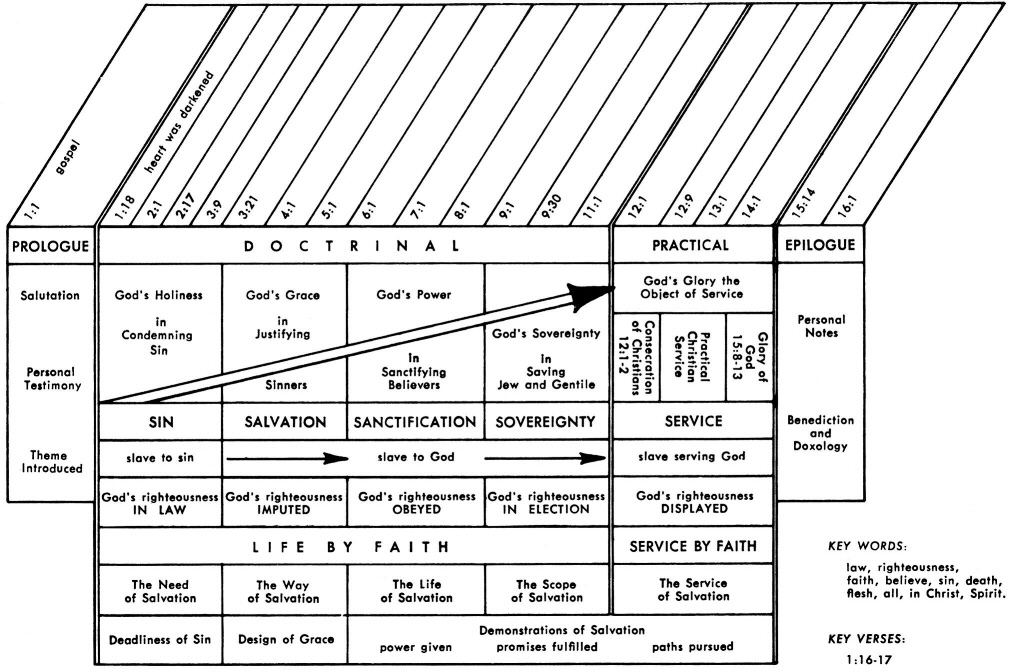
Click chart to enlarge
Chart from recommended resource Jensen's Survey of the NT - used by permission
Romans Overview Chart - Charles Swindoll
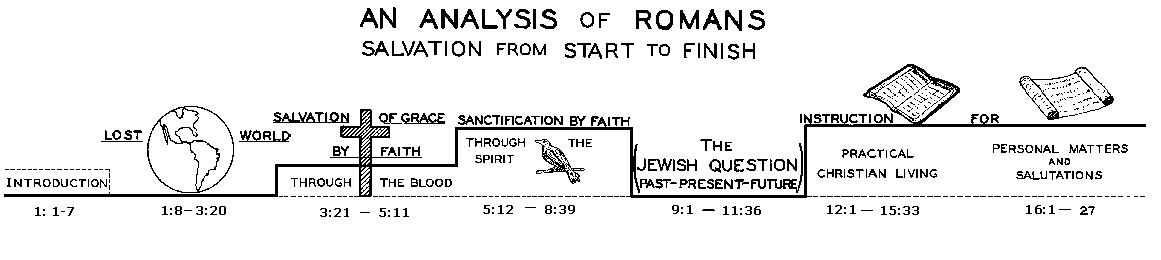
Source: Dr David Cooper
Click to Enlarge
R Ruin (Romans 1:17 – 3:20) – The utter sinfulness of humanity
O Offer (Romans 3:21-31) – God’s offer of justification by grace
M Model (Romans 4:1-25) – Abraham as a model for saving faith
A Access (Romans 5:1-11) – The benefits of justification
N New Adam (Romans 5:12-21) – We are children of two “Adams”
S Struggle w/ Sin (Romans 6-8) Struggle, sanctification, and victory
|
ROMANS ROAD |
||||
| Romans 1:18-3:20 | Romans 3:21-5:21 | Romans 6:1-8:39 | Romans 9:1-11:36 | Romans 12:1-16:27 |
| SIN | SALVATION | SANCTIFICATION | SOVEREIGNTY | SERVICE |
| NEED FOR SALVATION |
WAY OF SALVATION |
LIFE OF SALVATION |
SCOPE OF SALVATION |
SERVICE OF SALVATION |
| God's Holiness In Condemning Sin |
God's Grace In Justifying Sinners |
God's Power In Sanctifying Believers |
God's Sovereignty In Saving Jew and Gentile |
Gods Glory The Object of Service |
| Deadliness of Sin |
Design of Grace |
Demonstration of Salvation | ||
| Power Given | Promises Fulfilled | Paths Pursued | ||
| Righteousness Needed |
Righteousness Credited |
Righteousness Demonstrated |
Righteousness Restored to Israel |
Righteousness Applied |
| God's Righteousness IN LAW |
God's Righteousness IMPUTED |
God's Righteousness OBEYED |
God's Righteousness IN ELECTION |
God's Righteousness DISPLAYED |
| Slaves to Sin | Slaves to God | Slaves Serving God | ||
| Doctrine | Duty | |||
| Life by Faith | Service by Faith | |||
|
Modified from Irving L. Jensen's chart above |
||||
Romans 1:20 For since the creation of the world His invisible attributes, His eternal power and divine nature, have been clearly seen, being understood through what has been made, so that they are without excuse. (NASB: Lockman)
Greek: ta gar aorata autou apo ktiseos kosmou tois poiemasin nooumena (PPPNPN) kathoratai, (3SPPI) e te aidios autou dunamis kai theiotes, eis to einai (PAN) autous anapologetous
BGT τὰ γὰρ ἀόρατα αὐτοῦ ἀπὸ κτίσεως κόσμου τοῖς ποιήμασιν νοούμενα καθορᾶται, ἥ τε ἀΐδιος αὐτοῦ δύναμις καὶ θειότης, εἰς τὸ εἶναι αὐτοὺς ἀναπολογήτους,
ESV For his invisible attributes, namely, his eternal power and divine nature, have been clearly perceived, ever since the creation of the world, in the things that have been made. So they are without excuse.
KJV For the invisible things of him from the creation of the world are clearly seen, being understood by the things that are made, even his eternal power and Godhead; so that they are without excuse:
NET For since the creation of the world his invisible attributes– his eternal power and divine nature– have been clearly seen, because they are understood through what has been made. So people are without excuse.
NIV For since the creation of the world God's invisible qualities--his eternal power and divine nature--have been clearly seen, being understood from what has been made, so that men are without excuse.
NLT (revised) For ever since the world was created, people have seen the earth and sky. Through everything God made, they can clearly see his invisible qualities-- his eternal power and divine nature. So they have no excuse for not knowing God.
NLT (original) From the time the world was created, people have seen the earth and sky and all that God made. They can clearly see his invisible qualities--his eternal power and divine nature. So they have no excuse whatsoever for not knowing God. (NLT - Tyndale House)
Phillips: For since the beginning of the world the invisible attributes of God, e.g. his eternal power and divinity, have been plainly discernible through things which he has made and which are commonly seen and known, thus leaving these men without a rag of excuse. (Phillips: Touchstone)
Wuest: for the things concerning Him which are invisible since the creation of the universe are clearly seen, being understood by means of the things that are made, namely, His eternal power and divine Being, resulting in their being without a defense. (Eerdmans Publishing - used by permission)
Young's Literal: for the invisible things of Him from the creation of the world, by the things made being understood, are plainly seen, both His eternal power and Godhead -- to their being inexcusable;
FOR SINCE THE CREATION OF THE WORLD HIS INVISIBLE ATTRIBUTES: ta gar aorata autou apo ktiseos kosmou:
- For since the creation of the world His invisible attributes John 1:18; Colossians 1:15-16; 1Ti 1:17; 6:16; Heb 11:27
- Ro 1:19; Deut 4:19; Job 31:26, 27, 28; Ps 8:3; Ps 33:6, 7, 8, 9; Ps 104:5,31; Ps 119:90; Ps 139:13; Ps 148:8, 9, 10, 11, 12; Mt 5:45
- Romans 1 Resources - Multiple Sermons and Commentaries
Related Passages:
Genesis 1:1 (commentary) In the beginning God created the heavens and the earth.
Colossians 1:15-16+ He (JESUS CHRIST) is the image of the invisible God (Heb 1:3), the firstborn of all creation. 16 For by Him all things were created, both in the heavens and on earth, visible and invisible, whether thrones or dominions or rulers or authorities–all things have been created through Him and for Him.
Ps 19:1-6 - For the choir director. A Psalm of David. The heavens are telling of the glory of God; And their expanse is declaring the work of His hands. 2Day to day pours forth speech, And night to night reveals knowledge. 3There is no speech, nor are there words; Their voice is not heard. 4Their line has gone out through all the earth, And their utterances to the end of the world. In them He has placed a tent for the sun, 5Which is as a bridegroom coming out of his chamber; It rejoices as a strong man to run his course. 6Its rising is from one end of the heavens, And its circuit to the other end of them; And there is nothing hidden from its heat.
COMMENT - Note the repeated emphasis in Psalm 19 - "telling", "declaring", "pours forth speech", "reveals knowledge", "utterances". And the extent of this clear proclamation - "all the earth", "end of the world". Observe that in the opening verse of Psalm 19, David writes that "The heavens are telling (LXX translates the Hebrew word for "telling" with the verb anagello in the present tense = the heavens are continuously announcing in detail) of the glory of God" In short anyone who has ever looked into the glittering night sky or at a radiant red-orange sunset has no excuse to not believe in God! But humanity today prefers Hollywood or computer video games to seeing the "things" of the glorious God in the heavens. Beloved, when was the last time you walked outside and gazed at the moon and stars made by our Creator?
NATURAL REVELATION
DEMONSTRATES THE INVISIBLE GOD
John Piper writes that...Creation is God's poiema- Work of Art --What does He do to make Himself evident? He made the world. He created - like a potter, or a sculptor or a poet, except He created out of nothing. In verse 20, when it says that God is "understood through what has been made," the words "what has been made" stand for one Greek word (which you will all recognize), the word poiema. It's the word from which we get "poem." The universe and everything in it is God's work of art. What's the point of this word? The point is that in a poem there is manifest design and intention and wisdom and power. The wind might create a letter in the sand, but not a poem. That's the point. God acted. God planned. God designed. God crafted. He created and made. And in doing that, Paul says in v19, God made himself evident to all mankind. The universe is a poem about God. (Reference)
For - (1063) (gar) is a subordinating conjunction which Introduces the explanation of how God made a knowledge of Him evident to all mankind (Ro 1:19). Whenever you encounter a term of explanation like "for" (>7000 uses in NT - not all are explanatory but most are, especially at beginning of a passage), ask God to enable you to recognize that small conjunction as an invitation, an opportunity to pause and ponder the passage in the power of the Spirit by asking the 5W/H questions, always asking at least one - "What is the text explaining?" which will "force" you to examine the previous passage(s) (the context). As you prayerfully yield to and depend on your Teacher the Spirit to guide you into all the Truth (1Cor 2:12-16, 1Jn 2:20, 27, Jn 16:13), you will be amazed at the insights and illumination He will reveal to the eyes of your heart! And as you practice this simple discipline of slowing down and "chewing your food" (Mt 4:4, Lk 4:4) instead of speed reading the text, you will begin to experience the blessed fruits of meditation. In other words what you are doing by pausing to ponder the passage is you are musing on the passage, "chewing the cud" (Hebrew idea of meditation) and in effect carrying out a "mini-meditation" so to speak."
Hodges writes that "This verse is a confirmation and amplification of the preceding, inasmuch as it proves that God does manifest Himself to men, shows how this manifestation is made, and draws the inference that men are, in virtue of this revelation, inexcusable for their impiety. The argument is, God has manifested the knowledge of Himself to men, for the invisible things of Him, that is, his eternal power and Godhead, are, since the creation, clearly seen, being understood by His works; they are therefore without excuse. - (Commentary on the Epistle to the Romans - Online)
Newell quips that “The heavens declare the glory of God.” But humanity today prefers Hollywood’s “sound-pictures” to seeing the “things” of the glorious God in the heavens,—beholding His works, and hearing their speech. How long since you have gone out and gazed at moon and stars, made by the blessed God, travelling in such quiet glory, beauty, power, and order? Men know, if they care to know, that an infinite Majesty made and controls this. (Romans Verse-by-Verse)
Since the creation (ktisis) of the world (kosmos) His invisible (aoratos) attributes - David has the best commentary on this verse writing "The heavens are telling (LXX = set out in detail) of the glory of God; and their expanse is declaring (LXX = proclaiming openly) the work of His hands. 2 Day to day pours forth speech, And night to night reveals knowledge." (Psalm 19:1-2)
Visible Nature speaks of nature's invisible God.
Note the paradox -- God's creation does not audibly speak and yet it does speak. Mankind is enshrouded and enslaved in the darkness of their sin and blind to God, and yet in infinite grace and mercy gives a glimpse of His glory, that it might incite in lost sinners to desire to know Him personally. invisible things which are visible! This state of things has been true since the creation of the universe. The eternal power and Godhead of the Creator have been since that time and are now understood by the things that have been made, namely, the material creation. Man, reasoning upon the basis of the law of cause and effect, which law requires an adequate cause for every effect, is forced to the conclusion that such a tremendous effect as the universe, demands a Being of eternal power and of divine attributes.
However our response to God's natural (general) revelation can be one of two ways, one being desirable and the other being detrimental to the well being of our soul. We can be drawn to worship the Creator or we can be drawn to worship the creation itself. In short, man was made to worship something. If we refuse to worship God, the only alternative is that which is "no god", i.e., idols which come in many varieties. Moses warned...
And beware, lest you lift up your eyes to heaven and see the sun and the moon and the stars, all the host of heaven, and be drawn away and worship them and serve them, those which the LORD your God has allotted to all the peoples under the whole heaven. (Deut 4:19)
THOUGHT - Don't miss it - Worship first, then service! Corollary, you will serve what you worship so be careful what you worship!
Hodges explains that "By the invisible things of God Theodoret says we are to understand creation, providence, and the divine judgments; Theophylact understands them to refer to his goodness, wisdom, power, and majesty. Between these interpretations the moderns are divided. The great majority prefer the latter, which is obviously the better suited to the context, because the works of God are expressed afterwards by poiemata and because the invisible things are those which are manifested by his works, and are explained by the terms “power and Godhead.” (Commentary on the Epistle to the Romans - Online)
Henry Morris on since the creation - Since these things should have been seen and understood by men from the very time of the creation of the world, it is clear that the latter did not take place billions of years before men appeared on earth, as evolutionists and progressive creationists have alleged. Men and women have been in the world ever since its very beginning, and all should have recognized the reality of God, even before God gave His written revelation. Those who apply uniformitarian reasoning and natural processes to deduce a multi-billion year age for the world are merely seeking a means to avoid the overwhelming evidence of the special creation of all things in the beginning, and are “without excuse.”
Charles Hodges adds that God" ...has never left himself without a witness. His existence and perfections have ever been so manifested that His rational creatures are bound to acknowledge and worship Him as the true and only God” (Ibid)
ALL CREATION IS
AN OUTSTRETCHED FINGER
POINTING TO GOD!
The Heavens reveal the power of God
To everyone living on earth;
But then the good news of the gospel must come
From those who've experienced new birth.
- Sper
Creation (2937) (ktisis) refers to bringing something into existence which has not existed before. The act of causing to exist that which did not exist before, especially God's act of bringing the universe into existence (cp He 11:3). It is notable that ktisis always occurs in the New Testament in connection with God’s creative activities (see note below regarding use in 1Pe 2:13). Zodhiates says ktsis is "Something founded, i.e., of a city, colonization of a habitable place." (BORROW Complete Word Study Dictionary: New Testament)
Ktisis refers to
(1) The act of creating, creation, God's creative action (Ro 1:20)
(2) In the passive sense as the equivalent of the thing created whether animate or not. The result of a creative act or that which is created. Of individual things created (Ro 1:25, He 4:13, Ro 8:39). The sum total of all that has been created (Mk 10:6, 13:19, Ro 8:22, Col 1:15, Col 1:23, 2Pe 3:4, Rev 3:14). Of every genuine believer who is a new creation (created by the Spirit, Ro 3:3) in Christ (2Co 5:17, Gal 6:15).
(3) An institution, ordinance, ordering, authority - as that which is established ("created") by God in which authority is entrusted to human beings. A "system of established authority that is the result of some founding action...the act by which an authoritative or governmental body is created." (BORROW BDAG).
Comment: John MacArthur comments on ktisis meaning "institution" as used in 1Pe 2:13 - "God has created all the foundations of human society—work, family, and the government. Peter designated society human not as to its origin, but as to its function or sphere of operation. The apostle’s intent was therefore to command submission to every human institution because every one is God ordained. Believers submit to civil authorities, to employers (1Pe 2:18; Ep 6:5; Col 3:22), and in the family (Ep 5:21-6:2). In the latter two areas, the motive is also for the Lord’s sake (Ep 5:22; Ep 6:1, Eph 6:5, 6; Col 3:18, 20, Col 1:22, 23, 24).
Ktisis - 19x in the NT - Mk 10:6; 13:19; 16:15; Ro 1:20, Ro 1:25; Ro 8:19, Ro 8:20, 21, Ro 8:39; 2Co 5:17; Gal. 6:15; Col 1:15, 23; He 4:13; He 9:11; 1Pe 2:13; 2Pe 3:4; Re 3:14. The NAS translate ktisis as created thing(1), creation(14), creature(3), institution(1). There are no uses in the non-apocryphal Septuagint.
NIDNTT - ktisis, originally foundation, describes in a broad sense rather the process of becoming and coming into being, resulting from a decision of the will.
Ktisis refers to
to the act of creation or the thing that was created. Another form of the word found in the New Testament is the verb ktizo, which originally meant to build or found. In classical Greek, it also assumed the meaning of colonize, or bring into being. The noun ktisma also denotes the results of creation.
In the Greek papyruses of the New Testament period, all three forms of the term are used. Ktisis (creation) is the regular term for the founding of a city (Moulton and Milligan). The noun ktisma (created thing) does not occur until this period. It is always used in a concrete sense. It is used to refer to the foundation of the world. The verb ktizo is used to refer to the founding of a city, the establishment of friendship, or the creation by God of heaven and earth.
The verb ktizo is used sixty-six times in the Greek Old Testament. Of these, sixteen times it is used to translate the Hebrew barah (to create out of nothing). It is also used to express a variety of related terms. Its basic meaning is to express the "basic act of will behind the bringing into being, foundation or institution of something.""
In the New Testament ktizo and its cognate words occur thirty-eight times. The vast majority of these uses refer to the creation of the world as an act of God (Mk 13:19; Re 10:6) or of things that are part of that creation, such as meats (1Ti 4:3). Several passages, however, speak of the new creation, which is brought about through faith in Christ. Because of sin, people must be restored in order to fellowship with the creation. Even the inanimate creation "groans and travails" waiting for the restoration (Ro 8:22, author's translation). The past, with the old person, is canceled out by the cross, and the new person is put on, like a clean garment. The nature of the new person is described in Colossians 3:10. It is "renewed in knowledge after the image of him that created him."
The purpose of this new creation is also described. Eph 2:10 says, "We are his workmanship created in Christ Jesus unto [for the purpose of] good works." (author's translation). God's purpose is fulfilled in this kind of obedient life. Our lives are to be an offering of thanksgiving, holy unto God. James said that God has begotten us "with the word of truth, so that we might be [infinitive of purpose] a kind of firstfruits of his creatures" (ktisma, Jas 1:18).
Individually the believer is a "new creation," but not only that, he is part of a larger creation brought about by the cross. Christ has "abolished in His flesh the enmity" in order to make (ktizo) in Himself one new man out of two. The new man spoken of here is, of course, the church, which is created by bringing both Jew and Gentile together in Christ to make one new body (Ep 2:15).
Finally, Paul made it clear that human works and ceremonies are powerless to save. He said, "For in Christ Jesus neither circumcision avails anything, nor uncircumcision, but a new creation" (ktisis, Gal 6:15). There is no renewal without being "in Christ" (2Co 5:17).
Reformation of the old person is inadequate to save. The old person must be destroyed and a new one created. Human beings may make things, but only God can create. It is He who reforms the believers and makes them anew in the image of Christ (Col 3:10). Faith, repentance, conversion, and regeneration would not be possible without the work of the Holy Spirit in the heart of persons. On the other hand, when individuals have received Christ and the Spirit of God has recreated them, it is just as impossible that the effects of that change never issue forth in good works. (Salvation Word Studies by Gerald Cowen)
World (2889) (kosmos) describes an orderly arrangement and here refers to the order of the universe. The Greeks used kosmos to refer to the universe from the fact of its perfect arrangement. It was used in this case as opposed to the Greek word chaos which was used by the Greeks of the first state of existence, the rude, unformed mass out of which the universe was made. Thus the Greeks believed that the original state of the universe was one of chaos which is in line with the theory of evolution and the so-called "big bang" theory, which has been "exploded" by Creationists and believing scientists, even though this theory is still held to tenaciously by the majority of the scientific world.
Invisible (517) (aoratos from a = without + horáo = see) is that which cannot be seen with physical eyes. That which cannot be seen or is imperceptible by the sight.
ISBE article on Invisible - This term is used as an attribute of God in every biblical occurrence except Col. 1:16, where it refers to ranks of unseen angels and other spiritual powers. That no one had seen God at Sinai is stated in the OT (Ex 34:20; Deut. 4:12), and, in spite of God’s special self-disclosure to Moses (Ex. 33:18, 19, 20, 21, 22, 23; Nu. 14:14), it became axiomatic in Judaism that no one had seen or could see God in this present age (SB, II, 362f; cf. Mt. 5:8). The influence of this concept is reflected in the Johannine writings, with their emphasis that “no one has seen God” (Jn 1:18; 5:37; 6:46; 14:9; 1Jn. 4:12), and in the Pauline tradition as well (Rom. 1:20; Col. 1:15, 16; 1Ti 1:17; 3:16). The use of aóratos in the context of a doxology (1Ti 1:17) and in an adjectival clause with the pronoun “who” (“who is invisible”; Heb 11:27) shows that “invisible” was one of the ascriptions to God used in early Christian liturgy (Bromiley, G. W. The International Standard Bible Encyclopedia, Revised. Wm. B. Eerdmans)
Aoratos -- Ro 1:20; Col. 1:15, 16; 1Ti 1:17; Heb 11:27.
Septuagint - Ge 1:2; Is 45:3.
Genesis 1:2 The earth was formless (Lxx - aoratos) and void, and darkness was over the surface of the deep, and the Spirit of God was moving over the surface of the waters.
Isaiah 45:3 “I will give you the treasures of darkness And hidden wealth of secret places (Lxx - aoratos), So that you may know that it is I, The LORD, the God of Israel, who calls you by your name.
AN ILLUSTRATION OF NOT "SUPPRESSING" (Ro 1:18) THE TRUTH OF CREATION: By way of introduction to Paul's inspired discussion in Romans 1 describing God's gracious revelation and man's great rebellion against the Creator and His clear truth of the Creation, it might be enlightening to read what Isaac Newton (1642-1727), one of the greatest minds to ever live, had to say about this subject. The mathematical and scientific discoveries of Sir Isaac Newton are "astronomical" to use a pun! Some of the most notable achievements include the invention of calculus, discovery of the laws of motion and gravitation, and construction of the first reflecting telescope. And to the surprise of many truth suppressing modern scientists (not all of course!), Newton was a man of genuine, devout Christian faith and he spent a great portion of time studying Scripture with a special interest in prophecy. For example, Newton wrote "I have a fundamental belief in the Bible as the Word of God, written by men who were inspired. I study the Bible daily." This next comment relates especially to Romans 1 - Atheism is so senseless. When I look at the solar system. I see the earth at the right distance from the sun to receive the proper amounts of heat and light. This did not happen by chance. (Ed: "Amen!") At the time of his death, Sir Isaac Newton left more than a million words of notes on, you guessed it...the Bible! Six years after his death, Observations Upon the Prophecies of Daniel and the Apocalypse of St. John was published. Not only was Isaac a great scientist but also a dedicated student of the Bible.
THOUGHT - Dear Lord, by your Spirit may his tribe increase in these last days for the glory of the King of kings. Amen.
|
God's Attributes in Romans |
||||||||||||||||||||
|
- Summary Chart - The Attributes of God
- Spurgeon on the Attributes of God
- Eternal
- Faithfulness
- Foreknows
- Good
- Holy
- Immutable
- Impartial
- Incomprehensible
- Infinite
- Jealous
- Justice
- Longsuffering
- Love
- Mercy
- Omnipotent
- Omnipresent
- Omniscient
- Providence
- Righteous
- Self-existent
- Self-sufficient
- Sovereign
- Transcendent
- Truth
- Wise
- Wrath
HIS ETERNAL POWER: e te aidios autou dunamis:
- Eternal power - Ro 16:26; Ge 21:33; Deut 33:27; Ps 90:2; Isaiah 9:6; 26:4; 40:26; 1Ti 1:17; Heb 9:14
- Romans 1 Resources - Multiple Sermons and Commentaries
Eternal (126) (aidios from aeí = ever, always) means everlasting, having infinite duration, lasting or enduring forever, existing or continuing without end. Eternal in this context speaks of God's power which has no beginning and no end, even as God Himself is without beginning or end! Although aidios is not used in the following verse, the idea is the same...
Deuteronomy 33:27 The eternal God is a dwelling place, and underneath are the everlasting arms (cp "eternal power"); and He drove out the enemy from before you, and said, 'Destroy!' (cp Is 9:6 Eternal or Everlasting Father)
Aidos is used elsewhere in the New Testament only in Jude 1:6 (twice in the apocrypha - 4 Ma 10:15; Wis. 7:26).
Jude 1:6 And angels who did not keep their own domain, but abandoned their proper abode, He has kept in eternal bonds under darkness for the judgment of the great day.
Both the unchangeableness and omnipotence of God (see discussion of His omnipotence) are here in view, as exhibited in creation. The Creator, who made all that we see around us and constantly sustains it, must be a being of awesome power.
Related resources:
ISBE article on Eternal...
ETERNAL - e-tur'-nal (`olam; aionios, from aion): The word "eternal" is of very varying import, both in the Scriptures and out of them.
1. `Olam:
In the Old Testament, the Hebrew word `olam is used for "eternity," sometimes in the sense of unlimited duration, sometimes in the sense of a cycle or an age, and sometimes, in later Hebrew, in the signification of world. The Hebrew `olam has, for its proper New Testament equivalent, aion, as signifying either time of particular duration, or the unending duration of time in general. Only, the Hebrew term primarily signified unlimited time, and only in a secondary sense represented a definite or specific period. Both the Hebrew and the Greek terms signify the world itself, as it moves in time.
2. Aion, Aionios:
In the New Testament, aion and aionios are often used with the meaning "eternal," in the predominant sense of futurity. The word aion primarily signifies time, in the sense of age or generation; it also comes to denote all that exists under time-conditions; and, finally, superimposed upon the temporal is an ethical use, relative to the world's course. Thus aion may be said to mean the subtle informing spirit of the world or cosmos--the totality of things. By Plato, in his Timaeus, aion was used of the eternal Being, whose counterpart, in the sense-world, is Time. To Aristotle, in speaking of the world, aion is the ultimate principle which, in itself, sums up all existence.. In the New Testament, aion is found combined with prepositions in nearly three score and ten instances, where the idea of unlimited duration appears to be meant. This is the usual method of expressing eternity in the Septuagint also. The aionios of 2 Cor 4:18 must be eternal, in a temporal use or reference, else the antithesis would be gone.
3. Aidios:
In Ro 1:20 the word aidios is used of Divine action and rendered in the King James Version "eternal" (the Revised Version (British and American) "everlasting"), the only other place in the New Testament where the word occurs being Jude 1:6, where the rendering is "everlasting," which accords with classical usage. But the presence of the idea of eternal in these passages does not impair the fact that aion and aionios are, in their natural and obvious connotation, the usual New Testament words for expressing the idea of eternal, and this holds strikingly true of the Septuagint usage also. For, from the idea of aeonian life, there is no reason to suppose the notion of duration excluded. The word aionios is sometimes used in the futurist signification, but often also, in the New Testament, it is concerned rather with the quality, than with the quantity or duration, of life. By the continual attachment of aionios to life, in this conception of the spiritual or Divine life in man, the aeonian conception was saved from becoming sterile.
4. Enlargement of Idea:
In the use of aion and aionios there is evidenced a certain enlarging or advancing import till they come so to express the high and complex fact of the Divine life in man. In Greek, aiones signifies ages, or periods or dispensations. The aiones of Heb 1:2, and Heb 11:3, is, however, to be taken as used in the concrete sense of "the worlds," and not "the ages," the world so taken meaning the totality of things in their course or flow.
5. Eternal Life:
Our Lord decisively set the element of time in abeyance, and took His stand upon the fact and quality of life--life endless by its own nature. Of that eternal life He is Himself the guarantee--"Because I live, ye shall live also" (Jn 14:19). Therefore said Augustine, "Join thyself to the eternal God, and thou wilt be eternal." (Phrase "eternal life" in NAS - Mt 19:16, 29; 25:46; Mark. 10:17, 30; Lk 10:25; 18:18, 30; Jn 3:15, 16, 36; 4:14; 5:24, 39; 6:27, 40, 47, 54, 68; 10:28; 12:50; 17:2, 3; Ac 13:46, 48; Ro 2:7; 5:21; 6:22, 23; Gal. 6:8; 1Ti 1:16; 6:12; Titus 1:2; 3:7; 1Jn. 1:2; 2:25; 3:15; 5:11, 13, 20; Jude 1:21)
Power (1411) (dunamis [word study] - words derived from the stem duna— all have the basic meaning of “being able,” of “capacity” in virtue of an ability) refers to inherent ability, the power or ability to carry out some function, the potential for functioning in some way, the power residing in a thing by virtue of its nature. It conveys the idea of effective, productive energy, rather than that which is raw and unbridled. God's dunamis has always existed.
From a paper by B B Warfield in Jan,1889 on Darwin's arguments against Christianity:
The history of the drift by which Mr. Darwin was separated from faith in a divine order in the world, divides itself into two well-marked periods. The first of these, which was completed at about the time when he reached his fortieth year, ends with the loss of his Christianity. During the second, which extended over the remainder of his life, he struggled, with varying fortunes, but ever more and more hopelessly, to retain his standing at least as a theist. At the end of the first he no longer believed that God had ever spoken to men in his Word; at the end of the second he more than doubted whether the faintest whisper of his voice could be distinguished in his works. He was never prepared dogmatically to deny His existence; but search as he might he could not find Him, and he could only say that if He existed He was, verily, a God that hides Himself.
For an interesting article on whether Darwin's had a so called deathbed conversion (click here)
AND DIVINE NATURE: kai theiotes:
- Acts 17:29; Colossians 2:9
- Romans 1 Resources - Multiple Sermons and Commentaries
NATURE REVEALS
GOD IS DIVINE
Divine nature (2305) (theiotes from theos = God; See ISBE note below) usually refers to performance that one might properly associate with a divinity. Theiotes emphasizes the divine nature and properties or the whole of that which goes to make up our idea of God. In a sense theiotes is a good summary term for the attributes which constitute deity, signifying the sum-total of the divine attributes.
See also the commentary associated with tó theíon in Acts 17:29, the the commentary associated with tó theíon in 2 Pe 1:3,4; the commentary associated with theiótēs in Ro. 1:20; and the commentary associated with theótēs in Col. 2:9);
Theiotes describes the quality of theos and corresponds more to Latin divinitas from divus, divine. It refers to the quality or characteristics pertaining to deity and thus refers to divinity, divine nature or divineness.
Theiotes could be translated divine majesty and is seen supremely in Jesus Who uniquely bears the divine image (cf. 2Cor. 4:4; see Heb 1:3). He is God’s full revelation in human form (see Col 1:19; Col 2:9). The wonderful truth of the gospel is that fallen mankind, through faith in Christ, will share Christlikeness (cf. Heb 12:10; 1 Jn 3:2). The image of God in humanity (cf. Ge 1:26,27) has been restored!
Theotes is the Divine Personality and theiotes the Divine Nature and properties (See ISBE note below)
Wuest writes that...
The Greek word translated “Godhead” needs some study. It is theiotēs. We will compare it to theotēs (also translated “Godhead” a.v.) in order to bring out its meaning more clearly. Theotēs is used by Paul in Colossians 2:9 (see note) where he speaks of the fact that in our Lord “there is permanently at home all the fulness of absolute deity bodily” (in His incarnate state).
Trench comments, "St. Paul is declaring that in the Son there dwells all the fulness of absolute Godhead; they were no mere rays of divine glory which gilded Him, lighting up His Person for a season and with a splendor not His own; but He was, and is, absolute and perfect God.”
Commenting on the use of theiotēs in Romans 1:20, he says, "St. Paul is declaring how much of God may be known from the revelation of Himself which He has made in nature, from those vestiges of Himself which men may everywhere trace in the world around them. Yet it is not the personal God whom any man may learn to know by these aids: He can be known only by the revelation of Himself in His Son; but only His divine attributes, His majesty and glory … it is not to be doubted that St. Paul uses this vaguer, more abstract, and personal word, just because he would affirm that men may know God’s power and majesty, His divine power (2Peter 1:3) from His works; but would not imply that they may know Himself from these, or anything short of the revelation of His eternal Word. Motives not dissimilar induce him to use to theion rather than ho theos in addressing the Athenians on Mars Hill (Acts 17:29).”
Vincent says, "Godhead expresses deity (theotēs). Theiotēs is godhood, not godhead. It signifies the sum-total of the divine attributes."
Thus, through the light of the created universe, unsaved man recognizes the fact that there is a supreme Being who created it, who has eternal power and divine attributes, a Being to whom worship and obedience are due. This is the truth which unsaved man is repressing. Herein lies the just condemnation of the entire race, since it has not lived up to the light which it has. This, Paul says, renders man without excuse.(Wuest Word Studies - Eerdman Publishing Company Volume 1, Volume 2, Volume 3 - used by permission)
Vine notes that theiotes is "used here only in the New Testament, is associated in meaning with theotes, Godhead, which is used only in Colossians 2:9 (see note). There is, however, a certain distinction in meaning and accordingly the former is here translated “divinity” and the latter “godhead.” The difference in the words is appropriate to the respective passages. Here Paul is speaking of the revelation which God has given in nature of His divine attributes. Man can thereby know certain facts about Him, such as His divinity, but cannot know God personally. Such knowledge can come only through the Son of God (cp. Jn 17:25 with Jn 1:18). In Colossians 2:9 (see note) Paul is speaking of the absolute Godhead of Christ, the fullness of which dwells in Him, and not of an external revelation of His divine attributes. Hence the suitability of theotes, deity, in that verse. (Collected writings of W. E. Vine. Nashville: Thomas Nelson )
ISBE (Revised) entry under "Deity" - DEITY [Gk. tó theíon] (Acts 17:29); AV GODHEAD; [theiótēs] (Rom. 1:20); AV GODHEAD; [theótēs] (Col. 2:9); AV, NEB GODHEAD. These three closely related Greek terms are descriptive of the basic nature of God. They seem to vary but slightly in connotation.
A. Tó Theíon. Tó theíon (theios) “the divine thing,” is derived from the adjective theíos, meaning “pertaining to God,” “divine” (2 Pet. 1:3f). It signifies “God” in an impersonal sense. In Acts 17:29, in Paul’s speech to Greek intellectuals on Mars Hill, the term tó theíon draws attention to the qualitative aspect of God. Paul demonstrates the Greeks’ shallow conception of God, seeking to heighten their receptivity to the revealed truth of the gospel of Christ. The term tó theíon was common in their discussions, being used to designate the deity apart from any reference to a particular god. Paul focuses attention upon that quality of “the divine” which distinguishes God from all else. English terms based on the word “divine,” however, are used too commonly and are therefore inadequate to set forth the connotation of tó theíon (see II. A, B below). The idea is more adequately represented by “the Deity,” so that an appropriate translation of Acts 17:29 might be: “It is inconceivable that ‘the Deity’ can be appropriately represented by the artistic talents of men working with mere earthly elements.”
B. Theiótēs The term theiotes is an abstract noun closely related to tó theíon, derived from the same adjective, theíos. It is commonly understood as a summary term for the attributes of deity. However, the term merely “defines” with regard to essence, signifying “the quality of the divine,” that character which makes God God, and sets Him apart as worthy of worship. The Greeks used the term of their deities. Later it was applied to men by the Roman imperial cult as a term for the divinity of imperial majesty. It is rarely used in later Jewish works and occurs in biblical literature only in Wisd. 18:9 and Ro 1:20. The term is not as impersonal as tó theíon, but its abstractness does not lend a readily discernible distinction. Its meaning is approximated by “deity,” perhaps “divineness.”
In Ro. 1:20 theiótēs is used of that nature of the Creator discernible to the mind by observation of the existing worlds. Verse 19 states, “For what can be known about God is plain to them, because he has shown it to them.” Verse 20 affirms that man’s mind is able to form a concept of the invisible nature of God by visual perception of the universe. The discernible features of His transcendent being (“his invisible nature”) are specifically His “eternal power” and “deity.” The universe displays the eternal power it took to bring the universe into existence; in addition it displays the divine character of the one who created it, i.e., His deity. Specific attributes are not in view in the term theiótēs, simply His quality of “Godness,” which depicts Him as worthy of worship. But men suppressed this truth in unrighteousness (v 18), and are without excuse, subject to the wrath of God revealed from heaven (v 20). They did not acknowledge “his deity” as it is discernible in the things He has created.
C. Theótēs - Theotes is a kindred term (to theiotes), but is distinctive in that it is derived from the word “God” (theós). On this basis it is the most personal of the three terms (to theion - Acts 17:29, theiotes - Ro 1:20, theotes - Col 2:9), and is nearly a name. Whereas tó theíon marks “the quality of deity,” and theiótēs connotes “that which makes God God,” theótēs signifies “the being of God.” Theótēs apparently denotes the utmost idea of God. On heathen lips it could do no more than designate their highest concept of God, “The Supreme Being.” In Col. 2:9 Paul uses theótēs in declaring that “the whole fulness of deity dwells bodily” in Christ. Although it conveys the idea of a “being,” the use of “Divine Being” here would impersonalize the total expression, “the whole fulness of the Divine Being.” The term “deity,” or even “the Deity,” is likewise impersonal; furthermore, the connotation “being” is lacking. A term that better preserves the personal and qualitative aspect of theótēs is “godhead” (see III below). The total expression “the whole fulness of the Godhead,” then, signifies the sum of all that enters into the conception of “Godhead,” God in nature, character, and being. All this dwells in Christ “bodily,” i.e., in such a manner as to be shown in a bodily organism. Cf. Jn. 14:9, where Philip’s request that Jesus show them the Father was met by the Lord’s response, “He who has seen me has seen the Father.”
II. English Terms
In English the words most representative of these three Greek terms are “deity,” “divinity,” and “godhead.”
A. Deity “Deity” means “divine character” or “nature” and is used of false gods as well as of the persons of the trinity. “Deity” is qualitative in its import. The expression “the deity of Christ” is much stronger than “the divinity of Christ,” probably because “divinity” is commonly applied to men and things. When used with the article, the resultant term “the Deity” becomes a designation of God the Supreme Being, although it can also be used of specific lesser deities. Hence, the term “deity,” when used with the article, is qualitative and somewhat personal in connotation.
B. Divinity The term “divinity” is much like “deity” in that it refers to divine character or nature. But although it is used in connection with the persons of the trinity, it lacks the force of “deity.” These Latin derivatives bring into English the basic distinction created by the Latin fathers. Before the controversy about the deity of Christ, Latin had only the general term divinitas. The Latin fathers coined the term deitas as a distinctive rendering of the Gk. theótēs, and employed it to express the “deity” of the persons of the trinity. They, as well as the Greek fathers, needed unique terms to combat the attempt to ascribe to the Son and the Spirit a reduced “divinity.” This distinctiveness is largely preserved in English, although there is a tendency for “divinity” and “deity” to merge in meaning.
C. Godhead The English term “godhead” was originally a synonym for “Godhead,” a word that has all but passed out of use. As manhood is that quality which makes a man a man, so godhead is that which makes God God. This significance, however, is not readily discernible in the term today. It is presently a somewhat neutral term for the essential being of God as unique. By prefixing the article, the term becomes an abstract way of saying “God.” In fact, the article prefixed to any of these terms, “the Deity,” “the Divinity,” or “the Godhead,” draws attention to the constitutive qualities that make God the kind of being we call “God.” In strength of affirmation, or personalizing force, “godhead” seems most substantial, with “deity” nearly as strong and “divinity” weakest in this regard. All are abstract terms, nearly synonymous in meaning, yet the context will often decide the choice of one word over another.
III. Summary
Since the context of Col. 2:9 deals with the person of Christ, Paul apparently chose a term distinctive in that respect, theótēs. The contexts of Acts 17:29 and Rom. 1:20 emphasize the character rather than the person of God. The terms used are impersonal in connotation. Because of these differences in context and word derivation it is preferable to use distinctive English terms. “Deity” seems appropriate for the concept of tó theíon in Acts 17:29 and for theiótēs in Rom. 1:20, but inadequate for theótēs in Col. 2:9. “Godhead” more adequately portrays the truth that all that constitutes God in person, character and being dwells in Christ the Son. Speaking of God in respect to His “Godness” the term “deity” is sufficient, but in reference to His person and/or being a designation with the word “god” seems preferable. (G. E. Montgomery)
HAVE BEEN CLEARLY SEEN: kathoratai (3SPPI):
- Romans 1 Resources - Multiple Sermons and Commentaries
IN PLAIN
SIGHT
In plain sight is an idiom that means in full, unrestricted view, open and visible to all. In a place that is easily seen. Not hidden from view!
Newell explains that "Paul connects the observing of the mighty and beautiful things of the universe with the consciousness of a personal God. Human science, through its telescope, observes the vast courses of the stars, moving with amazing accuracy in their orbits, but often counts it a mark of wisdom to doubt whether an intelligent Being exists at all! But, “the undevout astronomer is mad,” as said the great Kepler. No really great scientist today supports the Darwinian theory; and many,—and some of the most prominent scientific men are saying, There must be a God, a Creator. (Romans Verse-by-Verse)
Clearly seen (2529) (kathorao from katá = down or an intensifier + horáo = see and perceiving) literally means to look down, see from above, view from on high. The meaning is then generally to view or to consider. The idea is to acquire definite information with focus upon process of perception but associated with an intellectual apprehension. It means to behold fully, distinctly apprehend clearly see and discern clearly. This is the only NT use.
Here are the other uses of Kathorao in the LXX-- Ex 10:5; Nu 24:2; Deut 26:15; Job 10:4; 39:26.
Clearly seen is in the present tense indicates God's handiwork is continually on display to be (passive voice) perceived -- continuously beheld fully, distinctly apprehended. It is not as if God gives rebellious, truth rejecting mankind one brief peak as His glorious handiwork!
REVELATION OF GOD
GENERAL & SPECIAL
(1) General revelation = God's self-disclosure through the created world as in Ps 19:1 (cp Ro 1:20)
(2) Special revelation = God's disclosure of Himself by an act of direct revelation, specifically in His written Word as in Ps 19:7 (cp Heb 1:1,2, 2Pe 1:20, 21)
An Illustration - Bill Bruster, former pastor of the First Baptist Church in Abilene, tells of a young student from Nigeria named John who attended his church. Bruster asked him how he became a Christian. John answered, "When I was a little boy, running around in the bush country of Nigeria, I knew there was a God. I would stand among the trees and look up at the skies at night and know that someone made this world. I knew there was a God, but I didn't know what to call him. One day Josephine Skaggs, a Southern Baptist missionary, came to our village to teach us children how to read. She taught us how to read the Bible. There I discovered the name of the God who had revealed himself to me through the trees and the stars." We can know of God through this general revelation. However, to know God required special revelation, God's revelation in history and specifically God's revelation in Jesus Christ. (Quoted by Brian Harbour)
Vincent observes that...We have here an oxymoron, literally a pointedly foolish saying; a saying which is impressive or witty through sheer contradiction or paradox. Invisible things are clearly visible.
Theologians refer to this revelation as natural or general in contrast to the Scriptures which are classified as "special revelation" God’s natural revelation of Himself is not obscure or selective, observable only by a few perceptive souls who are specially gifted. His revelation of Himself through creation can be clearly seen by everyone.
The upshot is that no one has an excuse to say I see no evidence for a Creator, for a God. It takes a deliberate act of one's will to observe the design we see in creation and not acknowledge a Designer. Conscience and Creation is enough evidence to condemn every man. The people who should be shouting the loudest are scientists and doctors who look into the telescopes and microscopes. They see the design and order and plan. I am a medical doctor and it took 39 years before I saw His handiwork in Christ (My Testimony of His Grace) When you go to the art gallery and see a beautiful painting, you may not necessarily know the name of the artist who painted it but you can discern from the beauty and form and design that the artist was clearly a master.
Adrian Rogers tells of a man who owns a trucking company in the south where part of the hiring process is a lie detector test on which one of the questions is “Do you believe in God?". They have observed that even avowed atheists who answer this question "no" are shown to be liars by the lie detector!
The stars in their courses proclaim the great Creator's power
Forever singing as they shine,
The Hand that made us is divine.
- Joseph Addison
Napoleon, on a warship in the Mediterranean on a star-lit night, passed a group of his officers who were mocking at the idea of a God. He stopped, and sweeping his hand toward the stars, said, "Gentlemen, you must get rid of those first!"
George Washington Carver (1864-1903) chemist and educator wrote that...Nature is an unlimited broadcasting station, through which God speaks to us every hour, if we only will tune in.
QUESTION - What is natural (general) revelation?
ANSWER - Revelation in theology refers to information that comes from God to reveal truth about Himself or about ourselves and the world around us. Revelation is then divided into two types: natural revelation (or general revelation) and special revelation.
Special revelation is that which comes directly from God and is recorded in inspired Scripture. The content of this revelation is truth that we could not know unless God told us directly. For instance, the Trinity and justification by grace through faith in Christ would be impossible to “figure out” on our own. Our knowledge of such things comes only through special revelation. If a person or a people group does not have access to the Bible in their own language, they will be ignorant of the truth that can only be known through special revelation.
Natural revelation is truth about God that can be discerned by looking at the world around us and by looking within ourselves. Although not everyone has access to special revelation, the Bible makes it clear that people everywhere have access to natural revelation and that people are accountable for their response to it. Natural revelation assumes that the image of God and the mental faculties of logic are still enough intact for fallen humanity to receive and understand some knowledge about God.
Psalm 19:1–4 refers to the abundance and accessibility of natural revelation:
“The heavens declare the glory of God;
the skies proclaim the work of his hands.
Day after day they pour forth speech;
night after night they reveal knowledge.
They have no speech, they use no words;
no sound is heard from them.
Yet their voice goes out into all the earth,
their words to the ends of the world.”
The beginning of the book of Romans explains natural revelation and its implications:
“The wrath of God is being revealed from heaven against all the godlessness and wickedness of people, who suppress the truth by their wickedness, since what may be known about God is plain to them, because God has made it plain to them. For since the creation of the world God’s invisible qualities—his eternal power and divine nature—have been clearly seen, being understood from what has been made, so that people are without excuse. “For although they knew God, they neither glorified him as God nor gave thanks to him, but their thinking became futile and their foolish hearts were darkened. Although they claimed to be wise, they became fools and exchanged the glory of the immortal God for images made to look like a mortal human being and birds and animals and reptiles. “Therefore God gave them over in the sinful desires of their hearts to sexual impurity for the degrading of their bodies with one another. They exchanged the truth about God for a lie, and worshiped and served created things rather than the Creator—who is forever praised. Amen” (Romans 1:18–25).
According to the above passage, natural revelation is universal, and mankind ignores it to his own peril. Some things about God can be known by observing creation (Romans 1:19). Specifically, one can infer from creation that the Creator has great power and that He is divine—that is, worthy of being worshiped (verse 20). People should thank and glorify the Creator of such a wonderful creation (verse 21). However, the passage also says that people do not respond to natural revelation in worship or thanksgiving to God, and they are “without excuse” (verse 20). They should have known better. The universal response of sinful mankind is not to fall down in worship of the Creator but to suppress the truth (verse 18) and then worship and serve created things (verse 25), even making idolatrous images of them (verse 23).
Romans 1 goes on to list a multitude of sins that people who reject and suppress natural revelation are prone to engage in, even though they know these things are wrong (verse 31). These are people who do not have the law of God in written form, but they have the law “written on their hearts” (Romans 2:15). The conscience is part of natural revelation. There are certain things that people know are right and other things that they know are wrong. The conscience is not infallible, and it can be corrupted, but when people do something that they know to be wrong without ever being told it is wrong, they are sinning by violating what God has revealed to them.
Finally, natural revelation is associated with the principle of consistency. Romans 2:1 says, “You, therefore, have no excuse, you who pass judgment on someone else, for at whatever point you judge another, you are condemning yourself, because you who pass judgment do the same things.” If a person sees someone else doing something and thinks it is wrong, and then later they do the same thing and justify it, they are rejecting a form of natural revelation.
The question is often asked, “What will happen to those who have never heard about Jesus? Will they be condemned for not believing in someone that they have never heard of?” The answer is “They will not be condemned for their ignorance, but they will be judged on the information that was provided to them.” And everyone has received a lot of information. Creation reveals that God is powerful and worthy of worship. People will be judged on whether or not they worshiped the Creator. Conscience reveals that some things are wrong. People will be judged by whether or not they did things that they thought were wrong. The principle of consistency reveals that people often recognize wrong actions in others but justify those same actions in their own lives. People will be judged based on the standard they used to judge other people.
When it is all said and done, Scripture is clear about the verdict: “There is no one righteous, not even one; there is no one who understands; there is no one who seeks God. All have turned away; they have together become worthless; there is no one who does good, not even one. Their throats are open graves; their tongues practice deceit. The poison of vipers is on their lips. Their mouths are full of cursing and bitterness. Their feet are swift to shed blood; ruin and misery mark their ways, and the way of peace they do not know. There is no fear of God before their eyes” (Romans 3:10–18). No one keeps the law of God as it has been revealed to them, whether it is through special revelation or natural revelation. When all are judged according to what has been revealed to them, all will be found guilty, and the verdict will be completely fair. “All who sin apart from the law [those who have only natural revelation] will also perish apart from the law, and all who sin under the law [those who have access to special revelation] will be judged by the law” (Romans 2:12).
Natural revelation is law, and law only condemns. No one will be saved by keeping the law because no one is able to keep the law. The only hope of salvation is faith in Jesus Christ. Although no one keeps God’s law as revealed in natural revelation perfectly, there are many missionary stories of people who have looked around them and recognized that there must be a God behind it all and have cried out to Him. God, in His grace, sent a missionary to them to tell them about Jesus, for no one can be saved apart from faith in Him.GotQuestions.org
QUESTION - Can a person be saved through general revelation?
ANSWER - General revelation can be defined as “the revelation of God to all people, at all times, and in all places that reveals that God exists and that He is intelligent, powerful, and transcendent.” Scriptures such as Psalm 19:1–4 and Romans 1:20 clearly state that certain things about God can be understood from His creation around us. Creation reveals God’s power and majesty, but it does not reveal the plan of salvation through Christ. There is only salvation in Jesus’ name (Acts 4:12); therefore, a person cannot be saved simply through general revelation. Usually, the question, “Can a person be saved through general revelation?” is asked in relation to another question, “What happens to those who have never heard the gospel?”
Sadly, there are still parts of the world with absolutely no access to the Bible, to the gospel of Jesus Christ, or to any means of learning Christian truth. The question then arises, what happens to these people when they die? Is it fair for God to condemn a person who has never heard the gospel or of Jesus Christ? Some propose the idea that God judges those who have never heard based on how they responded to general revelation. The presumption is that, if a person truly believes what can be known about God through general revelation, God will judge the person based on that faith and allow the person entrance into heaven.
The problem is that Scripture declares that, unless a person is in Christ, he or she “stands condemned already” (John 3:18). Romans 3:10–12, quoting Psalm 14:3, pronounces the unregenerate nature to be universally sinful: “There is no one righteous, not even one; there is no one who understands, no one who seeks God. All have turned away, they have together become worthless; there is no one who does good, not even one.” According to Scripture, the knowledge of God is available (through general revelation), but mankind perverts it to his own liking. Romans 1:21–23 states, “For although they knew God, they neither glorified him as God nor gave thanks to him, but their thinking became futile and their foolish hearts were darkened. Although they claimed to be wise, they became fools and exchanged the glory of the immortal God for images made to look like mortal man and birds and animals and reptiles.” The status of those without God is one of rebellion, darkness, and idolatry.
Man rebels despite general revelation. Sinful man willfully rejects what can be known of God through nature and seeks ways to avoid the truth (see John 3:19). Since man does not naturally seek God, God must seek him—and that is exactly what He did, in the Person of Jesus Christ. Jesus came “to seek and to save the lost” (Luke 19:10).
A good example of our need for the gospel is found in Acts 10. Cornelius knew about God and was “devout and God-fearing; he gave generously to those in need and prayed to God regularly” (Acts 10:2). Did God save Cornelius because of his devotion to God based on the limited knowledge he had? No. Cornelius needed to hear about Jesus. God instructed Cornelius to contact the apostle Peter and invite him to come to Cornelius’ home. Cornelius obeyed, and Peter came and presented the gospel to Cornelius and his family. Cornelius and his household believed in Jesus and were therefore saved (Acts 10:44–48). No one, not even a “good” man like Cornelius, is saved simply by believing that God exists or by honoring God in certain ways. The only way of salvation is the gospel of Jesus Christ (John 14:6; Acts 4:12).
General revelation can be seen as a universal call for people to acknowledge God’s existence. But general revelation, by itself, is not enough to lead a person to salvation in Christ. That is why it is so important for us to proclaim the gospel throughout the whole world (Matthew 28:19–20; Acts 1:8). Romans 10:14 declares, “How, then, can they call on the one they have not believed in? And how can they believe in the one of whom they have not heard? And how can they hear without someone preaching to them?” Faith in the good news of salvation through Jesus Christ is the only means of salvation (John 3:16).GotQuestions.org
Related Resources:
- Walter Kaiser on page 508 Is God Fair to Condemn Those Who Have Never Heard?
- What is general revelation and special revelation? | GotQuestions.org
- What happens to those who have never heard about Jesus? | GotQuestions.org (See related video answer)
- How did people know about God before the Bible?
- How were people saved before Jesus died for our sins?
- What happens to babies and young children when they die?
- Do mentally ill people go to heaven?
- Watch a 2' 20" video by John Piper
- International Standard Bible Encyclopedia (scroll down for discussion)
- The Bible - The Written Word of God - J. Hampton Keathley, III
- Bibliology - Greg Herrick (simple synopsis - revelation, inspiration, inerrancy, etc)
BEING UNDERSTOOD THROUGH WHAT HAS BEEN MADE: tois poiemasin nooumena (PPPNPN):
- Romans 1 Resources - Multiple Sermons and Commentaries
Related Passages:
Hebrews 11:3 By faith we understand that the worlds were prepared by the word of God, so that what is seen was not made out of things which are visible.
GOD'S MASTERPIECE
GIVES UNDERSTANDING
Spurgeon writes that "Men who never heard the gospel can see God in His works if they open their eyes. There is written upon the face of nature enough to condemn men if they do not turn to God. (Ed: Of course, they still need to hear the verbal Gospel proclaimed.)
Being understood (3539) (noeo from noús = the mind, reflective intelligence, the organ of mental perception and apprehension) has the with a basic meaning direct one's mind (nous) to a subject. Noeo then comes to denote a clear perception, a full understanding, and careful consideration. It means to grasp or comprehend something on the basis of careful thought and thus to perceive, apprehend, understand or gain an insight into. It means to perceive with reflective intelligence and is distinguished from the mere act of seeing because it represents perception of the mind consequent upon seeing. It means to think over a matter with care and so to think about carefully and to consider well. The present tense indicates that this understanding is continuous because it is continuously available to all who have eyes to see and ears to hear. The grandeur and wonder of nature give ample, eloquent testimony to the eternal power of God. The creation delivers a clear, unmistakable message about God’s person which everyone can understand. Paul's point is they saw and they knew and yet tragically they did not have a heart to understand the spiritual implications, that they were accountable to God and deserving of eternal hell!
Noeo is used 14 times in the NT...
Matthew 15:17 "Do you not understand that everything that goes into the mouth passes into the stomach, and is eliminated?
Matthew 16:9 "Do you not yet understand or remember the five loaves of the five thousand, and how many baskets you took up?
Matthew 16:11 "How is it that you do not understand that I did not speak to you concerning bread? But beware of the leaven of the Pharisees and Sadducees."
Matthew 24:15 "Therefore when you see the abomination of desolation which was spoken of through Daniel the prophet, standing in the holy place (let the reader understand),
Mark 7:18 And He said to them, "Are you so lacking in understanding also? Do you not understand that whatever goes into the man from outside cannot defile him;
Mark 8:17 And Jesus, aware of this, said to them, "Why do you discuss the fact that you have no bread? Do you not yet see or understand? Do you have a hardened heart?
Mark 13:14 "But when you see the abomination of desolation standing where it should not be (let the reader understand), then let those who are in Judea flee to the mountains.
John 12:40 "He has blinded their eyes, and He hardened their heart; lest they see with their eyes, and perceive with their heart, and be converted, and I heal them."
Romans 1:20 For since the creation of the world His invisible attributes, His eternal power and divine nature, have been clearly seen, being understood through what has been made, so that they are without excuse.
Ephesians 3:4 (note) And by referring to this, when you read you can understand my insight into the mystery of Christ,
Ephesians 3:20 (note) Now to Him who is able to do exceeding abundantly beyond all that we ask or think, according to the power that works within us,
Comment: In this use the idea is to form an idea about something, think, imagine
1 Timothy 1:7 wanting to be teachers of the Law, even though they do not understand either what they are saying or the matters about which they make confident assertions.
2 Timothy 2:7 (note) Consider what I say, for the Lord will give you understanding in everything.
Hebrews 11:3 (note) By faith we understand that the worlds were prepared by the word of God, so that what is seen was not made out of things which are visible.
Noeo is used 23 times in the Septuagint (LXX)(1Sa 4:20; 2Sa 12:19; 20:15; Job 33:3, 23; Pr. 1:2f, 6; 8:5; 16:23; 19:25; 20:24; 23:1; 28:5; 29:19; 30:18; Is 32:6; 44:18; 47:7; Jer. 2:10; 10:21; 20:11; 23:20)
What has been made (4161) (poiema from poieo = to do or make) means what is made and refers to the product or workmanship, a work, or a work piece, workmanship. Poiema is used figuratively in its only other use in Ephesians 2:10. It denotes the result of work, what is produced as contrasted to poíēsis which is the act of making, the doing itself and not that which is made. He who does the making is poietes, the doer or poet (think of God as the poet and Creation and Men as His masterpieces!)
Related Resources:
TDNT - In myths poiéō denotes the creative activity of deity. Zeus creates all things, including heaven and the gods.
Poiema as you might imagine gives us our English word poem. God has written two poetic masterpieces so to speak, the first being the creation and the second being the re-creation of redeemed men as
His workmanship (poiema), created in Christ Jesus for good works. (Eph 2:10).
Poiema is used 27 times in the Septuagint (LXX) (Judges 13:12; 1Sa 8:8; 19:4; Ezra 9:13; Neh 6:14; Ps 64:9; 92:4; 143:5; Ecclesiastes 1:14; 2:4, 11, 17; 3:11, 17, 22; 4:3, 4; 5:6; 7:13; 8:9, 14, 17; 9:7, 10; 11:5; 12:14; Is 29:16)
The psalmist writes...Psalm 143:5 I remember the days of old; I meditate on all Thy doings; I muse on the work (LXX = poiema) of Thy hands.
Here are a few other uses in the Septuagint...
Ecclesiastes 1:14 I have seen all the works (LXX = poiema - referring to man's works) which have been done under the sun, and behold, all is vanity and striving after wind.
Ecclesiastes 3:11 He has made everything (LXX = poiema - "all the things which He has made are beautiful") appropriate in its time. He has also set eternity in their heart, yet so that man will not find out the work which God has done from the beginning even to the end.
Ecclesiastes 7:13 Consider the work (LXX = poiema) of God, For who is able to straighten what He has bent?
Ecclesiastes 12:14 For God will bring every act (LXX = poiema) to judgment, everything which is hidden, whether it is good or evil.
Isaiah 29:16 (note this is the English translation of the Greek Septuagint and not the NAS translation as in the verses above) Shall ye not be counted as clay of the potter? Shall the thing formed say to him that formed it, Thou didst not form me? or the work (LXX = poiema) to the maker, Thou hast not made me wisely?
Harry Ironside (Ephesians Commentary) writes that "This is God's greatest poem: the epic of redemption
'Twas great to call a world from naught;
'Twas greater to redeem.
The two wondrous poems of creation and redemption are celebrated in Revelation 4 and Revelation 5. In chapter 4 the enthroned and crowned saints worship Christ as Creator. In chapter 5 they adore Him as Redeemer.
The very stars in the heaven are,
Forever singing as they shine
The hand that made us is divine.”
R C H Lenski concludes "Men cannot charge God with hiding Himself from them and thus excuse their irreligion and their immorality."
The Universe is
God's Masterpiece
SO THAT THEY ARE WITHOUT EXCUSE: eis to einai (PAN) autous anapologetous:
- Ro 2:1,15; Jn 15:22
- Without Acts 22:1
- Romans 1 Resources - Multiple Sermons and Commentaries
Related Passages:
Romans 2:1; 15 Therefore you have no excuse, everyone of you who passes judgment, for in that which you judge another, you condemn yourself; for you who judge practice the same things.15 in that they show the work of the Law written in their hearts, their conscience bearing witness and their thoughts alternately accusing or else defending them,
John 15:22 “If I had not come and spoken to them, they would not have sin, but now they have no excuse for their sin.
NO EXCUSE
BEFORE GOD!
So that (eis) -- See importance of terms of purpose or result - so that, in order that, that, as a result. Mankind’s problem is not that he doesn’t know the truth, but that he rejects the truth and ultimately the only One Who is "the Way, the Truth and the Life" (Jn 14:6).
They are without excuse - Man in willfully, continually holding down the truth about God (Ro 1:18) renders himself without a defense for his action. God holds all men responsible for their refusal to acknowledge what He has shown them of Himself in His creation. There is only One Advocate, the Lord Jesus Christ (1Jn 2:1), Who Alone can step in to defend such blatant disregard for truth which is so easily seen by all.
Vincent writes that so that means "The revelation of God’s power and divinity is given, so that, if, after being enlightened, they fall into sin, they may be without defence."
Evangelist D L Moody once quipped "Excuses are the cradle... that Satan rocks men off to sleep in!" (Woe!)
Anonymous - To live without listening is not to live at all; it is simply to drift in my own backwater.
ESV Study Bible note - No one should complain that God has left insufficient evidence of his existence and character; the fault is with those who reject the evidence. (ESV Study Bible)
Without excuse (379) (anapologetos from "a" = without + apologéomai = apologize) means "without apology", with no excuse and with no (legal) defense. (The only other use is in Romans 2:1). To make an excuse is to try to remove blame from one's self or to make an apology for some "miscue". Often the one making excuse makes special effort to mention the "extenuating" circumstances that led to the "miscue", but no such exceptions will be allowed by God in the day of Judgment of unrepentant men and women (Ro 2:1, Rev 20:11, 12, 13, 14 - see notes)
Man in continually holding down the truth about God (Ro 1:18) renders himself without a defense for his action. God holds all men responsible for their refusal to acknowledge what He has shown them of Himself in His creation. There is only One Advocate, the Lord Jesus Christ (1Jn 2:1, Jn 14:6), Who Alone can step in to defend such blatant disregard for truth which is so easily seen by all.
Mark it down as a fact - Even those who have never had an opportunity to hear the gospel have received a clear witness about the existence and character of God—and yet they have suppressed it. If a person will respond to the revelation he has, even if it is only the revelation of God in nature ("natural revelation"), God will provide some means for that person to hear the gospel.
John MacArthur explains how no man can say that God did not give them opportunity to receive Christ writing that...Men are judged and sent to hell not because they do not live up to the light evidenced in the universe but because ultimately that rejection leads them to reject Jesus Christ...if a person lives up to the light of the revelation he has, God will provide for his hearing the gospel by some means or another...Because the Ethiopian eunuch was sincerely seeking God, the Holy Spirit sent Philip to witness to him. Upon hearing the gospel, he believed and was baptized (Acts 8:26, 27, 28, 29, 30, 31, 32, 33, 34, 35, 36, 37, 38, 39). Because Cornelius, a Gentile centurion in the Roman army, was “a devout man, and one who feared God with all his household, and gave many alms to the Jewish people, and prayed to God continually,” God sent Peter to him to explain the gospel. “While Peter was still speaking, … the Holy Spirit fell upon all those who were listening to the message,” and they were “baptized in the name of Jesus Christ” (Acts 10:2,44,48). Because Lydia was a true worshiper of God, when she heard the gospel, “the Lord opened her heart to respond to the things spoken by Paul” (Acts. 16:14). (Romans 1-8. Chicago: Moody Press )
Years ago the Trans World Radio dropped transistor radios into the jungle. It wasn't until several years later that missionaries finally reached these isolated tribes only to find that some of these pagans had become believers thru the message broadcast on the transistor radio! God wants none to perish but for all to come to repentance (2Pe 3:9). If a man or woman does not suppress God's truth but in fact seeks Him, it is God's responsibility to provide a witness either in His Word or through a missionary sent to that person to proclaim the good news of Jesus Christ. This truth addresses and refutes the argument of so many as to "what about those who have never heard".
Newell adds that...Men had the light, and that from God. His eternal power and divinity were, from creation onward, plain to men, from His works. Napoleon, on a warship in the Mediterranean on a star-lit night, passed a group of his officers who were mocking at the idea of a God. He stopped, and sweeping his hand toward the stars, said, “Gentlemen, you must get rid of those first!” Men secretly believe there is a Power above them, and that their evil deeds deserve the wrath of that Power. In sudden peril, they scream like the guilty wretches they are, “God have mercy!” Knowledge of God, though not acquaintanceship with Him, lay behind Pharaoh’s words, “I have sinned against Jehovah and against you” (Ex 10:16); and behind the words of the Philistines in 1Sa 4:7,8, 5:7, 8, 11; and the proclamation of the King of Nineveh (Jonah 3:7, 8, 9). (Romans Verse-by-Verse)
John Calvin said "It is a person’s duty to seek God, Who comes to meet us in such a way that we can have no excuse for our ignorance. Surely nothing is more absurd than that people should be ignorant of their Author, especially people who have been given understanding principally for this use. And we must also note the goodness of God, in that He so familiarly introduces Himself, that even the blind may grope after Him. Because of this fact, the blindness of people, who are touched with no feeling of God’s presence, is even more shameful and intolerable. For God has not darkly shadowed His glory in the creation of the world, but He has everywhere engraved such marks that even the blind may know them. Therefore we see that people are not only blind but blockheaded, when, being helped by such excellent testimonies, they profit nothing." (Romans 1 Commentary)
John Gill wrote that "the very Heathens, who have only the light of nature, and are destitute of a revelation, have no colour or pretext for their idolatrous practices, and vicious lives; nor have they, nor will they have anything to object to God's righteous judgment against them, or why they should not be condemned. (Gill's Exposition of the Entire Bible)
As an aside the truth in this passage helps to understand a difficult topic in the Old Testament when Israel was told to utterly destroy groups of people. The fact is that they were without excuse and if Israel left the idol worshippers alive, they would corrupt the worship of Yahweh, which is exactly what began to happen in the book of Judges and eventually resulted in all 12 tribes being sent into exile! See Why did God command the extermination / genocide of the Canaanites, women and children included? | GotQuestions.org
Creation is filled with signs
that point to the Creator.
Once we assuage our conscience by calling something a "necessary evil," it begins to look more and more necessary and less and less evil. —Sydney J. Harris,
Nature is God’s first missionary. Where there is no Bible, there are sparkling stars. Where there are no preachers, there are springtimes.… If a person has nothing but nature, then nature is enough to reveal something about God. - Max Lucado
Believing in the Unseen - My aunt and uncle had a missionary family visiting. When the missionary children were called in for dinner, their mother said, "Be sure to wash your hands." The little boy scowled and said, "Germs and Jesus. Germs and Jesus. That's all I hear, and I've never seen either one of them."
Henry Ward Beecher possessed a beautiful globe depicting the various constellations and stars of the heavens. Robert Ingersoll, visiting Beecher one day, admired the globe and asked who had made it. "Who made it?" said Beecher, seizing the opportunity to attack his guest's well known agnosticism. "Why, nobody made it; it just happened."
God or Superman?
One day on the playground, my son's preschool teacher overheard him and his friend, Emily, having a conversation about God. "He is the biggest, the strongest and the fastest," said my son.
Emily replied, "Yeah, and he made the mountains, the trees, the bugs and he can even save people."
My son thought for a moment and said, "No, I think that's Superman."
Help the ACLU Fight Creationism
This publicly funded attack on creation is only the latest effort in what has become an all-out campaign against the Creator. The vitriolic science writer Isaac Asimov, who has boasted, "I am an atheist, out and out. I don't have the evidence to prove that God doesn't exist, but I so strongly suspect he does not that I don't want to waste my time." (Context, June 15, 1982, p. 4, 5), in March sent out a long fund appeal letter for the American Civil Liberties Union, urging people to send money to help the ACLU fight creationism wherever it appears.
Analogies of Nature
Look at the unattractive insect that lies upon the blade of grass or upon the cabbage-leaf; and, in a few short days, you find that insect floating in the air in all the beautiful colors of the rainbow. Look at the dry root in the gloomy season of winter; and, when spring comes forth, you find that root bloom into a beautiful rose. Look at the egg-shell: in that, there is the eagle, that is to wing its flight above all other birds, and rivet its eye upon the meridian sun. The doctrine of the resurrection is not inconsistent with the analogies of Nature or the experience of our common history.
Practical Atheism
Most professing Christians, from liberals to fundamentalists, remain practical atheists. They think the church is sustained by the services it provides or the amount of fellowship and good feeling in the congregation. This form of sentimentality has become the most detrimental corruption of the church and the ministry... Without God, without the one whose death on the cross challenges all our good feelings, who stands beyond and over against our human anxieties, all we have left is sentiment, a saccharine residue of theism in demise. Sentimentality is the way our unbelief is lived out. —Stanley Hauerwas and William H. Willmon in The Christian Century. Leadership, Vol. 10, no. 3.
A Still, Small Voice
It was an exasperating morning. Our phone rang constantly, I washed a contact lens down the drain, our dryer died, and our dog, Princess, sat on the deck and barked incessantly. My head reeled.
"Anna, please go tell Princess to be quiet," I told my daughter. "But Mom," she pleaded with conviction, "Princess is singing 'Jesus Loves Me'—I just know it!"
Cheered by her insight, I realized that God speaks in different ways; what I considered noise, my daughter saw as one of God's creatures praising Him. I don't have to be inside a quiet, peaceful sanctuary to learn from Him, I thought. I just have to be listening. —Dayle A. Shockley, Spring, TX. Today's Christian Woman,
The Creator Is Preeminent
"What is the object of my love?" I asked the earth and it said: "It is not I." I asked all that is in it; they made the same confession. ... I asked the sea, the deeps, the living creatures that creep, and they responded: "We are not your God, look beyond us." I asked the breezes which blow and the entire air with its inhabitants ... heaven, sun, moon, and stars; they said: "Nor are we the God whom you seek." And I said to all these things in my external environment: "Tell me of my God who you are not, tell me something about him." And with a great voice they cried out: "He made us. ... We are not God" and "He made us."
Science and Religion Are Not at Odds
Prior to his death in 1984, Paul Dirac was called "the world's greatest living physicist." His pioneering discoveries led to the Nobel Prize in physics in 1933 and led to the study of quantum mechanics. Called by some the equal of Isaac Newton and Albert Einstein, at age 30 he became the youngest person ever to hold a professorship at Cambridge University.
When Dirac was asked once why gravitational forces were getting weaker, he responded, "Why? Because God made it so." Dirac insisted that science and religion were not at odds; rather, "they are both seekers after truth."
The scientist believed that God used "beautiful mathematics" to create the world. "Beautiful, but not simple. My theories are based on faith that there is reason for all the numbers nature provides us with."
Have You Met My Sister?
The essence of all pantheism, evolutionism, and modern cosmic religion is really in this proposition: that Nature is our mother. Unfortunately, if you regard Nature as a mother, you discover that she is a step-mother.
The main point of Christianity was this: that Nature is not our mother: Nature is our sister. We can be proud of her beauty, since we have the same Father; but she has no authority over us; we have to admire, but not to imitate. This gives to the typically Christian pleasure in this earth a strange touch of lightness that is almost frivolity. Nature was a solemn mother to worshippers of Isis and Cybele. Nature was a solemn mother to Wordsworth or to Emerson. But Nature is not solemn to Francis of Assisi or to George Herbert. To St. Francis, Nature is sister, and even a younger sister: a little, dancing sister, to be laughed at as well as loved.
Accuracy of God
When the last tubes of the tunnels under the Hudson River for the Pennsylvania Railroad were about to be joined, the boring from the two shores meeting under the river, a young civil engineer, named Richardson, was chosen because of his marked ability to make the final survey that should bring the tube ends together perfectly. So accurate was the work that when the tubes were joined the two ends were less than one-eighth of an inch from being exact. But with God the accuracy is so complete that it can be foretold to the smallest fraction of a second as to what time a certain star will raise on a certain evening a century hence, and in that time it has traveled, not the few thousand feet of the length of the tunnel, but through space so vast as to be utterly beyond human thought; and at such speed as appalls us to describe.
All Creation Bears the Creator's Autograph - As part of a marketing campaign to attract subscribers, National Geographic magazine produced a remarkable brochure called Ten Pictures You'll Never Forget. Included in the pamphlet were photos such as astronaut Buzz Aldrin on the moon, Mount St. Helens erupting, a Brazilian jaguar sprawled across a tree branch, and a cherubic Russian schoolgirl signaling her age. As I gaze at this brochure, I'm reminded that these ten unforgettable scenes are possible only because of ten unforgettable words: "In the beginning God created the heavens and the earth" (Gen. 1:1). In this age of sophisticated sciences, we can be influenced to miss this key point because so much of what we read assumes a godless origin of this world. We need to remind ourselves that God made the moon, mountains, jaguars, and little girls. Just ten words. Don't forget them. They are the foundation of all the beauty and majesty of the universe. J. D. Branon.
The heavens declare the glory of God; and the firmament shows His handiwork. PSALM 19:1, Ro 1:19,20
The Grand Design Points to the Great Designer -(Ps 19:1-2, Ro 1:19-20) Who can contemplate the magnificence of the universe without acknowledging the greatness of God? Consider these facts about the precise design of our amazing planet.
• The distance of the earth from the sun, approximately 93,000,000 miles, is just right to sustain life.
• The 23 1/2 degree tilt of the, earth on its axis ensures seasonal changes, without which much of the earth would be desert.
• The balance of oxygen (21%) and nitrogen (78%) in the air we breathe is perfect for supporting life.
• An ozone layer in the atmosphere shelters our planet from deadly ultraviolet rays from the sun.
These all speak of a God of order, design, and greatness. Even more amazing is the fact that God has taken a personal interest in us. God cared so much that He sent His only Son to die for us. The great Creator became our Savior. How great is our God! — P. R. Van Gorder (Reprinted by permission from Our Daily Bread Ministries. Please do not repost the full devotional without their permission.)
ALL CREATION IS AN OUTSTRETCHED FINGER POINTING TOWARD GOD.
GOD’S WONDER BEES - That sixteen-ounce jar of honey in your pantry exists only because tens of thousands of bees flew some 112,000 miles in a relentless pursuit of nectar gathered from 4.5 million flowers. Every one of those foraging bees was female. By the time each died—living all of 6 weeks during honey-making season—she had flown about 500 miles in 20 days outside the hive.
As these bees were flying themselves to death, production inside the hive continued with stupendous efficiency, as follows: A bee brings nectar to the hive, carried tidily in her “honey stomach.” The bee is greeted by a younger, homebody receiver bee, who relieves her of her load. A receiver bee deposits nectar into a cell, reducing its water content and raising its sugar level by fanning it with her wings and regurgitating it up to 200 times, killing microbes along the way. More bees surround this cell and others and fan them with their wings 25,000 times or so, turning nectar into honey. When the honey is ripe, wax specialists arrive to cap off the cells. That is how every single ounce of every single honey pot, bottle, or jar in the world—hundreds of thousands of them—is brought into being.
“Every gulp of raw honey is a distinct, unique, unadulterated medley of plant flavor; a sweet, condensed garden in your mouth,” writes Holley Bishop, an awed amateur beekeeper trying her level best with ordinary English to capture a miracle.—Eric Miller
FINE-TUNING THE UNIVERSE - The fine-tuning of the universe is shown in the precise strengths of four basic forces. Gravity, the best known of these forces, is also the weakest, with a relative strength of 1. Next strongest is the weak nuclear force that holds neutrons together inside an atom. It is 1,034 times stronger than gravity but works only at subatomic distances. Electromagnetism is 1,000 times stronger than the weak nuclear force. And the strong nuclear force—which keeps protons together in the nucleus of an atom—is 100 times stronger yet.
If even one of these forces had a slightly different strength, the life-sustaining universe we know would be impossible. If gravity was slightly stronger, all stars would be large, like the ones that produce iron and other heavier elements, but they would burn out too rapidly for the development of life. If gravity was weaker, the stars would endure, but none would produce the heavier elements necessary to form planets.
The weak nuclear force controls the decay of neutrons. If it was stronger, neutrons would decay more rapidly, and there would be nothing in the universe but hydrogen. However, if this force was weaker, all the hydrogen would turn into helium and other elements.
The electromagnetic force binds atoms to one another to form molecules. If it was either weaker or stronger, no chemical bonds would form, so no life could exist.
Finally, the strong nuclear force overcomes the electromagnetic force and allows the atomic nucleus to exist. Like the weak nuclear force, changing its strength would produce a universe with only hydrogen or with no hydrogen.
In sum, without planets, hydrogen, and chemical bonds, there would be no life as we know it. Besides these four factors, there are at least twenty-five others that require pinpoint precision to produce a universe that contains life. Getting each of them exactly right suggests the presence of an Intelligent Designer.—Charles Edward White
God in the Alps - God’s eternal power and character cannot be seen. But from the beginning of creation, God has shown what these are like by all he has made” (Rom. 1:20). Many miss the majesty of God’s creation, but one boy on the Swiss-Italian border got the message.
Anselm grew up on breathtaking St. Bernard. His mother frequently reminded him of the Creator, and Anselm imagined God living among the Alps. In his mid-teens Anselm, quarreling with his father, entered a French monastery where he expanded his knowledge of God through study of Scripture. His keen mind and mature faith led to repeated calls from England, and eventually Anselm crossed the channel to become archbishop of Canterbury.
His life and teaching breathed of Christ. Belief in God, Anselm felt, was rational and logical, not a blind leap of mindless faith. The beauty of creation evidenced God’s existence; and furthermore, the very fact that our minds could imagine an infinite, loving God gave evidence that he existed. Anselm’s famous argument for God’s existence said that if God could exist in our minds, he could exist in reality.
But Anselm’s deepest writings were on the atonement, which he defined as Christ’s blood being a “satisfaction” made to God by the Lord Jesus. Love of Christ’s atonement brought Anselm comfort when he found himself in the crossfire between the pope and English king. The redheaded King William Rufus (Rufus the Red) was profane and violent. He reputedly arose a worse man every morning, and went to bed a worse man every night. He enjoyed seeing animals and men tortured, while Anselm would go out of his way to save a hare.
Banished and recalled, exiled and returned, Anselm bore his trials with strength until April 21, 1109, when, surrounded by friends, he passed away at age 76 as morning was breaking. Friends lifted his dying body from the bed and placed it on ashes in the floor. Thus he met his Creator face to face, whom he had first recognized in the beauty of the Alps and in the pages of the Holy Bible. - Robert Morgan - BORROW On this day : 365 amazing and inspiring stories about saints, martyrs & heroes
The Miraculous Human Body
The average human heart pumps over 1,000 gallons a day, over 55 million gallons in a lifetime. This is enough to fill 13 super tankers. It never sleeps, beating 2.5 billion times in a lifetime.
The lungs contain 1,000 miles of capillaries. The process of exchanging oxygen for carbon dioxide is so complicated that Dr. John Medina, genetic engineer, University of Washington, says, "It is more difficult to exchange O2 for CO2 than for a man shot out of a cannon to carve the Lord's Prayer on the head of a pin as he passes by."
DNA contains about 2,000 genes per chromosome—1.8 meters of DNA are folded into each cell nucleus. A nucleus is 6 microns long. This is like putting 30 miles of fishing line into a cherry pit. And it isn't simply stuffed in. It is folded in. If folded one way, the cell becomes a skin cell. If another way, a liver cell, and so forth. To write out the information in one cell would take 300 volumes, each volume 500 pages thick. The human body contains enough DNA that if it were stretched out, it would circle the sun 260 times.
The body uses energy efficiently. If an average adult rides a bike for 1 hour at 10 mph, it uses the amount of energy contained in 3 ounces of carbohydrate. If a car were this efficient with gasoline, it would get 900 miles to the gallon.
EVERY day that you wake up, nature is preaching a sermon. - Tony Evans
There is a hint of the everlasting in the vastness of the sea.—J.B. Phillips
Men cannot open their eyes without being compelled to see God. Upon his individual works he has engraved unmistakable marks of his glory. This skillful ordering of the universe is for us a sort of mirror in which we can contemplate God, who is otherwise invisible.—John Calvin
Earth’s crammed with heaven, and every common bush afire with God; but only he who sees takes off his shoes—the rest sit round it and pluck blackberries. - Elizabeth Barrett Browning
Whenever I am afield or outdoors, there steals over me the acute consciousness that I am confronted on every hand by the superb workmanship of my Father. It is as if every tree, rock, river, flower, mountain, bird, or blade of grass had stamped upon it the indelible label, “Made by God.” Is it any wonder that in a simple yet sublime sense of devotion, respect, and reverence for all life, Christ longed for His Father’s name to be hallowed throughout the earth? —Phillip Keller
Is Christ the only way to heaven? Will people who have never heard the Christian gospel go to hell? In his letter to the Romans, Paul hints at the answer. In chapter 1, Paul speaks of how God’s invisible qualities are present in the created world, which everyone can see. In other words, even without hearing the gospel or knowing the Bible, people have some sense that there is a God, “so that they are without excuse” (Rom. 1:18–20).
Excuses - Business consultant James M. Bleech of Jacksonville, Florida, surveyed 110 executives to find out what excuses they hear most from their employees.
Heading the list was “It’s not my fault.”
The second-place excuse was “It was someone else’s fault.”
Third, “Something else came up.”
The fourth most often used excuse was “I didn’t have time” followed by “We’ve never done it that way before.”
Other excuses were “No one told me to do it,” “I had too many interruptions,” “If only my supervisor really understood,” “I will get to it later,” and “No one showed me how to do it.”
Excuses don’t impress anyone, least of all God.
Sometimes when I’m faced with an unbeliever, an atheist, I am tempted to invite him to the greatest gourmet dinner that one could ever serve, and when we finished eating that magnificent dinner, to ask him if he believes there’s a cook.—Ronald Reagan
Rafael Septien
We're all guilty of using excuses. When we do, we place ourselves in the company of great sports heroes. Take Rafael Septien, for example. Rafael Septien has no peers—when it comes to making up lamebrained excuses for missed field goals.
His alibis are as weak as a squibbed kick off the crossbar and as weird as a paisley goal post.
After he muffed 4 of 5 field goal attempts against the Houston Oilers on September 29, 1985, Septien didn't rely on the old, hackneyed excuses like "It was a bad snap" or "The holder messed up." Nope, Septien put the blame squarely on his shoulders. He confessed, "I was too busy reading my stats on the scoreboard."
Later, when he blew a field goal in a game at Texas Stadium, Septien had a ready explanation: "The grass was too tall." So was his tale of woe. Texas Stadium doesn't even have grass; its surface is artificial turf.
Once when he shanked a chip shot, he said it was because "the 30- second clock distracted me." Another time, he booted a wounded duck that fell far short of the uprights. His excuse? "My helmet was too tight and it was squeezing my brain. I couldn't think."
Septien has seldom blamed anyone else for his messed-up kicks. But once, when yet another field goal attempt went wide, he turned to his holder, quarterback Danny White, and said, "No wonder. You placed the ball upside down."
As all men stand in a near relation to God, so they have still so much of his image stamped upon them as may oblige and excite us to love them; in some this image is more eminent and conspicuous, and we can discern the lovely tracts of wisdom and goodness; and though in others it is miserably sullied and defaced, yet it is not altogether erased, some lineaments at least do still remain. HENRY SCOUGAL
Rose Cipollone smoked for forty-three years and died of lung cancer at the age of fifty-eight. Her husband blamed the cigarette manufacturer and brought suit against it. A federal jury awarded her estate four hundred thousand dollars from the Liggett Group, the manufacturer of L&M cigarettes. James Kilpatrick, commenting on the case, wrote, "We have reared a generation of whiners and buck passers. . . . Nobody is at fault for anything."
God knew from the beginning the minds of snivelers and whimperers, so He designed an excuse-proof plan. Creation itself reveals God and leaves us without excuse (Rom. 1:20).
God's people don't make excuses; they always draw themselves with fault lines.
W H Griffith-Thomas - Adequate Opportunity (Romans 1:19, 20).—This is the way in which the unrighteous first hold and then hinder and suppress the truth in unrighteousness. The opportunity had come to them of knowing God through nature and conscience. "That which is known of God is manifest in them, for God manifested it unto them. For the invisible things of Him since the creation of the world are clearly seen." There is thus no valid reason for ignorance of God, for that which is a matter of knowledge concerning God has been manifested in them by conscience and through nature (Acts 13:38; 14:17; 28:28). And this revelation of God in nature is really much more than the mere fact of creation, for "the invisible things of Him since the creation of the world are clearly seen," thus implying His acts of providence as well as of creation. As Denney well says, "There is that within man which so catches the meaning of all that is without as to issue in an instinctive knowledge of God."
"That they may be without excuse." This opportunity of knowing God through His works was sufficient, and unrighteousness is inexcusable. There is no self-defence. Man may not see much by nature, but what he does see he is able to see clearly, if only he will give heed.
NO EXCUSES ACCEPTED
They are without excuse. --Romans 1:20
Derek was a drug abuser who came to Bill and Joanie Yoder for help. After they had spent hours answering his questions from the Bible, Derek said, "It seems to me that it would be pretty cheap to come to God after all I've done and say to Him, 'Well, God, how about forgiving me?' It would be different if I could say that I hadn't known any better when I did the things I did. But I knew that the things I did were wrong, not just after I did them, but as I was doing them."
Derek had hit on an important truth: We do not have a valid excuse for our sin. God holds us responsible because through conscience He has revealed His moral laws to everyone in the world. While creation declares God's power and majesty (Ro 1:20), conscience echoes His law loudly enough so that no one can plead ignorance (Ro 2:15).
Bill and Joanie explained to Derek that our only hope for release from the guilt that our responsibility carries with it is this: God offers forgiveness as a free gift through faith in Jesus Christ, who died in our place on the cross. Late one evening, Derek accepted God's forgiveness.
Until we are willing to own the sin, we cannot own the forgiveness. God accepts no excuses. Dennis J. De Haan (Reprinted by permission from Our Daily Bread Ministries. Please do not repost the full devotional without their permission.)
My sin, O Lord, defies Your Word,
It scorns Your holy name;
I will not make excuse for wrong --
Christ's blood is all I claim.
-- DJD
If you make an excuse for sin, your sin will not be excused.
THE BELIEF that nobody plus nothing equals everything. - Tony Evans
IT IS natural for us to assume that if we see a watch, it has a watchmaker. Evolution would have us believe that we could take the contents of a watch, throw them up in the air, and expect them to fall down precisely in the correct order and positioning and automatically start ticking! - Tony Evans
IF YOU walked into a quiet forest and stumbled upon a ball, the natural assumption would be that someone put it there. You would assume that someone had been there before. If you stumbled upon a very large ball, like a ball the size of a house, you’d assume that someone really big had to put the ball there. Suppose that ball is the size of planet Earth. Then someone really big would have had to put it there! - Tony Evans
IF THERE is a design, there is a designer. If there is a painting, there has to be an artist. - Tony Evans
The more we learn about life in our world, the more we recognize God’s eternal power and worship Him as Lord of creation
The greatness of our God is seen
In sky and sea and forest green;
And living creatures great and small
Reveal the God who made them all.
-D. De Haan
All creation sings God’s praise.
AFTER a flight into space, Russian cosmonaut Gherman Titoy said, "Some people say there is a God . . . but in my travels around the earth all day long, I looked around and didn't see Him. . . . I saw no God nor angels. . . . I don't believe in God. I believe in man, his strength, his possibilities, his reason."
Of course Titoy didn't see God! God is a Spirit, and we do not see Him with our eyes in the way we see flesh-and-blood beings. But the evidence for the existence of an all-powerful, all-wise Creator is so prevalent in nature that human attempts to explain it apart from God require as much faith as to believe in God. But it is faith of a different kind—it is faith in human knowledge instead of in God.
No wonder the psalmist declared, "The fool has said in his heart, `There is no God' (Psalm 14:1).
All we need to do is gaze through a telescope into the infinity of space or peer through a microscope at the minutest elements in creation to see God's wisdom, design, power, beauty, order, and laws. Paul said, "His invisible attributes are clearly seen, being understood by the things that are made, even His eternal power and Godhead" (Romans 1:20).
God revealed Himself in nature so that we might know His power and majesty. Our inability (or refusal) to see it is due to our own foolishness. — R W De Haan (Reprinted by permission from Our Daily Bread Ministries. Please do not repost the full devotional without their permission.)
Lord, open my eyes to the wonder of Your creation. Reveal something new to me today about Your divine nature through what I see all around me in physical nature.
Today in the Word - Acts 17:16-34
Since the creation of the world God’s invisible qualities–his eternal power and divine nature–have been clearly seen . . . so that men are without excuse. - Romans 1:20
One of the great apologists of recent times, C. S. Lewis, has this to say about defending the faith:
“One of the great difficulties is to keep before the audience’s mind the question of truth. . . . One must keep on pointing out that Christianity is a statement which, if false, is of no importance, and if true, of infinite importance. . . . They are simply not interested in the question of truth or falsehood. They only want to know if it will be comforting, or 'inspiring,’ or socially useful.”
Lewis could just as easily have been talking about the Athenians of Paul’s day. This episode is the only recorded “sermon” that defends Christianity from a purely rational perspective, as opposed to a historical argument or fulfilled prophecy (cf. Acts 2). In other words, this is a concrete example of philosophical apologetics. From Jerusalem, the city of faith, we have arrived now in Athens, the city of reason.
Distressed by the city’s paganism, Paul preached and defended the gospel to anyone willing to listen. He got the attention of some local philosophers–Epicureans and Stoics, whose philosophies are still studied in philosophy courses today. They brought Paul to a meeting of the Areopagus, a sort of philosophical society or discussion seminar, where people would hear and debate the latest philosophical ideas (Acts 17:19-21).
How could Paul convince these radically different people? He began with respect for their religiosity, using the altar to an “unknown god” he’d seen earlier as a cultural connection. He also quoted one of their poets (Acts 17:28).
He then presented the one true God, starting from creation (Acts 17:24-26). The true God is the Creator, the maker of all things, all beings, all life. He is all-powerful and self-sufficient. He rules over human history and has taken the initiative to reach out to people (Acts 17:27). One day God will hold everyone accountable for whether they worshiped Him or worshiped idols (Acts 17:29-31).
God's Flannelgraph
READ: Psalm 19
The heavens declare the glory of God; and the firmament shows His handiwork. —PSALM 19:1-2
n this age of new video technology it might be hard to believe that 1 some teachers still feel the best way to depict Bible stories is the low-tech flannelgraph board. I recall that my childhood Sunday school teachers used those flat boards covered with flannel, which enabled them to display cutouts of David, Daniel, Jonah, Jesus, and all the other Bible characters. The flannelgraphs helped my teachers capture the essence of the Bible story in an artistic way.
Those old-school flannelgraphs aren't the oldest graphic teaching devices, however. God has long had a kind of "flannelgraph" of His own, and it is called creation. God uses the marvel of creation to instruct us and to display His power.
In Psalm 19:1, David wrote, "The heavens declare the glory of God; and the firmament shows His handiwork." In creation, God has revealed himself so clearly that Paul declared, "His invisible attributes are clearly seen." Those who have the witness of creation are "without excuse" (Romans 1:20). Why? On the flannelgraph of God's creation, we see God's order and design. We see His power and glory. This should lead us to worship. "0 Lord, our Lord, how excellent is Your name in all the earth!" (Psalm 8:1). —BC (Reprinted by permission from Our Daily Bread Ministries. Please do not repost the full devotional without their permission.)
With words of great power God formed the world—
By the strength of His voice heaven's hosts were unfurled;
Now in His honor we worship His name
And in heartfelt devotion His glory proclaim.
—Branon
Creation is the canvas on which God has painted His character.
P G Matthew - Psalm 19 speaks of the living and true God’s self-disclosure in natural and special revelation. The natural revelation of God given us in the creation itself is continuous, abundant, universal, and illustrative of divine purpose. “Since the creation of the world God’s invisible qualities—his eternal power and divine nature—have been clearly seen, being understood from what has been made, so that men are without excuse” (Rom. 1:20). The sun, moon, and stars thus protest against creature worship. They point away from themselves to their powerful and glorious Creator God. No one can say that he does not know this God; atheism is impossible in light of the revelation around and inside man.
Nevertheless, natural revelation alone cannot save a man, for the sinner suppresses the truth about God and refuses to
thank and serve him. While people respect and even worship birds, bees, and trees, they continue to treat their Creator with utter contempt. The special revelation of Scripture alone reveals a God who is able to save such rebellious creatures. Neither sun nor moon can tell you how to be saved from guilt and eternal judgment; such revelation is given solely in the Son of God in the Holy Bible.
So we read in this psalm, “The law of the LORD is perfect, reviving the soul” (v. 7). God’s word is perfect, complete, lacking nothing. And as we internalize it, we are transformed by it. “All Scripture is God-breathed and is useful for teaching, rebuking, correcting and training in righteousness, so that the man of God may be thoroughly equipped for every good work” (2 Tim. 3:16–17). The word of God alone raises the dead and nourishes the living. It alone heals us and cleanses us from all our filth. Man can indeed live by every word that proceeds from the mouth of God.
No wonder the psalmist concludes by affirming that the word of God is the believer’s greatest treasure, more precious than pure gold, and the believer’s greatest pleasure, more delightful than the finest honey. And keeping God’s law leads to life’s greatest reward—fellowship with the Creator himself. May God help us to add faith to his word and so be saved, sanctified, and made fit to enjoy him forever.
MAKE THE CONNECTION - David Jeremiah - Morning and Evening Devotions
For since the creation of the world His invisible attributes are clearly seen . . . even His eternal power and Godhead. ROMANS 1:20
In a seminary missions class, Herbert Jackson told about a car he was given as a new missionary. Because the car would not start without a push, for two years he made a habit of always parking on a hill—or just leaving the car running. When he left that mission assignment, he passed the car on to his replacement. Curious about the starting problem, the new missionary raised the hood, twisted a wire, turned the key, and the car roared to life!
Failing to take advantage of a car’s power for two years is bad enough, but not nearly as bad as living a lifetime without God’s power. Look at the evidences of God’s power all around us. From the countless galaxies in the universe to the tiniest atoms of which they are made, from the marvelous complexity of the human body to the stunning simplicity of a one-cell bacterium, from the grandeur of the Himalayas to the mysteries of the ocean floor—God’s power is clearly seen wherever we look. Are you connected to God as your power source, or do you need a push just to get started every day?
Don’t let a loose connection with God leave you powerless in this life.
Chris Tiegreen - The One Year Hearing His Voice Devotional
Through everything God made, they can clearly see his invisible qualities —his eternal power and divine nature. ROMANS 1:20
In his poverty, Nicolas Herman enlisted in the army to earn a living and fought in the Thirty Years’ War. One winter during his term of service, he came upon a barren tree. Because it was winter, the tree had no leaves and no fruit, but in the spring it would be resurrected and flourish again. As Herman stared at the tree, he grasped the gospel with unusual clarity. He realized the enormity of God’s grace and the certainty of resurrection. And feeling barren like the tree, Herman knew he could look forward to the change of seasons that would bring fruitfulness to his life. God’s providence would grant him life.
Perhaps not many people come to Christ based on a visual picture in nature, but the message was clear enough for Herman to see the gospel story: death, resurrection, and the sovereignty of God. He was profoundly changed. After his military service, he joined a monastery as a low-ranking servant and took the name Lawrence of the Resurrection. We know him today as Brother Lawrence, a man who practiced the presence of God so profoundly that even cardinals and bishops came to listen to his wisdom.
Some people dismiss the idea that God might speak through nature, but Paul was right about God’s invisible attributes being clearly visible in the things He has made. His creation is His expression, so naturally He can speak through it. Nature is full of parables of God’s story and His purposes, and discerning eyes can discover them: caterpillars, cocoons, and butterflies; rainbows; water falling from heaven to produce fruit; seed sprouting differently according to the soil it falls in; and many more. Ask Him. He’ll show you a multitude of messages in the things He has made.
Lord, give me eyes to see Your parables and promises in the beauty and intricacies of Your creation. Your glory really does cover the earth. Speak to me through what You have made.
Os Hillman - TGIF: Today God is First
ROMANS 1:20
Have you ever heard someone say, “I don't see any evidence of God. How can a person believe in someone they can't see or prove even exists?”
The Bible tells us that God is revealed in His creation every day. Look at the human body and consider how thousands of body parts automatically work together. Someone created it to work this well. If it were a manufactured product, it would be in the repair shop all the time because of all the moving parts required to make it work.
The twelfth-century Scottish Christian mystic Richard of St. Victor said, “The whole of this sensible world is like a book written by the finger of God.” Think about how the seas know their boundaries. Ponder the beauty of the mountains and the balance of rain and oxygen that stabilizes the ecosystem. Consider God's signature, the rainbow. Look at nature and wonder at the creative design of the hundreds of thousands of species of animals like the tiger, the elephant, the great whales and the millions of species of birds, just to name a few. Consider the planet we live on. As author
Mike Taylor notes:
The Earth is a rough sphere about eight thousand miles in diameter, which means that it's about four thousand miles straight down to the center. We're accustomed to thinking of it as a ball of rock, but that's not so: the great majority of the Earth is liquid—molten rock called magma swirling, incredible slowly, beneath our feet. The solid part of the earth that we live on, and in whose hollows the sea sits, is called the crust, and on average it's only a few miles thick—maybe ten miles. That's like a layer a third of a millimeter thick coating a football. We live on that incredibly fragile, thin layer of plates floating on the subterranean sea of magma.
Yes, God has revealed Himself in His creation.
A SILENCE THAT SPEAKS VOLUMES - NIV Once A Day Worship and Praise Devotional
For since the creation of the world God’s invisible qualities — his eternal power and divine nature — have been clearly seen, being understood from what has been made, so that people are without excuse. ROMANS 1:20
The sun rises in the east and sets in the west. Summer follows spring, which follows winter, which follows autumn, which follows summer. Orion, Pleiades and Ursa Major move in their bejeweled glory across the night sky in the same pattern, night after night, millennium after millennium. The tide ebbs and flows, ebbs and flows.
All of creation bears witness to its Creator. If you had never read a Bible, attended a church service or heard the term general revelation, you would still know that this world was planned and placed here by an intelligent designer. As Psalm 19:1 – 2 puts it, “The heavens declare the glory of God; the skies proclaim the work of his hands. Day after day they pour forth speech; night after night they reveal knowledge.”
Today’s verse makes this point even more emphatically. Paul states that all people everywhere can look at this marvelous planet and the skies above it and know that it must have been created by Someone. Furthermore, we can discern some character traits about that Someone, namely, that he is powerful, orderly, beautiful and creative. These qualities are mirrored, if rather imperfectly, in his creation. No, nature alone cannot impart the whole gospel to us, but it can and does point unmistakably to its origin.
As you consider the majesty and beauty of the cosmos, pause to praise and adore its artist. Spend a few moments today in God’s creation — at a nearby park, at a conservatory or simply in your backyard. Worship the Creator of all that you see.
PRAYER
Lord of creation, thank you for …
UNIVERSAL REFLECTION - David Jeremiah - Your Daily Journey
Since the creation of the world His invisible attributes are clearly seen, being understood by the things that are made, even His eternal power and Godhead, so that they are without excuse. ROMANS 1:20
The heavens declare the glory of God! By looking into the stellar sky, we can learn many facts about God. Since the universe appears almost limitless in extent, the First Cause —God —must be virtually infinite. Since the universe appears almost endless in duration, He must be virtually eternal. Since the universe pulsates with energy, He must be omnipotent. Since the universe is phenomenally complex and contains intelligent life, God must be omniscient. Since the universe contains feeling and emotions and love and human relations, its Creator must be personal. Since the universe contains goodness and righteousness and love and justice, He must be moral.[1]
A cornerstone of the Christian faith is belief that God is the Creator. During the last days, those who deny His rightful role as Creator and Lord of creation will separate themselves from Him forever.
Marvel at what He has made today!
A man can no more diminish God’s glory by refusing to worship Him than a lunatic can put out the sun by scribbling “darkness” on the wall of his cell. C. S. LEWIS
REVEALING WORDS
If you were God, how would you go about revealing yourself to men? How could you tell them about, and give them, the kind of life you wanted them to enjoy?
God has revealed Himself in creation (Rom. 1:20), but creation alone could never tell us the story of God's love. God has also revealed Himself much more fully in His Word, the Bible. But God's final and most complete revelation is in His Son, Jesus Christ. Jesus said, "Anyone who has seen me has seen the Father" (John 14:9).
Because Jesus is God's revelation of Himself, He has a very special name: "The Word of Life" (1 John 1:1). This same title opens John's Gospel: "In the beginning was the Word, and the Word was with God, and the Word was God" (John 1:1).
Why does Jesus Christ have this name? Because Christ is to us what our words are to others. Our words reveal to others just what we think and how we feel. Christ reveals to us the mind and heart of God. He is the living means of communication between God and men. To know Jesus Christ is to know God! (Warren Wiersbe - BORROW - Pause for Power)
Consider The Lilies
Read: Psalm 19:1-6
The heavens declare the glory of God; and the firmament shows His handiwork. — Psalm 19:1
I enjoy nature and giving praise to its Creator, but I sometimes wrongly feel guilty for admiring it too much. Then I remember that Jesus used nature as a teaching tool. To encourage people not to worry, He used simple wildflowers as an example. “Consider the lilies,” He said, and then reminded people that even though flowers do no work at all, God dresses them in splendor. His conclusion? If God clothes something temporary in such glory, He surely will do much more for us (Matt. 6:28-34).
Other portions of Scripture indicate that creation is one of the ways God uses to tell us about Himself:
“The heavens declare the glory of God; and the firmament shows His handiwork,” wrote David. “Day unto day utters speech, and night unto night reveals knowledge” (Ps. 19:1-2).
“Let the heavens declare His righteousness, for God Himself is Judge,” Asaph said (Ps 50:6).
And Paul wrote, “For since the creation of the world His invisible attributes are clearly seen, being understood by the things that are made, even His eternal power and Godhead, so that they are without excuse” (Romans 1:20).
God so loves us and wants us to know Him that He put evidence of Himself everywhere we look. — Julie Ackerman Link (Reprinted by permission from Our Daily Bread Ministries. Please do not repost the full devotional without their permission.)
Father, Your love is overwhelmingly evident, yet so often we miss it. Thank You for the unfailing reminders of Your grace, love, and mercy. Give us eyes to see Your beauty in Your creation.
In God’s pattern book of nature we can trace many valuable lessons.
Revelation & Response...
Read: Romans 1:18-32
See that you do not refuse Him who speaks. . . . For our God is a consuming fire. --Hebrews 12:25,29
I tried to tell Felix about my faith. He was polite, but he said he would rather not discuss religion. His goal in life was to be a decent person and to find as much enjoyment as he could. He had concluded that death ends everything. He said he was happy with his beliefs.
Apparently Felix refused to think seriously about God's revelation of Himself in nature (Job 38; Ps. 19:1-6; Ro 1:20) and within his own conscience (Ro 1:18-21; 2:14-16).
God has revealed Himself in the created world, in our inner nature, and in the Bible. All people are responsible for what they do with God's self-disclosure. We can rationalize away His revelation in the created world. We can refuse the inner witness of our conscience. We can reject the Bible. But those responses lead to hell.
The best and most appropriate response to God's revelation is awe, acknowledgment of sin, and confession. This leads to forgiveness, inner peace, and everlasting life.
If you've rejected God's revelation of Himself, repent and turn to Him before it's too late. If you've decided to open your heart to Jesus Christ, you can be sure you'll be welcomed into His presence for all eternity. --H V Lugt (Reprinted by permission from Our Daily Bread Ministries. Please do not repost the full devotional without their permission.)
The Lord reveals Himself to you
In many different ways;
So don't reject and turn away;
Instead, give Him your praise.
--Sper
Sooner or later you'll have to face God.
PROBLEMS ARE OPPORTUNITIES FOR PROGRESS.
The entrance of Your words gives light; it gives understanding to the simple. PSALM 119:130, Ro 1:19, 20, Ps 19:1-3
A minister flying to the West Coast struck up aconversation with the passenger next to him. "What's your occupation?" he asked. His seatmate replied, "I'm a professor of astronomy. And what about you?" "I'm a pastor," the minister answered.
The astronomer shifted a bit in his seat and then confessed, "I used to attend church when I was young, but my wife and I don't go very often now But the way I look at it, the Bible is pretty simple. It all boils down to `Get along with your neighbors and stay out of trouble.
"That's interesting," the pastor noted. "I feel the same way about what you do. For me, astronomy all boils down to `Twinkle, twinkle, little star, how I wonder what you are.
The Bible is like the ocean. You can wade in it, feed from it, live on it—or swim in it. But those who take the time to learn its truths and practice them will be changed forever. —H. W Robinson (Reprinted by permission from Our Daily Bread Ministries. Please do not repost the full devotional without their permission.)
THE BIBLE IS SIMPLE ENOUGH FOR A CHILD TO READ
YET TOO DEEP FOR A SCHOLAR TO MASTER.
Reasons Why I Never Wash - People who don’t attend church often give some rather interesting reasons for not doing so. To show the weaknesses of those excuses, someone has compiled a humorous list called “Ten Reasons Why I Never Wash.”
- I was forced to wash as a child.
- People who wash are hypocrites—they think they’re cleaner than others.
- There are so many kinds of soap, I could never decide which was right.
- I used to wash, but it got boring.
- I wash only on Christmas or Easter.
- None of my friends wash.
- I’ll start washing when I’m older.
- I really don’t have time.
- The bathroom isn’t warm enough.
- People who make soap are only after your money.
The application is obvious. Most excuses for not going to church are weak. So too are the reasons people offer for not giving thought to spiritual issues and for not accepting Christ as their Savior. Despite the self-evident reality of a Creator (Rom. 1:19-20) and the “many infallible proofs” that Christ is all He claimed to be (Acts 1:3), people often use ridiculous, self-serving excuses as reasons to avoid a relationship with the Lord. The apostle Paul warned, “They are without excuse” (Rom. 1:20).
When it comes to something as serious as your spiritual condition, don’t be caught making excuses.— by Joanie Yoder (Our Daily Bread, Copyright RBC Ministries, Grand Rapids, MI. — Reprinted by permission. All rights reserved)
Making excuses will never suffice
To cover the stain of our sin;
Jesus provided the washing we need
To cleanse us without and within.
—Hess
There is no good excuse for ignoring God.
No Excuses Accepted - Derek was a drug abuser who came to Bill and Joanie Yoder for help. After they had spent hours answering his questions from the Bible, Derek said, “It seems to me that it would be pretty cheap to come to God after all I’ve done and say to Him, ‘Well, God, how about forgiving me?’ It would be different if I could say that I hadn’t known any better when I did the things I did. But I knew that the things I did were wrong, not just after I did them, but as I was doing them.”
Derek had hit on an important truth: We do not have a valid excuse for our sin. God holds us responsible because through conscience He has revealed His moral laws to everyone in the world. While creation declares God’s power and majesty (Ro 1:20), conscience echoes His law loudly enough so that no one can plead ignorance (Ro 2:15).
Bill and Joanie explained to Derek that our only hope for release from the guilt that our responsibility carries with it is this: God offers forgiveness as a free gift through faith in Jesus Christ, who died in our place on the cross. Late one evening, Derek accepted God’s forgiveness.
Until we are willing to own the sin, we cannot own the forgiveness. God accepts no excuses.— Dennis J. De Haan (Our Daily Bread, Copyright RBC Ministries, Grand Rapids, MI. Reprinted by permission. All rights reserved)
My sin, O Lord, defies Your Word,
It scorns Your holy name;
I will not make excuse for wrong—
Christ’s blood is all I claim.
—DJD
If you make an excuse for sin, your sin will not be excused
Romans 1:20 TODAY IN THE WORD
Read: Acts 17:16-34
Since the creation of the world God’s invisible qualities–his eternal power and divine nature–have been clearly seen . . . so that men are without excuse. - Romans 1:20
One of the great apologists of recent times, C. S. Lewis, has this to say about defending the faith:
"One of the great difficulties is to keep before the audience’s mind the question of truth. . . . One must keep on pointing out that Christianity is a statement which, if false, is of no importance, and if true, of infinite importance. . . . They are simply not interested in the question of truth or falsehood. They only want to know if it will be comforting, or 'inspiring,’ or socially useful.”
Lewis could just as easily have been talking about the Athenians of Paul’s day. This episode is the only recorded “sermon” that defends Christianity from a purely rational perspective, as opposed to a historical argument or fulfilled prophecy (cf. Acts 2). In other words, this is a concrete example of philosophical apologetics. From Jerusalem, the city of faith, we have arrived now in Athens, the city of reason.
Distressed by the city’s paganism, Paul preached and defended the gospel to anyone willing to listen. He got the attention of some local philosophers–Epicureans and Stoics, whose philosophies are still studied in philosophy courses today. They brought Paul to a meeting of the Areopagus, a sort of philosophical society or discussion seminar, where people would hear and debate the latest philosophical ideas (Romans 1:19-21).
How could Paul convince these radically different people? He began with respect for their religiosity, using the altar to an “unknown god” he’d seen earlier as a cultural connection. He also quoted one of their poets (Romans 1:28).
He then presented the one true God, starting from creation (Romans 1:24-26). The true God is the Creator, the maker of all things, all beings, all life. He is all-powerful and self-sufficient. He rules over human history and has taken the initiative to reach out to people (Romans 1:27). One day God will hold everyone accountable for whether they worshiped Him or worshiped idols (Romans 1:29-31).
TODAY ALONG THE WAY - Are you ready to defend your faith? Apologetics should be a part of your witnessing toolbox, and it will also help strengthen your own faith!
ILLUSTRATION OF WITHOUT EXCUSE - One of the most famous atheists of the twentieth century was the British philosopher Bertrand Russell, the author of a book entitled Why I Am Not A Christian. Russell asserted that the Christian faith has no basis in reality and that any truly rational person would reject the claims of religion. For Russell, faith was nothing more than evidence of a person’s gullibility. When he was on his deathbed, Russell was asked what he would say to God if he found himself in God’s presence after he died. In answer to this question Russell replied, “I should reproach Him for not giving us enough evidence.” Clearly Russell was a fool in life and a fool in death and will remain a fool for all eternity! That is so sad for a man so intellectually gifted! But no one is ever saved by intellect alone but by faith alone!
- See the interesting related book by Herbert Lockyer (can be borrowed) - Last Words of Saints and Sinners - and actually it is a misnomer in some ways for those who reject the offer of eternal life in Christ Jesus, will still be able to speak throughout eternity, but will no longer have an audience except themselves!
Romans 1:20 - No Excuse for Ignorance - It is a person’s duty to seek God, who comes to meet us in such a way that we can have no excuse for our ignorance. Surely nothing is more absurd than that people should be ignorant of their Author, especially people who have been given understanding principally for this use. And we must also note the goodness of God, in that He so familiarly introduces Himself, that even the blind may grope after Him. Because of this fact, the blindness of people, who are touched with no feeling of God’s presence, is even more shameful and intolerable. For God has not darkly shadowed His glory in the creation of the world, but He has everywhere engraven such marks that even the blind may know them. Therefore we see that people are not only blind but blockheaded, when, being helped by such excellent testimonies, they profit nothing. - John Calvin
Romans 1:20 TODAY IN THE WORD
Read: Romans 1:18-25
For since the creation of the world God’s invisible qualities--his eternal power and divine nature--have been clearly seen. - Romans 1:20
Tiger moths are one of the few insects which regularly escape from bats. Bats locate their prey with their complex sonar, then attack at 75 miles per hour. So how does a tiger moth elude them? Scientists have known for at least two decades about the escapes, but until recently they did not know how it was done.
A University of Toronto zoologist believes he’s found the answer. Tiger moths emit an ultrasonic clicking sound which resembles the sound of a bat’s sonar. These clicks may be “jamming” the bat’s sonar perceptions, or defending the tiger moth in another unknown way. At any rate, when a tiger moth emits these clicks, the attacking bat will usually veer away instead of snatching its target.
Both the bat’s sonar and the tiger moth’s “jamming” are more sophisticated than anything the Pentagon has! The more we learn about the complexity and intricate balances of the natural world, the more we realize a supernatural Designer must be the cause.
From the Genesis creation account, we now move on to the second part of our month’s study: seeing how creation reveals various attributes of God. Because we know our Maker, we can see His hand all around us!
We see that creation reveals God’s existence. Despite philosophies such as naturalism and skepticism, this truth is obvious, leaving people with no excuse for rejecting God (Romans 1:20).
He has made His existence plain by means of the created world (Romans 1:19-20). Past generations of Christians have called creation the “Book of Nature,” which reveals God generally, just as the Bible reveals God specifically.
Why do people deny God? They suppress the truth out of wickedness (Romans 1:18, 21). Following God means that they have to give up their sinful ways, and that’s unacceptable for them. Tragically, this brings God’s wrath upon them (Romans 1:24-25).
TODAY ALONG THE WAY - Our suggested application today is educational. Pick an area of nature about which you’d like to learn more, such as stars, birds, or insects. Your choice might be a general topic, such as mineral formation, or a specific animal or insect.
Romans 1:20 - Biography Of God Read: Romans 1:16-20
Since the creation of the world His invisible attributes are clearly seen . . . even His eternal power and Godhead. —Romans 1:20
Let’s say you were really famous. People would want to know all kinds of things about you. Then let’s say you called me up and asked, “How’d you like to write my biography?” Let’s say I agreed. I would be all over you like a moth on a streetlight, buzzing around trying to find out all I could about you. I’d ask you a thousand questions. I would ask for your list of contacts and call everyone on it to find out more about you. Then I would ask you to hand over anything related to your life. Papers. Pictures. The works.
I would look for three components, which are the secret to getting to know someone: What you say about yourself, what others say about you, and what you’ve done. Now think of what this means as you seek to know God: What does He say about Himself, what do others say about Him, and what has He done?
To know God in a vibrant, new way, ask all three. Read the Bible to find out what God says about Himself (Ex. 34:6-7; Lev. 19:2; Jer. 32:27). Then find out what the writers say about Him and His remarkable attributes (Ps. 19:1-4; Rom. 1:16-20; 1 John 4:8-10). Finally, take a look at the amazing things God has done (Gen. 1:1; Ex. 14:10-31; John 3:16).
Get to know God. Be His biographer. It will teach you more about Him than you ever thought possible.
Immortal, invisible, God only wise,
In light inaccessible hid from our eyes,
Most blessed, most glorious, the Ancient of Days,
Almighty, victorious—Thy great name we praise.
—Smith
The God who created the universe is the God you can know.
By Dave Branon (Our Daily Bread, Copyright RBC Ministries, Grand Rapids, MI. — Reprinted by permission. All rights reserved)
Romans 1:20 A Virtuoso Ignored
Read: Romans 1:18-23
Since the creation of the world His invisible attributes are clearly seen. —Romans 1:20
A man wearing jeans, a T-shirt, and a baseball cap positioned himself against a wall beside a trash can at the L’Enfant Plaza station in Washington, DC. He pulled out a violin and began to play. In the next 43 minutes, as he performed six classical pieces, 1,097 people passed by, ignoring him.
No one knew it, but the man playing outside the Metro was Joshua Bell, one of the finest classical musicians in the world, playing some of the most elegant music ever written on a $3.5 million Stradivarius. But no crowd gathered for the virtuoso. “It was a strange feeling, that people were actually . . . ignoring me,” said Bell.
God also knows what it feels like to be ignored. The apostle Paul said that God has sovereignly planted evidence of His existence in the very nature of man. And creation delivers an unmistakable message about His creativity, beauty, power, and character. Although God has revealed His majesty, many refuse to acknowledge and thank Him. But God will hold everyone responsible for ignoring who He is and what He has revealed: “They are without excuse, because, although they knew God, they did not glorify Him as God, nor were thankful” (Rom. 1:20-21).
Let us acknowledge and thank the Virtuoso of heaven, who has wonderfully revealed Himself to us.
The treasures of the crystal snows,
And all the wonders nature shows,
Speak of a mighty Maker’s hand
That all in love and wisdom planned.
—Bosch
All creation is an outstretched finger pointing toward God.
By Marvin Williams (Our Daily Bread, Copyright RBC Ministries, Grand Rapids, MI. — Reprinted by permission. All rights reserved)
Romans 1:20 - Butterflies move from flower to flower, not struck by the beauty of the flowers and not conscious that they are pollinating them to produce another generation of flowers. All they see is food! But we see the beautiful butterfly, the beautiful flower, and the beautiful though unconscious cooperation between the two. We see them and we marvel—at God the Creator.
Romans 1:20 Worshiping Nature's God Read: Psalm 104:10-24
Since the creation of the world His invisible attributes are clearly seen, being understood by the things that are made. —Romans 1:20
Consider the ad that appeared in the June 1998 issue ofOutside magazine. Under the picture of three fishermen is the following text: “The waters are their church. The rocks are their pulpit. And they worship a 20-pound steelhead that moves in mysterious ways.”
While that expression of pseudo-religion is no doubt exaggerated, it does voice the feelings and values of a sizable segment of our population. For these devotees of the great outdoors, nature takes the place of God. They don’t see the need for formal services in buildings dedicated to religious purposes. They claim that they don’t need Bibles, hymns, and sermons because reverent thoughts occasionally fill their hearts as they respond to the world’s beauty and wonder.
It’s one thing to acknowledge God’s handiwork, as the writer did in Psalm 104, praising the Creator for His wisdom and power displayed around us. But it’s quite another to be so taken up with created things, such as fish, flowers, clouds, and animals, that we aren’t open to what God has said in His Word about Jesus, His Son. Nowhere in nature do we learn about the cross and the Savior. God’s inspired book, the Bible, is indispensable if we are to know and truly worship the Maker and Lord of nature.
Majestic mountains, rolling seas—
God shows His power to everyone;
But it is only through God's Word
That we can come to know His Son. —Sper
Nature points us to the Creator, but only the Bible points us to the Savior.
By Vernon C. Grounds (Our Daily Bread, Copyright RBC Ministries, Grand Rapids, MI. — Reprinted by permission. All rights reserved)
Romans 1:21 For even though they knew God, they did not honor Him as God or give thanks, but they became futile in their speculations and their foolish heart was darkened. (NASB: Lockman)
Greek: dioti gnontes (AAPMPN) ton theon ouch os theon edoxasan (3PAAI) e huxaristesan, (3PAAI) all' emataiothesan (3PAPI) en tois dialogismois auton kai eskotisthe (3SAPI) e asunetos auton kardia.
KJV Because that, when they knew God, they glorified him not as God, neither were thankful; but became vain in their imaginations, and their foolish heart was darkened.
NLT: Yes, they knew God, but they wouldn't worship him as God or even give him thanks. And they began to think up foolish ideas of what God was like. The result was that their minds became dark and confused. (NLT - Tyndale House)
Phillips: They knew all the time that there is a God, yet they refused to acknowledge him as such, or to thank him for what he is or does. Thus they became fatuous in their argumentations, and plunged their silly minds still further into the dark. (Phillips: Touchstone)
NET For although they knew God, they did not glorify him as God or give him thanks, but they became futile in their thoughts and their senseless hearts were darkened.
BGT διότι γνόντες τὸν θεὸν οὐχ ὡς θεὸν ἐδόξασαν ἢ ηὐχαρίστησαν, ἀλλ᾽ ἐματαιώθησαν ἐν τοῖς διαλογισμοῖς αὐτῶν καὶ ἐσκοτίσθη ἡ ἀσύνετος αὐτῶν καρδία.
ESV For although they knew God, they did not honor him as God or give thanks to him, but they became futile in their thinking, and their foolish hearts were darkened.
NIV For although they knew God, they neither glorified him as God nor gave thanks to him, but their thinking became futile and their foolish hearts were darkened.
CSB For though they knew God, they did not glorify Him as God or show gratitude. Instead, their thinking became nonsense, and their senseless minds were darkened.
NKJ because, although they knew God, they did not glorify Him as God, nor were thankful, but became futile in their thoughts, and their foolish hearts were darkened.
NRS for though they knew God, they did not honor him as God or give thanks to him, but they became futile in their thinking, and their senseless minds were darkened.
NAB for although they knew God they did not accord him glory as God or give him thanks. Instead, they became vain in their reasoning, and their senseless minds were darkened.
NJB they knew God and yet they did not honour him as God or give thanks to him, but their arguments became futile and their uncomprehending minds were darkened.
GWN They knew God but did not praise and thank him for being God. Instead, their thoughts were pointless, and their misguided minds were plunged into darkness.
Wuest: Because, knowing God, not as God did they glorify Him, nor were they grateful, but they became futile in their reasonings, and their stupid heart was darkened. (Eerdmans Publishing - used by permission)
Young's Literal: because, having known God they did not glorify Him as God, nor gave thanks, but were made vain in their reasonings, and their unintelligent heart was darkened,
FOR (because) EVEN THOUGH THEY KNEW GOD: dioti gnontes (AAPMPN) ton theon:
- Ro 1:19,28; Jn 3:19
- Click Wayne Barber's Sermon
- Romans 1 Resources - Multiple Sermons and Commentaries
THEY KNEW
GOD
Those are some of the saddest words in the Bible - "They knew God!" The tragedy is that most who "know God" will reject relationship with the God-Man Jesus Christ (cf "the gate is wide and the way is broad that leads to destruction, and there are many who enter through it" Mt 7:13-14) and in so doing they reject the God they knew (or could have known) and "will pay the penalty of eternal destruction, away from the presence of the Lord and from the glory of His power (THEY THEN WILL KNOW ABOUT GOD AND HIS RIGHTEOUSNESS AND JUSTICE! cf Php 2:10-11)." (2 Thessalonians 1:9, cf Mt 7:21-23 = "I never knew you!")
Knew (1097) (ginosko) means to know by personal experience, and in this context refers to a personal knowledge of the existence of God and of His attributes just mentioned. In a sense they had experienced the Creator in His creation regardless of whether or not they chose to honor Him. The point is that man began with knowledge of God’s being and character, not with ignorance of Him. When Adam sinned and all thereafter were tainted with Sin, there transpired a descent from the light into the dark abyss of mental and moral folly.
Wuest explains that...Their experiential knowledge (ginosko) of God is not here a saving knowledge of Him as the context indicates, but a knowledge of Him as the God who has been revealed through the light of nature as Creator. - (Wuest Word Studies - Eerdman Publishing Company Volume 1, Volume 2, Volume 3 - used by permission)
A T Robertson adds "They knew more than they did...No people, however degraded, have yet been found without some yearning after a god, a seeking to find the true God and get back to him as Paul said in Athens (Acts 17:27 "that they should seek God, if perhaps they might grope for Him and find Him, though He is not far from each one of us") (Romans 1: Greek Word Studies)
Charles Kingsley writes that...I think it may be proved from facts that any given people, down to the lowest savages, has at any period of its life known far more than it has done: known quite enough to have enabled it to have got on comfortably, thriven and developed, if it had only done what no man does, all that it knew it ought to do and could do” (Charles Kingsley, “The Roman and the Teuton”).
Paul is saying that men are conscious of God’s existence, power, and divine nature through His Creation, general revelation (Ro 1:19, 20). Ro 1:21-32 describes the awful descent of the world (especially the Gentiles for the Creation was the only revelation of Him they possessed unlike the Jews who were entrusted with God's oracles) from their knowledge of the true God, ever downward into idolatry (and polytheism) and then into the gross immorality (as God gives them over to what they want to do!) and finally to internal conflict in which as a result of a depraved mind they become filled and with all unrighteousness.
Earth's crammed with heaven,
and every common bush aflame with God.
But only those who see take off their shoes;
the rest sit round it and pluck blackberries
--Elizabeth Barrett Browning
THEY DID NOT HONOR HIM AS GOD: ouch os theon edoxasan (3PAAI):
- Ro 15:9; Ps 50:23; 86:9; Hosea 2:8; Habakkuk 1:15,16; Lk 17:15, 16, 17, 18; 2Ti 3:2; Re 14:7; 15:4
- Romans 1 Resources - Multiple Sermons and Commentaries
Related Passages:
Revelation 14:6-7 And I saw another angel flying in midheaven, having an eternal gospel to preach to those who live on the earth, and to every nation and tribe and tongue and people;and he said with a loud voice, “Fear God, and give Him glory, because the hour of His judgment has come; worship Him Who made the heaven and the earth and sea and springs of waters.”
COMMENT - Note that even in this final proclamation of "Good News" to the world, the truth of creation is a central doctrine, one that leaves all men without excuse for rejecting His natural revelation.
Revelation 15:3 And they *sang the song of Moses, the bond-servant of God, and the song of the Lamb, saying, “Great and marvelous are Your works, O Lord God, the Almighty; Righteous and true are Your ways, King of the nations!
THEY DID NOT HAVE A
PROPER OPINION OF GOD
They did not (ouk - absolutely did not) honor (doxazo) Him as God (theos) - "They glorified Him not as God" (KJV) Not is the absolute negative (ou) signifying absolutely did not! This is amazing that they gave God not an "ounce" of glory! Honor more literally means to glorify God or to give a proper opinion of Him. That is what they did not do! The made a "god" of their own imagination, a god who would not be their judge and thus a god who would allow them to live wickedly and immorally with no fear of future judgement (or so they thought in their deceived, darkened minds [cf "depraved mind" - Ro 1:28] not knowing or believing that their future destiny for first Hades when they died and then resurrection and judgment before the Great White Throne of Jesus Christ where they would be dispatched to the lake of fire, the second death, their justly deserved eternal punishment. - Rev 20:11-15)
Spurgeon writes...I cannot say anything much worse of a man than that he is not thankful to those who have been his benefactors; and when you say that he is not thankful to God, you have said about the worst thing you can say of him. Now look not merely at the people who lived in Paul's day, but at those who are living now. I will soon prove ingratitude on the part of many. There are many counts in the indictment we have to bring against them in God's High Court of Justice. (See Spurgeon's recounting of the charges - Romans 1:20-21 Inexcusable Irreverence and Ingratitude)
The beautiful hymn We Praise Thee, O God, Our Redeemer, Creator honors God Who Alone is worthy to be honored and adored...
We praise Thee, O God, our Redeemer, Creator,
In grateful devotion our tribute we bring;
We lay it before Thee, we kneel and adore Thee,
We bless Thy holy Name, glad praises we sing.
(Play Hymn)
These ungodly men did not express a proper opinion of Who God was based upon the truth revealed about Him in the glorious, marvelous creation (natural revelation). Truth demands a response, and the truth about God demands that we the creatures glorify him as the great Creator. When we don’t, we fail in the great purpose for which we were created.
John MacArthur writes that...To glorify God is to exalt Him, to recognize Him as supremely worthy of honor, and to acknowledge His divine attributes. Since the glory of God is also the sum of all the attributes of His being, of all He has revealed of Himself to man, to give God glory is to acknowledge His glory and extol it. We cannot give Him glory by adding to His perfection, but by praising His perfection. We glorify Him by praising His glory! (MacArthur, J: Romans 1-8. Chicago: Moody Press )
Man’s chief end is to glorify God and Scripture constantly demands it. The first question of the Westminster Shorter Catechism is...
What is the chief end of man? Man’ s chief end is to glorify God ("Whether, then, you eat or drink or whatever you do, do all to the glory of God."1 Cor. 10:31, "For from Him and through Him and to Him are all things. To Him be the glory forever. Amen." Rom. 11:36) and to enjoy him for ever. (Ps. 73:25, 26, 27, 28)
Tell of His glory among the nations, His wonderful deeds among all the peoples. 1Chronicles 16:24, 25, 26, 27, 28, 29
(A Psalm of David.) Ascribe to the LORD, O sons of the mighty, Ascribe to the LORD glory and strength. Ascribe to the LORD the glory due to His name; Worship the LORD in holy array. (Psalm 29:1,2)
Worthy art Thou, our Lord and our God, to receive glory and honor and power; for Thou didst create all things, and because of Thy will they existed, and were created." (Revelation 4:11)
To glorify Him is to honor Him, to acknowledge His attributes (which they clearly understood), and to praise Him for His perfections. It is to recognize His glory and extol Him for it. Failing to give Him glory is man’s greatest affront to his loving merciful Creator as Herod discovered...
And the people kept crying out, "The voice of a god and not of a man!" And immediately an angel of the Lord struck him because he did not give God the glory, and he was eaten by worms and died. (Acts 12:22, 23).
William Newell comments that...Because that, though knowing God, they did not glorify Him as God, nor were they thankful-Every human being knows he ought to give his being over to his Creator's worship and glory, and ought to be continually thankful for life itself, and for its blessings; but men refused both worship and gratitude: they became godless and thankless. But they could not free themselves thus easily from conscience and terrors: so came on idolatry. First they resorted to vain speculations and "reasonings, " to escape the thought of God and duty. Then the judicial result: as Alford well renders, "Their heart (the whole inner man, the seat of knowledge and feeling), became dark (lost the little light it had), and wandered blindly in the mazes of folly." Think of a whole race of created beings knowing, but refusing to recognize, their Creator! of their eating from His hand daily, but refusing even one thanksgiving! (Romans Verse-by-Verse)
Honor (1392) (doxazo - see word study on cognate doxa) means to give glory to another and thus the KJV is an excellent translation ("they glorified Him not as God"). They did not enhance the reputation of God, praise Him or magnify Him. They did not place Him into the position of power and great honor that He rightly deserved. The verb honor is aorist tense (action at a moment in time) and active voice (subject makes a choice of their will to carry out this action) indicating that mankind made a deliberate choice not (Greek word for "not" indicates absolute negation) to honor Him.
Doxazo 61x om NT - Mt 5:16; 6:2; 9:8; 15:31; Mark 2:12; Lk 2:20; 4:15; 5:25, 26; 7:16; 13:13; 17:15; 18:43; 23:47; Jn 7:39; 8:54; 11:4; 12:16, 23, 28; 13:31, 32; 14:13; 15:8; 16:14; 17:1, 4, 5, 10; 21:19; Acts 3:13; 4:21; 11:18; 13:48; 21:20; Ro 1:21; 8:30; 11:13; 15:6, 9; 1Co 6:20; 12:26; 2Co 3:10; 9:13; Gal 1:24; 2Th 3:1; Heb 5:5; 1Pe 1:8; 2:12; 4:11, 16; Re 15:4; 18:7
Read the powerful illustration from Our Daily Bread of giving honor and glory to God...
Franz Joseph Haydn (1732-1809) was present at the Vienna Music Hall, where his oratorio The Creation was being performed. Weakened by age, the great composer was confined to a wheelchair. As the majestic work moved along, the audience was caught up with tremendous emotion. When the passage “And there was light!” was reached, the chorus and orchestra burst forth in such power that the crowd could no longer restrain its enthusiasm. The vast assembly rose in spontaneous applause. Haydn struggled to stand and motioned for silence. With his hand pointed toward heaven, he said, “No, no, not from me, but from thence comes all!” Having given the glory and praise to the Creator, he fell back into his chair exhausted. (Our Daily Bread, Copyright RBC Ministries, Grand Rapids, MI. Reprinted by permission. All rights reserved)
Who Wants Good News? - Do people really want to hear good news? Maybe not, broadcaster Paul Harvey suggests. The bad news about crime and tragedy may seem more interesting, and actually more compatible with their own tastes. As an example, Harvey cited the failure of the Good News Paper in Sacramento, California. It printed nothing but good news—and folded after 36 months.
What, then, about the best news of all, the gospel—the good news of Jesus and His love? It's the good news of full and free forgiveness through faith in Christ and His sacrificial death. Why do many people avert their eyes, close their minds, and refuse to listen when the best of all good news is being communicated to them?
The sad fact is that we all are afflicted with what has been called theophobia—a fearful dislike of God. Although we were created to have a close relationship with God and need His life-fulfilling presence, we actually are God-haters (Romans 1:30) until we are born again.
Let's keep on proclaiming the good news in the confidence that the Holy Spirit will break through the hostile indifference of God-haters, capture their attention, and win their believing response to the saving message of grace. After all, that's what He did with you and me. — Vernon C. Grounds (Our Daily Bread, Copyright RBC Ministries, Grand Rapids, MI. Reprinted by permission. All rights reserved)
So send I you to hearts made hard by hatred,
To eyes made blind because they will not see,
To spend—though it be blood—to spend and spare not—
So send I you to taste of Calvary.
—Clarkson(c) 1954 Singspiration, Inc.
In a world full of bad news,
our only hope is the good news of Jesus.
OR GIVE THANKS: e eucharistesan (3PAAI):
- See Torrey's Topic "Ingratitude to God"
- Romans 1 Resources - Multiple Sermons and Commentaries
"NO THANKS GOD!"
Give thanks (2168) (eucharisteo from eú = well, + charízomai = to grant, give) means to show oneself grateful, to be thankful or to give thanks. The verb give thanks is aorist tense (action at a moment in time) and active voice (subject makes a choice of their will to carry out this action) indicating that mankind made a deliberate choice not to give thanks to God. Blatant, willful ingratitude!
See all 38 uses of eucharisteo in the NT -- Mt 15:36; 26:27; Mark 8:6; 14:23; Lk. 17:16; 18:11; 22:17, 19; Jn 6:11, 23; 11:41; Acts 27:35; 28:15; Ro 1:8, 21; 14:6; 16:4; 1 Co. 1:4, 14; 10:30; 11:24; 14:17, 18; 2Co. 1:11; Ep 1:16; 5:20; Phil 1:3; Col. 1:3, 12; 3:17; 1Th 1:2; 2:13; 5:18; 2Th 1:3; 2:13; Philemon 1:4; Re 11:17.
They refused to acknowledge that
Every good thing bestowed and every perfect gift is from above, coming down from the Father of lights, with Whom there is no variation, or shifting shadow. (James 1:17)
The natural creation was intended to lead man to glorify God and to express gratitude to Him. Cessation from praise and thanksgiving to God leads to disastrous consequences, which the apostle now enumerates. When we leave off praising and thanking God, we open the way for every form of evil. Thanklessness toward God is a proof of the alienation of man from Him. Thanksgiving is the expression of gratitude toward, and joy in, God, and the acknowledgment of the blessedness of His and so Paul commands believers...
in everything give thanks; for this is God's will for you in Christ Jesus. (1Th 5:18).
Every human being knows he ought to give his being over to his Creator’s worship and glory, and ought to be continually thankful for life itself, and for its blessings; but men refused both worship and gratitude: they became godless and thankless. But they could not free themselves thus easily from conscience and terrors: so came on idolatry. First they resorted to vain speculations and "reasonings, " to escape the thought of God and duty. Then the judicial result: as Alford well renders, "Their heart (the whole inner man, the seat of knowledge and feeling), became dark (lost the little light it had), and wandered blindly in the mazes of folly." Think of a whole race of created beings knowing, but refusing to recognize, their Creator! of their eating from His hand daily, but refusing even one thanksgiving! Yet such ungodly ones, such unthankful ones, are all about you, now.
Donald Grey Barnhouse in his magnum opus (Romans, Volume 1, page 245, 1953) asked...Will God give man brains to see these things and will man then fail to exercise his will toward that God? The sorrowful answer is that both of these things are true. God will give a man brains to smelt iron and make a hammer head and nails. God will grow a tree and give man strength to cut it down and brains to fashion a hammer handle from its wood. And when man has the hammer and the nails, God will put out His hand and let man drive nails through it and place Him on a cross in the supreme demonstration that men are without excuse.
The creatures response to his Creator is well expressed in the hymn O Give Thanks to Him Who Made
O give thanks to Him Who made
Morning light and evening shade;
Source and Giver of all good,
Nightly sleep and daily food;
Quickener of our wearied powers,
Guard of our unconscious hours.
Thanks - (Read 1Ti 4:1, 2, 3, 4, 5)- A small boy visited his friend's home for dinner. When the youngster sat down at the table, he bowed his head and waited for someone to give thanks for the meal. The others at the table, however, began passing the food. The boy looked up and said, "You guys are just like my dog. You start right in!"
Writing to counter false teachers who prohibited the eating of certain foods, the apostle Paul told Timothy that all food is to be received with appreciation to God (1 Tim. 4:4-5). Food has been given to us for our nourishment and enjoyment. Our expression of thanks acknowledges that what we eat is a gift from God.
When Paul wrote to his friends in Rome, he singled out the sin of ingratitude among the pagans. He said, "Although they knew God, they did not glorify Him as God, nor were thankful" (Rom. 1:21).
What does it say about our society when people sit down to a full table, while pictures of starving masses flicker on their TV screens, and never bow their heads to express appreciation for their food?
A word of thanks is always appropriate for those of us who know that our daily bread comes not only from the grocery store but ultimately from God. — Haddon W. Robinson (Our Daily Bread, Copyright RBC Ministries, Grand Rapids, MI. Reprinted by permission. All rights reserved)
The world says, "I've earned all these delights!
By my own hand I'm clothed and kept well-fed";
But Christ our Lord looked up to loftier sights
And gave His Father thanks for daily bread. --Gustafson
Gratitude is a mark of godliness.
BUT THEY BECAME FUTILE IN THEIR SPECULATIONS: all emataiothesan (3PAPI) en tois dialogismois auton:
- Ge 6:5; 8:21; 2Ki 17:15; Ps 81:12; Eccl 7:29; Is 44:9-20; Jer 2:5; 10:3-8,14,15; 16:19; Ep 4:17,18; 1Pe 1:18
- Romans 1 Resources - Multiple Sermons and Commentaries
NONSENSICAL
THINKING ENSUES
But - Term of contrast. This marks an "about face" so to speak. They would not face (receive) truth so they made up non-truth! They rejected light and walked into darkness, where men inevitably stumble and fall (figuratively).
They became futile (mataioo) in their speculations (dialogismos) - They refers to those who did not receive the revelation of divine truth graciously offered in the incredible glorious creation by God. I like the NLT paraphrase "And they began to think up foolish ideas of what God was like." They did not just accidently slip into this futile state but it was a reflection of God's judicial action. Both verbs become futile and darkened are in the passive voice, in this context representing a retributive divine passive! This reminds one of the same spiritual dynamic in 2 Timothy 4 where Paul warns
For the time will come when they will not endure sound doctrine; but wanting to have their ears tickled, they will accumulate for themselves teachers in accordance to their own desires, and will turn away (active voice = choice of their will!) their ears from the truth and will turn aside (passive voice ~ divine passive) to myths. (2 Timothy 4:3-4)
Similarly in 2Ti 3:13 "But evil men and impostors will proceed from bad to worse, deceiving (present tense - active voice = choice of their will!) and being deceived (retributive divine passive)."
Godet says "The understanding was reduced to work in vacuo. It rendered itself in a way futile (Romans 1 Commentary)
Man the Worshiper
became man the Philosopher
Man’s search for meaning and purpose will produce only vain, meaningless conclusions. In sum, the result of rejecting the truth about God is an empty mind and a darkened heart. This is tragic. Man the worshiper became man the philosopher, but his empty wisdom only revealed his foolishness. Paul summarized all of Greek history in one dramatic statement: “the times of this ignorance” (Acts 17:30-notes).
John MacArthur remarks that...To reject God is to reject the greatest reality in the universe, the reality which gives the only true meaning, purpose, and understanding to everything else. Refusing to recognize God and to have His truth guide their minds, sinful men are doomed to futile quests for wisdom through various human speculations that lead only to falsehood and therefore to still greater unbelief and wickedness. The term speculation embraces all man’s God-less reasonings. To forsake God is to exchange truth for falsehood, meaning for hopelessness, and satisfaction for emptiness. But an empty mind and soul is like a vacuum. It will not long remain empty but will draw in falsehood and darkness to replace the truth and light it has rejected. The history of fallen mankind is devolutionary, not evolutionary." (Romans 1-8 MacArthur New Testament Commentary)
Read about man's futile speculations in Paul's discourse to the Corinthians (1Cor 1:18, 19, 20, 21, 22, 23, 24, 25, 26, 27, 28, 29, 30, 31).
Harry Ironside writes "A Chinese teacher once told a missionary that the Bible could not be so ancient a book after all, because the first chapter of Romans gave an account of Chinese conduct, such as the missionary could only have written after full acquaintance with the people. The mistake was not an unnatural one, but it is a heathen's testimony to the truth of the Bible." (Ironside, H A: Romans).
In Psalm 14:1 (Spurgeon's Note) David writes that (note how what one believes about God directly affects one's behavior and conduct)...
The fool has said in his heart, "There is no God." They are corrupt, they have committed abominable (detestable, abhorrent) deeds; There is no (absolute negation) one who does good.
Having held down God’s truth and refusing to acknowledge God’s glory, man was left without a god; and man is so constituted that he must worship something. If he will not worship the true God, he will worship a false god, even if he has to manufacture it himself! This fact about man accounts for his propensity to idolatry. He exchanged glory for shame, incorruption for corruption, truth for lies.
If the first step might be summed up in the word active willful "neglect" of God's truth, the second step might be called empty, vacuous "speculation".
As men become indifferent to revealed truth, they begin to actively grope for alternative explanations. Their ability to look at the world around them and to draw accurate conclusions about it tragically became worthless. Having rejected the real truth, men desperately search for anything to replace it, flitting about from preposterous idea to even more preposterous idea, from inane hypothesis to even more inane hypothesis, from specious theory to even more specious theory, frantically looking for a unifying world view that explains creation's order.
One so-called atheist said: "I know there are a lot of problems with evolution but God is not a factor that I consider and without that this is the next best thing I can come up with." Futile thinking!
Vine has an interesting note on use of "became futile" (mataioo) in the Septuagint (LXX) writing that "mataioo signifies to become useless; the corresponding adjective is mataios, which is used in the (LXX) for the Hebrew word habal rendered “vanity” or “vanities,” and frequently applied to idols! Both verb and adjective occur in 2 Kings 17:15...
“They rejected His statutes and His covenant which He made with their fathers and His warnings with which He warned them. And they followed vanity and became vain, and went after the nations which surrounded them (which went after gross idolatry), concerning which the LORD had commanded them not to do like them.”
In Jeremiah 2:5 note the consequence of futile, empty thinking and conduct...
"Thus says the LORD (addressing faithless Israel), "What injustice did your fathers find in Me, that they went far from Me and walked after emptiness (NIV, NLT = "worthless idols" = habal 1891) and became empty? (Jeremiah 2:5)
Vine sums up God rejecting men's sad state writing that "Refusal to recognize God leads to a condition of uselessness, of futility for the purposes for which He created man."
Became futile (3154) (mataioo from mataios = empty, vain, mataios being used in the Septuagint (LXX) for the Hebrew word habal (01891) rendered vanity or vanities, and frequently used to describe to idols - see Vine's note below) means to become futile in one's thinking, to be given over to worthlessness, to think about worthless things or to become destitute of real wisdom. Paul's point is that their ideas and conceptions of God had no intrinsic value corresponding with the truth.
This is the only NT use of mataioo but there are 6 uses in the Septuagint (LXX) (1Sa 13:13; 26:21; 2Ki. 17:15; 1Chr. 21:8; Jer. 2:5; 23:16).
2 Kings 17:15 And they rejected His statutes and His covenant which He made with their fathers, and His warnings with which He warned them. And they followed vanity (idols) and became vain (Lxx = Mataioo), and went after the nations which surrounded them, concerning which the LORD had commanded them not to do like them.
Jeremiah 2:5 Thus says the LORD, "What injustice did your fathers find in Me, That they went far from Me And walked after emptiness (Lxx = mataios) and became empty (Lxx = mataioo)?
Speculations (1261) (dialogismos from dia = through, suggesting separation + logismos = a reasoning) refers to reasoning, an opinion or a deliberating. It means to think or reason with thoroughness and completeness, to think out carefully, reason thoroughly, consider carefully. It refers to reasoning, with the idea of "purpose" as well as "deliberation". Dialogismos in most of the NT uses conveys an evil sense, that is that the reasonings are the outcome of self-will and of the natural fallen human mind independent of God. Dialogismos here denotes the false notions about God, entertained in opposition to the facts revealed concerning Him in nature.
Here are the 14 uses of dialogismos in the NT -- Mt. 15:19; Mark. 7:21; Lk. 2:35; 5:22; 6:8; 9:46, 47; 24:38; Ro 1:21; 14:1; 1Co 3:20; Phil 2:14; 1Ti 2:8; James. 2:4. The NAS translates dialogismos as argument(1), disputing(1), dissension(1), doubts(1), motives (1), opinions(1),reasonings(2), speculations(1), thoughts(3), what they were thinking (2). There are 17 uses in the Septuagint (LXX) -- Ps 40:5; 56:5; 92:5; 94:11; 139:2, 20; 146:4; Is 59:7; Je 4:14; Lam 3:60, 61; Da 2:29, 30; 4:19; 5:6, 10; 7:28;
AND THEIR FOOLISH HEART WAS DARKENED: kai eskotisthe (3SAPI) e asunetos auton kardia:
- Ro 11:10; Deut 28:29; Is 60:2; Acts 26:18; 1Pe 2:9
- Romans 1 Resources - Multiple Sermons and Commentaries
Related Passages:
Acts 26:18 (THE ONLY ANTIDOTE FOR A DARKENED FOOLISH HEART - THE GOSPEL) to open their eyes so that they may turn from darkness to light and from the dominion of Satan to God, that they may receive forgiveness of sins and an inheritance among those who have been sanctified by faith in Me.’
1 Peter 2:9 (CALLED OUT OF DARKNESS) But you are A CHOSEN RACE, A royal PRIESTHOOD, A HOLY NATION, A PEOPLE FOR God’s OWN POSSESSION, so that you may proclaim the excellencies of Him who has called you out of darkness into His marvelous light;
ONE RESULT OF
REJECTING GOD'S TRUTH
Foolish (801) (asunetos [word study] from a = without + sunetós = sagacious, discerning) means without insight or understanding. unintelligent, dull, foolish. Such a man has an inability to bring together facts and make sense out of them, specifically the inability to conclude from the creation there is a Creator.
Asunetos is the man who is a fool, who cannot learn the lesson of experience, who will not use the mind and brain that God has given to him. This person is without insight or understanding and is descriptive of unredeemed man's heart. It is the man who is without insight into moral or religious things and thus is so blinded that evil is thought of as good and good as evil.
Asunetos is used 5 times in the NT. Jesus asks His disciples "are you still lacking in understanding?" Mt 15:16; see identical use in Mark 7:18; of men whose "foolish (asunetos) heart was darkened" Ro 1:21 ; of "a nation (gentiles) without understanding" Ro 10:19. There are 4 uses in the non-apocryphal Septuagint -- Deut. 32:21; Job 13:2; Ps. 76:5; 92:6
Haldane adds that "without understanding" "well expresses the original; for although the persons so described were not destitute of understanding as to the things of this world, but as to these might be the most intelligent and enlightened, yet, in a moral sense, or as respects the things of God, they were unintelligent and stupid. This agrees with the usual signification of the word, and it perfectly coincides with universal experience. All men are by nature undiscerning as to the things of God, and to this there never was an exception. (Exposition of the Epistle to the Romans) (Bolding added)
Vine says: Asunetos is, literally, “unintelligent” or “without understanding” and is so translated in Ro 1:31 and elsewhere in the New Testament (Mt 15:16; Mark 7:18). The heart is frequently spoken of figuratively to indicate the hidden springs of the personal life. Here it is used simply of the understanding (Mt 13:15). (Vine, W. Collected writings of W. E. Vine. Nashville: Thomas Nelson )
Heart (2588) (kardia [word study]) does not refer to the physical organ but is always used figuratively in Scripture to refer to the seat and center of human life. I like to think of our heart as our "control center" as that part of us which functions much like an "air traffic controller"!
The heart is the center of the personality, and it controls the intellect, emotions, and will. No outward obedience is of the slightest value unless the heart turns to God. While kardia does represent the inner person, the seat of motives and attitudes, the center of personality, in Scripture it represents much more than emotion, feelings. It also includes the thinking process and particularly the will.
When men turn willfully from truth, they will run to the extremes of error. The world (the pagan world) yielded to idle fancies, and were involved in deeper darkness. He who shuts out the light will finally be unable to bear it.
While kardia does represent the inner person, the seat of motives and attitudes, the center of personality, in Scripture it represents much more than emotion, feelings. It also includes the thinking process and particularly the will. For example, in Proverbs we are told, “As (a man) thinks in his heart, so is he” (Proverbs 23:7). Jesus asked a group of scribes, “Why are you thinking evil in your hearts?” (Matthew 9:4). The heart is the control center of mind and will as well as emotion.
Vine writes that kardia...came to denote man’s entire mental and moral activities, and to stand figuratively for the hidden springs of the personal life, and so here signifies the seat of thought and feeling. (Collected writings of W. E. Vine)
MacArthur commenting on kardia writes that...While we often relate heart to the emotions (e.g., “He has a broken heart”), the Bible relates it primarily to the intellect (e.g., “Out of the heart come evil thoughts, murders, adulteries, fornications, thefts, false witness, slanders,” Matt 15:19). That’s why you must “watch over your heart with all diligence” (Proverbs 4:23). In a secondary way, however, heart relates to the will and emotions because they are influenced by the intellect. If you are committed to something, it will affect your will, which in turn will affect your emotions." (Drawing Near. Crossway Books) MacArthur adds that "In most modern cultures, the heart is thought of as the seat of emotions and feelings. But most ancients—Hebrews, Greeks, and many others—considered the heart to be the center of knowledge, understanding, thinking, and wisdom. The New Testament also uses it in that way. The heart was considered to be the seat of the mind and will, and it could be taught what the brain could never know. Emotions and feelings were associated with the intestines, or bowels." (MacArthur, J: Ephesians. 1986. Chicago: Moody Press)
Marvin Vincent has a lengthy comment on kardia writing...
Heart (kardia). The heart is, first, the physical organ, the centre of the circulation of the blood. Hence, the seat and centre of physical life. In the former sense it does not occur in the New Testament. As denoting the vigor and sense of physical life, see Acts 14:17; James 5:5; Luke 21:34. It is used fifty-two times by Paul.
Never used like psuche soul, to denote the individual subject of personal life, so that it can be exchanged with the personal pronoun (Acts 2:42 Acts 3:21; Romans 13:1); nor like pneuma spirit, to denote the divinely-given principle of life.
It is the central seat and organ of the personal life (psuche) of man regarded in and by himself, Hence it is commonly accompanied with the possessive pronouns, my, his, thy, etc.
Like our heart it denotes the seat of feeling as contrasted with intelligence. 2Cor 2:4; Romans 9:2 (note); Romans 10:1 (note); 2Cor 6:11; Philippians 1:7 (note). But it is not limited to this. It is also the seat of mental action, feeling, thinking, willing.
It is used —
1. Of intelligence, Romans 1:21 (note) 2Cor 3:15; 4:6; Ephesians 1:18 (note).
2. Of moral choice, 1Cor 7:37 2Cor 9:7.
3. As giving impulse and character to action, Romans 6:17 (note); Ephesians 6:5 (note); Colossians 3:22 (note); 1Ti 1:5; 2 Timothy 2:22 (note). The work of the law is written on the heart, Romans 2:15 (note). The Corinthian Church is inscribed as Christ’s epistle on hearts of flesh, 2Cor 1:23.
4. Specially, it is the seat of the divine Spirit, Gal 4:6; Romans 5:5 (note); 2Cor 1:22. It is the sphere of His various operations, directing, comforting, establishing, etc., Philippians 4:7 (note); Colossians 3:15 (note); 1Thessalonians 3:13 (note); 2Thes 2:17; 3:5. It is the seat of faith, and the organ of spiritual praise, Romans 10:9 (note); Acts 2:42 Ephesians 5:19 (note); Colossians 3:16 (note).
It is equivalent to the inner man, Ephesians 3:16 (note); Eph 3:17 (note). Its characteristic is being hidden, Romans 2:28; 2:29 (note); Romans 8:27 (note); 1Cor 4:5; 14:25.
It is contrasted with the face, 1Thessalonians 2:17 (note); 2Cor 5:12; and with the mouth, Romans 10:8 (note).
Heart was darkened - They had ready access to the light of natural revelation but when they rejected the light they had, the only thing remaining was darkness!
Was darkened (4654) (skotizo from skia = shadow) means literally to be or become dark or to be unable to give light (Mt 24:29, Mark 13:24, Eccl 12:2). Figuratively skotizo means to manifest a lack of religious and/or moral perception and thus to become inwardly "darkened" in respect to one's understanding.
In the present passage note the aorist tense speaks of an action occurring at a point in time (in context in the past when they rejected the light God provided) and the passive voice speaks of this effect coming from an outside source.
Vine adds this note on was darkened: Skotizomai is used of spiritual darkness again in Ro 11:10 (note) and elsewhere in the New Testament only in Ep 4:18. (Ed: this is actually a different verb - skotoo) The light that God had given men in nature became darkness in them. The faculty of reason becomes impaired by its abuse (Mt 6:23).
Skotizo describes not the enlightenment and freedom God rejecting men like to claim but increasing spiritual darkness and further enslavement to the power of Sin. The person who forsakes God is the ultimate fool for he or she forsakes truth, light, and eternal life, as well as meaning, purpose, and happiness.
There are 5 uses of skotizo in the NT - Mt 24:29, Mark. 13:24 (both these uses referring to the sun which, in times of tribulation, loses its radiance, cp Eccl. 12:2); Ro 1:21; 11:10; Re 8:12 and 5 uses in the Ps. 69:23; 74:20; 139:12; Eccl. 12:2; Is 13:10.
The truth is that God exists. He is eternal and infinitely powerful. He supplies us with all we have. Therefore he is gloriously self-sufficient with no needs that we can meet. The truth is that our reason for existing is to be thankful for all God has given us and to display His glory by the way we think and feel and act. God's promise is that...
"He who offers a sacrifice of thanksgiving honors Me;
And to him who orders his way aright I shall show the salvation of God." (Psalm 50:23).
When man rejects the truth, the darkness of spiritual falsehood replaces it (cf. Jn 3:19, 20, 2Ti 4:3,4, cp 2Ti 3:13) The light that God had given men in nature became darkness in them.
The fact is, once a man rejects the truth of God in Christ, he will fall for anything foolish, and trust far more ridiculous and fanciful systems then the truth about God that he has rejected. This futility of thinking, darkening of the heart, and folly is one manifestation of the continual revelation of God's righteous wrath against those who have rejected His revelation (Ro 1:18).
The problem is not that man did not know God, but that he did know Him - yet we refused to glorify Him as God, instead transforming our conception (what a ludicrous thought that we could even conceive of One Who alone is infinite, omnipotent, omniscient, etc! This is indeed a deceived, darkened heart!) of God into forms and images more comfortable to our corrupt and darkened hearts
The death of these men who promulgate foolish speculations is horrible as exemplified by this description of Thomas Paine, the renowned American author and infidel, who had exerted considerable influence against belief in God and in the Scriptures. He came to his last hour in 1809, a most disillusioned and unhappy man. During his final moments on earth he said:
"I would give worlds, if I had them, that Age of Reason had not been published. 0 Lord, help me! Christ, help me! O God what have I done to suffer so much? But there is no God! But if there should be, what will become of me hereafter? Stay with me, for God's sake! Send even a child to stay with me, for it is hell to be alone. If ever the devil had an agent, I have been that one."
Sin by its very nature is deceitful & draws men's hearts further and further into darkness as shown by this story from "Our Daily Bread"
Man makes the same mistakes over and over, even though history repeatedly warns him about the folly of his sins. Paul pinpointed the problem in Romans 1. He said that although man has a limited knowledge of God in creation, he chooses not to glorify Him, nor is he thankful. As a result, he becomes vain in his imaginations and his foolish heart is “darkened.” He no longer discerns right from wrong, but actually begins to think that right is wrong.
The deceitfulness of sin (See Related Discussion: The Deceitfulness of Sin) is vividly seen in the life of the French philosopher Rousseau. He declared,
“No man can come to the throne of God and say, ‘I’m a better man than Rousseau.’“
When he knew death was close at hand, he boasted,
“Ah, how happy a thing it is to die, when one has no reason for remorse or self-reproach.”
Then he prayed,
“Eternal Being, the soul that I am going to give Thee back is as pure at this moment as it was when it proceeded from Thee; render it a partaker of Thy felicity!”
This is an amazing statement when we realize that Rousseau didn’t profess to be born again. In his writings he advocated adultery and suicide, and for more than 20 years he lived in licentiousness. Most of his children were born out of wedlock and sent to a foundling home. He was mean, treacherous, hypocritical, and blasphemous
Spurgeon - Our Saviour could plead for some, ‘Father, forgive them; for they know not what they do.’ But what plea is to be used for those who know what they do, and yet do evil, who know what they ought to do, and do it not? These have the light, and close their eyes; or, to use another figure, they have the light, and use it to sin by. They take the golden candlestick of the Sanctuary into their hands, and by its help they perform their evil deeds the more dexterously, and run in the way of wickedness the more swiftly. Accursed is that man who heaps to himself knowledge till he becomes wise as Solomon, and then prostitutes it to base ends by using it to aggrandize his wealth, to pamper his appetites, to bolster his unbelief, or to conceal his vices. A man may by knowing more become all the more a devil. His growing information may only increase his condemnation. It is clear, then, that knowledge is not a possession of such unmingled good that we may grow vain of it; better far will it be if the more we know the more we watch and pray. Go on and read, young man. Go on and study with the utmost diligence. The more of knowledge you can acquire the better; but take care that you do not, like Sardanapalus, heap up your treasures to be your own funeral pile. Do not by a rebellious pride curdle the sweet milk of knowledge, and sour your precious blessing into an awful curse. It is soon done, but not so soon undone. It was the eating of the fruit of the tree of knowledge of good and evil which brought all this evil upon us which you see this day. You may eat of that tree still, if so it please you; but if you taste not of the tree of life at the same time, your knowledge shall only open to you the gates of hell. (Full sermon - Knowledge. Worship. Gratitude.)
Before the Face of God - Futile and its noun form futility are two of the ugliest words in the English language. To think that, in the final analysis, all our efforts are judged to be worthless, or of no value, is a sad commentary on the human race. Yet Paul said that, because humanity refuses to honor and bow to God in gratitude, human thought, however brilliant, ends in futility.
Have you ever wondered why very educated people can examine questions regarding the existence of God and come down on opposite sides? St. Thomas Aquinas, for example, was one of the intellectual titans of Western civilization. He devoted himself to defending the truthfulness of the existence of God and through all of his intellectual exercises was absolutely convinced of the reality of God’s being.
Yet, such intellectual giants as David Hume, Friedrich Nietzche, or in our own day, Jean-Paul Sartre, the French existentialist, sit on the other side of the table and argue against the existence of God. From God’s perspective the work of these powerful thinkers is futile.
If Paul was correct and God has revealed himself clearly so that knowledge about him is not obscure nor difficult to obtain, why do those with such brilliance come to different positions?
Paul’s answer to this question is profound. He sees the failure to acknowledge God’s existence, not so much as a problem of the intellect, but rather as a moral problem—a problem of the will. Men and women who refuse to acknowledge God’s existence do so, in the final analysis, because it is contrary to their manner of living. They do not want to bow to the moral claims of a holy God on their lives. Thoughts and actions would have to change; repentance for sin and the pursuit of righteousness would need to be evident. With that refusal as the basis of all their intellectual work, futility (from the eternal perspective) is the logical result.
Coram Deo - Because sinfulness warps our thinking ability, we must depend on God to transform us through the renewing of our minds. As you ponder Romans 12:1–2, pray that God would continue to transform your mind and protect you from vain and futile thinking.
Dangers of Imagination - A fertile spiritual imagination is just as good at growing weeds as a crop. —David Hansen, Leadership, Vol. 15
Cultures are always dancing with denial. Writers tap us on the shoulder and say, “May I cut in?”—Susan Shaughnessy
No Refunds - "Well, actually, the sermon didn't quite fit my needs. Where do I go to get a refund on my offering?" —Cartoonist Lee Johnson in Leadership, Vol. 13,
Thankless "Victims" - The careless soul is ever complaining, explains Scottish writer and preacher George MacDonald. "For the good that comes to him, he gives no thanks—who is there to thank? At the disappointments that befall him he grumbles—there must be someone to blame!"
We Give Thanks—But to Whom? - It must be an odd feeling to be thankful to nobody in particular. Christians in public institutions often see this odd thing happening on Thanksgiving Day. Everyone in the institution seems to be thankful "in general." It's very strange. It's a little like being married in general. —Cornelius Plantinga,
Thanksgiving - A wine company advertisement in Newsweek magazine read, “The earth gives us wonderful grapes. The grapes give us wonderful wine. The wine wins us lots of new friends. Thank you, earth.”How easy it is to give credit and thanks to everything or everyone but the real source of all our blessings!
Forgotten "Thank You" - Our biggest problem in the church today is this vast majority of Sunday morning Christians who claim to have known the Master's cure and who return not [at other times] to thank Him by presence, prayer, testimony and support of His church. In fact, the whole Christian life is one big "Thank You," the living expression of our gratitude to God for His goodness. But we take Him for granted and what we take for granted we never take seriously. —Vance Havner
Men Have Forgotten God - While I was still a child, I recall hearing a number of older people offer the following explanation for the great disasters that had befallen Russia: "Men have forgotten God...." Since then I have spent well-nigh fifty years working on the history of our revolution. I have read hundreds of books, hundreds of personal testimonies, and contributed eight volumes of my own toward the effort of clearing away the rubble left by that upheaval. But if I were asked today to formulate the main cause of the ruinous revolution that swallowed up some sixty million of our people, I would repeat: "Men have forgotten God; that's why all this has happened." I myself see Christianity today as the only living spiritual force capable of undertaking the spiritual healing of Russia.
So Little Place for Thanksgiving - It is probable that in most of us the spiritual life is impoverished and stunted because we give so little place to gratitude. It is more important to thank God for blessings received than to pray for them beforehand. For that forward-looking prayer, though right as an expression of dependence upon God, is still self-centered in part, at least, of its interest; there is something we hope to gain by our prayer. But the backward-looking act of thanksgiving is quite free from this. In itself it is quite selfless. Thus it is akin to love. All our love to God is in response to his love for us; it never starts on our side. "We love, because he first loved us" (1 John 4:19). —William Temple
Think And Thank - It has often been pointed out that thinking precedes thanking. When we are presented with a gift, it is because we think of its significance and meaning that we are led to express our appreciation.
What, then, are the thoughts that, entertained by the Christian, lead to thanksgiving?
Somewhere in our thinking there should be thoughts of God. Perhaps we should start there. God—what a train of thoughts should be started when we think of Him! Power, wisdom, goodness, grace, love, care: these are just some of the thoughts that cluster around the word God.
When Paul traces the downward path of mankind, he begins by saying that men, “when they knew God, … glorified Him not as God, neither were thankful” (Romans 1:21). Men were not thankful that they had a revelation of God; indeed, they sought to suppress that knowledge and to evade its power.
In addition to thoughts of God, there should be thoughts of ourselves. We should see our own insignificance in the light of the facts we know about God. We should see and confess our own frailty and failures. We should admit our commitment to earthly things. But we should not stop there. We should think thoughts about our privileges in Christ. God has loved us and made us significant, through sending His Son to die for us. The Father has accepted us in the Beloved Son.
In the light of these thoughts, we should be led to think of our responsibilities. We are now responsible to live for God’s glory. Redeemed, we should seek to serve Him faithfully. We should recognize our responsibility to be thankful, and from our lips there should come a daily song of praise.
Why is it, then, that we are not more thankful? The truth probably is that we don’t stop to think. The cares and riches and pleasures of this life choke the plant of gratitude, and our lives become unfruitful.
Thanksgiving is thus really the product of careful cultivation. It is the fruit of a deliberate resolve to think about God, ourselves, and our privileges and responsibilities. By giving thanks we make manifest the fact that our lives are not controlled by the imperious cares and concerns of this life. We give testimony to the fact that material things do not dictate the horizons of our soul.—Prairie Overcomer
Girl Scouts Pledge - A 6-year-old San Diego girl and her father sued the Girl Scouts of America, saying the GSA violates the girl's rights by requiring her to recite a pledge that contains a reference to God. The pledge says, "I will try to serve God and my country." The girl, Nitzya Cuevas Macias, who claims she is an atheist, said the pledge is a "religious test oath." GSA national director Patricia Winterer insisted her organization does not require members to swear an oath or allegiance to God. The lawsuit was filed by Orange County lawyer James Randall, who successfully sued the Boy Scouts of America on behalf of his two sons. A judge ruled in June that the Boy Scouts could not exclude the boys for refusing to recite an oath containing the word "God."
The Obscured Soul - The fact that Scripture speaks of our present unlikeness to God does not mean that Holy Writ maintains the likeness has been destroyed, but that something different has been drawn over it, concealing it. Obviously, the soul has not been cast off her original form, but has put on a new one foreign to her. The latter has been added, but the former is not lost, and although that which has been superinduced has managed to obscure the natural form, it has not been able to destroy it.
"Their foolish heart was darkened," said St. Paul, and the Prophet cried: "How is the gold become obscured and the finest color changed?" He laments that the gold has lost its brightness, and that the finest color has been obscured: but the gold is still gold, and the original base of color has not been wiped out. And so the simplicity of the soul remains truly impaired in its essence, but that is no longer able to be seen now that it is covered over by the duplicity of man's deceit, simulation, and hypocrisy. —Bernard of Clairvaux, from Sermon 82
Ethical Absurdity - The initial act of eliminating our Creator God from our thinking is so immoral and unethical in itself as to render the following concern with ethical fine points quite absurd. It's as if students were to murder the teacher and then sit down to have serious discussions about proper manners in the classroom. —Steven J. Keillor in Prisoners of Hope
Thanks, But... - Often we put a "but" at the end of a "thank you," as in, "Thank you, Lord, for friends, but I wish I had more"; or, "I'm grateful for my health, but I wish I weren't getting gray and creaky;" or, "I'm grateful for our home, but I wish we could afford new carpeting." —Carole Mayhall in Words That Hurt, Words that Heal
Life without Belief - A man who has no assured and ever-present belief in the existence of a personal God or of a future existence with retribution or reward, can have for his rule of life, as far as I can see, only to follow those impulses and instincts which are the strongest or which seem to him the best ones.
Wingless Chickens - It is easy to see that the moral sense has been bred out of certain sections of the population, like the wings have been bred off certain chickens to produce more white meat on them. This is a generation of wingless chickens. —Flannery O'Connor
Romans 1:21 Deceitfulness of Sin
Man makes the same mistakes over and over, even though history repeatedly warns him about the folly of his sins. Paul pinpointed the problem in Romans 1. He said that although man has a limited knowledge of God in creation, he chooses not to glorify Him, nor is he thankful. As a result, he becomes vain in his imaginations and his foolish heart is “darkened.” He no longer discerns right from wrong, but actually begins to think that right is wrong.
The deceitfulness of sin is vividly seen in the life of the French philosopher Rousseau. He declared, “No man can come to the throne of God and say, ‘I’m a better man than Rousseau.’” When he knew death was close at hand, he boasted, “Ah, how happy a thing it is to die, when one has no reason for remorse or self-reproach.” Then he prayed, “Eternal Being, the soul that I am going to give Thee back is as pure at this moment as it was when it proceeded from Thee; render it a partaker of Thy felicity!”
This is an amazing statement when you realize that Rousseau didn’t profess to be born again. In his writings he advocated adultery and suicide, and more that 20 years he lived in licentiousness. Most of his children were born out of wedlock and sent to a foundling home. He was mean, treacherous, hypocritical, and blasphemous. (Daily Walk)
- RELATED RESOURCE: The Deceitfulness of Sin
Dr Martyn Lloyd-Jones - THE RELIGIOUS HISTORY OF MANKIND (from The Plight of Man and the Power of God - see full book)
‘Because that, when they knew God, they glorified him not as God, neither were thankful; but became vain in their imagination, and their foolish heart was darkened’ (Romans 1:21).
We are all familiar with the saying which reminds us that there are times when we have ‘to be cruel to be kind’. And we know how that truth has to be applied in the realm of training children or in dealing with someone who is ill. The conditions may be such that the best interest of the child or patient is served by causing temporary pain. It is a difficult task for the parent or the doctor, a task from which he shrinks and which he tries to avoid to the uttermost. But if he has the real interest of the other at heart he just has to do it.
Now that, it seems to me, is the principle which the Church is called upon to put into practice at the present time, if she is to function truly as the Church of God in this hour of crisis and calamity. That she shrinks from doing so (and let us remember that there is no such thing as the Church apart from ourselves who compose and constitute the Church) is as evident as it is in the case of individuals. It is always more pleasant to soothe and to comfort than to cause pain and to arouse unpleasant reactions.
But surely the time has arrived when the situation of the world today must be dealt with and considered in a radical manner.
Nothing could be more fatal than for the impression to get abroad that the one business of the Church is to soothe and to give comfort to men and women who have been rendered unhappy by the present circumstances. I say the ‘one business’, for, of course, we all must thank God for the marvellous and wondrous consolation which the gospel alone can give. But if we give the impression that that is the only function of the Church, then we partly justify the criticism levelled at her that her main function is to supply a kind of ‘dope’ to the people. At first, under the immediate shock of war, it was essential that we should be steadied and comforted; but if the Church continues to do nothing but this, then surely we give the impression that our Christianity is something which is very weak and lifeless. The ministry of comfort and consolation is a part of the work of the Church, but if she devotes the whole of her energy to that task alone, as she did in general during the last war, she will probably emerge from this present trouble with her ranks still more depleted and counting for still less in the life of the people.
In the same way, if she contents herself with nothing beyond vague general statements designed to help and to encourage the national effort—if she but tries to add a spiritual gloss to the statements and speeches of the secular leaders of the country—while she may gain a certain amount of temporary applause and popularity and find herself being employed by the powers that be, in the end she will stand discredited in the eyes of the discerning.
Apart from anything else, for the Church to be content with either of these two attitudes, or with a combination of both, is for her to place herself in a purely negative position. She is merely palliating symptoms instead of dealing positively and actively with the disease. She is simply trying to tide over the difficulties, or, to change the metaphor, she is a mere accompanist instead of being the soloist. She is replying to a statement instead of issuing the challenge, and thereby appears as if she is somewhat frightened and bewildered. In the same way, and here I speak more especially to those of us who are Evangelicals, we must not continue with our religious life and methods precisely as if nothing were happening round and about us, and as if we were still living in the spacious days of peace. We have loved certain methods. And how delightful they were! What could be more enjoyable than to have and to enjoy our religion in the form with which we have for so long been familiar? How enjoyable just to sit and listen. What an intellectual and perhaps also emotional and artistic treat. But alas! How entirely unrelated to the world in which we live it has often been! How little has it had to offer to men and women who have never known our background and our kind of life, who are entirely ignorant of our very idiom and even our presuppositions. But in any case how detached and self-contained, how remote from a world that is seething in trouble with the foundations of everything that has been most highly prized rocking and shaking.
We must rouse ourselves and realize afresh that though our gospel is timeless and changeless, it nevertheless is always contemporary. We must meet the present situation and we must speak a word to the world that none else can speak.
There are many reasons why we should do so. The need of the world, its agony, its pain, its disease, call upon us to do so. But apart from that, it is our duty to do so. It is a part of the original commission given to the Church. She is a debtor in the sense in which St Paul so describes himself in the fourteenth verse of this chapter. There are indeed some who would say that if the Church fails in this present crisis, that if she does not realize that her very existence is at stake, the main result of the present troubled state of the world will be the end of the Church. That is a proposition from which I thoroughly dissent. The Church will continue because she is the Church of God and because He will sustain her until her work is completed. But if we fail we may well find the Church weakened in numbers and in power to a degree that has not been true of her for many a long century. And, above all, we shall have been traitors to the cause.
We must deal with the present position as it is. But the way in which we do so is of vital importance. And that is why I say that we must be prepared to ‘be cruel to be kind’. If we are anxious to help and to speak the redeeming word, we must first of all probe the wound and reveal the trouble. This cannot be done without giving rise to pain and perhaps also to offence. And that, in turn, will lead to our being unpopular and disliked in a sense that can never be true of us if we are merely soothing the world, or else more or less ignoring it entirely, whilst we enjoy our own religion. I would say again that her failure in general to deal vitally and realistically with the situation during the last war is one of the saddest chapters in the history of the Christian Church.
That must not be repeated, whatever it may cost. The last war was regarded as a kind of interlude in the drama of life, and men, failing to realize that it was an essential and inevitable part of the drama itself, just waited for it to end that they might resume at the point at which they suddenly left off in August, 1914. The real problem was not faced. But surely the history of the past twenty years and the present scene must force us to face the problem. Our attitude must not just be one of waiting for the war to end in order that we may resume our normal activities. We must be more active than we have ever been before and especially in our thinking.
The great central question is this. Why is the world in its present condition? But this must be considered very particularly in the light of the teaching concerning life that has been most popular during the past hundred years. That things are as they are is bad enough. But when we contrast them with the bright and optimistic pictures of life which have been held before us so constantly, the problem becomes heightened. The war of 1914–18, as has been said, was regarded as but a strange and inexplicable pause in the forward march of human progress. The progress was to be continued after the war. And here we are in our present circumstances! How can all this be explained? What is the cause of the trouble?
Surely it must be obvious by now that that whole view of life was entirely wrong and false? But is it? Is it obvious to all of us who claim to be Christians? Have not many of us rejoiced for years in what we fondly regarded as the inevitable progress of the world? Have we not felt within ourselves that, in spite of dwindling Church membership and attendance, and in spite of the obvious deterioration in the general tone of life, the world was nevertheless a better place? While the world has been gradually but certainly drifting to its present position, the voice of the majority, far from issuing warnings of alarm, has rather been rejoicing in the wonderful achievements of man and the dawning of a wondrous new era in human history.
There can be but one explanation of that: such a view of life must be tragically and fundamentally wrong.
It is in order to expose that fallacy, and to reveal the truth, that I call your attention to this second half of the first chapter of the Epistle to the Romans. I know of no passage in Scripture which describes so accurately the world of today and the cause of the trouble. Indeed, there is nothing in contemporary writing which so perfectly describes the present scene. It is a terrible passage. Melancthon described the eighteenth verse as ‘an exordium terrible as lightning.’ And it has not only the terrifying quality of lightning, but also its illuminating power. I am anxious to consider it with you, as it reveals some of the common underlying fallacies that have been responsible for the false view of life that has deluded mankind for so long.
The first matter that must engage our attention is the view of man himself, and especially in his relationship to God.
There is no need to indicate how this matter is quite fundamental. For our whole approach to man and his problems will depend upon our view of man. And nowhere, perhaps, is the complete antithesis between the biblical view and the popular view of the last years more evident than here. The second half of the last century will always be remembered as a period of immense intellectual activity and of scientific research. Even yet we are not perhaps fully aware of all the changes which were wrought as the result of that effort. But surely nothing was more remarkable as a direct result of all this than the entire change which took place in the view held of man. We are not concerned at the moment, and have not time to deal with the general question of the new view that came into vogue of man’s origin and development. We are interested rather in the new view that came into being with respect to man’s relationship to God. At the same time, we would indicate that the same general controlling principle held sway here as in the other matter—the principle of growth and development. That principle indeed can be found running through all the views of life and of man that gained currency during that period. In the realm of religion this whole tendency gave rise to a new science, or what was termed a science—namely, the study of comparative religion. This arose partly as the result of the colonizing movements of the previous century and partly also as a result of the facts that came to light in connection with the work of the various missionary societies. Wherever men went they discovered that the natives and the savages all had some form or other of religion. Gradually they began to note these religions and to take special interest in noting the type of religion found in relation to the type of people amongst whom it was found. Eventually, on the basis of all this, a theory was propounded, to the effect that a definite and certain evolution and development were to be found in the history of man in a religious sense. The steps and stages were clearly marked out as one passed from the most primitive to the most highly developed form. We cannot enter into the details, but by those who belonged to this school we were told that man in his most primitive form believed in a vague spirit that was resident in trees and stones and other objects—animism. Then came a kind of magic, then ancestor worship and totemism, ghost worship, fetishism, etc., until a stage was reached which could be described as polytheism—the state of affairs found in Greece and Rome in the time of our Lord—and eventually from that to the belief in one-God, monotheism. All this was meant to show how there is innate in man a law which causes him to seek for God and to reach out for Him. In the most primitive and unintelligent type, we are told, it is present, and as man grows and develops and progresses the idea becomes more and more purified and noble, until we eventually arrive at the belief of the Jews in a holy and just God. Indeed, those who held this view argued that what they were thus able to elaborate as a theory on the basis of their observed data was also confirmed by what was to be found in the Old Testament itself. There, they said, could be seen clearly a gradual development in the idea of God held by the Children of Israel. The important point is that this theory presupposes that man by nature is a creature who is ever seeking and thirsting for a knowledge of God and for communion with Him, and that Christ is the Man who has penetrated furthest and reached highest in that endeavour. To some, of course, this theory just proved that God was really non-existent, and that the development which is to be observed is nothing but a gradual refining and improving, and an attempt to give intellectual respectability to what was originally a myth arising on the basis of the fear of life.
That, then, is the theory and view that has held sway. What have we to say to it?
I am directing your attention to this passage in Romans 1 in order that we may see how false this view is. We can arrange our matter under the following headings:
(i) It is a view which is false to biblical history. St Paul reminds the Romans, and therefore us, that the actual facts entirely disprove this theory. He is out to show that the whole world is guilty before God. He does so by showing that all are without excuse. The way in which he demonstrates this is to show that at the commencement God, having made man, revealed Himself to him. He not only revealed His eternal power and Godhead in nature and in creation, from which all men ought to reason to the fact of God, but He further has placed within man, in his very nature, a knowledge and an intimation and a sense of God which should lead man to God. Man, says St Paul, started with the knowledge of God, and if he lacks it now it is because he has deliberately suppressed and lost it. The story of man with respect to God, according to the Apostle, is not one of gradual progress and development and rising, but rather one of decline and fall—retrogression.
And, surely, any fair reading of the Old Testament shows this to be the case. Man starts in communion with God and in a state of happiness. It is as a result of his own action, his own sin, that that communion is broken and man’s problems begin. For a while this knowledge and recognition of God continued and persisted, but as we read the story we can see it becoming more and more dim. And as the knowledge of God becomes less, so the life deteriorates. I would remind you that even Abraham was brought up in a state of idolatry. Even the special line of Shem had deteriorated and had wandered away from this true knowledge of God. But then God takes hold of Abraham and gives him the special revelation of Himself. This is transmitted to Isaac and to Jacob and then to the Children of Israel. But what happens to them? You have but to read their story to see that there is ever in them precisely the same tendency as is manifest in the other branches of the human race. Far from a desire to profit by their unique position and knowledge, or a desire to delve still further into the mystery, we find rather a tendency to return to idol worship and polytheism and even forms which are still lower. Indeed, the whole story of the Old Testament may well be summarized as the story of God through His servants fighting to preserve the knowledge of Himself among a recalcitrant people who were ever tending to lapse to the lower forms of religion. Not development, but definite retrogression. My point is that if this is true of these special people to whom God was constantly giving afresh definite and unique revelations and manifestations of Himself, it is obviously ridiculous to argue that the remainder of mankind was constantly seeking and striving for a fuller and yet fuller knowledge of God. Israel did not attain unto their belief in one God as the result of their own striving and effort. God revealed Himself to them in a unique manner. They did not seek God—they for ever wandered away from Him—He sought them and continued to guide them in spite of their waywardness. Biblical history, then, shows very clearly that the whole of mankind, which began with a knowledge of God and a life that corresponded, has fallen away from that knowledge, and that its tendency has been to sink lower and lower and further away from it. Man has not advanced from animism and fetishism, etc., to monotheism; he has degenerated in the opposite direction.
(ii) But this theory about man is also false to the history of man subsequent to biblical history. There is nothing which is more characteristic of the history of the Church than the strange periodicity which is to be found in her story. The history of the Church is in a sense a constant series of alternating periods of progress and decline, of spiritual revival and spiritual apathy. Without going any further, we can see this very clearly in the history of the Church in our own country. Were the doctrine of progress and development true, we would expect that each revival would lead to still further inevitable progress, that men having felt the stimulus and the impetus of a great time of blessing, would redouble their efforts and continue to grow and develop with an ever-increasing intensity. But such has not been the case. The fervour of the Protestant Reformation soon began to pass and to wane. Then came the Puritan period when the people of this country can be truly described as godly and God-fearing—one of the noblest periods in our history. But it soon gave way to the era of the Restoration with all its sin and shame. Who could believe that the England of the early part of the eighteenth century, as described for instance in the book, England Before and After Wesley, is the same country as the England of the Puritans? And so it has continued ever since. It is not only true of the country at large, but also of particular districts, of particular places of worship, and indeed of particular families and even of particular persons. Compare this country as she is today, and as she has become during the past twenty years, with the England of the mid-Victorian period.
(iii) ‘But what of the evidence of comparative religion to which you have referred?’ asks someone. We are very happy indeed to answer the question, for here, as in so many other realms, it is being discovered that the more thorough the research the more it confirms the biblical teaching. Nothing was more characteristic of the end of the Victorian era than the way in which theories were exalted into facts, and sweeping generalizations were made on the basis of very inadequate evidence without further confirmation and support. The tragedy is, of course, that once such ideas gain circulation, it takes a long time to undo their nefarious influence and effects. ‘The man in the street’—yea, and at times in the colleges also—is often many years behind the latest discoveries. For the fact is that in the field of comparative religion the latest evidence definitely supports the Bible, and it is being acknowledged more and more by scholars of repute. Take, for instance, the following two passages from an article on the subject of Comparative Religion in the Expository Times, November, 1936: ‘The first point brought out by the study of the most primitive cultures is the clear, vivid and direct belief in a Supreme Being which is found in them. This belief is to be found in a dominant position among all the primitive peoples. It must have been deeply rooted in this most ancient of human cultures at the very dawn of time, before the individual groups separated one from the other.’ Again, ‘The results of our study of the most primitive peoples, brief as it has been, seem to justify us in the conviction that religion began with the belief in a High God.’ Likewise, Professor C. H. Dodd, in his commentary on the Epistle to the Romans, says, ‘It is disputed among authorities on the comparative study of religion whether or not, in point of fact, idolatrous polytheism is a degeneration from an original monotheism of some kind; but at least there is a surprising amount of evidence that among very many peoples, not only in the higher civilizations of India and China, but in the barbarians of Central Africa and Australia, a belief in some kind of Creator Spirit subsists along with the superstitious cults of gods or demons, and often with a more or less obscure sense that this belief belongs to a superior, or a more ancient order.’ (p. 26, with reference to evidence given in Soderblom, Das Werden des Gottesglaubens). Then there is the truly monumental work of Father W. Schmidt (one of whose books is translated into English and bears the title of The Origin of Religion) which produces the most striking evidence to the same effect. In other words careful scientific investigation among the most primitive and backward races and tribes in the world produces evidence in that direction. Such a belief in the High God among such peoples is quite inexplicable apart from what we are told in the Bible. However far away they have wandered, and however low they may have sunk, there remains this memory and tradition of what was at the beginning the common knowledge of mankind.
(iv) But I would show you that this theory, quite apart from the evidence which I have adduced, is obviously false, were it merely from the standpoint of our knowledge of the nature of man. How utterly monstrous it is to postulate this idea of man as by nature imbued with this thirst and longing to know God when you look at modern man! According to the theory, we, living as we do today and with all our advantages of learning and understanding, and the great advantage of having at our disposal the result of the evidence of all who have gone before us, should be at the very top of the ladder. Our knowledge of God should be greater, and our desire for further knowledge should be still greater. Were it not tragic, it would be laughable to make such a suggestion. How easy it is to sit in a study and to evolve a theory arranging the evidence piece by piece on paper. Everything seems to fit in perfectly, and if it does not, with the complete freedom of the theorist, it is quite easy to manipulate and to rearrange. Thus men in their academic detachment have theorized about primitive tribes and savages. If they had but walked into the street or into the nightclubs of the West End, or into the hovels of the East End, they would soon have found how false was their central hypothesis. It still remains true that ‘the proper study of mankind is man.’ What is true of the individual is true of all. What is true of each one of us is true of all. And the fact is that within ourselves is the final evidence which proves what St Paul says is true: there is in man this antagonism to God, ‘the natural mind is enmity against God.’ (Rom. 8:7) Man by nature always wants to break away and to get away from God, and St Paul tells us precisely and exactly why that is so and how that tendency shows itself.
It is due first to the inherent rebelliousness in man’s nature, ‘When they knew God they glorified Him not as God.’ Men resent the very idea of God and feel that it means and implies that their liberty is somehow curtailed. They believe that they are fit to be ‘masters of their fate and captains of their souls’, and believing that, they demand the right to manage themselves in their own way and to live their own lives. They refuse to worship and to glorify God. They disown Him and turn their backs upon Him and say that they do not need Him. They renounce His way of life and shake off what they regard as the bondage and serfdom of religion and a life controlled by God. That is why man has always turned from God. He confuses lawlessness and licence with freedom; he is a rebel against God and refuses to glorify God.
But it is also due to a churlish element in man’s nature. What else is an adequate description of what St Paul states in the words, ‘Neither were thankful’? Were God merely a lawgiver we could in a sense understand man’s rebellion against Him. But He is the ‘giver of every good and perfect gift.’ (James 1:17) He is ‘the source and fount of every blessing.’ Yet man spurns Him. At the very beginning, and in spite of the fact that God had placed him in the perfect conditions in Paradise, with everything that could be desired, man was ready to believe the base insinuation of Satan against God’s character. He forgot all His goodness and kindness. And so it has continued. Observe it in the story of the Children of Israel. In spite of all God’s patience with them, and His kindness to them, they constantly turned their backs upon Him. Nothing is so terrible in their record as their base ingratitude. But the crowning demonstration of this in the history of Israel, as in the history of mankind in general, is to be found in the rejection of Jesus Christ the Son of God. ‘God so loved the world that he gave his only begotten Son.’ Yea, gave Him to the cruel death on Calvary’s hill that man might be pardoned and forgiven. But does mankind in general thank Him for so doing? Does it show and express its gratitude by surrendering itself to Him and trying to live to honour and glorify His name? Indeed, there is nothing that mankind so resents and hates as that crowning gift of God’s love and mercy. ‘The offence of the cross’ (Gal. 5:11) is still the greatest offence in the Christian gospel. ‘Neither were thankful.’ If man objects to God’s law, he objects still more to the truth that his salvation is entirely and solely dependent upon the grace and mercy of God.
And that is so, of course, for the reason expressed in St Paul’s third step in this story of the decline and fall of mankind from the knowledge of God. It is man’s pride. ‘they became vain in their imagination (reasonings) and their foolish heart was darkened. Professing themselves to be wise, they became fools.’ In other words, the final step is to reject God’s revelation altogether and to substitute their own ideas and reasonings instead. They refuse the knowledge of God which is offered and given, they reject the wondrous works of God, but, feeling the need and the necessity of a religion, they proceed to make their own god or gods and then worship them and serve them. Man believes in his own mind and his own understanding, and the greatest insult that can ever be offered to him is to tell him, as Christ tells him, that he must become as a little child and be born again.
There, then, are the steps. We shall consider them again in greater detail in subsequent lectures. But there is the general picture. Man rebels against God as He is and as He reveals Himself. He even hates Him for His goodness. And then he proceeds to make his own gods. That was not only the story of mankind at the beginning, it is a precise and exact description of the past hundred years and especially of the past forty years. Whatever we may propose to do about our world, whatever plans and ideas we may have with regard to the future, if we ignore this basic fact all will be in vain. To be kind and to indulge in vague generalizations about man and his development, etc., and to invite him just as he is to follow Christ is not enough. Man must be convinced and convicted of his sin. He must face the naked, terrible truth about himself and his attitude towards God. It is only when he realizes that truth that he will be ready to believe the gospel and return to God.
That is the task of the Church; that is our task. Shall we commence upon it by examining ourselves? Do we accept the revelation of God as given in the Bible or do we base our views upon some human philosophy? Are we afraid of being called old-fashioned or out of date because we believe the Bible? Further, is God central and supreme in our lives, do we really glorify Him and show others that we are striving constantly to be well-pleasing in His sight? And, finally, are we doing all this gladly and willingly, not as people who are obeying a law but as men and women who, looking at the Son of God dying on the Cross on Calvary’s hill for our sins, are so full of thankfulness and gratitude that we can gladly say:
‘Love so amazing, so divine
Demands my soul, my life, my all.’
Romans 1:21 Who Wants Good News?
Read: Romans 1:24-32
Although they knew God, they did not glorify Him as God. —Romans 1:21
Do people really want to hear good news? Maybe not, broadcaster Paul Harvey suggests. The bad news about crime and tragedy may seem more interesting, and actually more compatible with their own tastes. As an example, Harvey cited the failure of the Good News Paper in Sacramento, California. It printed nothing but good news—and folded after 36 months.
What, then, about the best news of all, the gospel—the good news of Jesus and His love? It’s the good news of full and free forgiveness through faith in Christ and His sacrificial death. Why do many people avert their eyes, close their minds, and refuse to listen when the best of all good news is being communicated to them?
The sad fact is that we all are afflicted with what has been called theophobia—a fearful dislike of God. Although we were created to have a close relationship with God and need His life-fulfilling presence, we actually are God-haters (Romans 1:30) until we are born again.
Let’s keep on proclaiming the good news in the confidence that the Holy Spirit will break through the hostile indifference of God-haters, capture their attention, and win their believing response to the saving message of grace. After all, that’s what He did with you and me. By Vernon C. Grounds (Our Daily Bread, Copyright RBC Ministries, Grand Rapids, MI. — Reprinted by permission. All rights reserved)
So send I you to hearts made hard by hatred,
To eyes made blind because they will not see,
To spend—though it be blood—to spend and spare not—
So send I you to taste of Calvary. —Clarkson
(c) 1954 Singspiration, Inc.
In a world full of bad news, our only hope is the good news of Jesus.
Romans 1:21 - Be Filled With Thankfulness
Read: Romans 1:18-22
Let us continually offer the sacrifice of praise to God, that is, the fruit of our lips, giving thanks to His name. —Hebrews 13:15
Throughout history, many cultures have set aside a time for expressing their thankfulness. In the US, Thanksgiving Day originated with the pilgrims. In the midst of extreme hardship, loss of loved ones, and meager supplies, they still believed they were blessed. They chose to celebrate God's blessings by sharing a meal with Native Americans who had helped them survive.
We know we've lost the spirit of that original celebration when we catch ourselves complaining that our Thanksgiving Day has been "spoiled" by bad weather, disappointing food, or a bad cold. It's we who are spoiled—spoiled by the very blessings that should make every day a day of thanksgiving, whatever our circumstances.
Billy Graham wrote, "Ingratitude is a sin, just as surely as is lying or stealing or immorality or any other sin condemned by the Bible." He then quoted Romans 1:21, one of the Bible's indictments against rebellious humanity. Then Dr. Graham added, "Nothing turns us into bitter, selfish, dissatisfied people more quickly than an ungrateful heart. And nothing will do more to restore contentment and the joy of our salvation than a true spirit of thankfulness."
Which condition describes you? —Joanie Yoder (Our Daily Bread, Copyright RBC Ministries, Grand Rapids, MI. — Reprinted by permission. All rights reserved)
A grumbling mood of discontent
Gives way to thankfulness
When we consider all God's gifts
And all that we possess.
—Sper
Gratitude is a God-honoring attitude.
Romans 1:21 Thanks
Read: 1 Timothy 4:1-5
Although they knew God, they did not glorify Him as God, nor were thankful. —Romans 1:21
A small boy visited his friend’s home for dinner. When the youngster sat down at the table, he bowed his head and waited for someone to give thanks for the meal. The others at the table, however, began passing the food. The boy looked up and said, “You guys are just like my dog. You start right in!”
Writing to counter false teachers who prohibited the eating of certain foods, the apostle Paul told Timothy that all food is to be received with appreciation to God (1 Tim. 4:4-5). Food has been given to us for our nourishment and enjoyment. Our expression of thanks acknowledges that what we eat is a gift from God.
When Paul wrote to his friends in Rome, he singled out the sin of ingratitude among the pagans. He said, “Although they knew God, they did not glorify Him as God, nor were thankful” (Rom. 1:21).
What does it say about our society when people sit down to a full table, while pictures of starving masses flicker on their TV screens, and never bow their heads to express appreciation for their food?
A word of thanks is always appropriate for those of us who know that our daily bread comes not only from the grocery store but ultimately from God. By Haddon Robinson (Our Daily Bread, Copyright RBC Ministries, Grand Rapids, MI. — Reprinted by permission. All rights reserved)
The world says, "I've earned all these delights!
By my own hand I'm clothed and kept well-fed";
But Christ our Lord looked up to loftier sights
And gave His Father thanks for daily bread.
—Gustafson
Gratitude is a mark of godliness.