Romans 10:2
Romans 10:3
Romans 10:4
Romans 10:5
Romans 10:6
Romans 10:7
Romans 10:8
Romans 10:9
Romans 10:10
Romans 10:11
Romans 10:12
Romans 10:13
Romans 10:14
Romans 10:15
Romans 10:16
Romans 10:17
Romans 10:18
Romans 10:19
Romans 10:20
Romans 10:21
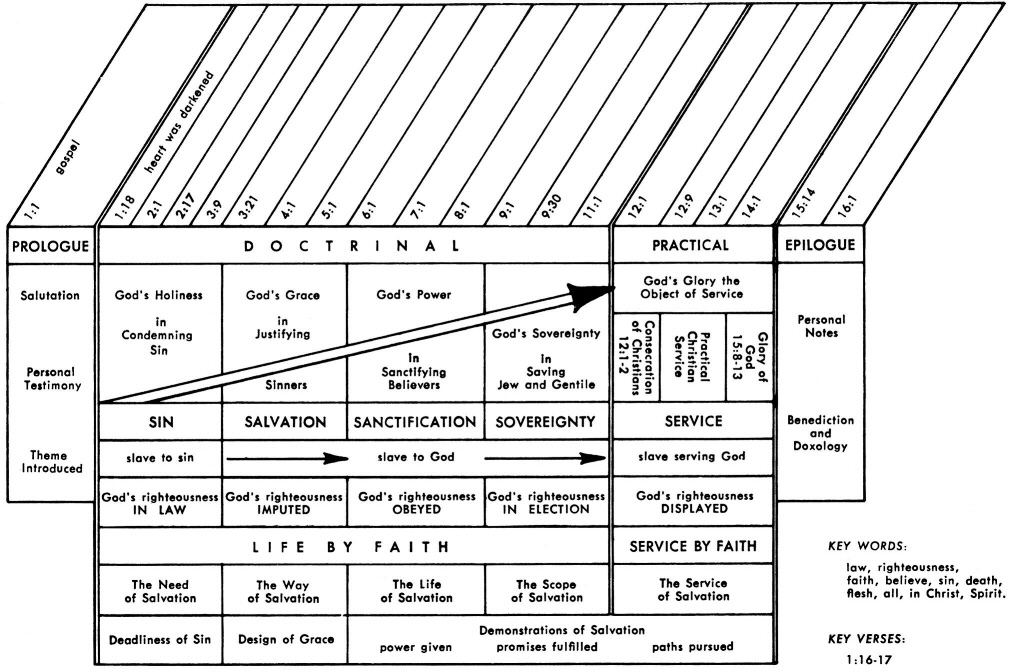
Click chart to enlarge
Chart from recommended resource Jensen's Survey of the NT - used by permission
Romans Overview Chart - Charles Swindoll
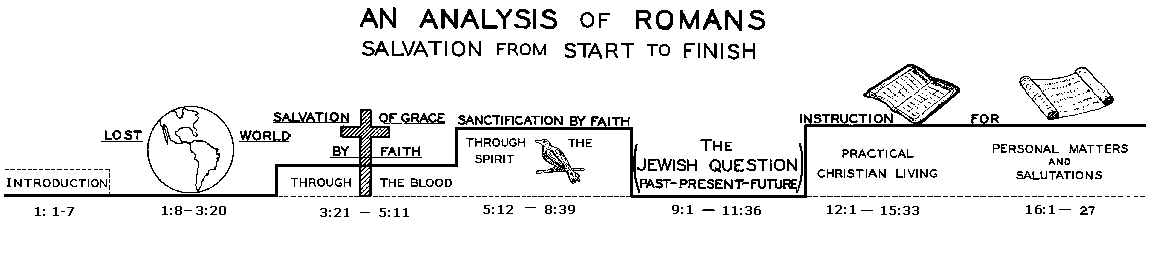
Source: Dr David Cooper
Click to Enlarge
| ROMANS ROAD to RIGHTEOUSNESS |
||||
| Romans 1:18-3:20 | Romans 3:21-5:21 | Romans 6:1-8:39 | Romans 9:1-11:36 | Romans 12:1-16:27 |
| SIN | SALVATION | SANCTIFICATION | SOVEREIGNTY | SERVICE |
| NEED FOR SALVATION |
WAY OF SALVATION |
LIFE OF SALVATION |
SCOPE OF SALVATION |
SERVICE OF SALVATION |
| God's Holiness In Condemning Sin |
God's Grace In Justifying Sinners |
God's Power In Sanctifying Believers |
God's Sovereignty In Saving Jew and Gentile |
Gods Glory The Object of Service |
| Deadliness of Sin |
Design of Grace |
Demonstration of Salvation | ||
| Power Given | Promises Fulfilled | Paths Pursued | ||
| Righteousness Needed |
Righteousness Credited |
Righteousness Demonstrated |
Righteousness Restored to Israel |
Righteousness Applied |
| God's Righteousness IN LAW |
God's Righteousness IMPUTED |
God's Righteousness OBEYED |
God's Righteousness IN ELECTION |
God's Righteousness DISPLAYED |
| Slaves to Sin | Slaves to God | Slaves Serving God | ||
| Doctrine | Duty | |||
| Life by Faith | Service by Faith | |||
|
Modified from Irving L. Jensen's chart above |
||||

Rome in the Time of Paul (c. A.D. 60)
| Summary of Romans 9-11 |
||
| Romans 9 | Romans 10 | Romans 11 |
| Past Election |
Present Rejection |
Future Reception |
| God's Sovereignty Israel's Election by God |
Man's responsibility Israel's Rejection of God |
God's Ways Higher God Not Rejecting Israel |
Romans 10:12 For there is no distinction between Jew and Greek; for the same Lord is Lord of all, abounding in riches for all who call on Him; (NASB: Lockman)
Greek: ou gar estin (3SPAI) diastole Ioudaiou te kai Hellenos, o gar autos kurios panton, plouton (PAPMSN) eis pantas tous epikaloumenous (PMPMPA) auton;
Amplified: [No one] for there is no distinction between Jew and Greek. The same Lord is Lord over all [of us] and He generously bestows His riches upon all who call upon Him [in faith]. (Amplified Bible - Lockman)
ESV: For there is no distinction between Jew and Greek; the same Lord is Lord of all, bestowing his riches on all who call on him. (ESV)
ICB: That Scripture says "anyone" because there is no difference between Jew and non-Jew. The same Lord is the Lord of all and gives many blessings to all who trust in him.
NIV: For there is no difference between Jew and Gentile--the same Lord is Lord of all and richly blesses all who call on him, (NIV - IBS)
NKJV: For there is no distinction between Jew and Greek, for the same Lord over all is rich to all who call upon Him.
NLT: For if you confess with your mouth that Jesus is Lord and believe in your heart that God raised him from the dead, you will be saved. (NLT - Tyndale House)
Phillips: And that "whoever" means anyone, without distinction between Jew or Greek. For all have the same Lord, whose boundless resources are available to all who turn to him in faith. (Phillips: Touchstone)
Wuest: For there is not a distinction between Jew and Greek. For the same Lord is over all, constantly rich toward all those who call upon Him.
Young's Literal: for there is no difference between Jew and Greek, for the same Lord of all is rich to all those calling upon Him,
Romans 10:12 FOR THERE IS NO DISTINCTION BETWEEN JEW AND GREEK FOR THE SAME LORD IS LORD OF ALL ABOUNDING IN RICHES FOR ALL WHO CALL UPON HIM: ou gar estin (3SPAI) diastole Ioudaiou te kai Hellenos o gar autos kurios panton plouton (PAPMSN) eis pantas tous epikaloumenous (PMPMPA) auton:
- Ro 3:22,29,30; 4:11,12; 9:24; Acts 10:34,35; 15:8,9; Gal 3:28; Ep 2:18, 19, 20, 21, 22; Ep 3:6; Col 3:11
- Ro 14:9; 15:12; Acts 10:36; 1Co 15:47; Php 2:11; 1Ti 2:5; Rev 17:14; 19:16
- Ro 14:9; 15:12; Acts 10:36; 1Co 15:47; Php 2:11; 1Ti2:5; Rev 17:14; 19:16
- Romans 10 Resources - Multiple Sermons and Commentaries
Listen to Dr J Vernon McGee: Romans 10:12-15 Mp3
For (gar) introduces an explanation. Always pause and ponder this strategic term of explanation.
No distinction - Paul uses the absolute negative particle ("ou") - absolutely no distinction! God is impartial (This in not a new thought for Paul - Read Ro 3:22,29,30; 4:11,12; 9:24, cp Acts 10:34-35, 15:8-9, Gal 3:28, et al).
Distinction (1293) (diastole from dia = denoting transition + stello = send and so diastello = to set apart) signifies a setting apart and hence, a clear or marked distinction. In ancient medicine diastole was a term used to denote the separation of organs (the “incision”).
Diastole - 3x - Ro 3:22, Ro 10:12, 1Co14:7
Earlier Paul had emphasized the non-exclusivity of the Gospel writing…
But now apart from the Law the righteousness of God has been manifested, being witnessed by the Law and the Prophets (referring to the Old Testament where God's righteousness was promised and available to all who would believe - cp Abraham = Ge 15:6, David = Ps 32:1,2, Ro 4:6, 7, 8) , 22 even the righteousness of God (So the righteousness the Holy God demands is that very righteousness He freely provides) through faith in Jesus Christ for all those who believe; for there is no distinction (implying Jews and Greeks both have access to this God-kind of righteousness in the Gospel) (Ro 3:21, 22)
The only other use of diastole is in Corinthians where Paul is emphasizing that speech like musical sounds should be intelligible…
Yet even lifeless things, either flute or harp, in producing a sound, if they do not produce a distinction in the tones, how will it be known what is played on the flute or on the harp? (1Co 14:7)
The Gospel broke down the "religious walls" that the Jews had constructed. Whereas before the Gospel, the Greek and Jew, one circumcised and the other uncircumcised, were separated by seemingly insurmountable racial and religious barriers. They had nothing to do with each other. Jewish people refused to enter a Gentile home. They would not eat a meal cooked by Gentiles, nor buy meat prepared by Gentile butchers. When they returned to Israel, they showed their disdain for Gentiles by shaking off the Gentile dust from their clothes and sandals. Even the apostles were reluctant to accept Gentiles as equal partners in the church (read Acts 10:1-46, 11:1-30). Needless to say, the Gentiles returned those sentiments. Paul is reminding his readers of the Roman epistle that the good news of the gospel broke down those barriers, as he described in greater detail in Ep 2:13, 14, 15, 16 (notes)
Jew (2453) Ioudaios ultimately derived from Hebrew Yehudi = a member of the tribe of Judah) is an adjective refers to one who belongs to the Jewish race with focus on adherence to Mosaic tradition (Acts 10:28, 22:3, 21:39). A Jew in respect to race or religion (as opposed to Gentiles).
The same Lord is Lord of all - Christianity is "narrow" in one sense (Jn 14:6, Acts 4:12), but it is by no means exclusive of any who would seek Christ. Paul has a parallel thought in Colossians in describing the new birth and the new style of life (Col 3:10) it brings about writing that it is…
a renewal in which there is no (signifies absolute negation) distinction between (distinction between added for clarity) Greek and Jew, circumcised and uncircumcised, barbarian, Scythian, slave and freeman, but Christ is all, and in all. (Col 3:11)
Comment: The Greek or Gentile when converted becomes a new being (2Co 5:17), with a new citizenship (Php 3:20), a new allegiance. Now he is not so much a Greek but is in fact a Christian. Etc for each of these categories. The result is a unity in one body with One Head, Christ Jesus. Christ breaks down all barriers and accepts all people who come to him. Nothing should keep us from telling others about Christ or accepting into our fellowship any and all believers (Ep 2:14,15). Christians should be building bridges, not walls. Lightfoot adds that Christ is all signifies that "Christ occupies the whole sphere of human life and permeates all its developments".
Although in Romans 10 Paul is addressing primarily Jews, he again stresses that the gospel applies equally (no distinction) to Greeks (Gentiles) and in short, to all (no exceptions) who call upon the Lord Jesus. In other words, there is not one God to the Jews Who is more kind, and another God of the Gentiles, Who is less kind. The promise of the good news is the same to all who call on the name of the Lord Jesus as the Son of God. It follows that believers call upon the Lord Jesus, and none else will do so humbly or sincerely.
MacArthur comments that the Jews "whose greatest pride was in the belief that they were far superior to all other peoples could not tolerate that humbling truth (Ed: I.e., "no distinction" from the Gentile "dogs"!).
Abounding in riches - What a great description of our high possession of Christ Jesus and our high privilege of proclaiming His excellencies in the midst of spiritual darkness! (1Pe 2:9, Php 2:15, Jn 1:5) We are wealthy beyond our "wildest imagination" (cp "now" = Col 2:3 and "then" = 1Pe 1:4). Would it be that we conducted ourselves as those who truly understood the height and depth and breadth and length of the simple description "abounding in riches"!
Abounding in riches (become rich)(4147) (plouteo from ploutos = wealth) means to be or become rich or wealthy (Lk 1:53, 1 Ti 6:9) and is used figuratively of spiritual riches (cp Lk 12:21, Rev 3:18 and literally in Rev 3:17!)
Plouteo - 12x - abounding in riches(1), become rich(4), become wealthy(1), get rich(1), rich(5).
Lk 1:53, 12:21, Ro 10:12, 1Co 4:8, 2 Co 8:9, 1 Ti 6:9,18, Rev 3:17, Rev 3:18, Rev 18:3, Rev 18:15, Rev 18:19
Plouteo - 14x in 14v - Ge 30:43; Ex 30:15; Ps 49:16; Pr 28:22; Pr 31:26; Eccl 5:12; Jer. 5:27; Da 11:2; Hos. 12:8; Zech 11:5
Gilbrant on plouteo -
Classical Greek - The stem of this verb goes back to a root common to many languages meaning “to fill” or “to be filled” (Hauck and Kasch, “ploutos,” Kittel, 6:319). From the classical Greek period to the New Testament era, the essential meaning remained “to be rich” or “to be wealthy,” primarily in a material way (for Aristotle, although Plato believed riches could also include virtue and wisdom [ibid., p.322]).
Septuagint Usage - In the 14 places where the Septuagint utilizes plouteō, usually to translate the Hebrew ‛āshar, it always has a literal meaning, except possibly in two instances. Often to be rich was a sign of God’s blessing and of the good life. The Old Testament apocryphal writings, especially Sirach, maintain the same attitudes toward money that the other Old Testament canonical Wisdom books do. Thus, a person may become rich if he is industrious (Sirach 31:3 [LXX 34:3], plousios [4004]) and refrains from wickedness (19:1ff., ploutizō [4008]). Nevertheless, it is wrong to put too much trust in money-making (31:5).
New Testament Usage- In contrast to the uses in the Septuagint, in the 12 instances in the New Testament where the verb is found, plouteō many times has a figurative meaning, frequently suggesting spiritual liberality or fullness. For example, 1 Corinthians 4:8 says, “Now ye are full, now ye are rich,” and seems to imply spiritual wealth. A second passage is 2 Corinthians 8:9 which describes Jesus with the words, “Though he was rich, yet for your sakes he became poor.” Again, it is not temporal wealth that is in view here, but a figurative or spiritual sense is suggested. (See also Luke 12:21; Romans 10:12.)
When plouteō is to be taken literally, “to be rich” is usually (if not always) seen in a negative way and dissociated from the riches which come from God or which are associated with the godly life. Earthly wealth, which in the Old Testament is frequently a sign of God’s blessing, in the New Testament is seen as a possible hindrance to the heavenly riches (Luke 1:53; Revelation 3:17).
However, a complete study of the New Testament words related to plouteō and of the theme of “wealth” itself will reveal that temporal wealth ought also to be viewed as a gift of God and used properly (cf. 1 Timothy 6:17-19). (Complete Biblical Library Greek-English Dictionary)
Different--Yet Alike - God, whose creative imagination is inexhaustible, delights in diversity. Billions upon billions of snowflakes fall every year, yet no two are exactly alike.
Wilson Bentley was so fascinated by this infinite variety that with the help of a photomicrograph he devoted himself to taking pictures of these exquisite crystals. They show that each snowflake is usually a hexagon with six tips or dendrites forming a perfectly symmetrical design. Yet there are no duplicates! What awe-inspiring evidence that God delights in diversity!
That same sense of wonder fills our hearts as we think about the diversity of human beings with all their ethnic and cultural differences. Yet men and women everywhere, whether dark-skinned Pygmies or tall, blond Scandinavians, are basically the same. All have the same anatomical structure, the same emotions, the same needs, and the same sin-stained nature.
We are also the same in our need of salvation. And there is just one way. Anyone, anywhere, anytime, who calls on Jesus Christ in faith experiences the destiny-changing wonder of God's redemptive love (Ro 10:13). The one and only Savior has been provided for all of us. --V C Grounds (Our Daily Bread, Copyright RBC Ministries, Grand Rapids, MI. Reprinted by permission. All rights reserved)
There's no difference--all are sinners,
God has made it plain;
Yet we all can have salvation--
Christ for us was slain. --Hess
No one's so good that he can save himself;
no one's so bad that God can't save him.
Related resources…
- Summary on the Attributes of God
- Spurgeon on the Attributes of God
- Israel of God - Is God "Finished" with Israel in His prophetic plan?
- Off Site - Table Comparing/contrasting Israel & Church
- Off Site - Does the Church Fulfill Israel's Program? - John Walvoord
- The Jewish People, Jesus Christ and World History - S Lewis Johnson
Are you confused about God's plan for Israel? Then I highly recommend Tony Garland's 12 Hour Course on Romans 9-11 in which he addresses in depth the question of What Will Happen to Israel? (click) or see the individual lectures below)
- Romans 9:1-5 Paul's Sorrow Concerning Israel
- Romans 9:6-13 Children of the Promise
- Romans 9:14-24 The Potter and the Clay
- Romans 9:25-33 A Remnant Will be Saved
- Romans 10:1-13 The Righteousness of God
- Romans 10:14-21 Has Israel Not Heard?
- Romans 11:1-6 God Has Not Cast Away The Jews
- Romans 11:7-15 Life from the Dead
- Romans 11:16-24 Two Olive Trees
- Romans 11:25-36 The Salvation of Israel
Note that when you click the preceding links, each link will in turn give you several choices including an Mp3 message and brief transcript notes. The Mp3's are long (avg 70+ min) but are in depth and thoroughly Scriptural with many quotations from the Old Testament, which is often much less well understood than the NT by many in the church today. Garland takes a literal approach to Scripture, and his love for the Jews and passion to see them saved comes through very clearly in these 12 hours of teaching! Take your home Bible Study group through this series if you dare. Take notes on the tapes as the transcripts are a very abbreviated version of the audio messages. This course is highly recommended for all who love Israel! I think you will agree that Tony Garland, despite coming to faith after age 30 as an engineer, clearly has been given a special anointing by God to promulgate the truth concerning Israel and God's glorious future plan for the Jews. Garland has also produced more than 20 hours of superb audio teaching in his verse by verse commentary on the Revelation (in depth transcripts also available) which will unravel (in a way you did not think was possible considering the plethora of divergent interpretations) God's final message of the triumph and return of the our Lord Jesus Christ as the King of kings and Lord of lords! Maranatha!
Romans 10:13 for "WHOEVER WILL CALL ON THE NAME OF THE LORD WILL BE SAVED." (NASB: Lockman)
Greek: Pas gar os an epikalesetai (3SAMS) to onoma kuriou sothesetai. (3SFPI)
Amplified: For everyone who calls upon the name of the Lord [invoking Him as Lord] will be saved. (Amplified Bible - Lockman)
ESV: For "everyone who calls on the name of the Lord will be saved." (ESV)
ICB: The Scripture says, "Anyone who asks the Lord for help will be saved." (ICB: Nelson)
NIV: for, "Everyone who calls on the name of the Lord will be saved." (NIV - IBS)
NKJV: For "whoever calls on the name of the LORD shall be saved."
NLT: For "Anyone who calls on the name of the Lord will be saved." (NLT - Tyndale House)
Phillips: For: 'Whoever calls upon the name of the Lord shall be saved'. (Phillips: Touchstone)
Wuest: For whoever shall call upon the Name of the Lord shall be saved.
Young's Literal: for every one -- whoever shall call upon the name of the Lord, he shall be saved.'
FOR WHOEVER WILL CALL UPON THE NAME OF THE LORD WILL BE SAVED: Pas gar os an epikalesetai (3SAMS) to onoma kuriou sothesetai. (3SFPI) :
- Romans 10 Resources - Multiple Sermons and Commentaries
Joel 2:32 “And it will come about that whoever calls on the name of the LORD Will be delivered; For on Mount Zion and in Jerusalem There will be those who escape, As the LORD has said, Even among the survivors whom the LORD calls.
Acts 2:21 ‘AND IT SHALL BE, THAT EVERYONE WHO CALLS ON THE NAME OF THE LORD SHALL BE SAVED.’
For (gar) explains why there is no distinction (Ro 10:12). Always pause and ponder this strategic term of explanation.
Whoever (pas) is literally all or everyone and leaves no room for any exceptions. This is a truth that should blunt every argument about the exclusivity of the "narrow way" (cp Jesus' teaching - Mt 7:13, 14, cp Lk 13:24, Jn 14:6). "Narrow" yes but "exclusive" no! For the gospel is for "whoever".
We see a parallel truth about the heart of our gracious, giving God in Peter's affirmation that "The Lord is not slow about His promise, as some count slowness, but is patient toward you, not wishing for any to perish but for all to come to repentance. (2Pe 3:9)
Paul echoes Peter's affirmation writing that "This is good and acceptable in the sight of God our Savior, who desires all men to be saved and to come to the knowledge of the truth. (1Ti 2:3, 4)
Will call upon (1941) (epikaleomai see discussion of this verb at Ro 10:14). Note Paul's use of the reflexive middle voice, which speaks of the personal involvement of the "callee" so to speak in this action. In other words, the middle voice signifies that the subject initiates the action and participates in the results/effects of that action.
THE NAME ABOVE ALL NAMES
The writer of Proverbs 18:10 (See note; Spurgeon's sermon) reminds us that…
The Name of the LORD (Jehovah = Jesus) is a strong tower.
The righteous runs into it and is safe (lifted up).
The name - Note the definite article (to onoma) in Greek (which is like "the" in English, so we say give me "the cup" [my favorite] not "a cup" [any cup in the cupboard), which defines this as the specific Name. It is not just any name the sinner is to call upon, but the Name above all names (Php 2:9, 10, 11) and the only Name by which men are saved (Acts 4:12). It is no wonder that the cults always seek somehow to distort the meaning of this most glorious, all sufficient Name, perpetrating as it were "another Jesus" a deadly, deceptive ruse of which Paul warned (2Co 11:4). There is only One Jesus (Jn 14:6) and calling upon Him, calls upon all of His character, all of His attributes, etc, for these are all encompassed in His great Name. What a wonderful Savior is Jesus our Lord. Play the great old hymn as you ponder (all 6 stanzas) and praise our Father for sending us…
What a Wonderful Savior!
by Elisha Hoffman
Christ has for sin atonement made
What a wonderful Savior!
We are redeemed, the price is paid
What a wonderful Savior!
Refrain
What a wonderful Savior is Jesus, my Jesus!
What a wonderful Savior is Jesus, my Lord!
Related Resource:
Name (3686) (onoma) is the distinctive designation of a person or thing and includes the ideas of title, character, reputation or authority.
In antiquity the name meant much more than it does today. We use a name as little more than a distinguishing mark or label to differentiate one person from other people. But in Scripture "the name" concisely sums up all that a person is. One's whole character is somehow implied in this name. And thus it is not surprisingly that God made very certain (sending an angel to Joseph in a dream) that the Savior received the Name that most clearly and beautifully describes His purpose in becoming a man (Lk 2:32, 1Ti 3:16, 2Ti 1:10, Titus 2:11, 1Pe 1:20, 1Jn 1:2)…
And she will bear a Son; and you shall call His Name Jesus, for it is He who will save His people from their sins. (Mt 1:21)
Comment: So we see His Name was and is His Mission. And that was the specific Name on which "whoever" called would be saved.
Paul quotes verbatim from the Septuagint (LXX) of Joel 2:32 (also quoted by Peter in his bold Pentecost sermon to the Jews = Acts 2:21) to prove this salvation is open to everyone. It is interesting that in the original Hebrew the verse is translated as follows by the NAS…
"And it will come about that whoever calls on the name of the LORD will be delivered; for on Mount Zion and in Jerusalem there will be those who escape, as the LORD has said, even among the survivors whom the LORD calls. (note the last phrase speaks to God's sovereignty in salvation - He calls).
The prayer promises of Scripture are restricted to the people of God, with one notable exception, the "whoevers" who call out for salvation.
Paul had already proved that “there is no distinction” in condemnation (Ro 3:22) now affirms “there is no difference” in salvation. Instead of the Jew having a special righteousness of his own through the Law, he was declared to be as much a sinner as the Gentile he condemned.
The prophet Isaiah centuries earlier had issued the urgent call to…
Seek (In the Septuagint = zeteo in aorist imperative = Do this now! It is urgent!) the LORD while He may be found; Call upon (epikaleomai in aorist imperative = Do this now! It is urgent!) Him while He is near. (Isaiah 55:6)
Will be saved - This statement is given in the form of a conditional promise. If the sinner calls, whoever they are (and whatever they've done!), God opens the door (cp Rev 3:20). A call upon His Name will not be like so many cell phone calls in which the connection is dropped! He will answer. He will save, the humble, contrite heart that calls (cries out) "Save me Lord!" His Word of truth is just that… Trustworthy. Faithful. Dependable. Unchangeable. So dear reader, what are you waiting for? Call upon His Name now!
Will be saved (4982) (sozo [word study]) has the basic meaning of rescuing someone from great peril. Additional nuances include to protect, keep alive, preserve life, deliver, heal, be made whole. Paul is referring here to the deliverance from the guilt and power of sin which is brought about by a sinner (whoever they are) calling on the Name above all names, the very Name Jesus meaning "Jehovah is salvation" (cp Mt 1:21). If you have never meditate on this great word, you might take some time to ponder the 106 NT occurrences of sozo (click here)
Steven Cole - ALL PEOPLE NEED TO HEAR THAT THERE IS ONE WAY TO BE SAVED: TO BELIEVE IN THE LORD JESUS CHRIST. Paul expresses the way to be saved in two synonymous phrases: to believe in Him (Ro 10:11); and, to call upon Him, or to call upon His name (Ro 10:12, 13). In 1Ro 0:14, he distinguishes them, as I will explain in a moment. But in Ro 10:11-13, he uses them to mean the same thing.
To believe in Christ means to rely on or trust in Him as the One who died on the cross to pay the penalty for your sin. He died as the propitiation (the atoning sacrifice which satisfied God’s wrath) for all who believe in Him, so that God can now be both just, because the penalty was paid, and the justifier of the one who has faith in Him (Ro 3:25-26). To believe in Christ implicitly means that you stop believing in yourself and your own good works as your hope for eternal life.
In Ro 10:13 Paul cites Joel 2:32, “Whoever will call on the name of the Lord will be saved.” Peter quotes the same verse in his sermon in Jerusalem on the Day of Pentecost (Acts 2:21). To call upon the Lord (His “name” means, who He is in all His attributes) implies that the one calling is in trouble or great need. This is reinforced by the word saved, which means that the person needs to be rescued from the great and glorious day of the Lord.
Both terms imply that the one calling out has nothing in himself to offer God. He isn’t doing basically okay, and just needs a few pointers on how to get ready for judgment. He can’t help God out. If he thinks that he can offer God anything, then he doesn’t understand his situation. He is guilty of rebellion against the holy God. If his case comes to trial, he will be condemned. So he cries out (Luke 18:13), “God, be merciful to me, the sinner!”
So Paul’s main point here is that the gospel is good news for all. Any guilty sinner, no matter how sordid his past, who calls upon the name of the Lord will be saved. John Bunyan has a wonderful treatise, “The Jerusalem Sinner Saved,” based on Jesus’ words to the apostles just before His ascension (Luke 24:47), “that repentance for forgiveness of sins would be proclaimed in His name to all the nations,” and then He added, “beginning from Jerusalem.” Jerusalem was the city where sinners crucified the Savior. But our sin also crucified Him. There is forgiveness for all Jerusalem sinners. Proclaim it to the nations! (Good News for All Romans 10:11-15) - Bible.org)
Call On His Name - Bible teacher Gary Burge stood at one end of a long, empty Gaza street. He was in Israel to do research for a book about Palestinian believers, and he wanted to talk to a Dr. Hassan at the Ali Arab hospital. The hospital was at the other end of the street, so he started walking. He soon discovered why the street was empty. On one side was the Israeli militia; on the other were Palestinian youths.
Halfway up the street, the calm was shattered by angry shouts, the chaotic clatter of rocks bouncing off plastic military shields, and the pop of rifles firing rubber bullets. Burge broke into a run. As he reached the hospital, he shouted desperately, "Dr. Hassan! I have come to see Dr. Hassan!" The door opened slightly, and a hand pulled him inside. Burge had called the name of the one who could save his life.
For sinners, "there is no other name under heaven given among men by which we must be saved" (Acts 4:12). Jesus is that name, "the name which is above every name" (Phil. 2:9). We are all born in sin. We have no hope of ever saving ourselves (Eph. 2:8, 9). Our situation is desperate. The only way of escape is to call on Jesus, who promises to save us from all our sin. But we must ask Him.
How about you? Have you called on His name? --D C Egner (Our Daily Bread, Copyright RBC Ministries, Grand Rapids, MI. Reprinted by permission. All rights reserved)
No other name can save me,
No other name beside,
But Jesus Christ the risen Lord,
The One they crucified. --Brandt
To get into heaven,
it's who you know that counts.
This entire section emphasizes the difference between “Law righteousness” and “faith righteousness.” The contrasts are seen in the following summary.
| RIGHTEOUSNESS BY THE LAW |
RIGHTEOUSNESS BY FAITH |
| Only for Jew | For “whosoever” |
| Based on works | Comes by faith alone |
| Self-righteousness | God’s righteousness |
| Cannot save | Brings salvation |
| Obey the LAW | Call on the LORD |
| Leads to pride | Glorifies God |
Romans 10:14 How then will they call on Him in whom they have not believed ? How will they believe in Him whom they have not heard ? And how will they hear without a preacher ? (NASB: Lockman)
Greek: Pos oun epikalesontai (3PAMS) eis on ouk episteusan? (3PAAI) pos de pisteusosin (3PAAS) ou ouk ekousan? (3PAAI) pos de akousosin (3PAAS) choris kerussontos? (PAPMSG)
Amplified: But how are people to call upon Him Whom they have not believed [in Whom they have no faith, on Whom they have no reliance]? And how are they to believe in Him [adhere to, trust in, and rely upon Him] of Whom they have never heard? And how are they to hear without a preacher? (Amplified Bible - Lockman)
ESV: But how are they to call on him in whom they have not believed? And how are they to believe in him of whom they have never heard?[3] And how are they to hear without someone preaching? (ESV)
ICB: But before people can trust in the Lord for help, they must believe in him. And before they can believe in the Lord, they must hear about him. And for them to hear about the Lord, someone must tell them. (ICB: Nelson)
NIV: How, then, can they call on the one they have not believed in? And how can they believe in the one of whom they have not heard? And how can they hear without someone preaching to them? (NIV - IBS)
NKJV: How then shall they call on Him in whom they have not believed? And how shall they believe in Him of whom they have not heard? And how shall they hear without a preacher?
NLT: But how can they call on him to save them unless they believe in him? And how can they believe in him if they have never heard about him? And how can they hear about him unless someone tells them? (NLT - Tyndale House)
Phillips: Now how can they call on one in whom they have never believed? How can they believe in one of whom they have never heard? And how can they hear unless someone proclaims him? (Phillips: Touchstone)
Wuest: How is it possible then that they shall call upon the One in whom they did not believe? Moreover, how is it possible that they will believe on the One concerning whom they did not hear? And how is it possible that they shall hear without one who proclaims?
Young's Literal: How then shall they call upon him in whom they did not believe? and how shall they believe on him of whom they did not hear? and how shall they hear apart from one preaching?
HOW THEN SHALL THEY CALL UPON HIM IN WHOM THEY HAVE NOT BELIEVED: Pos oun epikalesontai (3PAMS) eis on ouk episteusan (3PAAI):
- 1 Kings 8:41-43; Jonah 1:5,9, 10, 11,16; 3:5, 6, 7, 8, 9; Hebrews 11:6; James 5:15
- Romans 10 Resources - Multiple Sermons and Commentaries
1Kgs 8:41 “Also concerning the foreigner who is not of Thy people Israel, when he comes from a far country for Thy name’s sake 42 (for they will hear of Thy great name and Thy mighty hand, and of Thine outstretched arm); when he comes and prays toward this house,43 hear Thou in heaven Thy dwelling place, and do according to all for which the foreigner calls to Thee, in order that all the peoples of the earth may know Thy name, to fear Thee, as [do] Thy people Israel, and that they may know that this house which I have built is called by Thy name.
Jonah illustrates this principle…
Jonah 1:5 Then the sailors became afraid, and every man cried to his god, and they threw the cargo which was in the ship into the sea to lighten [it ]for them. But Jonah had gone below into the hold of the ship, lain down, and fallen sound asleep.
Jonah 1:9 And he said to them, “I am a Hebrew, and I fear the LORD God of heaven who made the sea and the dry land.”
Jonah 1:10 Then the men became extremely frightened and they said to him, “How could you do this?” For the men knew that he was fleeing from the presence of the LORD, because he had told them.
Jonah 1:11 So they said to him, “What should we do to you that the sea may become calm for us?”–for the sea was becoming increasingly stormy.
Jonah 1:16 Then (note this strategic marker of succession of events) the men feared the LORD greatly, and they offered a sacrifice to the LORD and made vows.
Jonah 3:5 Then the people of Nineveh believed in God; and they called a fast and put on sackcloth from the greatest to the least of them.
Jonah 3:6 When the word reached the king of Nineveh, he arose from his throne, laid aside his robe from him, covered [himself] with sackcloth, and sat on the ashes.
Jonah 3:7 And he issued a proclamation and it said, “In Nineveh by the decree of the king and his nobles: Do not let man, beast, herd, or flock taste a thing. Do not let them eat or drink water.
Jonah 3:8 “But both man and beast must be covered with sackcloth; and let men call on God earnestly that each may turn from his wicked way and from the violence which is in his hands.
Jonah 3:9 “Who knows, God may turn and relent, and withdraw His burning anger so that we shall not perish?”
MacArthur sums up Ro 10:14, 15 noting that "Paul’s main point in this series of rhetorical questions is that a clear presentation of the gospel message must precede true saving faith. True faith always has content—the revealed Word of God. Salvation comes to those who hear and believe the facts of the gospel."
They - This pronoun is repeated 4 times in the passage and in context appears to refer primarily to the Jews.
NLT Study Bible adds that "It is natural to presume that the pronoun they refers to “all who call on him” from Ro 10:12 or “everyone” from Ro 10:13. While this verse probably does refer to all people, it also continues the accusation against Israel from Ro 10:2, 3 (see Ro 10:18). (New Living Translation Study Bible. Tyndale House Publishers)
Call on… believed… heard… preacher (literally "one preaching): Note that these verbs are the reversal of the normal pattern by which one comes to believe the Gospel - The good news is proclaimed, heard, believed and the believer calls upon the Lord.
Call - In the previous passage (Ro 10:13) Paul used the same verb for "call" (epikaleomai) as he does in the beginning of this verse.
The ESV Study Bible goes on to explain the relationship between these two verse noting that - (1) People will call on Jesus to save them only if they believe he can do so; (2) belief in Christ cannot exist without knowledge about him; (3) one hears about Christ only when someone proclaims the saving message; and (4) the message about Christ will not be proclaimed unless someone is sent by God to do so.
How then will they call on him in whom they have not believed? And how are they to believe in him of whom they have never heard? And how are they to hear without someone preaching?
Call upon (1941) (epikaleomai [word study] from epi = upon + kaleo = call) literally means to call upon. Epikaleomai was used as here in Romans to call upon deity for some purpose. For example in Peter's quotation from Joel 2:32 he proclaims "AND IT SHALL BE, THAT EVERYONE WHO CALLS ON THE NAME OF THE LORD SHALL BE SAVED." (Acts 2:21, used in this same sense in Ro 10:12, 13)
Stephen with his dying words called upon the Lord "And they went on stoning Stephen as he called upon the Lord and said, "Lord Jesus, receive my spirit!" (Acts 7:59, similar sense in Acts 22:16)
Ananias addressing Paul after his conversion declared "why do you delay? Arise, and be baptized, and wash away your sins, calling on (epikaleomai) His name. (Acts 22:16)
Ryrie rightly reminds us that "Though God's election of His people is of His own free choice and not based on human merit (Ro 9:11, 23), the elect are not saved without believing the message that is preached by those who are sent (Isa. 52:7). (The Ryrie Study Bible)
AND HOW SHALL THEY BELIEVE IN HIM WHOM THEY HAVE NOT HEARD: pos de pisteusosin (3PAAS) ou ouk ekousan (3PAAI):
- Ro 1:5; 16:25,26; Mark 16:15,16; Luke 24:46,47; John 20:31; Acts 19:2; Acts 26:17,18; 2Timothy 4:17; Titus 1:3
- Romans 10 Resources - Multiple Sermons and Commentaries
Paul was obedient to his Master's command = (Jesus speaking to Paul on Damascus Road) But arise, and stand on your feet; for this purpose I have appeared to you, to appoint you a minister and a witness not only to the things which you have seen, but also to the things in which I will appear to you; 17 delivering you from the [Jewish] people and from the Gentiles, to whom I am sending you, 18 to open their eyes so that they may turn from darkness to light and from the dominion of Satan to God, in order that they may receive forgiveness of sins and an inheritance among those who have been sanctified by faith in Me.’ (Acts 26:16-18)
Whom they have not heard - MacDonald asks that "Of what use is a salvation offered to Jews and Gentiles if they never hear about it? Here we have the heartbeat of Christian missions! In a series of three “how’s” (how shall they call … believe … hear without a preacher), the apostle goes back over the steps that lead to the salvation of Jews and Gentiles. Perhaps it will be clearer if we reverse the order, as follows: God sends out His servants. They preach the good news of salvation. Sinners hear God’s offer of life in Christ. Some of those who hear believe the message. Those who believe call on the Lord. Those who call on Him are saved.
Years ago there was a great evangelist named Gipsy Smith. He was born a gypsy in England and came to Christ as a boy. Gipsy Smith used to preach up and down this country. Harry Ironside said that Gipsy Smith once came to Moody Church and spoke to the people of his conversion from a gypsy life. The people sat entranced with Gipsy's stories. At the end of the meeting Gipsy would give an altar call, and people would surge forward in great numbers. However, Dr. Ironside wondered why they were coming? Did they want to be gypsies, or what? They had really been given nothing of the gospel in which to believe. We must speak the Gospel of Jesus Christ and not stories that entertain! Does this sound like much of the modern church in America (circa 2014)?
AND HOW SHALL THEY HEAR WITHOUT A PREACHER: pos de akousosin (3PAAS) choris kerussontos (PAPMSG):
- Romans 10 Resources - Multiple Sermons and Commentaries
Without a preacher - Literally "apart from one preaching" and not the noun "preacher".
Preacher (2784) (kerusso [word study] or kerysso from kerux/keryx = a herald - one who acts as the medium of the authority of one who proclamation he makes; kerugma = the thing preached or the message) means to proclaim (publicly) or to herald or act as a public crier - the town official who would make a proclamation in a public gathering.
Kerusso was used of the official whose duty it was to proclaim loudly and extensively the coming of an earthly king, even as our gospel is to clearly announce the coming of the King of kings and Lord of lords (Re 10:16)!
The Imperial Herald would enter a town in behalf of the Emperor, and make a public proclamation of the message which his Sovereign ordered him to give, doing so with such formality, gravity, and authority as to emphasize that the message must be heeded! (Think about this in regard to the Gospel of God instead of the decree of a man! cf 1Th 2:13). He gave the people exactly what the Emperor bade him give, nothing more, nothing less. He did not dare add to the message or take away from it. Should this not be the example and pattern every preacher and teacher (and witnessing saint) of the holy gospel of God seeks and strives to emulate, yea, even doing so with fear and trembling! ("not as pleasing men but God, who examines our hearts" 1Th 2:4)
BKC adds that kerusso "means “to be a herald, to announce,” and is not limited to proclamation from a pulpit. Carrying God’s gracious offer involves human beings whom God has brought to Himself and then uses as His heralds. They share God’s message of salvation because He will save everyone who calls on His name. (Walvoord, J. F., Zuck, R. B., et al: The Bible Knowledge Commentary. 1985. Victor)
Wiersbe observes that" This passage is often used as the basis for the church’s missionary program, and rightly so, but its first application is to the nation of Israel. The only way unbelieving Jews can be saved is by calling on the Lord. But before they can call on Him, they must believe. For the Jew, this meant believing that Jesus Christ of Nazareth truly is the Son of God and the Messiah of Israel. It also meant believing in His death and resurrection (Ro 10:9, 10). But in order to believe, they must hear the Word, for it is the Word that creates faith in the heart of the hearer (Ro 10:17). This meant that a herald of the Word must be sent, and it is the Lord who does the sending. At this point, Paul could well have been remembering his own call to preach the Word to the Gentiles (Acts 13:1-3). (Wiersbe, W: Bible Exposition Commentary. 1989. Victor )
God could have chosen any means by which the message of salvation might have come (angelic messengers, direct working without a human preacher), but God’s "normal" way of bringing people to Jesus Christ is through the preaching of the gospel.
Steven Cole - Since the good news is for all, we must proclaim it to all (Ro 10:14-15) Romans 10:14-15: “How then will they call on Him in whom they have not believed? How will they believe in Him whom they have not heard? And how will they hear without a preacher? How will they preach unless they are sent? Just as it is written, ‘How beautiful are the feet of those who bring good news of good things!’”
I can only skim over these verses, but before we look at them, let me briefly address a criticism often raised by those who deny the doctrine of God’s sovereign election. They argue that the doctrine of election undermines evangelism and missions because if God has chosen someone, he will be saved. If he isn’t elect, our efforts are in vain. So, why witness?
But Paul, who wrote so strongly about God’s choice of Jacob and rejection of Esau while they were still in the womb (Ro 9:11-13), also wrote these wonderful verses about the need to preach the gospel to all people. He wasn’t contradicting himself. God chooses who will be saved and He chooses the means through which they will be saved, namely, preaching the gospel to them (2 Tim. 2:10).
Paul strings together a logical list of rhetorical questions to explain the process of how the gospel goes forth, and then backs it up with Scripture. To work from the foundation outward, the process begins with sending out preachers; they preach; people hear, believe, and call on the Lord. (Good News for All (Romans 10:11-15)
Our Daily Bread has an interesting illustration of Paul's charge to all believers, entitled "The King's Message" - On January 21, 1930, the name of Harold Vidian became synonymous with heroism. On that day, England's King George V was scheduled to give the opening address at the London Arms Conference. The king's message was to be sent by radio all around the world.
Donald McCullough, in his book The Trivialization of God (NavPress, 1995), tells us that a few minutes before the king was to speak, a member of the CBS staff tripped over an electrical wire and broke it, cutting off the whole American audience. With no hesitation, chief control operator Harold Vidian grasped one end of the broken wire in his right hand and the other in his left, thus restoring the circuit. Electricity surged through his body. Ignoring the pain, Vidian held on until the king had finished his address.
I see in this a challenge for Christians. The message of the King of kings must go to the whole world. But only as we allow God's power to pass through us can the Lord's saving gospel be transmitted. Paul wrote, "How shall they believe in Him of whom they have not heard?" (Rom. 10:14). If we are willing to serve as conduits, regardless of the cost to us, the good news will be proclaimed around the world.
Will you be a conduit for the King's message? --V C Grounds (Our Daily Bread, Copyright RBC Ministries, Grand Rapids, MI. Reprinted by permission. All rights reserved)
When I gave my life to Jesus,
He became my Lord and Friend;
Now His power is flowing through me,
As His message I extend. --Hess
The good news of Christ is the best news in the world.
A Final Witness -If you were in the midst of a disaster, would you think to witness to people around you? John Harper did.
Harper was a Scottish minister who was traveling by ship to preach for 3 months at Moody Church in Chicago. As the ship crossed the Atlantic, it struck an iceberg and began to sink. Some passengers were able to reach lifeboats, but many, Harper included, were flung into the cold Atlantic.
As the people frantically tried to stay afloat, Harper swam around asking individuals if they knew Jesus. At one point, Harper approached a passenger floating on a piece of debris and pleaded with him to trust Christ. Just before Harper slipped under the icy waters for the last time, he said, "Believe on the Lord Jesus Christ, and thou shalt be saved."
Four years later, at a meeting of survivors of that ship, the Titanic, the man testified that he had been saved twice that night. First, he had trusted Christ because of Harper's witness, and second, he had been plucked from the frigid sea.
Harper's dying wish was that he could bring hope to hopeless people. Is that our living wish? In crisis or at ease, do we let people know about the One who can save for eternity? Harper's final witness reminds us to tell the good news to people who are drowning in their sin. —J D Brannon (Our Daily Bread, Copyright RBC Ministries, Grand Rapids, MI. Reprinted by permission. All rights reserved)
Help us, Lord, to be a lifeline
To a dying world today,
Bringing hope to hopeless people
As we share salvation's way. —Sper
We need to tell everyone about Someone who can save anyone.
(What About Those Who Have Never Heard)
Undelivered Message - George Sweeting, in his book The No-Guilt Guide for Witnessing, tells of a man by the name of John Currier who in 1949 was found guilty of murder and sentenced to life in prison. Later he was transferred and paroled to work on a farm near Nashville, Tennessee.
In 1968, Currier's sentence was terminated, and a letter bearing the good news was sent to him. But John never saw the letter, nor was he told anything about it. Life on that farm was hard and without promise for the future. Yet John kept doing what he was told even after the farmer for whom he worked had died.
Ten years went by. Then a state parole officer learned about Currier's plight, found him, and told him that his sentence had been terminated. He was a free man.
Sweeting concluded that story by asking, "Would it matter to you if someone sent you an important message--the most important in your life--and year after year the urgent message was never delivered?"
We who have heard the good news and experienced freedom through Christ are responsible to proclaim it to others still enslaved by sin. Are we doing all we can to make sure that people get the message? --R W De Haan (Our Daily Bread, Copyright RBC Ministries, Grand Rapids, MI. Reprinted by permission. All rights reserved)
We who rejoice to know You
Renew before Your throne
The solemn pledge we owe You
To go and make You known. --Houghton
Keep the faith--but not to yourself.
Brother John - It's only a humorous story, yet it makes a serious point. Brother John was a timid man who dreaded speaking in public. So he was terrified on the day it was his turn to give a devotional message. With his knees trembling, he faced his listeners and said, "Do you know what I'm going to say this morning?" "No," answered the audience. He then said, "Neither do I," and he ran from the room.
The next day he was told to try again. He said, "Do you know what I'm going to say?" This time they replied, "Yes." So he said, "Then you don't need me to tell you." Again he fled.
He tried a third morning, saying, "Do you know what I'm going to say?" Half his hearers shouted, "Yes!" and half shouted, "No!" "Ah," said Brother John, "then let those who know tell those who don't know," and again he fled.
At first, his hearers sat in silence. Then the words hit home: "Let those who know tell those who don't know."
For 3 years, Jesus' disciples absorbed His teaching and observed His mighty works. They had come to know Him as the way, the truth, and the life. He was God in the flesh, the One who is "eternal life" (1John 1:2). In the years to come, they devoted their lives to telling others about Christ.
Today, let those who know tell those who don't. —D J De Haan (Our Daily Bread, Copyright RBC Ministries, Grand Rapids, MI. Reprinted by permission. All rights reserved)
Tell the sweet story of Christ and His love,
Tell of His power to forgive;
Others will trust Him if only you prove
True every moment you live. —Wilson
© Renewal 1952 Rodeheaver Co.
The best news in the world is the good news of Christ.
Romans 10:15 How will they preach unless * they are sent ? Just as it is written, "HOW BEAUTIFUL ARE THE FEET OF THOSE WHO BRING GOOD NEWS OF GOOD THINGS !" (NASB: Lockman)
Greek: pos de keruxosin (3PAAS), ean me apostalosin? (3PAPS) kathos gegraptai, (3SRPI) Os oraioi oi podes ton euaggelizomenon (PMPMPG) [ta] agatha.
Amplified: And how can men [be expected to] preach unless they are sent? As it is written, How beautiful are the feet of those who bring glad tidings! [How welcome is the coming of those who preach the good news of His good things!] (Amplified Bible - Lockman)
ESV: And how are they to preach unless they are sent? As it is written, "How beautiful are the feet of those who preach the good news!" (ESV)
ICB: And before someone can go and tell them, he must be sent. It is written, "How beautiful is the person who comes to bring good news." (ICB: Nelson)
NIV: And how can they preach unless they are sent? As it is written, "How beautiful are the feet of those who bring good news!" (NIV - IBS)
NKJV: And how shall they preach unless they are sent? As it is written: "How beautiful are the feet of those who preach the gospel of peace, Who bring glad tidings of good things!"
NLT: And how will anyone go and tell them without being sent? That is what the Scriptures mean when they say, "How beautiful are the feet of those who bring good news!" (NLT - Tyndale House)
Phillips: And how can they hear unless someone proclaims him? And who will go to tell them unless he is sent? As the scripture puts it: 'How beautiful are the feet of those who preach the Gospel of peace, who bring glad tidings of good things!' (Phillips: Touchstone)
Wuest: And how is it possible that they shall make a proclamation except they be sent on a mission? Even as it stands written, How beautiful are the feet of those who bring good tidings of good things.
Young's Literal: and how shall they preach, if they may not be sent? according as it hath been written, 'How beautiful the feet of those proclaiming good tidings of peace, of those proclaiming good tidings of the good things!'
AND HOW SHALL THEY PREACH UNLESS THEY ARE SENT: pos de keruxosin (3PAAS) ean me apostalosin (3PAPS):
- Jer 23:32; Matthew 9:38; 10:1, 2, 3, 4, 5, 6; 28:18, 19, 20; Luke 10:1; John 20:21; Acts 9:15; Acts 13:2, 3, 4; 22:21; 1Cor 12:28,29; 2Cor 5:18, 19, 20; Ephesians 3:8; 4:11,12; 1Peter 1:12
- Romans 10 Resources - Multiple Sermons and Commentaries
All disciples have been sent - "And Jesus came up and spoke to them, saying, “All authority has been given to Me in heaven and on earth. 19 “Go therefore and make disciples (not a suggestion, but a command - they only way to obey it is to surrender to the Spirit and allow Him to enable us to make disciples) of all the nations, baptizing them in the name of the Father and the Son and the Holy Spirit, 20 teaching them to observe all that I commanded you; and lo, I am with you always, even to the end of the age.” (Matt 28:18-20)
They are sent - Don't miss this - God is the One Who sends. We need to listen for that still small voice that we might hear His call. To be sure some are literally (in body) sent to unreached people groups, but all believers are sent (in spirit - through intercessory prayer) to unreached people groups. I have a feeling that some of the greatest missionaries this world has never known will be little old ladies who were confined physically to their wheelchair or their home and yet they traveled (via the prayer air waves) to more countries than any missionary could have ever done physically! You may say "I am a 'lesser' part of the body. God cannot really use me." You are wrong. The devil wants you to believe that lie, but he trembles at those "no bodies" who daily, faithfully drop to their knees and cry out for those who are lost in darkness (cp Paul's being "sent" = Acts 26:17, 18) in every continent of the globe. So may I suggest you get involved on the "front lines" (via prayer, which I have found is far more difficult and challenging than funding a matching grant for some well known ministry - not that the latter is wrong of course!). You say, I don't really know how to be sent.
Sent (649) (apostello from apo = from + stello = appoint to position) literally means to send forth. It can convey the bestowal of a commission, to perform a special task with empowerment of the authority of the sender (in this case God, cp the necessary empowerment for the early church and for the modern church, Acts 1:8).
Scripture to verify that bearers of the good news must be “sent” (this term is the verb form of the noun translated “apostle,” hence “apostled”); people are not saved without the opportunity to hear. [Isa 52:7] announced that there was good news, but heralds still had to bring it to the people. Several verses after [Isa52:7], Isaiah reports the response to the good news the heralds bring (Isa 53:1), and Paul’s readers probably know how this text continues: Israel rejected the good news (Isa 53:2-3). Then begin a lifelong journey of daily prayer for the hidden, unreached peoples of the world using as your guide the excellent resource The Global Prayer Digest (save this link to your toolbar favorites as each day there is a new prayer topic). I believer that through this vehicle of Spirit led intercessory, missionary prayer, our Father in heaven has given each of us as His children the incredible privilege of storing up for ourselves treasure in heaven in the the form of "human souls" (cp Mt 6:20, 1Th 2:19, 20, Lk 10:2, Col 4:2,3, 2Th 3:1, Rev 7:9)
If you are a blood bought, heaven bound believer, I submit that you have been "sent". Listen to Paul…
2Cor 5:18 Now all these things are from God, who reconciled us to Himself through Christ and gave us the ministry of reconciliation, 19 namely, that God was in Christ reconciling the world to Himself, not counting their trespasses against them, and He has committed to us the word of reconciliation (i.e., the "good news" that sinners can now by grace through faith be reconciled to God! Ro 5:10, Ep 2:16, Col 1:20, 21, 22) 20 Therefore, we are ambassadors for Christ, as though God were making an appeal through us; we beg you on behalf of Christ, be reconciled to God.
And we can always obey our Lord's charge to…
Therefore beseech (aorist imperative = Like a command from our General. Do this now! Don't delay. The need is urgent!) the Lord of the harvest to send out workers into His harvest. (Matthew 9:38)
And so to be "sent" suggests at least two things, first, that one operates under a higher authority and secondly that his message does not originate with himself but is given him by the sending authority (God). The prophets were men who were sent in these two respects as was even the Lord Jesus (Jn 3:34; 7:16). The apostles received their commission from the risen Lord as He in turn had been sent by the Father (Jn 20:21, cp His charge to the church = Mt 28:18, 19, 20). In addressing the Roman church, Paul was careful to state at the very beginning that he was called and set apart for the ministering of the gospel (Ro 1:1).
Writing to the saints at Ephesus Paul declared…
To me, the very least (Less than the least, far less, far inferior) of all saints, this grace (charis-word study) was given, to preach (euaggelizo/euangelizo [word study]) to the Gentiles the unfathomable (past finding out, impossible to comprehend; immeasurable; unsearchable) riches of Christ (Ephesians 3:8)
So no matter how inadequate or "little" we feel in regard to "preaching" the good news, remember that God does not want our ability as much as He wants our availability! "Less than the least" saints make good recipients of His transforming, enabling grace (cp 2Co 12:9,10- notes v9; notes v10), without which we can utter no supernatural proclamation (cp Jn 15:5)
JUST AS IT IS WRITTEN HOW BEAUTIFUL ARE THE FEET OF THOSE WHO BRING GLAD TIDINGS OF GOOD THINGS: kathos gegraptai, (3SRPI) Os oraioi oi podes ton euaggelizomenon (PMPMPG) [ta] agatha:
- Isaiah 52:7; Nahum 1:15) (Isaiah 57:19; Luke 2:14; Acts 10:36; Ephesians 2:17; 6:15) (Isaiah 40:9; 61:1; Luke 2:10; 8:1; Acts 13:26
- Romans 10 Resources - Multiple Sermons and Commentaries
Written (1125) (grapho [word study]) is in the perfect tense which emphasizes the lasting and binding authority of what God inspired the Biblical writers to record. It has been written at some point in time in the past and it "stands" written (cp "Thus saith the LORD")
Although Paul's OT quotation is taken from Isaiah 52:7 (see below), there is a parallel passage in Nahum 1:15…
Behold, on the mountains the feet of him who brings good news, Who announces peace! Celebrate your feasts, O Judah; Pay your vows. For never again will the wicked one pass through you; He is cut off completely. (Comment: Johnson observes that "So complete was [Nineveh’s] destruction that when Xenophon passed by the site about 200 years later, he thought the mounds were the ruins of some other city. And Alexander the Great, fighting in a battle nearby, did not realize that he was near the ruins of Nineveh." [Ref])
Nahum is prophesying the destruction of the Assyrian Empire who were the hated enemies of the Jews. Their key city Nineveh had experienced a genuine spiritual revival (Jonah 3:5, 6, 7, 8, 9, 10) some 150 years before Nahum when God sent (Jonah 3:2, 3, 4) the beautiful feet of a reluctant prophet Jonah (Jonah 1:2, 3, 4:1, 2, 3, 4, 5, 6, 7, 8, 9, 10, 11). God had patiently dealt with Nineveh, but now His judgment was going to fall and that was "good news" for the Jews.
Like Nahum's “good news” of peace, God's messengers brought good news of peace with God (Ro 5:1), and this is what made the messenger's feet so beautiful (to those who received the message - 1Th 2:13).
Paul quotes from Isaiah 52:7 so it behooves the diligent student of Scripture to examine the context of that original passage to most accurately interpret the original prophecy which was addressed not to the Gentiles but to Israel…
Isaiah 52:1 Awake, awake, (Not once but twice! Implication is that the hearer has been "somnolent" and this is a clarion call to arouse, stir or motivate to action) Clothe (Note all verbs in red are commands) yourself (Jerusalem personified - representative of all Israel who will be saved at the end of the Great Tribulation [see Ro 11:26, 27] and will enter into the Millennial Kingdom) in your strength (no longer will she [or her occupants the saved Jewish remnant] be trampled on by the nations [= goyim = Gentiles]), O Zion (= Jerusalem); Clothe yourself in your beautiful garments, O Jerusalem, the holy city (Even the new ESV Study Bible misinterprets this phrase to refer to "the people of God" as in Rev 21:22-27, and in so doing essentially "bypass" the Millennial age - review of many of the explanatory notes of the new ESV Study Bible suggests it takes primarily a "reformed" approach to the interpretation of prophecy and thus replaces the specific, definitive promises given to the nation of Israel and sees them as fulfilled in or to the "church"). For the uncircumcised (could refer to literal circumcision but more likely figurative circumcision of the heart = believers - See Ro 2:28, 29, Col 2:11) and the unclean (Isaiah had used this of moral uncleanness, Isa 6:5) Will no more (This time phrase marks the end of the present age and the dawn of the new Millennial age) come into you (This clearly speaks of a unique time in Jerusalem's history, a time which will only be fulfilled when the Messiah returns to set up His Millennial Kingdom and rule the world from Jerusalem).
2 Shake yourself from the dust, rise up, O captive Jerusalem (Personified as a city that has suffered severe humiliation [idea of humiliation is be made low, brought close to the dust of the ground so to speak] and abasement); Loose yourself from the chains around your neck, O captive daughter of Zion.
3 For thus says the LORD, "You were sold for nothing (not for the purpose of monetary gain) and you will be redeemed (ga'al = to act as a Kinsman Redeemer who delivers one from a debt they cannot pay) without money." (The implication that is it was Jehovah Who sold Israel into captivity is the same One Who will make provision for release because it is only Jehovah Who can redeem [cp 1Pe 1:18, 19] - Jehovah is sovereign over all events national and personal beloved - good news for the saved, bad news for rebels!)
4 For thus says the Lord GOD, "My people (Speaking of Israel) went down at the first into Egypt to reside there (Jacob taking his family to be cared for by Joseph during the famine and then remaining over 400 years, ending in bondage to Egypt), then the Assyrian oppressed (Lxx has "led away" as into captivity) them without cause.
5 "Now therefore, what do I have here," declares the LORD, "seeing that My people have been taken away without cause?" Again the LORD declares, "Those who rule over them howl (usually expresses deep mourning, dismay or distress - meaning uncertain but could be ), and My name is continually blasphemed (spoken of with reproach, rejected, scorned. Jerusalem was known as God's city and it's destruction brought shame upon His glorious Name, cp Ro 2:24) all day long.
6 "Therefore My people shall know My name (A clear reiteration of Jehovah's promise of the New Covenant given to the house of Israel and with the house of Judah - see Jer 31:31, 32, 33, 34, 24:7 "they shall know Me"); therefore in that day I am the one who is speaking, 'Here I am.'" (Fulfilled at Messiah's Second Advent!)
7 How lovely on the mountains are the feet of him who brings good news (LXX = euaggelizo/euangelizo [word study] [gives us English "evangelize"]), who announces peace and brings good news (LXX = euaggelizo/euangelizo [word study] [gives us English "evangelize"]) of happiness, who announces salvation, and says to Zion, "Your God reigns!" (This was the shout of joy and acclamation that the followers would given when a new king was enthroned. I think it is all the saints of the ages will one day shout also when the New King returns as the King of kings [Rev 19:16] in the clouds with great glory [Mt 24:30] to be crowned, assume His rightful place on the throne and reign in Zion, the Holy City, Jerusalem! Maranatha 1Co 16:22!)
Paul applied Isaiah's quotation to the messengers of the Gospel taking the Good News (especially to Israel) today (Beloved, have you ever shared the good news of the Messiah with a Jew?). The “peace” spoken of is “peace with God” (Ro 5:1) and the peace Christ has effected between Jews and Gentiles by forming the one body, the church (Ep 2:13, 14, 15, 16, 17-notes).
And so from the original context of Isaiah 52, we understand that God was prophesying the bestowal of His favor upon the holy city of Jerusalem was to be destroyed by the Babylonians (Isaiah prophesied before the fall of Jerusalem in 586BC). The ultimate fulfillment of Isaiah's prophecy would be marked by the return of the Messiah and the inauguration of His Millennial Kingdom. These tidings are good, for they announce the age of peace when the Prince of peace returns to reign in peace. Paul changes the wording somewhat--the single announcer in Isaiah becomes "they" which depicts all messengers of the good news (not just the formal clergy but every redeemed saint because every redeemed saint has a personal message of "good news" = their testimony. See My Testimony).
Beautiful (5611)(horaios from hora = hour) is an adjective which literally means timely, seasonable or ripe. When used of persons or things it meant beautiful or lovely (Mt 23:27, Acts 3:2, 10). When used of an appropriate time it meant an "opportune point of time" describing something as happening or coming at just the right time, as in Romans 10:15 which says "How will they preach unless they are sent? Just as it is written, “HOW BEAUTIFUL ARE THE FEET OF THOSE WHO BRING GOOD NEWS OF GOOD THINGS!”" The idea in this passage is how timely is the arrival of those who proclaim the Good News. How fascinating that in Acts 3 this man lame from birth was sitting at a gate named "Beautiful" and he receives and believes the Good News which set him free from his physical malady, but more importantly set him free from his bondage to sin which had crippled any attempts at a "spiritual walk." In short, this miracle happened at the right time, for God's Spirit would use it to launch Peter's message in Acts 3:11-26 and to incite the first persecution of the disciples (and serve as an opportunity to present the Gospel to the religious leaders) in Acts 4:1-12.
In Matthew 23:27 Jesus reviled the Pharisees for their hypocritical behavior - "Woe to you, scribes and Pharisees, hypocrites! For you are like whitewashed tombs which on the outside appear beautiful, but inside they are full of dead men’s bones and all uncleanness." The Pharisees were like monuments on a tomb that appeared beautiful on the outside but inside were full of unclean and vile things
Gilbrant - This adjective has a wide semantic range. Classical usage includes simple meanings such as “beautiful, fair, lovely,” and “pleasant.” The word can also mean “produced at the right time” (referring to salted or pickled fish and year-old tunas), “harvesttime” (Liddell-Scott), “in season,” and “ripe” (Moulton-Milligan). Hōraios also has the meaning of “seasonable, due,” or “proper” (Liddell-Scott). This word is related to hōra (5443) which originally meant “the right, favorable time” (Delling, “hōra,” Kittel, 9:675). Thus hōraios can describe anything that occurs or appears at the “right” time. Hence it describes things which are “pleasant, proper, beautiful.” (Complete Biblical Library Greek-English Dictionary).
Horaios - 4x in the NT all translated beautiful - Mt 23:27, Acts 3:2, 10, Ro 10:15.
Horaios - 35x in 35v in the Septuagint (Lxx)
Ge 2:9; Gen. 3:6; Ge 26:7; Ge 29:17 = "Rachel was beautiful"; Ge 39:6 "Joseph was handsome (Lxx - horaios)" or "Well-built"; Lev. 23:40; 1 Sam. 9:20; 2 Sam. 1:23; 1 Ki. 1:6; 2 Chr. 36:19; Job 18:13; Ps. 45:2; Ps. 65:12; Song 1:16; Song 2:14; Song 4:3; Song 6:4; Song 6:7; Isa. 63:1; Jer. 11:16; Lam. 2:2; Dan. 4:12; Joel 1:19; Joel 1:20
In Ge 2:9 horaios describes trees growing that were "pleasing (Lxx - horaios) to the sight" and in Ge 3:6 to describe fruit that was "a delight (attractive - Lxx = horaios) to the eyes." In Isa 63:1 it describes the Lord Jesus returning as Conqueror, One Who is majestic (Lxx = horaios) in His apparel."
Steven Cole - SENDING: WE SHOULD ASK THE LORD OF THE HARVEST TO SEND OUT WORKERS INTO THE HARVEST. Romans 10:15a: “How will they preach unless they are sent?” God saved Paul and appointed him as a minister and a witness, sending him to the Gentiles (Acts 22:21; 26:16-17). The church acts as a secondary sender, affirming God’s call to those He sends (Acts 13:1-3). To take the gospel to every people, as Jesus commanded in the Great Commission (Matt. 28:19-20; Luke 24:49), those who are sent out need to cross cultural and linguistic barriers to communicate the gospel to those who have not heard. Jesus instructed us (Matt. 9:38), “Therefore beseech the Lord of the harvest to send out workers into His harvest.” So we who have experienced God’s gracious salvation should pray for workers to be sent out. We should support such workers financially, emotionally, and in prayer when they go out to difficult places. And, some of us may be called to go ourselves.
B. PREACHING: THE SENT ONES PROCLAIM THE AUTHORITATIVE MESSAGE OF THE KING REGARDING HIS SON. Preach and preacher come from the Greek word meaning herald. The herald was sent out under the authority of the king to proclaim faithfully the king’s message. He didn’t make up his own message that would be more palatable to the hearers. He might get killed by an angry mob who didn’t like the king’s message, but he still had to tell them the truth. Those sent out with the gospel cannot tweak it to fit what people may want to hear. They have to tell them that they have sinned against the holy God and rightfully are under His judgment so that they will see their need for the Savior. They have to confront people’s universal belief that they are good enough to merit salvation so that they will abandon their good works and call on the Lord to save them.
C. HEARING: THOSE WHO HEAR THE PREACHER MUST UNDERSTAND WHAT THEY HEAR. This implies that those sent must be able to communicate in the language and culture of the hearers, but also that they not compromise the message in an attempt not to offend. The cross is inherently offensive, because it confronts our sin. This also means that as the sent ones proclaim the gospel, the Holy Spirit must open the deaf ears of the hearers, who cannot understand spiritual truth (1Cor. 2:14; Acts 16:14; Isa. 6:9-10). Thus the proclamation of the gospel must always be undergirded with prayer.
D. BELIEVING AND CALLING ON THE LORD: THE MESSAGE MUST BE BELIEVED TO BE EFFECTIVE. As I said, in Ro 10:11-13, Paul uses believing in Christ and calling upon His name somewhat interchangeably. But in Ro 10:14, he separates them to bring out two aspects of saving faith. People must believe in the sense of giving assent to the truth of the gospel or they will not call on Him for salvation. If you do not believe that Jesus is who He claimed to be and that God raised Him from the dead, you won’t cry out to Him to save you. And so a person must believe intellectually that Jesus is the risen Savior, but also he must call out to Him to save him from his sins. Intellectual belief alone without commitment is not saving faith. Finally,
E. THE MESSAGE BELIEVED: “GOOD NEWS OF GOOD THINGS.” Paul again (Ro 10:15b) cites Scripture (Isa. 52:7), “How beautiful are the feet of those who bring good news of good things.” You don’t normally look at a person’s feet, especially dirty, callused, bleeding feet, and say, “Wow, what a beautiful person!” But this person has dirtied and bloodied his feet to bring good news of good things: God will freely forgive all your sins through Jesus Christ if you will believe in Him and call out to Him to save you!
If we preach, “If you will clean up your life and try hard to obey God and not sin, you might earn a spot in heaven, although you can never be sure,” we’re not preaching good news. Any message of doing good works to earn salvation is not good news, because it depends on sinful people and sinful people inevitably fail and fall short. The good news is, “Whoever believes in Him will not be disappointed.” “Whoever will call on the name of the Lord will be saved.” That’s the wonderful news that we proclaim.
Conclusion - As long as there are billions of people that have never heard that news, we must commit ourselves to getting the good news to them. There is an African proverb, “There is only one crime worse than murder on the desert, and that is to know where the water is and not tell.” We know where the water is! We’ve got the greatest news in the world: God forgives every sinner who trusts in Jesus as Lord and Savior! We’ve got to tell everyone.
Here are a few practical steps. First, begin locally. Begin praying for the salvation of those you have regular contact with. Pray for opportunities to talk to them about the Savior. Reach out to the international students in our city. Second, educate yourself about world missions. Read about missions. Join one of our A-teams. Pray for our missionaries. Give to the cause of missions, especially to those trying to take the gospel to those who have yet to hear. Finally, God may call some of you to go to those who have never heard. With Isaiah (6:8) respond, “Here I am. Send me!” (Good News for All Romans 10:11-15)
BELOVED, WHAT DO YOUR FEET "LOOK LIKE"?
Beautiful Feet-When challenged to speak to others about Christ, some believers excuse their silence by saying, "Well, I am not a preacher." But every follower of Jesus is (or at least should be) a preacher. We don't need a pulpit. It can be done in friendly conversation, by handing out a tract or portion of Scripture, by writing a letter, or by singing a song.
I received the following letter: "Several months ago, on a bus in Detroit, I picked up a copy of Our Daily Bread, which someone had left on the seat. I began reading it and became so interested I wrote to you asking for the current booklet. Through this I began listening to your radio program and was wonderfully saved. I am eager to get to heaven and find out who left that booklet on the seat in the bus!"
A dying woman testified that she was saved by reading a piece of wrapping paper in a package from Australia. The crumpled pages contained a sermon by British pastor Charles H. Spurgeon. The sermon, first preached in England, printed in America, shipped to Australia, and then sent back to England as wrapping paper, was the means of converting a precious soul in London where the sermon was first preached! That is the power of the Word! --M. R. De Haan, M.D.(Our Daily Bread, Copyright RBC Ministries, Grand Rapids, MI. Reprinted by permission. All rights reserved)
We do not need a pulpit
From which to speak God's Word;
It only takes our willingness
To share what we have heard. --Sper
Jesus said, "Go into all the world" (Mk. 16:15).
The world begins where your front yard ends.
Here's another story about "beautiful feet" from Our Daily Bread… In 1983 at age 16, an English girl began an 11-year trek around the world--on foot! Why did she do it? She said, "I had to discover myself."
In case you think you couldn't or wouldn't undertake such a journey, a podiatrist in Washington, D.C., informs us that we already have. He claims that the average person's feet travel more than four times the earth's circumference in a lifetime.
That's a lot of walking! But where are our feet taking us, and why?
In Romans 10, Paul wrote about the feet of those who carry the gospel wherever they go (Ro 10:15). He said that unless someone goes and tells others about Jesus, they will not hear and they will not be saved.
With that in mind, we can walk with a cause--not to discover ourselves but to help others discover Christ. For this reason, God enlists our feet, even calling them beautiful!
But what about people like Joni Eareckson Tada who can't walk? She testifies, "I've learned that you can be in a wheelchair and still walk with Jesus!" Yes, all believers can live for Jesus wherever they go. Our lives can be a shining testimony of the power and truth of the gospel.
Where will your feet be going today? How will you spread the good news about Christ? --J E Yoder (Our Daily Bread, Copyright RBC Ministries, Grand Rapids, MI. Reprinted by permission. All rights reserved)
Help me to see the tragic plight
Of souls far off in sin;
Help me to love, to pray, and go
To bring the wandering in. --HarrisonLoving the lost is the first step in leading them to Christ.