Romans 10:2
Romans 10:3
Romans 10:4
Romans 10:5
Romans 10:6
Romans 10:7
Romans 10:8
Romans 10:9
Romans 10:10
Romans 10:11
Romans 10:12
Romans 10:13
Romans 10:14
Romans 10:15
Romans 10:16
Romans 10:17
Romans 10:18
Romans 10:19
Romans 10:20
Romans 10:21
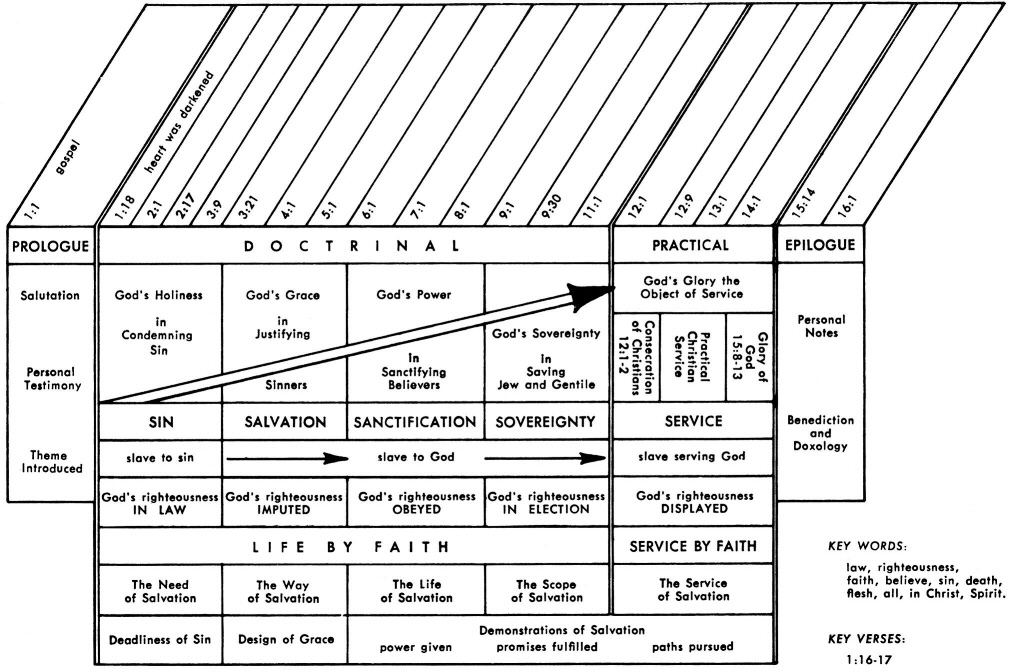
Click chart to enlarge
Chart from recommended resource Jensen's Survey of the NT - used by permission
Romans Overview Chart - Charles Swindoll
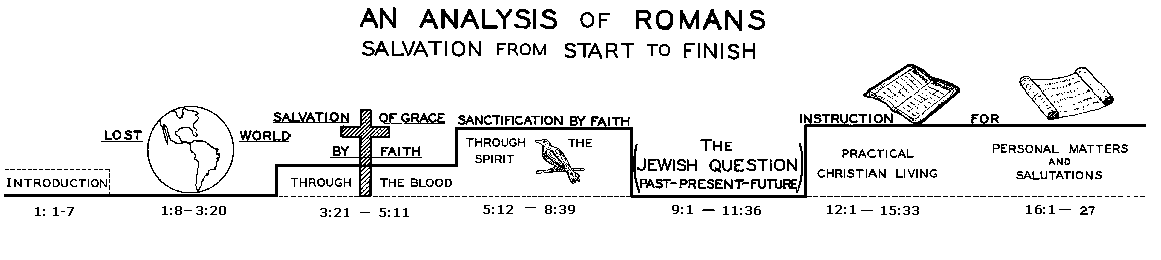
Source: Dr David Cooper
Click to Enlarge
| ROMANS ROAD to RIGHTEOUSNESS |
||||
| Romans 1:18-3:20 | Romans 3:21-5:21 | Romans 6:1-8:39 | Romans 9:1-11:36 | Romans 12:1-16:27 |
| SIN | SALVATION | SANCTIFICATION | SOVEREIGNTY | SERVICE |
| NEED FOR SALVATION |
WAY OF SALVATION |
LIFE OF SALVATION |
SCOPE OF SALVATION |
SERVICE OF SALVATION |
| God's Holiness In Condemning Sin |
God's Grace In Justifying Sinners |
God's Power In Sanctifying Believers |
God's Sovereignty In Saving Jew and Gentile |
Gods Glory The Object of Service |
| Deadliness of Sin |
Design of Grace |
Demonstration of Salvation | ||
| Power Given | Promises Fulfilled | Paths Pursued | ||
| Righteousness Needed |
Righteousness Credited |
Righteousness Demonstrated |
Righteousness Restored to Israel |
Righteousness Applied |
| God's Righteousness IN LAW |
God's Righteousness IMPUTED |
God's Righteousness OBEYED |
God's Righteousness IN ELECTION |
God's Righteousness DISPLAYED |
| Slaves to Sin | Slaves to God | Slaves Serving God | ||
| Doctrine | Duty | |||
| Life by Faith | Service by Faith | |||
|
Modified from Irving L. Jensen's chart above |
||||

Rome in the Time of Paul (c. A.D. 60)
| Summary of Romans 9-11 |
||
| Romans 9 | Romans 10 | Romans 11 |
| Past Election |
Present Rejection |
Future Reception |
| God's Sovereignty Israel's Election by God |
Man's responsibility Israel's Rejection of God |
God's Ways Higher God Not Rejecting Israel |
Romans 10:8 But what does it say? "THE WORD IS NEAR YOU, in your mouth and in your heart "--that is, the word of faith which we are preaching (NASB: Lockman)
Greek: alla ti legei? (3SPAI) Eggus sou to rhema estin, (3SPAI) en to stomati sou kai en te kardia sou; tout' estin (3SPAI) to rhema tes pisteos o kerussomen. (1PPAI)
Amplified: But what does it say? The Word (God's message in Christ) is near you, on your lips and in your heart; that is, the Word (the message, the basis and object) of faith which we preach (Amplified Bible - Lockman)
ESV: But what does it say? "The word is near you, in your mouth and in your heart" (that is, the word of faith that we proclaim); (ESV)
ICB: This is what the Scripture says: "God's teaching is near you; it is in your mouth and in your heart." That is the teaching of faith that we tell.
NIV: But what does it say? "The word is near you; it is in your mouth and in your heart," that is, the word of faith we are proclaiming: (NIV - IBS)
NKJV: But what does it say? "The word is near you, in your mouth and in your heart" (that is, the word of faith which we preach):
NLT: Salvation that comes from trusting Christ--which is the message we preach--is already within easy reach. In fact, the Scriptures say, "The message is close at hand; it is on your lips and in your heart." (NLT - Tyndale House)
Phillips: 'The word is near you, even in your mouth and in your heart'. It is the secret of faith, which is the burden of our preaching (Phillips: Touchstone)
Wuest: But what does it say? Near you the word is, in your mouth and in your heart. This is the word of the Faith which we are proclaiming. (Eerdmans Publishing - used by permission)
Young's Literal: But what doth it say? 'Nigh thee is the saying -- in thy mouth, and in thy heart:' that is, the saying of the faith, that we preach
BUT WHAT DOES IT SAY THE WORD IS NEAR YOU IN YOUR MOUTH AND IN YOUR HEART: alla ti legei (3SPAI) eggus sou to rhema estin (3SPAI) en to stomati sou kai en te kardia sou:
- Listen to Dr J Vernon McGee: Romans 10:9-11 Mp3
- The Word - Deut 30:14 (commentary)
- Romans 10 Resources - Multiple Sermons and Commentaries
QUOTING MOSES' WORDS
ON THE WORD
What does it say - This question refers to the personification of "Righteousness based on faith" which "speaks" in Ro 10:6-note. Paul quotes a passage from the OT "But the word is very near you, in your mouth and in your heart, that you may observe it." (Deut 30:14+)
Word (4487)(rhema from verb rheo = to speak - to say, speak or utter definite words) refers to the spoken word, especially a word as uttered by a living voice uttering a definite intelligible word, which has a definite meaning and which focuses upon the content of the communication. By using rhema Paul is referring to the Word as actually uttered when preached.
Near (1451) (eggus) can have a spatial (position close to another - Jn 3:23) or temporal (point of time relatively close to another - Jn 2:13) meaning. Here the idea seems to be that the Word of Faith is near or close at hand and ready to help.
Tony Garland explains it this way "Emphasis is placed on the nearness (accessibility) of God's commandments. There is an intimate connection between the heart and mouth. The mouth speaks forth that which is in the heart ( Mt 12:34; 15:17, 18, 19; Lk 6:44, 45+). Our problem is not one of access to God's will, but obedience! (Romans 10:1-13 - The Righteousness of God) (Watch his web show or listen to his Mp3 audio which is much more in depth - Romans 10:1-13)
To keep the Word near one's self was exactly the command given to Joshua "This book of the law shall not depart from your mouth, but you shall meditate on it day and night, so that you may be careful to do according to all that is written in it; for then you will make your way prosperous, and then you will have success. (Josh 1:8+)
Morris has an interesting observation "Paul in this passage is quoting (or better, paraphrasing and applying) Dt 30:14. It is noteworthy that he refers to its authority, not as that of the Scripture, Moses, or God, as he usually does when quoting from the Old Testament, but rather as "the righteousness which is of faith" speaking (Ro 10:6), in effect personifying that righteousness (1Cor 1:30+). (Defenders Study Bible)
Instead of having to go to great lengths to achieve righteousness by the impossible task of trying to obey the Law (cp Jas 2:10+), we can immediately receive righteousness by faith, by trusting in the word of the Gospel. In other words, men do not have to ascend or descend to find it, because God’s way of salvation has been clearly revealed in the Gospel. His chosen people Israel in fact had been surrounded by the word of faith (the message that righteousness comes by faith) which Paul was now preaching. Even under the Old Covenant men could claim God’s grace simply by receiving it in faith (Ge 15:6+, Ps 106:30-note, Ps 106:31-note [Phinehas faith brought forth works] Hab 2:4+, Gal 3:8+).
Much of our modern world today is like the Israel of Paul’s day, for they (like Israel) have a general idea of the claims of the Gospel and have access to Bibles, churches, and believers through which they could (or should be able to) easily see the gospel if they so desired. As a believer, it is difficult on this side of the veil, so to speak, to understand why men who have such open access to the truth which would set them free (Jn 8:31,32, 36) still foolishly, willfully choose to pursue righteousness by works (or conversely to actively pursue unrighteousness, Ro 9:30-note cp Jn 3:19, 20+) and to “suppress (katecho = actively hold truth down and present tense = do so continually) the truth in unrighteousness” (Ro 1:18-note, see the resultant downward "moral spiral" in Ro 1:19-28-note).
The word is near you - Paul quotes Moses' words from Dt 30:14+ to demonstrate to his readers that the word of faith (the message that righteousness comes by faith) was near and was accessible, intelligible, and easily obtained. As Constable says "Faith (Ed: believing the gospel) is easy, compared to a lifetime of slavish obedience to the Law (Ed: Which is futile in regard to obtaining righteousness acceptable to God)."
McGee phrases it this way - It (the Word of Faith) is available right where you are sitting. A great many folk think they have to go to an altar in some sort of meeting to be saved. But salvation is available to you right where you are now. (Listen to Dr McGee's Mp3's = Ro 10:4-8; Ro 10:9-11)
In your mouth - That is to say the word of faith (the message that righteousness comes by faith) can be expressed with normal human speech. For example, every time a Jewish priest would have spoken the words from Genesis 15:6+, the "bells" should have gone off in the minds of the hearers!
In your heart - That is to say that the word of faith can be readily understood in the mind ("heart" was often used as a metonym [figure of speech using name of one thing {heart} for that of another {mind} of which it is associated]) and thus easily accepted (or received, cp the predominate response of the Jews to the Truth = Jn 1:11+). And if one considers the Jewish phylacteries which were common in Jesus' and Paul's day (and are worn today by Orthodox Jews), the literal Word of God was near them for they would bind these boxes of Scripture on the left arm [nearer the heart!] and on their forehead [between their eyes - cp Ex 13:9YLT!]
The psalmist writes "The law of his God is in his heart; His steps do not slip. (Ps 37:31-See Spurgeon's note)
KJV Bible Commentary has an interesting and very plausible interpretation of this section noting that Paul "even goes so far as to say that it is in their mouths and in their hearts. How can this be? The answer is that when entering a town to preach, Paul immediately proceeded to the synagogue. Whether the Jews believed his message or not, when he left, they remained behind to discuss what Paul had taught. The very message of the gospel of Christ had been in their mouths and in their hearts, but they did not believe. The truth of righteousness was as close to them as it could possibly be, but they failed in their responsibility to receive that truth. (Dobson, E G, Charles Feinberg, E Hindson, Woodrow Kroll, H L. Wilmington: KJV Bible Commentary: Nelson )
Moses' charge to remember the Feast of the Passover forever (Ex 12:14) is another OT passage that should have "made the lights flash" in the hearts and minds of the Jewish celebrants (and should do so in our day when even many non-Orthodox Jews choose to celebrate the Passover!)...
And it (the annual celebration of the Passover feast) shall serve as a sign (points to something = a visible mark or object intended to convey a clear message!) to you on your hand, and as a reminder on your forehead (between your eyes - What God figuratively meant to stir their hearts, they perverted into a literal, albeit empty ritual known as the wearing of phylacteries - cp Ex 13:16+, Dt 6:4, 5, 6, 7, 8, 9+, Dt 11:18+, Mt 23:5) that the law of the Lord may be in your mouth; for with a powerful hand the Lord brought you out of Egypt (Ex 13:9+)
Comment: How "near" this Word was to the Jews who for the most part were blind to these great OT "picture book stories" of the Messiah and His work of salvation for sinful mankind! (2Co 3:14, 15, 16+) Compare Ex 12:3, 4, 5, 6, 7+ [note even the application to the doorposts and lintel would replicate the arrangement of the Cross!], Ex 12:13, 14+ = Redeemed from Egyptian slavery by the blood of an unblemished lamb [cp Jn 1:29, 2Co 5:7-8+, 1Pe 1:18, 19+] The word of faith has always been near to those who have eyes to see it and ears to hear it! What an awesome God we serve Who demonstrates such incredible patience and lovingkindness to men and women who are hostile toward Him (cp Col 1:21+, Ro 5:10+)!
Lenski - At one time the Jews from very childhood onward learned the law by the Word uttered and taught to them; it was put into the “mouth” of each one. In this way it was by the Word also to enter the “heart” of each, the center of his being. Not, indeed, so as to attain righteousness by the law. Theirs were to be believing hearts, and they were to use the law rightly for daily contrition and repentance and for their hearts’ guide to serve God aright. Just so the gospel Word, when it is uttered and preached, brings God’s righteousness, has ever brought it where it sounded forth, has placed it right into the “mouths” of the hearers to talk about it, discuss it, make it their own, confess it; right into their “hearts” to hold it there by faith. The Word, the Word uttered, is the great medium; and being gospel-Word and not command, faith is its reception, and unbelief, sad to say, its rejection. Since the medium, the uttered Word, was the same, it should have been as easy for the Jews to receive the gospel as to receive the law. Easier, in fact, because the gospel is a pure gift. But they received even the law only outwardly and not in the heart and closed their hearts obdurately against the gospel-word with its gift of righteousness. (The Interpretation of St. Paul's Epistle to the Romans 8-16)
Charles Hodge writes that "The meaning in this passage is: “The Gospel, instead of directing us to climb up into heaven (Ro 10:6-note) or to go down to the depths (Ro 10:7-note), tells us the thing required is simple and easy. Believe with your heart and you will be saved. . (Romans Commentary)
William Kelly said it well - Christ is given and preached. It is for man to name Him with his mouth and to believe with his heart
Middletown Bible...
The glorious proclamation about Christ is near. It’s not far away. It is accessible to all and available for all! The good news of salvation is within reach of all. How near is it? It is in your mouth and in your heart! But you must do something with it! With your heart believe it! With your mouth confess it! (It is near and close to people in America today, so near that it is in their mouths--they use the Lord’s Name all the time, but in the wrong way, not to confess but to curse!)
Ro 10:8,9 can be illustrated by the robber on the cross (Mk 15:32, Lk 23:39, 40, 41, 42, 43). The crucified Christ was very near him! The word was in the robber's mouth but in the wrong way (he reviled Him at first). But this man repented and he believed in his heart that God would raise Him from the dead (Lk 23:42) and with his mouth he confessed Him as Lord and King (Lk 23:42). May we believe and confess as this man did! (Ed: And not be like the other thief who refused to repent and believe!)
THAT IS, THE WORD OF (THE) FAITH WHICH WE ARE PREACHING: tout estin (3SPAI) to rhema tes pisteos o kerussomen (1PPAI):
- Ro 10:17; 1:16,17; Isaiah 57:19; Mark 16:15,16; Acts 10:43; 13:38,39; 16:31; Gal 3:2,5; 1Ti 4:6; 1Pe 1:23,25
- Romans 10 Resources - Multiple Sermons and Commentaries
Word (4487)(rhema from verb rheo = to speak - to say, speak or utter definite words) refers to the spoken word, especially a word as uttered by a living voice. Laleo is another word translated speak but it refers only to uttering a sound whereas rheo refers to uttering a definite intelligible word. Rhema refers to any sound produced by the voice which has a definite meaning. It focuses upon the content of the communication. For example in Luke we read...
And they understood none of these things, and this saying (rhema) was hidden from them, and they did not comprehend the things that were said. (Luke 18:34)
The word of faith - Literally this reads "word of the faith" or "saying of the faith". What word was Paul preaching? In context "the Word of the faith" Paul was preaching was the message that righteousness comes by faith. In other words, this would be another way of referring to the good news of the gospel. In the OT passage the "word" is God's word as found in the law. Paul takes the OT passage and applies it to the gospel, "the word of faith", which is something we confess as well as believe. Note that in the following verse (Ro 10:9), Paul reverses the normally expected chronological order, placing confess before believe, the expected pattern being that found in 2Co 4:13, 14.
Hodge agrees writing that "The expression word of faith may mean “the word or doctrine concerning faith,” or “the word to which faith is due,” which should be believed. In either case, it is the Gospel, or doctrine of justification, which is intended here. (Romans Commentary)
Paul's main point is the ready availability of Good News. Righteousness can be gained by sinful men, but it can only be secured by faith and not by deeds. This Good News is readily available to anyone who will receive it freely from God through Christ.
Preaching (2784) (kerusso or kerysso from kerux/keryx = a herald - one who acts as the medium of the authority of one who proclamation he makes; kerugma = the thing preached or the message) means to proclaim (publicly) or to herald or act as a public crier - the town official who would make a proclamation in a public gathering.
The Greco-Roman rulers had special heralds who made announcements to the people. They were commissioned by the ruler and were to proclaim their announcements in a loud, clear voice so that everyone could hear. In the ancient world not to heed the ruler’s messenger was a serious error and to abuse the messenger was even worse. So just as kerusso was used of the official whose duty was to proclaim loudly the coming of an earthly king, even our gospel is to clearly announce the coming of the King of kings and Lord of lords (Rev 19:16-note)!
The Imperial Herald would enter a town in behalf of the Emperor, and make a public proclamation of the message which his Sovereign ordered him to give, doing so with such formality, gravity, and authority as to emphasize that the message must be heeded! (Think about this in regard to the Gospel of God instead of the decree of a man! cf note 1Thessalonians 2:13). He spoke to the people exactly what the Emperor had instructed him to give, nothing more, nothing less. He did not dare add to the message or take away from it. Should this not be the example and pattern every preacher and teacher of the holy gospel of God seeks and strives to emulate, yea, even doing so with fear and trembling! ("not as pleasing men but God, who examines our hearts" 1Th 2:4-note)
Related resources...
- Summary on the Attributes of God
- Spurgeon on the Attributes of God
- Israel of God - Is God "Finished" with Israel in His prophetic plan?
- Off Site - Table Comparing/contrasting Israel & Church
- Off Site - Does the Church Fulfill Israel's Program? - John Walvoord
- The Jewish People, Jesus Christ and World History - S Lewis Johnson
Are you confused about God's plan for Israel? Then I highly recommend Tony Garland's 12 Hour Course on Romans 9-11 in which he addresses in depth the question of What Will Happen to Israel? (click) or see the individual lectures below)
- Romans 9:1-5 Paul's Sorrow Concerning Israel
- Romans 9:6-13 Children of the Promise
- Romans 9:14-24 The Potter and the Clay
- Romans 9:25-33 A Remnant Will be Saved
- Romans 10:1-13 The Righteousness of God
- Romans 10:14-21 Has Israel Not Heard?
- Romans 11:1-6 God Has Not Cast Away The Jews
- Romans 11:7-15 Life from the Dead
- Romans 11:16-24 Two Olive Trees
- Romans 11:25-36 The Salvation of Israel
Note that when you click the preceding links, each link will in turn give you several choices including an Mp3 message and brief transcript notes. The Mp3's are long (avg 70+ min) but are in depth and thoroughly Scriptural with many quotations from the Old Testament, which is often much less well understood than the NT by many in the church today. Garland takes a literal approach to Scripture, and his love for the Jews and passion to see them saved comes through very clearly in these 12 hours of teaching! Take your home Bible Study group through this series if you dare. Take notes on the tapes as the transcripts are a very abbreviated version of the audio messages. This course is highly recommended for all who love Israel! I think you will agree that Tony Garland, despite coming to faith after age 30 as an engineer, clearly has been given a special anointing by God to promulgate the truth concerning Israel and God's glorious future plan for the Jews. Garland has also produced more than 20 hours of superb audio teaching in his verse by verse commentary on the Revelation (in depth transcripts also available) which will unravel (in a way you did not think was possible considering the plethora of divergent interpretations) God's final message of the triumph and return of the our Lord Jesus Christ as the King of kings and Lord of lords! Maranatha!
Romans 10:9 that if you confess with your mouth Jesus as Lord, and believe in your heart that God raised Him from the dead, you will be saved;
Greek: hoti ean homologeses (2SAAS) en to stomati sou kurion Iesoun, kai pisteuses (2SAAS) en te kardia sou hoti o theos auton egeiren (3SAAI) ek nekron, sothese (2SFPI)
Amplified: Because if you acknowledge and confess with your lips that Jesus is Lord and in your heart believe (adhere to, trust in, and rely on the truth) that God raised Him from the dead, you will be saved.
ESV: because, if you confess with your mouth that Jesus is Lord and believe in your heart that God raised him from the dead, you will be saved.
ICB: If you use your mouth to say, "Jesus is Lord," and if you believe in your heart that God raised Jesus from death, then you will be saved.
NIV: That if you confess with your mouth, "Jesus is Lord," and believe in your heart that God raised him from the dead, you will be saved.
NKJV: that if you confess with your mouth the Lord Jesus and believe in your heart that God has raised Him from the dead, you will be saved.
NLT: For if you confess with your mouth that Jesus is Lord and believe in your heart that God raised him from the dead, you will be saved.
Phillips: If you openly admit by your own mouth that Jesus Christ is the Lord, and if you believe in your own heart that God raised him from the dead, you will be saved."
Wuest: If you confess with your mouth Jesus as Lord and believe in your heart that God raised Him from among the dead, you will be saved. (Eerdmans Publishing - used by permission)
Young's Literal: that if thou mayest confess with thy mouth the Lord Jesus, and mayest believe in thy heart that God did raise him out of the dead, thou shalt be saved,
THAT IF YOU CONFESS WITH YOUR MOUTH JESUS AS LORD AND BELIEVE IN YOUR HEART: hoti ean homologeses (2SAAS) en to stomati sou kurion Iesoun:
- Ro 14:11; Matthew 10:32,33; Luke 12:8; John 9:22; 12:42,43; Philippians 2:11; 1John 4:2,3; 2John 1:7
- Ro 8:34; Jn 6:69, 70, 71; 20:26, 27, 28, 29; Acts 8:37; 1Cor 15:14, 15, 16, 17, 18; 1Pe 1:21
- Romans 10 Resources - Multiple Sermons and Commentaries
ONLY ONE
CONFESSION "COUNTS"!
And if you confess with your mouth Jesus as Lord - This is a fascinating statement but one which is as it were "time sensitive". This confession must be made during life before we die physically. Indeed, there is coming a glorious day when the great God and Lord of all, Christ Jesus, will be acknowledged for Who He truly is by every man and woman ever born! The tragedy of tragedies is that this future confession in the life to come does not gain salvation for those who have denied His Lordship in this present evil age (Gal 1:4)!
Paul affirms the reality of this future confession twice noting first that...
it is written (grapho in the perfect tense = it stands written in the OT prophecy Isaiah 45:23 and is a permanent binding irrevocable record!), “As I live, says the Lord, every (pas = all with no exception!) knee shall bow to Me, and every (pas = all with no exception!) tongue shall give praise (exomologeo = conveys the thought of an open, frank, and full confession. The middle voice = reflects each person's definite personal involvement in this confession) to God.” (Ro 14:11-note)
Therefore (because of Php 2:5, 6, 7-notes, Php 2:8-note) also God highly exalted Him, and bestowed on Him the name which is above every name, that at the name of Jesus EVERY (pas = all without exception!) KNEE SHOULD BOW, of those who are in heaven, and on earth, and under the earth, and that every (pas = every tongue without exception!) tongue should confess that Jesus Christ is Lord, to the glory of God the Father. (Amen and Amen!) (Php 2:9, 10, 11-note)
Confess (3670) (homologeo from homoú = together with + légo = say) means to say the same and so to agree in one's statement. Homologeo means to express openly one's allegiance to a proposition or a person, in this context the person of Christ. It is a statement of identification, faith, confidence, and trust.
Outward confession stems from a profound inward conviction.
Homologeo has strong legal connotations. As a judicial term, the word indicates the binding and public declaration which settles a relationship with legal force. A person can confess to a charge in court and thus openly acknowledge guilt. Or one may agree with a court order and thus make a legally binding commitment to abide by it. This last sense is implied in passages like this one in Romans 10 that call on us to acknowledge Jesus. We are to express our binding commitment to Jesus publicly thus acknowledging our relationship to Him as our Lord and Savior.
Related Resources:
- International Standard Bible Encyclopedia Confession
- Bridgeway Bible Dictionary Confession
- Baker's Evangelical Dictionary Confess, Confession
- Easton's Bible Dictionary Confession
- Fausset Bible Dictionary Confession
- Spurgeon's Illustration Collection Hypocritical Confessions
- Holman Bible Dictionary Confession
- Hastings' Dictionary of the Bible Confession
- Hastings' Dictionary of the NT Confession
- Watson's Theological Dictionary Confession
- Vines' Expository Dictionary Confess, Confession Confess
Middletown Bible...
To confess that Jesus is the Christ means that a person agrees that Jesus is indeed the Messiah (Jn 1:41; 4:25, 26,42). According to the Old Testament Scriptures, the Messiah was portrayed as
(1) the God-man (Isa.7:14)
(2) the mighty God (Isa 9:6)
(3) the sinner’s Substitute and Saviour (Isaiah 53:5, 6ff)
(4) the eternal King (Micah5:2) and
(5) THE LORD (JEHOVAH) OUR RIGHTEOUSNESS (Jer 23:5, 6)
There is a cost involved in confessing that Jesus is the Messiah (Jn 9:22) and because of this cost many fail to confess Him (Jn 12:42). But those who do confess Him before men have Christ's own promise that He will confess them before the angels and before His heavenly Father (Mt10:32; Lk 12:8).
Jesus as Lord - Cranfield writes that...
The confession that Jesus is Lord meant the acknowledgment that Jesus shares the name and the nature, the holiness, the authority, power, majesty, and eternity of the one and only true God.
Lord (2962) (kurios) means lord, master, owner or the one who has absolute ownership power. Kurios translates Jehovah (LORD in OT) in the Septuagint (LXX) almost 7000 times. In the New Testament there are 717 references to kurios and it is notable that Jesus is referred to as Savior about ten times and as Lord about 700 times! Kurios signifies sovereign power and absolute authority. Kurios is the one who has absolute ownership and uncontested power. It is the one who is in charge by virtue of possession (owner).
Kurios is used to describe human relationships. Jesus described the relationship of slaves to their lords (Mt 10:24; 25:19). The Apostle Paul told slaves to obey their masters or lords as a sign of the slaves' faith in Christ (Eph 6:5-note, Eph 6:9-note; Col 3:22-note).
In the earliest Greek kurios meant "to have power or authority." Later it came to describe one who is in control. As classical Greek developed, it became a title for men of importance. Since the gods of ancient Greece were neither creators nor lords of their fate, pagan deities were not called "lord" until much later. By the time of Christ, kings had come to be called "lord." This was true of the Roman Emperor Caligula (A.D. 37-41). It was also true of Candace, the fabled queen of upper Egypt (see Acts 8:27). So too Herod the Great, Herod Agrippa I, and Herod Agrippa II were called "lord."
Mounce - The Greek word (kurios) used throughout the LXX for Yahweh (Ed: See discussion Jehovah = Jesus)...is here applied to Jesus. The implications of this are staggering. Primarily it means that Jesus’ authority is absolute, unlimited, and universal. Those who come to Christ by faith are acknowledging that they have placed themselves entirely and without reserve under His authority to carry out without hesitation whatever he may choose for them to do. There is no such thing as salvation apart from lordship. Although our level of obedience may falter from time to time, that does not imply that we can view our responsibilities as if they did not matter. Those who say that they intend to have a good time on earth and take a back seat in heaven do not realize that there are no “back seats” for those who approach salvation with this attitude. (Mounce, R. H. Vol. 27: Romans. The New American Commentary. Nashville: Broadman & Holman Publishers)
Martin Luther puts Lord in an interesting perspective noting that "The life of Christianity consists of possessive pronouns. It is one thing to say, "Christ is a Saviour"; it is quite another thing to say, "He is my Saviour and my Lord." The devil can say the first; the true Christian alone can say the second.
William MacDonald addresses the important topic of "Lordship" - The question often arises, “Can a person be saved by accepting Jesus as Savior without also acknowledging Him as Lord?” The Bible gives no encouragement to anyone who believes with mental reservations: “I’ll take Jesus as my Savior but I don’t want to crown Him Lord of all.” On the other hand, those who make submission to Jesus as Lord a condition of salvation face the problem, “To what degree must He be acknowledged as Lord?” Few Christians would claim to have made an absolute and complete surrender to Him in this way. When we present the gospel, we must maintain that faith is the sole condition of justification. But we must also remind sinners and saints constantly that Jesus Christ is Lord (Jehovah-God), and should be acknowledged as such. (MacDonald, W & Farstad, A. Believer's Bible Commentary: Thomas Nelson )
Related Resource:
Is there a "cost" to confessing Christ as Lord? John alludes to the cost in his story of the blind man who was given sight by our Lord noting that...
His parents said this (Jn 9:20, 21) because they were afraid of the Jews; for the Jews had already agreed that if anyone confessed Him to be Christ (the long expected Messiah), he was to be put out of the synagogue (aposunagogos = literally "separated from the synagogue" = excommunicated). (Jn 9:22, see also Jn 12:42, 43)
Comment: "Excommunication" from the Jewish synagogue was a very serious matter for any Jew and the healed man's parents were not willing to pay the "price" of confession for it could mean the loss livelihood, as well as a loss of privileges of the Jewish religion. In short, we need to count the cost when we confess Him as Lord. I remember some 20 years ago when I was first saved and so excited that I could not "shut up" about Jesus. One of my dearest relatives told me that if I did not cease talking about Him, I need not come back to their home! It was very painful, and dear reader I'm sure this anecdotal story conjures up a similar memory in your past!
Dr Luke records Jesus' own words on this topic - "And I say to you, everyone who confesses Me before men, the Son of Man shall confess him also before the angels of God, but he who denies Me before men shall be denied before the angels of God. (Luke 12:9, 10, cp Mt 10:32, 33)
In His Revelation, the Risen Glorified Lord Jesus affirms the church at Pergamum "I know where you dwell, where Satan's throne is; and you hold fast My name, and did not deny My faith even in the days of Antipas, My witness, My faithful one, who was killed among you, where Satan dwells. (Rev 2:13-note, cp Re 3:5-note)
Middletown Bible - The word that means the opposite of "confess" is the word "deny" (Jn 1:20; 1John 2:22, 23). To confess is to say "YES"; to deny is to say "NO." In Lk 22:57, 58, 59, 60 Peter should have said, "Yes, I know Him (Lk 22:57)!" "Yes, I am one of them (Lk 22:58)!" "Yes, I was with Him (Lk 22:59, 60)!" But Peter denied Christ (although his denial was only temporary because later, on the day of Pentecost, he boldly confessed Christ and preached Christ before thousands--Acts 2:14, 23, 24, 36, 37, 38). Thus, when asked this question, "Do you own Jesus as your Saviour and Lord? Do you claim Him as your own?" the believer can respond: "Yes I do! I acknowledge that He is mine! I belong to the Son of God who loved me and gave Himself for me!" During the great Christian persecutions of the second and third centuries, those believers who would not deny the Lord even at the risk of great suffering were known as CONFESSORS. May we never be ashamed of the God who was unashamed to die for us (2Ti 1:8-note; Ro1:16-note; 1Pe 4:16-note)!
The apostle John succinctly states the importance of the confession of Jesus writing that...
Whoever (Pas = all without exception!) denies (arneomai in the present tense = they persist in their denial) the Son does not have the Father; the one who confesses (homologeo in the present tense = they persist in their confession) the Son has the Father also. (1Jn 2:23)
Comment: To deny the Son is to deny the Father, a message that should be noted by all religions that say they "worship God" but deny the Son! The Son will one day deny them (Mt 7:21-note, Mt 7:22, 23-note)!
J Vernon McGee: When you say that you believe in God and deny the deity of Christ, you really do not believe in God, certainly not the God of the Bible. The God of the Bible is the one who sent His Son into the world to die for our sins. And since the Son is God, He alone is the one who could make a satisfactory sacrifice to God for our sins. Had he been anyone else other than God, He Himself would have been a sinner. In the great Riverside Church in New York City when Dr. Harry Emerson Fosdick was the pastor, the cover page of a bulletin at that time said,
Whoever you are that worship here, in whatever household of faith you were born, whatever creed you profess, if you come to this sanctuary to seek the God in whom you believe or to rededicate yourself to the God in whom you do believe, you are welcome.
It goes on to say a lot about peace and the Fatherhood of God, but I’m nauseated reading that far so I will not quote any more of it. It sounds sweet and flowery; it appeals to the natural man, but John’s whole point is that we need to beware of this, for this is antichrist. We need to emphasize this very important verse. (You will enjoy listening to Dr McGee's fuller explanation on the Mp3 of 1Jn 2:23-24).
Paul writes that "If we endure, we will also reign with Him. If we deny Him, He also will deny us. (2Ti 2:12-note)
We see the same principle uttered even by the psalmist who declares...
I will also speak of Your testimonies before kings and shall not be ashamed (Psalm 119:46-note)
Spurgeon: This is part of his liberty; he is free from fear of the greatest, proudest, and most tyrannical of men. David (Ed: Not everyone agrees that David wrote Ps 119 but it is certainly possible) was called to stand before kings when he was an exile; and afterwards, when he was himself a monarch, he knew the tendency of men to sacrifice their religion to pomp and statecraft; but it was his resolve to do nothing of the kind. He would sanctify politics, and make cabinets know that the Lord alone is governor among the nations. As a king he would speak to kings concerning the King of kings. He says, "I will speak": prudence might have suggested that his life and conduct would be enough, and that it would be better not to touch upon religion in the presence of royal personages who worshipped other gods, and claimed to be right in so doing. He had already most fittingly preceded this resolve by the declaration, "I will walk," but he does not make his personal conduct an excuse for sinful silence, for he adds, "I will speak." David claimed religious liberty, and took care to use it, for he spoke out what he believed, even when he was in the highest company. In what he said he took care to keep to God's own word, for he says, "I will speak of thy testimonies." No theme is like this, and there is no way of handling that theme like keeping close to the book, and using its thought and language. The great hindrance to our speaking upon holy topics in all companies is shame, but the Psalmist will "not be ashamed"; there is nothing to be ashamed of, and there is no excuse for being ashamed, and yet many are as quiet as the dead for fear some creature like themselves should be offended.
When God gives grace, cowardice soon vanishes. (GLORY!) He who speaks for God in God's power, will not be ashamed when beginning to speak, nor while speaking, nor after speaking; for his theme is one which is fit for kings, needful to kings, and beneficial to kings. If kings object, we may well be ashamed of them, but never of our Master Who sent us, or of His message, or of His design in sending it.
D. H. Mollerus - I will not be ashamed. That is, I shall not be cast down from my position or my hope; I shall not be afraid; nor will I, from fear of danger or reproach, shun or renounce the confession; nor shall I be overcome by terrors or threats.
William Cowper - A good conscience renders always great consolation; and an honest life makes great boldness to speak without fear or shame, as ye see in David towards Saul, in Elias to Ahab, in Paul to Agrippa, to Festus, and to Felix.
When we confess sin this confession is more than a mere acknowledgment of sin in the life. It is an agreeing with God as to all the implications that enter into the fact that one has sinned. It is looking at sin from God’s point of view, and acting accordingly. It means the putting away of that sin. It means the determination to be done with that sin.
To reiterate, the idea of confess is not just to say with one's lips, but to validate the lip's confession with the life's direction (conduct, behavior)! Do not be deceived, beloved brethren. One must confess Christ with his mouth, but he must also "confess" Him through his righteous behavior.
Lips and Life
Must Match
In Titus 1:16 we see a confession with the lips which is denied by the life lived in those who are defiled and unbelieving (Titus 1:15-note) "profess (homologeo in the present tense - their lips continually profess) to know God, but by their deeds they deny (their practice negates their profession - they say one thing and do another = they say with their behavior and lifestyle that they do not know Jesus or are in any way related to Him) Him, being (present tense - continually) detestable (root word means to "stink"!) and disobedient, and worthless (their deeds are rejected after examination = their works do not stand God's test of deeds wrought by abiding in the Vine, Christ Jesus) for any good deed . (Titus 1:16-note) (See What is a profession of faith?)
We are to confess Christ “before men” which emphasizes the public character of the confession. When we confess Jesus as Lord, we are agreeing with what God the Father says about Jesus His Son, and with what Jesus says about Himself. It means we recognize that Jesus is God, that He is the Messiah in the OT, and that His finished work on the Cross (Jn 19:30) secured the only way of salvation for mankind (Acts 4:12, Jn 14:6). If the heart truly believes, the mouth will be eager to confess. Confession (much like repentance, e.g., Mk 1:15) is characteristic of true faith and is not an separate or additional condition of salvation.
Haldane adds that "The confession of Christ is salvation. But that confession which is salvation, is a confession which implies that the truth confessed with the mouth is known and received in the heart. The belief of the heart is therefore joined with the confession of the lips. Neither is genuine without the other, though it may be said that either the one or the other is salvation, because they who believe with the heart will confess with the tongue. If a man says, “I believe in Christ,” yet denies Him when put to trial, or confesses Him with the lips, yet denies Him in His proper character, he neither confesses nor believes Christ (cp Luke 12:8, 9). It should always be remembered, that if he believes anything different from the testimony of God relating to the person and work of the Savior, he does not believe the Gospel, but something, whatever it may be, which can neither sanctify nor save. The Gospel alone is the power of God unto salvation to every one who believes it. (Romans 10 Commentary)
Frederic Godet explains that "The two terms: confessing with the mouth and believing with the heart, reproduce the ideas in thy mouth and in thy heart, of Ro 10:8 ("in your mouth and in your heart". These are the two conditions of salvation; for while faith suffices to take hold of the finished expiation, when this faith is living, it inevitably produces profession...Profession is put first here, in keeping with the words of Moses (Ro 10:8: in thy mouth); the order is that which from the external ascends to the internal; it reminds us that profession would be nothing without faith.—The object of the profession is the title Lord given to Christ, as is done in the invocation by which we publicly declare ourselves subjects; cp. 1Co 12:3... Here again we find the idea of Ro 10:6, that of the glorified Christ. The same relation between the sovereignty of Christ and the Christian profession appears in Php 2:9, 10, 11: “Wherefore God hath supremely exalted Him...that every tongue should confess that He is Lord.” This allusion to Ro 10:6-note proves clearly that the reference there was not to the incarnation; for Jesus is called by the title of Lord, as the glorified, and not as the pre-existent Christ.—On the other hand, the special object of faith is Christ risen. The reason is clear: it is in the external fact of the resurrection that faith apprehends its essential object, the moral fact of justification; cp. Ro 4:25-note.—Paul concludes this long sentence with a brief summary word: thou shalt be saved, as if he would say: After that all is done Ro 10:10 demonstrates in fact that these conditions once complied with, salvation was sure. (Romans 9:30-10:21 Cause of Israel's Rejection or here)
D L Moody - I DO not know of any more important truth to bring before an unconverted person than the answer to the question—“What must I do to be saved?”—because that is the beginning of everything with regard to the divine life. A man must know he is saved before there is any peace, or joy, or comfort. The answer is, “Believe on the Lord Jesus Christ, and thou shalt be saved.”
The question that comes right after that from almost every one is, “What is it to believe?” I believe that Jesus Christ is the Son of God; I believe that He came into the world to save sinners. Well, so do the devils. The devils not only believe, but they tremble. I can believe intellectually that Jesus Christ is able and willing to save, and yet be as far from the kingdom of God as any man who never heard about Jesus Christ. To be saved I must believe in my heart, and trust in His atoning work.
Robert J Morgan - 20,000 Verses
Vast portions of the Bible were written to be memorized, evidenced by the number of psalms that are based on Hebrew acrostics, such as Psalm 119 or Psalm 145. Bible translator William Tyndale suggested the book of Romans as prime memory material:
I think it meet that every Christian man know it by rote and without the book. Scripture memory stocks the mind with material for endless meditation, which, in turn, accelerates the transformation process. It keeps the heart from sin, and helps instill in us the mind of Christ.
In his book Your Inner You, pastor Leslie Flynn tells of his conversion to Christ during an evangelistic campaign led by Dr. Oscar Lowry, author of the book Scripture Memorizing for Successful Soul-Winning. Lowry admits that he entered Christian service as a young man with an undisciplined mind. Thinking he could not memorize Scripture, he filled the flyleaf of his Bible with references useful for counseling and evangelism, but it proved awkward to stop his conversations long enough to track down the right verse. Finally he determined to succeed at Scripture memory.
“If I can memorize one verse, I can memorize one more,” he said, “and ten more, and even one hundred.”
He rose early the next morning and chose what seemed to him a difficult passage, Romans 10:9–10. He paced the room, saying to himself, “I will do this thing.” He struggled with this passage for half an hour, but finally succeeded in memorizing it completely. The next morning, he reviewed and reinforced those verses in his memory, then added a new one. He kept reviewing his chosen passages and adding new ones until it dawned on him one day that he could repeat one hundred verses without looking in his Bible.
By the end of his life, he had learned over 20,000 verses, and he could locate each by chapter and verse without his Bible. No wonder his Christian life was full of joy, his mind full of wisdom, and his evangelistic efforts full of success. (From This Verse)
John MacArthur - To give glory to Christ, we must confess Him as Lord. That’s a part of salvation, not a subsequent act. Salvation is a matter of confessing that Christ is God and, therefore, that He is sovereign in your life. If you have never confessed Jesus Christ as Lord, you have no capacity to live for His glory. You cannot say, “I deny Christ. He is not my Savior or Lord,” and then expect to glorify God. If you dishonor the Son, you dishonor the Father (John 5:23). So salvation is the necessary beginning for glorifying God and, therefore, for spiritual growth. You cannot grow until you are born. (Truth for Today)
C H Spurgeon - Mouth Confession, Heart Belief: THERE must be confession with the mouth. Have I made it? Have I openly avowed my faith in Jesus as the Savior whom God has raised from the dead, and have I done it in God’s way? Let me honestly answer this question.
There must also be belief with the heart. Do I sincerely believe in the risen Lord Jesus? Do I trust in Him as my sole hope of salvation? Is this trust from my heart? Let me answer as before God.
If I can truly claim that I have both confessed Christ and believed in him, then I am saved. The text does not say it may be so, but it is plain as a pikestaff and clear as the sun in the heavens: “Thou shalt be saved.” As a believer and a confessor, I may lay my hand on this promise and plead it before the Lord God at this moment, and throughout life, and in the hour of death, and at the day of judgment.
I must be saved from the guilt of sin, the power of sin, the punishment of sin, and ultimately from the very being of sin. God hath said it: “Thou shalt be saved.” I believe it. I shall be saved: I am saved. Glory be to God for ever and ever! (Faith's Checkbook)
In view of the fact that "Lord" (kurios) is used over 8,600x in the Septuagint to translate the name of Israel's God (Yahweh), it is clear that Paul, when using this word of Jesus, is ascribing Deity to Him.
We can never forget all that it meant to say that Jesus Christ is Lord. "If a man called Jesus kurios he was ranking him with the Emperor and with God; he was giving him the supreme place in his life; he was pledging him implicit obedience and reverent worship." (Barclay)
A T Robertson commenting on Jesus Christ is Lord writes that "No Jew would do this who had not really trusted Christ, for Kurios in the Septuagint (LXX) is used of God. No Gentile would do it who had not ceased worshipping the emperor as Kurios. The word Kurios was and is the touchstone of faith."
Lord is from kurios, which signifies sovereign power and authority. In the book of Acts, Jesus is twice referred to as Savior but ninety-two times as Lord. In the entire New Testament, He is referred to some ten times as Savior and some seven hundred times as Lord. When the two titles are mentioned together, Lord always precedes Savior. And even if, as some erroneously contend, Lord were simply a synonym for God, the very term God by definition includes the idea of sovereign authority, that is, of lordship.
Regarding belief, it is important to emphasize that mere intellectual agreement with the facts of the Cross and the Resurrection is not necessarily faith that saves. Faith alone saves but the faith that saves results in a changed heart obedience.
Robert Haldane explains genuine faith writing that "A person becomes righteous by believing God’s record concerning His Son. But the evidence that this faith is genuine is found in the open confession of the Lord with the mouth. Confession of Christ is as necessary as faith in Him, but necessary for a different purpose. Faith is necessary to obtain the gift of righteousness. Confession is necessary to prove that this gift is received. In saying, then, that confession is made unto salvation, the apostle does not mean that it is the cause of salvation, or that without it the title to salvation is incomplete. When a person believes in his heart, he is justified. But confession of Christ is in effect of faith, and will be evidence of it at the last day. Faith which interests the sinner in the righteousness of Christ is manifested by the confession of His name in the face of danger. (Romans 10 Commentary)
Middletown Bible - If Jesus Christ is really MY Lord, then He demands and deserves my glad submission and wholehearted obedience. I humbly bow before His authority and I gladly do those things that please Him. How can I do anything less? Jesus said, "And why call ye me, Lord, Lord, and do not the things which I say?" (Lk 6:45).
The following penetrating words were written on a tombstone in Germany...
Thus Speaketh Christ Our Lord to us:
You call me Master, and obey me not;
You call me Light, and see me not;
You call me Way, and walk me not;
You call me Wise, and follow me not;
You call me Fair, and love me not;
You call me Rich, and ask me not;
You call me Eternal, and seek me not;
You call me Gracious, and trust me not;
You call me Noble, and serve me not;
You call me Mighty, and honor me not;
You call me Just, and fear me not;
IF I CONDEMN YOU,
BLAME ME NOT!!!
THAT GOD HAS RAISED HIM FROM THE DEAD YOU SHALL BE SAVED: hoti o theos auton egeiren (3SAAI) ek nekron sothese (2SFPI):
- shall be saved: Ro 8:34 Joh 6:69-71 20:26-29 Ac 8:37 1Co 15:14-18 1Pe 1:21
- Romans 10 Resources - Multiple Sermons and Commentaries
THE NECESSITY OF BELIEF
IN THE RESURRECTION
God has raised Him from the dead - The resurrection of Christ is the bedrock truth of Christian doctrine (1Co 15:4, 14, 17) and the central thrust of apostolic preaching (Acts 2:31, 32, 3:15, 4:10, 10:40). Christians believe not only that Jesus really lived, but that He really died on a Cross and really rose from the grave and that He still really lives.
Paul explains why the resurrection is necessary -
and if Christ has not been raised, then our preaching is vain, your faith also is vain. 15 Moreover we are even found to be false witnesses of God, because we testified against God that He raised Christ, whom He did not raise, if in fact the dead are not raised. 16 For if the dead are not raised, not even Christ has been raised; 17and if Christ has not been raised, your faith is worthless; you are still in your sins. 18 Then those also who have fallen asleep in Christ have perished.(1Co 15:14-18+)
Robert Haldane puts it this way - Why is so much stress laid on the resurrection? Was not the work of Christ in this world finished by His death? Most certainly it was. But His resurrection was the evidence that it was finished (cp Jn 2:18, 19, 20, 21); and therefore the belief of His resurrection is put for that of the whole of His work. (Romans 10 Commentary)
To raise (1453) (egeiro) means literally to waken, rouse from sleep, and so to raise up from death.
From (ek) is more literally "out of" the dead!
Dead (3498) (nekros; English = necropsy, necrotic - cell death, etc) literally means to to have breathed one's last breath and to lack the vital principles of life. Christ's resurrection from the dead is unmistakable, irrefutable proof that He was the satisfactory sacrifice for sin and that He fulfilled God’s work of redemption.
Paul writes that Jesus "was declared the Son of God with power by the resurrection from the dead, according to the Spirit of holiness, Jesus Christ our Lord” (Ro 1:4 -note)
Scripture never approves, much less commends, a faith without content, a “faith in faith” as it is often described. Paul specifies two bedrock truths that must be believed in order to be saved. The first is that Jesus is Lord, the second that God raised Him from the dead.
John MacArthur - Christ’s resurrection was the supreme validation of His ministry (cf. John 2:18, 19, 20, 21). Belief in it is necessary for salvation because it proved that Christ is who He claimed to be and that the Father had accepted His sacrifice in the place of sinners (Ro 4:24-note; cf. Acts 13:32, 33; 1Pe 1:3, 4-note). Without the resurrection, there is no salvation (1Co 15:14, 15, 16, 17).
Following the order of Ro 10:8, which quotes Dt 30:14 (where confession is also first), Paul speaks first of confession, which is with the mouth, and then of faith, which is in the heart. In Ro 10:10, however, he mentions them in reverse order, which as noted earlier is the chronological order of redemption.
Shall be saved - A promise. The condition is calling on His Name with genuine faith.
Shall be saved (4982) (sozo) has the basic meaning of rescuing one from great peril. Additional nuances include to protect, keep alive, preserve life, deliver, heal, be made whole. Sozo is sometimes used of physical deliverance from danger of perishing (see Mt 8:25; Mt 14:30; Lk 23:35; Acts 27:20, 27:31), physical healing from sickness (Mt 9:21, 22; Mk 5:23, Acts 4:9), and deliverance from demonic possession (Lk 8:36). More often (and as used in this verse) sozo refers to salvation in a spiritual sense as illustrated in the following passages: Matthew recorded the angel's conversation with Joseph declaring "She (Mary) will bear a Son; and you shall call His name Jesus, for it is He who will save (sozo) His people from their sins." (Mt 1:21)
QUESTION - Is public confession necessary for salvation (Romans 10:9-10)?
ANSWER - Romans 10:9–10 is a passage which is often used by many a well-meaning Christian in his/her endeavor to bring someone to a profession of faith in Christ. “If you confess with your mouth, ‘Jesus is Lord,’ and believe in your heart that God raised him from the dead, you will be saved. For it is with your heart that you believe and are justified, and it is with your mouth that you confess and are saved.”
This passage is not to be understood to mean that one is brought to salvation by means of an audible profession. We know that salvation is by grace through the gift of faith (Ephesians 2:8–9), not by confession. Therefore, as with all Scripture, context is of critical importance if we are to understand this passage.
At the time of the writing of the book of Romans, as a nation, the Jews had rejected Jesus as their Messiah. For an individual to accept Christ and confess that He was the Messiah would typically result in persecution and ultimately death. At this time, for a Jew to embrace Christ and subsequently confess Him as Lord, knowing that persecution was sure to come, was an indication of true salvation and the work of the Holy Spirit. Outward professions of faith are rare when one’s life is at stake, and no more so than in the early church. The phrase “you will be saved,” is not intended to reveal a condition for salvation by public confession, but rather a definite fact that no one facing death would confess Christ as Messiah, unless indeed he/she was saved.
This is further backed by verse 10, wherein we read, “For it is with your heart that you believe and are justified, and it is with your mouth that you confess and are saved.” The Greek can be rendered in view of an acknowledgment by confession in the attitude of thanksgiving. But why would an individual give thanks for something which he/she has not yet received? When we get to verse 13, we read that “… whosoever shall call upon the name of the Lord shall be saved.” Verse 14, however, indicates that calling upon the Lord is the privilege given to those who are already redeemed: “How, then, can they call on the one they have not believed in?” Further, in verse 12, we read, “For there is no difference between the Jew and the Greek—for the same Lord is Lord of all and richly blesses all who call on him.” Clearly, the phrase “richly blesses all who call on him” cannot be speaking of salvation, as those that were called were already saved by faith. Thus, it refers to the provisions enjoyed following salvation.
To conclude, Romans 10:9–10 is not establishing public confession as a prerequisite for salvation. Rather, it is asserting that when a Jew embraced Christ and subsequently confessed Him as Lord, knowing that persecution was sure to come, one could rest assured that individual was indeed saved. For us today, the passage is equally true. Those who are saved will confess Christ as Lord because He has already instilled faith in their hearts. As with baptism and all good works, public confession is not the means of salvation; it is the evidence of salvation. GotQuestions.org
Related Resources:
- Why is the resurrection of Jesus Christ important? | GotQuestions.org
- Why is the truth of the bodily resurrection of Jesus Christ so important? | GotQuestions.org
- Why should I believe in Christ’s resurrection? | GotQuestions.org
- Resurrection - Baker's Evangelical Dictionary of Biblical Theology
- Resurrection - International Standard Bible Encyclopedia
- Resurrection of Jesus Christ, the - International Standard Bible Encyclopedia
- Resurrection of Jesus Christ - Holman Bible Dictionary
- Resurrection of Christ - Hastings' Dictionary of the New Testament
- Resurrection of Christ (2) - Hastings' Dictionary of the New Testament
Steven Cole - To be saved, you must truly believe in Jesus as the crucified and risen Lord and Savior (Ro 10:9-10). Romans 10:9-10: “that if you confess with your mouth Jesus as Lord, and believe in your heart that God raised Him from the dead, you will be saved; for with the heart a person believes, resulting in righteousness, and with the mouth he confesses, resulting in salvation.” In verse 9, Paul follows the order of Deuteronomy 30 (cited in Ro 10:8), “in your mouth and in your heart.” In verse 10, he explains verse 9 (“for”) in the logical order: First we believe in the heart and then that heart belief finds outward expression in confession with our mouths and with our lives.
A. TRUE FAITH IS A MATTER OF YOUR HEART RELYING ON SPECIFIC CONTENT REGARDING JESUS AS THE CRUCIFIED AND RISEN LORD AND SAVIOR. Paul uses “faith” or “believe(s)” in Ro 9:30, 32, 33; 10:4, 6, 8, 9, 10, 11, 14 (2x), Ro 10:16, 17. Martyn Lloyd-Jones (Romans: Saving Faith [Zondervan], p. 90) argues that in Ro 10:9-10 Paul is giving us a definition of saving faith, showing us both its content and its character. There are not two requirements here for salvation, namely, believing and confessing. Rather, the repeated emphasis on faith shows that faith is the only requirement. As Paul told the Philippian jailer in response to his question, “What must I do to be saved?” (Acts 16:31), “Believe in the Lord Jesus, and you will be saved.” Outward confession of Christ is the inevitable outcome or character of genuine saving faith.
True saving faith is a matter of the heart, or inner person. It is not just a matter of intellectual assent, although we must believe the facts of the gospel as God has revealed them in His Word. These facts include that we have sinned and thus stand guilty before God. He sent Jesus, His eternal Son, to take on human flesh and die as our substitute on the cross. God raised Jesus bodily from the dead, thus showing that He accepted Jesus’ death as a satisfactory offering. Since “Lord” is used hundreds of times in the Old Testament to refer to God, confessing Jesus as Lord means believing that He is the Sovereign God. You must understand and believe this content of the gospel in order to be saved.
As an aside, sometimes when I talk to people about their need for salvation, it becomes evident that they don’t have a clue about who Jesus is. To press such people to make a decision to trust in Christ would be premature, in that they wouldn’t know who they were trusting in. So I encourage such people to read the Gospel of John and ask God to show them who Jesus is and why He came. Otherwise, they would be believing in a Jesus of their own imagination. Mormons and Jehovah’s Witnesses believe in a false, made-up “Jesus,” but such faith does not save. Saving faith is based on the truth about Jesus as revealed in God’s Word.
But saving faith is also a heart response to these facts. When you believe that the sinless Son of God bore God’s full wrath for your sins on the cross, it affects your heart. Just as you would be moved with gratitude if someone risked his life to save your life, so you are moved even more deeply to believe that Jesus died for you.
And faith includes committing your eternal destiny totally to Christ’s death on your behalf, not to any works of righteousness that you have done. Committing yourself to Christ includes repentance (turning from your sins), and submitting to Jesus as Lord of your life. If you don’t submit to and follow Christ as Lord, it shows that you really don’t believe in Him as He is revealed in the Bible. It would be like saying that you believe in a prescribed medicine, but you never take it. Thus Paul adds…
B. TRUE FAITH CONFESSES OPENLY THAT JESUS IS THE RISEN LORD AND SAVIOR. Faith is the root; confession is the fruit. We are saved by grace through faith in Christ alone, but if our faith is genuine, it will always bear the fruit of salvation (Eph. 2:8-10). The demons believe in Jesus, but their faith is not saving faith because it does not result in repentance and good works (James 2:14-26).
One of the first ways that a new believer should confess Christ is by being baptized. In our culture, baptism isn’t usually a costly commitment, but in many cultures that are hostile to Christ, to be baptized will result at best in being disowned by your family, or at worst by being murdered by them. We should take baptism seriously! After baptism, we go on confessing Christ by living in a manner pleasing to Him, by growing in love and obedience to Him, by trusting Him through our trials, and by telling others about His wonderful salvation as we have opportunity (1 Pet. 3:15).
Of course, all of us have failed numerous times to confess Christ, both through our sins and by not speaking out for Him when we should have. Thankfully, we have the example of Peter, who failed miserably and yet who later preached Christ boldly. The issue is not perfection, but direction. If our faith in Christ as Lord and Savior is genuine, the direction of our lives will be that of confessing Him before others. The outcome of such faith and confession of Christ on earth will be hearing Jesus confess us before the Father in heaven (Matt. 10:32-33).
Conclusion - Don’t make the fatal mistake of thinking that because you’re a pretty good person, you don’t need to be saved. Jesus didn’t give up the glory of heaven and suffer the agonies of the cross so that you could have your best life now. He didn’t die primarily so that you can have a happy family or succeed in business. He died to save you from your sins. He will save you if you recognize that you can’t save yourself and you truly believe in Him as your risen Lord and Savior. (How to Be saved)
Read the following devotional by F B Meyer entitled The Assurance of Salvation...
SALVATION IS a great word. It is conjugated in three tenses: The Past Tense. We saved at the moment when we first trusted Christ.
This salvation is a distinct and definite matter, which is ours at the moment we exercise simple faith in Jesus. "Being now justified by His blood, we shall be saved from wrath through Him" (Ro 5:9-note).
The Present Tense. "To us who are being saved, Christ is the power of God," such is the accurate rendering of 1Co 1:18. We are being saved perpetually from the love and power of sin. The disinfectant of Christ's Presence is ever warding off the germs of deadly temptation. The mighty arm of the Divine Keeper is always holding the door against the attempts of the adversary. The water is always flowing over the eye to remove the tiny grit or mote that may alight. "We are being saved by His life" (Ro 5:10-note).
The Future Tense. We are being kept by the power of God unto a salvation which waits to be revealed in the last time (1Pe 1:5-note). Salvation is a great word. It includes the forgiveness that remembers our sin no more; deliverance from the curse and penalty of our evil ways; emancipation from the thrall of evil habit; the growing conformity of the soul to the image of Christ, and the final resurrection of the body in spiritual beauty and energy, to be for ever the companion and vehicle of the redeemed spirit.
PRAYER Oh blessed Spirit of God, we pray Thee to give us the assurance of being the children of God, the sons and daughters of the Lord God Almighty; and so prepare us for the glory to be revealed to us, and for that great hour when the whole creation, which now groans and travails in pain, shall be delivered from the bondage of corruption into the glorious liberty of the children of God. AMEN.
The King's Message (Read Ro 10:9-15) - On January 21, 1930, the name of Harold Vidian became synonymous with heroism. On that day, England's King George V was scheduled to give the opening address at the London Arms Conference. The king's message was to be sent by radio all around the world.
Donald McCullough, in his book The Trivialization of God (NavPress, 1995), tells us that a few minutes before the king was to speak, a member of the CBS staff tripped over an electrical wire and broke it, cutting off the whole American audience. With no hesitation, chief control operator Harold Vidian grasped one end of the broken wire in his right hand and the other in his left, thus restoring the circuit. Electricity surged through his body. Ignoring the pain, Vidian held on until the king had finished his address.
I see in this a challenge for Christians. The message of the King of kings must go to the whole world. But only as we allow God's power to pass through us can the Lord's saving gospel be transmitted. Paul wrote, "How shall they believe in Him of whom they have not heard?" (Ro 10:14). If we are willing to serve as conduits, regardless of the cost to us, the good news will be proclaimed around the world.
Will you be a conduit for the King's message? — Vernon C. Grounds
When I gave my life to Jesus,
He became my Lord and Friend;
Now His power is flowing through me,
As His message I extend. --Hess
The good news of Christ is the best news in the world.
If I Tell The World - At the close of an evangelistic meeting held by D. L. Moody, a Norwegian youth stood up to testify of his faith in the Lord. He wanted the congregation to know that he had been saved, but he had difficulty speaking English. Haltingly he managed to say, "I'm up here because Jesus wants me to be a witness. He promised that if I tell the world about Him, He'll tell the Father about me!"
Moody later remarked, "That boy's testimony went straight to the heart of everyone present. 'If I tell the world'--yes, that's exactly what the Bible means when it says we must confess Christ!"
Our Lord does not want us to be silent disciples. He encourages us to witness boldly to others about His grace. Scripture provides eloquent proof that we are to be vocal about our standing in Christ. Romans 10:9 states, "Confess with your mouth the Lord Jesus." And Ro 10:14 asks, "How shall they believe in Him of whom they have not heard?"
If you love the Lord, it's your duty to witness to others. Maybe all you need to say to someone is: "Jesus means so much to me. I wish you knew Him too!" You will be surprised what such a simple, straightforward testimony can accomplish. Determine today to "tell the world." --H G Bosch (Our Daily Bread, Copyright RBC Ministries, Grand Rapids, MI. Reprinted by permission. All rights reserved)
I'll tell the world that I'm a Christian--
I'm not ashamed His name to bear;
I'll tell the world that I'm a Christian--
I'll take Him with me anywhere. --Fox
If your faith in Christ is worth having,
it's worth sharing
The Highway To Heaven- Under the headline Car Lover Buried In Corvette, the newspaper column opened with: "If there is a highway to heaven, George Swanson may get to the Pearly Gates in style. He was buried in his white Corvette." His wife Carolyn said, "A lot of people say they want to take it with them. Well, he took it with him."
Yes, there's a highway to heaven, but you can't travel it in a Corvette after you die. You must get on this highway while you are alive, and you get on it by placing your trust in Jesus Christ.
In Romans 10:1-13, Paul declared that the road to heaven is not difficult to find nor to access. It is right in front of us in the Word of God. Jesus Christ said, "I am the way, the truth, and the life" (Jn. 14:6). He died for our sins, broke the power of death by His resurrection, lives in heaven as our Advocate and Intercessor, and places on the highway to heaven all who trust Him as their Savior and Lord.
Whether or not you're buried in a Corvette makes no difference. The highway to heaven starts on this side of death, and the entrance is easy to find. The Bible says, "Whoever calls on the name of the Lord shall be saved" (Ro 10:13). Are you on the right road? (Our Daily Bread, Copyright RBC Ministries, Grand Rapids, MI. Reprinted by permission. All rights reserved)
There aren't many ways into heaven;
God's Word says there is only one:
Confessing Christ Jesus as Savior,
Believing in God's only Son.
--SperTo get to heaven,
you must go by the way of the Cross.
In his book Our Daily Homily, F B Meyer concludes that in Romans 10:9...
Salvation is evidently to be taken in its most extended meaning. It stands even more for the deliverance of the soul from the love and dominion of sin than for the removal of its justly incurred penalty. That we should be pure in heart, holy in thought, consecrated in life, with all the range of our nature controlled by his indwelling Spirit — such is the Divine intention with respect to us, as suggested by this deep, great word Salvation. But there are two conditions, on our compliance with which this saving power is realized.
We must confess Jesus as Lord. — Throughout Scripture there is a close connection between Christ’s Royalty and his Saviorship. “Behold, thy King cometh to thee, ... having salvation;” “Him hath God set forth to be a Prince and a Savior.” “Melchizedek, king of Salem, priest of God Most High, ... made like unto the Son of God, abideth a priest continually.” We shall never know Christ as a Savior from inbred sin until we have definitely and absolutely enthroned Him in our hearts. A physician is not content with healing outbreaks of disease and fever when they occur; but claims leave to examine all the arrangements of the house, so as to deal with the sources of the mischief.
We must also steadfastly believe in the Resurrection. — The risen Lord, sitting at the right hand of God, in all the vigour of an indissoluble life: still working in the world, and energizing the hearts of his own entering to indwell, to fill, to unite with his own eternal life — such is the vision offered to our faith. Let us look away to Him with a persistent, unwavering gaze, until sin ceases to attract us, and Satan finds a Stronger in possession.
IF THOU SHALT CONFESS
by John R. Clements
O lost one in the wilds of sin,
So long from God away;
Before thee lies an open path,
Where thou canst walk today.
For if thou shalt confess the Lord,
And in thine heart believe;
His Word is sure, it stands secure,
“Thou shalt be saved,”
“Thou shalt be saved.”
So many roads across the marsh
But lead to vales of night;
This one, “the true and living way,”
Ends in the fadeless light. Refrain
How many paths at first seem fair,
That lead to loss and pain!
This one yields comfort all the way,
The end eternal gain. Refrain
Romans 10:10 for with the heart a person believes, resulting in righteousness, and with the mouth he confesses, resulting in salvation.
Greek: kardia gar pisteuetai (3PPPI) eis dikaiosunen, stomati de homologeitai (3PPPI) eis soterian
Amplified: For with the heart a person believes (adheres to, trusts in, and relies on Christ) and so is justified (declared righteous, acceptable to God), and with the mouth he confesses (declares openly and speaks out freely his faith) and confirms [his] salvation.
ESV: For with the heart one believes and is justified, and with the mouth one confesses and is saved.
ICB: We believe with our hearts, and so we are made right with God. And we use our mouths to say that we believe, and so we are saved.
NIV: For it is with your heart that you believe and are justified, and it is with your mouth that you confess and are saved.
NKJV: For with the heart one believes unto righteousness, and with the mouth confession is made unto salvation.
NLT: For it is by believing in your heart that you are made right with God, and it is by confessing with your mouth that you are saved.
Phillips: For it is believing in the heart that makes a man righteous before God, and it is stating his belief by his own mouth that confirms his salvation.
Wuest: For with the heart faith is exercised resulting in righteousness, and with the mouth confession is made resulting in salvation. (Eerdmans Publishing - used by permission)
Young's Literal: for with the heart doth one believe to righteousness, and with the mouth is confession made to salvation;
FOR WITH THE HEART MAN BELIEVES RESULTING IN RIGHTEOUSNESS AND WITH THE MOUTH HE CONFESSES RESULTING IN SALVATION : kardia gar pisteuetai (3PPPI) eis dikaiosunen stomati de homologeitai (3PPPI) eis soterian:
- Luke 8:15; John 1:12-13; Jn 3:19-21; Hebrews 3:12; Heb 10:22
- Galatians 2:16; Philippians 3:9)(Ro 10:9; 1John 4:15; Revelation 2:13
- Romans 10 Resources - Multiple Sermons and Commentaries
Related Passages:
Luke 8:15+ “But (IN CONTRAST TO THE PREVIOUS 3 DESCRIPTIONS - LK 8:11-14+) the seed in the good soil, these are the ones who have heard the word in an honest and good heart, and hold it fast, and bear fruit with perseverance.
John 1:12-13+ But as many as received Him, to them He gave the right to become children of God, even to those who believe in His name, 13 who were born, not of blood nor of the will of the flesh nor of the will of man, but of God.
John 3:19-21+ “This is the judgment, that the Light has come into the world, and men loved the darkness rather than the Light, for their deeds were evil. 20 “For everyone who does evil hates the Light, and does not come to the Light for fear that his deeds will be exposed. 21 “BUT he who practices the truth comes to the Light, so that his deeds may be manifested as having been wrought in God.”
Hebrews 3:12+ Take care (present imperative see our need to depend on the Holy Spirit to obey), brethren, that there not be in any one of you an evil, unbelieving heart that falls away from the living God.
THE HEART OF
BELIEF
For - Introduces the explanation of the preceding verse and gives the proper order or sequence of events: first belief and then confession. Always pause and ponder this strategic term of explanation.
Heart (2588) (kardia) does not refer to the physical organ but is always used figuratively in Scripture to refer to the seat and center of human life. The heart is the center of the personality, and it controls the intellect, emotions, and will. No outward obedience is of the slightest value unless the heart turns to God.
Jesus describes the importance of a "right" heart explaining that...
the seed in the good soil, these are the ones who have heard the word in an honest and good heart, and hold it fast, and bear fruit with perseverance. (Lk 8:15, contrast an "evil and unbelieving heart" Heb 3:12-note)
Calvin remarks that "The seat of faith, it deserves to be observed, is not in the brain, but the heart; not that I wish to enter into any dispute concerning the part of the body which is the seat of faith, but since the word heart generally means a serious, sincere, ardent affection, I am desirous to show the confidence of faith to be a firm, efficacious, and operative principle in all the emotions and feelings of the soul, not a mere naked notion of the head."
Believes (4100) (pisteuo from pistis; pistos; related studies the faith, the obedience of faith) means to consider something to be true and therefore worthy of one’s trust. To accept as true, genuine, or real. To have a firm conviction as to the goodness, efficacy, or ability of something or someone. To consider to be true. To accept the word or evidence of.
Vincent notes that pisteuo...means to persuade, to cause belief, to induce one to do something by persuading, and so runs into the meaning of to obey, properly as the result of persuasion
Note that the Greek verb pisteuo in the context of the NT uses does not signify mere intellectual assent but a genuine acceptance with one’s whole inward being. When a person does that, he is instantly justified or declared righteous (forever positionally righteous before God).
In summary, true faith that saves one's soul includes at least three main elements (1) firm persuasion or firm conviction, (2) a surrender to that truth and (3) a conduct emanating from that surrender. In sum, faith shows itself genuine by a changed life (and in this context includes the act of "confession" - see explanation below). (Click here for W E Vine's similar definition of faith)
Righteousness (1343) (dikaiosune from dikaios = being proper or right in the sense of being fully justified being or in accordance with what God requires) is the quality of being upright. In its simplest sense dikaiosune conveys the idea of conformity to a standard or norm. In this sense righteousness is the opposite of hamartia (sin), which is defined as missing of the mark set by God. In this sense righteousness is the opposite of hamartia (sin), which is defined as missing of the mark set by God. Dikaiosune is rightness of character before God and rightness of actions before men. Righteousness of God could be succinctly stated as all that God is, all that He commands, all that He demands, all that He approves, all that He provides through faith in Christ (Click here to read Pastor Ray Pritchard's interesting analysis of righteousness in the Gospel of Matthew).
Righteousness in this passage refers to the righteousness of God which is judicially reckoned to all who believe on the Lord Jesus Christ (Justification = Declaration of righteousness [Christ's righteousness "credited" to the believer's account, once and for all time!] = past tense salvation = completed one time event in the past [when we believed on Christ] = positional righteousness)
MacArthur writes that "Righteousness has to do with what we become, and salvation has to do with what we escape. The first has to do with the eternal life we receive but do not deserve, the second with the eternal punishment we deserve but do not receive. The first relates to entering into blessedness, the second relates to escaping cursedness.
Believes...righteousness...confesses...salvation - Paul's words have produced some degree of disagreement on what he meant and of what importance is belief and confession.
William MacDonald - Confession is not a condition of salvation but the inevitable outward expression of what has happened:
If on Jesus Christ you trust,
Speak for Him you surely must
When a person really believes something, he wants to share it with others. So when a person is genuinely born again, it is too good to keep secret. He confesses Christ.
The Scriptures assume that when a person is saved he will make a public confession of that salvation. The two go together. Thus Kelly said,
“If there be no confession of Christ the Lord with the mouth, we cannot speak of salvation; as our Lord said, ‘He that believeth and is baptized shall be saved.’”
And Denney comments,
A heart believing unto righteousness, and a mouth making confession unto salvation, are not really two things, but two sides of the same thing. (Believer's Bible Commentary: Thomas Nelson )
Robert Haldane offers a balanced view...
A man becomes righteous, perfectly righteous, through believing God’s record concerning His Son. But the evidence that this faith is genuine is found in the open confession of the Lord with the mouth in everything in which His will is known.
Confession of Christ is as necessary as faith in Him, but necessary for a different purpose. Faith is necessary to obtain the gift of righteousness. Confession is necessary to prove that this gift is received.
If a man does not confess Christ at the hazard of life, character, property, liberty, and everything dear to him, he has not the faith of Christ.
In saying, then, that confession is made unto salvation, the Apostle does not mean that it is the cause of salvation, or that without it the title to salvation is incomplete. When a man believes in his heart, he is justified. But confession of Christ is the effect of faith, and will be evidence of it at the last day. Faith which interests the sinner in the righteousness of Christ is manifested by the confession of His name in the midst of enemies, or in the face of danger. (Romans 10 Commentary)
Middletown Bible agrees adding that...
Believing is inward; confession is outward (just as the heart and the mouth—the heart is inward and not visible; the mouth is outward and visible).
CONFESSION IS FAITH MADE AUDIBLE! (just as good works are faith made visible--see Jas 2:14-26-see notes).
How can I know whether you really are saved until you confess?
"Confession is made unto salvation." This does not mean that confession is a condition of salvation (you must confess Christ in order to be saved) but it means that confession is a result or evidence of salvation (you confess Christ to show that you are saved). Confession is not something that a person does to be saved; confession is something that a saved person does!
Faith must be expressed OUTWARDLY and PUBLICLY. Believing is the root; confession is the fruit. Everyone who truly believes will confess Christ (Matthew 10:32; Rom.10:9 and cf. Rev. 3:5). However not everyone who confesses Christ is a true believer (see Mt 7:23; Titus 1:16 and 2Ti 2:19). In God’s army there is no place for "secret believers."
May we never be ashamed of our Commander-in-Chief (2Ti 2:3, 4)!
Just as a label on a can proclaims its contents, so it is that by confession the believer proclaims who lives within (2Co 13:5 "Jesus Christ is in you").
F B Meyer - If thou shalt confess with thy mouth Jesus as Lord, etc. (R.V.)
Salvation here is evidently to be taken in its most extended meaning. It stands even more for the deliverance of the soul from the love and dominion of sin than for the removal of its justlyincurred penalty. That we should be pure in heart, holy in thought, consecrated in life, with all the range of our nature controlled by his indwelling Spirit — such is the Divine intention with respect to us, as suggested by this deep, great word Salvation. But there are two conditions, on our compliance with which this saving power is realized.
We must confess Jesus as Lord. — Throughout Scripture there is a close connection between Christ’s Royalty and his Saviorship. “Behold, thy King cometh to thee, ... having salvation;” “Him hath God set forth to be a Prince and a Savior.” “Melchizedek, king of Salem, priest of God Most High, ... made like unto the Son of God, abideth a priest continually.” We shall never know Christ as a Savior from inbred sin until we have definitely and absolutely enthroned Him in our hearts. A physician is not content with healing outbreaks of disease and fever when they occur; but claims leave to examine all the arrangements of the house, so as to deal with the sources of the mischief.
We must also steadfastly believe in the Resurrection. — The risen Lord, sitting at the right hand of God, in all the vigour of an indissoluble life: still working in the world, and energising the hearts of his own entering to indwell, to fill, to unite with his own eternal life — such is the vision offered to our faith. Let us look away to Him with a persistent, unwavering gaze, until sin ceases to attract us, and Satan finds a Stronger in
Highway to heaven - Under the headline Car Lover Buried In Corvette, the newspaper column opened with: "If there is a highway to heaven, George Swanson may get to the Pearly Gates in style. He was buried in his white Corvette." His wife Carolyn said, "A lot of people say they want to take it with them. Well, he took it with him."
Yes, there's a highway to heaven, but you can't travel it in a Corvette after you die. You must get on this highway while you are alive, and you get on it by placing your trust in Jesus Christ.
In Romans 10:1-13, Paul declared that the road to heaven is not difficult to find nor to access. It is right in front of us in the Word of God. Jesus Christ said, "I am the way, the truth, and the life" (Jn. 14:6). He died for our sins, broke the power of death by His resurrection, lives in heaven as our Advocate and Intercessor, and places on the highway to heaven all who trust Him as their Savior and Lord.
Whether or not you're buried in a Corvette makes no difference. The highway to heaven starts on this side of death, and the entrance is easy to find. The Bible says, "Whoever calls on the name of the Lord shall be saved" (Rom. 10:13). Are you on the right road? --H V Lugt (Our Daily Bread, Copyright RBC Ministries, Grand Rapids, MI. Reprinted by permission. All rights reserved)
There aren't many ways into heaven;
God's Word says there is only one:
Confessing Christ Jesus as Savior,
Believing in God's only Son. --Sper
To get to heaven,
you must go by the way of the Cross.
O BE SAVED
by Fanny Crosby
Sinner, how thy heart is troubled,
God is coming very near;
Do not hide thy deep emotion,
Do not check that falling tear.
Refrain
O be saved, His grace is free;
O be saved, He died for thee;
O be saved, He died for thee.
Jesus now is bending o’er thee,
Jesus lowly, meek and mild;
To the Friend Who died to save thee,
Canst thou not be reconciled? Refrain
Art thou waiting till the morrow?
Thou may’st never see its light;
Come at once—accept His mercy,
He is waiting—come tonight. Refrain
With a lowly, contrite spirit,
Kneeling at the Savior’s feet;
Thou canst feel this very moment,
Pardon—precious, pure and sweet. Refrain
Let the angels bear the tidings,
Upward to the courts of Heav’n;
Let them sing, with holy rapture,
O’er another soul forgiv’n. Refrain
(Play hymn)
Romans 10:11 For the Scripture says, "WHOEVER BELIEVES IN HIM WILL NOT BE DISAPPOINTED."
Greek: legei (3SPAI) gar e graphe, Pas o pisteuon (PAPMSN) ep' auto ou kataischunthesetai. (3SFPI)
Amplified: The Scripture says, No man who believes in Him [who adheres to, relies on, and trusts in Him] will [ever] be put to shame or be disappointed.
ESV: For the Scripture says, "Everyone who believes in him will not be put to shame."
ICB: As the Scripture says, "Anyone who trusts in him will never be disappointed."
NIV: As the Scripture says, "Anyone who trusts in him will never be put to shame."
NKJV: For the Scripture says, "Whoever believes on Him will not be put to shame."
NLT: As the Scriptures tell us, "Anyone who believes in him will not be disappointed."
Phillips: And the scripture says: 'Whoever believes on him will not be put to shame'.
Wuest: For the scripture says, Everyone who believes on Him shall not be put to shame. (Eerdmans Publishing - used by permission)
Young's Literal: for the Writing saith, 'Every one who is believing on him shall not be ashamed,'
FOR THE SCRIPTURE SAYS WHOEVER BELIEVES IN HIM WILL NOT BE DISAPPOINTED: legei (3SPAI) gar e graphe pas o pisteuon (PAPMSN) ep auto ou kataischunthesetai (3SFPI):
- Ro 9:33; Jer 17:7; 1Peter 2:6
- Romans 10 Resources - Multiple Sermons and Commentaries
Related Passages:
Romans 9:33+ just as it is written, “BEHOLD, I LAY IN ZION A STONE OF STUMBLING AND A ROCK OF OFFENSE, AND HE WHO BELIEVES IN HIM WILL NOT BE DISAPPOINTED.”
Jeremiah 17:7 “Blessed is the man who trusts in the LORD And whose trust is the LORD.
1 Peter 2:6+ For this is contained in Scripture: “BEHOLD, I LAY IN ZION A CHOICE STONE, A PRECIOUS CORNER stone, AND HE WHO BELIEVES IN HIM WILL NOT BE DISAPPOINTED.”
THE PROMISE OF SCRIPTURE
TO ALL WHO BELIEVE
For (gar) introduces an explanation. Always pause and ponder this strategic term of explanation.
The Scripture says - This phrase is a NT parallel of the repeated OT introduction "Thus saith the LORD". Here God's Word of truth is personified and makes a bedrock promise that cannot and will not be broken by the Omnipotent, Faithful God Who is not a man that He should lie. That assurance is why we must constantly seek to trust His Word, not our feelings which are often deceiving.
Haldane commenting on the Scripture says writes that
Here Paul shows that the Scriptures of the Prophets taught the same doctrine that he was teaching. This was not necessary in order to add authority to his own doctrine,—for he was equally inspired with the Prophets,—but in order to prove the perfect agreement of the Old and the New Testament, and to show that the Jews who denied that the Gentiles were to be fellow–heirs with them, were in error, even on their own principles.
By this reference to the Scriptures, too, the Apostle in the first place confirms the truth he had been so forcibly declaring concerning the language of the righteousness by faith, namely, that it was not necessary to make some impracticable attempts— such as to ascend into heaven, or to descend into the deep—to come to Christ, since He was brought nigh to all in the preaching of the Gospel, which proclaimed that whosoever shall call on the name of the Lord shall be saved.
And, in the next place, it afforded him an opportunity of recurring to the important truth, brought into view in the preceding chapter, of the Gentiles being fellow–heirs of that righteousness (cp Ro 9:30), such of them as believed the promises being part of the spiritual seed of Abraham (Ro 4:16, 17, 18-note, Gal 3:29), and equally interested in those promises with the believing remnant of the Jews. (Romans 10 Commentary)
Scriptures (1124)(graphe from grapho = to write; English = graphite - the lead in a pencil!) means first a writing or thing written, a document. The majority of the NT uses refer to the Old Testament writings, in a general sense of the whole collection when the plural (= Scriptures - Mt. 21:42; 22:29; 26:54; Mk. 12:24; 14:49; Lk. 24:27, 32, 45; Jn. 5:39; Acts 17:2, 11; 18:24, 28; Rom. 15:4; 2Pe 3:16) is used and other times of a particular passage when the singular is used (= the Scripture - Mk. 12:10; 15:28; Lk. 4:21; Jn. 13:18; 19:24, 36f; Acts 1:16; 8:35; Ro 11:2; Jas. 2:8, 23) and is used in such a way that quoting Scripture is understood to be the same as quoting God!
It is worth noting that the majority of the OT passages quoted in the NT Scriptures are not from the original Hebrew but are from the Greek translation of the Hebrew, the Septuagint (LXX). The full title, “the Holy Scriptures,” is found only in Ro 1:2 (see note). I find it is frequently valuable to consult the Septuagint when doing exposition on the Old Testament.
Whoever - This all inclusive term extends the merciful invitation of the Gospel to the Gentiles...if they truly believed.
Believes (4100) (pisteuo from pistis = faith) means to trust or have faith in. Pisteuo denotes more than intellectual assent to a fact. The word conveys the idea of adherence to, committal to, reliance upon, trust in a person or an object, and this involves not only the consent of the mind, but an act of the heart and will of the subject. Notice that in this verse pisteuo is in the present tense.
Related Resources:
- Faith vs. belief—what is the difference? | GotQuestions.org
- What does it mean to have faith in Jesus? | GotQuestions.org
- What does the Bible say about faith? | GotQuestions.org
- Is salvation by faith alone, or by faith plus works? | GotQuestions.org
- How can you believe in salvation by faith alone when the only occurrence of “faith alone” in the Bible (James 2:24) says that salvation is not by faith alone? | GotQuestions.org
- What are the differences between Catholics and Protestants? | GotQuestions.org
- Are Catholics saved? | GotQuestions.org
- Can a person believe in some sense but not be saved? | GotQuestions.org
- What are some Bible verses about belief? | GotQuestions.org
- What is the meaning of Ephesians 2:8–9? | GotQuestions.org
Not (ou) signifies absolute negation. One could paraphrase Paul's promise that this person "will absolutely never be disappointed".
MacDonald - The thought of public confession of Christ might arouse fears of shame, but the opposite is true. Our confession of Him on earth leads to His confession of us in heaven. Ours is a hope that will never be disappointed. The word whoever forms a link with what is to follow—namely, that God’s glorious salvation is for all, Gentiles as well as Jews. (Ibid)
Haldane has an interesting discussion - Here it may be remarked, that the least degree of faith embraces Christ, and unites the soul to Him. Faith does not save us by being strong or weak. It is Jesus Christ by whom we are saved and not by our faith, which is only the instrument or hand by which we receive Him. It may be further remarked, that here, as in so many other parts of Scripture, we see a full warrant for every one of the human race to believe in Jesus Christ, with the certainty that in doing so he shall be saved. (Romans 10 Commentary)
Disappointed (2617) (Kataischuno from kata = down but here intensifies meaning of verb aischuno = to shame) means primarily to put to shame, to humiliate, to disgrace (1Cor 11:4, 5) and (as used in the present verse) to disappoint or to frustrate one's hope (Ro 9:33-note, Ro 10:11-note, 1Pe 2:6-note). In the passive voice it can mean to blush with shame at one's predicament.
Paul personifies the Living Word again (Scripture says) quoting the Old Testament prophet Isaiah who records
Therefore thus says the Lord GOD, "Behold, I am laying in Zion a stone, a tested stone, A costly cornerstone for the foundation, firmly placed. He who believes in it will not be disturbed (not make haste, not be in a hurry). (Isaiah 28:16)
You may be asking how Paul got "not be disappointed" out of "not be disturbed" (or more literally not be in a hurry). The answer is that Paul does not quote the Hebrew but the Septuagint (LXX) which translates the Hebrew verb hasten with the Greek verb kataischuno. Most of the New Testament quotations from the Old Testament are taken from the Septuagint (LXX) which helps one understand why sometimes the Old Testament passage does not seem to "match" the New Testament quote.
McGee explains that "Paul is quoting Isaiah to enforce his previous statement that the “by faith righteousness” is taught in other passages of the Old Testament. This passage also shows the universal character of salvation in the word whosoever. (Mp3 -Romans 10:9-11)
Salvation has always been by faith in the Stone, in Isaiah's "the tested Stone" representing a prophecy of the coming Messiah, Whom they should have recognized.
MacArthur - No one who believes in Him will ever be disappointed by the salvation that He so graciously and universally offers.
Wuest writes that "Paul quotes Isaiah 28:16 in substantiation of what he has just asserted. “Shall not be ashamed” should be “shall not be put to shame.” The verb is kataischuno. The word here is used by Paul in a Hebrew usage where a person is put to shame who suffers a repulse. Paul uses it in Romans 5:5-note, “Hope does not put to shame in the sense of disappoint.” The idea of being ashamed of the Lord Jesus is not in the apostle’s mind. Rather, he says that the sinner who places his faith in the Lord Jesus will not be defeated, disappointed, suffer a repulse in his life. Paul, writing to the Romans says that when he brings the gospel to Rome he will not be ashamed. By that he means that he is not afraid that it will not work. He believes in its power to save. (Wuest Word Studies - Eerdman Publishing Company Volume 1, Volume 2, Volume 3 - used by permission)
Peter also quotes the Septuagint (LXX) of Isaiah 28:16 writing...
For this is contained in Scripture: "BEHOLD I LAY IN ZION A CHOICE STONE, A PRECIOUS CORNER stone, AND HE WHO BELIEVES IN HIM SHALL NOT BE DISAPPOINTED." (1Pe 2:6+)
In Isaiah 49:23 Jehovah repeats that
Those who hopefully wait for (look for) Me (Messiah) will not be put to shame.
Jesus, and shall it ever be,
A mortal man ashamed of Thee?
Ashamed of Thee, whom angels praise,
Whose glories shine through endless days?
Ashamed of Jesus! That dear Friend
On whom my hopes of heaven depend!
No, when I blush, be this my shame,
That I no more revere His Name!
Ashamed of Jesus! Yes, I may,
When I’ve no guilt to wash away;
No tear to wipe, no good to crave,
No fears to quell, no soul to save.
Till then, nor is my boasting vain,
Till then I boast a Saviour slain;
And O, may this my glory be,
That Christ is not ashamed of me!"
--Joseph Grigg
The good news: you’ve just inherited $10 million from a distant relative that you haven’t seen in decades! The bad news: no one told you about it, so your life is the same as always. Good news is only good news for you when you hear it and act on it.
The gospel is the best news in the world, but it isn’t good news at this point for approximately two billion (28%) of the world’s population, who are presently cut off from access to the gospel (Mission to Unreached Peoples, www.mup.org). Viewed another way, out of 16,789 people groups in the world, 6,954 (41.4%) are still unreached. An unreached or least-reached people is a people group among which there is no indigenous community of believing Christians with adequate numbers and resources to evangelize this group. Of these almost 7,000 groups, 2,087 are over 50,000 in population. Out of every $1.00 (U.S.) of Christian giving to all causes, less than one penny goes toward pioneer church planting among least-reached people groups. I encourage you to go to the Joshua Project web site (www.joshuaproject.net) and educate yourself with the most up to date statistics on where we’re at in the cause of world missions.
In our text, Paul makes a simple point that in some way will change the direction of your life when it grips you:
Since the gospel is good news for all, we must proclaim it to all.
Paul was trying to set the stage for his journey through Rome, where he could gain the support of the church there for his mission to the Gentiles in Spain (Rom. 15:24). To do that, he had to deal with two criticisms: First, that his message clashed with the Old Testament; second, that his ministry to the Gentiles erased what the Jews saw as a fundamental distinction between the two groups. So here Paul cites the Old Testament repeatedly (Ro 10:11, 13, 15; plus, Ro 10:16, 18, 19, 20, 21) to show that his message came right out of the Jewish Scriptures. And he shows that the same Lord is Lord of all people and has given one message for all to be saved. In Ro 10:11-13 Paul makes the point that the gospel is good news for all. In Ro 10:14-15, he shows that we must proclaim it to all.
1. The gospel is good news for all (Ro 10:11-13).
Romans 10:11-13: “For the Scripture says, ‘Whoever believes in Him will not be disappointed.’ For there is no distinction between Jew and Greek; for the same Lord is Lord of all, abounding in riches for all who call on Him; for ‘Whoever will call on the name of the Lord will be saved.’”
In Ro 10:11, Paul cites from Isaiah 28:16. In Ro 9:33, he cited the same verse more fully, but here he only cites the last part of the verse, changing “he” into “whoever,” thus broadening the application. Then in Ro 10:12, he explains why his broader application is valid, namely, because the same Lord is Lord of all people, Jew and Gentile alike (see Ro 3:29-30). Then (Ro 10:13), to show that he isn’t making this up, but that it comes right out of the Jewish Scriptures, Paul cites Joel 2:32, “Whoever will call on the name of the Lord will be saved.” His point is that the gospel is good news for all people, Jew and Gentile alike, if they will respond to it.
A. ALL PEOPLE HAVE ONE PRIMARY NEED: TO BE SAVED BEFORE THEY DIE AND FACE JUDGMENT.
“Whoever” occurs in Ro 1011, 13 and “no distinction” in Ro 10:12. In Ro 3:22-23 Paul wrote, “for there is no distinction; for all have sinned and fall short of the glory of God.” That’s the bad news. But here his focus is on the good news, that there is no distinction when it comes to receiving the abundant riches that God pours out on all who call on Him. But before people will call out to God to save them, they must realize that they’re in deep trouble and need to be saved. All people are guilty before God and headed for death and judgment. Thus all people need to be saved.
It’s important to keep this in mind when you talk to educated people about Christ. It’s easy to be intimidated by their great learning. They will argue that evolution is true or that the Bible is full of contradictions or that a loving God could not allow all the suffering in the world. But these things are just smokescreens to keep you from getting too close to their real need: They are sinners who stand condemned before a holy God. They have past and current sins that have alienated them from God and have created problems in their lives. Their number one need is to be saved before they die and face judgment.
On one occasion, the great Welsh medical doctor turned preacher, Martyn Lloyd-Jones, preached to a congregation at an Anglican Church in Oxford made up largely of students. He preached to them as he would have preached anywhere else. After the service, it was announced that Dr. Lloyd-Jones would be available to answer questions in another room. He got there, expecting just a few people, but the room was packed.
The first question came from a bright young student, who got up and spoke with all the grace and polish of a university debater. After paying a few compliments to the preacher, he said that he had one great difficulty as a result of the sermon. He really could not see but that that sermon might not equally well have been delivered to a congregation of farm laborers or anyone else. As he sat down, the room erupted with laughter.
Dr. Lloyd-Jones replied that he was most interested in the question, but really could not see the questioner’s difficulty because he regarded both undergraduates and graduates of Oxford University as being just ordinary common human clay and miserable sinners like everybody else. Thus their needs were precisely the same as those of the farm laborer or anyone else. And so he had preached as he had quite deliberately. This also provoked a lot of laughter and even cheering. They got his point and they gave him a most attentive hearing from there on (D. Martyn Lloyd-Jones, by Iain Murray [Banner of Truth], 2:76-77).
Since every person is a sinner, his or her main need is to be reconciled to God before he dies. It’s also important to keep this in mind when you’re talking with a good person. You may be tempted to think, “He doesn’t need to be saved. Look at what a nice person he is. Look at how kind and loving he is. He puts most Christians I know to shame!” And, of course, the good person agrees with you, even though he might never say so. He compares himself with others and thinks, “Surely it will go well with me when I stand before God. I’m not like other people!” (See Luke 18:11-12.) But he’s blind to his pride and self-righteousness. The good person is usually the most difficult type to reach with the gospel, because he doesn’t see his need for it. Show him God’s holy law, which is designed to expose his sin (Rom. 3:19-20). Because all people are sinners, they all have the same need to be saved before they die and face judgment.
B. ALL PEOPLE NEED ONE MESSAGE: THE GOOD NEWS THAT WHOEVER BELIEVES IN JESUS WILL NOT BE PUT TO SHAME.
“Not be disappointed” (Ro 10:11) is literally, “not be put to shame.” This does not refer to psychological shame, but rather to not being put to shame with a guilty verdict at the judgment (Thomas Schreiner, Romans [Baker], p. 561). It means that at the judgment God will vindicate the one who believes in Jesus.
Let’s face it, we all have more than a closet full of secret reasons to be put to shame at the judgment. Have you ever thought about what it would be like if your every thought was automatically broadcast out loud without your being able to control it? Even if you had the thought in private, it automatically went on your Facebook page, which was open for everyone to see. We’d all die of embarrassment! But, of course, the God before whom all things are open and laid bare (Heb. 4:13) knows our every thought!
But the good news is that on the cross, Jesus bore all of our guilt and shame so that the one who believes in Him will not be put to shame at the final judgment. Paul explains (Ro 10:12) that this good news applies equally to the religious Jew and to the pagan Gentile, because the same Lord is Lord of all. Some think that Lord refers to God the Father, and it may, but since Paul has just said that Jesus is Lord (Ro 10:9) and since the context of Ro 10:11-17 is all about believing in Jesus, it is more likely that Lord in both Ro 10:12 & 13 refers to Jesus. He is the Lord of all. The Lord Jesus abounds in riches for all who call on Him. If anyone calls on the name of Jesus, he will be saved.
Paul loves to talk about the spiritual riches that God delights to pour out on sinners who believe in Jesus as Savior and Lord. Note some of the references (see, also, Rom. 11:33; 1 Cor. 1:5; 2 Cor. 6:10; 9:11; Phil. 4:19; Col. 1:27):
Romans 2:4: “Or do you think lightly of the riches of His kindness and tolerance and patience, not knowing that the kindness of God leads to repentance?”
Romans 9:23: “And He did so to make known the riches of His glory upon vessels of mercy, which He prepared beforehand for glory.”
2 Corinthians 8:9: “For you know the grace of our Lord Jesus Christ, that though He was rich, yet for your sake He became poor, so that you through His poverty might become rich.”
Ephesians 1:7: “In Him we have redemption through His blood, the forgiveness of our trespasses, according to the riches of His grace.”
Ephesians 2:7: “So that in the ages to come He might show the surpassing riches of His grace in kindness toward us in Christ Jesus.”
Ephesians 3:8: “To me, the very least of all saints, this grace was given, to preach to the Gentiles the unfathomable riches of Christ.”
Ephesians 3:16: “That He would grant you, according to the riches of His glory, to be strengthened with power through His Spirit in the inner man.”
The point in our text is that no matter how sinful your past, if you will believe in the Lord Jesus and call upon Him to save you, He will do it out of the abundant riches of His grace. This good news applies to every person from every race and from every walk of life: Call on the name of the Lord and you will be saved.
Thus all people have one primary need: to be saved before they die and face judgment. All people need one message: the good news that whoever believes in Jesus will not be put to shame.
C. ALL PEOPLE NEED TO HEAR THAT THERE IS ONE WAY TO BE SAVED: TO BELIEVE IN THE LORD JESUS CHRIST.
Paul expresses the way to be saved in two synonymous phrases: to believe in Him (10:11); and, to call upon Him, or to call upon His name (10:12, 13). In 10:14, he distinguishes them, as I will explain in a moment. But in 10:11-13, he uses them to mean the same thing.
To believe in Christ means to rely on or trust in Him as the One who died on the cross to pay the penalty for your sin. He died as the propitiation (the atoning sacrifice which satisfied God’s wrath) for all who believe in Him, so that God can now be both just, because the penalty was paid, and the justifier of the one who has faith in Him (3:25-26). To believe in Christ implicitly means that you stop believing in yourself and your own good works as your hope for eternal life.
In Ro 10:13 Paul cites Joel 2:32, “Whoever will call on the name of the Lord will be saved.” Peter quotes the same verse in his sermon in Jerusalem on the Day of Pentecost (Acts 2:21). To call upon the Lord (His “name” means, who He is in all His attributes) implies that the one calling is in trouble or great need. This is reinforced by the word saved, which means that the person needs to be rescued from the great and glorious day of the Lord.
Both terms imply that the one calling out has nothing in himself to offer God. He isn’t doing basically okay, and just needs a few pointers on how to get ready for judgment. He can’t help God out. If he thinks that he can offer God anything, then he doesn’t understand his situation. He is guilty of rebellion against the holy God. If his case comes to trial, he will be condemned. So he cries out (Luke 18:13), “God, be merciful to me, the sinner!”
So Paul’s main point here is that the gospel is good news for all. Any guilty sinner, no matter how sordid his past, who calls upon the name of the Lord will be saved. John Bunyan has a wonderful treatise, “The Jerusalem Sinner Saved,” based on Jesus’ words to the apostles just before His ascension (Luke 24:47), “that repentance for forgiveness of sins would be proclaimed in His name to all the nations,” and then He added, “beginning from Jerusalem.” Jerusalem was the city where sinners crucified the Savior. But our sin also crucified Him. There is forgiveness for all Jerusalem sinners. Proclaim it to the nations!
2. Since the good news is for all, we must proclaim it to all (Ro 10:14-15)
Romans 10:14-15: “How then will they call on Him in whom they have not believed? How will they believe in Him whom they have not heard? And how will they hear without a preacher? How will they preach unless they are sent? Just as it is written, ‘How beautiful are the feet of those who bring good news of good things!’”
I can only skim over these verses, but before we look at them, let me briefly address a criticism often raised by those who deny the doctrine of God’s sovereign election. They argue that the doctrine of election undermines evangelism and missions because if God has chosen someone, he will be saved. If he isn’t elect, our efforts are in vain. So, why witness?
But Paul, who wrote so strongly about God’s choice of Jacob and rejection of Esau while they were still in the womb (Ro 9:11-13), also wrote these wonderful verses about the need to preach the gospel to all people. He wasn’t contradicting himself. God chooses who will be saved and He chooses the means through which they will be saved, namely, preaching the gospel to them (2 Tim. 2:10).
Paul strings together a logical list of rhetorical questions to explain the process of how the gospel goes forth, and then backs it up with Scripture. To work from the foundation outward, the process begins with sending out preachers; they preach; people hear, believe, and call on the Lord.
A. SENDING: WE SHOULD ASK THE LORD OF THE HARVEST TO SEND OUT WORKERS INTO THE HARVEST.
Romans 10:15a: “How will they preach unless they are sent?” God saved Paul and appointed him as a minister and a witness, sending him to the Gentiles (Acts 22:21; 26:16-17). The church acts as a secondary sender, affirming God’s call to those He sends (Acts 13:1-3). To take the gospel to every people, as Jesus commanded in the Great Commission (Matt. 28:19-20; Luke 24:49), those who are sent out need to cross cultural and linguistic barriers to communicate the gospel to those who have not heard. Jesus instructed us (Matt. 9:38), “Therefore beseech the Lord of the harvest to send out workers into His harvest.”
So we who have experienced God’s gracious salvation should pray for workers to be sent out. We should support such workers financially, emotionally, and in prayer when they go out to difficult places. And, some of us may be called to go ourselves.
B. PREACHING: THE SENT ONES PROCLAIM THE AUTHORITATIVE MESSAGE OF THE KING REGARDING HIS SON.
Preach and preacher come from the Greek word meaning herald. The herald was sent out under the authority of the king to proclaim faithfully the king’s message. He didn’t make up his own message that would be more palatable to the hearers. He might get killed by an angry mob who didn’t like the king’s message, but he still had to tell them the truth. Those sent out with the gospel cannot tweak it to fit what people may want to hear. They have to tell them that they have sinned against the holy God and rightfully are under His judgment so that they will see their need for the Savior. They have to confront people’s universal belief that they are good enough to merit salvation so that they will abandon their good works and call on the Lord to save them.
C. HEARING: THOSE WHO HEAR THE PREACHER MUST UNDERSTAND WHAT THEY HEAR.
This implies that those sent must be able to communicate in the language and culture of the hearers, but also that they not compromise the message in an attempt not to offend. The cross is inherently offensive, because it confronts our sin. This also means that as the sent ones proclaim the gospel, the Holy Spirit must open the deaf ears of the hearers, who cannot understand spiritual truth (1 Cor. 2:14; Acts 16:14; Isa. 6:9-10). Thus the proclamation of the gospel must always be undergirded with prayer.
D. BELIEVING AND CALLING ON THE LORD: THE MESSAGE MUST BE BELIEVED TO BE EFFECTIVE.
As I said, in Ro 10:11-13, Paul uses believing in Christ and calling upon His name somewhat interchangeably. But in Ro 10:14, he separates them to bring out two aspects of saving faith. People must believe in the sense of giving assent to the truth of the gospel or they will not call on Him for salvation. If you do not believe that Jesus is who He claimed to be and that God raised Him from the dead, you won’t cry out to Him to save you. And so a person must believe intellectually that Jesus is the risen Savior, but also he must call out to Him to save him from his sins. Intellectual belief alone without commitment is not saving faith. Finally,
E. THE MESSAGE BELIEVED: “GOOD NEWS OF GOOD THINGS.”
Paul again (Ro 10:15b) cites Scripture (Isa. 52:7), “How beautiful are the feet of those who bring good news of good things.” You don’t normally look at a person’s feet, especially dirty, callused, bleeding feet, and say, “Wow, what a beautiful person!” But this person has dirtied and bloodied his feet to bring good news of good things: God will freely forgive all your sins through Jesus Christ if you will believe in Him and call out to Him to save you!
If we preach, “If you will clean up your life and try hard to obey God and not sin, you might earn a spot in heaven, although you can never be sure,” we’re not preaching good news. Any message of doing good works to earn salvation is not good news, because it depends on sinful people and sinful people inevitably fail and fall short. The good news is, “Whoever believes in Him will not be disappointed.” “Whoever will call on the name of the Lord will be saved.” That’s the wonderful news that we proclaim.
Conclusion
As long as there are billions of people that have never heard that news, we must commit ourselves to getting the good news to them. There is an African proverb, “There is only one crime worse than murder on the desert, and that is to know where the water is and not tell.” We know where the water is! We’ve got the greatest news in the world: God forgives every sinner who trusts in Jesus as Lord and Savior! We’ve got to tell everyone.
Here are a few practical steps. First, begin locally. Begin praying for the salvation of those you have regular contact with. Pray for opportunities to talk to them about the Savior. Reach out to the international students in our city. Second, educate yourself about world missions. Read about missions. Join one of our A-teams. Pray for our missionaries. Give to the cause of missions, especially to those trying to take the gospel to those who have yet to hear. Finally, God may call some of you to go to those who have never heard. With Isaiah (6:8) respond, “Here I am. Send me!” (Lesson 65: Good News for All - Romans 10:11-15)