Romans 11:2
Romans 11:3
Romans 11:4
Romans 11:5
Romans 11:6
Romans 11:7
Romans 11:8
Romans 11:9
Romans 11:10
Romans 11:11
Romans 11:12
Romans 11:13
Romans 11:14
Romans 11:15
Romans 11:16
Romans 11:17
Romans 11:18
Romans 11:19
Romans 11:20
Romans 11:21
Romans 11:22
Romans 11:23
Romans 11:24
Romans 11:25
Romans 11:26
Romans 11:27
Romans 11:28
Romans 11:29
Romans 11:30
Romans 11:31
Romans 11:32
Romans 11:33
Romans 11:34
Romans 11:35
Romans 11:36

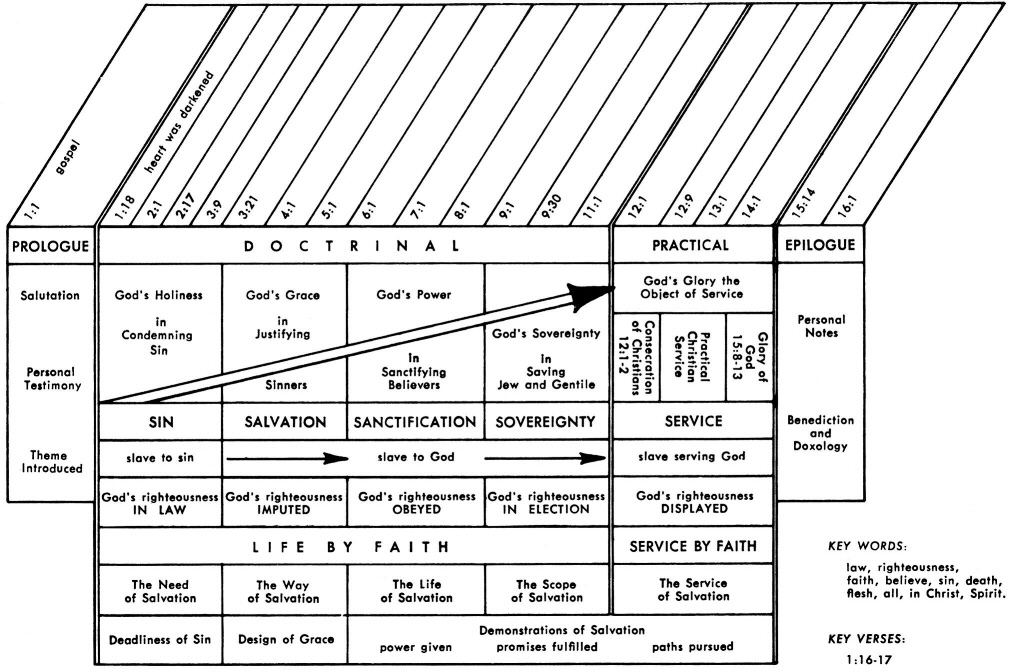
Click chart to enlarge
Chart from recommended resource Jensen's Survey of the NT - used by permission
Romans Overview Chart - Charles Swindoll
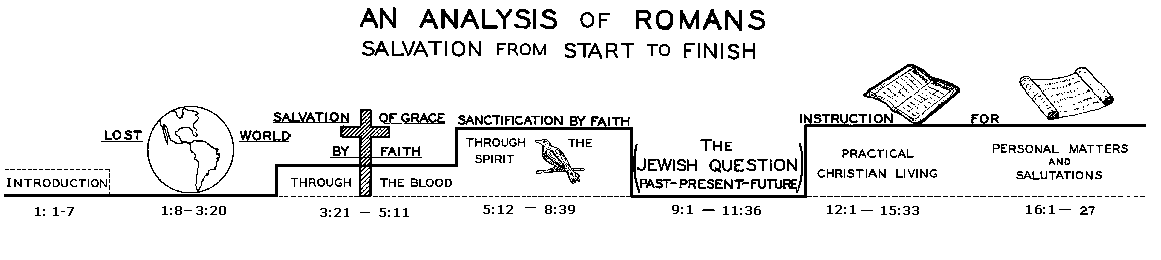
Source: Dr David Cooper
Click to Enlarge
| ROMANS ROAD to RIGHTEOUSNESS |
||||
| Romans 1:18-3:20 | Romans 3:21-5:21 | Romans 6:1-8:39 | Romans 9:1-11:36 | Romans 12:1-16:27 |
| SIN | SALVATION | SANCTIFICATION | SOVEREIGNTY | SERVICE |
| NEED FOR SALVATION |
WAY OF SALVATION |
LIFE OF SALVATION |
SCOPE OF SALVATION |
SERVICE OF SALVATION |
| God's Holiness In Condemning Sin |
God's Grace In Justifying Sinners |
God's Power In Sanctifying Believers |
God's Sovereignty In Saving Jew and Gentile |
Gods Glory The Object of Service |
| Deadliness of Sin |
Design of Grace |
Demonstration of Salvation | ||
| Power Given | Promises Fulfilled | Paths Pursued | ||
| Righteousness Needed |
Righteousness Credited |
Righteousness Demonstrated |
Righteousness Restored to Israel |
Righteousness Applied |
| God's Righteousness IN LAW |
God's Righteousness IMPUTED |
God's Righteousness OBEYED |
God's Righteousness IN ELECTION |
God's Righteousness DISPLAYED |
| Slaves to Sin | Slaves to God | Slaves Serving God | ||
| Doctrine | Duty | |||
| Life by Faith | Service by Faith | |||
|
Modified from Irving L. Jensen's chart above |
||||
R Ruin (Romans 1:17 – 3:20) – The utter sinfulness of humanity
O Offer (Romans 3:21-31) – God’s offer of justification by grace
M Model (Romans 4:1-25) – Abraham as a model for saving faith
A Access (Romans 5:1-11) – The benefits of justification
N New Adam (Romans 5:12-21) – We are children of two “Adams”
S Struggle w/ Sin (Romans 6:1-8:39) Struggle, sanctification, and victory
| Summary of Romans 9-11 |
||
| Romans 9 | Romans 10 | Romans 11 |
| Past Election |
Present Rejection |
Future Reception |
| God's Sovereignty Israel's Election by God |
Man's responsibility Israel's Rejection of God |
God's Ways Higher God Not Rejecting Israel |
Romans 11:12 Now if their transgression is riches for the world and their failure is riches for the Gentiles, how much more will their fulfillment be! (NASB: Lockman)
Greek: ei de to paraptoma auton ploutos kosmou kai to ettema auton ploutos ethnon, poso mallon to pleroma auton.
Amplified: Now if their stumbling (their lapse, their transgression) has so enriched the world [at large], and if [Israel's] failure means such riches for the Gentiles, think what an enrichment and greater advantage will follow their full reinstatement!
ESV: Now if their trespass means riches for the world, and if their failure means riches for the Gentiles, how much more will their full inclusion[1] mean!
ICB: The Jews' mistake brought rich blessings for the world. And what the Jews lost brought rich blessings for the non-Jewish people. So surely the world will get much richer blessings when enough Jews become the kind of people God wants.
NIV: But if their transgression means riches for the world, and their loss means riches for the Gentiles, how much greater riches will their fullness bring!
NKJV: Now if their fall is riches for the world, and their failure riches for the Gentiles, how much more their fullness!
NLT: Now if the Gentiles were enriched because the Jews turned down God's offer of salvation, think how much greater a blessing the world will share when the Jews finally accept it.
Phillips: For if their failure has so enriched the world, and their defection proved such a benefit to the Gentiles, think what tremendous advantage their fulfilling of God's plan could mean.
Wuest: But since their fall is the enrichment of the world, and their defeat and loss the enrichment of the Gentiles, how much more their fulness?
Young's Literal: and if the fall of them is the riches of a world, and the diminution of them the riches of nations, how much more the fulness of them?
Romans 11:13 But I am speaking to you who are Gentiles. Inasmuch * then as I am an apostle of Gentiles, I magnify my ministry,
Greek: humin de lego (1SPAI) tois ethnesin. eph' hoson men oun eimi (1SPAI) ego ethnon apostolos, thn diakonian mou doxazo (1SPAI)
Amplified: But now I am speaking to you who are Gentiles. Inasmuch then as I am an apostle to the Gentiles, I lay great stress on my ministry and magnify my office,
ESV: Now I am speaking to you Gentiles. Inasmuch then as I am an apostle to the Gentiles, I magnify my ministry
ICB: Now I am speaking to you who are not Jews. I am an apostle to the non-Jews. So while I have that work, I will do the best I can.
NIV: I am talking to you Gentiles. Inasmuch as I am the apostle to the Gentiles, I make much of my ministry
NKJV: For I speak to you Gentiles; inasmuch as I am an apostle to the Gentiles, I magnify my ministry,
NLT: I am saying all of this especially for you Gentiles. God has appointed me as the apostle to the Gentiles. I lay great stress on this,
Phillips: Now a word to you who are Gentiles. I should like you to know that I make as much as I can of my ministry as "God's messenger to the Gentiles"
Wuest: But to you I am speaking, the Gentiles. Inasmuch then, as for myself, as I am an apostle of Gentiles, I do my ministry honor
Young's Literal: For to you I speak -- to the nations -- inasmuch as I am indeed an apostle of nations, my ministration I do glorify;
BUT I AM SPEAKING TO YOU WHO ARE GENTILES: humin de lego (1SPAI) tois ethnesin:
To you who are Gentiles - While Paul was directly addressing the Gentile believers in Rome, the truths in this section are applicable to Gentile believers in our day.
Gentiles (nation, nations) (1484)(ethnos gives us our word "ethnic") in general refers to a multitude (especially persons) associated with one another, living together, united in kinship, culture or traditions and summed up by the words nation, Gentiles (especially when ethnos is plural), people (much like "people groups" in our modern missionary vernacular). In somewhat of a negative sense ethnos conveys the meaning of godless (generally idol worshipping) pagans (heathens, cp Eph 4:17, Mt 6:32), foreign nations not worshipping the true God (Mt 4:15). Often ethnos stands in clear contradistinction to Jew (Ioudaios) (Gal 2:14). Ethnos sometimes refers to Gentile Christians (Ro 11:13, Ro 15:27, 16:4, Gal 2:12). Ethnos is used in the singular of the Jewish Nation (Lk 7:5; 23:2; Jn 11:48, 50-53; Jn 18:35; Acts 10:22; 24:2, 10; Acts 26:4; 28:19). Plato used ethnos of a special class of men, a caste, tribe. In the Septuagint ethnos was used for nation, people Ge 10:5; non-Jews, Gentiles Ps 2:1.
Related Resources:
- Nations - Baker's Evangelical Dictionary of Biblical Theology
- Gentiles - International Standard Bible Encyclopedia
- Gentiles - Holman Bible Dictionary
- Gentiles - Hastings' Dictionary of the New Testament
- Gentiles (2) - Hastings' Dictionary of the New Testament
INASMUCH THEN AS I AM AN APOSTLE OF GENTILES I MAGNIFY MY MINISTRY: eph hoson men oun eimi (1SPAI) ego ethnon apostolos eph hoson men oun eimi (1SPAI) ego ethnon apostolos, ten diakonian mou doxazo (1SPAI):
- Romans 15:16-19; Acts 13:2; Galatians 1:16; 2Timothy 1:11,12
Apostle (652) apostolos from apo = from + stello = send forth) (Click discussion of apostle) means one sent forth from by another, often with a special commission to represent another and to accomplish his work. It can be a delegate, commissioner, ambassador sent out on a mission or orders or commission and with the authority of the one who sent him. Apostolos referred to someone who was officially commissioned to a position or task, such as an envoy. Cargo ships were sometimes called apostolic, because they were dispatched with a specific shipment for a specific destination. In secular Greek apostolos was used of an admiral of a fleet sent out by the king on special assignment. In the ancient world a apostle was the personal representatives of the king, functioning as an ambassador with the king’s authority and provided with credentials to prove he was the king's envoy.
Apostle of Gentiles - Jesus explained to the somewhat fearful Ananias so that he would be encouraged to go to Saul (Paul) and help him…
(On the Road to Damascus Jesus described Paul's "marching orders" to Ananias) Go, for he is a chosen instrument of Mine, to bear My name before the Gentiles and kings and the sons of Israel for I will show him how much he must suffer for My name's sake. (Acts 9:15-16)
Paul a Jew repeatedly emphasized his ministry to the Gentiles…
(In his Defense before the Jews he testified) and He (the risen Christ) said to me, 'Go! For I will send you far away to the Gentiles.'" (Acts 22:21)
15 "And I said, 'Who art Thou, Lord?' And the Lord said, 'I am Jesus whom you are persecuting. 16 'But arise, and stand on your feet; for this purpose I have appeared to you, to appoint you a minister and a witness not only to the things which you have seen, but also to the things in which I will appear to you; 17 delivering you from the Jewish people and from the Gentiles, to whom I am sending you, 18 to open their eyes so that they may turn from darkness to light and from the dominion of Satan to God, in order that they may receive forgiveness of sins and an inheritance among those who have been sanctified by faith in Me.' (Acts 26:15-18)
(Paul before the Jewish Council at Jerusalem testified that) "And it was because of a revelation that I went up; and I submitted to them the gospel which I preach among the Gentiles, but I did so in private to those who were of reputation, for fear that I might be running, or had run, in vain… I had been entrusted with the gospel to the uncircumcised, just as Peter had been to the circumcised 8 (for He who effectually worked for Peter in his apostleship to the circumcised effectually worked for me also to the Gentiles), 9 and recognizing the grace that had been given to me, James and Cephas and John, who were reputed to be pillars, gave to me and Barnabas the right hand of fellowship, that we might go to the Gentiles, and they to the circumcised. (Gal 2:2,7-9)
“the very least of all saints, this grace was given, to preach to the Gentiles the unfathomable riches of Christ” (Ephesians 3:8-note).
And for this (the fact that there was one God and one mediator between God and men, the man Christ Jesus) I was appointed a preacher and an apostle (I am telling the truth, I am not lying) as a teacher of the Gentiles in faith and truth.(1Timothy 2:7)
Paul understood the sovereignty of God in salvation. He understood that whom God foreknew He predestined and called (Ro 8:28-30) and yet here we see he approaches this issue of salvation with a sense of his responsibility of delivering the gospel to all men for he does not know who the elect are.
We see a similar thought in his last known letter, 2 Timothy, in which he explained that it was because of the gospel that …
I suffer hardship even to imprisonment as a criminal; but the word of God is not imprisoned. For this reason I endure all things (man's responsibility) for the sake of those who are chosen (elect - God's sovereignty), that they also may obtain the salvation which is in Christ Jesus and with it eternal glory. (2Ti 2:9-10 -notes)
Note that when Paul first came to a city, he invariably would go first to the synagogue or search out individual Jews if they were too few to have a synagogue. Some of those hearers would believe, but, for the most part, they resisted and rejected the gospel that was “spoken against everywhere” (Acts 28:22). At that point, Paul would turn his focus to the Gentiles.
Magnify (1392)(doxazo (see word study) from doxa = glory) has a secular meaning of to think, suppose, be of opinion, (Aeschylus, Sophocles, Xenophon, Plato, Thucydides). The simple definition of glorify is to give a correct opinion, a correct estimate of Who God is. How? By the way you behave (your "fruit" Jn 15:8, cp Mt 5:16-note) and in the present context, by what you do (or better yet "don't do") with your physical body.
Ministry (1248)(diakonia (see word study) is probably derived from dioko = to pursue, "to be a follower of a person, to attach one's self to him:" - note on origin is from Vincent.) means the rendering or assistance or help by performing certain duties, often of a humble or menial nature serve, including such mundane activities as waiting on tables or caring for household needs—activities without apparent dignity. Diakonia is related to diakonos, a servant, not in his relation (like doulos) but more in regard to his activity. The term covers both slaves and hired servants. MacArthur "The basic idea in both words always had to do with humble, submissive, personal service, not simply with an office or a particular function."
In this way Paul would "magnify" his "ministry" or as Phillips paraphrases it…
I should like you to know that I make as much as I can of my ministry as "God's messenger to the Gentiles"
Romans 11:14 if somehow I might move to jealousy my fellow countrymen and save some of them.
Greek: ei pos parazeloso (1SFAI) mou ten sarka kai soso (1SFAI) tinas ex auton.
Amplified: In the hope of making my fellow Jews jealous [in order to stir them up to imitate, copy, and appropriate], and thus managing to save some of them.
ESV: in order somehow to make my fellow Jews jealous, and thus save some of them.
ICB: I hope I can make my own people jealous. That way, maybe I can help some of them to be saved.
NIV: in the hope that I may somehow arouse my own people to envy and save some of them.
NKJV: if by any means I may provoke to jealousy those who are my flesh and save some of them.
NLT: for I want to find a way to make the Jews want what you Gentiles have, and in that way I might save some of them.
Phillips: so as to make my kinsfolk jealous and thus save some of them.
Wuest: if by any means, possibly, I may provoke to jealousy those who are my flesh, and save some of them.
Young's Literal: if by any means I shall arouse to jealousy mine own flesh, and shall save some of them,
IF SOMEHOW I MIGHT MOVE TO JEALOUSY MY FELLOW COUNTRYMEN: ei pos parazeloso (1SFAI) mou ten sarka:
- 1Corinthians 7:16; ; 2Timothy 2:10
- Ro 9:3; Philemon 1:12
If somehow. Elsewhere Paul stated it this was…
And to the Jews I became as a Jew, that I might win Jews; to those who are under the Law, as under the Law, though not being myself under the Law, that I might win those who are under the Law; to those who are without law, as without law, though not being without the law of God but under the law of Christ, that I might win those who are without law. To the weak I became weak, that I might win the weak; I have become all things to all men, that I may by all means save some. (1Cor 9:20-22)
Jealous (3863) (parazeloo from pará = to the point of, unto, implying movement toward a certain point + zeloo = to desire, be zealous) means to stimulate alongside and thus to excite to rivalry or to provoke to emulation and so to make jealous. The idea is that then the Jews would be jealous and want it for themselves. Parazeloo is a Greek infinitive with a preposition (eis = unto, toward) and carries the idea of purpose.
AND SAVE SOME OF THEM: kai soso (1SFAI) tinas ex auton:
- 1Corinthians 7:16; 1Timothy 4:16; James 5:20)
Save (4982) (sozo) means basically to rescue from peril, to protect, to keep alive - the word involves preservation of life, physical or spiritual, in this context clearly referring to spiritual life associated with regeneration or the new birth brought about by the power of the Holy Spirit (John 3:3-5) and the Gospel (Ro 1:16-note).
See discussion of physical and spiritual renewal of Israel beginning in Ezekiel 37:14-see notes)
Romans 11:15 For if their rejection is the reconciliation of the world, what will their acceptance be but life from the dead ?
Greek: ei gar e apobole auton katallage kosmou, tis e proslempsis ei me zoe ek nekron?
Amplified: For if their rejection and exclusion from the benefits of salvation were [overruled] for the reconciliation of a world to God, what will their acceptance and admission mean? [It will be nothing short of] life from the dead!
ESV: For if their rejection means the reconciliation of the world, what will their acceptance mean but life from the dead?
ICB: God turned away from the Jews. When that happened, God became friends with the other people in the world. So when God accepts the Jews, then surely that will bring to them life after death.
NIV: For if their rejection is the reconciliation of the world, what will their acceptance be but life from the dead?
NKJV: For if their being cast away is the reconciling of the world, what will their acceptance be but life from the dead?
NLT: For since the Jews' rejection meant that God offered salvation to the rest of the world, how much more wonderful their acceptance will be. It will be life for those who were dead!
Phillips: For if their exclusion from the pale of salvation has meant the reconciliation of the rest of mankind to God, what would their inclusion mean? It would be nothing less than life from the dead!
Wuest: For, in view of the fact that their repudiation results in the world’s reconciliation, what will the receiving of them result in if not in life from among the dead?
Young's Literal: for if the casting away of them is a reconciliation of the world, what the reception -- if not life out of the dead?
FOR IF THEIR REJECTION BE THE RECONCILIATION OF THE WORLD: ei gar e apobole auton katallage kosmou:
- Ro 11:1,2,11,12
- Ro 5:10; Daniel 9:24; 2Corinthians 5:18-20; Ephesians 1:10; Colossians 1:20,21
For if their rejection and exclusion from the benefits of salvation were [overruled] for the reconciliation of a world to God, what will their acceptance and admission mean? [It will be nothing short of] life from the dead! (Amplified)
For - always pause and ponder this term of explanation.
The word “if” which Paul uses throughout his argument here is not ean the “if” of a hypothetical condition, but ei the “if” of a fulfilled condition. Paul is not arguing upon the basis of an hypothesis, but upon the basis of facts. The translation should read, “since,” or “in view of the fact.”
Rejection (580) (apobole from apó = from + bállo = cast as casting away a garment) describes literally a casting off and thus a rejection.
Reconciliation (2643) (katallage from katallasso = change mutually; reconcile in turn from katá = an intensifying preposition + allásso = to make otherwise, to change the form or nature of a thing) means a change or reconciliation from a state of enmity between persons to one of friendship. In the NT, this word describes restoration to divine favor by bringing about a change in man, i.e., a conversion, the means or occasion of reconciling the world to God. Reconciliation is the removal of enmity that stands between people and God. Reconciliation is the basis of restored fellowship between people and God
The Greek verb katallasso basically means “change” or “exchange.” In the context of relationships between people, the term implies a change in attitude on the part of both individuals, a change from enmity to friendship. When used to describe the relationship existing between God and a person, the term implies the change of attitude on the part of both a person and God. The need to change the sinful ways of a human being is obvious. It should be noted that some argue that no change is needed on the part of God. On the other hand, inherent in the doctrine of justification is the changed attitude of God toward the sinner. God declares a person who was formerly His enemy to be righteous before Him.
World (2889) kosmos (see word study) here refers to the world in general, not the "world system" opposed to God.
WHAT WILL THEIR ACCEPTANCE BE BUT LIFE FROM THE DEAD: tis e proslempsis ei me zoe ek nekron:
- Ezekiel 37:1-14; Revelation 11:11; 20:4-6
Acceptance (4356) (proslepsis from proslambano = to receive unto oneself, to take in addition, to receive besides) means a taking to oneself and thus describes an acceptance.
The reconciling of Israel back to God is, indeed, associated with the "resurrection" of Israel as a nation (See Ezekiel 37:1-14-notes) and also with the bodily resurrection of all who have died in faith, Isaiah prophesying to Israel that…
Your dead will live; their corpses will rise. You who lie in the dust, awake and shout for joy, for your dew is as the dew of the dawn, and the earth will give birth to the departed spirits. (Isaiah 26:19, compare Hosea 6:1-3 Rev 20:4-6-note)
The receiving of Israel refers to that wonderful moment when, as the Messiah returns to the Mt. of Olives (Zechariah 14) all Israel shall be saved (Ro 11:26-note). This will be “life from among the dead” in that the nation will be saved by the sovereign grace of God out from a spiritually dead state and from among those who remain spiritually dead. (See related discussion beginning in Ezekiel 37:14-see notes)
In speaking of life from the dead, Paul was not referring to bodily resurrection. Regarding individual Jews, he was speaking of receiving spiritual life as a gracious gift to displace spiritual death, the wage of unbelief. Regarding Israel, he was speaking of its rebirth and the rebirth of the whole world in the glorified millennial kingdom of God (Isa11:1-9-note; Rev 20). In that glorious day, even “the creation itself also will be set free from its slavery to corruption into the freedom of the glory of the children of God” (Ro 8:21-note).
Related resources…
- Summary on the Attributes of God
- Spurgeon on the Attributes of God
- Israel of God - Is God "Finished" with Israel in His prophetic plan?
- Table Comparing/contrasting Israel & Church
- Does the Church Fulfill Israel's Program? - John Walvoord
- The Jewish People, Jesus Christ and World History - S Lewis Johnson
- Eschatological Problems IX- Israel’s Restoration - John Walvoord
- Will Israel Build a Temple in Jerusalem- Walvoord
- Eschatological Problems V - Is the Church the Israel of God- Walvoord
- Eschatological Problems VI- The Fulfillment Of The Abrahamic Covenant - Walvoord
- Eschatological Problems IX- Israel’s Restoration - Walvoord
- Eschatological Problems X- The New Covenant with Israel - Walvoord
- Israel And The Nations - John Walvoord
- Does the Church Fulfill Israel’s Program- — Part 1 - Walvoord
- Does the Church Fulfill Israel’s Program- — Part 2 - Walvoord
- Does the Church Fulfill Israel’s Program- — Part 3 - Walvoord
Online Book by Dr John Walvoord - Israel in Prophecy
- Chapter I The New State Of Israel
- Chapter II The Promise To Abraham
- Chapter III Israel’s Future As A Nation
- Chapter IV The Promise Of The Land To Israel
- Chapter V The Kingdom Promised To David
- Chapter VI The Suffering Of Israel
- Chapter VII The Glorious Restoration Of Israel
- Selected Bibliography
Articles by Arnold Fruchtenbaum related to Israel
- Israelology: Part 1 of 6 Introduction: Definition of Terms
- Israelology: Part 2 of 6 Israel Present (Note: Article begins on Page 2)
- Israelology: Part 3 of 6 Israel Present (Continued)
- Israelology: Part 4 of 6 - Israel Future (Part One)
- Israelology: Part 5 of 6 - Israel Future (Part Two)
- Israelology: Part 6 of 6 Other Relevant Topics - Illustrations of Israel (including marriage)
Are you confused about God's plan for Israel? Then I highly recommend Tony Garland's 12 Hour Course on Romans 9-11 in which he addresses in depth the question of What Will Happen to Israel? (click) or see the individual lectures below)
- Romans 9:1-5 Paul's Sorrow Concerning Israel
- Romans 9:6-13 Children of the Promise
- Romans 9:14-24 The Potter and the Clay
- Romans 9:25-33 A Remnant Will be Saved
- Romans 10:1-13 The Righteousness of God
- Romans 10:14-21 Has Israel Not Heard?
- Romans 11:1-6 God Has Not Cast Away The Jews
- Romans 11:7-15 Life from the Dead
- Romans 11:16-24 Two Olive Trees
- Romans 11:25-36 The Salvation of Israel
Note that when you click the preceding links, each link will in turn give you several choices including an Mp3 message and brief transcript notes. The Mp3's are long (avg 70+ min) but are in depth and thoroughly Scriptural with many quotations from the Old Testament, which is often much less well understood than the NT by many in the church today. Garland takes a literal approach to Scripture, and his love for the Jews and passion to see them saved comes through very clearly in these 12 hours of teaching! Take your home Bible Study group through this series if you dare. Take notes on the tapes as the transcripts are a very abbreviated version of the audio messages. This course is highly recommended for all who love Israel! I think you will agree that Tony Garland, despite coming to faith after age 30 as an engineer, clearly has been given a special anointing by God to promulgate the truth concerning Israel and God's glorious future plan for the Jews. Garland has also produced more than 20 hours of superb audio teaching in his verse by verse commentary on the Revelation (in depth transcripts also available) which will unravel (in a way you did not think was possible considering the plethora of divergent interpretations) God's final message of the triumph and return of the our Lord Jesus Christ as the King of kings and Lord of lords! Maranatha!
NOW IF THEIR TRANSGRESSION BE RICHES FOR THE WORLD AND THEIR FAILURE IS RICHES FOR THE GENTILES: ei de to paraptoma auton ploutos kosmou kai to etthema auton ploutos ethnon:
- Ro 11:15,33; 9:23; Ephesians 3:8; Colossians 1:27
- Ro 11:25; Isaiah 11:11-16; 12:1-6; 60:1-22; 66:8-20; Micah 4:1,2; 5:7; Zechariah 2:11; Zechariah 8:20-23; Revelation 11:15-19
Now if their stumbling (their lapse, their transgression) has so enriched the world [at large], and if [Israel's] failure means such riches for the Gentiles, think what an enrichment and greater advantage will follow their full reinstatement! (Amplified)
Transgressions (3900) (paraptoma from parapipto = fall aside, apostatize) is a "false step" and describes a deviation from living according to what has been revealed as the right way to live.
Riches (4149) (ploutos from pletho = fill) can describe wealth, money, possessions, or abundance. Here Paul is obviously not speaking of worldly riches but of spiritual riches.
Failure (2275) (hettema from hettáomai = be overcome) describes a deterioration and objectively as used in this verse pictures a failure or a loss.
"their fall… their fullness" (Ro 11:12KJV) - These two phrases, their fall and their fulness, correspond to the two comings of Christ. Paul writes in the interval when the cross is past history and the redemption of Israel is, as in our day, future. (Romans 117-15 - Life from the Dead)
God has used even the great transgression of Israel in rejecting her Messiah to accomplish His ultimate purpose of bringing spiritual riches to the world, that is, the Gentiles, just as He had declared to Abraham when He first called Israel to Himself: “In you all the families of the earth shall be blessed” (Ge 12:3). Although Israel failed to witness to the world in righteousness, God caused her to witness to the world, as it were, in unrighteousness. Because the Lord could not use Israel’s faithfulness to bring riches to the Gentiles, He instead used her failure.
HOW MUCH MORE WILL THEIR FULFILLMENT BE: poso mallon to pleroma auton:
How much more (Same phrase - 24x = Deut 31:27; 1 Sam 14:30; 21:5; 23:3; 2 Sam 4:11; 16:11; 2 Kgs 5:13; Job 4:19; Prov 11:31; 15:11; 19:7; 21:27; Ezek 14:21; Matt 7:11; 10:25; 12:12; Luke 11:13; 12:24, 28; Rom 11:12, 24; 1 Cor 6:3; Phlm 1:16; Heb 9:14) - When used in a comparison regarding quantity, denotes a greater abundance (as here). Otherwise the phrase much more denotes a greater certainty (Ro 5:9,10-note,Ro 5:15-note, Ro 5:17-note).
What is Israel's "fulfillment" associated with? Messiah's return and the establishment of His Millennial kingdom. This is why it is much more!
Earlier in the letter Paul had used another extreme contrast to portray the greatness of God’s love and grace:
God demonstrates His own love toward us, in that while we were yet sinners, Christ died for us. Much more then, having now been justified by His blood, we shall be saved from the wrath of God through Him. For if while we were enemies, we were reconciled to God through the death of His Son, much more, having been reconciled, we shall be saved by His life (Ro 5:8-9-note, Ro 5:10-note).
If a dying Savior could redeem us, how much more can a resurrected, living Savior sustain us. By the same logic, if a faithless Israel could bring salvation to the Gentiles, how much more or much greater blessing will her faithfulness bring. The Lord promises Israel one day will receive the Messiah she rejected because He…
will pour out on the house of David and on the inhabitants of Jerusalem, the Spirit of grace and of supplication, so that they will look on Me whom they have pierced (Zech 12:10).
In that day a fountain will be opened for the house of David and for the inhabitants of Jerusalem, for sin and for impurity (Zech 13:1).
Following that,
the Lord will be king over all the earth; in that day the Lord will be the only one, and His name the only one… And there will be no more curse… Then it will come about that any who are left of all the nations… will go up from year to year to worship the King, the Lord of hosts” (Zech 14:9, 11, 16).
Comment: Zechariah 12-14 constitutes a unit and should be studied together for a proper understanding.
Although the Jews had stumbled, their fall would not be irrevocable (Ro 11:27, 29) for as Paul explains in this section their fall was the way by which God had appointed salvation to come to the Gentiles. However in their fall, the sovereign, omniscient, omnipotent God had their restoration in view, because the very kindness God demonstrated to the Gentiles would be the means of provoking Israel to jealousy. And as great as were the benefits to the world from Israel's fall, the benefits of their restoration would be even greater. One might say "The best is yet to come!"
It is notable that almost 500 years before Paul penned these words of hope for Israel, the prophet Ezekiel had foretold of not only a physical (including reuniting of Judah/Benjamin and the Northern 10 tribes) but a spiritual renewal in Ezekiel 37:1-28-See commentary.
Fulfillment (4138) (pleroma from pleroo = make full, fill, fill up) describes fullness, a full measure, an abundance or a completion. Pleroma is that which has been filled and thus refers to that which is complete, the completeness of Israel referring here to its return to God at the second Advent of the Messiah when all Israel would be saved (cp Ro 11:26). Paul uses pleroma in Ro 11:25-note to describe the fulness of the Gentiles.
If Israel's rejection of light brings "riches", how much more will Israel’s restoration result in rich blessing for all the world! When Israel turns to the Lord at the close of the Great Tribulation, (the Second Coming of the Messiah) she will become the channel of blessing to the nations in the Millennium. The Lord Jesus will reign in Jerusalem on the earth, the nation of Israel will be composed of born again believers in Messiah, Satan will be bound, and the world will experience unprecedented universal righteousness, peace, and prosperity for one thousand years. And all God's people cry "Maranatha, Come Lord!"
Charles Hodge wrote that "At the second coming of Christ, "The conversion of the Jews will be accompanied by the most glorious consequences for the whole world." (Romans 11 - Hodge's Commentary on Romans)
Claude Stauffer writes…
In the Song of Moses in Deuteronomy 32, we see a prophetic word about what would happen when Israel forsook God. The result has come to pass in what we see today. God is working in the world primarily through the Gentile church in the present day. But God is not finished with Israel. He is going to provoke them to jealousy through showing the Gentiles His salvation. Like a child playing hard to get, who is provoked to jealousy when their sibling is shown attention by a parent, so too will Israel be provoked to jealousy and return to the Lord (11:11).
In Deuteronomy 32 it states God’s plan:
Deuteronomy 32:21 – “They have provoked Me to jealousy by what is not God; They have moved Me to anger by their foolish idols. But I will provoke them to jealousy by those who are not a nation; I will move them to anger by a foolish nation.”
God has never stopped loving Israel and He will use the Gentiles to provoke them to jealousy to awaken their love for Him. Jeremiah is inspired by God to describe God’s love for Israel as everlasting when he writes:
Jeremiah 31:3 – “The Lord has appeared of old to me, saying: “Yes, I have loved you with an everlasting love; Therefore with lovingkindness I have drawn you.”
Paul goes on to say that if so much has come from the fall of the Jews, (that is salvation to the Gentiles world) then when Israel does turn to the Lord their fullness will be even greater. There is a lot of anti-Semitism in the world today, even in the church. Israel is being disciplined by God, but God has not cast them aside forever. He will again raise them up to fit into His plan again. We have seen this resurrection begun on May 14th, 1948 with the establishment once again of Israel as a nation. Then in 1967 Israel captured Jerusalem. Soon during the Tribulation (Revelation 7; 14), God is going to work a mighty revival in the world and He is going to do it through Jews who will accept Jesus as their Messiah. The culmination of this fullness will be the kingdom age of Christ’s reign on earth during the Millennium (Revelation 20).
In the book of Daniel, Daniel records a prophecy which states that from the rebuilding of the city of Jerusalem there world be 490 years of prophetic workings for Israel in God’s plans. When Jesus made His triumphal entry into Jerusalem and went to the cross it marked the fulfillment of the first 69 sevens or 483 years according to Daniel’s prophecy. We are awaiting the beginning of the seventieth week (i.e. Hebrew HEPTED or set of seven years) of Daniel which is also known as the time of Jacob’s trouble and the 7-year Tribulation. During this seventieth week, God will work through Israel to fulfill His will upon the earth. The close of this seven-year period will be punctuated with the 2nd Coming of Jesus (see Revelation 6-19).