Romans 1:2
Romans 1:3
Romans 1:4
Romans 1:5
Romans 1:6
Romans 1:7
Romans 1:8
Romans 1:9
Romans 1:10
Romans 1:11
Romans 1:12
Romans 1:13
Romans 1:14
Romans 1:15
Romans 1:16
Romans 1:17
Romans 1:18
Romans 1:19
Romans 1:20
Romans 1:21
Romans 1:22
Romans 1:23
Romans 1:24
Romans 1:25
Romans 1:26
Romans 1:27
Romans 1:28
Romans 1:29
Romans 1:30
Romans 1:31
Romans 1:32

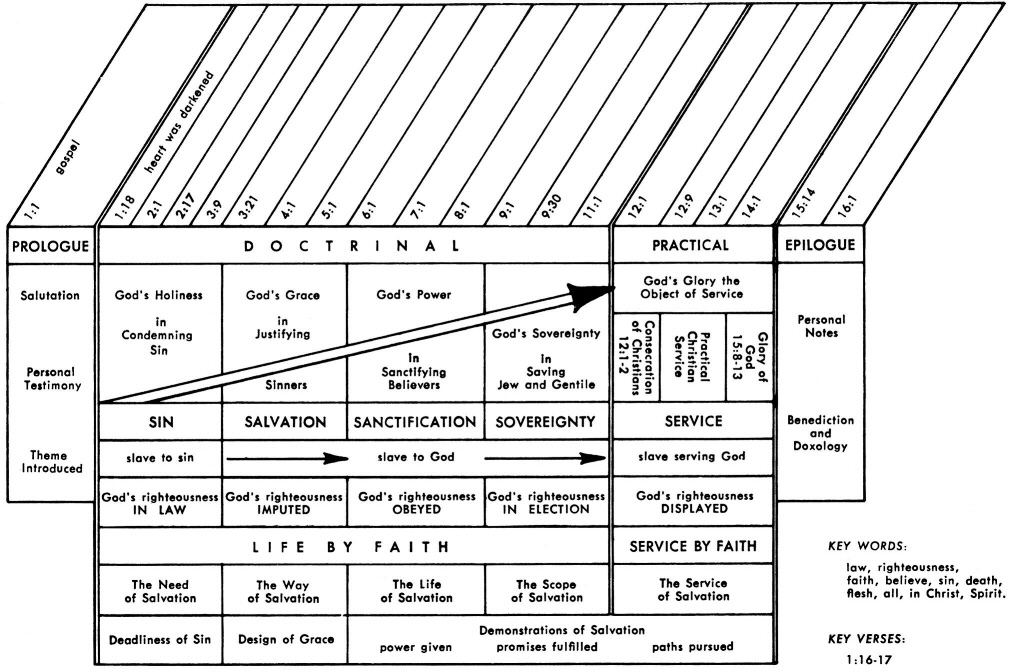
Click chart to enlarge
Chart from recommended resource Jensen's Survey of the NT - used by permission
Romans Overview Chart - Charles Swindoll
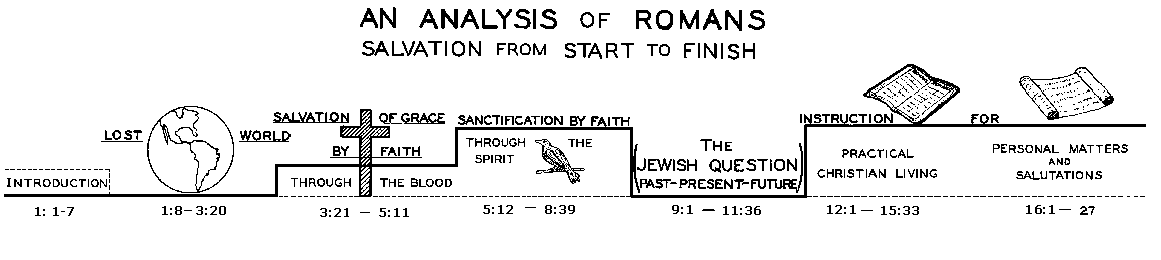
Source: Dr David Cooper
Click to Enlarge
R Ruin (Romans 1:17 – 3:20) – The utter sinfulness of humanity
O Offer (Romans 3:21-31) – God’s offer of justification by grace
M Model (Romans 4:1-25) – Abraham as a model for saving faith
A Access (Romans 5:1-11) – The benefits of justification
N New Adam (Romans 5:12-21) – We are children of two “Adams”
S Struggle w/ Sin (Romans 6-8) Struggle, sanctification, and victory
|
ROMANS ROAD |
||||
| Romans 1:18-3:20 | Romans 3:21-5:21 | Romans 6:1-8:39 | Romans 9:1-11:36 | Romans 12:1-16:27 |
| SIN | SALVATION | SANCTIFICATION | SOVEREIGNTY | SERVICE |
| NEED FOR SALVATION |
WAY OF SALVATION |
LIFE OF SALVATION |
SCOPE OF SALVATION |
SERVICE OF SALVATION |
| God's Holiness In Condemning Sin |
God's Grace In Justifying Sinners |
God's Power In Sanctifying Believers |
God's Sovereignty In Saving Jew and Gentile |
Gods Glory The Object of Service |
| Deadliness of Sin |
Design of Grace |
Demonstration of Salvation | ||
| Power Given | Promises Fulfilled | Paths Pursued | ||
| Righteousness Needed |
Righteousness Credited |
Righteousness Demonstrated |
Righteousness Restored to Israel |
Righteousness Applied |
| God's Righteousness IN LAW |
God's Righteousness IMPUTED |
God's Righteousness OBEYED |
God's Righteousness IN ELECTION |
God's Righteousness DISPLAYED |
| Slaves to Sin | Slaves to God | Slaves Serving God | ||
| Doctrine | Duty | |||
| Life by Faith | Service by Faith | |||
|
Modified from Irving L. Jensen's chart above |
||||
Romans 1:18 For the wrath of God is revealed (Present tense) from heaven against all ungodliness & unrighteousness of men who suppress the truth in unrighteousness." (NASB: Lockman)
Greek: Apokaluptetai (3SPPI) gar orge theou ap' ouranou epi pasan asebeian kai adikian anthropon ton ten aletheian en adikia| katechontin, (PAPMPG)
Amplified: For God's [holy] wrath and indignation are revealed from heaven against all ungodliness and unrighteousness of men, who in their wickedness repress and hinder the truth and make it inoperative. (Amplified Bible - Lockman)
NLT: But God shows his anger from heaven against all sinful, wicked people who push the truth away from themselves. (NLT - Tyndale House)
Phillips: Now the holy anger of God is disclosed from Heaven against the godlessness and evil of those men who render truth dumb and inoperative by their wickedness. (Phillips: Touchstone)
Wuest: For there is revealed God’s wrath from heaven upon every lack of reverence and upon every unrighteousness of men who in unrighteousness are holding down the truth.
Young's Literal: for revealed is the wrath of God from heaven upon all impiety and unrighteousness of men, holding down the truth in unrighteousness.
FOR THE WRATH OF GOD IS REVEALED FROM HEAVEN: Apokaluptetai (3SPPI) gar orge theou ap ouranou:
- Torrey's Topic "Anger of God"
- wrath of God - Jn 3:36; Re 14:10, 19; 15:1, 7; 16:1)
- Multiple resources on Romans 1
- Romans 1:18 The Wrath of God - John MacArthur
- Romans 1:18-32 The Reality of God's Wrath - John MacArthur
- Romans 1:18-32 When God Abandons a Nation - John MacArthur
- Romans 1:18-32 What's Wrong with America? - John MacArthur
- Romans 1:18-32 Assorted Attacks on the Bible - John MacArthur
- Romans 1:18-23: Is God’s Wrath Justified? - Steven Cole
- Romans 1 Commentary - William Newell
Notice from the chart above that from Romans 1:18 to Romans 3:20 Paul like a prosecuting attorney presents God's indictment of the world, clearly demonstrating why men need the righteousness of God which is then mercifully presented in Romans 3:21 through Romans 5:21.
Expositor's Bible Commentary introduces Romans 1:18-3:20 noting that…
Instead of plunging at once into an exposition of the gospel, Paul launches into a lengthy exposure of the sinfulness of man. This is sound procedure, for until men are persuaded of their lost condition they are not likely to be concerned about deliverance. So Paul undertakes to demonstrate in the human situation a grievous lack of the righteousness God requires. "Within the action of the divine righteousness there is a place for deliverance and for condemnation, a place for salvation and for punishment" (David Hill, Greek Words and Hebrew Meanings [Cambridge: Cambridge University Press, 1967], p. 90). ( Expositor's Bible Commentary: Old and New Testament)
C G Handley Moule eloquently explains that Paul…
… is intent and eager to bring his reader into sight and possession of the fulness of the eternal mercy, revealed and secured in the Lord Jesus Christ, our Sacrifice and Life. But for this very purpose he labours first to expose man to himself; to awaken him to the fact that he is before everything else a sinner; to reverse the Tempter’s spell, and to let him see the fact of his guilt with open eyes. “The Gospel,” someone has said, “can never be proved except to a bad conscience.” If “bad” means “awakened,” the saying is profoundly true. With a conscience sound asleep we may discuss Christianity, whether to condemn it, or to applaud. We may see in it an elevating programme for the race. We may affirm, a thousand times, that from the creed that God became flesh there result boundless possibilities for Humanity. But the Gospel. “the power of God unto salvation,” will hardly be seen in its own prevailing self-evidence, as it is presented in this wonderful Epistle, till the student is first and with all else a penitent. The man must know for himself something of sin as condemnable guilt, and something of self as a thing in helpless yet responsible bondage, before he can so see Christ given for us, and risen for us, and seated at the right hand of God for us, as to say, “There is now no condemnation; Who shall separate us from the love of God? I know whom I have believed.” (Moule, C. G. Handley: The Epistle of St Paul to the Romans) Moule concludes with the following quote…
To the full sight of Christ
there needs a true sight of self, that is to say, of sin.
For (1063) (gar) is a subordinating conjunction expressing cause or explanation and thus introduces an explanation. In simple terms for is a term of explanation and its occurrence should always prompt one to pause and ponder the text and context, asking what the author is explaining, how does he explain it, etc. While not every "for" in the Bible is a term of explanation, most are and since there are over 7500 uses of for (NAS), you will have ample opportunity to observe and interrogate the text. As you practice this discipline of pausing to ponder, you are establishing the context (which leads to more accurate interpretation and thus more apropos application) and you are in effect engaging in the blessed activity of Biblical Meditation (See Ps 1:2, Ps 1:3 and Joshua 1:8 for the blessed benefits of meditation). When for is used at the beginning of a passage (as here in Ro 1:18) it is usually a term of explanation.
A T Robertson explains it this way…
Note in Romans Paul's use of gar, now argumentative, now explanatory, now both as here. There is a parallel and antecedent revelation (see Romans 1:17) of God's wrath corresponding to the revelation of God's righteousness, this an unwritten revelation, but plainly made known. Orgē is from orgaō, to teem, to swell. It is the temper of God towards sin, not rage, but the wrath of reason and law (Shedd). The revelation of God's righteousness in the gospel was necessary because of the failure of men to attain it without it, for God's wrath justly rested upon all both Gentiles (Ro 1:18-32) and Jews (Romans 2:1-3:20).
Vincent's comment on "for"…
All men require this mode of justification, for all men are sinners, and therefore exposed to God's wrath.
Hodge writes that…
The apostle’s object is to prove the doctrine of the preceding verse, viz., that righteousness is by faith. To do this it was necessary to show that men in themselves are exposed to condemnation, or are destitute of any righteousness which can satisfy the demands of God. His argument is, God is just; he is determined to punish sin, and as all men are sinners, all are exposed to punishment. Hence this verse is connected by gar to the preceding one. Men must be justified by faith, for the wrath of God is revealed, etc. (Commentary on the Epistle to the Romans)
Moule - The "for" marks the connection as follows: "The Gospel is the secret of salvation, of justification before the eternal Judge; and as such it is a thing of supreme importance; for the Judge has proclaimed the doom of human sin. The question is not of mere theory, but of life or death." (The Epistle of Paul the Apostle to the Romans)
John Piper explains for by asking…
Why does Paul introduce Ro 1:18 with the word "for" or "because"? He does this in order to show that everything he is going to say about sin is meant to support the GOSPEL of Ro 1:17. He does not mention the gospel for the sake of sin. He deals with sin for the sake of the GOSPEL.
UNDERSTANDING SIN IS THE FOUNDATION
THAT UPHOLDS THE PRECIOUSNESS OF THE GOSPEL,
NOT VICE VERSA.
His main aim is not to lead us from gospel to sin, but from sin to gospel. If you have been caught in a crime and are facing trial, and I say to you, "I have a letter here from the Hennepin County Court that they have dropped the charges against you, because you were guilty and liable to severe punishment," what's the point? The point of saying that you were guilty is to help you understand and cherish the good news that the charges are dropped. That's the point of "for" at the beginning of v18. (The Wrath of God Against Holding Down the Truth)
The wrath of God - Vincent makes an interesting statement that this is "Not punishment, but the personal emotion" (of God).
Moule - It must, of course, always be remembered that the "wrath of God" is the wrath of a Judge (Ed: Not an imperfect worldly "judge" but a perfect Righteous Judge! Ps 7:11 - indignation = orge in Lxx). In its inmost secret (wrath-orge) is the very opposite of an arbitrary outburst (Ed: That is thumos), being the eternal repulsion of evil by good (Ed: God Whose essence is Good). (Ibid)
Wrath (3709) (orge from orgaô = to teem, to swell) conveys the picture of a swelling which eventually bursts, and thus describes an anger that proceeds from one’s settled nature. Orge does not refer to uncontrollable anger to which men are so prone but to God's settled indignation and controlled passionate hostile feeling toward sin in all its various manifestations. Settled indignation means that God’s holiness cannot and will not coexist with sin in any form whatsoever. Orge is not the momentary, emotional, and often uncontrolled anger (thumos) to which human beings are prone. Orge is used primarily of God's holy, righteous wrath but occasionally refers to the wrath of men (see Ephesians 4:31)
See 6 Page article on Orge in The New International Dictionary of New Testament Theology
Orge refers to to an inner, deep resentment that seethes and smolders. Orge as used of God refers to His constant and controlled indignation toward sin, while thumos (which originally referred to violent movements of air, water, etc., and consequently came to mean “well up” or “boil up”) refers more to a passionate outburst of rage. Thumos type anger represents an agitated, vehement anger that rushes along relentlessly. The root meaning has to do with moving rapidly and was used of a man’s breathing violently while pursuing an enemy in great rage!
Gilbrant on orge in classical Greek - Orgē and its related words (orgaō, “wax wanton,” and orgas [any well-watered, fertile spot of land]) are very common in classical literature. The most basic meaning of orgē relates to the inner disposition as evidenced by passion, impulse, and especially outward expressions of displeasure or anger. One might be characterized by an unhappy or “angry” disposition. Orgē can express anger against a person or thing, or it may be directed toward no person or thing in particular. The Classical literature has several related words. Among several other meanings, orgaō can mean “to be under the influence of passion or anger.” An orgia is a secret or religious rite, often involving sacrifices, with the worship usually involving sensual and passionate activities. Orgiazō refers to the celebration of such a religious orgia while the person who participates as a leader or priest is an orgōn. A particularly passionate person is a orgētēs. (See Liddell-Scott for this grouping of words.) There are several occurrences of orgē documented in the papyri literature. Moulton-Milligan documents several occurrences when orgē is used in the “sense of natural ’anger’ or ’passion.’ ” Also, orgē used with the sense of “divine wrath” is documented in the papyri just as it is in the New Testament. The related verb orgizomai, “be angry,” and the adjective orgilos, “quick-tempered,” are also found in the papyri. (Complete Biblical Library Greek-English Dictionary)
Orge is…
God’s settled opposition to
to and displeasure with sin
God’s wrath is his holy hatred of all that is unholy. It is His righteous indignation at everything that is unrighteous. It is the temper of God towards sin. It is not God's uncontrollable rage, vindictive bitterness or a losing of His temper, but the wrath of righteous reason and holy law.
Orge - 36x in 34v - Usage: anger(6), wrath(30). (KJV translates it also indignation and vengeance). Mt 3:7; Mark 3:5; Lk 3:7; 21:23; Jn 3:36; Ro 1:18; 2:5, 8; 3:5; 4:15; 5:9; 9:22; 12:19; 13:4, 5; Ep 2:3; 4:31; 5:6; Col 3:6, 8; 1Th 1:10; 2:16; 5:9; 1Ti 2:8; Heb 3:11; 4:3; James 1:19, 20; Re 6:16, 17; 11:18; 14:10; 16:19; 19:15
Orge - 232x in 220v - in Septuagint (LXX), the first use which describes the orge of God is in Ex 4:14 (cf other instances of Divine Orge in the Lxx - Ex 15:7, Ex 32:10-12, Ps 2:5, Ps 30:5, Ps 59:13, Ps 76:7, Ps 90:11, Ps 110:5
Ge 27:45; 39:19; Ex. 4:14; 15:7; 32:10-12; Nu 11:1,10; 12:9; 14:34; 16:22,46; 25:4; 32:14; Dt. 9:19; 11:17; 13:17; 29:20,23-24,28; 32:19,27; 33:10; Jos. 7:1,26; 9:20; 22:18,20; 1 Sam. 11:6; 19:22; 20:30,34; 28:18; 2 Sa 12:5; 22:9; 24:1; 2 Ki. 1:18; 22:13; 23:26; 1 Chr. 13:10; 27:24; 2 Chr. 12:12; 19:2,10; 24:18; 25:10,15; 28:9,11,13; 29:8,10; 30:8; 32:25-26; 35:19; Ezr. 7:23; 10:14; Neh. 13:18; Est. 8:12; Job 3:17,26; 4:9; 5:2; 6:2; 9:5,13,22; 10:17; 14:1,13; 16:9; 17:7; 18:4; 19:11; 20:23,28; 21:17,30; 31:11; 32:5; 35:15; 37:2; 39:24; 40:11; Ps. 2:5; 6:1; 7:6,11; 10:3; 18:8,15; 21:9; 27:9; 30:5; 35:20; 37:8; 38:1,3; 55:3,21; 56:7; 58:9; 59:13; 69:24; 76:7; 77:9; 78:21,31,38,49-50; 79:6; 83:15; 85:3,5; 88:16; 89:46; 90:7,9,11; 95:11; 102:10; 106:23; 110:5; 138:7; Pr. 12:16; 14:35; 16:32; 17:25; 21:14; 27:3-4; 29:8; Isa. 5:25; 7:4; 9:19; 10:5-6,25; 13:9,13; 26:20-21; 30:27,30; 34:2; 37:3; 42:25; 58:13; 59:19; 60:10; 63:6; Jer. 4:26; 7:20; 21:5,12; 23:19; 25:37; 30:23-24; 32:31,37; 33:5; 36:7; 44:6; 49:37; 50:13,25; 51:11; Lam. 1:12; 2:1,3,6,21-22; 3:66; 4:11; Ezek. 5:13; 6:12; 7:8; 13:13; 20:8,21; 21:31; 22:20-21,24,31; 23:25; 25:14; 38:19; Da 3:13; 8:6,19; 9:16,26; 11:18,20,36; Hos. 11:9; 13:11; 14:4; Amos 4:10; Jon. 3:9; Mic. 5:15; 7:9,18; Nah. 1:6; Hab. 3:2; Zeph. 1:15,18; 2:2-3; 3:8; Zech. 1:2,15; 7:12
Gilbrant on orge in the Septuagint - Orgē is used many times in the Septuagint. In Genesis 27:44 Rebekah spoke to Jacob about Esau’s “fury” (orgē). In Exodus 4:14 “the anger (orgē) of the Lord was kindled against Moses.” Again in Deuteronomy 9:19 Moses spoke of the “anger” (orgē) of the Lord. Saul’s “anger was kindled greatly” (1Sa 11:6). These passages are representative of many other similar occurrences in the Septuagint. It is noteworthy that orgē is used often in the Septuagint to refer to God’s anger or wrath. (Complete Biblical Library)
Related Resources for Wrath of God -
- Click discussion of God's Attribute of Wrath
- Baker Evangelical Dictionary Wrath of God
- Charles Buck Dictionary Wrath Wrath of God
- Holman Bible Dictionary Wrath, Wrath of God
- Hastings' Dictionary of the Bible Wrath
- Hastings' Dictionary of the NT Wrath Wrath (2)
- Vines' Expository Dictionary Wrath
- Webster Dictionary Wrath
- International Standard Bible Encyclopedia Wrath (Anger)
- McClintock and Strong's Bible Encyclopedia Wrath
In the present context note that the quality of this wrath is divine ("of God"). As MacArthur says this wrath…
is therefore unlike anything we know of in the present world. God’s wrath is not like human anger, which is always tainted by sin. God’s wrath is always and completely righteous. He never loses His temper. The Puritan writer Thomas Watson said, “Is God so infinitely holy? Then see how unlike to God sin is. … No wonder, therefore, that God hates sin, being so unlike to Him, nay, so contrary to Him; it strikes at His holiness." Unable to reconcile the idea of God’s wrath with his own ideas of goodness and righteousness, one liberal theologian made this claim: “We cannot think with full consistency of God in terms of the highest human ideals of personality and yet attribute to Him the rational passion of anger.” But it is foolish, not to mention unbiblical, to measure God by human standards and to discount the idea of His wrath simply because human anger is always flawed by sin. God’s anger is not capricious, irrational rage but is the only response that a holy God could have toward evil. God could not be holy and not be angry at evil. Holiness cannot tolerate unholiness." (See Romans Commentary - Page 62)
MacArthur adds that "Orge does not refer to an explosive outburst of temper but to an inner, deep resentment that seethes and smolders, often unnoticed by others. It is therefore an anger that only the Lord and the believer know about. Therefore, it is a special danger, (for the believer because the anger of man does not accomplish the righteousness of God) in that it can be privately harbored." (The MacArthur Commentary)
John MacArthur writes that orge "signifies the strongest kind of anger, that which reaches fever pitch, when God’s mercy and grace are fully exhausted. It will mark the end of God’s patience and tolerance with unregenerate, unrepentant mankind in the swelling of His final, furious anger which He will vent on those whose works evidence their persistent and unswerving rebellion against Him." (See See Romans Commentary)
William Barclay - The Greeks defined thumos as the kind of anger which is like the flame which comes from straw; it quickly blazes up and just as quickly subsides. On the other hand, they described ogre as anger which has become habitual… Orge is anger which has become inveterate; it is long-lasting, slow-burning anger, which refuses to be pacified and nurses its wrath to keep it warm… To the Christian the burst of temper and the long-lived anger are both alike forbidden." (Barclay, W: The Daily Study Bible Series)
Larry Richards in describing God's anger writes that…
The OT clearly specifies what human actions provoke God to anger. The NT treats wrath as a basic relational state, showing that the unsaved are under God's wrath. But God never acts capriciously in his anger. He always acts in full harmony with his character as a loving, forgiving, compassionate, and just person." (BORROW Expository Dictionary of Bible Words)
Arthur Pink defined God’s wrath as…
His eternal detestation of all unrighteousness. It is the displeasure and indignation of Divine equity against evil. It is the holiness of God stirred into activity against sin” (Arthur W. Pink, The Attributes of God, p83).
Bishop Trench defines orge = a wrath of God who would not love good unless He hated evil, the two being inseparable, that He must do both or neither.” Trench adds that orge is an anger “which righteous men not merely may, but as they are righteous, must feel; nor can there be a surer and sadder token of an utterly prostrate moral condition than the not being able to be angry with sin—and sinners”
Orge is used of our Lord when, after healing the man with the withered hand, He observed the hardness of heart of the Pharisees, and looked upon them with anger (Mark 3:5).
Marvin Vincent describes orge as God’s personal emotion with regard to sin. It represents God’s abhorrence and hatred of sin and His constant, invariable reaction to sin.
C H Spurgeon writes that…
The wrath of God does not end with death. This is a truth which the preacher cannot mention without trembling, nor without wondering that he does not tremble more. The eternity of punishment is a thought which crushes the heart. You have buried the man, but you have not buried his sins. His sins live and are immortal. They have gone before him to judgment, or they will follow after him to bear their witness as to the evil of his heart and the rebellion of his life. The Lord God is slow to anger, but when He is once aroused to it, as He will be against those who finally reject his Son, he will put forth all his omnipotence to crush his enemies." He adds that "I am certain that to preach the wrath of God with a hard heart, a cold lip, a tearless eye, and an unfeeling spirit is to harden men, not benefit them… The conscience of man, when he is really quickened and awakened by the Holy Spirit, speaks the truth. It rings the great alarm bell. And if he turns over in his bed, that great alarm bell rings out again and again, "The wrath to come! The wrath to come! The wrath to come!… There is no trouble like genuine conviction of sin. Racks, scorpions, death—these are troubles to be laughed at, as compared with the weight of guilt pressing on the conscience, the sight of an angry God, and the fear of the wrath to come.
The Puritan writer Thomas Watson said,
Is God so infinitely holy? Then see how unlike to God sin is…No wonder, therefore, that God hates sin, being so unlike to him, nay, so contrary to him; it strikes at his holiness.
J. I. Packer:
The fact is that the subject of divine wrath has become taboo in modern society, and Christians by and large have accepted the taboo and conditioned themselves never to raise the matter" (BORROW Packer's classic Knowing God, p. 149).
W E Vine has an interesting insight
The subject of the wrath of God recurs throughout the first part of the Epistle (Ro 2:5, 8; 3:5; 4:15; 5:9; 9:22). In this Epistle, which treats especially of the gospel, the differing attributes of God are set forth in a manner which reveals His character as a whole. While the gospel reveals Him as infinitely merciful, His mercy is not characterized by leniency toward sin. The Scriptures never reveal one attribute of God at the expense of another. The revelation of His wrath is essential to a right understanding of His ways in grace." (Collected writings of W. E. Vine)
The Shaw Pocket Bible Handbook has the following note on "God's Wrath":
"In Scripture, God’s strong and vigorous opposition to everything evil. There is a Greek verb that can be used both of anger and of the swelling of buds as the sap rises. It points to the kind of anger that results from a settled and consistent disposition, and not to a losing of one’s temper. God’s wrath is like that, rather than like human anger on a grand scale. With us, wrath always has elements of passion, lack of self-control, and irrationality. The wrath of God does not." (BORROW The Shaw Pocket Bible Handbook)
The respected expositor Albert Barnes writes that …
It is clear that when we think of the word “wrath” as applicable to God, it must be divested of everything that is like human passion, and especially the passion of revenge. It is one of the most obvious rules of interpretation that we are not to apply to God passions and feelings which, among us, have their origin in evil. [God’s wrath] is the opposition of the divine character against sin; and the determination of the divine mind to express that opposition in a proper way, by excluding the offender from the favors which He bestows on the righteous. We admire the character of a father who is opposed to disorder, vice, and disobedience in his family, and who expresses his opposition in a proper way. We admire the character of a ruler who is opposed to all crime in the community, and who expresses those feelings in the law. Why shall we not be equally pleased with God, who is opposed to all crime in all parts of the universe, and who determines to express His opposition in the proper way for the sake of preserving order and promoting peace? (Barnes Notes on the NT)
A W Tozer said that…
The holiness of God, the wrath of God and the health of the creation are inseparably united. Not only is it right for God to display anger against sin, but I find it impossible to understand how He could do otherwise (SEE Tozer on the Almighty God: A 365-Day Devotional - Page 17
Kenneth Wuest writes that…
"There are three words speaking of anger, thumos, indicating a sudden outburst of anger that cools off quickly, orge, defining an abiding and settled habit of mind, not operative at all times, but exhibiting itself in the same way when the occasion demands it, and parorgismos which speaks of anger in the sense of exasperation. The latter is forbidden in Scripture, “Let not the sun go down upon your wrath” (see Ep 4:26); the second, orge is permitted, but the qualification is that no sinful element be included in it."
One of the great tragedies of modern Christianity, which sadly has crept into much of evangelicalism, is the failure to preach and teach the wrath of God and the condemnation it brings upon all with unforgiven sin. Instead how often does one hear a truncated, sentimental gospel that is frequently presented today falls far short of the gospel that Jesus and Paul proclaimed. Examine any 19th century Psalter he will note that many of the psalms in those hymnals emphasize the wrath of God, just as much of the book of Psalms itself emphasizes His wrath. It is tragic that few hymns or other Christian songs today reflect that important biblical focus. Both the Old and New Testament consistently emphasize God’s righteous wrath.
Guzik - In Romans 1:16, Paul spoke of salvation - but what are we saved from? First and foremost, we are saved from the wrath of God that we righteously deserve. “Unless there is something to be saved from, there is no point in talking about salvation.” (Morris)
Murray - “It is unnecessary, and it weakens the biblical concept of the wrath of God, to deprive it of its emotional and affective character … to construe God’s wrath as simply in his purpose to punish sin or to secure the connection between sin and misery is to equate wrath with its effects and virtually eliminate wrath as a movement within the mind of God. Wrath is the holy revulsion of God’s being against that which is the contradiction of his holiness.”
Ray Pritchard has the following note on the forgotten doctrine of God's wrath declaring that…
It is truly a forgotten doctrine, even in the evangelical church. I’ll dare say that many of you have never heard a sermon on God’s wrath—that is, not a full sermon devoted to this one topic. The reasons for this apparent neglect are not hard to find. Most of us would rather hear about love and grace. I know I would rather preach about God’s grace. After all, to speak of the wrath of God makes us appear narrow-minded, judgmental, and God help us, fundamentalist… God’s wrath is difficult to comprehend, so in some ways, this is a doctrine that is easy to overlook. The thought that nice people we know might someday go to eternal hell is so overwhelming—and so disheartening—that we’d much rather not think about it at all. (Romans 1:18-20 A Forgotten Doctrine: The Wrath of God) (Bolding added)
The revelation of God's righteousness in the gospel was necessary because of the failure of men to attain it without that revelation. Paul will explain how God's Wrath is revealed in the verses that follow: most certainly it is by God giving mankind over to their own lusts, degrading passions and depraved minds! God let men have what they wanted is at least in part His wrath revealed! And so Paul pronounces God’s judgment on the whole human race in response to man’s rejection because the truth is men have a problem—not God. First all men rebel (because they are born rebels at heart ~ the depravity of all men) and then God responds with His righteous wrath.
Rob Morgan has a note on "Making Sense of the Wrath of God - Many people are troubled by the biblical doctrine of the wrath of God. Our lack of appreciation of this doctrine is one of the reasons we trivialize sin and fail to reverence God’s holiness. The best thing I’ve ever read outside the Bible on this subject is from a book by Christian philosopher Stephen T. Davis. Keep this quote handy when you preach or teach on the subject of holiness, judgment, and God’s wrath. "I think we ignore the concept of the wrath of God at our own cost. Indeed, I would argue for the radical proposition that our only hope as human beings is the wrath of God. (It is also true, of course, that our only hope is the grace of God, but that is another matter). The wrath of God shows that we do not live, as so many today suppose that we do, in a random and morally neutral universe. God wrath shows us that right and wrong are objectively real, they are to be discovered, not created. The wrath of God is our only hope because it teaches us the moral significance of our deeds and shows us how life is to be lived." (Stephen T. Davis, Risen Indeed: Making Sense of the Resurrection)
Ray Pritchard in his sermon entitled "Romans 1:18-20 What About Those Who Never Hear Gospel?" writes this about the wrath of God:
It’s the word "wrath" that grabs our attention. We’re accustomed to hearing about the love of God. We know about the grace of God. We sing about the mercy of God. We extol the glory of God. We ponder the holiness of God. But the wrath of God? We hardly ever mention it. There aren’t many hymns about God’s wrath. We’d much rather sing "Jesus loves me, this I know." But you can’t read Romans 1 without coming face to face with the wrath of God." What about those who never hear the gospel? Romans 1:18, 19, 20 touches the key issue we must face. It tells us how God views the people of the world—including those who never hear the gospel.
Deffinbaugh has this interesting comment on "the wrath of God":
God’s present wrath is really a gracious gesture on God’s part. It is not permanent, and it is not irreversible. When God gives men over to sin, He is not giving up on men. Giving men over to sin is God’s way of encouraging men to forsake their sin and to be saved. While God’s future wrath, once in force, cannot be reversed or escaped, God’s present wrath can be reversed, and men can escape. The reason for this is that God has already poured out His “future wrath” on Jesus Christ. This is the good news of the gospel. God’s anger toward sin has been satisfied in Christ because His wrath was poured out on Him, at Calvary. Have you accepted God’s forgiveness in Christ? Those who have trusted in Christ have already been punished, in Him. No man needs to suffer God’s eternal wrath, for Christ has suffered it for us. But only those who trust in Him may share in God’s salvation through Him. God’s future wrath falls only on those who reject the suffering of Jesus Christ, bearing God’s wrath, in their place. How tragic!
Still the small inward voice I hear,
That whispers all my sins forgiven;
Still the atoning blood is near,
That quenched the wrath of hostile heaven.
-- from Charles Wesley's
And Can It Be That I Should Gain?
WRATH OF GOD
A CONTINUAL REVELATION
Revealed ("being revealed")(601) (apokalupto from apó = from, any separation of one thing from another + kalúpto = cover) means literally to uncover and then to cause something previously secret or unknown to become fully known or disclosed. The present tense indicates that God's wrath is continually being (passive voice) revealed. This verse is more accurately rendered "is constantly being revealed." Moule commenting on the present tense says "This "revelation" is a standing one, for all places and all times, and ever repeated to individual consciences."
Apokalupto is used 26 times
Mt 10:26; 11:25, 27; 16:17; Lk 2:35; 10:21, 22; 12:2; 17:30; Jn 12:38; Ro 1:17, 18; 8:18; 1Co 2:10; 3:13; 14:30; Ga 1:16; 3:23; Ep 3:5; Phil 3:15; 2Th 2:3, 6, 8; 1Pe 1:5, 12; 5:1
Note that the righteousness of God (see Romans 1:17) and the wrath of God are being revealed "side by side".
The problem doesn’t start with God but with man. Man rejects truth and God responds to this rejection. God is not unjust and is not in heaven waiting for us to "slip up" so He can send us to Hell. Such a view of God is a monstrosity, but sadly is a view far too many have concocted in their vain imaginations. On the other hand, Paul is saying that God will not overlook sin. He won’t wink at it, laugh at it, or pretend it never happened, for all sin is an affront to His holiness.
Geoffrey B. Wilson commented that…
God is no idle spectator of world events; He is dynamically active in human affairs. The conviction of sin is constantly punctuated by Divine judgment (Romans: A Digest of Reformed Comment. London: Banner of Truth)
God’s wrath is therefore always being revealed from heaven against those who mock His name and reject His truth. This revelation of His wrath began in the Garden of Eden when He passed the "sentence of death" upon Adam and Eve as well as all their descendants. The wrath of God was later revealed in the world wide flood that drowned all mankind except for eight souls. It was revealed in the destruction of Sodom and Gomorrah and the drowning of Pharaoh's army. The greatest revelation of God's wrath however was when it was poured out in full force on the sinless Son of God, Jesus Christ, on the Cross. The revelation of God's wrath will culminate in two great expressions, the first at the end of this present age, during the time referred to as Daniel's Seventieth Week (See the 6 uses of orge in Revelation - Rev 6:16, 17; 11:18; 14:10; 16:19; 19:15) which culminates with the second coming of Christ at which time
from His mouth comes a sharp sword, so that with it He may smite the nations; and He will rule them with a rod of iron; and He treads the wine press of the fierce wrath (orge) of God, the Almighty. (see note Revelation 19:15)
At this time Christ will defeat the Antichrist, demolish all His enemies and establish His earthly 1000 year righteous kingdom (the Millennial kingdom). Following the 1000 years there will be the final revelation of God's wrath which Peter describes as a day that…
will come like a thief, in which the heavens will pass away with a roar and the elements will be destroyed with intense heat, and the earth and its works will be burned up." (see note 2 Peter 3:10)
Oh sinner take heed to the revelation of the good news for it is a terrifying thing to fall into the hand of the living God, Who is a consuming fire. Receive the good news and repent while today is still called today.
Where does the wrath come from?
Heaven (3772) (ouranos) is the residence of God where "the throne of God" (Matthew 5:34) is located. Isaiah describes heaven as a "high and holy place" (Isaiah 57:15), and as God's "holy and glorious habitation" (Isaiah 63:15). From this holy place comes God's holy wrath against unholy men.
John MacArthur has an interesting note explaining that…
Heaven reveals God’s wrath in two ways, through His moral order and through His personal intervention. When God made the world, He built in certain moral as well as physical laws that have since governed its operation. Just as a person falls to the ground when he jumps from a high building, so does he fall into God’s judgment when he deviates from God’s moral law That is built-in wrath. When a person sins, there is a built-in consequence that inexorably works. In this sense God is not specifically intervening, but is letting the law of moral cause and effect work.
The second way in which God reveals His wrath is through His direct and personal intervention. He is not an impersonal cosmic force that set the universe in motion to run its own course. God’s wrath is executed exactly according to His divine will. (MacArthur, J: Romans 1-8. Chicago: Moody Press)
AGAINST ("upon") ALL UNGODLINESS AND UNRIGHTEOUSNESS OF MEN: epi pasan asebeian kai adikian anthropon:
- Ro 6:13
Against (1909) (epi) is literally upon, which gives a picture of God's fury coming down (from heaven) upon the heads of the ungodly. Do any of the ungodly escape? No, for Paul says God's wrath is upon "all" (3956) (pas) which mean all without exception.
John MacArthur adds that "all" indicates that "God’s wrath is universal, being discharged against all who deserve it. No amount of goodwill, giving to the poor, helpfulness to others, or even service to God can exclude a person from the all Paul mentions here… Obviously, some people are morally better than others, but even the most moral and upright person falls far short of God’s standard of perfect righteousness. No one escapes. (MacArthur, J: Romans 1-8. Chicago: Moody Press)
Ungodliness (763) (asebeia from a = without + sébomai = worship, venerate) means want or lack of reverence or piety toward God (which speaks of one's heart attitude). Asebeia stresses a faulty personal relationship to God. And so asebeia suggests a disregard of the existence of God, a refusal to retain Him in knowledge and a habit of mind that leads to open rebellion. It is a general reference to all that is "anti-God". Ungodliness describes the man or woman who is living without regard for God and in a way that denies His existence and right as Supreme Ruler and Authority.
Asebeia is used 7 times in the NT -- Ro 1:18; 11:26; 2Ti 2:16; Titus 2:12; Jude 1:15, 18.
Asebeia refers to a lack of reverence toward God which leads to living as if He did not exist. What (and Who) we believe determines how we live.
As Paul will expound in the verses that follow, once a man or woman purposes to turn their back on God's truth as clearly revealed in Creation, the natural result is a river of wickedness flowing out of a life devoid of any interest in God or the things of God. The only thing damming that river is the constraint of one's own conscience or the constraint of circumstances. Left to himself man always turns to wickedness. There are no exceptions. That's why we must all read and understand the message Paul is conveying in Romans 1, especially this section that someone has aptly dubbed the dark night of the soul.
Moule says ungodliness is "Sin, in its aspect as offence (1) against God, (2) against man; the awful opposite to the Two Great Commandments. "Unrighteousness," however, is obviously a wider word than "ungodliness," including the idea of injustice to God as well as to man; spiritual rebellion."
The good news is even in our ungodliness…
while we were still helpless, at the right time Christ died for the ungodly." (see note Romans 5:6)
Unrighteousness (93) (adikia from a = without + díke = what is right) describes that which is not right and so is unjust; wicked or treacherous. Unrighteousness in the present context describes those attitudes and actions which fall short of the perfect standard of right as required by the perfectly righteous God.
Adikia 25x in NT - Lk 13:27; 16:8, 9; 18:6; Jn. 7:18; Acts 1:18; 8:23; Ro 1:18, 29; 2:8; 3:5; 6:13; 9:14; 1Co 13:6; 2Co 12:13; 2Th 2:10, 12; 2Ti 2:19; Heb 8:12; James. 3:6; 2Pe 2:13, 15; 1Jn 1:9; 5:17
John MacArthur explains the relationship of ungodliness to unrighteousness writing that…
Unrighteousness encompasses the idea of ungodliness but focuses on its result. Sin first attacks God’s majesty and then His law. Men do not act righteously because they are not rightly related to God, who is the only measure and source of righteousness. Ungodliness unavoidably leads to unrighteousness. Because men’s relation to God is wrong, their relation to their fellow men is wrong. Men treat other men the way they do because they treat God the way they do. Man’s enmity with his fellow man originates with his being at enmity with God. Sin is the only thing God hates. (MacArthur, J: Romans 1-8. Chicago: Moody Press)
John Piper writes that unrighteousness is…
Loving sin more than loving God and His truth. So you see that the issue of truth is an issue of the heart before it is an issue of the head. When the heart is in love with self-exaltation and independence and the pleasures of sin, the mind will inevitably distort the truth or suppress the truth in order to protect the idols of the heart. What is needed is not just new ideas or more information, but a new heart. And a new set of passions and desires and pleasures. (The Wrath of God Against Holding Down the Truth)
Of men - "i.e. mankind; not a class, but the race." (Moule)
WHO SUPPRESS THE TRUTH: ton ten aletheian en adikia katechonton (PAPMPG):
- Ro 1:19,28,32; 2:3,15, 16, 17, 18, 19, 20, 21, 22, 23; Lk 12:46,47; Jn 3:19, 20, 21; Acts 24:24,25; 2Th 2:10; 1Ti 4:1,2)
Spurgeon writes that "Those last words may be read, "Who hold down the truth in unrighteousness." They will not let the truth work upon their hearts; they will not allow it to operate in their minds; but they try to make it an excuse for their sin. Is there anybody here who is holding down the truth to prevent its entering his heart? I fear that there are some such persons, who have come here for years, and the truth has pricked them, troubled them, made them lie awake at night; but they are holding it down, like one who grasps a wild animal by the ears, and holds it down for fear it should bite him. Oh, sirs, when you are afraid of the truth, you may well be afraid of hell! When you and the truth quarrel, you had better end your fighting soon, for you will have the worst of it if you do not yield: "For the wrath of God is revealed from heaven against all ungodliness and unrighteousness of men, who hold down the truth in unrighteousness."
Moule - The verb (suppress) occurs once again in this Epistle, Ro 7:6: "wherein we were held," i.e. "held down as captives." Here the phrase is pregnant:—"who suppress the truth, living in unrighteousness the while." "The Truth" (of the awe filled Majesty of God) is, as it were, buried under sinful acts, though still alive, still needing to be "held down," if sin is to rule.
Who suppress the truth - To whom does this statement apply? It applies to every person for we were all born with the sin nature of Adam (Ro 5:12) and possess a built-in, natural, compelling desire to suppress and oppose God’s truth. Every person ever born possesses innate "Anti-God energy!"
Suppress (2722) (katecho from katá = down + écho = hold) literally means to hold down or to quash.
Vincent comments that katecho means to "hold down; i.e., hinder or repress. Compare 2Th 2:6, 7; Lk 4:42."
Katecho is in the present tense which indicates that ungodly men and women are continually, actively, willfully (active voice), deliberately restraining, hindering and withholding the truth about God. Note also the active voice which indicates this is a volitional choice, a choice of their will!. They know God exists. They may refer to Him as an invisible force, but deep inside they know there is a Creator of everything. And yet they hold down that truth in their mind. Why? Because if there is a God, and He is righteous, and He is a Judge, then I cannot behave any way I please. But if I suppress the truth about Him, I can behave badly and not have to give an account to Him. At least that is the tragic deception. Revelation 20:11-15 (note) where John saw every unbeliever of every age writing "And I saw the dead, the great and the small, standing before the throne." (Rev 20:12) This is a truth that cannot be suppressed!
Katecho conveys the picture of putting all one's weight upon something in an effort to restrict it’s free movement, in this case to restrict the free movement of truth which sets men free.
Paul is saying that men prevent truth from achieving its purpose (of setting men free). The fact is that everyone suppresses the truth about God to some extent and therefore everyone is without excuse. Unrighteousness is so much a part of man’s nature (Ro 5:12) that every person has a built-in, natural, compelling desire to suppress and oppose God’s truth. The truth here is not the gospel, for all men do not possess a knowledge of it.
W E Vine writes that katecho means “to hold fast,” whether by avoiding the relinquishing of something (1Th 5:21), or by suppressing it so that it may not reach others. Here the latter is in view, and the idea is that of purposive suppression of the truth (2Th 2:6).
Paul is describing the "disease" of every man, a "disease" that must be recognized before seeking a cure. The bad news precedes the good news. The biblical order in any gospel presentation is always first the warning of danger and then the way of escape. God’s righteous judgment against sin is proclaimed before His gracious forgiveness of sin is offered. A person has no reason to seek salvation from sin if he does not know he is condemned by it. He has no reason to want spiritual life unless he realizes he is spiritually dead.
Guzik - Every truth revealed to man by God has been fought against, disregarded, and deliberately obscured.
Steve Zeisler - Suppressing truth about God is not becoming an atheist or even an agnostic. There are not many atheists in the world, and agnostics, perhaps a few more in number, are in a small minority as well. Most people who want nothing to do with God, will generally admit that he exists, but he exists as a sort of unformed benevolence, a higher power that is floating around someplace and perhaps can be summoned like a spiritual butler to bring you things when you need them. They can admit that God exists, but they will not pay attention to him. What Paul is saying here is that when anybody begins to suspect that the loving and righteous Person who created everything inhabits the same cosmos as they do, the proper response is for them to fall on their knees and thank him for their life and the world that they live in, and to look for some way to live for his honor. The minimum response is to have a sense of responsibility descend on them: They owe him something. They may not know what it is yet, but they had better start finding out. But mostly people suppress the truth by just leaving God at great distance, feeling no concern and certainly no sense of duty toward him. (CYCLE OF SELF-DESTRUCTION)
Read the following illustration of "suppression of truth":
For decades the news media behind the Iron Curtain served a very different purpose than in the Free World. While airline accidents in the west got headline coverage, they almost always went unreported in the Soviet bloc, as were crime, and crop failures, and nuclear accidents, and anything else that might raise a question about the efficacy of Communism. The truth was suppressed so the populace would not grow aware of their need for a "cure".
As Paul declares in the following verse, “That which is known about God is evident within them; for God made it evident to them” (Ro 1:19). His point is that all people, regardless of their relative opportunities to know God’s Word and hear His gospel, have internal, God-given evidence of His existence and nature, but are universally inclined to resist and assault that evidence. No matter how little spiritual light he may have, God guarantees that any person who sincerely seeks Him will find Him. “You will seek me and find Me” He promises, “when you search for Me with all your heart” (Jer 29:13). Every person, no matter how isolated from God’s written Word or the clear proclamation of His gospel, has enough divine truth evident both within and around Him (Ps 19:1, 2) to enable him to know and be reconciled to God if his desire is genuine. It is because men refuse to respond to that evidence that they are under God’s wrath and condemnation.
Truth (225) (aletheia) refers to that which is out in the open, to the unveiled reality lying at the basis of and agreeing with an appearance and so the veritable essence of matter.
Unrighteous men continually "put the truth in a box" and sit on the lid and "hold it down in unrighteousness." Their evil deeds conceal the open truth of God from men. Compare a similar use in 2Th 2:6, 7.
Vincent - Divine truth generally, as apparent in all God's self-revelations.
Godet defines truth in this usage as "the knowledge of God as communicated to the human conscience."
Wuest adds that "The truth here is not the gospel, for all men do not possess a knowledge of it. The truth here is found in the context, the fact of a supreme Being with divine attributes to Whom worship and obedience are due, this truth being seen by all men through their observation of the created universe, the latter demanding a Creator to answer for its existence. The human race, possessing this truth, yet holds it down in the sense of refusing to acknowledge its moral implications, and goes on in its sin." (Wuest, K. S. Wuest's Word Studies from the Greek New Testament: Eerdmans )
Winston Churchill although not a theologian certainly hit the mark with this thought:
Men occasionally stumble over the truth, but most of them pick themselves up and hurry off as if nothing had happened.
IN UNRIGHTEOUSNESS: en adikia :
In (en) indicates "in the sphere of" unrighteousness.
Unrighteousness (93) (adikia from "a" = without + dikê = justice) means "unrightness" and refers to acts that violate the standard of right conduct. Adikia is the condition of not being right or straight with God, as judged by the standard of His holiness. This condition follows naturally from ungodliness or living like God did not exist something only a fool (Webster = a person lacking in judgment or prudence) would do (cp Ps 14:1, 53:1 - In these preceding passages observe carefully the behavior that naturally follows when one says "There is no God"! What you believe indeed works its way out in how you behave! Cp Ps 10:4, 5, 6, 7, 8, 9, 10, 11, 12, 13!!!)
For Paul, fear of eternal condemnation was the first motivation he offered for coming to Christ, the first pressure he applied to evil men. He was determined that they understand the reality of being under God’s wrath before he offered them the way of escape from it. That approach makes both logical and theological sense. A person cannot appreciate the wonder of God’s grace until he knows about the perfect demands of God’s law, and he cannot appreciate the fullness of God’s love for him until he knows something about the fierceness of God’s anger against his sinful failure to perfectly obey that law. He cannot appreciate God’s forgiveness until he knows about the eternal consequences of the sins that require a penalty and need forgiving.
Donald Grey Barnhouse gives the following illustration regarding the timing of the revelation of God's wrath against all ungodliness…
Barnhouse recounts the story of a group of godly farmers in a Midwest community being irritated one Sunday morning by a neighbor’s plowing his field across from their church. Noise from his tractor interrupted the worship service, and, as it turned out, the man had purposely chosen to plow that particular field on Sunday morning in order to make a point. He wrote a letter to the editor of the local paper, asserting that, although he did not respect the Lord or honor the Lord’s Day, he had the highest yield per acre of any farm in the county. He asked the editor how Christians could explain that. With considerable insight and wisdom, the editor printed the letter and followed it with the simple comment, “God does not settle [all] His accounts in the month of October”
W E Vine comments that…
"While the gospel declares the message of salvation (v16-17), it is a salvation granted by one Who is a Judge and Who, consistently with His own character, has proclaimed, and must carry out, the doom of the ungodly. This is not an arbitrary manifestation of wrath, but the necessary exercise of the infallible judgment of the judge of men. The subject of the wrath of God recurs throughout the first part of the Epistle (2:5, 8; 3:5; 4:15; 5:9; 9:22). In this Epistle, which treats especially of the gospel, the differing attributes of God are set forth in a manner which reveals His character as a whole. While the gospel reveals Him as infinitely merciful, His mercy is not characterized by leniency toward sin. The Scriptures never reveal one attribute of God at the expense of another. The revelation of His wrath is essential to a right understanding of His ways in grace."
Romans 1:19 because that which is known about God is evident within them; for God made it evident to them. (NASB: Lockman)
Greek: dioti to gnoston tou theou phaneron estin (3SPAI) en autois; o theos gar autois ephanerosen. (3SAAI)
Amplified: For that which is known about God is evident to them and made plain in their inner consciousness, because God [Himself] has shown it to them. (Lockman)
NLT: For the truth about God is known to them instinctively. God has put this knowledge in their hearts. (Tyndale House)
Phillips: It is not that they do not know the truth about God; indeed he has made it quite plain to them. (Touchstone)
Wuest: Because that which is knowable concerning God is plainly evident in them, for God made it clear to them;
Young's Literal: Because that which is known of God is manifest among them, for God did manifest it to them,
BECAUSE THAT WHICH IS KNOWN ABOUT GOD IS EVIDENT (widely known) WITHIN THEM: dioti to gnoston tou theou phaneron estin (3SPAI) en autois:
- Ro 1:20; Ps19:1, 2, 3, 4, 5, 6; Is 40:26; Jer 10:10, 11, 12, 13; Ac 14:16; 17:23, 24, 25, 26, 27, 28, 29, 30
Because (dioti) is used in causal clauses and means for the cause (for this reason). Dioti in this context is a marker of cause or reason. And the reason is usually explained in the next proposition as it is in this passage. In context Paul has just said they suppress the truth. How could they do that? Where did they get the truth? Here Paul begins to explain how they could suppress truth. They could suppress the truth because they knew about God. It was clear in their inner being. Why? How? Paul uses a for to explain why it was clearly visible to the eye of their heart. The answer is God made it clearly visible. The next verse explains how. How? In a word, the Creation.
Moule adds "The “because” points to the “holding down” just before: q. d., “they hold down the truth; and it needs holding down, as a living thing, if it is to be kept out of the way; because it is, as a fact, known to them.”
Because is like for (gar) in this passage and serves as a term of explanation which should always prompt one to pause and ponder the text and context, asking what the author is explaining, how does he explain it, etc. As you practice this discipline of pausing to ponder, you are establishing the context (which leads to more accurate interpretation and thus more apropos application) and you are in effect engaging in the blessed activity of Biblical Meditation (See Ps 1:2, Ps 1:3 and Joshua 1:8 for the blessed benefits of meditation). When for is used at the beginning of a passage (as here in Ro 1:16) it is usually a term of explanation.
That which is known (1110) (gnostos from ginosko = to know) means both knowable and known, thus the verse could be rendered "that which is knowable about God". Gnostos refers to something clearly recognizable, remarkable or well known, knowable, that which may be known. As Paul explains God is knowable by man because of the demonstration of His power in His creation.
Gnostos is used 15 times in the NT translated as acquaintances(2), known(11), noteworthy(1), that which is known(1).
Evident (5318) (phanerós = manifest, visible, conspicuous, from phaino = give light; to make to shine, to cause to become visible from phos = light; Study verb phaneroo) means made visible as an external manifestation to senses. Phaneros stresses what is visible to sight.
Conspicuous, apparent, (openly) manifest, obvious, visible, evident, plain, clear, easily seen, open to sight. What is open and public (Mk 4:22).
The related adverb phanerōs (5320) means plainly, clearly, in sharp visual focus, distinctly (Acts 10:3), openly, publicly (Mk 1:45, Jn 7:10).
Webster on evident - Clear to the vision or understanding, readily perceived or apprehended. Evident implies presence of visible signs that lead one to a definite conclusion. Plain. Open to be seen; clear to the mental eye; apparent; manifest.
Louw-Nida - 1. widely known, well known (Mk 6:14; Mt 6:4, 6, 18.); 2. evident, clearly known (Ro 1:19); 3. clearly seen, visible, plain to the senses (Ro 2:28)
The very nature of phaneros (originating from phos = light) suggests a visibility that gives the observer an ability to define immediately what is seen. Here in Romans 1:19 the truth about God is clearly seen and cannot be missed.
With the definite article (to phanero) phaneros means "in the open" or "publicly." With the verb ginomai it means "to become manifest.")
The cognate noun phanos refers to portable lights—lamps and lanterns.
Phaneros is that which has been made visible which previously had been hidden (implicit is that men would not know about the "Hidden God" unless He had chosen to shine the light on Himself as Creator).
Compare “phantom,” “phenomenon,” “phantasm,” “fantasy.”
Phanerocrystalline is an adjective that refers to igneous and metamorphic rocks that have a crystalline structure in which the crystals are large enough to be seen with the naked eye, which reflects the word's origin from phaneros.
The primary emphasis of phaneros refers to what is visible to sensory perception. In short, phaneros describes that which is knowable about the invisible God as readily known, visible, clear, plain to the eyes. God is not subtle nor is He "stuttering" in His Self Revelation! God's revelation in nature is exposed to the general view of ALL men (justifying Paul's declaration that NO MAN can use the excuse "I never had a chance to know God." His general revelation God has (as it were) given public notice that "I Am God and there is no other" (Is 46:5, 9, 43:12, 45:5, 6, 18, 21, 22, Ho 11:9, Deut 33:26 where Jeshurun = "Upright one", a term of endearment for Israel, His beloved.)
Here are the 18 uses of phaneros in the NT and is translated (NAS) as apparent(1), disclosed(2), evident(6), known(2), light(2), obvious(1), outward(1),outwardly (1), well known(2).
Matthew 12:16 and warned them not to tell who He was. (not to make him known.)
Mark 3:12 And He earnestly warned them not to tell who He was. (not to make him known.)
Mark 4:22 "For nothing is hidden, except to be revealed; nor has anything been secret, but that it would come to light.
Mark 6:14 And King Herod heard of it, for His name had become well known; and people were saying, "John the Baptist has risen from the dead, and that is why these miraculous powers are at work in Him."
Luke 8:17 "For nothing is hidden that will not become evident, nor anything secret that will not be known and come to light. (brought into the open)
Acts 4:16 saying, "What shall we do with these men? For the fact that a noteworthy miracle has taken place through them is apparent to all who live in Jerusalem, and we cannot deny it.
Acts 7:13 "On the second visit Joseph made himself known to his brothers, and Joseph's family was disclosed to Pharaoh.
Romans 1:19 because that which is known about God is evident within them; for God made it evident to them.
Romans 2:28 For he is not a Jew who is one outwardly, nor is circumcision that which is outward in the flesh.
Comment: Here phaneros refers to that which one can observe on the outside. In direct contrast to kruptos/kryptos which hidden, secret or concealed and speaks of the inner man, his soul life. Externally visible versus internally invisible is the contrast.
1 Corinthians 3:13 each man's work will become evident; for the day will show it because it is to be revealed with fire, and the fire itself will test the quality of each man's work.
1 Corinthians 11:19 For there must also be factions among you, so that those who are approved may become evident among you.
1 Corinthians 14:25 the secrets of his heart are disclosed; and so he will fall on his face and worship God, declaring that God is certainly among you.
Galatians 5:19 Now the deeds of the flesh are evident, which are: immorality, impurity, sensuality,
Comment': You don't have to guess whether you are filled with (controlled by) and walking by the Spirit. Paul says it is obvious by the deeds of the fallen flesh.
Philippians 1:13 so that my imprisonment in the cause of Christ has become well known throughout the whole praetorian guard and to everyone else,
1 Timothy 4:15 Take pains with these things; be absorbed in them, so that your progress will be evident to all.
1 John 3:10 By this the children of God and the children of the devil are obvious: anyone who does not practice righteousness is not of God, nor the one who does not love his brother.
Comment: conduct is the clue to paternity
Within them (en autois) is literally "in them" in their heart, their mind, and their conscience. Denney says, “God’s power, and the totality of the divine attributes constituting the divine nature, are inevitably impressed on the mind by nature, (or, to use the Scripture word, by creation). There is that within man which so catches the meaning of all that is without as to issue in an instinctive knowledge of God…This knowledge involves duties, and men are without excuse because, when in possession of it, they did not perform these duties; that is, did not glorify as God the God whom they thus knew.” In other words all men have been provided visible evidence of God, and what their physical senses can perceive of Him their inner senses can understand to some extent. In short, all men know something and understand something of the reality and the truth of God and are responsible for a proper response to that revelation. Any wrong response is without excuse.
In Romans 2 Paul adds that men also…
"show the work of the Law written in their hearts, their conscience bearing witness, and their thoughts alternately accusing or else defending them." (Ro 2:15).
God sovereignly plants evidence of His existence in the very nature of man by reason and moral law, independent of exposure to "special revelation" of the Scriptures. No person, therefore, can plead ignorance of God, because, entirely apart from Scripture, God has always revealed Himself and continues to reveal Himself to man. The naive, false notion that those who have never explicitly heard the gospel are not under God's condemnation is corrected by this passage. (See Romans 1:18-20 What About Those Who Never Hear Gospel?) That which may be intuitively known about God has been placed in the minds (heart, conscience) of all men by God and thus no man can claim ignorance of God, and no person can claim that God’s wrath against him is unjust. Every person is accountable for the revelation of God that may lead one to salvation.
The cosmos itself is a witness, David testifying that
The heavens are telling of the glory of God; And their expanse is declaring the work of His hands. Day to day pours forth speech, And night to night reveals knowledge. (Psalm 19:1-2).
Similarly Luke records that…
in the generations gone by (God) permitted all the nations to go their own ways and yet He did not leave Himself without witness, in that He did good and gave you rains from heaven and fruitful seasons, satisfying your hearts with food and gladness." Acts 14:16-17
In Isaiah God tells men to…
Lift up your eyes on high and see Who has created these stars. The One Who leads forth their host by number, He calls them all by name; because of the greatness of His might and the strength of His power not one of them is missing. (Isaiah 40:26)
Jeremiah records some "evidences" of God writing that…
Jehovah is the true God; He is the living God and the everlasting King. At His wrath the earth quakes, and the nations cannot endure His indignation. Thus you shall say to them, "The gods that did not make the heavens and the earth shall perish from the earth and from under the heavens." It is He who made the earth by His power, Who established the world by His wisdom; and by His understanding He has stretched out the heavens. When He utters His voice, there is a tumult of waters in the heavens, and He causes the clouds to ascend from the end of the earth. He makes lightning for the rain, and brings out the wind from His storehouses." (Jeremiah 10:10-13) God is neither "dead" nor silent!
God gives an external manifestation of Himself, and has provided men with the faculty to receive it. Hence the Scripture regards ignorance of God as a willful sin.
A famous 17th century philosopher, John Locke, set forth the fanciful proposition that man is at birth a "tabula rasa," a blank tablet or "white paper, void of all characters, without any ideas." All human ideas and beliefs, then, come from experience, culture, and environment. A logical deduction from Locke's proposition would be that a pagan who grew up in a society without Christian concepts or ideals would never be able to come to a knowledge of God on his own. Paul corrects Locke's foolish speculation teaching that when man is born his tablet is already written on--or, if you please, his computer is already programmed with a belief in the true God.
What is there within all humans that testifies to the existence of the God of the Bible? Paul doesn't say here, but he does in later explaining…
For when Gentiles who do not have the Law do instinctively the things of the Law, these, not having the Law, are a law to themselves,15 in that they show the work of the Law written in their hearts, their conscience bearing witness, and their thoughts alternately accusing or else defending them,16 on the day when, according to my gospel, God will judge the secrets of men through Christ Jesus. (Ro 2:14-16 ).
Humans have an incurable sense of morality. Conscience is not a perfect moral guide, but it does testify to the reality of a moral standard to which we are personally accountable because it "stabs" us when we violate it. This in turn is testimony for the existence of a moral Creator, in whose image we have been made. In Ro 1:32, Paul also says we all know instinctively that we will give an account to God for our sins. So without any Bible at all, human beings know that there is a God who is personal, moral, intelligent, eternal and powerful. And therefore even people who have never seen a Bible should bow to God and worship him and thank him. But this is not the normal response (Ro 1:21, 22, 23). The memory of this God can be found in virtually every culture ever researched as documented in Don Richardson's great book Eternity in Their Hearts. Nevertheless, they choose to reject the true God and replace him with a corruption of some variety ("idol"). This means that our primary spiritual problem is not intellectual (or lack of sufficient evidence), but moral (we want to rebel and be autonomous).
Even the death of infidels gives vivid testimony to the fact that men know God exists. William Pope was a well known infidel, who died in 1797, is said to have been the leader of a company of infidels who ridiculed everything religious. One of their exercises was to kick the Bible about the floor or tear it up. Friends who were present in his death-chamber spoke of it as a scene of terror as he died crying:
"I have no contrition. I cannot repent. God will damn me. I know the day of grace is past … You see one who is damned forever … Oh, Eternity! Eternity! … Nothing for me but hell. Come, eternal torments … I hate everything God has made, only I have no hatred for the devil — I wish to be with him. I long to be in hell. Do you not see? Do you not see him? He is coming for me."
FOR GOD MADE IT EVIDENT TO THEM: o theos gar autos ephanerosen (3SAAI):
William Newell writes that…
Noah’s father, Lamech, was for over fifty years a contemporary of Adam. Knowledge of God was held and imparted by tradition from the beginning. The fact that the “world that then was” became so corrupt as to necessitate destruction (Hebrew, “blotting out,” Ge 6:7, margin), only supports the awful account. Not only was the world bad unto judgment at the time of the Flood; but the world after Noah became such that God called out His own (from Abraham on) to a separate, pilgrim life (Ge 12:1, Acts 7:2, 3, 4, Heb 11:8, 9, 10). Sodom, and later the Canaanites, again filled up iniquity’s measure (Ge 15:16, Mt 23:32, 33) and were “sent away from off the face of the earth” (Jer 28:16).
Utter uncompromising, abandonment of hope in man is the first preliminary to understanding or preaching the gospel. Man says, “I am not so bad; I can make amends”; “There are many people worse than I am”; “I might be better, but I might be worse.”
But God’s indictment is sweeping: it reaches all. “None righteous (Ro 3:9, 10, 23); all have sinned; there is no distinction.” And the first step of wisdom is to listen to the worst God says about us, for He (wonderful to say!) is the Lover of man, sinner though man be. You and I were born in this lost race, with all these evil things innate in, and, apart from the grace of God, possible to us. “The heart is deceitful above all things, and is desperately wicked.” (Jer 17:9,10) Only redemption by the blood of Christ (Ps 34:22, 44:26, 49:7, 49:15, 55:18, 69:18, 103:4, 107:2, 119:154, Is 41:14, 47:4, 62:12, Jer 50:34, Ga 3:13, Titus 2:14, 1Pe 1:18, 19), and regeneration by the Holy Spirit (Titus 3:5, John 3:3), can afford hope (1Ti 1:1, Titus 2:13). (Romans 1:18-23 Commentary - well done with a devotional flavor)
Made evident (5319) (phaneroo from phanerós = manifest, visible, conspicuous, from phaino = give light; become visible from phos = light) means to cause to become visible by an external manifestation to senses which is open to all. It means to make visible that which has been hidden and the primary reference is to what is visible to sensory perception. The tense is the aorist (or past definite event), viewing the revelation of God in creation as a completed act (i.e., the definite act of creation cf Heb11:3). The Creation reveals the Creator God in such an unmistakable way that even the most backward pygmy cannot fail to grasp its basic message. God has brought to light (phos being the root of phaneroo) so to speak sufficient evidence of His existence.
There are 49 uses of phaneroo in the NT -- Phaneroo is translated (NAS) as -- appear(1), appeared(6), appears(3), become visible(1), becomes visible(1), disclose(1),disclosed(1), displayed(1), made evident(2), made known(1), made manifest(2), make clear(1), manifested(18), manifests(1),revealed(7), show(1), shown(1).
Mark. 4:22; 16:12, 14; Jn. 1:31; 2:11; 3:21; 7:4; 9:3; 17:6; 21:1, 14; Rom. 1:19; 3:21; 16:26; 1 Co. 4:5; 2 Co. 2:14; 3:3; 4:10f; 5:10f; 7:12; 11:6; Eph. 5:13f; Col. 1:26; 3:4; 4:4; 1 Tim. 3:16; 2 Tim. 1:10; Tit. 1:3; Heb. 9:8, 26; 1 Pet. 1:20; 5:4; 1 Jn. 1:2; 2:19, 28; 3:2, 5, 8; 4:9; Rev. 3:18; 15:4.
Ray Stedman aptly remarks that…
There is no such thing as an atheist. Even the Communists -- who are making the biggest possible demonstration of pretending that there is no God -- continually reveal, in little things they say, that they too recognize God. When Khrushchev was over here, he used the name "God" on frequent occasions; and even Stalin one time, when news came to him of a battle that was won, cried, "Thank God!" As G. K. Chesterton points out, it is impossible to swear properly without reference to God. Imagine ripping off a round oath in the name of natural selection, for instance. So, you see, there is a knowledge of God. And there is enough knowledge of God in the conscience of man, and in nature around, to induce a spirit of reverent worship if it is followed. But men refuse to recognize this knowledge, and this is the basic human sickness that grips our race. They suppress and smother the truth they know by permitting wrong actions and wrong attitudes in their lives. I shouldn't say, they, I should say, we. We do this, don't we? Even Christians do it!… the most violent rejection of God is almost always done in the name of education, of reason, or of philosophy. We try to crowd God out of our lives, though we don't actually wish to completely eliminate him. There are very few people who are willing to shake their fists into the heavens, and say: "There is no God." Or, "We don't want God!" Usually what we do is to put Him way down on the list -- until after our second heart attack -- then we are ready for God! And the result of that is predictable. When man is without the restraint of love for God, or fear of God, then he goes the limit in his reactions. The awful list that we have at the close of Chapter 1 is the record of the possibilities of evil that lie hidden in every human heart. These are now becoming more and more visible, I think, as this nation gradually drifts from its moorings and uses up the capital of our forefathers' spiritual heritage. (The Secrets of Men)
R. A. Torrey wrote that “Shallow views of sin and of God’s holiness, and of the glory of Jesus Christ and His claims upon us, lie at the bottom of weak theories of the doom of the impenitent. When we see sin in all its hideousness and enormity, the Holiness of God in all its perfection, and the glory of Jesus Christ in all its infinity, nothing but a doctrine that those who persist in the choice of sin, who love darkness rather than light, and who persist in the rejection of the Son of God, shall endure everlasting anguish, will satisfy the demands of our own moral intuitions. … The more closely men walk with God and the more devoted they become to His service, the more likely they are to believe this doctrine”
Throughout the history of the church, faithful men of God have understood and proclaimed the biblical truths that God is a God of justice and judgment and that His wrath is against all unbelief and ungodliness. That knowledge was the great motivation for their tireless service in winning the lost. (Click here for links to Christian Biography)
John Knox pleaded before God, “Give me Scotland or I die.”
As the young Hudson Taylor (another short bio) contemplated the fate of the unreached multitudes of China, he earnestly prayed, “I feel that I cannot go on living unless I do something for China.”
As an aside, I highly recommend reading Hudson Taylor's "Spiritual Secret" which can be downloaded free at CCEL. You can read Taylor's wonderful testimony of God's grace in one afternoon, but it will take you a lifetime to forget what you read about God's amazing grace in one man's life!
Upon landing in India, Henry Martyn said, “Here I am in the midst of heathen midnight and savage oppression. Now, my dear Lord, let me burn out for Thee.”
and in fact God answered for he died at the young age of 31 but not before God used him for 6 years in a most supernatural way! Little wonder that he was so dead to self considering that his spiritual mentor was a man named Charles Simeon who said "Brothers, We Must Not Mind a Little Suffering".
Adoniram Judson, the famed missionary to Burma, spent long, tiresome years translating the Bible for that people. He was eventually put into prison because of his work, and while there his wife died. After being released, he contracted a serious disease that sapped what little energy he had left. Nevertheless he prayed, “Lord, let me finish my work. Spare me long enough to put the saving Word into the hands of the people.”
James Chalmers, a Scottish missionary to the South Sea Islands, was so burdened for the lost that someone wrote of him,
“In Christ’s service he endured hardness, hunger, shipwreck and exhausting toil, and did it all joyfully. He risked his life a thousand times and finally was clubbed to death, beheaded, and eaten by men whose friend he was and whom he sought to enlighten.”
Although he was unable to go overseas, Robert Arthington enabled countless others to go. By working hard and living frugally he managed to give over $500,000 to the work of foreign missions. He testified, “Gladly would I make the floor my bed, a box my chair, and another box my table, rather than that men should perish for want of the knowledge of Christ.”
John MacArthur - "The biblical order in any gospel presentation is always first the warning of danger and then the way of escape, first the judgment on sin and then the means of pardon, first the message of condemnation and then the offer of forgiveness, first the bad news of guilt and then the good news of grace. The whole message and purpose of the loving, redeeming grace of God offering eternal life through Jesus Christ rests upon the reality of man’s universal guilt of abandoning God and thereby being under His sentence of eternal condemnation and death."
God has revealed Himself and for those who do not suppress the truth in unrighteousness, it is up to God to somehow bring the Gospel to them. The following is a story from a 1997 article in Christianity Today
Several years ago in Peru, during the insurgence of the Sendero Luminoso (Shining Path), a Wycliffe couple was traveling to show the film in a village. Their vehicle was intercepted by the Senderos, and they feared for their lives (with just cause). Instead of killing them, however, the terrorists decided to seize their equipment, including the film projector. The husband boldly suggested that they might as well take the film reels too. Some time later, a man contacted them to say that he had been among the Senderos who had robbed them. He told them they watched the film seven times (out of sheer boredom), and some had been converted through it. He came to apologize and to tell of his ministry in preaching and evangelism.”
H A Ironside - That the apostle’s picture of heathenism is still true the following clipping bears witness: “A Chinese Teacher once told a missionary that the Bible could not be so ancient a book after all, because the first chapter of Romans gave an account of Chinese conduct, such as the missionary could only have written after full acquaintance with the people. The mistake was not an unnatural one, but it is a heathen’s testimony to the truth of the Bible.” (Ironside's Notes on Selected Books )
><>><>><>
There Is No God? - Many years ago a friend sent me an article that included these words: “Some men say, ‘There is no God.’ All the wonders around you are accidental. No Almighty hand made a thousand billion stars. They made themselves. The surface of our land just happened to have topsoil, without which we would have no vegetables to eat, and no grass for the animals whose meat is our food.
“The inexhaustible envelope of air, only 50 miles deep and of exactly the right density to support human life, is just another law of physics. We have day and night because the earth spins at a given speed without slowing down. Who made this arrangement? Who tilts it so that we get seasons? The sun’s fire does not generate too much heat so that we fry, but just enough so that we do not freeze. Who keeps its fire constant?
“The human heart will beat for 70 or 80 years without faltering. How does it get sufficient rest between beats? Who gave the human tongue flexibility to form words, and who made a brain to understand them? Is it all accidental? ‘There is no God’? That’s what some people say.”
The Bible says, “In the beginning God created the heavens and the earth” (Gen. 1:1). The fool says, “There is no God” (Ps. 14:1). by Richard De Haan
The greatness of our God is seen
In sky and sea and forest green,
And living creatures great and small
Reveal the God who made them all.
—DJD
The design of creation points to the Master Designer.