Romans 1:2
Romans 1:3
Romans 1:4
Romans 1:5
Romans 1:6
Romans 1:7
Romans 1:8
Romans 1:9
Romans 1:10
Romans 1:11
Romans 1:12
Romans 1:13
Romans 1:14
Romans 1:15
Romans 1:16
Romans 1:17
Romans 1:18
Romans 1:19
Romans 1:20
Romans 1:21
Romans 1:22
Romans 1:23
Romans 1:24
Romans 1:25
Romans 1:26
Romans 1:27
Romans 1:28
Romans 1:29
Romans 1:30
Romans 1:31
Romans 1:32

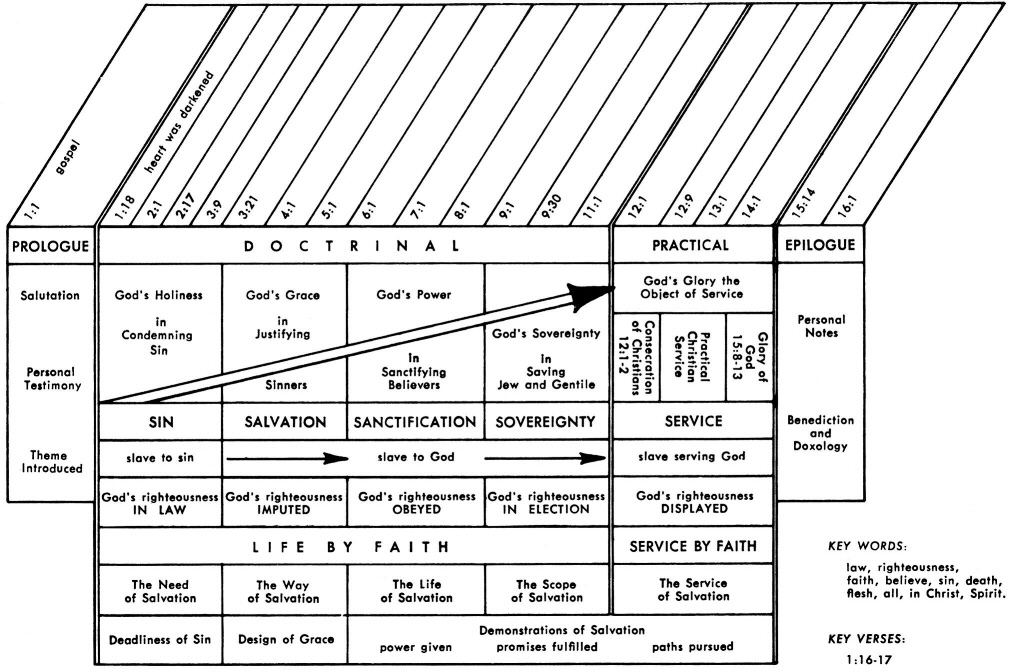
Click chart to enlarge
Chart from recommended resource Jensen's Survey of the NT - used by permission
Romans Overview Chart - Charles Swindoll
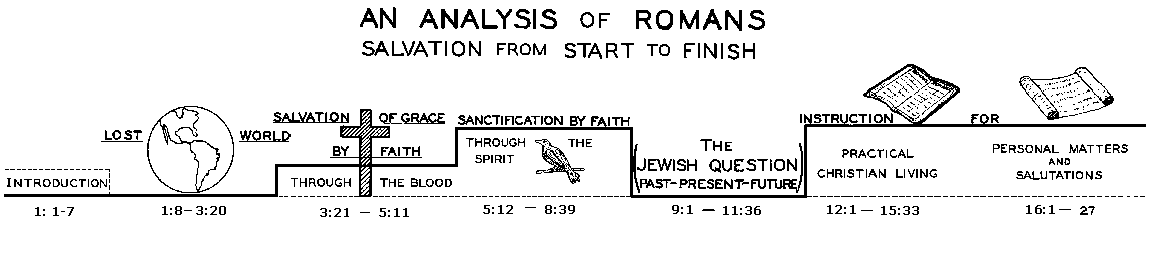
Source: Dr David Cooper
Click to Enlarge
R Ruin (Romans 1:17 – 3:20) – The utter sinfulness of humanity
O Offer (Romans 3:21-31) – God’s offer of justification by grace
M Model (Romans 4:1-25) – Abraham as a model for saving faith
A Access (Romans 5:1-11) – The benefits of justification
N New Adam (Romans 5:12-21) – We are children of two “Adams”
S Struggle w/ Sin (Romans 6-8) Struggle, sanctification, and victory
|
ROMANS ROAD |
||||
| Romans 1:18-3:20 | Romans 3:21-5:21 | Romans 6:1-8:39 | Romans 9:1-11:36 | Romans 12:1-16:27 |
| SIN | SALVATION | SANCTIFICATION | SOVEREIGNTY | SERVICE |
| NEED FOR SALVATION |
WAY OF SALVATION |
LIFE OF SALVATION |
SCOPE OF SALVATION |
SERVICE OF SALVATION |
| God's Holiness In Condemning Sin |
God's Grace In Justifying Sinners |
God's Power In Sanctifying Believers |
God's Sovereignty In Saving Jew and Gentile |
Gods Glory The Object of Service |
| Deadliness of Sin |
Design of Grace |
Demonstration of Salvation | ||
| Power Given | Promises Fulfilled | Paths Pursued | ||
| Righteousness Needed |
Righteousness Credited |
Righteousness Demonstrated |
Righteousness Restored to Israel |
Righteousness Applied |
| God's Righteousness IN LAW |
God's Righteousness IMPUTED |
God's Righteousness OBEYED |
God's Righteousness IN ELECTION |
God's Righteousness DISPLAYED |
| Slaves to Sin | Slaves to God | Slaves Serving God | ||
| Doctrine | Duty | |||
| Life by Faith | Service by Faith | |||
|
Modified from Irving L. Jensen's chart above |
||||
Romans 1:24 Therefore God gave them over (3SAAI) in the lusts of their hearts to impurity, so that their bodies would be dishonored (PPN) among them. (NASB: Lockman)
Greek: Dio paredoken (3SAAI) autous o theos en tais epithumiais ton kardion auton eis akatharsian tou atimazesthai (PPN) ta somata auton en autois,
Amplified: Therefore God gave them up in the lusts of their [own] hearts to sexual impurity, to the dishonoring of their bodies among themselves [abandoning them to the degrading power of sin], (Amplified Bible - Lockman)
Barclay: So then God abandoned them to uncleanness in their hearts, passionate desires for pleasure, desires which made them dishonor their bodies among themselves (Daily Study Bible)
NCV: Because they did these things, God left them and let them go their sinful way, wanting only to do evil. As a result, they became full of sexual sin, using their bodies wrongly with each other. (NCV)
NLT: So God let them go ahead and do whatever shameful things their hearts desired. As a result, they did vile and degrading things with each other's bodies. (NLT - Tyndale House)
Phillips: They gave up God: and therefore God gave them up - to be the playthings of their own foul desires in dishonoring their own bodies. (Phillips: Touchstone)
Wuest: On which account God delivered them over in the passionate cravings of their hearts to bestial profligacy which had for its purpose the dishonoring of their bodies among themselves;
Young's Literal: Wherefore also God did give them up, in the desires of their hearts, to uncleanness, to dishonour their bodies among themselves;
THEREFORE GOD GAVE THEM OVER: Dio paredoken (3SAAI) autous o theos:
- Judges 10:13; 2Chr 15:2; 24:20; Ps 81:11,12; Hos 4:17,18; Mt 15:14; Acts 7:42; Acts 14:16; Acts 17:29,30; Eph 4:18; 2Th 2:10, 11, 12
- Romans 1 Resources - Multiple Sermons and Commentaries
- Romans 1:24-27: Going Down, Down, Down, Part 1 - Steven Cole
- Romans 1:24-25 Abandoned by God, Part 1 - John MacArthur
Therefore (1352) (dio) means for which, wherefore, therefore and is a term of conclusion, which in the present context explains that because they gave God up and exchanged His glory for a dumb idol, God gave them up. Note the close connection between idolatry (verse 23) and immorality (verse 24). In fact is the association of idolatry with immorality is commonly highlighted in Scripture - eg, see Nu 25:1,2,3, 1Co 10:7,8, Ga 5:19-note; Gal 5:20-note, Eph 5:5-note, Col 3:5-note, 1Pe 4:3-note; Re 2:14-note; Re 2:20-note.; Re 21:8-note.
Johnson writes that…
The dio (AV, "wherefore") of verse 24 makes the connection with the preceding. In the light of the rebellion just described in Ro 1:18, 19, 20, 21, 22, 23 the inference of vindicatory judgment is drawn. Sin justly brings judgment, a judgment expressed most clearly in the following verses of this final section of chapter one. (Sermon)
Barnhouse introduces this somber section with these words…
The first stroke in the fearful melody of doom is now heard. The great burden of vengeance sounds the knell and the leit motif of retribution is heard in the majestic symphony of divine judgment. "God gave them up… God gave them up… God gave them over… " Three times in the paragraph there is the sweeping announcement that the human race was abandoned by the Creator God. And as He took His hands off humanity, the race descended more and more into the mire, sucked down into that quagmire which was the spew of its own doings.
This picture is not that of a segment of the most awful paganism. This is the human heart as it is without Christ It is the heart of America as well as the heart of India. The restraining powers of the mass influence of many Christians is greater here than in the pagan world, but every once in a while a corner is raised which permits us to see the formidable filth of even our own land, which puts it on a par with the vilest that the lands of Hell can produce. And the judgment of individuals in our land will be, perhaps, greater, because sin here is a sin against light while in the3 other lands it is frequently a sin within the midsts of gross darkness. (Man's Ruin)
God gave them over - This has to be one of the most frightening verses in the entire Bible. They refused light and instead loved darkness and consequently God gave them over to the power of darkness. Some see this (and I think rightly so) in part as an explanation of Ro 1:18 where "the wrath of God is being revealed from heaven". In this case God revealed His wrath, not by sending fire from heaven, but by abandoning sinful men to their lustful ways.
Newell offers an interesting comment…
This is deeper than the mere lusts of the flesh. Flesh has natural desires, which may or may not be yielded to. The lusts of the heart continue after the flesh is dissolved; and even when, in the tormented bodies of the damned, the lusts of the flesh cannot be conscious or controlling, “the lusts of the heart” will forever exist.(Romans 1 Commentary)
Listen to a similar refrain from Psalm 81
10 I, the LORD, am your God, Who brought you up from the land of Egypt; Open your mouth wide and I will fill it.
11 But My people did not listen to My voice; And Israel did not obey Me.
12 "So I gave them (Israel) over to the stubbornness of their heart, to walk in their own devices.
13 "Oh that My people would listen to Me, That Israel would walk in My ways!
14 "I would quickly subdue their enemies, And turn My hand against their adversaries.
Elsewhere in the Old Testament, we see God turn people over to their own hardness of heart Is 6:9, 10, 11; Is 29:9, 10, 11, 12; Je 44:25, 26, 27. Some writers have referred to this as “penal blindness”.
Psalm 115 records the folly of idolatry. Observe the dramatic contrasts between the living God and those things that are no gods at all…
1 Not to us, O LORD, not to us,
But to Your name give glory
Because of Your lovingkindness,
because of Your truth.
2 Why should the nations say,
"Where, now, is their God?"
3 But our God is in the heavens;
He does whatever He pleases.
4 Their idols are silver and gold,
The work of man's hands.
5 They have mouths, but they cannot speak;
They have eyes, but they cannot see;
6 They have ears, but they cannot hear;
They have noses, but they cannot smell;
7 They have hands, but they cannot feel;
They have feet, but they cannot walk;
They cannot make a sound with their throat.
8 Those who make them will become like them,
Everyone who trusts in them.
Luke records a similar pattern…
"God turned away and delivered (paradidomi) them (Israel) up to serve the host of heaven" (Acts 7:42)
"And in the generations gone by He permitted all the nations to go their own ways" (Acts 14:16)
As Godet writes mankind…
"sinned by degrading God, wherefore also God degraded them." (Godet, F: The Epistle of St Paul to the Romans)
Gave… over (3860) (paradidomi from para = beside + didomi = to give so literally to give beside) is a very strong Greek verb meaning to hand someone over to the power and authority of another. It is that act of God whereby He hands over the men for judgment because of their sins.
Paradidomi - 119x in 117v in the NAS -
Mt. 4:12; 5:25; 10:4, 17, 19, 21; 11:27; 17:22; 18:34; 20:18-19; 24:9-10; 25:14, 20, 22; 26:2, 15-16, 21, 23-25 45-46, 48; 27:2-4, 18, 26; Mk. 1:14; 3:19; 4:29; 7:13; Mk 9:31; 10:33; 13:9, 11-12; 14:10-11, 18, 21, 41-42, 44; 15:1, 10, 15; Lk. 1:2; Lk 4:6; 9:44; 10:22; 12:58; 18:32; 20:20; 21:12, 16; 22:4, 6, 21-22, 48; Lk 23:25; 24:7, 20; Jn. 6:64, 71; 12:4; 13:2, 11, 21; 18:2, 5, 30, 35-36; Jn 19:11, 16, 30; 21:20; Acts 3:13; 6:14; 7:42; 8:3; 12:4; 14:26; 15:26, 40; 16:4; 21:11; 22:4; 27:1; 28:17; Rom. 1:24, 26, 28; 4:25; 6:17; 8:32; 1Co. 5:5; 11:2, 23; 13:3; 15:3, 24; 2 Co. 4:11; Gal. 2:20; Eph. 4:19; 5:2, 25; 1 Tim. 1:20; 1 Pet. 2:23; 2 Pet. 2:4, 21; Jude 1:3
The NAS renders paradidomi as betray(13), betrayed(9), betraying(9), betrays(3), commended(1), committed(3),deliver(10), deliver up(7), delivered(17), delivered over(2), delivered up(16), delivering(3), delivers up(1), entrusted(3),entrusting(1), gave over(3), gave up(3), given over(1), handed down(3), handed over(4), permits(1), put(1), putting(1),risked(m)(1), taken custody(2), turn over(1).
God delivered us over to the power of our own lusts to impurity so that we might became "prisoners" that had to obey our own lusts. God's "abandoning" of men on one hand reflects His righteous wrath (cp Ro 1:18) in allowing them to follow their own desires, but on the other hand His giving men over allows them to see what life is like without God! In that sense, there is a redemptive purpose that stands behind the wrath of God. By letting men and women go their own way, God is not just punishing them but is also allowing them to see the emptiness of life without Him. What an awful picture this section of Scripture presents.
Moule writes that…
It is a dire thought; but the inmost conscience, once awake, affirms the righteousness of the thing. From one point of view it is just the working out of a natural process, in which sin is at once exposed and punished by its proper results, without the slightest injection, so to speak, of any force beyond its own terrible gravitation towards the sinner’s misery. But from another point it is the personally allotted, and personally inflicted, retribution of Him who hates iniquity with the antagonism of infinite Personality. He has so constituted natural process that wrong gravitates to wretchedness; and He is in that process, and above it, always and forever. (The Epistle of Paul the Apostle to the Romans)
Explaining the idea of "God gave them over" Godet writes that…
The word… does not signify that God impelled them to evil, to punish the evil which they had already committed. The holiness of God is opposed to such a sense, and to give over is not to impel. On the other hand, it is impossible to stop short at the idea of a simple permission: “God let them give themselves over to evil.” God was not purely passive in the terrible development of Gentile corruption. Wherein did His action consist? He positively withdrew His hand; He ceased to hold the boat as it was dragged by the current of the river. This is the meaning of the term used by the apostle, Acts 14:16: “He suffered the Gentiles to walk in their own ways,” by not doing for them what He never ceased to do for His own people. It is not a case of simple abstention, it is the positive withdrawal of a force. Such also is the meaning of the saying, Ge 6:3: “My Spirit shall not always strive with man.” As Meyer says: “The law of history, in virtue of which the forsaking of God is followed among men by a parallel growth of immorality, is not a purely natural order of things; the power of God is active in the execution of this law.” If it is asked how such a mode of action harmonizes with the moral perfection of God, the answer undoubtedly is, that when man has reached a certain degree of corruption, he can only be cured by the very excess of his own corruption; it is the only means left of producing what all preceding appeals and punishments failed to effect, the salutary action of repentance. So it is that at a given moment the father of the prodigal son lets him go, giving him even his share of goods. The monstrous and unnatural character of the excesses about to be described confirms this view. (Romans 1:18-32 The Wrath of God on Gentiles)
S Lewis Johnson writes that the threefold repetition of the verb given over has…
three major viewpoints in the interpretation of God's giving over of men.
First, perhaps the favorite interpretation of the term is that which has prevailed since the time of Origen and Chrysostom, in which the paredoken is taken in the permissive sense. According to this view God passively permitted men to fall into the retributive consequences of their infidelity and apostasy. The active voice of the verb is surely contrary to this view. It is not said that God permitted rebellious men to fall into uncleanness and bodily dishonor. It is said that He actively, although justly in view of their sin, consigned them to the consequences of their acts. It is His divine arrangement that men by their apostasy should fall into moral impurity, sin being punished by further sin, and He himself maintains the moral connection between apostasy and impurity by carrying out the judgment Himself.
Second, another popular view, which became current after the time of Augustine, takes the word, "gave up," in a privative sense. According to this interpretation God deprived man of an aspect of His work of common grace. He withdrew His hand that had restrained men from evil. Godet has expressed and illustrated this interpretation about as well as it can be set forth. "Wherein did His action consist?" he asks. And the answer follows, "He positively withdrew His hand; He ceased to hold the boat as it was dragged by the current of the river. This is the meaning of the term used by the apostle, Acts 14:16: 'He suffered the Gentiles to walk in their own ways,' by not doing for them what He never ceased to do for His own people. It is not a case of simple abstention, it is the positive withdrawal of a force."
At bottom this view is the practical equivalent of the permissive view. This is evident from the fact that Godet uses Acts 14:16 as illustrative of the sense. However, in that passage the verb used is eiasen (AV, "suffered"), which normally means simply to permit. The Pauline language seems stronger than this. The expression, "God gave them up to uncleanness," describes a judicial act, a "judicial abandonment." The active force of the verb must not be glossed over.
Therefore, finally, it becomes clear that the term must be given a judicial sense. The meaning is not simply that God withdrew from the wicked the restraining force of His providence and common grace, although that privative sense is included in the judicial sense, but that He positively gave men over to the judgment of "more intensified and aggravated cultivation of the lusts of their own hearts with the result that they reap for themselves a correspondingly greater toll of retributive vengeance." The usage of the word in both this epistle (cf. Ro 4:25; 6:17; 8:32) and in the other Pauline epistles (cf. 1Co 5:5; 1Ti 1:20) supports this force.
There is another striking occurrence of the identical form of the verb in Ephesians 4:19, and that passage serves to remind the interpreter that the infliction of punitive justice does not compromise the free agency and responsibility of man. In that passage Paul, speaking of the sin of the Gentiles, writes, "Who being past feeling have given themselves over (Gr., paredoken) unto lasciviousness, to work all uncleanness with greediness." In the midst of the retributive action of God there is no coercion of man. God does not entice or compel to evil. Man remains responsible and can even be said to be giving himself over to uncleanness while God gives him up to the judgment of his sin.
There is a popular saying to the effect that God made man in His own image, but now man is returning the compliment by making his gods in his own image. That saying receives some support from Paul's words here, and one can see that the consequences of that action are deadly. (Sermon)
Pritchard adds
It is only when a man comes to the end of himself that he is ready to think about Jesus Christ. But when that moment of emptiness comes, when he finally faces the "God-shaped vacuum" inside, when he discovers that disobedience only leads to pain, when he reaps the bitter harvest of his own sin, then and only then has he become a candidate for the grace of God! Unfortunately, some people never figure it out in time. They die without realizing the folly of their own behavior. But others come to the end and finally, after many mistakes, they begin to look up. When they do, they find that God is there waiting for them. (When God Gives Up - sermon by Dr. Ray Pritchard - February 1992)
Interestingly paradidomi was a judicial term used for handing over a prisoner to his sentence! When men forsake the one true God, He will abandon them (Judges 10:13; 2Chr 15:2; 24:20; Ps 81:11, 12). He accomplishes this by removing His restraint and allowing their innate totally depraved sin nature to run its inevitable course of degradation & destruction. The result is that man so abandoned the truth that he became like a beast in his thinking and in his living.
When men lose God, they always lose themselves.
It’s as if God has said,
All right. If you want to turn away from me, I’ll let you go. I won’t try to stop you. But you’ll have to face the consequences of your own actions.
Hosea 4:17 expresses the judgmental aspects of God "giving us up," leaving us to our own sin:
We err when we think that it is God’s mercy or kindness that allows man to continue in sin; it is actually His wrath which allows us to go on destroying ourselves with sin.
ILLUSTRATION: Dress up a pig, clean him up for the county fair, but the moment you "give him up" and let him go, he will go right back to the mud hole. As to its nature the pig loves uncleanness. Men love their sin as Jesus explained in John 3 declaring that…
"This is the judgment, that the Light has come into the world, and men loved the darkness rather than the Light, for their deeds were evil (their deeds speak of what they love). For everyone who does evil hates the Light, and does not come to the Light for fear that his deeds will be exposed (shown to be wrong, rebuked, corrected - they don't want to be corrected)." (John 3:19-20)
When men choose an evil manner of life, they also choose the consequences such a manner of life brings.
As A T Robertson says
"These people had already willfully deserted God Who merely left them to their own self-determination & self-destruction, part of the price of man’s moral freedom. Paul refers to this stage and state of man in Acts 17:30 by “overlooked” (huperidon). The withdrawal of God’s restraint sent men deeper down. Three times Paul uses paredoken (the parsed form of paradidomi) here (Ro 1:24, 26, 28), not three stages in the giving over, but a repetition of the same withdrawal. The words sound to us like clods on the coffin as God leaves men to work their own wicked will."
Notice the progression: First men reject the truth about God, then they turn away from God, then they turn to immorality. And the shocking truth is that this goes on all the time. Every baby born into this world comes in with a disposition (Sin nature) that turns him away from the truth. All mankind by nature (Adam's "nature" - Ro 5:12-note) actively continually suppresses the truth about God. Left to our own devices, the fallen flesh will naturally gravitate to wickedness and godlessness.
Barclay adds that…
It is one of the grim facts of life that the more a man sins the easier it is to sin. He may begin with a kind of shuddering awareness of what he is doing, and end by sinning without a second thought… The most terrible thing about sin is just this power to beget sin. It is the awful responsibility of free-will that it can be used in such a way that in the end it is obliterated and a man becomes the slave of sin, self-abandoned to the wrong way. And sin is always a lie, because the sinner thinks that it will make him happy, whereas in the end it ruins life, both for himself and for others, in this world and in the world to come. (Romans 1 - William Barclay's Daily Study Bible - Commentary)
Vine makes a sad but true observation regarding so called "civilized men" (in contrast to the "heathen") --
Civilization provides no remedy for, or safeguard against, the evil. The more civilized men became, the more vicious became their idolatry. (Parenthetically, the civilized Greeks & Romans had a veritable plethora of "gods") The knowledge of God is the ONLY means of leading man to purity of heart. The sanctity of the body is implied in the teaching of this verse.
Warren Wiersbe explains that…
From idolatry to immorality is just one short step. If man is his own god, then he can do whatever he pleases and fulfill his desires without fear of judgment. We reach the climax of man's battle with God's truth when man exchanges the truth of God for "the lie" and abandons truth completely. "The lie" is that man is his own god, and he should worship and serve himself and not the Creator. It was "the lie" Satan used in the Garden to lead Eve into sin: "Ye shall be as God!" Satan has always wanted the worship that belongs only to God (Is 14:12, 13, 14, 15; Mt 4:8, 9, 10); and in idolatry, he receives that worship (1 Cor. 10:19, 20, 21).
The result of this self-deification was self-indulgence; and here Paul mentions a vile sin that was rampant in that day and has become increasingly prevalent in our own day; homosexuality. This sin is repeatedly condemned in Scripture (Ge 18:20ff; 1Co 6:9, 10; Jude 1:7). Paul characterizes it as "vile" and "unnatural," as well as "against nature." Not only were the men guilty, but "even the women." (Wiersbe, W: Bible Exposition Commentary. 1989. Victor )
Wuest nicely explains that…
Since men chose to give up God (cp Jn 3:20, Pr 1:29, 5:12) and worship the creature, God could do nothing but give men into the control of the sinful things they preferred to God. In other words, God would not violate man’s will and force him to do something he did not want to do. When men persisted in following their totally depraved natures, God allowed them free rein. The natural result was immorality of the vilest kind. Alford, says of God’s act of delivering mankind over into the control of utter human depravity, “not merely permissive, but judicial, God delivered them over (See Retribution). As sin begets sin, and darkness of mind, deeper darkness, grace gives place to judgment, and the divine wrath hardens men, and hurries them on to more fearful degrees of depravity. ”God delivered man to uncleanness." (Wuest, K. S. Wuest's Word Studies from the Greek New Testament: Eerdmans )
Vine notes that
The same word (paradidomi) is used in reference to the death of Christ at Ro 4:25-note and at Romans 8:32-note (see Romans 6:17-note). In this passage the reference is to the divine retribution following upon the sin of exchanging God for an idol. To abandon God is to open a way for complete moral degradation. This retributive dealing is not the outcome of mere despotism on the part of God; for the acknowledgment and worship of the Creator are the means of human happiness.
Atheism and polytheism tend inevitably to moral disease. Our moral nature is governed by laws which God has Himself put therein as part of our very constitution. God works in and by these laws in human experience. In acting against them man sins against God as his Creator and sins against himself as the creature. He therefore lays himself open to the divine retribution expressed in this verse. The process described is not that of mere natural law, it is designed by God and the issue is reached under His control. It must be remembered that in the solemn description given in this passage, of the consequences of idolatry, the apostle is not presenting what is necessarily an irretrievable condition, for the gospel proves to be the power of God unto salvation even from such degradation. Indeed the whole description is a dark background to the revelation of the grace of God in and through the gospel." (Vine, W. Collected writings of W. E. Vine. Nashville: Thomas Nelson )
There are some messages that pastors would rather not preach. This sermon definitely falls into that category… This passage has for its theme the judgment of God upon a world gone mad with sin. When we read it, we come face to face with "our true condition." Many of us would rather not think about that. I cannot blame those who would prefer to be somewhere else this morning. Dr. Donald Grey Barnhouse called this the most terrible passage in all the Bible.
Barclay wrote that…
Before man there stands an open choice; and it has to be so. Without choice there can be no goodness and without choice there can be no love. A coerced goodness is not real goodness; and a coerced love is not love at all. If men deliberately choose to turn their backs on God after he has sent his Son Jesus Christ into the world, not even he can do anything about it. (Romans 1 - William Barclay's Daily Study Bible - Commentary)
IN THE LUSTS OF THEIR HEARTS TO IMPURITY: en tais epithumiais ton kardion auton eis akatharsian:
- Romans 1 Resources - Multiple Sermons and Commentaries
- Romans 1:24-27: Going Down, Down, Down, Part 1 - Steven Cole
- Romans 1:24-25 Abandoned by God, Part 1 - John MacArthur
In (en) - Note "in" gives the picture of their being literally entrapped IN their lusts, virtually immersed IN them. The idea of in is in the sphere of influence or in the atmosphere of these wicked insatiable desires. Even as a fish lives in the "atmosphere" of a fish tank, these men and women are allowed to live in the atmosphere of their sinful desires!
Godet comparing the preposition "in" (en) and the subsequent preposition (eis) writes that…
The two prepositions, en and eis differ from one another as the current which bears the bark along, once it has been detached from the shore, differs from the abyss into which it is about to be precipitated. Lusts exist in the heart; God abandons (the heart) to their power, and then begins that fall which must end in the most degrading impurities. (Godet, F: The Epistle of St Paul to the Romans)
Lusts (1939) (epithumia [word study] from the verb epithumeo = to set one's heart upon in turn from epi = upon, toward or used to intensify meaning of following word + thumos = passion) (Click word study) describes an internal drive or passion directed at or toward an object (preposition epi = toward). Epithumia describes that inner passion which greatly desires or longs to do or have something. Although epithumia can occasionally describe a good drive, this usage in Romans (as with most NT uses) describes depraved cravings and inner vile unrestrained desires emanating from our fallen Sin nature (see Sin) inherited from Adam (Ro 5:12-note). Epithumia describes to a degree an out-of-control craving. The result of these inner cravings is to drive men to open excesses. Compare epithumia to the even more intense craving described in the word orexis (lust) in Romans 1:27 (note).
William Barclay wrote that "The word translated desires (lusts) (epithumia) is the key to this passage. Aristotle defined epithumia as a reaching out after pleasure. The Stoics defined it as a reaching after pleasure which defies all reason. Clement of Alexandria called it an unreasonable reaching for that which will gratify itself. Epithumia is the passionate desire for forbidden pleasure. It is the desire which makes men do nameless and shameless things. It is the way of life of a man who has become so completely immersed in the world that he has ceased to be aware of God at all. It is a terrible thing to talk of God abandoning anyone. (Romans 1 - William Barclay's Daily Study Bible - Commentary)
Hearts (2588) (kardia) does not refer to the physical organ but is always used figuratively in Scripture to refer to the seat and center of human life. The heart is the center of the personality, and it controls the intellect, emotions, and will. No outward obedience is of the slightest value unless the heart turns to God. While kardia does represent the inner person, the seat of motives and attitudes, the center of personality, in Scripture it represents much more than emotion, feelings. It also includes the thinking process and particularly the will.
Kardia as stated above refers not to the physical organ (over 800 mentions and none refer to the physical organ!), but is always used figuratively to center of our personality, to so to speak to our "control center" (to make a play on the "air traffic control center" at the airport which carefully guards and guides what flies in and what flies out. How applicable to our "hearts" which are so prone to wander!). In short kardia refers to the the affective center of our being wherein lies the capacity of moral preference and volitional desire. The kardia generates thoughts that make the decisions which the mind works out. In other words, our logic flows out of our heart-decisions and not vice versa. Gleason Archer called the kardia, the "desire-producer that makes us tick" for it is the place where our "desire-decisions" occur, and which establish who we really are. WHO ARE YOU? HAVE YOU HAD A HEART CHECK UP RECENTLY? We are assiduous to do this medically, but woefully lax in doing it spiritually (beloved, I speak from experience!). At regeneration God reverses the spiritual atherosclerosis of our old sinful heart by giving us a total heart transplant! Daily confession and repentance are thereafter necessary to avoid "spiritual atherosclerosis" and gradual, subtle hardening (and becoming cold to the things of God) of our heart! (Read and practice daily "preventative maintenance" = 1 Jn 1:9+, Pr 28:13+).
Jeremiah said "The heart is more deceitful than all else and is desperately sick" (Jeremiah 17:9, 10) And thus the heart of man's problem is our unregenerate heart. The "lusts of their hearts" are those wicked desires that originate from their evil hearts or which their hearts produced.
MacArthur commenting on kardia writes that "While we often relate heart to the emotions (e.g., “He has a broken heart”), the Bible relates it primarily to the intellect (e.g., “Out of the heart come evil thoughts, murders, adulteries, fornications, thefts, false witness, slanders,” Mt 15:19). That’s why you must “watch over your heart with all diligence” (Pr 4:23). In a secondary way, however, heart relates to the will and emotions because they are influenced by the intellect. If you are committed to something, it will affect your will, which in turn will affect your emotions." (Drawing Near. Crossway Books) MacArthur adds that "In most modern cultures, the heart is thought of as the seat of emotions and feelings. But most ancients—Hebrews, Greeks, and many others—considered the heart to be the center of knowledge, understanding, thinking, and wisdom. The New Testament also uses it in that way. The heart was considered to be the seat of the mind and will, and it could be taught what the brain could never know. Emotions and feelings were associated with the intestines, or bowels." (Ephesians. Page 44. Chicago: Moody Press)
Adam Clarke - They had filled up the measure of their iniquities, and God, by permitting them to plunge into all manner of irregularities, thus, by one species of sin, inflicted punishment on another.
George Brooks - The word "impurity" (akatharsia) speaks of uncleanness. This word had reference to a person doing house keeping. Paul was suggesting that man had not done a very good job in keeping his mind clean. The word "mind" (kardia) speaks of man’s nature, his inner being or character. It speaks of the center and seat of the spiritual life. God allowed man to do the things that were at the center of his heart. Since God was not there in the center of man’s heart, man’s self-will controlled his life. Self-will is the cause of all sin.
Impurity (167) (akatharsia [word study] from a = without + kathaíro = cleanse <> from katharos = pure, clean, without stain or spot) is a broad term referring to moral uncleanness in thought, word, and deed. It means a state of moral impurity, especially sexual sin, immorality, filthiness, state of moral impurity. The term akatharsia refers to filth or refuse and thus describes a filthiness of heart and mind that makes the person defiled. The unclean person sees dirt in everything. The word akatharsia suggests especially that it defiles its participants, making them unusable for sacred purposes. While akatharsia includes sexual sin, it comes from a wider Septuagint (LXX) usage where “unclean” could refer to anything that made a person unfit to go to the temple and appear before God.
In a medical sense Hippocrates used akatharsia to describe an infected, oozing wound with pus and crusty impurities that gather around the sore or wound. What is “impure” is filthy and repulsive, especially to God. Akatharsia was a general term often used of decaying matter, like the contents of a grave (see Mt 23:27 cf Nu 19:13) In short akatharsia describes any excessive behavior or lack of restraint and speaks more of an internal disposition. An immoral filthiness on the inside whereas the lawless acts of ''immorality'' are on the outside.
Paul uses akatharsia in his description of the Gentiles in his letter to the Ephesians writing that the saints were to…
"… walk (speaks of one's lifestyle or conduct) no longer just as the Gentiles also walk, in the futility (emptiness, vanity) of their mind, being darkened in their understanding (cf "futile in their speculations, and their foolish heart was darkened." in Ro 1:21), excluded (entirely alienated or estranged) from the life of God, because of the ignorance that is in them, because of the hardness (porosis comes from poros = stone harder than marble and came to mean loss of all power of sensation; having become so hardened that there was no longer power to feel at all which always the terror of sin) of their heart; and they, having become callous (past feeling, unable to feel pain or grief), have given themselves over (paradidomi - same verb Paul uses of God's giving over) to sensuality (uninhibited sexual indulgence without shame and w/o concern for what others think), for the practice of every kind of impurity (akatharsia ) with greediness." (see exposition of Ephesians 4:17-19)
Akatharsia in the present context speaks of sexual immorality, which begins in the mind that rejects the Truth, then taking root in the heart and finally working itself out in the various effects that bring shame to the body (bodies dishonored). And we must not be deceived - Impurity or uncleanness always generates more uncleanness.
What is the "danger" of being given over in the the lusts of one's heart? Jesus explained that
out of the heart come (present tense = continually) evil thoughts, murders, adulteries, fornications, thefts, false witness, slanders. These are the things which defile the man… (see also Ge 6:5; 8:21; Pr 4:23; 6:14; 22:15;Jer 17:9; Mark 7:21, 22, 23; Ro 3:10, 11, 12, 13, 14, 15, 16, 17, 18, 19; 7:18; 8:7,8; Gal 5:19, 20, 21; Eph 2:1, 2, 3; Titus 3:2, 3, 4, 5, 6)
Moule writes that…
There is a dark sequence in the logic of facts, between unworthy thoughts of God and the development of the basest forms of human wrong… And the folly which does not indeed deny God, but degrades His Idea, always gives its sure contribution to… corruption. (Moule, C. G. Handley: The Epistle of St Paul to the Romans)
This section in Romans (1:24-32) describes the downward spiral of abandonment of the Truth about God in the life of men, focusing very specifically on what happens when God abandons man. (cf to the degraded, depraved, despicable days of Judges when men did what was right in their own eyes > Jdg 2:14-note, Jdg 2:19-note, Jdg 2:21-note).
Alford says,
“not by or through the lusts; the lusts of the heart were the field of action, the department of their being in which this dishonor took place.”
Their false religion was no check upon their lusts. They engaged in the lowest and most disgusting lusts. Language cannot describe the pollution of the Gentile world, when Paul wrote, as revealed by the pagan writers of that period.
Paul presents the antidote to impurity later in this letter, this time speaking of those who had been redeemed and regenerated by the Gospel explaining…
"I am speaking in human terms because of the weakness of your flesh. For just as you presented your members as slaves to impurity (akatharsia) and to lawlessness, resulting in further lawlessness, so now present your members as slaves to righteousness, resulting in sanctification (you will find that the process that went on before, in which you went on from bad to worse and became viler and viler, is entirely reversed. You will become cleaner and cleaner, and purer and purer, and holier and holier, and more and more conformed unto the image of the Son of God)." (See exposition of Romans 6:18-20)
Writing to the Thessalonians Paul explained that…
God has not called us for the purpose of impurity (akatharsia), but in sanctification ("to live holy lives" = the process by which believers are set apart by God as a special people to grow spiritually in personal holiness and to develop Christ-like character"). (1Thes 4:7-note)
Paul writing to the Colossians based on their position in Christ Who was now their life they must
Therefore consider the members of (their) earthly body as dead to immorality, impurity (akatharsia), passion, evil desire, and greed, which amounts to idolatry. For it is on account of these things that the wrath of God will come,." (See Colossians 3:5-note)
Comment: Though the outpouring of God's wrath in its fulness is a matter of the future fulfillment, a foretaste will be experienced by the impure even here and now.
SO THAT THEIR BODIES MIGHT BE DISHONORED AMONG THEM: tou atimazesthai (PPN) ta somata auton en autois:
- 1Co 6:13,18; 1Th 4:4; 2Ti 2:20, 21, 22
- Romans 1 Resources - Multiple Sermons and Commentaries
- Romans 1:24-27: Going Down, Down, Down, Part 1 - Steven Cole
- Romans 1:24-25 Abandoned by God, Part 1 - John MacArthur
Dishonored (818) (atimazo from a = without + time = honor) means to be treated with indignity or to cause to be disgraced or degraded. To treat shamefully. To suffer shame or to dishonor (treat in a degrading manner). To insult, treat with contumely (speaks of harsh language or treatment), whether in word, in deed, or in thought. It means to cause to have a low status involving dishonor and disrespect. To deprive of honor or respect and thus to treat shamefully. Some Lexicons state that in Romans 1:24 the idea is using the body for immoral purposes and thus degrading or abusing it.
To dishonor is to bring reproach or shame on; to stain the character of; to lessen the reputation. To treat with disrespect. To violate the chastity of; to debauch.
Atimazo in this passage is in the present tense indicating this is the continuing state of their bodies.
Here are the 7 uses of atimazo in the NT - Mark. 12:4; Lk. 20:11; Jn. 8:49; Acts 5:41; Rom. 1:24; 2:23; James. 2:6
Here are the 25 uses of atimazo in the Septuagint - Gen. 16:4, 5; Deut. 27:16; 1 Sam. 10:27; 17:42; 2 Sa 10:5; Esther 1:18; Pr 14:2, 21; 19:26; 22:10, 22; 27:22; 28:7; 30:17, 32; Is 5:15; 16:14; 23:9; 53:3; Ezek. 28:24, 26; 36:3, 5; Mic. 7:6;
Among them -- This phrase may seem like an unnecessary addition but by phrasing it this way as Godet explains, Paul…
wishes to describe this blight as henceforth inherent in their very personality: it is a seal of infamy which they carry for the future on their forehead.
Barnes adds that among them means
Among themselves; or mutually. They did it by unlawful and impure connexions with one another.
Clarke adds that the idea of among them is…
Of themselves, of their own free accord; none inciting, none impelling.
Harry Ironside notes that…
The vile immoralities depicted here are the natural result of turning from the holy One. The picture of heathenism in its unspeakable obscenities is not over-drawn, as any one acquainted with the lives of idolatrous people will testify. The awful thing is that all this vileness and filthiness is being reproduced in modern society where men and women repudiate God. If people change the truth of God into a lie and worship and serve the creature rather than the Creator, the whole order of nature is violated; for apart from the fear of God (cp Ro 3:18-note) there is no power known that will hold the evil desires of the natural heart in check. It is part of the very nature of things that flesh will be manifested in its worst aspects when God gives men up to follow the bent of their unholy lusts." (Romans 1 Commentary).
As Robertson observes
"Heathenism left its stamp on the bodies of men and women" whereas the salvation through the gospel brought a "… new sense of dignity for the body"
Remember that Paul was writing Romans from the city of Corinth, were every sort of sexual immorality and ritualistic prostitution was practiced promiscuously. In fact things were so vile in Corinth that the expression “to live like a Corinthian” came to mean “to live a life of moral degradation”! Corinth’s idol temple had more than one thousand so called priestesses dedicated to gratification of lust.
Vine describes the danger of idolatry writing that…
Civilization provides no remedy for, or safeguard against, the evil. The more civilized men became, the more vicious became their idolatry. The knowledge of God is the only means of leading man to purity of heart. The sanctity of the body is implied in the teaching of this verse.
Newell adds…
that when man is delivered from Divine restraint, the lusts of his heart plunge him into ever deeper bodily uncleanness, and bodily vileness. History backs up this fact with terrible relentlessness. What an answer is here to all the boasting of proud men of a "principle of development" in man; to the lying claim that man is ever "making progress." The "Golden Age" of Grecian literature, and that of Roman letters, —in both of them we find remarkable minds; but their works must be expurgated for decent readers! No printer, even in this corrupt age, would dare to publish books with literal descriptions of the orgies of "classical" days." (Romans 1 Commentary)
Keep in mind that it was God Who by His own will "gave them over" so this is not merely a passive sitting by but as Charles Hodge says
"is at least a judicial abandonment. (cf "wrath of God is [being] revealed" in Ro 1:18) It is as a punishment for their apostasy that God gives men up to the power of sin. He withdraws the restraints of his providence and grace and gives the wicked over to the dominion of sin. God is presented in the Bible as the absolute moral and physical ruler of the world. He governs all things according to the counsel of his own will and the nature of his creatures. What happens as a consequence does not come about by chance, but is designed; and the order of events is under his control. “It is beyond question,” says Tholuck, “that, according to the teaching of the Old and New Testaments, sin is the punishment of sin.” So the rabbis teach, “The reward of a good deed is a good deed, and of an evil deed, an evil deed.” (Romans 1 Commentary )
Hendrickson writes that although one aspect of God giving men over could be to lead them to repentance (e.g., see 1Corinthians 5:5 1Timothy 1:20 and as described by Isaiah "Jehovah will strike Egypt, striking but healing; so they will return to the Lord, and He will respond to them and will heal them." Isaiah 19:22)…
"Nevertheless, justice must be done also to the other side of the picture. Mercy unrequited produces wrath. Divine patience without favorable response on the part of man results in the outpouring of divine indignation. Honesty in exegesis compels one to admit that verse 24 is part of a paragraph that is introduced by a reference to “the wrath of God” (verse 18). What the present verse (24) holds before us, therefore, is the fact that at the proper time—known only to God—impenitent sinners are by that wrath allowed to be swept away by their own sins into the pit of their vile passions. By a positive action of God’s will they are finally abandoned. (Hendriksen, W., & Kistemaker, S. J. Vol. 12-13: New Testament commentary : Exposition of Paul's Epistle to the Romans. Page 75. Grand Rapids: Baker Book House )
John Piper gives 3 reasons why Paul goes into such explicit detail of the "pathology" of man's sin stating that
(1) Superficial diagnoses lead to false remedies. Superficial diagnoses lead to false remedies and no cures. If you want to find true remedies for a disease, and if you want to bring a lasting cure to the people who are diseased, then you need more than a superficial grasp of the disease itself. Those who care most about a cure for AIDS or cancer, spend almost all their time studying the disease.
(2) Understanding sin and wrath will make you wiser. Profound understanding of sin and wrath will make you a far wiser person about human nature - your own and others. And if you are wiser about the nature of the human soul, you will be able to fight your own sin more successfully, and you will be able to bless others more deeply with your insight and counsel. I have pled with women and men in this church in recent months that what we need to nurture and cultivate here at Bethlehem over the next decades is sages -men and women who ripen with years into deeply sagacious people: wise, discerning, penetrating, deep lovers of people and deep knowers of human nature and God's nature, who can see deeply into the tangle of sin and sacredness that perplexes the saints and threatens to undo us. If you run away from the study of sinful human nature - if you say, I don't like to think about sin - then you run away from yourself, and you run away from wisdom, and, worst of all, you run away from the deepest kinds of love.
(3) Knowing the nature of sin and wrath will cause you to cherish the gospel. Probably the most important thing I would say, and the most firmly rooted in Ro 1:18, is that knowing the true condition of your heart and the nature of sin and the magnitude and justice of the wrath of God will cause you to understand the mighty gospel, and love it, and cherish it, and feast on it, and share it as never before. And this is crucial because this is the way the gospel saves believers. If you don't understand the gospel, if you don't cherish it and look to it and feed on it day after day, it won't save you (1Co 15:1, 2, 3-see notes; Col 1:23-note). Knowing sin and wrath will help you do that." (The Wrath of God Against Ungodliness and Unrighteousness)
John MacArthur sums this section up by pointing out that
when men seek to glorify their own ways and to satisfy their bodies through shameful indulgence in sexual and other sins, their bodies, along with their souls, are instead dishonored. When man seeks to elevate himself for his own purposes and by his own standards, he inevitably does the opposite. The way of fallen mankind is always downward, never upward. The more he exalts himself, the more he declines. The more he magnifies himself the more he diminishes. The more he honors himself, the more he becomes dishonored. (MacArthur, J: Romans 1-8. Chicago: Moody Press )
S Lewis Johnson sounds a prophetic warning for America based upon passages in Romans 1 writing that…
The Pauline answer is plain, and Romans 1:24 expresses it most impressively and succinctly. When man rebelled and sinned, God "gave them up" to uncleanness in the lusts of their hearts that by their own activities their bodies might be dishonored. In other words, sexual rebellion, license, and anarchy is the retributive judgment of God. The civilization of the western world, including the particular civilization of the United States of America, is not a civilization in danger of contracting a fatal disease. That civilization has already contracted a malignant and fatal cancer through its unbelief of the message of God in Christ. It is now hurrying on with increasing speed to final climactic destruction. Civilizations do not die because of violence, crime, immorality, and anarchy. These things are evidences that death already is at work, a death brought on by disobedience to the revelation of God.
It should be carefully noted that the apostle is not speaking of eternal punishment in these verses (Ro 1:24, 26, 28). He writes of a judgment that pertains to this life. On the other hand, it is also plain that Paul's words lead on to the doctrine of everlasting torment (cf. Ro 1:32). The vindicatory judgment inflicted by God is continued in the life to come in a more terrible and permanent form if the escape through the gospel of the cross is neglected.
To the question sometimes posed by soft-hearted men, "Can God really give man up to judgment?," this passage provides a resounding "yes" answer. But, in fact, it is not the final and convincing answer to the question. That comes from the cross of Jesus Christ, which in the cry it elicits from our Lord, "My God, my God, why hast thou forsaken me?" unmistakably affirms the fact that God can give man up to judgment. It was there that the sinless Man bore the judgment of God upon sin, and it forever proclaims the true nature of sin—it is worthy of the penalty of spiritual and physical death--and God's hatred of it with His necessary condemnation of it.
Does God then care? The answer to this question also comes from the cross. It was God who gave the Son to offer the penal, propitiatory, substitutionary sacrifice, the remedy for sin and death. And, if that is not sufficient evidence of God's love and concern, reflect further upon the fact that it is also He who has revealed to men their lost condition and the significance of the atoning death, inscribed its interpretation in the written Word of God and preserved that Word for countless millions to read and ponder. Isaiah was right. Although righteous and necessary, judgment is His "strange work" and His "strange act." (Full sermon)
Romans 1:25 For they exchanged (3PAAI) the truth of God for a (the) lie, and worshiped and served the creature rather than the Creator, who is (3SPAI) blessed forever. Amen (so be it). (NASB: Lockman)
Greek: hoitines metellexan (3PAAI) ten aletheian tou theou en to pseudei, kai esebasthesan (3PAPI) kai elatreusan (3PAAI) te ktisei para ton ktisanta, (AAPMSA) os estin (3SPAI) eulogetos eis tous aionas; amen.
Barclay: for they are men who have exchanged the truth of God for falsehood, and who worship and serve the creation more than they do the Creator, who is blessed for ever. Amen. (Daily Study Bible)
NLT: Instead of believing what they knew was the truth about God, they deliberately chose to believe lies. So they worshiped the things God made but not the Creator himself, who is to be praised forever. Amen. (NLT - Tyndale House)
Phillips: These men deliberately forfeited the truth of God and accepted a lie, paying homage and giving service to the creature instead of to the Creator, who alone is worthy to be worshipped for ever and ever, amen. (Phillips: Touchstone)
Wuest: who were of such a character that they exchanged the truth of God for a lie and worshipped and rendered religious service to the creation rather than to the Creator who is to be eulogized forever. Amen.
Young's Literal: who did change the truth of God into a falsehood, and did honour and serve the creature rather than the Creator, who is blessed to the ages. Amen.
FOR THEY EXCHANGED THE TRUTH OF GOD FOR A LIE: hoitines metellaxan (3PAAI) ten aletheian tou theou en to pseudei:
- Ro 1:18; 1Th 1:9; 1Jn 5:20 Is 44:20; Jer 2:11, 10:14,15; 13:25; 16:19; Am 2:4; Hab 2:18
- Romans 1 Resources - Multiple Sermons and Commentaries
- Romans 1:24-27: Going Down, Down, Down, Part 1 - Steven Cole
- Romans 1:24-25 Abandoned by God, Part 1 - John MacArthur
Torrey's Topic Forsaking God - Idolaters guilty of 1 Samuel 8:8; 1 Kings 11:33; The wicked guilty of Deuteronomy 28:20; Backsliders guilty of Jeremiah 15:6 IS FORSAKING His house 2 Chronicles 29:6 His covenant Deuteronomy 29:25; 1 Kings 19:10; Jeremiah 22:9; Daniel 11:30 His commandments Ezra 9:10 The right way 2 Peter 2:15 Trusting in man is Jeremiah 17:5 Leads men to follow their own devices Jeremiah 2:13 Prosperity tempts to Deuteronomy 31:20; 32:15 Wickedness of Jeremiah 2:13; 5:7 Unreasonableness and ingratitude of Jeremiah 2:5,6 Brings confusion Jeremiah 17:13 Followed by remorse Ezekiel 6:9 Brings down his wrath Ezra 8:22 Provokes God to forsake men Judges 10:13; 2Chronicles 15:2; 24:20,24 Resolve against Joshua 24:16; Nehemiah 10:29-39 Curse pronounced upon Jeremiah 17:5 Sin of, to be confessed Ezra 9:10 Warnings against Joshua 24:20; 1 Chronicles 28:9 Punishment of Deuteronomy 28:20; 2 Kings 22:16,17; Isaiah 1:28; Jeremiah 1:16; 5:19 Exemplified Children of Israel 1 Samuel 12:10 Saul 1 Samuel 15:11 Ahab 1Kings 18:18 Amon 2 Kings 21:22 Kingdom of Judah 2 Chronicles 12:1,5; 21:10; Isaiah 1:4; Jeremiah 15:6 Kingdom of Israel 2 Chronicles 13:11; 2 Kings 17:7-18 Many disciples John 6:66 Phygellus, &c 2 Timothy 1:15 Balaam 2 Peter 2:15
For (1063)(gar) is a subordinating conjunction expressing cause or explanation and thus introduces an explanation. In simple terms for is a term of explanation and its occurrence should always prompt one to pause and ponder the text and context, asking what the author is explaining, how does he explain it, etc. While not every "for" in the Bible is a term of explanation, most are and since there are over 7500 uses of for (NAS), you will have ample opportunity to observe and interrogate the text. As you practice this discipline of pausing to ponder, you are establishing the context (which leads to more accurate interpretation and thus more apropos application) and you are in effect engaging in the blessed activity of Biblical Meditation (See Ps 1:2- note, Ps 1:3-note and Joshua 1:8-note for the blessed benefits of meditation). When for is used at the beginning of a passage it is usually a term of explanation.
Exchanged (3337) (metallasso from metá = change of place or condition + allásso = change) is used only in this verse and the following in the NT and means to cease one activity and to start something else in exchange. It denotes the giving up of one thing (the truth of God) in order to receive another (a lie).
The verb exchanged is aorist tense (action at a moment in time) and active voice (subject makes a choice of their will to carry out this action) indicating that these women made a deliberate choice to exchange the natural for the unnatural, which was a reflection of the influence of the degrading passions God had given them into the power of.
Expositor's Bible Commentary observes that…
Paul's use of "exchanged" is suggestive. The first exchange, that of the truth for the lie, is followed by another--the upsetting of the normal course of nature in sexual relations (see exposition of Ro 1:26). Instead of using the ordinary terms for men and women, Paul substitutes "males" and "females." The irony is that this sort of bestiality finds no counterpart in the animal kingdom. Perversion is the unique contrivance of the human species. (Gaebelein, F, et al: Expositor's Bible Commentary: Old and New Testament 12 Volumes)
This is a bad exchange for it results in men denying God’s existence and His right to be obeyed and glorified. Ancient pagans idolaters mocked Christianity because the idea of substitutionary atonement seemed foolish (1Co 1:18, 20, 27). Furthermore, their lifeless mythical "gods" (cp Acts 14:15, 19:26, Is 44:10, 11, 12, 13, 14, 15, 16, 17, 18, 19, 20, Is 46:5, 6, 7, Ga 4:8, 1Co 8:4, 10:19, 20, 12:2, 1Th 1:9) were unconcerned, detached, and totally indifferent to the welfare of men. Thus even the idea of a caring, approachable, redeeming, self-sacrificing God was beyond the comprehension of the pagan mind.
Truth (225) (aletheia from a = indicates following word has the opposite meaning ~ without + lanthano = to be hidden or concealed, to escape notice, cp our English "latent" from Latin = to lie hidden) has the literal sense of that which contains nothing hidden. Aletheia is that which is not concealed. Aletheia is that which that is seen or expressed as it really is. It describes the body of real things, events, facts, the unveiled reality lying at the basis of and agreeing with an appearance. Content which is true is in accordance with what actually happened. Whatever God says is truth! Truth is a Person, Christ Jesus!
Here are Paul's uses of aletheia -
Ro 1:18, 25; 2:2, 8, 20; 3:7; 9:1; 15:8; 1 Co. 5:8; 13:6; 2 Co. 4:2; 6:7; 7:14; 11:10; 12:6; 13:8; Gal. 2:5, 14; 5:7; Eph. 1:13; 4:21, 24, 25; 5:9; 6:14; Phil. 1:18; Col. 1:5, 6; 2Th 2:10, 2Th 2:12-13; 1Ti 2:4, 7; 3:15; 4:3; 6:5; 2Ti 2:15, 18, 25; 3:7, 8; 4:4; Titus 1:1, 14 (note especially 2Ti 4:4!)
The truth of God (In NASB this phrase in Ro 1:25; 3:7; 15:8) in context refers to the true notion of His existence ("His invisible attributes, His eternal power and divine nature") as revealed in His creation. Can you see the potential damage caused by the widespread teaching of evolution as the accepted explanation for creation?
BKC - The truth of God is not only the truth concerning God but also God’s truth concerning all things, including mankind. This truth is that people are creatures of God and can find true fulfillment only in worshiping and obediently serving God the Creator. A lie (lit., “the lie”) on the other hand says that the creature—angelic (note the repetition of the pronoun "I" in Is 14:13,14 which most authorities take as a statement by Satan; John 8:44) or human (Ge 3:1, 2, 3, 4, 5, 6, 7)—can exist independent of God, self-sufficient, self-directing, and self-fulfilling. Mankind made himself his god in place of the true God. (Walvoord, J. F., Zuck, R. B., et al: The Bible Knowledge Commentary. 1985. Victor )
A lie - Literally "the lie", the specific lie. In the present context what is the lie? Clearly the lie refers to idolatry. The idol is “a lie” because in the imagination of the worshiper it promises much; however, it provides nothing! It is interesting that the Septuagint (LXX) uses "pseudos" to depict an idol. For example, Isaiah in a long section describing idols writes that the an idol worshipper
feeds on ashes; a deceived heart has turned him aside. And he cannot deliver himself, nor say, "Is there not a lie (LXX = pseudos) in my right hand? (Isaiah 44:20)
Vincent writes that lie is a "a general abstract expression for the whole body of false gods. Bengel remarks, "the price of mythology."
Godet agrees writing that the lie "denotes idols, that ignoble mask in which the heathen expose the figure of the All-perfect. And here comes the height of insult. After travestying God by an image unworthy of him, they make this the object of their veneration."
Vine says this the lie is "A terse expression used by metonymy (the substitution of a word describing the nature or significance of an object instead of the object itself) for an idol. Isaiah speaks of the idolater as failing to perceive that there is “a lie in my right hand” (Is 44:20); Jeremiah calls the molten image falsehood or deceitful (Jer 10:14,15; 13:25; 16:19); so “their lies (deceptive thing, vain idol)” (Am 2:4).
Pritchard adds some practical thoughts on the lie explaining that ""the lie" is "… that you can ignore God and still find fulfillment in this life. The lie that you can break God's laws and still be happy. The lie that you can live the "good life" without God. The truth is that living without God isn't the good life. It's quite literally hell on earth."
Middletown Bible writes "There is one other passage in the New Testament which specifically mentions "THE LIE." It is found in 2 Th 2:11. In the context we again see that "the lie" is the same as in Ro 1:25. The lie is that the creature is worthy of worship. Notice that creature-worship is described in 2Th 2:4. The man of sin (a mere man) will put himself in the place of God and present himself as an object of worship (for an enlargement of this prophecy see Revelation 13:1-5, Rev 13:8, 14-15 - see notes). Indeed, he will demand such worship and punish those who refuse to do so. (Romans 1)
Lie (5579) (pseudos from pseudomai = to lie) (See another discussion of pseudos) (See pseudos combined with other words in Scripture) refers to conscious and intentional falsehood. The basic sense is that which is false (untrue, not according to truth or fact). Pseudos is a falsehood that has the purpose of deception (or that which causes one to accept as true or valid that which is actually false or invalid).
A lie is a statement used with the intention of deceiving or defrauding. Lies are not only the spoken words but also actions (1Jn 1:6 - verb pseudomai) or a reference to idols (Amos 2:4 - where "their lies" ~ their vain idols).
Lying is a natural expression of Satan's character (John 8:44).
Here in Romans, pseudos describes the fundamental attitude underlying the sin of idolatry -- exchanging the truth of God for a (the) lie.
Note how serious God considers lying, even including it in the list of sins associated with eternal condemnation as described in the last two chapters of Scripture (Re 21:27-note; Re 22:15-note > literally "all continually loving and continually doing a lie!" So this refers not just to an occasional lie but to an entire life lived as a lie!) where He emphasizes that those who lie as a lifestyle have no part whatever with His people in His heavenly city of Jerusalem. Lying is a serious sin! Therefore it is not surprising that Paul exhorts believers to lay aside falsehood (Eph 4:25-note)
Falsehood - The state or quality of being untrue. Contrariety or inconformity to fact or truth. An untrue statement. Absence of truth or accuracy.
Complete Biblical Library - The dichotomy between the “truth” and a “lie” is vital to the Biblical revelation of God. Fundamental to God’s nature is the quality of being truthful (Romans 3:4); thus, He opposes anything false. All truth resides in Him; He is “abundant in … truth” (Exodus 34:6). Moreover, His revelation (Psalm 43:3), His law (Psalm 119:142), and His works (Daniel 4:37) are true. The righteous walk in the truth of God, which results in holy fear of God as well as ethical responsibility (Psalm 86:11; Proverbs 8:7). The Lord “desirest truth in the inward parts” (Psalm 51:6). Lies and falsehood are the chief trademarks of God’s enemies. Condemnation of the religious “lie” of the nation of Israel is a common feature of the prophetic message. Likewise, the idolatry of the Gentiles is characterized as a “lie.” Their gods are gods of falsehood who lead people astray (Isaiah 44:20). Behind these idols are lying spirits (1 Kings 22:22) which control the false prophets, fortune-tellers, soothsayers, sorcerers, and magicians (Deuteronomy 18:10-12). God judges harshly those responsible for introducing “falsehood” into the religion of Israel. The true prophets often complained that the people had been led astray by false prophets (Jeremiah 23:14,32; 27:10; 28:15; Ezekiel 13:19; 21:29; 22:28). False prophecy typically is false in that it predicts “prosperity” and “joy” rather than presenting the true condition of the people before God. They cried “peace, peace” to an unrepentant, backslidden people who were facing God’s judgment and wrath (Jeremiah 6:14; Jer 14:13-14.; Ezekiel 13:10-11.; Micah 3:5). The scribes, the authorities on the Law, were accused by Jeremiah of having written their interpretations of the Law with a “lying pen” (Jeremiah 8:8). Similarly, the priesthood was snared by the deceit of the lie (Jeremiah 6:13). God will do away with the “lies” of pagan religions at the time of messianic redemption. The people of God will realize that “surely our (their) fathers have inherited lies, vanity, and things wherein there is no profit” (Jeremiah 16:19). (Complete Biblical Library Greek-English Dictionary)
Pseudos - 10x in 10v - NAS Usage: false(1), falsehood(1), lie(5), lying(2), what is false(1).
John 8:44 "You are of your father the devil, and you want to do the desires of your father. He was a murderer from the beginning, and does not stand in the truth because there is no truth in him. Whenever he speaks a lie, he speaks from his own nature, for he is a liar and the father of lies ("lies" is not in Greek, added by translators).
Romans 1:25 For they exchanged the truth of God for a lie (literally "the lie" - cp Satan's lie that “You surely will not die!" = Ge 3:1-6), and worshiped and served the creature rather than the Creator, who is blessed forever. Amen.
Ephesians 4:25 Therefore (Why is Paul drawing this conclusion? See Eph 4:20-24 - term of conclusion), laying aside falsehood, SPEAK TRUTH EACH ONE of you WITH HIS NEIGHBOR, for we are members of one another.
2 Thessalonians 2:9 that is, the one whose coming is in accord with the activity of Satan, with all power and signs and false wonders,
2 Thessalonians 2:11 For this reason (What reason? See 2Th 2:10 = a term of explanation) God will send upon them a deluding influence so that they will believe what is false,
1 John 2:21 I have not written to you because you do not know the truth, but because you do know it, and because no lie is of the truth.
1 John 2:27 As for you, the anointing which you received from Him abides in you, and you have no need for anyone to teach you; but as His anointing teaches you about all things, and is true and is not a lie, and just as it has taught you, you abide in Him.
Revelation 14:5 And no lie was found in their mouth; they are blameless (the 144,000 Rev 14:1-5).
Revelation 21:27 and nothing unclean, and no one who practices (habitually, as their lifestyle) abomination and lying, shall ever come into it, but only those whose names are written in the Lamb's book of life.
Revelation 22:15 Outside are the dogs and the sorcerers and the immoral persons and the murderers and the idolaters, and everyone who loves and practices (habitually, as their lifestyle) lying.
There are 34 uses of pseudos in the Septuagint (LXX) -- Job 16:8; Ps 4:2; 5:6; 58:3; 59:12; 62:4; Pr 9:12; 14:5, 25; 24:2, 22; Is 28:15, 17; Isa 30:12; Isa 44:20; Jer 3:10, 23; 5:2; 9:3; 13:25; 23:14, 32; 37:14; 43:2; Ezek 33:31; Da 8:25; 11:23; Hosea 4:2; 7:3, 13; 11:12; Mic 2:11; Zech 5:4; Mal 3:5. Pseudos often translates the Hebrew word sheqer, “falseness,” in the Septuagint. The cognate verb, pseudomai (5409), most frequently translates the Hebrew word kāchash, “to deceive, deny, lie.” Pseudos occurs about 40 times, generally denoting a “falsehood” or a “lie.” In Job 16:8 (LXX 16:9) Job states that his pseudos has become a testimony and has risen against him. In Hosea 4:2 Hosea complains that there is cursing and lying and murder in the land. Sirach 7:12,13 sums up the Jewish attitude toward falsehood: “Do not devise a lie against your brother, nor do the like to a friend. Refuse to utter a lie, for the habit of lying serves no good” (RSV). (Complete Biblical Library Greek-English Dictionary)
Easton's Bible Dictionary states that a lie is "an intentional violation of the truth. Lies are emphatically condemned in Scripture (Jn 8:44; 1Ti 1:9, 10; Re 21:27; 22:15). Mention is made of the lies told by good men, as by Abraham (Ge 12:12, 13; 20:2), Isaac (Ge 26:7), and Jacob (Ge 27:24); also by the Hebrew midwives (Ex 1:15-19), by Michal (1 Sa 19:14), and by David (1 Sa 20:6). (See ANANIAS)
Related Resources:
- Lie, Lying - Baker's Evangelical Dictionary of Biblical Theology
- Lying - The 1901 Jewish Encyclopedia
- Lie, Lying - Hastings' Dictionary of the Bible
- Lying - Hastings' Dictionary of the New Testament
- Lying - Torrey's Topical Textbook - Bible Concordance
ISBE has the following entry…
LIE; LYING - li, (sheqer (usually, e.g. Is 9:15; Zec 13:3), or kazabh verb (Job 34:6; Mic 2:11); pseudos (Jn 8:44; Rev 21:27), "to speak falsely," "to fabricate," "to make a false statement"; pseudomai, in Acts 5:3,1)
Lying Defined: In its very essence, a lie is something said with intent to deceive. It is not always a spoken word that is a lie, for a life lived under false pretenses, a hypocritical life, may be a lie equally with a false word (Jer 23:14). A vain thing, like an idol, may be a lie (Is 59:4), as also a false system (Rom 3:7). Error, as opposed to truth, is a lie (1 Jn 2:21). The denial of the deity of Jesus Christ is regarded as "the" lie (1 Jn 2:22).
The origin of lies and lying is traced to Satan who is called "a liar, and the father thereof" (Jn 8:44; Acts 5:3). Satan's dealing with Eve (Gen 3:1, 2, 3, 4, 5, 6, 7) furnishes us with a splendid illustration of the first lie, so far as we have any record of it.
God's Attitude toward Lying: God's attitude toward this sin is strongly marked throughout both the Old Testament and New Testament. The righteous are called upon to hate lying (Prov 13:5), to avoid it (Zeph 3:13), to respect not those who lie, and utterly reject their company (Ps 40:4; 101:7), to pray to be delivered from it (Ps 119:29). The wicked are said to love lying (Ps 52:3), to delight in it (Ps 62:4), to seek after it (Ps 4:2), and to give heed to it (Prov 17:4). Lying leads to worse crimes (Hos 4:1,2).
The Penalty: The punishment to be meted out to liars is of the severest kind. They are positively and absolutely excluded from heaven (Rev 21:27; 22:15), and those who are guilty of this sin are cast into the lake of fire (Rev 21:8). We are reminded of the awful fate meted out to Ananias and Sapphira when they lied to God and man (Acts 5:1-11). God will "destroy them that speak lies" (Ps 5:6), and "he that uttereth lies shall not escape" (Prov 19:5), yea "a sword is upon the liars" (Jer 50:36 the King James Version). The liar is thereby debarred from rendering any true and acceptable worship unto the Lord (Ps 24:4).
The Scriptures abound with illustrations of lying and the results and penalties therefor. A careful study of these illustrations will reveal the subtlety of falsehood. Sometimes a lie is a half-truth, as set forth in the story of Satan's temptation of Eve (Gen 3). Cain's lie (Gen 4:9) was of the nature of an evasive answer to a direct question. Jacob's deception of his father, in order that he might inherit the blessing of the firstborn, was a barefaced and deliberate lie (Gen 27:19). The answer which Joseph's brethren gave to their father when he asked them concerning the welfare of their brother Joseph is an illustration, as well as a revelation, of the depth of the wickedness of hearts that deliberately set themselves to falsify and deceive (Gen 37:31,32). Even good men are sometimes overtaken in a lie, which, of course, is no more excusable in them than in the wicked; indeed, it is more shameful because the righteous are professed followers of the truth (David in 1 Sam 21:2). What more striking example of the heinousness of lying in the sight of God can we have than the fate which befell Gehazi who, in order to satisfy a covetous desire for possessions, misrepresented his master Elisha to Naaman the Syrian whom the prophet had healed of his leprosy: "The leprosy therefore of Naaman shall cleave unto thee, and unto thy seed for ever. And he went out from his presence a leper as white as snow" (2 Ki 5:22-27)? The story of Peter's denial of his Lord, and his persistent asseverations that he did not know Him and was not one of His followers, makes us shudder to think that it is possible for a follower of Christ so far to forget himself as not only to lie, but buttress lying with swearing (Mt 26:72).
Pseudos United with Other Words: Throughout the Scriptures we find pseudos joined to other words, e.g. "false apostles" (pseudapostolos, 2 Cor 11:13), so called probably because a true apostle delivers the message of another, namely, God, while these "false apostles" cared only for self. Such are from Satan, and, like him, they transform themselves into angels of light, and sail under false colors. We read also of "false prophets" (pseudoprophetes, Mt 7:15; compare Jer 23:16 f), thereby meaning those who falsely claim to bring messages from God and to speak in behalf of God. Mention is made also of "false brethren" (pseudadelphos, 2 Cor 11:26), meaning Judaizing teachers, as in Gal 2:4; "false teachers" (pseudodidaskalos, 2Pe2:1), men whose teaching was false and who falsely claimed the teacher's office. We read further of "false witnesses" (pseudomartus, Mt 26:60, 1Cor 15:15; cp Mt 19:18, Mk 10:19, Lk 18:20); by such are meant those who swear falsely, and testify to what they know is not true. So, too, we find mention of the "false Christs" (pseudochristoi, Mt 24:24; Mark 13:22). This personage does not so much deny the existence of a Christ, but rather, on the contrary, builds upon the world's expectations of such a person, and falsely, arrogantly, blasphemously asserts they he is the Christ promised and foretold. It is the Antichrist who denies that there is a Christ; the false Christ affirms himself to be the Christ. Of course there is a sense in which the man of sin will be both Antichrist and a false Christ. (Lie; Lying - International Standard Bible Encyclopedia)
AND WORSHIPED AND SERVED THE CREATURE (creation) : kai esebasthesan (3PAPI) kai elatreusan (3PAAI) te ktisei:
- Ro 1:23; Mt 6:24; 10:37; 2Ti 3:4; James 4:4-note, 1Jn 2:15-17-note
- Romans 1 Resources - Multiple Sermons and Commentaries
- Romans 1:24-27: Going Down, Down, Down, Part 1 - Steven Cole
- Romans 1:24-25 Abandoned by God, Part 1 - John MacArthur
Spurgeon quipped that…
It is very easy to make a beast of yourself when you have made a beast to be your god, as the Egyptians did, when they worshipped the god that they had made in the form of an ox, or a crocodile, or a cat.
There are many preachers who have "changed the truth of God into a lie"; and by their exaltation of man, they have "worshipped and served the creature more than the Creator, who is blessed for ever." God save all of us from such idolatry as that! Amen.
Worshipped (4573) (sebazomai from sébas = reverential awe <> sébomai (4576), to shrink from, to worship religiously. ) expresses in attitude and ritual one’s allegiance to and regard for deity. Reverential awe. To stand in awe of someone, to reverence, venerate, worship. To give honor to. Sebázomai denotes religious expressions of veneration in particular as well as reverential behavior in general.
In the present context sebazomai means that they stood in awe of their idols, showed reverence to them (means to respect and esteem but also implies profound respect mingled with love, devotion, or awe), venerated them and worshipped them. In short they gave honor to their idols instead of to God.
TDNT on the cognate sebomai - The Greek World - 1. Homeric Usage. In tune with the sense of the stem (“to fall back before”), Homer first uses this term for “to shrink from” The idea of shrinking from the gods leads to the sense of awe or reverence, first in the general form of respect, then in the more specifically religious form of veneration. 2. Classical and Hellenistic Usage. The meaning “to shrink from” still occurs, but respect is commonly the sense, e.g., for beauty or majesty, for country, parents, the dead, heroes, or benefactors, and, of course, the gods. Relative to the gods, the term takes an active turn and comes to be used not for mere reverence but for worship as a cultic act.
Served (3000) (latreuo from latris = one hired) means to render religious service or homage, to worship, to perform sacred services or to minister to God in a spirit of worship. In the Greek translation of the Hebrew (Septuagint) latreuo describes the service of the priests.
There are 21 uses of latreuo in the NT -- NAS Usage: offer(1), serve(15), served(1), service(1), serving(1), worship(1), worshiper(1), worshipers(1).
Matthew 4:10 Then Jesus said to him, "Go, Satan! For it is written, 'YOU SHALL WORSHIP THE LORD YOUR GOD, AND SERVE HIM ONLY.'"
Luke 1:74 To grant us that we, being rescued from the hand of our enemies, Might serve Him without fear,
Luke 2:37 and then as a widow to the age of eighty-four (Anna - Lk 2:36, 38). She never left the temple, serving night and day with fastings and prayers. (O my, what a model of devotion! Now the "temple" never leaves us, for we are the "temple" of God wherever we go. Are we conscious of this truth? Do we take advantage of our high and holy privilege? Do we praise Him and pray to Him, serving Him night and day? I am convicted! Notice what motivated Anna in Lk 2:38! What [Who] we are looking for will [should] radically impact how we are living - for time or for eternity, for Savior or for Self?!)
Luke 4:8 Jesus answered him, "It is written, 'YOU SHALL WORSHIP THE LORD YOUR GOD AND SERVE HIM ONLY.'"
Acts 7:7 "'AND WHATEVER NATION TO WHICH THEY WILL BE IN BONDAGE I MYSELF WILL JUDGE,' said God, 'AND AFTER THAT THEY WILL COME OUT AND SERVE ME IN THIS PLACE.'
Acts 7:42 "But God turned away and delivered them up (paradidomi - Be careful! God may give you over to what you desire to worship! Read Exodus 20:1-6 for a "refresher!") to serve the host of heaven; as it is written in the book of the prophets, 'IT WAS NOT TO ME THAT YOU OFFERED VICTIMS AND SACRIFICES FORTY YEARS IN THE WILDERNESS, WAS IT, O HOUSE OF ISRAEL?
Acts 24:14 "But this I admit to you, that according to the Way which they call a sect I do serve the God of our fathers, believing everything that is in accordance with the Law and that is written in the Prophets;
Acts 26:7 the promise (Acts 26:6) to which our twelve tribes hope to attain, as they earnestly serve God night and day. And for this hope, O King, I am being accused by Jews. (What was the hope of the genuine believers in ancient Israel? The coming of the Messiah and His kingdom = Acts 1:6; 3:22-24; 13:23-33; Ge 3:15; Isa 7:14; 9:6; Da 7:14; Mic 5:2; Titus 2:13; 1Pe 1:11, 12).
Acts 27:23 "For this very night an angel of the God to whom I belong and whom I serve stood before me,
Romans 1:9 For God, whom I serve in my spirit (How did Paul "serve" God? What was his act of devotion?) in the preaching of the gospel of His Son, is my witness as to how unceasingly I make mention of you,
Romans 1:25 For they exchanged the truth of God for a lie, and worshiped and served the creature rather than the Creator, who is blessed forever. Amen.
Philippians 3:3 for we are the true circumcision (Jews who have been circumcised in heart, not just literal flesh! cp Ro 2:28-29, Col 2:11-12), who worship in the Spirit of God and glory in Christ Jesus and put no confidence in the flesh,
2 Timothy 1:3 I thank God, whom I serve with a clear conscience the way my forefathers did, as I constantly remember you in my prayers night and day,
Hebrews 8:5 who (Heb 8:1-4) serve a copy and shadow of the heavenly things, just as Moses was warned by God when he was about to erect the tabernacle; for, "SEE," He says, "THAT YOU MAKE all things ACCORDING TO THE PATTERN WHICH WAS SHOWN YOU ON THE MOUNTAIN."
Hebrews 9:9 which (What is "which?" Heb 9:8) is a symbol for the present time. Accordingly both gifts and sacrifices are offered which cannot make the worshiper perfect in conscience,
Hebrews 9:14 how much more (Much more than what? Heb 9:13) will the blood of Christ, who through the eternal Spirit offered Himself without blemish to God, cleanse your conscience from dead works to serve the living God?
Hebrews 10:2 Otherwise (What's the contrast? Heb 10:1), would they not have ceased to be offered, because the worshipers, having once been cleansed, would no longer have had consciousness of sins?
Hebrews 12:28 Therefore, since we receive a kingdom which cannot be shaken, let us show gratitude, by which we may offer to God an acceptable service with reverence and awe;
Hebrews 13:10 We have an altar from which those who serve the tabernacle have no right to eat.
Revelation 7:15 "For this reason, they are before the throne of God; and they serve Him day and night in His temple; and He who sits on the throne will spread His tabernacle over them.
Revelation 22:3 There will no longer be any curse; and the throne of God and of the Lamb will be in it, and His bond-servants will serve Him;
In secular Greek latreuo meant to work for wages, then to serve without wages. Latreuo (and its corresponding noun latreia) originally signified the work for wages as a hired servant, as distinguished from the compulsory service of the slave, but in the course of time it largely lost that significance and began to mean serving without wages. Finally the use of latreuo in Scripture began to convey the thought of adoration to the foundational idea of free obedience. And so the N. T. uses this word to describe service to God, with the idea of a service characterized by worship.
The order worship then serve is constant in Scripture. Acknowledgment of the Person Himself must have precedence over activity in His service. Service to God derives its effective from engagement of the heart with God. Although the verb is different (douleuo rather than latreuo), the principle is the same, Jesus stating emphatically that…
No one can serve two masters; for either he will hate the one and love the other, or he will hold to one and despise the other. You cannot serve God and mammon. (Matthew 6:24- note)
Wycliffe Bible Commentary notes that…
Idolatry consists in worshiping and serving the creature (v. 25); in sensuality man worships and serves himself. (Pfeiffer, C F: Wycliffe Bible Commentary. 1981. Moody )
There is no Scripture record of idolatry before the Flood. The ancient pagans originally knew the true God but in only a few generations after the Flood, under the leadership of Nimrod (Ge 10:8, 9, 10, 11; 11:1, 2, 3, 4, 5, 6, 7, 8, 9) they rebelled against Him and proceeded to worship nature instead of the God who had created all things, assuming either that the cosmos had always existed or else that it had somehow evolved itself from primordial chaos. These natural phenomena became personified as various gods and goddesses, of whom images began to be erected and for whom temples and shrines began to be built. Many of these also were associated with the host of heaven, both the stars and the spirits that presumably occupy the stars and planets controlling human lives via astrology. Things haven't changed much have they?
The creature - See related studies on Idol and of Idolatry.
Creature (2937) (ktisis) is generally used in the NT of God’s creative action (creation). Ktisis refers to bringing something into existence which has not existed before, especially God's act of bringing the universe into existence (cp He 11:3-note). Ktisis also refers to what is created, animate and inanimate (creature). The Greeks used ktisis to describe something founded, such as a city or colonization of a habitable place.
Someone may say to you
I know people who are very religious and totally sincere but not Christians. God will accept them won't He?
The apostle Paul teaches that simply practicing religion does not excuse anyone, but rather it may in fact compound the person’s guilt. It all depends on whether one worship and serves the Living God or dead, dumb idols who are no gods at all. In examining the pagan’s religion, Paul emphasizes that the pagan doctrine distorts the truth about God. The glory of God or the living God, the Creator of heaven and earth is "jettisoned" (so to speak) and replaced by the glory (or what passes as "glory") of the creature. The pagan's religion is one of idolatry, and to worship idols is an insult to the truth and dignity of the Almighty and thus is an abomination to Him (Scripture actually calls idols "abomination" -- cp Deut 7:25, 26, cp 1Co 10:19, 20). In short, religion per se conveys no advantage if what one worships is the wrong "god", irregardless of one's degree of devotion and sincerity. Such men and women are desperately deceived and sincerely stupid! God sets the exclusive standard, and He will accept only those who worship Him in spirit and in truth (Jn 4:24) through the Great High Priest, the Lord Jesus Christ (Jn 14:6, Acts 4:12).
RATHER THAN THE CREATOR WHO IS BLESSED FOREVER AMEN: para te ktisei para ton ktisanta (AAPMSA) os estin (3SPAI) eulogetos eis tous aionas amen:
- Ro 9:5; Ps 72:19; 145:1,2; 2Co 11:31; Eph 3:21; 1Ti 1:11,17
- Romans 1 Resources - Multiple Sermons and Commentaries
- Romans 1:24-27: Going Down, Down, Down, Part 1 - Steven Cole
- Romans 1:24-25 Abandoned by God, Part 1 - John MacArthur
Rather than (3844) (para) is a preposition meaning by the side of and as Godet notes, in this verse conveys the idea of "passing beyond , leaving aside with contempt (to go and adore something else)"
Vincent notes that in this context…
The preposition (para) indicates passing by the Creator altogether, not merely giving preference to the creature.
Creator (2936) (ktizo) means first to make or create something which has not existed before and so bring something into existence. means to bring something into existence or call it into being something that has not existed before. To make habitable, to people a place (as used in secular Greek). The meaning of ktizo in this context describes the founding of a place, a city or colony. In the NT ktizo is used only of God's creativity (man = Mt 19:4, 1Co 11:19, Dt 32:6, creation = Mk 13:19, Col 1:16, Re 4:11, Ex 9:18, Dt 4:32, Creator = Ro 1:25, "re-creation" of men, of his dead spirit = regeneration = Eph 2:10, 4:24, of the church = Eph 2:15).
There are 15 uses of the verb ktizo in the NT -
Matt. 19:4; Mark. 13:19; Rom. 1:25; 1 Co. 11:9; Eph. 2:10, 15; 3:9; 4:24; Col. 1:16; 3:10; 1 Tim. 4:3; Rev. 4:11; 10:6
Creature… Creator: The difference between the two is immeasurable. The Creator is self-existent, unconditioned and unlimited in power and knowledge. To the Creator the creature not only owes its existence, but by Him it is conditioned; from Him it received its power and its knowledge, and those limitations by reason of which it enjoys the blessing of dependence on its Creator. To substitute the worship of the creature for that of the Creator is therefore the very height of perverseness and folly, meriting the retribution mentioned in the passage.
Jesus put the "Creature… Creator" conflict in proper perspective explaining that…
"No one can serve two masters;
for either he will hate the one and love the other,
or he will hold to one and despise the other.
You cannot serve God and mammon." (Mt 6:24- note)
Blessed (2128) (eulogetos from eulogeo = to bless <> eú = good, well + logos = word. English = eulogize, eulogy = commendatory formal statement or set oration; high praise; to extol) means to be well spoken of or inherently worthy of praise
All the uses of eulogetos refer to God as the One "well spoken of". Eulogetos, used of God indicates praise and adoration on the part of the creature, in recognition of the power and prerogatives of the Creator, and the privileges enjoyed at His hands. In Psalm 103:1, 2 when David says “Bless (LXX = the related verb form eulogeo) the Lord O my soul” he is praising God, speaking well of God.
There are 8 uses of eulogetos in the NT - Mark 14:61 (here it used as a title - "the blessed One"); Lk 1:68; Ro 1:25-note; Ro 9:5-note; 2Co 1:3; 11:31; Eph 1:3-note; 1Pe 1:3-note.
There are 46 uses of eulogetos in the Lxx - Ge 9:26; 12:2; 14:20; 24:27, 31; 26:29; 43:28; Ex 18:10; Deut. 7:14; 33:24; Jdg. 17:2; Ru 2:20; 4:14; 1Sa 15:13; 25:32, 33, 39; 2Sa 6:21; 18:28; 22:47; 1Ki 1:48; 5:7; 8:15, 56; 1Chr 29:10; 2Chr 2:12; 6:4; Ezra 7:27; Ps 18:46; 28:6; 31:21; 41:13; Ps 66:20; 68:18, 19, 35; Ps 72:18, 19; Ps 89:52; 106:48; 119:12; 124:6; Ps 135:21; 144:1; Da 3:28; Zech 11:5. Eulogetos in the Septuagint always translates some form of Barak (“blessed”). The term is almost invariably applied to God (e.g., Genesis 9:26; 14:20; Exodus 18:10; Ruth 2:20; 4:14; 2Samuel 18:28 [LXX 2 Kings 18:28]; Tobit 3:11; Psalms throughout.
As Godet says Who is blessed means that He is blessed "because He ought to be so. He is and will be so, whatever the heathen may do in the matter."
Forever is the Greek phrase eis tous aionas which more literally is rendered, “unto the ages.” As Godet explains eis tous aionas contrasts God's eternal glory with the ephemeral honor paid to idols, or the temporary affronts given to God."
Amen (281)(amen) is a transliteration of the Hebrew word amen (0543) which means so be it, verily, truly or surely and expresses certain affirmation in response to what has been said. Amen was used in Hebrew after prayers and hymns of praise (and even after pronouncing curses). The idea behind the word is that which is firm, trustworthy and confirms the preceding words and invokes their fulfillment.
Here are the 129 uses of amen in the NT (Note especially Jesus' frequent use of amen - often translated "Truly" - And only in John's gospel is amen repeated "Truly, truly" - 25 times) -
Mt. 5:18, 26; 6:2, 5, 16; Mt 8:10; 10:15, 23, 42; 11:11; 13:17; 16:28; 17:20; 18:3, 13, 18, 19; 19:23, 28; 21:21, 31; 23:36; 24:2, 34, 47; 25:12, 40, 45; 26:13, 21, 34; Mark. 3:28; 8:12; 9:1, 41; 10:15, 29; 11:23; 12:43; 13:30; 14:9, 18, 25, 30; 16:8; Luke 4:24; 12:37; 18:17, 29; 21:32; 23:43; John 1:51; 3:3, 5, 11; 5:19, 24, 25; 6:26, 32, 47, 53; 8:34, 51, 58; 10:1, 7; 12:24; 13:16, 20, 21, 38; 14:12; 16:20, 23; 21:18; Rom. 1:25; 9:5; 11:36; 15:33; 16:27; 1 Co. 14:16; 2 Co. 1:20; Gal. 1:5; 6:18; Eph 3:21; Phil. 4:20; 1 Thess. 3:13; 1 Tim. 1:17; 6:16; 2 Tim. 4:18; Heb 13:21; 1 Pet. 4:11; 5:11; 2 Pet. 3:18; Jude 1:25; Rev. 1:6-7; 3:14; 5:14; 7:12; 19:4; 22:20
Godet adds that amen, comes from the Hebrew aman, to be firm. It is an exclamation intended to scatter by anticipation all the mists which still exist in the consciousness of man, and darken the truth proclaimed."
The psalms proclaim the proper response of the creature for the Creator:
Blessed be His glorious name forever;
And may the whole earth be filled with His glory.
Amen, and Amen. (Ps 72:19)
A Psalm of Praise, of David
I will extol Thee, my God, O King;
And I will bless Thy name forever and ever.
Every day I will bless Thee,
And I will praise Thy name forever and ever. (Ps 145:1,2)
C. G. Handley Moule eloquently sums up this section writing that God…
left them there where they had placed themselves,” in “the fatal region of self-will, self-indulgence; “unto uncleanness,” described now with terrible explicitness in its full outcome, “to dishonour their bodies,” the intended temples of the Creator’s presence, “among themselves,” or “in themselves”; for the possible dishonour might be done either in a foul solitude, or in a fouler society and mutuality: Seeing that they perverted the truth of God, the eternal fact of His glory and claim, in their lie, so that it was travestied, misrepresented, lost, “in” the falsehood of polytheism and idols; and worshipped and served the creature rather than the Creator, who is blessed forever. Amen. He casts this strong Doxology into the thick air of false worship and foul life, as if to clear it with its holy reverberation. For he is writing no mere discussion, no lecture on the genesis and evolution of paganism. It is the story of a vast rebellion, told by one who, once himself a rebel, is now altogether and forever the absolute vassal of the King whom he has “seen in His beauty” and whom it is his joy to bless, and to claim blessing for Him from His whole world forever. (Romans 1:18-32 Commentary) (Romans 1:24-32 Man Given Up to His Own Way: The Heathen)
Franz Joseph Haydn - (1732-1809) was present at the Vienna Music Hall, where his oratorio The Creation was being performed. Weakened by age, the great composer was confined to a wheelchair. As the majestic work moved along, the audience was caught up with tremendous emotion. When the passage “And there was light!” was reached, the chorus and orchestra burst forth in such power that the crowd could no longer restrain its enthusiasm. The vast assembly rose in spontaneous applause. Haydn struggled to stand and motioned for silence. With his hand pointed toward heaven, he said, “No, no, not from me, but from thence comes all!” Having given the glory and praise to the Creator, he fell back into his chair exhausted.