Romans 1:2
Romans 1:3
Romans 1:4
Romans 1:5
Romans 1:6
Romans 1:7
Romans 1:8
Romans 1:9
Romans 1:10
Romans 1:11
Romans 1:12
Romans 1:13
Romans 1:14
Romans 1:15
Romans 1:16
Romans 1:17
Romans 1:18
Romans 1:19
Romans 1:20
Romans 1:21
Romans 1:22
Romans 1:23
Romans 1:24
Romans 1:25
Romans 1:26
Romans 1:27
Romans 1:28
Romans 1:29
Romans 1:30
Romans 1:31
Romans 1:32

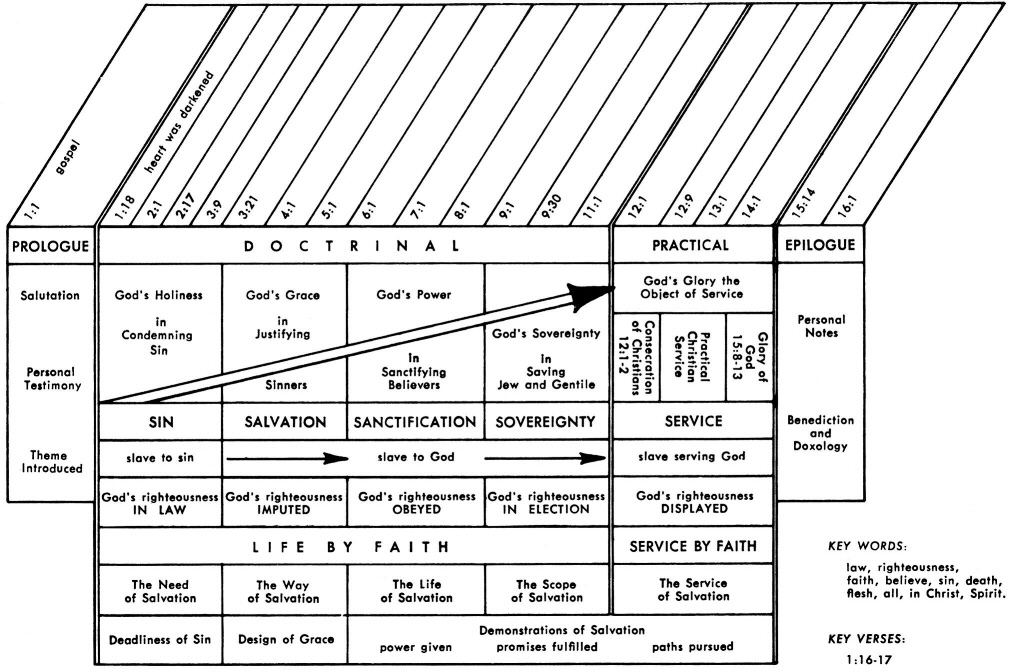
Click chart to enlarge
Chart from recommended resource Jensen's Survey of the NT - used by permission
Romans Overview Chart - Charles Swindoll
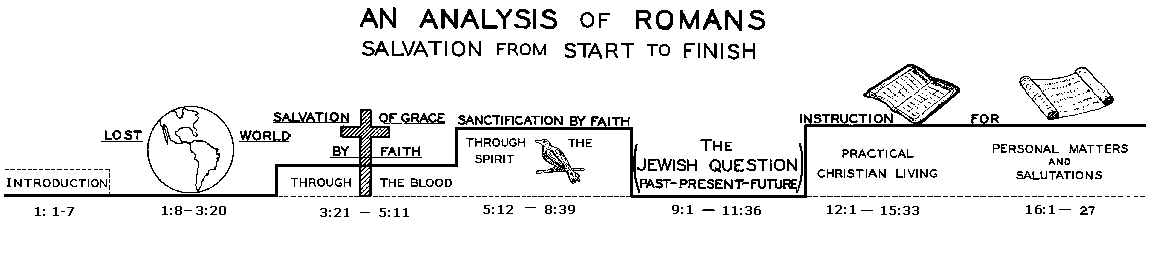
Source: Dr David Cooper
Click to Enlarge
R Ruin (Romans 1:17 – 3:20) – The utter sinfulness of humanity
O Offer (Romans 3:21-31) – God’s offer of justification by grace
M Model (Romans 4:1-25) – Abraham as a model for saving faith
A Access (Romans 5:1-11) – The benefits of justification
N New Adam (Romans 5:12-21) – We are children of two “Adams”
S Struggle w/ Sin (Romans 6-8) Struggle, sanctification, and victory
|
ROMANS ROAD |
||||
| Romans 1:18-3:20 | Romans 3:21-5:21 | Romans 6:1-8:39 | Romans 9:1-11:36 | Romans 12:1-16:27 |
| SIN | SALVATION | SANCTIFICATION | SOVEREIGNTY | SERVICE |
| NEED FOR SALVATION |
WAY OF SALVATION |
LIFE OF SALVATION |
SCOPE OF SALVATION |
SERVICE OF SALVATION |
| God's Holiness In Condemning Sin |
God's Grace In Justifying Sinners |
God's Power In Sanctifying Believers |
God's Sovereignty In Saving Jew and Gentile |
Gods Glory The Object of Service |
| Deadliness of Sin |
Design of Grace |
Demonstration of Salvation | ||
| Power Given | Promises Fulfilled | Paths Pursued | ||
| Righteousness Needed |
Righteousness Credited |
Righteousness Demonstrated |
Righteousness Restored to Israel |
Righteousness Applied |
| God's Righteousness IN LAW |
God's Righteousness IMPUTED |
God's Righteousness OBEYED |
God's Righteousness IN ELECTION |
God's Righteousness DISPLAYED |
| Slaves to Sin | Slaves to God | Slaves Serving God | ||
| Doctrine | Duty | |||
| Life by Faith | Service by Faith | |||
|
Modified from Irving L. Jensen's chart above |
||||
Romans 1:26 For this reason God gave them over (3SAAI) to degrading passions; for their women exchanged (AAI) the natural function for that which is unnatural * (NASB: Lockman)
Greek: dia touto paredoken (3SAAI) autous o theos eis pathe atimias; ai te gar theleiai auton metellaxan ten phusiken chresin eis ten para phusin
Barclay: Because of this God abandoned them to dishonorable passions, for their women exchanged the natural relationship, for the relationship which is against nature (Daily Study Bible)
ICB: Because people did those things, God left them and let them do the shameful things they wanted to do. Women stopped having natural sex and started having sex with other women. (ICB: Nelson)
KJV: For this cause God gave them up unto vile affections: for even their women did change the natural use into that which is against nature:
NLT: That is why God abandoned them to their shameful desires. Even the women turned against the natural way to have sex and instead indulged in sex with each other. (NLT - Tyndale House)
Phillips: God therefore handed them over to disgraceful passions. Their women exchanged the normal practices of sexual intercourse for something which is abnormal and unnatural. (Phillips: Touchstone)
Wuest: Because of this God gave them over to dishonorable passions, for even their females exchanged their natural use for that which is against nature.
Young's Literal: Because of this did God give them up to dishonourable affections, for even their females did change the natural use into that against nature;
FOR THIS REASON GOD GAVE THEM OVER TO DEGRADING PASSIONS: Dia touto paredoken (3SAAI) autous o theos eis pathe atimias:
- Ge 19:5 Le 18:22, 23, 24,25, 26, 27, 28 Dt 23:17,18 Jdg 19:22 1Co 6:9 Eph 4:19 Eph 5:12 1Ti 1:10 Jude 1:7,10
- Romans 1 Resources - Multiple Sermons and Commentaries
RESULTS OF
GOD'S "REASONING"
For this reason (Ro 1:18, 19, 20, 21, 22, 23, 24, 25) -- The Greek phrase for this reason is composed of two words (dia touto) variously translated in the NAS as "for this cause", "for this purpose", "for because of this", "therefore" and functions as a term of conclusion. As you become more familiar with inductive Bible study you will develop the habit of pausing and asking "for what reason?". In the present case the answer is straightforward - they made a bad choice to exchange the truth of God for a lie which progressed to idol worship. In the previous verses Paul had stated their speculative belief and he now proceeds to show the practical outworking of their aberrant belief in their abominable conduct in some of the most sobering and fearful passages in all of Scripture.
From Paul's divinely inspired "pattern of moral devolution" here in Romans 1, notice how suppression and rejection of the knowledge of the true God [Ro 1:18, 19, 20, 21, 22, 23, 24, 25] naturally "devolves" into worship of false gods and how this false worship in turn is intimately associated with the practice of sexual immorality in all forms! [Ro 1:24, 25, 26, 27, 28, 29, 30, 31, 32] Upshot? Knowledge of the one true and living God and growing intimacy with the Lord Jesus Christ and His Spirit [Gal 5:16-see notes] in daily quiet times of worshipful fellowship are the BEST preventative measures and cures for so-called addiction to sexual immorality, better than all the Christian books and programs that are flooding the marketplace! Let us return to the "ancient paths", the "highway of holiness" and as Christian men begin to experience a freedom in this area that heretofore we never even thought was possible in light of the pervasive permeation of American culture by sensuality and sexual seduction.
G Handley Moule introduces this section writing that God...
As if animated by the word of benediction, he returns to denounce “the abominable thing which God hateth” with still more terrible explicitness. For this reason, because of their preference of the worse to the infinite Good, God gave them up to passions of degradation; He handed them over, self-bound, to the helpless slavery of lust; to “passions,” an eloquent word which indicates how the man who will have his own way is all the while a “sufferer,” though by his own fault: the victim of a mastery which he has conjured from the deep of sin. (Moule, C. G. Handley: The Epistle of St Paul to the Romans)
Gave...over (3860) (paradidomi from para = beside + didomi = to give so literally to give beside) is a very strong Greek verb meaning to hand someone over to the power and authority of another. It is that act of God whereby He hands over the entire human race for judgment because of their sins.
God gave them over - This is the second of three solemn uses of paradidomi in Romans 1. The restraint of God that might have kept people living in pure relationships with one another is now removed. This reverberating phrase "God gave them over" should put the fear of the Lord into the heart and mind of every thinking person. We may even be so deceived that we think we are in control but Sin always deceives (Heb 3:13, cp Pr 28:26, Is 44:20, Ro 7:11, Ep 4:22, James 1:14) and when we think we are not in the grips or power of sin we are completely deceived (when you are deceived you don't even realize your flawed state of mind).
John MacArthur explains God's giving...over writing that...
God’s giving over sinful mankind has a dual sense. First, in an indirect sense God gave them over simply by withdrawing His restraining and protective hand, allowing the consequences of sin to take their inevitable, destructive course. Sin degrades man, debases the image of God in which he is made, and strips him of dignity, peace of mind, and a clear conscience. Sin destroys personal relationships, marriages, families, cities, and nations It also destroys churches... Fallen men are not concerned about their sin but only about the pain from the unpleasant consequences sin brings. (cp Pr 28:13, Gal 6:7, 8) Someone has well said that sin would have fewer takers if the consequences were immediate....
In a second, direct sense God gave…over rebellious mankind by specific acts of judgment. The Bible is replete with accounts of divine wrath being directly and supernaturally poured out on sinful men. The flood of Noah’s day (Ge 6:5, 6, 7, 17ff) and the destruction of Sodom and Gomorrah (Ge 18:20, 19:24,25, 26), for example, were not indirect natural consequences of sin but were overt supernatural expressions of God’s judgment on gross and unrepented sin. God often allows men to go deeper and deeper into sin in order to drive them to despair and to show them their need of Him. (MacArthur, J: Romans 1-8. Chicago: Moody Press)
Degrading (819) (atimia from átimos = without honor from a = negative + time = Honor, respect, reverence, esteem) is a noun which describes that which is literally not honorable, not worthy of respect, reverence or esteem. On the opposite side atimia is that which is only worthy of shame, dishonor (condition of suffering loss of esteem and of enduring reproach = emphasizes the loss of honor that one once enjoyed = cf man originally created in God's image), disgrace (to be a source of shame to & often implies humiliation and sometimes ostracism), ignominy (deep personal humiliation and disgrace, disgraceful or dishonorable conduct, quality, or action. This noun stresses humiliation).
KJV translates "atimia" as "vile" which Webster defines as morally despicable or abhorrent, physically repulsive, disgustingly or utterly bad. Compared to "base" or "low" (morally speaking) "vile" is the strongest of these words and tends to suggest disgusting depravity or filth. What a nasty word! And God gave men and women over to this quality of passions!
Atimia is used 7 times - Ro 1:26; Ro 9:21-note; 1Co. 11:14 (referring to a man with long hair); 1Co 15:43 (referring to the corruptible body = of the unseemliness and offensiveness of a dead body); 2Co. 6:8; 11:21; 2Ti 2:20 (used of household vessels with sense of menial or common)-note
Barnes comments that "The great object of the apostle here, it will be remembered, is to shew the state of the pagan world, and to prove that they had need of some other way of justification than the law of nature. For this purpose, it was necessary for him to enter into a detail of their sins. The sins which he proceeds to specify are the most indelicate, vile, and degrading which can be charged on man. But this is not the fault of the apostle. If they existed, it was necessary for him to charge them on the pagan world. His argument would not be complete without it. The shame is not in specifying them, but in their existence; not in the apostle, but in those who practiced them, and imposed on him the necessity of accusing them of these enormous offences. It may be further remarked, that the mere fact of his charging them with these sins is strong presumptive proof of their being practiced. If they did not exist, it would be easy for them to deny it, and put him to the proof of it. No man would venture charges like these without evidence; and the presumption is, that these things were known and practiced without shame. But this is not all. There is still abundant proof on record in the writings of the pagan themselves, that these crimes were known and extensively practiced.
Passions (3806) (pathos from páscho = suffer) primarily denotes whatever one suffers or experiences in any way; hence, an affection of the mind, a passionate desire. Pathos means excited emotion, uncontrollable desire, compelling feelings, overpowering urges.
Pathos was used by the Greeks to describe either good or bad desires but in the NT pathos always refers to bad desires, especially of a sexual nature (that is the context of the 3 uses below).
Pathos has 3 uses in the NT - Ro 1:26; Col. 3:5-note; 1Th 4:5-note
Pathos denotes not so much the violence of the feeling as its ungovernable nature. Note the derivation from the verb pascho to suffer which expresses the lustful feeling the individual suffers.
A passion is a drive or force that does not rest until satisfied. These are internal desires (emanating from our fallen sin nature) cause the victim to suffer and that have to be satisfied or they drive you crazy. A passion describes intense emotion compelling action; intense, driving, or overmastering feeling or conviction; ardent affection; sexual desire or an emotion that is deeply stirring or ungovernable. The word "desires" (when used as noun as in the present context) means to have a longing for and stresses the strength of feeling and often implies strong intention or aim; conscious impulse toward something that promises enjoyment or satisfaction in its attainment.
These degrading passions are Identified in these two verses as homosexuality, a sin indubitably condemned in Scripture (Ge 19:5; Lev 18:22, 23, 24, 25, 26, 27, 28; Dt 23:17,18; Jdg 19:22; 1Cor 6:9; Ep 4:19; 5:12; 1Ti 1:10; Jude 1:7,10). Self-will brings its own suffering. Natural laws have a self-executing power in a corresponding requital.
Mary Whitehouse wrote that "When sex is deformed, cheapened and exploited then the potentiality of life and the whole social fabric of society deteriorates.
Pastor Ray Pritchard has an interesting comment
"Why is illicit sex singled out as the first major step away from God? The answer is not hard to find. Sex is closely related to the human spirit. The way you conduct yourself sexually is a good barometer of what's going on in your heart. After all, what is sex but the desire to be worshiped by another person? Sound strange? It shouldn't. When two people come together, they are seeking much more than physical release. At a very deep level, they are looking for love, acceptance, fulfillment, freedom and meaning in life. By giving themselves to someone else, they hope (and secretly pray) that through this self-giving, they will discover a way to fill the void within. They "worship" through sex hoping someone will "worship" them back. Sex and worship are thus closely related in their ultimate purpose. It is as if God is pulling back the covers in order to show us how empty our hearts are without him. By turning to illicit sex, instead of fulfilling our dreams we only expose the emptiness within. It never works out like we hope it will. Immorality never satisfies because it always involves deception. We lie to each other, we lie to ourselves, and ultimately we lie to God." (When God Gives Up)
The descent into paganism with its focus on idolatry is always soon followed by gross immorality, especially sexual perversion. Ancient Sodom was so notorious for homosexuality that its practice has long been known as sodomy, Moses recording that...
Now the men of Sodom were wicked exceedingly and sinners against the LORD. (Genesis 13:13)
How exceedingly wicked were the men of Sodom? Moses later records the visit of two angels to escort Lot and family out of Sodom writing that...
Before they lay down (in Lot's house), the men of the city, the men of Sodom, surrounded the house, both young and old, all the people from every quarter and they called to Lot and said to him, "Where are the men who came to you tonight? Bring them out to us that we may have relations with them." (homosexuality) But Lot went out to them at the doorway, and shut the door behind him, and said, "Please, my brothers, do not act wickedly. Now behold, I have two daughters who have not had relations with man; please let me bring them out to you, and do to them whatever you like; only do nothing to these men, inasmuch as they have come under the shelter of my roof. But they said, "Stand aside." Furthermore, they said, "This one came in as an alien, and already he is acting like a judge; now we will treat you worse than them." So they pressed hard against Lot and came near to break the door." (Genesis 19:4-9).
And of course we know how the "wrath of God" was revealed against the ungodliness of Sodom!
The practice of homosexuality became so widespread in ancient Greece that it was considered normal and even desirable!
As dark and depressing as this section of Romans is, the truth in these verses can bring grace to those without Christ and set captives free, just as it did to a brilliant physician in one of Richard Halverson’s Bible studies on Romans who said,
“I don’t ever remember reading the Bible, but tonight I have seen myself in Romans 1; now what do I do about it?”
As mentioned earlier, the Scripture frequently links idolatry as leading to immorality. Idolatrous worship of Baal in the OT was inevitably accompanied by immorality including the abomination of temple prostitution, involving not just females but also male cult prostitutes! When man invents a god or gods (usually plural) of his own making, he is then free to "rewrite" the rules of human conduct or at least he is deceived into thinking he can do so and that there will be no consequences (The fate of Sodom stands as a powerful testimony that God will judge sin!). Then ungodly men and women begin to pontificate the dogma on the airways and the written media that you can live anyway you want to live and that no authority, God or otherwise, has the right to place their moral constructs on you. The Ten Commandments no longer apply and are treated blithely as "10 suggestions". Want to sleep around or live together outside of marriage? Go ahead. Want to have an orgy? Go ahead. Want to legalize abortion, prostitution or gambling? Go ahead. You can indulge your wildest fantasies once you begin making the rules. That's the tragic picture of Romans 1:18-32. God gave them over to what they wanted. They made the choice to turn from God but unfortunately cannot chose to skirt God's judgment. He will repay justly.
FOR THEIR WOMEN EXCHANGED THE NATURAL FUNCTION FOR THAT WHICH IS UNNATURAL: ai te gar theleiai auton metellaxan (3PAAI) ten phusiken chresin eis ten para phusin:
- Romans 1 Resources - Multiple Sermons and Commentaries
For (1063) (gar) is a subordinating conjunction expressing cause or explanation and thus introduces an explanation. In simple terms for is a term of explanation and its occurrence should always prompt one to pause and ponder the text and context, asking what the author is explaining, how does he explain it, etc. While not every "for" in the Bible is a term of explanation, most are and since there are over 7500 uses of for (NAS), you will have ample opportunity to observe and interrogate the text. As you practice this discipline of pausing to ponder, you are establishing the context (which leads to more accurate interpretation and thus more apropos application) and you are in effect engaging in the blessed activity of Biblical Meditation (See Ps 1:2- note, Ps 1:3-note and Joshua 1:8-note for the blessed benefits of meditation). When for is used at the beginning of a passage it is usually a term of explanation.
Women - This word is more literally "females".
Women (2338) (thelus from thēlē = a breast) is not the noble one (gune/gyne) which usually is used for "women" but aptly denotes sex only, as in the lower creatures. Thelus thus refers to the female of any living creature.
Thelus is used 5 times in the NT - Mt 19:4; Mk 10:6; Ro 1:26, 27; Gal. 3:28
Thelus is used 37 times in the Septuagint (LXX) --
Ge 1:27; 5:2; 6:19, 20; 7:2, 3, 9, 16; Ex 1:16, 22; Lev 3:1, 6; 4:28, 32; 5:6; 12:5, 7; 15:33; 27:4, 5, 6; Nu 31:15; Jdg 5:10; 1Ki 4:21; 2Chr 9:25; Job 1:3, 14; 42:12; Pr 30:31; Amos 6:12
Barnes notes that...
Evidence of the shameful and disgraceful fact here charged on the women is abundant in the Greek and Roman writers.
Exchanged (3337) (metallasso from metá = change of place or condition + allásso = change) is used only in this verse and the preceding in the NT and means to cease one activity and to start something else in exchange. It denotes the giving up of one thing (the natural function of the woman, heterosexuality and child bearing) in order to receive another (the lie of lesbianism). Women became lesbians, practicing unnatural sex and knowing no shame.
The verb exchanged is aorist tense (action at a moment in time) and active voice (subject makes a choice of their will to carry out this action) indicating that these women made a deliberate choice to exchange the natural for the unnatural, which was a reflection of the influence of the degrading passions God had given them into the power of.
Expositor's Bible Commentary observes that...
Paul's use of "exchanged" is suggestive. The first exchange, that of the truth for the lie, is followed by another--the upsetting of the normal course of nature in sexual relations. Instead of using the ordinary terms for men and women, Paul substitutes "males" and "females." The irony is that this sort of bestiality finds no counterpart in the animal kingdom. Perversion is the unique contrivance of the human species. (Gaebelein, F, et al: Expositor's Bible Commentary: Old and New Testament 12 Volumes)
Natural (5446) (phusikos from phúsis = nature) (only 3 NT uses - Ro 1:26, 27; 2Pe 2:12) means pertaining to things in accordance with nature or belonging to the naturally regulated order of things. Phusikos refers to those things which one does out of instinct. The idea is that something pertains to that which is in accordance with the nature or character of that thing. Thus it is natural for both men and woman to desire heterosexual relationships.
Peter uses phusikos to describe false teachers as likened to animals whose natural destiny is to be victims of predators. (see 2Pe 2:12-note)
Function (5540) (chresis from chráomai = to use) describes use or the act (usage) or manner (use) of using. It can refer to the habitual or customary usage of something. Chresis was commonly used of sexual intercourse, and in this context the term could refer to nothing other than intimate sexual relations and more specifically the perverted use of one's body and not the use specified in God's plan and order for men and women who were created in His image.
Unnatural - This is actually a phrase in Greek para phusin. Thus this is the same word translated natural (phusikos) with the addition of the preceding preposition para (3844) which means alongside, beside or contrary. Thus their acts are "contrary to or alongside natural acts". Even most pagan societies have recognized the clearly obvious fact that homosexuality is abnormal and unnatural. It is also an abnormality that is unique to man. See related resources: Homosexual • Homosexuality
William Newell (in the 1920's) comments:
This passage has deep significance in this day of the "sex-craze": when, as some one says, "Human beings seem to be just beginning to realize that they are male and female." The first of Romans warns of what such a craze will end in! (Ed note: And he did not live to see the AIDS epidemic). (Commentary)
Paul mentions women first probably to emphasize the extent of debauchery under the wrath of abandonment, because in most societies/cultures women are the last to fall into homosexuality and other moral aberrations! Woe!
J Vernon McGee notes that...
These are passions of dishonor and disgrace and depravity—regardless of what public opinion is today. Perversion entered into Greek life, and it brought Greece down to the dust. Go over there and look at Greece today. The glory has passed away. Why? These were their sins." (Thru the Bible Mp3's online)
God abandoned them not only to idolatry, the ultimate expression of man’s spiritual degeneracy, but also to degrading passions, which he identifies in these two verses as homosexuality, the ultimate expression of man’s moral degeneracy.
When man forsakes the AUTHOR of nature,
he inevitably forsakes the ORDER of nature.
Charles Hodge wrote,
“Paul first refers to the degradation of females among the heathen, because they are always the last to be affected in the decay of morals, and their corruption is therefore proof that all virtue is lost” (Commentary online)
Even most pagan societies have recognized the clearly obvious fact that homosexuality is abnormal and unnatural. It is also an abnormality that is unique to man.
Hughes asks...
Why does Paul single out homosexuality then? Because it is so obviously unnatural, and therefore automatically underlines the extent to which sin takes mankind. Other sins are just as evil, but they are naturally evil. God has emphasized the sin of inversion to show us that inside the unbelieving man is a running sore which indicates a far deeper dimension of the wounds of sinful society. We should note that chapter 1 ends with the sins of the mind and spirit, of which all sinners are guilty….Paul also emphasized this sin because it was all around him. He was writing from Corinth, the sin capital of Asia. Greek culture taught that homosexual love was the purest and highest of loves. Many highborn Greeks maintained male lovers along with their wives. It was no different in Rome. Fourteen of the first fifteen emperors were homosexuals.... According to Biblical revelation, what we see around us means that our particular culture is on the skids. If we are believers, this encourages us to draw close to Christ so that we are really living what we say we believe. If we are unbelievers, it is meant to drive us (as it did the brilliant physician we mentioned) to faith. (Hughes, R. K. Romans: Righteousness from heaven. Preaching the Word. Crossway Books)
Romans 1:27 and in the same way also the men abandoned (AAPMPN) the natural function of the woman and burned (3PAPI) in their desire toward one another, men with men committing (PMPMPN) indecent acts and receiving (PAPMPN) in their own persons the due penalty of their error (NASB: Lockman)
Greek: homoios te kai oi arsenes aphentes (AAPMPN) ten phusiken chresin tes theleias exekauthesan en te orexei auton eis allelous, arsenes en arsesin ten aschemosunen katergazomenoi (PMPMPN) kai ten antimisthian en edei (3SIAI) tes planes auton en heautois apolambanontes. (PAPMPN)
Amplified: And the men also turned from natural relations with women and were set ablaze (burning out, consumed) with lust for one another—men committing shameful acts with men and suffering in their own bodies and personalities the inevitable consequences and penalty of their wrong-doing and going astray, which was [their] fitting retribution. (Amplified Bible - Lockman)
Barclay: and so did the men, for they gave up the natural relationship with women, and were inflamed with their desire for each other, and men were guilty of shameful conduct with men. So within themselves they received their due and necessary rewards for their error. (Daily Study Bible)
KJV: And likewise also the men, leaving the natural use of the woman, burned in their lust one toward another; men with men working that which is unseemly, and receiving in themselves that recompence of their error which was meet.
NLT: And the men, instead of having normal sexual relationships with women, burned with lust for each other. Men did shameful things with other men and, as a result, suffered within themselves the penalty they so richly deserved. (NLT - Tyndale House)
Phillips: Similarly the men, turning from natural intercourse with women, were swept into lustful passions for one another. Men with men performed these shameful horrors, receiving, of course, in their own personalities the consequences of sexual perversity. (Phillips: Touchstone)
Wuest: And likewise also the males, having put aside the natural use of the females, burned themselves out in their lustful appetite toward one another, males with males carrying to its ultimate conclusion that which is shameful, receiving in themselves that retribution which was a necessity in the nature of the case because of their deviation from the norm. another; males with males working shame, and the recompense of their error that was fit, in themselves receiving.
Young's Literal: and in like manner also the males having left the natural use of the female, did burn in their longing toward one
AND IN THE SAME WAY ALSO THE MEN ABANDONED: homoios te kai oi arsenes aphentes (AAPMPN):
- Romans 1 Resources - Multiple Sermons and Commentaries
In the same way (3668) (homoios) means to being similar in some respect, similarly, of equal degree or manner and denoting perfect agreement.
In the same way - That is, in the same way that the females had forsaken their natural function fulfilling their shameful, disgraceful passions with other women, so too the males followed suit.
The men - Literally the males.
Men (730) (arrhen or arsen) means the gender male or the male sex, not the more common word aner (435) for man (sometimes translated husband or generically for human beings).
The 7 NT uses of arrhen - Matt. 19:4; Mk. 10:6; Lk. 2:23; Ro 1:27; Gal. 3:28; Re 12:5, 13
The 47 uses of arrhen in the Septuagint --
Gen. 1:27; 5:2; 6:19, 20; 7:2, 3, 9, 16; 17:14, 23; 34:24; Ex 1:16, 17, 18, 22; 2:2; 12:5; Lev. 1:3, 10; 3:1, 6; 4:23; 6:29; 7:6; 12:2, 7; 15:33; 18:22; 20:13; 22:19; 27:3, 5, 6, 7; Nu 1:2; 3:40; 31:17, 18; Jos. 17:2; Jdg. 21:11, 12; Job 3:3; Is 26:14; 66:7; Jer. 20:15; 30:6; Mal. 1:14;
John MacArthur - The usual Greek terms for women and men, like corresponding terms in most languages, imply a certain dignity, and Paul refused to ascribe even an implied dignity to those who degenerate into homosexuality. (MacArthur, J: Romans 1-8. Chicago: Moody Press)
Abandoned (863) (aphiemi from apo = separation, dissociation + hiemi = send) conveys the basic idea of an action which causes separation and thus means to send away or to let go from oneself. Aphiemi was used for example of the action of dismissing a wife. The idea is to let go from one's possession!
The verb abandoned is aorist tense (action at a moment in time, speaks of effective action) and active voice (subject makes a choice of their will to carry out this action). Thus these men made a deliberate, conscious choice of their will to abandon the natural for the unnatural.
These men in essence "jettisoned" their God given attraction to the opposite sex. This is a vivid picture of personal choice which all began when they refused to acknowledge God as Creator. They forsook their God given natural role, God having created men (Adam) with the direct instruction to be fruitful and multiply (Ge 1:22, 28, cp post-flood commands Ge 9:1, 7)! How ironic that if they had obeyed God they would have brought forth life, but in disobeying Him, the result was death (cp James 1:15-note, Ro 6:23-note, Re 21:8-note)! And so we see that not only is homosexuality a willful choice, it is one that completely reverses the natural order of creation. It is thoroughly "unnatural" or literally "against nature." Men and women have to deliberately repress the way God made them in order to practice homosexuality.
Homosexuality was common in first century Rome, and is often spoken of without a sense of shame by Roman writers. Homosexuality was prohibited neither by religion nor law, and was acknowledged without shame (cp Is 3:9, Je 6:15, 8:12, Zeph 3:5, Phil 3:19-note). At times, the Roman empire specifically taxed approved homosexual prostitution, and even gave boy prostitutes a legal holiday! Same sex marriage was legally recognized, and even some of the Roman emperors married men. At the very time Paul was writing, Nero was emperor. He had taken a boy named Sporus and had him castrated. He then married him (with a full ceremony), brought him to the palace with a great procession, and made the boy his "wife." Later, Nero lived with another man, and Nero was the "wife."
Barnes has this historical note:
Cicero says that...the practice of (homosexuality) was common among the Greeks, and that their poets and great men, and even their learned men and philosophers, not only practiced, but gloried in it. And he adds, that it was the custom, not of particular cities only, but of Greece in general. Xenophon says, that "the unnatural love of boys is so common, that in many places it is established by the public laws." He particularly alludes to Sparta. Plato says that the Cretans practiced this crime, and justified themselves by the example of Jupiter and Ganymede. (Book of Laws, i.) And Aristotle says, that among the Cretans there was a law encouraging that sort of unnatural love. Plutarch says, that this was practiced at Thebes, and at Elis. He further says, that Solon, the great lawgiver of Athens, "was not proof against beautiful boys, and had not courage to resist the force of love." Diogenes Laertius says that this vice was practiced by the Stoic Zeno. Among the Romans, to whom Paul was writing, this vice was no less common. It appears from what Seneca says that in his time it was practiced openly at Rome, and without shame. He speaks of flocks and troops of boys, distinguished by their colors and nations; and says that great care was taken to train them up for this detestable employment. There is not the least evidence that this abominable vice was confined to Greece and Rome. (Romans 1 - Barnes' Notes)
George Duncan rightly said that...
In nothing did early Christianity so thoroughly revolutionize the ethical standards of the pagan world as in regard to sexual relationships.
Pastor Ray Pritchard has some strong words in conclusion on this section of Scripture exhorting us to...
not lose the main point. More than anything else, homosexuality is a willful choice. No one can say, "I was born that way." No one is born homosexual. No one. Anyone who argues otherwise is either ignorant of the Bible or has deliberately perverted its teaching. You can talk all you want about genetics, the size of the hypothalamus, about absent fathers, over-protective mothers, about early sexual confusion, and even about sexual abuse. Some of those things may indeed create a predisposition to this particular sin. But the fact remains: Every act of homosexuality—whether in word or deed or in lustful thought—every single act is a personal moral choice. Temptation is not the issue because temptation in and of itself is not a sin (cp James 1:14-note). But giving in to temptation—whether mentally, verbally or in actual deed—is a sin (James 1:15-note). That's a moral choice for which God will hold you 100% accountable. You can't blame your choices on your hypothalamus! You can't even blame your father for his failure to be there when you needed him...As a society moves away from God, one mark of its drift into judgment is widespread homosexuality. The tragic fact is that this is exactly where America is today. (When God Gives Up)
Martin Luther - I find it impossible to avoid offending guilty men, for there is no way of avoiding it by our silence or their patience; and silent we cannot be because of God's command, and patient they cannot be because of their guilt.
THE NATURAL FUNCTION OF THE WOMAN AND BURNED: ten phusiken chresin tes thleias exekauthesan (3PAPI):
- Romans 1 Resources - Multiple Sermons and Commentaries
PASSIONS
"ON FIRE!"
Natural (5446) (phusikos from phúsis = nature) means pertaining to things in accordance with nature or belonging to the naturally regulated order of things. Phusikos refers to those things which one does out of instinct. The idea is that something pertains to that which is in accordance with the nature or character of that thing. Thus it is natural for both men and woman to desire heterosexual relationships.
Peter uses phusikos to describe false teachers as likened to animals whose natural destiny is to be victims of predators. (see exposition of 2 Peter 2:12-13)
Function (5540) (chresis from chráomai = to use) describes use or the act (usage) or manner (use) of using. It can refer to the habitual or customary usage of something. In the two NT uses (Romans 1:26, 27) chresis refers to "use" of the body or more accurately in the context of Romans 1, the perverted use of one's body and not the use specified in God's plan and order for men and women who were created in His image.
O R Johnson wrote that "Homosexual practices are against nature and against revealed truth... Homosexual indulgence is something which God condemns as the ultimate sign of decadence and degradation in any culture."
Burned (1572) (ekkaio from ek = intensifies meaning of the following verb + kaío = burn, set fire to) literally means to set on fire or to cause to burn or flame up.
BDAG writes that ekkaio means "to instigate something destructive, kindle, start" as a schism (Diod. S. 20, 33, 7)"
Figuratively as used in this passage in Romans means to be inflamed with passion or burn furiously with lust. It speaks of a strong desire. There a number of figurative uses in the Septuagint several referring to the the anger or wrath of Jehovah being kindled (ekkaio)...
Deuteronomy 29:20 "The LORD shall never be willing to forgive him, but rather the anger of the LORD and His jealousy will burn (ekkaio) against that man, and every curse which is written in this book will rest on him, and the LORD will blot out his name from under heaven. (cp 2Ki 22:13, 17)
Deuteronomy 32:22 For a fire is kindled (ekkaio) in My anger, and burns to the lowest part of Sheol, and consumes the earth with its yield, And sets on fire the foundations of the mountains.
Job 3:17 There the wicked cease from raging (Hebrew = agitation, excitement, turmoil; Lxx = ekkaio), And there the weary are at rest.
Their lusts or desires were enflamed. They were made to flame up or burn furiously with lust. What a picturesque word: fire destroys, fire spreads quickly on dry timber, fire is flamed up by winds.
While this verse in Romans is the only NT use of ekkaio, there are 40 uses of ekkaio in the Septuagint -
Ex 22:6; Num. 11:1, 3; Deut. 29:20; 32:22; Jdg. 15:5, 14; 2 Sam. 22:9, 13; 24:1; 1 Ki. 21:21; 2 Ki. 22:13, 17; 2 Chr. 34:21, 25; Neh. 10:34; Job 3:17; Ps. 2:12; 39:3; 73:21; 78:38; 79:5; 89:46; 106:18; 118:12; Pr 6:19; 14:5, 25; 19:9; 29:8; Is 50:11; Jer. 1:14; 4:4; 15:14; 44:6; Ezek. 20:48; Dan. 3:19, 22; Obadiah 1:18; Nah. 2:13
Regarding ekkaio Marvin Vincent comments that "The terms are terrible in their intensity. Literally, ‘burned out.’ The preposition ("ek") indicates the rage of lust because this preposition ( ek) prefixed to the verb, intensifies its meaning. Their lust could not be satiated. It was an all-out endeavor to satisfy their totally-depraved natures."
IN THEIR DESIRE: en te orexei auton:
- Romans 1 Resources - Multiple Sermons and Commentaries
A DEEP "GRASPING"
DESIRE
Desire (3715) (orexis from orego = to reach out for ~ stretching out of the body to touch or grasp an object) literally a reaching out and thus a striving for something. It refers to an eager desire, lust or appetite. Orexis is used only here in NT but in classic Greek was the most general term for every kind of desire, even describing one's appetite for food. The idea of orexis is that of a deep, abiding, and profound degree of internal longing for the object of one's desire. Orexis thus refers to a continual reaching out after an object with the purpose of drawing it to oneself and appropriating it.
Zodhiates writes that orexis is...
always the reaching out after an object with the purpose of drawing it to oneself and appropriating it.
Vincent - The peculiar expressiveness of the word (orexis) here is sufficiently evident from the context. (Word Studies in the New Testament)
We see this so poignantly portrayed in those men who blatantly park by the woods unashamedly waiting for a partner who too is literally consumed by the perverted passion to a degree that the longing after absolutely will not let them rest until this desire is fed. It is like a ravenous wolf in the winter when food is scarce and it will do almost anything to quench the pangs of hunger.
Louw-Nida says that the combination of ekkaio and orexis forms a Greek idiom meaning literally ‘to burn with intense desire’ or to have a strong, intense desire for something and so ‘to be inflamed with passion, to have a strong lust for, to be inflamed with lust.’ They add that "In some languages the equivalent idiom is ‘to boil with desire"! (Greek-English Lexicon of the New Testament)
There is a burning level of lust among homosexuals that defies accurate description and is rarely seen among heterosexuals. The homosexuals of Sodom were so passionately consumed with their lust that they ignored the fact that they had been made blind! Instead they literally “wearied (Hebrew word is "la'ah" --to tire; to be disgusted--faint, grieve, be made weary) themselves trying to find the doorway” into Lot’s house in order to gratify their perverted cravings (Genesis 19:11).
TOWARD ONE ANOTHER MEN WITH MEN COMMITTING INDECENT ACTS: eis allelous, arsenes en arsesin ten aschemosunen katergazomenoi (PMPMPN):
- Romans 1 Resources - Multiple Sermons and Commentaries
MEN WITH MEN
Toward (1519) (eis) is a picturesque preposition in this context for it implies motion into, toward or upon another place or object. Obviously in this context the motion is directed toward other men.
Men with men - A clear reference to homosexuality.
Committing (2716) (katergazomai) to do that from which something results, to carry to its ultimate conclusion, to work to bring something to fulfillment or completion. The idea is to carry out a task until it finished AND to do it thoroughly carrying out these indecent tasks until they are finished. Present tense pictures this as a continuous action (lifestyle, habitual action). Middle voice is reflexive conveying the idea that they themselves initiate these acts and participate in the carrying out to completion of those acts.
Indecent (808) (aschemosune from aschemon = indecent from a = without + schema = outward shape) refers to want of form, disfigurement, deformed, nakedness, shame, indecency, obscenity. Aschemosune means to act in defiance of social and moral standards with resulting disgrace, embarrassment and shame. This noun describes behavior which elicits disgrace as when one commits a shameless deed.
In the Septuagint uses (Ex 20:26, Dt 23:14, Lev 18:6ff) aschemosune refers to something that is considered too private for public exposure such as one's nakedness.
The word here in Romans refers to that which is unseemly a term which Webster describes as not conforming to what is accepted as right, fitting, or in good taste. Unseemly adds a suggestion of special inappropriateness to a situation or an offensiveness to good taste. The word also implies indecency which is grossly unseemly or offensive to manners or morals.
The only other NT use of aschemosune is by John who quotes Jesus' sobering reminder...
Behold, I am coming like a thief. Blessed is the one who stays awake and keeps his garments, lest he walk about naked and men see his shame." (see note Revelation 16:15)
There are 32 uses of aschemosune in the Septuagint --
Ex 20:26; 22:27; 28:42; Lev 18:6, 7, 8, 9, 10, 11, 12, 13, 14, 15, 16, 17, 18, 19,; 20:11, 17, 18, 19, 20, 21; Dt 23:13, 14 ; Ezra 4:14; La 1:8; Ezek 16:8; Ho 2:9
These men in defiance of social and moral standards continually commit acts that are "unseemly" with resulting disgrace, embarrassment and shame.
As noted above, history records that ancient Greece and Rome were hotbeds of homosexuality. Many of our most revered philosophers were homosexuals as were many of the political leaders of that day. In fact, 14 of the first 15 Roman emperors were homosexual, some of them blatantly so. How ironic that even those that were most noted for moral virtue (Socrates, Plato, Zeno) are charged with the sin of homosexuality. Homosexuality generally prevails with idolatry and infidelity, as among the Pagans of old and interestingly nothing like it is observed in the animal world.
Expositor's Bible Commentary writes that...
The "gay" facade is a thin veil for deep-seated frustration. The folly of homosexuality is proclaimed in its inability to reproduce the human species in keeping with the divine commandment (Gen 1:28). To sum up, what men do with God has much to do with their character and life style. Godet put it well when he said, "A law broods over human existence, a law which is at the same time a divine act: Such as thou makest thy God, such wilt thou make thyself" (in loc.). Throughout the passage man is represented as active-- seeing, thinking, doing. He is not represented as victimized, as taken captive against his will, as the dupe of evil influences from outside himself. "Sin comes from the mind, which perverts the judgment. The effect of retribution is to abandon the mind to that depravity" (Henri Maurier, The Other Covenant [New York: Newman Press, 1968], p. 185) (Gaebelein, F, et al: Expositor's Bible Commentary)
Pritchard adds that
"Whenever men turn away from God, terrible things begin to happen in society. Long-held standards disappear. Things once considered incredible now become commonplace. Evil no longer seems evil. The basic distinctions between male and female are obliterated. No one knows the difference between right and wrong. In such an atmosphere, homosexuality is first tolerated, then accepted, then praised, and finally enshrined as the ultimate freedom." (When God Gives Up)
Related Resources:
- How does the fact that there are gay/homosexual animals impact the idea that homosexuality is a sin?
- What does the Bible say about homosexuality? Is homosexuality a sin?
- Is it possible to be a gay Christian?
- Can a person be born gay?
- Why are Christians opposed to marriage equality?
- How should Christian parents respond if one of their children comes out as gay?
- Is homosexuality a sin?
AND RECEIVING IN THEIR OWN PERSONS THE DUE PENALTY (recompense, retribution) OF THEIR ERROR: kai ten antimisthian en edei (3SIAI) tes planes auton en heautois apolambanontes (PAPMPN):
- Romans 1 Resources - Multiple Sermons and Commentaries
PAYING
THE PENALTY
And (kai) is a coordinating conjunction which in this case links the indecent practice with unavoidable punishment.
Receiving (618) (apolambano from apo = from + lambáno = to receive) means to receive back in the general sense of that which is due. The following is an attempt to separate out the nuances of this verb, but some of the distinctions are not easy to determine and the careful student of Scripture is advised to take time to personally examine each use in its specific context.
(1) as receiving back or recovering something one previously possessed (Lk 6:34 - receive back payment from a debtor, Lk 15:27 - father receiving back his son safely). (2) as receiving back in the sense of retribution (dispensing of either reward or punishment - in latter sense = act of taking vengeance for wrongdoing, sin or injury) (Lk 23:41) Receiving back in a good sense, including rewards (Lk 18:30, 2Jn 1:8, cp Col 3:24). (3) In Mk 7:33 apolambano means to take one away from a particular point.
Here in Romans 1 Paul refers uses apolambano to refer to the natural result of the sin of these men committing indecent acts with one another which pays them back (they receive back) for what they have done.
Apolambano is in the present tense which signifies that these men continually receive in full what is their due. Here we see a clear affirmation of God's principle of "sowing and reaping" (see Ga 6:7, 8, Ho 8:7, Ro 6:13; 8:13, Pr 22:8; Jer 12:13; Ho 10:13).
This verse speaks of the tragic self-destructive nature of sin indicating that it often carries within itself it’s own penalty -- the penalty of disease: the consequence of violating nature’s order & the penalty of rebellion: spiritual emptiness and all it’s ramifications.
Here are the 10 uses of apolambano in the NT -- Mk. 7:33; Lk. 6:34; 15:27; 16:25; 18:30; 23:41; Ro 1:27; Gal. 4:5; Col. 3:24; 2Jn. 1:8. They are translated in NASB - receive(3), receive back(1), received(1), received back(1), receiving(2), took aside(1).
There are 2 uses of apolambano in the Septuagint -- Nu 34:14; Is 5:17.
Due penalty - Robert Haldane comments - As the impiety of the Pagans respecting God reached even to madness, it was also just that God should permit their corruption to recoil upon themselves, and proceed also to madness. It was just that they who had done what they could to cover the Godhead with reproaches, should likewise cover themselves with infamy, and thus receive a proportionate and retributive recompense. (Exposition of the Epistle to the Romans)
Due (1163) (dei from from deo = to bind or tie objects together, put in prison and also root of doulos, bond-servant) refers to what is not optional but needful (binding) out of intrinsic necessity or inevitability. Dei refers to inward constraint which is why it is often translated "must". Dei describes that which is under the necessity of happening or which must necessarily take place, often with the implication of inevitability. Dei To express the sense of necessity dei is translated "one ought", "one should", "one has to" or "one must". In sum dei has the idea that something is necessary (binding) and thus speaks of the certainty or inevitableness of what is bound to happen. Men committing indecent acts with men must bring a penalty.
Kenneth Wuest adds that dei refers to "a necessity in the nature of the case.” The evil consequences were necessary as ordained by divine law. When one violates the laws of nature, one must pay the price. (Wuest's Word Studies from the Greek New Testament)
Penalty (489) (antimisthia from antí = in return + misthós = reward,) means a recompense, either in a good or as in the present context, a bad sense. A reward given in compensation. The idea is a just retribution which is based upon what one deserves. This word gives a special emphasis upon the reciprocal nature of the recompense.
Friberg says that antimisthia has "an emphasis on receiving what is due in exchange; 1) in a positive sense reward, recompense, fair exchange (2Co 6:13 - "Paul appealed strongly for his readers to reciprocate his openness and love completely. However, he knew that he could not demand this but only request it, as a parent requests the love of his or her children"- Constable); (2) n a negative sense requital, retribution, due penalty (Ro 1:27). (Analytical Lexicon of the Greek New Testament. Baker Academic - nice resource!)
BDAG writes that antimisthia "expresses the reciprocal (anti) nature of a transaction as requital based upon what one deserves, recompense, exchange, either in the positive sense of reward or the negative sense penalty, depending on the context. (A Greek-English Lexicon of the New Testament and Other Early Christian Literature)
Antimisthia is used in only 2 passages - Rom. 1:27; 2 Co. 6:13
Related Resource:
Error (4106) (plane from planos = deceitful, root idea = has idea of wandering) (Click word study of related verb planao) describes a roaming or a wandering and then figuratively a going astray or a wandering out of the right way and thus straying from orthodoxy or piety. Plane pictures a wandering, a straying about, whereby one, led astray from the right way, roams hither and thither and deviates.
Plane in the present verse describes men who wander from the path of truth (cp Ro 1:18) and into error, delusion and deceit.
Vincent says plane is an
error which shows itself in action...It may imply deceit as accompanying or causing error.
The literal use of plane is in the sense of roaming is found in the Greek historian Herodotus who records this note of Solon "who roamed the earth in search of new information".
TDNT has the following note on plane writing that...
Plane describes a wanderer, as a star or planet that appears not to stay on course. Planes is frequent in Greek secular writings to mean deceit. Aristotle uses plane for mistakes in investigation...Plane used in the active sense of deceit is late and rare (secular Greek). The passive (meaning) "illusion" in seeing and sense perception generally, the vacillation of knowledge found even in wise men, the error which is to be explained by overestimation of a hedone (pleasure) -- all these things can be denoted plane. (Kittel, G., Friedrich, G., & Bromiley, G. W. Theological Dictionary of the New Testament. Eerdmans)
There are 13 uses of plane in the NT - Matt. 27:64; Rom. 1:27; Eph. 4:14; 1 Thess. 2:3; 2 Thess. 2:11; Jas. 5:20; 2 Pet. 2:18; 3:17; 1 Jn. 4:6; Jude 1:11
There are 3 uses of plane in the Septuagint - Prov. 14:8; Jer. 23:17; Ezek. 33:10
God allows this whole process of widespread, unchecked sexual immorality to pervade a culture as a means of showing how empty and barren life is without Him. When people think they can find fulfillment in sex, God says, "Look, it won't work. But you won't believe that until you find out for yourself." So both women and men abandon God's order and God "abandons" them to sexual immorality. He lets women and then men indulge their fantasies. He stands back while they rush headlong off the cliff of unbridled lust to be broken on the jagged rocks of disobedience. Why? He does it because He knows that in the end they will be more unhappy than they were in the beginning. Only then hopefully will they begin to see their need for their Creator.
Newell comments on this section writing that...
Here men are seen visited with a like condign, judicial “giving up” by God, in which they forget not only the holy relations of marriage, but even the burnings of ordinary lust, and plunge into nameless horrors of unnatural lust-bondage, all, males and females, receiving in themselves the due recompense of their error. Compare “among themselves” of verse 24, with “in themselves” of verse 27: “These words bring out,” as Godet remarks, “the depth of the blight. It is visible to the eyes of all.” And Meyer also: “The law of history, in virtue of which the forsaking of God is followed among men by a parallel growth of immorality, is not a purely natural order of things; the power of God is active in the execution of this law.”
What a fearful account is here! A lost race plunging ever deeper, by their own desire! Left in shameful, horrid bondage, unashamed,—not only immoral, but unmoral, hideous. Missionaries abroad can tell you of what they find; as can the Christian workers in our great cities. But you would be unprepared to believe what exists, in the private lives of many, even in country districts through Christendom. And if God has “made you to differ,” thank Him only! It will not do to hold up your hands in self-righteous dismay, and say, These verses do not in any particular describe me. For God will show you and me that this is exactly the race as we were born into it, and out of which the only rescue is being born again. All these things pertain to lost, fallen man. Man is a tenant of the earth only by Divine grace, since the Deluge. — (Romans 1 Commentary)
Stuart Briscoe concludes this section by noting that "The logic of Paul's argument should not be missed. Those who reject what they know of God in so doing divorce themselves from truth and reality. This means, among other things, that a person out of touch with the reality of God is out of touch with reality, period, including the truth about humanity. To be out of touch with the meaning of humanity means a crisis of identity which is demonstrated in many ways, not least in confusion about sexuality. When sexuality is misunderstood, the sheer power of unrestrained sexual drive and uneducated sexual insight will produce all manner of aberrant sexual behavior. In short, confusion about God breeds confusion about man, which breeds confusion about sexuality which produces sexual confusion and chaos. Far from being, as was fondly imagined by many, an enlightened age of sexual freedom, Paul showed his contemporaries that they lived in a dark day of divine wrath." (Romans, The Communicator's Commentary, p50-51)
Before we leave this section we should note that all is not as dark as it appears for with God nothing is impossible and no man or woman is too far away from the touch of God's grace as Paul reminded the Corinthian church
Or do you not know that the unrighteous will not inherit the kingdom of God? Do not be deceived; neither fornicators, nor idolaters, nor adulterers, nor effeminate, nor homosexuals, nor thieves, nor the covetous, nor drunkards, nor revilers, nor swindlers, will inherit the kingdom of God. Such were some of you; but you were washed, but you were sanctified, but you were justified in the name of the Lord Jesus Christ and in the Spirit of our God. (1Cor 6:9, 10, 11)
Praise God for this marvelous truth. God is the God of hope and Christ is our Hope (1Tim 1:1).
Hope in Christ
for...
"WHOEVER BELIEVES IN HIM
WILL NOT BE DISAPPOINTED"
(Ro 10:11, 9:33; Is 28:16; 49:23; Jer 17:7, 8; 1Pe 2:6)