Romans 1:2
Romans 1:3
Romans 1:4
Romans 1:5
Romans 1:6
Romans 1:7
Romans 1:8
Romans 1:9
Romans 1:10
Romans 1:11
Romans 1:12
Romans 1:13
Romans 1:14
Romans 1:15
Romans 1:16
Romans 1:17
Romans 1:18
Romans 1:19
Romans 1:20
Romans 1:21
Romans 1:22
Romans 1:23
Romans 1:24
Romans 1:25
Romans 1:26
Romans 1:27
Romans 1:28
Romans 1:29
Romans 1:30
Romans 1:31
Romans 1:32

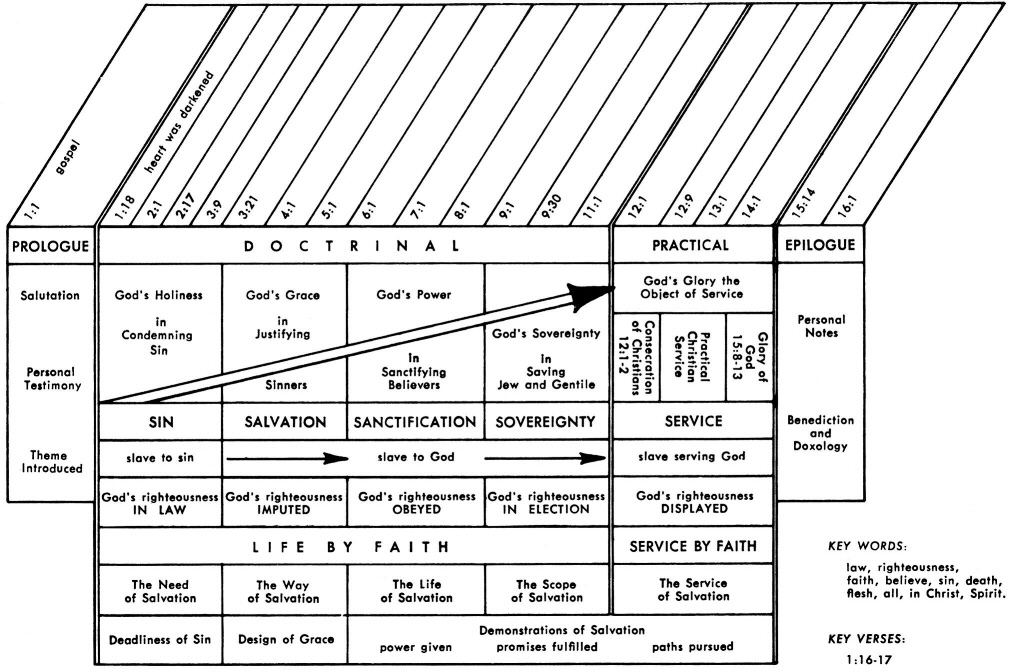
Click chart to enlarge
Chart from recommended resource Jensen's Survey of the NT - used by permission
Romans Overview Chart - Charles Swindoll
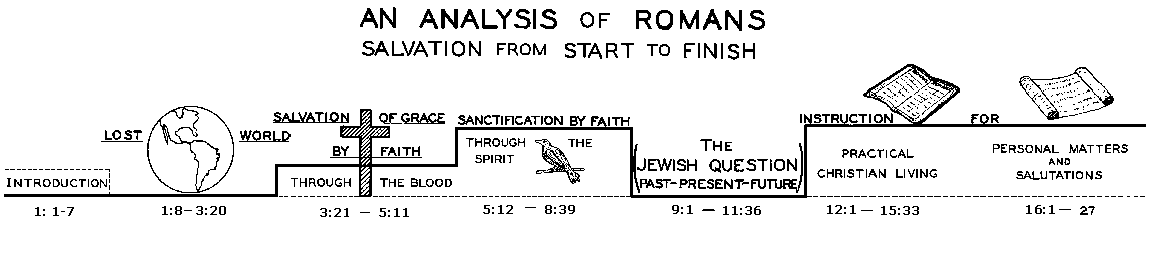
Source: Dr David Cooper
Click to Enlarge
R Ruin (Romans 1:17 – 3:20) – The utter sinfulness of humanity
O Offer (Romans 3:21-31) – God’s offer of justification by grace
M Model (Romans 4:1-25) – Abraham as a model for saving faith
A Access (Romans 5:1-11) – The benefits of justification
N New Adam (Romans 5:12-21) – We are children of two “Adams”
S Struggle w/ Sin (Romans 6-8) Struggle, sanctification, and victory
|
ROMANS ROAD |
||||
| Romans 1:18-3:20 | Romans 3:21-5:21 | Romans 6:1-8:39 | Romans 9:1-11:36 | Romans 12:1-16:27 |
| SIN | SALVATION | SANCTIFICATION | SOVEREIGNTY | SERVICE |
| NEED FOR SALVATION |
WAY OF SALVATION |
LIFE OF SALVATION |
SCOPE OF SALVATION |
SERVICE OF SALVATION |
| God's Holiness In Condemning Sin |
God's Grace In Justifying Sinners |
God's Power In Sanctifying Believers |
God's Sovereignty In Saving Jew and Gentile |
Gods Glory The Object of Service |
| Deadliness of Sin |
Design of Grace |
Demonstration of Salvation | ||
| Power Given | Promises Fulfilled | Paths Pursued | ||
| Righteousness Needed |
Righteousness Credited |
Righteousness Demonstrated |
Righteousness Restored to Israel |
Righteousness Applied |
| God's Righteousness IN LAW |
God's Righteousness IMPUTED |
God's Righteousness OBEYED |
God's Righteousness IN ELECTION |
God's Righteousness DISPLAYED |
| Slaves to Sin | Slaves to God | Slaves Serving God | ||
| Doctrine | Duty | |||
| Life by Faith | Service by Faith | |||
|
Modified from Irving L. Jensen's chart above |
||||
Romans 1:29 being filled (RPPMPA) (permeated & saturated) with all unrighteousness, wickedness, greed, evil; full of envy, murder, strife, deceit, malice; they are gossips (NASB: Lockman)
Greek: pepleromenous (RPPMPA) pases adikia poneria pleonexia kakia, mestous phthonou phonou eridos dolou kakoetheias, psithuristas,
Amplified: Until they were filled (permeated and saturated) with every kind of unrighteousness, iniquity, grasping and covetous greed, and malice. [They were] full of envy and jealousy, murder, strife, deceit and treachery, ill will and cruel ways. [They were] secret backbiters and gossipers, (Amplified Bible - Lockman)
Barclay: They are replete with all evil, villainy, the lust to get, viciousness. They are full of envy, murder, strife, deceit, the spirit which puts the worst construction on everything. They are whisperers (Daily Study Bible)
NLT: Their lives became full of every kind of wickedness, sin, greed, hate, envy, murder, fighting, deception, malicious behavior, and gossip. (NLT - Tyndale House)
Phillips: They became filled with wickedness, rottenness, greed and malice; their minds became steeped in envy, murder, quarrelsomeness, deceitfulness and spite. (Phillips: Touchstone)
Wuest: being filled with every unrighteousness, pernicious evil, avarice, malice, full of envy, murder, wrangling, guile, malicious craftiness; secret slanderers,
Young's Literal: having been filled with all unrighteousness, whoredom, wickedness, covetousness, malice; full of envy, murder, strife, deceit, evil dispositions; whisperers,
BEING FILLED: pleroo (RPPMPA):
Note that this "laundry list" of sins covers the entire gamut of life, be it the home, the family, marriage, the workplace, the church. No area of life is left unaffected by man's decision to turn his back on God.
As Pritchard comments
In a sense, this passage is a comment upon the doctrine of total depravity. The historic Protestant doctrine uses phrases such as "spiritually dead, inherently corrupt, incapable of pleasing God and hopelessly lost" to describe the plight of the human race apart from Jesus Christ. What does it mean to be "inherently corrupt?" It means to live in the way Paul has just described. (When God Gives Up)
Being filled (4137) (pleroo) (Click word study pleroo) which indicates more than just pouring water in a glass up the brim.
(1) pleroo was often used of the wind filling a sail and thereby carrying the ship along. To be filled with the Spirit then to is to be moved along in our Christian life by God Himself, by the same dynamic by which the writers of Scripture were “moved by the Holy Spirit” (2Pe 1:21). The men in (Ro 1:29) are being moved by their depraved minds to do unspeakable evil.
(2) pleroo also conveys the idea of permeation as of salt’s permeating meat in order to flavor and preserve it. The depraved minds of these men permeated their entire being resulting in the evil actions Paul lists out for us.
(3) pleroo has connotation of total control. The person who is filled with sorrow is no longer under his own control but is totally under the control of that emotion. In the same way, someone who is filled with fear, anger or even Satan (Acts 5:3) is no longer under his own control but under the total control of that which dominates him. God has so given these men over to their debased minds that those minds totally control their thoughts and actions.
Being filled is perfect tense which speaks of having become filled and remaining in that state, thus pointing to a state of filling and controlling. They are completely filled and thus totally permeated and controlled by an undiscerning rejected worthless mind! This is a frightening truth: Men shook their fist at their Creator and He gave them what they lusted for...to be their own god. This is revelation of God's just wrath against unrighteous man! What a tragic, grievous picture of MAN APART FROM GOD. Not being controlled by just a portion of unrighteousness but being filled with ALL UNRIGHTEOUSNESS.
You can mark it down --
Apathy leads to apostasy which brings moral anarchy. Just look at America in the twenty first century. We see this same pattern of idolatry leading to immorality which leads to internal strife in the book of Judges, especially the horrible description of men doing what is right in their own eyes in Judges 17-21).
Haldane notes that being filled...
signifies that the vices here exposed were not tempered with virtues, but were alone and uncontrolled, occupying the mind and heart even to overflowing. (Exposition of the Epistle to the Romans)
Hodge comments on being filled that...
The Greek construction links this either with the them of the preceding verse: “he gave them up, filled with all unrighteousness”; or it depends on the preceding infinitive to do: “so that they, filled with all unrighteousness, should commit" It is not connected with gave them over to imply that God gave them up after they were thus corrupt, but is linked with to do to express the consequence of God’s abandoning them to do the things which are not right. The crimes here mentioned were commonplace. The heathen were full of them (pleroo). They not only abounded, but in many cases were excused and even justified. Although the picture drawn here is dark, it is not as dark as that presented by the most distinguished Greek and Latin authors about their own countrymen. Commentators have collected a fearful array of passages from the ancient writers, which more than support the account given by the apostle. What Paul says about the ancient heathen world is true in all its essential features of men in all generations. Wherever men have existed, there have they shown themselves to be sinners, ungodly and unrighteous, and therefore justly exposed to the wrath of God." (Hodge, C. Commentary on the Epistle to the Romans, 1835)
So, where do the evils listed in v29-31 come from? It all started back in (Ro 1:18) where Paul gave the reason for why the gospel of the gift of God's righteousness is so desperately needed. The gospel is the power of God to save believers because in it God gives us what we need and could never produce on our own, namely, His own righteousness. The righteousness that God demands from us He freely gives to us, if we will but trust Him. This is the great Biblical truth of justification by faith. So what Paul does in the verses (Ro 1:18ff) is describe for us the effects of suppressing the truth of God. He wants us to see all the evil of the world as a river that flows from this polluted spring. Reject God, suppress God, distort God, recreate God in your own image to your own liking, and the effect is worse than we expect. And the thing that is worse than we expect is that God joins our crusade against God, as it were, and delivers us into the debasing effects of our own rebellion against him.
WITH ALL UNRIGHTEOUSNESS, WICKEDNESS, GREED, EVIL: pase adikia poneria pleonexia kakia:
All (3956)(pas) means just what it says, all with no exceptions in regard to their unrighteous conduct! Each one of these sinful attitudes and actions is "filled to the brim"!
Unrighteousness (93) (adikia from a = not + dikê = right) is a condition of not being right, whether with God, according to the standard of His holiness and righteousness or with man, according to the standard of what man knows to be right by his conscience.
In secular Greek adikia referred to unjust acts, or to deeds which caused personal injury. Rather than a general concept of injustice, this word was taken, in the writings of Plato, to mean an unjust act which injures a specific person. Such an act was not necessarily a violation of some specific law, but rather an affront against the just order of society. Among the acts which fell into this category were theft, fraud, and sexual crimes. Later this word came to mean a neglect of duty toward the pagan gods. The Septuagint (LXX) used this word to describe social sins, those deeds which violated human relations or the political order of society. Among these injustices were deceit, fraud, and lying.
Adikia is used 25 times in the NT - translated "doing wrong, 1; evildoers, 1; iniquities, 1; iniquity, 2; injustice, 1; unrighteous, 2; unrighteousness, 12; wickedness, 4; wrong."
Lk. 13:27; 16:8f; 18:6; Jn. 7:18; Acts 1:18; 8:23; Rom. 1:18, 29; 2:8; 3:5; 6:13; 9:14; 1 Co. 13:6; 2 Co. 12:13; 2Th 2:10, 12; 2Ti 2:19; Heb 8:12; Jas. 3:6; 2Pe 2:13, 15; 1 Jn. 1:9; 5:17
Adikia is used over 200 times in the Septuagint (LXX) --
Ge 6:11, 13; 26:20; 44:16; 49:5; 50:17; Ex 34:7; Lev 16:21, 22; 18:25; Nu 14:18; Dt 19:15; 32:4; Jdg 9:24; 1 Sa 3:13, 14; 14:41; 20:8; 25:24; 28:10; 2 Sa 3:8, 34; 7:10, 14; 14:32; 21:1; 1Ki 2:32; 8:50; 17:18; 2Ki 17:4; 1Chr 17:9; 2Chr 19:7; Job 11:14; 15:16; 33:17; 34:6, 32; 36:10, 18, 33; Ps 7:3, 14, 16; 11:5; 17:3; 27:12; 28:3; 52:2, 3; 55:10; 58:2; 62:10; 66:18; 72:14; 73:6, 7, 8; 75:5; 82:2; 92:15; 94:4; 119:29, 69, 104, 163; 140:2; 144:8, 11; Pr 8:13; 11:5; 15:29; 21:9; 28:16; Is 33:15; 43:24; 57:1; 58:6; 59:3; 60:18; 61:8; Je 2:22; 3:13; 11:10; 13:22; 14:6, 10, 20; 16:10, 18; 18:23; 30:14, 16; 31:34; 33:8; 36:3; 50:20; 51:5, 6; La 2:14; 4:13; Ezek 3:18, 19; 4:4, 5, 6, 17; 7:16, 19; 9:9; 12:2; 14:3, 4, 7, 10; 18:8, 17, 18, 19, 20, 24, 30; 21:23, 24, 25, 27, 29; 22:7, 25, 29; 24:23; 28:18; 33:13; 35:5; 39:26; 44:10, 12; 45:9; Da 4:27; 9:13, 16, 24; 12:4; Ho 4:8; 5:5; 7:1; 8:13; 9:7, 9; 10:9, 10, 13; 12:7, 8; 13:12; 14:1, 2; Joel 3:19; Am 3:10; Jon 3:8; Mic 3:10; 6:10; 7:18, 19; Nah. 3:1; Hab 2:12; Zep 3:5, 13; Zec 3:9; 5:6; Malachi 2:6; 3:7
Barclay writes that...
Adikia is the precise opposite of dikaiosune (righteousness), which means justice; and the Greeks defined justice as giving to God and to men their due. The evil man is the man who robs both man and God of their rights. He has so erected an altar to himself in the centre of things that he worships himself to the exclusion of God and man." (Daily Study Bible Online)
Larry Richards writes that adikia "means "wrongdoing," "unrighteousness," "injustice." Its focus is on the concept of sin as conscious human action that causes visible harm to other persons in violation of the divine standard. (Richards, L O: Expository Dictionary of Bible Words: Regency)
Nietzsche was not correct when he pontificated that "might makes right". Only God makes right and only His standard is acceptable as perfect. All other is "not right" but is in fact adikia and no amount of men's "might" makes it "right".
John MacArthur writes that adikia or unrighteousness "encompasses the idea of ungodliness but focuses on the result. Sin first attacks God’s majesty and then His law. Men do not act righteously because they are not rightly related to God, who is the only measure and source of righteousness." (MacArthur, J: Romans 1-8. Chicago: Moody Press)
One can derive a good sense for the meaning of adikia by studying the passages in which it is used. For example, John defines adikia writing that "All unrighteousness is sin" (1Jn 5:17) Paul describes the coming anti-christ whose coming will do the work of Satan "with all the deception of wickedness (adikia)". (2Th 2:10) Adikia corrupts the truth and chokes out the truth by its deceitfulness. From this use in Scripture we can deduce that adikia deceives as well as suppresses the truth (see Ro 1:18). Adikia or unrighteousness is loving sin more than loving God and His truth. When the heart is in love with self-exaltation and independence and the pleasures of sin, the mind will inevitably distort the truth or suppress the truth in order to protect the idols of the heart. What is needed is not just new ideas or more information, but a new heart. And a new set of passions and desires and pleasures. This is what God provides in the gospel and what Paul is showing men that they are in desperate need of.
Adikia is used to describe people as well as things. For example, adikia describes an "unrighteous steward' Lk 16:8, an "unrighteous judge" Lk 18:6, the tongue or speech of controlled by the fallen sin nature ("the tongue is a fire, the very world of iniquity"). (James 3:6) Peter describes Simon the magician (who was seeking to purchase the effects of the Holy Spirit) as "in the gall of bitterness and in the bondage of iniquity (adikia)." (Acts 8:23) In a similar way these reprobates in Romans 1 are in bondage to their own unrighteousness, having been turned over by God to the depravity of their own minds!
Luke records that the traitor Judas Iscariot "acquired a field with the price of his wickedness (adikia)." (Acts 1:18). Similarly Peter warned of the just judgment on false teachers declaring they would suffer "wrong as the wages of doing wrong (adikia)" (see 2Pe 2:13) going on to explain that these men forsook "forsaking the right way they have gone astray, having followed the way of Balaam, the son of Beor, who loved the wages of unrighteousness (he loved to earn money by doing wrong)." (See 2Pe 2:15)
Paul asked and answered a rhetorical (for effect) question...
There is no injustice (adikia) with God, is there? May it never be!" (Romans 9:14)
In a passage which presents a similar thought, Jesus in a description of Himself declared that...
He who speaks from himself seeks his own glory; but He who is seeking the glory of the One who sent Him, He is true, and there is no unrighteousness (adikia) in Him. (John 7:18)
Paul teaches that genuine Christian (agape) love...
does not rejoice (is never glad about) in unrighteousness (adikia) but rejoices with the truth" (1 Cor 13:6)
One day future Jesus will declare to men and women who thought they knew Him
I tell you, I do not know where you are from; DEPART FROM ME, ALL YOU EVILDOERS (literally "workers = ergates" of "iniquity = adikia").' (Luke 13:27)
Believers however are not immune to adikia, Paul commanding the Roman believers to stop continually (implying that it was in fact transpiring)...
presenting the members of your body to sin (the old sin nature inherited from Adam which was made potentially inoperative when we were co-crucified with Christ) as instruments (describes a tool or implement for preparing something and then a weapon of warfare) of unrighteousness (adikia)." (see note Romans 6:13)
Paul warned that adikia would be repaid, writing that God would give to
those who are selfishly ambitious and do not obey the truth, but obey (present tense - continually persuaded by or having a settled conviction regarding) unrighteousness (adikia), wrath and indignation (i.e., eternal damnation and separation from the Righteous One)." (see note Romans 2:8) The "means" justify their "end"!
Paul again warns that all are to
be judged who did not believe the truth, but took pleasure (approved of it, thought well of it, were well-pleased) in wickedness (adikia)." (2 Thes 2:12) Notice that the opposite of believing the truth is a life of wickedness.
In his last letter, Paul exhorts...
everyone who names the name of the Lord abstain (aorist imperative - a command to be obeyed not a suggestion) from wickedness (adikia). (2 Timothy 2:19)
Comment: Those who are truly the Lord's are no longer free to sin wantonly, living licentiously, but are commanded to separate from unrighteousness which stresses the believer's need for holiness and speaks of each believer's responsibility. It follows that if one is continually pursuing adikia they have cause to question the "sure foundation" of their salvation.
God provides a way to deal with adikia, John recording that...
f we confess our sins, He is faithful and righteous to forgive us our sins and to cleanse us from all unrighteousness. (1 John1:9-note)
Wickedness (4189) (poneria [word study] from poneros from pónos = labor, sorrow, pain and and poneo = to be involved in work, labor) refers to depravity, to an evil disposition, to badness or to an evil nature. Poneria is used in the NT only in the moral and ethical sense and refers to intentionally practiced ill will.
Kakia (see below) is another Greek word for evil which speaks more of the vicious disposition of one's mind (one's ill will or hatefulness, a mean-spirited or vicious attitude or disposition) whereas poneria pictures the active exercise of this evil.
Poneria describes the state of lacking moral or social values (baseness, sinfulness, maliciousness, malevolence). Poneria is active malice. Poneria is malevolence, not only doing evil, but being evil. Webster defines malevolence as the condition which arises from intense often vicious ill will, spite, or hatred.
Poneria describes perverseness and denotes the bad instinct of the heart. Poneria is the general inclination to evil that reigned among the pagans, and made them practice and take pleasure in vicious and unprofitable actions.
Barclay - In Greek this word (poneria) means more than badness. There is a kind of badness which, in the main, hurts only the person concerned. It is not essentially an outgoing badness. When it hurts others, as all badness must, the hurt is not deliberate. It may be thoughtlessly cruel, but it is not callously cruel. But the Greeks defined poneria as the desire of doing harm. It is the active, deliberate will to corrupt and to inflict injury. When the Greeks described a woman as ponēra they meant that she deliberately seduced the innocent from their innocence. In Greek one of the commonest titles of Satan is ho poneros, the evil one, the one who deliberately attacks and aims to destroy the goodness of men. Poneros describes the man who is not only bad but wants to make everyone as bad as himself. Poneria is destructive badness. (Daily Study Bible Online)
Webster adds some interesting thoughts on "wicked" (English word being derived from "wicca" meaning sorcerer) including "morally very bad, marked by mischief, disgustingly unpleasant, causing or likely to cause harm, distress, or trouble."
Poneria - 7x in 7v - Usage: malice(1), wicked ways(1), wickedness(5).
Matthew 22:18 But Jesus perceived their malice, and said, "Why are you testing Me, you hypocrites?
Mark 7:21 "For from within, out of the heart of men, proceed the evil thoughts, fornications, thefts, murders, adulteries,
Luke 11:39 But the Lord said to him, "Now you Pharisees clean the outside of the cup and of the platter; but inside of you, you are full of robbery and wickedness.
Acts 3:26 "For you first, God raised up His Servant and sent Him to bless you by turning every one of you from your wicked ways."
Romans 1:29 being filled with all unrighteousness, wickedness, greed, evil; full of envy, murder, strife, deceit, malice; they are gossips,
1 Corinthians 5:8 Therefore let us celebrate the feast, not with old leaven, nor with the leaven of malice and wickedness, but with the unleavened bread of sincerity and truth.
Ephesians 6:12 For our struggle is not against flesh and blood, but against the rulers, against the powers, against the world forces of this darkness, against the spiritual forces of wickedness in the heavenly places.
Poneria - 46v in the non-apocryphal Septuagint - Ex 10:10; 32:12; Deut 31:21; Jdg 9:56-57; 11:27; 15:3; 20:3, 12-13, 41; Neh 1:3; 2:2, 17; 6:2; 13:7, 27; Ps 7:9; 28:4; 55:15; 73:8; 94:23; 141:4; Pr 26:25; Eccl 2:21; 6:1; 10:5; 11:10; Isa 1:16; 7:16; 10:1; 47:10; 59:7; Jer 4:4; 6:29; 9:7; 23:11; 24:2-3, 8; 32:32; 33:5; 44:3, 22; 48:16; Da 11:27;
Greed (KJV "covetousness") (4124) (pleonexia [word study] from pleíon = more + écho = to have) (See word study on pleonexia) means literally "to have more" and describes a strong desire to acquire more and more material possessions (the "itch for more").
The Greeks defined pleonexia as “arrogant greediness,” as “the accursed love of possessing,” as “the unlawful desire for the things which belong to others.” It is the spirit in which a man is always ready to sacrifice his neighbor to his own desires. It describes an insatiable desire and it has been said that you might as easily satisfy it as you might fill with water a bowl with a hole in it.
Here are the 10 uses on pleonexia in the NT -- Mk 7:22; Lk 12:15; Ro 1:29; 2 Co. 9:5; Ep 4:19; 5:3; Col 3:5; 1Th 2:5; 2Pe 2:3, 14
Barclay says that pleonexia "is built up of two words which mean to have more. The Greeks themselves defined pleonexia as the accursed love of having. It is an aggressive vice. It has been described as the spirit which will pursue its own interests with complete disregard for the rights of others, and even for the considerations of common humanity. Its keynote is rapacity. Theodoret, the Christian writer, describes it as the spirit that aims at more, the spirit which grasps at things which it has no right to take. It may operate in every sphere of life. If it operates in the material sphere, it means grasping at money and goods, regardless of honour and honesty. If it operates in the ethical sphere, it means the ambition which tramples on others to gain something which is not properly meant for it. If it operates in the moral sphere, it means the unbridled lust which takes its pleasure where it has no right to take. Pleonexia is the desire which knows no law. (Daily Study Bible Online)
The basic idea of pleonexia is the desire for that which a man has no right to have. It is, therefore, a sin with a very wide range. If it is the desire for money, it leads to theft. If it is the desire for prestige, it leads to evil ambition. If it is the desire for power, it leads to sadistic tyranny. If it is the desire for a person, it leads to sexual sin.
Haldane writes that pleonexia originally referred to
taking the advantage, overreaching in a bargain, having more than what is just in any transaction with our neighbor. Of this, covetousness is the motive. This was universal among rich and poor, and was the spring of all their actions. (Exposition of the Epistle to the Romans)
Pleonexia is described as the equivalent of idolatry in (see exposition of Colossians 3:5) for covetousness puts things in the place of God..
C. F. D. Moule well describes it as "the opposite of the desire to give."
Evil (2549) (kakia [word study]) is deliberate wickedness which takes pleasure in doing harm. Kakia is the quality of wickedness, with the implication of that which is harmful or damaging. It is often translated in a narrow sense for malice, describing a deep-seated feelings against a person that includes hatred that lasts on and on. It is an intense and long-lasting bitterness against a person. It is actually wishing that something bad would happen to a person. Kakia means wickedness, a deliberate intention to harm (actively plotting revenge; passively mad when they are blessed and happy when they have misfortune).
Kakia is used 50 times in the NT --
Mt 21:41; 24:48; 27:23; Mk 7:21; 15:14; Lk. 16:25; 23:22; Jn 18:23, 30; Ac 9:13; 16:28; 23:9; 28:5; Ro 1:30; 2:9; 3:8; 7:19, 21; 12:17, 21; 13:3, 4, 10; 14:20; 16:19; 1Co 10:6; 13:5; 15:33; 2Co 13:7; Php 3:2; Col 3:5; 1Th 5:15; 1Ti 6:10; 2Ti 4:14; Titus 1:12; Heb 5:14; James 1:13; 3:8; 1Pe 3:9, 10, 11; 3Jn 1:11; Re 2:2; 16:2
Lightfoot describes kakia as “the vicious nature which is bent on doing harm to others”
One Greek scholar refers to kakia as “the vicious character generally.” To varying degrees, but inevitably, the unsaved person spends his life enveloped in and motivated by kakia.
Larry Richards writes that kakia "is a flaw within us that keeps the best of us from being what we should be and what we want to be." (Richards, L O: Expository Dictionary of Bible Words: Regency)
John MacArthur says that "kakia, denotes moral evil and corruption in general, especially in regard to intent. It pertains to sin that is deliberate and determined. It may reside in the heart for a long time before being expressed outwardly, and may, in fact, never be expressed outwardly. It therefore includes the many “hidden” sins that only the Lord and the individual are aware of. (Macarthur J. James. Moody)
Barclay writes that kakia is "the most general Greek word for badness. It describes the case of a man who is destitute of every quality which would make him good. For instance, a kakos kritēs is a judge destitute of the legal knowledge and the moral sense and uprightness of character which are necessary to make a good judge. It is described by Theodoret as “the turn of the soul to the worse.” The word he uses for turn is ropē which means the turn of the balance. A man who is kakos is a man the swing of whose life is towards the worse. Kakia has been described as the essential viciousness which includes all vice and as the forerunner of all other sins. It is the degeneracy out of which all sins grow and in which all sins flourish. (Daily Study Bible Online)
FULL OF ENVY, MURDER, STRIFE, DECEIT, MALICE: mestous phthonou phonou eridos dolou kakoetheias:
Full (3324) (mestos) signifies full up, full to the utmost, "stuffed"! Mestos is generally makes reference to that of or with which a person or thing is full.
Mestos is used 9 times in NASB (Matt. 23:28; Jn. 19:29; 21:11; Rom. 1:29; 15:14; Jas. 3:8, 17; 2 Pet. 2:14), most often in a figurative sense describing being full to the utmost with good and bad moral qualities: "are full of hypocrisy and lawlessness" Mt 23:28; "full of goodness" Ro 15:14; "tongue...full of deadly poison" Ja 3:8 , "wisdom from above is first pure, then peaceable, gentle, reasonable, full of mercy and good fruits" Ja 3:17 ; false teachers "having eyes full of adultery" 2Pe 2:14. The literal uses describe a "jar full of sour wine" John 19:29 and a "net...full of large fish" John 21:11.
There are 4 uses of mestos in the Septuagint - Esther 5:2; Pr 6:34; Nah 1:10; Ezek 37:1;
Envy (5355) (phthonos) is an attitude of ill-will that leads to division and strife and even murder. (cp Mt 27:18) Tacitus remarks that this was the usual vice of the villages, towns, and cities. (Click for in depth study of phthonos)
Vine says "Envy differs from jealousy in that the former desires merely to deprive another of what he has, whereas the latter desires as well to have the same, or a similar, thing for itself." Trench, calls it “the meaner sin” of the two.
Barclay - "There is...envy which is essentially a grudging thing. It looks at a fine person, and is not so much moved to aspire to that fineness, as to resent it. It is the most warped and twisted of human emotions.... a mean word. Euripides called it “the greatest of all diseases among men". The essence of it is that it does not describe the spirit which desires, nobly or ignobly, to have what someone else has; it describes the spirit which grudges the fact that the other person has these things at all. It does not so much want the things for itself; it merely wants to take them from the other. The Stoics defined it as “grief at someone else’s good.” Basil called it “grief at your neighbor’s good fortune.” It is the quality, not so much of the jealous, but rather of the embittered mind.” (Daily Study Bible Online)
The godly Scottish preacher Andrew Bonar penned a diary entry. He wrote, “This day 20 years ago I preached for the first time as an ordained minister. It is amazing that the Lord has spared me and used me at all. I have no reason to wonder that He used others far more than He does me. Yet envy is my hurt, and today I have been seeking grace to rejoice exceedingly over the usefulness of others, even where it cast me into the shade. Lord, take away this envy from me!”
F. B. Meyer held meetings in Northfield, Mass., and large crowds thronged to hear him. Then the great British Bible teacher G. Campbell Morgan came to Northfield and people were soon flocking to hear his brilliant expositions of scripture. Meyer confessed at first he was envious. He said, “The only way I can conquer my feelings is to pray for Morgan daily, which I do.”
Dwight L. Moody once told the fable of an eagle who was envious of another that could fly better than he could. One day the bird saw a sportsman with a bow and arrow and said to him, “I wish you would bring down that eagle up there.” The man said he would if he had some feathers for his arrow. So the jealous eagle pulled one out of his wing. The arrow was shot, but it didn’t quite reach the rival bird because he was flying too high. The first eagle pulled out another feather, then another—until he had lost so many that he himself couldn’t fly. The archer took advantage of the situation, turned around, and killed the helpless bird. Moody made this application: if you are envious of others, the one you will hurt the most by your actions will be yourself.
Envy - is it a small sin? Pilate knew that for envy they had delivered Him. (cp Mt27:18) Envy is discontent with, or mortification at, the knowledge or sight of another person’s superiority or advantage.
ILLUSTRATION: History tells us of a statue that was erected to a celebrated victor in the public games of Greece named Theogenes. The erection of this statue so excited the envious hatred of one of his rivals that he went every night and strove to throw the statue over by repeated blows. Ultimately h e succeeded, but alas, the statue fell upon him, and he was crushed to death beneath it. Such generally is the end of the man who allows himself to be carried away by the spirit of envy. (Zodhiates, S. Faith, Love, & Hope: Chattanooga, TN: AMG)
Murder (5408) (phonos) describes murder, particularly slaughter. It can describe slaying or killing by the sword. Murder was familiar to them, especially with respect to their slaves, whom they caused to be put to death for the slightest offenses.
Barclay reminds us that
Jesus immeasurably widened the scope of this word. He insisted that not only the deed of violence but the spirit of anger and hatred must be eliminated. He insisted that it is not enough only to keep from angry and savage action. It is enough only when even the desire and the anger are banished from the heart. We may never have struck a man in our lives, but who can say he never wanted to strike anyone? As Aquinas said long ago, “Man regardeth the deed, but God seeth the intention.” (Daily Study Bible Online)
Strife (2054) (eris) means contention (applies to strife or competition that shows itself in quarreling, disputing, or controversy; a point advanced or maintained in a debate or argument; an often perverse and wearisome tendency to quarrels and disputes), strife (bitter sometimes violent conflict or dissension; emphasizes a struggle for superiority rather than the incongruity or incompatibility of the persons or things involved), wrangling, fighting, discord, quarreling. Eris describes strife about words for vainglory (ostentatious pride especially in one’s achievements - all for show) and not truth. Are not some of these sins like looking in the mirror, even for believers? I am convicted!
There are 9 uses of eris in the NT - Ro 1:29; 13:13; 1Co. 1:11; 3:3; 2Co 12:20; Gal 5:20; Phil 1:15; 1Ti 6:4; Titus 3:9
Barclay writes that strife "is the contention which is born of envy, ambition, the desire for prestige, and place and prominence. It comes from the heart in which there is jealousy. If a man is cleansed of jealousy, he has gone far to being cleansed of all that arouses contention and strife. It is God-given gift to be able to take as much pleasure in the successes of others as in one’s own. (Daily Study Bible Online)
Deceit (1388) (dolos which is derived from dello meaning to bait) literally refers to a fishhook, trap, or trick all of which are various forms of deception. Dolos is a deliberate attempt to mislead, trick, snare or "bait" (baiting the trap in attempt to "catch" the unwary victim) other people by telling lies. It is a desire to gain advantage or preserve position by deceiving others. A modern term in advertising is called "bait and switch" where the unwary consumer is lured in by what looks like an price too good to be true!
Dolos is used 36 times in the Septuagint (LXX)
Ge 27:35; 34:13; Exod. 21:14; Lev. 19:16; Deut. 27:24; 2 Ki. 9:23; Job 13:7, 16; 15:35; 31:5; Ps. 10:7; 24:4; 32:2; 34:13; 35:20; 36:3; 52:2; 55:11; Prov. 10:10; 12:5, 20; 16:28; 26:23f, 26; Isa. 9:5; 53:9; Jer. 5:27; 9:6; Ezek. 35:5; Dan. 8:25; 11:23; Mic. 6:11; Zeph. 1:9)
Dolos is used 9 times in the NT...
Matthew 26:4 and they plotted together to seize Jesus by stealth, and kill Him.
Mark 7:21 "For from within, out of the heart of men, proceed the evil thoughts, fornications, thefts, murders, adulteries,
Mark 14:1 Now the Passover and Unleavened Bread was two days off; and the chief priests and the scribes were seeking how to seize Him by stealth, and kill Him;
John 1:47 Jesus saw Nathanael coming to Him, and said of him, "Behold, an Israelite indeed, in whom is no guile!"
Acts 13:10 and said, "You who are full of all deceit and fraud, you son of the devil, you enemy of all righteousness, will you not cease to make crooked the straight ways of the Lord?
Romans 1:29 (note) being filled with all unrighteousness, wickedness, greed, evil; full of envy, murder, strife, deceit, malice; they are gossips,
2 Corinthians 12:16 But be that as it may, I did not burden you myself; nevertheless, crafty fellow that I am, I took you in by deceit.
1 Thessalonians 2:3 (note) For our exhortation does not come from error or impurity or by way of deceit;
1 Peter 2:1 (note) Therefore, putting aside all malice and all guile and hypocrisy and envy and all slander, 22 who committed no sin, nor was any deceit found in His mouth;
1 Peter 3:10 (note) For, "Let him who means to love life and see good days Refrain his tongue from evil and his lips from speaking guile.
The related verb dolioo (1387) is used in Romans 3:13 where Paul indicts all mankind writing that
THEIR THROAT IS AN OPEN GRAVE, WITH THEIR TONGUES THEY KEEP DECEIVING," "THE POISON OF ASPS IS UNDER THEIR LIPS.
Larry Richards explains that dolos...
picks up the metaphor from hunting and fishing. Deceit is an attempt to trap or to trick and thus involves treachery...Deception sometimes comes from within, as our desires impel us to deceive. But more often in the NT, deceit is error urged by external evil powers or by those locked into the world's way of thinking. (Richards, L O: Expository Dictionary of Bible Words: Regency)
Barclay writes that...
We best get the meaning of this from the corresponding verb (doloun). Doloun has two characteristic usages. It is used of debasing precious metals and of adulterating wines. Dolos is deceit; it describes the quality of the man who has a tortuous and a twisted mind, who cannot act in a straightforward way, who stoops to devious and underhand methods to get his own way, who never does anything except with some kind of ulterior motive. It describes the crafty cunning of the plotting intriguer who is found in every community and every society." (Daily Study Bible - Romans 1 Commentary - Online)
In another writing Barclay explains that dolos can be translated "guile" and that "It comes from a word which means bait; it is used for trickery and deceit. It is used for instance of a mousetrap. When the Greeks were besieging Troy and could not gain entry, they sent the Trojans the present of a great wooden horse, as if it was a token of good will. The Trojans opened their gates and took it in. But the horse was filled with Greeks who in the night broke out and dealt death and devastation to Troy. That exactly is dolos. It is crafty, cunning, deceitful, clever treachery. Dolos is the trickery of the man who is out to deceive others to attain his own ends, the vice of the man whose motives are never pure. (Daily Study Bible - Mark Commentary Online)
DECEIT (Naves)
- Is a lie, Ps 119:118.
- The tongue an instrument of, Ro 3:13.
- Comes from the heart, Mark 7:22.
- Characteristic of the heart, Jer 17:9.
- God abhors, Ps 5:6.
- Forbidden, Pr. 24:28; 1Pe 3:10.
- Christ was perfectly free from, Is 53:9, with 1Pet. 2:22.
- Saints free from, Ps 24:4; Zeph 3:13; Re 14:5; purpose against, Job 27:4; avoid, Job 31:5; shun those addicted to, Ps 101:7; pray for deliverance from those who use, Ps 43:1; 120:2; delivered from those who use, Ps 72:14; should beware of those who teach, Eph. 5:6; Col. 2:8; should lay aside, in seeking truth, 1Pe 2:1.
- Ministers should lay aside, 2Co 4:2; 1Th. 2:3.
- The wicked are full of, Ro 1:29; devise, Ps. 35:20; 38:12; Pr. 12:5; utter, Psa. 10:7; 36:3; work, Pr. 11:18; increase in, 2Ti 3:13; use, to each other, Je 9:5; use, to themselves, Je 37:9; Obad. 3, 7; delight in, Pr 20:17.
- False teachers are workers of, 2Co 11:13; preach, Je 14:14; 23:26; impose on others by, Ro 16:18; Eph. 4:14; reveling in deceit, 2Pe 2:13.
- Hypocrites devise, Job 15:35.
- Hypocrites practice, Ho 11:12.
- False witnesses use, Pr. 12:17.
- A characteristic of antichrist, 2Jn 7.
- Characteristic of the apostasy, 2Th. 2:10.
- Evil of: hinders knowledge of God, Je 9:6.
- Keeps from turning to God, Je 8:5.
- Leads to pride and oppression, Je 5:27, 28; to lying, Pr 14:25.
- Often accompanied by fraud and injustice, Ps 10:7; 43:1.
- Hatred often concealed by, Pr 26:24, 25, 26.
- The folly of fools is, Pr. 14:8.
- The kisses of an enemy are, Pr. 27:6.
- Blessedness of being free from, Ps 24:4, 5; 32:2.
- Punishment of, Ps 55:23; Je 9:7, 8, 9
DECEIT [ISBE] - de-set' (mirmah; dolos): The intentional misleading or beguiling of another; in Scripture represented as a companion of many other forms of wickedness, as cursing (Ps 10:7), hatred (Pr 26:24), theft, covetousness, adultery, murder (Mk 7:22; Ro1:29). The Revised Version (British and American) introduces the word in Pr 14:25; 2Th 2:10; but in such passages as Ps 55:11; Pr 20:17; 26:26; 1Th 2:3, renders a variety of words, more accurately than the King James Version, by "oppression," "falsehood," "guile," "error."
Malice (2550) (kakoetheia from kakós = bad, evil + ethos = disposition) is used only here in the NT and refers to the person who has an ill-nature, taking everything with an evil connotation and giving a malicious interpretation to the actions of others, a nature which is evil and makes one suspect evil in others.
Haldane writes that kakoetheia
in the original, when resolved into its component parts, literally signifies bad custom or disposition, yet it generally signifies something more specific, and is with sufficient propriety rendered malignity, which is a desire to hurt others without any other reason than that of doing evil to them, and finding pleasure in their sufferings. The definition of the term, as quoted from Aristotle by Dr. Macknight, seems true rather as a specification than as a definition. It “is a disposition,” he says, “to take everything in the worst sense.” (Exposition of the Epistle to the Romans)
Barclay describes these unrighteous people as possessed of
The spirit which puts the worst construction on everything (kakoetheia). Kakoetheia means literally evil-naturedness. At its widest it means malignity. Aristotle defined it in a narrower sense which it has always retained. He said it was “the spirit which always supposes the worst about other people.” Pliny called it “malignity of interpretation.” Jeremy Taylor said that it is “a baseness of nature by which we take things by the wrong handle, and expound things always in the worst sense.” It may well be that this is the commonest of all sins. If there are two possible constructions to be put upon the action of any man, human nature will choose the worse. It is terrifying to think how many reputations have been murdered in gossip over the teacups, with people maliciously putting a wrong interpretation upon a completely innocent action. When we are tempted so to do, we ought to remember that God hears and remembers every word we speak. (Daily Study Bible Online)
Instances of malice in the Scripture
- Cain toward Abel, Ge 4:8.
- Ishmael toward Sarah, Ge 21:9.
- Sarah toward Hagar, Ge 21:10.
- Philistines toward Isaac, Ge 26.
- Esau toward Jacob, Ge 27:41.
- Joseph's brethren toward Joseph, Ge 37; 42:21.
- Potiphar's wife toward Joseph, Ge 39:14-20.
- Ammonites toward the Israelites, Deut. 23:3, 4.
- Saul toward David, 1 Sam. 18:8-29; 19; 20:30-33; 22:6-18; 23:7-23; 26:18.
- David toward Michal, 2 Sam. 6:21, 22, 23; toward Joab, 1Ki 2:5, 6; Shimei, 1Ki 2:8, 9.
- Shimei toward David, 2 Sam. 16:5-8.
- Ahithophel toward David, 2 Sam. 17:1, 2, 3.
- Jezebel toward Elijah, 1 Kin. 19:1, 2.
- Ahaziah toward Elijah, 2 Kin. 1.
- Jehoram toward Elisha, 2 Kin. 6:31.
- Samaritans toward the Jews, Ezra 4; Neh. 2:10; 4; 6.
- Haman toward Mordecai, Esther 3:5-15; 5:9-14.
- Jeremiah's enemies, Jer. 26:8-11; 38.
- Nebuchadnezzar toward Zedekiah, Jer. 52:10, 11.
- Daniel's enemies, Dan. 6:4-9.
- Herodias toward John, Matt. 14:3-10; Mark 6:24, 25, 26, 27, 28.
- Herod toward Jesus, Luke 23:11.
- The Jews toward Jesus, Matt. 27:18; Mark 12:12; 15:10; Luke 11:53, 54.
- James and John toward the Samaritans, Luke 9:54.
- Jews toward Paul, Acts 17:5; 23:12; 25:3.
- Masters of the slave girl who had a spirit of divination toward Paul, Acts 16:19, 20, 21, 22, 23, 24.
MALICE, MALIGNITY [ISBE] - mal'-is, ma-lig'-ni-ti (kakia, poneros, kakoetheia): "Malice," now used in the sense of deliberate ill-will, by its derivation means badness, or wickedness generally, and was so used in Older English. W. L. Walker
THEY ARE GOSSIPS: psithuristas:
- Ps 41:7; Pr 16:28; 26:20; 2Co 12:20
Gossips (whisperers, secret slanderers) (5588) (psithuristes) is found only here in the NT and describes an evil tongue which secretly conveys information, whether true or false and which is detrimental to the character or welfare of others. This is the man or woman who pours their poison against their neighbor by whispering into the ear.
Haldane - The person spoken against may as well be absent. It refers to that sort of evil speaking which is communicated in secret, and not spoken in society. It is called whispering, not from the tone of the voice, but from the secrecy. It is common to speak of a thing being whispered, not from being communicated in a low voice, but from being privately spoken to individuals. It refers to sowing divisions. It is one of the most frequent and injurious methods of calumny (a misrepresentation intended to blacken another’s reputation), because, on the one hand, the whisperer escapes conviction of falsehood, and, on the other, the accused has no means of repelling the secret calumny. (Exposition of the Epistle to the Romans)
Barclay adds that whisperers (gossips) (Psithuristes) and slanderers (katalalos) - "both describe people with slanderous tongues; but there is a difference between them. Katalalos, slanderer, describes the man who trumpets his slanders abroad; he quite openly makes his accusations and tells his tales whereas Psithuristes describes the man who whispers his malicious stories in the listeners ear, who takes a man apart into a corner and whispers a character-destroying story. Both are bad, but the whisperer is the worse. A man can at least defend himself against an open slander, but he is helpless against the secret whisperer who delights in destroying reputations." (Daily Study Bible Online)
Gossip [NAVE]
- Forbidden Lev. 19:16; Psa. 15:1-3; Psa. 50:20; Prov. 11:13; Prov. 16:28; Prov. 17:9; Prov. 18:8; Prov. 20:19; Prov. 26:20-22; Ezek. 22:9; 1 Tim. 5:11, 13 See: Busybody; Slander; Speaking, Evil.
- Instances of
- Joseph, Gen. 37:2.
- Israelites, 2 Sam. 3:23.
- Tobiah, Neh. 6.
Romans 1:30 slanderers, haters of God, insolent, arrogant, boastful, inventors of evil, disobedient to parents, (NASB: Lockman)
Greek: katalalous, theostugeis, hubristas, huperephanous alazonas, epheuretas kakon, goneusin apeitheis,
Amplified: Slanderers, hateful to and hating God, full of insolence, arrogance, [and] boasting; inventors of new forms of evil, disobedient and undutiful to parents. (Amplified Bible - Lockman)
Barclay: slanderers, haters of God. They are insolent men, arrogant, braggarts, inventors of evil things, disobedient to their parents (Daily Study Bible)
NLT: They are backstabbers, haters of God, insolent, proud, and boastful. They are forever inventing new ways of sinning and are disobedient to their parents. (NLT - Tyndale House)
Phillips: They became whisperers-behind-doors, stabbers-in-the-back, God-haters; they overflowed with insolent pride and boastfulness, and their minds teemed with diabolical invention. They scoffed at duty to parents, (Phillips: Touchstone)
Wuest: backbiters; hateful to God, insolent, haughty; swaggerers, inventors of evil things; disobedient to parents,
Young's Literal: evil-speakers, God-haters, insulting, proud, boasters, inventors of evil things, disobedient to parents,
SLANDERERS, HATERS OF GOD: katalalous theostugeis:
- Pr 25:23
- haters Ro 8:7,8; Nu 10:35; Deut 7:10; 2Chr 19:2; Ps 81:15; Pr 8:36; Jn 7:7; Jn 15:23,24; Titus 3:3)
Slanderers (2637) (KJV = "backbiting") (katalalos from katá = against + laléo = speak) is found only here in the NT and describes those who speak evil against of others with the intent to injure the one spoken about. (See also Barclay's note above on "gossips"). A slanderer is one who blackens" publicly.
Backbiting involves an element of deceit and cowardice.
One dictionary has this definition of backbiting: To slander the absent, like a dog biting behind the back where one cannot see; to go about as a talebearer. (Orr, J, et al: The International Standard Bible Encyclopedia: 1915)
Backbiters seek to ruin or defame someone’s character—they are vilifers of character.
Haldane has a long note on katalalos writing that...
The original word is here improperly translated backbiters. Dr. Macknight equally misses the meaning of this term, which he translates “revilers,” distinguishing it from whisperers, or “persons who speak evil of others to their face,” giving them opprobrious language and bad names. The word indeed includes such persons; but it applies to evil speaking in general,—to those, in short, who take a pleasure in scandalizing their neighbors, without any reference to the presence or absence of those who are spoken against; and it by no means designates, as he says, the giving of “opprobrious language and bad names.” Such persons are included in it, but not designated by it.
Whisperers or tattlers are evil–speakers, without any peculiar distinction. Our translators have erred in rendering it backbiters. As Dr. Macknight has no authority to limit the word to what is spoken face to face, it is equally unwarrantable to confine it to what is spoken in the absence of those who are spoken against. The word translated “whisperers” refers, according to Mr. Tholuck, to a secret, and the word translated “backbiters,” to an open slander. Secrecy is undoubtedly the characteristic of the first word, but the last is not distinguished from it by contrast, as implying publicity; on the contrary, the former class is included in the latter, though here specifically marked. Besides, though the communication of both the classes referred to may usually be slander, yet it appears that the signification is more extensive. Whisperers, as speakers of evil, may be guilty when they speak nothing but truth. Mr. Stuart has here followed Mr. Tholuck. The former he makes a slander in secret, the latter a slander in public. It is not necessary that all such persons should be slanderers, and the evil–speaking of the latter may be in private as well as in public. (Exposition of the Epistle to the Romans)
Haters of God (2319) (theostuges from Theos = God + stugeo = hated, odious, hateful) means hateful to God or impious. This is the only NT use of theostuges. The ancient Greeks used to call theostuges someone who turned against God. When any heavy calamity befell such a person, He would accuse God and His providence.
Godet writes that theostuges is...
the highest manifestation of pride, which cannot brook the thought of this superior and judge; one might say: the most monstrous form of calumny (the malediction of Providence)
Regarding haters of God Haldane writes that...
The charge is applicable to the whole heathen world, who hated God, and therefore did not like to keep Him in remembrance. This was manifest throughout the world in the early introduction of Polytheism and idolatry. No other cause can be assigned for the nations losing the knowledge of the true God. They did not like to retain Him in their knowledge. Had men loved God, He would have been known to them in all ages and all countries. Did not mankind receive a sufficient lesson from the flood? Yet such was their natural enmity to God, that they were not restrained even by that awful manifestation of Divine displeasure at forgetfulness of the Almighty. Although no one will acknowledge this charge to be applicable to himself, yet it is one which the Spirit of God, looking deeply into human nature, and penetrating the various disguises it assumes, brings home to all men in their natural state. “The carnal mind is enmity against God.” They hate His holiness, His justice, His sovereignty, and even His mercy in the way in which it is vouchsafed (granted or furnished in a gracious or condescending manner). The charge here advanced by the Apostle against the heathens was remarkably verified, when Christianity, on its first appearance among them, was so violently opposed by the philosophers and the whole body of the people, rich and poor, learned and unlearned. This melancholy fact is written in the history of the persecutions of the early Christians in characters of blood. (Exposition of the Epistle to the Romans)
Adam Clarke has an interesting note writing that the...
Styx, was a feigned river in hell by which the gods were wont to swear, and if any of them falsified this oath he was deprived of his nectar and ambrosia for a hundred years; hence the river was reputed to be hateful, and stugeo signified to be as hateful as hell." (Clarke, Adam: Clarke's Commentary )
Haters Of God - Recently, I listened to an audiobook by a militant advocate for atheism. As the author himself read his own work with spiteful sarcasm and contempt, it made me wonder why he was so angry.
The Bible tells us that a rejection of God can actually lead to a more hateful attitude toward Him: “Even as they did not like to retain God in their knowledge, God gave them over to a debased mind . . . [to become] haters of God” (Ro 1:28-30).
Turning one’s back on God does not lead to secular neutrality. Indeed, recent militant atheists have shown their desire to remove any reference to a Creator from culture.
When we hear about atheists trying to remove crosses or the Ten Commandments from society, it’s easy to respond to their hatred of God with our own hatred. But we’re exhorted to defend the truth with an attitude of love, “in humility correcting those who are in opposition, if God perhaps will grant them repentance, so that they may know the truth” (2 Tim. 2:25).
The next time you see the works or hear the words of a hater of God, do an attitude check. Then ask God for a spirit of humility and pray that the offender might come to the knowledge of the truth. — by Dennis Fisher
Lord, help us not respond in kind
To those who hate and turn from You;
Instead, help us to love and pray
That someday they’ll accept what’s true. —SperDefend the truth with love.
INSOLENT, ARROGANT, BOASTFUL: hubristas huperephanous alazonas:
- boasters Ro 2:17,23; 3:27; 1Ki 20:11; 2Chr 25:19; Ps 10:3; 49:6; 52:1; 94:4; 97:7; Ac 5:36; 2Co 10:15; 2Th2:4; James 3:5; 4:16; 2Pe 2:18; Jude 1:16
Insolent (5197) (hubristes from hubrizo = act with insolence + hubris = arrogance, primarily denotes wantonness, insolence; then, an act of wanton violence, an outrage, injury) refers to an insolent persecutor of others. It is the man who is violent, insolent (insultingly contemptuous in speech or conduct) and who mistreats from the pleasure which affliction of wrong brings him. Hubristes is used only one other time in the NT where Paul describes his pre-conversion condition as a "violent aggressor" (hubristes) (1Timothy 1:13)
There are uses of hubristes in the non-apocryphal Septuagint - Job 40:11; Pr 15:25; 16:19; 27:13; Is 2:12; 16:6; Je 51:2
Godet observes that...
To insolence toward God (the sin of hubris among the Greeks) there is naturally joined insult offered to men: hubristes, insolent, despiteful.
The Greek word hubristes gives rise to our English word hubris which is defined as exaggerated pride, self-confidence or arrogance and in the Greek tragedies referred to an excess of ambition, pride, etc., which ultimately caused the transgressor’s ruin.
Haldane writes that hubristes "always implies contempt, and usually reproach. Often, treatment violent and insulting...This vice aims at attaching disgrace to its object; even in the injuries it commits on the body, it designs chiefly to wound the mind. It well applies to hootings, hissings, and peltings of a mob, in which, even when the most dignified persons are the objects of attack, there is some mixture of contempt. (Exposition of the Epistle to the Romans)
Barclay - Hubris was to the Greek the vice which supremely courted destruction at the hand of the gods. It has two main lines of thought in it. (1) It describes the spirit of the man who is so proud that he defies God. It is the insolent pride that goes before a fall. It is the forgetting that man is a creature. It is the spirit of the man who is so confident in his wealth, his power and his strength that he thinks that he can live life alone. (2) It describes the man who is wantonly and sadistically cruel and insulting. Aristotle describes it as the spirit which harms and grieves someone else, not for the sake of revenge and not for any advantage that may be gained from it, but simply for the sheer pleasure of hurting. There are people who get pleasure from seeing someone wince at a cruel saying. There are people who take a devilish delight in inflicting mental and physical pain on others. That is hubris; it is the sadism which finds delight in hurting others simply for the sake of hurting them. (Daily Study Bible Online)
Arrogant (5244) (huperephanos from huper = over, above, + phaíno = shine) is the haughty person pictured with his head held high above others. The man who is huperephanos is the one who shows himself above. This man who because of his feeling of personal superiority, regards others with haughtiness. He is puffed up with a high opinion of himself, and thus regards others with contempt, as if they were unworthy of any social interactions. The noun huperephania is usually translated pride which is one of those sins which Jesus says proceeds out of a man's heart (Mark 7.22 = only NT use of huperephania).
There are 5 uses of huperephanos in the NT...
Luke 1:51 "He has done mighty deeds with His arm; He has scattered those who were proud in the thoughts of their heart.
Romans 1:30 slanderers, haters of God, insolent, arrogant, boastful, inventors of evil, disobedient to parents,
2Timothy 3:2 For men will be lovers of self, lovers of money, boastful, arrogant, revilers, disobedient to parents, ungrateful, unholy,
James 4:6 But He gives a greater grace. Therefore it says, "God is opposed to the proud, but gives grace to the humble."
1Peter 5:5 You younger men, likewise, be subject to your elders; and all of you, clothe yourselves with humility toward one another, for God is opposed to the proud, but gives grace to the humble.
Barclay adds that huperephanos "literally means one who shows himself above other people. Even the Greeks hated this pride. Theophrastus described it as “a certain contempt for all other people.” Theophylact, the Christian writer, called it “the citadel and summit of all evils.” The real terror of this pride is that it is a thing of the heart. It certainly means haughtiness, but the man who suffers from it might well appear to be walking in downcast humility, while all the time there was in his heart a vast contempt for all his fellow-men. This pride shuts itself off from God for three reasons. (i) It does not know its own need… It walks in proud self-sufficiency. (ii) It cherishes its own independence. It will be beholden to no man; it will not even be beholden to God… (iii) It does not recognize its own sin… A pride like that cannot receive help, because it does not know that it needs help, and, therefore, it cannot ask. It loves, not God, but itself. (Daily Study Bible Online - scroll down)
In his book New Testament Words, Barclay adds that...
THE words huperephania and huperephanos are not very common in the NT, but they describe one of the gravest and most basic sins in human nature... It does not so much mean the man who is conspicuous and to whom others look up, as the man who stands on his own little self-created pedestal and looks down. The characteristic of the man who is huperephanos is that he looks down on everyone else, secure in his own arrogant self-conceit....We can see already that huperephania is an ugly sin; we must go on to look at it in two of its most characteristic manifestations.
(i) Huperephania and wealth were apt to go hand in hand. Riches and possessions have a way of begetting arrogance and pride. Stobaeus preserves a fragment of a writer called Callicratides: 'It is inevitable that those who have great possessions should become inflated with pride; then that being inflated with pride they should become boastful (alazon); then that being boastful they should be-come arrogant (huperephanos), and think that there is no one like themselves' (Stobaeus, 85.15)...
(ii) But huperephania can go even further than that. Huperephania can become the pride and arrogance which in the end despise God....Huperephania is the spirit which despises men and lifts itself arrogantly against God. No wonder Theophylact called huperephania the acropolis kakon, the peak of evils. This pride can come from pride in birth, from pride in wealth, from pride in knowledge, from aristocratic pride, from intellectual pride, from spiritual pride. It is described by Trench as 'human nature in battle array against God'.
Alazon [word study] describes the boaster, the man who shouts his claims and pretensions so that all can hear. But huperephania is worse that that, for the seat of huperephanoa is in the heart. The blustering, boasting alazon is plain for all to see; but the huperephanos is the man who might well go about the world with downcast eyes and folded hands and with out-ward quietness, but with a silent contempt within his heart for his fellow-men; the huperephanos is the man who might walk in outward humility, but in inward pride. His basic sin is that he has forgotten that he is a creature and that God is the Creator; for the huperephanos has erected an altar to himself within his own heart, and worships there. (William Barclay. New Testament Words)
NIDNTT - The adjective hyperephanos (Hesiod onwards) usually means arrogant, proud; occasionally, prodigal. It also has a positive use (e.g. in Plato): magnificent. The writers of the classical period also used the noun hyperephania in the sense of pride, arrogance, contempt. (Brown, Colin, Editor. New International Dictionary of NT Theology. 1986. Zondervan)
Huperephanos is used much more frequently in the Septuagint (LXX)...where we encounter 20 occurrences -
Esther 4:17; Job 38:15; 40:12; Ps 18:27; 89:10; 94:2; 101:5; 119:21, 51, 69, 78, 122; 123:4; 140:5; Pr 3:34; Isa 1:25; 2:12; 13:11; 29:20; Zeph 3:6.
Here are most of the uses, a study of which helps one discern the characteristics of huperephanos...
Job 40:12 "Look on everyone who is proud, and humble him; And tread down the wicked where they stand.
Psalm 18:27 For Thou dost save an afflicted people; but haughty eyes Thou dost abase.
Spurgeon: Those who look down on others with scorn shall be looked down upon with contempt ere long. The Lord abhors a proud look. What a reason for repentance and humiliation! How much better to be humble than to provoke God to humble us in his wrath! A considerable number of clauses occur in this passage in the future tense; how forcibly are we thus brought to remember that our present joy or sorrow is not to have so much weight with us as the great and eternal future!
High looks: namely, the proud; the raising up of the eyebrows being a natural sign of that vice. Psalms 101:5 Proverbs 6:17. John Diodati.
Psalm 94:2 Rise up, O Judge of the earth; Render recompense to the proud.
Render a reward to the proud, give them measure for measure, a fair retaliation, blow for blow. The proud look down upon the gracious poor and strike them from above, as a giant might hurl down blows upon his adversary; after the same manner, O Lord, lift up thyself, and "return a recompense upon the proud," and let them know that thou art far more above them than they can be above the meanest of their fellow men. The psalmist thus invokes the retribution of justice in plain speech, and his request is precisely that which patient innocence puts up in silence, when her looks of anguish appeal to heaven.
Psalm 101:5 Whoever secretly slanders his neighbor, him I will destroy; No one who has a haughty look and an arrogant heart will I endure.
Spurgeon: Proud, domineering, supercilious gentlemen, who look down upon the poor as though they were so many worms crawling in the earth beneath their feet, the psalmist could not bear. The sight of them made him suffer, and therefore he would not suffer them. Great men often affect aristocratic airs and haughty manners, David therefore resolved that none should be great in his palace but those who had more grace and more sense than to indulge in such abominable vanity, Proud men are generally hard, and therefore very unfit for office; persons of high looks provoke enmity and discontent, and the fewer of such people about a court the better for the stability of a throne. If all slanderers were now cut off, and all the proud banished, it is to be feared that the next census would declare a very sensible diminution of the population.
Pride will sit and show itself in the eyes as soon as anywhere. A man is seen what he is in oculis, in poculis, in loculis (in his eyes, his cups, and his resorts) say the Rabbins. See Pr 6:17. --John Trapp.
Psalm 119:21 Thou dost rebuke the arrogant, the cursed, Who wander from Thy commandments.
Spurgeon: Thou hast rebuked the proud that are cursed. This is one of God's judgments: he is sure to deal out a terrible portion to men of lofty looks. God rebuked Pharaoh with sore plagues, and at the Red Sea "In the foundations of the world were discovered at thy rebuke, O Lord." In the person of the naughty Egyptian he taught all the proud that he will certainly abase them. Proud men are cursed men: nobody blesses them, and they soon become a burden to themselves. In itself, pride is a plague and torment. Even if no curse came from the law of God, there seems to be a law of nature that proud men should be unhappy men. This led David to abhor pride; he dreaded the rebuke of God and the curse of the law. The proud sinners of his day were his enemies, and he felt happy that God was in the quarrel as well as he.
Psalm 119:51 The arrogant utterly deride me, Yet I do not turn aside from Thy law.
Spurgeon: The proud have had me greatly in derision. Proud men never love gracious men, and as they fear them they veil their fear under a pretended contempt. In this case their hatred revealed itself in ridicule, and that ridicule was loud and long. When they wanted sport they made sport of David because he was God's servant. Men must have strange eyes to be able to see a farce in faith, and a comedy in holiness; yet it is sadly the case that men who are short of wit can generally provoke a broad grin by jesting at a saint. Conceited sinners make footballs of godly men. They call it roaring fun to caricature a faithful member of "The Holy Club"; his methods of careful living are the material for their jokes about "the Methodist"; and his hatred of sin sets their tongues wagging at long faced Puritanism, and straitlaced hypocrisy. If David was greatly derided, we may not expect to escape the scorn of the ungodly. There are hosts of proud men still upon the lace of the earth, and if they find a believer in affliction they will be mean enough and cruel enough to make jests at his expense. It is the nature of the son of the bondwoman to mock the child of the promise.
Psalm 119:69 The arrogant have forged a lie against me; With all my heart I will observe Thy precepts.
Spurgeon: The proud have forged a lie against me. They first derided him (Psalms 119:51), then defrauded him (Psalms 119:61), and now they have defamed him. To injure his character they resorted to falsehood, for they could find nothing against him if they spoke the truth. They forged a lie as a blacksmith beats out a weapon of iron, or they counterfeited the truth as men forge false coin. The original may suggest a common expression -- "They have patched up a lie against me." They were not too proud to lie. Pride is a lie, and when a proud man utters lies "he speaketh of his own." Proud men are usually the bitterest opponents of the righteous: they are envious of their good fame and are eager to ruin it. Slander is a cheap and handy weapon if the object is the destruction of a gracious reputation; and when many proud ones conspire to concoct, exaggerate, and spread abroad a malicious falsehood, they generally succeed in wounding their victim, and it is no fault of theirs if they do not kill him outright. O the venom which lies under the tongue of a liar! Many a happy life has been embittered by it, and many a good repute has been poisoned as with the deadliest drug. It is painful to the last degree to hear unscrupulous men hammering away at the devil's anvil forging a new calumny; the only help against it is the sweet promise, "No weapon that is formed against thee shall prosper, and every tongue that riseth against thee in judgment thou shalt condemn."
The proud. Faith humbleth, and infidelity maketh proud. Faith humbleth, because it letteth us see our sins, and the punishments thereof, and that we have no dealing with God but through the mediation of Christ; and that we can do no good, nor avoid evil, but by grace. But when men know not this, then they think much of themselves, and therefore are proud. Therefore all ignorant men, all heretics, and worldlings are proud. They that are humbled under God's hands, are humble to men; but they that despise God do also persecute his servants. --Richard Greenham.
Psalm 119:78 May the arrogant be ashamed, for they subvert me with a lie; But I shall meditate on Thy precepts.
Spurgeon: Shame is for the proud, for it is a shameful thing to be proud. Shame is not for the holy, for there is nothing in holiness to be ashamed of.
Psalm 119:122 Be surety for Thy servant for good; Do not let the arrogant oppress me.
Psalm 123:4 Our soul is greatly filled With the scoffing of those who are at ease, And with the contempt of the proud.
Spurgeon: And with the contempt of the proud". The proud think so much of themselves that they must needs think all the less of those who are better than themselves. Pride is both contemptible and contemptuous. The contempt of the great ones of the earth is often peculiarly acrid: some of them, like a well known statesman, are "masters of gibes and flouts and sneers", and never do they seem so much at home in their acrimony as when a servant of the Lord is the victim of their venom. It is easy enough to write upon this subject, but to be selected as the target of contempt is quite another matter. Great hearts have been broken and brave spirits have been withered beneath the accursed power of falsehood, and the horrible blight of contempt. For our comfort we may remember that our divine Lord was despised and rejected of men, yet he ceased not from his perfect service till he was exalted to dwell in the heavens. Let us bear our share of this evil which still rages under the sun, and let us firmly believe that the contempt of the ungodly shall turn to our honour in the world to come: even now it serves as a certificate that we are not of the world, for if we were of the world the world would love us as its own.
Psalm 140:5 The proud have hidden a trap for me, and cords; They have spread a net by the wayside; They have set snares for me. Selah.
Isaiah 2:12 For the LORD of hosts will have a day of reckoning against everyone who is proud and lofty, And against everyone who is lifted up, That he may be abased.
Isaiah 13:11 Thus I will punish the world for its evil, And the wicked for their iniquity; I will also put an end to the arrogance of the proud, And abase the haughtiness of the ruthless.
The story is told of a young Scottish minister who walked proudly into the pulpit to preach his first sermon. He had a brilliant mind and a good education and was confident of himself as he faced his first congregation. But the longer he preached, the more conscious everyone was that “the Lord was not in the wind.” He finished his message quickly and came down from the pulpit with his head bowed, his pride now gone. Afterward, one of the members said to him,
If you had gone into the pulpit the way you came down, you might have come down from the pulpit the way you went up.
Boastful (213) (alazon) is used only one other time in 2 Timothy 3:2 (describing men in the last days when difficult times come) and refers to the loud arrogant boaster who expresses pride in oneself or one’s accomplishments and often suggests ostentation and exaggeration. Plato described this as the person who claimed greatness that he did not possess. A boaster is the man who seeks to attract admiration by claiming advantages he does not really possess. Therefore to a degree every boast is really a lie.
Alazon in the original designates ostentatious persons in general; but as these usually affect more than belongs to them, it generally applies to persons who extend their pretensions to consideration beyond their just claims.
Barclay notes that alazon and the related word alazoneia have...
behind them a most interesting picture, which makes them all the more vivid and meaningful. The Greeks derived them from ale, which means a wandering about; and an alazon was one of these wandering quacks who could be found shouting their wares in every market-place and in every fair-ground, and offering to sell men their patent cure-alls.
Plutarch, for instance, uses it to describe a quack doctor (Plutarch, Moralia 523). It was the word for these quacks and cheapjacks who travelled the country and set up their stalls wherever crowds gathered, to sell their patent pills and potions, and to boast that they could cure anything.
So in Greek the word came to mean a pretentious braggart. The Platonic Definitions define alazoneia as `the claim to good things which a man does not really possess'.
Aristotle defines the alazon as the man `who pretends to praiseworthy qualities which he does not possess, or possesses in a lesser degree than he makes out' (Aristotle, Nicomachean Ethics 1127a 21). Again in the Rhetoric (1384a 6) he says that 'it is the sign of alazoneia to claim that things it does not possess belong to it'.
Plato uses the word alazon to describe the 'false and boastful words' which can get into a young man's mind and drive out `the pursuits and true words which are the best guardians and sentinels in the minds of men who are dear to the gods' (Plato, Republic 560c).
In the Gorgias Plato draws a picture of the souls of men before the judge in the afterworld, souls 'where every act has left its smirch, where all is awry through falsehood and imposture, alazoneia, and nothing straight because of a nurture that knew not the truth' (Plato, Gorgias 525a).
Xenophon tells how Cyrus the Persian king, who knew men, defined the alazon: 'The name alazon seems to apply to those who pretend that they are richer than they are, or braver than they are, and to those who promise to do what they cannot do, and that, too, when it is evident that they do this only for the sake of getting something or making some gain' (Xenophon, Cyropaedia 2.2.12).
In the Memorabilia he tells how Socrates utterly condemned such imposters. Socrates said they are found in every walk of life, but they were worst of all in politics. 'Much the greatest rogue of all, is the man who has gulled his city into the belief that he is fit to direct it' (Xenophon, Memorabilia 1.7.5).
Theophrastus has a famous character sketch of the alazOn. 'Alazoneia', he begins, 'would seem to be, in fact, pretension to advantages which one does not possess'. The alatan is the man who will stand in the market-place and talk to strangers about the argosies he has at sea and his vast trading enterprises when his bank balance is precisely tenpence l He will tell of the campaigns he served with Alexander the Great, and how he was on terms of personal intimacy with him.
He will talk about the letters which the chiefs of the state write to him for help and advice. When he is living in lodgings he will pretend that the house in which his room is situated is the family mansion, and that he is thinking of selling it because it is not commodious enough for the entertaining which he has to do (Theophrastus, Characters 23).
The alazan was the braggart and the boaster out to impress men; the man with all his goods in the shop window; the man given to making extravagant claims which he can never fulfil. But we have still to see the alazon in his most damaging and dangerous form.
It was not so very dangerous for a man to lay claim to a business or a fortune which he did not possess; but in the days of the NT there were men who made claims which were exceedingly dangerous.
These men were the Sophists. The Sophists were Greek wandering teachers who claimed to sell knowledge; and, in effect, the knowledge they claimed to sell was the know-ledge of how to be a success in life. The Greeks loved words; and the Sophists claimed to give men subtle skill in words, so that, in the famous phrase `they could make the worse appear the better reason'. They claimed to give men that magic of words which would make the orator the master of men.
Aristophanes pillories them in The Clouds. He says the whole object of their teaching was to teach men to fascinate the jury, to win impunity to cheat, and to find an argument to justify anything. Isocrates, the great Greek teacher, hated them. `They merely try,' he said, 'to attract pupils by low fees and big promises' (Isocrates, Sophist 10. 193a).
He said : `They make impossible offers, promising to impart to their pupils an exact science of conduct by means of which they will always know what to do. Yet for this science they charge only £15 or £20... . They try to attract pupils by the specious titles of the subjects which they claim to teach, such as Justice and Prudence.
`But the Justice and Prudence which they teach are of a very peculiar sort, and they give a meaning to the words quite different from that which ordinary people give; in fact they cannot be sure about the meaning themselves, but can only dispute about it. Although they profess to teach justice, they refuse to trust their pupils, and make them deposit the fees with a third party before the course begins' (Isocrates, Sophist 4. 291d).
Plato savagely attacks them in his book called The Sophist : 'Hunters after young men of wealth and position, with sham education as their bait, and a fee for their object, making money by a scientific use of quibbles in private conversation, while quite aware that what they are teaching is wrong.'
It is these men, and the like of them, of whom the NT is thinking, and against whom it warns the Christian. The warning is against the false teacher who claims to teach men the truth, and who does not know it himself. The world is still full of these people who offer men a so-called wisdom, who shout their wares wherever men meet, who claim to have the cure and the solution to everything. How can we distinguish these men?
(i) Their characteristic is pride. In the Testament of Joseph, Joseph tells how he treated his brethren : 'My land was their land, and their counsel my counsel. And I exalted myself not among them in arrogance (alazoneia) because of my worldly glory, but I was among them as one of the least' (Testament of Joseph 17. 8). The alazon is the teacher who struts as he teaches, and who is fascinated by his own cleverness.
(ii) Their stock in trade is words. The Sophist defended himself to Epictetus that the young men came to him looking for someone to teach them. 'To teach them to live?' demands Epictetus. And then he answers his own question : 'No, fool; not how to live, but how to talk; which is also the reason why he admires you' (Epictetus, Discourses 3.23). The alazon seeks to substitute clever words for fine deeds.
(iii) Their motive is profit. The alazon is out for what he can get. Prestige for his reputation and money for his pocket is his aim. The programme he preaches is designed to return his party to power and himself to office.
The alazon is not dead. There are still the teachers who offer worldly cleverness instead of heavenly wisdom; who spin fine words which never end in any lovely action; whose teaching is aimed at self-advancement and whose desire is profit and power. (Barclay, William: New Testament Words:. Westminster John Know Press, 1964)
INVENTORS OF EVIL: epheuretas kakon:
- inventors Psalms 99:8; 106:39; Ecclesiastes 7:29
Inventors (2182) (epheuretes from epí = intensifies meaning + heurísko = to find) is found only here in the NT and describes the man who, so to speak, is not content with the usual, ordinary ways of sinning, but who seeks out new vices because he has grown blasé and seeks a new thrill in some new sin. With the proliferation of technology we have seen numerous ways in which men have become "inventors of evil" and most are so evil they will not even be mentioned in these notes! How tragic. Men created in God's image who could be using their minds for noble God glorifying purposes, instead have been given over to depraved minds that think up unspeakable evil! Maranatha (Come quickly) Lord Jesus!
Evil (2556) (kakos) (see related word kakia in note above)
DISOBEDIENT TO PARENTS: goneusin apeitheis:
- disobedient Deut 21:18, 19, 20, 21; 27:16; Pr 30:17; Ezekiel 22:7; Mt 16:21; 15:4; Lk 21:16; 2Ti 3:2
Disobedient (545) (apeithes from a = without + peítho = persuade) is literally “not to be persuaded by” or one who refuses to be persuaded.
Parents (1118) (goneus from gínomai = to generate) is a parent, whether father or mother.
Apeithes conveys the idea of obstinate rejection of the will of God. The corresponding verb (apeitheo) describes the opposite of "believes" in John 3:36 ""He who believes (pisteuo - present tense ~ as a lifestyle) in the Son has eternal life but he who does not obey (present tense ~ as a lifestyle) the Son shall not see life, but the wrath of God abides on him."
So clearly from this passage in John disobedience equates with unbelief (cf Heb 3:18, 19 where "disobedient" clearly parallels "unbelief"). If follows that if one says he believes in Jesus but in his lifestyle he continually manifests a pattern of disobedience, he is deceived and is not truly regenerate and a possessor of the Holy Spirit (as indicated by his unholy disobedient lifestyle) (cf Titus 1:16, 3:3 Lk 1:17 Col 3:6 2Ti 3:2). (See also Torrey's Topic "Disobedience to God")
Haldane - Obedience to parents is here considered as a duty taught by the light of nature, the breach of which condemns the heathens, who had not the fifth commandment written in words. It is a part of the law originally inscribed on the heart, the traces of which are still to be found in the natural love of children to their parents. When the heathens, then, disregarded this duty, they departed from the original constitution of their nature, and disregarded the voice of God in their hearts. (Exposition of the Epistle to the Romans)
Barclay - Both Jews and Romans set obedience to parents very high in the scale of virtues. It was one of the Ten Commandments that parents should be honored. In the early days of the Roman Republic, the patria potestas, the father’s power, was so absolute that he had the power of life and death over his family. The reason for including this sin here is that, once the bonds of the family are loosened, wholesale degeneracy must necessarily follow. (Daily Study Bible Online)
Romans 1:31 without understanding, untrustworthy, unloving, unmerciful (NASB: Lockman)
Greek: asunetous, asunthetous, astorgous, aneleemonas;
Amplified: [They were] without understanding, conscienceless and faithless, heartless and loveless [and] merciless. (Amplified Bible - Lockman)
Barclay: senseless breakers of agreements, without natural affections, pitless. (Westminster Press)
NLT: They refuse to understand, break their promises, and are heartless and unforgiving. (NLT - Tyndale House)
Phillips: they mocked at learning, recognized no obligations of honour, lost all natural affection, and had no use for mercy. (Phillips: Touchstone)
Wuest: stupid, faithless, without natural affection, merciless;
Young's Literal: unintelligent, faithless, without natural affection, implacable, unmerciful;
WITHOUT UNDERSTANDING: asunetous:
- Ro 1:20,21; 3:11; Proverbs 18:2; Isaiah 27:11; Jeremiah 4:22; Matthew 15:16
Without understanding (801) (asunetos from a = without + sunetós = sagacious, discerning) describes the man who is a fool, who cannot learn the lesson of experience, who will not use the mind and brain that God has given to him. This person is without insight or understanding and is descriptive of unredeemed man's heart. This man has an inability to bring together facts and make sense out of them. In context this man has an inability to conclude from the creation there is a Creator. It is the man who is without insight into moral or religious things and thus is so blinded that evil is thought of as good and good as evil.
Asunetos is used 5 times in the NT (Mt 15:16; Mk 7:18; Ro 1:21, 31; 10:1). Jesus asks His disciples "are you still lacking in understanding?" Mt 15:16 (cp identical use in Mk 7:18); of men whose "foolish (asunetos) heart was darkened" Ro 1:21 ; of "a nation (gentiles) without understanding" Ro 10:19.
There are 4 uses of asunetos in the non-apocryphal Septuagint - Deut. 32:21; Job 13:2; Ps. 76:5; 92:6
Haldane adds that without understanding "well expresses the original; for although the persons so described were not destitute of understanding as to the things of this world, but as to these might be the most intelligent and enlightened, yet, in a moral sense, or as respects the things of God, they were unintelligent and stupid. This agrees with the usual signification of the word, and it perfectly coincides with universal experience. All men are by nature undiscerning as to the things of God, and to this there never was an exception. (Haldane, R. An Exposition of Romans) (Bolding added)
UNTRUSTWORTHY: asunthetous:
- 2Ki 18:14-37; Is 33:8; 2Ti 3:3
Untrustworthy (KJV "covenant breakers") (802) (asunthetos from a = not + passive of suntíthemi = consent, make agreement) describes covenant breakers or men and women who are “non-covenant-keeping.” Such individuals break promises, treaties, agreements, and contracts whenever it serves their purposes.
Haldane notes that the KJV rendering of "Covenant–breakers" is a correct translation, if covenant is understood to apply to every agreement or bargain referring to the common business of life, as well as solemn all important contracts between nations and individuals.(Exposition of the Epistle to the Romans)
Barclay adds that "asunthetos" "would come with particular force to a Roman audience. In the great days of Rome, Roman honesty was a wonderful thing. A man’s word was as good as his bond. That was in fact one of the great differences between the Roman and the Greek. The Greek was a born pilferer. The Greeks used to say that if a governor or official was entrusted with one talent—£240—even if there were ten clerks and accountants to check up on him, he was certain to succeed in embezzling some of it; while the Roman, whether as a magistrate in office or a general on a campaign, could deal with thousands of talents on his bare word alone, and never a penny went astray. By using this word, Paul was recalling the Romans not only to the Christian ethic, but to their own standards of honour in their greatest days." (The Daily Study Bible Series, Rev. ed. Philadelphia: The Westminster Press)
UNLOVING: astorgous:
Unloving (794) (astorgos from a = without + storge = family love) literally means without love for family members. Storge love is instinctive, involves natural affection and is a conditional love. Although the Greek word storge is not used in the NT, it does form part of 3 derivative words in (Ro 1:31, 2Ti 3:3, Ro 12:10). The only other use of astorgos in the NT describes men in the last days as "unloving" (see note 2 Timothy 3:3 ).
Storge is the word used especially of family love, the love of child for parent and parent for child. If there is no human affection, the family cannot exist.
It is a terrible time when men and women are so focused on self gratification that even the closest ties mean nothing to them. Perhaps Dickens had this thought in mind in his classic epic "A Tale of Two Cities" when he wrote "It was the best of times, it was the worst of times". The "best of times" of course is only possible when depraved men & women living in the "worst of times" accept the gospel of Jesus Christ, and are forever transferred from the city of man to the city of God (cf Rev 21:2).
William Barclay notes that the age of the Roman Empire was "an age in which family love was dying. Never was the life of the child so precarious as at this time. Children were considered a misfortune. When a child was born, it was taken and laid at the father’s feet. If the father lifted it up that meant that he acknowledged it. If he turned away and left it, the child was literally thrown out. There was never a night when there were not thirty or forty abandoned children left in the Roman forum. Even Seneca, great soul as he was, could write: “We kill a mad dog; we slaughter a fierce ox; we plunge the knife into sickly cattle lest they taint the herb; children who are born weakly and deformed we drown.” The natural bonds of human affection had been destroyed. (Daily Study Bible Online)
MacArthur adds that "astorgos, a negative adjective form of the verb storge, which commonly was used of family, social, and patriotic love. The noted theologian Benjamin Warfield described it as "that quiet and abiding feeling within us, which, resting on an object as near to us, recognizes that we are closely bound up with it and takes satisfaction in its recognition." It is not natural for people to love God or the things and people of God, but it is natural for them to love their own families. To be astorgos is therefore to be "without natural affection" (KJV). Just as the self-loving person is without common decency, he also is without common affection. He cares nothing for the welfare of those who should be dearest to him. His only interest in them is for what he believes they can do for him. To be unloving is to be heartless. Unloving behavior is reported daily in newspapers and broadcasts. Husbands and wives abusing one another, parents and children abusing one another - often to the point of murder - are so common that they make headlines only if they are particularly brutal or sensational. Tragically, the evangelical church has its share of the unloving and heartless (Ed note: "heartless" is how the NIV translates astorgos).
UNMERCIFUL: aneleemonas:
Unmerciful (415) (aneleemon from a = without + eleemon = merciful) is used only here in the NT and means not compassionate. Aneleemon applies to those who do not feel for the distresses of others, whatever may be the cause of their distresses; and to those who inflict these distresses it peculiarly applies.
William Barclay - There never was a time when human life was so cheap. A slave could be killed or tortured by his master, for he was only a thing and the law gave his master unlimited power over him. In a wealthy household a slave was bringing in a tray of crystal glasses. He stumbled and a glass fell and broke. There and then his master had him flung into the fish pond in the middle of the courtyard where the savage lampreys devoured his living flesh. It was an age pitiless in its very pleasures, for it was the great age of the gladiatorial games where people found their delight in seeing men kill each other. It was an age when the quality of mercy was gone. (Daily Study Bible Online)