Romans 13:2
Romans 13:3
Romans 13:4
Romans 13:5
Romans 13:6
Romans 13:5
Romans 13:8
Romans 13:9
Romans 13:10
Romans 13:11
Romans 13:12
Romans 13:13
Romans 13:14

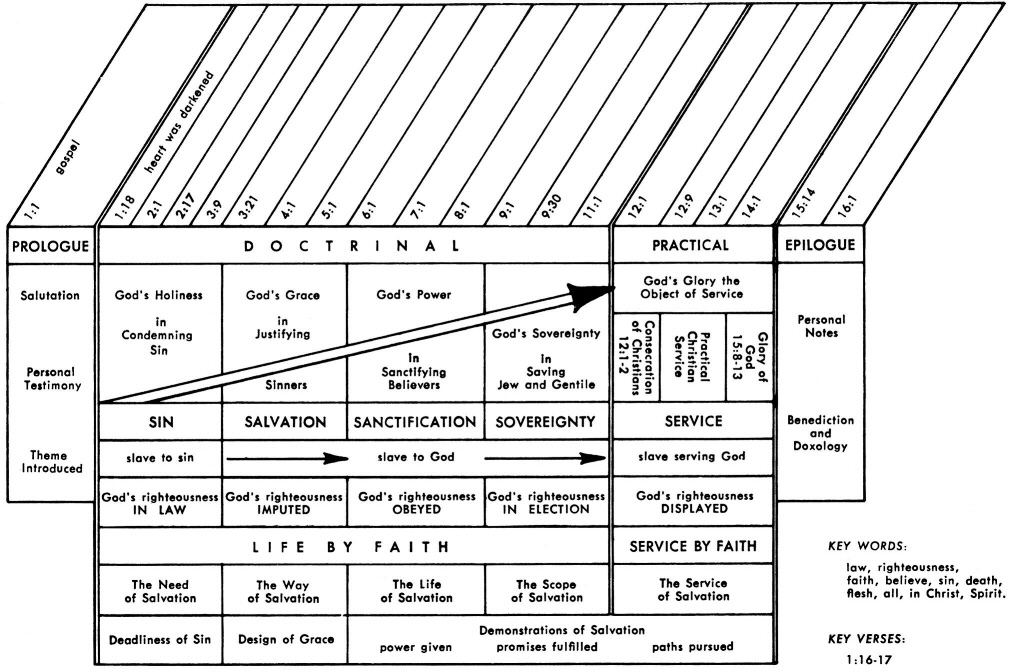
Click chart to enlarge
Chart from recommended resource Jensen's Survey of the NT - used by permission
Romans Overview Chart - Charles Swindoll
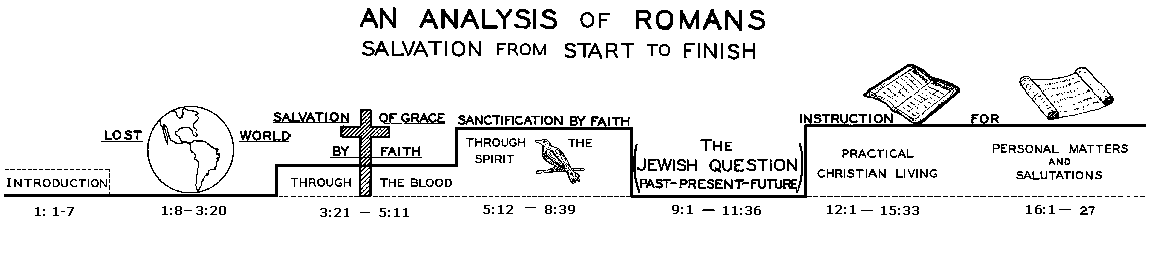
Source: Dr David Cooper
Click to Enlarge
R Ruin (Romans 1:17 – 3:20) – The utter sinfulness of humanity
O Offer (Romans 3:21-31) – God’s offer of justification by grace
M Model (Romans 4:1-25) – Abraham as a model for saving faith
A Access (Romans 5:1-11) – The benefits of justification
N New Adam (Romans 5:12-21) – We are children of two “Adams”
S Struggle w/ Sin (Romans 6-8) Struggle, sanctification, and victory
|
ROMANS ROAD |
||||
| Romans 1:18-3:20 | Romans 3:21-5:21 | Romans 6:1-8:39 | Romans 9:1-11:36 | Romans 12:1-16:27 |
| SIN | SALVATION | SANCTIFICATION | SOVEREIGNTY | SERVICE |
| NEED FOR SALVATION |
WAY OF SALVATION |
LIFE OF SALVATION |
SCOPE OF SALVATION |
SERVICE OF SALVATION |
| God's Holiness In Condemning Sin |
God's Grace In Justifying Sinners |
God's Power In Sanctifying Believers |
God's Sovereignty In Saving Jew and Gentile |
Gods Glory The Object of Service |
| Deadliness of Sin |
Design of Grace |
Demonstration of Salvation | ||
| Power Given | Promises Fulfilled | Paths Pursued | ||
| Righteousness Needed |
Righteousness Credited |
Righteousness Demonstrated |
Righteousness Restored to Israel |
Righteousness Applied |
| God's Righteousness IN LAW |
God's Righteousness IMPUTED |
God's Righteousness OBEYED |
God's Righteousness IN ELECTION |
God's Righteousness DISPLAYED |
| Slaves to Sin | Slaves to God | Slaves Serving God | ||
| Doctrine | Duty | |||
| Life by Faith | Service by Faith | |||
|
Modified from Irving L. Jensen's chart above |
||||
Romans 13:3 For rulers are not a cause of fear for good behavior, but for evil. Do you want to have no fear of authority? Do what is good and you will have praise from the same;
Greek: hoi gar archontes ouk eisin (3PPAI) phobos to agatho ergo alla to kako. theleis (2SPAI) de me phobeisthai (PPN) ten exousian: to agathon poiei (2SPAM) kai exeis (2SFAI) epainon ex autes
Amplified: For civil authorities are not a terror to [people of] good conduct, but to [those of] bad behavior. Would you have no dread of him who is in authority? Then do what is right and you will receive his approval and commendation.
Barclay: For the man who does good has nothing to fear from rulers, but the man who does evil has. Do you wish to be free of fear of authority? Do good and you will enjoy praise from authority,
NLT: For the authorities do not frighten people who are doing right, but they frighten those who do wrong. So do what they say, and you will get along well.
Phillips: The honest citizen has no need to fear the keepers of law and order, but the dishonest man will always be nervous of them. If you want to avoid this anxiety just lead a law-abiding life, and all that can come your way is a word of approval.
Wuest: For the rulers are not a terror to the good work but to the evil. Now, do you desire not to be afraid of the authority? Keep on doing the good, and you will have commendation from him,
Young's Literal: For those ruling are not a terror to the good works, but to the evil; and dost thou wish not to be afraid of the authority? that which is good be doing, and thou shalt have praise from it
| ROMANS ROAD to RIGHTEOUSNESS |
||||
| Romans 1:18-3:20 | Romans 3:21-5:21 | Romans 6:1-8:39 | Romans 9:1-11:36 | Romans 12:1-16:27 |
| SIN | SALVATION | SANCTIFICATION | SOVEREIGNTY | SERVICE |
| NEED FOR SALVATION |
WAY OF SALVATION |
LIFE OF SALVATION |
SCOPE OF SALVATION |
SERVICE OF SALVATION |
| God's Holiness In Condemning Sin |
God's Grace In Justifying Sinners |
God's Power In Sanctifying Believers |
God's Sovereignty In Saving Jew and Gentile |
Gods Glory The Object of Service |
| Deadliness of Sin |
Design of Grace |
Demonstration of Salvation | ||
| Power Given | Promises Fulfilled | Paths Pursued | ||
| Righteousness Needed |
Righteousness Credited |
Righteousness Demonstrated |
Righteousness Restored to Israel |
Righteousness Applied |
| God's Righteousness IN LAW |
God's Righteousness IMPUTED |
God's Righteousness OBEYED |
God's Righteousness IN ELECTION |
God's Righteousness DISPLAYED |
| Slaves to Sin | Slaves to God | Slaves Serving God | ||
| Doctrine | Duty | |||
| Life by Faith | Service by Faith | |||
Modified from Irving L. Jensen's excellent work "Jensen's Survey of the NT"
FOR RULERS ARE NOT A CAUSE OF FEAR FOR GOOD BEHAVIOR, BUT FOR EVIL: hoi gar archontes ouk eisin (3PPAI) phobos to agatho ergo alla to kako:
- Deuteronomy 25:1; Proverbs 14:35; 20:2; Ecclesiastes 10:4-6; Jeremiah 22:15-18
For civil authorities are not a terror to [people of] good conduct, but to [those of] bad behavior. (Amplified)
The honest citizen has no need to fear the keepers of law and order, but the dishonest man will always be nervous of them. (Phillips)
For - term of explanation - Should always prompt inquiry into what is being explained.
Denney - The gar (for) can only be connected in a forced and artificial way with the clause which immediately precedes: it really introduces the reason for a frank and unreserved acceptance of that view of ‘authorities’ which the apostle is laying down. It is as if he said: Recognize the divine right of the State, for its representatives are not a terror—an object of dread—to the good work, but to the bad… It is implied that those to whom he speaks will always be identified with the good work, and so have the authorities on their side; it is taken for granted also that the State will not act in violation of its own idea, and identify itself with the bad. (Romans 13 - The Expositor's Greek Testament)
Rulers (758) (archon from árcho = to rule) means first (in rank or power) and thus a ruler, chief, prince, magistrate
The authorities do not frighten people who are doing right, but they frighten those who do wrong. Rulers hold no terror for those who do right. People who do what is right don't have to be afraid of the government. The fear of punishment is not the highest motivation for obedience, but it is better than having chaos.
This is why we have police officers and FBI agents and customs agents. This is why we have hall monitors at the high school and security guards at the airport. They are here to find and punish the evildoers. Without such people, lawbreakers would have a field day and criminals would go scot-free.
Even the most wicked regimes are at least some deterrent to murder, theft, and many other crimes of the populace. Although this truth does not justify brutal dictatorships or totalitarian regimes, frequently crimes rates under such systems are lower than those in the free world. Until recently, at least, such violations as murder, robbery, and rape were all but nonexistent in communist China. In Muslim nations, severe punishment continues to be a formidable deterrent of crime. Civil authorities also realize that basic morality is essential to a workable society. No society can long survive wanton murder, theft, dishonesty, sexual immorality, and violence. Good behavior is essential for any nation’s self preservation. Without it, society self destructs (cf Pr 29:18-Pr 29:18, Jdg 21:25-note).
Not (ou) means absolute negation.
Fear (5401)(phobos from verb phébomai = flee from or be startled) refers first to flight, to alarm, to fright or to terror (of the shaking type) (cf. Mt 14:26; Lk 21:26; 1Co 2:3). This type of fear is connected with fear of the unknown, fear of the future, and fear of authorities. It speaks of the terror which seizes one when danger appears.
Good behavior - Elsewhere this is translated good deed (See discussion)
Good (18) (agathos) means intrinsically good, inherently good in quality but with the idea of good which is also profitable, useful, benefiting others, benevolent (marked by or disposed to doing good).
Behavior (2041) (ergon) means a deed or action in contrast to inactivity. It speaks of toil or effort in which one exerts strength or faculties to do or perform something. Works are the result of and never the means of salvation.
But - This term of contrast should always prompt the inquisitive reader to examine the context to determine what is being contrasted (why?, why now? etc).
Evil (2556) (kakos) is an adjective that basically denotes a lack of something or not as it ought to be. It is the opposite of good (agathos). It describes actions or people which are evil in themselves and, as such, get others in trouble. In a moral sense kakos describes the Cretans in the book of Titus as wicked, vicious, bad in heart, conduct, and character (cf Php 3:2-note).
DO YOU WANT TO HAVE NO FEAR OF AUTHORITY? DO WHAT IS GOOD, AND YOU WILL HAVE PRAISE FROM THE SAME: theleis (2SPAI) de me phobeisthai (PPN) ten exousian: to agathon poiei (2SPAM) kai echeis (2SFAI) epainon ex autes:
1Pet 2:13-note Submit (aorist imperative - a command not a suggestion) yourselves for the Lord’s sake to every human institution, whether to a king as the one in authority, 14 or to governors as sent by him for the punishment of evildoers and the praise of those who do right.
1Pet 3:13-note And who is there to harm you if you prove zealous for what is good? 14 But even if you should suffer for the sake of righteousness, you are blessed. AND DO NOT FEAR THEIR INTIMIDATION, AND DO NOT BE TROUBLED (tarasso - shaken, thrown into confusion, disturbed, unsettled, stirred up, suffering inward turmoil),
Do (what is good) (4160) (poieo) means to accomplish or carry out and is in the present imperative calling for this to be the habit of their life. Are you afraid of those who are over you? Don’t be. Do what is right and you will have nothing to fear.
Fear (5399) (phobeo from phobos = fear, reverence, respect, honor) means to be afraid of someone, but in the present context is better described as a measure of respect for the one authority. The present tense describes a continual attitude of no fear.
Authority (1849) (exousia) refers ultimately to the "power of authority," the right to exercise power or "the power of rule or government," the power of one whose will and commands must be obeyed by others. Exousia means delegated authority or power of authority and right of that authority. The person delegating authority is in a sense acting in and through the person to whom he has delegated the authority. In short, exousia describes "the right and the might" (see Ro 9:21-note) or the privilege and the power. An authority is anyone who has the right to make decisions that affect your life.
Do good - The present imperative calls for this to be your lifestyle as a "good" citizen.
Good (18) (agathos) means intrinsically good, inherently good in quality.
Praise (1868) (epainos from epí = upon + aínos = praise) is literally "praise upon" and denotes commendation, praise, or approbation (an act of formally or officially approving). It means something which is worthy of being commended. The word can describe the act of expressing admiration or approval, praise, approval, recognition.
Generally speaking, peaceful and law abiding citizens have been favorably treated by their governments throughout history. With notable exceptions, such people have no need to fear authority. As long as they do what is good, they not only will not be mistreated but will have praise from their government.
The principles of the Roman law were just, and Paul himself found protection from its officers and tribunals, whose fairness he had, and had reason to have, more confidence in than in the tender mercy of either Gentile or Jewish zealots (Acts 19:35, 21:31, 22:30, 24:10, 25:10, 11, 26:30).
Robert Haldane - The institution of civil government is a dispensation of mercy, and its existence is so indispensable, that the moment it ceases under one form, it reestablishes itself in another. The world, ever since the fall, when the dominion of one part of the human race over another was immediately introduced (Ge 3:16), has been in such a state of corruption and depravity, that without the powerful obstacle presented by civil government to the selfish and malignant passions of men, it would be better to live among the beasts of the forest than in human society. As soon as its restraints are removed, man shows himself in his real character. When there was no king in Israel, and every man did that which was right in his own eyes, we see in the last three chapters of the Book of Judges what were the dreadful consequences. (Jdg 21:25,17:6;18:1;19:1 see notes on Judges 17 Judges 18 Judges 19 Judges 21) (Romans 13 - Haldane's Exposition on the Epistle to the Romans)
Steven Cole - The purpose for government is to protect law-abiding citizens and punish law-breakers (13:3-4). Romans 13:3-4: “For rulers are not a cause of fear for good behavior, but for evil. Do you want to have no fear of authority? Do what is good and you will have praise from the same; for it is a minister of God to you for good. But if you do what is evil, be afraid; for it does not bear the sword for nothing; for it is a minister of God, an avenger who brings wrath on the one who practices evil.”
Paul is presenting the general purpose and practice of government: to protect those who do right and to punish those who do wrong. Granted, there have been many exceptions throughout history. Corrupt governments punish law-abiding citizens who speak out against the corruption and they reward scoundrels who help keep them in power. John Calvin argues (Calvin’s Commentaries [Baker], p. 480) that God uses wicked rulers as His scourge to punish the sins of the people. In other words, we get the rulers that we deserve! But when governments function as they are supposed to, they protect law-abiding citizens and punish law-breakers.
To do this, the government must legislate morality. You often hear that we should not legislate morality, but that is absurd. I had an exchange in the local newspaper earlier this year with an opinion piece where the author argued that imposing “personal, moralistic beliefs” challenges our freedom by disregarding the Constitution and the Bill of Rights. I pointed out in my response that we impose personal, moralistic beliefs all the time. We have laws against rape, wife-beating, honor killings, stealing, assault, murder, pedophilia, and many other immoral behaviors, and rightly so. We forcefully impose these “moralistic” beliefs on all in our society, even though they go against the personal beliefs of a minority.
The responses to my article were unbelievable. One man argued that “murder, rape, pedophilia, and assault are crimes, not bad morals.” Hello? Another lamented, “It is true that our laws are informed by our collective beliefs. Unfortunately, those beliefs are often derived from a jumble of ancient religious texts.” But he is hopeful, as he continues, “Fortunately, more and more people are discarding those antiquated religious beliefs in favor of a morality based on science and reason.” He goes on to state proudly that he is in favor of women being allowed to kill their babies (he calls it “pro-choice”) and that he chooses “science, reason and freedom.” What delusion! Sadly, that man used to attend this church!
If God’s purpose for civil governments is to protect law-abiding citizens and punish law-breakers, then it follows that we should use civil authorities for protection and due process. Paul himself did this in Philippi, where he was unjustly beaten and imprisoned without a trial, although he was a Roman citizen. When the authorities realized their error and wanted to quietly usher him out of town, Paul wouldn’t stand for it (Acts 16:35-40). He also invoked his Roman citizenship to avoid a scouring and to appeal to Caesar rather than face a kangaroo court (Acts 22:25; 25:11).
This means that if someone is physically or sexually abusing you, you should report it to the proper authorities. If your husband is physically abusive, call the police. If he is a church member, let the elders know so that we can implement church discipline. If you are being defrauded by a church member, first attempt to resolve the matter in the church (1Cor. 6:1-8). If it can’t be resolved, you may have to take your case to secular courts. The purpose of government is to protect law-abiding people and punish evildoers.
What about capital punishment? Paul mentions the government “bearing the sword.” As far back as the covenant with Noah, God ordained that if someone deliberately takes another person’s life, his life should be taken (Gen. 9:6). Under the Mosaic covenant, there were many other crimes punishable by death. But those laws applied specifically to Israel under the law.
My understanding is that capital punishment is still fitting for first degree murder. It upholds the sanctity of human life to impose the penalty of life for life. But the way that our government practices capital punishment is inept. Murderers are allowed to live on death row for decades while they file appeal after appeal, often on technicalities. My view is that if a criminal is guilty beyond a shadow of a doubt, he should be executed immediately after his trial. Ecclesiastes 8:11 states, “Because the sentence against an evil deed is not executed quickly, therefore the hearts of the sons of men among them are given fully to do evil.” To argue that a criminal should not be executed because he is insane is insane. To insist that we must execute him as painlessly as possible is insane. The issue is that he ruthlessly murdered innocent people. The punishment for that crime should be quick, painful death. Anything else cheapens the lives that he slaughtered.
The general principle is that since God has ordained government authority, we must be subject to it. The purpose for government is to protect law-abiding citizens and punish law-breakers. (The Government and You Romans 13:1-7)(See Cole's related updated sermon - Christ- Lord of our Politics)
Romans 13:4 for it is a minister of God to you for good. But if you do what is evil, be afraid; for it does not bear the sword for nothing; for it is a minister of God, an avenger who brings wrath on the one who practices evil.
Greek: theou gar diakonos estin (3SPAI) soi eis to agathon. ean de to kakon poies (2PPAS), phobou (2SPPM): ou gar eike ten machairan phorei (3SPAI): theou gar diakonos estin (3SPAI) ekdikos eis orgen to to kakon prassonti (PAPMSD)
Amplified: For he is God’s servant for your good. But if you do wrong, [you should dread him and] be afraid, for he does not bear and wear the sword for nothing. He is God’s servant to execute His wrath (punishment, vengeance) on the wrongdoer.
Barclay: for any servant of God exists for your good. If you do evil, then you must fear. For it is not for nothing that the man set in authority bears the sword, for he is the servant of God, and his function is to vent wrath and vengeance on the man who does evil.
NLT: The authorities are sent by God to help you. But if you are doing something wrong, of course you should be afraid, for you will be punished. The authorities are established by God for that very purpose, to punish those who do wrong.
Phillips: The officer is God's servant for your protection. But if you are leading a wicked life you have reason to be alarmed. The "power of the law" which is vested in every legitimate officer, is no empty phrase. He is, in fact, divinely appointed to inflict God's punishment upon evil-doers.
Wuest: for he is God’s servant to you for good. But if you are habitually doing that which is evil, be fearing, for not in vain is he wearing the sword, for he is God’s servant, an executor of wrath upon the one who practices the evil.
Young's Literal: for of God it is a ministrant to thee for good; and if that which is evil thou mayest do, be fearing, for not in vain doth it bear the sword; for of God it is a ministrant, an avenger for wrath to him who is doing that which is evil.
FOR IT IS A MINISTER OF GOD TO YOU FOR GOOD: theou gar diakonos estin (3SPAI) soi eis to agathon:
-
1Kings 10:9; 2Chronicles 19:6; Ps 82:2-4; Proverbs 24:23,24; 31:8,9; Ecclesiastes 8:2-5; Isaiah 1:17; Jeremiah 5:28; Ezekiel 22:27; Micah 3:1-4,9
For - term of explanation - Should always prompt inquiry into what is being explained.
It - The government and the authority of that government as ministered to its agents. Paul refers to it as a minister of God, so that the authorities act ideally like servants of God.
As Ray Pritchard writes the word "minister" "sounds odd to our ears. Most of us associate “ministry” with what happens on Sunday morning. Twice in verse 4 he calls rulers “God’s servants.” He doesn’t mean that they are necessarily saved, but that human authorities serve the purpose of God on earth… This, by the way, is the basis for treating our leaders with respect. Christians ought to the lead the way in showing honor to human authorities because we understand they are appointed by God… I must treat them with respect--without regard to how I feel about certain of their decisions--because they are God’s servants. Whom God has appointed, I must not treat lightly. (How to be a Godly Rebel)
Minister (1249) (diakonos; see related word diakonia) has an uncertain derivation some saying it is from diakónis which means "in dust laboring" or "running through dust". Others derive diakonos from diáko same as dieko which means to hasten. The diakonos is one who renders assistance or help by performing certain duties, often of a humble or menial nature. Since service associated with the word diakonia necessarily involved dependence, submission, and constraints of time and freedom, the Greeks regarded diakonia as degrading and dishonorable. Service for the public good was honored. And so we see that Paul is saying that the government is God's "deacon", and as with any deacon, its job is to humbly serve. The point is that whether the government knows it or admits it, it serves God. If our elected officials only truly understand this Biblical principle!
For he is God’s servant for your good. (Amplified)
Note that in the Greek sentence, "Theou" (God) comes first for emphasis. Paul's point is that the "ruler" is God's servant, no less. And "servant" reminds us that he is no more. He is not God even if some rulers have had very exalted views of themselves and their roles. This thought is brought out by Paul's choice of "diakonos" for servant, as this word emphases menial service as of a table waiter & thus came to be used of lowly service in general. However exalted the ruler may be among the people, before God he is nothing more than a lowly servant. And he is a servant "to you", which adds a personal touch. The ruler's function concerns the individual subject, and this function is "for good".
And so Queen Victoria of England in the 1800's was prone to refer to herself as "Victoria, by the grace of God".
King Jehoshaphat of Judah upon the occasion of appointing judges over the cities of the land wisely instructed them declaring "Consider what you are doing, for you do not judge for man but for the LORD Who is with you when you render judgment. Now then let the fear of the LORD be upon you; be very careful what you do, for the LORD our God will have no part in unrighteousness, or partiality, or the taking of a bribe." (2Chronicles 19:6-7)
The psalmist Asaph records God's instructions to those in authority asking…
"How long will you defend the unjust and show partiality to the wicked? Selah 3 Defend the cause of the weak and fatherless; maintain the rights of the poor and oppressed. 4 Rescue the weak and needy; deliver them from the hand of the wicked. (Psalms 82:2-4)
All of these ministers of God will one day give an account for their stewardship of God's gift of authority. And so we should pray for our leaders (1Ti 2:1-3). David repeatedly referred to the wicked King Saul as the Lord’s anointed (1Sa 24:6,10 26:9,11,16,23). In spite of Saul’s repeated attempts on David’s life, the latter would not allow his men to harm the king. Why? Because Saul was the king, and as such he was the Lord’s appointee.
The government is God's servant working for your good. But if you do what is wrong, you should be afraid. The civil magistrate, saved or unsaved, is a servant of God in the sense that since God has instituted human government as a means of regulating the affairs of the human race, a magistrate who carries out the law, acts as a servant of God. Orderly government is part of God's provision, even in a wicked world. No ruler exercises control except as God permits (Da 2:21, 4:17, 5:21). Under normal circumstances the Christian is to be obedient to the law of the land. This does not mean that he is to obey regulations that are immoral or anti-Christian. In such cases it is his duty to obey God rather than men (Ac 4:19-20 5:29; cp. Da 3:16-18; 6:10ff).
Wuest - The civil magistrate, saved or unsaved, is a servant of God in the sense that since God has instituted human government as a means of regulating the affairs of the human race, a magistrate who carries out the law, acts as a servant of God. (Wuest's word studies from the Greek New Testament)
Note that Ro 13:4 supports the concept of using "the sword" by government when necessary. This would confirm the principle of justified capital punishment first established in Ge9:6, as well as the concept of warfare when justified.
In Israel, as in most other parts of the empire, nationals of the country were appointed (usually after paying a high fee) as tax collectors and were given specified amounts to collect for Rome each year. They were free to charge virtually any rate they wanted and to collect taxes almost as often as they wanted, under the protection of Roman soldiers. Whatever they collected over the prescribed amount for Rome, they could keep for themselves. As would be expected, abuse was rampant, and because most of them were fellow countrymen, tax collectors often were more hated than the Roman officials and soldiers. The gospels vividly reveal how much the tax collector was despised in Israel (Mt 9:10-11).
R Kent Hughes commenting on the government as a minister to "for good" writes "Even a Communist dictatorship is better than no state at all. The darkest days in Israel’s history were those days described in Judges 17:6 when “everyone did as he saw fit.” Just a few days (a few hours!) without law in today’s world and all would be chaos, just as in the book of Judges. This is true both of dictatorships and democracies, although Paul does not have in mind a government which has lost its ability to rule or is at the whim of a madman. (Hughes, R. K. Romans : Righteousness from heaven. Preaching the Word. Wheaton, Ill.: Crossway Books)
BUT IF YOU DO WHAT IS EVIL BE AFRAID: ean de to kakon poies (2PPAS), phobou (2SPPM):
- Proverbs 16:14; 20:2,8,26
But - This term of contrast should always prompt the inquisitive reader to examine the context to determine what is being contrasted (why?, why now? etc).
Be afraid (5399) (phobeo) in this context picks up the classic Greek meaning which was to cause to run away which gives us our English word "phobia". (See related topic How To Handle Fear) Present tense means to be continually fearing. The Wuest paraphrase emphasizes the present tense - "But if you are habitually doing that which is evil, be fearing." In other words, if you continually do evil, then you certainly have a good reason to "be fearing" or have a "phobia" of the authorities! If you drive 55 in a 55 mph zone, you will have nothing to fear. But if you are doing 70, you will be looking in the rear-view mirror constantly. Are you convicted? I am!
Solomon writes that…
The anger of the king is a deadly threat; the wise do what they can to appease it. (Proverbs 16:14NLT)
A king's wrath is like the roar of a lion; he who angers him forfeits his life… When a king sits on his throne to judge, he winnows out all evil with his eyes… A wise king winnows out the wicked [from among the good]; he drives the threshing wheel over them (lays them out like wheat, then runs the crushing wheel over them) [to separate the chaff from the grain]. (Proverbs 20:2,8,26)
><>><>><>
Our Daily Bread devotional on fear - One night I heard a radio preacher say that we should fear only God. But I don't agree. Peter exhorted servants to be subject to their masters "with all fear" (1Pet. 2:18) , and Paul said that wrongdoers should be afraid of civil authorities (Ro 13:4) . A hierarchy of fear is an integral part of living on our sin-cursed planet. Our moral responsibility is to put the things we fear in their proper place.
A boy whose friends urged him to experiment with illicit drugs told me he was afraid they would think of him as a coward, but he resisted because he was more frightened of the consequences. A young man who volunteered for dangerous military duty admitted he was scared of being wounded or killed, but he had a greater concern about what would happen if the enemy won the war. Both of these young men did what was right because they recognized the priority of certain fears.
The Bible teaches that our greatest fear should be of displeasing God. A believer who is told that he must either commit evil or face the firing squad should be more concerned about disobeying the Lord than being shot. That's what Jesus meant when He said, "Do not fear those who kill the body but cannot kill the soul. But rather fear Him who is able to destroy both soul and body in hell" (Matt. 10:28).
Fear is part and parcel of life here on earth. But this strong emotion can serve us well if we let our fear of God be supreme. —H V Lugt (Our Daily Bread, Copyright RBC Ministries, Grand Rapids, MI. Reprinted by permission. All rights reserved)
Shame arises from the fear of men,
Conscience from the fear of God.
- Samuel Johnson
FOR IT DOES NOT BEAR THE SWORD FOR NOTHING: ou gar eike ten machairan phorei (3SPAI):
For - term of explanation - Should always prompt inquiry into what is being explained.
Sword (3162) (machaira) refers to a short sword or dagger in contrast to rhomphaia (A saber, a long and broad cutlass, a sword. Thracian weapon of large size, whether a sword or spear not certain and usually longer than machaira. Used in Lxx of sword of Goliath 1Sa 17:51). The sword is not just an innocuous symbol of power for reference to a scepter would have served that purpose. This figure means that the government is armed and can use force. Many commentators feel the sword speaks of the ultimate power of the ruler— capital punishment.
Vincent writes the sword is "Borne as the symbol of the magistrate’s right to inflict capital punishment. Thus Ulpian: “They who rule whole provinces have the right of the sword (jus gladii).” The Emperor Trajan presented to a provincial governor, on starting for his province, a dagger, with the words, “For me. If I deserve it, in me.” (Romans 13 - Vincent's Word Studies)
Alford - Alford comments; “In ancient times and modern times, the sword has been carried before sovereigns. It betokens the power of capital punishment: and the reference to it here is among the many testimonies borne by Scripture against the attempt to abolish the infliction of the penalty of death for crime in Christian states.” (Romans 13 - Greek Testament Critical Exegetical Commentary)
"The sword” therefore could be a reference to the common method of execution (beheading) during this time period in history. According to tradition, Paul himself experienced the cruelty of the Roman sword when Nero had him beheaded.
Swords were carried in front of Roman officials to indicate their authority over life and death -- the "ius gladi" or the Roman "law of the sword" which some feel was more limited during the first 2 centuries. Irregardless a "sword" certainly does support that the government is authorized by God to use force in order to bring law and order.
Pastor Ray Pritchard makes an interesting comment "This reference to the sword provides the Christian basis both for service in the armed forces (and for going to war in general) as well as the theological justification for capital punishment. God says that the state does have the right to take life--not capriciously or unjustly, but in certain cases, it is clearly justified. “He does not bear the sword for nothing.” (How to be a Godly Rebel)
FOR IT IS A MINISTER OF GOD AN AVENGER WHO BRINGS WRATH UPON THE ONE WHO PRACTICES EVIL: theou gar diakonos estin (3SPAI) ekdikos eis orgen to to kakon prassonti (PAPMSD):
- Ro 12:19; Joshua 20:5,9; Ezekiel 25:14
For - term of explanation - Should always prompt inquiry into what is being explained.
Minister of God - Paul for a second time refers to the rulers as God's servants (diakonos - word study) and again places "Theou" for "God" first for emphasis. The Emperor on his throne might well see his power as something to be exercised as he chose. But Paul is clear that everyone in any position of responsibility is first and foremost God's servant and that it is to God that he must one day render account! The governmental authority is not an independent operator but an agent of wrath to bring punishment on the wrongdoer.
Avenger (1558) (ekdikos from ek = from, out + dike = justice) (used only one other time in 1Th 4:6) literally describes one outside of that which is lawful then one who exacts a penalty from a person. Thus ekdikos is one who executes justice so as to exact satisfaction for a wrong by punishing the wrongdoer in retaliation for an injury or offense.
The Old Testament laid down important principles for the blood avenger (the Hebrew word goel which was also the word for the kinsman redeemer), Moses recording some of these ordinances in Numbers…
'The blood avenger himself shall put the murderer to death; he shall put him to death when he meets him. 20 'And if he pushed him of hatred, or threw something at him lying in wait and as a result he died, 21 or if he struck him down with his hand in enmity, and as a result he died, the one who struck him shall surely be put to death, he is a murderer; the blood avenger shall put the murderer to death when he meets him. 22 'But if he pushed him suddenly without enmity, or threw something at him without lying in wait, 23 or with any deadly object of stone, and without seeing it dropped on him so that he died, while he was not his enemy nor seeking his injury, 24 then the congregation shall judge between the slayer and the blood avenger according to these ordinances. 25 'And the congregation shall deliver the manslayer from the hand of the blood avenger, and the congregation shall restore him to his city of refuge to which he fled; and he shall live in it until the death of the high priest who was anointed with the holy oil. 26 'But if the manslayer shall at any time go beyond the border of his city of refuge to which he may flee, 27 and the blood avenger finds him outside the border of his city of refuge, and the blood avenger kills the manslayer, he shall not be guilty of blood 28 because he should have remained in his city of refuge until the death of the high priest. But after the death of the high priest the manslayer shall return to the land of his possession. 29 'And these things shall be for a statutory ordinance to you throughout your generations in all your dwellings. (Numbers 35:19-29)
Wrath (3709) (orge from orgaô = to teem, to swell) (See related topic: God's Attribute of Wrath) is derived from the idea of a swelling which eventually bursts, and applies more to an anger that proceeds from one’s settled nature.
Practices (4238) (prasso) expresses an action as continued or not yet completed, what one does repeatedly, continually, habitually (present tense).
Evil (2556) (kakos) denotes a lack of something or not as it ought to be and describes actions or people which are evil in themselves and, as such, get others in trouble.