Romans 13:2
Romans 13:3
Romans 13:4
Romans 13:5
Romans 13:6
Romans 13:5
Romans 13:8
Romans 13:9
Romans 13:10
Romans 13:11
Romans 13:12
Romans 13:13
Romans 13:14

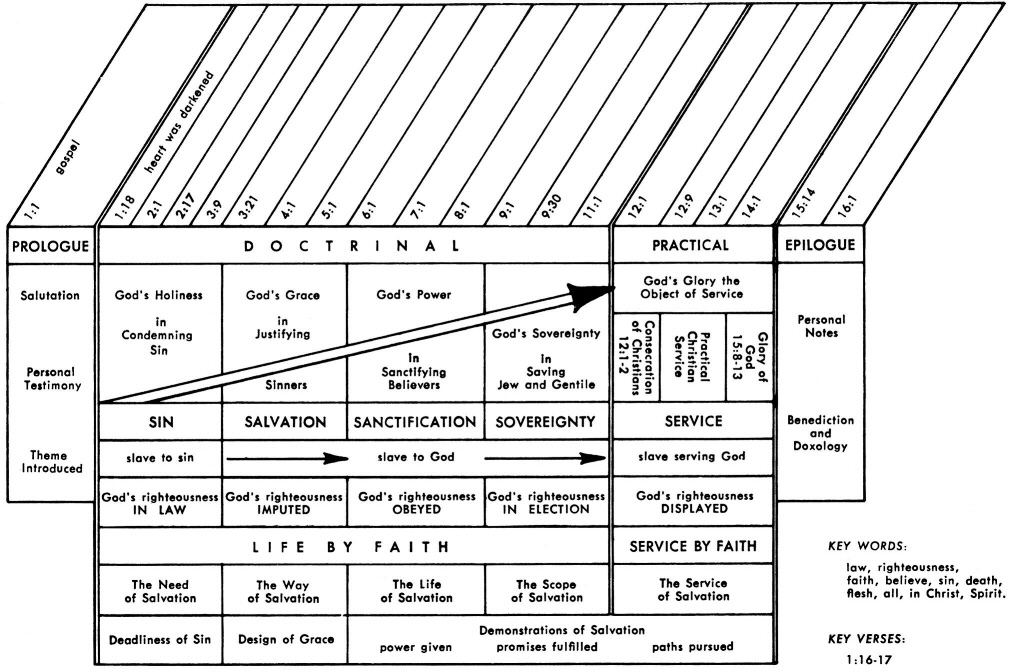
Click chart to enlarge
Chart from recommended resource Jensen's Survey of the NT - used by permission
Romans Overview Chart - Charles Swindoll
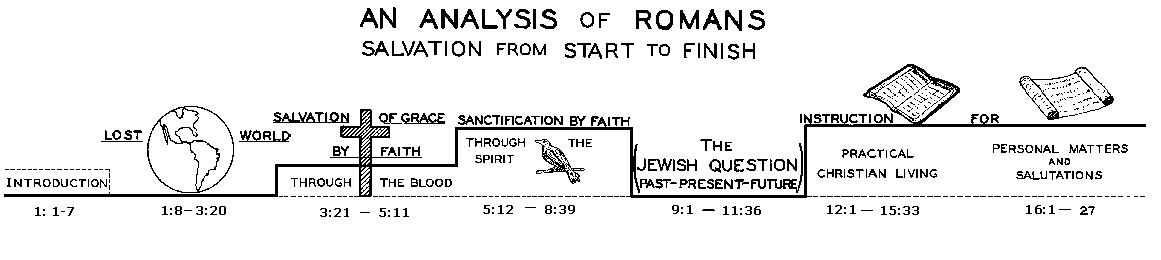
Source: Dr David Cooper
Click to Enlarge
R Ruin (Romans 1:17 – 3:20) – The utter sinfulness of humanity
O Offer (Romans 3:21-31) – God’s offer of justification by grace
M Model (Romans 4:1-25) – Abraham as a model for saving faith
A Access (Romans 5:1-11) – The benefits of justification
N New Adam (Romans 5:12-21) – We are children of two “Adams”
S Struggle w/ Sin (Romans 6-8) Struggle, sanctification, and victory
|
ROMANS ROAD |
||||
| Romans 1:18-3:20 | Romans 3:21-5:21 | Romans 6:1-8:39 | Romans 9:1-11:36 | Romans 12:1-16:27 |
| SIN | SALVATION | SANCTIFICATION | SOVEREIGNTY | SERVICE |
| NEED FOR SALVATION |
WAY OF SALVATION |
LIFE OF SALVATION |
SCOPE OF SALVATION |
SERVICE OF SALVATION |
| God's Holiness In Condemning Sin |
God's Grace In Justifying Sinners |
God's Power In Sanctifying Believers |
God's Sovereignty In Saving Jew and Gentile |
Gods Glory The Object of Service |
| Deadliness of Sin |
Design of Grace |
Demonstration of Salvation | ||
| Power Given | Promises Fulfilled | Paths Pursued | ||
| Righteousness Needed |
Righteousness Credited |
Righteousness Demonstrated |
Righteousness Restored to Israel |
Righteousness Applied |
| God's Righteousness IN LAW |
God's Righteousness IMPUTED |
God's Righteousness OBEYED |
God's Righteousness IN ELECTION |
God's Righteousness DISPLAYED |
| Slaves to Sin | Slaves to God | Slaves Serving God | ||
| Doctrine | Duty | |||
| Life by Faith | Service by Faith | |||
|
Modified from Irving L. Jensen's chart above |
||||
Romans 13:5 Therefore it is necessary to (continually) be in subjection, not only because of wrath, but also for conscience' sake. (NASB: Lockman)
Greek: dio anagke hupotassesthai, (PPN) ou monon dia ten orgen alla kai dia ten suneidesin.
Amplified: Therefore one must be subject, not only to avoid God’s wrath and escape punishment, but also as a matter of principle and for the sake of conscience. (Amplified Bible - Lockman)
Barclay: So, then, it is necessary for you to submit yourself, not because of the wrath, but for the sake of your own conscience. (Westminster Press)
NLT: So you must obey the government for two reasons: to keep from being punished and to keep a clear conscience. (NLT - Tyndale House)
Phillips: You should, therefore, obey the authorities, not simply because it is the safest, but because it is the right thing to do. (Phillips: Touchstone)
Wuest: On which account there is a necessity for putting one’s self in subjection, not only because of wrath, but also because of conscience,
Young's Literal: Wherefore it is necessary to be subject, not only because of the wrath, but also because of the conscience
| ROMANS ROAD to RIGHTEOUSNESS |
||||
| Romans 1:18-3:20 | Romans 3:21-5:21 | Romans 6:1-8:39 | Romans 9:1-11:36 | Romans 12:1-16:27 |
| SIN | SALVATION | SANCTIFICATION | SOVEREIGNTY | SERVICE |
| NEED FOR SALVATION |
WAY OF SALVATION |
LIFE OF SALVATION |
SCOPE OF SALVATION |
SERVICE OF SALVATION |
| God's Holiness In Condemning Sin |
God's Grace In Justifying Sinners |
God's Power In Sanctifying Believers |
God's Sovereignty In Saving Jew and Gentile |
Gods Glory The Object of Service |
| Deadliness of Sin |
Design of Grace |
Demonstration of Salvation | ||
| Power Given | Promises Fulfilled | Paths Pursued | ||
| Righteousness Needed |
Righteousness Credited |
Righteousness Demonstrated |
Righteousness Restored to Israel |
Righteousness Applied |
| God's Righteousness IN LAW |
God's Righteousness IMPUTED |
God's Righteousness OBEYED |
God's Righteousness IN ELECTION |
God's Righteousness DISPLAYED |
| Slaves to Sin | Slaves to God | Slaves Serving God | ||
| Doctrine | Duty | |||
| Life by Faith | Service by Faith | |||
|
Modified from Irving L. Jensen's excellent work "Jensen's Survey of the NT" |
||||
THEREFORE IT IS NECESSARY TO BE IN SUBJECTION: dio anagke hupotassesthai (PPN):
- 1 Sa 24:5,6; Eccl 8:2; Titus 3:1,2; 1 Pe 2:13, 14, 15
Therefore (for this reason) - Whenever you encounter a term of conclusion, always pause and ask "What is it there for?"
Necessary (318) (anagke) is a noun which means compulsion, force, constraint or a state of being checked, restricted, or compelled either because of a feeling of inward necessity (See 1Sa 24:5-6, 1Cor 9:16) or necessity brought about by circumstances which make it inevitable (Mt 18:7) or as in this verse a necessity which arises from the divine order of things. Examine the following uses in context to help understand anagke (Mt 18:17, 1Cor 7:37, 2Cor 9:7, Philemon 1:14, Heb 7:12, Heb 9:27, Heb 9:16, Heb 9:23, Jude 1:3).
Denney - there is a twofold necessity for submission—an external one, in the wrath of God which comes on resistance; an internal one, in conscience. Even apart from the consequences of disobedience conscience recognizes the Divine right and function of the exousia and freely submits to it...It is because conscience recognises the moral value of the State as an ordinance of God that we pay taxes. (Romans 13 - The Expositor's Greek Testament)
NOT ONLY BECAUSE OF WRATH BUT ALSO FOR CONSCIENCE SAKE : ou monon dia ten orgen alla kai dia ten suneidesin:
- Hebrews 13:18; 1Peter 2:19; 3:16
Ultimately believers subject themselves selves because of our reverence for God’s authority. There is a two reasons submission is a necessity—an external one, in the wrath which comes upon those who resist authority & an internal one the conscience. Even apart from the consequences of disobedience, conscience recognizes the divine right and function of authority. Believers are citizens of heaven, but we must not minimize our responsibilities on earth. We must be exemplary citizens so that the Lord will be glorified (1Pe 2:11-17).
Wrath (3709) (orge from orgaô = to teem, to swell) (See related topic: God's Attribute of Wrath) is derived from the idea of a swelling which eventually bursts, and applies more to an anger that proceeds from one’s settled nature.
Conscience' (4893) (suneidesis from sun = with + oida = know) literally means "a knowing with" or a co-knowledge (with oneself) which is the witness borne to one's conduct by their conscience. Conscience is the "soul as distinguishing between what is morally good and bad, prompting to do the former and shun the latter". Conscience is that faculty by which we apprehend the will of God, as that which is designed to govern our lives.
Paul explains his motivation for keeping a clear conscience writing "that there shall certainly be a resurrection of both the righteous and the wicked. In view of this, I also do my best to maintain always (always exercise and discipline myself [mortifying my body, deadening my carnal affections, bodily appetites, and worldly desires, endeavoring in all respects] Amplified) a blameless (clear, unshaken) conscience (void of offense) both before God and before men. (Acts 24:16)
Peter exhorts believers " [And see to it that] your conscience is entirely clear (unimpaired), so that, when you are falsely accused as evildoers, those who threaten you abusively and revile your right behavior in Christ may come to be ashamed [of slandering your good lives]. (Amplified, see 1Peter 3:16)
A. W. Tozer defined "conscience" as that entity which "singles you out as though nobody else existed. God has given us a faithful witness inside of our own being. . . . It is able to single a man out and reveal his loneliness, the loneliness of a single soul in the universe going on to meet an angry God. That’s the terror of the conscience. Conscience never deals with theories. Conscience always deals with right and wrong and the relation of the individual to that which is right or wrong. Remember the conscience is always on God’s side! It judges conduct in the light of the moral law, and as the Scripture says, excuses or accuses."
Conscience is that inner judge that accuse & condemns us when we have done wrong and approves and commends us when we have done right (see Romans 2:14,15).
R Kent Hughes explains - We are to be in subjection not just because we are afraid of being punished, but because, unlike the world, we understand that the state is divinely instituted and that rulers are wittingly or unwittingly God’s ministers. Christians are able to see the big picture, and thus through their informed consciences they are able to live in profound subjection. (Hughes, R. K. Romans: Righteousness from heaven. Preaching the Word. Crossway Books)
It is possible to sin against the conscience so that it becomes “defiled” (Titus 1:5).
Repeated sinning hardens the conscience so that it becomes “seared” like scar tissue (1Ti 4:2).
To continually reject God’s truth causes the conscience to become progressively less sensitive to sin, as if covered with layers of "unspiritual scar tissue".
Ray Pritchard sums up this verse noting that "We support human government first because “of wrath”--meaning we fear punishment if we don’t. That is why you slow down when you suddenly see a police car parked by the side of the road. Lawbreakers will be brought to justice. Second, we support government “because of conscience”--that is, because we know that God stands behind every human government working out his will for the human race. That means that anarchy is never an option for the Christian. We may disagree, we may vote against, we may picket or write letters. But we must never join the ranks of the anarchists who say, “Down with all government.” Such a view is thoroughly pagan. Even bad government is better than no government at all. To be more specific, Christians ought to be known as law-abiding citizens. In our day, some people have taken to shooting abortionists in a futile attempt to save the unborn. When will we learn that insurrection, lawlessness, and murder do not advance the cause of Christ?...If we believe what Paul said, it will make us better Christians and ultimately better citizens. We may disagree--even violently--but we won’t resort to violence. (How to be a Godly Rebel)
Daniel Webster said: "Whatever makes men good Christians makes them good citizens."
R Kent Hughes records the illustration of a believer who obeyed his conscience - When it became clear that the Nazis were pursuing their terrible racist policies, Pastor Martin Niemoller continued to preach the truth and as a result was thrown into prison. The prison chaplain upon visiting Niemoller asked somewhat foolishly, “What brings you here? Why are you in prison?” To which Niemoller replied angrily, “And, brother, why are you not in prison?” “Give to Caesar what is Caesar’s, and to God what is God’s” (Matthew 22:21). This is a divine calling. (Hughes, R. K. Romans : Righteousness from heaven. Preaching the Word. Wheaton, Ill.: Crossway Books) (Bolding added)
Steven Cole - We should be subject to government not only because it is for our good, but also because it is right (Ro 13:5). Romans 13:5: “Therefore it is necessary to be in subjection, not only because of wrath, but also for conscience’ sake.” Paul means that we should be subject to our government not only because we fear punishment if we break the law, but also because we fear God, who knows our hearts. This makes keeping the laws of our land not just a matter of outward compliance, but also of inward obedience to God. With outward compliance, you are honest on your income tax forms because you’re afraid that if you aren’t, you might get caught. With inward obedience, you are honest because you want to have a clear conscience before God, who reads your tax forms before you send them in! (The Government and You)
Romans 13:6 For because of this you also pay taxes, for rulers are servants of God, devoting themselves to this very thing. (NASB: Lockman)
Greek: dia touto gar kai phorous teleite, (2PPAI) leitourgoi gar theou eisin (3PPAI) eis auto touto proskarterountes. (PAPMPN)
Amplified: For this same reason you pay taxes, for [the civil authorities] are official servants under God, devoting themselves to attending to this very service. (Amplified Bible - Lockman)
Barclay: For this same reason you must pay your taxes too; for those set in authority are the servants of God, and continue to work for that very end. (Westminster Press)
NLT: Pay your taxes, too, for these same reasons. For government workers need to be paid so they can keep on doing the work God intended them to do. (NLT - Tyndale House)
Phillips: It is right, too, for you to pay taxes for the civil authorities are appointed by God for the good purposes of public order and well-being. (Phillips: Touchstone)
Wuest: for because of this you pay taxes; for God’s public servants they are, continually giving their attention to this very thing.
Young's Literal: for because of this also pay ye tribute; for servants of God they are, on this very thing attending continually.
FOR BECAUSE OF THIS YOU ALSO PAY TAXES: dia touto gar kai phorous teleite (2PPAI):
- Ezra 4:13,20; 6:8; Neh 5:4; Mt 17:24, 25, 26, 27; 22:17, 18, 19, 20, 21; Mk 12:14, 15, 16, 17; Lk 20:21, 22, 23, 24, 25, 26; 23:2
IT'S TIME TO
PAY YOUR TAXES!
For - term of explanation - Should always prompt inquiry into what is being explained.
Pay (5055) (teleo from télos = end, goal) means to make an end or to accomplish, complete something and by implication as used in the present context means to pay off in full things such as taxes.
Vine on the root word Telos = Poll Tax, Toll, Custom - "an end, termination," whether of time or purpose, denotes, in its secondary significance, "what is paid for public ends, a toll, tax, custom," Mt 17:25 (RV, "toll"); Ro 13:7 (RV and AV, "custom"). In Palestine the Herods of Galilee and Perea received the "custom;" in Judea it was paid to the procurator for the Roman government. (Custom - Vine's Expository Dictionary of NT Words)
CUSTOM is to be carefully distinguished from ‘tribute’. The customs were paid on the value of goods, in Galilee and Perea to the Herods, but in the Roman province of Judea to the procurator as agent of the Roman government. The ‘receipt of custom’ was the collector’s office.
Vincent says teleo (cf uses in Mt 17:24, Jn 19:28,19:30 ["paid in full"], Jas 2:8), carries "the sense of the fulfillment of an obligation.” (Romans 13 - Vincent's Word Studies)
Henry Alford quotes Tertullian, “That which the Romans lost by the Christians refusing to bestow gifts on their temples, they gained by their conscientious payment of taxes.”
Taxes (5411) (phoros from phéro = to bring) describes particularly what is brought and describes taxes or tributes imposed upon persons and property annually, in distinction from custom (télos) toll, which was usually levied on merchandise and travelers.
Robertson says that phoros refers "to the tribute paid to a subject nation (Lk 20:22), while custom (telos) is tax for support of civil government (Mt 17:25)."
Phoros was a tax that subject people paid to their conqueror. Phoros was generally considered a direct tax (eg, property tax or poll tax) and telos as an indirect tax such as customs (TLB paraphrases it "import duties").
BDAG - Phoros is that which is brought in as payment to a state, with implication of dependent status, tribute, tax
Friberg - Phoros is a tribute, tax; in the NT, as paid to a foreign ruler, whether levied on houses, lands, or persons
TDNT - In Ro 13:6-7, Lk. 20:22, and Mk. 12:14 phoros means “tribute” paid to a foreign ruler. At issue is a land tax or poll tax as distinct from a toll or business tax (télē). The phóros poses for Jews the alternative of loyalty or treason to God as the only Lord. This is what confronts Jesus with a dilemma in Mk. 12:13ff. and parallels. The Pharisees support payment, the Zealots oppose it, but Jesus lifts the problem onto another plane. He abandons God’s claim in the restricted sense but raises it again in an unrestricted sense, anchoring the answer in eschatological fulfilment of the kingdom, and leaving it to responsible individual decision to fill out today the content of giving to God the things that are his. *(Theological dictionary of the New Testament.: W.B. Eerdmans)
Phoros - A. Outside the NT. (1) Literally this word means “carrying or bringing,” then “tribute,” “tax,” “dues,” “payment,” and in the papyri “lease,” “rent,” or “hire.” (2) Hebrew equivalents mean “gift,” then “tribute,” “tax.” (3) The rabbis have various terms for levies, tributes, taxes, etc. (4) The LXX mostly uses phóros for “tribute” (2Chr. 36:3) or “forced labor” (Jdg. 1:28-30.). (5) Philo contrasts taxes for the priests with the phóroi paid to secular authorities. (6) Josephus uses phóros or phóroi for tribute paid to foreign rulers. (TDNT)
J C Lambert - In NT ‘TRIBUTE’ represents 3 Greek words. (1) phoros is properly a land tax; (2) kensos (originally a property register), a capitation or poll tax. Both were direct Imperial taxes payable by the Jews as Roman subjects; the former in kind, the latter in Roman money. In NT, however, the distinction is not carefully observed (cf. Mt 22:17, Lk 20:22). (ADDITIONAL NOTE: In NT times the kensos—an annual tax levied on persons, houses, or lands—was paid to a prince or civil governor on behalf of the Roman treasury. The phoros was a tax paid by agriculturists. = New International Bible Dictionary) For the ‘tribute money’ of Mt 22:19 see Money (b). (3) didrachmon (Mt 17:24 ‘the half-shekel ’) was the sum paid by every male Israelite to meet the cost of the daily services in the Temple. (d). Toll (telos , AV ‘custom’; telônion ‘ place of toll ,’ ‘ receipt of custom’) must be carefully distinguished from tribute (cf. Mt 17:25, Ro 13:7). It was not a direct tax like (1) and (2), but an impost on the value of exported goods. For details see. Custom, Publican. Taxing (apographo, apographe, ‘enrolment,’ Lk 2:2 , Acts 5:37) denotes a registration with a view to taxation for Imperial purposes. (Tribute, Toll, Taxing - Hastings' Dictionary of the Bible)
Webster on TRIBUTE - an excessive tax, rental, or tariff imposed by a government, sovereign, lord, or landlord; an exorbitant charge levied by a person or group having the power of coercion. An annual or stated sum of money or other valuable thing, paid by one prince or nation to another, either as an acknowledgment of submission, or as the price of peace and protection, or by virtue of some treaty. The Romans made all their conquered countries pay tribute, as do the Turks at this day; and in some countries the tribute is paid in children.
NEW BIBLE DICTIONARY - Tribute in the sense of an impost paid by one state to another, as a mark of subjugation, is a common feature of international relationships in the biblical world. The tributary could be either a hostile state or an ally. Like deportation, its purpose was to weaken a hostile state. Deportation aimed at depleting the man-power. The aim of tribute was probably twofold: to impoverish the subjugated state and at the same time to increase the conqueror’s own revenues and to acquire commodities in short supply in his own country. As an instrument of administration it was one of the simplest ever devised: the subjugated country could be made responsible for the payment of a yearly tribute. Its non-arrival would be taken as a sign of rebellion, and an expedition would then be sent to deal with the recalcitrant.
In the OT “tribute,” really meant “forced laborers,” “labor gang” (1Ki 4:6; 9:15, 21); also “forced service,” “serfdom”; possibly “forced payment” is meant in Esther 10:1." (ISBE)
Phoros - 5x in 4v -
Luke 20:22 "Is it lawful for us to pay taxes to Caesar, or not?"
Luke 23:2 And they began to accuse Him, saying, "We found this man misleading our nation and forbidding to pay taxes to Caesar, and saying that He Himself is Christ, a King."
Romans 13:6 For because of this you also pay taxes, for rulers are servants of God, devoting themselves to this very thing. 7 Render to all what is due them: tax to whom tax is due; custom to whom custom; fear to whom fear; honor to whom honor.
Phoros - 29v in non-apocryphal Septuagint - Josh 19:47; Jdg 1:28-30, 33, 35; 2Sa 20:24; 1Kgs 4:6; 5:13-14; 9:15; 10:15; 12:18; 2Chr 8:8; 10:18; 36:3; Ezra 2:3; 4:13, 20; 6:8; 7:24; 8:3; 10:25; Neh 3:25; 5:4; 7:8; 10:14; Lam 1:1. Note that phoros translates forced laborers in 1Ki 4:6, 9:15, etc)
ISBE - KENSOS (Mt 22:17; Mk 12:14) = "poll (census) tax" “census,” while PHOROS (Lk 20:22; 23:2; Ro 13:6, 7), signifies an annual tax on persons, houses, lands, both being direct taxes. The PHOROI were paid by agriculturists, payment being made partly in kind, partly in money, and are contrasted with the TELE (see TELOS above) of the publicans, while kensos is strictly a poll tax. The amount of tribute required as a poll tax by the Romans was the didrachmon ("a half-shekel" i.e., dis, "twice," drachme, "a drachma," the coin mentioned in Luke 15:8-9, was the amount of the tribute in the 1st Century AD, due from every adult Jew for the maintenance of the Temple services = Mt 17:24), the KJV = “TRIBUTE,” the RV = “half-shekel.” The STATER (a teradrachmon = a silver coin worth four drachmas, originally 224 grains, in Tyrian currency, but reduced in weight somewhat by the time recorded in Matthew 17:24; the value was about three shillings, and would pay the Temple tax for two persons, Matthew 17:27 , RV, "shekel" (AV, "a piece of money"), was a tetradrachm, “one shekel,” or pay for two. After the destruction of Jerusalem, the Jews were required to pay this POLL TAX toward the support of the worship of Jupiter Capitolinus. Different kinds of personal taxes were raised by the Romans: 1. an income tax, 2. the poll tax. The latter must be paid by women and slaves as well as by free men, only children and aged people being exempted. The payment exacted began with the 14th year in the case of men and the 12th in the case of women, the obligation remaining in force up to the 65th year in the case of both. For purposes of assessment, each person was permitted to put his own statement on record. After public notice had been given by the government, every citizen was expected to respond without personal visitation by an official (see Lk 2:1 ff). On the basis of the records thus voluntarily made, the tax collectors would enforce the payment of the tribute.
So part of what is means to "subject" one's self to governing authorities is to pay taxes. The Roman historian Tacitus noted that in the A.D. 58 there were persistent complaints against taxes and the "acquisitiveness" of tax collectors.
Matthew records the following event when the Pharisees were testing Jesus trying to trap Him with His own words...
(A disciple of the Pharisees and some Herodians went to Jesus saying) "Teacher, we know that You are truthful and teach the way of God in truth, and defer to no one; for You are not partial to any. 17(Here is the "test") "Tell us therefore, what do You think? Is it lawful to give a poll-tax to Caesar, or not?"
18 But Jesus perceived their malice, and said, "Why are you testing Me, you hypocrites (one who pretends to be other than he really is - see study of Greek word "without hypocrisy")?
19 "Show Me the coin used for the poll-tax." And they brought Him a denarius.
20 And He said to them, "Whose likeness and inscription is this?"
21 They said to Him, "Caesar's." Then He said to them, "Then render to Caesar the things that are Caesar's; and to God the things that are God's." (Matthew 22:16-21)
R Kent Hughes makes the following comment on Jesus' "test" - The question was devilishly clever. If Jesus answered no he would be branded a traitor to Caesar. If he said yes he would be called anti-patriotic, and his ministry would be discredited. His enemies were sure they had him. But instead Jesus had them when he answered, “You hypocrites, why are you trying to trap me? Show me the coin used for paying the tax” (Matthew 22:18). A hush came over the crowd as Jesus held the coin for all to see. Then he asked them, “‘Whose portrait is this? And whose inscription? ’‘Caesar’s,’ they replied. Then he said to them, ‘Give to Caesar what is Caesar’s, and to God what is God’s’” (Matthew 22:20, 21). It was a brilliant answer, and all his critics could do was walk away shaking their heads in wonder. With this single sentence our Lord established the validity of human government, while at the same time setting its limits. Caesar had his image on certain things, and they rightly belonged to him. There is a proper domain and function for human government. However, God has stamped His Own image on man (the intellect, the will, and the soul bear the divine stamp). Thus, man may give outward things to Caesar, but the inner man belongs to God. Jesus was saying, “The coin is from the mint of the Roman Empire, but you are from God’s mint. The coin’s use is determined by its likeness, and your use is determined by the likeness you bear.” Jesus’ single sentence is certainly the most important political statement ever made! (Hughes, R. K. Romans: Righteousness from heaven. Preaching the Word. Crossway Books)
Ray Pritchard comments that "human rulers (are) “God’s servants.” As such, they deserve four things from us: Taxes, revenue, respect, and honor. We may think we are heavily taxed (and we are), but hardly more so than in the first century. Rome had an income tax, a head tax, a poll tax, a road tax, a wagon tax, a crop tax, an import tax, an export tax, a harbor tax, and a bridge tax--to name only a few. The Caesars like to live in style and it cost a lot of money to maintain that huge empire, so they taxed their people heavily in order to pay for everything. Paying taxes is a Christian duty. Tax evasion is not only a crime; it’s also a sin. Ray Stedman tells how in his early years he found himself frustrated because he paid so much in taxes to a government that in his opinion wasted most of the money. So one year he wrote a check to the “Infernal Revenue Service.” It made him feel better, until they cashed the check. Then he changed it to the “Eternal Revenue Service” but they still took his money. Finally, he said “I repented of all my sins and now hope to pay my taxes cheerfully.” Well, most of us may never get that far. It’s hard to be cheerful about sending that much money to Springfield and to Washington. But at least we can have the satisfaction of knowing that when we pay our taxes, we’re doing exactly what Jesus and Paul told us to do. (How to be a Godly Rebel Taxes are the means of carrying on responsible government--the state could not exist without them. Notice that this matter of paying taxes, among other things, is put under the matter of the realm of conscience. ("for because of this" referring to what he had just stated in [v5]). That is, Christians (for this whole passage concerns the attitude of Christians to government) are under a higher law than the world in regard to the demands of government. The worldling pays his taxes and obeys the laws largely because he fears the penalty, or he realizes that this is the only way that law and order can be maintained. But the Christian is put under a far higher responsibility; he is told to pay these things for the sake of conscience. That is, he knows that to fail to do this will affect his own relationship with God.
Beware - If a believer cheats on his income tax, he grieves the Holy Spirit cheats on his income tax, he has grieved the Holy Spirit (Eph 4:30-note) and can no longer manifest the indwelling life of Jesus Christ in that ministry of power and conviction that glorifies God and makes the invisible God visible to man. If he is unjust in his treatment of government authorities, rude or crude in his dealings with them, or disrespectful (not giving "respect to whom respect is due, honor to whom honor is due" even through he doesn't like the man or his motives or methods) he is affecting his conscience and is under the disapproval of the grieved Holy Spirit within. Christians then in one sense pay taxes not to the government but to God. The way you treat government officials is a testimony of whether you are a Christian or not. The way you pay your taxes, if you pay them, and the way that you pay other revenues, custom duties, and fees of various sorts, is a testimony -- one way or another -- of your Christian life.
Question: What does the Bible say about paying taxes?
Answer: In Matthew 22:17–21, the Pharisees asked Jesus a question: "'Tell us then, what is your opinion? Is it right to pay taxes to Caesar or not?' But Jesus, knowing their evil intent, said, 'You hypocrites, why are you trying to trap me? Show me the coin used for paying the tax.' They brought Him a denarius, and He asked them, 'Whose portrait is this? And whose inscription?' 'Caesar’s,' they replied. Then He said to them, 'Give to Caesar what is Caesar’s, and to God what is God’s.'" In full agreement, the apostle Paul taught, "This is also why you pay taxes, for the authorities are God’s servants, who give their full time to governing. Give everyone what you owe him: If you owe taxes, pay taxes; if revenue, then revenue; if respect, then respect; if honor, then honor" (Romans 13:6–7).
It seems there is an endless amount of the types of taxes to which citizens and participants in the local and global economy are subjected. Taxes are unpopular, and sometimes the government agencies in charge of collecting those taxes are thought of with disgust, whether they are corrupt or not. This is nothing new. Tax collectors were not thought highly of in Bible times either (Matthew 11:19; 21:31–32; Luke 3:12–13).
As much as we hate taxes, as much as any tax system can be corrupt and unfair, as much as we believe there are far better things our money could go toward—the Bible commands, yes, commands us to pay our taxes. Romans 13:1–7 makes it clear that we are to submit ourselves to the government. The only instance in which we are allowed to disobey the government is when it tells us to do something the Bible forbids. The Bible does not forbid paying taxes. In fact, the Bible encourages us to pay taxes. Therefore, we must submit to God and His Word—and pay our taxes.
Generally speaking, taxes are intended to enable the beneficial running of society. Depending on one’s priorities, tax revenue is not always put to the best use. The most frequent objection to paying taxes is that the money is being misused by the government or even used for evil purposes by the government. That, however, is not our concern. When Jesus said, "Give to Caesar...," the Roman government was by no means a righteous government. When Paul instructed us to pay taxes, Nero, one of the most evil Roman emperors in history, was the head of the government. We are to pay our taxes even when the government is not God-honoring.
We are free to take every legal tax deduction available. We do not have to pay the maximum amount of taxes possible. If the government allows you a tax break, you are free to take it. If there is a legal way you can shelter some of your money from being taxed, you are free to shelter it. Illegal and/or dishonest methods of evading taxes must be rejected. Romans 13:2 reminds us, "Consequently, he who rebels against the authority is rebelling against what God has instituted, and those who do so will bring judgment on themselves."
Christians know that everything we have ultimately belongs to God. We are stewards and are called upon to invest our money and other resources into things with eternal value. We are called upon to provide for our families (1 Timothy 5:8) and to give generously (2 Corinthians 9:6–8). It is also wise to save (Proverbs 6:6–8) and perfectly acceptable to spend money on ourselves and thank God for His good gifts (James 1:17; Colossians 3:17). Paying taxes is the duty of a citizen, and Christians are called to be good citizens. But Christians are ultimately citizens of heaven (Philippians 3:20). Reducing our tax burden in this life should have as its goal investing in God’s kingdom for eternity. GotQuestions.org
Related Resources:
- What did Jesus mean when He said, “Render to Caesar what is Caesar’s”? | GotQuestions.org
- Do Christians have to obey the laws of the land? | GotQuestions.org
FOR RULERS ARE SERVANTS OF GOD: leitourgoi gar theou eisin (3PPAI):
For - term of explanation - Should always prompt inquiry into what is being explained.
Rulers - Not in the original Greek but in keeping with the context it is added by the NAS and by several other translations. Note that in the NAS you can discern "added words" (almost always to make the text flow more smoothly) because they are in italics, a feature not present in most other modern translations, including the otherwise excellent ESV.
Servants (3011) (leitourgos from léïtos = of the people [NIDNTT says it from "laos" = people] + érgon = work) is literally a worker of the people. In classical Greek leitourgos referred especially to persons performing public duties, or works of public use. A public servant, minister, such as those in Athens who performed or administered the leitourgíai (3009), the public functions. In the NT leitourgos was used to describe one who carried out God's will by serving others (Php 2:25). Hebrews 1:7 refers to God's angels as His servant
TDNT - Etymologically the word carries the sense of doing things for the body politic, or discharging a task for society.
Vine on leitourgos - firstly, "one who discharges a public office at his own expense," then, in general, "a public servant, minister." In the NT it is used (a) of Christ, as a "Minister of the sanctuary" (in the Heavens), Heb. 8:2; (b) of angels, Heb. 1:7 (Psa. 104:4); (c) of the Apostle Paul, in his evangelical ministry, fulfilling it as a serving-priest, Rom. 15:16; that he used it figuratively and not in an ecclesiastical sense, is obvious from the context; (d) of Epaphroditus, as ministering to Paul's needs on behalf of the church at Philippi, Phil. 2:25; here, representative service is in view; (e) of earthly rulers, who though they do not all act consciously as servants of God, yet discharge functions which are the ordinance of God, Rom. 13:6. (Vine's Expository Dictionary)
Vincent - “The word here brings out more fully the fact that the ruler, like the priests, discharges a divinely ordained service. Government is thus elevated into the sphere of religion. Hence Rev., ministers of God’s service.” (Romans 13 - Vincent's Word Studies)
Leitourgos is used 5 times in the NT: Ro 13:6; 15:16; Phil 2:25; Heb 1:7; 8:2. Usage: minister(3), ministers(1), servants(1).
Romans 13:6 For because of this you also pay taxes, for rulers are servants of God, devoting themselves to this very thing.
Romans 15:16 to be a minister of Christ Jesus to the Gentiles, ministering as a priest the gospel of God, so that my offering of the Gentiles may become acceptable, sanctified by the Holy Spirit.
Philippians 2:25 But I thought it necessary to send to you Epaphroditus, my brother and fellow worker and fellow soldier, who is also your messenger and minister to my need;
Hebrews 1:7 (quoting Ps 104:4) And of the angels He says, "WHO MAKES HIS ANGELS WINDS, AND HIS MINISTERS A FLAME OF FIRE."
Hebrews 8:2 (spoken of the Jewish priests in OT but here to Jesus as) a minister in the sanctuary and in the true tabernacle, which the Lord pitched, not man.
Leitourgos -14x in the non-apocryphal Septuagint: 2Sa 13:18, 1Ki. 10:5, 2Ki. 4:43, 2Ki. 6:15, 2Chr. 9:4, Ezra 7:24, Neh. 10:39, Ps. 103:21, Ps. 104:4, Isa. 61:6. Here are some OT uses of leitourgos (in the Lxx)
Ps 103:21 Bless the LORD, all you His hosts, You who serve Him (You ministers-leitourgos), doing His will
Ps 104:4 He makes the winds His messengers, Flaming fire His ministers.
Isa 61:6 But you will be called the priests of the LORD; You will be spoken of as ministers of our God. You will eat the wealth of nations, And in their riches you will boast.
In the NT leitourgos is used by Paul to describe himself (Ro 15:16) as well as his "brother and fellow worker and fellow soldier", Epaphroditus (Philippians 2:25). In Hebrews leitourgos is used of angels as God's ministers (Hebrews 1:7) and of the priests as His ministers in the sanctuary in the Jerusalem Temple (Heb 8:2). Furthermore, leitourgos is the word primarily used by to the Greek Septuagint translation to describe the Old Testament priestly service to God and of service to man. In this present verse Paul uses this word with rich religious legacy to refer to public ministers or "public servants", describing those who render special service. Earlier Paul had called government rulers God's deacons and here they are His ministers!
Cranfield comments that this phrase "rulers are servants of God" emphasizes even stronger the servant aspect of the governments "because the Greek wording has in view serving in a religious capacity, with an emphasis on solemnity and dignity. (Cranfield, C E B: A Critical and Exegetical Commentary on the Epistle to the Romans, Vol 2, Edinburgh: T. & T. Clark Limited, 1970)
It is worth noting that this verse represents the third time (Ro 13:1,4) Paul has stressed that the authority of civil authorities comes from God.
Kistemaker - Is not the implication this, that, in the final analysis, the governing authorities owe their authority not to people but to God to whom they are responsible for all their actions; and that the citizens should so regard them; and, when these officials faithfully carry out their duty, even that of collecting taxes, should so honor them?Of course, this very principle has implications also for the officials, as Calvin correctly observes when he states, “It behooves them to remember that whatever they receive from the people is, as it were, public property, and not to be spent in gratification of private indulgence.” ( Hendriksen, W., & Kistemaker, S. J. NT Commentary Set. Baker Book)
One is reminded of Cyrus, the Persian emperor, anointed by God to be His servant to carry out His will, God declaring...
"It is I who says of Cyrus, 'He is My shepherd! And he will perform all My desire.' And he declares of Jerusalem, 'She will be built,' And of the temple, 'Your foundation will be laid.'...Thus says the LORD to Cyrus His anointed, whom I have taken by the right hand, to subdue nations before him, and to loose the loins of kings; to open doors before him so that gates will not be shut: (Isa 44:28, 45:1)
In the OT, one of the duties of the priests was to receive tithes and offerings and sacrifices from the people. They were acting as God's agents in receiving these tithes and offerings and sacrifices. Paul simply transfers that ministry and that work to the government, and says that governments have this right given to them by God to collect taxes, and that, in paying your taxes, you are paying properly authorized revenue to God -- for these are his agents in carrying out this ministry. In other words, the power to tax is a God-given power.
John MacArthur comments that leitourgos "is one of several Greek words sometimes translated minister in the New Testament. Again, it is the term from which liturgy is derived; but it has a broad range of meanings and applications. It was used by ancient Greeks of a public official who was so passionately dedicated to his duties that he discharged them at his own expense. The word often described doing a service that had an aura of special importance, and a leitourgos was therefore highly respected and honored by his fellow citizens. Paul refers to human rulers in general as “servants [leitourgoi] of God” (Ro 13:6), who are to be respected and obeyed (Ro 13:1, 2, 3, 4, 5, 7). In the New Testament, leitourgos was most commonly used of service to the Lord. Paul spoke of himself as “a minister of Christ Jesus to the Gentiles, ministering as a priest the gospel of God” (Ro 15:16). The writer of Hebrews calls God’s holy angels “His ministers” (He 1:7) and even refers to Jesus Christ as “a minister in the sanctuary and in the true tabernacle” (He 8:2). For Paul to call Epaphroditus a minister was high praise indeed. Epaphroditus was himself the most valuable gift that came to Paul from Philippi—a self-giving, tireless, sacrificial, and humble servant of the highest caliber. (MacArthur, J. Philippians. Chicago: Moody Press )
NIDNTT has the following note on th1:9-17is word group - Leitourgeo (verb form) means do public work at one’s own expense. It is a political, almost legal, concept. The noun (leitourgos) similarly means service for the people. In the later classical period it was as common a term as “taxes” today (O. Cassel, Oriens Christianus 3, 7, 1932, 289). We seldom find leitourgos in secular Gk.; where it is found it is rarely used in a religious sense, but normally means an artisan. leitourgikos is found only a few times in the papyri. In Hellenistic Gk. leitourgeo covers all kinds of service to the community (H. Strathmann, TDNT IV 217) which a person was under obligation to do because of the size of his income, but which could also be carried out voluntarily. The concept gradually expanded, especially in Egypt, to cover every conceivable compulsory service for the state, with regulations laid down for every detail. Then it became widened to cover any sort of service. Beside this legal meaning in public life, there developed an entirely new, religious and cultic use of the words. The only connexion seems to be that the cultus had a public importance for the community. There are, however, no important deductions to be drawn from this. In the Septuagint leitourgeo (about 100 times) and leitourgia (about 40 times) acquired a clearly defined meaning. They are used almost exclusively for the service of priests and Levites in the temple. ( Brown, Colin, Editor. New International Dictionary of NT Theology. 1986. Zondervan)
Barclay has the following excellent summary of this word group...
Leitourgia, from which comes our English word 'liturgy', and its kindred words form a group of words of unsurpassed interest. In classical and Hellenistic Greek these words go through four stages of meaning.
(i) In the very early days leitourgein, the verb, meant to undertake some service of the state voluntarily and of one's own free will, voluntarily to shoulder some public task in order patriotic-ally to serve the state.
(ii) Later leitourgein came to mean to perform the services which the State laid upon citizens specially qualified to perform them. (Ed note: "In ancient Greece there were certain state duties called liturgies (leitourgiai) which were sometimes laid upon and sometimes voluntarily shouldered by men who loved their country" from Barclay's The letter to the Romans. The Daily study Bible series, Rev. ed. Philadelphia: The Westminster Press. And from Barclay's commentary on Philippians he adds that "It might be to defray the expenses of an embassy, or the cost of putting on one of the dramas of the great poets, or of training the athletes who would represent the city in the games, or of fitting out a warship and paying a crew to serve in the navy of the state. These men were the supreme benefactors of the state and they were known as leitourgoi) The services were the same, but now instead of being voluntary they have become compulsory. Certain duties were liable to be laid on any citizen who possessed more than three talents, that is about £700.
Four typical such duties were : e :
(Ed note: Barclay adds a fifth voluntary service in his notes on Romans "There was hestiasis. There were occasions when the tribes met together to share in a common meal and a common rejoicing; and there were generous men who undertook the task of meeting the expense of such a gathering...That is the background of this word leitourgos. In later days, as patriotism died, such liturgies became compulsory and not voluntary. Later the word came to be used of any kind of service; and later still it came to be used especially of worship and service rendered in the temple of the gods. But the word always had this background of generous service. Just as a man in the ancient days laid his fortune on the altar of the service of his beloved Athens, and counted it his only glory, so Paul laid his everything on the altar of the service of Christ, and was proud to be the servant of his Master)
Still later, especially in Egypt, nearly all municipal duties were leitourgiai. The state picked out a suitable man and laid on him the duty of serving in some capacity his town or village or county.
(iii) Still later leitourgein came to describe any kind of service. It is used, for instance, of dancing girls, flute-players, musicians who are hired for some entertainment; of a workman working for any master; and even, strangely enough, of a prostitute giving her services.
(iv) In NT times leitourgein was the regular word for the service that a priest or servant rendered in a temple of the gods. So we read of `Thanes and Taous, the twins, who serve in the great temple of Serapis at Memphis'.
In the NT the words have three main uses.
(ii) They are used of specifically religious service (Luke 1.23; Acts 13.2). They are actually used of the high-priestly work of Jesus himself (Heb. 8.6; 8.2). Our Church work is a 'liturgy' again laid on us by God.
(iii) There are two specially interesting uses in Paul.
(a) The magistrate, the person in power, is called by Paul a leitourgos (Rom. 13.6). A man's public service must be done for God.
(b) Paul uses it of himself when he calls himself Jesus Christ's leitourgos to the Gentiles (Rom. 15.16). Just as Athens in the old days sent out its leitourgoi to represent the state, so Paul is sent by God to the Gentiles. Perhaps the most interesting fact of all about the word leitourgos is that in later Greek it came simply to mean a 'workman', for that simple fact has in it the great truth that all work is a 'liturgy' laid on men by God, and that the commonest task is glorious because it is done for him.
The great fact about leitourgia is that it has a double background.
(i) It describes voluntary service, spontaneously shouldered.
(ii) It describes that service which the state lays compulsorily upon its citizens. The Christian is a man who works for God and men, first, because he desires to, with his whole heart, and second, because he is compelled to, because the love of Christ constrains him. (William Barclay. New Testament Words) (Daily Study Bible Series) (Bolding added)
DEVOTING THEMSELVES (continually) TO THIS VERY THING: eis auto touto proskarterountes (PAPMPN):
- Ro 12:8; Exodus 18:13-27; Deuteronomy 1:9-17; 1 Samuel 7:16,17; 2 Samuel 8:5; 1 Chronicles 18:14; Job 29:7-17
The authorities continually make "this very thing", tax collection, their business.
Devoting (4342) (proskartereo [word study] from pros = before + kratos = strength) conveys the primary idea "to persevere" and thus means to be steadfastly attentive to, to give unremitting care to a thing, persevere and not to faint, be in constant readiness for, wait on constantly. The verb is in the present tense which pictures this as the public servant's continuous action. It is used of the attitude of the early church to the teaching of the apostles, to prayer and to the breaking of bread (cf. Acts 2:42, 2:46, 6:4 ; 1:14 , cf Colossians 4:2 ) and Paul used proskartereo earlier to refer to the believer’s attitude to prayer (Romans 12:12-note).
To this very thing - What thing? the collection of taxes
His most suggestive use of the word is found here in Romans 13:6 where the word describes the unceasing activity of the tax collector. Modern citizens need no clearer illustration of continuous energy. If the church today would demonstrate in its prayer life the dedication and persistence of the government in its collection of revenue, then the church would indeed have little to fear from the gates of hell! There would be no question of the truthfulness of the stanza,
Satan trembles when he sees
the weakest saint upon his knees.
Romans 13:7 Render to all what is due them: tax to whom tax is due; custom to whom custom; fear to whom fear; honor to whom honor. (NASB: Lockman)
Greek: apodote (2PAAM) pasin tas opheilas, to ton phoron ton phoron, to telos to telos, to ton phobon ton phobon, to ten timen ten timen.
Amplified: Render to all men their dues. [Pay] taxes to whom taxes are due, revenue to whom revenue is due, respect to whom respect is due, and honor to whom honor is due. (Amplified Bible - Lockman)
Barclay: Give to all men what is due to them. Give tribute to those to whom tribute is due; pay taxes to those to whom taxes are due. Give fear to those to whom fear is due. Give honour to those to whom honour is due. (Westminster Pressress)
NLT: Give to everyone what you owe them: Pay your taxes and import duties, and give respect and honor to all to whom it is due. (NLT - Tyndale House)
Phillips: Give everyone his legitimate due, whether it be rates, or taxes, or reverence, or respect! (Phillips: Touchstone)
Wuest: Deliver to all the debts due them to the one collecting the tax, the tax; to the one collecting the custom, the custom; to the one to whom the fear is due, the fear; to the one to whom the honor is due, the honor.
Young's Literal: Render, therefore, to all their dues; to whom tribute, the tribute; to whom custom, the custom; to whom fear, the fear; to whom honour, the honour.
RENDER TO ALL WHAT IS DUE THEM: apodote (2PAAM) pasin tas opheilas:
Deliver to all the debts due them to the one collecting the tax (Amplified)
Render (591) (apodidomi from apó = from, off, away from + didomi = give) (used earlier in Romans - Ro 2:6 [note]ote], cf "render" in Revelation 22:12 [note]) literally means to "give off" from one's self and so it conveys the idea of paying back something that is owed, and that meaning is reinforced by the phrase what is due them. The verb is in the Aorist tense, imperative mood (aorist imperative) and thus is a command meaning "do this, do it now and do it effectively!" Remember that all God's commandments include His enablements. Whenever we encounter an imperative (directed to believers), it is an opportunity to "relinquish our so-called rights" and surrender to the filling (control) of the indwelling Spirit, Who alone can give us the desire and the power to work out our salvation in fear and trembling. (Php 2:13, Php 2:12).
In the papyri borrowers used apodidomi in the formula "I will repay" what has been borrowed.
Jesus used apodidomi when He instructed His followers to "Render to Caesar..." (Mk 12:17).
Due (3782)(opheilē from opheleo = conveys the basic meaning of owing a debt or having a strong obligation - moral obligation and personal duty; opheiletes) means that which is owed, a debt. Opheile is a specific ("applied") indebtedness, looking to the implied (applied) obligation due to the debt (what is owed). Friberg - debt; literally, a debt of goods or money (Mt 18.32); figuratively obligation, duty; plural, of taxes dues (Ro 13.7); as a euphemism for sexual intercourse that becomes a duty after a marriage vow what should be done, conjugal duty (1Co 7.3)
Used 3x in the NT - Matt. 18:32; Rom. 13:7; 1 Co. 7:3
Taxes are not voluntary or optional offerings given for the support of government, and paying them is the unqualified obligation of every citizen. Christians not only have a moral but a spiritual responsibility to pay taxes, because they know, or should know, that God requires it of them. Cheating on taxes is a crime against government and a sin against God.
TAX TO WHOM TAX IS DUE: to ton phoron ton phoron:
Tax (5411) (phoros from phero = to bear or carry) refers particularly to what is borne or brought and so that which is brought in as payment to a state, with the implication that this is a symbol of submission and dependence. Phoros refers to a tax or tribute imposed upon persons and their property annually, in distinction from customstom (télos) toll, which was usually levied on merchandise and travelers. These taxes or levies are placed on the populace by the governing authorities, and in our modern society include such taxes income and social security taxes and especially the annual tax levied upon houses, lands, and persons.
As discussed above phoros was a tax that subject people paid to their conqueror. Phoros was generally considered a direct tax (eg, property tax or poll tax) and telos as an indirect tax such as customs (TLB paraphrases it "import duties")
William Barclay - This passage deals with what might be called a man's public debts. Romans 13:7 mentions two of these public debts. There is what Paul calls tribute, and what he calls taxes. By tribute he means the tribute that must be paid by those who are members of a subject nation. The standard contributions that the Roman government levied on its subject nations were three. (1) There was a ground tax by which a man had to pay, either in cash or in kind, one-tenth of all the grain, and one fifth of the wine and fruit produced by his ground. (2) There was income tax, which was one per cent of a man's income. (3) There was a poll tax, which had to be paid by everyone between the ages of fourteen and sixty five. By taxes Paul means the local taxes that had to be paid. There were customs duties, import and export taxes, taxes for the use of main roads, for crossing bridges, for entry into markets and harbors, for the right to possess an animal, or to drive a cart or wagon. Paul insists that the Christian must pay his tribute and his taxes to state and to local authority, however galling it may be. (Romans 13 - William Barclay's Daily Study Bible)
CUSTOM TO WHOM CUSTOM: to to telos to telos:
Customs, tolls and tariffs arising from trade and business, such as highway tolls, airport landing fees, and import fees.The custom (5056) (telos) was a form of toll or goods tax, paid directly to Roman governors or procurators or to their vassals, such as King Herod. Telos then was a toll, custom or tribute and particularly was what was paid for public purposes for the maintenance of the state (Mt 17:25).
In the Greco-Roman world, public officers and magistrates were called tá téle; hence telones (5057), a publican, a collector of taxes. (Vine says telones = primarily denoted "a farmer of the tax" (from telos, "toll, custom, tax"), then, as in the NT, a subsequent subordinate of such, who collected taxes in some district, "a tax gatherer;" such were naturally hated intensely by the people; they are classed with "sinners," Matthew 9:10,11; 11:9; Mark 2:15,16; Luke 5:30; 7:34; 15:1; with harlots, Matthew 21:31,32; with "the Gentile," Matthew 18:17; some mss. have it in Matthew 5:47 , the best have ethnikoi, "Gentiles." See also Matthew 5:46; 10:3; Luke 3;12; 5:27,29; 7:29; 18:10,11,13. Architelones = the "chief tax-collector"- see Publican - Vine's Expository Dictionary of NT Words)
Paul is saying that assessments such as those are to be paid without begrudging the one to whom they are legally due.
Ray Stedman tells the following interesting story: "When I was in England, a man told me about an American speaker who came over there to speak. He was a prominent American Christian and he had been scheduled for a series of meetings. This man said that he met the speaker at the plane when he came in. As they were riding in from the airport to town, the man looked at his watch to see the time, and this fellow noticed that he had three watches on his arm. So he said to him, "What is the trouble? Do you have trouble telling time by one watch? Do you add them all up, or what?" And the man said, "No, I'll tell you: I found out there is a customs duty on the import of watches, so rather than put them in the suitcase where they would be found, I simply slipped them on my arm, and nobody noticed that they were there, and I came right through." The Englishman said, "You know, from that moment on, that man's ministry was a dead thing as far as I was concerned, and I noticed that there was nothing of blessing in his meetings all the time that he was here." You see, this sort of thing immediately touches the spiritual life of a believer and renders him inoperative as far as a testimony and a witness for Christ is concerned." (Citizen-Saints)
Stedman also has another story: "A great many Christians have been greatly blessed by the reading of books by Bishop O. H. Hallesby of Norway. I have been challenged and blessed by them myself, and Bishop Hallesby had a great ministry of writing that was a help and a strength to Christians around the world. His books were sold in many countries of the world. But, a few years ago, he was brought into court because of an income tax discrepancy, and it was proved that he had cheated on his income tax. As a result, his ministry absolutely ceased. Few of his books were sold any longer. Only those who hadn't heard of this bought his writings, but it was publicized in Time Magazine and around the world, so that one act of attempting to evade his justified responsibility absolutely cut off his ministry; and he was placed on the shelf for the few remaining years of his life. He is dead now, but this is such a sharp testimony of what happens when we cheat, or don't play fair, in this area of life." (Citizen-Saints)
FEAR TO WHOM FEAR: to ton phobon ton phobonobon:
- Leviticus 19:3; 1Samuel 12:18; Proverbs 24:21; Ephesians 5:33; 6:5; 1Peter 2:18
Fear (5401) (phobos) refers to an emotional reaction which depending on the context, ranges from awe to abject terror. In the present context, phobos appears to refer to having sincere respect for civil authorities who collect taxes. This is appropriate fear. There is a type of fear that can debilitate believers (see Fear - How to Handle It) but that is not what Paul is referring to here.
Jehovah told Moses to "Speak to all the congregation of the sons of Israel and say to them, 'You shall be holy, for I the LORD your God am holy. (In the context of God's call for them to be holy note the first thing He gives instructs them to do!) 'Every one of you shall reverence his mother and his father, and you shall keep My sabbaths; I am the LORD your God. (Leviticus 19:3)
Solomon wrote "My son, fear the LORD and the king; Do not associate with those who are given to change [of allegiance, and are revolutionary] (Proverbs 24:21)
Paul writing to the believing slaves in Ephesus said "Slaves, be obedient to those who are your masters according to the flesh (physical), with fear and trembling (having respect for them and eager concern to please them), in the sincerity (singleness of motive) of your heart, as (service) to Christ (Ephesians 6:5)
Fear is the respect we owe to those who enforce the law, such as police officers and military personnel. It describes your emotion when you're driving down the freeway and see red lights ahead on the side of the road. What is you first reaction? You slow down, don't you? And you do it even if you're going the speed limit. Your reaction was a manifestation of your phobos!
HONOR TO WHOM HONOR: to ten timen ten timen:
- Exodus 20:12; Leviticus 19:32; ; 1Timothy 5:13,17; 6:1; 1Peter 2:17; 3:7
Honor (5092) (time) describes the worth or merit of some object, event, or state. It is a valuing by which the price is fixed and an attitude towards a person or thing commensurate with its value. And so in context time describes an esteem or valuing as precious. It speaks of the praise we owe to those in high authority, such as judges and elected officials, not because they are powerful and influential, but because they have been appointed by God.
We are to show honor for the names and offices of all civil servants (even if they can’t always respect their personal lives). In this connection, Christians should never join in speaking in a derogatory way of the President or the Prime Minister. Even in the heat of a political campaign they should refuse to join in the verbal abuse that is heaped upon the head of state. It is written, “You shall not speak evil of a ruler of your people” (Acts 23:5).
Peter wrote that believers should "Honor all men; love the brotherhood, fear God, honor the king. (1Peter 2:17)
Peter added in the same letter that "You husbands likewise, live with your wives in an understanding way, as with a weaker vessel, since she is a woman; and grant her honor as a fellow heir of the grace of life, so that your prayers may not be hindered. (1Peter 3:7)
Paul wrote for children to "HONOR YOUR FATHER AND MOTHER (which is the first commandment with a promise), 3 THAT IT MAY BE WELL WITH YOU, AND THAT YOU MAY LIVE LONG ON THE EARTH. (see notes Ephesians 6:2; 6:3)
In his first epistle to Timothy Paul exhorted believing slaves writing "Let all who are under the yoke as slaves regard their own masters as worthy of all honor so that the name of God and our doctrine may not be spoken against. (1 Timothy 6:1)
In sum a Christian is simply a body in which Christ walks through this life. When our Lord Jesus was here, he paid taxes. You remember he sent Peter down to the seaside to catch a fish once to take the money out of the fish's mouth to pay his tax {Mt 17:24, 25, 26, 27}. He didn't have any money of his own, so this was the way his need was supplied. On another occasion he took a penny and asked, "Whose is this superscription? Whose is this picture?" {Mt 22:17, 18, 19, 21; Mk 12:14, 15, 16,17}. And they said, "It is Caesar's." He said, "Render to Caesar the things that are Caesar's and to God the things that are God's."
Now, when Jesus was paying taxes, was He not just as Spirit-filled and Spirit-empowered as when He raised Lazarus from the dead, or did any of His other miracles? Of course He was. Did He not need the fullness of an indwelling Father for that task as much as He needed it for anything else? Of course He did. We also are to do all the necessary tasks of our life in the fullness of the indwelling life of Jesus Christ. We need the Spirit of God for everything that we do: If we pay our taxes and fill out our income tax report, if we treat government officials with respect, if we pay our fees and so on, and if we do this in dependence of the life of the Lord Jesus Christ within us, this becomes a powerful, potent testimony that will have eternal effect in the lives, not only of these officials, but of those who observe us in our acts and our relationships to them. Thus, it becomes a powerful instrument to transform and change the society in which we live, and arrest the corruption and dispel the darkness that is about us.
R Kent Hughes writes that "As Christians we may deplore the politics of a particular person in office. We may be repelled by his scandalous conduct. But that does not disallow us from respecting the office. The person is just a human, but the office exists at the discretion of God. Even in our dissent we must always be Christian gentlemen and gentlewomen. (Hughes, R. K. Romans: Righteousness from heaven. Preaching the Word. Crossway Books )
The Christian, as we have seen here, is called to God-likeness. That is, as Major Ian Thomas said, "making God visible in human life through the outworking of His indwelling life."
As we, even in little things, display honesty, and respect, and honor, and carefulness (not for the sake of some better relationship between the government and us, but because we are God's men from head to foot), this thing becomes an instrument and a channel by which the Spirit of God opens doors, right and left. Thus, the influence of a Christian becomes a potent, vibrant, powerful testimony -- a vigorous thing in the life of his community and beyond to that of the nation as well.
William Barclay offers the following testimonies relating to Romans 13:1-7 from the Early Church Fathers...
Justin Martyr (Apology 1:17) writes, “Everywhere, we, more readily than all men, endeavour to pay to those appointed by you the taxes, both ordinary and extraordinary, as we have been taught by Jesus. We worship only God, but in other things we will gladly serve you, acknowledging you as kings and rulers of men, and praying that, with your kingly power, you may be found to possess also sound judgment.”
Athenagoras, pleading for peace for the Christians, writes (chapter 37): “We deserve favour because we pray for your government, that you may, as is most equitable, receive the kingdom, son from father, and that your empire may receive increase and addition, until all men become subject to your sway.”
Tertullian (Apology 30) writes at length: “We offer prayer for the safety of our princes to the eternal, the true, the living God, whose favour, beyond all other things, they must themselves desire. … Without ceasing, for all our emperors we offer prayer. We pray for life prolonged; for security to the empire; for protection for the imperial house; for brave armies, a faithful senate, a virtuous people, the world at rest—whatever, as man or Caesar, an emperor would wish.”
He goes on to say that the Christian cannot but look up to the emperor because he “is called by our Lord to his office.”
And he ends by saying that “Caesar is more ours than yours because our God appointed him.”
Arnobius (4:36) declares that in the Christian gatherings “peace and pardon are asked for all in authority.” (The Daily Study Bible Series)
Ray Pritchard has some excellent practical thoughts on Romans 13:1-7:
1. How far can a Christian go in expressing opposition to an unjust government?
On one level, the answer is clear. You can go as far as the law allows you to go. You can picket, you can collect petitions, you can write letters to the editor, you can call a talk-show and sound off, you can vote and encourage others to vote with you, you can visit your congresswoman or your senator. You can take out an ad in the paper if you like. Submission doesn’t require you to keep your mouth shut about injustice and corruption. However, the issue of the heart is very important. It’s better to keep quiet than to speak out in burning anger. If you believe that God can work his will even through a corrupt leader, that will temper your comments, cool your emotions, and keep you from doing or saying something you may regret later.
2. What should a Christian do if the government orders to do something that conflicts with his Christian faith?
Peter and John gave us the answer in Acts 5:29 when they said, “We must obey God rather than man.”
The highest authority is God himself. Like the Hebrew children who refused to bow down before the golden image of King Nebuchadnezzar, we must take our stand for our faith. And then we must be willing to suffer the consequences.
Pastor Kent Hughes shares some helpful conclusions about the circumstances in which disobedience is not only permitted but demanded of the Christian: Our conclusion is this: A Christian must disobey his government when it asks him to 1) violate a commandment of God, 2) commit an immoral or unethical act, or 3) go against his Christian conscience (a conscience which is informed by Scripture and is in submission to the Spirit of God). (Romans: Righteousness from heaven)
John Stott summarizes the issue in this succinct statement: The principle is clear: We are to submit right up to the point where obedience to the state would entail disobedience to God. But if the state commands what God forbids, or forbids what God commands, then our plain Christian duty is to resist, not to submit, to disobey the state in order to obey God. (Romans, p. 342)
Again, the attitude of the heart is so important. If you read Daniel 3, you discover that Shadrach, Meshach and Abednego spoke respectfully to the king even though they disobeyed his direct orders. In other words, they disobeyed with a submissive heart. That’s why God blessed them in spite of their disobedience.
3. What about civil disobedience?
wide range of activities, but it usually refers to breaking a law in order to protest against injustice. Sometimes that happened in the Old Testament, such as the Hebrew midwives refusing to kill the babies or Rahab the harlot hiding the Israeli spies in Jericho. Today we use the term to refer to what happened during the civil rights movement of the sixties or some of the protests that take place outside or inside an abortion clinic.
Again, consider these words of John Stott: “Whenever laws are enacted which contradict God’s law, civil disobedience becomes a Christian duty” (Romans, p. 342).
The problem lies in discerning whether a given law clearly and absolutely “contradicts” God’s law. Obviously, we all agree that if the government forced women to have abortions, that law should be resisted. But most conflicts are not as clear-cut as that. What about a law that restricts protest at abortion clinics but does not forbid it altogether? Is civil disobedience a “Christian duty” in that case?
It’s difficult to set down hard and fast rules covering every situation because one person’s Christian conscience may lead him in one direction while another person may choose to do something else or not to participate at all. But if you choose the course of civil disobedience, it seems to me that it must be over an issue of clear biblical teaching, it must be done publicly so that others can draw the right lesson, it ought to be done in concert with other believers, it must be accompanied by prayer and repentance, and finally, if you do break a law as a form of protest, you must then accept whatever penalty is handed down against you.
Believers who choose disobedience cannot also claim some special protection from God when they break the law of man. And again, the attitude of heart is crucial. You may not always be able to obey, but you can always have a submissive spirit because you believe in God.
4. What does it mean to be a good Christian and a good citizen?
This term covers a wide range of activities, but it usually refers to breaking a law in order to protest against injustice. Sometimes that happened in the Old Testament, such as the Hebrew midwives refusing to kill the babies or Rahab the harlot hiding the Israeli spies in Jericho. Today we use the term to refer to what happened during the civil rights movement of the sixties or some of the protests that take place outside or inside an abortion clinic. Again, consider these words of John Stott: “Whenever laws are enacted which contradict God’s law, civil disobedience becomes a Christian duty” (Romans, p. 342).
The problem lies in discerning whether a given law clearly and absolutely “contradicts” God’s law. Obviously, we all agree that if the government forced women to have abortions, that law should be resisted. But most conflicts are not as clear-cut as that. What about a law that restricts protest at abortion clinics but does not forbid it altogether? Is civil disobedience a “Christian duty” in that case? It’s difficult to set down hard and fast rules covering every situation because one person’s Christian conscience may lead him in one direction while another person may choose to do something else or not to participate at all. But if you choose the course of civil disobedience, it seems to me that it must be over an issue of clear biblical teaching, it must be done publicly so that others can draw the right lesson, it ought to be done in concert with other believers, it must be accompanied by prayer and repentance, and finally, if you do break a law as a form of protest, you must then accept whatever penalty is handed down against you. Believers who choose disobedience cannot also claim some special protection from God when they break the law of man. And again, the attitude of heart is crucial. You may not always be able to obey, but you can always have a submissive spirit because you believe in God.
This week I ate breakfast with a friend who serves on a school board somewhere in the western suburbs. He told me about the many opportunities he has had to use his Christian faith in a positive way. The night before I talked with another friend--a teacher--who is deeply frustrated by what is happened at his school. What should he do about it an unfair situation? How far should he go in protest? I am very proud of both men because they are taking their Christian faith out into the arena of life and they are seriously attempting to be salt and light.
There is a sense in which all of us are called to be godly rebels. It happens because we have dual citizenship. As believers we are citizens of heaven. As members of the human race, we have citizenship in America or in some other country. The conflict is inevitable because the kingdom of God and the kingdom of man are often at war with each other. Many times our Christian faith will force to stand against the status quo and take positions that are unpopular and politically incorrect.
As a Christian, I see much around me that deeply disturbs me. As an American, I pray for leaders who will obey Micah 6:8 and act justly, love mercy and walk humbly before Almighty God. For the most part, that prayer has not yet been answered.
“The Only Times We Are Given”
Some time ago Richard Neuhaus was on his way to a speaking engagement in Pennsylvania. When he arrived at the airport, his host spent over an hour detailing everything that was wrong with our country, our society, our culture, our families, and our schools. When his host had finished his dreary litany of our national ills, Pastor Neuhaus said, “These may be bad times, but they are the only times we are given. And we must remember that despair is a mortal sin.”
How true. These are indeed the only times we are given. We only have one president at a time, and God has raised him up “for such a time as this.” He deserves our support and our prayers, even if we may disagree with him from time to time. (read this excellent sermon in its entirety at How to be a Godly Rebel)
Steven Cole - Paying taxes and giving proper respect to government officials is part of submission (13:6-7). Romans 13:6-7: “For because of this you also pay taxes, for rulers are servants of God, devoting themselves to this very thing. Render to all what is due them: tax to whom tax is due; custom to whom custom; fear to whom fear; honor to whom honor.”
For the third time Paul mentions that government officials are servants of God, but this time he uses a different word that is sometimes used for those who serve in the temple and also of angels (Heb. 1:7). This may hint that these officials are performing a sacred function, although that may be reading too much into the use of the word here (Douglas Moo, The Epistle to the Romans [Eerdmans], p. 804). But by saying that they are “servants of God,” Paul wants us to see the importance of submitting to them, paying taxes, and giving them proper honor.
Paul uses two words for taxes. The first refers to direct taxes paid by subject nations, such as property tax and income tax. The second word refers to more indirect tax, such as sales tax and customs (Thomas Schreiner, Romans [Baker], p. 686). The point is, although we often disagree with how our government spends our tax dollars, we should pay our taxes conscientiously before the Lord. We can protest our taxes through proper channels and we can vote for those who might lower our taxes, but we aren’t free to opt out of paying our taxes.
“Fear” should probably be translated “respect” here. In the context, Paul is not speaking about fearing God, but about the proper respect given to government leaders. We should confront the evil behavior of rulers. John the Baptist confronted Herod’s taking his brother’s wife (Matt. 14:4). Jesus called Herod “that fox” (Luke 13:32), which referred either to his deceptiveness or his destructiveness (Darrell Bock, Luke [Baker], 2:1247). Our current President promotes evil views on abortion and homosexuality. It is right to confront him on this. My understanding is that all civil authorities are worthy of respect because of their office. But honor is only due to those who deserve it because they are honorable in their personal integrity, morals, and in the way that they serve.
Conclusion - Our text rests on the assumption that you are in subjection to God and want to please Him. Paul is not promoting moralism, but rather submission to the lordship of Jesus Christ. He is showing us how that submission plays out in our relationship to our government. So before you get right with the government, you’ve got to get right with God by repenting of your sins and trusting in Jesus Christ as Savior and Lord. Your relationship with Christ provides the basis for proper submission toward the government.
Application Questions -
1 On what biblical grounds would you argue in favor of or against the American Revolution?
2 Some argue that it is wrong for Christians to protest at abortion clinics or at civil rights marches. Others argue that it is wrong not to do these things. What is your view and why?
3 To what extent (if any) is it right to use satire, sarcasm, or ridicule toward government leaders in view of Rom. 13:7?
4 What Scriptures support capital punishment? Should any crimes other than murder be subject to the death penalty? (The Government and You) (See Cole's related updated sermon - Christ- Lord of our Politics)