Romans 13:2
Romans 13:3
Romans 13:4
Romans 13:5
Romans 13:6
Romans 13:5
Romans 13:8
Romans 13:9
Romans 13:10
Romans 13:11
Romans 13:12
Romans 13:13
Romans 13:14

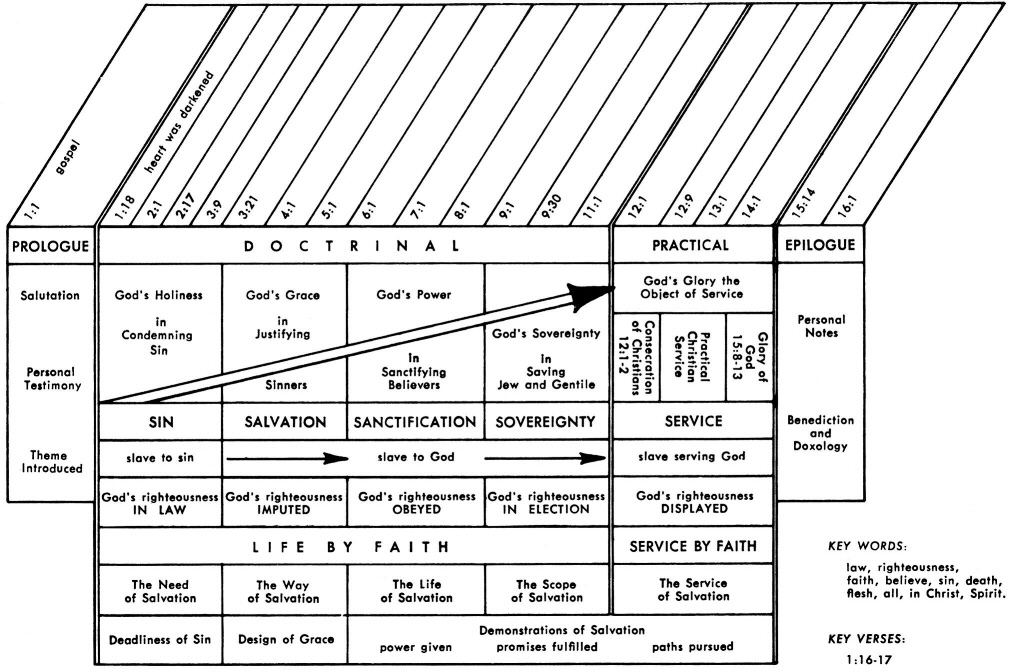
Click chart to enlarge
Chart from recommended resource Jensen's Survey of the NT - used by permission
Romans Overview Chart - Charles Swindoll
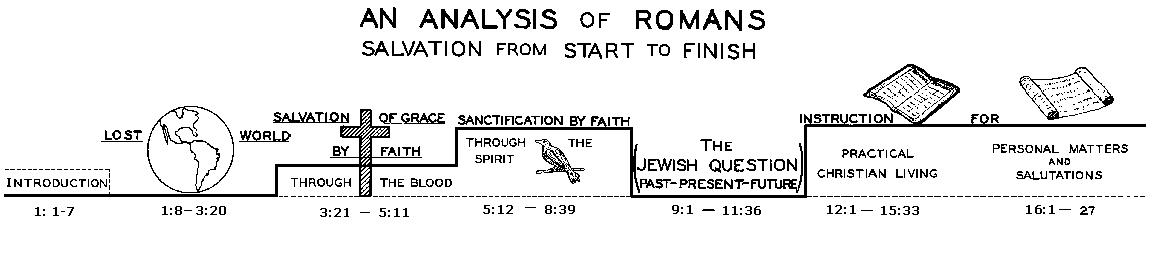
Source: Dr David Cooper
Click to Enlarge
R Ruin (Romans 1:17 – 3:20) – The utter sinfulness of humanity
O Offer (Romans 3:21-31) – God’s offer of justification by grace
M Model (Romans 4:1-25) – Abraham as a model for saving faith
A Access (Romans 5:1-11) – The benefits of justification
N New Adam (Romans 5:12-21) – We are children of two “Adams”
S Struggle w/ Sin (Romans 6-8) Struggle, sanctification, and victory
|
ROMANS ROAD |
||||
| Romans 1:18-3:20 | Romans 3:21-5:21 | Romans 6:1-8:39 | Romans 9:1-11:36 | Romans 12:1-16:27 |
| SIN | SALVATION | SANCTIFICATION | SOVEREIGNTY | SERVICE |
| NEED FOR SALVATION |
WAY OF SALVATION |
LIFE OF SALVATION |
SCOPE OF SALVATION |
SERVICE OF SALVATION |
| God's Holiness In Condemning Sin |
God's Grace In Justifying Sinners |
God's Power In Sanctifying Believers |
God's Sovereignty In Saving Jew and Gentile |
Gods Glory The Object of Service |
| Deadliness of Sin |
Design of Grace |
Demonstration of Salvation | ||
| Power Given | Promises Fulfilled | Paths Pursued | ||
| Righteousness Needed |
Righteousness Credited |
Righteousness Demonstrated |
Righteousness Restored to Israel |
Righteousness Applied |
| God's Righteousness IN LAW |
God's Righteousness IMPUTED |
God's Righteousness OBEYED |
God's Righteousness IN ELECTION |
God's Righteousness DISPLAYED |
| Slaves to Sin | Slaves to God | Slaves Serving God | ||
| Doctrine | Duty | |||
| Life by Faith | Service by Faith | |||
|
Modified from Irving L. Jensen's chart above |
||||
Romans 13:1 Every person is to be in subjection to the governing authorities. For there is no authority except from God, and those which exist are established by God.
Greek: Pasa psuche exousiais huperechousais (PAPFPD) hupotassestho (3SPPM) ou gar estin (3SPAI) exousia ei me hupo theou, ai de ousai (PAPFPN) hupo theou tetagmenai (RPPFPN) eisin (3PPAI).
Amplified: Let every person be loyally subject to the governing (civil) authorities. For there is no authority except from God [by His permission, His sanction], and those that exist do so by God’s appointment. [Proverbs 8:15]
Barclay: Let everyone render due obedience to those who occupy positions of outstanding authority, for there is no authority which is not allotted its place by God,
NLT: Obey the government, for God is the one who put it there. All governments have been placed in power by God.
Phillips: Every Christian ought to obey the civil authorities, for all legitimate authority is derived from God's authority, and the existing authority is appointed under God.
Wuest: Let every soul put himself habitually in subjection to authorities who hold position over them, for there is not an authority except that ordained by God. Moreover, the existing authorities stand permanently ordained by God.
Young's Literal: Let every soul to the higher authorities be subject, for there is no authority except from God, and the authorities existing are appointed by God
| ROMANS ROAD to RIGHTEOUSNESS |
||||
| Romans 1:18-3:20 | Romans 3:21-5:21 | Romans 6:1-8:39 | Romans 9:1-11:36 | Romans 12:1-16:27 |
| SIN | SALVATION | SANCTIFICATION | SOVEREIGNTY | SERVICE |
| NEED FOR SALVATION |
WAY OF SALVATION |
LIFE OF SALVATION |
SCOPE OF SALVATION |
SERVICE OF SALVATION |
| God's Holiness In Condemning Sin |
God's Grace In Justifying Sinners |
God's Power In Sanctifying Believers |
God's Sovereignty In Saving Jew and Gentile |
Gods Glory The Object of Service |
| Deadliness of Sin |
Design of Grace |
Demonstration of Salvation | ||
| Power Given | Promises Fulfilled | Paths Pursued | ||
| Righteousness Needed |
Righteousness Credited |
Righteousness Demonstrated |
Righteousness Restored to Israel |
Righteousness Applied |
| God's Righteousness IN LAW |
God's Righteousness IMPUTED |
God's Righteousness OBEYED |
God's Righteousness IN ELECTION |
God's Righteousness DISPLAYED |
| Slaves to Sin | Slaves to God | Slaves Serving God | ||
| Doctrine | Duty | |||
| Life by Faith | Service by Faith | |||
Modified from Irving L. Jensen's excellent work "Jensen's Survey of the NT"
R Ruin (Romans 1:17 – 3:20) – The utter sinfulness of humanity
O Offer (Romans 3:21-31) – God’s offer of justification by grace
M Model (Romans 4:1-25) – Abraham as a model for saving faith
A Access (Romans 5:1-11) – The benefits of justification
N New Adam (Romans 5:12-21) – We are children of two “Adams”
S Struggle w/ Sin (Romans 6-8) Struggle, sanctification, and victory
LET EVERY PERSON (literally - soul) BE IN SUBJECTION TO THE GOVERNING AUTHORITIES: Pasa psuche exousiais huperechousais (PAPFPD) hupotassestho (3SPPM):
- Deuteronomy 17:12; Ephesians 5:21; Titus 3:1; 1Peter 2:13-17; 2Peter 2:10,11; Jude 8
PAUL'S EXHORTATION REGARDING BEHAVIOR AS GOOD CITIZENS
Deut 17:12 “And the man who acts presumptuously by not listening to the priest who stands there to serve the LORD your God, nor to the judge, that man shall die; thus you shall purge the evil from Israel.
Eph 5:21 and be subject to one another in the fear of Christ.
Ray Pritchard writes that "It has been often said that God only established three institutions--the home, the church, and the state. In so doing, he gave us explicit instructions on how all three were to operate. Most Christians know a great deal about what God has to say about the home and church. We know much less about what God says about the state and how we should relate to it. (How to be a Godly Rebel)
In this section Paul tells us how the citizens of the Kingdom of God are to relate to human kingdoms and governments, so that we can be the kind of citizens and "lighthouses" (cf Mt 5:16) God wants us to be.
“Let every soul put himself habitually in subjection to authorities” (Wuest)
In reading Romans 13 it is important to keep the historical context in mind. The political situation in Rome was difficult to say the least. The Roman Emperor Claudius had earlier expelled the Jews because of a dispute involving a certain “Chrestus” (i.e., Christ), and though the Jews had returned, the political situation was still potentially volatile. Moreover, Paul may have also been concerned about the possible influence of a group of Jews known as Zealots, (or here) who held a revolutionary attitude toward the government of Rome. Paul therefore will give practical instructions on how a believer should live under an unfriendly government. On the other hand Paul does not directly instruct believers on what we ought to do when a government departs from the role God has given it and does not specifically explain what to do when our government is committing a moral wrong (e.g., as in Nazi Germany). Neither are we told what to do in the midst of revolution. Furthermore, Paul does not hold up one form of government (theocracy, monarchy, democracy, dictatorship, etc) over another (e.g., "When Jesus comes back, He won’t be riding an elephant or a donkey” He’s an Independent and He has the only vote that counts!). He is speaking in broad, general terms about all human government anywhere in the world. The institution of government comes from the hand of God. So keep these thoughts in mind as you study Romans 13, so that you will avoid the interpretative danger of trying to read into Paul's treatise something that he did not intend.
Harrison - This is the most notable passage in the NT on Christian civic responsibility. It probably reflects the famous word of Jesus: “Give to Caesar what is Caesar’s, and to God what is God’s” (Matt 22:21). That Paul lived in conformity with his own teaching is apparent from his relation to various rulers as recorded in the Book of Acts. Pride in his Roman citizenship and his readiness to appeal to it in critical situations are also reflected in Acts. Because Paul realized that this subject had a definite bearing on the spread of the gospel (1 Tim 2:1ff.), he saw its relevance in this Epistle on the theme of salvation. (The Expositor's Bible Commentary, Volume 10: Romans Through Galatians)
Wuest discusses a possible reason for why Paul suddenly moves to a discussion of the believer's relationship to the government - "While the Roman local church was predominantly Gentile, yet there were some Jewish members. The Jews of the Roman empire were notoriously bad citizens. Many held on the ground of Deuteronomy 17:15 that to acknowledge a Gentile ruler was sinful. This was the spirit back of the question of the Pharisees who asked, “Is it lawful to give tribute to Caesar, or not?” Gentiles, in contact with such Jewish Christians, could well imbibe the spirit of anarchy which such an attitude would foment. Thus, Paul writes to make sure that these Christians understand their relations and obligations to government. His thesis is in the words of Denney, “Law and its representatives are of God, and as such are entitled to all honor and obedience from Christians.” Human government is a divine institution, instituted by God when Noah came out of the ark, a basic law of which is capital punishment for the murderer duly convicted of his crime (Gen. 9:5, 6). (Wuest's word studies from the Greek New Testament)
Related Resources:
- Taxes - Holman Bible Dictionary
- Tax; Taxing - International Standard Bible Encyclopedia (see #4 for Tax "Under the Romans"
Every (3956) (pas) means "all" without exception. Without the Greek definite article (as in this verse) pas means "every" (of every kind and variety), "each and every one", both individually and collectively. So literally Paul is saying "every soul" which was a Hebraism (i.e., the Hebrews said "every soul" whereas we would say "every one"). Furthermore, "every soul" is emphatic in the Greek, being strategically place first in sentence for emphasis! Paul's point is that there are no exception clauses! This is a universal duty. Christians included for in fact they ought to be the best citizens of all! A believer's submission and dedication to God nor their citizenship in His Kingdom, does not negate or replace his responsibility to the secular authorities. As "aliens and strangers" we are charged to be exemplary subjects to our secular authorities.
Believers then (when Rome ruled with an iron fist) and now might be tempted to feel that since we are "aliens and strangers" (1Pe 2:11-note) in this present world and are citizens of the Kingdom of God (Kingdom of Heaven) (see study of the beatitudes and the Sermon on the Mount) (Php 3:20-note; Heb 12:22-note), we do not need to submit to wicked rulers. We are citizens of heaven, journeying through time on earth. So although heaven is our home, Spirit filled (controlled) believers must be subject to authorities.. Why? Paul says because that authority is established by God.
Person (5590)(psuche) is literally soul. Denney says that "every soul" "is a Hebraism; cf. Acts 2:43; Acts 3:23, and Ro 2:9." (Romans 13 - The Expositor's Greek Testament)
Be in subjection (5293) (hupotasso) (4 times in Romans: Ro 8:7-note, Ro 8:20-note, Ro 10:3-note, Ro 13:5, cf Jesus' example Lk 2:51, cf also James 4:7-note) was a military term that meant to line up under, to place or rank under or to subordinate to. It represented a logistical term which described the arrangement of military implements on a battlefield for effective warfare. “To arrange [troop divisions] in a military fashion under the command of a leader”. Hupotasso is in the present imperative, a command calling for continual obedience. For a believer to fulfill this command, he or she must yield to the "governing" authority of the Holy Spirit Who enables grace based obedience rather than legalistic obedience.
Hupotasso focuses on function, not essence. In non-military use, it was "a voluntary attitude of giving in, cooperating, assuming responsibility, and carrying a burden". The central idea is to be under the authority of some authority.
Stated another way submission means to voluntarily follow the direction of those in authority over you. Submission is not the same as obedience, though the two are related. Obedience relates to outward performance, while submission touches the attitude of the heart toward those who are over you. This distinction is critical because you may not always be able to obey those who are over you, but you can always have a heart attitude of submission.
Submission is believing that God is able to accomplish His will in your life through those He has placed in authority over you. This definition focuses the attention on God, not on the person over you.
As Ray Pritchard explains - "We’ll all have to contend at times with unsaved husbands, mean-spirited parents, cranky bosses, and teachers who can’t wait for the end of the semester. Sometimes we’ll work for people we can’t stand. Or live with people who treat us cruelly. Or suffer under a government that consistently promotes evil. What do you then? Actually, you have many options. You can rebel. You can fight back. You can suffer in silence. You can complain to others. You can get angry and try to get even. You can appeal to the authority over you asking for a redress of your grievances. The most important thing is the attitude of your heart. You must submit to the one in authority in the sense that you must believe that God has put that person in your life for a purpose and that God’s will is somehow being done in your through that person even if you don’t see it and don’t understand it. God says, “By me kings reign.” He takes responsibility for raising up one leader and pulling down another. He stands behind the ballot box and behind the armies that march and the navies that sail. He is Unseen Hand at work in the nations of the world. (How to be a Godly Rebel)
In Ephesians Paul instructs the believers to…
be subject to one another in the fear of Christ. (Eph 5:21- note; Eph 5:24-note)
Note that Paul is addressing the Spirit controlled man or woman, for ultimately our flesh does not desire to be subject to any authority. We need the Spirit's empowerment.
Writing to Titus who was ministering on the isle of Crete which had many rebellious men, empty talkers and deceivers, especially those of the circumcision, Paul instructed Titus to…
Remind (present imperative) - keep reminding them -- they are forgetful would be one implication) them (the believers) to be subject (hupotasso) to rulers, to authorities, to be obedient, to be ready for every good deed - (Titus 3:1-note)
Submission (Webster's 1828 writes that submission means "yield, resign or surrender to the power, will or authority of another") is an act of faith. When we subject ourselves to an authority, we are trusting God to direct in our lives and to work out His purposes in His time (Ep 1:11-note, Ro 8:28-note). After all, there is a danger in submitting to authority -- they might take advantage of us! There is but one limitation to the believer’s obligation under the Lord to willing and complete submission to civil authority: namely, any law or command that would require disobedience to God’s Word (eg., see Ex 1:17-20, Acts 4:18-20; 5:29).
Regardless of the failures of government—many of which are immoral, unjust & ungodly—Christians are to pray (1Ti 2:1-3) and live peaceful lives that influence the world by godly, selfless living, not by protests, sit ins, and marches, much less by rebellion.
Every believer is to be continuously (present tense) subject to these various authorities, even if the authorities are as wicked and depraved as Nero (A.D. 54–68), the emperor in power when Paul wrote this section. Nero's reign brought dark days for Christians. Foxe’s Book of Martyrs describes the scene as follows: In AD 67, Nero ordered the burning of Rome. The fire lasted for nine days and when the blame turned to Nero, Nero blamed the Christians. And Nero came at the Christians with a new vengeance. Nero contrived all manner of punishments for the Christians that the most infernal imagination could design. In particular, he had some sewed up in skins of wild beasts, and then they were attacked by dogs until they expired; and others dressed in shirts made stiff with wax, were fixed to stakes, and set on fire in his gardens, in order to illuminate them. This persecution was general throughout the whole Roman Empire. In the course of it, St. Paul and St. Peter were martyred.
We must also understand the seriousness with which God takes rebellion to governing authorities as illustrated by Korah's refusal to subject himself to Moses' authority (Nu 16:3,13, 30, 32-35, 41,49). Had not Aaron intervened by making atonement for the people, the entire congregation of Israel would have been annihilated (Nu 16:46-48).
Henry Morris - See also I Peter 2:13-17. God instituted the system of human government immediately after the great Flood (Genesis 9:6), and has never changed this. Furthermore, God sometimes may, for His own purposes, place even wicked men in positions of power (e.g., Nebuchadnezzar—note Jeremiah 27:5-7; Daniel 4:17). The Apostle Paul himself was imprisoned and finally executed by Emperor Nero, yet he never counseled rebellion or disobedience, except when human laws demand disobedience to God’s laws (Acts 5:29). Note that Romans 13:4 supports the concept of using “the sword” by government when necessary. This would confirm the principle of justified capital punishment first established in Genesis 9:6, as well as the concept of warfare when justified. (Defender's Study Bible)
Governing (5242) (huperecho from hupér = above, over + écho = have, hold) literally means to hold over or have above, and figuratively to be superior in rank which explains the translation as "governing".
Denney - Huperecho "describes the authorities as being actually in a position of superiority." (Romans 13 - The Expositor's Greek Testament)
Hodge - Huperecho "is applied to any one who, in dignity and authority, excels us. In 1 Peter 2:13, it is applied to the king as supreme, i.e. superior to all other magistrates. But here one class of magistrates is not brought into comparison with another, but they are spoken of as being over other men who are not in office. It is a very unnatural interpretation which makes this word refer to the character of the magistrates, as though the sense were, ‘Be subject to good magistrates.' This is contrary to the usage of the term, and inconsistent with the context. Obedience is not enjoined on the ground of the personal merit of those in authority, but on the ground of their official station. There was peculiar necessity, during the apostolic age, for inculcating the duty of obedience to civil magistrates. This necessity arose in part from the fact that a large portion of the converts to Christianity had been Jews, and were peculiarly indisposed to submit to the heathen authorities. This indisposition (as far as it was peculiar) arose from the prevailing impression among them, that this subjection was unlawful, or at least highly derogatory to their character as the people of God, who had so long lived under a theocracy. In Deuteronomy 17:15, it is said, "Thou shalt in any wise set him king over thee, whom the Lord thy God shall choose; one from among thy brethren shalt thou set king over thee; thou mayest not set a stranger over thee, which is not thy brother." It was a question, therefore, constantly agitated among them, "Is it lawful to pay tribute unto Caesar, or not?" A question which the great majority were at least secretly inclined to answer in the negative. Another source of the restlessness of the Jews under a foreign yoke, was the idea which they entertained of the nature of the Messiah's kingdom. As they expected a temporal Prince, whose kingdom should be of this world, they were ready to rise in rebellion at the call of every one who cried, "I am Christ." The history of the Jews at this period shows how great was the effect produced by these and similar causes on their feelings towards the Roman government. They were continually breaking out into tumults, which led to their expulsion from Rome,‹68› and, finally, to the utter destruction of Jerusalem. It is therefore not a matter of surprise, that converts from among such a people should need the injunction, "Be subject to the higher powers." Besides the effect of their previous opinions and feelings, there is something in the character of Christianity itself, and in the incidental results of the excitement which it occasions, to account for the repugnance of many of the early Christians to submit to their civil rulers. They wrested, no doubt, the doctrine of Christian liberty, as they did other doctrines, to suit their own inclinations. This result, however, is to be attributed not to religion, but to the improper feelings of those into whose minds the form of truth, without its full power, had been received." (Romans 13 - Hodge's Commentary on Romans)
On the eve of Nero’s fiery persecution, Peter gave a similar exhortation to the believers who resided reside as aliens, scattered throughout Pontus, Galatia, Cappadocia, Asia, and Bithynia, instructing them…
Submit (present imperative) yourselves for the Lord's sake to every human institution, whether to a king as the one in authority, 14 or to governors as sent by him for the punishment of evildoers and the praise of those who do right. 15 (Why? How will believers let their light shine forth and give their Father glory? Mt 5:16-note, cf Phil 2:15-note) For (term of explanation) such is the will of God that by doing right (see Good Deeds) you may silence the ignorance of foolish men. 16 Act as free men, and do not use your freedom as a covering for evil, but use it as bondslaves of God. 17 Honor (aorist imperative) all men; love (present imperative) the brotherhood, fear (present imperative) God, honor the king. (1Pe 2:13-17-note)
Comment: Note there are 4 commands in this section. Remember that every command is a "marker" if you will. It is an "opportunity" (actually a necessity) for the believer to jettison self-reliance and to rely fully on the Holy Spirit's enabling power, submitting to His lead. The Spirit will give us both the desire and the power to be able to obey the commands to the glory of the Father. (See Phil 2:13NLT-note)
Authorities (authority) (1849) (exousia) which Vine says evolved "from the meaning of "leave or permission," or liberty of doing as one pleases, it passed to that of "the ability or strength with which one is endued," then to that of the "power of authority," the right to exercise power or "the power of rule or government," the power of one whose will and commands must be obeyed by others. Exousia describes the authority a person has delegated to him from someone else. The person delegating authority is in a sense acting in and through the person to whom he has delegated the authority. Thus, exousia means delegated authority or the power of authority and of the right of that authority. Exousia describes "the right and the might" (see Ro 9:21-note) or the privilege and the power. An authority is anyone who has the right to make decisions that affect your life.
Just a thought to ponder - Sometimes exousia is used to refer to demonic powers (Eph 6:12-note = "our struggle is… against powers [exousia]). This is interesting in view of the fact that in Daniel 10 we encounter a good angelic messenger who tells Daniel that "the prince of the kingdom of Persia was withstanding me for twenty-one days" (Da 10:13-note). The "prince of the kingdom of Persia" was clearly a demon and the designation "of Persia" suggests he in some way exerted influence over the human government of Persia. In any event, God is the one Who is in total control for even the (created) demons must abide by the Creator's directions. Just a thought to ponder.
Exousia is used 3x in this chapter (Ro 13:1-3)
Hodge - By higher powers are most commonly and naturally understood those in authority, without reference to their grade of office, or their character. We are to be subject not only to the supreme magistrates, but to all who have authority over us. The abstract word powers or authorities ( exousia) is used for those who are invested with power, Luke 12:11; Ephesians 1:21; Ephesians 3:10, etc (Romans 13 - Hodge's Commentary on Romans)
Paul well understood "exousia" as illustrated by (Acts 26:10, 26:12)
Martin Luther said it well - A Christian man is the most free lord of all, and subject to none; a Christian man is the most dutiful servant of all, and subject to everyone.
William Barclay - We might be tempted to argue that these passages come from a time when the Roman government had not begun to persecute the Christians. We know, for instance, in the Book of Acts that frequently, as Gibbon had it, the tribunal of the pagan magistrate was often the safest refuge against the fury of the Jewish mob. Time and again we see Paul receiving protection at the hands of impartial Roman justice. But the interesting and the significant thing is that many years, and even centuries later, when persecution had begun to rage and Christians were regarded as outlaws, the Christian leaders were saying exactly the same thing. Justin Martyr (Apology 1: 17) writes, "Everywhere, we, more readily than all men, endeavour to pay to those appointed by you the taxes, both ordinary and extraordinary, as we have been taught by Jesus. We worship only God, but in other things we will gladly serve you, acknowledging you as kings and rulers of men, and praying that, with your kingly power, you may be found to possess also sound judgment." Athenagoras, pleading for peace for the Christians, writes (chapter 37): "We deserve favour because we pray for your government, that you may, as is most equitable, receive the kingdom, son from father, and that your empire may receive increase and addition, until all men become subject to your sway." Tertullian (Apology 30) writes at length: "We offer prayer for the safety of our princes to the eternal, the true, the living God, whose favour, beyond all other things, they must themselves desire… Without ceasing, for all our emperors we offer prayer. We pray for life prolonged; for security to the empire; for protection for the imperial house; for brave armies, a faithful senate, a virtuous people, the world at rest--whatever, as man or Caesar, an emperor would wish." He goes on to say that the Christian cannot but look up to the emperor because he "is called by our Lord to his office." And he ends by saying that "Caesar is more ours than yours because our God appointed him." Arnobius (4: 36) declares that in the Christian gatherings "peace and pardon are asked for all in authority." It was the consistent and official teaching of the Christian Church that obedience must be given to, and prayers made for, the civil power, even when the wielder of that civil power was a Nero. (Romans 13 - William Barclay's Daily Study Bible)
FOR THERE IS NO AUTHORITY EXCEPT FROM GOD: ou gar estin (3SPAI) exousia ei me hupo theou:
- Jn 19:10, Jn 19:11, Pr 8:15-16 Da 2:21 Da 4:32 Da 5:18-23
For - Always pause and ponder this strategic term of explanation.
Denney - It is by God’s act and will alone that there is such a thing as an authority, or magistrate; and those that actually exist have been appointed—set in their place—by Him. (Romans 13 - The Expositor's Greek Testament)
The Authority behind the authorities is God. This is a lot easier to preach in America than it would be in China. We like to think that God is behind governments like America and England, but that He has nothing to do with governments like China. But recall the evil government headed by Pilate that unjustly crucified our Lord (Jn 19:11). Pilate could not have even lifted a finger to crucify Jesus if it were not permitted by God that he do so. In (Romans 9:17) to the Paul tells us that God raised up Pharaoh, that wicked, hardhearted king, and set him on the throne of Egypt. God did that! God made Nebuchadnezzar ("My servant" Jer 25:9) the most powerful ruler in the world & used him to punish His own chosen people. Cyrus was also God's servant, raised up and set on the throne by God (Isa 44:28; 45:1).
All through the OT God represents himself as the controlling force behind every government on earth, without exception. Therefore, it isn't man's elections or his revolutions that determine the governments of earth. We think it is. In Mexico they used to do it by the process of revolution -- you never could change the government there without a revolution. But neither elections nor revolutions determine who sits in the seats of power -- it is God Who does so. These things are only the instruments by which He works His will; and the revelation of Scripture is that God puts in power the men of his choosing, whether they be good or evil, whether they are beneficent rulers or tyrants like Hitler or Stalin or Mao or any of the others on earth by the permissive choice of God. If you struggle with that, it is because you don't see what is behind God's purpose in the world today & that He is El Elyon, the sovereign Most High God over ALL the earth. The questioning of why God allows evil comes because we do not realize that God is not attempting to govern the earth properly -- He is waiting, He is withholding, He is restraining evil, He is governing to a limited extent, -- but He is not trying to do the job as He will someday. We've not seen the end of "His"story ("HISTORY") yet!. Every government that exists is held in the palm of God's hand. It can only go as far as God wills; it is under His control; it has been instituted by Him.
God instituted the system of human government immediately after the great flood when He decreed,
“Whoever sheds man’s blood, by man his blood shall be shed” (Ge 9:5-6).
That decree gave authority to men to judge criminal matters and to punish offenders. (1Pe 2:13-17 Jn 19:11) Furthermore, God sometimes may, for His own purposes, place even wicked men in positions of power (Nebuchadnezzar Jer 27:5-7, Da 4:17). The Apostle Paul himself was imprisoned and finally executed by Emperor Nero, yet he never counseled rebellion or disobedience.
Paul says, human government is ordained by God for the benefit of society. In whatever of the many forms it exists, civil authority derives directly from God. Like marriage, it is a universal institution of God, and, like marriage, it is valid regardless of place, circumstance, or any other consideration. God sovereignly created and absolutely controls the universe, with no exceptions or limitations. Also without exception, the power that any person, group, or society may possess is divinely delegated and circumscribed. How well or how poorly that power is used is another matter. The autocratic, ruthless, and even demonic regimes of Adolph Hitler, Joseph Stalin, and Mao Tse Tung were no exceptions to God’s command to be subject to civil authority. The Roman empire, sometimes ruled by Caesars who proclaimed themselves to be gods, was no exception. The apostate and heretical “Christian” kingdoms of the Middle Ages were no exceptions. Shaman ruled primitive and animistic tribes of South America are no exceptions. Scripture however does make exception in those situations in which obedience to civil authority would require disobedience to God & to God’s Word (eg, Ex 1:17; Da 3:16-18 6:7,10; Ac 4:19-20; 5:28-29).
Richard Halverson the former chaplain of the United States Senate wrote that "To be sure, men will abuse and misuse the institution of the State just as man because of sin has abused and misused every other institution in history including the Church of Jesus Christ, but this does not mean that the institution is bad or that it should be forsaken. It simply means that men are sinners and rebels in God’s world, and this is the way they behave with good institutions. As a matter of fact, it is because of this very sin that there must be human government to maintain order in history until the final and ultimate rule of Jesus Christ is established. Human government is better than anarchy, and the Christian must recognize the “divine right” of the State." (Halverson, R: Prologue to Prison: Cowman Publishers, 1964)
Prayer and Politics, a devotional from Our Daily Bread:
In 1787 a convention was called in the United States to revise the Articles of Confederation. For weeks delegates reviewed ancient history and analyzed modern governments, searching for insights. But nothing suited the infant nation.
Finally, a distinguished gentleman named Benjamin Franklin rose and said, "In this situation of this assembly, groping as it were in the dark to find political truth and scarce able to distinguish it when it is presented to us, how has it happened that we have not hitherto once thought of humbly applying to the Father of Lights to illuminate our understandings?" Mr. Franklin believed there was a sovereign God who could provide guidance to those who sought it.
If ever there was a time to follow that prayerful example, it is now. Paul said that governments are ordained of God (Rom. 13:1), and that we are to pray for those in authority over us (1Ti 2:1-2). This prayer principle also applies to the election of our leaders. We must become informed and vote prayerfully for those who shape our laws.
Because God has instructed us to do so, we can--indeed we must--unashamedly and boldly mix prayer with our politics. --D J DeHaan (Our Daily Bread, Copyright RBC Ministries, Grand Rapids, MI. Reprinted by permission. All rights reserved)
In God we trust, let others trust their rulers,
We trust in God to save us from alarm;
Like broken reeds, the works of man will fail us,
Our God alone can keep us from all harm. --Smith
Whatever makes men good Christians
makes them good citizens.
--Webster
AND THOSE WHICH EXIST ARE ESTABLISHED BY GOD: ai de ousai (PAPFPN) hupo theou tetagmenai (RPPFPN) eisin (3PPAI):
- 1Samuel 2:8; 1Chronicles 28:4,5; Psalms 62:11; Proverbs 8:15,16; Jeremiah 27:5-8; Daniel 2:21; 4:32; Daniel 5:18-23; Matthew 6:13; John 19:11; Revelation 1:5; 17:14; 19:16
AUTHORITY ARRANGED IN ORDER BY DIVINE ORDER
Denney - The Apostle passes from the abstract to the concrete; the persons and institutions in which for the time authority had its seat, are before his mind—in other words, the Empire with all its grades of officials from the Emperor down. (Romans 13 - The Expositor's Greek Testament)
Established by ("Instituted by" = NET, ESV; "put in place" = GWT, "been appointed by" = NJB; "have been placed there" = NLT) (5021) (tasso) means to place, to draw up in order, to arrange in place, assign or dispose to a certain position, order or lot or to a particular task. To ordain or to designate. In relation to a properly assigned authority tasso means = be instituted, be appointed, be established (as here in Ro 13:1). Tasso is used in determining a fixed time or course of events (Mt 28:16, Acts 28:23). Tasso can convey the idea of devoted in some context (1Cor 16:15), of doing something regularly and devotedly.
Tasso is a root word in a number of other Greek words - e.g., atakteo = out of line, disorderly, unruly. Atakteo comes from the verb tassō which is a military term referring to the act of arranging soldiers in military order in the ranks. When the Greeks wanted to make a word mean the opposite to what it meant originally, they placed the letter Alpha as its first letter (a = without + tasso = set in order). Thus atakteō refers to soldiers marching out of order or quitting the ranks, thus being disorderly. The word therefore means “deviating from the prescribed order or rule.” Its original meaning was that of riot or rebellion. The word is found only in the Thessalonian epistles, in its verb form in 2Th 3:7, as an adjective in 1Th 5:14-note (ataktos = unruly = any deviation from the prescribed order or rule of the Christian life), and as an adverb in 2Th 3:6, 11. (Adapted from Word Study by Kenneth Wuest)
Another interesting derivative word is epitasso - which is translated "commands" in Mark 1:27 (And they were all amazed, so that they debated among themselves, saying, “What is this? A new teaching with authority! He commands (epitasso) even the unclean spirits, and they obey Him.”) Wuest explains that
“Commands” is epitassō, a military term; the noun form used in the military sense of an “orderly array.” The single verb tassō was used in classical Greek, “to draw up in order of battle, array, marshal.” Our Lord has the hosts of Satan under His absolute power at all times. Unwilling and incorrigible as they are, He can command them at will, and they obey Him. Satan always operates on a limited tether. To the synagogue crowd, the most astonishing thing was that the demons obeyed Him. (Hallelujah! Our God Reigns!) (Wuest, K. S. Wuest's Word Studies from the Greek New Testament: Eerdmans)
In this verse, the perfect tense pictures a past completed action with present ongoing effect or result and so could be translated "Have been ordained and the ordinance remains in force." Wuest translation brings out the perfect tense "the existing authorities stand permanently ordained by God." Thus human government is a permanent institution brought into being by God for the regulation of human affairs for He alone is the sovereign ruler of the universe (Ps 62:11, 103:19, 1Ti 6:15).
Wuest - The simple verb tassō was used in classical Greek in a military meaning, “to draw up in order of battle, to form, array, marshal” both troops or ships. It speaks of soldiers marshaled in military order under a commanding officer. Thus, it speaks of the subjection of one individual under or to another.
BDAG says tasso means
(1) To bring about an order of things by arranging = to arrange, put in place… of an authority structure (Ro 13:1)… in a person put into a specific position ("to place under authority of another" = Mt 8:9, Lk 7:8)… be put under someone’s command… assign someone to a (certain) classification… passive - belong to, be classed among those possessing ("eternal life" in Acts 13:48)… devote oneself to a service (1Cor 16:15).
(2) To give instructions as to what must be done = to order, fix, determine, appoint (Acts 15:2, 18:2, 22:10) - "set a day" (Acts 28:23), designated a mountain to meet (Mt 28;16). (Arndt, W., Danker, F. W., & Bauer, W. A Greek-English Lexicon of the New Testament and Other Early Christian Literature)
TDNT - “to appoint,” “to order,” with such nuances as “to arrange,” “to determine,” “to set in place,” “to establish,” and middle “to fix for oneself.” (Kittel, G., Friedrich, G., & Bromiley, G. W. Theological Dictionary of the New Testament. Eerdmans)
Liddell-Scott summarizes the secular Greek uses of tasso "To arrange, put in order, Herodotus, etc.: esp. to draw up in order of battle, to form, array, marshal, both of troops and ships… to fall in, form in order of battle… to post, station, Herodotus… to serve among the infantry… to appoint to any service, military or civil… to order one to do a thing… to assign to a class… to appoint, ordain, order, prescribe… of taxes or payments, to appoint or fix a certain payment… to agree upon, to settle… to impose punishments… perfect participle passive = fixed, prescribed,"
Tasso - 8x in 8v in NAS - appointed(2), designated(1), determined(1), devoted(1), established(1), set(1) placed (1)
Matthew 28:16 But the eleven disciples proceeded to Galilee, to the mountain which Jesus had designated.
Luke 7:8 "For I also am a man placed under authority, with soldiers under me; and I say to this one, 'Go!' and he goes, and to another, 'Come!' and he comes, and to my slave, 'Do this!' and he does it."
Acts 13:48 When the Gentiles heard this, they began rejoicing and glorifying the word of the Lord; and as many as had been appointed to eternal life believed.
Acts 15:2 And when Paul and Barnabas had great dissension and debate with them, the brethren determined that Paul and Barnabas and some others of them should go up to Jerusalem to the apostles and elders concerning this issue.
Acts 22:10 "And I said, 'What shall I do, Lord?' And the Lord said to me, 'Get up and go on into Damascus, and there you will be told of all that has been appointed for you to do.'
Acts 28:23 When they had set a day for Paul, they came to him at his lodging in large numbers; and he was explaining to them by solemnly testifying about the kingdom of God and trying to persuade them concerning Jesus, from both the Law of Moses and from the Prophets, from morning until evening.
Romans 13:1 Every person is to be in subjection to the governing authorities. For there is no authority except from God, and those which exist are established by God.
1 Corinthians 16:15 Now I urge you, brethren (you know the household of Stephanas, that they were the first fruits of Achaia, and that they have devoted themselves for ministry to the saints),
Tasso - 59x in the non-apocryphal Septuagint -
Ge 3:24; Exod 8:9, 12; 29:43; 1 Sam 20:35; 22:7; 2 Sam 7:11; 20:5; 23:23; 1 Kgs 2:5; 2 Kgs 10:24, 27; 12:17; 1 Chr 16:4, 7; 17:10; 2 Chr 31:2; Esth 3:13; 8:12; Job 14:13; 30:22; 31:24; 36:13; Song 2:4; 6:4, 10; Isa 38:1; Jer 2:15; 3:19; 5:22; 7:30; 10:22; 11:13; 18:16; 19:8; Lam 3:21; Ezek 4:2; 14:4, 7; 16:14; 17:5; 19:5; 20:28; 24:7; 40:4; 44:5; Hos 2:3, 14; Mic 5:1; Hab 1:12; 2:9; 3:19; Zeph 1:14; Hag 1:5; Zech 7:12, 14; 10:3f; Mal 1:3
Gen 3:24 So He drove the man out; and at the east of the garden of Eden He stationed (Lxx = tasso) the cherubim, and the flaming sword which turned every direction, to guard the way to the tree of life.
Habakkuk 1:12 Are You not from everlasting, O LORD, my God, my Holy One? We will not die. You, O LORD, have appointed (Lxx = tasso ~ designated) them (Babylonians would "judge" Judah for her sins of idolatry and failure to keep the Sabbath years for 490 years) to judge; And You, O Rock, have established them to correct.
Habakkuk 3:19 The Lord GOD is my strength, And He has made (Lxx = tasso ~ He has appointed or designated) my feet like hinds' feet, and makes me walk on my high places. For the choir director, on my stringed instruments.
Haggai 1:5 Now therefore, thus says the LORD of hosts, "Consider (Hebrew = sum = to place, put or set; Lxx = tasso in the aorist imperative = do this - the Greek adds the word "kardia" for heart and so reads something like "Order your heart unto your ways") your ways!
Zechariah 7:12 "They made (Lxx = tasso = they ordered) their hearts like flint so that (term expresses purpose - always begs question - "What purpose?") they could not hear the law and the words which the LORD of hosts had sent by His Spirit through the former prophets; therefore great wrath came from the LORD of hosts.
This principle that all authority is from God is seen in both the Old and New Testament…
He raises the poor from the dust, He lifts the needy from the ash heap To make them sit with nobles, And inherit a seat of honor; For the pillars of the earth are the LORD 's, And He set the world on them. (1Samuel 2:8)
Pr 8:15 “By Me kings reign, and rulers decree justice.16 “By Me princes rule, and nobles, all who judge rightly.
Dan 2:21-note “And it is He who changes the times and the epochs; He removes kings and establishes kings; He gives wisdom to wise men, and knowledge to men of understanding.
Dan 4:32-note and you will be driven away from mankind, and your dwelling place will be with the beasts of the field. You will be given grass to eat like cattle, and seven periods of time will pass over you, until you recognize that the Most High is ruler over the realm of mankind, and bestows it on whomever He wishes.’
"(Speaking of King Nebuchadnezzar Daniel records this incredible event and the even more incredible result) (Nebuchadnezzar) as also driven away from mankind, and his heart was made like that of beasts, and his dwelling place was with the wild donkeys. He was given grass to eat like cattle, and his body was drenched with the dew of heaven, until (a crucial time phrase) he recognized that the Most High (El Elyon) God is Ruler over the realm of mankind, and that He sets over it whomever He wishes." (Daniel 5:21)
Jesus answered (Pilate who claimed to have authority over Jesus' destiny), "You would have no authority over Me, unless it had been given you from above; for this reason he who delivered Me up to you has the greater sin." (John 19:11)
Wuest - “Ordained” is tassō, “to appoint, to assign a place to, to ordain.” The word is in the perfect tense, “have been ordained and as a result remain ordained.” That is, human government is a permanent institution brought into being by God for the regulation of human affairs. The powers or authorities here are seen, not in their individual personalities, but as officers of the law, whose positions are ordained by God. That is, the various offices of civil authority are appointed by God. The structure of government and the laws connected with it are appointed by God as a means of promoting law and order on earth. The incumbents in those offices are not always ordained of God. We know that demons have a great deal to do with various governments. Yet, the Christian is obligated to honor and obey the magistrates under whose jurisdiction he lives. (Wuest's word studies from the Greek New Testament)
John MacArthur has an excellent comment on this section writing that
These seven verses contain the clearest and most specific NT teaching on the Christian’s responsibility to civil authority. Every Christian, no matter what form of government he lives under, is under command from the Lord to maintain proper and useful submission to that government for the sake of leading a peaceful life and having an effective witness. This recurring theme of submission to society’s controlling power is nowhere more forcefully dealt with than here… The monumental miracle of salvation impacts every relationship associated with the believer’s life…
First, and most important and obvious, is the effect on our relationship to God. When we are saved, our initial response should be to fully present our “bodies a living and holy sacrifice, acceptable to God, which is [our] spiritual service of worship” (Ro 12:1- note).
The apostle’s next concern is for our having a right relationship with our brothers and sisters in Christ (Ro 12:3-6-note) and with non Christians, including even our enemies (Ro 12:17-note Ro 12:18-21-note).
After dealing with those matters, the inspired writer focuses on the need to have a right relationship to the human governments under which we live (Romans 13:1-7). Due to the religious freedom that most westerners have enjoyed for many generations, it is difficult for believers living in such countries to fully appreciate the struggle that many of their brothers and sisters in Christ face under regimes that restrict freedom and oppress Christianity…
We are to be the conscience of the nation through faithful preaching & godly living, confronting it not with the political pressure of man’s wisdom—including our own—but with the spiritual power of God’s Word. Using legislation, adjudication, or intimidation to achieve a superficial, temporal “Christian morality” is not our calling—and has no eternal value… the Christian’s priority [is] of proclaiming the gospel and living a holy life to demonstrate that God is a saving God.
Both the Old and New Testament present illustrations of believers whose earthly role placed them in civil service, and they were useful to God there. Joseph in Egypt and Daniel in Babylon are the two supreme Old Testament examples. After Jesus healed the centurion’s servant, He did not advise him to leave the army (Mt 8:5-13). After Zaccheus was converted, he did not leave his civil profession but became an honest tax collector (see Lk 19:1-10). Cornelius, another Roman centurion, was saved through the ministry of Peter and continued to serve in the army (Ac 10). And there is no reason to believe that the proconsul Sergius Paulus did not remain in his high civil office after he was saved (Acts 13:4-12).
In a message delivered at Oxford University in 1898, the British theologian Robert L. Ottley observed: "The Old Testament may be studied … as an instructor in social righteousness. It exhibits the moral government of God as attested in his dealings with nations rather than with individuals; and it was their consciousness of the action and presence of God in history that made the prophets preachers, not merely to their countrymen, but to the world at large… There is indeed significance in the fact that in spite of their ardent zeal for social reform they did not as a rule take part in political life or demand political reforms. They desired… not better institutions but better men." (Romans - Moody Publishing)
Henry Alford - “We may observe that the apostle here pays no regard to the question of the duty of Christians in revolutionary movements. His precepts regard an established power, be it what it may. It, in all matters lawful, we are bound to obey. But even the parental power does not extend to things unlawful. If the civil power command us to violate the law of God, we must obey God before man. If it commands us to disobey the common laws of humanity, or the sacred institutions of our country, our obedience is due to the higher and more general law, rather than the lower and particular. These distinctions must be drawn by the wisdom granted Christians in the varying circumstances of human affairs: they are all only subordinate portions of the great duty of obedience to LAW. To obtain, by lawful means, the removal or alteration of an unjust or unreasonable law, is another part of this duty: for all powers among men must be in accord with the highest power, the moral sense. But even where law is hard and unreasonable, not disobedience, but legitimate protest, is the duty of the Christian. (Romans 13 - Greek Testament Critical Exegetical Commentary)
Steven Cole - Imagine that you are a Christian farmer, living peacefully in colonial America, when word comes that a bunch of politicians in Philadelphia have declared independence from Great Britain. You are aware of what Paul teaches in Romans 13 about being in submission to the governing authorities. What should you do? Which side should you take? What if General Washington later conscripts you to join his revolutionary army?
Or, you’re living in Germany in the 1930’s when Adolph Hitler came to power. You watch with growing horror as he begins systematically exterminating the Jews. Some of your Jewish neighbors, who were good friends, are herded off to the death camps, never to be seen alive again. Then you hear about a plot to assassinate Hitler and you’re invited to join the conspiracy. If Hitler could be killed, it could conceivably save the lives of millions of Jews. But you’re aware of Romans 13, which commands you to be subject to the governing authorities. What should you do?
How should Christians relate to their government? If you think that I’m going to be able to give easy answers to these issues, thank you for your confidence in my wisdom, but I’m afraid that you’re too optimistic! Hopefully, none of us will ever face dilemmas as difficult as the ones I’ve described. But Romans 13:1-7 raises these and other important issues concerning our relationship as Christians with the government. When (if ever) is civil disobedience justifiable? What about armed rebellion or revolution against a corrupt government? What about capital punishment? Should Christians withhold part of their taxes to protest government misuse of our tax dollars?
At first glance, Romans 13:1-7 may seem to be out of context. Paul shifts subjects with no transition or introduction. But in the context, Paul is speaking about how believers are to live in love and to get along peaceably with all people. He has just forbidden taking vengeance and advocated treating with kindness those who mistreat us. This raises the questions, “Is it wrong to report those who mistreat us to civil authorities for prosecution? Is it wrong to use force to resist an aggressor?” So Paul shows that it is proper for the government to protect law-abiding citizens and to punish evildoers.
Also, Paul was writing to Christians, some of whom were Jews, in the capital of the Roman Empire. Claudius, the previous emperor, had expelled the Jews from Rome a few years before because he viewed them as dangerous (Acts 18:2). The Jews hated being under Roman rule. The Romans often viewed Christians as a Jewish sect, so that suspicion of revolution was always a concern in the minds of the rulers. Also, Christians easily could have taken Jesus’ teaching about the coming kingdom of God to mean that they should work for the overthrow of the secular, morally corrupt government in order to help bring in Christ’s kingdom. In fact, when Paul wrote Romans, Nero, one of the most evil rulers of all time, was on the throne. What a time for a revolution!
So Paul wanted the Roman Christians to be clear on how they should relate to the civil government. In Paul’s day, there was no Christian consensus or Christian-based constitutional law. There was no Jewish theocracy, as in the Old Testament. But these principles, inspired by the Holy Spirit, apply to believers down through the ages, living under various forms of government. Contrary to what many Americans may think, the Bible never mandates one type of government over another. While arguably a constitutional democracy with a balance of powers is the best form of government, the Bible does not ordain it or forbid monarchy or other forms of government. We can sum up Romans 13:1-7:
Because God has ordained government authority for our good, we must be subject to our government. First, I’ll give a brief overview of Paul’s flow of thought and then we’ll explore four principles stemming from the text. First (Ro 13:1) Paul states that every person is to be subject to the governing authorities, because God is the sovereign who ordains all human governments. Then (Ro 13:2) he draws the implication: If you resist government authority, which God has established, you are opposing God Himself and you’ll come under judgment. Then (Ro 13:3-4) Paul explains that the purpose of civil government is to protect law-abiding citizens and punish law-breakers. As such, the government is acting as a minister of God in avenging wrong. Thus (Ro 13:5) there are two reasons to be in subjection to the government: Fear of punishment and conscience before God, who has ordained the government. Finally (Ro 13:6-7), Paul applies it by showing why we should pay taxes, namely, because government officials are servants of God. Thus they deserve our taxes as well as our respect. The general principle: Since God has ordained government authority, we must be subject to it (13:1-2).
Paul first lays down a general principle (13:1a), “Every person is to be in subjection to the governing authorities.” Then (13:1b) he explains the reason behind this principle: “For there is no authority except from God, and those which exist are established by God.” He follows this (13:2) with a logical conclusion: “Therefore whoever resists authority has opposed the ordinance of God; and they who have opposed will receive condemnation upon themselves.”
God has ordained various spheres of authority for the blessing and protection of those under authority: the government, the local church, the family, and employment. Due to sin, those in authority are often prone to misuse their authority for their own benefit, not for the benefit of those under their authority. But Paul, writing under wicked Nero, does not allow for exceptions. He states categorically (13:1b), “For there is no authority except from God, and those which exist are established by God.” Therefore every person is to be subject to their civil government.
Some do not want to go so far as to say that God established or ordained wicked tyrants like Nero. So they say that God ordained the institution of government, not the individual rulers. But that is a weak attempt to dodge a problem that Scripture repeatedly affirms. For example, Jeroboam, who rebelled against Solomon’s son, Rehoboam, subsequently set up false gods and a false worship center so that his people would not go to Jerusalem. Yet his rebellion and kingdom was “a turn of events from the Lord,” to establish His prophecy through Ahijah (1 Kings 12:15).
Nebuchadnezzar’s army destroyed Jerusalem, including the temple, slaughtered many Jewish people, and carried most of the survivors to Babylon. But God calls him His “servant” and says that He gave all of the land he conquered into his hand (Jer. 27:6).
Pilate was a pagan Roman governor who allowed Jesus to be crucified. Note this interesting exchange between Pilate and Jesus (John 19:10-11): “So Pilate said to Him, ‘You do not speak to me? Do You not know that I have authority to release You, and I have authority to crucify You?’ Jesus answered, ‘You would have no authority over Me, unless it had been given you from above; for this reason he who delivered Me to you has the greater sin.’”
Even the wicked dragon (Satan) and the beast (Antichrist) do not thwart God’s purpose for the ages. They are under His sovereign authority, even when they persecute the saints (Rev. 13). Daniel’s testimony to both Nebuchadnezzar and Belshazzar was consistent and clear: “The Most High is ruler over the realm of mankind and bestows it on whomever He wishes” (Dan. 4:17, 25, 32; 5:21).
When Paul says (Ro 13:2) that those who disobey government authority “will receive condemnation upon themselves,” I understand him primarily to be referring to the judgment that the government brings on law-breakers. In Ro 13:4 he says that the government “bears the sword,” which refers to the authority to punish law-breakers. He also calls it “an avenger who brings wrath on the one who practices evil.” These expressions do not refer to God’s eternal wrath, but to His temporal wrath inflicted by the government on evildoers so that it can uphold law and order.
Thus, because the government is God’s minister to inflict punishment on those who do evil, Christians must be in subjection to the government. But this raises the questions, “What about civil disobedience against corrupt governments or bad laws? What about armed rebellion against evil, tyrannical governments?”
Regarding civil disobedience, when the government commands us to do something that is disobedient to God’s Word, we must resist the government and obey God. When the Sanhedrin commanded Peter and John to stop speaking in the name of Jesus, they replied (Acts 4:19-20), “Whether it is right in the sight of God to give heed to you rather than to God, you be the judge; for we cannot stop speaking about what we have seen and heard.” Later, when the command was repeated, Peter answered (Acts 5:29), “We must obey God rather than men.” Shadrach, Meshach, and Abed-nego refused to bow before Nebuchadnezzar’s idol (Dan. 3). In defiance of the king’s edict, Daniel continued to pray (Dan. 6).
If the government forced us to abort babies to maintain population control, we should resist. If the government forbad us to gather as believers, we should gather anyway. If the government banned the Bible, we should own and distribute Bibles anyway. If the government commanded us not to say anything against homosexual behavior, we should teach what the Bible says anyway.
Should Christians ever take up arms against the government or attempt to assassinate a wicked ruler, such as Hitler? Were the thirteen colonies right to declare independence from Britain? These are difficult questions that must be prayerfully thought through in each situation. Godly believers differ in their conclusions.
While I would agree that it is wrong to murder an abortionist, which would be overcoming evil by evil (Ro 12:21), I must admit that if I had lived in Nazi Germany and had had an opportunity to take out Hitler, it would have been very tempting. As you know, Dietrich Bonhoeffer was arrested and subsequently hanged because he was part of a plot to assassinate Hitler. Killing Hitler would have saved the lives of millions of Jews. I realize that by the same logic it could be argued that killing an abortionist saves hundreds of babies. So I’m being a bit inconsistent. But Hitler was so horrifically evil that, as I said, it would have been tempting to kill him.
Regarding revolution against the government, I agree with Sam Storms, who writes (on EnjoyingGodMinistries.com), “Armed revolution is justified … only if the state has become totally opposed to the purpose for which God ordained it, and if there is no other recourse available to prevent massive evil.” Obviously, this involves a judgment call. Some justify the American Revolution on the principle “that it is morally right for a lower government official to protect the citizens in his care from a higher official who is committing crimes against these citizens” (cited by Wayne Grudem, Politics According to the Bible [Zondervan], p. 89, italics his). This view goes back to Calvin’s Institutes (ibid.).
But in my judgment, I cannot justify the American Revolution on biblical grounds, although I am thankful for our nation and our freedoms. While King George was corrupt and repressive, I don’t think he was so bad as to justify rebellion. Again, I realize that godly thinkers disagree on this. It’s not an easy issue! But the general principle is clear and exceptions to it must be weighed very carefully: Since God has ordained government authority, we must be in subjection to it or we are in rebellion against God Himself. (The Government and You) (See Cole's related updated sermon - Christ- Lord of our Politics)
Romans 13:2 Therefore whoever resists authority has opposed the ordinance of God; and they who have opposed will receive condemnation upon themselves.
Greek: hoste o antitassomenos (PMPMSN) te exousia te tou theou diatage anthesteken (3SRAI) hoi de anthestekotes (RAPMPN) heautois krima lempsontai (3PFMI)
Amplified: Therefore he who resists and sets himself up against the authorities resists what God has appointed and arranged [in divine order]. And those who resist will bring down judgment upon themselves [receiving the penalty due them].
Barclay: So he who sets himself up against authority has really set himself up against God’s arrangement of things. Those who do set themselves against authority will receive condemnation upon themselves.
NLT: So those who refuse to obey the laws of the land are refusing to obey God, and punishment will follow.
Phillips: Every Christian ought to obey the civil authorities, for all legitimate authority is derived from God's authority, and the existing authority is appointed under God. To oppose authority then is to oppose God, and such opposition is bound to be punished.
Wuest: So that the one who sets himself in array against the authority, against the ordinance of God has set himself, with the result that he is in a permanent position of antagonism against the ordinance. And those who resist shall receive for themselves judgment.
Young's Literal: so that he who is setting himself against the authority, against God’s ordinance hath resisted; and those resisting, to themselves shall receive judgment.
THEREFORE HE WHO RESISTS AUTHORITY: hoste o antitassomenos (PMPMSN) te exousia:
- Jeremiah 23:8-17; 44:14-17; Titus 3:1
"Therefore he who resists and sets himself up against the authorities" (Amplified)
Therefore (5620) (hoste) introduces a conclusion, the logical result (see term of conclusion) - Because God has willed that there be orderly states, anyone who sets himself in opposition rebels against what God has ordained. Paul is making it clear that the believer is to respect the state & not make himself the final arbiter. Manson adds "Resistance to legitimate authority legitimately exercised is wrong."
To resist the authorities that God has set in place is to resist what God has commanded and such resisters will bring judgment on themselves. As alluded to above, there is an exception. A Christian is not required to obey if the government orders him to sin or to compromise his loyalty to Jesus Christ (Acts 5:29).
No government has a right to command a person’s conscience. So there are times when a believer must, by obeying God, incur the wrath of man. In such cases he must be prepared to pay the penalty without undue complaint.
Resists (498) (antitassomai from antí = against + tasso = arrange) literally means to "array against". To oppose someone involves an attitude and also corresponding action (be hostile toward, to show hostility).
Antitasso - 5x in 5v - Acts 18:6; Ro 13:2; James 4:6-note; James 5:6; 1 Pet 5:5-note
The verb is in the present tense which pictures one who continually or habitually resists authority and dos so as a lifestyle. In addition the verb is in the middle voice which brings out the reflexive meaning and so means to set oneself against, to resist or to oppose. Antitassomai was a military term found in the papyri and pictured an army arrayed against the enemy forces.
For example, Peter uses antitasso…
You younger men, likewise, be subject to your elders; and all of you, clothe yourselves with humility toward one another, for GOD IS OPPOSED (present tense = continually!!!) TO THE PROUD, BUT GIVES GRACE TO THE HUMBLE. (1Pe 5:5-note, compare James 4:6-note)
Authority (1849) (exousia from éxesti = it is permissible, allowed; it is lawful) describes the authority a person has delegated to him from someone else. Exousia means "delegated authority" or the power of authority and of the right of that authority. From the permission, or liberty of doing as one pleases, it passed to that of the ability or strength with which one is endued, then to that of the power and authority, the right to exercise power; liberty of doing as one pleases. Exousia combines the ideas of right and might.
Vine says exousia evolved "from the meaning of "leave or permission," or liberty of doing as one pleases, it passed to that of "the ability or strength with which one is endued," then to that of the "power of authority," the right to exercise power… or "the power of rule or government," the power of one whose will and commands must be obeyed by others.
In short exousia is "the right and the might" (see Ro 9:21).
HAS OPPOSED THE ORDINANCE OF GOD: te tou theou diatage anthesteken (3SRAI):
- Isaiah 58:2; 1Peter 2:13
Opposed (4368) (anthistemi from anti = against + histemi = stand) means literally to set one's self against, to resist or oppose whether in deed or word. It means to arrange in battle against and so pictures a face to face confrontation. It means to oppose (place opposite or against), to resist by actively opposing pressure or power, to withstand (oppose with firm determination) and involves not only a psychological attitude but also a corresponding behavior.
Anthistemi - 14x in 12v -Mt 5:39; Lk 21:15; Acts 6:10; 13:8; Ro 9:19-note; Ro 13:2; Gal 2:11; Eph 6:13-note; 2Ti 3:8-note; 2Ti 4:15-note; Jas 4:7-note; 1Pet 5:9-note
There is a right time and a wrong time for opposing…
Eph 6:13-note Therefore, take up the full armor of God, that you may be able to resist (anthistemi) in the evil day, and having done everything, to stand firm.
2Ti 3:8-note And just as Jannes and Jambres opposed (anthistemi) Moses, so these men also oppose (anthistemi) the truth, men of depraved mind, rejected as regards the faith.
Opposed is perfect tense = “so that the one who sets himself in array against the aforementioned authority, against the ordinance of God has set himself, with the result that he is in a permanent position of antagonism (against the ordinance).” This suggests that the rebellion had hardened into an established policy.
Ordinance (1296) (diatage from diatásss - see here for important discussion = arrange thoroughly, appoint, command, set in order) refers to an order, a disposition or an ordinance. It is that which has been specifically ordered or commanded and was the customary term for an official decree e.g. by emperor or governor. Diatage is that which has been ordered or commanded, and so it represents an ordinance, disposition or direction. It is a noun that describes how a matter has been arranged.
The only other NT use (once in Ezra 4:11) of diatage is
Acts 7:53+ you who received the law as ordained by angels, and yet did not keep it.
Young's Literal Acts 7:53 who received the law by arrangement of messengers, and did not keep it.'
NET Bible comment: Traditionally, "as ordained by angels," but eis with the accusative here should be understood as instrumental (a substitute for en)… Thus the phrase literally means "received the law by the decrees [orders] of angels" with the genitive understood as a subjective genitive, that is, the angels gave the decrees… Decrees given by angels. According to Jewish traditions in the first century, the law of Moses was mediated through angels… The Greek word phulasso (traditionally translated "keep") in this context connotes preservation of and devotion to an object as well as obedience.
To oppose authority established by God is to bring judgment on yourself. It may mean judgment by God, it certainly means judgment by the authority. If you doubt that, just trying mouthing off the next time you are pulled over for speeding. If you argue too much, you may find yourself spending the night in the county jail.
Paul is saying if we resist the government, we resist God. But Paul is not teaching blind devotion to the state regardless of what it commands. Indeed this is how some Christians interpreted this passage in Nazi Germany despite Germany’s despicable treatment of the Jews. This passage must be compared with parallel passages, and when we do so it is clear that the Christian’s obedience to the state is always conditional, and sometimes disobedience is a duty as for example when government's command directly counters God's commands.
In Acts 5 the Jewish high priest and Sadducees who were filled with jealously toward Peter and the apostles for the great works they were performing in Jerusalem. As a result they imprisoned them only to have God provide a supernatural "jail break" with orders to continue speaking the whole message of this life which led to their being re-arrested. Luke records that
when they had brought (Peter and the apostles), they stood them before the Council (Sanhedrin). And the high priest questioned them, 28 saying, "We gave you strict orders not to continue teaching in this name, and behold, you have filled Jerusalem with your teaching, and intend to bring this man's blood upon us." 29 But Peter and the apostles answered and said, "We must obey God rather than men. (Acts 5:27-29)
The important point is that the command of God always takes precedence over the command of the government. There are no exceptions. But the fact remains that we must be prepared to pay the potential price. R Kent Hughes tells the story that took place in 1962…
Aida Skripnikova, a brand-new Christian, was arrested on the Nevski Prospect in Leningrad for handing out postcards proclaiming Christ—and spent most of her life in labor camps because she would not refrain from sharing her faith in Christ.(Hughes, R. K. Romans: Righteousness from heaven. Preaching the Word. Crossway)
Hughes goes on to quote Colonel Al Shine, former professor of military science at Wheaton College, who wrote the following comment on Romans 13…
These verses are not in good repute in some circles today, through no fault of their own, but because some have taken them out of the context of the whole of Scripture to argue that disobedience to any government, under any circumstances, is unbiblical. But it is nonetheless clear that these verses, supported and amplified by other portions of the Word, and contradicted by none, teach the legitimacy of human government. Bearing the sword, in order to execute justice, is a proper duty of human governments.. The soldier does not, of course, have a blanket license to hate or kill. As an individual sinner, prone to avenge and resist personal abuse, he must, like all other believers, restrain himself. He should, I believe, examine himself. He should, I believe, examine the cause for which his nation fights, and if he concludes that it is evil and unjust he should refuse to participate. Even when he finds the cause acceptable, he may at times feel led to disobey certain orders that he feels abuse the proper use of force. (Finally Hughes concludes that) a Christian must disobey his government when it asks him to 1) violate a commandment of God, 2) commit an immoral or unethical act, or 3) go against his Christian conscience (a conscience which is informed by Scripture and is in submission to the Spirit of God). (Hughes, R. K. Romans: Righteousness from heaven. Preaching the Word. Crossway)
Peter calls on all believer to "Keep (It is actually a present participle but is used in context with the imperative sense) your behavior excellent among the Gentiles, so that in the thing in which they slander you as evildoers, they may on account of your good deeds, as they observe them, glorify God in the day of visitation. 13 Submit (aorist imperative) yourselves for the Lord's sake to every human institution, whether to a king as the one in authority, 14 or to governors as sent by him for the punishment of evildoers and the praise of those who do right. 15 For such is the will of God that by doing right you may silence the ignorance of foolish men. (1Pe 2:12-note 1Pe 2:13-15-note)
Harrison - Submission to authority was characteristic of the Lord's behavior, since the state was understood to be God's provision for human safety and well-being. While the ideal state was theocratic, it could not be realized until the kingdom of God was consummated. Meanwhile the governing authorities had to be accepted as a divine surrogate, and consequently, disobeying them was the same as disobeying God (Romans 13:2 ). Peaceful behavior as a citizen would be rewarded in due time, but evildoing would be punished, because that was one of the important responsibilities of the state (Romans 13:4 ). Paul taught his hearers that, regardless of the character of the state's leaders, its authority was still to be recognized because that authority proceeded ultimately from God. Paul set an example for all believers by submitting to the laws of the Roman Empire, which in any event was a matter of moral obligation since he was a Roman citizen. By following established procedures he enjoyed the protection of the state at times when fanatical Jews would have killed him (Acts 23:12-13 ), and was actually treated reasonably well by Roman authorities such as Felix, Festus, and even Agrippa, who was of the family of Herod and owed his title of "king" (Acts 25:24 ) to the Romans. The remarkable period of peace and prosperity (Pax Romana) which the emperor Augustus instituted established the authority of the emperor, but also placed considerable emphasis upon the emperor's subjects, one-half of whom were slaves. It was thus entirely proper for Christian leaders such as Peter to require believers to submit to "every authority instituted among men, " whether to a supreme king or state officials appointed by him (1 Peter 2:13-14 ). While the official worship of the emperor was incompatible with acknowledging Jesus as Lord, the king was to be given the honor due to his position as an authority figure under the hand of God (1 Peter 2:17 ). The New Testament does not forbid Christians to serve as government officials, which is proper inasmuch as it permits the leaven of the gospel to work in secular society. Whatever Christians may think about the nature and objectives of civil government they are encouraged to work toward such changes as will benefit society and honor Christ. But civil disobedience, whatever the intentions of the participants, will bring down upon them the wrath of the state, and may well thwart movements toward the same objectives that are being done legally, if covertly. Anything that disintegrates the state inevitably brings social chaos and this is contrary to the Lord's decree that everything should be done decently and in order. (Government - Baker's Evangelical Dictionary of Biblical Theology)
Related Resources:
- What does the Bible say about government?
- Government - Hastings' Dictionary of the Bible
- Government - Bridgeway Bible Dictionary
- Government - Holman Bible Dictionary
- Government - The 1901 Jewish Encyclopedia
AND THEY WHO HAVE OPPOSED WILL RECEIVE CONDEMNATION UPON THEMSELVES: hoi de anthestekotes (RAPMPN) heautois krima lempsontai (3PFMI):
- Ro 13:5; Matthew 23:14; Mark 12:40; Luke 20:47; James 3:1
ESV - those who resist will incur judgment
GWT - Those who resist will bring punishment on themselves.
NJB - rebels must expect to receive the condemnation they deserve.
Philips - such opposition is bound to be punished.
YLT - and those resisting, to themselves shall receive judgment.
Opposed (4368) (anthistemi [word study]) suggests vigorously opposing or standing face-to-face against. As noted above, when we oppose the "ordinance of God", this involves not only a psychological attitude also a corresponding behavior. The perfect tense conveys the idea of a fixed and determined opposition to authority, not just one slip up.
Condemnation (2917) (krima [word study] from kríno = to judge and the suffix –ma indicates the result of judging) denotes the result of the action signified by verb krino which means to judge. It can describe a judicial sentence from the magistrate or a decision (severe or mild) one passes on faults of others. Thus it describes a judgment, a sentence pronounced, or a verdict, usually negative in New Testament.
Passages dealing with receiving condemnation…
Mark 12:40 who devour widows’ houses, and for appearance’s sake offer long prayers; these will receive greater condemnation.”
Jas 3:1 Let not many of you become teachers, my brethren, knowing that as such we shall incur a stricter judgment.
The KJV is a bit strong in its translation of krima as "damnation". Krima does not refer to in the lake of fire as might be inferred from the KJV translation, but instead refers to punishment from the government for breaking the law although some feel the condemnation does include an element of divine judgment. In a sense the punishment carried out by the governing authorities is the way divine judgment is meted out.