Romans 1:2
Romans 1:3
Romans 1:4
Romans 1:5
Romans 1:6
Romans 1:7
Romans 1:8
Romans 1:9
Romans 1:10
Romans 1:11
Romans 1:12
Romans 1:13
Romans 1:14
Romans 1:15
Romans 1:16
Romans 1:17
Romans 1:18
Romans 1:19
Romans 1:20
Romans 1:21
Romans 1:22
Romans 1:23
Romans 1:24
Romans 1:25
Romans 1:26
Romans 1:27
Romans 1:28
Romans 1:29
Romans 1:30
Romans 1:31
Romans 1:32

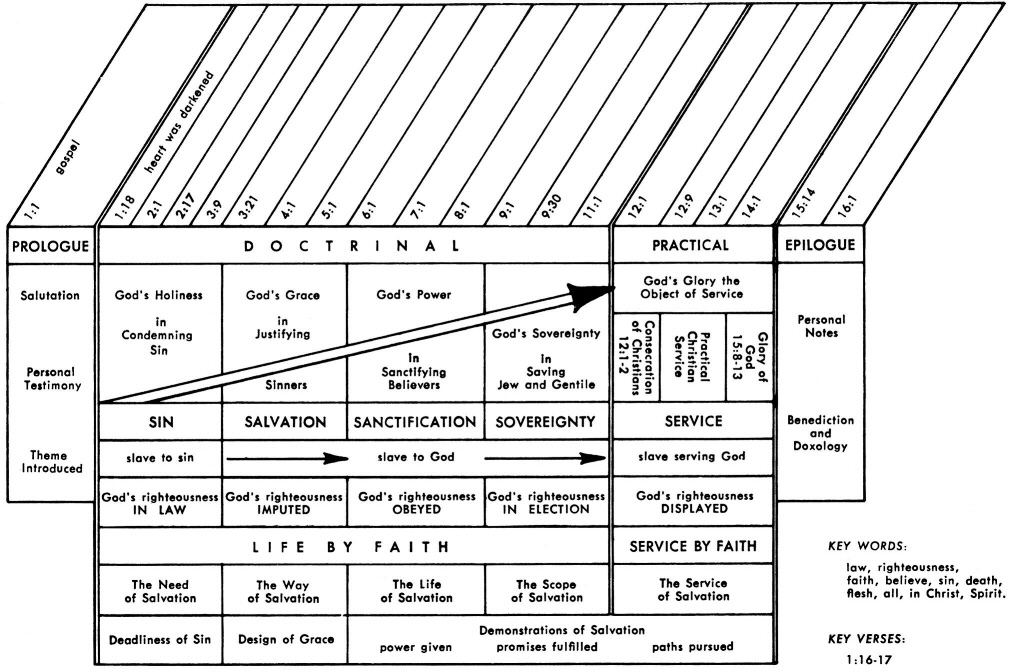
Click chart to enlarge
Chart from recommended resource Jensen's Survey of the NT - used by permission
Romans Overview Chart - Charles Swindoll
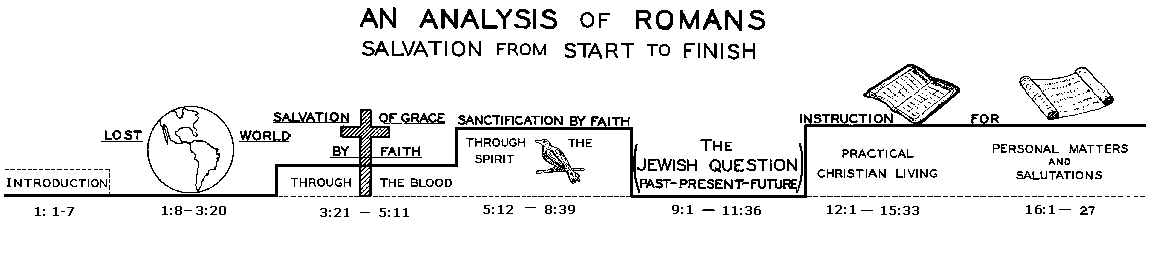
Source: Dr David Cooper
Click to Enlarge
R Ruin (Romans 1:17 – 3:20) – The utter sinfulness of humanity
O Offer (Romans 3:21-31) – God’s offer of justification by grace
M Model (Romans 4:1-25) – Abraham as a model for saving faith
A Access (Romans 5:1-11) – The benefits of justification
N New Adam (Romans 5:12-21) – We are children of two “Adams”
S Struggle w/ Sin (Romans 6-8) Struggle, sanctification, and victory
|
ROMANS ROAD |
||||
| Romans 1:18-3:20 | Romans 3:21-5:21 | Romans 6:1-8:39 | Romans 9:1-11:36 | Romans 12:1-16:27 |
| SIN | SALVATION | SANCTIFICATION | SOVEREIGNTY | SERVICE |
| NEED FOR SALVATION |
WAY OF SALVATION |
LIFE OF SALVATION |
SCOPE OF SALVATION |
SERVICE OF SALVATION |
| God's Holiness In Condemning Sin |
God's Grace In Justifying Sinners |
God's Power In Sanctifying Believers |
God's Sovereignty In Saving Jew and Gentile |
Gods Glory The Object of Service |
| Deadliness of Sin |
Design of Grace |
Demonstration of Salvation | ||
| Power Given | Promises Fulfilled | Paths Pursued | ||
| Righteousness Needed |
Righteousness Credited |
Righteousness Demonstrated |
Righteousness Restored to Israel |
Righteousness Applied |
| God's Righteousness IN LAW |
God's Righteousness IMPUTED |
God's Righteousness OBEYED |
God's Righteousness IN ELECTION |
God's Righteousness DISPLAYED |
| Slaves to Sin | Slaves to God | Slaves Serving God | ||
| Doctrine | Duty | |||
| Life by Faith | Service by Faith | |||
|
Modified from Irving L. Jensen's chart above |
||||
Romans 1:5 through Whom we have received (AAI) grace and apostleship to bring about the obedience of faith among all the Gentiles for His name's sake (NASB: Lockman)
Greek: di' ou elabomen (1PAAI) charin kai apostolen eis hupakoen pisteos en pasin tois ethnesin huper tou onomatos autou
Amplified: It is through Him that we have received grace (God’s unmerited favor) and [our] apostleship to promote obedience to the faith and make disciples for His name’s sake among all the nations, (Amplified Bible - Lockman)
ESV: through whom we have received grace and apostleship to bring about the obedience of faith for the sake of his name among all the nations, (ESV)
GWT: Through him we have received God's kindness and the privilege of being apostles who bring people from every nation to the obedience that is associated with faith. This is for the honor of his name. (GWT)
ICB: Through Christ, God gave me the special work of an apostle. This was to lead people of all nations to believe and obey. I do this work for Christ. (ICB: Nelson)
KJV: By whom we have received grace and apostleship, for obedience to the faith among all nations, for his name:
NIV: Through him and for his name's sake, we received grace and apostleship to call people from among all the Gentiles to the obedience that comes from faith. (NIV - IBS)
NLT: Through Christ, God has given us the privilege and authority to tell Gentiles everywhere what God has done for them, so that they will believe and obey him, bringing glory to his name. (NLT - Tyndale House)
Phillips: from whom we received grace and our commission in his name to forward obedience to the faith in all nations. (New Testament in Modern English)
Wuest: through whom we received grace and apostleship in order that there may be obedience to the Faith among all the Gentiles in behalf of His name, (Erdmans)
Young's Literal: through whom we did receive grace and apostleship, for obedience of faith among all the nations, in behalf of his name;
THROUGH WHOM WE HAVE RECEIVED GRACE AND APOSTLESHIP: di ou elabomen (1PAAI) charin kai apostolen:
- Ro 12:3; 15:15, 16; Jn 1:16; Acts 20:24, 1Co 15:10,; 2Co 3:5, 3:6; Gal 1:15, 1:16; Ep 3:2, 3, 4, 5, 6, 7, 8, 9; 1Ti 1:11; 1:12
- See Torrey's Topic Grace
Through him we have received God's kindness and the privilege of being apostles (GWT)
from whom we received grace and our commission in his name (Phillips)
Through Whom grace has been given to us, sending us out (BBE)
Through Christ, God has given us the privilege and authority to tell Gentiles everywhere what God has done for them (NLT)
Through Whom - Through Jesus Christ our Lord (Ro 1:4) - All grace flows through Him (cf 2Ti 2:1). This phrase speaks of the instrumentality or the "instrument" by which Paul received his apostleship. Ultimately it was from the Father but it was through the Son, Jesus Christ our Lord, Who is the quintessential manifestation and "conduit" of grace to the human race, John declaring Him as the Word Who became flesh and Who was full of grace and truth (Jn 1:14, 16, 17). (Click for simple study on "Through Him")
Received (2983) (lambano) means in the active sense to take or grasp. It can indicate both benevolent and hostile actions, and have as object either people or things; e.g. take a wife, collect taxes, accept a verdict, take a road, and fig. take courage. In the present context lambano is used in the passive sense meaning to receive, this sense being used to embrace all areas of life from simple things to spiritual benefits such as grace and apostleship.
Grace and apostleship - Note that grace precedes apostleship for without grace even one as gifted as Paul could not fulfill his mission (cp his personal testimony on enabling grace = 1Cor 15:10). This same truth applies to all of God's children, all of whom have been drafted into His army and are in "active service" (cp 2Ti 2:3 ; 2Ti 3:4)
William Newell writes that…
Personal grace must come before true service. The grace Paul had received concerned both his personal salvation and his service as the great example of divine favor. Paul’s own words are the best comment on this: “I am the least of the apostles, that am not meet to be called an apostle, because I persecuted the Church of God. But by the grace of God I am what I am: and His grace which was bestowed upon me was not found vain; but I labored more abundantly than they all: yet not I, but the grace of God which was with me” (1Cor 15:9,10); and, “I obtained mercy, that in me as chief might Jesus Christ show forth all His longsuffering, for an ensample of them that should thereafter believe on Him unto eternal life” (1Ti 1:16). Paul’s apostleship was marked out by the fact that he had “seen Jesus our Lord” (1Cor 9:1), and by the “signs of an apostle,” in “authority,” (2Cor 10:8; 13:10), in “all patience, by signs and wonders and mighty works” (2Cor 12:12). Though desperately resisted by the Jerusalem Judaizers, he continually insisted, to the glory of God, upon “obedience of faith among all the nations.” To obey God’s good news, is simply to believe it. There is now a “law of faith” (Ro 3:27); and Paul ends this Epistle with this same wonderful phrase: “obedience of faith” (Ro 16:26). Paul was not establishing what is now called “the Christian religion”! Having abandoned the only religion God ever gave, that of the Jews, “By “religion” (thrēskeia): we mean that worship which is conducted through ceremonies. Paul, indeed, calls that worship, in Galatians 1:13,14 Judaism—(Ioudaismos). James 1:26 uses the word thrēskeia, which primarily means, fear of the gods. The fundamental thought in “religion” is the performance of duties. In fact, the English word “religion” from Latin, religio, a binding, that is, to bind duties on one, and is an accurate setting forth of the original meaning.
Now this was exactly what was not done in the gospel. “Religious” duties as Such were wholly set aside, and faith in the living Christ substituted. Strictly speaking, a believer is a man who has a Person, not a religion.
The “Judaizers” were those professing to be Christians who were determined to fasten on Christian believers “Iaudaismos,” as Paul calls it. The cross ended all that: the veil was rent, the way to God made wholly open, apart from “religious duties and ceremonies, days, seasons, months and years”! he went forth with a simple message concerning Christ, to be believed by everybody, anybody, anywhere. And all was “for His name’s sake”—Christ’s. And why not! The Christ of glory had done the work, had “emptied Himself, taking the form of a servant, becoming obedient unto death, yea, the death of the cross.” He was the “propitiation for the whole world” (1Jn 2:2). We are likely to think of the gospel as something published for our sake only, whereas in fact God is having it published for the sake of His dear Son, Who died. It is sweet to enter into this, as did John: “I write unto you, little children, because your sins are forgiven you for His Name’s sake” (1Jn 2:12). Preachers, teachers, and missionaries everywhere, should regard themselves as laboring for Christ’s Name’s sake, first of all. (Romans 1 Commentary)
Grace (5485) (charis [word study]) is God's unmerited, unearned favor, to which a believer does not and cannot contribute anything of worth. Someone once said that grace is everything for nothing for those who don't deserve anything. For the most part, this is an accurate statement but the phrase "everything for nothing" needs to have the caveat that it cost God everything - the sacrifice of His inestimably precious only begotten Son! In short it reads more accurately "everything for everything"!
Donald Grey Barnhouse said that "Love that gives upward is worship, love that goes outward is affection; love that stoops is grace."
Apostleship (651) (apostole from verb apostello - from apo = from + stello = withdraw from; Click related word apostolos or here) means a sending forth, sending off, sending away, a dispatching. In secular Greek it was used of an expedition (LS).
As noted earlier not every believer is an apostle in the technical NT sense, but every believer is in a real sense "sent forth" from God and privileged to be an ambassador for Him, going forth with the life transforming message of the gospel of grace and truth. Are you fulfilling your purpose beloved? (cp Eph 2:10)
Apostole - 4x in 4v in the NT -
Acts 1:25 to occupy this ministry and apostleship from which Judas turned aside to go to his own place."
Romans 1:5 through whom we have received grace and apostleship to bring about the obedience of faith among all the Gentiles, for His name's sake,
1 Corinthians 9:2 If to others I am not an apostle, at least I am to you; for you are the seal of my apostleship in the Lord.
Galatians 2:8 (for He who effectually worked for Peter in his apostleship to the circumcised effectually worked for me also to the Gentiles),
There are 5 uses in the non-apocryphal Septuagint (LXX) - Dt 22:7; 1Ki 3:1; Ps 78:49; Eccl 8:8; Song 4:13; Je 32:36. (Note: Although the Lxx uses can sometimes help amplify the Scriptural meaning of a Greek word, that is not always the case and these 5 uses are an example. They are included for completeness sake).
ILLUSTRATION -
After one of D. L. Moody’s sermons, a highly educated man came to him and said,
Excuse me, but you made eleven mistakes in your grammar tonight.”
In a gracious rebuke Moody replied,
I probably did. My early education was very faulty. But I am using all the grammar that I know in the Master’s service. How about you?”
On another occasion a man came up to Mr. Moody and said, “
I don’t like your invitation. I don’t think it’s the right way to do it.”
I appreciate that,” Moody responded. “I’ve always been uncomfortable with it, too. I wish I knew a better way. What is your method of inviting people to Christ?”
I don’t have one,” the man replied.
Then I like mine better,” Moody said.
When God calls us by His grace, He gives us a purpose to every saint, calling each one to His service.
TO BRING ABOUT THE OBEDIENCE OF FAITH AMONG ALL THE GENTILES: eis hupakoen pisteos en pasin tois ethnesin:
- Acts 15:14, 15:18, 19;16:19, 16:26; Acts 6:7; 10:4, 10:5; Heb 5:9
THE OBEDIENCE THAT
COMES FROM FAITH
To bring about - This is one Greek preposition eis which is (literally) a preposition of motion into any place or thing. Figuratively eis marks the object or point toward which anything ends. The idea could be paraphrased the point or object toward which faith ends is obedience. Obedience does not save anyone, but is the beautiful fruit of faith, testifying to the genuineness of a person's salvation. Don't tell me you're saved… show me! Notice how this latter statement can be so easily twisted by one who does not rightly divide the Word of Truth -- they might say for example "See there, I told you it was "works" which God wanted to see and those "works" merit salvation." This is heresy and the one who believes it to eternal separation from the presence of God's glory (cf 2Th 1:7-9 where "obey the Gospel" means to believe the Gospel, such belief being authenticated by one's Spirit enabled obedience). Charles Haddon Spurgeon has an interesting sermon on the relationship of Faith and Obedience entitled The Obedience of Faith (on Hebrews 8).
Regarding the relationship between faith and obedience, compare Ro 1:8 with Ro 16:19 - What had been "proclaimed throughout the whole world" in Ro 1:8? What had "reached to all" in Ro 16:19? Interesting!
ILLUSTRATION OF OBEDIENCE OF FAITH - The integral nature of faith and works. It has been said that separating faith and works is like separating the heat and light from a candle. You know both are produced by the candle. You know they are not the same thing. You also know you cannot separate them.
Obedience of faith - see discussion below regarding the interpretation of this passage (see related discussion )
the obedience that comes from faith (NIV)
who bring people from every nation to the obedience that is associated with faith (GWT),
in order to lead people of all nations to believe and obey (TEV)
so that they will believe and obey him (NLT)
Obedience (5218) (hupakoe from hupó = under + akoúo = hear) means literally to "hear under" which conveys the picture of listening and submitting to that which is heard. This response often involves a change of attitude in the hearer. The idea is to obey on the basis of having paid attention to. Hupakoe is used six times in Romans (Here are all 14 uses in 15 NT verses = Ro 1:5; 5:19; 6:16; 15:18; 16:19, 26; 2Co 7:15; 10:5, 6; Philemon 1:21; Heb 5:8; 1Pet 1:2, 14, 22). (See Torrey's Topic on Obedience)
In fairness, it should be stated that the phrase "obedience of faith" is somewhat ambiguous as to Paul's (and God's) intended meaning (Not that God caused the ambiguity - He is always clear [1Co 14:33] - we are the ones who cannot always clearly discern His intended meaning.).
Charles Ryrie sums up the two main ways one could interpret this phrase explaining that it could refer to…
Either obedience that leads to initial faith (as in Acts 6:7) or obedience that results from faith. (The Ryrie Study Bible)
I have studied the phrase obedience of faith and read D. B. Garlington's excellent 4 part series on this subject and this leads me to favor this phrase as referring to obedience that is a result of and energized by genuine faith. It may be that this phrase is deliberately ambiguous and thus includes both of the primary interpretations as Ryrie mentions above. Here are links to the excellent articles by D B Garlington…
- The Obedience of Faith in the Letter to the Romans Part I: The Meaning of Hupakoen pisteos (Ro 1:5; 16:26);
- The Obedience of Faith in the Letter to the Romans Part II- The Obedience of Faith and Judgment by Works
- The Obedience of Faith in the Letter to the Romans — Part III- The Obedience of Christ and the Obedience of the Christian
- The Obedience of Faith in the Letter to the Romans — Part III Continued
Below are some excerpts from various commentaries reflecting both of the major interpretative views.
The Net Bible Notes give a more detailed analysis of "hupakoen pisteos" writing that this phrase
has been variously understood as
(1) an objective genitive (a reference to the Christian faith, “obedience to [the] faith”);
(2) a subjective genitive (“the obedience faith produces [or requires]”);
(3) an attributive genitive (“believing obedience”); or
(4) as a genitive of apposition (“obedience, [namely] faith”) in which “faith” further defines “obedience" (NET Bible)
G Handley Moule writes that the obedience of faith means…
to produce the obedience connected with believing. Justifying faith is itself an act of obedience (see Ro 10:3, "have not submitted themselves", and 1Pe 1:2), and it results in a life of obedience.
Kenneth Wuest writes that …
As to the meaning of the words, for obedience to the faith, scholars differ. Some say that it means obedience to the Faith, the Christian system of belief, as in Acts 6:7 where a great company of the priests were obedient to the faith. Others say that obedience is the obedience which springs from and is produced by faith. (Wuest's Word Studies from the Greek New Testament: Eerdmans)
A T Robertson writes that obedience of faith in the original Greek text reflects what is referred to as the…
Subjective genitive as in Ro 16:26, the obedience which springs from faith (the act of assent or surrender). (Word Pictures in the NT)
Marvin Vincent another respected Greek scholar writing on the RSV translation "unto obedience of faith" says that…
Unto marks the object of the grace and apostleship: in order to bring about. Obedience of faith is the obedience which characterizes and proceeds from faith. (Vincent, M. R. Word studies in the New Testament Vol. 3, Page 1-5) (Bolding added)
Expositor's Bible Commentary explaining the "obedience of faith" writes that…
The desired response to the gospel message is "obedience that comes from faith" (Gaebelein, F, Editor: Expositor's Bible Commentary 6-Volume New Testament. Zondervan Publishing)
Robert Haldane commenting on the obedience of faith writes that…
Some understand this of the obedience which faith produces; but the usual import of the expression, as well as the connection in this place, determines it to apply to the belief of the Gospel. Obedience is no doubt an effect produced by that belief; but the office of an Apostle was, in the first place, to persuade men to believe the Gospel. This is the grand object, which includes the other. The Gospel reforms those who believe it; but it would be presenting an imperfect view of the subject to say that it was given to reform the world. It was given that men might believe and be saved. The obedience, then, here referred to, signifies submission to the doctrine of the Gospel. (Haldane, R. An Exposition of Romans)
The UBS translator's handbook comments that
Believe and obey translates obedience of faith. This is not “obedience to the faith” (Moffatt), but obedience that is caused by faith (NEB “to faith and obedience”; Goodspeed “obedience and faith”). Although “obedience” and “faith” are nouns in Greek, they describe events rather than objects, and so are better rendered by verbs. The last clause in verse 5, introduced by in order to lead, reflects only a preposition in Greek. However, the relationship between the “apostleship” and the “obedience of faith” involves obvious purpose. Furthermore, in most languages one must make explicit the role of Paul with respect to the people of all nations, and for this reason the TEV makes this relationship explicit by means of the somewhat expanded rendering in order to lead people of all nations to believe and obey. (The United Bible Societies' New Testament Handbook Series)
Life Application Bible Commentary writes that obedience of faith refers to…
the obedience that comes from faith. This was the desired response to the gospel message and the goal of Paul’s ministry to the Roman Christians—that they would obey God because of their faith in God. The only source for the kind of obedience expected is faith in the one true God and in Jesus Christ, his Son. Faith and obedience are inseparable. Where one is lacking, the other will not be found either. Real faith will always lead to obedience; real obedience comes from faith. (Barton, B, et al: The NIV Life Application Commentary Series: Tyndale)
The Preacher's Commentary notes that…
Wherever he went the objective was the same—to bring people to “obedience to the faith.” It is important to note that for Paul “faith” was considerably more than an intellectual assent or even an attitude of trust. Faith, in his preaching, constituted a life-style of obedience, so wherever he went he presented truth to which people should assent, promises they should trust, and commands they should obey. His goal and burning desire was to bring people to the point where they would “trust and obey” Jesus Christ. (Briscoe, D. S., & Ogilvie, L. J. The Preacher's Commentary Series. New Testament. 2003. Thomas Nelson) (Bolding added)
John MacArthur writes that
The message of the gospel is to call people to the obedience of faith, which is here used as a synonym for salvation… It is not that faith plus obedience equals salvation but that obedient faith equals salvation. True faith is verified in obedience. Obedient faith proves itself true, whereas disobedient faith proves itself false. It is for having true faith, that is, obedient faith, that Paul goes on to commend the Roman believers… Together, faith and obedience manifest the inseparable two sides of the coin of salvation, which Paul here calls the obedience of faith. (MacArthur, J: Romans 1-8. Chicago: Moody Press)
J Vernon McGee adds that…
Obedience to the faith is very important to God. God saves us by faith, not by works; but after He has saved us, He wants to talk to us about our works, about our obedience to Him. I hear many people talk about believing in Jesus, then they live like the Devil and seem to be serving him. My friend, saving faith makes you obedient to Jesus Christ. (McGee, J V: Thru the Bible Commentary: Thomas Nelson) (Bolding added)
If one says they have believed in the gospel of God and yet continually are disobedient to God, then that individual needs to be wary and should prayerfully look at Paul's warning in (2Cor 13:5).
On the other hand, Paul is not saying that works gain God's favor, but he is saying that a "working" faith produces a change in one's behavior. For a great "summary" of the relationship of salvation to works study (Ephesians 2:8; 2:9; 2:10 see notes Ep 2:8; 9; 10)
Man is saved by grace alone but the faith that saves is never alone (see James 2:17, 18, 19, 20, 21, 22, 23, 24, 25-notes), but brings forth fruit in keeping with repentance (Mt 3:8, Lk 3:8).
Note that it is widely taught that "once saved, always saved" and I agree with that, with the caveat that the initial salvation is genuine! Some (even in evangelical circles) teach that a man or a woman can simply pray a prayer to accept Jesus into their heart, and then live the rest of their life just as they did before they obtained the "fire insurance" policy. These teachers conclude that such a person is saved. This website respectfully disagrees with that teaching. And I think Paul (and James) would likewise disagree for the faith that genuinely saves, is the faith that results in obedience.
Albert Barnes explains that the obedience of faith means
in order to produce, or promote obedience to the faith; that is, to induce them to render that obedience to God which faith produces. There are two things therefore implied.(1) that the design of the gospel and of the apostleship is to induce men to obey God. (2) that the tendency of faith is to produce obedience. There is no true faith which does not produce that. This is constantly affirmed in the New Testament… " (Barnes Notes on the Bible)
G Campbell Morgan...
Faith and obedience are always joined together. ‘Trust and obey, for there’s no other way’ may be so simple a statement as to be considered doggerel rather than poetry. It is, nevertheless, the philosophy of Genesis, and of the Christian religion. When trust failed, obedience ceased [emphasis added]….Thus the fundamental truth is taught that man can only realize his own God-created life by trusting God and walking in the way of His commandment.
Augustine said "Let the acts of the offspring indicate similarity to the Father."
Romans opens with obedience and
Closes with obedience
In the final chapter Paul mention obedience twice writing thus "forming the archway through which one enters the portal and by which one departs this magnificent cathedral of sacred literature"…
For your obedience is come abroad unto all men (Ro 16:19)
And again explaining that by the Scriptures the "preaching of Jesus Christ" has been
made known to all nations for (the goal) the obedience of faith (Ro 16:26)
Other translations of (Ro 16:26) are rendered…
to bring about the obedience of faith (NET)
so that all nations might believe and obey Him (NIV)
with a view to the obedience to the Faith among all nations (Wuest)
John Piper writes that "True, God-exalting OBEDIENCE comes from FAITH. Any other kind of OBEDIENCE is not true OBEDIENCE at all. (Why Does it Matter Which Came First: Circumcision or Justification?) (Bolding added)
Faith alone saves but the faith that saves is inextricably linked with obedience. Tragically there are many in our day who teach that there is no vital relationship between faith and obedience (e.g., Zane Hodges and others of the so-called "free grace" movement - see also What is free grace? What is Free Grace Theology?). Listen to what some of the giants of the Christian faith have to say about faith and obedience.
Therefore everyone who hears these words of Mine, and acts upon them, may be compared to a wise man, who built his house upon the rock. (See notes Matthew 7:24) — The Lord Jesus Christ
Faith is the fountain, the foundation and the fosterer of obedience. — C. H. Spurgeon
Believing and obeying always run side by side. — C. H. Spurgeon
When a person truly trusts Christ, he or she will obey Him. — Warren Wiersbe
We see in the flood account (we see that) God has always saved people the same way: by grace (Ge 6:8), through faith (Heb 11:7)… (and) True faith leads to obedience (Ge 6:22; 7:5). — Warren Wiersbe Expository Outlines
James 2:14-26 (see notes) discusses the relationship between faith and works, and James uses this event to illustrate his main point: true faith is always proved by obedience.— Wiersbe Expository Outlines
Faith that saves has one distinguishing quality; saving faith is a faith that produces obedience, it is a faith that brings about a way of life. — Billy Graham
Faith and obedience are bound up in the same bundle. He that obeys God, trusts God; and he that trusts God, obeys God. — C. H. Spurgeon
Obedience is the hallmark of faith, and the proof of grace; but Judas and others worked miracles, and were lost.— C. H. Spurgeon
True faith commits us to obedience. — A. W. Tozer
To escape the error of salvation by works we have fallen into the opposite error of salvation without obedience. — A. W. Tozer
What saves is faith alone, but the faith that saves is never alone. —J. I. Packer
Faith must have adequate evidence, else it is mere superstition. — A. A. Hodge
Faith is the starting-post of obedience. — Thomas Chalmers
Hebrews 11:17, 18, 19-notes indicates that Abraham believed that God could even raise Isaac from the dead! In short, Abraham proved his faith by his works. His obedience to the Word was evidence of his faith in the Word. His faith was made perfect (brought to maturity) in his act of obedience. — Warren Wiersbe
He does not believe that does not live according to his belief. — Thomas Fuller
The best measure of a spiritual life is not its ecstasies but its obedience. —Oswald Chambers
The obedience that springs from faith is the obedience of a son, not of a slave. — Thomas Brooks
Faith and obedience are bound up in the same bundle. He that obeys God, trusts God; and he that trusts God, obeys God. — C. H. Spurgeon
Obedience is the hallmark of faith. — C. H. Spurgeon
If we would know whether our faith is genuine, we do well to ask ourselves how we are living. — J. C. Ryle
The scriptural doctrine of justification by faith alone, without any manner of goodness or excellency of ours, does in no wise diminish either the necessity or benefit of a sincere evangelical obedience. — Jonathan Edwards
The threefold purpose of the Bible is to inform, to inspire faith and to secure obedience. Whenever it is used for any other purpose, it is used wrongly and may do actual injury. The Holy Scriptures will do us good only as we present an open mind to be taught, a tender heart to believe and a surrendered will to obey.— A W Tozer
It is faith alone that justifies, but the faith that justifies is not alone. —John Calvin
Only he who believes is obedient; only he who is obedient believes. —Dietrich Bonhoeffer
The Bible recognizes no faith that does not lead to obedience, nor does it recognize any obedience that does not spring from faith. The two are opposite sides of the same coin.— A W Tozer
Faith alone unites us to Christ and Christ alone is the ground of our justification. Our obedience is the fruit of that faith. The faith that justifies is the kind of faith that, by the Holy Spirit (Romans 8:13), changes us. If your faith in Christ leaves you unchanged, you don’t have saving faith. Obedience—not perfection, but a new direction of thought and affections and behavior—is the fruit that shows that the faith is alive. James put it this way, “So also faith by itself, if it does not have works, is dead” (James 2:17). Faith alone justifies, but the faith that justifies is never alone. It is always accompanied by “newness of life” (Romans 6:4). — John Piper (Sermon)
"Every Christian will bear spiritual fruit. Somewhere, sometime, somehow. Otherwise that person is not a believer. Every born-again individual will be fruitful. Not to be fruitful is to be faithless, without faith, and therefore without salvation….Every Christian will bear fruit; otherwise he or she is not a true believer" (Charles Ryrie, So Great Salvation, pages 45-46).
If lips and life do not agree, the testimony will not amount to much. —Harry Ironside
In His Word, God tells us again and again that as believing children we are to live by faith and we are to walk by faith. This reference is to God's believing, trusting people and to the kind of faith that is saving faith. There are many other brands of faith being displayed in our world today. Saving faith—biblical faith—is on the highest level, for it is the life of trust and obedience that our Lord requires of us.— A W Tozer
The difficulty we modern Christians face is not misunderstanding the Bible, but persuading our untamed hearts to accept its plain instructions. Our problem is to get the consent of our world-loving minds to make Jesus Lord in fact as well as in word. For it is one thing to say, "Lord, Lord," and quite another thing to obey the Lord's commandments. We may sing, "Crown Him Lord of all," and rejoice in the tones of the loud-sounding organ and the deep melody of harmonious voices, but still we have done nothing until we have left the world and set our faces toward the city of God in hard practical reality. When faith becomes obedience then it is true faith indeed. — A W Tozer
A visitor, passing through a certain department of a large shop, noticed a set of regulations written on a blackboard. He also noticed that, in several particulars, every man in the shop was disregarding them. He questioned the foreman concerning the matter. At first the man was reluctant about answering him. Finally he said, "Those rules were written by one of the firm. He has neither wisdom nor judgment. If we should follow his directions, we would ruin a good part of the work." The men took their own way because they lacked faith in their commander. However else we may characterize it, failure to obey is simply lack of faith.— Bible Illustrations
The man that believes will obey; failure to obey is convincing proof that there is not true faith present. To attempt the impossible God must give faith or there will be none, and He gives faith to the obedient heart only. Where real repentance is, there is obedience; for repentance is not only sorrow for past failures and sins, it is also a determination to begin now to do the will of God as He reveals it to us.— A W Tozer
At a time when Dietrich Bonhoeffer was leading an illegal seminary (because of the takeover of the German church by the Nazis!) he penned his peerless classic The Cost of Discipleship (he of all people understood the "cost" and pay the ultimate cost almost 10 years later!) in which he spoke plainly and powerfully regarding the association of faith and obedience…
Only those who believe obey…and only those who obey believe. The soul of the believer knows that when we believe we will obey and when we obey we believe. If we believe but do not obey, the believer is laid open to the danger of cheap grace. If we obey but don’t believe, we are laid open to the danger of salvation through works…
Cheap grace has served as an inoculation or more accurately, a vaccination. We have gotten just enough of Jesus to prevent us from catching the real thing. As a result we begin to feel secure even in the midst of godless living. We become aware of our disobedience, and cheap grace provides us with a deceptive sense of strength…
Costly grace is the grace of Christian discipleship. It is costly because it calls us to follow. It is costly because it costs our very lives. It is costly because it condemns sin. It is grace because when we are called to follow, the call is to follow Jesus. It is grace because although it costs our life, it is also the source of the only true and complete life. And it is grace because, although it condemns the sin, it justifies the sinner…
Cheap grace is grace without discipleship, communion without confession, baptism without church discipline, absolution without personal confession, preaching forgiveness without requiring repentance. In addition, it is characterized by belief without obedience, hearing without doing, and intellectual assent without life commitment…it is grace without the cross…grace without Jesus…
Suffering, then, is the badge of true discipleship. (The Cost of Discipleship by Dietrich Bonhoeffer) (See also What is cheap grace?)
Pastor Steven Cole makes an important distinction in a day in which is becoming increasingly difficult (especially in America) to distinguish between those who profess to know Christ as their Savior from those who deny Him as Savior…
It is possible to follow Christ superficially. Luke 14:25 is crucial for interpreting what follows. “Great multitudes were going along with Him.” Every pastor would love to have that kind of congregation. Every ministry desires more followers. Pastors with large congregations get their books published and are invited to speak all over the world because they are successful.
We measure success by numbers. But Jesus was different. Large crowds did not fool Him. He knew that many were following Him for selfish or superficial reasons. It was the exciting thing to do. Maybe you or someone you knew would be healed. But Jesus was not a false recruiter. He wanted to weed out those who followed Him for superficial reasons, because when the battle heated up, He knew that they would fall away and cause damage for His cause. So He turned to the great multitude and laid out these demands of discipleship. At the outset I need to point out that there are many in evangelical circles who draw a sharp distinction between salvation and discipleship. Salvation, they say, is God’s free gift, but discipleship is costly. They would also say that while every believer ought to pursue discipleship, it is not linked to saving faith. In other words, there are some who are truly saved, but who never commit themselves to being disciples. They say that it is possible to receive Jesus as Savior, but not to follow Him as Lord. I cannot find any basis for such teaching in the New Testament, and I can find many Scriptures to refute such teaching. To believe in Jesus Christ as Savior necessarily entails following Him as Lord. Salvation is not just a decision that a man makes, but it is the mighty power of God in raising a dead soul to eternal life. God, who began that good work in you, will perfect it unto the day of Christ Jesus (Phil. 1:6). The new life God imparts inevitably results in a new way of life in accord with its nature, namely growth in holiness. The seed of the Word will bear fruit unto eternal life. While believers must grow as disciples and while we never perfectly arrive in this life (Phil. 3:12), if a person claims to be a believer, but he isn’t seeking to grow in obedience to Christ, he is fooling himself. He is saying, “Lord, Lord,” but on that fearful day, he will hear the awful words, “I never knew you; depart from Me, you who practice lawlessness” (Matt. 7:23). In Paul’s words, “They profess to know God, but by their deeds they deny Him, being detestable and disobedient, and worthless for any good deed” (Titus 1:16). Thus it is possible to follow Christ superficially and it is to such followers that Jesus lays out the cost of discipleship. He knows that the battle will be intense and He doesn't want to recruit anyone under false pretenses. (The Cost of Discipleship - Sermon on Luke 14:25-35)
Related Resources:
Gentiles (nation, nations) (1484)(ethnos) are all the rest of mankind that is not Jewish.
THOUGHT - Have you ever considered the fact that God divides all mankind into two "races" Jews and Gentiles (regardless of "color"!) Similarly all men and women are either In Adam (unregenerate) or In Christ (born again). All humanity has one of two fathers - Satan (unregenerate) or God (regenerate) (Note God is NOT the Father of every person contrary to what we often hear people say - the only way to call God Father is to believe in God the Son and then you will be His child for John writes "But as many as received Him, to them He gave the right to become children of God, even to those who believe (THIS UNLOCKS THE DOOR TO CALL GOD YOUR "FATHER") in His name" (Jn 1:12) All mankind is either in the Kingdom of Darkness (headed by Satan) or the Kingdom of Light (headed by God's Son) (See Col 1:13 and Acts 26:18 where "dominion" = exousia = the right and the might)
Among the Gentiles - This phrase identifies Paul's primary missionary field which was selected not by himself but was "by the will of God". Jesus Himself designated Paul as
a chosen (ekloge = "a picking out" or selection translated elsewhere in Romans as "election") instrument of Mine, to bear My name before the Gentiles and kings and the sons of Israel (Acts 9:15)
Later in Acts Paul recalls Jesus' commission to
Go! For I will send you far away to the Gentiles (Acts 22:21)
Bearing witness before King Agrippa, Paul explains that Jesus' declared He was sending him to the Gentiles
to open their eyes so that they may turn from darkness to light and from the dominion of Satan to God, in order that they may receive forgiveness of sins and an inheritance among those who have been sanctified by faith in Me. (Acts 26:17, 18)
Later in Romans Paul says
I am speaking to you who are Gentiles. Inasmuch then as I am an apostle of Gentiles, I magnify my ministry (Ro 11:13)
Again Paul wrote to the saints at Ephesus that to him
"the very least of all saints, this grace was given, to preach to the Gentiles the unfathomable riches of Christ." (Ep 3:8)
Finally, writing to son in the faith, young Timothy, he declared that
for this (points back to the commandment to pray for the lost in 1Ti 2:1, 2) I was appointed a preacher and an apostle (I am telling the truth, I am not lying) as a teacher of the Gentiles in faith and truth." (1Ti 2:7)
It should be clear from a study of the Word that God has wedded faith and obedience so that they are related much like two sides of a coin.
Dr. H. A. Ironside was told by a lady that she expected to get to heaven by faith plus her good works, explaining to Pastor Ironside…
It's like rowing a boat. It takes two oars to row a boat; otherwise you go around in a circle.
Dr. Ironside replied
That's a good illustration except for one thing: I'm not going to heaven in a rowboat!
The faith that saves is the faith that proves itself in good works (Ep 2:8, 9, 10-see notes Ephesians 2:8; 2:9; 2:10; Titus 2:14; 3:8, 3:14 - notes Titus 2:14; 3:8, 14). Abraham was saved by faith (Ge 15:6; Ro 4:1; 4:2; 4:3; 4:4; 4:5-see notes Ro 4:1; 4:2; 4:3; 4:4; 4:5; Heb 11:8), but his faith was made evident by his obedience (Jas 2:21, 22, 23, 24).
Thomas Watson…
A Christian is carried on by the help of the Spirit, and the Spirit makes every duty easy. 'The Spirit helps our infirmities' (Ro 8:26). The Spirit works in us 'both to will and to do' (Php 2:13) = Ed: He gives us the desire and the power, but we still have to make a choice to obey = Php 2:12). When God enables us to do what He commands, then 'His commandments are not grievous' (1Jn 5:3KJV). If two carry a burden, it is easy. The Spirit of God helps us to do duties, and to bear burdens. He draws as it were in the yoke with us (cp Mt 11:29, 30), . If the teacher guides the child's hand and helps it to frame its letter—it is not hard for the child to write. If the loadstone draw the iron—it is not hard for the iron to move. If the Spirit of God as a divine loadstone draws and moves the heart—it is not hard to obey. When the bird has wings given it, it can fly. Though the soul of itself be unable to do that which is good—yet having two wings given it—the wing of faith and the wing of the Spirit, now it flies swiftly in obedience! 'The Spirit lifted me up' (Ezekiel 11:1). The heart is heavenly in prayer, when the Spirit lifts it up. The sails of a mill cannot move by themselves—but when the wind blows then they turn round. When a gale of the Spirit blows upon the soul, now the sails of the affections move swiftly in duty. (Beatitudes) (See Watson's discussion of the "four ingredients" of obedience - The Good Practitioner)
Faith is an obediential grace. "The obedience of faith." Faith melts our will into God's. It runs at God's call. If God commands duty (though cross to flesh and blood) faith obeys. "By faith Abraham obeyed." Heb 11:1. Faith is not an idle grace; as it has an eye to see Christ, so it has a hand to work for Him. It not only believes God's promise—but obeys His command. It is not having knowledge that will evidence you to be believers; the devil has knowledge—but lacks obedience, and that makes him a devil. The true obedience of faith, is a cheerful obedience. God's commands do not seem grievous (1Jn 5:3KJV). Have you obedience, and obey cheerfully? Do you look upon God's command as your burden—or privilege; as an iron fetter about your leg0—or as a gold chain about your neck? (Body of Divinity)
(Thomas Watson on Evangelical Obedience writes) A true Christian not only believes God's promise--but obeys His command. When God says "Do not drink from sin's enchanted cup," the believer says, "my heavenly Father has commanded me--and I dare not drink!"
Obedience must have the Word of God for its rule. This is the touchstone. "To the law and to the testimony!" If our obedience is not according to the Word, it is offering up strange fire; and God will say, "Who has required this at your hand?" Child-like obedience is that which is
consistent with our Father's revealed will.
Obedience must be done from a right principle, from the noble principle of faith. "The obedience of faith." A crab-tree may bear fruit fair to the eye--but it is sour because it does not come from a good root. A moral person may give God outward obedience, which to the eyes of others may seem glorious; but his obedience is sour because it comes not from the sweet and pleasant root of faith. A child of God gives Him the obedience of faith, and that meliorates and sweetens his services.
All God's commands have the same stamp of divine authority upon them. If I obey one precept because my heavenly Father commands me, by the same rule I must obey all. A child of God obeys one command, as well as another. "I have respect unto all Your commandments." To obey God in some things--and not in others, shows an unsound heart. Child-like obedience moves towards every command of God, as the needle points that way which the magnet draws. If God calls to duties which are cross to flesh and blood, if we are children--we shall still obey our Father. "I have kept my feet from every evil path so that I might obey Your Word."
Though a believer cannot obey every precept perfectly; yet he does evangelically. He approves of every command. "I consent to the law, that it is good." He delights in every command. "O how love I Your law!" His desire is to obey every command. "Oh, that my ways were steadfast in obeying Your decrees!" Wherein he comes short--he looks up to Christ's blood to supply his defects. This is evangelical obedience; which, though we are not satisfied with it, God accepts it. (Thomas Watson - Evangelical Obedience)
Thomas Brooks (1669)…
CHAPTER II. Containing many choice, precious, and infallible evidences of true saving grace, upon which a Christian may safely and securely, comfortably and confidently, rest and lean the weight of his precious and immortal soul, and by which he may certainly know that it shall go well with him forever; and that he has a real saving interest in Christ, and shall be everlastingly happy, when he shall be here no more, etc.
I. First, There are some things in regard of SIN, and a Christian's actings about it—which manifests a gracious estate, and which discovers a saving principle of grace to be in the soul.
II. Secondly, Where the constant, ordinary, standing, and abiding purpose, disposition, frame, and general bent of a man's heart, soul, spirit, desires, and endeavors—are fixed and set for God, for grace, for holiness in heart and life—there is a most sure and infallible work of God passed upon that man's soul.
III. Thirdly, If your OBEDIENCE be the obedience of faith, then your estate is good, then you have assuredly an infallible work of God upon your souls.
IV. Fourthly, A gracious heart is an UNIFORM heart.
V. Fifthly, A gracious heart sets himself most against his darling sin, his bosom-sin.
VI. Sixthly, True desires of grace is grace; true desires after Christ, and grace, and holiness—is grace. (From A Cabinet of Choice Jewels)
Thomas Reade ("On Faith")…
True faith is not a mere passive impression, or an inoperative notion. It is a holy principle wrought in the soul by the Spirit of God, producing gracious habits, holy affections, filial reverence, and obedience. True faith is seated in the heart, influencing and purifying the whole inner man. (True faith!)
Gracegems quote…
Just as a substance and its properties, causes and their necessary effects are inseparably connected, so are a saving faith and conscientious obedience unto God. Hence we read of "the obedience of faith" (Ro 16:26). (Ref)
Law writes…
Faith must trust. Obedience must comply. Diligence must work. Effort must be up and doing. The poisoned Israelites must look to the uplifted pole. The leprous Naaman must wash in Jordan seven times. The perishing sinner must flee to the crucified Jesus. The needy saint must hasten to the mercy-seat. Sloth's couch is at the gate of hell. Activities and energies scale heaven. Striving enters the strait gate. The fighting warrior receives the prize. (Reference)
Charles Simeon adds that…
IT is supposed by many, that to profess an assurance of our acceptance with God is the very height of presumption. But, whilst we acknowledge that such a profession may be made very erroneously, and by persons who deceive their own souls, we cannot admit that no such thing as a scriptural assurance exists: on the contrary, we affirm, that a consciousness of so great a change as takes place in conversion cannot but exist in some degree; and that our blessed Lord has taught all his people to expect it: “In that day ye shall know that I am in my Father, and you in me, and I in you.”
If indeed such a persuasion were to be entertained without being subjected to any test, then would it be the most enthusiastic, and most dangerous: but, if we have an infallible rule whereby to try it, then have we no reason to feel that jealousy respecting it, which so generally prevails.
The truth is, that in this very passage where our Lord has sanctioned an assurance of our state, he has established a criterion whereby all our professions must be judged: nor, till our experience has been found to accord with that standard, have we any right to expect the rewards and consolations of his Gospel (John 14:21 Obedience the Test of Our Love to Christ)
Andrew Murray…
In Paul’s Epistle to the Romans, we have, in the opening and closing verses the expression, ‘the obedience of faith among all nations’ (Romans 1:5; 16:26), as that for which he was made an apostle. He speaks of what God had wrought ‘to make the Gentiles obedient.’ He teaches that, as the obedience of Christ makes us righteous, we become the servants of obedience unto righteousness. As disobedience in Adam and in us was the one thing that wrought death, so obedience, in Christ and in us, is the one thing that the gospel makes known as the way of restoration to God and His favor. (The School of Obedience by Andrew Murray)
A W Pink commenting on the faith of Abraham in Hebrews 11:8 (note)…
“Observe that faith, wherever it is, bringeth forth obedience: by faith Abraham, being called, obeyed God. Faith and obedience can never be severed; as the sun and the light, fire and heat. Therefore we read of the ‘obedience of faith’ (Ro 1:5). Obedience is faith’s daughter. Faith hath not only to do with the grace of God, but with the duty of the creature. By apprehending grace, it works upon duty: ‘faith worketh by love’ (Gal 5:6); it fills the soul with the apprehensions of God’s love, and then makes use of the sweetness of love to urge us to more work or obedience. All our obedience to God comes from love of God, and our love comes from the persuasion of God’s love to us. The argument and discourse that is in a sanctified soul is set down thus: ‘I live by the faith of the Son of God, who loved me and gave Himself for me’ (Gal. 2:20-note). Wilt thou not do this for God, that loved thee? for Jesus Christ, that gave Himself for thee? Faith works towards obedience by commanding the affections” (Thomas Manton, 1680). (The Call of Abraham. Hebrews 11-8)
Among all the Gentiles - Although Paul always went first to the Jews, his calling was to be an "apostle of Gentiles" (Ro 11:13, cp Ro 15:16 Ga 2:9 Ep 3:7,8 1Ti 2:7) as evidenced by Christ's Damascus Road "commissioning"…
(Context: Acts 26:1,10, 11, 12, 13, 14) "And I said, 'Who art Thou, Lord?' And the Lord said, 'I am Jesus whom you are persecuting. 'But arise, and stand on your feet; for this purpose I have appeared to you, to appoint you a minister and a witness not only to the things which you have seen, but also to the things in which I will appear to you; 17 delivering you from the Jewish people and from the Gentiles, to whom I am sending (apostello the root verb of apostle) you, (And then Jesus declares Paul's "life purpose" which was… ) 18 to open their eyes so that they may turn from darkness to light and from the dominion of Satan to God, in order that they may receive forgiveness of sins and an inheritance among those who have been sanctified by faith in Me.' (Acts 26:15, 16, 17, 18, 19, 20)
(Context: Jesus instructs Ananias to give the blinded Saul assistance - Acts 9:10, 11, 12, 13, 14) But the Lord said to him (Ananias), "Go, for he (Saul/Paul) is a chosen instrument of Mine, to bear My name before the Gentiles and kings and the sons of Israel; 16 for I will show him how much he must suffer for My name's sake."
(Context: Paul at the beginning of his imprisonment by the Romans defends himself to the Romans before a Jewish crowd - Acts 22:19, 20) "And He (Jesus) said to me (Paul), 'Go! For I will send you far away to the Gentiles.'" (Acts 22:21, Note the Jewish reaction - Acts 22:22, cp Acts 28:28, 29, 30, 31)
In Paul's last recorded words before he died, he affirms that he had been faithful to fulfill the ministry that the Lord had given him at the outset testifying…
At my first defense no one supported me, but all deserted me; may it not be counted against them. But the Lord stood with me, and strengthened me, in order that through me the proclamation might be fully accomplished (cp Jesus' "food" in Jn 4:34 and His achievement of that goal in Jn 17:4 - Paul emulated His Lord in accomplishing "God's assignment" and so too should we - Do you know what "assignment" you have been given? Are you obeying His "assignment"? And remember it's a grace enabled "assignment" - 1Co 15:10), and that all the Gentiles might hear; and I was delivered out of the lion's mouth. (2Ti 4:16, 17)
FOR HIS NAME'S SAKE: huper tou onomatos autou:
- Malachi1:11, 1:14; Acts 15:14; Eph 1:6, 1:12; 1Pe 2:9, 2:10
This is for the honor of His name (GWT)
for his name (BBE)
I do this work for Christ (ICB)
bringing glory to his name (NLT)
For His Name's sake (See related study - Name of the LORD is a Strong Tower) - This explanatory phrase (as you read the Scriptures, be alert to terms of explanation - take a moment to query the term) stresses the fact that the honor and glory of Jesus Christ is the ultimate goal of God in the proclamation of the gospel. In one sense man’s salvation is a "by-product" of God’s grace, for its main focus is to display God’s glory. When obedience to the gospel occurs among idol worshipping pagans, the name of Jesus is honored (cp what transpired after the idolatrous Gentiles [1Th 1:9] came to faith in Thessalonica - 1Th 1:5, 6, 7, 1Th 1:8). Paul did not seek honor for himself, but did what he did for the honor and glory of Jesus Christ. What a privilege saints have to speak the truth of the gospel to a lost world for His name's sake, and to bring glory and honor to the only One to Whom it is due (Rev 5:12).
How tragic that Jesus' Name is profaned and blasphemed in our modern "liberated" society with a frequency and audacity that is mind boggling to those of us who know the Lord Jesus Christ, the One to Whom has been given the Name above every name (Php 2:9, 10 cp Acts 4:12, Malachi1:11where "nations" is a synonym for "Gentiles").
As the Psalmist so aptly declares
Not to us, O LORD, not to us, but to Thy Name give glory because of Thy lovingkindness, because of Thy truth." (Ps 115:1)
Spurgeon comments on this psalm: It will be well to remember that this psalm was sung at the Passover, and therefore it bears relationship to the deliverance from Egypt. The burden of it, seems to be a prayer that the living God, who had been so glorious at the Red Sea and at the Jordan, should again for his own name's sake display the wonders of his power.
Not unto us, O LORD, not unto us, but unto thy name give glory. The people undoubtedly wished for relief from the contemptuous insults of idolaters, but their main desire was that Jehovah himself should no longer be the object of heathen insults. The saddest part of all their trouble was that their God was no longer feared and dreaded by their adversaries. When Israel marched into Canaan, a terror was upon all the people round about, because of Jehovah, the mighty God; but this dread the nations had shaken off since there had been of late no remarkable display of miraculous power. Therefore Israel cried unto her God that he would again make bare his arm as in the day when he cut Rahab and wounded the dragon. The prayer is evidently tinctured with a consciousness of unworthiness; because of their past unfaithfulness they hardly dared to appeal to the covenant, and to ask blessings for themselves, but they fell back upon the honour of the Lord their God -- an old style of argument which their great lawgiver, Moses, had used with such effect when he pleaded, "Wherefore should the Egyptians speak, and say, For mischief did he bring them out, to slay them in the mountains, and to consume them from the face of the earth? Turn from thy fierce wrath, and repent of this evil against thy people." Joshua also used the like argument when he said, "What wilt thou do unto thy great name?" In such manner also let us pray when no other plea is available because of our sense of sin; for the Lord is always jealous of his honour, and will work for his name's sake when no other motive will move him.
The repetition of the words, Not unto us, would seem to indicate a very serious desire to renounce any glory which they might at any time have proudly appropriated to themselves, and it also sets forth the vehemence of their wish that God would at any cost to them magnify his own name. They loathed the idea of seeking their own glory, and rejected the thought with the utmost detestation; again and again disclaiming any self glorifying motive in their supplication.
For thy mercy, and for thy truth's sake. These attributes seemed most in jeopardy. How could the heathen think Jehovah to be a merciful God if he gave his people over to the hands of their enemies? How could they believe him to be faithful and true if, after all his solemn covenant engagements, he utterly rejected his chosen nation? God is very jealous of the two glorious attributes of grace and truth, and the plea that these may not be dishonoured has great weight with him. In these times, when the first victories of the gospel are only remembered as histories of a dim and distant past, sceptics are apt to boast that the gospel has lost its youthful strength, and they even presume to cast a slur upon the name of God himself. We may therefore rightly entreat the divine interposition that the apparent blot may be removed from his escutcheon, and that his own word may shine forth gloriously as in the days of old. We may not desire the triumph of our opinions, for our own sakes, or for the honour of a sect, but we may confidently pray for the triumph of truth, that God himself may be honoured.
Paul went to the Gentiles, out of whom God was pleased to take
a people for His name (See Acts 15:14, 13:46, 14:27)
Through Isaiah the LORD declared that
The people whom I formed for Myself, will declare My praise. (Is 43:21)
All because of the glorious Gospel of God.
Vine adds that
This is the paramount consideration in all gospel work. While the gospel is intended to accomplish the salvation of souls, yet, above and beyond this, its object is the glory of the Redeemer. The proclamation of the Gospel is a witness for His Name. His Name expresses what He is, and it is His character that shines out not only in the nature of the Gospel itself but also in the results which it achieves. Those who yield to the gospel the obedience of faith, therein reflect the character of Him Whom it preaches and Whom they receive. Thence onward their lives, as they show forth His glory, bring honor to His Name (See Acts 15:14)" (Collected writings of W. E. Vine. Nashville: Thomas Nelson)
Pastor Steven Cole introduces Romans 1:5-7
There is a familiar story about three men who were working on a stone pile at a construction site. A curious passerby asked the first worker, “What are you doing?” He tersely replied, “Chiseling stone.”
Hoping for a better answer, he asked the second worker, “What are you doing?” “Bringing home a paycheck.”
Still wondering what was going on, he asked the third man, “Sir, what are you doing?” The man dropped his sledge hammer, stood erect, and his face brightened as he waved toward the site and exclaimed, “I’m building a great cathedral!”
All three men were doing the same job, but only the third man had the proper vision to make his job meaningful and to put his heart into it.
If someone asked how you serve the Lord, what would you say? Some might say, “I teach Sunday School.” Or, “I help clean up after church socials.” Or, “I serve as a greeter on Sunday mornings.” Or, “I lead a small group Bible study.”
All of those answers are good as far as they go, but a bigger perspective would be, “God has saved me and is using me to help build His church and to be His channel for taking the gospel to the nations.”
That was the apostle Paul’s perspective, as we see in Romans 1:5-7. God saved Paul from being a persecutor of the church and graciously called him as an apostle to help lay the foundation for the worldwide church, which Christ promised to build. God was using Paul to take the gospel to the Gentiles (or, nations) for His name’s sake. While none of us are called as apostles in the same sense that Paul was, the principles still apply:
God saves us and gives us spiritual gifts so that we will be His channels for the gospel to go to the nations.
You should see whatever you do to serve the Lord as fitting into that greater purpose of seeing His name glorified through the power of the gospel going to every people group. Maybe you’re thinking, “But I’m not cut out to be a missionary.” Maybe not, but as God gives you the greater vision of bringing about “the obedience of faith among all the Gentiles for His name’s sake” (1:5), there are many ways that you can help out in that cause.
Each of us can pray for the various people groups around the world and for the gospel to go to the ends of the earth. We can give from what the Lord has provided to support missions. We can seek to lead boys and girls and men and women to the Savior, and then instill in them a vision for taking the gospel to the nations. Maybe God will raise up a Hudson Taylor or a William Carey from your labors. Even if it’s a mundane job, like cleaning up after a church social or helping maintain our facilities, it’s helping to build the church. As long as the church keeps its focus on discipling the nations, then you’re part of the team effort.
In these verses, which are the tail end of a seven-verse sentence, Paul gives us five principles about salvation and service. The main thing to keep in mind is that God didn’t save you so that you could sit around and be happy or have a happy family. Happiness is a means to an end, namely, that the gospel would go out to the nations. That, in turn, is a means to the ultimate end of glorifying God. So if God has saved you, He wants you in some capacity to be part of His means of channeling the gospel to the nations. (Read the entire sermon - The Gospel of God- To the Nations Romans 1:5-7)
Romans 1:6 among whom you also are (2PPAI) the called of Jesus Christ (NASB: Lockman)
Greek: en ois este (2PPAI) kai humeis kletoi Iesou Christou,
Amplified: And this includes you, called of Jesus Christ and invited [as you are] to belong to Him (Amplified Bible - Lockman)
KJV: Among whom are ye also the called of Jesus Christ:
NLT: You are among those who have been called to belong to Jesus Christ, (NLT - Tyndale House)
Phillips: And of this great number you at Rome are also called to belong to him. (Phillips: Touchstone)
Wuest: among whom you also are divinely summoned ones belonging to Jesus Christ (Eerdmans)
Young's Literal: among whom are also ye, the called of Jesus Christ;
AMONG WHOM YOU ALSO ARE THE CALLED OF JESUS CHRIST: en ois este (2PPAI) kai humeis kletoi Iesou Christou:
- Ro 1:1, 7, 8:28, 29, 30, 9:24; 1Cor 1:2, 1:9; 1:24, 1:26, Gal 1:6; Eph 1:18, 4:1, 1Thes 2:12; 2Thes 2:14; 2Ti 1:9; Heb 3:1; 1Pe 2:9,21;2Pe 1:10; Jude 1:1, Rev 17:14
- See Torrey's Topic Call of God)
Among whom (the Gentiles just mentioned) you also are the called - The saints at Rome were also "the called" even as were the Gentiles in Romans 1:5.
The called of Jesus Christ - see Spurgeon's sermons related to calling…
- Effectual Calling - Luke 19:5
- Personal and Effectual Calling - John 10:3
- Effectual Calling - His Personal Testimony
- Effectual Calling Illustrated by the Call Of Abraham - Genesis 12:5
- The Call Of Abraham - Hebrews 11:8
- The Call Of Today - Hebrews 3:7
The called (2822) (kletos from kaleo = basic meaning is to call - see amplification below. See study of related word klesis) is a "verbal adjective" which is sometimes used as a verb and sometimes used as a noun referring to believers. Literally kletos means invited or welcomed and was originally used to designate those invited to a banquet. In fact in 1Ki 1:41, 49 kletos is used in the Septuagint in the sense of called or invited to a meal or banquet. In the NT kletos is generally used of one who has accepted a calling or an invitation to become a guest or member of a select group. Believers have been invited by God in the proclamation of the Gospel to obtain eternal salvation in the kingdom through Christ.
In Stephen Motyer's well done article on Call, Calling he writes that…
This prominent biblical term is used with particular theological significance in three ways: in connection with worship, with election, and with vocation.
(1) Worship. To "call on" God or the Lord is a frequent biblical expression: it occurs fifty-six times in total (Old Testament, 45; New Testament, 11); on four occasions it is applied to other gods. It often appears in the fuller form, "call on the name of" (31 times). The highest concentration is in the psalms (16 times). (Click for full discussion on "Worship")…
(2) Election. "Call" is one of the biblical words associated with the theme of election. In both Hebrew and Greek, "call" can be used in the sense of "naming" (Ge 2:19; Luke 1:13), and in biblical thought to give a name to something or someone was to bestow an identity. Names often encapsulated a message about the person concerned (Ruth 1:20, 21; Jn 1:42; cf. Mt 16:18). When God is the one who bestows names, the action is almost equivalent to creation: "Who created all these? He who brings out the starry host one by one, and calls them each by name. Because of his great power and mighty strength, not one of them is missing" (Isa 40:26).
This theme is developed particularly in Isaiah 40-55, which forms an important background to the New Testament use of the term. The creative "calling" of the stars is matched by the "calling" of Abraham, which meant both the summons to leave Ur and the call to be the father of Israel: "When I called him he was but one, and I blessed him and made him many" (Is 51:2). Similarly Israel the nation has been called-"I took you from the ends of the earth, from its farthest corners I called you" (Is 41:9; cf. Is 48:12)-and this means that they are "called by my name … created for my glory" (Is 43:7; cf. Hos 1:10). God has bestowed his own name upon Israel as part of the creative act that made Israel his own elect people. Now also the Servant of the Lord has been "called" to be the Savior of the world (Is 42:6; 49:1); and so has Cyrus, to be the instrument of judgment of Babylon (Is 48:15).
Thus in Isaiah "call" brings together the ideas of naming, election, ownership, and appointment, as the word is used with different nuances in different contexts. It connotes the creative word of God, by which he acts effectively within the world.
The New Testament picks up all these ideas and takes them further. The influence of Isaiah is seen particularly in the writings of Paul and Peter, who use "call" as a semi-technical term denoting God's effective summons of people to faith in Christ; verb and noun together are used approximately forty-three times with this general denotation. However, within this overall usage various shades of meaning of and nuances may be discerned: Initiation… Naming… Destiny… Holiness (Click for full discussion of each of these "nuances" of call, calling)…
Vocation. The notion of appointment to office, which we observed in Isaiah, is also taken up in the New Testament. When Paul was "called by grace, " it meant not just his conversion but also his appointment as apostle to the Gentiles (Gal 1:15). He is therefore "called to be an apostle" (Ro 1:1; 1Co 1:1). (Click for Stephen Motyer's full discussion on Call, Calling). (Bolding added)
William Barclay gives us some excellent background on the root verb kaleo noting that in Classical Greek there were 4 main uses all of which help one understand the NT uses of this verb…
(1) (Kaleo) is the regular verb for 'calling' a person or a place by a name. So in Mt 1.21, 23, 25, Jesus is 'called' by the name 'Jesus'. In Mt 5.9 the peacemakers are 'called' the sons or God. In Mt 23.7 the scribes love to be 'called' Rabbi. This is the commonest of all the uses of (kaleo).
(2) (Kaleo) is the regular verb for 'summoning' or 'calling' a person. It may be that the person is 'summoned' to an office and an honour. Paul is 'called' to be an apostle (kletos) (Ro 1.1; 1Co 1.1). It may be that the person is 'summoned' to be given a task. In Mt. 25.14 the servants are 'called' to take over the estate when the master is away (cp. Lk 19.13). It may be that the person is summoned to be given a reward for his work and to give an account of it (Mt 20.8). Kalein is regularly used for summoning a person to an office, a task, a responsibility, a reward. and an account.
(3) (Kaleo) is the regular verb for 'inviting a person to a meal or a banquet or into a house as a guest'. So much so is this the case that the past participle passive ho keklemenos and the adjective ho kletos can both by them-selves mean 'the guest' (for this use in the Septuagint cp. 1Ki 1.41). So kalein is the word used for 'inviting' the guests to the wedding feast (Mt 22.3). It is used of Simon the Pharisee 'inviting' Jesus to a meal in his house (Lk 7.39). It is the word that Luke uses of the humble and the conceited guests who are 'bidden' to a feast (Lk 14.8). It is the word that is used of those who are 'called' to the marriage supper of the Lamb (Re 19.9). Kalein is the regular word which is used for a hospitable invitation.
(4) (Kaleo) is the regular word for 'summoning into the law-courts'. It is the word that is used for 'citing' a witness or a defendant to appear before a judge. In the NT it is so used of Peter and John being brought before the Sanhedrin (Acts 4.18); and of Paul being summoned before Felix to face his Jewish prosecutors (Acts 24.2). It is the word which is used when a man is summoned to stand his trial and to give account.
Even if we were to stop here and go no further we would have a flood of light on what the call of the Christian means. We could say four things at least.
(1) The Christian is a man who hears the summons of God. Now the very essence of a summons is that it is either a challenge or an appeal. A man can either accept it or reject it; he can heed it or disregard it; he can listen to it or be deaf to it. The very word lays upon us the tremendous responsibility of answering—or not answering—the voice of God.
(2) The Christian life is a summons to duty. Always the Christian is summoned to a task. God is always offering the Christian man a task to do. In Cicero's Republic (1.20, 33) Laelius is asked : 'What then do you think we ought to teach the people we have to educate?' And the answer is : 'We ought to teach those arts which will make us of use to the state.' The call of God is a call to the Christian to be of use in this world.
(3) The call of God is a call to privilege. (Kaleo) and klesis are intimately associated with the invitation to a feast, a banquet, the welcome to a table and a home. The call of God to the Christian is the call to come and to enjoy his fellowship, his hospitality, the joy and the fullness of being a guest of God.
(4) The call of God is a call to judgment. Equally (kaleo) and klesis are intimately associated with being cited to appear before a judge and a court. The Christian life is not going nowhere; it is going to the judgment seat of God. And if a man disregards the call of God, if he is deaf to the summons to duty, if he is heedless to the invitation of God, there comes the final call, the call which will call him to account. (Barclay, William: New Testament Words:. Westminster John Know Press, 1964)
Kletos-10x in 10v - Mt 22:14; Ro 1:1, 6, 7; 8:28; 1Co. 1:1, 2, 24; Jude 1:1; Rev 17:14
Mt 22:14 "For many are called, but few are chosen."
Ro 1:1 Paul, a bond-servant of Christ Jesus, called as an apostle, set apart for the gospel of God… 6 among whom you also are the called of Jesus Christ;7 to all who are beloved of God in Rome, called as saints: Grace to you and peace from God our Father and the Lord Jesus Christ.
Ro 8:28 And we know that God causes all things to work together for good to those who love God, to those who are called according to His purpose.
1Co 1:1 Paul, called as an apostle of Jesus Christ by the will of God, and Sosthenes our brother, 2 To the church of God which is at Corinth, to those who have been sanctified in Christ Jesus, saints by calling, with all who in every place call on the name of our Lord Jesus Christ, their Lord and ours… 24 but to those who are the called, both Jews and Greeks, Christ the power of God and the wisdom of God.
Jude 1:1 Jude, a bond-servant of Jesus Christ, and brother of James, To those who are the called, beloved in God the Father, and kept for Jesus Christ:
Rev 17:14 "These will wage war against the Lamb, and the Lamb will overcome them, because He is Lord of lords and King of kings, and those who are with Him are the called and chosen and faithful."
Kletos - 18x in the non-apocryphal Septuagint (Lxx) - Ex 12:16; Lev 23:2, 3, 4, 7, 8, 21, 24, 27, 35, 36, 37; Nu 28:25; Jdg 14:11; 2Sa 15:11; 1Kgs 1:41, 49; Zeph 1:7. In 1Ki 1:41, 49 kletos is used in the sense of called or invited to a meal or banquet.
In Ro 1:1 Paul informed the Romans that he had been "called (kletos) as an apostle" (repeated to the Corinthians in 1Cor 1:1) and he identifies the Roman saints once again as "the called" (kletos) in the Romans 1:7.
Observe that kletos is most often used in the introduction portion of Paul's letters. This appears to be a truth Paul wanted to reaffirm, so that the saints understood their position and privilege (which implies a certain, corresponding practice).
Jude opened his epistle similarly writing
Jude, a bond-servant of Jesus Christ, and brother of James, to those who are the called (kletos), beloved in God the Father, and kept for Jesus Christ (Jude 1:1)
What an encouraging description of believers…
CALLED, BELOVED, KEPT
The called are those who have been summoned by God, called…
- according to His purpose (kletos- Ro 8:28)
- to salvation (kaleo- Ro 8:30)
- saints by calling (kletos- 1Co 1:2)
- both Jews and Greeks (kletos- 1Co 1:24)
- having been called (kaleo) "with a holy" calling (klesis) (2Ti 1:9)
- heavenly calling (klesis) (Heb 3:1)
- out of darkness into His marvelous light (kaleo- 1Pe 2:9)
- to walk worthy (kaleo- Ep 4:1)
- by grace (kaleo- Gal 1:6)
- not from among Jews only, but also from among Gentiles (kaleo- Ro 9:24)
- through the "gospel" that we "may gain the glory of our Lord Jesus Christ" (kaleo- 2Th 2:14)
- and be brought "into fellowship with His Son, Jesus Christ our Lord" (kaleo- 1Co 1:9)
- and return in triumph "with Him" at the end of this age (kaleo- Re 17:14).
These magnificent truths on "called" should cause all the "called of Jesus Christ" to cry out "Glory!"
Who are the CALLED? As this term is used by Paul (and Jude and John) "the called" are those who have heard the good news and responded to it by exercising saving faith. In this understanding "the called" are virtually synonymous with "the elect" (Matthew's use discussed below is an exception).
The Lord Jesus said, "My sheep hear My voice and I know them and they follow Me." (Jn 10:27).
If you are following someone or something else, you haven’t heard Jesus and you are not one of His sheep. The ones who hear and respond and follow Him are the called.
As someone has well said, let's not get in an argument about who the elect are, because it is as simple as this: God calls and you answer. If you have answered, you are among the elect, one of “the called of Jesus Christ.”
Disclaimer - Calling, election (Click in depth study of the word "elect" = ekletos) and man's free will are deep truths that this brief discussion does not seek to address exhaustively (nor could it completely be explained even if such effort were attempted!)
I like how Dr J Vernon McGee puts it…
So, my friend, you can argue about election all you want to, but you can come. And if you come, He’ll not cast you out. Someone may ask, “You mean that if I’m not the elect I can still come?” My friend, if you come, you will be the elect. How tremendous this is!"… Does election shut out certain people? No. Life eternal is to know the only true God and Jesus Christ Whom He has sent. Do you have a desire to know the true God and Jesus Christ? Then you are not shut out. You must be one of the elect. He gives eternal life to those who have heard the call and have responded down in their hearts. They have come to Christ of their own free will. (bolding added) (McGee, J V: Thru the Bible Commentary: Thomas Nelson)
In short, Paul assures the Roman Christians that they are called. In the writings of both Paul and Peter when they mention "called" ("call", "calling", etc), the reference is to what has been referred to by theologians as an "effectual" call, that is a call which is answered. Therefore "the called" equate essentially with the "chosen" or the "elect" (Click here for a word study of eklektos).
MATTHEW'S MEANING OF "CALLED"
Be aware that Matthew use the term called (kletos) slightly differently than it is used in the epistles. In a parable Jesus said many were "called" to the "wedding feast" but few were "chosen" (Mt 22:1-13,14). Here the term "call" is clearly not synonymous with an "effectual call" to salvation.
John MacArthur has a helpful note explaining that in Matthew 22:14 (read context Mt 22:1-13) - The call spoken of… is sometimes referred to as the “general call” (or the “external” call)—a summons to repentance and faith that is inherent in the gospel message. This call extends to all who hear the gospel. “Many” hear it; “few” respond… Those who respond are the “chosen,” the elect. In the Pauline writings, the word “call” usually refers to God’s irresistible calling extended to the elect alone (Ro 8:30-note)—known as the “effectual call” (or the “internal” call). The effectual call is the supernatural drawing of God which Jesus speaks of in John 6:44. Here (in Matthew's gospel) a general call is in view, and this call extends to all who hear the gospel—this call is the great “whosoever will” of the gospel (cf. Rev 22:17-note, Ro 10:13-note). Here, then, is the proper balance between human responsibility and divine sovereignty: the “called” who reject the invitation do so willingly, and therefore their exclusion from the kingdom is perfectly just. The “chosen” enter the kingdom only because of the grace of God in choosing and drawing them." (The MacArthur Bible Commentary)
Romans 1:7 to all who are (PAPMPD) beloved of God in Rome called as saints: Grace to you and peace from God our Father and the Lord Jesus Christ (NASB: Lockman)
Greek: pasin tois ousin (PAPMPD) en Rome agaphetois Theou, kletois hagiois; charis humin kai eirene apo Theou patros hemon kai kuriou Iesou Christou.
Amplified: To [you then] all God’s beloved ones in Rome, called to be saints and designated for a consecrated life: Grace and spiritual blessing and peace be yours from God our Father and from the Lord Jesus Christ. (Amplified Bible - Lockman)
KJV: To all that be in Rome, beloved of God, called to be saints: Grace to you and peace from God our Father, and the Lord Jesus Christ.
NLT: dear friends in Rome. God loves you dearly, and he has called you to be his very own people. May grace and peace be yours from God our Father and the Lord Jesus Christ. (NLT - Tyndale House)
Phillips: To you all then, loved of God and called to be Christ's men and women, grace and peace from God the Father and from our Lord Jesus Christ. (Phillips: Touchstone)
Wuest: to all who are in Rome, God's loved ones, divinely summoned saints. Grace to you and peace from God our Father and our Lord Jesus Christ. (Eerdmans)
Young's Literal: to all who are in Rome, beloved of God, called saints; Grace to you, and peace, from God our Father, and from the Lord Jesus Christ!
TO ALL WHO ARE BELOVED OF GOD IN ROME: pasin tois ousin (PAPMPD) en Rome agaphetois theou:
- Eph 5:1-2, Eph 2:4, 5, 1Jn 3:1
- Acts 2:10
BELOVED
OF GOD
John describes the beloved of God writing "See (aorist imperative see our need to depend on the Holy Spirit to obey) how great a love the Father has bestowed upon us, that we should be called children of God; and [such] we are. For this reason the world does not know us, because it did not know Him. (1 John 3:1, cf 1 Jn 4:10, Jn 1:12, "brethren beloved by God," in 1 Th 1:4)
An understanding of our privileged position as beloved of God should be a strong motivation to obey the command to "Be holy (aorist imperative see our need to depend on the Holy Spirit to obey as He is holy." (1 Pe 1:15)
Paul in fact uses this truth of our being beloved by God to motivate us to walk like His children, specifically by walking (living) like His Son...
Therefore (SEE CONTEXT - Eph 4:32) be imitators (present imperative see our need to depend on the Holy Spirit to obey) of God, as beloved children; and walk (present imperative) in love, just as Christ (Walking Like Jesus Walked) also loved you and gave Himself up for us, an offering and a sacrifice to God as a fragrant aroma. (Ephesians 5:1-2)
Related Resource:
To all who are beloved of God - Does not this phrase overwhelm your ability to process the depth of mercy inherent in this truth? By way of application all who believe upon the fully atoning death, burial and resurrection of Christ have entered a very unique, very special family, the family of God, the "patriarch" of which, so to speak, is God the Father. The eternal, immutable, infinite, holy God holds you in His heart as BELOVED! And this relationship will not change throughout eternity. Why? Because He is a covenant keeping God. And because all His "beloved" are inscribed upon the nailed pierced hands of His Beloved, Christ Jesus! See study of Indelible Grace- Inscribed on His Hands.
Beloved (27) (agapetos from agapao = to love, agape = unconditional love borne by Spirit) means beloved, dear, very much loved. Agapetos is love called out of one’s heart by preciousness of the object loved. God the Father repeatedly uses agapetos to describe His Son and in fact the first 9 uses in the NT (see below) refer to God the Father speaking about His beloved Son. This gives you some idea of the preciousness of the word "beloved"! This truth makes it even more incredible that Paul described the saints at in Rome "beloved" even as he did those in Thessalonica referring to them as
brethren beloved (not agapetos but agapao) by God, His choice (1Th 1:4).
Agapetos - 61 uses in NT - Mt. 3:17; 12:18; 17:5; Mk. 1:11; 9:7; 12:6; Lk. 3:22; 20:13; Acts 15:25; Ro 1:7; 11:28; 12:19; 16:5, 8, 9, 12; 1 Co. 4:14, 17; 10:14; 15:58; 2Co. 7:1; 12:19; Eph 5:1; 6:21; Phil. 2:12; 4:1; Col. 1:7; 4:7, 9, 14; 1Th 2:8; 1Ti 6:2; 2Ti 1:2; Philemon 1:1, 16; Heb 6:9; Jas 1:16, 19; 2:5; 1Pe 2:11; 4:12; 2Pe 1:17; 3:1, 8, 14, 15, 17; 1Jn. 2:7; 3:2, 21; 4:1, 7, 11; 3Jn. 1:1, 2, 5, 11; Jude 1:3, 17, 20
Who are beloved - It seems to be such a small point but don't miss Paul's use of the present tense (are continually beloved of God) , signifying that God's unchanging view of His children is that they are ever and always His beloved. Remember this encouraging, uplifting truth when you don't "feel" very "beloved", picking up the shield of faith (based on this truth you believe about God - see Ephesians 6:16) in order to deflect the fiery missiles set loose to bring you down and downcast. When we find ourselves not feeling like God's beloved, let us emulate David and preach these eternally edifying words to our souls…
Psalm 42:5 Why are you in despair, O my soul? And why have you become disturbed within me? (Then preach this exhortation to your soul) Hope in God, for I shall again praise Him for the help of His presence.
Spurgeon comments: As though he were two men, the psalmist talks to himself. His faith reasons with his fears, his hope argues with his sorrows. These present troubles, are they to last forever? The rejoicings of my foes, are they more than empty talk? My absence from the solemn feasts, is that a perpetual exile? Why this deep depression, this faithless fainting, this chicken hearted melancholy?
As Trapp says, "David chides David out of the dumps;" and herein he is an example for all desponding ones. To search out the cause of our sorrow is often the best surgery for grief. Self ignorance is not bliss; in this case it is misery. The mist of ignorance magnifies the causes of our alarm; a clearer view will make monsters dwindle into trifles. Why art thou disquieted within me? Why is my quiet gone? If I cannot keep a public Sabbath, yet wherefore do I deny my soul her indoor Sabbath? Why am I agitated like a troubled sea, and why do my thoughts make a noise like a tumultuous multitude?
The causes are not enough to justify such utter yielding to despondency. Up, my heart! What aileth thee? Play the man, and thy castings down shall turn to up liftings, and thy disquietudes to calm.
Hope thou in God. If every evil be let loose from Pandora's box, yet is there hope at the bottom. This is the grace that swims, though the waves roar and be troubled. God is unchangeable, and therefore His grace is the ground for unshaken hope.
If everything be dark, yet the day will come, and meanwhile hope carries stars in her eyes; her lamps are not dependent on oil from without, her light is fed by secret visitations of God, which sustain the spirit.
For I shall yet praise Him. Yet will my sighs give place to songs, my mournful ditties shall be exchanged for triumphal paeans. A loss of the present sense of God's love is not a loss of that love itself; the jewel is there, though it gleams not on our breast; hope knows her title good when she cannot read it clear; she expects the promised boon though present providence stands before her with empty hands.
For I shall yet praise him for the help of His countenance. Salvations come from the propitious face of God, and He will yet lift up His countenance upon us. Note well that the main hope and chief desire of David rest in the smile of God. His face is what he seeks and hopes to see, and this will recover his low spirits, this will put to scorn his laughing enemies, this will restore to him all the joys of those holy and happy days around which memory lingers. This is grand cheer.
This verse, like the singing of Paul and Silas, looses chains and shakes prison walls. He who can use such heroic language in his gloomy hours will surely conquer.
In the garden of hope grow the laurels for future victories, the roses of coming joy, the lilies of approaching peace.
Notice in this passage the precision of Paul's pen that does not mention the believer’s love for God, but rather that truth which is far more constant and comforting—God’s fatherly love for His children.
Kent Hughes has an excellent synopsis of beloved of God writing…
Sometimes I like to recount how much I am loved by thinking of John 3:16KJV in this way…
|
|
|
Fellow believers, we are loved by God! |
|
|
Hughes, R. K. Romans: Righteousness from heaven. Preaching the Word. Crossway Books |
|
CALLED AS SAINTS: kletois hagiois:
Called as saints - Literally "called saints". Called set apart ones. Called holy ones. Called out of and set apart from this profane world which is passing away and into God's everlasting Kingdom of Light to now be His lights in the midst of a perverse and crooked generation and proclaim His excellencies and give a proper opinion of Him to all who in their foolishness say (and live like) "There is no God." Are you fulfilling your holy charge from the Holy One to be His holy one?
Called (2822) (kletos [word study]) is the same noun used in the preceding verses Ro 1:6 referring to those who have been summoned by God to salvation (Ro 8:30) and in Ro 1:1 referring to Paul's calling to be an apostle "set apart for the gospel of God".
Like Paul we are not born saints, nor do we become so through our own power, but we are "called saints", called by grace ("calling grace"). Men and women are first beloved of the Lord, and then called to be his saints. We are not called because we are saints or because we were so lovely, but we are saints because we are called.
Saints (40) (hagios) in this context means those individuals who have been set aside from the profane world and consecrated to God. Contrary to some church teachings, there is no special group of "saints" and "aint's"! Every believer, every person in Christ by grace through faith is seen by the Father as a saint. NAS adds as but a better rendering is literally those who are "called saints" or "called set apart ones". Saints now have a great, God glorifying purpose as those who have been set apart and that purpose is to live holy lives in the midst of a wholly unholy world that others might see glimpses of the glory of the unseen God (cp Mt 5:16).
Related discussions on holiness:
- Jehovah MeKeddeshim - LORD Who Sanctifies
- Holiness - J C Ryle
- Holiness - Jerry Bridges
- Holiness (38) hagiasmos
- Holiness (42) hagiosune
- 1Peter 1:15-16 Commentary
- Holiness Quotes
John MacArthur comments regarding set apart ones that
In the Old Testament many things and people were divinely set apart by God for His own purposes. The Tabernacle and Temple and all their furnishings-supremely the Ark of the Covenant and the holy of holies-were set apart to Him. The tribe of Levi was set apart for His priesthood, and the entire nation of Israel was set apart as His people. The tithes and offerings of the people of Israel consisted of money and other gifts specifically set apart for God. Frequently in the Old Testament, however, holy refers to a persons being set apart by God from the world and to Himself, and thereby being made like Him in holiness. To be set apart in that sense is to be made holy and righteous. Whether under the Old or the New Covenant, saints are “the holy ones” of God. Under the New Covenant, however, such holy things as the Temple, priesthood, Ark, and tithes no longer exist. God’s only truly holy things on earth today are His people, those whom He has sovereignly and graciously set apart for Himself through Jesus Christ. The new temple of God and the new priesthood of God are His church (1Co 3:16,17; see1Pe 2:5; 1Pe 2:9) (MacArthur, J: Romans 1-8. Chicago: Moody Press) (Bolding added)
CALLED TO BE SAINTS by C H Spurgeon…
We are very apt to regard the apostolic saints as if they were "saints" in a more especial manner than the other children of God. All are "saints" whom God has called by His grace, and sanctified by His Spirit; but we are apt to look upon the apostles as extraordinary beings, scarcely subject to the same weaknesses and temptations as ourselves.
Yet in so doing we are forgetful of this truth, that the nearer a man lives to God the more intensely has he to mourn over his own evil heart; and the more his Master honors him in his service, the more also doth the evil of the flesh vex and tease him day by day. The fact is, if we had seen the apostle Paul, we should have thought him remarkably like the rest of the chosen family: and if we had talked with him, we should have said, "We find that his experience and ours are much the same.
He is more faithful, more holy, and more deeply taught than we are, but he has the selfsame trials to endure. Nay, in some respects he is more sorely tried than ourselves." Do not, then, look upon the ancient saints as being exempt either from infirmities or sins; and do not regard them with that mystic reverence which will almost make us idolaters.
Their holiness is attainable even by us. We are "called to be saints" by that same voice which constrained them to their high vocation. It is a Christian's duty to force his way into the inner circle of saintship; and if these saints were superior to us in their attainments, as they certainly were, let us follow them; let us emulate their ardor and holiness.
We have the same light that they had, the same grace is accessible to us, and why should we rest satisfied until we have equaled them in heavenly character? They lived with Jesus, they lived for Jesus, therefore they grew like Jesus. Let us live by the same Spirit as they did, "looking unto Jesus," and our saintship will soon be apparent." (Spurgeon's -Morning & Evening- - Daily Devotionals Morning of July 5)
GRACE TO YOU AND PEACE charis humin kai eirene:
Grace (favor) (5485)(charis) - our great need. Our daily "manna" (which cannot be "stored up" but must be by faith received each day, like a little child who arises in the morning not doubting his parents will feed him and care for him. He has faith. We need that same childlike faith in God's daily provision of "manna" which we call grace. Here Paul in essences prays this "benediction" (an invocation of blessing, for the saints at Rome. As a point of application, we as Christian fathers are to pray for our families but too often the "tyranny of the urgent" replaces the privilege of the present, the privilege to pray for our spouse and our children. All this to say, even if we are rushing to a morning meeting, we can always take a few seconds to pray "grace to you and peace." God grant us the grace to remember to do it (out of love, not legalism).
Related Resource: Click for more on grace and peace - These are God's daily provisions which we as believers desperately need to partake of every day for the rest (pun intended) of our lives, lest we fall into the trap of trying to live this supernatural Christian life in our own strength (cp 2Cor 3:5, 6).
C H Spurgeon well says that…
Blessed men scatter blessings. When the benediction of God rests upon us, we pour out benedictions upon others. (The Second Coming)
Guy King (in his expositional commentary on Philippians, Joy Way,1952 - online version) writes that…
"Grace and peace" - just the customary greeting:
"grace", the Western (or Greek)
"peace", the Eastern (or Hebrew)
but when the HOLY SPIRIT led Paul to combine them here, we may be sure that He intended their use to be something so much more than formal and usual; both writer and readers would be led to see in them very deep and rich meaning.
Wilson Cash makes the interesting suggestion that
"Paul combines both Jewish 'peace' and Gentile 'grace' in one salutation as a pledge of unity between East and West, between Jew and Gentile, in the one Saviour, who unites all in the one fellowship of His Body".
Dr. Hugh Michael, in the Moffatt Commentary, speaks of
"the enrichment of the commonplace by the new faith of CHRIST, which elevates a salutation into a benediction".
How arrestingly that is seen in the transmutation of everything, however lowly, that He touched - a common Name, a despised City, a humble workshop, even a felon's Cross.
Dr. Johnson said of Oliver Goldsmith,
"He touched nothing that he did not adorn: how infinitely truer of the Master. So here the common greeting is invested with uncommon beauty."
What are these things that the apostle desires for his friends, and which are no less desirable for ourselves?
(a) Grace - a quality which is, at once
(i) an Attitude, which He adopts towards us, as in Eph 2:8 (note);
(ii) an Activity, which He exerts for our help, as in 1Cor 15:10; and
(iii) an Accomplishment, which He works in, and out from, us, as in Acts 4:33.
Paul ardently, and prayerfully, desires for his converts everywhere - for he uses the words in all his church letters - that they may experience to the full this "grace", which the late Bishop Handley Moule describes as "love in action".
Then comes:
(b) Peace - the "God of all grace" is the "God of peace", 1Pe 5:10 (note); Ro 15:33 (note); and it is only by, and after, His grace that we can enjoy His peace.
- Peace of heart - no condemnation before GOD
- Peace of conscience - no controversy with GOD
- Peace of mind - no anxiety about life
- Peace of action - no grit in the machinery
This gift is an immensely precious boon; and it may be the possession, should be the possession, of every believer. Paul will have some deep things to say about this later.
These two joys come, says Philippians 1:2 (note), "from God our Father, and from the Lord Jesus Christ" - the Father is the Source, from whom they come; the Saviour is the Medium, through whom they come. Not from the world arise such blessings, nor from our circumstances, however affluent and pleasant, nor from our own inner being, however much we strive, but only from Him, through Him, and "all the fulness of the Godhead … and ye are complete in Him" (See Col 2:9; Col 2:10) (King, Guy, Joy Way,1952 - online version)
Grace (5485) (charis [word study]) is usually defined as God's unmerited favor, but is also His supernatural transforming power ever available to believers enabling them to live the supernatural Christ life. The only limits to God's grace are the limits we put on it (eg, our pride blunts the reception of God's grace-James 4:6, cp 2Chr 32:26, 33:12, 13, Is 57:15, our "strength" blunts the reception of God's grace - 2Cor 12:9, cp Is 40:28, 29, 30, 31)
Grace is God’s generous favor to undeserving sinners and needy saints. When we depend on God’s grace, we can endure suffering and turn trials into triumphs. It is grace alone that saves us (Eph 2:8, 9, 10-see notes Ep 2:8; 9; 10).
God’s grace can give us strength in times of trial (2Cor 12:9, 2Co 12:10).
Grace enables us to serve God in spite of difficulties (1Cor 15:9,10).
Whatever begins with God’s grace will always lead to glory (Ps 84:10, 11 [Spurgeon's note]; 1Pe 5:10). 1 Peter shows how the three themes of suffering, grace, and glory unite to form an encouraging message for believers experiencing times of trial and persecution. These themes are summarized in 1 Peter 5:10 a verse we would do well to memorize.
Grace is not license to do as we please, but power to do as we should. God’s grace insures that those who have been truly regenerated will persevere until the end of life. This entire work is called sanctification, (See Torrey's Topic "Sanctification") a work of God “whereby we are renewed in the whole man and are enabled more and more to die daily unto sin and to live unto righteousness” as stated by the Westminster Shorter Catechism (see Ro 12:2;Eph 4:23; Col 3:10; 2Cor 4:16)
There is no other present salvation except that which begins and ends with grace… Those who have lived the most holy and useful lives invariably look to free grace in their final moments… If a man be completely saved in this present time of warfare, how can it be except by grace. While he has to mourn over sin that dwelleth in him, while he has to confess innumerable shortcomings and transgressions, while sin is mixed with all he does, how can he believe that he is completely saved except it be by the free favor of God? (Excerpted from Spurgeon's sermon on Ephesians 2:8 [note] All of Grace; see also his booklet by the same title All of Grace)
Often travelers by railway ask, "When do we pass from England into Scotland?" There is no jerk in the movements of the train; no broad boundary; you glide from one to the other, and scarce know where the boundary is. The eternal life that is in the believer glides along from grace to glory without a break. — Barbed Arrows from the Quiver of C. H. Spurgeon
Wuest characterizes grace as follows:
In its use among the pagan Greeks it referred to a favor done by one Greek to another out of the pure generosity of his heart, and with no hope of reward. When it is used in the New Testament, it refers to that favor which God did at Calvary when He stepped down from His judgment throne to take upon Himself the guilt and penalty of human sin. In the case of the Greek, the favor was done to a friend, never an enemy. In the case of God it was an enemy, the sinner, bitter in his hatred of God, for whom the favor was done. God has no strings tied to the salvation He procured for man at the Cross. Salvation is given the believing sinner out of the pure generosity of God’s heart. The Greek word referred to an action that was beyond the ordinary course of what might be expected, and was therefore commendable. What a description of that which took place at the Cross! (Wuest, K. S. Wuest's Word Studies from the Greek New Testament: Eerdmans)
Ed note: Grace is the Spirit of Christ indwelling me [cp Holy Spirit's name as the "Spirit of grace" in Heb 10:29] and enabling me to overcome sin. I cannot overcome it… it will overcome me if I try. I must die daily! [cf Paul's command to continually "consider yourself as dead to Sin but alive to God in Christ Jesus." Ro 6:11, see also Gal 2:20 - I have used 1Cor 15:31 incorrectly in the past as synonymous with Gal 2:20, for in context Paul is speaking of danger to his physical life - context is king in regard to accurate interpretation of the Scripture - be sure you fully understand this most vital principle in interpreting Scriptures - Take a moment and study the discussion of context]. All attempts to defeat the flesh in my own power will fail
"Christian" - take "a" and place it at the beginning of the word = "A Christ in"! Are you living like this is true, beloved? May the Lord grant us this most precious grace, the eyes to see it, the faith to receive it, the power to walk in it. Indeed, may all of God's children be continually led by the Spirit of God to seek Him Who alone can open "the well-stored granaries of grace" [CHS].
Pharisees and self-righteous persons display great enmity towards those who depend upon the grace of God in Christ Jesus. They call them presumptuous, and revile their doctrine as tending to licentiousness. -- Spurgeon
The sovereign grace of God creates grave distinctions when it begins to operate, and every year makes the differences more apparent. -- Spurgeon
Thus shall we best proclaim abroad
The honours of our Saviour God,
When his salvation reigns within,
And grace subdues the power of sin.
---
Though years on years roll on
His mercy shall endure;
Though clouds and darkness hide his path,
His promised grace is sure.
---
'Tis mine the covenant of grace,
And every promise mine;
All flowing from eternal love,
And sealed by blood divine.
-- Spurgeon ,The Interpreter
Peace (1515) (eirene) (Other discussions of eirene on this website can be found at eirene(2) or eirene (3) (See also see discussion of "peace" under God's name Jehovah Shalom)
The apostle closes the introduction by expressing his desire that God's favor, His grace, and confident and unrestrained access after alienation, His "peace," (see Ro 5:1, Ro 5:10; Ro 5:11) may be the experience of the Romans. Keep in mind that because of our faith in Christ, we will now and forever possess the peace with God. The war is over. We are in His camp and heart. But when we sin we break that precious intimate communion (albeit not the union, that covenant oneness paid for fully with the blood of Messiah). If we find ourselves in a state of unconfessed (and unrepentant) sin, we will experience a loss of the sense of the peace OF God (Phil 4:6; Phil 4:7) And so while we can disturb the peace of God, we can never disrupt the peace with God, for it is dispensed not because of our merit, but the eternal merit of the blood of God's Son (cp Heb 13:20).
Grace is God’s free unmerited favor toward man. Peace is the result to those who respond to His grace. Our hearts are kept in peace as we realize that the favor of God is upon us.
God's grace is immeasurable. His mercy inexhaustible. His peace inexpressible.
This greeting bears the poetry of redemption, for the regular Greek greeting was “Rejoice!” (chaire), and the regular Jewish greeting was “Peace” (Hebrew shalom). Paul combines the two and then replaces rejoice with the similar sounding but far richer charis—“grace.” He in effect combines the greetings of the Eastern and Western worlds, then modifies the Western and gives the whole world the sublime Christian greeting, “Grace and peace.” The two combine naturally and beautifully in cause and effect, because when God’s grace comes upon us, taking away our sins and making us objects of his favor, his peace floods our being.
FROM GOD OUR FATHER AND THE LORD JESUS CHRIST: apo theou patros hemon kai kuriou Iesou Christou:
From (apo - speaks of separation) - This identifies the divine source of "Every good thing bestowed and every perfect gift" (Jas 1:17)
Paul links his "Lord" with "God our Father," looking upon the two Persons together as the common Source of the supernatural grace and peace. Paul could not do this if he did not believe that the two stand upon the same ground, co-equal in power and wisdom and authority.
God our Father - Not God the Father (which is true) but God our Father! Such a blessed profound truth in such a small word, our! This glorious phrase, God our Father, is found 10 times in the NT, most often in Paul's opening section of several of his epistles (click for these verses)
The Lord Jesus Christ - His full name is used some 61 times in the NT -
Study Acts 11:17; 15:26; 20:21; 28:31; Ro 1:7; 5:1, 11; 13:14; 15:6, 30; 16:24; 1Co 1:2, 3, 7, 8, 10; 6:11; 8:6; 15:57; 2Co 1:2, 3; 8:9; 13:14; Gal 1:3; 6:14, 18; Ep 1:2, 3, 17; 5:20; 6:23, 24; Php 1:2; 3:20; 4:23; Col 1:3; 1Th 1:1, 3; 5:9, 23, 28; 2Th 1:1, 2, 12; 2:1, 14, 16; 3:6, 12, 18; 1Ti 6:3, 14; Philemon 1:3, 25; Jas 1:1; 2:1; 1Pe 1:3; 2Pe 1:8, 14, 16; Jude 1:4, 17, 21
Lord (2962) (kurios) means lord, master, owner or the one who has absolute ownership power. Jesus is referred to some ten times as Savior and some seven hundred times as Lord. He is supreme in authority. Kurios translates Jehovah (LORD in OT) in Septuagint (LXX) some 7000 times.
Jesus (2424) (Iesous from the Hebrew Yeshu'a (see word study yeshua) = Jehovah will save or Yahweh is salvation) is Hellenized as Jesus. In this Name is His deity, humanity vicarious atonement. God incarnate died for sinners to satisfy the just demands of His law and now He lives in His redeemed as the Spirit of Christ (Ro 8:9)
Christ (5547) (Christos from chrio = to rub or anoint, consecrate to an office) refers to the Anointed One and thus is a title of the Messiah, the divine One (fully God) the Jews were looking for and of Whom the OT bore prophetic witness.
Norman Geisler - ROMANS 1:7—Does this verse prove that Jesus is God the Father, as Oneness Pentecostals believe?
MISINTERPRETATION: In Romans 1:7 we read the salutation, “Grace to you and peace from God our Father and the Lord Jesus Christ” (NASB). Oneness Pentecostals argue that the word “and” (Greek kai) in the phrase “God our Father and the Lord Jesus Christ” should be translated “even.” It should thus read, “God our Father, even the Lord Jesus Christ.” Translated this way, Jesus and the Father are seen to be one and the same person (Graves, 1977, 50–51; cf. Bernard, 1983, 207–11). This means Jesus is the Father.
CORRECTING THE MISINTERPRETATION: While it is true that the Greek word kai can be translated “even” in certain verses, context determines the appropriate translation. Even Oneness Pentecostal scholar Brent Graves admits this (Graves, 52). The fact is, Greek scholars universally agree that in context, kai in Romans 1:7 should be translated “and.” Most occurrences of kai in the New Testament are translated “and,” not “even.” This means that the burden of proof is on Oneness Pentecostals to demonstrate that the word must be translated with its secondary meaning (“even”) and not its primary meaning (“and”) in Romans 1:7.
However kai is translated, the verses immediately prior to and immediately after Romans 1:7 show personal distinction between the Father and Jesus Christ. For example, Jesus is called God’s “Son” in verse 3, and in verse 8 Paul thanks “God through Jesus Christ” for the Roman Christians. It is the uniform testimony of Scripture that Jesus and the Father are distinct persons (within the unity of the one God). See the discussion of Matthew 28:19. (When Cultists Ask)