Romans 15:2
Romans 15:3
Romans 15:4
Romans 15:5
Romans 15:6
Romans 15:7
Romans 15:8
Romans 15:9
Romans 15:10
Romans 15:11
Romans 15:12
Romans 15:13
Romans 15:14
Romans 15:15
Romans 15:16
Romans 15:17
Romans 15:18
Romans 15:19
Romans 15:20
Romans 15:21
Romans 15:22
Romans 15:23
Romans 15:24
Romans 15:25
Romans 15:26
Romans 15:27
Romans 15:28
Romans 15:29
Romans 15:30
Romans 15:31
Romans 15:32
Romans 15:33

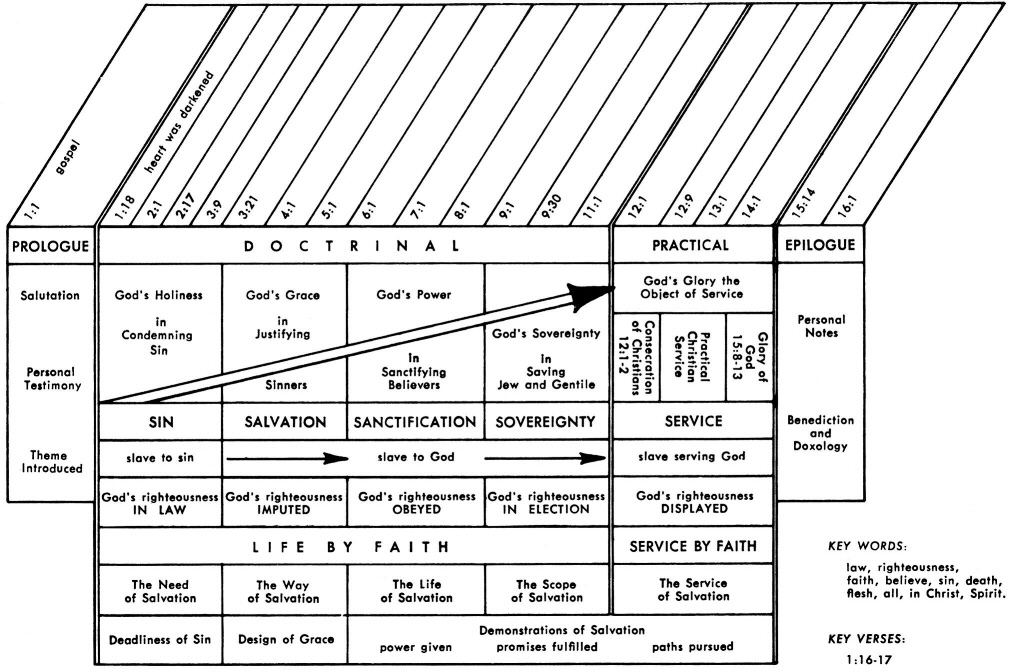
Click chart to enlarge
Chart from recommended resource Jensen's Survey of the NT - used by permission
Romans Overview Chart - Charles Swindoll
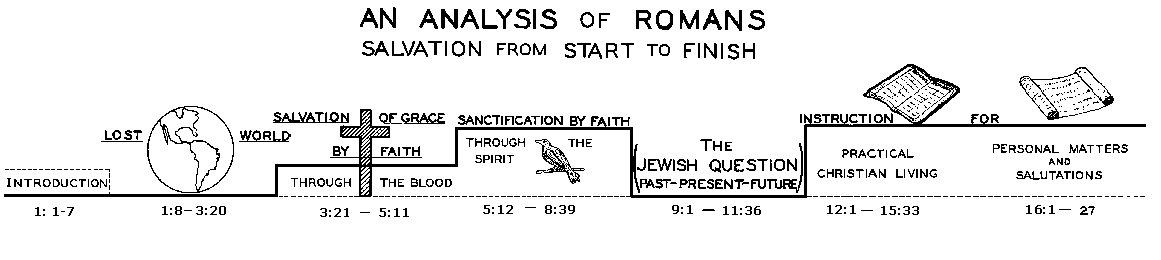
Source: Dr David Cooper
Click to Enlarge
R Ruin (Romans 1:17 – 3:20) – The utter sinfulness of humanity
O Offer (Romans 3:21-31) – God’s offer of justification by grace
M Model (Romans 4:1-25) – Abraham as a model for saving faith
A Access (Romans 5:1-11) – The benefits of justification
N New Adam (Romans 5:12-21) – We are children of two “Adams”
S Struggle w/ Sin (Romans 6-8) Struggle, sanctification, and victory
|
ROMANS ROAD |
||||
| Romans 1:18-3:20 | Romans 3:21-5:21 | Romans 6:1-8:39 | Romans 9:1-11:36 | Romans 12:1-16:27 |
| SIN | SALVATION | SANCTIFICATION | SOVEREIGNTY | SERVICE |
| NEED FOR SALVATION |
WAY OF SALVATION |
LIFE OF SALVATION |
SCOPE OF SALVATION |
SERVICE OF SALVATION |
| God's Holiness In Condemning Sin |
God's Grace In Justifying Sinners |
God's Power In Sanctifying Believers |
God's Sovereignty In Saving Jew and Gentile |
Gods Glory The Object of Service |
| Deadliness of Sin |
Design of Grace |
Demonstration of Salvation | ||
| Power Given | Promises Fulfilled | Paths Pursued | ||
| Righteousness Needed |
Righteousness Credited |
Righteousness Demonstrated |
Righteousness Restored to Israel |
Righteousness Applied |
| God's Righteousness IN LAW |
God's Righteousness IMPUTED |
God's Righteousness OBEYED |
God's Righteousness IN ELECTION |
God's Righteousness DISPLAYED |
| Slaves to Sin | Slaves to God | Slaves Serving God | ||
| Doctrine | Duty | |||
| Life by Faith | Service by Faith | |||
|
Modified from Irving L. Jensen's chart above |
||||
Romans 15:15 But I have written very boldly to you on some points so as to remind you again, because of the grace that was given me from God, (NASB: Lockman)
Greek: tolmeroteron de egrapsa (1SAAI) humin apo merous (literally ‘from a part’) os epanamimneskon (PAPMSN) humas dia ten charin ten dotheisan (APPFSA) moi hupo tou theou
Amplified: Still on some points I have written to you the more boldly and unreservedly by way of reminder. [I have done so] because of the grace (the unmerited favor) bestowed on me by God (Amplified Bible - Lockman)
NLT: Even so, I have been bold enough to emphasize some of these points, knowing that all you need is this reminder from me. For I am, by God's grace, (NLT - Tyndale House)
Phillips: - Nevertheless I have written to you with a certain frankness, to refresh your minds with truths that you already know, by virtue of my commission as Christ's minister to the Gentiles in the service of the Gospel. (Phillips: Touchstone)
Wuest: The more boldly indeed I write to you in some measure as recalling to your mind again because of the grace which was given to me from God,
Young's Literal: and the more boldly I did write to you, brethren, in part, as putting you in mind, because of the grace that is given to me by God,
BUT I HAVE WRITTEN VERY BOLDLY TO YOU ON SOME POINTS: tolmeroteron de egrapsa (1SAAI) humin apo merous:
- Hebrews 13:22; 1Peter 5:12; 1John 2:12, 13, 14; 5:13; Jude 1:3,4, 5
- Romans 15 Resources - Multiple Sermons and Commentaries
But (de) is a term of contrast - whenever you encounter it, pause and ponder the context asking what is the author contrasting?
Have written is epistolary aorist, a device whereby a first-century writer observes the courtesy of putting himself at the viewpoint of the recipient of the letter, viewing the writing of his letter which is a present occurrence to him, as a past event, which latter viewpoint the reader would have when receiving the letter. The reference is therefore to the contents of the letter to the Romans which he was then in the process of writing.
Written (1125) (grapho) from root graph- = primarily means to scratch on or engrave as on an ornament, reports, letters, etc; English = graph, graphic, etc) means to engrave or inscribe with a pen or stylus characters or letters on a surface which can be wood, wax, metal, leather, stone, parchment, dirt (John ), paper, etc. (Click to review all 191 uses of grapho in the NAS)
Very boldly (5112) (tolmeros from tolma = courage) pertains to having courage, boldness or confidence. The actual Greek word is the comparative of tolmeros, tomeroteron (Technically = adjective, normal, accusative, neuter, singular, comparative) which means more boldly, rather freely, a little boldly, with greater confidence and freedom and describes one particularly bold and daring.
Vincent - Not too boldly, but the more boldly because you are full of goodness.
Stedman makes an interesting comment - Now, you would think that a church that was theologically knowledgeable, able to instruct and counsel one another in the deep problems of life, and filled with a spirit of goodness and compassion, would hardly need anything more said to them. Yet it is to that kind of a church that Paul addressed his letter to the Romans. (An Adequate Ministry)
I've written you a letter, parts of which are rather bold, as a reminder to you.
Phillips renders it - I have written to you with a certain frankness to refresh your minds with truths that you already know.
Stedman - "In a sense, everyone who reads the letter to the Romans is taking a self-examination of his own spiritual effectiveness. I don't think a Sunday goes by but that someone says to me after a message, "You know, you were talking just to me this morning. In fact, I noticed that you kept looking right at me all the time you were talking." I must say that I have no awareness of picking out individuals at all as I am teaching through this book, but this is the phenomena which often occurs when the Spirit of God is taking the truth and bring it right home to the heart. You can't listen to the book of Romans honestly and openly without having this sense of being under examination yourself. I am sure that these first recipients of this letter had that feeling as the letter was read in the gathering in Rome." (Read full text - The Minister of Jesus Christ)
SO AS TO REMIND YOU AGAIN : os epanamimneskon (PAPMSN ) humas:
- 1Timothy 4:6; 2Timothy 1:6; 2:14; Titus 3:1; 2Peter 1:12, 13, 14, 15; 3:1,2
- Romans 15 Resources - Multiple Sermons and Commentaries
This was what Peter did as well (2Pe 1:12-note; 2Pe 3:1-2-note). A good teacher must keep in mind the opposing problems of familiarity and forgetfulness. Even for the best of minds with the sincerest devotion, that which is not kept familiar eventually will be forgotten.
Stedman comments: "I saw a man the other day with a string around his finger. The string was to remind him of something. The fact that we so easily forget things is somehow built into our humanity and I think one of the greatest proofs of the fall of man is that we have such a hard time remembering what we want to remember, yet we so easily remember what we want to forget!… Living out in the world, as many of you are, working every day among non-Christians, it is so easy to be sucked into the attitudes of the world around. It is so easy to get the idea that life is designed to be a pleasant picnic, that we can work toward the day when we can retire and enjoy ourselves. I find that attitude prevalent among people everywhere, but that is not what the Bible says. The Bible says we are in the midst of a battle, a battle to the death, against a keen and crafty foe. He wants to discourage us and defeat us, and to make us feel angry and hostile. He knows how to do it, and he never lets up. This life is not designed to be a time of relaxing. There are times when we need recreation and vacations, when we can slow down a bit. But you never see the Apostle Paul talking about quitting the battle. You cannot quit, as long as life is there. So Paul tells us that we need to be reminded, day by day and week by week, that we are in a battle and that we have a crafty foe. This life is not all there is, by any means. This is school time, a training ground, where we are to learn our lessons. This life is getting us ready for the real thing that is yet to come." (An Adequate Ministry)
BECAUSE OF THE GRACE THAT WAS GIVEN TO ME FROM GOD: dia ten charin ten dotheisan (APPFSA) moi hupo tou theou:
- Ro 1:5 12:3,6 1Cor 3:10, 1Cor 15:10
- Romans 15 Resources - Multiple Sermons and Commentaries
Because (dia) is a term of explanation - stop, look and ask - what is the writer explaining? Check the context.
Grace (5485) (charis) is "God's Riches At Christ's Expense." Remember that grace is not just unmerited favor, but it is the supernatural provision from God to enable us to live a supernatural life (with the enablement of the Spirit, called the "Spirit of Grace" - Heb 10:29). Here we see it is a gift and therefore is not something Paul merited (nor do we). Receive it by faith. Avoid the trap of trying to be "good enough" to earn it (you can't!).
Paul's commentary on this verse is…
But (this contrast word should force us to examine 1Cor 15:9-note) by the grace of God I am what I am, and His grace toward me did not prove vain; but I labored even more than all of them, yet not I, but the grace of God with me. (1Cor 15:10-see commentary)
Was given is aorist tense, which speaks of his receipt of this gift of grace at some point in time, specifically corresponding undoubtedly with his being set apart for the gospel (see Ro 1:1-note, Ro 1:5-note cf Act 9:1-16) could explain why Paul considers himself a debtor or under obligation (Ro 1:14-note).
A parallel thought is found in (Ro 1:5-note) where Paul records that "["Jesus Christ our Lord"] through Whom we have received (thus we are "debtors" but not in the sense that we are trying to pay back or ever could pay back) grace and apostleship to bring about the obedience of faith among all the Gentiles, for His name's sake")
Since every believer in Christ is in the ministry, in the sense that the ministry of the gospel is committed to them (and not to some special class called "the clergy" who wear their collars backwards and don long robes), the words that we read here of Paul as a minister apply to each one of us.
Romans 15:16 to be a minister of Christ Jesus to the Gentiles, ministering as a priest the gospel of God, so that my offering of the Gentiles may become acceptable, sanctified by the Holy Spirit. (NASB: Lockman)
Greek: eis to einai (PAN) me leitourgon Christou Iesou eis ta ethne, hierourgounta (PAPMSA) to euaggelion tou theou, hina genetai (3SAMS) e prosphora ton ethnon euprosdektos, hegiasmene (RPPFSN) en pneumati hagio
Amplified: In making me a minister of Christ Jesus to the Gentiles. I act in the priestly service of the Gospel (the good news) of God, in order that the sacrificial offering of the Gentiles may be acceptable [to God], consecrated and made holy by the Holy Spirit. (Amplified Bible - Lockman)
NLT: a special messenger from Christ Jesus to you Gentiles. I bring you the Good News and offer you up as a fragrant sacrifice to God so that you might be pure and pleasing to him by the Holy Spirit. (NLT - Tyndale House)
Phillips: For my constant endeavour is to present the Gentiles to God as an offering which he can accept, because they are sanctified by the Holy Spirit. (Phillips: Touchstone)
Wuest: resulting in my being a servant of Christ Jesus in holy things to the Gentiles, exercising a sacred ministry in the good news of God in order that the offering of the Gentiles might be well pleasing, having been sanctified by the Holy Spirit.
Young's Literal: for my being a servant of Jesus Christ to the nations, acting as priest in the good news of God, that the offering up of the nations may become acceptable, sanctified by the Holy Spirit.
TO BE A MINISTER OF CHRIST JESUS TO THE GENTILES: eis to einai ( PAN ) me leitourgon Christou Iesou eis ta ethne:
- For more insights into Paul's ministry to the Gentiles study the following cross references: Ro 15:18; 11:13; Acts 9:15; 13:2; 22:21; 26:17,18; 1Corinthians 3:5; 4:1; 2Corinthians 5:20; 2Corinthians 11:23; Galatians 2:7,8; Ephesians 3:1; Philippians 2:17; 1Timothy 2:7; 2Timothy 1:11
- Romans 15 Resources - Multiple Sermons and Commentaries
Spurgeon - As Paul was peculiarly the apostle of the Gentiles, he was the more anxious that in the Gentiles the gospel should produce the acceptable fruit of mutual love. Every man should give most attention to that part of the work with which the Lord has entrusted him, with the one pure motive that God may be glorified thereby. Paul was insatiable for the glory of God and the prosperity of the church; let us be filled with the same zeal.
Lord, if thou hast made us strong,
Let us learn to help the weak;
Bearing with each other long,
While the good of all we seek.
May we with one heart and mind
Seek the glory of thy name;
In one sacred league combined,
All our aims and hopes the same.
Minister (3011) (leitourgos [word study] from léïtos = of the people [NIDNTT says it from "laos" = people] + érgon = work) is literally a worker of the people. In classical Greek leitourgos referred especially to persons performing public duties, or works of public use.
In the NT leitourgos is used by Paul to describe himself as well as his "brother and fellow worker and fellow soldier", Epaphroditus (Php 2:25-note). In Hebrews leitourgos is used of angels as God's ministers (He 1:7-note) and of the priests as His ministers in the sanctuary in the Jerusalem Temple (Heb 8:2-note). Furthermore, leitourgos is the word primarily used by to the Greek Septuagint translation to describe the Old Testament priestly service to God and of service to man. In this present verse Paul uses this word with rich religious legacy to refer to public ministers or "public servants", describing those who render special service. Earlier Paul had called government rulers God's deacons and here they are His ministers!
Vincent agrees adding that leitourgos "brings out more fully the fact that the ruler, like the priests, discharges a divinely ordained service."
Kenneth Wuest explains that "minister" in this verse is not "the usual word… diakonos (servant), but leitourgos , used in secular life of a public minister, a servant of the state, in sacred things, of the priests of the Jerusalem Temple [Ed: used to describe the work of Christ our "Great High Priest in (Heb 8:2-note)]. Another source says this word originally meant someone who does public service at his own expense, but in Christian literature it came to be used of the service of god (cf same word translated "servants" - see Ro 13:6-note) Paul uses it here to speak of his ministry of preaching the gospel as a priestly ministry & of equal value and sacredness to the ministry of the priesthood of the OT." Thus the Christian ministry is seen as a priestly ministry which parallels Peter's teaching on who believers are in (1Pe 2:5-note, 1Pe 2:9-note). In the Septuagint leitourgos was used in translating a technical term for priestly service to God. Luke employed the verbal form (leitourgeo) to describe the ministry of Paul and Barnabas at the church of Antioch (Acts 13:2). It was also used of the ministry of the Macedonian and Achaian Christians who gave to the poor in Jerusalem (Ro 15:27-note). Paul used the noun (leitourgos) in (Php 2:25-note) for the ministry of Epaphroditus to the Philippian saint.
Hughes - Paul could have used other words to describe himself. For example, he could have used the common term doulos to indicate a servant of Jesus Christ, or he could have used diakonos, which means “servant” or “minister.” But he chose leitourgos because he saw his missionary work like that of a priest offering sacred worship to God. Consonant with this, he saw his priestly offering not as a lamb or a grain offering, but as Gentile converts. As he expresses it in v16: “that the Gentiles might become an offering acceptable to God, sanctified by the Holy Spirit.” Here we are exposed to Paul’s remarkable self-conception. Though he is involved in the dusty, mundane business of traveling the ancient world on foot, suffering from exposure, threats, beatings, and rejection, in his heart of hearts he sees himself in priestly garb in the Temple, lifting up the souls of men which then ascend as a sweet-smelling fragrance to Christ. Fully apprehended and appreciated, this is a dazzling picture." (Hughes, R. K. Romans: Righteousness from heaven. Preaching the Word. Wheaton, Ill.: Crossway Books)
William Barclay has an interesting background on leitourgos
In ancient Greece there were certain state duties called liturgies (leitourgiai) which were sometimes laid upon and sometimes voluntarily shouldered by men who loved their country. There were five of these voluntary services which patriotic citizens used to undertake.
(a) There was choregia (5524), which was the duty of supplying a chorus. When Aeschylus and Sophocles and Euripides were producing their immortal dramas, in each of them a verse-speaking chorus was necessary. There were great festivals like the City Dionysia when as many as eighteen new dramatic works were performed. Men who loved their city would volunteer to collect, maintain, instruct and equip such a chorus at their own expense.
(b) There was gumnasiarchia. The Athenians were divided into ten tribes; and they were great athletes. At certain of the great festivals there were the famous torch-races in which teams from the various tribes raced against each other. We still speak of handing on the torch. To win the torch-race was a great honour, and there were public-spirited men who at their own cost would select and support and train a team to represent their tribe.
(c) There was hestiasis. There were occasions when the tribes met together to share in a common meal and a common rejoicing; and there were generous men who undertook the task of meeting the expense of such a gathering.
(d) There was archetheoria. Sometimes the city of Athens sent an embassy to another city or to consult the oracle at Delphi or Dodona. On such an occasion everything had to be done in such a way that the honour of the city was maintained; and there were patriotic men who voluntarily defrayed the expenses of such an embassy.
(e) There was trierarchia. The Athenians were the great naval power of the ancient world. And one of the most patriotic things that a man could do was voluntarily to undertake the expenses of maintaining a trireme or warship for a whole year.
That is the background of this word leitourgos. In later days, as patriotism died, such liturgies became compulsory and not voluntary. Later the word came to be used of any kind of service; and later still it came to be used especially of worship and service rendered in the temple of the gods. But the word always had this background of generous service. Just as a man in the ancient days laid his fortune on the altar of the service of his beloved Athens, and counted it his only glory, so Paul laid his everything on the altar of the service of Christ, and was proud to be the servant of his Master. (Romans 15 - William Barclay's Daily Study Bible)
MINISTERING AS A PRIEST THE GOSPEL OF GOD: hierourgounta ( PAPMSA ) to euaggelion tou theou:
- Ro 15:29; 1:1; Acts 20:24; Galatians 3:5; 1Th 2:2,9; 1Ti 1:11; 1Peter 1:12
- Romans 15 Resources - Multiple Sermons and Commentaries
Ministering as a priest (2418) (hierourgeo) is used in the unusual way of referring to Christian service but not in connection with any liturgical practice but explicitly with the gospel of God. It is a striking way of affirming that the proclamation of the gospel originates with God and is "sacred".
Vines says "ministering as a priest" means “to minister in priestly service” (from hieros [2413] sacred [24x in Acts] + ergon [2041] work) [and] is used by Paul metaphorically of his ministry of the Gospel. The offering connected with his priestly ministry is “the offering up of the Gentiles,” i.e., the presentation by Gentile converts of themselves to God." (Collected writings of W. E. Vine)
Paul took very seriously his call to minister to the Gentiles (cf Ro 11:13, Gal 2:9). He never renounced his Jewish heritage, but on the other hand he was faithful to be God's minister to the Gentiles (cf Acts 22:21).
Denney - The offering which Paul conceives himself as presenting to God is the Gentile Church, and the priestly function in the exercise of which this offering is made is the preaching of the gospel.”
The writers of the New Testament adapted the term Gospel as God's glorious message of salvation for lost otherwise hopeless, helpless sinners. Euaggelion is found in several combination phrases, each describing the gospel like a multifaceted jewel in various terms from a different viewpoint (from the NASB, 1977):
- the gospel of the kingdom (Mt 4:23+, Mt 9:35+, Mt 24:14+)
- the gospel of Jesus Christ, the Son of God (Mk 1:1+) because it centers in Christ
- the gospel of God (Mk 1:14+, Ro 15:16+, 2Co 11:7+, 1Th 2:2+, 1Th 2:8,9+, 1Pe 4:17+) because it originates with God and was not invented by man
- the gospel of the kingdom of God (Lu 16:16+)
- the gospel of the grace of God (Acts 20:24+, Ro 1:1+),
- the gospel of His Son (Ro 1:9+)
- the gospel of Christ (Ro 15:19+, 1Co 1:9+, 2Co 2:12+, 2Co 9:13+, 2Co 10:14+, Gal 1:7+, Phil 1:27+, 1Th 3:2+)
- the gospel of the glory of Christ (2Co 4:4+)
- the gospel of your salvation (Eph 1:14+)
- the gospel of peace (Eph 6:15+)
- the gospel of our Lord Jesus (2Th 1:8+)
- the glorious gospel of the blessed God (1Ti 1:11+)
- In Ro 16:25, 26+ Paul called it “my Gospel” indicating that the special emphasis he gave the gospel in his ministry.
For a rewarding study, study the preceding references in context making notation of the truth you observe about the gospel. If you would like a special blessing, take an afternoon to go through all 76 uses of euaggelion in context making a list of what you learn about the gospel. The Spirit of God will enlighten your heart and encourage your spirit in a very special way...and you'll want to share the "good news" with someone because of your "discoveries"!
Euaggelion - Matt. 4:23; Matt. 9:35; Matt. 24:14; Matt. 26:13; Mk. 1:1; Mk. 1:14; Mk. 1:15; Mk. 8:35; Mk. 10:29; Mk. 13:10; Mk. 14:9; Mk. 16:15; Acts 15:7; Acts 20:24; Rom. 1:1; Rom. 1:9; Rom. 1:16; Rom. 2:16; Rom. 10:16; Rom. 11:28; Rom. 15:16; Rom. 15:19; Rom. 16:25; 1 Co. 4:15; 1 Co. 9:12; 1 Co. 9:14; 1 Co. 9:18; 1 Co. 9:23; 1 Co. 15:1; 2 Co. 2:12; 2 Co. 4:3; 2 Co. 4:4; 2 Co. 8:18; 2 Co. 9:13; 2 Co. 10:14; 2 Co. 11:4; 2 Co. 11:7; Gal. 1:6; Gal. 1:7; Gal. 1:11; Gal. 2:2; Gal. 2:5; Gal. 2:7; Gal. 2:14; Eph. 1:13; Eph. 3:6; Eph. 6:15; Eph. 6:19; Phil. 1:5; Phil. 1:7; Phil. 1:12; Phil. 1:16; Phil. 1:27; Phil. 2:22; Phil. 4:3; Phil. 4:15; Col. 1:5; Col. 1:23; 1 Thess. 1:5; 1 Thess. 2:2; 1 Thess. 2:4; 1 Thess. 2:8; 1 Thess. 2:9; 1 Thess. 3:2; 2 Thess. 1:8; 2 Thess. 2:14; 1 Tim. 1:11; 2 Tim. 1:8; 2 Tim. 1:10; 2 Tim. 2:8; Phlm. 1:13; 1 Pet. 4:17; Rev. 14:6
THAT MY OFFERING OF THE GENTILES MIGHT BECOME ACCEPTABLE SANCTIFIED BY THE HOLY SPIRIT: hina genetai (3SAMS) e prosphora ton ethnon euprosdektos, hegiasmene (RPPFSN ) en pneumati hagio:
- Ro 12:1,2; Isa 66:19,20; 2Cor 8:5; Php 2:17; 4:18; Heb 13:16; 1Pe 2:5
- Ro 5:5; 8:26,27; Acts 20:32; 1Co 6:19; Eph 2:18,22; 1Th 5:23
- Romans 15 Resources - Multiple Sermons and Commentaries
Gentiles are genitive of apposition, which means that the Gentiles themselves constitute the offering! What an “offering” that God wanted Paul to make: the offering of the Gentiles, of human lives. God wanted Paul to bring people to Him.
Offering (4376) (phosphora from prós = toward, before + phéro = bring) literally means to bring before and not surprisingly is used most often in Hebrews which emphasizes Jesus the High Priest of our confession (other uses in Acts 21:26, Acts 24:17) Prosphora is used in the Septuagint (LXX = Greek translation of the Hebrew OT) for the sacrifice offered on the altar and it means to carry or bring something or someone into the presence of another usually implying a transfer to the latter individual. Prosphora thus clearly was part of the vocabulary of priestly worship and in the NT it was used of Christ’s sacrificial offering (Eph 5:2-note ; Heb10:10-note of His body).
Compare the similar idea of the presentation of the redeemed believer's body back to God (Who owns it anyway) as a living sacrifice (Ro 12:1-note).
In this verse Paul explains that his purpose for ministering the gospel of God was in order that the Gentiles might actually come to be an acceptable offering (to God) having been set apart from the profane world and unto a holy God by the sanctifying work of the Holy Spirit.
Acceptable (2144) (euprosdektos -- Ro 15:31-note, 1Pe 2:5-note, 2Cor 6:2) means well-accepted and conveys a strong affirmation of acceptability.
The OT knew of sacrifices that God would not accept (cf Isa 1:11ff-see notes) and Paul is distancing the offering of the Gentiles from such "worthless" offerings.
Compare to "acceptable" offering of our living sacrifice in (Romans 12:1) (note) and the "acceptable" will of God (Romans 12:2) (note). And they were "acceptable" because they were sanctified by the Holy Spirit.
What a radical transformation the gospel had worked in Paul mind. Before conversion he regarded the Gentiles as "unclean", but now he says they are sanctified or set apart! God's Spirit had taken the "unclean" vessels and made them "holy" vessels (saints).
Note that all three members of the Godhead are mentioned in this verse in the work of salvation.
Sanctified (37) (hagiazo cf study on related hagios) and in simple terms means to devote something to the intended purpose for which it was made. Click for a more in depth discussion of the interrelationship of justification (past tense sanctification), sanctification (ongoing salvation), and glorification.
Ray Stedman has an interesting explanation of sanctified writing that when "You sit on a chair and you sanctify it; you use it for the purpose it was intended for. When you play an organ, you sanctify it; an organ was intended to be played. You don't attempt to type a letter with it -- that would be to use it in an unsanctified way -- but you play it. When you sanctify your shoes, you put them on your feet; that is what they were intended for. This is the simple meaning for sanctification" to put to the intended use." "You are not your own … " -- you were never made to be your own, and, if you think you are your own and can run your own life, you are defeating the purpose for which you were created. "You are not your own, you are bought with a price." Therefore, acceptable service is simply to allow yourself to be available and at the disposal of the One who has the right to use you as he pleases, in the place that he pleases, and under the conditions that he chooses. That is being sanctified by the Holy Spirit." (Read full sermon The Minister of Jesus Christ)
Stedman goes on to add "We continually need this reminder (sanctified by the Holy Spirit) because the philosophy of the flesh, the Adamic theory, is that we can do all things ourselves -- that we don't need God. We find this philosophy underlying almost all the activity of the world today. We get so proud over what we have created… We become so proud of it that we think we can do everything. And when we come to the place where we think that we can do everything, then we discover that God lets us go ahead on that basis, and we have no one upon whom we can rely except ourselves. It is a very disconcerting experience to suddenly find that we are alone on the bridge of the ship and that we have no one else to seek advice from. We have to control this tremendous vessel as it makes its way across the sea of life, and it is a frightening thing. That is why men who think that way always have, underneath, a sense of uncertainty and an awareness that they are not equipped, they are not able, they are not capable. We never were made to be -- that is the whole point. And the Christian life is simply one that has recognized what we were made to be, and is willing to be that. Paul says that this is "sanctified by the Holy Spirit," and the Spirit is ready to put that into practice. " (Read full sermon The Minister of Jesus Christ)
In faithful fulfillment of his unique apostolic calling, Paul’s supreme offering to God then was the Gentiles, who by virtue of the Holy Spirit’s power had been justified, sanctified and redeem, made holy by the blood of Christ and thus made acceptable for fellowship with the Father. Like Paul, every believer who is instrumental in winning a soul to Jesus Christ presents that convert, whether Jew or Gentile, as a priestly offering to the Lord. God is not after buildings, programs, money, equipment, etc. He is after the lives of people. This truth helps understand Paul's description of the saints at Philippi that he was instrumental in winning to Christ:
"Therefore, my beloved brethren whom I long to see, my joy and crown, so stand firm in the Lord, my beloved." (Php 4:1-note)
In a similar exclamation in first Thessalonians we read Paul's description of the Thessalonian believers he to whom he had been privileged to proclaim the gospel of Jesus Christ…
"For who is our hope or joy or crown of exultation? Is it not even you, in the presence of our Lord Jesus at His coming? For you are our glory and joy." (1Th 2:19-20-note)
These Gentiles were his "acceptable offering" to the Lord as he faithfully carried out the priestly function of "ministering" the gospel of God. Let this awesome truth provoke us to be faithful witnesses like Paul.
In light of these passages, it is not surprising that Paul in prison with the time of his earthly departure drawing near writes that in his first defense although all deserted him…
"the Lord stood with me, and strengthened me, in order that through me the proclamation might be fully accomplished, and that all the Gentiles might hear; and I was delivered out of the lion's mouth." (2Ti 4:17-note)
G. Campbell Morgan - What a radiant light this sheds on all our evangelistic and pastoral effort! Every soul won by the preaching of the gospel is not only brought into a place of safety and of blessing; he is an offering to God, a gift which gives Him satisfaction, the very offering He is seeking. Every soul carefully and patiently instructed in the things of Christ, and so made conformable to His likeness, is a soul in whom the Father takes pleasure. Thus we labor, not only for the saving of men, but for the satisfying of the heart of God. This is the most powerful motive.
Romans 15:17 Therefore in Christ Jesus I have found reason for boasting in things pertaining to God. (NASB: Lockman)
Greek: echo (1SPAI) oun (ten) kauchsin en Christo Iesou eis ta pros ton theon:
Amplified: In Christ Jesus, then, I have legitimate reason to glory (exult) in my work for God [in what through Christ Jesus I have accomplished concerning the things of God]. (Amplified Bible - Lockman)
NLT: So it is right for me to be enthusiastic about all Christ Jesus has done through me in my service to God. (NLT - Tyndale House)
Phillips: And I think I have something to be proud of (through Christ, of course) in my work for God. (Phillips: Touchstone)
Wuest: I have therefore my glorifying in Christ Jesus with reference to the things which pertain to God.
Young's Literal: I have, then, a boasting in Christ Jesus, in the things pertaining to God,
THEREFORE IN CHRIST JESUS I HAVE FOUND REASON FOR BOASTING IN THINGS PERTAINING TO GOD: echo oun (1SPAI ) oun (ten) kauchsin en Christo Iesou ta pros ton theon:
- Ro 4:2; 2Corinthians 2:14, 15, 16; 3:4, 5, 6; 7:4; 11:16-30; 12:1,11-21
- Romans 15 Resources - Multiple Sermons and Commentaries
And I think I have something to be proud of (through Christ, of course) in my work for God (Phillips)
So it is right for me to be enthusiastic about all Christ Jesus has done through me in my service to God. (NLT)
Therefore introduces the "consequence". Because of this ministry of the gospel of God to the Gentiles & their reception of it and regeneration by the Holy Spirit into saints… Because of this wonderfully successful ministry among the Gentiles Paul says “I have a reason for boasting.” Paul always boasts of what God has done, not in his own human achievement.
Literally since "boasting" is a noun here, Paul says "I continually have boasting".
There is a legitimate boasting, a justified glorying … Paul was proud of what he had done for God in Christ Jesus. So the key to understanding Paul's boastful attitude here is that is was "in Christ Jesus" & was not in himself or his abilities. Paul demonstrated this fact clearly, for he did not talk about himself nor about what he had done. He talked only about the things that pertained to God, only about the things wrought through Jesus Christ.
"Paul will glory only in what Christ has done through him. He is sure that Christ has done great things through him, and he is glad that he can draw attention to those things. But he is not trying to attract adulation. It is what Christ has done that is his theme." (Morris)
In terms of both the quantity and the quality of of his service—winning converts, starting churches, writing books of the Bible!—Paul certainly could have put together a very impressive resume. But he was not interested in bringing glory to himself. He knew that his apostleship as such was a gift of grace (v15b), that the gospel is the real power that saves (Ro 1:16-note; Ro 10:17-note), and that he owed his accomplishments to God’s power working through him (v19a).
“Seeing I have received this office from God and am appointed a minister of the Gospel to the Gentiles, I have confidence and rejoice.” Since in the previous verses Paul has asserted his divine appointment as an apostle, he shows, in this and the following verses, that the assertion was well founded, as God had crowned his labors with success and sealed his ministry with signs and wonders. Therefore, he was entitled as a minister of God to exhort and admonish his brothers with the boldness and authority which he had used in this letter.
Things pertaining to God (ta pros ton theon) means "with reference to what concerns God". A technical phrase in Jewish liturgical language to denote the functions of worship (Heb 2:17-note, Heb 5:1-note).
Hughes provides examples of a similar mindset in other great saints:
That is the way it has been for the great missionary hearts that have followed in Paul’s footsteps as well.
Raymond Lull, the brave missionary to the Moslems, lived by this famous refrain: “I have one passion—it is He, it is He.”
Charles Wesley sang, “Thou, O Christ, art all I want, more than all in Thee I find.”
It was said by Alexander Whyte of his long Saturday walks with Marcus Dods, “Whatever we started off with in our conversations, we soon made across country, somehow, to Jesus of Nazareth.”
“We preach always Him,” said Martin Luther; “this may seem a limited and monotonous subject, likely to be soon exhausted, but we are never at the end of it.”
So it was with Paul. With Christ at the center, Paul could only boast of him. (Hughes, R. K. Romans: Righteousness from heaven. Preaching the Word. Wheaton, Ill.: Crossway Books)
Romans 15:18 For I will not presume to speak of anything except what Christ has accomplished through me, resulting in the obedience of the Gentiles by word and deed, (NASB: Lockman)
Greek: ou gar tolmeso (1SFAI) ti lalein (PAN) on ou kateirgasato (3SAMI) Christos di emou eis hupakoen ethnon logo kai ergo
Amplified: For [of course] I will not venture (presume) to speak thus of any work except what Christ has actually done through me [as an instrument in His hands] to win obedience from the Gentiles, by word and deed, (Amplified Bible - Lockman)
NLT: I dare not boast of anything else. I have brought the Gentiles to God by my message and by the way I lived before them. (NLT - Tyndale House)
Phillips: I am not competent to speak of the work Christ has done through others, but I do know that through me he has secured the obedience of Gentiles in word and deed (Phillips: Touchstone)
Wuest: For I will not dare to be speaking concerning anything of the things which Christ did not bring about through my agency resulting in the obedience of the Gentiles, by word and deed
Young's Literal: for I will not dare to speak anything of the things that Christ did not work through me, to obedience of nations, by word and deed
FOR I WILL NOT (dare) PRESUME TO SPEAK OF ANYTHING EXCEPT WHAT CHRIST HAS ACCOMPLISHED THROUGH ME : ou gar tolmeso (1SFAI) ti lalein (PAN) on ou kateirgasato (3SAMI) Christos di emou:
- Proverbs 25:14; 2Corinthians 10:13, 14, 15, 16, 17, 18; 11:31; 12:6; Jude 1:9
- what Christ: Mark 16:20; Acts 14:27; 15:4,12; 21:19; Gal 2:8; 1Corinthians 3:6, 7, 8, 9; 2Corinthians 3:1, 2, 3; 6:1
- Romans 15 Resources - Multiple Sermons and Commentaries
GIVING GLORY
TO WHOM IT IS DUE
This verse is a an excellent example of Jesus' command in Matthew 5:16 to
Let your light shine (aorist imperative = do this! It is "urgent!" Do it in the power of the Spirit, not in dependence on the fallen flesh -- Why? First, you can't! Second, the flesh would want the glory!) before men in such a way (This is the key qualifier, the main "asterisk" - don't draw attention to yourself!) that they may see your good works, and glorify your Father who is in heaven. (note)
For (gar) is a term of explanation, which should stimulate us to ask what Paul is explaining?
"If any part of my ministry does not stem from God's work through me, I don't even want to talk about it. I have nothing to say about it. It isn't even worth mentioning."
I will not talk about anything I did myself. I will talk only about what Christ has done through me. Paul is totally dependent upon Jesus Christ for ministry (initiation & empowerment & effect). He was learned that the strength and power of the ministry did not rest in his background, or his training, or his abilities in any sense. He had learned to reckon upon the indwelling life of Jesus Christ and to know that God can use any man, any woman, any person, any human being, that all God wants is a vessel, no matter what it may be like, and that God can, if that vessel is available to Him, manifest through it all the marvelous power of his ministry and life. This is the secret! That's worth presuming to speak about!
And so Paul did in fact teach that there was a proper "boasting" (2Cor 12:5, 9; Gal 6:14; 1Cor 1:31) . When you meet a man or a woman who is willing to trust God to work through them, there is no limit to what God can do. This is the secret of Paul's ministry. It's as if Paul pictures himself as a conduit, through which the power of God can flow unimpeded. No wonder Paul even boasted about his weaknesses for when he was weak the power of Christ was perfected in him (2Co 12:9-note; 2Cor 12:10-note).
Accomplished (2716) (katergazomai [word study])means to work out fully and thoroughly, to accomplish or achieve an end, to finish or carry something to its conclusion. To work so as to bring something to fulfillment or successful completion and implies doing something with thoroughness. It means to do that from which something results. This verb always means to complete the effort and the work begun. Katergazomai conveys the idea of achieving an end, of carrying out to conclusion or until finished. Katergazomai describes not the spirit in which the work is done, but the aim and issue—"carry through" and so it represents the full and final bringing of an enterprise to a successful conclusion. Roman scholar Strabo (who wrote in Greek and lived about sixty years before Christ) gives us insight into the word’s meaning, using katergazomai to describe extraction of silver from mines.
Katergazomai - 22x in NT, 11x in Romans - Ro 1:27; 2:9; 4:15; 5:3; 7:8, 13, 15, 17, 18, 20; 15:18; 1 Cor 5:3; 2 Cor 4:17; 5:5; 7:10, 11; 9:11; 12:12; Eph 6:13; Phil 2:12; Jas 1:3; 1 Pet 4:3
William Barclay says that katergazomai "always has the idea of bringing to completion. It is as if Paul says: “Don’t stop halfway; go on until the work of salvation is fully wrought out in you.” No Christian should be satisfied with anything less than the total benefits of the gospel." And so he translates this as "carry to its perfect conclusion".
TDNT writes that katergazomai is "found from the time of Sophocles, means a. “to bear down to the ground,” “to overcome,” maintaining the older local sense of kata; b. “to work at,” “make.” Refined by constant use, it gradually takes on the sense of the simple, so that the verb signifies working at, and finally accomplishing a task." (Theological Dictionary of the New Testament. Eerdmans)
In Ro 5:3 Paul teaches that we can
"exult in our tribulations, knowing that tribulation brings about (or accomplishes) perseverance". (Romans 5:3-note)
In Philippians 2:12 Paul exhorts the Philippian believers to
work out (katergazomai in the present imperative = as the pattern of your life, the general direction [not perfection!]) your salvation with fear and trembling", i.e., bring your salvation to completion "for it is God Who is at work in you, both to will and to work for His good pleasure (see note)
In (2Co 4:17) Paul tells us that
"momentary, light affliction is producing (or accomplishing or achieving the end) for us an eternal weight of glory far beyond all comparison"
In (2Co 7:10) Paul uses katergazomai twice to contrast what is accomplished by godly vs worldly sorrow
"For the sorrow that is according to the will of God PRODUCES a repentance without regret, leading to salvation, but the sorrow of the world PRODUCES death."
James uses this word to describe what is accomplished when our faith is tested (Jas 1:3) "knowing that the testing of your faith PRODUCES endurance."
This brief word study should help understand what Paul means when he describes "what Christ has accomplished through" him.
Paul was simply God's "chosen instrument (vessel)" (Acts 9:15), His "vessel for honor, sanctified, useful to the Master, prepared for every good work." (2Ti 2:21-note)
And so we understand that the Gentile converts were wrought by Christ, not by Paul. Christ used Paul’s “words and deeds” to reach the converts, but it was Christ who worked in their hearts to convict and convert them. Paul took no credit for himself. Lest he be misunderstood, he immediately explained, I will not presume to speak of anything except what Christ has accomplished through me. In other words, he was not boasting in what he had accomplished as an apostle but only in what Christ had accomplished through him. In both of his letters to the church at Corinth, Paul admonished the immature and proud believers there: “Let him who boasts, boast in the Lord” (1Co1:31 2Co 10:17). Believers as God's ministers have NO right to take credit for ANY spiritual effect we have had, but every right to boast in what He Himself (and only Him) has done through us.
The people God chooses & uses to accomplish His will are His instruments (see Acts 9:15 Jn 15:16), His masterpiece "created IN Christ Jesus for good works, which God prepared beforehand, that we should walk in them" (Ep 2:10-note). Therefore no Christian can or should take personal credit for what God does through him. To do so would be as ludicrous as Leonardo da Vinci's brush taking credit for the Mona Lisa!
William Barclay - Paul saw himself, in the scheme of things, as an instrument in the hands of Christ. He did not talk of what he had done; but of what Christ had done with him. He never said of anything: "I did it." He always said: "Christ used me to do it." It is told that the change in the life of D. L. Moody came when he went to a meeting and heard a preacher say: "If only one man would give himself entirely and without reserve to the Holy Spirit, what that Spirit might do with him!" Moody said to himself: "Why should I not be that man?" And all the world knows what the Spirit of God did with D. L. Moody. It is when a man ceases to think of what he can do and begins to think of what God can do with him, that things begin to happen. (Romans 15 - William Barclay's Daily Study Bible)
RESULTING IN THE OBEDIENCE OF THE GENTILES BY WORD AND DEED: di emou eis hupakoen ethnon logo kai ergo:
- Ro 1:5; 6:17; 16:26; Matthew 28:18, 19, 20; Acts 26:20; 2Corinthians 10:4,5; Hebrews 5:9; 11:8) (by word: Colossians 3:17; 2Thessalonians 2:17; James 1:22; 1John 3:18
- Romans 15 Resources - Multiple Sermons and Commentaries
NIV "By what I have said and done" = Paul's example
The preposition "eis" is used here to introduce a purpose so that what was done was done with a view to producing obedience from the Gentiles.
Obedience (5218) (hupakoe [word study] from hupó = under + akoúo = hear) (see the 6 uses in Romans) literally means "hearing under", that is, listening from a subordinate position in which compliance with what is said is expected and intended. Hupakoe speaks of the one hearing as being under the authority of some one else. Thus, hupakoe comes to mean compliance (disposition to yield to another) with the demands or requests of someone over us. Obedience is submission or hearkening to a command. Obedience is the carrying out the word and will of another person, especially the will of God.
Hupakoe conveys the picture of one listening and following instructions. Submitting to that which is heard involves a change of attitude, forsaking the tendency of the fallen nature to rebel against Divine instructions and commands and seeking God's will, not self will. Someone has said that a "proof" that we are of the elect is not an empty prating about how secure we are once we believed, but rather how sensitive we are to the principle and practice of obedience to Jesus.
Hodge - The obedience of the Gentiles is their belief of the Gospel. To obey the Gospel is to receive it, for it commands belief." (Commentary on Romans)
If one is not obedient then it would be advisable to ponder Paul's warning in (2Co 13:5-note). Faith alone saves, but the faith that saves is never alone. A lifestyle of continual disobedience is cause to doubt whether one has ever truly become a new creation in Christ (2Co 5:17 cp Gal 5:19, 20, 21-see notes Gal 5:19; 20; 21; 1Co 6:9, 10, 11).
Paul’s preaching resulted in the genuine obedience of the Gentiles. The gospel not only calls men to faith in Christ as Savior but to obedience to Him as Lord. (Ro 1:5-note, Ro 16:19-note, Ro 16:26-note).
In Romans 6:17 (note) Paul reminded believers in Rome “that though you were slaves of sin, you became obedient from the heart to that form of teaching to which you were committed”. In that context, obedience from the heart is a synonym for saving faith.
"By word and deed" speak of Paul's personal integrity. Paul preached to the Gentiles by word and deed.
Hodge agrees that "by word & deed" applies to Paul not to the "obedience of the Gentiles" and the (NKJV) translation favors this meaning translating it as "things which Christ has not accomplished through me, in word and deed, to make the Gentiles obedient".
The NIV translates it in a similar way as "except what Christ has accomplished through me in leading the Gentiles to obey God by what I have said and done".
The NLT paraphrases it in a similar way: "I have brought the Gentiles to God by my message and by the way I lived before them."
Paul's life was totally consistent with his message, without hypocrisy or self righteousness. There is no greater deterrent to the work of God than a disparity in the life of a preacher between the message he proclaims and the life he lives. What one's lips profess, the life must project.
Hughes gives an interesting analogy: "Paul "preached the entire 1,400 miles from Jerusalem to Illyricum, which is in present-day Yugoslavia. Not bad—especially in sandals! But Paul takes no credit. Christ did it through him. How contrary this is to the way things usually happen. More often we are like the Little Leaguer who put all his sixty pounds into a ferocious swing and barely connected. The ball scraped by the bottom of the bat, jiggled straight back to the pitcher, who groped and fumbled it. There was still plenty of time to nail the batter at first, but the pitcher’s throw soared high over the first baseman’s head. The slugger flew on toward second base. Somebody retrieved the ball. The next throw sailed wildly into left field. The hitter swaggered into third, puffing along with a man-sized grin, then continued on to cross home plate. “Oh, boy,” he said, “that’s the first home run I ever hit in my whole life!” That is so like us! We step to the plate for Jesus, barely tip the ball, but he arranges for us to get home—and we take all the credit! If Paul had been someone else, he could have become insufferable: “Did I tell you about my Iconium escapade? Let me tell you … I was being stoned in Iconium because I stood tall for Jesus. I was always getting the stones—Barnabas always managed to save his pretty face. Well, I was really taking it, but I stood my ground and didn’t flinch, and finally this guy threw a stone and put me down. It would have killed most men, but not me! So there I was, lying on a rubbish pile outside the city. Barnabas and the saints had all gone to pieces, but I was awake, and I got to laughing … What’s a little stoning? The Lord needs more men, I guess.” (Hughes, R. K. Romans: Righteousness from heaven. Preaching the Word. Wheaton, Ill.: Crossway Books)