Romans 15:2
Romans 15:3
Romans 15:4
Romans 15:5
Romans 15:6
Romans 15:7
Romans 15:8
Romans 15:9
Romans 15:10
Romans 15:11
Romans 15:12
Romans 15:13
Romans 15:14
Romans 15:15
Romans 15:16
Romans 15:17
Romans 15:18
Romans 15:19
Romans 15:20
Romans 15:21
Romans 15:22
Romans 15:23
Romans 15:24
Romans 15:25
Romans 15:26
Romans 15:27
Romans 15:28
Romans 15:29
Romans 15:30
Romans 15:31
Romans 15:32
Romans 15:33

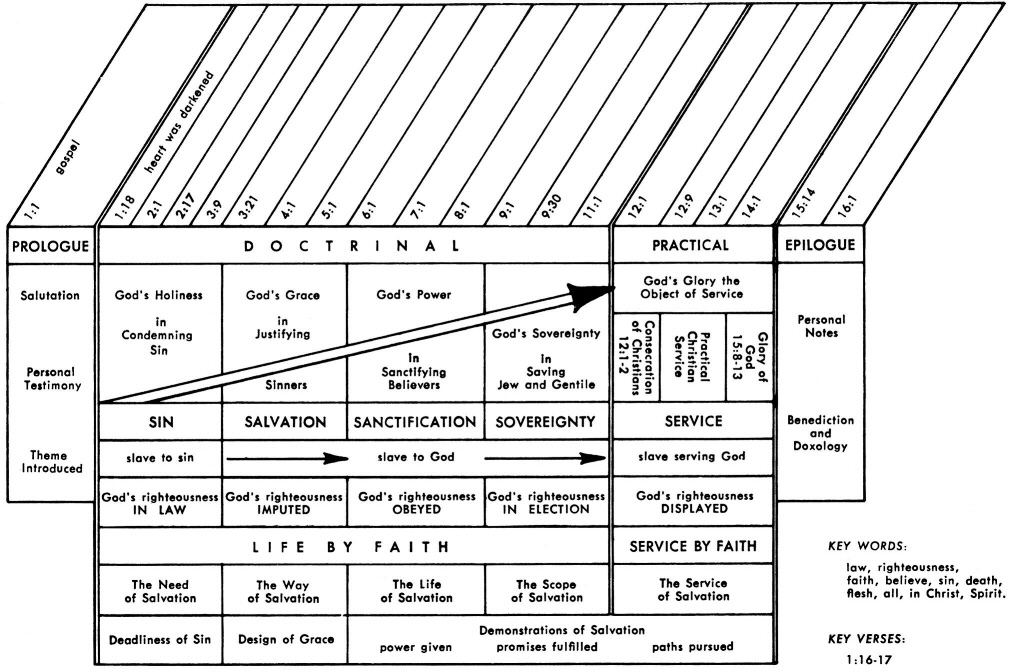
Click chart to enlarge
Chart from recommended resource Jensen's Survey of the NT - used by permission
Romans Overview Chart - Charles Swindoll
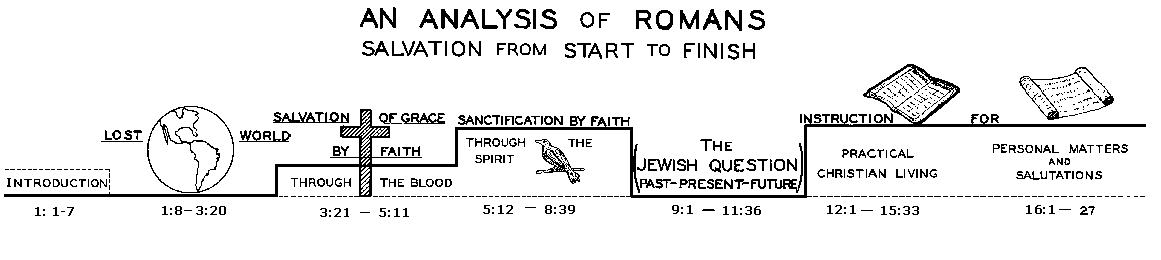
Source: Dr David Cooper
Click to Enlarge
R Ruin (Romans 1:17 – 3:20) – The utter sinfulness of humanity
O Offer (Romans 3:21-31) – God’s offer of justification by grace
M Model (Romans 4:1-25) – Abraham as a model for saving faith
A Access (Romans 5:1-11) – The benefits of justification
N New Adam (Romans 5:12-21) – We are children of two “Adams”
S Struggle w/ Sin (Romans 6-8) Struggle, sanctification, and victory
|
ROMANS ROAD |
||||
| Romans 1:18-3:20 | Romans 3:21-5:21 | Romans 6:1-8:39 | Romans 9:1-11:36 | Romans 12:1-16:27 |
| SIN | SALVATION | SANCTIFICATION | SOVEREIGNTY | SERVICE |
| NEED FOR SALVATION |
WAY OF SALVATION |
LIFE OF SALVATION |
SCOPE OF SALVATION |
SERVICE OF SALVATION |
| God's Holiness In Condemning Sin |
God's Grace In Justifying Sinners |
God's Power In Sanctifying Believers |
God's Sovereignty In Saving Jew and Gentile |
Gods Glory The Object of Service |
| Deadliness of Sin |
Design of Grace |
Demonstration of Salvation | ||
| Power Given | Promises Fulfilled | Paths Pursued | ||
| Righteousness Needed |
Righteousness Credited |
Righteousness Demonstrated |
Righteousness Restored to Israel |
Righteousness Applied |
| God's Righteousness IN LAW |
God's Righteousness IMPUTED |
God's Righteousness OBEYED |
God's Righteousness IN ELECTION |
God's Righteousness DISPLAYED |
| Slaves to Sin | Slaves to God | Slaves Serving God | ||
| Doctrine | Duty | |||
| Life by Faith | Service by Faith | |||
|
Modified from Irving L. Jensen's chart above |
||||
Romans 15:7 Therefore, accept one another, just as Christ also accepted us to the glory of God .
Greek: Dio proslambanesthe (2PPMM) allelous, kathos kai o Christos proselabeto (3SAMI) humas eis doxan tou theou
Amplified: Welcome and receive [to your hearts] one another, then, even as Christ has welcomed and received you, for the glory of God.
NLT: So accept each other just as Christ has accepted you; then God will be glorified.
Phillips: So open your hearts to one another as Christ has opened his heart to you, and God will be glorified.
Wuest: Wherefore, be receiving one another even as also the Christ received us, with a view to the glory of God.
Young's Literal: wherefore receive ye one another, according as also the Christ did receive us, to the glory of God.
WHEREFORE ACCEPT ONE ANOTHER: Dio proslambanesthe (2PPMM) allelous:: dio:
- Mt 10:40 Mk9:37 Lk 9:48
- Romans 15 Resources - Multiple Sermons and Commentaries
Wherefore (term of conclusion) - This term includes the entire section from (Ro 14:1-15:6), and here sums up the major emphasis of this section. In immediate context because the purpose of being of one accord is to bring glory to God the Father, we are therefore to accept one another that this glorious effect might be realized.
Stedman asks "Do you remember the prayer of the little girl who once prayed, "Lord, make the bad people good and the good people nice"? This is really the subject of Ro 14-15 -- making good people nice! One of the problems of the Christian church is that we may be quite correct in our doctrine and practice, but very irritating about it. How do you live with people like that? That is the problem of these chapters, and it is a problem that abounds everywhere -- how to live with other Christians who persist in looking at things differently than you do."
Middletown Bible - The Law of Love (Romans 14:1-15:3) - For further help in understanding how to live so as to not cause a brother to stumble, see paper entitled, "Guidance: 67 Biblical Tests to Use in Deciding Upon a Course of Action."
Accept (4355) (proslambano from prós = to, toward + lambáno = to take) means literally to take to or toward. To take in addition to (Acts 17:5). It can mean to take hold of or grasp ( Acts 27.36). It can mean to take aside or lead off to oneself (can imply for privacy) (Mt 16:22, 20:17, Mk 8:32). Proslambano is used in this verse with the meaning of to accept the presence of a person with friendliness, to welcome, to receive hospitably, to receive into one’s home or circle of acquaintances, (Ro 14:1, 3, 15:7, Acts 28:2, Philemon 1:17). Proslambano is used idiomatically to mean to take food to oneself (Acts 27:33, 27:36).
Paul commands us (present imperative) to continually make this our habit, our lifestyle. We are to be supernatural acceptors so to speak! Why do I say that? Because the only way a believer can obey this command continually, is by continually being filled with (controlled by) the Holy Spirit (Eph 5:18-note), walking by the selfsame Spirit (Gal 5:16-note). In fact, whenever you encounter a command in the New Testament, you should read it as an opportunity to surrender to the Spirit. The only way to keep the supernatural commands is by dependence on a supernatural Source! For example, Paul says "Husbands love (present imperative) your wives just as (take note of this "strategic" term of comparison) Christ loved the Church!" (Eph 5:25-note) which is a command calling for this to be our habitual practice. Just try to obey this command in your own strength! Enough said!
Proslambano is always in the middle voice in the NT which conveys the idea that the subject not only initiates the action but also participates in the results of that action. Paul is calling for a "reflexive" (you yourselves demonstrate) a whole hearted attitude and action.
So Paul says continually draw one another to yourself. One could translate it "accept to yourself" or "take to yourself" which is the idea of the middle voice. Thus one could paraphrase it as...
Give them a warm welcome.
Grant them access to your heart.
Take them to yourself.
Treat them as the closest of friends with the most caring kindness.
Believers are to receive one another in the closest of bonds. Let your love be without hypocrisy (Ro 12:9-note) and demonstrate a genuine heartfelt acceptance. Take them into friendship. And remember that in the final analysis to accept one another is actually to accept Christ Himself (Mt 10:40)
Related Resource:
JUST AS CHRIST ALSO ACCEPTED US TO THE GLORY OF GOD: kathos kai o Christos proselabeto (3SAMI) humas eis doxan tou theou:
- Romans 15 Resources - Multiple Sermons and Commentaries
Just as - This is a term of comparison, which again calls for us to depend on a supernatural Source, the Spirit of Christ Who indwells us and enables us to live a supernatural life, life on a higher plane. In other words, the only way to accept just as Christ did is to walk like He walked (1Jn 2:6, 1Pe 2:21-note, 1Cor 11:1 - we are to be continually filled with, enabled by the Spirit, just as He was when He was on earth as the God-Man -see Lk 4:1, 14). When we are filled with His Spirit, walking by His Spirit, it should not be too difficult to extend the hand of friendship to one who is loved by the One we honor and worship and Who first loved us.
The idea should be "Any friend of His is a friend of mine."
Spurgeon - If the Lord Jesus has indeed received us, and bears with our weaknesses and follies, well may we have patience with one another, and show pity to each other's infirmities. Christ did not receive us because we were perfect, because he could see no fault in us, or because he hoped to gain somewhat at our hands. Ah, no! but, in loving condescension covering our faults, and seeking our good, he welcomed us to his heart; so, in the same way, and with the same purpose, let us receive one another.
Accepted - The same verb proslambano in (Ro14:3-note) describes God accepting the strong brother.
What were we like before Christ accepted us? Romans 5 gives us a "thumbnail sketch" where Paul describes unbelievers as "helpless... ungodly... sinners... enemies". (Ro 5:6, 7-note, Ro 5:8, 5:9-note, Ro 5:10-note)
So what excuse do we have not to accept another, no matter what the differences we might have with them in the arena of non-essentials. Jesus accepts sinners impartially (Ro 2:11-note).
Jesus accepts sinners to the glory of God. God established His eternal plan of redemption to glorify Himself. Everything He does is to His glory, and everything His children do should be to His glory.
Leenhardt writes
Nothing glorifies God as much as the unity of His children, which alone is in harmony with His essential will of love.
Believers are to receive one another even as Christ has received us. No person is too prejudicial or critical, too weak or base for us to receive. The point is that Christ received and ministered to the most prejudicial and judgmental (the Jews), sinful and base (the Gentiles) people in the world; therefore, believers can receive one another (Gal 3:28, Ep 2:11-22-note). No one is too far gone to be rejected and cast away.
Ray Stedman has some practical insights writing:
"Now, that is the end and aim of human life, to "glorify the God and Father of our Lord Jesus Christ." Every Christian heart wants that. Is there any Christian who, deep down in his heart, does not want the glory of God in his life? Well, then, the way to produce it is to live in harmony with one another. That is the procedure. It says that even though Christians: Hold different points of view (they do not come to some universal agreement on doctrine -- that isn't what is necessary), despite this, they can be so interested in one another and so concerned about one another that they can live in harmony, and the result is that they glorify God. What is the key to it? It is tucked away in one little phrase which, if you miss it, you will want to live in harmony with others but you will find yourself quite incapable of doing it. The key is this little phrase, "in accord with Christ Jesus." (Ro 15:5b) You see, when Paul mentions that Christ did not please Himself, he is not holding Him up as an example to follow, he is lifting Him up as a life to appropriate! That is the big difference! We are not just to try our best to live the same way, because we CAN'T. Our own natural inclinations of self-pleasing rise up and refuse to permit us to do that. But we must never forget that these exhortations that we read in these last five chapters of Romans rest solidly and squarely on the teachings of Ro 5, 6, 7, 8. It is back there that we learn that God has done something about this old Adamic life which naturally moves to evil -- has cut it off, and has given us, in place of it, the indwelling life of the Son of God Himself, and it is His purpose and desire to live that life again through us! In the doing of it, we find it quite possible to do all that He does because He does it through us. This is what it is speaking of here when it says, "in accord with Christ Jesus," that is, in fellowship with him. Biting your lip, and trying to keep your temper is not the SECRET of living with difficult people; that is never it. The SECRET is a thankful heart which continually looks up to the Lord Jesus. It says, "Thank You, Lord, for the quietness and the calmness, the purity and the love which is available to me through You continually. Thank You." A thankful heart and an obedient will that seeks to please another for his own good is the SECRET of living with difficult people. You try that and see if it doesn't work." (Power to Please)
John MacArthur adds that
Paul does not mention specific types of believers in this verse. He is speaking to the strong and to the weak, to Gentiles and to Jews. All believers are called to accept one another. He is not simply speaking of accepting new believers into our church fellowship, although that would certainly be included in this admonition. He is calling on all Christians to accept one another in the fullest and deepest sense, to treat each other with love and understanding, just as Christ also accepted us. If the perfect, sinless Son of God has accepted us into God’s divine family, how much more should we be willing to accept each other, despite the fact that we all still carry sinful trappings from our old, unredeemed flesh. (MacArthur, J: Romans 9-16. Chicago: Moody Press)
Include The Unaccepted (Romans 15:4-13) - Christ's followers are called to live an "inclusive" lifestyle. By this I mean that we are instructed in God's Word to reach out to those who might not be accepted by others. But we get so comfortable with our church friends that we may feel it's too much to ask.
In The Covenant Home Altar, Erika Carney wrote, "When I was growing up, my mom was deeply involved with the various activities I participated in. She would often tell me, 'Make sure Heather feels included,' or 'Ask Julie to be your partner,' or 'Invite Kristen to sit with you and your friends.' I sometimes dreaded hearing those words. What if I just wanted to be with my friends? Why should I have to make sure that other people were having fun?"
Erika's mother was teaching her daughter to obey the principle taught in Romans 15:7. We are to welcome and accept Christians who may not feel comfortable in our particular group.
Some people are excluded because they are withdrawn, angry, or defensive, or because they seem strange or demanding. But these things shouldn't matter. We are to receive fellow believers "just as Christ also received us, to the glory of God" (Ro 15:7). — David C. Egner
Some people can be difficult to love
And so we do not even try to care,
But God says, "Love them just as I've loved you--
You'll bring Me glory as My love you share." --Cetas
We care for others because God cares for us.
Romans 15:8 For I say that Christ has become a servant to the circumcision on behalf of the truth of God to confirm the promises given to the fathers
Greek: lego (1SPAI) gar Christon diakonon gegenesthai (RPN) peritomes huper aletheias theou eis to bebaiosai (AAN) tas epaggelias ton pateron
Amplified: For I tell you that Christ (the Messiah) became a servant and a minister to the circumcised (the Jews) in order to show God’s truthfulness and honesty by confirming (verifying) the promises [given] to our fathers,
NLT: Remember that Christ came as a servant to the Jews to show that God is true to the promises he made to their ancestors.
Phillips: Christ was made a servant of the Jews to prove God's trustworthiness, since he personally implemented the promises made long ago to the fathers,
Wuest: For I am saying, Christ has become a servant to the circumcision on behalf of God’s truth, resulting in the confirmation of the promises to the fathers
Young's Literal: And I say Jesus Christ to have become a ministrant of circumcision for the truth of God, to confirm the promises to the fathers,
FOR I SAY THAT CHRIST HAS BECOME A SERVANT TO THE CIRCUMCISION ON BEHALF OF THE TRUTH OF GOD: lego (1SPAI) gar Christon diakonon gegenesthai (RPN ) peritomes huper aletheias theou:
- Mk 10:43, Mt 20:26, Mt 23:11
- Romans 15 Resources - Multiple Sermons and Commentaries
For (gar) is a term of explanation, which should always prompt us to pause and ponder the text and context, asking questions like what is the author explaining, etc? Paul has explained that believers are to accept one another just as Christ accepted each one of us and now he elaborates on what Christ's acceptance of us entails -- in a nutshell, as menial (diakonos) (see in depth discussion of related word diakonia) servant, of both Jews and Gentiles.
Spurgeon - It was to Abraham and his descendants that the promise was made that, in him, and in his seed, all the nations of the earth should be blessed. So our Lord came, as a Jew, to be "a minister of the circumcision." Let us never forget that he came to those whom we are apt to forget; and, peradventure, even to despise, "to confirm the promises made unto the fathers.'" Jesus, our Lord, became the servant of the Jews, and preached among them in fulfilment of prophecy; shall we not become the servants of others for their good? Nor did his ministry end with Israel; but we, who are Gentiles, share the blessing; therefore, like our Lord, we should seek the good of all mankind and live to bless them.
Become (ginomai) - Paul used perfect tense for become indicating a permanent state -- Christ continues in his capacity as "a servant of circumcision". His function as Jewish Messiah is permanent.
Paul is explaining the breadth of Christ's acceptance of us. Christ received the Jews and ministered to them and He did so for the truth of God -- to confirm and fulfill the promises God made to the patriarchs. Did He accept them because they accepted Him? In fact they did not receive Him! (Jn 1:11) and yet Christ came to them and received and ministered to them. Why? For the sake of the truth of God—to fulfill the OT promises made in the Word of God for "not one word has failed of all His good promise" (1Ki 8:56 cp Josh 23:14 Nu 23:19)
Servant (minister, deacon) (1249)(diakonos see related words diakoneo, diakonia) is of uncertain origin. Some say it is from dia (through) + konis (dust) which denotes one who hurries through the dust to carry out his service. (Thayer and others doubt this derivation for technical reasons). Vine says that diakonos is probably from diako which means to hasten after, to pursue and so to run on errands. "Then the root idea is one who reaches out with diligence and persistence to render a service on behalf of others. This would imply that the deacon reaches out to render love-prompted service to others energetically and persistently." (Hiebert)
This word group (diakonos, diakoneo, diakonia) focuses on the rendering or assistance or help by performing certain duties, often of a humble or menial nature, and including such mundane activities as waiting on tables or caring for household needs, activities that to many would seem to be without dignity (not true of course in God's eyes, Pr 15:3, Rev 22:12-note). In summary, the basic idea of this word group is that of humble, submissive, personal service, with less emphasis on a specific office or a particular function.
As Matthew Henry once said "Those whom God will employ are first struck with a sense of their unworthiness to be employed."
Circumcision (4061) (peritome [word study] from perí = around + témno = cut off) refers literally to cutting and removal of the foreskin. As discussed below both the Old and New Testament also use the concept of circumcision in a figurative or metaphorical sense. (See also exposition of Scriptures on Circumcision)
Although circumcision was required by the Mosaic law, the rite was neglected during the days when the people of Israel wandered in the wilderness. Perhaps this was a sign that the nation had broken their covenant with God through their disobedience. The rite was resumed when they entered the land of Canaan, with Joshua performing the ritual on the generation born in the wilderness (Joshua 5). The Hebrew people came to take great pride in circumcision; in fact, it became a badge of their spiritual and national superiority. This practice fostered an exclusivist mentality instead of a missionary zeal to reach the Gentiles which was God's original intent for His "chosen" people.
A daily prayer of a strict Jewish male was to thank God that he was neither a woman, a Samaritan, nor a Gentile. Gentiles came to be regarded by the Jews as the uncircumcision, a term of disrespect implying that non-Jewish peoples were outside the circle of God’s love. As discussed below, God applied the very same term ("uncircumcised") to describe His "chosen" people. The terms circumcised and uncircumcised became emotionally charged symbols to Israel and their Gentile neighbors. This issue later brought discord into the fellowship of the New Testament church and especially caused confusion about how one obtained genuine salvation.
The Jews should have known the true meaning of circumcision for Moses and the prophets used the term circumcised as a symbol for purity of heart and readiness to hear and obey. For example, through Moses the Lord challenged the Israelites to submit to
Circumcise then your heart, and stiffen your neck no more. (Dt 10:16).
An uncircumcised heart reflected a will that was hardened toward God’s commands.
Circumcision as first prescribed in (Ge 17:10, 11, 12, 13, 14) meant to cut away the fleshly part of the male sexual organ, that part which might hold disease in its folds and so potentially might pass the disease on to the wives. Thus physical circumcision had an important role in the preservation of God’s people physically.
The Jews took great pride in circumcision which became a badge of their spiritual and national superiority thus fostering a spirit of exclusivism instead of a missionary zeal to reach out to the Gentile nations as God had intended. A daily prayer of strict Jewish males was to thank God that he was neither a woman, a Samaritan, nor a Gentile. Gentiles came to be regarded by the Jews as the “uncircumcision,” a term of disrespect implying that non-Jewish peoples were outside the circle of God’s love. Paul had already dealt with genuine (internal, heart) circumcision and contrasted this with the external ritual (Ro 2:28, 29-note).
Truth (225)(aletheia from a = indicates following word has the opposite meaning ~ without + lanthano = to be hidden or concealed, to escape notice, cp our English "latent" from Latin = to lie hidden) has the literal sense of that which contains nothing hidden. Aletheia is that which is not concealed. Aletheia is that which that is seen or expressed as it really is (this idea is discussed more below).
The basic understanding of aletheia is that it is the manifestation of a hidden reality (eg, click discussion of Jesus as "the Truth"). For example, when you are a witness in a trial, the court attendant says "Raise your right hand. Do you swear that you will tell the truth and nothing but the truth so help you God?" And you say, "I do" and you sit down. The question the court attendant is asking is "Are you willing to come into this courtroom and manifest something that is hidden to us that only you know so that you will bear evidence to that?" Therefore when you speak the truth, you are manifesting a "hidden reality". Does that make sense?
Truth then is the correspondence between a reality and a declaration which professes to set forth or describe the reality. To say it another way, words spoken or written are true when they correspond with objective reality. Persons and things are true when they correspond with their profession (which we describe with words like integrity, sincerity, non-hypocritical, etc). In other words, "what you see is what you get". Hence a truth is a declaration which has corresponding reality, or a reality which is correctly set forth. Since God is Himself the great reality, that which correctly sets forth His nature is pre-eminently the Truth of Creation (Natural Revelation) and the Truth of Scripture (Special Revelation). Thus it is not surprising that rebellious, sinful men actively hold down or suppress the Truth of Creation (and the glorious Creator) (Ro 1:18-note) and even exchange this clearly manifested (and objective) reality (Creation) for a lie (Ro 1:25-note).
TO CONFIRM (make firm, strengthen, guarantee) THE PROMISES GIVEN TO THE FATHERS: eis to bebaiosai ( AAN ) tas epaggelias ton pateron:
- Ro 9:4,5
- Romans 15 Resources - Multiple Sermons and Commentaries
Confirm (establish) (950)(bebaioo from bébaios = sure, fixed, standing firm on the feet, steadfast, maintaining firmness or solidity. In classical Greek from the 5th century B.C. bebaios acquires the meaning of firm, durable, unshakeable, sure, reliable, certain; and in the legal sphere, valid, legal <> bebaios is derived from baino = fit to tread on = having a firm foundation) is a verb which means to make sure or certain, to prove valid or reliable or to verify and (in legal language) to guarantee. Bebaioo was used in secular Greek as a legal technical term meaning "to designate properly guaranteed security". Its use in a legal sense therefore gives it great force here, indicating that there cannot be the slightest doubt about the salvation offered. The main point then is that this is truth that can be trusted without hesitation or reservation.
Promises (1860)(epaggelia/epangelia from epí = intensifies verbal meaning + aggéllo = to tell, declare) literally means to "tell at or upon" and originally referred to an announcement or declaration (especially of a favorable message) (see Acts 23:21). In other words the first sense of epaggelia is that of a . declaration to do something which came to be associated with the implication of obligation to carry out what is stated and thus the meaning of a promise, pledge or offer. In Scripture, epaggelia refers primarily to God's pronouncements that provide assurance of what He intends to do.
The fathers - Primarily this refers to the patriarchs, Abraham, Isaac and Jacob.
How did Messiah confirm the promises to the patriarchs? Clearly by being the ultimate fulfillment of those OT promises (To Abraham Ge 12:3, 17:7, 18:19, 22:18, Acts 3:25) (To Isaac Gen 26:3, 4) (To Jacob Ge 28:13, 14, 15, 46:2, 3, 4).
Paul made it clear both that the covenant promises of God are permanent and that they find their fulfillment in Christ.
Paul's point is that herein lies our motivation to accept one another, to bear one another's weaknesses and not to please our self but build up one another (Ro 15:1, 2+).
The believer has the greatest pattern imaginable: Christ Himself. (cf 1Jn 2:6+, 1Pe 2:21+, 1Cor 11:1+)
Christ received us that God may be glorified. Therefore, believers must receive each other so that God may be glorified through their lives and His church.
Related Resource:
Romans 15:9 and for the Gentiles to glorify God for His mercy; as it is written, "THEREFORE * I WILL GIVE PRAISE TO YOU AMONG THE GENTILES, AND I WILL SING TO YOUR NAME."
Greek: ta de ethne huper eleous doxasai (AAN) ton theon, kathos gegraptai (3SRPI) dia touto exomologesomai (1SFMI) soi en ethnesin kai to onomati sou psalo (1SFAI)
Amplified: And [also in order] that the Gentiles (nations) might glorify God for His mercy [not covenanted] to them. As it is written, Therefore I will praise You among the Gentiles and sing praises to Your name. [Ps 18:49]
NLT: And he came so the Gentiles might also give glory to God for his mercies to them. That is what the psalmist meant when he wrote: "I will praise you among the Gentiles; I will sing praises to your name."
Phillips: and also that the Gentiles might bring glory to God for his mercy to them. It is written: 'For this reason I will confess to you among the Gentiles, and sing to your name'.
Wuest: and [resulting] in the Gentiles, on behalf of His mercy, glorifying God; even as it stands written, Because of this I will openly confess to you among the Gentiles and in your Name sing.
Young's Literal: and the nations for kindness to glorify God, according as it hath been written, 'Because of this I will confess to Thee among nations, and to Thy name I will sing praise,'
AND FOR THE GENTILES TO GLORIFY GOD FOR HIS MERCY: ta de ethne huper eleous doxasai (AAN ) ton theon:
- John 10:16
- Romans 15 Resources - Multiple Sermons and Commentaries
Spurgeon - And that the Gentiles might glorify God .for his mercy; as it is written: For this cause I will confess to thee among the Gentiles, and sing unto thy name. And again he saith, Rejoice, ye Gentiles, with his people. And again, Praise the Lord, all ye Gentiles; and laud him, all ye people. And again, Esaias saith, There shall be a root of Jesse, and he that shall rise to reign over the Gentiles; in him shall the Gentiles trust. There were plain indications, in the Old Testament, that the blessing was meant for the Gentiles as well as for the Jews; but, still, it was made known to the Jews first, and we must never forget that.
The saved Jew primarily praises God for His truth and the saved Gentile primarily praises God for His mercy. Christ received the Gentiles and ministered to them. He came to bring them the mercy of God, that they might praise God for His mercy. And don't forget the context -- Jesus received and ministered to the Gentiles when they were living the most licentious and indulgent life-style imaginable (Ro 1:18-32-note).
God had made covenants only with Israel (Ro 9:4-note), not with the Gentiles (Ep 2:12-note), so God had no covenantal promises to confirm with the Gentiles. Any spiritual blessings that come to the Gentiles spring solely from the mercy of God. Nevertheless God eternally purposed to bless the Gentiles spiritually through the Lord Jesus as their Messiah and through His covenants with Israel (Ge 12:3 cf. Jn 4:22).
It is no accident that Paul's quotations in (Ro 15:8, 9, 10, 11, 12) are taken from the three divisions of the OT, the Law, the Prophets, and the Psalms (Lk 24:44) and from three great Jewish heroes: Moses, David, and Isaiah.
A progression of thought can be traced through the four quotations. In the first, David praised God among the Gentiles (Ro 15:9); in the second, Moses exhorted the Gentiles, Rejoice . . . with His people (Ro15:10); in the third the psalmist commanded the Gentiles to praise the Lord (Ro 15:11-note; cf. Ro 15:7) and in the fourth, Isaiah predicted that the Gentiles will live under the rule of the Root of Jesse (the Messiah) and they will hope in Him (Ro 15:12-note).
AS IT IS WRITTEN THEREFORE I WILL GIVE PRAISE TO THEE AMONG THE GENTILES: kathos gegraptai ( 3SRPI) dia touto exomologesomai (1SFMI ) soi en ethnesin:
- Romans 15 Resources - Multiple Sermons and Commentaries
Written (1125) (grapho) from root graph- = primarily means to scratch on or engrave as on an ornament, reports, letters, etc; English = graph, graphic, etc) means to engrave or inscribe with a pen or stylus characters or letters on a surface which can be wood, wax, metal, leather, stone, parchment, dirt (John ), paper, etc. (Click to review all 191 uses of grapho in the NAS)
It is written occurs 76 times in the (Click for these uses). When we were children and our parents told us to do something and we questioned "Why?", the answer was usually "Because I said so!". Why are we commanded to be holy? Because God said so! A popular saying is
God said it, I believe it, that settles it.
This sounds good but isn't accurate because God's Word is true, irregardless of whether we believe it or not. A more accurate "saying" would be
God said it, that settles it!
It is written should put a stop to every complaint or excuse. Paul is saying don't judge but remember you will appear before Me to give an account (as the next verse clarifies). This sobering thought should motivate us to obey this injunction.
Grapho is in the perfect tense meaning that this "has been written and stands written".
To illustrate that it has always been God’s plan to bring Gentile into His kingdom, Paul appeals not to his great learning but to the unchanging Word of God in the Old Testament, possibly to soften the prejudice of Christian Jews against Christian Gentiles as their own Scriptures demonstrate that the inclusion of Gentiles was neither a divine nor a human afterthought.
This first OT quotation is from the Greek Septuagint of (2Sa 22:50, Ps 18:49-note) where David is praising God for giving him victory over his enemies and for making the nations subject to him. David goes on to say will sing hymns of praise to the Lord among the Gentile nations, so that the Gentiles may know the true God and join in the praise.
Paul sees in this Psalm as a clear indication of God’s plan to include the Gentiles in the Messiah’s people. Israel was to have been the instrument through which God's redemptive work would extend to the Gentiles.
AND I WILL SING TO THY NAME: kai to onomati sou psalo ( 1SFAI ):
- Romans 15 Resources - Multiple Sermons and Commentaries
SING PRAISES TO
HIS NAME
Play the beautiful simple chorus "I Sing Praises to Your Name"
Sing praises (5567)(psallo from psao = touch lightly, twang, snap) means literally to strike the strings of an instrument. So the idea is sing to the accompaniment of a harp;
Zodhiates - Musicians who play upon an instrument were said to pluck the strings (psálloun chordás) or simply pluck (psálloun). The word came to signify the making of music in any fashion. Because stringed instruments were commonly used both by believers and heathen in singing praises to their respective gods, it meant to sing, sing praises or psalms to God whether with or without instruments (Complete Word Study Dictionary – New Testament)
Psallo - 4x in the NT - Ro 15:9 = "I will sing to Your Name"; 1 Co. 14:15 = "I will sing with the spirit and I will sing with the mind also."; Eph. 5:19+; Jas. 5:13
Psallo in the Septuagint -
Jdg. 5:3; 1 Sam. 16:16; 1 Sam. 16:17; 1 Sam. 16:23; 1 Sam. 19:9; 2 Sam. 22:50; 2 Ki. 3:15; Ps. 7:17; Ps. 9:2; Ps. 9:11; Ps. 13:5; Ps. 18:49; Ps. 21:13; Ps. 27:6; Ps. 30:4; Ps. 30:12; Ps. 33:2; Ps. 33:3; Ps. 47:6; Ps. 47:7; Ps. 57:7; Ps. 57:9; Ps. 59:17; Ps. 61:8; Ps. 66:2; Ps. 66:4; Ps. 68:4; Ps. 68:25; Ps. 68:32; Ps. 68:33; Ps. 69:12; Ps. 71:22; Ps. 71:23; Ps. 75:9; Ps. 92:1; Ps. 98:4; Ps. 98:5; Ps. 101:1; Ps. 104:33; Ps. 105:2; Ps. 108:1; Ps. 108:3; Ps. 135:3; Ps. 138:1; Ps. 144:9; Ps. 146:2; Ps. 147:7; Ps. 149:3
Gilbrant on psallo - In classical Greek the verb psallō means “to pluck, pull” in a very general sense, such as to “pluck out a hair” or “to pull a bowstring.” It is also used with a technical meaning “to play a stringed musical instrument” on which the strings were plucked rather than struck with a mallet. The usage of psallō in the Septuagint, however, introduces an expansion of its meaning. Twelve times it is used to translate Hebrew nāghan, “to play a stringed instrument,” in keeping with its technical use in classical Greek. However, nearly 40 times the Septuagint uses psallō to translate Hebrew zāmar, “to make music in praise of God” (Brown-Driver-Briggs, “zmr,” Hebrew Lexicon, p.274). This Hebrew word describes music made either by musical instruments or vocally, and thus can also mean “to sing.” In some Old Testament contexts it is apparent that zāmar/psallō refer to singing that is accompanied by instruments (cf. Psalm 66:4). As a result, the meaning of psallō began to be extended to include “to sing,” and by Modern Greek it had come to mean this exclusively (Bauer).
Romans 15:10 Again he says, "REJOICE, O GENTILES, WITH HIS PEOPLE."
Greek: kai palin legei (3SPAI) euphranthete (2PAPM) ethne, meta tou laou autou.
Amplified: Again it is said, Rejoice (exult), O Gentiles, along with His [own] people; [Deut. 32:43.]
NLT: And in another place it is written, "Rejoice, O you Gentiles, along with his people, the Jews."
Phillips: And again: 'Rejoice, O Gentiles, with his people!'
Wuest: And again he says, Rejoice, Gentiles, with His people.
Young's Literal: and again it saith, 'Rejoice ye nations, with His people;'
AND AGAIN HE SAYS REJOICE O GENTILES WITH HIS PEOPLE: kai palin legei ( 3SPAI) euphranthete (2PAPM ) ethne, meta tou laou autou:
- Romans 15 Resources - Multiple Sermons and Commentaries
“Rejoice, O nations, with His people; For He will avenge the blood of His servants, And will render vengeance on His adversaries, And will atone for His land and His people.” (Deut 32:43)
Paul quotes the from Septuagint the song of Moses, given as Moses prepared to die (Dt 32:43). He had led Israel to its promised land and now, in the final verse of his great song, he exhorted all the nations to rejoice with God's chosen nation, for in Abraham's seed would all nations be blessed. Note also that Paul quotes this exhortation as coming directly from God, even though it was Moses' song, thus confirming the divine inspiration of Moses' writings near the very end of the Pentateuch.
Rejoice (2165) (euphraino from eu = well, good + phren = mind, intellect, disposition) means in active sense to make someone glad, to cheer someone up, to make them joyful in mind, to cause them to be glad (2Cor 2:2, Lxx = Ps 19:8, Pr 23:15). In the middle voice or passive voice euphraino means to be glad, to be joyful, to celebrate or be jubilant (used 4 times with this sense in story of Prodigal son = to feast in token of joy), to enjoy oneself, to be delighted, to keep a day of rejoicing.
NIDNTT adds that "such joy stems largely from those events and situations which give rise to communal rejoicing, such as a banquet. Nevertheless philosophers also us the word for introspective and spiritual joy....For the rest a wide diversity of usage can be found, a fact indicated by numerous Hebrew equivalents: joy as an emotion (e.g. Ps. 16:11); joy in someone or something (2Sa. 1:26; Eccl. 11:9); joy in God (Neh. 8:10; Ps. 33:21); joy in God’s word (Jer. 15:16; Ps. 119:14); joy in the keeping of the commandments (Ps. 119:162); joy in the time of salvation (Isa. 35:10; 52:12)."
To "enjoy the good life" in Luke 12:19 and Luke 16:19, a desire that proved to be a deception for the rich man (see Lk 12:20-21, Lk 16:22-31). In Rev 12:12-note euphraino is used metaphorically in an exhortation to the heavens to rejoice. There is also "deceptive" rejoicing by the children of Israel as they reveled in idolatry at Mt Sinai (Acts 7:41) and when the wicked of the world rejoiced over the martyrdom of God's two witnesses.
Generally speaking, euphraino indicates the subjective feeling of joy and the related term agalliao the outward demonstration of joy ("Jump for joy" is the idea). In the Septuagint, euphraino is used alongside agalliao to express eschatological joy in which even the heavens and earth participate (Ps 96:11, Ps 97:11) and even of God rejoicing with them (Isa 65:19). The festive joy of the Jews in their OT community feasts (eating, drinking, etc) is "a vivid picture of eschatological joy." (NIDNTT - e.g., see Rev 12:12, 18:20). In the NT, the verb chairo is preferred over euphraino (although in the Septuagint euphraino is almost as frequently as chairo).
Mounce - Euphraino conveys the basic idea of a created state of joy or euphoria.
Euphraino - 14x in 14v - Usage: celebrate(5), glad(1), joyously living(1), makes...glad(1), merry(1), rejoice(4), rejoicing(1).
Luke 12:19 'And I will say to my soul, "Soul, you have many goods laid up for many years to come; take your ease, eat, drink and be merry."'
Luke 15:23 and bring the fattened calf, kill it, and let us eat and celebrate; 24 for this son of mine was dead and has come to life again; he was lost and has been found.' And they began to celebrate.
29 "But he answered and said to his father, 'Look! For so many years I have been serving you and I have never neglected a command of yours; and yet you have never given me a young goat, so that I might celebrate with my friends;
32 'But we had to celebrate and rejoice, for this brother of yours was dead and has begun to live, and was lost and has been found.'"
Luke 16:19 "Now there was a rich man, and he habitually dressed in purple and fine linen, joyously living in splendor every day.
Acts 2:26 'THEREFORE MY HEART WAS GLAD AND MY TONGUE EXULTED; MOREOVER MY FLESH ALSO WILL LIVE IN HOPE;
Comment: This passage in context speaks of Jesus "rejoicing" (celebrating) that He was resurrected.
Acts 7:41 "At that time they made a calf and brought a sacrifice to the idol, and were rejoicing in the works of their hands.
Comment: This type of rejoicing is transient, futile, vain, empty because of the source - vain, lifeless idols! How in contrast to the rejoicing given by the Spirit, focused on things that are righteous (see especially the passages in Revelation below).
Romans 15:10-note Again he says, "REJOICE, O GENTILES, WITH HIS PEOPLE."
2 Corinthians 2:2 For if I cause you sorrow, who then makes me glad but the one whom I made sorrowful?
Galatians 4:27 For it is written, "REJOICE, BARREN WOMAN WHO DOES NOT BEAR; BREAK FORTH AND SHOUT, YOU WHO ARE NOT IN LABOR; FOR MORE NUMEROUS ARE THE CHILDREN OF THE DESOLATE THAN OF THE ONE WHO HAS A HUSBAND."
Revelation 11:10-note And those who dwell on the earth will rejoice over them and celebrate; and they will send gifts to one another, because these two prophets tormented those who dwell on the earth.
Revelation 12:12-note "For this reason (Rev 12:11), rejoice (present imperative), O heavens and you who dwell in them. Woe to the earth and the sea, because the devil has come down to you, having great wrath, knowing that he has only a short time."
Revelation 18:20-note "Rejoice (present imperative) over her, O heaven, and you saints and apostles and prophets, because God has pronounced judgment for you against her (Babylon)."
Euphraino - 187v in the non-apocryphal Septuagint (Lxx) Note that the preponderance of uses of euphraino are found in the Psalms (57x in 57v) - Take a moment and meditate on these uses (interrogating with the 5W/H questions) and be sure to check the context if you see a phrase like "therefore" or "for this reason", "for" at the beginning of a verse [= term of explanation] or "but" [= term of contrast]) to see what is associated with rejoicing and celebration in the Psalms. It will bless your spirit! -
Lev 23:40; Deut 12:7, 12, 18; 14:26; 16:11, 14f; 20:6; 24:5; 26:11; 27:7; 28:39, 63; 30:9; 32:43; 33:18; Jdg 9:13, 19; 16:23; 19:3; 1 Sam 2:1; 6:13; 11:9, 15; 16:5; 2Sa 1:20; 1Kgs 1:40, 45; 8:65; 1Chr 16:10, 31, 33; 29:9; 2Chr 6:41; 7:10; 15:15; 20:27; 23:13, 21; 29:36; 30:25; Ezra 6:22; Neh 12:43; Esther 4:17; 5:9, 14; Job 21:12; 31:25; (Note that the uses of euphraino in Psalms are often a translation of the phrase "be glad" or "glad" and other uses as "rejoice") Ps 5:11; Ps 9:2; 14:7; Ps 16:9; 19:8; 21:1, Ps 21:6; 30:1; 31:7; 32:11; Ps 33:21; 34:2; 35:15, 27; Ps 40:16; Ps 43:4; 45:8; 46:4; Ps 48:11; 53:6; Ps 58:10; Ps 63:11; 64:10; Ps 65:10; 66:6; 67:4; 68:3; 69:32; 70:4; Ps 77:3; 85:6; 86:4, 11 ("unite" in Lxx = "let my heart rejoice"); Ps 87:7; 89:42; 90:14f; 92:4; 96:11; 97:1, 8, 12; 104:15, 31, 34; 105:3, 38; 106:5; 107:30, 42; 109:28; 113:9; 118:24; 119:74; 122:1; 126:3; 149:2; Pr 2:14; 8:30f; 10:1; 12:20, 25; 14:10; 15:13, 20, 30; 17:21f; 22:18; 23:15, 24f; 27:11; 29:2f, 25; 31:25; Eccl 2:10; 3:12, 22; 4:16; 5:19; 8:15; 10:19; 11:8f; Song 1:4; Isa 9:3, 17; 12:6; 14:8, 29; 16:10; 24:7, 14; 25:9; 26:19; 28:22, 26; 30:29; 35:1; 41:16; 42:11; 44:23; 45:8; 49:13; 52:8; 54:1; 56:7; 61:10; 62:5; 65:13, 19; 66:10; Jer 7:34; 20:15; 31:7, 12f; 50:11; Lam 2:17; 4:21; Ezek 23:41; Dan 4:31; 9:24f; Hos 7:3; 9:1; Joel 2:21, 23; Amos 6:13; Hab 1:15; Zeph 3:14, 17; Zech 2:10; 8:19; 10:7.
Here are some representative uses of euphraino from the Septuagint (Lxx), noting that the first use is in the celebration of the Feast of Booths or Tabernacles, a feast that will be celebrated in the Millennial reign (See Zech 14:16-19)
Isaiah 62:5 For as a young man marries a virgin, So your sons will marry you; And as the bridegroom rejoices over the bride, So your God will rejoice over you.