

Click chart to enlarge
Chart from recommended resource Jensen's Survey of the NT - used by permission
Romans Overview Chart - Charles Swindoll
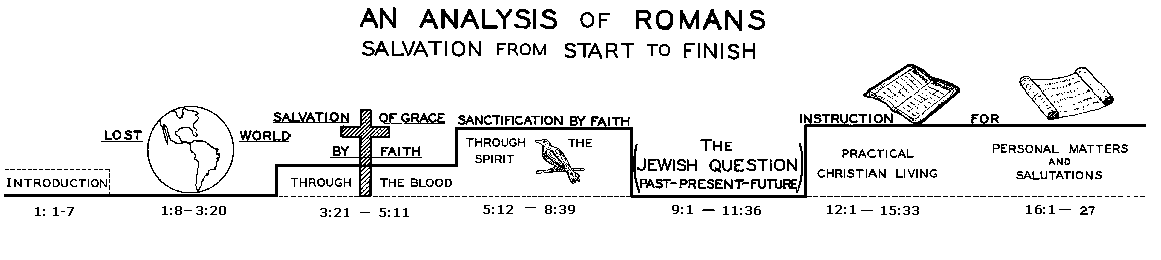
Source: Dr David Cooper
Click to Enlarge
R Ruin (Romans 1:17 – 3:20) – The utter sinfulness of humanity
O Offer (Romans 3:21-31) – God’s offer of justification by grace
M Model (Romans 4:1-25) – Abraham as a model for saving faith
A Access (Romans 5:1-11) – The benefits of justification
N New Adam (Romans 5:12-21) – We are children of two “Adams”
S Struggle w/ Sin (Romans 6-8) Struggle, sanctification, and victory
|
ROMANS ROAD |
||||
| Romans 1:18-3:20 | Romans 3:21-5:21 | Romans 6:1-8:39 | Romans 9:1-11:36 | Romans 12:1-16:27 |
| SIN | SALVATION | SANCTIFICATION | SOVEREIGNTY | SERVICE |
| NEED FOR SALVATION |
WAY OF SALVATION |
LIFE OF SALVATION |
SCOPE OF SALVATION |
SERVICE OF SALVATION |
| God's Holiness In Condemning Sin |
God's Grace In Justifying Sinners |
God's Power In Sanctifying Believers |
God's Sovereignty In Saving Jew and Gentile |
Gods Glory The Object of Service |
| Deadliness of Sin |
Design of Grace |
Demonstration of Salvation | ||
| Power Given | Promises Fulfilled | Paths Pursued | ||
| Righteousness Needed |
Righteousness Credited |
Righteousness Demonstrated |
Righteousness Restored to Israel |
Righteousness Applied |
| God's Righteousness IN LAW |
God's Righteousness IMPUTED |
God's Righteousness OBEYED |
God's Righteousness IN ELECTION |
God's Righteousness DISPLAYED |
| Slaves to Sin | Slaves to God | Slaves Serving God | ||
| Doctrine | Duty | |||
| Life by Faith | Service by Faith | |||
|
Modified from Irving L. Jensen's chart above |
||||
Romans 16:13 Greet Rufus, a choice man in the Lord, also his mother and mine. (NASB: Lockman) Greek: aspasasthe (AAM) Rouphon ton eklekton en kurio kai ten metera autou kai emou.
BGT Romans 16:13 ἀσπάσασθε Ῥοῦφον τὸν ἐκλεκτὸν ἐν κυρίῳ καὶ τὴν μητέρα αὐτοῦ καὶ ἐμοῦ.
NET Romans 16:13 Greet Rufus, chosen in the Lord, and his mother who was also a mother to me.13
NLT Romans 16:13 Greet Rufus, whom the Lord picked out to be his very own; and also his dear mother, who has been a mother to me.
ESV Romans 16:13 Greet Rufus, chosen in the Lord; also his mother, who has been a mother to me as well.
GNT Romans 16:13 ἀσπάσασθε Ῥοῦφον τὸν ἐκλεκτὸν ἐν κυρίῳ καὶ τὴν μητέρα αὐτοῦ καὶ ἐμοῦ.
KJV Romans 16:13 Salute Rufus chosen in the Lord, and his mother and mine.
NIV Romans 16:13 Greet Rufus,a chosenb in the Lord, and his mother, who has been a mother to me, too.
ASV Romans 16:13 Salute Rufus the chosen in the Lord, and his mother and mine.
CSB Romans 16:13 Greet Rufus,1 chosen in the Lord; also his mother -- and mine.
NKJ Romans 16:13 Greet Rufus, chosen in the Lord, and his mother and mine.
NRS Romans 16:13 Greet Rufus, chosen in the Lord; and greet his mother -- a mother to me also.
YLT Romans 16:13 Salute Rufus, the choice one in the Lord, and his mother and mine,
GREET RUFUS ("red") A CHOICE MAN IN THE LORD ALSO HIS MOTHER AND MINE: aspasasthe (2PAAM) Rouphon ton eklekton en kurio kai ten metera autou kai emou:
- Mk 15:21
- Jn 15:16 Ep 1:4 2Th 2:13 2Jn 1:1
- Mt 12:49,50 Mk 3:35 Jn 19:27
- Romans 16 Resources - Multiple Sermons and Commentaries
Rufus whom the Lord picked out to be his very own (NLT)
A choice man - Literally "the chosen" with "man" added by the translators.
MacArthur comments on "choice" writing that "Eklektos (choice) has the literal meaning of chosen, or elected. Paul could hardly be speaking about his being chosen for salvation, since, as made clear earlier in the epistle, every believer is “predestined to become conformed to the image of His Son” (Ro 8:29-note). In that sense, every Christian is equally chosen “in [Christ] before the foundation of the world” (Ephesians 1:4-note). The idea here, as the New American Standard Bible rendering indicates, is that Rufus was choice in the general sense in which that word is used today. He was an extraordinary Christian, known for his love and work for the Lord and for the Lord’s people. (MacArthur, J: Romans 9-16. Chicago: Moody Presss)
The greeting to his mother and mine does not mean Rufus was Paul’s natural brother but that Rufus’s mother, somewhere and in some way during Paul’s travels and ministry, had cared for the apostle as if he were her own son. Interesting!
A Mother's Touch - A Christian who helps to place orphans in homes tells about a little Russian boy named Ivan. He's a lovable child with a shock of brown hair falling over his face. When he learned that he might be able to leave the orphanage, he said, "Please, will you find me a mother?"
Fathers are important too, but there are times when nothing but a mother's touch will do. Even grown men need it.
The apostle Paul, probably in his fifties, sent special greetings to a fellow believer in Rome named Rufus. Interestingly, he added greetings to "his mother and mine" (Romans 16:13). Why would he refer to her in this way?
During his years of ministry, Paul faced many hardships (2Co 6:4, 5, 6, 7, 8, 9, 10). Could it be that Rufus had brought a weary and tired apostle to his house, where Paul received from the mother of Rufus comforting words, a fresh garment, and a nourishing meal? Did Paul receive from her the empathy and tenderness that only a mother can give? We don't know this for sure, but it could explain his unusual greeting in today's text.
I believe that God has given mothers a unique capacity for showing gentleness and compassion, and for influencing the spiritual direction of children. Let's be thankful for our mothers and for those who have been like a mother to us. — Herbert Vander Lugt (Our Daily Bread, Copyright RBC Ministries, Grand Rapids, MI. Reprinted by permission. All rights reserved)
God has conferred on motherhood
A true nobility,
And she who gladly fills that role
Can shape man's destiny. —DJD
Nothing moves a child like a mother's touch.
Romans 16:14 Greet Asyncritus, Phlegon, Hermes, Patrobas, Hermas and the brethren with them (NASB: Lockman)
Greek: aspasasthe (AAM) Asugkriton, Phlegonta, Ermen, Patroban, Erman, kai tous sun autois adelphous.
- Ro 8:29 Col 1:2 Heb 3:1 1Pet 1:22,23
- Romans 16 Resources - Multiple Sermons and Commentaries
The brethren with them - This grouping and the phraseology suggest this may have been a "congregation" or a house church. Note the specific individual affirmation which is almost identical to the pattern (Ro 16:15). Saved sinners immortalized in holy writ forever! It reminds me of Isaiah's great affirmation that we are all written down forever, God Himself affirming…
Behold, I have inscribed you on the palms of My hands… (Isa 49:16) (Comment: In context God is referring to Zion, but I think the application can be justifiably made to all saints, for the scars in His hands will forever mark the immutability of His covenant of grace with each of us individually, cp John's vision of Jesus in Heaven = Re 5:6-note, Re 5:9-note)
Romans 16:15 Greet Philologus and Julia, Nereus and his sister, and Olympas, and all the saints who are with them. (NASB: Lockman)
Greek: aspasasthe (AAM) PHilologon kai Ioulian, Nerea kai ten adelphen autou, kai Olumpan, kai tous sun autois pantas agious.
Romans 16 Resources - Multiple Sermons and Commentaries
This as well as other "groupings" of names may represent those who belonged to a small church in a home.
Philologus - His name means fond of words or a lover of words. He either loved the "Word" of God or he talked too much! Or perhaps he was a good inductive Bible study student who loved "word studies"! Won't heaven be a fascinating place, where we see these minor "mysteries" come to light!
AND ALL THE SAINTS WHO ARE WITH THEM: kai tous sun autois pantas hagious:
- Romans 16 Resources - Multiple Sermons and Commentaries
All the Saints - not the name of a church.
And all the saints - Not that the aforementioned (Philologus, et al) are not also saints in Christ, for they are indeed set apart, as is every believer who is safe in the "Ark" of Jesus Christ. There is no such category known as "super saints". We are all equal in Christ (Gal 3:28). The foot of the Cross is a "level playing field" where all the saints meet to bow down and worship and derive the power for their supernatural life (1Co 1:18, cp Gal 6:14-note, 2Co 12:9-note)
Saints (40) (hagios [word study] = set apart ones, separated ones, sanctified ones) is literally holy ones and in this context refers to individuals who have been set apart by God's Spirit (1Pe 1:2-note) (sanctified by faith) from the filth and corruption of this world and unto a holy, holy, holy God for His use! In the New Testament every believer has a "special purpose" and this truth includes you dear reader (cp Ep 2:10-note, Mt 5:16-note, cp 1Pe 4:10, 11-note), so do not let this brief wisp of time called "life" pass you by like a vapor without accomplishing the task God has graciously given you to complete (cp 2Ti 4:5-note, Col 4:17-note, cp 3Jn 1:4, 2Jn 1:8)! As a saint, you are "safe" eternally, for all God's saints are holy ones positionally for they are securely placed in Christ forever (Jn 10:28, 29), but this position brings a responsibility, and calls for each of us to be experientially set apart in character (in our heart, our motives, the way we think, etc) and conduct (what we speak, what we watch, where we go, etc). As saints we are no longer our own for we have been bought with the price of Christ's precious blood (1Pe 1:18, 19-note, Titus 2:14-note) we have been set apart by God to be exclusively His (1Co 6:19-note, 1Co 6:20-note), to be dedicated solely to Him (Ro 12:1-note) and to consequently to manifest holiness of heart and conduct (Ep 4:1-note, 1Th 2:12-note) in contrast to the unholiness and rank impurity that characterizes the best of pagan unbelievers. In short, saints are set aside for sacred use. Dear saint _________ (insert your name beloved of God) are you living like who you are positionally before God in Christ?
Romans 16:16 Greet one another with a holy kiss. All the churches of Christ greet you. (NASB: Lockman)
Greek: Aspasasthe (AAM) allelous en philemati agio. Aspazontai (3PPMI) humas ai ekklesiai pasai tou Christou.
Amplified: Greet one another with a holy (consecrated) kiss. All the churches of Christ (the Messiah) wish to be remembered to you. (Amplified Bible - Lockman)
BBE: Give one another a holy kiss. All the churches of Christ send their love to you.
CEV: Be sure to give each other a warm greeting. All of Christ's churches greet you. (CEV)
GWT: Greet each other with a holy kiss. All the churches of Christ greet you. (GWT)
KJV: Salute one another with an holy kiss. The churches of Christ salute you.
NET: Greet one another with a holy kiss. All the churches of Christ greet you. (NET Bible)
Phillips: Give each other a hearty handshake all round for my sake. The greetings of all the churches I am in touch with come to you with this letter. (Phillips: Touchstone)
TLB: Shake hands warmly with each other. All the churches here send you their greetings.
Weymouth: Salute one another with a holy kiss. All the Churches of Christ send greetings to you.
Young's Literal: salute one another in a holy kiss; the assemblies of Christ do salute you.
advises them to avoid those who cause dissension and offenses
GREET ONE ANOTHER WITH A HOLY KISS ALL THE CHURCHES OF CHRIST GREET YOU: aspasasthe (2PAAM) allelous en philemati hagio aspazontai (3PPMI) humas ai ekklesiai pasai tou Christou:
- Acts 20:37 1Cor 16:20 2Cor 13:12, 1Th 5:26, 1Pet 5:14
- Romans 16 Resources - Multiple Sermons and Commentaries
See Ray Pritchard's sermon entitled Let’s Bring Back the Holy Kiss
The holy kiss was an oriental form of friendly greeting, which was adapted by the early church to indicate Christian love, with men so greeting the men, and women the women. Robertson says, “The near-east mode of salutation as hand-shaking in the western.” The kiss was to be “holy,” hagios, i.e., free from everything unworthy of their calling as saints (hagioi). Moreover there was to be freedom from prejudice arising from social distinctions, and from partiality toward those who were well-to-do. In the assembly, masters and servants would thus salute one another with freedom from an attitude of condescension on the one part, and from disrespect on the other.
Stedman writes:
Having just come from Mexico, I was struck by the difference in the way people greet one another there. You don't just shake hands, you embrace. This is a carry-over from the custom that Paul refers to here, of "greeting one another with a holy kiss," and, among the Christians of Mexico, this is very common. When two greet each other, they have an abrazo (embrace), and sometimes I think we have gotten too far away from this kind of greeting. It was such a wonderful expression of true Christian love.
MacArthur writes: "Paul ends this section with the admonition, Greet one another with a holy kiss. The practice of embracing and kissing friends on the forehead or cheek was common in Old Testament times. Men would sometimes be kissed on the beard. Such kisses were in no way romantic, much less erotic, and kissing on the mouth was rare, except for married couples. Kissing was common among relatives and close friends, especially when they first came together after a long separation and when they departed, as is common today. To kiss a person of high position was a sign of honor and respect. The New Testament church, at first composed primarily of Jews, carried on the traditional practice of kissing among relatives and close friends. Because many new believers were made outcasts by their biological families, the spiritual kinship of Christians became all the dearer and was frequently manifested by what came to be called a holy kiss. Paul admonished believers in Rome to maintain the practice when they would greet one another. He gave the same admonition at the end of both of his letters to the church at Corinth (1Co 16:20; 2Co 13:12) and in his first letter to believers in Thessalonica (1Th 5:26-note). Peter had in mind the same idea of demonstrating spiritual kinship when he said, “Greet one another with a kiss of love” (1Peter 5:14-note). After Paul exhorted the elders from Ephesus who came out to meet him at Miletus as he was traveling to Jerusalem, “he knelt down and prayed with them all. And they began to weep aloud and embraced Paul, and repeatedly kissed him, grieving especially over the word which he had spoken, that they should see his face no more” (Acts 20:36, 37, 38)… The practice of the holy kiss, or kiss of love, continued for many years in the early church. It probably came to an end by being corrupted by sensuous perversion. Some centuries later, it was somewhat revived in the form of a liturgical kiss, which was purely formal and ritualistic, not personal or spiritual. In our own day, there is also danger of certain physical signs of affection being misunderstood and abused. Those dangers have always existed and will continue to exist until the Lord returns. But, if practiced with sensible discretion, a loving embrace and a truly holy kiss that reflect genuine, heartfelt love between Christians should not be jettisoned simply because of possible misunderstanding or misuse." (MacArthur, J: Romans 9-16. Chicago: Moody Press)
Newell adds:
The simplicity and warmth of early Christian devotion cannot be brushed aside as an "Orientalism" by the colder hearts and more formal and "reserved" manners of our day. "Behold, how these Christians love one another!" was the constant remark in the early days. The word beloved is used four times by Paul in these few verses… Would it not be wonderful in our eyes to come upon some community today where the saints were all one! loving one another and thus fulfilling our Lord’s great prayer in (John 17:21, 22)? Surely the world has much to stumble at in our divisions and lack of tenderness one toward another." (Romans 16)
Bishop Moule gives us some "food for thought" observing that
This page is no mere relic of the past; it is a list of friendships to be made hereafter, and to be possessed forever in the endless life where personality indeed shall be eternal, but where also the union of personalities in Christ shall be beyond our utmost present thought." (Read his well done commentary online - The Epistle of Paul the Apostle to the Romans )
Romans 16:17 Now I urge you, brethren, keep your eye on those who cause dissensions and hindrances contrary to the teaching which you learned, and turn away from them (NASB: Lockman)
Greek: Parakalo (1SPAI) de humas, adelphoi, skopein (PAN) tous tas dichostasias kai ta skandala para ten didachen en humeis emathete (2PAAI) poiountas, (PAPMPA) kai ekklinete (2PPAM) ap' auton
Amplified: I appeal to you, brethren, to be on your guard concerning those who create dissensions and difficulties and cause divisions, in opposition to the doctrine (the teaching) which you have been taught. [I warn you to turn aside from them, to] avoid them. (Amplified Bible - Lockman)
BBE: Now, it is my desire, brothers, that you will take note of those who are causing division and trouble among you, quite against the teaching which was given to you: and keep away from them.
CEV: My friends, I beg you to watch out for anyone who causes trouble and divides the church by refusing to do what all of you were taught. Stay away from them! (CEV)
GWT: Brothers and sisters, I urge you to watch out for those people who create divisions and who make others fall away {from the Christian faith} by teaching doctrine that is not the same as you have learned. Stay away from them. (GWT)
KJV: Now I beseech you, brethren, mark them which cause divisions and offences contrary to the doctrine which ye have learned; and avoid them.
NET: Now I urge you, brothers and sisters, to watch out for those who create dissensions and obstacles contrary to the teaching that you learned. Avoid them! (NET Bible)
Phillips: And now I implore you, my brother, to keep a watchful eye on those who cause trouble and make difficulties among you, in plain opposition to the teaching you have been given, and steer clear of them. (Phillips: Touchstone)
TLB: And now there is one more thing to say before I end this letter. Stay away from those who cause divisions and are upsetting people's faith, teaching things about Christ that are contrary to what you have been taught.
Weymouth: But I beseech you, brethren, to keep a watch on those who are causing the divisions among you, and are leading others into sin, in defiance of the instruction which you have received; and habitually to shun them.
Young's Literal: And I call upon you, brethren, to mark those who the divisions and the stumbling-blocks, contrary to the teaching that ye did learn, are causing, and turn ye away from them;
NOW I URGE YOU BRETHREN: Parakalo (1SPAI) de humas, adelphoi:
- Romans 16 Resources - Multiple Sermons and Commentaries
Urge (3870) (parakaleo [word study] from para = side of + kaléo = call) conveys the basic idea of calling one alongside to help or give aid. Because a person can be called alongside for many purposes, the word has a wide range of meanings. They include to entreat, appeal to, summon, comfort, exhort, or encourage. Later parakaleo came to mean exhorting, admonishing, encouraging, call to one’s side, call to one’s aid.
Paul's idea is something like "I beg of you, please"
It has been suggested that those of whom he is now speaking promulgated the errors of Antinomianism, with which he had dealt in chapter six, or belonged to the party referred to in chapter fourteen. Possibly the opposition was that arising from Judaistic teachings, with which Paul and his fellow-laborers were continually confronted.
KEEP YOUR EYE ON THOSE WHO CAUSE (continually are making) DISSENSIONS AND HINDRANCES: skopein (PAN) tous tas dichostasias kai ta skandala … poiountas (PAPMPA):
- Phil 3:17 Acts 15:1, 2, 3, 4, 5,24, 1Co 1:10, 11, 12, 13, 1Cor 3:3, 11:18, Gal 1:7, 8, 9, // Gal 2:4, Phil 3:2, 3 Col 2:8, 2Pet 2:1, 2, 1Jn 2:19, 2Jn 1:7, 8, 9, 10, Jude 19
- Romans 16 Resources - Multiple Sermons and Commentaries
SCOPE OUT
THE "SNAKES"
Keep your eye on - "Scope them out"!
Keep your eye (4648) (skopeo [word study] from skopos = distant mark looked at, goal or end in view as in Philippians 3:14 [note]) means keep your eye on and carries the idea of looking at or observing with intensity. It is from the noun form of that word that we get the scope in telescope and microscope. Skopeo means more than simply to look at, but to examine and scrutinize carefully. It implies mental consideration and so to contemplate. It means to look into, examine, inspect, continue to regard closely or to keep one's attention on.
Skopeo is in the present tense which calls for this to be a continual activity, implying the danger of spiritual intruders is ever present. In short, Paul is saying continually your eye on those "who cause dissensions and hindrances". Keep "scoping" them out! The only way to accomplish this task is by continually being filled with the Word (Col 3:16-note) and filled with the Spirit yourself (Eph 5:18-note). (See Filled with His Spirit/Richly Indwelt with His Word)
John MacArthur clarifies that…Paul is not talking about what today is often referred to as a “witch hunt,” an effort that is determined to find fault whether it is there or not. Nor is he talking about legalistic and often mean-spirited and unloving “litmus tests” for an orthodoxy that is more rigid than Scripture."… Although it is helpful for Christians, especially preachers and teachers, to have some knowledge of what liberal Christianity and so-called Christian cults teach, it is spiritually unwise and dangerous to be overly exposed to their falsehoods, whether through reading their literature or becoming involved in their churches, colleges, seminaries, or other institutions. By doing such things, many ill-prepared but self-confident believers have had their faith as well as their doctrine seriously subverted, as they are “carried about by every wind of doctrine, by the trickery of men, by craftiness in deceitful scheming” (Ep 4:14-note). Many seminarians, who typically are more familiar with Scripture than most other Christians of their age, have become so engulfed in dialogue with theological error that their effective ministry is all but forfeited. They do not, of course, lose their salvation, but they can easily have their usefulness to the Lord severely weakened and sometimes destroyed." (MacArthur, J: Romans 9-16. Chicago: Moody Press)
Although Paul did say we were not to put a stumbling block in a brother's way (Ro 14:13-note) which is Greek skandalon, the same word translated "hindrances" in this verse, Paul is not referring to believers who had differences of opinion over non essentials. In every church, there are those who outwardly, and perhaps in many other ways, appear to be Christians, but are not. They are counterfeit saints. Wherever you find the true, you always find the counterfeit.
The Greek here is literally "dissension and scandal". Both words have the definite Greek article, indicating specific dissenters and scandal producers, indicating therefore that both these groups were well-known to the Roman saints.
Hindrances (4625) (skandalon [word study] from a root meaning jump up, snap shut) was originally the piece of wood that kept open a trap for animals. Outside the Bible it is not used metaphorically, though its derivative skandalethron (e.g. a trap set through questions) is so used. The English word scandal is derived from the noun via the Lat. scandalum. Thus skandalon was literally, that movable part of a trap on which the bait was laid, and when touched caused the trap to close on its prey. Skandalon thus came to mean any entanglement of the foot. Figuratively, as used most often in Scripture, skandalon refers to any person or thing by which one is drawn into error or sin.
Skandalon - 15x in 13v - Matt 13:41; 16:23; 18:7; Luke 17:1; Rom 9:33; 11:9; 14:13; 16:17; 1 Cor 1:23; Gal 5:11; 1 Pet 2:8; 1 John 2:10; Rev 2:14. NAS = cause for stumbling(1), hindrances(1), offense(2), stumbling block(7), stumbling blocks(4).
In the NT skandalon is always used metaphorically, and ordinarily of anything that arouses prejudice, or becomes a hindrance to others, or causes them to fall by the way. Sometimes the hindrance is in itself good, and those stumbled by it are the wicked. Paul clearly uses skandalon in the good sense here in Romans 9:33. He also records that rejection of the Messiah was especially true with respect to His Cross…
"we preach Christ crucified, to Jews a stumbling block (skandalon), and to Gentiles foolishness (1Co 1:23) (see also Gal 5:11)
Skandalon can describe that which causes someone to sin or that which produces certain behavior which can lead to ruin. Skandalon thus denotes an enticement to conduct which could ruin the person in question. For example, Balaam’s device was a trap for Israel, John recording Jesus' words…
'But I have a few things against you, because you have there some who hold the teaching of Balaam, who kept teaching Balak to put a stumbling block before the sons of Israel, to eat things sacrificed to idols, and to commit acts of immorality. (see note Revelation 2:14)
Regarding skandalon, Vine writes that it was
originally the name of the part of a trap to which the bait is attached, hence, the trap or snare itself, as in [Romans 11:9-note], ‘stumbling block,’ quoted from [Ps 69:22 - see Spurgeon's note], and in [Revelation 2:14-note], for Balaam’s device which proved to be a trap for Israel rather than a stumbling block to them… In NT skandalon is always used metaphorically, and ordinarily of anything that arouses prejudice, or becomes a hindrance to others or causes them to fall by the way. Sometimes the hindrance is in itself good, and those stumbled by it are the wicked. Thus it is used (a) of Christ in [Romans 9:33-note] “(a rock) of offense” [cf 1Cor 1:23'; see 1 Peter 2:8-note] and of His cross [Gal 5:11] of the “table” provided by God for Israel [Romans 11:9-note] (b) of that which is evil, eg, [Mt 13:41] lit., “all stumblingblocks”; [Mt 18:7] “occasions of stumbling” and “occasion”; [see Romans 14:13-note] “an occasion of falling” of such use of Christian liberty that proves a hindrance to another; [see Romans 16:17-note] “occasions of stumbling,” of the teaching of things contrary to sound doctrine. (Vine, W E: Vine's Complete Expository Dictionary of Old and New Testament Words. 1996. Nelson)
Compare Paul's warning to the Ephesian elders in (Acts 20:27, 28, 29, 30, 31, 32). And take note of Jesus' repeated warnings to the disciples against false teachers & false prophets. (see Matthew 7:15; 16-notes; see also Mt 24:24).
CONTRARY TO THE TEACHING WHICH YOU LEARNED: para ten didachen en humeis emathete (2PAAI):
- Ro 6:17
- Romans 16 Resources - Multiple Sermons and Commentaries
Contrary (3844) (para = beside) literally describes dissenters and scandal producers alongside or near! This picture of close proximity parallels the use of the prefix "para" describing counterfeits in Colossians and second Peter.
Paul warning the saints at Colossae writes…
"I say this (i.e., in Christ 'are hidden all the treasures of wisdom and knowledge') in order that no one may delude you with persuasive argument." (see notes Col 2:3-note; Col 2:4-note) The verb "delude" paralogizomai (word study) (para =alongside + logizomai = reason beside something) means they come an "reason beside". Therefore, if the target is the truth, there is something alongside it that looks very much like the truth, and one begins to focus upon that, rather than the truth (Christ). Truth and error may be made to look almost the same, but one is a counterfeit. Marvin Vincent adds that paralogizomai means "to conclude by reasoning. The deception referred to is therefore, that into which one betrays himself by false reasoning— reasoning beside the truth")
In a similar vein, Peter warns the believers that…
"false prophets also arose among the people (referring to the OT times), just as there will also be false teachers among you, who will secretly introduce destructive heresies, even denying the Master who bought them, bringing swift destruction upon themselves." (see note 2 Peter 2:1)
Comment: Secretly introduce is pareisago (pará - unto or at the side of + eiságo = bring in, introduce) literally depicts bringing in by the side of and so introducing surreptitiously. These false teachers will present a clever, even catchy attractive message in which they will secretly introduce error alongside of the truth. Thus it is possible that 90+% of their message is orthodox but there only needs to be a small percent of "poison" brought in "alongside of" or "contrary to" the truth in order to bring about destruction of souls.
These "counterfeits" can be detected because first of all, they are busy creating dissension and scandal contrary to sound (healthy) doctrine (cf 1Ti 4:6, see 2Timothy 4:3-note, Titus 1:9-note; Titus 2:1-note) by preaching and teaching things that are different from what the "standard of sound doctrine" (see note 2 Timothy 1:13-note). This is the mark of a counterfeit believer or a false teacher. Not only are they marked by "what they say" but how they say it ("smooth and flattering speech" in the next verse). These men are good… they do not come and speak roughly or so boldly as to disturb people. They "creep in unnoticed" (pareisduno from the prefix "para" = at the side of + eisduo = enter in or sink in) as in (Jude 1:4) speaking sweetly and ostensibly such lovely people. They seemed to have such a desire to advance the knowledge and the welfare of believers; but there was always something wrong about what and how they said. Another "give away" was that they served their own appetites.
Stedman writes…
"What did Paul say to do about them? Excommunicate them? Burn them at the stake? No, just avoid them. Don't listen to them. Don't pay any attention to them. Don't give them an audience. Don't let them take your time with their false ideas. I think this applies well to those zealous cultists who come around so frequently to our doors with books under their arms that claim to be explanations of the Scriptures, but which are so contrary to it in teaching and doctrine. They usually require that you join some organization, or take your counsel from some inspired teacher or center somewhere else. Paul says avoid them -- that is all… Remember, when the disciples came to Jesus very disturbed because they had found somebody who was preaching in his name and didn't belong to their group, they asked, "What shall we do with him? Shall we call down fire on his head?" Jesus said to them, "Every plant that my Father has not planted will be rooted up. Let them alone," {cf. Matt 15:12, 13, 14}. Don't worry, God will take care of them. Be concerned with the positive affirmation of that which is true. Give yourself to that which is good in the Scriptures, and never mind these others. God will take care of them. (See full sermon The Former Day Saints)
There is a very important phrase in this verse "the teaching which you have learned"
Teaching (1322) (didache [word study]) (see study of related word didaskalia) in the active sense refers to the act of teaching, instructing or tutoring and in the passive sense to teaching which is given. In didache, we have incorporated the idea of the authority of that which is taught.
Didache - 30x in 29v in the NAS - Ps 59:1; Matt 7:28; 16:12; 22:33; Mark 1:22, 27; 4:2; 11:18; 12:38; Luke 4:32; John 7:16f; 18:19; Acts 2:42; 5:28; 13:12; 17:19; Rom 6:17; 16:17; 1 Cor 14:6, 26; 2 Tim 4:2; Titus 1:9; Heb 6:2; 13:9; 2 John 1:9f; Rev 2:14f, 24
Learned (3129) (manthano [word study]) describes intentional learning by inquiry and observation. Manthano is most recognizable in its noun form, mathetes ("disciple"). The idea of manthano is to genuinely understand and accept a teaching accept it as true and to apply it in one’s life. The Greek word mathetes - "disciple" - is derived from the verb manthano. Thus, a disciple is a pupil or learner. In Greek culture prior to Socrates, manthano described the process by which a person sought theoretical knowledge.
Manthano - 25x in 24v in the NAS - Matt 9:13; 11:29; 24:32; Mark 13:28; John 6:45; 7:15; Acts 23:27; Rom 16:17; 1 Cor 4:6; 14:31, 35; Gal 3:2; Eph 4:20; Phil 4:9, 11; Col 1:7; 1 Tim 2:11; 5:4, 13; 2 Tim 3:7, 14; Titus 3:14; Heb 5:8; Rev 14:3. NAS = educated(1), find(1), learn(12), learned(9), learning(1), receive instruction(1).
A mathetes was one who attached himself to another to gain some practical or theoretical knowledge, whether by instruction or by experience. The word came to be used both of apprentices who were learning a trade and of adherents of various philosophical schools. After the time of Socrates, the word lost favor with the philosophers, who were not at all happy with its association with labor.
The value of sound teaching that is learned is crucial so that the disciple might be equipped to recognize and then to refute subtle errors. Paul exhorted his young protégé Timothy in his last written words to
Retain the standard (present imperative = continually hold on to this "healthy" teaching) of sound words which you have heard from me, in the faith and love which are in Christ Jesus." (see note 2 Timothy 1:13)
Later in this same letter, Paul warned Timothy there would be
evil men and impostors (who) will proceed from bad to worse, deceiving and being deceived (see note 2 Timothy 3:13)
In light of the imminent, certain appearance of these evil men, Paul exhorted Timothy…
You, however (in contrast to the deceivers), continue (present imperative = continually) in the things you have learned and become convinced of, knowing from whom you have learned them." (see note 2 Timothy 3:14)
AND TURN AWAY FROM THEM: kai ekklinete (2PPAM) ap auton:
- Romans 16 Resources - Multiple Sermons and Commentaries
As Phillip's has it "steer clear of them." Reject what they teach and to protect fellow believers, especially new converts and the immature, from being deceived, confused, and misled.
Turn away (1578) (ekklino [word study] from ek = from or out of + klíno = incline, bend, turn aside or away) means to lean in the wrong direction conveying the idea that one is to to keep away from, to limit or to avoid association with these men. Shun them. Avoid them. Have nothing to do with them. Note again we have the present tense and the imperative mood which calls for continual obedience to this command - make this your continual practice to shun these men.
Ekklino was used to describe a soldier’s running the wrong way or deserting. Another secular use describes staying clear of prickly shrubs. Hippocrates used this word to describe a dislocation.
Peter uses ekklino in (1Pe 3:11-note) commanding believers to "turn away from evil".
From - this is the preposition apo which speaks of separation and thus conveys the idea of "put some distance between you and these men"!
William Newell warns that
Satan has deceived some good preachers into "personally investigating evil people and conditions, " in order to "preach against them"; but God says "The things that are done of them in secret, it is a shame even to speak of." Preach the Word (2Ti 4:1; 4:2; 4:3; 4:4-see notes 2Ti 4:1; 4:2; 4:3; 4:4); therein will be found abundant discoveries of evil and denunciations thereof; but, being the Word of God, it is holy, and may safely be used in exposing evil. It is like the sunshine that lights up the foulest alley without being itself defiled! Don’t go down the alley "personally, " lifting the lids of their garbage-cans; or you will smell of it! (Romans 16)
MacArthur amplifies Paul's warning:
"Although it is helpful for Christians, especially preachers and teachers, to have some knowledge of what liberal Christianity and so-called Christian cults teach, it is spiritually unwise and dangerous to be overly exposed to their falsehoods, whether through reading their literature or becoming involved in their churches, colleges, seminaries, or other institutions. By doing such things, many ill-prepared but self-confident believers have had their faith as well as their doctrine seriously subverted, as they are “carried about by every wind of doctrine, by the trickery of men, by craftiness in deceitful scheming” (Ephesians 4:14-note). Many seminarians, who typically are more familiar with Scripture than most other Christians of their age, have become so engulfed in dialogue with theological error that their effective ministry is all but forfeited. They do not, of course, lose their salvation, but they can easily have their usefulness to the Lord severely weakened and sometimes destroyed." (MacArthur, J: Romans 9-16. Chicago: Moody Press)
William Newell adds that…
"The inability to turn resolutely and holily away from false teachers and evil workers, is a mark of spiritual ill-health, decadence, and possibly of the state of spiritual death itself! Mad dogs are shot; infectious diseases are quarantined; but evil teachers who would divide to their destruction and draw away the saints with teaching contrary to the doctrine of Christ and His Apostles are everywhere tolerated! How ghastly and ruinous is this false toleration! Let us take heed lest we "partake in the evil deeds" of such evil workers. (Romans 16)
The apostle John warns us that…
"Anyone who goes too far and does not abide in the teaching of Christ, does not have God; the one who abides in the teaching, he has both the Father and the Son. If anyone comes to you and does not bring this teaching, do not receive him into your house, and do not give him a greeting; for the one who gives him a greeting participates in his evil deeds." (2John 1:9, 10, 11).
Matthew Henry has some pithy comments:
"How earnest, how endearing are these exhortations! Whatever differs from the sound doctrine (Titus 1:9-note) of the Scriptures, opens a door to divisions and offences. If truth be forsaken, unity and peace will not last long. Many CALL Christ, Master and Lord, who are FAR FROM SERVING Him. But they serve their carnal, sensual, worldly interests. (Titus 1:16-note) They corrupt the head by deceiving the heart (Mt 15:19); perverting the judgments by winding themselves into the affections. We have great need to keep our hearts with all diligence (Pr 4:23-note). It has been the common policy of seducers to set upon those who are soft in their convictions. A pliable temper is good when under good guidance, otherwise it may be easily led astray. Be so wise as not to be deceived, yet so simple as not to be deceivers. The blessing the apostle expects from God, is victory over Satan. This includes all designs and devices of Satan against souls, to defile, disturb, and destroy them; all his attempts to keep us from the peace of heaven here, and the possession of heaven hereafter. When Satan seems to prevail, and we are ready to give up all as lost, then will the God of peace interpose in our behalf. Hold out therefore, faith and patience, yet a little while. If the grace of Christ be with us, who can prevail against us?"
How To Catch A Rat - My grandson's chicken coop was invaded by rats. Attracted by the feed, they had moved in. He asked for my help and we set out a couple of traps. After a week, though, we had not caught a single one. Then a farmer friend offered some advice. "No rat," he said, "will touch an exposed trap. You must disguise it with food. Fill a pan with meal and place the trap in it. Cover it well with meal so it is completely hidden." It worked! The next morning we had a big fat rat.
All this reminded me that the devil knows this trick too. He carefully disguises his trap with truth. Nowhere is it better seen than in the numerous false cults and religions in the world today. All set their traps of error in a pan of meal. Many quote the Bible and preach a certain amount of gospel truth. They talk about prayer and Jesus and the Bible. But under the layer of truth is the trap of error.
This is the age of deception. The Bible therefore warns us to "test the spirits" (1Jn. 4:1) and beware of deceivers (2Ti 3:13-note; 2Jn. 7). The only antidote against the clever deceptions that come in the name of Christ (Mk 13:5, 6) is to know your Bible. Be rooted and grounded in the truth (Col 2:6, 7-note, Col 2:8-note). "Test all things; hold fast what is good" (1Th 5:21-note). Beware of Satan's traps. — M. R. De Haan (Our Daily Bread, Copyright RBC Ministries, Grand Rapids, MI. Reprinted by permission. All rights reserved)
Satan dogs the steps of the saints
And digs a pit for their feet;
He craftily sows his tares in the field,
Wherever God sows His wheat! —Anon.
Satan often disguises error with a veneer of truth.
Romans 16:18 For such men are slaves, not of our Lord Christ but of their own appetites; and by their smooth and flattering speech they deceive the hearts of the unsuspecting. (NASB: Lockman)
Greek: oi gar toioutoi to kurio emon Christo ou douleuousin (5719) alla te heauton koilia, kai dia tes chrestologias kai eulogias exapatosin tas kardias ton akakon.
Amplified: For such persons do not serve our Lord Christ but their own appetites and base desires, and by ingratiating and flattering speech, they beguile the hearts of the unsuspecting and simpleminded [people]. (Amplified Bible - Lockman)
BBE: For such people are not servants of the Lord Christ, but of their stomachs; and by their smooth and well-said words the hearts of those who have no knowledge of evil are tricked.
CEV: They want to serve themselves and not Christ the Lord. Their flattery and fancy talk fool people who don't know any better. (CEV)
GWT: People like these are not serving Christ our Lord. They are serving their own desires. By their smooth talk and flattering words they deceive unsuspecting people. (GWT)
KJV: For they that are such serve not our Lord Jesus Christ, but their own belly; and by good words and fair speeches deceive the hearts of the simple.
NET: 1 For these are the kind who do not serve our Lord Christ, but their own appetites. By their smooth talk and flattery they deceive the minds of the naive. (NET Bible)
Phillips: Such men do not really serve our Lord Jesus Christ at all but are utterly self-centred. Yet with their plausible and attractive arguments they deceive those who are too simple-hearted to see through them. (Phillips: Touchstone)
TLB: Such teachers are not working for our Lord Jesus but only want gain for themselves. They are good speakers, and simple-minded people are often fooled by them.
Weymouth: For men of that stamp are not bondservants of Christ our Lord, but are slaves to their own appetites; and by their plausible words and their flattery they utterly deceive the minds of the simple.
Wuest: For they are such as are not rendering service as bondslaves to our Lord Christ, but to their own stomachs; and with smooth and plausible address, which simulates goodness, and with polished eulogies, are leading astray the hearts of the innocent; (Eerdmans)
Young's Literal: for such our Lord Jesus Christ do not serve, but their own belly; and through the good word and fair speech they deceive the hearts of the harmless,
FOR SUCH MEN ARE SLAVES NOT OF OUR LORD CHRIST BUT OF THEIR OWN APPETITES (belly) : oi gar toioutoi to kurio hemon Christo ou douleuousin (3PPAI) alla te heauton koilia:
- Ro 6:17 1Sa 2:12, 13, 14, 15, 16, 17,29 Isa 56:10, 11, 12 Php 3:19 2Pe 2:10, 11, 12, 13, 14, 15 Jude 1:12
- Romans 16 Resources - Multiple Sermons and Commentaries
For - Paul explains why the radical (at least they seem radical in our day where we are more like "Casper milk toast" and don't want to offend feelings! - elders please for the sake of the purity of the Bride of Christ, please re-read Acts 20:26, 27, 28, 29, 30, 31, 32) actions in the above verse are called for.
Paul gives two negative reasons for turning away from false teachers. The first is that these men are slaves of sin (See Sin = the power of sin, personified as a cruel king or evil taskmaster - who would voluntarily want to go back under such a cruel regime!) (Romans 6:16-note; Romans 6:20 note; Romans 6:21-note) with the lustful appetites of their depraved mindset in Adam (Romans 5:13-note).
Are slaves (1398) (douleuo from root noun doulos [word study] = slave or one who is in bondage or bound to another, in the state of being completely controlled by someone or something) means to be in bondage or in the position of servant and to act accordingly, dutifully obeying the master's commands.
Douleuo - 25x in 23v - Matt 6:24; Luke 15:29; 16:13; John 8:33; Acts 7:7; 20:19; Rom 6:6; 7:6, 25; 9:12; 12:11; 14:18; 16:18; Gal 4:8f, 25; 5:13; Eph 6:7; Phil 2:22; Col 3:24; 1 Thess 1:9; 1 Tim 6:2; Titus 3:3. NAS = bondage(1), enslaved(3), render service(1), serve(10), served(1), serves(1), serving(4), slavery(1), slaves(3).
The present tense signifies this was the lifestyle (continually enslaved) of these men and active voice indicates that they made a willful choice to submit themselves to the strong, corrupt desires that originate from our fallen (see discussion of Sin) nature inherited from Adam. In short, they might have masqueraded as believers but here Paul is saying they clearly were depraved, unregenerate men, still enslaved to their sinful lusts.
Every person born in the flesh (physical flesh) becomes a slave to the rule and reign of SIN, Paul instructing us that
just as through one man (Adam) Sin entered into the world and death through Sin and so death spread to all men because all sinned" (Romans 5:12-note).
In other words all men commit sins because all men have inherited the "Sin" gene (the propensity to sin) from Adam, our first father. Our very constitution "in Adam" is sinful and we have neither the desire nor the power to do anything but continually (present tense - as our lifestyle) commit sins. We are sinners by nature (by birth). All men are therefore both willingly and inevitably enslaved to sin in its many and various forms. Therefore, although we as believers cannot help being dismayed when we see evil flourishing, we should not be surprised (cf Ps 73:3ff [Spurgeon's note], Hab 1:3), for apart from being born again by the Spirit, by grace through faith in Christ, a person has no alternative but to habitually commit sins.
Jesus taught this same truth declaring
Truly, truly, I say to you, everyone who (continually, habitually) commits sin is the slave (doulos) of sin. (Jn 8:34)
In describing false teachers, Peter writes that
by what a man is overcome, by this he is enslaved. (2Peter 2:19-note)
The NLT paraphrases 2Peter 2:19NLT…
They (the false teachers) promise freedom, but they themselves are slaves to sin and corruption. For you are a slave to whatever controls you.
In Romans 6 Paul asks a rhetorical question (a question for effect)..
Do you not know that when you (continually) present yourselves to someone as slaves for obedience (to do his will), you are slaves of the one whom you obey, either of (the power of Sin) resulting in death or of obedience resulting in righteousness (right doing and right standing with God)? (see note Romans 6:16)
Servitude in the ancient world, whether voluntary or involuntary, was rigid and gave the master an absolute right over his slave.
Clarke adds that the unsaved like the men Paul is describing here in Romans 16 are…
in a state of continual thraldom (enslavement); not served or gratified by our lusts and pleasures, but living, as their slaves, a life of misery and wretchedness.
All (no exceptions) unregenerate men and women are enslaved to Sin by the "chains" of their passions and pleasures and are completely under Sin's control.
In Romans 3 Paul writes
that both Jews and Greeks are all under (the power of) Sin. (see note Romans 3:9)
Writing to the Galatians Paul taught that
"the Scripture has shut up all men under SIN" (Gal 3:22a, NAS).
The NLT paraphrases it this way
"the Scriptures have declared that we are all prisoners of sin".
Jesus came to set men free from slavery to SIN, at the inauguration of His ministry quoting from Isaiah in the synagogue, declaring
"The Spirit of the LORD is upon Me, because He has anointed Me to preach the gospel to the poor; He has sent Me to proclaim release to the captives and recovery of sight to the blind, to set free those who are downtrodden." (Lk 4:18)
Where is the freedom from slavery to SIN revealed? In the Gospel for through the Gospel Jesus
delivered us from the domain of darkness, and transferred us to the kingdom of His beloved Son." (Colossians 1:13-note)
Even in the Old Testament, Isaiah had prophesied that Jesus would come
to open blind eyes, to bring out prisoners from the dungeon, and those who dwell in darkness from the prison. (Isa 42:6)
In Romans 6 Paul elaborates on the great truth that when we are taken from our state of slavery to Sin (personified as a master) "in Adam" and placed "in Christ", the power of Sin in our life is irrevocably broken. Yes, we all continue to commit sins but for the first time we have the power within us to say "No" to the reign of Sin.
Paul writes that when
"our old self (i.e., who we were were in Adam = spiritually dead) was crucified with (Christ), our body of Sin (became ineffective, inoperative, inactive, powerless and) that we should no longer be slaves to SIN (i.e., to the power which Sin exerted over us to control us and force us to commit sins) for he who has died is freed from (the control of) SIN." (Romans 6:6, 7- note)
Sin formerly had dominion over us, but now believers can consider themselves truly
"dead to sin, but alive to God in Christ Jesus." (Romans 6:11-note)
Paul goes on to teach that because of our death ("co-crucifixion" with Christ) to Sin, now we are not to permit
Sin (to) reign in your mortal body that you should obey its lusts, and do not go on presenting the members of your body to Sin as instruments of unrighteousness; but present yourselves to God as those alive from the dead, and your members as instruments of righteousness to God. For Sin shall not be master over you, for you are not under law, but under grace. (Romans 6:12; 13; 14-note)
Own appetites - This phrase is indicative of any base interest, and not necessarily gross, sensual indulgence, as in (Philippians 3:18-note Php 3:19-note; Php 3:20-note), though this is possibly intended.
MacArthur adds: No matter how seemingly sincere and caring false teachers or preachers may appear to be, they are never genuinely concerned for the cause of Christ or for His church. They are driven by self-interest and self-gratification—sometimes for fame, sometimes for power over their followers, always for financial gain, and frequently for all of those reasons. Many of them enjoy pretentious and luxurious lifestyles, and sexual immorality is the rule more than the exception. Many false teachers devote their lives to the study of Scripture, but because they have never trusted in Christ for salvation and because they view the Bible as man’s ideas about God rather than God’s revelation to man, they distort His Word and twist it to fit their own sinful predispositions. Because they have been in such close contact with God’s truth, “it would be better for them not to have known the way of righteousness, than having known it, to turn away from the holy commandment delivered to them” (2Pe 2:21-note). Such scholars are “always learning and [are] never able to come to the knowledge of the truth. And just as Jannes and Jambres opposed Moses, so these men also oppose the truth, men of depraved mind, rejected as regards the faith” (2Ti 3:7, 8-note). They reject the truth that Peter declares so clearly in his second letter (2Pe 1:20; 21-note; cf. 2Pe 2:1; 2; 3-note; 2Pe 2:10-note; 2Pe 2:11;12, 2Pe 2:13-note; 2Pe 2:13; 2Pe 2:14-note; 2Pe 2:15, 16-note; 2Pe 2:17-note; 2Pe 2:18-note; 2Pe 2:19-note)" (MacArthur, J: Romans 9-16. Chicago: Moody Press)
William Newell comments…What an unutterably fearful spiritual state!—to be amongst those filled with holy love toward the Lord Jesus Christ, and toward one another as fellow members of His Body, and yet be bent on altogether selfish business! Concerning many professors of Christianity John Bunyan said, "A man will go far for his own belly’s sake. (Cf Php 3:18; 3:19; 3:20 notes Php 3:18; 19; 20)… Just as in Eden God did not prevent the serpent from tempting Eve, —"beguiling her in his craftiness"; so God does not forcibly prevent false teachers, division-makers, evil workers, stumbling producers, from coming among His saints. But He warns His saints, and expects them to exercise both their discernment and their holy hatred of evil in turning away from such. Also, they "have an Anointing from the Holy One, "(1 John 2:20) — these saints of God; and this Anointing "teacheth them concerning all things." The saints do not have to depend on their own understanding, but to consult constantly God’s Word, and trust the indwelling Spirit. God warns concerning these evil workers that by their smooth and fair speech they beguile the hearts of the innocent. Beautiful testimony of an all-seeing God to the blessed "innocence" of His own children toward the subtle wickedness of evil doers! (Romans 16)
AND BY THEIR SMOOTH AND FLATTERING SPEECH THEY DECEIVE: kai dia tes chrestologias kai eulogias exapatosin (3PPAI):
- Ro 7:11,16:18 1Cor 3:18 2Cor 11:3 2Th 2:3 Cp. Eze 13:17, 18, 19
- Romans 16 Resources - Multiple Sermons and Commentaries
smooth & plausible address which simulates goodness & with polished eulogies
The second reason false teachers should be rejected is because the results of their teaching are always destructive. Those who cause such dissensions and scandals in the church often appear to be pious and talented devotees of Jesus Christ, while in reality they are self-centered and ambitious seekers of personal prestige or power.
Paul says mark them,
and avoid them.
Their speech disguises itself as loving and beneficent, while denying the central truths of the gospel. In the name of strengthening and unifying Christ’s church, they undermine its very foundation. In the name of bringing men closer to God, they drive them further from Him. An excellent description of these men is found in (2Cor 11:13, 14, 15).
Smooth (words) (5542) (chrestologia from chrestós = kind, obliging + lego = say) means fair or kind speaking, using the smooth and plausible address which simulates goodness, mixed with eloquent and attractive speech involving pleasing rhetorical devices.
Flattering speech (2129) (eulogia from eú = good, well + logos = word) gives us our English word “eulogy”.
Thayer defines eulogia as
praise, laudation, panegyric, fine discourse, polished language.
In a bad sense (as in the present context) it can mean language artfully adapted to captivate the hearer. The idea is that of flattery or excessive praise where the recipient is portrayed too favorably by the these men's words.
Deceive (1818) (exapatao from ek = intensifies meaning of root + apatáo = seduce, deceive - see study of related word apate) means to beguile thoroughly, deceive completely or seduce (persuade to disobedience, lead astray by persuasion or false promises) wholly. The result is to lead astray. To cause a subject to believe or accept false ideas about something with the implication of that one is led out of the right way into error and especially to sin (see 1Cor 11:3, 1Ti 2:14 below).
Richards writes that…
Apatao and its derivatives indicate ethical enticement… Deception sometimes comes from within, as our desires impel us to deceive. But more often in the NT, deceit is error urged by external evil powers or by those locked into the world's way of thinking. (Richards, L O: Expository Dictionary of Bible Words: Regency)
As noted above the preposition ek strengthens the meaning of the verb apatao, conveying the idea that the one being deceived is deceived completely and utterly (see 1 Timothy 2:14 below where apatao refers to Adam and exapatao refers to Eve!)
The present tense indicates this is their lifestyle. The active voice indicates that they are not the recipients (as would be indicated by the passive voice = subject receives action or effect from outside source) but the willful dispensers of the deception.
Vincent suggests exapatao might be better translated as beguile for
it is not merely making a false impression, but practically, leading astray.
Webster's says that to beguile means to lead astray by underhandedness and stresses the use of charm and persuasion in deceiving. Thus it is deceiving by wiles (tricks or stratagems intended to ensnare or deceive = attempts to entrap or deceive with false allurements).
A T Robertson says that this deceiver…
includes “tricks” of any kind. It is amazing how gullible some of the saints are when a new deceiver pulls off some stunts in religion.
Here are all the Scriptural uses of exapatao (One in the Septuagint - LXX and 6 in the NT)…
Exodus 8:29 Then Moses said, "Behold, I am going out from you, and I shall make supplication to the LORD that the swarms of insects may depart from Pharaoh, from his servants, and from his people tomorrow; only do not let Pharaoh deal deceitfully (Hebrew = talal = to mock, deceive, trifle with; Lxx = exapatao) again in not letting the people go to sacrifice to the LORD."
Romans 7:11 (see note) for sin, taking opportunity through the commandment, deceived me, and through it killed me. (Compare the use of apatao and exapatao in 1 Timothy below. Adam was not deceived but the woman was utterly deceived by Satan, which is the same effect Paul attributes in Romans 7:11 to the effect of sin! As an aside, this truth means we must be especially alert to the ability of sin to utterly deceive us! Don't toy with sin!)
Romans 16:18 (note) For such men are slaves, not of our Lord Christ but of their own appetites; and by their smooth and flattering speech they deceive the hearts of the unsuspecting.
1 Corinthians 3:18 Let no man deceive himself. If any man among you thinks that he is wise in this age, let him become foolish that he may become wise. (Comment: Note that we are actually capable of thoroughly beguiling or deceiving ourselves. Beware lest you fall into the trap of utter self-deception.)
2 Corinthians 11:3 But I am afraid, lest as the serpent deceived Eve by his craftiness, your minds should be led astray (phtheiro = corrupted, destroyed, spoiled) from the simplicity and purity of devotion to Christ.
2 Thessalonians 2:3 Let no one in any way deceive you, for it (the Day of the Lord) will not come unless the apostasy comes first, and the man of lawlessness (anti-christ) is revealed, the son of (utter) destruction (ruin),
1 Timothy 2:14 And it was not Adam who was deceived (apatao - passive = action exerted on subject from outside source), but the woman being quite deceived (exapatao), fell into transgression.
THE HEARTS OF THE UNSUSPECTING: tas kardias ton akakon:
- Romans 16 Resources - Multiple Sermons and Commentaries
He who adopts an attitude of never expecting (or suspecting) evil is liable to be (continually) deceived. To those who are not instructed in the ways of God as revealed in Scripture, the smooth and fair speech of those who propagate false teaching is especially dangerous. Safety lies in a knowledge of, and adherence to, the Word of God.
Hearts (2588)(kardia) does not refer to the physical organ but is always used figuratively in Scripture to refer to the seat and center of human life. The heart is the center of the personality, and it controls the intellect, emotions, and will. No outward obedience is of the slightest value unless the heart turns to God.
While kardia does represent the inner person, the seat of motives and attitudes, the center of personality, in Scripture it represents much more than emotion, feelings. It also includes the thinking process and particularly the will. For example, in Proverbs we are told, “As (a man) thinks in his heart, so is he” (Proverbs 23:7KJV). Jesus asked a group of scribes, “Why are you thinking evil in your hearts?” (Matthew 9:4). The heart is the control center of mind and will as well as emotion.
The Scottish writer John Eadie says that…
The “heart” belongs to the “inner man,” is the organ of perception as well as of emotion; the centre of spiritual as it is physically of animal life.
Vine writes that kardia…
"… came to denote man’s entire mental and moral activities, and to stand figuratively for the hidden springs of the personal life, and so here signifies the seat of thought and feeling." (Vine, W. Collected writings of W. E. Vine. Nashville: Thomas Nelson )
MacArthur commenting on kardia writes that…
"While we often relate heart to the emotions (e.g., “He has a broken heart”), the Bible relates it primarily to the intellect (e.g., “Out of the heart come evil thoughts, murders, adulteries, fornications, thefts, false witness, slanders,” Mt 15:19). That’s why you must “watch over your heart with all diligence” (Proverbs 4:23-notes). In a secondary way, however, heart relates to the will and emotions because they are influenced by the intellect. If you are committed to something, it will affect your will, which in turn will affect your emotions." (Drawing Near. Crossway Books) MacArthur adds that "In most modern cultures, the heart is thought of as the seat of emotions and feelings. But most ancients—Hebrews, Greeks, and many others—considered the heart to be the center of knowledge, understanding, thinking, and wisdom. The New Testament also uses it in that way. The heart was considered to be the seat of the mind and will, and it could be taught what the brain could never know. Emotions and feelings were associated with the intestines, or bowels." (MacArthur, J: Ephesians. 1986. Chicago: Moody Press)
Hughes explains that what Paul is saying here is that…
"The heart is the wellspring of man’s spiritual life, and that is where the Roman Christians’ obedience was rooted. It was not just a formal obedience—it came from the center of their being. This is the example of slavery Paul holds up for us all: a heartfelt obedience to Christ and his Word. It is an obedience which brings liberation." (Hughes, R. K. Romans: Righteousness from heaven. Preaching the Word. Wheaton, Ill.: Crossway Books)
Unsuspecting (172) (akakos from a = without + kakos = constitutionally bad, morally evil -- see study of related word kakia) literally refers to who are not constitutionally bad. One needs to examine the context of the usage to determine whether this trait is good or bad, as explained below.
Akakos can be used in a positive sense as in the passage in Hebrews which describes our Lord Jesus as an innocent (guileless, free from guilt, without guile or fraud) High Priest. Philo uses akakos for newborn infants. Several uses in the LXX use akakos in a positive sense to describe a person of integrity and/or innocence. While a certain kind of simple innocence is good (see note Romans 16:19), that of which Paul speaks here is not good. In Christian infancy "innocence" may be excusable, but we are supposed to outgrow it as we mature in Christ (He 5:11; 5:12; 5:13; 5:14-see notes He 5:11; 12; 13; 14). They would include those who are especially vulnerable to being taken in by fancy talk and flattery. They are unsuspecting, unwary, naïve.
Thayer characterizes them as
fearing no evil from others, distrusting no one,
Godet says they are
innocent of evil and easily duped.
Murray says these men and women (in Romans 16:18) are
"not given to the wiles of deceit” and thus are “not suspecting the same in others”.
Bengel feels that akakos is…
An indifferent word. They are called so who are merely without positive wickedness, when they ought to abound also in prudence, and to guard against other men’s wickedness.
To be called simple-minded or naive in the sense of being easy prey for false teachers is by no means a compliment. The LXX use of akakos in Proverbs 14:15 shows why this trait can leave one vulnerable to these silver tongued snakes…
The naive (Hebrew = pethi = simple, foolish; Lxx = akakos) believes everything, but the prudent man considers his steps. (Proverbs 14:15)
Akakos is used two times in the NT and 17 times in the Septuagint - LXX (Job 2:3; 8:20; 36:5; Ps. 25:21; Pr 1:4, 22; 2:21; 8:5; 13:6; 14:15; 15:10; 21:11; Jer. 11:19). Below are the NT uses and several representative uses in the LXX…
Romans 16:18 For such men are slaves, not of our Lord Christ but of their own appetites; and by their smooth and flattering speech they deceive the hearts of the unsuspecting.
Hebrews 7:26 (note) For it was fitting that we should have such a high priest, holy, innocent, undefiled, separated from sinners and exalted above the heavens;
Psalm 25:21 Let integrity (Hebrew = tom = completeness, innocence, simplicity; Lxx = akakos) and uprightness preserve me, For I wait for Thee.
Proverbs 1:4 To give prudence to the naive (Hebrew = pethi = simple; Lxx = akakos), To the youth knowledge and discretion,
Proverbs 1:22 "How long, O naive ones (Hebrew = pethi = simple; Lxx = akakos), will you love simplicity? And scoffers delight themselves in scoffing, And fools hate knowledge?
Proverbs 2:21 For the upright will live in the land, And the blameless (Hebrew = tamiym = complete, sound, wholesome; Lxx = akakos) will remain in it;
Proverbs 8:5 "O naive ones (Hebrew = pethi = simple; Lxx = akakos), discern prudence (shrewdness); And, O fools, discern wisdom.
Proverbs 13:6 Righteousness guards the one whose way is blameless (Hebrew = tom = completeness, innocence, simplicity; Lxx = akakos), But wickedness subverts the sinner.