Romans 16:2
Romans 16:3
Romans 16:4
Romans 16:5
Romans 16:6
Romans 16:7
Romans 16:8
Romans 16:9
Romans 16:10
Romans 16:11
Romans 16:12
Romans 16:13
Romans 16:14
Romans 16:15
Romans 16:16
Romans 16:17
Romans 16:18
Romans 16:19
Romans 16:20
Romans 16:21
Romans 16:22
Romans 16:23
Romans 16:24
Romans 16:25
Romans 16:26
Romans 16:27


Click chart to enlarge
Chart from recommended resource Jensen's Survey of the NT - used by permission
Romans Overview Chart - Charles Swindoll
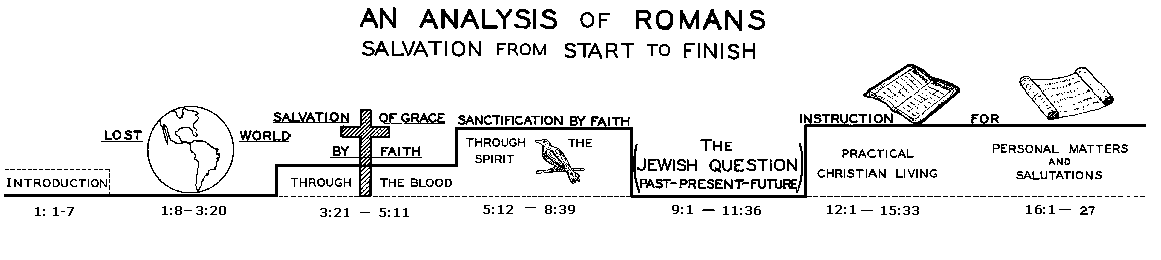
Source: Dr David Cooper
Click to Enlarge
R Ruin (Romans 1:17 – 3:20) – The utter sinfulness of humanity
O Offer (Romans 3:21-31) – God’s offer of justification by grace
M Model (Romans 4:1-25) – Abraham as a model for saving faith
A Access (Romans 5:1-11) – The benefits of justification
N New Adam (Romans 5:12-21) – We are children of two “Adams”
S Struggle w/ Sin (Romans 6-8) Struggle, sanctification, and victory
|
ROMANS ROAD |
||||
| Romans 1:18-3:20 | Romans 3:21-5:21 | Romans 6:1-8:39 | Romans 9:1-11:36 | Romans 12:1-16:27 |
| SIN | SALVATION | SANCTIFICATION | SOVEREIGNTY | SERVICE |
| NEED FOR SALVATION |
WAY OF SALVATION |
LIFE OF SALVATION |
SCOPE OF SALVATION |
SERVICE OF SALVATION |
| God's Holiness In Condemning Sin |
God's Grace In Justifying Sinners |
God's Power In Sanctifying Believers |
God's Sovereignty In Saving Jew and Gentile |
Gods Glory The Object of Service |
| Deadliness of Sin |
Design of Grace |
Demonstration of Salvation | ||
| Power Given | Promises Fulfilled | Paths Pursued | ||
| Righteousness Needed |
Righteousness Credited |
Righteousness Demonstrated |
Righteousness Restored to Israel |
Righteousness Applied |
| God's Righteousness IN LAW |
God's Righteousness IMPUTED |
God's Righteousness OBEYED |
God's Righteousness IN ELECTION |
God's Righteousness DISPLAYED |
| Slaves to Sin | Slaves to God | Slaves Serving God | ||
| Doctrine | Duty | |||
| Life by Faith | Service by Faith | |||
|
Modified from Irving L. Jensen's chart above |
||||
Romans 16:1 I commend to you our sister Phoebe, who is a servant of the church which is at Cenchrea (NASB: Lockman)
Greek: Sunistemi (1SPAI) de humin PHoiben ten adelphen hemon, ousan (PAPFSA) [kai] diakonon tes ekklesias tes en Kegchreais,
Amplified: NOW I introduce and commend to you our sister Phoebe, a deaconess of the church at Cenchreae, (Amplified Bible - Lockman)
ASV: I commend unto you Phoebe our sister, who is a servant of the church that is at Cenchreae:
BBE: It is my desire to say a good word for Phoebe, who is a servant of the church in Cenchreae:
KJV: 1 I commend unto you Phebe our sister, which is a servant of the church which is at Cenchrea:
NLT: I commend to you our sister Phoebe, who is a deacon in the church in Cenchrea. (NLT - Tyndale House)
Phillips: I want this letter to introduce to you Phoebe, our sister, a deaconess of the Church at Cenchrea. (Phillips: Touchstone)
Wuest: Now, I recommend to you, Phoebe, our sister, who is a deaconess of the assembly which is at Cenchrea.
Young's Literal: And I commend you to Phebe our sister--being a ministrant of the assembly that is in Cenchrea
I COMMEND TO YOU OUR SISTER PHOEBE: Sunistemi (4921) (1SPAI) de humin phoiben ten adelphen (79) hemon:
- 2Co 3:1
- Our - Mt 12:50 Mk 10:30 1Ti 5:2 Jas 2:15 1Pe 1:22,23
- Romans 16 Resources - Multiple Sermons and Commentaries
PAUL COMMENDS
A WOMAN WORKER
Commend (4921) (sunistao from sún = together with + hístemi = set, place, stand) literally means "to Set together". Sunistao was used of setting one person with another by way of introducing or presenting him, hence, “to recommend, vouch for, commend.” (commend = recommend as worthy of confidence or notice).
As discussed above, commendatory letters were well known in the ancient world. Whenever the early Christians traveled from one church to another, they carried letters of introduction. This was a real courtesy to the church being visited and a help to the visitor (same word used by Paul with this meaning in 2Cor 3:1).
In (Romans 3:5 [note]) sunistao is used in the sense of putting together with a view to showing, proving, or establishing, Paul writing…
But if our unrighteousness demonstrates (sunistao) the righteousness of God, what shall we say? The God who inflicts wrath is not unrighteous, is He? (I am speaking in human terms.) (see note Romans 3:5)
Human sin is a foil by which God’s righteousness is seen all the more clearly. It establishes the fact of God’s righteousness, proves it by its very contrast with that sin.
Paul uses sunistao again in chapter five writing that…
God demonstrates (sunistao) His own love toward us, in that while we were yet sinners, Christ died for us. (see note Romans 5:8\)
God gives proof of or renders conspicuous His own love to sinners in Christ's death for the ungodly
Phoebe ("bright & radiant") was probably a Gentile by birth, since the closely related name "Phoibe" was the name of a pagan goddess. Another source adds that "Phoebe" is the feminine form of a title given to the pagan god Apollo, the title meaning "the bright one." It is interesting to note that the early Christians retained their names although they were derived from the names of false gods, because now that they were in Christ these pagan names had lost all religious meaning. Similarly we retain the names of the days of the week without ever thinking about their derivation.
William Newell writes that "This sixteenth chapter is neglected by many to their own loss. It is by far the most extensive, intimate and particular of all the words of loving greeting in Paul's marvelous letters. No one can afford to miss this wonderful outpouring of the heart of our apostle toward the saints whom he so loved—which means all the real Church of God!" (Romans 16)
Note that Paul devotes these two verses to the commendation of a single individual. Letters of introduction were very useful in the ancient world. Travel was hazardous, and public accommodations were scarce and somewhat risky; and such letters could secure private hospitality. They also gave some assurance to potential hosts (such as the Christians at Rome) that they were not being defrauded by pretenders.
Note that Paul "identifies" Phoebe with three endearing names: “sister,” “servant,” and “a helper of many.”
"Sister" In Christ not in the flesh, cf 1 Cor 7:15; Philemon 1:2) In Christ, we belong to God not only as “fellow citizens with the saints” in His divine kingdom but also are brothers and sisters in His divine “household” (see note Ephesians 2:19). To refer to Phoebe as "our sister" meant that she was a devoted member of the family of God, and the context makes clear that she was especially dear to Paul.
There were no post offices, pony express or federal express in Paul's day and as a private citizen he was not permitted to use the imperial couriers of Rome to send his epistle. Therefore many feel that Paul had this epistle carried to Rome by Phoebe… and thus the importance of this specific mention of "commendation" to the church at Rome.
John MacArthur says "It is almost certain that Phoebe delivered this letter in person to the church at Rome, a responsibility of considerable magnitude."
If this is true which certainly seems plausible, one wonders if sister Phoebe had any idea that she was being used by God as a vessel to transport the greatest theological treatise ever penned? Paul knew that the journey from Corinth to Rome would not be easy, and would involve considerable sea as well as land travel. When this special lady arrived in Rome and presented believers there with Paul’s letter, they must have realized his great trust in her even before they read this personal commendation. It would be immediately evident that she deserved their greatest appreciation and respect.
THOUGHT: No believer can fully comprehend the significance of the "little" tasks he or she faithfully carries out as a servant of the Most High God. The judgment seat of Christ (see Ro 14:10+) will doubtless reveal the eternal significance of these "little" jobs "well done". It follows…
Coram Deo (Before the Face of God)
Carpe diem (Seize the Day)
Tempus fugit (Time Flies)
This chapter illustrates the "horizontal" aspects of Paul's missionary heart. In particular, this chapter refutes the idea that the apostle resented women working in the churches or among believers. There are far more women mentioned here than in the typical literature of the day. Paul was no misogynist (a hatred of women)!
His tribute to Phoebe is followed by greetings to various people and groups. Among those greeted are eight women. Paul specifically comments on how much work five of these women did (Mary, v6; Priscilla, a fellow worker, v3; Tryphena and Tryphosa, v12; Persis, v12). The mother of Rufus was so dear to Paul that he calls her his mother as well (v13). Only two women are mentioned without any comment—Julia and the sister of Nereus (v15).
Ray Stedman notes that "Many people ignore this chapter, I think, because they see in it nothing but a list of names of people long since dead and gone. But in many ways this is one of the most exciting chapters in Romans." Newell echoes this thought (Romans 16) ""This sixteenth chapter is neglected by many to their own loss. It is by far the most extensive, intimate and particular of all the words of loving greeting in Paul's marvelous letters. No one can afford to miss this wonderful outpouring of the heart of our apostle toward the saints whom he so loved—which means all the real Church of God!
Warren Wiersbe writes that "Paul was a friend maker as well as a soul winner. He did not try to live an isolated life; he had friends in the Lord, and he appreciated them. (Bolding added) (BEC)
It is interesting that in his epistles Paul greeted more individuals by name in the churches he had not visited than in those that he had.
Kent Hughes notes: What makes this list of those he knew in the church of Rome so amazing is the fact that he had never been to Rome! Most of the people he mentions are those whom he had met on his journeys and who had subsequently taken up residence in Rome. In a recent America’s Cup Race the tradition-conscious New York Yacht Club allowed no TV or radio on the premises. Rather, they used a tracking board on which someone in contact with the yachts moved by hand the ships on the board throughout the course of the race. Paul’s “tracking-board” heart knew where each friend was geographically and spiritually. Think of the energy such “keeping in touch” involved! Imagine Paul on ship and in port beseeching travelers for information: “What about Patrobas? Where is Hermes now? Is he still walking in faith? What can I pray for?” We know from the testimony of other Scriptures that this is the way Paul was. He routed his journeys and scheduled his disciples’ travels so as to obtain as much information as possible. Paul, one of the greatest of intellects, a true master of theology, was also a caring man who loved people. Paul was a “people person” par excellence. Moreover, he did not determine his friendships on the basis of intellectual capability or theological literacy. Names were very important to Paul. I am told that if you visit the old Natural Bridge of Virginia you will see hundreds of names scrawled on the rocks. But high on the side of it, above almost all the names, is scratched, “George Washington.” Even “The Father of Our Country” could not resist imposing his personal graffiti on nature! Our own names are music to our ears. Certainly Paul knew this. But it is also true that you learn the names of those for whom you really care. Some perceptively suggest that the reason Paul could so readily recite all these names in dictation was because of their frequent mention in his personal prayer list." See (see notes Romans 1:9; 1:10) which tends to substantiate this supposition. (Hughes, R. K. Romans: Righteousness from heaven. Preaching the Word. Crossway Books )
Morris adds that "Phoebe is the first of thirty-five personal names mentioned in this last chapter of Paul's letter to the Romans, most of whom are mentioned nowhere else in Scripture. The reason why so much apparently personal information was included in the Scriptures by the inspiration of the Holy Spirit is probably to illustrate the Spirit's concern with individuals. The names of all the redeemed are written in God's book in heaven (Luke 10:20; see note Philippians 4:3); as a token of this fact, the names of some of these saints are written in God's book on earth.
WHO IS A SERVANT OF THE CHURCH WHICH IS AT CENCHREA: ousan (PAPFSA) (kai) diakonon tes ekklesias tes en Kegchreais:
- Lk 8:3 1Ti 5:9,10
- Ac 18:18
- Romans 16 Resources - Multiple Sermons and Commentaries
Servant (1249)(diakonos related word diakonia) the same word used in previous chapter of Christ's example of how we are to "accept one another" (Romans 15:7; 8-note)
The word servant is the feminine of deacon, and some students believe she was a deaconess in the church. This is possible, because there were women in the early church who served by visiting the sick, assisting the young women, and helping the poor. But lest me miss Paul's main point, remember Paul stressed her service, not her office and neither should we.
John MacArthur comments on this somewhat controversial passage writing that "Servant translates diakonos, the term from which we get deacon. The Greek word [diakonos (1249)] here is neuter and was used in the church as a general term for servant before the offices of deacon and deaconess were developed. It is used of the household servants who drew the water that Jesus turned into wine (John 2:5, 9), and Paul has used the term earlier in this letter (Ro 13:4 [note], twice) to refer to secular government as “a minister of God to you for good” and even of Christ as “a servant to the circumcision,” that is, to Jews (Ro 15:8). When diakonos obviously refers to a church office, it is usually transliterated as “deacon” (see, e.g., Phil 1:1; 1Ti 3:10,13, 1-13). In 1Ti 3:11, Paul declares that “women must likewise be dignified, not malicious gossips, but temperate, faithful in all things.” Some argue that he is referring to wives of deacons, (Ed. Note: NIV, KJV, NKJV translate it as "wives" but more literal is to render it as "women") rather than to an office of women deacons. But it makes no sense that high standards would be specified for the wives of deacons but not for wives of overseers (or bishops, who are also called elders, see Titus 1:5-note) (Ed note: Click study on episkopos), whose qualifications he has just given in 1Ti 3:1-7. In this context (1Ti 3:1-10, 12, 13), the office of deaconess is clearly implied. The “likewise” in 1Ti 3:11 ties the qualifications of these women to those already given for the offices of overseer and deacon. In 1Ti 3:11, Paul did not refer to those women as deaconesses because diakonos has no feminine form. During the first few centuries of the church, the role of a woman servant (diakonos) was to care for fellow believers who were sick, for the poor, for strangers passing through, and for the imprisoned. They also were responsible for helping baptize and disciple new women converts and to instruct children and other women. Whether or not Phoebe held some official title or not, Paul commended her as a highly-proven servant of Christ and implored the church at Rome to receive her in the Lord. (MacArthur, J: Romans 9-16. Chicago: Moody Press) (Bolding added)
Church (1577) (ekklesia from ek = out + kaleo = call) is literally “to call out from” or "called-out ones". This verse is the first use of ekklesia in Romans and as in most of Paul's epistles, ekklesia refers to the local congregation, the collective body of Christians in a particular area. In classic Greek ekklesia referred to an assembly of citizens summoned by the town crier or herald (kerux [G2783]) as in [Acts 19:32, 33, 34, 35, 36, 37, 38, 39, 40, 41]. Ekklesia is translated "assembly" or "congregation" of Israel in the Septuagint (See Septuagint) (e.g., Deut 18:16, Neh13:1) The church (in the New Testament sense of being composed of Jewish and Gentile believers) is not mentioned in the OT. The first mention of the church in the NT is by Jesus (Mt 16:18).
The NT does apply ekklesia to the congregation or assembly of the people of Israel in (Acts 7:38) but every other use in the NT is translated “CHURCH”. The CHURCH then is the body of believers who is CALLED-OUT of the world of unsaved humanity to become the people of God "that (we) may proclaim the excellencies of Him who has called (us) out of darkness into His marvelous light" (1Peter 2:9-note). EKKLESIA occasionally refers to local churches as in this verse (Ro 16:1,5, Gal 1:2).
Assembly is a good one-word translation of ekklesia. The genius of the word points to the fact that in the mind of God, the Church of Jesus Christ is a called-out group of people, separated out from the world to be a people that should maintain their separation from the world out of which they have been called. Everyone who has been saved belongs to the body of Christ -- the universal church. The universal church is manifested in the world by individual local churches, each of which is to be a microcosm of the body of Christ. The church (see Torrey's references) is to function under the leadership of the Holy Spirit, operating under His sovereign rule. Jesus Christ is the Founder, Head & Lord of His church and has guaranteed its perpetuity until He returns (Mt 16:18; Colossians 1:18-note).
Corinth, (map) being situated on a narrow isthmus, had two ports, one facing Europe and the other facing Asia.
The strategic seaport of Cenchrea (“millet”; still called Kenchreae, although the popular name is Kikries) was a harbor located 7-9 miles east of Corinth and provided that great metropolis' harbor on the on the Gulf of Saronicus. (map) The western harbor was Lechaeum.
Vincent says Cenchrea was a thriving town filled with idolatrous monuments and shrines, including temples for worship of Venus, Aesculapius and Isis. Thus Cenchrea undoubtedly had an atmosphere of religious toleration.
A believer in Cenchrea would surely have had to know what they stood for in this atmosphere or they would be liable to fall for anything. And so in this setting of New Age paganism there was a church at which Phoebe served.
At Cenchrea Paul shaved his head in observance of a vow he had taken and it was from Cenchrea, at the end of his first ministry in Corinth (see Paul's Footsteps), that Paul (Part 1)(Part 2), Priscilla, and Aquila “put out to sea for Syria” (Acts 18:18).
Wiersbe comments on Romans 16…
What a remarkable chapter! In it Paul greeted at least twenty-six people by name, as well as two unnamed saints; and he also greeted several churches that were meeting in homes. He closed with greetings from nine believers who were with him in Corinth when he wrote the letter. What is the significance of this? It shows that Paul was a friend maker as well as a soul winner. He did not try to live an isolated life; he had friends in the Lord, and he appreciated them. They were a help to him personally and to his ministry. In my own reading of Christian biography, I have discovered that the servants whom God has used the most were people who could make friends. They multiplied themselves in the lives of their friends and associates in the ministry. While there may be a place for the secluded saint who lives alone with God, it is my conviction that most of us need each other. We are sheep, and sheep flock together. (Wiersbe, W: Bible Exposition Commentary. 1989. Victor)
"We Cut The Coal"- Winston Churchill knew that people who work behind the scenes don't always get the credit they deserve. During World War II, many of England's coal miners wanted to enlist and fight on the front lines. Churchill acknowledged their patriotism but reminded them of how valuable their work was to the cause of the war. "Some must stay in the pits," he said, "and others must stay in the army. Both are equally needed, and for both there is equal credit."
Looking ahead to when children would ask their parents what they did in the war, Churchill said, "One will say, 'I was a fighter pilot'; another will say, 'I was in the submarine service'; … and you in your turn will say with equal pride and with equal right, 'We cut the coal.'"
Paul too recognized the vital importance of those who worked behind the scenes. Much of Romans 16 is dedicated to honoring some of his fellow workers in the faith—people such as Phoebe, Andronicus, and Urbanus—whom we would otherwise never know about. Their service was valuable to Paul and to the cause of reaching people for Christ.
Your labor for the Lord may be unseen and unheralded, but it is essential. Continue to "cut the coal." You are valuable to the Lord.— David C. Egner (Our Daily Bread, Copyright RBC Ministries, Grand Rapids, MI. Reprinted by permission. All rights reserved)
Use now what God has given you,
Count not its worth as small;
God does not ask of you great things,
Just faithfulness—that's all! —Bosch
Your little is a lot when you give your all.
Credit Due - In 1946, when the US Army unveiled its 30-ton computer called ENIAC (Electronic Numerical Integrator And Computer), two men named John Mauchly and J. Presper Eckert received all the credit. But it was six women behind the scenes who made the computer work.
Before Mauchly and Eckert took the stage to demonstrate ENIAC, the women had programmed the complex machine. They received no recognition at the time, but historians today want to give them due credit.
Women have often gone unrecognized for their achievements and contributions. And sadly, it's also true in the church. But in Romans 16, we have an example of the importance of honoring women who serve faithfully. Paul praised Phoebe as "a helper of many and of myself also" (Ro 16:1, 2). He commended Priscilla and her husband Aquila, who risked their lives for Paul's sake (Ro 16:3, 4). Tryphena, Tryphosa, and Persis "labored in the Lord" (v.12). Paul mentioned at least eight women for whom he had great appreciation.
Women of faith deserve honor for their service to God and others. Think of the women who are serving faithfully in your church. Why not give one of them a word of thanks and praise today? — David C. McCasland (Our Daily Bread, Copyright RBC Ministries, Grand Rapids, MI. Reprinted by permission. All rights reserved)
O Lord, help me appreciate
The work that women do,
The service given from their hearts,
Their sacrifice for You. —Sper
God never fails to give credit where credit is due.
Special Delivery- When a special delivery letter is handed to us at the door, it usually means we are receiving something very important. According to many Bible scholars, Phoebe was the one who hand-delivered a letter of immeasurable value to the church in Rome—Paul’s inspired doctrinal masterpiece. It points out how a lost and sinful humanity can find redemption through faith in the death and resurrection of Jesus Christ.
Phoebe, whose name means “bright and radiant,” lived in Cenchrea, a harbor village in eastern Corinth where Paul had stopped during his third missionary journey. Because of her kindness to him, he wrote to the Romans, “I commend to you Phoebe our sister, who is a servant of the church in Cenchrea, that you may … assist her in whatever business she has need of you; for indeed she has been a helper of many and of myself also” (16:1, 2). Phoebe had assisted others in getting out the Word of God.
All of us are “spiritual mail carriers.” We have the good news that Paul wrote about so many centuries ago. And like Phoebe, we should assist in delivering it by word and deed to people around us who need its life-giving message. — Dennis Fisher (Our Daily Bread, Copyright RBC Ministries, Grand Rapids, MI. Reprinted by permission. All rights reserved)
Do good to all and kindness show—
That’s what God’s Word commands;
For when we’re serving in Christ’s name,
We are His feet and hands. —Fitzhugh
We serve God by sharing His Word with others.
Companions Or Competitors? - The French philosopher Jean-Paul Sartre (1905-1980) had nothing but disdain for the concept of companionship. He saw all people as competitors. According to this view, people are always striving with one another in a kind of continual rivalry.
Competition can be healthy in the worlds of business and athletics. It becomes detrimental, however, when a person's attitudes and actions become viciously self-serving. Such competition should have no place in a marriage or in the church.
When spouses try to outdo each other in a career, or in some other endeavor, the marriage may be in trouble. The apostle Peter, in a male-dominated society, admonished men to treat their wives as companions, as "heirs together of the grace of life" (1Pe 3:7-note).
When someone starts complaining about people in the church who always try to run things, a competitive spirit may be at the heart of the problem. In Romans 16, Paul saw his fellow believers as companions, not competitors. All Christians, men and women, are members of God's family and serve Jesus as co-workers in the greatest of all enterprises.
Companions, not competitors—that's what Christ wants us to be! — Herbert Vander Lugt (Our Daily Bread, Copyright RBC Ministries, Grand Rapids, MI. Reprinted by permission. All rights reserved)
Lord, help me live from day to day
In such a self-forgetful way
That even when I kneel to pray,
My prayer shall be for others. —Meigs
Beware: Competition can destroy companionship.
A Gratitude Visit- Counting your blessings promotes good physical health, according to a study by some US doctors. Volunteers who kept weekly gratitude journals reported fewer aches and pains than those who recorded daily hassles or neutral events.
A "gratitude visit" was developed by Dr. Martin E. P. Seligman to promote strong emotional health. He tells people to think of someone who has made an important difference in their lives. He asks them to write the story of how that person has helped them, and then to visit that person and read the story aloud. Tests show that a year later the people who had done so were happier and reported fewer episodes of depression. Even more important, think of what it must have done for those who were thanked!
The apostle Paul had a long list of people who had helped him and for whom he was grateful (Rom. 16:1-16). He wrote that Phoebe had "been a helper," Priscilla and Aquila had "risked their own necks" for his life, and Mary had "labored much" for him. And he took time to write his thanks in a letter to the church at Rome.
Who has helped to shape your life? Could you make a gratitude visit—for their sake, and for yours? — Anne Cetas (Our Daily Bread, Copyright RBC Ministries, Grand Rapids, MI. Reprinted by permission. All rights reserved)
Consider what the Lord has done
Through those who've shown you love;
Then thank them for their faithful deeds,
For blessings from above. —Sper
Gratitude should not be an occasional incident but a continuous attitude.
Romans 16:2 that you receive her in the Lord in a manner worthy of the saints, and that you help her in whatever matter she may have need of you; for she herself has also been a helper of many, and of myself as well. (NASB: Lockman)
Greek: hina auten prosdexesthe (2PAMS) en kurio axios ton agion, kai parastete (2PAAS) aute en o an umon chreze (3SPAS) pragmati, kai gar aute prostatis pollon egenethe (3SAPI) kai emou autou.
Amplified: That you may receive her in the Lord [with a Christian welcome], as saints (God’s people) ought to receive one another. And help her in whatever matter she may require assistance from you, for she has been a helper of many including myself [shielding us from suffering]. (Amplified Bible - Lockman)
ASV: that ye receive her in the Lord, worthily of the saints, and that ye assist her in whatsoever matter she may have need of you: for she herself also hath been a helper of many, and of mine own self.
BBE: That you will take her in kindly, after the way of the saints, as one who is the Lord's, and give her help in anything in which she may have need of you: because she has been a help to a great number and to myself.
KJV: That ye receive her in the Lord, as becometh saints, and that ye assist her in whatsoever business she hath need of you: for she hath been a succourer of many, and of myself also.
NLT: Welcome her in the Lord as one who is worthy of honor among God’s people. Help her in whatever she needs, for she has been helpful to many, and especially to me. (NLT - Tyndale House)
Phillips: Please give her a Christian welcome, and any assistance with her work that she may need. She has herself been of great assistance to many, not excluding myself. (Phillips: Touchstone)
Wuest: to the end that you take her to yourselves in the Lord in a manner which is fitting to the saints, and that you stand by her in whatever business she may have need of you, for verily, she herself became a benefactress of many, and of me myself. (
Young's Literal: that ye may receive her in the Lord, as doth become saints, and may assist her in whatever matter she may have need of you--for she also became a leader of many, and of myself.
THAT YOU RECEIVE HER IN THE LORD: hina auten prosdexesthe ( 2PAMS) en kurio:
- Ro 15:7 Matt 10:40, 41, 42, 25:40 Phil 2:29 Col 4:10 Philemon 1:12,17 2Jn 1:10 3Jn 1:5, 6, 7, 8, 9, 10
- Romans 16 Resources - Multiple Sermons and Commentaries
The idea is something like, “Welcome her into your midst with the open arms of fellowship”. Because of the blessed tie that binds our hearts in Christian love, Christians can find instant communion and rapport with other Christians who show up even as strangers at our doors.
Receive (4327) (prosdechomai from pros = in compound Greek words implies motion or direction toward + dechomai [see word study] = a deliberate and ready reception) means to accept favorably, to receive one into intercourse/companionship, to give access to oneself or receive to oneself.
To receive one coming from some place and so to welcome with friendliness (Ro 16:2, Philippians 2:29-note).
To wait for with a sense of expectancy (Mark 15:43, Luke 2:25, 38, 12:36, 23:51, Acts 23:21,Titus 2:13-note, Jude 1:21)
The root verb dechomai means to accept deliberately and readily, receive kindly and so to take to oneself what is presented or brought by another. It means to welcome as a teacher, a friend, or a guest into one's house. The word describes accepting persons with open arms, minds, and hearts, even going beyond normally expected gracious hospitality. The term was often used of welcoming honored guests and meeting their needs with special attention and kindness.
Prosdechomai is used of things future, in the sense of expecting and with the meaning of accepting. This verb is virtually always is found in the middle voice conveying reflexive action (action directed or turned back on self) which means that one receives to one’s self or gives another access to one’s self.
Moulton-Milligan have this secular use of prosdechomai…“I am waiting for the 450 drachma you have given to Radanus.” (Comment: We can probably all identify with this person's anticipation of being repaid!)
In short, prosdechomai means to earnestly expect, look forward to, wait for, wait anxiously and refers to the attitude of believers who are earnestly expecting and anxiously awaiting the return of their Master to set up the kingdom of God.
THOUGHT - Would it make any difference in our daily choices and outlook if we had a "prosdechomai" "uplook"? See Vertical Vision.
IN A MANNER WORTHY OF THE SAINTS : axios ton hagion:
- Eph 5:3 Php 1:27 1Ti 2:10 Titus 2:3
- Romans 16 Resources - Multiple Sermons and Commentaries
Receive her in a way worthy of the saints (ATR)
Please give her a Christian welcome (Phillips)
as doth become saints (YLT)
Christians are to receive, to love, to minister to each other in a way that is distinct from the world around us and that it cannot comprehend. We are to embrace, serve, and care for all those who genuinely name the name of Christ (cf. Matt 18:5, 6, 7,8, 9,10).
Manner worthy (516) (axios [word study]) refers to a set of scales that balance - the same weight on one side and the other side. If Jesus is in me (my CHARACTER), then I need to live a lifestyle that will "Measure equally" to the fact that He is in me or else my lifestyle denies the fact that He is in me. The idea is that the conduct of the saints weigh as much as the character of Christ Why? because WHEN we are surrendered to His will, He is living His life through us & His is the only conduct which is WORTHY… no other conduct would balance God's perfect scales that look at hearts, at motives, at agendas, etc. Christ alone pleases the Father completely and as we allow Christ to rule and reign in our lives, our lives become PLEASING TO THE FATHER.
Axios - 6x in 6v - Rom 16:2; Eph 4:1; Phil 1:27; Col 1:10; 1 Thess 2:12; 3 John 1:6
Paul uses "axios" in (Php 1:27 [note]) where he urges the saints in that church to see to it that their manner of life as citizens of heaven "weighs" as much as the gospel they preach, that is, be worthy of the gospel. Here Paul exhorts the Roman saints to welcome Phoebe into their spiritual company in a manner "worthy" of a saint. Their welcome should weigh as much as the position they hold in the family of God. It should be fitting to their position as saints. They should act worthy of a saint.
Denney remarks "no mere reception of Phoebe into their houses satisfies this—their Christian life was to be open for her to share in it; she was no alien to be debarred from spiritual intimacy.
Saints (40) (hagios [word study]) is also translated holy and has the fundamental idea of separation from sin, of abstaining from the earth's "omnipresent" defilement, of forsaking sin and seeking to consecrate oneself to God, of devotion to service of Deity, of sharing in God’s purity and living a holy manner of life.
Hagios therefore (see 1Peter 1:15-note; 2Peter 3:11-note) has come to be the accepted term for disciples of Christ. Although he lives in the world, the man who is hagios must always in one sense be different from the world and separate from the world. His standards are not the world's standards.
Ray Stedman adds this insight - They are called saints because they are sanctified people. Now, as Major Ian Thomas so beautifully taught us when he was here, the word sanctify simply means, "to put something to its intended and proper use." Here were people who, by coming to grips with Jesus Christ, by having received the fullness of his indwelling life, and by believing the message of the gospel, had now entered into a relationship in which their whole lives were put to their proper and intended use. That is why they were saints. They were sanctified -- being used, at last, in the right and proper way." Stedman goes on to tell of his visit to a church in Mexico City that formerly was steeped in tradition & worship of icons & statues of saints… " I also noticed inside the church that there were none of the plaster saints around. I said to him, "Bishop, where are the saints?" He said, "Well, I have taken them down and locked them in the cupboard -- now the saints come walking in through the door! I thought that was a tremendous expression of exactly the truth that Paul is getting at here in Romans 16. Here are the saints at Rome. They were not plaster; they were common, ordinary, plain vanilla people like you and me, but they had been put to the proper use in their lives by an encounter with Jesus Christ. Therefore they were sanctified; therefore they were saints. (See his full sermon The Former Day Saints)
William Barclay writes that "There should be no strangers in the family of Christ; there should be no need for formal introductions between Christian people, for they are sons and daughters of the one father and therefore brothers and sisters of each other. And yet a church is not always the welcoming institution that it ought to be. It is possible for churches, and still more possible for church organizations, to become almost little closed societies which are not really interested in welcoming the stranger. When a stranger comes amongst us, Paul's advice still holds good-welcome such a one as God's dedicated people ought to welcome each other. (Barclay, W: The Daily Study Bible Series. The Westminster Press)
AND THAT YOU HELP HER IN WHATEVER MATTER SHE MAY HAVE NEED OF YOU: kai parastete (2PAAS) aute en o an humon chreze (3SPAS) pragmati:
- Romans 16 Resources - Multiple Sermons and Commentaries
Literally “and to stand by her in whatsoever matter”
Matter (4229) (pragma) gives us our English word pragmatic, which refers to anything that was done or carried out. Pragmati was often used of business transactions, and probably carries that idea here, as indicated by the King James’s rendering of “business.”
Paul not only was giving a commendation of Phoebe as a faithful Christian but also was giving a letter of reference, as it were, in regard to whatever business matter she may have had in Rome. That idea is reinforced by Paul’s speaking of her as a helper (prostatis) which was commonly used to signify a patron or wealthy person who encouraged and financially supported an organization or cause, as in a patron of the arts.
Phoebe appears no ordinary helper, but one of high esteem and integrity and likely was a businesswoman of considerable wealth. She used her influence and her financial means, as well as her personal time and effort, as a helper of many fellow believers and of myself [Paul] as well. That statement says as much about Paul as it does about Phoebe. The esteemed apostle readily and graciously acknowledged his personal indebtedness to and love for a Christian sister, whom he memorialized in these two verses in the Word of God. And, although God inspired no woman to write a part of Scripture, he used Phoebe to transport the first copy of this marvelous letter, which is one of the bedrocks of New Testament theology. This woman was emblematic of those countless women of God whom He has used and honored with great distinction within the framework of His divine plan."
Larry Richards writes "Probably the highest honor we can do Phoebe or any other believer is to note, as Paul does, that “she has been a great help to many people, including me.
Help (3936) (paristemi [word study] from pará = near + hístemi = place, stand) means literally to stand near or beside.
Paul is exhorting the Roman brethren in essence to stand by or beside Phoebe (like the popular song "Stand by me").
Paristemi was used by Paul of the help he experienced by Jesus "standing beside" him in his hour of need when no one else supported him but all had deserted him (2Ti 4:16; 17-note). It was used as a legal term of presenting culprits or witnesses in a court of law.
Paristemi also means to place at the disposal or service of another or to present oneself for service which gives us a picture of what it means to "help" another saint. We've got to place ourselves at their disposal, not merely looking out for our own interests but for theirs also (Philippians 2:3; 2:4; 2:5-see notes Php 2:3; 4; 5).
Paul has already used paristemi to describe the presentation of the members of our body to sin or to God (Ro 6:13;16; 19-see notes Ro 6:13 ; 16; 19) and also to exhort us to present our body to God as a living and holy sacrifice (Ro 12:1-note).
FOR SHE HERSELF HAS ALSO BEEN A HELPER OF MANY AND OF MYSELF AS WELL: kai gar aute prostatis pollon egenethe (3SAPI) kai emou autou:
- Ro 16:3,4,6,9,23 Ac 9:36,39,41 Php 4:14, 15, 16,17, 18,19 2Ti 1:18
- Romans 16 Resources - Multiple Sermons and Commentaries
Helper (patroness) (KJV "succourer") (4368) (prostatis is from pro = over, before + hístemi = place) means literally one who stands over.
Prostatis came to mean a leader, ruler, or director (1Ch 27:31, 29:6 2Ch 8:10), but was also used by Plutarch for the Lat. patronus, a patron, a defender of a lower person. The word denoted those in Athens who were the patrons, who took care of strangers.
So Phoebe was a patroness, a woman set over others, a protectress, a succourer, caring for the affairs of others and aiding them with her resources. Webster's defines succourer [Middle English succur from Latin succurrere to run to help] as someone that furnishes relief or who goes to the aid of another. This was how Paul characterized Phoebe, not passive but proactive in her serving. In the ancient world a patron of a religious association was normally a well-to-do person who allowed members of a religious group to meet in his or her home. The patron was generally a prominent and honored member of the group and generally exercised some authority over it. Although most patrons of religious associations were men, some women patrons are known.
Unsung - James Deitz has produced paintings of airplanes and their crews that are so realistic they look like photographs. His works hang in many aviation galleries in the United States, including the Smithsonian Institution.
One of the paintings by Deitz, titled Unsung, depicts a crew of four mechanics who are working on a dive bomber. They are far below the flight deck of an aircraft carrier somewhere in the Pacific during World War II. The pale, serious-looking, grease-stained men are working tirelessly to get the plane ready to go back into battle.
We too may be performing unnoticed tasks as we support the church's mandate to spread the gospel and train believers. Without many volunteers, no church or mission agency could do its ministry effectively.
As the apostle Paul closed his letter to the believers in Rome, he listed several people who receive no other mention in Scripture. For example, Paul referred to Phoebe and said that she was "a helper of many" (Ro 16:2). Phoebe and the others were essential to the life and work of the early church.
Are you working "below the flight deck"? Remember, your service for Christ is essential. Even if no one shows appreciation for your hard work, you can be sure that one day the Lord will reward you (Colossians 3:23, 24-note).— David C. Egner (Our Daily Bread, Copyright RBC Ministries, Grand Rapids, MI. Reprinted by permission. All rights reserved)
Our works of service in Christ's name
May not be noticed by our peers;
But what we've done in love for Him
Will be revealed when He appears. —Sper
No service for Christ goes unnoticed by Him.
“Isn’t There Anything Else?” - A prominent Christian leader was known for his willingness to help needy individuals with their social and financial problems. When asked why he took time out of his busy schedule to do this, he replied, “When I was a boy, I worked in our family grocery store. I was taught that I should never ask a customer, ‘Is that all?’ Instead, I was told to say, ‘Isn’t there anything else?’
I have carried this philosophy over into my Christian work.” That man of God was filled with so much love for others that he wanted to see them develop in all areas of their lives.
In Romans 16, the apostle Paul commended many in the church who were like this man. He singled out Priscilla, Aquila, Mary, Persis, and several others who had labored for the Lord with willing hands and loving hearts. They were not content to do minimal service but were always busy ministering to the needs of fellow believers.
When we have experienced the matchless grace of God, our hearts should be filled with compassion for our brothers and sisters in Christ. By extending to them a helping hand and assisting them in whatever way possible, we’re actually saying, “God has given me so much. Isn’t there anything else I can do for you?”— Henry G. Bosch (Our Daily Bread, Copyright RBC Ministries, Grand Rapids, MI. Reprinted by permission. All rights reserved)
Beautiful lives have they who bear
The burdens of those heavy laden with care;
Earnest are they who daily show
Compassionate service wherever they go.
—Anon.
You may serve God without loving Him,
but you cannot love God without serving Him.
Romans 16:3 Greet Prisca and Aquila, my fellow workers in Christ Jesus, (NASB: Lockman) Greek: Aspasasthe (2PAAM) Priskan kai Akulan tous sunergous mou en CHristo Iesou,
Amplified: Give my greetings to Prisca and Aquila, my fellow workers in Christ Jesus, (Amplified Bible - Lockman)
ASV: Salute Prisca and Aquila my fellow-workers in Christ Jesus,
BBE: Give my love to Prisca and Aquila, workers with me in Christ Jesus,
KJV: Greet Priscilla and Aquila my helpers in Christ Jesus:
NLT: Give my greetings to Priscilla and Aquila, my co-workers in the ministry of Christ Jesus. (NLT - Tyndale House)
Phillips: Shake hands for me with Priscilla and Aquila. (Phillips: Touchstone)
Wuest: Greet Prisca and Aquila, my fellow-workers in Christ Jesus,
Young's Literal: Salute Priscilla and Aquilas, my fellow-workmen in Christ Jesus--
GREET PRISCA AND AQUILA: Aspasasthe ( 2PAAM ) Priskan kai Akulan:
- Aquila is Latin for "eagle"
- Acts 18:2-18, 24, 25, 26; 1Cor 16:19; 2Ti 4:19
- Romans 16 Resources - Multiple Sermons and Commentaries
Phillips translates "greet" in this chapter "Shake hands"
KJV translates "greet" all through this chapter with the word "Salute".
Prisca (Latin diminutive of Priscilla) is mentioned before Aquila 4x (Acts 18:18, 26; 2 Tim 4:19, Ro 16:3) with the order reversed two times (Acts 18:2, 1 Cor 16:19), an observation that has led many to conclude that Prisca may either have had a higher social rank than Aquila or that she was the more prominent of the two in the church.
Paul first met this Jewish Christian couple (Aquila was Jewish see Acts 18:2) on his first visit to Corinth when all Jews were expelled from Rome by the Emperor Claudius in AD49. This expulsion caused Aquila and Priscilla to migrate to Corinth where they encountered Paul (Acts 18:2). They were tent-makers which was Paul's own trade, and he found a home with them. When he left Corinth and went to Ephesus, Priscilla and Aquila accompanied him & settled for a time in Ephesus (Acts 18:18) when the party stopped briefly (Acts 18:19).
Prisca - 3x in 3v - Rom 16:3; 1 Cor 16:19; 2 Tim 4:19
Priscilla - 3x in 3v - Acts 18:2, 18, 26
Aquila - 6x in 6v - Acts 18:2, 18, 26; Rom 16:3; 1 Cor 16:19; 2 Tim 4:19
While at Ephesus, they met a young Jewish preacher
named Apollos, an Alexandrian by birth, and eloquent man,… mighty in the Scriptures.” He did not have a full understanding of the gospel, “being acquainted only with the baptism of John… But when Priscilla and Aquila heard him, they took him aside and explained to him the way of God more accurately” (Acts 18:24, 25, 26).
After Claudius died, Aquila and Priscilla returned to Rome, where they lived and ministered when Paul wrote this letter to the church there. Later they returned to Ephesus (2Ti 4:19-note).
MY FELLOW WORKERS IN CHRIST JESUS: tous sunergous mou en Christo Iesou:
- Ro 16:9 1Co 16:16
- Romans 16 Resources - Multiple Sermons and Commentaries
Fellow workers (4904) (sunergos [word study] from sun/syn = together with, speaks of an intimate relationship + érgon = work) means literally working together with and thus refers to a companion in work, a colleague, a co-laborer, a fellow laborer or fellow helper. Sunergos gives us our English word "synergy" which is defined as the interaction or working together of two (or more) agents or forces which produce a combined effect greater than the sum of their individual effects. This truth is worth pondering especially in light of Paul's repeated use in this chapter replete with specific names of other believers.
Sunergos-13x in 13v - Ro16:3, 9, 21 1Co 3:9 2Co 1:24, 8:23 Php 2:25, 4:3 Col 4:11 1Th 3:2 Philemon1:1, 24 3Jn 1:8
In the NT, sunergos is used only of a co–worker or helper in the Christian work. In each instance sunergos conveys the idea of an affectionate partnership and not merely that of an impersonal, official relationship. Paul twice specifically includes godly women among his fellow workers (Prisca or Priscilla Ro 16:3) and Euodia and Syntyche, two godly but quarreling members of the church at Philippi who had shared Paul’s “struggle in the cause of the gospel” (Php 4:3-note).
Thayer writes that sunergos "with a genitive of the person (refers to) one who labors with another in furthering the cause of Christ."
This word refers to someone who is a team player, who does not seek to run or control things on his own, nor serve for selfish or personal agendas.
Keathley says that sunergos…
refers to someone who is a team player. This is someone who does not seek to run or control things on his own, nor serve for selfish or personal agendas. There are two aspects of a team player in the body of Christ:
1.He or she is one who is a fellow worker with God. The head of the body is the Lord Jesus. The church belongs to Christ, not us. This means we are to get our orders and spiritual strength from the Lord and allow Him to work in and through us. We work as God’s fellow workers by submission to Him and by faith in His provision.
2.This also means we are to work together with our brethren in Christ as a part of God’s team. There is no such thing as a one-man team. We work to build up others and to help the body to function as a body. It means team work with each believer doing his share for the goals of the Head and the team.
In addition, sunergos brings out the fact that Timothy was a worker, which, in New Testament terms, means a minister or a servant of others. Selfish, self-centered agendas spoil our ability to not only be team players, but to work as servants. (1Thessalonians 3:1-13 )
This great word sunergos is used 13 times (predominantly by Paul) in the NT…
Romans 16:3 (note) Greet Prisca and Aquila, my fellow workers in Christ Jesus… 16:9 (note) Greet Urbanus, our fellow worker in Christ, and Stachys my beloved… 16:21 (note) Timothy my fellow worker greets you, and so do Lucius and Jason and Sosipater, my kinsmen.
1 Corinthians 3:9 For we are God's fellow workers; you are God's field, God's building.
2 Corinthians 1:24 Not that we lord it over your faith, but are workers with you for your joy; for in your faith you are standing firm.
2 Corinthians 8:23 As for Titus, he is my partner and fellow worker among you; as for our brethren, they are messengers of the churches, a glory to Christ.
Philippians 2:25 (note) But I thought it necessary to send to you Epaphroditus, my brother and fellow worker and fellow soldier, who is also your messenger and minister to my need;
Philippians 4:3 (note) Indeed, true comrade, I ask you also to help these women who have shared my struggle in the cause of the gospel, together with Clement also, and the rest of my fellow workers, whose names are in the book of life.
Colossians 4:11 (note) and also Jesus who is called Justus; these are the only fellow workers for the kingdom of God who are from the circumcision; and they have proved to be an encouragement to me.
1Thessalonians 3:2 (note) and we sent Timothy, our brother and God's fellow worker in the gospel of Christ, to strengthen and encourage you as to your faith,
Philemon 1:1 Paul, a prisoner of Christ Jesus, and Timothy our brother, to Philemon our beloved brother and fellow worker… 24 as do Mark, Aristarchus, Demas, Luke, my fellow workers.
3 John 1:8 Therefore we ought to support such men, that we may be fellow workers with the truth.
William Hendricksen writes that "During his missionary career Paul had colleagues and fellow workers. But he deemed it necessary to oppose Peter to his face (Gal. 2:11f.). With Barnabas he had such a sharp disagreement that the two parted company (Acts 15:39). There was a time when Paul refused to allow Mark to remain one of his companions (Acts 15:38). He was going to reprimand Euodia and Syntyche (Philippians 4:2-note). And Demas was going to desert him (2Timothy 4:10-note). But even though Prisca and Aquila in a sense stood closer to him than any others—for they were his companions both in trade and in faith—as far as the record shows, between Paul, on the one hand, and Prisca and Aquila, on the other, there was always perfect harmony! (Hendriksen, W., & Kistemaker, S. J. NT Commentary Set. Baker Book)
Say it Now! - An unknown author has penned these thought-provoking words:
I would rather have one little rose
From the garden of a friend
Than to have the choicest flowers
When my stay on earth must end.
I would rather have a pleasant word
In kindness said to me
Than flattery when my heart is still,
And life has ceased to be.
I would rather have a loving smile
From friends I know are true
Than tears shed 'round my casket
When to this world I bid adieu.
Bring me all your flowers today,
Whether pink, or white, or red;
I'd rather have one blossom now
Than a truckload when I'm dead.
Recalling the good qualities of deceased friends or relatives at their funeral is appropriate, but how much better to give sincere praise to them while they are still living. It may be the encouragement they desperately need.
As the apostle Paul closed his letter to the Romans, he publicly commended those who had helped and encouraged him in the work of the gospel. He not only greeted them by name, but he also expressed his gratitude for what they had done (Ro 16:1-15). What an example for all of us to follow!
Do you owe someone a word of thanks or appreciation? Don't put it off. Say it today. Tomorrow may be too late! — Richard De Haan (Our Daily Bread, Copyright RBC Ministries, Grand Rapids, MI. Reprinted by permission. All rights reserved)
You can't speak a kind word too soon,
for you never know how soon it will be too late.
Loving Relationships - A reporter in USA Today quoted a young woman who said of her baseball superstar father: "I don't know why he never spent any time with us. All we wanted him to do was spend time with us. He never liked us."
When the athlete was told what she said, he responded, "I don't know what she's complaining about. I just bought her a Mercedes last week."
He obviously didn't realize that a loving relationship has much more value than anything money can buy. This is true in every aspect of our lives. We need people far more than we need possessions.
The apostle Paul highlighted the value of relationships as he closed his letter to the believers in Rome (Rom. 16:1-16). After teaching them deep truths about the gospel, he sent his personal greetings to more than 25 individuals and the people associated with them. His co-workers joined him in sending their greetings. They obviously treasured the friendship of the saints.
Loving relationships! They enrich our individual lives. They encourage us in our Christian faith. They make a house a home. They vitalize our churches. Give yourself to developing loving relationships and you will be greatly blessed. — Herbert Vander Lugt (Our Daily Bread, Copyright RBC Ministries, Grand Rapids, MI. Reprinted by permission. All rights reserved)
Lord, teach us the secret of loving,
The love You are asking today;
Then help us to love one another--
For this we most earnestly pray. --Anon.
We don't find friends, we make them.
Plant A Tree - Before I entered the Holocaust Museum in Jerusalem, I had to walk down a boulevard called "The Avenue of the Righteous Gentiles." It is lined with hundreds of trees planted in honor of people who sheltered or in other ways assisted Jews during the Nazi regime. At the base of each tree is a metal plaque bearing the name of a man, woman, or family who risked their lives to help Jews during the Holocaust. Some of the names are familiar, like Corrie ten Boom and Oscar Schindler. But most are not.
As I walked down this avenue of memorial, my thoughts went to Romans 16, where Paul said that Priscilla and Aquila had risked their lives for his sake. Then I thanked God for devoted believers in Jesus Christ down through the centuries who made tremendous sacrifices, some losing loved ones or their own lives, to meet the physical and spiritual needs of their brothers and sisters in Christ.
Few of us face serious risks today. If we did, it's not likely that anyone would plant a tree in our honor. Even so, let's pray for a willingness and a desire to support sacrificially a struggling or suffering believer. — David C. Egner (Our Daily Bread, Copyright RBC Ministries, Grand Rapids, MI. Reprinted by permission. All rights reserved)
Add to your believing deeds that prove it true--
Knowing Christ as Savior, make Him Master too;
Follow in His footsteps, go where He has trod,
In the world's great trouble, risk yourself for God. --Leech
© 1976 Evangelical Covenant Church of America
God gives us all we need,
so let's give to others in their need.
An Unusual Couple? - The more we see marriage problems all around us, the more we wonder where to look for a marriage that is working. How about the story of a couple who not only made their marriage work but who also used their unity to assist the early church? Their names were Aquila and Priscilla. Notice the characteristics that made them so helpful to Paul, and which, I believe, reflected the strength of their marriage.
- They were selfless and brave. In Romans 16:4, Paul said they “risked their own necks” for him.
- They were hospitable. A church met in their home (1Co 16:19).
- They were flexible. Twice they had to move—once by force from Rome (Acts 18:2) and once by choice to go on a missions trip with Paul (Acts 18:18).
- They worked together. They were tentmakers (Acts 18:3).
- They both were committed to Christ and teaching others about Him. They invited Apollos to their home, where they “explained to him the way of God more accurately” (Acts 18:26).
Aquila and Priscilla were a unit—a team—an inseparable twosome. That may make them an unusual couple, but it’s a difference we who are married should all hope to imitate.— Dave Branon (Our Daily Bread, Copyright RBC Ministries, Grand Rapids, MI. Reprinted by permission. All rights reserved)
A man and wife who serve the Lord
Will serve each other too;
And jointly they will show the world
What’s right and good and true.
—K. De Haan
Marriage works best when a couple has a single purpose.
Romans 16:4 who for my life risked their own necks, to whom not only do I give thanks, but also all the churches of the Gentiles; (NASB: Lockman)
Greek: hoitines huper tes psuches mou ton heauton trachelon hupethekan, (3PAAI) ois ouk ego monos eucharisto (1SPAI) alla kai pasai ai ekklesiai ton ethnon,
Amplified: Who risked their lives [endangering their very necks] for my life. To them not only I but also all the churches among the Gentiles give thanks. (Amplified Bible - Lockman)
ASV: who for my life laid down their own necks; unto whom not only I give thanks, but also all the churches of the Gentiles:
BBE: Who for my life put their necks in danger; to whom not only I but all the churches of the Gentiles are in debt:
KJV: Who have for my life laid down their own necks: unto whom not only I give thanks, but also all the churches of the Gentiles.
NLT: In fact, they once risked their lives for me. I am thankful to them, and so are all the Gentile churches. (NLT - Tyndale House)
Phillips: They have not only worked with me for Christ, but they have faced death for my sake, Not only I, but all the Gentile churches, owe them a great debt (Phillips: Touchstone)
Wuest: who are such that on behalf of my life they laid down their necks, to whom I not only give thanks, but also all the assemblies of the Gentiles.
Young's Literal: who for my life their own neck did lay down, to whom not only I give thanks, but also all the assemblies of the nations--
WHO FOR MY LIFE RISKED THEIR OWN NECKS: hoitines huper tes psuches mou ton heauton trachelon hupethekan (3PAAI):
- Ro 5:7 Jn 15:13 Php 2:30 1Jn 3:16) (Josh 10:24 2Sa 22:41 Mic 2:3
- Romans 16 Resources - Multiple Sermons and Commentaries
Apparently at some point in Paul's ministry this courageous couple "put their necks on the executioner's block" so to speak, risking lives for Paul.
Their sacrifice brings to mind John's exhortation
We know love by this, that He laid down His life for us and we ought to lay down our lives for the brethren. (1 John 3:16+).
Prisca and Aquila obviously rendered selfless service to many other Christians as well, because Paul goes on to make the remarkable statement that to them not only do I give thanks, but also all the churches of the Gentiles. Wherever they traveled and lived, that Jewish couple ministered unstintingly and without prejudice.
TO WHOM NOT ONLY DO I GIVE THANKS BUT ALSO ALL THE CHURCHES OF THE GENTILES: ois ouk ego monos eucharisto (1SPAI) alla kai pasai ai ekklesiai ton ethnon:
- Ac 15:41, 16:5 1Co 7:17, 16:1 1Th 2:14 Rev 1:4
- Romans 16 Resources - Multiple Sermons and Commentaries
Give thanks (2168) (eucharisteo [word study] from eucháristos = thankful, grateful, well-pleasing - Indicates the obligation of being thankful to someone for a favor done <> in turn from eú = well + charízomai = to grant, give.; English - Eucharist) means to show that one is under obligation by being thankful. To show oneself as grateful (most often to God in the NT).
Eucharisteo - 38x in 37v - Matt 15:36; 26:27; Mark 8:6; 14:23; Luke 17:16; 18:11; 22:17, 19; John 6:11, 23; 11:41; Acts 27:35; 28:15; Rom 1:8, 21; 14:6; 16:4; 1 Cor 1:4, 14; 10:30; 11:24; 14:17f; 2 Cor 1:11; Eph 1:16; 5:20; Phil 1:3; Col 1:3, 12; 3:17; 1 Thess 1:2; 2:13; 5:18; 2 Thess 1:3; 2:13; Philemon 1:4; Rev 11:17
Moulton and Milligan note that eucharisteo originally meant “do a good turn to” or “oblige,” and in late Greek passed readily into the meaning “be grateful,” “give thanks”. Giving thanks is the quality of being grateful, with the implication of also having appropriate (Spirit filled) attitude.
This meaning is common in diplomatic documents in which the recipient of a favor reciprocates with assurance of goodwill. It is also used o express appreciation for benefits or blessings. Giving thanks was an important component of Greco-Roman reciprocity as demonstrated by a copy of a letter written by the Emperor Claudius to a Gymnastic Club expressing his gratification at games performed in his honour. The word eucharista was also common on ancient inscriptions.
Thanksgiving expresses what ought never to be absent from any of our devotions. We should always be ready to express our grateful acknowledgement of past mercies as distinguished form the earnest seeking of future mercies.
TDNT writes that "We first find eucharistos in the senses “pleasant” and “graceful.” Eucharisteo means “to show a favor,” but this imposes a duty of gratitude and the meaning “to be thankful” or “to give thanks” develops. We also find the sense “to pray.” The Greek world held thanksgiving in high esteem. With the ordinary use we find a public use (gratitude to rulers) and a religious use (thanksgiving to the gods for blessings). Thanks are also a constituent part of letters. (Kittel, G., Friedrich, G., & Bromiley, G. W. Theological Dictionary of the New Testament. Eerdmans)
Jesus words in (Mark 10:29, 30) could easily apply not only to Prisca & Aquila but to many of the saints Paul mentions in this epilogue. Ponder Jesus' words as you contemplate your life which like flowering grass will soon pass away:
"Truly I say to you, there is no one who has left house or brothers or sisters or mother or father or children or farms, for My sake and for the gospel's sake, but that he shall receive a hundred times as much now in the present age, houses and brothers and sisters and mothers and children and farms, along with persecutions; and in the age to come, eternal life." (Mark 10:29-30)