Romans 2:2
Romans 2:3
Romans 2:4
Romans 2:5
Romans 2:6
Romans 2:7
Romans 2:8
Romans 2:9
Romans 2:10
Romans 2:11
Romans 2:12
Romans 2:13
Romans 2:14
Romans 2:15
Romans 2:16
Romans 2:17
Romans 2:18
Romans 2:19
Romans 2:20
Romans 2:21
Romans 2:22
Romans 2:23
Romans 2:24
Romans 2:25
Romans 2:26
Romans 2:27
Romans 2:28
Romans 2:29

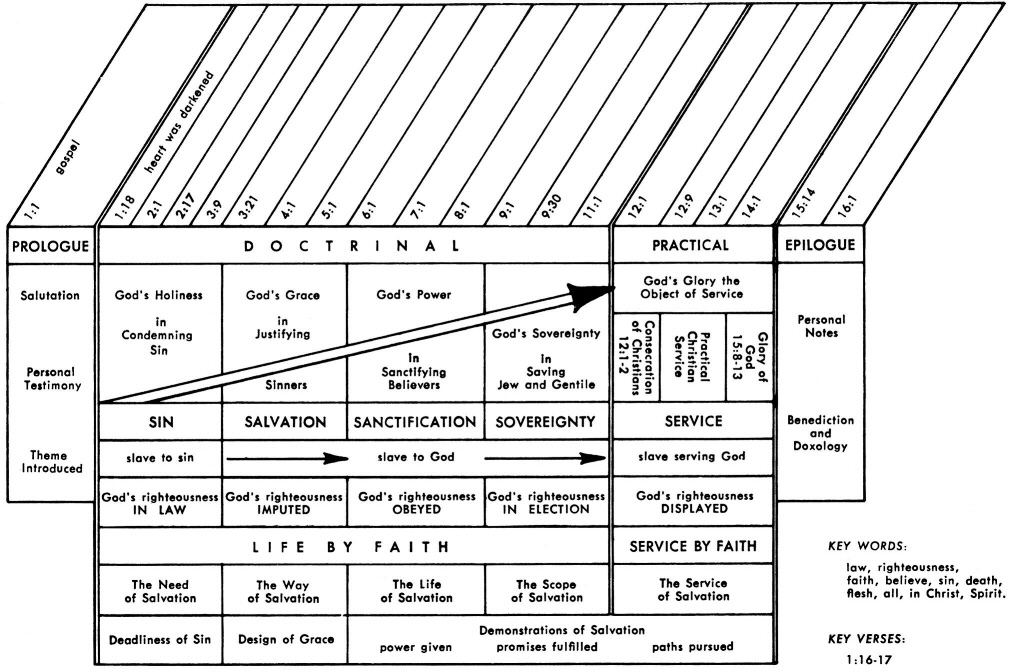
Click chart to enlarge
Chart from recommended resource Jensen's Survey of the NT - used by permission
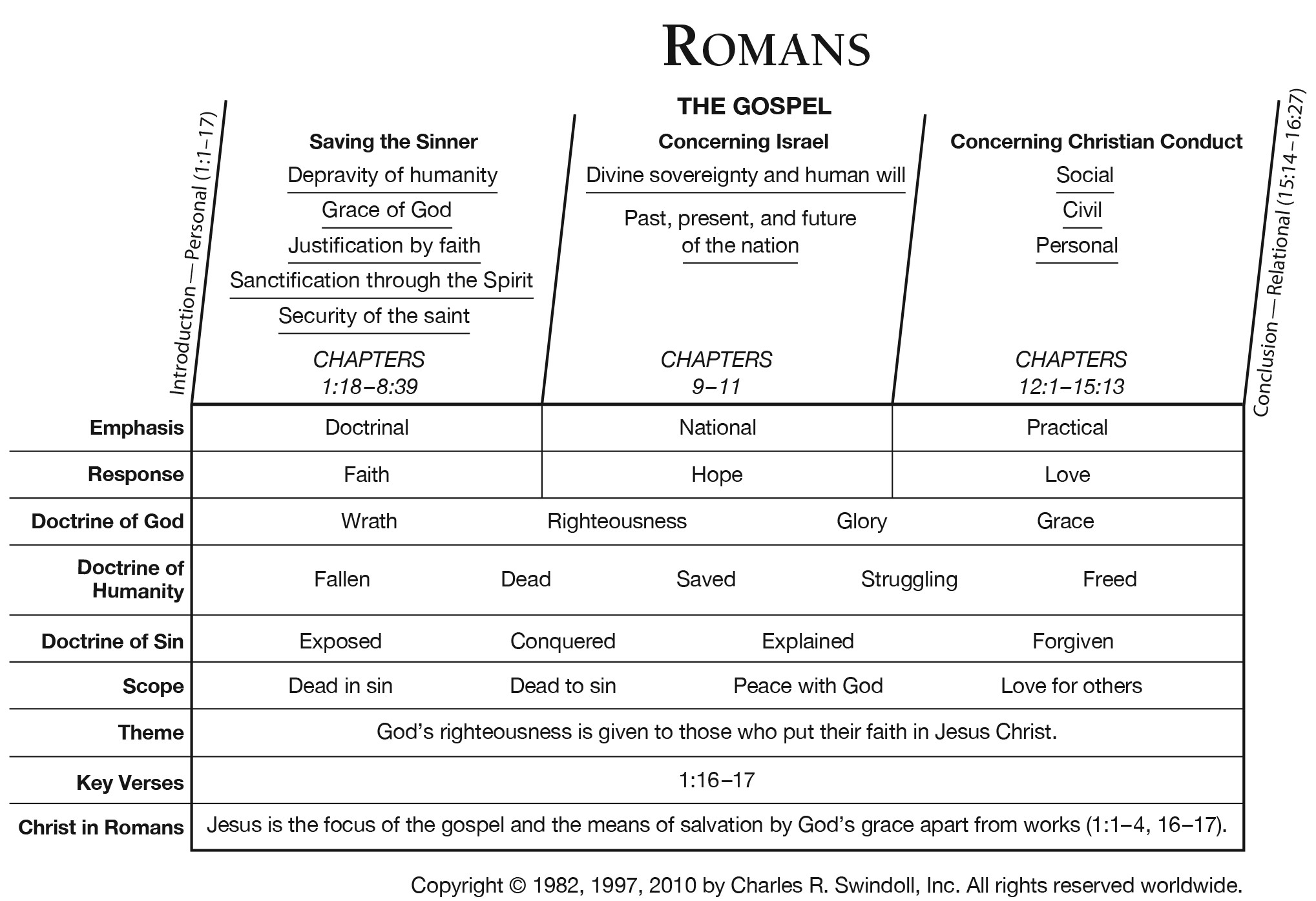
Click Charles Swindoll's overview chart
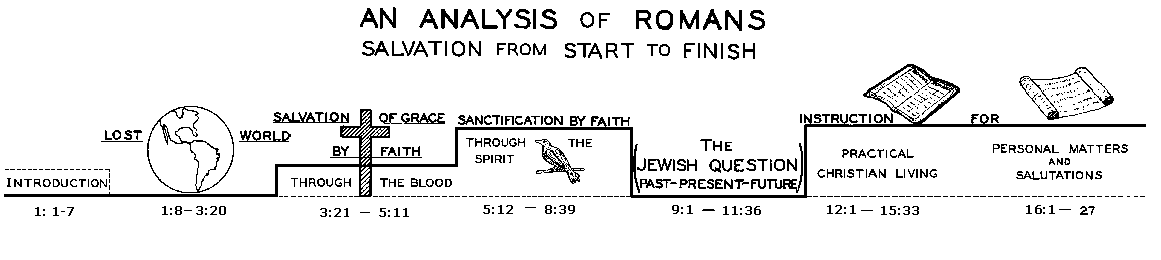
Source: Dr David Cooper
Click to Enlarge
| ROMANS ROAD to RIGHTEOUSNESS |
||||
| Romans 1:18-3:20 | Romans 3:21-5:21 | Romans 6:1-8:39 | Romans 9:1-11:36 | Romans 12:1-16:27 |
| SIN | SALVATION | SANCTIFICATION | SOVEREIGNTY | SERVICE |
| NEED FOR SALVATION |
WAY OF SALVATION |
LIFE OF SALVATION |
SCOPE OF SALVATION |
SERVICE OF SALVATION |
| God's Holiness In Condemning Sin |
God's Grace In Justifying Sinners |
God's Power In Sanctifying Believers |
God's Sovereignty In Saving Jew and Gentile |
Gods Glory The Object of Service |
| Deadliness of Sin |
Design of Grace |
Demonstration of Salvation | ||
| Power Given | Promises Fulfilled | Paths Pursued | ||
| Righteousness Needed |
Righteousness Credited |
Righteousness Demonstrated |
Righteousness Restored to Israel |
Righteousness Applied |
| God's Righteousness IN LAW |
God's Righteousness IMPUTED |
God's Righteousness OBEYED |
God's Righteousness IN ELECTION |
God's Righteousness DISPLAYED |
| Slaves to Sin | Slaves to God | Slaves Serving God | ||
| Doctrine | Duty | |||
| Life by Faith | Service by Faith | |||
|
Modified from Irving L. Jensen's chart above |
||||
Romans 2:3 But do you suppose (2SPMI) this, O man, when you pass judgment (PAPMSN) on those who practice (PAPMSA) such things and do (PAPMSN) the same yourself, that you will escape (2SFMI) the judgment of God? (NASB: Lockman)
Greek: logize (2SPMI) de touto, o anthrope o krinon (PAPMSN) tous ta toiauta prassontas (PAPMSA) kai poion (PAPMSN) auta, hoti su ekpheuxe (2SFMI) to krima tou theou
Amplified: And do you think or imagine, O man, when you judge and condemn those who practice such things and yet do them yourself, that you will escape God's judgment and elude His sentence and adverse verdict? (Amplified Bible - Lockman)
Barclay: Are you counting on this, O man, you who set yourself up as a judge upon people who do such things and who do them yourself—that you will escape the condemnation of God?
KJV: And thinkest thou this, O man, that judgest them which do such things, and doest the same, that thou shalt escape the judgment of God?
NLT: Do you think that God will judge and condemn others for doing them and not judge you when you do them, too? (NLT - Tyndale House)
Phillips: What makes you think that you who so readily judge the sins of others, can consider yourself beyond the judgment of God? (Phillips: Touchstone)
Wuest: But we know that the judgment of God is according to truth against those who practice such things. And do you reason thus, O man, who judges those who practice such things, and are doing the same things, that as for you, you will escape the judgment of God?
Young's Literal: And dost thou think this, O man, who art judging those who such things are practising, and art doing them, that thou shalt escape the judgment of God? (Eerdmans)
AND DO YOU SUPPOSE THIS O MAN: logize (2SPMI) de touto, o anthrope:
- 2 Samuel 10:3; Job 35:2; Psalms 50:21; Matthew 26:53
- O man - Ro 2:1; Daniel 10:19; Luke 12:14; 22:58,60
- Romans 2 Resources - Multiple Sermons and Commentaries
THINK ON
THIS
Romans 2 does not tell us how to be saved but shows us how God will judge (esp Ro 2:6-11).
Moule - “Thou” (you) is, of course, emphatic. We must remember how often the Jews of that age clung to national privilege as if it were personal immunity. It was a saying, that to live in Palestine was “equal to the observance of all the commandments.” “He that hath his permanent abode in Palestine,” so taught the Talmud, “is sure of the life to come.” (Edersheim’s Sketches of Jewish Life, p. 5.) The tendency betrayed in such thoughts is deep as the fall of man, but it has its times and ways of special manifestation.
Suppose (3049) (logizomai related to the English "logic") means to think about something in a detailed and logical manner and draw a conclusion. Logizomai is an arithmetical word used in bookkeeping to describe the making of an entry into the account book. It includes the ideas of to calculate or compute, as when figuring an entry in a ledger. The purpose of the entry is to make a permanent record that can be consulted whenever needed. But it is often used metaphorically or figuratively where numbers are not in question with a meaning like “take into account”, “reckon”, “consider”. It is a word that invites to reasoning, which may be why it turns up so often in Romans. It is suited to the argumentative style that Paul adopts throughout this letter. Logizomai implies a process of reasoning.
The present tense indicates "O Man" is continually making a "spiritual miscalculation" regarding the fact that he is guilty of the very sins of which he accuses others!
John the Baptist warned his Jewish audience of the "miscalculation" that physical lineage or bloodline guaranteed immunity to God's judgment, admonishing them…
"Therefore (i.e., because of "the wrath to come" - the judgment of God) bring forth fruit in keeping with repentance (fruit or works would not save them but fruit borne of the Spirit and abiding in the Vine, Jesus, would prove they were genuinely regenerate new creations in Christ) and do not suppose (not logizomai but dokeo - still the idea is similar) that you can say to yourselves, 'We have Abraham for our father' (i.e., just because you are a physical offspring of Abraham does not mean that you will escape from God's judgment); for I say to you, that God is able from these stones to raise up children to Abraham." (Mt 3:8-9)
The able French commentator, F. Godet renders this section - Dost thou reason that thou wouldst escape, -thou? A being by thyself? A privileged person?" And he adds, "The Greek word here used (logizomai) well describes the false calculations whereby the Jews persuaded themselves that they would escape the judgment wherewith God would visit the Gentiles. According to the Jewish tradition only the Gentiles would be judged; while all ‘Jews, as the children of the "kingdom" of Messiah, would inherit it!"
Donald Grey Barnhouse offers this pithy paraphrase of Romans 2:3 - "You dummy-do you really figure that you have doped out an angle that will let you go up against God and get away with it? You don’t have a ghost of a chance. There is no escape. Do you understand? No escape-ever. And this means you-the respectable person, sitting in judgment upon another fellow creature, and remaining unrepentant yourself” (Expositions of Bible Doctrines, vol. 2, God’s Wrath. Grand Rapids: Eerdmans)
Paul obliterates his reader's false reasoning. He is saying in essence that…
Those using the law as their ladder to heaven will be left standing in hell.
WHEN YOU PASS JUDGMENT UPON THOSE WHO PRACTICE SUCH THINGS AND DO THE SAME: o krinon (PAPMSN) tous ta toiauta prassontas (PAPMSA) kai poion (PAPMSN) auta:
- Romans 2 Resources - Multiple Sermons and Commentaries
GET THE SPECK
OUT OF YOUR EYE!
Jesus declared “Do not judge so that you will not be judged. 2 “For in the way you judge, you will be judged; and by your standard of measure, it will be measured to you. 3 “Why do you look at the speck that is in your brother’s eye, but do not notice the log that is in your own eye? 4 “Or how can you say to your brother, ‘Let me take the speck out of your eye,’ and behold, the log is in your own eye? 5 “You hypocrite, first take the log out of your own eye, and then you will see clearly to take the speck out of your brother’s eye. (Mt 7:1-5+)
The Greek Tenses are very important in an accurate interpretation of this passage - Practice and Do are both in the present tense which signifies that both speak of one's habit or lifestyle ("continually practice" "continually do").
In spite of the axiomatic truth that God judges righteously, there are always those who think they can escape the inescapable. In this verse Paul addresses those who think they will "get in before the Ark closes!"
The first insight into the minds of self-righteous moralizers is that they do not understand the nature and extent of sin. They imagine that because they have not actually committed one of the "big" sins, they are beyond God's judgment. The truth is that a man may not have committed adultery physically, but it has happened in his heart if they have looked at a woman with lust (Mt 5:27-28) They may not have committed murder, but numerous times their "knife of anger" has plunged into another person's heart (so to speak) (Mt 5:21-22). And the omniscient God sees both our external action but our heart attitude! He is not deceived by our indulging in self-righteous delusion by renaming a sin such as lying, by saying we are simply stretching the truth (aka "a little, white lie"). While others steal, we just "borrow." And while other people are prejudiced, we have "convictions."
The second insight, related to the first, is that the self-righteous have an intrinsic blindness to their own faults. They do not see they are doing the same things for which they condemn others. An example of this is found in the life of David (see previous note) after he had committed adultery with Bathsheba and Nathan the prophet came and told the king the tale of a rich man who took a poor man’s sheep which the poor man loved and slaughtered it to feed his guests. David was horrified (2 Sa12:5-7) David, though immensely guilty of a similar and far greater sin, was blind to his own condition even while enraged at the similar sin of another. The religiously self-righteous easily forgets his own wrongs and feels that others’ sins are worse than his own.
As Brunner has said "The knowledge of the good is not the good itself”. I would add that righteous talk does not equate necessarily with a righteous walk.
Robert Burns famous request was
O, wad some Power the giftie gie us
To see ourselves as ithers see us!
THAT YOU WILL ESCAPE JUDGMENT: hoti su ekpheuxe (2SFMI) to krima tou theou:
- Ro 1:32; Pr 11:21; 16:5; Eze 17:15,18; Mt 23:33; 1Th 5:3; Heb 2:3; 12:25
- Romans 2 Resources - Multiple Sermons and Commentaries
Do you think that God will judge and condemn others for doing them and not judge you when you do them, too? (NLT)
NO WAY OF ESCAPE EXCEPT
IN THE "WAY" CHRIST JESUS
Harry Houdini was one of the world's most famous escape artists, but he could not escape death (read the account) and from reading about his beliefs it is very likely he will not escape judgment (Rev 20:11-15+).
The stress in the Greek text rests upon the second “you” of the verse , the Greek word for "you" (su) being emphatic (placed at the beginning of the Greek sentence for emphasis). Do you think that you, because you are "religious" or "moral", will escape? Do you think that you, because you are a Jew, will escape the righteous judgment of God? "Do you think that you of all people will escape… ?” The clear implication is of course “No; you do not stand a ghost of a chance. There is no escape, not now, not ever!”
THOUGHT - IS GOD'S SPIRIT POINTING HIS FINGER AT "YOU" AS "YOU" READ THIS PASSAGE?
Some Jews did expect precisely this: “even if we sin we are thine” (Taken out of context - This passage is from the apocrypha, Wisdom 15:2).
Wisdom 15:1-2 But you, our God, are good and true, slow to anger, and governing all with mercy (Ed: Yes, this is true!). 2 For even if we sin, we are yours (Ed: Not true if one practices a lifestyle of sin, so it should not be taken out of context, for even the latter part of this verse calls for a curtailing of sin), and know your might; but we will not sin, knowing that we belong to you.
Jewish tradition taught that Abraham sat at the gate of hell to prevent any Jew from entering! The Jews were not ignorant of God, but of God’s design to bring them to repentance. Jesus rightly accused the Pharisees and the scribes, the Jewish religious leaders, of
invalidating (making of no effect) the Word of God by your tradition (paradosis = literally that which is handed down, from generation to generation) which you have handed down; and you do many things such as that. (Mark 7:13)
Escape (1628) (ekpheugo from ek = out of, from + pheugo = move quickly from a point; flee; run) means to flee out of a place, flee from, run away or escape. The idea is to seek safety in flight or to become free from danger by avoiding some peril.
Ekpheugo - 8x NT translated in the NAS as: escape, 5; escaped, 2; fled, 1.
A review of the NT uses of ekpheugo gives one a graphic picture of the meaning…
Regarding His second coming and the difficult times that would precede His return Jesus warned men to "keep on the alert at all times, praying in order that you may have strength to escape all these things that are about to take place (judgment of God when His wrath is fully revealed), and to stand before the Son of Man (the Righteous Judge)." (Luke 21:36)
The Philippians jailer "when (he) had been roused out of sleep and had seen the prison doors opened, he drew his sword and was about to kill himself, supposing that the prisoners (including Paul and Silas) had escaped." (Acts 16:27)
In Acts Luke describes a man possessed by an evil spirit who "leaped on (the seven sons of Sceva) and subdued all of them and overpowered them, so that they fled out of (ekpheugo) that house naked and wounded." (Acts 19:16)
Paul recounting his escape from the king of Damascus explained "I was let down in a basket through a window in the wall, and so escaped his hands." (2 Corinthians 11:31)
In a passage that parallels Romans 2:3 Paul explains that preceding the coming Day of the Lord men will be deluded "saying, "Peace and safety!" (and) then destruction will come upon them suddenly like birth pangs upon a woman with child; and they shall not escape (ekpheugo)" (1Thessalonians 5:3-note)
Comment: The Day of the Lord is a familiar Old Testament image for the ultimate day of God’s judgment, His final day in court when He settles the injustices of the world.
The writer of Hebrews asks "how shall we escape (in context refers to the judgment of God) if we neglect (are careless of, unconcerned about) so great a salvation? After it was at the first spoken through the Lord, it was confirmed to us by those who heard" (Hebrews 2:3-note)
Finally and once again in the context of God's judgment the writer of Hebrews warns his readers (and all men) to "See to it that you do not refuse Him who is speaking. For if those did not escape (judgment) when they refused him who warned them on earth, much less [will we escape] who turn away from Him who warns from heaven." (Hebrews 12:25-note)
Comment: Because the Israelites refused to listen to God when He spoke to them on earth in regard to His law, that generation perished in the wilderness. How much more accountable, then, will those be who disregard the infinitely greater message of the gospel? And how can they escape?
The Septuagint (LXX) has 6 uses of ekpheugo (Jdg. 6:11; Est. 8:12; Job 15:30; Pr. 10:19; 12:13; Isa. 66:7). In Proverbs we see a contrast in two lifestyles and associated destinies declaring that
An evil man is ensnared by the transgression of his lips, but the righteous will escape from trouble. Proverbs 12:13
As MacDonald notes that…
The judgment of God is inescapable on those who condemn others for the very sins they practice themselves. Their capacity to judge others does not absolve them from guilt. In fact, it increases their own condemnation. The judgment of God is inescapable unless we repent and are forgiven." (Believer's Bible Commentary)
Hodge writes…
“If, then,” as Theophylact says, “he cannot escape his own judgment, how can he escape the judgment of God? If we are forced to condemn ourselves, how much more will the infinitely Holy condemn us?” (Hodge, C. Commentary on the Epistle to the Romans, 1835)
Why might they think they will escape? Solomon explains that men are inclined to consider that God is condoning their ways if…
"the sentence against an evil deed is not executed quickly, therefore the hearts of the sons of men among them are given fully to do evil. " (Eccl 8:11).
John MacArthur gives an illustration of judgment:
It has been told that nomadic tribes roamed ancient Russia much as American Indians once roamed North America. The tribe that controlled the choicest hunting grounds and natural resources was led by an exceptionally strong and wise chief. He ruled not only because of his superior physical strength but because of his utter fairness and impartiality. When a rash of thefts broke out, he proclaimed that if the thief were caught he would be punished by ten lashes from the tribal whip master. As the thefts continued, he progressively raised the number of lashes to forty, a punishment that everyone knew he was the only one strong enough to endure. To their horror, the thief turned out to be the chief’s aged mother, and speculation immediately began as to whether or not he would actually sentence her to the announced punishment. Would he satisfy his love by excusing her or would he satisfy his law by sentencing her to what would surely be her death? True to his integrity, the chief sentenced his mother to the forty lashes. But true also to his love for his mother, just before the whip came down on her back he surrounded her frail body with his own, taking upon himself the penalty he had prescribed for her. In an infinitely greater way, Christ took the penalty of all men’s sin upon Himself. (MacArthur, J: Romans 1-8. Moody)
Why is it important to understand that one day there will be an actual judgment of God? Listen to Francis Schaeffer's answer in his section entitled "The Necessity of Judgment":
But let me stress this warning. It (the message of coming judgment) is more than just. It is the only message that is able to speak into the 20th-century mentality because it is the only message which really gives an answer to the two great problems of all men—modern man and man throughout the ages. First, man needs absolutes, universals, something by which to judge. If one has no basis on which to judge, then reality falls apart, fantasy is indistinguishable from reality, there is no value for the human individual and right and wrong have no meaning.
There are two ways to get away from God's judgment of men. One is to say that there is no absolute. But one must be aware that if God does not judge on a 100% basis, he is indeed like an old man in the sky. And worse—not only is man left in relativism, but God himself is bound by relativism. God must be the judge whose own character is the law of the universe or we have no absolute. We do not need to be embarrassed as we speak of the individual coming to God to be judged in the full historic sense of judgment. It is quite the other way. If this is not true, then we no longer have an absolute, and we no longer have an answer for 20th-century man. (The Church at the End of the 20th Century, pp. 49-50)
William Newell - Of course, this whole second chapter, and the first part of the third, is meant by God, whose name is Love, to drive us out of our false notions of Himself and His judicial procedure, into the arms of our Redeemer, Christ; who has borne wrath, the wrath of God, as our Substitute. But whether you are brought to flee to Christ or not, you must face the facts: God is a God of judgment, and a God of truth. See how He "spared not His own Son, but delivered Him up." It is not because God loves to judge and condemn, for He definitely says judgment is "His strange work" (Isa28:21). Nevertheless, He must judge, and it must be "according to truth, " according to the facts, the realities which are, of course, known to Him. He needs no "jury" to decide any case. He is Himself Witness, Jury and Judge. " (Romans 2)
Ray Stedman -As G. K. Chesterton points out, it is impossible to swear properly without reference to God. Imagine ripping off a round oath in the name of natural selection, for instance. So, you see, there is a knowledge of God. And there is enough knowledge of God in the conscience of man, and in nature around, to induce a spirit of reverent worship if it is followed. But men refuse to recognize this knowledge, and this is the basic human sickness that grips our race. They suppress and smother the truth they know by permitting wrong actions and wrong attitudes in their lives. I shouldn't say, they, I should say, we. We do this, don't we? Even Christians do it! (Romans 2:1-16: The Secrets of Men)
Brian Bell - We don’t become righteous by pointing out the sins of others. If you see another stumble or fall, let your first thought be…of all men you are most likely to stumble or fall in that same manner.
We are congenitally blind to our own faults.
We have amnesia when it comes to our past sins.
We rationalize it (that’s not pornography…it’s art!).
We rename it something more palatable (affair/adultery; white lie/lie; prayer request/gossip)
We might be righteous in our own eyes but it doesn’t mean we are in God’s!
I find it very easy to cover up my own failures by criticizing others! How about you? (Holier Than Thou Club)
A novel by Madeleine L’Engle is entitled A Severed Wasp. The title, which comes from one of George Orwell’s essays, offers a graphic image of human lostness. Orwell describes a wasp that “was sucking jam on my plate and I cut him in half. He paid no attention, merely went on with his meal, while a tiny stream of jam trickled out of his severed esophagus. Only when he tried to fly away did he grasp the dreadful thing that had happened to him.” The wasp and people without Christ have much in common. Severed from their souls, but greedy and unaware, people continue to consume life’s sweetness. Only when it’s time to fly away will they grasp their dreadful condition.
Romans 2:4 Or do you think lightly (2PAI) of the riches of His kindness and tolerance andpatience, not knowing (PAPMSN) that the kindness of God leads (3SPAI) you to repentance? (NASB: Lockman)
Greek: e tou ploutou tes chrestotetos autou kai tes anoche kai tes makrothumias kataphroneis, (2PAI) agnoon (PAPMSN) hoti to chreston tou theou eis metanoian se agei? (3SPAI)
Amplified: Or are you [so blind as to] trifle with and presume upon and despise and underestimate the wealth of His kindness and forbearance and long-suffering patience? Are you unmindful or actually ignorant [of the fact] that God's kindness is intended to lead you to repent (to change your mind and inner man to accept God's will)?(Amplified Bible - Lockman)
Barclay: Or, are you treating with contempt the wealth of his kindness and forbearance and patience, not realizing that God’s kindness is meant to lead you to repentance?
KJV: Or despisest thou the riches of his goodness and forbearance and longsuffering; not knowing that the goodness of God leadeth thee to repentance?
NLT: Don't you realize how kind, tolerant, and patient God is with you? Or don't you care? Can't you see how kind he has been in giving you time to turn from your sin? (NLT - Tyndale House)
Phillips: Are you, perhaps, misinterpreting God's generosity and patient mercy towards you as weakness on His part? Don't you realize that God's kindness is meant to lead you to repentance?" (Phillips: Touchstone)
Wuest: Or, the wealth of His kindness and forbearance and longsuffering are you treating with contempt, being ignorant that the goodness of God is leading you to repentance? (Eerdmans)
Young's Literal: or the riches of His goodness and forbearance and long-suffering, dost thou despise? -- not knowing that the goodness of God doth lead thee to reformation!
OR DO YOU THINK LIGHTLY: e kataphroneis (2SPAI):
- Romans 6:1,15; Ps 10:11; Eccl 8:11; Jer 7:10; Eze 12:22,23; Mt 24:48,49; 2Pe 3:3
- Romans 2 Resources - Multiple Sermons and Commentaries
"Or are you [so blind as to] trifle with and presume upon and despise and underestimate" (Amplified)
"are you treating with contempt", (Wuest)
Ecclesiastes 8:11 Because the sentence against an evil deed is not executed quickly, therefore the hearts of the sons of men among them are given fully to do evil.
SCORN OF
GOD'S KINDNESS
The "or" (e) introduces the alternative. Or, the thought is, is it that you have such a poor estimate of God’s goodness that you think it gives you license to sin?
Robertson -This upstart Jew actually thinks down on God. And then "the riches" of all that comes from God.
Leon Morris reminds us that ""An important part of the teaching of this epistle is that God is a merciful God; His purposes are always purposes of mercy. He may at times be engaged in activities like judgment that seem to the casual observer to be directed against the sinner. But even God’s judgments must be seen in a context of mercy; they are meant to lead people to repentance and forgiveness. God never punishes for the sake of punishment. And if this is the case with judgment, much more is it so with God’s forbearance. So, before he brings out what is in store for the impenitent sinner, Paul has a short section in which he speaks of God’s kindness as leading people to repentance." (The Epistle to the Romans. W. B. Eerdmans; Inter-Varsity Press)
Constable - They should not misinterpret God's failure to judge them already as an indication that they are blameless. They should realize that God is simply giving them time to repent (cf. 2 Pet. 3:9). (Tom Constable's Notes on the Bible)
Vincent - The indicative mood (of kataphroneo) unites a declaration with the question: "Do you despise? Aye, you do."
Regarding the "you" ("thou" KJV), Spurgeon observes that
The apostle is intensely personal in his address. This verse is not spoken to us all in the mass, but to some one in particular. The apostle fixes his eyes upon a single person, and speaks to him as "Thee" and "Thou."... I will give nothing for that kind of hearing which consists in the word being heard by everybody in general, and by no one in particular. It is when the preacher can "Thee" and "Thou" his hearers that he is likely to do them good. When each man is made to say, "This is for me," then the power of God is present in the word. One personal, intentional touch of the hem of Christ's garment conveys more blessing than all the pressure of the crowd that thronged about the Master...Observe that the apostle singled out an individual who had condemned others for transgressions, in which he himself indulged. This man owned so much spiritual light that he knew right from wrong, and he diligently used his knowledge to judge others, condemning them for their transgressions. As for himself, he preferred the shade, where no fierce light might beat on his own conscience and disturb his unholy peace. His judgment was spared the pain of dealing with his home offenses by being set to work upon the faults of others. He had a candle, but he did not place it on the table to light his own room; he held it out at the front door to inspect therewith his neighbors who passed by...The poet of the night-watches wrote,--"All men think all men mortal but themselves." As truly might I say, "All men think all men guilty but themselves." The punishment which is due to sin the guilty reckon to be surely impending upon others, but they scarce believe that it can ever fall upon themselves. A personal doom for themselves is an idea which they will not harbour: if the dread thought should light upon them they shake it off as men shake snow-flakes from their cloaks. The thought of personal guilt, judgment, and condemnation is inconvenient; it breeds too much trouble within, and so they refuse it lodging. Vain men go maundering on their way, whispering of peace and safety; doting as if God had passed an act of amnesty and oblivion for them, and had made for them an exception to all the rules of justice, and all the manner of his courts. Do men indeed believe that they alone shall go unpunished? No man will subscribe to that notion when it is written down in black and white, and yet the mass of men live as if this were true; I mean the mass of men who have sufficient light to condemn sin in others. (Earnest Expostulation [Objection])
Think lightly (Despise = KJV, have contempt = NET) (2706) (kataphroneo from kata = down + phroneo = to think, have understanding <> phren = mind, faculty of perceiving and judging) literally means to think down upon and so to despise, scorn, hold in contempt, not care for because it is thought to be without value. It means to "think little of". The idea is to look down on someone or something with contempt or aversion, with the implication that one considers the object of little value or as unworthy of one’s notice or consideration.
To despise something is to look down on it as inferior and not worth consideration or care. It is to disdain it and treat it with contempt as being worthless.
Kataphroneo is present tense indicating that this contemptuous attitude is continuous and not just a one time thought. Active voice emphasizes that this attitude/action is a personal, conscious, willful choice and thus they are fully accountable. One has to agree with J. B. Lightfoot who wrote "The blackest of sin is not righteousness violated, but mercy despised."
NIDNTT records that in classic Greek kataphroneo was "a common word, used with a single or double gen. or, more rarely, with the accusative in the general sense of acting in a way that shows contempt or disregard for somebody or something, or for somebody on account of something....In the Septuagint (LXX),kataphroneo usually renders (the Hebrew words) bûz and bazâh. Objects of contempt include God (Hos. 6:7), one’s father (Gen. 27:12), one’s mother (Prov. 23:22), the ways of the law (Proverbs 19:16 - "He who keeps the commandment keeps his soul, but he who is careless [despises - kataphroneo - present tense] of his ways will die). Such contempt was, of course, profoundly impious." (Brown, Colin, Editor. New International Dictionary of NT Theology. 1986. Zondervan)
Moulton and Milligan write that kataphroneo “does not denote a mere feeling of contempt—it is active.”
Kataphroneo is used 9 times in the NAS and is translated as - despise, 5; despising, 1; disrespectful, 1; look down, 1; think lightly, 1.
Matthew 6:24 (note) "No one can serve two masters; for either he will hate the one and love the other, or he will hold to one and despise the other. You cannot serve God and mammon.
Matthew 18:10 "See that you do not despise one of these little ones, for I say to you, that their angels in heaven continually behold the face of My Father who is in heaven.
Luke 16:13 "No servant can serve two masters; for either he will hate the one, and love the other, or else he will hold to one, and despise the other. You cannot serve God and mammon."
Romans 2:4 (note) Or do you think lightly (KJV = "despisest") of the riches of His kindness and forbearance and patience, not knowing that the kindness of God leads you to repentance?
1 Corinthians 11:22 What! Do you not have houses in which to eat and drink? Or do you despise the church of God, and shame those who have nothing? What shall I say to you? Shall I praise you? In this I will not praise you.
1 Timothy 4:12 Let no one look down on your youthfulness, but rather in speech, conduct, love, faith and purity, show yourself an example of those who believe.
1 Timothy 6:2 And let those who have believers as their masters not be disrespectful to them because they are brethren, but let them serve them all the more, because those who partake of the benefit are believers and beloved. Teach and preach these principles.
Hebrew 12:2 (note) fixing our eyes on Jesus, the author and perfecter of faith, who for the joy set before Him endured the cross, despising the shame, and has sat down at the right hand of the throne of God.
2Peter 2:10 (note) and especially those who indulge the flesh in its corrupt desires and despise authority. Daring, self-willed, they do not tremble when they revile angelic majesties,
Kataphroneo is used 11 times in the non-apocryphal Septuagint (LXX) - Ge 27:12; Prov. 13:13, 15; 18:3; 19:16; 23:22; 25:9; Jer. 2:36; Hos. 6:7; Hab. 1:13; Zeph. 1:12
One use in the LXX somewhat parallels the use in Romans 2:4
The one who despises (Kataphroneo - present tense) the word (God's Word) will be in debt to it, but the one who fears the commandment will be rewarded." (Proverbs 13:13)
In another passage Solomon records that
He who keeps the commandment keeps his soul, but he who is careless (despises - kataphroneo - present tense) of his ways will die. (Proverbs 19:16)
Kataphroneo is used in Mt 6:24 (note) of despising the master one is not devoted to.
"No one (no exceptions) can (is able or has the inherent power to) serve (as a slave serves with total devotion, dedication and duty the master) two masters (kurios - have absolute ownership, supreme authority, uncontrolled power); for either he will hate (detest or dislike strongly with the implication of aversion and hostility) the one and love (Love unconditionally and sacrificially not from affection but based on a decision of the will) the other, or he will hold (hold oneself face to face with) to one and despise (kataphroneo) the other. You cannot (is able or has the inherent power to) serve God and mammon (comprehensive word for all kinds of possessions, earnings, gains = materialism)."
Jesus used kataphroneo in a good sense, the writer of Hebrews explaining that...
for the joy set before Him despising (kataphroneo) the shame (of the Cross) (Heb 12:2-note).
Peter pointed out some of the characteristics of false teachers explaining they were men who...
indulge the flesh in its corrupt desires and despise (kataphroneo) authority (2Pe 2:10- note).
Other things that are despised or looked down on are God’s church (1Cor 11:22), Christ’s little ones (Mt. 18:10), a youthful leader, or a leader for his youth (1Ti 4:12-note) - where Paul says to Timothy who was being despised "Paul says, “Stop allowing anyone to despise you". In other words assert the dignity of your office even though men may think you young to hold it) and Christian masters of slaves (1Ti 6:2 -Christian slaves are exhorted not to despise their Christian masters, because they (the masters) are brethren).
Note how the original Greek construction of this verse places the riches of His kindness at beginning of the sentence for emphasis. God’s failure to zap people when they sin isn’t evidence of His disinterest. It’s evidence of His kindness. Paul points out that the Jew & the moralist is presuming upon the goodness, forbearance, and longsuffering of God, which all should have brought the them into a humble repentance instead of an attitude of superiority. They think of the “kindness, tolerance and patience” of God as if it were a kind of "divine OK" on the course he has chosen, rather than seeing it as a chance for repentance. No one should assume he is all right with God just because life is easy for him at a given time. God calls people through sunshine as well as through rain.
The Jews and "religious" moralists are continually looking down their noses not just at the pagans described in Romans 1 but even worse at God Himself!
Hodge comments that to "despise" means "to hold a low opinion. To despise God’s goodness is to form such a wrong idea of it as to suppose that it gives a license to sin — to imagine that God will not punish, either because he is so patient or because his goodness towards us is so great that we will escape even though others perish." (Hodge, C. Commentary on the Epistle to the Romans, 1835)
Spurgeon observes that "Sin is always on the downward grade, so that when a man proceeds a certain length he inevitably goes beyond it. The person addressed by the apostle first thought to escape judgment, and then he came to think lightly of the goodness, forbearance, and longsuffering of God. He thinks he shall escape in the future, and because of that he despises the present goodness and longsuffering of the Most High. Of course he does. If he does not believe in the terrors of the world to come for himself, he naturally reckons it to be a small thing to have been spared their immediate experience. Barren tree as he is, he does not believe that he will ever be cut down, and therefore he feels no gratitude to the dresser of the vineyard for pleading, "Let it alone yet another year, till I dig about it, and dung it." I wish, as God shall help me, to drive hard at the consciences of men upon this matter. I would be to you, my careless friend, what Jonah was to Nineveh: I would warn you, and bestir you to repentance. Oh that the Holy Ghost would make this sermon effectual for the arousing of every unsaved soul that shall hear or read it! (Earnest Expostulation)
POSB - The moralist thinks God is too good to punish. When he thinks of God, he thinks of the riches...
• of God's goodness (chrēston): His kindness and grace and love.
• of God's forbearance (anochē): His refraining, holding back, abstaining and controlling His justice.
• of God's longsuffering: His suffering a long time, being patient and slow in judging sin.
God, of course, is all this and much more. What the moralist fails to see is that God's goodness...
• is not a blank check for sin.
• does not give license to sin.
• does not condone sin.
• does not indulge sin.
• does not overlook sin.
God's goodness is to lead men to repentance, not to sin. The fact that God will forgive sin should stir men to seek forgiveness and to please God. If a man goes out and sins, thinking that God will just overlook and forgive his sin, he is despising God's goodness. He is taking God's goodness and making it a sham, a mockery, a joke, a thing of indulgence. The man who despises God's goodness—who sins thinking God will just overlook and forgive his sin—is wrong. He is mistaken. God does not just overlook and forgive his sin; He does not condone, indulge, nor give license to his sin. God will judge him and the judgment will be according to the truth. (Preacher's Outline and Sermon Bible)
OF THE RICHES OF HIS KINDNESS (KJV = GOODNESS): e tou ploutou tes chrestotetos autou:
- Ro 11:22- note, Titus 3:4-note
- God's Attribute - Goodness
- Romans 2 Resources - Multiple Sermons and Commentaries
Riches ( (4149)(ploutos from pletho = to fill) properly denotes abundance, plentitude, and literally is used to refer to material wealth or prosperity (abundance of earthly, temporal goods) which is the meaning in the parable of the seed and the soils (Mt 13:22, Mk 4:19, Lk 8:14 = Material riches are deceitful and choke out reception of the Word of God. Be careful all you wealthy readers! Contrast spiritual riches - Ep 3:8) Indeed, think of the people who know whose whole lives glow with the glory of God for they are rich in spiritual possessions, albeit often poor in material possessions!
Vincent - Riches is a favorite word with Paul to describe the quality of the divine attributes and gifts. See 2 Corinthians 8:9; Ephesians 1:7, 18; 2:4, 7; 3:8, 16; Philippians 4:19; Colossians 1:27.
Francis Havergal alluded to true riches in these lines...
Take my silver and my gold,
Not a mite would I withhold;
Take my intellect, and use
Every power as Thou shalt choose.
Play Hymn - Take My Life and Let it Be
(Another Version by Chris Tomlin)
In Greek Plutus was the god of riches. Liddell-Scott records secular uses of ploutos as referring to treasures of gold, silver, the "riches" of the earth. Our English word plutocrat means one who rules because of his wealth. In Greek the word is connected to pleroma, the word for "fullness" so that a rich person is one who is "full of money or property."
Louw and Nida write that ploutos " an abundance of possessions exceeding the norm of a particular society and often with a negative connotation (Louw, J. P., & Nida, E. A. Greek-English Lexicon of the New Testament: Based on Semantic Domains. United Bible societies)
The father of Keynesian economics was J. M. Keynes (1883-1946) who said candidly that "The moral problem of our age is concerned with the love of money, with the habitual appeal to the money motive in nine-tenths of the activities of life."
Socrates (470-399 B.c.) said about wealth - If a rich man is proud of his wealth, he should not be praised until it is known how he employs it.
Detzler writes that "In early Greek literature, the fullness of material things was contrasted with the fullness of spiritual things. It was regarded as crude to be wealthy in terms of possessions but poor in terms of immaterial things. (Sadly, many people still make this foolish exchange. They surrender spiritual wealth for financial fatness.) Along the lines of this spiritual wealth one reads of Zeus, who was a pagan god rich in peace. But Homer spoke of wealth which made it possible for one to live without working. Socrates said that the rich were regarded as being socially sought after. (Wayne A Detzler. New Testament Words in Today's Language)
Ploutos is more commonly is used in a figurative sense in the NT to speak of a plentiful supply of something and thus speaks of spiritual abundance or spiritual prosperity (God's kindness - Ro 2:4, His glory - Ro 9:23, Ep 1:18, 3:16, Php 4:19, Col 1:27, His grace - Ep 1:7, 2:7). Here in Romans 2:4 ploutos pictures an abundance or plentiful supply of God's kindness or goodness. God has a veritable treasure store of inexhaustible, bountiful kindness, forbearance and patience. They are not in short supply. Thank You Lord!
Elizabeth Barrett Browning ("Sonnets from the Portuguese") stately it beautifully writing that...
God's gifts put man's best dreams to shame.
TDNT - This group is connected with a root meaning “to flow,” which is connected to “to fill.” The basic sense, then, is “fullness of goods,” and ploutos may mean either material wealth or spiritual wealth (of wisdom etc.). Lexicography supports the linguistic analysis. Thus ploutos means “wealth,” plousios “well-to-do,” plouteo “to be or become rich,” and ploutizo “to make rich.” (Kittel, G., Friedrich, G., & Bromiley, G. W. Theological Dictionary of the New Testament. Eerdmans)
The NIDNTT notes that...
The word-group associated with ploutos is related to polys, much, and means initially abundance of earthly possessions of every kind. Later its meaning divided in two directions. In the one it meant riches in a technical and material sense. In the other it was more general, and occurs with a qualifying word, generally in the gen., e.g. riches of wisdom, honour, mercy, etc. All the words in this group can bear this double meaning: plouteo, be or become rich; ploutizo, make rich; ploutos, possession of many goods, super-abundance of something, riches; and plousios, as an adj, wealthy, rich and as a noun a rich man.
In Homer external wealth and virtue are not separated (cf. Il. 1, 171; 16, 596; 24, 536, 546; Od. 24, 486). Rich is a comprehensive term for a fortunate life blessed by the gods. Plato and Aristotle in particular judge riches by their effect on society. If they do not serve the community (polis), they are to be rejected. In Aristotle wealth is always material and is something that can be used wrongly or rightly (Pol. 1, 9, p. 1256b-1258a, 8; 2, 9, p. 1269a, 34 f.). But Plato distinguishes material riches from true riches which consist of wisdom, virtue and culture (Rep. 7, 521a; 8, 547b; Phdr. 279c; cf. F. Hauck and W. Kasch, TDNT VI 322). The Cynics completely despised material possessions because they brought commitments and anxieties with them (cf. Stob., Ecl. 5, 782, 18; 5, 785, 15 ff.; 5, 766, 12; 5, 806, 17 ff.; see further TDNT VI 322). The Stoics considered that the chief danger of riches lay in their creation of a feeling of false security, but they also recognized their value because of the opportunities of developing the personality which they offered (Seneca, De Vita Beata 22, 1; cf. TDNT VI 323). Basically riches were not to be rejected, for (a) in Gk. culture riches did not have the sociologically divisive influence that they have had in other cultures, and (b) the idea never appeared that they could be given up for the benefit of the poor. (Brown, Colin, Editor. New International Dictionary of NT Theology. 1986. Zondervan)
Here are the 22 NT uses of ploutos...notice that Paul is word is a favorite of Paul's especially in Ephesians, which is filled with riches!...
Matthew 13:22 "And the one on whom seed was sown among the thorns, this is the man who hears the word, and the worry of the world, and the deceitfulness of riches choke the word, and it becomes unfruitful.
Mark 4:19 and the worries of the world, and the deceitfulness of riches, and the desires for other things enter in and choke the word, and it becomes unfruitful.
Luke 8:14 "And the seed which fell among the thorns, these are the ones who have heard, and as they go on their way they are choked with worries and riches and pleasures of this life, and bring no fruit to maturity.
Romans 2:4 Or do you think lightly of the riches of His kindness and forbearance and patience, not knowing that the kindness of God leads you to repentance?
Romans 9:23 (note) And He did so in order that He might make known the riches of His glory upon vessels of mercy, which He prepared beforehand for glory,
Romans 11:12 (note) Now if their transgression be riches for the world and their failure be riches for the Gentiles, how much more will their fulfillment be!
Romans 11:33 (note) Oh, the depth of the riches both of the wisdom and knowledge of God! How unsearchable are His judgments and unfathomable His ways!
2 Corinthians 8:2 that in a great ordeal of affliction their abundance of joy and their deep poverty overflowed in the wealth of their liberality.
Ephesians 1:7 (note) In Him we have redemption through His blood, the forgiveness of our trespasses, according to the riches of His grace,
Ephesians 1:18 (note) I pray that the eyes of your heart may be enlightened, so that you may know what is the hope of His calling, what are the riches of the glory of His inheritance in the saints,
Ephesians 2:7 (note) in order that in the ages to come He might show the surpassing riches of His grace in kindness toward us in Christ Jesus.
Ephesians 3:8 (note) To me, the very least of all saints, this grace was given, to preach to the Gentiles the unfathomable riches of Christ,
Ephesians 3:16 (note) that He would grant you, according to the riches of His glory, to be strengthened with power through His Spirit in the inner man;
Philippians 4:19 (note) And my God shall supply all your needs according to His riches in glory in Christ Jesus.
Colossians 1:27 (note) to whom God willed to make known what is the riches of the glory of this mystery among the Gentiles, which is Christ in you, the hope of glory.
Colossians 2:2 (note) that their hearts may be encouraged, having been knit together in love, and attaining to all the wealth that comes from the full assurance of understanding, resulting in a true knowledge of God's mystery, that is, Christ Himself,
1 Timothy 6:17 Instruct those who are rich in this present world not to be conceited or to fix their hope on the uncertainty of riches, but on God, who richly supplies us with all things to enjoy.
Hebrews 11:26 (note) considering the reproach of Christ greater riches than the treasures of Egypt; for he was looking to the reward.
James 5:2 Your riches have rotted and your garments have become moth-eaten.
Revelation 5:12 (note) saying with a loud voice, "Worthy is the Lamb that was slain to receive power and riches and wisdom and might and honor and glory and blessing."
Revelation 18:17(note) for in one hour such great wealth has been laid waste!' And every shipmaster and every passenger and sailor, and as many as make their living by the sea, stood at a distance
Comment: Note the striking contrast between the riches of the Lamb (Re 5:12) and those of the world system opposed to the Lamb!
There are 70 uses of ploutos in the non-apocryphal Septuagint (LXX) Gen. 31:16; Deut. 33:19; 1 Sam. 2:10; 1 Ki. 3:11, 13; 10:23; 1 Chr. 29:12, 28; 2 Chr. 1:11f; 9:22; 17:5; 18:1; 32:27; Esther 1:4; 5:11; 10:2; Job 20:15, 18; 21:7; 31:25; Ps. 37:3, 16; 49:6, 10; 52:7; 62:10; 73:12; 76:5; 112:3; 119:14; Prov. 3:16; 8:18; 11:16, 28; 13:7f, 22f; 19:4; 21:17; 22:1, 4; 24:4; 28:8; 29:3; 30:8; 31:3, 29; Eccl. 4:8; 5:13f, 19; 6:2; 9:11; Isa. 16:14; 24:8; 29:2, 5, 7f; 30:6; 32:14, 18; 60:5, 16; 61:6; Jer. 9:23; 17:11; Dan. 11:2; Mic. 6:12;
Haldane explains that Paul qualifies these three great attributes of God by referring to them as...the riches of His goodness, and long–suffering, and forbearance, to mark the greatness of their extent, their value and abundance, and to excite admiration in beholding a God all–powerful, who has no need of any of His creatures, and is infinitely exalted above them, striving for so long a period with an unrighteous, ungrateful, rebellious, and stiff–necked people, but striving with them by His goodness and patience. This language is also introduced to correct the false judgments of men on this patience of God; for they are apt, on this account, to imagine that there is no God. If, say they, God existed, He would not endure the wicked. They suppose that God does not exercise His providence in the government of the world, since He does not immediately punish their sins. To repress these impious thoughts, the Apostle holds forth this manner of God’s procedure as the riches of goodness and patience, in order that the impunity which it appears that sinners enjoy, might not be attributed to any wrong principle. (Haldane, R. An Exposition of Romans).
John Piper writes of the riches of His kindness...Yes there is kindness in the midst of wrath. God is always doing more than one thing. Jesus said, "He causes His sun to rise on the evil and the good, and sends rain on the righteous and the unrighteous" (Mt 5:45-note). Paul said to the pagans of Lystra, "[God] did not leave Himself without a witness, in that He did good and gave you rains from heaven and fruitful seasons, satisfying your hearts with food and gladness" (Acts 14:17). He said this to people who were dying and suffering and sinning under the wrath of God. God warns with his wrath and he woos with his kindness. He speaks both languages: severity and tenderness. Do you recall how Jesus interpreted the coming of John the Baptist as a severe, leather-girded, locus-eating, desert-living, adultery -condemning prophet, on the one hand, and his own coming as a party-going, wine-making, child-healing, sin-forgiving savior, on the other hand? He said, "We played the flute for you, and you did not dance; we sang a dirge, and you did not mourn." Instead, you said, "John has a demon and Jesus is a glutton" (Mt 11:17). The gospel came with both languages, but they would not hear. O, unbeliever, God is speaking to you in your pain to warn you, and God is speaking to you in your pleasure to woo you. Don't misread the voice of God.
Brian Bell - It is not the badness of man but the goodness of God that brings a person to repentance! So, me living with guilt on overload won’t do it?…Nope! How about Shame that would make a sailor blush?... Nope! The prodigal (Luke 15:11-32) came to repentance, not when he thought of his badness but of his father’s goodness! But when he came to himself, he said, 'How many of my father's hired servants have bread enough and to spare, and I perish with hunger! (Lk.15:17) “When the dove was weary, she remembered the ark and flew into Noah's hand at once!” (Spurgeon)
Riches, in Christ
• Riches of mercy (Eph. 2:4)
• Riches of grace (Eph. 1:7)
• Riches of goodness (Rom. 2:4)
• Riches of glory (Phil. 4:10)
• Riches of God (Rom. 11:33)
From the Book of 750 Bible and Gospel Studies, 1909, George W Noble
Kindness (5544)(chrestotes from chrestos = useful, profitable in turn from verb chraomai= furnish what is needed) refers to providing that which one needs. It pictures a tender concern for others which is reflected in a desire to treat others gently. This word includes the idea of so called “common grace” which speak of the benefits God bestows on all men (cf. Mt 5:45; Acts 14:15, 16, 17). Chrestotes is kindliness which disposes God to do good. Chrestotes - 10x in 10v - Ro 2:4; 3:12; 11:22; 2 Co. 6:6; Gal. 5:22; Eph. 2:7; Col. 3:12; Titus 3:4
Related Resource:
- God's Attribute of Goodness.
Leon Morris - The basic thought (of chrestotes) is that of goodness. But it is the goodness that is goodness of heart, not that which is austerely correct. The translation “kindness” brings out this benevolent aspect, but we should not be unmindful of the fact that goodness is also involved. Paul is thinking of God’s goodness, which is seen in the kindness he shows to his people. (Morris, L. The Epistle to the Romans. W. B. Eerdmans; Inter-Varsity Press)
The kindness of God to us, remembered, reflected upon, heartily believed in should move our hearts and change our whole disposition toward God. Contrast unregenerate man's "kindness" (translated "good" - Ro 3:12-note) versus regenerate man (Gal 5:22-note, Col 3:12-note). God's kindness is not just past as shown in this verse, but future as show in (Ep 2:7-note).
MacArthur adds: "Strangely, most people do not perceive of God as being totally good. Instead of recognizing His gracious provision, patience, and His mercy, they accuse Him of being insensitive and unloving for letting certain things happen. “How could God allow that little child to die?” they ask, or, “Why does God allow that good person to suffer pain and poor health and permit a scoundrel to enjoy health and wealth?” Such people judge God from an incomplete and distorted human perspective, failing to acknowledge that, if it were not for God’s gracious goodness and patience, no human being would be alive. It is only His grace that allows any person to take another breath (Job 12:10)." (MacArthur, J: Romans 1-8. Moody)
Spurgeon describes the spiritual aspect of the kindness of God: Myriads of our fellow men have never had an opportunity of knowing Christ. The missionary's foot has never trodden the cities wherein they dwell, and so they die in the dark. Multitudes are going downward, downward; but they do not know the upward road; their minds have never been enlightened by the teachings of God's word, and hence they sin with less grievousness of fault. You are placed in the very focus of Christian light, and yet you follow evil! Will you not think of this? Time was when a man would have to work for years to earn enough money to buy a Bible. There were times when he could not have earned one even with that toil; now the word of God lies upon your table, you have a copy of it in almost every room of your house; is not this a boon from God? This is the land of the open Bible, and the land of the preached word of God; in this you prove the riches of God's goodness. Do you despise this wealth of mercy? Possibly you have enjoyed the further privilege of sitting under a ministry which has been particularly plain and earnest; you have not had sermons preached before you, they have been preached at you: the minister has seized upon you and tugged at your conscience, as though he would force you to the Saviour. With cries and entreaties you have been invited to your heavenly Father, and yet you have not come. Is this a small thing?
Spurgeon - God’s “goodness” (kindness) may refer to the way in which he has overlooked all our past sins, so that he has not yet dealt with us in justice concerning them. His “forbearance” may refer to our present sins. And his “long-suffering” may refer to our future sins, for he knows that we shall continue to sin, yet he does not destroy us, but bears with us still.
William Newell - Note the degrees or stages, also, of God’s kindness during the earth-life of such a man: First, it is God’s "goodness, " in daily preserving him, providing for him, and protecting him. Second, Divine goodness being despised by him, God’s "forbearance" is exercised, -God does not smite instantly the proud ingrate, but goes on in goodness toward him, withholding wrath even at times when disease, danger, or death threaten all about him. Third, all God’s goodness and forbearance being despised, God’s "long-suffering" keeps waiting, even over "vessels of wrath" (Ro 9:22-note) (Romans 2)
God always punishes sinners but sometimes His judgment is delayed so that men will have time to repent. Thus every breath taken by an unsaved man is a sign of God's kindness (goodness), meant to lead him step by step to repentance and faith.
A T Pierson - “Not knowing that the goodness of God leadeth thee to repentance.”—Rom. 2:4. There is here a very valuable suggestion. It may be doubted whether God does not always first try goodness, as a means of awakening in sinners a sense of sin and godly sorrow for it, as parents use special tenderness to bring back a wayward child. Then, when such appeals of love prove inefficient, calamity and judgment come. And this text also suggests, secondly, that the fact and purpose of God’s goodness are not recognized. The continued forbearance of God is rather taken as a sign of His indifference, or blasphemously attributed to His impotence. And so “because sentence against an evil work,” etc.—Eccles. 8:11. Those who began by being “earthly,” get to be “sensual,” and end by being “devilish.” How often do disciples refuse to be reclaimed from wanderings by God’s goodness, and compel hard blows from His correcting rod!
SEEK MORE OF GOD FOR HIMSELF ALONE - A W Tozer -- ROMANS 2:4 -- Why should a man write and distribute a tract instructing us on “How to Pray So God Will Send You the Money You Need”?
Any of us who have experienced a life and ministry of faith can tell how the Lord met our needs. Surely we believe that God can send money to His believing children—but it becomes a pretty cheap thing to get excited about the money and fail to give the glory to Him who is the Giver!
So, many are busy “using” God. Use God to get a job! Use God to give us safety! Use God to give us peace of mind! Use God to obtain success in business! Use God to provide heaven at last!
Brethren, we ought to learn—and learn it very soon—that it is much better to have God first and have God Himself even if we have only a thin dime than to have all the riches and all the influence in the world and not have God with it!
John Wesley believed that men ought to seek God alone because He is love. I think in our day we are in need of such an admonition as: “Seek more of God, and seek Him for Himself alone!”
If we become serious-minded about this, we would soon discover that all of the gifts of God come along with the knowledge and the presence of God Himself.
Is part of his character -Psalms 25:8; Nahum 1:7; Matthew 19:17
DECLARED TO BE
- Great -Nehemiah 9:35; Zechariah 9:17
- Rich -Psalms 104:24; Romans 2:4
- Abundant -Exodus 34:6; Psalms 33:5
- Satisfying -Psalms 65:4; Jeremiah 31:12,14
- Enduring -Psalms 23:6; 52:1
- Universal -Psalms 145:9; Matthew 5:45
MANIFESTED
- To his Church -Psalms 31:19; Lamentations 3:25
- In doing good -Psalms 119:68; 145:9
- In supplying temporal wants -Acts 14:17
- In providing for the poor -Psalms 68:10
- In forgiving sins -2 Chronicles 30:18; Psalms 86:5
- Leads to repentance -Romans 2:4
- Recognize, in his dealings -Ezra 8:18; Nehemiah 2:18
- Pray for the manifestation of -2 Thessalonians 1:11
- Despise not -Romans 2:4
- Reverence -Jeremiah 33:9; Hosea 3:5
- Magnify -Psalms 107:8; Jeremiah 33:11
- Urge others to confide in -Psalms 34:8
- The wicked disregard -Nehemiah 9:35
AND FORBEARANCE: kai tes anoche:
- Ro 3:25 Ro 9:22 Ex 34:6; Nu 14:18; Ps 78:38; 86:15; Isa 30:18; 63:7-10; Jonah 4:2; 1Ti 1:16; 1Pet 3:20
- Romans 2 Resources - Multiple Sermons and Commentaries
GOD'S HOLDING BACK
HIS WRATH AGAINST SIN
Forbearance (tolerance) (463)(anoche from anecho = be patient with in regard to errors or weaknesses = "put up with") describes self-restraint, a holding back, a pause, a temporary cessation, a state of respite from something onerous or disagreeable. Forbearance refers to a refraining from the enforcement of something (as a debt, right, or obligation) that is due.
Anoche describes a refraining from the enforcement of something. It is as if God had granted us temporary clemency, where clemency is defined as a mild, merciful disposition in the one who otherwise has the power and/or duty to punish.
Anoche implies something temporary which may pass away (cp Ge 6:3) under new conditions. Hence it is used in connection with God's passing over of sins in the time preceding Christ's sacrificial death, Paul explaining in the only other NT use of anoche that..."because in the forbearance of God He passed over the sins previously committed." (Romans 3:25+)
Anoche was used in secular Greek writings to describe a truce between warring parties. A truce represented a suspension of fighting, especially a suspension of considerable duration and by agreement of opposing forces. Anoche described an armistice which is a temporary suspension of hostilities by agreement between the opponents. The distinction is that the use in Scripture involves a "one sided armistice" in which God suspends justly deserved punishment even in the face of men continuing to be His enemy (Ro 5:10+) and continuing to exhibit hostility (Col 1:21+) toward Him. What an awesome God You are to sinners such as we! Armistice Day marked the termination of WWI on Nov 11, 1918. God's "Armistice Day" occurred on Calvary 2000 years ago. Hallelujah!
Leon Morris adds an important note writing that anoche means that...God does not punish the sinner immediately after he sins. He holds back his final judgment and thus gives the sinner an interval in which he can repent and turn to God. But the important thing to notice about this word is that it points to a truce, not a peace. It is temporary. It implies a limit. If the sinner does nothing but sin, if he rejects the invitation to repent (cf. Eccl 8:11), then in due course he must face God with all his sin about him. God’s forbearance is wonderful, eloquent of his deep concern for people. But it is not forgiveness. (Ibid)
Trench says that anoche describes "that forbearance or suspension of wrath, that truce with the sinner, which by no means implies that the wrath will not be executed at the last; nay, involves that it certainly will, unless he be found under new conditions of repentance and obedience (Vincent)
Rather than destroying every person the moment he or she sins, God graciously holds back His judgment (cf. Ro 3:25+). He saves sinners in a physical and temporal way from what they deserve, to show them His saving character, that they might come to Him and receive salvation.
Ray Stedman writes that...God patiently waits to help us see through these delusions. He is patient with us; he is forbearing. He doesn't beat us over the head, and demand that we face the truth. He patiently waits and gently leads, and put us in circumstances where we see these things if we are willing to face the facts. Because he waits so patiently, we fondly imagine that we can go on living in our castle in the clouds forever. But all bubbles burst eventually, and, sooner or later, we discover that all along we were not fooling God one bit -- he sees us for exactly what we are. (Romans 2:1-16: The Secrets of Men)
But clearly God's forbearance has a limit. And so Paul is saying to the religious person that
You think that you are safe because God’s judgment has not yet descended upon you. But what God is giving you is not carte blanche to sin; he is giving you the opportunity to repent and to amend your ways.
In Ecclesiastes Solomon makes a parallel statement explaining the consequences of failing to appreciate the true nature and purpose of God's present patience writing that
Because the sentence against an evil deed is not executed quickly, therefore the hearts of the sons of men among them are given fully to do evil. (Ecclesiastes 8:11)
God's postponing of His wrath only makes people think they can get away with more evil. Paul's point here in Romans 2 is clear that no man can sin forever with impunity.
William Barclay - Anoche is the word for a truce. True, it means a cessation of hostility, but it is a cessation that has a limit. Paul, in effect, is saying to the Jews, “You think that you are safe because God’s judgment has not yet descended upon you. But what God is giving you is not carte blanche to sin; he is giving you the opportunity to repent and to amend your ways.” A man cannot sin forever with impunity. (Barclay, W: The Daily Study Bible Series, Rev. ed. Philadelphia: The Westminster Press)
Spurgeon describes God's forbearance writing that it..."comes in when men having offended, God withholds the punishment that is due to them; when men, having been invited to mercy, have refused it, and yet God continues to stretch out his hands, and invite them to come to him. Patient endurance of offenses and insults has been manifested by God to many of you, who now hear these words of warning. The Lord knows to whom I speak and may he make you, also, know that I am speaking to you, even to you. Some men have gone back to the very sin of which for awhile they repented; they have suffered for their folly, but have turned again to it with suicidal determination. They are desperately set on their own ruin and nothing can save them. The burnt child has run to the fire again; the singed moth has plunged again into the flame of the candle; who can pity such self-inflicted miseries? They are given over to perdition, for they will not be warned. They have returned to the haunt of vice, though they seemed to have been snatched from the deep ditch of its filthiness. They have wantonly and willfully returned to their cups, though the poison of former draughts is yet burning in their veins. Yet, despite this folly, God shows forbearance towards them. They have grievously provoked him when they have done despite to his word, and have even turned to laughter the solemnities of his worship, against their own consciences, and to their own confusion: yet when his hand has been lifted up he has withdrawn it in mercy. See how God has always tempered his providence with kindness to them. He laid them low so that they were sore sick, but at the voice of their moaning he restored them. They trembled on the brink of death, yet he permitted them to recover strength; and now, despite their vows of amendment, here they are, callous and careless, unmindful of the mercy which gave them a reprieve. Did you ever think what is included in the riches of forbearance. There are quick tempered individuals who only need to be a little provoked, and hard words and blows come quick and furious: but, oh, the forbearance of God when he is provoked to his face by ungodly men!"
O unexhausted Grace
O Love unspeakable!
I am not gone to my own place;
I am not yet in hell!
Earth doth not open yet,
My soul to swallow up:
And, hanging o'er the burning pit,
I still am forced to hope. --Spurgeon
- Is part of his character -Exodus 34:6; Numbers 14:18; Psalms 86:15
- Salvation, the object of -2 Peter 3:15
- Through Christ’s intercession -Luke 13:8
- Should lead to repentance -Romans 2:4; 2 Peter 3:9
- An encouragement to repent -Joel 2:13
- Exhibited in forgiving sins -Romans 3:25
EXERCISED TOWARD
- His people -Isaiah 30:18; Ezekiel 20:17
- The wicked -Romans 9:22; 1 Peter 3:20
- Plead in prayer -Jeremiah 15:15
- Limits set to -Genesis 6:3; Jeremiah 44:22
THE WICKED
- Abuse -Ecclesiastes 8:11; Matthew 24:48,49
- Despise -Romans 2:4
- Punished for despising -Nehemiah 9:30; Mt 24:48, 49, 50, 51; Ro 2:5
Illustrated
- Luke 13:6,9
Exemplified
- Manasseh -2Chr 33:10, 11, 12, 13
- Israel -Psalms 78:38; Isaiah 48:9
- Jerusalem -Matthew 23:37
- Paul -1 Timothy 1:16
AND PATIENCE: kai tes makrothumias:
- Ex 34:6 2Pe 3:9, 15
- Romans 2 Resources - Multiple Sermons and Commentaries

GOD'S AMAZING
PATIENCE
God has a "long fuse" and for this we are ALL eternally grateful!
Patience (3115)(makrothumia from makros = long + thumos = temper) is literally a “long-temper” (cf "long fuse"). A short-tempered person speaks and acts impulsively and lacks self-control. Makrothumia means patience with people, the ability to bear long in the face of disappointment and opposition. God is longsuffering, putting up with provoking people or circumstances without retaliating. Makrothumia is God's long suffering, as if His the pouring out of His wrath was on a long fuse, burning slowly but giving time to escape. The "slowness" in avenging wrongs demonstrates His goodness and forbearance—for long periods of time (cf. 2Pe 2:5-note).
William Barclay adds that makrothumia "is characteristically a word which expresses patience with people . Chrysostom defined it as the characteristic of the man who has it in his power to avenge himself and deliberately does not use it. Paul is, in effect, saying to the Jews: “Do not think that the fact that God does not punish you is a sign that He cannot punish you. The fact that His punishment does not immediately follow sin is not a proof of His powerlessness; it is a proof of His patience. You owe your lives to the patience of God....almost everyone has “a vague and undefined hope of impunity,” a kind of feeling that “this cannot happen to me.” The Jews went further than that; “they openly claimed exemption from the judgment of God.” They traded on his mercy, and there are many who to this day seek to do the same (ref).....Makrothumia; this is a great word. The writer of First Maccabees (1 Maccabees 8:4) says that it was by makrothumia that the Romans became masters of the world, and by that he means the Roman persistence which would never make peace with an enemy even in defeat, a kind of conquering patience. Generally speaking the word is not used of patience in regard to things or events but in regard to people. Chrysostom said that it is the grace of the man who could revenge himself and does not, the man who is slow to wrath. The most illuminating thing about it is that it is commonly used in the New Testament of the attitude of God towards men (Romans 2:4; Romans 9:22; 1 Timothy 1:16; 1 Peter 3:20). If God had been a man, he would have wiped out this world long ago; but he has that patience which bears with all our sinning and will not cast us off. In our dealings with our fellow men we must reproduce this loving, forbearing, forgiving, patient attitude of God towards ourselves. (The Daily Study Bible)....It is the ability not to lose patience when people are foolish, not to grow irritable when they seem unteachable. It is the ability to accept the folly, the perversity, the blindness, the ingratitude of men and still to remain gracious, and still to toil on. There is love. This is God's attitude to men. It is the attitude which bears with everything men can do and refuses to be either angry or embittered, and which will never seek anything but their highest good. To love men is to forgive them and care for them as God forgave and cares--and it is only he who can enable us to do that. (Ref)
THOUGHT - Do you presume upon His patience? Don't presume too long, for one day it will be too late. Beware of procrastinating regarding repentance for as J C Ryle said "There is one case of death-bed repentance recorded—the penitent thief—that no one should despair; and only one, that no one should presume." Thomas Fuller adds "You cannot repent too soon, because you do not know how soon it may be too late."
As alluded to above, this section of Romans alludes to God’s common grace—the way He demonstrates His grace to all mankind (cf. Ps 119:68; 145:9). Men often see the forbearance and patience of God as a weakness in God. We've all heard the following or something very similar: "If there is a God in heaven, let Him strike me dead!" When it doesn't happen then they rashly and wrongly conclude: "See, I told you there was no God." Men are deceived by sin & misinterpret God's forbearance and patience as His approval. Nothing could be further from the truth.
Spurgeon describes God's patience: Oh, how long doth God suffer the ill manners of men! Forty years long was he grieved with that generation whose carcasses fell in the wilderness. Has it come to forty years yet with you, dear hearer? Possibly it may have passed even that time, and a half-century of provocation may have gone into eternity to bear witness against you. What if I should even have to say that sixty and seventy years have continued to heap up the loads of their transgressions, until the Lord saith, "I am pressed down under your sins; as a cart that is full of sheaves I am pressed down under you." Yet for all that, here you are on praying ground and pleading terms with God; here you are where yet the Saviour reigns upon the throne of grace; here you are where mercy is to be had for the asking, where free grace and dying love ring out their charming bells of invitation to joy and peace! Oh, the riches of his goodness, and forbearance, and longsuffering. Three-fold is the claim: will you not regard it? Can you continue to despise it?
The respected wordsmith Marvin Vincent explains that makrothumia is derived "From makros, long, and thumos, soul or spirit, but with the sense of strong passion, stronger even than orge, anger, as is maintained by Schmidt (“Synonymik”), who describes thumos as a tumultuous welling up of the whole spirit; a mighty emotion which seizes and moves the whole inner man. Hence the restraint implied in makrothumia is most correctly expressed by long-suffering, which is its usual rendering in the NT. It is a patient holding out under trial; a long-protracted restraint of the soul from yielding to passion, especially the passion of anger. In the NT the word and its cognates are sometimes rendered by patient or patience, which conceals the distinction from hupomone, uniformly rendered patience, and signifying persistent endurance, whether in action or suffering. As Trench observes, “hupomone is perseverantia and patientia both in one.” ...makrothumia is exercised toward persons; hupomone, toward things. The former is ascribed to God as an attribute (Lk 18:7+; 1Pe 3:20+; 2Pe 3:9+, 2Pe 3:15+), the latter never; for the God of patience (Ro 15:5+) is the God who imparts patience to his children. “There can be no resistance to God nor burden upon him, the Almighty, from things. Therefore hupomone cannot find place in him” (Trench).
NOT KNOWING THAT THE KINDNESS OF GOD: agnoon (PAPMSN) hoti to chreston tou theou:
- Romans 2 Resources - Multiple Sermons and Commentaries
HE IS A GOOD
GOOD FATHER
Kindness is the quality of being warmhearted, considerate, humane, and sympathetic. A synonym is Goodness. God is filled with goodness! Play Chris Tomlin's song "Good, Good Father!"
Or worship with this old Maranatha praise song - Your Kindness
Waiting for angry words to sear my soul
Knowing I don't deserve another chance
Suddenly the kindest words I've ever heard
Come flooding from God's heart
It's your kindness that leads us
To repentance Oh Lord
Knowing that You love us
No matter what we do
Makes us want to love You too
It's your kindness that leads us
To repentance Oh Lord
Knowing that You love us
No matter what we do
Makes us want to love You too
No excuse no one to blame
No way to hide
The eyes of God have found my failures
Found my pain
He understands my weaknesses
And knows my shame
But His heart never leaves me.
It's your kindness that leads us
To repentance Oh Lord
Knowing that You love us
No matter what we do
Makes us want to love You too
If You are for us
Who can be against us
You gave us everything
even Your only Son
It's your kindness that leads us
To repentance Oh Lord
Knowing that You love us
No matter what we do
Makes us want to love You too
Not knowing (50)(agnoeo from a = not + noéo = perceive, understand) means to be unaware of or to be ignorant of. It also conveys the sense to refuse to think about or pay attention to and so to ignore. Men knew of God’s Being through natural revelation (Romans 1:19, 20, 21-note, Ro 1:28-note), but did not know the purpose of His kindness. Why are people ignorant of God’s intention to be kind? Paul explains in the next verse that begins with "but because".
THOUGHT - The only way to truly know about the Father's kindness is to humbly run to Him as a sinner and experience His matchless forgiveness. This is a good thought for both believers and unbelievers!
The present tense of agnoeo is instructive for it describes the reader's ignorance as a continual or habitual condition and the active voice adds the thought that the ignorance is not an accident but is a willful choice!
Here are the 22 uses of agnoeo in the NT -Mk. 9:32; Lk. 9:45; Acts 13:27; 17:23; Rom. 1:13; 2:4; 6:3; 7:1; 10:3; 11:25; 1 Co. 10:1; 12:1; 14:38; 2 Co. 1:8; 2:11; 6:9; Gal. 1:22; 1 Thess. 4:13; 1 Tim. 1:13; Heb. 5:2; 2 Pet. 2:12
Morris writes that agnoeo in context implies that their "ignorance is culpable; the person ought to know." Morris goes on to quote "Lenski, “Is it too much to say that agnoeo means, ‘will not see’?” The person in question does not want to be shaken out of his self-satisfied, sinful state. (Morris, L. The Epistle to the Romans. W. B. Eerdmans; Inter-Varsity Press)
Hodge explains that "not knowing" means "not understanding, and here not comprehending the true nature and purpose. Men abuse God’s goodness because they do not correctly understand that, instead of intimating an intention not to punish, it is designed to lead them to forsake their sins. God’s goodness leads us to repentance because it shows us our duty towards a Being who is so kind, and because it gives us grounds to hope that we will be accepted. (ibid)
Moule - Specially the goodness of kindness.
Related Resources:
- Goodness of God
- What does the Bible say about forbearance?
- What does it mean that God is good?
- What does it mean that God is omnibenevolent?
- What does it mean to taste and see that the Lord is good in Psalm 34:8?
- How can I believe in the goodness of God when there is so much evil in the world?
Kindness (5543)(chrestos from chráomai = furnish what is needed) is not the identical word used for "kindness" (chrestotes) earlier but is obviously closely related. Chrestos refers primarily to that which is fit for use, able to be used and hence is good, virtuous, and pleasant (in contrast to what is hard, harsh, bad or unprofitable). Here are the 7 uses in the NT - Mt. 11:30+ = Christ's "yoke is easy"; Lk. 5:39+; Lk 6:35+; Ro 2:4; 1 Co. 15:33; Eph. 4:32+; 1 Pet. 2:3+
Salvation is tasting of God's kindness! "If (SINCE) you have tasted the kindness of the Lord." (1 Pet. 2:3+)
Because God has been so kind to us in giving us salvation enabled by His Spirit we should "Be (present imperative) kind to one another, tender-hearted, forgiving each other, just as God in Christ also has forgiven you." (Eph. 4:32+) (Note - See discussion of the Need for the Holy Spirit to obey NT commands or "How to Keep All 1642 Commandments in the New Testament!")
Morris - There seems no significant difference (between chrestotes and chrestos), and the addition of the cognate word simply puts emphasis on the idea that both convey. That which is good and kind in God is directed towards bringing people to repentance. (Ibid)
Spurgeon describes God's kindnesses this way - A man breaks a leg, and the surgeon sets the bone. That is kindness. But suppose the man's mother should set the bone. Oh, how she would do it with lovingkindness! That is how God has dealt with us. Oh, how tenderly!
In summary, Kindness refers to the benefits God gives, forbearance refers to the judgment He withholds, and patience to the duration of both. For long periods of time the Lord is kind and forbearing. That is God’s common grace or providence that He bestows on all of fallen mankind.
Ray Stedman summarizes this section noting that "Paul's question is, "Why are you acting the way you are?" Why do you judge others so critically and so constantly, yet never seem to judge yourself? Surely it can't be that you think you are going to escape! If you know that God judges according to truth, you must be included in that judgment as well. If it is not that you think you'll escape his judgment, then it must be that you are treating with disdain the opportunities God gives you to repent. Why are you allowed to live? Why are you permitted to experience life, to find a new year lying ahead of you, with all its chances to correct these wrong attitudes and conditions? God's goodness, tolerance, and patience are exhibited in His giving you a chance to change, a chance to acknowledge your sins and to be forgiven. We have to see all our life in this respect. A faithful God, judging the inner part of life, does give us these opportunities. He knows we are blind. He knows that we often struggle at recognizing what is wrong in our life, and so He gives us these opportunities to repent and change. These moments of truth are very important. (Romans 2:1-11 Sinful Morality) (Bolding added)
When one door closes, another opens; but we often look so long and so regretfully upon the closed door that we do not see the one which has opened for us. —Alexander Graham Bell,
LEADS YOU TO REPENTANCE: eis metanoian se agei (3SPAI):
- Acts 3:26,5:31, 11:18; 2Ti 2:25
- Romans 2 Resources - Multiple Sermons and Commentaries
GOD CONTINUES TO LEAD
EVEN THOSE WHO ARE DESPISING!
Not drags but draws! (“No one can come to Me unless the Father who sent Me draws him; and I will raise him up on the last day." Jn 6:44+)
Play this beautiful Maranatha Praise Band song - Your Kindness
HCSB - Grace should lead people to repent of their sin (2Pe 3:7-13).
A T Robertson - The very kindness (to chrēston, the kindly quality) of God is trying to lead (conative present agei) thee to a right-about face, a change of mind and attitude (metanoian) instead of a complacent self-satisfaction and pride of race and privilege.
Moule - “repentance,” here as elsewhere in N. T., means far more than alarm or grief; rather, a change of thought and will. See especially 2 Cor. 7:9, 10; 2 Tim. 2:25. The point of this verse is specially for the (still unnamed) Jew. He thought his spiritual privilege and light, so long and lovingly continued, a mere honour, instead of a peculiar call to conscience.
Leads (71) (ago) means to lead along, bring, carry, move or impel. Ago is used figuratively of forces or influences affecting the mind and here in Ro 2:4 the "force" is the kindness of God which continually (present tense) leads sinners to repentance. Is this not amazing grace! It is not the badness of man but the goodness of God that brings us to repentance. Do I take God’s many blessings for granted?
Spurgeon draws our attention to the fact that Paul does not say "The goodness of God calls thee to repentance," but "leads thee." This is a much stronger word. God calls to repentance by the Gospel; God leads to repentance by his goodness. It is as though he plucked at your sleeve and said, "Come this way." His goodness lays its gentle hand on you, drawing you with cords of love and bands of a man. God's forbearance cries, "Why wilt thou hate me? What wrong have I done thee? I have spared thee; I have spared thy wife and children to thee; I have raised thee up from the bed of sickness; I have loaded thy board; I have filled thy wardrobe; I have done thee a thousand good turns; wherefore dost thou disobey me? Turn unto thy God and Father, and live in Christ Jesus.
Spurgeon explains how God leads unbelievers to repentance in the everyday circumstances of life:. It seems to me that every morning when a man wakes up still impenitent, and finds himself out of hell, the sunlight seems to say, ‘I shine on thee yet another day, as that in this day thou mayest repent.’ When your bed receives you at night I think it seems to say, ‘I will give you another night’s rest, that you may live to turn from your sins and trust in Jesus.’ Every mouthful of bread that comes to the table says, ‘I have to support your body that still you may have space for repentance.’ Every time you open the Bible the pages say, ‘We speak with you that you may repent.’ Every time you hear a sermon, if it be such a sermon as God would have us preach, it pleads with you to turn unto the Lord and live.

REPENT
ABOUT FACE!
The command "About Face" is describes the act of pivoting 180 degrees, especially in a military formation. Another English definition says it is "a reversal of direction, of attitude, behavior, or point of view." This is a good picture of repentance that Jesus commands. Jesus continues the call to repentance made by John in Mark 1:4+.
Repentance (3341) (metanoia) means to change one’s mind, which is associated with a corresponding change in behavior.
Metanoia = 22 uses of in NT -Mt. 3:8, 11; Mk. 1:4; Lk. 3:3, 8; 5:32; 15:7; 24:47; Acts 5:31; 11:18; 13:24; 19:4; 20:21; 26:20; Rom. 2:4; 2 Co. 7:9, 10; 2Ti 2:25; Heb 6:1, 6; 12:17; 2 Pet. 3:9
Repentance implies a radical change in one's view of things (specifically a change of mind about sin), and in one's estimate of matters and a change in one's purposes, a change in one's thoughts and in one's conduct.
Repentance is to leave
The sin we loved before,
And show that we in earnest grieve
By doing so no more.
Illustrations of repentance
For they themselves report about us what kind of a reception we had with you, and how you turned to God from idols (REPENTANCE) to serve a living and true God, and to wait for His Son from heaven, whom He raised from the dead, that is Jesus, who rescues us from the wrath to come. (1Th 1:9-10+)
The Prodigal Son - “But when he came to his senses, he said, ‘How many of my father’s hired men have more than enough bread, but I am dying here with hunger! 18 ‘I will get up and go to my father, and will say to him, “Father, I have sinned against heaven, and in your sight; 19 I am no longer worthy to be called your son; make me as one of your hired men.”’ (Luke 15:17-19+)
Repentance is not synonymous with regret which says “I'm sorry I got caught”. Likewise it is not remorse which is a deep sorrow for sin which causes a a gnawing distress arising from a sense of guilt for past wrongs but lacks the positive note in repentance. Note that repentance is not simply negative. It means turning to a new life in Christ, a life of active service to God.
Repentance is a change of mind that results in an action of the will. If a sinner honestly changes his mind about sin he will turn from it. If he sincerely changes his mind about Jesus Christ, he will turn to Him, trust Him, and be saved.
Spurgeon describes repentance -- A man may hate sin just as a murderer hates the gallows, but this does not prove repentance. If I hate sin because of the punishment, I have not repented of sin. I merely regret that God is just. But if I can see sin as an offense against Jesus Christ, and loathe myself because I have wounded Him, then I have a true brokenness of heart... What if I say that repentance is like the cry of a newborn babe, which indicates that the child is alive? That cry of "God be merciful to me a sinner!" (Luke 18:13) is as sure a sign of life as the song of cherubim before the throne...To hate sin because it caused the brow of Christ to be girt with the thorn crown, and the face of Christ to be dishonored with the spittle, and the hands of Christ to be pierced with the nail—this is repentance—not because I am afraid of hell, not because sin brings pains and penalties with it, but because it made Jesus Christ to suffer for me such pangs unutterable....Repentance and faith are like Siamese twins. If one is sick the other cannot be well, for they live but one life. If ever you are asked which comes first, repentance or faith, you may answer by another question: "Which spoke of a wheel moves first when the wheel begins to move? "
Spurgeon adds that "Repentance is not a preparation for looking to Christ. Do you not see that? The looking is put first, and the mourning after-wards. Yet you have said, "We must mourn for sin, and then look to Christ to pardon it." That is not God's order. There will never be a tear of acceptable repentance in your eye till you have first looked to Jesus Christ. If you weep for sin without fixing your gaze on Christ, you will have to weep again over your repentance, for it is itself another sin." And again says "We are to tell of the source of repentance, namely, that the Lord Jesus Christ is exalted on high to give repentance. Repentance is a plant that never grows on nature's dunghill. The nature must be changed, and repentance must be implanted by the Holy Spirit, or it will never flourish in our hearts. We preach repentance as a fruit of the Spirit, or else we greatly err.
Spurgeon spared no words on the critical nature of repentance in salvation declaring that "Sin and hell are married unless repentance proclaims the divorce."
A W Tozer - I think there is little doubt that the teaching of salvation without repentance has lowered the moral standards of the Church and produced a multitude of deceived religious professors who erroneously believe themselves to be saved when in fact they are still in the gall of bitterness and the bond of iniquity. God will take nine steps toward us, but He will not take the tenth. He will incline us to repent, but He cannot do our repenting for us.
The very kindness of God is trying to lead this religious person to a right-about face, a change of mind and attitude instead of a complacent self-satisfaction and pride about their superior blood line and privilege.
Repentance is a gift to undeserving sinners granted by a merciful, kind God ("the kindness of God our Savior and His love for mankind" see note Titus 3:4).
The great preacher of repentance, John the Baptist, cried,
Repent (aorist imperative = calls for decisive action and conveys a sense of urgency) for the Kingdom (all you Jews have been hoping for) is at hand (has been brought near and is still present = perfect tense)" (Mt 3:2)
With religious pretenders John the Baptist was stern, as was Jesus Who
began (His ministry) to preach and say, "Repent (aorist imperative) for the kingdom of heaven is at hand. (Mt 4:17).
The proof of genuine repentance is fruit bearing John the Baptist proclaiming
Therefore (because of "the wrath to come" = God's righteous judgment) bring forth (aorist imperative) fruit in keeping with repentance (Mt 3:8)
Paul wrote later that genuine repentance is not worldly sorrow but is without regret explaining that...
the sorrow that is according to the will of God produces a repentance without regret, leading to salvation; but the sorrow of the world produces death. For behold what earnestness this very thing, this godly sorrow, has produced in you: what vindication of yourselves, what indignation, what fear, what longing, what zeal, what avenging of wrong! In everything you demonstrated yourselves to be innocent in the matter. (2Co 7:10-11)
For an excellent survey of more than 100 Scriptural Cross References dealing with the oft misunderstood but absolutely vital topic of "repentance" click Torrey's Topic. Take an evening and read through these Scriptures making note of what the Spirit teaches you concerning the nature of and importance of genuine Biblical repentance. Then you can compare your observations with what the commentaries have to say about this subject.
It is an old saying...
Repentance is never too late
But it is a true saying..
Repentance is never too soon
Henry Smith - 'If thou hast fallen into sin through violent temptations, seek speedily for repentance for it, recovery out of it, and reformation from it.
A Few Puritan Thoughts
on Repentance
John Trapp - 'Repentance with man is the changing of his will; repentance with God is the willing of a change.
Thomas Manton - Whoever delays his repentance does in effect pawn his soul with the devil.
Thomas Watson - By delay of repentance, sin strengthens, and the heart hardens. The longer ice freezeth, the harder it is to be broken.
Thomas Fuller - You cannot repent too soon, because you do not know how soon it may be too late.
Thomas Brooks - Though true repentance is never too late, yet late repentance is seldom true.
Hughes sums up this section noting that "we see the psychology of the self-righteous: their ignorance of the nature and extent of sin, blindness to their own sins, extreme judgmentalism, siding with God against others’ sins, interpreting God’s kindness as approval. God understands those who are truly self-righteous. He is never fooled. That is why his judgment will be rendered with unerring, terrible perfection. He sees all. In Psalm 139:4 David says, “Before a word is on my tongue you know it completely, O Lord.”God knows the real intention behind every spoken word. God knows instantly and effortlessly everything about us. A man may be a “good” person—upright, outwardly moral, sure of his goodness. But if he dies without Christ, Christ will say to him, “You, therefore, have no excuse” (Ro 2:1).And his judgment will be perfect." (Hughes, R. K. Romans: Righteousness from heaven. Preaching the Word. Crossway Books)
Repentance Is a Decision - Perhaps you do not understand that God is kind to you so you will change your hearts and lives.ROMANS 2:4 No one is happier than the one who has sincerely repented of wrong. Repentance is the decision to turn from selfish desires and seek God. It is a genuine, sincere regret that creates sorrow and moves us to admit wrong and desire to do better. It’s an inward conviction that expresses itself in outward actions. You look at the love of God and you can’t believe he’s loved you like he has, and this realization motivates you to change your life. That is the nature of repentance. - Max Lucado in Walking with the Savior
REPENTANCE A German computer thief returned the laptop computer he had just stolen from a computer store after a salesman stumbled and broke his arm while chasing him. The thief apparently saw the clerk trip on the sidewalk and heard him cry out in pain at his broken arm. The thief seemed to change his mind when the clerk was injured. He went back to the store, returned the computer and apologized, saying, "I'm sorry." Before he could be apprehended, the thief ran away.—Reuters,
What it is -
- Is 45:22; Mt 6:19, 20, 21; Acts 14:15; 2Co 5:17; Col 3:2; 1Th 1:9; He 12:1,2
- Commanded to all by God -Ezekiel 18:30, 31, 32; Acts 17:30
- Commanded by Christ - Revelation 2:5,16; 3:3, Mark 1:15+
- Given by God -Acts 11:18; 2 Timothy 2:25
- Christ came to call sinners to -Matthew 9:13
- Christ exalted to give -Acts 5:31
- By the operation of the Holy Spirit -Zechariah 12:10
- Called repentance to life -Acts 11:18
- Called repentance to salvation -2 Corinthians 7:10
WE SHOULD BE LED TO, BY
- The long-suffering of God -Genesis 6:3; 1 Peter 3:20; 2 Peter 3:9
- The goodness of God -Romans 2:4
- The chastisements of God -1 Kings 8:47; Revelation 3:19
- Godly sorrow works -2 Corinthians 7:10
- Necessary to the pardon of sin -Acts 2:38; 3:19; 8:22
- Conviction of sin necessary to -1 Kings 8:38; Proverbs 28:13; Acts 2:37,38; 19:18
PREACHED
- By Christ -Matthew 4:17; Mark 1:15
- By John the Baptist -Matthew 3:2
- By the Apostles -Mark 6:12; Acts 20:21
- In the name of Christ -Luke 24:47
Not to be repented of -2 Corinthians 7:10
The present time the season for - Ps 95:7,8; He 3:7,8; Pr 27:1; Is 55:6; 2Co 6:2; He 4:7
- There is joy in heaven over one sinner brought to -Luke 15:7,10
- Ministers should rejoice over their people on their -2 Corinthians 7:9
- Should be evidenced by fruits -Isaiah 1:16,17; Daniel 4:27; Mt 3:8; Acts 26:20
SHOULD BE ACCOMPANIED BY
- Humility -2 Chronicles 7:14; James 4:9,10
- Shame and confusion -Ezra 9:6-15; Je 31:19; Ezekiel 16:61,63; Da 9:7,8
- Self-abhorrence -Job 42:6
- Confession -Leviticus 26:40; Job 33:27
- Faith -Matthew 21:32; Mark 1:15; Acts 20:21
- Prayer -1 Kings 8:33; Acts 8:22
- Conversion -Acts 3:19; 26:20
- Turning from sin -2 Chronicles 6:26
- Turning from idolatry -Ezekiel 14:6; 1 Thessalonians 1:9
- Greater zeal in the path of duty -2 Corinthians 7:11
Exhortations to -
- Ezekiel 14:6; 18:30;
- Acts 2:38; 3:19
THE WICKED
- Averse to -Jeremiah 8:6; Matthew 21:32
- Not led to by the judgments of God -Revelation 9:20,21; 16:9
- Not led to, by miraculous interference -Luke 16:30,31
- Neglect the time given for -Revelation 2:21
- Condemned for neglecting -Matthew 11:20
- Danger of neglecting -Matthew 11:20, 21, 22, 23, 24; Luke 13:3,5; Revelation 2:22
- Neglect of, followed by swift judgment -Revelation 2:5,16
- Denied to apostates -Hebrews 6:4, 5, 6
Illustrated -Luke 15:18, 19, 20, 21; 18:13
- The Prodigal Son -Luke 15:17, 18, 19
- The Repentant Son -Matthew 21:29
- Paul -Galatians 1:23
True-Exemplified
- Israelites -Judges 10:15,16
- David -2 Samuel 12:13
- Manasseh -2 Chronicles 33:12,13
- Job -Job 42:6
- Nineveh -Jonah 3:5-8; Matthew 12:41
- Peter -Matthew 26:75
- Zacchaeus -Luke 19:8
- Thief on the Cross -Luke 23:40,41
- Corinthians -2 Corinthians 7:9,10
False-Exemplified
- Saul -1 Samuel 15:24, 25, 26, 27, 28, 29, 30
- Ahab -1 Kings 21:27, 28, 29
- Judas -Matthew 27:3, 4, 5