Romans 2:2
Romans 2:3
Romans 2:4
Romans 2:5
Romans 2:6
Romans 2:7
Romans 2:8
Romans 2:9
Romans 2:10
Romans 2:11
Romans 2:12
Romans 2:13
Romans 2:14
Romans 2:15
Romans 2:16
Romans 2:17
Romans 2:18
Romans 2:19
Romans 2:20
Romans 2:21
Romans 2:22
Romans 2:23
Romans 2:24
Romans 2:25
Romans 2:26
Romans 2:27
Romans 2:28
Romans 2:29

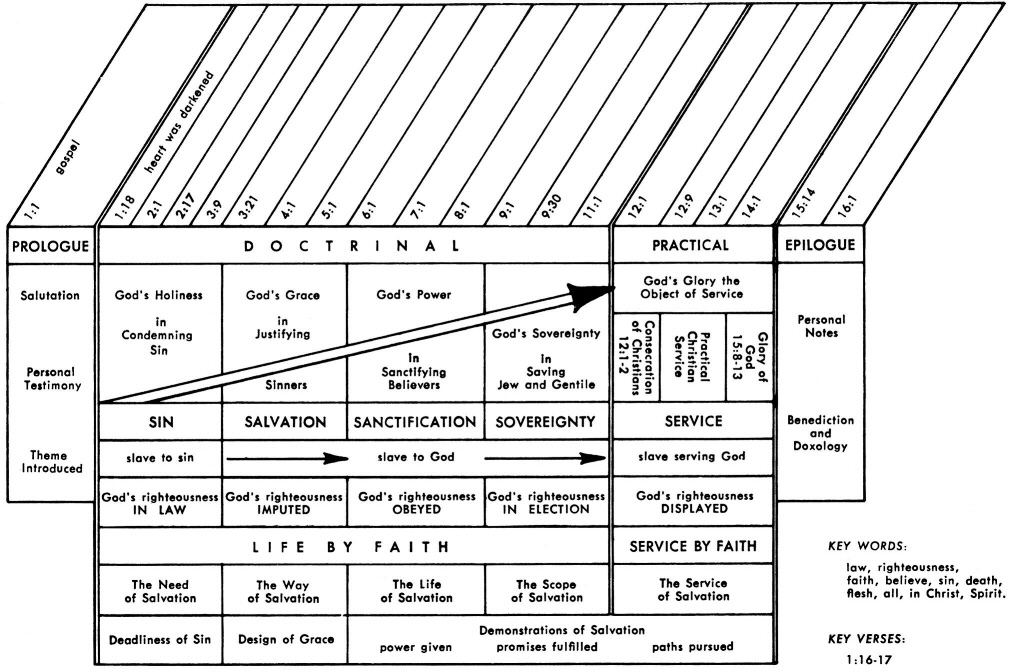
Click chart to enlarge
Chart from recommended resource Jensen's Survey of the NT - used by permission
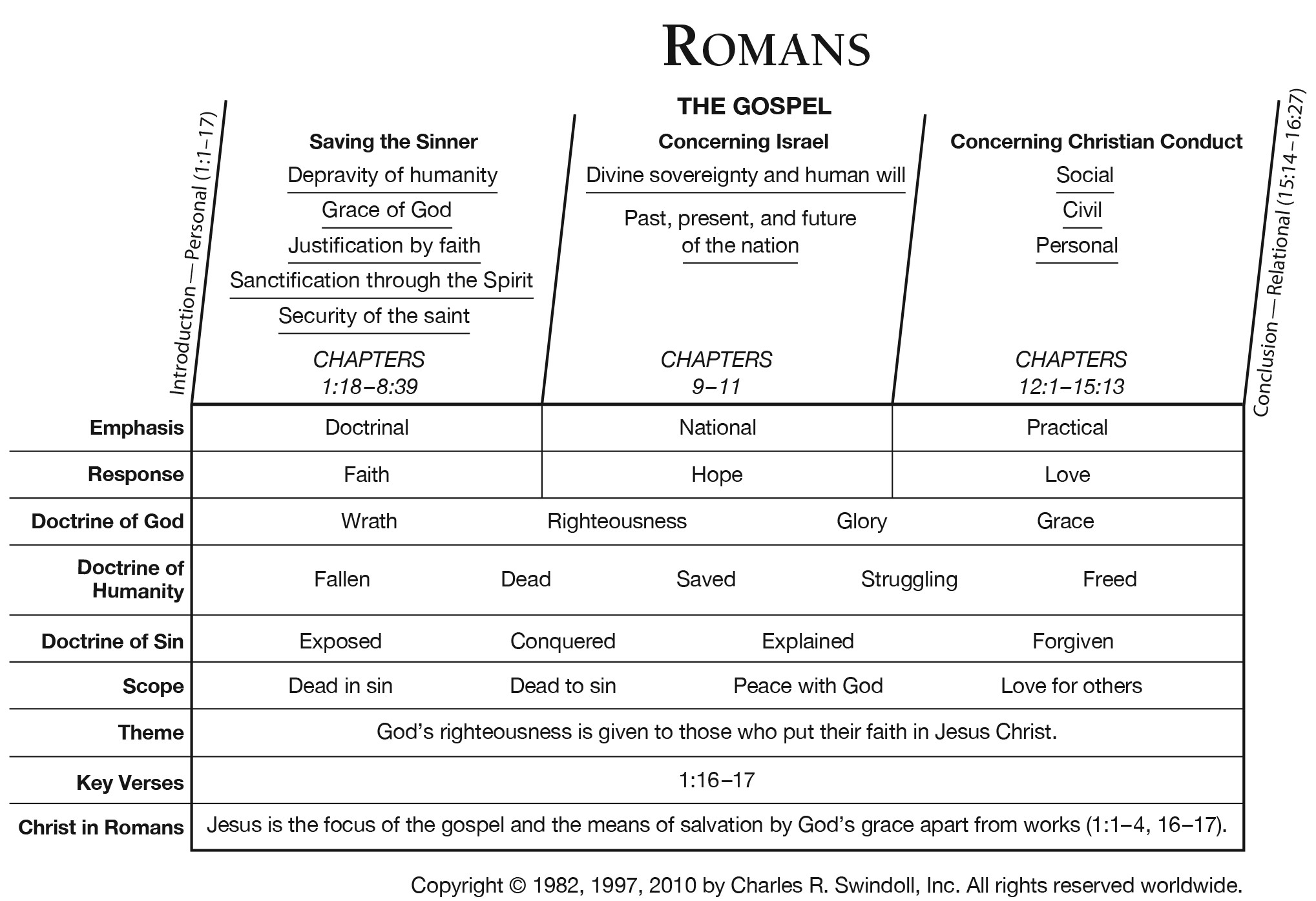
Click Charles Swindoll's overview chart
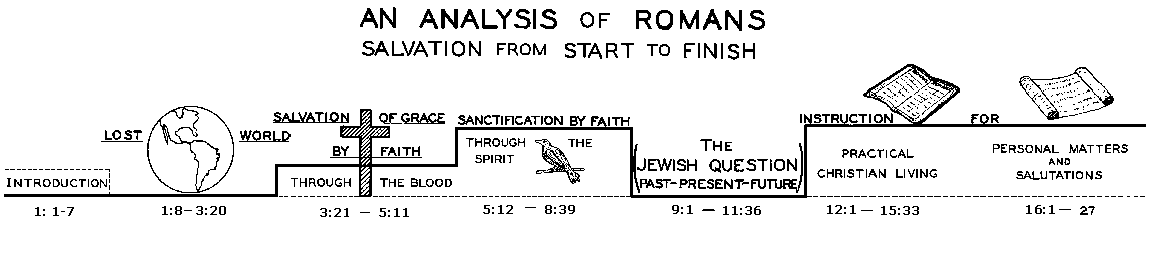
Source: Dr David Cooper
Click to Enlarge
| ROMANS ROAD to RIGHTEOUSNESS |
||||
| Romans 1:18-3:20 | Romans 3:21-5:21 | Romans 6:1-8:39 | Romans 9:1-11:36 | Romans 12:1-16:27 |
| SIN | SALVATION | SANCTIFICATION | SOVEREIGNTY | SERVICE |
| NEED FOR SALVATION |
WAY OF SALVATION |
LIFE OF SALVATION |
SCOPE OF SALVATION |
SERVICE OF SALVATION |
| God's Holiness In Condemning Sin |
God's Grace In Justifying Sinners |
God's Power In Sanctifying Believers |
God's Sovereignty In Saving Jew and Gentile |
Gods Glory The Object of Service |
| Deadliness of Sin |
Design of Grace |
Demonstration of Salvation | ||
| Power Given | Promises Fulfilled | Paths Pursued | ||
| Righteousness Needed |
Righteousness Credited |
Righteousness Demonstrated |
Righteousness Restored to Israel |
Righteousness Applied |
| God's Righteousness IN LAW |
God's Righteousness IMPUTED |
God's Righteousness OBEYED |
God's Righteousness IN ELECTION |
God's Righteousness DISPLAYED |
| Slaves to Sin | Slaves to God | Slaves Serving God | ||
| Doctrine | Duty | |||
| Life by Faith | Service by Faith | |||
|
Modified from Irving L. Jensen's chart above |
||||
Romans 2:1 Therefore you have (2SPAI) no excuse, (KJV= "O man) everyone * of you who passes judgment (PAPMSN) , for in that which you judge (2SPAI) another, you condemn (2SPAI) yourself; for you who judge (PAPMSN) practice (2SPAI) the same things. (NASB: Lockman)
Greek: Dio anapologetoe ei, (2SPAI) o anthrope pas o krinon; (PAPMSN) en o gar krineis (2SPAI) ton heteron seauton katakrineis, (2SPAI) ta gar auta prasseis (2SPAI) o krinon. (PAPMSN)
Amplified: THEREFORE YOU have no excuse or defense or justification, O man, whoever you are who judges and condemns another. For in posing as judge and passing sentence on another, you condemn yourself, because you who judge are habitually practicing the very same things [that you censure and denounce]." (Amplified Bible - Lockman)
Baker: Therefore you have no excuse, O man, whoever you are, when you pass judgment (on someone else), for at whatever point you judge the other person, you are condemning yourself, because you, the judge, are practicing the same things.
Barclay: So, then, O man, everyone of you who judges others, you yourself have no defence. While you judge others, you condemn yourself, for you who set yourself up as a judge do exactly the same things.
KJV: Therefore thou art inexcusable, O man, whosoever thou art that judgest: for wherein thou judgest another, thou condemnest thyself; for thou that judgest doest the same things.
NLT: YOU may be saying, “What terrible people you have been talking about!” But YOU are just as bad, and YOU have no excuse! When YOU say they are wicked and should be punished, YOU are condemning YOURSELF, for YOU do these very same things." (emphasis added with capitalization) (NLT - Tyndale House)
Phillips: Now if you feel inclined to set yourself up as a judge of those who sin, let me assure you, whoever you are, that you are in no position to do so. For at whatever point you condemn others you automatically condemn yourself, since you, the judge, commit the same sins. (Phillips: Touchstone)
Wuest: Therefore, you are without a defense, O man, everyone who judges, for in that in which you are judging another, yourself you are condemning, for you who judge practice the same things.
Young's Literal: Therefore, thou art inexcusable, O man -- every one who is judging -- for in that in which thou dost judge the other, thyself thou dost condemn, for the same things thou dost practise who art judging"
R Ruin (Romans 1:17 – 3:20) – The utter sinfulness of humanity
O Offer (Romans 3:21-31) – God’s offer of justification by grace
M Model (Romans 4:1-25) – Abraham as a model for saving faith
A Access (Romans 5:1-11) – The benefits of justification
N New Adam (Romans 5:12-21) – We are children of two “Adams”
S Struggle w/ Sin (Romans 6-8) Struggle, sanctification, and victory
- Romans 2 Resources - Multiple Sermons and Commentaries
Summary: It has been said that visitors to the labyrinths of certain of the catacombs in Rome used to take hold of a silk thread by which they could retrace their steps if they became fearful of becoming lost. In this next section of Romans there are also abundant opportunities of losing one's way.
It is necessary, then, to keep in mind the purpose of Paul in the verses which is stated plainly in 3:9 which is to accuse both Gentiles and Jews that they are guilty of sin. (see the table above) The theme of this section of Romans 2:1-16 is that God’s judgment is righteous (right) and by this standard every "moral" or "religious" person including the Jew (who had the Law) is as guilty as the heathen (who did not have the Law). Although Paul does not mention the Jews by name until Romans 2:17, it seems to be a reasonable interpretation to state that "the every man of you" in (Romans 2:1) would be a reference to Jews or certainly would include them.
Warren Wiersbe addresses the interpretation of this first section writing that "Bible scholars do not agree on whom Paul was addressing in Romans 2:1–16. Some think he was dealing with the moral pagan who did not commit the sins named in Romans 1:18–32, but who sought to live a moral life. But it seems to me that Paul was addressing his Jewish readers in this section. To begin with, his discussion of the Law in Romans 2:12-16 would have been more meaningful to a Jew than to a Gentile. And in Romans 2:17, he openly addressed his reader as “a Jew.” This would be a strange form of address if in the first half of the chapter he were addressing Gentiles. It would not be an easy task to find the Jews guilty, since disobedience to God was one sin they did not want to confess. The Old Testament prophets were persecuted for indicting Israel for her sins, and Jesus was crucified for the same reason. Paul summoned four witnesses to prove the guilt of the Jewish nation… The Gentiles (Ro 2:1–3)… God’s blessing (Ro 2:4–11)… God’s Law (Ro 2:12–24)… Circumcision (vv. 25–29) (Wiersbe, W: Bible Exposition Commentary. 1989. Victor)
Hodge explains it this way - In order to appreciate the force of the apostle’s reasoning in this and the following verses, it should be remembered that the principal ground on which the Jews expected to be accepted by God was the covenant which he had made with their father Abraham, in which he promised to be a God to Abraham and to his descendants after him. The Jews believed that this promise guaranteed salvation for all who retained their connection with Abraham through the observance of the law and the rite of circumcision. Therefore they expected to be regarded and treated not so much as individuals, each dealt with according to his personal character, but as a community to whom salvation was assured by the promise made to Abraham. Paul begins his argument at a distance; he states his principles in such general terms that they could not fail to secure the assent of the Jew, before he was aware of their application to himself. It is clear that the Jews are addressed in this chapter both from the whole tenor of the argument, and from its particular application to the Jews from verse 17 onwards. This way of viewing the passage is now generally accepted, though many of the earlier commentators supposed either that no particular people were being spoken of here or that the apostle had in mind the best pagans, or at least those who did not seem to approve of the sins mentioned in the preceding chapter, but rather condemned them. (Romans 2 - Hodge's Commentary on Romans)
William Barclay feels Paul is addressing the Jews (albeit this clearly is applicable to any "religious" person who might look down on the godless pagans of Romans 1) - In this passage Paul is directly addressing the Jews. The connection of thought is this. In the foregoing passage Paul had painted a grim and terrible picture of the heathen world, a world which was under the condemnation of God. With every word of that condemnation the Jew thoroughly agreed. But he never for a moment dreamed that he was under a like condemnation. He thought that he occupied a privileged position. God might be the judge of the heathen, but he was the special protector of the Jews. Here Paul is pointing out forcibly to the Jew that he is just as much a sinner as the Gentile is and that when he is condemning the Gentile he is condemning himself. He will be judged, not on his racial heritage, but by the kind of life that he lives.The Jews always considered themselves in a specially privileged position with God. "God," they said, "loves Israel alone of all the nations of the earth." "God will judge the Gentiles with one measure and the Jews with another." "All Israelites will have part in the world to come." "Abraham sits beside the gates of hell and does not permit any wicked Israelite to go through." When Justin Martyr was arguing with the Jew about the position of the Jews in the Dialogue with Trypho, the Jew said, "They who are the seed of Abraham according to the flesh shall in any case, even if they be sinners and unbelieving and disobedient towards God, share in the eternal Kingdom." (Romans 2 - William Barclay's Daily Study Bible)
It is easy to convince the "religious" person as well as the Jew of the unrighteousness of the idolatrous pagans in Romans 1 because the flagrant nature of their sins. On the other hand, convincing the "religious" person (eg, one who goes to church or is a member of a church) or the Jews of their innate unrighteousness is another matter as many of us who have shared our faith have experienced.
The Jews thought they had it made because of their good "genes" which gave them a good spiritual heritage. After all they were God's "chosen people", possessors of His Law and His covenant sign of circumcision.
Paul's objective in Romans is to convince the Jew and all "religious" persons of his or her need for genuine salvation which "brings forth fruit in keeping with repentance" and exhibits a radically changed lifestyle as expressed in rhyme…
Your best resolutions must wholly be waived,
Your highest ambitions be crossed;
You need never think you are going to be saved
Until you have learned you are lost.
To make his point Paul reminds his readers that the judgment of God is according to works. Be careful here. Do not be confused. Salvation is by faith alone. In Romans 2:1-16 Paul is dealing with principles of judgment not principles of justification. He is not teaching us how a person is saved in this section. As someone has well said Paul is speaking about the "completion" of one's life, not the "commencement" of it!. Paul is concerned about the great fact that righteousness leads to life and unrighteousness leads to death, irregardless of how religious is one's life. Paul is dealing with the results, not with the process; the goal, not the way. In summary, Romans 2 does not in any way contradict Paul's teaching that justification is by faith alone and not by works.
Hughes - As we begin our study of Romans 2, we need to focus on this thought: mankind does not accept God’s assessment of human sin and the imperative of divine judgment. This is not to say that men will not admit they are sinners. It is very easy to get a non-Christian to agree that he is a sinner (“nobody’s perfect”), but it is almost impossible to get him to realize the gravity of his sin. Typically he has no trouble agreeing that those who are guilty of “big sins” like murder and rape and treason deserve judgment—even death. However, that God’s wrath should fall on those guilty of such “lesser sins” as envy or arrogance does not seem quite right to them. Most people do not take God’s word about sin and judgment seriously, but rather reject it and replace it with their own ad hominem reasoning.. “Nobody’s perfect!” “To err is human, to forgive is divine.” Or as the philosopher Heine said in a moment of now-famous cynicism, “God will forgive … it is his trade.” Such thinking suggests that since we are human we are under moral obligation to sin, and that God is under moral obligation to forgive us. Inherent in the common thinking that because everyone is doing it, it is not so bad—as long as we do not commit the “biggies” we will be okay—is the assumption that God does not mean what he says or say what he means… The eternal fact is, God means what he says and says what he means. Moreover, his judgment, despite moralisms to the contrary, is perfect. That is what Ro 2:1–16 is all about. As we come to understand (or reaffirm our understanding) of the perfection of God’s judgment, we will bring health to our souls. For those of us who are believers, this will drive us toward a greater authenticity in life—and thus spiritual power. For the non-Christian, there will be strong encouragement to face fundamental issues about oneself and God. (Hughes, R. K. Romans: Righteousness from heaven. Preaching the Word. Wheaton, Ill.: Crossway Books)
Ray Stedman introduces this section reminding us that in Romans chapter 1 "to our astonishment, we see how accurately the apostle has analyzed the civilization of twentieth century civilization as well. All that is recorded in the first chapter of Romans took place last night in San Francisco and Los Angeles, up and down the West coast, and throughout this nation, and the world in which we live. Yet there are many people who would say they do not belong in this picture. I am sure there were thousands in Paul's day, and I know there are millions today who feel they are not described in Romans 1." "That isn't talking about us. We're not like that. It may describe them, but it does not describe us." Whenever you read this first chapter of Romans you find that division immediately evident -- them and us. They are the wicked, the obviously gross, wicked people; we are not. Many people would say, "We're law-abiding, home-loving, clean-living, decent people." Many of these people have been church members most of their lives. Others perhaps do not go to church at all, but nevertheless pride themselves on their moral standards, their ethical values, and their clean, law-abiding lives. They say the world may be in its present condition because of the wickedness of gangsters, radicals, revolutionaries, prostitutes, pimps, and perverts of our day; but they themselves are the salt of the earth." (Romans 2:1-11 Sinful Morality ) (Bolding added)
Hypocritical Judgment - A hypocrite is someone who complains there is too much sex and violence in his DVD collection! (Woe! Are we all a bit convicted?!) A Hypocrite says, “Mary is always criticizing others!” Hypocrisy is such a subtle, self-deceiving sin!
Denney - The apostle has now to prove that the righteousness of God is as necessary to the Jew as to the pagan; it is the Jew who is really addressed in this chapter from the beginning. (The Expositor's Greek Testament)
William Newell introduces Romans 2 - We now enter upon the greatest passage in all Scripture as to the principles and processes of God in His estimate, or judgment, concerning His creatures. If God is “Judge of all,” and if the whole world is to be “brought under the judgment of God” (Romans 3:19), God will surely take pains to make known the great principles of His action, so that men may know beforehand how He will decide and act. Otherwise, men would “imagine vain things” about the true God, and hug their delusions to their own damnation. The personal character of God’s relations toward men, either in the matter of salvation or of damnation, is rapidly being forgotten by this generation. Yet, if God be God, He must be the Judge of All. Back of the whole revelation of His works and ways, in His Word, is God Himself. And it is only the fool that saith in his heart, “No God.” Mark that it is in his heart, his desires, that he speaks; and not in his reason or judgment! God created man “in His own image.” Since we are persons,--so is God. Since we have personal feelings,--so has God.
Now every creature stands in relation to God according to what God is. God cannot change. Daniel Webster, in answer to the question: “What is the greatest thought that ever entered your mind?” said, at once, “My responsibility to my Maker!” You must meet God, and that as He is, not as you might wish Him to be. If you have Christ, you have already met Him! If you have not Christ, you have still to face God in His infinite holiness, and that arrayed against you, at the Judgment Day.
Now this second chapter of Romans deals with those who do not believe that the awful things of the first chapter mean themselves. Consequently, we find two sets of such self-appointed “judges” of others [Note: The Greek verb for “judging” in the first verse does not mean to estimate a man’s value but to condemn his person.] in Chapter Two:
First, Those who discountenance the “openly bad” of humanity, considering themselves “better”--because of race, civilization, environment, education, or culture; and,
Second, Those who discountenance the bad, thinking themselves “better,” because of their religion,--the possession of the Divine oracles: these, of course, were, in Paul’s day, the Jews (Romans 2:17).
Concerning the first class, the “respectable” sinners, who esteem themselves “better,” God lays down six great principles of His estimate or judgment of men; and adds a seventh concerning the second class, the “religious” sinners; of whom God declares that the world itself despises inconsistency between practice and religious profession.
Now just because the history of our race has been so black, as shown in Chapter One (“God gave them up--God gave them up--God gave them up--”), we who read the record are ourselves in peculiar danger, for the doors into the death-chamber of self-righteousness so easily open to us! We readily fall into the delusion that God is speaking in this chapter concerning heathen idolaters, who finally descended to worshiping “creeping things,”--and that He cannot be speaking to us!
But will you remember that God comes quickly, through this sad history, to man’s settled state. For at the end of the history, the announcement concerning men is, “being filled with all unrighteousness!” By and by God will announce that there is no distinction” as to sinners, and will publish the fact that there is but one way of salvation for all men alike,--and that through the shed blood of a Redeemer. But here, as we have above said, God is heading off from escape first the proud “judges” of others, of every sort,--the moralists, and moral philosophers, all the “moral” folks,--the “whosoevers” that “judge”; and, second, those who would escape the consciousness of guilt and judgment by running under a “religious” roof-- whether a Jewish shelter, as in Paul’s day, or a “Christian” one, in our day (Romans 2 Commentary)
The self-righteous and the hypocrite tried and condemned by
I. Conscience (Romans 2:1-3).
II. The mercy of God (Romans 2:4).
III. Eternal justice (Romans 2:5-11). (J. Lyth, D. D.) (Biblical Illustrator)
THEREFORE YOU ARE WITHOUT EXCUSE: Dio anapologetoe ei (2SPAI):
- Ro 9:20-note; 1Co 7:16; Jas 2:20
- Romans 2 Resources - Multiple Sermons and Commentaries
NO EXCUSE!
Therefore (1352) (dio) is a term of conclusion and is usually a call to examine the previous passages to see what the author is concluding or what is the basis for his conclusion. In this particular verse, the therefore is somewhat difficult to interpret dogmatically and some very good expositors have different "conclusions!" (See below)
As discussed by several of the references below, "therefore" could refer to what Paul has just said in the last half of Romans 1. Alternatively this therefore could be based on the facts which follow - they are the basis for Paul's conclusion (you are without excuse) follow instead of precede the "therefore" (the interpretation favored by Donald Barnhouse - see below).
Robert Haldane explains that the therefore "introduces a conclusion, not from anything in the preceding chapter, but to establish a truth from what follows. The Apostle had proved the guilt of the Gentiles, who, since they had a revelation vouchsafed to them in the works of God, though they did not possess His word, were inexcusable. The Jews, who had His word, yet practiced the same things for which the former were condemned, must therefore also be inexcusable. In the sequel, he specifies and unfolds the charge thus generally preferred." (Exposition of Romans - Romans 2)
Hendriksen writes that "Many are puzzled by the word Therefore. It must be admitted that its meaning is not immediately clear. The following interpretation, however, seems to be supported by the preceding context: “Since it has been established (Ed: see note Romans 1:18-19ff) that the immoral practices of the Gentiles are an abomination to God, therefore you, too, whoever you may be, are without excuse when you practice these same evils, the very vices you condemn in others.” (Hendriksen, W., & Kistemaker, S. J. New Testament Commentary Set, 12 Volumes. Grand Rapids: Baker Book House)
Dr Barnhouse's explanation of the therefore is a bit different - "The chapter begins with the word “therefore,” and this needs some explanation. As a rule this word is an illative (a word or phrase introducing an inference), referring to something that has gone before, acting as a hinge to draw a conclusion from a preceding premise. But in this instance the word does not point backwards to the first chapter, but rather anticipates that which follows. It might well be translated, “For the following reason,” thou art inexcusable, O man, whosoever thou art that judgest."
Kruse - The connection between Ro 2:1–16 and Ro 1:32 is established by the conjunction ‘therefore’ as well as the repeated use of the verb ‘to practice’ mentioned above. The similar factor found in Ro 1:32 and Ro 2:1 is that people know what God requires. The difference is that in the first instance they know what God requires but continue to do the opposite and give their approval to others who do the same, whereas in the second instance, knowing what God requires, they condemn the evil actions of others while doing the same things themselves. (Pillar NT Commentary)
Leon Morris - Therefore links this with the preceding; what Paul says now arises out of what he said at the end of the previous chapter. There is a difficulty in that it is not obvious how the guilt of the Gentile world brings the Jew under condemnation. We seem to require that those addressed here are included in the previous section. The explanation may be that, while it is true that in chapter 1 Gentiles are primarily in mind, the sins of all people are castigated, and here, while the Jews are at center stage, all who judge others are condemned. (Pillar NT Commentary)
James Denney on therefore - The Jew is ready enough to judge the Gentile. But he forgets that the same principle on which the Gentile is condemned, viz., that he does evil in spite of better knowledge (Ro 1:32), condemns himself also. His very assent to the impeachment in Ro 1:18–32 is his own condemnation. This is the force of dio: therefore. (Romans 2 - The Expositor's Greek Testament)
Vine explains therefore - Because of the universal facts of the voice of conscience and the knowledge of the divine condemnation and punishment of sin and of the consequences of practicing evil and consenting with it, in spite of that knowledge. (Collected writings of W. E. Vine)
Moule on therefore - Therefore] It is difficult to state the precise bearing of this word; the exact premise to which it refers. It is, perhaps, best explained by a brief statement of the apparent general connection here. St Paul has described the great fact of Human Sin. He has done so in terms which point specially to heathendom, but not exclusively. Two points, the universality of sin, and the universality of conscience (Ro 1:18, 32), are plainly meant to be true of all men, idolaters or not. But now, in our present verse, he has it in view to expose specially the state of Jewish sinners; but to do this by leading gradually up to the convincing point, which is not reached till Ro 2:16. Really, but not explicitly, therefore, he here addresses the Jew, as included in the previous condemnation, but as thinking himself all the while the "judge" of heathen sinners. In words, he addresses any self-constituted "judge;" while in fact he specially, though still not exclusively, addresses the Jew. And he addresses him as "inexcusable," because of his sin, and because of his conscience, a conscience in his case peculiarly enlightened. The "therefore" thus points mainly to the words just previous; to the fact of a knowledge of God's penal statute against sin, while yet sin is committed and abetted. doest the same things] The reference is doubtless to the passage from about Ro 1:26. External idolatry had vanished among the Jews since the captivity; but other forms of the subtle "worship of the creature" had taken its place; a gross immorality was far from rare; and sins of "strife, craft, and malignity," were conspicuous. (The Epistle of Paul the Apostle to the Romans - Google Books)
Hodge adds that "The connection between this chapter and chapter 1, which is indicated by the particle therefore, is somewhat obscure. Some suppose that the inference comes out of the teaching from 1:18: God is just and is determined to punish all man’s unrighteousness and ungodliness; so those who commit the sins which they condemn in others have no excuse. In this case, however, the conclusion does not exactly fit the premises. It is not so much the inexcusableness of sinners as the exposure that follows from the justice of God. Most commentators, therefore, hold that the inference therefore in Ro 2:1 is drawn from Ro 1:32, where it is said that all men know that those who sin are worthy of death. The inference is that those who commit sin have no excuse, however censorious their self-conceit may make them towards others. (Romans 2 - Hodge's Commentary on Romans)
The verb are (eimi) is present tense indicating that they were continually without excuse. Wuest says they are "without a defense," for Paul like a skilled prosecuting attorney is weaving his air-tight case against his readers.
Without excuse (379) (anapologetos from a = without + apologéomai = apologize or more literally to speak oneself off and so to plead for oneself) means inexcusable. This word pertains to not being able to defend oneself or to justify one’s actions The root word "apologeomai" (defending in Romans 2:15) was used in secular Greek in a judicial sense to describe a legal petition or defense.
The only other use of anapologetos is in the previous chapter where Paul writes that "since the creation of the world His invisible attributes, His eternal power and divine nature, have been clearly seen (note the "seeing" of the "invisible attributes, which he goes on to explain - what they see of the Creation generates an inner seeing so to speak), being understood through what has been made, so that they are without excuse." (Ro 1:20-21-note)
Why is everyone without excuse ("without defense")? In Romans 1:18-32 all the "unrighteous" are without excuse and in Romans 2 he begins to demonstrate that all the "self-righteous" are also without excuse. They are without excuse because of the universal facts of the external creation and the internal voice of conscience (God made it evident within them). What was true of the "pagans" in Romans 1:18-32 is also true of this group he identifies with the pronoun "you" (in contrast to the pronoun they he had used repeatedly in Romans 1:18-32). Therefore both they and you are without excuse. In the following verses, Paul refers to you as if he is addressing an imaginary representative of a real and identifiable group of people. Undoubtedly, in many ways the Jew of Paul's day typified the moralist, but as discussed, his words in Romans 2:1-16 seem to have a wider application to all who think they are morally righteous (in comparison to the gross immorality described in Romans 1).
Barnhouse - The key to the argument is the word, “inexcusable.” The first chapter asks, in effect, Did you ever look upon nature? The present verse asks, Have you ever criticized anyone for anything? Then you are without excuse, because your criticism arises from the fact that you have a conscience, which now recognizes a sin in another because it is aware of the existence of sin in self; and you have never lived up to the light of your conscience, whatever it may be. Anyone who has ever criticized anything in anybody has thereby written his own condemnation… No individual has ever criticized another for lying without having, sometime or other, been guilty of shading the truth. The conscience that makes you aware of imperfection in another finds written on itself the guilt of its own imperfection.
MacDonald rightly reminds us that…
Fallen man can see faults in others more readily than in himself. Things hideous and repulsive in the lives of others seem quite respectable in his own. But the fact that he can judge sins in others shows that he knows the difference between right and wrong. If he knows that it is wrong for someone to steal his wife, then he knows that it is wrong for him to steal someone else’s wife. Therefore, when someone commits the very sins he condemns in others, he leaves himself without excuse. The sins of cultured people are essentially the same as those of the heathen. Although a moralist may argue that he has not committed every sin in the book, he should remember the following facts:
1. he is capable of committing them all.
2. by breaking one commandment, he is guilty of all (Jas. 2:10).
3. he has committed sins of thought which he may never have committed in actual deed, and these are forbidden by the word. Jesus taught that the lustful look, for instance, is tantamount to adultery (Mt. 5:28-29). (Believer's Bible Commentary)
When we seek to share with others their great need of Christ's free gift of salvation we meet with a variety of responses:
What about the heathen?
A loving God would never send anyone to hell.
I'm okay because I belong to the church.
Oh I don't show it or live it but I'm a Christian and I'm okay so you can worry about someone else."
Romans 1 addressed the first objection - the heathen did know about God but suppressed this truth and therefore are guilty. Romans 2 addresses the other objections and misconceptions about genuine salvation and man's need for it.
Jews were the people who judged, pronouncing all Gentiles to be born in sin and under condemnation. They loved to criticize the Gentile "dogs" as they called them and it warmed their hearts to hear Paul put those dirty heathen sinners in their place in Romans 1. Paul's unexpected conclusion (you are without excuse) abruptly challenges the self righteous Jew or anyone who thought himself exempt from the indictment in Romans 1.
A good example of a "religious person" with a judgmental attitude is found in Jesus' illustration of the Pharisee and the Publican where Jesus addresses the "self-righteous", judgmental Pharisee to show him his need for God's righteousness.
"Two men went up into the temple to pray, one a Pharisee, and the other a tax-gatherer. 11 "The Pharisee stood and was praying thus to himself, 'God, I thank Thee that I am not like other people: swindlers, unjust, adulterers, or even like this tax-gatherer. 12 'I fast twice a week; I pay tithes of all that I get.' 13 "But the tax-gatherer, standing some distance away, was even unwilling to lift up his eyes to heaven, but was beating his breast, saying, 'God, be merciful to me, the sinner!' 14 "I tell you, this man went down to his house justified rather than the other; for everyone who exalts himself shall be humbled, but he who humbles himself shall be exalted." (Luke 18:10-14)
A person best understands his need for the good news of the Gospel when he understands he is guilty before God--whether immoral (Ro 1) or moral (Ro 2), whether Gentile (Ro 1) or Jew (Ro 2). Their sins may be different but their guilt is the same. But as everyone knows, it's not easy to convince a "moral man" of his guilt, because "moral" men truly believe they are better than other people. This is deception. And when a person is deceived, they do not even know it! (See the deceitful effect of sin - Heb 3:13).
So whether one is a Jew or a "moral Gentile", both groups think they are exempt from God’s judgment because they have not indulged in the immoral excesses described in Romans 1. Paul is emphasizing that they are mistaken and deceived. In fact in some ways they are worse off than the pagans, for they have more knowledge (e.g., the Jews "were entrusted with the oracles of God" Romans 3:2) and thus they had a greater accountability. If the Gentile is without excuse, then the Jew is even more so because he had more information at his disposal. Later in this chapter Paul informs us that he "will be judged by the Law" (Romans 2:12). His judgment will be according to light and he will receive a greater degree of punishment because of his refusal of the light. The principle of greater light bringing greater accountability and a more severe judgment is clearly taught in Scripture - study the following passages (Mt 10:15, 11:20, 21, 22, 23, 24, 12:41 Jn 19:11, Lu 10:12, 13, 14, 15, 16, 12:47,48, 20:46, 47, Heb 10:29]
EXTERNAL RELIGION, INTERNAL DEADNESS - The Queen Mary was the largest ship to cross the oceans when it was launched in 1936. Through 4 decades and a World War she served until she was retired, anchored as a floating hotel and museum in Long Beach, California. During the conversion, her 3 massive smoke-stacks were taken off to be scraped down and repainted. But on the dock they crumbled. Nothing was left of the 3/4-inch steel plate from which the stacks had been formed. All that remained were more than 30 coats of paint that had been applied over the years. The steel had rusted away. There was no substance, only an exterior appearance! “No substance, only an exterior appearance!”
Football legend Al Davis understood he was "without excuse" - “Death is the only thing I’m afraid of,” said Al Davis, the aging managing general partner of the Oakland Raiders. “It’s the only thing you can’t control. The football I’ll get straight. My biggest thing now is this death business. I’ve always been able to control the elements of my life, dominate my environment without hurting others. But this death business … I can’t beat it. I can’t win.” And of course death is the inevitable consequence of the entrance of sin into this world (Ro 5:12-note).
EVERY MAN WHO PASSES JUDGMENT: o anthrope pas o krinon (PAPMSN):
- Ps 50:16, 17, 18, 19, 20; Mt 7:1, 2, 3, 4, 5-see notes; Mt 23:29, 30, 31; Lk 6:37; 19:22; Jn 8:7, 8, 9; Jas 4:11
- Romans 2 Resources - Multiple Sermons and Commentaries
KING DAVID: A PICTURE
OF EVERY MAN WHO JUDGES OTHERS
Read the tragic example of David judging and getting judged by God through His prophet Nathan - "You are the man!" David had "one finger" pointing at the man, but 4 were pointing at himself!
2 Samuel 12:1-10 Then the LORD sent (a)Nathan to David. And he came to him and said, "There were two men in one city, the one rich and the other poor. 2 "The rich man had a great many flocks and herds. 3 "But the poor man had nothing except one little ewe lamb Which he bought and nourished; And it grew up together with him and his children. It would eat of his bread and drink of his cup and lie in his bosom, And was like a daughter to him. 4 "Now a traveler came to the rich man, And he was unwilling to take from his own flock or his own herd, To prepare for the wayfarer who had come to him; Rather he took the poor man's ewe lamb and prepared it for the man who had come to him." 5 Then David's anger burned greatly against the man, and he said to Nathan, "As the LORD lives, surely the man who has done this deserves to die. 6 "He must make restitution for the lamb fourfold, because he did this thing and had no compassion." 7 Nathan then said to David, "You are the man! Thus says the LORD God of Israel, 'It is I who anointed you king over Israel and it is I who delivered you from the hand of Saul. 8 'I also gave you your master's house and your master's wives into your care, and I gave you the house of Israel and Judah; and if that had been too little, I would have added to you many more things like these! 9 'Why have you despised (Heb = bazah = disdain; regarded with contempt; Lxx = phaulizo = considered worthless, held cheap, disparaged, treated with contempt) the Word of the LORD by doing evil in His sight? (Note: Phaulizo is used in Nu 15:31 - notice what happened to that man!) You have struck down Uriah the Hittite with the sword, have taken his wife to be your wife, and have killed him with the sword of the sons of Ammon. 10 'Now therefore, the sword shall never depart from your house, because you have despised (Heb = bazah; Lxx = exoutheneo = utterly despised) Me and have taken the wife of Uriah the Hittite to be your wife.' (We all need to remember this passage before you commit what you know to be a flagrant sin, be it in the area of immorality or otherwise! Woe! Read 2Sa 12:11-14!)
Every (3956) (pas) means all without exception. As Ray Stedman quipped in his sermon on this section "Here Paul talks about those who pass judgment on others. If there are any here this morning who do not belong in that category, we will excuse you. You are free to go, because I want to talk to those who have, at one time or another, passed judgment on someone else. (Romans 2:1-11 Sinful Morality)
Man (444) (anthropos) is the generic name in distinction from gods and the animals. It refers to a man or woman, an individual of the human race or a person. The KJV renders this with the phrase "O man".
Passes judgment (2919) (krino) primarily signifies to distinguish, separate or discriminate and then, to distinguish between good and evil, right and wrong, without necessarily passing an adverse sentence, though this is usually involved. Krino means to sift out and analyze evidence. Krino is present tense indicating that they were continually passing judgment. Passing judgment, by implication, means condemning.
The imaginary interlocutors ("you… every man") are envisaged not as objecting to what Paul had said but as agreeing with it very strongly. It is that tendency (in all of us) to point the finger at someone else -- the amazing ability to find someone whom we consider worse than we are, and to ask God to concentrate on him and leave us alone. But Paul corrects their (and our) mistaken conclusions by explaining that when "Mr. I'm Okay" meets his Maker, he will be judged by God. This section presents the principles by which that judgment takes place.
MacDonald makes the point that…
The sins of cultured people are essentially the same as those of the heathen. Although a moralist may argue that he has not committed every sin in the book, he should remember the following facts:
1. he is capable of committing them all.
2. by breaking one commandment, he is guilty of all (James 2:10."For whoever keeps the whole law and yet stumbles in one point, he has become guilty of all.")
3. he has committed sins of thought which he may never have committed in actual deed, and these are forbidden by the word. Jesus taught that the lustful look, for instance, is tantamount to adultery (Matt. 5:28-note "but I say to you, that everyone who looks on a woman to lust for her has committed adultery with her already in his heart.") (Believer's Bible Commentary)
Jesus addressing a Jewish audience, many of whom were undoubtedly convinced of their self-righteousness, admonished them to…
not judge lest you be judged. For in the way you judge, you will be judged; and by your standard of measure, it will be measured to you. And why do you look at the speck that is in your brother's eye, but do not notice the log that is in your own eye? Or how can you say to your brother, 'Let me take the speck out of your eye,' and behold, the log is in your own eye? You hypocrite, first take the log out of your own eye, and then you will see clearly to take the speck out of your brother's eye. (Matthew 7:1-5-note)
MacArthur writes that…
"The phrase "O man" (cf. Ro 2:3; 9:20) is a general reference to any moralist who thinks he's exempt from judgment because he hasn't sunk to idolatry, homosexuality, or any other reprobate activity."
Paul's description fits us all to a certain extent… for we all have an amazing tendency to point the finger at someone else -- the amazing ability to find someone whom we consider worse than we are, and to ask God to concentrate on him and leave us alone. All of us know someone whom we consider a little bit lower on the ethical scale than we are, and what a comfort they are to our hearts! Every time our conscience gives us a little stab, we immediately remember these people, and we take courage, and feel a lot better.
Have you ever noticed how frequently this attitude is encountered? When you are stopped by a traffic policeman, and he comes up beside your car, you say to him,
"Officer, what are you bothering me for? Why don't you go out and catch some of the teenage speeders, and leave us law abiding citizens alone?"
We all want a lightning rod that will divert the stroke of divine wrath from us, and channel it off to someone we consider a little more worthy of it. (MacArthur, J: Romans 1-8. Moody)
Harry Ironside - In the first sixteen verses of this chapter of Romans another class of people is brought into view: the world of culture and refinement. Surely among the educated, the followers of the various philosophic systems, will be found men who lead such righteous lives that they can come into the presence of God claiming His blessing on the ground of their own goodness! Certainly there were those who professed to look with disgust and abhorrence upon the vile lewdness of the ignorant rabble. But were their private lives any holier or any cleaner than those whom they so loudly condemned? It is now their turn to be summoned into court, so to speak, where the apostle fearlessly arraigns them before the august tribunal of the righteous Lord, who loveth righteousness. "Therefore thou art inexcusable, O man, whosoever thou art that judgest: for wherein thou judgest another, thou condemnest thyself; for thou that judgest doest the same things" (Romans 2:1). Philosophy does not preserve its devotee from the indulgence of the flesh. A recognition of the evil is not necessarily power to overcome the evil. Culture does not cleanse the heart nor education alter the nature. The judgment of God according to truth will be rendered against the evildoer. To praise virtue while practicing vice may enable one to get by with his fellows, but it will not deceive Him who is of purer eyes than to behold iniquity. (Romans Expository Commentary)
Ray Pritchard defines this "man" as "a good person who is not a Christian. He pays his taxes, loves his wife, helps his kids, works hard, obeys the law and every year buys five boxes of Girl Scout cookies. Although he is a good neighbor, a hard worker, and an all-around nice guy, he is not a Christian. To be even more specific, he probably is a church member, but he is not saved. He is moral, but lost." (Romans 2:1-16: Mr. I.M. Okay Meets His Maker)
FOR IN THAT YOU JUDGE ANOTHER YOU CONDEMN YOURSELF: en o gar krineis (2SPAI) ton heteron seauton katakrineis (2SPAI):
- Romans 2 Resources - Multiple Sermons and Commentaries
For (1063) (gar) - Always take a moment to pause and ponder this strategic term of explanation asking at least "What is Paul explaining?"
Judge (2919) (krino) basically means to form an opinion after separating and considering the particulars in the case. Krino means to evaluate and determine what is right, proper, and expedient for correction or action (including condemnation).
Wuest has a helpful note on the progression of meaning of Krino - "The word krino meant originally to separate, then to distinguish, to pick out, to be of opinion, and finally, to judge. The act of judgment was therefore that of forming an accurate and honest opinion of someone, thus, appraising his character, and placing him in a certain position with respect to the law of God. The result of such a judgment is commonly condemnation." (Wuest's word studies from the Greek New Testament)
Note that the present tense is used for every occurrence for judging in this verse emphasizing the habitual action (which is tendency in all of us -- and if you deny this you are deceived! The fallen flesh loves to judge others! It is only as we yield to the Spirit's filling and empowering that we can kill this sin each time it raises it's ugly head!)
Condemn (2632) (katakrino from katá = against + kríno = judge) means to pronounce sentence against, adjudge guilty. It always denotes “to pass an adverse sentence”. The derivation of the English word is worth noting = from Latin condemnare, from com- + damnare to condemn, related to "damn" from damnum ‘loss, damage’. The meaning of condemn is to declare to be reprehensible, wrong, or evil usually after weighing evidence and without reservation. What a paradox = the judge condemns himself!
Jesus warned in His famous Sermon on the Mount in what is probably one of the most well know and frequently used (especially by non-believers) verses in Scripture…
"Do not judge lest you be judged. (Then Jesus explained why we had better be careful judging with wrong motives or from a critical, condemnatory spirit) For in the way you judge, you will be judged; and by your standard of measure, it will be measured to you." (Mt 7:1-2 -note)
Ray Stedman observes that "All of us know someone whom we consider a little bit lower on the ethical scale than we are, and what a comfort they are to our hearts! Every time our conscience gives us a little stab, we immediately remember these people, and we take courage, and feel a lot better. If we analyze our thoughts, we find that we secretly feel God has no right to bother us while these people are around. Let him concentrate on them! They are the ones who need it!… We all want a lightning rod that will divert the stroke of divine wrath from us, and channel it off to someone we consider a little more worthy of it. (Romans 2:1-16: The Secrets of Men)
It is important to understand that in the process of passing judgment on others these people show that they know the difference between right and wrong; otherwise they would not presume to be judging. In other words, they have a clear understanding of a standard of what is right and what is wrong.
Ray Stedman list some "practical" ways in which we all try to elude the fact that we are guilty of the very things that we judge others for thinking, saying or doing:
1) Blindness toward our own faults -- We are just not aware of them. We do not see that we are doing the same things that others are doing, and yet other people can see that we are. We all have these blind spots. One of the greatest lies of our age is the idea that we can know ourselves. We often argue, "Don't you think I know myself?" The answer is, "No, you do not know yourself. You are blind to much of your life." There can be areas that are very hurtful and sinful that you are not aware of. (see Jeremiah's analysis of your "heart" Jeremiah 17:9)
2) Conveniently forgetting what we have done that is wrong -- We may have been aware of our sin at the time, but somehow we just assume that God is going to forget it. We do not have to acknowledge it in any way -- he will just forget it. As the sin fades from our memory, we think it fades from His, as well (Wrong!)… In the Sermon on the Mount we learn that if we hold a feeling of animosity and hatred against someone, if we are bitter and resentful and filled with malice toward an individual, then we are guilty of murder, just as though we had taken a knife and plunged it into that person's breast, or shot them with a gun. If we find ourselves lustfully longing to possess the body of another, if we play with this idea over and over in our mind, and treat ourselves to a fantasy of sex, we have committed fornication or adultery. If we find ourselves filled with pride, yet we put on the appearance of being humble and considerate of others, we are guilty of the worst of sins. Pride of heart destroys humanity. We think these things will go unnoticed, but God sees them in our heart. He sees all the actions that we conveniently have forgotten. He sees it when we cut people down, or speak with spite and sharpness, and deliberately try to hurt them… Isn't it remarkable that when others mistreat us we always think it is most serious and requires immediate correction. But when we mistreat others, we say to them. "You're making so much out of a little thing! Why it's so trivial and insignificant."
3) Cleverly renaming things -- Other people lie and cheat; we simply "stretch the truth a little". Others betray; we simply are protecting our rights. Others steal; we borrow. Others have prejudices; we have convictions. Others murder and kill; we exploit and ruin. Others rape; we pollute. We cry, "Those people ought to be stoned!" Jesus says, "He that is without sin among you, let him cast the first stone," (John 8:7). Yes, we are all guilty of the same things we accuse others of doing. (Adapted from Sinful Morality) (Bolding added)
Newell remarks that "The Greek verb for "judging" in the first verse does not mean to estimate a man's value but to condemn his person." (Romans 2 Commentary)
Condemn (2632) (katakrino from katá = against + kríno = judge) means to pronounce sentence against, condemn, adjudge guilty. Katakrino was a legal technical term meaning to pronounce a sentence after determination of guilt. In human judgment it is the verdict as distinguished from its execution, but the two converge in divine judgment (cf. Mk 16:16; 1Cor 11:32; 2Pe 2:6-note).
Another (heteros) means another of a different kind. For example when Jesus told the disciples He would send "another Helper" (Jn 14:16), He did not use heteros but allos, which means another of the same kind (He would leave but the Spirit of Christ would come and be with His disciples forever). Allos = numerical difference and denotes another of the same sort. Heteros = qualitative difference and denotes another of a different sort.
Judge another - Krínō should be distinguished from a cognate verb katakrino, "to condemn," derived from kata, "down, against," and krínō, "to judge." In Romans 2:1 both verbs are used - "Therefore you are without excuse, every man [of you] who passes judgment (krino), for in that you judge (krino) another, you condemn (katakrino) yourself; for you who judge (krino) practice the same things. The understanding of this verse lies in the proper rendering of what is translated "another" (heteros). It is another who is different than you are. If the only reason you judge another person is because he is different than you are, the basis of your judgment is faulty; and it is no surprise that you will condemn him, for who is better than self! Only God knows the extent of suffering there has been in this world because people have judged their fellowmen by the color or physical features specific to their race. "Undoubtedly much of the warring and rioting and bloodshed in the world today is due to just such judgment." (Zodhiates)
Here are the 18 uses of katakrino in the NT - Mt 12:41, 42; 20:18; 27:3; Mk 10:33; 14:64; 16:16; Lk 11:31, 32; Jn 8:10, 11; Ro 2:1; 8:3, 34; 14:23; 1Co 11:32; He 11:7; 2Pe 2:6
Katakrino always denotes to pass an adverse sentence. In this case the "judger" condemns himself or herself. If one has enough knowledge to judge others, he or she is thus self-condemned, for each has enough to judge their own true condition.
Hodge notes that this "condemnation is based on what has been done; therefore the person who condemns the act condemns the agent, whether the agent is himself or someone else, whether he is a Jew or a Gentile. (Romans 2 - Hodge's Commentary on Romans) (Bolding added)
Now this is really nothing new because historically, we have always blamed others for our own decisions. Adam blamed Eve for enticing him to take of the forbidden fruit rationalizing to God that "The woman whom Thou gavest to be with me, she gave me from the tree, and I ate." (Genesis 3:12)
Eve blamed the serpent declaring "The serpent deceived me, and I ate." (Genesis 3:13)
Fallen men and women are still playing the blame-game. One of the hardest things we have to learn is that when we point a finger at others, we point four at ourselves! That’s what Paul is saying in this section. We look at another person’s actions, and we say, “That’s wrong.” And as soon as we do, we admit that moral standards exist. After all, we used some standard to determine he or she was “wrong”! So anyone who judges others, and we all do, says in effect, “It’s right to judge. Standards do exist.”
The prophet Nathan's confrontation of King David is a classic example of the judge himself being condemned, Scripture recording that the prophet began by telling the king a tragic tale…
"Now a traveler came to the rich man, And he was unwilling to take from his own flock or his own herd, To prepare for the wayfarer who had come to him; Rather he took the poor man's ewe lamb and prepared it for the man who had come to him." Then David's anger burned greatly against the man, and he said to Nathan, "As the LORD lives, surely the man who has done this deserves to die. And he must make restitution for the lamb fourfold, because he did this thing and had no compassion." (2 Samuel 12:4-7)
In response to David's judgment on the "rich man" Nathan declared… "You are the man!" David in judging the rich man's sin, had condemned himself!
PASSING JUDGMENT!
In a Connecticut city, fifty-three residents of a certain neighborhood signed a petition to stop reckless driving on their streets. The police set a watch. A few nights later five violators were caught. All five had signed the petition.
When the Day of Judgment finally rolls around, God will not be fooled by pious pretenses. He'll look beyond our outer facade to see how we have lived when no one else was looking. In particular, he will notice our many moral judgments of other people. If someone has sufficient knowledge to judge others, he condemns himself, because he shows he has the knowledge to evaluate his own condition. For example, what about Seneca, the Roman moralist and tutor of Nero? He would have agreed wholeheartedly with Paul regarding the morals of most pagans. But a man like Seneca would have thought himself different. Many Christians admired Seneca and his strong stand for "morals" and "family values". But too often he tolerated in himself vices not so different from those which he condemned in others - the most flagrant instance being his connivance at Nero's murder of his mother Agrippina.
Lenski comments on the "moral man": "Paul's object is far greater than merely to convict also them of unrighteousness. He robs them, absolutely must rob them, of their moralism and their moralizing because they regard this as the way of escape from God's wrath."
You might try the following "experiment" on the skeptical person who pretends, as many do these days, that morality is personal and relative. Such folks will tell you,
“What I do may be wrong for you, but it’s all right for me.”
Well, if you ever hear a moral relativist condemn any action, say,
“Gotcha! You just condemned yourself.”
And then explain. By admitting that moral standards exist, that person made himself subject to judgment. By God.
Charles Colson said that "The Gospel is GOOD News. But Jesus never said it was EASY news. The central truth of the cross is DEATH before LIFE, REPENTANCE before REWARD. Before His Gospel can be the Good News of redemption, it must be the BAD NEWS of the conviction of sin."
FOR YOU WHO JUDGE PRACTICE THE SAME THINGS: ta gar auta prasseis (2SPAI) o krinon (PAPMSN):
- Romans 2 Resources - Multiple Sermons and Commentaries
For (1063) (gar) is a conjunction which explains the reason they are condemned. Always take a moment to pause and ponder this strategic term of explanation. What is Paul explaining?
The basic problem with the self righteous Jew and religious moralist is that they are hypocrites. At the moment they are looking down at others, they secretly are doing the very thing they condemn. In their condemnation of others they have excused and overlooked their own sins.
"Some time ago I (Pritchard) talked with a good friend who is having trouble in his marriage. When I asked him what was his main problem and what was her main problem, my friend smiled ruefully and said with total honesty, "I see her problems much better than I see my own." I laughed and admitted that I'm the same way. I always look pretty good to myself! That's human nature, isn't it? All of us, even the best of us, are prone to hypocrisy because we all by nature let ourselves off the hook too easily." (Romans 2:1-16: Mr. I.M. Okay Meets His Maker)
Judge (condemn)(2919)(krino is a root of English words like critic, critical [kritikos] = a decisive point at which judgment is made) primarily signifies to distinguish, to decide between (in the sense of considering two or more things and reaching a decision), to make up one's mind, to separate, to discriminate. The idea is to distinguish between what one thinks is right or wrong, but without necessarily passing an adverse sentence, although it is usually negative and certainly is in this context. .
The basic meaning of krino is to form an opinion after separating and considering the particulars in the case. Krino means to evaluate and determine what is right, proper, and expedient for correction.
Practice (4238) (prasso) means to perform repeatedly or habitually. Prasso is in the present tense which emphasizes that this is their lifestyle.
We can better understand this section if we understand the historical context on Jewish thought in first century: Most Jews of Paul’s day believed in the idea that performing certain moral and religious deeds produced "righteousness". Specifically, they believed that they could earn God’s favor and therefore eternal life by keeping the LAW and the TRADITIONS. Many even believed that if they failed in the deeds effort, they might forfeit some earthly reward but were still exempt from God’s judgment simply because they were Jews, God’s chosen people! They were firmly convinced that God would judge and condemn pagan Gentiles because of their idolatry and immorality but that no Jew would ever experience such condemnation. They loved to repeat such sayings as,
“God loves Israel alone of all the nations,” and “God will judge the Gentiles with one measure and the Jews with another.”
Some even taught that Abraham sat outside the gates of hell in order to prevent even the most wicked Jew from entering. And so we read that Justin Martyr in his work "Dialogue with Trypho" quotes his Jewish opponent saying:
“They who are the seed of Abraham according to the flesh shall in any case, even if they be sinners and unbelieving and disobedient towards God, share in the eternal kingdom.”
Pritchard illustrates this tendency we all have to condemn others of what we ourselves are guilty of:
"The tendency toward hypocrisy shows itself in many subtle ways. Have you ever noticed how we like to "rename" our sins? We do that by ascribing the worst motives to others, while using other phrases to let ourselves off the hook. If you do it, you're a liar; I merely "stretch the truth." If you do it, you're cheating; I am "bending the rules." (Romans 2:1-16: Mr. I. M. Okay Meets His Maker)
And then he lists examples of this behavior and some come too close to home:
|
You lose your temper; I have righteous anger. |
If you know Jesus Christ as your Savior, your sins have already been judged on the cross (Jn 5:24; Ro 8:1). But are you ready for the judgment seat of Christ where your works will be judged (Ro 14:10, 11, 12; 2Co 5:10)?
Ask yourself the following questions.
Do I judge myself or others (Ro 2:1, 2, 3)?
How easy it is to cover up my own failures by criticizing others (Mt 7:1,2 see notes 7:1-2)!
Am I grateful for God’s goodness (Ro 2:4-note)?
It is not the badness of man but the goodness of God that brings us to repentance (Luke 15:17-19).
Do I take God’s many blessings for granted? Is my faith proved by works (see notes Romans 2:5ff)?
Do I obey God’s truth and persist in holy living?
Do I have a hard heart or a tender heart?
Am I hiding behind RELIGION and/or RITUAL (Ro 2:12, 13, 14, 15, 16, 24, 25, 26, 27, 28, 29-see 2:12, 2:13-16;2:24-29)?
Godet analyzes section as follows…
The course followed by the apostle is this:—In the first part, Ro 2:1-16, he lays down the principle of God's true (impartial) judgment. In the second, Ro 12:17-29, he applies it directly to the Jew.—The first part contains the development of three ideas.
1. Favors received, far from forming a ground for exemption from judgment, aggravate the responsibility of the receiver, Ro 2:1-5.
2. The divine sentence rests on the works , Ro 2:6-12.
3. Not on knowledge , Ro 2:13-16. (Romans 2:1-29 The Wrath of God Suspended Over the Jewish People)
The Jews boasted in their LAW, but it could not save them. EXTERNAL rituals do not produce INTERNAL changes. God searches the SECRETS of the heart.
What does He see in my heart? (Pr 15:3)
Do I practice what I profess (Ro 2:17-24)?
Do I tell others what is right but then do what is wrong (Ro 2:21)? (When we point a finger at another person, we need to always remember that there are 3, sometimes 4 of our own fingers pointing back at us!)
God judges honestly (Ro 2:2) and without partiality (Ro 2:11), and no secret is hidden from Him (Ro 2:16).
Are you prepared?
Thomas à Kempis said
“How rarely we weigh our neighbor
in the same balance in which we weigh ourselves.”
THE FOLLY OF JUDGING OTHERS
BEFORE WE REMOVE THE LOG OUT OF OUR OWN EYE:
For some reason, it is easier to jump to negative conclusions about people than it is to assume the best about them. When we do this, we ascribe to them bad intentions and evil purposes that may not be true. We also reveal something about ourselves, for the faults we see in others are actually are reflection of our own.
In his little book Illustrations of Bible Truth, H. A. Ironside pointed out the folly of judging others. He related an incident in the life of a man called Bishop Potter. “He was sailing for Europe on one of the great transatlantic ocean liners. When he went on board, he found that another passenger was to share the cabin with him. After going to see the accommodations, he came up to the purser’s desk and inquired if he could leave his gold watch and other valuables in the ship’s safe. He explained that ordinarily he never availed himself of that privilege, but he had been to his cabin and had met the man who was to occupy the other berth. Judging from his appearance, he was afraid that he might not be a very trustworthy person. The purser accepted the responsibility for the valuables and remarked, ’It’s all right, bishop, I’ll be very glad to take care of them for you. The other man has been up here and left his for the same reason!’“
|
Principles |
|
| Is according to truth | Romans 2:2 |
| Is inescapable | Romans 2:3 |
| Is sometimes delayed | Romans 2:4 |
| Is measured out according to the accumulation of guilt | Romans 2:5 |
| Is according to works | Romans 2:6 |
| Is according to privilege or light received | Romans 2:9 |
| Is without respect of persons | Romans 2:11 |
| Is according to performance, not knowledge | Romans 2:13 |
| Will take into account the secrets of men's heart | Romans 2:16 |
| Is according to reality, not religious profession | Romans 2:17-29 |
Romans 2:2 And we know (1PRAI) that the judgment of God rightly falls upon those who practice (PAPMPA) such things. (NASB: Lockman)
Greek: oidamen (1PRAI) de hoti to krima tou theou estin (3SPAI) kata aletheian epi tous ta toiauta prassontas (PAPMPA)
Amplified: [But] we know that the judgment (adverse verdict, sentence) of God falls justly and in accordance with truth upon those who practice such things. (Amplified Bible - Lockman)
Barclay: We know that God’s judgment is directed against all who do such things, and that it is based on reality.
KJV: But we are sure that the judgment of God is according to truth against them which commit such things.
NLT: And we know that God, in his justice, will punish anyone who does such things. (NLT - Tyndale House)
Phillips: God's judgment, we know, is utterly impartial in its action against such evil-doers. (Phillips: Touchstone)
Wuest: Therefore, you are without a defense, O man, everyone who judges, for in that in which you are judging another, yourself you are condemning, for you who judge practice the same things.
Young's Literal: and we have known that the judgment of God is according to truth, upon those practising such things.
AND WE KNOW THAT THE JUDGMENT OF GOD RIGHTLY [FALLS] UPON THOSE WHO (continually, as a lifestyle) PRACTICE SUCH THINGS: oidamen (1PRAI) de hoti to krima tou theou estin (3SPAI) kata aletheian epi tous ta toiauta prassontas (PAPMPA):
- Ro 2:5; 3:4,5; 9:14; Ge 18:25; Job 34:17, 18, 19,23; Ps 9:4,7,8; 11:5, 6, 7; 36:5,6; Ps 96:13; 98:9; ; Isa 45:19,21; Jer 12:1; Ezek 18:25,29; Zep 3:5; Acts 17:31; 2Th 1:5, 6, 7, 8, 9, 10; Rev 15:3,4; 16:5; 19:2
- Romans 2 Resources - Multiple Sermons and Commentaries
JUDGMENT OF GOD
We know - See we know Ro 3:19; 7:14; 8:22, 28. Paul includes himself by uses the verb "we." Man knows that judgment is to come!
Leon Morris comments - Paul not infrequently appeals to his correspondents’ knowledge (we know; cf. Ro 3:19; 6:6; 7:14; 8:22, 28). He varies his approach by using the participle “knowing” (Ro 5:3; 6:9; 13:11). Or he can say “you know” (Ro 2:18) or ask the question “Do you not know?” (Ro 6:3, 16; 7:1; 11:2; cf. Ro 2:4). All this is an invitation to sweet reasonableness. Where the occasion demands it, Paul can be dogmatic and issue authoritative instructions. But he likes to enlist the intelligent cooperation of his readers and have them see the point for themselves. (Ibid)
Know (1492) (eido/oida) refers to an intuitive knowledge, a knowledge which is absolute, positive, beyond a shadow of a doubt. Oida conveys the idea of something which is obvious.
As Paul has already pointed out, even the pagans in Romans 1 acknowledge that “those who practice (see exposition of the sin in Ro 1:29-31-note) are worthy of death” (Ro 1:32-note). In the ESV this phrase occurs 3 times - Ro 2:2, 2:3, 2Thes 1:5. The corresponding phrase in the NIV is "God's judgment" which occurs 4 times - Ro 2:2, 2:3, Ro 14:10, 2Thes 1:5.
Oida is in the perfect tense which points to the permanent state of their intuitive knowledge, and which explains why no one has an excuse like "I didn't know this was the truth about God's judgment."
Leon Morris notes that "Paul not infrequently appeals to his correspondents’ knowledge (we know; cf. Ro 3:19; 6:6; 7:14; 8:22, 28). He varies his approach by using the participle “knowing” (Ro 5:3; 6:9; 13:11). Or he can say “you know” (Ro 2:18) or ask the question “Do you not know?” (Ro 6:3, 16; 7:1; 11:2; cf. Ro 2:4). All this is an invitation to sweet reasonableness. Where the occasion demands it, Paul can be dogmatic and issue authoritative instructions. But he likes to enlist the intelligent cooperation of his readers and have them see the point for themselves " (Morris, L. The Epistle to the Romans. W. B. Eerdmans; Inter-Varsity Press)
Judgment of God - It is surprising that this exact phrase occurs only 3 times (in the NAS) and all are in Romans 2 (Ro 2:2, 3, 5).
Judgment (2917) (krima from kríno = to judge + the suffix –ma = the result of) denotes the result of judging such as a judicial sentence from a magistrate. It represents a decision God passes on those who practice the very things they judge. In the present context krima means to pass unfavorable judgment by criticizing or finding fault.
Rightly is the combination of two words ("kata = according to + aletheia 225 = truth") which is literally rendered "according to truth". Therefore the following translations present a more accurate rendering than the NASB:
"we have known that the judgment of God is according to truth" (Young's Literal)
"we know that the judgment of God is according to truth against those who practice such things" (NKJV)
"Now we know that God's judgment against those who do such things is based on truth" (NIV)
Paul's first point about "the judgment of God" is that it is not based on incomplete, inaccurate, or circumstantial evidence. Rather, it is based on the truth, the whole truth, and nothing but the truth. He does not have one standard for the Jews and another for the Gentiles.
Leon Morris comments that "The judgment of God” is an expression which occurs again in verse 3 and nowhere else in the New Testament (though cf. 1 Pet. 4:17; Rev. 18:20). But, though the expression is rare, it is everywhere assumed that the judgment is God’s and that it is “according to truth”; no sinner can face it with equanimity (evenness of mind under stress)… God’s judgment is “according to truth”; that is, it is just, and it is exercised toward all those who do the kind of thing Paul has been talking about. In judgment it is not nationality or privilege that matters, but deeds. (Morris, L. The Epistle to the Romans. W. B. Eerdmans; Inter-Varsity Press)
God has one standard He judges by and that is truth. It's really frightening today to see how little the truth has to do with most criminal proceedings. Technicalities about how evidence was gathered seem to be far more important than the question, "Did he do it?" Defense attorneys don’t even ask their client, "Did you do it?" Their job is to raise doubts whether he did it or not. Not so with God.
This is an important truth - God's judgment is not based on personal bias (i.e., it makes no difference whether you are Jew or Greek or whether your parents were pagans or Christians, or how much money you give, or how long your prayers are, etc.) but God judges ACCORDING TO TRUTH… His scales of justice are PERFECT and for that we should rejoice. Whatever God does is by nature right.
Practice (4238) (prasso) means to perform repeatedly or habitually. Prasso is in the present tense which emphasizes that this is their lifestyle.
The actions of the critic are identical with the actions of those he criticizes!
Hendriksen adds that God's judgment “is ever in line with absolute truth and justice. That is by no means always the case with respect to human evaluations. “I’m six feet tall,” exclaimed the little boy. When his father asked him how he had arrived at this conclusion, he replied, “I found a stick as big as myself, and I divided it into six equal parts, calling each part a foot. That makes me just as tall as you are: six feet.” We smile about the argumentation of the little fellow, but do we not often make ourselves guilty of similar reasoning: measuring ourselves and others by our own measuring rod? The result is often a too favorable estimate of ourselves, and a too harsh judgment of others. The point Paul makes is that in the final analysis human judgments, whether about ourselves or about others, do not count." (Hendriksen, W., & Kistemaker, S. J. New Testament Commentary Set, 12 Volumes. Grand Rapids: Baker Book House)
The psalmist comments on God's righteousness, declaring that…
"The LORD is righteous in all His ways, and kind in all His deeds." (Psalms 145:17)
Jehovah testifies of His righteous character in Isaiah declaring…
"I have not spoken in secret, In some dark land; I did not say to the offspring of Jacob, 'Seek Me in a waste place'; I, the LORD, speak righteousness Declaring things that are upright." (Isaiah 45:19)
Even Babylonian King Nebuchadnezzar when he had come to his senses declared…
"Now I Nebuchadnezzar praise, exalt, and honor the King of heaven, for all His works are true and His ways just, and He is able to humble those who walk in pride." (Daniel 4:37-note)
His judgment may be tempered in mercy if we have responded to Him in faith. But no one deserves whatever mercy He may show, for we are without excuse in our sins.
Paul and his reader both knew this maxim as did the heathen (Ro 1:32-note). The Jews must feel the full force of the ancient threat, “be sure your sin will find you out” (Nu 32:23). Reminiscent of this is the story of the rural church member who used tobacco by dipping snuff. When the preacher thundered out in his sermon,
“And God is going to judge the idolaters,” the brother shouted, “Amen!”
When the preacher, waxing more vigorous, shouted,
“And God is going to judge the adulterers,” the brother followed with his “Amen!”
But when the preacher then bellowed,
“And God is going to judge the snuff dippers,” the unhappy brother in a barely audible voice responded, “Now he’s done stopped preachin’ and gone to meddlin.’“
Any man or woman who sins and does not confess like David did, will always unhappy with the proclamation of the Nathans in their life who say “Thou art the man (or the woman)!
Open Bible asks "How does God judge? He judges justly (Ro 2:2), according to one’s deeds (Ro 2:6, 7, 8, 9, 10) and in the light of what one knows (Ro 2:11, 12, 13, 14, 15, 16) God does not judge Gentiles according to Jewish law, because Gentiles do not know that law. People are responsible only for the light they have or could have."
It's amazing how many people believe they can escape the judgment of God. Even as Christians we are prone to expect Him to overlook areas of our lives that are less than holy. We develop excuses for our ungodly behavior--often by comparing ourselves to others whom we deem worse. This produces a brand of righteousness based on the faulty logic that says "because I don't do what he does I'm better than he is and because I'm better than he is, I'm all right."
A good example of this mind set is Jesus’ illustration of the Pharisee and the Publican; now Paul is addressing the Pharisee…
10 "Two men went up into the temple to pray, one a Pharisee, and the other a tax-gatherer (publican)
11 "The Pharisee stood and was praying thus to himself, 'God, I thank Thee that I am not like other people: swindlers, unjust, adulterers, or even like this tax-gatherer.
12 'I fast twice a week; I pay tithes of all that I get.'
13 "But the tax-gatherer, standing some distance away, was even unwilling to lift up his eyes to heaven, but was beating his breast, saying, 'God, be merciful to me, the sinner!'
14 "I tell you, this man went down to his house justified (declared righteous) rather than the other; for everyone who exalts himself shall be humbled, but he who humbles himself shall be exalted." (Lu 18:10-14).
Undoubtedly, in many ways the Jew of Paul’s day typified the hypocritical moralists of Jesus' day (Paul himself would be very familiar with their mindset as he was a "Pharisee of Pharisees") but his words in Ro 2:1-16 seem to have a wider application, beyond Jews only. For example, what about Seneca, the Roman moralist and tutor of Nero? Seneca undoubtedly would have agreed with Paul regarding the morals of most pagans. But a man like Seneca would have thought himself different. Many Christians admired Seneca and his strong stand for "morals" and "family values";
"But too often he tolerated in himself vices not so different from those which he condemned in others - the most flagrant instance being his connivance at Nero’s murder of his mother Agrippina." (Bruce)
Brian Bell - God’s judgment is based on 3 divine standards - truth (Ro 2:2-4), impartiality (Ro 2:5-11), and Jesus Christ Himself (Ro 2:12-16) - which are absolute and infinite, condemning every person. Yet still some will say/think…Some Jews thought, but I’m not as bad as some! - Answer: Yes, you do the same things, you’re just more refined in how you sin. Some Gentiles thought, but I should be acquitted on the grounds of Ignorance! Answer: No, you have a conscience and nature around you. (Holier Than Thou Club)