Romans 2:2
Romans 2:3
Romans 2:4
Romans 2:5
Romans 2:6
Romans 2:7
Romans 2:8
Romans 2:9
Romans 2:10
Romans 2:11
Romans 2:12
Romans 2:13
Romans 2:14
Romans 2:15
Romans 2:16
Romans 2:17
Romans 2:18
Romans 2:19
Romans 2:20
Romans 2:21
Romans 2:22
Romans 2:23
Romans 2:24
Romans 2:25
Romans 2:26
Romans 2:27
Romans 2:28
Romans 2:29

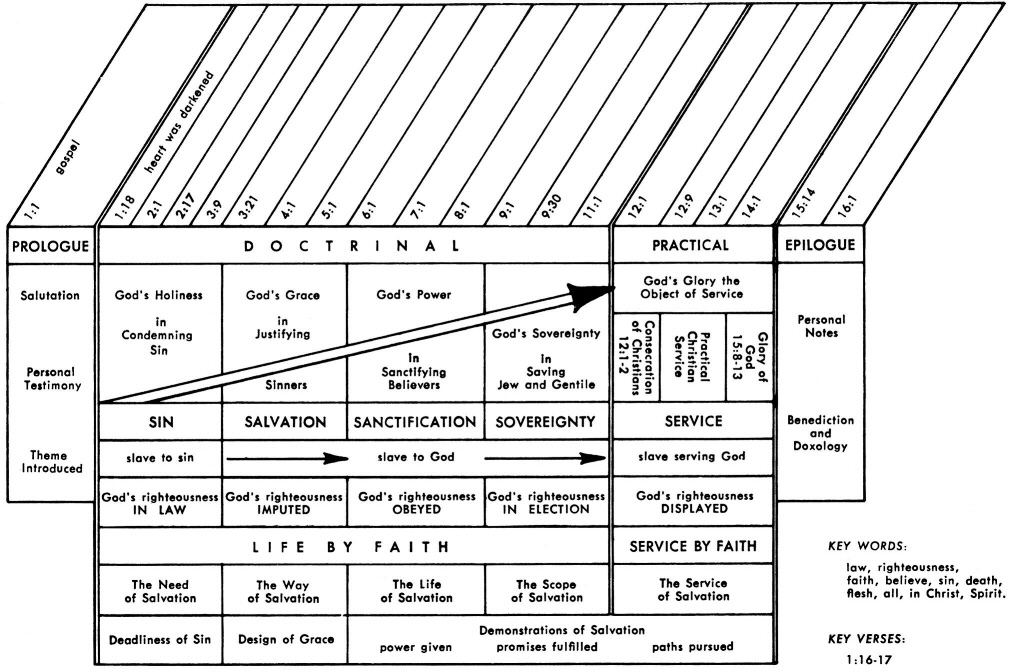
Click chart to enlarge
Chart from recommended resource Jensen's Survey of the NT - used by permission
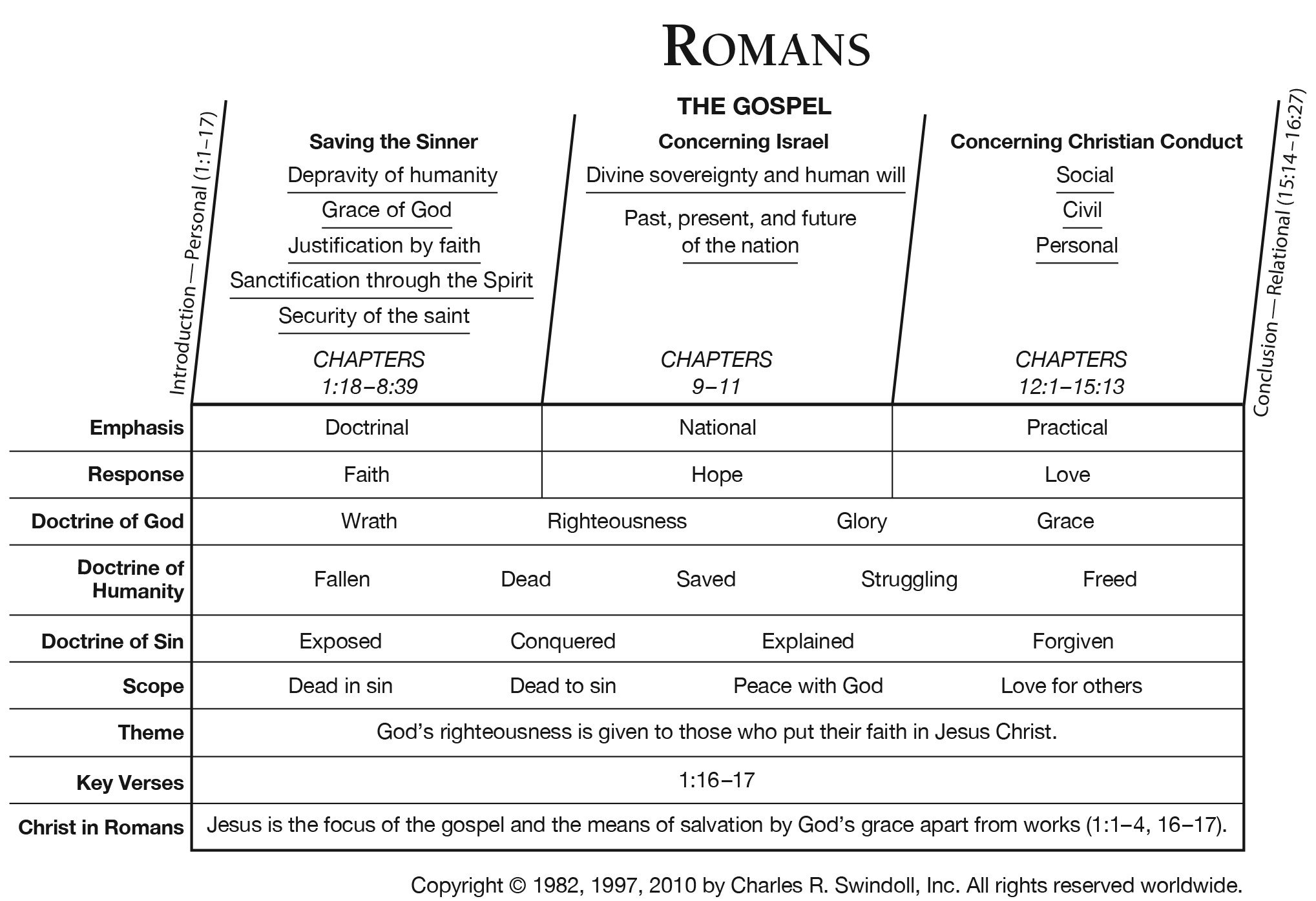
Click Charles Swindoll's overview chart
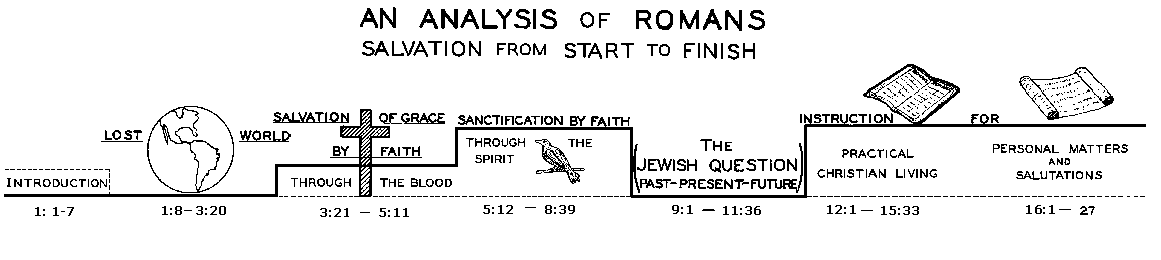
Source: Dr David Cooper
Click to Enlarge
| ROMANS ROAD to RIGHTEOUSNESS |
||||
| Romans 1:18-3:20 | Romans 3:21-5:21 | Romans 6:1-8:39 | Romans 9:1-11:36 | Romans 12:1-16:27 |
| SIN | SALVATION | SANCTIFICATION | SOVEREIGNTY | SERVICE |
| NEED FOR SALVATION |
WAY OF SALVATION |
LIFE OF SALVATION |
SCOPE OF SALVATION |
SERVICE OF SALVATION |
| God's Holiness In Condemning Sin |
God's Grace In Justifying Sinners |
God's Power In Sanctifying Believers |
God's Sovereignty In Saving Jew and Gentile |
Gods Glory The Object of Service |
| Deadliness of Sin |
Design of Grace |
Demonstration of Salvation | ||
| Power Given | Promises Fulfilled | Paths Pursued | ||
| Righteousness Needed |
Righteousness Credited |
Righteousness Demonstrated |
Righteousness Restored to Israel |
Righteousness Applied |
| God's Righteousness IN LAW |
God's Righteousness IMPUTED |
God's Righteousness OBEYED |
God's Righteousness IN ELECTION |
God's Righteousness DISPLAYED |
| Slaves to Sin | Slaves to God | Slaves Serving God | ||
| Doctrine | Duty | |||
| Life by Faith | Service by Faith | |||
|
Modified from Irving L. Jensen's chart above |
||||
Romans 2:17 But if you bear (2SPPI) the name "Jew " and rely (2SPMI) upon the Law and boast (2SPMI) in God, (NASB: Lockman)
Greek: Ei de su Ioudaios eponomaze (2SPPI) kai epanapaue (2SPMI) nomo kai kauchasai (2SPMI) en theo
Amplified: But if you bear the name of Jew and rely upon the Law and pride yourselves in God and your relationship to Him, (Amplified Bible - Lockman)
NLT: If you are a Jew, you are relying on God's law for your special relationship with him. You boast that all is well between yourself and God. (NLT - Tyndale House)
Phillips: Now you, my reader, who bear the name of Jew, take your stand upon the Law, and are, so to speak, proud of your God. (Phillips: Touchstone)
Wuest: Now, assuming, as for you, that you bear the name of Jew, and have a blind and mechanical reliance on the law, and boast in God, (Eerdmans)
Young's Literal: Lo, thou art named a Jew, and dost rest upon the law, and dost boast in God,
KJV Behold, thou art called a Jew, and restest in the law, and makest thy boast of God,
NET But if you call yourself a Jew and rely on the law and boast of your relationship to God
CSB Now if you call yourself a Jew, and rest in the law, boast in God,
ESV But if you call yourself a Jew and rely on the law and boast in God
NIV Now you, if you call yourself a Jew; if you rely on the law and brag about your relationship to God;
NRS But if you call yourself a Jew and rely on the law and boast of your relation to God
YLT Lo, thou art named a Jew, and dost rest upon the law, and dost boast in God,
GWN You call yourself a Jew, rely on the laws in Moses' Teachings, brag about your God,
NKJ Indeed you are called a Jew, and rest on the law, and make your boast in God,
NAB Now if you call yourself a Jew and rely on the law and boast of God
MIT If you bear the reputation of being Jewish, you are also ensconced in the law and take pride in God.
NJB If you can call yourself a Jew, and you really trust in the Law, and are proud of your God,
ASV But if thou bearest the name of a Jew, and restest upon the law, and gloriest in God,
DBY But if *thou* art named a Jew, and restest in the law, and makest thy boast in God,
BBE But as for you who have the name of Jew, and are resting on the law, and take pride in God,
RSV But if you call yourself a Jew and rely upon the law and boast of your relation to God
BUT IF YOU BEAR THE NAME JEW: Ei de su Ioudaios eponomaze (2SPPI):
- Ro 2:28-29; Ro 9:4-7; Ps 135:4; Isa 48:1,2; Mt 3:9; 8:11,12; Jn 8:33; 2Co 11:22; Gal 2:15; Eph 2:11; Phil 3:3-7; Rev 2:9; 3:1,9)
- Naves - Formalism; Hypocrisy; Self-Righteousness - see Additional Resources
- Torrey's Topic Hypocrites
- Romans 2 Resources - Multiple Sermons and Commentaries
Related Passages:
Matthew 3:9 and do not suppose that you can say to yourselves, ‘We have Abraham for our father’; for I say to you that from these stones God is able to raise up children to Abraham.
Romans 2:28-29 For he is not a Jew who is one outwardly, nor is circumcision that which is outward in the flesh. 29 But he is a Jew who is one inwardly; and circumcision is that which is of the heart, by the Spirit, not by the letter; and his praise is not from men, but from God.
Romans 9:3-7 (PRIVILEGES OF THE JEWS) For I could wish that I myself were accursed, separated from Christ for the sake of my brethren, my kinsmen according to the flesh 4 who are Israelites, to whom belongs the adoption as sons, and the glory and the covenants and the giving of the Law and the temple service and the promises, 5 whose are the fathers, and from whom is the Christ according to the flesh, who is over all, God blessed forever. Amen. 6 But it is not as though the word of God has failed. For they are not all Israel who are descended from Israel; 7 nor are they all children because they are Abraham’s descendants, but: “THROUGH ISAAC YOUR DESCENDANTS WILL BE NAMED.”
RELIGIOUS
HYPOCRISY
Summary
Romans 2:17-20 shows the great privileges the Jews possessed.
Romans 2:21-23 shows the failure to practice their great privileges
Romans 2:24 shows the effect their hypocrisy had on the reputation of God among the Gentiles
Bible Knowledge Commentary on Ro 2:17-23 - Without doubt as Paul enumerated this list of moral and religious distinctives, he got repeated affirmative responses from his Jewish readers. The Jews gloried in their special spiritual position, which contrasted with the Gentiles. (See Bible Knowledge Commentary)
John Piper sounds an important warning to us as we study this section, because a casual reading might tend to produce in us an anti-Semitic reaction. Piper cautions against such an occurrence "I want to begin this morning with a caution. Anti-Semitism has been a great sin in the world, acted out by Christians and non-Christians throughout the centuries. By this I mean that there has been terrible mistreatment of Jewish people for no reason other than their Jewishness. (The Effect of Hypocrisy, Part 1 Dishonoring God)
A hypocrite is one who says one thing and does another. In ancient Grecian plays, the actors wore mask to portray a character, but acting out of a part on stage behind a mask (that hid their real identity) was known as "hypokrites." The NT gives speaks of hypokrites only with a negative connotation referring to duplicity (the quality of being double - belying of one’s true intentions by deceptive words or action), insincerity, dissimulation (hiding under a false appearance; hiding or disguising one's thoughts or feelings - don't we all do this from time to time?!). The idea is to pretend, to act as something one is not and so to act deceitfully, pretending to manifest traits like godly or loving character. It means to create a public impression that is at odds with one’s real purposes or motivations, and thus is characterized by play-acting, pretense or outward show. It means to give an impression of having certain purposes or motivations, while in reality having quite different ones. This is an apt summarization of Paul's characterization of the religious Jews who knew the Law and gave feigned acquiescence to it (external), thus failing to practice the Law (internally, from their heart).
In Ro 2:17-29 Paul teaches that God's judgment is based on their practice of the Law (actually their failure to practice it!) not their profession of the Law. Regarding His Law, God wants personal possession (internal), not just public proclamation (external).
Paul has already alluded to this spiritual disconnect in Romans 2:13 stating that it is "not the hearers of the Law are just before God, but the doers of the Law will be justified." Recall that he is referring not to the fact that "doing" the Law saves anyone. It doesn't. What he will clarify in other place in Romans, is that those who are genuinely saved will be supernaturally enabled to "do" the Law. The Law is not meant to save us but to demonstrate our need for salvation by the Gospel. The Jews had put the proverbial cart before the horse, claiming that their possession of the Law (and their hypocritical practice of it which Paul describes in Ro 2:17-24) guaranteed them a "free pass" into the Kingdom of God. They had totally missed and perverted one of the major purposes of the Law.
As you study this section, read through Romans 2:17-20 and identify the five phrases which express the privileges that the "Chosen People" enjoyed.
But if (first class conditional) you bear the name (eponomazo - present tense) Jew (ioudaios) - But is a term of contrast and should always prompt the simple question what is the writer contrasting? This will force you to examine the context which is never wasted time. In this case, Paul has just explained how God can judge the Gentiles, even though they did not have a copy of the written law. Now Paul moves to directly confront the non-believing Jews, who would have felt quite safe from God's judgment because they had the "safety net" of the name (Jew), possessed God's Law and were recipients of physical circumcision (but not spiritual circumcision of their heart). Their problem in short (as emphasized in Ro 2:21-24) was that they were in essence "hearers" of the Law, but they were not "doers" of the Law (James 1:22+). Recall that the first use of Law in Romans is found in Romans 2:12 and occurs 22x in 11v in Romans 2. Clearly a key word in Romans 2 is Law. Remember that key words are important to identify, because they will reveal the subject or theme of the section in which they are found and this in turn will help accurately interpret the verses in that section.
John Calvin - Having now completed what he meant to say of the Gentiles, he returns to the Jews; and that he might, with greater force, beat down their great vanity, he allows them all those privileges, by which they were beyond measure transported and inflated: and then he shows how insufficient they were for the attainment of true glory, yea, how they turned to their reproach. Under the name Jew he includes all the privileges of the nation, which they vainly pretended were derived from the law and the prophets; and so he comprehends all the Israelites, all of whom were then, without any difference, called Jews.
Godet - The name Jew, is probably not used without allusion to its etymological meaning: Jehoudah, the praised one. The preposition epi, which enters into the composition of the verb, converts this name into a real title. But Israel possesses more than a glorious name; it has in its hands a real gift: the law. Here is a manifest sign of the divine favor on which it may consequently rest. Finally, this token of special favor makes God its God, to the exclusion of all other nations. It has therefore whereof to glory in God. (Romans 2 Commentary)
Steven Cole - The Jew thought himself exempt from God’s judgment on three grounds: (1) He was a son of Abraham (John 8:33), not a Gentile dog! (2) Unlike the pagans, he had God’s Law, revealed to Moses on the holy mountain. (3) He was circumcised, again in contrast to the defiled Gentiles. Paul shows how being a Jew by birth cannot save anyone (Ro 2:17, 28-29); how having the Law cannot save those who do not keep it (Ro 2:17-24); and, how being circumcised in the flesh is of no avail if the circumcised man does not keep the entire Law (Ro 2:25-27; this analysis from Alva McClain, borrow his book Romans: The Gospel of God’s Grace) (Romans 2:17-24 What Hypocrisy Does)
William MacDonald - There is no doubt that many Jews felt they were immune from God’s judgment. God would never send a Jew to hell, they thought. The Gentiles, on the other hand, were fuel for the flames of hell. Paul must now destroy this pretension by showing that under certain circumstances Gentiles may be closer to God than Jews. First he reviews those things which a Jew prized as giving him an inside track with God. He bore the name of a Jew and thus was a member of God’s chosen earthly people. He rested on the law, which was never designed to give rest but rather to awaken the conscience to a sense of sinfulness. He gloried in God, the only true God, who had entered into a unique covenant relationship with the nation of Israel. (Borrow Believer's Bible Commentary)
And before we Gentiles are too hard on the Jews, we do well to "personalize" these passages. Remember that the Word of Truth is likened by James to a mirror which shows us our blemishes and flaws and so we do well to read Paul's accusations against the Jews as sinners who are looking at a mirror of their own face! I personally am very convicted by these passages when applied personally…
"But if you Gentile bear the name "Church goer" (or Christian or Religious Person, etc) and rely upon your profession of faith, the fact that you were raised in a Christian family, the fact that you have been baptized, the fact that you go to a "good" church, etc…
JESUS' REACTION TO
RELIGIOUS HYPOCRISY
We need to keep in mind that Jesus was especially hard on the Pharisees who were religious fakers, counterfeits, pretenders, hypocrites, and the list goes on!
"Woe (an expression of grief or denunciation, expressing extreme displeasure and calling for severe retributive pain!) to you, scribes and Pharisees, hypocrites! For you clean the outside of the cup and of the dish (Religion - All Externals but had No Relationship - No Internal Change), but inside they are full (present tense = continually = this was their lifestyle) of robbery (harpage = taking something by violence or greed) and self-indulgence (Akrasia = lack of self-control - used in sexual connotation in 1Cor 7:5). 26 "You blind (figuratively - they weren't physically blind but even worse were spiritually blind) Pharisee, first clean the inside of the cup and of the dish (cp Ezek 36:26), so that the outside of it may become clean also. 27 "Woe to you, scribes and Pharisees, hypocrites! For you are like whitewashed tombs (Literal tombs were often ornate and whitewashed to make them easily seen and attractive. In Acts 23:3 Paul called Ananias a "whitewashed wall" to denote his carefully concealed wickedness!) which on the outside appear beautiful, but inside they are full of dead men's bones and all uncleanness. 28 "Even so you too outwardly appear righteous to men, but inwardly you are full of hypocrisy and lawlessness (= sin in 1Jn 3:4). (Mt 23:25-28)
Note order: internal cleanses precedes external purity.
Charles Hodge: Whenever true religion declines, the disposition to lay undo stress on external rites is stressed. The Jews when they lost their spirituality supposed that circumcision (Ed: And the Law) had the power to save them.
Apostasy (abandonment of a previously profession or loyalty) always moves the religious focus from the inward to the outward, from humble obedience to empty formality. Remember that to obey is better than sacrifice (1Sa 15:22-23)
Schneider commenting on the "whitewashed" Pharisees: The irony of the saying is that they represent the very thing they avoid. They are not what they appear to be, and they are to be avoided as unclean (even though they claim to be clean).
If (ei) is what is referred to as a "first class conditional" statement and signifies that the text that follows is assumed to be true. This "if" can often be translated with the word "Since" ("Since you bear the name Jew" which they did indeed bear). Yes, they were Jews by blood (physically), but not by the blood of Christ (spiritually). They were Jews outwardly, but not inwardly (Ro 2:28-29+), which is the argument which Paul is building in Romans 2:17-29. They were "professors" but not genuine "possessors." That is, they were like men who today profess to be "Christian" but who do possess Christ within! They were in the dangerous deception of religion, ignorant of the truth that they lacked a true saving relationship with Christ. I fear there are many around the world (and I am no one's judge), who claim to be "Christian" but who live like the devil (so to speak). In other words, their profession fails to match their practice. They may even have orthodoxy, but lack orthopraxis (Greek = orthopraxis from ortho = correct + praxis = practice)! Almost weekly, I encounter someone who says that they are a "Christian" and when I try to discern the evidence of their profession, I am met with vague replies such as "I don't read the Bible, because it's too difficult to understand, especially the old King James English." or "I don't attend a church, because there are so many hypocrites there." etc, etc. Paul is building his case against the Jews and is saying if you are a true Jew, then you need to practice what you preach, something his readers were not doing as he clearly shows in Ro 2:21-23.
You - Note that "you" is singular not plural throughout Ro 2:17-27. Paul is addressing individual Jews in this section. There is no "communal conversion." Each person must personally repent and believe in Jesus Christ in order to enter the Kingdom of God.
Bear the name (only use in the NT - hapax legomenon) (2028) (eponomazo from epí = upon + onomázo = to name) strictly means name after, give an additional name and thus to call or classify oneself by means of a name, title, or attribution.
Eponomazo - Used 36x in 35 verses in non-apocryphal Septuagint most often in context of naming a person or place - Gen 4:17, 25f; 5:2f, 29; 21:31; 25:25; 26:18, 21f; 30:11; Ex 2:10, 22; 15:23; 16:31; 17:7, 15; 20:24; Lev 24:11; Num 13:16, 24; 32:38, 41f; Deut 2:11; 3:9, 14; 12:5; Josh 7:26; 22:34; Jdg 2:5; 1Chr 28:3; 2Chr 12:13;
Every "boast" of the Jew in this passage concerns their possession of God's Law and represents a privilege. In other words all of the things Paul mentions in Ro 2:17-20 are good, in and of themselves. Although the Jew certainly should gratefully receive the law as a gift from God, Paul emphasizes that the possession of the law does not automatically result in righteousness standing before God. Like a prosecuting attorney, Paul builds his case against the Jew based on this question -- "You have the law, do you keep it (beginning especially in Ro 2:21-24 note 5 questions in rapid succession!)? You can see how others break the law, do you see how you break it also?"
As we have said many times in Romans, the Jewish leaders in Paul's day interpreted (rather "misinterpreted") the law in such a way that they considered themselves "justified" (declared righteous) by the Law, something the Law was NEVER intended to do! In the Sermon on the Mount (Mt 5:1-7:29) Jesus sought to directly expose the error of such a deadly, deceptive misinterpretation (and misapplication) of the Laws of Moses, explaining in essence, that it was not so much what a person was externally, but what they were internally, in their heart (See discussion of the argument of Jesus beginning in Mt 5:19, 20+). The problem of the Jewish interpretation (and of all fallen men including Gentiles) is that we only seek to apply God’s law to our external actions, which misses the most important point that God desires to apply His law to our heart attitudes. In the New Covenant God's law is written by the Spirit in our minds and written upon our hearts. (See Jer 31:33-34, Heb 8:10+, cp Ezek 36:26, 27+, the latter passage explaining how it is even possible for someone to obey Jesus' strict teaching in the Sermon on the Mount. It is humanly "IM"-possible and is only "HIM"-possible! His Spirit in us giving us the desire the power to obey - Php 2:13NLT+)
Jew (2453) (Ioudaios) should be distinguished from the term Hebrew and Israelite as follows (from Kenneth Wuest)… Hebrew distinguishes a Hebrew-speaking Jew from a Greek-speaking one. Jew distinguishes a Jew from a Gentile, and denotes nationality. Israelite is the most august title of all, speaking of the fact that the Jew is a member of the theocracy, and thus an heir of the promises (Trench).
Previously called Hebrews and Israelites, by the first century “Jew” had become the most common name for the descendants of Abraham through Isaac. “Jew” is from “Judah,” (“praise”), one of the 12 tribes and the designation for the southern half of Solomon’s kingdom after his death. From the time of the Babylonian captivity, the whole race bore this title. Their great heritage, however, (cf. Ge 12:3) became a source of pride and complacency (cf. Jonah 4:2; Mic 3:11, 12; Mt 3:7, 8, 9; Jn 8:31, 32, 33, 34, 40, 59), which led to judgment instead of “praise.” He could and should have become a "guide" and "light" to those in darkness (Ro 2:19). So Paul is showing the self-righteous Jews, boasting in their status as God's chosen people, that just being a Jew is not sufficient for salvation.
The ISBE entry notes that - "Jew" denotes originally an inhabitant of Judah (2 Kings 16:6 applies to the two tribes of the Southern Kingdom), but later the meaning was extended to embrace all descendants of Abraham. In the Old Testament the word occurs a few times in the singular. (Esther 2:5; 3:4, etc.; Jeremiah 34:9; Zechariah 8:23); very frequently in the plural in Ezra and Nehemiah, Esther, and in Jeremiah and Daniel. The adjective in the Old Testament applies only to the "Jews' language" or speech (2Ki 18:26,28 parallel Nehemiah 13:24; Isaiah 36:11,13). "Jews" (always plural) is the familiar term for Israelites in the Gospels (especially in John), Acts, Epistles, etc. "Jewess" occurs in 1 Chronicles 4:18; Acts 16:1; 24:24. In Titus 1:14 (note) a warning is given against "Jewish fables" (in Greek the adjective is found also in Gal 2:14). The "Jews' religion" (Ioudaismos) is referred to in Galatians 1:13,14. (James Orr)
Formalism
FORMALISM. [NAVE] 1 Sam. 15:22; Psa. 50:8-15; Psa. 51:16, 17; Psa. 69:30, 31; Eccl. 5:1; Isa. 1:11-15; Isa. 29:13-16; Jer. 6:20; Jer. 14:12; Hos. 6:6; Amos 5:21-23; Mic. 6:6, 7; Mal. 1:6, 8, 10, 13, 14; Matt. 9:13; Matt. 12:7; Matt. 15:8, 9; Luke 13:24-27; Rom. 2:17-29; 1 Cor. 7:19; Phil. 3:4-7; 2 Tim. 3:1-5
Hypocrisy
Hypocrisy [NAVE] . Job 8:13-15; Job 13:16; Job 15:31, 33, 34; Job 17:8; Job 20:4, 5 vs. 6-18.; Job 27:8-10 vs. 13-18.; Job 31:33, 34; Job 34:30; Job 36:13, 14; Psa. 5:9; Psa. 50:16, 17; Psa. 52:4; Psa. 55:12-14, 20, 21, 23; Psa. 78:34-37; Psa. 101:7; Prov. 7:10-21; Prov. 11:9; Prov. 14:8; Prov. 15:8; Prov. 20:14; Prov. 21:27; Prov. 23:6-8; Prov. 25:19; Prov. 26:18, 19, 23-26; Isa. 1:13, 15 vs. 11-14.; Isa. 66:3-5. Isa. 9:17; Isa. 10:6; Isa. 29:13 [Matt. 15:8.] Isa. 29:15, 16; Isa. 32:5, 6; Isa. 33:14; Isa. 48:1, 2; Isa. 58:2-5; Isa. 61:8; Isa. 65:5; Jer. 3:10 v. 11.; Jer. 5:2; Jer. 6:20; Jer. 7:4, 8-10; Jer. 9:4, 8; Jer. 12:2; Jer. 17:9; Jer. 42:20 vs. 21,22.; Lam. 1:2; Ezek. 14:7, 8 v. 4.; Ezek. 20:39 Ezek. 5:11; Hos. 8:13; 9:4. Ezek. 33:30-32; Hos. 6:4; Hos. 7:14, 16; Hos. 8:2, 3; Hos. 10:1, 4; Hos. 11:12; Amos 5:21, 23, 24 vs. 22,25-27.; Obad. 7; Mic. 3:11; Mic. 7:5; Zech. 7:5, 6; Zech. 13:6; Mal. 1:6-8, 13, 14 vs. 9-12.; Mal. 2:13; Mal. 3:14; Matt. 3:7, 8; Matt. 6:1, 2, 5, 16, 24; Matt. 7:5, 15, 21-23 Luke 13:26, 27. Matt. 9:13; Matt. 15:7, 8 [Mark 7:6.] Matt. 15:9; Matt. 16:3 Luke 12:54-56. Matt. 21:28-32; Matt. 22:12, 13, 18; Matt. 23:2-33; Matt. 24:50, 51; Matt. 25:3, 41-45; Mark 7:7, 8 Matt. 15:7-9. Mark 12:38-40; Luke 6:46; Luke 8:18; Luke 11:39, 42, 44, 52 vs. 39-52.; Luke 12:1, 2 Matt. 16:6, 12; Mark 8:15. Luke 13:13-17; Luke 14:34 v. 35;; Mark 9:50. Luke 16:13, 15; Luke 18:11, 12; Luke 20:46, 47 Matt. 23:14; Mark 12:38-40. Luke 21:16; John 6:26, 70; John 7:19; John 15:2, 6; Rom. 1:18; Rom. 2:1, 3, 17-29; Rom. 9:6, 7; Rom. 16:18; 1 Cor. 13:1; 2 Cor. 4:2; 2 Cor. 5:12; Gal. 6:3; Phil. 3:2, 18, 19; 1 Tim. 4:2; 2 Tim. 3:5, 13; Tit. 1:16; Jas. 1:8 [Jas. 4:8.] Jas. 1:22-24, 26; Jas. 2:14-26; Jas. 3:17; 1 Pet. 2:1, 16; 2 Pet. 2:1-3, 17, 19; 1 John 1:6, 10; 1 John 2:4, 9, 19; 1 John 4:20; Jude 12, 13; Rev. 2:9 Rev. 3:9. Rev. 3:1 See: Deceit; Deception.
Instances of
- Jacob, in impersonating Esau and deceiving his father, Gen. 27.
- Jacob's sons, in deception of their father concerning Joseph, Gen. 37:29-35.
- Joseph's deception of his brethren, Gen. 42-44.
- Pharaoh, Ex. 8:15, 28, 29, 32; 9:27-35; 10:8-29.
- Balaam, Jude 11, with Num. 22-24.
- Delilah, the wife of Samson, Judg. 16.
- Jael, Judg. 4:8-21.
- Ehud, Judg. 3:15-25.
- Rabshakeh, 2 Kin. 18:17-37.
- Ahaz, Isa. 7:12 with vs. 17-25. Johanan, Jer. 42:1-12, 20, 22.
- Ishmael, Jer. 41:6, 7.
- The false prophets, Ezek. 13:1-23.
- Herod, Matt. 2:8.
- Judas, Matt. 26:25, 48; John 12:5, 6.
- Pilate, Matt. 27:24.
- Pharisees, Matt. 15:1-9; 22:18; Mark 12:13, 14; John 8:4-9; 9:24; 19:15.
- The ruler, Luke 13:14-17.
- Spies sent to entrap Jesus, Luke 20:21.
- Priests and Levites, Luke 10:31, 32.
- Chief priests, John 18:28.
- Ananias and Sapphira, Acts 5:1-10.
- Simon Magus, Acts 8:18-23.
- Peter and other Christians at Antioch, Gal. 2:11-14.
- Judaizing Christians in Galatia, Gal. 6:13.
- False teachers at Ephesus, Rev. 2:2.
- See: Conspiracy; Treachery.
HYPOCRISY; HYPOCRITE [ISBE] - hi-pok'-ri-si, hip'-o-krit (choneph, chaneph; hupokrisis, hupokrites):
(1) "Hypocrisy" occurs only once in the Old Testament as the translation of choneph (Isa 32:6, the Revised Version (British and American) "profaneness"); chaneph, from which it is derived, means properly "to cover," "to hide," or "becloud," hence, to pollute, to be polluted or defiled, to make profane, to seduce; as a substantive it is translated "hypocrite" (Job 8:13; 13:16; 15:34; 17:8; 20:5; 27:8; 34:30; 36:13, in all which instances the Revised Version (British and American) has "godless man," "godless men," "godless"; Prov 11:9, the Revised Version (British and American) "the godless man"; Isa 9:17, the Revised Version (British and American) "profane"; Isa 33:14, the Revised Version (British and American) "the godless ones"); it is rendered "hypocritical," in Ps 35:16; Isa 10:6, the Revised Version (British and American) "profane."
(2) "Hypocrisy," "hypocrite" are frequent in the New Testament, chiefly in Christ's discourses in the Gospels. The word hupokrisis (primarily, "an answer," "response") meant generally, in classical Greek, stageplaying, acting, the histrionic art; hence, it came to mean acting a part in life, etc. We find hupokrisis in this sense in 2 Macc 6:25, the Revised Version (British and American) "dissimulation," and hupokrinomai, "to pretend," "to feign," etc. Ecclesiasticus 1:29; 32:15; 33:2, translated "hypocrite"; 2 Macc 5:25, "pretending peace," the Revised Version (British and American) "playing the man of peace"; 6:21, the Revised Version (British and American) "to make as if." Hupokrites (literally, "an actor") is the Septuagint for chaneph (Job 34:30; 36:13), equivalent to bad, wicked, godless, which is perhaps included in some of our Lord's uses of the words, e.g. Mt 23:27 f, "full of hypocrisy and iniquity" (compare 23:29 f; 24:51); but, in general, the meaning is acting a part, false, deceptive and deceived, formally and outwardly religious and good, but inwardly insincere and unrighteous; the hypocrite may come to deceive himself as well as others, but "the hypocrite's hope shall perish" (Job 8:13 the King James Version). On no class did our Lord pronounce such severe condemnation as on the hypocrites of His day.
"Hypocrisy" (hupokrisis) occurs in Mt 23:28; Mk 12:15; Lk 12:1; 1 Tim 4:2; 1 Pet 2:1 (in Gal 2:13 it is rendered "dissimulation"); "hypocrite" (hupokrites), Mt 6:2,5,16; 7:5; 15:7; 22:18; 23:13,15,23,25 ff,29; 24:51; Mk 7:6; Lk 12:56; 13:15; in Jas 3:17, anupokritos is "without hypocrisy," so the Revised Version (British and American), Rom 12:9 ("unfeigned," 2 Cor 6:6; 1 Tim 1:5; 2 Tim 1:5; 1 Pet 1:22). W. L. Walker
Self-righteousness
Self-righteousness [NAVE] Num. 16:3; Deut. 9:4-6; 1 Sam. 2:9; Job 6:13; Job 11:4-6; Job 12:2; Job 13:3, 13, 15, 19; Job 16:17, 18; Job 18:2-4; Job 21:27-29; Job 22:2, 3; Job 32:1, 2; Job 33:8, 9; Job 35:2, 7, 8; Psa. 10:5, 6; Prov. 12:15; Prov. 14:12; Prov. 16:2; Prov. 20:6; Prov. 21:2; Prov. 25:14, 27; Prov. 26:12; Prov. 27:2, 21; Prov. 28:13, 26; Prov. 30:12, 13; Isa. 5:21; Isa. 28:17, 20; Isa. 47:7; Isa. 50:11; Isa. 64:6; Isa. 65:3-5; Jer. 2:13, 22, 23, 34, 35; Jer. 7:4; Jer. 8:8; Jer. 17:5; Jer. 49:4, 16; Ezek. 33:24-26; Hos. 12:8; Amos 6:13; Hab. 2:4; Zeph. 3:11; Matt. 7:22, 23; Matt. 9:10-13 Mark 2:16; Luke 5:30. Matt. 16:6 Mark 8:15. Matt. 19:16-22 Mark 10:17-22; Luke 18:18-23. Matt. 22:12, 13; Matt. 23:29-31; Luke 7:36-50; Luke 10:25-37; Luke 15:2, 25-32; Luke 16:14, 15; Luke 18:9-14; John 9:34, 39-41; Rom. 2:17-20; Rom. 3:27; Rom. 10:3; Rom. 11:19-21; 2 Cor. 1:9; 2 Cor. 10:17, 18; Gal. 6:3; Rev. 3:17, 18 See: Hypocrisy; Self-exaltation.
Instances of
Saul, 1 Sam. 15:13-31.
Young man, see above. Lawyer, see above. Pharisees, Luke 11:33-54; John 8:33-59; 9:28-34.
Israel, Rom. 10:3.
Church of Laodicea, Rev. 3:17.SELF-RIGHTEOUSNESS [ISBE] - self-ri'-chus-nes: A term that has come to designate moral living as a way of salvation; or as a ground for neglecting the redemptive work of Jesus Christ. The thought is present in the teaching of Jesus, who spoke one parable particularly to such as reckoned themselves to be righteous (Lk 18:9 ff). The Pharisees quite generally resented the idea of Jesus that all men needed repentance and they most of all. They regarded themselves as righteous and looked with contempt on "sinners." Paul in all his writings, especially Rom 3; Gal 3; Eph 2; Phil 3, contrasts the righteousness that is God's gift to men of faith in Jesus Christ, with righteousness that is "of the law" and "in the flesh." By this latter he means formal conformity to legal requirements in the strength of unregenerate human nature. He is careful to maintain (compare Rom 7) that the Law is never really kept by one's own power. On the other hand, in full agreement with Jesus, Paul looks to genuine righteousness in living as the demand and achievement of salvation based on faith. God's gift here consists in the capacity progressively to realize righteousness in life (compare Rom 8:1 ff). See also SANCTIFICATION. William Owen Carver
Hypocrites - R A Torrey - Torrey's Topics
1. God knows and detects. Isa 29:15, 16.
2. Christ knew and detected. Mt 22:18.
3. God has no pleasure in. Isa 9:17.
4. Shall not come before God. Job 13:16.
5. Described as
a. Wilfully blind. Mt 23:17, 19, 26.
b. Vile. Isa 32:6.
c. Self-righteous. Isa 65:5; Lu 18:11.
d. Covetous. Eze 33:31; 2 Pe 2:3.
e. Ostentatious. Mt 5:2, 5, 16; 23:5.
f. Censorious. Mt 7:3–5; Lu 13:14, 15.
g. Regarding tradition more than the word of God. Mt 15:1–3.
h. Exact in minor, but neglecting important duties. Mt 23:23, 24.
i. Having but a form of godliness. 2 Ti 3:5.
j. Seeking only outward purity. Lu 11:39.
k. Professing but not practising. Eze 33:31, 32; Mt 23:3; Ro 2:17–23.
l. Using but lip-worship. Isa 29:13; Mt 15:8.
m. Glorying in appearance only. 2 Co 5:12.
n. Trusting in privileges. Jer 7:4; Mt 3:9.
o. Apparently zealous in the things of God. Isa 58:2.
p. Zealous in making proselytes. Mt 23:15.
q. Devouring widows’ houses. Mt 23:14.
r. Loving pre-eminence. Mt 23:6, 7.
6. Worship of, not acceptable to God. Isa 1:11–15; 58:3–5; Mt 15:9.
7. Joy of, but for a moment. Job 20:5.
8. Hope of perishes. Job 8:13; 27:8, 9.
9. Heap up wrath. Job 36:13.
10. Fearfulness shall surprise. Isa 33:14.
11. Destroy others by slander. Pr 11:9.
12. In power, are a snare. Job 34:30.
13. The Apostasy to abound with. 1 Ti 4:2.
14. Beware the principles of. Lu 12:1.
15. Spirit of, hinders growth in grace. 1 Pe 2:1.
16. Woe to. Isa 29:15; Mt 23:13.
17. Punishment of. Job 15:34; Isa 10:6; Jer 42:20, 22; Mt 24:51.
18. Illustrated. Mt 23:27, 28; Lu 11:44.
19. Exemplified
a. Cain. Ge 4:3.
b. Absalom. 2 Sa 15:7, 8.
c. The Jews. Jer 3:10.
d. Pharisees, &c. Mt 16:3.
e. Judas. Mt 26:49.
f. Herodians. Mr 12:13, 15.
g. Ananias. Ac 5:1–8.
h. Simon. Ac 8:13–23.
AND RELY UPON THE LAW: kai epanapaue (2SPMI) nomo
- Ro 2:23; Ro 9:4,32; Jer 7:4-10; Zep 3:11; Lk 10:28; Jn 5:45; Jn 7:19; 9:28,29
- Romans 2 Resources - Multiple Sermons and Commentaries
Related Passages:
John 5:45 “Do not think that I will accuse you before the Father; the one who accuses you is Moses, in whom you have set your hope.
John 7:19 “Did not Moses give you the Law, and yet none of you carries out the Law? Why do you seek to kill Me?”
Romans 2:13 for it is not the hearers of the Law who are just before God, but the doers of the Law will be justified.
Romans 9:30-32 What shall we say then? That Gentiles, who did not pursue righteousness, attained righteousness, even the righteousness which is by faith; 31 but Israel, pursuing a law of righteousness, did not arrive at that law. 32 Why? Because they did not pursue it by faith, but as though it were by works. They stumbled over the stumbling stone (JESUS CHRIST - SEE Luke 20:17-18+),
Jeremiah 7:4-10 “Do not trust in deceptive words, saying, ‘This is the temple of the LORD, the temple of the LORD, the temple of the LORD.’ 5 “For if you truly amend your ways and your deeds, if you truly practice justice between a man and his neighbor, 6 if you do not oppress the alien, the orphan, or the widow, and do not shed innocent blood in this place, nor walk after other gods to your own ruin, 7 then I will let you dwell in this place, in the land that I gave to your fathers forever and ever. 8 “Behold, you are trusting in deceptive words to no avail. 9 “Will you steal, murder, and commit adultery and swear falsely, and offer sacrifices to Baal and walk after other gods that you have not known, 10 then come and stand before Me in this house, which is called by My name, and say, ‘We are delivered!’–that you may do all these abominations?
MECHANICAL RELIANCE ON THE LAW
And rely (epanapauomai) on the law - In English rely conveys the sense of to trust fully, to be dependent upon. The Jews relied upon the Law, rather than upon the God who gave them the Law! As Robertson says rely “is a picture of blind and mechanical reliance on the Mosaic law." Denney adds that "The Jew said, We have a law, and the mere possession of it gave him confidence."
Micah 3:11+ which may have been the verse to which the Jews appealed in order to justify their false belief that the Law was their safe pass to heaven. Micah writes…
Her (Israel's) leaders pronounce judgment for a bribe, Her priests instruct for a price, and her prophets divine for money. Yet they lean on (Lxx = epanapauomai) the LORD saying, “Is not the LORD in our midst? Calamity will not come upon us.
Comment: In the Septuagint (Lxx), the word “lean on” (epanapauomai) is the same verb that Paul uses in Ro 2:17. In sum, it appears that the Jews in Paul’s day thought that relying on the Law would protect them from judgment, even though they disobeyed it
Rely (1879) (epanapauomai from epí = upon + anapaúomai = to rest <> from aná = again + paúo = cease, give rest) conveys the basic meaning of to rest on. The idea is to refresh oneself back upon anything. It describes finding "comfort" through confident dependence on something, trust in and in context trusting in the Law but not being doers of it, which pictures a blind and mechanical reliance on the Mosaic law.
Webster's 1828 says rely means "To rest on something, as the mind when satisfied of the veracity, integrity or ability of persons, or of the certainty of facts or of evidence; to have confidence in; to trust in; to depend; with on."
Epanapauomai is used only here here and Luke 10:16 - "And if a man of peace is there, your peace will rest upon him; but if not, it will return to you."
Epanapauomai means to continue, remain with the sense of remaining upon. In the OT (LXX), this word is describes the Spirit of God "resting" on men (see below - Nu 11:25, 26) So here in Ro 2:17 the picture Paul paints is of a spiritually blind mechanical "resting upon" or relying upon the Mosaic Law. The present tense of indicates this as their general practice. Paul in saying in essence that you Jews are continually (present tense) resting upon the Law of Moses but with a blind and mechanical reliance on the Mosaic law.
Epanapauomai is used 8 times in the Septuagint (LXX) (Nu 11:25, Nu 11:26, 2 Ki. 2:15, 2 Ki. 5:18, 2Ki. 7:2, 2Ki. 7:17, Ezek. 29:7, Mic. 3:11) in some cases meaning literally "leaning upon" and in others describing the Spirit "resting upon" men Moses recording for example…
Then the LORD came down in the cloud and spoke to him; and He took of the Spirit who was upon him and placed Him upon the seventy elders. And it came about that when the Spirit rested upon them, they prophesied. But they did not do it again. 26 But two men had remained in the camp; the name of one was Eldad and the name of the other Medad. And the Spirit rested upon them (now they were among those who had been registered, but had not gone out to the tent), and they prophesied in the camp. (Nu 11:25, 26)
Steven Cole - Of course, the Jews did obey some of the external requirements of the Law. They were fastidious about ceremonial cleanliness. They meticulously tithed even their table spices. They fasted and prayed at the stipulated times. But Jesus rebuked them because while they honored God with their lips, their hearts were far from Him (Mark 7:6). They knew God’s commandments, but they just kept those that could be seen by men, so that they looked spiritual. They didn’t seek to please God from the heart. Hypocrisy is all about maintaining outward appearances, with no regard to obedience from the heart. (Romans 2:17-24 What Hypocrisy Does)
AND BOAST IN GOD: kai kauchasai (2SPMI) en theo:
- Is 45:25; 48:2; Mic 3:11; Jn 8:41
- Ro 2:23, Ro 3:27, 4:2 contrast real "boasting" Ro 15:17 & real praise Ro 2:29
- Romans 2 Resources - Multiple Sermons and Commentaries
Related Passages:
Romans 3:27 Where then is boasting? It is excluded. By what kind of law? Of works? No, but by a law of faith.
Romans 4:2 For if Abraham was justified by works, he has something to boast about, but not before God.
Romans 15:17 Therefore in Christ Jesus I have found reason for boasting in things pertaining to God.
BAD BOASTING
And boast in God - The present tense pictures the Jews as continually boasting. Some of the versions (like NIV above) feel the sense is that they are continually bragging. Boasting in God is a good thing, not a bad thing, but their version of boasting was the bad variety! The Amplified translation helps bring out the sense of Paul is trying to convey here by rendering it "you pride yourselves in God and your relationship to Him."
Cole - So boasting in the Lord is good, if our aim is to give Him all glory for our salvation. But Paul’s Jewish readers were boasting in God in the sense of elevating themselves above the pagan Gentiles, who did not know God. It was a form of spiritual pride, where they said, “We know the only true God, but you don’t! We’re better than you are!” They were like the super-spiritual faction in Corinth (1 Cor. 1:12). Some were saying, “I am of Paul,” and others, “I am of Apollos,” or “I am of Cephas.” But some boasted, “I am of Christ!” They were boasting in God, but not to honor God, but to honor themselves. But they were deceived by their hypocrisy. (Romans 2:17-24 What Hypocrisy Does)
Boast (2744) (kauchaomai akin to aucheo = boast + euchomai = pray to God <> auchen = neck which vain persons are apt to carry in proud manner) means to boast over a privilege or possession. The idea is to take pride in something (in a bad sense - Ro 2:23+, in a good or legitimate sense - Ro 5:2+, Ro 5:3+; Ro 5:11+) See Utley's Note below
NIDNTT adds that…In classical Greek the verb kauchaomai is found from Sappho onwards. Homer uses instead euchomai, pray, ask, wish. The tragedians and orators use aucheo, boast, plume oneself. Intrans. kauchaomai means to boast, vaunt oneself, be proud. With the prepositions en, epi, peri, huper, eis, or kata, it means to boast of a person or thing. The trans. form also occurs. The compound vb. enkauchaomai has the same meaning. katakauchaomai is used particularly with reference to the situation of an object, and may be translated to vaunt oneself against someone, to treat someone in a derogatory or contemptuous manner. Kauchema (Pindar) refers to the subject of boasting, to the words used by the boaster, and occasionally also to the act of boasting, although for the latter (especially in the NT) the noun kauchesis is more frequently found. Kauchesis (Epicurus) can likewise on occasion be used to denote the subject of boasting. Although the ancient Greeks recognize legitimate pride in oneself (e.g. Homer, Il., 6, 208), there is a clear appreciation of the distinction between this and unwarranted bragging, which was pilloried by the satirists and others. Plutarch also attacked ostentation in an essay on Self-praise without Envy.
Kauchaomai is translated in the NAS as - boast(24), boasted(1), boasting(3), boasts(2), exult(3), glory(2), take pride in(1).
There is a proper boasting as described by God in the prophecy of Jeremiah
Thus says the LORD, "Let not a wise man boast of his wisdom, and let not the mighty man boast of his might, let not a rich man boast of his riches; but let him who boasts boast of this, that he UNDERSTANDS and KNOWS Me, that I am the LORD who exercises lovingkindness, justice, and righteousness on earth; for I delight in these things,” declares the LORD. (Jer 9:23-24)
Comment: The Jews Paul was addressing boasted in God, but clearly (as determined by the context) they neither truly understood Him or knew Him as their Messiah, their Redeemer.
Fallen men have no grounds for boasting in the presence of God (1Co 1:29, James 4:16) but instead should boast in God (1Co 1:31, from Jer 9:23, 24, cp 2Co 10:17). And so Paul writes…
that no man should boast before God, but by His doing you are in Christ Jesus, who became to us wisdom from God, and righteousness and sanctification, and redemption, that, just as it is written, "LET HIM WHO BOASTS, BOAST (present imperative = command to continually boast) IN THE LORD." (1Cor 1:29-31+)
Paul however did want the Corinthians to boast in the work of God in and through him (2Co 5:12). Paul himself boasted about the readiness (readiness of mind, eagerness) of the saints at Corinth to contribute to the fiscal needs of the saints at Jerusalem (2Cor 9:2 - his boasting in them here had as its object the calling of the Corinthians back to their original readiness to participate in the offering project.) As noted in the list of NT uses below, kauchaomai is frequent in the letters to the Corinthians. Notice that Paul emphasizes what it is we as saints should genuinely boast about in regard to ourselves…
2Co 10:30+ If I have to boast, I will boast of what pertains to my weakness.
2Co 12:1+ Boasting is necessary, though it is not profitable; but I will go on to visions and revelations of the Lord… 5 On behalf of such a man will I boast; but on my own behalf I will not boast, except in regard to my weaknesses. 6 For if I do wish to boast I shall not be foolish, for I shall be speaking the truth; but I refrain from this, so that no one may credit me with more than he sees in me or hears from me. 7 And because of the surpassing greatness of the revelations, for this reason, to keep me from exalting myself, there was given me a thorn in the flesh, a messenger of Satan to buffet me-- to keep me from exalting myself! 8 Concerning this I entreated the Lord three times that it might depart from me. 9 And He has said to me, "My grace is sufficient for you, for power is perfected in weakness." Most gladly, therefore, I will rather boast about my weaknesses, that the power of Christ may dwell in me.
Gal 6:13+ For those who are circumcised do not even keep the Law themselves, but they desire to have you circumcised, that they may boast in your flesh. 14 But may it never be that I should boast, (believers give the credit for all they are and have to the Lord Jesus Christ and His efficacious work on Calvary) except in the cross of our Lord Jesus Christ, through which the world has been crucified to me, and I to the world.
Comment: Beloved, let us exult joyfully in one thing, the Cross of Christ, letting this be our single minded focus, our sole passion and joy. Christ crucified is to forevermore be our boast and exultation so that He Alone receives the glory and honor for every good thing in our lives and every bad thing that God turns for good. Such supernatural boasting happens when we appreciate and live in the glorious truth that we have been crucified with Christ on His old rugged cross. This radical truth transforms our lives that were in the gutter so that they are now directed toward glory, the glory of the cross of Christ. (cp Gal 2:20 - see notes). Next time you catch yourself being tempted to boast, ask yourself "In this boasting, is it ultimately in some way tied to boasting in the almighty Cross?" If not, you might want to check that heart attitude or the words that proceed from that heart attitude (cp Mt 15:18, 19, Mt 12:36 where "careless" = argos = "not working", bearing no fruit type words [see study of words = rhema])
Kauchaomai - 37x in 32v in the NAS (see below) - Usage: boast(24), boasted(1), boasting(3), boasts(2), exult(3), glory(2), take pride(1). The KJV renders it - glory 23, boast 8, rejoice 4, make boast 2, joy 1; 38
Romans 2:17 But if you bear the name "Jew " and rely upon the Law and boast in God,
23 You who boast in the Law, through your breaking the Law, do you dishonor God?
Romans 5:2 through whom also we have obtained our introduction by faith into this grace in which we stand; and we exult in hope of the glory of God.
3 And not only this, but we also exult in our tribulations, knowing that tribulation brings about perseverance;
11 And not only this, but we also exult in God through our Lord Jesus Christ, through whom we have now received the reconciliation.
1 Corinthians 1:29 so that no man may boast before God.
31 so that, just as it is written, "LET HIM WHO BOASTS, BOAST IN THE LORD."
1 Corinthians 3:21 So then let no one boast in men. For all things belong to you,
1 Corinthians 4:7 For who regards you as superior? What do you have that you did not receive? And if you did receive it, why do you boast as if you had not received it?
NET 1 Corinthians 13:3 If I give away everything I own, and if I give over my body in order to boast, but do not have love, I receive no benefit.
2 Corinthians 5:12 We are not again commending ourselves to you but are giving you an occasion to be proud of us, so that you will have an answer for those who take pride in appearance and not in heart.
2 Corinthians 7:14 For if in anything I have boasted to him about you, I was not put to shame; but as we spoke all things to you in truth, so also our boasting before Titus proved to be the truth.
2 Corinthians 9:2 for I know your readiness, of which I boast about you to the Macedonians, namely, that Achaia has been prepared since last year, and your zeal has stirred up most of them.
2 Corinthians 10:8 For even if I boast somewhat further about our authority, which the Lord gave for building you up and not for destroying you, I will not be put to shame,
13 But we will not boast beyond our measure, but within the measure of the sphere which God apportioned to us as a measure, to reach even as far as you.
15 not boasting beyond our measure, that is, in other men's labors, but with the hope that as your faith grows, we will be, within our sphere, enlarged even more by you,
16 so as to preach the gospel even to the regions beyond you, and not to boast in what has been accomplished in the sphere of another.
17 But HE WHO BOASTS IS TO BOAST IN THE LORD.
2 Corinthians 11:12 But what I am doing I will continue to do, so that I may cut off opportunity from those who desire an opportunity to be regarded just as we are in the matter about which they are boasting....16 Again I say, let no one think me foolish; but if you do, receive me even as foolish, so that I also may boast a little.....18 Since many boast according to the flesh, I will boast also....30 If I have to boast, I will boast of what pertains to my weakness.
2 Corinthians 12:1 Boasting is necessary, though it is not profitable; but I will go on to visions and revelations of the Lord.....5 On behalf of such a man I will boast; but on my own behalf I will not boast, except in regard to my weaknesses.....6 For if I do wish to boast I will not be foolish, for I will be speaking the truth; but I refrain from this, so that no one will credit me with more than he sees in me or hears from me.....9 And He has said to me, "My grace is sufficient for you, for power is perfected in weakness." Most gladly, therefore, I will rather boast about my weaknesses, so that the power of Christ may dwell in me.
Galatians 6:13 For those who are circumcised do not even keep the Law themselves, but they desire to have you circumcised so that they may boast in your flesh.
Galatians 6:14+ But may it never be that I would boast, except in the cross of our Lord Jesus Christ, through which the world has been crucified to me, and I to the world.
Ephesians 2:9 (see Eph 2:8+) not as a result of works, so that no one may boast.
Philippians 3:3+ for we are the true circumcision, who worship in the Spirit of God and glory in Christ Jesus and put no confidence in the flesh,
James 1:9-note But the brother of humble circumstances is to glory (present imperative = command to continually boast) in his high position;
James 4:16 But as it is, you boast in your arrogance; all such boasting is evil.
There are 12 uses of kauchaomai in the Septuagint (LXX)- Jdg. 7:2; 1Sa 2:3, 10; 1Ki. 20:11; 1Chr. 16:35; Ps 5:11; 32:11; 49:6; 94:3; 149:5; Pr 20:9; 25:14; 27:1; Je 9:23, 24; Da 5:1, 6
Kauchaomai is used in the OT of any proud and exulting joy and is expressive of triumphant, rejoicing confidence in God (eg, 1Chr 16:35, Ps 5:11; 32:11). This word combines ideas of jubilation and confidence into one word to describe "joyful confidence".
Jdg 7:2 (see notes) And the LORD said to Gideon, "The people who are with you are too many for Me to give Midian into their hands, lest Israel become boastful (Heb = pa'ar = to beautify, to glorify; Lxx = kauchaomai), saying, 'My own power has delivered me.'
The Jew continually (present tense) boasted in God as the covenant God of Israel and that they were His peculiar chosen people. Jesus corrected their faulty misconception that God was their Father, accusing the Jews (who paradoxically had believed in Him in John 8:30-31 indicating that their belief was only a profession or mental/intellectual assent and not a changed/circumcised heart!) declaring …
"You are doing the deeds of your father." They said to Him, "We were not born of fornication; we have one Father, even God." Jesus said to them, "If God were your Father, you would love Me; for I proceeded forth and have come from God, for I have not even come on My own initiative, but He sent Me. "Why do you not understand what I am saying? It is because you cannot hear My word. "You are of your father the devil, and you want to do the desires of your father. He was a murderer from the beginning, and does not stand in the truth, because there is no truth in him. Whenever he speaks a lie, he speaks from his own nature; for he is a liar, and the father of lies. (John 8:41-44)
Even a Divinely revealed religion provides no security to its professor if it is devoid of real heart change. Profession does not always signify possession!
In the above verses Paul is directly addressing the Jew. He shows that the Jew relied or "rested" on The Law, on possessing it. They were proud that the will of the God had been revealed to them. They thought the fact that they "knew" God's will, enabled them to "approve the things that: are excellent." As Paul will explain in the following passages, the Jews developed a false confidence in themselves as guides, lights, correctors of the foolish, teachers, because they felt (self deception) that in the law they had "the form of knowledge and of the truth." In short, they thought their place in heaven was virtually guaranteed by their privileges. Their problem was that they did not apply the Law to themselves in their teaching, preaching, etc! The result was that the very Name they boasted in was blasphemed among the Gentiles because of their blatant selfishness, pride, covetousness, and general wickedness! And one other consequence of the fact that they had the privileges, but failed to practice those privileges, is that they would receive greater condemnation (a "hotter hell" so to speak). There are many who profess to be Christian because they have been exposed to the light of the Scripture, etc, but they fail to practice the truth they have heard. The result is that they will also receive greater condemnation because of their greater exposure to light.
NEWELL'S APPLICATION TO
PROFESSED "CHRISTIANS"
William Newell applies Paul's truths to those who claim to be "Christians" writing that…
If we should thus apply this passage (Romans 17-29), must it not read something like this?—
"If you bear the name of a Christian, and rest on having the Gospel, and glory in God, and know His will, and approve the things that are excellent, being instructed out of the Gospel; and are confident that you yourself are a guide of the blind, having in the Gospel the form of knowledge and of the truth"
— Then would follow the searching questions of Romans 2:21-22; for do we not know teachers that teach others, but refuse to follow their own teaching? And preachers that denounce stealing, but are accused by the world of being themselves money-grabbers? So it would read,
"You who glory in the gospel, through your disobedience to the gospel, do you dishonor God? The name of God is blasphemed among non ‘church-members’ because of you! Church-membership indeed profits if you are an obeyer of the gospel; but if you are a refuser of a gospel-walk, your ‘church-membership’ has become non ‘church-membership.’ If therefore a non ‘church-member’ obeys the gospel, shall not his non ‘church-membership’ be reckoned for ‘church-membership’? And shall not non ‘church-members, ‘if they obey the gospel, judge you, who with the letter and ‘church-membership’ are a refuser of a gospel-walk? For he is not a Christian who is one outwardly, nor is that ‘church-membership’ which is outward in the flesh; but he is a Christian who is one inwardly; and ‘church-membership’ is that of the heart, in the Spirit not in the letter, whose praise is not of men, but of God." (Romans 2)
Bob Utley's - SPECIAL TOPIC: BOASTING
These Greek terms, kauchaomai, kauchēma, and kauchēsis, are used thirty five times by Paul and only twice in the rest of the NT (both in James). Its predominate usage is in 1 and 2 Corinthians.
There are two main truths connected to boasting.
A. no flesh shall glory/boast before God (cf. 1 Cor. 1:29; Eph. 2:9)
B. believers should glory in the Lord (cf. 1 Cor. 1:31; 2 Cor. 10:17, which is an allusion to Jer. 9:23-24)
Therefore, there is appropriate and inappropriate boasting/glorying (i.e., pride).
A. appropriate
1. in the hope of glory (cf. Rom. 4:2)
2. in God through the Lord Jesus (cf. Rom. 5:11)
3. in the cross of the Lord Jesus Christ (i.e., Paul's main theme, cf. 1 Cor. 1:17-18; Gal. 6:14)
4. Paul boasts in
a. his ministry without compensation (cf. 1 Cor. 9:15,16)
b. his authority from Christ (cf. 2 Cor. 10:8,12)
c. his not boasting in other men's labor (as some at Corinth were, cf. 2 Cor. 10:15)
d. his racial heritage (as others were doing at Corinth, cf. 2 Cor. 11:17; 12:1,5,6)
e. his churches
(1) Corinth (2 Cor. 7:4,14; 8:24; 9:2; 11:10)
(2) Thessalonika (cf. 2 Thess. 1:4)
(3) his confidence in God's comfort and deliverance (cf. 2 Cor. 1:12)
B. inappropriate
1. in relation to Jewish heritage (cf. Rom. 2:17-23; 3:27; Gal. 6:13)
2. some in the Corinthian church were boasting
a. in men (cf. 1 Cor. 3:21)
b. in wisdom (cf. 1 Cor. 4:7)
c. in freedom (cf. 1 Cor. 5:6)
3. false teachers tried to boast in the church at Corinth (cf. 2 Cor. 11:12)
Romans 2:18 and know (2SPAI) His will and approve (2SPAI) the things that are (PAPNPA) essential, being instructed (PPPMSN) out of the Law, (NASB: Lockman)
Greek: kai ginoskeis (2SPAI) to thelema kai dokimazeis (2SPAI) ta diapheronta (PAPNPA) katechoumenos (PPPMSN) ek tou nomou
Amplified: And know and understand His will and discerningly approve the better things and have a sense of what is vital, because you are instructed by the Law; (Amplified Bible - Lockman)
NLT: Yes, you know what he wants; you know right from wrong because you have been taught his law. (NLT - Tyndale House)
Phillips: You know his plan, and are able through your knowledge of the Law truly to appreciate moral values. (Phillips: Touchstone)
Wuest: and have an experiential knowledge of His will, and after having put to the test for the purpose of approving the things that differ, and having found that they meet your specifications, you put your approval upon them, being instructed in a formal way in the law,
Young's Literal: and dost know the will, and dost approve the distinctions, being instructed out of the law,
KJV And knowest his will, and approvest the things that are more excellent, being instructed out of the law;
NET and know his will and approve the superior things because you receive instruction from the law,
CSB know His will, and approve the things that are superior, being instructed from the law,
ESV and know his will and approve what is excellent, because you are instructed from the law;
NIV if you know his will and approve of what is superior because you are instructed by the law;
NRS and know his will and determine what is best because you are instructed in the law,
GWN know what he wants, and distinguish right from wrong because you have been taught Moses' Teachings.
NKJ and know His will, and approve the things that are excellent, being instructed out of the law,
NAB and know his will and are able to discern what is important since you are instructed from the law,
MIT You even know his will, and you distinguish moral alternatives, having been instructed by the law.
NJB and know his will, and tell right from wrong because you have been taught by the Law;
ASV and knowest his will, and approvest the things that are excellent, being instructed out of the law,
DBY and knowest the will, and discerningly approvest the things that are more excellent, being instructed out of the law;
BBE And have knowledge of his desires, and are a judge of the things which are different, having the learning of the law,
RSV and know his will and approve what is excellent, because you are instructed in the law,
AND KNOW HIS WILL AND APPROVE THE THINGS THAT ARE ESSENTIAL: kai ginoskeis (2SPAI) to thelema kai dokimazeis (2SPAI) ta diapheronta (PAPNPA):
Easy to Read Version - You know what God wants you to do. And you know what is important, because you have learned the law.
NJB - and know his will, and tell right from wrong because you have been taught by the Law;
- Dt 4:8; Ne 9:13,14; Ps 147:19,20; Lk 12:47; Jn 13:17; 1Co 8:1,2; Jas 4:17
- approve Phil 1:10; 1Th 5:21; Heb 5:14)
- Romans 2 Resources - Multiple Sermons and Commentaries
The "if" of Ro 2:17 applies to this verse, signifying that these things were true of those who called themselves Jews.
And know His will - How? They had His Word (being instructed out of the Law; NET = because you receive instruction from the law), which is the best source of His will. So while they knew His will, they did not do His will (as explained in Ro 2:21-23). And while they were able to test and discern what was essential, excellent, and important, they failed to do it!
Know (1097) (ginosko) (present tense) means taking in knowledge in regard to something or someone, knowledge that goes beyond the merely factual, thus Wuest translates it "have an experiential knowledge". By extension, the term frequently was used of a special relationship between the person who knows and the object of the knowledge. For example, ginosko, was often used of the intimate relationship between husband and wife and between God and His people.
Will (2307) (thelema from thelo = to will) means what one wishes or has determined shall be done or that which is desired or wished for. It refers to a desire which proceeds from one’s heart or emotions. This term expresses the result of one’s purpose or desire. Thelema has both an objective meaning (“what one wishes to happen”) and a subjective connotation (“the act of willing or desiring”). The word conveys the idea of desire, even a heart’s desire, for the word primarily expresses emotion instead of volition. Thus God’s will is not so much God’s intention, as it is His heart’s desire, His gracious disposition. It refers to His will not as a demand but an inclination of pleasure towards that which is liked, which pleases and creates joy. God’s will signifies His gracious disposition toward something or what God Himself does of His own good pleasure.
And approve (dokimazo in present tense = continually) the things that are excellent (what is superior = NIV) - Since they had His Word (being instructed out of the Law; NET = because you receive instruction from the law), they were able to test and approve those things which are excellent, that really matter, and which are of greater value or worth. Bible Knowledge Commentary says that the idea of "essential" is that "They have a concern for spiritually superior standards." "They had a relatively precise understanding of what is more and less important to God." (Constable) "By this knowledge of the divine will the Jew can discern and appreciate (dokimazo) the most delicate shades of the moral life." (Godet)
Paul is saying "You Jews after (continually = present tense) having put to the test for the purpose of approving the things that differ (essential), and having found that they meet your specifications, you put your approval upon them." (Wuest)
Hodge - It was not their moral judgments, but their moral conduct that was in fault.
MacDonald - He (the Jew) approved the things that are excellent, because the law taught him how to assess moral values.
Denney - In virtue of being taught out of the law (in the synagogue and the schools) the Jew possesses moral discernment: he does not sink to the "unapproved mind" (nous adokimos), the mind which has lost all moral capacity (Ro 1:28). But a certain ambiguity remains in dokimazein ta diapheronta: it may mean either (1) to distinguish, by testing, between things which differ—i.e., to discriminate experimentally between good and evil; or (2) to approve, after testing, the things which are more excellent. There are no grounds on which we can decide positively for either. (Romans 2 Commentary - The Expositor's Greek Testament)
Approve (1381) (dokimazo from dokimos = tested, proved or approved, tried as metals by fire and thus purified from dechomai = to accept, receive) means means to assay, to test, to prove, to put to the test, to make a trial of, to verify, to discern to approve.
Dokimazo involves not only testing but determining the genuineness or value of an event or object. That which has been tested is demonstrated to be genuine and trustworthy.
Dokimazo was used in classic Greek to describe the assaying of precious metals (especially gold or silver coins), usually by fire, to prove the whether they were authentic and whether they measured up to the stated worth. That which endures the test was called dokimos and that which fails is called adokimos.
Dokimazo means to put to the test for the purpose of approving, and finding that the person tested meets the specifications prescribed, to put one’s approval upon him. For example Paul writes that unregenerate mankind "did not approve (dokimazo) of having God in knowledge, God gave them up to a disapproved mind, to do the things not seemly." (Young's literal translation; Ro 1:28-note) In this incredible verse fallen men presumptuously put God to the test for the purpose of approving Him to see He if He would meet the specifications which they laid down for a God who would be to their liking! But sinful man did not stop there, for finding that He did not meet their specifications, they refused to approve (dokimazo) Him as the God to be worshipped or have Him in its knowledge! They tested the infinitely precious God as they would a mere coin, and chose to turn aside from Him! A similar audacity
Dokimazo means to make a critical examination of something to determine its genuineness. Dokimazo was used in a manuscript of 140AD which contains a plea for the exemption of physicians, and especially of those who have "passed the examination (dokimazo)". Dokimazo was thus used as a technical expression referring to the action of an examining board putting its approval upon those who had successfully passed the examinations for the degree of Doctor of Medicine.
Essential (1308) (diaphero from dia = transition or separation + phéro = carry, bear) means literally to carry two ways and so to carry different ways and then comes to mean "to differ”. As used in this verse (and in Php 1:10-note) diaphero has the meaning of distinguishing things that are different.
TDNT says diaphero in Ro 2:18 and Phil 1:10 have "reference to what is essential either in fulfilling the law or in the Christian life."
Diaphero is used of those moral and spiritual concepts and actions which involve delicate and keen distinctions, those that require a deep and keen discernment to recognize. Not the ordinary, everyday, easily understood spiritual obligations, but the finer points of the Law. It speaks of those things that are superior, vital, that surpass, that excel!
Vincent comments that diaphero…may also mean the things which differ; in which case we shall render provest instead of approvest. The sense will then be: thou dost test with nice discrimination questions of casuistry (a resolving of specific cases of conscience, duty, or conduct through interpretation of ethical principles or religious doctrine). Compare Philip. 1:10. The latter interpretation seems preferable, being borne out by the succeeding being instructed.
Godet on "essential" - the apostle seems to be alluding to those discussions of legal casuistry in which the Jewish schools excelled, as when the two eminent doctors Hillel and Schammai gravely debated the question, whether it was lawful to eat an egg laid by a hen on the Sabbath day.
SPECIAL TOPIC: GREEK TERMS FOR TESTING AND THEIR CONNOTATIONS - Bob Utley
I was confused by the relationship between Matt. 6:13 and James 1:13. They seem to contradict each other. The answer came in the connotation of two Greek terms.
There are two Greek terms which have the connotation of testing, trying, or tempting someone for a purpose.
- Dokimazō, Dokimion, Dokimasia
This term is a metalurgist term for testing the genuineness of something (i.e., metaphorically someone) by fire (see SPECIAL TOPIC: FIRE). The fire reveals the true metal and burns off (i.e., impurities) the dross. This physical process became a powerful idiom for God and/or Satan and/or humans testing others. This term is only used in a positive sense of testing with a view towards acceptance (see SPECIAL TOPIC: GOD TESTS HIS PEOPLE [OT]).
It is used in the NT of testing- oxen ‒ Luke 14:19
- ourselves ‒ 1 Cor. 11:28
- our faith ‒ James. 1:3
- even God ‒ Heb. 3:9
The outcomes of these tests were assumed to be positive (cf. Rom. 2:18; 14:22; 16:10; 2 Cor. 10:18; 13:3,7; Phil. 2:27; 1 Pet. 1:7), therefore, the term conveys the idea of someone examined and approved
- to be worthwhile
- to be good
- to be genuine
- to be valuable
- to be honored
- Peirazō, Peirasmus
This term often has the connotation of examination for the purpose of fault finding or rejection. It is used in connection to Jesus' temptation in the wilderness (cf. Matthew 4; Luke 4).- It conveys the attempt to trap Jesus (cf. Matt. 4:1; 16:1; 19:3; 22:18, 35; Mark 1:13; Luke 4:2; Heb. 2:18).
- This term (peirazōn) is used as a title for Satan in Matt. 4:3; 1 Thess. 3:5 (i.e., "the tempter"; see SPECIAL TOPIC: SATAN).
- Usage
- It was used by Jesus warning humans not to test God (cf. Matt. 4:7; Luke 4:12, [or Christ cf. 1 Cor 10:9]).
- It also denotes the attempt to do something that has failed (cf. Heb.11:29).
- It is used in connection with the temptation and trials of believers (cf. 1 Cor. 7:5; 10:9, 13; Gal. 6:1; 1 Thess. 3:5; Heb. 2:18; James. 1:2, 13, 14; 1 Pet. 4:12; 2 Pet 2:9).
- In Hebrews 3:9 they are both used in a synonymous relationship. Words have meaning only in contexts!
BEING INSTRUCTED OUT OF THE LAW: katechoumenos (PPPMSN) ek tou nomou:
- Ro 15:4-note; Ps 19:8; 119:98, 99, 100,104,105,130; Pr 6:23; 2Ti 3:14, 15-note; 2Ti 3:16, 17-note
- Romans 2 Resources - Multiple Sermons and Commentaries
CATECHISM FROM
THE LAW
Being instructed (Catechized) out of the Law - The Law in context refers to the Mosaic Law, in which most Jews trusted for their salvation. This is the Source of the Jews' "higher faculty of appreciation" (Godet) and explains how they were able to discern God's will and test and approve things that were excellent.
Instructed - Wuest says "formally instructed." Godet adds it means "to be penetrated by a sound, makes each Jew law personified."
Being Instructed (2727) (katecheo from katá = down or intensive + echeo = sound, our English "echo") (see related word sounded forth = execheo) means to literally to sound down on or into the ears. From this the derived meaning is “to inform” or “to instruct orally.” The idea is to re-sound, to re-echo, to teach by by insistent repetition into the ears as the Arabs do when learning the Koran (learning aloud). The present tense indicates they were continuously being (passive voice) instructed out of the Law. Continuously systematically instructed through catechetical and synagogue instruction. This formal instruction is the basis of the critical discrimination or discernment. Katecheo - 8 times in NAS translated instruct, 1; instructed, 2; taught, 2; teaches, 1; told, 2
The idea is to teach by word of mouth, to teach in systematic or detailed manner, to indoctrinate ("catechize"). To drill a teaching into another which as alluded to can imply learning by repetition.
Luke wrote his Gospel so that Theophilus might know the certainty of those things concerning which he had been informed orally or catechized (Luke 1:4).
so that you might know the exact truth about the things you have been taught (katecheo) (Luke 1:4)
Apollos was catechized or orally informed, Luke writing that he…
had been instructed (katecheo) in the way of the Lord; and being fervent in spirit, he was speaking and teaching accurately the things concerning Jesus, being acquainted only with the baptism of John (Acts 18:25)
The Jews had been orally informed by Paul in (Acts 21:21, 24)
Acts 21:21 and they have been told about you, that you are teaching all the Jews who are among the Gentiles to forsake Moses, telling them not to circumcise their children nor to walk according to the customs.
Acts 21:24 take them and purify yourself along with them, and pay their expenses in order that they may shave their heads; and all will know that there is nothing to the things which they have been told about you, but that you yourself also walk orderly, keeping the Law.
As used here in Romans 2:18, Paul says that the Jews were taught orally out of the law.
Paul preferred to speak five understandable words than ten thousand words in another language, so that he could then orally teach others
"however, in the church I desire to speak five words with my mind, that I may instruct others also, rather than ten thousand words in a tongue." (1Cor. 14:19)
God commands that the person who has been orally informed about His Word should share with him who orally teaches
And let the one who is taught the word share all good things with him who teaches. (Gal. 6:6).
In summary, teaching involves the oral passing on of information about the things of God. It is catechizing, informing by word of mouth.
Katecheo is the source of our English word “catechism” and those doing the teaching who were called catechists and those receiving it were called catechumens.
Catechized is idea of oral instruction especially associated with teaching by repetition. Both at home and in the synagogues, Jewish boys in particular were systematically and thoroughly instructed out of the Law. The Law was read and explained every Sabbath. Not only rabbis but also many other Jewish men memorized large portions of the OT, which they often recited in public as a demonstration of piety. It is ironic that ancient Jews considered wisdom to consist of acting according to the knowledge one had, whereas the ancient Greeks simply equated wisdom with knowledge. By New Testament times, however, many Jews, especially the religious leaders, had, in practice, accepted the Greek view of wisdom. Whether they did so intentionally or not, the consequence was that they felt content with merely knowing God’s law and had little desire or motivation to obey it. They knew much but obeyed little.
THOUGHT- All of us are aware of the spiritual blindness of many of our Jewish acquaintances, but we need to be aware that we too may be affected by "spiritual myopia!" We fail to see that the sword of the Word cuts both Jews and Gentiles. The sword that pierces the heart of the religious Jew also pierces the religious Gentile. It is easy for the religious person to fall into the deceptive trap of imagining they are "okay" (righteous before God, guaranteed entry into God's presence when they die) because they know more about the Bible than the average person on the street (cp Ro 2:1-2), especially in this day of Biblical illiteracy. It is a great deception even for the pastor who takes his Bible in original Hebrew and Greek into the pulpit thinking he is okay with God, when in fact he may have a heart of stone. I constantly hear stories of pastors who are saved after years of preaching (Praise God)! One of the dangers of "religion" is that it functions much like a "vaccine" (think flu vaccine), so that those who have the vaccination ("a shot of religion") cannot get the real "disease" (the soul saving Gospel). Flu vaccinations are good because they save lives. "Religion Vaccinations" are dangerous because they keep dead souls from receiving life in Christ!
Romans 2:19 and are confident (2SRAI) that you yourself are (PAN) a guide to the blind, a light to those who are in darkness, (NASB: Lockman)
Greek: pepoithas (2SRAI) te seauton hodegon einai (PAN) tuphlon, phos ton en skotei:
Amplified: And if you are confident that you [yourself] are a guide to the blind, a light to those who are in darkness, and [that (Amplified Bible - Lockman)
NLT: You are convinced that you are a guide for the blind and a beacon light for people who are lost in darkness without God. (NLT - Tyndale House)
Phillips: You can, therefore, confidently look upon yourself as a guide to those who do not know the way, and as a light to those who are groping in the dark. (Phillips: Touchstone)
Wuest: you have persuaded yourself and have come to a settled conviction that you are a guide of the blind, a light of those in darkness,
Young's Literal: and hast confidence that thou thyself art a leader of blind ones, a light of those in darkness,
KJV And art confident that thou thyself art a guide of the blind, a light of them which are in darkness,
NET and if you are convinced that you yourself are a guide to the blind, a light to those who are in darkness,
CSB and if you are convinced that you are a guide for the blind, a light to those in darkness,
ESV and if you are sure that you yourself are a guide to the blind, a light to those who are in darkness,
NIV if you are convinced that you are a guide for the blind, a light for those who are in the dark,
NRS and if you are sure that you are a guide to the blind, a light to those who are in darkness,
YLT and hast confidence that thou thyself art a leader of blind ones, a light of those in darkness,
GWN You are confident that you are a guide for the blind, a light to those in the dark,
NKJ and are confident that you yourself are a guide to the blind, a light to those who are in darkness,
NAB and if you are confident that you are a guide for the blind and a light for those in darkness,
MIT Indeed, you persuaded yourself you are a chaperone for the blind, a light for those in darkness,
NJB if you are confident that you are a guide to the blind and a beacon to those in the dark,
ASV and art confident that thou thyself art a guide of the blind, a light of them that are in darkness,
DBY and hast confidence that thou thyself art a leader of the blind, a light of those who are in darkness,
BBE In the belief that you are a guide to the blind, a light to those in the dark,
RSV and if you are sure that you are a guide to the blind, a light to those who are in darkness,
AND ARE CONFIDENT THAT YOU YOURSELF: pepoithas (2SRAI) te seauton:
- Pr 26:12; Isa 5:21; 56:10; Mt 6:23-note; Mt 15:14; 23:16, 17, 18, 19, 20, 21, 22, 23, 24, 25, 26; Mk 10:15; Jn 7:46, 47, 48, 49; 9:34,40,41; 1Co 3:18; 4:10; 8:1,2; Rev 3:17,18
- Romans 2 Resources - Multiple Sermons and Commentaries
CONFIDENCE CAN
BE DECEIVING!
And are confident that you yourself - The ESV adds the "if" which applies to all the verbs in Ro 2:17-18 (if you rely… if you boast… if you know… etc) ESV has "and if you are sure that you yourself are a guide to the blind, a light to those who are in darkness." In other words all of what follows is assumed true. The Jews were fully convinced (perfect tense speaks of the permanence of their assurance) that they were a guide, a light, a corrector and a teacher, because they had the Law. And who was the implied recipient of their great learning? Undoubtedly (from the overall context) it was the Gentiles because they were blind, in darkness, foolish and immature. And so Paul enumerates the functions the Jews (with their access to God's Word) should have fulfilled to the Gentiles who were without access to God's Word (cp Eph 2:12). Did the Jews accomplish the task God had graciously given them? For the most part they did not, and yet some did accomplish their God ordained purpose. Paul (and his precious epistles) was one Jew who was obedient to the call of Jesus after being struck down on the Damascus Road (see Acts 9:1-7+)…
But arise, and stand on your feet; for this purpose I have appeared to you, to appoint you a minister and a witness not only to the things which you have seen, but also to the things in which I will appear to you; delivering you from the Jewish people and from the Gentiles, to whom I am sending you, to open their eyes so that they may turn from darkness to light and from the dominion (exousia = the right and the might) of Satan to God, in order that they may receive forgiveness of sins and an inheritance among those who have been sanctified (Here "sanctified" not in present tense as with progressive sanctification but in perfect tense, indicating a past completed action [justification] with ongoing effects and results. See also Three Tenses of Salvation) by faith in Me.’ (Acts 26:16-18+)
Comment: Note that Paul's commission was especially to the Gentiles, to those who were spiritually blind, in spiritual darkness, spiritually foolish and spiritually immature. Paul obeyed without hesitation, for he knew that delayed obedience is always disobedience!
Bible Knowledge Commentary agrees writing that "Many Jews were convinced and as a result believed certain things about themselves in relationship to Gentiles… This belief by Jews rested in their having in the Law the embodiment (morphōsin, “outline, semblance”; used elsewhere in the NT only in 2Ti 3:5) of knowledge and truth (the Gr. has the definite article “the” with both nouns: “the knowledge and the truth”)." (See Bible Knowledge Commentary )
The verb peitho suggests that what follows is the result of an idea not only of superiority but of self-complacency. Because they possessed the law, the Jews were confident (self assured, convinced) that they were spiritually superior teachers -- they were guides to blind pagans (cf. Mt 23:24, 25, 26, 27, 28), light to those in spiritual darkness (cf Isa 42:6), wise in God’s ways, and able to teach babes (this could be a reference to Gentile proselytes to Judaism). "The term 'thou art confident', describes his pretentious assurance." (Godet)
Confident (convinced, persuaded, trust) (3982) (peitho -- Thayer says it derives from the root meaning `to bind'; allied with pistis, fides, foedus, etc; see study of the antonym = apeitheo) means literally to persuade or induce by words to believe (Acts 19:26, Mt 27:20, Ro 14:14). Peitho takes on various shades of meaning and the following discussion is an attempt to give an overview of the NT uses and some of the enlightening uses in the Old Testament (Septuagint). The NIDNTT adds that "The range of meaning of the verb (peitho) may be ascertained by looking at its tenses with regard to the beginning, end and duration of the action concerned."
This range of meaning of peitho is reflected by the large number of English words the NAS uses to translate the Greek text…assure(1), confident(3), convinced(7), followed (2), have confidence(2), having confidence(2), listen(1), obey(3), obeying(1), persuade(4), persuaded(8), persuading(1), put confidence in(2), put trust in(1),relied(1), seeking favor(1), sure(2), took advice(1), trust in(2), trusted in(1), trusting in(1), trusts in(1), urging(1),win over(1), won over(2).
Peitho is a strong verb, carrying the components of confidence, reliance, and hope. The NT uses (see examples below) in the perfect tense mean to cause to come to a particular point of view or course of action. The idea is to come to a settled persuasion concerning something or to be persuaded. It means to be so convinced that one puts confidence in something or someone. The idea of a settled conviction is the result of a past completed process of turning a matter over in one’s mind until one is persuaded of it.
The basic idea in the active sense is to cause one to come to accept a particular point of view or course of action which depending on the context can take on one of the following meanings -
To convince in a good sense or in a bad sense (seduce by persuasion, trying to mislead or coax)
Ex of Good Sense - Acts 18:4 And he was reasoning in the synagogue every Sabbath and trying to persuade (imperfect tense = over and over they were doing this) Jews and Greeks.
Ex of Bad Sense - Mt 27:20 But the chief priests and the elders persuaded the multitudes to ask for Barabbas, and to put Jesus to death.
To persuade, appeal, urge -
Acts 13:43 Now when the meeting of the synagogue had broken up, many of the Jews and of the God-fearing proselytes followed Paul and Barnabas, who, speaking to them, were urging (NET Bible = were persuading -imperfect tense; KJV = persuaded) them to continue in the grace of God.
Acts 26:28 And Agrippa replied to Paul, "In a short time you will persuade me to become a Christian."
To win over, to strive or seek to please, to gain approval, to make friends of (Acts 14:19,).
Acts 12:20 Now he was very angry with the people of Tyre and Sidon; and with one accord they came to him, and having won over Blastus the king's chamberlain, they were asking for peace, because their country was fed by the king's country.
Acts 14:19 But Jews came from Antioch and Iconium, and having won over the multitudes, they stoned Paul and dragged him out of the city, supposing him to be dead.
Mt 28:14 "And if this should come to the governor's ears, we will win him over (Young's Literal = "we will persuade him") and keep you out of trouble."
Gal 1:10 For am I now seeking the favor of (to win over, to conciliate, to render them friendly toward himself) men, or of God? Or am I striving to please men? If I were still trying to please men, I would not be a bond-servant of Christ.
To assure, pacify, set at ease, Thayer says "to tranquilize", win with confidence, soothe the alarm
1 John 3:19 We shall know by this that we are of the truth, and shall assure our heart before Him
In the middle or passive voice peitho means to allow one's self to be persuaded --
Luke 16:31 But he said to him, 'If they do not listen to Moses and the Prophets, neither will they be persuaded (ESV, NET Bible = convinced) if someone rises from the dead.'"
Acts 17:4 And some of them were persuaded and joined Paul and Silas, along with a great multitude of the God-fearing Greeks and a number of the leading women.
Acts 21:14 And since he would not be persuaded, we fell silent, remarking, "The will of the Lord be done!"
Acts 28:24 And some were being persuaded by the things spoken, but others would not believe.
Another meaning of peitho in the perfect tense is to have become convinced and because of this to have placed confidence in something (Paul's use here in Romans 2:19), to firmly trust in something or someone, to rely on, to be confident concerning something or someone (Mt 27:43 = in God; Lk 18:9 = in one's self; 2Co 1:9 = not one's self but God; Heb 2:13; 2Cor 2:3 = having confidence in, felt sure of; 2Th 3:4 = confidence in the Lord).
Romans 8:38 (see note) For I am convinced that neither death, nor life, nor angels, nor principalities, nor things present, nor things to come, nor powers.
The perfect tense expresses the idea that "I have come through a process of persuasion to a settled conclusion."
Romans 14:14 (see note) I know and am convinced in the Lord Jesus that nothing is unclean in itself; but to him who thinks anything to be unclean, to him it is unclean.
The perfect tense expresses the idea that Paul’s had reasoned through this topic to the a point where it was complete, with the result that he had come to a finished persuasion that was permanent. Paul stands persuaded and could not be budged from his conviction, so sure was he of the truth of the matter.
Romans 15:14 (see note) And concerning you, my brethren, I myself also am convinced (perfect tense) that you yourselves are full of goodness, filled with all knowledge, and able also to admonish one another.
"I stand convinced" or as Wuest has it “I have been completely persuaded with the result that I have arrived at a settled conviction.”
Philippians 1:6 (see note) For I am confident of this very thing, that He who began a good work in you will perfect it until the day of Christ Jesus.
Hebrews 6:9 (see note) But, beloved, we are convinced (perfect tense “I have come to a settled conviction.” ) of better things concerning you, and things that accompany salvation, though we are speaking in this way.
2Timothy 1:5 (see note) For I am mindful of the sincere faith within you, which first dwelt in your grandmother Lois, and your mother Eunice, and I am sure (perfect tense “I have come to a settled conviction”) that it is in you as well.
2Timothy 1:12 (see note) For this reason I also suffer these things, but I am not ashamed; for I know whom I have believed and I am convinced (perfect tense “I have come to a settled conviction”) that He is able to guard what I have entrusted to Him until that day.
Paul became convinced when he was saved by Him and he remains convinced in His saving/keeping power.
Another meaning of peitho in the NT is to obey and/or to follow
Acts 5:36 "For some time ago Theudas rose up, claiming to be somebody; and a group of about four hundred men joined up with him. And he was slain; and all who followed him were dispersed and came to nothing. Acts 5:37 "After this man Judas of Galilee rose up in the days of the census, and drew away some people after him, he too perished, and all those who followed him were scattered.
Hebrews 13:17 Obey (present imperative; passive voice) your leaders, and submit to them; for they keep watch over your souls, as those who will give an account. Let them do this with joy and not with grief, for this would be unprofitable for you.
Peitho is used 52 times in the NT - Mt 27:20, 43; 28:14; Lk. 11:22; 16:31; 18:9; 20:6; Acts 5:36, 37, 39; 12:20; 13:43; 14:19; 17:4; 18:4; 19:8, 26; 21:14; 23:21; 26:26, 28; 27:11; 28:23, 24; Ro 2:8, 19; 8:38; 14:14; 15:14; 2Co 1:9; 2:3; 5:11; 10:7; Ga 1:10; 5:7, 10; Php 1:6, 14, 25; 2:24; 3:3, 4; 2Th 3:4; 2Ti 1:5, 12; Philemon 1:21; He 2:13; 6:9; 13:17, 18; Jas. 3:3; 1Jn 3:19.
There are 117 uses of peitho in the non-apocryphal Septuagint (LXX) - Lv 25:18, 19; Dt. 28:52; 32:37; 33:12, 28; Jdg 8:11; 18:27; Ru 2:12; 1Sa 12:11; 24:7; 2Sa 22:3, 31; 1Ki. 4:20; 2Ki. 18:19, 20, 21; 19:10; 2Chr. 14:11; 16:7, 8; 32:10, 15; Esther 4:4; Job 6:13, 20; 11:18; 12:6; 27:8; 31:21, 24; 39:11; 40:23; Ps 2:12; 11:1; 25:2; 49:6; 57:1; 115:8; 118:8; 125:1; 135:18; 146:3; Pr 3:5, 23, 29; 10:9; 11:28; 14:16, 32; 16:20; 21:22; 26:25; 28:1, 25, 26; 29:25; Isa 8:14, 17; 10:20; 12:2; 14:7; 17:7, 8; 20:5, 6; 22:24; 28:17; 30:3, 12, 15, 32; 31:1; 32:3, 11, 17, 18, 19; 33:2; 36:4, 5, 6, 9; 37:10; 42:17; 47:8; 50:10; 58:14; 59:4; Jer. 5:17; 7:4, 8, 14; 9:4; 12:5; 17:7; 23:6; 28:15; 29:31; 32:37; 39:18; 46:25; 48:7, 11, 13; 49:4, 11; 50:38; Ezek. 16:15; 33:13; Da 3:28; 11:17; Amos 6:1; Hab. 2:18; Zeph. 3:2. A study of the OT uses, especially in Psalms (and Proverbs - see also popup uses in Isaiah!), yields some wonderful fruit. Notice that often the OT idea of taking refuge is translated by peitho, which gives us a very interesting picture of the meaning of this verb. Here are a few OT uses…
Deuteronomy 32:37 "And He will say, 'Where are their gods, the rock in which they sought refuge (Heb = chacah = seek refuge, see other uses below, eg, Ru 2:12; Lxx = peitho)?
Comment: Here the phrase they sought refuge is translated by peitho so that taking refuge conveys the sense of trusting in something, in this case idols! See other examples below.
Deuteronomy 33:28 "So Israel dwells in security (Heb = betach = safety, security, calm assurance - gives idea of in confidence or assurance; Lxx = peitho), The fountain of Jacob secluded, In a land of grain and new wine; His heavens also drop down dew.
Judges 8:11 (ESV rendering) And Gideon went up by the way of the tent dwellers east of Nobah and Jogbehah and attacked the army, for the army felt secure (Heb = batach = safety - gives idea of in confidence or assurance; Lxx = peitho)
Ruth 2:12 (KJV rendering) The LORD recompense thy work, and a full reward be given thee of the LORD God of Israel, under whose wings thou art come to trust (Heb = chacah = seek refuge, flee for protection, put trust or hope in; Lxx = peitho).
1Samuel 24:7 And David persuaded (Lxx = peitho) his men with these words and did not allow them to rise up against Saul. And Saul arose, left the cave, and went on his way.
Psalm 2:12 (Spurgeon's note) Do homage to the Son, lest He become angry, and you perish in the way, For His wrath may soon be kindled. How blessed are all who take refuge (Heb = chacah = seek refuge, flee for protection, put trust or hope in; Lxx = peitho) in Him!
Psalm 25:2 (Spurgeon's note) O my God, in Thee I trust (Heb = batach = safety - gives idea of confidence or assurance; Lxx = peitho), Do not let me be ashamed; Do not let my enemies exult over me.
Psalm 49:6 (Spurgeon's note) Even those who trust (Heb = batach = safety - gives idea of confidence or assurance; Lxx = peitho) in their wealth, And boast in the abundance of their riches?
Psalm 115:8 (Spurgeon's note) (cp Ps 135:18) Those who make them will become like them, everyone who trusts (Heb = batach = safety - gives idea of in confidence or assurance; Lxx = peitho) in them.
Psalm 118:8 (Spurgeon's note) It is better to take refuge (Heb = chacah = to seek, take refuge in; Lxx = peitho) the LORD than to trust in man.
Psalm 125:1 (Spurgeon's note) A Song of Ascents. Those who trust (Heb = batach = safety - gives idea of confidence or assurance; Lxx = peitho) in the LORD are as Mount Zion, which cannot be moved, but abides forever.
Psalm 146:3 (Spurgeon's note) Do not trust (Heb = batach = safety - idea of confidence or assurance; Lxx = peitho) in princes, In mortal man, in whom there is no salvation.
Proverbs 3:5 Trust (Heb = batach = safety - idea of confidence or assurance; Lxx = peitho) in the LORD with all your heart, And do not lean on your own understanding.
Proverbs 10:9 He who walks in integrity walks securely (Heb = betach = safety, security, calm assurance - gives idea of in confidence or assurance; Lxx = peitho), But he who perverts his ways will be found out.
Proverbs 11:28 He who trusts (Heb = batach = safety - idea of confidence or assurance; Lxx = peitho) in his riches will fall, But the righteous will flourish like the green leaf.
Proverbs 16:20 He who gives attention to the word shall find good, and blessed is he who trusts (Heb = batach = safety - idea of confidence or assurance; Lxx = peitho) in the LORD.
Proverbs 21:22 A wise man scales the city of the mighty, and brings down the stronghold in which they trust (Heb = mibtach = confidence, refuge, security; Lxx = peitho).
Proverbs 28:25 An arrogant man stirs up strife, but he who trusts (Heb = batach = safety - idea of confidence or assurance; Lxx = peitho) in the LORD will prosper.
Proverbs 28:26 He who trusts (Heb = batach = safety - idea of confidence or assurance; Lxx = peitho) in his own heart is a fool, but he who walks wisely will be delivered.
Proverbs 29:25 The fear of man brings a snare, but he who trusts (Heb = batach = safety - idea of confidence or assurance; Lxx = peitho) in the LORD will be exalted.
Isaiah 8:17 And I will wait for the LORD who is hiding His face from the house of Jacob; I will even look eagerly (Heb = qavah = wait, look for, expect for, hope for, idea of depending on and ordering one's activities around a future event; Lxx = peitho) Him.
Isaiah 10:20 (contrast the two uses of peitho) Now it will come about in that day that the remnant of Israel, and those of the house of Jacob who have escaped, will never again rely (Heb = shaah = look with favor, with intent, with approval, with hope, with high regard; Lxx = peitho) on the one who struck them, but will truly rely (Heb = shaah == look with favor, with intent, with approval, with hope, with high regard; Lxx = peitho) on the LORD, the Holy One of Israel.
Isaiah 12:2 "Behold, God is my salvation, I will trust (Heb = batach = safety - idea of confidence or assurance; Lxx = peitho) and not be afraid; For the LORD God is my strength and song, And He has become my salvation."
Isaiah 17:7 In that day man will have regard for (Heb = shaah = look with favor, with intent, with approval, with hope, with high regard; Lxx = peitho) his Maker, and his eyes will look to the Holy One of Israel.
Isaiah 31:1 Woe to those who go down to Egypt for help, and rely on (Heb = batach = safety - idea of confidence or assurance; Lxx = peitho) horses, and trust in chariots because they are many, And in horsemen because they are very strong, But they do not look to (Heb = shaah = look with favor, with intent, with approval, with hope, with high regard; Lxx = peitho) the Holy One of Israel, nor seek the LORD!
Jeremiah 17:7 "Blessed is the man who trusts (Heb = batach = safety - idea of confidence or assurance; Lxx = peitho) in the LORD And whose trust is the LORD.
ARE A GUIDE TO THE BLIND: hodegon einai (PAN) tuphlon:
- Romans 2 Resources - Multiple Sermons and Commentaries
Related Passages:
Matthew 15:14 “Let them alone; they are blind guides of the blind. And if a blind man guides a blind man, both will fall into a pit.”
Matthew 23:16 “Woe to you, blind guides, who say, ‘Whoever swears by the temple, that is nothing; but whoever swears by the gold of the temple is obligated.’
Matthew 23:24 “You blind guides, who strain out a gnat and swallow a camel!
Luke 6:39 And He also spoke a parable to them: “A blind man cannot guide a blind man, can he? Will they not both fall into a pit?
SPIRITUALLY BLIND GUIDING
THE SPIRITUALLY BLIND!
Are (present tense) a guide (hodegos) to the blind (tuphlos) - The Jews were confident that they are continually a guide to the spiritually blind Gentiles. They were able to lead the way. While this potentially was true, for the most part the Jews failed to lead spiritually blind Gentiles to the truth, because ultimately they did not know the Truth (Jesus - Jn 14:6). They were in effect blind guides as Jesus stated "“Let them alone; they are blind guides of the blind. And if a blind man guides a blind man, both will fall into a pit.” (Mt 15:14).
Jesus called the hypocritical religious leaders of His day "blind guides", blind because instead of leading the people to the Light of the world and eternal life, the were leading the people who were in temporal (spiritual) darkness to eternal darkness. Jews in general, and the scribes and Pharisees in particular, considered themselves to be superior mentors of the community in spiritual and moral matters. They saw themselves as religious guides to their unlearned Jewish brethren and especially to the spiritually blind Gentile pagans. But because of their arrogant pride and blatant hypocrisy, Jesus charged them with “blindness” in regard to "the Way, the Truth and the Life"! Far from being qualified to guide others, they were themselves in desperate need of the "Way Leader", Christ Jesus.
Denney - The blind, those in darkness, the foolish, the babes, are all names for the heathen: the Jew is confident that the Gentiles must come to school to him.
Godet - First, the Jew takes the poor Gentile by the hand as one does a blind man, offering to guide him; then he opens his eyes, dissipating his darkness by the light of revelation; then he rears him, as one would bring up a being yet without reason; finally, when through all this care he has come to the stage of the little child, nepios (who cannot speak; this was the term used by the Jews to designate proselytes), he initiates him into the full knowledge of the truth, by becoming his teacher.
Guide (3595) (hodegos from hodos = way + hegeomai = lead) is literally, one who leads on a path or "a leader on the way", a conductor, a guide, a leader. Hodegos - 5x in the NT (only once in the LXX - Ezra 8:1) and translated as guide or leader (KJV).
The NT uses hodegos metaphorically of a teacher as in this verse and by Jesus three times in Matthew…
"Let them (the Pharisees) alone; they are blind guides of the blind. And if a blind man guides a blind man, both will fall into a pit." (Mt 15:14)
A T Robertson: Once in Cincinnati a blind man introduced me to his blind friend. He said that he was showing him the city. Jesus is not afraid of the Pharisees. Let them alone to do their worst. Blind leaders and blind victims will land in the ditch. A proverbial expression in the OT.
"Woe to you (hypocritical Scribes and Pharisees), blind guides, who say, 'Whoever swears by the temple, that is nothing; but whoever swears by the gold of the temple, he is obligated.' … 24 "You blind guides, who strain out a gnat and swallow a camel!" (Mt 23:16, 24)
The last use of hodegos refers to Jesus' betrayer Judas, Luke recording Peter's assessment…
"Brethren, the Scripture had to be fulfilled, which the Holy Spirit foretold by the mouth of David concerning Judas, who became a guide to those who arrested Jesus. (Acts 1:16)
Blind (5185) (tuphlos from tuphlóo = envelop with smoke, be unable to see clearly) can refer to literal blindness (Mt 9:27, 28; 11:5; 12:22; Lk 7:21, 22; Jn 9:1, 2, 3.; Acts 13:11 Lv 19:14; Job 29:15) but more often is used to describe spiritual blindness. Figuratively then tuphlos picture one's mind as blind, ignorant, stupid, slow of understanding, being unable to understand, incapable of comprehending (see Mt 15:14; 23:16, 17, 19, 24, 26; Lk 4:18; Jn 9:39,40,41; Ro 2:19; 2Pe 1:9; Rev 3:17; Isa 42:16,18,19; 43:8) This sense speaks of both mental and spiritual blindness, often the result of self-deception so that one is unable to understand (spiritual truth). The Greek writers used tuphlos to describe those who were "mentally blind".
NIDNTT - see page 218 - Classic - typhlos (Homer onwards) means blind. It is used lit. of men and animals, and fig. of the other senses and the mind. It may even be applied to dark, obscure things, and also to rivers and harbours choked with mud. The barbaric custom of blinding for revenge or punishment is well attested.
Old Testament 1. typhlos in the LXX represents Heb. ‘iwwēr. Blindness has always been relatively common in the Near East. The brightness of the sun, dust and dirt all encourage inflammation of the eyes, which may lead to blindness. The helplessness of the blind was proverbial (Deut. 28:29; Isa. 59:10; Lam. 4:14). They were the weakest and most needy among the people (cf. 2 Sam. 5:6ff) Consequently they were under the special protection of the law (Lev. 19:14; Deut. 27:18), and are expressly mentioned in the promise of release from bondage (Jer. 31:8). The pious Israelite helped the blind (Job 29:15). Fish-gall was used as a cure for blindness in the apocryphal story of Tobias (Tob. 6:5, 9; 11:12ff.). One knew, however, that there was little hope of a cure, for that was one of the miracles of the last days (Isa. 29:18; 35:5; cf. Matt. 11:5). The proper functioning of the senses is a gift from God. It depends on him entirely whether a man sees or is blind (Exod. 4:11). Only in Deut. 28:28f., in the context of the great curse on those who do not obey the law, is blindness mentioned as a punishment in the OT. In contrast to the Babylonian penal law (cf. 2 Ki. 25:7), blinding was not a punishment in Israel. Blindness was a cultic blemish. The blind could not function as priests (Lev. 21:18), and blind animals might not be offered as sacrifices (Lev. 22:22; Deut. 15:21). In the LXX blindness is also used metaphorically. Bribes make one blind (Exod. 23:8; Deut. 16:19), so that one no longer sees the injustice. God can blind the disobedient, so that he no longer sees what is right and true (Isa. 6:10; 29:9f.).
2. For late Judaism blindness was regarded as God’s punishment for human sin because it prevented study of the Law (cf. SB II 193, 196). “And any judge that takes a bribe and perverts judgment shall not die in old age before his eyes wax dim” (Peah 8:9). The benediction on seeing a blind man was “Blessed be the truthful Judge,” which implies that the blindness was a just judgment by God either on the man’s own sins, or on those of his parents working themselves out in their children (cf. Jn. 9:2; Exod. 20:5; Deut. 5:9; See R. Bultmann, The Gospel of John, 1971, 330 ff.). Precedent for this was sought in Deut. 28:15ff. The Qumran community excluded the blind and others with physical defects from their membership (cf. 1QSa 2:5 ff.; 1QM 7:4 f.). This is probably based on Lev. 21:18ff., though the official justification of the rule is that “the angels of holiness are with their congregation.”
NT The view of blindness changes in the NT.
1. Jesus received the blind into his fellowship and so gave them a share in the kingdom of God. In contrast to the rule of Qumran, he told the man who had invited him to a meal that he should invite the poor and blind (Lk. 14:13, 21). ([Tr.] There was no discrimination against the blind in the synagogue.)
2. The many cases where Jesus healed the blind were messianic signs (Matt. 9:27–31; 12:22; 15:30; 21:14; Mk. 8:22–25; 10:46–52 par.; Lk. 7:21). When John the Baptist grew doubtful and sent disciples to question him, Jesus answered, “The blind receive their sight” (Matt. 11:5), pointing him to Isa. 29:18; 35:5. Jesus’ appearance and ministry means that the promised time of redemption has become a present reality. The new age, in which there would be no more blindness, had broken in. When he healed the man born blind (Jn. 9:1ff.), Jesus rejected the question that seemed so obvious to late Jud., as to who was responsible for the blindness with which he had been born. He changed it from “Why is this man blind?” to “What is the purpose of his blindness?” No longer is man’s sin the ultimate cause of suffering. God’s redemptive work is the ultimate factor. “It was not that this man sinned, or his parents, but that the works of God might be manifest in him” (Jn. 9:3). Again this leads to the question of the authority, task and significance of Jesus. God’s work is done in this man and at the same time God reveals Jesus as the light of the world through the work. “God made the truth of divine pardon visible, when he turned a destroyed, imprisoned life into a healed and freed life” (A. Schlatter, Der Evangelist Johannes, ad. loc.).
3. Acts 13:11 tells of a man temporarily blinded as the result of a curse. The story makes clear the superiority of the Christian servant over the heathen magician. The latter’s failure shows the power of God over magic and traffic with demons.
4. Blindness is used metaphorically in Matt. 15:14, where Jesus calls the Pharisees blind guides of the blind. He is referring, as does Paul in Rom. 2:19, to the assumption of the Jews versed in the Law that they were hodēgoi typhlōn (guides of the blind), and so were entitled to use the phrase as a title of honour. They considered that they were the only authoritative interpreters of the Law, and as such they were the only legitimate leaders and guides of the “blind” heathen. As bringers of light, they offered them truth and understanding. Jesus felt no sympathy for the Pharisees in their blindness, but rather condemned them, because it showed that they had become hardened (cf. also Matt. 23:16f., 19, 26; 16:4). The parallel to Matt. 15:14 in Lk. 6:39 is angled rather differently. Since it is linked with teaching on judging, it may be interpreted: How can you exalt yourself as a judge, since you are blind and have no standard to judge by?
Tuphlos is used 50 times in the NAS (Mt 9:27, 28; 11:5; 12:22; 15:14, 30, 31; 20:30; 21:14; 23:16, 17, 19, 24, 26; Mk. 8:22, 23; 10:46, 49, 51; Lk. 4:18; 6:39; 7:21, 22; 14:13, 21; 18:35; Jn. 5:3; 9:1, 2, 13, 17, 18, 19, 24, 25, 32, 39, 40, 41; 10:21; 11:37; Acts 13:11; Ro 2:19; 2Pe 1:9-note; Re 3:17-note).
Blind, Blindness - Dictionary of Biblical Imagery, see page 370 - Some of the most vivid pictures of the Bible center on blindness, including the Sodomites’ groping about Lot’s house, the dim-eyed Isaac tricked by his son, Samson’s eyes gouged out, a troupe of blinded Syrian warriors being led from their intended destination to Samaria, the drama of the man born blind healed by Jesus to the consternation of the Pharisees, the blind beggars who cried out pathetically to Jesus as he passed by and the temporary blindness of Paul at his conversion. The characters in the Bible who are physically blind are a moving spectacle of human misfortune. However, in a spiritual sense, blindness is congenital for all humans, who inherit the tendency simply by virtue of belonging to the human race. In both physical and spiritual instances, blindness is an image of terror, helplessness and despair unless reversed by God’s miraculous intervention.
The physical blindness referred to in the Bible is either congenital (Jn 9:1) or acquired. In a region of dust and bright sunlight, ophthalmic diseases were common, as attested by the frequency with which blindness is referred to in Scripture (Lev 19:14; Job 29:15; Mt 9:27; Lk 14:13). Blindness is one of the several disabilities that prevented someone born into a priestly family from exercising his ministry (Lev 21:18); and although blind people deserve special consideration according to the law (Lev 19:14), blindness could be a synonym for weakness and helplessness (2 Sam 5:6; Is 59:10; Lam 4:14).
Blinding is a punishment for wrongdoing in neighboring nations (2 Kings 25:7), but never in Israel. On occasion, in order to promote his own purposes, God temporarily blinds individuals or groups of people, either totally or in regard to something they attempt to see (Gen 19:11; 2 Kings 6:18; Acts 9:9; 13:11). Physical blindness is regarded by some of Jesus’ contemporaries as evidence of divine punishment, something Jesus strongly denies (Jn 9:1–3).
Figuratively, blindness refers to an inability to recognize the truth, usually a culpable condition. As such, it describes judges whose judgment is perverted because of bribes (Ex 23:8; Deut 16:19; Job 9:24), idolaters whose worship is illogical as well as wrong (Is 44:9–10) and people who simply do not want to know (Is 43:8). Such blindness to the truth and mental confusion could actually be the result of God’s judgment on those who did not want to admit the truth and who therefore forfeit the ability to perceive it at their cost (Deut 28:28–29; Is 6:9–10; 29:9–10). This is true of the Israelites, both leaders (Is 56:10) and followers (Is 42:18–19). Only God in his mercy can reverse this condition (Is 29:18; 35:5; 42:16). Paul describes gradual blindness when he writes of those whose “foolish hearts were darkened” (Rom 1:21). In another vein he talks of seeing poorly now in contrast to seeing perfectly in the life to come (1 Cor 13:12).
The imagery of sight and blindness is especially prominent in the account of Jesus’ earthly ministry. The high incidence of physical blindness in the world of the Gospels is attested by the frequency with which Jesus performed miracles of giving sight to the blind. It is, in fact, one of the most vivid signs of Jesus’ supernatural power. Spiritual blindness is no less prominent in the Gospels. Jesus described the religious leaders and teachers of his own generation in terms of blindness (Mt 15:14; 23:16–17, 19, 24, 26). The irony of their situation is that in their spiritual ignorance they assumed that they understand perfectly. Jesus remedied spiritual as well as physical blindness (Mt 13:17; Jn 9:39). Those who rejected Jesus’ words came under a judgment similar to that of Israel-a state of permanent blindness (Jn 12:40; cf. Rom 11:7–10).
Although metaphorically blindness may describe mere ignorance (Rom 2:19), it usually carries the overtones of an unwillingness to face up to the truth (Jas 1:23–24); and in the case of those who do not believe in Christ, this is the work of Satan (2 Cor 4:4). As such it requires a miracle in order to become aware of the significance of Christ. Similarly, Christian believers who revert to their pre-Christian ways are described as blind, not perceiving the contradiction expressed in their behavior (2 Pet 1:9; 1 Jn 2:11). Blindness describes the fact that they are unaware of the gravity of their condition (Rev 3:17).
See also DEAF, DEAFNESS; DISEASE AND HEALING; MAIMED, HALT AND BLIND.
A LIGHT TO THOSE WHO ARE IN DARKNESS: phos ton en skotei:
- Isa 49:6,9,10; Mt 4:16; Mt 5:14-note; Lk 1:79; Acts 26:18; Php 2:15-note
- Romans 2 Resources - Multiple Sermons and Commentaries
ISRAEL'S PURPOSE
TO BE LIGHT TO THE WORLD
A light (phos) to those in darkness (skotos) - The verb "are" ("are a guide") is continuous (present) tense signifying that the Jews are convinced they "wear all these hats" so to speak. This was Israel's purpose in the OT (as discussed below) to bring spiritual light to those in spiritual darkness. Those in darkness is a clear reference to the Gentiles (cp Mt 4:16+ Luke 1:79 1Th 5:4+ 1Pe 2:9+), which would support that all 4 qualities (blind, in darkness, foolish, immature) characterize the Gentiles. The Jews were educated regarding the Law and should have functioned in the spiritual enlightenment of the godless Gentiles, but they failed to fulfill their function (for the most part), until a Jew named Paul came on the scene (cp Acts 26:13-18+)
Isaiah refers to God's specific purpose for the Jewish nation…
He (God) says, "It is too small a thing that You should be My Servant To raise up the tribes of Jacob, and to restore the preserved ones of Israel; I will also make You a light of the nations (THE GENTILES) So that My salvation may reach to the end of the earth." (Isa 49:6)
“I am the LORD, I have called you in righteousness, I will also hold you by the hand and watch over you, And I will appoint you as a covenant to the people, As a light to the nations, 7 To open blind eyes, To bring out prisoners from the dungeon, And those who dwell in darkness from the prison. (Isa 42:6-7)
Paul quotes Isaiah in Acts 13:47 showing that he clearly understood God's original intent was for the Jews to be a light to the Gentiles. Luke writes…
And Paul and Barnabas spoke out boldly and said, "It was necessary that the word of God should be spoken to you first (Jews - cf the order in Ro 1:16+, etc); since you repudiate (apotheo/apotheomai a strong word picture = literally = to push or thrust something aside, and figuratively to reject or refuse to even listen to) it (present tense = they continually reject it; middle voice = reflexive, they themselves "push it away" from themselves! Strong words by Paul), and judge yourselves unworthy of eternal life (cp Ro 2:5-6), behold, we are turning to the Gentiles. For thus the Lord has commanded us (Paul and Barnabas were both Jews and were to be Jewish "lights" to the Gentiles, a fact Paul substantiates by quoting Isa 49:6), 'I HAVE PLACED YOU AS A LIGHT FOR THE GENTILES, THAT YOU SHOULD BRING SALVATION TO THE END OF THE EARTH.'" And when the Gentiles heard this, they began rejoicing and glorifying the Word of the Lord (Striking contrast with the predominant Jewish reaction of "pushing away" the life giving Word!); and as many as had been appointed to eternal life believed. And the word of the Lord was being spread through the whole region. (Acts 13:46-49+)
Comment: To be sure the ultimate fulfillment of Isaiah's prophecy was in the Jewish Messiah Who was the "great Light" that dawned upon the darkness of the Gentiles (Mt 4:16+, Lk 2:32+). And yet this truth did not free the Jews from the responsibility to themselves be light by proclaiming THE LIGHT, the purpose wonderfully fulfilled by Paul and Barnabas.
A light - Light shows the way. Jesus is the Way, the Light of the World (cf Jn 1:4, 5, 9, 14:6, 8:12). The Jews for the most part failed to show the Way to those in darkness as discussed above.
Light (5457) (phos) can refer to literal light (Lk 8:16; Jn 11:9) but more often in the NT has a figurative meaning. Light is closely associated with God (1Jn 1:7) Who “is light” (1Jn 1:5). John uses light symbolically to refer to Jesus as the divine Light and to show His oneness with the One who sent Him (1Jn 1:4, 5, 6, 7, 8, 9; Jn 8:12; 9:5; 12:46; cf. Lk 2:32).
Those who are enlightened with the truth (believers) are called children (or sons) of light (Read Ep 5:8+; cf. Lk 16:8+; Jn 12:36; 1Th 5:5+). This symbolic use of light explains the emphasis on the eyes as the organs of perception (e.g., Lk 11:34, 35, 36+), the close association of “seeing” with “believing,” and the antipathy toward darkness throughout the NT.
Matthew quotes Isaiah 9:2+ writing of Jesus that…
THE PEOPLE WHO WERE SITTING IN DARKNESS (skotos) SAW A GREAT LIGHT (phos = Messiah) AND TO THOSE WHO WERE SITTING IN THE LAND AND SHADOW OF DEATH, UPON THEM A LIGHT (phos = Messiah) DAWNED. (Mt 4:16+)
To those who are in darkness (skotos) - In spiritual darkness, in the "domain (right and might of Satan the prince over the kingdom) of darkness" (Col 1:13-note). In context (Paul is clearly addressing Jewish readers in this section - Ro 2:17) and "those" refers to the Gentiles who were in spiritual darkness because they…
were at that time (when they still in the kingdom of Satan, still in spiritual darkness) separate from Christ, excluded from the commonwealth of Israel, and strangers to the covenants of promise, having no hope and without God in the world. (Eph 2:12+)
Comment: Paul's letter to the Ephesians is primarily addressed to Gentile believers who had been transferred from the kingdom of darkness and pagan practices such as idol worship and were now in the Kingdom of Christ. In Eph 2:12 Paul is reminding them of who they once were, a contrast which serves to demonstrate how great a salvation they had received, which should in turn motivate a desire to holy living in light of the love of the Holy One which was poured out a people in such a dire spiritual strait otherwise. Frequent meditation on what God the Father, God the Son and God the Spirit have done to bring about our salvation, can serve as a good stimulus for loving obedience to such a great Triune God!
We have already noted above, but it bears repeating, that the concept "those who are in darkness" emphasizes that there are two kingdoms in conflict, the kingdom of darkness, Satan's kingdom and the Kingdom of light, Jesus' kingdom (present in believer's hearts now but one day consummated fully at His return… "now, not yet" as some have said.)
Darkness (4655) (skotos from skia = shadow thrown by an object. Skia it can assume the meaning of skotos and indicate the sphere of darkness) is literally that sphere in which light is absent and can refer to literal or spiritual darkness in the NT. Skotos is used figuratively in this passage to refer to spiritual or moral darkness (including a lack of understanding)
Skotos is used 31 times in the NT - Mt 4:16; 6:23; 8:12; 22:13; 25:30; 27:45; Mk. 15:33; Lk. 1:79; 11:35; 22:53; 23:44; Jn. 3:19; Acts 2:20; 13:11; 26:18; Ro 2:19; 13:12; 1Co 4:5; 2Co 4:6; 6:14; Ep 5:8, 11; 6:12; Col 1:13; 1Th. 5:4, 5; 1Pe 2:9; 2Pe 2:17; 1Jn 1:6; Jude 1:13
Luke records that Jesus was…
TO SHINE UPON THOSE WHO SIT IN DARKNESS (skotos) AND THE SHADOW OF DEATH, to guide our feet into the way of peace." (Lk 1:79+)
As discussed above, the nation of Israel, was called out from all the nations to be a light to the Gentiles, a role they, for the most part failed to fulfill in the OT, but which Jesus perfectly fulfilled, Isaiah recording the prophecy…
"I am the LORD, I have called You (Messiah) in righteousness, I will also hold You by the hand and watch over You, and I will appoint You as a covenant to the people, As a light to the nations (Simeon saw the beginning of this fulfillment at Christ’s first coming in Luke 2:32) (Isaiah 42:6)
And again Isaiah speaks prophetically of Messiah…
He says, "It is too small a thing that You should be My Servant To raise up the tribes of Jacob, and to restore the preserved ones of Israel; I will also make You a light of the nations So that My salvation may reach to the end of the earth." (Isa 49:6)
Paul is one Jew who fulfilled the role the nation of Israel should have filled, for when Jesus called him to preach the gospel, he instructed him to go to the Gentiles. Luke records Jesus' instructions to Paul on the initial Damascus Road encounter …
And I (Paul) said, 'Who art Thou, Lord?' And the Lord said, 'I am Jesus Whom you are persecuting. 'But arise, and stand on your feet; for this purpose I have appeared to you, to appoint you a minister and a witness not only to the things which you have seen, but also to the things in which I will appear to you; delivering you from the Jewish people and from the Gentiles, to whom I am sending you, to open their eyes so that they may turn from darkness to light and from the dominion of Satan to God, in order that they may receive forgiveness of sins and an inheritance among those who have been sanctified by faith in Me.' (Acts 26:15-18+)
Speaking to Ananias to encourage him to go and minister to Saul (Paul), Jesus commanded…
Go (present imperative), for he (Saul soon to be Paul) is a chosen instrument of Mine, to bear My name before the Gentiles and kings and the sons of Israel; for I will show him how much he must suffer for My name's sake. (Acts 9:15-16+)
All believers today are called to be lights for Jesus said…
You are the light of the world. A city set on a hill cannot be hidden. Nor do men light a lamp, and put it under the peck-measure, but on the lampstand; and it gives light to all who are in the house. Let your light shine before men in such a way that they may see your good works, and glorify your Father who is in heaven. (Mt 5:14-16+)
Paul amplifies Jesus charge to believers, commanding them to conduct themselves in a supernaturally energized manner that…
Do (present imperative see our need to depend on the Holy Spirit to obey) all things without grumbling or disputing (Just try to do this in your "natural" strength - clearly this behavior gives evidence of a supernatural source - the Spirit of God in believers - read the command in Phil 2:12b+ which is only possible because of Phil 2:13NLT+); that you may prove yourselves to be blameless and innocent, children of God above reproach in the midst of a crooked and perverse generation, among whom you appear as lights in the world (Php 2:14-15+)