Romans 2:2
Romans 2:3
Romans 2:4
Romans 2:5
Romans 2:6
Romans 2:7
Romans 2:8
Romans 2:9
Romans 2:10
Romans 2:11
Romans 2:12
Romans 2:13
Romans 2:14
Romans 2:15
Romans 2:16
Romans 2:17
Romans 2:18
Romans 2:19
Romans 2:20
Romans 2:21
Romans 2:22
Romans 2:23
Romans 2:24
Romans 2:25
Romans 2:26
Romans 2:27
Romans 2:28
Romans 2:29

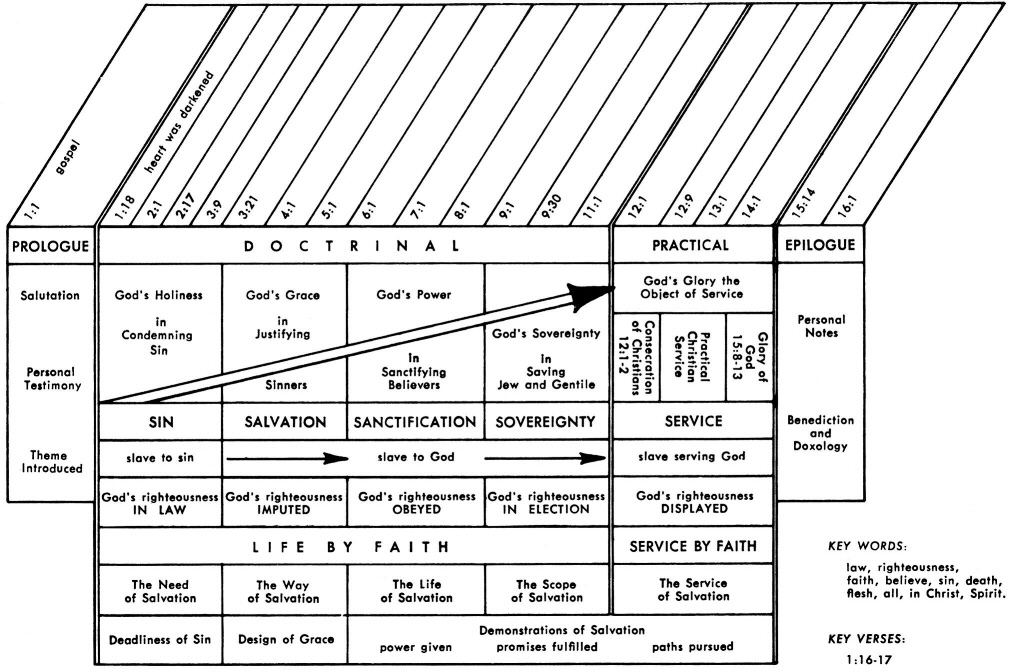
Click chart to enlarge
Chart from recommended resource Jensen's Survey of the NT - used by permission
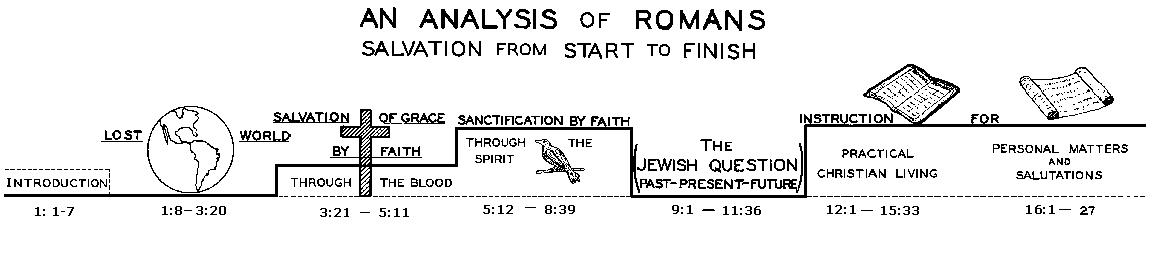
Click Charles Swindoll's overview chart
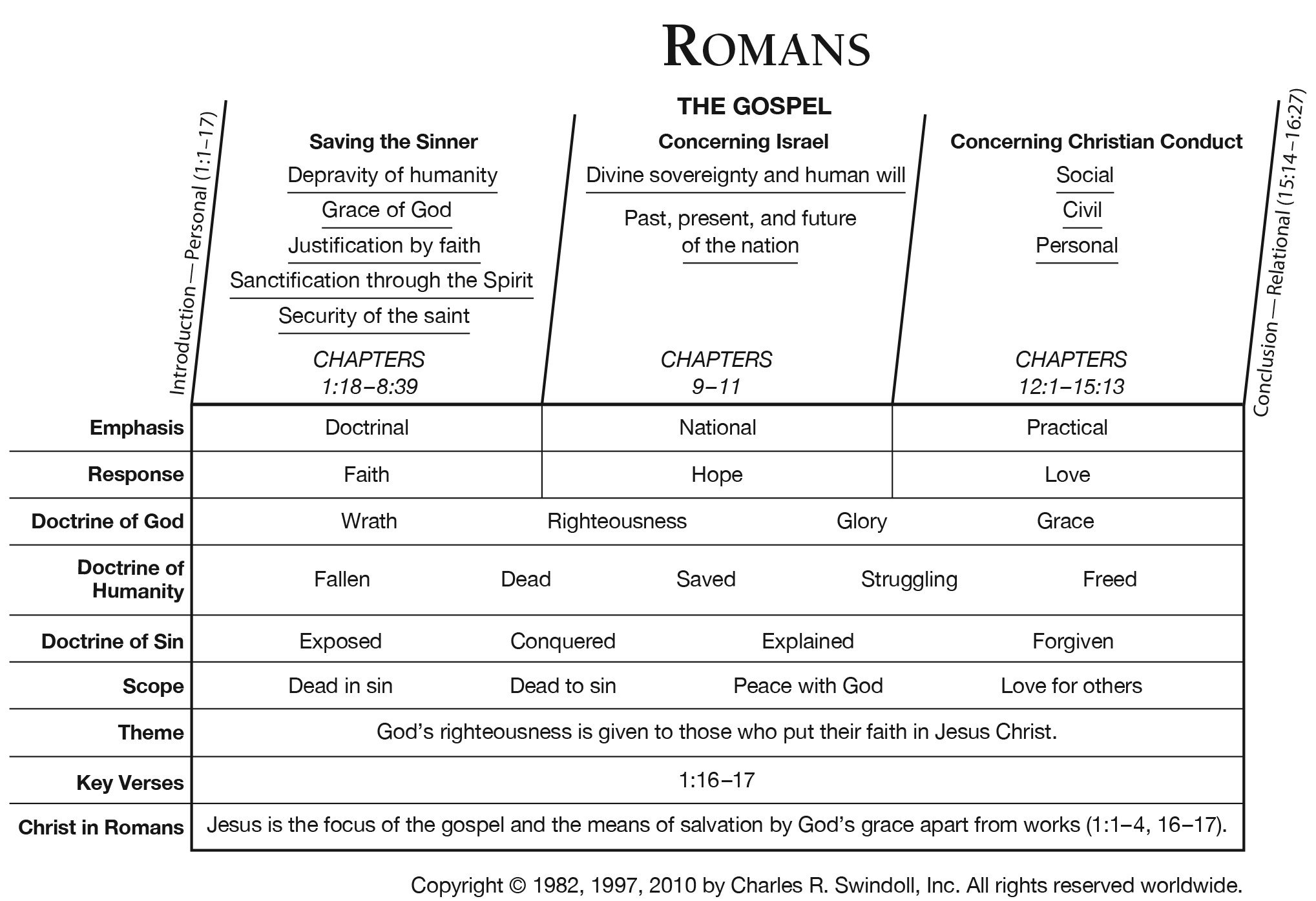
Source: Dr David Cooper
Click to Enlarge
| ROMANS ROAD to RIGHTEOUSNESS |
||||
| Romans 1:18-3:20 | Romans 3:21-5:21 | Romans 6:1-8:39 | Romans 9:1-11:36 | Romans 12:1-16:27 |
| SIN | SALVATION | SANCTIFICATION | SOVEREIGNTY | SERVICE |
| NEED FOR SALVATION |
WAY OF SALVATION |
LIFE OF SALVATION |
SCOPE OF SALVATION |
SERVICE OF SALVATION |
| God's Holiness In Condemning Sin |
God's Grace In Justifying Sinners |
God's Power In Sanctifying Believers |
God's Sovereignty In Saving Jew and Gentile |
Gods Glory The Object of Service |
| Deadliness of Sin |
Design of Grace |
Demonstration of Salvation | ||
| Power Given | Promises Fulfilled | Paths Pursued | ||
| Righteousness Needed |
Righteousness Credited |
Righteousness Demonstrated |
Righteousness Restored to Israel |
Righteousness Applied |
| God's Righteousness IN LAW |
God's Righteousness IMPUTED |
God's Righteousness OBEYED |
God's Righteousness IN ELECTION |
God's Righteousness DISPLAYED |
| Slaves to Sin | Slaves to God | Slaves Serving God | ||
| Doctrine | Duty | |||
| Life by Faith | Service by Faith | |||
|
Modified from Irving L. Jensen's chart above |
||||
Romans 2:20 a corrector of the foolish, a teacher of the immature, having (PAPMSA) in the Law the embodiment of knowledge and of the truth, (NASB: Lockman)
Greek: paideuten aphronon, didaskalon nepion, echonta (PAPMSA) ten morphosin tes gnoseos kai tes aletheias en to nomo
Amplified: You are a corrector of the foolish, a teacher of the childish, having in the Law the embodiment of knowledge and truth- (Amplified Bible - Lockman)
NLT: You think you can instruct the ignorant and teach children the ways of God. For you are certain that in God's law you have complete knowledge and truth. (NLT - Tyndale House)
NET an educator of the senseless, a teacher of little children, because you have in the law the essential features of knowledge and of the truth–
CSB an instructor of the ignorant, a teacher of the immature, having the full expression of knowledge and truth in the law--
ESV an instructor of the foolish, a teacher of children, having in the law the embodiment of knowledge and truth--
NIV an instructor of the foolish, a teacher of infants, because you have in the law the embodiment of knowledge and truth--
Phillips: You can instruct those who have no spiritual wisdom: you can teach those who, spiritually speaking, are only just out of the cradle. You have a certain grasp of the basis of true knowledge. You have without doubt very great advantages. (Phillips: Touchstone)
Wuest: a corrector of those who are without reflection or intelligence, a teacher of the immature, having the rough sketch of the experiential knowledge of the truth in the law.(Wuest Word Studies - Eerdman Publishing Company Volume 1, Volume 2, Volume 3 - used by permission)
Young's Literal: an instructor of foolish ones, a teacher of babes, having the form of the knowledge and of the truth in the law.
A CORRECTOR OF THE FOOLISH, A TEACHER OF THE IMMATURE: paideuten aphronon, didaskalon nepion:
- Mt 11:25; 1Co 3:1; Heb 5:13; 1Pe 2:2
- Romans 2 Resources - Multiple Sermons and Commentaries
- Romans 2:17-20 shows the great privileges the Jews possessed.
- Romans 2:21-23 shows the failure to practice their great privileges
- Romans 2:24 shows the effect their hypocrisy had on the reputation of God among the Gentiles
This is a continuation from Ro 2:19, in which Paul says the Jews were fully convinced that they were a guide, a light, a corrector and a teacher, because they had the Law. They were the epitome of spiritual pride. Sadly (and ironically) their pride had blinded them to the truth that saves one's soul from eternal punishment. And who was the implied recipient of their great learning? Undoubtedly (from the overall context) it was the Gentiles because they were blind, in darkness, foolish and immature. In truth it was the Jews who were in spiritual darkness and were fools!
Bible Knowledge Commentary agrees writing that "Many Jews were convinced and as a result believed certain things about themselves in relationship to Gentiles… This belief by Jews rested in their having in the Law the embodiment (morphōsin, “outline, semblance”; used elsewhere in the NT only in 2Ti 3:5+) of knowledge and truth (the Greek has the definite article “the” with both nouns: “the knowledge and the truth”)." (See The Bible Knowledge Commentary)
Corrector (3810) (paideutes from paideuo = instruct, correct, chastise from país = child) refers to one who disciplines and corrects by punishment or provides instruction for the purpose of proper behavior. The idea is that of an instructor, trainer, corrector, discipliner, preceptor. This word group related to paideuo (word study) denotes the upbringing and handling of the child which is growing up to maturity and which thus needs direction, teaching, instruction and a certain measure of compulsion in the form of discipline or even chastisement.
Wuest adds that paideutes is…The word was used by the Greeks of a slave who had charge of a young child, taking him to school and bringing him home again. He had the moral and ethical supervision of the child also. Our word, “pedagogue” comes from this word. The word is used here of a corrector or chastizer as in Hebrews 12:9. (Wuest Word Studies - Eerdman Publishing Company Volume 1, Volume 2, Volume 3 - used by permission)
The only other use of paideutes is in Hebrews…
Hebrews 12:9 (see notes) Furthermore, we had earthly fathers to discipline us, and we respected them; shall we not much rather be subject to the Father of spirits, and live?
The Septuagint (LXX) has one use in Hosea
And the revolters have gone deep in depravity, but I will chastise (Heb = muwcar = discipline, correction; Lxx = paideutes) all of them. (Ho 5:2)
Foolish (878) (aphron [see word study] from a = without + phren = understanding; phren is literally the diaphragm, reflecting that which restrains and figuratively was considered to be the site of all mental and emotional activity = the mind) means literally without reason (without one's mind or intellect), senseless, foolish, stupid, acting rashly. Vine writes that the idea is “want of mental sanity and sobriety, a reckless and inconsiderate habit of mind” (Hort), or “the lack of commonsense perception of the reality of things natural and spiritual … or the imprudent ordering of one’s life in regard to salvation” (G. Vos, in Hastings Bible Dictionary); it is mostly translated “foolish” or “foolish ones”.
TDNT in the note on classical Greek uses says aphron was used to mean "out of one's mind"… Vaunting human reason is folly (áphrōn, aphrosýnē). The áphrōn is the fool (who denies God) in the Psalms. In Proverbs áphrōn refers to the simple or inexperienced person. phrónimos occurs in Prov. 14:17, and aphrosyne is used for “misdeed” in Jdg. 20:6… (In Josephus) aphron and aphrosyne denote youthful folly or lack of restraint. (1278). (Borrow Kittel's Theological Dictionary of the New Testament : abridged in one volume)
If you would like a more expanded definition on the meaning of aphron, consider reading through the Scriptural uses in the Septuagint (see the uses below), specifically those in Proverbs (eg, in Pr 10:18 a fool is one who utters slander). This exercise would give you considerable insight in what God says about one who is aphron or foolish.
Aphron is not employing one's understanding especially in regard to practical matters. It is one who is without reason, senseless, stupid, foolish, without reflection or intelligence.
A T Robertson adds that, "Aphron is a hard word for the Gentiles, but it is the Jewish standpoint that Paul gives. Each termed the other ‘dogs.
Vincent writes that aphron means…Senseless. In Xenophon’s “Memorabilia,” Socrates, addressing Aristodemus, says, “Which do you take to be the more worthy of admiration, those who make images without sense (aphrona) or motion, or those who make intelligent and active creations?” (1, 4:4). Sometimes, also, in the sense of crazed, frantic, but never in New Testament.
NIDNTT adds that aphron means…senseless, foolish and aphrosune, lack of sense, foolishness (both words from Hom. onwards) indicate by the use of the Alpha-privative that the term is essentially defined by a lack or a negation, i.e. lack of insight and reason. But the possible development of a diseased mind is not excluded here either (Homer, Od. 23, 10-14). aphron can thus mean infatuated (Homer, Od. 21, 102) and aphrosyne can be referred back to mania (Aristotle, Eth. Nic. 7, 6, both times, incidentally, through active intervention of the gods). But the words chiefly describe deficient perception of value and truth. The Hebrew words for fool, foolish and folly are predominantly rendered in the LXX by aphron (115 times, of which 19 have no equivalent) or aphrosune (See page 1024 in the NIDNTT online)
Here are the 11 uses of aphron in the NT -
Luke 11:40 "You foolish ones, did not He who made the outside make the inside also?
Comment: Jesus called the Pharisees fools for their preoccupation with externals and for their unconcern with character warped by greed and wickedness
Luke 12:20 "But God said to him (in a parable about a certain rich man who sought to build bigger barns), 'You fool! This very night your soul is required of you; and now who will own what you have prepared?'
Comment: Richards writes that " Jesus called the rich farmer a fool for laying up material possessions and ignoring God, the appellation of fool being especially poignant because he was to meet God that very night (Lk 12:20). In each case, willful ignorance is involved. The Pharisees (see Lk 11:40 above) and this farmer refused to take into account what God had revealed to his OT people. (Richards, L O: Expository Dictionary of Bible Words: Regency)
Romans 2:20 (note) a corrector of the foolish, a teacher of the immature, having in the Law the embodiment of knowledge and of the truth,
1Corinthians 15:36 You fool! That which you sow does not come to life unless it dies;
Comment: I agree with the comment in TDNT - "In 1Co 15:36, Paul is not pronouncing a definitive judgement with his aphron. It is a rhetorical appeal for true understanding. To cling to the negative view is to adopt the position of the aphron which is close to that of ungodliness" (TDNT, 9:231).
2Corinthians 11:16 Again I say, let no one think me foolish; but if you do, receive me even as foolish, that I also may boast a little.
Comment: The key term is aphron, ‘fool’: not a dim-witted person or clown, a jester (as in ‘play the fool’), but in the technical sense of the person in Hellenistic-Roman society who had lost the correct measure (metron) of himself and the world around him (Martin, Ralph P. 2 Corinthians. Word Biblical Commentary series. Waco: Word Books, 1986)
2Corinthians 11:19 For you, being so wise, bear with the foolish gladly.
2Corinthians 12:6 For if I do wish to boast I shall not be foolish, for I shall be speaking the truth; but I refrain from this, so that no one may credit me with more than he sees in me or hears from me.
2Corinthians 12:11 I have become foolish; you yourselves compelled me. Actually I should have been commended by you, for in no respect was I inferior to the most eminent apostles, even though I am a nobody.
Ephesians 5:17 (note) So then do not be foolish, but understand what the will of the Lord is.
Comment: So a foolish person meanders through life with no concept nor desire for the will of God.
1Peter 2:15 (note) For such is the will of God that by doing right you may silence the ignorance of foolish men.
There are about 110 uses of aphron in the non-apocryphal Septuagint (LXX) (Note the marked concentration in Proverbs which speaks of wisdom) - 2Sa 13:13; Job 2:10; 5:2, 3; 30:8; 34:36; Ps 14:1; 39:8; 49:10; 53:1; 74:18, 22; 92:6; 94:8; Pr 1:22; 6:12; 7:7; 9:4, 13, 16; 10:1, 4, 18, 21, 23; 11:29; 12:1, 15, 16, 23; 13:16, 20; 14:1, 3, 7, 8, 16, 18, 24, 29, 33; 15:2, 5, 7, 20; 16:22, 27; 17:2, 7, 10, 12, 16, 18, 21, 24, 25 18:6, 7, 22; 19:10, 13, 25, 28, 29; 20:3; 21:20; 22:3; 23:9; 24:9, 30; 26:1, 4, 5, 6; 27:3, 12, 22; 28:26; 29:11, 20; 30:2, 22; Eccl. 2:14, 15, 16, 19; 4:5, 13; 5:1, 3f; 6:8; 7:4, 5, 6, 9; 10:2f, 6, 12, 14, 15; Isa. 59:7; Jer. 4:22; 17:11. Here are some examples from the Septuagint (LXX)…
Proverbs 7:7 And I saw among the naive (Heb = petiy = foolish, simpleminded, naive concerning the complexities of life; Lxx = aphron), I discerned among the youths, A young man lacking sense
Proverbs 10:1 The proverbs of Solomon. A wise son makes a father glad, but a foolish (Heb = kesiyl = a fool, one unable to deal with life in a wise way); Lxx = aphron) son is a grief to his mother.
Psalm 92:6 (Spurgeon's note) A senseless (Heb = baar = a brutish person, one showing little intelligence or sensibility; Lxx = aphron) man has no knowledge; Nor does a stupid man understand this:
Teacher (1320) (didaskalos from didasko = teach to shape will of one being taught by content of what is taught) is an instructor. The Biblical concept of teaching differed quite radically from secular Greek teaching in the matter of its goal. Whereas the Greek teacher sought to impart knowledge and skills, teaching for the Jew sought to change one’s entire life. The ministry of teaching in the OT sense that carried over to the early Church was therefore concerned “with the whole man and his education in the deepest sense.” It included the intellect, but its final goal was the will. It is notable that of the 58 uses in the NT, 41 refer to Jesus as the "Teacher". 41 of 58x = Jesus!
Here are the NT uses of didaskalos - Mt 8:19; 9:11; 10:24, 25; 12:38; 17:24; 19:16; 22:16, 24, 36; 23:8; 26:18; Mk. 4:38; 5:35; 9:17, 38; 10:17, 20, 35; 12:14, 19, 32; 13:1; 14:14; Lk. 2:46; 3:12; 6:40; 7:40; 8:49; 9:38; 10:25; 11:45; 12:13; 18:18; 19:39; 20:21, 28, 39; 21:7; 22:11; Jn. 1:38; 3:2, 10; 8:4; 11:28; 13:13, 14; 20:16; Acts 13:1; Ro 2:20; 1Co. 12:28, 29; Ep 4:11; 1Ti 2:7; 2Ti 1:11; 4:3; He. 5:12; Jas. 3:1
Immature (3516) (nepios from nê = negative + epos = not able to talk) means literally not speaking and thus a small child above age of a helpless infant but probably not more than three or four years of age. Figuratively as here in Romans nepios refers to a person who lacks experience, is untried or ignorant or simple-minded. In context Paul is referring to the Gentiles. Nepios is the term used by the Jews to designate Gentile proselytes. Paul uses it of one not come of legal age (Ga 4:1). The writer to the Hebrews used it of one spiritually immature (Heb 5:13) as did Paul (1Co 3:1) for they cannot eat solid food (spiritually speaking).
Wuest comments that nepios in Hebrews 5:13 means…an infant, a little child, a minor, not of age, and in a metaphorical sense, “untaught, unskilled.” The idea of immaturity is in the word, and according to the context in which it is found, it could refer to either mental or spiritual immaturity. Paul defines the word when he says that the person whom he calls a babe is “unskillful in the word of righteousness.” Spiritual immaturity is referred to by the word “babe.” Thus those spoken of as of full age are spiritually mature (teleios) (Wuest Word Studies - Eerdman Publishing Company Volume 1, Volume 2, Volume 3 - used by permission)
TDNT notes that…in General Greek Usage (nepios) means “immature,” “foolish.” It is used in medicine for small children in various stages. We also find it on burial inscriptions for small children aged 1 to 10. It may also be used for orphans (denoting their helplessness), and then comes into use for legal minors. It often occurs for children as members of the family along with the wife or mother. (It can also be used for the young of animals or plants.) But the main sense in Greek is “foolish,” “inexperienced,” or “childish” with no necessary reference to children. A person is nepios who is immature in conduct, who shows a foolish confidence in fortune, who does not take account of reality, or who does not heed the advice of philosophers. (Borrow Kittel's Theological Dictionary of the New Testament : abridged in one volume)
NIDNTT writes that…
nepios denotes an infant, child or minor in classic Greek. The word can be used in metaphorical sense, e.g. of young seedlings (Theophrastus, Historia Plantarum, 8, 1, 7). Furthermore, the characteristics of the foolish and inexperienced child may be so to the fore that the meaning of child recedes in favour of foolish, inexperienced (cf. Sophocles, Electra, 145 f.). Greek philosophers who wanted to communicate to men true knowledge of the world and the life of reason dismissed with biting sarcasm the unperceptive man with no experience of life as nepios, a fool (cf. Hesiod, Works, 130, 286 ff.; Epictetus, Dissertations, 3, 24, 53).
The LXX also translates petî, simple man, by nepios (Ps. 19:8). Whereas the wisdom lit. reproaches the nepios for being simple, i.e. dull and foolish (Pr. 1:32; cf. also 1:22 Aquila), nepios in the Pss. denotes the man of simple faith (e.g. Ps 116:6; 119:130) who stands under God’s protection and pays attention to his instruction. (See online page 281 Brown, Colin, Editor. New International Dictionary of NT Theology)
Detzler writes that nepios…means "infant." An infant is a young child who is not yet weaned. The Greeks seem to have taken this word from the verb nepeleo (to be without power, impotent, or weak). In other words, an infant is a person who has no power and needs the assistance of parents or guardians. (Borrow New Testament Words in Today's Language)
Hippocrates, "the father of medicine" used the word nepios to describe every child from the stage of a fetus to five or six years old. It is the word used to describe a family relationship: "This is the child of those parents." Aristotle used the word to describe the entire age of childhood. In Plato's writings it portrayed a person who lived in a pretend world of fantasy, in contrast with a realist.
The New Testament uses the word nepios on two different levels. It speaks of both a physical child and a spiritual child…
The Apostle Paul used the picture of a nursing mother to describe the tenderness of his concern for Christians. He wrote to the Thessalonians that he and his colleagues had treated them as a mother treats her infants, with love and tenderness (1Th 2:7). In fact, this verse probably gives one the clearest pictures of the basic meaning of nepios, that of a child before weaning…
In his first letter to the Corinthians the apostle warned them that they were still "babes" in Christ, for they had not grown beyond the basics (1Co 3:1). Paul wanted them to put away childish ways and live like adult Christians (1Co 13:11). (Borrow New Testament Words in Today's Language)
Nepios is used 15 times in the NT -
Matthew 11:25 At that time Jesus answered and said, "I praise Thee, O Father, Lord of heaven and earth, that Thou didst hide these things from the wise and intelligent and didst reveal them to babes.
Comment: MacArthur explains that Jesus is referring to "spiritual babes, those who acknowledge their utter helplessness in themselves, to whom God has sovereignly chosen to reveal the truths of His kingdom. It is to the “poor in spirit” who humbly confess their dependency that God makes the way of salvation clear and understandable. By the Holy Spirit they recognize they are spiritually empty and bankrupt and they abandon all dependence on their own resources. They are the cringing spiritual beggars to whom Jesus refers in the first beatitude-the absolutely destitute who are ashamed to lift up their head as they hold out their hands for help. Babes are the exact opposite of the kind of person the scribes, Pharisees, and rabbis taught was pleasing to God. They are also the exact opposite of the imagined ideal Christian touted by many popular preachers and writers who glorify self-assertion and self-worth. The contrast between wise and intelligent and babes is not between the knowledgeable and the ignorant, the educated and the uneducated, the brilliant and the simpleminded. It is a contrast between those who think they can save themselves by their own human wisdom, resources, and achievement and those who know they cannot. It is a comparison between those who rely on themselves and those who rely on God." (Matthew 8-15, Matthew 16-23, Matthew 24-28)
Matthew 21:16 and said to Him, "Do You hear what these are saying?" And Jesus said to them, "Yes; have you never read, 'Out of the mouth of infants and nursing babes Thou hast prepared praise for Thyself'?"
Luke 10:21 At that very time He rejoiced greatly in the Holy Spirit, and said, "I praise Thee, O Father, Lord of heaven and earth, that Thou didst hide these things from the wise and intelligent and didst reveal them to babes. Yes, Father, for thus it was well-pleasing in Thy sight.
Romans 2:20 a corrector of the foolish, a teacher of the immature, having in the Law the embodiment of knowledge and of the truth,
1 Corinthians 3:1 And I, brethren, could not speak to you as to spiritual men, but as to men of flesh, as to babes in Christ.
1 Corinthians 13:11 When I was a child, I used to speak as a child, think as a child, reason as a child; when I became a man, I did away with childish things.
Comment: Paul uses nepios literally here referring to those who have not yet learned to speak.
Galatians 4:1 Now I say, as long as the heir is a child, he does not differ at all from a slave although he is owner of everything,
Galatians 4:3 So also we, while we were children, were held in bondage under the elemental things of the world.
Comment: Detzler comments that "To the Galatians Paul compared the Jews to infants. They had an elemental knowledge of God's plan, but as a nation they did not mature enough to accept their Messiah (Gal. 4:1). This is not a final stage but a beginning stage of development (4:3). Paul looked for the day when the Jews would grow up and grasp their messianic birthright. (Ibid)
Ephesians 4:14 (note) As a result, we are no longer to be children, tossed here and there by waves, and carried about by every wind of doctrine, by the trickery of men, by craftiness in deceitful scheming
Comment: Clearly Paul is using nepios figuratively to encourage his readers to no longer be spiritually immature saints but to grow in their spiritual maturity. It is good for a person to be born as a baby, but it is unnatural when one remains as an infant. By the same token, believers begin as babies, but they should grow on to maturity in the faith.
1 Thessalonians 2:7 (note) But we proved to be gentle among you, as a nursing mother tenderly cares for her own children.
Hebrews 5:13 (note) For everyone who partakes only of milk is not accustomed to the word of righteousness, for he is a babe.
Nepios is used about 26 times in the non-apocryphal Septuagint (LXX) - 1 Sam. 15:3; 22:19; 2 Ki. 8:12; Job 3:16; 24:12; 31:10; 33:25; Ps. 8:2; 17:14; 19:7; 64:7; 116:6; 119:130; 137:9; Prov. 1:32; 23:13; Isa. 11:8; Jer. 6:11; 9:21; 43:6; 44:7; Lam. 1:5; 2:11, 19f; 4:4; Ezek. 9:6; Hos. 11:1; Joel 2:16; Nah. 3:10
Psalm 8:2 (ESV ) Out of the mouth of babies and infants, you have established strength because of your foes, to still the enemy and the avenger.
Psalm 19:7 The law of the LORD is perfect, restoring the soul; The testimony of the LORD is sure, making wise the simple (Heb = pethiy = simplicity, naiveté, foolish; Lxx = nepios).
Leo Burke said that…
"People who say they sleep like a baby usually don't have one." The spiritual parallel is when immature, spiritual babes come into a house of God, they require attention. We cannot just let them go, any more than we can put a baby in a crib and just let him grow.
Billy Graham spoke to the issue of maturing babes in Christ…
Being a Christian is more than just an instantaneous conversion—it is a daily process whereby you grow to be more and more like Christ.
Tacitus said,
Among themselves their honesty is inflexible, their compassion quick to move, but to all other persons they show the hatred of antagonism.
In Alexandria the Jews allegedly took an oath never to show kindness to a Gentile. The very privileges which should have produced saints produced arrogant, loveless egotists instead!
HAVING IN THE LAW THE EMBODIMENT OF KNOWLEDGE AND OF THE TRUTH: echonta (PAPMSA) ten morphosin tes gnoseos kai tes aletheias en to nomo:
- Ro 6:17; 2Ti1:13; 3:5; Titus 1:16
- Romans 2 Resources - Multiple Sermons and Commentaries
POSSESSING THE LAW BUT NOT
POSSESSED BY THE LAW
By this title I mean they have access to the Law (they even memorize much of the OT!) but it does not "have them" in the sense that they do not obey it, because they cannot obey it, because the only way to truly obey the law is to be born again and be continually energized by the Holy Spirit to give both the desire and the power (Php 2:13NLT+) to obey it! Don't deceive yourself into thinking you can keep the Law by relying on your own (lawless) fallen flesh! That's just legalism in disguise which is of no value in controlling fleshly indulgences (Col 2:23b+) and which will blunt the flow of grace in your life because law and grace simply do not mix!
Having (2192) (echo) means to have or to hold in one's possession and the present tense indicates this "having" is their continuous possession.
Having in the Law the embodiment - The Law contains the essential features, the full content, the full expression and the formulation of knowledge and truth.
Wuest says the Jews had "the rough sketch of the experiential knowledge of the truth in the law." (Wuest Word Studies - Eerdman Publishing Company Volume 1, Volume 2, Volume 3 - used by permission)
Godet - The end of Ro 2:20 serves to explain the reason of this ministry to the Gentile world which the Jew exercises. He possesses in the law the precise sketch (morphosis), the exact outline, the rigorous formula of the knowledge of things which men should have (the idea which every one should form of them), and of the truth, that is to say, the moral reality or substance of goodness. Knowledge is the subjective possession of truth in itself. The Jew possesses in the law not only the truth itself, but its exact formula besides, by means of which he can convey this truth to others.
Denney - The confidence of the Jew is based on the fact that he possesses in the law “the outline of knowledge and truth." (Denney goes on to make an interesting remark which may be true) " The morphosin tes gnoseos (embodiment of knowledge) is in point of fact only a form: valuable as the outline or definition of truth was, which the Jew possessed in the law, it was in reality ineffective, so far as the practical authority of the law in the Jew’s conduct was concerned.
Embodiment (3446) (morphosis from morphe = stresses essence of one’s nature) refers to the to outward shape and appearance, such as that of a silhouette, which is an outline or shadow of something. The root word morphe emphasizes both the internal and external form and thus refers to the outward display of the inner reality or the essential form of something which never alters.
Webster says that to embody is to form or collect into a united mass (a body) and to give a tangible, concrete form to an abstract concept. The Law is a valid form in which spiritual knowledge and truth are collected together as a comprehensive whole.
Vincent - morphe, form is the expression or embodiment of the essential and permanent being of that which is expressed… In Ro 2:20, morphosis is the truthful embodiment of knowledge and truth as contained in the law of God… (He adds that morphe is) not mere appearance, but the scheme, the correct embodiment of the lineaments of truth and knowledge in the law.
Paul uses morphosis to describe the false (spiritually dead) teachers warning Timothy that they are…"holding to a form of godliness, although they have denied its power; and avoid such men as these." (2Ti 3:5+)
Knowledge (1108) (gnosis) refers to “experiential knowledge,” not a mere passing acquaintance.
Truth (225) (aletheia from alethes = true in turn from a + lêthô = that which is hidden or lanthanô = conceal, this combination meaning out in the open, containing nothing that is hidden) describes the body of reality (facts, events, etc) or the content which is true, or which is in accordance to what actually occurred. Truth is the unveiled reality lying at the basis of and agreeing with an appearance; the manifested, the veritable essence of matter. Truth is the correspondence between a reality and a declaration which professes to set it forth. Words are true when they correspond with objective reality. Persons and things are true when they correspond with their profession. Hence a truth is a declaration which has corresponding reality, or a reality which is correctly set forth. Since God is Himself the great reality, that which correctly sets forth His nature is pre-eminently the Truth. Obviously whatever God says is "the truth", and in fact "the Truth" is actually embodied in the Person of Christ Jesus!
Paul's religious readers (and especially the Jews) fancied themselves as guides, lights, correctors, and teachers and in so doing they tended to look down with condescension and scorn upon those who did not have access to the Law. The Gentiles sensed this "spiritual pride" or "arrogance" and they resented it.
John discusses the Law and Truth in his introductory comments writing that…
And the Word became flesh (the incarnation of Jesus), and dwelt among us, and we beheld His glory, glory as of the only begotten from the Father, full of grace and truth. 15 John bore witness of Him, and cried out, saying, "This was He of whom I said, 'He who comes after me has a higher rank than I, for He existed before me.'" 16 For of His fulness we have all received, and grace upon grace. 17 For the Law was given through Moses; grace and truth were realized through Jesus Christ. (Jn 1:14-17+)
The truth in its fullness came with Jesus Christ, (Jn 1:14, 17+). The law was the pattern that pointed to Jesus, but He was the consummation of truth.
Romans 2:21 you, therefore, who teach (PAPMSN) another, do you not teach (2SPAI) yourself ? You who preach (PAPMSN) that one shall not steal (PAN) do you steal (2SPAI)? (NASB: Lockman)
Greek: o oun didaskon (PAPMSN) heteron seauton ou didaskeis (2SPAI); o kerusson (PAPMSN) me kleptein (PAN) klepteis (2SPAI):
Amplified: Well then, you who teach others, do you not teach yourself? While you teach against stealing, do you steal (take what does not really belong to you)? (Amplified Bible - Lockman)
NLT: Well then, if you teach others, why don't you teach yourself? You tell others not to steal, but do you steal? (NLT - Tyndale House)
NET therefore you who teach someone else, do you not teach yourself? You who preach against stealing, do you steal?
CSB you then, who teach another, don't you teach yourself? You who preach, "You must not steal"-- do you steal?
ESV you then who teach others, do you not teach yourself? While you preach against stealing, do you steal?
NIV you, then, who teach others, do you not teach yourself? You who preach against stealing, do you steal?
Phillips: But, prepared as you are to instruct others, do you ever teach yourself anything? You preach against stealing, for example, but are you sure of your own honesty? (Phillips: Touchstone)
Wuest: Therefore, you who are constantly teaching another, are you not teaching yourself? You who are constantly preaching a person should not be stealing, are you stealing? (Wuest Word Studies - Eerdman Publishing Company Volume 1, Volume 2, Volume 3 - used by permission)
Young's Literal: Thou, then, who art teaching another, thyself dost thou not teach?
YOU, THEREFORE, WHO TEACH ANOTHER, DO YOU NOT TEACH YOURSELF: o oun didaskon (PAPMSN) heteron seauton ou didaskeis (2SPAI):
- Ps 50:16, 17, 18, 19, 20, 21; Mt 23:3, 4, 5, 6, 7, 8, 9, 10, 11, 12; Lk 4:23; 11:46; 12:47; 19:22; 1Co 9:27; Gal 6:13; Titus 2:1, 2, 3, 4, 5, 6, 7
- Romans 2 Resources - Multiple Sermons and Commentaries
YOUR CREED CONTRADICTS
YOUR CONDUCT
You - pointedly addressing the Jew (Ro 2:17), but dear Gentile reader, this section is oh so applicable to all who claim the name "Christian." The skeptics, doubters and nay sayers eyes are ever on you, looking for flaws in your belief system, specifically any disconnect between what you believe and how you behave in the crucible of life. Remember that chapter two begins with a change from "they" in Romans 1 to "you" in Ro 2:1, which could refer to the Jew even there, but now unquestionably refers to the Jews. Their possession of the Law (with all the inherent privileges enumerated in Ro 2:17-20) does not match their practice of the Law.
THOUGHT - We all need to continually ask ourselves - Is my Christianity authentic? Does it pass the test? See 2Cor 13:5+. To be sure we can have assurance of our eternal security but we need to be sure of our assurance. (How can I have assurance of my salvation? | GotQuestions.org)
Isaac Watts - "I have heard it said by persons whom I could fully credit, that a Turk when he is suspected of fraud and cheating, will reply, "What, do you think I am a Christian?" O! How hath the Gospel of the lovely Jesus been rendered odious by the abominable practices of those what pretend to honor him!" (from "Sermons on Various Subjects… ")
MacDonald - But these things in which the Jew boasted had never changed his life. It was simply pride of race, religion, and knowledge without any corresponding moral transformation. He taught others but did not take the lessons to heart himself. He preached against stealing but did not practice what he preached. (Borrow Believer's Bible Commentary)
Therefore (oun) is a term of conclusion which begs questions such as "What is Paul concluding?" or "What are the facts that lead to his conclusion?" and "What is his conclusion?"
Godet - The oun, then (ESV = "then"; NAS = "therefore") ironically contrasts the real practical fruit produced in the Jews by their knowledge of the law, and that which such an advantage should have produced.
Denney - Here the grammatical apodosis (the main clause of a conditional sentence - which began with "if" in Ro 2:17) begins, the oun (therefore) resuming all that has been said in Romans 2:17–20.
Harrison says in Ro 2:17–20 Paul engages "in dialogue with a representative Jew, and his razor-sharp irony is superb for its deftness. He proceeds to build up the Jew, citing his various distinctives and appearing to appreciate them, only to swing abruptly into a frontal assault by exposing the inconsistency between his claims and his conduct (Ro 2:21–24). (Borrow The Expositor's Bible Commentary)
In the Psalms we read a similar accusation in the form of a question…
But to the wicked God says, "What right have you to tell of My statutes, And to take My covenant in your mouth? "For you hate discipline, and you cast My words behind you. "When you see a thief, you are pleased with him, and you associate with adulterers. "You let your mouth loose in evil, and your tongue frames deceit. "You sit and speak against your brother. You slander your own mother's son." (Ps 50:16-20)
Jesus addressed this hypocrisy in the Jewish religious leaders warning others…
therefore all that they tell you, do and observe, but do not do according to their deeds; for they say things, and do not do them. And they tie up heavy loads, and lay them on men's shoulders; but they themselves are unwilling to move them with so much as a finger. But they do all their deeds to be noticed by men; for they broaden their phylacteries, and lengthen the tassels of their garments. And they love the place of honor at banquets, and the chief seats in the synagogues, and respectful greetings in the market places, and being called by men, Rabbi. But do not be called Rabbi; for One is your Teacher, and you are all brothers. And do not call anyone on earth your father; for One is your Father, He who is in heaven. And do not be called leaders; for One is your Leader, that is, Christ. But the greatest among you shall be your servant. And whoever exalts himself shall be humbled; and whoever humbles himself shall be exalted. But woe to you, scribes and Pharisees, hypocrites, because you shut off the kingdom of heaven from men; for you do not enter in yourselves, nor do you allow those who are entering to go in. (Mt 23:3-12)
Addressing the Jewish lawyers, Jesus declared…
"Woe to you lawyers (experts in the Mosaic law) as well! For you weigh men down with burdens hard to bear, while you yourselves will not even touch the burdens with one of your fingers. (Lk 11:46+)
In Galatians Paul addressed the hypocrisy of the Jews explaining that…
those who are circumcised do not even keep the Law themselves, but they desire to have you circumcised, that they may boast in your flesh. (Gal 6:13+)
In just a few sentences Paul does away with the false security which they could derive from having the truth. They were not okay. Their lives did not measure up to the truth they possessed ("you condemn yourself" Ro 2:1-note). Remember that much of rabbinic Judaism of Paul's day interpreted the law in such a way that one might consider themselves completely justified by the law; yet Jesus exposed the error of such interpretations. The Scribes and Pharisees sought to keep the law externally and not from the heart. Jesus applied the Law not just to our actions but also to our attitudes. (Mt 5:19, 20-notes)
Thomas à Kempis - “How rarely we weigh our neighbor in the same balance in which we weigh ourselves.”
Godet - The term teach includes all the honorable functions toward the rest of the world which the Jew has just been arrogating (making undue claims to having).
Teach (1321) (didasko from dáo= know or teach; English = didactic; see study of related noun didaskalia and adjective didaktikos) means to provide instruction or information in a formal or informal setting. In the 97 NT uses of didasko the meaning is virtually always to teach or instruct, although the purpose and content of the teaching must be determined from the context.
To teach means to cause to know, to help one to learn, to impart knowledge or skill, or to carry out the activity of instructing by precept or by practice. To teach is distinguished from to preach, the latter emphasizing the proclamation of the gospel to the non-Christian world.
John MacArthur writes that didasko "refers to the passing on of information-often, but not necessarily, in a formal setting. It focused on content, with the purpose of discovering the truth-contrary to the forums so popular among Greeks, where discussion and the bantering about of various ideas and opinions was the primary concern (see Acts 17:21). Synagogue teaching, as illustrated by that of Jesus, was basically expository. Scripture was read and explained section by section, often verse by verse. (See Matthew Commentary)
YOU WHO PREACH THAT ONE SHOULD NOT STEAL DO YOU STEAL: o kerusson (PAPMSN) me kleptein (PAN) klepteis (2SPAI):
- Isa 56:11; Ezek 22:12,13,27; Amos 8:4, 5, 6; Mic 3:11; Mt 21:13; 23:14
- Romans 2 Resources - Multiple Sermons and Commentaries
HYPOCRITICAL
PREACHERS
External rituals clearly did not produce the internal changes that God demanded and provided for in the Gospel. The Jews considered themselves to be God’s exclusive favorites; but what they failed to see was that these very privileges obligated them to live holy lives. They disobeyed themselves the very law they preached to the Gentiles.
THOUGHT - Even if we are genuine believers, we need to be sure we don't read over this section too fast. Paul's arguments should stimulate us all to ask "Do I practice what I profess? Do I tell others what is right but then do what is wrong? Do I expect more of others than I do of myself?" Are you as convicted as I am?
Isaiah addressed the wickedness of God's people writing that…
the dogs are greedy, they are not satisfied. And they are shepherds who have no understanding. They have all turned to their own way, each one to his unjust gain, to the last one. (Isa 56:11)
Ezekiel addressed their dishonesty declaring…
"In you they have taken bribes to shed blood (hired murderers); you have taken interest and profits, and you have injured your neighbors for gain by oppression (loan racketeers, extortionists), and you have forgotten (be oblivious of from want of memory or attention, cease to care) Me," declares the Lord GOD. Behold, then, I smite My hand at your dishonest gain which you have acquired and at the bloodshed which is among you… "Her princes within her are like wolves tearing the prey, by shedding blood and destroying lives in order to get dishonest gain. (Ezek 22:12,13,27)
The prophet Amos also rebuked the Jews…
Hear this, you who trample the needy, to do away with the humble of the land, saying, "When will the new moon be over, so that we may sell grain, and the sabbath, that we may open the wheat market, to make the bushel smaller and the shekel bigger, and to cheat with dishonest scales, so as to buy the helpless for money And the needy for a pair of sandals, And that we may sell the refuse of the wheat?" (Amos 8:4-6)
Micah wrote that Israel's…
leaders pronounce judgment for a bribe, Her priests instruct for a price, And her prophets divine for money. Yet they lean on the LORD saying, "Is not the LORD in our midst? Calamity will not come upon us." (Mic 3:11+)
In Jesus' day the situation had not improved…
And He said to them, "It is written, 'MY HOUSE SHALL BE CALLED A HOUSE OF PRAYER'; but you are making it a ROBBERS' DEN." (Mt 21:13)
Preach (2784) (kerusso or kerysso from kerux/keryx = a herald - one who acts as the medium of the authority of one who proclamation he makes; kerugma = the thing preached or the message) means to proclaim (publicly) or to herald or act as a public crier - the town official who would make a proclamation in a public gathering.
Kerusso was used of the official whose duty it was to proclaim loudly and extensively the coming of an earthly king, even as our gospel is to clearly announce the coming of the King of kings and Lord of lords (Rev 19:16+)!
The Imperial Herald would enter a town in behalf of the Emperor, and make a public proclamation of the message which his Sovereign ordered him to give, doing so with such formality, gravity, and authority as to emphasize that the message must be heeded! (Think about this in regard to the Gospel of God instead of the decree of a man which is what the Jews were preaching! cf 1Th 2:13-note). He gave the people exactly what the Emperor bade him give, nothing more, nothing less. He did not dare add to the message or take away from it. THOUGHT - Should this not be the example and pattern every preacher and teacher of the holy gospel of God seeks and strives to emulate, yea, even doing so with fear and trembling! ("not as pleasing men but God, who examines our hearts" 1Th 2:4+)
The present tense indicates that the readers were continually heralding (like public criers) this message. A herald acted as the medium of the authority of the one whose proclamation he proclaimed. Greco-Roman rulers had special heralds made announcements to the people and who were commissioned by the ruler to make announcements in a loud, clear voice so everyone could hear. Sadly these religious professors were not powerful preachers of the genuine gospel.
This section is a classic case of “Do as I say, not as I do.” They were just like the Pharisees. They were hypocrites of the first order!
Steal (2813) (klepto akin to kleptes = thief, English = kleptomaniac) to steal furtively or to take by stealth. Take something (secretly) without the owner's permission. To commit a theft. To take something away secretly. Take (another person's property) without permission or legal right and without intending to return it.TDNT adds that klepto means to "means a. “to steal” (either objects or people), b. “to cheat” or “bewitch,” and c. “to conceal.”
The present tense indicates this was the habitual practice of the Jewish readers who were not regenerate.
Klepto is used 13 times in the NT - Mt 6:19, 20-see notes; Mt 19:18; 27:64; 28:13; Mk 10:19; Lk 18:20; Jn 10:10; Ro 2:21-note; Ro 13:9-note; Ep 4:28-note
There are 31 uses of klepto in the non-apocryphal Septuagint - Gen. 30:33; 31:19, 30, 32; 40:15; 44:5, 8; Exod. 20:15; 21:16; 22:1, 7f, 12; Lev. 19:11; Deut. 5:19; 24:7; Jos. 7:11; 2 Sam. 19:41; 21:12; 2 Ki. 11:2; 2 Chr. 22:11; Job 17:3; Prov. 6:30; 30:9; Jer. 7:9; 23:30; Obad. 1:5;
The Jew professed to act as God's herald or spokesperson so to speak, and yet committed the very acts which God condemned! (Ro 2:3 -note)
Here is an illustration of what Paul is asking the religious, self-righteous Jews to do - When Sgt. Ray Baarz of the Midvale, Utah, police department opened his wallet, he noticed his driver’s license had expired. Embarrassed at having caught himself red-handed, he had no alternative. He calmly and deliberately pulled out his ticket book and wrote himself a citation. Then Baarz took the ticket to the city judge who fined him five dollars. Baarz confessed “How could I give a ticket to anyone else for an expired license in the future if I didn’t cite myself?”
Note that Paul is using a series of questions designed to contrast the practice of most of the Jews with what they knew and taught (cf. Ps 50:16-20; Mt 23:3, 4; Jas 3:1+).
For example, despite the clear pronouncements of the Mosaic law against theft, it was very common in ancient Judaism. Isaiah rebuked those who “turned to their own way, each one to his unjust gain” (Isa. 56:11).
In theological terms, their preaching reflected orthodoxy (right doctrine), but their living failed to follow through with orthopraxy (right practice). They were much like corrupt police officials or judges, whose lives are in direct contradiction of the laws they have sworn to uphold and enforce. And because of their greater responsibility, they bring upon themselves greater punishment when they break those laws.
Illustration of preaching "one should not steal" - John was driving home late one night when he picked up a hitchhiker. As they rode along, he began to be suspicious of his passenger. John checked to see if his wallet was safe in the pocket of his coat that was on the seat between them, but it wasn't there! So he slammed on the brakes, ordered the hitchhiker out, and said, "Hand over the wallet immediately!" The frightened hitchhiker handed over a billfold, and John drove off. When he arrived home, he started to tell his wife about the experience, but she interrupted him, saying, "Before I forget, John, do you know that you left your wallet at home this morning?" Gotcha! (see notes on Jesus' warning on hypocritical judging - Mt 7:1, 2 - notes)
TALKING AND WALKING - A professor of ethics at a leading university was attending a convention. He and another teacher of philosophy had lunch at a restaurant and were discussing deep issues of truth and morality. Before they left the table, the professor slipped the silverware into his pocket. Noticing his colleague's puzzled look, he explained, "I just `teach' ethics. I need the spoons." By vocation that man was paid to instruct his students in the principles of right and wrong. But outside the classroom he failed to put those principles into practice. Profession without practice is hypocrisy, and hypocrisy is a sin.
Jesus reminded the hypocrites of His day that God had declared through Isaiah, "These people … honor Me with their lips, but have removed their hearts far from Me" (Isa 29:13). He could just as well have cited God's rebuke to Israel through Ezekiel, "They hear Your words, but they do not do them" (Ezek 33:32).
The Christian life is like a coin. One side is belief; the other is behavior. If our behavior isn't consistent with our belief, we are hypocrites. By God's enabling grace, we need to bring practice and profession into alignment. We must walk our talk, then we can talk our walk. - V C Grounds (Our Daily Bread, Copyright RBC Ministries, Grand Rapids, MI. Reprinted by permission. All rights reserved)
Unless my talk about my faith
Is mirrored in my walk,
The faith that glibly I profess
Is merely empty talk.
--Anon.
How we behave reveals what we truly believe.
Practice What You Preach - A number of years ago a university was accused of plagiarism (which means, to take the writings of someone else and pass them off as one's own). What made it so unusual was that the school had plagiarized the section on plagiarism from another university's handbook. A news report stated, "A graduate student of one school, who was considering a teaching assistant's job at the other, was reading the school handbook when he noted that the section warning students against plagiarism was identical to the caution in the handbook of the other university." Another student said, "The thing that bothered me most was the hypocrisy."
In Romans 2 the apostle Paul exposed the hypocrisy of self-righteous religionists. He said, "You who preach that man should not steal, do you steal?" (Ro 2:21). Paul warned that people who are quick to judge the sins of others are guilty of the very things they condemn.
I think all of us can identify with this tendency. We see a sin in another person's life and we rise up in pride to correct that person. But if we are honest with ourselves, we can see similar faults in our own life.
Be careful to examine yourself before pointing out the faults of others. Practice what you preach! R W De Haan (Our Daily Bread, Copyright RBC Ministries, Grand Rapids, MI. Reprinted by permission. All rights reserved)
Consistency! How much we need
To walk a measured pace,
To live the life of which we speak,
And show God's love and grace.
- AnonYou please God when your walk matches your talk.
Practice What You Preach (Read: Romans 2:17-24) - You, therefore, who teach another, do you not teach yourself? —Romans 2:21
Mohandas Gandhi spearheaded India’s struggle for freedom from British rule. His Hindu religious practices and his political philosophy had a radical and revolutionary influence on millions of his countrymen. Earlier in his life, Gandhi had considered the possibility of becoming a follower of Jesus. Attracted by His life and teachings, Gandhi attended the services of a church in Pretoria, South Africa. He later wrote,
“The congregation did not strike me as being particularly religious; they were not an assembly of devout souls, but appeared rather to be worldly-minded people going to church for recreation and in conformity to custom.”
Christianity, he concluded, could not add anything of value to Hinduism. So he turned away from Jesus, to his own loss, and to the loss of the many who followed after him.
Are we like those churchgoers in Pretoria?
Is our adherence to Christianity merely a matter of custom, a nice way of enjoying social relationships?
Would a stranger who is sincerely seeking a relationship with God be attracted or turned off by the quality of our worship and personal devotion to Christ?
Do we live out the Christianity we profess? Do we practice what we preach? (Romans 2:21)
(Ed: Or even worse do we blaspheme the Name of God by our behavior around those who think we are followers are Christ? Ro 2:24). — by Vernon C. Grounds
I'd rather see a Christian
Than to hear one merely talk,
I'd rather see his actions
And behold his daily walk.
—Herrell
What we practice is the best illustration of what we preach.
Romans 2:22 You who say (PAPMSN) that one should not commit adultery (PAN), do you commit adultery (2SPAI)? You who abhor (PMPMSN) idols, do you rob temples (2SPAI)? (NASB: Lockman)
Greek: o legon (PAPMSN) me moicheuein (PAN) moicheueis (2SPAI); o bdelussomenos (PMPMSN) ta eidola hierosuleis (2SPAI):
Amplified: You who say not to commit adultery, do you commit adultery [are you unchaste in action or in thought]? You who abhor and loathe idols, do you rob temples [do you appropriate to your own use what is consecrated to God, thus robbing the sanctuary and doing sacrilege]? (Amplified Bible - Lockman)
NLT: You say it is wrong to commit adultery, but do you do it? You condemn idolatry, but do you steal from pagan temples? (NLT - Tyndale House)
Phillips: You denounce the practice of adultery, but are you sure of your own purity? You loathe idolatry, but How honest are you towards the property of heathen temples? (Phillips: Touchstone)
Wuest: You who are constantly saying that a person should not be committing adultery, are you committing adultery? You who are turning away constantly from idolatry as from a stench, are you robbing temples? (Wuest Word Studies - Eerdman Publishing Company Volume 1, Volume 2, Volume 3 - used by permission)
Young's Literal: thou who art preaching not to steal, dost thou steal? thou who art saying not to commit adultery, dost thou commit adultery? thou who art abhorring the idols, dost thou rob temples?
YOU WHO SAY THAT ONE SHOULD NOT COMMIT ADULTERY, DO YOU COMMIT ADULTERY:o legon (PAPMSN) me moicheuein (PAN) moicheueis (2SPAI):
- Jer 5:7; 7:9,10; 9:2; Ezekiel 22:11; Mt 12:39; 16:4; Jas 4:4
- Romans 2 Resources - Multiple Sermons and Commentaries
ADULTERY
HYPOCRISY
Remember that all 5 rhetorical questions call for a resounding "yes." Yes, they committed adultery even though they preached against it.
A similar indictment was made by Jeremiah…
"Why should I pardon you? Your sons have forsaken Me And sworn by those who are not gods. When I had fed them to the full, They committed adultery And trooped to the harlot's house (eg During the reign of Manasseh, cult prostitution was practiced.).(Jeremiah 5:7)
"Will you steal, murder, and commit adultery, and swear falsely, and offer sacrifices to Baal, and walk after other gods that you have not known (Note that in this verse alone half of the Ten Commandments were being violated), then come and stand before Me in this house, which is called by My name, and say, 'We are delivered!'-- that you may do all these abominations? (Jeremiah 7:9,10)
O that I had in the desert a wayfarers' lodging place (a lonely and desolate dwelling, providing only a shelter from the elements.); that I might leave my people, and go from them! for all of them are adulterers, An assembly of treacherous men. (Jeremiah 9:2)
Ezekiel's indictment was even more direct…
And one has committed abomination with his neighbor's wife, and another has lewdly defiled his daughter-in-law. And another in you has humbled his sister, his father's daughter. (Ezekiel 22:11)
James explained the abject evil inherent in spiritual adultery declaring…
You adulteresses (those who have engaged in an affair with the "world" [that evil organized system under the rule of the devil which opposes God and His will] thus compromising with the present world-system as seen in much of modern Christianity, even evangelicalism!), do you not know that friendship (indicating a reciprocal relationship. Unfaithful people love the world, and the world loves them) with the world is hostility toward God? Therefore whoever wishes to be a friend of the world makes himself an enemy of God. (James 4:4+)
Commit adultery (3431) (moicheuo from moichós = an adulterer) means to be unfaithful to one's marriage vows speaking of sexual intercourse with someone who is married to another. In some uses moicheuo can also be a figure of speech (Re 2:22) as in the Old Testament where "adultery" described unfaithfulness to God especially through the practice of idolatry (which in the NT equates with greed and in essence is anything that comes between you and God).
The present tense indicates that they practiced adultery as a lifestyle!
NIDNTT has an interesting historical note on moicheuo writing that…moicheuo and its Doric counterpart moichao mean to commit adultery (with acc.). Sometimes they are used more generally, seduce a woman, violate; hence in mid. let oneself be seduced, in pass. be seduced to adultery. The derivatives include moicheia, adultery, harlotry (cf. porneia Discipline); moichos, Adulterer; moichalis, first an adj. meaning adulterous, and, secondly, a noun meaning adulteress, harlot. Adultery was punishable already in the old law codes going back to the second millennium B.C., e.g. the Lipit-Ishtar Code, the Code of Hammurabi, the old Ass. laws (cf. ANET, 159 ff., 163-88). Every form of sexual relationship outside marriage was forbidden to the wife, for she was the real guarantor of the integrity of the family and clan, and by adultery she broke her own marriage and she destroyed the integrity of the whole clan. A man on the contrary committed adultery only by sexual relationships with a married woman, i.e. when breaking into another’s arrangement. At the same time traces of older concepts behind these legal views from different cultures may be detected: (a) adultery with a married woman involves an offense against property, i.e. the invasion of the area of another’s possessions, and (b) the woman committing adultery opens the clan to the influence of evil powers. The punishment of adultery by death, ill-treatment or the payment of an expiatory fine was normally left to the private initiative of the wronged husband or of his clan.
Here are the 15 uses of moicheuo in the NT -
Matthew 5:27 (note) "You have heard that it was said, 'You shall not commit adultery';
Comment: Here in Romans 2:22 Paul is saying they preach and teach this principle. What they misunderstood was what act constituted adultery before a holy God. And so they were guilty of Mt 5:28 (and may have also been guilty of physical adultery.)
Matthew 5:28 (note) but I say to you, that everyone who looks on a woman to lust for her has committed adultery with her already in his heart.
Matthew 5:32 (note) but I say to you that everyone who divorces his wife, except for the cause of unchastity, makes her commit adultery; and whoever marries a divorced woman commits adultery.
Matthew 19:18 He said to Him, "Which ones?" And Jesus said, "You shall not commit murder; You shall not commit adultery; You shall not steal; You shall not bear false witness;
Mark 10:19 "You know the commandments, 'Do not murder, Do not commit adultery, Do not steal, Do not bear false witness, Do not defraud, Honor your father and mother.'"
Luke 16:18 "Everyone who divorces his wife and marries another commits adultery; and he who marries one who is divorced from a husband commits adultery.
Luke 18:20 "You know the commandments, 'Do not commit adultery, Do not murder, Do not steal, Do not bear false witness, Honor your father and mother.'"
John 8:4 they said to Him, "Teacher, this woman has been caught in adultery, in the very act.
Romans 2:22 (note) You who say that one should not commit adultery, do you commit adultery? You who abhor idols, do you rob temples?
Romans 13:9 (note) For this, "You shall not commit adultery, You shall not murder, You shall not steal, You shall not covet," and if there is any other commandment, it is summed up in this saying, "You shall love your neighbor as yourself."
James 2:11 For He who said, "Do not commit adultery," also said, "Do not commit murder." Now if you do not commit adultery, but do commit murder, you have become a transgressor of the law.
Revelation 2:22 (note) 'Behold, I will cast her upon a bed of sickness, and those who commit adultery with her into great tribulation, unless they repent of her deeds.
Moicheuo is used 8 times in the Septuagint (LXX) - Exod. 20:14; Lev. 20:10; Deut. 5:18; Jer. 3:9; Ezek. 23:43; Hos. 4:13, 14; 7:4
Ex 20:14 "You shall not commit adultery.
Leviticus 20:10 'If there is a man who commits adultery with another man's wife, one who commits adultery with his friend's wife, the adulterer and the adulteress shall surely be put to death.
YOU WHO ABHOR IDOLS: o bdelussomenos (PMPMSN) ta eidola:
- Romans 2 Resources - Multiple Sermons and Commentaries
AN AVERSION TO
IDOLATRY
You who - You Jews who are nauseated by the pagan practices associated with their empty idolatry.
Abhor (948) (bdelusso from bdéo = stink or reek) is a verb which means literally to emit a foul odor or to render foul and figuratively means to strongly detest something on the basis that it is abominable (as used in Rev 21:8) (abominable = quite disagreeable, worthy of disgust, whatever is odious to the mind or offensive to the senses). In Greek usage bdelusso means to feel a nausea or loathing for food and so came to be used of disgust in general. And so the verb bdelusso pictures one turning away from a stench as in disgust.
The cognate adjective bdekluktos (word study) as used in Titus gives us a sense of the meaning of this word group…
They (counterfeit believers = "defiled and unbelieving" Titus 1:15-note) profess to know God, but by their deeds they (present tense - by their lifestyle, the practice of their life they continually) deny Him, being detestable and disobedient, and worthless for any good deed. (Titus 1:16-note)
Comment: Notice how these professors in Titus are much like the Jewish professors here in Romans 2:17-24). Both groups are professors by not practitioners of genuine Spirit enabled piety!
Marvin Vincent - Bdelusso originally to turn away from a thing on account of the stench. (Bdelusso) means to feel a nausea or loathing for food: hence used of disgust generally. In a moral sense it denotes an object of moral or religions repugnance… It denotes anything in which estrangement from God manifests itself; as the eating of unclean beasts, Lev. 11:11… and, generally, all forms of heathenism. This moral sense must be emphasized in the New Testament use of the word… It does not denote mere physical or esthetic disgust.
Bdelusso is in the present tense indicating that this is their habitual practice. The middle voice is reflexive meaning "you yourself". The middle voice signifies to turn oneself away from as if from a stench and hence to detest something, in this case idols. To be sure, in Israel's past, idolatry had been a serious trap, especially during the times of the divided kingdom and the monarchies that ruled each kingdom and was a major reason for Judah's 70 years of Babylonian exile (cf Da 9:2, Dt 32:15-18 - "Jeshurun" = Israel, 2Chr 36:14-16). After the Babylonian exile and their return to the land, the Jews for the most part forsook the (overt) practice of idol worship (at least of the conventional variety - idols of wood and stone) and had a strong abhorrence for idols. During the time of Roman rule (the world power at the time of Paul's writing), the Jews actually came to abhor Roman coins that were impressed with the image of the Roman emperors, many of whom claimed to be gods. (see Mt 22:19, 20, 21). And yet Paul is saying they robbed Temples, which somehow is related to the very idolatry they abhorred (See explanation below under section on "Idols".)
The only other NT use of bdelusso in the NT is in the Revelation…
BUT (A term of contrast- always observe what is being contrasted - see Rev 21:6-7) for the cowardly and unbelieving and abominable (bdelusso in the perfect tense = their permanent state is that of being detestable, being a stench in the "nostrils of God" so to speak - what a horrible word picture!) and murderers and immoral persons and sorcerers and idolaters and all liars, their part will be in the lake that burns with fire and brimstone (see Great White Throne Judgment of unbelievers in Rev 20:11-15-note), which is the second death. (Rev 21:8-note)
There are 35 uses of bdelusso in the Septuagint (LXX) - Ge 26:29; Ex 1:12; 5:21; Lv 11:11, 13, 43; 18:30; 20:23, 25; 26:11; Dt 7:26; 23:7; 1Ki 21:26. Esther 4:17; Job 9:31; 15:16; 19:19; 30:10; Ps 5:6; 14:1; 38:20; 53:1; 56:5; 106:40; 107:18; 119:163; Pr 8:7; 28:9; Isa 14:19; 49:7; 66:5; Hos. 9:10; Amos 5:10; 6:8; Mic 3:9. Here are a few examples from the OT uses…
Exodus 5:21 (ESV) and they said to them, "The LORD look on you and judge, because you have made us stink (Heb = to have a bad smell, to stink, emit a foul odor; Lxx = bdelusso) in the sight of Pharaoh and his servants, and have put a sword in their hand to kill us."
Leviticus 20:23 'Moreover, you shall not follow the customs of the nation which I shall drive out before you, for they did all these things, and therefore I have abhorred (Heb = quts = feel a loathing, abhorrence or sickening dread; Lxx = bdelusso) them
Psalm 119:163 (ESV) I hate and abhor (Heb = ta'ab = to detest, loathe; Lxx = bdelusso) falsehood, but I love Your Law
Proverbs 28:9 He who turns away his ear from listening (Heb = shama; Lxx = eisakouo = listen attentively with the intent to obey) to the law, Even his prayer is an abomination. (Heb = tow'ebah = a disgusting thing; Lxx = bdelusso in perfect tense = speaks of permanence of this effect! Woe!)
Hosea 9:10 I found Israel like grapes in the wilderness; I saw your forefathers as the earliest fruit on the fig tree in its first season. But they came to Baal-peor and devoted themselves to shame, And they became as detestable as that which they loved.
Idols (1497) (eidolon from eídos = that which is seen, what is visible, figure, appearance) primarily refers to a phantom, a form, an image, a shadow or a likeness. Practically speaking an idol is ANYTHING that comes between you and God.
Eidolon is used 11 times in the NT - Acts 7:41; 15:20; Ro 2:22; 1Co 8:4, 7; 10:19; 12:2; 2Co 6:16; 1Th 1:9; 1Jn. 5:21; Rev 9:20
The spiritual significance of eidolon is primarily derived from the use of this word in the Septuagint (LXX) where eidolon is considered a derogatory term for images of the gods or pagan deities. The Septuagint uses of eidolon emphasize the fact that idols are the products of fantasy and are manufactured by human hands (e.g. Isa 44:12, 13, 14, 15, 16, 17). The Old Testament writers considered that these so-called gods had no reality at all, but were simply pieces of wood or stone. They were not alternative gods, but rather unreal gods. The NT usage is based on the understanding of eidolon in the Septuagint. Read Psalm 115 for a vivid description of what it is like to worship an idol.
Arthur Wallis an English evangelical writer said that…An idol may be defined as any person or thing that has usurped in the heart the place of preeminence that belongs to the Lord.
Louw and Nida write that…
The technical distinction between an image and an idol is that an image may merely represent a supernatural being, while an idol not only represents such a being but is believed to possess certain inherent supernatural powers. Images often become idols when they are assumed to possess such powers in and of themselves rather than being mere representations of some supernatural entity. If, for example, various images of a particular supernatural being are supposed to have different healing powers, then what began merely as images or representations of a supernatural power have become idols, in that the different images themselves have acquired special efficacy. (Borrow Greek-English lexicon of the New Testament : based on semantic domains)
Eidolon in a practical sense is anything, anyone, etc that takes priority over the True and Living God. Idols therefore are not just carved images but any objects which come between the soul and Christ, including things like money, pleasure, fame or material things. Many idolaters literally serve idols as in ancient Egypt where statues of gods were regularly and ritually clothed and fed!
The Jews had been taught, by the severe discipline of the Babylonian Captivity, to obey God’s decree against idolatry (see word study of idols = eidolon). The nation had been purged from its grossness in this respect. Although Israel had fallen into idolatry repeatedly during the period of the monarchies, since the Babylonian exile Jews have never practiced that evil to any significant degree. During the Greek and Roman occupations after their return from Babylon, Jews developed a strong abhorrence for anything remotely resembling idolatry. Because some Caesars had declared themselves to be gods, Jews even loathed handling Roman coins, because Caesar’s image was inscribed on them (Mt 22:19, 20, 21).
DO YOU ROB TEMPLES?: hierosuleis (2SPAI):
- Romans 2 Resources - Multiple Sermons and Commentaries
AN AVARICE
FOR GOLD
The answer to this question is again "Yes!"
Rob temples (2416) (hierosuleo from hierón = temple + suláo = to rob, spoil, thus a robber of a temple, a sacrilegious person) means to commit sacrilege, to take to one’s own private use what is consecrated to God. As removing sacred property from a sacred site. To take objects from a temple by force or stealth. To commit irreverent acts or sacrilege.
Vine says "The treasures of the idol temples perhaps attracted the avarice of the Jews, who would excuse themselves on the score of the wickedness of idolatry."
The interpretation of this verse is not completely clear. John MacArthur writes that…
To rob temples may have referred to Jews who robbed their own Temple in Jerusalem… they often robbed God by withholding part of their tithes and offerings. (cf. Mal 3:8, 9, 10). On the other hand, it could refer to the common practice (a direct violation of God’s command - Dt 7:25) of looting pagan temples and selling the idols and vessels for personal profit (Acts 19:37) under the pretext of religion. According to the Jewish historian Josephus, some Jews also robbed the Temple in other devious ways. He reports that on one occasion a group of Jewish men enticed a wealthy Roman woman into giving a large sum of money to the Temple. But instead of putting the money in the Temple treasury, they divided it among themselves. (See Romans 1-8 MacArthur New Testament Commentary)
In either case the practice of the Jews belied their profession of piety! God hates hypocrisy in any form. Let us all examine our hearts and remove the logs out of our own eyes so that we might be able to see clearly to remove the speck out of our brother's eye! (Mt 7:2, 3, 4, 5-see notes)
In Scripture eidolon is an image or representation whether corporeal or imaginary or some other thing which resembles a person, animal, false god, etc. and which is an object of worship. So the question is this - how did robbing temples equate with idolatry?
In Colossians 3 Paul broadened the meaning an idol using the combination word eidololatreia (eidolon + latreia = render religious service) writing…
Therefore (term of conclusion - see context - based on the truth in Col 3:1-4-note, Paul concludes) consider (aorist imperative = a command conveying the sense of "Do this now! Don't delay!" - Founded of the truth about us in Col 3:1-4 and empowered by the indwelling Spirit Who enables us to "kill sin" - Ro 8:13-note) Corollary - Do not try to put these sneaky, seductive beasts to death by your own power! You will fail for sure!) the members of your earthly body as dead to immorality, impurity, passion, evil desire, and greed, which amounts to idolatry. (Col 3:5-note)
When people engage in greed (literally the Greek word pleonexia means "a desire to have more"), they follow their desires rather than God’s desires, in essence worshiping themselves, which amounts idolatry. Greed in this context is any materialistic desire (lust) that disregards the rights of others. So to rob temples is ultimately a manifestation of a desire to have more and according to Paul in Col 3:5 equates with greed (see same idea in Eph 5:5-note = "covetous man, who is an idolater") with idolatry!
As one writer puts it, greed is “the arrogant and ruthless assumption that all other persons and things exist for one’s own benefit.” If the Jews were robbing temples this would certainly be a reflection of a "desire to have more" and therefore would be a manifestation of the very thing they said they abhorred! It's amazing how we can justify our actions by changing the names ("to protect the supposed innocent"!) Notice how this (and the related passages in this section) reaffirm the basic premise Paul assert in the beginning of this chapter - when we judge others and yet practice the same thing we are judging, we are in effect condemning ourselves (Read Ro 2:1-3).
Romans 2:23 You who boast (2SPAI) in the Law, through your breaking the Law, do you dishonor (2SPAI) God? (NASB: Lockman)
Greek: os en nomo kauchasai (2SPAI) dia tes parabaseos tou nomou ton theon atimazeis (2SPAI)
Amplified: You who boast in the Law, do you dishonor God by breaking the Law [by stealthily infringing upon or carelessly neglecting or openly breaking it]? (Amplified Bible - Lockman)
NLT: You are so proud of knowing the law, but you dishonor God by breaking it. (NLT - Tyndale House)
Phillips: Everyone knows how proud you are of the Law, but that means a proportionate dishonor to God when men know that you break it! (Phillips: Touchstone)
Wuest: You who are making your boast in the law, through your transgression of the law are you dishonoring God? (Wuest Word Studies - Eerdman Publishing Company Volume 1, Volume 2, Volume 3 - used by permission)
Young's Literal: thou who in the law dost boast, through the transgression of the law God dost thou dishonour?
YOU WHO BOAST IN THE LAW THROUGH YOUR BREAKING THE LAW DO YOU DISHONOR GOD: os en nomo kauchasai (2SPAI) dia tes parabaseos tou nomou ton theon atimazeis (2SPAI):
- Ro 2:17; 3:2; 9:4; Jer 8:8,9; Mt 19:17, 18, 19, 20; Lk 10:26, 27, 28, 29; 18:11; Jn 5:45; Jn 9:28,29; Jas 1:22, 23, 24, 25, 26, 27; 4:16,17
- Ro 2:17, 3:27, 4:2 contrast real "boasting" Ro 15:17 & real praise Ro 2:29
- Romans 2 Resources - Multiple Sermons and Commentaries
Jewish Bible - You who take such pride in Torah, do you, by disobeying the Torah, dishonor God?
John Piper feels "The main point (of this section Ro 2:17-24) is found in Ro 2:23: “You who boast in the Law, through your breaking the Law, do you dishonor God?” The answer to that question is, Yes. We know this because Ro 2:24 assumes a “yes” answer.
Romans 2:17-20 shows the great privileges the Jews possessed.
Romans 2:21-23 shows the failure to practice their great privileges
Romans 2:24 shows the effect their hypocrisy had on the reputation of God among the Gentiles
Later in Romans Paul reminds us of the privileges of the Jews…
who are Israelites, to whom belongs the adoption as sons and the glory and the covenants and the giving of the Law and the temple service and the promises (see note Romans 9:4)
Jeremiah directly addressed this same problem in the Old Testament asking…
"How can you say, 'We are wise, and the law of the LORD is with us'? But behold, the lying pen of the scribes (The first mention of scribes as a professional class of men who copied, studied, and expounded the Law. They claimed to be the legitimate interpreters of some written portion of the Law) has made it into a lie. "The wise men are put to shame, They are dismayed and caught; Behold, they have rejected the word of the LORD, And what kind of wisdom do they have (whose message will you believe, the scribes who lie and tell you what you want to hear or Jeremiah's message of repentance?)? (Jer 8:8,9)
Jesus exposed the hypocrisy of the external religiosity of the Jews telling…
this parable to certain ones who trusted in themselves that they were righteous, and viewed others with contempt (despised others on basis they were worthless or of no value):
"Two men went up into the temple to pray, one a Pharisee, and the other a tax-gatherer.
"The Pharisee stood and was praying thus to himself (he prayed "with himself" rather than God, congratulating himself on his self-righteousness and thus received no forgiveness), 'God, I thank Thee that I am not like other people: swindlers, unjust, adulterers, or even like this tax-gatherer.' I fast twice a week (refers to the belief of Pharisees that Moses went up on Mt Sinai to receive the Law on a Thursday, and returned with it on a Monday - to them fasting on those two days is considered a special mark of holiness); I pay tithes of all that I get (the religious leaders had expanded the items required to be tithed to include even the smallest of herbs neglecting the proper normal tithing, see Mt 23:23).'
"But the tax-gatherer, standing some distance away, was even unwilling to lift up his eyes to heaven, but was beating his breast, saying, 'God, be merciful to me, the sinner (not a sinner but "the" sinner. And not be merciful but more literally "be propitiated to me" propitiated referring to the mercy seat in the Holy of holies - he was confessing his sin and need of forgiveness, trusting in the blood sprinkled on the mercy seat for atonement. This repentant faith was sufficient to secure his being "declared righteous" before God)!'
"I tell you, this man went down to his house justified (declared righteous - the Pharisee approached God as if He operated on a merit system and thus could be put in man's debt through good works. The tax collector bowed down to God as merciful and worthy of trust) rather than the other; for everyone who exalts himself shall be humbled, but he who humbles himself shall be exalted.". (Mt 18:9-14)
The Jews were deceived as John shows writing the following note about the religious leaders who…
reviled him (the man who had been cured of blindness by Jesus), and said, "You are His disciple, but we are disciples of Moses. "We know that God has spoken to Moses; but as for this man, we do not know where He is from. (A typical statement of Pharisaic orthodoxy. But the man refused to be coerced away from the plain fact that he had been cured )" (Jn 9:28,29)
James explained the only "religion" that pleases God instructing his readers to…
prove yourselves doers of the word, and not merely hearers who delude themselves.
23 For if anyone is a hearer of the word and not a doer, he is like a man who looks at his natural face in a mirror;
24 for once he has looked at himself and gone away, he has immediately forgotten what kind of person he was.
25 But one who looks intently at the perfect law, the law of liberty, and abides by it, not having become a forgetful hearer but an effectual doer, this man shall be blessed in what he does.
26 If anyone thinks himself to be religious, and yet does not bridle his tongue but deceives his own heart, this man's religion is worthless.
27 This is pure and undefiled religion in the sight of our God and Father, to visit orphans and widows in their distress, and to keep oneself unstained by the world. (See notes James 1:22; 23; 24; 25; 26; 27)
(James added that) as it is, you boast in your arrogance; all such boasting is evil. Therefore, to one who knows the right thing to do, and does not do it, to him it is sin. (James 4:16,17)
Boast (2744) (kauchaomai akin to aucheo = boast + euchomai = pray to God <> auchen = neck which vain persons are apt to carry in proud manner) means to boast over a privilege or possession. It is used in the OT of any proud and exulting joy and is expressive of triumphant, rejoicing confidence in God. This word combines ideas of jubilation and confidence into one word to describe "joyful confidence". The Jew continually (present tense) boasted in the Law as their covenant with and the premise that they were His peculiar people.
Kauchaomai is used 37 times in the NT - Ro 2:17-note, Ro 2:23; Ro 5:2-note, Ro 5:3-note, Ro 5:11-note; 1Co 1:29, 31; 3:21; 4:7; 13:3; 2Co. 5:12; 7:14; 9:2; 10:8, 13, 15, 16, 17; 11:12, 16, 18, 30; 12:1, 5, 6, 9; Ga 6:13, 14; Ep 2:9-note; Php 3:3-note; Jas. 1:9-note; Jas 4:16
Breaking (3847) (parabasis from para = beyond, aside + baino = step) means to step on one side and thus is primarily a going aside, a stepping across a line, an overstepping or stepping over and always implies a breach of law and especially of the Law of Moses. It refers to the act of a person stepping beyond a fixed limit into forbidden territory. The point is that the law draws the line that should not be crossed or "stepped over". Where there is no law, people do not deliberately disobey God but they disobey in ignorance.
Here are the 7 uses of parabasis in the NT - Ro 2:23; 4:15; 5:14; Gal. 3:19; 1Ti 2:14; He 2:2; 9:15
Trench in his discussion of discussing parabasis says that "There must be something to transgress before there can be a transgression. There was sin between Adam and Moses, as was attested by the fact that there was death; but those between the law given in Paradise (Ge 2:16, 17) and the law given from Sinai, sinning indeed, yet did not sin ‘after the similitude of Adam’s transgression’ (or offense = parabasis Romans 5:14-note). With the law came for the first time the possibility of the transgression of law."
Vincent in his comments on parabasis adds that…The primary sense of the preposition para is beside or by, with reference to a line or extended surface. Hence it indicates that which is not on its true line but beside it, either in the way of falling short or of going beyond… Parabasis differs from the Homeric hyperbasia transgression, in that the latter carries only the idea of going beyond or over. A mark or line as a standard is thus implied. Transgression implies something to transgress. With the law came in the possibility of transgressing the law. “Where there is no law there is no transgression” (Ro 4:15-note). Hence Adam’s sin is called a transgression (Ro 5:14-note), because it was the violation of a definite command. Paul habitually uses the word and its kindred parabates or transgressor, of the transgression of a commandment distinctly given (Gal 3:19; 1Ti 2:14; Ro 2:25, 27). Hence it is peculiarly appropriate here of one who boasts in the law. It thus differs from hamartia or sin in that one may sin without being under express law. Sin (hamartia) was in the world until the law; i.e., during the period prior to the law. Death reigned from Adam to Moses over those who had not sinned (hamartesantas) after the similitude of Adam’s transgression (parabaseos). The sin is implicit, the transgression explicit." (Vincent, M. R. Word studies in the New Testament. Vol. 3, Page 1-31).
Dishonor (818) (atimazo from a = without + time = honor) means to treat with indignity, to cause to be dishonored, to disgrace or to degrade. To cause someone to have low status involving dishonor and disrespect. Note again this verb is in the present tense = continuously dishonoring God.
The gospel is written a chapter a day
By deeds that you do and words that you say.
Men read what you say, whether faithless or true.
Say, what is the gospel according to you?
Here are the 7 uses of atimazo in the NT - Mk 12:4; Lk. 20:11; Jn 8:49; Acts 5:41; Ro 1:24; 2:23; Jas 2:6
In other words the Jews He boasted or gloried in the fact that they possessed the law, while at the same time they dishonored the God who gave the law by breaking its precepts.
Just Pretending (Read: Matthew 23:23-28) - You who make your boast in the law, do you dishonor God through breaking the law? —Romans 2:23
In his youth, John Philip Sousa, the grandson of America’s great composer and conductor by the same name, received large sums of money as a guest bandleader. Soon, however, his conscience began to trouble him. He knew that he was asked to conduct because of his famous ancestor, not due to his own ability. In fact, the younger Sousa couldn’t read a note of music. So he decided to give up his lucrative charade and start earning a real living.
Have you ever pretended to be someone you’re not?
Could you be masquerading as a devoted disciple of Jesus when in fact you’re a spiritual sham?
That question is as shocking as an ice-cold shower, but I know from personal experience that self-deception is possible. (Ed: In fact Jesus warns not just a few but "many" will fall into this trap of self-destruction leading to soul-destruction! Mt 7:21-23-note)
The sin that Jesus most often denounced was the hypocrisy of the Pharisees. They were playing the role of God-fearers but not living in holy and grateful obedience to His will. Jesus saw them as “blind guides” (Mt. 23:24) and said they cleansed “the outside of the cup” but inside were “full of extortion and self-indulgence” (Mt 23:25).
Are we just pretending? That question compels prayerful self-examination (see 2Cor 13:5-note). It should motivate us to make the needed changes in our attitudes and in the way we live.— by Vernon C. Grounds (Our Daily Bread, Copyright RBC Ministries, Grand Rapids, MI. Reprinted by permission. All rights reserved)
We fuss over form and we put on a face,
All the while showing God disrespect,
Not seeing how pride is eclipsing the grace
That the light of Christ's life should reflect.
—Gustafson
The harder you work at what you should be,
the less you'll try to hide what you are.
Only Pretending - Have you heard the story about a driver who put a note under the windshield wiper of a parked car? The note read,
"I have just smashed into your car. The people who saw the accident are watching me. They think I'm writing down my name and address, I'm not."
This story reminds me of another bit of devious pretence. In Jeremiah 3, the people of Judah were described as willing to call God their Father and friend while still doing all the evil they could (Jeremiah 3:4, 5 "Have you not just now called to Me, 'My Father, Thou art the friend of my youth? 'Will He be angry forever? Will He be indignant to the end?' Behold, you have spoken And have done evil things, And you have had your way."). They only pretended to return to the Lord; their hearts were far from Him.
Putting on a false front is a very old practice, but it hasn't gone out of fashion. (Read Romans 2:17-24) I can't think of a problem I'm more concerned about in myself than a failure to respond from my heart to the Lord, who has made Himself so real and so knowable in Christ. It's easy to say, "Yes, yes, He is our Lord and Saviour. He has died for our sins and deserves our worship and service." But do we remember our commitment to Him when no one is around to observe how we live?
We may say the right things about God when it's in our best interest to do so. But what about our heart relationship with the Lord? Can we come before Him without shame? Looking good in the eyes of others is not enough.-Martin R. De Haan II (Our Daily Bread, Copyright RBC Ministries, Grand Rapids, MI. Reprinted by permission. All rights reserved)
Arm me with jealous care,
As in Thy sight to live;
And oh, Thy servant, Lord, prepare
A strict account to give! -Wesley