Romans 2:2
Romans 2:3
Romans 2:4
Romans 2:5
Romans 2:6
Romans 2:7
Romans 2:8
Romans 2:9
Romans 2:10
Romans 2:11
Romans 2:12
Romans 2:13
Romans 2:14
Romans 2:15
Romans 2:16
Romans 2:17
Romans 2:18
Romans 2:19
Romans 2:20
Romans 2:21
Romans 2:22
Romans 2:23
Romans 2:24
Romans 2:25
Romans 2:26
Romans 2:27
Romans 2:28
Romans 2:29

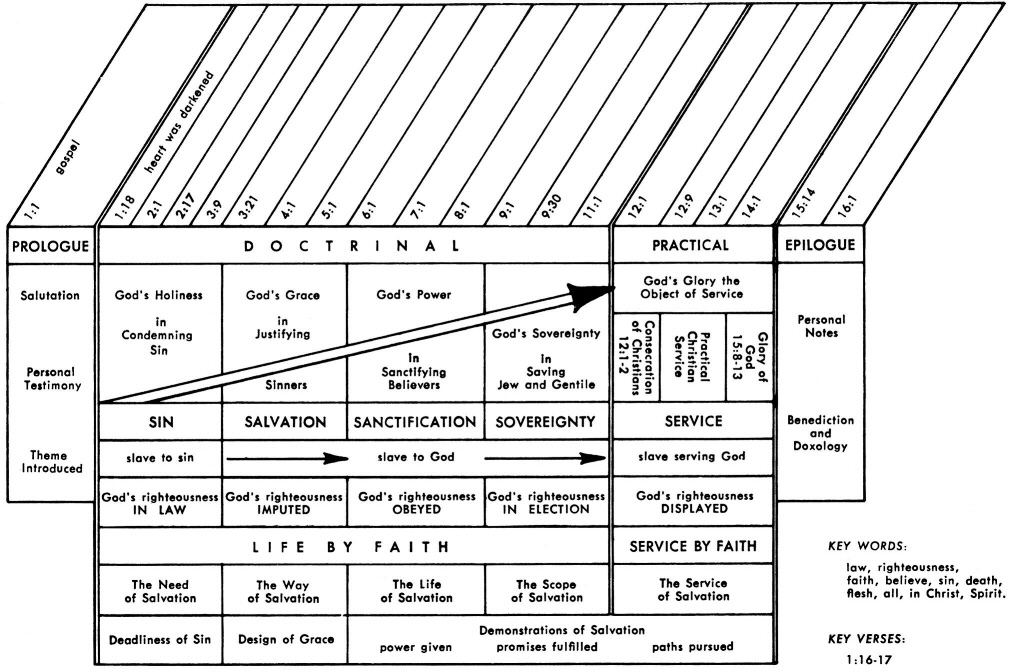
Click chart to enlarge
Chart from recommended resource Jensen's Survey of the NT - used by permission
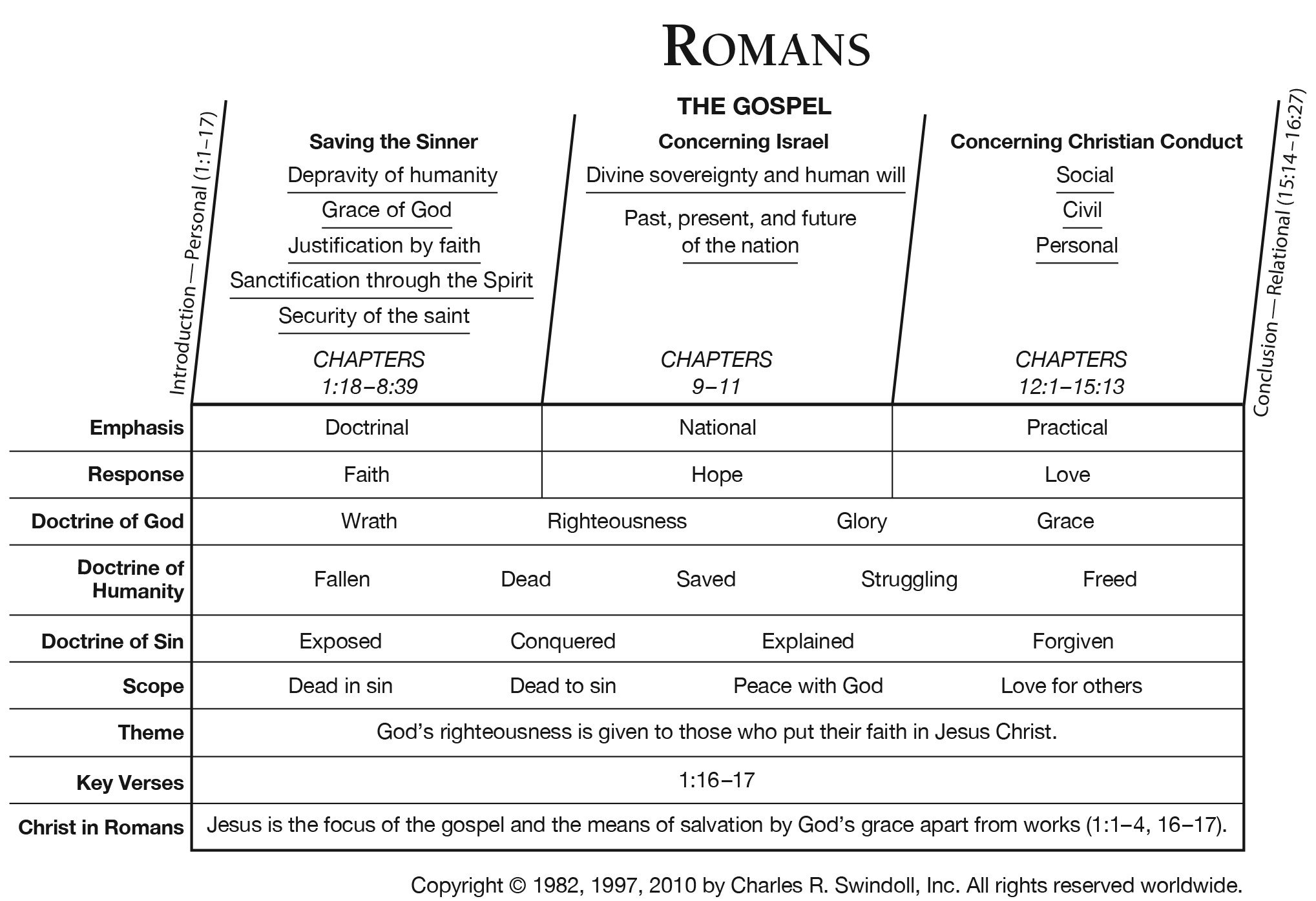
Click Charles Swindoll's overview chart
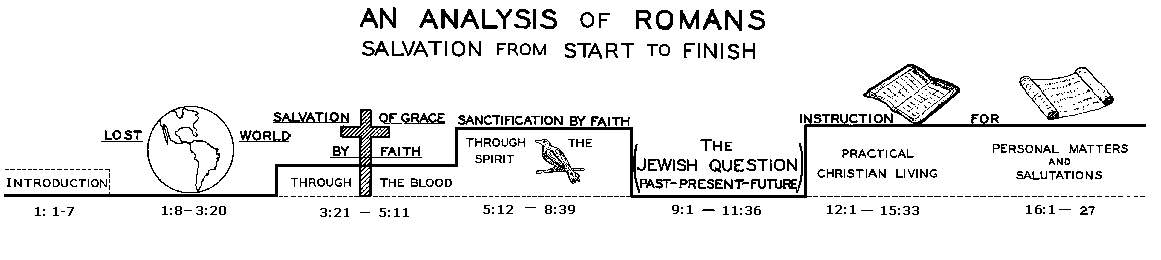
Source: Dr David Cooper
Click to Enlarge
| ROMANS ROAD to RIGHTEOUSNESS |
||||
| Romans 1:18-3:20 | Romans 3:21-5:21 | Romans 6:1-8:39 | Romans 9:1-11:36 | Romans 12:1-16:27 |
| SIN | SALVATION | SANCTIFICATION | SOVEREIGNTY | SERVICE |
| NEED FOR SALVATION |
WAY OF SALVATION |
LIFE OF SALVATION |
SCOPE OF SALVATION |
SERVICE OF SALVATION |
| God's Holiness In Condemning Sin |
God's Grace In Justifying Sinners |
God's Power In Sanctifying Believers |
God's Sovereignty In Saving Jew and Gentile |
Gods Glory The Object of Service |
| Deadliness of Sin |
Design of Grace |
Demonstration of Salvation | ||
| Power Given | Promises Fulfilled | Paths Pursued | ||
| Righteousness Needed |
Righteousness Credited |
Righteousness Demonstrated |
Righteousness Restored to Israel |
Righteousness Applied |
| God's Righteousness IN LAW |
God's Righteousness IMPUTED |
God's Righteousness OBEYED |
God's Righteousness IN ELECTION |
God's Righteousness DISPLAYED |
| Slaves to Sin | Slaves to God | Slaves Serving God | ||
| Doctrine | Duty | |||
| Life by Faith | Service by Faith | |||
|
Modified from Irving L. Jensen's chart above |
||||
Romans 2:24 For "THE NAME OF GOD IS BLASPHEMED (3SPPI) AMONG THE GENTILES BECAUSE OF YOU," just as it is written (3SRPI). (NASB: Lockman)
Greek: to gar onoma tou theou di humas (di humas = because of you) blasphemeitai (3SPPI) en tois ethnesin, kathos gegraptai (3SRPI):
Amplified: For, as it is written, The name of God is maligned and blasphemed among the Gentiles because of you! [The words to this effect are from your own Scriptures.] [Isa. 52:5; Ezek. 36:20.] (Amplified Bible - Lockman)
NLT: No wonder the Scriptures say, "The world blasphemes the name of God because of you." (NLT - Tyndale House)
Phillips: Don't you know that: 'the very name of God is cursed among the Gentiles because of the behaviour of Jews?' There is, you know, a verse of scripture to that effect. (Phillips: Touchstone)
Wuest: For the Name of God because of you is reviled among the Gentiles, even as it stands written
Young's Literal: for the name of God because of you is evil spoken of among the nations, according as it hath been written.
- Isa 52:5; La 2:15,16; Ezek 36:20, 21, 22, 23; Mt 18:7; 1Ti 5:14; 6:1; Titus 2:5,8
- Smith on Blasphemy
Romans 2:17-20 shows the great privileges the Jews possessed.
Romans 2:21-23 shows the failure to practice their great privileges
Romans 2:24 shows the effect their hypocrisy had on the reputation of God among the Gentiles
As it is written - Paul quotes from the Septuagint version of Isaiah 52:5 (Lxx = "blasphemeitai en tois ethnesin", identical to the Greek here in Ro 2:24) which in Brenton's English translation of Isa 52:5 reads "On account of you my name is continually blasphemed among the Gentiles."
HCSB - Paul cited Isa 52:5 from the Greek OT (the Septuagint, or LXX) as support that Jewish sin resulted in God's name being dishonored among the pagan nations when the Jews were defeated and exiled. To pagan perception, Yahweh seemed powerless since He did not protect His people.
Bible Knowledge Commentary - Paul did not condemn this hypocrisy of the Jews on his own authority; he quoted their own Scriptures (the close of Isa. 52:5, in the LXX). Their hypocrisy dishonored God; also it caused Gentiles to blaspheme God. “Why should we honor God,” Gentiles may have reasoned, “when His Chosen People do not follow Him?”
Note that Romans 2:24 should be read with the previous passages Ro 2:17-23 for context, especially in light of the fact that Ro 2:24 begins with for (gar).
For (gar) - Always be alert for the little preposition for (there are over 7000 in Scripture!) and if the context dictates as in this passage that the for is a term of explanation, pause and ponder it by asking yourself what is the Spirit seeking to explain? In fact, stop reading right now and observe Romans 2:23 and see if you can determine what Romans 2:24 is explaining. Notice how pausing to ponder will force you to examine the context. You can (and should) practice this simple discipline every time you encounter a for, and while not every instance is a term of explanation, a for at the beginning of a verse is almost always used with that grammatical sense. I can guarantee (based on my experience and the experience of many to whom I have taught this simple principle) that if you begin to "pause and ponder," you will radically rejuvenate your "Read Through the Bible in a Year" program! You might even get a small journal and begin to keep notes on what the Spirit illuminates and how this truth can be applied to your daily life. As you practice interrogating "for" with the 5W/H questions such as "What's the for explaining?", you will begin to learn to (1) Read the Bible inductively (power point overview) and to (2) Meditate (see also Primer on Biblical Meditation) on the Scripture. Meditation or "chewing the cud" of the Scripture (cf Mt 4:4, Job 23:12+, Jer 15:16) so to speak is a vanishing discipline (art) in our fast paced, hi tech, low touch society (unless it's a touch screen!), but a spiritual discipline which God promises to greatly bless (See Ps 1:1+, Ps 1:2+, Ps 1:3+, Joshua 1:8+, cf Ps 4:4, 19:14, 27:4, 49:4, 63:6, Ps 77:6, 77:12, Ps 104:34, Ps 119:15, 119:23, 119:27, Ps 119:48, 119:78, Ps 119:97, 119:99, Ps 119:148, 143:5, Ps 145:5) From the preceding passages which "organ" of our being is most often involved/engaged in meditation? What are the subjects or the focus of meditation? Remember that reading the Bible without meditating on it is like eating without chewing. We must read…
Scripture every day
And meditate on what God said
To fight temptation from the world
And live a life that's Spirit led
(see note) --Sper
The Name of God - God's Name is tantamount to His character, to the essence of Who He is (see study of the Name of the LORD), and so to blaspheme His Holy Name is to blaspheme the very essence of His being.
Paul introduces a bitter irony here, because this Name is the very word which none of the religious Jews would ever dare speak because they considered it so holy! And so while not doing so with their lips, they did in fact blaspheme God's Name with their lives. Our lives often speak much louder than our lips, which is a powerful reminder for all who name the Name of Jesus as their Lord. Unbelievers are always watching!
The Name of God is blasphemed - It is spoken of with reproach. God's Name is reviled by contemptuous speech that intentionally comes short of the reverence due to that holy (set apart) Name.
In a similar way Nathan confronted David with his sin against Uriah and his wife Bathsheba, asking
'Why have you despised the word of the LORD by doing evil in His sight? You have struck down Uriah the Hittite with the sword, have taken his wife to be your wife, and have killed him with the sword of the sons of Ammon. 10 'Now therefore, the sword shall never depart from your house, because you have despised Me and have taken the wife of Uriah the Hittite to be your wife.' 11 "Thus says the LORD, 'Behold, I will raise up evil against you from your own household; I will even take your wives before your eyes, and give them to your companion, and he shall lie with your wives in broad daylight. 12 'Indeed you did it secretly, but I will do this thing before all Israel, and under the sun.'" 13 Then David said to Nathan, "I have sinned against the LORD." And Nathan said to David, "The LORD also has taken away your sin; you shall not die.14 "However, because by this deed you have given occasion to the enemies of the LORD to blaspheme, the child also that is born to you shall surely die." (2Sa 12:9-14)
Keep in mind that David was probably in his mid-to-late 40's at the time of this sin. Note also that the sin reflected David (a man after God's own heart) contempt of the Holy Word and of the Holy God, two incredible statements that we otherwise would never have attributed to King David who wrote the majority of the psalms. The result was that it gave occasion to the enemies of Jehovah to blaspheme His Holy Name, and for this David was suffered severe consequences, even though God spared his life upon his confession.
Abraham experienced essentially the same thing when he told Pharaoh that Sarah was his sister and Pharaoh took her into his harem. After the discovery Abraham and Sarah went away, and Abraham had no more testimony for God before the Egyptians.
Ezekiel speaks of the blaspheming of God's name writing…
When they (Jews, the Nation of Israel) came to the nations where they went, they profaned ("dragged in the dirt" so to speak) My holy name, because it was said of them (by the pagan, idol worshipping Gentiles who were watching the Jews to see if they practiced what they preached or what they claimed to be true about God and His Law), 'These (Jews) are the people of the LORD; yet they have come out of His land (Exiled for 70 years because of their spiritual harlotry and failure to keep the Lord's Sabbaths).' "But I had concern for My holy Name, which the house of Israel had profaned among the (Gentile) nations where they went. "Therefore, say to the house of Israel, 'Thus says the Lord GOD, "It is not for your sake, O house of Israel, that I am about to act, but for My holy Name (God's Name was to have been exalted among the pagans, not profaned by the people who claimed His Name!), which you have profaned among the (Gentile) nations where you went. "And I will vindicate (avenge, free from allegation) the holiness of My great Name which has been profaned among the (Gentile) nations, which you have profaned in their midst (Where the profanity was clearly visible to the pagan nations!). Then ("Then" is an expression of time - When God Himself defends and avenges His great and Holy Name) the nations (the Gentiles) will know that I am the LORD (Jehovah, the Covenant Keeping God)," declares the Lord GOD, "when (This is another expression of time which describes an unfulfilled prophecy, one which will be fulfilled when the Messiah returns to take up His throne in Jerusalem and establish His kingdom) I prove Myself holy among you (the nation of Israel) in their sight. (Ezek 36:20-23)
God will show Himself faithful to His covenant and will restore Israel to the land for His "holy name's sake" not because of any merit in them
We must remember that God's people are His only representatives that many people see and so when we sin, we profane His name before the pagans. God acts to defend His holy name. He wants all people to know the awesome holiness which separates Him from all other gods.
Blasphemed (987) (blasphemeo derived from bláx = sluggish, slow, stupid + phéme = rumor, fame) OR MORE LIKELY (derived from blápto = to hurt, injure, harm + phéme from phemí = to speak) means literally to speak to harm and in general therefore means to bring into ill repute and so to slander, to defame (to harm the reputation of by libel or slander), speak evil of, to rail at (revile or scold in harsh, insolent, or abusive language and rail stresses an unrestrained berating), to speak calumny (noun form = a misrepresentation intended to blacken another’s reputation = the act of uttering false charges or misrepresentations maliciously calculated to damage another’s reputation), to calumniate (verb form = to utter maliciously false statements, charges, or imputations about - calumniate imputes malice to the speaker and falsity to the assertions).
Here are the 34 NT uses of blasphemeo -
Mt. 9:3; 26:65; 27:39; Mk. 2:7; 3:28f; 15:29; Lk. 12:10; 22:65; 23:39; Jn. 10:36; Acts 13:45; 18:6; 19:37; 26:11; Ro 2:24; 3:8; 14:16; 1 Co. 10:30; 1 Tim. 1:20; 6:1; Titus 2:5; 3:2; Jas. 2:7; 1 Pet. 4:4; 2Pet. 2:2, 10, 12; Jude 1:8, 10; Re 13:6; 16:9, 11, 21
MacDonald (Believer's Bible Commentary) comments…
This combination of high talk and low walk caused the Gentiles to blaspheme the name of God. They judged the Lord, as men always do, by those who professed to be His followers. It was true in Isaiah’s day (Isa 52:5) and it is still true today. Each of us should ask:
If of Jesus Christ their only view
May be what they see of Him in you,
(Insert your name), what do they see?
Written (1125) (grapho from root graph- = primarily means to scratch on or engrave as on an ornament, reports, letters, etc; English = graph, graphic, etc) means to engrave or inscribe with a pen or stylus characters or letters on a surface which can be wood, wax, metal, leather, stone, parchment, dirt (John ), paper, etc and then to write. (Click to review all 191 uses of grapho in the NAS)
Grapho is in the perfect tense which signifies that this truth was written down in the past (in this case by the prophet Isaiah) and it remains written and in effect. The perfect tense thus speaks of the permanence of the written word of God.
It is written occurs 76 times in the (Click for these uses). When we were children and our parents told us to do something and we questioned "Why?", the answer was usually "Because I said so!". Why are we commanded to be holy? Because God said so! A popular saying is
God said it, I believe it, that settles it.
This sounds good but isn't accurate because God's Word is true, irregardless of whether we believe it or not. A more accurate "saying" would be
God said it, that settles it!
It is written should put a stop to every complaint or excuse. Paul is saying don't judge but remember you will appear before Me to give an account (as the next verse clarifies). This sobering thought should motivate us to obey this injunction.
Paul is quoting in part from the Septuagint (LXX) of Isaiah 52:5. Paul reminds his Jewish reader that God had stated in the Old Testament that the failure of the Jew to obey the law was the cause of His holy Name being continually blasphemed by the Gentiles!
Paul appeals to the testimony of the very Law they boast in as that which in fact condemns them. As alluded to above, the Jews were so zealous for the Name of God that they would not pronounce the Tetragrammaton (YHWH or "Yahweh" when one adds vowels - see study of Jehovah) and yet the tragic irony was that they acted in such a way that the Gentiles blasphemed the very Name the Jews claimed to revere!
The Old Testament prophets like Isaiah and Ezekiel and now Paul, all declare that God's character and honor are at stake and that the opinion of Him on the part of the pagans is based at least in part on the conduct of those who claimed His Name. The captivity of Israel and Judah, because of continual national unfaithfulness to Jehovah resulted in the Gentile nations scoffing at the God of the Jews. In other words His name was blasphemed because of them.
THOUGHT - If you claim the Name of Jesus as your Lord, what is the opinion your family members, co-workers, neighbors, etc have of your God because of what they know of your character and conduct?
A Modern day illustration of how God's Name is Blasphemed by those who claim to know Him: Stuart Briscoe tells about having to deal with a fellow employee who had embezzled a large sum of money from the bank for which they both worked. The reason the man embezzled was that he had two wives and families to support. When he was apprehended and fired, he stunned everyone by saying,
“I am very sorry for what I have done, and I need to know whether I should fulfill my preaching commitments on Sunday in our local church.”
Briscoe says that in the following weeks he spent a great part of his time mending the damage done by that man’s blatant inconsistency. To his chagrin, he found that his fellow workers not only despised the man, but “… were quick to dismiss the church he belonged to as a ‘bunch of hypocrites,’ the gospel he professed to believe as a ‘lot of hogwash,’ and the God he claimed to serve as ‘nonexistent.’”
Right In Our Front Yard - Grass or weeds? Bluegrass or quack grass? Thick or thin? Browning out or greening up? These are the things I look for when I drive by the front yard of a nearby office building. To the credit of its keepers, the lawn has been green and weed-free for some time now. Even in the middle of summer that grass looks first-class.
There's a good reason I'm always checking out this lawn. It graces the corporate offices of a highly competitive and well-known lawn-care firm. I suppose they would have a good excuse if their turf was not picture-perfect. They could claim they're so busy servicing the lawns of others that they don't have time for their own. On the other hand, who's going to respect a business that doesn't use its own product?
Throughout history, the people of God have been in a similar position. They have always been on display, representing the true and living God. Unfortunately, as the apostle Paul pointed out, many professing believers have been a poor testimony for the Lord (Ro 2:24).
Today, because we call ourselves Christians, we turn the heads of curious passersby. As if by reflex, people naturally watch us. They want to see if what we claim to have is really working--right in our own front yard. --M R De Haan II (Our Daily Bread, Copyright RBC Ministries, Grand Rapids, MI. Reprinted by permission. All rights reserved)
I do not ask for mighty words
To leave the crowd impressed;
Lord, grant my life may ring so true
My neighbor may be blessed. --Anon.
What we practice proves what we profess.
- Christ assailed with -Matthew 10:25; Luke 22:64,65; 1 Peter 4:14
- Charged upon Christ -Matthew 9:2,3; 26:64,65; John 10:33,36
- Charged upon saints -Acts 6:11,13
- Proceeds from the heart -Matthew 15:19
- Forbidden -Exodus 20:7; Colossians 3:8
- The wicked addicted to -Psalms 74:18; Isaiah 52:5; 2 Timothy 3:2; Revelation 18:11,21
- Idolatry counted as -Isaiah 65:7; Ezekiel 20:27,28
- Hypocrisy counted as -Revelation 2:9
- Saints grieved to hear -Psalms 44:15,16; 74:10,18,22
- Gives no occasion for -2 Samuel 12:14; 1 Timothy 6:1
- Against the Holy Spirit, unpardonable -Matthew 12:31,32
- Connected with folly and pride -2 Kings 19:22; Psalms 74:18
- Punishment of -Leviticus 24:16; Isaiah 65:7; Ezekiel 20:27-33; 35:11,12
Exemplified
- The Danite -Leviticus 24:11
- Sennacherib -2 Kings 19:4,10,22
- The Jews -Luke 22:65
- Hymenaeus -1 Timothy 1:20
Romans 2:25 For indeed circumcision is of value (3SPAI), if you practice (2SPAS) the Law; but if you are (2SPAS) a transgressor of the Law, your circumcision has become (3SRAI) uncircumcision. (NASB: Lockman)
Greek: Peritome men gar ophelei (3SPAI) ean nomon prasses (2SPAS): ean de parabates nomou es (2SPAS) e peritome sou akrobustia gegonen (3SRAI):
BGT Περιτομὴ μὲν γὰρ ὠφελεῖ ἐὰν νόμον πράσσῃς· ἐὰν δὲ παραβάτης νόμου ᾖς, ἡ περιτομή σου ἀκροβυστία γέγονεν.
Amplified: Circumcision does indeed profit if you keep the Law; but if you habitually transgress the Law, your circumcision is made uncircumcision. (Amplified Bible - Lockman)
KJV For circumcision verily profiteth, if thou keep the law: but if thou be a breaker of the law, thy circumcision is made uncircumcision.
NKJ For circumcision is indeed profitable if you keep the law; but if you are a breaker of the law, your circumcision has become uncircumcision.
NET For circumcision has its value if you practice the law, but if you break the law, your circumcision has become uncircumcision.
CSB For circumcision benefits you if you observe the law, but if you are a lawbreaker, your circumcision has become uncircumcision.
ESV For circumcision indeed is of value if you obey the law, but if you break the law, your circumcision becomes uncircumcision.
NIV Circumcision has value if you observe the law, but if you break the law, you have become as though you had not been circumcised.
NLT: The Jewish ceremony of circumcision is worth something only if you obey God's law. But if you don't obey God's law, you are no better off than an uncircumcised Gentile. (NLT - Tyndale House)
Phillips: That most intimate sign of belonging to God that we call circumcision does indeed mean something if you keep the Law. But if you flout the Law you are to all intents and purposes uncircumcising yourself! (Phillips: Touchstone)
Wuest: For, indeed, circumcision is profitable if you are making a practice of law, but if, on the other hand, you are a transgressor of law, your circumcision has become uncircumcision.
Young's Literal: For circumcision, indeed, doth profit, if law thou mayest practise, but if a transgressor of law thou mayest be, thy circumcision hath become uncircumcision.
- Circumcision - Ro 2:28-29; Ro 3:1,2; Ro 4:11-12; Dt 30:6; Jer 4:4; Gal 5:3-6; 6:15; Ep 2:11-12
Related Passages:
Romans 2:28-29 For he is not a Jew who is one outwardly, nor is circumcision that which is outward in the flesh. 29 But he is a Jew who is one inwardly; and circumcision is that which is of the heart, by the Spirit, not by the letter; and his praise is not from men, but from God.
Romans 4:11-12 and he received the sign of circumcision, a seal of the righteousness of the faith which he had while uncircumcised, so that he might be the father of all who believe without being circumcised, that righteousness might be credited to them, 12 and the father of circumcision to those who not only are of the circumcision, but who also follow in the steps of the faith of our father Abraham which he had while uncircumcised.
Jeremiah 4:4 (A CALL FOR HEART CIRCUMCISION) “Circumcise (A COMMAND - IN LXX = aorist imperative = "JUST DO IT!") yourselves to the LORD And remove the foreskins of your heart, Men of Judah and inhabitants of Jerusalem, Or else My wrath will go forth like fire And burn with none to quench it, Because of the evil of your deeds.”
Jeremiah 9:25-26 (THE HEART OF THE ISSUE WITH ISRAEL WAS THEIR HARD HEART!) “Behold, the days are coming,” declares the LORD, “that I will punish all who are circumcised and yet uncircumcised– 26 Egypt and Judah, and Edom and the sons of Ammon, and Moab and all those inhabiting the desert who clip the hair on their temples; for all the nations are uncircumcised, and all the house of Israel are uncircumcised of heart.”
Deuteronomy 10:16+ “So circumcise your heart, and stiffen your neck no longer.
Deuteronomy 30:6+ (THIS IS IN EFFECT A PROPHECY OR "ANTICIPATION" OF THE NEW COVENANT) “Moreover the LORD your God will circumcise your heart and the heart of your descendants, to love the LORD your God with all your heart and with all your soul, so that you may live. (NOTE: The juxtaposition of divine provision in Dt 30:6 and human responsibility in Dt 10:16, but frankly the latter can be obeyed only if God gives the person the desire and the power by the Spirit. In other words, human responsibility [Dt 10:16] becomes human possibility only through divine provision [Dt 30:6], which Paul describes in Php 2:13NLT+ which allows one to carry out the command in Php 2:12+).
Acts 7:51+ (STEPHEN ADDRESSING JEWS WHO WERE PHYSICALLY CIRCUMCISED) “You men who are stiff-necked and uncircumcised in heart and ears are always resisting the Holy Spirit; you are doing just as your fathers did. (NOTE: It was also the role of the Holy Spirit in the OT to bring about internal, heart circumcision).
THE VALUE OF
CIRCUMCISION
Paul now turns to expose a dangerous illusion cherished by many Jews of his day, the belief that possessing the covenant sign of circumcision guaranteed covenant favor, regardless of the condition of their heart. Having already demonstrated that the Jew’s knowledge of the Law could not save him (Ro 2:17–24), Paul now shows that neither can physical circumcision, the sign of the Abrahamic covenant (Ge 17:11+), save apart from obedience, only possible if one's heart is circumcised (see Circumcision of the Heart)! In effect, Paul dismantles every false refuge of external religion. He argues that circumcision, though God-given and deeply significant, has spiritual value only when it reflects a life submissive to God’s revealed will. Without obedience flowing from faith and enabled by the Holy Spirit, the outward sign becomes an empty ritual, and the very mark designed to testify to covenant loyalty becomes a witness against the one who bears it!
For (gar) is a term of explanation, begging the question "What is Paul explaining?" Paul is showing why the Jew’s boast in circumcision (Ro 2:17–24) is misplaced. In Romans 2:23–24 the Jews dishonor God by breaking the Law. In Romans 2:25 (with gar) Paul explains why their covenant sign cannot save them. Paul’s flow is as follows -- you boast in the Law but break it (Ro 2:23). God’s Name is blasphemed because of this (Ro 2:24). For (gar) the sign of the covenant (circumcision) has no value if you break the Law (Ro 2:25). Therefore circumcision becomes “uncircumcision.” In sum, In Romans 2:25 FOR (gar) explains why circumcision is worthless without obedience, because the value of any covenant sign depends on the reality it signifies.
Indeed circumcision (peritome) is of value (opheleo - profit), IF (3CC - "if — and only if") you practice (prasso - habitually do) the Law (nomos) - Paul is saying "Your circumcision only profits you IF your life matches the covenant you claim. An external mark without an obedient heart is worthless.” Paul's conditional clause destroys the illusion of "automatic righteousness." Circumcision is not magical, is not salvific, and is not a guarantee of righteousness. Circumcision only had value as a sign in one whose heart was submitted to God. Paul is dismantling the false security of the Jews who are relying on externals without evidence of internal transformation.
The sign means nothing
if the life contradicts it!
The fact is no one can continually keep the Law. The sign (circumcision) is of no value unless the thing signified is also present, i.e., unless the person has experienced circumcision of the heart (Ro 2:28), a stipulation that was even given in the Old Testament to the Jews by Moses (see note above on Dt 10:16, Dt 30:6).
Practice (prasso) is in the present tense emphasizes this is one's continual activity or habitual practice. Practice (prasso) emphasizes not occasional obedience, not selective obedience, but continual, habitual obedience from the heart. To reiterate Paul's point is "If you consistently obeyed the Law, your circumcision would align with your life. But since you don’t, your circumcision is meaningless.” Circumcision without righteousness is like water baptism without faith, both are but an empty shell (and can deceive a person into believing they are saved - I was baptized 3 times, but only the third time was the real-deal!)
A mark in the flesh without obedience
from the heart is worthless.
Steven Cole introduces his sermon on Romans 2:25-29 with an interesting question - Who are the most difficult people to reach with the gospel? I realize that only God can save a soul and that nothing is too difficult for Him. But, from a human standpoint, some types of people seem to be more difficult to bring to saving faith than others are (Luke 18:24-27). The Bible shows us that the most difficult people to reach are religious people who trust in their religion. They relish their rituals and religious traditions. They don’t see their need for a Savior from sin because they view themselves as pretty good people. They think they are right with God because of their religious performance (Luke 18:11-12). They may be Jewish, Muslim, Hindu, Sikh, Buddhist, Baha’i, Mormon, Catholic, Orthodox, or Protestant. They can even be Baptists! They think that their performance of their religious rituals will somehow commend them to God. But they lack reality with the living God on the heart level. Paul knew that the most difficult people to reach with the gospel were not the pagans whom he described in Romans 1:18-32. Like Matthew or Zaccheus (Luke 5:27-32; 19:1-10), the tax collectors, or like the sinful woman who washed Jesus’ feet with her tears (Luke 7:36-50), many obviously wicked people know that they are sinners. They may not be sure that God could ever forgive them. But they welcome that news when they hear it. But the religious Jews didn’t see themselves as sinners and so they didn’t see any need for a Savior. They trusted in their Jewishness, in their possession of God’s Law, and in their conformity to the prescribed religious rituals, especially circumcision. (See full sermon Ritual Versus Reality Romans 2:25-29)
Notice the flow of Paul's argument to lead his readers to begin to see their NEED for "the power of God for salvation" and the only kind of righteousness which is acceptable to God (Ro 1:16-17). So in Ro 2:12-24 he deals specifically with the Law and how it does not bring about a righteousness which is acceptable to God. Now Paul demolishes physical circumcision, the second major Jewish pillar on which they relied (in vain) for salvation. The Jews believed that keeping the Law and circumcision were necessary for salvation (see Acts 15:1-4,5-29), but Paul explains that they were wrong.
Robert Haldane explains that "Paul here pursues the Jew into his last retreat, in which he imagined himself most secure. He presses him on the subject of circumcision, which the Jews viewed as their stronghold—that rite even more ancient than Moses, and by which they were distinguished from the other nations. The sum of this, and the following verses to the end of the chapter, is, that the Jews being such as the Apostle had represented them, all their advantages, including circumcision, could only enhance their condemnation before the tribunal of God, and that, on the contrary, if the Gentiles, who have not received the law, observed its precepts, they would be justified without circumcision. Two things are here to be observed, namely, what is asserted of the Jews and Gentiles, and the proof that follows. The assertions are, that circumcision serves only as a ground of condemnation to transgressors of the law; and, on the other hand, that the want of it would be no detriment to those who fulfilled the law. The proof is, that before God the true Jew and the true circumcision consist not in external qualities, but in internal and real holiness. The reason why circumcision was not included in the enumeration before given of the advantages of the Jews is, that in itself it is not an advantage, but only a sign of other advantages; and it is mentioned here, because, in the character of a sign, it includes them: to name circumcision then, is to refer to them all. In this verse the Apostle does not speak of circumcision according to its real and most important signification as he does in the two concluding verses, but in that view in which the Jews themselves considered it, as the initiatory and distinctive rite of their religion, without the observance of which they believed they could not be saved." (An Exposition of Romans 2)
William MacDonald explains "Here Paul links circumcision with the Law of Moses and points out that it was only valid as a sign when it was combined with a life of obedience. God is not a mere ritualist; He is not satisfied with external ceremonies unless they are accompanied by inward holiness. So a circumcised Jew who transgresses the law might just as well be uncircumcised." (BORROW Believer's Bible Commentary PAGE 1684)
A sacred sign without a surrendered heart
is just "religious graffiti."
Steven Cole however understands this passage differently writing "I do not understand him to mean, “if you practice the Law perfectly.” Some think that when Paul mentions keeping the Law in this section (Ro 2:25, 26, 27), he is speaking hypothetically of perfect obedience, which no one can do. But I understand him to be referring to a lifestyle of obedience to God’s Law, which is possible for those who have been born again (Luke 1:6; 2:25). For such Jews before the cross, circumcision was of value." (See full sermon Ritual Versus Reality Romans 2:25-29)
John MacArthur - Circumcision is of value, Paul explains, only if you practice the Law, that is, live in obedience to God’s will. To the faithful, obedient Jew, circumcision was a symbol of God’s covenant, His blessings, His goodness, and His protection of His chosen people… A Jew who continually transgressed God’s law proved that he had no more saving relationship to God than a pagan Gentile, whom Jews often referred to as the uncircumcised. (See Romans Commentary)
James Denney explains that "The absence of the article (before circumcision) suggests that the argument may be extended to everything of the same character as circumcision. Circumcision was the seal of the covenant, and as such an assurance given to the circumcised man that he belonged to the race which was the heir of God’s promises. That was undeniably an advantage…but if the actual inheriting of the promises has any moral conditions attached to it (as Paul proceeds to show that it has), then the advantage of circumcision lapses unless these are fulfilled. Now, the persons contemplated here (the Jews) have not fulfilled them. (The Expositor's Greek Testament)
Paul recognizes that a Jew may protest, and say that his salvation is based on the fact that he is a descendant of Abraham. Paul rightly says that this is irrelevant regarding justification. Circumcision was a sign (Ge 17:11) of God’s covenant with Abraham and his descendants, and therefore another token, besides the Law, of the special privileges which were granted to the Jew and in which they gloried and sadly which they misinterpreted to be the means of obtaining righteousness. As illustrated by the Rabbinical quotations below in the next section, the Jews believed that circumcision guaranteed their salvation. They might be punished in the world to come, but they believed that they could never be lost. Paul counters this "spiritual red herring" and proceeds to point out that circumcision is irrelevant regarding justification. In so doing he again is preparing them to see clearly their desperate need for the Gospel which is the power of God for their salvation, for in the Gospel is revealed the righteousness that God demands and that He provides to the one who repents and believes. Are you trusting in anything that you can do to merit righteousness, right standing before God? And dear believer, now that you are saved, are you still from time to time trusting in anything other than the imputed righteousness you have been granted? In other words you have been saved by faith in the Gospel, but are you daily living in the power of the Gospel by faith or are you falling back into works righteousness.
Bob Utley on the uses of IF in Romans 2:25-26 - "if. . .if. . .if" These are three THIRD CLASS CONDITIONAL SENTENCES which refer to possible future action. Obedience (cf. Leviticus 26; Deuteronomy 28) is the key in Paul's argument in Romans 2, but not in Rom. 3:21-31 (cf. Galatians 3). Obedience is the result of salvation but grace is the basis (cf. Eph. 2:8-10).
Steven Cole - God instituted the practice of circumcision (the removal of the male foreskin) as a sign of His covenant with Abraham, over 500 years before He gave Moses the Law (see Genesis 17). It symbolized moral purity and separation from the world unto God. Under the Law of Moses, it became a sign of membership in the covenant community. So as a God-ordained ritual, circumcision was of value to the Jews as a reminder of their covenant relationship to God and of the need to be morally set apart to God. When Paul says that circumcision is of value, he is speaking to the Jews as Jews. When he addresses those who are in Christ, he says (Gal. 5:6), “For in Christ Jesus neither circumcision nor uncircumcision means anything, but faith working through love.” Circumcision was a Jewish sign of the covenant that ended when Jesus instituted the new covenant. Except for hygienic reasons, it holds no value for believers in Christ. (See full sermon Ritual Versus Reality Romans 2:25-29)
Jerry Bridges emphasizes the importance in the believer's life of "A Daily Appropriation of the Gospel" writing…
The second essential (of finishing your life well) is a daily appropriation of the Gospel. I have put personal communion with God first to highlight its priority because that’s the absolute basic essential. But in actual practice I put my daily appropriation of the Gospel first. That is, I begin my time with God by reviewing and appropriating to myself the Gospel. Since the Gospel is only for sinners, I come to Christ as a still practicing sinner. In fact, I usually use the words of that tax collector in the temple when he cried out, “God, be merciful to me, a sinner” (Luke 18:13). God has been merciful, and I’m quick to acknowledge his mercy in my life, but I say to him that I come in the attitude of that tax collector. “I need your mercy. I am still a practicing sinner. Even my very best deeds are sinful in your sight, and I am an object of your mercy and your grace.”
It’s important that we come, first of all, by appropriating the Gospel because it’s through Christ that we have access to God the Father. Paul says in Ephesians 2:18, “For through Him we both [Jew and Gentile] have access in one Spirit to the Father.” We cannot come directly to God. We must always come through the blood of the Lord Jesus Christ. But God not only allows us to come; He invites us to come. The writer of Hebrews says, “Therefore, brothers, since we have confidence to enter the holy places by the blood of Jesus, by the new and living way that he opened for us through the curtain, that is, through his flesh, and since we have a great priest over the house of God, let us draw near with a true heart in full assurance of faith” (Heb. 10:19–22). And so as we appropriate the Gospel it gives us the confidence to come into the very presence of God to have communion with Him (cf Ro 5:1-2). So we need to learn to live by the Gospel every day of our lives.
In the early years of my Christian life and even in my early ministry I regarded the Gospel as a message for the unbeliever. Now that I was a Christian I personally no longer needed the gospel except as a message to share with unbelievers. But I learned the hard way many years ago that I need the Gospel every day of my life. At the time I was serving overseas, and I was single and lonely. Additionally I was struggling with some interpersonal relationship issues. Every Monday night I led a Bible study at an American Air Force base about an hour’s drive from where I lived. And every Monday night as I drove home, Satan would attack me with accusations of my sin. Out of desperation I began to resort to the Gospel. To use an expression I learned years later, I began to “preach the Gospel to myself.” And I subsequently learned that I continued to need the Gospel every day of my life. That is why I list this practice as one of the four essential elements.
Consider Paul’s words in Galatians 2:20. The apostle writes, “I have been crucified with Christ. It is no longer I who live, but Christ who lives in me. And the life I now live in the flesh I live by faith in the Son of God, who loved me and gave himself for me.” The context of this verse is the subject of justification. In Gal 2:15–17 Paul speaks of our being justified four times. He says we’re not justified by works of the law but by faith in Jesus Christ, and he keeps repeating that thought. And then in Gal 2:21 he says, “I do not nullify the grace of God, for if justification were through the law, then Christ died for no purpose.” Clearly in this entire passage, Gal 2:15–21, he is talking about the subject of justification. He is going to get to sanctification later, but that’s not in this context. The reason I make a point of that is because I want to call your attention particularly to the last sentence of Gal 2:20. “And the life I now live in the flesh I live by faith in the Son of God, who loved me and gave himself for me.” Remember, in the context Paul is speaking about justification, not sanctification.
Now this raises an apparent problem or question. That is, we know that justification is a point-in-time past event. At the time you trusted Christ you were at that precise moment declared righteous by God. You were justified. That’s why Paul in Romans 5:1 can speak of justification in the past tense when he says, “Therefore, since we have been justified by faith, we have peace with God through our Lord Jesus Christ.” And yet here in this passage he speaks of it in the present tense. “The life that I now live in the flesh,” today. The life that I live today, “I live by faith in the Son of God, who loved me and gave himself for me.” So if justification is a point-in-time event that happened in our past, why does Paul speak of it in the present tense? The life that I now live today I live by faith in the Son of God.
The answer to that question is one of the most important truths we can learn about the Gospel. For the apostle Paul, justification was not only a past event; it was also a present reality. This is where so many Christians miss it. They can look back to the day that they trusted Christ. And if you press them on that they will say, “Yes, I was justified at that time.” But today they seek to live their lives as if it depends upon them. In their mind they have reverted to a performance relationship with God. And so the thinking is, if I had my quiet time and if I haven’t had any lustful thoughts and these kind of things, then I expect God to bless me today. We want to pay our own way. We want to earn God’s blessings. The apostle Paul didn’t do that. Paul looked outside himself and saw himself clothed in the righteousness of Christ. He saw himself declared righteous. We say to a person who trusts Christ, “You have been justified. You’ve been declared righteous. Your sins have been forgiven. You stand before God today clothed in the righteousness of Jesus Christ.” And then we can point to eternity and say, “When you go to be with the Lord forever, you will still stand clothed in the righteousness of Jesus Christ.” Even though we will have left our sinful nature behind, even though we will be righteous people made perfect, as the writer of Hebrews says (Heb. 12:23), we will for all eternity stand in the righteousness of Christ. That never changes.
But what about from the time of our conversion until the time we go to be with the Lord? For most Christians it’s a performance relationship. That is why we need a daily appropriation of the gospel, because it is our nature to drift toward a performance relationship. Going back to those days of crossing the Pacific Ocean and getting those navigational positions twice a day, if we did not get those we would drift slowly off course. And if you do not daily appropriate the gospel, you will drift toward a performance relationship with God. And when you do that, you lead yourself in one of two directions. If you have a very superficial view of sin in your life—that is, if you think of sin in terms of the big gross sins that society outside of us commits—then you will tend toward religious pride because you’re not doing those things. But if you are conscientious and if you’re seeing some of these “respectable” sins, such as gossip and pride, jealousy and envy and a critical spirit and these kind of things, if you’re seeing those in your life and you do not live by the gospel, that can lead you to despair. And so oftentimes people in this second category just kind of slack off because they can’t handle the tension. They can’t handle the difference between what they know they should be and what they honestly see themselves to be. And what resolves that tension is the gospel, which reminds us that our sins are forgiven and that we are clothed in the righteousness of Jesus Christ. At the same time, that which keeps us from spiritual pride is the gospel, because again the gospel is only for sinners. But we are all sinners, still practicing sinners, even though we’ve been delivered from the guilt and the dominion of sin. Yes, that’s true. And we are now called saints, separated ones. But we still sin in thought, word, deed, and most of all in motive because we often do the right thing for a wrong reason or for a mixed reason. We want to please God, but we want to look good in the process. And so we come to the Lord and we say,
“Lord, I come still a practicing sinner, but I look to Jesus Christ and his shed blood and his perfect obedience, his righteous life that has been credited to me. And I see myself standing before you clothed in his righteousness.”
That will get you out of bed in the morning. That will get you excited about the Christian life, when you see yourself daily clothed in his righteousness. And that will keep you from loving the world. You can’t love the gospel and love the world at the same time. So a daily appropriation of the gospel will keep you from getting off course.
About a hundred years ago a great theologian by the name of B. B. Warfield, who was a professor at Princeton Theological Seminary, wrote these words: “There is nothing in us or done by us at any stage of our earthly development because of which we are acceptable to God.” Warfield is saying there is nothing that we do in ourselves that makes us acceptable to God. He continues: “We must always be accepted for Christ’s sake, or we cannot ever be accepted at all.” Then he continues, and this is important: “This is not true of us only when we believe. It is just as true after we have believed. It will continue to be true as long as we live. Our need of Christ does not cease with our believing; nor does the nature of our relation to Him or to God through Him ever alter, no matter what our attainments in Christian graces or our achievement in Christian behavior may be. ”What he is saying is that it doesn’t matter how sanctified we become. It doesn’t matter how much we grow in the Christian life. He says it is always on Christ’s blood and righteousness alone that we can rest.
One of the sins I struggle with frequently is the sin of anxiety; not anxiety in general, but anxiety over delayed luggage on airplane trips. I have had so many bad experiences with my luggage not arriving with me on the same flight that I no longer assume my bag will arrive with me. Every time I go to the baggage claim area I have to pray against the sin of anxiety.
A few years ago, after two back-to-back really bad experiences, I said to my wife, “I have to confess I’m just an anxious person.” The next morning in my time with God I was reading in Matthew 8. Part of that chapter is the account of Jesus and the disciples caught in a great storm on the Sea of Galilee. In verse 24 the text says that a great storm arose, “so that the boat was being swamped by the waves; but he [that is, Jesus] was asleep.” I was arrested by the statement that Jesus was asleep in the midst of this raging storm while the disciples were terrified.
As I pondered that scene the thought came to me, Jesus was asleep in the boat for me. By that I mean that all that Jesus did in both his sinless life and sin-bearing death, he did as our representative and substitute. His perfect obedience as well as his death was all on our behalf. In contrast to my sin of anxiety over missing luggage, Jesus was never anxious. In far more desperate circumstances than mine, he fully trusted his Heavenly Father. And I get the credit for it. By his death he paid for the sin and guilt of my anxiety. And by his perfect trust he clothed me with his righteousness.
So I left my time with God that morning not feeling guilty because of my persistent struggle with anxiety but feeling encouraged because I knew my sin was forgiven and instead I had been credited with perfect obedience (in this case, the perfect trust) of Jesus. So I went out into my day not only encouraged but determined that by his grace I would fight against my anxiety.
That’s what it means to live by the Gospel. That’s why we need to appropriate the gospel every day of our lives, because God only accepts us for Christ’s sake. God sees us clothed in the righteousness of Christ, and he wants us to see ourselves clothed in the righteousness of Christ, so that we will come to him on that basis and seek to relate to him through the merit of the Lord Jesus Christ and not through our own works. All of us in our sinful nature are prone to slide toward a works-based relationship with God. And even though I have been preaching this kind of message for many years, I can tell you honestly it is so easy to revert in that direction because of our sinful human nature. It is our sinful nature that thinks we must somehow earn God’s favor by our own hard work or our own faithfulness. Now we want to be faithful, we want to work hard, but not in order to earn God’s approval, but because we have God’s approval. And so a daily appropriation of the gospel is essential to enduring to the end. (Consider reading this entire book with sections by highly respected Christian leaders - Stand- A Call for the Endurance of the Saints- Justin Taylor, John Piper, Jerry Bridges, Jerry Bridges, Randy Alcorn, Helen Roseveare, John MacArthur)
Circumcision (4061) (peritome from perí = around + témno = cut off) (Click for more in depth word study of peritome) refers literally to cutting and removal of the foreskin. (See related discussion on Circumcision) As discussed below both the Old and New Testament also use the concept of circumcision in a figurative or metaphorical sense.
Here are the 36 uses of peritome in the NT --Jn. 7:22, 23; Acts 7:8; 10:45; 11:2; Ro 2:25, 26+, Ro 2:27, 28, 29+; Ro 3:1+, Ro 3:30+; Ro 4:9, 10, 11, 12+; Ro 15:8+; 1 Co. 7:19; Gal 2:7, 8, 9, 12; 5:6, 11; 6:15; Ep 2:11+; Php 3:3+, Php 3:5+; Col. 2:11+; Col 3:11+; Col 4:11+; Titus 1:10+
There are only 4 uses in the Septuagint (LXX) - Ge 17:13; Ex 4:25, 26; Je 11:16.
Related Resources:
- Circumcision in Bible Dictionaries
- Circumcision of the Heart
Is of value (profits) 5623) (opheleo from ophéllo = heap up or from ophelos = increase, profit) means to provide assistance, with emphasis upon the resulting benefit. To help, to be of benefit, to be of use, to be an advantage, to be advantageous. Passive sense - to have benefit from, to profit. To be useful or profitable. It is used usually with the sense of gain, profit in both a material and non-material sense.
Louw-Nida - To provide assistance, with emphasis upon the resulting benefit (Jn 6:63). To be successful in accomplishing some goal, with the implication that such might be useful.
Vine - in the Active Voice signifies to help, to succor, to be of service; in the Passive to receive help, to derive profit or advantage
Opheleo is used in the sense of “bringing or gaining spiritual benefit” in Jn 6:63; 1Co. 13: 3; 14:6; Gal. 5: 2; Heb. 4: 2; 13:9. Opheleo occurs in the question “What does it profit a person … ?” in Mt 16:26; Mk 8:36; Lk 9:25.
Note that Paul is not saying that circumcision will save a person, for by works no man can be justified before God.
Mounce - Opheleo denotes the basic idea of benefiting through a particular condition or situation, hence, “to gain, profit, value.”
Opheleo - 15x in 15v - accomplishing(1), benefit(1), benefited(1), doing… good(1), help(2), helped(1), profit(4), profited(1), profits(2), value(1).
Matthew 15:5 "But you say, 'Whoever says to his father or mother, "Whatever I have that would help you has been given to God,"
Matthew 16:26 "For what will it profit a man if he gains the whole world and forfeits his soul? Or what will a man give in exchange for his soul?
Matthew 27:24 ¶ When Pilate saw that he was accomplishing nothing, but rather that a riot was starting, he took water and washed his hands in front of the crowd, saying, "I am innocent of this Man's blood; see to that yourselves."
Mark 5:26 and had endured much at the hands of many physicians, and had spent all that she had and was not helped at all, but rather had grown worse--
Mark 7:11 but you say, 'If a man says to his father or his mother, whatever I have that would help you is Corban (that is to say, given to God),'
Mark 8:36 "For what does it profit a man to gain the whole world, and forfeit his soul?
Luke 9:25 "For what is a man profited if he gains the whole world, and loses or forfeits himself?
John 6:63 "It is the Spirit who gives life; the flesh profits nothing; the words that I have spoken to you are spirit and are life.
John 12:19 So the Pharisees said to one another, "You see that you are not doing any good; look, the world has gone after Him."
Romans 2:25 For indeed circumcision is of value if you practice the Law; but if you are a transgressor of the Law, your circumcision has become uncircumcision.
Comment: Since no one can continually practice the Law or practice it perfectly, circumcision in and of itself is of no spiritual value.
1 Corinthians 13:3 And if I give all my possessions to feed the poor, and if I surrender my body to be burned, but do not have love, it profits me nothing.
1 Corinthians 14:6 ¶ But now, brethren, if I come to you speaking in tongues, what will I profit you unless I speak to you either by way of revelation or of knowledge or of prophecy or of teaching?
Galatians 5:2 ¶ Behold I, Paul, say to you that if you receive circumcision, Christ will be of no benefit to you.
Comment: Christ is of no spiritual advantage to the one who received circumcision as their perceived means of attaining the righteousness God demands.
Hebrews 4:2 For indeed we have had good news preached to us, just as they also; but the word they heard did not profit them, because it was not united by faith in those who heard.
Comment: the unbelieving generation of Israelites who failed to enter the land of Canaan because of their unbelief had no spiritual gain.
Hebrews 13:9 Do not be carried away by varied and strange teachings; for it is good for the heart to be strengthened by grace, not by foods, through which those who were so occupied were not benefited.
Opheleo - 28x in 26v in the non-apocryphal Septuagint -Ps 89:22; Pr 10:2; 25:13; Isa 30:5ff; 44:9; 47:12; 57:12; Jer 2:11; 7:4, 8; 12:13; 15:10; 23:32; Hab 2:18;
Practice (4238) (prasso) means to perform repeatedly or habitually and stresses the process leading to the accomplishment. While the similar verb poieo stresses accomplishment (Ro 4:21), prassô stresses the process leading to the accomplishment (Ro 2:25).
PRASSO 36V - Lk. 3:13; Lk. 19:23; Lk. 22:23; Lk. 23:15; Lk. 23:41; Jn. 3:20; Jn. 5:29; Acts 3:17; Acts 5:35; Acts 15:29; Acts 16:28; Acts 17:7; Acts 19:19; Acts 19:36; Acts 25:11; Acts 25:25; Acts 26:9; Acts 26:20; Acts 26:26; Acts 26:31; Rom. 1:32; Rom. 2:1; Rom. 2:2; Rom. 2:3; Rom. 2:25; Rom. 7:15; Rom. 7:19; Rom. 9:11; Rom. 13:4; 1 Co. 9:17; 2 Co. 5:10; 2 Co. 12:21; Gal. 5:21; Eph. 6:21; Phil. 4:9; 1 Thess. 4:11
- Instituted by God -Genesis 17:9,10
- Described -Genesis 17:11; Exodus 4:25
- Enforced by the law -Leviticus 12:3; John 7:22
CALLED THE
- Covenant of circumcision -Acts 7:8
- Circumcision in the flesh -Ephesians 2:11
- Concision -Philippians 3:2
- A painful and bloody rite -Exodus 4:26; Joshua 5:8
- Promises to Abraham previous to -Romans 4:9,13
- A seal of the covenant -Genesis 17:11; Romans 4:11
- Introductory Jewish ordinances -Galatians 5:3
- Outward sign of -Romans 2:28
- Inward grace -Romans 2:29
- Necessary to enjoying the privileges of the Jewish State -Ex 12:48; Ezek 44:7
WAS PERFORMED
- On males home-born and bought -Genesis 17:12,13
- On the eighth day -Genesis 17:12; Leviticus 12:3
- Even on the sabbath day -John 7:22,23
- With knives of flint -Exodus 4:25; Joshua 5:3
- By the heads of families -Genesis 17:23; Exodus 4:25
- By persons in authority -Joshua 5:3
- In the presence of the family, &c -Luke 1:58-61
- Accompanied with naming the child -Genesis 21:3,4; Luke 1:59; 2:21
- First performed on Abraham and his family -Genesis 17:24-27
- Not performed in the wilderness -Joshua 5:5
- Performed by Joshua at Gilgal -Joshua 5:2,7
- Punishment for neglecting -Genesis 17:14; Exodus 4:24,26
- Without faith, vain -Romans 3:30; Galatians 5:6
- Without obedience, vain -Romans 2:25; 1 Corinthians 7:19
THE JEWS
- Denominated by -Acts 10:45; Galatians 2:9
- Held it unlawful to intermarry with those not of the -Genesis 34:14; Judges 14:3
- Held no intercourse with those not of the -Acts 10:28; 11:3; Galatians 2:12
- Despised as unclean those not of the -1Sa 14:6; 17:26; Mt 15:26,27; Ep 2:11,15
- Sometimes performed on slain enemies -1Samuel 18:25-27; 2Samuel 3:14
- Abolished by the gospel -Ephesians 2:11,15; Colossians 3:11
- Performed on Timothy as a matter or expediency because of the Jews -Acts 16:3
- Necessity of, denied by Paul -Galatians 2:3-5
- Necessity of, asserted by false teachers -Acts 15:24; Galatians 6:12; Titus 1:10
- Trusting to, a denial of Christ Galatians 3:3,4; 5:3,4
- Paul denounced for opposing -Acts 21:21
- Saints the true spiritual -Philippians 3:3; Colossians 2:11
ILLUSTRATIVE OF
- Readiness to hear and obey -Jeremiah 6:10
- Purity of heart -Deuteronomy 10:16; 30:6
- Purity of speech -Exodus 6:12
BUT IF YOU ARE A TRANSGRESSOR OF THE LAW YOUR CIRCUMCISION HAS BECOME UNCIRCUMCISION: ean de parabates nomou es (2SPAS) e peritome sou akrobustia gegonen (3SRAI) e peritome sou akrobustia gegonen (3SRAI):
- Ro 2:23; Jer 9:25,26; Acts 7:51
The NLT paraphrase gives a good sense of what Paul is saying -
But if you don't obey God's law, you are no better off than an uncircumcised Gentile
Fitzmyer - Paul’s bold declaration, equating a good pagan with a circumcised Jew, would have been an abomination to Pharisaic ears.
You are - The verb is in the present tense signifying that if you as a Jew "are habitually a transgressor" or "if that is the habitual course of your life" than you are in the same condition as an uncircumcised Gentile.
Transgressor (3848) (parabates from from pará = beyond or contrary to + baíno = to go; see study on cognate noun - parabasis) describes one who steps on one side and thus goes beyond or steps across a line. A transgressor is a violator of the law, one who goes beyond the law. It refers to the the person who steps beyond a fixed limit into forbidden territory. The point is that the law draws the line that should not be crossed or "stepped over". Where there is no law, people do not deliberately disobey God but they disobey in ignorance.
Trench in his discussion of discussing parabasis says that
There must be something to transgress before there can be a transgression. There was sin between Adam and Moses, as was attested by the fact that there was death; but those between the law given in Paradise (Ge 2:16, 17) and the law given from Sinai, sinning indeed, yet did not sin ‘after the similitude of Adam’s transgression’ (or offense = parabasis Romans 5:14+). With the law came for the first time the possibility of the transgression of law.
Vincent - The primary sense of the preposition para is beside or by, with reference to a line or extended surface. Hence it indicates that which is not on its true line but beside it, either in the way of falling short or of going beyond… Parabasis differs from the Homeric hyperbasia transgression, in that the latter carries only the idea of going beyond or over. A mark or line as a standard is thus implied. Transgression implies something to transgress. With the law came in the possibility of transgressing the law. “Where there is no law there is no transgression” (Ro 4:15). Hence Adam’s sin is called a transgression (Ro 5:14), because it was the violation of a definite command. Paul habitually uses the word and its kindred parabates or transgressor, of the transgression of a commandment distinctly given (Gal 3:19; 1Ti 2:14; Ro 2:25, 27). Hence it is peculiarly appropriate here of one who boasts in the law. It thus differs from hamartia or sin in that one may sin without being under express law. Sin (hamartia) was in the world until the law; i.e., during the period prior to the law. Death reigned from Adam to Moses over those who had not sinned (hamartesantas) after the similitude of Adam’s transgression (parabaseos). The sin is implicit, the transgression explicit." (Vincent, M. R. Word studies in the New Testament. Vol. 3, Page 1-31).
Wuest - The word parabasis when used of human conduct, indicates a violation of the rights of others, or of limitations imposed upon one. This word Paul uses (in Gal 3:19 where Paul writes " Why the Law then? It was added because of transgressions (parabasis) , having been ordained through angels by the agency of a mediator, until the seed should come to whom the promise had been made") to indicate the purpose of the giving of the law. Before the law was given by Moses to Israel, the wrong doing of man was recognized as hamartia, sin, a deviation from the course of right conduct. But when the law was given, sin was seen to be, not merely the following of evil impulses, but the violation of explicit law. Thus, the exceeding sinfulness of sin was recognized by the human race, which otherwise might not have been evident. The law therefore was not given because of the existence of transgressions, but to show hamartia (sin) in its true light, an overstepping of what is right into the realm of what is wrong. This revelation of the true nature of sin, would cause man to fear God’s wrath, which in turn would give strength to the weakness of man’s moral sense and thus educate his conscience and make it more sensitive to sin. The particular phase of the Mosaic law here as well as throughout all of the Galatian letter is the purely mandatory statues of “Thou shalt,“ and “Thou shalt not.“ The law was given therefore to set the stamp of positive transgression upon already existing sin. It was not to give the knowledge of sin as sin, but to show that it was a violation of God’s commandments." (Wuest, K. S. Wuest's Word Studies from the Greek New Testament: Studies in the Vocabulary of the Greek New Testament: Grand Rapids: Eerdmans)
In short, parabates describes one who trespasses, this English verb derived from transpass, from the Latin trans, across or beyond and passus, a step. Webster's 1828 entry says that trespass means "Literally, to pass beyond; hence primarily, to pass over the boundary line of another’s land; to enter unlawfully upon the land of another. A man may trespass by walking over the ground of another, and the law gives a remedy for damages sustained."
Here are the 5 uses of parabates in the NT (no uses in the Lxx) -
Romans 2:25 For indeed circumcision is of value, if you practice the Law; but if you are a transgressor of the Law, your circumcision has become uncircumcision.
Romans 2:27 And will not he who is physically uncircumcised, if he keeps the Law, will he not judge you who though having the letter of the Law and circumcision are a transgressor of the Law?
Galatians 2:18 "For if I rebuild what I have once destroyed, I prove myself to be a transgressor.
James 2:9 But if you show partiality, you are committing sin and are convicted by the law as transgressors.
James 2:11 For He who said, "Do not commit adultery," also said, "Do not commit murder." Now if you do not commit adultery, but do commit murder, you have become a transgressor of the law.
Become (1096) (ginomai) means to come into existence. The perfect tense speaks of the permanence of the resulting condition (uncircumcision). In other words since you (Jews) are transgressors of the law, your circumcision has become uncircumcision and the result is that this state is a settled one.
Uncircumcision (203) (akrobustia from ákron = the extreme + búo = cover) means uncircumcised (the foreskin not cut off) or uncircumcision and thus referred to the prepuce or foreskin.
Paul is saying that the physical rite of circumcision without any internal transformation equates with a foreskin! And so Paul uses akrobustia figuratively, in a negative sense of lack of relationship with God and the perfect righteousness His law demands.
Akrobustia was also used as a term of scorn and derision by Jews, for they equated uncircumcision with being a pagans, non-Jewish peoples or Gentiles. Can you imagine how a self-righteous Jew must have felt when he read Paul's argument!
Akrobustia is used 14 times in the Septuagint (LXX) -
Ge 17:11, 14, 23, 24, 25; 34:14, 24; Ex 4:25; Lv 12:3; Jos. 5:3; 1Sa 18:25, 27; 2Sa 3:14; Je 9:25
Akrobustia is used 19 times in the NT -
Acts 11:3 saying, "You went to uncircumcised men and ate with them." (Refers to Gentiles)
Romans 2:25 (notes) For indeed circumcision is of value, if you practice the Law; but if you are a transgressor of the Law, your circumcision has become uncircumcision.
Romans 2:26 (notes) If therefore the uncircumcised man keeps the requirements of the Law, will not his uncircumcision be regarded as circumcision?
Romans 2:27 (notes) And will not he who is physically uncircumcised, if he keeps the Law, will he not judge you who though having the letter of the Law and circumcision are a transgressor of the Law?
Romans 3:30 (+) since indeed God who will justify the circumcised by faith and the uncircumcised through faith is one.
Romans 4:9 (+) Is this blessing then upon the circumcised, or upon the uncircumcised (Refers to the Gentiles) also? For we say, "Faith was reckoned to Abraham as righteousness."
Romans 4:10 (+) How then was it reckoned? While he was circumcised, or uncircumcised? Not while circumcised, but while uncircumcised;
Romans 4:11 (+) and he received the sign of circumcision, a seal of the righteousness of the faith which he had while uncircumcised, that he might be the father of all who believe without being circumcised, that righteousness might be reckoned to them,
Romans 4:12 (+) and the father of circumcision to those who not only are of the circumcision, but who also follow in the steps of the faith of our father Abraham which he had while uncircumcised.
1Co 7:18 Was any man called already circumcised? Let him not become uncircumcised. Has anyone been called in uncircumcision? Let him not be circumcised.
1Co 7:19 Circumcision is nothing, and uncircumcision is nothing, but what matters is the keeping of the commandments of God.
Gal 2:7 But on the contrary, seeing that I had been entrusted with the gospel to the uncircumcised (the Gentiles) just as Peter had been to the circumcised
Gal 5:6 For in Christ Jesus neither circumcision nor uncircumcision means anything, but faith working through love.
Gal 6:15 For neither is circumcision anything, nor uncircumcision, but a new creation.
Ephesians 2:11 (+) Therefore remember, that formerly you, the Gentiles in the flesh, who are called "Uncircumcision " by the so-called "Circumcision," which is performed in the flesh by human hands--
Colossians 2:13 (+) And when you were dead in your transgressions and the uncircumcision of your flesh, He made you alive together with Him, having forgiven us all our transgressions,
Colossians 3:11 (+) -- a renewal in which there is no distinction between Greek and Jew, circumcised and uncircumcised, barbarian, Scythian, slave and freeman, but Christ is all, and in all.
Why does Paul address circumcision so directly? The Jews had been taught and had come to believe that physical circumcision secured eternal salvation. Below are a few quotations from Jewish sources that express this false belief…
Rabbi Menachem, commenting on Book of Moses writes that…
Our Rabbis have said that no circumcised man will see Hell.
Another rabbinic saying was…
Circumcision saves from Hell.
The Midrash (Jewish traditions compiled about 200AD, basic part of the Talmud) Tillim says,
God swore to Abraham that no one who was circumcised should be sent to Hell.
The Midrash also taught the absurd notion that…
Abraham sits before the gate of hell and never allows any circumcised Israelite to enter.
In sum, the rabbis taught a false gospel declaring that…
God will judge the Gentiles with one measure and the Jews with another. All Israelites will have part in the world to come
Paul is arguing that physical circumcision (or physical water baptism or any rite or ritual for that matter) does not secure salvation for anyone. It is well known for example, that the Egyptians circumcised their boys and obviously they were not saved. It is amazing and sad that many, if not most, of God's chosen people were willing to stake their eternal destiny on a lie. Things haven't changed much, have they?
ILLUSTRATION: Circumcision or baptism or any other rite practiced in an attempt to gain salvation is analogous to a label on a can of fruit or vegetables. If the outer label doesn’t match with the inner product, something is "rotten"!
Romans 2:26 So if the uncircumcised man keeps (3SPAS) the requirements of the Law, will not his uncircumcision be regarded (3SFPI) as circumcision? (NASB: Lockman)
Greek: ean oun e akrobustia ta dikaiomata tou nomou phulasse (3SPAS), ouch e akrobustia autou eis peritomen logisthesetai (3SFPI)
Amplified: So if a man who is uncircumcised keeps the requirements of the Law, will not his uncircumcision be credited to him as [equivalent to] circumcision? (Amplified Bible - Lockman)
NLT: And if the Gentiles obey God's law, won't God give them all the rights and honors of being his own people? (NLT - Tyndale House)
Phillips: Conversely, if an uncircumcised man keeps the Law's commandments, does he not thereby "circumcise" himself? (Phillips: Touchstone)
Wuest: Therefore, if the uncircumcision habitually guards the righteous requirements of the law, will not his uncircumcision be credited to his account for circumcision?
Young's Literal: If, therefore the uncircumcision the righteousness of the law may keep, shall not his uncircumcision for circumcision be reckoned?
SO IF THE UNCIRCUMCISED MAN KEEPS THE REQUIREMENTS OF THE LAW: ean oun e akrobustia ta dikaiomata tou nomou phulasse (3SPAS):
- Isa 56:6,7; Mt 8:11,12; 15:28; Acts 10:2-4,34,35; 11:3-18; 1Cor 7:18,19; Phil 3:3; Col 2:11
If the uncircumcised man (see akrobustia in preceding verse) - This is more literally rendered “if the foreskin”. This was a phrase used by the Jews as a slang expression describing a Gentile.
The NLT conveys the idea of this passage…
And if the Gentiles obey God's law, won't God give them all the rights and honors of being His own people? (NLT - Tyndale House)
James Denney explains that…
Here the inference is drawn from the principle laid down in Ro 2:25. This being so, Paul argues, if the uncircumcision maintain the just requirements of the law, shall not his uncircumcision be accounted circumcision, because it has really done what circumcision pledged the Jew to do?… As he has done what circumcision bound the Jew to do, he will be treated as if in the Jew’s position: his uncircumcision will be reckoned as circumcision. (Expositor's Greek Testament)
Keeps (5442)(phulasso) (Click study of phulasso) means to watch, to carry out the function as a military sentinel (Lk 2:8). Phulasso is used in this case of guarding a law from being broken, i.e., by observing its provisions. The present tense emphasizes that they continually keep the requirements of the law. Clearly, Paul is not teaching salvation by works implying that the Gentiles might be able to live such good lives that thereby they could earn salvation.
Here are the 31 uses of phulasso in the NT - Mt 19:20; Mk. 10:20; Lk. 2:8; 8:29; 11:21, 28; 12:15; 18:21; Jn. 12:25, 47; 17:12; Acts 7:53; 12:4; 16:4; 21:24, 25; 22:20; 23:35; 28:16; Ro 2:26; Gal. 6:13; 2Th 3:3; 1Ti 5:21; 6:20; 2Ti 1:12, 14; 4:15; 2Pe 2:5; 3:17; 1Jn 5:21; Jude 1:24
Wuest writes that in this verse phulasso means…
to guard the commandments of God with a solicitous care lest they be broken, doing this by carefully observing them. The tense and mode are present subjunctive, speaking of habitual action. One is reminded of the Greek philosopher Socrates, whose ethics were so exalted that he said that he never did anything in his life which his reason told him was wrong. Knowing totally depraved nature as we do, one is hesitant to accept this statement at its full face value, but at least the intent of the pagan heart of this man was one concerning which our present verse speaks. Wuest, K. S. Wuest's Word Studies from the Greek New Testament: Eerdmans or Logos)
Requirements (1345) (dikaioma from dikaióo = to justify in turn from díkaios = just, righteous) in the present verse refers to an ordinance, to what God has declared to be right, referring to His decree of retribution or that which is deemed right so as to have the force of law.
Here are the 10 uses of dikaioma in the NT - Lk 1:6; Ro 1:32; 2:26; 5:16, 18; 8:4; He 9:1, 10; Re 15:4; 19:8
In Isaiah God prophesied that Gentiles would come into His kingdom writing…
Also the foreigners who join themselves to the LORD, To minister to Him, and to love the name of the LORD, To be His servants, every one who keeps from profaning the sabbath, And holds fast My covenant; Even those I will bring to My holy mountain, And make them joyful in My house of prayer. Their burnt offerings and their sacrifices will be acceptable on My altar; For My house will be called a house of prayer for all the peoples. (Isa 56:6,7)
Jesus affirms God's heart for the Gentiles writing…
And I say to you, that many shall come from east and west, and recline at the table with Abraham, and Isaac, and Jacob, in the kingdom of heaven; 12 but the sons of the kingdom shall be cast out into the outer darkness; in that place there shall be weeping and gnashing of teeth." (Mt 8:11,12)
Peter echoes the truth about the Gentiles…
And opening his mouth, Peter said: "I most certainly understand now that God is not one to show partiality, but in every nation the man who fears Him and does what is right, is welcome to Him. (Acts 10:34-35)
This verse is part of God’s answer to the skeptic who asks
What about the Pygmy in Africa who has never heard the gospel?
God will judge them by what they have heard, and how they have lived by it - which means that they are guilty.
The problem of the "innocent native" is that we can’t find an innocent natives anywhere!
Two questions are actually more important:
What will become of you who has heard the gospel?
What will become of you if you do not take the gospel to the native?
John Piper writing on Romans 2:26 explains…
that God will regard you as a Jew—that is, will count you, though you be a Gentile, as a member of his chosen people—if you keep the requirements of the Law, that is, if you fulfil the Law. I base it mainly on Ro 2:26: “So if the uncircumcised man keeps the requirements of the Law, will not his uncircumcision be regarded as circumcision?” In other words, a Gentile (that’s what is meant by “the uncircumcised man”) who fulfils the requirements of the Law will be counted as a true Jew—a true member of God’s chosen people, Israel. (See Piper's entire sermon for an more detailed explanation - Who Is a True Jew? Part One)
John MacArthur explains…
Sincerely keeping the requirement of the Law because it is God’s will is of great value, whereas circumcision without obedience is of absolutely no value. If the uncircumcised man, that is, a Gentile, keeps the requirement of the Law, God will look on him just as favorably as on a circumcised Jew who keeps His law-counting the believing Gentile’s uncircumcision as if it were true circumcision. (MacArthur, J: Romans 1-8. Chicago: Moody Press)
MacDonald says that what Paul is saying is that…
if a Gentile adheres to the morality prescribed by the law, even if he isn’t under the law, his uncircumcision is more acceptable than the circumcision of a Jewish transgressor. In such a case the Gentile’s heart is circumcised, and that is what counts. (Ibid)
Leon Morris explains this passage as follows…
The law is God’s revealed will; it points to the way in which God would have people go, and this way is the way of trusting him, as the fuller revelation in the gospel makes so plain. The Gentile, despite his lack of the law, may respond to what God has made known to him, and this, for Paul, is the real circumcision. To respond with love and faith is to possess all that circumcision means (cf. Col. 2:11+). Murray follows Godet in seeing a reference to Gentile Christians. This may be the correct way to understand it, but it seems that Paul’s words are wide enough to include people like Cornelius (Acts 10:34, 35). (Morris, L. The Epistle to the Romans. Grand Rapids, Mich.; Leicester, England: W. B. Eerdmans; Inter-Varsity Press. 1988)
Hodge explains that…
In Ro 2:25 it was taught that everything depends upon obedience to the law. God will judge every man according to his deeds. If a Jew, though circumcised, breaks the law, he will be condemned; and if a Gentile, though uncircumcised, keeps the law, he will be justified. The one proposition flows from the other. For if circumcision is in itself nothing, its presence cannot protect the guilty and its absence cannot invalidate the claims of the righteous.
Requirements (refers to)… “decrees,” “precepts,” what the law prescribes as right. The apostle does not mean to suggest that the Gentiles do in any case keep the righteousness of the law, as this would be contrary to his own explicit assertion that no one is righteous, not even one (see 3:12). It is merely a hypothetical statement, designed to show that everything depends on obedience, and that circumcision cannot be the ground either of justification or condemnation. Will they not be regarded as though they were circumcised? Uncircumcision shall be taken for circumcision. (Romans Commentary online or Alternate source)
WILL NOT HIS UNCIRCUMCISION BE REGARDED AS CIRCUMCISION: ouch e akrobustia autou eis peritomen logisthesetai (3SFPI):
Uncircumcision (203) (akrobustia from ákron = the extreme + búo = cover) means uncircumcised (the foreskin not cut off) or uncircumcision and thus referred to the prepuce or foreskin. Paul is using akrobustia figuratively to refer to the uncircumcision of one's heart.
that the physical rite of circumcision without any internal transformation equates with a foreskin! And so Paul uses akrobustia figuratively, in a negative sense of lack of relationship with God and the perfect righteousness His law demands.
Regarded (3049) (logizomai) (Click study of logizomai) means to reckon, compute, calculate, to take into account, to deliberate, weigh and implies a process of reasoning. Logizomai refers to a settled conclusion by careful study and reasoning and thus in short a reasoned conclusion. It refers to a process of reasoning which results in the arriving at a conclusion. Logizomai was a bookkeeping term and used to describe the making of an entry in the account book, as when figuring an entry in a ledger. The purpose of the entry is to make a permanent record that can be consulted whenever needed.
Logizomai is used at least 19 times (out of a total of 40 NT uses) in Romans and often is translated reckoned or imputed -
Lk 22:37; Jn 11:50; Acts 19:27; Ro 2:3, 26; 3:28; 4:3, 4, 5, 6, 8, 9, 8, 9, 10, 11, 22, 23, 24; 6:11; 8:18, 36; 9:8; 14:14; 1Co 4:1; 13:5, 11; 2Co 3:5; 5:19; 10:2, 7, 11; 11:5; 12:6; Gal 3:6; Php 3:13; 4:8; 2Ti 4:16; He 11:19; Jas 2:23; 1Pe 5:12
God will regard the believing Gentile as favorably as a circumcised, believing Jew. This statement for example could potentially encompass men like Job, Enoch, Noah, etc, men who existed before God called out a people (Jews) to be His chosen possession.
The evidence of our rightness with God is not contained in outward signs or works, and it is not assured because of our parentage; the evidence is found in the work of God in our hearts, which shows itself in fruit.
Jamieson comments that…
Two mistaken interpretations, we think, are given of these words: First, that the case here supposed is an impossible one, and put merely for illustration [Haldane, Chalmers, Hodge]; second that it is the case of the heathen who may and do please God when they act, as has been and is done, up to the light of nature [Grotius, Olshausen, &c.]. The first interpretation is, in our judgment, unnatural; the second, opposed to the apostle’s own teaching. But the case here put is, we think, such as that of Cornelius (Acts 10:1–48), who, though outside the external pale of God’s covenant, yet having come to the knowledge of the truths contained in it, do manifest the grace of the covenant without the seal of it, and exemplify the character and walk of Abraham’s children, though not called by the name of Abraham. Thus, this is but another way of announcing that God was about to show the insufficiency of the mere badge of the Abrahamic covenant, by calling from among the Gentiles a seed of Abraham that had never received the seal of circumcision (see Ga 5:6); and this interpretation is confirmed by all that follows.
Expositor's Bible Commentary writes that…
Circumcision was to Jewry what baptism is to those who maintain baptismal regeneration. In dividing men into two classes, circumcised and uncircumcised, the Jews were in effect indicating those who were saved and those who were not. But Paul's contention is that circumcision and observance of the law cannot be separated. If one has the symbol of Judaism and lacks the substance, of what value is the symbol? Society has laws that demand that the labeling of a can or bottle match the contents. How much more should there be correspondence in the spiritual realm! If a Gentile should manifest success in observing the law, the lack of circumcision is surely not so important as to discount his spiritual attainment (cf. the line of thought in Ro 2:14). (Gaebelein, F, Editor: Expositor's Bible Commentary 6-Volume New Testament. Zondervan Publishing)