Romans 2:2
Romans 2:3
Romans 2:4
Romans 2:5
Romans 2:6
Romans 2:7
Romans 2:8
Romans 2:9
Romans 2:10
Romans 2:11
Romans 2:12
Romans 2:13
Romans 2:14
Romans 2:15
Romans 2:16
Romans 2:17
Romans 2:18
Romans 2:19
Romans 2:20
Romans 2:21
Romans 2:22
Romans 2:23
Romans 2:24
Romans 2:25
Romans 2:26
Romans 2:27
Romans 2:28
Romans 2:29

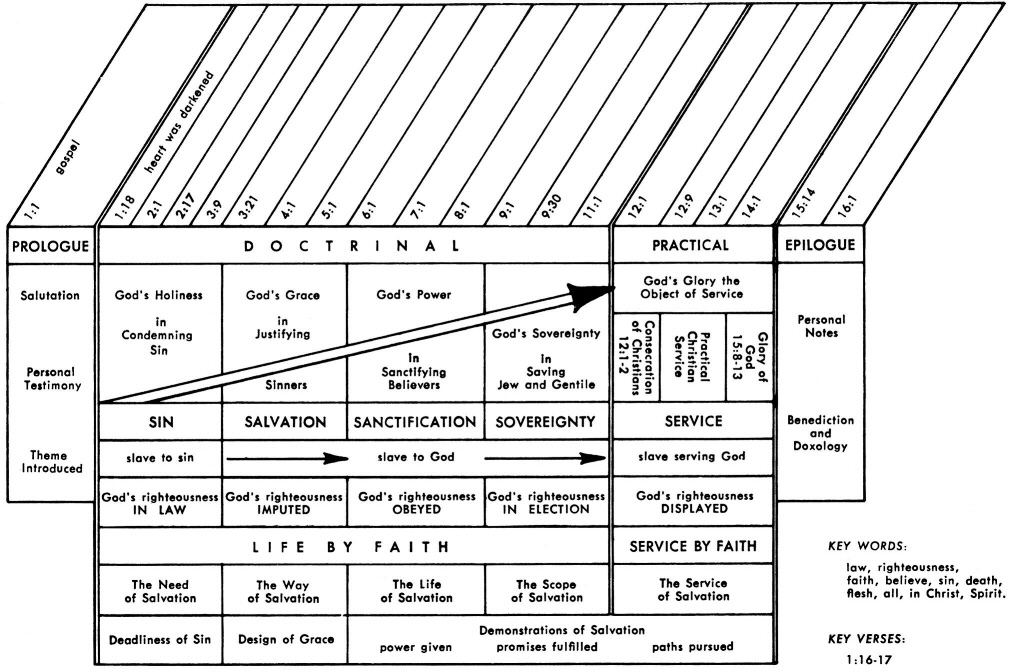
Click chart to enlarge
Chart from recommended resource Jensen's Survey of the NT - used by permission
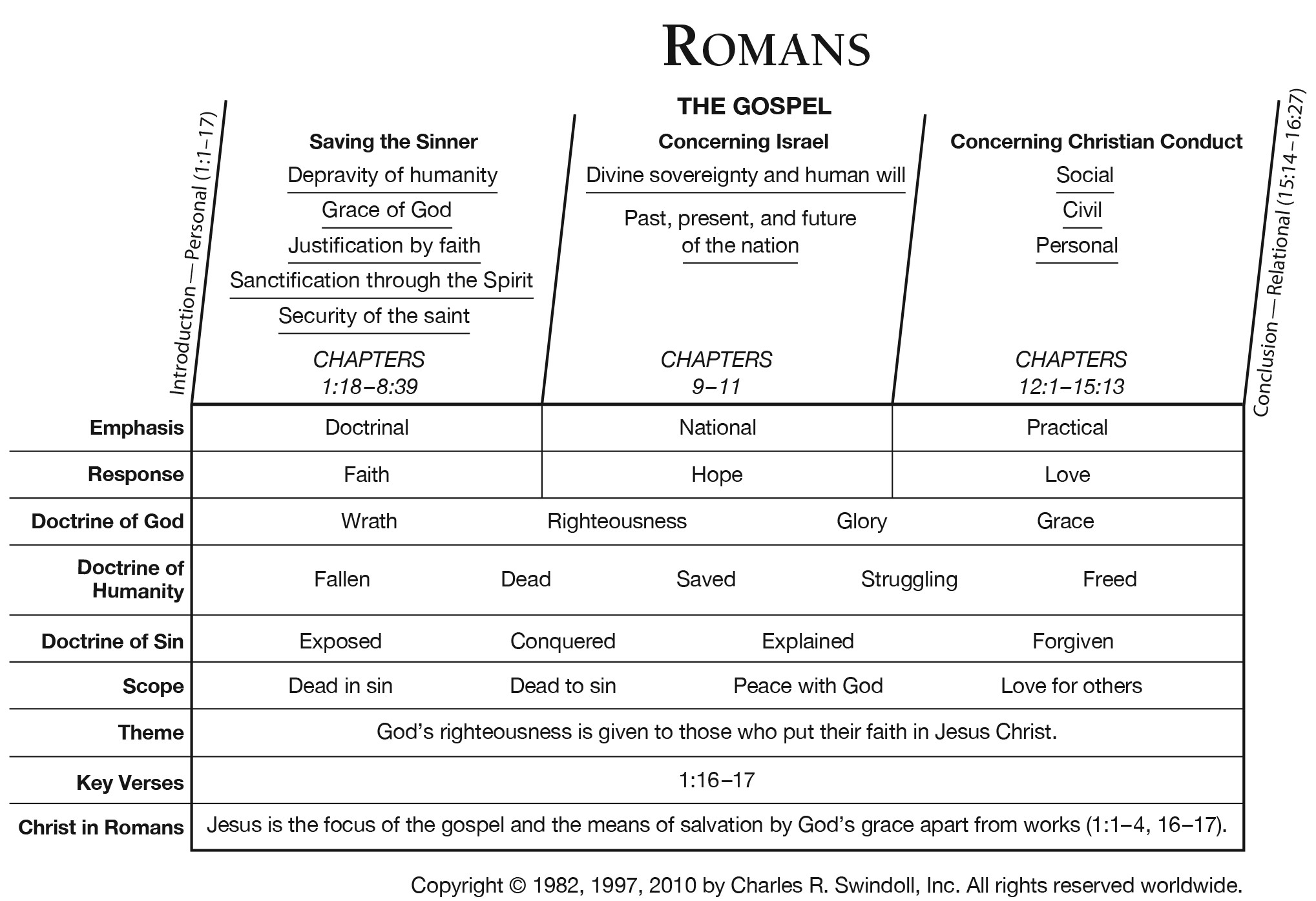
Click Charles Swindoll's overview chart
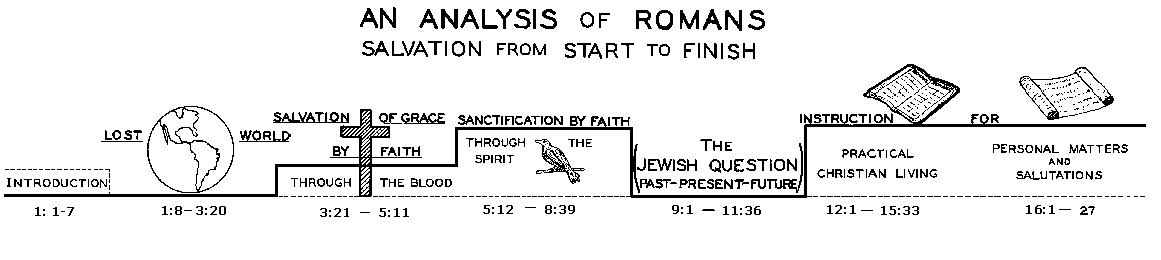
Source: Dr David Cooper
Click to Enlarge
| ROMANS ROAD to RIGHTEOUSNESS |
||||
| Romans 1:18-3:20 | Romans 3:21-5:21 | Romans 6:1-8:39 | Romans 9:1-11:36 | Romans 12:1-16:27 |
| SIN | SALVATION | SANCTIFICATION | SOVEREIGNTY | SERVICE |
| NEED FOR SALVATION |
WAY OF SALVATION |
LIFE OF SALVATION |
SCOPE OF SALVATION |
SERVICE OF SALVATION |
| God's Holiness In Condemning Sin |
God's Grace In Justifying Sinners |
God's Power In Sanctifying Believers |
God's Sovereignty In Saving Jew and Gentile |
Gods Glory The Object of Service |
| Deadliness of Sin |
Design of Grace |
Demonstration of Salvation | ||
| Power Given | Promises Fulfilled | Paths Pursued | ||
| Righteousness Needed |
Righteousness Credited |
Righteousness Demonstrated |
Righteousness Restored to Israel |
Righteousness Applied |
| God's Righteousness IN LAW |
God's Righteousness IMPUTED |
God's Righteousness OBEYED |
God's Righteousness IN ELECTION |
God's Righteousness DISPLAYED |
| Slaves to Sin | Slaves to God | Slaves Serving God | ||
| Doctrine | Duty | |||
| Life by Faith | Service by Faith | |||
|
Modified from Irving L. Jensen's chart above |
||||
Romans 2:5 But because of your stubbornness and unrepentant heart you are storing up (2SPAI) wrath for yourself in the day of wrath and revelation of the righteous judgment of God, (NASB: Lockman)
Greek: kata de ten skleroteta sou kai ametanoeton kardian thesaurizeis (2SPAI) seauto orgen en hemera orges kai apokalupseos dikaiokrisias tou theou
Amplified: But by your callous stubbornness and impenitence of heart you are storing up wrath and indignation for yourself on the day of wrath and indignation, when God’s righteous judgment (just doom) will be revealed. (Amplified Bible - Lockman)
NLT: But no, you won't listen. So you are storing up terrible punishment for yourself because of your stubbornness in refusing to turn from your sin. For there is going to come a day of judgment when God, the just judge of all the world, (NLT - Tyndale House)
Phillips: Or are you by your obstinate refusal to repent simply storing up for yourself an experience of the wrath of God in the day when, in his holy anger against evil, he shows his hand in righteous judgment? (Phillips: Touchstone)
Wuest: But according to your obstinate and unrepentant heart you are storing up for yourself wrath in the day of wrath and revelation of the righteous judgment of God
Young's Literal: but, according to thy hardness and impenitent heart, thou dost treasure up to thyself wrath, in a day of wrath and of the revelation of the righteous judgment of God,
BUT BECAUSE OF YOUR STUBBORNNESS (hardness) AND YOUR UNREPENTANT HEART: kata de ten skleroteta sou kai ametanoeton kardian:
- Ro 11:25+; Ex 8:15; 14:17; Dt 2:30; Josh 11:20; 1Sa 6:6; 2Chr 30:8; 36:13; Ps 95:8; Pr 29:1; Is 48:4; Eze 3:7; Da 5:20; Zec 7:11,12; Heb 3:13,15; 4:7
- Torrey's topic Character of the Unrenewed Heart
- Chuck Smith sermon outline on Romans 2:5
- Romans 2 Resources - Multiple Sermons and Commentaries
STUBBORN REFUSAL
TO TURN FROM SIN
Stubbornness (4643) (sklerotes from skleros = dry, hard, tough, harsh, used, of a stone which is specially hard for masons to work; metaphorically of a king who is inhuman and hard in his treatment of his subjects) describes callousness, hardness or obstinacy (which is the quality of perversely adhering to an opinion, purpose, or course in spite of reason, arguments, or persuasion).
Sklerotes is a resistant or stubborn attitude with regard to any change in behavior, this attitude denoting unreceptibility. In the present use Paul is describing the hard, impenitent hearts of his unsaved "religious" readers. Stubbornness is an unreasonable and perverse unyielding attitude, one which is determined not to change (we all have firsthand experience with this attitude from time to time!) and refusing to comply with or agree to.
This is the only NT use of sklerotes but there are 4 in the LXX (Deut 9:27; 2Sa 22:6; Isa 4:6; 28:27). For example, Moses offers up an intercessory prayer for sinful Israel (appealing to God on the basis of the immutable Abrahamic Covenant)… 'Remember Thy servants, Abraham, Isaac, and Jacob; do not look at the stubbornness (sklerotes) of this people or at their wickedness or their sin. (Deut 9:27)
NIDNTT - Hardening, according to the OT understanding, results from the fact that men persist in shutting themselves to God’s call and command. A state then arises in which a man is no longer able to hear and in which he is irretrievably enslaved. Alternatively, God makes the hardening final, so that the people affected by it cannot escape from it… Hardening is the continually mounting refusal on the part of man to listen to God’s command. (Brown, Colin, Editor. New International Dictionary of NT Theology. 1986. Zondervan)
The verb skleruno was originally a medical term as attested by Hippocrates and was used to describe Pharaoh who first persistently hardened (skleruno) his heart which eventually resulted in retributive hardening by God, after His much longsuffering (Ro 9:17,18-note)
Skelerotes is the root of our English medical term sclerosis as used in arteriosclerosis which describes the condition of "hardening" of the arteries. This physical hardening is a perfect picture of the spiritual condition of a heart that has become unresponsive and insensitive to God. However, the spiritual "ailment" is immeasurably worse than the physical malady, for if one fails to receive a spiritual "heart transplant" (cf Ezekiel 36:26, 27-note) they will die an eternal death in the lake of fire, eternally destroyed, separated from the presence of God, "away from the presence of the Lord and from the glory of His power." (2Thes 1:8-10).
Hardening of the arteries may take a man to the grave
but
Hardening of one's spiritual heart will take a man to hell!
Remember, if the kindness of God toward you is not leading you to repentance, then every day, every hour, you live, drops another drop into the terrible "treasure" of indignation which will burst the great dam of God’s long-suffering in the great Day of His Wrath, when God shall reveal His righteous judgment! Flee to take refuge in the Cross of Calvary.
Jesus said that "he who hears (His) word, and believes Him Who sent (Jesus), has eternal life, and does not come into judgment, but has passed out of death into life." (Jn 5:24+)
The wrath of God fell on Jesus but will fall on you if you fail to take refuge in Him.
Unrepentant (279) (ametanoetos from a = without + metanoeo = repent or change one's mind in turn from meta = after + noieo = perceiving clearly with the mind; See study of metanoia) means admitting no change of mind (amendment), unrepentant, impenitent.
Heart (2588) (kardia) is never used literally of the physical heart in Scripture but always figuratively signifying the seat and center of human life, thought and feeling, the wellspring of man’s spiritual life. Kardia is the inner person, the seat of motives and attitudes, the center of personality, in Scripture it represents much more than emotion, feelings. It also includes the thinking process and particularly the will. (See article on Proverbs 4:23 - Watch Over Your Heart with All Diligence)
MacArthur commenting on kardia writes that "While we often relate heart to the emotions (e.g., “He has a broken heart”), the Bible relates it primarily to the intellect (e.g., “Out of the heart come evil thoughts, murders, adulteries, fornications, thefts, false witness, slanders,” Matt 15:19). That’s why you must “watch over your heart with all diligence” (Proverbs 4:23). In a secondary way, however, heart relates to the will and emotions because they are influenced by the intellect. If you are committed to something, it will affect your will, which in turn will affect your emotions." (Drawing Near. Crossway Books) MacArthur adds that "In most modern cultures, the heart is thought of as the seat of emotions and feelings. But most ancients—Hebrews, Greeks, and many others—considered the heart to be the center of knowledge, understanding, thinking, and wisdom. The New Testament also uses it in that way. The heart was considered to be the seat of the mind and will, and it could be taught what the brain could never know. Emotions and feelings were associated with the intestines, or bowels." Ephesians. Chicago: Moody Press)
by Herschel Hobbs
The verb form of this word is sklērunō meaning "to harden." One example is found in the papyri. It was also used by Galen and Hippocrates in the medical sense. This usage of the word survives in modern medical language in such words as "scleroderma," hardness of the skin; "scleroma," a hard tumor; and "sclerosis," the hardening of body tissues.
The noun sklērotēs is found one time in the papyri and once in Romans 2:5 as "hardness" of heart. It may well be rendered "obstinacy" or "stubbornness." Or it may be rendered "stubbornness of will."
Sklēros is the adjective form meaning "hard" or "rough" as to the touch. In one papyri example it is used in this dual sense as of "hard" stone (also in the inscriptions). One citation renders it as "bitter (or pickled) meats," which adds flavor to the meaning with regard to attitude. In one case it is used metaphorically: "This did not seem to be hard" or "harsh." A similar usage is found in an inscription (Kaibel) where kings are described as "both inhuman and harsh." This also sheds light on certain usages in the New Testament. The word sklērourgos is found for "stone-mason." In one instance sklēros is combined with trachēlos, "neck," sklērotrachēlos, meaning "stiff-neck." One such example is found in Acts 7:51. Note also sklērokardia, "hard-hearted" (not found in papyri, but cf. Matt. 19:8; Mark 10:5). These carry a certain medical flavor, but are metaphors for unyielding wills and lack of spiritual sensitivity and understanding respectively.
These same ideas are present in the use of sklērunō in Acts 19:9 and Hebrews 3:8, 13, 15; 4:7. The example in Romans 9:18 is the source of theological difficulty. Did God arbitrarily harden Pharaoh's heart? If so, was Pharaoh responsible? Exodus 8:15, 32; 9:4 say that Pharaoh hardened his own heart. Of course, the subject under discussion in Romans is the sovereignty of God, whereby God acts within His own will but in keeping with His nature and purpose. The point in this passage is that Pharaoh repeatedly hardened his heart in the face of God's wonderful works. God will not violate a human personality or will. Thus God simply acted in accord with His nature and purpose by recognizing the hardness which existed in Pharaoh's heart. The present tense of the verb in Romans 9:18 would seem to allow this. Thus Pharaoh's heart was hardened, not by God's perpetration but by His permission.
The medical sense of this word by Galen and Hippocrates sheds light on this passage. The doctor does not cause the hardening. But he acts in the light of the fact of it. As God acts in accord with His nature and purpose, He did not cause Pharaoh's stubbornness. But since He wills not to violate one's personality, He accepted the fact of Pharaoh's condition. And since God's holiness is in unyielding opposition to evil, He acted accordingly.
The adjective sklēros appears five times in the New Testament (not in best mss. in Acts 9:5). And in all instances save one it is rendered as "hard." Acts 26:14 reads, "It is hard for thee to kick against the pricks." Here "hard" is used in the metaphorical sense. A "prick" was a pointed stick used to goad an ox. Page notes that it is taken from the figure of an ox which kicks against the prick, and which receives a severer wound. In Paul's case the "prick" was the call of God stemming from Saul's experience in seeing the manner in which Stephen died. Stephen saw the Lord Jesus alive (Acts 7:55-56). And now Saul sees or hears Him. Thus he receives the severer wound in his soul because of his attitude toward Jesus. It was indeed "hard."
John 6:60 reads, "This is an hard [harsh] saying; who can hear it?" The "saying" was Jesus' words about eating His flesh and drinking His blood. Failing to rise to the significance of this symbolism, the multitude thought of cannibalism or pagan worship. Thus it was "harsh" to their ears. The hardness was not in the "saying" but in their hearts.
In James 3:4 the word is translated "fierce." This is with reference to wind (nature). Howson notes that James in one short epistle draws more imagery from natural phenomena than is found in all of Paul's writings. The picture is that of a strong, stiff, harsh, hard, rough wind. A. T. Robertson renders it "rough," which is in keeping with the papyri usage of something that is rough to the touch.
Jude 15 uses the word "hard" with respect to that which "ungodly sinners have spoken against him" (Lord). The word here might better be rendered "harsh" as harsh speakers.Much light is thrown on Matthew 25:24 by Kaibel's inscription, not papyri, cited above in the example of kings being called "both inhuman and harsh." While the word "inhuman" (anēmeroi) does not appear in Matthew 25:24 the thought is implied. So the unfaithful servant may be understood as saying that his owner was an "inhuman and harsh man." (Preaching Values from the Papyri - 1964)
YOU ARE STORING UP WRATH FOR YOURSELF IN THE DAY OF WRATH: thesaurizeis (2SPAI) seauto orgen en hemera orges:
- Ro 9:22+; Dt 32:34; Am 3:10; Jas 5:3+
- the day Job 21:30; Pr 11:4; 2Pe 2:9+; 2Pe 3:7+; Rev 6:17
- Torrey's topic The Judgment;
- Torrey's topic The Long-suffering of God;
- Torrey's topic The Punishment of the Wicked
- Romans 2 Resources - Multiple Sermons and Commentaries
A TREASURE CHEST
YOU WILL NOT WANT!
You are storing up wrath for yourself in the day of wrath - Storing up is in the present tense indicating they are treasuring up wrath as their lifelong activity whether they realized it or not!
THOUGHT -If you reading this commentary and are not a believer, this statement should make you shudder and shake! This is a horrible prophecy which will be fulfilled in the minutest detail at the end of your life if you breathe your last breath never having believed on He Who bore your wrath upon Himself no the Cross (1 Pe 2:24+, 2 Cor 5:21+)! Believe in the Lord Jesus Christ and you will be saved. (Acts 16:31+, cf Ro 10:9,10+).
HCSB has a picturesque comment noting that "Like water pooling up behind a dam, people accumulate a debt of wrath as they continue to reject God's grace. One day the dam will break, and the flood of divine wrath will sweep up individuals and entire societies."
James gives a similar warning to the materially rich declaring "Your gold and your silver have rusted; and their rust will be a witness against you and will consume your flesh like fire. It is in the last days that you have stored up (theaurizo) your treasure!" (Jas. 5:3+) WOE!
Jesus uses this same verb theaurizo first negatively, then positively commanding "Do not store up (present imperative with a negative) for yourselves treasures on earth, where moth and rust destroy, and where thieves break in and steal. “But store up (present imperative = only way to do this is by depending on the Holy Spirit to obey) for yourselves treasures in heaven, where neither moth nor rust destroys, and where thieves do not break in or steal, (Mt 6:19-21+)
Storing up (2343) (theaurizo from thesaurós = a treasure, that which is deposited = place where something is kept. English = thesaurus, a treasury of words) means of keep some material thing (especially things of great value) safe by storing it. To store or treasure up goods for future use. Theaurizo means to do something that will bring about a future event or condition. Used 8x in NT - Matt. 6:19; Matt. 6:20; Lk. 12:21+ = "So is the man who stores up treasure (theaurizo) for himself, and is not rich toward God."; Ro. 2:5; 1 Co. 16:2; 2 Co. 12:14; Jas. 5:3; 2 Pet. 3:7+ = "but by His word the present heavens and earth are being reserved (theaurizo) for fire, kept for the day of judgment and destruction of ungodly men."
In the present context theaurizo specifically refers to to treasuring up wrath or future punishment as if they were building up a fortune of gold and silver.
The root word thesauros in secular Greek means a treasure chamber, storage room, granary, strong-box and thus a treasure. Even at a very early period temples were built with treasure chambers, where gifts and taxes in kind and money could be stored. The practice appears to have spread from Egypt to Greece. Collecting boxes were also known (cf. 2Ki 12:10). The verbal form thesaurizo is used similarly in the sense of storing up treasure, or putting it in safe keeping.
Theaurizo was used in later Judaism (the non-canonical book of Tobit 4:9) to describe storing up of "works"…So doing, you will lay up for yourself a great treasure (theaurizo) for the day of necessity.
Be sure to distinguish eternally worthless "human" works described in Tobit 4:9 from Spirit empowered "good works" (see discussion of what constitutes "Good Deeds").
The TDNT has this note on the root thesauros writing that it is…
“The place where a thing is stored,” the “treasure chamber, chest, or house,” e.g., state warehouse, P. Lond., I, 31, temple treasury, or temple storehouse for offerings in kind. Payments into the thesauros are temple offerings, sacrificial and guilt offerings, or thank offerings, e.g., for successful cures. The erection of a thesauros in the temple seems to have spread to Greece from Egypt. The cultic treasuries provided an impulse for private money boxes (1Cor 16:2). (Kittel, G., Friedrich, G., & Bromiley, G. W. Theological Dictionary of the New Testament. Eerdmans)
NIDNTT writes that the root word
thesauros is found from Hesiod onwards. Its etymology is uncertain, and it is probably a technical loan-word. It means:
(a) a treasure chamber, a storage room, granary, strong-box;
(b) treasure. Even at a very early period temples were built with treasure chambers, where gifts and taxes in kind and money could be stored. The practice appears to have spread from Egypt to Greece. Collecting boxes were also known (cf. 2Ki 12:10).
Thesaurizo is used similarly in the sense of storing up treasure, or putting it in safe keeping.
Mandaean Gnostic literature made use of the concepts of the treasure-house and the treasure of life and light from which the soul takes its rise, and to which it may return after it has experienced salvation (cf. W. Foerster, Gnosis: A Selection of Gnostic Texts)…
In later Judaism good works, e.g. alms giving, are a treasure which is stored up as a reward in the world to come, while the interest is enjoyed in this world as well (cf. Tob. 4:8ff.; 2 Esd. 6:5ff.; 7:77; Tosefta Peah 4:18; SB I 430). “All that Israel lays up in the form of fulfilments of the Law and good works, it lays up for its Father in heaven” (Deut. R. 1 on Deut. 1:1; cf. F. Hauck, TDNT III 137; SB I 431).
The rabbis sometimes spoke of the treasure from which the scribe draws and of the treasure house of eternal life, i.e. the place where the souls of the dead are stored up, or the “bundle” in which they are “bound” (cf. 1 Sam. 15:29; F. Hauck, ibid.; SB II 268; III 803). (Brown, Colin, Editor. New International Dictionary of NT Theology. 1986. Zondervan)
Theaurizo is used 8 times in the NAS (Matt. 6:19, 20; Lk. 12:21; Ro 2:5; 1 Co. 16:2; 2 Co. 12:14; Jas. 5:3; 2Pet. 3:7-note) and is translated: reserved, 1; save, 2; store, 2; stored up… treasure, 1; stores up treasure, 1; storing, 1.
James addressing the rich draws a similar picture writing that
"Your gold and your silver have rusted and their rust will be a witness against you and will consume your flesh like fire. It is in the last days that you have stored up your treasure!" (James 5:3, compare use in 2Pe 3:7 note) .
Jesus uses theaurizo in the Sermon on the Mount explaining an "investment strategy" which produces the ultimate diversified portfolio…
"Do not lay up (present imperative + a negative = command to stop action already in process) for yourselves treasures upon earth, where moth and rust destroy, and where thieves break in and steal. (The saying is true… You can't take it with you!) "But lay up (present imperative = make this the habit of your life! Don't be stingy!) for yourselves treasures in heaven, where neither moth nor rust destroys, and where thieves do not break in or steal (see notes on Matthew 6:19-20)
In Luke 12:21 Jesus explained true riches in the parable of a rich man who sought to build larger barns so that he might be at ease…
"But God said to him, 'You fool! This very night your soul is required of you; and now who will own what you have prepared?' So is the man who stores up treasure (theaurizo) for himself, and is not rich toward God." (Luke 12:20, 21)
In first Corinthians Paul writes…
On the first day of every week each one of you is to put aside and save (theaurizo), as he may prosper, so that no collections be made when come
In a context of judgment (analogous to the use here in Romans 2:5) Peter records that…
by His word (cf creation "by the word of God") the present heavens and earth are being reserved (theaurizo) for fire, kept for the day of judgment and destruction of ungodly men. (2Pe 3:7)
The Septuagint (LXX) has 9 uses of thesaurizo (2Ki. 20:17; Ps. 39:6; Prov. 1:18; 2:7; 13:22; 16:27; Amos 3:10; Mic. 6:10; Zech. 9:3) and is used both literally and figuratively.
Psalm 39:6 "Surely every man walks about as a phantom. Surely they make an uproar for nothing. He amasses riches, and does not know who will gather them.
2 Kings 20:17 'Behold, the days are coming when all that is in your house, and all that your fathers have laid up in store to this day shall be carried to Babylon; nothing shall be left,' says the LORD.
Proverbs 2:7 He stores up (Hebrew = tsaphan = hide, treasure, store up; Lxx = thesaurizo) sound wisdom for the upright; He is a shield to those who walk in integrity,
Amos 3:10 "But they do not know how to do what is right," declares the LORD, "these who hoard up (Hebrew = 'atsar = store up, save, lay up; Lxx = thesaurizo) violence and devastation in their citadels."
Here in Romans 2:5, Paul pictures hardened and unrepentant sinners treasuring up judgment for themselves, as if they were building up a fortune of gold and silver! But what a fortune that will be in the day when God’s wrath is finally revealed at the judgment of the Great White Throne (Rev 20:11, 12, 13, 14, 15-see notes)! The religious individuals Paul addresses are storing up wrath like a man who collects snake eggs, bringing them into his warm house where they will one day hatch and destroy him.
Wrath (3709) (orge from orgaô = to teem, to swell, the idea of a swelling which eventually bursts) is used primarily of God's settled opposition to and displeasure against sin. Settled indignation means that God’s holiness cannot and will not coexist with sin in any form whatsoever. Orge is not the momentary, emotional, and often uncontrolled anger (thumos = 2372) to which human beings are prone. Orge refers not to an explosive outburst but to an inner, deep resentment that seethes and smolders, often unnoticed by others (certainly true in the case of God's wrath which is being "stored up" unbeknownst to most of mankind).
Related resources
- Wrath of God
- Wrath, Wrath of God - Holman Bible Dictionary
Here are the 36 uses of orge in the NT - Mt 3:7; Mk. 3:5; Lk. 3:7; 21:23; Jn. 3:36; Ro 1:18; 2:5, 8; 3:5; 4:15; 5:9; 9:22; 12:19; 13:4, 5; Eph. 2:3; 4:31; 5:6; Col. 3:6, 8; 1 Thess. 1:10; 2:16; 5:9; 1 Tim. 2:8; Heb. 3:11; 4:3; Jas. 1:19, 20; Rev. 6:16, 17; 11:18; 14:10; 16:19; 19:15
William Barclay writes that "The Greeks defined thumos as the kind of anger which is like the flame which comes from straw; it quickly blazes up and just as quickly subsides. On the other hand, they described ogre as anger which has become habitual… Orge is anger which has become inveterate; it is long-lasting, slow-burning anger, which refuses to be pacified and nurses its wrath to keep it warm… To the Christian the burst of temper and the long-lived anger are both alike forbidden." (Daily Study Bible)
Arthur Pink defined God’s wrath (orge) as “His eternal detestation of all unrighteousness. It is the displeasure and indignation of Divine equity against evil. It is the holiness of God stirred into activity against sin” (The Attributes of God).
Bishop Trench defines orge as “a wrath of God who would not love good unless He hated evil, the two being inseparable, that He must do both or neither.” Trench adds that orge is an anger “which righteous men not merely may, but as they are righteous, must feel; nor can there be a surer and sadder token of an utterly prostrate moral condition than the not being able to be angry with sin—and sinners” (Anger - Trench's Synonyms)
Lenski comments that "storing up wrath" pictures "a load that God bears, which men heap up more and more, making heavier and heavier. The wonder of it all is that God holds any of it up even for a day; yet he holds up all its weight and does not let it crash down on the sinner’s head.
It is intriguing that some Jewish traditions (see note above) speak of treasuring up good works against the day of wrath. Paul is insisting that the impenitent Jew fails to realize the relation of the present to the coming judgment of God. It is interesting that Paul uses a term which was used twice in Jewish Hellenistic literature both examples referring to the last judgment. The day of wrath reveals the character of God as the Judge who judges righteously. This is contrasted with the moralizing of those who condemn heinous evils but do them themselves, so that their judgment is not according to truth (not righteous) like that of God.
Vincent, commenting on the words, “wrath against the day of wrath,” says that this is "A very striking image—treasuring up wrath for one’s self. The sinner stores it away. Its forthcoming is withheld by the forbearance of God. It will break out in the day when God’s righteous judgment shall be revealed.
Spurgeon describes God's wrath in vivid terms explaining that "God's wrath, though it come not on you yet, is like a stream that is dammed up. Every moment it gathers force. It bursts not the dike, yet every hour it is swelling it. Each moment of each day in which you remain an unbeliever you are treasuring up wrath against the day of wrath when the measure of your iniquity is full
Bengel calls our attention to "the antithesis between ‘despising the riches of goodness, ‘and ‘treasuring up wrath’; between ‘hardness’ and ‘goodness’; between ‘impenitent heart’ and ‘repentance, ‘of v4. Also note that it is ‘against thyself thou art treasuring wrath, not against others whom thou judgest. Finally, the unquestionable antithesis between ‘forbearance’ and ‘revelation of judgment.’
Matthew Henry - Those that go on in a course of sin are treasuring up unto themselves wrath. A treasure denotes abundance. It is a treasure that will be spending to eternity, and yet never exhausted; and yet sinners are still adding to it as to a treasure. Every wilful sin adds to the score, and will inflame the reckoning; it brings a branch to their wrath, as some read that (Eze. 8:17), they put the branch to their nose. A treasure denotes secrecy. The treasury or magazine of wrath is the heart of God himself, in which it lies hid, as treasures in some secret place sealed up; see Deut. 32:34; Job 14:17. But withal it denotes reservation to some further occasion; as the treasures of the hail are reserved against the day of battle and war, Job 38:22, 23. These treasures will be broken open like the fountains of the great deep, Gen. 7:11. They are treasured up against the day of wrath, when they will be dispensed by the wholesale, poured out by full vials. Though the present day be a day of patience and forbearance towards sinners, yet there is a day of wrath coming-wrath, and nothing but wrath.
David Brown - What an awful idea is here expressed, —that the sinner himself is amassing, like hoarded treasure, an ever accumulating stock of Divine wrath, to burst upon him ‘in the day of wrath and revelation of the righteous judgment of God" And this is said not of the reckless, but of those who boasted of their purity!
Torrey's Topic
The Wrath of God
- Averted by Christ -Lk 2:11,14; Ro 5:9; 2Co 5:18,19; Ep 2:14,17; Col 1:20; 1Th 1:10
- Is averted from them that believe -John 3:14, 15, 16, 17 18; Romans 3:25; 5:1
- Confession & repentance averts-Job 33:27,28; Ps 106:43-45; Je 3:12,13; 18:7,8; 31:18, 19, 20; Joel 2:12-14; Lk 15:18, 19, 20
- Is slow -Psalms 103:8; Isaiah 48:9; Jonah 4:2; Nah 1:3
- Is righteous -Psalms 58:10,11; Lam 1:18; Romans 2:6,8; 3:5,6; Re 16:6,7
- The justice of, not to be questioned -Romans 9:18,20,22
- Manifested in terrors -Ex 14:24; Ps 76:6-8; Je 10:10; Lam 2:20, 21,22
- Manifested in judgments & afflictions -Job 21:17; Ps 78:49, 50, 51; 90:7; Is 9:19; Je 7:20; Ezek 7:19; He 3:17
- Cannot be resisted -Job 9:13; 14:13; Psalms 76:7; Nah 1:6
- Aggravated by continual provocation -Nu 32:14
- Specially reserved day of wrath-Zeph 1:14, 15, 16, 17, 18; Mt 25:41; Ro 2:5,8; 2Th 1:8; Re 6:17; 11:18; 19:15
AGAINST
- The wicked -Ps 7:11; 21:8,9; Is 3:8; 13:9; Nah 1:2,3; Ro 1:18; 2:8; Ep 5:6; Col 3:6
- Those who forsake him -Ezra 8:22; Is 1:4
- Unbelief -Psalms 78:21,22; Hebrews 3:18,19; John 3:36
- Impenitence -Psalms 7:12; Proverbs 1:30,31; Isaiah 9:13,14; Romans 2:5
- Apostasy -Hebrews 10:26,27
- Idolatry -Dt 29:20,27,28; 32:19,20,22; Joshua 23:16; 2Ki 22:17; Ps 78:58,59; Je 44:3
- Sin, in saints -Ps 89:30, 31, 32; 90:7, 8, 9; 99:8; 102:9,10; Is 47:6
- Extreme, against those who oppose the gospel -Ps 2:2,3,5; 1Th 2:16
- Folly of provoking -Jeremiah 7:19; 1 Corinthians 10:22
- To be dreaded -Psalms 2:12; 76:7; 90:11; Matthew 10:28
- To be deprecated -Exodus 32:11; Psalms 6:1; 38:1; 74:1,2; Is 64:9
- Removal of, should be prayed for -Psalms 39:10; 79:5; 80:4; Daniel 9:16; Hab 3:2
- Tempered with mercy to saints -Ps 30:5; Is 26:20; 54:8; 57:15,16; Je 30:11; Mic 7:11
- To be born with submission -2 Samuel 24:17; La 3:39,43; Micah 7:9
- Should lead to repentance -Isaiah 42:24,25; Je 4:8
EXEMPLIFIED AGAINST
- The old world -Genesis 7:21-23
- Builders of Babel -Genesis 11:8
- Cities of the plain -Genesis 19:24,25
- Egyptians -Exodus 7:20; 8:6,16,24; 9:3,9,23; 10:13,22; 12:29; 14:27
- Israelites -Ex 32:35; Nu 11:1,33; 14:40, 41, 42, 43, 44, 45; 21:6; 25:9; 2Sa 24:1,15
- Enemies of Israel -1Sa 5:6; 7:10
- Nadab, &c -Leviticus 10:2
- The Spies -Numbers 14:37
- Korah, &c -Numbers 16:31,35
- Aaron and Miriam -Numbers 12:9,10
- Five Kings -Joshua 10:25
- Abimelech -Judges 9:56
- Men of Beth Shemesh -1 Samuel 6:19
- Saul -1 Samuel 31:6
- Uzzah -2 Samuel 6:7
- Saul’s family -2 Samuel 21:1
- Sennacherib -2 Kings 19:28,35,37
AND THE REVELATION OF THE RIGHTEOUS JUDGMENT OF GOD: kai apokalupseos dikaiokrisias tou theou:
- Torrey's topic The Judgment
- Romans 2 Resources - Multiple Sermons and Commentaries
Revelation (602) (apokalupsis from apó = from + kalúpto = cover) literally describes the removal a cover thus exposing to open view that which was previously concealed. "Revelation" therefore conveys the idea of "taking the lid off" so that some thing previously secret or unknown is now manifest and exposed to open view. In all the NT uses, “revelation” refers to something or someone, once hidden, becoming visible and now made fully known.
Although in one sense, it is true that "the wrath of God is (already being) revealed (apokalupto) from heaven against all ungodliness and unrighteousness of men" (Ro 1:18-note), as Job says "these are (but) the fringes of His ways" (Job 26:14) and will come to fruition in "the Revelation of Jesus Christ" (Rev 1:1-note) with the seal, trumpet and bowl judgments, the Day of the Lord and ultimately in the eternal "the lake of fire and brimstone where" "stubborn and unrepentant" men "will be tormented day and night forever and ever." (Rev 20:10-note)
Here are the 18 uses of apokalupsis in the NT - Lk. 2:32; Rom. 2:5; 8:19; 16:25; 1 Co. 1:7; 14:6, 26; 2 Co. 12:1, 7; Gal. 1:12; 2:2; Eph. 1:17; 3:3; 2 Thess. 1:7; 1 Pet. 1:7, 13; 4:13; Rev. 1:1
In the first coming of Jesus Christ, the loving character of God was revealed with greatest emphasis but at the second coming of Jesus, the righteous judgment of God will be revealed most clearly.
Moule - The “wrath” is as pure, just, and Divine as the mercy. Its “revelation” will be only the revelation of the absolute equity of “the JUDGE of all the earth.” This deep righteousness of the Divine anger is its most awful element.
Spurgeon emphasizes that "It is absolutely necessary that men should be convinced of sin. The fashionable theology is, "Convince men of the goodness of God. Show them the universal fatherhood, and assure them of unlimited mercy. Win them by God's love, but never mention His wrath against sin or the need of an atonement or the place of punishment. Comfort and encourage, but never accuse and threaten." That is the way of man, but the way of the Spirit of God is very different. He comes on purpose to convince men of sin, to make them feel that they are so guilty that they are lost and ruined and undone. He comes to remind them not only of God's loveliness, but of their own unloveliness. The Holy Ghost does not come to make sinners comfortable in their sins, but to cause them to grieve over their sins. He does not help them to forget their sin or think little of it, but he comes to convince them of the horrible enormity of their iniquity. It is no work of the Spirit to pipe to men's dancing."
Righteous judgment (1341) (dikaiokrisia from dikaios = just or in accordance with what is right + krísis = judgment) is the judgment which renders justice and produces right and stresses the equity of the decision rendered. Although not popular in many theological circles, it is nevertheless a fact that wrath is as much a part of the righteous character of God as is His love. If God did not exercise wrath against injustice he would be unrighteous. A universe in which evil exists unchallenged and ultimately unvanquished is inconceivable and could not be ruled by a good God of holy love Who exercises "righteous judgment" as explained in the next verse.
ILLUSTRATION - NO LOOPHOLES: Just before the death of actor W. C. Fields, a friend visited Fields’ hospital room and was surprised to find him thumbing through a Bible. Asked what he was doing with a Bible, Fields replied, “I’m looking for loopholes.”
God's Judgment is Righteous…
There are no "loopholes!
Romans 2:6 Who WILL RENDER (3SFAI)TO EACH PERSON ACCORDING TO HIS DEEDS: (NASB: Lockman)
Greek: os apodosei (3SFAI) hekasto kata ta erga autou
Amplified: For He will render to every man according to his works [justly, as his deeds deserve]: [Ps 62:12] (Amplified Bible - Lockman)
NLT: will judge all people according to what they have done. (NLT - Tyndale House)
Phillips: There is no doubt at all that he will render to every man according to his works' (Phillips: Touchstone)
Wuest: who recompenses each according to his works
Young's Literal: who shall render to each according to his works
WHO WILL RENDER TO EVERY MAN ACCORDING TO HIS DEEDS: os apodosei (3SFAI) hekasto kata ta erga autou:
- Ro 14:22; Job 34:11; Ps62:12; Pr 24:2; Isa 3:10,11; Jer 17:10; 32:19; Ezekiel 18:30; Mt 16:27; 25:34, 35, 36, 37, 38, 39, 40, 41, 42, 43, 44, 45, 46; 1Co 3:8; 4:5; 2Corinthians 5:10; Galatians 6:7,8; Revelation 2:23; 20:12; 22:12
- Romans 2 Resources - Multiple Sermons and Commentaries
PAYDAY
SOMEDAY
The well-known 20th century preacher Robert G Lee preached a classic sermon entitled "Payday, Someday!" (Watch the Video of this stirring sermon!) That is exactly what Paul is alluding to in this verse. It's akin to the idea of sowing and reaping (cf Gal 6:7-8+).
MacArthur - The subjective criterion for salvation is faith alone, with nothing added. But the objective reality of that salvation is manifested in the subsequent godly works that the Holy Spirit leads and empowers believers to perform. For that reason, good deeds are a perfectly valid basis for God’s judgment… It must be made clear, of course, that although Scripture, both Old and New Testaments, teaches that judgment is by works, it nowhere teaches that salvation is by works… the life that is saved by faith is to give evidence of that salvation by doing God’s work. Outward godly works are the evidence of inner faith.
Render (pay back, repay) (591) (apodidomi from apó = from + dídomi = give) means to pay or give back, implying a debt. This word carries the idea of obligation and responsibility for something that is not optional. The prefixed preposition apo (off, away from) makes the verb mean “to give off” from one’s self. To give back or pay back or to do something necessary in fulfillment of an obligation or expectation.
Apodidomi - 48 times in the NT - Mt. 5:26, 33; 6:4, 6, 18; 12:36; 16:27; 18:25f, 28ff, 34; 20:8; 21:41; 22:21; 27:58; Mk. 12:17; Lk. 4:20; 7:42; 9:42; 10:35; 12:59; 16:2; 19:8; 20:25; Acts 4:33; 5:8; 7:9; 19:40; Rom. 2:6; 12:17; 13:7; 1 Co. 7:3; 1 Thess. 5:15; 1 Tim. 5:4; 2 Tim. 4:8, 14; Heb. 12:11, 16; 13:17; 1 Pet. 3:9; 4:5; Rev. 18:6; 22:2, 12
Note that "WILL RENDER" is in all capital letters in the NAS, indicating that it is a clear quotation of an Old Testament passage. Paul is quoting the Septuagint translation (most of the NT quotations from the OT are not from the Hebrew text but from the Septuagint) of Psalm 62:12-note, which the NAS renders
And lovingkindness is Thine, O Lord, for Thou dost recompense a man according to his work.
If one reads Romans 2:6, 7, 8, 9, 10, 11 out of the context of the flow of Paul's argument in the entire letter, one might conclude that Paul was teaching salvation by works. These verse seem to say that those who do good works will thereby earn eternal life. However, as you read and study these passages, it is imperative to keep in mind that these verses do not describe how one is saved. What they do describe is how God judges mankind according to each person's deeds performed during the course of their life. As Newell affirms…
we are being shown in Chapter 2 how God must proceed in accordance with His being, toward two classes, those subject to Him, and those refusing subjection… God often, in His saving-grace, meets an enemy like Saul of Tarsus in the very heat of his opposition to Christ; or saves, and reveals His truth to, young men of wild dissipation like Augustine; or takes up and leads all the way to the Celestial City a profane Bunyan. Nevertheless, of these also, it could be said, as Paul spake: "I was not disobedient to the heavenly vision." After grace reached them, they too are described as "those who sought for glory and honor and incorruption." We repeat that verses 1 to 10 are not a revelation of the way of salvation, but a general description of the character of those that are saved. (Romans 2) (Bolding added)
Alford explains "The Apostle is here speaking generally, of the general system of God in governing the world, -the judging according to each man's works-'punishing the evil, and rewarding the righteous. No question at present arises, how this righteousness in God's sight is to be obtained-but the truth is only stated broadly to be further specified by and by, when it is clearly shown that by works of law (ergo nomou) no flesh can be justified before God. The neglect to observe this has occasioned … an idea that by this passage it is proved that not faith only, but works also in some measure, justify before God; and an idea that by well-doing here is meant faith in Christ. However true it be, so much is certainly not meant here, but merely the fact that everywhere, and in all, God punishes evil and rewards good." (Alford, Henry: New Testament in Greek 4 volumes - out of print) (Bolding added)
In the present case, Paul is quoting almost verbatim the Greek translation of the Hebrew (Septuagint) of Ps 62:12 (Spurgeon's note) which would appeal to the Jew. In this Psalm, the psalmist’s enemies, while secretly plotting against him, professed to be his friends. He appeals to God, who, he declares, will recompense each according to his works. The passage refers evidently to Jewish enemies, and therefore implies that God will treat even Jews according to their deeds. Paul explains how and why God will judge, and how He can judge both Jew and Gentile and be completely fair in the process. The controlling principle will be according to deeds because deeds give incontrovertible proof of what is in the heart. It is an awesome and fearful thought that God will render to each one according to his deeds; this condemns the moralist as well as the obvious sinner.
HCSB - Cranfield (Romans, I:151) outlines 10 different interpretations of this controversial passage. The most likely one is that works are the outcome of a person's faith. Christians are declared righteous by faith. At the moment of that declaration, the person is joined to Christ and regenerated by the Holy Spirit, becoming a new creation (2Co 5:17-note) created for good works (Eph 2:10-note). As Paul wrote, "What matters is faith working through love" (Gal 5:6). Thus the person of faith who seeks glory, honor, and immortality and continues to do good demonstrates that he is truly regenerate and thus is assured of eternal life. To the person who obeys unrighteousness and disobeys truth, however, wrath is his destiny. (Cp Jesus' words in Mt 7:21-23 where we see what we say
Lewis Sperry Chafer in his 4 volume treatise on Systematic Theology, Kregel points out that about 150 passages in the New Testament clearly indicate that salvation is based solely on faith or believing. No one passage or group of passages such Romans 2:6-11, when rightly understood (cf importance of context), contradicts such overwhelming testimony. Fallen mankind is justified by faith alone and not by works but as has been stated by someone a faith that works is not alone (that is it has obedience and good deeds, cf Eph 2:8, 9, 10-note).
Every man (1538) (hekastos) means each and every one, whether they are Jew or Gentile, saved or unsaved. What is the implication? No exceptions! Paul is making it clear that God will deal with the Jew just as he does with the Gentile. The Jew cannot escape simply because he is a Jew.
Ray Stedman - Perhaps this passage is one of the places where a man finds some basis for the idea of a "great balance sheet". Almost everyone has the idea, even if they have never become acquainted with the Scriptures, that God is conducting a moral weighing maneuver -- that he puts all our good deeds on one side and all our bad deeds on the other side -- and if the good deeds outweigh the bad, we get into heaven; if the bad outweigh the good, we go the other direction. I was interested, during the recent breakfast meetings for businessmen, to hear how many of the men said this was their idea of how God worked, and therefore the whole purpose of human life was to try to get in as many good things as possible, and thus outweigh some of the bad things that we really can't help doing, or are driven to do for various reasons. They hoped that the good would outweigh the bad. Perhaps it is from this passage in Romans that the idea comes. At first glance, it sounds that way, doesn't it?" (The Secrets of Men)
According to his deeds - This principle of judgment by deeds (works) should be very familiar to his Jewish readers for it is clearly taught in the Old Testament. For example Isaiah records Jehovah's words:
"Say to the righteous that it will go well with them, for they will eat the fruit of their actions. Woe to the wicked! It will go badly with him, for what he deserves will be done to him." (Isa 3:10,11)
In a parallel passage in Jeremiah Jehovah declares
"I, the LORD, search the heart, I test the mind, even to give to each man according to his ways, According to the results of his deeds." (Jer 17:10, cp Jer 17:9)
Jeremiah again records that the LORD of hosts is the One Who is
"great in counsel and mighty in deed, whose eyes are open to all the ways of the sons of men, giving to everyone according to his ways and according to the fruit of his deeds." (Jeremiah 32:19)
Paul is not teaching how one is justified (declared righteous) in this section but is laying down general principles about justice, according to which, irrespective of the Gospel, all men are to be judged. Paul is not suggesting that doing good will get anyone into heaven but is making it clear that knowing good is not enough. In short in this section of Romans…
Paul is not describing the basis for salvation
but
the basis for judgment.
Paul will not begin to discuss how one can be saved until Romans three. In the present passage he is talking about deeds as one of the elements, or principles, God employs in judgment.
In other words, Paul is discussing the evidences of salvation not the means or basis of it. Thus if a person is truly saved, there will be outward evidence of in one's life and conversely the unsaved will exhibit no such evidence.
Hebert Lockyer in his fascinating book "Last Words of Saints and Sinners " records that "Robert Barnes was the faithful minister of the Gospel who was burned at Smithfield, England, in 1540, and who, as he was committed to the flames, addressed the onlookers with these farewell words: "I trust in no good works that ever I did, but only in the death of Christ. I do not doubt but through Him to inherit the kingdom of heaven. But imagine not that I speak against good works, for they are to be done, and verily they that do them not shall never enter into the kingdom of God."
To be sure, every believer falls short of God’s perfect righteousness but a life that is devoid of righteous deeds can make no claim to being redeemed.
David committed some terrible sins; but the total thrust of his life was obedience to God. Judas confessed his sin and supplied the money for buying a cemetery for strangers; yet the total emphasis of his life was disobedience and unbelief. True saving faith results in obedience and godly living, even though there may be occasional falls. The works of believers will not be appealed to as the cause of their acquittal, but as the evidence of their union with Christ, on account of which they will be pronounced righteous.
The philosopher Plato assumed that if a person knew the good, he would be sure to do it. It doesn’t take long to show how foolish that Plato's postulate is. Just try for three days to do only what you know is good and right. And see how long before the gap between knowing and doing appears.
This verse also teaches the principle found elsewhere that there will be a varying degrees of reward and that the punishment of all will not be equal. In other words, the wicked will be punished both because of their deeds and according to their deeds. Jesus explained that greater light (if not responded to by placing faith in Him) would result in a greater degree of judgment than those who had less light.
"Nevertheless I say to you that it shall be more tolerable for the land of Sodom in the day of judgment (at the Great White Throne judgment - see table below), than for you." (Matthew 11:24)
Commenting on this passage in Matthew C H Spurgeon declares that…
God is more angry with some of you than he is with some (already) in hell. Are you startled by the assertion? "It shall be more tolerable for Sodom in the day of judgment than for thee." The sins you have already committed are greater than those of Sodom, and the anger is in proportion to the guilt.
The righteous will be rewarded, (at the Judgment Seat of Christ - see table below and also the study of bema seat of Christ) not because of, but according to their deeds just as Paul taught in his second letter to the Corinthians declaring that it was his utmost desire to be pleasing to His Lord…
For we must all appear before the judgment seat of Christ, that each one may be recompensed for his deeds in the body, according to what he has done, whether good or bad (phaulos = useless, of no profit & not a reference to sins which have been "paid for in full" at the Cross)" (2 Corinthians 5:10) (Piper's sermon) (I was surprised to find that Piper does not separate the judgment of believers and unbelievers in a note written in 2007 although he does believe in a millennium - See Piper's note)
|
||||||||||||
Hampton Keathley offers the following arguments for placing of the timing of the Judgment Seat of Christ as before the millennium…
This event will occur immediately following the rapture or resurrection of the church after it is caught up to be with the Lord in the air as described in 1Th 4:13, 14, 15, 16, 17, 18.
Arguments in support of this view:
(1) In Luke 14:12, 13, 14, reward is associated with the resurrection and the rapture is when the church is resurrected.
(2) In Re 19:8 (note), when the Lord returns with His bride at the end of the tribulation, she is seen already rewarded. Her reward is described as fine linen, the righteous acts of the saints—undoubtedly the result of rewards.
(3) In 2Ti 4:8 (note) and 1Co 4:5, rewards are associated with “that day” and with the Lord’s coming. Again, for the church this means the event of 1Th 4:13-18-note. (Chart comparing Rapture and Second Coming)
So the order of events will be (a) the rapture which includes our glorification or resurrection bodies, (b) exaltation into the heavens with the Lord, (c) examination before the Bema, and (d) compensation or rewards. (Reference; see also Reference)
Alford sums up this section emphasizing that Paul is…
“speaking generally, of the general system of God in governing the world,—the judging according to each man’s works—punishing the evil, and rewarding the righteous. No question at present arises (in the context of Paul's teaching in Romans 2), how this righteousness in God’s sight is to be obtained—but the truth is only stated broadly at present, to be further specified by and by, when it is clearly shown that by works of law no flesh can be justified before God. The neglect to observe this has occasioned two mistakes: (1) an idea that by this passage it is proved that not faith only, but works also in some measure justify before God, and (2), an idea that by a good work here is meant faith in Christ. However true it be, so much is certainly not meant here, but merely the fact, that everywhere, and in all, God punishes evil, and rewards good.” (See Related Resource - What Are Good Deeds?)
ILLUSTRATION: ACCORDING TO DEEDS - "The eighth-century emperor Charlemagne wanted to have a magnificent bell cast for the church he had built. An artist name Tancho was employed to make it. He was furnished, at his own request, with a great quantity of copper and a hundred pounds of silver. He kept the silver for his own personal use, however, and used highly purified tin instead. When the work was completed, he presented the bell to the Emperor, who had it suspended in the church tower. But the people were unable to ring it. So Tancho himself was called in to help. He pulled so hard to make it ring that its clapper fell down and killed him."
Dear reader the question must be asked at this juncture… Have you placed your faith in Jesus Christ and does your lifestyle indicate that you are a new creature in Christ (2Cor 5:17)? Faith alone saves but the faith that truly saves is not alone (Eph 2:8-9, Eph 2:10)! Jesus' warning is clear:
"Behold, I am coming quickly, and My reward is with Me,
to render to every man according to what he has done."
(Revelation 22:12+)
- Is from God -Leviticus 26:18; Isaiah 13:11
ON ACCOUNT OF THEIR
- Sin -Lamentations 3:39
- Iniquity -Jeremiah 36:31; Ezekiel 3:17, 18; 18:4,13,20; Amos 3:2
- Idolatry -Leviticus 26:30; Isaiah 10:10,11
- Rejection of the law of God -1 Samuel 15:23; Hosea 4:6, 7, 8, 9
- Ignorance of God -2 Thessalonians 1:8
- Evil ways and doings -Jeremiah 21:14; Hosea 4:9; 12:2
- Pride -Isaiah 10:12; 24:21; Luke 14:11
- Unbelief -Mark 16:16; Romans 11:20; Hebrews 3:18,19; 4:2
- Covetousness -Isaiah 57:17; Jeremiah 51:13
- Oppressing -Isaiah 49:26; Jeremiah 30:16,20
- Persecuting -Jeremiah 11:21,22; Matthew 23:34, 35, 36
- Disobeying God -Nehemiah 9:26,27; Ephesians 5:6
- Disobeying the gospel -2 Thessalonians 1:8
- Is the fruit of their sin -Job 4:8; Proverbs 22:8; Romans 6:21; Galatians 6:8
- Is the reward of their sins -Ps 91:8; Is 3:11; Je 16:18; Ro 6:23; He 2:2
- Often brought about by their evil designs -Esther 7:10; Psalms 37:15; 57:6
- Often commences in this life Proverbs 11:31
IN THIS LIFE BY
- Sickness -Leviticus 26:16; Psalms 78:50
- Famine -Leviticus 26:19,20,26,29; Psalms 107:34
- Noisome beasts -Leviticus 26:22
- War -Leviticus 26:25,32,33; Jeremiah 6:4
- Deliverance to enemies -Nehemiah 9:27
- Fear -Leviticus 26:36,37; Job 18:11
- Reprobate mind -Romans 1:28
- Put in slippery places -Psalms 73:3-19
- Trouble and distress -Isaiah 8:22; Zephaniah 1:15
- Cutting off -Psalms 94:23
- Bringing down their pride -Isaiah 13:11
- Future, shall be awarded by Christ Matthew 16:27; 25:31,41
FUTURE DESCRIBED AS
- Hell -Psalms 9:17; Matthew 5:29; Luke 12:5; 16:23
- Darkness -Matthew 8:12; 2 Peter 2:17
- Death -Romans 5:12-17; 6:23
- Resurrection of damnation -John 5:29
- Rising to shame and everlasting contempt -Daniel 12:2
- Everlasting destruction -Psalms 52:5; 92:7; 2 Thessalonians 1:9
- Everlasting fire -Matthew 25:41; Jude 1:7
- Second death -Revelation 2:11; 21:8
- Damnation of hell -Matthew 23:33
- Eternal damnation -Mark 3:29
- Blackness of darkness -2 Peter 2:17; Jude 1:13
- Everlasting burnings -Isaiah 33:14
- The wrath of God -John 3:36
- Wine of the wrath of God -Revelation 14:10
- Torment with fire -Revelation 14:10
- Torment for ever and ever -Revelation 14:11
- The righteousness of God requires -2 Thessalonians 1:6
- Often sudden and unexpected -Ps 35:8; 64:7; Pr 29:1; Lk 12:20; 1Th 5:3
SHALL BE
- According to their deeds Matthew 16:27; Romans 2:6,9; 2 Corinthians 5:10
- According to the knowledge possessed by them -Luke 12:47,48
- Increased by neglect of privileges -Matthew 11:21-24; Luke 10:13-15
- Without mitigation -Luke 16:23-26
- Accompanied by remorse -Isaiah 66:24; Mark 9:44
- No combination avails against -Proverbs 11:21
- Deferred, emboldens them in sin -Ecclesiastes 8:11
- Should be a warning to others -Numbers 26:10; 1 Corinthians 10:6-11; Jude 1:7
- Consummated at the day of judgment -Matthew 25:31,46; Romans 2:5,16; 2 Peter 2:9