Romans 2:2
Romans 2:3
Romans 2:4
Romans 2:5
Romans 2:6
Romans 2:7
Romans 2:8
Romans 2:9
Romans 2:10
Romans 2:11
Romans 2:12
Romans 2:13
Romans 2:14
Romans 2:15
Romans 2:16
Romans 2:17
Romans 2:18
Romans 2:19
Romans 2:20
Romans 2:21
Romans 2:22
Romans 2:23
Romans 2:24
Romans 2:25
Romans 2:26
Romans 2:27
Romans 2:28
Romans 2:29

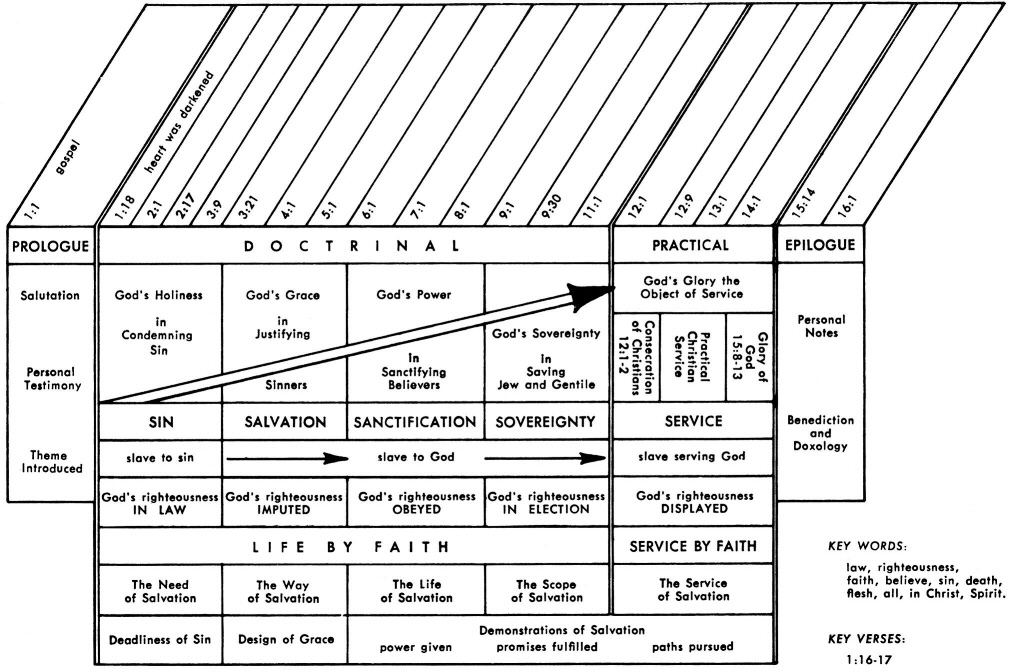
Click chart to enlarge
Chart from recommended resource Jensen's Survey of the NT - used by permission
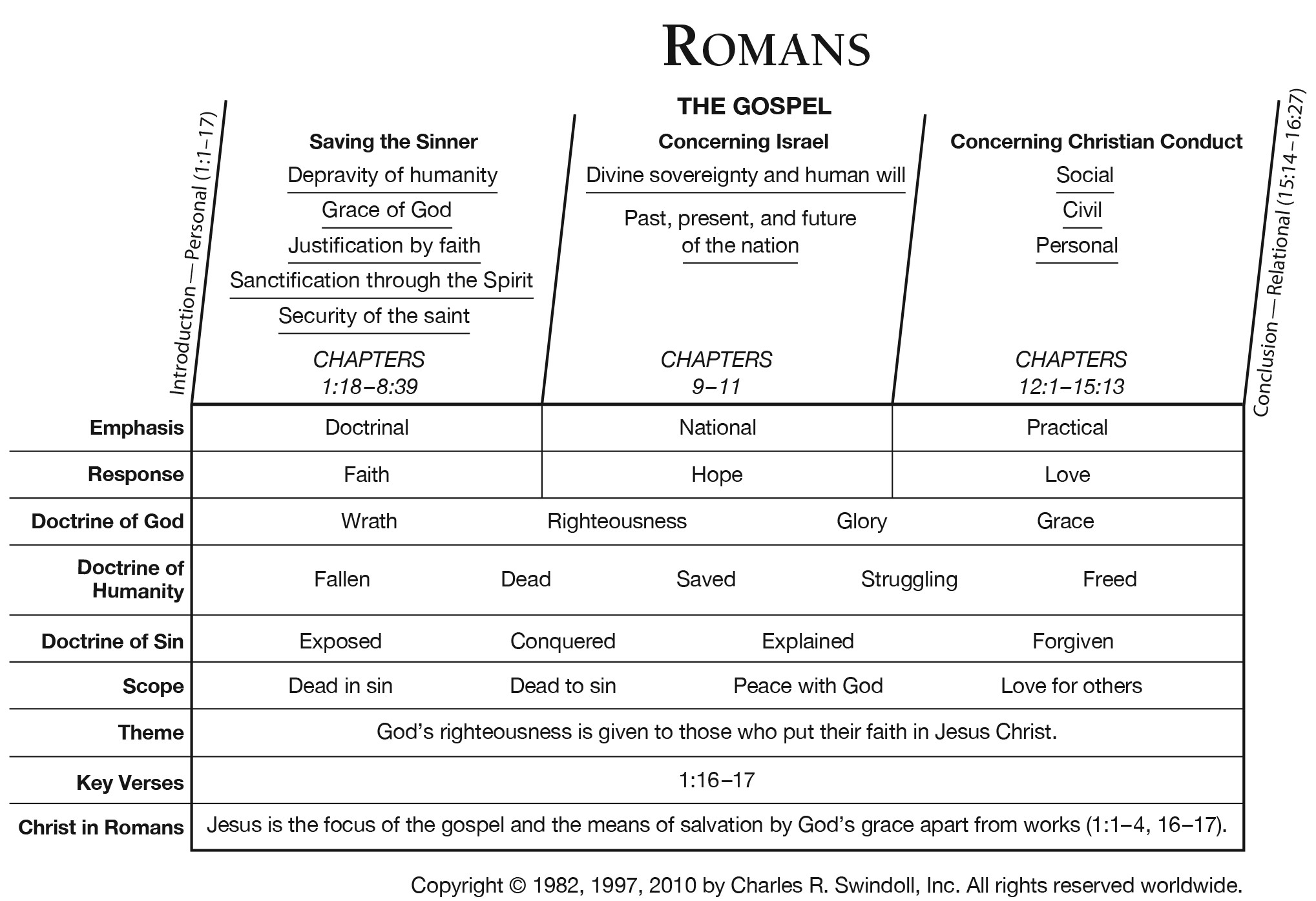
Click Charles Swindoll's overview chart
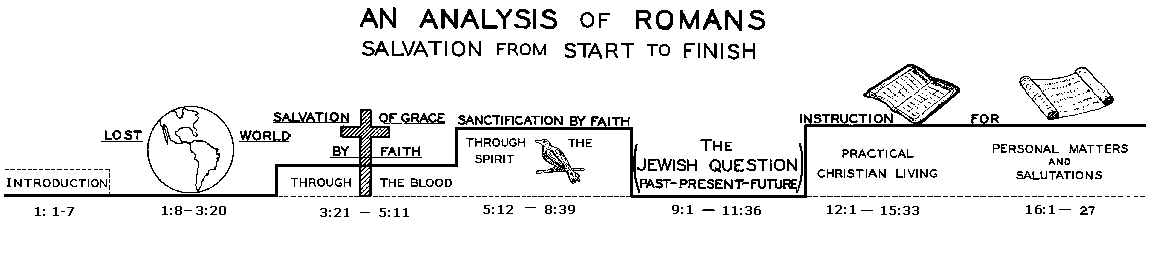
Source: Dr David Cooper
Click to Enlarge
| ROMANS ROAD to RIGHTEOUSNESS |
||||
| Romans 1:18-3:20 | Romans 3:21-5:21 | Romans 6:1-8:39 | Romans 9:1-11:36 | Romans 12:1-16:27 |
| SIN | SALVATION | SANCTIFICATION | SOVEREIGNTY | SERVICE |
| NEED FOR SALVATION |
WAY OF SALVATION |
LIFE OF SALVATION |
SCOPE OF SALVATION |
SERVICE OF SALVATION |
| God's Holiness In Condemning Sin |
God's Grace In Justifying Sinners |
God's Power In Sanctifying Believers |
God's Sovereignty In Saving Jew and Gentile |
Gods Glory The Object of Service |
| Deadliness of Sin |
Design of Grace |
Demonstration of Salvation | ||
| Power Given | Promises Fulfilled | Paths Pursued | ||
| Righteousness Needed |
Righteousness Credited |
Righteousness Demonstrated |
Righteousness Restored to Israel |
Righteousness Applied |
| God's Righteousness IN LAW |
God's Righteousness IMPUTED |
God's Righteousness OBEYED |
God's Righteousness IN ELECTION |
God's Righteousness DISPLAYED |
| Slaves to Sin | Slaves to God | Slaves Serving God | ||
| Doctrine | Duty | |||
| Life by Faith | Service by Faith | |||
|
Modified from Irving L. Jensen's chart above |
||||
Romans 2:7 to those who by perseverance in doing good seek (PAPMPD) for glory and honor and immortality, eternal life (NASB: Lockman)
Greek: tois men kath hupomonen ergou agathou doxan kai timen kai aphtharsian zetousin (PAPMPD) zoen aionion,
Amplified: To those who by patient persistence in well-doing [springing from piety] seek [unseen but sure] glory and honor and [the eternal blessedness of] immortality, He will give eternal life. (Amplified Bible - Lockman)
ICB: Some people live for God's glory, for honor, and for life that has no end. They live for those things by always continuing to do good. God will give life forever to them. (ICB: Nelson)
NLT: He will give eternal life to those who persist in doing what is good, seeking after the glory and honor and immortality that God offers. (NLT - Tyndale House)
Phillips: and that means eternal life to those who, in patiently doing good, aim at the unseen (but real) glory and honour of the eternal world. (Phillips: Touchstone)
Wuest: to those on the one hand who by steadfastness of a good work seek glory and honor and incorruptibility, life eternal
Young's Literal: to those, indeed, who in continuance of a good work, do seek glory, and honour, and incorruptibility -- life age-during;
TO THOSE WHO BY PERSEVERANCE IN DOING GOOD DEEDS: tois men kath hupomonen ergou agathou:
- Ro 8:24,25; Job 17:9; Ps 27:14; 37:3, 34; La 3:25, 26; Mt 24:12,13; Lk 8:15; Jn 6:66, 67, 68, 69; 1Co 15:58; Gal 6:9; 2Ti 4:7,8; Heb 6:12,15;10:35,36; Jas 5:7,8; Rev 2:10,11
- Torrey's Topics Patience; Perseverance
- Romans 2 Resources - Multiple Sermons and Commentaries
PAUL'S DESCRIPTION
OF BELIEVERS
Perseverance in doing good deeds - Note carefully that this phrase does not describe the way of salvation but the way the saved conduct their lives. In other words, their good works give clear evidence that they are genuinely saved. We are saved by faith alone in Christ alone, but the faith that genuinely saves is never alone but brings forth fruit (good deeds) in keeping with repentance.
Perseverance (5281) (hupomone [word study] from hupo = under + meno = abide) means literally abiding under, as one would abide under a heavy load. As an aside he who abides in Christ will be enabled to abide "under" any load (cp Php 4:13-note).
Hupomone describes steadfastness and endurance when circumstances are difficult. "God… gives perseverance" (Ro 15:5-note) and thus hupomone is not simply you by yourself "gritting your teeth" nor is it a passive acceptance of the circumstances. To the contrary, hupomone is manifest strong (Spirit enabled) fortitude in the face of opposition or difficulty.
Hupomone is used 32 times in the NT -
Lk. 8:15; 21:19; Rom. 2:7; 5:3, 4; 8:25; 15:4, 5; 2 Co. 1:6; 6:4; 12:12; Col. 1:11; 1Th 1:3; 2Th 1:4; 3:5; 1 Tim. 6:11; 2 Tim. 3:10; Titus 2:2; Heb. 10:36; 12:1; Jas. 1:3, 4; 5:11; 2 Pet. 1:6; Rev. 1:9; 2:2, 3, 19; 3:10; 13:10; 14:12
Hupomone is that spirit which bears things not simply with resignation, but with blazing hope (absolute assurance of future good not "I hope so"). In other words, if something happens in your life that is hard and painful and frustrating and disappointing, and, by grace, your faith looks to Christ and to His power and His sufficiency and His fellowship and His wisdom and His love, and you don't give in to bitterness and resentment and complaining, then your faith endures and perseveres. How did you do this past week? If you have slipped backwards, don't be discouraged for God is your "very present help in trouble" (Ps 46:1-Spurgeon's note). Recall that "The steps of a man are established by Jehovah and He delights in his way. When he falls, he shall not be hurled headlong because Jehovah is the One Who holds his hand." (Ps 37:23 24 cf Jude 1:24, 25; Php 1:6-note)
Dearly beloved, be encouraged for by His promise and power you shall persevere to the end.
Patient continuance in well doing does not mean that we are saved by doing good. Although a superficial reading of this verse might suggest that eternal life can be gained by doing good Romans clearly teaches justification (declared in right standing before God) is only by faith (Ro 3:22-note).
Steve Lawson expounds on the perseverance described here by Paul...
The word perseverance is the mark of the true believer. You have heard of the perseverance of the saints?...This is one passage that teaches the perseverance of the saints which means to endure with constancy and steadfastness throughout the entirety of one's Christian life....Hebrews 3:14 s says, "For we have become partakers of Christ." Another way to say we have become believers in Jesus Christ. We have received Christ and are partakers of Christ. "If we hold fast the beginning of our assurance firm until the end." You have heard me say before “the faith that fizzles before the finish had a flaw from the first” indicating that the person was not a true believer. That is a flawed, counterfeit faith, if one does not persevere faithful to the end (of their life), because God is the Author of saving faith and when God grants saving faith, it is a faith that causes one to persevere in obedience throughout one's life. Colossians 1:21-23 is the other passage and we just need to touch on beginning in verse 21, "You were formerly alienated and hostile in mind, engaged in evil deeds, yet he has now reconciled you in his fleshly body through death in order to present you before him holy and blameless and beyond reproach." Col 1:23 goes on to say "If indeed you continue in the faith, firmly established, and steadfast and not moved away from the hope of the Gospel, which you have heard." It could not be clearer. The one who is a true believer begins in the faith, perseveres in the faith, continues in the faith, and there is a finality at the end of their life in doing good and in pursuing godliness. There may be seasons of carnality, times of being tripped up, for this doctrine of perseverance does not mean perfection. This doctrine describes the direction in which a true believer is headed.
Gotquestions addresses the perseverance of the saints -
Perseverance of the saints is the name that is used to summarize what the Bible teaches about the eternal security of the believer. It answers the question, “Once a person is saved, can he lose his salvation?” Perseverance of the saints is the P in the acronym TULIP, which is commonly used to enumerate what are known as the five points of Calvinism. Because the term “perseverance of the saints” can cause people to have the wrong idea about what is meant, some people prefer to use terms like “preservation of the saints,” “eternal security,” or “held by God.” Each of these terms reveals some aspect of what the Bible teaches about the security of the believer. However, like any biblical doctrine, what is important is not the name assigned to the doctrine but how accurately it summarizes what the Bible teaches about that subject. No matter which name you use to refer to this important doctrine, a thorough study of the Bible will reveal that, when it is properly understood, it is an accurate description of what the Bible teaches. The simplest explanation of this doctrine is the saying: “Once saved, always saved.” The Bible teaches that those who are born again will continue trusting in Christ forever. God, by His own power through the indwelling presence of the Holy Spirit, keeps or preserves the believer forever. This wonderful truth is seen in Ephesians 1:13-14, where we see that believers are “sealed with the Holy Spirit of promise, who is the guarantee of our inheritance until the redemption of the purchase possession, to the praise of His glory.” When we are born again, we receive the promised indwelling presence of the Holy Spirit that is God’s guarantee that He who began a good work in us will complete it (Philippians 1:6). In order for us to lose our salvation after receiving the promised Holy Spirit, God would have to break His promise or renege on His “guarantee,” which He cannot do. Therefore, the believer is eternally secure because God is eternally faithful. (Read more>)
As already discussed, the subject of this verse is judgment, not justification. Believers who continue in good works will receive rewards in the life to come. Rewards will be based on works accomplished on earth. A person’s doing good shows that his heart is regenerate. Such a person, redeemed by God's Spirit, has eternal life. Conversely a person who continually does evil and rejects the truth shows that he is unregenerate, and therefore will be an object of God’s wrath.
Good deeds cannot even begin until one is born again! (Click for discussion of Good Deeds) Here Paul speaks of the reward that shall be given to those who persevere in living holy lives. Living a holy life does not save us but does prove we are saved, because the only one who can live a holy life is the one who possesses the indwelling Holy Spirit. Paul is not explaining how a man is saved in this section but is showing how a man is judged. All men will be judged on the basis of deeds (see the discussion in preceding verse).
I like to describe "good deeds" as "good" with the "o" removed - "God deeds." In other words, deeds initiated and enabled by the Spirit for the glory of the Father and the Son.
John Murray succinctly stated that "works without redemptive aspiration are dead works. Aspiration without good works is presumption."
Related Resources:
- On site discussion of Good Deeds
- What does it mean that good works are the result of salvation?
- Is salvation by faith alone, or by faith plus works?
Speaking of believers, Paul explains that "each man's work (ergon = deeds) will become evident (NIV = "shown for what it is"), for the day will show it, because it is to be revealed with fire; and the fire itself will test the quality of each man's work. If any man's work which he has built upon it remains, he shall receive a reward. If any man's work is burned up, he shall suffer loss; but he himself shall be saved, yet so as through fire." (1Cor 3:11 12 13 14, 15). (See discussion of Judgment Seat of Christ = bema)
By contrast (see Table in preceding section) unbelievers at the Great White Throne will be
"judged from the things… written in the books, according to their deeds… every one of them according to their deeds" (Rev 20:11, 12, 13, 14, 15-see notes) to determine the degree of their everlasting punishment in "the lake of fire" (See Births, Deaths, and Resurrections).
William Newell sums up "patient continuance in well-doing" (KJV) as follows
The "patient continuance in well-doing" is not at all set forth as the means of their procuring eternal life, but as a description of those to whom God does render life eternal. Well-doing is subjection to and obedience to the light God has vouchsafed.
To Abel, "well-doing" meant approaching God by a sacrifice, as a sinner, as he had been taught to do.
To Noah, "continuance in well-doing" meant building an ark to save his house and preserve life upon the earth, involving years of labor, and the ridicule of man.
To Abraham, it meant leaving his country, his relatives, and his father's house, and becoming a stranger and pilgrim on earth.
To Job, it meant his God-fearing, evil-rejecting life; and afterwards, in the midst of his great affliction, bowing before the presence of God in dust and ashes.
To Matthew the publican, it meant rising from his business and following the Lord Jesus
To Cornelius the centurion, a life of patient prayer and generosity, -and then believing the gospel at Peter's lips.
To Lydia, it meant humble and faithful attendance at "the place of prayer" till Paul came and "her heart was opened" to give heed to the gospel of grace spoken by the apostle, whence followed her "obedience of faith."
In every age since man sinned there have been those like Jabez, who was "more honorable than his brethren, and called upon God" (1Chr 4:9,10) ; and like Joseph, who was "separate from his brethren."
There always have been choosers of God and rejectors of God. (Romans 2) (Bolding added)
SEEK (continuously) FOR GLORY AND HONOR AND IMMORTALITY ETERNAL LIFE: doxan kai timen kai aphtharsian zetousin (PAPMPD) zoen aionion:
- glory: Ro 8:18-note; Ro 9:23-note; Jn 5:44; 2Co 4:16, 17, 18; Col 1:27-note; 1Pe 1:7-note; 1Pe 1:8-note; 1Pe 4:13-note, 1Pe 4:14-note;
- immortality: 1Co 15:53,54; 2Ti 1:10-note
- eternal life: Ro 6:23-note; 1Jn 2:25
- Romans 2 Resources - Multiple Sermons and Commentaries
PAUL'S DESCRIPTION
OF BELIEVERS CONTINUES
Do not be confused by this passage, for Paul is not teaching salvation by works!
John MacArthur summarizes this section writing that "In Romans 2:1-16 Paul is not talking about the basis for salvation but the basis for judgment. He does not begin discussing salvation as such until chapter three. In the present passage he is talking about deeds as one of the elements, or principles, God employs in judgment. He is discussing the evidences of salvation, not the means or basis of it. He is saying that if a person is truly saved, there will be outward evidence of it in his life. If he is not saved, there will be no such evidence. Every believer falls short of God's perfect righteousness and sometimes will fall into disobedience. But a life that is completely barren of righteous deeds can make no claim to being redeemed. In Romans 2:7-10 Paul draws a clear line between two classes of people, the only two classes that exist: the saved and the unsaved. He focuses first on the determinative deeds of the redeemed (Ro 2:7), next on the determinative deeds of the unredeemed (Ro 2:8-9), and then again on the deeds of the redeemed (Ro 2:10)." (MacArthur New Testament Commentary – Romans) (Bold added)
And so one can look at this section as a contrast between two classes, the redeemed and unredeemed, whether Jew or Gentile, specifically as shown by their conduct and the rewards they obtain which are based on their conduct.
| CHARACTER | CONDUCT | REWARD | |
| Ro 2:7 | Redeemed | doing good | eternal life |
| Ro 2:8 | Unredeemed | do not obey the truth | wrath and indignation |
| Ro 2:9 | Unredeemed | does evil | tribulation and distress |
| Ro 2:10 | Redeemed | does good | glory and honor and peace |
Remember that in the next chapter Paul teaches that (absolutely) no (fallen, unregenerate) man seeks (ekzeteo) for God (Ro 3:11+), so clearly the continuous (present tense indicates continuously) "seeking" described in this passage has to be explained in some other way. And the explanation is that they are supernaturally enabled by the Spirit to seek for "eternal life." However, in this section (Ro 2:7-11) Paul is not explaining how a person is saved but is contrasting the way a saved person lives with the way an unsaved person lives. He also discusses the dramatic difference in the rewards of the saved and the unsaved. Stated another way, Paul is setting forth what God desires from all men (whether Jew or Gentile for there is no partiality) and the blessing (or "curse") that will result.
Seek (2212) (zeteo) implies giving attention and priority to and deliberately pursuing after. The most common sense of this word is to "seek".
Webster says that to seek means to go in search or quest of, to look for, to try to discover, to search for by going from place to place. To inquire for; to ask for; to solicit; to endeavor to find or gain by any means.
Zēteō in classical Greek is often used as a technical term for philosophical investigation, something “examined, considered” or “deliberated.” The Old Testament tradition of seeking after God, the prophets, false gods, etc., was shown by Paul (Ro 10:20). The most striking application of zēteō is the New Testament religious application. Jesus came to seek and to save the lost which implies far more than a mere “looking around” (as seen in Mt 6:32,33; 13:45,46; Lk 15:8) and includes the idea of diligently, earnestly, and tenaciously searching after something, sparing no effort, for the sought object is valued to the highest degree. Likewise, believers are to seek God in the same way.
The present tense in Ro 2:8 speaks of habitual conduct or lifestyle, whether good or evil, both of which reveal the true condition of one's heart, whether it is regenerated or not by faith in Christ. Jesus taught (speaking of false teachers but applicable in principle) that "You will know them by their fruits. Grapes are not gathered from thorn bushes, nor figs from thistles, are they?… So then, you will know them by their fruits. (Mt 7:16-note, Mt 7:20 -note)
See zeteo in Vine's Expository Dictionary
Zeteo can refer to people “searching for” wisdom (1 Co. 1:22); spiritual blessing (Mt 7: 7; Lk 11:19); rest (Mt 12:43); peace (1Pe. 3:11); a sign (Mk 8:11); death (Rev. 9: 6). People are also said to “seek after” the kingdom of God (Mt 6:33; Lk 12:31; 13:24).
While zeteo most often means “seek” in most of its nearly 117 uses in the NT, in Lk 12:48 and 1 Co 4:2 zeteo is used passively to indicate that which is required (i.e., demanded) of faithful servants of God.
Stephen Renn - The meaning “seek” in the sense of “attempt” is indicated in contexts where there is an intention to destroy or kill (cf. Mt 2:20; 21:31). In particular, such an intent is recorded in connection with the campaign of the Jewish authorities to have Jesus Christ killed (cf. Mt 21:46; Mk 11:18; Lk 19:47; Jn 5:16; 7:1, 19 ff.; 8:37 ff.). Elsewhere, zeteo refers to the “attempt” to obtain eternal life or glory (Ro 2: 7; Col. 3: 1). See also Lk 17:33. It also refers to people touching Jesus in order to obtain a cure for disease (cf. Lk 6:19). Christ, as the Son of Man, “seeks” to do the will of God (Jn 5:44); and “seeks out” those who are spiritually lost in order to save them (cf. Lk 19:10). God is said to seek those who will worship him in Jn 4:23. (Expository Dictionary Of Bible Words - Word Studies for Key English Bible Words - Stephen D. Renn)
Zeteo describes the way Onesiphorus sought for Paul in Rome (2Ti 1:17) and there carries the idea of "diligent searching." Onesiphorus didn't make a few inquiries and quit. He diligently and with great determination searched for Paul until he found him. Oliver B. Greene wrote "The majority of friends. (so-called) will forsake us in the darkest hour of need; but the friend who is to be treasured as a jewel is the man who stands with us when we need encouragement, when all others are against us, and seemingly we have lost the battle. No words could ever express the worth of such a friend"!
Zeteo can speak of to seek what is lost, as "lost souls" in Luke 19:10, a shepherd seeking his lost sheep (Mt. 18:12) or a woman for her lost coin (Luke 15:8). But the same term can also be used of God's holy "demand" that requires much of him to whom He has given much (Luke 12:48 "required" [sought]), and that expects fruit from the tree (Luke 13:6-7 where "looking" = zeteo)
Wayne Detzler - The Greek term translated "seek" is zeteo. In its basic form it means to seek, investigate, or search for something. Homer used it to describe the striving after knowledge; it especially applied to philosophical investigation. Later on the term took on a legal flavor, as it was used to portray a judicial investigation. From the first century before Christ onward it meant to seek, investigate, to strive for knowledge. This word appeared more than 400 times in the Septuagint (see uses below), the Greek translation of the Old Testament. Sometimes "seek" simply meant to concentrate on finding someone. Joseph sought his brothers (Gen. 37:16), and Saul sought his father's female donkeys (1Sa 10:2). Also in the Septuagint this word was used for seeking after God (Isa 9:13). Conversely, God sought after His prodigal people (Ezek. 34:12-16). The words based on zeteo occur 120 times in the New Testament. Simply speaking, they relate to seeking what was lost. In Jesus' Parable of the Pearl, a merchant sought diligently to find expensive pearls (Matt. 13:45). Luke's Gospel contains a whole cluster of parables relating to seeking. In addition to the Lost Sheep and the Lost Son Parables, Jesus told about a Lost Coin. A woman lit a torch and sought diligently to found her coin (Luke 15:8). Another major emphasis in the Scriptures is the search for God. (Some would argue that God is not lost; we are. Still the New Testament speaks of applying effort to find God.) Christ exhorted His hearers to seek God's kingdom before anything else (Matt. 6:33; Luke 12:31). Likewise Jesus urged urgency in the search for God (Matt. 7:7; Luke 11:9). In the same vein the Apostle Paul told his Athenian hearers to seek after God (Acts 17:27). When a sinner is saved, he or she has searched seriously for God, though God really did the pursuing. There are some references in the Scripture to show what God is seeking in His people. Jesus sought figs on a fig tree, and He seeks spiritual fruit in our lives (Luke 13:6). God is also seeking true worshipers (John 4:23). When the Lord came into this world, His primary aim was to seek and to save the lost (Luke 19:10). God seeks in His people a heart to worship and serve Him, and where this is lacking He moves on. One kind of seeking that is condemned in the Scriptures is self-seeking. Before Christ came, people were consumed with a desire to seek righteousness on their own terms, not on God's terms (Rom. 10:3). Even among Christians Paul found many people who sought after their own interests rather than the things of God (Phil. 2:21). He contrasted this self-seeking with Christ's life of self-sacrifice (2:5-11). Paul had learned not to seek his own ends, but the building up of the church (1 Cor. 10:33). Another perversion of this seeking was the Jewish habit of seeking a sign from God to validate the messianic message (Mark 8:12). If the people did not see a miracle, they would not believe. But despite all the miracles they saw, many still did not believe. The Apostle Paul likewise warned the Corinthians about this fundamental error (1 Cor. 1:21-23). The whole of the Christian life can be summarized in seeking. God in His grace and mercy seeks and finds us. We have hearts which are disposed to seek after God until we find Him (ED NOTE: Actually Ro 3:11 would argue against this statement by Detzler - to be sure there is a "God shaped vacuum" in every soul, but many/most are "seeking" for God in "all the wrong places!"). After conversion, God seeks in us true worship, while we seek to please Him by what we do. When Jesus lived on earth, He went around seeking and saving. Now we who are the body of Christ should be constantly involved in seeking and saving the lost. Otherwise we have no reason to remain on earth. (NT Words in Today's Language)
ILLUSTRATIONS of seek - God's marvelous means of winning us for Himself are all bound up with the act of seeking. In fact Francis Thompson (1859-1907) wrote an excellent poem, "The Hound of Heaven." After studying for the priesthood, Thompson turned to medicine at the University of Manchester. Before long he became a helpless opium addict, in London. In 1888 Wilfred Meynell found him and won him for Christ. Thompson claimed that all along God had sought him like "the hound of heaven." Another similar story is that of Augustine (A.D. 354-430). Despite the pleadings of his godly mother, Monica, he launched into a life of immorality and debauchery. Along the way he fell in with the Manichean sect, and later he became a disciple of Neo-Platonism. Finally in Milan during 386 he read the Bible, and God arrested Augustine. Consequently the church has been immensely enriched by his life and writings. Augustine explained this searching in his testimonial book, Confessions. Here he recorded this powerful prayer: "Thou has created us for Thyself, and our heart cannot be quieted till it may find repose in Thee." He knew the double searching of God for the sinner and the sinner for God. Another person who understood this seeking after God was Chicago preacher A. W. Tozer. One of the collections of his writings is titled, The Pursuit of God. In this compendium of essays Tozer took his readers on a quest for the holiness of God. The son of my colleague had grown up, but not completely. In rebellion he turned his back on everything his father stood for. One time the boy even stole his father's car and ended up in jail. In sheer desperation, to escape his Christian home, the boy joined the U.S. Army. Of course God was still pursuing him, seeking him. Soon a Christian came into the boy's life, and he came to a personal faith in the Lord. Now that retired rebel is studying for the ministry. Because God is eager to seek us, true Christians engage in evangelism to seek others. The need for going after the lost was emphasized by Myron S. Augsburger, a Mennonite evangelist. "Too many clergymen have become keepers of the aquarium," argued Augsburger, "instead of fishers of men—and often they are just swiping each other's fish." On the same subject of seeking the lost, John Wesley (1703-91) issued a stern warning: "The church has nothing to do but to save souls; therefore spend and be spent in this work. It is not your business to speak so many times, but to save souls as you can; to bring as many sinners as you possibly can to repentance." (Ibid)
Here is a summary of uses of zeteo
(1) Searching for what is lost in order to find it (Lk 19:10, once possessed then lost - Mt 28:5, Mk 1:37)
(2) Searching or seeking for God (Acts 17:27). To seek God means to turn to Him, to strive humbly and sincerely to follow and obey Him
(3) A divine requirement of man (Lk 12:48).
(4) Seeking in the sense of making an inquiry or conducting an investigation, as when examining or questioning (Jn 16:19)
(5) To endeavor to obtain something, to strive for something even with earnestness. To devote serious effort to realize one’s desire or objective, strive for, aim (at), try to obtain, desire, wish (for) (Mt 6:33, Lk 12:31)
(6) Speaks of man's desire toward something (1Cor 10:24).
NAS translates zeteo - deliberating(1), demanding(1), inquire(1), looking(11), made efforts(1), search(4), searched(1), seek(36), seek after(1), seeking(35), seeks(9), sought(4), striving(1), tried(1), trying(6), kept trying to obtain(2).
Zeteo - 117x in 114v in NAS -
Matt 2:13 (Herod is going to search for the Child to destroy Him.), Mt 2:20 (for those who sought the Child's life are dead); Mt 6:33 (seek [present imperative] first His kingdom; Mt 7:7, 8 (seek and you shall find); Mt 12:43, 46f; 13:45 (the kingdom of heaven is like a merchant seeking fine pearls); Mt 18:12 (and search for the one that is straying); Mt 21:46 (they sought to seize Him); 26:16, 59; 28:5;
Mark 1:37; 3:32; 8:11f; 11:18; 12:12; 14:1, 11, 55; Mk 16:6;
Luke 2:48f; 5:18; 6:19; 9:9; 11:9f, 16, 24, 29; Lk 12:29, 31, 48; 13:6f, 24; 15:8; 17:33; 19:3, 10, 47; 20:19; 22:2, 6; 24:5;
John 1:38; 4:23, 27; 5:18, 30, 44; 6:24, 26; 7:1, 4, 11, 18ff, 25, 30, 34, 36; Jn 8:21 (I go away, and you shall seek Me, and shall die in your sin; where I am going, you cannot come), Jn 8:37, 40 (you seek to kill Me), Jn 8:50; 10:39; 11:8, 56; 13:33; 16:19; 18:4, 7f; 19:12; 20:15;
Acts 9:11; 10:19, 21; 13:8, 11; 16:10; 17:5, 27; 21:31; 27:30;
Ro 2:7; Ro 10:3 (= to seek, to search for, to try to, w. inf. Pres. part. emphasizes the continuing search, and indicates a deliberate and sustained intention, reflecting their zeal), Ro 10:20; 11:3;
1 Cor 1:22; 4:2; 7:27; 10:24, 33; 13:5; 1Cor 14:12 (seek to abound for the edification of the church);
2 Cor 12:14; 13:3; Gal 1:10; 2:17; Phil 2:21; Col 3:1 (Vine - "to seek, signifies here, not to search for, but to desire earnestly and to strive after"); 1Th 2:6; 2Ti 1:17; Heb 8:7; 1 Pet 3:11; 5:8; Rev 9:6
Zeteo - 313x in the Non-apocryphal Septuagint - Gen 19:11; 37:15f; 43:9, 30; Ex 2:15; 4:19, 24; 10:11; 33:7; Lev 10:16; Num 16:10; 35:23; Deut 4:29 (A prophecy - "“But from there you will seek the LORD your God, and you will find Him if you search for Him with all your heart and all your soul."); 13:10; 22:2; Jdg 4:22; 14:4; 18:1; Ruth 3:1; 1 Sam 9:3; 10:2, 14, 21; 13:14; 14:4; 16:16; 19:2, 10; 22:23; 23:10, 14f, 25; 24:2, 9; 25:26, 29; 26:2, 20; 27:1, 4; 28:7; 2Sa 3:17; 4:8; 5:17; 11:3; 12:16; 14:16; 16:11; 17:3, 20; 20:19; 21:1f; 1 Kgs 1:2f; 10:24; 11:22, 40; 12:24; 18:10; 19:10, 14; 20:7; 2Kgs 1:6, 16; 2:16f; 6:19; 1Chr 4:39; 10:13f; 13:3; 14:8; 15:13; 16:10f; 21:3, 30; 22:19; 28:8f; 2Chr 7:14; 9:23; 11:16; 15:12, 15; 16:12; 18:4, 7; 20:4; 22:9; 25:15; 26:5; 33:12; 34:3, 21, 26; Ezra 2:62; 7:6, 10; 8:21ff; Neh 2:4, 10; 5:12, 18; 7:64; 12:27; Esther 1:1; 2:2, 21; 6:2; 8:12; Job 6:5; 9:26; 38:41; 39:8, 29; Ps 4:2; 10:15; 24:6 (This is the generation of those who seek Him, Who seek Thy face–even Jacob. Selah); Ps 27:8 (When Thou didst say, “Seek My face,” my heart said to Thee, “Thy face, O LORD, I shall seek.”); Ps 34:14 (Depart from evil, and do good; Seek peace, and pursue it.); Ps 35:4; 37:10, 25, 32, 36; Ps 38:12; 40:14, Ps 40:16 (Let all who seek Thee rejoice and be glad in Thee; Let those who love Thy salvation say continually, “The LORD be magnified!”); Ps 54:3; 63:9; 69:6; 70:2, 4; 71:13, 24; Ps 83:16; 86:14; 104:21; 105:3 (Glory in His holy name; Let the heart of those who seek the LORD be glad.) Ps 105:4 (Seek the LORD and His strength; Seek His face continually.); Ps 119:176; Pr 1:28 (“Then they will call on me, but I will not answer; They will seek me diligently, but they shall not find me); Pr 2:3, 4; Pr 8:17 (“I love those who love me; And those who diligently seek me will find me.); Pr 9:6; 11:27; 14:6; 15:14; 16:7; 17:9, 16; 18:1, 15; 23:35; 28:5; Eccl 3:6, 15; 7:25, 28f; 8:17; 12:10; Song 3:1f; 5:6; 6:1; Isa 8:19; 21:12; 34:16; 40:20; 41:12, 17; 45:19; 51:1; 55:6; 58:2; 65:1, 10; Jer 2:24, 33; 4:30; 5:1; 11:21; 19:7; 21:7; 22:25; 26:21; 29:7 (‘And seek the welfare of the city where I have sent you into exile, and pray to the LORD on its behalf; for in its welfare you will have welfare.’) Jer 29:13 (And you will seek Me and find Me, when you search for Me with all your heart), Jer 30:17; 36:24; 44:30; 45:5; 49:37; 50:4, 20; Lam 1:11, 19; 3:25; Ezek 7:25f; 22:30; 34:4, 12, 16; 36:37; Dan 1:20; 2:11, 13, 18; 4:36; 6:4; 7:16, 19; 8:15; Hos 2:7; Amos 8:12; Mic 3:2; Nah 3:7, 11; Zeph 1:6; 2:3; Zech 11:16; Zech 12:9; Mal 2:15; 3:1 (“Behold, I am going to send My messenger, and he will clear the way before Me. And the Lord, whom you seek, will suddenly come to His temple; and the messenger of the covenant, in whom you delight, behold, He is coming,” says the LORD of hosts.);
Glory (1391) (doxa from dokeo = to think) means to give a proper opinion or estimate of something and thus the glory of God expresses all that He is in His Being and in His nature, character, power and acts. True believers continually (present tense) seek glory, primarily God's glory and secondarily personal glory.
MacArthur on seeking glory - the highest and most wonderful desire of a believer is glory, above all, God’s glory. A person who does not have such a desire deep within him cannot be a true believer. “Whether, then, you eat or drink or whatever you do, do all to the glory of God,” Paul admonishes (1Cor 10:31). To live to the glory of God is to manifest the very nature of God as a willing vehicle for His own divine working. A believer also seeks glory for himself, not in the fleshly, self-seeking way that is common to fallen human nature, but by looking forward to his sharing God’s own glory some day when his salvation is perfected (see Ro 8:21, 30; 2Th. 2:14; cf. Ps. 17:15). We know that any “momentary, light affliction is producing for us an eternal weight of glory far beyond all comparison” (2 Cor. 4:17) and that “when Christ, who is our life, is revealed, then [we] also will be revealed with Him in glory” (Col. 3:4). In seeking this heavenly glory it is really a seeking of Christlikeness. (MacArthur NT Commentary - Romans)
Honor (5092)(time from tio = to pay honor or respect; see verb timao) is the worth or value ascribed to a person or thing. That which is paid in token of worth or value.
MacArthur - a true believer seeks honor, again not the worldly honor that most men long for but the honor that comes from God, the honor of His saying, “Well done, good and faithful slave; you were faithful with a few things, I will put you in charge of many things, enter into the joy of your master” (Matt. 25:21)....a true believer seeks immortality, the day when his perishable body "must put on the imperishable, and this mortal must put on immortality" (1 Cor. 15:53)." (Ibid)
Immortality (861) (aphtharsia from a = not + phthartos = corruptible from the verb phtheiro = to corrupt, shrivel, wither, spoil by any process, ruin , deprave, defile, destroy) is literally that which cannot decay or be corrupted (deteriorated or lowered in quality, implying loss of soundness, purity & integrity) and is that which experiences unending existence. Aphtharsia is a state of not being subject to decay or death - immortality, incorruptibility (state of being free from physical decay), perpetuity. It speaks of an unending existence, of that which is not capable of corruption. Aphtharsia indicates immunity to the decay that infects all of creation.
That aspect of aphtharsia for which we seek is especially described by Paul…
1Cor 15:53 For this perishable must put on the imperishable, and this mortal must put on immortality.
Aphtharsia - 7x in 7v - Ro. 2:7; 1Co. 15:42, 50, 53, 54; Ep 6:24; 2Ti 1:10. NAS = immortality(2), imperishable(4), incorruptible(1).
This incorruptible existence was made possible
by the appearing of our Savior Christ Jesus, Who abolished death, and brought life and immortality to light through the gospel. (2Ti 1:10-note:10)
The Latin Vulgate has incorruptio which in the context of the New Testament refers in part to the glorified resurrection body
"sown a perishable body, (but) raised an imperishable body" (1Co 15:42) and described by Paul as when "DEATH IS SWALLOWED UP in victory" (1Co 15:54)
Aphtharsia thus means more than simply duration, because even unbelievers will live forever, but also refers to a new quality of life (Jn 17:3). Jesus came that we
"may have life, and have it to the full" (abundantly) (Jn 10:10NIV).
Vine writes that aphtharsia is used
(a) of the resurrection body, 1Cor 15:42, 50, 53, 54;
(b) of a condition associated with glory and honour and life, including perhaps a moral significance, Ro 2:7; 2Ti 1:10; this is wrongly translated “immortality” in the AV;
(c) of love to Christ, that which is sincere and undiminishing, Eph 6:24 (Vine, W E: Vine's Complete Expository Dictionary of Old and New Testament Words. 1996. Nelson
Eternal life is a not just "quantitative" but is also "qualitative". Eternal life in this context is not simply duration of one's life but the life God gives to His children. As Paul so beautiful put it (note repetition of live and life)…
I have been crucified with Christ; and it is no longer I who live, but Christ lives in me; and the life which I now live in the flesh I live by faith in the Son of God, who loved me, and delivered Himself up for me. (Galatians 2:20-note)
Writing to the saints at Colossae who were being "bombarded" with all manner of empty philosophy and false teaching regarding their position in Christ (Col 2:8+), Paul assures them that their eternal life is found in "Christ…our life" (there is no verb "is" in the Greek text) (Col 3:4-note). The moment we are converted by grace through faith we receive "the free gift of God (which) is eternal life in Christ Jesus our Lord." (Ro 6:23-note; cf 1 John 5:20 and John 20:31 which describes the purpose of John's Gospel!) Believers experience eternal life not only in the future but even now in the present because we have the eternal God living within us now. This truth should serve to motivate us all to live with a heavenly perspective, a "future focus," continually "seeking the things above, where Christ is, seated at the right hand of God," continually setting our "mind on the things above, not on the things that are on earth." (Col 3:1-2+) See also discussion of "Vertical Vision."
John says "These things (THE FIRST EPISTLE OF JOHN) I have written to you who believe in the name of the Son of God, so that you may know that you have eternal life." (1 Jn 5:13) In the Greek the phrase "so that you may know that you have eternal life" is first in the sentence emphasizing the reality of eternal life as our present and continuous (have is in the present tense). This is just another little "clue" that eternal life once possessed by faith CANNOT be lost! A genuine believer cannot lose their salvation! See Assurance of Salvation.
In sum, eternal life is the believer's present possession and also our future inheritance (cf Mk 10:30) for as Peter explains we posses an "inheritance which is imperishable and undefiled and will not fade away, reserved in heaven" (1Pe 1:4+)
Easton's Dictionary adds that immortality refers to "perpetuity of existence. The doctrine of immortality is taught in the Old Testament. It is plainly implied in the writings of Moses (Ge 5:22,24; 25:8; 37:35; 47:9; 49:29, Compare Heb 11:13, 14, 15, 16; Ex 3:6, Compare Mt 22:23). It is more clearly and fully taught in the later books (Isa 14:9; Ps 17:15; 49:15; 73:24). It was thus a doctrine obviously well known to the Jews. With the full revelation of the gospel this doctrine was "brought to light" (2Ti 1:10; 1Co 15; 2Cor 5:1, 2, 3, 4, 5, 6; 1Th 4:13, 14, 15, 16, 17, 18).
Christ is -1 John 1:2; 5:20
Revealed by Christ -John 6:68; 2 Timothy 1:10
To know God and Christ is -John 17:3
GIVEN
- By God -Psalms 133:3; Romans 6:23
- By Christ -John 6:27; 10:28
- In Christ -1 John 5:11
- Through Christ -Romans 5:21; 6:23
- To all given to Christ -John 17:2
- To those who believe in God -John 5:24
- To those who believe in Christ -John 3:15,16; 6:40,47
- To those who hate life for Christ -John 12:25
- In answer to prayer -Psalms 21:4
- Revealed in the Scriptures -John 5:39
RESULTS FROM
- Drinking the water of life -John 4:14
- Eating the bread of life -John 6:50-58
- Eating of the tree of life -Revelation 2:7
- They who are ordained to, believe the gospel -Acts 13:48
SAINTS
- Have promises of -1 Timothy 4:8; 2 Timothy 1:1; Titus 1:2; 1 John 2:25
- Have hope of -Titus 1:2; 3:7
- May have assurance of -2 Corinthians 5:1; 1 John 5:13
- Shall reap, through the Spirit -Galatians 6:8
- Shall inherit -Matthew 19:29
- Look for the mercy of God to -Jude 1:21
- Should lay hold of -1 Timothy 6:12,19
- Are preserved to -John 10:28,29
- Shall rise to -Daniel 12:2; John 5:29
- Shall go into -Matthew 25:46
- Shall reign in -Daniel 7:18; Romans 5:17
- The self-righteous think to inherit, by works -Mark 10:17
- Cannot be inherited by works -Ro 2:7; 3:10, 11, 12, 13, 14, 15, 16, 17, 18, 19
THE WICKED
- Have not -1John 3:15
- Judge themselves unworthy of -Acts 13:46
- Exhortation to seek -John 6:27
Romans 2:8 but to those who are selfishly ambitious and do not obey (PAPMPD) the truth, but obey (PPPMPD) unrighteousness, wrath and indignation. (NASB: Lockman)
Greek: tois de ex eritheias kai apeithousi (PAPMPD) te aletheia peithomenois (PPPMPD) de te adikia orge kai thumos
Amplified: But for those who are self-seeking and self-willed and disobedient to the Truth but responsive to wickedness, there will be indignation and wrath. (Amplified Bible - Lockman)
NLT: But he will pour out his anger and wrath on those who live for themselves, who refuse to obey the truth and practice evil deeds. (NLT - Tyndale House)
Phillips: It also means anger and wrath for those who rebel against God's plan of life, and refuse to obey his rules, and who, in so doing, make themselves the very servants of evil. (Phillips: Touchstone)
Wuest: but to those on the other hand who out of a factious spirit are both also non-persuadable with respect to the truth and persuadable with respect to unrighteousness, wrath and anger.
Young's Literal: and to those contentious, and disobedient, indeed, to the truth, and obeying the unrighteousness -- indignation and wrath,
BUT TO THOSE ARE SELFISHLY AMBITIOUS: Tois de ek eritheias:
- Pr 13:10; 1Co 11:16; 1Ti 6:3,4; Titus 3:9-note
- Romans 2 Resources - Multiple Sermons and Commentaries
PAUL'S DESCRIPTION
OF UNBELIEVERS
But - This is a Term of contrast, striking in this case, as it introduces a description of the behavior which is radically different from that just described, which ultimately explains the justification for the diametrically opposite fates ("rewards") of the two groups.
It is fitting that in Paul's description of unregenerate, unredeemed men, he begins by focusing on their self-focused existence! Everything they do is for the express purpose of serving and pleasing self! Self is who you are and what you think and feel, and these men and women are so full of themselves, they have no room for God! O my, does this not picture the present plight of many in America who, who could also be aptly described as "lovers of self, lovers of money (to be used to pamper self!)." (2 Ti 3:2) It is interesting that the middle letter of "sin" is "I." Self...self...self. This sums up the essence of the temporal existence of all men and women who are still dead in their trespasses and sins in Adam (Eph 2:1). It is all about me! I am the great triumvirate, the indomitable "trinity" - I, me, mine. Beetle George Harrison's song "I Me Mine" is an apt anthem for Romans 2:8!
Selfishly ambitious (2052) (eritheia) means self seeking, strife, contentiousness, extreme selfishness, rivalry and those who seek only their own. In a word, eritheia is the desire to be number one no matter the cost!
Thayer adds that it refers to "a courting distinction, a desire to put oneself forward, a partisan and factious spirit which does not disdain low arts; partisanship, factiousness".
Eritheia describes personal gratification and self-fulfillment at any cost, which are the ultimate goals of all fleshly endeavors. Eritheia has no room for others, much less genuine humility. It is that ultimate self-elevation rampant in the world today which is the antithesis of what the humble, selfless, giving, loving, and obedient child of God is called to be in Christ and only possible in the power of His Spirit.
As discussed below eritheia did not originally have such a negative connotation but merely referred to a day laborer. It came to be used metaphorically, and almost exclusively, of a person who persistently seeks personal advantage and gain, regardless of the effect on others and by New Testament times, it had come to mean unbridled, selfish ambition in any field of endeavor. Eritheia was often associated with personal and party rivalry, quarreling, infighting, and strife (as KJV renders it five times). It usually conveys the idea of building oneself up by tearing someone else down, as in gambling, where one person’s gain is derived from others’ losses. The word accurately describes someone who strives to advance himself by using flattery, deceit, false accusation, contentiousness, and any other tactic that seems advantageous. It is hardly surprising, then, that Paul lists eritheia (“disputes”) as one of the works of the flesh (Gal. 5:20-note).
Eritheia is used 7 times in the NT (see below) and is translated in the NAS as - disputes, 2; selfish ambition, 3; selfishly ambitious, 1; selfishness, 1. It is not used in the Septuagint (LXX)
Romans 2:8 (note) but to those who are selfishly ambitious and do not obey the truth, but obey unrighteousness, wrath and indignation.
2 Corinthians 12:20 For I am afraid that perhaps when I come I may find you to be not what I wish and may be found by you to be not what you wish; that perhaps there may be strife, jealousy, angry tempers, disputes, slanders, gossip, arrogance, disturbances;
Galatians 5:20 (note) idolatry, sorcery, enmities, strife, jealousy, outbursts of anger, disputes, dissensions, factions,
Philippians 1:17 (note) the former proclaim Christ out of selfish ambition, rather than from pure motives, thinking to cause me distress in my imprisonment.
Philippians 2:3 (note) Do nothing from selfishness or empty conceit, but with humility of mind let each of you regard one another as more important than himself;
James 3:14 But if you have bitter jealousy and selfish ambition in your heart, do not be arrogant and so lie against the truth.
James 3:16 For where jealousy and selfish ambition exist, there is disorder and every evil thing.
Eritheia originally referred to spinning thread for hire, then more broadly to sewing for hire, then more broadly still to any sort of work or undertaking that was done for personal gain -- the work of a hired laborer (root word erithos). So it came to refer essentially to any work done for pay. Sadly eritheia degenerated into a description of the work which is done for no other motives than for pay. The one who works solely for pay works from a low motive and is out solely to benefit self. Eritheia therefore evolved into a description of one who was out for an office as a means of magnifying self and came to be connected with politics (wonder why?!) and to mean canvassing for political or public office. And so it described a person who wanted office, not from a motives of public service, but for what he could get out of it. At it's base level eritheia came to describe the utterly selfish and self-centered ambition which has no desire to serve another but is only in something for what it can get out of it for self. Furthermore, the person who is eritheia does not care what level or method it must stoop in order to attain its objective! Eritheia is more eager to display self than to display the truth. It is interested more in the victory of its own opinions than in the victory of the truth. Crooked politicians, who serve in office only for what they can get out of it, are a good example of this.
Eritheia is found before NT times only in Aristotle where it denotes a self-seeking pursuit of political office by unfair means. Thayer says it is "used of those who electioneer for office, courting popular applause by trickery and low arts." (Times haven't changed very much have they!) The idea is that this person is like a mercenary, who does his work simply for money, without regard for the issues or any harm he may be doing. Everything he does is for the purpose of serving and pleasing SELF. Certainly this fits the Bible’s emphasis that the basic problem of unregenerate man is his being totally wrapped up in SELF and having no place in his life for God.
William Barclay adds his interesting analysis of eritheia writing that it…
"is a word whose meaning degenerated, and the story of its degeneration is in itself a grim commentary on human nature… the interesting thing about this word is that… we would very naturally and almost inevitably derive it from eris, which is the word for `strife'; but that is not its derivation at all. Erithos originally meant 'a day labourer'; the word was specially connected with `spinners' and 'weavers', and the popular derivation was from erion, which means 'wool'. Eritheia therefore began by being a perfectly respectable word with the meaning 'labour for wages'. It then begins to degenerate. It began to mean that kind of work which is done for motives of pay and for nothing else; that kind of work which has no motive of service whatever and which has only one question—What do I get out of it? It therefore went on to mean 'canvassing and intriguing for public office'. It was the characteristic of the man who sought public office, not for any service he could render the State, but simply and solely for his own honour and glory and for his own profit. It then acquired two other meanings.
First, it came to be used of 'party squabbles', of the jockeying for position and the intriguing for place and power which is so often characteristic of both secular and ecclesiastical politics. Second, it ended up by meaning 'selfish ambition', the ambition which has no conception of service and whose only aims are profit and power.
It is extremely interesting to see how the NT uses it. By far its greater number of uses occur in Paul, and no one knew the inside of the Early Church better than Paul did. It was the fault which could so easily wreck a Church. It was the fault which nearly wrecked the Church of God at Corinth by splitting it into sects and factions who were more concerned with their own supremacy than the supremacy of Christ. In Philippi it had actually become the moving motive of certain preachers. They were eager rather to show their own greatness than the greatness of Christ. Long ago Denney bitingly said that no preacher can show at one and the same time that he is clever and that Christ is wonderful. It was characteristic in Paul of the works of the flesh and in James of the earthly and sensual wisdom. It is the characteristic of the man who applies earthly and human standards to everything, and who assesses things by the measuring rod of personal prestige and personal success.
It is an illuminating light on human nature that the word which began by describing the work that a man does for an honest day's pay came in the end to describe the work which is done for pay and pay alone. It is a warning to our own generation, for most of our troubles today are not basically economic troubles; they spring rather from the spirit which asks, always, What can I get out of life? and, never, What can I put into life?" (Barclay, William: New Testament Words: page 99. Westminster John Know Press, 1964)
If there could be found one who genuinely was doing good at all times, they could merit eternal life of their own accord - but there is none, because all, in some way or another are or have been or will be self-seeking and do not obey the truth, but obey unrighteousness.
William Newell observes that…
Literally, it reads here, "those who are of contention"; that is, whose hearts, instead of believing and obeying, rise in opposition to the truth, contending inwardly against the truth and outwardly with them that proclaim it. The word "contentious" here evidently refers to the first conscious risings of man's wicked heart against God's revealed will. 'Of contention' defines unbelievers, as those who are 'of faith' defines believers" (Hodge).
We need only sketch in Scripture a few of the contentious, the factious - a Cain who was angry, and hateful at God's accepting Abel's sacrifice; an Esau who despised his birthright and hated to the end the people of God; a Pharaoh who said to Moses, "Who is Jehovah that I should hearken unto His voice?" A Saul who despised the word of Jehovah and sought to destroy His elect king, David; a Jehoiakim, apostate king of Judah, who "cut with his penknife" and burned the prophecies of Jeremiah; scribes and Pharisees, who rejected John's baptism of repentance, -and, consequently, our Lord's loving offer of eternal life for sinners through faith in Himself alone; infidel Sadducees, who obeyed not the truth, by ridiculing it, as Modernists do today. All about us we perceive them, -"the factious, " those who oppose to Scripture their notions or arguments, and continue to obey unrighteousness. The world is filled with them, and they will fill hell shortly! (Romans 2) (Bolding added)
AND DO NOT OBEY THE TRUTH: kai apeithousi (PAPMPD) te aletheia:
- Ro 1:18; 6:17; 10:16; 15:18; Job 24:13; Isa 50:10; 2Th 1:8; Heb 5:9; 11:8; 1Pe 3:1; 4:17
- Romans 2 Resources - Multiple Sermons and Commentaries
THE NATURAL CONSEQUENCE
OF SELFISH AMBITION
Selfish ambition naturally gives way to resistance to another's ways, orders and commands. The natural self steadfastly resists the supernatural Savior. Disobedience to the truth is simply another way to describe unregenerate men's intransigent rebellion against God.
Do not obey (544) (apeitheo from a = without + peítho = persuade) literally describes one who refuses to be persuaded and who disbelieves willfully and perversely.
Apeitheo in the present context in Romans means that these individuals possess an attitude of unbelief. This is not just a momentary lapse in belief or a weakening of belief but a persistent, ongoing unbelief as indicated by Paul's use of the present tense. And how is their persistent unbelief discerned? It is observing their persistent, deliberate disobedience, their conscious, willful resistance and rebellion against authority and their obstinate rejection of the will (truth, Word) of God. Such is their lifestyle (i.e., disobedience to the Divine declaration), the way they foolishly live their life in continual disobedience against God! To be sure, we all disobey the divine Word from time to time. That is not what Paul is referring to here. Instead he is describing the individual with an unregenerate heart who habitually, continually disobeys (as their lifestyle) what he or she knows to be the truth.
Apeitheo means not to allow oneself to be persuaded; not to comply with and to refuse or withhold belief (in the truth, but elsewhere in Christ, in the gospel)
Apeitheo speaks of a stubborn, stiff-necked attitude. It speaks of disbelief manifesting itself in disobedience. It is opposed to pisteuo, the verb translated "believe".
In studying apeitheo it is important to understand that "the stem peith- (pith-, poith-) has the basic meaning of trust (cf. Latin fido, fides). Trust can refer to a statement, so that it has the meaning to put faith in, to let oneself be convinced, or to a demand, so that it gets the meaning of obey, be persuaded. The active meaning of the verb stem peith- then is to convince and persuade and is especially characteristic of Greek thought. In secular Greek it interesting to note that "Peitho" (art of persuading) was even regarded as a goddess! (see Brown, Colin, Editor. New International Dictionary of NT Theology. 1986. Zondervan)
Marvin Vincent in discussing apeitheo in John 3:36 writes that "Disbelief is regarded in its active manifestation, disobedience. The verb peitho means to persuade, to cause belief, to induce one to do something by persuading, and so runs into the meaning of to obey, properly as the result of persuasion… Obedience, however, includes faith. (Ed Note: See discussion of phrase "obedience of faith" at Romans 1:5)." (Vincent, M. R. Word studies in the New Testament Vol. 2, Page 1-109)
From the above comments, it should not surprise you to discover that in the New Testament the word group translated disobey, disobedience, etc (apeitheo and the related ) does not stand in contrast with obedience but in contrast with faith!
Other words in this word group…
Apeithes (adjective) - 6x in 6v - Luke 1:17; Acts 26:19; Ro 1:30; 2Ti 3:2; Titus 1:16; 3:3. = one who will not be persuaded to obey authority
Apeitheia (noun) - 7x in 7v - Ro 11:30, 32; Eph 2:2; 5:6; Col 3:6; Heb 4:6, 11 = disobedience, obstinate opposition to the Divine will
Apeitheo is used 34 times in the Septuagint (LXX), (Ex 23:21; Lv 26:15; Nu 11:20; 14:43; Dt 1:26; 9:7, 23, 24; 21:20; 32:51; Josh 1:18; 5:6; 2Ki 5:16; Neh 9:29; Ps 67:19; Pr 1:25; 24:21; Hos 9:15; Zec 7:11; Is 1:23, 25; 3:8; 7:16; 8:11; 30:12; 33:2; 36:5; 50:5; 59:13; 63:10; 65:2; 66:14; Je 13:25; Ezek 3:27) where it often translates the Hebrew verb "marah" a verb meaning to be rebellious and most often descriptive of rebellion against God to such a degree that it provoked Him to action. For example Moses warns Israel…
Deut 9:7 "Remember, do not forget how you provoked the LORD your God to wrath in the wilderness; from the day that you left the land of Egypt until you arrived at this place, you have been rebellious (LXX translates with apeitheo) against the LORD.
Below are the 14 uses of apeitheo. This verb makes a fascinating study. Go through the passages and make a simple list asking the questions who? what? why?, etc. You may need to examine the context (study them in context which you can do by clicking the link) to get an accurate sense (context is king ruling accurate interpretation) of the meaning of each use. Be sure and factor in the verb tenses remembering that present tense often conveys the sense that the action of the verb is as a lifestyle or is habitual. Aorist tense can refer to a definite completed action without specifying when this took place ("timeless").
Apeitheo is translated in the KJV as believe not, 8; disobedient, 4; obey not, 3; unbelieving, 1
Apeitheo is translated in the NAS as disbelieved, 1; disobedient, 10; do not obey, 1; obey, 2. The NAS renders apeitheo - disbelieved(1), disobedient(10), do not obey(1), obey(2).
John 3:36 "He who believes in the Son has eternal life; but he who does not obey (present tense) the Son shall not see life, but the wrath of God abides on him."
Acts 14:2 But the Jews who disbelieved (aorist tense) (NLT "spurned God's message", NIV "refused to believe") stirred up the minds of the Gentiles, and embittered them against the brethren.
Acts 19:9 But when some were becoming hardened (skleruno = hard, stubborn) and disobedient (imperfect tense = over and over), speaking evil of the Way before the multitude, he withdrew from them and took away the disciples, reasoning daily in the school of Tyrannus.
Romans 2:8 (note) but to those who are selfishly ambitious and do not obey (present tense) the truth, but obey unrighteousness, wrath and indignation.
Romans 10:21 (note) But as for Israel He says, "All the day long I have stretched out My hands to a disobedient (present tense) and obstinate (anti-lego = speaking against, contradicting = present tense) people."
Romans 11:30 (note) For just as you (Gentiles) once were disobedient (aorist tense) to God, but now have been shown mercy because of their (the Jew's) disobedience (noun form = apeitheia),
Romans 11:31 (note) so these also now have been disobedient (aorist tense), in order that because of the mercy shown to you they also may now be shown mercy.
Romans 15:31 (note) (Paul asked the Romans saints to pray… ) "that I may be delivered from those who are disobedient (present tense) in Judea, and that my service for Jerusalem may prove acceptable to the saints"
Hebrews 3:18 (note) And to whom did He swear that they should not enter His rest, but to those who were disobedient (aorist tense)? 19 And so we see that they were not able to enter because of unbelief (apistia). (What equates with "disobedient" in this context? Clue: why could Israel not enter the promised land?)
Hebrews 11:31 (note) By faith Rahab the harlot did not perish along with those who were disobedient (aorist tense), after she had welcomed the spies in peace.
1 Peter 2:8 (note) and, "A stone of stumbling and a rock of offense"; for they stumble because they are disobedient (present tense) to the word, and to this doom they were also appointed.
1 Peter 3:1 (note) In the same way, you wives, be submissive to your own husbands so that even if any of them are disobedient (present tense) to the word, they may be won without a word by the behavior of their wives,
1 Peter 3:20 (note) who once were disobedient (aorist tense), when the patience of God kept waiting in the days of Noah, during the construction of the ark, in which a few, that is, eight persons, were brought safely through the water.
1 Peter 4:17 (note) For it is time for judgment to begin with the household of God; and if it begins with us first, what will be the outcome for those who do not obey (present tense) the gospel of God?
In sum, what is the essence of disobedience? Clearly it is unbelief, lack of faith, without which no man can be saved (cf Heb 11:6).
In Ro 1:18 men continually suppress (actively hold down) the truth. Here they refuse to obey the truth. They volitionally, as an act of their will (active voice) refuse to be persuaded by the truth. In Romans 1:25 men "exchanged the truth of God for a lie and worshiped and served the creature (cf "selfishly ambition") rather than the Creator, Who is blessed forever. Amen."
Pilate is the "prototype" of these unregenerate men for he had the very One Who alone was the Truth (Jn 14:6) standing in front of him and yet still asked "What is truth?" (Jn 18:38).
The truth - not just truth in general but "the" (definite article is present in the Greek text) specific truth about God and the way of salvation (the Gospel).
Truth (225) (aletheia from alethes = true in turn from a + lêthô = that which is hidden or lanthanô = conceal, this combination meaning out in the open, containing nothing that is hidden) describes the body of reality (facts, events, etc) or the content which is true, or which is in accordance to what actually occurred.
Truth is the unveiled reality lying at the basis of and agreeing with an appearance; the manifested, the veritable essence of matter.
Truth is the correspondence between a reality and a declaration which professes to set it forth. Words are true when they correspond with objective reality. Persons and things are true when they correspond with their profession. Hence a truth is a declaration which has corresponding reality, or a reality which is correctly set forth. Since God is Himself the great reality, that which correctly sets forth His nature is pre-eminently the Truth. Obviously whatever God says is "the truth", and in fact "the Truth" is actually embodied in the Person of Christ Jesus!
So these men do not obey the truth and refuse to answer the gospel invitation which continually holds out the gracious offer that
"whoever will call upon the name of the Lord will be saved." (Romans 10:13-note).
Instead, they have chosen as the habitual practice of their life to obey unrighteousness as their master (Ro 6:13-note). And so it should not be surprising that their lives are characterized by strife, wrangling, and disobedience, all indicators that they were never saved.
Here are the 109 uses of aletheia in the NT -
Matt. 22:16; Mk. 5:33; 12:14, 32; Lk. 4:25; 20:21; 22:59; Jn. 1:14, 17; 3:21; 4:23f; 5:33; 8:32, 40, 44ff; 14:6, 17; 15:26; 16:7, 13; 17:17, 19; 18:37f; Acts 4:27; 10:34; 26:25; Rom. 1:18, 25; 2:2, 8, 20; 3:7; 9:1; 15:8; 1 Co. 5:8; 13:6; 2 Co. 4:2; 6:7; 7:14; 11:10; 12:6; 13:8; Gal. 2:5, 14; 5:7; Eph. 1:13; 4:21, 24f; 5:9; 6:14; Phil. 1:18; Col. 1:5f; 2 Thess. 2:10, 12f; 1 Tim. 2:4, 7; 3:15; 4:3; 6:5; 2 Tim. 2:15, 18, 25; 3:7f; 4:4; Tit. 1:1, 14; Heb. 10:26; Jas. 1:18; 3:14; 5:19; 1 Pet. 1:22; 2 Pet. 1:12; 2:2; 1 Jn. 1:6, 8; 2:4, 21; 3:18f; 4:6; 5:6; 2 Jn. 1:1ff; 3 Jn. 1:1, 3f, 8, 12
BUT (continuously) OBEY UNRIGHTEOUSNESS WRATH AND INDIGNATION: peithomenois (PPPMPD) de te adikia orge kai thumos:
- Jn 3:18, 19, 20, 21; 2Th 2:10, 11, 12; Heb 3:12,13
- Ro 9:22; Ps 90:11; Nah 1:6; Heb 10:27; Rev 14:10; 16:19
- Romans 2 Resources - Multiple Sermons and Commentaries
THE JUST REWARDS FOR THEIR
LIFESTYLE OF DISOBEDIENCE
But - This term of contrast highlights who (what) they do obey. They refuse to obey the Righteous One and by "default" end up obeying unrighteousness (see Bob Dylan's song below).
Obey (3982) (peitho) means to be persuaded and to cause to come to a particular point of view or course of action. In the New Testament peitho suggests an actual outward conduct as the result of the inward persuasion. Obey is in the present tense which indicates that obedience is the general direction of their life. They manifest a lifestyle of obedience to sin rather than the Savior! Their means will justify their end (so to speak)!
Bob Dylan was correct when he penned the song "Gotta Serve Somebody!"
You may be an ambassador to England or France
You may like to gamble, you might like to dance
You may be the heavyweight champion of the world
You may be a socialite with a long string of pearls
But you're gonna have to serve somebody, yes
Indeed you're gonna have to serve somebody
Well, it may be the devil or it may be the Lord
But you're gonna have to serve somebody
(full lyrics)
There are only two options - the harsh task master Sin or the meek and gentle Master Jesus! This reminds me of Moses' words
I call heaven and earth to witness against you today, that I have set before you life (cf Savior as Master) and death (cf Sin as Master), the blessing and the curse. So choose life in order that you may live, you and your descendants (Dt 30:19).
THOUGHT - Have you chosen life? Have you surrendered to Jesus as your Master and Lord (cf Ro 10:9,10)? Who are you serving? And rest assured, you ARE serving somebody!
Peitho - 52x in 52v - NAS = assure(1), confident(3), convinced(7), followed(2), have confidence(2), having confidence(2), listen(1), obey(3), obeying(1), persuade(4), persuaded(8), persuading(1), put… trust(1), put confidence(1), put… confidence(1), relied(1), seeking the favor(1), sure(2), took… advice(1), trust(2), trusted(1), trusting(1), trusts(1), urging(1), win… over(1), won over(2).
Matt 27:20, 43; 28:14; Luke 11:22; 16:31; 18:9; 20:6; Acts 5:36f, 39; 12:20; 13:43; 14:19; 17:4; 18:4; 19:8, 26; 21:14; 23:21; 26:26, 28; 27:11; 28:23f; Rom 2:8, 19; 8:38; 14:14; 15:14; 2 Cor 1:9; 2:3; 5:11; 10:7; Gal 1:10; 5:7, 10; Phil 1:6, 14, 25; 2:24; 3:3f; 2 Thess 3:4; 2 Tim 1:5, 12; Philemon 1:21; Heb 2:13; 6:9; 13:17f; Jas 3:3; 1 John 3:19.
Unrighteousness (93) (adikia [word study] from a = without + dike = justice) is a condition of not being right, whether with God, according to the standard of His holiness and righteousness or with man, according to the standard of what man knows to be right by his conscience.
John gives us a good "working definition" of unrighteousness…
1 John 5:17+ All unrighteousness is sin, and there is a sin not leading to death. (compare 1 Jn 3:4+ where "sin" is "defined" as "lawlessness")
Adikia is a lack of right conduct toward God and toward men, a conduct which is not conformable with God's standard of what is right. These men are continuously listening to and obeying "adikia". The result of their obedience is a conduct which may be observed. On the other hand when a man obeys God he gives the only possible evidence that in his heart he truly believes God.
In secular Greek adikia referred to unjust acts, or to deeds which caused personal injury. Rather than a general concept of injustice, this word was taken, in the writings of Plato, to mean an unjust act which injures a specific person. Such an act was not necessarily a violation of some specific law, but rather an affront against the just order of society. Among the acts which fell into this category were theft, fraud, and sexual crimes. Later this word came to mean a neglect of duty toward the pagan gods. The Septuagint (LXX) used this word to describe social sins, those deeds which violated human relations or the political order of society. Among these injustices were deceit, fraud, and lying.
Adikia - 25x times in NT - NAS is translated "doing wrong, 1; evildoers, 1; iniquities, 1; iniquity, 2; injustice, 1; unrighteous, 2; unrighteousness, 12; wickedness, 4; wrong."
Lk. 13:27; 16:8f; 18:6; Jn. 7:18; Acts 1:18; 8:23; Rom. 1:18, 29; 2:8; 3:5; 6:13; 9:14; 1 Co. 13:6; 2 Co. 12:13; 2Th 2:10, 12; 2 Tim. 2:19; Heb. 8:12; James. 3:6; 2 Pet. 2:13, 15; 1 Jn. 1:9; 1Jn 5:17
Wrath (3709) (orge [word study]) is a settled or abiding condition of mind, frequently with a view to taking revenge. The word wrath comes from the idea of something which teems or swells until it becomes so swollen that it bursts forth which gives a perfect picture of God's holy "orge" which is His settled indignation and controlled passionate feeling against sin. Orge applies not to a petulant outburst like humans are so prone to but to an anger that proceeds from God's settled nature. Men make themselves the object of God's orge when they sin and become a part of the destructiveness of evil. The concept of wrath includes God’s present displeasure with evil as well as the ultimate confinement and defeat of all evil in eternal hell (Mt 8:12).
Orge - 36x in 34v - NAS = anger(6), wrath(30)
Matt 3:7; Mark 3:5; Luke 3:7; 21:23; John 3:36; Rom 1:18; 2:5, 8; 3:5; 4:15; 5:9; 9:22; 12:19; 13:4f; Eph 2:3; 4:31; 5:6; Col 3:6, 8; 1 Thess 1:10; 2:16; 5:9; 1 Tim 2:8; Heb 3:11; 4:3; Jas 1:19f; Rev 6:16f; 11:18; 14:10; 16:19; 19:15.
Newell notes that "And now we must faithfully read and believe what God declares will befall these "factious" unbelievers: Wrath-indignation-tribulation-anguish: thus is the fearful visitation of The Great Day upon the impenitent described, with concise but sweeping comprehensiveness: Wrath: this is "revealed from heaven" as the state of God's mind toward the unbelieving wicked- "the wrath of God abides upon him" (John 3:36 - ED: picture if you will a guillotine precariously and precisely placed over [pix] the outstretched necks of every person condemned by their own sins - Ro 6:23). Indignation: this is vividly described in Nahum: "Who can stand before His indignation? and who can abide in the fierceness of His anger?" (ED: No man, except the God-Man Who did so as our Substitute!) Or Ezekiel: "I have poured out My indignation upon them; I have consumed them with the fire of My wrath." It seems to be the outburst in visitation of wrath stored up. (Romans 2) (Bolding added)

Does this picture not unnerve you? Holy, righteous wrath accumulating moment by moment, day after day, year after year, filling to the point of bursting God's holy hatred of our sins! O, thank You Jesus for having become our righteous Sin Bearer! Amen!
C H Spurgeon writes that…
The wrath of God does not end with death (ED: See eternal punishment). This is a truth which the preacher cannot mention without trembling, nor without wondering that he does not tremble more. The eternity of punishment is a thought which crushes the heart. You have buried the man, but you have not buried his sins. His sins live and are immortal. They have gone before him to judgment, or they will follow after him to bear their witness as to the evil of his heart and the rebellion of his life. The Lord God is slow to anger, but when He is once aroused to it, as He will be against those who finally reject his Son, He will put forth all His omnipotence to crush His enemies.
A W Pink adds that God’s wrath is
His eternal detestation of all unrighteousness. It is the displeasure and indignation of Divine equity against evil. It is the holiness of God stirred into activity against sin” It is the moving cause of that just sentence which He passes upon evil-doers. God is angry against sin because it is a rebelling against His authority, a wrong done to His inviolable sovereignty. Insurrectionists against God's government shall be made to know that God is the Lord. They shall be made to feel how great that Majesty is which they despise, and how dreadful is that threatened wrath which they so little regarded. Not that God's anger is a malignant and malicious retaliation, inflicting injury for the sake of it, or in return for injury received. No; while God will vindicate His dominion as the Governor of the universe, He will not be vindictive… The wrath of God is a perfection of the Divine character upon which we need to frequently meditate.
First, that our hearts may be duly impressed by God's detestation of sin. We are ever prone to regard sin lightly, to gloss over its hideousness, to make excuses for it. But the more we study and ponder God's abhorrence of sin and His frightful vengeance upon it, the more likely are we to realize its heinousness.
Second, to beget a true fear in our souls for God: Let us have grace whereby we may serve God acceptably with reverence and godly fear: for our God is a consuming fire (Heb 12:28, 29-note). We cannot serve Him acceptably unless there is due reverence for His awful Majesty and godly fear of His righteous anger, and these are best promoted by frequently calling to mind that our God is a consuming fire.
Third, to draw out our souls in fervent praise for having delivered us from the wrath to come (1Th 1:10 -note)" (Pink, The Attributes of God). (Bolding added)
I like the ESV rendering of Ro 2:8 "there will be wrath and fury."
Indignation (2372) (thumos from thúo = move impetuously, particularly as the air or wind, a violent motion or passion of the mind; move violently, rush along) describes passion (as if breathing hard) and so speaks of an agitated or "heated" anger that rushes along (impulse toward a thing). Indignation comes from the idea of "boiling up" and pictures a passionate outburst by God. The day of His forbearance and patience (Ro 2:4) has come to an end.
Thumos describes a tumultuous welling up of the whole spirit; a mighty emotion which seizes and moves the whole inner man. Thumos (especially when accompanied by breathing violently or hard) pictures a "panting rage". We've all seen individuals in whom there was a sudden outburst of this type of passionate anger. You can even see their nasal passages widening to take in more air in the heat of their passion.
Thumos - 18x in 18v - NAS = angry tempers(1), fierce(2), indignation(1), outbursts of anger(1), passion(2), rage(2), wrath(9).
Luke 4:28; Acts 19:28; Ro 2:8; 2Cor 12:20; Gal 5:20; Eph 4:31; Col 3:8; Heb 11:27; Re 12:12; 14:8, 10, 19; 15:1, 7; 16:1, 19; 18:3; 19:15.
Thumos indicates a more agitated condition of feelings compared to orge. Thumos describes an outburst of anger from inward indignation that quickly blazes up and quickly subsides. Is it then any wonder that most uses of thumos are found in the Revelation of Jesus Christ, for in that book we see the sudden, final and full pouring our of God's holy anger toward the Christ rejecting world, a pouring out that lasts for seven years and reaches a crescendo in the last 3.5 years of the Great Tribulation!