Romans 5:2
Romans 5:3
Romans 5:4
Romans 5:5
Romans 5:6
Romans 5:7
Romans 5:8
Romans 5:9
Romans 5:10
Romans 5:11
Romans 5:12
Romans 5:13
Romans 5:14
Romans 5:15
Romans 5:16
Romans 5:17
Romans 5:18
Romans 5:19
Romans 5:20
Romans 5:21

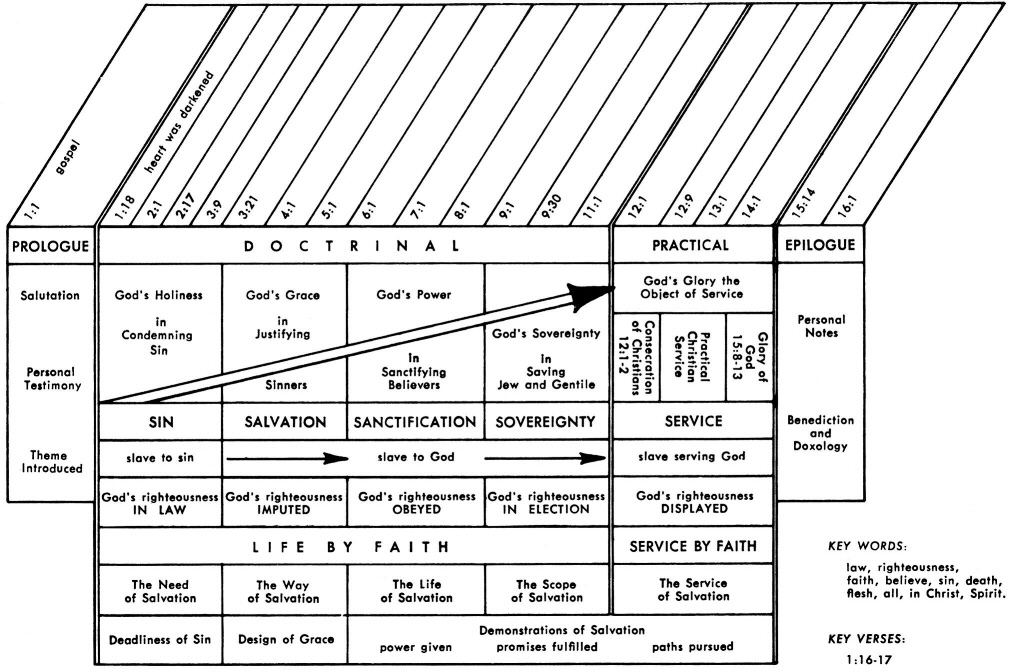
Click chart to enlarge
Chart from recommended resource Jensen's Survey of the NT - used by permission
Romans Overview Chart - Charles Swindoll
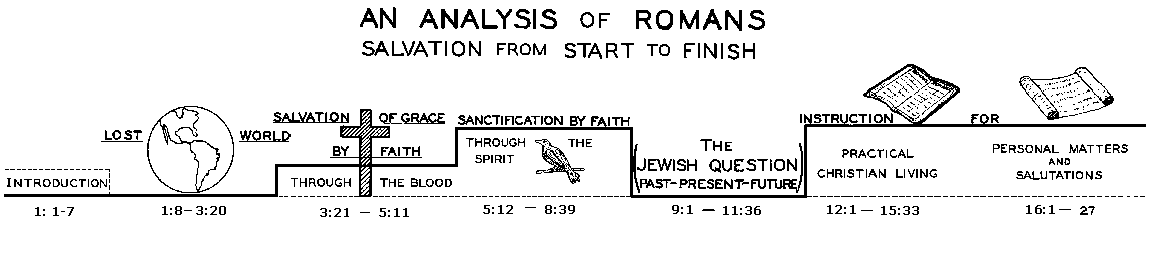
Source: Dr David Cooper
Click to Enlarge
| ROMANS ROAD to RIGHTEOUSNESS |
||||
| Romans 1:18-3:20 | Romans 3:21-5:21 | Romans 6:1-8:39 | Romans 9:1-11:36 | Romans 12:1-16:27 |
| SIN | SALVATION | SANCTIFICATION | SOVEREIGNTY | SERVICE |
| NEED FOR SALVATION |
WAY OF SALVATION |
LIFE OF SALVATION |
SCOPE OF SALVATION |
SERVICE OF SALVATION |
| God's Holiness In Condemning Sin |
God's Grace In Justifying Sinners |
God's Power In Sanctifying Believers |
God's Sovereignty In Saving Jew and Gentile |
Gods Glory The Object of Service |
| Deadliness of Sin |
Design of Grace |
Demonstration of Salvation | ||
| Power Given | Promises Fulfilled | Paths Pursued | ||
| Righteousness Needed |
Righteousness Credited |
Righteousness Demonstrated |
Righteousness Restored to Israel |
Righteousness Applied |
| God's Righteousness IN LAW |
God's Righteousness IMPUTED |
God's Righteousness OBEYED |
God's Righteousness IN ELECTION |
God's Righteousness DISPLAYED |
| Slaves to Sin | Slaves to God | Slaves Serving God | ||
| Doctrine | Duty | |||
| Life by Faith | Service by Faith | |||
|
Modified from Irving L. Jensen's chart above |
||||
Romans 5:10 For if while we were enemies we were reconciled to God through the death of His Son, much more, having been reconciled, we shall be saved by His life. (NASB: Lockman)
Greek: ei gar ecthroi ontes (PAPMPN) katellagemen (1PAPI) to theo dia tou thanatou tou huiou autou, pollo mallon katallagentes (APPMPN) sothesometha (1PFPI) en te zoe autou
Amplified: For if while we were enemies we were reconciled to God through the death of His Son, it is much more [certain], now that we are reconciled, that we shall be saved (daily delivered from sin’s dominion) through His [resurrection] life. (Amplified Bible - Lockman)
NIV: For if, when we were God's enemies, we were reconciled to him through the death of his Son, how much more, having been reconciled, shall we be saved through his life! (NIV - IBS)
NLT: For since we were restored to friendship with God by the death of his Son while we were still his enemies, we will certainly be delivered from eternal punishment by his life. (NLT - Tyndale House)
Phillips: If, while we were his enemies, Christ reconciled us to God by dying for us, surely now that we are reconciled we may be perfectly certain of our salvation through his living in us. (Phillips: Touchstone)
Wuest: For though, while being enemies, we were reconciled to God through the death of His Son, much more, having been reconciled, we shall be saved by the life He possesses.
Young's Literal: for if, being enemies, we have been reconciled to God through the death of His Son, much more, having been reconciled, we shall be saved in his life.
FOR IF (fulfilled condition = since) WHILE WE WERE ENEMIES WE WERE (have been = passive = God's initiates and empowers) RECONCILED TO GOD THROUGH THE DEATH OF HIS SON: ei gar ecthroi ontes (PAPMP N) katellagemen (1PAPI) to theo dia tou thanatou tou huiou autou :
- Ro 8:7; 2Cor 5:18,19,21; Col 1:20,21
- Ro 5:11; 8:32; Lev 6:30; 2 Chr 29:24; Ezek 45:20; Da 9:24; Eph 2:16; Heb 2:17
- Romans 5 Resources - Multiple Sermons and Commentaries
If you are ready for an edifying, challenging and encouraging word on Romans 5:9-11, I highly recommend listening to Dr John Piper's sermon Much More Shall We Be Saved By His Life. In this message (note that you will miss much of the impact of the message by only reading it...the transcription is not verbatim, nor can you sense the passion in Piper's presentation) Piper gives a wonderful illustration you can use to explain the truth of this passage to your children. Do you wrestle with the issue of eternal security? This sermon may be just what the doctor ordered!
Paul's point here is that if when were enemies of God, Christ's death made it possible for us to be reconciled to God, now that we are His children, Jesus can "save" us day by day and eternally (some favor this latter emphasis) through His power.
S Lewis Johnson asks...
What, then, is the resulting sense of the apostle's argument? Simply stated, it is this: If He has done the most for us, giving us a crucified Savior for our reconciliation when we were enemies, He surely will give us the least, save us through to the end, now that we have become friends, reconciled to Him. Or, surely if He has done the best for us, He will do the rest. As Sanday and Headlam put it, "If the first intervention cost the death of His Son, the second costs nothing, but follows naturally from the share which we have in His life." They in their comment refer to the Pauline use of en in the last phrase of the verse when they speak of "from the share which we have in His life." The reference of the en may be to Ro 8:34 (note) and the intercession of the Son for us now. It is surely not a reference to deliverance from the dominion of sin, as some Bible teachers have thought. The salvation is defined by the statement of verse nine; "saved from wrath." Paul is thinking of the deliverance of the believer from the wrath and condemnation of sin, not from its dominion in the believer's life, except insofar as the latter follows from the former. The argument, thus, is the ne plus ultra of the doctrine of the security of the believer. If, when we were enemies. He reconciled us to Himself by giving His Son as a penal, substitutionary sacrifice for sin, He will surely do that which is less, now that we are friends, reconciled, deliver us from the wrath to come, and especially since we now share in the life of our Representative through the union consummated with Him. It is the kind of argument that cannot be refuted. The logic is inescapable. The force of the argument for security is made even stronger by the fact that it is one of the implicit kinds, one not seen at first glance, such as the one drawn from John 10:28 29. It is not so obvious, but just as powerful....As the little Irish convert once said, "I often tremble on the Rock, but the Rock never trembles under me."
For (1063) (gar) is a subordinating conjunction expressing cause or Introduces an explanation. Gar serves as a marker of cause or reason between events. Learn to recognize terms of explanation and ask why is it there "for" which will help you understand the flow of a given passage.
If (1487) (ei) is a first class conditional marker indicating that what follows is a fulfilled condition. There is no doubt this is what we were! In other words if really means "since we were enemies" (because before Christ came into our life we were enemies) or “in view of the fact that when we were enemies" or "if, enemies as we were".
Were (5607) (ontes = present tense participle masculine nominative singular of eimí - 1510 = to be) means "being" and refers to one's existence but not the beginning of that existence. The point is that our "existence" was that we were continuously God's enemy. Some have used this verse to teach that, yes, sinful men are indeed enemies of God, but He Himself is not our enemy. Yes, we are opposing Him, but He is not opposing us. Yes, we have enmity toward Him, but He has no enmity toward us. The fallaciously reason that Ro 5:10 flatly states that we were God's enemies, but does not state that God was our enemy. They say that after all God is a God of love not anger. How could a God of love be angry? But they reason incorrectly, for just looking at Romans we see that God clearly is a God of wrath Who continually reveals His wrath "from heaven against all ungodliness and unrighteousness of men" (Ro 1:18) and has prepared "the day of wrath and revelation of (His) righteous judgment" (Ro 2:5) for "those who are selfishly ambitious and do not obey the truth, but obey unrighteousness" (Ro 2:8).
Paul gives a picture of this enemy mindset in Romans 8 writing that...
the mind set on (the tendency or inclination of the mind, its bent) the flesh (flesh -- the evil disposition opposed to God, unable to please Him) is hostile (echthra = enmity, hatred) toward God; for it does not (Greek = ouch = absolutely does not) subject (hupotasso - present tense = as a way of life, as their habitual practice) itself to the law of God, for it is not (Greek = ouch = absolutely does not) even able (unregenerate men, unbelievers, do not have either the inclination nor the power to submit their rebellious will to God - the flesh is dead toward God - note the tense again is present which pictures this as their continual state - they don't have the power because they don't have the Spirit Who alone can give the power to submit - cf Php 2:13) to do so (Ro 8:7) (Comment: There are some commentators who teach this verse is referring to believers who are simply living according to the flesh but I think careful analysis of the tenses of the verbs and the Greek negative particles used [absolute, not relative] strongly favor that Paul is describing an unsaved person.)
Enemies (2190) (echthros from échthos = hatred, enmity; noun = echthra = enmity, hostility) is an adjective which pertains to manifesting hostility or being at enmity with another, where enmity is a deep seated animosity or hatred which may be open or concealed or a "deep-rooted hatred."
In the active sense echthros means to be hateful, hostile toward, at enmity with or adversary of someone. In the passive sense echthros pertains to being subjected to hostility, to be hated or to be regarded as an enemy.
Echthros is one who has the extreme negative attitude that is the opposite of love and friendship. An enemy is one that is antagonistic to another; especially seeking to injure, overthrow, or confound the opponent. Scripture often uses echthros as a noun describing "the adversary", Satan! Like father like son!
Leon Morris commenting on this verse notes that...Enemies is a strong term; sin had put us completely in the wrong with God (in Ro 11:28 this term is opposed to “beloved”). An enemy is not a person who comes a little bit short of being a friend; it means someone in the opposite camp. Some see the meaning here as man’s hostility to God, but the reference to wrath (Ro 5:9) surely shows that God’s hostility to evil is in view. The wrath and the enmity go together. That sinners are God’s enemies is stated a number of times in the New Testament (Ro 11:28; Php 3:18; Col 1:21; Jas 4:4; cf. Ep 2:15, 16). (Morris, L. The Epistle to the Romans. W. B. Eerdmans; Inter-Varsity Press)
EBC asks the question...
Is "enemies" used in an active sense to mean those who have enmity toward God (cf. Ro 8:7) or in the passive sense, meaning those who are reckoned as enemies by God? Several reasons dictate that the latter is the intended force of the word.
First, that the word is capable of conveying this meaning is evident from Ro 11:28, where the people of Israel are spoken of as enemies in the reckoning of God and yet loved by him, involving the same combination as in the passage we are considering. The enmity in 11:28 is not temperamental but judicial.
Second, the mention of "God's wrath" in Ro 5:9 points to the conclusion that the echthroi are the objects of the wrath.
Third, the tenor of the argument leads one to the same conclusion. Paul reasons from the greater to the lesser. If God loved us when we were enemies, now that he has made provision for us at infinite cost, much more will he go on to see us through to the final goal of our salvation. But if the sense is that God loved us and saved us when we were enemies in our attitude toward him, the much more loses its point. "He is not arguing that if we have begun to love God we may reckon on His doing so and so for us, but because He has done so much, we may expect Him to do more" (Archibald McCaig in ISBE, 1930, vol. IV, p. 2537a).
Fourth, Paul not only states that we have been reconciled (Ro 5:10) but that we have received the reconciliation (Ro 5:11). He avoids saying that we have done anything to effect the reconciliation. God provided it through the death of his Son. The matter is made even clearer, if anything, in the companion statement that God has reconciled us "to Himself" (2Co 5:18). The appropriate response of the saved community is exultation (cf. Ro 5:2, 3) (Gaebelein, F, Editor: Expositor's Bible Commentary)
James Denney explains that "The the state of sin was that in which we were enemies (echthroi) and the whole connection of ideas in the passage requires us to give enemies (echthroi) the passive meaning which it undoubtedly has in Ro 11:28, where it is opposed to beloved (agapetoi). We were in a real sense objects of the Divine hostility. As sinners, we lay under the condemnation of God, and His wrath hung over us. This was the situation which had to be faced: Was there love in God equal to it? Yes, when we were enemies we were reconciled to God by the death of His Son. (Expositors Greek Testament - Romans 5)
TDNT writes that...
While mísos denotes the disposition of hostility and pólemos war, echthros means “hostility” itself... For the rabbis opponents include idolaters, apostate proselytes, renegades, and wicked Israelites. Unjustifiable hatred is forbidden but there is a legitimate hatred of foes in the OT sense as those who disrupt the covenant relationship.
The term (echthros) is used in the NT for personal enemies (Gal 4:16), but as in the OT and LXX, it is used for the foes of Israel (Lk. 1:71), of Jerusalem (Lk 19:43), of the NT witnesses (Rev 11:5), and of believers within their own families (Mt. 10:36). echthrós refers, too, to hostility to God and Christ (Lk. 19:27; Phil. 3:18; Acts 13:10, and cf. the quoting of Ps 110:1 in Mk 12:36; Acts 2:34 35; 1Cor 15:25; Heb. 1:13; Paul in 1Cor 15:25 refers to all the forces that are hostile to God, including death). The reference of Mt. 5:43-44 is to love for the enemies of God and his people (in contradistinction to the older hatred), and the same view may be reflected in 2Th. 3:15.
By nature we are all God’s enemies (Ro 5:10; 11:28; Col. 1:21; Jas 4:4). The point is that we hate God (active), although in Ro 11:28 Jews are both hated (passive) because of the gospel and loved on account of the fathers. The echthrós is the devil in the parable of Mt. 13:24 25 26 and Lk. 10:19; the devil is the absolute enemy both of us and of God and his kingdom. (Kittel, G., Friedrich, G., & Bromiley, G. W. Theological Dictionary of the New Testament. Eerdmans)
Echthros is used 32 times in the NASB (Study the NT passages - What are the outcomes for God's enemies - one good, the other bad? Who is the ultimate enemy of God? How are believers to respond to enemies?)
Matthew 5:43 (note) "You have heard that it was said, 'You shall love your neighbor, and hate your enemy.' 5:44 "But I say to you, love your enemies, and pray for those who persecute you (How is this possible? Naturally? Supernaturally? What is the clear implication of Jesus' command [? We must learn to rely on the enabling presence and power of the indwelling Spirit - Eph 5:18, Gal 5:16, Php 2:12, Php 2:13, Gal 5:22])
Matthew 10:36 and a man's (who believes in Messiah) enemies will be the members of his household.
Matthew 13:25 (Parable) "But while men were sleeping, his enemy came and sowed tares also among the wheat, and went away...28 "And he said to them, 'An enemy has done this!' And the slaves said to him, 'Do you want us, then, to go and gather them up?'...39 and the enemy who sowed them is the devil, and the harvest is the end of the age; and the reapers are angels.
Matthew 22:44 'The Lord said to my LORD, "Sit at My right hand, Until I put Thine enemies beneath Thy feet "'?
Mark 12:36 "David himself said in the Holy Spirit, 'The Lord said to my LORD, "Sit at My right hand, Until I put Thine enemies beneath Thy feet.'"
Luke 1:71 Salvation from our (Israel's) enemies (cp, "Anti-Semitism"), and from the hand of all who hate us...74 To grant us that we (Jews who repent and believe in Messiah), being delivered (rescued by the Messiah) from the hand of our enemies, might serve Him without fear
Luke 6:27 "But I say to you who hear, love your enemies, do good to those who hate you...35 "But love your enemies, and do good, and lend, expecting nothing in return; and your reward will be great, and you will be sons of the Most High; for He Himself is kind to ungrateful and evil men.
Luke 10:19 "Behold, I (Jesus) have given you authority to tread upon serpents and scorpions, and over all the power of the enemy, and nothing shall injure you.
Luke 19:27 "(Jesus speaking) But these enemies of Mine, who did not want me to reign over them, bring them here and slay them in my presence."...
Luke 19:43 "For the days shall come upon you when your (Israel's) enemies will throw up a bank before you, and surround you, and hem you in on every side (This prophecy was fulfilled by the destruction of Jerusalem by the Roman General Titus in 70AD)
Luke 20:43 Until I make Thine enemies a footstool for Thy feet."'
Acts 2:35 Until I make Thine enemies a footstool for Thy feet."'
Acts 13:10 and said, "You who are full of all deceit and fraud, you son of the devil, you enemy (like father, like son) of all righteousness, will you not cease to make crooked the straight ways of the Lord?
Romans 5:10 (note) For if while we were enemies, we were reconciled to God through the death of His Son, much more, having been reconciled, we shall be saved by His life.
Romans 11:28 (note) From the standpoint of the gospel they (unbelieving Israel) are enemies for your sake, but from the standpoint of God's choice they are beloved for the sake of the fathers;
Romans 12:20 (note) "But if your enemy is hungry, feed him, and if he is thirsty, give him a drink; for in so doing you will heap burning coals upon his head."
1 Corinthians 15:25 For He (Messiah) must reign until (at the end of the Millennium) He has put all His enemies under His feet. 26 The last enemy that will be abolished is death.
Galatians 4:16 Have I therefore become your enemy by telling you the truth?
Philippians 3:18 (note) For many walk, of whom I often told you, and now tell you even weeping, that they are enemies of the cross of Christ,
Colossians 1:21 (note) And although you were formerly alienated and hostile (echthros) in mind, engaged in evil deeds,
2 Thessalonians 3:15 And yet do not regard him as an enemy, but admonish him as a brother.
Hebrews 1:13 (note) But to which of the angels has He ever said, "Sit at My right hand, Until I make Thine enemies A footstool for Thy feet "?
Hebrews 10:13 (note) waiting from that time onward until His enemies be made a footstool for His feet.
James 4:4 You adulteresses, do you not know that friendship with the world is hostility (echthra = noun = hatred, inner disposition and external opposition) toward God? Therefore whoever wishes to be a friend of the world makes himself an enemy (echthros = adjective) of God.
Revelation 11:5 (note) And if anyone desires to harm them (God's two witnesses during the first half of Daniel's Seventieth Week), fire proceeds out of their mouth and devours their enemies; and if anyone would desire to harm them, in this manner he must be killed.
Revelation 11:12 (note) And they heard a loud voice from heaven saying to them, "Come up here." And they (the two witnesses killed in Jerusalem at the end of the first 3.5 years of the 7 year "Tribulation") went up into heaven in the cloud, and their enemies beheld them.
Echthros is used 329 times in the Septuagint (LXX) where it describes personal enemies, as well as national enemies (Josh. 7:8). Basic to the usage is that Gentiles do not alternate between hostility and friendship but are in constant opposition to both Israel and God (Ex 23:22, 2 Sa 12:14). Here is a representative use...
Genesis 14:20 And blessed be God Most High, Who has delivered your enemies into your hand." And he gave him a tenth of all.
Ps 110:1 (A Psalm of David.) The LORD says to my Lord: "Sit at My right hand, Until I make Thine enemies a footstool for Thy feet." (Quoted in Mt , Mk 12:36, Lu 20:42, Acts 2:34 - see verses above)
Reduced to the final analysis, sin is rebellion against God. It is not only a failure, but a refusal, to do God's will. Only when understood thus can the serious consequences of sin be properly appreciated. We were all enemies of God, we toward Him in rebellion, and He toward us in wrath, and therefore we all needed to be reconciled to God. There would be no hope without the removal of His wrath and our rebellion. Man is the enemy of God, not the reverse. Thus the hostility must be removed from man if reconciliation is to be accomplished. God took the initiative in bringing this about through the death of his Son.
In Colossians Paul uses echthros to explain that...
although you were formerly alienated (estranged - and hostile in mind, the antonym of reconciled) , engaged in evil deeds (echthros), yet He has now reconciled (apokatallasso = reconcile fully, thoroughly, completely, change thoroughly, of bringing together friends who have been estranged) you in His fleshly body through death, in order to present you before (Literally = down in the eye of God ~ Coram Deo = before the face of God) Him holy and blameless (amomos) and beyond reproach (anegkletos) (see note Colossians 1:21-22)
We lived with a constant attitude of hostility toward God, openly resisting His love and perfect law, continuously expressing hatred toward Him, whether directly or indirectly. An ENEMY of God is one who is antagonistic toward Him, especially seeking to injure His character and overthrow His rule over men. An enemy of God actively (or passively) contends with Him, opposing Him and resisting His rules only meant to bring life (Dt 32:47). In war an enemy seeks to kill his opponent. Ponder that even in this antagonistic state God still loved us and brought us back into relationship and fellowship thru the death of His only beloved Son. This is indeed a "much more" salvation or as Hebrews would say "so great a salvation" (see notes Hebrews 2:3). And as if this wasn't incredible enough, even "much more" He shall save us by His life.
Since reconciliation was accomplished by Jesus’ death, certainly His life is able to insure the complete and final salvation of believers. “His life” is His present life (not His life on earth) in which He intercedes (see note Hebrews 7:25) for believers. He died for His enemies; surely He will save those, His former enemies, who are now fellowshipping in Him.
Spurgeon remarks...
No more love to God is there in an unrenewed heart than there is life within a piece of granite. No more love to God is there within the soul that is unsaved than there is fire within the depths of the ocean's waves. And here is the wonder, that when we had no love for God, he should have loved us!
Vine calls our attention to...
the three expressions “ungodly” (v. 6), “sinners” (v. 8), “enemies” (v. 10). The last word anticipates the mention of reconciliation.
We were reconciled (2644) (katallasso from katá = an intensifier + allásso = change) means to exchange one thing for another and was used for example to describe the exchange of coins for others of equal value. This Its original meaning of to change, exchange, etc. transferred to mean to reconcile. The Greeks spoke of people in opposition to each other being “reconciled” or being made friends again. When people change from being at enmity with each other to being at peace, they are said to be reconciled. Katallasso meant to legally reconcile two disputing parties in court and in the New Testament is used of a believer’s reconciliation with God through Jesus Christ.
Donald Barnhouse on the Greek idea of reconcile - The Greek word translated “reconciled” comes from the world of the moneychanger. If you give two dimes and a nickel in exchange for a quarter, or vice versa, you have made an equal exchange. This was the original meaning of the word as used by Aristotle and others. Later the word was used for the adjustment of a difference in business dealings, and finally for a difference between two personalities who had become estranged. The transition from the material to the emotional and psychological was made, and the word was used as in Shakespeare’s Richard III: “I desire to reconcile me to his friendly peace.” (See the full message Romans 5:9-10 Reconciliation)
Katallasso here in Romans 5:10 is in the aorist tense indicating a completed event in the past (a historical event) and the passive voice indicates that it occurred as the result of a force (God) outside of and independent of the subject (man). In other words, "we" are the the objects, not the subjects of this reconciliation: the subject is God (cf 2Cor 5:19 21, see Romans 5:11 where received is also the divine passive indicating it was effected by God.)
TDNT writes of katallasso - With the thought of “change” predominating, this word can mean “to change,” “to exchange,” and “to reconcile” or “reconcile oneself.” (Kittel, G., Friedrich, G., & Bromiley, G. W. Theological Dictionary of the New Testament. Eerdmans)
Katallasso refers to the exchange of hostility or enmity to a friendly relationship. It means to change a person for the purpose of being able to have fellowship together. Scripture always portrays God as the Reconciler and sinners as the ones reconciled, since it was human sin that ruptured the relationship between God and man Isaiah, for example, recording...
But your iniquities have made a separation between you and your God, And your sins have hidden His face from you, so that He does not hear. (Isaiah 59:2)
In the NT, katallasso speaks of the change that God makes in man through regeneration, so that he may be reconciled to God. The idea is to set up a relationship of peace not existing before. Note that man is reconciled to God, but God is not said to be reconciled to man.
Katallasso is used 6 times in the NT, twice in Ro 5:10, and the following verses...
(Paul is giving instructions to the married here addressing a believing wife) "(but if she does leave, let her remain unmarried, or else be reconciled to her husband), and that the husband should not send his wife away." (1Cor 7:11)
18 Now all these things (pointing back to the total transformation taking place at conversion) are from God, Who reconciled (katallasso) us (God initiates the reconciliation - unregenerate people cannot) to Himself through Christ (the good news of the gospel), and gave us the ministry of reconciliation (katallage), 19 namely, that God was in Christ reconciling (katallasso) the world to Himself (Paul is not teaching universalism!), not counting their trespasses against them, and He has committed to us the word of reconciliation (katallage). 20 Therefore, we are ambassadors for Christ, as though God were entreating through us; we beg you on behalf of Christ, be reconciled (katallasso) to God. (2Cor 5:18-20) (Comment: To overcome our separation from God, we needed someone to provide reconciliation and thereby bring us back into fellowship with God.)
Reconciliation produces restoration of a relationship of peace which has been disturbed between God and man in the garden of Eden. Sinful man is reconciled in that his attitude of enmity toward God is changed to one of friendship.
John MacArthur explains that "reconciliation is not something man does but what he receives; it is not what he accomplishes but what he embraces. Reconciliation does not happen when man decides to stop rejecting God but when God decides to stop rejecting man. It is a divine provision by which God’s holy displeasure against alienated sinners is appeased, His hostility against them removed, and a harmonious relationship between Him and them established. Reconciliation occurs because God was graciously willing to design a way to have all the sins of those who are His removed from them “as far as the east is from the west” (Psalms 103:12 - Spurgeon's note), “cast all their sins into the depths of the sea” (Micah 7:19), and “cast all [their] sins behind [His] back” (Isaiah 38:17). (MacArthur, J. 2 Corinthians. 2003 Moody Publishers)
James Denney - To represent reconciliation (katellagemen) by an active form, e.g., "we were won to lay aside our hostility," is to miss the point of the whole passage. Paul is demonstrating the love of God, and he can only do it by pointing to what God has done. That we on our part are hostile to God before the reconciliation, and that we afterwards lay aside our enmity, is no doubt true; but here it is entirely irrelevant. The Apostle's thought is simply this: "If, when we lay under the Divine condemnation, the work of our reconciliation to God was achieved by Him through the death of His Son, much more shall the love which wrought so incredibly for us in our extremity carry out our salvation to the end." The subjective side of the truth is here completely and intentionally left out of sight; the laying aside of our hostility adds nothing to God's love, throws no light upon it; hence in an exposition of the love of God it can be ignored. To say that the reconciliation is "mutual", is true in point of fact; it is true also to all the suggestions of the English word; but it is not true to the meaning of we were reconciled (katellagemen) nor to the argument of this passage, which does not prove anything about the Christian, but exhibits the love of God at its height in the Cross, and argues from that to what are comparatively smaller demonstrations of that love. (Expositors Greek Testament - Romans 5)
Believer's Study Bible - Reconciliation has reference to a change in relationship from hostility to love, acceptance, and friendship. The atonement of Christ accomplished two things: (1) The cross propitiated (satisfied) the wrath of God and reconciled man to God. Few realize that the Bible pictures man as an enemy of God (see notes Romans 5:10; 8:7; Ephesians 2:12, 2:15) in his unredeemed state. (2) In repentance toward God and faith in the Lord Jesus, a man is reconciled to God by the death of Christ. His basic relationship has changed from that of an enemy of God to that of a friend of God. (Criswell, W A. Believer's Study Bible: New King James Version. 1991. Thomas Nelson)
To reconcile is to take someone who is hostile towards someone else and change that into a friendly relationship. Unsaved ungodly man is an enemy of God and is hostile toward Him and God takes the initiative in this estranged relationship and send Jesus to be our Mediator Who based on our faith in His sacrificial death and resurrection life brings us into a friendly relationship with God.
Unger explains that...Man is reconciled to God, but God is not said to be reconciled to man. By this change lost humanity is rendered savable. As a result of the changed position of the world through the death of Christ the divine attitude toward the human family can no longer be the same. God is enabled to deal with lost souls in the light of what Christ has accomplished. Although this seems to be a change in God, it is not a reconciliation; it is rather a “propitiation.” God places full efficacy in the finished work of Christ and accepts it. Through His acceptance of it He remains righteous and the justifier of any sinner who believes in Jesus as his reconciliation. When an individual sees and trusts in the value of Christ’s atoning death, he becomes reconciled to God, hostility is removed, friendship and fellowship eventuate. (Unger, M. F., Harrison, R. K., Vos, H. F., Barber, C. J., & Unger, M. F. The New Unger's Bible Dictionary. Chicago: Moody Press)
Vincent’s note on katallasso is illuminating...
“The verb (katallasso) means primarily to exchange, and hence to change the relation of hostile parties into a relation of peace; to reconcile. It is used of both mutual and one sided enmity. In the former case, the context must show on which side is the active enmity. In the Christian sense, the change in the relation of God and man effected through Christ. This involves
(1) a movement of God toward man with a view to break down man’s hostility, to commend God’s love and holiness to him, and to convince him of the enormity and the consequence of sin. It is God who initiates this movement in the person and work of Jesus Christ. See notes Romans 5:6, 5:8; 2Cor 5:18, 19, see note Ephesians 1:6; 1 Jn 4:19). Hence the passive form of the verb here: we were made subjects of God’s reconciling act.
(2) a corresponding movement on man’s part toward God; yielding to the appeal of Christ’s self-sacrificing love, laying aside his enmity, renouncing his sin, and turning to God in faith and obedience.
(3) a consequent change of character in man: the covering, forgiving, cleansing of his sin; a thorough revolution in all his dispositions and principles.
(4) a corresponding change of relation on God’s part, that being removed which alone rendered Him hostile to man, so that God can now receive him into fellowship and let loose upon him all His fatherly love and grace (1Jn 1:3, v7). Thus there is complete reconciliation.”
The great triumvirate of redemption, propitiation, and reconciliation is totally the work of God, accomplished through the death of Jesus Christ. Redemption pertains to sin, propitiation (or satisfaction) pertains to God, and reconciliation is for people (we were reconciled). Reconciliation is the removal of enmity that stands between people and God. Reconciliation is the basis of restored fellowship between people and God.
To sum up what Paul says in Romans 5:6-10, the helpless He died for, the ungodly He justified, the sinner He saved, and the enemy He reconciled to Himself.
Through the death of His Son - This reminds us of Jesus' words in John 14:6 that absolutely "no one comes to the Father but THROUGH Me." When Jesus "yielded up His spirit" on the Cross, "the veil of the temple was torn in two from top to bottom." (Mt 27:50,51). Because Jesus died as the perfect Lamb of God, He took away the sin of the world (to all who believe) and we can now enter God's holy presence through Jesus as described beautifully by the writer of Hebrews 10:19-22
Since therefore, brethren, we have confidence (boldness) to enter the holy place (God's very presence!) by the blood of Jesus, by a new and living way which He inaugurated for us through the veil, that is, His flesh, and since we have a great priest over the house of God, let us draw near with a sincere heart in full assurance of faith, having our hearts sprinkled clean from an evil conscience and our bodies washed with pure water.
Albert Barnes writes that "Death may include possibly his low, humble, and suffering condition. Death has the appearance of great feebleness; the death of Christ had the appearance of the defeat of his plans. His enemies triumphed and rejoiced over him on the cross, and in the tomb. Yet the effect of this feeble, low, and humiliating state was to reconcile us to God. If in this state--when humble, despised, dying, dead--he had power to accomplish so great a work as to reconcile us to God, how much more may we expect that he will be able to keep us now that he is a living, exalted, and triumphant Redeemer! If his fainting powers in dying were such as to reconcile us, how much more shall his full, vigorous powers, as an exalted Redeemer, be sufficient to keep and save us! This argument is but an expansion of what the Saviour himself said, Jo 14:19, "Because I live, ye shall live also." (Albert Barnes. Barnes NT Commentary)
MUCH MORE HAVING BEEN RECONCILED: pollo mallon katallagentes (APPMPN):
- Romans 5 Resources - Multiple Sermons and Commentaries
Much more then - is used in the logical sense: much more certainly, and not: much more abundantly. This introduces Paul's argument which is what is often referred to as from the greater (the justification in Christ’s blood - God the Son died for us when we were sinners, unlovely and unlovable, rebellious against Him, hating Him) to the lesser (the final future salvation from God's wrath). It is much more to be expected.
Guzik - If God showed such dramatic love to us when we were enemies, think of the blessings we will enjoy once we are reconciled to God! If God does this much for His enemies, how much more will He do for His friends!
Wuest, quoting Alford: “Not only has the reconciled man confidence that he shall escape God’s wrath, but triumphant confidence—joyful hope in God.”
Having been reconciled (2644) (katallasso from katá = an intensifier + allásso = change) means having exchanged hostility or enmity for a friendly relationship.
The form of these arguments goes like this...
If God has done the greater thing, then certainly ("how much more") we can trust Him to do the lesser thing. Paul uses this "much more" argument four other times in Romans [ see Ro 5:9, 10, 15, 17; Ro 11:12, 11:24]
If God purchased our reconciliation so dearly, (much more) will He ever let us go? If we were reconciled through the death of His Son, which is a symbol of utter weakness, ("much more") shall we not be preserved to the end by the present life of Christ at the right hand of God, a life of infinite power? If His death had such power to save us, how much more will His life have power to keep us!
If we were reconciled by His death, much more clear is it that we shall be saved by His life. Some find a difficulty in this, as if it implied that the atonement and price of redemption were not complete at the death of Christ. But the Apostle is not speaking on that point. He is speaking of the security of the believer from any danger.
Related Resource:
- Reconciliation - From Enmity to Amity for numerous illustrations related to reconciliation.
John MacArthur writes: If God had the power and the will to redeem us in the first place, how much more, does He have the power and the will to keep us redeemed? In other words, if God brought us to Himself through the death of His Son when we were His enemies, how much more, now that we are His reconciled children, will He keep us saved by the life of His Son? If the dying Savior reconciled us to God, surely the living Savior can and will keep us reconciled. The thrust of this truth for believers is that our Savior not only delivered us from sin and its judgment, but also delivers us from uncertainty and doubt about that deliverance. If God has already made sure our rescue from sin, death, and future judgment, how could our present spiritual life possibly be in jeopardy? How can a Christian, whose past and future salvation are secured by God, be insecure during the time between? If sin was no barrier to the beginning of our redemption, how can it become a barrier to its completion? If sin in the greatest degree could not prevent our becoming reconciled, how can sin in lesser degree prevent our staying reconciled? If God’s grace covers the sins even of His enemies, how much more does it cover the sins of His children? Paul here reasons from the greater to the lesser. It is a greater work of God to bring sinners to grace than to bring saints to glory, because sin is further from grace than grace is from glory. (MacArthur, J: Romans 1-8. Chicago: Moody Press) (Bolding added)
John Piper illustrates much more which anyone can understand...
Now do you see how this phrase much more is functioning? Children, consider this illustration. You move with your parents into a new neighborhood. And during the first night a fire breaks out in your house. Your neighbor - let's call him Mr. Peterson - sees the smoke, calls the fire department, breaks a window, wakes everybody up, crawls inside, gets your mom and dad to safety, but they have passed out. He hears you calling from an upstairs bedroom before the fire fighters arrive. He dashes up the stairs, wets a blanket in the bathtub, plunges through flames in the hall, wraps you in the blanket and brings you safely outside with terrible burns on his arms and face. Over the next months you become very close friends with your Mr. Peterson and visit him in the hospital. One morning after he gets home, you ask him, "Mr. Peterson, will you come over this afternoon and show me a new trick with my yo-yo?" Mr. Peterson says, "Sure, I'd love to." But during the day you start to wonder if he will really come. And you say to your father, "I'm not sure Mr. Peterson will come this afternoon. He might forget, or maybe he really doesn't care about a little kid like me. "And then your father says, "You know what? If Mr. Peterson was willing to run through fire to save you at the risk of his own life and getting terrible burns, then how much more will he be willing to come over and show you a new yo-yo trick this afternoon! If he did the hard thing for you, then all the more surely, he will do the easy thing." Do you see how the "much more" in v9 works? "Much more then, having been justified by his blood, shall we be saved from the wrath of God through him." The point is to make you all the more confident and assured that God will save you. It's the same in v10: "For if while we were enemies we were reconciled to God through the death of His Son, much more, having been reconciled, we shall be saved by His life." If Mr. Peterson risked his life to save you when he didn't even know you yet, how much more, now that you are friends, will he keep his word and come to play with you! God has done the hardest thing in sacrificing his Son to reconcile his enemies. How shall he not save his friends!? He will! Much more, he will!" (Read full sermon Much More Shall We Be Saved By His Life) (Click here for the audio version which is even better than the written sermon - it is definitely worth the 40 minutes it will take to listen on your Ipod or computer)
WE SHALL BE SAVED BY (in) HIS LIFE: sothesometha (1PFPI) en te zoe autou:
- John 14:19 “After a little while the world will behold Me no more; but you will behold Me; because I live, you shall live also.
- Hebrews 7:25 Hence, also, He is able to save forever those who draw near to God through Him, since He always lives to make intercession for them.
- Revelation 1:18 and the living One; and I was dead, and behold, I am alive forevermore, and I have the keys of death and of Hades.
- Romans 5 Resources - Multiple Sermons and Commentaries
THE DIVINE PARADOX:
JESUS' DEATH GIVES US LIFE!
By His life - Literally in His life ("By" - Greek = en = 1722) , which conveys the sense of union with Christ (in Christ). In His life alludes to the intimate, living union between a believer and his Lord. He is now our life (Gal 2:20, Col 3:4), our strength (Php 4:!3), our sufficiency, our all in all. Does "in His life" describe your life? It is what the Father desires for you. (Click here for more discussion of the wonderful truth "in Christ")
Denney - The Living Lord, in virtue of His life, will save us to the uttermost. Cf. John 14:19 "After a little while the world will behold Me no more; but you will behold Me; because I live, you shall live also." (Expositors Greek Testament - Romans 5)
Explaining what His life means, Jesus declares...
For just as the Father has life in Himself, even so He gave to the Son also to have life in Himself (Jn 5:26)
For this is the will of My Father, that everyone who beholds the Son and believes in Him, may have eternal life; and I Myself will raise him up on the last day." (John 6:40)
As the living Father sent Me, and I live because of the Father, so he who eats Me, he also shall live because of Me. (John 6:57)
Jesus said to her (Martha on the occasion of the death of Lazarus), "I am the resurrection and the life; he who believes in Me shall live even if he dies, and everyone who lives and believes in Me shall never die. Do you believe this? (John 11:25,26)
Paul explains how Jesus' life became manifest in him (Paul) during his earthly life writing that he was...
always carrying about in the body the dying of Jesus (Paul compares his own constant persecution and suffering with that of Jesus in Whose death and resurrection life he consequently shares cf Php 3:10), that the life of Jesus also may be manifested in our body (thru Paul’s weakness, Christ's life in him was put on display). For we who live are constantly being delivered over (paradidomi = given over into the power of) to death for Jesus' sake, that the life of Jesus also may be manifested (caused to become visible = made to appear, caused to be seen) in our mortal flesh. (2Co 4:10,11)
Paul explained another aspect of how we are "saved in His life" declaring to the Colossians that...
you have died (aorist tense = definite event in past = with Christ you have died to the power, rule, mastery, enslavement to the old task master Sin, now been rendered inoperative by the death, burial and resurrection of Jesus and your faith in His finished work) and your life is hidden (perfect tense = were hidden at point in time in the past and remain hidden = speaks of permanence of this state = emphasizes our security, safety and identification) with (study this preposition sun = intimate union with) Christ in God (Living the Christ life is daily surrendering to His will and Word which allows us to enter into His divine enablement). When Christ, Who is our life, is revealed, then you also will be revealed with Him in glory. (See note Colossians 3:3-4)
Finally regarding saved in His life John adds in his first epistle...
And the witness is this, that God has given us eternal life, and this life is in His Son. He who has the Son has the life; he who does not have the Son of God does not have the life. (1 John 5:11-12)
Andrew Bonar - Jesus died, and Jesus lives—these are the truths that contain everything for us. All that a dying and a living Saviour can do is ours.
Jesus gave Himself to give us salvation. When we were God’s enemies, Christ was able by His death to reconcile us to God. Certainly now that we are God’s children, the Savior can keep us by His living power, resurrection power. In this verse Paul is clearly making clear reference to Christ's post resurrection life rather than to His life in the days of his flesh.
THOUGHT - Does your life manifest the sweet aroma of Christ in you (2 Cor 2:14-16), living His life through you, daily "saving" you from the temptations and trials of the world, the flesh and the devil?
Saved (4982) (sozo) has the basic meaning of rescuing one from great peril. Additional nuances include to protect, keep alive, preserve life, deliver, heal, be made whole. Sozo is sometimes used of physical deliverance from danger of perishing (see Mt 8:25; Mt 14:30; Lu 23:35; Acts 27:20 27:31 hold pointer over for popup verse), physical healing from sickness (Mt 9:21 22; Mk 5:23, Acts 4:9), and deliverance from demonic possession (Lk 8:36). More often sozo refers to salvation in a spiritual sense.
Saved by (in) His life is a striking example of Paul's fondness for antithetical constructions. We are reconciled to God by the death of Jesus. That is initial salvation (justification). But the resurrection and the interceding life of Jesus in heaven provide the divine guarantee that we shall continue being saved (sanctification) until that salvation is consummated at the return of Christ (glorification). To state it another way, we have been delivered from sin's penalty; we are being delivered from sin's power; and we will ultimately be delivered from sin's presence.
Harry Ironside - How blind are they who read into this verse a reference to the earthly life of our blessed Lord. That life - pure and holy as it was - could never have saved one poor sinner. It was by His death He made atonement for our sins. Even the love of God demonstrated so fully in the ways of Jesus only drew out the envenomed hate of the human heart. It is His death that destroys the enmity - when I realize He died for me I am reconciled to God. The hatred was all on my side - there was no need for God to be reconciled to me - but I needed reconciliation, and I have found it in Jesus' death. Now since it is already an accomplished fact I may know for a certainty I will be saved by His life. He said, "Because I live, ye shall live also" (John 14:19). It is, of course, His resurrection life that is in view in Romans 5:10 . "Wherefore he is able also to save them [evermore] that come unto God by him, seeing he ever liveth to make intercession for them" (Hebrews 7:25 ). A living Christ at God's right hand is my pledge of eternal redemption. He lives to plead our cause, to deliver through all the trials of the way, and to bring us safely home to the Father's house at last. We are bound up in the same bundle of life as Himself (Ironside, Harry. Romans and Galatians. Kregel. 2006)
His life - This phrase refers to His present resurrection life (not His life while He was on earth). It is the death of Christ which effects our salvation but it is the life of Christ which sustains it. He now functions as our High Priest interceding (He 7:25-Hebrews 7:25) at the right hand of the throne of God...
Hence, also, He is able to save forever those who draw near to God through Him, since He always lives to make intercession for them. (Hebrews 7:25)
The logic is that since He died for those who were His enemies, surely He will save those former enemies.
Vine explains that "Our justification cost the death of His Son. Our present preservation and our future deliverance are dependent upon Himself as the living one. The love that was displayed in His death is the guarantee not only of our present maintenance but of our future redemption, the redemption of the body (Ro 8:23; see also Heb. 7:25). (Vine, W. Collected writings of W. E. Vine. Nashville: Thomas Nelson)
Newell writes that in His life means...that the believer shares that risen life of Christ; that in the power of that endless life the believer will abide both now and forever: as John says, "we may have confidence in the day of judgment; because as He is, so also are we in this world." (1Jn 4:17) (Romans 5)
KJV Bible Commentary - The life of Jesus Christ did not take away the penalty of our sins, His death did. But Christ ever lives to take away the dominion of sin over us. (Dobson, E G, Charles Feinberg, E Hindson, Woodrow Kroll, H L. Wilmington: KJV Bible Commentary: Nelson)
Wycliffe Bible Commentary notes that...We were reconciled by his death when we were enemies. This being true, the apostle concludes, much more is it true that we shall be saved in or by his life. Elsewhere Paul points out that the one who is joined to the Lord is one spirit (1Co 6:17), i.e., he shares Christ’s resurrected life and spiritual power. He also says: “When Christ, our life, shall appear, then shall ye also appear with him in glory” (Col 3:4). We shall be saved by Christ’s life because we share this life. We belong to Christ. The writer of Hebrews stresses that Christ lives to make intercession for us (Hebrews 7:25). The intercessory life of Christ in glory plays a vital role in the salvation of believers. But the context here seems to put the stress on the believers’ sharing in Christ’s death and resurrected life." (Pfeiffer, C F: Wycliffe Bible Commentary. 1981. Moody)
Wuest -After a little while the world will behold Me no more; but you will behold Me; because I live, you shall live also. (Jn 14:19). That is, in virtue of the fact that our Lord lives after death, He is able to save us completely and to the end (Hebrews 7:25). Salvation is in three parts, justification, the removal of the guilt and penalty of sin and the bestowal of a righteous standing in Christ before God’s law, which is given to us at the moment of believing; sanctification, the progressive work of the Holy Spirit during the Christian life; and glorification, the glorifying of our bodies at the Rapture. It is of the latter two Paul is speaking, since he is writing in a context of justification. It should be clear that the statement, “we shall be saved by His life,” has no reference to our Lord’s life on earth as an example of how a Christian should live. His example saves no one. His blood does. (Word Studies from the Greek New Testament)
Warren Wiersbe on reconciliation - Now let us look at the believer. What does it mean to us as believers to be reconciled? Why would an unbeliever even want to be reconciled? Let me make it very clear that reconciliation is not merely a second chance. If it were only a second chance, then the next time you sinned, you would be lost. Reconciliation is not a temporary truce. God doesn't change; God doesn't lie. What God does, He does permanently. Reconciliation is a permanent bringing together of the believing sinner and God through Jesus Christ. I would remind you that the cross is a plus sign, and a plus sign brings things together. Romans 5:10 says, "For if, when we were God's enemies, we were reconciled to him through the death of his Son, how much more, having been reconciled, shall we be saved through his life!" Romans 5 uses the phrase "much more" several times. Reconciliation gives you "much more." Now that we are His children, we have security. We are justified by His blood. Nothing can change that. We have victory. We can "reign in life through the one man, Jesus Christ" (see v. 17). If He did so much for us by His death, how much more He can do for us in His life. We are not only saved by His death, but we are also saved by His life— saved from defeat, saved from future wrath. "Since we have now been justified by his blood, how much more shall we be saved from God's wrath through him!" (v. 9). So we have security, we have victory, we have sufficiency. All that we need, God gives to us. Romans 5:21 says, "Just as sin reigned in death, so also grace might reign through righteousness to bring eternal life through Jesus Christ our Lord." God takes rebels and makes kings out of them. God takes slaves and makes sovereigns out of them. That is reconciliation. Along with reconciliation comes responsibility. We are ambassadors for Christ. The world we live in is at war with God. Sinners need to be reconciled to God. God is already reconciled—God has turned His face toward us. Now it is our task to spread the Good News, to tell people they don't have to be at war with God because God is not at war with them. This is a day of God's grace. There is coming a day of judgment, and then it will be too late. What a privilege it is to be an ambassador for Jesus Christ—wherever you are—at home, in your neighborhood, at work, at school. What good news we have—the Good News of reconciliation. (Key Words in the Christian Life)
ILLUSTRATIONS OF BIBLE TRUTH by Harry A. Ironside - PATRIOTISM-PLUS - When we were enemies, we were reconciled to God by the death of his Son (Ro 5:10)
When nations are engaged in deadly strife, it is common for patriots to declare that he who gives his life for the defence of his country may be certain of a home in heaven because of having made the supreme sacrifice. This teaching is in accord with the principles of the Moslem religion and not with true Christianity. Mahomet promised his fanatical followers a place in Paradise if they died for the faith in conflict with the "infidels" who rejected his teachings. Patriotism is a virtue of which any man may well be proud.
"Lives there a man with soul so dead,
Who never to himself hath said,
This is my own, my native land?"
But patriotism, praiseworthy as it is from a human standpoint, will never fit the soul for the presence of GOD. It can never wash away the guilt of sin.
The testimony of Edith Cavell, the brave British nurse who was killed by the Germans during the former world war, is well worth considering in this connection.
This noble woman was born at Swardeston, Norfolk on December 4, 1865. She entered the London Hospital for nurses' training in 1895. In 1907 she was appointed first matron of the Berkendael Medical Institute at Brussels, Belgium. This became the Red Cross Hospital for Belgium at the outbreak of the conflict in 1914. From August of that year, until August, 1915, Nurse Cavell helped to care for wounded French, Belgian, English and German soldiers alike. She ministered faithfully even to those who had fallen while fighting against her own nation. Naturally, her sympathies were with the Allies, and in cooperation with the efforts of Prince Reginald de Croy, she aided many derelict English and French soldiers who had fled from the Germans. These escaped by "underground" methods to the Dutch frontier, where, with the aid of guides, they were conveyed across to Britain. When some of these fugitives were traced to her house in Brussels, she was immediately arrested and after a court-martial was sentenced to face a firing-squad. All her kindness to the German wounded was forgotten. Her captors considered her a spy and treated her accordingly.
Just before the bandage was placed over her eyes, as she stood fearlessly facing the soldiers who were about to take her life, she gave a last message to the world. "I am glad," she said, "to die for my country. But as I stand here I realize as never before that patriotism is not enough." Then she went on to give a clear, definite testimony to her personal faith in the LORD JESUS CHRIST and her assurance of salvation, not through laying down her life for others, but because He laid down His life for her. In perfect composure, she submitted to the bandaging of her eyes and, in a few moments fell, pierced by many German bullets.
Her words, patriotism is not enough! have spoken loudly to many in the years that have gone since she died a martyr to her convictions. Yet many forget this.
"What more is needed?" you may ask. The answer is "CHRIST!" It is through faith in Him alone that the soul is saved and heaven assured.
THE CAPTIVE FREED: A letter written by Dr. C. I. Scofield recounts the experience of this Bible teacher who has been so greatly used by the Lord. It reads in part: "The all but universal habit of drink among the men of my time overmastered me. I was not a victor in the battle of life, but a ruined and hopeless man who, despite all my struggles, was fast bound in chains of my own forging. I had no thought of Christ. There was no hope that in a church sometime I might hear and believe the Gospel, for I never attended. But then the Savior took up the case. Men were beginning to turn away from me, but the Lord of Glory sought me.
Through Thomas McPheeters, a joyous, hopeful soul, Jesus Christ offered Himself to me, that human wreck. From a worn pocket Testament, McPheeters read to me the great deliverance passages. And when I asked, like the Philippian jailer of old, `What must I do to be saved?' he just read them again, and we knelt and I received Jesus as my Savior. And — oh! put it into the story, put it big and plain: Instantly the chains were broken never to be forged again — the passion for drink was taken away! Put it 'instantly,' dear Editor. Make it plain. Don't say, 'He strove with his sin of drink and came off victor.' He did nothing of the kind. Divine power did it, wholly of grace. To Christ be all the glory!"
The Lord Jesus died on the cross that we might be saved from the guilt of sin. He lives to deliver us from its power. There is only One who can thus snap the fetters of sin and give deliverance. (Our Daily Bread, Copyright RBC Ministries, Grand Rapids, MI. Reprinted by permission. All rights reserved)
O for a Thousand Tongues to Sing
He breaks the power of canceled sin,
He sets the prisoner free;
His blood can make the foulest clean,
His blood availed for me.
— Wesley (Play)
When God forgives sin,
He purges the RECORD,
Erases the REMEMBRANCE, and
Empowers the RECIPIENT!
—HGB
Romans 5:11 And not only this, but we also exult in God through our Lord Jesus Christ, through Whom we have now received the reconciliation (NASB: Lockman)
Greek: ou monon de, alla kai kauchomenoi (PMPMPN) en to theo dia tou kuriou hemon Iesou Christou, di' ou nun ten katallagen elabomen. (1PAAI)
Amplified: Not only so, but we also rejoice and exultingly glory in God [in His love and perfection] through our Lord Jesus Christ, through Whom we have now received and enjoy [our] reconciliation. (Amplified Bible - Lockman)
KJV: And not only so, but we also joy in God through our Lord Jesus Christ, by Whom we have now received the atonement.
NIV: Not only is this so, but we also rejoice in God through our Lord Jesus Christ, through whom we have now received reconciliation. (NIV - IBS)
NLT: So now we can rejoice in our wonderful new relationship with God—all because of what our Lord Jesus Christ has done for us in making us friends of God. (NLT - Tyndale House)
Phillips: Nor, I am sure, is this a matter of bare salvation - we may hold our heads high in the light of God's love because of the reconciliation which Christ has made. (Phillips: Touchstone)
Wuest: And not only so, but we also rejoice in God through our Lord Jesus Christ, through whom now we received the reconciliation.
Young's Literal: And not only so, but we are also boasting in God, through our Lord Jesus Christ, through whom now we did receive the reconciliation;
AND NOT ONLY THIS BUT WE ALSO EXULT IN GOD THROUGH OUR LORD JESUS CHRIST: ou monon de alla kai kauchomenoi (PMPMPN) en to theo dia tou kuriou hemon iesou christou:
- Ro 2:17; 3:29,30; 1Sa 2:1; Ps 32:11; 33:1; 43:4; 104:34; 149:2; Isa 61:10; Hab 3:17,18; Lk 1:46; Gal 4:9; 5:22; Phil 3:1,3; 4:4; 1Pet 1:8
- Romans 5 Resources - Multiple Sermons and Commentaries
NOT ONLY THIS BUT...
JOY IN GOD
And not only this but - We not only rejoice in His gifts but in the Giver Himself. Before we were saved we found our joys elsewhere. Now we exult whenever we remember Him, and are sad only when we forget Him. What has produced this marvelous change, so that we can now be glad in God? It is the work of the Lord Jesus Christ. Like all our other blessings, this joy comes to us through Him.
Spurgeon comments...
OUR text begins with these words, “And not only so.” It is the second time in which they occur in the chapter (Ro 5:3), I might almost have said the third, for a similar expression is used in another verse. The apostle had been mentioning very great and amazing privileges; he had gone from great benefits to yet greater; he had advanced, I might say, from silver to gold, and from gold to the priceless crystal; and when he had reached the highest point that we could have thought to be conceivable, he adds, “And not only so.” There is always in Christian privilege a yet beyond. The ancient mariners spoke of the pillars of Hercules and the Ultima Thule, and they supposed that when once their sails had whitened the sea in that direction they had come to the end of the universe and could go no further; but, more venturous prows forced their way to a new world, and proved that the former boundaries were imaginary. Even so we may have concluded in the early days of our Christian experience that we never could be happier, that we never could enjoy greater privileges, that there could not be greater treasures than we had discovered; but even at this present we have pushed far beyond our young attainments, and are preparing for yet more far-reaching endeavours. We have not yet attained. Far be it from us to imagine that we are or have all that the Lord intends. Let us not sit down contented with the notion that the gospel contains no more, for rest assured, to him who is able to follow after it there are whole worlds of privilege yet to be discovered. We are only at the foot of the mountain as yet. We may take for our motto the words, “Higher, higher, higher,” and may soar aloft again and again on eagles’ wings, for heaven is higher than our loftiest flight. At the end of all we have known and experienced there may be written, “And not only so.” A nobler future allures us, a higher line of spiritual things invites us; let us by faith and patience press forward to it. The borders of Immanuel’s land have yielded us choice fruit, but the inner valleys are rich with Eshcol clusters, and the brooks in the heart of the country overflow with milk and honey.
The present passage indicates a high attainment in spiritual life, when the soul learns not only to rejoice in salvation—which is an early experience, or to rejoice in tribulation—which is a far riper fruit, but advances even beyond that, and learns to make her joy, her glory, and her boast in God, in God alone. “And not only so, but we joy in God.” There is the point of elevated experience of which the apostle speaks with such confident familiarity. It certainly touches the confines of heaven, if it be not altogether heaven. This is the joy of angels and of spirits purified from all stain; they joy in God. Yet this is an attainment possible to us here. I might confine my thoughts to that subject, but it might be for profit if I use the text in another way, embracing that thought and making it the main topic of discourse, but taking a somewhat wider range. My text seems to me to describe the progress of a soul towards God. There is the first step visible in it, though somewhat in shadow and rather implied than expressed. The second step is very clear; it is “receiving the atonement,” or more correctly “the reconciliation.” The third step shines in a yet brighter light; having received the reconciliation, “we joy in God” and so we complete our fellowship with Him, and ascend to an elevation which, if it be not in heaven, lies on the confines of it. (Amen, let it be so for every reader of Romans 5 dear Lord. Amen) (Romans 5:11 Joy in a Reconciled God - Pdf)
Someone confronted Martin Luther, upon the Reformer’s rediscovery of the biblical doctrine of justification, with the remark,
“If this is true, a person could simply live as he pleased!”
“Indeed!” answered Luther. “Now, what pleases you?”
We also exult in God - The reconciled to God through Christ rejoice in God.
Leslie Allen - Paul again brings his readers back to earth (cf. note Romans 5:3). The fruits of justification do not all lie in the future by any means. Christ in establishing friendly relations with God has given something which makes us rejoice here and now in God Himself. (Bruce, F F, et al: New International Bible Commentary).
James Denney - The Christian glories in God; for though "boasting is excluded" from the true religion (see note Romans 3:27), yet to make one's boast in God is the perfection of that religion. Yet the believer could not thus glory, but for the Lord Jesus Christ; it is in Him "clothed in the Gospel," that he obtains that knowledge of God character which enables Him to exult. (Expositors Greek Testament - Romans 5)
Exult (2744) (kauchaomai akin to aucheo (boast) + euchomai = to pray to God) means to boast over a privilege or possession. It means to rejoice and so to feel joy or great delight, combining ideas of jubilation and confidence into one word we might describe as "joyful confidence". It expresses an unusually high degree of confidence in God and what He has done for as being exceptionally noteworthy. As used in the positive sense self-confidence is radically excluded and all self-boasting is abandoned. Faith implies the surrender of all self-glorying. Note present tense implies this should be a believer's lifestyle!
In Romans 5:1-11 there are three "tenses" in which we can rejoice:
- Future Rejoicing: "we rejoice in hope of the glory of God" (Romans 5:2)
- Present Rejoicing: "we rejoice in tribulations" (Romans 5:3) (Are you?)
- Past Rejoicing: "we rejoice in God through our Lord Jesus Christ by whom we have now received the reconciliation" (Romans 5:11).
Rejoice and again I say rejoice for our reconciliation has been accomplished (past), God is now molding and shaping us through tribulations (present) and our glorification is yet to come (future).
C H Spurgeon = Joy in God is the happiest of all joys. There are other sweets, but this is the virgin honey dripping fresh from the comb. Joy in God is also a most elevating joy. Those who joy in wealth grow avaricious. Those who joy in their friends too often lose nobility of spirit. But he who boasts in God grows like God. It is a solid joy, and he who joys in God has good reasons for rejoicing. He has arguments which will justify his joy at any time. It is an abiding joy. In a word, it is celestial joy.
Barnes - In Romans 5:2 (note), he had said that we rejoice in tribulations, and in hope of the glory of God. But he here adds that we rejoice in God Himself; in His existence; His attributes; His justice, holiness, mercy, truth, love. The Christian rejoices that God is such a Being as He is; and glories that the universe is under His administration. The sinner is opposed to Him; he finds no pleasure in Him; he fears or hates Him; and deems Him unqualified for universal empire. But it is one characteristic of true piety, one evidence that we are truly reconciled to God, that we rejoice in Him as he is; and find pleasure in the contemplation of His perfections as they are revealed in the Scriptures. (Ibid)
Alford - Not only has the reconciled man confidence that he shall escape God’s wrath, but triumphant confidence - joyful hope in God.
Through (1223) (dia) is a marker of instrument by which something is accomplished or effected (by means of), in this case it is all by the mediatorial means of the efficacious, finished work of our Savior the Lord Jesus Christ.
Since God has reconciled godless enemies to Himself, they should exult and glory in that peace with Him. Notice Paul does not say that this is some second stage Christianity or some special experience for very mature or mystical Christians. "We (all) exult in God" which is what all Christians should do. Adam must have rejoiced in His Creator and the intimacy he shared with Him, but sin destroyed that precious fellowship to the point that Adam hid from God (Ge 3:9,10). Now because of the reconciliation through the death of His Son, we can continually rejoice in His Presence once again, unfettered, unafraid, unassuming...just lingering with Him, much like the "good part" Mary savored but Martha had sidestepped because of her busyness. (Lu 10:39-41,42)
How does one exult or rejoice or glory in God? The psalms give us a clue. Eg, see
But let the righteous be glad; let them exult before God;
Yes, let them rejoice with gladness.
Sing to God, sing praises to His name;
Lift up a song for Him who rides through the deserts,
Whose name is the LORD, and exult before Him. (Ps 68:3-4) (Spurgeon's note v3; Note on v4)
The gift of reconciliation is not the gift of God doing things for you. You might say that the gift of "salvation" is the gift of God doing things for you - rescuing you from sin and guilt and hell. And you might say that the gift of "justification" is the gift of God's doing this for you -forgiving your sins and counting you righteous for Christ's sake. But the gift of reconciliation is different. It is God offering us God as himself.
Newell explains that "We exult in God. How great a change! Three chapters back, we were sitting in the Divine Judge's court, guilty-our mouths stopped, and all our works rejected! Now, "through our Lord Jesus Christ" and His work for us, we are rejoicing, exulting, in Him who was our Judge! This is what grace can do and does! And we see that it is simply by receiving the reconciliation that has been brought in by Christ. (Romans 5)
Spurgeon addresses the question...
How Is This Joy The Evidence Of Our Reconciliation To God? ...it must be clear to you that any man who can truly joy in God is reconciled to God. That God is reconciled to him is certain, or else the man would not be reconciled to God, for no sinner ever was beforehand with God; and if I love God, I may be sure that He long ago loved me. But one of the most glorious evidences of a man being reconciled to God is when he rejoices in God.
Suppose he becomes obedient to certain outward precepts; that he may be, and yet be very sorry that he has to be obedient to them. Suppose he begins to repent sand mourn to think that he has sinned; he may do that, and yet there may be latent in his heart the wish that he could have his full of sin without fear of punishment. But when a man feels,
“There is no one in the world that I love as I love God; there is none that I adore as I adore the Lord; for Him I would live, for Him I would die; He is everything to me, He is the Source of my delight, and the Spring of all my joys,”
— why, that man is perfectly reconciled to God. You can see that the enmity in his heart is slain; you can see that now God’s purposes are his purposes, and God’s desires are his desires. That which God hates, this man hates; that which God loves, this man loves. You can see that he is perfectly reconciled to God because he rejoices in God. As for that part of the reconciliation which has to do with God Himself about that no question can possibly arise. The difficulty never was as to how to reconcile God to a sinner, but to reconcile the sinner to God. The Lord Jesus Christ has done perfectly that which enables God with justice to manifest mercy to the guilty. That is done; you may take that for granted, and be sure that it is done in your case when this lesser matter of reconciling you to God is most assuredly accomplished, as it is when you “joy in God through our Lord Jesus Christ.” (Read his full sermon Joy in God - Pdf)
THROUGH WHOM WE HAVE NOW RECEIVED THE RECONCILIATION: di ou nun ten katallagen elabomen (1PAAI):
- Jn 1:12; 6:50-58; 1 Cor 10:16; Col 2:6
- Romans 5 Resources - Multiple Sermons and Commentaries
CHRIST OPENS THE DOOR
OF RECONCILIATION
Through Whom - Through Christ once again. Jesus said of His finished work of salvation " I am the door; if anyone enters through Me, he shall be saved, and shall go in and out, and find pasture. The thief comes only to steal, and kill, and destroy; I came that they might have life, and might have it abundantly." (John 10:9-10)
Guzik - The point is clearly emphasized. What matters is what we have through Jesus. What we have through our own works doesn’t matter and can’t help us. It’s all through Jesus.
Now (3568) (nun) is a temporal marker with focus on the moment as such.
Received (2983) (lambano) means literally to take or grasp and here is used in a spiritual sense of being a recipient of the reconciliation. The aorist tense conveys the sense that his is a past completed action, a historical event. Note carefully that reconciliation is not something man does but what he receives; it is not what he accomplishes but what he embraces.
John Piper feels that many who sit in churches across America have never genuinely received reconciliation and in light of this tragic malady, delivers a passionate plea to receive reconciliation. Stated another way, Piper is concerned that they are many who every Sunday sit IN CHURCH but have never entered INTO CHRIST (by grace through faith, a faith shown to be genuine, saving faith by the works that result. Supernatural [not natural] works don't save, but they do demonstrate that an individual is truly saved.) Beloved, whether you are a believer or not (you may think you are a believer but are only a professor and not a possessor of the life of Jesus), I highly recommend listening to Piper's powerful and poignant proclamation on Romans 5:11 - Piper's sermon.
James Denney - Nothing could show more unmistakably that the reconciliation (katallage) is not a change in our disposition toward God, but a change in His attitude toward us. We do not give it (by laying aside enmity, distrust, or fear); we receive it, by believing in Christ Jesus, Whom God has set forth as a propitiation through faith in His blood (see note Romans 3:25). We take it as God's unspeakable gift (2 Cor 9:15). (Expositors Greek Testament - Romans 5)
Robertson writes that the "aorist active indicative of lambano, (is) looked at as a past realization, (and) now (nun) in contrast with the future consummation and a sure pledge and guarantee of it."
Received atonement - This is the KJV rendering but atonement in modern parlance is misleading and it best translated reconciliation. The English word atonement originally did convey the picture of a harmonious relationship and so to be at one with someone or be reconciled. The Old Testament speaks often of this need for atonement. The annual sacrifice on what was known as the Day of Atonement was for this purpose (Lev. 16). Although none of the Old Testament sacrifices could remove sin, they do testify to the fact that sin has destroyed fellowship between God and humanity and they point to the death of Christ, the true Lamb of God, who is able to take away sin. It is in His sacrifice that their purpose is finally fulfilled.
Spurgeon - The word “atonement” is a very improper translation here. It is the only case in which our translators have used the word at all in the New Testament, and it is very unfortunate that they should have used it in the wrong place, because the word is as plainly as possible reconciliation, and does not so much refer to the atonement by which the reconciliation is made as to the reconciliation itself. I
S Lewis Johnson writes "the rendering of the Authorized Version of the Greek word katallage, atonement, is surely wrong. The word means reconciliation. The word atonement is an Old Testament word, referring to the covering of sin. It is not found at all in the New Testament, for sin is there not simply covered by the death of Christ, but paid for and removed."
Reconciliation (2643) (katallage from katá = an intensifier + allásso = change - see study of verb katallasso) describes the change from a state of enmity between persons to one of friendship. It pictures the reestablishment of an interrupted or broken relationship. Reconciliation is a vivid word, pointing to the making of peace after a quarrel. Katallage describes the bring together again people who have been estranged and describes the state of those who have been restored to friendship. In the New Testament it refers, of course, to God's reconciling of the world to Himself through the work of Jesus Christ on the cross. Thayer describes it as "the restoration of the favor of God to sinners that repent and put their trust in the expiatory death of Christ."
Reconciliation assures us of the future bliss of eternal life and Christ’s risen and exalted life is the guarantee - this should be cause for exultation.
God changes us from enemies to family. Man is reconciled to God, not God to man to God, for it was man who moved away from God. The reconciliation is the effect of the death of Christ, and so reconciliation brings out the significance of the Cross, where God's wrath against sin was poured out on His Son Who was made sin on our behalf.
Katallage originally was used in Greek to describe an exchange (or profit from exchange), especially of money (of the business of money changers, exchanging equivalent values). This word group then began to acquire a wider sense of exchanging any one thing for another. Aristotle, for instance, speaks of professional and mercenary soldiers who are willing to barter their lives for trifling gain. And then the meaning came to be more than anything else, the change of enmity into friendship, as in the present passage.
Remember that the Scripture always portrays God as the Reconciler and sinners as the ones reconciled, since it was human sin that ruptured the relationship between God and man, even as explained by the prophet Isaiah...
But your (speaking to rebellious Israel, but practically to all mankind who likewise are rebels) iniquities have made a separation between you and your God, And your sins have hidden His face from you, so that He does not hear. (Isaiah 59:2)
Barclay summarizes the truths about reconciliation writing that...
First and foremost, Paul sees the work of Jesus Christ as above and beyond all else a work of reconciliation. Through that which he did, the lost relationship between man and God is restored. Man was made for friendship and fellowship with God. By his disobedience and rebellion he ended up at enmity with God. That which Jesus did took that enmity away, and restored the relationship of friendship which should always have existed, but which was broken by man's sin.
It is to be carefully noted that Paul never speaks of God being reconciled to men, but always of men being reconciled to God. The most significant of all the passages, 2Cor. 5.18-20, three times speaks of God reconciling man to himself. It was man, not God, who needed to be reconciled. Nothing had lessened the love of God; nothing had turned that love to hate; nothing had ever banished that yearning from the heart of God. Man might sin, but God still loved. It was not God who needed to be pacified, but man who needed to be moved to surrender and to penitence and to love.
Here then we are face to face with an inescapable truth. The effect of the Cross—at least in this sphere of the thought of Paul—was on man, and not on God. The effect of the Cross changed, not the heart of God, but the heart of man. It was man who needed to be reconciled, not God. It is entirely against all Pauline thought to think of Jesus Christ pacifying an angry God, or to think that in some way God's wrath was turned to love, and God's judgment was turned to mercy, because of something which Jesus did...
When we look at it in Paul's way, it was man's sin which was turned to penitence, man's rebellion which was turned to surrender, man's enmity which was turned to love, by the sacrificial love of Jesus Christ upon the Cross. It cost that Cross to make that change in the hearts of men. (Barclay, William: New Testament Words:. Westminster John Know Press, 1964)
Katallage is used 4 times in the NT...
Romans 5:11 And not only this, but we also exult in God through our Lord Jesus Christ, through whom we have now received the reconciliation.
Romans 11:15 (note) For if their rejection be the reconciliation of the world, what will their acceptance be but life from the dead?
2 Corinthians 5:18 Now all these things are from God, who reconciled us to Himself through Christ, and gave us the ministry of reconciliation, 19 namely, that God was in Christ reconciling the world to Himself, not counting their trespasses against them, and He has committed to us the word of reconciliation. (in the gospel)
Leon Morris - Since the New Testament never speaks of God as being reconciled, and some conclude that reconciliation means no more than a change in sinful people. But it is the wrath of God, not of people, that has to be dealt with, the demand of God that we live uprightly that must be reckoned with. Moreover, v. 11 speaks of receiving reconciliation, which was thus in some sense wrought before we received it. It is also true that the first change is not in the sinner’s feelings, but in his state (Gifford). The death of Christ puts away our sin, which had aroused not our opposition but God’s. (Morris, L. The Epistle to the Romans. W. B. Eerdmans; Inter-Varsity Press)
Newell notes that "the word here is not atonement (as translated in the KJV) which means to cover up, and is applied to the Old Testament sacrifices. The word reconciliation here (katallage) is simply the noun form of the verb "reconcile" in verse 10. Compare "God was in Christ reconciling the world unto Himself, not reckoning unto them their trespasses (2Cor 5:19). To "receive" a complete, accomplished reconciliation, -how simple! We have seen men and women exult in God, thus! Every believer has this great right of exultation. This is a "song of the Lord" that lasts forever-"through our Lord Jesus Christ" (Romans 5)
Richards sums up the truths on reconciliation...
(1) It is human beings who need reconciliation; their sinful attitude toward God must change.
(2) God has acted in Christ to accomplish reconciliation, so that with our sins no longer counted against us, believers no longer have a basis for counting God as an enemy.
(3) When we come to believe the gospel, we experience a psychological and spiritual change, as our attitude is brought into harmony with the divine reality.
We who once were enemies "rejoice in God through our Lord Jesus Christ" (Ro 5:11). In pagan religions, human beings might bring offerings designed to win the affection of some wounded deity. Only in Christian faith, however, does God take the initiative to win, at terrible cost, the affection of those who have wounded him by their sins (Richards, L O: Expository Dictionary of Bible Words: Regency)
Let's summarize some of the benefits of justification by faith...
- Peace with God through Christ (see note Romans 5:1)
- Access into the grace & presence of God through Christ (see note Romans 5:2)
- Experience of Exultation and Joy in tribulation (see note Romans 5:3)
- The love of God poured out in our heart (see note Romans 5:5)
- The indwelling of the Holy Spirit (see note Romans 5:5)
- Deliverance from future wrath of God (see note Romans 5:9)
- Present continuing salvation in Christ our life (see note Romans 5:10)
- Reconciliation through Christ with God (Romans 5:11)
Warren Wiersbe sums it up - Totally apart from Law, and purely by grace, we have a salvation that takes care of the past, the present, and the future. Christ died for us; Christ lives for us; Christ is coming for us! Hallelujah, what a Savior! (Bible Exposition Commentary. 1989. Victor)
Harry Ironside writes "This is the glorious end - for the present - to which the Holy Spirit has been leading us. Our salvation is full and complete. Our sins are gone. We are justified freely by his grace. We have peace with God and we look forward with joyous certainty to an eternity of bliss with Him who has redeemed us." (Romans 5 Notes)
Spurgeon cautions us - Observe, how we are reconciled. It is not by working out a reconciliation. Please observe that. The first instinct of a man who finds himself with an angry God gazing upon him, and with enmity in his own heart towards God, is to set to work to try and better this state of things. “What shall I do? How shall I avert the divine anger?” The heart suggests a multitude of expedients. Sometimes it runs into the enchantment and fascination of ceremonialism, but more commonly among us it falls back upon its own natural self-righteousness, and dreams of reconciliation by amendment, and by future carefulness, and by a diligent obedience in the future, which it hopes to be able to render. Now, observe, the text does not say that we have made any atonement for sin, neither does any Scripture ever tell us that we can do so, or that by any good deeds of our own we are to be reconciled to God. I tell you, awakened souls, that all your struggles to be reconciled to God apart from Christ are only another form of the rebellion of your hearts against God; you are evidently opposed to him because you reject his plan of reconciliation, and in defiance of his will make a pretence of offering to be reconciled on other terms than those which he ordains. While talking of peace you insult the Lord again by rejecting the blood of his Son, which is the only atonement. From the top of Sinai, amidst the smoke and burnings of his awful presence, he forbids you to draw nigh, and he sets bounds about the mount; but your daring reply is, “By this mount I will approach to God, I will break the barriers, and climb Sinai’s rocky sides.” Your attempt is vain, the fire of his law will devour you; for this is not the way, neither is this the road by which God can permit a sinful soul to approach him, since if he did accept a sinner in his own righteousness it would be an insult to the righteousness of Christ; if he should admit a sinner into his favour by any door but faith in his dear bleeding Son, it would be to make a liar of himself, to make void all his promises, and to do despite to the cross of Jesus. No, we receive the reconciliation, there is the pith of the matter. We do not make it, we receive it. I would like to dwell on that blessed word a little while—“We have received the atonement.” We do not buy it; we receive it without money, and without price. We do not complete it, we receive it. “It is finished” was the verdict pronounced upon it long before we were born. We did not assist in commencing it nor can we add anything to it, neither is there any need that we should wish to do so. We receive reconciliation. It is a free gift. We have only to put out our hand and take it; we have only to be empty vessels to be filled with it. We receive it perfect. Oh, that precious word “receive;” How well it suits all cases. A person may be very poor, but I never yet met a person who was too poor to receive; in fact it is the poor man who is the most willing and ready to receive. When the pitcher is empty it is in the fittest state to receive, for when it is full it cannot receive; and the lower, the more humble, the more broken, the more ruined, the more condemned, I was almost about to say the more near being damned, the more fit you are to receive divine grace. I put it as strongly as I can in order that any here who are despairing may lay hold of it. If you are emptied to the last drop, and cannot find a trace of a footstep of anything good in you, why then you are ready to receive. Surely, if you have nothing, you are the very man who can receive what Christ has provided. (Joy in a Reconciled God)
In his sermon Joy in God Spurgeon addresses the question...
WHAT is joy IN GOD? Now, my dear friends. I have before me a topic which far exceeds my ability. I get out of my depth when I have such a question as this to answer, “What is joy in God?”
I shall be like the swallow, that but touches the brook with its wing, and then is up and away again; I can do no more than skim the surface of the subject, but I know that there is, to the believer, a joy, first, in the very fact that there is a God. To the ungodly man, it would be a great delight if it could be proved that there is no God. When he is at all serious, and thinks upon the great problems which concern his own state, he is troubled with the thought of God; for, if there be a God, then sin must be punished. If there be a God, then a life spent in neglect of Him must entail, somehow or other, chastisement and sorrow. The worldling would be glad if he could be thoroughly well assured that the idea of God is “a mere bugbear (a thing that causes obsessive fear or anxiety) of priests to keep men in terror,” as some say. There is a something within a man that makes him feel and know that the world must have had a Maker. If it is so full of intelligence, a Someone, by His intelligence, superior to all the intelligence of mankind, must have made it; and the man gets troubled as he remembers that he has lived so many years, and yet has forgotten his Maker, and broken His laws. But the child of God, the regenerate man, who feels within him the nature of God and kinship to the Most High, could not bear the idea of there being no God. Atheism is a black Egyptian night to a soul that once has known God. If we ever come to have joy in Him, anything which robs Him of his glory makes us grieve; but to prove that there is no God, would be to prove that we are orphans, it would prove to us our everlasting poverty and wretchedness. It would be to us an infinite catastrophe if we could ever be convinced that there is no God. Happily, we have no fear of any such a calamity; we delight to know that, there is a God, and that God is everywhere. Our highest joys are experienced when we are in His most immediate presence; and if we ever do anything which we should not do if we were conscious of His presence, we know that it is wrong, and we have to grieve for doing it. But when we live as in hHis sight, when we truly walk with God, then we live like Enoch, who “had this testimony, that he pleased God.” Then do we realize the truest form of happiness and joy. So, first, we have joy even in the fact that there is a God.
But we have joy, most of all, in the knowledge that this everlasting God has become our Father (John 1:12, Gal 3:26, 1John 3:1). We take no delight in the universal fatherhood which comes of creation; that is a poor thing, and belongs as much to dogs and cats as it does to us, for they are as truly created by God as we are; and that sort of fatherhood, of which I hear men talk, which is the portion of those who blaspheme God, and live in utter rebellion against Him, is not that of which the apostle wrote: “If children, then heirs; heirs of God, and joint-heirs with Christ” (note Romans 8:17) Sirs, until God renews your nature, you are children of the wicked one (John 8:44, 1John 3:8-10) and not children of the Most High; neither have you any right to talk about the fatherhood of God towards you. “Ye must be born again;” (John 3:7) and only when you are born again, and have believed in Christ, are you God’s children, for “as many as received him, to them gave he power” (John 1:12) — the right, or privilege, — “to become the sons of God, even to them that believe on his name: which were born, not of blood, nor of the will of the flesh, nor of the will of man, but of God.” But that fatherhood which comes of the spirit of adoption within you, because you have been born into the family Of God, — in this you may indeed rejoice. Now, can you not, and must you not, if you have believed in Christ, joy in God as you feel that He is, through His abounding grace, your Father? Whatever He does, He is your Father. When He smiles upon you, He is your Father. If He frowned upon you, He would still be your Father. I have told you before what the old Welsh preacher answered when his friend said to him, “While you are preaching, this morning, may you have the smile of God resting upon you!” “Yes,” he replied, “my dear brother, I hope that I shall have it; but if I do not have the light of God’s countenance, I will speak well of Him behind His back.” So we should; when we do not have the Lord smiling upon us, we should speak well of Him behind his back. Let us be resolved to say with Job, “Though he slay me, yet will I trust in him.” (Job 13:15) If He should take away every comfort which. I have, I am so persuaded that it will be a Father’s love that will dictate the action that I will still praise Him, and magnify Him, do what He may. It is joy indeed when you can say that, if the Lord is strong, He, is strong for you; if He is wise, He is wise for you; if He is unchangeable, He is unchangeable to you; and whatever He is, and whatever He possesses, He has made Himself over to you to be your possession, saying, “I will be their God, and they shall be my people.” (2 Cor 6:16) This, then, is joying in God first rejoicing that there is a God, and then delighting in Him as our Father.
When we once reach this point, under the guidance of the Holy Spirit, we rejoice in every attribute of God, we delight in Him as He is revealed. I fear me that, in these days, many men are very busy trying to Construct a god for themselves, such as they think God ought to be; and it generally turns out that they fashion a god like themselves, for that saying of the psalmist concerning idols and idol-makers is still true, “They that make them are like unto them, so is every one that trusteth in them.” (Ps 115:8) These modern manufacturers of gods make them blind because they are themselves blind, and deaf because they are deaf, and dead because they are spiritually dead. No, beloved, there is no God but the God revealed in Holy Scripture, the God of Abraham, and Isaac, and Jacob, the God and Father of our Lord and Savior Jesus Christ; and the excogitation of another godhead, which has been the business of the sages of the present day, is all a mistake and a delusion. God can only be seen in His own light, He must be His own Revealer; and no man can know God except God shall reveal Himself unto him.
I trust that many of us can say that we do rejoice in God as we find Him in the Scriptures. Some quarrel with God as a Sovereign, and no doctrine makes them grind their teeth like the glorious truth of divine sovereignty. They profess to want a god, but He must not be on a throne; He must not be King, He must not be absolute and universal Monarch; He must do as His creatures tell Him, not as He Himself wills. I adore that God Who says, “I will have mercy on whom I will have mercy, and I will have compassion on whom I will have compassion.” (note Romans 9:15) Such a God as He is needs no limitation; let Him do as He wills, for it is not possible that He should will to do anything that is unjust or unholy. Let us joy and rejoice in Him as an unlimited Sovereign.
Then let us rejoice in Him as perfectly holy. The holiness of God is an attribute that may well fill us with awe; to the eyes of ungodly men, it shines like “the terrible crystal” of which Ezekiel speaks, but, in the Word of God, whenever the song rises higher than usual, you will generally find that it is a hymn in praise of the holy God. Yea, this is the song of heaven: “They rest not day and night, saying, Holy, holy, holy, Lord God Almighty, which was, and is, and is to come.” (Note Revelation 4:8) The wholeness of the divine nature is seen in His holiness; there is in Him no defect, no excess, He is altogether just such as a holy soul must delight in.
I trust also, dear friends, that you and I can joy in God as to His justice. The justice of God makes men dread Him till they become His children. There are some, today, who pretend to preach the gospel, and who really are preaching’ “another gospel which is not another;” (Gal 1:6) and they try to set forth the littleness of sin, and as for the justice of God it seems to be ignored by them. Their effeminate deity is not worthy to be known by the name of God; but our God is terrible in His justice, and He will by no means clear the guilty; and conscience tells every man this. But the believer in Jesus, when he sees what God did that justice might be satisfied, and that love might freely flow to the unworthy when he beholds Christ crucified, the great Father piercing his Son with sharpest smart that He might justly put away the sin of His people, then he comes to delight in God’s justice. Instead of threatening him, God’s justice becomes the guardian of his salvation with a drawn sword protecting him from condemnation. Happy is the man who can say of every attribute of God that he adores it, the man who would not have turned back at the Red Sea, and refused to sing unto the Lord who had triumphed gloriously in his righteous vengeance upon the ungodly. Bow your heads before God as He is, as He declares himself to be in His own Word; for if you do not, you are not reconciled to Him; but if you are truly reconciled to Him, you will accept Him without question in all those points that seem dark and mysterious you will believe those doctrines which sometimes grate upon the ear as you hear of them, and you will say, “Though I cannot understand, I adore; and where I tremble before the Lord, so that the joints of my bones are loosed, and I fall prostrate at His feet, yet even in those dread mysteries I feel that I love and I joy in God.”
Beloved brothers and sisters, what a blessed and transcendent joy this joy in the Lord is! Sometimes you joy in your children; yet they die, and then you sorrow. At other times, you rejoice in those who are grown up and are prospering; but perhaps they treat you with ingratitude, and then again your joy is gone. You joy in your health, and that is a great blessing; but you sicken, and your joy departs. Some rejoice in their riches; but wealth takes to itself wings, and flies away. You may joy in a choice friend, but after a while you may be forsaken and forgotten. You may joy, perhaps, in past achievements, and there, may come to you a joy in your prospects for the future; but there is no joy equal to joy in God. Suppose I have nothing in the house but God; suppose there is nothing for me to rely upon but God, nothing that I can call my own but God. Well, is that a little thing?
Are not all creatures but the visions of an hour? But the Creator is the substantial all in all; so that he who has God has all that he can possibly need. God, to His people, is the fullness out of which all their wants shall be supplied. What a mercy it is that, when we can joy in nothing else, we can joy in God! We can joy in His power, for He can help us. We can joy in his faithfulness, for He cannot fail us. We can joy in His immutability, for He changes not, and therefore we are not consumed. We can joy in every thought that we have of Him, for altogether and observed from every point of view, He is the delight of His people.
Well now, dear friends, if we have come as far as that, we can also say that we joy in God in all His dealings with us. “That is hard work,” says one. But when you perfectly joy in God, you joy in everything that He does. Suppose you had a dear friend, who came to your house, and suppose you should say to him, “anything that there is, you may enjoy, or you may take. I will give you anything you can ask for or desire. I owe my life and all my prosperity to you.” Well, if you did miss this and that of your treasures which you might like to have retained, when you heard that your friend had them, you would be quite content. According to that good old parable, when the master went into the garden, and took a very choice rose, the gardener did not trouble himself at the loss of it when he knew who had plucked it. He was so glad that the master admired it, that he could even rejoice that it had gone. Now, dear friends, can you not get to this point, that, if the Lord brings you comforts, you will not rejoice in them so much as in Himself who brings them? You say that you can get as far as that; but if the Lord takes away your comforts, can you come to this point, that you will not sorrow over them, but that you will joy in Him who took them away? The drops are gone; yes, but there is the fountain always flowing. Though the sunbeam behidden from your eye, the sun is always shining. Wherefore, always rejoice in God, your all in all, and say, “Yes, I will rejoice in all His dealings with me.”
Looking back on the whole of my own life, I desire to bless God for everything that He has ever done for me. I desire to praise Him for every cut of the rod, for every blow of the hammer, for every melting in the furnace, for the crucible and the burning heat. Everything has commenced, and continued, and concluded as it ought to do, according to His infinite love and wisdom; and I therefore joy in all that God does to me, and bless His holy Name.
Then I think that we also learn to joy in all God’s requirements of us, and in all His teachings. In all that He tells us, and in all that He reveals to us of the world to come, we learn to joy in God. Thus, as I told you, I have only touched the surface of this great subject; I pray the Holy Spirit to reveal to you all that there is in the blessed Trinity in which we can rejoice. This God is our God; and He has said, “Delight thyself also in the Lord; and he shall give thee the desires of thine heart.” (Ps 37:4 Spurgeon's note) There is no fear of your delighting too much in Him, so let your hearts be filled with joy. Take down your harps from the willows, and touch every string with sacred delight as you joy in God. (Read his full sermon Joy in God - Pdf)
Much more then, being now justified by his blood, we shall be saved from wrath through him. For if, when we were enemies, we were reconciled to God by the death of his Son, much more, being reconciled, we shall be saved by his life (Rom. 5:9, 10).
MUCH more—much more—that is the theme of the central portion of the fifth chapter of Romans. The argument of the book moves to a new phase. Having been justified, the believer has access into the grace wherein we stand, and the indwelling Holy Spirit, by whom the love of God is poured out in a gushing stream, brings all other blessings. All this was done without regard to what we were, yea, even in spite of it, for we were helpless, ungodly sinners, and were enemies, when God moved to save us. Much more, then, shall we be sure of being saved from wrath through Him. And again, having been reconciled to God by the death of His Son, even when we were enemies, much more shall we be saved by His life.
“RECONCILE”
The word “reconcile” comes from the Latin and means to “bring a person again into friendly relations to or with oneself or another after an estrangement.” That there has been estrangement between the soul and God has been made abundantly evident in the early chapters of Romans. Man sinned and fled from God and became His enemy. It would normally appear that the offended God would have to be reconciled to man, but this is not the way the Bible puts it. Tennyson in “The Lotus Eaters” says, “The gods are hard to reconcile,” meaning that those who have been offended will not easily smile again. But God, who is Light, holds nothing against the sons of darkness and is willing to bring them into the Light, if they will only come.
AN EVEN EXCHANGE
The Greek word translated “reconciled” comes from the world of the moneychanger. If you give two dimes and a nickel in exchange for a quarter, or vice versa, you have made an equal exchange. This was the original meaning of the word as used by Aristotle and others. Later the word was used for the adjustment of a difference in business dealings, and finally for a difference between two personalities who had become estranged. The transition from the material to the emotional and psychological was made, and the word was used as in Shakespeare’s Richard III: “I desire to reconcile me to his friendly peace.”
Perhaps I have spent more time on this Greek word and its meaning than on almost any other, for I find myself differing with some of the commentators on its significance. Thayer thinks that the word means “the restoration of the favor of God to sinners that repent and put their trust in the expiatory death of Christ.” I wish to show that the New Testament meaning of the word is quite different. Again, Thayer adduces two arguments to prove that God has reconciled us: “First, that He does not impute to men their trespasses; second, that He has deposited the doctrine of reconciliation in the souls of the preachers of the gospel.”
THE LOVE OF GOD
But I am sure that there is something much greater than this. It should be noted that the word “reconcile” is never used of God. It is used only of men. This, at the outset, is extraordinary and quite contrary to human practice. But we are not to be astonished at this, for God’s ways are not our ways. The whole argument of our paragraph in Romans is that God took the initiative. God did not have to be reconciled to man because God is love. Man had to be reconciled to God because man was a helpless, ungodly enemy.
Man by the fall was estranged from God; he would not come back to God of his own will, and he could not come back to God because he had been rendered incapable of so doing. He was nonetheless responsible, and God was going to do something about it. He was going to save those on whom He had eternally set His love. God never had to be reconciled, for He is love. Those who refuse His love and continue in their own selfish way must incur His wrath.
All this is specifically set forth in 2 Corinthians 5:17–19: “For if any man be in Christ, he is a new creation; old things are passed away; behold, all things are become new. And all things are of God, who hath reconciled us to himself (note that it does not say that He reconciled Himself to us] by Jesus Christ, and path given to us the ministry of reconciliation; that is to say, that God was in Christ, reconciling the world unto himself, not imputing their trespasses unto them; and hath committed unto us the word of reconciliation.”
Go back to the root meanings of “reconcile”: to exchange coins of equal value, and to adjust a difference. The context of our verse in Romans shows us that we were helpless, ungodly sinners, and not only so, but also that we were enemies. God came in Christ and died for us. That satisfied every demand of His nature for righteousness and true holiness, and now His love may pour itself out to us. God sets Himself up as a banker in the market place and calls out to sinners, “Change your money here! Change your money here! I will give my power for your helplessness! I will give my godliness for your sinfulness! I will give my love for your enmity!”
PREACHING RECONCILIATION
This is the message of reconciliation which we are supposed to preach. It has almost disappeared from the Christian pulpits. Multitudes of liberals preach a gentle and ineffective reminder to sinners that Christ was a very fine example of martyrdom and willingness to die for a cause, and that mankind should show its good will by joining in all good causes, and therefore in this cause. It is all very vague and fruitless. On the other hand, even fundamental evangelists are not really exercising the ministry of reconciliation. “Now then we are ambassadors for Christ, as God did beseech you by us; we pray you in Christ’s stead, be ye reconciled to God. For God hath made him [Christ] to be sin for us, who knew no sin; that we might be made the righteousness of God in him” (2 Cor. 5:20–21).
Let us examine some of the phrases used by evangelists which have been passed around so often that they carry the sanctity of divine utterance in some quarters, even though they are quite false and should never be used by gospel preachers. Take, first of all, the common invitation for the sinner to give his heart to God. As James McKendrick, the Scotch evangelist, said, “What would God do with the dirty thing anyway?” Never in the Bible is an unsaved man asked to give his heart to God. God first takes away the heart of stone and gives the believer the heart of flesh. Then He says, “My son, give me thine heart” (Prov. 23:26). But this is not a request for the old, foul heart, which God says is deceitful above all things and incurable (Jer. 17:9).
Again, evangelists frequently say, “If you do not receive Christ as your Savior, you will be lost.” At first glance this appears to be good coin, but it is counterfeit when subjected to the acid test of Scripture. Such an invitation exalts the sinner to the throne where God and the Devil bow before him. The sinner has the heady intoxication of thinking himself in a position to confer an enormous favor upon one or the other of the suppliants. But the Bible presents us no such elevation of the sinner above God. The true proposition is, “If you do not receive the Lord Jesus as your Savior, you will remain lost. You always were lost. You were born lost. You are lost, and now we invite you to be reconciled to the true God who is all love toward you.”
THE WILL OF GOD
Most common of the honest errors made by evangelists is the appeal to the human will, especially through the emotions. There is no authority for such an appeal in Scripture, and there are flat statements to the contrary. “Being born again, not of blood, nor of the will of the flesh, nor of the will of man, but of God” (John 1:13); and, “So then it is not of him that willeth, nor of him that runneth, but of God that sheweth mercy” (Rom. 9:16). Therefore, any preaching addressed to the will of the listener is in contradiction to the plain statements of the Word of God. Such preaching may be sincere, but it is not the ministry of reconciliation which has been committed to us as the ambassadors of Christ.
Still another error of many evangelists is the false presentation of the doctrine of repentance. We must not be misunderstood at this point. There is a biblical repentance, but there is also a non-biblical repentance. The false doctrine is the penitential idea of repentance. To tell an unsaved man to be sorry for his sins is like asking a corpse to give itself a blood transfusion. The repentance which in the Bible is called godly sorrow can be experienced only by a godly person (2 Cor. 7:10). How can an ungodly man experience godly sorrow?
ABOUT FACE!
The basic meaning of the original word, repentance, is “to change one’s mind,” and, since the idea of mental direction is involved, it is the equivalent to the military command “About face!” Change of direction is involved in the process of becoming a Christian, but this must not be allowed to degenerate into the false idea of weeping for sin before salvation can be secured. (Soon after that, one would think that there must be further suffering for sins after death, and thus we would deny the finished work of Christ.) Biblical repentance may be described thus: the sinner has been trusting in himself for salvation, his back turned upon Christ, who is despised and rejected. Repent! About face! The sinner now despises and rejects himself, and places all confidence and trust in Christ. Sorrow for sin comes later, as the Christian grows in appreciation of the holiness of God and the sinfulness of sin.
As we comprehend the love that stooped to save us, that love will constrain us. Paul had written several epistles before he wrote, “I know that in me, that is, in my flesh, dwelleth no good thing” (Rom. 7:18). In one of his earliest writings he rated himself as number twelve or thirteen, saying, “I am the least of the apostles” (1 Cor. 15:9). Later in his ministry he classified himself as number 500,000 or thereabouts, writing, I “am less than the least of all saints” (Eph. 3:8). But as an old man in prison and about to die, he wrote to young Timothy, “Jesus Christ came into the world to save sinners; of whom I am chief” (1 Tim. 1:15).
Experimentally, I knew nothing of true godly sorrow for my sin for years after I was saved, and, indeed, I ask God even now to increase that sorrow that I may have an ever-growing horror of sin and an increasing sensitiveness to sin in its every subtle variation. Such godly sorrow leads to repentance not to be repented of (2 Cor. 7:10).
God has not committed to us the ministry of calling incurable hearts to be offered to Him; He has committed to us the ministry, the word, of reconciliation. God has not committed to us the ministry of high-pressuring unstable souls; He has committed to us the ministry of reconciliation. God has not called us to stir up the emotions of the psychologically impressionable; He has called us to the ministry of reconciliation.
“BY THEIR FRUITS”
What is this ministry of reconciliation committed to us? Let me exercise it rather than describe it. First, my credentials: “Now then we are ambassadors for Christ, as though God did beseech you by us: we pray you in Christ’s stead, be ye reconciled to God” (2 Cor. 5:20). Others make the same claims, but do they have the authentication of the Word of God and of the Holy Spirit? I do not present my claim upon the basis of the fancied validity of ordination through a church. Ambassadors are not chosen by apostolic succession but by clear appointment. The reality of the appointment is to be judged by the faithfulness of the ambassador to the Word of God, which is in the hands of all men. If you do not check all preaching by the Bible and the Bible alone, you will be held responsible by God. But what about all who claim to minister according to the Bible? The answer is, look at their converts. “By their fruits ye shall know them” (Mt. 7:20). Not by their proselytes to a set of ideas, but by the lives that are transformed under their ministry. Appraise them not by the statistics of people who come forward in an after meeting, but by the number of young men who enter the same faithful ministry of reconciliation.
But now to the ministry of reconciliation itself. Consider that I am speaking to a group that includes a Moslem, a Devil-worshipper from Africa, an atheist from Russia, an agnostic from the faculty of one of our great universities, a follower of a cult that talks about the love of God but denies the salvation provided by the blood of the cross. Finally, in the group with the Moslem, the pagan, the atheist, the agnostic, and the cultist, there is you. To you all I speak, as though God did beseech you by us. Even as the Lord said to Moses, “Behold, I have made thee God [thus the Hebrew] to Pharaoh, and Aaron thy brother shall be thy prophet” (Ex. 7:1). Thus I speak to you:
You are a sinner, estranged from God. You have been running away ever since the garden of Eden. God declares that you are now in a condition of total helplessness, ungodliness, and sinfulness, and that you are His enemies. He commands me to tell you that He has fully dealt with your sin by sending Christ to die for you. Christ’s blood cried out, silencing God’s wrath against you, so that He is now propitiated. God is thoroughly satisfied with the death of Christ instead of your death. I declare to you on the authority of God that He is not imputing your trespasses to you. Every sin which you ever committed or ever will commit has already been charged to the account of Christ, and God holds nothing against you. He knows that you are still afraid and are acting as an enemy, but He loves you. He authorizes me to say that all has been forgiven and that you must simply turn around and come home.
JUST AS YOU ARE
You are to come just as you are. You are not to wash your face or brush your clothes. He will cleanse you and give you new garments, but He will not do so until you step inside the door with all your filth and ungodliness. After He has bathed you, you can keep yourself washed. After He gives you new garments, you may keep them brushed. Leave all your baggage outside and come with empty hands. He will give you new luggage, and you will pack it from His bounteous store. But He will not tolerate your bringing anything with you.
BRING NOTHING, DO NOTHING
O be ye reconciled to God. He loves you. He has nothing against you. He must take you as you are. Moslem, leave your Koran and come as a naked sinner. Pagan, leave your fetishes and come as you are. Atheist and agnostic, leave your doubts and fears and intellectual pride and come as bankrupts. Member of a false cult, leave your horrible caricature of God and come knowing that the blood of Christ has been shed by God Himself to pay your fine. Whoever you are, drop all confidence in baptism or church membership, and come to God; be reconciled to Him, for He has forgotten your sins, has put them behind His back, will remember them against you no more forever. Bring nothing, do nothing, say nothing. Come as you are.
That is the ministry of reconciliation. That is the gospel. God commands you to repent, to turn away from all that you are or have, and to come to Him through the Lord Jesus Christ. (From "God's River")