Romans 5:2
Romans 5:3
Romans 5:4
Romans 5:5
Romans 5:6
Romans 5:7
Romans 5:8
Romans 5:9
Romans 5:10
Romans 5:11
Romans 5:12
Romans 5:13
Romans 5:14
Romans 5:15
Romans 5:16
Romans 5:17
Romans 5:18
Romans 5:19
Romans 5:20
Romans 5:21

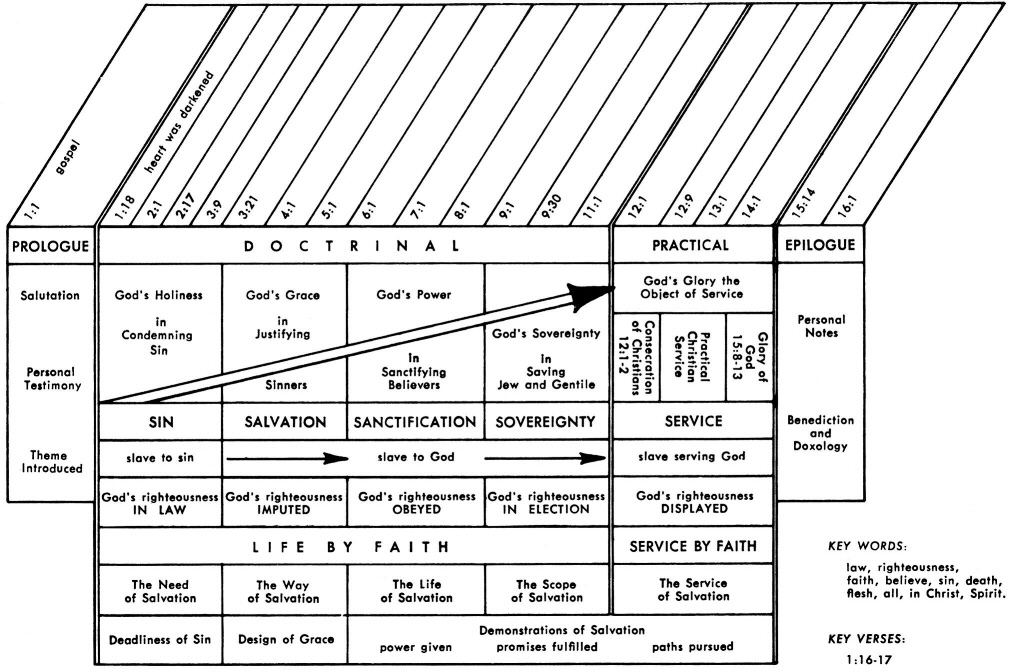
Click chart to enlarge
Chart from recommended resource Jensen's Survey of the NT - used by permission
Romans Overview Chart - Charles Swindoll
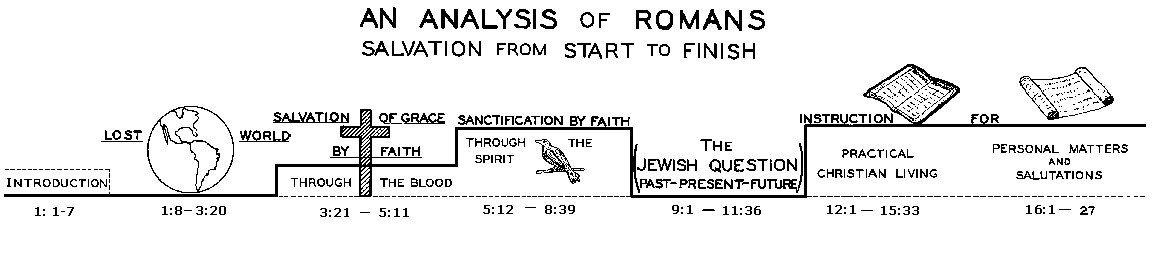
Source: Dr David Cooper
Click to Enlarge
R Ruin (Romans 1:17 – 3:20) – The utter sinfulness of humanity
O Offer (Romans 3:21-31) – God’s offer of justification by grace
M Model (Romans 4:1-25) – Abraham as a model for saving faith
A Access (Romans 5:1-11) – The benefits of justification
N New Adam (Romans 5:12-21) – We are children of two “Adams”
S Struggle w/ Sin (Romans 6-8) Struggle, sanctification, and victory
|
ROMANS ROAD |
||||
| Romans 1:18-3:20 | Romans 3:21-5:21 | Romans 6:1-8:39 | Romans 9:1-11:36 | Romans 12:1-16:27 |
| SIN | SALVATION | SANCTIFICATION | SOVEREIGNTY | SERVICE |
| NEED FOR SALVATION |
WAY OF SALVATION |
LIFE OF SALVATION |
SCOPE OF SALVATION |
SERVICE OF SALVATION |
| God's Holiness In Condemning Sin |
God's Grace In Justifying Sinners |
God's Power In Sanctifying Believers |
God's Sovereignty In Saving Jew and Gentile |
Gods Glory The Object of Service |
| Deadliness of Sin |
Design of Grace |
Demonstration of Salvation | ||
| Power Given | Promises Fulfilled | Paths Pursued | ||
| Righteousness Needed |
Righteousness Credited |
Righteousness Demonstrated |
Righteousness Restored to Israel |
Righteousness Applied |
| God's Righteousness IN LAW |
God's Righteousness IMPUTED |
God's Righteousness OBEYED |
God's Righteousness IN ELECTION |
God's Righteousness DISPLAYED |
| Slaves to Sin | Slaves to God | Slaves Serving God | ||
| Doctrine | Duty | |||
| Life by Faith | Service by Faith | |||
|
Modified from Irving L. Jensen's chart above |
||||
Romans 5:12 Therefore *, just as through one man sin entered into the world, and death through sin, and so death spread to all men, because * all sinned -- (NASB: Lockman)
Greek: Dia touto hosper di' enos anthropou e hamartia eis ton kosmon eiselthen (3SAAI) kai dia tes hamartias o thanatos, kai houtos eis pantas anthropous o thanatos dielthen, (3SAAI) eph o pantes hemarton (3PAAI)
Amplified: Therefore, as sin came into the world through one man, and death as the result of sin, so death spread to all men, [no one being able to stop it or to escape its power] because all men sinned. (Amplified Bible - Lockman)
NLT: When Adam sinned, sin entered the entire human race. Adam’s sin brought death, so death spread to everyone, for everyone sinned. (NLT - Tyndale House)
Phillips: This, then, is what happened. Sin made its entry into the world through one man, and through sin, death. The entail of sin and death passed on to the whole human race, and no one could break it for no one was himself free from sin. (Phillips: Touchstone)
Wuest: Wherefore, as through the intermediate agency of one man the aforementioned sin entered the world, and through this sin, death; and thus into and throughout all mankind death entered, because all sinned. (Eerdmans)
Young's Literal: because of this, even as through one man the sin did enter into the world, and through the sin the death; and thus to all men the death did pass through, for that all did sin;
THEREFORE: Dia touto:
- Romans 5 Resources - Multiple Sermons and Commentaries
A SUGGESTION ON STUDYING ROMANS 5:12-21: Dear reader, without a doubt, Romans 5:12-21 is one of the most difficult sections of Scripture in Romans and in the entire New Testament for that matter. And yet it is one of the most important sections, for the truths expounded in these verses are the very foundation stones of the Gospel. It therefore behooves every saint to earnestly consider prayerfully digging into this meaty section in order to more fully understand the rich treasure we have in the Gospel of Jesus Christ. After studying the text yourself under the teaching ministry of the Holy Spirit, you are encouraged to look at the notes on these verses. I would also encourage you to download the excellent messages by Dr John Piper using the links provided below. I usually download them to a folder I have created on my Desktop ("Audio") and them drag them over to my Ipod Playlist and listen to them on my daily 20 mile bike ride. To easily download the following Mp3's simply right click your mouse over the link, select "Save Target As" and then pick your destination (Desktop folder, Ipod, etc). Then sit back and listen to Piper's Puritan like passionate plea which is truly "logic on fire"!
You could just read the manuscripts at Desiringgod.org but be aware that (1) the manuscripts are not verbatim and (2) if you only read the text, you would miss some of Piper's passionate cry in preaching which stirs one's soul to desire more of God's glory!
- Romans 5:12-21 Adam, Christ, and Justification, Part 1
- Romans 5:12-21 Adam, Christ, and Justification, Part 2
- Romans 5:12-21 Adam, Christ, and Justification, Part 3
- Romans 5:12-21 Adam, Christ, and Justification, Part 4
- Romans 5:12-21 Adam, Christ, and Justification, Part 5
- Romans 5:20-21 The Triumph of Grace through Righteousness
If you only have time for one message I would recommend Part 5 which summarizes Romans 5:12-21 and deals with the often sticky issue of "original sin".
C H Spurgeon has a sermon in which he gives an excellent summary of the doctrine of Christ and Adam as representative heads. Click here to read Spurgeon's comments on this important doctrine.
S Lewis Johnson writes that "The master-thought of the section that begins with verse twelve of Romans chapter five and concludes with verse 21 is the unity of the many in the one. Adam and his posterity are affected by his sin, while the Last Adam and His people are affected by his righteous act, that is, the victorious redeeming work of the cross.
Leon Morris cautiously introduces Romans 5:12-21 writing that…
Just as Adam was the head of a race of sinners, so Christ is the head of a new race, the redeemed people of God. The argument is very condensed, and in all translations and comments we must allow for the possibility that Paul’s meaning may at some point be other than we think. But we must not exaggerate this. The main lines of the argument are clear. It is an important section, and indeed Nygren calls it “the point where all the lines of (Paul’s) thinking converge, both those of the preceding chapters and those of the chapters that follow.” The construction of the whole is not straightforward. Paul begins to compare Adam and Christ in Romans 5:12, but breaks off his sentence at the end of that verse to explain the pattern of sin and death (Romans 5:13; 14). He makes it clear that there are profound dissimilarities between Christ and Adam (Romans 5:15; 16; 17), and in Romans 5:18 he returns to complete succinctly the thought of the unfinished sentence of Romans 5:12. To this he adds an explanation (Romans 5:19) and a little section on the law (Romans 5:20; 21). There is an objectivity to this section that we should not miss. In Romans 5:1–11 and again in 6:1–9 the pronoun we is constant, but in Romans 5:12–21 there is not one we. Paul is concentrating on objective facts, irrespective of our participation. (See The Epistle to the Romans)
As background remember that there are 3 great imputations in the Bible. To impute something means to place it on another's account so to speak.
(1) Imputation of Adam's sin to his posterity's account or the spiritual account of the entire human race.
(2) Imputation of the sin of the elect to Jesus Christ, Who bore sin's penalty on the Cross (cf 2Cor 5:21)
(3) Imputation of the righteousness of God to the elect (Ro 3:24, 25, 26, Ro 4:1, 2, 3, 4, 5, 6, 7,8)
Romans 5:12 deals with the first imputation, the placing of Adam's sin upon the account of the human race, a doctrine which is fundamental to all theology. In short, in this section Paul teaches that man does evil, because he is evil, and the root cause of the sin problem is what happened millennia ago in the beautiful garden planted by God.
Warren Wiersbe introduces this important, often times poorly understood section, Romans 5:12-21, by asking…
How is it possible for God to save sinners in the person of Jesus Christ? We understand that somehow Christ took our place on the cross, but how was such a substitution possible? Paul answered the question in this section, and these verses are the very heart of the letter.
To understand these verses a few general truths about this section need to be understood. First, note the repetition of the little word one. It is used eleven times. The key idea here is our identification with Adam and with Christ. Second, note the repetition of the word reign which is used five times. Paul saw two men—Adam and Christ—each of them reigning over a kingdom. Finally, note that the phrase much more is repeated five times. This means that in Jesus Christ we have gained much more than we ever lost in Adam!
In short, this section is a contrast of Adam and Christ. Adam was given dominion over the old creation, he sinned, and he lost his kingdom. Because of Adam’s sin, all mankind is under condemnation and death. Christ came as the King over a new creation (2Cor 5:17-see commentary). By His obedience on the cross, He brought in righteousness and justification. Christ not only undid all the damage that Adam’s sin effected, but He accomplished “much more” by making us the very sons of God. Some of this “much more” Paul has already explained in Romans 5:1-11. (Bible Exposition Commentary)
Harry Ironside has an interesting comment on the practical import of this doctrinally deep and controversial section, Romans 5:12-21, writing that…
The awakened sinner is concerned about one thing: how to be delivered from the judgment his sins have righteously deserved. This aspect of salvation has all been gone into and settled in the first part of Romans 5. It is never raised again. As we go on into this next part of the Epistle the question of guilt does not come up.
The moment a sinner believes the gospel, his responsibility as a child of Adam under the judgment of God is over forever. But at that very moment his responsibility as a child of God begins. He has a new nature that craves what is divine. But he soon discovers that his carnal nature has not been removed nor improved by his conversion to God, and from this fact arises many trying experiences. It often comes as a great shock when he realizes that he has still a nature capable of every kind of vileness. He is rightly horrified, and may be tempted to question the reality of his regeneration (See also The Nature of Regeneration - My Utmost For His Highest) and his justification before God. How can a holy God go on with one who has such a nature as this? If he tries to fight sin in the flesh he is probably defeated, and learns by bitter experience what Philip Melanchthon, Luther's friend, put so tersely,
"Old Adam is too strong for young Philip."
Happy is the young convert if at this crisis he comes under sound scriptural instruction instead of falling into the hands of spiritual charlatans who will set him to seeking the elimination of the fleshly nature and the death of the carnal mind. If he follows their advice he will be led into a quagmire of uncertainty and dazzled by the delusive will-o'-the-wisp of possible perfection in the flesh. He will perhaps flounder for years in the bog of fanaticism and self-torture before reaching the rest that remains for the people of God.
I have tried to tell of my own early experiences along this line in a little volume entitled, Holiness, the False and the True, (Ed note: This short pamphlet is available at no charge on the internet - Holiness - the False and the True) which I am thankful to know has been blessed to the deliverance of many thousands of souls. It was the truth we are now to consider that saved me at last from the wretchedness and disappointments of those early years.
First we have to consider the two great families and the two federal heads of chapter Romans 5:12-21. The moment a man is justified by faith he is also born of God. His justification is, as we have seen, his official clearance before the throne of God. His regeneration involves his introduction into a new family. He becomes a part of the new creation of which the risen Christ is the Head.
Adam the first was federal head of the old race. Christ risen, the Second Man and the last Adam, is Head of the new race. The old creation fell in Adam, and all his descendants were involved in his ruin. The new creation stands eternally secure in Christ, and all who have received life from Him are sharers in the blessings procured by His cross and secured by His life at God's right hand.
Joyful now the new creation
Rests in undisturbed repose,
Blest in Jesus' full salvation,
Sorrow now nor thraldom knows.
The proper comprehension of the eternal standing in Christ settles the question of the believer's security. It also provides a scriptural basis for the doctrine of deliverance from the power of sin. (Romans Study Notes)
The following is a tabular summary of Romans 5:12-21…
|
GOD'S PLAN: |
||
|
TWO |
Adam |
Christ |
|
TWO |
One Transgression |
One Righteous Act |
|
TWO |
Condemnation, Guilt, Death |
Justification, Life, Kingship |
|
TWO DIFFERENCES |
Transgression |
Abounding Grace of God and the Gift by grace |
|
TWO DIFFERENCES |
One sin in Adam - condemnation and reign of death |
Many sins on Christ-justification and "reigning in life" for those accepting God's grace |
|
TWO |
SIN |
GRACE |
|
TWO ABUNDANCES |
"Abundant" |
Abundant |
|
TWO |
Condemned Men |
Justified Men |
|
SUMMARY |
Adam |
Christ |
Modified from William Newell Romans Verse by Verse
Comparing Adam and Christ verse by verse…
| COMPARISON & CONTRASTS ADAM AND CHRIST |
|||
| ONE MAN ADAM |
ONE MAN CHRIST |
||
| ACTION | RESULT | ACTION | RESULT |
| Transgression Ro 5:15 |
Many Died | Grace & Gift of God | Grace Abounds |
| Transgression Ro 5:16 |
Judgment Condemnation |
Free Gift | Justification |
| Transgression of the one Ro 5:17 |
Death Reigned |
Abundant Grace thru One |
Righteousness Will Reign in life |
| Transgression Ro 5:18 |
Condemnation To All |
One Act of Righteousness | Justification offered to All |
| Disobedience Ro 5:19 |
Many Made Sinners |
Obedience | Many Made Righteous |
| Law Came Ro 5:20 |
Sin Increased | Sin Increased | Grace Abounded |
| Sin Reigned Ro 5:21 |
Death | Grace Reigns | Eternal Life |
Therefore - Clearly Paul is linking Romans 5:11-21 with the preceding section. Notice that in the KJV at the end of Ro 5:12KJV there is a parenthesis sign encompassing Ro 5:13-17. What the KJV is trying to help the reader discern is that the comparison that Paul begins in this verse (as indicated by the word "as"), is not concluded unto Romans 5:18-19, where the ideas are picked up again and fully stated. Thus, Romans 5:13-14 are parenthetical, explaining the statement of verse twelve, namely, that all sinned.
Denney explains that therefore (dia touto)…
refers to that whole conception of Christ's relation to the human race which is expounded in Romans 3:21-5:11. But as this is summed up in Romans 5:1-11, and even in the last words of Romans 5:11 (through Him we received the reconciliation) the grammatical reference may be to these words only. (Nicoll, W Robertson, Editor: Expositors Greek Testament: 5 Volumes. Out of print. Search Google)
Newell introduces this section writing that…
The two men, Adam and Christ, with their distinct federal (ED: See also What is the meaning of federal headship?) or representative consequences, are before us. It is no longer what we have done (our sins), but the one trespass of Adam that is in view. And it is the work of Christ, also, looked at as an "Adam" (second Man or last Adam - cp 1Cor 15:22, 45, 47) and His "righteous act" of death with its effect of justification for us. So now (Romans 5:12-21) we look back to the act that set us down as sinners, instead of to our own deeds and to the act that sets us down righteous, apart from our own works…
(He goes on to explain the therefore writing that) This whole plan of salvation, by Christ's work, not ours, which we have been considering in Romans 3-5, gives rise to the therefore which introduces this verse: Therefore this plan of salvation of all by a single Redeemer, is on the same principle as when through the other one man sin entered the world; and, with it, its wages, death. Paul proceeds to emphasize that it was in that way; i.e., by one man, that death passed to all men, because when Adam sinned, all sinned. It was a federal representative act. (Romans 5)
A key word in Romans 5:12-21 is one which occurs 13 times in the NASB (Multiple times in some verses - See notes Romans 5:12, 15, 16, 17, 18, 19). One evil deed of this one man, is very important and underlies the whole discussion.
Oswald Chambers…
Just as the nature of sin entered into the human race through one man, the Holy Spirit entered into the human race through another Man (Ro 5:12, 13, 14, 15, 16, 17, 18, 19 ). And redemption means that I can be delivered from the heredity of sin, and that through Jesus Christ I can receive a pure and spotless heredity, namely, the Holy Spirit. (See also The Nature of Regeneration - My Utmost For His Highest)
Constable makes the following related observation…
Paul did not call Adam and Christ by name when he first spoke of them but referred to each as one man. He thereby stressed the unity of the federal head with those under his authority who are also “men” (i.e., people). (Expository Notes)
Leon Morris adds that…
repeatedly Paul refers to one man Adam (and to one sin of that one man), and opposes to him (and to it) the one man Jesus Christ (and his one work of grace). The one man and his sin and the one Savior and his salvation are critical to the discussion. (Morris, L. The Epistle to the Romans. W. B. Eerdmans; Inter-Varsity Press)
The KJV Bible Commentary makes the point that…
Since these verses are so doctrinal in nature, it will be helpful to keep in mind three very important truths established in Romans 5:12-21. They are: (1) one offense, by one man, made all the world guilty of sin; (2) the resultant guilt of Adam’s original sin is imputed to each of us; and (3) Adam acted as our official representative when he cast his vote against God. (KJV Bible Commentary online)
W A Criswell explains that…
These verses contrast and compare life in Adam with life in Christ. These men are alike in that each is the head of a race, and thus his actions have far-reaching effects. They differ in that through one death came to all men (Ro 5:12), but through the other life came as a free gift for those who would accept that gift (Ro 5:17, 19-see notes Ro 5:17; 18). The passage affirms that in some way Adam's sin has negatively affected the entire human race. Man inherits a sinful nature and sinful state via his identification with Adam as the head of the race. Paul does not explain exactly how all sinned in Adam, but he clearly affirms the fact of it. All humanity is spiritually related to one of these two men. Either we are (1) in Adam by birth and therefore under condemnation, or (2) in Christ by faith and therefore justified and forgiven. We are in Adam naturally by birth. We are in Christ supernaturally by the New Birth. There is no hint of universalism in this text. (Believer's Study Bible)
As Wayne Barber says…
if you don’t understand Romans 5, especially verses 12 through 21, a lot of confusion can come. We’re going to talk about the reason why every man desperately needs to be justified by faith, by putting his faith into the Lord Jesus Christ. Have you ever had somebody look at you with a puzzled look when you said to him that every person apart from Jesus Christ is a sinner? They say to you, "I’ve always tried to be a good person. I’ve joined the church. I’ve given money to the church. I do things for underprivileged kids. I give to the poor. What do you mean I’m a sinner?"
I want you to see from God’s word why it is that all men who have not placed their faith into Jesus Christ are sinners: they are IN Adam as opposed to being IN Christ. Verses 12 through 21, especially verses 14 and down, are going to give you a contrast of what it means to be IN Adam and what it means to be IN Christ… When you put your faith into Christ, you are taken out of Adam and you are placed into the body of Jesus Christ. Paul says in Colossians you are taken out from under the power of darkness and you are placed into the kingdom of His dear Son (God "delivered us from the domain of darkness, and transferred us to the kingdom of His beloved Son" Col 1:13)… The problem does not come from what you are doing on the outside. The problem is on the inside. You’ve got to be changed from within. A man does what he does because he is what he is. He is also going to show us man is desperate to be justified before God.
When did sin begin? It started with Adam. How do you know he is talking about Adam? Look at Ro 5:14:
Nevertheless death reigned from Adam until Moses, even over those who had not sinned in the likeness of the offense of Adam, who is a type of Him who was to come
If you’ll follow the context through Ro 5:21, he’s comparing Adam and what he did and how it affected the human race with Jesus and what He did and how that affected the human race. Liberals look at this text and tell us that Genesis 1-11 is myth and that Adam and Eve were a race of people, not a man and a woman. If you believe that, take Romans 5 and throw the rest of your Bible away! ONE man sinned, and because he sinned, sin entered the world. That man’s name was Adam. It all started right there…
Let’s go back and at least read the warning that God gave to Adam and Eve in the garden. In Genesis 2:16 He is speaking to Adam.
"And the Lord God commanded the man, saying, ‘From any tree of the garden you may eat freely.’".
..Adam had the entire garden, all the trees to eat from. But God said, "There’s one tree you cannot eat from." Ge 2:17:
"but from the tree of the knowledge of good and evil you shall not eat, for in the day you eat from it you shall surely die."
We are going to see in Romans that that death was not just physical death. Physical death is the obvious evidence to people that there has been a spiritual death. There’s been an estrangement between God and man. Death means separation. The moment that Adam chose to sin against God and eat from that tree, he was immediately estranged from God. There was a death. Even though he might not have understood all of that, he began physically to die, and death began to reign on this earth. (Romans 5:12-14) (Bolding added)
We have seen, in Romans 1-3, the fact of universal human guilt, that all thus are "falling short of God’s glory"; and we have seen Christ set forth by God as a "propitiation through faith in His blood." We also found that believers were declared righteous; and seen connected with a Risen Christ, in Romans 4. Then we saw, in the first part of Romans 5, the blessed results of this "justification by faith."
Romans 5:12-21 is vital material to prepare one for the great truths in Romans 6-8. In these passages we see the contrast between the UNION with Christ for believers versus their former UNION with Adam. Paul compares and contrasts Adam, the first man Adam, the father of humanity, with Jesus Christ, the "second Adam" (cp 1Cor 15:47) and father of the new humanity. The two men, Adam and Christ, with their distinct representative consequences are presented in these ten verses at the end of Romans 5. It is no longer what we have done—our sins, but the one trespass of Adam that is in view. Paul contrasts the work of Adam with the work of Christ in His "righteous act" of death with its effect of justification.
Charles Ryrie introduces Romans 5:12-21 remarking that…
In the closely worded argument of this section Paul contrasts death in Adam with life in Christ. Just as Adam's sin brought certain results, so did the death of Christ. Yet this does not mean automatic salvation, for men must receive the grace God offers (Ro 5:17). After Adam sinned, he and his descendants could only beget sinners, so all men are under the sentence of death, the penalty of sin. all sinned. True because of the solidarity of the race just explained (He 5:9, He 7:10 for the principle of imputation). (Borrow Ryrie Study Bible Expanded Edition)
The International Standard Bible Encyclopedia has an insightful note on Romans 5:12-21 writing that…
The passage is the logical center of the epistle, the central point to which everything that precedes has converged, and out of which everything which follows will flow. The great ideas of Sin, Death, and Judgment are here shown to be involved in the connection of the human race with Adam. But over against this there is the blessed fact of union with Christ, and in this union righteousness and life. The double headship of mankind in Adam and Christ shows the significance of the work of redemption for the entire race. Mankind is ranged under two heads, Adam and Christ. There are two men, two acts and two results. In this teaching we have the spiritual and theological illustration of the great modern principle of solidarity. There is a solidarity of evil and a solidarity of good, but the latter far surpasses the former in the quality of the obedience of Christ as compared with Adam, and the facts of the work of Christ for justification and life.
The section is thus no mere episode, or illustration, but that which gives organic life to the entire epistle. Although sin and death are ours in Adam righteousness and life are ours in Christ, and these latter two are infinitely the greater (Ro 5:11); whatever we have lost in Adam we have more than gained in Christ. As all the evils of the race sprang from one man, so all the blessings of redemption come from One Person, and there is such a connection between the Person and the race that all men can possess what the One has done. (Bolding added) (See Adam in the New Testament)
JUST AS THROUGH ONE MAN: Dia touto hosper di enos (heis) anthropou:
- Ro 5:19; Ge 3:6
- Romans 5 Resources - Multiple Sermons and Commentaries
ONE MAN
ADAM
Just as (5618) (hosper) is a conjunction which introduces a comparison. The main point in Romans 5:12-21 is the comparison between Adam and Christ, explaining how Adam on one hand was the means of bringing in sin and death, while Christ on the other hand was the One who brought in justification and life.
Hodge writes that just as "obviously indicates a comparison or parallel. There is, however, no corresponding clause beginning with “so” to complete the sentence. Examples of similar incomplete comparisons may be found in Matthew 25:14 with “like” and in 1Timothy 1:3 with “as.” It is, however, so obvious that the illustration begun in this verse is resumed and fully stated in Ro 5:18,19 that the vast majority of commentators agree we must seek in those verses the clause which answers to this verse. (Commentary on Romans)
Kenneth Wuest paraphrases - Wherefore, as through the intermediate agency of one man the aforementioned sin entered the world, and through this sin, death; and thus into and throughout all mankind death entered, because all sinned. (Eerdmans)
One man - Although not name in this verse, this is clearly Adam. As Barber discusses above, in Genesis 2:16,17, God gave one command to eat from every tree in the Garden except the Tree of Knowledge, for if he ate of this tree he would surely die.
Carroll writes that…
The one offense committed by the first Adam was his violation of that test, or prohibition, "But of the tree of the knowledge of good and evil, thou shalt not eat of it; for in the day that thou eatest thereof thou shalt surely die" (Genesis 2:17). Adam was told that he was not to eat of the tree of death, nor was he to experimentally know the difference between good and evil. In other words, he was an anti-prohibitionist. The law commenced with an absolute prohibition, and it did not avail Adam a thing to plead personal liberty. Race responsibility rested on Adam alone. It could not possibly have rested on Eve, because she was a descendant of Adam, just as much as we are. GOD created just one man, and in that man was the whole human race, including Eve. Later he took a part of the man and made a woman, and the meaning of the word "woman" is "derived from man." When Adam saw her, he said, "Isshah," woman, which literally means derived from man. As she got both her soul and body from the man, being his descendant, it was impossible that the race responsibility should rest on her.
If Eve alone had sinned, the race would not have perished. She would have perished, but not the race. The race was in Adam. GOD could have derived another woman from him like that one. He had the potentiality in him of all women as well as all men. Some error has arisen from holding Eve responsible, such as the error of pointing the finger at the woman and saying, "You did it!" The text says, "By one man's offense" and not by one offense of one woman. That Eve sinned there is no doubt; she was in the transgression. To the contrary, history shows that GOD connects salvation with the woman, and not damnation. He said that the Seed of the woman shall bruise the serpent's head. There we have the promise of grace. And he could not have said the seed of the man, for, if one be the seed of a man, he inherits the man's fallen nature. (Romans: Studies in Romans)
Man (444) (anthropos) is a generic name for human beings in general. Anthropos is distinguished from aner, which refers to the male sex. Anthropos on the other hand signifies a member of the human race, without reference either to sex or nationality.
Henry Morris however adds this qualifying remark noting that…
There is no warrant in the New Testament for the heretical notion that "Adam" is simply a generic term representing the human race. He was "one man," in fact "the first man" (1Corinthians 15:45)… Adam was a real person, directly created and made by God, and so was Eve. The entire argument of Romans 5:12-21 becomes irrelevant if the Genesis record of the creation and fall of Adam did not happen just as recorded in Genesis 1-3, and this would mean there is no reality in the saving work of Christ either. Destroying or distorting the Genesis record undermines and eventually destroys the gospel of salvation. Such a devastating undermining of the Christian faith is surely not warranted by the fragmentary and self-contradictory fossil evidences that have been alleged to support the notion of human evolution. (Defenders Study Bible)
F F Bruce writes that "To Paul, Adam was more than a historical individual, the first man; he was also what his name means in Hebrew - ‘humanity.’ The whole of humanity is viewed as having existed at first in Adam. (See Romans: An Introduction and Commentary - Page 130)
The following discussion is somewhat redundant and repetitive in order to lay the groundwork for studying Romans 5:12-21, which can be a bit confusing. Hopefully, the following will help clarify Paul's arguments in the next 10 verses.
Henry Morris comments that…
There is no warrant in the New Testament for the heretical notion that "Adam" is simply a generic term representing the human race. He was "one man," in fact "the first man" (1Cor 15:45). There were no pre-Adamite men, as some have alleged, and certainly no population of evolving hominids becoming Adam. In fact, Christ Himself made it clear that Adam and Eve were
"from the beginning of the creation God MADE THEM MALE AND FEMALE" (Mark 10:6 quoting Genesis 1:27)
Adam was a real person, directly created and made by God, and so was Eve. The entire argument of Romans 5:12-21 becomes irrelevant if the Genesis record of the creation and fall of Adam did not happen just as recorded in Genesis 1-3, and this would mean there is no reality in the saving work of Christ either. Destroying or distorting the Genesis record undermines and eventually destroys the gospel of salvation. Such a devastating undermining of the Christian faith is surely not warranted by the fragmentary and self-contradictory fossil evidences that have been alleged to support the notion of human evolution. (Defenders Study Bible)
Genesis is not a myth or a fairy tale. It is the truth and it all began here…
When the woman saw that the tree was good for food, and that it was a delight to the eyes, and that the tree was desirable to make one wise, she took from its fruit and ate; and she gave also to her husband with her, and he ate. (Ge 3:6)
Note that Genesis 3 make it abundantly clear that this one man, Adam, brought sin to the human race by disobedience. It was not the sins of Adam’s lifetime, but the one "original sin" which allowed death, sin’s close ally, to enter the world with it. On no less than five occasions in Romans 5:15-19 the principle of one sin by one man is asserted. One act of disobedience to God was sufficient to allow sin to enter and permeate the entire realm of humanity.
This truth shuts the mouth of liberals who would deny the literal truth of Genesis, saying Adam was just a generic term for the human race. God says specifically one man thus corroborating the truth of Genesis. The entire argument of Romans 5:12-21 becomes irrelevant if the Genesis record of the creation and fall of Adam did not happen as recorded.
The following note is on the term federal for it is often found in commentaries describing Adam as our "federal head", or legal representative of the rest of mankind that originated from him. The federal headship view considers Adam, the first man, as the representative of the human race that generated from him. Thus in the federal headship model…
As the representative of all humans, Adam’s act of sin was considered by God to be the act of all people and his penalty of death was judicially made the penalty of everybody.
Bible Knowledge Commentary goes on to distinguish a second way of explaining the participation of all mankind in the sin of Adam…
The natural headship view, on the other hand, recognizes that the entire human race was seminally and physically in Adam, the first man. As a result God considered all people as participating in the act of sin which Adam committed and as receiving the penalty he received. Even adherents of the federal headship view must admit that Adam is the natural head of the human race physically; the issue is the relationship spiritually. Biblical evidence supports the natural headship of Adam. When presenting the superiority of Melchizedek’s priesthood to Aaron’s, the author of Hebrews argued that Levi, the head of the priestly tribe, “who collects the 10th, paid the 10th through Abraham, because when Melchizedek met Abraham, Levi was still in the body of his ancestor” (Heb. 7:9, 8, 9, 10). (See Bible Knowledge Commentary - Page 458)
The esteemed Dallas Theological Seminary professor S Lewis Johnson favors the "immediate federal imputation view" which says that…
Adam is the federal head of the race. Men are regarded as having stood their probation in him as their representative. His act was, therefore, deemed to be their act. He, the covenantal head of the race, fell, and in him the race fell. The fact that he was the head of the race is indicated by the fact the threats that were given him by God on the condition of his failure of the probation have been carried out on Adam and his posterity. All men, and not simply Adam, die.
And so Paul begins the analogy of Christ with Adam, the common principle being that, in each case, a far-reaching effect on countless others was generated through one man. Adam was given but one (as far as we know) prohibition by God, and the consequence for disobedience of that prohibition was severe
Then the LORD God took the man and put him into the garden of Eden to cultivate it and keep it. And the LORD God commanded the man, saying, "From any tree of the garden you may eat freely; but from the tree of the knowledge of good and evil you shall not eat, for in the day that you eat from it you shall surely die." (Genesis 2:15-17)
And so when Adam disobeyed God (Ro 5:12,19) sin entered into his life and generated a constitutional change in his human nature so that our basic human nature in Adam is that we are made sinners or constituted as sinners (see note Romans 5:19), indicating that we possess the innate propensity to sin which was transmitted from Adam to all men.
Paul’s argument begins with the assertion that, through Adam, sin entered into the world. He does not speak of sins, plural, but of sin, singular. In this sense, as discussed below (see note), sin does not represent a particular unrighteous act (as when I commit a "sin") but rather the inherent propensity to unrighteousness in thought, word and deed. It was not the many sinful acts that Adam subsequently committed, but the indwelling sin nature that he passed on to his posterity. Just as Adam bequeathed his physical nature to his posterity, he also bequeathed to them his spiritual nature, and that nature was characterized and dominated by sin.
Mankind is a single entity, constituting a divinely ordered solidarity. Adam represents the entire human race that is descended from him, no matter how many subgroups there may be. Therefore when Adam sinned, all mankind sinned, and because his first sin transformed his inner nature, and that same depraved nature was also transmitted to his posterity. Ancient Jews understood well the idea of corporate identity. It was on that basis that God frequently punished or blessed an entire tribe, city, or nation because of what a few, or even just one, of its members did. (eg see effect of Achan's sin Joshua 7:1-26). This background should help you understand such passages as “In Adam all die" (1Cor 15:22).
The fact that Adam and Eve not only were actual historical figures but were the original human beings from whom all others have descended is absolutely critical to Paul’s argument here and is critical to the efficacy of the gospel of Jesus Christ. Can you see why this Old Testament truth is so critical? If a historical Adam did not represent all mankind in sinfulness, a historical Christ could not represent all mankind in righteousness. If all men did not fall with the first Adam, all men could not be saved by Christ, the second and last Adam (1Cor 15:20, 21, 22, 45).
When Adam sinned, all mankind sinned in his loins (Ro 5:18). Adam's sin transformed his inner nature and brought spiritual death and depravity, and that sinful nature was passed on seminally to his posterity. This same principle of one who is yet unborn is in a sense in the loins of his predecessor is alluded to by the writer of Hebrews in his discussion of Abraham and Levi (the priesthood)…
And, so to speak, through Abraham even Levi, who received tithes, paid tithes, for he was still in the loins of his father when Melchizedek met him. (see notes Hebrews 7:9; 10)
Stated another way even though Levi was not yet born, Abraham was his physical ancestor and thus Levi is considered as to be in the loins of Abraham. In light of that concept, what one can say is that Levi (and his descendants) who collected the tithe from the people in Israel, in a manner of speaking they themselves (Levi and descendents) paid a tithe to Melchizedek through their physical ancestor Abraham. When Abraham paid the tithe, it was as if Levi (and his descendents) paid the tithe. This same principle is utilized by Paul in his discussion of Adam, the physical ancestor of every human being ever born.
Expositor's Bible Commentary adds…
That we could have sinned in Adam may seem strange and unnatural to the mind of Western man. Nevertheless, it is congenial to biblical teaching on the solidarity of mankind. When Adam sinned, the race sinned because the race was in him. To put it boldly, Adam was the race. What he did, his descendants, who were still in him, did also…
If one is still troubled by the seeming injustice of being born with a sinful nature because of what the father of the race did and being held accountable for the sins that result from that disability, he should weigh carefully the significance of reconciliation as stated by Paul: "… that God was reconciling the world to himself in Christ, not counting men's sins against them " (2Cor 5:19). The sins committed, that owe their original impetus to the sin of the first man, are not reckoned against those who have committed them provided they put their trust in Christ crucified and risen. God takes their sins and gives them his righteousness. Would we not agree that this is more than a fair exchange? (See Romans or The Expositor's Bible Commentary - Abridged Edition:- Page 805)
So then here in one of the most enigmatic passages in the entire book, Paul sets out to show how one Man’s death can provide salvation for many. To prove his point, he uses Adam to establish the principle that it is possible for one man’s actions to inexorably affect many other people.
Beet makes an observation (that John Piper has also made) that (Romans 5:12) is incomplete for it
states only one side of an important comparison. For, although grammatically the clause also in this way etc. might be taken as introducing the second member of the comparison
Ed note: that is the "second Adam", Christ), this would yield no adequate contrast. Evidently the comparison is broken off in order to prove the former (Adamic) side of it. The second side (Christ) is informally introduced in (Romans 5:15) and the whole comparison is formally stated in (Ro 5:18; 5:19)
Paul’s Jewish readers might have been tempted to argue that this did not apply to them because of their unique descent from "Abraham the righteous" (more accurately, "Abraham the sinner declared righteous" -- God imputed righteousness to Abraham's "account" in Genesis 15:6 on the basis of grace through faith - Abraham believed God's promise and ultimately the promised Seed, the Messiah). Paul counters any such Jewish logic, by taking them back to the beginning of all mankind in Genesis 3, thus emphasizing their common descent with the Gentiles from the line of "Adam the sinner". It is interesting to observe that Paul's argument would have greater force to his Jewish readers than Genesis alone might imply, because Jewish traditions had made Adam much more prominent than he had been in the Old Testament (he is hardly mentioned outside Genesis). Jewish people in this period sometimes spoke of Adam in hyperbolic terms as if he filled the whole earth (!) or more often they spoke of his original glory, which was lost in the Fall in Genesis 3. And so the Jews generally believed that Adam's sin introduced sin (and consequently death) into the world, and that all Adam's descendants shared in his guilt. In addition, Jewish interpreters generally believed that Adam’s original glory would be restored to the "righteous" ones in the world to come.
William Newell makes an interesting comment…
We were so connected with the first Adam that we did not have to wait to be born, or to have a sinful nature; but when Adam, our representative, acted, we acted… The great truth of Romans 5.12-21 is that a representative acted, involving those connected with him (Romans 5)
(the) SIN ENTERED THE WORLD AND DEATH THROUGH SIN AND SO DEATH SPREAD TO ALL MEN: he (definite article) hamartia (sin) eis ton kosmon eiselthen (3SAAI) kai dia tes hamartias ho thanatos:
- Ro 6:23; Ge 2:17; 3:19, 22, 23, 24; Ezek 18:4; 1Cor 15:21; Jas 1:15; Rev 20:14,15
- Romans 5 Resources - Multiple Sermons and Commentaries
THE "SIN VIRUS"
100% FATAL!
I am a retired infectious disease (medical) specialist and think of SIN as something far worse than the dread Ebola virus. How tragic that men fear earthly literal viruses (like the picture of literal Ebola virus) which can terminate their physical life on earth, but far too seldom contemplate the 100% fatality rate of the "Sin Virus" (no picture available!) which not only results in physical death but in eternal death! O, that God's Spirit and Word would arouse the darkened hearts of millions and millions of souls who otherwise face a Christless eternity. In Jesus' saving Name (Mt 1:21, Acts 4:12). Amen
.jpg)
This passage is often referred to when one seeks to explain the doctrine you may have heard described as original sin. Original sin is a term used to describe our inheritance of a sinful nature from Adam. The sinful nature originated with Adam and is passed down from parent to child. We are by nature children of wrath (Eph 2:3).
Ryrie notes that theologians have used at least three different labels to describe the sin nature all men inherit from Adam…
(1) Some call it… inherited sin. This emphasizes the truth that all people inherit this sinful state from their parents, and their parents from their parents, all the way back to Adam and Eve.
(2) Others call it the sin nature, which focuses on the fact that sin has corrupted our entire nature. The term “sin nature” provides a clear contrast between that root nature and its fruits (which are particular acts of sin).
(3) Still others prefer the term original sin because Adam’s original sin produced that moral corruption of nature that was transmitted by inheritance to each succeeding generation. (See Basic Theology : A Popular Systemic Guide to Understanding Biblical Truth)
As mentioned in this discussion of Romans 5:12-21, be aware that Scripture distinguishes our sin nature from the sins we each commit (personal sins). In other words, we commit sins because we are sinners by nature, a nature we inherited from Adam.
There is a more difficult to understand third aspect of sin which is referred to as imputed sin, and this is the teaching that many often chaff at. Why? Because imputed sin says (as determined from Romans 5:12) that when Adam sinned, every man and woman ever born also sinned, because God imputed (credited to one's account) Adam's sin to our spiritual ledger. We don't like this truth (because we have a sinful nature!). It doesn't sound fair, but it is simply because we do not fully comprehend the spiritual dynamics. Rest assured that the Judge of all mankind is always perfectly righteous and infinitely just. He is not some cosmic ogre, but the infinitely holy God Who cannot stand sin in any form. The truth of imputed sin will be discussed in more detail throughout the notes on Romans 5:12-21, so if you are wrestling with this truth, stop and pray for the Spirit's illumination.
Wayne Grudem offers the following thoughts to address our sense of indignation at being held guilty because of Adam's sin…
(1) Everyone who protests that this is unfair has also voluntarily committed many actual sins for which God also holds us guilty. These will constitute the primary basis of our judgment on the last day, for God “will render to every man according to his works” (Ro. 2:6), and “the wrongdoer will be paid back for the wrong he has done” (Col. 3:25).
(2) Moreover, some have argued, “If any one of us were in Adam’s place, we also would have sinned as he did, and our subsequent rebellion against God demonstrates that.” I think this is probably true, but it does not seem to be a conclusive argument, for it assumes too much about what would or would not happen. Such uncertainty may not help very much to lessen someone’s sense of unfairness.
(3) The most persuasive answer to the objection is to point out that if we think it is unfair for us to be represented by Adam, then we should also think it is unfair for us to be represented by Christ and to have his righteousness imputed to us by God. (Systematic Theology)
Meanwhile, below is a simple summary chart (acknowledging that such charts are not a substitute for careful study of the broad subject of sin) taken from Dr Charles Ryrie's book Basic Theology which I highly recommend as orthodox, Scripturally based and imminently readable, and made even more so by frequent helpful illustrations.
Just as through one man sin entered the world - Note that Paul doesn’t seek to prove that sin entered through one man but simply accepts as true God's record through Moses in Genesis 3, where sin entered the world through Adam. As an aside, do you see the implication of the statement "sin entered"? The implication is that sin existed before Adam (but we won't go there)! Notice also that it was Adam who was held responsible for the fall of man, not his wife Eve. In his first epistle to Timothy, Paul explained that…
it was not Adam who was deceived, but the woman being quite deceived, fell into transgression. (1Timothy 2:14)
To be sure Eve sinned when she was deceived. On the other hand, Adam, without being deceived, and with knowledge of what he was doing, deliberately chose to disobey God. Thus Adam was more accountable for his disobedience than Eve.
In the book of beginnings, Moses records the historical event…
When the woman saw that the tree was good for food, and that it was a delight to the eyes, and that the tree was desirable to make one wise, she took from its fruit and ate; and she gave also to her husband with her, and he ate. Then the eyes of both of them were opened, and they knew that they were naked (note how guilt immediately followed their commission of sin); and they sewed fig leaves together and made themselves loin coverings. (Genesis 3:6, 7)
The Ryrie Study Bible Expanded Edition comments that "Their sin was more than merely eating forbidden fruit; it was disobeying the revealed word of God, believing the lie of Satan, and placing their own wills above God's. Sin, with all its dreadful consequences, now entered the human race and the world in general."
God had "drawn a line in the sand" so to speak and they walk across it or transgressed, hence the term transgression, which Paul uses 6 times in Romans 5:15, 16, 17, 18, 19, 20
It is vitally important to understand the meaning of the phrase "the Sin" before you can understand Romans 6, where Sin is personified as an active, ruling principle in every individual's life (Romans 5:21, 6:12-13, 6:17, 6:19-see notes Ro 5:21, 6:12-13, 6:17, 6:19)
The Sin (266) (hamartia) is the Greek word hamartia which originally conveyed the idea of missing the mark (as when hunting with a bow and arrow and not hitting the target - see this literal use of the most common Hebrew word for "sin" - Jdg 20:16!), of missing one's way and then came to mean missing or falling short of any goal, standard, or purpose.
In the theological sense as used most often in Scripture t he word sin describes one's thoughts, words or deeds which so often miss the ultimate purpose that God would intend them to have (i.e., they "miss" His will). Stated another way, our thoughts, words and/or deeds fall short of God’s perfect standard of holiness. Now here is where the definition of Sin as used in Romans 5-8 can become a bit confusing.
SIN AS A REIGNING POWER,
A DICTATOR RESIDING IN YOUR BODY!
First note that Sin (hamartia) here in Romans 5:12 is singular and thus is not sins but sin. (see list of all similar uses of hamartia in Ro 5-8) The significance of this small grammatical detail becomes more apparent from the next fact (so don't check out yet!)
In many (in fact, most) of Paul's uses of hamartia in Romans 5-8, he places the definite article "the" before sin (this "the" is not translated in most English versions for it would be somewhat cumbersome to read).
So what does this phrase "the Sin" signify? In short, Paul is speaking of sin as an entity, not sins in general. From the context (Romans 5-8) "The Sin" is clearly used figuratively, in what is referred to as a metonym (derived from "meta" = with + "onym" = name") which describes the substitution of a word referring to an attribute for the thing that is meant (eg, the use of the word "crown" to refer to the entire "monarchy").
Now are you really confused? What Paul is doing by using the phrase "The Sin" is to use this word not to describe the actions or results (sins [plural] which are committed) but to describe the underlying root cause, the basic principle or, in medical terms (I'm a physician with sub specialization in infectious disease), the "virus" that killed (first spiritually and later physically) Adam and which has infected all men for all men can trace their physical lineage to the first Adam.
Think of The Sin as analogous to a highly contagious, 100% lethal virus which every man, woman and child has contracted because every person alive is related to Adam, the first man, who himself was infected. Or think of The Sin as analogous to an abnormal "gene" which transmits a defective moral/ethical "DNA code" to all of Adam's offspring, this defective code explaining why every individual commits sins (plural). In other words, we all continually commit sins because we all have inherited the defective "sin gene". Try to keep this distinction in mind when reading Romans 5-8, where Paul refers primarily to "the sin gene" ("the sin virus"), which is the underlying root cause of why we do the wicked things we do. In most of the uses of sin in these chapters Paul is not speaking of individual sins that we commit.
Wayne Barber explains that "When you see the word sin in Romans 5, take a pencil and write by it "The" (so that it reads "the Sin"). When the definite article "the" (Ed note: look at the Greek sentence above. Do you see the Greek word "he" before "hamartia"? The "he" is the definite article in Greek, corresponding to the English definite article "the") is used in Scripture, it is very important because it is identifying something as very specific. "Sin" occurs in Romans 5 and 6 most often with the definite article. In English, we might say "the cup," where the definite article (the) means, not just any cup, but the specific cup. (Romans 5:12-14) (Bolding and italics added)
To reiterate, Paul is not speaking of a particular sin (as selected out from among many sins that one might commit), but instead refers to the inherent propensity to sin that entered the human heart, which in turn made Adam a sinner by nature. Adam then passed the inherent sinful nature he possessed to all his offspring. Yes it was only a single act of disobedience, but it opened his heart to the entrance of the sin (nature, principle). This same "Adamic" nature is present in every person ever born from the moment of conception.
Kenneth Wuest explains SIN in Romans 6 writing that "The first thing we must settle is regarding the word sin, is whether it refers (in context) to sin as an abstraction, namely, to acts of sin committed by the believer or to the totally depraved nature still in him? A rule of Greek syntax settles the question. The definite article (Ed note: Definite article equates with the Greek word for "the") appears before the word (Sin) in the Greek text. Here the article (the) points back to a previously mentioned sin defined in its context. The reference is to sin reigning as king (Ro 5:21). There sin is personified since it reigns as a king. (ED: For example Paul commands believers - "do not let SIN reign [present imperative with a negative - stop letting Sin reign or don't let it begin!] in your mortal body so that you obey its lusts" Ro 6:12, so clearly "Sin" can still "assume the throne!" Look out! Forewarned is forearmed!) But one cannot conceive of acts of sin reigning as king in the life of a person. They (individual acts of sin) are the result of some dominant factor reigning as a king (Ed: or even worse as a Dictator!). That can only be the evil nature still resident in the Christian. And here is the key to the interpretation of the entire chapter (Romans 6). Every time the word SIN is used in this chapter as a noun, it refers to the evil nature in the Christian. Read the following verses and substitute the words sinful nature for the word sin, and see what a flood of light is thrown upon your understanding of this section of God’s Word (Ro 6:1, 2, 6, 10, 11, 13, 14, 16, 17, 18, 20, 22, 23). (Bolding and color added)
THOUGHT - Everybody has to serve somebody! Don't be deceived into thinking you are "free" because true freedom is not the power to do as you please, but the power to do as you should to please your Heavenly Father! And so in the moral/ethical sphere the choices are clear and diametrically opposed - either you obey God the Father, His Son and His Spirit or you obey "The Sin" that is still lurking in the hearts of believers and who holds unfettered sway in the heart of every non-believer! Who are you going to serve? That is the critical question we should all consider asking ourselves every morning for the rest of our lives! Today, will I obey Jesus, my Lord, enabled by His grace and His indwelling Spirit (cf Ro 8:13) or will I make the bad choice to obey The Sin which is continually waging war against my soul, continually enticing my mind and heart seeking to carry me away into some sin? (1 Pe 2:11, James 1:14). Bob Dylan's song "nailed it" - listen to his oldie, but goodie Gotta Serve Somebody (from his album "Gospel Songs of Bob Dylan!) Who you gonna serve today? And remember do not fall into the subtle trap of "keeping a list rules" (we call it legalism which always blunts the effective working of God's grace) but rather yield to the Spirit Who Alone can provide you the desire (the "want to" because our old Sin nature does not "want to" obey God) and the power (Php 2:13NLT) to work out (present imperative = not a suggestion but a command you can only keep as you rely on the Spirit's power - cf Eph 5:18, Gal 5:16) your salvation in fear and trembling (Php 2:12). It is not "Let go and let God," but more accurately "Let God and let's go!"
Another way of looking at this issue is to note that the sin is singular (in contrast to plural sins as in Ro 3:25, Ro 4:7, Ro 11:27 - the only 3 uses of "sins" plural in Romans) and does not refer to the ongoing death of specific sins which is part of our spiritual growth or sanctification. Rather the term sin in this verse refers to sin as a controlling power and as an enslaving tyrant, who prior to our salvation held "full sway" over our moral/ethical decisions! Paul's point is that believers have died in relation to the power sin was had over us as believers. And remember, it does not make one whit of difference whether or not you "feel" like this is true in your life. Paul's point is that if you are genuinely regenerate by the Spirit, you have been set free from the ruling power of the old tyrant Sin. He does not say you will never commit individuals sins again, for all believers still have the unredeemed (and unredeemable!) fallen flesh nature that seeks to coerce us to miss God's mark (sin) or sidestep His perfect path (transgression, trespass). At the time of Justification believers are set free once and for all from the ruling power of sin, but now in sanctification we must daily, moment by moment fight the battle with our residual, dethroned enemy and we now can do so infused by and controlled by God's Spirit (cp Ro 8:13).
In Psalm 51, notice how David under the inspiration of the Holy Spirit describes himself…
Behold (Hebrew = "Listen up!" for what I have to say is important!) I was brought forth in iniquity, and in sin my mother conceived me. (Ps 51:5-see exposition) Spurgeon comments on David's declaration…
Behold, I was shapen in iniquity. He is thunderstruck at the discovery of his inbred sin, and proceeds to set it forth. This was not intended to justify himself, but it rather meant to complete the confession. It is as if he said, not only have I sinned this once, but I am in my very nature a sinner. The fountain of my life is polluted as well as its streams. My birth tendencies are out of the square of equity; I naturally lean to forbidden things. Mine is a constitutional disease, rendering my very person obnoxious to Thy wrath.
And in sin did my mother conceive me. He goes back to the earliest moment of his being, not to traduce (expose to shame or blame) his mother, but to acknowledge the deep tap roots of his sin.
It is a wicked wresting of Scripture to deny that original sin and natural depravity are here taught. Surely men who cavil (raise trivial objections) at this doctrine have need to be taught of the Holy Spirit what be the first principles of the faith. David's mother was the Lord's handmaid, he was born in chaste wedlock, of a good father, and he was himself, "the man after God's own heart;" and yet his nature was as fallen as that of any other son of Adam, and there only needed the occasion for the manifesting of that sad fact. In our shaping we were put out of shape, and when we were conceived our nature conceived sin. Alas, for poor humanity! Those who will (desire or choose to do so), may cry it up, but he is most blessed who in his own soul has learned to lament his lost estate. (see full note) (Bolding added)
Beloved this truth that even newborn babes possess a sin nature may cause you considerable angst, especially if you have ever had a young child die. We do not have time to address this topic fully, but it is my belief that although babies and young infants are indeed "little sinners", nevertheless they will enter into the eternal presence of God if they die during this period. Upon the death of his infant son (who was conceived in adultery), David declared…
But now he has died; why should I fast? Can I bring him back again? I shall go to him, but he will not return to me. (2Samuel 12:23)
Henry Morris in the Defenders Study Bible writes "David's infant son, dead before he was able to discern right from wrong, was safe in Christ… David thus was confident he would be with his child in the ages to come, after the great resurrection day. He knew that he himself would "dwell in the house of the Lord forever" [Psalm 23:6] and so would his infant son."
Wayne Grudem: Are Infants Guilty Before They Commit Actual Sins? Some maintain that Scripture teaches an “age of accountability” before which young children are not held responsible for sin and are not counted guilty before God. However, the passages noted… about “inherited sin” indicate that even before birth children have a guilty standing before God and a sinful nature that not only gives them a tendency to sin but also causes God to view them as “sinners.” “Behold, I was brought forth in iniquity, and in sin did my mother conceive me” (Ps. 51:5). The passages that speak of final judgment in terms of actual sinful deeds that have been done (e.g., Ro 2:6–11) do not say anything about the basis of judgment when there have been no individual actions of right or wrong, as with children dying in early infancy. In such cases we must accept the Scriptures that talk about ourselves as having a sinful nature from before the time of birth. Furthermore, we must realize that a child’s sinful nature manifests itself very early, certainly within the first two years of a child’s life, as anyone who has raised children can affirm. (David says, in another place, “The wicked go astray from the womb they err from their birth,” Ps. 58:3.)
But then what do we say about infants who die before they are old enough to understand and believe the gospel? Can they be saved?
Here we must say that if such infants are saved, it cannot be on their own merits, or on the basis of their own righteousness or innocence, but it must be entirely on the basis of Christ’s redemptive work and regeneration by the work of the Holy Spirit within them. “There is one God, and there is one mediator between God and men, the man Christ Jesus” (1Ti 2:5). “Unless one is born anew, he cannot see the kingdom of God” (John 3:3).
Yet it certainly is possible for God to bring regeneration (that is, new spiritual life) to an infant even before he or she is born. This was true of John the Baptist, for the angel Gabriel, before John was born, said, “He will be filled with the Holy Spirit, even from his mother’s womb” (Luke 1:15). We might say that John the Baptist was “born again” before he was born! There is a similar example in Psalm 22:10: David says, “Since my mother bore me you have been my God.” It is clear, therefore, that God is able to save infants in an unusual way, apart from their hearing and understanding the gospel, by bringing regeneration to them very early, sometimes even before birth. This regeneration is probably also followed at once by a nascent, intuitive awareness of God and trust in him at an extremely early age, but this is something we simply cannot understand.
We must, however, affirm very clearly that this is not the usual way for God to save people. Salvation usually occurs when someone hears and understands the gospel and then places trust in Christ. But in unusual cases like John the Baptist, God brought salvation before this understanding. And this leads us to conclude that it certainly is possible that God would also do this where he knows the infant will die before hearing the gospel.
How many infants does God save in this way? Scripture does not tell us, so we simply cannot know. Where Scripture is silent, it is unwise for us to make definitive pronouncements. However, we should recognize that it is God’s frequent pattern throughout Scripture to save the children of those who believe in him (see Ge 7:1; cf. Heb. 11:7; Josh. 2:18; Ps. 103:17; John 4:53; Acts 2:39; 11:14(?); 16:31; 18:8; 1 Cor. 1:16; 7:14; Titus 1:6; cf. Matt. 18:10, 14). These passages do not show that God automatically saves the children of all believers (for we all know of children of godly parents who have grown up and rejected the Lord, and Scripture also gives such examples as Esau and Absalom), but they do indicate that God’s ordinary pattern, the “normal” or expected way in which he acts, is to bring the children of believers to himself. With regard to believers’ children who die very young, we have no reason to think that it would be otherwise.
Particularly relevant here is the case of the first child Bathsheba bore to King David. When the infant child had died, David said, “I shall go to him but he will not return to me” (2Sa 12:23). David, who through his life had such great confidence that he would live forever in the Lord’s presence (see Ps. 23:6, and many of David’s psalms), also had confidence that he would see his infant son again when he died. This can only imply that he would be with his son in the presence of the Lord forever. This passage, together with the others mentioned above, should be of similar assurance to all believers who have lost children in their infancy, that they will one day see them again in the glory of the heavenly kingdom.
Regarding the children of unbelievers who die at a very early age Scripture is silent. We simply must leave that matter in the hands of God and trust him to be both just and merciful. If they are saved, it will not be on the basis of any merit of their own or any innocence that we might presume that they have. If they are saved, it will be on the basis of Christ’s redeeming work; and their regeneration, like that of John the Baptist before he was born, will be by God’s mercy and grace. Salvation is always because of his mercy, not because of our merits (see Rom. 9:14–18). Scripture does not allow us to say more than that. (Online Systematic Theology - Highly Recommended very readable book on systematic theology)
David had the assurance that his baby would meet him in heaven. The renowned expositor John MacArthur writes that…
In no place does Scripture teach infant damnation. Rather, every biblical reference—whether oblique or direct—to the issue of infants and children who die gives us reason to believe they go immediately into the eternal presence of God. I cannot help but conclude that our Lord graciously and freely receives all those who die in infancy—not on the basis of their innocence or their worthiness, but by His grace, made theirs through the atonement He purchased on the cross. These little ones experience salvation grounded in absolute sovereignty and comprehensive grace. Yes, children are sinners by nature. Babies are not without a sin nature—they are, however, without sin deeds. Yes, children are in need of a Savior. Yes, God has provided a Savior for them, Jesus Christ. Yes, all children who die before they reach a state of moral awareness and culpability in which they understand their sin and corruption—so that their sins are deliberate—are graciously saved eternally by God through the work of Jesus Christ. They are counted as elect by sovereign choice because they are innocent of willful sin, rebellion, and unbelief, by which works they would be justly condemned to eternal punishment. (Excerpt from Dr MacArthur's book which I would highly recommend if you have questions or doubts concerning the topic - See Safe in the Arms of God: Truth from Heaven About the Death or borrow)
In a parallel passage David writes that…
The wicked are estranged from the womb; These who speak lies go astray from birth. (Psalm 58:3)
Spurgeon comments:
The wicked are estranged from the womb. It is small wonder that some men persecute the righteous seed of the woman, since all of them are of the serpent's brood, and enmity is set between them. No sooner born than alienated from God -- what a condition to be found in!
They go astray as soon as they be born, speaking lies. Every observer may see how very soon infants act lies. Before they can speak they practice little deceptive arts. This is especially the case in those who grow up to be adept in slander, they begin their evil trade early, and there is no marvel that they become adept in it. He who starts early in the morning will go far before night. To be untruthful is one of the surest proofs of a fallen state, and since falsehood is universal, so also is human depravity
The Sin (Sin -- the Sin principle or propensity inherited from Adam "lethal virus", "defective gene") in each individual makes it impossible for man to live in a way that pleases God. We all "miss the mark" because of this inherent propensity which determines our behavior.
A T Robertson adds here in Romans 5:12 that the Sin is personified by Paul "and represented as coming from the outside into the world of human. Paul does not discuss the origin of evil beyond this fact. There are some today who deny the fact of sin at all and who call it merely "an error of mortal mind" (a notion) while others regard it as merely an animal inheritance devoid of ethical quality.
Ray Stedman asks
"What is sin? Well, basically and fundamentally, sin is self-centeredness, that's all. We commit sins because we are thinking of ourselves, loving ourselves, indulging ourselves, looking out for ourselves, taking care that no one get ahead of us. That is the essence of sin -- self-centeredness. We are all victims of it. There is not one of us who does not struggle in this area. We find ourselves trapped in it constantly. That is the curse which hangs over our whole human race. We were made by God to be vessels to convey his outgoing love, to reach out with it to everyone around us. Somehow that has become twisted, so that now -- instead of reaching out -- we reach in, and we love ourselves first." And sin always produces guilt. Guilt is dislike of ourselves. We do not like the fact that we hurt others -- and we know we do. We feel responsible because we see the damage we do in other people's lives by our self-centeredness, and we feel guilty about it. We learn to hate ourselves to a considerable degree. That is why psychologists say that the great problem humanity wrestles with is self-hatred. Carl Menninger wrote a book, Man Against Himself, in which he documents that this is what we do. We hate ourselves. We do not like ourselves. We lose our self-respect. That is guilt. Guilt is always accompanied by fear, because fear is self-distrust. Fear is feeling unable to handle life anymore, being aware that there are forces and powers we are unable to control, and which eventually are going to confront us. We are not able to handle them, and so we run from them. Even in the Garden of Eden, as soon as Adam and Eve sinned they felt guilty, and they hid in fear. It has been the history of the race ever since. Fear looms up, that uncertainty about the future, and we become fearful, timid people, afraid of what will happen next. We are walking on eggs all the time, afraid of being accepted or rejected, afraid of what people will do to us -- and especially, finally, afraid of what God is going to do to us. That is an inner torment the like of which there is no equal. (Mark 1:1-8 The Place To Begin)
Entered (1525) (eiserchomai from eis = into, a preposition of motion into any place or thing + erchomai = come) literally means to come into and so to enter into. Eiserchomai is in the aorist tense and the indicative mood which signifies that at a certain point in time sin "went in the world's front door (by means of Adam's sin)" (Walvoord). Sin is personified as an evil that invaded the perfect Garden setting. Adam sinned, and at that point in time, the consequence of his sin was immediate for at that moment, the "deadly virus" named the sin entered into the world and spread to "infect" the entire human race.
Wayne Barber makes the point that the preposition eis in the verb eiserchomai…"Instead of signifying "to" all men, is more literally "into" (1519) all men… What a picture! When Adam sinned, out of his body was passed the seed of Sin into all mankind -- into man. the death. the sin. Every man born of man and woman on this earth is born into the sin, is born into Adam, is born into the death. And this consequence results without them ever having done anything. (see answers to the objections this truth raises)
Into (1519) (eis) conveys the idea of motion into some place or some thing.
World (2889) (kosmos related to kosmeo = to arrange or put in order from komeo = tend, take care of) according to W E Vine means "a harmonious arrangement or order,” then, “adornment, decoration,” came to denote “the world, or the universe, as that which is divinely arranged.” What a tragic irony that the sin and its corrupting, destructive effects entered into a place of such "harmonious arrangement and order"! Kosmos is often thus used to denote human beings--the race, the human family. Kosmos is the same word used in John 3:16 where God so loved the world, the sinful human family composed of sinners.
And death through sin - Paul personifies Death as entering the world through sin.
Death (2288) (thanatos) indicates the opposite of life and the absence of life and in the NT is seen as the consequence and punishment of sin. Death speaks of separation, physically of the soul from the body and spiritually of the soul from God. Note that death does not signify either annihilation or extinction. Here in Romans 5:12 Paul speaks not of death in general but "the death", in a sense personifying death as using sin as its point of entry into the world. Before the sin there was no the death.
Vine adds that thanatos in Romans 5 is primarily a reference…
to the (physical) death of the body, as is indicated in verse 14. The term may, however, have a more general sense, as including death spiritual and eternal; for these are the penal consequences of sin, and the whole argument points to death as a penalty thereof. Moreover, the life which is brought to the believer through Christ is set in contrast to death (Romans 5:17) and this eternal life is more than simply antithetic to physical death. (Collected writings of W. E. Vine)
Newell comments on death writing that…
Death is a Divine decree
It is appointed to men once to die and after this comes judgment (He 9:27)
Death involves four consequences:
(1) The utter ending of what we call human life.
(2) Falling consciously into the fearful hands of that power under which men have during their lifetime lightly lived, unprotected from the indescribable terrors and horrors connected therewith.
(3) Being imprisoned in Sheol or Hades - in "the pit wherein is no water, " as was Dives (a Latin adjective meaning "rich," which occurs in this passage in the Vulgate = the rich man) in Lk 16:19, 20, 21, 22, 23, 24, 25, 26, 27, 28, 29, 30, 31. Compare Zech 9:11
(4) Exposure to the coming judgment and its eternal consequences. Of course, the believer is rescued from all this-even physical death, -from bodily "falling asleep, " if Christ comes during his lifetime! while it is true of all saints, those who keep Christ's word, that they shall "never see death" (Jn 8:51). Death and judgment are past for the believer, Christ his Substitute having endured them. Nevertheless, in this day of mad pleasure-seeking, it certainly behooves all of us to reflect on the fearful realities connected with death!
Spread (1330) (dierchomai from dia = through + erchomai = go) means literally to go through or to pass throughout. It speaks of complete movement in a particular direction. To spread means to to send or be sent out in all directions, as for example a highly contagious deadly virus disseminating and spreading completely through an entire population. Paul uses this verb to describe the veritable diffusion of sin and death among mankind. His phrase "upon all men" emphasizes that the diffusion is universal in scope. Some say the preposition dia in dierchomai emphasizes the force of distribution so that what Paul is saying is that death "made its way to each individual member of the race".
Dierchomai - 43x in 42v - Matt 12:43; 19:24; Mark 4:35; 10:25; Luke 2:15, 35; 4:30; 5:15; 8:22; 9:6; 11:24; 17:11; 19:1, 4; John 4:4, 15; Acts 8:4, 40; 9:32, 38; 10:38; 11:19, 22; 12:10; 13:6, 14; 14:24; 15:3, 41; 16:6; 17:23; 18:23, 27; 19:1, 21; 20:2, 25; Rom 5:12; 1 Cor 10:1; 16:5; 2 Cor 1:16; Heb 4:14
Barnes comments on spread to all men writing that the verb spread means…
Passed through; pervaded; spread over the whole race, as pestilence passes through, or pervades a nation. Thus death, with its train of woes, with its withering and blighting influence, has passed through the world, laying prostrate all before it. (Albert Barnes. Barnes NT Commentary)
With the sin came, the consequences (cf the law of sowing and reaping, Gal 6:7, 8) of that sin came
so (the) death spread to all men, because all sinned.
Every grave stone gives a silent testimony to the spread
and reign of sin since the time of Adam.
As C H Spurgeon lamented "Oh, the awful power which sin had thus to turn the world into one vast cemetery, and to slay the whole human race (from his sermon "Lost Through One; Saved Through One" on Romans 5:16)
Barnhouse comments that…
Some who read these words may react against the truth that we set forth. But we remind them that we do not originate truth, we reflect it. We teach only what is in the Word of God. If you quarrel with us, you must first prove that we are teaching what the Bible does not teach.
Note that again the definite article is before "death", so we could read it as "the sin of Adam affected the death" which was the consequence God had warned Adam that "in the day that you eat from it you shall surely die." (Ge 2:17). And so it happened that Adam ate and so entered…
"THE death through THE sin, and so THE death spread to all men."
Through ONE MAN (Adam) "the SIN" entered at a specific point in time and it passed through or went through (out) the entire world. Notice that the verb entered implies that before that time the death was outside the world.
Henry Morris agrees adding that "there was no death before sin entered the world. The finished creation was "very good" (Genesis 1:31), with an abundance of food and all other provisions for man and animals. There was certainly no struggle for existence, or survival of the fittest, for every creature was created fit for its own environment. When Adam sinned, God brought the curse of decay and death not only upon Adam but also upon all His dominion (Ge 3:17, 18, 19, 20; 1Co 15:21,22; Romans 8:20, 21, 22). (Defenders Study Bible)
C H Spurgeon comments "Ask Noah as he looks out of his ark, "Does sin bring bitterness?" and he points to the floating carcasses of innumerable thousands that died because of sin (Ge 7:21). Turn to Abraham. Does sin bring bitterness? He points to the smoke of Sodom and Gomorrah that God destroyed because of their wickedness (Ge 19:1-38). Ask Moses, and he reminds you of Korah, Dathan, and Abiram, who were swallowed up alive (Nu 16:1-50).
Adam was not originally subject to death, but through his sin, death became a grim certainty for him and his posterity. Notice here a plain assertion that all men die because Adam sinned…
For as in Adam all die, so also in Christ all shall be made alive. (1Cor 15:22)
Even tiny babies can die, not because they have committed sins but because they have been born with a sin nature, the ultimate consequence of which is death.
A person does not become a sinner by committing sins
but rather commits sins because he or she is by nature a sinner.
A person does not become a liar when he tells a lie. He tells a lie because his heart is already deceitful for as Jesus clearly declared…
out of the heart come evil thoughts, murders, adulteries, fornications, thefts, false witness, slanders. (Mt 15:19)
The Penalty for Adam's Sin Brings
Three Kinds of Death
Although there are are three aspects to the death that is the result of sin, the penalty is really one.
(1) SPIRITUAL: Death conveys the sense of separation, and Adam’s first death was spiritual separation from God, which he experienced immediately after his disobedience.
And you were dead in your trespasses and sins, in which you formerly walked according to the course of this world, according to the prince of the power of the air, of the spirit that is now working in the sons of disobedience. (see notes Ephesians 2:1; 2:2).
(2) PHYSICAL: Physical death brings separation of one's soul from his body and separation from fellow human beings. Adam died physically at 930 years of age.
By the sweat of your face You shall eat bread, Till you return to the ground, Because from it you were taken; For you are dust, And to dust you shall return." (Genesis 3:19) (Comment: "Dust… to dust" is clearly a reference to physical death).
So all the days that Adam lived were nine hundred and thirty years, and he died. (Genesis 5:5)
And inasmuch as it is appointed for men to die once (once for all time = excludes possibility of re-incarnation) and after this comes judgment, (Hebrews 9:27)
(3) ETERNAL: This aspect of death (the Second death) includes not only eternal separation from God (Ge 3:22, 23, 24 describes the beginning of this separation when Adam was driven from the Garden and barred from entering), but eternal torment in the lake of fire…
And I saw a great white throne and Him who sat upon it, from whose presence earth and heaven fled away, and no place was found for them. 12 And I saw the dead, the great and the small, standing before the throne, and books were opened; and another book was opened, which is the book of life; and the dead were judged from the things which were written in the books, according to their deeds. 13 And the sea gave up the dead which were in it, and death and Hades gave up the dead which were in them; and they were judged, every one of them according to their deeds. 14 And death and Hades were thrown into the lake of fire. This is the Second death, the Lake of fire. 15 And if anyone's name was not found written in the book of life (or see Book of Life), he was thrown into the Lake of fire. (Rev 20:11-15)
In summary, when Adam sinned, he immediately died spiritually. Then after living "930 years… he died" (Genesis 5:5). Finally , as best we can discern, Adam was brought to faith and thus escaped eternal death. Unbelieving man is spiritually dead when he is born which leads to physical death and then to eternal death unless he receives the remedy for spiritual death which is eternal life, the gift of God through faith in the Lord Jesus Christ, the suffering and crucified Savior. The remedy of physical death is the bodily resurrection, which takes place at the coming of the Lord Jesus Christ for believers. For eternal death there is no remedy!
Related Resources:
- Eternal Punishment
- See excellent chart summary of Births, Deaths, and Resurrections.
- Baker Evangelical Dictionary Second Death
- Holman Bible Dictionary Second Death
- Will there be a second chance for salvation after death?
- What does it mean that Jesus Christ conquered death?
- Why do so many people have to experience terrible suffering before death?
- What is eternal death?
- How is physical death related to spiritual death?
- What is spiritual death?
- What happens after death?
- What is the difference between Sheol, Hades, Hell, the lake of fire, Paradise, and Abraham’s bosom?
- What is the second death?
- What is the Great White Throne Judgment?
- When was hell created?
- Is hell literally a place of fire and brimstone?
- Is there a difference between the book of life and the Lamb's book of life?
- What is the Book of Life?
- Is it possible for a person's name to be erased from the Book of Life?
BECAUSE ALL SINNED: eph ho pantes hemarton (3PAAI):
- Romans 5 Resources - Multiple Sermons and Commentaries
Related Passages:
Romans 3:23 for all have sinned and fall short of the glory of God,
James 3:2 For we all stumble in many ways. If anyone does not stumble in what he says, he is a perfect man, able to bridle the whole body as well.
1 John 1:8-10 If we say that we have no sin, we are deceiving ourselves and the truth is not in us. 9 If we confess our sins, He is faithful and righteous to forgive us our sins and to cleanse us from all unrighteousness. 10 If we say that we have not sinned, we make Him a liar and His word is not in us.
"ALL" MEANS ALL
WITHOUT EXCEPTION
Well, not quite all without exception, for praise God, there was one exception and that was Jesus Christ, fully God, fully Man, Who lived a sinless life (Heb 4:15, 2 Cor 5:21, 1 Pe 2:22, 1 Jn 3:5) that He might die a sacrificial death (Jn 1:29, 1 Cor 5:7) and provide a "safe haven" for all sinners who place their faith in Him, His finished work on the Cross, His burial and His death conquering resurrection.
Although this clause may seem straightforward, it has been one of the major interpretative battlegrounds among theologians and if interested in a more detailed discussion consult one of the conservative works on systematic theology. The question this clause raises is "In what sense have all sinned"?
Some for example hold the view that Paul is referring to the actual personal sins of individuals, those sins we all commit daily (e.g., Calvin seems to favor this view). Since sinned is not in the present tense (sin continuously which might be rendered "because all are continually sinning" or "continually committing sins") but the aorist tense (point in time action, whether past, present or future determined by context) this interpretation is less viable. Secondly, in the context of Romans 5:15, 16, 17, 18, 19 Paul repeatedly insists that only one sin of one man (not all of us) is the culprit. Let's review…
- the transgression of the one the many died (see Romans 5:15)
- the judgment arose from one transgression resulting in condemnation (see Romans 5:16)
- by the transgression of the one, death reigned through the one (see Romans 5:17)
- through one transgression there resulted condemnation to all men (see Romans 5:18)
- through the one man's disobedience the many were made sinners (see Romans 5:19-ntoe)
In light of this context and Paul's repetition of one sin of one man it is not surprising that the most widely held interpretation is that Adam's one act was deemed mankind's act and his one sin was their sin, as difficult as that truth might be for many to accept. The Scriptures clearly state that "the many" sinned in Adam (in Ro 5:12, Ro 5:18 = "if by the transgression of the one the many died" and Ro 5:19 = "the one man's disobedience the many were made sinners") which supports this view. Furthermore, Adam was a representative head, for the promises of dominion given to him were also given to the entire human race. Similarly, the warning of punishment given to Adam was also for the entire human race, as the consequences of his sin indicate. In short, this interpretation holds that all have sinned in their representative head, Adam and this resulted in "condemnation to all men" (see Romans 5:18). Think of the illustration where if a general is defeated, every one of his soldiers is defeated. Adam acted for the human race because he was the head of it. Because all humanity existed in the loins of Adam (cf Hebrews 7:9; 10-notes He 7:9; 10), and have through procreation inherited his fallenness and depravity, it can be said that all sinned in him. Therefore, humans are not sinners because they sin, but sin because they are sinners.
This concept though somewhat difficult to grasp is also found in a passage with exactly the opposite implication where Paul writes that…
One died for all and therefore all died (2Co 5:14)
In this passage in Second Corinthians Paul is speaking of the identification of believers with their Substitute, the One Who died in their place. The context is clearly referring those who have placed their faith in Christ, so that when He died we died with Him (Ro 6:3ff). And so by analogy, just as all who are in Adam (the whole race) became sinners because of Adam's one sin, so also all who are in Christ (those who believe) "are made righteous" (Ro 5:19) because of His death.
William Newell adds that Paul's…
whole point is that all acted when Adam acted: all sinned. We have remarked on the aorist tense, "sinned" in connection with its use in Romans 3. To translate it here "have sinned" (as in KJV) is utterly to obscure the Scripture, making man’s "sinner ship" to depend on his own acts rather than on Adam’s, the latter being the whole point of the passage. (Romans 5)
The Sin went through the world in the same way all mankind was in the "loins" of Adam and so the curse comes from Adam. The death spread or “went through,” or penetrated the entire human race, like a vapor permeating every room in a house.
To reiterate, men are not sinners because they sin, but rather they sin because they are sinners. Stated another way, you don't need to see an act of sin to ''prove'' you are a sinner. Paul is saying we are sinners by virtue of the fact that we were in Adam ("in Adam's loins") when he sinned. He was like a ''federal'' head or representative of the entire human race.
J Vernon McGee reviews this somewhat difficult to grasp concept…
It is on the basis of the federal headship of Adam that now God is able through the federal headship of Christ to save those who will trust Christ. This is what theologians have labeled the federal headship. Adam and Christ are representatives of the human race. Adam is the natural head of the human race… the natural head. And his one act of disobedience plunged his entire offspring into sin. We are all made sinners by Adam’s sin.
First, let’s see what this does not mean. It does not refer to the fact that we have a sinful nature inherited from Adam. It is true that I got a sinful nature from my father, and he from his father, and on back. Also, I passed on that nature to my child and to my grandchildren… Although you and I do have sinful natures and do pass them on to our offspring, this particular verse does not refer to that fact.
Also, the verse before us that says all have sinned (KJV) does not mean that we are guilty of a sinful act. Of course, we are guilty, but that is not what the verse is talking about. (Ed note: He is referring here to our daily committing individual sins)
It does refer to the fact that we are so vitally connected with the first father of the human race that before we even had a human nature, before we had committed a sin, even before we were born, we were sinners in Adam… Adam’s sin was imputed (ED: reckoned, placed on our "account" so to speak) to us. What Adam did, we did. God could put all of us in a Garden of Eden and give us the same test He gave to Adam. Do you think you would do any better with your sinful nature than Adam did without a sinful nature? I don’t think so. We might as well accept the fact that Adam’s one act of disobedience made all of us sinners. (See Thru the Bible Vol. 42: The Epistles Romans 1-8)
All (3956) (pas) means all without exception. It includes the idea of the whole (of humanity in this context). Every person ever born except Jesus Christ.
Sinned (264) (hamartano) means to miss the mark and so to miss God's will and purpose for one's life. The aorist tense is constative (summary) aorist which in simple terms means that at one point in time all men sinned. To what point in time does Paul refer? It was the time when Adam first sinned. His sin became mankind’s sin, because all mankind were in his loins, so to speak.
A T Robertson adds that sinned is what is referred to as "Constative aorist active indicative of hamartano, gathering up in this one tense the history of the race.
DeMoss explains that constative aorist refers to a verb in the aorist tense "that, along with other contextual features, presents the action simply, in summary, or as a whole. Also called complexive, comprehensive, global, historical, punctiliar, simple or summary. (DeMoss, M. S. Pocket Dictionary for the Study of New Testament Greek. Downers Grove, Ill.: InterVarsity Press)
Because all humanity existed in the loins of Adam, and have through procreation inherited his fallenness and depravity, it can be said that all sinned in him. Therefore, to reiterate, humans are not sinners because they sin, but rather they sin because they are sinners.
This section as with other sections in Romans speaks to what some have referred to as the doctrine of total depravity. What does this term refer to? Total depravity is the doctrine that says fallen man is completely touched by sin and that he is completely a sinner. He is not as bad as he could be, but in all areas of his being, the totality of his being -- body, soul, spirit, mind, emotions, etc. -- he is polluted by the sin principle. In that sense, then, he is exhibits total depravity. Because all men are totally depraved, nothing good can come out of them, even as Paul taught us in Romans 3:10-12 writing…
as it is written, "THERE IS NONE RIGHTEOUS, NOT EVEN ONE; 11 THERE IS NONE WHO UNDERSTANDS, THERE IS NONE WHO SEEKS FOR GOD; 12 ALL HAVE TURNED ASIDE, TOGETHER THEY HAVE BECOME USELESS; THERE IS NONE WHO DOES GOOD, THERE IS NOT EVEN ONE." (see notes Romans 3:10; 11; 12)
Wayne Barber explains because all sinned as follows…
For some reason scholars over the years have had trouble with this. Personally I think it is relatively simple… Nobody had been born yet at that time -- there was only Adam and Eve. Yet all have sinned because of Adam's sin. What does that mean? It doesn’t mean that you have to commit an act of sin to prove that you are a sinner. You are a sinner whether you think you have committed an act of sin or not. You are a sinner because you were represented in Adam when Adam sinned. When Adam sinned, you were IN Adam, even though you weren’t born yet. The sin that was attached to Adam and the death that was attached to Adam is now attached to the entire human race.
The Bible gives us another example of how this works. Look at Hebrews 7:9, where the writer is speaking of Melchizedek, who had no beginning and no end (a type of Christ), and how Abraham paid tithes to Melchizedek.
"And, so to speak, through Abraham even Levi, who received tithes, paid tithes."
Now, Levi was a priest. He was one of the 12 sons of Jacob who was later named Israel. He received tithes as a priest, but how did he pay tithes? Hebrews 7:10 continues,
for he was still in the loins of his father when Melchizedek met him.
Levi was the great-grandson of Abraham. When Abraham paid tithes to Melchizedek, in effect Levi paid it, even though he wasn’t born -- Levi paid it because he was in effect still in Abraham's loins—he was unborn. What Abraham did had an effect on Levi.
That is what Paul is saying about Adam. He is saying when Adam sinned we were all in the loins of Adam. He was the first man and Eve was the first woman on this earth. They began to have children, and the seed of the sin, the nature of sin, was passed on from man to man to man. Therefore the whole human race was "infected" by Adam’s sin.
Some years ago there was an incident in Restin, Virginia that illustrates this point. Some monkeys from the Philippines were brought into the US, and were discovered to have a disease for which there was no known cure. The disease affected some of the people who were treating them and they had to immediately isolate the buildings and entire complex in order to isolate the contagious virus. One bite from an infected monkey could have infected the whole nation and then the whole world if the virus had not been immediately isolated.
In an analogous way, Adam infected the whole human race when he sinned - he infected the world with the virus of the sin. We are born into the sin. So, what is it that causes a man to be born ungodly, a sinner, an enemy of God? It’s nothing he has ever done, but it is what Adam did. The curse comes from Adam and has infected the entire human race. (Romans 5:12-14 Need To Be Justified By Faith)
Total depravity is one of those "watershed" doctrines, being generally believed by the Calvinists and rejected by the Arminians.
In short, Adam’s initial sin constituted him a sinner in which all human beings participated, and which brings death to all. It is not surprising that many people object to these somewhat difficult to grasp (or "swallow") truths. John MacArthur addresses some of the common objections writing that…
Some object to the idea that they sinned in Adam, arguing that they not only were not there but did not even exist when he sinned. But by the same token, we were not physically at the crucifixion when Christ died, but as believers we willingly accept the truth that, by faith, we died with Him. We did not literally enter the grave with Christ and were not literally resurrected with Him, but by faith we are accounted to have been buried and raised with Him. If the principle were not true that all sinned in Adam, it would be impossible to make the point that all can be made righteous in Christ…
Others argue that it is not fair to be born guilty of Adam’s sin. “We did not asked to be born,” they argue, “nor did our parents or their parents or grandparents before them.” But neither was it “fair” that the sinless Son of God suffered the penalty of sin on behalf of all mankind. If God were only fair, Adam and Eve would have been destroyed immediately for their disobedience, and that would have been the end of the human race. It is only because God is gracious and forgiving, and not merely just, that men can be saved. The magnitude of Paul’s analogy is mind-boggling, and its significance cannot be fully comprehended but only accepted by faith. (MacArthur, J: Romans 1-8. Chicago: Moody Press)
David Guzik adds a similar comment observing that…
We may not like the fact that we are made sinners by the work of another man. We may protest, and say, “I want to stand on my own two feet, and not be made a sinner because of the work of another man.” Nevertheless, it is fair to be made righteous by the work of another man only if we are also made sinners by the work of another man. If we aren’t made sinners by Adam, then it isn’t fair for us to be made righteous by Jesus. (Romans 5)
Related Resource:
Is man totally depraved? Even newspaper columnists like Dear Abby recognize the the fallen nature of man!
Dear Abby: I am 44 and would like to meet a man my age with no bad habits.
Dear Rose: So would I.
ILLUSTRATION - HOW DEPRAVED IS MAN? ANSWER: TOTALLY! READ ON…October 7, 1969 the Montreal, Canada police force went on strike. Because of what resulted, the day has been called Black Tuesday. A burglar and a policeman were slain. Forty-nine persons were wounded or injured in rioting. Nine bank holdups were committed, almost a tenth of the total number of holdups the previous year along with 17 robberies at gunpoint. Usually disciplined, peaceful citizens joined the riffraff and went wild, smashing some 1,000 plate glass windows in a stretch of 21 business blocks in the heart of the city, hauling away stereo units, radios, TVs and wearing apparel. While looters stripped windows of valuable merchandise, professional burglars entered stores by doors and made off with truckloads of goods. A smartly dressed man scampered down a street with a fur coat over each arm with no police around, anarchy took over.
The Bias Of Degeneration - The Bible does not say that God punished the human race for one man's sin; but that the disposition of sin, viz., my claim to my right to myself, entered into the human race by one man, and that another Man took on Him the sin of the human race and put it away (Heb. 9:26) - an infinitely profounder revelation. The disposition of sin is not immorality and wrong-doing, but the disposition of self-realization - I am my own god. This disposition may work out in decorous morality or in indecorous immorality, but it has the one basis, my claim to my right to myself. When Our Lord faced men with all the forces of evil in them, and men who were clean living and moral and up right, He did not pay any attention to the moral degradation of the one or to the moral attainment of the other; He looked at something we do not see, viz., the disposition.
Sin is a thing I am born with and I cannot touch it; God touches sin in Redemption. In the Cross of Jesus Christ God redeemed the whole human race from the possibility of damnation through the heredity of sin. God nowhere holds a man responsible for having the heredity of sin. The condemnation is not that I am born with a heredity of sin, but if when I realize Jesus Christ came to deliver me from it, I refuse to let Him do so, from that moment I begin to get the seal of damnation. "And this is the judgment" (the critical moment), "that the light is come into the world, and men loved the darkness rather than the light." (Oswald Chambers)
Romans 5:13 for until the Law sin was in the world, but sin is not imputed when there is no law.
Greek: achri gar nomou hamartia en (3SIAI) en kosmo, hamartia de ouk ellogeitai (3SPPI) me ontoe (PAPMSG) nomou;
Amplified: [To be sure] sin was in the world before ever the Law was given, but sin is not charged to men’s account where there is no law [to transgress].
NLT: Yes, people sinned even before the law was given. And though there was no law to break, since it had not yet been given,
NET for before the law was given, sin was in the world, but there is no accounting for sin when there is no law.
GNT ἄχρι γὰρ νόμου ἁμαρτία ἦν ἐν κόσμῳ, ἁμαρτία δὲ οὐκ ἐλλογεῖται μὴ ὄντος νόμου,
Phillips: Sin, you see, was in the world long before the Law, though I suppose, technically speaking, it was not "sin" where there was no law to define it.
Wuest: For until law, sin was in the world, but sin is not put to one’s account, there being no law.
Young's Literal: for till law sin was in the world: and sin is not reckoned when there is not law;
FOR UNTIL THE LAW SIN WAS IN THE WORLD: achri gar nomou hamartia en (3SIAI) en kosmo:
- Romans 5 Resources - Multiple Sermons and Commentaries
For (gar) introduces Paul's explanation to prove or substantiate what he has asserted in Romans 5:12 -- that all men are born sinners. Note that although Paul's explanation begins here in Romans 5:13, it continues into verse 14 which needs to be studied to appreciate the full impact of Paul's argument.
Leon Morris adds that in this verse "Paul breaks off his construction and proceeds in a different direction. But what he says is connected with the preceding, and he links it up with for. He can say what he has just said, for there was sin even before the law was given: even before there was any such thing as formal law there was sin. (See The Epistle to the Romans)
How do we know that sin was in the world from Adam to Moses? He says death reigned (Romans 5:14) - men died from Adam to Moses giving ample witness to the truth that men were sinners (the wages of sin was death) despite the fact that there was no written Law. This verse can be a bit confusing. As discussed in the preceding verse, Paul is not speaking about sins men committed, which are amply documented from Adam to Moses (e.g., Cain's murder of Abel, the universal flood, Sodom and Gomorrah, etc).
S Lewis Johnson explains it this way…
If Paul only meant in Romans 5:12 that death passed upon all men because of their many individual transgressions, then no explanation would be necessary. But the extraordinary statement that all die because of Adam's sin does require explanation. The statement of verse thirteen is intended to show that the sin, referred to in the clause "for all sinned" in verse twelve, is not sin against the Mosaic Law. All violations of the Decalogue must be excluded when one looks for the sin that brought death in the world. It is plain that what Paul wants to say is that men die, not for personal sins, but for Adam's one sin. In the opening clause, "For until law sin was in the world," he admits that sin was in the world during the period of the time bounded by Adam and Moses' Law, the time referred to in verse 14 by the phrases, "from Adam to Moses." Thus, he reminds them that it was not for the breaking of the Decalogue that men died..
Paul would appear to be especially speaking to a Jewish reader who would argue like this
"Now wait a minute, Paul. Since sin is something you do, there has got to be a law to tell you not to do it. And if there is no law to tell you not to do it, then you can't charge it to someone's account."
Paul answers
"You are wrong. Your conclusion is based on "misinformation". You fail to understand the basic sin nature ("the Sin" of Romans 5:12) of mankind which makes fallen men fully capable of committing sins independent of the knowledge of the Law. And furthermore each one of these sins was sufficiently amiss to warrant death. And in fact men did die from the time of Adam until Moses."
Wayne Barber explains Romans 5:13 as follows…
Paul gives evidence that all men are sinners. This is beautiful evidence. Without having any Law to convict them, he shows that all men are sinners.
Paul is really bringing his point home now. I can just imagine some of those religious Jewish people in his audience… The religious Jews took their religion and justified themselves by the fact that they had the Law… They felt that they were part of that covenant and therefore spared from any individual judgment. What the Apostle Paul is doing very lovingly, I think, and very clearly is tearing down their argument. He is showing them why every man is desperate to be justified.
They would say,
"Wait a minute. Sin is something you do. Therefore, there has to be a Law to tell you not to do it. If there’s no Law to tell you not to do it, then you can’t charge it against somebody’s account."
Paul says,
"Sin was in the world from Adam until Moses before the Law ever even came."
Let’s look at that. He said, for until the Law sin was in the world.
Paul says before the Law ever even came about, sin was in the world. There is no definite article before sin. That means sin of all manifestations. We are all sinners with a definite article—THE sin attached to us. We are sinners by nature. But sin without the article means this is the evidence. In other words, people committed incest. People were homosexuals. People were prostitutes… There is nothing new under the sun. It was in the world until the Law came about to expose it. That is what Paul says. It is in the imperfect tense, which means it was there, going on continuously (over and over again).
Then it says, but sin is not imputed when there is no law.
He uses a different word for imputed than the word he uses in Romans 4 (logizomai). In Romans 5:13 the word ellogeo means to charge against somebody’s account. Paul is saying if sin is an action, it cannot be charged to your account unless there is a law forbidding it. Yet, sin was in the world from Adam until the Law came about. Now how do you explain that?
See what he’s doing? He has built an argument now that no Jew can get out of.
"Well, you’re right. If there is no law, you can’t charge it against somebody’s account."
Yet, there was sin in the world. Not only was there sin in the world, but there was death in the world, and death reigned from Adam to Moses.
What is he saying? He is trying to drill the point home:
sin is not what you do,
sin is what you are!
Oh, the Law comes out to show you the evidence of it. The Law says,
"You want to see that you’re a sinner? Okay, here! Obey it!"
Paul says,
"I once was alive without the Law, and the Law came and sin revived, and I died. I couldn’t obey it!"
Why couldn’t he obey it? He had the zeal. He had the sincerity. But he had the nature of Adam within him and that could not in any way measure up to what God commands and demands. Sin is not an activity. That’s just an evidence of sin. Sin is the nature of every man born of Adam, and you don’t need a Law to convict someone of that. (Romans 5:12-14 Need To Be Justified By Faith)
BUT SIN IS NOT IMPUTED WHEN THERE IS NO LAW: hamartia de ouk ellogeitai (3SPPI) me ontos (PAPMSG) nomou :
- Romans 5 Resources - Multiple Sermons and Commentaries
Related Passages:
Romans 4:15 for the Law brings about wrath, but where there is no law, there also is no violation.
1 Corinthians 15:56 The sting of death is sin, and the power of sin is the law;
1 John 3:4; 14 Everyone who practices sin also practices lawlessness; and sin is lawlessness. (3:14) We know that we have passed out of death into life, because we love the brethren. He who does not love abides in death.
Not (3756) (ouk) expresses direct and full negation, independently and absolutely, and hence, objectively. Absolutely not imputed is the idea.
Sin (hamartia) is not imputed (ellogeo) when there is no law (nomos)- Paul says that sin is not charged as a specific violation of a particular law when there is no written Law. And yet in the next verse he says that men died anyway! So what's up? Sin was still sin during the period from Adam to Moses and the fact that there was death during that period proved that it still had the effect of resulting in death. His point is that sin can never be anything but evil. Paul is not teaching that prior to the giving of the Law, men were not held accountable for sin. The fact that men continued to die from Adam to Moses establishes the truth that Adam's sin nature had a continuing effect on his posterity.
Imputed (1677) (ellogeo from en = in + logos = something said in the sense of account) was a technical Greek commercial term (technical term of mercantile language) meaning to charge something to one's account. Here in Romans 5:13 speaks metaphorically of sin as not being “imputed when there is no law.” This principle is applied to the fact that between Adam’s transgression and the giving of the Law at Sinai, sin, though it was in the world, did not partake of the character of transgression; for there was no law. The law of conscience existed, but that is not in view in the passage, which deals with the external commandments given by God.
W E Vine on ellogeo - denotes "to charge to one's account, to lay to one's charge," and is translated "imputed" in Rom. 5:13, of sin as not being "imputed when there is no law." This principle is there applied to the fact that between Adam's transgression and the giving of the Law at Sinai, sin, though it was in the world, did not partake of the character of transgression; for there was no law. The law of conscience existed, but that is not in view in the passage, which deals with the fact of external commandments given by God."
H. Preisker on ellogeo - The term ellogéō has a commercial sense in Philemon 1:18: Paul will meet any loss suffered through Onesimus. Its use is figurative in the only other NT instance in Ro 5:13. The argument here is that all are sinners prior to the giving of the law, and death reigns as a destiny posited in Adam, but until God’s will is declared in the law sin is not transgression of the law and hence it is not counted or charged in the same way as it is after Moses. (Theological Dictionary of the New Testament: Abridged in One Volume)
Friberg on ellogeo - (1) as a commercial technical term reckon in, charge to someone's account (Philemon 1:18); (2) figuratively, of God's dealing with sins keep record, take into account (Ro 5.13)
In the only other NT use of ellogeo Paul writes that if Onesimus "has wronged you in any way, or owes you anything, charge that to my account (Philemon 1:18)
In other words, any loss suffered through the runaway Onesimus was to be charged to the apostle Paul's "charge account".
In the present context, Paul is saying that sin does not have the character of being a transgression apart from Law and therefore is not reckoned as such which is similar to what Paul wrote in Romans 4 explaining…
the Law brings about wrath, but where there is no law, neither is there violation ("transgression" in the KJV). (see note Romans 4:15)
Comment: Transgression (or "violation") means the violation of a known law. Paul does not say that where there is no law, there is no sin. An act can be inherently wrong even if there is no law against it. But it becomes transgression (Ed note: a crossing over the line so to speak) when a sign goes up saying “Speed Limit 20 MPH.” The Jews thought they inherited blessing through having the law, but all they inherited was transgression. God gave the law so that sin might be seen as transgression, or to put it another way, so that sin might be seen in all its sinfulness. He never intended it to be the way of salvation for sinful transgressors! (MacDonald) (See related topic Purpose of the Law = to reveal sin, to shut up all men under sin, to keep men in custody, to lead them to Christ.
So sin was in the world until the Law came. Paul has built this argument that no Jew can escape. If there is no Law, you are right: You can't charge it against someone's account. And yet there was sin in the world, and not only was there sin in the world, but there was death in the world and it reigned from Adam to Moses.
What is Paul saying? Paul is trying to drill home the point that
SIN is not what you DO
SIN is what you ARE
The Law comes and shows the evidence of it. The Law says in essence: ''Do you want to see if you are a sinner? Then here is the Law. Go ahead and try to obey it."
Why can't we obey? Because we have the Sin nature of Adam. Sin is not so much the activity. That's just the evidence of the Sin nature. Sin is the nature of every man born of Adam and you don't need Law to convict someone of that. There are many unsaved people who are living good, moral lives (maybe better than many born again believers) but they are still in Adam and bound for the Lake of fire. Remember that all mankind is either in Adam or in Christ, those in the latter group having been delivered out of Adam and the penalty (eternal death) and transferred into the body of Christ and His kingdom.
Morris sums up Romans 5:13 noting that it… "has been interpreted in two ways. It is possible to take it (as Hendriksen does) in the sense that it shows that there is a more comprehensive law than that of Moses. There is a law written on people’s hearts (see Romans 2:15). On biblical premises it can scarcely be denied that sin was reckoned to people and punished in the period between Adam and Moses, as the flood narrative, to name no other, plainly shows (Ge 6:5, 6, 7, 12, 13). The other is to point out that Paul is emphasizing what Adam did; he may thus mean that it was that one sin that brought death to all. It is objected that this requires the insertion of the words “in Adam”; to leave them out is to leave out what is crucial. Neither view can be said to be proved or to be impossible given our present state of knowledge, but perhaps the context points to the second." (Ibid)
Question - What is the meaning of federal headship? | GotQuestions.org
Answer - In theology, federal headship is one theory used to explain imputation—how Adam’s sin was imputed to all his descendants and how Christ’s righteousness was imputed to those who believe the gospel. According to the federal headship theory, or federalism, Adam was the federal (or representative) head of the human race; Adam chose to sin, and all of us are considered guilty, too, because he was our representative. Federal headship is seen as a possible explanation of Paul’s comparison of the roles of Adam and Christ in Romans 5:18: “As one trespass led to condemnation for all men, so one act of righteousness leads to justification and life for all men” (ESV). So, Adam’s sin brought condemnation on the human race; Christ’s sacrifice brought salvation for the whole race. The idea of federal headship involves the teaching that Adam was the first representative of the human race and Christ was the second representative.
The idea of federal headship is not explicit in the Bible; that is, the Bible nowhere calls Adam our representative. Federal headship is simply a way some scholars have chosen to speak about Adam’s, and then Christ’s, involvement in the destiny of humanity. The theory is based on Paul’s argument in Romans 5 that “sin entered the world through one man, and death through sin, and in this way death came to all people, because all sinned” (verse 12). From Adam to Moses, even before the Law was given, “death reigned” (verse 14). If there was no Mosaic Law, and if “where there is no law there is no transgression” (Romans 4:15), how could Adam’s sons have been deemed sinful? Applying the concept of federal headship, we can say it was because they were part of the human race; Adam was their representative, and therefore Adam’s transgression applied to all men.
The weakness of federal headship is that it is an interpretive tool, not an explicitly biblical truth. Romans 5 does not say that Adam was the representative of the human race, only that “by the trespass of the one man, death reigned through that one man” (Romans 5:17). God never says exactly how the transference of the sin nature occurred, only that it did occur.
What we know for certain is that death entered the world through Adam’s sin. The idea of federal headship is not stated outright in Scripture, but Adam’s sin was definitely the origin of the problem, and sin was inherited by all of us through him. Then Christ came and by His sacrifice became our Savior. Thus, there is a parallel between Adam and Christ: “Just as one trespass resulted in condemnation for all people, so also one righteous act resulted in justification and life for all people. For just as through the disobedience of the one man the many were made sinners, so also through the obedience of the one man the many will be made righteous” (Romans 5:18–19).
Related Resources:
- Why does Christ's righteousness need to be imputed to us?
- What is impartation? - Excerpt - In the final analysis, the Bible clearly teaches imputed righteousness, but the doctrine of imparted righteousness is not so clear. At salvation, believers in Jesus Christ receive a new nature—which loves righteousness and produces good works—but to say they receive righteousness itself is stretching the point
Diplomatic Immunity - No charges were filed against an international diplomat who broke into a Bel-Air Estates home. The man drove through a security fence, kicked down a door, took some jewelry, and hit the homeowner with a glass. The intoxicated Consul General was handcuffed but later released because the victim declined to press charges. He could have been charged with a misdemeanor, but the international law of diplomatic immunity protected him.
All who have received Christ as Savior have a different kind of immunity. This exemption does not protect us from the courts of this world, but it does protect us from condemnation in the age to come (Ro 8:1, Ro 8:33). Our sin has consequences, but it does not disqualify us for entrance into heaven.
How should we respond to this legal reprieve? Should we think of Christ's forgiveness as a license to live a self-centered life? (Ro 6:12). Not if we believe what He says about the enslaving effects of sin (Ro 6:6). Not if we care about our own body and mind. Not if we care about those affected by our choices. Not if we care about the One who suffered for us.
The immunity Christ provides is for one purpose: to show how much God loves us, and to give us reason to live for Him and love Him forever. — Mart De Haan (Our Daily Bread, Copyright RBC Ministries, Grand Rapids, MI. Reprinted by permission. All rights reserved)
Rejoice, O soul, the debt is paid,
For all our sins on Christ were laid;
We've been redeemed, we're justified--
And all because the Savior died. --DJDThrough faith in Christ we receive God's pardon
and escape sin's penalty.