Romans 5:2
Romans 5:3
Romans 5:4
Romans 5:5
Romans 5:6
Romans 5:7
Romans 5:8
Romans 5:9
Romans 5:10
Romans 5:11
Romans 5:12
Romans 5:13
Romans 5:14
Romans 5:15
Romans 5:16
Romans 5:17
Romans 5:18
Romans 5:19
Romans 5:20
Romans 5:21

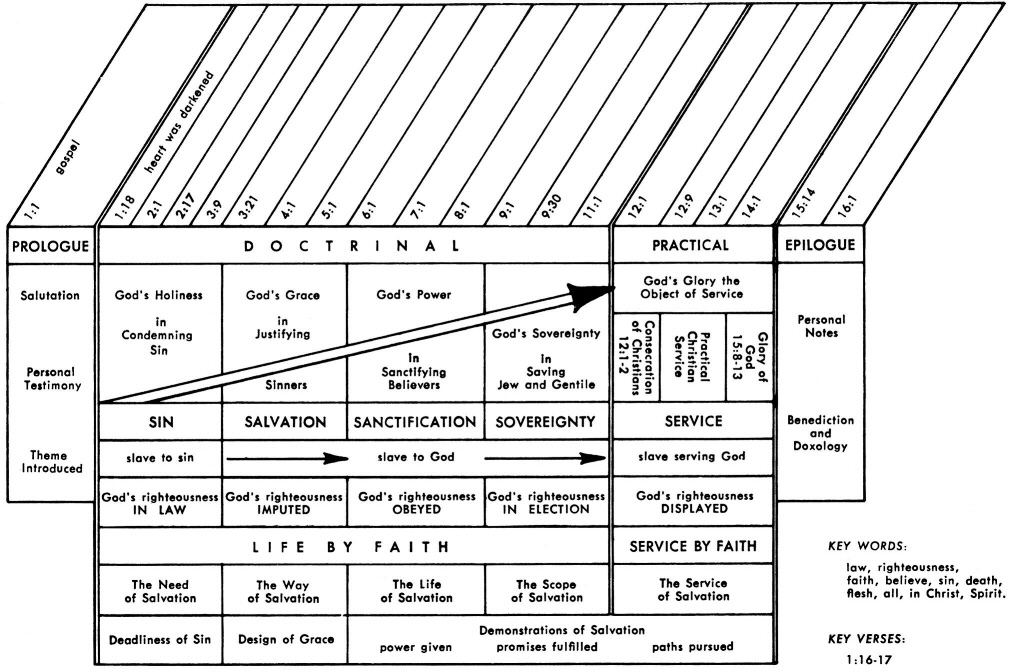
Click chart to enlarge
Chart from recommended resource Jensen's Survey of the NT - used by permission
Romans Overview Chart - Charles Swindoll
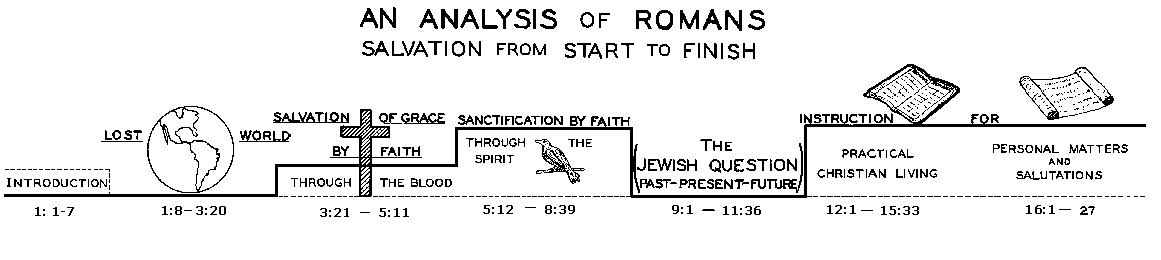
Source: Dr David Cooper
Click to Enlarge
R Ruin (Romans 1:17 – 3:20) – The utter sinfulness of humanity
O Offer (Romans 3:21-31) – God’s offer of justification by grace
M Model (Romans 4:1-25) – Abraham as a model for saving faith
A Access (Romans 5:1-11) – The benefits of justification
N New Adam (Romans 5:12-21) – We are children of two “Adams”
S Struggle w/ Sin (Romans 6-8) Struggle, sanctification, and victory
|
ROMANS ROAD |
||||
| Romans 1:18-3:20 | Romans 3:21-5:21 | Romans 6:1-8:39 | Romans 9:1-11:36 | Romans 12:1-16:27 |
| SIN | SALVATION | SANCTIFICATION | SOVEREIGNTY | SERVICE |
| NEED FOR SALVATION |
WAY OF SALVATION |
LIFE OF SALVATION |
SCOPE OF SALVATION |
SERVICE OF SALVATION |
| God's Holiness In Condemning Sin |
God's Grace In Justifying Sinners |
God's Power In Sanctifying Believers |
God's Sovereignty In Saving Jew and Gentile |
Gods Glory The Object of Service |
| Deadliness of Sin |
Design of Grace |
Demonstration of Salvation | ||
| Power Given | Promises Fulfilled | Paths Pursued | ||
| Righteousness Needed |
Righteousness Credited |
Righteousness Demonstrated |
Righteousness Restored to Israel |
Righteousness Applied |
| God's Righteousness IN LAW |
God's Righteousness IMPUTED |
God's Righteousness OBEYED |
God's Righteousness IN ELECTION |
God's Righteousness DISPLAYED |
| Slaves to Sin | Slaves to God | Slaves Serving God | ||
| Doctrine | Duty | |||
| Life by Faith | Service by Faith | |||
|
Modified from Irving L. Jensen's chart above |
||||
Romans 5:14 Nevertheless death reigned from Adam until Moses, even over those who had not sinned in the likeness of the offense of Adam, who is a type of Him who was to come. (NASB: Lockman)
Greek: alla ebasileusen (3SAAI) o thanatos apo Adam mechri Mouseos kai epi tous me hamartesantas (AAPMPA) epi to homoiomati tes parabaseos Adam, os estin (3SPAI) tupos tou mellontos. (PAPMSG)
Amplified: Yet death held sway from Adam to Moses [the Lawgiver], even over those who did not themselves transgress [a positive command] as Adam did. Adam was a type (prefigure) of the One Who was to come [in reverse, the former destructive, the Latter saving]. [Ge 5:5; 7:22; Dt 34:5.] (Amplified Bible - Lockman)
NLT: they all died anyway—even though they did not disobey an explicit commandment of God, as Adam did. What a contrast between Adam and Christ, who was yet to come! (NLT - Tyndale House)
Phillips: Nevertheless death, the complement of sin, held sway over mankind from Adam to Moses, even over those whose sin was quite unlike Adam's. Adam, the first man, corresponds in some degree to the man who has to come. (Phillips: Touchstone)
Wuest: But death reigned as king from Adam to Moses, even over those who did not sin in the likeness of the transgression of Adam, who is a type of the One who is to come.
Young's Literal: but the death did reign from Adam till Moses, even upon those not having sinned in the likeness of Adam's transgression, who is a type of him who is coming.
NEVERTHELESS DEATH REIGNED FROM ADAM UNTIL MOSES: all ebasileusen (3SAAI) o thanatos apo adam mechri moseos:
- Ro 5:17,21; Ge 4:8; 5:5-31; 7:22; 19:25; Ex 1:6; Heb 9:27
- Romans 5 Resources - Multiple Sermons and Commentaries
- Romans 5:12-19: Death in Adam or Life in Christ? - Steven Cole
- Romans 5:12-14 Adam and the Reign of Death - John MacArthur
- Romans 5:12-17 Death Through Adam; Life Through Christ - John MacArthur
Donald Barnhouse notes that "About a year before Paul wrote the epistle to the Romans, he wrote his first letter to the Corinthians in which he spoke of the Lord Jesus as “the last Adam,” and “the second man” (1Cor. 15:45, 47). There he presented, in outline, the truth on which he elaborates in Romans. “As in Adam all die; so also in Christ shall all be made alive” (1Cor 15:22). He presents death as an enemy to destroy (v. 26); and He presents Christ as reigning, and continuing His reign until all things, including the subversive reign of death, are put under His feet (1Cor 15:24, 25, 27). The first Adam is presented as a living soul; the last Adam as a life giving spirit (1Cor 15:45). Now in Romans, this theme is greatly enlarged and its implications made plain in practical application to the Christian’s daily life and walk. Here, in the argument of this epistle, we are at a turning point (Romans 5:12-21), for it concerns the active Christian life and the life of Christ flowing through us, that we may know constant triumph in Him. (Barnhouse, D. G.. God's Grace: Romans 5:12-21. Grand Rapids, MI.: William B. Eerdmans Publishing Company)
Hodge writes that "men were subject to death before the law of Moses was given, and consequently not on account of violating it. Therefore there must be some other reason for their exposure to death." (Romans 5 Commentary)
Nevertheless - a strong adversative. Paul is saying is that far from sin not being credited when there is no law, nevertheless death reigned.
Death (2288) (thanatos) indicates the opposite of life and the absence of life and in the NT is seen as the consequence and punishment of sin. Death speaks of separation, physically of the soul from the body and spiritually of the soul from God. Note that death does not signify either annihilation or extinction.
Here Paul speaks not of death in general but "the death", in a sense personifying it as a "king" over mankind from the Fall of Man until the giving of the Law at Mt. Sinai.
Reigned (936) (basileuo from basileús = a king) means to rule as a king, with implication of complete authority and right to control in an absolute manner. It speaks of the dominating quality of death. This Death reigned as an absolute monarch over all unsaved humanity, exhibiting undisputed, rightful sway. In America, this picture might lose some of its impact. But to those who were raised in a country ruled by monarchy, the picture of a King whose decrees cannot be questioned is very real. So it was with "King Death".
Remember that in the beginning when man was created God looked and "saw all that He had made, and behold, it was very good." (Ge 1:31)
It was very good also for Adam was not a sinner and there was perfect fellowship with God. But when Adam sinned all men became sinners and "the Sin" -- the sin principle or the sin nature -- came into the world through Adam and brought to fruition God's sure promise of death. And since death has indeed reigned in every man after Adam, it is empirical (originating in or based on observation or experience) proof that they were also sinners, having inherited the sin nature from Adam. They were sinners because they were all in Adam when he sinned and were thus made or constituted sinners (see note Romans 5:19).
So death is personified as a king reigning. Just as men could not defeat the rulership of "the Sin", similarly men could not usurp the power of death and thus they all died. Even believers die but there is a difference. Hebrews records..
Since then the children share in flesh and blood, He Himself likewise also partook of the same, that through death He might render powerless him who had the power of death, that is, the devil; and might deliver those who through fear of death were subject to slavery all their lives. (Heb 2:14-15+)
In other words, yes believers die, but unlike unregenerate mankind, we no longer are in bondage to the fear that we will die and the certainty that death is the final hopeless chapter of their futile life. Not so with the believer for he is safe in the "ark" of Christ and will be delivered from the wrath to come. Paul echoed this triumphant cry for every believer of every age writing…
"O DEATH, WHERE IS YOUR VICTORY?
O DEATH, WHERE IS YOUR STING?"
(1Cor 15:55)
Thus even without the Law, death was universal. All men from Adam to Moses were subject to death, not because of their sinful acts against the Mosaic law (which they did not yet have), but because of their own inherited sinful nature and the fact that when Adam sinned, they sinned.
EVEN OVER THOSE WHO HAD NOT SINNED IN THE LIKENESS OF THE OFFENSE OF ADAM: kai epi tous me hamartesantas (AAPMPA) epi to homoiomati tes parabaseos adam os estin (3SPAI) tupos tou mellontos (PAPMSG):
- Ro 8:20,22, Ex 1:22, 12:29, 12:30, Jonah 4:11
- Romans 5 Resources - Multiple Sermons and Commentaries
- Romans 5:12-19: Death in Adam or Life in Christ? - Steven Cole
- Romans 5:12-14 Adam and the Reign of Death - John MacArthur
- Romans 5:12-17 Death Through Adam; Life Through Christ - John MacArthur
Even - introduces a clause that shows there were no exceptions.
Sinned (264) (hamartano) literally means to miss the mark (and so not share in the prize). Hamartano means to act contrary to the will and law of God. To commit a wrong. To be in error.
Gary Hill on hamartano - hamartánō (from a = "not" + méros = "a part, share") [ED: THIS PROPOSED DERIVATION WAS ORIGINALLY PROPOSED BY A. H. STRONG AND IS NOT FOUND IN MANY/MOST LEXICONS THUS ITS VALIDITY IS NOT ABSOLUTELY ESTABLISHED - IT DOES LEAD TO SOME INTERESTING APPLICATION AS HILL GOES ON TO UNFOLD] – properly, having no share in; to sin, which always brings forfeiture (eternal loss because missing God's mark). Like hamartía, (hamartánō) is regularly used in ancient times of an archer missing the target (Homer, Aesch., etc). Every decision (action) done apart from faith (pistis) is sin (Ro 14:23+; cf. Heb 11:6+). Hamartanō ("to sin") emphasizes loss which always results from missing God's mark (target; i.e. "His preferred will," see thelema). Hamartánō ("choosing sin") asserts the agenda of self, by (for) self, over God's loving plan. Ironically, this insists on bringing self-made condemnation (cf. Titus 3:11+). Reflection: Believers experience loss every time they sin (cf. Heb 10:26+), as it diminishes their unique glorification awarded by Christ at His return. (The Discovery Bible)
Hamartano emphasizes loss which always results from missing God's mark or target, His good and acceptable and perfect will (Ro 12:2). Gary Hill adds that "hamartánō ("choosing sin") asserts the agenda of self, by (for) self, over God's loving plan. Ironically, this insists on bringing self-made condemnation (cf. Titus 3:11 = "and is sinning, being self-condemned."). In sum, hamartánō always results in loss of reward for believers, and everlasting condemnation for unbelievers.
F W Danker writes that "The very common word ἁμαρτάνω (hamartano) and its cognates provide another instructive study. In the Iliad 5.287 it is used of a spear missing its mark. In general it is used of failure to achieve one’s purpose. Thus Odysseus in the underworld assures Achilles that Neoptolemus did not err (hamartano) in his words, and only Nestor and Odysseus were a match for him (Odyssey 11.511). Religious significance is attached to the word already as early as Homer. In the Iliad 24.68 Zeus alerts Hera to the fact that Hector never failed to offer pleasing gifts to the gods. The concept of actual wrongdoing and indiscretions committed against the gods appears in the Iliad 9.501. In biblical documents the implications of “sin” are more clearly denned in direct ratio to the increased understanding of God’s moral nature and humanity’s created responsibility, but the original idea of failure to achieve one’s purpose sharpens the contrast between moral expectations and actual achievements. Ancient Hellenes had other ways of dealing with matters of behavior. In the Sacred Scriptures prophets unanimously proclaim that apart from an understanding of God’s redemptive activity life is bound to end in disappointment and failure. Human endeavor without atonement is one long ramble. It lacks direction and orientation. Unless all of life is steered toward God and conditioned by God’s designs, it goes off course, no matter how swift the speed or determined the direction. Again, ἁμαρτάνω (hamartano) by itself does not “mean” all these things, and there is nothing specifically “theological” about the term, but when a given context indicates awareness of divine interests, the student searches for resources in the receptor language that will express the meaning in a specific passage. Moved into the contemporary scene, strong are some of the warnings to humans who hurtle off along their own trajectory, swearing companionship to the wind." (Multi-Purpose Tools for Bible Study, page 135-136).
Hamartano means to err (err is from Latin errare = to wander or to stray!) which means to wander from the right way, to deviate from the true course or purpose and so to violate an accepted standard of conduct. To err is to miss the right way. To err means to deviate from the path or line of duty. To stray by design or mistake. To err is to stray from God and/or His commandments.
Hamartano means to swerve from the truth, to turn aside from the straight course charted by the Word of Truth. To swerve means to wander from any line prescribed, or from a rule of duty; to depart from what is established by law, duty or custom.
In short hamartano means to miss the mark of God's perfect standard of righteousness, a mark which in the final analysis was "hit" every time by only one Person in all of human history, the God-Man Christ Jesus, the sinless Son of God and personification of righteousness. (cf Jer 23:5,6, 1 Cor 1:30)
Webster's 1828 Dictionary has a "bibliocentric" definition of sin as
"The voluntary departure of a moral agent from a known rule of rectitude or duty, prescribed by God; any voluntary transgression of the divine law, or violation of a divine command; a wicked act; iniquity. Sin is either a positive act in which a known divine law is violated, or it is the voluntary neglect to obey a positive divine command, or a rule of duty clearly implied in such command. Sin comprehends not actions only, but neglect of known duty, all evil thoughts, purposes, words and desires, whatever is contrary to God’s commands or law."
Now compare with the 2024 Webster's definition of sin -
"1a: an offense against religious or moral law (b) an action that is or is felt to be highly reprehensible it's a sin to waste food (c) an often serious shortcoming : FAULT 2a : transgression of the law of God b : a vitiated state of human nature in which the self is estranged from God."
See related discussion of the noun cognate - Hamartia
Scriptural definitions of "sin" include…
1Jn 5:17 = unrighteousness
Jn 16:9 = do not believe in Jesus
Jas 4:17 = knows right thing to do and does not do it
1Jn 3:4 = lawlessness
Ro 3:23-note = falling short of the glory of God
Commenting on Jas 4:17 this passage means that it is wrong for a man to do anything about which he has a reasonable doubt (i.e., that which goes against one's conscience!). If he does not have a clear conscience about it, and yet goes ahead and does it, he is sinning. And by definition that is willful sin or deliberate sin, which all believers commit from time to time. However, it willful sinning is your daily, habitual practice, your continual "direction" so to speak, the writer of Hebrews has a strong word of warning, probably the most severe warning in the entire Bible in Hebrews 10:26-31. As an aside
What does it mean to commit sin? Any thought, word or action that fails to conform to the law of God is sin. Evil is a complex phenomenon in the Scriptures and the idea of sin is conveyed by a variety of expressions like missing the mark, rebelling, going astray, transgressing, stumbling, etc. Basically, “sin is lawlessness” (1Jn3:4), referring to an inward attitude as well as to the breaking of written commandments.
Sin synonyms in NT = hamartia, hamartema, parakoe, anomia, paranomia, parabasis, paraptoma, agnoema and hettema.
TDNT notes that hamartano
from Homer and is also used figuratively for “to fall short intellectually,” “to err,” or “‘to fall short morally,” “to do wrong.” In the LXX the moral sense is predominant.
Liddell Scott (summarized) - (1) To miss, miss the mark, "he missed the man on purpose", "to miss the road". (2) To fail of doing, ail of one's purpose, to miss one's point, fail, go wrong, "failed in hitting upon the thought". (3) to fail of having, i.e. to be deprived of, lose
Wuest writes that hamartano "was used in the Greek classics of a spearman missing the target at which he aimed the spear. It was used in the ethical terminology of the Greeks to mean “to fail of one’s purpose, to go wrong.” In the NT, it speaks of sin as the act of a person failing to obey the Word of God, failing to measure up in his life to the will of God. Its use is excellently illustrated in Romans 3:28, “All have sinned (missed the mark), and at present come short of the glory of God.” The mark or target is the glory of God. Man was created to glorify God. His attempt, where the attempt is made, to live a life pleasing to God, falls short of the target, like a spear thrown by an athlete, falls short of the target at which it is thrown. (Wuest's Word Studies from the Greek New Testament: Eerdmans).
Hamartano - 43x in 37v -NAS = commit sin(1), committed… offense(1), committing(1), sin(11), sinned(17), sinning(4), sins(8).
Mt 18:15, 21; 27:4; Lk 15:18, 21+; Lk 17:3, 4+; Jn 5:14; 8:11; 9:2, 3; Acts 25:8+; Ro 2:12+; Ro 3:23+; Ro 5:12+, Ro 5:14+, Ro 5:16+; Ro 6:15+; 1Cor 6:18+; 1 Co 7:28, 36; 8:12; 15:34; Ep 4:26+; 1Ti 5:20; Titus 3:11+; Heb 3:17+; He 10:26+; 1Pe 2:20+; 2 Pe 2:4+; 1Jn 1:10+; 1 Jn 2:1+; 1 Jn 3:6+, 1 Jn 3:8+, 1 Jn 3:9+ 1 Jn 5:16+, 1 Jn 5:18+.
A few of the notable uses of hamartano…
1John 3:6 No one who abides in Him sins (hamartano = present tense); no one who sins (hamartano = present tense) has seen Him or knows Him. 7 Little children, let no one deceive ( + negative = stop being deceived. How? Being taught that you can "accept Christ" and live any way you want, that you never have to exhibit any change in lifestyle, that you can continually live lawlessly. Wrong! This deceptive error has infiltrated the modern evangelical church!) you; the one who practices (present tense) righteousness is righteous, just as He is righteous; 8 the one who practices (present tense) sin is of the devil; for the devil has sinned from the beginning. The Son of God appeared for this purpose, that He might destroy the works of the devil. 9 No one who is born of God practices (present tense) sin, because His seed abides in him; and he cannot sin (hamartano = present tense) - He is not saying believers never sin. He has already stated no one is without sin = 1Jn 1:8. What he is saying is that someone who claims to be a believer and yet continually sins is not a true believer. In other words, they have never had the experience Paul describes in 2Co 5:17-note), because he is born of God. 10 By this the children of God and the children of the devil are obvious: anyone who does not practice (present tense) righteousness (What is the opposite of not practicing righteousness? cp 1Jn 5:17) is not of God, nor the one who does not love his brother.
Comment: As alluded to in the notes interspersed in this verse, the accurate interpretation of this section of 1John is critically dependent upon understanding the verb tenses. Notice that of the verb hamartano, both uses being in the present tense, which indicates not committing an occasional sin or even falling back for a time into a pattern of sin. The in fact indicates that the person described is in a state of continual sin. They live a lifestyle of sin. They sin habitually. Such a description is clearly not a true believer.
NIDNTT says that in classic Greek hamartia…
(Homer onwards) originally meant to miss, miss the mark, lose, not share in something, be mistaken. The Greek view of a mistake is intellectually orientated -- hamartano is the result of some agnoia, ignorance. The cognate noun is hamartia (Aesch. onwards), mistake, failure to reach a goal (chiefly a spiritual one). The result of such action is hamartema, failure, mistake, offense, committed against friends, against one’s own body, etc. From these was derived (in the 5th cent. B.C.) the adjective and noun hamartolos, that thing or person that fails…
The root hamart-, with its meaning of fail, produced many popular compounds, e.g. hamartinoos, madman…
In the LXX two words, hamartia and adikia, represent between them almost the whole range of Hebrew words for guilt and sin…
The NT uses (hamartano and cognates) as the comprehensive expression of everything opposed to God. The Christian concept of sin finds its fullest expression and its deepest theological development in Paul and John…
Hamartia is always used in the NT of man’s sin which is ultimately directed against God…
Jesus used the OT and Jewish concept of sin that was familiar in the world around him. This becomes clear from the fact that in the Synoptic Gospels the nouns hamartia and hamartema are found almost exclusively in the context of the forgiveness of sins. The verb is often used absolutely, i.e. in its usual and familiar sense (cf. Mt 18:15; Lk 17:3, 4.). The use of the nouns chiefly in the plural shows that the dominant idea is that of individual faults committed against the law or one’s brother…
Paul almost always uses the word hamartia in the singular. Sin is almost a personal power which acts in and through man (Ro 5:12, 21; 6:6, 17; 7:9, 10, 11ff.) (See Sin "personified"). The same is also true of sarx, flesh (See Flesh "personified") (Gal. 5:19, 24), and thanatos, death (Ro 6:9b). (Brown, Colin, Editor. New International Dictionary of NT Theology. 1986. Zondervan or Computer version)
Hamartano - About 340x in the non-apocryphal Septuagint (LXX) -
Gen 4:7 = "If you do well, will not your countenance be lifted up? And if you do not do well, sin (Lxx = hamartano in aorist tense - used as a noun) is crouching at the door; and its desire is for you, but you must master it.”; Ge 20:6, 9; 39:9; 40:1; 43:9; 44:32; Exod 9:27, 34; 10:16; 20:20; 23:33; 32:30f, 33; Lev 4:2f, 14, 22f, 27f, 35; 5:1, 4ff, 10f, 13, 15ff; 6:2ff; 19:22; Num 6:11; 12:11; 14:40; 15:27f; 16:22; 21:7; 22:34; 32:23; Deut 1:41; 9:16, 18; 19:15; 20:18; 32:5; Josh 7:11, 20; Judg 10:10, 15; 11:27; 1 Sam 2:25; 7:6; 12:10, 23; 14:33f; 15:18, 24, 30; 19:4f; 20:1; 24:11; 26:18, 21; 2 Sam 12:13; 19:20; 24:10; 1 Kgs 8:31, 33, 35, 46f, 50; 14:22; 18:9; 2 Kgs 17:7; 18:14; 21:17; 1 Chr 21:8, 17; 2 Chr 6:22, 24, 26, 36f, 39; 12:2; 19:10; 22:3; 28:13; Neh 1:6; 6:13; 9:29; 13:26; Esth 4:17; Job 1:22; 2:10; 5:24; 7:20; 8:4; 10:14; 11:6; 15:11; 31:33; 33:9, 27; 34:8; 35:3, 6; 42:7; Ps 4:4; 25:8; 36:1; 39:1; 41:4; 51:4; 75:4; 78:17, 32; 106:6; 119:11; Prov 8:36; 12:26; 13:21; 14:21; 20:2; 28:24; 29:6; Eccl 2:26; 7:20, 26; 8:12; 9:2, 18; Isa 24:6; 29:21; 42:24; 64:5; Jer 2:35; 3:25; 8:14; 14:7, 20; 16:10; 33:8; 40:3; 44:23; 50:7; Lam 1:8; 3:42; 5:7, 16; Ezek 3:21; 14:13; 16:51; 18:4, 20, 24; 28:16; 33:16; 35:6; 37:23; Dan 9:5, 8, 11, 15f; 12:10; Hos 4:7; 10:9; 12:8; 13:2; Mic 7:9
Here are a few representative uses of hamartano from the Septuagint (LXX) translation of the OT…
Genesis 39:9 "There is no one greater in this house than I, and he has withheld nothing from me except you, because you are his wife. How then could I do this great evil and sin (Hebrew = chata = to miss, go wrong, sin; Lxx = hamartano) against God?"
Numbers 32:23 "But if you will not do so, behold, you have sinned (Hebrew = chata = to miss, go wrong, sin; Lxx = hamartano) against the LORD, and be sure your sin (Heb = chattath; Lxx = hamartia) will find you out.
1Kings 8:46 "When they sin (Hebrew = chata = to miss, go wrong, sin; Lxx = hamartano) against You (for there is no man who does not sin [Hebrew = chata = to miss, go wrong, sin; Lxx = hamartano]) and You are angry with them and deliver them to an enemy, so that they take them away captive to the land of the enemy, far off or near
Job 1:22 Through all this Job did not sin (Hebrew = chata = to miss, go wrong, sin; Lxx = hamartano) nor did he blame God.
Job 2:10 But he said to her, "You speak as one of the foolish women speaks. Shall we indeed accept good from God and not accept adversity?" In all this Job did not sin (Hebrew = chata = to miss, go wrong, sin; Lxx = hamartano) with his lips.
Psalm 4:4-note Tremble, and do not sin (Hebrew = chata = to miss, go wrong, sin; Lxx = hamartano); Meditate in your heart upon your bed, and be still. Selah. (Red = imperatives)
Ecclesiastes 7:20 Indeed, there is not a righteous man on earth who continually does good and who never (Lxx = ou = absolute negation) sins (Hebrew = chata = to miss, go wrong, sin; Lxx = hamartano).
This was how Susannah Wesley defined “sin” to her young son, John Wesley - If you would judge of the lawfulness or the unlawfulness of pleasure, then take this simple rule: Whatever weakens your reason, impairs the tenderness of your conscience, obscures your sense of God, and takes off the relish of spiritual things—that to you is sin.
SIN MAKES US STUPID!
The Power Of Sin - I was having lunch with a pastor-friend when the discussion sadly turned to a mutual friend in ministry who had failed morally. As we grieved together over this fallen comrade, now out of ministry, I wondered aloud, “I know anyone can be tempted and anyone can stumble, but he’s a smart guy. How could he think he could get away with it?” Without blinking, my friend responded, “Sin makes us stupid.” It was an abrupt statement intended to get my attention, and it worked. I have often thought of that statement in the ensuing years, and I continue to affirm the wisdom of those words. How else can you explain the actions of King David, the man after God’s own heart turned adulterer and murderer? Or the reckless choices of Samson? Or the public denials of Christ by Peter, the most public of Jesus’ disciples? We are flawed people who are vulnerable to temptation and to the foolishness of mind that can rationalize and justify almost any course of action if we try hard enough. If we are to have a measure of victory over the power of sin, it will come only as we lean on the strength and wisdom of Christ (Ro 7:24, 25+; ED: AND I WOULD ADD EVEN MORE IMPORTANT IS TO LEARN TO PUT SIN TO DEATH BY THE SPIRIT! - Ro 8:13+). As His grace (ED: cf Spirit of grace - Heb 10:29+) strengthens our hearts and minds (2 Ti 2:1+), we can overcome our own worst inclination to make foolish choices. —Bill Crowder (Our Daily Bread, Copyright RBC Ministries, Grand Rapids, MI. Reprinted by permission. All rights reserved)
The price of sin is very high
Though now it may seem low;
And if we let it go unchecked,
Its crippling power will grow.
—Fitzhugh
God’s Spirit is your power Source—
Don’t let sin break the connection.
("for if you are living according to the flesh, you must die;
but if by the Spirit you are putting to death the deeds of the body, you will live.")
Romans 8:13+
ILLUSTRATION OF THE SUBTLE CORRUPTING EFFECT OF SIN: What happened to the great city of Ephesus? Often mentioned in the New Testament, it was one of the cultural and commercial centers of its day. Located at the mouth of the Cayster River, it was noted for its bustling harbors, its broad avenues, its gymnasiums, its baths, its huge amphitheater, and especially its magnificent Temple of Diana.
What happened to bring about its gradual decline until its harbor was no longer crowded with ships and the city was no longer a flourishing metropolis? Was it smitten by plagues, destroyed by enemies, or demolished by earthquakes? No, silt was the reason for its downfall—silent and non-violent silt. Over the years, fine sedimentary particles slowly filled up the harbor, separating the city from the economic life of the sea traders. Little evil practices, little acts of disobedience may seem harmless. (Song 2:15) But let the silt of sin gradually accumulate, and we will find ourselves far from God. Life will become a spiritual ruin. In the book of Hebrews we are warned of the danger of “the deceitfulness of sin” (Heb 3:13-note). James said that the attractive pleasures of sin are really a mask covering death (Jas 1:15-note).God forbid that we let the "silt of sin" accumulate in our lives!
Christian, walk carefully, danger is near!
On in your journey with trembling and fear;
Snares from without and temptations within
Seek to entice you once more into sin. --Anon.
Little sins add up to big trouble.
Sin Is Like An Insect! - It was reported recently that an enormous pine tree in the mountains of Colorado had fallen victim to a pine beetle and died. According to locals, up to that point the tree was thought to be indestructible. It had survived fourteen lightning strikes and many years of Colorado winters, including avalanches and fires. But it was eventually brought down from within by a tiny insect that did its work silently. That's the way it is with sin in a person's life, be they a Christian or a non-Christian. Watch over your heart with all diligence.
Rousseau's "Self-Ruse" - The deceitfulness of sin is vividly seen in the life of the French philosopher Rousseau. He declared, “No man can come to the throne of God and say, ‘I’m a better man than Rousseau.’” When he knew death was close at hand, he boasted, “Ah, how happy a thing it is to die, when one has no reason for remorse or self-reproach.” Then he prayed, “Eternal Being, the soul that I am going to give Thee back is as pure at this moment as it was when it proceeded from Thee; render it a partaker of Thy felicity!”
This is an amazing statement when we realize that Rousseau didn’t profess to be born again. In his writings he advocated adultery and suicide, and for more than 20 years he lived in licentiousness. Most of his children were born out of wedlock and sent to a foundling home. He was mean, treacherous, hypocritical, and blasphemous. (Our Daily Bread, Copyright RBC Ministries, Grand Rapids, MI. Reprinted by permission. All rights reserved)
SIN IS LIKE A BOA CONSTRICTOR! - Are you being deceived by sin and tolerating it like a pet? If you are, then you need to remember the fate of the man with the pet boa constrictor (Do a Google search - use the following three words in your search keeping the quotation marks as written >> "pet boa" killed). After 15 years of living with his owner, one day the "pet boa" would not let its "owner" out of its grip resulting in the owner's tragic death. Wild animals remain wild and so does Sin. Do not be deceived (Stop being deceived)!
No Small Deviations in God's Economy! - In St. Louis there is a railroad switchyard. One particular switch begins with just the thinnest piece of steel to direct a train away from one main track to another. If you were to follow those two tracks, however, you would find that one ends in San Francisco, the other in New York. Sin is like that. Just a small deviation from God’s standards can place us far afield from our intended destination. Don't be deceived by the world, flesh or devil who say "It's no big deal!" Wrong!
Entanglement by the Cords of one's own Sin - Not long after a wealthy contractor had finished building the Tombs prison in New York, he was found guilty of forgery and sentenced to several years in the prison he had built! As he was escorted into a cell of his own making, the contractor said, “I never dreamed when I built this prison that I would be an inmate one day.” (cp Nu 32:23, Pr 5:22-note)
According to sociologist Robert Bellah - One of our current psychological gurus says that 98 percent of Americans are dysfunctional. No doubt he is right. He has just discovered original sin, though he is mistaken if he things 2 percent are without.
Just for "fun" take a moment to review the following list of 20 reasons not to commit sins (hamartano)…
1. A little sin leads to more sin. (2 Pe 2:18-19, Pr 5:22)
2. Sin invites the discipline of God. (Heb 12:5-11)
3. The time spent in my sin is forever wasted. (Eph 5:16)
4. My sin never pleases but always grieves the God Who loves me. (Ge 39:9, Ezek 6:9, Eph 4:30)
5. My sin places a greater burden on my spiritual leaders. (Heb 13:17)
6. In time, sin always brings heaviness to my heart. (Ps 32:4)
7. Others, including my family, suffer consequences due to my sin. (2 Sa 12:10)
8. My sin makes the enemies of God rejoice. (Jdg 16:25-27, Ps 35:15, Ps 69:12)
9. Sin deceives me into believing I have gained when in reality I have lost. (Heb 3:13, Heb 11:25)
10. Sin may keep me from qualifying for spiritual leadership. (1 Ti 3:2, 10)
11. The supposed benefits of sin will never outweigh the consequences of disobedience. (Heb 11:25)
12. Repenting of sin is a painful process. (2 Cor 7:9-11)
13. My sin may influence others to sin. (cf 1 Cor 5:9-13)
14. My sin may keep others from knowing Christ. (cf 2 Pe 2:18)
15. Sin makes light of the Cross, upon which Christ died for the very purpose of taking away my sin. (Heb 10:29)
16. It is impossible to sin and follow the Spirit at the same time. (1 Th 5:19, Eph 4:30, Jdg 16:19,20)
17. Others more earnest than I have been destroyed by just such sins. (Jdg 16:28-31)
18. God chooses not to hear the prayers of those who cherish their sin (Ps 66:18, Pr 15:8, 29, Pr 21:13, Pr 28:9, Isa 1:15, Jn 9:31, Jas 4:3).
19. My unwillingness to reject this sin now grants it authority over me greater than I understand. (Pr 5:22, Eccl 7:26)
20. I promised God He would be the Lord of my life. (Ro 10:9-10) (Source unknown)
Sin will take you farther than you ever thought you’d stray
Sin will leave you so lost, you think you’ll never find your way
Sin will keep you longer than you ever thought you’d stay
Sin will cost you more than you ever thought you’d pay
Likeness (3667) (homoíoma from homoios = similar) means resemblance or similitude (correspondence in kind or quality = a visible likeness, a thing or sometimes a person that is like or the counterpart of another). Correspondence in details.
State of either having a common experience (Ro 5:14, 6:5) or of being similar in appearance (Dt 4:16).
Strong's Lexicon writes that homoioma is
(1) that which has been made after the likeness of something. (1a) a figure, image, likeness, representation (as used in Ro 1:23, Rev 9:7). (1b) likeness i.e. resemblance, such as amounts almost to equality or identity (as in Ro 5:14, 6:5, 8:3, Phil 2:7).
In the present context the idea is that even they might not have broken a direct command, written or verbal, Paul teaches that death still reigned over them because of Adam’s transgression. In other words, here Paul is using homoioma to describe a state of having a common experience. Before there was even a written law, men were disobedient to the "law" which God wrote on the heart of every man. Though they might not have broken a direct written command, death still reigned over them because of Adam’s transgression. Because Adam and Eve were evicted from the Garden of Eden after they sinned, they had no more opportunity to disobey God’s single prohibition. They no longer had access to the forbidden fruit of the tree of the knowledge of good and evil, nor have any of their descendants. Consequently, it has been impossible for any human being, either before or after Moses, to have sinned in the likeness of the initial offense of Adam.
In Romans 1:23-note we read…
(men who had professed to be wise but were fools) exchanged the glory of the incorruptible God for an image in the form (or likeness - homoioma) of corruptible man and of birds and four-footed animals and crawling creatures. (Ro 1:23)
Comment: Here Paul uses homoioma to describes the state of being similar in appearance - the same idea is seen in the use of homoioma in the Septuagint (LXX) of Psalm 106:20 "Thus they exchanged their glory for the image [homoioma] of an ox that eats grass" referring to the Israel's making the idolatrous golden calf in Ex 32:1ff. Aaron sought to present this golden calf to Israel as the image, of the gods they left behind in Egypt
Thayer…
a. that which has been made after the likeness of something, hence, a. a figure, image, likeness, representation (Ps 105:20-note); of the image or shape of things seen in a vision, Rev 9:7 (Ezek 1:5,26,28)
b. “likeness i.e. resemblance” (inasmuch as that appears in an image or figure), frequent such as amounts almost to “equality or identity”: Ro 6:5; 8:3; Php 2:7; eikonos, a likeness expressed by an image, i.e. an image, like, Ro 1:23; in the same manner in which Adam transgressed a command of God Ro5:14. — Thayer's Greek-English Lexicon
TDNT states that homoioma is…
“what is made similar,” “copy.” The word is rare in secular Gk.. It occurs in Plato, Aristotle, Epicur., and occasionally papyrus., and always has the concrete sense of “copy” rather than the abstract sense of likeness or correspondence. It is thus synonymous to eikon. Eikon and homoioma are often used as equivalents (but see Constable's note above)… (and) are in Plato the earthly copies of the heavenly prototypes. But there is often a distinction between the two words. This may be formulated as follows: eikon represents the object, whereas homoioma emphasizes the similarity, but with no need for an inner connection between the original and the copy. (Kittel, G., Friedrich, G., & Bromiley, G. W. Theological Dictionary of the New Testament. Eerdmans)
Homoioma - 6x in 6v - NAS = appearance(1), form(1), likeness(4)
Ro 1:23-note = an image in the form of corruptible man
Ro 5:14-note = who had not sinned in the likeness of the offense of Adam
Ro 6:5-note = we have become united with Him in the likeness of His death
Ro 8:3-note = sending His own Son in the likeness of sinful flesh
Phil 2:7-note = being made in the likeness of men
Rev 9:7-note = The appearance of the locusts was like horses
Homoioma - 32x in the non-apocryphal Septuagint (LXX) -
Ex 20:4; Deut 4:12, 15, 16, 17, 23, 25; 5:8; Josh 22:28; Jdg 8:18; 1 Sam 6:5; 2 Kgs 16:10; 2 Chr 4:3; Ps 106:20; 144:12; Song 1:11; Isa 40:18f; Ezek 1:5, 16, 22, 26, 28; 8:2f; 10:1, 8, 10, 21; 23:15; Da 3:25For example Moses records…
"You shall not make for yourself an idol, or any likeness (LXX = homoioma) of what is in heaven above or on the earth beneath or in the water under the earth. (Ex 20:4)
"Then the LORD spoke to you from the midst of the fire; you heard the sound of words, but you saw no form (LXX = homoioma) -- only a voice." (Deut 4:12)
In Daniel we see a usage that almost certainly refers to an appearance of the pre-incarnate Messiah…
He (Nebuchadnezzar) answered and said, "Look! I see four men loosed and walking about in the midst of the fire without harm, and the appearance of the fourth is like (LXX = homoioma) a son of the gods!" (Da 3:25)
MacArthur adds that homoioma
refers to that which is made to be like something else, not just in appearance (cf. Php 2:7) but in reality. Jesus was not a clone, a disguised alien, or merely some reasonable facsimile of a man. He became exactly like all other human beings, having all the attributes of humanity, a genuine man among men. (MacArthur, J. Philippians. Chicago: Moody Press)
It is important to realize that the resemblance signified by homoíoma in no way implies that one of the objects in question has been derived from the other. In the same way two men may resemble one another even though they are in no way related to one another.
The Amplified Version (I utilize it much like a "mini-commentary" - remember [brackets] signify clarifying words or comments not actually found in the original text and (parentheses) signify additional phrases of meaning reflecting the original words) helps understand this phrase writing…
even over those who did not themselves transgress [a positive command] as Adam did.
This same section in the New Living Translation (NLT) (which I also think can be a useful adjunct to your study if used with discretion realizing it is a paraphrase albeit in my opinion a relatively accurate paraphrase) (NLT - Tyndale House)
they all died anyway—even though they did not disobey an explicit commandment of God
Adam and Eve disobeyed a very explicit commandment. God spoke directly to Adam commanding him that…
from the tree of the knowledge of good and evil you shall not eat, for in the day that you eat from it you shall surely die." (Ge 2:17)
Because Adam and Eve were evicted from the Garden of Eden after they sinned, and prevented from returning, they had no more opportunity to disobey God’s explicit commandment. Neither they nor their offspring any longer had access to the tree of the knowledge of good and evil. Consequently, became impossible for any human being to sin in the likeness of the offense of Adam.
Baxter remarks "It is indeed interesting to compare, on Scripture authority, Adam as the root of sin and death to all, with CHRIST, who is to all true Christians the root of holiness and life."
WHO IS A TYPE OF HIM WHO WAS TO COME: os estin (3SPAI) tupos tou mellontos.
- Romans 5 Resources - Multiple Sermons and Commentaries
- Romans 5:12-19: Death in Adam or Life in Christ? - Steven Cole
- Romans 5:12-14 Adam and the Reign of Death - John MacArthur
- Romans 5:12-17 Death Through Adam; Life Through Christ - John MacArthur
Who is a type of him who was to come - Adam was a type of Christ Who would come. This final clause introduces the reader to the Adam-Christ typology, as a preparation for what is to follow in the next section.
Type (5179) (tupos from túpto = strike, smite with repeated strokes) (Click word study on tupos) means a "model" or "pattern" or "mold" into which clay or wax was pressed, that it might take the figure or exact shape of the mold. Type denotes the visible mark made by a striking some object (cf. "imprint of the nails" John 20:25), an impression made by an object that is in turn used to mould or shape something else (cf. "form" in Ro 6:17 [note]). Thus, Adam is an example of Christ. It is proper to speak of him as the First Adam and of Christ as the Last Adam (cf, 1Co 15:45). It is interesting that the only Old Testament character to be called explicitly a type of Christ is Adam.
Hodge comments that in regard to the "religious meaning" type was "a designed pre-representation or counterpart — either historically, as the Passover was a type or significant commemoration of the passing over, by the destroying angel, of the houses of the Hebrews in Egypt; or prophetically, as the sacrifices of the Old Testament were types of the great sacrifice of the Lamb of God. A type, therefore, in the religious meaning of the word, is not a mere historical parallel or incidental resemblance between persons or events but a designed resemblance — the one being intended to prefigure or to commemorate the other.It is in this sense that Adam was the type of Christ. The similarity between them was not accidental. It was predetermined and entered into the whole plan of God. As Adam was the head and representative of his race, whose destiny depended on his conduct, so Christ is the head and representative of his people. As the sin of the one was the reason for our condemnation, so the righteousness of the other is the reason for our justification. This relation between Adam and the Messiah was recognized by the Jews, who called their expected deliverer “the last Adam,” as Paul also calls him in 1 Corinthians 15:45. (Romans 5 Commentary)
And so the primary likeness of Adam to Jesus was that each was the head of their offspring. Christ is the head of all believers, even as Adam is the head of the human race. Adam and Christ were similar in that each one's single act affected their offspring. The first Adam affects his posterity for death, while the Last Adam gives eternal life to His offspring (not universalism but only to those who believe in Christ). Both Adam and Christ are one with their people and thus represent two unities, which are further explained in the following verses. This section serves as transition from the apostle’s discussion of the transference of Adam’s sin (Ro 5:12-14a) to the crediting of Christ’s righteousness (Romans 5:15ff).
Paul’s Jewish readers might have argued for their unique descent from Abraham the righteous, but Paul points them instead to their common descent with the Gentiles from the line of Adam the sinner. His argument would have greater force to his Jewish readers than Genesis alone might imply, because their traditions had made Adam much more prominent than he had been in the Old Testament (which is interesting because he is hardly mentioned outside Genesis). For example, Jewish people in this period sometimes spoke of Adam’s immense size (he filled the whole earth!), or more often of his glory, which he lost at the Fall. They believed that his sin introduced sin and thus death into the world, and that all his descendants shared in his guilt. Jewish interpreters generally believed that Adam’s glory would be restored to the righteous in the world to come.
To reiterate, the great truth of Ro 5.12-21 is that a representative acted, involving those connected with Adam and those connected with Christ.
Paul brings in the subject of death to establish the principle that one persons deeds can inexorably affect many other people. Paul’s primary objective in this chapter is to show how one Man’s death provided salvation for many, and to do so the apostle first shows the reasonableness of that truth since one man’s sin produced condemnation and death for many.
Wayne Barber summarizes Romans 5:14 stating that Paul is showing…
"the eternal effect of two people. One is a creation, the other is the Creator, Who became the God Man. That’s what we’ll see in the rest of chapter 5 as he says,"Okay, here is what it means to be in Christ and here is what it means to be in Adam. This is what Adam did for you. This is what Christ has done for you."
Paul goes on in verse 14 and says Adam…"is a type of Him who was to come."
What did Adam have that was in any way a likeness to Jesus? There are significant differences, but there is one likeness that stands out. Both of them were representative of the human race. Adam made a selfish decision and cast the world into sin. Jesus made a selfless decision, as Philippians 2 teaches us "esteem others as highly as yourself, have this attitude in yourself which was also in Christ Jesus when He emptied Himself and thought it not robbery to be equal with God." (see notes Philippians 2:5-7)
Christ made a selfless decision to come to this earth and affect all humankind.
Adam affected all men, and Jesus can potentially affect all men. The difference is that Adam’s penalty was imposed upon man even though we were not even born. We had no choice in this matter. On the other hand, you must put your faith into Jesus in order to receive eternal life. Paul is not teaching universal salvation, but is saying that what Christ did as representative has the potential of affecting the whole human race. You are either in Adam or you are in Christ. What Adam did affected all humankind. The question is, "Are you in Adam or are you in Christ?"
If you’re counting on your goodness and your good deeds and your helping people to get you into heaven, you are still in Adam. You have to be born again by the Holy Spirit Who places you into the body Christ. You must be taken out of Adam and put into Christ or you will not be with and see God throughout eternity. Instead, you will see Him only at the Great White Throne Judgment (see notes Revelation 20:11; 12; 13; 14; 15) and you will be banished from His presence throughout eternity.
Sin is not what you do. It’s what you are. It’s evidenced by what you do. Sin is more than just an act. It’s a nature or an attitude which came from Adam." (Romans 5:12-14 Need To Be Justified By Faith) (Bolding added)
William Newell comments on Romans 5:13-14…
Now comes the remarkable statement that although sin was in the world during the first 2500 years, from Adam to Moses, it is not put to account when there is no law (Ro 5:13-note) . The Greek word (ellogeo) "put to account" used here occurs only one other time- Philemon 1:18. It signifies to charge up something to anyone as a due. (The wholly different word "reckon" - logizomai - in Ro 4:23 (note), Ro 4:24 (note) regards the person; this word ellogeo in Ro 5:13-note regards some item put to one's account.) It was to Adam, not to us, that God said:
"In the day that thou eatest thereof thou shalt surely die." (Genesis 2:17)
It was to Israel through Moses that God gave the ten commandments. The general argument of the apostle here is to show the effect of a federal or representative sin, in which an Adam. acted, bringing an effect upon the individuals connected with him. Paul is about to prove that death passed to all men not because they sinned, but because Adam sinned. He is also about to show (see note Romans 5:18) that all men were condemned by Adam's act, were made to become sinners.
To understand, therefore, the force of the words, sin is not put to account where there is no law, or, as Conybeare enlighteningly paraphrases, "Sin is not put to the account of the sinner when there is no law forbidding it, " we must remember:
1. That sin was in the world, between Adam and Moses.
2. That, according to Chapter One, the race had rejected light and were without excuse; though they were "without law" (anomos): for God's definition of sin is not "transgression of law" (1John 3:4), but anomia, which means refusal to be controlled-self-will.
3. That there was a "work" (working) written in their hearts (Ro 2:15-note), to which their consciences bore witness, either accusing or else excusing them; and that this working necessarily corresponded morally to any law to be afterwards revealed by Jehovah.
4. That condign judgments, such as the Flood, and the overthrow of Sodom, and the destruction of the Canaanites, followed the "filling up of the cup of iniquity" at such times: for such sinners both trampled on their own consciences, and inherited the previous generations of guilt.
5. That, nevertheless, the sins between Adam and Moses did not bring about the sentence of death upon humanity, however much individuals or nations might hasten death's over- taking them. For these people, though they sinned, had not sinned after the likeness of Adam's transgression, which was a willful violation of a direct command of a revealed God; as was Israel's making, through Aaron, the calf at Sinai: evolving judicial consequences to others besides themselves. For we read in Ex 32:34 of a set future "visitation" on Israel, because of that sin at Sinai of their fathers: "In the day that I visit, I will visit their sin upon them"; this will be in "the time of Jacob's trouble, " in the Great Tribulation- long after the calf-worship; indeed, still future!
6. We therefore must regard the human race as under a sentence of death they did not bring upon themselves: death reigned from Adam until Moses (Ro 5:14). Unlike Adam, and unlike Israel after Moses, those who lived between the two had no positive outward Divine law, the breaking of which would be a direct transgression and a threatening of death therefor. Nevertheless "death reigned"-even over them. Constantly before our eyes is the attestation to the same truth: babes that know nothing of right or wrong, die. Every little white coffin, -yea, every coffin, should remind us of the universal effect of that sin of Adam, for it was thus and thus only that "death passed to all men."
We see then, that from Adam until Moses, death "reigned- as-king" (We say, "reigned-as-king, " because the Greek word means that. Not the power of sin to hold in bondage, as in Chapter Six, is here meant; but the royal word, basileuo, is used, denoting sovereignty, not mere lordship) on account of Adam's sin. Paul has said (Ro 4:15-note), "Where there is no law neither is there transgression"; so that those between Adam and Moses, not having direct commands of God, consequently had not transgressed known commands as Adam had done. Nevertheless, Adam's transgression had involved his whole race.
Here in (Romans 5:14) Adam is declared a type of the One who was to come-that is, of Christ, the last Adam. We cannot sufficiently urge the study of this great passage: until the mind sees, and the heart understands-and that gladly, condemnation by the one, and justification by the Other. It is just as necessary to see this "by the one" doctrine regarding our spirits, as regarding our bodies. As to the latter, Paul says, "As in Adam all die, so also In Christ shall all be made alive"; "The first man is of the earth, earthy; the second Man is of heaven… And as we have borne the image of the earthy, we shall also bear the image of the heavenly" (1Cor 15:22,47,49). To discover that we are even now no longer connected with that first Adam in which we were born, but with the Risen Christ, the last Adam-this will be our joy in Chapters Six to Eight. But the foundation of this blessed truth is laid here in the Doctrine of the Two Men. (Romans 5 Commentary)
Romans 5:15 But the free gift is not like the transgression. For if by the transgression of the one the many died, much more did the grace of God and the gift by the grace of the one Man, Jesus Christ, abound to the many. (NASB: Lockman)
Greek: All' ouch os to paraptoma, houtos kai to charisma; ei gar to tou enos paraptomati oi polloi apethanon, (3PAAI) pollo mallon e charis tou theou kai e dorea en chariti te tou enos anthropou Iesou Christou eis tous pollous eperisseusen. (3SAAI) (Grace permeates this verse!)
Amplified: But God’s free gift is not at all to be compared to the trespass [His grace is out of all proportion to the fall of man]. For if many died through one man’s falling away (his lapse, his offense), much more profusely did God’s grace and the free gift [that comes] through the undeserved favor of the one Man Jesus Christ abound and overflow to and for [the benefit of] many. (Amplified Bible - Lockman)
NLT: And what a difference between our sin and God’s generous gift of forgiveness. For this one man, Adam, brought death to many through his sin. But this other man, Jesus Christ, brought forgiveness to many through God’s bountiful gift. (NLT - Tyndale House)
Phillips: But the gift of God through Christ is a very different matter from the "account rendered" through the sin of Adam. For while as a result of one man's sin death by natural consequence became the common lot of men, it was by the generosity of God, the free giving of the grace of one man Jesus Christ, that the love of God overflowed for the benefit of all men. (Phillips: Touchstone)
Wuest: But not as the transgression, thus also is the gratuitous favor. For since by the transgression of the one the many died, much more the grace of God and the gratuitous gift by grace which is of the one Man, Jesus Christ, to the many will abound.
Young's Literal: But, not as the offence so also is the free gift; for if by the offence of the one the many did die, much more did the grace of God, and the free gift in grace of the one man Jesus Christ, abound to the many;
BUT THE FREE GIFT IS NOT LIKE THE TRANSGRESSION FOR (explains why they are "not like") IF BY THE TRANSGRESSION OF THE ONE THE MANY DIED: all ouch os to paraptoma houtos kai to charisma ei gar to tou enos paraptomati oi polloi apethanon (3PAAI):
- Ro 5:16,17,20; Is 55:8,9; Jn 3:16; 4:10) (Ro 5:12,18; Da 12:2; Mt 20:28; 26:28
- Romans 5 Resources - Multiple Sermons and Commentaries
- Romans 5:12-19: Death in Adam or Life in Christ? - Steven Cole
- Romans 5:12-14 Adam and the Reign of Death - John MacArthur
- Romans 5:12-17 Death Through Adam; Life Through Christ - John MacArthur
THE FREE GIFT
But the free gift - Notice that Paul begins with but, which denotes that he is drawing a clear contrast. What is he contrasting? At the end of Romans 5:14 he stated that Adam was a type of Him Who was to come referring of course to Jesus Christ. Yes, Adam is a type of Christ but there are a number of significant differences. His point therefore is to contrast Adam with Christ and so in Romans 5:15, 16, 17 he explains how Christ is not like Adam. (See related discussion - Typology - Study of Biblical types)
Note that there are 3 major contrasts in verses Romans 5:15, 16 and 17…
Romans 5:15 - Adam's Transgression versus Christ's Free Gift - what Christ gives contrasts with what Adam did.
Romans 5:16 - Adam's Sin Brought Judgment and the verdict rendered was "Condemned". Christ's Death Brought Justification - the contrast then is condemnation in Adam and justification in Christ. When Adam sinned, he was declared unrighteous and condemned. When a sinner trusts Christ, he is justified—declared righteous in Christ.
Romans 5:17 - Because of Adam's Sin, Death reigned. Those Who Receive Christ Reign in Life.
MacArthur introduces this verse commenting that "Paul continues his analogy of Adam and Christ, showing how the life that was made possible for all men by Christ’s atoning sacrifice is illustrated antithetically by the death that was made inevitable for all men by Adam’s sin. It is the truth the apostle summarizes in his first letter to Corinth: "For as in Adam all die, so also in Christ all shall be made alive (1Co 15:22)." (MacArthur, J: Romans 1-8. Chicago: Moody Press )
S Lewis Johnson in light of the deep doctrinal teaching in this section which might "lose" some readers reiterates that "The master-thought of the section is the unity of the many in the one. In Adam's case it is the unity of the many in a representative who fell. In Christ's case it is the unity of the many in a representative who overcame, including in His victory all who are in Him. (Romans 5:13-14 All Under Foreign Domination; Romans 5:15-21 Grace Abounding and Reigning)
Spurgeon has an intriguing introductory comment to his sermon entitled "Honey from a Lion" on Romans 5:16…
This text affords many openings for controversy. It can be made to bristle with difficulties. For instance, — there might be a long discussion as to the manner in which the fall of Adam can justly be made to affect the condition of his posterity. When this is settled there might arise a question as to the exact way in which Adam’s fault is connected with ourselves — whether by imputation of its sin, or in what other form; and then there might be further dispute as to the limit of the evil resulting from our first parents’ offense, and the full meaning of the fall, original sin, natural depravity, and so forth. There would be another splendid opportunity for a great battle over the question of the extent of the redeeming work of the Lord Jesus Christ; whether it covers, as to persons, the whole area of the rain of the Fall; whether, in fact, full atonement has been made for all mankind or only for the elect. It would be easy in this way to set up a thorn-hedge, and keep the sheep out of the pasture; or, to use another metaphor, to take up so much time in pelting each other with the stones as to leave the fruit untasted.
I have, at this time, neither the inclination nor the mental strength either to suggest or to remove the difficulties, which are so often the amusement of unpractical minds. I feel more inclined to chime in with that ancient father of the church who declined controversy in a wise and explicit manner. He had been speaking concerning the things of God and found himself at length confounded by a certain clamorous disputant, who shouted again and again, “Hear me! Hear me!” “No,” said the father, “I will not hear you, nor shall you hear me; but we will both be quiet and hear what our Lord Jesus Christ has to say.”
So we will not at this time listen to this side nor to that; but we will bow our ear to hear what the Scripture itself hath to say apart from all the noise of sect and party. My object shall be to find out in the text that which is practically of use to us, that which may save the unconverted, that which may comfort and build up those of us who are brought into a state of reconciliation with God; for I have of late been so often shut up in my sick chamber that when I do come forth I must be more than ever eager for fruit to the glory of God. We shall not, therefore, dive into the deeps with the hope of finding pearls, for these could not feed hungry men; but we will navigate the surface of the sea, and hope that some favoring wind will bear us to the desired haven with a freight of corn wherewith to supply the famishing. May the Holy Spirit bless the teaching of this hour to the creation and nourishment of saving faith.
At this point what had been a parallel comparison, now begins a contrast of the work of Christ with that of Adam.
Sanday and Headlam add that "In both cases there is a transmission of effects: but there the resemblance ends. In all else the false step (or Fall, as we call it) of Adam and the free gift of God’s bounty are most unlike. The fall of that one representative man entailed death upon the many members of the race to which he belonged. Can we then be surprised if an act of such different quality—the free unearned favour of God, and the gift of righteousness bestowed through the kindness of that other Representative Man, Jesus Messiah—should have not only cancelled the effect of the Fall, but also brought further blessings to the whole race? (Romans 5 Commentary)
Cranfield explains that "The purpose of Romans 5:15, 16, 17 is to drive home the vast dissimilarity between Christ and Adam, before the formal comparison between them is made in v. 18f, and so to preclude possible misunderstanding of that comparison. (Cranfield, C. E. B Exegetical Commentary on the Epistle to the Romans. Vol 1: Ro 1-8.; Volume 2: Romans 9-16)
Hendriksen agrees writing that "In these verses Paul shows that the parallel Adam-Christ is mainly one of contrast, in the sense that Christ’s influence for good far outweighs Adam’s effectiveness for evil: the free gift is “not like the trespass,” that is, is far more effective than the trespass. (Hendriksen, W., & Kistemaker, S. J. NT Commentary Set. Baker Book)
Free gift (grace gift) (5486) (charisma from charis = grace + the ending --ma which indicates the result of something, in this case the result of grace) is a gift of grace or an undeserved benefit. It refers something given by God completely apart from human merit.
Note that in 16 of the 17 uses in the NT charisma is connected to God as the Giver and is always the word used to describe the gifts of the Spirit.
In Romans, Paul uses charisma in reference to the gift of salvation (Romans 5:15, 16; Ro 6:23-note), the blessings of God (Ro 1:1-note, Ro 11:29-note), and divine enablements for ministry (Ro 12:6-note). Every other use of the word by Paul, and the one by Peter (1Pe 4:10, 11, 12, 13-note), relates it to the divine enablements for believers to minister in the power of the Holy Spirit.
Vine writes that charisma is "a gift of grace, a gift involving grace (charis) on the part of God as the donor, is used of His free bestowments upon sinners (Ro 5:15, 16; 16:23; 11:29)
Denney remarks that charisma is "The gift which is freely provided for sinners in the Gospel, i.e., a Divine righteousness and life." (Romans 5 Commentary Expositor's Greek Testament)
If by the transgression of the one - If (could be rendered "since" or "if as is the case") introduces a conditional statement that is assumed fulfilled (Adam did have one transgression = the first one in Genesis 3). The one is clearly Adam, who is not mentioned by name after Romans 5:14. Note not it is not transgressions plural but the (specific) transgression, the one sin referred to earlier.
The dictionary definition of the English word transgression is "an act of “going beyond” or violating a duty, command, or law."
You Can't Work For It - On Wednesday evenings, the church my family attends becomes a busy place. We give away a truckload of food to people who are struggling to get by. We’re grateful to be able to help meet a physical need in their lives. Another important part of this ministry is visiting these folks later and sharing the gospel of Christ with them.
Understandably, we must have some guidelines for a ministry like this, and one of them is: You can’t work for this food.
The church has already bought the food, so nothing anyone does can pay for it. The only way a person can get the food is to accept it as a free gift. No one is allowed to unload the food from the truck, pass it out, or do anything else with the intention that such efforts will earn this food. It’s absolutely free.
Sound familiar? It should. Jesus bought our souls with His death, and He offers us salvation that is free and paid for (Ro 5:15; Ro 6:23). We can’t earn it, no matter what we do (Ephesians 2:8, 9). All we can do is reach out to Jesus by repenting of our sin and receiving His free gift of eternal life.
Have you accepted the salvation Jesus offers? Please do. Reach out and take it. It’s free. —J D Branon (Our Daily Bread)
The righteousness of Christ
Is free to everyone;
But we must face our guilt,
And trust God's precious Son. —D. De Haan
Our salvation was costly to God,
but it's free to us.
Transgression (3900) (paraptoma from parapipto = fall aside from para = aside + pipto = fall) (Ro 4:25-note) means a falling beside, deviation from a path or departing from the norm. Note that even the root meaning of paraptoma implies The Fall of Man. By extension, it carries the idea of going where one should not go, and therefore is sometimes translated “trespass”. Here it refers to the trespass of eating "from the tree of the knowledge of good and evil" Genesis 2:17. The picture is that of one who stumbles or falls. The idea behind transgressions is that one has crossed a line, challenging God's boundary, whereas the idea behind sins (hamartia 266) is missing a mark, the perfect standard of God. Paraptoma is a very fitting description for the "fall" of Adam in the Garden of Eden.
Ray Pritchard explains transgression (trespass) noting that it "means to go beyond the border. You "trespass" when you enter someone's property illegally. It's what happens when you deliberately break a rule. Someone may draw a line in the sand and say, "If you cross that line, you'll be in trouble." Trespassing is what you do when you say, "Oh yeah! You just watch me." And you step across the line. That's what happened in Eden. God drew a line in the sand and said, "Don't cross it." Adam said, "Watch me." And he deliberately "crossed the line" when he ate the forbidden fruit. (Read his full message -Romans 5:15-21 Paradise Regained)
Barnes writes that "We use the word fall as applied to Adam, to denote his first offence, as being that act by which he fell from an elevated state of obedience and happiness into one of sin and condemnation. (Romans 5 Commentary)
The many died - In context the phrase the many identifies the totality of mankind.
Through the offense of Adam the many (all of Adam’s descendants = all mankind) incurred the penalty of death. Similarly, the many (i.e., all the redeemed) have incurred the free gift of eternal life through the Last Adam, Jesus Christ. The dissimilarity is seen in the phrase, much more… the grace of God. The grace of God, which is the ground of our justification, is contrasted with the sin of Adam, because it is greater in quality and greater in degree than Adam’s sin. In Adam we got what we deserved, condemnation and guilt. In Christ we have received much more of what we do not deserve, mercy and grace.
Spurgeon observes that…
It Is Certain That Great Evils Have Come To Us By The Fall. Paul speaks in this text of ours of the “offense,” which word may be read the “Fall,” which was caused by the stumbling of our father Adam.
Our fall in Adam is a type of the salvation which is in Christ Jesus, but the type is not able completely to set forth all the work of Christ: hence the apostle says,
“But not as the offense, so also is the free gift. For if through the offense of one many be dead, much more the grace of God, and the gift by grace, which is by one man, Jesus Christ, hath abounded unto many.”
It is certain, then, that we were heavy losers by the offense of the first father and head of our race. I am not going into details and particulars (Ro 5:12-note), but it is clear that we have lost the garden of Eden and all its delights, privileges, and immunities, its communion with God, and its freedom from death. We have lost our first honor and health, and we have become the subjects of pain and weakness, suffering and death: this is the effect of the Fall. A desert now howls where otherwise a garden would have smiled. Through the sin of Adam we have been born under conditions which are far from being desirable, heirs to a heritage of sorrow. Our griefs have been alleviated by the bounty of God, but still we are not born under such conditions as might have been ours had Adam remained in his integrity and kept his first estate.
We came into the world with a bias towards evil. Those of us who have any knowledge of our own nature must confess that there is in us a strong tendency towards sin, which is mixed up with our very being. This is not derived solely from faults of education, or from the imitation of others; but there is a bent within us in the wrong direction, and this has been there from our birth. Alas! that it should be so; but so it is.
In addition to having this tendency to sin, we are made liable to death — nay, not liable alone, but we are sure in due time to bow our heads beneath the fatal stroke. Two only of the human race have escaped death (Enoch and Elijah), but the rest have left their bodies here to moulder back into mother earth, and unless the Lord cometh speedily, we expect that the same thing will happen to these bodies of ours. While we live we know that the sweat of our brow must pay the price of our bread; we know that our children must be born with pangs and travail; we know that we ourselves must return to the dust from whence we are taken; for dust we are, and unto dust must we return.
O Adam, thou didst a sad day’s work for us when thou didst hearken to the voice of thy wife and eat of the forbidden tree. The world has no more a Paradise anywhere, but everywhere it has the place of wailing and the field of the dead. Where can you go and not find traces of the first transgression in the sepulcher and its mouldering bones? Every field is fattened with the dust of the departed: every wave of the sea is tainted with atoms of the dead. Scarcely blows a March wind down our streets but it sweeps aloft the dust either of Caesar or his slave, of ancient Briton, or modern Saxon; for the globe is worm-eaten by death. Sin has scarred, and marred, and spoiled this creation by making it subject to vanity through its offense.
Thus terrible evils have come to us by an act in which we had no hand: we were not in the Garden of Eden, we did not incite Adam to rebellion, and yet we have become sufferers through no deed of ours. Say what you will about it, the fact remains, and cannot be escaped from. ("Honey from a Lion" Romans 5:16)
MUCH MORE DID THE GRACE OF GOD AND THE GIFT BY THE GRACE OF THE ONE MAN JESUS CHRIST ABOUND TO THE MANY: pollo mallon e charis tou theou kai e dorea en chariti te tou enos anthropou iesou christou eis tous pollous eperisseusen (3SAAI):
- Eph 2:8
- Ro 6:23; 2Cor 9:15; Heb 2:9; 1Jn 4:9,10; 5:11
- Ro 5:20; Is 53:11; 55:7; 1Jn 2:2; Rev 7:9,10,14, 15, 16, 17
- Romans 5 Resources - Multiple Sermons and Commentaries
- Romans 5:12-19: Death in Adam or Life in Christ? - Steven Cole
- Romans 5:12-14 Adam and the Reign of Death - John MacArthur
- Romans 5:12-17 Death Through Adam; Life Through Christ - John MacArthur
THE MUCH MORES
OF ROMANS 5
Romans 5:9 Much more then, having now been justified by His blood, we shall be saved from the wrath of God through Him.
Romans 5:10 For if while we were enemies, we were reconciled to God through the death of His Son, much more, having been reconciled, we shall be saved by His life.
Romans 5:15 But the free gift is not like the transgression. For if by the transgression of the one the many died, much more did the grace of God and the gift by the grace of the one Man, Jesus Christ, abound to the many.
Romans 5:17 For if by the transgression of the one, death reigned through the one, much more those who receive the abundance of grace and of the gift of righteousness will reign in life through the One, Jesus Christ.
Romans 5:20 And the Law came in that the transgression might increase; but where sin increased, grace abounded all the more (KJV "did much more abound")
Much more - This introduces Christ's work. His one act of obedience was immeasurably greater than Adam’s one act of condemnation. God's grace is infinitely greater for good than is Adam's sin for evil.
J Vernon McGee comments on much more in Romans 5:12-21 writing that "what Paul is (saying is) that we have much more in Christ than we lost in Adam… Today we are looking forward to something more wonderful than the Garden of Eden.
The force of this much more seems to be bound up with the recurring use of "grace" and "gift," suggesting that the work of Christ not only cancelled the effects of Adam's transgression so as to put man back into a state of innocence under a probation such as their progenitor faced, but gives to man far more than he lost in Adam, more indeed than Adam ever had.
John MacArthur writes that "Christ’s one act of redemption was immeasurably greater than Adam’s one act of condemnation."
Constable adds that "Much more here shows that Jesus Christ did not just cancel the effects of Adam’s sin, but he provided more than Adam lost or even possessed, namely the righteousness of God! (Romans 5 Expository Notes)
Calvin explained the more more this way - Since the fall of Adam had such an effect as to produce ruin of many, much more efficacious is the grace of God to the benefit of many; inasmuch as it is admitted, that Christ is much more powerful to save, than Adam was to destroy (Romans 5 Commentary)
Ray Pritchard explains much more noting that "when Jesus died on the cross, He died for others. What Adam did was an act of total selfishness. He didn't care that others would be hurt by his foolish decision. When Jesus died, it was totally for others. He had no sin of His own, so He couldn't be dying for himself. His death was self-sacrificing. That's why Paul calls it "God's grace" and "the gift." Adam was thinking only of himself. Christ was thinking of others. Thus in the very nature of what these two men did, Christ's deed was greater than Adam's misdeed, even as love is greater than selfishness. (Read his full message - Romans 5:15-21 Paradise Regained)
A T Robertson writes that much more introduces "Another a fortiori argument. Why so? As a God of love He delights much more in showing mercy and pardon than in giving just punishment (Lightfoot). The gift surpasses the sin."
Hodge has an interesting thought writing that in regard to much more "the idea is, “If the one dispensation has occurred, much more may the other; if we die for one, much more may we live by another.” The much more does not express a higher degree of efficacy but of certainty: “If the one thing has happened, much more certainly may the other be relied upon.” (Romans 5 Commentary)
Denney writes that regarding much more that "the idea underlying the inference is that God delights in mercy; if under His administration one man's offence could have such far-reaching consequences, much more reasonably may we feel sure of the universal influence of one Man's righteous achievement. This idea is the keynote of the whole chapter: see Ro 5:9, 10, 17. (Romans 5 Commentary Expositor's Greek Testament)
Spurgeon comments on much more (this is a long note but is well worth reading slowly and meditatively)…
If all this mischief has happened to us through the fall of Adam why should not immense blessing flow to us by the work of Christ? Through Adam’s transgression we lost Paradise, that is certain; but if anything can be more certain we may with greater positiveness declare that the second Adam will restore the ruin of the first.
If through the offense of one man many be dead, much more the grace of God and the gift by grace, which is by one man, Jesus Christ, shall abound and has abounded unto many.
Settle in your minds, then, that the fall of Adam has wrought us great damage, and then be as much assured that the life, death, and resurrection of Christ, in which we had no hand whatever, must do us great service. Believing in Christ Jesus, it becomes beyond all measure sure to us that we are blessed in Him, seeing that it is already certain that through the fall of Adam we have become subject to sorrow and death.
For, first, this appears to be more delightful to the heart of God. It must be fully according to his gracious nature that salvation should come to us through his Son. I can understand that God, having so arranged it that the human race should be regarded as one, and should stand or fall before Him in one man, should carry out the arrangement to its righteous end, and allow the consequences of sin to fall upon succeeding generations of men: but yet I know that He takes no pleasure in the death of any, and finds no delight in afflicting mankind.
When the first Adam transgressed it was inevitable that the consequences of his transgression should descend to his posterity, and yet I can imagine a perfectly holy mind questioning whether the arrangement would be carried out. I can conceive of angels saying one to another, “Will all men die through this entrance of sin into the world? Can it be that the innumerable sons of Adam will all suffer from his disobedience?”
But I cannot imagine any question being raised about the other point, namely, the result of the work of our Lord Jesus. If God has so arranged it that in the second Adam men rise and live, it seems to me most gloriously consistent with his gracious nature and infinite love that it should come to pass that all who believe in Jesus should be saved through Him.
I cannot imagine angels hesitating and saying, “Christ has been born; Christ has lived; Christ has died; these men have had nothing to do with that: will God save them for the sake of his Son?” Oh, no, they must have felt, as they saw the Babe born at Bethlehem, as they saw Him living His perfect life and dying His atoning death, “God will bless those who are in Christ; God will save Christ’s people for Christ’s sake.”
As for ourselves, we are sure that if the Lord executes judgment, which is His strange work, He will certainly carry out mercy, which is His delight. If He kept to the representative principle when it involved consequences which gave Him no pleasure, we may be abundantly assured that He will keep to it now that it will involve nothing but good to those concerned in it. Here, then, is the argument, —
“For if through the offense of one many be dead, much more the grace of God, and the gift by grace, which is by one man, Jesus Christ, hath abounded unto many.”
This assurance becomes stronger still when we think that it seems more inevitable that men should be saved by the death of Christ than that men should be lost by the sin of Adam. It might seem possible that, after Adam had sinned, God might have said, “Notwithstanding this covenant of works, I will not lay this burden upon the children of Adam”; but it is not possible that after the eternal Son of God has become man, and has bowed His head to death, God should say, “Yet after all I will not save men for Christ’s sake.”
Stand and look at the Christ upon the cross, and mark those wounds of His, and you will become absolutely certain that sin can be pardoned, nay, must be pardoned to those who are in Christ Jesus. Those flowing drops of blood demand with a voice that cannot be gainsaid that iniquity should be put away. If the voice of Abel crying from the ground was prevalent, how much more the blood of the Only-begotten Son of God, Who through the eternal Spirit offered Himself without spot? It cannot be, O God, that thou shouldest despise or forget the sacrifice on Calvary. Grace must flow to sinners through the bleeding Savior, seeing that death came to men through their transgressing progenitor.
I do not know whether I shall get into the very soul of this argument as I desire, but to me it is very sweet to look at the difference as to the causes of the two effects.
Look now at the occasion of our ruin, — “the offense of one.” The one man transgresses, and you and I and all of us come under sin, sorrow, and death. What are we told is the fountain of these streams of woe? The one action of our first parents. Far be it from me to say a word to depreciate the greatness of their crime, or to raise a question as to the justice of its consequences. I think no one can have a more decided opinion upon that point than I have; for the offense was very great, and the principle which led to our participation in its results is a just one, and, what is more, is fraught with the most blessed after-consequences to fallen men, since it has left them a door of hope of their rising by the same method which led to their fall.
Yet the sin which destroyed us was the transgression of a finite being, and cannot be compared in power with the grace of the infinite God; it was the sin of a moment, and therefore cannot be compared for force and energy with the everlasting purpose of divine love.
If, then, the comparatively feeble fount of Adam’s sin sends forth a flood which drowns the world in sorrow and death, what must be the boundless blessing poured forth from the infinite source of divine grace?
The grace of God is like His nature, omnipotent and unlimited. God hath not a measure of love, but He is love; love to the uttermost dwells in Him. God is not only gracious to this degree or to that, but He is gracious beyond measure; we read of “the exceeding riches of His grace.” He is “the God of all grace,” and His mercy is great above the heavens. Our largest conceptions fall far short of the lovingkindness and pity of God, for “His merciful kindness is great towards us.” As high as the heavens are above the earth, so are His thoughts above our thoughts in the direction of grace.
If, then, my brethren, the narrow fount which yielded bitter and poisonous waters has sufficed to slay the myriads of the human race, how much more shall the river of God which is fall of water, even the river of the water of life, which proceedeth out of the throne of God and of the Lamb, supply life and bliss to every man that believeth in Christ Jesus?
Thus saith Paul,
“For if by one man’s offense death reigned by one; much more they which receive abundance of grace and of the gift of righteousness shall reign in life by one, Jesus Christ.” (see note Romans 5:17)
That is the argument of the text, and to me it seems to be a very powerful one, sufficient to dash out the very life of unbelief and enable every penitent man to say,
“I see what I have lost in Adam, but I also see how much I obtain through Christ Jesus, my Lord, when I humbly yield myself to Him.”
Furthermore, I would have you note the difference of the channels by which the evil and the good were severally communicated to us.
In each case it was “by one,” but what a difference in the persons! We fell through Adam, a name not to be pronounced without reverence, seeing he is the chief patriarch of the race, and the children should honor the parent: let us not think too little of the head of the human family.
Yet what is the first Adam as compared with the second Adam? He is but of the earth earthy, but the second man is the Lord from heaven. He was at best a mere man, but our Redeemer counts it not robbery to be equal with God. Surely, then, if Adam with that puny hand of his could pull down the house of our humanity, and hurl this ruin on our first estate, that greater man, Who is also the Son of God, can fully restore us and bring back to our race the golden age. If one man could ruin by his fault, surely an infinitely greater Man in Whom dwelleth all the fullness of the Godhead bodily can restore us by the abounding grace of God.
And look, my brethren, what this man did. Adam commits one fault and spoils us; but Christ’s works and achievements are not one, but many as the stars of heaven. Look at that life of obedience: it is like a crown set with all manner of priceless jewels: all the virtues are in it, and it is without flaw in any point. If one sinful action of our first covenant head destroys, shall not a whole life of holiness, on the part of our second covenant representative be accepted for us?
But what is more, Adam did but eat of the forbidden fruit, but our Lord Jesus died, pouring out his soul unto death, bearing the sin of his people upon Himself. Such a death must have more force in it than the sad deed of Adam. Shall it not save as? Is there any comparison between the one act of rebellion in the garden and the matchless deed of superlative obedience upon the cross of Calvary which crowned a life of service? Am I sure that the act of disobedience has done me damage? Then I am much more certain that the glorious act of self-sacrifice must be able to save me, and I cast myself upon it without question or misgiving.
The passion of God’s Only-begotten must have in it infallible virtue for the remission of sin. Upon the perfect work of Jesus my soul hangs at this moment, without a suspicion of possible failure, and without the addition of the shadow of a confidence anywhere else. The good which may be supposed to be in man, his best words and holiest actions, are all to me as the small dust of the balance as to any title to the favor of God. My sole claim for salvation lies in that one Man, the gift of God, Who by His life and death has made atonement for my sin, but that one Man, Christ Jesus, is a sure foundation, and a nail upon which we may hang all the weight of our eternal interests. I feel the more confidence in the certainty of salvation by Christ because of my firm persuasion of the dreadful efficacy of Adam’s fall.
Think awhile and it will seem strange, yet strangely true, that the hope of Paradise regained should be argued and justified by the fact of Paradise lost, that the absolute certainty that one man ruined us should give us an abounding guarantee that one glorious Man has in very deed effectually saved all those who by faith accept the efficacy of His work.
Now, if you have grasped my thought, and have drunk into the truth of the text, you may derive a great deal of comfort from it, and it may suggest to you many painful things which will henceforth yield you pleasure. A babe is born into the world amid great anxiety because of its mother’s pains, but while these go to prove how the consequences of the Fall are still with us, according to the word of the Lord to Eve, “in sorrow shalt thou bring forth children,” they also assure us that the second Adam can abundantly bring us bliss through a second birth, by which we are begotten again unto a lively hope.
You go into the arable field and mark the thistle, and tear your garments with a thorn: these prove the curse, but also preach the gospel. Did not the Lord God say, “Cursed is the ground for thy sake; thorns also and thistles shall it bring forth to thee.” Through no fault of ours, for we were not present when the first man offended, our fields reluctantly yield their harvests. Well, inasmuch as we have seen the thorn and the thistle produced by the ground because of one Adam, we may expect to see a blessing on the earth because of the second and greater Adam.
Therefore with unbounded confidence do I believe the promise —
“Ye shall go out with joy, and be led forth with peace: the mountains and the hills shall break forth before you into singing, and all the trees of the field shall clap their bands. Instead of the thorn shall come up the fir tree, and instead of the brier shall come up the myrtle tree: and it shall be to the Lord for a name, for all everlasting sign that shall not be cut off.”
Do you wipe the sweat from your brow as you toil for your livelihood? Did not the Lord say, “In the sweat of thy face shalt thou eat bread”? Ought not your labor to be an argument by which your faith shall prove that in Christ Jesus there remaineth a rest for the people of God. In toiling unto weariness you feel that Adam’s fall is at work upon you; he has turned you into a tiller of the ground, or a keeper of sheep, or a worker in metals, but in any case he has made you wear a yoke; say you then to the Lord Jesus,
“Blessed second Adam, as I see and feel what the first man did, I am abundantly certified as to what thou canst accomplish. I will therefore rest in thee with all my heart.”
When you observe a funeral passing slowly along the street, or enter the churchyard, and notice hillock after hillock above the lowly beds of the departed, you see set forth evidently before your eyes the result of the Fall. You ask, — Who slew all these? and at what gate did the fell destroyer enter this world? Did the first Adam through his disobedience lift the latch for death? It is surely so.
Therefore I believe with tile greater assurance that the second Adam can give life to these dry bones, can awake all these sleepers, and raise them in newness of life. If so weak a man as Adam by one sin has brought in death, to pile the carcases of men heaps upon heaps, and make the earth reek with corruption, much more shall the glorious Son of God at His coming call them again to life and immortality, and renew them in the image of God. How blessed are those words, —
“Now is Christ risen from the dead, and become the first fruits of them that slept, For since by man came death, by man came also the resurrection of the dead. For as in Adam all die, even so in Christ shall all be made alive. The first man is of the earth, earthy: the second man is the Lord from heaven. As is the earthy, such are they also that are earthy: and as is the heavenly, such are they also that are heavenly. And as we have borne the image of the earthy, we shall also bear the image of the heavenly.”
Is not this killing a lion, and finding honey in its carcass? “Out of the eater cometh forth meat, and out of the strong cometh forth sweetness,” when from the fact of the Fall we derive a strong assurance of our restoration by Christ Jesus.
It seems certain that if from the fall of Adam such great results flow, Greater Results Must Flow From The Grace Of God, And The Gift By Grace, Which Is By One Man, Jesus Christ.
Brethren, suppose that Adam had never sinned, and we were at this moment unfallen beings, yet our standing would have remained in jeopardy, seeing that at any moment he might have transgressed and so have pulled us down. Thousands of years of obedience might not have ended the probation, seeing there is no such stipulation in the original covenant. You and I therefore would be holding our happiness by a very precarious tenure; we could never glory in absolute security and eternal life as we now do in Christ Jesus.
We have now lost everything in Adam, and so the uncertain tenure has come to an end, our lease of Eden and its joys has altogether expired; but we that have believed, have obtained an inheritance which we hold by an indisputable and never-failing title which Satan himself cannot dispute;
“All things are yours, and ye are Christ’s, and Christ is God’s.”
The Lord Jesus Christ has finished the work, by which His people are saved, and that work has been certified by His resurrection from the dead. There are no “ifs” in the covenant now; there is not a “peradventure” in it from beginning to end, no chances of failure caused by unfinished conditions can be found in it. He that believeth and is baptized shall be saved.” Do you say” I believe he shall be saved if he — “? Do not dare to add an “if” where God has placed none. Remember what will happen to you if you add anything to the book of God’s testimony. No, it is written, “He that believeth and is baptized shall be saved:” “He that believeth in Him hath everlasting life.” “There is therefore now no condemnation to them that are in Christ Jesus.”
Thus we have obtained a surer standing than we could have had under the first Adam, and our hymn is true to the letter when it sings-
“He raised me from the deeps of sin,
The gates of gaping hell,
And fixed my standing more secure
Than ’twas before I fell.”
Our Lord has not only undone the mischief of the Fall, but He has given us more than we have lost: even as the Psalmist saith,
“Then I restored that which I took not away.”
By the great transgression of Adam we lost our life in him, for so ran the threatening — “In the day that thou eatest thereof thou shalt surely die”; but in Christ Jesus we live again with a higher and nobler life, for the new life being the direct work of the Spirit, and being sustained by feeding upon the person of the Lord Jesus, is higher than the life of innocence in the garden of Eden. It is of a higher kind in many respects, of which we cannot now speak particularly, but this much we may say,
The first Adam was made a living soul, the second Adam is a quickening Spirit.
The Lord Jesus has also brought us into a nearer relationship to God than we could have possessed by any other means. We were God’s creatures by creation, but now we are His sons by adoption; in a certain narrow sense we were the offspring of God, but now by the exaltation of the Man Christ Jesus, the representative of us all, we are brought into the nearest possible relationship to God. Jesus sits upon the throne of God, and Manhood is thus uplifted next to Deity: the nearest akin to the Eternal is a Man, Christ Jesus, the Son of the Highest. We are members of His body, of His flesh, and of His bones, and therefore we share His honors and participate in His triumphs. In Christ Jesus man is made to have dominion over all the works of God’s hands, and the redeemed are raised up together with Christ and made to sit in the heavenly places with Him, above all principalities and powers, and all things else that be; for these are the favourites of heaven, the beloved of the great King. No creatures can equal perfected men; they rise superior even to the angels who have never sinned; for in them the riches of the glory of God’s grace is more fully seen than in pure, unfallen spirits.
O beloved, hath not the Lord Jesus Christ done much for us, and ought we not to expect that it should be so, for the grace of God, and the gift by grace by the man Christ Jesus, are infinitely stronger forces than Adam’s sin.
There must be much more sap in the Man, the Branch, than in that poor plant, the one man who was made from the dust of the earth.
Oh the bliss which opens up before us now. We have lost Paradise, but we shall possess that of which the earthly garden was but a lowly type: we might have eaten of the luscious fruits of Eden, but now we eat of the Bread which came down from heaven; we might have heard the voice of the Lord God walking in the garden in the cool of the day, but now, like Enoch, we may walk with God after a nobler and closer fashion.
We are now capable of a joy which unfallen spirits could not have known: the bliss of pardoned sin, the heaven of deep conscious obligation to eternal mercy. The bonds which bind redeemed ones to their God are the strongest which exist.
What a joy it will be to love the Lord more than any other of His creatures, and assuredly we shall do so. Do not think that this is an unwarrantable assertion, for I feel sure that it is the truth. Do you not read in the gospels of a woman who washed the Savior’s feet with tears and wiped them with the hairs of her head, and anointed them with ointment? Did not the Savior say that she loved much because she had much forgiven. I take it that the same general principle will apply to all places, to eternity as well as to time, and therefore I believe that forgiven sinners will have a love to God and to His Christ such as cherubim and seraphim never felt; Gabriel cannot love Jesus as a forgiven man will do.
Those who have washed their robes and made them white in the blood of the Lamb will be nearer and dearer to Him, and He will be nearer and dearer to them, than all the ministering spirits before the throne, for He took upon Him our nature and not theirs.
Glory be unto Thee, O Christ! As I look into the awful deeps of Adam’s fall, I tremble, but when I lift up my eyes again to the eternal heights whither Thou hast raised me by Thy passion and Thy resurrection I feel strengthened by the former vision. I magnify the infinite grace of God, and believe in it unstaggeringly. Oh, that I had power to magnify it with fit words and proper speech, but these are not with me. Accept the feeling of the heart when the language of the lip confesses its failure. Accept it, Lord, through the Well-beloved. Amen.
The transgression of Adam brought death whereas grace brought life a far more dynamic power. Grace not only did away with death, but restored what had been destroyed. Moreover
“the trespass of Adam brought death once, the sacrifice and death of Jesus brings life a thousand times.”
Grace (5485) (charis) stresses the unmerited favor of God and our inability to earn or deserve it. It is God's Riches At Christ's Expense. from from chairo = to rejoice. English = charity. Beggars need "charity" even as sinners need grace, for we are all spiritual paupers outside of Christ, but "God gives where he finds empty hands"-Augustine [cp Mt 5:3-note]) is a word which defies a simple definition but at its core conveys the sense of favor while the specific nuances of charis depend on the context in which it is used. Someone has written that the word grace is probably the greatest word in the Scriptures, even greater even than “love,” because grace is love in action, and therefore includes it. It is hardly too much to say that God has in no word uttered Himself and all that was in His heart more distinctly than in this word grace (charis)!
Grace in simple terms is God's unmerited favor and supernatural enablement and empowerment for salvation and for daily sanctification. Grace is everything for nothing to those who don't deserve anything. Grace is what every man needs, what none can earn and what God Alone can and does freely give (see Ro 8:32-note where "freely give" is charizomai [word study] from charis = a grace gift!). Grace addresses man's sin, while mercy addresses man's misery. The gift of grace makes men fit for salvation, miraculously making separated strangers into God's beloved sons (1Th 1:4-note, 1Jn 3:1-note, 1Jn 3:2-note, 1Jn 3:3-note).
Grace, grace. God's grace,
Grace that is greater than all our sin.
The Grace of God (click the 20 uses of this beautiful phrase) expresses the Source of the Grace, God Himself, "the God of all grace" (1Pe 5:10-note) Who reigns as sovereign on "the throne of grace" (Heb 4:16-note), and Who Alone "gives grace and glory" (Psalm 84:11 - Spurgeon's note).
Gift (1431) (dorea from didomi = to give) refers to a free gift and emphasizes the gratuitous character of the gift. Dorea describes that which is given or transferred freely by one person to another, without price or compensation. Whereas dorea (gift) emphasizes freeness, charisma (free gift) highlights the gracious aspect of what God has done.
By the grace of the one Man Jesus Christ - "One Man" emphasizes that the saving work was accomplished by Christ alone.
Abound (4052) (perisseuo from perissós = abundant from peri = in sense of beyond) means to exceed a fixed number or measure, to exist in superfluity and so to superabound, to have an abundance, or to abound richly. The idea is to have enough and to spare in the needs of daily life.
Denney writes that abound is a word "Prompted by Paul's own experience: the blessedness of the Christian life far out went the misery of the life under condemnation." (Romans 5 Commentary Expositor's Greek Testament)
Barnes writes that grace "will be more than a counterbalance for the ills which have been introduced by the sin of Adam."
John MacArthur writes that…
the gift by the grace of the one Man, Jesus Christ, did more than simply provide the way for fallen mankind to be restored to the state of Adam’s original innocence. Jesus Christ not only reversed the curse of death by forgiving and cleansing from sin but provided the way for redeemed men to share in the full righteousness and glory of God… God’s grace is greater than man’s sin. Not only is it greater than the one original sin of Adam that brought death to all men but it is greater than all the accumulated sins that men have ever or will ever commit. It might be said that Adam’s sinful act, devastating as it was, had but a one-dimensional effect-it brought death to everyone. But the effect of Christ’s redemptive act has facets beyond measure, because He not only restores man to spiritual life but gives him the very life of God. Death by nature is static and empty, whereas life by nature is active and full. Only life can abound.
Jesus Christ broke the power of sin and death, but the converse is not true. Sin and death cannot break the power of Jesus Christ. The condemnation of Adam’s sin is reversible, the redemption of Jesus Christ is not. The effect of Adam’s act is permanent only if not nullified by Christ. The effect of Christ’s act, however, is permanent for believing individuals and not subject to reversal or nullification. We have the great assurance that once we are in Jesus Christ, we are in Him forever. (Ibid)
The many - The use of the many twice in this verse has the advantage of underscoring the distinct differences of Adam and Christ respectively. What one did, in each case, affected not one but many. Notice that that the many speaks of two distinct groups (Paul uses the term all with similarly distinct meanings in Ro 5:18-note.) In the case of Adam, the many means all mankind, but in the case of Christ, the many means only to those who by grace through faith have received the gift of God's righteousness (see Ro 3:24, 25-note, note v25) in Christ Jesus. In short, Paul is not teaching universal salvation for the many.
EBC makes the point that…
The use of the many has this advantage, that it underscores the importance of Adam and Christ respectively. What one did, in each case, affected not one but many. (Gaebelein, F, Editor: Expositor's Bible Commentary 6-Volume New Testament. Zondervan Publishing)
The many may be an allusion to Isaiah 53 where we read…
As a result of the anguish of His soul, He will see it and be satisfied; By His knowledge the Righteous One, My Servant, will justify the many, As He will bear their iniquities. 12 Therefore, I will allot Him a portion with the great, And He will divide the booty with the strong; Because He poured out Himself to death, And was numbered with the transgressors; Yet He Himself bore the sin of many, And interceded for the transgressors. (Isaiah 53:11, 12)
Compare Jesus' words as He inaugurated the New Covenant…
For this is My blood of the covenant, which is poured out for many for forgiveness of sins. (Mt 26:28)
(Compare Jesus' words) For even the Son of man did not come to be served, but to serve and t give His life a ransom for many. (Mark 10:45).