Romans 5:2
Romans 5:3
Romans 5:4
Romans 5:5
Romans 5:6
Romans 5:7
Romans 5:8
Romans 5:9
Romans 5:10
Romans 5:11
Romans 5:12
Romans 5:13
Romans 5:14
Romans 5:15
Romans 5:16
Romans 5:17
Romans 5:18
Romans 5:19
Romans 5:20
Romans 5:21

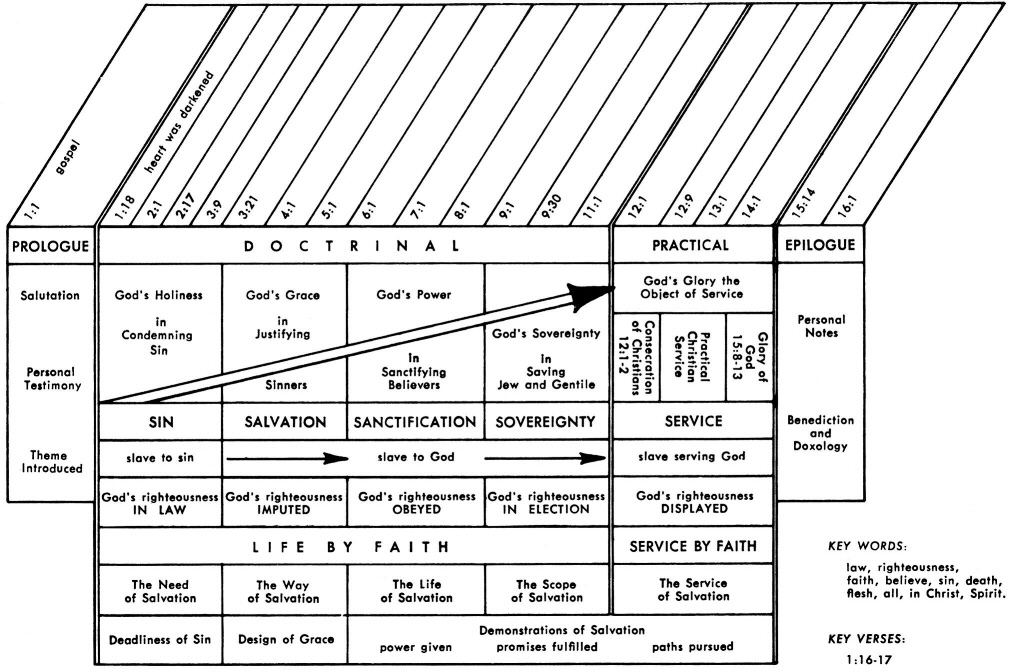
Click chart to enlarge
Chart from recommended resource Jensen's Survey of the NT - used by permission
Romans Overview Chart - Charles Swindoll
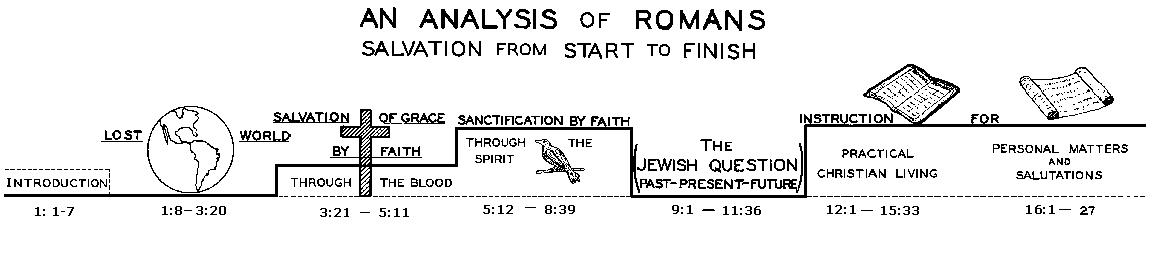
Source: Dr David Cooper
Click to Enlarge
R Ruin (Romans 1:17 – 3:20) – The utter sinfulness of humanity
O Offer (Romans 3:21-31) – God’s offer of justification by grace
M Model (Romans 4:1-25) – Abraham as a model for saving faith
A Access (Romans 5:1-11) – The benefits of justification
N New Adam (Romans 5:12-21) – We are children of two “Adams”
S Struggle w/ Sin (Romans 6-8) Struggle, sanctification, and victory
|
ROMANS ROAD |
||||
| Romans 1:18-3:20 | Romans 3:21-5:21 | Romans 6:1-8:39 | Romans 9:1-11:36 | Romans 12:1-16:27 |
| SIN | SALVATION | SANCTIFICATION | SOVEREIGNTY | SERVICE |
| NEED FOR SALVATION |
WAY OF SALVATION |
LIFE OF SALVATION |
SCOPE OF SALVATION |
SERVICE OF SALVATION |
| God's Holiness In Condemning Sin |
God's Grace In Justifying Sinners |
God's Power In Sanctifying Believers |
God's Sovereignty In Saving Jew and Gentile |
Gods Glory The Object of Service |
| Deadliness of Sin |
Design of Grace |
Demonstration of Salvation | ||
| Power Given | Promises Fulfilled | Paths Pursued | ||
| Righteousness Needed |
Righteousness Credited |
Righteousness Demonstrated |
Righteousness Restored to Israel |
Righteousness Applied |
| God's Righteousness IN LAW |
God's Righteousness IMPUTED |
God's Righteousness OBEYED |
God's Righteousness IN ELECTION |
God's Righteousness DISPLAYED |
| Slaves to Sin | Slaves to God | Slaves Serving God | ||
| Doctrine | Duty | |||
| Life by Faith | Service by Faith | |||
|
Modified from Irving L. Jensen's chart above |
||||
Romans 5:18 So then as through one transgression there resulted condemnation to all men, even so through one act of righteousness there resulted justification of life to all men. (NASB: Lockman)
Greek: Ara oun os di' enos paraptomatos eis pantas anthropous eis katakrima, houtos kai di' enos dikaiomatos eis pantas anthropous eis dikaiosin zoes;
Amplified: Well then, as one man’s trespass [one man’s false step and falling away led] to condemnation for all men, so one Man’s act of righteousness [leads] to acquittal and right standing with God and life for all men. (Amplified Bible - Lockman)
KJV: Therefore as by the offence of one judgment came upon all men to condemnation; even so by the righteousness of one the free gift came upon all men unto justification of life. (Vincent writes "correctly, one act of righteousness")
NLT: Yes, Adam’s one sin brought condemnation upon everyone, but Christ’s one act of righteousness makes all people right in God’s sight and gives them life. 19 Because one person disobeyed God, many people became sinners. But because one other person obeyed God, many people will be made right in God’s sight. (NLT - Tyndale House)
Phillips: We see, then, that as one act of sin exposed the whole race of men to God's judgment and condemnation, so one act of perfect righteousness presents all men freely acquitted in the sight of God. (Phillips: Touchstone)
Wuest: So then, therefore, as through one act of transgression, to all men there resulted condemnation, thus also through one act of righteousness, to all men there resulted a righteous standing that had to do with life.
Young's Literal: So, then, as through one offence to all men it is to condemnation, so also through one declaration of 'Righteous' it is to all men to justification of life;
SO THEN AS THROUGH ONE TRANSGRESSION THERE RESULTED CONDEMNATION TO ALL MEN: ara oun os di enos paraptomatos eis pantas anthropous eis katakrima:
- Ro 5:12,15,19; 3:19,20
- Romans 5 Resources - Multiple Sermons and Commentaries
SO THEN
PAUL'S CONCLUSION
Notice in the translations above how the KJV rendering leads to an interpretation slightly different than the other translations (including Young's Literal). Remember translations no matter how literal can have some interpretative bias which is why it is always good to go back to the original languages!
So then (ara oun) is a phrase that signals a conclusion is being drawn. Most commentators agree that this concluding section completes the line of thought Paul began, but temporarily interrupted, at the end of Romans 5:12.
Here Paul summarizes the great contrast between Adam and Christ. What is his conclusion? There are two corresponding results. In Ro 5:18, all humanity experiences either condemnation (in Adam) or justification (in Christ). In Ro 5:19, all are made sinners (through Adam’s disobedience) or made righteous (through Christ’s obedience).
A T Robertson notes that this is the "Conclusion of the argument. Cf. Ro 7:3,Ro 7:25; Ro 8:12, etc. Paul resumes the parallel between Adam and Christ begun in Ro 5:12 and interrupted by explanation (Ro 5:13) and contrast (Ro 5:15; Ro 5:16-17). (Word Pictures in the New Testament)
Guzik observes…
From this passage, Adam and Jesus are sometimes known as the two men. Between them they represent of all humanity, and everyone is identified in either Adam or Jesus. We are born identified with Adam; we may be born again into identification with Jesus.
The idea of Adam and Jesus as two representatives of the human race is sometimes called Federal Theology or Adam and Jesus are sometimes referred to as Federal Heads. This is because under the federal system of government, representatives are chosen and the representative speaks for the people who chose him. Adam speaks for those he represents, and Jesus speaks for His people.
Again, someone may object: “But I never chose to have Adam represent me.” Of course you did! You identified yourself with Adam with the first sin you ever committed. It is absolutely true that we were born into our identification with Adam, but we also choose it with our individual acts of sin. (Romans 5)
W E Vine - The immediate purpose of verse 19 is to show the means by which the effects of God’s grace were brought about, and to set forth the precise contrast to the effects of the one trespass.
James Montgomery Boice has a superb introduction to this summary section…
I do not know when or where it happened, but somebody was sitting in his apartment, getting ready to go to bed, when he heard his neighbor drop a shoe on the floor above him. The upstairs neighbor was obviously getting ready for bed, too, and the man below him waited for the thud of the other shoe. Afterward he must have talked about it, and the expression “waiting for the other shoe to drop” became an expressive figure of speech in our language.
Now we come to what we have been waiting for ever since we started to study Romans 5:12–21. Our expectation arose because Paul began this great passage with a contrast: “Therefore, just as sin entered the world through one man, and death through sin, and in this way death came to all men, because all sinned. …” But just when we were expecting the second half of that thought, he broke it off, and everything we have been studying since has in a sense been a digression, or parenthesis.
In fact, there have been two major digressions, which it might be helpful to review before proceeding.
First, Paul explained the sense in which “all sinned.” He did not mean that all have become sinners and have therefore sinned, though we would naturally think this, but rather that each of us was declared a sinner because of Adam’s original sin or transgression. It is true that we also sin and should be condemned for that, if there were nothing more to be said. But that is not Paul’s meaning. He meant that all have been accounted sinners in Adam, so that those who were going to be saved could be accounted righteous in the Lord Jesus Christ.
Since this digression finished at the end of verse 14, we again expected the other shoe to drop. But instead of completing the contrast introduced by verse 12, Paul worked in another long parenthesis to show the differences between our union with Adam, on the one hand, and our union with Jesus Christ, on the other. This second digression started at verse 15 and occupied the next three verses.
It is only when we get to verse 18 that the second shoe finally falls and we get the full impact of the contrast. Paul backs up to give it, restating the first part again, although in slightly different words: “[1] Consequently, just as the result of one trespass was condemnation for all men, [2] so also the result of one act of righteousness was justification that brings life for all men.”
There we have it!
But then, lest we have fallen asleep in the meantime and have somehow missed the point after this long wait, Paul makes it again in verse 19, adding: “[1] For just as through the disobedience of the one man the many were made sinners, [2] so also through the obedience of the one man the many will be made righteous.” (Boice, J. M. Romans. Grand Rapids, Mich.: Baker Book House)
The 4 major contrasts are seen in tabular form…
| TWO ''ONE ACT'' CONTRASTS IN ROMANS 5:18-19 |
||
| ADAM | CHRIST | |
| Cause (Act) |
One Transgression |
One Act of Righteousness |
| Effect | Condemnation to all (Death) |
Justification of life to all (Life) |
| Cause (Act) |
(Blatant) Disobedience of One |
(Submissive) Obedience of One |
| Effect | Many Made Sinners |
Many Made Righteous |
At first glance this chart suggests all men will be justified (made righteous) but the context of Romans and the NT clearly indicates the reference is all men who are justified by faith alone. Paul is not teaching universalism or that all men will be justified (saved). Recall that in Romans 5:17 (note) Paul speaks of life for those who receive it. The point is that you don't have to do anything to be condemned. Condemnation is Adam's "gift" to you. But if you want to be justified, you must receive God's free gift by grace through faith.
McGee sums up Romans 5:18 as descriptive of "the underlying principle of the imputation (act of crediting or laying responsibility upon) of sin and the imputation of righteousness. This is the doctrine of the federal headship of the race in Adam and Christ."
One (1520) (heis) is the cardinal number one and in this case refers to Adam's first transgression in eating from the fruit God clearly commanded he not eat. One transgression is all it took to "infect" the entire human race (for all originate from Adam) with a deadly "virus" called "sin".
One transgression - One man Adam committed one act of selfish disobedience resulting in condemnation for "all men." Now because of Adam's one transgression, all men are born condemned and are all guilty before God, fully deserving the eternal flames of hell. Paul says that the condemnation is universal, coming to "all men" without exception. Apart from Jesus Christ, the whole human race stands condemned by Almighty God.
Transgression (3900) (paraptoma from para = aside + pipto = fall) is literally a falling aside and describes a deviation from living according to what has been revealed as the right way to live. Paraptoma conveys the idea of a false step and so is translated a transgression (transgress in English means to to go beyond or overstep a limit or boundary and is from Latin trans- across + gradi = to step). There is a subtle distinction between sin and transgression -- The idea behind transgression is that we have crossed a line, challenging God's boundaries. The idea behind sin is that we have missed a mark, God's standard that calls for perfection, every time!
Adam took one "false step" and thus crossed over the line God had clearly given him in Genesis 2:17 - "but from the tree of the knowledge of good and evil you shall not eat, for in the day that you eat from it you will surely die.”
Condemnation to all men - The entire human race without exception stands condemned.
Condemnation (2631) (katakrima from katá = against, down + kríno = judge and so pronounce sentence against) appears only in Romans 8:1, 5:16; 18. The idea literally is of judgment "coming down" on someone. Paul says God’s judgment is going to come down upon all men because of Adam's sin.
Katakrima means to judge someone as definitely guilty and thus subject to punishment. Katakrima relates to the sentencing for a crime, but its primary focus is not so much on the verdict as on the penalty that the verdict demands. As Paul has already declared, the penalty, or condemnation, for sin is death (see + Romans 6:23)
All men… all men - Paul is using all men with two different meanings for the sake of parallelism, a common practice in the Hebrew Old Testament, which is similar Paul's repetition of the phrase the many in Romans 5:15 (note). The first all covers all humanity who are born into Adam. The second all refers to that part of the first all who by grace through faith are reborn into the Last Adam, Christ (Paul repeatedly emphasizes righteousness and faith - see notes Romans 1:16; 17; 3:22; 3:28; 4:5; 4:13. To reiterate - Paul is not teaching universal salvation.)
EVEN SO THROUGH ONE ACT OF RIGHTEOUSNESS THERE RESULTED JUSTIFICATION OF LIFE TO ALL MEN: houtos kai di enos dikaiomatos eis pantas anthropous eis dikaiosin zoes:
- Ro 3:21,22; 2Pet 1:1) (Jn 1:7; 3:26; 12:32; Acts 13:39; 1 Cor 15:22; 1Ti 2:4-6; Heb 2:9; 1Jn 2:20
- Romans 5 Resources - Multiple Sermons and Commentaries
JESUS' ONE ACT OF RIGHTEOUSNESS:
HIS DEATH ON THE CROSS
One act of righteousness - Every act of Jesus' life was an act of righteousness. So here "one act" refers not to Jesus' perfectly righteous life, but to His obedient submission to the Cross. When Christ died, He died for "all men" without exception and without distinction. In some mysterious sense, His death paid the price for the sins. However, the effect of that wondrous death will never be made real in one's life until one personally by a conscious choice receives God's gift by simple faith.
Vine adds that "The description “act of righteousness” presents the legal aspect of the death of Christ. That it was an act of obedience presents its moral aspect."
Righteousness (1345) (dikaioma from dikaióo = to justify <> díkaios = just, righteous <> dike = right) refers to what God has declared to be right.
Vine adds that dikaioma "is rightly rendered “act of righteousness.” It refers to that which Christ accomplished at His death, and stands in contrast to dikaiosune, righteousness simply as a quality."
Justification (1347) (dikaiosis from dike = right, expected behavior or conformity, not according to one’s own standard, but according to an imposed standard with prescribed punishment for nonconformity) denotes the act of pronouncing righteous -- justification, acquittal. Dikaiosis in this passage refers to justification which results in life, the life He gives us through His resurrection and the sharing of His life with us.
Regarding the somewhat difficult to understand phrase justification of life Kenneth Wuest writes that "The words of life are genitive of description in the Greek text, describing the quality of the righteousness bestowed upon man. It is a righteousness which is connected with the impartation of spiritual life. In itself, this righteous standing is a purely legal matter and does not impart life nor change character. But it is accompanied by the life that God is, imparted to the believing sinner in regeneration. (Wuest's Word Studies from the Greek New Testament: Eerdmans )
All men does not mean all men will be saved, because Scripture amply attests to the truth that salvation is only for those who exercise faith in Jesus Christ (Ro 1:16-17, 3:22, 28, 4:5, 13-see notes Romans 1:16-17, 3:22, 3:28, 4:5, 4:13; cp similar phrase the many in Romans 5:15 [note])
Our Daily Bread - Through one Man's righteous act the free gift came to all men, resulting in justification of life (Romans 5:18).
At noon on January 1, 1863, Abraham Lincoln received the final draft of the Emancipation Proclamation. Twice the president picked up his pen to sign it, and twice he laid it down. Turning to Secretary of State William Seward, he said, "I have been shaking hands since 9:00 this morning, and my right arm is almost paralyzed. If my name ever goes into history, it will be for this act, and my whole soul is in it. If my hand trembles when I sign the proclamation, all who examine the document hereafter will say, `He hesitated.— The president then took up the pen again and slowly but firmly wrote, "Abraham Lincoln." That historic act endeared Lincoln to the world as the Great Emancipator.
One greater than Lincoln and with even surer resolve brought freedom to the human race. Jesus signed our liberty with His own blood by dying on the cross to release us from the awful slavery of sin. Oswald Chambers wrote, "Never tolerate the idea of martyrdom about the cross of Jesus Christ. The cross was a superb triumph in which the foundations of hell were shaken. [Jesus Christ]… made the redemption the basis of human life, that is, He made a way for every son of man to get into communion with God."
Having trusted the Savior, we are free from sin's condemnation. By His Spirit we have the power to turn from sin and live for Him. And doing so is the only way to honor Christ—our Great Emancipator.—D J De Haan (Our Daily Bread, Copyright RBC Ministries, Grand Rapids, MI. Reprinted by permission. All rights reserved)
The empty tomb assures a full salvation.
Romans 5:19 For as through the one man's disobedience the many were made sinners, even so through the obedience of the One the many will be made righteous. (NASB: Lockman)
Greek: hosper gar dia tes parakoes tou enos anthropou hamartoloi katestathesan (3PAPI) oi polloi, houtos kai dia tes hupakoes tou enos dikaioi katastathesontai (3PFPI) oi polloi.
Amplified: For just as by one man’s disobedience (failing to hear, heedlessness, and carelessness) the many were constituted sinners, so by one Man’s obedience the many will be constituted righteous (made acceptable to God, brought into right standing with Him). (Amplified Bible - Lockman)
NLT: Because one person disobeyed God, many people became sinners. But because one other person obeyed God, many people will be made right in God’s sight. (NLT - Tyndale House)
Phillips: One man's disobedience placed all men under the threat of condemnation, but one man's obedience has the power to present all men righteous before God. (Phillips: Touchstone)
Wuest: For just as through the disobedience of the one man the many were constituted sinners, thus also through the obedience of the One, the many will be constituted righteous.
Young's Literal: for as through the disobedience of the one man, the many were constituted sinners: so also through the obedience of the one, shall the many be constituted righteous.
FOR AS THROUGH THE ONE MAN'S DISOBEDIENCE THE MANY WERE MADE (constituted, declared) SINNERS: hosper gar dia tes parakoes tou enos anthropou hamartoloi katestathesan (3PAPI) oi polloi:
- Isa 53:10-12; Da 9:24; 2Cor 5:21; Eph 1:6; Rev 7:9-17
- Romans 5 Resources - Multiple Sermons and Commentaries
ADAM'S DISOBEDIENCE:
WE MEN INHERIT HIS SIN
For (gar) emphasizes that this verse is an explanation (term of explanation) of the former verse and not a mere repetition. Pause and ask yourself what is the Spirit seeking to explain? In fact, stop reading right now and observe and see if you can determine what Paul is explaining. Notice how pausing to ponder will always force you to examine the context. You can (and should) practice this simple discipline every time you encounter a for, and while not every instance is a term of explanation, a "for" at the beginning of a verse is almost always used with that grammatical sense. I guarantee that if you begin to "pause and ponder," you will radically rejuvenate your "Read Through the Bible in a Year" program! You might even get a small journal and begin to keep notes on what the Spirit illuminates and how this truth can be applied to your daily life. As you practice interrogating the text (for, therefore, but, so that, etc) with 5W/H questions such as "What's the for explaining?", you will begin to learn to (1) Read the Bible inductively (power point overview) and to (2) Meditate (see also Primer on Biblical Meditation) on the Scripture. Meditation or "chewing the cud" of the Scripture (cf Mt 4:4, Job 23:12, Jer 15:16) so to speak, is a vanishing discipline in our fast paced, hi tech, low touch society, but a spiritual discipline which God promises to greatly bless (See Ps 1:1, Ps 1:2, Ps 1:3, Joshua 1:8, cf Ps 4:4,19:14, 27:4, 49:4, 63:6, Ps 77:6, 77:12, Ps 104:34, Ps 119:15, 119:23, 119:27, Ps 119:48, 119:78, Ps 119:97, 119:99, Ps 119:148, 143:5, Ps 145:5) From the preceding passages which "organ" of our being is most often involved/engaged in meditation? What are the subjects or the focus of meditation? Reading the Bible without meditating on it is like eating without chewing.
Barnes addresses this question noting that "By the former statements it might perhaps be inferred that men were condemned without any guilt or blame of theirs. The apostle in this verse guards against this, and affirms that they are in fact sinners. He affirms that those who are sinners are condemned, and that the sufferings brought in, on account of the sin of Adam, are introduced because many were made sinners. Calvin says, "Lest any one should arrogate to himself innocence, [the apostle] adds, that each one is condemned because he is a sinner." (Albert Barnes. Barnes NT Commentary)
Newell notes that "There is no more direct statement in Scripture concerning justification than we find in Romans 5:19."
Again Paul refers to Adam's disobedience in the Garden of Eden (Ge 3:6), but goes on to counter it with Jesus' obedience in the Garden of Gethsemane (Luke 22:42), consummating of course in the Cross.
Disobedience (3876) (parakoe from para = aside, amiss + akoúo) = hear, sometimes with the accompanying sense of hearing and thus very near the meaning "obey") is literally "hear amiss" and was originally used of flawed hearing, then what might be called half–hearted listening, and finally the attitude of purposefully filtering out what the hearer did not want to hear. It is about closing one’s ears to God’s voice, as Adam did to God's command…
And the LORD God commanded the man, saying, "From any tree of the garden you may eat freely; but from the tree of the knowledge of good and evil you shall not eat, for in the day that you eat from it you shall surely die." (Genesis 2:17-18)
Parakoe thus describes active disobedience which follows this inattentive or careless hearing (although one cannot imagine Adam did not clearly hear God's command!)
Marvin Vincent notes that "Bengel remarks that the word very appositely (= appropriately) points out the first step in Adam’s fall — carelessness, as the beginning of a city’s capture is the remissness of the guards." (Vincent's Greek Word Studies)
William Barclay explains that parakoe "begins by meaning imperfect hearing, as, for instance, of a deaf man. Then it goes on to mean careless hearing, the kind which through inattention either misunderstands or fails to catch what has been said. It ends by meaning unwillingness to hear, and therefore disobedience to the voice of God. It is the deliberate shutting of the ears to the commands and warnings and invitations of God." (Daily Study Bible)
In its strictest sense (parakoe) means a failing to hear or hearing amiss, with the notion of active disobedience which follows this inattentive or careless hearing. Paul's point is that Adam's sin was deliberate and he was not simply 'deceived" (cp Ge 2:16,17 and 1Ti 2:14).
The many - Every descendant of Adam without exception. Earlier Paul had used this same phrase "But the free gift is not like the transgression. For if by the transgression of the one the many died, much more did the grace of God and the gift by the grace of the one Man, Jesus Christ, abound to the many. (Ro 5:15)
Were made sinners - Adam’s one act of disobedience made all sinners—not only possessors of a sin nature, but guilty of the act of sin. You may be arguing "But that's not fair. I wasn't there." But counter that thought by choosing to recall that one of God's great attributes is that He is always and forever perfectly, infinitely just.
See Dr Wayne Grudem's explanation of The Doctrine of Inherited Sin at bottom of this page.
Regarding the phrase many were made sinners, Newell makes an interesting comment - "We were so connected with the first Adam that we did not have to wait to be born, or to have a sinful nature; but when Adam, our representative, acted, we acted… The great truth of Romans 5.12-21 is that a representative acted, involving those connected with him (Romans 5)." (Ed note: This is what theologians refer to as "original sin")
Made (2525) (kathistemi from kata = down + histemi = cause to stand) means literally to set down and so to set, place or put. It was used with the meaning to set one over a thing or in charge of it (eg, Mt 24:45). The idea of set down in other contexts means to constitute or to make someone something and this is the intended meaning in Romans 5:19 where it is used twice. Paul is saying that as a result of Adam's disobedience, Adam's descendants (that's you and me and all mankind!) were made sinners by nature and constitution. In next section, Paul writes that in the same way, but with a diametrically different effect, Christ’s obedience causes those who believe in Him to be made righteous by nature and constitution.
Morris makes an important distinction noting that made sinners "does not mean that sinless people were compelled to become sinners, but rather that Adam’s sin constituted them as sinners. They were born as members of a race already separated from God."
Sinners (268) (hamartolos from hamartano = to miss the mark) is an adjective (that is sometimes used as a noun as in the present passage) that describes one who errs from the prescribed way.
Barnes explains it this way - All who are condemned are sinners. They are not innocent persons condemned for the crime of another. (Ibid)
Spurgeon - It is a happy circumstance for us that we did fall and were condemned in the bulk in our representative, because had we been individually put on the like probation, we would to a certainty all have fallen. But then it must have ended finally and fatally, for when the angels fell by sinning individually, there was no hope of restoration for them. But we, happily, had fallen through a representative, and therefore we could be restored by another representative.
Stanley Horton - The Adam-Christ Parallel. Romans 5:12–21 and, to a lesser extent, 1 Corinthians 15:21–22 emphasize a strong parallel between Adam and Christ. Romans 5:19 is especially significant: “As through the disobedience of the one man [Adam] the many were made [Gr. kathistemi] sinners, so also through the obedience of the one man [Christ] the many will be made [kathistemi] righteous.” In the New Testament, kathistemi typically refers to one appointing another to a position. No actual act is required to attain the position. Hence, people who had not actually sinned could be made sinners by Adam. In a mirror image of Christ, Adam can make people sinners by a forensic, or legal, act not requiring actual sin on their part. (That a person must “accept Christ” to be saved cannot be part of the parallel, since infants who cannot consciously accept Christ may be saved; 2 Sam. 12:23.) (Systematic Theology)
EVEN SO THROUGH THE OBEDIENCE OF THE ONE THE MANY WILL BE MADE RIGHTEOUS: kai dia tes hupakoes tou enos dikaioi katastathesontai (3PFPI) oi polloi:
- Php 2:8, Heb 5:8, 10:5-9) (Ro 5:9, 10,15,16,17,19) (Isa 53:11 Da 9:24 2Cor 5:21
- Romans 5 Resources - Multiple Sermons and Commentaries
A MERCIFUL ACT OF GOD
MANY SINNERS MADE RIGHTEOUS
The many will be made righteous - In this verse Paul asserts that Christ’s obedience encompasses all those affected by Adam’s disobedience. Paul does not teach that all men will be saved but only those who "receive the abundance of grace" will be appointed or designated righteousness.
Obedience of the One - a reference to Jesus' death as the ultimate act of obedience rather than to His life of obedience since it is His death that saves us. Christ’s saving work is done in obedience to the Father (see verses from Hebrews below) and thus stands in stark contrast to Adam’s disobedience.
Matthew Henry - The disobedience of the first Adam ruined us, the obedience of the second Adam saves us
Paul speaks of Jesus' obedience in his letter to the Philippians writing "And being found in appearance as a man, He humbled Himself by becoming obedient to the point of death, even death on a cross." (see + Philippians 2:8)
The writer of Hebrews adds…
Although He was a Son, He learned obedience from the things which He suffered (What Jesus knew by omniscience, He "learned" by experience. This does not suggest that Jesus was ever disobedient!). And having been made perfect, He became to all those who obey (faith alone saves but genuine faith is not alone and is shown to be genuine by one's obedience initiated and enabled by the indwelling Spirit, realizing that in this life no one other than Jesus will manifest perfect obedience) Him the source of eternal salvation (see notes Hebrews 5:8; 5:9,
Therefore, when He comes into the world, He says, "SACRIFICE AND OFFERING THOU HAST NOT DESIRED, BUT A BODY THOU HAST PREPARED FOR ME; 6 IN WHOLE BURNT OFFERINGS AND sacrifices FOR SIN THOU HAST TAKEN NO PLEASURE. 7 "THEN I SAID, 'BEHOLD, I HAVE COME (IN THE ROLL OF THE BOOK IT IS WRITTEN OF ME) TO DO THY WILL, O GOD.' 8 After saying above, "SACRIFICES AND OFFERINGS AND WHOLE BURNT OFFERINGS AND sacrifices FOR SIN THOU HAST NOT DESIRED, NOR HAST THOU TAKEN PLEASURE in them" (which are offered according to the Law),9 then He said, "BEHOLD, I HAVE COME TO DO THY WILL." He takes away the first in order to establish the second." (See notes Hebrews 10:5; 10:6; 10:7; 10:8; 10:9)
Obedience (5218) (hupakoe from hupó = under + akoúo = hear) (Click word study of hupakoe) literally means "hearing under", that is, listening from a subordinate position in which compliance with what is said is expected and intended. Hupakoe speaks of the one hearing as being under the authority of some one else. Thus, hupakoe comes to mean compliance (disposition to yield to another) with the demands or requests of someone over us. Obedience is submission or hearkening to a command. Obedience is the carrying out the word and will of another person, especially the will of God.
Hupakoe conveys the picture of one listening and following instructions. Submitting to that which is heard involves a change of attitude, forsaking the tendency of the fallen nature to rebel against Divine instructions and commands and seeking God's will, not self will. Someone has said that a "proof" that we are of the elect is not an empty prating about how secure we are once we believed, but rather how sensitive we are to the principle and practice of obedience to Jesus.
Paul describes our Lord's obedience in his letter to the Philippians…
5 Have this attitude in yourselves which was also in Christ Jesus,
6 who, although He existed in the form of God, did not regard equality with God a thing to be grasped,
7 but emptied Himself, taking the form of a bond-servant, and being made in the likeness of men.
8 And being found in appearance as a man, He humbled Himself by becoming obedient to the point of death, even death on a cross.
9 Therefore also God highly exalted Him, and bestowed on Him the name which is above every name,
10 that at the name of Jesus EVERY KNEE SHOULD BOW, of those who are in heaven, and on earth, and under the earth (See notes Philippians 2:5; 2:6; 2:7; 2:8; 2:9; 2:10)
Made (2525) (kathistemi from kata = down + histemi = cause to stand) means literally to set down and so to set, place or put. It was used with the meaning to set one over a thing or in charge of it (eg, Mt 24:45). The idea of set down in other contexts means to constitute or to make someone something and this is the intended meaning here in Romans 5:19.
Sanday and Headlam on made or constituted - But in what sense ‘constituted’? The Greek word has the same ambiguity as the English. If we define further, the definition must come from the context. Here the context is sufficiently clear: it covers on the one hand the whole result of Adam’s Fall for his descendants prior to and independently of their own deliberate act of sin; and it covers on the other hand the whole result of the redeeming act of Christ so far as that too is accomplished objectively and apart from active concurrence on the part of the Christian. (Romans)
Zodhiates explains why kathistemi is used instead of ginomai in Ro 5:19 - “For as by one man’s disobedience many were made [katestáthēsan, aor. pass. indic.] sinners, so by the obedience of one shall many be made [katastathésontai, fut. pass. indic.] righteous.” Another synonym which was not used is gínomai (1096), to become, or, in this case, to make. To have used this latter word would have actually meant that God is responsible for making transgressors. As a judge does not make lawbreakers or bear moral responsibility for what they do, so it is with the Lord. God does not make sinners or cause them to sin, but He declares them to be such. He set the consequence of the disobedience of man, but He was not responsible for that disobedience. The verb kathístēmi used in this regard means that God has set or placed man in a definite place or position, that of the transgressor, but He did not make him a transgressor. The responsibility is entirely man’s. (The Complete Word Study Dictionary: New Testament - excellent resource)
Vincent writes that kathistemi is…
Used elsewhere by Paul only at Titus 1:5 (), in the sense of to appoint to office or position. This is its most frequent use in the New Testament. See Matt. 24:25; Acts 6:3; 7:10; Heb. 5:1, etc.
The primary meaning being to set down, it is used in classical Greek of bringing to a place, as a ship to the land, or a man to a place or person; hence to bring before a magistrate (Acts 17:15). From this comes the meaning to set down as, i.e., to declare or show to be; or to constitute, make to be. So 2Pet. 1:8 (); Jas. 4:4; 3:6.
The exact meaning in this passage is disputed. The following are the principal explanations:
1. Set down in a declarative sense; declared to be.
2. Placed in the category of sinners because of a vital connection with the first transgressor.
3. Became sinners; were made. This last harmonizes with sinned in Ro 5:12. The disobedience of Adam is thus declared to have been the occasion of the death of all, because it is the occasion of their sin; but the precise nature of this relation is not explained. (Romans 5: Greek Word Studies)
Righteous (1342)(dikaios) (Click word study of dikaios) describes that which is proper, right, fitting, fair, righteous, just (acting or being in conformity with what is morally upright or good). From a religious viewpoint dikaios is one who is rightly related to God. In simple terms righteous describes being in accordance with what God requires. The righteous man does what he ought. He is the person who conforms to the standard, will or character of God. For example, Luke describes Zacharias and Elizabeth (John the Baptist's parents) as
"both righteous (dikaios) in the sight of God, walking blamelessly in all the commandments and requirements of the Lord." (Lu 1:6)
They were rightly related to God and because of that right relationship, they walked accordingly. Again we see righteous character is associated with righteous conduct. That's what Paul is calling for in those men who would lead God's church.
Guzik - Only a sinless person acting on our behalf can save us, and it is fair for Him to act on our behalf because another man put us in this mess by acting on our behalf… The person who says, “I don’t want to be represented by Adam or Jesus; I want to represent myself” doesn’t understand two things. First, they don’t understand that it really isn’t up to us. We didn’t make the rules, God did. We simply have to deal with it. Secondly, they don’t understand that our personal righteousness before God is as filthy rags (Isaiah 64:6). To God, our personal righteousness is an offensive counterfeit; so standing for yourself guarantees your damnation. (Ibid)
Wiersbe draws a practical application noting that "our justification is the result of a living union with Christ. And this union ought to result in a new kind of life, a righteous life of obedience to God. Our union with Adam made us sinners; our union with Christ enables us to “reign in life.” (Bible Exposition Commentary )
Because of Adam’s disobedience, the many were appointed by God to be sinners. They were put down in the category of and constituted to be sinners. Because of Christ’s obedience, the many will be appointed to be righteous. Amazing grace that saved wretches such as we!
John MacArthur draws a practical conclusion from this passage commenting that "The person who genuinely belongs to Jesus Christ will reflect that same spirit of obedience, because he has Christ’s own life within him. When a person places his trust in Christ, he not only is declared righteous forensically but is actually made righteous, that is, given an inward righteousness that must and will bear fruit. As long as a believer is in the flesh, he will have the shortcomings and weaknesses of the flesh, and his righteousness will not be manifested perfectly. But if a person’s life is characterized by sin and shows no fruit of the Holy Spirit (see notes Galatians 5:22; 5:23), that person has no legitimate claim on Christ. The person who is made righteous by Christ will live righteously. (MacArthur, J: Romans 1-8. Chicago: Moody Press)
JEHOVAH TSIDKENU
The Lord Our Righteousness
Nov 18, 1834, Robert Murray McCheyne
"I once was a stranger to grace and to God,
I knew not my danger, and felt not my load;
Though friends spoke in rapture of Christ on the tree,
Jehovah Tsidkenu was nothing to me."I oft read with pleasure, to soothe or engage,
Isaiah’s wild measure, and John’s simple page;
But e’en when they pictured the blood-sprinkled tree,
Jehovah Tsidkenu seemed nothing to me."Like tears from the daughters of Zion that roll,
I wept when the waters went over His soul;
Yet thought not that my sins had nailed to the tree
Jehovah Tsidkenu—’twas nothing to me.When free grace awoke me, with light from on high
Then legal fears shook me, I trembled to die;
No refuge, no safety, in self could I see, —
Jehovah Tsidkenu my Savior must he."My terrors all vanished before the sweet Name;
My guilty fears banished, with boldness I came
To drink at the fountain, life-giving and free—
Jehovah Tsidkenu is all things to me."Jehovah Tsidkenu! my treasure and boast;
Jehovah Tsidkenu! I ne’er can be lost;
In Thee I shall conquer, by flood and by field—
My cable, my anchor, my breastplate and shield!"
The Adam Legacy - Our new grandson Jackson had fine features, soft blemish-free skin, and ten tiny fingers and toes on two little hands and feet. How could any proud Grampa not see him as a “perfect” baby? He certainly was a miracle of divine formation (Psalm 139:13, 14).
The apostle Paul gave us a broader view of such “perfect” little infants when he wrote,“ Through one man sin entered the world, and death through sin … Nevertheless death reigned from Adam to Moses, even over those who had not sinned according to the likeness of the transgression of Adam” (Romans 5:12, 13, 14). In other words, every child is born with a tendency to sin. But that’s not Paul’s final word. He also wrote about Jesus, the “last Adam,” who became a “life-giving spirit” (1Corinthians 15:45).
Long after man’s first sin, a baby was born who was God incarnate (John 1:14). God made Christ,“ who knew no sin to be sin for us” (2Corinthians 5:21). When we trust Jesus as our Savior, the Holy Spirit creates within us a new desire to do what is pleasing to God. The flesh still has its pull, but the pull of the Spirit is stronger.
In the “first Adam” we’re all sinners. But let’s concentrate on who we are in the“last Adam.” — Dennis J. De Haan (Our Daily Bread, Copyright RBC Ministries, Grand Rapids, MI. Reprinted by permission. All rights reserved)
One with Adam are we all,
One with Adam in his fall;
But another Adam came—
Fallen sinners to reclaim. —D. De Haan
If anyone is in Christ, he is a new creation; old things have passed away. —2 Corinthians 5:17
- See also Dr Grudem's Outline on the Doctrine of Sin
- Listen to his in depth (~50 minute) lectures on the Doctrine of Sin in 3 parts - Part 1, Part 2, Part 3
- Systematic Theology
How does the sin of Adam affect us? Scripture teaches that we inherit sin from Adam in two ways.
1. Inherited Guilt: We Are Counted Guilty Because of Adam’s Sin. Paul explains the effects of Adam’s sin in the following way: “Therefore … sin came into the world through one man and death through sin, and so death spread to all men because all men sinned” (Rom. 5:12). The context shows that Paul is not talking about actual sins that people commit every day of their lives, for the entire paragraph (Rom. 5:12–21) is taken up with the comparison between Adam and Christ. And when Paul says, “so [Gk. οὕτως, G4048, “thus, in this way”; that is, through Adam’s sin] death spread to all men because all men sinned,” he is saying that through the sin of Adam “all men sinned.”
This idea, that “all men sinned” means that God thought of us all as having sinned when Adam disobeyed, is further indicated by the next two verses, where Paul says:
Sin indeed was in the world before the law was given, but sin is not counted where there is no law. Yet death reigned from Adam to Moses, even over those whose sins were not like the transgression of Adam, who was a type of the one who was to come. (Rom. 5:13–14)
Here Paul points out that from the time of Adam to the time of Moses, people did not have God’s written laws. Though their sins were “not counted” (as infractions of the law), they still died. The fact that they died is very good proof that God counted people guilty on the basis of Adam’s sin.
The idea that God counted us guilty because of Adam’s sin is further affirmed in Romans 5:18–19:
Then as one man’s trespass led to condemnation for all men, so one man’s act of righteousness leads to acquittal and life for all men. For as by one man’s disobedience many were made sinners so by one man’s obedience many will be made righteous.
Here Paul says explicitly that through the trespass of one man “many were made [Gk. κατεστάθησαν from καθίστημι, G2770, also an aorist indicative indicating completed past action] sinners.” When Adam sinned, God thought of all who would descend from Adam p 495 as sinners. Though we did not yet exist, God, looking into the future and knowing that we would exist, began thinking of us as those who were guilty like Adam. This is also consistent with Paul’s statement that “while we were yet sinners Christ died for us” (Rom. 5:8). Of course, some of us did not even exist when Christ died. But God nevertheless regarded us as sinners in need of salvation.
The conclusion to be drawn from these verses is that all members of the human race were represented by Adam in the time of testing in the Garden of Eden. As our representative, Adam sinned, and God counted us guilty as well as Adam. (A technical term that is sometimes used in this connection is impute meaning “to think of as belonging to someone, and therefore to cause it to belong to that person.”) God counted Adam’s guilt as belonging to us, and since God is the ultimate judge of all things in the universe, and since his thoughts are always true, Adam’s guilt does in fact belong to us. God rightly imputed Adam’s guilt to us.
Sometimes the doctrine of inherited sin from Adam is termed the doctrine of “original sin.” As explained above, I have not used this expression. If this term is used, it should be remembered that the sin spoken of does not refer to Adam’s first sin, but to the guilt and tendency to sin with which we are born. It is “original” in that it comes from Adam, and it is also original in that we have it from the beginning of our existence as persons, but it is still our sin, not Adam’s sin, that is meant. Parallel to the phrase “original sin” is the phrase “original guilt.” This is that aspect of inherited sin from Adam that we have been discussing above, namely, the idea that we inherit the guilt from Adam.
When we first confront the idea that we have been counted guilty because of Adam’s sin, our tendency is to protest because it seems unfair. We did not actually decide to sin, did we? Then how can we be counted guilty? Is it just for God to act this way?
In response, three things may be said: (1) Everyone who protests that this is unfair has also voluntarily committed many actual sins for which God also holds us guilty. These will constitute the primary basis of our judgment on the last day, for God “will render to every man according to his works” (Rom. 2:6), and “the wrongdoer will be paid back for the wrong he has done” (Col. 3:25). (2) Moreover, some have argued, “If any one of us were in Adam’s place, we also would have sinned as he did, and our subsequent rebellion against God demonstrates that.” I think this is probably true, but it does not seem to be a conclusive argument, for it assumes too much about what would or would not happen. Such uncertainty may not help very much to lessen someone’s sense of unfairness.
(3) The most persuasive answer to the objection is to point out that if we think it is unfair for us to be represented by Adam, then we should also think it is unfair for us to be represented by Christ and to have his righteousness imputed to us by God. For the procedure that God used was just the same, and that is exactly Paul’s point in Romans 5:12–21: “As by one man’s disobedience many were made sinners, so by one man’s obedience many will be made righteous” (Rom. 5:19). Adam, our first representative sinned—and God counted us guilty. But Christ, the representative of all who believe in him, obeyed God perfectly—and God counted us righteous. That is simply the way in which God set up the human race to work. God regards the human race as an organic whole, a unity, represented by p 496 Adam as its head. And God also thinks of the new race of Christians, those who are redeemed by Christ, as an organic whole, a unity represented by Christ as head of his people.
Not all evangelical theologians, however, agree that we are counted guilty because of Adam’s sin. Some, especially Arminian theologians, think this to be unfair of God and do not believe that it is taught in Romans 5. However, evangelicals of all persuasions do agree that we receive a sinful disposition or a tendency to sin as an inheritance from Adam, a subject we shall now consider.
2. Inherited Corruption: We Have a Sinful Nature Because of Adam’s Sin. In addition to the legal guilt that God imputes to us because of Adam’s sin, we also inherit a sinful nature because of Adam’s sin. This inherited sinful nature is sometimes simply called “original sin” and sometimes more precisely called “original pollution.” I have used instead the term “inherited corruption” because it seems to express more clearly the specific idea in view.
David says, “Behold, I was brought forth in iniquity, and in sin did my mother conceive me” (Ps. 51:5). Some have mistakenly thought that the sin of David’s mother is in view here, but this is incorrect, for the entire context has nothing to do with David’s mother. David is confessing his own personal sin throughout this section. He says:
Have mercy on me O God
… blot out my transgressions.
Wash me thoroughly from my iniquity
… I know my transgressions.
… Against you … have I sinned. (Ps. 51:1–4)
David is so overwhelmed with the consciousness of his own sin that as he looks back on his life he realizes that he was sinful from the beginning. As far back as he can think of himself, he realizes that he has had a sinful nature. In fact, when he was born or “brought forth” from his mother’s womb, he was “brought forth in iniquity” (Ps. 51:5). Moreover, even before he was born, he had a sinful disposition: he affirms that at the moment of conception he had a sinful nature, for “in sin did my mother conceive me” (Ps. 51:5). Here is a strong statement of the inherent tendency to sin that attaches to our lives from the very beginning. A similar idea is affirmed in Psalm 58:3, “The wicked go astray from the womb, they err from their birth, speaking lies.”
Therefore, our nature includes a disposition to sin so that Paul can affirm that before we were Christians “we were by nature children of wrath, like the rest of mankind” (Eph. 2:3). Anyone who has raised children can give experiential testimony to the fact that we are all born with a tendency to sin. Children do not have to be taught how to do wrong; they discover that by themselves. What we have to do as parents is to teach them how to do right, to “bring them up in the discipline and instruction of the Lord” (Eph. 6:4).
This inherited tendency to sin does not mean that human beings are all as bad as they could be. The constraints of civil law, the expectations of family and society, p 497 and the conviction of human conscience (Rom. 2:14–15) all provide restraining influences on the sinful tendencies in our hearts. Therefore, by God’s “common grace” (that is, by his undeserved favor that is given to all human beings), people have been able to do much good in the areas of education, the development of civilization, scientific and technological progress, the development of beauty and skill in the arts, the development of just laws, and general acts of human benevolence and kindness to others. In fact, the more Christian influence there is in a society in general, the more clearly the influence of “common grace” will be seen in the lives of unbelievers as well. But in spite of the ability to do good in many senses of that word, our inherited corruption, our tendency to sin, which we received from Adam, means that as far as God is concerned we are not able to do anything that pleases him. This may be seen in two ways:
a. In Our Natures We Totally Lack Spiritual Good Before God: It is not just that some parts of us are sinful and others are pure. Rather, every part of our being is affected by sin—our intellects, our emotions and desires, our hearts (the center of our desires and decision-making processes), our goals and motives, and even our physical bodies. Paul says, “I know that nothing good dwells within me, that is, in my flesh” (Rom. 7:18), and, “to the corrupt and unbelieving nothing is pure; their very minds and consciences are corrupted” (Titus 1:15). Moreover, Jeremiah tells us that “the heart is deceitful above all things, and desperately corrupt; who can understand it?” (Jer. 17:9). In these passages Scripture is not denying that unbelievers can do good in human society in some senses. But it is denying that they can do any spiritual good or be good in terms of a relationship with God. Apart from the work of Christ in our lives, we are like all other unbelievers who are “darkened in their understanding, alienated from the life of God because of the ignorance that is in them, due to their hardness of heart” (Eph. 4:18).
b. In Our Actions We Are Totally Unable to Do Spiritual Good Before God: This idea is related to the previous one. Not only do we as sinners lack any spiritual good in ourselves, but we also lack the ability to do anything that will in itself please God and the ability to come to God in our own strength. Paul says that “those who are in the flesh cannot please God” (Rom. 8:8). Moreover, in terms of bearing fruit for God’s kingdom and doing what pleases him, Jesus says, “Apart from me you can do nothing” (John 15:5). In fact, unbelievers are not pleasing to God, if for no other reason, simply because their actions do not proceed from faith in God or from love to him, and “without faith it is impossible to please him” (Heb. 11:6). When Paul’s readers were unbelievers, he tells them, “You were dead through the trespasses and sins in which you once walked” (Eph. 2:1–2). Unbelievers are in a state of bondage or enslavement to sin, because “every one who commits sin is a slave to sin” (John 8:34). Though from a human standpoint p 498 people might be able to do much good, Isaiah affirms that “all our righteous deeds are like a polluted garment” (Isa. 64:6; cf. Rom. 3:9–20). Unbelievers are not even able to understand the things of God correctly, for the “natural man does not receive the gifts [lit. “things’] of the Spirit of God, for they are folly to him, and he is not able to understand them because they are spiritually discerned” (1 Cor. 2:14 RSV mg.). Nor can we come to God in our own power, for Jesus says, “No one can come to me unless the Father who sent me draws him” (John 6:44).
But if we have a total inability to do any spiritual good in God’s sight, then do we still have any freedom of choice? Certainly, those who are outside of Christ do still make voluntary choices—that is, they decide what they want to do, then they do it. In this sense there is still a kind of “freedom” in the choices that people make. Yet because of their inability to do good and to escape from their fundamental rebellion against God and their fundamental preference for sin, unbelievers do not have freedom in the most important sense of freedom—that is, the freedom to do right, and to do what is pleasing to God.
The application to our lives is quite evident: if God gives anyone a desire to repent and trust in Christ, he or she should not delay and should not harden his or her heart (cf. Heb. 3:7–8; 12:17). This ability to repent and desire to trust in God is not naturally ours but is given by the prompting of the Holy Spirit, and it will not last forever. “Today, when you hear his voice, do not harden your hearts” (Heb. 3:15). (Systematic Theology: An Introduction - - one of the best, easiest to understand systematic theological texts ever written!)