Romans 5:2
Romans 5:3
Romans 5:4
Romans 5:5
Romans 5:6
Romans 5:7
Romans 5:8
Romans 5:9
Romans 5:10
Romans 5:11
Romans 5:12
Romans 5:13
Romans 5:14
Romans 5:15
Romans 5:16
Romans 5:17
Romans 5:18
Romans 5:19
Romans 5:20
Romans 5:21

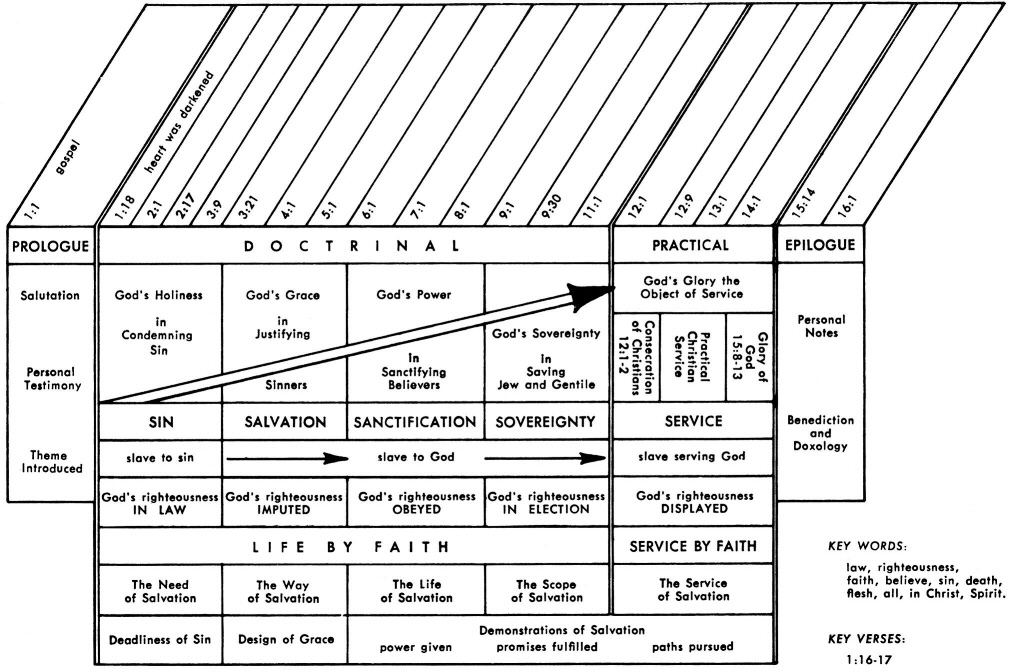
Click chart to enlarge
Chart from recommended resource Jensen's Survey of the NT - used by permission
Romans Overview Chart - Charles Swindoll
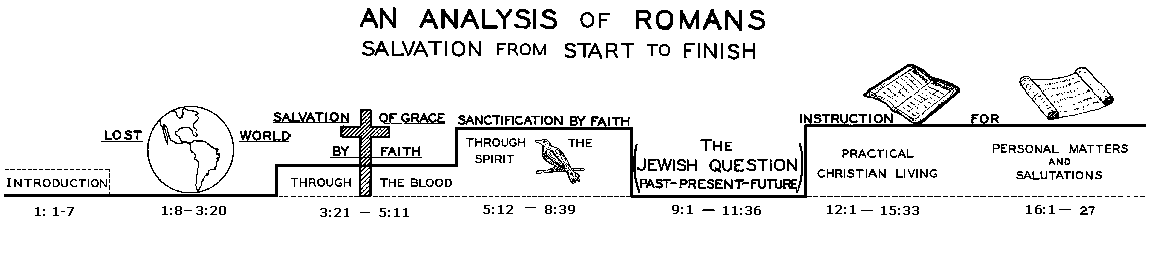
Source: Dr David Cooper
Click to Enlarge
R Ruin (Romans 1:17 – 3:20) – The utter sinfulness of humanity
O Offer (Romans 3:21-31) – God’s offer of justification by grace
M Model (Romans 4:1-25) – Abraham as a model for saving faith
A Access (Romans 5:1-11) – The benefits of justification
N New Adam (Romans 5:12-21) – We are children of two “Adams”
S Struggle w/ Sin (Romans 6-8) Struggle, sanctification, and victory
|
ROMANS ROAD |
||||
| Romans 1:18-3:20 | Romans 3:21-5:21 | Romans 6:1-8:39 | Romans 9:1-11:36 | Romans 12:1-16:27 |
| SIN | SALVATION | SANCTIFICATION | SOVEREIGNTY | SERVICE |
| NEED FOR SALVATION |
WAY OF SALVATION |
LIFE OF SALVATION |
SCOPE OF SALVATION |
SERVICE OF SALVATION |
| God's Holiness In Condemning Sin |
God's Grace In Justifying Sinners |
God's Power In Sanctifying Believers |
God's Sovereignty In Saving Jew and Gentile |
Gods Glory The Object of Service |
| Deadliness of Sin |
Design of Grace |
Demonstration of Salvation | ||
| Power Given | Promises Fulfilled | Paths Pursued | ||
| Righteousness Needed |
Righteousness Credited |
Righteousness Demonstrated |
Righteousness Restored to Israel |
Righteousness Applied |
| God's Righteousness IN LAW |
God's Righteousness IMPUTED |
God's Righteousness OBEYED |
God's Righteousness IN ELECTION |
God's Righteousness DISPLAYED |
| Slaves to Sin | Slaves to God | Slaves Serving God | ||
| Doctrine | Duty | |||
| Life by Faith | Service by Faith | |||
|
Modified from Irving L. Jensen's chart above |
||||
Romans 5:20 The Law came in so that the transgression would increase; but where sin increased, grace abounded all the more, (NASB: Lockman)
Greek: nomos de pareiselthen (3SAAI) hina pleonase (3SAAS) to paraptoma; ou de epleonasen (3SAAI) e hamartia hupereperisseusen (3SAAI) e charis,
Amplified: But then Law came in, [only] to expand and increase the trespass [making it more apparent and exciting opposition]. But where sin increased and abounded, grace (God’s unmerited favor) has surpassed it and increased the more and superabounded, (Amplified Bible - Lockman)
NLT: God’s law was given so that all people could see how sinful they were. But as people sinned more and more, God’s wonderful kindness became more abundant. (NLT - Tyndale House)
Phillips: Now we find that the Law keeps slipping into the picture to point the vast extent of sin. Yet, though sin is shown to be wide and deep, thank God his grace is wider and deeper still! (Phillips: Touchstone)
Wuest: Moreover, law entered in alongside in order that the transgression might be augmented. But where the sin was augmented, the grace superabounded with more added to that,
Young's Literal: And law came in, that the offence might abound, and where the sin did abound, the grace did overabound,
AND THE LAW CAME IN THAT THE TRANSGRESSION MIGHT INCREASE: nomos de pareiselthen (3SAAI) hina pleonase (3SAAS) to paraptoma:
- Ro 3:19,20; 4:15; 6:14; 7:5-13; Jn 15:22; 2Cor 3:7, 8, 9; Gal 3:19, 20, 21, 22, 23, 24, 25
- Romans 5 Resources - Multiple Sermons and Commentaries
WHAT WAS ONE PURPOSE
OF THE LAW?
Denney introduces these last 2 verses of Romans 5 commenting that...The comparison between Adam and Christ is closed. But in the middle, between the two, stood the Law. (quoting Meyer)
Adam may have faded from the discussion but the consequences of his one transgression (sin and death) linger on.
Marvin Vincent agrees writing that "Now that the parallel between Adam and Christ is closed, the question arises as to the position and office of the law. How did it stand related to Adam and Christ? Paul replies that it came in alongside of the sin. “It was taken up into the divine plan or arrangement, and made an occasion for the abounding of grace in the opening of the new way to justification and life” (Dwight). (Vincent, M. R. Word Studies in the New Testament. Vol. 3, Page 1-65)
And the Law came in - Refers to God's giving of the Law to Moses and Israel at Mount Sinai.
Law (3551) (nomos from nemo = to divide among, parcel out, allot) according to Vine primarily meant “that which is assigned” and hence, that which is the “custom” and finally that which is “law as prescribed by custom or by statute”. The word ethos, “custom,” was retained for unwritten “law,” while nomos became the established name for “law” as decreed by a state and set up as the a formalized set of rules for the administration of justice.
In this context Law refers to the Mosaic Law given at Mount Sinai (it "came in beside" sin and death) (See related topics - Summary of the Purpose of the Law from Galatians 3; see also William Newell's discussion of the purpose of the Law in exposition of Romans 3:20) Nomos can refer to the first five books of Moses (the Pentateuch or the Torah in Hebrew) and that may be Paul's meaning here, but the emphasis is clearly on the legal aspect, in the sense of prescribing what a person must do and not do.
One might ask "Why bring up the Law at this juncture?"
Leon Morris explains that...It is somewhat unexpected that he brings in a reference to law, but between Adam and Christ stood Moses, revered by the Jews and often seen as the most significant figure among the sons of men because of his giving of the law. This was so important in Jewish religion and in the Old Testament that Christians as well as Jews regarded as Scripture that it had to be seen in its proper place in God’s great scheme of salvation. Law, says Paul, was added, the verb (pareiserchomai) showing that it held no primary place. Its purpose was that the trespass (Ed note: trespass singular - see discussion below) might increase. It was not concerned with preventing sin (it was too late for that {Ed note: Adam's original sin}). Nor was it concerned with preventing (Ed note: continual committing of sins) sin (it was too weak for that). The law can only condemn (see note Romans 4:15). It was concerned with showing sin for what it is, and it certainly showed magnificently that there was much sin (cf. notes Romans 3:19; 3:20). (Morris, L. The Epistle to the Romans. W. B. Eerdmans; Inter-Varsity Press)
Came in (3922) (pareiserchomai from pará = alongside + eisérchomai = to enter) means to come in to beside and in some context means to slip in or to sneak in (see use in Gal 2:4 below). To come in with something so as to be present beside it.
Thayer says the idea here in Romans is "to enter in addition" (in addition to or "beside" sin and death which had previously entered into the Garden of Eden through Adam).
Paul also has the only other use of pareiserchomai in Scripture...
Galatians 2:4 But it was because of the false brethren (Judaizers - claimed allegiance to Christ but demanded circumcision + obedience to the Law for salvation) who had sneaked in (pareiserchomai) to spy out (means primarily to view closely and in this context to spy out, learn about by secret observation) our liberty (eleutheria - see study of related verb eleutheroo = the idea is of freedom and in this context of freedom from the law as a means of salvation and sanctification but not a license to sin!) which we have in Christ Jesus, in order to bring us into bondage (Reduce to slavery, imposing control over another for one's own ends = Total enslavement to a system of works righteousness by which salvation and/or sanctification is impossible). (Comment: In this context the meaning is clearly to come in or slip in secretly, by stealth)
BDAG adds that pareiserchomai means...to come in beside, slip in, come in as a side issue, of the law, as having no primary place in the divine plan. (Arndt, W., Danker, F. W., & Bauer, W. A Greek-English Lexicon of the New Testament and Other Early Christian Literature)
Friberg says that the idea of this verb is that..the (Mosaic) law (was) brought in to play a subordinate role (Friberg, T., Friberg, B., & Miller, N. F. Analytical Lexicon of the Greek New Testament. Baker Academic)
Cranfield adds that the prefix para in this verb means...'alongside of’, ‘beside’, and the most natural way of understanding pareiserchomai here is surely to take it as a simple reference to the undisputed fact that the law was given at a later date than that of Adam’s fall, namely, in the time of Moses. To refer to this fact is not, in itself, to say anything about the worth of the law depreciatory or otherwise. (Cranfield, C. E. B Exegetical Commentary on the Epistle to the Romans. Vol 1: Ro 1-8.; Volume 2: Romans 9-16)
Paul used the root verb eiserchomai earlier in Romans 5:12 when he explained that
through one man sin entered (eiserchomai) into the world (see note Romans 5:12)
So just as sin entered the world through Adam in Romans 5:12, here in Romans 5:20 Paul says the Law of Moses "entered in beside" or alongside sin. Men were sinners long before the Law was given and God had begun implementation of His plan of salvation before the Law was given (eg, see Ge 3:15 - multiple translations; Ephesians 1:4 - note). The purpose of the Law’s entrance into the world was not to redeem men for only Christ could accomplish this great objective. Don't misunderstand the purpose of the Law for it was not given in order to make men sinful. As Paul explained in Romans 5:12-19 man did not need to be made sinful for he is born sinful and that is why he commits sins. Instead, Paul explains that the Law was given so that sin might be made more evident.
Compare this role of the Law with Paul's earlier point in Romans 3:20 [note] where he explained that...
by the works of the Law no flesh will be justified (declared righteous) in His sight; for through the Law comes the knowledge of sin. (See discussion)
In Galatians 3 Paul explained that the promise of God is superior to the Law which raised the obvious question of...
Why the Law then? It was added because of transgressions, having been ordained through angels (see Acts 7:53, Hebrews 2:2) by the agency of a mediator, until the Seed (the Messiah) should come to Whom the promise had been made. (See note Galatians 3:19) (Comment: The Law was intended to reveal sin in its true character as transgression and prepare the way for the coming of Christ by demonstrating the dire need for His saving work. As Paul has taught in Romans 5, sin existed before the Law [see note Romans 5:14], but men did not recognize it as transgression until the Law came [remembering that transgression is the violation of a known law).
Paul made similar statements regarding the purpose of the Law in Romans 7...
7:7 What shall we say then? Is the Law sin? May it never be! On the contrary, I would not have come to know sin except through the Law; for I would not have known about coveting if the Law had not said, "YOU SHALL NOT COVET."... 7:13 Therefore did that which is good become a cause of death for me? May it never be! Rather it was sin, in order that it might be shown to be sin by effecting my death through that which is good, that through the commandment sin might become utterly sinful. (See notes Romans 7:7; 7:13)
Harrison makes an interesting comment regarding this revelatory purpose of the Law...This function of the law-viz., to increase transgression-was not recognized in rabbinic Judaism (H.J. Schoeps, Paul [Philadelphia: Westminster Press, 1961], p. 174). From the Sermon on the Mount, however, it appears that Jesus sought to apply the law in just this way, to awaken a sense of sin in those who fancied they were keeping the law tolerably well but had underestimated its searching demands and the sinfulness of their own hearts. (Gaebelein, F, Editor: Expositor's Bible Commentary 6-Volume New Testament. Zondervan Publishing)
So that (2443) (hina) introduces a purpose clause, and (as just alluded to) in this case introduces the explanation of God's purpose for the Law.
The transgression might increase - He is not saying that God introduced the Law because He wanted to make us sin more, but that He wanted us to be more aware of our sins and the fact that we had a totally sinful nature. (See more detailed discussion of this function of the law below) Notice that Paul does not say transgressions (plural) but transgression (singular), which is a reference to the sin of Adam. How do we arrive at that conclusion? Notice that six times in Romans 5 Paul uses transgression and in each use it is in the singular and in each context, transgression refers to the sin of Adam. Observe the uses and see if you do not agree...
Romans 5:15 But the free gift is not like the transgression. For if by the transgression of the one the many died, much more did the grace of God and the gift by the grace of the one Man, Jesus Christ, abound to the many.
Romans 5:16 And the gift is not like that which came through the one who sinned; for on the one hand the judgment arose from one transgression resulting in condemnation, but on the other hand the free gift arose from many transgressions resulting in justification.
Romans 5:17 For if by the transgression of the one, death reigned through the one, much more those who receive the abundance of grace and of the gift of righteousness will reign in life through the One, Jesus Christ.
Romans 5:18 So then as through one transgression there resulted condemnation to all men, even so through one act of righteousness there resulted justification of life to all men.
John Piper explains the transgression as follows...
I take it to mean that one crucial function of the law is to turn our original sin into actual transgressions of specific commandments. First, we are guilty in Adam and sinful by nature, and then the Law confronts us with the specific will of God: "Don't steal. Don't lie. Don't covet." And the effect is that it turns sinful nature into specific sinful acts of transgression. One writer said it well: the Law makes little Adams out of us all. ("The law has the function of turning those it addresses into 'their own Adam.'" Douglas Moo, The Epistle to the Romans)
So what was once one transgression in which we all shared by virtue of the union with Adam that God ordained for all humanity, has now, because of the Law, become millions upon millions of specific transgressions, as verse 16b said, The free gift arose from many transgressions. So the Law of Moses was given to increase the transgression of Adam into millions of specific acts of transgression in all of us who resist submitting to the Law of God because of our rebellious nature." (Read the full message The Triumph of Grace through Righteousness)
To review, every human being has inherited a sin nature from Adam, and the effect of the Law is to stimulate our sin nature so that we commit sins. The commission of personal sins shows that we all have a sin nature. Recall that there are 3 aspects of sin - Inherited Sin (Sin Nature, Sinful Nature, original sin), Imputed Sin and Personal Sins (See discussion and chart on these three aspects of sin)
One might think of the Law as like a mirror one uses to see dirt on one's face. The mirror is not designed to remove the dirt but only to reveal it. Or think of the Law as like a carpenter's plumbline. Plumblines are not meant to straighten the building but to tell one how crooked it is and where the change needs to be made. The Law fulfills its purpose when it makes men realize the full sense of how sinful they are as they see the sins they commit.
Martin Luther wasn't far off when he said that the function of Law was not to justify but to terrify!
Transgression (3900) (paraptoma from para = aside + pipto = fall) is literally a falling aside or beside to stumble on something (so as to loose footing) and in its figurative ethical usage (all uses in the NT) it describes a "false step", a violation of moral standards or a deviation from living according to what has been revealed as the right way to live. Paraptoma is a false step out of the appointed way, a trespass on forbidden ground, a stepping out of line of true conduct, a deviation from truth and uprightness. Paraptoma describes what a person has done in transgressing the will and law of God by some false step or failure.
Paraptoma is akin to parapipto, to fall beside a person or thing, to fall away, to deviate from the right path, or to turn aside (see note Hebrews 6:6). The basic idea of paraptoma is that of stumbling or falling so as to lose one's footing
The NAS translates paraptoma with 2 words, either as transgression or trespass (derived from Old French - tres =across [Latin - trans] + passer = to pass. Thus trespass means to make inroads upon the property, territory, or rights of another and implies an unwarranted, unlawful, or offensive intrusion).
The Hebrew word (pesha' - 6588) translated as “trespass” means “a stepping aside from the (correct) path” (Ge 31:36; Ex. 22:9), but the Septuagint does not use paraptoma to translate pesha'.
Thayer writes that paraptoma means
1. properly, a fall beside or near something; but nowhere found in this sense.
2. tropically, a lapse or deviation from truth and uprightness; a sin, misdeed (R. V. trespass, `differing from hamartema in figure not in force'
Vine writes that paraptoma "primarily “a false step, a blunder” (para, “aside,” pipto, “to fall”), then “a lapse from uprightness, a sin, a moral trespass, misdeed,” is translated “fall” (KJV) in Romans 11:11 (note), of the sin and “downfall” of Israel in their refusal to acknowledge God’s claims and His Christ; by reason of this the offer of salvation was made to Gentiles... (Vine, W E: Vine's Complete Expository Dictionary of Old and New Testament Words. 1996. Nelson)
Paraptoma conveys the idea of a false step and so is translated a transgression (transgress in English means to to go beyond or overstep a limit or boundary and is from Latin trans- across + gradi = to step).
There is a subtle distinction between sin and transgression -- The idea behind transgression is that we have crossed a line, challenging God's boundaries. The idea behind sin is that we have missed a mark, God's standard that calls for perfection, every time!
NIDNTT says that in Classical Greek...the noun paraptoma (Polybius onwards) means oversight, error, mistake (unintentional). Here the originally fig. sense was that someone deviated to the one side or the other. (Brown, Colin, Editor. New International Dictionary of NT Theology. 1986. Zondervan)
ISBE says that trespass means...To pass over, to go beyond one’s right in place or act; to injure another; to do that which annoys or inconveniences another; any violation of law, civil or moral; it may relate to a person, a community, or the state, or to offenses against God. The Hebrew 'asham ("sin"), is used very frequently in the Old Testament when the trespass is a violation of law of which God is the author. (ISBE Article)
ISBE comments that...As in Levitical law and Jesus’ teachings, Paul noted that a trespass can have corporate implications. The entire human race experienced vicariously the trespass of Adam (Ro 5:15 note). In like manner, because of the trespass of Israel the message of salvation through Jesus came to the Gentiles (Romans 11:11 note). (Bromiley, G. W. The International Standard Bible Encyclopedia, Revised. Wm. B. Eerdmans)
Vincent has this note on paraptoma used in Matthew 6:14 writing that...The Lord here uses another word for sins, and still another (hamartias) appears in Luke’s version of the prayer, though he also says, “every one that is indebted to us.” There is no difficulty in supposing that Christ, contemplating sins in general, should represent them by different terms expressive of different aspects of wrong-doing. This word is derived from parapipto, to fall or throw one’s self beside. Thus it has a sense somewhat akin to hamartia, of going beside a mark, missing. In classical Greek the verb (parapipto) is often used of intentional falling, as of throwing one’s self upon an enemy; and this is the prevailing sense in biblical Greek, indicating reckless and willful sin (see 1 Chr 5:25; 10:13; 2 Chr 26:18; 29:6, 19; Ezek. 14:13; 18:26). It does not, therefore, imply palliation or excuse. It is a conscious violation of right, involving guilt, and occurs therefore, in connection with the mention of forgiveness (see notes Romans 4:25; Romans 5:16; Colossians 2:13; Ephesians 2:1, 2:5). Unlike parabasis (transgression), which contemplates merely the objective violation of law, it carries the thought of sin as affecting the sinner, and hence is found associated with expressions which indicate the consequences and the remedy of sin (see notes Romans 4:25; Romans 5:15; 5:17 Ephesians 2:1) (Vincent, M. R. Word Studies in the New Testament).
Paraptoma is used 19 times in the NT...
Matthew 6:14 (note) "For if you forgive men for their transgressions, (false steps or faults against others) your heavenly Father will also forgive you.
Matthew 6:1 (note) "But if you do not forgive men, then your Father will not forgive your transgressions. (false steps or faults against God where the repetition in this way brings out the severity of faults against others.)
Mark 11:25 "And whenever you stand praying, forgive, if you have anything against anyone; so that your Father also who is in heaven may forgive you your transgressions. (against whom one transgresses here is not specified).
Romans 4:25 (note) He who was delivered up because of our transgressions, and was raised because of our justification.
Romans 5:15 (note) But the free gift is not like the transgression. For if by the transgression of the one the many died, much more did the grace of God and the gift by the grace of the one Man, Jesus Christ, abound to the many.
Romans 5:16 (note) And the gift is not like that which came through the one who sinned; for on the one hand the judgment arose from one transgression resulting in condemnation, but on the other hand the free gift arose from many transgressions resulting in justification.
Romans 5:17 (note) For if by the transgression of the one, death reigned through the one, much more those who receive the abundance of grace and of the gift of righteousness will reign in life through the One, Jesus Christ.
Romans 5:18 (note) So then as through one transgression there resulted condemnation to all men, even so through one act of righteousness there resulted justification of life to all men.
Romans 5:20 (note) And the Law came in that the transgression (speaking here of the totality of sin) might increase; but where sin increased, grace abounded all the more (Comment: Bauder in NIDNTT writes that "As in the OT, it is used as one of several words for sin, but emphasizes strongly the deliberate act (only in Romans 5:20 is it used of a universal fact) with its fateful consequences. Hence, figuratively it means an action through which man falls and loses the position that God gave him. Thus trespasses committed by one man against another directly affect man’s relation to God and in the final judgment provide the standard by which he is judged (Matt. 6:14 f. par. Lk. 11:25f.). Thus a man must be helped to put any failure right (Gal. 6:1). The first sinful act at the beginning (Rom. 5:15ff.; cf. Wis. 10:1) brought in its train a mass of sin and woe (Rom. 5:18,20), and even death (5:15, 17f.), and that in such a way that even before his physical death man was in the power of death (Eph. 2:1, 5; Col. 2:13). Thus Christ was given up to death (Rom. 4:25) in order that we might receive forgiveness for our sins (2 Cor. 5:19; Eph. 1:7; Col. 2:13). According to Rom. 11:11f., Israel’s fall consists in its rejection of the gospel.) (Ibid)
Romans 11:11 (note) I say then, they did not stumble so as to fall, did they? May it never be! But by their transgression salvation has come to the Gentiles, to make them jealous.
Romans 11:12 (note) Now if their transgression be riches for the world and their failure be riches for the Gentiles, how much more will their fulfillment be!
2 Corinthians 5:19 namely, that God was in Christ reconciling the world to Himself, not counting their trespasses against them, and He has committed to us the word of reconciliation.
Galatians 6:1 Brethren, even if a man is caught in any trespass, you who are spiritual, restore such a one in a spirit of gentleness; each one looking to yourself, lest you too be tempted.
Ephesians 1:7 (note) In Him we have redemption through His blood, the forgiveness of our trespasses, according to the riches of His grace,
Ephesians 2:1 (note) And you were dead in your trespasses and sins,
Ephesians 2:5 (note) even when we were dead in our transgressions, made us alive together with Christ (by grace you have been saved),
Colossians 2:13 (note) And when you were dead in your transgressions and the uncircumcision of your flesh, He made you alive together with Him, having forgiven us all our transgressions,
There are 14 uses of paraptoma in the Septuagint (LXX) -Job 35:15; 36:9; Ps 19:12; 22:1; Ezek 3:20; 14:11, 13; 15:8; 18:22, 24, 26; 20:27; Dan 4:27; 6:4, 22; Zech 9:5
Psalm 19:12 Who can discern his errors (Lxx = paraptoma - transgressions? Acquit me of hidden faults.
Spurgeon comments on this passage writing that David's
question is its own answer. It rather requires a note of exclamation than of interrogation. By the law is the knowledge of sin, and in the presence of divine truth, the psalmist marvels at the number and heinousness of his sins. He best knows himself who best knows the Word, but even such an one will be in a maze of wonder as to what he does not know, rather than on the mount of congratulation as to what he does know. We have heard of a comedy of errors, but to a good man this is more like a tragedy. Many books have a few lines of errata at the end, but our errata might well be as large as the volume if we could but have sense enough to see them. Augustine wrote in his older days a series of Retractations; ours might make a library if we had enough grace to be convinced of our mistakes and to confess them. (Spurgeon's note)
Ezekiel 14:13 (note) "Son of man, if a country sins against Me by committing (ma'al - 4603) unfaithfulness (ma'al - 4603), and I stretch out My hand against it, destroy its supply of bread, send famine against it, and cut off from it both man and beast (Comment: In Ezekiel parapipto and paraptoma are used repeatedly and almost always translate the Hebrew verb ma'al which describes the breaking or violation of religious law as a conscious act of treachery, the victim of this breach being God.)
Might increase (4121) (pleonazo from pleion = more) means to cause to increase and suggests an abundance. It means to become more and more so as to be present in abundance.
Guzik has an interesting illustration of the effect of the Law writing that...The flaws in a precious stone abound when contrasted with a perfect stone, or when put against a contrasting backdrop. God’s perfect law exposes our flaws, and makes our sin abound. There is another way that the law makes sin abound. Because of the sinfulness of my heart, when I see a line drawn I want to cross over it. In this sense, the law makes sin abound because it draws many clear lines between right and wrong that my sinful heart wants to break. Therefore, the law makes me sin more - but not because there is anything wrong in the law, only because there is something deeply wrong in the human condition.
Regarding the law coming that transgression might increase, Spurgeon comments that...
It was the practical result of the giving of the law that men became greater sinners than they were before, and it was the design of the law that they should see themselves to be greater sinners than before. The law is the looking-glass in which we see our spots, but it is not the basin in which we wash them away. The law has a provoking power, for such is-the perversity of our nature that, no sooner do we hear the command, “You shall not do so-and-so,” than at once we want to do it. Our nature is very much like quicklime. Throw cold water upon it, and straightway it generateth heat; acting, as it were, against the nature of that which is cast upon it. (Ed note: Quicklime is Calcium oxide which reacts with H2O to form calcium hydroxide, this reaction called slaking giving off much heat and causing the solid to nearly double in volume.) So, the more God says to a man, “Thou shalt,” the more the man says, “I will not;” and the more God says to him, “Thou shalt not,” the more doth the man resolve that he will. “The law entered, that the offense might abound.” It reveals the depravity and disobedience of human nature, and lays us low before God as convicted criminals.
Just as, sometimes, a physician may give a medicine which causes the disease to be more fully developed in order to its ultimate cure, so does the law make a discovery of our sin to us, and it also excites us to greater sin, by reason of the enmity of our nature, which is opposed to the law of God, and becomes the more active the more clearly the law is known, even as Paul says, further on in this Epistle (see note Romans 7:7), “I had not known lust, except the law had said, Thou shalt not covet.” (Expository Note on Romans 5:6-21)
Denney explains that...The offense is multiplied because the law, encountering the flesh, evokes its natural antagonism to God, and so stimulates it into disobedience (cp Galatians 3:19 [note] and the development of this idea in Romans 7:7 [note] "...I would not have come to know sin except through the Law; for I would not have known about coveting if the Law had not said, "YOU SHALL NOT COVET."). As the offense multiplied, the need of redemption, and the sense of that need were intensified. (Expositors Greek Testament)
Although the Mosaic Law is not flawed (Ro 7:12 ), its introduction into God's plan of salvation caused man’s sin to increase (Ro 7:8, 9, 10, 11-see notes Romans 7:8; 7:9; 7:10 ; 7:11). Thus the Law made men more aware of their own sinfulness and their inability to keep God’s perfect standard (Ro 7:7 Gal 3:21,22). Ultimately, the Law was to serve as a tutor to drive sinners to Christ (Gal 3:24) (See related topic Purpose of the Law). In short, the Law then is good and holy and righteous because it demonstrates to man his need for a Saviour.
This section also speaks to the Jew who might ask, “What is the law for if it is not to make us holy?” The answer is that the Law is...
the necessary yardstick of God’s holiness which served to bring out into sharp relief the guilt of man in revolt against God, showing him the hopelessness of attempting to earn salvation by good works (Gleason L. Archer).
To reiterate, the law came not to make a man a sinner, but to show him how great a sinner he is.
The Amplified Version puts it this way...
But then Law came in, [only] to expand and increase the trespass [making it more apparent and exciting opposition]. (Eerdmans)
The New Living Translation paraphrases it simply that...
God’s law was given so that all people could see how sinful they were (NLT - Tyndale House)
The LAW was given that we might see the AWFULNESS of our SIN! The law made sin even more sinful by revealing what sin is in stark contrast to God's holiness.
Cranfield explains the purpose of the Law writing that...If sin, which was already present and disastrously active in mankind, though as yet nowhere clearly visible and defined, were ever to be decisively defeated and sinners forgiven in a way worthy of the goodness and mercy of God and recreated in newness of life, it was first of all necessary that sin should increase somewhere among men in the sense of becoming clearly manifest. So the law was given in order that transgression might increase, in order that in one people (for their own sake and also for the sake of all others) sin might be known as sin...When this is realized, it is possible to see that the law, even in its apparently negative and disastrous effects is, for Paul, the instrument of the mercy of God.... (Cranfield, C. E. B Exegetical Commentary on the Epistle to the Romans. Vol 1: Ro 1-8.; Volume 2: Romans 9-16)
Douglas Moo explains...The fact and power of ‘sin’ introduced into the world by Adam has not been decreased by the law, but given a new dimension as rebellion against the revealed, detailed will of God; sin has become ‘transgression’ (Moo, Douglas J. The Epistle to the Romans. New International Commentary on the New Testament Series. Grand Rapids: Wm. B. Eerdmans Publishing Co., 1996 ) (Bolding added)
Hendriksen adds that Paul is not saying...that God became the cause of sin’s increase. It means that it was God’s will and purpose that in light of His demand of perfect love (cf. Mt 22:37, 38, 39, 40; Mk 12:29, 30, 31; Luke 10:27) man’s consciousness of sin might become sharpened. A vague awareness of the fact that all is not well with him will not drive man to the Savior. So the law acts as a magnifying glass. Such an instrument does not actually increase the number of dirty spots on a garment. It makes them stand out more clearly and reveals many more of them than one can see with the naked eye. Similarly the law causes sin to stand out in all its heinousness and ramifications. In connection with this see also Ro 3:20; 7:7, 13; Gal. 3:19. Moreover, this increase in the knowledge of sin is very necessary. It will prevent a person from imagining that in his own power he can overcome sin. The more he, in light of God’s law, begins to see his own sinfulness and weakness, the more also will he thank God for the manifestation of His grace in Jesus Christ. Result: where sin increases, grace increases also. Not as if these two forces, sin and grace, were equal. On the contrary, grace not only pardons; as verse 21 shows, it does far more: it brings “everlasting life through Jesus Christ our Lord!” Truly, where sin increases, grace increases all the more! (Hendriksen, W., & Kistemaker, S. J. NT Commentary Set. Baker Book)
The law entered the world because sin had entered the world, for "just as through one man sin entered into the world, and death through sin, and so death spread to all men, because all sinned." (see note Romans 5:12).
But from Adam to Moses, even though death reigned (they all died anyway--even though they did not disobey an explicit commandment of God, as Adam did -- Ro 5:14 see note), sin was not "imputed" (Ro 5:13) because men had only a vague intuitive knowledge of God's law even as Paul alluded to in Romans 2:14,15 (note), explaining that ...
when Gentiles who do not have the Law do instinctively the things of the Law, these, not having the Law, are a law to themselves, in that they show the work of the Law written in their hearts, their conscience bearing witness, and their thoughts alternately accusing or else defending them (Romans 2:14; 15)
J Vernon McGee adds an interesting comment writing that...When God gave the Law, He gave with it a sacrificial system. Then later on Christ came to fulfill that part of it also. In other words, God has given to the human race, a lost race, an opportunity to be delivered from the guilt of sins—not the nature of sin. You and I will have that old sin nature throughout our lives. (McGee, J V: Thru the Bible Commentary: Nashville: Thomas Nelson) (See synopsis of flesh for elaboration on this evil disposition still present even in the mortal bodies of every believer)
When the law was finally given through Moses, however, sin could be seen in full measure in its ugliness. Nevertheless, God's grace was still more abundant, capable of redeeming and saving even the most flagrant sinner.
Spurgeon sums up this section on the purpose of the Law by noting that...A stick is crooked, but you do not notice how crooked it is until you place a straight rule by the side of it. You have a handkerchief, and it seems to be quite white. You could hardly wish it to be whiter. But you lay it down on the newly fallen snow, and you wonder how you could ever have thought it to be white at all. So the pure and holy law of God, when our eyes are opened to see its purity, shows up our sin in its true blackness, and in that way it makes sin to abound. But this is for our good, for that sight of our sin awakens us to a sense of our true condition, leads us to repentance, drives us by faith to the precious blood of Jesus, and no longer permits us to rest in our self-righteousness
Ray Stedman - I remember reading one of Charles Spurgeon's sermons some time ago; he told about spending some time down in a little hut in Italy. When he went into the hut he noticed that the floor was as dirty as he had ever seen a floor in his life. After he had lived there a day or two he could stand it no longer, and he sent for a cleaning woman to come in and scrub the floor. The woman came in and she scrubbed and scrubbed and scrubbed, but the longer she scrubbed, the worse it got. Finally, he began to investigate and he discovered that there wasn't any floor -- there was nothing but the bare ground -- and all the efforts of the water to clean it only made it worse!... There is nothing wrong with the law, but this is the thing that we must always understand: Law has no ability, none whatsoever, to change the change the heart -- to change the desire. It cannot touch what goes on inside, and all the rules of life only increase the frustration and rebellion with which we face life. And, at best, the Law simply makes you content with outward conformity. (Read his full sermon To Reign in Life)
BUT WHERE SIN INCREASED GRACE ABOUNDED ALL THE MORE: ou de epleonasen (3SAAI) e hamartia hupereperisseusen (3SAAI) e charis:
- Ro 6:1; 2Chr 33:9, 10, 11, 12, 13; Ps 25:11; Isa 1:18; 43:24,25; Jer 3:8, 9, 10, 11, 12, 13, 14; Ezekiel 16:52,60, 61, 62, 63; 36:25, 26, 27, 28, 29, 30, 31, 32; Micah 7:18,19; Mt 9:13; Lk 7:47; 23:39, 40, 41, 42, 43; Jn 10:10; 1Cor 6:9, 10, 11; Eph 1:6, 7, 8; 2:1, 2, 3, 4, 5; 1Ti 1:13, 14, 15, 16; Titus 3:3, 4, 5, 6, 7
- Romans 5 Resources - Multiple Sermons and Commentaries
ABOUNDING GRACE SUPERSEDES
ABOUNDING SIN!
Supersede means to replace in power, authority, effectiveness, acceptance, use, etc.,
But (de) - Introduces a blessed contrast (notes)! Whenever you encounter a "but" (yet, on the other hand, etc), stop and ask questions like "What is being contrasted? Why is the the writer making a 'change of direction?'", etc. As you practice this simple discipline, you are in effect learning how to observe the Biblical text which is the crucial component of inductive Bible study, a "method" of Bible study which can totally transform the way you read the Scriptures!
Ray Stedman - "where sin increased, grace abounded all the more" {Ro 5:20RSV}, Paul says. That is, if Law does this to you, it is all the more certain that the life of Jesus Christ indwelling you shall create in you a desire to live more and more to the glory of God inwardly. You see, Christ's life is more powerful than Adam's life. That is what the meaning of the "much more" is all the way through, simply because God is greater than man. You cannot control the old Adam inside -- neither can I -- but Christ can! (To Reign in Life)
THE SINFULNESS
OF SIN
Sin (266) (hamartia) literally conveys the idea of missing the mark as when hunting with a bow and arrow (in Homer some hundred times of a warrior hurling his spear but missing his foe). Later hamartia came to mean missing or falling short of any goal, standard, or purpose. Hamartia in the Bible signifies a departure from God's holy, perfect standard of what is right in word or deed (righteous). It pictures the idea of missing His appointed goal (His will) which results in a deviation from what is pleasing to Him. In short, sin is conceived as a missing the true end and scope of our lives, which is the Triune God Himself. As Martin Luther put it "Sin is essentially a departure from God."
Ryrie adds that sin "is not only a negative idea but includes the positive idea of hitting some wrong mark."
Related Resources:
- See discussion of the verb form - hamartano
- See discussion of "the Sin" = Sin "personified" as a principle
- Wayne Grudem's Outline on the Doctrine of Sin
- Wayne Grudem's lectures on the Doctrine of Sin - Part 1, Part 2, Part 3
- The Doctrine of Inherited Sin - Wayne Grudem from Systematic Theology (complete book online)
- What is the definition of sin?
- Questions about Sin (All) - over 100 questions answered!
- Twenty Reasons Not to Sin!
Disclaimer - Note that SIN is a major theological teaching in the Scriptures and the present discussion is but a feeble attempt to provide the reader with a "starting point" from which one can expand their concept of sin as one reads, studies and meditates on this vitally important topic in the Scriptures. Remember that a "low view of sin" will lead to a "low view of salvation". In fact a failure to understand the true nature of sin as God sees it (and describes it in Scripture), can result in a false understanding of salvation (cp Mt 7:21, Mt 7:22, 23 - Observe that they "practice [present tense = continually, as their lifestyle, as the general "direction" of their life] lawlessness" which 1Jn3:4 defines as sin!). Sinners need to be confronted boldly and head on with the sinfulness of their personal sins against the holy God, so that they might from a sense of anguish, deep despair and utter hopelessness and helplessness, be motivated (the Spirit of course "superintends" the entire process, Jn 3:5, 6, 7, 8, Jn 16:8, 1Pe 1:2, 2Th 2:13, Titus 3:5) to humble themselves and cry out to God and His Son for salvation (cp Peter when he knew he was drowning - Mt 14:30! The Philippian jailer - Acts 16:30, 31, Zaccheus - Lk 19:1, 2, 3, 4, 5, 6, 7, 8, 9, 10, Two men - one who had a true understanding of sin - Lk 18:9, 10, 11, 12, 13, 14. Cp OT pictures - Ps 3:7, 8, 6:4, 55:16, Jer 17:14, Naaman - 2Ki 5:10, 11, 12, 13, 14)
From a Biblical perspective hamartia describes the missing of the ultimate purpose and person of our lives, that purpose being to please God Who is also the Person the sinner misses!
Hamartia is a deviation from God's truth or His moral rectitude (righteousness). It is a deviation from the straight line, marked off by the "plumb line" of God's perfect, pure Word. As someone has well said ultimately sin is man's (foolish) declaration of independence of God, of the "apostasy" of the creature from his Creator! Woe!
Ray Stedman has an intriguing description of sin as self-centeredness and it's companions a sense of guilt and of fear. Stedman begins by asking "What is sin? Well, basically and fundamentally, sin is self-centeredness, that's all. We commit sins because we are thinking of ourselves, loving ourselves, indulging ourselves, looking out for ourselves, taking care that no one get ahead of us. That is the essence of sin -- self-centeredness. We are all victims of it. There is not one of us who does not struggle in this area. We find ourselves trapped in it constantly. That is the curse which hangs over our whole human race. We were made by God to be vessels to convey his outgoing love, to reach out with it to everyone around us. Somehow that has become twisted, so that now -- instead of reaching out -- we reach in, and we love ourselves first." And sin always produces guilt. Guilt is dislike of ourselves. We do not like the fact that we hurt others -- and we know we do. We feel responsible because we see the damage we do in other people's lives by our self-centeredness, and we feel guilty about it. We learn to hate ourselves to a considerable degree. That is why psychologists say that the great problem humanity wrestles with is self-hatred. Carl Menninger wrote a book, Man Against Himself, in which he documents that this is what we do. We hate ourselves. We do not like ourselves. We lose our self-respect. That is guilt. Guilt is always accompanied by fear, because fear is self-distrust. Fear is feeling unable to handle life anymore, being aware that there are forces and powers we are unable to control, and which eventually are going to confront us. We are not able to handle them, and so we run from them. Even in the Garden of Eden, as soon as Adam and Eve sinned they felt guilty, and they hid in fear. It has been the history of the race ever since. Fear looms up, that uncertainty about the future, and we become fearful, timid people, afraid of what will happen next. We are walking on eggs all the time, afraid of being accepted or rejected, afraid of what people will do to us -- and especially, finally, afraid of what God is going to do to us. That is an inner torment the like of which there is no equal. (Mark 1:1-8 The Place To Begin)
John Blanchard aptly describes sin as that which "defiles man and defies God" or as he states in another way "Sin is moral mutiny by man".
The Puritan John Bunyan minced no words when he defined sin as "the dare of God's justice, the rape of His mercy, the jeer of His patience, the slight of His power and the contempt of His love."
Calvin echoed Bunyan declaring that "All wickedness flows from a disregard of God.
Tozer stated that "The essence of sin is rebellion against divine authority.
F F Bruce described sin when he wrote that "There is something in man—even regenerate man—which objects to God and seeks to be independent of Him.
Spurgeon on sin...
- Sin drives men mad. Against their reason, against their best interests, they follow after that which they know will destroy them.
- It is not the nature of sin to remain in a fixed state. Like decaying fruit, it grows more rotten. The man who is bad today will be worse tomorrow.
- Sin is a thief. It will rob your soul of its life. It will rob God of his glory.
- Sin is a murderer. It stabbed our father Adam. It slew our purity.
- Sin is a traitor. It rebels against the king of heaven and earth.
Hamartia is what happens when we err (err is from Latin errare = to wander!) which means to wander from the right way, to deviate from the true course or purpose and so to violate an accepted standard of conduct.
Ryrie notes that "Sin may also be defined as against the character of God (from Ro 3:23, where the glory of God is the reflection of His character)....Certainly the chief characteristic of sin is that it is directed against God. (This may be expressed in relation to God’s Law as well.) Any definition that fails to reflect this is not a biblical one. The cliché that categorizes sins as against self, against others, or against God fails to emphasize the truth that all sin is ultimately against God (Ps 51:4; Ro 8:7). (Ryrie, C. C.. Basic Theology: Moody Press)
Easton's Bible Dictionary says sin is "any want of conformity unto or transgression of the law of God" (1John 3:4; Ro 4:15), in the inward state and habit of the soul, as well as in the outward conduct of the life, whether by omission or commission (Ro 6:12-17; 7:5-24). It is "not a mere violation of the law of our constitution, nor of the system of things, but an offence against a personal lawgiver and moral governor who vindicates his law with penalties. The soul that sins is always conscious that his sin is (1) intrinsically vile and polluting, and (2) that it justly deserves punishment, and calls down the righteous wrath of God. Hence sin carries with it two inalienable characters, (1) ill-desert, guilt; and (2) pollution (macula).", Hodge's Outlines. (Read Multiple Dictionary Articles on Sin)
Eerdmans Dictionary says that sin is "In essence, the failure or refusal of human beings to live the life intended for them by God their creator."
Sin (See Sin principle) is personified as a king, a master or monarch in Paul's writings (eg, Ro 6:12, 13, 14) and you can mark it down that...
Sin always ruins
where it reigns!
Wayne Grudem defines sin as "any failure to conform to the moral law of God in act, attitude, or nature. Sin is here defined in relation to God and his moral law. Sin includes not only individual acts such as stealing or lying or committing murder, but also attitudes that are contrary to the attitudes God requires of us." (Systematic Theology online). (Bolding added)
Hamartia in the Bible means to miss God's mark as an archer misses the “bull’s eye” and ultimately to miss the true purpose and end of our lives which is God Himself.
Hamartia is the word used most frequently in the NT for sin. Other Sin synonyms parakoe, anomia, paranomia, parabasis, paraptoma, agnoema and hettema.
Sin is any violation of God’s righteous character. It is anything we say or do or think or imagine or plan that does not meet God’s standard of perfection.
Scriptural definitions of "sin" include...
- 1Jn 5:17 = unrighteousness
- Jn 16:9 = do not believe in Jesus
- Jas 4:17 = knows right thing to do & does not do it
- 1Jn 3:4 = lawlessness
- Ro 3:23 = falling short of the glory of God
NIDNTT says that in classic Greek hamartia...
originally meant to miss, miss the mark, lose, not share in something, be mistaken. The Greek view of a mistake is intellectually orientated -- hamartano is the result of some agnoia, ignorance. The cognate noun is hamartia (Aesch. onwards), mistake, failure to reach a goal (chiefly a spiritual one). The result of such action is hamartema, failure, mistake, offense, committed against friends, against one’s own body, etc. From these was derived (in the 5th cent. B.C.) the adjective and noun hamartolos, that thing or person that fails; in Aristoph. it occurs as a barbarism used with a deprecatory and ironic ring. hamartetikos (the better form) is also uncommon and late. The root hamart-, with its meaning of fail, produced many popular compounds, e.g. hamartinoos, madman...
In the LXX two words, hamartia and adikia, represent between them almost the whole range of Heb. words for guilt and sin...
The NT uses (hamartano and cognates) as the comprehensive expression of everything opposed to God. The Christian concept of sin finds its fullest expression and its deepest theological development in Paul and John...
Hamartia is always used in the NT of man’s sin which is ultimately directed against God....
Jesus used the OT and Jewish concept of sin that was familiar in the world around him. This becomes clear from the fact that in the Synoptic Gospels the nouns hamartia and hamartema are found almost exclusively in the context of the forgiveness of sins. The verb is often used absolutely, i.e. in its usual and familiar sense (cf. Mt 18:15; Lk 17:3, 4.). The use of the nouns chiefly in the plural shows that the dominant idea is that of individual faults committed against the law or one’s brother...
Paul almost always uses the word hamartia in the singular. Sin is almost a personal power which acts in and through man (Ro 5:12, 21; 6:6, 17; 7:9, 10, 11ff.) (See Sin "personified"). The same is also true of sarx, flesh (See Flesh "personified") (Gal. 5:19, 24), and thanatos, death (Ro 6:9b). (Brown, Colin, Editor. New International Dictionary of NT Theology. 1986. Zondervan)
Cremer says that hamartia...would seem to denote primarily, not sin considered as an action, but sin considered as the quality of action, that is, sin generically...Sin is not merely the quality of an action, but a principle manifesting itself in the conduct of the subject"
Ralph Earle observes that...Paul prefers to use other words for sinful acts, reserving hamartia largely for the generic idea of sin as a principle, what we call the carnal nature. How-ever, in the plural, as here, it may denote sinful acts as such.
Kenneth Wuest adds that... The pagan Greeks used it of a warrior who hurls his spear and fails to strike his foe. It is used of one who misses his way. Hamartia is used of a poet who selects a subject which it is impossible to treat poetically, or who seeks to attain results which lie beyond the limits of his art. The hamartia is a fearful mistake. It sometimes is employed in an ethical sense where the ideas of right and wrong are discussed, but it does not have the full significance of the biblical content of the word. In the moral sphere, it had the idea of missing the right, of going wrong. In the classics, its predominating significance was that of the failure to attain in any field of endeavor. Brought over into the NT, this idea of failing to attain an end, gives it the idea of missing the divinely appointed goal, a deviation from what is pleasing to God, doing what is opposed to God's will, perversion of what is upright, a misdeed. Thus the word hamartia means a missing of the goal conformable to and fixed by God. It is interesting to note that in Romans the word dikaiosune which means "conformity to the standard" appears as the opposite of hamartia, a missing of the standard set by God (Ro 6:16, 17, 18). (Wuest's Word Studies from the Greek New Testament: Eerdmans)
Stahlin says that the NT "uses hamartia to denote the determination of human nature in hostility to God."
Thayer (abbreviated and modified)...
“a failing to hit the mark”. In Greek writings first, “an error” of the understanding. Second, “a bad action, evil deed.” In the NT always in an ethical sense, and
(1) Equivalent to "to hamartanein" = “a sinning,” whether it occurs by omission or commission, in thought and feeling or in speech and action: Ro 5:12, 13,20; held down in sin = Ro 3:9; Ro 6:1; Ro 6:2; Ro 7:7; 2Co 5:21; Ro 6:11; to break the power of sin, Ro 8:3; body as the instrument of sin, Ro 6:6;the craft by which sin is accustomed to deceive, He 3:13 (see discussion of The Deceitfulness of Sin); the man so possessed by sin that he seems unable to exist without it, the man utterly given up to sin, 2Th 2:3.
In this sense hamartia as a power exercising dominion over men (“sin as a principle and power”) is rhetorically represented as an imperial personage (Ed: Sin is like a "King" who demands loyalty and obedience!) in the phrases Ro 5:21; Ro 6:12, Ro 6:14; Ro 7:17, Ro 7:20; Ro 6:6; Jn 8:34; Ro 6:17
The dictate of sin or an impulse proceeding from it, Ro 7:23; 8:2; 1Co 15:56; (the prosopopoeia [rhetorical device in which a speaker or writer communicates to the audience by speaking as another person or object. Literally from Greek roots = "a face, a person, to make"] occurs in Ge 4:7). Thus, hamartia in sense, but not in signification, is the source whence the several evil acts proceed.
See related discussion of Sin which is "personified" as a principle or propensity inherited from Adam
(2) “that which is done wrong,” committed or resultant “sin, an offence, a violation of the divine law in thought or in act” (1Jn 3:4);
a. generally: Jas 1:15; Jn 8:46 (where hamartia must be taken to mean neither “error,” nor “craft” by which Jesus is corrupting the people, but “sin” viewed generally; the thought is, ‘If anyone convicts me of sin, then you may lawfully question the truth and divinity of my doctrine, for sin hinders the perception of truth’); so that he did not commit sin, He 4:15; Jn 8:34; 1Jn 3:8; 2Co 11:7; 1Pe 2:22;
To have sin as though it were one’s odious private property, or to have done something needing expiation, equivalent to to have committed sin, Jn 9:41; 15:22,24; 19:11; 1Jn 1:8 (of one who has committed murder, Euripides);
very often in the plural (hamartiai) (in Synoptic Gospels singular occurs but once Mt 12:31); 1Th 2:16; Jas 5:16; Re 18:4, 5, etc.; Jas 5:20; 1Pe 4:8; Jas 5:15; also in the expressions in which the word does not of itself denote the “guilt or penalty of sins,” but the sins are conceived of as removed so to speak from God’s sight, regarded by him as not having been done, and therefore are not punished. Thou wast covered all over with sins when thou wast born i.e. didst sin abundantly before thou wast born, Jn 9:34;
to die loaded with evil deeds therefore unreformed, Jn 8:24; still to have one’s sins, namely, unexpiated, 1Co 15:17.
b. “some particular evil deed”: Acts 7:60; Mt12:31; 1Jn 5:16
(3) collectively, “the complex or aggregate of sins committed either by a single person or by many”: Jn 1:29 Jn 8:21; He 9:28.
(4) abstract for the concrete, equivalent to hamartolos Ro 7:7; 2Co 5:21 he treated him, who knew not sin, as a sinner. Thayer's Greek-English Lexicon
Daniel Doriani writes that...
Sin is a riddle, a mystery, a reality that eludes definition and comprehension. Perhaps we most often think of sin as wrongdoing or transgression of God's law. Sin includes a failure to do what is right. But sin also offends people; it is violence and lovelessness toward other people, and ultimately, rebellion against God. Further, the Bible teaches that sin involves a condition in which the heart is corrupted and inclined toward evil. The concept of sin is complex, and the terminology large and varied so that it may be best to look at the reality of sin in the Pentateuch first, then reflect theologically. (Click to read the full discussion of "Sin" in Baker's Evangelical Dictionary of Biblical Theology)
Webster's 1823 Dictionary has a "bibliocentric" definition of sin as...
The voluntary departure of a moral agent from a known rule of rectitude or duty, prescribed by God; any voluntary transgression of the divine law, or violation of a divine command; a wicked act; iniquity. Sin is either a positive act in which a known divine law is violated, or it is the voluntary neglect to obey a positive divine command, or a rule of duty clearly implied in such command. Sin comprehends not actions only, but neglect of known duty, all evil thoughts, purposes, words and desires, whatever is contrary to God’s commands or law.
Hamartia - 173x in 150v
Mt 1:21; 3:6; 9:2, 5, 6; 12:31; 26:28; Mk 1:4, 5; 2:5, 7, 9, 10; Lk 1:77; 3:3; 5:20, 21, 23, 24; 7:47, 48, 49, 11:4; 24:47; Jn 1:29; 8:21, 24, 34, 46; 9:34, 41; 15:22, 24; 16:8, 9; 19:11; 20:23; Acts 2:38; 3:19; 5:31; 7:60; 10:43; 13:38; 22:16; 26:18; Ro 3:9, Ro 3:20; Ro 4:7, 8; Ro 5:12, Ro 5:13, Ro 5:20, 21; Ro 6:1, 2, Ro 6:6, 7, Ro 6:10, Ro 6:11, Ro 6:12, 13, 14, Ro 6:16, 17, Ro 6:18, Ro 6:20, Ro 6:22, Ro 6:23; Ro 7:5, Ro 7:7, 8, 9, Ro 7:11, Ro 7:13, Ro 7:14, Ro 7:17, Ro 7:20, Ro 7:23, Ro 7:25; Ro 8:2, 3, Ro 8:10; Ro 11:27; Ro 14:23; 1Co 15:3, 17, 56; 2Cor 5:21; 11:7; Gal 1:4; 2:17; 3:22; Ep 2:1; Col 1:14; 1Th 2:16; 1Ti 5:22, 24; 2Ti 3:6; He 1:3; He 2:17; He 3:13; He 4:15; He 5:1, He 5:3; He 7:27; He 8:12; He 9:26, He 9:28; He 10:2, 3, He 10:4, He 10:6, He 10:8, He 10:11, 12, He 10:17, 18, He 10:26; He 11:25; He 12:1, He 12:4; He 13:11; Jas 1:15; Jas 2:9; 4:17; 5:15, 16, 20; 1Pe 2:22, 1Pe 2:24; 1Pe 3:18; 1Pe 4:1, 1Pe 4:8; 2Pe 1:9; 2Pe 2:14; 1Jn 1:7, 8, 9; 2:2, 12; 3:4, 5, 8, 9; 4:10; 5:16, 17; Rev 1:5; Rev18:4, Rev 18:5.
NT uses of hamartia summarized -
Romans 48x = 28% (Ro 6 = 16x; Ro 7 = 15x); Hebrews 25x = 14% (He 10 = 10x); John 17x = 10% (Jn 8 = 6x); 1John 17x = 10% (1Jn 3 = 6x); Luke 11x = 6%; Acts 8x = 5%; Matthew 7x = 4%; James 7x = 4%.
NAS = sin(96), sinful(2), sins(75).
Hamartia - 377x in the non-apocryphal Septuagint (LXX) -
Ge 15:16; 18:20; 20:9; 41:9; 42:21; 50:17; Ex 10:17; 20:5; 28:43; 29:14, 36; 30:10; 32:21, 30ff, 34; 34:7, 9; Lev 4:3, 8, 14, 20f, 23ff, 28f, 32ff; 5:1, 5ff, 17; 6:17, 25, 30; 7:7, 18, 37; 8:2, 14; 9:2f, 7f, 10, 15, 22; 10:16f, 19; 12:6, 8; 14:13, 19, 22, 31; 15:15, 30; 16:3, 5f, 9, 11, 15f, 21, 25, 27, 30, 34; 19:8, 17, 22; 20:17, 19; 22:9; 23:19; 24:15; 26:18, 21, 24, 28, 39ff; Nu 5:6f, 15, 31; 6:11, 14, 16; 7:16, 22, 28, 34, 40, 46, 52, 58, 64, 70, 76, 82, 87; 8:8, 12; 9:13; 12:11; 14:18f, 34; 15:24f, 27, 31; 16:26; 18:1, 9, 22, 32; 27:3; 28:15, 22, 30; 29:5, 11, 16, 19, 22, 25, 28, 31, 34, 38; 30:15; 32:23; Dt 5:9; 9:18, 21; 15:9; 19:15; 21:22; 23:21f; 24:15f; 30:3; Josh 22:20; 1Sa 2:17; 12:19; 14:38; 15:23; 1Kgs 8:34ff; 12:30; 13:34; 14:22; 15:3, 26, 30, 34; 16:13, 19, 26, 31; 22:52; 2Kgs 1:18; 3:3; 10:29, 31; 12:16; 13:2, 6, 11; 14:6, 24; 15:9, 18, 24, 28; 17:21f; 21:16f; 24:3; 1Chr 21:3; 2 Chr 6:25ff; 7:14; 25:4; 28:13; 29:21, 23f; 33:19; 36:5; Ezra 6:17; 8:35; Neh 1:6; 9:2, 37; 10:33; Job 1:5; 7:21; 10:6; 13:23, 26; 14:16; 22:5; 24:20; 31:33; 34:37; 42:9f; Ps 10:15; 19:13; 25:7, 11, 18; 32:1f, 5; 38:3, 18; 40:6; 51:2f, 5, 9; 59:3, 12; 78:38; 79:9; 85:2; 89:32; 103:10; 109:7, 14; 141:4; Pr 5:22; 10:16, 19; 12:13; 13:6, 9; 14:34; 15:27; 20:9; 21:4; 24:9; 26:11, 26; 28:2; 29:16, 22; Eccl 10:4; Isa 1:4, 14, 18; 3:9; 5:18; 6:7; 13:11; 14:21; 22:14; 27:9; 30:1, 13; 33:24; 38:17; 40:2; 43:24; 44:22; 50:1; 53:4ff, 10ff; 55:7; 57:17; 59:2f, 12; 64:7, 9; 65:2, 7; 66:4; Jer 5:25; 14:7; 15:13; 16:10, 18; 18:23; 30:14, 16; 31:30, 34; 32:18; 33:8; 36:3; 50:20; Lam 1:8; 3:39; 4:13; Ezek 3:20; 16:51f; 18:14, 24; 21:24; 23:49; 28:17f; 33:14, 16; 36:19; 39:23; 40:39; 42:13; 43:10, 19, 21f, 25; 44:29; 45:17, 22f, 25; 46:20; Da 4:22, 27, 33f; 6:4, 22; 8:12f, 23; 9:13, 16, 20, 24; 11:32; Hos 4:8; 8:11, 13; 9:9; 13:12; Amos 3:2; 5:12; Mic 1:5, 13; 3:8; 6:7, 13; 7:19; Zech 14:19
Charles Spurgeon said "Sin is the mother and nurse of all evil, the egg of all mischief, the fountain of all bitterness, the root of misery."
Puritan John Bunyan (Pilgrim’s Progress), described sin like this - Sin is the dare of God’s justice, the rape of His mercy, the jeer of His patience, the slight of His power and the contempt of His love.
Godly people, such as Bunyan, have always been able to articulate just how horrible and damaging sin really is.
Augustine, The Confessions of Saint Augustine - Sin comes when we take a perfectly natural desire or longing or ambition and try desperately to fulfill it without God. Not only is it sin, it is a perverse distortion of the image of the Creator in us. All these good things, and all our security, are rightly found only and completely in him.
Nothing seems to expose the sin nature more than two boys tugging on opposite ends of a toy fire truck, each one screaming, "Mine! Mine!!"
John Blanchard -No sin is to be regarded as small, because the God who forbids all sin is so great...Sin keeps us from knowing the true nature of sin...To understand the deceitfulness of sin, compare its promises and its payments. (Source: This quote and several of the quotes in this section are from John Blanchard's book which is highly recommended as the single best compendium of Biblically sound quotations available - The Complete Gathered Gold: A Treasury of Quotations)
Jerry Bridges asks "What is sin?"
It is often described as “missing the mark”—that is, failure to live up to the rigorous standard of God’s holy law. But the Bible makes it clear that it is much more than that. In Leviticus 16:21, sin is described as transgression; literally, as rebellion against authority. In the prophet Nathan’s confrontation of David over his sins of adultery and murder, Nathan describes sin as a despising of both God’s Word and God himself (2Sa 12:9–10). And in Nu 15:30–31, Moses characterizes sinners as acting “with a high hand,” meaning defiantly.
Therefore, we can conclude that sin is a rebellion against God’s sovereign authority, a despising of his Word and his person, and even a defiance of God himself.
It is no wonder Paul wrote that because of our sin, we were by nature objects of God’s wrath (Eph. 2:3). We would like to think that, as believers, such descriptions of sin no longer apply to us. We look at the gross and obvious sins of society around us, and we tend to define sin in terms of those actions. We fail to see that our anxiety, our discontentment, our ingratitude toward God, our pride and selfishness, our critical and judgmental attitudes toward others, our gossip, our unkind words to or about others, our preoccupation with the things of this life, and a whole host of other subtle sins are an expression of rebellion against God and a despising of his Word and person. The truth is that even the most mature believers continue to sin in thought, word, deed, and especially in motive. We continually experience the inward spiritual guerilla warfare Paul describes when he states, “For the desires of the flesh are against the Spirit, and the desires of the Spirit are against the flesh, for these are opposed to each other, to keep you from doing the things you want to do” (Gal. 5:17). That is why it was necessary for the apostle Peter to exhort us to “abstain from the passions of the flesh, which wage war against your soul” (1 Pet. 2:11). This, then, is the doctrine of sin. Because of Adam’s sin as representative of the entire human race (Ed: Discussed fully in Ro 5:12-21-see notes), we are born with a sinful nature and as objects of God’s wrath. We then aggravate our condition before God with our personal sins, whether they be the gross, obvious sins, or the subtle sins we too often tolerate in ourselves and in our Christian circles. And it is in view of this truth of the doctrine of sin that we should understand Paul’s words, “Christ died for (Ed: In our place, on our behalf, as our representative, as our substitute for) our sins.” (1Cor 15:3) It is with this understanding of the nature and reality of sin that we should understand the words of the angel to Joseph, “You shall call his name Jesus, for he will save his people from their sins” (Mt 1:21 - Ed note - Hebrew is Yehoshua, contracted to Joshua = Yeshua = Yehowshuwa = he will save = Yahweh or Jehovah -I Am- + yasha = saves = "Jehovah saves." The Name also may be contracted simply to Yeshua, which is the Hebrew word for "salvation," frequently used in the Old Testament. It is also equivalent to "Joshua." Appropriately, Mt 1:21 is the first use of "save" in the NT.). Christ died for our sins. This phrase suggests two ideas—substitution and sacrifice. Christ died in our place as our substitute and representative. Just as God appointed Adam to act as representative of all humanity, so he appointed Jesus Christ to act on behalf of all who trust in him. (The Great Exchange- My Sin for His Righteousness- Jerry Bridges, Bob Bevington - this book is worth reading - it is heavy but needed in our day of a softening of the "Gospel Message.")
John MacArthur has an excellent summary of the different words for sin in his sermon Forgive Us Our Sins (Part 1)....
Forgiveness is man’s deepest need. He is a hopeless, helpless sinner. And here the word “sins” is instructive for us (Lk 11:4). It is the word hamartia. There are a number of ways to define sin. One of the best ways is to look at the words that the Greek language uses. You don’t see them in the English, although there are varying English words … sin, debt … Matthew says, “Forgive us our debts as we forgive our debtors,” (Mt 6:12) transgression, trespass, iniquity. Let me just give you five of the Greek words that perhaps will help to give you an understanding of the character or nature of sin.
(1) HAMARTIA - The word used here by Jesus in this account in Luke is the word hamartia, it is a shooting word and it means to miss the target … to miss the mark. Then sin is a failure to hit God’s standard. Sin is a failure to meet the requirement. And what is the standard? Well, Jesus said it in Matthew in the Sermon on the Mount, Mt 5:48, “Be ye perfect even as your Father in heaven is perfect.” The standard is absolute holy perfection, the very perfection of God … that’s the standard. That’s why also in the Sermon on the Mount earlier in that chapter, Jesus said to the people, “"For I say to you, that unless your righteousness surpasses that of the scribes and Pharisees, you shall not enter the kingdom of heaven.” (Mt 5:20) They were the most superficially externally religiously ceremonially righteous people around and they didn’t come close to the standard, they missed the mark. The standard was established long ago. You find it in the book of Leviticus, “Be ye holy, for I am holy.” (Lev 11:44) And if you’re not as holy as God is holy, you missed the mark … you missed the mark. It’s not about relative goodness, it’s about absolute holiness. It’s not about being better than somebody else, you can always find somebody worse than you are. It’s about absolute holiness. That’s the mark. Miss that mark and you need forgiveness, and everybody does.
(2) PARABASIS - It literally means to step across. Sin is going over the line. The borders are there, the barriers are there, this is right, don’t go beyond it, stepping across the line, the line drawn between right and wrong, between good and evil. Sin steps over that line. And we all enter in to the forbidden territory, the forbidden territory of thought, or word, deed, action. We’ve all been there. We all go beyond what God has established as His perfect standard. So we miss the mark, we step over the line.
(3) ANOMIA - ( a = alpha privative, it negates nomos = law) - lawlessness. Sin is then breaking God’s Law. It is rebelling against God. And it is the primary act of the proud, selfish sinner. A man kicks against the Law of God because he wants to go his own way. Like the old soldier in Kipling’s famous Mandalay who said, “Ship me somewhere east of Suez where the best is like the worst, where there ain’t no Ten Commandments and a man can raise a thirst.” We want to live like that, apart from the Law of God.Sin is severe. It is missing the mark, stepping over the line, rebelling against God.
(4) PARAPTOMA - Now that brings us to words that are used also in this text, but in particular in the Matthew account of this prayer. In Matthew 6:14-15, Matthew uses a word that is translated in the New King James “trespasses,” forgiving our trespasses, and in the NAS it’s translated transgressions. The Greek word is paraptoma. It’s a fourth word used for sin and it means to slip, stumble, tumble, fall. Sin then is literally lacking the self-control necessary to stand up. It means being out of control. It means being swept away by impulse or passion so as to be out of control. You understand that kind of image. People fall down, stumble, trip and fall because they lose control. That’s one way to describe sin. It is a loss of control. That’s the word trespass or transgression used in Matthew 6:14-15. This points to our impotence. It points to our inability.
We miss the mark. We miss the mark regularly because we can’t reach the standard of perfection, it is utterly impossible for us. We step across the line all the time because we cannot restrain our evil hearts. We rebel against the Law because we’re driven by sinful pride. We stumble and fall because we have no self-control. We are impotent.
(5) OPHEILEMA - And then there’s one other word, the fifth one. It is also the one used in Matthew 6, “Forgive us our debts.” And you find it here in 11:4 of Luke in the second statement in verse 4, “We ourselves also forgive everyone who is indebted to us.” And here it is used in its verb form as a synonym for sins, “Forgive us our sins as we forgive the sins of others,” here called debts. This is opheilema, it means a debt. What is this saying about sin? It is saying every sin you have ever committed has put you in debt to God. You have defrauded God of what He is due and what He is due is righteousness and obedience. You have defrauded God. You have violated His will. You have rebelled against Him. You’ve stepped over His line. You’ve missed His mark. You have stumbled and fallen. And all of that has caused you to incur a debt with God, a debt that will be paid, that must be paid. And that’s why it’s synonymous with sin because sin by definition is a missing of the mark. By definition it is a crossing of the line. By definition it is a stumbling and a falling. By definition it is an act of rebellion.
But the effect of all of that is to incur a debt with God, a debt that must be paid. So when you come to God, Jesus says, say to God, “I have missed the mark. I have stepped across the line. I have rebelled. I have tumbled and stumbled and fallen. And I have incurred a massive debt that I can’t pay." Does this remind you of the Matthew 18 text? Jesus teaching about the man who came and owed an unpayable debt and fell on his face and asked forgiveness? And he was forgiven. This is the attitude that is required in this petition. This is all we ever ask from the sinner. But this is the part of the Gospel that’s so disturbing to people, even seemingly Christian people find this too hard to incorporate in their Gospel presentation. But this is essentially what our Lord is saying. “Come and confess you have fallen short, you have missed the mark. Come and confess you’ve stepped over the line. Come and confess that your whole life is one great act of rebellion, stumbling, tripping, falling. Come and confess that you have incurred a massive debt before God that you could never hope to pay. And what do you do about it? Astonishingly and amazingly, how about this. Ask Him to forgive it. There is no way God could have been more gracious than that.… absolutely no way. Just ask Him to forgive it. That’s all. (Forgive Us Our Sins Part 1)
Increased (4121) (pleonazo [word study] from pleion = more) means to cause to increase or to superabound. It suggests an abundance, an increase in number. It means to have or cause to have much, or more than enough. To have a surplus of grace so to speak! The aorist tense signifies a historical event and indicative mood is the mood of reality! Sin did in fact increase, even to the point of superabounding!
Pleonazo - 9x in 8v - Ro 5:20; 6:1; 2Co 4:15; 8:15; Php 4:17; 1Th 3:12; 2Th 1:3; 2Pe1:8. NAS - cause*(1), grows...greater(1), have too much(1), increase(3), increased(1), increases(1), increasing(1), spreading(1).
Hodge comments that as "great as is the prevalence of sin, as seen and felt in the light of God’s holy law, yet over all this evil the grace of the Gospel has increased. The Gospel or the grace of God has proved itself much more efficacious in producing good than sin in producing evil. This idea is illustrated in the following verse...Where (sin increased) — that is, in the sphere in which sin abounded — there, in the same sphere, grace superabounded. The fact of the triumph of grace over sin is expressed in the clearest manner. (Commentary on Romans)
SIN:
A UNIVERSAL POWER
Barclay adds that...
(i) Hamartia, sin, is 'universal' (Ro 3.23 ; Ro 7.14; Gal. 3.22; 1Jn 1.8). Sin is not like a disease which some men contract and some escape. It is something in which every single human being is involved and of which every human being is guilty. Sin is not simply a sporadic and spasmodic outbreak; it is the universal state of man.
(ii) Hamartia, sin, is 'a power which has man in its grasp. Here the words which are used are very interesting and significant. Man is hupe' hamartian. Literally that means `under sin'. But this preposition hupo with the accusative case, as here, is used to mean 'in dependence on, in subjection to, under the control or. A minor, for instance, is 'under his father'; an army is 'under its commander'; so we are 'under, in the power of, in the control of sin' (Gal. 3.22; Ro. 3.9). So certain words are used of sin. Sin is said 'to rule over (basileuein) men' (Ro 5.21). Basileus is the Greek for 'a king'. Sin is the ruler of men. Sin is said 'to lord it over us' (kurieuein) (Ro 6.14). Kurios is the Greek for 'lord', and the word has the flavor of absolute 'possession' and 'domination'. Sin is said 'to take us captive (aichmalotizo) (Ro 7.23). The word is the word which is used for taking a prisoner in war. Sin is said 'to dwell within man' (oikein, enoikein) (Ro 7.17, 20). So basic is the hold of sin over man that sin is not merely an external power which exercises sway over a man; it has got into the very fiber and centre and heart of his being until it occupies him, as an enemy occupies an occupied country. The result is that we can be said 'to be the slaves of sin' (doulos, douleuo) (John 8.34; Ro 6.17, 20; Ro 6.6). It is to be remembered that the power of the master over the slave was absolute. There was no part of life, no moment of time, no activity which was the personal property of the slave. He belonged to his master in the most total way. So man is totally under the domination of sin.
Grace (5485) (charis [word study]) is God’s generous favor to undeserving sinners and needy saints. The grace of God is undeserved, unsought, and unbought (except that it is made available by the precious blood of the Lamb of God). Grace is not license to do as we please, but power to do as we should. God’s grace insures that those who have been truly regenerated will persevere until the end of life. Saving grace is God's provision for the believer's sinful past and enabling grace His portion for daily Christian living.
Spurgeon has an interesting note on grace writing that...Someone asked me once, “Why do you. say free grace? Of course, if it is grace, it’s free.” “Oh, well!” I replied, “I do so to make assurance doubly sure.” We will always call it, not only grace, but free grace, to make it clear that God gives his grace freely to sinners,—the undeserving and ungodly. He gives it without any condition. If, in one place, he says that he requires repentance, in another place he promises it; if he demands faith at one moment, he bestows it at another. So grace is always God’s free gift, and that suits a man who has not a penny in his pocket.
Harrison writes that...Lest someone raise a charge against the Almighty that to make possible an increase in sin is not to His credit, Paul insists that only where sin is seen in its maximum expression can divine grace truly be appreciated. "Grace increased all the more." The apostle waxes almost ecstatic as he revels in the superlative excellence of the divine overruling that makes sin serve a gracious purpose. ( Expositor's Bible Commentary. Zondervan Publishing)
Denney said that "grace is the first and last word of the Gospel; and peace—perfect spiritual soundness—is the finished work of grace. (Expositors Greek Testament)
Boice comments that "The second half of Romans 5:20 is one of the truly great verses of the Bible. Even in the midst of a book in which every sentence is splendid, Romans 5:20 stands out like a brilliant beacon on a dark and dangerous night. The dark background is sin and its horrible proliferation in the world. But the beacon flashes, “Where sin increased, grace increased all the more.” (Boice, J. M.. Romans. Grand Rapids, Mich.: Baker Book House)
Abounded (5248) (huperperisseuo [hypererisseuo] from hupér [hyper] = over, super + perisseuo = be over and above, cause to overflow or superabound) means to superabound (even more than "superabound"!) or to abound much more in a comparative sense. The idea is to be in great excess or abundance (Ro 5:20). It is also used figuratively in 2 Corinthians 7:4 where the idea is to be full and running over, to be overflowing or to experience exceedingly.
The only other use of huperperisseuo in Scripture is found in 2 Corinthians...
Great is my confidence in you, great is my boasting on your behalf; I am filled with comfort. I am overflowing with joy in all our affliction. (2 Corinthians 7:4)
Barnhouse comments on Paul's use of abound and abounded noting that...In the Greek, these are two different words. “Where sin overflowed, grace flooded in.” Where sin measurably increased, grace immeasurably increased. Where sin abounded—pleonazo—grace did much more abound—huper-perisseuo. The prefix huper is like the Latin super. The movie ads have taught us what super does to a word. Instead of being colossal, something is supercolossal. So, where sin could be measured by multiplying the number of commands of the law by the number of human beings in the world, grace could never be measured because it would require the multiplication of the number of acts of God’s grace by the infinity of His being. Our text might well read: “Where sin was finite, grace was infinite.” (Barnhouse, D. G. God's Grace: Romans 5:12-21. Grand Rapids, MI.: William B. Eerdmans Publishing Company)
Grace abounded all the more - Grace abundantly overflowed. "Where sin reached a high-water mark, grace completely flooded the world." (Barnhouse)
Martyn Lloyd-Jones explains that "The idea is that of an overflowing, as if a mighty flood were let loose, sweeping everything before it. Indeed, we might well use the term ‘engulfed’; such an abundance, such a superabundance that it drowns and engulfs everything.
Contemplating the truth of superabounding grace, Spurgeon wrote...Blessed be God for that! Sin may be a river, but grace is an ocean. Sin may be a mountain, but grace is like Noah’s flood, which prevailed over the tops of the mountains fifteen cubits upward.
NEB renders it...Where sin was thus multiplied, grace immeasurably exceeded it.
J. B. Phillips paraphrases it...Though sin is shown to be wide and deep, thank God his grace is wider and deeper still.
As Spurgeon says, the Law is a storm that wrecks your hopes of self-salvation, but at the same time washes you up upon the Rock of Ages, not only rescued, but restored and raised to the side of the Eternal God. Who would not want to cry out in joy! The words of Julia Johnston convey a beautiful picture of this overflowing grace... you might consider pausing a moment and singing this hymn as you worship the God of all grace...
Marvelous grace of our loving Lord,
Grace that exceeds our sin and our guilt!
Yonder on Calvary’s mount outpoured,
There where the blood of the Lamb was spilt.Refrain
Grace, grace, God’s grace,
Grace that will pardon and cleanse within;
Grace, grace, God’s grace,
Grace that is greater than all our sin.Sin and despair, like the sea waves cold,
Threaten the soul with infinite loss;
Grace that is greater, yes, grace untold,
Points to the refuge, the mighty cross.Refrain
Dark is the stain that we cannot hide.
What can avail to wash it away?
Look! There is flowing a crimson tide,
Brighter than snow you may be today.Refrain
Marvelous, infinite, matchless grace,
Freely bestowed on all who believe!
You that are longing to see His face,
Will you this moment His grace receive?
Law added transgressions, showing even more vividly the superabundant grace of God. Grace did not set aside the law, but rather completely satisfied it. As deep as sin goes, God’s grace goes deeper. As wide as sin is, God’s grace is wider. When sin abounded, grace super-abounded. God’s grace is greater than all our sin. Praise the Lord! How sad it is when some hear this glorious truth and "run the wrong direction" with it (see notes Romans 6:1; 6:2)
As Guzik says
We might have expected that where sin abounded, God's anger or judgment would have abounded much more. But God's love is so amazing that grace abounded much more where we might have expected wrath. If grace super-abounds over sin, then we know that it is impossible to out-sin the grace of God. We can't sin more than God can forgive, but we can reject His grace (Ed note: even believers can "frustrate" it = Paul declares "I do not frustrate the grace of God" - Galatians 2:21, KJV) and forgiveness. (Romans 5) (Bolding added)
Boice makes two practical points concerning God's superabounding grace...
(1) Grace is not withheld because of sin. We need to understand this clearly, because in normal life you and I do not operate this way. If we are offended by someone, we tend to withdraw from that person and restrain any natural favor we might otherwise show. If someone offends us greatly, we find it hard even to be civil. God is not like this. On the contrary, where sin increases, grace superabounds.
(Barnhouse adds that...The fundamental idea of our text is that no dam erected by sin can stop the flow of God’s grace. The great dams of the world, such as Assouan, Hoover, Bonneville, Friant, Shasta, are used to arrest the flow of rivers or to divert waters from their normal course. But nothing can arrest or divert the flow of the grace of God. Adam had not gone very far from the scene of his rebellion before the grace of God sought him, called him by name, pursued him in the obscurity of the grove where he was hiding.)
(2) God’s grace is never reduced because of sin. There is an unlimited supply of grace available. Some people mistakenly suppose that there is only so much grace to go around. They envision God as looking down on mankind and seeing a great variety of sinners in need of salvation. One man is fairly good, but he is not perfect. He can only be saved by grace, of course, so God dips into his bucket of grace and splashes out just enough for this man to find Christ and salvation. Here is another person, a woman. She is not as “good” as the man. She needs more grace. Finally, here is a very terrible person. He has committed every sin in the book and is not the least bit inclined toward God or godliness. This man is also saved by grace, but it takes a lot of grace to save him. God has to scrape the very bottom of the bucket to get this vile profligate in.
All this is a gross misunderstanding. Grace is not something that is depleted as it covers our deficiencies. Furthermore, by grace God provides one hundred percent of what is necessary for the salvation of one hundred percent of the people he is saving. Grace is not doled out in proportion to our misdeeds. And God’s superabundant supply never runs dry!
There is another error related to the first. Imagine a man who was once walking close to God but who fell into some great sin. I do not care what sin it was. It may have been Moses’ sin, David’s sin, your sin. Having fallen into sin, this man now thinks that he has forfeited something of God’s grace. It is as if he had originally been given one hundred percent of God’s grace but now supposes that he is slowly wasting away this treasury of grace by his major transgressions.
Do you ever find yourself thinking that? Are you thinking that now? That you were saved in the past and you were once a first-class Christian; but now, having sinned, you are condemned to be only a second-class or third-class Christian forever? Forget that idea. Your sin did not keep God’s grace from flowing to you in full measure when you came to Christ. It will not keep grace from you now.
(Barnhouse adds that..."God does not say of a monstrous sinner, “Oh, that man is so bad that I must scrape the bottom of the barrel of grace for him!” Nor does He say of another, “There is an average man, doing average things in an average way, so I need only an average amount of grace to deal with him.” He does not say of a third man, “There is a highly moral man, well thought of by all his fellows; just a scoop full of grace will meet his need.” The degree of sinfulness does not enter into God’s dealing with men. The question of sin was settled forever when the Lord Jesus Christ shed His blood on the cross of Calvary. Now, because of that righteous act, God can reach any man in any degree of sin, and save him. The grace that goes forth to all sinners, whether first-class, second-class or third-class, is the limitless, measureless, infinite grace of God. It knows no change of source or purpose. It would be impossible for God to exert more pressure and bestow more grace, because grace is already the supreme, infinite flow of perfect love. It would likewise be impossible for God to do less for a sinner, for no brakes can check the work of God. At the cross He forever destroyed all that sin is and all that sin can do. - Ibid)
I do not mean to suggest even for a moment that God condones sin. God hates sin so much that he sent Jesus Christ to die to rescue men and women from its destructive rule and tyranny. He hates sin in you. He will continually work to remove it and give you victory over it. But the point I am making here is that God will never diminish his grace toward you because of your sin. (Ibid)
Wayne Barber in his sermon on this passage says...
I want you to look at Romans 5:20 [note]. There is something I want to point out that may help you as we enter into Romans 6. It says
And the Law came in that the transgression might increase; but where sin increased, grace abounded all the more.
Now there are two words used in that verse for abound or increase. The first one is pleonazo, which means "is more than enough; to have enough." The other word used, perisseuo, is actually a synonym, but when they are used together, they are saying different things... pleonazo means to abound, but perisseuo means to go even beyond that... (and) takes it to a greater extreme. Not only that, but Paul put a preposition, huper in front of the word perisseuo. So what he is saying is, not only does it go beyond increasing, where sin increased, but it goes way beyond.
There is another difference in the words. Grace has abounded over what sin did to man. The word perisseuo means you are conscious of this abounding. The first words "sin increased," describes something that you may not be conscious of. But the second word means you are conscious of this. This is very important. How did sin abound? When you cry out to the Lord Jesus Christ and grace super abounds over that sin that you were once in, the grace of God is extended to you. Now are you aware of it? Oh, yes! You’re aware of it! You’re aware of the fact that something happened to your life. We’re going to be looking at this in Romans 6.
First, you are aware that the penalty of sin is gone.
No longer will you have to endure the penalty of death. Even when you die physically on this earth, immediately you are in the presence of God. Death no longer reigns over you. He took your death for you. He went to the cross for you. The penalty fell on Him. He went to the cross. Therefore, when we put our faith into Him, it has no effect on us.
Secondly, the power of sin, now, has no more claim over our lives.
Whereas, when we were in Adam, Sin ruled and reigned in our lives. We were sinners, ungodly, all of us! But when you reach out to Christ, His grace is something you experience. It’s not just something you preach about! It’s not just something you talk about! You actually experience the grace of God. You are conscious of His grace, of the fact that now something new has happened in your life.
Not only does it deal with the power of sin, it even deals with the desire to sin. I think Paul is trying to get us to the point of understanding that when you become a Christian, you are aware that something brand new has taken place in your life. It’s not like when you were (unsaved, unregenerate) in Adam. You didn’t even know what the problem was until the Scripture came and revealed your need. But when you put your faith in Christ, you seek after Him. When the Holy Spirit opens this truth, you reach out to Christ.
Now when I say, "You seek after Him" I really mean He sought after you! But when you see the grace, you reach out for it. That grace coming into your life transforms you! 2Cor 5:17 says,
"Therefore, if any man is in Christ."
Where was he before? In Adam. How did he get in Christ? He put his faith into Christ, and the result of that was baptized into His body with the Holy Spirit. There is no such thing as the baptism of the Holy Spirit. That is never found in Scripture. It’s the baptism with the Holy Spirit or by the Holy Spirit into the body of Christ. The moment you reach out for that grace, it super abounds over the sin and you are consciously aware of it.
"Therefore, if any man is in Christ, he is a new creature; the old things [all of that old life style in Adam] passed away; behold, new things have come."
What? The old becomes new. Here it is, right here in Romans. Oh, if you can get this down in your thinking, it will radically transform your lifestyle.
J C Philpot - In order to know what grace is in its reign over sin, and in its super-aboundings over the aboundings of iniquity, we must be led experimentally into the depths of the fall. We must be led by God himself into the secrets of our own heart; we must be brought down into distress of mind on account of our sin and the idolatry of our fallen nature. And when, do what we will, sin will still work, reign, and abound, and we are brought to soul poverty, helplessness, destitution, and misery, and cast ourselves down at the footstool of his mercy--then we begin to see and feel the reign of grace, in quickening our souls, in delivering us from the wrath to come, and in preserving us from the dominion of evil. We begin to see then that grace superabounds over all the aboundings of sin in our evil hearts, and as it flows through the channel of the Savior's sufferings, that it will never leave its favored objects until it brings them into the enjoyment of eternal life! And if this does not melt and move the soul, and make a man praise and bless God, nothing will, nothing can! But until we have entered into the depths of our own iniquities, until we are led into the chambers of imagery, and brought to sigh, groan, grieve, and cry under the burden of guilt on the conscience and the workings of secret sin in the heart--it cannot be really known. And to learn it thus, is a very different thing from learning it from books, or ministers. To learn it in the depths of a troubled heart, by God's own teaching, is a very different thing from learning it from the words of a minister or even from the word of God itself. We can never know these things savingly and effectually, until God himself is pleased to apply them with his own blessed power, and communicate an unctuous savor of them to our hearts, that we may know the truth, and find to our soul's consolation, that the truth makes us free! (December 1)
SIN'S SUBTLE DECEPTION - Sin first enslaves, then compounds, then deceives, then destroys. Often, by the time a person realizes what his or her sin has done, he is too far off course to turn back. In St. Louis there is a railroad switchyard. One particular switch begins with just the thinnest piece of steel to direct a train away from one main track to another. If you were to follow those two tracks, however, you would find that one ends in San Francisco, the other in New York. “Sin is like that. Just a small deviation from God’s standards can place us far afield from our intended destination.”
RELATED RESOURCE:
Romans 5:21 so that, as sin reigned in death, even so grace would reign through righteousness to eternal life through Jesus Christ our Lord. (NASB: Lockman)
Greek: hina hosper ebasileusen (3SAAI) e hamartia en to thanato, houtos kai e charis basileuse (3SAAS) dia dikaiosunes eis zoen aionion dia Iesou Christou tou kuriou hemon.
Amplified: So that, [just] as sin has reigned in death, [so] grace (His unearned and undeserved favor) might reign also through righteousness (right standing with God) which issues in eternal life through Jesus Christ (the Messiah, the Anointed One) our Lord. (Amplified Bible - Lockman)
Newell: In order that, just as sin reigned-as-king by means of death: grace might reign-as-king, through righteousness, unto life eternal, through Jesus Christ our Lord.
NLT: So just as sin ruled over all people and brought them to death, now God’s wonderful kindness rules instead, giving us right standing with God and resulting in eternal life through Jesus Christ our Lord. (NLT - Tyndale House)
Phillips: The whole outlook changes - sin used to be the master of men and in the end handed them over to death: now grace is the ruling factor, with righteousness as its purpose and its end the bringing of men to the eternal life of God through Jesus Christ our Lord. (Phillips: Touchstone)
Wuest: in order that just as the aforementioned sin reigned as king in the sphere of death, thus also the aforementioned grace might reign as king through righteousness, resulting in eternal life through Jesus Christ our Lord.
Young's Literal: that even as the sin did reign in the death, so also the grace may reign, through righteousness, to life age-during, through Jesus Christ our Lord.
THAT AS (the) SIN REIGNED IN DEATH: hina hosper ebasileusen (3SAAI) te hamartia en to thanato:
- Ro 5:14; 6:12,14,16
- Romans 5 Resources - Multiple Sermons and Commentaries
SIN WAS OUR
"KING"
Before one bows to Jesus the King of kings, Sin is their "king." But it is also their "slavemaster" and it is NOT benevolent!
Note how Romans 5 begins with justification or declaration of righteousness and fittingly ends with eternal life!
That (hina) introduces a purpose clause which in this case is that the purpose of the superabounding grace was to replace the reign of sin in death which would ultimately bring eternal life through Jesus Christ our Lord.
Sin (266) (hamartia) is discussed in more detail preceding discussion). In this verse "sin" is preceded by the definitive article in Greek ("the" = te hamartia) which identifies it with some specificity as described below.
The Sin (see note) (266) (hamartia) originally conveyed the idea of missing the mark (as when hunting with a bow and arrow and not hitting the target) and then came to mean missing or falling short of any goal, standard, or purpose. The Sin in Romans 5-7 is man's Adamic SIN (inherent) nature (that every baby born inherits from his spiritual father Adam) in distinction to "SINS" one commits each day, these being a natural outworking of the (inherent) SIN nature in every man, woman and child. PERSONAL SINS then are those sins we commit because we are by nature constituted as SINNERS having inherited THE SIN "virus" that entered the garden from our first spiritual "father" Adam. (See discussion and chart on these three aspects of sin)
Thus Paul is not speaking of a particular sin (as selected out from among many sins that one might commit), but instead refers to the inherent propensity to sin that entered the human heart, which in turn made Adam a sinner by nature. Adam then passed the inherent sinful nature he possessed to all his offspring. Yes it was only a single act of disobedience, but it opened his heart to the entrance of the Sin (nature, principle). This same "Adamic" nature is present in every person ever born from the moment of conception and it rules over us like as "King Sin".
Reigned (936) (basileuo from basileús = a king) or ruled as a king, which implies that Sin had complete authority and right to control us in an absolute manner.
Godet writes that "The words in death, remind us that the reign of sin is present; it manifests itself, wraps, as it were, and embodies itself in the palpable fact of death (Commentary on Romans)
Sin reigned in death - sin reigned and ruined! This is an impressive statement regarding the power of both sin and death. To say that sin ("the sin") reigned points out that we were subordinate to Sin. We could not break free from the rule of sin nor could we escape death. This king is a despot named Sin. He has invaded our world and has established ruthless control over all men and women. The end of this king’s rule is death, for all mankind. He stands in contrast to the other king name Grace who is naturally a gracious ruler. He has come to save us from sin and bring us into a realm of eternal bliss and the end of this king’s rule is eternal life.
Hodge writes that...Death, spiritual as well as temporal — evil in its widest sense, as the judicial consequence of sin — was the sphere in which the power or triumph of sin was manifested. (Commentary on Romans)
Sanday and Headlam write that...Sin reigns, as it were, over a charnel-house (a building or chamber in which bodies or bones are deposited); the subjects of its empire are men as good as dead, dead in every sense of the word, dead morally and spiritually, and therefore doomed to die physically (A Critical and Exegetical Commentary on the Epistle of the Romans. Originally published 1897)
J Vernon McGee explains in death (in the sphere of death) noting that...you and I are living in a world where sin reigns. Do you want to know who is king of the earth today? Well, Scripture tells us that Satan is the prince. He is the one who goes up and down this earth seeking whom he may devour (see 1 Pet. 5:8). “Sin hath reigned unto death,” and the cemeteries are still being filled because of that. (McGee, J V: Thru the Bible Commentary: Nashville: Thomas Nelson)
Douglas Moo explains "in (the sphere of) death" this way...Paul often thinks in terms of ‘spheres’ or ‘dominions,’ and the language of ‘reigning’ is particularly well suited to this idea. Death has its own dominion: humanity as determined, and dominated, by Adam. And in this dominion, sin is in control. But those who ‘receive the gift’ (see note Romans 5:17) enjoy a transfer from this domain to another, the domain of righteousness, in which grace reigns and where life is the eventual outcome.” (Moo, Douglas J. The Epistle to the Romans. New International Commentary on the New Testament Series. Grand Rapids: Wm. B. Eerdmans Publishing Co., 1996)
Harrison writes that...The treatment of sin, death, and salvation in terms of righteousness is crucial to our understanding of our relation to God. It loudly proclaims that no sinner, whether a mystic aspiring to direct contact with God or a legalist counting on his good works to approve him in God's sight, is able in his own way to find acceptance with God. Because another man, Adam, has intervened between him and the Creator, still another, even Jesus Christ, must be the medium of his return as a sinner to a righteous God. The claim of Jesus of Nazareth resounds through the passage: "I am the way—and the truth and the life. No one comes to the Father except through me" (John 14:6). (Gaebelein, F, Editor: Expositor's Bible Commentary 6-Volume New Testament. Zondervan Publishing)
Spurgeon writes...Our apostle represents man as being subject to two great kings. Sin is the grim tyrant, to whom, in the first place, man has bowed his willing neck. The reign of sin is a reign of terror and delusion; it promises pleasure, but being full of all manner of deceivableness, of unrighteousness, it gives pain even in this world, and in the world to come, death eternal. An awful contemplation is that of the reign of sin. Permitted to come into this world as an usurper — having mounted its throne upon the heart of man by flattering blandishments, and crafty pleasantries, it was not long ere it fully developed itself. Its first act was to smite Eden with blast and mildew by its breath; its next act was to slay the second child of man and that by the hand of the eldest-born. Since then, its reign has been scarlet with blood, black with iniquity, and fraught with everything that can make the heart of man sad and wretched. Oh sin, thou tyrant monster, all the demons that ever sat upon the throne of Rome, were never such as thou art; and all the men, who, from the wild north, have come forth as the scourges of man, the destroying angels of our race, though they have waded up to their knees in the blood of mortals, have never been so terrible as thou art. Thou hast reigned unto death, and that a death eternal — a death from which there shall be no resurrection — a death which casts souls into an eternal grave — a grave of fire.
EVEN SO GRACE MIGHT REIGN THROUGH RIGHTEOUSNESS TO ETERNAL LIFE THROUGH JESUS CHRIST OUR LORD: houtos kai e charis basileuse (3SAAS) dia dikaiosunes eis zoen aionion dia iesou christou tou kuriou hemon:
- Jn 1:16,17; Titus 2:11; Heb 4:16; 1Pet 5:10
- Ro 5:17; 4:13; 8:10; 2 Peter 1:1
- Ro 6:23; Jn 10:28; 1Jn 2:25; 5:11, 12, 13
- Romans 5 Resources - Multiple Sermons and Commentaries
John Bunyan's autobiography - Grace Abounding
Spurgeon comments that...The drift of the whole chapter is to comfort believers in the time of trouble by the fact of the great love of God to them in the person of Jesus Christ their Lord and Savior.
Phillips in his unique style paraphrases this verse...The whole outlook changes - sin used to be the master of men and in the end handed them over to death: now grace is the ruling factor, with righteousness as its purpose and its end the bringing of men to the eternal life of God through Jesus Christ our Lord.
At the beginning of Romans 5:12-21, sin and death were reigning, but now we see grace is reigning! When Adam fell, it appeared that sin would triumph completely, but according to God’s plan, grace superabounded and in the case of all God’s children, triumphed over sin. Grace met sin head-on and defeated it at the Cross. And now for the believer, grace already reigns, and so far as his eternal standing is concerned, death has no power over him. He has been joined to Christ and even now possesses eternal life.
J H Jowett in his devotional Daily Meditation entitled Grace Reigns! wrote...
WHEN old Mr. Honest came to the river, and he entered the cold waters of death, the last words he was heard to utter by those who stood on the shore were these:—“Grace reigns!” (Ro 5:21) All through his pilgrimage old Mr. Honest had been in Emmanuel’s land where grace reigned night and day. It was through grace that he had found the way of life. It was through grace that he had been delivered from the beasts and pitfalls of the road. It was grace that had given him lilies of peace, and springs of refreshment, and the fine air that inspired him in difficult tasks. And in death he still found “grace abounding,” and the Lord of the changing road was also Lord of the dark waters through which he passed into the radiant glories of the cloudless day.
In every yard of a faithful pilgrimage we shall find the decrees of sovereign love. We are never in alien country. “Grace reigns” in every hill and valley, through every green pasture and over every rugged road, in every moment of “the day of life,” and in the last sharp passage through the transient night of death. (Jowett - Daily Meditation - Feb 21)
Grace (5485) (charis) (Click word study) (11 hymns that speak of grace) reflects God's free unmerited gift and speaks of is His power which enables believers to overcome the power of Sin. Believers cannot overcome Sin...Sin will overcome us if I try to defeat it in our strength. All attempts to defeat the fallen, sinful flesh in one's own power will fail. We need to be very certain that we understand this basic principle.
Amazing grace! how sweet the sound
That saved a wretch like me
(Play hymn)
Reign (936) (basileuo from basileús = a king) means that Grace rules as a king, with complete authority.
Boice comments that the fact that grace is pictured as reigning like a king...tells us something about grace that we have not yet adequately considered. It tells us that grace is a power. We tend to think of grace as an attitude; and, of course, it is that. We even define it that way. We call grace “God’s unmerited favor toward the undeserving,” in fact, toward those who deserve the precise opposite. But grace is more than an attitude. It is also a power that reaches out to save those who, apart from the power of grace, would perish. This means that grace is more than an offer of help. It is even more than help itself. To use the illustration of the two rival kingdoms, it would be possible to say that grace is an invasion by a good and legitimate king of territory that has been usurped by another. The battle is not always visible, because this is a matter of spiritual and not physical warfare. But the attack is every bit as massive and decisive as the invasion of the beaches of Normandy by the Allied Forces at the turning point of the Second World War. The Allies threw their maximum combined weight into that encounter and won the day. In a similar way, God has thrown his weight behind grace, and grace will triumph. (Ibid)
Sanday and Headlam explain that through righteousness means that...
The reign of grace or Divine favour is made possible by the gift of righteousness which the Christian owes to the mediation of Christ, and which opens up for him the prospect of eternal life. (Ibid)
Hodge explains that...
As the triumph of sin over our race was through the trespass of Adam, so the triumph of grace is through the righteousness of Christ. Commentary on Romans
Hendriksen explains that through righteousness does not refer to "a righteousness provided by man but a righteousness imputed by God. It was through this righteousness that grace triumphed over sin. (Hendriksen, W., & Kistemaker, S. J. NT Commentary Set. Baker Book)
Godet agrees writing that righteousness in this context...denotes...the righteousness freely granted by God to faith. (Commentary on Romans)
Vine explains that...Grace exercises its royal power in securing eternal life, life for the believer, and this is brought out “by means of” (dia) righteousness, that is to say, the exercise of God’s righteousness in reckoning the believing sinner righteous on the ground of the death of Christ.
Morris explains the reign of grace through righteousness writing that...it is not our righteousness (imputed or imparted) that has the power, but God’s grace, and through righteousness expresses the means grace employs to overthrow the reign of death. It is God’s purpose that not sin but grace should be the ruler, and grace reigns through righteousness. This may mean that grace reigns when God makes people right with Himself, when He imputes righteousness to believers, that righteousness which is by faith. Or possibly the thought is that by grace the believer lives righteously here and now and this manifests the triumph of grace over sin. The former is more likely in view of the whole context and particularly because Paul goes on to refer to eternal life. Grace triumphs when God imputes righteousness and this leads to eternal life, the end or aim of it all. (Morris, L. The Epistle to the Romans. W. B. Eerdmans; Inter-Varsity Press)
S Lewis Johnson commenting on the phrase through righteousness writes that...God does forgive sin, but He does it righteously. To teach that He forgives sin because of tenderness of heart, like an indulgent grandfather forgives a grandson who has done something wrong, is to pervert the doctrine of divine grace. Nor does He pardon as does a governor who exercises clemency. That type of pardon would detract from the work of Jesus Christ. God forgives men only because the Son, the divine substitute, has paid the full penalty for their sin. All that God does in pardon and forgiveness is done righteously. Those who possess the pardon of God have a right to heaven, and no angel can bar us from entering. The grace of God is seen in the gift of the Son who made the righteous pardon possible. Thus, to sum it up, the grace of God is seen in the gift of the Son; the righteousness of God is seen in the work He did and in the pardon that results from it. Grace reigns, not through the great-heartedness of God, but through the righteousness of God. (Read his full sermon Romans 5:15-21 Grace Abounding and Reigning)
Righteousness (1343) (dikaiosune [word study] from dikaios [word study] = being proper or right in the sense of being fully justified being or in accordance with what God requires) is the quality of being upright. In its simplest sense dikaiosune conveys the idea of conformity to a standard or norm. In this sense righteousness is the opposite of hamartia (sin), which is defined as missing of the mark set by God. In this sense righteousness is the opposite of hamartia (sin), which is defined as missing of the mark set by God.
Dikaiosune is rightness of character before God and rightness of actions before men. (Click here to read Pastor Ray Pritchard's interesting analysis of righteousness in the Gospel of Matthew).
The word “righteousness” comes from a root word that means “straightness.” It refers to a state that conforms to an authoritative standard. Righteousness is a moral concept. God’s character is the definition and source of all righteousness. God is totally righteous because He is totally as He should be. The righteousness of God could be succinctly stated as that which is all that God is, all that He commands, all that He demands, all that He approves, all that He provides through Christ.
From the context it is clear that the righteousness Paul refers to here does not refer to a believer's practical obedience to the truth (righteous behavior) but to Christ's perfect righteousness which has been credited to the believer's account. Why is it Christ's righteousness? The primary reason to conclude that this is Christ's righteousness is by noting the usage in two earlier passages...
For if by the transgression of the one, death reigned through the one, much more those who receive the abundance of grace and of the gift of righteousness will reign in life through the One, Jesus Christ. So then as through one transgression there resulted condemnation to all men, even so through one act of righteousness there resulted justification of life to all men. (See notes Romans 5:17; 5:18) (Comment: Clearly this refers to Christ's righteousness which was imputed or credited to our account when we believed.)
David Guzik has a practical explanation of how grace must reign writing that...
i. Grace reigns through righteousness. Many people have the idea that where grace reigns, there will be a disregard for righteousness, and a casual attitude towards sin. But that isn't the reign of grace at all. Paul wrote in another letter what grace teaches us: For the grace of God that brings salvation has appeared to all men, teaching us that, denying ungodliness and worldly lusts, we should live soberly, righteously, and godly in the present age (see notes Titus 2:11, 2:12). Grace reigns through righteousness, and grace teaches righteousness.
ii. Grace reigns to eternal life. God's grace gives us something, and takes us somewhere. It gives more than just everlasting life in the sense that it will never end. Eternal life has the idea of a present quality of life, God's quality of life, given to us right now - not simply when we die.
iii. Grace reigns through Jesus. There is a King in the kingdom where grace reigns, and the King is Jesus. A life of grace is all about Jesus and others, and not about me. A life of grace doesn't look to self because it understands that this undeserved favor of God is given apart from any reason in self. All the reasons are in Jesus; none of the reasons are in myself. Grace doesn't reign through self, but through Jesus. (Romans 5) (Bolding added)
Grace is no friend to Sin, but in a very real sense is Sin's sworn enemy.
The puritan Thomas Brooks expressed it this way...
As heat is opposed to cold, and light to darkness, so grace is opposed to sin. Fire and water may as well agree in the same vessel as grace and sin in the same heart.
This verse contains the double contrast between sin and righteousness and between death and life. From the very moment sin entered the universe it has reigned, bringing about physical and spiritual death. Its principle of rulership has been to separate mankind from his Creator and to cause his end to be a mortal one which passes to an eternal separation. But through the blood of Jesus Christ, the old "king", Sin, has been dethroned and righteousness now rules on the throne! Whereas death was the order of the day in Adam’s society, now life eternal is the order of the day for those who have believed in Jesus Christ. The contrast is a great one. It is a contrast between man’s sin and Christ’s obedience, between the wages of sin and the gift of God.
His love has no limit, His grace has no measure;
His power no boundary known unto men;
For out of His infinite riches in Jesus
He giveth and giveth and giveth again.
--Annie Johnson Flint
God's grace provides our eternal salvation as well as our efficacious enablement to know life more abundantly and is available for our every problem and need. Sadly there are those who advance the fallacious argument that since God's grace covers all our sins, then we are free to live as we please. Wrong! Yes, it is absolute sound (healthy) doctrine that God's grace provides for our freedom, but the other side of that doctrinal coin is that the very same amazing grace is God's provision to free believing sinners from slavery to the selfish, sinful nature (see study of Sin, flesh) in order that we might pursue "every good work" and become all that God intends us to be in Christ Jesus our Lord. We are to be His trophies of grace as it were to a lost and dying world who might see in and through us the Father's provision of salvation flowing from His throne of grace.
The dust of earth He measures out,
He numbers all the stars of space,
His mighty scales the mountains weigh;
But what can weigh His grace?
--Annie Johnson Flint
S Lewis Johnson sums up Romans 5 with these closing words...The chapter, which began on the note of security, the certainty of our salvation, "through our Lord Jesus Christ" (Romans 5:1), ends on the note of eternal life by that same One, "by Jesus Christ, our Lord" (Romans 5:21). As Lenski said, "Who but an inspired writer could put such a volume of saving truth into 21 short verses?" To that we say a fervent "Amen!" The aim of Paul has been to show us victorious in Christ. He has dwelt on Adam as the sketch to the portrait. What does it matter if Adam was disobedient, Christ has been obedient. What does it matter if Adam brought us sin and death, Christ brought us righteousness and life. The Pauline "much more" is important in the sphere of the history of the world, in that the power of grace has come, showing us that there will come a time when sin and death shall be overcome finally and swallowed up in the final victory (cf. note Ephesians 1:11). The one and only Last Adam is the Master of the history of the world, and of the history of ME! Thus, men and women, throw down your weapons of rebellion and antagonism toward a sovereign God, kiss the Son in trust, and rejoice in the possession of eternal life (Read his full sermon Romans 5:15-21 Grace Abounding and Reigning)
Eternal life through Jesus Christ our Lord - Through is a preposition of instrumentality. The "instrument" by which sinners enter into eternal life is Jesus Christ our Lord, through Him.
Barnhouse writes that...Suddenly, in the midst of the graveyard of humanity the Lord Jesus Christ appears. He dies on the cross to establish the righteous basis for what He is about to do. Then, in His own resurrection, He exercises the power of resurrection for us who believe in His grace alone. “Lazarus, come forth!” (John 11:43) Out from the cave of death come the glorious host of the redeemed. Spiritual life reigns where once spiritual death reigned. The body of Lazarus is alive, though still bound in the tomb. Not until the sixth chapter of Romans do we put away the grave-clothes of our natural condition. But we can rejoice in the glorious doctrine of free grace, that life now reigns in the believer even though his renewed nostrils are keenly aware of the lingering scent of death. The physical life in Lazarus was real. The spiritual life in every believer is just as real. I am alive in Christ. Spiritual death holds not the slightest empire over me from henceforth and forever. (Ibid)
Through Jesus Christ our Lord - see the study below.
Consider the following simple study - observe and record the wonderful truths that accrue through Him - this would make an edifying, easy to prepare Sunday School lesson - then take some time to give thanks for these great truths by offering up a sacrifice of praise...through Him.
John 1:3 [NIV reads "through Him"], John 1:7, John 1:10,Jn 3:17, Jn 14:6, Acts 3:16, Acts 7:25, Acts 10:43, Acts 13:38-39, Romans 5:9 [note], Romans 8:37 [note], Ro 11:36 [note]; 1Cor 8:6, Ep 2:18 [note], Php 4:13 [note], Col 1:20 [note], Col 2:15 [note], Col 3:17 [note], He 7:25 [note], He 13:15 [note],1Pe 1:21 [note], 1John 4:9
Would you like more study on the wonderful topic of through Him? Click the NT uses of the parallel phrase through Jesus or see (John 1:17, Acts 10:36, Ro 1:8, Ro 5:1,2-note v1; v2 Ro 5:21, Ro 7:25, Ro 16:27, Gal 1:1, Ep 1:5, Php 1:11, Titus 3:6, He 13:21, 1Pe 2:5, 1Pe 4:11, Jude 1:25)
All things are from Him, through Him and to Him. To Him be the glory forever. Amen.
MacDonald sums up Romans 5 with an interesting comment writing that "Perhaps we have in these verses a partial answer to the familiar question, “Why did God allow sin to enter the world?” The answer is that God has received more glory and man has received more blessings through Christ’s sacrifice than if sin had never entered. We are better off in Christ than we ever could have been in an unfallen Adam. If Adam had never sinned, he would have enjoyed continued life on earth in the Garden of Eden. But he had no prospect of becoming a redeemed child of God, an heir of God, or a joint-heir with Jesus Christ. He had no promise of a home in heaven or of being with Christ and like Him forever. These blessings come only through the redemptive work of Jesus Christ our Lord. (MacDonald, W & Farstad, A. Believer's Bible Commentary: Thomas Nelson)
As Wiersbe says "You cannot help being “in Adam,” for this came by your first birth over which you had no control. But you can help staying “in Adam,” for you can experience a second birth—a new birth from above—that will put you “in Christ.” This is why Jesus said, “Ye must be born again” (John 3:7). (Wiersbe, W: Bible Exposition Commentary. 1989. Victor)
Moule writes that in Bunyan's Pilgrim's Progress “The last words of Mr. Honest were, Grace reigns. So he left the world.” Let us walk with the same watchword through the world, till we too, crossing that Jordan, lean with a final simplicity of faith upon “the obedience of the One.”
Romans 5:20-21 has been phrased poetically by Hendrickson...
The law came in besides. ’Twas so
The sense of sin might keener grow.
But when that consciousness increased,
Grace topped it, and this never ceased.
Result was this: O’er death reigned Sin,
But all the while Grace ruled within
The heart, as Conqueror in the strife,
Bringing, through Christ, eternal life!
(Exposition of Paul's Epistle to the Romans)
Let all God's children rejoice and cry out...
O For a Thousand Tongues to Sing
by Charles Wesley, 1739.
O for a thousand tongues to sing
My great Redeemer’s praise,
The glories of my God and King,
The triumphs of His grace!
He breaks the power of canceled sin,
He sets the prisoner free;
His blood can make the foulest clean,
His blood availed for me.
On this glad day the glorious Sun
Of Righteousness arose;
On my benighted soul He shone
And filled it with repose.
Sudden expired the legal strife,
’Twas then I ceased to grieve;
My second, real, living life
I then began to live.|