Romans 5:2
Romans 5:3
Romans 5:4
Romans 5:5
Romans 5:6
Romans 5:7
Romans 5:8
Romans 5:9
Romans 5:10
Romans 5:11
Romans 5:12
Romans 5:13
Romans 5:14
Romans 5:15
Romans 5:16
Romans 5:17
Romans 5:18
Romans 5:19
Romans 5:20
Romans 5:21

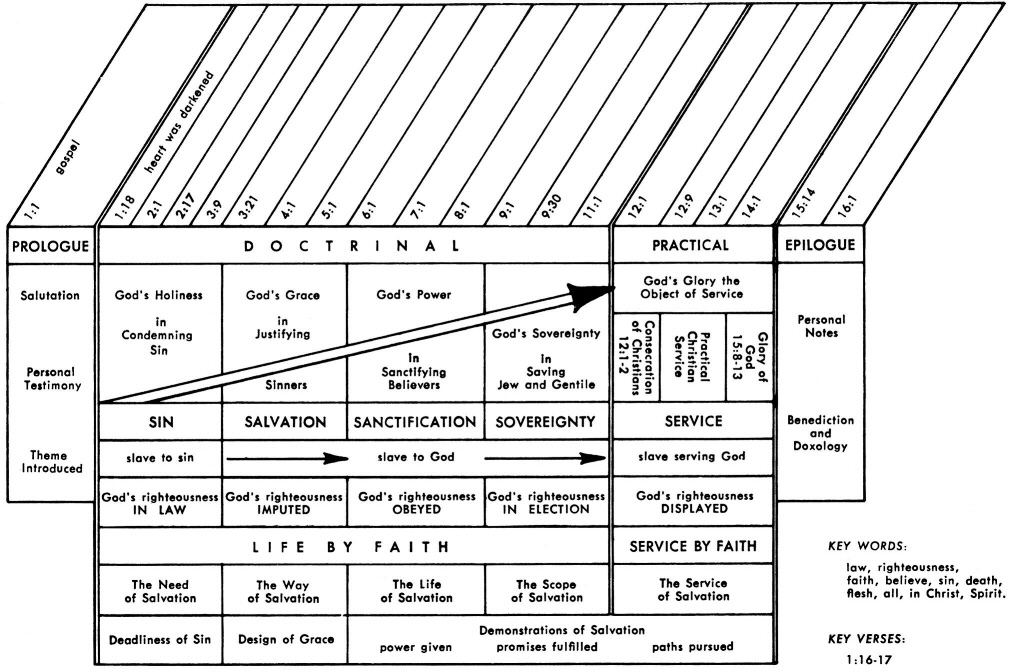
Click chart to enlarge
Chart from recommended resource Jensen's Survey of the NT - used by permission
Romans Overview Chart - Charles Swindoll
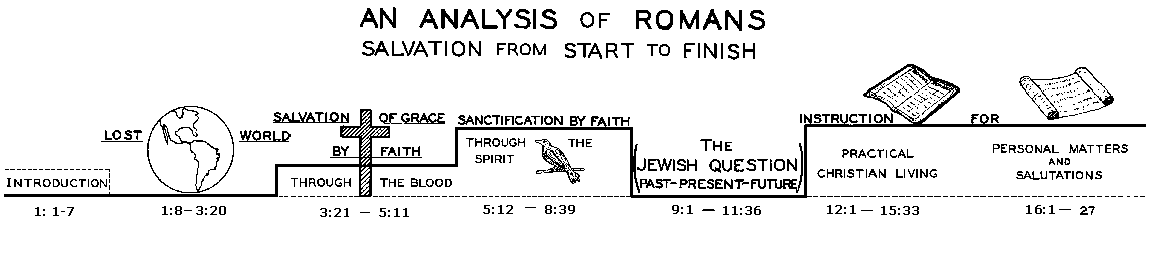
Source: Dr David Cooper
Click to Enlarge
| ROMANS ROAD to RIGHTEOUSNESS |
||||
| Romans 1:18-3:20 | Romans 3:21-5:21 | Romans 6:1-8:39 | Romans 9:1-11:36 | Romans 12:1-16:27 |
| SIN | SALVATION | SANCTIFICATION | SOVEREIGNTY | SERVICE |
| NEED FOR SALVATION |
WAY OF SALVATION |
LIFE OF SALVATION |
SCOPE OF SALVATION |
SERVICE OF SALVATION |
| God's Holiness In Condemning Sin |
God's Grace In Justifying Sinners |
God's Power In Sanctifying Believers |
God's Sovereignty In Saving Jew and Gentile |
Gods Glory The Object of Service |
| Deadliness of Sin |
Design of Grace |
Demonstration of Salvation | ||
| Power Given | Promises Fulfilled | Paths Pursued | ||
| Righteousness Needed |
Righteousness Credited |
Righteousness Demonstrated |
Righteousness Restored to Israel |
Righteousness Applied |
| God's Righteousness IN LAW |
God's Righteousness IMPUTED |
God's Righteousness OBEYED |
God's Righteousness IN ELECTION |
God's Righteousness DISPLAYED |
| Slaves to Sin | Slaves to God | Slaves Serving God | ||
| Doctrine | Duty | |||
| Life by Faith | Service by Faith | |||
|
Modified from Irving L. Jensen's chart above |
||||
Romans 5:3 And not only this, but we also exult in our tribulations, knowing that tribulation brings about perseverance (NASB: Lockman)
Greek: ou monon de, alla kai kauchometha (1PPMI) en tais thlipsesin, eidotes (RAPMPN) hoti e thlipsis hupomonen katergazetai, (3SPMI)
Amplified: Moreover [let us also be full of joy now!] let us exult and triumph in our troubles and rejoice in our sufferings, knowing that pressure and affliction and hardship produce patient and unswerving endurance. (Amplified Bible - Lockman)
Barclay: Not only that, but let us find a cause of glorying in our troubles; for we know that trouble produces fortitude;
Newell: And not only so, but we also exult in the tribulations which beset us: knowing that tribulation is working out endurance
NLT: We can rejoice, too, when we run into problems and trials, for we know that they are good for us—they help us learn to endure. (NLT - Tyndale House)
Phillips: This doesn't mean, of course, that we have only a hope of future joys - we can be full of joy here and now even in our trials and troubles. Taken in the right spirit these very things will give us patient endurance; (Phillips: Touchstone)
Wuest: And not only this, but we also are exulting in our tribulations, knowing that this tribulation produces endurance
Young's Literal: And not only so, but we also boast in the tribulations, knowing that the tribulation doth work endurance;
AND NOT ONLY THIS: ou monon de :
And not only this - This begs a simple question - "What is THIS?" Always pause and ponder when you encounter this genre of phrase. It serves to slow you down, to give you time to hear from your Teacher the Spirit and to in effect "meditate" on the passage (See the incredible blessings of Biblical Meditation). Develop an interrogative mindset as you read (interrogate with the 5W/H questions). In the secular world, the best reporters (those who glean the most information) are those who have learned the skill of asking the best questions. It takes some practice, but it is a practice that produces an incredible return, for as you learn to question the text, you are learning to interact with (speak to and listen to) the Holy Spirit, the One Who wrote the book. How many books have you read, where you had the golden opportunity to talk to the author about the meaning of a scene in the book? Not many, if you're like me. But every time you open the Book of books, remember to go to the Author and ask Him to open your heart to His truth and give you the ability to interact with the text. You will not regret it!
And not only (in the NAS this identical phrase occurs in Ro 5:3, 11, 8:23, 9:10, 2Cor 7:7, 8:19, Gal 4:18, 2Ti 4:8) - Leon Morris remarks that this "is a mark of Paul’s style. it recurs with some frequency when he is piling another argument on to the preceding one."
Godet writes "But some one will ask the apostle: And what of the tribulations of life? Do you count them nothing? Do they not threaten to make you lower your tone? Not at all; for they will only serve to feed and revive the hope which is the ground of this glorying. This reply is contained and justified in the following verses. (Romans 5:1-11 The Certainty of Final Salvation for Believers)
This opening (not only this) conveys the idea but that's not all! Not only do we now experience peace with the holy, righteous, justly wrathful God. Not only do we stand forever in His grace with full access to His throne of grace. Not only do we rejoice in the hope of future glory. But we also rejoice in our tribulations, the believer's present classroom of what one might call "Spiritual Maturity 101".
Note that peace with God does not necessarily bring peace with man. The actual conditions of life, especially for believers in the midst of a hostile society, are not necessarily easy or pleasant, yet we have cause to rejoice in these hostile conditions as explained below. Job seems to have understood the value of this "process" to a some degree declaring that God "knows the way I take; When He has tried me, I shall come forth as gold." (Job 23:10-note)
Paul says he exults, rejoices, even boasts in them, instead of murmuring and complaining about them. So as we look at the role of afflictions in the Christian life, keep in mind that they are any tests to your faith. Anything that makes life harder and threatens your faith in the goodness and power and wisdom of God is tribulation. These are normal, not abnormal. It would be abnormal for a Christian not to have them, as Paul taught the churches [Acts 14:22 1Thes 1:5, 3:2 cp Jn 16:33 Heb 10:32,33]. Now, do you rejoice in trials (NOT because of them!? Have you learned to live on this level yet? Do you rejoice in sufferings? Now, this is being ready for life.
Ray Stedman - Paul takes the very worst things about life -- the periods of heartache and sorrow and disappointment, the tears, the crying, the heartbreaks of life -- the suffering, and he says it makes us rejoice: We rejoice in our sufferings. Now, I believe it is time that we Christians take these words very seriously, because this is no special standard, reserved for just a few wonderful saints who, by virtue of great faith, are able to live on this high level -- this is the normal expectation of every Christian [The Normal Christian Life]. Oh, I wish I could shout that, sing it, paint it -- I don't care how -- just so I could get across that message! This is what God expects of every Christian, and he not only expects it, but provides for it. Anything less than this is simply sub-Christian living. Have you learned to live on this level? Have you learned to rejoice in suffering? Or, do you still gripe and complain and grumble and murmur about all the circumstances that come? Do you remember the story of Sophie, the scrub woman, who lived in New York City, and made her living scrubbing floors in the skyscrapers of New York? By that means, she earned thousands of dollars to send out missionaries. That one woman supported some twenty or thirty missionaries, alone. Sophie had a wonderful character of glory about her all the time -- so much so that she used to cause people to stop her and ask what her secret was. On several occasions, while she was working, some office worker would come to work late and would say to her, "Sophie, I wish I had your faith -- I wish I knew God like you know him." And she would say, "Well, if you would read your New Testament right, you could know him." This person would say, "Well, I read my Bible." In fact, she said this one time to a minister. He said, "I read the Bible -- I read the Bible in Greek and Hebrew." And she said, "Well, you don't read it right!" And he said, "What do you mean?" "Well," she said, "when it says g-l-o-r-y in tribulations, you read it g-r-o-w-l, growl. That is the trouble with you, that is why you don't have joy in your heart, you growl in tribulation." That is exactly what Paul is getting at here, you see. Someone has said that the definition of a Christian is a one who is: Completely fearless, Continually cheerful, and Constantly in trouble! That's true! Do you know the secret to that kind of Christianity? Let's face it -- most of us feel, really, that being a Christian should excuse us somewhat from trials and sufferings. I know that, if we are asked, we would say that we realize that sufferings may come, but that we don't think of them as really necessary. We think that sufferings are sort of signs that something is wrong, that, if we keep in fellowship with Christ, things ought to go well. And, if we have difficulty, we feel it is a sign that we are out of fellowship, or that Christianity doesn't really work after all." (Faith Faces Life) (Bolding added)
Matthew Henry - Observe, what a growing increasing happiness the happiness of the saints is: Not only so. One would think such peace, such grace, such glory, and such a joy in hope of it, were more than such poor undeserving creatures as we are could pretend to; and yet it is not only so: there are more instances of our happiness—we glory in tribulations also, especially tribulations for righteousness’ sake, which seemed the greatest objection against the saints’ happiness, whereas really their happiness did not only consist with, but take rise from, those tribulations. They rejoiced that they were counted worthy to suffer, Acts 5:41. This being the hardest point, he sets himself to show the grounds and reasons of it."
BUT WE ALSO EXULT IN OUR TRIBULATIONS: alla kai kauchometha (1PPMI) en tais thlipsesin :
- Ro 8:35, 36, 37; Mt 5:10-12; Lk 6:22,23; Acts 5:41; 2Cor 11:23-30; 12:9,10; Eph 3:13; Phil 1:29; 2:17,18; Jas 1:2,3,12; 1Pet 3:14; 4:16,17) (2Cor 4:17; Heb 12:10,11
- Romans 5 Resources - Multiple Sermons and Commentaries
But (alla) - see discussion of value of observing and querying terms of contrast.
Hodge explains that "Since our relationship to God is changed, the relationship of all things to us is changed. Sufferings, which had been the expressions of God’s displeasure, are now the kind and beneficial expressions of his love. Instead of being inconsistent with our relationship to him as our Heavenly Father, they prove that he regards and loves us as his children (see Ro 8:18-note; Heb 12:6-note). Therefore tribulations, although for the present they bring only pain, become for the believer a matter of joy and thankfulness (Romans 5 Commentary)
Spurgeon commenting on exult in our tribulation notes that Paul "tells us of another joy of which worldlings certainly never taste. “Not only so, but we glory in tribulations also.” There is a secret sweetness in the gall and wormwood of our daily trials, a sort of ineffable, unutterable, indescribable, but plainly-experienced joy in sorrow, and bliss in woe. O friends, I think that the happiest moments I have ever known have been just after the sharpest pains I have ever felt. As the blue gentian flower grows just upon the edge of the Alpine glacier, so, too, extraordinary joys, azure-tinted with the light of heaven, grow hard by the severest of our troubles, the very sweetest and best of our delights… Let no man’s heart fail him when he hears the experience of the tried people of God. It is true that we do have troubles peculiar to the Christian state; there are some sorrows which are not known outside the family of God. They are very blessed, health-giving, purifying sorrows, and we would not wish to be without them; but, still, sometimes they are very keen, and cut the heart even to its very center. Yet though that; is the case, — and we admit that it is, — we also have some peculiar joys which no others realize. There are fruits in God’s storehouse which no mouth has ever tasted till it has been washed clean by the Word and by the Spirit of God. There are secret things which are not seen by the human eye, however much enlightened by knowledge, until that eye has been touched with heaven’s own eye-salve that it may look and still may live, — look into the glory, and not be blinded by the wondrous sight. Come, then, ye who are tempted by the world’s joys, and see where true joy is to be found. Turn away from that painted Jezebel; she will but mock and deceive you. (Romans 5:11 Joy in God)
Solid joys and lasting treasure,
None but Zion’s children know.
We also exult - He who has been justified exults, not in spite of his tribulations, but in or because of his tribulations. Because of all of these blessings and benefits of having been justified by faith, there is cause for confident jubilation, which is brought out by 3 uses of the same verb (kauchaomai) in Romans 5, all three uses being in the present tense which speaks of one's habitual practice (note the objects of the exultation)…
we exult in hope (certainty) of the glory of God. (see note Romans 5:2)
we also exult in our tribulations (Ro 5:3)
And not only this, but we also exult in God through our Lord Jesus Christ, through whom we have now received the reconciliation. (see note Romans 5:11)
Exult (2744) (kauchaomai from root word auchen = describes the neck which vain persons are apt to carry in proud manner) means to take pride in something or to boast over a privilege or possession. The idea is rejoice with (appropriate) pride. As used in the positive sense self-confidence is radically excluded and all self-boasting is abandoned. Faith implies the surrender of all self-glorying. In the present tense kauchaomai signifies that saints are to live a life of continual exultation! Are you exulting in your suffering? I would submit the only way to live this quality of supernatural life is by continually being filled with (controlled by, enabled by, empowered by) the Holy Spirit (Eph 5:18-note).
Kauchaomai was used in the OT describing any proud and exulting joy (See uses in Septuagint translation - 1Chr 16:35, Ps 5:11, 32:11, 149:5, Jer 9:23-24). And so kauchaomai can mean to rejoice, feel joy or great delight and in this sense combines the ideas of jubilation and confidence into one word to describe "joyful confidence". It also carries the thought of giving expression to what is felt and not simply the feeling. It is one thing to submit to or endure tribulations without complaint, but it is another to find ground of glorying in the midst of them as Paul exhorts here.
Paul used this same verb earlier in a negative connotation writing that " if you bear the name "Jew," and rely upon the Law, and boast in God… You who boast in the Law, through your breaking the Law, do you dishonor God?" (Ro 2:17, 23 - see notes Romans 2:17; 2:23) In Romans 5 Paul uses kauchaomai in a positive light, exhorting believers to be (passive voice) continually (present tense) possessed this joyful confidence. Note however that Paul is not saying we are to rejoice "because of" but "in" our tribulations for they have great purpose as explained below.
Cranfield writes "that the exulting in tribulations to which this verse refers is not an exulting in them as in something meritorious on our part… but an exulting in them as in that to which God subjects us as part of the discipline by which He teaches us to wait patiently for His deliverance. As a general statement "tribulation accomplishes patience" would lack validity; for, as Calvin points out, tribulation ‘provokes a great part of mankind to murmur against God, and even to curse Him’. But Paul is here thinking of what it achieves, when it is met by faith in God which receives it as God’s fatherly discipline. Where God sustains faith, tribulation produces hupomone. (Exegetical Commentary on the Epistle to the Romans. Vol 1: Ro 1-8.; Volume 2: Romans 9-16)
Leon Morris observes that "Rejoice (“boast” or “exult” again) is a striking word to use of afflictions, but the attitude (with or without this word) is found often throughout the New Testament (cf. Mt 5:4, 10, 11, 12 -see notes Mt 5:4,10; 11; 12; Acts 5:41; 14:22; 2Co 12:9,10-note; 2Th 1:5; 1Pe 4:13,1 4-see notes 1Pe 4:13;14). People generally think of troubles as evils to be endured as gracefully as possible. Paul thinks of them not as simply to be endured, but to be gloried in. (Morris, L. The Epistle to the Romans. W. B. Eerdmans; Inter-Varsity Press)
Newell sums this section up writing that "So now we find that not only does the believer look back to peace made with God at the cross; at a God smiling upon him in favor; and forward to his coming glorification with Christ, but he is able also to exult in the very tribulations that are appointed to him. Paul constantly taught, as in Acts 14:22; 2Thes 3:3, that "through many tribulations we must enter into the kingdom of God, " and that "we are appointed unto afflictions." (Romans Verse by Verse)
As Matthew Henry put it we can rejoice in tribulations "because tribulations, by a chain of causes, greatly befriend hope"!
REJOICING IN SUFFERING?!!!
Robert Haldane explains "This rejoicing, however, is not in tribulations considered in themselves, but in their effects. It is only the knowledge of the effects of afflictions, and of their being appointed by his heavenly Father, that enables the Christian to rejoice in them. Being in themselves an evil, and not joyous but grievous, they would not otherwise be a matter of rejoicing, but of sorrow. But viewed as proceeding from his heavenly Father’s love, He 12:6 (note); Re 3:19(note), they are so far from depriving him of his joy, that they tend to increase it. The way to the cross was to his Savior the way to the crown, and he knows that through much tribulation he must enter into the kingdom of God, Acts 14:22. The greatest tribulations are among those things that work together for his good. God comforts him in the midst of his sorrows, 2Corinthians 1:4. Tribulation, even death itself, which is numbered among his privileges, 1Corinthians 3:22, shall not separate him from the love of God, which is in Christ Jesus our Lord. The Apostle Peter addresses believers as greatly rejoicing in the hope of salvation, though now, if need be, they are in heaviness through manifold trials. Tribulation worketh or effecteth patience.—Christians should be well instructed on this point, and should have it continually in their eye: their happiness is greatly concerned in it. If they forget the end and tendency of afflictions, they will murmur like the Israelites. Patience is a habit of endurance; and Christian patience implies submission to the will of God. Paul says here that affliction worketh patience, and James 1:3, says that the trying of faith worketh patience. This proves that the afflictions of a Christian are intended as a trial of his faith. What by the one Apostle is called tribulation, is by the other called trial of faith. The effect of affliction is patience, a grace which is so necessary, as we are all naturally impatient and unwilling to submit unreservedly to the dispensations of God. Patience gives occasion to the exercise of the graces of the Spirit, and of submission under afflictions to the will of God. (Haldane, R. An Exposition on the Epistle to the Romans)
Hodge adds that…
The words we rejoice in our sufferings do not mean that we rejoice in the midst of sufferings, but because of them. They are themselves a reason for rejoicing. So the Jews are said to rejoice in the law, others rejoice in men, while the believer constantly rejoices in the Lord. The Christian feels that sufferings themselves are an honor and a blessing. This is a sentiment often expressed in the Word of God.
Our Lord says, “Blessed are those who mourn” (5:4-note); “Blessed are those who are persecuted” (Mt 5:10-note). He calls on his suffering disciples to rejoice and be glad when they are afflicted (Mt 5:10, 11, 12-note).
The apostles left the Jewish council “rejoicing because they had been counted worthy of suffering disgrace for the Name” (Acts 5:41).
Peter calls on Christians to rejoice when they participate in Christ’s sufferings and pronounces them happy when they are insulted for his sake (see notes 1 Peter 4:13; 14).
And Paul says, “Therefore I will boast all the more gladly about my weaknesses” (that is, my sufferings). “For Christ’s sake, I delight in weaknesses,” he says, “in insults, in hardships, in persecutions, in difficulties” (2 Corinthians 12:9, 10).
This is not irrational or fanatical. Christians do not glory in suffering as such, or for its own sake, but because of what the Bible teaches.
1. They consider it an honor to suffer for Christ.
2. They rejoice in being given the opportunity of showing his power in their support and deliverance.
3. Suffering is made the means of their own sanctification and preparation for usefulness here and for heaven hereafter.
In this context the apostle refers to the last of these reasons. We rejoice in our sufferings, he says, because suffering produces perseverance, “constancy.” It brings that strength and firmness seen in the patient endurance of suffering and in perseverance in faithfulness to truth and duty under the severest trials. (Commentary on Romans)
John Piper gives a lucid explanation of how one can genuinely rejoice in the midst of adverse condition writing that ""the answer from verse 2 is that we are standing in grace. This is God's omnipotent power to help us though. We don't deserve it. You don't hold the key to this wonderful, supernatural way of life that should set Christians off from the world, God does. The power to rejoice and exult in tribulation comes from omnipotent grace that we receive by trusting in God's promises. Here's an illustration of it from 2 Corinthians 8:1, 2. Paul is talking about the way the Macedonian Christians rejoiced in their afflictions even in great poverty. Notice the key: "Now, brethren, we wish to make known to you the grace of God which has been given in the churches of Macedonia, that in a great ordeal of affliction their abundance of joy and their deep poverty overflowed in the wealth of their liberality." Do you see the key: "the grace of God" was given to them. And that produced an indomitable joy in a great ordeal (or test) of affliction. And that joy in affliction overflowed in love."
Piper continues by asking some probing questions that apply to every believer…
How are we doing today when things go bad for us?
Do we rest in the grace of God and experience joy in God and keep on loving people?
Or do we forget the grace of God, overflow with complaining and become self-absorbed and critical instead of loving?
So omnipotent power of grace is the key. We stand in this grace, Paul says in verse 2. But grace does not work like magic. It works through truth. You will know the truth and the truth will set you free (John 8:32) - from complaining and from paralyzing frustration and from a critical spirit. Grace opens the eyes of the heart to truth and inclines the heart to embrace it and live by it. What truth? That is what the rest of this text is about. There are four truths that Paul wants us to know and meditate on. That is how grace will change us into peaceful, joyful people who exult in our afflictions.
In other words, if something happens in your life that is hard and painful and frustrating and disappointing, and, by grace, your faith looks to Christ and to his power and his sufficiency and his fellowship and his wisdom and his love, and you don't give in to bitterness and resentment and complaining, then your faith endures and perseveres.
Paul is not asking us to grit our teeth and be stoical (Ed note: a stoic is one who is apparently or professedly indifferent to pleasure or pain) about suffering. Neither is he saying that afflictions, in themselves, should be enjoyed. Rather, we are asked to rejoice because of what sufferings can produce.
The pressures of life have a way of developing endurance in us, and this endurance can be exercised only when we are placed under pressure. The very trials we dread are thus used by God to strengthen us.
Therefore the followers of Christ can view sufferings as opportunities, as training situations in which our inner reserves of strength and tenacity are developed. And how we need these qualities if we are to maintain godly, righteous lives in the complex, highly pressurized societies in which we live!" (See the complete message: We Exult in Our Tribulations) (Bolding and color added)
Ray Stedman explains that "Rejoicing in suffering is not simply stoicism. It is not simply a 'Grin and bear it' attitude, or 'Tough it out' and see how much you can take, or 'Just hang in there until it's over' and 'don't let anything get you down,' or 'Keep a stiff upper lip.' Many people feel that if they do that, they are fulfilling the Word and "rejoicing in suffering." But that is not it. There are non-Christians who can do that. Many people pride themselves on how much they can take. Sometimes people who are not Christians will put us to shame by the things that they can take without complaining.
We are not merely expected to enjoy the pain. There are some people who think "rejoicing in suffering" means that you are to enjoy your pain and hurt, that somehow Christians ought to be glad when terrible tragedy occurs and their hearts are hurting. That is not what Paul is saying. But there are people who feel that way -- they are called masochists -- they like to torture themselves. You have met people like that, who aren't happy unless they're miserable. If you take their misery away from them, they are really wretched, because it is their misery that gives them a sense of contentment. That is a twisted, distorted view of life. That is not what Paul is saying.
Nor is he saying that we merely are to pretend that we are happy. Some think this passage is saying that when you are out in public, you should put on an artificial smile and act happy, when inside your heart is hurting like crazy. Now that is not it. Christianity is never phony. Phoniness of any kind is a false Christianity.
I heard a man some years ago put this very clearly. Some of you may remember this man. He was going through great physical trouble, and one of his legs was amputated. That did not arrest the course of his disease, and he ultimately died because of it. Just a few days before his death I visited him in the hospital and he said something to me that I never forgot because it so perfectly expresses what Christian rejoicing in suffering means. He said,
"I never would have chosen one of the trials that I've gone through, but I wouldn't have missed any of them for the world!"
Now that is saying it. There is an awareness that this suffering has done something of supreme value; therefore, you wouldn't have missed it. But you wouldn't have chosen it, either! Watch a woman in labor; watch the expression on her face. If you have any empathy in you, you can't help but feel deeply hurt with her because she is going through such pain. And yet, there usually is joy in the midst of it because she knows that childbirth produces children. It is the child that makes it all worthwhile. There are probably women here this morning who will gladly go through childbirth again because they want a child. Suffering produces something worthwhile." (See the complete message: Rejoicing in Suffering) (Bolding added)
Related Resources:
- Why Would A Good God Allow Suffering? Finding goodness in trouble
- Knowing God Through Job Trusting God's purpose in suffering
- 10 Reasons To Believe In A God Who Allows Suffering
- What does the Bible say about suffering?
- Is suffering for Christ always going to be a part of being a follower of Christ?
- What does the Bible say about affliction?
Tribulation (2347) (thlipsis from thlibo = to crush, press together, squash, hem in, compress, squeeze in turn derived from thláo = to break) originally expressed sheer, physical pressure on a man. Thlipsis is a strong term which does not refer to minor inconveniences, but to real hardships.
Medically thlipsis was used of the pulse (pressure). It is a pressing together as of grapes. It conveys the idea of being squeezed or placed under pressure or crushed beneath a weight. When, according to the ancient law of England, those who willfully refused to plead guilty, had heavy weights placed on their breasts, and were pressed and crushed to death, this was literally thlipsis. The iron cage was stenochoria (see below). Thlipsis thus refers not to mild discomfort but to great difficulty.
Morris rightly notes that "No one likes troubles of this kind, but they may be seen as difficulties to be overcome, as ways of opening up new possibilities. One who sees them in this light glories in them (Ibid)
Martin Luther wrote that "Whatever virtues tribulation finds us in, it develops more fully. If anyone is carnal, weak, blind, wicked, irascible, haughty, and so forth, tribulation will make him more carnal, weak, blind, wicked and irritable. On the other hand, if one is spiritual, strong, wise, pious, gentle and humble, he will become more spiritual, powerful, wise, pious, gentle and humble."
Thlipsis is used 45 times in the NT is translated: affliction (inflicting on a person something that is hard to bear), 14; afflictions, 6; anguish, 1; distress (the state of being in great trouble), 2; persecution (harassment in a manner designed to injure, grieve, or afflict), 1; tribulation (distress or suffering resulting from oppression or persecution), 16; tribulations, 4; trouble, 1
Matt. 13:21; 24:9, 21, 29; Mk. 4:17; 13:19, 24; Jn. 16:21, 33; Acts 7:10f; 11:19; 14:22; 20:23; Rom. 2:9; 5:3; 8:35; 12:12; 1 Co. 7:28; 2 Co. 1:4, 8; 2:4; 4:17; 6:4; 7:4; 8:2, 13; Eph. 3:13; Phil. 1:17; 4:14; Col. 1:24; 1 Thess. 1:6; 3:3, 7; 2 Thess. 1:4, 6; Heb. 10:33; Jas. 1:27; Rev. 1:9; 2:9, 10, 22; 7:14.
Thlipsis - 99x in the Septuagint (LXX) =
Ge 35:3 ("distress"); Ge 42:21; Ex 4:31; Deut. 4:29; 28:53, 55, 57; 31:17; Jdg. 10:14; 1 Sam. 1:6; 10:19; 24:19; 26:24; 2 Sam. 4:9; 22:19; 1 Ki. 1:29; 22:27; 2 Ki. 13:4; 19:3; 2 Chr. 15:6; 18:26; 20:9; Neh. 9:27, 37; Esther 1:1; 4:17; 8:12; Job 15:24; Ps. 4:1; 9:9; 10:1; 20:1; 22:11; 25:17, 22; 32:7; 34:6, 17, 19; 37:39; 44:24; 46:1; 50:15; 54:7; 55:3; 59:16; 60:11; 66:11, 14; 71:20; 77:2; 78:49; 81:7; 86:7; 91:15; 107:39; 108:12; 116:3; 118:5; 119:143; 138:7; 142:2; 143:11; Pr 1:27; 21:23; 24:10; Isa. 8:22; 10:3, 26; 26:16; 28:10, 13; 30:6, 20; 33:2; 37:3; 57:13; 63:9; 65:16; Jer. 6:24; 10:18; 11:16; 15:11; 50:43; Ezek. 12:18; 18:18; Dan. 12:1; Hos. 5:15; 7:12; Obad. 1:12, 14; Jon. 2:2; Mic. 2:12; Nah. 1:7, 9; 2:1; Hab. 3:16; Zeph 1:15; Zech. 8:10
Thlipsis is used twice in Ge 42:21 - Then they said to one another, "Truly we are guilty concerning our brother, because we saw the distress (Heb = tsarah = straits; Lxx = thlipsis) of his soul when he pleaded with us, yet we would not listen; therefore this distress (Heb = tsarah = straits; Lxx = thlipsis) has come upon us."
John MacArthur writes that "Thlipsis (tribulations) has the underlying meaning of being under pressure and was used of squeezing olives in a press in order to extract the oil and of squeezing grapes to extract the juice… In Scripture the word thlipsis is perhaps most often used of outward difficulties, but it is also used of emotional stress." (MacArthur, J: Romans 1-8. Chicago: Moody Press)
Figuratively thlipsis pictures one being "crushed" by intense pressure, difficult circumstances, suffering or trouble pressing upon them from without. Thus persecution, affliction, distress, opposition or tribulation, all press hard on one's soul. Thlipsis does not refer to mild discomfort but to great difficulty. In Scripture the thlipsis is most often used of outward difficulties, but it is also used of emotional stress and sorrows which "weighs down" a man’s spirit like the sorrows and burden his heart. Thlipsis then includes the disappointments which can "crush the life" out of the one who is afflicted.
The English word "tribulation" is derived from the Latin word tribulum (literally a thing with teeth that tears), which was a heavy piece of timber with spikes in it, used for threshing the corn or grain. The tribulum was drawn over the grain and it separated the wheat from the chaff. As believers experience the "tribulum" of tribulations, and depend on God’s grace, the trials purify us and rid us of the chaff.
Lawrence Richards writes that "thlipsis is used as a technical theological term for the Great Tribulation (see note below) of the end times. Thlipsis is also used in a non-theological, figurative way to convey the idea of the great emotional and spiritual stress that can be caused by external or internal pressures. Of the fifty-five uses of this root (thlipsis and thlibo) in the NT, fifty-three are figurative and correspond closely to the Hebrew words tsarah and tsar." (Richards, L O: Expository Dictionary of Bible Words: Regency)
Marvin Vincent has the following note explaining that the root thlibo means "to press or squeeze. Tribulation is perhaps as accurate a rendering as is possible, being derived from tribulum, the threshing-roller of the Romans. In both the idea of pressure is dominant, though thlipsis does not convey the idea of separation (as of corn from husk) which is implied in tribulatio." (Vincent, M. R. Word studies in the New Testament Vol. 1, Page 3-80)
Vine writes that thlipsis "primarily means a pressure, that which weighs down the spirit. For the believer who is enabled to endure it, the affliction becomes a means of triumph… “afflictions” are the various forms of injury to body and mind suffered by those who are persecuted… Thlipsis is the suffering which results from what presses hard on the soul." (Collected writings of W. E. Vine)
The International Standard Bible Encyclopedia adds that "thlipsis derives from roots that graphically portray the process in which a person is first limited, then walled in, and gradually squeezed until something must give. Sometimes the tribulation is seen as a punishment for sin (see note Romans 2:9), sometimes as a part of life to be expected and tolerated (Ro 12:2-note) (Bromiley, G. W. The International Standard Bible Encyclopedia, Revised. Wm. B. Eerdmans)
The picture of thlipsis is of one being squeezed. When you squeeze something, what comes out is what is on he inside. What comes out of you when you are experiencing "thlipsis"? Remember believers have Christ in them the hope of glory and therefore have the potential to exude the fragrance of His life when crushed.
Here in Romans 5 thlipsis is preceded by the definite article, marking these tribulations out as specific occurrences naturally expected in a Christian’s life. Paul did not exult because of the tribulations themselves but because of their beneficial effect upon his Christian life. This the saint must learn to do as we grow in grace, weathering the trial, learning to lean on and trust Him. The believer must look at his or her tribulations as "assets" that God uses to hone one's Christian character into Christ like conformity (1Pe 1:6-7-note). And so in context Paul says that thlipsis brings forth or accomplishes patience, proven character and hope.
William Barclay writes that thlipsis "In ordinary Greek always describes actual physical pressure on a man… Sometimes there falls upon a man’s spirit the burden and the mystery of this unintelligible world. In the early years of Christianity the man who chose to become a Christian chose to face trouble. There might well come to him abandonment by his own family, hostility from his heathen neighbours, and persecution from the official powers. Samuel Rutherford wrote to one of his friends, “God has called you to Christ’s side, and the wind is now in Christ’s face in this land: and seeing ye are with him ye cannot expect the lee-side or the sunny side of the brae.” It is always a costly thing to be a real Christian, for there can be no Christianity without its cross. (Ed note: i.e., thlipsis)" (Daily Study on 2 Corinthians 1 Commentary) (Bolding added)
In other notes Barclay writes that "thlipsis which originally expressed sheer, physical pressure on a man. There are things which weigh down a man’s spirit like the sorrows which are a burden on his heart and the disappointments which are like to crush the life out of him… Originally thlipsis meant simply pressure and could, for instance, describe the pressure of a great stone on a man’s body. At first it was used quite literally, but in the New Testament it has come to describe that pressure of events which is persecution. (Ibid)
Tribulation is the normal lot of Christians and is a fact repeatedly emphasized in the NT. In the first NT use, Jesus taught that thlipsis (affliction) comes because of the Word of God but that holding fast to the Word in the face of tribulation proves one to be genuine. "And the one on whom seed was sown on the rocky places, this is the man who hears the Word, and immediately receives it with joy; yet he has no firm root in himself, but is only temporary, and when affliction (thlipsis) or persecution arises because of the word, immediately he falls away." (Matthew 13:20-21)
William MacDonald explains that "The shallow earth yields a shallow profession; there is no depth to the root. But when his profession is tested by the scorching sun of tribulation or persecution, he decides it isn’t worth it and abandons any profession of subjection to Christ. (Believer's Bible Commentary)
Jesus warned that being one of His disciples in this world would bring its share of difficulties
These things I have spoken to you, that in Me you may have peace. In the world you have tribulation (thlipsis), but take courage; I have overcome the world." (John 16:33)
C H Spurgeon has the following devotional on this verse…
Art thou asking the reason of this, believer?
Look upward to thy heavenly Father, and behold him pure and holy. Dost thou know that thou art one day to be like Him? Wilt thou easily be conformed to His image? Wilt thou not require much refining in the furnace of affliction to purify thee? (1Pet 1:6, 7- see notes 1Pe1:6; 1:7) Will it be an easy thing to get rid of thy corruptions, and make thee perfect even as thy Father which is in heaven is perfect? (Mt 5:48 - notes)
Next, Christian, turn thine eye downward. Dost thou know what foes thou hast beneath thy feet? Thou wast once a servant of Satan, and no king will willingly lose his subjects. Dost thou think that Satan will let thee alone? No, he will be always at thee, for he "goeth about like a roaring lion, seeking whom he may devour." (1Pe 5:8-note) Expect trouble, therefore, Christian, when thou lookest beneath thee.
Then look around thee. Where art thou? Thou art in an enemy's country, a stranger and a sojourner (1Pe 1:1-note; 1Pe 2:11-note). The world is not thy friend. If it be, then thou art not God's friend, for he who is the friend of the world is the enemy of God (Jas 4:4). Be assured that thou shalt find foe-men everywhere. When thou sleepest, think that thou art resting on the battlefield; when thou walkest, suspect an ambush in every hedge. As mosquitoes are said to bite strangers more than natives, so will the trials of earth be sharpest to you.
Lastly, look within thee, into thine own heart and observe what is there. Sin and self are still within (Ro 7:18-note). Ah! if thou hadst no devil to tempt thee, no enemies to fight thee, and no world to ensnare thee, thou wouldst still find in thyself evil enough to be a sore trouble to thee, for "the heart is deceitful above all things, and desperately wicked." (Jeremiah 17:9)
Expect trouble then, but despond not on account of it, for God is with thee to help and to strengthen thee. He hath said, "I will be with thee in trouble; I will deliver thee and honour thee." (Ps 91:15 - see "Heirs of heaven are conscious of a special divine presence in times of severe trial. God is always near in sympathy and in power to help his tried ones. The man honors God, and God honors him. Believers are not delivered or preserved in a way which lowers them, and makes them feel themselves degraded; far from it, the Lord's salvation bestows honour upon those it delivers. God first gives us conquering grace, and then rewards us for it. Spurgeon's Note)
Writing to the Thessalonian saints who had heard and received the gospel, Paul explained that
our gospel did not come to you in word only, but also in power and in the Holy Spirit and with full conviction; just as you know what kind of men we proved to be among you for your sake. You also became imitators of us and of the Lord, having received the word in much tribulation (thlipsis) with the joy of the Holy Spirit (See notes 1Thessalonians 1:5; 1:6)
How did the Thessalonian believers bear up under emotionally crushing circumstances? Paul says that even though the tribulation was quantitatively great, they were empowered "with the joy of the Holy Spirit."
In his second epistle Paul commends the Thessalonian saints
for (their) perseverance and faith in the midst of all (their) persecutions and afflictions (thlipsis) which (they) endured." (2Thes 1:4)
Paul explained that God Himself, the Father of mercies and God of all comfort…
comforts (comes alongside of) us in all our affliction (thlipsis) so that (notice again how your affliction is not without purpose) we may be able to comfort those who are in any affliction with the comfort with which we ourselves are comforted by God." (2 Corinthians 1:3-4)
From these uses of thlipsis in the NT, it is clear that tribulation is the path believers are destined to tread in this present life. Notice that thlipsis in the NT does not refer to the normal pressures of every day life, but to the inevitable troubles that come upon all followers of Christ because of their relationship with Him and His Word.
Luke records that after Paul was stoned in Lystra, he survived this "crushing event" and went on to Derbe with Barnabas and that…
after they had preached the gospel to that city and had made many disciples, they returned to Lystra and to Iconium and to Antioch, strengthening the souls of the disciples, encouraging them to continue in the faith, and saying, "Through many (polus = quantitatively = same word in description of Thessalonians above) tribulations (thlipsis) we must enter the kingdom of God." (Acts 14:21-22)
Commenting on Acts 14:22 Spurgeon writes that "It is ordained of old that the cross of trouble should be engraved on every vessel of mercy, as the royal mark whereby the King’s vessels of honour are distinguished. But although tribulation is thus the path of God’s children, they have the comfort of knowing that their Master has traversed it before them; they have his presence and sympathy to cheer them, his grace to support them, and his example to teach them how to endure; and when they reach “the kingdom,” it will more than make amends for the “much tribulation” through which they passed to enter it." (Morning and evening: Daily readings: Morning, March 8)
Writing to the Colossian saints, Paul said
Now I rejoice in my sufferings for your sake (refers to his present imprisonment), and in my flesh I do my share on behalf of His body (which is the church) in filling up that which is lacking in Christ's afflictions (thlipsis) (in that Paul was receiving the persecution that was intended for Christ)." (Col 1:24-note)
Paul's afflictions have no atoning value, for In Jesus’ death on the cross, the work of salvation was completed. It is also worth noting that , thlipsis is used nowhere in the New Testament to speak of Christ’s sufferings. Lawrence Richards adds that…
The Greek word thlipsis is not linked with social vulnerability. It focuses attention on external conditions as the cause of emotional pressures. Paul's thought in Colossians is that the afflictions and the suffering that have come to him in the course of his ministry should not be viewed as discipline or as punishment. Instead, such suffering is an extension of the suffering experienced by Jesus, for it comes from the same source. Following Jesus, Paul also willingly chose a course of action that would bring him into conflict with human society. We, too, have the privilege of making such choices, knowing that the pain that comes to us is far outweighed by the benefits our suffering will bring to others." (Richards, L O: Expository Dictionary of Bible Words: Regency) (Bolding added)
God promises that no matter how many or how great the tribulations we are called upon to endure for the sake of His Name and His Word. In Romans 8 Paul asks…
Who shall separate us from the love of Christ? Shall tribulation (thlipsis), or distress (stenochoria), or persecution, or famine, or nakedness, or peril, or sword? (Ro 8:35-note)
And then Paul answers that…
in all these things (thlipsis, et al) we overwhelmingly conquer through Him who loved us, for I am convinced that neither death, nor life, nor angels, nor principalities, nor things present, nor things to come, nor powers, nor height, nor depth, nor any other created thing, shall be able to separate us from the love of God, which is in Christ Jesus our Lord." (see notes Romans 8:37; 8:38; 8:39)
In light of eternity tribulations today are for a moment, are "light" and are continually working in us to produce an unimaginable eternal weight of glory for
Therefore I ask you not to lose heart at my tribulations (thlipsis) on your behalf, for they are your glory." (Eph 3:13-note)
And lest you be tempted to seek revenge for thlipsis suffered for the sake of the Lord and His Word, remember that
"after all it is only just for God to repay with affliction (thlipsis) those who afflict (verb thlibo) you, and to give relief to you who are afflicted (verb thlibo) and to us as well when the Lord Jesus shall be revealed from heaven with His mighty angels in flaming fire dealing out retribution to those who do not know God and to those who do not obey the gospel of our Lord Jesus." (2Thes 1:6-8) (cp identical use of thlipsis in notes on Ro 2:9-note)
Paul explained the inestimable value of temporal thlipsis when viewed with eternal vision, explaining that…
momentary, light affliction (thlipsis) is producing for us an eternal weight of glory far beyond all comparison while we look not at the things which are seen, but at the things which are not seen; for the things which are seen are temporal, but the things which are not seen (e.g., our future glory) are eternal." (2 Corinthians 4:17-18-note).
In summary, the truth you need to remember regarding tribulations (thlipsis) is that
(1) tribulations have a purpose
(2) one's response to tribulations demonstrates the reality of one's faith
(3) temporal tribulations produce inestimable future, eternal glory
(4) God will avenge tribulations you have endured for His Name and Word
Jesus used thlipsis to refer to a specific time period, the last 3.5 years of Daniel's Seventieth Week as…
a Great Tribulation (thlipsis - see notes) such as has not occurred since the beginning of the world until now, nor ever shall" (Matthew 24:21)
In a parallel passage in the Revelation, John beheld "a great multitude, which no one could count, from every nation and all tribes and peoples and tongues, standing before the throne and before the Lamb, clothed in white robes, and palm branches were in their hands" (see note Revelation 7:9), whom one of the elders explained were "the ones who come out of the Great Tribulation (thlipsis - see notes), and they have washed their robes and made them white in the blood of the Lamb." (see note Revelation 7:14)
FOUR PICTURES OF PRESSURE/AFFLICTION
- Picture a Tea Bag - “People are like teabags; you never know how strong they are until they’re put in hot water.” When you place a tea bag in hot water, it doesn't change. But the hot water reveals what was already in the tea bag.
- Picture a Rose Petal - We think of the scent given off when a Rose Petal is stepped on & crushed.
- Picture a lump of Coal - We think of Coal being under tremendous pressure being formed into Diamond. And this is done in a very dark place.Most natural diamonds are formed at high temperature and pressure at depths of 87-120 miles in the earth mantle. Every pressure that comes your way in your home life, in college, in your employment, will make you either bitter or better! [The struggle is just part of the journey!]
- Picture a water-saturated sponge. If we push down with our finger even slightly, water runs out onto the table. We immediately know what fills the interior pockets of the sponge.
Oh, when we are journeying through the murky night and the dark woods of affliction and sorrow, it is something to find here and there a spray broken, or a leafy stem bent down with the tread of His foot and the brush of His hand as He passed; and to remember that the path He trod He has hallowed, and thus to find lingering fragrance and hidden strength in the remembrance of Him as "in all points tempted like as we are," bearing grief for us, bearing grief with us, bearing grief like us. - Alexander Maclaren
A believer may pass through much affliction, and yet secure very little blessing from it all. Abiding in Christ is the secret of securing all that the Father meant the chastisement to bring us. - Andrew Murray
Pour not on the comforts you want, but upon the mercies you have. Look rather at God's ending in afflicting, than to the measure and degree of your affliction.- Christopher Love
Vanity of science. Knowledge of physical science will not console me for ignorance of morality in time of affliction, but knowledge of morality will always console me for ignorance of physical science. - Blaise Pascal
The Lord gets his best soldiers out of the highlands of affliction. - Charles Spurgeon
As sure as God puts His children in the furnace of affliction, He will be with them in it. - Charles Spurgeon
It seems to me that doubt is worse than trial. I had sooner suffer any affliction than be left to question the gospel or my own interest in it.-Charles Spurgeon
Most of the grand truths of God have to be learned by trouble; they must be burned into us with the hot iron of affliction, otherwise we shall not truly receive them. - Charles Spurgeon
Providence is wonderfully intricate. Ah! You want always to see through Providence, do you not? You never will, I assure you. You have not eyes good enough. You want to see what good that affliction was to you; you must believe it. You want to see how it can bring good to the soul; you may be enabled in a little time; but you cannot see it now; you must believe it. Honor God by trusting Him. - Charles Spurgeon
The furnace of affliction is a good place for you, Christian; it benefits you; it helps you to become more like Christ, and it is fitting you for heaven. - Charles Spurgeon
Those who dive in the sea of affliction bring up rare pearls. - Charles Spurgeon
We can stand affliction better than we can prosperity, for in prosperity we forget God. - D.L. Moody
A great many people wonder why it was that Christ did not come at once to Martha and Mary, whom He loved, whenever He heard of their affliction. It was to try them, and it is the same with His dealings toward us. If He seems not to come to us in our affliction, it is only to test us. - D.L. Moody
Affliction is then come to the height and its complete measure, when the sinner is made sensible of his own weakness, and doth see there is no help for him, save in God alone. - David Dickson
Nothing unites people as sharing the same affliction. - Jack Hyles
As every mercy is a drop obtained from the ocean of God's goodness, so every affliction is a drachm weighed out in the wisdom of God's providence. - James H. Aughey
Hope is the last lingering light of the human heart. It shines when every other is put out. Extinguish it, and the gloom of affliction becomes the very blackness of darkness - cheerless and impenetrable. - James H. Aughey
It is not affliction itself, but affliction rightly borne, that does us good. - James H. Aughey
In times of affliction we commonly meet with the sweetest experiences of the love of God. - John Bunyan
A measure of trials is necessary for the exercise and manifestation of your graces; to give you a more convincing proof of the truth and sweetness of the promises made to a time of affliction; to mortify the body of sin; and to wean you more effectually from the world. - John Newton
If we suffer persecution and affliction in a right manner, we attain a larger measure of conformity to Christ, by a due improvement of one of these occasions, than we could have done merely by imitating his mercy, in abundance of good works. - John Wesley
The readiest way which God takes to draw a man to himself is, to afflict him in that he loves most, and with good reason; and to cause this affliction to arise from some good action done with a single eye; because nothing can more clearly show him the emptiness of what is most lovely and desirable in the world. - John Wesley
If the sun of God's countenance shine upon me, I may well be content to be wet with the rain of affliction. - Joseph Hall
Why should I ever resist any delay or disapointment, any affliction or oppression or humiliation - when I know God will use it in my life to make me like Jesus and to prepare me for heaven? - Kay Arthur
The agony of man's affliction is often necessary to put him into the right mood to face the fundamental things of life. The Psalmist says. Before I was afflicted I went astray; but now I have kept Thy Word. - Oswald Chambers
God's way of answering the Christian's prayer for more patience, experience, hope and love often is to put him into the furnace of affliction. - Richard Cecil
Faith makes all evil good to us, and all good better; unbelief makes all good evil, and all evil worse. Faith laughs at the shaking of the spear; unbelief trembles at the shaking of a leaf, unbelief starves the soul; faith finds food in famine, and a table in the wilderness. In the greatest danger, faith says, "I have a great God." When outward strength is broken, faith rests on the promises. In the midst of sorrow, faith draws the sting out of every trouble, and takes out the bitterness from every affliction. - Richard Cecil
Poverty and affliction take away the fuel that feeds pride. - Richard Sibbes
Affliction brings out graces that cannot be seen in a time of health. It is the treading of the grapes that brings out the sweet juices of the vine; so it is affliction that draws forth submission, weanedness from the world, and complete rest in God. Use afflictions while you have them. - Robert Murray McCheyne
Affliction shows the power of Christ's blood, when it gives peace in an hour of trouble, when it can make happy in sickness, poverty, persecution and death. Do not be surprised if you suffer, but glorify God. - Robert Murray McCheyne
When old companions, old lusts, and sins crowd in upon you, and when you feel that you are ready to sink, what can save you, sinking sinner? This alone - I have a high priest in heaven, and he can support in the hour of affliction. This alone can give you peace - I have a high priest in heaven. When you are dying - when friends can do you no good - when sins rise up like specters around your bed - what can give you peace? This - "I have a high priest in heaven" - Robert Murray McCheyne
When I am in the cellar of affliction, I look for the Lord's choicest wines. - Samuel Rutherford
Affliction doth not rise out of the dust or come to men by chance; but it is the Lord that sends it, and we should own and reverence His hand in it. - Thomas Boston
God intermixeth mercy with affliction: he steeps his sword of justice in the oil of mercy; there was no night so dark, but Israel had a pillar of fire in it; there is no condition so dismal, but we may see a pillar of fire to give light. If the body be in pain, conscience is in peace, --there is mercy: affliction is for the prevention of sin, --there is mercy. In the ark there was a rod and a pot of manna, the emblem of a Christian's condition, mercy interlined with judgment. - Thomas Watson
Affliction may be lasting, but it is not everlasting. Affliction was a sting, but withal a wing: sorrow shall soon fly away. - Thomas Watson
Oh, it is sad for a poor Christian to stand at the door of the promise, in the dark night of affliction, afraid to draw the latch, whereas he should then come boldly for shelter as a child into his father's house. - William Gurnall
There are some things good but not pleasant, as sorrow and affliction. Sin is pleasant, but unprofitable; and sorrow is profitable, but unpleasant. As waters are purest when they are in motion, so saints are generally holiest when in affliction. - William Secker
Afflictions are light when compared with what we really deserve. They are light when compared with the sufferings of the Lord Jesus. But perhaps their real lightness is best seen by comparing them with the weight of glory which is awaiting us. - A.W. Pink
What fools are we, then, to frown upon our afflictions! These, how crabbed soever, are our best friends. They are not indeed for our pleasure, they are for our profit. - Abraham Wright
Sanctified afflictions are like so many artificers working on a pious man's crown to make it more bright and massive.- Ralph Cudworth
The sorest afflictions never appear intolerable, but when we see them in the wrong light; when we see them in the hand of God, who dispenses them; when we know that it is our loving Father who abases and distresses us; our sufferings will lose their bitterness and become even a matter of consolation. - Brother Lawrence
Some people feel guilty about their anxieties and regard them as a defect of faith but they are afflictions, not sins. Like all afflictions, they are, if we can so take them, our share in the passion of Christ. - C.S. Lewis
There is no attribute of God more comforting to His children than the doctrine of Divine Sovereignty. Under the most adverse circumstances, in the most severe troubles, they believe that Sovereignty hath ordained their afflictions, that Sovereignty overrules them, and that Sovereignty will sanctify them all. - Charles Spurgeon
The highest honor that God can confer upon his children is the blood-red crown of martyrdom. The jewels of a Christian are his afflictions. The regalia of the kings that God has made, are their troubles, their sorrows, and their griefs. Griefs exalt us, and troubles lift us. - Charles Spurgeon
Afflictions are but the shadows of God's wings. - George Macdonald
Let your heart feel for the afflictions and distress of everyone, and let your hand give in proportion to your purse. - George Washington
Afflictions are but conductors to immortal life and glory. - James H. Aughey
The wisdom of God appears in afflictions. By these He separates the sin which He hates, from the son whom He loves. By these thorns He keeps him from breaking over into Satan's pleasant pastures, which would fatten him indeed, but only to the slaughter. - James H. Aughey
Afflictions make the heart more deep, more experimental, more knowing and profound, and so, more able to hold, to contain, and beat more. - John Bunyan
Afflictions have the same use and end to our souls, that frosty weather hath upon those clothes that are laid and bleaching, they alter the hue and make them white. - John Flavel
The more afflictions you have been under, the more assistance you have had for this life of holiness. - John Flavel
Do not be despondent when fighting against the incorporeal enemy, but even in the midst of your afflictions and oppression praise the Lord, Who has found you worthy to suffer for Him, by struggling against the subtlety of the serpent, and to be wounded for Him at every hour; for had you not lived piously, and endeavored to become united to God, the enemy would not have attacked and tormented you. - John of Kronstadt
Labour to grow better under all your afflictions, lest your afflictions grow worse, lest God mingle them with more darkness, bitterness and terror. - John Owen
One of the greatest evidences of God's love to those that love him is, to send them afflictions, with grace to bear them. - John Wesley
Even in the greatest afflictions, we ought to testify to God, that, in receiving them from his hand, we feel pleasure in the midst of the pain, from being afflicted by Him who loves us, and whom we love. - John Wesley
The most generous vine, if not pruned, runs out into many superfluous stems and grows at last weak and fruitless: so doth the best man if he be not cut short in his desires, and pruned with afflictions. - Joseph Hall
There is no enemy can hurt us but by our own hands. Satan could not hurt us, if our own corruption betrayed us not. Afflictions cannot hurt us without our own impatience. Temptations cannot hurt us, without our own yieldance. Death could not hurt us, without the sting of our own sins. Sins could not hurt us, without our own impenitence. - Joseph Hall
The godly man contrarily is afraid of nothing; not of God, because he knows Him his best friend, and will not hurt him; not of Satan, because he cannot hurt him; not of afflictions, because he knows they come from a loving God, and end in his good; not of the creatures, since "the very stones in the field are in league with Him;" not of himself, since his conscience is at peace. - Joseph Hall
No marvel if the worldling escape earthly afflictions. God corrects him not. He is base born and begot. God will not do him the favour to whip him. The world afflicts him not, because it loves him: for each man is indulgent to his own. God uses not the rod where He means to use the Word. The pillory or scourge is for those malefactors that shall escape execution. - Joseph Hall
Extraordinary afflictions are not always the punishment of extraordinary sins, but sometimes the trial of extraordinary graces. Sanctified afflictions are spiritual promotions. - Matthew Henry
The winter prepares the earth for the spring, so do afflictions sanctified prepare the soul for glory. - Richard Sibbes
Your afflictions may only prove that you are more immediately under the Father's hand. There is no time that the patient is such an object of tender interest to the surgeon, as when he is bleeding beneath his knife. So you may be sure if you are suffering from the hand of a reconciled God, that His eye is all the more bent on you. - Robert Murray McCheyne
God often lays the sum of His amazing providences in very dismal afflictions; as the limner first puts on the dusky colors, on which he intends to draw the portraiture of some illustrious beauty. - Stephen Charnock
Whoever be the instruments of any good to us, of whatever sort, we must look above them, and eye the hand and counsel of God in it, which is the first spring, and be duly thankful to God for it. And whatever evil of crosses or afflictions befalls us, we must look above the instruments of it to God. - Thomas Boston
Afflictions are but as a dark entry into our Father's house. - Thomas Brooks
What if we have more of the rough file, if we have less rust! Afflictions carry away nothing but the dross of sin. - Thomas Watson
Afflictions add to the saints' glory. The more the diamond is cut, the more it sparkles; the heavier the saints' cross is, the heavier will be their crown. - Thomas Watson
Knowing the truth concerning the deep workings of the evil spirit helps the individual not only to overcome sins but to eliminate unnecessary afflictions as well. - Watchman Nee
Few are made better by prosperity, whom afflictions make worse. - William Gurnall
What sorrow, troubles, and afflictions attend all the followers of the Lamb! - William Tiptaft
KNOWING THAT TRIBULATION BRINGS ABOUT: eidotes (RAPMPN) hoti e thlipsis hupomonen katergazetai (3SPMI) :
- Romans 5 Resources - Multiple Sermons and Commentaries
Knowing (1492) (eido) signifies a clear perception of a fact, and so means “to be fully aware”. The perfect tense indicates that this intuitive knowledge was given at some point in the past (when they were justified by faith) and continues into the present. This knowledge is is intuitive knowledge. The world doesn’t have it, but every believer does. The same note of assurance is sounded in Romans 8:28 (note) (and we know {oida})
Guzik notes that tribulation is the Christian's lot in this life much as…
A runner must be stressed to gain endurance. Sailors must go to sea. Soldiers go to battle. For the Christian, tribulation is just part of our Christian life. We should not desire or hope for a tribulation-free Christian life, especially because
· God uses tribulation wonderfully in our life
· God knows how much tribulation we can take, and He carefully measures the tribulation we face
· Those who are not Christians face tribulation also (Romans 5)
Spurgeon adds that "A Christian man should be willing to be tried; he should be pleased to let his religion be put to the test. ‘There,’ says he, ‘hammer away if you like.’ Do you want to be carried to heaven on a feather bed?"
S Lewis Johnson explains that "Knowledge is the ground of faith in Paul's mind, and in this case it is the knowledge of a spiritual process. Tribulation introduces a pattern of growth in the believer's life that concludes with the possession of what we had before it began and an approved character. Tribulations really strengthen us, contrary to what one might think."
Ironside writes that "ere we reach the glory we must tread the sands of the wilderness. This is the place of testing. Here we learn the infinite resources of our wonderful God. So we are enabled to glory in tribulations, contrary though these may be to all that the natural man rejoices in. Tribulation is the divinely appointed flail to separate the wheat from the chaff. In suffering and sorrow we learn our own nothingness and the greatness of the power that has undertaken to carry us through. These are lessons we could never learn in Heaven. (Romans Commentary)
The touch that heals the broken heart
Is never felt above;
His angels know His blessedness,
His wayworn saints His love.
Constable - The third benefit of justification is joy in sufferings. Peace with God does not always result in peace with other people. Nevertheless the fact that we have peace with God and a relationship with Him with hope of standing before Him acceptable enables us to view present difficulties with joy. We can rejoice in tribulations because God has revealed that He uses them to produce steadfast endurance and proven character in those who relate to their sufferings properly (Expository Notes on the Bible )
Brings about (accomplishes) (katergazomai from katá = intensifies meaning of verb + ergazomai = work or engage in an activity involving considerable expenditure of effort) (Click in depth word study katergazomai) means to accomplish which means to bring about (a result) by effort, to bring to completion with emphasis on the successful completion in this case of the "fruit" of tribulation, which is perseverance. The present tense indicates that this is a continuous effect of tribulation. Of all human illustrations, perhaps labor and childbirth is the most clear. Even as a man I will never forget the suffering involved in the birth of our children, especially the first two who came through unusually long and difficult labors. But the greatness of the suffering was more than matched by the sweetness of holding a newborn baby that belonged to us.
Roman scholar Strabo (who wrote in Greek and lived about sixty years before Christ) gives us insight into the meaning of katergazomai. Strabo uses the same verb when he refers to the Romans extracting silver from mines. By analogy, tribulation "mines out" perseverance in the life of saints!
Katergazomai - 22 times in the NT - Ro 1:27; 2:9; 4:15; 5:3; 7:8, 13, 15, 17, 18, 20; 15:18; 1Co. 5:3; 2 Co. 4:17; 5:5; 7:10, 11; 9:11; 12:12; Eph. 6:13; Phil. 2:12; Jas. 1:3; 1Pet. 4:3. In NAS translated - accomplished(1), brings about(2), carried(1), committed(1), committing(1), does(1), doing(4), done(1), effecting(1), performed(1), prepared(1), produced(2), produces(2), producing(2), work(1).
Spurgeon comments that in regard to ""Tribulation worketh patience"… Naturally it is not so. Tribulation worketh impatience, and impatience misses the fruit of experience, and sours into hopelessness. Ask many who have buried a dear child, or have lost their wealth, or have suffered pain of body, and they will tell you that the natural result of affliction is to produce irritation against providence, rebellion against God, questioning, unbelief, petulance, and! all sorts of evils. But what a wonderful alteration takes place when the heart is renewed by the Holy Spirit!
Wayne Barber explains that katergazomai "means to work something fully out. Let me put it in my words. When you put pressure on something and squeeze it, what’s on the inside is going to come out. When a believer goes through tribulation, suffering, of any kind in his life, he knows the thing tribulation will squeeze out of him is something that he desperately needs. It’s already there, but the trial will bring it out. What does it bring out? It is the word hupomone, "patience." Tribulation works patience. It works out something that is already within me. There is an ability that God puts within me that I never had before, and when you put pressure on me, it causes that ability to be worked out so that people can see it, so that I can see it. What is it? It is the ability to bear up under whatever comes my way, whether it be a death in the family, a traumatic experience at work, a division in the family, or whatever it is that I’ve got to face while I’m here. The Holy Spirit of God lives in me and produces the ability to cause me to be able to bear up under anything that comes my way. Do you realize how necessary suffering is? Without suffering most of us would not have a clue what is on the inside of us. Why would He put the Holy Spirit within us and tell us that the fruit of the Spirit is love if He wasn’t going to put some very unlovable people in our pathway? You see, it’s only when you come across those people whom you can’t love and run to God and say, "God, I can’t!" when God says, "That’s right. I never said you could, but I can, and I always said I would. Trust Me!" Then that love begins to flow out of you. This ability to bear up under comes out of you the same way.
Albert Barnes has an excellent analysis of this process writing that "the effect of afflictions on the minds of Christians is to make them patient. Sinners are irritated and troubled by them; they murmur, and become more and more obstinate and rebellious. They have no sources of consolation; they deem God a hard master; and they become fretful and rebellious just in proportion to the depth and continuance of theft trials. But in the mind of a Christian, who regards his Father's hand in it; who sees that he deserves no mercy; who has confidence in the wisdom and goodness of God; who feels that it is necessary for his own good to be afflicted; and who experiences its happy, subduing, and mild effect in restraining his sinful passions, and in weaning him from the world--the effect is to produce patience. Accordingly, it will usually be found that those Christians who are longest and most severely afflicted are the most patient. Year after year of suffering produces increased peace and calmness of soul; and at the end of his course the Christian is more willing to be afflicted, and bears his afflictions more calmly, than at the beginning. He who on earth was most afflicted was the most patient of all sufferers; and not less patient when he was "led as a lamb to the slaughter," than when he experienced the first trial in his great work." (Romans 5)
Matthew Henry comments that "Tribulation works patience, not in and of itself, but the powerful grace of God working in and with the tribulation. It proves, and by proving improves, patience, as parts and gifts increase by exercise. It is not the efficient cause, but yields the occasion, as steel is hardened by the fire. That which works patience is matter of joy; for patience does us more good than tribulations can do us hurt. Tribulation in itself works impatience; but, as it is sanctified to the saints, it works patience."
Spurgeon on the value of trials - Brothers and sisters, if, in a word, we learn endurance we have taken a high degree. You look at the weather-beaten sailor, the man who is at home on the sea: he has a bronzed face and mahogany-colored flesh, he looks as tough as heart of oak, and as hardy as if he were made of iron. How different from us poor landsmen. How did the man become so inured to hardship, so able to breast the storm, so that he does not care whether the wind blows south-west or north-west? He can go out to sea in any kind of weather; he has his sea legs on: how did he come to this strength? By doing business in great waters. He could not have become a hardy seaman by tarrying on shore. Now, trial works in the saints that spiritual hardihood which cannot be learned in ease. You may go to school for ever, but you cannot learn endurance there: you may color your cheek with paint, but you cannot give it that ingrained brown which comes of stormy seas and howling winds. Strong faith and brave patience come of trouble, and a few men in the church who have thus been prepared are worth anything in times of tempest. To reach that condition of firm endurance and sacred hardihood is worth all the expense of all the heaped-up troubles that ever come upon us from above or from beneath. When trial works patience we are incalculably enriched. The Lord give us more of this choice grace. As Peter's fish had the money in its mouth, so have sanctified trials spiritual riches for those who endure them graciously. (All Joy in All Trials)
William Newell writes that believers today…
need to take a lesson from the martyrs, who lived in the freshness and strength of the early faith of the Church of God, who often sang in the midst of the flames! We hear today of Just the same courage where persecution and trial are greatest. We can but give here a testimony from Russia that will reach all our hearts. It is a classic on suffering for Christ's sake. (see letters from "Mary" below)
The Divine process is as follows:
God brings us into tribulations, and that of all sorts; graciously supplying therewith a rejoicing expectation of deliverance in due time; and the knowledge that, as the winds buffeting some great oak on a hillside cause the tree to thrust its roots deeper into the ground, so these tribulations will result in steadfastness, in faith and patient endurance; and our consciousness of steadfastness-of having been brought 'by grace through the trials, -gives us a sense of Divine approval, or approvedness, we did not before have; and which is only found in those who have been brought through trials, by God's all-sufficient grace. This sense of God's approval arouses within us abounding "hope"-we might almost say, hopefulness, a hopeful, happy state of soul.
A letter that lately came out of Northern Siberia, signed "Mary, " reads:
"The best thing to report is, that I feel so happy here. It would be so easy to grow bitter if one lost the spiritual viewpoint and began to look at circumstances. I am learning to thank God for literally everything that comes. I experienced so many things that looked terrible, but which finally brought me closer to Him. Each time circumstances became lighter, I was tempted to break fellowship with the Lord. How can I do otherwise than thank Him for additional hardships? They only help me to what I always longed for-a continuous, unbroken abiding in Him. Every so-called hard experience is just another step higher and closer to Him."
Another recent letter from "Mary" reads,
"I am still in the same place of exile. There is a Godless Society here; one of the members became especially attached to me. She said, "I cannot understand what sort of a person you are; so many here insult and abuse you, but you love them all" … She caused me much suffering, but I prayed for her earnestly. Another time she asked me whether I could love her. Somehow I stretched out my hands toward her, we embraced each other, and began to cry. Now we pray together. My dear friends, please pray for her. Her name is Barbara"
In a letter a month later, "Mary" writes;
"I wrote you concerning my sister in Christ, Barbara. She accepted Christ as her personal Savior, and testified before all about it. We both, for the last time, went to the meeting of the Godless. I tried to reason with her not to go there, but nothing could prevail. She went to the front of the hall, and boldly testified before all concerning Christ. When she finished she started to sing in her wonderful voice a well-known hymn,
'I am not ashamed to testify of Christ, who died for me,
His commandments to follow, and depend upon His cross!'
The very air seemed charged! She was taken hold of and led away."
Two months later, another letter came from "Mary";
"Yesterday, for the first time, I saw our dear Barbara in prison. She looked very thin, pale, and with marks of beatings. The only bright thing about her were her eyes, bright, and filled with heavenly peace and even joy. How happy are those who have it! It comes through suffering. Hence we must not be afraid of any sufferings or privations. I asked her, through the bars, 'Barbara, are you not sorry for what you have done?' 'No, ' she firmly responded, 'If they would free me, I would go again and tell my comrades about the marvelous love of Christ. I am very glad that the Lord loves me so much and counts me worthy to suffer for Him.'"-The Link (Romans 5 Verse by Verse)
Faith's Checkbook, C H Spurgeon: Let Trials Bless - THIS is a promise in essence if not in form. We have need of patience, and here we see the way of getting it. It is only by enduring that we learn to endure, even as by swimming men learn to swim. You could not learn that art on dry land, nor learn patience without trouble. Is it not worth while to suffer tribulation for the sake of gaining that beautiful equanimity of mind which quietly acquiesces in all the will of God?
Yet our text sets forth a singular fact, which is not according to nature, but is supernatural. Tribulation in and of itself worketh petulance, unbelief, and rebellion. It is only by the sacred alchemy of grace that it is made to work in us patience. We do not thresh the wheat to lay the dust: yet the flail of tribulation does this upon God’s floor. We do not toss a man about in order to give him rest, and yet so the Lord dealeth with His children. Truly this is not the manner of man, but greatly redounds to the glory of our all-wise God.
Oh, for grace to let my trials bless me! Why should I wish to stay their gracious operation? Lord, I ask thee to remove my affliction, but I beseech thee ten times more to remove my impatience. Precious Lord Jesus, with thy cross engrave the image of thy patience on my heart
C H Spurgeon wrote - Very much of our Lord’s purging work is done by means of afflictions of one kind or another. It is not the evil but the good who have the promise of tribulation in this life. But then, the end makes more than full amends for the painful nature of the means. If we may bring forth more fruit for our Lord, we will not mind the pruning and the loss of leafage.
THE FRUIT OF AFFLICTION: We sometimes say that certain people have "two strikes" against them. By this we mean they start out their lives under the cloud of some difficulty. It may be the character of their parents, their environment, their appearance, or a disability that came upon them while they were still young. One such person was Mercy Goodfaith. She was an orphan, and at the age of ten was unhappy, sickly, ill-tempered, ugly, and hunch-backed. No one seemed to love her, and no one wanted her until one day a woman came to the orphanage looking for a child no one else would take.
Thirty-five years later reports were circulated that one county-appointed home for orphans stood out above all others. A case-worker reported that the children were clean and happy. The matron of this home frequently sang with the children while one of the older girls assisted by playing on a small pump organ. They all seemed to have a deep affection for the housemother and constantly flocked about her. She in turn gave each one the utmost in love and gracious attention. This great and helpful woman was none other than the outwardly ugly hunchback named Mercy Goodfaith. Her affliction had not made her bitter, but had led her into a life of service and devotion to others.
The patriarch Joseph also experienced a great deal of misfortune in his lifetime, first at the hand of his brothers and then in his early days in Egypt. He did not deserve the things he suffered. Yet he never became spiteful, never lost his faith, but was able to give a glowing testimony of his submission to the ways of God. The trials were necessary in order that the Lord's loving purpose for the sons of Jacob might be fulfilled.
Your misfortunes need not be tragedies. They can be stepping-stones to a life of sweet fellowship with God and service to others. It is your response to affliction that makes the difference! (Our Daily Bread, Copyright RBC Ministries, Grand Rapids, MI. Reprinted by permission. All rights reserved)
For every hill I've had to climb,
For every stone that bruised my feet,
For all the blood and tears and grime,
For blinding storms and burning heat,
My heart sings but a grateful song
These were the things that made me strong!—Anon.
The difficulties of life are intended by God to make us better—not bitter!
A famous Danish sculptor went to Rome to produce his works of art because choice marble was available there. When he finished, he put his masterpiece in crates, using hay and straw to protect them for shipping. Then he hurried back to Denmark. The day his treasures arrived, he was away on business. After uncrating the statues, his resentful servants deliberately scattered the packing material over his well-tilled garden, hoping the weeds which were lodged in the chaff would take root in the fertile soil. Exotic plants native to Rome sprang up instead, and today they are some of Copenhagen’s most beautiful flowers.
Samuel L. Brengle’s little classic, Helps to Holiness, was originally written as a series of articles and penned during a period of convalescence after a tough threw a whole paving brick at the author’s head. The Brengles used to say:
If there had been no little brick,
There would have been no little book.
Mrs. Brengle kept the brick and painted a text on it. The text: “But as for you, ye thought evil against me; but God meant it unto good, to bring to pass, as it is this day to save much people alive” (Gen. 50:20).
We have read that during World War I, when it was no longer possible to import those beautiful singing canaries from the Harz Mountains, Germany, a dealer in New York decided to start a system of training canaries to sing. He had bird songs put on records, and these proved of value. But one day he made a real discovery which meant success. He found that if he covered the cages with thick cloths, completely shutting out the light, the birds learned their song. God sometimes teaches His children to sing in darkness. Verily, “He giveth songs in the night.”—Moody Monthly
The Good of Trouble (Tribulation) (See also "Why Would A Good God Allow Suffering?"): A young Christian man asked an elderly believer to pray that he would have more patience. The older man got down on his knees and began, "Lord, send this young man tribulation in the morning; send this young man tribulation in the afternoon; send this young man--" At that point the young Christian blurted out, "No, no, I didn't ask you to pray for tribulation. I wanted you to pray for patience." "Ah," responded the wise Christian, "it's through tribulation that we learn patience." … Are you facing a difficult test? Then praise God! Under His wise control, everything that happens to you, whether enjoyable or painful, is designed to develop perseverance. That's why suffering saints can glory in tribulation. (Our Daily Bread)
Looking back, it seems to me
All the grief which had to be
Left me, when the pain was o'er,
Richer than I'd been before. --Anon.
They who wait on the Lord
Can bear the weight of adversity.
GREAT PREACHERS: The greatest sermons I have ever heard were not preached from pulpits but from sickbeds. The deepest truths of God's Word have often been taught by those humble souls who have gone through the seminary of affliction.
The most cheerful people I have met, with few exceptions, have been those who've had the least sunshine and the most pain and suffering in their lives. The most grateful people I have ever known were not those who had traveled a pathway of roses all their lives, but those who were confined to their homes, some to their beds, and had learned to depend on God.
The gripers, on the other hand, are usually those who have the least to complain about. The men and women who are the most cheerful and the most grateful for the blessings of Almighty God are often those who have gone through the greatest trials.
The Bible tells us that if we respond properly to the trials of life, we will develop patience and godly maturity (Romans 5:3, 4, 5; James 1:3, 4). We must keep in mind that our present sufferings are "but for a moment" and that they are being used by God for our eternal good (2Corinthians 4:17, 18).
So take heart, suffering one. Someday you too will realize that it was worth it all (1Peter 1:7). —M R DeHaan (Our Daily Bread)
It will be worth it all when we see Jesus,
Life's trials will seem so small when we see Christ;
One glimpse of His dear face all sorrow will erase,
So bravely run the race till we see Christ.
— Esther Kerr Rusthoi © Renewal 1969 Singspiration, Inc.
Some of life's greatest lessons are learned in the school of affliction.
Taller Through Trial-Caribbean pine trees routinely withstand fierce hurricanes, long periods of drought, and even fire. But one thing they cannot tolerate is cultivation. In a well-kept yard with plenty of water and fertilizer, they often die. We tend to be like those pine trees. During good times we may grow complacent and lose our effectiveness for Christ. But blasts of trial remind us of our need to depend on Him. When we feel our weakest, we can actually be the strongest (2Cor 12:10).
A tourist in Maine was watching a farmer build a stone wall. After a few moments, he inquired about the wall's strange dimensions. It was 4 feet high and 5 feet wide. The farmer explained, "I'm building it like this so that if it ever blows over, it will be taller that it was before."
No doubt the industrious fence maker said this with tongue in cheek, yet there is a good lesson to be drawn from this story. Even though the storms of trial may seem to blow us over, the Lord uses such experiences to make us "taller" than we were before.
Sometimes in the midst of great trials, it may seem as if the Lord has abandoned us. But we can "glory in tribulations, knowing that tribulation produces perseverance" (Ro 5:3). Yes, we can grow taller through trial.- Herbert G. Bosch (Ref)
I thank You, Lord, for trials sore,
That taught me how to trust You more,
For when I found no other stay,
I learned to lean on You each day.- Sorrell
Faith needs exercise to grown strong.
<>
Cure For Complainers: (Our Daily Bread) For years, the nearest I came to glorying in tribulations was to mutter, "Well, praise the Lord anyway!" I felt that my complaining was usually justified. After all, who needs pain and frustration? I certainly didn't, I thought. But God thought differently.
The Lord knew that I needed to change and grow spiritually. In Romans 5:3, 4, Paul taught that life's predicaments can produce godly character in us. Our complaining hinders God's work.
Here are some suggestions for overcoming a complaining attitude:
Remember that your troubles did not take God by surprise. He is still in control.
Believe that God has a solution, a provision, or a gift of wisdom to match your difficulty.
Pray, affirming your faith in God and expressing your confidence in His loving purpose for you.
Wait with expectancy and availability, trusting God to work out His perfect will.
Praise Him--even before He acts.
This alternative to complaining gives God an opportunity to work creatively, both in us and in our circumstances. Best of all, even if circumstances don't change, He uses them to change us. I recommend it! --J E Yoder (Ref)
Little things that fret and try us,
Causing murmur and complaint,
If but borne as He intended,
Are the makings of a saint. --Meadows
Don't complain about thorns among roses;
be grateful for roses among thorns.
PERSEVERANCE: hupomonen katergazetai (3SPMI) :
- Romans 5 Resources - Multiple Sermons and Commentaries
Romans 5:3-5 summarize the process of Christian maturity and sanctification, which is accomplished by God’s grace or transforming power. Notice a similar sequence of events in Paul's benediction at the end of his first letter to Thessalonica
“Now may the God of peace Himself sanctify you entirely; and may your spirit and soul and body be preserved complete (tribulations bring about perseverance which in turn brings about proven character), without blame at the coming of our Lord Jesus Christ (His coming is the believer's blessed hope). Faithful is He who calls you, and He also will bring it to pass (we do not need to be ashamed but can be assured God will bring this all about)” (See notes 1Thessalonians 5:23; 5:24)
S Lewis Johnson tells the following story - It is said that a young man, who found himself very impatient, once asked Robert Chapman, the well-known Brethren Bible teacher, to pray for him that he might learn patience. He was rather surprised to hear Mr. Chapman immediately turn to the Lord in prayer and say, "Oh Lord! Send this young man tribulation." The young man expostulated that he had not asked him to pray that prayer, but the older, experienced man of God answered, "But young man, it is tribulation that worketh patience." Of course, he was right, and, if we let God speak to us in our trials, we shall be the better men and women for them.
Ironside writes that "tribulation worketh patience" if we accept it as from our loving Lord Himself, knowing it is for our blessing. Out of patient endurance springs fragrant Christian experience, as the soul learns how wonderfully Christ can sustain in every circumstance. And experience blossoms into hope, weaning the heart from the things of earth and occupying them with the heavenly scene to which we are hastening. (Ironside, Harry. Romans and Galatians. Kregel. 2006)
Hendriksen - Although it is true that perseverance (strength to bear up under plus the persistent application of this strength) is basically the result of the operation of the Holy Spirit in the hearts and lives of God’s children, it implies human action. It is by no means a passive quality. The person who has it perseveres. He holds on to what he has (see note Revelation 2:25), is faithful even to the point of death (Rev 2:10-note). (Hendriksen, W., & Kistemaker, S. J. NT Commentary Set. Baker Book)
Perseverance (5281) (hupomone [word study] from hupo = under + meno = abide literally means abiding under. The root idea of hupomone is that of remaining under some discipline, subjecting one’s self to something which demands the acquiescence of the will to something against which one naturally would rebel. Hupomone is the ability to continue working in the face of strong opposition and great obstacles. It portrays a picture of steadfastly and unflinchingly bearing up under a heavy load and describes that quality of character which does not allow one to surrender to circumstances or succumb under trial. The picture is that of steadfastness, constancy and endurance. It has in it a forward look, the ability to focus on what is beyond the current pressures (eg Jesus
Who for the joy set before Him endured [verb form hupomeno] the Cross despising the shame (Heb 12:2-note).
Hupomone - 32x in 31v -
Luke 8:15; 21:19; Rom 2:7; 5:3f; 8:25; 15:4f; 2 Cor 1:6; 6:4; 12:12; Col 1:11; 1 Thess 1:3; 2 Thess 1:4; 3:5; 1 Tim 6:11; 2 Tim 3:10; Titus 2:2; Heb 10:36; 12:1; Jas 1:3f; 5:11; 2 Pet 1:6; Rev 1:9; 2:2f, 19; 3:10; 13:10; 14:12
Hupomone is also translated “patience” and describes a bearing up under or remaining under trials in a God-honoring way so as to learn the lesson for which they have been sent, rather than attempting to squirm out from under them in an effort to be relieved of their pressure. And so hupomone does not describe a grim resignation or a passive "grin and bear" attitude but a triumphant facing of difficult circumstances knowing that even out of evil God guarantees good. It is courageous gallantry which accepts suffering and hardship and turns them into grace and glory.
The difficulties in our lives,
The obstacles we face,
Give God the opportunity
To show His power and grace.
We need to distinguish another closely related Greek word makrothumia (makro = long + thumos = temper), literally "long-temper" or the idea of a "long fuse" before it explodes. It is a long holding out of the mind before it gives room to passion. Although there is some overlap in meanings, in general, makrothumia has to do more with difficult people than with difficult circumstances. Hupomone has to do with the circumstances of life (trials, difficulties, hardships)
Paul explains that the source of a believer's perseverance in his prayer for the Colossians that they be
strengthened (passive voice = literally being strengthened = the effect comes from an outside source, ie, the grace God supplies) with all power (dunamis), according to His glorious might (kratos), for the attaining of all steadfastness (hupomone) and patience (makrothumia); joyously (see notes on Colossians 1:11) (Note the "all's")
The point is that both the steadfastness and the patience called for in the life of a believer cannot be lived in the sphere of mere human strength but requires His (supernatural) strength. Therefore Paul prays that the believers might know the power of the risen Son of God ("resurrection power fill us this hour"). Note that from this text, there is no power shortage because it is "according to (not a portion of but proportional to) His glorious might". In other words, His power available to us to remain steadfast and be patient offers limitless power. As Peake writes:
The equipment with power is proportional not simply to the recipient’s need, but to the Divine supply. (Peake, A S: Colossians: The Expositor’s Greek Testament, III:499)
Perseverance is that spiritual staying power that will die before it gives in. It is the virtue which can endure, not simply with resignation, but with a vibrant hope.
Perseverance involves doing what is right and never giving in to the temptation or trial. It is a conquering patience or conquering endurance. Hupomone is the ability to deal triumphantly with anything that life can do to us. It accepts the blows of life but in accepting them transforms them into stepping stones to new achievement.
Self-control has to do with handling the pleasures of life, while perseverance relates to the pressures and problems of life.
Morris says hupomone "is the attitude of the soldier who in the thick of battle is not dismayed but fights on stoutly whatever the difficulties.
Thayer says that hupomone is "the characteristic of a man who is unswerved from his deliberate purpose and his loyalty to faith and piety by even the greatest trials and sufferings.
Trench says that hupomone "does not mark merely endurance, or even patience, but the perseverance, the brave patience with which the Christian contends against the various hindrances, persecutions, and temptations that befall him in his conflict with the inward and outward world.” He adds that hupomone is "that temper of spirit in which we accept God’s dealings with us as good, and therefore without disputing or resisting. (Trench, R. C. Synonyms of the New Testament
Barclay writes that hupomone does not mean…
the patience which sits down and accepts things but the patience which masters them. It is not some romantic thing which lends us wings to fly over the difficulties and the hard places. It is a determination, unhurrying and yet undelaying, which goes steadily on and refuses to be deflected. Obstacles do not daunt it and discouragements do not take its hope away. It is the steadfast endurance which carries on until in the end it gets there.
(Hupomone) means the spirit which can overcome the world; it means the spirit which does not passively endure but which actively overcomes the trials and tribulations of life. When Beethoven was threatened with deafness, that most terrible of troubles for a musician, he said: “I will take life by the throat.” That is hupomonē. When Scott was involved in ruin because of the bankruptcy of his publishers, he said: “No man will say ‘Poor fellow!’ to me; my own right hand will pay the debt.” That is hupomone. Someone once said to a gallant soul who was undergoing a great sorrow: “Sorrow fairly colours life, doesn’t it?” Back came the reply: “Yes! And I propose to choose the colour!” That is hupomonē… when we meet life with the hupomonē which Christ can give, the colour of life is never grey or black; it is always tinged with glory. Hupomonē is not the spirit which lies down and lets the floods go over it; it is the spirit which meets things breast forward and overcomes them.
(Hupomone) is the triumphant adequacy which can cope with life; it is the strength which does not only accept things, but which, in accepting them, transmutes them into glory.
Hupomonē is not simply the ability to bear things; it is the ability to turn them to greatness and to glory. The thing which amazed the heathen in the centuries of persecution was that the martyrs did not die grimly, they died singing. One smiled in the flames; they asked him what he found to smile at there. “I saw the glory of God,” he said, “and was glad.” Hupomonē is the quality which makes a man able, not simply to suffer things, but to vanquish them. The effect of testing rightly borne is strength to bear still more and to conquer in still harder battles.
The word used of (Job in James 5:11 "Behold, we count those blessed who endured. You have heard of the endurance (hupomone) of Job and have seen the outcome of the Lord's dealings, that the Lord is full of compassion and is merciful.") is that great New Testament word hupomonē, which describes, not a passive patience, but that gallant spirit which can breast the tides of doubt and sorrow and disaster and come out with faith still stronger on the other side. There may be a faith which never complained or questioned; but still greater is the faith which was tortured by questions and still believed. It was the faith which held grimly on that came out on the other side, for “the Lord blessed the latter days of Job more than his beginning” (Job 42:12). There will be moments in life when we think that God has forgotten, but if we cling to the remnants of faith, at the end we, too, shall see that God is very kind and very merciful.
Chrysostom called hupomonē “The Queen of the Virtues.” In the Authorized Version it is usually translated patience; but patience is too passive a word. Hupomonē has always a background of courage. Cicero defines patientia, its Latin equivalent, as: “The voluntary and daily suffering of hard and difficult things, for the sake of honour and usefulness.” Didymus of Alexandria writes on the temper of Job: “It is not that the righteous man must be without feeling, although he must patiently bear the things which afflict him; but it is true virtue when a man deeply feels the things he toils against, but nevertheless despises sorrows for the sake of God.”… That is hupomone, Christian steadfastness. It is the courageous acceptance of everything that life can do to us and the transmuting of even the worst event into another step on the upward way.
The keynote of hupomone is not grim, bleak acceptance of trouble but triumph. It describes the spirit which can not only accept suffering but triumph over it… As the silver comes purer from the fire, so the Christian can emerge finer and stronger from hard days. The Christian is the athlete of God whose spiritual muscles become stronger from the discipline of difficulties.
(Hupomone) does not describe the frame of mind which can sit down with folded hands and bowed head and let a torrent of troubles sweep over it in passive resignation. It describes the ability to bear things in such a triumphant way that it transfigures them. Chrysostom has a great panegyric on this hupomone. He calls it “the root of all goods, the mother of piety, the fruit that never withers, a fortress that is never taken, a harbour that knows no storms” and “the queen of virtues, the foundation of right actions, peace in war, calm in tempest, security in plots.” It is the courageous and triumphant ability to pass the breaking-point and not to break and always to greet the unseen with a cheer. It is the alchemy which transmutes tribulation into strength and glory.
Hupomonē never means simply the ability to sit down and bear things but the ability to rise up and conquer them. God is He who gives us the power to use any experience to lend greatness and glory to life. God is He in whom we learn to use joy and sorrow, success and failure, achievement and disappointment alike, to enrich and to ennoble life, to make us more useful to others and to bring us nearer to himself.
(Hupomone) is victorious endurance. “It is unswerving constancy to faith and piety in spite of adversity and suffering.” It is the virtue which does not so much accept the experiences of life as conquers them. (Barclay's Daily Study Bible)
Jerry Bridges makes a slight distinction between endurance and perseverance "Endurance is the ability to stand up under adversity; perseverance is the ability to progress in spite of it. These two English words are translations of the same Greek word and simply represent two different views of the same quality: a godly response to adversity. (The Fruitful Life- The Overflow of God's Love Through You)
Perseverance is not something that develops automatically; we must work at it. James (James 1:2-8-note) provides the template we need to follow, writing we must "Consider (a command - not possible to obey naturally, but only supernaturally - filled with and enabled by the Spirit!) it all joy, my brethren, when (not "if" - they are coming!) you encounter various trials, knowing that the testing of your faith produces endurance. And let endurance have its perfect result, that you may be perfect and complete, lacking in nothing."
Amy Carmichael in Candles in the Dark writes that "The best training is to learn to accept everything as it comes, as from Him whom our soul loves. The tests are always unexpected things, not great things that can be written up, but the common little rubs of life, silly little nothings, things you are ashamed of minding (at all). Yet they can knock a strong man over and lay him very low."
Writing to the Thessalonians Paul commends them for their "steadfastness of hope in our Lord Jesus Christ (1Th 1:3-note)
So here we see that steadfastness (hupomone) is related to hope (remembering that Christian hope is different from the world's hope for our hope reflects an absolute certainty of future good and is manifest by a desire of some good with the expectation of obtaining it). What is the source of their steadfastness? The context clearly teaches it is "in our Lord Jesus Christ" In (1Th 1:10-note) we find that the Thessalonian believers are expectantly waiting for Jesus which is a clear manifestation of their steadfastness even in the face of persecution as a result of their valiant stand for Christ. No cracks had appeared in what Phillips calls their “sheer dogged endurance.” And so we are enabled to endure when we fix our hope completely on Christ Jesus, Who is our eternal Hope. Paul explains this same truth and association between hope and perseverance to the Romans writing
if we hope for what we do not see, with perseverance (hupomone) we wait eagerly for it. (see note Romans 8:25)
In other words we know that we will delivered from the presence of sin and its awful consequences (this is our sure hope) because of the precious and magnificent promises of God and because this truth is as certain as if we had already received it (our future glorification), this renewed mindset gives us the Spirit wrought inner strength to hupomone or bear up under our present difficult circumstances. Beloved, what are you bearing up under today? As I write I am heavily burdened but greatly encouraged by the truths about hupomeno. You too be encouraged dear persevering saint.
Here is a secular illustration of the meaning of perseverance:
Sir Winston Churchill was invited back to his alma mater, Harrow, to address the students near the end of his storied life of public service, which included guiding Britain through her darkest and finest hours. When the five-foot, five-inch bulldog of a man took the platform, everyone waited breathlessly upon his words—and they would never forget what they heard:
“Young gentlemen, never give up.
Never give up.
Never give up!
Never! Never! Never!”
With that Churchill sat down. That's what Peter is calling believers to diligently live out in their faith. Are you about to give up beloved? Don't do it! Never give up! Never! Never! Never! He Who promised is faithful to fulfill His promise that He would never, ever, no never leave you nor forsake you. The Christian life is not a sprint, but a marathon. Over the years we have been repeatedly saddened by acquaintances who did not persevere and who dropped by the wayside of this world.
A Snail’s Pace — by Dennis Fisher: One of my earliest childhood memories was watching snails in our backyard flower garden. I was fascinated by this little creature with a shell, a slimy little tummy, and tiny eyes that turned like periscopes. But what really seemed unusual was how slowly a snail travels.
How slow does a snail go? One study clocked a snail at 0.00758 miles per hour—or 40 feet in one hour. No wonder we use the phrase moving at a snail’s pace to mean “slow.”
Although a snail does move at a “sluggish” pace, one virtue it does possess is perseverance. The great 19th-century preacher Charles Spurgeon wryly observed, “By perseverance the snail reached the ark.”
According to the apostle Paul, perseverance is a key component in character development. He explained that “tribulation produces perseverance” (Rom. 5:3). And upon that building block go character and hope (Ro 5:4). The original Greek word translated “perseverance” means “steadfastness, constancy, and endurance.” It was used of believers who endured in their walk of faith despite many painful trials.
Have setbacks slowed you down to a snail’s pace? Be encouraged. God doesn’t ask for a fast finish. He expects persevering progress.
When trials intrude to slow down your life,
It would be easy for you to give in;
But by perseverance you’ll overcome strife,
So just keep on plodding—with Christ you can win.
—Branon
Great achievement requires great perseverance.
Hope For A “Mudder” — by Cindy Hess Kasper: When my husband built a covered porch on the front of our house, he anticipated that someday a bird might try to build a nest there. So he built the top of the corner post on a slant. Later we laughed smugly when we saw robins trying their best to claim squatting rights to a new home. Piles of grass on the porch revealed their wasted efforts. But after 2 days of steady rain, we saw that a nest had indeed appeared in the very spot we thought was impossible. Because of the rain, Mrs. Robin was able to mix up a batch of mud mortar. Weaving it with twigs and grass, our determined feathered friend had built herself a new nest. She had persevered.
Perseverance is inspiring! Trying to live a Christ-honoring life while experiencing hardship can leave us frustrated and discouraged. But when we depend on God to help us through our difficulties, we are empowered to keep going even when we can’t always see the resolution of our problems. Galatians 6:9 reminds us not to grow “weary while doing good” and encourages us not to give up.
Is our loving God using a seemingly insurmountable challenge in your life to produce perseverance? Let Him produce in you character, and through character, hope (Rom. 5:3-4).
When trials intrude to slow down your life,
It would be easy for you to give in;
But by perseverance you’ll overcome strife,
So just keep on plodding—with Christ you can win.
—Branon
When the world says, “Give up,”
Hope whispers, “Try it one more time!”
Sing a doxology in your tribulation - Praise may well be given to God, even in times of trouble. He gives all spiritual blessings, and they often come through trials. “Tribulation worketh patience” (Rom. 5:3). But though our conditions change He does not. His choice was made before the foundation of the world, and He is unchangeable. He meant us to be holy, and He uses the needful means to this high end. Christ believed: that is the basis of our pardon. Christ loved and served: that is sanctification. The Father chose; the Son redeemed; the Spirit makes holy. We may well sing a doxology.—John Hall.
C H Spurgeon in a devotional in Faith's Checkbook writes that tribulation…
"is a promise in essence if not in form. We have need of patience, and here we see the way of getting it. It is only by enduring that we learn to endure, even as by swimming men learn to swim. You could not learn that art on dry land, nor learn patience without trouble. Is it not worth while to suffer tribulation for the sake of gaining that beautiful equanimity of mind which quietly acquiesces in all the will of God?
Yet our text sets forth a singular fact, which is not according to nature, but is supernatural. Tribulation in and of itself worketh petulance, unbelief, and rebellion. It is only by the sacred alchemy of grace that it is made to work in us patience. We do not thresh the wheat to lay the dust: yet the flail of tribulation does this upon God’s floor. We do not toss a man about in order to give him rest, and yet so the Lord dealeth with His children. Truly this is not the manner of man, but greatly redounds to the glory of our all-wise God.
Oh, for grace to let my trials bless me! Why should I wish to stay their gracious operation? Lord, I ask thee to remove my affliction, but I beseech thee ten times more to remove my impatience. Precious Lord Jesus, with thy cross engrave the image of thy patience on my heart."
Sing a hymn in the midst of your tribulation…
(Click title to play hymn)
In Time of Tribulation
In time of tribulation, hear, Lord, my feeble cries;
With humble supplication to Thee my spirit flies;
My heart with grief is breaking, scarce can my voice complain;
Mine eyes with tears kept waking, still watch and weep in vain.
The Church’s One Foundation
’Mid toil and tribulation,
And tumult of her war,
She waits the consummation
Of peace forevermore;
Till, with the vision glorious,
Her longing eyes are blest,
And the great Church victorious
Shall be the Church at rest.
Day by Day
Help me then in every tribulation
So to trust Thy promises, O Lord,
That I lose not faith’s sweet consolation
Offered me within Thy holy Word.
Help me, Lord, when toil and trouble meeting,
Ever to take, as from a father’s hand,
One by one, the days, the moments fleeting,
Till I reach the promised land.
Stand by Me
In the midst of tribulation,
Stand by me (stand by me);
In the midst of tribulation,
Stand by me (stand by me);
When the hosts of hell assail,
And my strength begins to fail,
Thou Who never lost a battle,
Stand by me (stand by me).
“From Glory unto Glory!” Though tribulation fall,
It cannot touch our treasure, when Christ is All in All!
Whatever lies before us, there can be naught to fear,
For what are pain and sorrow when Jesus Christ is near?
Day by day and with each passing moment,
Strength I find to meet my trials here;
Trusting in my Father's wise bestowment,
I've no cause for worry or for fear.
—Berg
God takes us into His darkroom to develop our character.
><>><>><>
I'm reminded of Joseph's response to his brothers who had sold him into slavery. They feared that he would seek revenge, but he said, "You meant evil against me; but God meant it for good" (Ge 50:20).
What a comfort to know that nothing happens apart from the will of our heavenly Father! He is all-wise, all-knowing, all-powerful. Under God's sovereign control, evil can be turned around to accomplish His good purposes.
There is a certainty of love
That sets my heart at rest,
A calm assurance for today
That what God does is best.
–Anon.
God can bring showers of blessing out of storms of adversity.
><>><>><>
Jesus said that we'd have trouble
In this world so filled with sin,
But we need not be discouraged–
He'll give peace and joy within.
–Sper
><>><>><>
Even though you may be fearful and discouraged, you can find reason for cheer if you look to the heavenly Father. Remember what the psalmist advised, "Hope in God," (Ps 42:11) and then say with the apostle Paul, "I believe God." (Acts 27:23-25)
The next time you're down, remember to look up! –R W Dehaan
Lift up your eyes, discouraged one,
The Lord your help will be;
New strength will come from Him who said,
"For rest, come unto Me."
–Anon.
When you can't find a way out, look up!
><>><>><>
O Lord, I would not ask You why
These trials must come my way,
But what is there for me to learn
Of Your great love, I pray.
--D J DeHaan
There is no education like adversity.
><>><>><>
When problems seem impossible
And we can't face another day,
The Lord extends His helping hand
And shows us how to make a way.
--Sper
Problems are opportunities
to discover God's solutions.
><>><>><>
On the old Happy Days television show, Richie Cunningham had just been "grounded for life" by his father, Howard, for misbehavior. As they talked about it, Howard asked his son, "Did you know that there is a lesson in this for you?" Richie's response was priceless: "I figured anything with this much pain had to have a lesson in it somewhere."
We do not learn character in times of ease and properity but in times of difficulty.
His point is simple--God doesn't waste anything! Everything happens in our lives for a reason, and a great part of that reason is to help us grow in our faith.
It has been said that life has to be lived in a forward motion but can only be understood by looking back. This demands that we trust in the loving purposes of a sovereign God. We must trust that He is in control--especially when life seems to be out of control.
This is what Paul referred to as walking by faith (2Cor. 5:7). It goes against every element of self-preservation that is ingrained in us. We want to take charge, manipulate, and control. But God wants us to trust in the love of a Father who makes no mistakes. He wants us to rely on the One who makes us "more than conquerors through Him who loved us" (Ro 8:37).
><>><>><>
To say that life is filled with trials and temptations is, as sportscaster Howard Cosell used to say, to have "a marvelous grasp of the obvious." To realize, however, that these trials often come on the heels of our greatest successes may be to understand the very essence of what makes life so hard.
It's probably true that how we handle success says as much if not more about us as how we handle failure.
><>><>><>
Life in a fallen world seldom rewards right (-eous) living. Often life isn't fair--but our responsibility is to do right and leave the consequences to God.
Joseph's character was under construction as he was shaped by adversity, punished by men, and honored by God. Genesis 39 ends the way it began--with Joseph in bondage. Yet through it all, his solid faith in God's control had helped him overcome.
Vertical--he didn't allow his circumstances to disrupt his relationship with God.
Horizontal--he didn't allow his hurt to prevent him from caring about the hurts of others.
For example, a missionary couple in India saw their six children killed, so they raised 300 foster children. Following the tragic flood at Toccoa Falls, Georgia, a man whose wife and two children had died in the flood said, "Every time I wanted to cry, someone else needed help and I felt compelled to offer. I was so consumed with helping others that I had no time to worry about myself."
Is that how you respond to adversity and disappointment? Or do you become so consumed with your own pain that you are blind to the pain of others? Sensitivity to the needs of others can be deadened by preoccupation with personal disappointment. But that wasn't true of Joseph. He not only noticed and cared--he got involved.
The ultimate lesson Joseph had learned through slavery, imprisonment, and mistreatment was that God is in control. He will do what He says, for He is in charge.
James teaches that without patience there will be no maturity, and without trials, delays, and disappointments there will be no patience. It has been said that a man is not a hero because he is braver than anyone else but because he is brave longer.
><>><>><>
Pride--J. Oswald Sanders wrote, "Not every man can carry a full cup. Sudden elevation frequently leads to pride and a fall. The most exacting test of all is to survive prosperity."
><>><>><>
A young Christian man asked an elderly believer to pray that he would have more patience. The older man got down on his knees and began, "Lord, send this young man tribulation in the morning; send this young man tribulation in the afternoon; send this young man--" At that point the young Christian blurted out, "No, no, I didn't ask you to pray for tribulation. I wanted you to pray for patience." "Ah," responded the wise Christian, "it's through tribulation that we learn patience."
><>><>><>
Perseverance means "steadfastness, the ability to remain under difficulties without giving in." That was certainly true in Paul's life and ministry. He had suffered beating, whipping, stoning, and shipwreck, yet he remained steadfast in the faith and did not shrink from his calling (2 Co11:23-33). Are you facing a difficult test? Then praise God! Under His wise control, everything that happens to you, whether enjoyable or painful, is designed to develop perseverance. That's why suffering saints can glory in tribulation.
Looking back, it seems to me
All the grief which had to be
Left me, when the pain was o'er,
Richer than I'd been before. --Anon.
They who wait on the Lord can bear the weight of adversity.
><>><>><>
William Cowper, a 19th-century English poet and hymnwriter, struggled with recurring bouts of depression throughout his life. Perhaps that's why his hymns still touch us deeply during times when our lives seem to be spinning out of control and we desperately want to trust God. One of Cowper's best-known hymns, "God Moves In A Mysterious Way," contains these encouraging words:
Ye fearful saints, fresh courage take;
The clouds ye so much dread
Are big with mercy, and shall break
In blessings on your head.
><>><>><>
Douglas Burton-Christie decided to walk the last few miles to his spiritual retreat at an Egyptian monastery. He stepped off the bus in a small village and confidently set out across the desert. A few hours later, he realized that he was lost. Instead of arriving at the monastery self-assured and proud, he eventually found his way there humbled and grateful to be alive.
He said, "I gradually came to understand one of the most important things the desert had to teach me: To enter the desert is to relinquish the illusion of control."
Being in charge of our own destiny is a fantasy we cling to. But when God takes us through a "desert experience," we learn that our only hope rests in Him.
After 40 years in the wilderness, with the Promised Land finally in sight, Moses challenged God's people to remember a lesson from those years: "He humbled you, allowed you to hunger, and fed you with manna … , that He might make you know that man shall not live by bread alone; but man lives by every word that proceeds from the mouth of the Lord" (Dt. 8:3).
If you're in a desert today, take heart. God is still in control. He's teaching you to depend on Him. --D C Macasland
I strode into the desert of my will,
Obsessed with each mirage that I could chase;
God let me wander aimlessly until
I cried for the oasis of His grace. --Gustafson
In every desert of trial God has an oasis of comfort.
><>><>><>
Warren Wiersbe says that where you turn when you're in trouble reveals your character. Life's challenges are designed not to break us but to bend us toward God.
><>><>><>
It shouldn't surprise us, therefore, that God permits the added trials of being ridiculed and hated because we follow Christ (1Pet. 4:12). But trouble, whether it is common to man or unique to Christians, can reveal to us the moral fiber of our soul.
I have never seen a golf course without hazards. They are part of the game. Golfers speak of the courses with the most hazards as the most challenging, and they will travel a long way to test their skill against the most demanding 18 holes.
Oliver Wendell Holmes said, "If I had a formula for bypassing trouble, I wouldn't pass it around. I wouldn't be doing anyone a favor. Trouble creates a capacity to handle it… Meet it as a friend, for you'll see a lot of it and you had better be on speaking terms with it."
><>><>><>
A Chinese scholar who converted to Christ told this parable: "A man fell into a dark, dirty pit, and he tried to climb out but he couldn't. Confucius came along. He saw the man in the pit and said, 'Poor fellow. If he had listened to me, he never would have fallen in.' And he left. Buddha came along and saw the man in the pit and said, 'Poor fellow. If he can climb up here, I'll help him.' And he too left. Then Christ came and said, 'Poor fellow!' And He jumped into the pit and helped him out."
God's dawn of deliverance
often comes when the hour of trial is darkest.
><>><>><>
Like all reliable carving tools, that knife is constructed of "crucible steel." To produce this durable metal, raw material is placed in a crucible where it is subjected to intense heat. Once it is glowing with molten brightness, the white-hot metal is maintained at precisely the right temperature until it qualifies as crucible steel. When it cools, it is neither so soft that it won't hold an edge nor so hard that it is brittle.
Christians, as the handiwork of God, are shaped and formed by His will. Sometimes He places us in a crucible of affliction. Peter wrote about the faith of Christians and said that it may be "tested by fire" (1 Pet. 1:7). That testing may come in the form of "various trials" to refine our faith (1Pe 1:6).
If you're in a crucible of testing right now, don't be discouraged. God knows what He is doing. He has promised to stay with you and help you to become a useful tool in His strong, loving hands.
Gold is tested by fire
Man is tested by adversity.
><>><>><>
Dave Dravecky had pitched with remarkable success for the San Diego Padres and the San Francisco Giants baseball teams. But his pitching arm developed an unusual soreness. Medical tests identified the problem--cancer. Surgery and months of rehabilitation followed.
Then, after pitching for a time in the minor leagues, Dave made a widely applauded comeback to the majors. But in Montreal, as he was delivering a pitch, his arm snapped.
The cancer had not gone away. To save his life, doctors removed his arm and much of his shoulder. A committed Christian, Dave didn't wallow in self-pity. He said, "There is no struggle about feeling sorry for myself. The question is not, 'Why me, God?' The question is, 'What is Your plan for me?' " Then he said, "I see this as God giving me the opportunity to share the gospel with a lot of people."
Just as Paul saw how adversity could lead to opportunity (Phil. 1:12), Dave has seen God open doors to speak about his faith in Christ. Audiences are willing to listen because he is a living testimony of human grit and divine grace.
When trouble strikes, destroying our dreams or crippling our bodies, do we react with self-pity? Or do we see an opportunity to demonstrate the sufficiency of God's grace? --V C Grounds
He giveth more grace when the burdens grow greater,
He sendeth more strength when the labors increase;
To added affliction He addeth His mercy,
To multiplied trials, His multiplied peace.
--Flint
Trouble and the grace to bear it come in the same package
><>><>><>
A soldier on the battlefield hadn't received any mail for weeks. During a break in the fighting, he was handed an envelope. Inside was a bill for $3.52. A note read: "If this bill isn't paid in 5 days, you will be in serious trouble!" I wonder if that soldier smiled over the irony.
Troubles come in all sizes, from small irritants to life-threatening crises, from the loss of a $20 bill to the loss of a loved one, from the breakdown of our car to the breakdown of our health. When troubles begin to add up, they can push us to the breaking point.
So it was with Job. He said, "If now I hold my tongue, I perish" (13:19). Job felt he was a righteous man. Why did he lose all his oxen, donkeys, sheep, and camels? Why were his servants and 10 children killed? Why was he afflicted with excruciating pain?
Job began to contend with God. He accused Him of destroying man's hope (Job 14:18-22). When God finally answered him, He didn't give the reason for Job's suffering. Instead, the Lord challenged him to provide explanations for the mysteries of nature. Job quickly got the point and reached the humble conclusion that he must let God be God (38-42). In all our troubles, may God help us to do the same. --D J DeHaan
Though Satan should buffet, though trials should come,
Let this blest assurance control,
That Christ has regarded my helpless estate
And has shed His own blood for my soul.
--Horatio Spafford
God may not always give us answers,
but He always gives us grace.