Romans 6:2
Romans 6:3
Romans 6:4
Romans 6:5
Romans 6:6
Romans 6:7
Romans 6:8
Romans 6:9
Romans 6:10
Romans 6:11
Romans 6:12
Romans 6:13
Romans 6:14
Romans 6:15
Romans 6:16
Romans 6:17
Romans 6:18
Romans 6:19
Romans 6:20
Romans 6:21
Romans 6:22
Romans 6:23

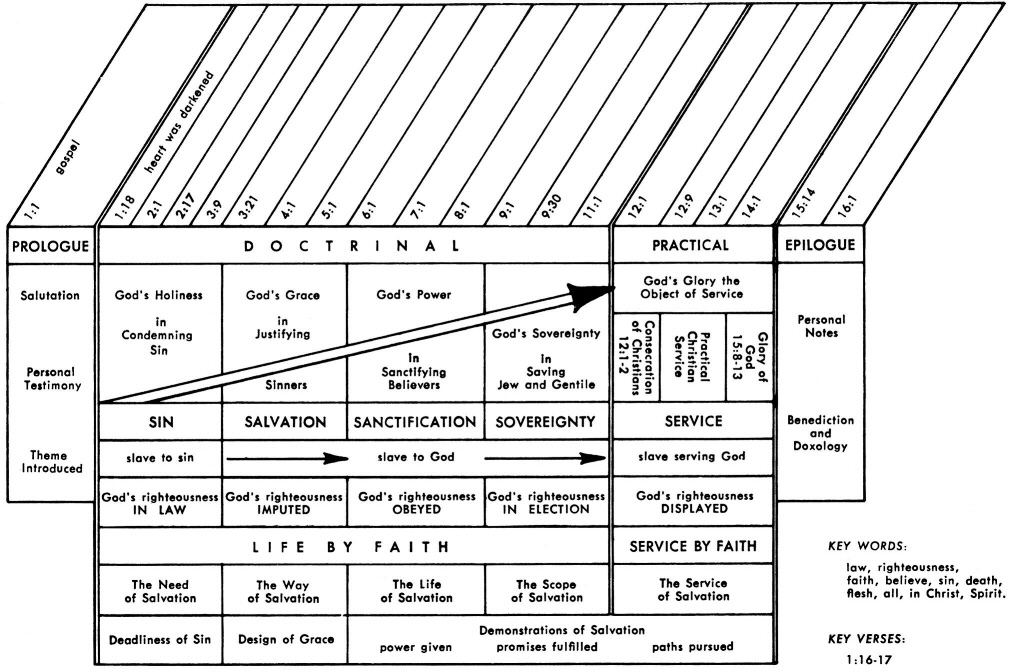
Click chart to enlarge
Chart from recommended resource Jensen's Survey of the NT - used by permission
Romans Overview Chart - Charles Swindoll
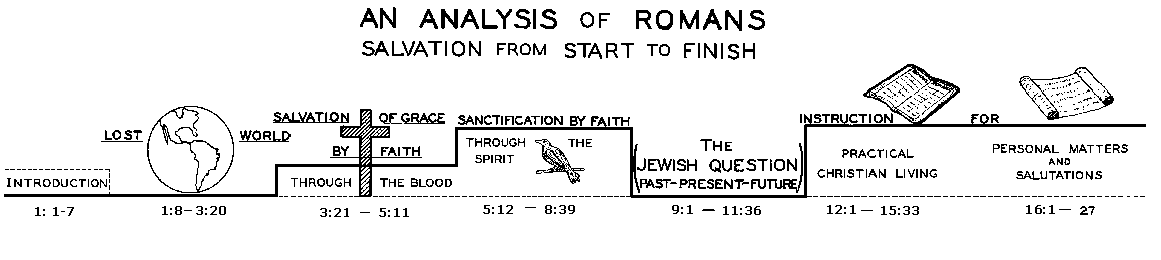
Source: Dr David Cooper
Click to Enlarge
| ROMANS ROAD to RIGHTEOUSNESS |
||||
| Romans 1:18-3:20 | Romans 3:21-5:21 | Romans 6:1-8:39 | Romans 9:1-11:36 | Romans 12:1-16:27 |
| SIN | SALVATION | SANCTIFICATION | SOVEREIGNTY | SERVICE |
| NEED FOR SALVATION |
WAY OF SALVATION |
LIFE OF SALVATION |
SCOPE OF SALVATION |
SERVICE OF SALVATION |
| God's Holiness In Condemning Sin |
God's Grace In Justifying Sinners |
God's Power In Sanctifying Believers |
God's Sovereignty In Saving Jew and Gentile |
Gods Glory The Object of Service |
| Deadliness of Sin |
Design of Grace |
Demonstration of Salvation | ||
| Power Given | Promises Fulfilled | Paths Pursued | ||
| Righteousness Needed |
Righteousness Credited |
Righteousness Demonstrated |
Righteousness Restored to Israel |
Righteousness Applied |
| God's Righteousness IN LAW |
God's Righteousness IMPUTED |
God's Righteousness OBEYED |
God's Righteousness IN ELECTION |
God's Righteousness DISPLAYED |
| Slaves to Sin | Slaves to God | Slaves Serving God | ||
| Doctrine | Duty | |||
| Life by Faith | Service by Faith | |||
|
Modified from Irving L. Jensen's chart above |
||||
R Ruin (Romans 1:17 – 3:20) – The utter sinfulness of humanity
O Offer (Romans 3:21-31) – God’s offer of justification by grace
M Model (Romans 4:1-25) – Abraham as a model for saving faith
A Access (Romans 5:1-11) – The benefits of justification
N New Adam (Romans 5:12-21) – We are children of two “Adams”
S Struggle w/ Sin (Romans 6:1-8:39) Struggle, sanctification, and victory
Therefore do not let sin reign in your mortal body so that you obey its lusts, (NASB: Lockman) Me oun basileueto (3SPAM) e hamartia en to thneto humon somati eis to hupakouein (PAN) tais epithumiais autou,
Amplified: Let not sin therefore rule as king in your mortal (short-lived, perishable) bodies, to make you yield to its cravings and be subject to its lusts and evil passions. (Amplified Bible - Lockman)
Phillips: Do not, then, allow sin to establish any power over your mortal bodies in making you give way to your lusts. (Phillips: Touchstone)
Wuest: Stop therefore allowing the sinful nature to reign as king in your mortal body with a view to obeying it [the body] in its passionate cravings.
Young's Literal: Do not let sin control the way you live; do not give in to its lustful desires.
THEREFORE : me oun:
- Psalm 119:133 Establish my footsteps in Your word, And do not let any iniquity have dominion over me.
- Romans 6 Resources - Multiple Sermons and Commentaries
- Romans 6:12-14: It Ain’t Gonna Reign No More - Steven Cole
- Romans 6:11-14 Dying to Live 3 - Study Guide (click dropdown menu) - John MacArthur
- Romans 6:11-14 Dying to Live 3 - John MacArthur
- Gotta Serve Someone! - Bob Dylan
Philips outlines this section as follows…
Comprehending the truth--"know" (Romans 6:8, 9, 10)
Counting on the truth--"reckon" (Romans 6:11, 12)
Capitulating to the truth--"yield" (Romans 6:13)
Therefore (3767) (oun) means so or consequently. (Click for discussion of terms of conclusion) This conjunction introduces a logical result from the preceding, the knowing and the reckoning of the preceding 11 verses. This juncture marks one of the most important "therefore's" in the Bible for believers. Paul is saying in essence don't just set in the classroom or the sanctuary and talk about the truths you've just learned in (Romans 6:1, 2, 3, 4, 5, 6, 7, 8, 9, 10, 11) (For exposition click 6:1-3 6:4-5 6:6-7 6:8-10 6:11) but live out these truths.
Therefore because of the fact, the truth that in my spiritual bank account (Ro 6:1-10) I am alive TO God IN Christ Jesus. That is why I am not to let SIN continually exert control over my body the way it did before I was baptized into His death and raised to walk in newness of life. It depends on who I make a choice to submit to… sin or Christ (yielding my rights to the Spirit of Christ, moment by moment, day by day - this surrender brings true freedom!)
Spurgeon - How intimately the believer's duties are interwoven with his privileges! Because he is alive unto God, he is to renounce sin, since that corrupt thing belongs to his estate of death. How intimately both his duties and his privileges are bound up with Christ Jesus his Lord! How thoughtful ought we to be upon these matters; reckoning what is right and fit; and carrying out that reckoning to its practical issues. (See full note below)
Romans 6:11-12 Dead But Alive - Spurgeon's Sermon Notes
Dead But Alive
Likewise reckon ye also yourselves to be dead indeed unto sin, but alive unto God through Jesus Christ our Lord. Let not sin therefore reign in your mortal body, that ye should obey it in the lusts thereof. Romans 6:11-12
How intimately the believer's duties are interwoven with his privileges! Because he is alive unto God, he is to renounce sin, since that corrupt thing belongs to his estate of death.
How intimately both his duties and his privileges are bound up with Christ Jesus his Lord!
How thoughtful ought we to be upon these matters, reckoning what is right and fit and carrying out that reckoning to its practical issues.
We have in our text—
I. A GREAT FACT TO BE RECKONED UPON. "Likewise reckon ye also yourselves to be dead indeed unto sin, but alive unto God through Jesus Christ our Lord?"
1. We are dead with Christ to sin by having borne the punishment in him. In Christ we have endured the death penalty and are regarded as dead by the law (verses 6 and 7).
2. We are risen with him into a justified condition and have reached a new life (verse 8).
3. We can no more come under sin again than he can (verse 9).
4. We are therefore forever dead to its guilt and reigning power: "Sin shall not have dominion over you" (verses. 12-14).This reckoning is based on truth, or we should not be exhorted to it.
To reckon yourself to be dead to sin so that you boast that you do not sin at all would be a reckoning based on falsehood and would be exceedingly mischievous. "There is no man that sinneth not" (1 Kings 8:46; 1 John 1:8). None are so provoking to God as sinners who boast their own fancied perfection.
The reckoning that we do not sin must either go upon the Antinomian theory that sin in the believer is no sin, which is a shocking notion.
Or else our conscience must tell us that we do sin in many ways: in omission or commission, in transgression or shortcoming, in temper or in spirit (James 3:2; Eccles. 7:20; Rom. 3:23).
To reckon yourself dead to sin in the scriptural sense is full of benefit both to heart and life. Be a ready reckoner in this fashion.
II. A GREAT LESSON TO BE PUT IN PRACTICE. "Let not sin therefore reign in your mortal body, that ye should obey it in the lusts thereof?"Sin has great power. It is in you and will strive to reign.
It remains as an outlaw, hiding away in your nature.
It remains as a plotter, planning your overthrow.
It remains as an enemy, warring against the law of your mind.
It remains as a tyrant, worrying and oppressing the true life.
2. Its field of battle is the body.
Its wants — hunger, thirst, cold, etc. — may become occasions of sin by leading to murmuring, envy, covetousness, robbery.
Its appetites may crave excessive indulgence and, unless continually curbed, will easily lead to evil.
Its pains and infirmities, through engendering impatience and other faults, may produce sin.
Its pleasures, also, can readily become incitements to sin.
Its influence upon the mind and spirit may drag our noble nature down to the groveling materialism of earth.
3. The body is mortal, and we shall be completely delivered from sin when set free from our present material frame, if indeed grace reigns within. Till then, we shall find sin lurking in one member or another of "this vile body"
4. Meanwhile, we must not let it reign.
If it reigned over us, it would be our god. It would prove us to be under death and not alive unto God.
It would cause us unbounded pain and injury if it ruled only for a moment.
Sin is within us, aiming at dominion. This knowledge, together with the fact that we are nevertheless alive unto God, should—
Help our peace, for we perceive that men may be truly the Lord's, even though sin struggles within them.
Aid our caution, for our divine life is well worth preserving and needs to be guarded with constant care.
Draw us to use the means of grace, since in these the Lord meets with us and refreshes our new life.
Let us come to the Table of Communion, and to all other ordinances, as alive unto God. In that manner, let us feed on Christ.
Instructive Words
In the fourth century, when the Christian faith was preached in its power in Egypt, a young brother sought out the great Macarius. "Father," said he, "what is the meaning of being dead and buried with Christ?"
"My son," answered Macarius, "you remember our dear brother who died and was buried a short time since? Go now to his grave, and tell him all the unkind things that you ever heard of him and that we are glad he is dead and thankful to be rid of him, for he was such a worry to us and caused so much discomfort in the church. Go, my son, and say that, and hear what he will answer."
The young man was surprised and doubted whether he really understood; but Macarius only said, "Do as I bid you, my son, and come and tell me what our departed brother says."The young man did as he was commanded and returned."Well, and what did our brother say?" asked Macarius."Say, father!" he exclaimed. "How could he say anything? He is dead.""Go now again, my son, and repeat every kind and flattering thing you have ever heard of him. Tell him how much we miss him, how great a saint he was, what noble work he did, how the whole church depended upon him, and come again and tell me what he says."The young man began to see the lesson Macarius would teach him. He went again to the grave and addressed many flattering things to the dead man, and then returned to Macarius."He answers nothing, father. He is dead and buried."
"You know now, my son," said the old father, "what it is to be dead with Christ. Praise and blame equally are nothing to him who is really dead and buried with Christ." — Anon
Though the lowest believer be above the power of sin, yet the highest believer is not above the presence of sin. Sin never ruins but where it reigns. It is not destroying where it is disturbing. The more evil it receives from us, the less evil it does to us. — William Secker
Sin may rebel, but it shall never reign in a saint. It fareth with sin in the regenerate as with those beasts that Daniel speaks of "that had their dominion taken away, yet their lives were prolonged for a season and a time." — Thomas Brooks
Men must not suffer a single sin to survive. If Saul had destroyed all the Amalekites, no Amalekite would have lived to destroy him. — David Roland
DO NOT LET SIN REIGN: me oun basileueto (3SPAM) ho hamartia:
- Ro 6:16; 5:21; 7:23,24; Nu 33:55; Dt 7:2; Josh 23:12,13; Jdg 2:3; Ps 19:13; Ps 119:133
- Romans 6 Resources - Multiple Sermons and Commentaries
- Romans 6:12-14: It Ain’t Gonna Reign No More - Steven Cole
- Romans 6:11-14 Dying to Live 3 - Study Guide (click dropdown menu) - John MacArthur
- Romans 6:11-14 Dying to Live 3 - John MacArthur
Related Passages:
Numbers 33:55+ (OT PARALLEL OF COMMAND NOT TO LET SIGN REIGN!) ‘But if you do not drive out the inhabitants of the land from before you, THEN (HERE IS THE "PROMISE"!) it shall come about that those whom you let remain of them will become as pricks in your eyes and as thorns in your sides, and they will trouble you in the land in which you live.
Joshua 23:12-13+ (WARNING ABOUT LETTING SIN REIGN IN YOUR MORTAL BODY) “For if you ever go back and cling to the rest of these nations, these which remain among you, and intermarry with them, so that you associate with them and they with you, 13 know with certainty that the LORD your God will not continue to drive these nations out from before you; but they will be a snare and a trap to you, and a whip on your sides and thorns in your eyes, until you perish from off this good land which the LORD your God has given you.
COMMAND TO NOT LET SIN
TAKE THE THRONE OF MY HEART
The Greek is emphatic -- “Be not at all allowing sin to reign!” Stop letting this happen! While sin will continue to RESIDE (have one's permanent home in a particular place.), it is not to PRESIDE (be in the position of authority in a meeting or other gathering)! Praise God that while SIN has a "permanent" home in our hearts in this earthly natural life, SIN will be "permanently evicted" in the eternal life to come in glory! So for now we are not to let SIN reign, but enabled by the Spirit are to "reign SIN in!" (to restrain, tighten control).
Sin (266) (hamartia) is literally "the sin" (Greek article "ho" = "the", conveying the idea not of sin in general but of a specific aspect of Sin -- see discussion) which in Romans 6 represents a moral principle or force which is personified as an evil king (or harsh slave master) who constantly seeks to enslave and to rule those who are subject to its power (all unregenerate mankind for all of them are still "in Adam" - Ro 5:12-note, Ro 5:17-note, Ro 5:18, 19-note).
Reign (936) (basileuo from basileús = a king, sovereign, monarch) means to rule as a king with the implication of complete authority. To rule and be in control in an absolute manner or to control completely.
The present imperative (command) is preceded by a negative particle ("me" = negates what follows) which means "Stop letting the Sin to continue to reign in your physical body." Paul is saying stop letting this continue, implying that his readers were in fact letting sin reign. "Sniper attacks" by our incorrigible flesh are unavoidable, but allowing Sin to reign in our bodies is unacceptable (Why? see 1Co 6:19, 20, 1Co 3:16). Paul's point is because of our position (dead, buried and resurrected with Christ), believers no longer have to obey the demands of "Sin".
Poole notes that Paul "does not say, let it not be or reside, but let it not reign or preside; let it not bear sway or have dominion in you; let it not have the upper hand of the motions of the Spirit of God. (Matthew Poole's Commentary)
Paul had earlier taught "that, as sin reigned in death, even so grace might reign through righteousness to eternal life through Jesus Christ our Lord. (Ro 5:21-note)
Here in Romans 6, Paul teaches that Sin's reign has come to a complete and final end for the believer (Ro 6:6, 7-note). Now, we need to act in faith based upon that truth.
David understood that Sin like an evil tyrant could reign over him and so he prayed to the LORD to
keep back Thy servant from presumptuous sins. Let them not rule (Hebrew = mashal or masal = to rule, reign or have dominion over ~ conveys idea of exercise of authority over persons; Lxx = kurieuo) over me; Then I shall be blameless, and I shall be acquitted of great transgression. (Ps 19:13) (Spurgeon's Note)
Comment: The Hebrew verb mashal/masal is used in Genesis 4:7 where God told Cain that "Sin is crouching at the door and its desire is for you, but you must master [mashal/masal] it" (Did he? Ge 4:8! Even in the OT God somehow made provision for "handling" the fallen flesh but Cain rebelliously refused God's provision! How often do we who now have the indwelling Holy Spirit still imitate Cain's refusal of God's provision for practical holiness!). In Genesis 37:8 Joseph's brothers ask him ""Are you actually going to reign [Hebrew = malak = be king] over us? Or are you really going to rule [mashal/masal; Lxx = kurieuo [word study] over us?"
In another prayer we read a similar desire for Jehovah to
Establish (imperative mood; LXX = kateuthunoo = cause to go straight, guide in the right path! aorist imperative) my footsteps in Thy word, and do not let any iniquity have dominion over (Hebrew = salat = domineer, be master of; Lxx = katakurieuo = gain power over, have mastery or dominion over, subdue) me. (Ps 119:133) (Spurgeon's note)
Comment: Ps 119:133 is an excellent prayer with which every saint could begin the new day and it beautifully parallels the psalmist's prayer for God's Word to produce godly fear in Ps 119:38-Spurgeon's note.
Some other passages related to the preceding prayers...
Psalm 25:15 My eyes are continually toward the LORD, For He will pluck my feet out of the net. (IMPLICATION? MY FEET ARE GOING TO GET CAUGHT IN THE NET!)
Psalm 141:4 Do not incline my heart to any evil thing, To practice deeds of wickedness With men who do iniquity; And do not let me eat of their delicacies.
Psalm 119:36 Incline my heart to Your testimonies And not to dishonest gain. 37 Turn away my eyes (THE EYE GATE OF THE HEART!) from looking at vanity, And revive me in Your ways.
Matthew 6:13 ‘And do not lead us into temptation, but deliver us from evil.
Moses warned the Israelites that "But if you do not drive out the inhabitants of the land from before you, then it shall come about that those whom you let remain of them will become as pricks in your eyes and as thorns in your sides, and they shall trouble you in the land in which you live." (Nu 33:55+) God knew that if His people did not kill the Canaanites in the land, Israel would become infected by their immorality and idolatry. Not only were the Israelites to kill the people, but they were to destroy every trace of idolatry. By analogy, in the New Covenant, God has given us the potential for an abundant life in Christ (Jn 10:10b), but knowing about that truth and even reckoning it as true is not enough. We need to act on that truth, just as Israel needed to submit to the Lord and obey His command to purge the evil from the land.
THOUGHT - How are you fairing, beloved? Are you "by the Spirit… putting to death the deeds of the body" that you might really "live" (Ro 8:13+)? Dr Martyn Lloyd-Jones calls Romans 8:13 the most important verse in the Bible regarding our daily walk, our progressive sanctification. I would strongly recommend committing it to memory so that you might meditate on it being careful to examine the context. Ask God (and keep on asking Him) to teach you the profound truth of this verse, so that you might grow in grace and the knowledge of our Lord and Savior Jesus Christ (2 Pe 3:18+) at the same time growing in your practical understanding of the Spirit's role in killing those "pesky," persistent sins which are like "little foxes that are ruining your vineyards while they are in bloom." (Song 2:15+).
In a similar instruction Moses declared to Israel that
When (NOT "IF" BUT "WHEN" = A SURE PROMISE) the LORD your God shall deliver them before you, and you shall defeat them (NOTE THE PATTERN - GOD'S PROVISION, MAN'S RESPONSE - THUS NOT "LET GO, LET GOD," BUT "LET GOD, LET'S GO!"), then you shall utterly destroy (charam) them. You shall make (karath) no covenant (beriyth) with them and show no favor to them. (Deut 7:2+)
This command seems "merciless" but, to the contrary, is actually a reflection of God's mercy to His people Israel, for He knew that the Canaanites constituted a moral cancer that had the potential of introducing idolatry and immorality which would spread like leaven among the Israelites (which in fact eventually occurred). Here in Romans 6 Paul is saying in a manner of speaking don't let Sin continue to reign in the land ("your body").
Kill sin or Sin will kill you
Don't misunderstand - Sin cannot bring you to hell if you are a genuine believer (your salvation is eternally secure - you are forever saved from the coming flood of God's righteous wrath [1Th 1:10+] because you are in the "Ark", in Christ - Jn 10:28, 29, 30, 1Jn 5:11, 12, 13+) but Sin will so disturb your fellowship with your Father that your present life "may feel like Hell," or at least far from "heavenly" (Jas 1:15, 16+, cf David's "hell" in Ps 32:3-4, but praise God for Ps 32:5! SELAH!).
Joshua at age 110 on his death bed (Joshua 24:29+) warned Israel that had entered into the land of "milk and honey" that "if you ever go back and cling to the rest of these nations, these which remain among you, and intermarry with them, so that you associate with them and they with you, know with certainty that the LORD your God will not continue to drive these nations out from before you; but they shall be a snare and a trap to you, and a whip on your sides and thorns in your eyes, until you perish from off this good land which the LORD your God has given you." (Joshua 23:12,13+) Woe! Now that's "tough love!"
THOUGHT - Beloved, heed Paul's exhortation to us as believers for the Word of God is like a two-edged sword (He 4:12+), like fire and like a hammer (Jer 23:29): If we obey it, God will bless and enable us, but if we refuse the goodness of God and foolishly chose to disobey His good Word (cp Pr 12:25, He 6:5), God will be forced to chasten us as His sons (He 12:5, 6+) until we surrender our wandering will and submit to His good and acceptable and perfect will (Ro 12:2+, cp Ro 12:2NLT)
In a similar message given at the outset of the tragic, spiritually dark, 300 year period of Judges, the Angel of the LORD (Jehovah)" (most consider this to be the pre-incarnate Messiah) (Click for an in depth analysis of this OT designation) addressed Israel (there was no king in Israel and everyone was doing what was right in his own eyes - Jdg 21:25+) declaring
and as for you, you shall make no covenant with the inhabitants of this land; you shall tear down their altars.' But you have not obeyed Me. What is this you have done? "Therefore I also said, 'I will not drive them out before you; but they shall become as thorns in your sides, and their gods shall be a snare to you. (Jdg 2:2, 3-+)
The command to stop letting Sin reign is not an option beloved if we are to avoid the thorny consequences of sins committed against the clear light of God's Word.
Martyn Lloyd-Jones offers a helpful illustration of the believer’s relation to his old sinful disposition. He pictures two adjoining fields, one owned by Satan and one owned by God, that are separated by a road. Before salvation, a person lives in Satan’s field and is totally subject to his jurisdiction. After salvation, a person works in the other field, now subject only to God’s jurisdiction. As he plows in the new field, however, the believer is often cajoled by his former master, who seeks to entice him back into the old sinful ways. Satan often succeeds in temporarily drawing the believer’s attention away from his new Master and his new way of life. But he is powerless to draw the believer back into the old field of sin and death.
Cain failed to heed the Lord's instructive warning "If you do well, will not your countenance be lifted up? And if you do not do well, sin is crouching at the door; and its desire is for you, but you must master (Lxx = archo = rule over, govern) it. (Genesis 4:7).
God told Cain that if he chose not to obey His commands, ever-present Sin, crouched and waiting to pounce like a lion, would fulfill its desire to overpower him. God's command to Cain somehow included the enablement (even in the Old Testament) and yet Cain refused to submit to the command. History records the steep price he paid for continuing to let sin reign (Ge 4:8-17). Beloved "these things happened as examples for us, that we should not crave evil things, as they also craved" and "these things happened to them as an example, and they were written for our instruction… therefore let him who thinks he stands take heed lest he fall.." (1Cor 10:6,11, 12)
IN YOUR MORTAL BODY: en to thneto humon somati:
- Ro 8:11; 1Co 15:53,54; 2Cor 4:11; 5:4
- Romans 6 Resources - Multiple Sermons and Commentaries
- Romans 6:12-14: It Ain’t Gonna Reign No More - Steven Cole
- Romans 6:11-14 Dying to Live 3 - Study Guide (click dropdown menu) - John MacArthur
- Romans 6:11-14 Dying to Live 3 - John MacArthur
Mortal (2349) (thnetos from thnesko = to die) refers to that which is subject to death. Thnetos describes the condition of changeability or mortality of the body.
Our physical body is the "land" over which "the (King) Sin" continually seeks to reign.
Classic Greek contrasts thnetos with athánatos which describes that which is immortal. There is a hint of hope in Paul's use of thnetos, for this life will soon be over and even as
the Spirit of Him who raised Jesus from the dead dwells in you (as a guarantee of our future inheritance), He who raised Christ Jesus from the dead will also give life to your mortal bodies through His Spirit who indwells you. (Ro 8:11-note)
These bodies that we have will be put in the grave one day if the Lord tarries for they are "mortal" or subject to death. However, the indwelling Holy Spirit is our assurance that our bodies will be raised from the dead (2Cor 5:1, 2, 3, 4). Because Christ was raised from the dead, we shall be raised from the dead. The Holy Spirit will deliver us from the mortal “body of his death” for as Paul writes elsewhere
"this perishable must put on the imperishable, and this mortal must put on immortality. But when this perishable will have put on the imperishable, and this mortal will have put on immortality, then will come about the saying that is written, "DEATH IS SWALLOWED UP in victory. O DEATH, WHERE IS YOUR VICTORY? O DEATH, WHERE IS YOUR STING? The sting of death is sin, and the power of sin is the law but thanks be to God, who gives us the victory through our Lord Jesus Christ." (1 Cor 15:53-57)
Poole comments that "the body (called here a mortal or frail body) is put by a synecdoche (a figure of speech by which a part is put for the whole) for the whole man; and he the rather makes mention of the body, because the parts and members thereof are the usual instruments of sin. (Matthew Poole's Commentary)
Jim Wilson - Hand sanitizing is in these days. Brookstone now offers a hand sanitizer dispenser that is so efficient you don’t even have to touch it for your little dab of sanitizer or soap. It is a hands-free dispenser.--USA Today December 7, 2009 p. 6D Illustration by Jim L. Wilson and Rodger Russell USA Today calls this a Christmas gift for a germophobe. That is not a bad thing to be during any flu season. What Christians need to be is Sinophobe. It is a good thing to be put off as much by sin as we are by germs. (Sin-Jim L. Wilson)
THAT YOU SHOULD OBEY ITS LUSTS: eis to hupakouein (PAN) tais epithumiais autou:
- Ro 6:16; 2:8; 8:13; 13:14; Gal 5:16,24; Eph 2:3; 4:22; 1Thes 4:5; 2 Ti 2:22; Titus 2:12; 3:3; Jas 1:14,15; 4:1-3; 1Pet 1:14; 2:11; 4:2,3; 1Jn 2:15, 16, 17; Jude 1:16,18
- Romans 6 Resources - Multiple Sermons and Commentaries
- Romans 6:12-14: It Ain’t Gonna Reign No More - Steven Cole
- Romans 6:11-14 Dying to Live 3 - Study Guide (click dropdown menu) - John MacArthur
- Romans 6:11-14 Dying to Live 3 - John MacArthur
SIN IS A HARSH
TASKMASTER
Obey (5219) (hupakouo from hupó = agency or means, under + akoúo physical hearing and apprehension of something with the mind - akouo gives us our English acoustics - the science of design which helps one hear) (Click study on related noun hupakoe) literally means to "hear under" or "listen under" with attentiveness and to respond positively to what is heard. It conveys the idea of listening as a subordinate with a view to obeying what the subordinate hears. The sense is that one understands and responds accordingly. Note that hupakouo implies an inward attitude of respect and honor, as well as external acts of obedience. Obedience on the part of children consists in listening to the advice given by parents. In Genesis 22 Isaac's willingness to be offered as a sacrifice is a model of such submission.
Hupakouo is used to picture the obedience children render to their parents (Ep 6:1-note) or the obedience rendered by slaves to their masters (Ep 6:5-note; Col 3:22-note) The idea implicit in obey is to bow under (in this case "lusts") and allow those strong desires to control you.
Hupakouo is in the present tense which speaks of obeying one's lusts as the habitual practice of their life, something that is literally impossible for one who has genuinely "died to sin" and is therefore forever separated from its rule and reign.
Hughes - Obedience involves conscious listening. If you do not really listen, you cannot really obey. That is why parents are always saying, “Listen to me!” The idea is to listen under with the intent to understand and do it… Much of this is a matter of attitude. We are not to be like the little boy who misbehaved and was told by his teacher to sit in the corner, which he did with grudging obedience, all the while saying to himself, “I’m sitting down on the outside, but I’m standing up on the inside!” (Hughes, R. K.: Ephesians: The Mystery of the Body of Christ. Crossway Books)
Warren Wiersbe makes an excellent practical application "Being a Christian is a matter of bondage or freedom (Ro 6:12, 13, 14, 15, 16, 17, 18, 19, 20, 21, 22). Who is your master, Jesus Christ or the old life? You are not under the authority of Moses (Ro 6:15), but that does not mean you have freedom to break God’s moral law (Ro 8:1, 2, 3, 4, 5). Yield yourself to the Lord; He is the most wonderful Master, and the “salary” He pays lasts forever. (With the Word: The Chapter-by-Chapter Bible Handbook)
Prior to our JUSTIFICATION by faith while we were still IN ADAM, we obeyed SIN. In other words the old man in Adam upon hearing a knock at his door, would go to see who was there and finding that it was "Mr. Temptation to Sin", would expectantly welcome him into the house. In contrast the New Man in Christ can be "rude" and not even answer the door! This is a great picture, for "Mr. Temptation to Sin" will be knocking on the door of our heart the remainder of our mortal existence. But hallelujah, we don't have to answer the door anymore because we have a "new Porter" to answer the door for us, the Spirit of Christ in us.
Stated another way, before we were born again, regenerated, set free from the power of Sin (Ro 6:11-note), delivered from the domain of darkness and dominion of Satan (Acts 26:18, Col 1:13-note) and transferred to the kingdom of light and the rulership of Christ, we chased after sin, but now, sin chases after us! Praise God for the blessed hope (certainty) of glorification, that grace to be brought to us the revelation of Jesus Christ (1Pet 1:13-note) , when not only will we be free from the penalty and power of sin (both of which are realities today), but also once and for all time the presence of sin and the passing pleasure of sin (He 11:25-note)! Hallelujah! Thank You, Lord Jesus for setting us free, now and throughout eternity! Amen. Even so. Come, Lord Jesus (Rev 22:20-note). Maranatha ("Come now Lord" 1Co 16:22). Hosanna! ("Save us, please!")
Lusts (1939) (epithumia from epi = at, toward [preposition "epi-" in compound is directive and conveys the picture of "having one’s passion toward" ] + thumos = passion <> root verb epithumeo = set heart upon)) (Click for word study of epithumia).
Epithumia in itself is a neutral term denoting the presence of strong desires or impulses, longings or passionate craving (whether it is good or evil is determined by the context) directed toward an object. It is a definite wish going after an object pleasant or helpful.
- American Tract Society Lust
- Baker Evangelical Dictionary Lust
- Easton's Bible Dictionary Lust
- Spurgeon's Illustration Collection Lust
- Holman Bible Dictionary Lust
- Hastings' Dictionary of the Bible Lust
- Hastings' Dictionary of the NT Lust Lust (2)
- Hawker's Poor Man's Dictionary Lust
- Vines' Expository Dictionary Lust
- International Standard Bible Encyclopedia Lust
- McClintock and Strong's Bible Encyclopedia Lust
- The Jewish Encyclopedia Lust
In the present context epithumia refers to the cravings of the human body, which originate from the sinful nature inherited from Adam.
Notice this verse teaches that "the sin", here personified as an evil king, possesses evil lusts. When we were unsaved and in Adam we
"all formerly lived in the lusts of our flesh, indulging the desires (epithumia) of the flesh and of the mind..." (Ep 2:3-note) and "we also once were foolish ourselves, disobedient, deceived, enslaved to various lusts (epithumia) and pleasures..." (Titus 3:3-note) but now that we "belong to Christ Jesus (we) have crucified the flesh (Ro 6:6-note) with its passions and desires (epithumia)" (Ga 5:24-note) and because of this we are dead to sin's power. Now as new creatures in Christ we are commanded to "put on the Lord Jesus Christ, and make no provision for the flesh in regard to its lusts (epithumia) " (Ro 13:14-note), to continually "flee from youthful lusts (epithumia), and pursue righteousness, faith, love and peace" (2Ti 2:22-note), and to continually live "as obedient children (by not being) conformed to the former lusts (epithumia) which were (ours) in (our) ignorance" (1Pe 1:14-note).
Motivated by the fact that we are now
"aliens and strangers (dead to the world Gal 6:14) (we are to continually) abstain from fleshly lusts (epithumia), which wage war against (our) soul" (1Pe 2:11-note), remembering that that "each one is tempted when he is carried away and enticed by his own lust (epithumia) (and that) when lust (epithumia) has conceived, it gives birth to sin; and when sin is accomplished, it brings forth death" (Jas 1:14, 15-note).
John commands us as those who are in Christ and dead to sin, the world and the power of devil not to keep on loving
"the world, nor the things in the world" but being ever mindful that "all that is in the world, the lust (epithumia) of the flesh and the lust (epithumia) of the eyes and the boastful pride of life, is not from the Father, but is from the world. And the world is passing away, and also its lusts (epithumia); but the one who does the will of God abides forever." (1Jn 2:15, 16, 17)
Paul instructs us as saints that "in reference to your former manner of life, you lay aside the old self, which is being corrupted in accordance with the lusts (epithumia) of deceit" (Ep 4:22-note), not "following after (our) own ungodly lusts (epithumia)" (Jude 1:18) for we now have the power to in view of the fact that
"the grace of God has appeared (in the presence of Jesus Christ), bringing salvation to all men, instructing us to deny ungodliness and worldly desires (epithumia) and to live sensibly, righteously and godly in the present age" (see notes Titus 2:11; 12)
God is never unreasonable in His demands upon His own. What He asks of us to carry out is always within our ability to fulfill, as we choose to humble ourselves and to lay hold by faith of His divine resource of grace, walking in submission to and controlled by the Spirit of Christ. Since the power of sin is broken (Ro 6:1, 2, 3, 4, 5, 6, 7, 8, 9, 10) and the His divine nature has been implanted within our hearts (Col 1:27-note), believers now are fully equipped and empowered to keep sin from reigning in our members.
Pulling Weeds - Pulling weeds from my lawn can be a struggle. Whether it's unearthing a string of ivy or digging up dandelions, it's often difficult to overcome God's curse in the Garden of Eden (Ge 3:17, 18).
When the ground is hard and dry, weeds are highly resistant to being uprooted. But when a soaking rain softens the soil, they yield quite readily. I've also noticed that the youngest weeds are easier to remove and the older ones are more stubborn.
Bad habits are like that. The longer they remain, the more difficult they are to remove. If we uproot them early, when our heart is tender toward God's love, we will have the best chance for success.
Paul tells us of God's great love and abundant grace to us (Ro 5:20, 21). These truths can soften the soil of a hard heart. And when we understand that Jesus died to free us from the penalty and the power of sin (Ro 6:1, 2, 3, 4, 5, 6, 7, 8, 9, 10, 11, 12, 13, 14), we will see the need to fight aggressively against sinful habits.
A passive faith won't kill a bad habit. Faith must actively apply these truths. "Pulling weeds" is often a painful process of multi-failures followed by the success of failing for the last time.
Do you have some weeds that need pulling? — Dennis J. De Haan (Our Daily Bread, Copyright RBC Ministries, Grand Rapids, MI. Reprinted by permission. All rights reserved)
The sins that would entangle us
Must never be ignored;
If we do not get rid of them
They'll pierce us like a sword. —Sper
A bad habit is like a soft chair—
easy to get into but hard to get out of
THOUGHT - A better way to "kill weeds" is to plant flowers that impede the growth of weeds. In killing your sin, first fix your eyes on Jesus, not on your sin (Col 3:1-5 before Col 3:6, Ro 13:14a before Ro 13:14b, etc). First walk in the Spirit and then (and only then) will you be enabled to kill the lusts of sin! (Gal 5:16)
See related discussion of the Expulsive Power of a New Affection.
Keep It Out!- Guam is crawling with snakes. Slithering brown tree snakes are killing the birds of the beautiful island nation and threatening the citizens' way of life. The people, of course, want to keep the snakes out.
These snakes are not native to Guam. They came as stowaways on airplanes from Micronesia, and they have multiplied by the thousands. Known for their voracious appetites, the snakes have wiped out 9 of the island's 11 native bird species. They also threaten other islands with which Guam trades.
Just as these deadly snakes are a danger to Guam, so our sins are a danger to us if we don't deal decisively with them. Sins such as lust, sexual impurity, covetousness, anger, wrath, malice, blasphemy, filthy language, and lying can show up in the lives of Christians (Colossians 3:5, 6, 7, 8, 9). Like snakes, such sins can grow, multiply, and eventually dominate us. They can also destroy our effectiveness in serving Christ and damage our testimony for Him.
The solution is to say no to sin (Ro 6:12). We also need to focus on Christ and His Word, setting our minds "on things above, not on things on the earth." We must also "put to death" the sins that seek to invade our lives (Col 3:2, 5,16). That's the way to keep sin out! — Dave Branon (Our Daily Bread, Copyright RBC Ministries, Grand Rapids, MI. Reprinted by permission. All rights reserved)
We can't afford to play with fire
Nor tempt the serpent's bite;
We can't afford to think that sin
Brings any true delight. —Anon.
Sins are like weeds in a garden; keep them out or they will take over
Willing To Change - A major league baseball pitcher was having trouble. He started the season with a terrible record. After the mid-season break, though, things began to get better. He won four games in a row and suddenly became nearly unhittable. When asked what was different, he replied, "Mechanics."
In other words, he had corrected a bad habit in his pitching motion. After discovering the error, he practiced diligently to correct it. At first nothing felt right, but the longer he worked at it the better things got. The next time he pitched, his winning streak started.
Do you recall the last time you tried to change a bad habit? It wasn't easy. Because you were comfortable with the old way, the new way seemed awkward. That's why we often hesitate to make needed changes. For example, maybe you speak words you shouldn't say. Or you are critical of people instead of helpful. Fill in your own wrong actions--we all have them.
It takes conscious effort on our part and God's help to change. Paul said we are to present our "members as slaves of righteousness for holiness" (Ro 6:19). That's not easy. But for God's glory and our own good we must make the effort. Let's be willing to change. — Dave Branon (Our Daily Bread, Copyright RBC Ministries, Grand Rapids, MI. Reprinted by permission. All rights reserved)
Father, thank You for Your Spirit,
Fill us with Your love and power;
Change us into Christ's own image
Day by day and hour by hour. --Anon.
The spirit of God uses the Word of God to change the people of God.
Animal Actions - In his book Adjust Or Self-Destruct, Craig Massey draws some familiar parallels between our actions as human beings and those of animals. Here are a few of them: A "snake in the grass" is a cunning, deceitful person. A grouch is an "old bear." A coward is a "chicken," and a glutton is a "hog." We've all used such descriptive terms, as well as acted them out in our own lives.
When we turn in faith to Christ, we become new creatures (2Corinthians 5:17), but the "animals" of our old life do not just curl up and die. They keep trying to assert themselves. Paul saw them as springing from "the flesh" (Gal 5:17). He didn't mean our physical body, but that sinful disposition inherited from Adam (Ro 7:18, 19, 20, 21; Gal 5:16, 17, 18, 19, 20, 21). No matter how spiritually mature we become in this life, these tendencies stay with us.
But there's good news. By faith we are one with Christ (1Co 6:17), and His Spirit lives within us to enable us to overcome sinful thoughts, attitudes, and actions. Our faith must not be passive, however. Once we recognize these sinful tendencies, we must reject them (Ro 6:12).
These beasts are not subdued easily. No victory is ever won without a struggle. But we can resist and overcome—in the power of God's Spirit. —Dennis J. De Haan (Our Daily Bread, Copyright RBC Ministries, Grand Rapids, MI. Reprinted by permission. All rights reserved)
Lord, into Your hands I place this day,
All that I have and do and say;
Oh, grant that every hour be filled
With thoughts and actions You have willed. —Green
To break sin's grip,
put yourself in God's hands.
Reign (936) (basileuo from basileús = a king, sovereign, monarch) means to be a king, to rule as a king with the implication of one who has total unfettered authority. Basileuo means to be in control in an absolute manner. To control completely or in an absolute manner.
Basileuo is used figuratively by Paul to speak of the dominating quality of something - of death reigning (Ro 5:14), of "the gift of righteousness" reigning (Ro 5:17), of sin reigning in or having predominance over (to exercise the highest influence over) our mortal bodies (Ro 5:21, 6:12 - Wuest = "Here sin is personified, and refers to a nature, the totally depraved nature of the unsaved person, That reigns as an absolute monarch in his being."), of grace reigning (Ro 5:21)
Mt 2:22 speaks of the reign of an earthly king (cp Isa 1:1; 7:6; 24:23; 30:33; 32:1; 36:1; 37:38; 52:7; Jer 22:11, 15; 23:5; 25:20; 34:5; 37:1; 52:1, 31; Ezek 17:16; 20:33; ) Lk 1:33 speaks of the eschatological reign of Christ over Israel forever. 1Cor 15:25 describes Messiah's reign in the Millennium. Rev 5:10 and Rev 20:4, 6 describe the future reign of believers on earth during the Messiah's Millennial reign (see the specific time phrase "thousand years" in Rev 20:4,6) as the King of kings. In 2Ti 2:12 Paul compounds the verb (sumbasileuo) stating we will reign with Christ if we endure (endurance does not save us - it proves we are saved!) Rev 11:15 (cp Rev 11:17) describes the seventh trumpet sounding which is followed by the proclamation that the Lord and His Messiah will reign forever and ever. In Rev 19:6 after the destruction of the earthly anti-god kingdoms, we will sing praises to the fact that the Lord reigns.
Webster' Definition - To possess or exercise sovereign power or authority; to rule; to exercise government, as a king or emperor; or to hold the supreme power. George the third reigned over Great Britain more than fifty years. Behold, a king shall reign in righteousness. Isaiah 32:1. 2. To be predominant; to prevail. 3. To rule; to have superior or uncontrolled dominion. To exercise authority in the manner of a monarch 4. to be predominant or prevalent 〈sin reigned in death〉
Mounce - There are several references in the NT to the reigning of Christians, not in their own right but in the power of Jesus. Jesus has ascended to God’s right hand, and we are now sitting with him in the heavenly realms (Eph 1:20; 2:6; Col 3:1-3). Thus, while it is true that in this present dispensation, sin and death “reign” (Ro 5:14, 17, 21), if have received the gift of righteousness from the one man Jesus, grace now “reigns” in us to bring us eternal life (Ro 5:15, 21). Thus, Paul is able to exhort, “Do not let sin reign in your mortal body” (Ro 6:12). In the coming millennial reign of Christ, Revelation makes it clear that believers “will reign with him for a thousand years” (Rev 20:4, 6). And when the new heaven and new earth are brought in by God, all his saints “will reign for ever and ever” (Rev 22:5). (Mounce's Complete Expository Dictionary of Old & New Testament Words)
Vine's Expository Dictionary - "to reign," is used (I) literally, (a) of God, Revelation 11:17; 19:6 , in each of which the aorist tense (in the latter, translated "reigneth") is "ingressive," stressing the point of entrance; (b) of Christ, Luke 1:33; 1 Corinthians 15:25; Revelation 11:15; as rejected by the Jews, Luke 19:14,27; (c) of the saints, hereafter, 1 Corinthians 4:8 (2nd part), where the Apostle, casting a reflection upon the untimely exercise of authority on the part of the church at Corinth, anticipates the due time for it in the future (see No. 2); Revelation 5:10; 20:4 , where the aorist tense is not simply of a "point" character, but "constative," that is, regarding a whole action as having occurred, without distinguishing any steps in its progress (in this instance the aspect is future); Revelation 20:6; 22:5 , (d) of earthly potentates, Matthew 2:22; 1 Timothy 6:15 , where "kings" is, lit., "them that reign;" (II) metaphorically, (a) of believers, Romans 5:17 , where "shall reign in life" indicates the activity of life in fellowship with Christ in His sovereign power, reaching its fullness hereafter; 1 Corinthians 4:8 (1st part), of the carnal pride that laid claim to a power not to be exercised until hereafter; (b) of Divine grace, Romans 5:21; (c) of sin, Romans 5:21; 6:12; (d) of death, Romans 5:14,17 . (Reign - Vine's Expository Dictionary of NT Words)
Complete Biblical Library Greek-English Dictionary - It is used of secular kings (Matthew 2:22), and of divine kings: God (Revelation 11:17), and Christ (Luke 1:33). It is also used of the Holy Spirit by the church fathers and among secular writers it was used of pagan deities… The New Testament uses basileuō to declare God’s sovereign authority over all other rulers and powers. Ultimately all rebellion and evil will be overthrown, and God will reign in righteousness unopposed, forever.
BASILEUO IN
THE NEW TESTAMENT
Basileuo - 21x in 18v - Usage: become kings(2), kings(1), reign(12), reigned(4), reigning(1), reigns(1).
Matthew 2:22 But when he heard that Archelaus was reigning over Judea in place of his father Herod, he was afraid to go there. Then after being warned by God in a dream, he left for the regions of Galilee,
Luke 1:33 and He will reign over the house of Jacob forever, and His kingdom will have no end."
Luke 19:14 "But his citizens hated him and sent a delegation after him, saying, 'We do not want this man to reign over us.'
27 "But these enemies of mine, who did not want me to reign over them, bring them here and slay them in my presence."
Romans 5:14-note Nevertheless death reigned from Adam until Moses, even over those who had not sinned in the likeness of the offense of Adam, who is a type of Him who was to come.
Romans 5:17-note For if by the transgression of the one, death reigned through the one, much more those who receive the abundance of grace and of the gift of righteousness will reign in life through the One, Jesus Christ.
Vine on Ro 5:17 - of believers, Rom. 5:17, where “shall reign in life” indicates the activity of life in fellowship with Christ in His sovereign power, reaching its fullness hereafter; 1 Cor. 4:8 (1st part), of the carnal pride that laid claim to a power not to be exercised until hereafter
Ro 5:21-note so that, as sin reigned in death, even so grace would reign through righteousness to eternal life through Jesus Christ our Lord.
Wuest - Here sin is personified, and refers to a nature, the totally depraved nature of the unsaved person, That reigns as an absolute monarch in his being. “Unto death” is en toi thanatoi (ἐν τοι θανατοι), “in the sphere of death.” Alford says that death is that in and by which the reign of sin is exercised and shown. Grace is supplied in superabundance in order that it might reign as king through righteousness, resulting in eternal life, and this eternal life in its application to the believing sinner is made possible through the Lord Jesus’ work on the Cross.
Romans 6:12 Therefore do not let sin reign in your mortal body so that you obey its lusts,
Wuest - Reign” is basileuō “to exercise kingly power.” The verb is present imperative with the negative mē, which construction forbids the continuance of an action already going on. It is, “Stop allowing the sinful nature to reign as king in your mortal body.” The sinful nature is a dethroned monarch. The believer has the responsibility of keeping it from mounting into the throne of his heart, the place which the Lord Jesus should occupy. The believer is well able to do this. His will is free. He has the divine nature and the Holy Spirit to urge him on, and give him the desire and the power to refuse the sinful nature and obey the Word. Paul says, “Order your behavior in the sphere of, by means of, the Spirit, and you will positively not fulfill the desires of the flesh” (Gal. 5:16). Paul says, “Stop allowing the sinful nature to reign as king in your mortal body with a view to obeying it in the sphere of its passionate cravings.” (Wuest's word studies from the Greek New Testament)
1 Corinthians 4:8 You are already filled, you have already become rich, you have become kings without us; and indeed, I wish that you had become kings so that we also might reign with you.
MacArthur - They were self–satisfied, and therefore were missing the blessing and satisfaction of those who “hunger and thirst for righteousness” (Matt. 5:6). They were not inclined to say with their former pastor, “Not that I have already obtained it, or have already become perfect” (Phil. 3:12), because, in their own minds, they had obtained it. They already considered themselves to be reigning, as if their own Millennium had begun. You have become kings without us. Continuing the sarcasm, Paul suggested that they had received their crowns from Christ without (chōris, “without the agency of”; cf. John 1:3) assistance from him and Apollos, or from any of the other apostles. At that point the sarcasm is modified, and Paul changes from reprimand to reflection. I would indeed that you had become kings so that we also might reign with you. Paul wished that it were really coronation time for all of them. If the Millennium had truly begun, they would have had true glory, shared with them by the Lord, and would truly be reigning with Him—and with Paul and Apollos. But that was not the case. The Corinthian believers were not reigning, and they had no cause at all to glory. (1 Corinthians: Moody Press)
1 Corinthians 15:25 For He must reign until He has put all His enemies under His feet.
1 Timothy 6:15 which He will bring about at the proper time-- He who is the blessed and only Sovereign, the King of kings and Lord of lords,
Revelation 5:10 "You have made them to be a kingdom and priests to our God; and they will reign upon the earth."
NOTE: FOR MORE DETAILED DISCUSSION AND BIBLIOGRAPHY OF REFERENCES QUOTED IN THE COMMENTARY ON THE REVELATION SEE THE FOLLOWING LINK BY DR ANTHONY GARLAND (ONE OF THE BEST, IF NOT THE BEST, LITERAL INTERPRETATIONS OF THIS BOOK EVER COMPILED - HIGHLY RECOMMENDED).
have made us
The TR text reads as shown. The MT and NU texts read “have made them.” See discussion concerning textual variants in the preceding verse.
kings and priests
The TR and MT texts read as shown. The NU text reads “a kingdom of priests.” A similar variation attends Revelation 1:6 where the TR text reads as shown, but the MT text agrees with the NU text as shown here. See commentary on preceding verse. See commentary on Revelation 1:6.
As priests, believers are ministers of the new covenant—not of the letter, but of the Spirit (2Cor. 3:6). They offer up spiritual sacrifices acceptable to God (1Pe. 2:5) while proclaiming His praises (1Pe. 2:9). They minister to God as priests and share His reign as kings (Dan. 7:27; Rev. 2:26-27; 3:21; Rev. 20:6). “Though believers are currently viewed as a royal priesthood (1Pe. 2:5, 9; cf. Ex. 19:6), this is only preliminary to the fullness of the way they will function alongside Christ in the Millennial Kingdom.”86 See commentary on Revelation 2:26, Revelation 3:21, and Revelation 20:6.
we shall reign on the earth
The TR text reads as shown. The MT and NU texts read “they shall rule.” See discussion concerning textual variants in the preceding verse.
This is the same promise made earlier to the overcomer in Thyatira and Laodicea. The saints will be given power over the nations and will co-rule with Christ (Rev. 2:26-27). They will sit with Him on His throne (Rev. 3:21). They shall reign (future tense) on the earth in fulfillment of the familiar petition within the “Lord’s Prayer”: Your kingdom come, Your will be done on earth as it is in heaven (Mat. 6:10). The rule will be upon His throne, not upon the throne of the Father where He currently is seated. This occurs at the Millennial Kingdom following His appearing (2Ti. 4:1; Rev. 20:4-6). The psalm writer said, “those who wait on the LORD, they shall inherit the earth” [emphasis added] (Ps. 37:9b). Jesus said, “Blessed are the meek, for they shall inherit the earth” [emphasis added] (Mat. 5:5). There is real, physical land involved in the redemption which pours forth from this book. The taking back of man’s dominion over the earth which was lost by Adam (Gen. 1:26, 28), and the restoration of Israel to the Promised Land (Amos 9:13-15).87 See commentary on Revelation 3:21.
Some argue that a future earthly kingdom is out-of-step with the spiritual glories of the gospel. Yet it is completely in keeping with the promises found throughout the OT.
But strangely enough, some of the very men who are so scornful of the alleged “materialism” of a Millennial Kingdom, are the most insistent that the Church today must make effective in society what they call the social and moral ideals of the present kingdom of God. Thus, it is our duty to vote the right ticket politically, give to the Red Cross, help the Boy Scouts, support the United Nations, endow hospitals, etc. But if a “spiritual” kingdom can and should produce such effects at the present time through the very imperfect agency of sinful men, why cannot the same thing be true in larger measure in the coming age when the rule of God will be mediated more perfectly and powerfully through the Eternal Son personally present among men as the Mediatorial King? … The reasoning of such men at times seems very curious. If physicians conquer disease, if scientists eliminate certain physical hazards, if by legislation governments improve the quality of human existence, if wise statesmen succeed in preventing a war, etc.,—these things are often cited as evidence of the progress of a present Kingdom of God. But if the Lord Jesus Christ Himself returns to earth in person to accomplish these same things, more perfectly and universally, then we are told that such a kingdom would be “carnal.”88
Some people tell us that it is quite too low and coarse a thing to think of the earth in connection with the final bliss of the saints. They preach that we do but degrade and pervert the exalted things of holy Scripture, when we hint the declaration of the wise man, that “the earth endureth forever,” and that over it the glorious and everlasting kingdom of Christ and His saints, is to be established in literal reality. But if the ransomed in heaven, with golden crowns upon their brows, kneeling at the feet of the Lamb, before the very throne of God, and with the prayers of all the saints, and the predictions of all the prophets in their hands, could sing of it as one of the elements of their loftiest hopes and joys, I beg to turn a deaf ear to the surly cry of “carnal”—“sensual”—“unspiritual”—which some would turn me from “the blessed hope.” Shall the saints in glory shout “We shall reign on the earth,” and we be accounted heretics for believing that they knew what they were saying?89
Revelation 11:15 Then the seventh angel sounded; and there were loud voices in heaven, saying, "The kingdom of the world has become the kingdom of our Lord and of His Christ; and He will reign forever and ever."
A Testimony of Jesus Christ - 3.11 - Revelation 11 - seventh angel sounded - The seventh angel sounds the seventh trumpet (Rev. 8:2). This last of the seven trumpets is not to be confused with the “last trump” which attends the Rapture.103
This cannot be what is meant by the last trump [1Cor. 15:52]; at the time that I Corinthians was written, John had not written Revelation. The Corinthians would not have had any knowledge of the seven trumpets. The only knowledge they would have of trumpets are those spoken of in the Old Testament, especially those of the Feast of Trumpets. The last trump refers to the Feast of Trumpets and the Jewish practice of blowing trumpets at this feast each year. During the ceremony there are a series of short trumpet sounds concluding with one long trumpet blast which is called the tekiah gedolah, the great trumpet blast. This is what Paul means by the last trump.104
This seventh trumpet is the last of this series of seven, but not the last absolutely, and is not to be confused with the “last trump” of 1Cor. 15:52. Chronologically, the trumpet of Mat. 24:31 must follow this seventh trumpet of Revelation, for it occurs after the Tribulation, at the open manifestation of Christ’s Second Advent (Mat. 24:30), which in the book of Revelation is recorded in Rev. 19:11-16, which is after the time expressed here. In the book of Revelation the seventh trumpet is never called “last” (Rev. 1:11, 17; 2:8, 19; 15:1. 21:9; 22:13).105
The seventh trumpet covers an extended period of time, thus distinguishing it from the instantaneous (“in a moment, in the twinkling of an eye”) event of the “last trumpet.” Instead of calling for the moment of the Rapture of the church, as the “last trumpet” does, the seventh trumpet calls for prolonged waves of judgment on the ungodly. It does not parallel the trumpet of 1 Corinthians 15:52, but does parallel the trumpet of Joel 2:1-2: “Blow a trumpet in Zion, and sound an alarm on My holy mountain! Let all the inhabitants of the land tremble, for the day of the Lord is coming; surely it is near, a day of darkness and gloom, a day of clouds and thick darkness.”106
The seventh trumpet is typified by the seven trumpets of the conquest of Jericho by Joshua.
kingdoms of this world - MT and NU texts have kingdom (singular).107
The use of the singular term kingdom of the world instead of the plural “kingdoms” introduces an important truth. All of the world’s diverse national, political, social, cultural, linguistic, and religious groups are in reality one kingdom under one king. That king is known in Scripture by many names and titles, including the accuser (Rev. 12:10), the adversary (1 Pet. 5:8), Beelzebul (Mat. 12:24), Belial (2Cor. 6:15), the dragon (Rev. 12:3, 7, 9), the “evil one” (John 17:15), the god of this world (2Cor. 4:4), the prince of the power of the air (Eph. 2:2), the roaring lion (1Pe. 5:8), the ruler of the demons (Mark 3:22), the ruler of this world (John 12:31), the serpent of old (Rev. 12:9; 20:2), the tempter (1Th. 3:5), and, most commonly, the devil (Mat. 4:1) and Satan (1Ti. 5:15).108
The sounding of the seventh trumpet “proclaims the coming coronation of earth’s rightful king, the answer to the prayer of the ages, ‘thy kingdom come’ [Mat. 6:10].”109 The seventh trumpet is typified by Zadok’s blowing of the horn when Solomon was anointed as King (1K. 1:39). The coming of the kingdom of God is connected with the overthrow of Satan (Rev. 12:10) and involves the reclamation of the earth as the Lord’s, but now, Satan is “god of this age” (Mat. 4:8-9; 2Cor. 4:4). See commentary on Revelation 20:2.
The sounding of the seventh trumpet signals God’s answer to the prayer, “Your kingdom come. Your will be done, on earth as it is in heaven” (Mat. 6:10). That answer sweeps through chapters 12-22 as God finishes His mighty work of reclaiming creation from the usurper, Satan.110
have become - [egeneto] , singular, prophetic aorist. The event is so certain in the sounding of the seventh angel that it is treated as if already past. However, the kingdom will not have arrived in totality until all seven bowl judgments are poured forth (Rev. 16:17) and the King Himself returns to earth to defeat the armies of the nations (Isa. 63:1-6; Zec. 12:1-9; 14:1-8; Rev. 19:11-21). That day is described by many passages of which a small sample appears below:
All the ends of the world shall remember and turn to the Lord, and all the families of the nations shall worship before You. For the kingdom is the Lord’s, and He rules over the nations. (Ps. 22:27-28).
He shall have dominion also from sea to sea, and from the River to the ends of the earth. Those who dwell in the wilderness will bow before Him, and His enemies will lick the dust. The kings of Tarshish and of the isles will bring presents; the kings of Sheba and Seba will offer gifts. Yes, all kings shall fall down before Him; all nations shall serve Him. (Ps. 72:8-11)
Of the increase of His government and peace There will be no end, upon the throne of David and over His kingdom, to order it and establish it with judgment and justice from that time forward, even forever. The zeal of the LORD of hosts will perform this. (Isa. 9:7)
And in the days of these kings the God of heaven will set up a kingdom which shall never be destroyed; and the kingdom shall not be left to other people; it shall break in pieces and consume all these kingdoms, and it shall stand forever. (Dan. 2:44)
Then to Him was given dominion and glory and a kingdom, that all peoples, nations, and languages should serve Him. His dominion is an everlasting dominion, which shall not pass away, and His kingdom the one Which shall not be destroyed. (Dan. 7:14)
And the LORD shall be King over all the earth. In that day it shall be-“The LORD is one,” and His name one. All the land shall be turned into a plain from Geba to Rimmon south of Jerusalem. Jerusalem shall be raised up and inhabited in her place from Benjamin’s Gate to the place of the First Gate and the Corner Gate, and from the Tower of Hananeel to the king’s winepresses. The people shall dwell in it; and no longer shall there be utter destruction, but Jerusalem shall be safely inhabited. (Zec. 14:9-11)
He will be great, and will be called the Son of the Highest; and the Lord God will give Him the throne of His father David. And He will reign over the house of Jacob forever, and of His kingdom there will be no end. (Luke 1:32-33)
Not one of the above passages finds literal fulfillment in the present day Church as the adherents of Replacement Theology, Dominion Theology, and Covenant Theology claim because the sounding of the seventh trumpet remains future to our time. These passages do not speak of an invisible spiritual kingdom, but a visible earthly kingdom—the Millennial Kingdom of Revelation 20:4-6. See The Arrival of God’s Kingdom.111
All attempts to equate this glorious reign of Christ over the whole earth with any past event or with the church is utterly foreign and contradictory to the clear eschatological teaching of Scripture, including especially this passage. There is no way this text can be fulfilled except by the universal reign of Jesus Christ over the whole earth—as the prophets had for so long predicted.112
His Christ
Christ is [Christou] , an appellative the Anointed One, the Messiah.113 This speaks of His office as the promised Anointed One and is a direct allusion to the Father’s pronouncement concerning the Son: “Why do the nations rage and the people plot a vain thing? The kings of the earth set themselves and the rulers take counsel together against the LORD and His Anointed, saying, ‘Let us break Their bonds in pieces and cast away Their cords from us.’ ” [emphasis added] (Ps. 2:1-2). His Anointed is מְשִׁיחוֹ [mešîḥô] , the anointed of His and is a direct parallel to tou Christou autou , the Christ of His. The seventh trumpet proclaims the impending fulfillment of Psalm 2, especially verses 7-9 which will be realized in the pouring forth of the final seven bowls:
“I will declare the decree: the LORD has said to Me, ‘You are My Son, today I have begotten You. Ask of Me, and I will give You The nations for Your inheritance, and the ends of the earth for Your possession. You shall break them with a rod of iron; You shall dash them to pieces like a potter’s vessel.’ ” (Ps. 2:7-9)
forever and ever - eis tous aiōnas tōn aiōnōn , into the ages of the ages. His kingdom is without end (Ex. 15:18; Ps. 10:16; 145:13; Isa. 9:7; Dan. 2:44; 4:3; 6:26; 7:14, 18, 27; Mic. 4:7; Luke 1:33; 1Ti. 1:17; 2Pe. 1:11; Rev. 11:15).
Revelation 11:17 saying, "We give You thanks, O Lord God, the Almighty, who are and who were, because You have taken Your great power and have begun to reign.
Revelation 19:6 Then I heard something like the voice of a great multitude and like the sound of many waters and like the sound of mighty peals of thunder, saying, "Hallelujah! For the Lord our God, the Almighty, reigns.
Robertson - Probably ingressive prophetic aorist, “God became king” in fulness of power on earth with the fall of the world power.
the voice of a great multitude
See commentary on Revelation 19:1.
as the sound of many waters
This phrase describes the roar which attends heavenly voices and noises of great magnitude (Eze. 1:24; 43:2). John heard Christ’s voice as the “sound of many waters” (Rev. 1:15).
as the sound of mighty thunderings
The voice of mighty heavenly creatures (Rev. 6:1; 10:3-4) and the sound of the multitude of voices is like that of powerful thunder. The heavenly multitude which attended the song of the 144,000 redeemed from among Israel also was like loud thunder (Rev. 14:2). The loudest electronic amplification system of any earthly praise will dwindle to insignificance in comparison to the thunderous praise from heaven at the accomplishment of God in His omnipotence!
Alleluia!
See commentary on Revelation 19:1.
Imagine the largest stadium in the world, filled to overflowing with a thundering crowd. Now multiply that by one thousand, ten thousand, even myriad of myriads (Rev. 5:11)! Gather all the world’s instruments together with all the heavenly instruments—instruments and sounds and voices of unimaginable purity, power, and magnificence. On command, they all shout forth: ALLELUIA!
Surely, in the spiritual realm, this thunderous praise is already beginning to erode the strength of the dragon and his unclean spirits who, at this very hour, are gathering the kings of the earth to their impending slaughter below (Rev. 16:13-14).
the Lord God Omnipotent reigns
Omnipotent is [pantokratōr] . See commentary on Revelation 1:8.
God is omnipotent, all-powerful: none of His purposes can be withheld or frustrated. “I know that You can do everything, and that no purpose of Yours can be withheld from You” (Job 42:2). “Ah, Lord GOD! Behold, You have made the heavens and the earth by Your great power and outstretched arm. There is nothing too hard for You” (Jer. 32:17). Jesus said, “With God all things are possible” (Mat. 19:26b).
Who has measured the waters in the hollow of His hand, measured heaven with a span and calculated the dust of the earth in a measure? Weighed the mountains in scales and the hills in a balance? Who has directed the Spirit of the LORD, or as His counselor has taught Him? With whom did He take counsel, and who instructed Him, and taught Him in the path of justice? Who taught Him knowledge, and showed Him the way of understanding? Behold, the nations are as a drop in a bucket, and are counted as the small dust on the scales; look, He lifts up the isles as a very little thing. (Isa. 40:12-15)
Reigns is [ebasileusen] : “rule over, control completely.”5 “The aorist [ebasileusen] is proleptic and ingressive. Looking back from the future point when the climactic battle of Rev. 19:19-21 is complete, the verb tense sees God’s assumption of power in reigning over the earth.”6 In one sense, God has and always will reign supreme. His rule over all creation has never been, nor ever will be in question: “Your throne is established from of old” (Ps. 93:2a), “The LORD reigns: let the peoples tremble! … He is high above all the peoples” (Ps. 99:1a-2). In another sense, the physical reign of God on earth has been corrupted by fallen men and usurped by Satan. It is in this sense—the mediatorial rule of God on earth through men—that events are now rapidly moving to bring God’s kingdom to earth.
Our Father in heaven. Hallowed be Your name. Your kingdom come. Your will be done. On earth as it is in heaven. (Mat. 6:9b-10). [emphasis added]
The worship of the multitude restates the announcement which attended the sounding of the seventh trumpet: “The kingdoms of this world have become the kingdoms of our Lord and His Christ, and He shall reign forever and ever!” (Rev. 11:15). In the destruction of Babylon, the world is but a hair-breadth away from the institution of God’s literal earthly kingdom. All that remains is the destruction of the Beast and the kings of the earth at the Campaign of Armageddon (Rev. 19:17-21).
Revelation 20:4 Then I saw thrones, and they sat on them, and judgment was given to them. And I saw the souls of those who had been beheaded because of their testimony of Jesus and because of the word of God, and those who had not worshiped the beast or his image, and had not received the mark on their forehead and on their hand; and they came to life and reigned with Christ for a thousand years.
And I saw thrones, and they sat on them
Previously, it was the twenty-four elders who were seen sitting on thrones (Rev. 4:4). Here, the throne-sitters are resurrected men which supports our conclusion that the twenty-four elders are not angels, but resurrected men who also sit on thrones. See commentary on Revelation 4:4.
Now the only “Company of Believers” that we see sitting on Thrones are the “Four and Twenty Elders” of Revelation 4:4-5. These as we have seen stand for the Church, and were resurrected or caught out before “The Tribulation,” and are the “Harvest” of which Christ and those who rose at the time of His Resurrection were the “First Fruits.”19
“Surely the sitters on these thrones are those to whom this implied judicio-regal authority is everywhere promised.”20 They are the overcomers who obtained the promises Jesus gave to the church at Thyatira and Laodicea: “And he who overcomes, and keeps My works until the end, to him I will give power over the nations—He shall rule them with a rod of iron: they shall be dashed to pieces like the potter’s vessels” (Rev. 2:26-27), “To him who overcomes I will grant to sit with Me on My throne, as I also overcame and sat down with My Father on His throne” (Rev. 3:21). See commentary on Revelation 2:26 and Revelation 3:21. See Millennial Reign of the Saints.
Here we begin to see what God has gained out of the whole trail of earth history. Man, made a little lower than the angels, is raised through the redemptive death of the Lord who also was willing to be made lower than the angels (Heb. 2:7, 9), to a higher position. In salvation we are not lifted back to the level from which Adam fell, but higher. We are not lifted to the level of the angels, but higher. We are lifted above all the principalities and powers to the very throne of Heaven.21
and judgment was given to them
These both reign and judge during the Millennial Kingdom. See Judgment by the Saints.
These seated on thrones are from two major resurrection events, both of which are part of the category known as the first resurrection:
OT Saints - Those who came to faith and died prior to the baptizing work of the Spirit which began on the Day of Pentecost. These are the OT saints, many of whom are Jews, and who were resurrected after Jacob’s Trouble and the Great Tribulation (Dan. 12:2; Isa. 26:19).22
Church Saints - Those who came to faith and lived beyond the Day of Pentecost to be baptized by the Spirit into the body of Christ, the Church. These were resurrected or translated at the Rapture of the Church (John 14:3; 1Cor. 15:51; 1Th. 4:13-18). See Rapture.
See Order of Resurrection.
Then I saw the souls of those who had been beheaded
Souls is [psychas] . “These souls, once disembodied (Rev. 6:9), but here clearly resurrected, for they live and reign with Christ a thousand years. Thus, this is the figure of speech Metonymy of the Cause, whereby ‘soul’ is put for the person… The use of ‘soul’ here provides no basis for asserting a spiritual, as opposed to a literal, reign or resurrection.”23 It is also possible that John first describes them as souls because as he watches in the vision they come to life (are joined with their resurrected bodies).
Who had been beheaded is [pepelekismenōn] , perfect tense: the ones having been beheaded with an axe.24 They were martyred and are now identified as having been faithful unto death (Rev. 2:10). At the opening of the fifth seal, John saw those who had been slain “for the word of God and for the testimony which they held” (Rev. 6:9). Elsewhere, John was shown a great multitude who came out of the Great Tribulation, most of whom were probably martyrs (Rev. 7:13-14).
The guillotine in revolutionary France was a revival of the mode of capital punishment of pagan imperial Rome. Paul was beheaded [as was John the Baptist, Mat. 14:8; Mark 6:24-15], and no doubt shall share the first resurrection, in accordance with his prayer that he “might attain unto the resurrection from out of the rest of the dead” (Greek, “exanastasis”). The above facts may account for the specification of this particular kind of punishment.25
for their witness to Jesus and for the word of God
Witness to Jesus is [martyrian Iēsou] , elsewhere translated the testimony of Jesus (Rev. 1:2, 9; 12:17; 19:10). John “bore witness to the word of God, and to the testimony of Jesus Christ” which included all the things he saw in his vision and are recorded in this book (Rev. 1:2). See commentary on Revelation 1:2 and Revelation 19:10.
who had not worshiped the beast or his image
Who had not worshiped is [kai hoitines ou prosekynēsan] : and all the ones who not worshiped. The Beast arose from the sea, having recovered from a deadly wound to the acclaim and worship of the world (Rev. 13:4). The earth dwellers, under the urging of the False Prophet, constructed an image of the Beast which was worshiped under penalty of death (Rev. 13:14-16). These, having faith and being protected from deception by the power of the Holy Spirit, had not been swayed by the great deception of their age. They had rejected worship of both the Beast and His image. As a result, they suffered martyrdom. In their physical death, having held true to their testimony (Rev. 12:11), they had escaped eternal torment (Rev. 14:9-11) which is the second death (Rev. 2:11; 20:6). Prior to the bowl judgments, John saw those from among them who had already died, who had “victory over the beast, over his image and over his mark and over the number of his name” singing the song of Moses and the song of the Lamb (Rev. 15:2-4).
The grammar of the Greek provides the possibility that a third group is described beyond those sitting on thrones and those who had been beheaded:26
John describes three groups of resurrected believers (they “came to life”) in Rev. 20:4. First, the thrones represent believers of the pre-tribulation era (as the twenty-four elders sat on their thrones before the tribulation began—Rev. 4:4); second, the souls of those who will be martyred in the first half of the tribulation; and third, those who will refuse to worship the Beast in the second half of the tribulation.27
The three groups are not mutually exclusive, for the second two are probably a subset from among the first:
That martyrs and the faithful ones under the Beast are not different parties from the sitters on the thrones, but special classes specifically included. A somewhat parallel presentation occurs in Revelation 1:7, where it is said of the Saviour at his great Epiphany, that “every eye shall see him, and they which pierced him.” The meaning is not that “they which pierced him” for a separate class apart from “every eye,” but that even those who slew Christ shall be among those denoted by “every eye,” and that they too shall look upon him.28
In any case, these cannot include the living saints who survive the Tribulation until the Second Coming of Christ and enter the Millennial Kingdom in their natural bodies, because these have previously died and are resurrected.
and had not received his mark on their foreheads or on their hands
Their hands is [tēn cheira autōn] : the hand [singular] of them. Hands is plural in the same sense as foreheads, many people with one [right] hand each that could have received the mark.29 Their refusal of the mark of the Beast meant they could neither buy nor sell (Rev. 13:17). Their only means of survival was by supernatural assistance, living off the land, or through the black market. Thus, they demonstrated their faith by their works and lived under extreme duress in order to remain true to their faith in God.
they lived and reigned with Christ for a thousand years
They lived is [ezēsan] , used of “dead persons who return to life, become alive again.”30 It is an ingressive aorist: they came to life and began to live.31 The same word is used by Christ to describe His own resurrection: “These things says the First and the Last, who was dead, and came to life [ezēsen] )” (Rev. 2:8). It describes the revival of the Beast from physical death: “And he [the False Prophet] deceives those who dwell on the earth by those signs which he was granted to do in the sight of the beast, telling those who dwell on the earth to make an image to the beast who was wounded by the sword and lived [ezēsen] )” (Rev. 13:14).
The reason they come to life is because Christ overcame death (Rev. 1:18; 2:8). “For as the Father raises the dead and gives life to them, even so the Son gives life to whom He will” (John 5:21). “A little while longer and the world will see Me no more, but you will see Me. Because I live, you will live also” (John 14:19). “This is a faithful saying: For if we died with Him, We shall also live with Him” (2Ti. 2:11). Through identification by faith in Jesus Christ, they obtained resurrection to life. In one of the most significant scenes in the gospels, Jesus makes a dramatic claim:
Jesus said to her, “Your brother will rise again.” Martha said to Him, “I know that he will rise again in the resurrection at the last day.” Jesus said to her, “I am the resurrection and the life. He who believes in Me, though he may die, he shall live.” (John 11:23-25) [emphasis added]
Their persecutors, the Beast worshipers, had saved their own physical lives for a time, but ultimately lost eternal life: “He who finds his life will lose it, and he who loses his life for My sake will find it” (Mat. 10:39). This is a resurrection to receive a glorified body never to die again. It differs from those who were raised from the dead, but then died again (1K. 17:22; Luke 7:15; 8:54; John 11:43-44):
Jesus answered and said to them, “The sons of this age marry and are given in marriage. But those who are counted worthy to attain that age, and the resurrection from the dead, neither marry nor are given in marriage; nor can they die anymore, for they are equal to the angels and are sons of God, being sons of the resurrection.” (Luke 20:34-36)
Now this I say, brethren, that flesh and blood cannot inherit the kingdom of God; nor does corruption inherit incorruption. Behold, I tell you a mystery: We shall not all sleep, but we shall be changed— in a moment, in the twinkling of an eye, at the last trumpet. For the trumpet will sound, and the dead will be raised incorruptible, and we shall be changed. For this corruptible must put on incorruption, and this mortal must put on immortality. (1Cor. 15:50-53)
Those who claim we are already in the time which John describes must find a different way of understanding this verse because the physical resurrection of the believing dead has obviously not yet transpired. The most frequent way to explain away the future force of the passage and move it into the past is to explain this resurrection as being a spiritual regeneration by which people come to faith—having previously been spiritually dead.
From at least the time of Augustine, the first resurrection was understood as a regeneration of the soul and the second resurrection as the general physical, bodily resurrection of the just and unjust (City of God 20.9-10). It must, however, be insisted that it is quite weak exegesis to make the first resurrection spiritual and the second one physical, unless the text itself clearly indicates this change, which it does not.32
But this cannot be a spiritual resurrection because these are said to have previously died because of their faith! The very faith which the amillennialist now claims is attained at their “resurrection”:
It seems absurd to press this passage into a spiritual or moral conversion in the face of the beheading which was endured for the Word, since it is virtually affirming that the sinner, previous to his conversion, suffers death because of his witnessing for Jesus; that the unregenerated man endures a beheading for his unswerving devotion to the truth; and then, after such an exhibition of love, he is resurrected, i.e., converted, etc… The persons who have part in this resurrection are such as were converted to the truth before this death.33
This is the future physical resurrection of the just which the early Church Father Irenaeus described:
“For, behold,” says Isaiah, “the day of the Lord cometh past remedy, full of fury and wrath, to lay waste the city of the earth, and to root sinners out of it.” And again he says, “Let him be taken away, that he behold not the glory of God.” And when these things are done, he says, “God will remove men far away, and those that are left shall multiply in the earth. And they shall build houses, and shall inhabit them themselves: and plant vineyards, and eat of them themselves.” For all these and other words were unquestionably spoken in reference to the resurrection of the just, which takes place after the coming of Antichrist, and the destruction of all nations under his rule; in [the times of] which [resurrection] the righteous shall reign in the earth, waxing stronger by the sight of the Lord: and through Him they shall become accustomed to partake in the glory of God the Father, and shall enjoy in the kingdom intercourse and communion with the holy angels, and union with spiritual beings; and [with respect to] those whom the Lord shall find in the flesh, awaiting Him from heaven, and who have suffered tribulation, as well as escaped the hands of the Wicked one.34
Their coming to life and reigning with Christ is a future event which is the fulfillment of the prayers of the saints throughout history that God would bring His kingdom to earth (Mat. 6:10). See The Arrival of God’s Kingdom. This is the beginning of the literal kingdom on earth which smashes all other earthly kingdoms and fills the globe. See Nebuchadnezzar’s Dream and Daniel’s Vision. See Millennial Kingdom. Both Jesus and the saints rule in the kingdom. See Millennial Reign of Messiah. See Millennial Reign of the Saints.
At the sounding of the seventh trumpet, it was announced that “He shall reign forever and ever” (Rev. 11:15). The reign of Christ and the saints eventually extends beyond the thousand years and on into the eternal state (Rev. 22:5).
Rev 20:6- note Blessed and holy is the one who has a part in the first resurrection; over these the second death has no power, but they will be priests of God and of Christ and will reign with Him for a thousand years.
Revelation 22:5 And there will no longer be any night; and they will not have need of the light of a lamp nor the light of the sun, because the Lord God will illumine them; and they will reign forever and ever.
There shall be no night there
The NU text and some manuscripts in the line of the MT text omit there implying the general absence of darkness, whether in the city or elsewhere. See commentary on Revelation 21:23.
They need no lamp nor light of the sun, for the Lord God gives them light
Gives them light is [phōtisei ep autous] , present tense: He is shining upon them. Those within the vicinity of the New Jerusalem will receive the radiant light of God’s glory. “This is the message which we have heard from Him and declare to you, that God is light and in Him is no darkness at all” (1Jn. 1:5). They will have no need of the sun, although the sun may still be present in the eternal state. See commentary on Revelation 21:23.
they shall reign forever and ever
Their initial reign is for one thousand years during the Millennial Kingdom (Rev. 20:4-6). See Millennial Reign of the Saints. After the throne of the Son is merged with the Father, the saints continue to co-reign with Him in eternity. In Daniel’s night vision, the angel explained, “the saints of the Most High shall receive the kingdom, and possess the kingdom forever, even forever and ever” (Dan. 7:18).
Jesus told the church at Thyatira that the overcomer would co-rule with Him (Rev. 2:27). See commentary on Revelation 2:27. He also told the church at Laodicea that the overcomer would sit with Him on His throne (Rev. 3:21). See commentary on Revelation 3:21.
BASILEUO IN THE
SEPTUAGINT
Basileuo - 279v in non-apocryphal Septuagint -
Ge 36:31-31; 37:8; Ex 15:18; Josh 13:10, 12; Jdg 4:2; 9:6, 8, 10, 12, 14-16, 18; 1Sa 8:7, 9, 11, 22; 11:12; 12:1, 12, 14; 15:11, 35; 16:1; 23:17; 24:20; 27:5; 2Sa 2:4, 9-11; 3:17, 21; 5:4-5; 8:15; 10:1; 15:10; 16:8; 19:22; 1Kgs 1:5, 11, 13, 17f, 24, 30, 35, 43; 2:11; 4:1, 20; 5:17; 11:25, 37, 42f; 12:1, 20, 24; 14:21, 25, 31; 15:1f, 8-10, 24f, 28f, 33; 16:6, 8, 10f, 15f, 21ff, 28f; 22:40-42, 50f; 2Kgs 1:18; 3:1, 27; 8:13, 15-17, 20, 24-26; 9:13, 29; 10:5, 35f; 11:3, 12, 21; 12:1, 21; 13:1, 9f, 24; 14:1f, 16, 21, 23, 29; 15:1f, 5, 7f, 10, 13, 17, 22f, 25, 27, 30, 32f, 38; 16:1f, 20; 17:1, 21; 18:1f; 19:37; 20:21; 21:1, 18f, 24, 26; 22:1; 23:30f, 33f, 36; 24:6, 8, 17f; 1Chr 1:44-46; 3:4; 11:10; 12:31, 38; 16:31; 18:14; 19:1; 23:1; 29:22, 26, 28; 2Chr 1:8f, 11, 13; 9:30f; 10:1, 17; 11:22; 12:13, 16; 13:1f; 14:1; 17:1; 20:31; 21:1, 5, 8, 20; 22:1f, 12; 23:3, 11; 24:1, 27; 25:1; 26:1, 3, 23; 27:1, 9; 28:1, 27; 29:1; 32:33; 33:1, 20f, 25; 34:1; 36:2, 5, 8-10; Esther 1:1, 3, 11; 2:4; 4:14; 10:3; Job 34:30; 42:17; Ps 10:16; 45:4; 47:8; 93:1; 96:10; 97:1; 99:1; 146:10; Pr 1:1; 8:15; 30:22; Eccl 4:14; Isa 1:1; 7:6; 24:23; 30:33; 32:1; 36:1; 37:38; 52:7; Jer 22:11, 15; 23:5; 25:20; 34:5; 37:1; 52:1, 31; Ezek 17:16; 20:33; Dan 7:1, 27; 8:1; 9:1; Hos 8:4; Mic 4:7
Ex 15:18 “The LORD shall reign forever and ever.”
Ps 10:16 The LORD is King forever and ever; Nations have perished from His land.
Ps 47:8 God reigns over the nations, God sits on His holy throne.
Ps 93:1 The LORD reigns, He is clothed with majesty; The LORD has clothed and girded Himself with strength; Indeed, the world is firmly established, it will not be moved.
Ps 96:10 Say among the nations, “The LORD reigns; Indeed, the world is firmly established, it will not be moved; He will judge the peoples with equity.”
Ps 97:1 The LORD reigns; let the earth rejoice; Let the many islands be glad.
Ps 99:1 The LORD reigns, let the peoples tremble; He is enthroned [above] the cherubim, let the earth shake!
Ps 146:10 The LORD will reign forever, Thy God, O Zion, to all generations. Praise the LORD!
Pr 8:15 “By me kings reign, And rulers decree justice.
Isa 24:23 Then the moon will be abashed and the sun ashamed, For the LORD of hosts will reign on Mount Zion and in Jerusalem, And [His] glory will be before His elders.
Isa 32:1 Behold, a king will reign righteously, And princes will rule justly.
Isa 52:7 How lovely on the mountains Are the feet of him who brings good news, Who announces peace And brings good news of happiness, Who announces salvation, [And] says to Zion, “Your God reigns!”
Jeremiah 23:5 (Prophecy of Messiah's future reign) "Behold, the (days are coming," declares the LORD, "When I will raise up for David a righteous Branch; And He will reign as king and act wisely And do justice and righteousness in the land.
Ezek 20:33 (Some associate this prophecy fulfilled at beginning of the Millennium - when the remnant of Israel who is saved/delivered will enter the Messianic Kingdom) “As I live,” declares the Lord GOD, “surely with a mighty hand and with an outstretched arm and with wrath poured out, I shall be king over you.
Mic 4:7 (Prophetic passage) “I will make the lame a remnant, And the outcasts a strong nation, And the LORD will reign over them in Mount Zion From now on and forever.
Complete Biblical Library Greek-English Dictionary on uses in the Classic Greek and Septuagint - This verb is consistently understood to mean “to rule, reign” in all kinds of Greek writing. It has an additional secondary meaning with the causative sense of “make or appoint as king.” This meaning appears in the Septuagint, where basileuō translates four Hebrew terms, including various forms of these and most especially mālakh. For example, it refers to political kings who rule (Genesis 36:31), or to the Lord who reigns forever and ever (Exodus 15:18).
Romans 6:13 and do not go on presenting the members of your body to sin as instruments of unrighteousness; but present yourselves to God as those alive from the dead, and your members as instruments of righteousness to God. (NASB: Lockman)
Greek: mede paristanete ( 2PPAM) ta mele humon hopla adikias te hamartia alla parastesate ( 2PAAM) heautous to theo osei ek nekron zontas (PAPMPA) kai ta mele humon hopla dikaiosunes to theo
Amplified: Do not continue offering or yielding your bodily members [and [1] faculties] to sin as instruments (tools) of wickedness. But offer and yield yourselves to God as though you have been raised from the dead to [perpetual] life, and your bodily members [and [2] faculties] to God, presenting them as implements of righteousness. (Amplified Bible - Lockman)
KJV: Neither yield ye your members as instruments of unrighteousness unto sin: but yield yourselves unto God, as those that are alive from the dead, and your members as instruments of righteousness unto God.
Phillips: Nor hand over your organs to be, as it were, weapons of evil for the devil's purposes. But, like men rescued from certain death, put yourselves in God's hands as weapons of good for his own purposes. (Phillips: Touchstone)
Wuest: Moreover, stop putting your members at the disposal of the sinful nature as weapons of unrighteousness, but by a once-for-all act and at once, put yourselves at the disposal of God as those who are actively alive out from among the dead, and put your members as weapons of righteousness at the disposal of God,
Young's Literal: Do not let any part of your body become a tool of wickedness, to be used for sinning. Instead, give yourselves completely to God since you have been given new life. And use your whole body as a tool to do what is right for the glory of God.
AND DO NOT GO ON PRESENTING : mede paristanete (2PPAM)
- Ro 6:19; 7:5; 7:23 1Cor 6:15; Col 3:5; Jas 3:5,6; 4:1
- Romans 6 Resources - Multiple Sermons and Commentaries
- Romans 6:12-14: It Ain’t Gonna Reign No More - Steven Cole
- Romans 6:11-14 Dying to Live 3 - Study Guide (click dropdown menu) - John MacArthur
- Romans 6:11-14 Dying to Live 3 - John MacArthur
STOP PRESENTING
YOURSELF TO SIN
Note that several translations translate presenting more graphically or forcefully…
Do not continue offering or yielding your bodily members (Amplified)
Neither yield ye your members (KJV)
Nor must you surrender any part of yourselves to sin (Today's English Version)
No longer lend your faculties as unrighteous weapons for Sin to use (Weymouth)
You must not let sin have your members for the service of vice (Moffatt)
Do not go on presenting - The Greek construction is a present imperative with a negative (mede) which conveys the sense "Stop doing this." The idea is that they are to terminate an action that is already in progress.
The New English Bible picks us this sense rendering it
you must no longer put its several parts at sin’s disposal
Wuest also conveys the sense of the tense…
stop putting your members at the disposal of the sinful nature as weapons of unrighteousness
Present (3936) (paristemi from para = near, beside + histemi = place, set) literally means to place or set beside or near and hence to place at someone's disposal. Paristemi means to present oneself for service or to put at the service of (sometimes translated "help" Ro 16:2-note)
Paristemi is used 41 times in the NT in the NASB -
Mt 26:53; Mk. 4:29; 14:47, 69, 70; 15:35, 39; Lk. 1:19; 2:22; 19:24; Jn 18:22; 19:26; Acts 1:3, 10; 4:10, 26; 9:39, 41; 23:2, 4, 24, 33; 24:13; 27:23, 24; Ro 6:13, 16, 19; 12:1; 14:10; 16:2; 1Co 8:8; 2Co 4:14; 11:2; Ep 5:27; Col 1:22, 28; 2Ti 2:15; 4:17
The NAS renders paristemi as bystanders, 5; come, 1; commend, 1; help, 1; present, 11; presented, 4; presenting, 1; prove, 1; provide, 1; put at… disposal, 1; stand before, 2; standing, 1; standing beside, 1; standing nearby, 2; stands, 1; stands here, 1; stood, 2; stood before, 1; stood beside, 2; took their stand, 1.
In the Septuagint (LXX - Greek translation of Hebrew OT) paristemi is used as a technical term for the priest’s placing the offering on the altar. There are 65 uses in the LXX -
Ge 18:8; 40:4; 45:1; Ex. 9:31; 18:13f, 23; 19:17; 24:13; 34:5; Nu 1:5; 7:2; 11:28; 16:9; 23:3, 15; Dt 1:38; 10:8; 17:12; 18:5, 7; 21:5; Jdg 20:28; 1Sa 4:20; 5:2; 16:21, 22; 22:6, 7; 25:27; 1Ki 1:2; 10:8; 12:6, 8, 10, 32; 17:1; 18:15; 2Ki 3:14; 5:16, 25; 8:11; 2Chr. 6:3; 9:7; Esther 4:5; 8:4; Job 1:6; 2:1; 37:20; Ps 2:2; 5:3; 36:4; 45:9; 50:21; 109:31; Pr 22:29; Is 5:29; 60:10; Je 15:11; 35:19; Da 6:6; 7:10, 13; Ho 9:13; Joel 3:13; Zec 4:14; 6:5.
Josephus (Ant., 4, 113) uses this verb paristemi recording that
He then slew the sacrifices, and offered (paristemi ) them as burnt offerings, that he might observe some signal of the flight of the Hebrews.
Keep in mind the cultural context in which Romans was written. Gentile (and Jewish) citizens of ancient Rome had a firsthand understanding of presenting sacrifices which would have helped them understand the picture of Paul's call to stop presenting themselves to Sin. Modern believers do not have this understanding of a sacrifice and there is a tendency to take this serious call less seriously or with indifference, much to our loss. There will be NO God blessed ministry without a Spirit empowered separation (stop presenting) and consecration (presentation to God)! Before a priest in Israel could minister on behalf of others, he was obliged to present himself in a consecrated condition and the sacrifices he offered were to be without blemish (Mal 1:8, 9, 10, 11, 12, 13).
Paristemi then conveys the general idea of surrendering or yielding up. In the Old Testament a worshiper would present an unblemished animal sacrifice to God as an expression of worship. Today, God doesn't want us to present dead sacrifices but to present ourselves to Him as living sacrifices. The OT Law demanded sacrifice. The Gospel of Grace invites us to consider the "mercies of God" in and respond accordingly. On the basis of what God has shown us He has done, we are not to look to the Law and respond because we MUST. Instead we look at all God has done in showing us mercies and we respond freely from a grateful heart.
With eyes wide open to the mercies of God. (Phillips).
Lawrence Richards adds "If you ever find it hard to do what you know is the right thing, don't say, "I ought to do this or that" Ought won't help. Instead, think of God's MERCY to you & of Christ's great love. In view of God's MERCY you will want to do right."
Paristemi pictures giving something over to another, relinquishing your grip, and not letting go only to take it back! In the present verse Paul is saying stop placing yourselves at the disposal of Sin (personified as an very real and very evil "king"). Instead present yourselves to God.
In a similar manner, in Israel the whole burnt offering (a voluntary offering) ascended to God and could never be reclaimed. It belonged to God. And so Paul is not referring to "dedication" as done in so many churches and evangelistic meetings, where individuals come forward to confess sin. The sin problem has already been dealt with by His mercies (Ro 6:1, 2, 3-note). We are presenting a "holy" sacrifice, not a blemished sacrifice. How many times in "dedications" in church do we see the same people coming down again and again, because they are dealing with some besetting sin. That is not what Paul is urging us to do.
Greek scholar Marvin Vincent writes that…
The original meaning is to place beside, and so commend to the attention. Hence, to set before the mind; present, shew.
Paristemi is used in a variety of "presentations" in Scripture:
Of presenting the child Jesus in the temple:
And when the days for their purification (to cleanse, free from filth - women bearing sons were ceremonially unclean for 40 days or twice that if she bore a daughter) according to the law of Moses were completed, they brought Him (Jesus) up to Jerusalem to present Him to the Lord (Luke 2:22)
Of the Christian presenting himself or herself to God:
I urge you therefore, brethren, by the mercies of God, to present your bodies a living and holy sacrifice, acceptable to God, which is your spiritual service of worship. (Ro 12:1-note).
Of God presenting the saved:
"that (Christ) might present to Himself (literally "in order that He might Himself present to Himself… " = at one the Agent and the End or Object of the presentation = the Bridegroom presents or sets forth the bride) the church in all her glory, having no spot (stain figuratively in a moral sense) or wrinkle or any such thing; but that she should be holy and blameless." (Ep 5:27-note) In ancient Greece, a bride–to–be would be taken down to a river to be bathed and ceremonially cleansed from every defilement of her past life. Whatever her life had been before, it was now symbolically purified and she would be presented to her husband marriage without any moral or social blemish—the past was washed away.
Of Christ presenting His church:
"And we proclaim Him, admonishing every man and teaching every man with all wisdom, that we may present every man complete (full-grown, fully initiated, complete, and perfect) in Christ. 29 And for this purpose also I labor, striving according to His power, which mightily works within me (see note Colossians 1:28-29)
Of believers presenting themselves to God as diligent workmen and workwomen:
Be diligent (aorist imperative, idea of having zealous persistence to accomplish a particular objective - giving maximum effort to impart God’s truth as completely, clearly and unambiguously as possible) to present (stand alongside of = in context of standing alongside of or before God presenting oneself for inspection in order to be approved by Him) yourself approved (dokimos = favorably passing careful scrutiny and thereby being counted worthy) to God as a workman who does not need to be ashamed, handling accurately (orthotomeo = cut straight, used of craftsmen cutting a straight line, farmer plowing straight furrows, mason setting straight line of brick, workmen building a straight road so referred to carefully performing any task) the word of truth." (2Ti 2:15-note)
In a second use in his letter to Timothy, Paul encouraged the young disciple with the truth that even though no one stood with him at his first defense…
the Lord stood with (paristemi = stood by) me, and strengthened (“Poured power into me” ) me, in order that through (indicates the means of or agent of - Paul was like a conduit of the gospel from God to the Gentiles) me the proclamation (public proclamation might be heralded abroad - the proclamation of the gospel stating the of the redeeming purpose of God in Christ) might be fully accomplished (fulfilled, brought to full measure), and that all the Gentiles might hear; and I was delivered (Click study of rhuomai = snatched from danger and drawn to His side) out of the lion's mouth. (2Ti 4:17-note)
Consider two general types of OT sacrifices, for reconciliation and for consecration. (Ro 1-11) has taken care of reconciliation (of man to God- Ro 5:10,11-note) and (Ro 12:1ff-note) refers to consecration or presentation to God to do with us as He wills.
As alluded to above, implicit in the meaning of paristemi are the ideas of yielding or surrendering because if you place something at the disposal of another, you are in essence surrendering your rights and power to that other entity. Here in the context of Romans 6:13 the "other entity" is not an altar but is the Sin nature we each inherited from Adam. Paul is commanding us to stop putting the members of our body at the disposal of, at the service of the sinful nature.
As you come to KNOW as best you can the truth in (Ro 6:1-10) and then make the conscious effort to continually RECKON this true (you accept it as truth) (Ro 6:11-note) and then ACT on it (negatively = not yielding to the old sin nature and positively = yielding to God's Spirit) (Ro 6:12, 13-note), God's Spirit will make this truth more and more real in your life (see note Colossians 1:10 "increasing in the knowledge of God").
Know
Reckon
Yield
These three words are foundational truths that when comprehended and apprehended will lead you into the victorious life Christ has redeemed you to live to His glory.
A key word or action is "yield" or "present", an attitude and action which has to do with one's will. Because of the unfathomable riches of the truths we know are now true of our position in Christ (see notes) (Ro 6:1-10), we need to make the choice to accept this truth into our heart (Ro 6:11), which is the bedrock truth that enables us to exercise our will successfully against the old master, Sin (which still resides in our physical bodies). Empowered now by the indwelling Holy Spirit, we can stop yielding our physical bodies (eyes, ears, hands, etc) to the rule and reign of Sin.
When the practice of yielding to the God's Spirit (being filled with, controlled by His Spirit) becomes more and more our daily experience, we begin to enter into what some have referred to as the "victorious life". Whatever you choose to call this experiential aspect of our sanctification process, be encouraged that this is God's will for every one of His children and not just for a special group.
Do not be surprised to continually experience that in this present life, Sin (the old nature inherited from Adam) will always be a potentially powerful force for the Christian to reckon with. But Sin is no longer master, no longer lord, and it can be resisted. Sin (personified as a "king") has been dethroned but still desires to reign in the believer’s life just as "it" did before salvation. The apostle’s admonition to believers, therefore, is for them to not let sin reign, because it now has no right to reign. Sin now has no power to control a believer unless the believer chooses to obey its lusts.
Peter makes a similar appeal writing that because we are
“are a chosen race, a royal priesthood, a holy nation, a people for God’s own possession” he urges us “as aliens and strangers to abstain from fleshly lusts, which wage war against the soul” (1Pe 2:9-note, 1Pe 2:11-note).
The moment we were saved, we were transferred from Satan and Sin's kingdom of darkness into the marvelous light of the Kingdom of God and now we are citizens of His kingdom of righteousness. In Romans 6-8 Paul is giving us the template by which we can now live as more than conquerors in the midst of a crooked and perverse generation.
THE MEMBERS OF YOUR BODY TO SIN: ta mele humon hopla adikias te hamartia:
- 2Cor 10:4
- Romans 6 Resources - Multiple Sermons and Commentaries
- Romans 6:12-14: It Ain’t Gonna Reign No More - Steven Cole
- Romans 6:11-14 Dying to Live 3 - Study Guide (click dropdown menu) - John MacArthur
- Romans 6:11-14 Dying to Live 3 - John MacArthur
OUR MEMBERS ARE
NOW HIS MEMBERS!
1 Cor 6:19-20+ makes the title above crystal clear, for Paul asks rhetorically "Or do you not know that your body is a temple of the Holy Spirit who is in you, whom you have from God, and that you are not your own? For you have been bought with a price: therefore glorify God in your body." (cf Titus 2:14+ = "His Own possession," 1 Peter 2:9+ = "a people for God's own possession") Take a moment to play and ponder Wayne Watson's sobering words in his old classic...and try to keep a dry eye, dear blood bought, Heaven bound believer! We belong to Him and then by His Spirit let this be our day to day reality, for His glory. Amen!
THOUGHT - As I listened to "We Belong to Him" and looked at the picture, the thought came to mind of what a powerful way this would be to take communion - a few words about what Christ did at the Cross to purchase us for Himself and out of bondage to sin, shame, Satan, etc. And while the song is playing offering the symbols of His body and His blood with the thought that because of these "symbols" we are truly no longer our own! Powerful motivation to walk away from communion and live like we believe we are not our own in the power of the Holy Spirit.
Members (3196) (melos) refers to a limb or member of the body and in the plural (and in the context of the present verse) refers to the members of body as the seat of the desires and passions. Melos is literally any part of the human body. In James 3:5+ melos is singular (most of us have only one tongue, although some of us to often speak with a "forked tongue!") In the plural melos was used to describe the members of the body as the seat of the desires and passions (Ro 6:13, 19; Ro 7:5, 23; 1 Cor. 6:15; Col. 3:5; James 4:1). Figuratively melos of one who belongs to the Christian community as the body of Christ (Ro 12:5; 1 Cor 6:15; 1 Cor 12:27; Eph 5:30). In classical Greek the primary meaning of melos is “limb” or “part” of the body.
Melos is used 34 times in the NT = member, 4; members, 27; part, 1; parts, 2.
Matt. 5:29, 30; Ro 6:13, 19; 7:5, 23; 12:4, 5; 1Co. 6:15; 12:12, 14, 18, 19, 20, 22, 25, 26 (4x), 1Co 12:27; Ep 4:25; 5:30; Col. 3:5; Jas. 3:5, 6; James 4:1
In His famous Sermon on the Mount, Jesus instructed his hearers that…
everyone who looks on a woman to lust for her has committed adultery with her already in his heart. 29 and if your right eye makes you stumble (skandalizo = ensnares you = describes the bait stick that springs the trap when an animal touches it. Anything that morally or spiritually traps us and causes us to fall into sin should be eliminated quickly and totally - see related word skandalon), tear it out (pluck or root it out), and throw it from you; for it is better for you that one of the parts of your body perish (destroyed wholly or utterly - not extinction but ruin, loss, not of being, but of well–being), than for your whole body to be thrown into hell (Gehenna)." (See notes Matthew 5:28; Matthew 5:29)
Based on the truth of the believer's new position in Christ (see notes), Who is now the our life (source and power) Paul wrote…
Therefore consider the members (melos) of your earthly body as dead to immorality, impurity, passion, evil desire, and greed, which amounts to idolatry. (Col 3:5+)
Vine commenting on Colossians 3:5+ describes melos as "A member or limb, here in the plural, is used morally, our actual limbs being used as instruments either for the world, the things on the earth, instead of being put to death, or used for Christ and His glory, and the things in the heavens. We thus either identify ourselves with the old man, or with the new man." (Collected writings of W. E. Vine. Nashville: Thomas Nelson)
Marvin Vincent adds that melos refers to the "Physical (members) though some include mental faculties. Compare Col 3:5-note, where members is expounded by fornication, uncleanness, etc., the physical being a symbol of the moral, of which it is the instrument. The physical members, so far as as they are employed in the service of sin. (Vincent, M. R. Word studies in the New Testament)
James describes one of those "members" writing that "the tongue is a small part of the body, and yet it boasts of great things. Behold, how great a forest is set aflame by such a small fire! And the tongue is a fire, the very world of iniquity; the tongue is set among our members as that which defiles the entire body, and sets on fire the course of our life, and is set on fire by hell. (Jas 3:5, 6-commentary) (See devotionals related to the untamable tongue, all from Our Daily Bread - (Taming The Tongue) (The Tongue That Defiles) (Hold Your Tongue) (Twice Is Once Too Many) (Taming A Tiger)
James asks the rhetorical question
What is the source of quarrels and conflicts among you? Is not the source your pleasures that wage war in your members? (Jas 4:1)
Paul explains that…
while we were in the flesh, the sinful passions, which were aroused by the Law, were at work in the members of our body to bear fruit for death. (Ro 7:5+)
He went on to explain that
I joyfully concur with the law of God in the inner man, but I see a different law in the members of my body, waging war against the law of my mind, and making me a prisoner of the law of sin which is in my members. (Ro 7:22, 23-note)
When the believer counts upon the fact that the power of the indwelling sinful nature is broken, and operates his life on that principle, he stops allowing that nature to reign as a king in his life. But he does something else. He obeys Paul’s admonition,
Stop putting your members as weapons of unrighteousness at the service of the sinful nature.
He not only refuses obedience to its sinful behests, but he refuses to put his eyes, ears, tongue, mind, hands, and feet at its service, in order that the fallen nature might use these as weapons of unrighteousness in the battle of Satan against God. The Christian is in a warfare. Paul sees him as a soldier of Jesus Christ fighting in the armies of righteousness. When the Christian puts his members at the service of the sinful nature, he is guilty of "high treason", fighting against his own Captain, the Lord Jesus.
Wiersbe - The tongue is a "little member" of the body (James 3:5), but it is one member that must be yielded to God as a tool of righteousness (Ro 6:12, 13).
Sin (266) (hamartia from verb hamartano = miss the mark and so not share in the prize, to err, offend, sin, to act contrary to the will and law of God and so miss the mark in relation to God) in the present context does not refer to the sins we commit (missing the mark) but, as discussed above, is personified by Paul as the evil nature still resident in the believer. Sin in this verse refers to Sin as a controlling power and as an enslaving tyrant. Paul's has presented the evidence in the preceding verses of Romans 6 that should convince every believer that they have died in relation to the power of Sin as their master.
AS INSTRUMENTS OF UNRIGHTEOUSNESS: hopla adikias te hamartia:
- Ro 1:29; 2:8,9; Dt 25:16; Isa 3:10,11; 55:7; Ezek 18:4; 1Cor 6:9; 2Th 2:12; 2Pe 2:13, 14, 15; 1Jn 1:9
- Romans 6 Resources - Multiple Sermons and Commentaries
- Romans 6:12-14: It Ain’t Gonna Reign No More - Steven Cole
- Romans 6:11-14 Dying to Live 3 - Study Guide (click dropdown menu) - John MacArthur
- Romans 6:11-14 Dying to Live 3 - John MacArthur
Instruments (3696) (hoplon) originally described any tool or implement for preparing a thing and then became specialized to refer to items such as a ship's tackling, a cable, a rope or a tool of any kind (blacksmith tools, sickle, staff) and then in the plural was used for "weapons of warfare. And so the instruments we are to put at the service of God are weapons (Ro 6:13KJV) or implements of war, either offensive or defensive.
Hoplon is used 6 times in the NT is rendered in the NAS as armor, 1; instruments, 2; weapons, 3.
Jn 18:3; Ro 6:13; Ro 13:12-see note; 2Co. 6:7; 2Co 10:4-see note
Hoplon - 31x in the Septuagint (LXX) -
1Sa 17:7; 1 Ki. 10:17; 14:26f; 2 Ki. 10:2; 2 Chr. 21:3; 23:9f; 32:5; Neh. 4:17; Ps. 5:12; 35:2; 46:9; 57:4; 76:3; 91:4; Prov. 14:7; Jer. 21:4; 43:10; 46:3, 9; 51:3, 12; Ezek. 26:8; 32:27; 39:9f; Joel 2:8; Amos 4:2; Nah. 2:3; 3:3; Hab. 3:11
Kenneth Wuest notes that in classical Greek hoplon "referred to the weapons of the Greek soldier. Paul thinks of the members of the Christian’s body as weapons to be used in the Christian warfare against evil. The saint, counting upon the fact that he has been disengaged from the evil nature, does two things, he refuses to allow it to reign as king in his life, and he stops putting his members at its disposal to be used as weapons of unrighteousness. (Wuest's Word Studies from the Greek New Testament)
Marvin Vincent writes that hoplon "is used from the earliest times of tools or instruments generally. In Homer of a ship’s tackle, smith’s tools, implements of war, and in the last sense more especially in later Greek. In the New Testament distinctly of instruments of war (John 18:3; 2 Corinthians 6:7, 10:4). Here probably with the same meaning, the conception being that of Sin and Righteousness as respectively "rulers" of opposing sovereignties (compare reign, Ro 6:12-note, and have dominion, Ro 6:14-note), and "enlisting men" in their armies. Hence the exhortation is, do not offer your members as weapons with which the rule of unrighteousness may be maintained, but offer them to God in the service of righteousness." (Vincent, M. R. Word Studies in the New Testament. Vol. 3, Page 1-70) (Bolding added)
Hoplon is used once in the NT to describe literal physical weapons (Jn 18:3) but more often is used figuratively to describe…
members of the body = "instruments of unrighteousness" (Instruments used for evil purposes)
armor of light (Ro 13:12-note),
weapons of righteousness (2Cor 6:7)
weapons of the Christian's warfare (2Co 10:4-note).
To obey the desires of our body, is to place our hands, lips, etc at the disposal of Sin to be weapons which this enemy uses to carry out unrighteous war. Paul says stop doing this! And Romans 6:1-10 gives the truths which indicate that now in Christ Jesus, every believer possesses the power to stop presenting ourselves to Sin. If we don't stop doing so, it is because we don't want to stop, not because we cannot make the choice to stop. Notice the important corollary thought that if a person claims to be born again and a new creation and yet truly cannot cease from sin (as their continual practice) then they would be very wise to assess whether they are truly born again (see 2 Cor 13:5, as well as Jesus' sobering warning in Mt 7:21-note, Mt 7:22, 23-note)
Peter Marshall has an interesting assessment declaring that "The problem with most of us is that we are not Christian enough to keep from sinning, but we are sinning too much to enjoy our Christian life."
I like the advice of Oliver Wendell Holmes who said "There is in my life a plant I call Reverence. It needs to be watered about once a week." (Amen!)
In the following OT passages note the effect that Reverence or "fear of Jehovah" has on "evil"
Do not be wise in your own eyes; Fear the LORD and turn away (In the LXX this is a present imperative - continually turn aside - implying we have continual need to turn away from the all pervasive presence of evil) from evil. (Proverbs 3:7)
Comment: "It is impossible to have fellowship with God while walking in that which His word condemns (cp 1Jn 1:6, 7, 2:9, 10, 11, 4:20, Jas 1:15, 16-note) The path of blessing is the path of obedience. If He has spoken, the submissive soul will not stay to question but obey implicitly." (Ironside).
A reverential fear of the LORD "will get you away from sin, away from those things which corrode not only your spiritual life but your physical life as well" (J Vernon McGee)
The fear of the LORD is to hate (despise, oppose, detest) evil… (Proverbs 8:13)
… By the fear of the LORD one keeps away (turns aside, departs) from evil. (Proverbs 16:6)
The fear of the LORD leads to life, so that one may sleep satisfied, untouched by evil. (Proverbs 19:9)
There was a man in the land of Uz, whose name was Job, and that man was blameless, upright, fearing God, and turning away from evil. (Job 1:1)
Ps 34:11-14-Spurgeon's note Come, you children, listen to me; I will teach you the fear of the LORD. 12 Who is the man who desires life, And loves length of days that he may see good? 13 Keep your tongue from evil, And your lips from speaking deceit. 14 Depart from evil, and do good; Seek peace, and pursue it.
… Let every who names the name of the Lord abstain (aorist imperative) from wickedness (sin) (2Ti 2:19-note). (Comment: Paul does not dissociate behavior from belief - if your belief is genuine, your walk will concur! cp a "faith that works" in Jas 2:14ff-notes)
Unrighteousness (93) (adikia from a = not + dikê = right) is a condition of not being right, whether with God, according to the standard of His holiness and righteousness or with man, according to the standard of what man knows to be right by his conscience.
Barclay writes that…
Adikia is the precise opposite of dikaiosune (righteousness), which means justice; and the Greeks defined justice as giving to God and to men their due. The evil man is the man who robs both man and God of their rights. He has so erected an altar to himself in the centre of things that he worships himself to the exclusion of God and man." (Barclay, W: The Daily Study Bible Series, Rev. ed. Philadelphia: The Westminster Press)
Larry Richards writes that adikia
means "wrongdoing," "unrighteousness," "injustice." Its focus is on the concept of sin as conscious human action that causes visible harm to other persons in violation of the divine standard. (Richards, L O: Expository Dictionary of Bible Words: Regency)
John MacArthur writes that adikia or unrighteousness
encompasses the idea of ungodliness but focuses on the result. Sin first attacks God’s majesty and then His law. Men do not act righteously because they are not rightly related to God, who is the only measure and source of righteousness." (MacArthur, J: Romans 1-8. Chicago: Moody Press or Logos)
One can derive a good sense for the meaning of adikia by studying the passages in which it is used. For example, John defines adikia writing that "All unrighteousness is sin" (1Jn 5:17) Paul describes the coming anti-christ whose coming will do the work of Satan "with all the deception of wickedness (adikia)". (2Th 2:10) Adikia corrupts the truth and chokes out the truth by its deceitfulness. From this use in Scripture we can deduce that adikia deceives as well as suppresses the truth (see Ro 1:18-note). Adikia or unrighteousness is loving sin more than loving God and His truth. When the heart is in love with self and with self-exaltation and independence and the pleasures of sin, the mind will inevitably distort the truth or suppress (actively, willfully hold down) the truth in order to protect the idols of the heart (We've all experienced this dynamic haven't we? Every time we sin, knowingly and willfully [Woe!] we are participating in this warped spiritual dynamic!). What is needed is not just new ideas, more information or even reformation of our old way of thinking and living, but a new heart which radically transforms our thinking from "upside down" to "right side up"! And with God's gift of a new heart and mind (Ezek 36:26, 27), we also receive a new set of passions and desires and pleasures (2Co 5:9, Ro 12:2-note). This is what God provides in the transforming truth of Gospel, which frees us from the power of sin in Romans 6, from the yoke of the law in Romans 7 and into the freedom of the Spirit in Romans 8! Hallelujah, what a Savior, Hallelujah, what a Friend! (Play Jesus! What a Friend for Sinners or Hallelujah! What a Savior)
BUT PRESENT YOURSELVES TO GOD AS THOSE ALIVE FROM THE DEAD: alla parastesate (2PAAM) heautous to theo osei ek nekron zontas (PAPMPA):
- Ro 12:1; 2Chr 30:8; Da 3:28; 1Cor 6:20; 2Cor 8:5; Phil 1:20
- Ro 11; Lk 15:24,32; Jn 5:24; 2 Cor 5:15; Eph 2:5; 5:14; Col 2:13; 1Pe 2:24; 4:2
- Romans 6 Resources - Multiple Sermons and Commentaries
- Romans 6:12-14: It Ain’t Gonna Reign No More - Steven Cole
- Romans 6:11-14 Dying to Live 3 - Study Guide (click dropdown menu) - John MacArthur
- Romans 6:11-14 Dying to Live 3 - John MacArthur
But (235) (alla) marks a striking contrast. Not your way but God's way (cp Pr 14:12, Jdg 21:25-note). Jamieson calls this "the great surrender".
Wiersbe rightly concludes that…
If believers truly reckon themselves dead to sin, then they will prove their faith by yielding (Ed: or "presenting") themselves to God. This is step three in the process of getting victory over the old nature, the flesh. Notice that stern "Let not!" in Ro 6:12KJV. This yielding is an act of our own wills, a step of obedience to the Lord. It is not enough to know this wonderful doctrine, or even reckon on it; we must take this final step of yielding the members of our bodies to Christ (Ed: Or as suggested by Philips outline - "Capitulating to Christ"). (Wiersbe, W. W. Wiersbe's Expository Outlines on the New Testament. Wheaton, Ill.: Victor Books) (Bolding added)
Philips outlines this section as follows…
Comprehending the truth--"know" (Romans 6:8, 9, 10)
Counting on the truth--"reckon" (Romans 6:11, 12)
Capitulating to the truth--"yield" (Romans 6:13)
Present (3936) (paristemi from para = near + histemi = place) conveys the idea of placing yourself beside God, in so doing placing yourself at the disposal to Him. Paul's use of this verb also conveys the ideas of yielding or surrendering because if you place something at the disposal of God, you are in essence surrendering your rights and power to God and His power (a very good exchange indeed!)
Note that Paul uses aorist imperative, indicating that this presentation is not a suggestion that we might want to consider, but is a command for us as believers to take a once and for for all choice, one which is to be done even with a sense of urgency! Do it now. Then do it every time you are tempted to act the traitor to your King. Notice that the active voice calls for this to be a personal, volitional choice, a choice to submit our will to God's will, which is good and acceptable and perfect (a smart choice to make!)
Alive (2198) (zao) literally means to be alive physically and refers to existence as opposed to death or nonexistence. In this verse it is used to signify spiritual life for those who were formerly spiritually dead in their trespasses and sins. The verb zao in this context speaks of real life (cp "abundant life" John 10:10) or true life, that is, life in the sense that God originally intended it to be lived (in Christ - Col 3:4, cp Jn 20:31, 14:19, Ro 5:10, 1Jn 5:11). Zao is present tense which describes believers as those continually alive from the the dead.
Dead (3498)(nekros from nékus = a corpse, root of our English words necropsy, necrophobia, etc) signifies that which is destitute of life such as is pictured by a lifeless corpse. Death is represented under a variety of figures or descriptions in Scripture, such as
"The dust shall return to the earth as it was" (Eccl 12:7)
"Thou takest away their breath, they die" (Ps 104:29) (See Spurgeon's note)
In the present context Paul is speaking of spiritual death in trespasses and sins or the death of the soul under the power of sin and owing the wages of sin (see notes "the mind set on the flesh is death" Romans 8:6; "dead in your trespasses and sins" Ephesians 2:1, 2:3; "dead in your transgression", Colossians 2:13).
In other words, looking upon yourselves as you now really are in Christ (see notes) - your old life of sin having come to an end ("dead to sin") and now with the potential to live a new quality of life ("newness of life"), make a determined choice to place yourselves (cp Jesus charge for us to love God with all our heart, soul, mind, and strength, Mark 12:30) at the disposal of God.
AND YOUR MEMBERS AS INSTRUMENTS OF RIGHTEOUSNESS: kai ta mele humon hopla dikaiosunes to theo:
- Ps 37:30; Pr 12:18; James 3:5,6
- Romans 6 Resources - Multiple Sermons and Commentaries
- Romans 6:12-14: It Ain’t Gonna Reign No More - Steven Cole
- Romans 6:11-14 Dying to Live 3 - Study Guide (click dropdown menu) - John MacArthur
- Romans 6:11-14 Dying to Live 3 - John MacArthur
Members (3196) (melos) refers to a limb or member of the body and in the plural (and in the context of the present verse) refers to the members of body as the seat of the desires and passions.
Instruments (3696) (hoplon) (Click note on hoplon above)
Jamieson - But what if indwelling sin should prove too strong for us? The reply is: But it will not. (A Commentary, Critical and Explanatory on the Old and New Testaments)
Righteousness (1343) (dikaiosune [word study] from dikaios [word study] = being proper or right in the sense of being fully justified being or in accordance with what God requires) is the quality of being upright. In its simplest sense dikaiosune conveys the idea of conformity to a standard or norm. In this sense righteousness is the opposite of hamartia (sin), which is defined as missing of the mark set by God. In this sense righteousness is the opposite of hamartia (sin), which is defined as missing of the mark set by God.
Righteousness of God could be succinctly stated as all that God is, all that He commands, all that He demands, all that He approves, all that He provides through faith in Christ (Click here to read Pastor Ray Pritchard's interesting analysis of righteousness in the Gospel of Matthew).
Dikaiosune is rightness of character before God and rightness of actions before men. The present passage simply stated means doing what is right (in God's eyes).
'I'm A Present!' - A few days before Christmas, the 3-year-old daughter of Pastor Jeff Callender was caught up in the excitement of gifts and giving. He writes, "One morning she was picking up, examining, shaking, and guessing what was inside every package. Then, in a burst of inspiration, she picked up a big red bow that had fallen off one present and held it on the top of her head. She looked up at me with twinkling eyes and beamed a smile as she said, 'Look at me, Daddy! I'm a present!'"
Every child of God should say that to the heavenly Father. In view of all He has done for us, we are to offer ourselves to Him freely, including our bodies. Doing that, we will "put to death the deeds of the body" (Rom. 8:13). And we will present ourselves to the Lord as a living sacrifice (Rom. 12:1). Those who truly surrender their all to the Lord can say with Paul, "Christ will be magnified in my body, whether by life or by death" (Phil. 1:20).
Christmas is the time when we commemorate God's greatest gift to mankind--His Son Jesus Christ. As we contemplate the love that prompted such giving, may our response be one of yielding our lives to Him for His glory.
Let's echo the words of that little girl, "Look at me, Father! I'm a present!" — Richard De Haan (Our Daily Bread, Copyright RBC Ministries, Grand Rapids, MI. Reprinted by permission. All rights reserved)
What shall I give to Christ today,
To Him who gave Himself for me?
I'll give to Him my life, my love--
For time and for eternity. --Anon.
To make something of your life, give your life to God.
Look A Little Closer - My daughter Julie was visiting Yellowstone National Park, a place noted for its beauty and grandeur. But one part of the park told a different story.
She looked out over one huge expanse of land and at first saw nothing but death. The scars of a forest fire were evident as soot-covered tree trunks, burned free of their branches, marked the landscape. It was a sad and ugly scene!
Then she took a closer look. She saw that death did not dominate the scene after all. On the ground she could see the beginnings of new life. Small trees were sprouting up. Grasses were growing and a thick undergrowth was beginning to take hold in the once scorched and barren land. New life had taken root.
Sometimes we make the same mistake with new Christians. When we look at them, we're unable to shake the old image of the way they were prior to new life in Christ (see notes). We focus on the residue of what was there before they met Him. But when we get to know them, we see life. We see the spiritual growth they are experiencing.
When we look at other Christians, let's not dwell on the burned-out stumps of their former life. Instead, let's celebrate and affirm the exciting new growth in their lives. — Dave Branon (Our Daily Bread, Copyright RBC Ministries, Grand Rapids, MI. Reprinted by permission. All rights reserved)
A babe in Christ grows strong and true,
Is helped to know God's will to do,
When we extend a loving hand
And show him love without demand. —DJD
Instead of focusing on a person's past, look at how far he's come.
F B Meyer in Our Daily Homily has a devotional entitled "Present Yourselves Unto God"…
WE must choose. On the one hand stands sin, filling the market-place with its appeals, and bidding for us; on the other hand, God in the person of His Son. For it is well known that to whomsoever we yield ourselves to obey, his servants we shall be (see note 2 Peter 2:19). Sin wants us, not only to work its fell (Ed: as adjective = fierce, cruel, destructive, deadly) results by us, but to curse and ruin us; whilst God wants to bless us with eternal life.
We may not be able to forecast or to arrange many things in our lives, which are difficult and perplexing; and at first it is not wise to discuss our attitude or action with respect to them. The first and most momentous question which presses for immediate solution is, whether we are prepared to present our members--brain, voice, hand, heart--to God (cp note Romans 12:1); that through them He may fulfill His good purpose.
The argument is a very cogent one. The apostle tells us that we have been delivered from death; that in Jesus Christ we have been brought back to stand on the resurrection side of the grave. For such a wondrous deliverance, he exclaims, there is only one adequate return. Present yourselves to be the slaves of your Redeemer. Surely none of us would resemble the rich man, who was saved from drowning by a brave sailor, and offered him half-a-crown in recompense!
In this way also we shall be delivered from sin. Merely to resist and refuse it, is not enough; we shall not get perfect freedom so. But if we turn to God with a full purpose of heart, and give Him possession, we shall be delivered from the dominion of evil, because the responsibility of our emancipation and perfecting will rest on Him to Whom we have yielded spirit, soul, and body.
Meyer has the following enlightening comments from chapter 4 of his book Light on Life's Duties (see Google Book or Download Pdf - 1.5M)
THE FIRST STEP
INTO THE BLESSED LIFE
There is a Christian life, which, in comparison with that experienced by the majority of Christians, is as summer to winter, or as the mature fruitfulness of a golden autumn to the struggling promise of a cold and late spring. It is such a life as Caleb might have lived in Hebron, the city of fellowship; or the Apostle John was living when he wrote his epistles. It may be fitly termed the Blessed Life.
And the Blessedness of the Blessed Life lies in this: that we trust the Lord to do in us and for us what we could not do; and we find that He does not belie His word, but that, according to our faith, so it is done to us. The weary spirit, which has vainly sought to realize its ideal by its own strivings and efforts, now gives itself over to the strong and tender hands of the Lord Jesus; and He accepts the task, and at once begins to work in it to will and to do of His own good pleasure, delivering it from the tyranny of besetting sin, and fulfilling in it His own perfect ideal.
This Blessed Life should be the normal life of every Christian; in work and rest; in the building up of the inner life, and in the working-out of the life-plan. It is God's thought not for a few, but for all His children. The youngest and weakest may lay claim to it, equally with the strongest and oldest. We should step into it at the moment of conversion, without wandering with blistered feet for forty years in the desert, or lying for thirty-eight years with disappointed hopes in the porch of the House of Mercy.
But since many have long ago passed the moment of conversion, without entering the Blessed Life, it may be well to show clearly what the first step must be, to take us within its golden circle. Better take it late than never.
CONSECRATION
The first step into the Blessed Life is contained in the one word, consecration.
It is enforced by the significant exhortation of the Apostle:
Yield yourselves unto God, as those that are alive from the dead, and your members as instruments of righteousness unto God. (Romans 6:13.)
It is not enough to give our time, or energy, or money. Many will gladly give anything, rather than themselves. None of these will be accounted as a sufficient substitute by Him who gave, not only His possessions, but His very Self for us. As the Lord Jesus was all for us, He asks that we should be all for Him, body, soul and spirit; one reasonable service and gift.
That Consecration is the stepping-stone to Blessedness, is clearly established in the experience of God's children. For instance, Frances Ridley Havergal has left us this record:
It was on Advent Sunday, December, 1873, that I first saw clearly the blessedness of true consecration. I saw it as a flash of electric light, and what you see you can never unsee. There must be full surrender before there can be full Blessedness. God admits you by the one into the other. First I was shown that the blood of Jesus Christ, His Son, cleanseth from all sin; and then it was made plain to me that He who had thus cleansed me, had power to keep me clean; so I utterly yielded myself to Him and utterly trusted Him to keep me.
The seraphic Whitfield, the brothers Wesley, the great Welsh preacher Christmas Evans, the French pastor Oberlin, and many more, have given the same testimony. And in their mouths surely this truth may be regarded as established, that we must pass through Gilgal to the Land of Rest; and that the strait gate of Consecration alone leads into the Blessed Life.
1. THE GROUND OF CONSECRATION IS IN THE GREAT SCRIPTURE STATEMENT THAT WE ARE CHRIST'S.
There is a two-fold ground of proprietorship.
We are His by Purchase.
Ye are not your own, for ye are bought with a price.
Step into that slave-market where men and women are waiting like chattels to be bought. Yonder comes a wealthy planter, who, after due examination, lays down his money for a number of men and women to stock his estate. From that moment, those persons are absolutely his property, as much so as his cattle or his sheep. All they possess, all they may earn, is absolutely his. So, the Apostles reasoned, they were Christ's; and often they began their epistles by calling themselves, " the slaves of Jesus Christ." Paul went so far as to say that he bore in his body the brand-marks of Jesus. And are not all Christians Christ's, whether they own it and live up to it, or not, because He purchased them by His most precious blood?
We are His also by Deed of Gift.
The Father has given to the Son all who shall come to Him. If ever you have come, or shall come, to Jesus Christ as your Saviour, you show that you have been included in that wonderful donation.
All that the Father giveth me shall come to me;
and him that cometh to me f will in no wise cast out. (John 6:37)
And is it likely that the Father gave only a part of us? Nay, as utterly as He gave His Son for us, so hath He given us to His Son. And our Lord Jesus thinks much of that solemn transaction, though we, alas! often live as if it had never taken place, and were free to live as we pleased.
2. THE ACT OF CONSECRATION IS TO RECOGNIZE CHRIST'S OWNERSHIP; AND TO ACCEPT IT; AND TO SAY TO HIM, WITH THE WHOLE HEART, " LORD, I AM THINE BY RIGHT, AND I WISH TO BE THINE BY CHOICE."
Of old the mighty men of Israel were willing to swim the rivers at their flood, to come to David, their uncrowned but God-appointed King. And when they met him, they cried,
Thine are we, David, and on thy side, thou son of Jesse.
They were his because God had given them to him, but they could not rest content till they were his also by their glad choice. Why then should we not say the same to Jesus Christ?
Lord Jesus, I am Thine by right. Forgive me that I have lived so long as if I were my own. And now I gladly recognize that Thou hast a rightful claim on all I have and am. I want to live as Thine henceforth, and I do solemnly at this hour give myself to Thee. Thine in life and death. Thine absolutely and for ever.
Do not try to make a covenant with God, lest you should break it and be discouraged. But quietly fall into your right attitude as one who belongs to Christ. Take as your motto the noble confession, " Whose I am and whom I serve." Breathe the grand old simple lines:
"Just as I am,
Thy love unknown Has broken every barrier down;
Now to be Thine, yea, Thine alone,
O Lamb of God, I come."
3. CONSECRATION IS NOT THE ACT OF OUR FEELINGS, BUT OF OUR WILL.
DO not try to feel anything. Do not try to make yourself fit or good or earnest enough for Christ. God is working in you to will, whether you feel it or not. He is giving you power, at this moment, to will and do His good pleasure. Believe this, and act upon it at once; and say, "Lord Jesus, I am willing to be Thine;" or, if you can not say as much as that, say, "Lord Jesus, I am willing to be made willing to be Thine for evermore."
Consecration is only possible when we give up our will about everything. As soon as we come to the point of giving ourselves to God, we are almost certain to become aware of the presence of one thing, if not of more, out of harmony with His will; and whilst we feel able to surrender ourselves in all other points, here we exercise reserve. Every room and cupboard in the house, with the exception of this, thrown open to the new occupant. Every limb in the body, but one, submitted to the practised hand of the Good Physician. But that small reserve spoils the whole. To give ninety-nine parts and to withhold the hundredth undoes the whole transaction.
Jesus will have all or none. And He is wise. Who would live in a fever-stricken house, so long as one room was not exposed to disinfectants, air and sun? Who would undertake a case so long as the patient refused to submit one part of his body to examination? Who would become responsible for a bankrupt so long as one ledger was kept back? The reason that so many fail to attain the Blessed Life is that there is some one point in which they hold back from God, and concerning which they prefer to have their own way and will rather than His. In this one thing they will not yield their will and accept God's; and this one little thing mars the whole, robs them of peace, and compels them to wander in the desert.
4. IF YOU CAN NOT GIVE ALL, ASK THE LORD JESUS TO TAKE ALL, AND ESPECIALLY THAT WHICH SEEMS SO HARD TO GIVE.
Many have been helped by hearing it put thus: Tell them to give and they shake their heads despondently. They are like the little child who told her mother that she had been trying to give Jesus her heart, but it wouldn't go. But ask them if they are willing for Him to come into their hearts and take all, and they will joyfully assent.
Tennyson says
Our wills are ours to make them Thine.
But sometimes it seems impossible to shape them out so as to match every corner and angle of the will of God. What a relief it is at such a moment to hand the will over to Christ, telling Him that we are willing" to be made willing to have His will in all things, and asking him to melt our stubborn waywardness, to fashion our wills upon His anvil, and to bring us into perfect accord with Himself!
5. WHEN WE ARE WILLING THAT THE LORD JESUS SHOULD TAKE ALL, WE MUST BELIEVE THAT HE DOES TAKE ALL.
He does not wait for us to free ourselves from evil habits, or to make ourselves good, or to feel glad and happy. His one desire is that we should put our will on His side in everything. When this is done, He instantly enters the surrendered heart and begins His blessed work of renovation and renewal. From the very moment of consecration, though it be done in much feebleness and with slender appreciation of its meaning, the spirit may begin to say with emphasis, "I am His! I am His! Glory to God, I am His!" Directly the gift is laid on the altar, the fire falls on it.
Sometimes there is a rush of holy feeling. It was so with James Brainerd Taylor, who tells
I felt that I needed something I did not possess. I desired it, not for my benefit only, but for that of the Church and the world. I lifted up my heart that the blessing might descend. At this juncture I was delightfully conscious of giving up all to God. I was enabled in my heart to say:
' Here, Lord, take me, take my whole soul, and seal me Thine now, and Thine for ever. If Thou wilt, Thou canst make me clean.'
Then there ensued such emotions as I never before experienced. All was calm and tranquil, and a heaven of love pervaded my soul. I had the witness of God's love to me, and of mine to Him. Shortly after I was dissolved in tears of love and gratitude to our blessed Lord, who came as King, and took possession of my heart.
It is very delightful when such emotions are given to us; but we must not look for them, or depend on them. Our consecration may be accepted, and may excite the liveliest joy in our Saviour's heart, though we are filled with no answering ecstasy. We may know that the great transaction is done, without any glad outburst of song. We may even have to exercise faith, against feeling, as we say, many scores of times each day, " I am His." But the absence of feeling proves nothing. We must pillow our heads on the conviction that Jesus took what we gave, at the moment of our giving it, and that He will keep that which was committed to Him, against that day.
6. IT IS WELL TO MAKE THE ACT OF CONSECRATION A DEFINITE ONE IN OUR SPIRITUAL HISTORY.
George Whitfield did it in the ordination service
I can call heaven and earth to witness that when the bishop laid his hands upon me, I gave myself up to be a martyr for Him who hung upon the cross for me. Known unto Him are all the future events and contingences. I have thrown myself blindfolded, and without reserve, into His Almighty hands.
Christmas Evans did it as he was climbing a lonely and mountainous road toward Cader Idris
I was weary of a cold heart toward Christ, and began to pray, and soon felt the fetters loosening. Tears flowed copiously, and I was constrained to cry out for the gracious visits of God. Thus I resigned myself to Christ, body and soul, gifts and labors, all my life, every day and every hour that remained to me; and all my cares I committed to Christ.
Stephen Grellet did in it the woods:
The woods are there of lofty and large pines, and my mind being inwardly retired before the Lord, He was pleased so to reveal His love to me, through His blessed Son, my Saviour, that my fears were removed, my wounds healed, my mourning turned into joy; and He strengthened me to offer up myself freely to Him and to His service, for my whole life.
It matters little when and how we do it; whether by speech or in writing; whether alone or in company; but we must not be content with a general desire. We must come to a definite act, at a given moment of time, when we shall gladly acknowledge and confess Christ's absolute ownership of all we are and have.
7. WHEN THE ACT OF CONSECRATION IS ONCE TRULY DONE, IT NEED NOT BE REPEATED.
We may review with thankfulness. We may add some new codicils to it. We may learn how much more was involved in it than we ever dreamed. We may find new departments of our being, constantly demanding to be included. But we can not undo, and need never repeat it; and if we fall away from it, let us go at once to our merciful High-Priest, confessing our sin, and seeking forgiveness and restoration.
8. THE ADVANTAGES RESULTING FROM THIS ACT CAN NOT BE ENUMERATED HERE.
They pass all count. The first and best is the special filling by the Holy Ghost; and as He fills the heart, He drives before Him the evil things which had held possession there too long; just as mercury, poured into a glass of water, sinks to the bottom, expels the water, and takes its place. Directly we give ourselves to Christ, He seals us by His Spirit. Directly we present Him with a yielded nature, He begins to fill it with the Holy Ghost. Let us not try to feel that it is so; let us believe that it is so, and reckon on God's faithfulness. Others will soon see a marked difference in us, though we wist it not.
9. ALL THAT WE HAVE TO DO IS TO MAINTAIN THIS ATTITUDE OF FULL SURRENDER, BY THE GRACE OF THE HOLY SPIRIT.
Remember that Jesus Christ offered Himself to God, through the Eternal Spirit; and He waits to do as much for you. Ask Him to maintain you in this attitude, and to maintain this attitude in you. Use regularly the means of meditation, private prayer, and Bible study. Seek forgiveness for any failure, directly you are conscious of it; and ask to be restored. Practice the holy habit of the constant recollection of God. Do not be eager to work for God, but let God work through you. Accept everything that happens to you as being permitted, and therefore sent by the will of Him who loves you infinitely. There will roll in upon you wave on wave, tide on tide, ocean on ocean of an experience, fitly called the Blessed Life, because it is full of the Happiness of the ever-blessed God Himself.
Dear reader, will you not take this step? There will be no further difficulty about money, dress or amusements, or similar questions, which perplex some. Your heart will be filled and satisfied with the true riches. As the willing slave of Jesus Christ, you will only seek to do the will of your great and gentle Master. To spend every coin as He directs, to act as His steward, to dress so as to give Him pleasure, to spend the time only as He may approve, to do His will on earth, as it is in heaven; all this will come easy and delightful.
You are perhaps far from this at present, but it is all within your reach. Do not be afraid of Christ. He wants to take nothing from you except that which you would give up at once if you could see, as clearly as He does, the harm it is inflicting. He will ask of you nothing inconsistent with the most perfect fitness and tenderness. He will give you grace enough to perform every duty He may demand. His yoke is easy; His burden is light.
Blessed Spirit of God, by Whom alone human words can be made to speak to the heart, deign to use these, to point many a longing soul to the First Step into the Blessed Life, for the exceeding Glory of the Lord Jesus, and for the sake of a dying world. (Amen)
Romans 6:14 For sin shall not be master over you, for you are not under law but under grace (NASB: Lockman)
Greek: hamartia gar humon ou kurieusei, (3SFAI) ou gar este (2PPAI) hupo nomon alla hupo charin.
Amplified: For sin shall not [any longer] exert dominion over you, since now you are not under Law [as slaves], but under grace [as subjects of God's favor and mercy]. (Amplified Bible - Lockman)
Moule: For sin shall not have dominion over you; sin shall not put in its claim upon you, the claim which the Lord has met in your Justification; for you are not brought under law, but under grace. (Ages)
Phillips: For sin is not meant to be your master - you are no longer living under the Law, but under grace. (Phillips: Touchstone)
Wuest: for [then] the sinful nature will not exercise lordship over you, for you are not under law but under grace.
Young's Literal: Sin is no longer your master, for you are no longer subject to the law, which enslaves you to sin. Instead, you are free by God's grace.
H C G Moule introduces this section writing that "At the point we have now reached, the Apostle’s thought pauses for a moment, to resume. He has brought us to self-surrender. We have seen the sacred obligations of our divine and wonderful liberty. We have had the miserable question, “Shall we cling to sin?” answered by an explanation of the rightness and the bliss of giving over our accepted persons, in the fullest liberty of will, to God, in Christ. Now he pauses, to illustrate and enforce. And two human relations present themselves for the purpose; the one to show the absoluteness of the surrender, the other its living results. The first is Slavery, the second is Wedlock… The whole previous argument explains this sentence. He refers to our acceptance. He goes back to the justification of the guilty, “without the deeds of law,” by the act of free grace; and briefly restates it thus, that he may take up afresh the position that this glorious liberation means not license but divine order. Sin shall be no more your tyrant creditor, holding up the broken law in evidence that it has right to lead you off to a pestilential prison, and to death. Your dying Saviour has met your creditor in full for you, and in Him you have entire discharge in that eternal court where the terrible plea once stood against you. Your dealings as debtors are now not with the enemy who cried for your death, but with the Friend who has bought you out of his power." (Moule, C. G. The Epistle of St Paul to the Romans)
William Newell - Note the two "for's." (See term of explanation) The first "for" announces the Divine decree that sin's lordship over us shall be ended. The second for reveals the happy condition of things in which such a release is possible: we are not under the legal principle, -which first demanded duty, and then offered blessing; but we are under the grace principle, which confers blessing first, and, behold, fruits follow!
SIN SHALL NOT BE MASTER OVER YOU: hamartia gar humon ou kurieusei (3SFAI):
- Ro 6:12; 5:20,21; 8:2; Ps 130:7,8; Mic 7:19; Mt 1:21; Jn 8:36; Titus 2:14; Hebrew 8:10
- Romans 6 Resources - Multiple Sermons and Commentaries
- Romans 6:12-14: It Ain’t Gonna Reign No More - Steven Cole
- Romans 6:11-14 Dying to Live 3 - Study Guide (click dropdown menu) - John MacArthur
- Romans 6:11-14 Dying to Live 3 - John MacArthur
Sin (266) (hamartia from the verb hamartano = miss the mark and so not share in the prize, to err, offend, sin, to act contrary to the will and law of God and so miss the mark in relation to God) in the present context does not refer to the sins we commit (missing the mark) but is personified by Paul as the evil nature still resident in the believer. Sin in this verse refers to sin as a controlling power and as an enslaving tyrant. Paul's has presented the evidence in the preceding verses of Romans 6 that should convince every believer that they have died in relation to the power of sin as their master.
Not is the Greek word (ou) signifying absolute negation. Sin shall absolutely no longer be our master when we were in Adam and before we were born anew in Christ.
Be master (2961) (kurieuo from noun kurios = lord or master - power of control rather than physical strength) means to rule or have dominion over. Sin (personified as a wicked despot or tyrannical king) shall not be lord of or exercise lordship over over us. It is worth noting that Scripture personifies various entities such as the law, sin and death which are said to control human life.
Do not be deceived beloved. Everyone has a master -- and that master is either "sin" or Christ Jesus the Lord. Resurrection freed Jesus from the possibility of death, both physical and spiritual. The saving results of His death and resurrection are forever guaranteed and sure. Christ's victory over sin and death has been accomplished once for all. And since we have died with Him, sin and death are no longer cruel masters over us. Praise His Holy Name!
Paul is saying that our former harsh master Sin no longer owns us and therefore no longer has the right to rule over our thoughts, words or deeds. Sin can no longer bark out it's commands to do this evil thing'' or ''act on this lustful thought'' because we are no longer under the Law. Paul writes that "while we were in the flesh (used in moral sense to describe the unbeliever who is able to operate only in the sphere of fallen mankind—an unredeemed, unregenerate person), the sinful passions, which were aroused by the Law, were at work in the members of our body to bear fruit for death." (see note Romans 7:5)
Note that every believer still possesses a remnant of the "old man" (the flesh) which will remain with each believer until each receives his or her glorified body. Although the believer therefore can still manifest some of the deeds of the flesh, he or she can never again be truly “in the flesh" (see Chart contrasting in the flesh vs in the Spirit). The practical point is that because we as genuine believers still have this remnant of the old nature, we need to beware not to fall into the subtle trap of placing ourselves under a list do's and don'ts, for the moment we do, we have just placed ourselves back into the kingdom and under the rule of the old slave master Sin and are forced to obey and carry out Sin's wishes. (click similar note) Instead, the believer is now to surrender to and be enabled by the Spirit to walk in the transforming power (grace) of the newness of Christ's resurrected life (see note Romans 6:4).
Spurgeon - Sin will reign if it can (READ THAT SENTENCE AGAIN!): it cannot be satisfied with any place below the throne of the heart. We sometimes fear that it will conquer us, and then we cry unto the Lord, "Let not any iniquity have dominion over me. This is His comforting answer: "Sin shall not have dominion over you. " It may assail you and even wound you, but it shall never establish sovereignty over you. If we were under the law, our sin would gather strength and hold us under its power; for it is the punishment of sin that a man comes under the power of sin (cp 1Cor 15:55-56). As we are under the covenant of grace, we are secured against departing from the living God by the sure declaration of the covenant. Grace is promised to us by which we are restored from our wanderings, cleansed from our impurities, and set free from the chains of habit. We must lie down in despair and be "content to serve the Egyptians" if we were still as slaves working for eternal life; but since we are the Lord's free men, we take courage to fight with our corruptions and temptations, being assured that sin shall never bring us under its sway again. God Himself giveth us the victory through our Lord Jesus Christ, to whom be glory forever and ever. Amen. (Faith's Checkbook - Nov 11)
A W Tozer writes that "It is disheartening to those who care, and surely a great grief to the Spirit, to see how many Christians are content to settle for less than the best. Personally I have for years carried a burden of sorrow as I have moved among evangelical Christians who somewhere in their past have managed to strike a base compromise with their heart's holier longings and have settled down to a lukewarm, mediocre kind of Christianity utterly unworthy of themselves and of the Lord they claim to serve. And such are found everywhere… Every man is as close to God as he wants to be; he is as holy and as full of the Spirit as he wills to be… Yet we must distinguish wanting from wishing. By "want" I mean wholehearted desire. Certainly there are many who wish they were holy or victorious or joyful but are not willing to meet God's conditions to obtain. (That Incredible Christian)
It is true that many of us live our lives as believers with sin still dominating us, at least from time to time. Day after day we struggle with the same temptations and make the same bad choices. Too often we place ourselves under the Law, and seek to attain victory over that sin in our "power"! (Read Ray Stedman's practical message entitled Legalism or download his Mp3).
In contrast under the New Covenant of grace, God's Spirit within us continually enables us to press on toward holiness. Remember that this pressing on is not an arrival in this life but is a process (progressive sanctification). The important truth to retain is the that God's all sufficient grace enables each of His children to do what He calls us to do that we might be pleasing to Him.
Victory is not me overcoming my flesh
Victory is Jesus overcoming me!
Believers have a battle that non-Christians cannot experience. When we were lost (unregenerate, without a new heart), the flesh dominated our mind and will. Now believers have the Holy Spirit indwelling our bodies (His temple) (1Co 6:19-note) and continuously warring against the flesh,
for the flesh (godless, unregenerate nature inherited from Adam) sets (present tense = continually) its desire against the Spirit (and the desires of the Spirit), and the Spirit against the flesh; for these are in opposition to one another, so that you may not (present tense = continually, habitually) do the things that you please. (Galatians 5:17-note).
As a "new creature" in Christ (2Cor 5:17-note ), we must LEARN how to say "no" to the flesh and that event is now possible because of the Spirit working in us both to will and to work for God's good pleasure (desiring and empowering us
like the Holy One Who called [us to] be holy… in all [our] behavior" - 1Pe 1:15, 16- note, and constantly "being transformed into the same image from glory to glory"- 2Cor 3:18).
In his letter to the Galatians Paul writes that believers are now to
Walk (present imperative = not a suggestion but a command - you are in a War! Continually obey… ) and live [habitually] (as a lifestyle) in the [Holy] Spirit [responsive to and controlled and guided by the Spirit]; then you will certainly not gratify the cravings and desires of the flesh (not simply the physical body, but includes the mind, will, and emotions which are all subject to the master Sin & in general is our unredeemed humanness) (of human nature without God). (Amplified, Gal 5:16-note).
Walking (step by step) implies progress and so as a believer submits to the Spirit’s control, responding in obedience to the simple commands of Scripture, he or she grows in spiritual life. This is called sanctification or progressively being more and more set apart from the world and unto God. Knowing, reckoning and yielding as described in Romans 6 is foundational to this walk of faith and ultimately of victory in Christ.
Romans 6:13 says we present (present tense) ourselves and our members to God continually. We have to learn how to make this presentation. We need to place our focus on yielding to Christ, not on "not" yielding to sin. Romans 6:12 says "Don't obey your lusts" but verse 13 shifts the focus from lust and toward the Lord. If I continue to focus on sin, I will fail. As I learn to present myself to Christ, I will experience a "new power", His life in me. Once you confess your sin, take your focus off of that sin and fix your eyes upon Jesus so that He in His power can overcome you. This is the key to living out your new life in Christ.
The old nature, our sin nature, even though made ineffective by our co-crucifixion with Christ (Ro 6:6-note, Col 2:12-note) is still like a car that is in neutral with the motor running. If we shift into gear, the old self takes off, propelling down the road to sin of manifold shape and size. But with the gears shifted in neutral, the engine (of self) may roar loudly but it has no power. The comparison of flesh to a car engine being revved up is not completely accurate, because flesh is more powerful and is waiting to be released to propel me into sinful behavior and conflict with others (as well as with God).
Because of our new life in Christ (Ro 6:4- note), we can now respond in a God pleasing way to Ro 12:1 (Click note) and present our bodies to Him… we now have that choice--to present ourselves to God rather than to sin. We must daily learn to present our body to Him, so that sin remains in neutral. But don't think that our flesh with its potential to sin ceases to exist. We still have our physical flesh and our spiritual flesh. We need to remember that futility that we felt when we were in Adam and had no choice to sin or not.
In Colossians 2:6 (see note) Paul teaches that we must have the same sense of futility (i.e., that any effort initiated and empowered by the old flesh nature is powerless to control Sin) and dependence (on the Holy Spirit and the grace He supplies) for daily living. When you live that way the old monarch "Sin" can roar at you but it has no power because it is in "neutral". However, when you step outside the realm of God's will and surrender to sin, you grieve (or quench) the Holy Spirit and the flesh takes over because it is bound in sin and you will end up in a "crash". We are in a war from the moment we get saved until the time Jesus comes back (this period between justification and glorification is called sanctification) and our minds have to constantly be renewed by the Word of God. Warfare is not demons always on me (although they are very real and warfare with them is very real) but is more often me dealing with my old flesh. That is the biggest battle most of us face each day when we get up. We look in the mirror and see our "own worst enemy" in one sense. Demons can effect the warfare but they are not the one who chooses how to respond in any given moment. When we sin it is because we choose to submit to "have it our way" rather than our Lord's way as mediated by His indwelling (and controlling) Spirit.
To begin to experience victory over sin is to surrender to the One Who has rendered Sin powerless. (see F B Meyer's thought provoking discussion of The First Step Into the Blessed Life)
Finally let us ponder Paul's teaching in Romans 6:14+ that "sin shall not be master over you, for you are not under (the enslaving power of) law but under (the transforming power of) grace ." This eternal truth begs a simple question -- how can Sin be master over us in our everyday Christian walk? What might we do that would bring us back under the yolk of bondage to the Law? The answer is clear from Romans 6:14+ that whenever we make choices that in effect place us under the law, we are in effect promoting sin to a position of "master." And beloved, we do this every time we begin to try to live the Christian life by keeping a list of "do's and don'ts" either as a literal list or mental checklist.
THOUGHT - Philip Bliss (who died at the young age of 38) was meditating one day on Hebrews 10:10+ and after he finished was led to compose his famous hymn ONCE FOR ALL (see below). Of course the fact that we have been eternally sanctified in Christ and are free in Him does not mean we can now live lawless lives (aka antinomianism), but that our salvation in Christ is fully sufficient and precludes the need to legalistically keep the Law in a vain attempt to add to the finished work of Christ (cf Jn 19:30+). The Law is now internal, having been written on our hearts (Hebrews 8:10+) and the indwelling Spirit daily provides us with the power to obey the law of love (Gal 5:14) out of love, not legalism (cf Ro 8:13+). The lost man thinks that freedom is the right to do anything he desires in order to please himself, but true freedom in the New Covenant with Christ is the power to do what we should, doing so to please our Father in Heaven! Indeed, oh, happy condition!
Free from the law—oh, happy condition!
Jesus hath bled, and there is remission;
Cursed by the law and bruised by the fall,
Christ hath redeemed us once for all.Once for all—oh, sinner, receive it;
Once for all—oh, doubter, believe it;
Cling to the cross, the burden will fall,
Christ hath redeemed us once for all.2 There on the cross your burden upbearing,
Thorns on His brow your Savior is wearing;
Never again your sin need appall,
You have been pardoned once for all.3 Now we are free—there’s no condemnation;
Jesus provides a perfect salvation:
“Come unto Me,” oh, hear His sweet call,
Come, and He saves us once for all.4 Children of God—oh, glorious calling,
Surely His grace will keep us from falling;
Passing from death to life at His call,
Blessed salvation once for all.
Who owns you? Olav Olavson was a free citizen of Sweden, but he found himself hard pressed for money. So in desperation he sold his body for medical research to the Karolinska Institute in Stockholm in 1910. A year later, he inherited a fortune, so he tried to buy himself back. But the Institute refused to sell him his rights to his own body, and in a lawsuit they retained possession of it. The Institute even collected damages from him because he had two teeth extracted without permission! Before receiving Christ as Savior and Lord, believers were obligated to obey their master, Sin, but they have been set free in Christ and do not have to live like Olav Olavson who could not free himself. Jesus Himself testified that "if the Son shall make you free, you shall be free indeed." (John 8:36)
FOR YOU ARE NOT UNDER LAW: ou gar este (2PPAI) hupo nomon:
- Ro 3:19,20; 7:4, 5, 6, 7, 8, 9, 10, 11; Gal 3:23; 4:4,5,21; 5:18
- Romans 6 Resources - Multiple Sermons and Commentaries
- Romans 6:12-14: It Ain’t Gonna Reign No More - Steven Cole
- Romans 6:11-14 Dying to Live 3 - Study Guide (click dropdown menu) - John MacArthur
- Romans 6:11-14 Dying to Live 3 - John MacArthur
For -See term of explanation. To repeat Newell - this "for reveals the happy condition of things in which such a release is possible: we are not under the legal principle, -which first demanded duty, and then offered blessing; but we are under the grace principle, which confers blessing first, and, behold, fruits follow! It is deeply significant here that even to us, new creatures in Christ, and recipients of the Holy Spirit, it is definitely announced to us that we are not under law, else bondage and helplessness would still be our lot. Note, God does not say we are not under the Law, the Mosaic Law: (Gentiles never were!) But, God says we are not under law, under the legal principle. In the opening part of Romans 7, Paul will show the Jewish believers, (who had been under law), that only death could release them from their legal obligation; and that they had been made dead to the Law, through being identified with Christ in His death. Only when we believe that our history in Adam, with all its responsibilities and demands to produce righteousness, ended at the cross, shall we find ourselves completely free to enjoy these words of heavenly comfort-UNDER GRACE! (1) Study carefully the contrast between Romans 6.14 and 1Cor 9:21. Paul declares in the former passage, "We are not under law." The Greek here is, hupo nomon. This expression evidently indicates placing one under external enactments under that principle. Now in 1Co 9:21, Paul, in describing his ministry to souls, says, "To those without law (anomois), I became as without law (anomos), not at all being without law Godward, but, on the contrary, en-lawed (ennomos) to Christ, " as the members of a body to the head, controlled naturally by the one spirit and will. There is every possible difference between the two, between being "under law, " and "en-lawed." Israel under law, placed under the Law at Sinai, with a veil between them and God, had to think of their behavior, in all its details, as affecting their relationship to God. The Law was "written on tables, " by the hand of Divine authority. It was external to them: there was no union between them and Jehovah; nor was the Holy Spirit within them (although He was upon certain of them, for certain service, at certain times). But, with us, all is different. We are in Christ, members of Christ. The Spirit of God's Son, also, has been sent forth into our hearts, crying, "Abba, Father!" We are "no longer bondservants, but adult sons" (Gal 4:4-7). Our relationship is settled. (Consider the relationship of a bride and a bridegroom: it is one of love, and delighted seeking of mutual benefit. It is not a relationship of enactments of law at all. The husband does not go about the house tacking up rules for the wife to "observe": and upon the observance of which the relationship shall continue! Such rules are for servants! Yet, you find the wife eagerly asking the husband what he would like for dinner, and how, in any other way, she can make him comfortable and pleased. And all this arises from the principle of love, not law!) "Walking by the Spirit," (Gal Who indwells us, takes for us today the place that observing the things written in the Law had with Israel. "Being dead to the Law, and discharged therefrom, " says Paul, "we bring forth fruit unto God"; "We serve in newness of spirit and not in oldness of letter" (Ro 7:4,6). When Paul says (as above) in I Corinthians that he was "en-lawed to Christ, " the Greek word ennomos signifies that blessed control by the Holy Spirit proceeding from Christ as the Head, which corresponds to the control of our natural bodies by our physical heads. This, of course, is the very opposite of being "under law" in the sense of Ro 6:14. To speak of a believer's being "under the Law to Christ, " would be no more true, than to say that your hand has a set of external rules by which it obeys your head and seeks to render itself pleasing to you! No, your hand is en-lawed to your head, in that it is one with your head; your spirit dwells in every member of your body, and the head intelligently directs every member.
Under (5259) (hupo) literally means beneath but figuratively as in this passage speaks of being totally under the power, authority, and control of any kind of law, whether the 10 commandments are a set of do's and don'ts which I set up. Believer's no longer owe allegiance to the law, and yet believers are by no means "lawless." In the New Covenant, the law is written on our hearts (Jer 31:33 contrasted with Is 51:7; cp Ezek 11:19, see Ps 37:31-note, He 8:10-note, He 10:16-note, cp Ro 6:17-note) and we possess the indwelling Spirit to obey its commands (see esp Ezek 36:25, 26, 27 which is related also to the New Covenant).
In Matthew 8:9 the Roman centurion declared… ,
I am a man under (hupo) authority (exousia [word study] = the right and the might), having soldiers under (hupo) me.
So in this passage just as the Roman centurion was under Roman military authority, including its laws and penalties, so his soldiers were under his authority. In summary we may say that for one to be "under law" in the Biblical sense is to be subject to its authority, its commands and its penalties.
Law (3551) (nomos) originally referred to something parceled out and came to mean usage or custom and later came to refer to a formalized rule (or set of rules) prescribing what people must do.
Note that in this verse the definite article is not used with "law" so Paul is saying we are not under any kind of law, be it the 10 commandments or self imposed constraints or conditions (see Legalism). When you put yourself under law, as discussed in the previous section, the Sin again becomes your master. When you start setting up a list of rules which say "I can't do this. I can't go there." etc. then you need to understand that you are putting yourself back up under (the power of) law. There is something about our fallen flesh that loves to respond to a list of do's and don'ts.
Do this and live, the law commands,
But gives me neither feet nor hands.
A better word the gospel brings,
It bids me fly, and gives me wings.
The Gospel believed in our heart provides the Spirit indwelling our heart and He gives us the supernatural power to spiritually "fly"!
Related Resource:
BUT UNDER GRACE: alla hupo charin:
- Ro 6:15; 4:16; 5:21; 11:6; Jn 1:17; 2Cor 3:6-9
- Romans 6 Resources - Multiple Sermons and Commentaries
- Romans 6:12-14: It Ain’t Gonna Reign No More - Steven Cole
- Romans 6:11-14 Dying to Live 3 - Study Guide (click dropdown menu) - John MacArthur
- Romans 6:11-14 Dying to Live 3 - John MacArthur
UNDER TRANSFORMING
POWER OF GRACE
But (235) (alla) signifies the opposition of the Law versus Grace.
Under (5259) (hupo) as noted above means not simply to be beneath but to be totally under the power, authority, and control of grace (a good place to reside!)
Jamieson writes that "The force of this glorious assurance (not under law but under grace) can only be felt by observing the grounds on which it rests. To be under the law is, first, to be under its claim to entire obedience; and so, next under its curse for the breach of these. And as all power to obey can reach the sinner only through Grace, of which the law knows nothing, it follows that to be under the law is, finally, to be shut up under an inability to keep it, and consequently to be the helpless slave of sin. On the other hand, to be under grace, is to be under the glorious canopy and saving effects of that grace which reigns through righteousness unto eternal life through Jesus Christ our Lord (see notes Romans 5:20; 21). The curse of the law has been completely lifted from off them; they are made the righteousness of God in Him; and they are alive unto God through Jesus Christ. So that, as when they were under the law, Sin could not but have dominion over them, so now that they are under grace, Sin cannot but be subdued under them. If before, Sin resistlessly triumphed, Grace will now be more than conqueror. (See Reference)
| LAW | GRACE |
| What we must do | What God has done |
| Sets Forth What man ought to be | Exhibits what God is |
| I do something for God | God does something for me |
| Works of the flesh | Finished work of Christ |
| Man's works | God's Work in Men |
| Trying to measure up to God's perfect standard |
God placing me in Christ Who alone meets God's standard |
| Breeds Self Righteousness | Breeds Humility |
| All credit to self | All credit to God |
| Law given by Moses | Grace and truth came in Christ |
| Mt Sinai Mt Horeb |
Mt Moriah Mt Calvary |
| Bondage/Enslavement: I cannot keep the law |
Deliverance/Freedom God can and Christ did |
| God demands life and love ("THOU SHALT… THOU SHALT NOT") |
God provides life and love ("CHRIST LIVETH IN ME") |
***From Middletown Bible - Romans Chapter 6
Grace (5485) (charis) is used in several ways in the NT but all these uses are based on the unmerited favor of God. In the current verse, the context speaks of grace as the resurrection power (transforming power, power to obey) available to every believer in Christ. Stated succinctly grace is not a license to do as we please, but is the power to obey as we should. Grace is God's enabling me to "turn off" my flesh. (cp note on "abstain from fleshly lusts" in 1Pe 2:11-note). Grace is God's Spirit enabling me to overcome sin, moment by moment, day by day. I cannot overcome sin… it will overcome me if I try in my power. All attempts to defeat the flesh in my own power will fail (cf notes on Romans 7:14-25 whether you believe this Romans 7 refers to a believer or to an unbeliever - the principles still apply).
Spurgeon comments that…
Sin (personified as lord and master) will reign if it can: it cannot be satisfied with any place below the throne of the heart. We sometimes fear that it will conquer us, and then we cry unto the LORD,
"Let not any iniquity have dominion over me."
This is His comforting answer:
"Sin shall not have dominion over you."
It may assail you and even wound you, but it shall never establish sovereignty over you.
If we were under the law, our Sin would gather strength and hold us under its power; for it is the punishment of sin (sins committed) that a man comes under the power of Sin. As we are under the covenant of grace, we are secured against departing from the living God by the sure declaration of the covenant.
Grace (ponder Spurgeon's practical "definition" of grace) is promised to us by which we are restored from our wanderings, cleansed from our impurities, and set free from the chains of habit.
We must lie down in despair and be "content to serve the Egyptians" if we were still as slaves working for eternal life (as are all those not born again and those who are born again but who are failing to walk according to the Spirit); but since we are the LORD's free men, we take courage to fight with our corruptions and temptations, being assured that sin shall never bring us under its sway again. God Himself giveth us the victory through our LORD Jesus Christ (1Co 15:57), to Whom be glory forever and ever. Amen." (Faith's Checkbook) (Bolding added)
Wayne Barber has a practical comment asking…
"When does Sin (personified as lord and master) have power over me? Evidently (from this verse) it has something to do when I am up under law (not "THE LAW" but any kind of law!). In other words, when you start (or someone else does it for you) setting up a set of rules saying you can't do this or that, etc, etc, you need to remember that there is something "latent" or dormant in your body called the FLESH that is going to respond to being UNDER those rules. We need to be aware of what Paul is saying here. We all have this residual propensity to commit sins but it is now a choice because we have died with Christ to THE SIN (it's power) of ADAM (Click exposition of this critically important truth). When we commit sins now, it is because we choose to sin.
Don't excuse it, refuse it. But when you do this don't look to a set of rules telling you what you can't do, but instead look to Jesus, getting into His word and surrendering to His Spirit and He will work out Christ's righteousness in and through you.
Don't think that only a lost person responds this way to laws. Flesh is flesh (Ed note: here flesh is not referring to our physical body of flesh and blood but to flesh in its moral meaning describing that which is centered upon self, prone to sin, and opposed to God. It is the ugly complex of human sinful desires that includes the ungodly motives, affections, principles, purposes, words, and actions that Sin generates through our bodies) and it is still present in believers. This body is dying and is the same body that you lived in when you were IN ADAM. The difference now is that some One has come to live inside of me (see Wayne's practical sermons on Ro 8:1-4; Ro 8:5-11; Ro 8:12-17) and has control over this body. We have got to learn to line up under Him not under a set of rules because this is where legalism begins to crop up."
Dr Barber goes on to say that he feels a lot of preachers are taking this approach…
"telling their flock don't drink, don't chew, and don't go with girls who do and that this is why they (preachers and parishioners) are "falling like flies". They are placing their emphasis on the wrong thing - focus on Jesus and the difference is 180 degrees because when you
WHEN YOU START OBEYING JESUS
YOU STOP OBEYING THE FLESH
Remember also that you access God's grace by faith (Ro 5:2-note). Yes, we are no longer under law but under grace but being "under" grace does not automatically equate with our living in it. We have to access grace by faith. There is no other way."1 (Bolding added)
Many years ago, a man visited a slave market. He watched for a while, then bid on a slave until no one was able to go any higher. After paying the price, he gave the bill of sale to the slave, and said, "I have purchased you to set you free." Overcome with gratitude, the slave refused to leave him and became his devoted servant for life. Jesus paid an enormous price for our salvation. Do we serve Him out of gratitude? (M. R. De Haan) (Our Daily Bread, Copyright RBC Ministries, Grand Rapids, MI. Reprinted by permission. All rights reserved)
My new life I owe to Thee,
Jesus, Lamb of Calvary;
Sin was canceled on the tree,
Jesus, blessed Jesus. --BlanchardJesus gave His all for us--
are we giving our all for Him?
(Ed: Not out of legalistic obligation but loving obedience!)
William Newell's notes on Ro 6:14 -
A) Many honest souls cannot believe that obedience to God can be secured in any other way than by law. They say, "Set a man completely at liberty, and you cannot control him." But consider:
1). No human being has ever been really controlled by the principle of law. Israel, whom God placed under law, and that "with marvelous and glorious manifestations of His own presence and authority, " immediately renounced the obedience which they had promised.
2. Consider the relationship of a bride and a bridegroom: it is one of love, and delighted seeking of mutual benefit. It is not a relationship of enactments of law at all. The husband does not go about the house tacking up rules for the wife to "observe": and upon the observance of which the relationship shall continue! Such rules are for servants! Yet, you find the wife eagerly asking the husband what he would like for dinner, and how, in any other way, she can make him comfortable and pleased. And all this arises from the principle of love, not law!
3. Now God declares, and that repeatedly, that we have been removed from under the principle of law "in Christ's death." And now, being under grace, we bring forth "fruit to God, " We serve in "newness of the spirit": which can only mean that, (like the wife thrilled with delight at the prospect of pleasing her husband), the very spirit of service, which is personal devotion, animates the believer.
4. But we really have no hope of any person's willingness or ability to see the power of this newness-of-spirit plan, this love-plan of God's, until such a one has seen and believed that he died with Christ, -that he was so bad that his entire "old man" was sent to the cross to be crucified; so that now he is married to Another, to Him that was raised from the dead, that he may bring forth fruit unto God.
That God can be a Savior-God and not be a Law-giver, is beyond the reach of the human mind to conceive, and is to be received by faith alone. That in those not under law is brought about all-and much morel than the Law demands, is foolishness to all but faith!
B). Seven things believers enter into since the cross, and the coming of the Holy Spirit that were not true of believers before, may be stated here:
1. Sin has been put away on the cross. (It had been only "covered" year by year before that.)
2. Our old man has been crucified with Christ, -opening the way for complete deliverance from the power of sin, by the indwelling Spirit.
3. Christ has been glorified (Acts 1:3; John 7:39).
4. The Holy Spirit has been given, at Pentecost, dispensationally; and upon hearing and believing the gospel, individual believers are hereafter sealed by this "Holy Spirit of promise" (Eph 1:13); who witnesses in them, as "the Spirit of God's Son, " their adult sonship.
5. God began at Pentecost to create "new creatures in Christ Jesus" (2Co 5:17): "a kind of first-fruits of His creatures" (Jas 1:18). Christ, the First- born from among the dead, is the Head of this new creation.
6. Believers were, at Pentecost and thereafter, "baptized into one Body, " the Body of Christ, -becoming members of Christ and inembers one of another, a marvelous thing and a new!
7. After Pentecost the "house of God" was not at Jerusalem, but "in the midst" with believers anywhere, -even of twos or threes gathered in Christ's Names for there He Himself is (Mt 18:19,20); and there the Holy Spirit is (1Co 3:16; Eph 2:21,22).
C). "We Jewish Old Testament saints, contrasted with Gentile believers] were kept under the Law … The Law was our tutor to lead us unto Christ -to be justified by faith. But now that faith is come, we Hebrew believers are no longer under a tutor" (Gal 3:23, 24).
"Ye are severed from Christ, ye who would be justified by the Law; ye are fallen away from grace" (Ga 5:4).
"If ye are led by the Spirit, YE ARE NOT UNDER THE LAW"! (Gal 5:18).
"Christ abolished in His flesh the enmity between Jew and Gentile, the Law of commandments contained in ordinances" (Eph 2:15).
"… For there is a disannulling of a foregoing commandment because of its weakness and unprofitableness, (for The Law MADE NOTHING PERFECT), and a bringing in thereby of a BETTER hope, through which we draw nigh unto God" (Heb 7:12,14,18,19).
Made To Soar - When I visit the zoo, I skip the eagles’ cage. I can’t stand the pain of seeing those majestic birds sit there on their perches day after day, their burnished brown wings draped over them like an ill-fitting old coat. They were created for the heights, to dance among the clouds, not to be prisoners in a cage. Those birds were made to fly.
Many people who profess that they are Christ’s men and women are like those caged eagles. They are made to live as free citizens of heaven, but they are imprisoned by their own sin. Their condition must break God’s heart. He knows what they could become, but they have put themselves in a cage. And the irony is that it is a cage with open doors.
The apostle Paul said that we who have put our trust in Christ have died with Him to the sin that confined us in our old life. And we are now alive in Him. We are not the person we used to be. Therefore, we must stop facing life as we used to face it.
Think long about those truths. Remind yourself of them often. Through Christ, you have been set free! You were never meant to be imprisoned in a cage. Confess your sin and trust God anew. You were made to soar.— Haddon W. Robinson (Our Daily Bread, Copyright RBC Ministries, Grand Rapids, MI. Reprinted by permission. All rights reserved)
Lord, I thank You for salvation,
For Your mercy, full and free;
Take my all in consecration,
Glorify Yourself in me. —Codner, ElizabethChrist is the open door out of the cage of sin.
A W Tozer in Keys to the Deeper Life has some pithy advice that relates to Romans 6:11-14…
I would… make a few recommendations to anyone seeking a more satisfying and more God-possessed life than he now enjoys.
First, determine to take the whole thing in dead earnest. Too many of us play at Christianity. We wear salvation as a kind of convention badge admitting us into the circle of the elect, but rarely stop to focus our whole lives seriously on God's claims upon us.
Second, throw yourself out recklessly upon God. Give up everything and prepare yourself to surrender even unto death all of your ambitions, plans and possessions. And I mean this quite literally. You should not be satisfied with the mere technical aspect of surrender but press your case upon God in determined prayer until a crisis has taken place within your life and there has been an actual transfer of everything from yourself to God. (Ed: See Meyer's discussion of Consecration)
Third, take a solemn vow never to claim any honor or glory or praise for anything you are or have or do. See to it that God gets all honor, all the time. (Ed: I am not sure I would actually take a vow. Be a Berean Acts 17:11-note)
Fourth, determine not to defend yourself against detractors and persecutors. Put your reputation in God's hands and leave it there.
Fifth, mortify the flesh with the affections and lusts. Every believer has been judicially put to death with Christ, but this is not enough for present victory. Freedom from the power of the flesh will come only when we have by faith and self-discipline made such death an actuality. Real death to self is a painful thing and tends to reduce a man in his own eyes and humble him into the dust. Not many follow this rugged way, but those who do are the exemplary Christians.