Romans 6:2
Romans 6:3
Romans 6:4
Romans 6:5
Romans 6:6
Romans 6:7
Romans 6:8
Romans 6:9
Romans 6:10
Romans 6:11
Romans 6:12
Romans 6:13
Romans 6:14
Romans 6:15
Romans 6:16
Romans 6:17
Romans 6:18
Romans 6:19
Romans 6:20
Romans 6:21
Romans 6:22
Romans 6:23

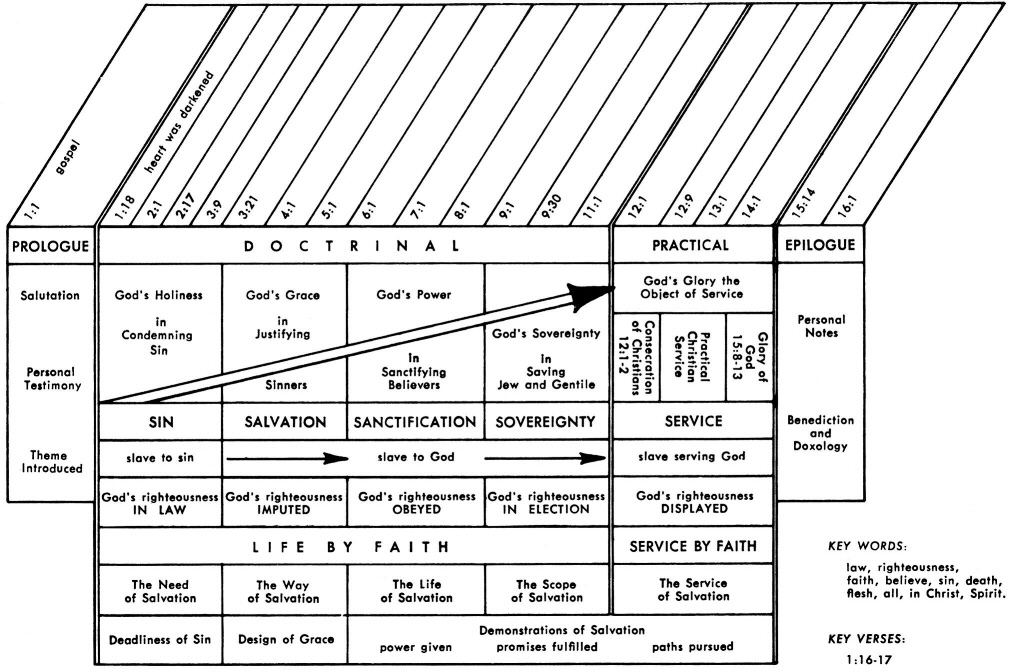
Click chart to enlarge
Chart from recommended resource Jensen's Survey of the NT - used by permission
Romans Overview Chart - Charles Swindoll
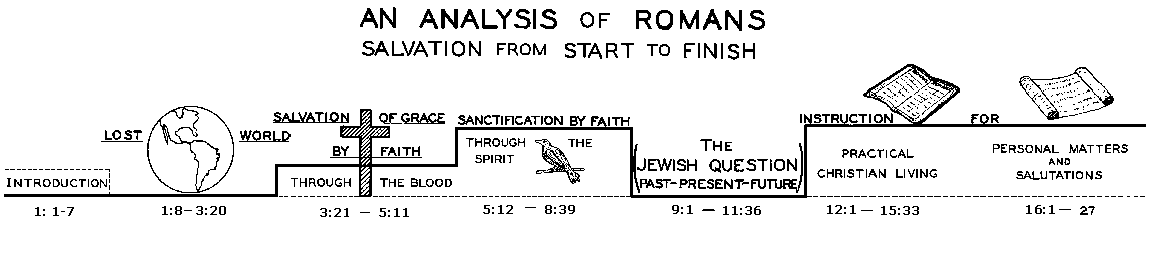
Source: Dr David Cooper
Click to Enlarge
| ROMANS ROAD to RIGHTEOUSNESS |
||||
| Romans 1:18-3:20 | Romans 3:21-5:21 | Romans 6:1-8:39 | Romans 9:1-11:36 | Romans 12:1-16:27 |
| SIN | SALVATION | SANCTIFICATION | SOVEREIGNTY | SERVICE |
| NEED FOR SALVATION |
WAY OF SALVATION |
LIFE OF SALVATION |
SCOPE OF SALVATION |
SERVICE OF SALVATION |
| God's Holiness In Condemning Sin |
God's Grace In Justifying Sinners |
God's Power In Sanctifying Believers |
God's Sovereignty In Saving Jew and Gentile |
Gods Glory The Object of Service |
| Deadliness of Sin |
Design of Grace |
Demonstration of Salvation | ||
| Power Given | Promises Fulfilled | Paths Pursued | ||
| Righteousness Needed |
Righteousness Credited |
Righteousness Demonstrated |
Righteousness Restored to Israel |
Righteousness Applied |
| God's Righteousness IN LAW |
God's Righteousness IMPUTED |
God's Righteousness OBEYED |
God's Righteousness IN ELECTION |
God's Righteousness DISPLAYED |
| Slaves to Sin | Slaves to God | Slaves Serving God | ||
| Doctrine | Duty | |||
| Life by Faith | Service by Faith | |||
|
Modified from Irving L. Jensen's chart above |
||||
R Ruin (Romans 1:17 – 3:20) – The utter sinfulness of humanity
O Offer (Romans 3:21-31) – God’s offer of justification by grace
M Model (Romans 4:1-25) – Abraham as a model for saving faith
A Access (Romans 5:1-11) – The benefits of justification
N New Adam (Romans 5:12-21) – We are children of two “Adams”
S Struggle w/ Sin (Romans 6:1-8:39) Struggle, sanctification, and victory
Romans 6:18 and having been freed from sin, you became slaves of righteousness. (NASB: Lockman)
Greek: eleutherothentes (AAPMPN) de apo tes hamartias edoulothete (2PAPI) te dikaiosune;
Amplified: And having been set free from sin, you have become the servants of righteousness (of conformity to the divine will in thought, purpose, and action). (Amplified Bible - Lockman)
Phillips: Then, released from the service of sin, you entered the service of righteousness. (Phillips: Touchstone)
Wuest: And having been set free once for all from the sinful nature, you were constituted slaves to righteousness.
Young's Literal: Now you are free from sin, your old master, and you have become slaves to your new master, righteousness.
AND HAVING BEEN FREED FROM SIN: eleutherothentes (AAPMPN) de apo tes hamartias:
- Ro 6:14; Ps 116:16; 119:32,45; Lk 1:74,75; Jn 8:32,36; 1Cor 7:21,22; Gal 5:1; 1Pet 2:16
- Romans 6 Resources - Multiple Sermons and Commentaries
PAST TENSE:
HAVING BEEN FREED!
Notice that this verse parallels Ro 6:22 "but now having been freed from sin and enslaved to God… " (see note)
Sin continues to be personified in this chapter as a harsh task master from whom believers have been once and for all time set free by the payment of the price for redemption (Lk 1:68, 2:38, Ro 3:24-note, 1Co 1:30, Col 1:14-note, Heb 9:15-note), the blood of the Lamb (Ep 1:7-note, He 9:11, 12-note, Da 9:24, Mt 26:28, 1Pe 1:18, 19-note, 1Jn 1:7, 2:2, Re 1:5-note, Re 5:9-note)
Listen to to the Psalmist who seems to speak of this liberation from Sin…
Ps 116:16: O LORD, surely I am Thy servant, I am Thy servant, the son of Thy handmaid, Thou hast loosed my bonds.
Spurgeon comments: Thou hast loosed my bonds, freedom from bondage binds me to thy service. He who is loosed from the bonds of sin, death, and hell should rejoice to wear the easy yoke of the great Deliverer. Note how the sweet singer delights to dwell upon his belonging to the Lord; it is evidently his glory, a thing of which he is proud, a matter which causes him intense satisfaction. Verily, it ought to create rapture in our souls if we are able to call Jesus Master, and are acknowledged by him as his servants.
Stephen Charnock (Puritan writer) says: Mercies are given to encourage us in God's service, and should be remembered to that end. Rain descends upon the earth, not that it might be more barren, but more fertile. We are but stewards; the mercies we enjoy are not our own, but to be improved for our Master's service. Great mercies should engage to great obedience. God begins the Decalogue with a memorial of his mercy in bringing the Israelites out of Egypt, -- "I am the Lord thy God, which brought thee out of the land of Egypt." How affectionately doth the Psalmist own his relation to God as his servant, when he considers how God had loosed his bonds: O LORD, truly I am thy servant; thou hast loosed my bonds! the remembrance of thy mercy shall make me know no relation but that of a servant to thee. When we remember what wages we have from God, we must withal remember that we owe more service, and more liveliness in service, to him. Duty is but the ingenuous consequent of mercy. It is irrational to encourage ourselves in our way to hell by a remembrance of heaven, to foster a liberty in sin by a consideration of God's bounty. When we remember that all we have or are is the gift of God's liberality, we should think ourselves obliged to honour him with all that we have, for he is to have honour from all his gifts. It is a sign we aimed at God's glory in begging mercy, when we also aim at God's glory in enjoying it. It is a sign that love breathed the remembrance of mercy into our hearts, when at the same time it breathes a resolution into us to improve it. It is not our tongues, but our lives must praise him. Mercies are not given to one member, but to the whole man.
Ps 119:45 And I will walk at liberty, for I seek Thy precepts.
Spurgeon Comments: And I will walk at liberty: for I seek thy precepts. Saints find no bondage in sanctity. The Spirit of holiness is a free spirit; he sets men at liberty and enables them to resist every effort to bring them under subjection. The way of holiness is not a track for slaves, but the King's highway for freemen, who are joyfully journeying from the Egypt of bandage to the Canaan of rest. God's mercies and His salvation, by teaching us to love the precepts of the word, set us at a happy rest; and the more we seek after the perfection of our obedience the more shall we enjoy complete emancipation from every form of spiritual slavery…
The verse is united to that which goes before (Ps 119:44), for it begins with the word And, which acts as a hook to attach it to the preceding verses. It mentions another of the benefits expected from the coming of mercies from God. The man of God had mentioned the silencing of his enemies (Psalms 119:42), power to proceed in testimony (Psalms 119:43), and perseverance in holiness; now he dwells upon liberty, which next to life is dearest to all brave men. He says, "I shall walk," indicating his daily progress through life; "at liberty," as one who is out of prison, unimpeded by adversaries, unencumbered by burdens, unshackled, allowed a wide range, and roaming without fear. Such liberty would be dangerous if a man were seeking himself or his own lusts; but when the one object sought after is the will of God, there can be no need to restrain the searcher. We need not circumscribe the man who can say, "I seek thy precepts." Observe, in the preceding verse he said he would keep the law; but here he speaks of seeking it. Does he not mean that he will obey what he knows, and endeavour to know more? Is not this the way to the highest form of liberty, -- to be always labouring to know the mind of God and to be conformed to it? Those who keep the law are sure to seek it, and bestir themselves to keep it more and more.
Earlier in Romans 6 Paul had explained the believer's liberation from the awful power and mastery of Sin…
For sin shall not be master over you, (why not?) for you are (present tense = our continuous state now in Christ) not under law, but under grace. (Ro 6:14-note)
Comment: "Under" (hupo) pictures not just a "position" but figuratively pictures under the power of something or some one (in this case Sin). Note carefully that when I place myself under the law, setting rules, living legalistically (saying "I can't do this… I can't do that… ") the old fallen flesh will "rise up" in response to those rules (see Ro 7:5-note). The believer is now under grace (God's transforming power, supernatural power to live a supernatural Christ-like life, a life possible in no other way).
Do this and live, the law commands,
But gives me neither feet nor hands.
A better word the gospel brings,
It bids me fly, and gives me wings.
As Clarke says now "Sin can enjoin (order or direct with urgency; admonish or instruct with authority; command) no good and profitable work; Righteousness can require none that is unjust or injurious.
And having been - This phrase shows that Romans 6:18 is the continuation and conclusion of the preceding sentence and not a new one. In addition this verse parallels Ro 6:22-note. Be careful in your interpretation of this verse. Paul is not saying that the sin principle has been eradicated, but that Sin is no longer the believer's master, which is expressed in the verb eleutheroo discussed below.
Hodge puts it this way - It was not license but a change of masters that they had experienced. This being the case, it is impossible they should serve sin; they now have another master. A freed slave does not continue to be subject to his former master. Similarly, our Lord says: “If the Son sets you free, you will be free indeed” (John 8:36). This subjection to righteousness is perfect liberty. It is the subjection of the soul to God, reason, and conscience, in which true liberty consists. This being the case, in the following verse the apostle explains the reason why he used an apparently incongruous illustration when speaking of the relationship of the believer to righteousness. (Romans 6 - Hodge's Commentary on Romans, Ephesians)
Shedd - Believers are free from the condemning power of sin, and from its enslaving power
Having been freed… have become slaves - It is important to notice that both of these verbs in Ro 6:18 are in the passive voice, which indicates that we have been acted upon by a power outside of ourselves to bring about the effects/actions of each verb. In other words, it is God alone Who supernaturally brought about the effects/actions indicated by these two verbs and this should be a cause of worship and humble thanks to our Creator and Redeemer and Friend.
FREE AT LAST:
THANK GOD WE'RE FREE AT LAST!
Having been freed (1659) (eleutheroo = the ending " -oo" means not only will it be set free but it will be seen as set free) (Click word study of eleutheroo) means to cause someone to be freed from domination. The picture is that of the emancipation of slaves (by the liberating truth of the Gospel of Christ). The idea is that the one set free is at liberty, capable of movement, exempt from obligation or liability, and unfettered. Although the act of setting free results in freedom and liberty we must understand that this new freedom is not a license to sin. In fact true liberty for the believer is now living as we should and not as we please. For the first time in Romans the important theme of Christian freedom is introduced. Here the aorist tense describes a past tense event - our salvation experience, passing from death to life, free from condemnation, free from the guilt of sin, no longer guilty before God. Dear Christian, are you struggling to be free? If so, then ask the Spirit to illuminate to your mind and heart this glorious truth - you have been already set free. Instead of struggling, you need to be standing in the truth of this freedom (study Romans 8:1, 2 [note] for it is "the law [principle] of the Spirit of life" Who enables us to walk in the freedom that we have by virtue of our position in Christ).
Do not confuse Paul's declaration of liberty as an affirmation of license, for that is not his intent as some falsely taught (cp Jude 1:4).
When we first believed (Eph 2:8, 9-note) we were united eternally with Christ (Ro 6:5-note), having died with Him (Ro 6:3-note, Ro 6:8-note, 2Ti 2:11-note, Col 2:20-note, Col 3:3-note) and then resurrected with Him (Ro 6:4-note, Col 2:12-note, Eph 2:6-note). The result was that a qualitatively, irreversibly new creation came into being (2Co 5:17, cp Ga 2:20-note) along with a decisive and irrevocable liberation (Ro 6:14-note, Ro 6:18) as we passed out of eternal death into eternal life (Jn 5:24), having been transferred from the dominion (power to control) of darkness (Satan's domain, cp Col 1:13-note, Acts 26:18, Eph 2:2,3-note) to the kingdom of light and dominion of our new Master, the Lord Jesus Christ (cp Col 4:1-note). Hallelujah!
As Leon Morris says " For him (Paul) freedom in Christ is not an invitation to splendid self-centeredness. The freed in Christ have become slaves to righteousness. They are not aimless, purposeless. They have been freed from sin in order that they may give themselves over wholly to worthwhile causes, boldly expressed here as being enslaved to the right. Elsewhere Paul tells us that, while the slave is Christ’s freedman, the free man called to be a Christian is Christ’s slave (1Co 7:22). We remember that Jesus said that a good tree “cannot” bear bad fruit (Mt 7:18). Paul is saying much the same in his own way. Those set free do not wander in a moral vacuum. They are slaves to righteousness. (Morris, L. The Epistle to the Romans. Grand Rapids, Mich.; Leicester, England: W. B. Eerdmans; Inter-Varsity Press)
Note that the phrase freed from Sin does not mean that believers no longer have a sinful nature (see flesh). And unfortunately, neither does it mean that we no longer commit acts of sin (that great hope [certainty] awaits our glorification, for when we see Him we shall be like Him 1Jn 3:2). The context shows that Paul is referring to freedom from sin as the dominating power in our life. God's provision and power (His Spirit [eg, Ro 8:13-note] and grace [eg Titus 2:11-note, Titus 2:12-note]) has now made it possible for us to live the supernatural Christian ("Christ") life (see Col 3:4-note -see Spurgeon's devotional, cp Jn 14:6, Ga 2:20-note; 1Jn 5:12) and now we can live for God. Beloved, don't try to live this supernatural life without learning to lean on the Spirit of Christ allowing Him to live through you.
Here are the 7 uses of eleutheroo in the NT - Jn. 8:32, 36; Ro 6:18, 22; 8:2, 21; Gal. 5:1
Jesus used the verb eleutheroo in His famous "emancipation" declaration "you shall know the truth, and the truth shall make you free (eleutheroo)." (Jn 8:32)
Our Lord went on to add that "If therefore the Son shall make you free (eleutheroo), you shall be free (eleutheros) indeed. (Jn 8:36)
Barnes writes that "You are not under (Sin's) dominion; you are no longer its slaves. They were made free, as a servant is who is set at liberty, and who is, therefore, no longer under obligation to obey. (Barnes Notes on the NT)
Comment: Beloved are you still harkening to the cries of your old master Sin? You realize that in Christ, empowered by His Spirit and grace, you no longer have to "give in" to those "old urges" to commit sin. This truth will take a lifetime to "perfect" (and only in glory is it made perfect), and that is what is involved in the daily walk of holiness, seeking His will, not my own will, submitting to His Spirit, relying on His enablement to accomplish this supernatural task. And as we do this, guess Who gets the glory? God of course (cp Mt 5:16-note)
From (575) (apo) is a preposition which means "from", "off from" "away from" and shows separation. Webster's defines "from" as "as a function word to indicate physical separation or an act or condition of removal, abstention, exclusion, release."
Apo basically means the going forth or proceeding of one object from another. Apo can be a marker of dissociation, implying a rupture from a former association. This preposition pictures the separation of one thing from another with destruction of the union or fellowship of the two. It conveys the idea of away from, separation, departure, cessation, completion, reversal.
Apo is used some 670 times and is translated most often as: from, 393; of, 129; out of, 48.
(Mat 106; Mk 48; Lk 113; Jo 39;Ac 104; Romans 26; 1 Co 10; 2 Co18; Gal 9; Ep 5; Phil 5; Col 9; 1 Thes 11;2 Thes 9;1 Ti 5;2 Ti 8;Titus 3;Phile 2;Heb 23;Ja 6;1 Pe 4;2 Pe; 1 Jo 16;2 Jo 2; 3 Jo; Jude 2;Re)
Below are a few illustrative uses of apo…
Matthew uses apo describing Jesus' name writing…
"And she will bear a Son; and you shall call His name Jesus, for it is He who will save His people from (apo = away from) their sins.” (Matthew 1:21)
Luke records Jesus' instruction to His disciples…
“And as for those who do not receive you, as you go out from (apo) that city, shake off the dust from (apo) your feet as a testimony against them.” (Luke 9:5).
Jesus, knowing that the Father had given all things into His hands, and that He had come forth from God, and was going back to God (John 13:3)
Much more then, having now been justified by His blood, we shall be saved from (apo) the wrath of God through Him. (Romans 5:9-note).
For he who has died is freed from (apo) sin. (Romans 6:7-note)
For the married woman is bound by law to her husband while he is living; but if her husband dies, she is released from (apo) the law concerning the husband. (Romans 7:2-note).
For the law of the Spirit of life in Christ Jesus has set you free from (apo) the law of sin and of death. (Romans 8:2-note).
Therefore, my beloved, flee (present imperative - commands to make this our lifestyle) from (apo) idolatry. (1Cor 10:14).
Therefore, being always of good courage, and knowing that while we are at home in the body we are absent from (apo) the Lord (2Cor 5:6)
Therefore, having these promises, beloved, let us cleanse ourselves from (apo) all defilement of flesh and spirit, perfecting holiness in the fear of God. (2Cor 7:1-note)
But I am afraid, lest as the serpent deceived Eve by his craftiness, your minds should be led astray from (apo) the simplicity and purity of devotion to Christ. (2Cor 11:3).
Let all bitterness (pikra) and wrath (thumos) and anger (orge) and clamor (krauge) and slander (blasphemia) be put away from (apo) you, along with all malice. (Ephesians 4:31-note)
If you have died with Christ to (from = apo) the elementary principles of the world, why, as if you were living in the world, do you submit yourself to decrees, such as (Colossians 2:20-note) (Comment: Think of what Paul is saying here - now that we are in Christ there is separation form these worldly ideas. Am I living up to my potential? cf Gal 6:14)
For this is the will (thelema) of God, your sanctification (hagiasmos); that is, that you abstain from (apo) sexual immorality (porneia) (1Thes 4:3-note)
But examine everything carefully; hold fast to that which is good; abstain from (apo) every form of evil. (1The 5:21,22-note) (All three verbs are present imperative - commands to make this our lifestyle - remember God never commands us to do anything that He does not also enable by His Spirit and His all sufficient grace!)
Nevertheless, the firm foundation of God stands, having this seal, “The Lord knows those who are His,” and, “Let everyone who names the name of the Lord abstain from (apo) wickedness.” (2Timothy 2:19-note).
And will turn away (active voice = their volitional, willful choice) their ears from (apo) the truth, and will turn aside (passive voice = implies by outside force - analogous to "reaping" the seeds of the "seeds" of their choice to turn away from truth) to myths. (2Timothy 4:4-note)
Take care (present imperative - commands to make this our lifestyle), brethren, lest there should be in any one of you an evil, unbelieving heart, in falling away from (apo) the living God. (Hebrews 3:12-note)
How much more will the blood of Christ, who through the eternal Spirit offered Himself without blemish to God, cleanse your conscience from (apo) dead works to serve the living God? (Hebrews 9:14-note)
See to it (aorist imperative = command to do this now. Do it effectively. It is urgent) that no one comes short of (from = apo) the grace of God; that no root of bitterness springing up causes trouble, and by it many be defiled (Hebrews 12:15-note).
Submit (hupotasso) (aorist imperative = command to do this now. Do it effectively. It is urgent) therefore to God. Resist (anthistemi) (aorist imperative) the devil (diabolos) and he will flee from (apo) you. (James 4:7-note)
Comment: We don't need to buy a large tome on "spiritual warfare" beloved. What we need to do is memorize and obey this command [in this order - surrender to the Supreme One, stand against Satan - don't try the latter without accomplishing the former!] in the power of His Spirit and the grace He provides.
Little children, guard (aorist imperative = command to do this now. Do it effectively. It is urgent) yourselves from idols. (1John 5:21)
And I saw the holy city, new Jerusalem, coming down out of heaven from (apo) God, made ready as a bride adorned for her husband." (Rev 21:2-note)
And if anyone takes away from (apo) the words of the book of this prophecy, God shall take away his part from (apo) the tree of life and from the holy city, which are written in this book. (Rev 22:19-note)
YOU BECAME SLAVES OF RIGHTEOUSNESS: edoulothete (2PAPI) te dikaiosune:
- Ro 6:19,20,22; Isa 26:13; 54:17
- Romans 6 Resources - Multiple Sermons and Commentaries
Having been set free from the evil nature, the believer was constituted a slave of righteousness. Believers have changed masters, no longer slaves of Sin, but instead slaves of Righteousness. There is no middle ground, no “no man’s land” in this war. Believers are no longer free to do whatever they desire. They are free only to do that which is consistent with the character of God. True freedom is freedom from the ruthless tyrant Sin. Now that we are in Christ we are slaves who do what God approves of. Our new master is personified as "Righteousness".
Became slaves (1402) (douloo - see also study of doulos) means to bring someone into a state of absolute obedience and thus to bring into bondage, to enslave, to make someone a slave. The idea is to be held and controlled against one’s will. Figuratively (all NT uses except Acts 7:6) douloo means to gain control over someone. To become servant, to make someone a slave or to become a slave, to serve. The imagery derives directly from the ancient practice of enslaving an enemy defeated in battle as a prisoner! And so douloo describes not so much a relation of service as primarily one of dependence upon, or bondage to, something.
Douloo - 8x in 8v - Acts 7:6; Ro 6:18, 22; 1Cor 7:15; 9:19; Gal 4:3; Titus 2:3; 2Pe 2:19. NAS = became slaves(1), enslaved(4), held in bondage(1), made a slave(1), under bondage(1).
Vine writes that douloo "signifies to fulfill the duties of a slave, for whom there was no choice either as to the kind or length of his service.
The TDNT has an interesting comment on the background of this Greek word group noting that…
Greeks have a strong sense of freedom. Personal dignity consists of freedom. There is thus a violent aversion to bondage. Service may be rendered to the state, but by free choice. Slavery is scorned and rejected. This explains the fierceness with which the Greeks fought for political independence. The only slavery Plato will allow is to the laws. The laws, however, represent the goal of humanity, so that slavery to law is in no way derogatory. Aristotle shows a similar scorn for slavery; for him slaves have no part in the state or true service to it. The Stoics have a broader view of service. Zeus himself summons us to it, so that, while free in relation to all people, we are unconditionally bound to all. Yet the Stoic would never call himself the doúlos theoú; he moves through the world as basileús and despótēs, the very opposite of the doúlos. This is the characteristic of the wise. Those who are not wise are slaves, no matter what the form of their bondage (cf. Epictetus, Plutarch, and Philo). This survey shows that the group has no religious significance for the Greeks. It acquires this as Near Eastern religions win new adherents and in so doing change the Greek view of God and our relationship to him. (Kittel, G., Friedrich, G., & Bromiley, G. W. Theological Dictionary of the New Testament. Eerdmans)
Righteousness (1343) (dikaiosune from dikaios = being proper or right in the sense of being fully justified being or in accordance with what God requires) is the quality of being upright. In its simplest sense dikaiosune conveys the idea of conformity to a standard or norm. In Biblical terms it is that which is acceptable to God and in keeping with what God is in His holy character. In this sense righteousness is the opposite of hamartia (sin), which is defined as missing of the mark set by God. In this sense righteousness is the opposite of hamartia (sin), which is defined as missing of the mark set by God.
Dikaiosune - 92x in 85v -
Mt 3:15; 5:6, 10, 20; 6:1, 33; 21:32; Luke 1:75; John 16:8, 10; Acts 10:35; 13:10; 17:31; 24:25; Rom 1:17; 3:5, 21f, 25f; 4:3, 5f, 9, 11, 13, 22; 5:17, 21; 6:13, 16, 18ff; 8:10; 9:30f; 10:3ff, 10; 14:17; 1 Cor 1:30; 2 Cor 3:9; 5:21; 6:7, 14; 9:9f; 11:15; Gal 2:21; 3:6, 21; 5:5; Eph 4:24; 5:9; 6:14; Phil 1:11; 3:6, 9; 1 Tim 6:11; 2 Tim 2:22; 3:16; 4:8; Titus 3:5; Heb 1:9; 5:13; 7:2; 11:7, 33; 12:11; Jas 1:20; 2:23; 3:18; 1 Pet 2:24; 3:14; 2 Pet 1:1; 2:5, 21; 3:13; 1 John 2:29; 3:7, 10; Rev 19:11; 22:11
Dikaiosune is rightness of character before God and rightness of actions before men. Righteousness of God could be succinctly stated as all that God is, all that He commands, all that He demands, all that He approves, all that He provides through faith in Christ (Click here to read Pastor Ray Pritchard's interesting analysis of righteousness in the Gospel of Matthew).
Jamieson, Fausset and Brown - The case is one of emancipation from entire servitude to one Master to entire servitude to another, whose property we are. There is no middle state of personal independence; for which we were never made, and to which we have no claim. When we would not that God should reign over us, we were in righteous judgment "sold under Sin"; now being through grace "made free from Sin," it is only to become "servants to Righteousness," which is our true freedom." (Romans 6 - Bible Commentary)
R H Mounce emphasizes that "The freedom brought by grace does not provide carte blanche to continue in sin. On the contrary, grace places the believer under obligation to holiness and growth in righteousness." (Mounce, R. H. Romans: The New American Commentary. Broadman & Holman Publishers)
The Bible Knowledge Commentary adds that now "Christians are not to give in to sin because they are dead to it and no longer slaves of it. It is totally contrary to God’s plan for slaves of righteousness to become enslaved to sin!" (Walvoord, J. F., Zuck, R. B., et al: The Bible Knowledge Commentary. 1985. Victor).
Charles Hodge writes that "It was not license but a change of masters that they had experienced. This being the case, it is impossible they should serve sin; they now have another master. A freed slave does not continue to be subject to his former master. Similarly, our Lord says: “If the Son sets you free, you will be free (eleutheroo) indeed” (John 8:36). This subjection to righteousness is perfect liberty. It is the subjection of the soul to God, reason, and conscience, in which true liberty consists. This being the case, in the following verse the apostle explains the reason why he used an apparently incongruous illustration when speaking of the relationship of the believer to righteousness." (Romans 6 Commentary) (Bolding added)
Haldane writes that "The servants of righteousness are men obedient to righteousness, being devoted to the practice of such works as are righteous, or, as is said in other words, in verse Ro 6:22, “servants of God.” (Haldane, R. An Exposition of Romans)
Romans 6:19 I am speaking in human terms because of the weakness of your flesh. For just as you presented your members as slaves to impurity and to lawlessness, resulting in further lawlessness, so now present your members as slaves to righteousness, resulting in sanctification. (NASB: Lockman)
Greek: anthropinon lego (1SPAI) dia ten astheneian tes sarkos humon hosper gar parestesate (2PAAI) ta mele humon doula te akatharsia kai te anomia eis ten anomian, houtos nun parastesate (2PAAM) ta mele humon doula te dikaiosune eis hagiasmon
Amplified: I am speaking in familiar human terms because of your natural limitations. For as you yielded your bodily members [and faculties] as servants to impurity and ever increasing lawlessness, so now yield your bodily members [and faculties] once for all as servants to righteousness (right being and doing) [which leads] to sanctification. (Amplified Bible - Lockman)
Phillips: (I use an everyday illustration because human nature grasps truth more readily that way.) In the past you voluntarily gave your bodies to the service of vice and wickedness - for the purpose of becoming wicked. So, now, give yourselves to the service of righteousness - for the purpose of becoming really good. (Phillips: Touchstone)
Wuest: I am using an illustration drawn from human affairs because of the frailties of your humanity. For just as you placed your members as slaves at the disposal of uncleanness and lawlessness resulting in lawlessness, thus now place your members as slaves at the disposal of righteousness resulting in holiness.
Young's Literal: I speak this way, using the illustration of slaves and masters, because it is easy to understand. Before, you let yourselves be slaves of impurity and lawlessness. Now you must choose to be slaves of righteousness so that you will become holy.
I AM SPEAKING IN HUMAN TERMS BECAUSE OF THE WEAKNESS OF YOUR FLESH: anthropinon lego (1SPAI) dia ten astheneian tes sarkos humon:
- Ro 3:5; 1Cor 9:8; 15:32; Gal 3:15
- Ro 8:26; 15:1; Heb 4:15
- Romans 6 Resources - Multiple Sermons and Commentaries
Beginning in Romans 6:15 Paul expanded his personification of Sin by contrasting this old master (Sin) with the new master, Righteousness. As discussed below although presenting a useful picture, such analogies are less than perfect.
Notice that in Romans 6:18 we have the truth about our new position (having been freed), whereas here in Romans 6:19, Paul commands us to act on that truth (present your members).
In human terms (see similar verbiage in 1Co 15:32; Ga 3:15) means that as humans we grope in our weakness and finiteness for language that is sufficient this great and glorious reality, and are forced to settle for words and images that are only partially helpful. Paul knows that there were aspects of slavery (which existed everywhere in Paul's time and was thus a very poignant illustration) that he would not want us to attribute to our relation to righteousness or to God.
Morris adds that speaking in human terms "is to speak “as people do in daily life”… He is not so much apologizing for using an illustration from slavery as explaining why he did it. Slavery was regarded as such a degrading state and it was so firmly repudiated in the contemporary world that it would not normally be regarded as an acceptable metaphor. But it makes things very clear to his readers, and they needed such clarity. “On account of the weakness of your flesh” (NIV, natural selves) has been understood as referring to moral weakness, a view strengthened by the words that follow (Ibid)
Moule commenting on speaking in human terms puts it this way "I use the terms of this utterly not-divine bond of man to man, to illustrate man’s glorious bond to God, because of the weakness of your flesh, because your yet imperfect state enfeebles your spiritual perception, and demands a harsh paradox to direct and fix it. (The Epistle of Paul the Apostle to the Romans - Online)
John Piper explains Paul's in human terms because of the weakness of your flesh…
In other words, as humans we grope in our weakness and finiteness for language that is sufficient for great and glorious and complex realities, and have to settle for words and images that are partially helpful and partially misleading. Paul knows good and well that there were aspects of slavery that he would not want us to attribute to our relation to righteousness or to God, even though he says that we are “enslaved” to righteousness (Ro 6:18) and “enslaved” to God (Ro 6:22).
Jesus, you recall, did the same thing in John 15:15 “No longer do I call you slaves, for the slave does not know what his master is doing; but I have called you friends, for all things that I have heard from My Father I have made known to you.” So there are some aspects of slavery that we should apply to our relationship to God and some that we should not. And there are some aspects of friendship that we should apply and some we should not. We judge from the context what aspect of an image we are to focus on.
Slavery in Romans 6:6, 16, 17, 18, 19, 20, 22 does not imply mainly being forced against our will to do something. It mainly implies that our wills are enslaved. They are bound to do sin or bound to do righteousness because by nature we either see the rewards of sin or the beauty of righteousness as more attractive. So in both cases we do what we want most to do. (See full sermon Slaves to God, Sanctification, Eternal Life)
Weakness (769) (astheneia [word study] from a = without + sthénos = strength, bodily vigor) means without strength and figuratively describes a state of incapacity to do or experience something. In this context weakness refers to our limited human nature. As discussed under "flesh" below, many commentators take this to be a reference to our fallen flesh (that part of us which is irrevocably opposed to God) while others interpret it as weak in an intellectual sense, reflecting an inability to fully comprehend this truth.
Asthenia - 24x in 23v - NAS = ailments(1), diseases(1), ill(1), illness(1), infirmities(1), sickness(3), sicknesses(2), weak(1), weakness(9), weaknesses(4).
Matt 8:17; Luke 5:15; 8:2; 13:11f; John 5:5; 11:4; Acts 28:9; Rom 6:19; 8:26; 1 Cor 2:3; 15:43; 2 Cor 11:30; 12:5, 9f; 13:4; Gal 4:13; 1 Tim 5:23; Heb 4:15; 5:2; 7:28; 11:34.
Flesh (4561) (sarx) does not refer here to the physical flesh ("flesh and blood") but to the moral/ethical or spiritual sense describes the outlook orientated toward self, which is prone to sin, which is opposed to God and which pursues its own ends in self-sufficient, independence from God. Flesh is the ugly complex of human sinful desires that includes the ungodly motives, affections, principles, purposes, words, and actions that sin generates through our bodies. Sarx as used in this manner denotes the entire fallen human being—not just the sinful body but the entire being, including the soul and mind, as affected by sin. To live according to the flesh is to be ruled and controlled by that evil complex. Because of Christ’s saving work on our behalf, the sinful flesh no longer reigns over us, to debilitate us and drag us back into the pit of depravity into which we were all born.
A T Robertson writes that Paul "begs pardon for using “slaving” in connection with righteousness. But it is a good word, especially for our times when self-assertiveness and personal liberty bulk so large in modern speech.
Vincent says that Paul "seems to have felt that the figures of service, bondage, etc., were unworthy of the subject, and apologizes for his use of the image of the slave-mart to enforce such a high spiritual truth, on the ground of their imperfect spiritual comprehension. (Vincent, M. R. Word studies in the New Testament. Vol. 3, Page 1-72)
R C Sproul - The illustration of slavery is an inadequate representation of the Christian life, especially in the Roman context, because it could convey harsh connotations of human slavery and inadequately express the truth that the yoke of Christ is easy (Matt 11:28, 29, 30)." (New Geneva study Bible. Nashville: Thomas Nelson)
A T Robertson says that Weakness of your flesh means "Because of defective spiritual insight largely due to moral defects also.
Matthew Poole - I accommodate myself to your capacity, because of the weakness of your understanding in spiritual things; therefore I use this familiar similitude of service and freedom, that by these secular and civil things you might the better understand such as are spiritual. (Matthew Poole's Commentary on the New Testament)
MacArthur explains that flesh (sarx) "is here used as a synonym for humanness or mortality, and is equivalent to “the members of your body” in v13 and members at the end of v19. The flesh is the human faculty influenced by Sin, and as long as believers remain in their mortal bodies, Sin still has a beachhead, a place to launch its attacks.
Hodge agrees writing that Paul "used this illustration, he says, because they were weak in their natural selves — not intellectual weakness, but weakness which stemmed from their corrupt nature (sarx). It was their lack of spirituality which rendered such illustrations necessary. (Romans Commentary)
William Newell also agrees writing…
I am speaking in human terms on account of the moral strengthlessness of your flesh-Paul here explains why he is using this word "bondservants" throughout this passage. He declares the "infirmity of our flesh" to be such, that we must necessarily be in bond service-either to sin or to God. Rome was full of slaves -- indeed, many of the Christians to whom he was writing were slaves, as seems to be indicated in Romans 16. In the Roman Empire, freedom was a most difficult thing to secure (Acts 22:28). So Paul speaks in human terms, "after the manner of men, " and he says that we are strengthless naturally, that we must be servants, either of God or of sin.
Man hates this fact. He boasts his independence, whether it be in the realm of intellect-"free thought!" in the matter of private wealth-"independent!" or in the manner of government -"free!" But it is all really a delusion. We indeed rejoice at the intellectual shackles thrown off at the Renaissance, and at liberty of thought and expression, wherever found among men. We also honor those who, like Boaz (Ru 2:1-note), are "mighty men of wealth" for God has permitted it to be so; and we rejoice at that relief from governmental tyranny which is yet found in some parts of this earth.
But what we most earnestly assert is that not only Paul here, but our Lord Himself, and Scripture generally, sets forth that only those that know the truth and walk therein, are free. The Jews (in Jn 8:33, 34, 35, 36ff) horribly rebel against our Lord's saying: "If ye abide in My word, then are ye truly My disciples: and ye shall know the truth, and the truth shall make you free! … Every one that commits sin is the bond-servant of sin… If the Son shall make you free, ye shall be free indeed." There is no freedom out of Christ. "Whose service is perfect freedom" is the beautiful expression of obedience to God.
We must see this necessity of service to God or service to sin for our own lives. When John wrote to believers, "We know that we are of God, and the whole earth lies in the (hand of the) evil one" (1Jn 5:19, Lk 4:5, 6, 7), -what a revelation was that!
These Roman Christians had formerly, like the pagans among whom they lived, presented their members bondservants to uncleanness in every inward thought, and to lawlessness unto further lawlessness in outward practice. A blacker page of iniquitous abominations history does not write than that of the Roman Empire of Paul's day! (E.g., see entries in Edward Gibbon's The History Of The Decline And Fall Of The Roman Empire - eg, see Degeneracy) And out of these fearful states of sin, God had de- livered these believers! Compare 1Co 6:9-11. (Romans 6 - Newell's Commentary on Romans)
FOR JUST AS YOU PRESENTED YOUR MEMBERS AS SLAVES TO IMPURITY AND TO LAWLESSNESS RESULTING IN FURTHER LAWLESSNESS: hosper gar parestesate ta mele humon doula te akatharsia kai te anomia kai te anomia:
- Ro 6:13,17; 1Co 6:11; Ep 2:2,3; Col 3:5, 6, 7; 1Pet 4:2, 3, 4
- Ro 6:16; 1Cor 5:6; 15:33; 2Ti 2:16,17; Heb 12:15
- Romans 6 Resources - Multiple Sermons and Commentaries
For - Always pause to ponder this strategic term of explanation.
Just as you presented your members as slave to impurity and lawlessness - Before we were born again, this is the way we behaved. Paul is reminding his readers of their former state, in order to draw a dramatic contrast with how we are to behave now that we have been set free from the power of Sin.
Morris - Paul makes the point that the Roman Christians are to be just as wholehearted in walking in the ways of God now as they used to be in their bondage to sin. His aorist tenses point to wholehearted commitment. They had given themselves wholeheartedly to sin; let them now give themselves equally wholeheartedly to righteousness. (Morris, L.. The Epistle to the Romans. Grand Rapids, Mich.; Leicester, England: W. B. Eerdmans; Inter-Varsity Press)
Presented (3936) (paristemi from para = near, beside + histemi = place, set) literally means to place or set beside or near and hence to place at someone's disposal. Paristemi means to present oneself for service or to put at the service of.
Paristemi - 41x in 39v - NAS = bystanders(5), come(1), commend(1), help(1), present(11), presented(4), presenting(1), prove(1), provide(1), put at… disposal(1), stand before(2), standing(1), standing beside(1), standing nearby(2), stands(1), stands here(1), stood(2), stood before(1), stood beside(2), took their stand(1).
Matt 26:53; Mark 4:29; 14:47, 69f; 15:35, 39; Luke 1:19; 2:22; 19:24; John 18:22; 19:26; Acts 1:3, 10; 4:10, 26; 9:39, 41; 23:2, 4, 24, 33; 24:13; 27:23f; Rom 6:13, 16, 19; 12:1; 14:10; 16:2; 1 Cor 8:8; 2 Cor 4:14; 11:2; Eph 5:27; Col 1:22, 28; 2 Tim 2:15; 4:17.
Members (3196) (melos) refers to a limb or member of the body and in the plural (and in the context of the present verse) refers to the members of body as the seat of the desires and passions.
Hodge amplifies members with the phrase "“your various faculties,” with special reference to their bodily organs as the visible instruments of evil. (Romans Commentary - online)
Vine commenting on Colossians 3:5 describes melos as "A member or limb, here in the plural, is used morally, our actual limbs being used as instruments either for the world, the things on the earth, instead of being put to death, or used for Christ and His glory, and the things in the heavens. We thus either identify ourselves with the old man, or with the new man." (Vine, W. Collected writings of W. E. Vine. Nashville: Thomas Nelson)
Melos is used 34 times in the NT - Mt 5:29, 30; Ro 6:13, 19; 7:5, 23; 12:4, 5; 1Co 6:15; 12:12, 14, 18, 19, 20, 22, 25, 26, 27; Ep 4:25; 5:30; Col 3:5; Jas 3:5, 6; 4:1
Slaves (1401)(doulos from deo = to bind) (Click additional notes on doulos) describes one who is bound to another in servitude. It conveys the idea of the slave's binding ties with the master, so that the slave belongs completely to the master and is obligated to do his will so that the will of the doulos was totally consumed in the will of the master, personified as the decadent duo of impurity and lawlessness!
Impurity (167) (akatharsia from a = without + kathaíro = cleanse) is a broad term referring to moral uncleanness in thought, word, and deed. It describes a state of moral impurity, especially sexual sin. The term akatharsia refers to filth or refuse. Paul's point here is that sin defiles us, producing corruption and degradation of the sinner. The sinner is never a winner!
Rod Mattoon - The word akatharsia means everything which would hinder a man to enter into God's presence. It describes the life muddied with wallowing in the world's ways. It is the opposite of purity and considered one of the deeds of the flesh (Galatians 5:19).
Grant Richison says akatharsia means “uncleanness” and relates to the idea that aberrant sex defiles the purity of marriage.
Akatharsia is used 10 times is translated: impurity, 9; uncleanness, 1.
Matthew 23:27 "Woe to you, scribes and Pharisees, hypocrites! For you are like whitewashed tombs which on the outside appear beautiful, but inside they are full of dead men's bones and all uncleanness.
Romans 1:24 (note) Therefore God gave them over in the lusts of their hearts to impurity, that their bodies might be dishonored among them.
In Romans when men exchange the glory of the incorruptible God for an image in the form of corruptible man, etc, and "God gave them over in the lusts of their hearts to impurity (akatharsia), that their bodies might be dishonored among them. For they exchanged the truth of God for a lie, and worshiped and served the creature rather than the Creator, who is blessed forever. Amen.." (Ro 1:23-25 - see notes Romans 1:23; 1:24-25)
Comment - And why did God give them over to the power of their lusts? The answer gives us a clue for the antidote of impurity! Read Romans 1:18-22, especially the phrase in verse 21 "they did not honor Him as God or give thanks." It is fascinating that Paul repeats the "antidote" of giving thanks in Ephesians 5:3-4+ writing in verse 4 "but rather (read Eph 5:3-4 for what precedes the "but") giving of thanks." Beloved, look out when you begin to grumble instead of (by the Spirit) manifesting an attitude of gratitude. You are on a slippery slope and will soon slide into the cesspool of Romans 1:26-32!
Romans 6:19 (note) I am speaking in human terms because of the weakness of your flesh. For just as you presented your members as slaves to impurity and to lawlessness, resulting in further lawlessness, so now present your members as slaves to righteousness, resulting in sanctification.
2 Corinthians 12:21 I am afraid that when I come again my God may humiliate me before you, and I may mourn over many of those who have sinned in the past and not repented of the impurity, immorality and sensuality which they have practiced.
Galatians 5:19 Now the deeds of the flesh are evident, which are: immorality, impurity, sensuality,
MacArthur says akatharsia "refers to pornographic thoughts that lead to pornographic activities....A contemporary term to describe all these is "sexual addiction." Sexual addictions are not caused by a lack of self-esteem or a poor relationships with your mother or father. They are produced by the flesh."
Ephesians 4:19 (note) and they, having become callous, have given themselves over to sensuality, for the practice of every kind of impurity with greediness.
Ephesians 5:3 (note) But do not let immorality or any impurity or greed even be named among you, as is proper among saints;
Colossians 3:5 (note) Therefore consider the members of your earthly body as dead to immorality, impurity, passion, evil desire, and greed, which amounts to idolatry.
1 Thessalonians 2:3 (note) For our exhortation does not come from error or impurity or by way of deceit;
1 Thessalonians 4:7 (note) For God has not called us for the purpose of impurity, but in sanctification.
Akatharsia is used in 1 Th 4:7+ where Paul reminds the predominantly Gentile believers in Thessalonica (who had come out of abominable idolatry mixed with immorality - which is a common combination) that "God has not called us for the purpose of impurity, but in sanctification (holiness = hagiasmos also used in 1 Th 4:3, 7; Heb 12:14)." The antithesis of impurity is purity or holiness! And the only way a believer can be holy is by continual dependence on the Holy Spirit to energize the desire to be holy and the power to be holy (cf Php 2:13NLT+) There is ABSOLUTELY NO WAY a believer can be holy solely relying on his or her own strength. Note this is not "Let go, let God," but more accurately "Let God, let's go!" See the "Paradoxical Principle of 100% Dependent and 100% Responsible" (100/100)
There are 42 uses of akatharsia in the Septuagint (LXX)
Lev. 5:3; 7:20, 21; 15:3, 24, 25, 26, 30, 31; 16:16, 19; 18:19; 19:23; 20:21, 25; 22:3, 4, 5, Nu 19:13; 2Sa 11:4; 2Chr 29:5, 16; Ezr. 6:21; 9:11; Prov. 6:16; 24:9; Jer. 19:13; 32:34; Lam 1:9; Ezek. 4:14; 7:20; 9:9; 22:10, 15; 24:11; 36:17, 25, 29; 39:24; Hos. 2:10; Mic. 2:10; Nah. 3:6)
Here are a few representative uses in the LXX…
Leviticus 5:3 'Or if he touches human uncleanness (Lxx = akatharsia), of whatever sort his uncleanness (Lxx = akatharsia), may be with which he becomes unclean, and it is hidden from him, and then he comes to know it, he will be guilty.
Leviticus 15:31 "Thus you shall keep the sons of Israel separated from their uncleanness (Lxx = akatharsia), lest they die in their uncleanness (Lxx = akatharsia) by their defiling My tabernacle that is among them."
Leviticus 20:21 'If there is a man who takes his brother's wife, it is abhorrent (Lxx = akatharsia = uncleanness); he has uncovered his brother's nakedness. They shall be childless.
Ezekiel 36:29 "Moreover, I will save you from all your uncleanness (Lxx = akatharsia); and I will call for the grain and multiply it, and I will not bring a famine on you.
Akatharsia describes a filthiness of heart and mind (so it is internal as compared to anomia discussed below) that makes the person defiled. The unclean person sees dirt in everything. The word akatharsia suggests especially that it defiles its participants, making them unusable for sacred purpose. While akatharsia includes sexual sin, it comes from a wider Septuagint (Greek translation of the Hebrew OT) usage where “unclean” could refer to anything that made a person unfit to go to the temple and appear before God. In a medical sense Hippocrates used this word to describe an infected, oozing wound with pus and crusty impurities that gather around the sore or wound. What is “impure” is filthy and repulsive, especially to God. Akatharsia was a general term often used of decaying matter, like the contents of a grave. In short akatharsia describes any excessive behavior or lack of restraint and speaks more of an internal disposition. An immoral filthiness on the inside whereas the lawless acts of ''immorality'' are on the outside.
J D Watson in Word for the Day has the following on akatharsia...
The second characteristic of counterfeit love is uncleanness (Eph. 5:3). The Greek akatharsia <G167> is a broader term than porneia (fornication). Paul uses this word in Ephesians 4:19 to show that man is so far gone, so past even feeling guilt for his sin, that he's totally given over to filthy living.
Akatharsia is actually tied in with the Old Testament concepts of "clean" and "unclean." One could become "unclean" in several ways—by eating unclean meat, for example—so Paul "borrows" the term, brings it into the Christian life, and shows that everything propagated by Satan's counterfeit love is unclean, impure, and polluted. Not only are immoral acts impure, but immoral thoughts and fantasies are impure. Today there are books written about people's sexual fantasies and the world has the audacity to call such things "love"! One insidious example of such uncleanness (if not outright fornication) is the vileness of pornography. In conjunction with the word graphē <1124>, which means "writing," it's from pornos that this term is derived, and which means a writing or picture of sexual sin and involves all the meanings listed yesterday. But while certain types of pornography are considered "bad," other types, such as Playboy magazine, actually have a certain degree of respectability and are not really considered pornography by some people, but rather "art." In recent years indescribably revolting paintings and sculptures have been displayed in art galleries and are even paid for with tax money. According to Forbes Magazine (5-25-01), pornographic magazines gross $1 billion annually, pornography on the Internet another $1 billion, pay-per-view movies $128 million, and adult videos add between $500 million and $1.8 billion, yielding a total of $2.6 to $3.9 billion per year. If that's not enough to appall us, how about the complicity of local and state governments that gather sales tax on such perversion? After all, it's argued, "It's just another business," and "We can't regulate morality." Many a man (even among Christians) has started with pornography and ended up not being able to have normal relations with his wife or even being transformed into a child molester. Such conduct must "not be once named among [Christians]" (Eph. 5:3). We must constantly be on guard against uncleanness and "abstain from all appearance of evil" (1 Thess. 5:22).
Rick Renner -
The word "uncleanness" is the Greek word akatharsia, which is the word kathairo with the prefix a added. The word kathairo means cleansed or pure, but when the a is added to it the condition is reversed, making the object dirty or unclean. In the New Testament, this word refers to lewd or unclean thoughts that eventually produce lewd or unclean actions. As it is used in the Gospels and Paul's epistles, it strongly suggests that these actions begin in the mind as unclean thoughts before they manifest as unclean deeds.
Mark 1:23 says, "And there was in their synagogue a man with an unclean spirit...." The Greek actually says that this man was "gripped by the control of an unclean spirit." It seems this man had pondered on lewd thoughts for so long that he had thrown open the door for these thoughts to seize and control him, so that eventually he found himself "in the clutch" of an unclean spirit. Although the text doesn't explicitly say it, the usage of the word akatharsia makes one wonder whether or not this demon found entrance into this man's life because he allowed his mind to dwell on things that were forbidden. Had he committed mental prostitution to such an extent that it opened the door for him to be completely controlled by spirits of uncleanness? The Bible doesn't say exactly so, but the usage of the word akatharsia definitely makes this a possibility.
In Mark 5:2, we find another example of a man with an unclean spirit. It says, "And when he was come out of the ship, immediately there met him out of the tombs a man with an unclean spirit." The word "unclean" is also the word akatharsia. Just as Mark 1:23 depicted the man in the synagogue as being "gripped by the control of an unclean spirit," this word could be translated exactly the same way in this verse. In the first five chapters of Mark, we thus have two very demonized individuals whose demon-possessed condition seems to have begun with impure, lewd, dirty thoughts, since this is exactly what the Greek word akatharsia means that is used in both texts. Did Satan lure them into the pornography of unclean ideas or into adultery, and then build a stronghold of uncleanness so robust in their minds that he was able to eventually cause unclean actions to be manifested in their lives and thus completely control them?
Never forget that Paul told us, "Know ye not, that to whom ye yield yourselves servants to obey, his servants ye are to whom ye obey..." (Romans 6:16). Whatever you give your mind to will eventually be your master. Was this the case with these two demon-possessed men in Mark 1:23 and Mark 5:2? I am not stating it emphatically, but the Greek suggests this very strongly However, it should certainly make us want to take charge of our thought life and not allow uncleanness to have any place in our minds! (Sparkling Gems from the Greek)
Barton says that akatharsia refers to "Moral uncleanness. Perhaps no sexual act has taken place, but the person exhibits a crudeness or insensitivity in sexual matters that offends others and leads them to false conclusions about the other person’s character. An example today would be the excessive use of sexual humor (or what is supposed to be humor), where people make statements with a sexual double meaning." (Barton, B. B. Life application Bible commentary. Wheaton, Ill.: Tyndale House)
William Barclay writes that akatharsia means…
everything which would unfit a man to enter into God’s presence. It describes the life muddied with wallowing in the world’s ways. Kipling prayed
Teach us to rule ourselves always,
Controlled and cleanly night and day.
Akatharsia is the very opposite of that clean purity… It can be used for the pus of an unclean wound, for a tree that has never been pruned, for material which has never been sifted. In its positive form (katharos, an adjective meaning pure) it is commonly used in housing contracts to describe a house that is left clean and in good condition. But its most suggestive use is that katharos is used of that ceremonial cleanness which entitles a man to approach his gods. Impurity, then, is that which makes a man unfit to come before God, the soiling of life with the things which separate us from him… Jesus used the word to describe the rottenness of decaying bodies in a tomb (Matthew 23:27). The other ten times the word is used in the New Testament it is associated with sexual sin. It refers to immoral thoughts, passions, ideas, fantasies, and every other form of sexual corruption. (The Daily Study Bible - 2Corinthians) (Bolding added)
Lawlessness (458) (anomia) from a = negates what follows + nomos = law) literally describes that which is without the law and signifies, not merely the abstract idea, but disregard for, or actual breach of, the law of God. Anomia means “no law,” and emphasizes an attitude of disregard for the statutes of God. It means living as if there were no law. A person who rejects God’s authority doesn’t care what God thinks about his habits.
Lawlessness is living as though your own ideas are superior to God's.
Lawlessness says, "God may demand it but I don't prefer it."
Lawlessness says, "God may promise it but I don't want it."
Lawlessness replaces God's law with my contrary desires. I become a law to myself.
Lawlessness is rebellion against the right of God to make laws and govern His creatures. Lawlessness signifies everything that is contrary to the will and law of God and is more intentional and flagrant sin. It is direct and open rebellion against God and His ways.
Lawlessness describes one who has the quality of not being regulated by, restrained by or controlled by law. It is one who is not governed by nor obedient to laws and who is thus unbridled and uncontrolled in general. Some close synonyms include the quality of a person that manifests lawlessness include words such as --
anarchy, rebellion, insurgence, insubordination, chaos, disorderliness, mutiny, recklessness, sedition, unruliness (that's enough for starters!)
Anomia -15 times - Mt 7:23-note; Mt 13:41; 23:28; 24:12; Ro 4:7-note; Ro 6:19-note; 2 Co. 6:14; 2Th 2:3, 7; Titus 2:14-note; Heb 1:9-note; He 10:17-note; 1Jn. 3:4. NAS = lawless deed, 1; lawless deeds, 2; lawlessness, 12.
Matthew 7:23 (note) And then I will declare to them, 'I never knew you; depart from Me, you who practice (as the habit of your lives, as your lifestyle) lawlessness.
Comment: Beware if you claim Christ as Savior and say you have His Holy Spirit indwelling you if you have never experienced a time of repentance, of turning from your old ways of sin. If you have never experienced a time of turning from Sin and unto God, you may be among those Jesus is warning about -- those who continue to practice lawlessness, even in the face of having made a profession of Christ. Only God knows your heart, dear reader. Make certain (cp Peter's warning - 2Pe 1:10 11-note) you have not been deceived by the false and deadly teaching (which is not really the Gospel but is "another gospel" Gal 1:6, 7, 8, 9) that you can pray a prayer to "receive Christ" and then go on living any way you wish, because you have never been made by the Spirit into a new creation in Christ (2Co 5:17-note) and you have never experienced the times of refreshing which come from the presence of the Lord and from a new heart (Ezek 36:26, 27, Acts 3:19). See Mt 23:28 and Titus 2:14-note below for amplification this "eternally" important point. Don't dare go to sleep tonight without 100% assurance (see following paragraph regarding "assurance") that you are not among those who are tragically self-deluded and self-deceived and who will one day cry out "Lord, Lord" (Mt 7:21-note) even though during their time on earth they continually practiced lawlessness, a practice which itself is a clear "marker" of their still unregenerate state, because they lack the power to say "no" to their old nature (cp 2Ti 3:5-note, be willing to read and heed Paul's commands in 2Co 13:5-note)
THOUGHT - How can a person who is unsure about his or her salvation gain true assurance? (cp 1Jn 5:10 11 12 13 - Especially from 1Jn 5:13, what is the practical step one can take to assure one's assurance? [Clue: What are "these things"? See 1Jn 2:29, 3:9, 14, 4:7, 5:4] cp Ro 10:17-note If that passage is true [which it is], "listen" to the following Words… Heb 6:11 12-note, Sin damages assurance = Ps 32:3-note ["The Spanish inquisition with all its tortures was nothing to the inquest which conscience holds within the heart." - Spurgeon] Assurance is a lifelong fight = 1Ti 6:12 Assurance is to be prayed for = Eph 1:18, 19-note; Assurance is God's will and gift to be received = Ro 8:16-note)? How can we know that we have entered through the narrow door of Mt 7:13, 14-note? (See Jn 20:31, 2Co 5:17-note)
Matthew 13:41 (At the end of the Great Tribulation) The Son of Man will send forth His angels, and they will gather out of His kingdom all stumbling blocks, and those who commit lawlessness,
Matthew 23:28 Even so you too (the "religious" ones! Look out! Religion does not save! Only relationship with Christ and a new heart saves!) outwardly appear righteous to men, but inwardly you are full of hypocrisy and lawlessness.
Matthew 24:12 And because lawlessness is increased, most people's love will grow cold.
Romans 4:7 (note) "Blessed are those whose lawless deeds have been forgiven, and whose sins have been covered.
Paul quotes Ps 32:1 - Spurgeon's note
Romans 6:19 (note) I am speaking in human terms because of the weakness of your flesh. For just as you presented your members as slaves to impurity and to lawlessness, resulting in further lawlessness, so now present your members as slaves to righteousness, resulting in sanctification.
2 Corinthians 6:14 Do not be bound together with unbelievers; for what partnership have righteousness and lawlessness, or what fellowship has light with darkness?
2 Thessalonians 2:3 Let no one in any way deceive you, for it will not come unless the apostasy comes first, and the man of lawlessness (the Antichrist -1Jn 2:18, 22, 4:3, 2Jn 1:7, the Beast - Rev 13:3, 4, 5, 6, 6, the Little Horn - Da 7:8, 11, 20, 21, the prince who is to come - Da 9:26, the king Da 11;36, 45) is revealed, the son of destruction,
2Thessalonians 2:7 For the mystery of lawlessness is already at work; only he who now restrains will do so until he is taken out of the way.
Titus 2:14 (note) (Christ) Who gave Himself for (substitution) us, that He might redeem (buy with a price - His precious blood - 1Pe 1:18, 19-note) us from every (how many?) lawless deed and purify for Himself a people for His own possession (It is not so much "who we are in Christ" but "Whose we now are" beloved!), zealous for good deeds
Comment - Good deeds are "God" deeds, not our plans and programs, but His will done on earth as it is in heaven - see Eph 2:10 [see notes] for where "good deeds" originate. We need to be alert to and ready to walk in those good deeds.).
Hebrews 1:9 (note) "Thou (Christ) hast loved righteousness and hated lawlessness; Therefore God, Thy God, hath anointed Thee With the oil of gladness above Thy companions."
Hebrews 10:17 (note) "And their sins and their lawless deeds I will remember no more."
1John 3:4+ Everyone who practices sin also practices lawlessness; and sin is lawlessness.
There are about 188 uses of anomia in the non-apocryphal Septuagint (LXX) -
Ge 19:15; Ex 34:7, 9; Lv 16:21; 19:29; 20:14; 22:16; 26:43; Nu 14:18; Dt 31:29; 2Sa 14:9; 19:19; 22:5, 24; 24:10; 2Ki 7:9; 1Chr. 9:1; 10:13; Ezra 9:6, 7, 13; Neh. 4:5; 9:2; Job 7:21; 8:4; 10:6, 14; 13:23; 14:17; 20:27; 31:3, 28; 34:37; Ps. 5:4, 5; 6:8; 7:14; 14:4; 18:4, 23; 26:10; 31:18; 32:1, 5; 36:2, 3, 4, 12; 37:1; 38:4, 18; 39:8, 11; 40:12; 41:6; 45:7; 49:5; 50:21; 51:2, 3, 5, 9; 52:1; 53:1, 4; 55:3, 9, 10; 57:1; 58:2; 59:2, 3, 4; 64:2, 6; 65:3; 69:27; 73:19; 74:20; 79:8; 85:2; 89:22, 32; 90:8; 92:7, 9; 94:4, 16, 20, 23; 101:8; 103:3, 10, 12; 106:43; 107:17, 42; 109:14; 119:3, 133, 150; 125:3, 5; 129:3; 130:3, 8; 139:24; 141:4, 9; Pr 13:11; Isa 1:5; 3:8; 5:7, 18; 6:7; 9:18; 21:4; 24:20; 27:9; 33:15; 43:25, 26; 44:22; 50:1; 53:5, 8, 9; 58:1; 59:3, 4, 6, 12; 64:6; Jer. 5:25; 16:18; 29:23; Lam 4:6, 22; Ezek 3:19; 7:23; 8:6, 9, 13, 17; 9:4; 11:18, 21; 12:16; 16:2, 36, 43, 47, 51, 58; 18:12, 13, 20,21, 24, 27; 20:4, 30; 22:2, 5; 23:21, 36, 44; 28:16; 29:16; 32:27; 33:6, 8, 10, 12, 13, 18, 19; 36:31, 33; 37:23; 43:8; 44:6, 7; Da 9:24; Hos. 6:9; Zech 3:4; 5:8; Mal 1:4
Anomia describes those who live immoral, ungodly, unrighteous lives as a matter of continuous practice. They hate God’s righteousness and perpetually live as if they were sovereign over God’s law.
Lawlessness is used by John as the definition of sin, who writes that "Everyone who practices sin also practices lawlessness; and sin is lawlessness. (1Jn 3:4)
Godet says that lawlessness is "contempt of the standard of right written in the law of every man's conscience (Ro 2:14, 15) (Romans Commentary)
Vine - Lawlessness” (anomia) is not merely transgression of a law, nor simply its nonobservance; it has a far deeper significance; it denotes the denial or rejection of law or restraint, in the spirit of self-will and resistance to God. This is what characterizes sin. (Vine, W. Collected writings of W. E. Vine. Nashville: Thomas Nelson )
Barclay adds that anomia is "the sin of the man who knows the right, and who yet does the wrong: the sin of the man who knows the law, and who yet breaks the law. The first of all the human instincts is the instinct to do what we like; and therefore there come into any man’s life times when he wishes to kick over the traces, and to defy the law, and to do or to take the forbidden thing. (The Daily Study Bible - Matthew 6)
Impurity defiles the being, whereas lawlessness violates the law of God. Impurity refers to inward and lawlessness to outward sin. The unregenerate person is both internally and externally sinful, and as he lives out his sinfulness it results in further lawlessness. Like a cancer that reproduces itself until the whole body is destroyed, sin reproduces itself until the whole person is destroyed. Like a vicious animal, sin’s appetite only grows when it is fed like the "beast" God warned Cain about in Genesis declaring that…
"If you do well, will not your countenance be lifted up? And if you do not do well, Sin (here personified as a ferocious, ravenous beast) is crouching at the door; and its desire is for you, but you must master it." (Genesis 4:7).
Lawlessness birthing further lawlessness is reminds one of cancer which reproduces itself until the whole body is destroyed, sin reproduces itself until the whole person is destroyed.
After the brilliant writer Oscar Wilde’s homosexuality and other deviant behavior was made public, he wrote,
“I forgot that what a man is in secret he will some day shout aloud from the housetop.”
Another famous writer, Sinclair Lewis, was the toast of the literary world and received the Nobel Prize in literature in 1930. To mock what he considered the hypocrisy of Christianity, he wrote Elmer Gantry, the fictitious story of a Bible-pounding evangelist who was secretly an alcoholic, a fornicator, and a thief. Few people know, however, that Lewis himself died an alcoholic in a third-rate clinic outside Rome, a devastated victim of his own sinful life-style. His lawlessness led to further lawlessness.
Spurgeon comments that this verse "wants no explanation. In the days of our sin, we sinned with all our power. There was not one part of us but what became the willing servant of sin: and we went from iniquity into iniquity, and now the Cross has made us entirely new, and we have been melted down, poured out into a fresh mold. Now, let us yield every member of our body, soul, and spirit to righteousness, even unto holiness, till the whole of us, in the wholeness and consequently the holiness of our nature, shall be given unto God.
As you submitted yourselves to sin most cheerfully and voluntarily, and yet were slaves under it, so now come, and be slaves under Christ with most blessed cheerfulness and delight: endeavor now to lose your very wills in his will, for no man’s slavery is so complete as his who even yields his will. Now, yield everything to Christ. You shall never be so free as when you do that, never so blessedly delivered from all bondage as when you absolutely and completely yield yourselves up to the power and supremacy of your Lord.
SO NOW PRESENT YOUR MEMBERS AS SLAVES TO RIGHTEOUSNESS RESULTING IN SANCTIFICATION: houtos nun parastesate (2PAAM) ta mele humon doula te dikaiosune eis hagiasmon:
- Romans 6 Resources - Multiple Sermons and Commentaries
So now - A strategic expression of time.
Regarding the phrase so now Morris writes that
Now Paul urges them to a different course. Now that Christ has come, now that atonement has been made, now that they are living in a time of eschatological significance, they must act differently. They have given up slavery to evil; they must accept slavery to righteousness (see on v. 18) with all that that means. This is “with a view to sanctification” (CBSC), that is, to becoming holy as befits the slave of God. The lives of the Roman Christians are to reflect the reality of their full commitment to the service of God. (Ibid)
Charles Hodge explains that…
The slave is bound to serve his master, and the obedience of the believer to God is no less certain. The one is slavery, because the obedience is independent of the will and coerced, but the other is perfect freedom, because it is given from the heart and with the full consent of the will. Yet both are a slavery as far as the certainty of obedience is concerned. (Romans Commentary - online)
| MASTER | FRUIT |
| Impurity Lawlessness |
Further Lawlessness |
| Righteousness | Sanctification (Holiness) |
Based on what Paul has just said, he now gives a clear command we are to obey and act upon, making a decisive choice of our will, the result of which will be our progressive growth in holiness (progressive sanctification). When we were initially justified by faith, God's Spirit made us positionally holy in Christ, complete in Him (thus we are called "saints", "holy ones" or set apart ones = positional sanctification), but in this verse Paul is calling for us to participate in the process that takes place in (positionally holy) "saints", the process of growing in grace and the knowledge of our Lord and Savior Jesus Christ, progressively becoming more and more in our daily experience what we are in our position. As we daily chose to obey what is right (righteousness), empowered by God's Spirit and His ever present grace (transforming power in this context), we grow in conformity to His Son. That is our Father's great desire for us as His children. Does that make sense? Now that we are justified sinners who have been born again and changed into fruit bearing followers of Christ, we are to give ourselves willingly to this process of change.
THOUGHT - Beloved, let me ask you… are you giving yourself willingly to this end? Or to ask it another way, who are you yielding your members to? To your former harsh "master", Sin (impurity and lawlessness) or to your new kind "Master", God (righteousness)? You will have many opportunities each day to yield your will and your members to God. Don't pass up these opportunities (often in the form of trials, adversity, affliction, most of which are relatively "small" but sometimes "big") to grow more like Christ. Make it your goal each day, under grace not law. Be careful of falling into the trap of "subtle legalism"! For example, don't begin your day or week by writing out a list of do's and don'ts and "trying" to keep them (in your own natural power) - that is legalism for you are placing yourself under the law and such acts will yield no progressive sanctification. Get up each morning, yielding yourself to God as a living sacrifice, putting on the full armor of God and then going forth into the new day with joyful anticipation, expecting to grow in grace and the knowledge of our Lord and Savior Christ Jesus.
Present (3936) (paristemi from para = near, beside + histemi = place, set) (Click in depth study of paristemi) literally means to place or set beside or near and hence to place at someone's disposal. Paristemi means to present oneself for service or to put at the service of (sometimes translated "help" as Ro 16:2-note) Paristemi conveys the idea of surrendering or yielding up. Paristemi thus pictures giving something over to another, relinquishing your grip, and not letting go only to take it back! In a similar manner, in Israel the whole burnt offering (a voluntary offering) ascended to God and could never be reclaimed. It belonged to God. In the Old Testament a worshiper would present an unblemished animal sacrifice to God as an expression of worship. In the present verse, Paul uses the aorist imperative which calls for a response. Do this now. Don't delay is the idea. And remember, learn to depend on the Spirit to enable you to obey this command energizing you with both the desire to obey and the power to obey (Php 2:13NLT+). This is not passive, but requires an active choice on our part.
Keep in mind that in the culture in which Romans was written, Gentile (and Jewish) citizens of ancient Rome had a firsthand understanding of presenting sacrifices. Modern believers do not have this understanding of presentation of sacrifices and thus there is a tendency to take the command less seriously or even worse with indifference. There can be no God blessed ministry without a Spirit empowered separation (stop presenting) and consecration (presentation to God and righteousness)! Before a priest in Israel could minister on behalf of others, he was obliged to present himself in a consecrated condition and the sacrifices he offered were to be without blemish (Mal 1:8, 9, 10, 11, 12, 13).
Greek scholar Marvin Vincent writes that original meaning of paristemi "is to place beside, and so commend to the attention. Hence, to set before the mind; present, shew."
Josephus (Ant., 4, 113) uses this verb paristemi recording that "He then slew the sacrifices, and offered (paristemi ) them as burnt offerings, that he might observe some signal of the flight of the Hebrews
Members (3196) (melos) refers to a limb or member of the body and in the plural (and in context) refers to the members of body as the seat of the desires and passions.
Moule explains that Paul…
has appealed to the moral reason of the regenerate soul. Now he speaks straight to the will. You are, with infinite rightfulness, the bondmen (slave) of your God. You see your deed of purchase (cp Acts 20:28, Titus 2:14-note, 1Co 6:20, Re 5:9-note); it is the other side of your warrant of emancipation. Take it, and write your own unworthy names with joy upon it, consenting and assenting to your Owner’s perfect rights. And then live out your life, keeping the autograph of your own surrender before your eyes. Live, suffer, conquer, labour, serve, as men who have themselves walked to their Master’s door, and presented the ear to the awl (small pointed tool for piercing holes - read of this beautiful practice in the OT - Dt 15:12, 13, 14, 15, 16, 17 = "and he shall be your servant forever", cp Ex 21:5,6 - see Spurgeon's sermon - Ears Bored to the Door Post; see Devotional by F B Meyer; see Notes on bondservant by Dr Wayne Barber) which pins it to the doorway, each in his turn saying, “I will not go out free.”
To such an act of the soul the Apostle calls these saints, whether they had done the like before or no. They were to sum up the perpetual fact, then and there, into a definite and critical act (present = paristemi in the aorist imperative) of thankful will. And he calls us to do the same today. By the grace of God, it shall be done. With eyes open, and fixed upon the face of the Master who claims us and with hands placed helpless and willing within His hands, we will, we do, present ourselves bondservants to Him; for discipline, for servitude, for all His will. (The Epistle of Paul the Apostle to the Romans - Online)
Slaves (1401)(doulos [word study] from deo = to bind) (Click additional notes on doulos) describes one who is bound to another in servitude. It conveys the idea of the slave's binding ties with the master, so that the slave belongs completely to the master and is obligated to do his will. In sum, the will of the doulos was totally consumed in the will of the master. In other words the slave was surrendered wholly to the master's will and to the disregard of his own interest. For example, when Paul referred to himself as a bondslave of Christ, he was saying he was no his own for he fully recognized that he had been bought with the price of the blood of Christ. He was now the property of the Lord Jesus Christ and was His slave exclusively.
Jesus taught the important principle that no man can serve two masters (Mt 6:24-note). Paul (as have we all) was born a slave of Sin (see note on the Sin) in Adam's likeness (Ro 5:12-note), but now he was a slave of Christ by virtue of his new birth. In this verse the blood bought saint is to have his will consumed by righteousness (right behavior) which results in holiness.
Righteousness (1343) (dikaiosune [word study] from dikaios = theologically describes what is right in the sense of being in accordance with what God requires) means right behavior before God and right behavior before man. This word group conveys the idea of conforming to a standard or norm. In Biblical terms it is that which is acceptable to God and in keeping with what God is in His holy character. The word righteousness comes from a root word that means “straightness.” It refers to a state that conforms to an authoritative standard. Righteousness is a moral concept. God’s character is the definition and source of all righteousness. God is totally righteous because He is totally as He should be. The righteousness of God could be succinctly stated as that which is all that God is, all that He commands, all that He demands, all that He approves, all that He provides (through Christ).
As an aside it is worth noting in this passage one of the many paradoxes of the Christian faith -- on one hand Paul describes believers as slaves (Ro 6:18, 22) but on the other hand we are those who are radically free in the Spirit of Christ (2Co 3:17, Ga 5:1, cp Jas 1:25). We are free slaves because now bound to our new Master Christ, we are empowered to love to do what we ought to do. In other words, now we seek to do righteousness (to live right) because we are motivated by love of our Master (and even that love is from His indwelling Spirit - Ga 5:22). Amazing grace, how sweet the sound that saved a wretch like me!
Resulting in - The preposition eis (1519) means literally into but is used figuratively here as marking the object or point to or toward which anything ends and thus indicating a result, effect or consequence. Here the desired end result is sanctification or more specifically so-called progressive sanctification, daily growing in Christ-likeness and conformity to His image. It is very important to note that progressive sanctification is not totally passive or automatic but entails human responsibility which requires human action in concert with God's supernatural work in our life (one sees this "tension" or balance in Php 2:12+, Php 2:13+).
Sanctification (holiness) (38) (hagiasmos from hagiazo = sanctify from hagios = holy, set apart, consecrated) refers to the process of making holy and includes the ideas of consecration, purification, dedication and holiness. The dominant idea is separation from the secular and sinful and setting apart for a sacred purpose, for God’s special use, all made possible by the atoning work of Christ. Hagiasmos does not denote the state of holiness but rather the process of being made holy, of becoming more and more in character and conduct that which God desires us to be.
Hagiasmos -10 times - Ro 6:19, 22; 1Co 1:30; 1Th 4:3, 4, 7; 2Th 2:13; 1Ti 2:15; He 12:14; 1Pe 1:2.
Hagiasmos was used in the Greek pagan religions to describe buildings, altars or offerings set apart for religious purposes. The object set apart was thus declared sacred, holy, devoted to religious purposes. It applied also to the worshippers. They were set apart persons, thus religious devotees of the temple.
Paul changes the focus from position to practice, admonishing believers to make their living correspond to their new natures. Although it is still possible for Christians to sin, they no longer are bound by sin. Now they are free not to sin, and they should exercise that divinely-provided ability in obedience to their new Lord and Master.
Vincent comments that hagiasmos "is used in the New Testament both of a process — the inauguration and maintenance of the life of fellowship with God, and of the resultant state of sanctification… It is difficult to determine which is meant here… As in Ro 6:22 it appears that sanctification contemplates a further result (everlasting life), it is perhaps better to understand it as the process. Yield your members to righteousness in order to carry on the progressive work of sanctification, perfecting holiness (2Cor 7:1-note) (Vincent, M. R. Word Studies in the New Testament. Vol. 3, Page 1-72)
On the other hand A T Robertson feels that hagiasmos or sanctification is "the goal, the blessed consummation that demands and deserves the new slavery without occasional lapses or sprees (Ro 6:15-note) (Robertson, A. Word Pictures in the New Testament)
The Evangelical Dictionary of Biblical Theology helps illustrate the meaning of hagiasmos noting that the generic meaning of sanctification is “the state of proper functioning.” To sanctify someone or something is to set that person or thing apart for the use intended by its designer. A pen is “sanctified” when used to write. Eyeglasses are “sanctified” when used to improve sight. In the theological sense, things are sanctified when they are used for the purpose God intends. A human being is sanctified, therefore, when he or she lives according to God’s design and purpose. (Elwell, W. A., & Elwell, W. A. The Evangelical Dictionary of Biblical Theology)
Because it is possible for believers to resist sin and to live righteously, they should now obey the command to present their members as slaves to righteousness. And just as the life of sin leads to further sin, so the life of righteousness begets further righteousness the result being holiness or sanctification.
Mounce - Freedom is not a question of whether or not we would like to serve but the choice of which master we will serve. Righteousness leads to holiness; sin as a master promotes wickedness. Righteousness reverses the moral direction taken by sin and leads to sanctification. In both cases a process is under way. Christians who entertain sin find themselves in an ethical tug-of-war they are bound to lose. The answer to this conflict is practical; surrender your body to those activities that are good and pure rather than to those that defile. (Mounce, R. H. Romans: The New American Commentary. Broadman & Holman Publishers)
Hughes emphasizes that Paul is issuing…
a powerful call to commitment. It is a call to slavery—a call to total obligation, total commitment, total accountability. Obedience is not a popular word today. It is something of a cultural obscenity. Bonhoeffer’s oft-quoted words are more relevant today than they have ever been:
…cheap grace, the grace which amounts to the justification of sin without the justification of the repentant sinner who departs from sin and from whom it departs. Cheap grace is not the kind of forgiveness of sin which frees us from the toils of sin. Cheap grace is the grace we bestow on ourselves. Cheap grace is the preaching of forgiveness without requiring repentance, baptism without church discipline, communion without confession, absolution without personal confession. Cheap grace is grace without discipleship, grace without the cross, grace without Jesus Christ, living and incarnate…Such grace is costly because it calls us to follow, and it is grace because it calls us to follow Jesus Christ . It is costly because it costs a man his life, and it is grace because it gives a man the only true life." (Hughes, R. K. Romans: Righteousness from heaven. Preaching the Word. Wheaton, Ill.: Crossway Books)
Comment: - To read Bonhoeffer's famous quote in its original context click The Cost of Discipleship.
Enslavement to God brings true freedom. True freedom is not the right to do as you please, but the power to do as you should! Chrysostom adds that enslavement to God “is better than any freedom.”
Martyn Lloyd-Jones - As you go on living this righteous life, and practicing it with all your might and energy, and all your time … you will find that the process that went on before, in which you went on from bad to worse and became viler and viler, is entirely reversed. You will become cleaner and cleaner, and purer and purer, and holier and holier, and more and more conformed unto the image of the Son of God.
No one stands still morally and spiritually. Just as unbelievers progress from sinfulness to greater sinfulness, a believer who is not growing in righteousness, though never falling back altogether out of righteousness, will slip further and further back into sin. God’s purpose in redeeming men from sin is not to give them freedom to do as they please but freedom to do as He pleases, which is to live righteously.
- Is separation to the service of God -Psalms 4:3; 2 Corinthians 6:17
EFFECTED BY
- God -Ezekiel 37:28; 1 Thessalonians 5:23; Jude 1:1
- Christ -Hebrews 2:11; 13:12
- The Holy Spirit -Romans 15:16; 1 Corinthians 6:11
- In Christ -1 Corinthians 1:2
- Through the atonement of Christ -Hebrews 10:10; 13:12
- Through the word of God -John 17:17,19; Ephesians 5:26
- Christ made, of God, to us -1 Corinthians 1:30
- Saints elected to salvation through -2 Thessalonians 2:13; 1 Peter 1:2
- All saints are in a state of -Acts 20:32; 26:18; 1 Corinthians 6:11
- The Church made glorious by -Ephesians 5:26,27
SHOULD LEAD TO
- Mortification of sin -1 Thessalonians 4:3,4
- Holiness -Romans 6:22; Ephesians 5:7, 8, 9
- Offering up of saints acceptable through -Romans 15:16
- Saints fitted for the service of God by -2 Timothy 2:21
- God wills all saints to have -1 Thessalonians 4:3
MINISTERS
- Set apart to God’s service by -Jeremiah 1:5
- Should pray that their people may enjoy complete -1 Thessalonians 5:23
- Should exhort their people to walk in -1 Thessalonians 4:1,3
- None can inherit the kingdom of God without -1 Corinthians 6:9, 10, 11
- Typified -Genesis 2:3; Exodus 13:2; 19:14; 40:9-15; Lev 27:14, 15, 16
Jail From the Inside Out - From the outside, all jails look bad. But from the inside, some prisons rate better than others.
In 1992, The Associated Press published an inmates' list of the nation's 10 best jails. Included in the survey were cell capacity, TV service, meal quality, and visitation rights.
Some jails provide a smoke-free environment, continuing education, and a good library. The first-rated Fairbanks Correctional Center in Alaska, for instance, has a capacity of 194, dormitory-style bunks in single cells, cable TV, regular contact visits, and varied and plentiful meals.
That got me thinking about our relationship to Christ. It can look like a form of imprisonment to someone "on the outside." To an unbeliever, obedience to the faith may seem confining. But from the inside, obedience to God actually opens the door to a whole new world of freedoms.
Paul was familiar with the inside of a cell. He also knew that whether we are slaves to sin or to God isn't determined by where we are doing time. It's a matter of the heart. Paul knew that with bondage to sin comes an ever-increasing hunger for that which dishonors God. With slavery to God comes an ever-increasing desire to do good, to love, and to be grateful for freedoms that bring no regret. — Mart De Haan (Our Daily Bread, Copyright RBC Ministries, Grand Rapids, MI. Reprinted by permission. All rights reserved)
We were imprisoned by our sin,
Controlled by evil ways;
But then the Savior set us free
To serve Him all our days. --SperObedience to God is the key to freedom.
Romans 6:20 For when you were slaves of sin, you were free in regard to righteousness. (NASB: Lockman)
Greek: ote gar douloi ete (2PIAI) tes hamartias eleutheroi ete (2PIAI) te dikaiosune
Amplified: For when you were slaves of sin, you were free in regard to righteousness. (Amplified Bible - Lockman)
Phillips: For when you were employed by sin you owed no duty to righteousness. (Phillips: Touchstone)
Wuest: For, when you were slaves of the sinful nature, you were those who were free with respect to righteousness.
Young's Literal: In those days, when you were slaves of sin, you weren't concerned with doing what was right.
FOR WHEN YOU WERE SLAVES OF SIN: ote gar douloi ete (2PIAI) tes hamartias:
- Ro 6:16,17
- Romans 6 Resources - Multiple Sermons and Commentaries
Notice that in Romans 6 Paul allows for no self autonomy, thus demolishing the myth of the unsaved that they think they are no one's slave. They envision themselves as totally independent of any constraining influences or people. In this great chapter of Romans, Paul highlights that there is no such thing as autonomy in this fallen world. The simple truth is that every person ever born (other than Jesus) is governed either by Sin or by God. That's what Paul is saying in this verse as he explains who it was to whom the saints at Rome formerly owed their allegiance. One of the ultimate questions in life then is not "who" you are (even "who" you are "in Christ") but more foundationally, "whose" you are (cp 1Co 6:19, 20)! Who is your master (cp Mt 6:21)? To whom do you belong?
John Piper explains that in our unsaved state "we were not neutral, self-determining creatures standing before sin and righteousness, able to make our sovereign choice. We were slaves to sin from the beginning. Sin was master; we were not. Our wills were in bondage to the allurements of sin. Because of our corruption—the distortion of our values—we saw sin as more attractive than righteousness. So we were free, Paul says, in regard to righteousness. That is, it had no power to sway us. Righteousness didn’t look attractive or rewarding. And so its appeals were powerless. (Read the full sermon entitled Slaves to God, Sanctification, Eternal Life)
For (1063) (gar) Again always pause to ponder this strategic term of explanation. For explains why regenerate persons should be diligent in the service of righteousness.
For when - Looks back to the time before his readers had become believers.
Slaves (1401) (doulos from deo = to bind) is one who surrendered wholly to another’s will and thus devoted to another to the disregard of his own interest. In context our "Master" before Christ became our Lord (Master, Owner) was Sin, a vile, unmerciful taskmaster indeed!
THOUGHT - Why do we as believers so often/easily/quickly/willingly put ourselves back under the dominion of such an evil Master?! More of a rhetorical question.
Webster's 1828 English dictionary defines a slave as "a person who is wholly subject to the will of another; one who has no will of his own, but whose person and services are wholly under the control of another… One who has lost the power of resistance; or one who surrenders himself to any power whatever; as a slave to passion, to lust, to ambition."
Sin (noun) (266) (hamartia [word study] literally conveys the sense of missing the mark as when hunting with a bow and arrow (in Homer some hundred times of a warrior hurling his spear but missing his foe). Later hamartia came to mean missing or falling short of any goal, standard, or purpose. From a Biblical perspective hamartia describes the missing of the ultimate purpose and person of our lives, that purpose being to please God Who is also the Person the sinner misses!
John Blanchard aptly describes sin as that which "defiles man and defies God" or as he states in another way "Sin is moral mutiny by man".
Moule comments that "you were freemen as to righteousness, God’s Righteousness. It had nothing to do with you, whether to give you peace or to receive your tribute of love and loyalty in reply. Practically, Christ was not your Atonement, and so not your Master; you stood, in a dismal independence, outside His claims. To you, your lips were your own; your time was your own; your will was your own. You belonged to self; that is to say, you were the slaves of your sin. Will you go back? Will the word “freedom” (he plays with it, as it were, to prove them) make you wish yourselves back where you were before you had endorsed by faith your purchase by the blood of Christ? Nay, for what was that “freedom,” seen in its results, its results upon yourselves? (the very question in Ro 6:21-note) (The Epistle of Paul the Apostle to the Romans - Online)
YOU WERE FREE IN REGARD TO RIGHTEOUSNESS: eleutheroi ete (2PIAI) te dikaiosune:
|
WHO IS YOUR MASTER? |
|
|
OLD SLAVERY |
NEW SLAVERY |
| Slave master = Sin Ro 6:20 |
Slave Master = God Ro 6:22 |
| Free from righteousness Ro 6:20 |
Free from sin Ro 6:22 |
| What benefit? = None Ro 6:21 |
What fruit? = Sanctification Ro 6:22 |
| Master Pays Wages Ro 6:23 |
Master gives gifts Ro 6:23 |
| Wages = Death Ro 6:23 |
Gift = Eternal Life Ro 6:23 |
You were free (1659) (eleutheroo [word study] = the ending " -oo" means not only will it be set free but it will be seen as set free) means to cause someone to be freed from domination. The picture is that of the emancipation of slaves. The idea is that the one set free is at liberty, capable of movement, exempt from obligation or liability, and unfettered.
Paul says that they were set free and unfettered by righteousness when they were unregenerate.
William Newell - And in those former evil days, they had been, as Paul says, free in regard of righteousness. They were altogether given to iniquity, without any check whatever (Note: There seems to be a grave but cutting irony in this allusion to their old condition, when the only freedom they knew was in respect to righteousness! They were slaves of sin, and had nothing to do with righteousness!"). And those were fruitless days of which they were now ashamed. Free and fruitless! What a pair of words to describe the life of one who is going on daily toward eternity! Let each believer look back to those days when God was "not in all his thoughts." The pleasures and treasures of sin we sought-free in regard of righteousness, like the beasts which perish. What saved one can say of his unsaved life, I can treasure this or that as fruit? Of any particular iniquity, I cherish good results from it? What fruit had you? Shame, only: things of which ye are now ashamed (cp 1Pe 4:3-note, Titus 3:3-note). Furthermore, we were going on steadily in that path unto the end, which was death, and that eternal. Remember the relentless but true description of sin's horrid birth and end, in Jas 1:14,15 (notes). Now from all this, God has in sovereign grace rescued us, and should we not, do we not, gladly enter upon the path of loving service, yea, bond service, to Him (cp 1Pe 1:8-note; Jn 14:15, 21, 23)? (Romans 6 Commentary)
Righteousness (1343) (dikaiosune [word study) is that which conforms to a standard or norm and in this context is that which is itself in keeping with what God is in His holy character. Dikaiosune is rightness of character before God and rightness of actions before men. Both of these qualities are based on truth, which is conformity to the Word and will of God, a conformity not even remotely possible for the unregenerate person.
And so when sin was our master, we all were free from the control of righteousness. As Jesus declared…
"Truly, truly, I say to you, everyone who commits (present tense = continually) sin is the slave (doulos) of sin." (Jn 8:34)
A T Robertson has an interesting way to rephrase this verse writing "Ye wore no collar of righteousness, but freely did as ye pleased.
Vincent explains that they were "Disengaged (Morison), practically independent of its demands, having offered their service to the opposing power. They could not serve two masters." (Vincent, M. R. Word studies in the New Testament. Vol. 3, Page 1-72)
Morris rightly observes that as unbelievers "they were not subject to the rule of righteousness; they saw no compulsion to do what was right. Their freedom was a grim one. (Ibid)
Spurgeon - You disdained the silken bonds of piety, you said that you would never wear what you called the iron fetters of grace; you were “Free from righteousness.” So, surely, now that you are the servants of righteousness, you should seek to be free from sin.
You did not then trouble yourselves about that matter at all; you left the things of God and piety alone.
You did not care about righteousness then. When you served sin you felt it was utterly indifferent to you what the claims of righteousness might be. Well, now that you have become the servant of righteousness, be free from sin, let sin have no more dominion over you now, than righteousness used to have when you were the slaves of sin. “What fruit had ye then in those things whereof ye are now ashamed?” What profit did they ever bring you? There was a temporary delight, like the blossom on the tree in spring, but what fruit find you? Did it ever come, to anything? Is there anything to look back upon with pleasure in a life of sin? Oh no, those things whereof we are now ashamed were fruitless to us, “for the end of those things is death.”
John MacArthur explains "free in regard to righteousness" writing that unregenerate men and women "have no connection to righteousness; it can make no demands on them since they possess neither the desire nor the ability to meet its requirements. They are controlled and ruled by Sin, the Master whom they are bound to serve. In that sense, they have no responsibility to righteousness, because they are powerless to meet its standards and demands. That is why it is foolish to preach reformation to sinners. They cannot reform their living until God transforms their lives. Many unsaved people, of course, do not think their lives need reformation, much less transformation. The world is full of people who are decent, honest, law-abiding, helpful, and often very religious, who think their lives are exemplary. But Paul declares that apart from salvation through Jesus Christ, all people are slaves of sin and are free in regard to, that is, totally separated from and unrelated to, God’s standard of righteousness. Paul described his own good works and religious accomplishments before salvation as rubbish, or dung ("More than that, I count all things to be loss in view of the surpassing value of knowing Christ Jesus my Lord, for whom I have suffered the loss of all things, and count them but rubbish [skubalon - that which is thrown to the dogs, refuse, what is worthless] in order that I may gain Christ" -- Phil 3:8-note). (MacArthur, J: Romans 1-8. Chicago: Moody Press) (Bolding added)
Adam Clarke comments on this section writing that…
These two servitudes are incompatible; if we cannot serve God and Mammon, surely we cannot serve Christ and Satan. We must be either sinners or saints; God’s servants or the devil’s slaves. It cannot be as a good mistaken man has endeavored to sing: -
To good and evil equal bent,
I’m both a devil and a saint.
I know not whether it be possible to paint the utter prevalence of sin in stronger colors than the apostle does here, by saying they were Free from righteousness. It seems tantamount to that expression in Genesis, Genesis 6:5, where, speaking of the total degeneracy of the human race, the writer says, Every imagination of the thoughts of his heart was only evil continually. They were all corrupt; they were altogether abominable: there was none that did good; no, not one.
Jamieson - Since no servant can serve two masters, much less where their interests come into deadly collision, and each demands the whole man, so, while ye were in the service of Sin ye were in no proper sense the servants of Righteousness, and never did it one act of real service: whatever might be your conviction of the claims of Righteousness, your real services were all and always given to Sin: Thus had ye full proof of the nature and advantages of Sin's service." The searching question with which this is followed up, shows that this is the meaning." (Robert Jamieson, A. R. Fausset and David Brown Commentary Critical and Explanatory on the Whole Bible)
John Gill - they had no righteousness, nor were they desirous of any; yea, averse to it, threw off the yoke of the law of righteousness, and lived in a very unrighteous manner: hence may be observed what is the free will of man in an unregenerate state; not free to, but "from" righteousness; free enough to evil, but from all that is good; and also what obligation lies upon believers, who are delivered from the bondage of corruption, and the servitude of sin, to a life and service of righteousness; inasmuch as they were before free from it, and unconcerned about it, but are now made by the grace of God free to it, they ought therefore cheerfully to pursue it, and neglect no opportunity of performing it.
Moule paraphrases it this way "For when you were slaves of your sin, you were freemen as to righteousness, God’s Righteousness. It had nothing to do with you, whether to give you peace or to receive your tribute of love and loyalty in reply. Practically, Christ was not your Atonement, and so not your Master; you stood, in a dismal independence, outside His claims. To you, your lips were your own; your time was your own; your will was your own. You belonged to self; that is to say, you were the slaves of your sin. Will you go back? Will the word “freedom” (he plays with it, as it were, to prove them) make you wish yourselves back where you were before you had endorsed by faith your purchase by the blood of Christ? (The Epistle of Paul the Apostle to the Romans - Online)