Romans 6:2
Romans 6:3
Romans 6:4
Romans 6:5
Romans 6:6
Romans 6:7
Romans 6:8
Romans 6:9
Romans 6:10
Romans 6:11
Romans 6:12
Romans 6:13
Romans 6:14
Romans 6:15
Romans 6:16
Romans 6:17
Romans 6:18
Romans 6:19
Romans 6:20
Romans 6:21
Romans 6:22
Romans 6:23

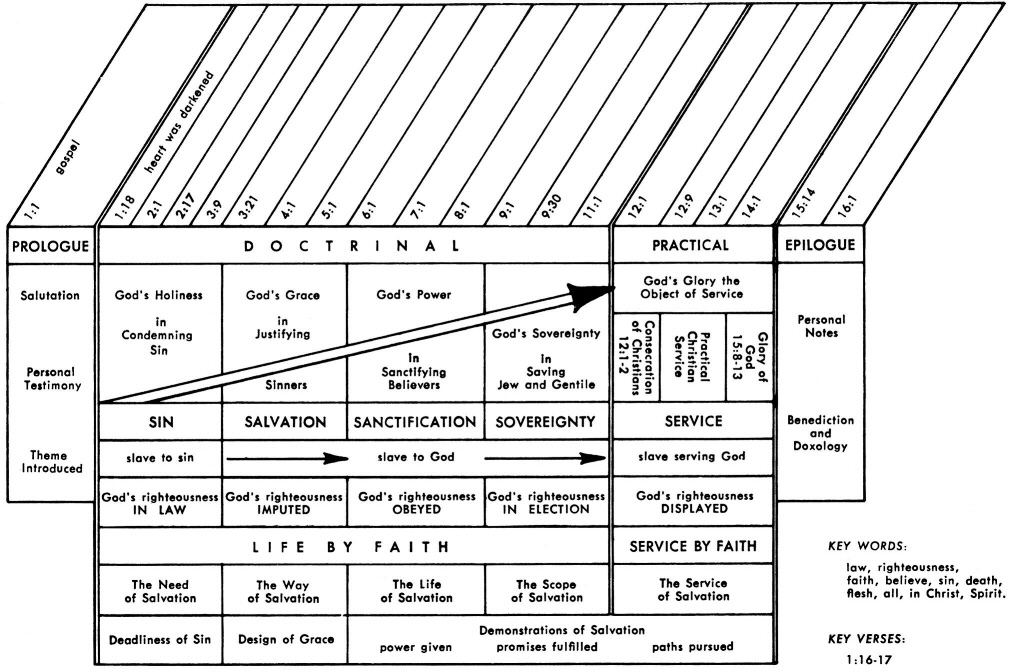
Click chart to enlarge
Chart from recommended resource Jensen's Survey of the NT - used by permission
Romans Overview Chart - Charles Swindoll
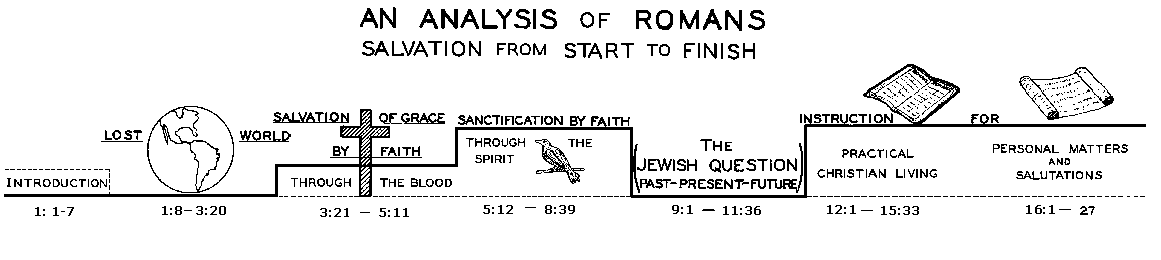
Source: Dr David Cooper
Click to Enlarge
| ROMANS ROAD to RIGHTEOUSNESS |
||||
| Romans 1:18-3:20 | Romans 3:21-5:21 | Romans 6:1-8:39 | Romans 9:1-11:36 | Romans 12:1-16:27 |
| SIN | SALVATION | SANCTIFICATION | SOVEREIGNTY | SERVICE |
| NEED FOR SALVATION |
WAY OF SALVATION |
LIFE OF SALVATION |
SCOPE OF SALVATION |
SERVICE OF SALVATION |
| God's Holiness In Condemning Sin |
God's Grace In Justifying Sinners |
God's Power In Sanctifying Believers |
God's Sovereignty In Saving Jew and Gentile |
Gods Glory The Object of Service |
| Deadliness of Sin |
Design of Grace |
Demonstration of Salvation | ||
| Power Given | Promises Fulfilled | Paths Pursued | ||
| Righteousness Needed |
Righteousness Credited |
Righteousness Demonstrated |
Righteousness Restored to Israel |
Righteousness Applied |
| God's Righteousness IN LAW |
God's Righteousness IMPUTED |
God's Righteousness OBEYED |
God's Righteousness IN ELECTION |
God's Righteousness DISPLAYED |
| Slaves to Sin | Slaves to God | Slaves Serving God | ||
| Doctrine | Duty | |||
| Life by Faith | Service by Faith | |||
|
Modified from Irving L. Jensen's chart above |
||||
R Ruin (Romans 1:17 – 3:20) – The utter sinfulness of humanity
O Offer (Romans 3:21-31) – God’s offer of justification by grace
M Model (Romans 4:1-25) – Abraham as a model for saving faith
A Access (Romans 5:1-11) – The benefits of justification
N New Adam (Romans 5:12-21) – We are children of two “Adams”
S Struggle w/ Sin (Romans 6:1-8:39) Struggle, sanctification, and victory
Romans 6:21 Therefore what benefit were you then deriving from the things of which you are now ashamed? For the outcome of those things is death. (NASB: Lockman)
Greek: tina oun karpon eichete (2PIAI) tote eph' ois nun epaischunesthe? (2PPPI) to gar telos ekeinon thanatos
Amplified: But then what benefit (return) did you get from the things of which you are now ashamed? [None] for the end of those things is death. (Amplified Bible - Lockman)
ESV: But now that you have been set free from sin and have become slaves of God, the fruit you get leads to sanctification and its end, eternal life.
Phillips: Yet what sort of harvest did you reap from those things that today you blush to remember? In the long run those things mean one thing only - death. (Phillips: Touchstone)
Wuest: Therefore, what fruit were you having then, upon the basis of which things now you are ashamed? For the consummation of these things is death. (Eerdmans)
Young's Literal: what fruit, therefore, were ye having then, in the things of which ye are now ashamed? for the end of those is death.
THEREFORE WHAT BENEFIT WERE YOU THEN DERIVING FROM THE THINGS OF WHICH YOU ARE NOW ASHAMED?: tina oun karpon eichete (2PIAI) tote ephois nun epaischunesthe (2PPPI):
- Ro 7:5; Pr 1:31; 5:10-13; 9:17,18; Isa 3:10; Jer 17:10; 44:20, 21, 22, 23, 24; Gal 6:7,8
- Ezra 9:6; Job 40:4; 42:6; Jer 3:3; 8:12; 31:19; Ezek 16:61, 62, 63; Ezek 36:31,32; 43:11; Da 9:7,8; 12:2; Lk 15:17, 18, 19, 20, 21; 2Cor 7:11; 1Jn 2:28
Therefore - Always pause to ponder this strategic term of conclusion.
As he does so frequently in this epistle Paul introduces this section with a rhetorical (asked for effect) question which he quickly answers, explaining that our former life of disobedience wrought only death. But even in the question in this verse the implicit answer is "None" (no good fruit for eternity from a life lived under the sovereignty of the harsh Master Sin! cf fruit that remains or endures Jn 15:16, 8, Pr 11:30, Ro 1:13)
Denney - To decide which of the tow lives, or of the two "freedoms", is the true, Paul apples to their fruits.... "What fruit therefore had you then? Things of which you are now ashamed." (cf similar construction in Isa 1:29-note) (The Expositor's Greek Testament)
Benefit (fruit) (2590) (karpos) is used in its literal sense to refer to fruit, produce or offspring, which describes that which is produced by the inherent energy of a living organism. Karpos is what something naturally produces.
Figuratively, karpos is used of the consequence of physical, mental, or spiritual action. In the NT the figurative (metaphorical) uses predominate and this is particularly true in the Gospels, where human actions and words are viewed as fruit growing out of a person's essential being or character.
Karpos refers to that which originates or comes from something producing an effect or result (benefit, advantage, profit, utility).
Karpos is used 66 times in the NT - Matt. 3:8, 10; 7:16, 17, 18; Mt 12:33; 13:8, 26; 21:19, 34, 41, 43; Mk. 4:7, 8, 29; 11:14; 12:2; Lk. 1:42; 3:8f; 6:43, 44; 8:8; 12:17; 13:6, 7, 9; 20:10; Jn. 4:36; 12:24; 15:2, 4, 5, 8, 16; Acts 2:30; Ro 1:13; 6:21, 22; 15:28; 1 Co. 9:7; Gal. 5:22; Eph. 5:9; Phil. 1:11, 22; 4:17; 2Ti 2:6; 4:13; Heb. 12:11; 13:15; Jas. 3:17, 18; 5:7, 18; Rev. 22:2 The NASB renders karpos as benefit, 2; crop, 5; crops, 2; descendants, 1; fruit, 43; fruitful, 1; fruits, 4; grain, 1; harvest, 1; proceeds, 1; produce, 4; profit, 1.
Karpos is used some 96 times in the Septuagint (LXX) (Gen. 1:11f, 29; 3:2f, 6; 4:3; 30:2; 43:11; Exod. 10:12, 15; Lev. 19:23, 24, 25; 23:40; 25:3; 26:4, 20; 27:30; Num. 13:20, 26f; Deut. 1:25; 7:13; 11:17; 26:2; Jdg. 6:4; 1 Sam. 5:4; 2 Ki. 19:29f; Neh. 9:36; 10:35, 37; Job 22:21; Ps. 1:3; 21:10; 58:11; 67:6; 72:16; 78:46; 85:12; 104:13; 105:35; 107:37; 127:3; 128:2; 132:11; Prov. 1:31; 3:9; 10:16; 11:30; 12:14; 13:2; 15:6; 18:20f; 19:22; 27:18; 31:16, 20, 31; Eccl. 2:5; Song 2:3; 4:13, 16; 8:11f; Isa. 27:6; 37:30; Jer. 2:7; 6:19; 12:2; 17:8, 10; 29:5, 28; 31:12; 50:27; Lam. 2:20; Ezek. 17:8f, 23; 19:10; 25:4; 34:27; 36:8, 30; 47:12; Dan. 4:12, 14, 21; Hos. 9:16; 10:1, 12f; 14:2, 8; Joel 2:22; Amos 2:9; 6:12; 9:14; Mic. 6:7; 7:13; Hag. 2:19; Zech. 8:12; Mal. 3:11)
Other resources on fruit:
- Fruit - Baker's Evangelical Dictionary of Biblical Theology
- Bearing Fruit - The Topical Concordance
- Fruit - Easton's Bible Dictionary
- Fruit - Holman Bible Dictionary
- Fruit - Hastings' Dictionary of the Bible
- Fruit (2) - Hastings' Dictionary of the New Testament
- Fruit - Hastings' Dictionary of the New Testament
- Fruit - International Standard Bible Encyclopedia
- McClintock and Strong's Bible Encyclopedia Fruit
- The Jewish Encyclopedia Fruit
Paul uses karpos as an expression for desirable, righteous qualities in one’s life, the “fruit of the Spirit” (Galatians 5:22-23). The author of Hebrews uses karpos to picture the results of the disciplined lifestyle (see note Hebrews 12:11)
Scripture catalogs 3 general kinds of spiritual fruit...
1) Spiritual attitudes that characterize a Spirit-led believer - Galatians 5:22-23
2) Righteous actions - see notes Romans 6:22, Philippians 4:16; 4:17; Hebrews 13:5
3) New converts - see note Romans 16:5
Larry Richards summarizes the Biblical concept of spiritual fruit writing that...
Fruitfulness is a consistent concept in the OT and the NT. The fruit God seeks in human beings is expressed in righteous and loving acts that bring peace and harmony to the individual and to society. But that fruit is foreign to sinful human nature. Energized by sinful passions, fallen humanity acts in ways that harm and bring dissension. God's solution is found in a personal relationship with Jesus and in the supernatural working of God's Spirit within the believer. As we live in intimate, obedient relationship with Jesus, God's Spirit energizes us as we produce the peaceable fruits of a righteousness that can come only from the Lord. (Richards, L O: Expository Dictionary of Bible Words: Regency)
W. E Vine has an excellent summary of karpos explaining that...
Karpos frequently in the New Testament in its natural sense of that which is produced by the inherent energy of a living organism, Matthew 13:8, and also, in a derived sense, of the result, in the spiritual and moral sphere, of the energy of the Holy Spirit operating in those who through faith are brought into living union with Christ, John 15:4-5.
Fruit is thus the outward expression of power working inwardly, and so in itself beyond observation, the character of the fruit giving evidence of the character of the power that produces it, Matthew 7:16 (note). As lust manifests itself in works, the restless and disorderly activities of the flesh, or principle of evil, in man, so the Spirit manifests His presence in His peaceable Hebrews 12:11 (note), and orderly fruit.
In this connection fruit presents an advance upon “works.” “Works” gives prominence to the notion of activity; fruit directs attention to the power that works within.
Fruit is also used by the apostle Paul of the converts resulting from his ministry, Philippians 1:22 (note); and of the manifestation of the character of Christ in the lives of believers in consequence of his ministry of the Word among them, Romans 1:13 (note); and of the care of the believers for the poor, for this is the fruit, or outward expression, of love, attesting its reality, Romans 15:28 (note); and of the care of laborers in the gospel, for this is the fruit, or outward expression, of thankfulness to God for spiritual blessings enjoyed, attesting its reality, Philippians 4:17 (note).
The singular form, fruit, is used here perhaps to suggest the unity and harmony of the character of the Lord Jesus which is to be reproduced in the believer by the power of the Holy Spirit, in contrast with the discordant and often mutually antagonistic “works of the flesh.” In Christ actually, and in the Christian potentially, the fruit of the Spirit is harmonious, the various elements being mutually consistent, and each encouraging and enhancing the rest in happy coordination and cooperation in that “new man, which after God hath been created in righteousness and holiness of truth,” Ephesians 4:24 (note).
The verb “fruit-bearing,” karpophoreo, is found in the New Testament in both the natural, Mark 4:28, and the spiritual sense, Matthew 13:23; Mark 4:20; Luke 8:15. The two states of men, the regenerate and the unregenerate, are contrasted in Romans 7:4, 7:5 (note); in the former “the passions of sins,” i.e., sinful impulses, see at v. 24, below, bore fruit unto death, that is these activities arose out of a state of alienation from God; in the latter the power of the indwelling Spirit, who unites the soul with the risen Lord, bears fruit unto God; so also Colossians 1:10 (note). Colossians 1:6 (note) corresponds with Philippians 1:22 (note), mentioned above. (Vine, W. Collected writings of W. E. Vine. Nashville: Thomas Nelson )
Gilbrant - Classical Greek
“Fruit, produce, offspring” and “result” are among the variety of translations of karpos in secular Greek. It is especially used for the “fruit” of trees/plants or of the “offspring” of animals or people. In another sense karpos can denote the “result” of an action.
Septuagint Usage
Pᵉrî is the usual Hebrew term behind karpos in the Septuagint, although nine other expressions may be used. We consistently encounter the “fruit” of trees and vegetation (Genesis 1:11,12; 3:2; Leviticus 19:23). The karpos tēs gēs, the “fruit of the land,” means the “produce” of that region (e.g., Numbers 13:20; Deuteronomy 1:25). Figuratively, human offspring are karpos (Psalm 21:10 [LXX 20:10]; cf. 132:11 [131:11]; Lamentations 2:20).
Another figurative sense occurs in the Septuagint at times. The “fruit” of one’s actions will surely come (Proverbs 1:31; 10:16). “Later Judaism,” Hauck tells us, “also likes to call the result of an action its fruit . . . ” (“karpos,” Kittel, 3:614).
New Testament Usage
Karpos, in its various senses, is a fairly common noun in the New Testament. Its literal sense occurs in the Gospels (Matthew 13:8; 21:19) and elsewhere (2 Timothy 2:6; James 5:7). The figurative image converges with the literal at times (e.g., Matthew 7:17; cf. verses 16,18; parallel Luke 6:43,44). The figurative sense of “offspring” (often “fruit of the womb/ loins”) appears in Luke (1:42) and Acts (2:30). The expression “fruit of (the) lips” occurs in Hebrews 13:15. This simply means “what is said.”
Of special significance, however, is the New Testament usage of karpos as a “result” of action. Repentance is verified by karpos (Matthew 3:8ff. with parallels), and karpos identifies the true believer (Matthew 7:20; cf. Luke 6:44). Fruit may be either “good” (kalos [2541]/agathos [18]) (e.g., Matthew 3:10; 7:17,18; James 3:17) or “evil” (ponēros [4050]/sapros [4407]) (e.g., Matthew 7:18; 12:33).
Karpos is often found in conjunction with the work of the apostle (Hauck, ibid., 2:615). Missionary results are referred to as karpoi (Romans 1:13; Philippians 1:22; cf. John 4:36). But it is also to be the sign of the believer who is unable to bear fruit apart from being “in Jesus” (John 15:2,4,5,8,16; cf. Galatians 5:22, the “fruit” of the Spirit). (Complete Biblical Library)
Hensel - In John the expression karpon pherein (bear fruit) is used especially in Jn. 15:2ff., where Jesus’ disciples’ close fellowship with the Lord is seen as the secret of the power to bear fruit. His death is the soil out of which rich fruit grows (Jn. 12:24); his death on the cross brings about redemption for men. As the vine (i.e. here the tree of life), he sends through his branches that life-giving power which is the prerequisite and means of faith. Man can indeed accomplish moral and technical achievements by his natural gifts. But the “fruit of the gospel” (Luther)—that which God expects from man—can grow only from the soil of obedience, which essentially consists in recognition of the bond between creator and creature, established by the death of Christ. He no longer needs to consider his own achievements. Freed from the anxiety of failure, he is capable of the highest endeavour (“more fruit”, Jn. 15:2, 5, 8). Because the source of his capacity to bear fruit lies outside himself, the yield is certain. It counts and abides for eternal life (Jn. 4:36; 15:16). (See full discussion of karpos NIDNTT page 720)
Here are a few illustrative uses of karpos in the New Testament (studying these in context will give one a good sense of the meaning of the word karpos)...
Matthew 3:8 "Therefore bring forth fruit in keeping with repentance;" In his proclamation John the Baptist called for repentance and insisted that any inner change produce fruit as evidence of its reality.
Matthew 7:16-20 “You will know them by their fruits. Grapes are not gathered from thorn bushes nor figs from thistles, are they? 17 “So every good tree bears good fruit, but the bad tree bears bad fruit. 18 “A good tree cannot produce bad fruit, nor can a bad tree produce good fruit.19 “Every tree that does not bear good fruit is cut down and thrown into the fire. 20 So then, you will know them by their fruits." Jesus explained to his audience that true inner character (and evidence of a new heart, a spiritually circumcised heart) is recognized in a person's good fruits or conversely bad fruits (from the unregenerate heart). When a tree is rotten it naturally produces rotten fruit. But when the indwelling Spirit of God Himself begins to express His mighty power in the inner being of believers, good things begin to happen. The nature of God Himself begins to manifest itself in our lives. (See notes on Matthew 7:16; 17; 18; 19; 20)
Matthew 13:8 And others fell on the good soil and yielded a crop, some a hundredfold, some sixty, and some thirty.
Matthew 21:43 Therefore I say to you, the kingdom of God will be taken away from you and given to a people, producing the fruit of it.
Mark 4:7 Other seed fell among the thorns, and the thorns came up and choked it, and it yielded no crop. 8 Other seeds fell into the good soil, and as they grew up and increased, they yielded a crop and produced thirty, sixty, and a hundredfold.”
Luke 8:8 Other seed fell into the good soil, and grew up, and produced a crop a hundred times as great.” As He said these things, He would call out, “He who has ears to hear, let him hear.”
Luke 1:42 And she cried out with a loud voice and said, “Blessed are you among women, and blessed is the fruit of your womb! ("fruit of the womb" is a Hebraism = a linguistic usage or custom borrowed from or particular to the Hebrew language)
Luke 3:8 Therefore bear fruits in keeping (axios = corresponding to or consistent with) with repentance, and do not begin to say to yourselves, ‘We have Abraham for our father,’ for I say to you that from these stones God is able to raise up children to Abraham." Here karpos views the deeds as the outcome of some moral or inner force.
John 12:24 Truly, truly (Amen, Amen), I say to you, unless a grain of wheat falls into the earth and dies, it remains alone; but if it dies, it bears much fruit.
John 15:2 Every branch in Me that does not bear fruit (karpos) He takes away; and every branch that bears fruit (karpos), He prunes it so that it may bear more fruit....4 “Abide in Me, and I in you. As the branch cannot bear fruit (karpos) of itself unless it abides in the vine, so neither can you unless you abide in Me. 5 “I am the vine, you are the branches; he who abides in Me and I in him, he bears much fruit, for apart from Me you can do nothing....8 “My Father is glorified by this, that you bear much fruit (karpos), and so prove to be My disciples....16 “You did not choose Me but I chose you, and appointed you that you would go and bear fruit (karpos), and that your fruit (karpos) would remain, so that whatever you ask of the Father in My name He may give to you."
Comment: In the Gospel of John and the Epistles of Paul that the concept of fruitfulness shifts from that of the product of character to the product of God's work within us. Jesus takes the image of the vine, with God as gardener, from Isaiah. We believers are carefully tended by the Father, pruned and cared for that we may "bear much fruit." Fruitfulness is possible, he said, if we remain in him and his words remain in us. The point Jesus makes is that fruitfulness is rooted in our personal relationship with him, and our personal relationship with him is maintained by living his words: "If you obey my commands you will remain in my love" -- John 15:10. God has chosen us. It is his intention that we be fruitful. It is for this reason that he has given us the most intimate of relationships and Jesus' own words to guide us, and it is our responsibility to walk in close fellowship with our Lord.
Romans 1:13 I do not want you to be unaware, brethren, that often I have planned to come to you (and have been prevented so far) so that I may obtain some fruit among you also, even as among the rest of the Gentiles. (see note)
Romans 15:28 Therefore, when I have finished this, and have put my seal on this fruit of theirs, I will go on by way of you to Spain. (see note)
Galatians 5:22 But the fruit of the Spirit is love, joy, peace, patience, kindness, goodness, faithfulness,"
Ephesians 5:9 for the fruit of the Light consists in all goodness and righteousness and truth (see note)
Philippians 1:11 having been filled with the fruit of righteousness which comes through Jesus Christ, to the glory and praise of God. (see note)
Philippians 4:17 Not that I seek the gift itself, but I seek for the profit which increases to your account. (see note)
Comment: Vine writes that " The figure here is that of spiritual and eternal recompense for material assistance; there is blessing both in this life and the next. See Proverbs 19:17. The “account” (logos) is a financial metaphor suggestive of interest." (Vine, W. Collected writings of W. E. Vine. Nashville: Thomas Nelson)
2 Timothy 2:6 The hard-working farmer ought to be the first to receive his share of the crops. (see note)
Hebrews 12:11 All discipline for the moment seems not to be joyful, but sorrowful; yet to those who have been trained by it, afterwards it yields the peaceful fruit of righteousness. (see note)
Hebrews 13:15 Through Him then, let us continually offer up a sacrifice of praise to God, that is, the fruit of lips that give thanks to His name. (see note)
James 3:17 But the wisdom from above is first pure, then peaceable, gentle, reasonable, full of mercy and good fruits, unwavering, without hypocrisy. 18 And the seed whose fruit is righteousness is sown in peace by those who make peace.
James 5:7 Therefore be patient, brethren, until the coming of the Lord. The farmer waits for the precious produce of the soil, being patient about it, until it gets the early and late rains.
Revelation 22:2 in the middle of its street. On either side of the river was the tree of life, bearing twelve kinds of fruit, yielding its fruit every month; and the leaves of the tree were for the healing of the nations. (see note)
The unsaved person is free—free from righteousness (v20). But his bondage to sin only leads him deeper into slavery so that it becomes harder and harder to do what is right. The Prodigal Son is an example of this (Lu 15:11-24). When he was at home, he decided he wanted his freedom, so he left home to find himself and enjoy himself. But his rebellion only led him deeper into slavery. He was the slave of wrong desires, then the slave of wrong deeds; and finally he became a literal slave when he took care of the pigs. He wanted to find himself, but he lost himself! What he thought was freedom turned out to be the worst kind of slavery. It was only when he returned home and yielded to his father that he found true freedom.
Haldane offers an interesting point of clarification on benefit noting that "Fruit (in the KJV, NAS = benefit) here signifies advantage, and not pleasure. Many interpret this verse as if the Apostle denied that they had any pleasure in their sins at the time of committing them. This the Apostle could not do; for it is a fact that men have pleasure in sin. To say that sinful pleasure is no pleasure, but is imaginary, is to abuse terms. All pleasure is a matter of feeling, and a man is no less happy than he feels himself to be; if he imagines that he enjoys pleasure, he actually enjoys pleasure. But what advantage is there in such pleasure? This is the question which the Apostle asks. (An Exposition on the Epistle to the Romans)
Newell comments that...
in those former evil days, they had been, as Paul says, free in regard of righteousness (see note Romans 6:20). They were altogether given to iniquity, without any check whatever. ("There seems to be a grave but cutting irony in this allusion to their old condition, when the only freedom they knew was in respect to righteousness! They were slaves of sin, and had nothing to do with righteousness!") And those were fruitless days of which they were now ashamed.
Free and fruitless!
What a pair of words to describe the life of one who is going on daily toward eternity! Let each believer look back to those days when God was "not in all his thoughts." The pleasures and treasures of sin we sought - free in regard of righteousness, like the beasts which perish. What saved one can say of his unsaved life, I can treasure this or that as fruit? of any particular iniquity, I cherish good results from it? What fruit had you? Shame, only: things of which ye are now ashamed. Furthermore, we were going on steadily in that path unto the end, which was death, and that eternal. Remember the relentless but true description of sin's horrid birth and end, in James 1:14,15. Now from all this, God has in sovereign grace rescued us, and should we not, do we not, gladly enter upon the path of loving service, yea, bond service, to Him? (Romans 6)
Ashamed (1870) (epaischunomai [word study]i from epi = upon or used to intensify the meaning of the following word + aischunomai from aischos = disfigurement & then disgrace) (used 2x in Romans) means to experience a painful feeling or sense of loss of status because of some particular event or activity. It describes one's consciousness of guilt or of exposure or the fear of embarrassment that one's expectations may prove false. Epaischunomai is associated with being afraid, feeling shame which prevents one from doing something, a reluctance to say or do something because of fear of humiliation, experiencing a lack of courage to stand up for something or feeling shame because of what has been done.
Epaischunomai -11x in 9v in the NAS - Mk. 8:38; Lk. 9:26; Ro 1:16; 6:21; 2Ti 1:8, 12, 16; He 2:11; 11:16
John Calvin - As soon as the godly begin to be enlightened by the Spirit of Christ and the preaching of the gospel, they freely acknowledge that the whole of their past life, which they lived without Christ, is worthy of condemnation. So far from trying to excuse it, they are in fact ashamed of themselves. Indeed, they go farther, and continually bear their disgrace in mind, so that the shame of it may make them more truly and willingly humble before God. (Romans 6)
Ezra describes this shame writing...
O my God, I am ashamed (because the Jews had taken some of the pagan Gentile daughters as wives, so that the holy race was intermingled with the pagans) and embarrassed to lift up my face to Thee, my God, for our iniquities have risen above our heads, and our guilt has grown even to the heavens. (Ezra 9:6)
Jeremiah describes God's wrath on His people declaring...
Therefore the showers have been withheld, and there has been no spring rain. yet you had a harlot's forehead; You refused to be ashamed....12 "Were they ashamed because of the abomination they had done? They certainly were not ashamed, And they did not know how to blush; Therefore they shall fall among those who fall; At the time of their punishment they shall be brought down," Declares the LORD. (Jer 3:3; 8:12)
In the future Israel will be ashamed, Ezekiel recording...
Then you will remember your ways and be ashamed when you receive your sisters, both your older and your younger; and I will give them to you as daughters, but not because of your covenant 62 "Thus I will establish My covenant with you, and you shall know that I am the LORD 63 in order that you may remember and be ashamed, and never open your mouth anymore because of your humiliation, when I have forgiven you for all that you have done," the Lord GOD declares...31 "Then you will remember your evil ways and your deeds that were not good, and you will loathe yourselves in your own sight for your iniquities and your abominations. 32 "I am not doing this for your sake," declares the Lord GOD, "let it be known to you. Be ashamed and confounded for your ways, O house of Israel!" (Ezek 16:61-63; Ezek 36:31,32)
Daniel warns of the failure of one willing to be ashamed during this life of their sin against God recording that in the future "many of those who sleep in the dust of the ground will awake, these to everlasting life, but the others to disgrace and everlasting contempt." (Da 12:2)
John exhorts believers "And now, little children (born ones), abide (present imperative - John, filled with the inspiration of the Holy Spirit, says to abide not as a suggestion to do so when we feel spiritual, but a command that calls for abiding to be our very lifestyle - he is commanding direction not perfection!) in Him, so that when He appears, we may have confidence and not shrink away from Him in shame at His coming. (1Jn 2:28)
FOR THE OUTCOME OF THOSE THINGS IS DEATH: to gar telos ekeinon thanatos:
- Ro 6:23; 1:32; Dt 17:6; 21:22; 2Sa 12:5, 6, 7; 1Ki 2:26; Ps 73:17; Pr 14:12; Pr 16:25; Phil 3:19; Heb 6:8; 10:29; Jas 1:15; 5:20; 1Pe 4:17; Rev 16:6; Rev 20:14
For - Paul explains why the fruit of a life lived in bondage to Sin is "rotten"! Always pause to ponder this strategic term of explanation.
Outcome (5056) (telos from tello = to set out for a definite point or goal) is the culmination or the outcome of a growth or development representing an attained objective. Telos is never used in NT as a chronological end, as if something simply stops. Instead, telos speaks of a consummation, a goal achieved, a result attained, or a realization. Telos is the result of an event or process with special focus upon the final state or condition - outcome, result.
Telos - 40x in 38v - Matt 10:22; 17:25; 24:6, 13f; 26:58; Mark 3:26; 13:7, 13; Luke 1:33; 18:5; 21:9; 22:37; John 13:1; Rom 6:21f; 10:4; 13:7; 1 Cor 1:8; 10:11; 15:24; 2 Cor 1:13; 3:13; 11:15; Phil 3:19; 1 Thess 2:16; 1 Tim 1:5; Heb 3:14; 6:8, 11; 7:3; Jas 5:11; 1 Pet 1:9; 3:8; 4:7, 17; Rev 2:26; 21:6; 22:13.
NAS = continually*(1), custom(2), customs(1), end(24), ends(2), finished(1), fulfillment(1), goal(1), outcome(6), sum(1), utmost(1).
Death (2288) (thanatos) includes not only physical death, but also the quality of one's present life (1Ti 5:6). Here Paul uses the term of the death brought in by human sin and not referring merely to physical death but to death in its most comprehensive sense - separation of the creature from his Creator in the Lake of fire (Rev 10:14-note; see also Births, Deaths, and Resurrections)
Death came though the tree of the knowledge of good and evil (Ge 2:17) - in the garden by Adam - life came through the tree of death (cross) on Calvary (cf Gal 3:13) by the second Adam (Christ). Adam's disobedience brought death to all; so Christ's obedience brought life to all (1Cor 15:22). Adam "took and ate" and thus brought death to men. Christ died and thus brought life to man by the same words, "Take and eat." (Mt 26:26). Truly, Christ put death out of business (not existence) and so we can sing with the apostle Paul, "O Death, where is your sting? O Hades, where is your victory?" (1Cor 15:55, cf He 2:14, 15-note)
Matthew Henry offers a pithy comment on this section warning believers that "The pleasure and profit of sin do not deserve to be called fruit. Sinners are but ploughing iniquity, sowing vanity, and reaping the same. Shame came into the world with sin, and is still the certain effect of it. The end of sin is death. Though the way may seem pleasant and inviting, yet it will be bitterness in the latter end. From this condemnation the believer is set at liberty, when made free from sin. If the fruit is unto holiness, if there is an active principle of true and growing grace, the end will be everlasting life; a very happy end! Though the way is up-hill, though it is narrow, thorny, and beset, yet everlasting life at the end of it is sure. The gift of God is eternal life. And this gift is through Jesus Christ our Lord. Christ purchased it, prepared it, prepares us for it, preserves us to it; He is the All in all in our salvation. (Matthew Henry's Concise Commentary)
ILLUSTRATIONS OF BIBLE TRUTH by Harry A. Ironside - ON TOP OF THE BEER BARREL
"What fruit had ye then in those things whereof ye are now ashamed? for the end of those things is death" (Ro 6:21)
Many years ago, when I was a young Salvation Army officer, it was my privilege to participate in a most unique service at a wide street intersection in the heart of the city of San Diego, California.
We had among our adherents a lovely Christian girl, who was saved out of a very ungodly family. Her father was a saloonkeeper and, while kind to his family and in many respects an admirable character, he had no use for "religion," as he called it, nor for the church. But, through the consistent life of his daughter, he was at last awakened to see his need of a SAVIOUR. He realized that she had something of which he knew nothing, and one night we were all surprised to see him in our audience.
At the close of the service, he came forward, weeping, to confess his sins and seek CHRIST as his SAVIOUR. We pointed him to the LORD and before the meeting closed, he was rejoicing in the knowledge of sins forgiven.
At once he was faced with the fact that the business in which he was engaged was utterly inconsistent with the Christian life. Some suggested that he should sell out and put the proceeds into some other business. He indignantly spurned the suggestion. Realizing that the saloon was a detriment to humanity, he said he could not, since he had accepted CHRIST as his SAVIOUR and his LORD, allow himself to profit in any way from the stock of what he afterwards called "liquid damnation." Instead of this, he went to the city authorities and got a permit for what some might have thought was a rather fantastic service.
At the intersection of four streets, near his saloon, he rolled out all the beer barrels and made of them quite a pyramid. The Salvation Army surrounded this rather remarkable spectacle and with band playing and Salvationists singing, soon attracted an immense crowd. The converted saloonkeeper had boxes full of liquor piled up by the pyradid, to the top of which he climbed. "Praise GOD," he exclaimed as he began his testimony, "I am on top of the beer barrel. For years I used to be under its power, but now I can preach on its head." Then he told the story of his own conversion and pleaded with sinners to come to his SAVIOUR.
As the liquor bottles were passed up to him, he broke them and spilled the contents over the barrels. Then descending, he set fire to the whole pyramid which went up in a great blaze as the song of the LORD continued. What a remarkable testimony to the power of the Gospel of CHRIST to completely change a life! No longer a saloonkeeper, our friend went into a legitimate business, where his life was a bright testimony to the reality of GOD's salvation.
Romans 6:22 But now having been freed from sin and enslaved to God, you derive your benefit, resulting in sanctification, and the outcome, eternal life. (NASB: Lockman)
Greek: nuni de, eleutherothentes (APPMPN) apo tes hamartias doulothentes (APPMPN) de to theo echete (2PPAI) ton karpon humon eis hagiasmon to de telos zoen aionion.
Amplified: But now since you have been set free from sin and have become the slaves of God, you have your present reward in holiness and its end is eternal life. (Amplified Bible - Lockman)
ESV: But now that you have been set free from sin and have become slaves of God, the fruit you get leads to sanctification and its end, eternal life. But now that you have been set free from sin and have become slaves of God, the fruit you get leads to sanctification and its end, eternal life.
Phillips: But now that you are employed by God, you owe no duty to sin, and you reap the fruit of being made righteous, while at the end of the road there is life for evermore. (Phillips: Touchstone)
Wuest: But now, having been set free from the sinful nature and having been made bondslaves of God, you are having your fruit resulting in holiness, and the consummation, life eternal. (Eerdmans)
Young's Literal: And now, having been freed from the sin, and having become servants to God, ye have your fruit -- to sanctification, and the end life age-during
BUT NOW: nuni de:
- Ro 6:4,18; 8:2; Jn 8:32; 2Cor 3:17; Gal 5:13
But now - Now that you have been brought repentance and faith in Christ. Here we see one those places where Paul "turns the corner" from darkness to light. But now is one of those great mercy filled changes of direction from gutter to glory, from a shame filled life to a fruit filled life. Now for the believer, born again from eternal death to eternal life, the situation is diametrically the opposite, completely reversed, for Christ has set us free from the horrible Master Sin and made us slaves to our loving Master Jesus. (cf 1Co 6:19-note, 1Co 6:20-note)
But now is a combination of a term of contrast and an expression of time.
But now (these are worth studying) - Lk 16:25; Jn 17:13; Ro 3:21; 6:22; 7:6; 11:30; 16:26, 25 1Cor 12:18, 17; 15:20, 19; Gal 3:25, 24; 4:9, 8; Eph 2:13, 12; 5:8; Col 3:8, 7; 2Ti 1:10, 9; Philemon 1:11; Heb 9:26; 1Pet 2:10, 25
Romans 6:18 (note) parallels Romans 6:22 "Having been freed from sin, you became slaves of [were enslaved to] righteousness."
AND HAVING BEEN FREED FROM SIN AND ENSLAVED TO GOD: eleutherothentes (APPMPN) apo tes hamartias doulothentes (APPMPN) de to theo:
- Ro 7:25; Ge 50:17; Job 1:8; Ps 86:2; 143:12; Isa 54:17; Da 3:26; 6:20; Gal 1:10; Col 4:12; Titus 1:1; Jas 1:1; 1Pet 2:16; Rev 7:13)
Having been freed (1659) (eleutheroo [word study] = the ending " -oo" means not only will it be set free but it will be seen as set free) means to cause someone to be freed from domination. The picture is that of the emancipation of slaves. The idea is that the one set free is at liberty, capable of movement, exempt from obligation or liability, and unfettered. Although the act of setting free results in freedom and liberty we must understand that this new freedom is not a license to sin. In fact true liberty for the believer is now living as we should and not as we please.
The aorist tense pictures our emancipation as a past tense, completed event. Having been freed from sin is not just freedom from its penalty (that is justification - declared righteous, acquitted so to speak), but also freedom from its power over us and it is the latter aspect which is Paul's point here.
Eleutheroo - 7x in 7v in the NAS - Jn. 8:32, 36; Ro 6:18, 22; 8:2, 21; Gal. 5:1 and rendered by the NAS as freed(2), make free(2), set free(3).
MacDonald expresses it this way noting that "Conversion changes a man’s position completely. Now he is free from sin as his master, and he becomes a willing slave to God. The result is a holy life now and everlasting life at the end of the journey. Of course the believer has eternal life now too, but this verse refers to that life in its fullness, including the glorified resurrection body. (MacDonald, W & Farstad, A. Believer's Bible Commentary: Thomas Nelson)
The Spirit, Who brought the life of God Himself into us, has set us free from the power of our flesh and free to be the person God wants us to be. In Ro 7:24 (see note) Paul asked "Who shall deliver me?" The answer given in this verse is that: "Christ has already delivered me!" The last part of Romans 7 was a description of a believer's struggling, failing condition. In Romans 8 Paul encourages the believer to focus upon his perfect, unfailing position in Christ Jesus (Ro 8:1-see notes beginning in Ro 8:1)! Mark it down...
The more we believe God’s facts about our eternal position
The more this truth will affect our experiential condition !
Pritchard writes that the fact that you have been set free means...
You don't have to sin any more. You don't have to live in defeat any more. You don't have to be down any more. You don't have to go years and years and years committing the same old dumb sins over and over again. Why? Because the law of the spirit of life of Jesus Christ has set you free. Therefore, if you choose to dwell in sin, if you choose to be defeated, it's because you've chosen to live that way, not because you must live that way. (Romans 8)
From (575) (apo) is a marker of dissociation and implies a rupture from a former association. Apo describes a separation of one thing (believers) from another (the Sin) by which the union or fellowship of the two is destroyed!
Sin (266) (hamartia) is literally "the sin" which in Romans 6 represents a moral principle or force which is personified as an evil king who constantly seeks to enslave and to rule those who are subject to its power (all unregenerate mankind).
Enslaved (1402) (douloo [word study] from doulos) means to bring into bondage, become servant, to be a slave, to serve. The imagery derives directly from the ancient practice of enslaving an enemy defeated in battle as a prisoner!
Douloo - 8x in 8v in NAS - Acts 7:6; Ro 6:18, 22; 1Co. 7:15; 9:19; Gal. 4:3; Titus 2:3; 2Pet. 2:19
The NAS renders douloo as became slaves(1), enslaved(4), held in bondage(1), made a slave(1), under bondage(1).
Barclay quotes the Stoic philosopher Seneca as saying "To be enslaved to oneself is the heaviest of all servitudes."
Notice, ultimately we don't free ourselves; we have "been freed." God alone is the decisive deliverer from this slavery. When? When Christ was crucified I was co-crucified (Gal 2:20-note, Col 2:13, 14-note v13; v14) and by faith entered into the New Covenant...at that moment I became a free man and no longer bound to the old masters sin, Satan and the world. But nature abhors a vacuum...I then became a slave to God.
Ultimately we don't make ourselves slaves of God, we have been "enslaved" to God. Behind these passive verbs is the work of God. This is what happens "under grace." When Christ is our righteousness by faith, the grace of God enters us mightily, and breaks the power of cancelled sin, and transforms us in the renewing of our minds, and writes the law upon our hearts, and gives us a new spirit, and inclines us to the Word of God, and causes us to see the beauty of Christ and his ways as the treasure of our lives.
John Piper writes that "Becoming a Christian is to have the sovereign captain of the battleship of righteousness commandeer the slave ship of unrighteousness; put the ship-captain, sin, in irons; break the chains of the slaves; and give them such a spiritual sight of grace and glory that they freely serve the new sovereign forever as the irresistible joy and treasure of their lives. That's how we got saved. God freed us from one master and enslaved us to himself by the compelling power of a superior promise. So embrace this work of God. Receive Christ and his promise as the treasure of your life. (See complete sermon Slaves to God, Sanctification, Eternal Life)
YOU DERIVE YOUR BENEFIT RESULTING IN SANCTIFICATION: echete ton karpon humon eis hagiasmon:
- Ps 92:14; Jn 15:2,16; Gal 5:22; Eph 5:9; Phil 1:11; 4:17; Col 1:10
Derive (2192) (echo) have or possess. The present tense pictures this as a lifelong process. Kenneth Wuest conveys this sense of a process in his expanded translation...
But now, having been set free from the sinful nature and having been made bondslaves of God, you are having your fruit resulting in holiness, and the consummation, life eternal. (Eerdmans) (Bolding added)
Benefit (fruit) (2590) (karpos is used in its literal sense to refer to fruit, produce or offspring, which describes that which is produced by the inherent energy of a living organism. Karpos is what something naturally produces. Figuratively, karpos is used of the consequence of physical, mental, or spiritual action. In the NT the figurative (metaphorical) uses predominate and this is particularly true in the Gospels, where human actions and words are viewed as fruit growing out of a person's essential being or character. Karpos refers to that which originates or comes from something producing an effect or result (benefit, advantage, profit, utility).
Scripture catalogs 3 general kinds of spiritual fruit...
1) Spiritual attitudes that characterize a Spirit-led believer - Gal 5:22-note, Gal 5:23-note
2) Righteous actions - Ro 6:22, Php 4:16, 17-note; He 13:5-note
3) New converts - Ro 16:5-note
Resulting (1519) (eis) is a preposition of motion into any place or thing. Figuratively eis marks the object or point toward which anything ends (in this case sanctification). It is the result, effect, consequence, marking that which any person or thing inclines toward or becomes.
Moule writes that...
The " fruit" (benefit) amounted to, consisted in, a steady course of self-denial and conflict against sin.
Sanctification (38) (hagiasmos [word study] from hagiazo = sanctify from hagios = holy, set apart, consecrated) literally means sanctification and includes the ideas of consecration, purification, dedication and holiness. The dominant idea of sanctification is separation from the secular and sinful and setting apart for the sacred and spiritual.
Hagiasmos - 10x in 10v NAS - Rom. 6:19, 22; 1 Co. 1:30; 1 Thess. 4:3f, 7; 2 Thess. 2:13; 1 Tim. 2:15; Heb. 12:14; 1 Pet. 1:2
The NAS renders hagiasmos as sanctification(8), sanctifying work(1), sanctity(1).
Wuest puts it this way - The word sanctify in the Greek means to set apart, and the word sanctification refers to the setting apart process. (Wuest, K. S. Wuest's Word Studies from the Greek New Testament: Eerdmans)
Hagiasmos can describe the state of being set apart from sin and the world and unto deity (God), such a state occurring when we first believe and more frequently referred to as justification by faith, a one time event, not to be repeated. Hagiasmos can also refer to the process of progressively being set apart from sin and being conformed more and more into the image of God's Son. Clearly this meaning of sanctification is an ongoing process by which believers are set apart by God as a special people to grow spiritually in personal holiness and to develop Christ-like character, the culmination of which is glorification, which occurs when we see Christ. (See related topic Three Tenses of Salvation)
SANCTIFICATION:
USED TWO WAYS IN THE NEW TESTAMENT(1) Our initial salvation experience:
A POINT IN TIME EVENT
A POSSESSION
POSITIONAL(2) Our daily growth in Christ-likeness:
A PROCESS
A PRACTICE
PROGRESSIVE
The Evangelical Dictionary of Biblical Theology has a note that helps illustrate the meaning of hagiasmos "The generic meaning of sanctification is the state of proper functioning. To sanctify someone or something is to set that person or thing apart for the use intended by its designer. A pen is “sanctified” when used to write. Eyeglasses are “sanctified” when used to improve sight. In the theological sense, things are sanctified when they are used for the purpose God intends. A human being is sanctified, therefore, when he or she lives according to God’s design and purpose." (Elwell, W. A., & Elwell, W. A. The Evangelical Dictionary of Biblical Theology)
Vine commenting on hagiasmos in Ro 6:19-note and Ro 6:22-note explains that...
Hagiasmos signifies
(1) separation to God, as in 1Co 1:30; 2Th 2:13; 1Pe 1:2;
(2) the course of life which benefits those who have been separated to God.
This (definition #2) is its meaning here ( Romans 6:19 - see note) and in Romans 6:22. (Vine, W. Collected writings of W. E. Vine. Nashville: Thomas Nelson)
Robert Mounce - The reward for serving God is growth in holiness and, in the end, eternal life. In fact, apart from holiness there is no eternal life. The author to Hebrews counseled a holy life because “without holiness no one will see the Lord” (He 12:14-note). Slavery to sin results in death. Slavery to righteousness leads to eternal fellowship with God. Or, in the words of Jesus, the broad road (the path of sin) leads to destruction, but the narrow road (the way of righteousness) leads to life (Mt 7:13, 14-notes). (Mounce, R. H. Romans: The New American Commentary. Broadman & Holman Publishers)
Robert Haldane agrees writing that "Fruit (benefit, NASB), in this verse, denotes conduct, and holiness its specific character or quality. When conduct or works are called fruit, their nature is not expressed; they are merely considered as the production of the man. Fruit unto holiness is conduct that is holy. Fruit unto holiness, or holy conduct, is the present result of freedom from sin, and of becoming servants to God; eternal life is the final result. Eternal life is the issue of the service of God, but it is not the reward of its merit. (Ed note: You CANNOT earn eternal life through works!) (Haldane, R. An Exposition of Romans)
AND THE OUTCOME ETERNAL LIFE: to de telos zoen aionion:
- Ro 6:21; Nu 23:10; Ps 37:37,38; Mt 13:40,43; 19:29; 25:46; Jn 4:36
Outcome (5056) (telos from tello = to set out for a definite point or goal) is the culmination or the outcome of a growth or development representing an attained objective. Telos is never used in NT as a chronological end, as if something simply stops. Instead, telos speaks of a consummation, a goal achieved, a result attained, or a realization. Telos is the result of an event or process with special focus upon the final state or condition - outcome, result.
Telos - 40x in 38v in the NAS - Matt. 10:22; 17:25; 24:6, 13f; 26:58; Mk. 3:26; 13:7, 13; Lk. 1:33; 18:5; 21:9; 22:37; Jn. 13:1; Rom. 6:21f; 10:4; 13:7; 1 Co. 1:8; 10:11; 15:24; 2 Co. 1:13; 3:13; 11:15; Phil. 3:19; 1 Thess. 2:16; 1 Tim. 1:5; Heb. 3:14; 6:8, 11; 7:3; Jas. 5:11; 1 Pet. 1:9; 3:8; 4:7, 17; Rev. 2:26; 21:6; 22:13
The NAS renders telos as continually*(1), custom(2), customs(1), end(24), ends(2), finished(1), fulfillment(1),goal(1), outcome(6), sum(1), utmost(1).
Eternal (166) (aionios from aion = age) means perpetual, everlasting, either without beginning or without end or both. It comes as near to the idea of eternal as the Greek can put it in one word. It is a difficult idea to put into language.
Life (2222) (zoe [word study]) means the absolute fullness of life, both essential and ethical, which alone belongs to God the Giver of life. It is a life that is capable of enjoying the things of God down here, and a life that will be equally suitable to our heavenly home. This new quality of life then is the present possession of the believer because of his or her relationship with the Lamb Who takes away the sins of the world and it is also our future hope when we will receive our glorified bodies, have every tear wiped away and be forever free from sin, sickness, sorrow, suffering, and death (Php 3:20, 21-note). This is life real and genuine, a life active and vigorous, devoted to God and includes the present as well as the future. It is not simply life but that God-promised life "in union with Christ Jesus." It is only in a believer's union with the resurrected Christ , that this quality of life is available. (Click for the 23 uses of "life" in the same verse as "Christ").
The point of all God has done for man...that we might live in Christ Jesus our Lord forever.
The result of being freed from sin and being enslaved to God and then bearing the fruit unto sanctification is eternal life. These steps are not optional. This is the only path that leads to eternal life: being freed from the slavery to sin, enslaved to God, bearing fruit in a life of holiness, and finally eternal life. That is why holiness and the fight against sin in this chapter is so serious. We are not playing games. Eternal life is in the balance.
William Newell comments on the believer's glorious destiny of life instead of death writing...
But now, having been freed from the fearful Master, Sin, and brought into a sweet, willing bond service to God, there was not only the daily delightful fruit, which those given over to sanctification were ever bearing; but there was the consciousness that every day brought nearer, the full realization of that blessed eternal life, which they already possessed, but the full enjoyment of which was the end of the path of God's saints!
They were now and would be forever under the domination of that motive which is the strongest of all, love. Their service to God would be no longer one of seeking to fulfil certain enactments by Him (as under law) but a glad willingness, such as Christ expressed toward His Father in the prophetic words of Psalm 40:8: "I delight to do Thy will, O my God!" There is no relief comparable to this surrender to the all-wise and all-loving will of God! Our Lord prescribes for those "laboring and heavy-laden, " first, to come to Him, and He will give them rest (that is, salvation); and then, having come, to take His yoke upon them (the yoke of Him who is meek and lowly in heart) and they shall find rest to their souls (that is surrender)! (Romans 6)
Kent Hughes adds that because as believers...
we are slaves of Christ, we have been called to a profound obedience and have become the recipients of the glorious benefits that are ours as his slaves.
The abiding truth is this: obedience is the key to our liberation. Irenaeus said,
The glory of God is a man fully alive!
Our spiritual life comes, of course, through our union with Christ. But the fullness of that life comes through obedience. G. K. Chesterton said
Obedience is but the other side of the Creative will.
Obedience looses the creative power of God in our lives. God will do great and wondrous things in and through the life of an obedient soul. Samuel said
Does the Lord delight in burnt offerings and sacrifices as much as in obeying the voice of the Lord? To obey is better than sacrifice, and to heed is better than the fat of rams.” (1Samuel 15:22)
If God is speaking to you about any area of your life, obey him now. (Hughes, R. K. Romans: Righteousness from heaven. Preaching the Word. Crossway Books)
Romans 6:23 For the wages of sin is death, but the free gift of God is eternal life in Christ Jesus our Lord. (NASB: Lockman)
Greek: ta gar opsonia tes hamartias thanatos to de charisma tou theou zoe aionios en Christo Iesou to kurio hemon.
Amplified: For the wages which sin pays is death, but the [bountiful] free gift of God is eternal life through (in union with) Jesus Christ our Lord. (Amplified Bible - Lockman)
NET: For the payoff of sin is death, but the gift of God is eternal life in Christ Jesus our Lord.
Phillips: Sin pays its servants: the wage is death. But God gives to those who serve him: his free gift is eternal life through Jesus Christ our Lord. (Phillips: Touchstone)
Wuest: But the free gift of God is life eternal in Christ Jesus our Lord. (Eerdmans)
Young's Literal: for the wages of the sin is death, and the gift of God is life age-during in Christ Jesus our Lord.
FOR THE WAGES OF SIN IS DEATH: ta gar opsonia tes hamartias thanatos:
- Ro 5:12; Ge 2:17; 3:19; Isa 3:11; Ezekiel 18:4,20; 1Cor 6:9,10; Gal 3:10; Gal 6:7,8; Jas 1:15; Rev 21:8
For - Introduces an explanation and refers us back to Paul's last statement in Ro 6:22.
Denney - For introduces the general truth of which what has been said of the Romans in Ro 6:21ff is an illustration. "All this is normal and natural, for the wages of sin is death." (The Expositor's Greek Testament)
The Reformation Study Bible notes that "The triple contrast of wages, sin, and death, with gift, God, and eternal life, brings Paul’s argument to a memorable focus. (Whitlock, L. G., Sproul, R. C., Waltke, B. K., & Silva, M. Reformation Study Bible. 1995. Thomas Nelson)
MacDonald express this truth slightly different observing that...
The apostle summarizes the subject by presenting these vivid contrasts:
Two masters—sin and God.
Two methods—wages and free gift.
Two aftermaths—death and eternal life.
Notice that eternal life is in a Person, and that Person is Christ Jesus our Lord. All who are in Christ have eternal life. It’s as simple as that! (Believer's Bible Commentary (Bolding added)
Wages (3800) (opsonion from ópson = cooked meat + onéomai = buy) literally, as a military technical term for what is appointed to soldiers to buy food ration (money), allowance, pay; more generally (subsistence) pay, wages, expense money. At Athens it meant "fish." It came to mean the "provision-money" which Rome gave its soldiers. It refers to the wages paid by sin (Ro 6:23+). Death can be "earned" so to speak! Eternal life cannot be earned but is a gracious gift from God.
Some see this allusion to wages as a continuation of the metaphor of warfare (Ro 6:13) for Roman soldiers received wages for serving their Emperor. Christian's have an "Emperor" to Whom we owe our allegiance and from Whom we receive gifts by virtue of His grace, not our merit.
As the Roman soldier received provision-money with which to sustain life so that he could fight and die for Caesar, so the unsaved receive provision-money from sin, spiritual death, so that they can serve it, then physical death, and final banishment from the presence of God for all eternity.
Moule - The Greek is same word as Luke 3:14; 1Co 9:7; 2Co 11:8. It strictly denotes pay for military service; and the metaphor here therefore points not to slavery so much as to the warfare of Ro 6:13. The word is full of pregnant truth. Death, in its most awful sense, is no more than the reward and result of sin; and sin is nothing less than a conflict against God. (The Epistle of Paul the Apostle to the Romans)
Gilbrant on opsonion -
Derived from opsōn, food prepared over a fire, and a form of ōneomai (5441), “to buy,” opsōnion originally referred to the provisions needed to complete one’s meal, and then to the funds needed to purchase such provisions. Thus the money given to a soldier to buy supplies over and above the bread and oil that were provided to him was his opsōnion. This usage is quite common in Greek literature. Eventually the term came to denote wages in general, but most often subsistence wages, as opposed to payment commensurate with work completed, for which the Greek used the word misthos (3272).
In the Septuagint the term is used, for example, of the wages paid to those who guarded the city of Jerusalem during the rebuilding work (1 Esdras 4:56), and of the payment that Antiochus gave to his military forces (1 Maccabees 3:28). First Maccabees 14:32 states that Simon, son of Mattathias the priest, spent his own money to pay the opsōnia of those who defended the land against the enemy.
In the New Testament the word occurs but four times, most notably in Romans 6:23. Death is what sin pays out as opsōnion; but in striking contrast, God gives freely, as a gift (charisma [5321]), eternal life through Christ Jesus. Elsewhere opsōnion is, as in classical literature, the soldier’s pay (Luke 3:14; 1 Corinthians 9:7) and also the support provided to Paul by some of the churches in which he had ministered (2 Corinthians 11:8). (Complete Biblical Library - Incredible Resource)
- Wages - Baker's Evangelical Dictionary of Biblical Theology
- Wages - Holman Bible Dictionary
- Wages - Hastings' Dictionary of the New Testament
- Wages - Vine's Expository Dictionary of NT Words
- Wages - International Standard Bible Encyclopedia
Opsonion is found 4x in 4v in the NAS...
Luke 3:14+ And some soldiers were questioning him, saying, "And what about us, what shall we do?" And he said to them, "Do not take money from anyone by force, or accuse anyone falsely, and be content with your wages."
Comment: Luke uses opsonion with its literal meaning as a military technical term for what is appointed to soldiers to buy food commonly known as ration (money), allowance, or more generally as subsistence pay, wages, expense money . Thayer adds that opsonion referred to "grain, meat, fruits, salt, (that) were given to soldiers instead of pay (Caesar b. g. 1, 23, 1; Polybius 1, 66f; 3, 13, 8), opsonion began to signify: 1. universally, a soldier's pay, allowance (Polybius 6, 39, 12; Dionysius Halicarnassus, Antiquities 9, 36)"
Romans 6:23+ For the wages of sin is death, but the free gift of God is eternal life in Christ Jesus our Lord.
1 Corinthians 9:7+ Who at any time serves as a soldier at his own expense? Who plants a vineyard, and does not eat the fruit of it? Or who tends a flock and does not use the milk of the flock?
2 Corinthians 11:8+ I robbed other churches, taking wages from them to serve you;
Thayer adds that wages (opsonion) in Paul's day referred to "whatever is bought to be eaten with bread, as fish, flesh. Corn, meat, fruits, salt, were given the soldiers instead of pay. That part of a soldier’s support given him in place of pay (i.e., rations) and the money in which he is paid
Wuest adds that "Paul used a military term hopla (see word study), the weapons of a Greek foot soldier, translated “instruments” (see note Romans 6:13). Now, he uses the illustration of a soldier’s wages. The battle is between Satan’s hosts of wickedness and the people of God. The wage that Satan doles out is death. (Wuest's Word Studies from the Greek New Testament: Eerdmans)
The IVP Background Commentary has an interesting note on wages explaining that "Slaves could and often did receive some “wages.” Although the slave’s owner legally owned the slave’s possessions, the slave could use this property or money (called a peculium), sometimes even to purchase freedom. That such wages were normally a positive symbol makes Paul’s words here all the more striking. (Keener, Craig: The IVP Bible Background Commentary: New Testament. 1994. IVP)
Warren Wiersbe makes an excellent point - "We quote this verse as we witness to the lost, and rightly so; but Paul wrote it originally to believers. Although God forgives the sins of His children, He may not stop the painful consequences of sin. The pleasures of sin are never compensated for by the wages of sin. Sinning is not worth it! (Wiersbe, W. W. With the Word : The Chapter-by-Chapter Bible Handbook Nashville: Thomas Nelson)
William Newell explains that "Death, as we read in Romans 6:23, is the wages of sin. Men. speak of it lightly. But it is indeed "the king of terrors" for the natural man (Job 18:14). A well-known writer says: "Man finds in Death an end to every hope, to every project, to all his thoughts and plans. The busy scene in which his whole life has been, knows him no more. His nature has given way, powerless to resist this master (death) to which it belongs, and who now asserts his dreadful rights. But this is far from being all. Man indeed, as man alive in this world, sinks down into nothing. But why? Sin has come in; with sin, conscience; with sin, Satan's power; still more with sin, God's judgment. Death is the expression and witness of all this. It is the wages of sin, terror to the conscience, Satan's power over us, for he has the power of death (See notes Hebrews 2:14; Hebrews 2:15). Can God help here? Alas, it is His own judgment on sin. Death seems but as the proof that sin does not pass unnoticed, and is the terror and plague of the conscience, as witness of God's judgment, the officer of justice to the criminal, and the proof of his guilt in the presence of coming judgment. How can it but be terrible? It is the seal upon the fall and ruin and condemnation of the first Adam. And he has nothing but this old nature. (Romans 6)
BUT THE FREE GIFT OF GOD IS ETERNAL LIFE IN CHRIST JESUS OUR LORD: to de charisma tou theou zoe aionios en Christo Iesou to kurio hemon:
- Ro 2:7; 5:17,21; Jn 3:14, 15, 16, 17,36; 4:14; 5:24,39,40; 6:27,32,33,40,50, 51, 52, 53, 54, 55, 56, 57, 58; Jn 6:68; 10:28; 17:2; Titus 1:2; 1Pet 1:3,4; 1Jn 2:25; 5:11,12)
H C G Moule - “Is life worth living?” Yes, infinitely well worth, for the living man who has surrendered to “the Lord that bought him.” Outside that ennobling captivity, that invigorating while most genuine bond service, the life of man is at best complicated and tired with a bewildered quest, and gives results at best abortive, matched with the ideal purposes of such a being. We “present ourselves to God,” for His ends, as implements, vassals, willing bondmen; and lo, our own end is attained. Our life has settled, after its long friction, into gear. Our root, after hopeless explorations in the dust, has struck at last the stratum where the immortal water makes all things live, and grow, and put forth fruit for heaven. The heart, once dissipated between itself and the world, is now “united” to the will, to the love, of God; and understands itself, and the world, as never before; and is able to deny self and to serve others in a new and surprising freedom. The man, made willing to be nothing but the tool and bondman of God, “has his fruit” at last; bears the true product of his now recreated being, pleasant to the Master’s eye, and fostered by His air and sun. And this “fruit” issues, as acts issue in habit, in the glad experience of a life really sanctified, really separated in ever deeper inward reality, to a holy will. And the “end” of the whole glad possession, is “life eternal.”
Those great words here signify, surely, the coming bliss of the sons of the resurrection, when at last in their whole perfected being they will “live” all through, with a joy and energy as inexhaustible as its Fountain, and unencumbered at last and forever by the conditions of our mortality. To that vast future, vast in its scope yet all concentrated round the fact that “we shall be like Him, for we shall see Him as He is,” the Apostle here looks onward. He will say more of it, and more largely, later, in the eighth chapter. But as with other themes so with this, he preludes with a few glorious chords the great strain soon to come. He takes the Lord’s slave by the hand, amidst his present tasks and burdens, (dear tasks and burdens, because the Master’s, but still full of the conditions of earth,) and he points upward — not to a coming manumission in glory; the man would be dismayed to foresee that; he wants to “serve forever”; — but to a scene of service in which the last remainders of hindrance to its action will be gone, and a perfected being will forever, perfectly, be not its own, and so will perfectly live in God. And this, so he says to his fellow servant, to you and to me, is “the gift of God”; a grant as free, as generous, as ever King gave vassal here below. And it is to be enjoyed as such, by a being which, living wholly for Him, will freely and purely exult to live wholly on Him, in the heavenly places.
Yet surely the bearing of the sentences is not wholly upon heaven. Life eternal, so to be developed hereafter that Scripture speaks of it often as it began hereafter, really begins here, and develops here, and is already “more abundant” (John 10:10) here. It is, as to its secret and also its experience, to know and to enjoy God, to be possessed by Him, and used for His will. In this respect it is “the end,” the issue and the goal, now and perpetually, of the surrender of the soul. The Master meets that attitude with more and yet more of Himself, known, enjoyed, possessed, possessing. And so He gives, evermore gives, out of His sovereign bounty, life eternal to the bondservant who has embraced the fact that he is nothing, and has nothing, outside his Master. Not at the outset of the regenerate life only, and not only when it issues into the heavenly ocean, but all along the course, the life eternal is still “the free gift of God.” Let us now, today, tomorrow, and always, open the lips of surrendering and obedient faith, and drink it in, abundantly, and yet more abundantly. And let us use it for the Giver. We are already, here on earth, at its very springs; so the Apostle reminds us. For it is “in Jesus Christ our Lord”; and we, believing, are in Him, “saved in His life.” It is in Him; nay, it is He. “I am the Life”; “He that hath the Son, hath the life.” Abiding in Christ, we live “because He liveth.” It is not to be “attained”; it is given, it is our own. In Christ, it is given, in its divine fulness, as to covenant provision, here, now, from the first, to every Christian. In Christ, it is supplied, as to its fulness and fitness for each arising need, as the Christian asks, receives, and uses for his Lord. So from, or rather in, our holy bond service the Apostle has brought us to our inexhaustible life, and its resources for willing holiness. (Commentary on Romans)
But (term of contrast) Introduces the gracious, glorious contrast.
Free gift (5486) (charisma [word study] from charis = grace + the ending -ma which indicates the result of something, in this case the result of grace) means a “gift of grace” or “free gift,” and in sixteen of its seventeen New Testament uses is connected to God as the Giver. Charisma emphasizes the freeness of the gift.
James Denney - Tertullian renders charisma here donativum (Latin for "the largess given by the emperor to soldiers on a New Year's Day or birthday"), keeping on the military association.
You can work for Sin ( the Sin principle or propensity inherited from Adam) but it is a cruel master. When it pays you off, its wage is death—separation from God forever. In stark contrast, God does not pay wages. He has a free gift to offer—eternal life. There is nothing that one can do to earn this gift. If one could earn it, it would not be a gift; it would be wages. Eternal life is just that—eternal—it never ceases.
Moule writes that "free gift" "is same word as free gift, Ro 5:15.—This word here is, so to speak, a paradox. We should have expected one which would have represented life eternal as the issue of holiness, to balance the truth. that death is the issue of sin. And in respect of holiness being the necessary preliminary to the future bliss, this would have been entirely true. But St Paul here all the more forcibly presses the thought that salvation is a gift wholly apart from human merit. The eternal Design, the meritorious Sacrifice, the life-giving and love-imparting Spirit, all alike are a Gift absolutely free. The works of sin are the procuring cause of Death; the course of sanctification is not the procuring cause of Life Eternal, but only the training for the enjoyment of what is essentially a Divine gift "in Jesus Christ our Lord."
Eternal life - Not only a future promise but a present possession.
Moule - The "life eternal" is to be found only "in Him," by those who " come to Him." His work is the one meritorious cause; and in His hands also is the actual gift. (Jn 17:3)
In Christ Jesus - Our life is not in a principle but in a Person. (See discussion of in Christ)
Lord (master, owner)(2962) (kurios [word study]) conveys the basic sense of one who is another's owner, possessor or master. The main sense of kurios is that of a supreme one, one who is sovereign and possesses absolute authority, absolute ownership and uncontested power. Kurios is used of the one to whom a person or thing belonged, about which he has the power of deciding, the one who is the master or disposer of a thing (Mk 7:28).
Wayne Barber - When you refer to Jesus as Lord Jesus Christ, you’re not just referring to the position He holds, but you’re referring to the compassion He feels for the people whom He oversees....Whatever He does in the authoritative position that God has put Him in is for our good.
JESUS IS
LORD
In the NT Jesus is referred to as Lord (Kurios) more frequently than by any other title. Therefore it behooves us to understand the truth concerning Jesus as Lord and not allow ourselves to become side tracked in debate over so-called "Lordship salvation". The indisputable Biblical facts are that faith in Jesus saves and Jesus is Lord. This confession of "Jesus is Lord" became a direct affront to the practice of emperor worship (cf Ro 10:9, 10-note). Certain cities even built temples for Caesar-worship as was the case in Smyrna where the command was to honor the emperor by confessing "Caesar is Lord". To declare "Jesus is Lord" became a crime punishable by death, resulting in the martyrdom. I think the first century believers understood "Lordship" in a way modern believers would find it difficult to comprehend! (cp Jesus' "prophetic" warning in Mt 10:22, 23, 24, 25 where "master" is kurios)
Lord is not merely a name that composes a title, but signifies a call to action so that every saint should willingly, reverently bow down to Jesus Christ. If Christ is our Lord, we are to live under Him, consciously, continually submitting our wills to him as His loyal, loving bondservants ("love slaves"), always seeking first His Kingdom and His righteousness (Mt 6:33-note). According to this practical working "definition" beloved we all need to ask ourselves "Is Jesus Christ my Lord?". "Do I arise each day, acknowledges this is the day the Lord hath made?" (Ps 118:24-note) "Do I surrender my will to His will as I begin each day?" (cp Ro 12:1-note, Ro 12:2-note) Beloved, don't misunderstand. None of us have "arrived" in this area of Jesus as Lord of our lives. And it is precisely for that reason that Peter commands us to continually "grow (present imperative) in the grace (unmerited favor, power to live the supernatural, abundant life in Christ) and knowledge (not just intellectual but transformational) of our Lord and Savior Jesus Christ. To Him be the glory, both now and to the day of eternity. Amen." (2Pe 3:18-note) So do not be discouraged. Don't "throw in the towel" as they say. Keep on keeping on, pressing (continually = present tense) "on toward the goal for the prize of the upward call of God in Christ Jesus." (Php 3:14-note)
New Life: The basic concept underlying life is union. There are three kinds of life mentioned in the Bible:
(1) Physical life—union of the soul with the body
(2) Spiritual life—union of the soul with God; and
(3) Eternal life—eternal union of the soul with God.
Jesus said,
My sheep hear My voice … And I give them eternal life; and they shall never perish (Jn 10:27,28).
The gift of God is eternal life. We receive this gift when we believe in Jesus as our own personal Savior. Having eternal life, we will never perish.
Newell elaborates reminding us how we gained access to such an incomparable, humanly unattainable gift writing that...
Christ has come in. He has come into death-O wondrous truth, the Prince of life! What is death now for the believer? 'Death is ours, 'says the apostle, as all things are. By the blessed Lord's entering into it for me, death, -and judgment too, is become my salvation. The sin, of which it was the wages, has been put away by death itself. The judgment has been borne for me there."
But the grace-bestowal (charisma) of God-here is the same dear word as in Romans 5:15 (note), 5:16 (note). It is the expression which describes what is behind God's gift, -his grace (Greek, charis). And what is, here, God's grace-bestowal? Eternal life in Christ Jesus our Lord! What a bestowment of grace is this! Sins borne, pardoned, gone, -and more! A welcome in Heaven, -and more! Life granted to a lost soul dead in sins, -and more! Eternal life, -to last as long as God its Giver. But more, -life in Christ Jesus our Lord Himself! Sharing His life, who is the Well-Beloved of the Father, sharing "the love wherewith God hath loved Christ." Life, eternal life, in Christ Jesus, -God's grace-gift! The wages of sin as over against the free gift of God! Mark this, that God will keep the contrast constantly before us, even at the end of this chapter, between what is earned and what is given. In verses 21 and 22, "the end" of two paths is seen: one, death; the other, eternal life. But it must finally be said here, at the chapter's close, that while death is earned wages, eternal life is a FREE GIFT! (Romans 6)
ILLUSTRATION OF WAGES OF SIN by Charles Haddon Spurgeon - “A cruel king called one of his subjects into his presence and asked him his occupation. The man responded, I’m a blacksmith.’ The ruler then ordered him to go and make a chain of a certain length. “The man obeyed, returning after several months to show it to the monarch. Instead of receiving praise for what he had done, however, he was instructed to make the chain twice as long. “When that assignment was completed, the blacksmith presented his work to the king, but again was commanded, ‘Go back and double its length!’ This procedure was repeated several times. At last the wicked tyrant directed the man to be bound in the chains of his own making and cast into a fiery furnace.” Like that cruel king, sin exacts from its servants a dreadful price: “The wages of sin is death” (Ro 6:23). But the good news is the last part of that verse: “The gift of God is eternal life through Christ Jesus our Lord.” If you are not a Christian, consider the consequence of your sin. Then “believe on the Lord Jesus Christ, and you will be saved” (Acts 16:31)
BEWARE OF YOUR OWN LUSTS! > Consumed by Their Own Lust
Radio personality Paul Harvey tells the story of how an Eskimo kills a wolf. The account is grisly, yet it offers fresh insight into the consuming, self-destructive nature of sin.
First, the Eskimo coats his knife blade with animal blood and allows it to freeze. Then he adds another layer of blood, and another, until the blade is completely concealed by frozen blood.
Next, the hunter fixes his knife in the ground with the blade up. When a wolf follows his sensitive nose to the source of the scent and discovers the bait, he licks it, tasting the fresh frozen blood. He begins to lick faster, more and more vigorously, lapping the blade until the keen edge is bare. Feverishly now, harder and harder the wolf licks the blade in the arctic night. So great becomes his craving for blood that the wolf does not notice the razor-sharp sting of the naked blade on his own tongue, nor does he recognize the instant at which his insatiable thirst is being satisfied by his OWN warm blood. His carnivorous appetite just craves more—until the dawn finds him dead in the snow!”
Dr. George Sweeting wrote in Special Sermons For Special Days It is a fearful thing that people can be “consumed by their own lusts.” Only God’s grace keeps us from the wolf’s fate. -- Chris T. Zwingelberg
This powerful illustration from Paul Harvey—of a wolf unknowingly killing itself by licking a blood-covered knife—perfectly portrays the deceptive, destructive nature of sin. It highlights how sin, like the frozen blood, disguises itself as harmless or satisfying, yet ultimately leads to self-destruction. The wolf’s inability to recognize that it is consuming its own lifeblood mirrors how sinners become consumed by their own appetites, often without realizing their peril until it’s too late.
Below are Scriptures that beautifully complement this illustration and can be used in teaching, preaching, or devotional writing:
Scriptures That Align with This Illustration
1. James 1:14–15 But each one is tempted when he is carried away and enticed by his own lust. Then when lust has conceived, it gives birth to sin; and when sin is accomplished, it brings forth death.
Key Connection: Just as the wolf is drawn by its appetite and unknowingly seals its doom, so those who are lured by sinful desires will inevitably find that sin leads to spiritual death.
2. Romans 6:23 For the wages of sin is death, but the free gift of God is eternal life in Christ Jesus our Lord.
Key Connection: The wolf’s fatal appetite mirrors the consequence of sin—death. Only God's grace rescues us from this fate through Christ.
3. Proverbs 14:12 There is a way which seems right to a man, but its end is the way of death.
Key Connection: The wolf thinks it is feeding itself, but is destroying itself. Sin often appears satisfying, even harmless, until its deadly end is revealed.
4. Galatians 6:7–8 Do not be deceived, God is not mocked; for whatever a man sows, this he will also reap.
For the one who sows to his own flesh will from the flesh reap corruption, but the one who sows to the Spirit will from the Spirit reap eternal life.Key Connection: The wolf "sows to the flesh" and reaps corruption—death. Habitual sin is self-sabotaging.
5. 2 Peter 2:19 …by what a man is overcome, by this he is enslaved.
Key Connection: The wolf is overcome by its appetite—its own nature—just as sinners can become enslaved by their own desires until it destroys them.
6. Proverbs 5:22 His own iniquities will capture the wicked, and he will be held with the cords of his sin.
Key Connection: Sin is not something merely external—it comes from within and traps us. The wolf is literally consuming and being trapped by its own blood.
7. Jeremiah 17:9 The heart is more deceitful than all else and is desperately sick; who can understand it?
Key Connection: Like the wolf deceived by its own hunger, the human heart deceives itself into thinking sinful desires will satisfy.
8. Hebrews 3:13 But encourage one another day after day… so that none of you will be hardened by the deceitfulness of sin.
Key Connection: Sin deceives—and that deception leads to spiritual death if unchecked, just like the wolf’s fatal ignorance.
9. Isaiah 59:2 But your iniquities have made a separation between you and your God, and your sins have hidden His face from you so that He does not hear.
Key Connection: The wolf’s insatiable appetite leads to separation from life, just as sin separates us from God—unless we repent.
Harry Ironside in Illustrations of Bible Truth has the following illustration on..
The gift of God is eternal life through Jesus Christ our Lord" (Rom. 6:23).
You cannot earn a gift. It would cease to be a gift if it were purchased with money, or paid for, in whole or in part, in any other way.
Years ago, a wealthy lady in New York built a beautiful church. On the day of dedication her agent came up from the audience to the platform and handed the deed of the property to the Episcopal Bishop of New York. The bishop gave the agent $1.00 for the deed, and by virtue of the $1.00, which was acknowledged, the property was turned over to the Episcopal Church.
You say, "What a wonderful gift!" Yes, in a certain sense it was, for the passing over of $1.00 was simply a legal observance. But after all, in the full Bible sense it was not a gift, for it cost $1.00; and so the deed was made out, not as a deed of gift, but as a deed of sale. It was sold to the Episcopal Church for $1.00.
If you had to do one thing in order to be saved, if you had even to raise your hand, to stand to your feet, had but to say one word, it would not be a gift. You could say, "I did thus and so, and in that way earned my salvation." But this priceless blessing is absolutely free.
"If by grace, then is it no more of works: otherwise grace is no more grace. But if it be of works, then is it no more grace: otherwise work is no more work" (Ro 11:6-note). That is what the SPIRIT of GOD tells us in the Word.