Romans 6:2
Romans 6:3
Romans 6:4
Romans 6:5
Romans 6:6
Romans 6:7
Romans 6:8
Romans 6:9
Romans 6:10
Romans 6:11
Romans 6:12
Romans 6:13
Romans 6:14
Romans 6:15
Romans 6:16
Romans 6:17
Romans 6:18
Romans 6:19
Romans 6:20
Romans 6:21
Romans 6:22
Romans 6:23

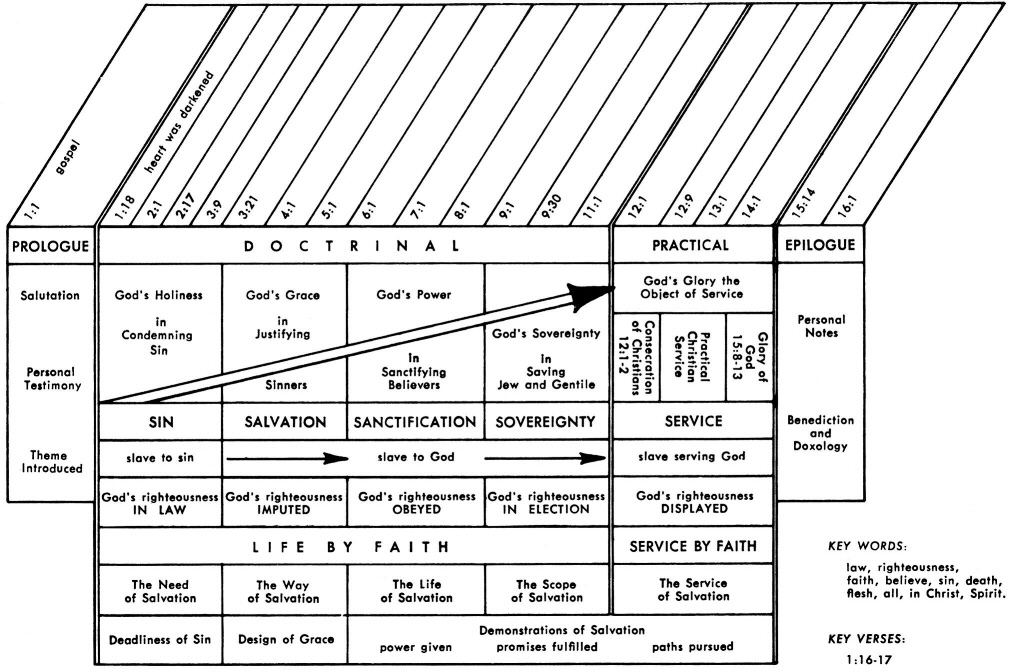
Click chart to enlarge
Chart from recommended resource Jensen's Survey of the NT - used by permission
Romans Overview Chart - Charles Swindoll
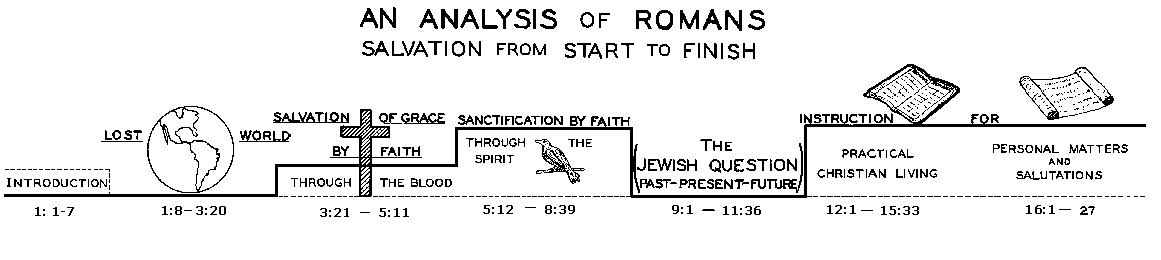
Source: Dr David Cooper
Click to Enlarge
| ROMANS ROAD to RIGHTEOUSNESS |
||||
| Romans 1:18-3:20 | Romans 3:21-5:21 | Romans 6:1-8:39 | Romans 9:1-11:36 | Romans 12:1-16:27 |
| SIN | SALVATION | SANCTIFICATION | SOVEREIGNTY | SERVICE |
| NEED FOR SALVATION |
WAY OF SALVATION |
LIFE OF SALVATION |
SCOPE OF SALVATION |
SERVICE OF SALVATION |
| God's Holiness In Condemning Sin |
God's Grace In Justifying Sinners |
God's Power In Sanctifying Believers |
God's Sovereignty In Saving Jew and Gentile |
Gods Glory The Object of Service |
| Deadliness of Sin |
Design of Grace |
Demonstration of Salvation | ||
| Power Given | Promises Fulfilled | Paths Pursued | ||
| Righteousness Needed |
Righteousness Credited |
Righteousness Demonstrated |
Righteousness Restored to Israel |
Righteousness Applied |
| God's Righteousness IN LAW |
God's Righteousness IMPUTED |
God's Righteousness OBEYED |
God's Righteousness IN ELECTION |
God's Righteousness DISPLAYED |
| Slaves to Sin | Slaves to God | Slaves Serving God | ||
| Doctrine | Duty | |||
| Life by Faith | Service by Faith | |||
|
Modified from Irving L. Jensen's chart above |
||||
R Ruin (Romans 1:17 – 3:20) – The utter sinfulness of humanity
O Offer (Romans 3:21-31) – God’s offer of justification by grace
M Model (Romans 4:1-25) – Abraham as a model for saving faith
A Access (Romans 5:1-11) – The benefits of justification
N New Adam (Romans 5:12-21) – We are children of two “Adams”
S Struggle w/ Sin (Romans 6:1-8:39) Struggle, sanctification, and victory
Romans 6:4 Therefore we have been buried with Him through baptism into death, so that as Christ was raised from the dead through the glory of the Father, so we too might walk in newness of life. (NASB: Lockman)
Greek: sunetaphemen (1PAPI) oun auto dia tou baptismatos eis ton thanaton, hina hosper egerthe (3SAPI) Christos ek nekron dia tes doxes tou patros, houtos kai hemeis en kainoteti zoes peripatesomen. (1SAAS)
GWT: When we were baptized into his death, we were placed into the tomb with him. As Christ was brought back from death to life by the glorious power of the Father, so we, too, should live a new kind of life. (GWT)
NLT: For we died and were buried with Christ by baptism. And just as Christ was raised from the dead by the glorious power of the Father, now we also may live new lives. (NLT - Tyndale House)
Phillips: We were dead and buried with him in baptism, so that just as he was raised from the dead by that splendid Revelation of the Father's power so we too might rise to life on a new plane altogether. (Phillips: Touchstone)
Wuest: We therefore were entombed with Him through this being placed in His death, in order that in the same manner as there was raised up Christ out from among those who are dead through the glory of the Father, thus also we by means of a new life imparted may order our behavior.
Young's Literal: we were buried together, then, with him through the baptism to the death, that even as Christ was raised up out of the dead through the glory of the Father, so also we in newness of life might walk.
THEREFORE: oun: WE HAVE BEEN BURIED WITH HIM THROUGH BAPTISM INTO DEATH: sunetaphemen (1PAPI) oun auto dia tou baptismatos eis ton thanaton:
- Ro 5:3; Col 2:12,13; 3:1, 2, 3; 1Pe 3:21
- Torrey's scriptures re the believer's Union With Christ
- Study of in Christ and in Christ Jesus and in Christ
- Romans 6 Resources - Multiple Sermons and Commentaries
Therefore (always stop and interrogate with the 5W'S & H e.g., asking what it's "there for?"- see terms of conclusion) In light of the truth that we "have been baptized into His (Christ Jesus') death", the implication is that there has been a burial which Paul now explains.
Buried with (4916) (sunthapto from sún = together with - a nearer and closer connection implied by this preposition in comparison to "meta" which also means "with" + thapto = bury, perform funeral rites, inter) means exactly what it says "to bury with". Our burial with Christ signifies the believer's participation in His death by virtue of our unbreakable union with Him.
The only other NT use of sunthapto is also by Paul in Colossians (in a similar context)…
(Read Col 2:11-note for context) having been buried with Him in baptism, in which you were also raised up with Him through faith in the working of God, who raised Him from the dead. (Col 2:12-note)
Through (1223) (dia) is a marker of instrument by which something is accomplished and can be translated "by means of" or "through."
Baptism (908) (baptisma from bapto = dipping something into dye and changing the color) (Click word study of root verb baptizo) describes the result of a dipping and figuratively as used in this context refers to the identification with a person in what the name of that person stands for or what he has come to do. For instance, in 1Cor 10:2, those who came out of Egypt are said to have been "baptized into Moses" which means they were identified with the character and the purpose of Moses.
Baptisma - 19x in NT - Matt. 3:7; 21:25; Mk. 1:4; 10:38f; 11:30; Lk. 3:3; 7:29; 12:50; 20:4; Acts 1:22; 10:37; 13:24; 18:25; 19:3f; Rom. 6:4; Eph. 4:5; 1 Pet. 3:21
Baptism as used in this verse illustrates the inner work of salvation as a sinner is buried with and raised with Christ, because of identification with the death and resurrection of Christ through faith (Ro 5:1-note; Ro 6:7-note). A person does not die to sin because he or she is physically baptized in water, but before he or she is baptized in water. Before his discussion of baptism in this section (Ro 6:3, 4, 5, 6, 7, 8, 9, 10), Paul has already said that we have died to sin: (Ro 6:2-note) where he declares "that we who died to sin". Here the verb (died) is in the aorist tense which describes a definite event at some point in time. Only those who did die to sin are to be water baptized, and this death to sin can only take place as the Holy Spirit works in the heart of a sinner and causes him to be justified by Christ through faith and makes him righteous (2Co 5:21).
Dying to sin is not thru the outward physical act of water baptism, but it is by Christ thru faith (Ro 5:1-note). Dipping our body into water is symbolic of the events which have already transpired (specifically our death, burial and resurrection with Christ). The repentant thief on the cross received eternal life when he was baptized into Christ through faith, even though he never had an opportunity to experience water baptism!
Where did the interpretation that Paul was referring to "water baptism" in Romans 6 originate? In brief, the conflict between Augustine and Pelagius raged when Pelagius taught that man was free of original sin and able to choose the good. Augustine, a great proponent of grace, emphasized correctly that God’s grace was necessary to rescue man from his state of total depravity. And yet Augustine himself erroneously taught the necessity of physical water baptism to "wash away sins" committed beforehand. So called "Baptismal regeneration" quickly and tragically became part of the teaching in many quarters of Christianity. Yet a careful observation of Romans 6 clearly shows that Paul did not teach such a doctrine of faith plus works!
Kenneth Wuest explains the concept of a believer's baptism into Christ's death writing that "the definition of the word baptizo, (signifies) “the introduction or placing of a person or thing into a new environment or into union with something else so as to alter its condition or its relationship to its previous environment or condition.” And that is its usage in Romans 6. It refers to the act of God introducing a believing sinner into vital union with Jesus Christ, in order that that believer might have the power of his sinful nature broken and the divine nature implanted through his identification with Christ in His death, burial, and resurrection, thus altering the condition and relationship of that sinner with regard to his previous state and environment, bringing him into a new environment, the kingdom of God. God placed us in Christ when He died so that we might share His death and thus come into the benefits of that identification with Him, namely, be separated from the evil nature as part of the salvation He gives us when we believe. We were placed in a new environment, Christ. The old one was the First Adam in whom as our federal head we were made sinners and came under condemnation. In our new environment in Christ we have righteousness and life. Our condition is changed from that of a sinner to that of a saint." (Bolding Added)
Wiersbe wisely points out that "Romans 6:3, 4 do not refer to water baptism but the operation of the Spirit in putting us “into Christ” as members of His body. (This operation is illustrated by water baptism.) When Christ died, we died with Him; when He was raised, we were raised to newness of life with Him. This is our new position in Christ. Christ not only died for sin, but He also died unto sin (Ro 6:10-note). That is, He broke the power of sin and put out of commission (destroyed) the old nature (Ro 6:6-note). The old nature is still there, this we know; but it has been robbed of its power by the cross of Christ, for we died with Christ to all that belongs to the old life." (Wiersbe's Expository Outlines on the New Testament. Wheaton, Ill.: Victor Books)
Into (1519)(eis) is a preposition of motion into any place or thing or direction to, toward or upon any place or thing. Figuratively eis marks the object or point toward which anything ends. Spoken of a result, effect, consequence, marking that which any person or thing inclines toward or becomes.
Death (2288) (thanatos from thnesko = to die) refers to physical separation of the soul from the body, and this is the meaning in this verse. Spiritually thanatos can refer to the separation of soul from God, the state of all unregenerate sinners.
Thanatos in Romans -
Rom. 1:32; Rom. 5:10; Rom. 5:12; Rom. 5:14; Rom. 5:17; Rom. 5:21; Rom. 6:3; Rom. 6:4; Rom. 6:5; Rom. 6:9; Rom. 6:16; Rom. 6:21; Rom. 6:23; Rom. 7:5; Rom. 7:10; Rom. 7:13; Rom. 7:24; Rom. 8:2; Rom. 8:6; Rom. 8:38;
Pastor Ray Stedman shares the following story which illustrates the meaning of baptism…
"Some time ago, Ron Ritchie told me of an experience that he had on Easter Sunday during a baptism service in the ocean near his house. I tell you, you really have to love Christ to be baptized in the frigid waters of the Pacific! A woman came up to him and asked him to baptize her nine-year-old daughter. Ron was reluctant to do so without finding out whether the girl really understood what was happening, so he began to question her and to teach her about the reality behind the water baptism. He was gesturing as he talked to her, and noticed that, as he was using his hand, the shadow of it fell on the sand. So he said to the little girl, "Do you see the shadow of my hand on the sand? Now, that is just the shadow; the hand is the real thing. And when you came to Jesus, when you believed in Jesus, that was the real baptism. You were joined to Him, and what happened to Him happened to you. Jesus was alive; then He died, was buried, and then He arose from the dead. And that is what happened to you when you believed in Him." He pointed to the shadow on the sand and said, "When you go down in the water and are raised up again, that is a picture of what has already happened." The girl immediately caught on and said, "Yes, that is what I want to do because Jesus has come into my life." So water baptism is a picture, a symbol worked out for us, to teach us what has happened to us when we believed in the Lord Jesus." (To read full sermon click The True Baptism of the Spirit)
IN ORDER THAT AS CHRIST WAS RAISED FROM THE DEAD THROUGH THE GLORY OF THE FATHER: hina hosper egerthe (3SAPI) Christos ek nekron dia tes doxes tou Patros:
- Ro 6:9; 8:11; 1Cor 6:14; 2Cor 3:4; Eph 1:19,20; 2:5,6
- Mt 28:2,3; Jn 2:11,19,20; 11:40; Col 1:11
- Romans 6 Resources - Multiple Sermons and Commentaries
In order that (2443) (hina) marks purpose, in this case the purpose of the believer's spiritual baptism into Christ's death, the ultimate purpose being that we might experience "newness of life." When I put my faith into Christ, there is a death that occurs. God baptizes me and identifies me with Christ's death. That must happen in order that I might now participate in His newness of life.
As (5618) (hosper) even as, just as, exactly like and in the NT used only in comparisons. It indicates an analogy or a resemblance.
Was raised (1453) (egeiro) means to awaken from sleep or to rouse from sleep. To stand up from sitting or lying. Figuratively as here in Romans 6:4 it means to cause to return to life (the ancients closely associated death with sleep). In Ephesians Paul teaches that
"even when we were dead in our transgressions, (God) made us alive together with Christ (by grace you have been saved), and raised us up with Him, and seated us with Him in the heavenly places, in Christ Jesus." (see note Ephesians 2:5; 2:6)
Egeiro is used by Christ Himself in an allusion to His resurrection declaring to the Jews ""Destroy this temple, and in three days I will raise it up." (Jn 2:19)
He was speaking to the Jews of His body as a temple, which, while they would destroy it, He would raise up in three days.
From (1537) (ek) primarily means out of or from, specifically "up from the grave He arose with a mighty triumph o'er His foes". What better time then now to pause and sing of this glorious truth and future hope of every believer…
LOW IN THE GRAVE HE LAY
Play and Sing Hymn
by Robert Lowry
Low in the grave He lay, Jesus my Savior,
Waiting the coming day, Jesus my Lord!
Refrain
Up from the grave He arose,
With a mighty triumph o’er His foes,
He arose a Victor from the dark domain,
And He lives forever, with His saints to reign
He arose! He arose!
Hallelujah! Christ arose!
Vainly they watch His bed, Jesus my Savior;
Vainly they seal the dead, Jesus my Lord!
Death cannot keep its Prey, Jesus my Savior;
He tore the bars away, Jesus my Lord!
Dead (3498) (nekros from nékus = a corpse; English - necropsy, necrophobia, etc) describes literally one who has breathed their last and figuratively (the more common NT use) speaks of the spiritual condition of unsaved men, spiritually dead to God because of sin (Ep 2:1-note).
Nekros in Romans -
Rom. 1:32; Rom. 5:10; Rom. 5:12; Rom. 5:14; Rom. 5:17; Rom. 5:21; Rom. 6:3; Rom. 6:4; Rom. 6:5; Rom. 6:9; Rom. 6:16; Rom. 6:21; Rom. 6:23; Rom. 7:5; Rom. 7:10; Rom. 7:13; Rom. 7:24; Rom. 8:2; Rom. 8:6; Rom. 8:38;
J. Vernon McGee speaking of our identification with Christ in His resurrection writes "We are joined today to a living Christ. In other words, our sins have already been judged; we are already raised; and we are yonder seated with Christ in the heavenlies (see note Ephesians 2:5; 2:6). My friend, there are only two places for your sins: either they were on Christ when He died for you over nineteen hundred years ago—because you have trusted Him as your Savior—or they are on you today, and judgment is ahead for you. There is no third place for them." (Bolding Added) (McGee, J V: Thru the Bible Commentary: Nashville: Thomas Nelson)
Glory (1391) (doxa from dokéo = to think or suppose) means to give a proper opinion of, in this case a proper opinion of God. Glory then is the true apprehension of God. The glory of God means His unchanging essence, what He is essentially, the totality of His perfection. God is glorified when He is allowed to be seen as He really is. "Doxa" in the present context stands for the excellence of God’s almighty power as manifested in the resurrection of Christ, in that Christ's resurrection gives a proper opinion or estimate of the Father.
Godet has this comment regarding "through the glory of the Father" "The glory of the Father by which Christ was raised, is not the display of His power apart from His other perfections; but, as usual, that of all the divine attributes combined. For they have all contributed to this masterpiece of the revelation of God on the earth, righteousness as well as mercy, wisdom as well as holiness. Speaking of the resurrection of Lazarus, Jesus said to Martha: “Did I not say to you, if you believe, you will see the glory (doxa) of God?" (Jn 11:40) But here we have to do with the resurrection of the Son; and therefore Paul says: by the glory of the Father. (Romans Commentary)
SO WE TOO MIGHT WALK IN NEWNESS OF LIFE: houtos kai emeis en kainoteti zoes peripatesomen (1PAAS):
- Ro 6:19; 7:6; 12:1,2; 13:13,14; 2Cor 5:17; Gal 6:15,16; Eph 4:17,22, 23, 24; 5:8; Php 3:17,18; Col 1:9, 10, 11, 12; 2:11,12; 3:10; 4:1; 1 Pe 4:1,2; 2Pe 1:4, 5, 6, 7, 8, 9; 1Jn 2:6
- Romans 6 Resources - Multiple Sermons and Commentaries
Might walk (4043) (peripateo from peri = about, around + pateo = walk, tread) (Click for an in depth study of peripateo) literally means to "walk around" or "walk about", to go here and there in walking, to tread all around. More commonly in the NT (and in our current verse) peripateo figuratively refers to one's manner of life, to one's habitual way or bent of life or to one's life-style.
Ray Stedman comments on Paul's figurative use of "walk" writing "I like that figure because a walk, of course, merely consists of two simple steps, repeated over and over again. It is not a complicated thing. In the same way, the Christian life is a matter of taking two steps, one step after another. Then you are beginning to walk. Those two steps follow in this passage. Paul describes them as, "Put off the old man" (Col 3:5, 6, 7, 8, 9, 10 -see notes Col 3:5, 6-8, 9, 10) and "put on the new." (see specific attitudes and actions in Col 3:12, 13, 14, 15, 16, 17, 18-notesff) Then repeat them. That is all. Keep walking through every day like that. That is how Scripture exhorts us to live." (Bolding Added) (For full sermon click True Human Potential)
Walk is aorist tense, subjunctive mood, this mood in context expressing the purpose of the our co-resurrection with Christ. Specifically, Paul says that our purpose is a daily conduct that is in the sphere of "Newness of life".
Peripateo in Romans - Rom. 6:4; Rom. 8:4; Rom. 13:13; Rom. 14:15;
D. L. Moody alluded to a believer's walk when he quipped that “Every Bible should be bound in shoe-leather.”
J Vernon McGee adds a practical notation that :Walking is not a balloon ascension. A great many people think the Christian life is some great, overwhelming experience and you take off like a rocket going out into space. That’s not where you live the Christian life. Rather, it is in your home, in your office, in the schoolroom, on the street. The way you get around in this life is to walk. You are to walk in Christ. God grant that you and I might be joined to Him in our daily walk." (Bolding Added) (Thru the Bible Commentary: Nashville: Thomas Nelson)
Newness (2538) (kainotes from kainos [word study] = new in sense that it brings into the world a new quality of thing which did not exist before) refers to a renewal, not simply an experience similar to the past, but a qualitatively different one, one that is new in quality and character. Of note is that the word Paul chose under the inspiration of the Holy Spirit is not neos (see word study) which refers merely to newness in point of time. The life every believer now has the potential to walk is a life of a brand new kind, new because the believer is now in union with and identified irrevocably with Christ.
The only other NT uses of kainotes is found in Romans 7 "But now we have been released from the Law, having died to that by which we were bound, so that we serve in newness of the Spirit and not in oldness of the letter. (Ro 7:6-note)
Wuest makes a subtle distinction in regard to "newness" "The newness of life therefore refers, not to a new kind of life the believer is to live, but to a new source of ethical and spiritual energy imparted to him by God by which he is enabled to live the life to which Paul exhorts in Romans 12-16.
Paul's point is that just as sin characterized and dominated every one of our lives in Adam, so now because of our position in union with Christ every believer possesses the potential to live a righteous lifestyle. Before their union with Christ, even man's best was but filthy rags in light of God's holiness and His perfect standard.
In light of this truth Wayne Barber applies this truth asking the question "Can a Christian go back and live like he used to live?" Well, how can you if you are dead and you have been raised to walk in newness of His life? A life that is brand new, qualitatively different? "How different?" In the sense that sin no longer controls you. In the sense that you have Someone who lives in you now that gives you power to do what you couldn’t do before; Someone to convict you of sin; Someone to give you knowledge that you didn’t have before. I can’t go back! I’m walking in newness of His life." (Bolding added) (Barber, W: The New Life in Jesus)
The Believer’s
New Spiritual Life
Scripture is filled with descriptions of the believer’s new spiritual life. We are said to receive a new heart (Ezek 36:26), a new spirit (Ezek 18:31), a new song (Ps 40:3-note), and a new name (Rev 2:17-note). We are called a new creation (2Cor 5:17), a new creature (Gal 6:15), and a new self (Ep 4:24-note).
A change in behavior begins with a change in the heart.
Life (2198) (zoe) refers to fullness of life, a blessed life, a life that satisfies and can be lived as God intended for it to be lived because we are now united and identified with the life of Christ. He is now our "life" Source (Col 3:4-note) providing the potential for this new, full life. His life now operates in us as a motivating, energizing, pulsating principle of existence that has the potential to transform every believer's life.
Zoe in Romans - Rom. 2:7; Rom. 5:10; Rom. 5:17; Rom. 5:18; Rom. 5:21; Rom. 6:4; Rom. 6:22; Rom. 6:23; Rom. 7:10; Rom. 8:2; Rom. 8:6; Rom. 8:10; Rom. 8:38; Rom. 11:15;
Moule writes that "All possible emphasis lies upon those words, “newness of life.” They bring out what has been indicated already (Ro 5:17, 18-note), the truth that the Lord has won us not only remission of a death penalty, not only even an extension of existence under happier circumstances, and in a more grateful and hopeful spirit — but a new and wonderful life power. The sinner has fled to the Crucified, that he may not die. He is now not only amnestied but accepted. He is not only accepted but incorporated into his Lord, as one with Him in interest. He is not only incorporated as to interest, but, because his Lord, being Crucified, is also Risen, he is incorporated into Him as Life. The Last Adam, like the First, transmits not only legal but vital effects to His member. In Christ the man has, in a sense as perfectly practical as it is inscrutable (not readily investigated, interpreted, or understood), new life, new power, as the Holy Ghost applies to his inmost being the presence and virtues of his Head. “In Him he lives, by Him he moves.” To men innumerable the discovery of this ancient truth, or the fuller apprehension of it, has been indeed like a beginning of new life. They have been long and painfully aware, perhaps, that their strife with evil was a serious failure on the whole, and their deliverance from its power lamentably partial. And they could not always command as they would the emotional energies of gratitude, the warm consciousness of affection. Then it was seen, or seen more fully, that the Scriptures set forth this great mystery, this powerful fact; our union with our Head, by the Spirit, for life, for victory and deliverance, for dominion over sin, for willing service. And the hands are lifted up, and the knees confirmed, as the man uses the now open secret — Christ in him, and he in Christ — for the real walk of life. (The Epistle of Paul the Apostle to the Romans - online)
The new life in Christ has begun—
The past with its darkness is gone;
Look closer to see what the Savior has done,
For change is beginning to dawn.
—Hess
C H Spurgeon - Quickening is a needful part of the process of sanctification. Sanctification, in its operation upon our character, consists of three things. First, we die unto sin. A wondrous death! By this Jesus strikes at the heart of evil. The death of Christ makes us die to sin. After this comes burial. We are buried with Christ, and of this burial, baptism is the type and token. Covered up to be forgotten, we are to sin as a dead shepherd to his flock. As the sheep pass over the dead shepherd’s grave or even feed thereon, and yet he regards them not, so our old sins and habits come about us, but we, as dead men, know them no more. We are buried to them. To complete our actual sanctification we receive heavenly quickening. ‘If we be dead with Christ, we believe that we shall also live with him’. Yes, we do live in him and by him, for ‘he that believeth on him … hath everlasting life.’ I trust you know what this means. Have you been thus dead, thus buried with Christ? Are you now thus quickened in the likeness of his resurrection? This is your joyful privilege, if you are indeed believers in Christ and joined unto the Lord in one spirit. Being thus quickened you are partakers of a new life. You are not like Lazarus, who, when he was raised from the dead, had the same life restored to him. True, you have that same life about you. Alas, that you should have it, for it will be your burden and plague. But your true life has come to you by your being born again from above. ‘This is the record, that God hath given to us eternal life, and this life is in his Son. He that hath the Son hath life’. The Holy Spirit has wrought in us a higher life than nature possessed. (From Sermon Christ's Resurrection and Our Newness of Life)
W. Hay Aitken - That is the life we are called upon to live, and that is the life it is our privilege to lead; for God never gives us a call without its being a privilege, and He never gives us the privilege to come up higher without stretching out to us His hand to lift us up. Come up higher and higher into the realities and glories of the resurrection life, knowing that your life is hid with Christ in God. Shake yourself loose of every encumbrance, turn your back on every defilement, give yourself over like clay to the hands of the potter, that He may stamp upon you the fullness of His own resurrection glory, that you, beholding as in a mirror the glory of the Lord, may be changed from glory to glory as by the Spirit of the Lord.
L B E Cowan - BORROW Springs in the Valley
Buried with him…that…even so we also should walk in newness of life. (Rom. 6:4)
No one enters into the experience of entire sanctification without going through a “white funeral,” i.e., the burial of the old life. If there has never been this crisis of death, sanctification is nothing more than a vision. There must be a “white funeral,” the death that has only one resurrection—a resurrection into the life of Jesus. Nothing can upset this life; it is one with God, for one purpose, to be a witness to Him.
Have I come to my last days really? I have come to them in sentiment, but have I come to them really? You cannot go to your funeral in excitement, nor die in excitement. Death means stopping being. Do I agree with God that I stop being the striving earnest kind of Christian I have been? We skirt the cemetery and all the time refuse to go to death. It is not striving to go to death, it is dying—“baptized into his death.”
Have I had a “white funeral,” or am I sacredly playing with my soul? Is there a place marked in my life as the last day, a place that the memory goes back to with a chastened and extraordinary grateful remembrance—Yes, it was then, that I made an agreement with God. “This is the will of God, even your sanctification.” When you realize what the will of God is, you will enter into sanctification as naturally as can be. Are you willing to go through the “white funeral” now?
Do you agree with Him that this is your last day on earth? That moment depends on you. MY UTMOST FOR HIS HIGHEST, BY OSWALD CHAMBERS
A W Tozer - We who pride ourselves on our orthodoxy … have in recent years committed a costly blunder.… Our blunder (or shall we frankly say our sin?) has been to neglect the doctrine of the Spirit to a point where we virtually deny Him His place in the Godhead. This denial has not been by open doctrinal statement, for we have clung closely enough to the biblical position wherever our creedal pronouncements are concerned. Our formal creed is sound; the breakdown is in our working creed. This is not a trifling distinction. A doctrine has practical value only as far as it is prominent in our thoughts and makes a difference in our lives.....Truth consists not in correct doctrine, but in correct doctrine plus the inward enlightenment of the Holy Spirit … Deity indwelling men!.… No man has experienced rightly the power of Christian belief until he has known this for himself as a living reality
Warren Wiersbe - Romans 6:1-4 THE LIVING DEAD
Historians agree that the mode of baptism in the early church was immersion. The believer was "buried" in the water and brought up again as a picture of death, burial, and resurrection. Baptism by immersion (which is the illustration Paul is using in Rom. 6) pictures the believer's identification with Christ in His death, burial, and resurrection. It is an outward symbol of an inward experience. Paul is not saying that their immersion in water put them "into Jesus Christ," for that was accomplished by the Spirit when they believed. Their immersion was a picture of what the Spirit did: the Holy Spirit identified them with Christ in His death, burial, and resurrection.
This means that the believer has a new relationship to sin. He is "dead to sin." If a drunk dies, he can no longer be tempted by alcohol because his body is dead to all physical senses. He cannot see the alcohol, smell it, taste it, or desire it. In Jesus Christ we have died to sin so that we no longer want to "continue in sin." But we are not only dead to sin; we are also alive in Christ. We have been raised from the dead and now walk in the power of His resurrection. We walk in "newness of life" because we share His life. "I have been crucified with Christ and I no longer live, but Christ lives in me" (Gal. 2:20). (BORROW Pause for power : a 365-day journey through the Scriptures)
W H Griffith-Thomas - Service —From union and fruitfulness will come service. "In Christ" we not only "walk in newness of life" (Ro 6:4), but "serve in newness of spirit" (Ro 7:6). The contrast between the service of ch. vi. and the present section is very striking. There it was the service of a slave; here it is the service of a wife to a husband. The service of a slave, or even of a faithful servant, is altogether different from the loving devotion of a wife to a husband, and this is the simile here used. The new obligation involved in the new position enables the soul to serve, apart from all bondage and labor, Him "Whose service is perfect freedom," or, as the terse Latin of the Collect has it, "Whom to serve is to reign." It should be observed that Ro 6:6 gives the theme of Romans 8; fruitfulness and service to God in newness of spirit.
The day after Easter, the newspaper headline read: "Entire World Celebrates the Risen Christ." On the same page under smaller headings ran stories about war and death, racial clashes, and an ultimatum issued to the United States by a hostile nation. As I read the discouraging news, I thought, how contradictory. The headline declares that the entire world celebrates the risen Christ, but the balance of the page tells of people disregarding the blessing and grace Christ provided by His resurrection. Apparently the millions of people around the world who flock to churches on Easter don't all live as if they believe in the historical resurrection nor recognize its true spiritual significance.
Even Christians can err in this way. Sometimes we simply go through the motions of expressing our faith without acknowledging our identification with Christ. In Romans 6, Paul said that we have been crucified with Christ and have died to sin. But we have also been raised with Christ so we can "walk in newness of life." That's why the apostle said, "If then you were raised with Christ Set your mind on things above, not on things on the earth" (Col. 3:1-2).
Having been crucified with Christ, we are now privileged to live for Him. As we do, we show our gratitude for being "risen with Christ."
—R.W.D. (Reprinted by permission from Our Daily Bread Ministries. Please do not repost the full devotional without their permission.)
The power that opened Christ's tomb opens the door to the fullness of life.
(ED THOUGHT - Let us pray without ceasing for that resurrection power as Paul did in Eph 1:18-19+)
Robert Neighbour - The Life Which Is in Christ Jesus
• The Life Defined (I John 5:11, 12).
• The Life and Its Manifestations (Rom. 6:4).
• The Life and Its Security (Col. 3:3).
• The Life and Its Precedence (Gal. 2:20).
• The Life and the Life More Abundant (John 10:10).
• The Life and Its Tabernacle (II Cor. 4:7).
• The Life and How It Is Obtained (I Peter 1:23).
Unless we have the Life which is in Christ Jesus, we have nothing worth the while; we have nothing upon which to build; we have no basis of development and of growth.
Kay Arthur - As God’s child you are no longer a slave to sin. As a servant of righteousness, you don’t have to let sin rule in your body.
Charles Stanley - The Infusion of God’s Grace
SCRIPTURE READING: Ephesians 2:8–10
KEY VERSE: Romans 6:4 We were buried with Him through baptism into death, that just as Christ was raised from the dead by the glory of the Father, even so we also should walk in newness of life.
You cannot come to Jesus apart from the grace of God. If you could save yourself, then there would be no need for a Savior. But God’s pattern for salvation includes the infusion of His grace in the lives of those who come to Him.
Grace is all-important to the believer. It is God’s personal touch, His handprint of intimacy in your life. It is the evidence of His advent and the one thing that keeps you founded in His abiding love. His grace breathes potential into all that you do and say.
The apostle Paul told us: “(By grace you have been saved), and raised … up with Him … in order that in the ages to come He might show the surpassing riches of His grace in kindness toward us in Christ Jesus” (Eph. 2:5–7 NASB).
He reminded us that we have been buried with Jesus through baptism into death, so that as Christ was raised from the dead through the glory of the Father, we, too, might walk in newness of life (Rom. 6:4). The mission of grace did not end at the Cross. It overflows into every area of our lives, filling us with hope and the blessed assurance that we are loved with an eternal love. Thus, God has called us to be distributors of His grace to others. Just as it has been given to you, let grace motivate you to give it away to someone today.
God, thank You for Your grace that fills me. Help me to give it away to someone today.
BORROW - Seeking His face : a daily devotional
F B Meyer - THE POWER OF CHRIST'S RESURRECTION
"Like as Christ was raised up from the dead by the glory of the Father, even so we also should walk in newness of life."-- Ro 6:4.
THE KEYNOTE of this inspiring paragraph is life in union with the Risen Christ. Behind us lies the Death of our Lord, which severed for His people their fellowship with the world. As the voice of praise or blame cannot reach the dead, but are arrested at the fast-closed ears, so it is intended that the murmur of the world should not affect us, but that we should be set only on the Will of God.
It is not wise, however, to dwell always on the negations of the Christian life. It is true that they are always present, but to dwell on them is to miss the power by which self-sacrifice and self-denial become easy. Do not live on the dying but the risen side of the Saviour's work. Behold Him as He goes forth upon His upward way to the Throne of Glory. Seek to experience union with Him in the likeness of His resurrection (Phi 3:10).
There ought to be a finality in our experience. It is good for us to recognize the break with our past life. It must be clearly defined; we must have done with it for ever. It is possible that we may be tempted, and come temporarily beneath the dominion of old sins; but in principle, like the Israelites, we have passed from Egypt, never to return to it, and the Red Sea of Christ's redemption severs us from our former condition. We do not reckon ourselves to be dead to sin in the sense that our nature is henceforth incapable of sinning. If we think thus, we shall soon be disillusioned, and find that tendencies and strivings are within us which prove the contrary. But we must reckon that we have died to sin, and whenever temptation comes, that it has no claim upon us. Nelson turned his blind eye to the signal to retreat from action, and we are to turn blind eyes and deaf ears to the tempter.
The Apostle says that we are to present our members as instruments of righteousness to God. Do not look at the tempter, but at Christ; yield the eyes, ears, heart, and mind to Him, that He may make the best possible use of them; and that which becomes the habitual practice of the outward life will inevitably affect the soul and spirit.
PRAYER Constrained by Thy love, O Lord, we would here present ourselves, spirit, soul, and body, not to live unto ourselves, but unto Thee who didst die, and rise again. AMEN.
John MacArthur - THE TRANSFORMATION
We also should walk in newness of life. Ro 6:4
The purpose for Jesus’ substitutionary sacrifice was that “we, having died to sins, might live for righteousness” (1 Pet. 2:24). Peter doesn’t say Christ died so we could go to heaven, have peace, or experience love. He died to bring about a transformation: to make saints out of sinners. Christ’s substitutionary work enables a person to depart from sin and enter into a new life pattern: a life of righteousness.
The apostle Paul said, “Our old man was crucified with Him, that the body of sin might be done away with, that we should no longer be slaves of sin” (Rom. 6:6). We have died to sin; thus it no longer has a claim on us. First Peter 2:24 echoes that thought: our identification with Christ in His death is a departure from sin and a new direction in life. (BORROW devotional Truth for Today)
Adrian Rogers - When I got baptized, it was a funeral for the old Adrian. Baptism pictured the burial. The only mourner in attendance was the devil, who hated to see me die, because I was his good buddy when the old Adrian was still alive. So here's the reason why someone should never be baptized before he or she is saved. It would be like having your funeral and being buried before you die. When you're saved, you die to the old way. You proclaim, "Good-bye, world, good-bye," and become a new person. Baptism pictures that!
John MacArthur - ALIVE IN CHRIST - Ro 6:4
Union with Christ means participation in His death, burial, and resurrection.
Believers are united with Christ not only in His life, but also in His death. When believers come to faith in Christ, they symbolically share in His death, dying to sin in order to live to God (Rom. 6:10–11).
That reality has profound implications. Having died to the old life of sin and been raised to share new life in Christ, believers cannot continue in the same old patterns of sin. They now live in an entirely different realm. Those who die in Christ live in Christ. In the words of the great nineteenth–century theologian Charles Hodge, “There can be no participation in Christ’s life without a participation in his death, and we cannot enjoy the benefits of his death unless we are partakers of the power of his life. We must be reconciled to God in order to be holy, and we cannot be reconciled without thereby becoming holy.”
As a result, believers cannot help but “walk in newness of life.” Walk describes daily spiritual conduct. Believers have a new direction in life; they no longer live like they did before they were saved (1 Peter 4:3–4).
In his classic hymn “And Can It Be?” Charles Wesley wrote:
No condemnation now I dread:
Jesus, and all in Him, is mine!
Alive in Him, my living Head,
And clothed in righteousness divine,
Bold I approach the eternal throne,
And claim the crown, thru Christ my own.
Is that the song of your heart today? (BORROW devotional Strength for today)
Oswald Chambers - Do you walk in white?
Buried with Him … that … even so we also should walk in newness of life. Romans 6:4.
No one enters into the experience of entire sanctification without going through a ‘white funeral’—the burial of the old life. If there has never been this crisis of death, sanctification is nothing more than a vision. There must be a ‘white funeral,’ a death that has only one resurrection—a resurrection into the life of Jesus Christ. Nothing can upset such a life; it is one with God for one purpose, to be a witness to Him.
Have you come to your last days really? You have come to them often in sentiment, but have you come to them really? You cannot go to your funeral in excitement, or die in excitement. Death means that you stop being. Do you agree with God that you stop being the striving, earnest kind of Christian you have been? We skirt the cemetery and all the time refuse to go to death. It is not striving to go to death, it is dying—“baptized into His death.”
Have you had your ‘white funeral,’ or are you sacredly playing the fool with your soul? Is there a place in your life marked as the last day, a place to which the memory goes back with a chastened and extraordinarily grateful remembrance—‘Yes, it was then, at that “white funeral,” that I made an agreement with God’?
“This is the will of God, even your sanctification.” When you realize what the will of God is, you will enter into sanctification as naturally as can be. Are you willing to go through that ‘white funeral’ now? Do you agree with Him that this is your last day on earth? The moment of agreement depends upon you. (BORROW My utmost for His highest)
Ken Hemphill - WE ARE
Walking in Newness of Life
Romans 6:4 Just as Christ was raised from the dead … we too may walk in a new way of life.
The image of walking is an important one in the New Testament. You’re certainly familiar, for example, with the concept of “walking in the Spirit”—conducting your life under his guidance and control, enjoying his continual direction and empowerment. In our present passage we find the incredible truth that we are able as believers to walk “in a new way of life.” This ability to live in daily freshness is based on the fact that we have died to sin, so that we no longer have to say “yes” to it.
Before we became Christians, we were often powerless to say “no” to the passions that led us away from God. All of us can identify even now with the struggle we go through to control our anger or passion by inner fortitude alone. We frequently lose this battle for a very basic reason: when we won’t submit to Christ, we are slaves of sin. But it doesn’t have to be this way.
Our salvation experience was made possible by Jesus’ death and resurrection—a reality depicted in the act of baptism. In the New Testament era, baptism followed immediately upon one’s confession of faith. This was generally a public event where the individual was completely immersed in water. Going down into the water symbolized death, and coming up out of the water symbolized resurrection. Thus it portrays our participation with Christ. Through him we are able to walk daily in his resurrection life.
This resurrection life is not something waiting for us in the future, unavailable until after this life is over. It is a present reality. We are new creatures, empowered to live a life that is pleasing to God—right now, in this hour.
Therefore, we must commit ourselves daily to live according to our new nature which has been given to us by Christ, and to refuse to obey our old nature. When we are tempted to sin, we can declare that we are walking in newness of life—a new way of living that no longer has any need for sin and its harmful side-effects. (We Are - Kingdom Promises)
I will give you a new heart and put a new spirit in you. Ezekiel 36:26
Today's Scripture & Insight: Ezekiel 36:24–27
The news was grim. My father had been having chest pains, so his doctor ordered a test to peer into his heart. The result? Blockage found in three arteries.
Triple-bypass surgery was scheduled for February 14. My dad, though anxious, saw that date as a hopeful sign: “I’m getting a new heart for Valentine’s Day!” And he did! The surgery went perfectly, restoring life-giving blood flow to his struggling heart—his “new” heart.
My father’s surgery reminded me that God offers us a new life as well. Because sin clogs our spiritual “arteries”—our capacity to connect with God—we need spiritual “surgery” to clear them.
That’s what God promised His people in Ezekiel 36:26. He assured the Israelites, “I will give you a new heart. . . . I will remove from you your heart of stone and give you a heart of flesh.” He also promised, “I will cleanse you from all your impurities” (Ezek 36:25) and “put my Spirit in you” (Ezek 36:27). To a people who’d lost hope, God promised a fresh start as the One who could renew their lives.
That promise was ultimately fulfilled through Jesus’ death and resurrection. When we trust in Him, we receive a new spiritual heart, one that’s cleansed of our sin and despair. Filled with Christ’s Spirit (Eph 5:18), our new heart beats with the spiritual lifeblood of God, that “we too may live a new life” (Romans 6:4). By: Adam R. Holz (Reprinted by permission from Our Daily Bread Ministries. Please do not repost the full devotional without their permission.)
How does God’s promise of a new life bring hope when you’re struggling with guilt or shame? How will you rely on the Spirit’s power today instead of your own?
Father, thank You for the new hope You’ve given us in Jesus. Help us to trust You daily as Your Spirit leads us into a whole new way of living.
Pursue peace with all people, and holiness, without which no one will see the Lord. —Hebrews 12:14
Today's Scripture & Insight: Romans 6:14-23
We often see surveys that ask people if they are happy, satisfied with their work, or enjoying life. But I’ve never seen an opinion poll that asked, “Are you holy?” How would you answer that question?
One Bible dictionary defines holiness as “separation to God and conduct fitting for those separated.” Author Frederick Buechner said that when writing about a person’s character, “nothing is harder to make real than holiness.” He adds that “holiness is not a human quality at all, like virtue. Holiness is . . . not something that people do, but something that God does in them.”
Romans 6 presents the stunning gift that God gives us through faith in Christ: “We were buried with Him through baptism into death, that just as Christ was raised from the dead by the glory of the Father, even so we also should walk in newness of life” (v.4). The pursuit of holiness occurs daily as we yield ourselves in obedience to the Lord instead of following our old ways of self-gratification. “Now you are free from the power of sin and have become slaves of God. Now you do those things that lead to holiness and result in eternal life” (v.22 nlt).
Are you becoming more holy? By God’s grace and power, the answer can be a resounding “Yes! More and more each day.” By: David C. McCasland (Reprinted by permission from Our Daily Bread Ministries. Please do not repost the full devotional without their permission.)
Father, I want to cooperate with You in Your work of changing me to become more like Jesus. Help me to walk in Your ways. Without Your work in me, nothing of lasting value will occur in my growth in holiness.
The choice to pursue holiness is a matter of life or death.
Reckon yourselves to be dead indeed to sin, but alive to God. —Romans 6:11
Today's Scripture: Romans 6:1-14
In his book An Anthropologist on Mars, Oliver Sacks tells about a man named Virgil. Blind from early childhood, Virgil underwent surgery decades later and regained the ability to see.
But at first, like the blind man healed by Jesus outside Bethsaida (Mk. 8:22-26), Virgil had difficulty seeing. Although he could discern movement and color, he couldn’t put images together to make sense of them. For a time, his behavior was still the same as when he was sightless.
Sacks comments, “One must die as a blind person to be born again as a seeing person. It is the interim, the limbo . . . that is so terrible.”
That comment echoes Paul’s teaching about burying our old, dead selves to walk in newness of life (Rom. 6:4). It is a dramatic spiritual change that may bring a time of difficult adjustment. Ingrained habits and attitudes may hang on like withered leaves in autumn.
To overcome sin, we must remember that it is no longer our master (Ro 6:11), and we are to refuse to let it reign in our lives (Ro 6:12). Instead, we are to offer ourselves to God as “alive from the dead” (Ro 6:13). As we take these steps, our spiritual blindness will become a thing of the past, and we will learn to see Jesus more clearly. By: Vernon Grounds (Reprinted by permission from Our Daily Bread Ministries. Please do not repost the full devotional without their permission.)
Amazing grace! How sweet the sound—
That saved a wretch like me!
I once was lost but now am found,
Was blind but now I see.
—Newton
Sin blinds—but God's grace restores sight.
We were . . . buried with him. Romans 6:4
Today's Scripture & Insight: Romans 6:1–11
For twenty-nine years after World War II ended, Hiroo Onoda hid in the jungle, refusing to believe his country had surrendered. Japanese military leaders had dispatched Onoda to a remote island in the Philippines (Lubang) with orders to spy on the Allied forces. Long after a peace treaty had been signed and hostilities ceased, Onoda remained in the wilderness. In 1974, Onoda’s commanding officer traveled to the island to find him and convince him the war was over.
For three decades, Onoda lived a meager, isolated existence, because he refused to surrender—refused to believe the conflict was done. We can make a similar mistake. Paul proclaims the stunning truth that “all of us who were baptized into Christ Jesus were baptized into his death” (Romans 6:3). On the cross, in a powerful, mysterious way, Jesus put to death Satan’s lies, death’s terror, and sin’s tenacious grip. Though we’re “dead to sin” and “alive to God” (v. 11), we often live as though evil still holds the power. We yield to temptation, succumbing to sin’s seduction. We listen to lies, failing to trust Jesus. But we don’t have to yield. We don’t have to live in a false narrative. By God’s grace we can embrace the true story of Christ’s victory.
While we’ll still wrestle with sin, liberation comes as we recognize that Jesus has already won the battle. May we live out that truth in His power. By: Winn Collier (Reprinted by permission from Our Daily Bread Ministries. Please do not repost the full devotional without their permission.)
How are you tempted to believe that death and sin still hold power over your life? Where can you see Christ’s victory already present in the world?
Jesus, I know You’ve won the battle over evil and darkness. Would You help me to live this out?
EDITORIAL THOUGHT - In truth we don't need a little "help" (that implies we have power of our own to live the Christ life). What we really need is divine enablement from the Holy Spirit Who gives us the desire and the power (see Php 2:13NLT+) to live the Christian life and walk worthy of our high calling in Christ. This is not "Let go, let God" (which is unscriptural) but more like LET GOD, LET'S GO!
Just as Christ was raised from the dead by the glory of the Father, even so we also should walk in newness of life. — Romans 6:4
Today's Scripture: Romans 6:1-11
After my doctor announced that I had cancer, I tried to listen to what he said, but I couldn’t. I went home, pulled a blanket over my head, and fell asleep on the couch, as if sleeping could change the diagnosis.
When I finally gained enough strength to tell my loved ones, my friend Judy Schreur said something especially memorable. After expressing her sympathy, she said, “This is what will happen. You will feel really bad for 3 days. Then you will get up, figure out what you have to do, and get on with your life.” Then she added, “I think it has to do with death, burial, and resurrection.”
At the time, I didn’t believe it. I was sure that life as I knew it was over. Nothing would ever be the same. I couldn’t imagine feeling normal again. But she was right. Three days later I woke up and realized I didn’t feel quite so bad. And little by little, despite the physical misery of chemotherapy treatments, my emotional and spiritual condition improved significantly. I “died” to my old reality and was “raised” to a new normal.
Thankfully, God is in the business of resurrection. For those who have died in Christ, the death of one reality means resurrection to a new, glorious normal so that we can “walk in newness of life” (Rom. 6:4). By: Julie Ackerman Link (Reprinted by permission from Our Daily Bread Ministries. Please do not repost the full devotional without their permission.)
Jesus redeemed us and died in our stead;
In Him we died and rose from the dead.
No longer is death a thing that we dread;
The old is behind us, the new is ahead.
—D. De Haan
To be “in Christ” is to share in His life, in His death, and in His resurrection.
Romans 6:5 For if we have become united with Him in the likeness of His death, certainly we shall also be in the likeness of His resurrection, (NASB: Lockman)
Greek: ei gar sumphutoi (JMPNX: congenital, planted together) gegonamen (1PRAI) to homoiomati tou thanatou autou, alla kai tes anastaseos esometha; (1PFMI)
GWT: If we've become united with him in a death like his, certainly we will also be united with him when we come back to life as he did. (GWT)
NLT: Since we have been united with him in his death, we will also be raised as he was. (NLT - Tyndale House)
Phillips: If we have, as it were, shared his death, let us rise and live our new lives with him! (Phillips: Touchstone)
Wuest: For in view of the fact that we are those who have become permanently united with Him with respect to the likeness of His death, certainly also we shall be those who as a logical result have become permanently united with Him with respect to the likeness of His resurrection
Young's Literal: For, if we have become planted together to the likeness of his death, so also we shall be of the rising again;
FOR IF WE HAVE BECOME UNITED WITH HIM IN THE LIKENESS OF HIS DEATH: ei gar sumphutoi gegonamen (1PRAI) to homoiomati tou thanatou autou:
- Ro 6:8-12; Eph 2:5,6; Php 3:10,11
- Ps 92:13; Isa 5:2; Jer 2:21; Mt 15:13; Jn 12:24; 15:1, 2, 3, 4, 5, 6, 7, 8
- Romans 6 Resources - Multiple Sermons and Commentaries
If we have become planted together (Young's Literal)
In view of the fact that we are those who have become permanently united with Him with respect to the likeness of His death (Wuest)
If we have become one with Him by sharing a death like His (Amplified)
For if - The “if” here signifies a fulfilled condition and could be translated "in view of the fact" or the "since such and such a thing is so".
The statement which follows is in fact is true in time and space for every person who has been justified by faith. Recall that in Ro 6:1, 2, 3, 4 Paul has established two major facts. First, that when God saves a sinner, He separates him from the indwelling sinful nature and this cleavage is so effective that the believer is not compelled to sin anymore (we may sin but now it is a choice). The believer has in actuality been permanently delivered from the power of sin. Secondly, God at the same time imparted the divine nature ("newness of life"), which gives the believer both the desire and the power to do God’s will.
This is the first time in Romans Paul speaks specifically of our union with Christ (although in Ro 3:24 [note] he does use the phrase "in Christ Jesus"). Paul begins to explain how "newness of life" comes about and how we become a new kind of person in every aspect of our life. Whereas before we had only a relationship with Adam’s sin, now that has been broken and we have a relationship with Christ, "the last Adam" (1Co15:45, cp 1Co 15:22) in his death, burial and resurrection. We need to know and to continually count on these great truths in order to experience a life of victory over sin.
So the question that one might have is how can we be assured a believer that their walk can now indeed be in "newness of life"? Paul explains this new quality of life is possible because of our intimate permanent (perfect tense) union with Christ in His burial but more importantly in His resurrection.
WITH CHRIST
Study and be blessed by the nine occurrences of with Christ in Paul's epistles -
Ro 6:8; 8:17; Gal. 2:20; 3:27; Eph. 2:5; Phil. 1:23; Col. 2:20; 3:1, 3
IN HIM
Then observe the 29 uses by Paul of the phrase in Him and be blessed exceedingly -
Ro. 4:5, 24; 9:33; 10:11, 14; 15:12; 1Co 1:5; 2Co 1:19, 20; 5:21; 13:4; Ep 1:4, 7, 9, 10, 13; 3:12; 4:21; Phil 1:29; 3:9; Col 1:17, 19; 2:6, 7, 9, 10, 11; 2Th 1:12; 1Ti 1:16
Notice that this thought of "with" Christ is "clustered" in this great doctrinal section of Romans 6 (Ro 6:4, 5, 6, 7, 8). Two aspects of the this great phrase with Christ (or "with Him") are worth noting: (1) These phrases depicts a close, inseparable union of believers with Christ in the events described and (2) they (should) have the effect of comforting, encouraging and challenging believers to live for Christ in the present. The “with Christ” of the past makes the power for present identification possible. The “with Christ” of the future makes the suffering of present identification bearable. Life “with Christ” in the present looks both backward for enabling and forward for incentive. For Paul, the truth expressed by the believer’s association “with Christ” is power and hope for a life in the “now” caught between the “once” and the “not yet.” (adapted from the excellent summary by The “With Christ” Motif In Paul’s Thought by John Harvey in the Journal of the Evangelical Theological Society volume 35/3 Sept, 1992, page 332)
Have become (1096) (ginomai) means to cause to be ("gen"-erate), to become, to come into existence, to be formed. Ginomai is perfect tense which depicts a past completed act and its abiding results. Clearly this tense speaks of permanence and in context of the permanence of the believer's union "with Christ".
Beloved, do you wrestle with "eternal security"? Even the divinely inspired perfect tense of this one verb, ginomai, should encourage your heart that once truly saved, always, eternally saved. This union cannot be broken. Believe it. Live in light of the truth brought out by the phrases "with Christ" and "in Him" which speak of our permanent union with the Lord Jesus Christ.
In short, Paul is expressing a historical fact looking back some 2000 years to our union with Christ in His death on the Cross and His burial. By emphasizing this inseparable, albeit somewhat "mysterious" union with Christ, Paul is saying in essence that it is now impossible to continually live in bondage to the power of sin which was our lifestyle before we trusted Christ.
Some have difficulty believing these mysterious truths because of the 2000 year time gap. Frank Gaebelein has a helpful comment noting…
"Our spiritual history began at the cross. We were there in the sense that in God’s sight we were joined to Him who actually suffered on it. The time element should not disturb us, because if we sinned in Adam, it is equally possible to have died to sin with Christ." (Expositor's Bible Commentary)
This is every believer's position whether they fully comprehend it or not. Furthermore, we do not need to be conscious of this new position in Christ any more than we needed to conscious of our being in Adam when we sinned. Our union is an undeniable fact. We are irrevocably identified with Christ in this present life and the life to come!
How identified with Christ was Paul? In that famous verse in Galatians he testified to his experience as having
"been crucified with Christ and it is no longer I who live, but Christ lives in me; and the life which I now live in the flesh I live by faith in the Son of God, who loved me, and delivered Himself up for me. (Gal 2:20-note)
Have become united with (4854) (sumphutos from sun/syn = together speaks of intimate union + phúo = grow up, spring up, of men, to beget = engender or generate, to produce, to bring forth, to put forth shoots) means growing up or spring up together. It was a word commonly used for the joining of two tings that proceed to grow together as a unity, as in the fusing together of a broken bone or in the grafting of a branch into a tree. Indeed, Paul may have the process of grafting in mind for young branches were grafted on the tree to be nourished by the main stock. The practical point is that believers now actually share in the life of Christ, just as a limb grafted into a tree shares the life of the tree. The life of Christ is our life now, beloved. When we are "united with" Christ, His resurrected life flows into us and we continue to grow with Him into spiritual maturity (in the process known as sanctification or "Present Tense Salvation").
Charles Hodge notes that in regard to the meaning of sumphutos "Calvin and many others translate the Greek here as “inserted,” “engrafted,” as though it were derived from the word “to plant.” It is, however, from the Greek “to bear” and “to grow.” Hence the word here sometimes means “born with,” in the sense of “innate”; sometimes it expresses unity of origin or nature, in the sense of “cognate,” “congenial”; and sometimes it is used to refer to things born or produced at the same time. There is always the idea of close union, and that is the idea here." (Bolding added) (Romans Commentary - Online)
With (4862) (sun/syn) As discussed below the preposition sun speaks of intimacy in contrast to meta which speaks of nearness without the idea of intimacy. An excellent illustration of this difference is the two thieves on the Cross. The believing thief was crucified (physically but more importantly spiritually) with (sun) Christ (see word study on crucified with = sustauroo) while the other thief was crucified (physically next to) with Christ. The first thief experienced intimate union with Christ, while the second experienced only close proximity to Christ, the result of which was eternal separation from Christ.
Wayne Barber has an excellent illustration to help understand the difference between the two prepositions for "with", (3326) meta versus (4862) sun… (click here also for a discussion and list of the multiple "sun" words in Ephesians)
"One Greek word for "with" is meta. We are with one another (Ed note: he is speaking this to his congregation, those who are "with" him to listen). The Lord Jesus was with them when He was on this earth. He was alongside them, in a room together with. That’s the word meta.
Another word for "together with" is the little word sun, which means not only are we together with one another, but we are so mixed in that nobody can tell the difference one from the other. We can’t get apart from each other. Let me give you the illustration… making biscuits. Let’s just say you take all the ingredients and put them out on a piece of waxed paper. You put the flour down and the shortening or whatever else goes in them. You put it all on the piece of paper. Now all of those ingredients can be separated, but at the same time they are with each other—meta. Okay? But take all of those ingredients and mix them together. Just stir them all together. Cut them out and put them on a pan. Let’s put them in the oven, and let’s bake them. After they have baked for a while they come out as luscious biscuits. Once they are baked, that’s that little word sun. No scientist has ever been able to separate those ingredients out again.
"You mean to tell me that I’ve been united so much into His death that now I am united in His resurrection? When He raised from the dead, that’s when the newness of life started for me?" Absolutely. Now let me ask you again. Can a believer, one who has put his faith into Jesus Christ, go back and live as if he is still in Adam? You make up your own mind! No wonder John says you can’t habitually sin and call yourself a Christian! You are dead to that lifestyle! You have been united. The word has the idea of planted together with. It’s like taking a branch and grafting it into a tree. The life of the tree now floods into the branch. Jesus used that same picture in John 15. He said, "I am the vine; you are the branches. And because you abide in Me, you will bear much fruit. It’s not you doing it, it’s Me in you doing it!" This is the resurrected life that we are now intertwined into. There is nothing that can separate us from that!
When you were in Adam, sin caused you to do what you were doing. You couldn’t get away from it. But now that you have put your faith into Christ, you have been taken out of Adam and put into Christ and you are so united with Him that His Spirit lives in you. The "Divine Referee of God" has changed you from within. That’s regeneration. "You mean I sinned before because I was a sinner, so now if I sin it is only because of choice. Is that right?" You are exactly right! When you find a Christian saying, "Hey, I can’t stop sinning," you have a Christian who is really saying, "No, I won’t!" You have the life of Jesus in you now! You can’t go back and live like you want to live. There is no way you can do that! You bring total blasphemy to everything Jesus Christ did for you. You shame what salvation is all about. You are a new person in Christ. You’re saved "out of sin" and "into Him."
Why do I still sin? Paul is going to tell you that the lust of our flesh is entrenched in this physical body that we still live in. This lust still pulls us away from what our spirit is trying to get us to do. But we are no longer in Adam. That means that I am responsible for choices of sin. You see, when I come to Christ… I confess my sins to give evidence that I am a sinner. I’m saved from sin—the sin of Adam that I was tagged with and which made me do what I did! Now God has changed me. ("newness of life") Now I have to deal with sins… As a believer, we must remember that we don’t sweep sin under the rug. We must put it under the blood. John tells us how to deal with it. There is only one way to deal with it. Confess it with a willingness to turn away from it in the power of His life that now lives resident within us. We can live in the victory that God gives to us." (Barber, W: The New Life in Jesus)
The root (no pun intended) verb phuo means to grow and the compound word, sumphutos, means to grow up together with and pictures the believer in living, vital union, growing up together with Christ. When we placed our faith in Christ, God placed us into Christ on the Cross, to share His death, burial and resurrection.
One commentator paraphrased this section as "fused into one"—almost as if we were speaking of Siamese twins who share the same vital organs.
How close are you to Jesus? Beloved, if you know Him, His life is your life, His strength is your strength, His mind is your mind, His power is your power.
Barnes comments that sumphutos "properly means sown or planted at the same time; what sprouts or springs up together; and is applied to plants and trees that are planted at the same time, and that sprout and grow together. Thus, the name would be given to a field of grain that was sown at the same time, and where the grain sprung up and grew simultaneously. Hence, it means intimately connected, or joined together. And here it denotes that Christians and the Saviour have been united intimately in regard to death; as he died and was laid in the grave, so have they by profession died to sin. And it is therefore natural to expect, that, like grain sown at the same time, they should grow up in a similar manner, and resemble each other." (Barnes, A: Notes on the NT)
The truth of this passage gives the reader even more insight regarding the believer's union and communion with Christ in Jesus' declaration
"I am the vine, you are the branches (genuine believers); he who abides (remains or stays around = keep in fellowship with Christ so that His life can work in and through us to produce fruit) in Me, and I in him, he bears much fruit; for apart from Me you can do nothing (the Greek means absolutely nothing!)." (Jn 15:5).
A vine branch has one great purpose—to bear fruit. It is useless for making furniture or for building homes. It does not even make good firewood. But it is good for fruit bearing—as long as it abides in the Vine.
As Warren Wiersbe puts it "Our union with Christ is a living union, so we may bear fruit; a loving union, so that we may enjoy Him; and a lasting union, so that we need not be afraid." (Bible Exposition Commentary. 1989. Victor)
John Gill has some insightful comments on what "we have been planted together" entails writing that "when they are transplanted from a state of nature, and are ingrafted into Christ; have the graces of the Spirit of God implanted in them, and grow up under the dews of grace, and shinings of the sun of righteousness upon them, and bring forth much fruit; now as these persons, by virtue of their secret union with Christ from eternity, as their head and representative, with whom they were crucified, in whom they died representatively, share in his death, enjoy the benefits of it, and feel its efficacy, and through it become dead to the law, sin, and the world" (John Gill's Exposition of the Entire Bible, 1690-1771)
Likeness (3667) (noun homoioma from verb homoioo = to make like = complete identification, assimilation, not simulation) means Likeness, shape, similitude, resemblance. It is important to realize that the resemblance signified by homoíoma in no way implies that one of the object in question has been derived from the other. In the same way two men may resemble one another even though they are in no way related to one another. A proper understanding of homoíoma is important for the proper understanding of the incarnation of Christ where Paul teaches that He "emptied Himself, taking the form of a bond-servant, and being made in the likeness (homoíoma ) of men." (Php 2:7 -note)
Homoioma - 6x in 6v in NAS - Rom. 1:23; 5:14; 6:5; 8:3; Phil. 2:7; Rev. 9:7 and is rendered in the NAS as appearance(1), form(1), likeness(4).
In the likeness of His death - By union with Christ, believers undergo a death like His. It can only be like His because His death was the only death that paid full price of redemption and fully satisfied the Father's righteous demand (Propitiation = the act of appeasing the wrath of God by offering an appropriate sacrifice). There is no atoning (see Atonement) or soteriological (related to salvation - except in the sense of course that we are saved by identification with His once for all time death) significance to our death with Christ. On the other hand as Charles Hodge wrote "There can be no participation in Christ’s life without a participation in His death, and we cannot enjoy the benefits of His death unless we are partakers of the power of His life. We must be reconciled to God in order to be holy, and we cannot be reconciled without thereby becoming holy." (Romans Commentary - Online)
CERTAINLY WE SHALL BE ALSO [IN THE LIKENESS OF] HIS RESURRECTION: alla kai tes anastaseos esometha (1PFMI):
- Romans 6 Resources - Multiple Sermons and Commentaries
Certainly (235) (alla) is a particle implying some diversity or super-addition to what preceded. In the present context alla serves to mark transition, continuing the thought of the previous statement and here can be translated surely, in fact, certainly or emphatically.
Beet adds that this is "a strong adversative particle indicating that the second cause utterly overpowers the first (in other words as Beet paraphrases it) "It is true that we suffer a death like His: but this we need not regret; for from it we infer that we shall share a resurrection like His."
We shall be (1510) (eimi) is ésomai, the future tense of eimi, to be. Some commentaries have interpreted Paul as referring primarily to a future resurrection (because of the future tense) but the context allows for and favors a reference to a spiritual resurrection.
Charles Hodge explains it this way "The future (tense)… does not express obligation or the future here. The reference is not to what is to happen later on, but to the certainty of the event or to the causal link here. If the one thing happens, the other WILL certainly follow. This passage does not simply teach that the believer dies and rises as Christ died and rose — that there is an analogy between his death and theirs. As we have seen, the main idea is that there is a necessary connection between the death and resurrection of Christ and the death and resurrection of his people. Such is the union between them and him that his death and resurrection makes theirs a certainty. The life or death of a tree necessitates the life or death of the branches." Hodges goes on to add that "Although this is obvious (i.e., future tense speaks of certainty not so much actual future), all reference to the future resurrection of the body should not be excluded… If, therefore, we are baptized into the death of Christ, united and conformed to Him in His death, the certain result will be that we will be conformed to Him in a holy life here (the present life) and in a life of glorious immortality of the soul and body hereafter (the future life). All this is included in the life which flows to us from Christ." (Bolding added) (Romans Commentary - Online)
Note that the phrase "in the likeness of" is not found in the original Greek text but is added by the translators who felt this was the meaning implied by the context.
Resurrection (386) (anastasis [word study] from ana = up, again + histemi = to cause to stand) literally means “to stand again" or "to cause to stand again" and most NT uses refer to a physical body rising from the dead or coming back to life after having once died. The resurrection is distinguished from belief in reincarnation, which usually involves a series of rebirths from which the soul may seek release. Resurrection has primary reference to the body. The resurrection is the central, defining doctrine and claim of the gospel for as Paul wrote "if Christ has not been raised, then our preaching is vain (keno = empty, fruitless, of no purpose), your faith also is vain." (1Cor 15:14)
In the present context the primary meaning of resurrection is to a spiritual resurrection as discussed above (see note by Charles Hodge)
Matthew Poole phrases it this way "The graft revives with the stock (part of plant to which graft is attached) in the spring, and that (occurs) by a virtue which it receives from the stock; so as a believer is raised to newness of life, by virtue flowing from Christ, into Whom he is engrafted." (Poole, Matthew: Matthew Poole's Commentary on the New Testament)
Writing to the Colossian saints at the beginning of the exhortational section of that epistle (Col 1-2 = doctrine, Col 3-4 = duty in light of the doctrine) Paul reminds them
If then (denotes reality = since this is true that) you have been raised up with (co-resurrected = past tense, accomplished fact, spiritually speaking) Christ, (His life in us now gives us the desire to) keep seeking the things above, where Christ is, seated at the right hand of God. Set your mind on the things above, not on the things that are on earth. For you have died (past tense as explained in Ro6) and your life is hidden (perfect tense = speaks of the permanence of this union ~ eternal security!) with Christ in God." (Col 3:1, 2, 3 -see notes Col 3:1, 3:2, 3:3)
In this same epistle Paul had taught that the saints had
been buried with (Christ) in baptism (identification with Christ witnessed to by water baptism), in which you were also raised up with Him through faith in the working of God, who raised Him from the dead. (Col 2:12-note)
Warren Wiersbe notes that ""Too many Christians are “betweeners”: they live between Egypt and Canaan, saved but never satisfied; or they live between Good Friday and Easter, believing in the Cross but not entering into the power and glory of the Resurrection… It is clear, then, that the believer cannot deliberately live in sin since he has a new relationship to sin because of his identification with Christ. The believer has died to the old life; he has been raised to enjoy a new life. The believer does not want to go back into sin any more than Lazarus wanted to go back into the tomb dressed again in his grave clothes! (see John 11-12) (Wiersbe, W: Bible Exposition Commentary. 1989. Victor)
Bishop Handley Moule graphically asserts "We have “received the reconciliation” that we may now walk, not away from God, as if released from a prison, but with God, as His children in His Son. Because we are justified, we are to be holy, separated from sin, separated to God; not as a mere indication that our faith is real, and that therefore we are legally safe, but because we were justified for this very purpose, that we might be holy… The grapes upon a vine are not merely a living token that the tree is a vine and is alive; they are the product for which the vine exists. It is a thing not to be thought of that the sinner should accept justification-and live to himself. It is a moral contradiction of the very deepest kind, and cannot be entertained without betraying an initial error in the man’s whole spiritual creed. (The Epistle of Paul the Apostle to the Romans)
William Newell in his devotional commentary adds that "when the apostle says we are to be united with "the likeness of His resurrection, " he refers to the walking in "newness of life" just spoken of in the preceding verse. (For this verse explains that.) To be joined in life with the Risen Christ, and thus daily, hourly, to walk, is a wonder not conceived of by many of us. But it is the blessed portion of all true Christians. They shared Christ's death, and now are "saved by (or in) His life"-as we read in Ro 5:10-note. But not only saved: we walk here on earth by appropriating faith, in the blessedness of His heavenly "newness" of resurrection life! This is what Paul meant when he said, "To me to live is Christ"; "our inward man is being renewed day by day"; "I was crucified with Christ; Christ liveth in me… the life I now live in the flesh I live by the faith of the Son of God." (Gal 2:20-note) … We reap the exact effect of what Christ did. Did Christ bear our sins in His own body on the tree? He did. Then we bear them no more. Was Christ made to be sin on our behalf and did He die unto sin? Truly so. Then Christ's relation to sin becomes ours! (Romans 6: Verse by Verse)