Romans 7:2
Romans 7:3
Romans 7:4
Romans 7:5
Romans 7:6
Romans 7:7
Romans 7:8
Romans 7:9
Romans 7:10
Romans 7:11
Romans 7:12
Romans 7:13
Romans 7:14
Romans 7:15
Romans 7:16
Romans 7:17
Romans 7:18
Romans 7:19
Romans 7:20
Romans 7:21
Romans 7:22
Romans 7:23
Romans 7:24
Romans 7:25

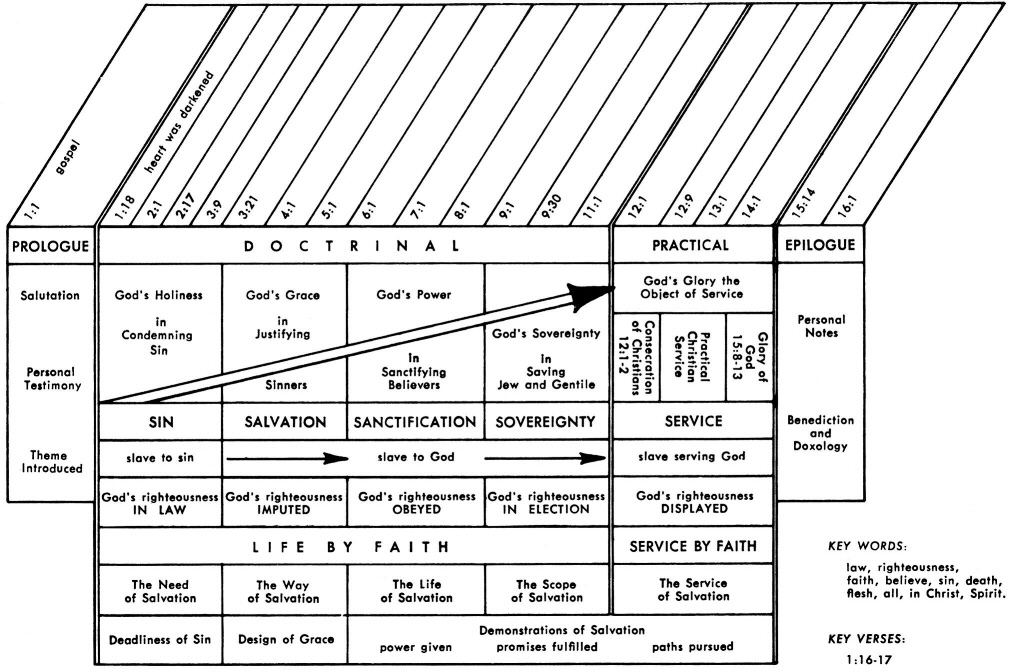
Click chart to enlarge
Chart from recommended resource Jensen's Survey of the NT - used by permission
Romans Overview Chart - Charles Swindoll
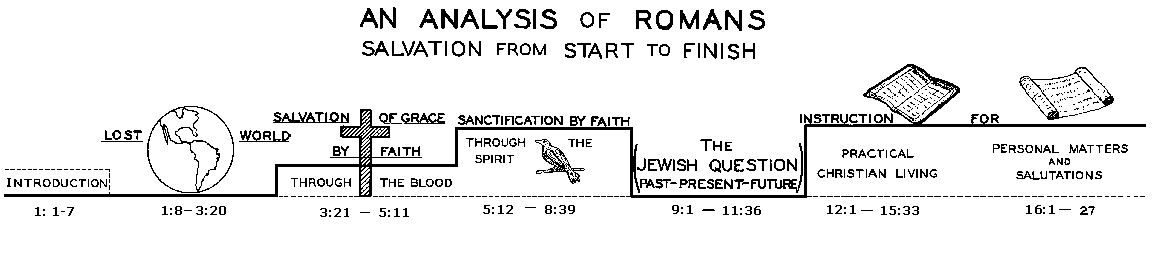
Source: Dr David Cooper
Click to Enlarge
| ROMANS ROAD to RIGHTEOUSNESS |
||||
| Romans 1:18-3:20 | Romans 3:21-5:21 | Romans 6:1-8:39 | Romans 9:1-11:36 | Romans 12:1-16:27 |
| SIN | SALVATION | SANCTIFICATION | SOVEREIGNTY | SERVICE |
| NEED FOR SALVATION |
WAY OF SALVATION |
LIFE OF SALVATION |
SCOPE OF SALVATION |
SERVICE OF SALVATION |
| God's Holiness In Condemning Sin |
God's Grace In Justifying Sinners |
God's Power In Sanctifying Believers |
God's Sovereignty In Saving Jew and Gentile |
Gods Glory The Object of Service |
| Deadliness of Sin |
Design of Grace |
Demonstration of Salvation | ||
| Power Given | Promises Fulfilled | Paths Pursued | ||
| Righteousness Needed |
Righteousness Credited |
Righteousness Demonstrated |
Righteousness Restored to Israel |
Righteousness Applied |
| God's Righteousness IN LAW |
God's Righteousness IMPUTED |
God's Righteousness OBEYED |
God's Righteousness IN ELECTION |
God's Righteousness DISPLAYED |
| Slaves to Sin | Slaves to God | Slaves Serving God | ||
| Doctrine | Duty | |||
| Life by Faith | Service by Faith | |||
|
Modified from Irving L. Jensen's chart above |
||||
R Ruin (Romans 1:17 – 3:20) – The utter sinfulness of humanity
O Offer (Romans 3:21-31) – God’s offer of justification by grace
M Model (Romans 4:1-25) – Abraham as a model for saving faith
A Access (Romans 5:1-11) – The benefits of justification
N New Adam (Romans 5:12-21) – We are children of two “Adams”
S Struggle w/ Sin (Romans 6:1-8:39) Struggle, sanctification, and victory
Romans 7:10 and this commandment, which was to result in life, proved to result in death for me; (NASB: Lockman)
Greek: ego de apethanon, (3SAAI) kai eurethe (3SAPI) moi e entole e eis zoen aute eis thanaton;
Amplified: And the very legal ordinance which was designed and intended to bring life actually proved [to mean to me] death. (Amplified Bible - Lockman)
Barclay: The commandment that was meant for life—I discovered that that very commandment was in me for death. (Westminster Press)
NLT: So the good law, which was supposed to show me the way of life, instead gave me the death penalty. (NLT - Tyndale House)
Phillips: But when the commandment arrived, sin sprang to life and I "died". The commandment, which was meant to be a direction to life, I found was a sentence to death. (Phillips: Touchstone)
Wuest: And the commandment which was to life, this I found to be to death
Young's Literal: and this commandment, which was to result in life, proved to result in death for me;
AND THIS COMMANDMENT, WHICH WAS TO RESULT IN LIFE: kai heurethe (3SAPI) moi e entole e eis zoen:
- Ro 10:5; Lev 8:5; Ezek 20:11, 13,21; Lk 10:27-29; 2Cor 3:7
- Romans 7 Resources - Multiple Sermons and Commentaries
Literally, “the commandment the one for (meant for) life, this was found for me unto death.”
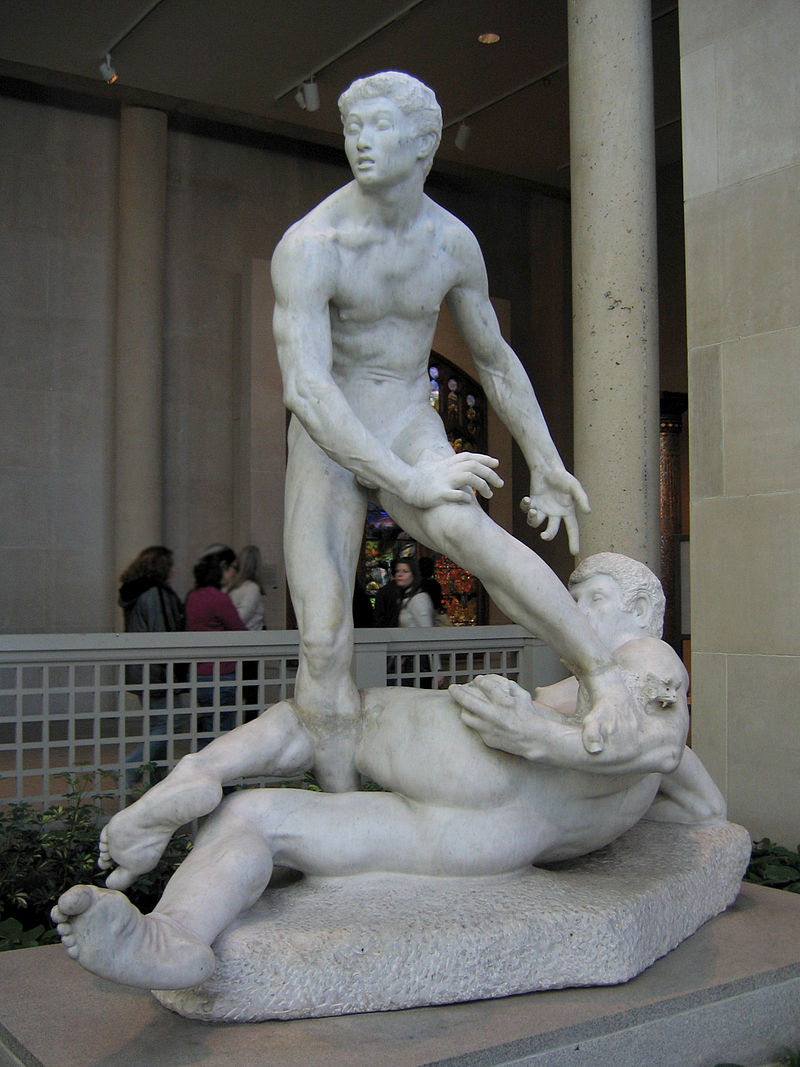
The Struggle of the Two Natures in Man
George Grey Barnard (carved 1892–94)
And this commandment - Thou shall not covet. It is representative of all of God's Law which was intended to guard and promote life but man could not keep the law.
The UBS Handbook adds that…
According to the Genesis account, obedience to the command of God meant that life would continue, whereas disobedience meant death would come. But Paul discovers that Adam’s experience and his own are similar: the commandment which was meant to bring life, in my case brought death. (The United Bible Societies' New Testament Handbook Series or Logos)
Why was it to result in "life"? If we could keep it perfectly every moment of every day of our life, we would be righteous and have eternal life (see Jesus' words below). The only man who kept it perfectly was the Man Christ Jesus. As we are confronted with the law we realize our own sinful disobedience to the law and have to face up to the awful penalty of a broken Law which is death.
The commandment not to covet was given to help people see how to live, but it actually produced death because of the power of sin that indwelt the human heart.
Jesus' encounter with the rich young ruler explains the relationship between Law and Life…
And behold, one came to Him and said, "Teacher, what good thing shall I do that I may obtain eternal life?" And He said to him, "Why are you asking Me about what is good? There is only One who is good; but if you wish to enter into life, keep the commandments." (Matthew 18:16-17)
In another encounter Jesus reiterates the association of Law and Life…
25 And behold, a certain lawyer stood up and put Him to the test, saying, "Teacher, what shall I do to inherit eternal life?"
26 And He said to him, "What is written in the Law? How does it read to you?"
27 And he answered and said, "YOU SHALL LOVE THE LORD YOUR GOD WITH ALL YOUR HEART, AND WITH ALL YOUR SOUL, AND WITH ALL YOUR STRENGTH, AND WITH ALL YOUR MIND; AND YOUR NEIGHBOR AS YOURSELF."
28 And He said to him, "You have answered correctly; DO THIS, AND YOU WILL LIVE." (Luke 10:25, 26, 27, 28)
Middletown Bible adds that…
All (!!!!) a person needs to do to LIVE and to inherit eternal life is to keep the law. But he must keep it perfectly and completely and he must do so throughout his entire life! (cp Jas 2:10) The problem is that no person has ever done this and no sinful person will ever do this! (cp "all under sin" in Ro 3:9-note and thus none righteous Ro 3:10-note) Those who have clean faces do not have to fear the mirror (Lk 1:69, 74, 75, 1Jn 4:18). The problem is that none of us have clean faces! (Eccl 7:20, 1Ki 8:46, 2Chr 6:36, Pr 20:9) We are all sinners and thus the law condemns us all! "I found to be death"—As I was confronted with the law I realized my own sinful disobedience to the law and I had to face up to the awful penalty of a broken law which is death. (Romans chapter 7)
Hodge adds that life…
Life includes the ideas of happiness and holiness. The law was designed to make men happy and holy. Death, on the other hand, includes the ideas of misery and sin. The law became, through no fault of its own, the means of making the apostle miserable and sinful. How vain it is therefore to expect salvation from the law, since all the law does, in its working on the unrenewed heart, is to condemn and to awaken opposition! It cannot change the nature of man. (Hodge, C. Commentary on the Epistle to the Romans, 1835)
The Law's design and ideal were to promote observance that would lead to divine blessing and consequent human happiness. Moses records a similar declaration by Jehovah as He gives His charge to Israel…
So you shall keep My statutes and My judgments, by which a man may live if he does them (Lev 18:5; see also Deut 8:1)
One Jewish interpretation of Leviticus 18:5 was that those who keep the commandments merit (earn) eternal life. This misinterpretation of the passage appears in Jewish texts alongside the view that God elects Israel as a whole to be saved.
In a NT "paraphrase" of Leviticus 18:5 Paul writes that…
Moses writes that the man who practices the righteousness which is based on law shall live by that righteousness. (Ro 10:5-note)
This verse states the purpose of the Law: if you obey it, you live. The religious Jew would argue
“But we did obey it!”
To which Paul would respond…
"You may have obeyed it outwardly, but you did not believe it from your heart.” (Ro 2:28, 29-notes)
The Mosaic Law makes the path to righteousness through the law plain. If you want to live by the law (find life through the law), you must do the law - and do it completely and perfectly. The Amplified Version accentuates this demand…
For Moses writes that the man who [can] practice the righteousness (perfect conformity to God's will) which is based on the Law [with all its intricate demands] shall live by it.
The practical difficulty, of course, is that man is born with a sin nature and is incapable of perfectly doing the will of God as set forth in the commandments…
For whoever keeps the whole law and yet stumbles in one point, he has become guilty of all. (James 2:10).
James is saying that just one sin makes man a sinner and deserving of condemnation that sin brings. No one could never be declared righteous before God by keeping the law, since no one could ever keep it perfectly. One unforgiven sin is enough for condemnation.
In Ezekiel we read a similar teaching…
And I gave them My statutes and informed them of My ordinances, by which, if a man observes them, he will live… 13 But the house of Israel rebelled against Me in the wilderness. They did not walk in My statutes, and they rejected My ordinances, by which, if a man observes them, he will live; and My sabbaths they greatly profaned. Then I resolved to pour out My wrath on them in the wilderness, to annihilate them… 21 "But the children rebelled against Me; they did not walk in My statutes, nor were they careful to observe My ordinances, by which, if a man observes them, he will live; they profaned My sabbaths. So I resolved to pour out My wrath on them, to accomplish My anger against them in the wilderness. (Ezekiel 20:11,13,21)
James and Ezekiel remind us that if it were possible to keep the law even for a while, a person who failed in only one point of the law would remain just as lost and under God's wrath as a person who failed in every point of the law.
Writing to the Galatians Paul addressed this same question asking…
Is the Law then contrary to the promises of God? May it never be! For if a law had been given which was able to impart life, then righteousness would indeed have been based on law. (Galatians 3:21)
PROVED TO RESULT IN DEATH FOR ME: heurethe (3SAPI)… aute eis thanaton:
- Romans 7 Resources - Multiple Sermons and Commentaries
Proved (2147) (heurisko) means to find either with a previous search or to find out by inquiry. To learn. To discover. In the present context the verb expresses the idea of surprise at such an unexpected result regarding the Law. The passive voice indicates that this was not the result of vigorous search but was disclosed without any initiative on the part of the subject.
This "discovery" would especially “surprise the Jew” who learned for the first time that before God he had no moral superiority over the Gentiles whom he superciliously dubbed “sinners,” while he esteemed himself to be “righteous”!
Paul (pronoun "me") expected his life under law to earn eternal life. Instead he discovered that he was condemned to death, because law reveals sin, and the wages of sin is death (Ro 6:23-note).
Death (2288) (thanatos, English - thanatology) is a permanent cessation of all vital functions. It marks the end of life. In the present verse the reference is to spiritual life.
Guzik (Romans 7) explains the spiritual dynamics of how the law brings death writing that…
Sin does this by deception. Sin deceives us:
· Because sin falsely promises satisfaction
· Because sin falsely claims an adequate excuse
· Because sin falsely promises an escape from punishment
“The trouble with trouble is that it usually starts out as a whole lot of fun.” anonymous
MacDonald comments that…
Ideally the law promised life to those who kept it. The sign outside a lion’s cage says, “Stay back of the railing.” If obeyed, the commandment brings life. But for the child who disobeys and reaches in to pet the lion, it brings death. (MacDonald, W & Farstad, A. Believer's Bible Commentary: Thomas Nelson or Logos)
Wiersbe brings out a very practical application noting that…
This (i.e., the truth that the Law brings death) explains why legalistic Christians and churches do not grow and bear spiritual fruit. They are living by Law, and the Law always kills. Few things are more dead than an orthodox church that is proud of its “high standards” and tries to live up to them in its own energy. Often the members of such a church start to judge and condemn one another, and the sad result is a church fight and then a church split that leaves members—or former members—angry and bitter. As the new Christian grows, he comes into contact with various philosophies of the Christian life. He can read books, attend seminars, listen to tapes, and get a great deal of information. If he is not careful, he will start following a human leader and accept his teachings as Law. This practice is a very subtle form of legalism, and it kills spiritual growth. No human teacher can take the place of Christ; no book can take the place of the Bible. Men can give us information, but only the Spirit can give us illumination and help us understand spiritual truths. The Spirit enlightens us and enables us; no human leader can do that. (Wiersbe, W: Bible Exposition Commentary. 1989. Victor or Logos)
Romans 7:11 for sin, taking an opportunity through the commandment, deceived me and through it killed me. (NASB: Lockman)
Greek: e gar hamartia aphormen labousa (AAPFSN) dia tes entoles exepatesen me kai di' autes apekteinen. (3SAAI)
Amplified: For sin, seizing the opportunity and getting a hold on me [by taking its incentive] from the commandment, beguiled and entrapped and cheated me, and using it [as a weapon], killed me. (Amplified Bible - Lockman)
Barclay: For, when sin obtained a foothold through the commandment, it seduced me, and, through it, killed me. (Westminster Press)
NLT: Sin took advantage of the law and fooled me; it took the good law and used it to make me guilty of death. (NLT - Tyndale House)
Phillips: The commandment gave sin an opportunity, and without my realising what was happening, it "killed" me. (Phillips: Touchstone)
Wuest: for the sinful nature, using the commandment as a fulcrum, beguiled me and through it killed me.
Young's Literal: for sin, taking opportunity through the commandment, deceived me, and through it killed me.
FOR SIN, TAKING OPPORTUNITY THROUGH THE COMMANDMENT, DECEIVED ME: he gar hamartia aphormen labousa (AAPFSN) dia tes entoles exepatesen (3SAAI) me:
- Ro 7:8,13 Isa 4:20; Jer 17:9; 49:16; Obad 1:3; Eph 4:22; Heb 3:13; Jas 1:22,26
- Romans 7 Resources - Multiple Sermons and Commentaries
Sin - Note that the following explanation of sin is repeated at several points in the notes on Romans 5-8, because it is such an important truth to keep in mind as one studies this this doctrinally rich section of Scripture.
Sin (266) (hamartia) originally meant missing the mark, and thus missing the true purpose God has for each created man and women. It describes a falling short of His standard of holiness, a departure from doing what is right, and an acting contrary to God's will. Now here is where the definition of Sin as used in Romans 5-8 might be a bit confusing. First note that sin is singular, so it is not sins but sin the significance of which becomes more apparent from the next fact. In many (most) of Paul's uses of hamartia in Romans 5-8, Paul places the definite article "the" before sin (even though the "the" is not translated in most English versions for it would be somewhat difficult to read). The use of the definite article indicates that Paul is not referring to "a sin" (not to just any sin) but "the sin". In this way Paul is speaking of Sin figuratively, in what is referred to as a metonym (derived from "meta" = with + "onym" = name") which describes the substitution of a word referring to an attribute for the thing that is meant (eg, the use of the word "crown" to refer to the entire "monarchy").
Now are you really confused? Well, what Paul is doing with the Sin (he hamartia) is to use this word not to describe the actions or results (i.e., the specific sins we commit in thought, word or deed) but to describe the underlying root cause, the principle or, in medical terms (I'm a physician with sub specialization in infectious disease), the "sin virus" we have all inherited from Adam. The Sin is like a highly contagious, lethal virus which every man, woman and child has inherited because every person alive can trace their lineage back to Adam, the first man. The presence of the Sin gene in our "moral make up" is the reason every man, woman and child commits sins (note the plural). Try to keep this distinction in mind when studying Romans 5-8, where Paul refers primarily to the "sin virus", the underlying root cause of why we do the wicked things we do. To state it another way, in Romans 1:21-32 Paul described the acts of sin (sins committed) but in this use he speaks of sin as a disposition deep in every person's life that produces the ungodly acts.
Wayne Barber explains sin as follows…
Sin entered the world! (Ro 5:12-note) When you see the word sin in this verse (Romans 5:12), take a pencil and write right behind it "The" (so that it reads "the Sin"). When the definite article "the" (Ed note: look at the Greek sentence above. Do you see "he" before "hamartia"? The "he" is the definite article in Greek, corresponding to the English definite article "the") is used in Scripture, it is very important because it is identifying something as very specific… In English, we would say "THE cup," where the definite article means, not just any cup, but the specific cup. (Romans 5:12-14) (Bolding and italics added)
So Sin here refers not to a particular sin, but to the inherent propensity to sin that entered the human realm when Adam sinner and fathered men who became "little sinners" by nature, by birth. Adam passed to all his descendants the inherent sinful nature he possessed because of his single act of disobedience. That "Adamic" nature is present in every person ever born from the moment of conception David writing…
Behold (this Hebrew word means "Listen up!" what I have to say is very important!) I was brought forth in iniquity, and in sin my mother conceived me. (Psalm 51:5)
The Sin in each man makes it impossible for man to live in a way that pleases God. Paul is explaining in Romans 7:14-25 how he came to discover that his best efforts to do good and to obey the Law resulted in defeat and death. The Law, using the Sin, or the evil nature in him as a base camp, brought out the power of sin all the more, and this condition he calls death. Sin is like a personal enemy within our physical body. God warned Cain of this internal enemy in Genesis 4 declaring…
"If you do well, will not your countenance be lifted up? And if you do not do well, SIN is crouching at the door; and its desire is for you, but you must master it." (Ge 4:7).
Taking (2983) (lambano) means to get hold of something by laying hands on or grasping.
Opportunity (874) (aphorme from apó = from, and horme = a rushing on, onset, impetus, violent tendency) describes an occasion, an opportunity or casual circumstance producing a tendency toward something else.
Aphorme - 7x in 6v in the NAS - Rom. 7:8, 11; 2 Co. 5:12; 11:12; Gal. 5:13; 1 Tim. 5:14 and is rendered by the NAS as occasion(2), opportunity(5).
In context aphorme describes Sin using the specific requirements of the law as a base of operation from which to launch its evil work. Confronted by God’s law, the sinner’s rebellious nature finds the forbidden thing more attractive, not because it is inherently attractive, but because it furnishes an opportunity to assert one’s self-will.
Sin finds its foothold in the flesh (Ro 6:12-note; cf. Ro 8:7-note), and its soldiers wield “weapons” (hopla) of wickedness rather than weapons of righteousness (Ro 6:13-note; 2Cor 6:7).
Sin preys on people, awaiting the opportunity to make the Law a “bridgehead” in humans and “wages war” (antistrateuomai, see Ro 7:23-note, cp 1Pe 2:11-note) and “takes prisoners” (aichmalotizo, Ro 7:23-note).
Deceived (1818) (exapatao from ek = intensifies meaning of root + apatáo = seduce, deceive - see study of related word apate) means to beguile thoroughly, deceive completely or seduce (persuade to disobedience, lead astray by persuasion or false promises) wholly. To make or cause someone to lose their way (cp Pr 14:12). Exapatao means not just to give a false impression but to actively lead astray. To cause a subject to believe or accept false ideas about something with the implication of that one is led out of the right way into error and especially to sin.
Exapatao - 6x in 6v - Rom. 7:11; 16:18; 1 Co. 3:18; 2 Co. 11:3; 2 Thess. 2:3; 1 Tim. 2:14
Richards writes that…
Apatao and its derivatives indicate ethical enticement… Deception sometimes comes from within, as our desires impel us to deceive. But more often in the NT, deceit is error urged by external evil powers or by those locked into the world's way of thinking. (Richards, L O: Expository Dictionary of Bible Words: Regency)
Exapatao is a strong word indicating utter deception. Paul uses the same word on two other occasions when speaking of the deception effected by the serpent in relation to Eve (2Cor 11:3, 1Ti 2:14). Sin within Paul, led him to do the very thing the commandment forbade, thus bringing him under condemnation as a lawbreaker.
The writer of Hebrews exposes sin (and also gives an "antidote") writing…
Encourage one another day after day, as long as it is still called "Today," lest any one of you be hardened by the deceitfulness (apate) of sin. (He 3:13-note)
Sin deceives by deception! How? Here is the "deception" -- Since the commandment was intended to bring life, Paul expected the commandment to yield life as a result. But instead it became the occasion for sin and subsequently for death. Since the commandment yielded the opposite of what Paul expected, he felt deceived. But the perpetrator of this deception was not the commandment itself, but Sin. The commandment was merely the instrument by which Sin deceived him.
Haldane agrees writing that…
Sin, by blinding his mind as to the extent of the demands of the law, had led Paul to believe that he could fulfill it, and so obtain justification and life, and had thus by the law taken occasion to deceive him. Till the commandment came home to him in its spiritual application, sin was never brought to such a test as to make a discovery to Paul of its real power. (Haldane, R. An Exposition of Romans)
Daniel Hill asks…
What is the deception? It is the deception that caused Paul to think he could live under the law, fulfill the law, and again experience life unto God through law-obedience. But he found that all his efforts at law-obedience came up short and resulted in defeat… and this defeat killed him. THIS IS THE BOTTOM LINE OF PERFORMANCE-BASED CHRISTIANITY, it does not work! The result is often more guilt, more loss, more sense of defeat, more sense of dread and death…
Principles:
1. All mankind go through a state of innocents based on ignorance.
2. This gives way to a state of guilt based on cognizance.
3. The Law makes man cognizant of sins and the sin nature
4. Without the 10th commandment it was easy for Paul, a self-righteous Jewish leader, to see sins on the outside.
5. The 10th commandment, however, placed sin on the inside and with that there was awareness of the Sin Nature.
6. Coveting or Lusting is something no one else sees, no one hears it, but it is there, very real, very much sin.
7. That sin was an evidence of the presence of the Sin Nature
8. And that awareness brought about the recognition of spiritual death. (Romans Notes)
There are other ways Sin deceives. For example, Sin promises satisfaction. Sin is a liar through and through because it falsely claims an adequate excuse (there is never a "good excuse" to commit sin because sin is ultimately missing mark of God's righteousness). But you may be asking questions like what about Rahab who deceived the men of Jericho when she hid the Israeli spies? What about David and his men when they ate the bread on the Table of Shewbread in the tabernacle when they were famished? The basic questions one must ask to determine whether an action is sin or not are, "Does it serve God's purpose or mine?" "Does my conscience tell me that what I am am about to do is wrong (never offend your conscience)?" Even when we ask ourselves these questions, we may still miss the mark of God's righteousness, and we may sin in ignorance, but thanks be to God, that the blood of Jesus covers all our sin!
Sin also falsely promises an escape from punishment. Sin, when followed, leads to death not life. One of Satan’s deceptions is to get us to think that committing sins is something good and something a mean God wants to deprive us of. Remember the first attack by Satan… "Indeed, has God said?" (Ge 3:1, 13)
Sin is strongly personified, being represented as acting as a person would act. The language is reminiscent of the fall, with Sin taking the place of the tempter and provoking a deception that led to death (the spiritual death that occurred then and there was prophetic of the physical death to follow in due time).
John MacArthur comments that…
Paul says that sin also deceived him. Deceit is one of sin’s most subtle and disastrous evils. A person who is deceived into thinking he is acceptable to God because of his own merit and good works will see no need of salvation and no reason for trusting in Christ. It is doubtless for that reason that all false religions-including those that claim the name of Christ-in one way or another are built on a deceptive foundation of self-trust and self-effort. Self-righteousness is not righteousness at all but is the worst of sins. Both by the standard of the law and by the standard of grace, the very term self-righteousness is a self-contradiction. (MacArthur, J: Romans 1-8. Chicago: Moody Press or Logos) (Bolding added)
Hodges explains how sin completely deceived Paul writing that it was…
By leading the apostle to expect one thing, while he experienced another. He expected life and found death. He expected happiness and found misery. He looked for holiness and found increased corruption. He thought that by the law all these desirable ends could be achieved, but he found that it produced exactly the opposite effects. Sin therefore used the commandment to deceive and by it slew him. Instead of the law being a source of holiness and blessedness, it brought death to Paul. (Hodge, C. Commentary on the Epistle to the Romans, 1835)
AND THROUGH IT KILLED ME: kai di autes apekteinen (3SAAI):
Recall Paul's instruction about the law in (2Cor 3:6) that "the letter kills, but the Spirit gives life"
Killed (615) (apokteino from apó = intensifier + kteíno =slay) means to kill outright or to put to death.
James explains that sin is the killer writing that…
when lust has conceived, it gives birth to sin; and when sin is accomplished, it brings forth death. (James 1:15)
A T Robertson paraphrases Paul as saying that Sin…
“Killed me off,” made a clean job of it. Sin here is personified as the tempter (Ge 3:13).
Barnhouse…
Here Paul perceived the horror of indwelling sin which, like a dormant reptile, had always been lurking in him. Suddenly he found it was alive—and then it slew him. (Barnhouse, D. G. God's Freedom: Romans 6:1-7:25. Eerdmans)
Guzik adds that…
One of Satan’s greatest deceptions is to get us to think of sin as something good that an unpleasant God wants to deprive us of. When God warns us away from sin, He warns us away from something that will kill us.
S Lewis Johnson has an interesting thought…
It is an interesting fact, too, that genuine Christianity often has the same effect as the Law of Moses. When it is practiced in the midst of the world, the world, which was able to sleep soundly in the sleep which is spiritual death, is stirred to an awakened conviction that leads to persecution of those who practice the faith. The "ravings" of the old man replace the sweet reasonableness of the unawakened conscience. Those who lived with a pale and anemic Christianity cannot stand to live by the side of a vital life of faith. It's the story of Ishmael and Isaac all over again, for "as then he that was born of the flesh persecuted him that was born after the Spirit, even so it is now" (cf. Ga 4:29).
Romans 7:12 So then, the Law is holy, and the commandment is holy and righteous and good. (NASB: Lockman)
Greek: hoste o men nomos hagios kai e entole hagia kai dikaia kai agathe.
Amplified: The Law therefore is holy, and [each] commandment is holy and just and good. (Amplified Bible - Lockman)
NLT: But still, the law itself is holy and right and good. (NLT - Tyndale House)
Phillips: It can scarcely be doubted that in reality the Law itself is holy, and the commandment is holy, fair and good. (Phillips: Touchstone)
Wuest: So that the law is holy, and the commandment holy, and righteous, and good.
Young's Literal: So then, the Law is holy, and the commandment is holy and righteous and good.
SO THEN, THE LAW IS HOLY AND THE COMMANDMENT IS HOLY AND RIGHTEOUS AND GOOD: hoste o men nomos hagios kai e entole hagia kai dikaia kai agathe:
- Ro 7:14; 3:31; 12:2; Dt 4:8; 10:12; Neh 9:13; Ps 19:7, 8, 9, 10, 11, 12; 119:38,86,127,137; Ps 119:140,172; 1Ti1:8
- Romans 7 Resources - Multiple Sermons and Commentaries
Notice that there are no verbs in this verse making it a very dogmatic statement of truth.
Paul is in effect clearly answering the question in Ro 7:7 (note) about the nature of the law.
So then (hoste) brings this section to a conclusion. Paul is answering the question raised in Romans 7:7 (note) where he asked "Is the Law sin?" The fact that the law reveals (like a mirror which shows dirt but cannot make you clean), arouses, and condemns sin and brings death to the sinner does not make the law itself evil. The problem with the sin of man is not the Law, for it is holy, righteous, and good. The difficulty lies elsewhere, and that the apostle will dwell on in Ro 7:13-note.
God's Law is perfect… a perfect reflection of the One Who gave it to Israel…
The law of the LORD is perfect, restoring the soul; The testimony of the LORD is sure, making wise the simple. (Ps 19:7 - Spurgeon's Note)
Every word of God is tested; He is a shield to those who take refuge in Him. (Pr 30:5)
Thus believers should honor the Law as representing perfectly the holiness and justice of God. But as sinners condemned by the Law, our need is not justice but grace and mercy.
Holy, righteous and good - Ultimately, these attributes express the character of the Living God Whose commandment it is.
Holy (40) (hagios) literally refers to that which is set apart for a special purpose. Hagios speaks of that which represents God’s holiness. That which is holy is set aside for sacred use.
The Law is holy
but it cannot make me holy
The Law is holy - Holy means set apart from the common and profane. The Law is set apart and full of purity, majesty, and glory because it's Source is the Holy God. The Law is set apart in that it reveals God’s nature and will. It is set apart in that it exposes sin, all that is contrary to God’s holiness. The Law is holy in that it is different and set apart from everything else on earth. The Law is holy because it is God’s way for man to live a life of holiness, a way that is so different and so set apart. Such a life can never be lived by trying to "keep the Law" but only by lovingly obeying the urging of the indwelling Spirit of Christ (see notes walking in the Spirit - Gal 5:16-note; being continually controlled by the Spirit - Ep 5:18-note), Who not only gives us the desire to obey but also the power to obey to His good pleasure (Php 2:12-note; Php 2:13-note).
Just (1342) (dikaios from dike = right, just) defines that which is in accordance with high standards of rectitude. It is that which is in right relation to another and so in reference to persons defines that which is morally and ethically upright or just.
Dikaios - 79x in 74v in the NAS - Matt. 1:19; 5:45; 9:13; 10:41; 13:17, 43, 49; 20:4; 23:28f, 35; 25:37, 46; 27:19; Mk. 2:17; 6:20; Lk. 1:6, 17; 2:25; 5:32; 12:57; 14:14; 15:7; 18:9; 20:20; 23:47, 50; Jn. 5:30; 7:24; 17:25; Acts 3:14; 4:19; 7:52; 10:22; 22:14; 24:15; Rom. 1:17; 2:13; 3:10, 26; 5:7, 19; 7:12; Gal. 3:11; Eph. 6:1; Phil. 1:7; 4:8; Col. 4:1; 2 Thess. 1:5f; 1 Tim. 1:9; 2 Tim. 4:8; Tit. 1:8; Heb. 10:38; 11:4; 12:23; Jas. 5:6, 16; 1 Pet. 3:12, 18; 4:18; 2 Pet. 1:13; 2:7f; 1 Jn. 1:9; 2:1, 29; 3:7, 12; Rev. 15:3; 16:5, 7; 19:2; 22:11 and is rendered in the NAS as innocent(1), just(6), justice(1), right(6), righteous(45), righteous man(8), righteous Man(1), righteous man's(1), righteous men(2), righteous one(1), Righteous One(3), righteous persons(1), what is right(1), who is righteous(1).
The Law is just
but it can never justify me!
Paul explained earlier…
by the works of the Law no flesh will be justified in His sight; for through the Law comes the knowledge of sin. (Ro 3:20-note)
And in Galatians he wrote…
nevertheless knowing that a man is not justified by the works of the Law but through faith in Christ Jesus, even we have believed in Christ Jesus, that we may be justified by faith in Christ, and not by the works of the Law; since by the works of the Law shall no flesh be justified. (Ga 2:16)
Vine adds that…
The English word “righteous” was formerly spelt ‘rightwise’, i.e., (in a) straight way. In the N.T. it denotes righteous, a state of being right, or right conduct, judged whether by the Divine standard, or according to human standards, of what is right. Said of God, it designates the perfect agreement between His nature and His acts (in which He is the standard for all men). (Vine, W E: Vine's Complete Expository Dictionary of Old and New Testament Words. 1996. Nelson)
The Law is righteous - It is right, fair, impartial, equitable and straight (a "perfect plumbline"). The Law is righteous in that it reveals the righteous character of the Lawgiver. The Law is righteous in view of the just requirements it lays upon men. It is righteous because it forbids and condemns sin. The Law treats a man exactly like he should be treated and shows no partiality to anyone, be they king or pauper. The Law reveals how a man should treat others. The Law is righteous in that it reveals exactly how a man should live in relation to God and to his fellow man.
Good (18) (agathos) means intrinsically good, inherently good in quality but with the idea of good which is also profitable, useful, benefiting others, benevolent (marked by or disposed to doing good). Agathos is that which is good in its character, beneficial in its effects and/or useful in its action.
The Law is good
but it cannot make me good.
The Law is good - It is beneficial because its aim is life. The misuse of the law at the hands of sin has not altered its own essential character. The Law is good in that it shows man how to live and tells him when he fails to live that way. It exposes his sin and demonstrates his desperate need for a Savior. The law tells man the truth about the nature of man in a most explicit way, and it points him toward the need for outside help in order to be saved.
Barnhouse sums it up…
Law is holy because it reveals sin; righteous because it condemns the sinner to death; good because it shows what a holy God demands; and its intrinsic purpose is spiritual. Law does not invite sin, it uncovers it; not the law, but sin brings death. (God's Freedom: Romans 6:1-7:25 Eerdmans)
Romans 7:13 Therefore did that which is good become a cause of death for me? May it never be! Rather it was sin, in order that it might be shown to be sin by effecting my death through that which is good, so that through the commandment sin would become utterly sinful. (NASB: Lockman)
Greek: To oun agathon emoi egeneto (3SAMI) thanatos? me genoito; (3SAMO) alla e hamartia, hina phane (3SAPS) hamartia, dia tou agathou moi katergazomene (PMPFSN) thanaton; hina genetai (3SAMS) kath' huperbolen hamartolos e hamartia dia tes entoles.
Amplified: Did that which is good then prove fatal [bringing death] to me? Certainly not! It was sin, working death in me by using this good thing [as a weapon], in order that through the commandment sin might be shown up clearly to be sin, that the extreme malignity and immeasurable sinfulness of sin might plainly appear. (Amplified Bible - Lockman)
Barclay: Did then that which was good become death to me? God forbid! But the reason was that sin might be revealed as sin by producing death in me, through the very thing which was in itself good, so that, through the commandment, sin might become surpassingly sinful. (Westminster Press)
NLT: But how can that be? Did the law, which is good, cause my doom? Of course not! Sin used what was good to bring about my condemnation. So we can see how terrible sin really is. It uses God's good commandment for its own evil purposes. (NLT - Tyndale House)
Phillips: Can it be that something that is intrinsically good could mean death to me? No, what happened was this. Sin, at the touch of the Law, was forced to express itself as sin, and that meant death for me. The contact of the Law showed the sinful nature of sin. (Phillips: Touchstone)
Wuest: Therefore, that which is good, to me did it become death? Away with the thought. But the sinful nature, in order that it might become evident that it is sin, through that which is good [the commandment] brought about death in me, in order that the sinful nature [its impulses and workings] through the intermediate agency of the commandment may become exceedingly sinful.
Young's Literal: That which is good then, to me hath it become death? let it not be! but the sin, that it might appear sin, through the good, working death to me, that the sin might become exceeding sinful through the command,
THEREFORE DID THAT WHICH IS GOOD BECOME A CAUSE OF DEATH FOR ME? MAY IT NEVER BE! RATHER IT WAS (the) SIN IN ORDER THAT IT MIGHT BE SHOWN TO BE SIN BY EFFECTING MY DEATH THROUGH THAT WHICH IS GOOD: To oun agathon emoi egeneto (3SAMI) thanatos me genoito (3SAM0) alla e hamartia, hina phane (3SAPS) hamartia dia tou agathou moi katergazomene (PMPFSN) thanaton:
- Ro 8:3; Ga 3:21) (Ro 7:8, 9, 10, 11; 5:20; Jas 1:13, 14, 15
- Romans 7 Resources - Multiple Sermons and Commentaries
Can it be that something that is intrinsically good could mean death to me? No, what happened was this. Sin, at the touch of the Law, was forced to express itself as sin, and that meant death for me. The contact of the Law showed the sinful nature of sin. (Phillips: Touchstone)
Four times in 3 verses (Ro 7:12, 15, 16-see notes Ro 7:12; 15;16) Paul emphasizes that the Law is good (agathos [beneficial in effect] in first 3 uses, kalos [intrinsically good] in third). Remember that whether one interprets the following verses as descriptive of a man who is regenerate or one who is unregenerate, the Law cannot sanctify either. In short, however you interpret the verses (Romans 7:13-23) this vital principle is true.
Paul anticipates a reader's question. His answer re-emphasizes that the spiritual death he died was absolutely not caused by the Law but by the Sin in him which was exposed by the Law (cp Jas 1:15, Ro 6:23).
Ray Stedman writes that…
to expose the fact that this evil force (Sin) is in every one of us, waiting only for the right circumstance in order to spring into being (cf God's warning to Cain "sin is crouching at the door; and its desire is for you, but you must master it." Ge 4:7b, cp Ge 4:6, 8), overpower our will and carry us into things we never dreamed we would do. Many of us experience this. According to this passage, the great power of sin is that it deceives us (Ro 7:11-note). We think we have got life under control -- and we are fooled. All sin is waiting for is the right occasion (Ro 7:8, 11-notes Ro 7:8,7:11) when, like a powerful, idling engine, it roars into life and takes over at the touch of the accelerator and we find ourselves helplessly under its control. (The Continuing Struggle)
THAT THROUGH THE COMMANDMENT (the) SIN MIGHT BECOME UTTERLY SINFUL: hina genetai (3SAMS) kath huperbolen hamartolos e hamartia dia tes entoles:
- Romans 7 Resources - Multiple Sermons and Commentaries
That (hina) expresses purpose - that sin might be exposed in all its heinous character. Sin is the real problem not the Law. It is not the Law that brings death but sin which uses the Law which itself is good.
Through (dia) is a preposition defining the means or agency ("the commandment") by which something takes place ("sin became utterly sinful"). Sin "became more sinful" by means of the light shed by the Law.
Sin uses the commandments of the Law of God to manifest its true nature as intractably rebellious to God and to demonstrate its evil power within individuals.
MacArthur sounds an important practical note regarding the phrase through the commandment reminding all who would faithfully proclaim the gospel that…
the preaching of the law is necessary to the preaching of the gospel. Until men see their sin for what it is, they will not see their need of salvation from it. (MacArthur, J: Romans 1-8. Chicago: Moody Press or Logos)
Might become utterly sinful - Law "magnified" sin - Next to God's holy magnifying mirror (see below), we all appear as abominably filthy, utterly unholy!
that the extreme malignity and immeasurable sinfulness of sin might plainly appear. (Amplified Bible)
sin might become surpassingly sinful (Barclay)
that sin shows its unbounded sinful power (NJB)
So we can see how terrible sin really is (NLT)
in order that by means of the Commandment the unspeakable sinfulness of sin might be plainly shown. (Weymouth)
that the extreme malignity and immeasurable sinfulness of sin might plainly appear. (Wuest)
Newell explains that…
The more fully and widely the Law resolved itself in new and fresh commands to Paul's soul, the more intense and desperate became indwelling Sin's horrid opposition to it. Thus was Sin's hideous countenance seen in full! It became exceeding (utterly) sinful!
Utterly (5236) (huperbole from huperballo = a throwing beyond the usual mark from huper = above + ballo = cast) refers to a degree which exceeds extraordinarily a point on an implied or overt scale of extent. It means extraordinary, far more, much greater, to a far greater degree, surpassing, beyond measure, utterly.
This Greek word gives us our English hyperbole = extravagant exaggeration. In rhetoric, hyperbole is a figure of speech which expresses much more or less than the truth, or which represents things much greater or less, better or worse than they really are. An object uncommon in size, either great or small, strikes us with surprise, and this emotion produces a momentary conviction that the object is greater or less than it is in reality. The same effect attends figurative grandeur or littleness; and hence the use of the hyperbole, which expresses this momentary conviction. The following are instances of the use of this figure. For example in Ge 13:16 "as the dust of the earth" is a hyperbole.
Paul's point is that the Law exposes and magnifies sin in an extraordinary manner. If sin can use something good like the Law to its own advantage to promote evil, how evil sin is!
Huperbole - 8x in 7v in the NAS - Ro 7:13; 1Co. 12:31; 2Co. 1:8; 4:7, 17; 12:7; Gal. 1:13. NAS = all comparison(1), beyond measure*(1), excessively*(1), far(1), more excellent(1),surpassing greatness(2), utterly(1). There are no uses in the Septuagint. Here are the other uses of huperbole.
1 Corinthians 12:31 But earnestly desire the greater gifts. And I show you a still more excellent way.
2 Corinthians 1:8 For we do not want you to be unaware, brethren, of our affliction which came to us in Asia, that we were burdened excessively, beyond our strength, so that we despaired even of life;
2 Corinthians 4:7-note But we have this treasure in earthen vessels, so that the surpassing greatness of the power will be of God and not from ourselves;
2 Corinthians 4:17-note For momentary, light affliction is producing for us an eternal weight of glory far beyond all comparison,
2 Corinthians 12:7 Because of the surpassing greatness of the revelations, for this reason, to keep me from exalting myself, there was given me a thorn in the flesh, a messenger of Satan to torment me-- to keep me from exalting myself!
Galatians 1:13 For you have heard of my former manner of life in Judaism, how I used to persecute the church of God beyond measure and tried to destroy it;
Sin magnifies the blemishes that were there all the time. Have you ever looked in a make up mirror that greatly magnifies one's face? What have you seen? Well if there was a small blemish you failed to see before, the magnifying mirror makes the blemish very apparent. This is a picture of the work of the Law. Think about it this way -- if you see something holy next to yourself, the effect is to see that you are utterly unholy, utterly sinful, which is exactly the way the prophet Isaiah felt when he had an encounter with the Holy One Himself…
In the year of King Uzziah's death, I saw the Lord sitting on a throne, lofty and exalted, with the train of His robe filling the temple. 2 Seraphim stood above Him, each having six wings; with two he covered his face, and with two he covered his feet, and with two he flew. 3 And one called out to another and said, "Holy, Holy, Holy, is the LORD of hosts. The whole earth is full of His glory." 4 And the foundations of the thresholds trembled at the voice of him who called out, while the temple was filling with smoke. 5 Then I said, "Woe (Hebrew = oy = a passionate cry of grief or despair) is me, for I am ruined! Because I am a man of unclean lips, and I live among a people of unclean lips; for my eyes have seen the King, the LORD of hosts." (Isaiah 6:1-5)
MacArthur explains that…
Paul’s point here is that sin is so utterly sinful that it can even pervert and undermine the purpose of God’s holy law. It can twist and distort the law so that instead of bringing life, as God intended, it brings death. It can manipulate the pure law of God to deceive and damn people. Such is the awful wretchedness of sin. (MacArthur, J: Romans 1-8. Chicago: Moody Press or Logos) (see related topic - Purpose of the Law)
Adam Clarke agrees writing that…
Those who preach only the Gospel to sinners, at best only heal the hurt of the daughter of my people slightly. The law, therefore, is the grand instrument in the hands of a faithful minister, to alarm and awaken sinners.
C H Spurgeon wrote…
Paul here calls sin "exceeding sinful." Why didn't he say, "exceeding black" or "exceeding horrible" or "exceeding deadly"? Because there is nothing in the world so bad as sin. When he wanted to use the very worst word he could find to call sin by, he called it by its own name, and reiterated it: "Sin… exceeding sinful.
In another place Spurgeon speaking of sin being made to appear as it really was was important…
because it always wants to hide in us and conceal its true depths and strength. “This is one of the most deplorable results of sin. It injures us most by taking from us the capacity to know how much we are injured. It undermines the man’s constitution, and yet leads him to boast of unfailing health; it beggars him, and tells him he is rich; it strips him, and makes him glory in his fancied robes.”
Warren Wiersbe adds that …
Instead of being a dynamo that gives us power to overcome, the Law is a magnet that draws out of us all kinds of sin and corruption…
Paul’s argument here is tremendous: (1) the Law is not sinful—it is holy, just, and good; (2) but the Law reveals sin, arouses sin, and then uses sin to slay us; if something as good as the Law accomplishes these results, then something is radically wrong somewhere; (3) conclusion: see how sinful sin is when it can use something good like the Law to produce such tragic results. Sin is indeed “exceedingly sinful.” The problem is not with the Law; the problem is with my sinful nature. This prepares the way for the third topic in this chapter. (Wiersbe, W: Bible Exposition Commentary. 1989. Victor or Logos)
The Law is designed to expose sin, and to make us feel the way Paul describes in this section so that we begin to understand what this evil force is that we have inherited when we were all born in Adam (see note Romans 5:12). The Law shows sin to be what it is, something exceeding powerful and dangerous, something that has greater strength than our willpower and a force that causes us to do things which we are resolved not to do! Beloved, do you not see how utterly foolish it is to give ourselves over to the power of sin for even a moment!
Daniel Hill summarizes the principles in this verse…
1. The law shows us that sins come from the inside, the sin nature. And that the sin nature will always be sinful.
2. The recognition of the sin nature results in a recognition of spiritual death.
3. So the process again: LAW ---- Sin Nature ---- SINS ---- DEATH
4. And that process is exactly the route God wants it to take in our lives.
5. It is only when we realize the outcome is death that we will realize we can do nothing about our situation.
6. So the Law was designed to show mankind that it was impossible to be saved, impossible to impress God with keeping the Law because it could not be done.
7. Rather than be a means of salvation it is a means of death. (Romans Notes)
In summary, note the three things that the Law does with respect to sin…
The law reveals Sin (like a mirror) -- Romans 7:7 (note); Ro 3:20 (note)
The law arouses Sin -- Romans 7:5 (note), Ro 7:9 (note)
The law magnifies Sin -- Romans 7:13 (note) (cp 1Co 15:56)
><> ><> ><>
Read the following poem entitled Jehovah Tsidkenu (The Lord Our Righteousness) by Robert Murray McCheyne. Compare the fourth stanza with the experience Paul describes here in Romans 7 when confronted with one purpose of God's Law and Commandments…
Jehovah Tsidkenu
I once was a stranger to grace and to God,
I knew not my danger, and felt not my load;
Though friends spoke in rapture of Christ on the tree,
Jehovah Tsidkenu was nothing to me.
I oft read with pleasure, to soothe or engage,
Isaiah’s wild measure and John’s simple page;
But even when they pictured the blood-sprinkled tree,
Jehovah Tsidkenu seemed nothing to me.
Like tears from the daughters of Zion that roll,
I wept when the waters went over His soul,
Yet thought not that my sins had nailed to the tree
Jehovah Tsidkenu-‘twas nothing to me.
When free grace awoke me by light from on high,
Then legal fears shook me, I trembled to die;
No refuge, no safety in self could I see-
Jehovah Tsidkenu my Savior must be.
My terrors all vanished before the sweet name;
My guilty fear banished, with boldness I came
To drink at the fountain, life-giving and free-
Jehovah Tsidkenu is all things to me.
Jehovah Tsidkenu! My treasure and boast,
Jehovah Tsidkenu! I ne’er can be lost;
In Thee shall I conquer by flood and by field-
My cable, my anchor, my breastplate and shield!
Even treading the valley, the shadow of death,
This “watchword” shall rally my faltering breath;
For while from life’s fever my God sets me free,
Jehovah Tsidkenu my death-song shall be.
Beware
of light thoughts
of sin!
C H Spurgeon (Morning and Evening) warns about the utter sinfulness of sin…
Beware of light thoughts of sin. At the time of conversion, the conscience is so tender, that we are afraid of the slightest sin. Young converts have a holy timidity, a godly fear lest they should offend against God.
But alas! very soon the fine bloom upon these first ripe fruits is removed by the rough handling of the surrounding world: the sensitive plant of young piety turns into a willow in after life, too pliant, too easily yielding.
It is sadly true, that even a Christian may grow by degrees so callous, that the sin which once startled him does not alarm him in the least. By degrees men get familiar with sin. The ear in which the cannon has been booming will not notice slight sounds.
At first a little sin startles us; but soon we say, “Is it not a little one?” Then there comes another, larger, and then another, until by degrees we begin to regard sin as but a little ill; and then follows an unholy presumption:
“We have not fallen into open sin. True, we tripped a little, but we stood upright in the main. We may have uttered one unholy word, but as for the most of our conversation, it has been consistent.”
So we palliate sin; we throw a cloak over it; we call it by dainty names. (Ed note: "an affair" not "fornication", etc)
Christian, beware how thou thinkest lightly of sin. Take heed lest thou fall by little and little.
Sin, a little thing? Is it not a poison? Who knows its deadliness?
Sin, a little thing? Do not the little foxes spoil the grapes? Doth not the tiny coral insect build a rock which wrecks a navy? Do not little strokes fell lofty oaks? Will not continual droppings wear away stones?
Sin, a little thing? It girded the Redeemer’s head with thorns, and pierced his heart! It made Him suffer anguish, bitterness, and woe.
Could you weigh the least sin in the scales of eternity, you would fly from it as from a serpent, and abhor the least appearance of evil.
Look upon all sin as that which crucified the Saviour, and you will see it to be “exceeding sinful.”