Romans 7:2
Romans 7:3
Romans 7:4
Romans 7:5
Romans 7:6
Romans 7:7
Romans 7:8
Romans 7:9
Romans 7:10
Romans 7:11
Romans 7:12
Romans 7:13
Romans 7:14
Romans 7:15
Romans 7:16
Romans 7:17
Romans 7:18
Romans 7:19
Romans 7:20
Romans 7:21
Romans 7:22
Romans 7:23
Romans 7:24
Romans 7:25

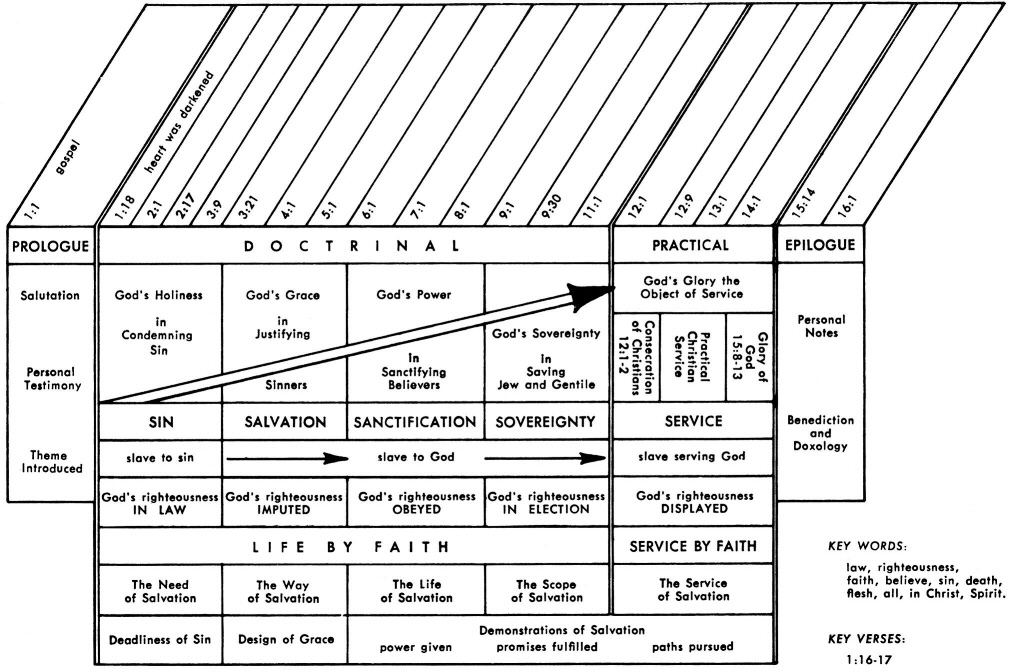
Click chart to enlarge
Chart from recommended resource Jensen's Survey of the NT - used by permission
Romans Overview Chart - Charles Swindoll
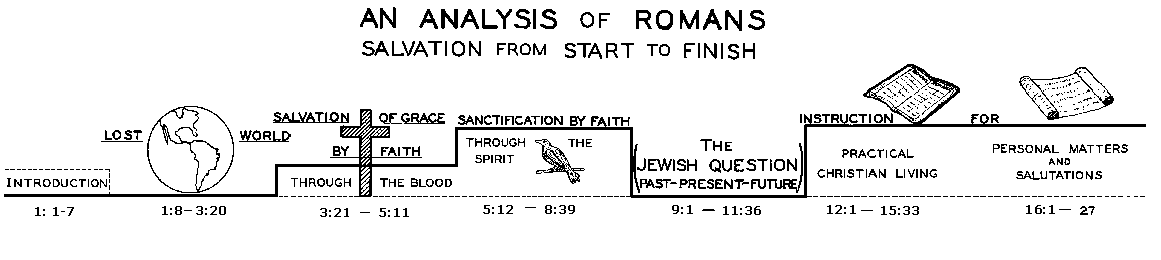
Source: Dr David Cooper
Click to Enlarge
| ROMANS ROAD to RIGHTEOUSNESS |
||||
| Romans 1:18-3:20 | Romans 3:21-5:21 | Romans 6:1-8:39 | Romans 9:1-11:36 | Romans 12:1-16:27 |
| SIN | SALVATION | SANCTIFICATION | SOVEREIGNTY | SERVICE |
| NEED FOR SALVATION |
WAY OF SALVATION |
LIFE OF SALVATION |
SCOPE OF SALVATION |
SERVICE OF SALVATION |
| God's Holiness In Condemning Sin |
God's Grace In Justifying Sinners |
God's Power In Sanctifying Believers |
God's Sovereignty In Saving Jew and Gentile |
Gods Glory The Object of Service |
| Deadliness of Sin |
Design of Grace |
Demonstration of Salvation | ||
| Power Given | Promises Fulfilled | Paths Pursued | ||
| Righteousness Needed |
Righteousness Credited |
Righteousness Demonstrated |
Righteousness Restored to Israel |
Righteousness Applied |
| God's Righteousness IN LAW |
God's Righteousness IMPUTED |
God's Righteousness OBEYED |
God's Righteousness IN ELECTION |
God's Righteousness DISPLAYED |
| Slaves to Sin | Slaves to God | Slaves Serving God | ||
| Doctrine | Duty | |||
| Life by Faith | Service by Faith | |||
|
Modified from Irving L. Jensen's chart above |
||||
R Ruin (Romans 1:17 – 3:20) – The utter sinfulness of humanity
O Offer (Romans 3:21-31) – God’s offer of justification by grace
M Model (Romans 4:1-25) – Abraham as a model for saving faith
A Access (Romans 5:1-11) – The benefits of justification
N New Adam (Romans 5:12-21) – We are children of two “Adams”
S Struggle w/ Sin (Romans 6:1-8:39) Struggle, sanctification, and victory
Romans 7:17 So now, no longer am I the one doing it, but sin which dwells in me. (NASB: Lockman)
Greek: nuni de ouketi ego katergazomai (1SPMI) auto alla e oikousa (PAPFSN) en emoi hamartia.
Amplified: However, it is no longer I who do the deed, but the sin [principle] which is at home in me and has possession of me. (Amplified Bible - Lockman)
Berkley: However, I am no longer the one who does the deed, but sin which is at home in me does it.
Moffatt: That being so, it is not I who do the deed but sin that dwells within me.
NLT: But I can't help myself, because it is sin inside me that makes me do these evil things. (NLT - Tyndale House)
Wuest: And since the case stands thus, no longer is it I who do it, but the sinful nature which indwells me;
Young's Literal: So now, no longer am I the one doing it, but sin which indwells me.
WHAT CONCLUSION DOES HE COME TO IN EXPLAINING HIS CONFLICTING BEHAVIOR? COULD THIS STATEMENT BE MADE BY AN UNSAVED OR A SAVED INDIVIDUAL?
SO NOW, NO LONGER AM I THE ONE DOING IT: nuni de ouketi ego katergazomai (1SPMI) auto:
- Ro 7:20; 4:7,8; 2Cor 8:12; Phil 3:8,9
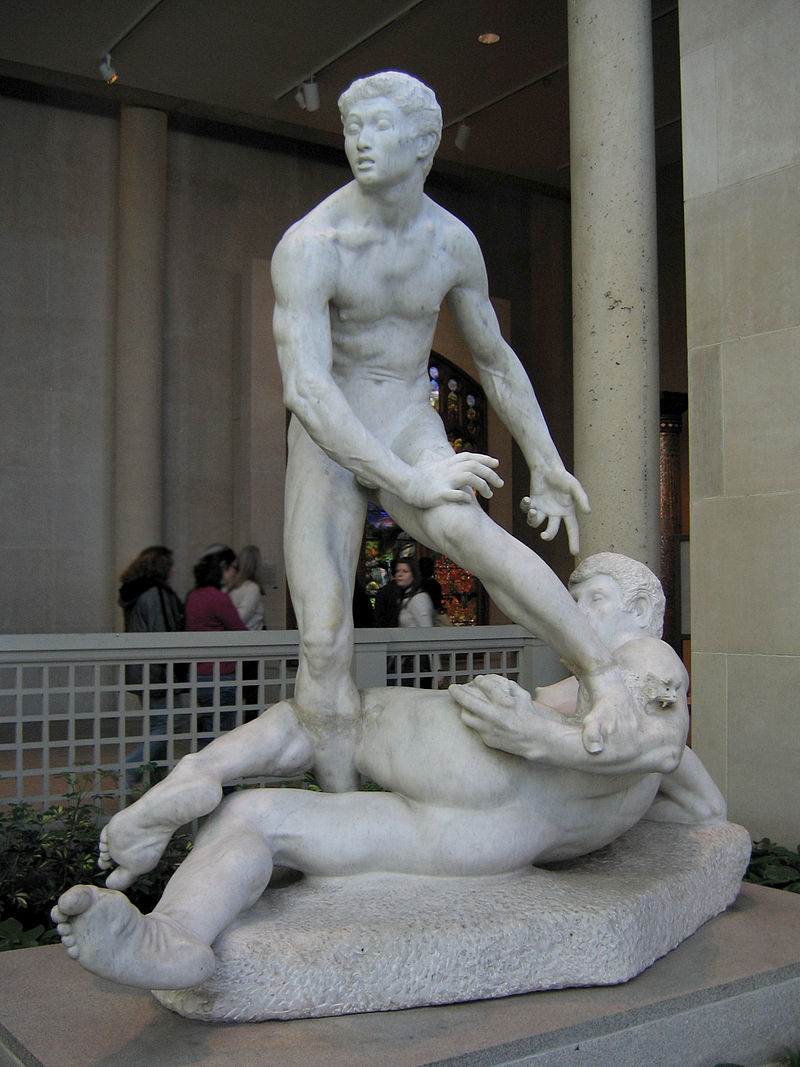
The Struggle of the Two Natures in Man
George Grey Barnard (carved 1892–94)
As you study these passages remember the context. Beginning in Romans 7:14 Paul begins to discuss the conflict of two natures. This section has been one of the most controversial in the New Testament. The majority of modern commentators (men like John MacArthur, John Piper, William Newell, Donald Barnhouse, et al) favor this section to be a description of a saved man who is wrestling with the sinful propensities still present in the physical body of every saved individual. Others feel Paul is discussing an unsaved man in this section. Although I favor the former interpretation, the principles that can be gleaned from Paul's teaching on this struggle are still applicable to all men whatever their status regarding salvation. Click here for a summary of the arguments that favor Romans 7:14-25 as a description of a believer over an unbeliever (or vice versa), as there are legitimate points favoring both interpretations.
Romans 7:17 —no longer I but sin
THE CRY OF DEFEAT!
Galatians 2:20—no longer I but Christ
THE CRY OF VICTORY!
No longer (3765) (ouketi from ou = absolute negation + eti = yet, still) means to negate an extension of time beyond a certain point. The time extends up to that point but no further. In this particular context ouketi (and "now") are not used so much in a temporal sense as in a logical sense.
Vine agrees writing that "The now means “this being the case.” It is not here an expression of time...As with the now, the no more is not an expression of time, but of argument, as if to say “it can no longer be maintained that …”
MacArthur comments that "Paul’s new I, his new inner self, no longer approves of the sin that still clings to him through the flesh. Whereas before his conversion his inner self approved of the sin he committed, now his inner self, a completely new inner self, strongly disapproves. (MacArthur, J: Romans 1-8. Chicago: Moody Press)
Doing (2716) (katergazomai from katá = down or here as an intensifying preposition + ergázomai = to work or to engage in an activity involving considerable expenditure of effort) means to work out fully and so to accomplish or finish a task. It means to work to bring something to fulfillment or completion so that it results in success.
If he's lost, then the Law has come and exposed him showing him that he cannot do anything but commit sins. God has exposed that sinful nature of Adam which is inside of him.
More likely Paul is describing a saved person, presumably himself. As a saved person he says that God has inwardly changed me but because of the Sin that is still dwelling in my mortal body like an unwanted intruder, this intruder continues to harass him. It is the power of Sin within his flesh which keeps pulling me off of the track because I keep looking at the LAW & trying in my own effort to do what God wants me to do.
Newell (who takes the approach that Paul is describing a believer) comments on this section...
"No longer I!" That was a wonderful discovery! For a forgiven Saul, who had gone on in joy awhile without inward trouble, it was indeed a terrible awakening to become again convicted-not now of sins, but of indwelling sin, of a hateful power that seemed one's very self-but was really "our old man." (see next paragraph) But he is making discoveries about himself- amazing things, brought out for the first time in Scripture. He is going much further than "consenting to the Law that it is right" (Ro 7:16-note) ; for now, instead of being completely over- whelmed by this holy, righteous Law; he arrives at (and writes down for us!) a conclusion that is daring: Since I am doing what I am not wishing, there must be another and evil principle working within me. For it is not my real self that is working out this evil, but sin which dwelleth in me. An unwelcome, hateful presence!
For, though our Old Man was crucified with Christ, put in the place of certain, though not instant death - we find, though we have "put him off" (Ep 3:9-note) we must "put away, " as to every thing of the former life, "the Old Man" (Ep 4:22-note). And, to be put away, he must be discovered to us, and this is what is so vividly set before - us in this struggle.
Note, it is never said the Old Man is dead, but that we died (Ro 6:2-note). We were federally identified with Christ, and passed on with Him into burial (Ro 6:3-note), and now share His Risen life (Ro 6:4-note). The old man is not to be "counted dead" (as some very dear brethren have put it): but to be counted crucified (Gal 2:20-note) - his place being there only. (Romans 7)
BUT (the) SIN WHICH INDWELLS ME: alla e oikousa (PAPFSN) en emoi hamartia:
- Ro 7:18,20,23; Jas 4:5,6
But the sin - Paul is not giving us a reason to excuse our sin if we are believers. We cannot just say "Sin made me commit sins!" and go blithely along as if we have no culpability.
As Godet says "It is not to be thought that Paul wishes to exculpate himself in the least when he says "It is not I who do it, but sin." On the contrary, he wishes to make the miserable state of bondage to which he is reduced the more palpable; he is not master even in his own house; there he finds a tyrant who forces him to act in opposition to his better wishes. What humiliation! What misery! It is the state of sin regarded from its painful rather than from its culpable point of view. (Commentary on Romans 7)
Vine adds that "This verse provides no ground of excuse on the part of anyone for sinning, as if it was not the person who did it but the responsibility lay upon an inward principle. That is not the apostle’s meaning at all. Moreover, it runs contrary to his whole line of argument, which represents the believer as in a struggle under the realization of the sinfulness of sin as evoked by the Law and as one who disapproves of the act. (Collected writings of W. E. Vine)
Wuest (quoting Denney) comments "To be saved from sin, a man must at the same time own it and disown it; it is this practical paradox which is reflected in this verse."
Sin - Note that the following explanation of sin is repeated at several points in the notes on Romans 5-8, because it is such an important truth to keep in mind as one studies this this doctrinally rich section of Scripture.
The Sin (266) (hamartia) originally conveyed the idea of missing the mark as when hunting with a bow and arrow and then came to mean missing or falling short of any goal, standard, or purpose. In Scripture sin often describes our thoughts, words and deeds that miss the ultimate purpose God has for each individual, these thoughts, words and deeds falling short of God’s perfect standard of holiness. Now here is where the definition of Sin as used in Romans 5-8 might be a bit confusing. First note that "sin" is singular, so it is not "sins" but "sin" the significance of which becomes more apparent from the next fact. In many (most) of Paul's uses of hamartia in Romans 5-8, Paul places the definite article "the" before "sin" (even though the "the" is not translated in most English versions for it would be somewhat difficult to read). In this way Paul is speaking of "Sin" figuratively, in what is referred to as a metonym (derived from "meta" = with + "onym" = name") which describes the substitution of a word referring to an attribute for the thing that is meant (eg, the use of the word "crown" to refer to the entire "monarchy").
Now are you really confused? Well, what Paul is doing with the Sin (he hamartia) is to use this word not to describe the actions or results (i.e., the specific sins we commit in thought, word or deed) but to describe the underlying root cause, the principle or, in medical terms (I'm a physician with sub specialization in infectious disease), the "sin virus" we have all inherited from Adam. The Sin is like a highly contagious, lethal virus which every man, woman and child has inherited because every person alive can trace their lineage back to Adam, the first man. The presence of the Sin gene in our "moral make up" is the reason every man, woman and child commits sins (note the plural). Try to keep this distinction in mind when studying Romans 5-8, where Paul refers primarily to the "sin virus", the underlying root cause of why we do the wicked things we do.
Wayne Barber explains sin as follows "Sin entered the world! (Ro 5:12-note) When you see the word sin in this verse (Romans 5:12), take a pencil and write right behind it "The" (so that it reads "the Sin"). When the definite article "the" (Ed note: look at the Greek sentence above. Do you see "he" before "hamartia"? The "he" is the definite article in Greek, corresponding to the English definite article "the") is used in Scripture, it is very important because it is identifying something as very specific... In English, we would say "THE cup," where the definite article means, not just any cup, but the specific cup. (Romans 5:12-14) (Bolding and italics added)
So it was not a particular sin, but the inherent propensity to sin that entered the human realm so that men became sinners by nature. Adam passed to all his descendants the inherent sinful nature he possessed because of his single act of disobedience. That "Adamic" nature is present in every person ever born from the moment of conception David writing...
Behold (this Hebrew word means "Listen up!" what I have to say is very important!) I was brought forth in iniquity, and in sin my mother conceived me. (Psalm 51:5 - Spurgeon's note)
MacArthur explains that...After salvation, sin, like a deposed and exiled ruler, no longer reigns in a person’s life, but it manages to survive. It no longer resides in the innermost self but finds its residual dwelling in his flesh, in the unredeemed humanness that remains until a believer meets the Lord at the Rapture or at death. “For the flesh sets its desire against the Spirit, and the Spirit against the flesh,” Paul further explained to the Galatians; “for these are in opposition to one another, so that you may not do the things that you please” (Gal 5:17-note). In this life, Christians are somewhat like an unskilled artist who beholds a beautiful scene that he wants to paint. But his lack of talent prevents him from doing the scene justice. The fault is not in the scene, or in the canvas, the brushes, or the paint but in the painter. That is why we need to ask the master painter, Jesus Christ, to place His hand over ours in order to paint the strokes that, independent of Him, we could never produce. Jesus said, “Apart from Me you can do nothing” (John 15:5). The only way we can live victoriously is to walk by Christ’s own Spirit and in His power, in order not to “carry out the desire of the flesh” (Gal 5:16-note). (See MacArthur Commentary)
Dwells (3611) (oikeo from oíkos = dwelling, home) literally was used to mean to occupy a house, to reside (inhabit, remain). Oikeo in this context means to dwell and the present tense indicates that this is not just a short term renter but one who occupies the house for as long as believers are in this house called a body. So whether you believe Romans 7 is a believer or an unbeliever, the crucial truth one can never forget is that Sin (personified) dwells in our flesh (believer or unbeliever) and it takes opportunity when the LAW comes around.
Oikeo - 9x in 9v in the NAS - Ro 7:17, 18, 20; 8:9, 11; 1 Co. 3:16; 7:12, 13; 1Ti 6:16 and is rendered in the NAS as dwell(2), dwells(1), dwelt(1), indwells(2).
This does not mean Paul was avoiding personal responsibility for his actions but was outlining the conflict between his desires and the Sin within. He is explaining the control that the (power of) Sin exerts in a person's life. The Sin was a tenant that had managed to secure more than just a foothold, but actually roams the place (our body) as if it his home. Paul has moved from a consideration of outward acts to an emphasis on the unwanted indwelling power of Sin. With this alien master in control, no matter how strongly he wants to do the good, he finds himself checkmated and cannot carry out the good.
Every one of us needs to understand the evil of our flesh. On the one hand if a person is LOST, he needs to understand that the evil of his flesh points to the SIN of Adam which dominates a lost person. But once you are SAVED you still need to remember that you have that evil propensity dwelling in your flesh. We know that this is true because there is a battle with the flesh every day of our lives. (Gal 5:17-note, 1Pe 2:11-note; Mt 26:41).
Romans 7:18 For I know that nothing good dwells in me, that is, in my flesh; for the willing is present in me, but the doing of the good is not. (NASB: Lockman)
Greek: oida (1SRAI) gar hoti ouk oikei (3SPAI) en emoi, tout' estin (3SPAI) en te sarki mou, agathon; to gar thelein (PAN) parakeitai (3SPMI) moi, to de katergazesthai (PMN) to kalon ou;
Amplified:For I know that nothing good dwells within me, that is, in my flesh. I can will what is right, but I cannot perform it. [I have the intention and urge to do what is right, but no power to carry it out.] (Amplified Bible - Lockman)
Berkley: For I know that within me, that is, within my flesh, what is good is not at home; the personal willingness is there by not the accomplishing of what is right.
Moffatt: For in me (that is, in my flesh) no good dwells, I know; the wish is there, but not the power of doing what is right.
NLT: I know I am rotten through and through so far as my old sinful nature is concerned. No matter which way I turn, I can't make myself do right. I want to, but I can't. (NLT - Tyndale House)
Wuest: for I know positively that there does not dwell in me, that is, in my flesh, good; for the being desirous is constantly with me; but the doing of the good, not;
Young's Literal: For I know that nothing good dwells in me, that is, in my flesh; for the wishing is present in me, but the doing of the good is not.
HOW DOES HE CHARACTERIZE THIS INDWELLING SIN? WHERE SPECIFICALLY DOES HE SAY IT INDWELLS? WHAT'S THE IMPLICATION OF THIS SPECIFICATION OF LOCATION? HOW DOES HE SUPPORT HIS CONCLUSION THAT NOTHING GOOD DWELLS IN HIM?
FOR I KNOW THAT NOTHING GOOD DWELLS IN ME THAT IS, IN MY FLESH: Oida (1SRAI) gar hoti ouk oikei (3SPAI) en hemoi tout estin (3SPAI) en te sarki mou agathon:
- Ge 6:5; 8:21; Job 14:4; 15:14, 15, 16; 25:4; Ps 51:5; Isa 64:6; Mt 15:19; Mk 7:21, 22, 23; Luke 11:13; Eph 2:1, 2, 3, 4, 5; Titus 3:3; 1Pet 4:2
- Ro 7:5,25; 8:3-13; 13:14; Jn 3:6; Gal 5:19, 20, 21,24
For (gar) explains that what he said in Romans 7:17 was not intended as an excuse for one's sins. Instead he confesses the powerlessness of flesh for good.
Nothing (3756) (ou) signifies absolute negation. Paul is saying that absolutely nothing that is intrinsically good, inherently good in quality, nothing that is spiritually profitable, useful, benevolent (marked by or disposed to doing good).
Good (18) (agathos) (click in depth study) is that which is good in its character, beneficial in its effects and/or useful in its action. Here it describes the kind of good that is framed in a deed that you do for someone else. It is another way of saying a "righteous work". So in me there is no good thing...but he qualifies it -- "in my flesh". So whether he is describing a saved or lost person, he is saying that in his flesh there is no potential to do righteous deeds. So you can still come at it from both sides.
Vine commenting on good writes that "Whatever may be considered good from the purely natural point of view, is in reality void of that quality in the absence of right relationship with God. The statement affords a further proof of the fact of indwelling sin. (Collected writings of W. E. Vine. Nashville: Thomas Nelson or Logos)
Dwells (3611) (oikeo from oíkos = dwelling, home) (present tense) literally was used to mean to occupy a house, to reside (inhabit, remain).
In my flesh - Paul qualifies his statement about the "whereabouts" of nothing good because (assuming that he is speaking of a believer) in the believer the Holy Spirit dwells, both to work and to will that which pleases God. The Spirit is not in my flesh, because there is nothing good there.
Middletown Bible asks...Why do we have the parenthesis containing the words, "that is, in my flesh"? This is another hint that Paul was writing from the perspective of a saved person, not an unregenerate person. Paul had to make this parenthetical clarification because he knew that apart from his sinful flesh there was something (Someone) very good dwelling in him (Ro 8:9-note). (Romans chapter 7)
MacArthur has an interesting description of the flesh (as used by Paul in this context) writing that "The flesh serves as a base camp from which sin operates in the Christian’s life. It is not sinful inherently (Ro 6:6-note), but because of its fallenness, it is still subject to sin and is thoroughly contaminated. (See Study Bible Note)
Flesh (4561) (flesh) can be used in three different ways. It can speak of the body, the physical body that we have, the meat that is on the bones. It can speak of weakness, meaning that which is psychological. It can also mean that corrupt nature which you and I have, that fallen nature and this last nuance is the spiritual meaning in this verse. This declaration in Romans 7:18 does not sound like Paul before his conversion if one compares the way he boasted pre-conversion writing that at that time he was...
as to zeal, a persecutor of the church; as to the righteousness which is in the Law, found blameless (Moffatt "immaculate by the standard of legal righteousness”). (Php 3:6-note).
In other words Paul the Pharisee held a fairly high "opinion" of himself and his "religious" accomplishments. As Isaiah phrased it Paul had come to see that
all our righteous deeds are like a filthy garment (the dressings employed by women during menstruation. ) (Isaiah 64:6, Is 64:5KJV)
If such a man as Paul would have to confess that in his flesh there was nothing good at all, then surely every Christian must say the same.
Denney writes that "It is sin, and nothing but sin, that has to be taken into account of in this connection, for ‘I know that in me, that is, in my flesh, there dwells no good,’ in me, regarded as a creature of flesh, apart from any relation to or affinity for God and His Spirit.
Godet has an interesting comment on Romans 7:18 writing...
This thesis, reproducing that of Ro 7:14 (note): I am carnal (Ro 7:14KJV) ("I am of flesh" - NAS), connects itself, by terms used, with the last words of Ro 7:17 (note); compare the two expressions: Sin dwelling in me and in me dwelleth no good thing. The for (Gk = gar) is explanatory rather than demonstrative. It is the same experience which is again expounded more precisely; compare the similar for, Ro 7:10. It might seem, when Paul said, Ro 7:14: I am carnal, that he left nothing subsisting in the ego which was not flesh. The contrary appeared, however, from the we know preceding; for he who recognizes that the law is spiritual, must possess in himself something spiritual. This distinction between the ego, the I, and the flesh, is emphasized still more fully in Romans 7:18. For it is obvious that the phrase that is ("that is, in my flesh...") has a restrictive sense, and that Paul means: in me, so far at least as my person is carnal. He therefore gives it to be understood that there is something more in him besides the flesh. This something is precisely that in him which recognizes the spirituality of the law, and pays it homage.
We thereby understand what the flesh is in his eyes, the complacent care of his person, in the form of pride or sensuality. Now this is precisely the active power which in practice determines the activity of the unregenerate man. The flesh thus understood does not exclude the knowledge, and even the admiration of goodness; but it renders this noble faculty fruitless in ordinary life, by enslaving to itself the active principle, the will. (Commentary on Romans 7) (Bolding and italics added for emphasis)
FOR THE WILLING IS PRESENT IN ME: to gar thelein (PAN) parakeitai (3SPMI) moi:
- Ro 7:15,19,25; Ps 119:5,32,40,115, 116, 117,173,176; Gal 5:17; Phil 2:13; 3:12
Wishing (2309) (thelo) describes that desire which comes from one’s emotions. It is a predetermined and focused will that one sets to do. It is an active decision of the will, implying volition (making a choice) and purpose. It is a conscious willing that denotes a more active resolution urging on to action. The present tense indicates that Paul was continuously desirous of doing God's will. A continual desire to do God's will makes it very difficult to state Romans 7:14-25 is describing a lost person (Click summary of arguments pro and con)
Present (3873) (parakeimai from pará = near, with + keímai = to lie) means literally to lie near and so to be adjacent to or within reach as it were. It is used with the metaphorical meaning in this verse which conveys the idea of being at hand or present. The present tense indicates that this desire to do good was continually within his reach.
Middletown Bible notes that ""To will" means "to desire, to want." I want to do good, I want to have victory over sin, I want to keep God’s holy law and obey God’s Word, but I have NO POWER to perform. I’m powerless! I’m helpless! I can’t do it! I am totally UNABLE to live the Christian life!!! Have you made this discovery? The new creature in Christ has the will to do what is good and right (Ro 7:18,19, 21-see notes Ro 7:18,19, 21) but no power at all. The power is not in ourselves but is found only in God the Holy Spirit (Romans 8 and compare Php 2:13-note).
BUT THE DOING OF THE GOOD IS NOT: to de katergazesthai (PMN) to kalon ou:
Literally “but to (continuously = present tense) produce the good is not”
Doing (2716) (katergazomai from katá = down or here as an intensifying preposition + ergázomai = to work or to engage in an activity involving considerable expenditure of effort) means to work out fully and so to accomplish or finish a task. It means to work to bring something to fulfillment or completion so that it results in success.
Katergazomai means to operate in a powerful and efficacious manner. The idea is to do it with thoroughness and thus achieve an end or come to a conclusion. As used in this context katergazomai means to to work out or produce good as the accomplished goal.
Good (2570) (kalos) refers to that which is inherently excellent or intrinsically good: and which provides some special or superior benefit.
William Newell has some an interesting comments regarding Romans 7:18 writing that....
Here is that man who wrote in Philippians Three, "If any man hath whereof to glory in the flesh, I yet more!" And he gave there seven facts he could glory in, -beyond the greatest Greek, or Roman, or English, or any Gentile-"I yet more"! but now saying, "In me dwelleth no good thing." And also: "I can will, but cannot do!" This great double lesson must be learned by all of us!
(1) There is no good thing in any of us-in "our flesh"-our old selves.
(2) We cannot do the good we wish or will, to do.
Most humbling of all confessions. Renewed, desiring to proceed-we cannot! We are dependent on the Holy Spirit as our only spiritual power, just as on Christ as our only righteousness!
Alas, how incompletely are these two facts taught and learned! We have seen hundreds of eager young believers who are being told to "surrender to Christ, " that all depended upon their yielding, etc. But these dear children, what did they know of the tremendous truths Paul has taught in the early part of Romans, before asking that believers to present themselves to God as alive from the dead? (Ro 6:13- note). He has taught the terrible, lost guilty state of all men; their inability to recover righteousness; then Christ set forth as a propitiation through faith in His blood as their only hope; then identification, as connected with Adam, with Christ in His death; and the command to reckon themselves dead to sin, and alive to God in Christ Jesus; together with, the fact that they are not under law, but under grace.
All this before the real call for surrender for service, in the Twelfth Chapter is given at all! (Ro 12:1-note)
Our hearts are weary with the appeals to man's will, - whether the will of a sinner to "make a start, "be a Christian" etc.; or the appeal to the will of believers who have not yet been shown what guilt is, and what indwelling sin is. For God's Word in Romans 7.18 tells us that while to will may be present with us, to work that which is right is not present. Paul told those same Philippians that believers were such as had "no confidence" in the flesh (Php 3:3-note), and that it is God that worketh in us, "both to will and to work, for His good pleasure." (Php 2:13-note)
The author (Newell) must be permitted to say that he had part in the Student Volunteer Movement (Wikipedia) for foreign missions of fifty years ago; that he saw hundreds of earnest and honest students "volunteer" for the mission field. But afterwards, in teaching the book of Romans, especially in China, he had many a missionary say, "We never knew this gospel before." It is nothing short of tragic to send men and women out against the hosts of hell in heathendom without teaching them through and through and through and through this mighty gospel Paul preached - which gospel he says is "the power of God unto salvation." And he comes to further detail in saying, "The word of the Cross ("the gospel") is the power of God." Education, medication, sanitation, and general sweetness-what does Satan care for that. "The word of the Cross" is the great wire along which runs the dynamic of God - and it runs along no other wire. If God is permitting great investments of money, men and time along other lines to be swept away, let us remember that the real Church of God, having the Holy Ghost, does not need great outward things. Paul built no colleges, schools, or institutions-which may be useful, never essential, But Paul's last epistle, just before his martyrdom, says "The Lord stood by me and strengthened me; that through me THE MESSAGE might be fully proclaimed, and that all the Gentiles might hear." (2Ti 4:17+) (See commentary Romans 7)
THE "BEAST" WITHIN! - Why the doing of good is not present in us...an illustration from Our Daily Bread - Several years ago we had a pet raccoon we called Jason. For hours he would entertain us by wrestling with our dog, MacTavish, a kind and gentle Scottish terrier. Jason, on the other hand, was a kind of schizoid terror. One minute he would snuggle up on your lap like a perfect angel and the next he'd be engaged in the most fiendish antics. If unrestrained, he would breakfast on dove eggs, raid the garbage can, or tear up the flowerbed. Although he was a delightful pet, we became increasingly aware that his destructive actions were governed by his wild instincts. Jason would always have the nature of a raccoon, and we had to watch him closely no matter how tame he seemed to be.
Often when I observed Jason's behavior, I thought of the fallen, sinful nature that we as Christians retain even though we are indwelt by the Holy Spirit. Paul referred to this as the "flesh" in which "nothing good dwells" (Ro 7:18). It may be repressed and restrained, but it is always there. Unless we are daily controlled by the Lord, our old "self" will demonstrate its destructive, pleasure-seeking capacity in some way or another.
Although we are new creatures in Christ (2Co 5:17+), we still possess a tendency to sin. But we need not be governed by it, for we are united to Christ and indwelt by the Holy Spirit (Ro 8:9+). By obeying God's Word and yielding to the Spirit (ED: see "Paradoxical Principle of 100% Dependent and 100% Responsible"), we can be victorious over the flesh—the "nature of the beast" within. —M. R. De Haan II (Our Daily Bread, Copyright RBC Ministries, Grand Rapids, MI. Reprinted by permission. All rights reserved)
The secret of self-control is to give control of self to the Spirit.
Lord, I am learning of Your power
To give me victory each hour;
As I keep walking close to You,
Your Spirit fills with life anew.
—Hess
Strong Foes - As Christians, we face strong foes that would bring us into spiritual defeat. Our greatest enemy, however, lurks within. Even though we have been born again, we are deeply aware of our inclination toward evil. The apostle Paul wrote, “For I know that in me (that is, in my flesh) nothing good dwells; for to will is present with me, but how to perform what is good I do not find” (Ro 7:18). He added, “For I delight in the law of God according to the inward man. But I see another law in my members, warring against the law of my mind, and bringing me into captivity to the law of sin which is in my members” (Ro 7:22, 23). (10,000 Sermon illustrations)
In Victor Hugo’s story, “Ninety-Three” a ship is caught in a storm. The frightened crew hears a terrible crashing sound below. Immediately the men know what it is: a cannon has broken loose and is crashing into the ship’s side with every smashing blow of the sea! Two men, at the risk of their lives, manage to fasten it down again, for they know that the unfastened cannon is more dangerous than the raging storm. Hillery C. Price made this application: “Many people are like that ship—their greatest danger areas lie within their own lives.” (10,000 Sermon illustrations)
Animal Actions - In his book Adjust Or Self-Destruct (BORROW BOOK), Craig Massey draws some familiar parallels between our actions as human beings and those of animals. Here are a few of them:
- A "snake in the grass" is a cunning, deceitful person.
- A grouch is an "old bear."
- A coward is a "chicken," and
- a glutton is a "hog."
We've all used such descriptive terms, as well as acted them out in our own lives.
When we turn in faith to Christ, we become new creatures (2 Corinthians 5:17+), but the "animals" of our old life do not just curl up and die. They keep trying to assert themselves. Paul saw them as springing from "the flesh" (Galatians 5:17). He didn't mean our physical body, but that sinful disposition inherited from Adam (Romans 7:18-21; Galatians 5:16, 17, 18, 19, 20, 21). No matter how spiritually mature we become in this life, these tendencies stay with us.
But there's good news. By faith we are one with Christ (1 Corinthians 6:17), and His Spirit lives within us to enable us to overcome sinful thoughts, attitudes, and actions. Our faith must not be passive, however. Once we recognize these sinful tendencies, we must (ED: Php 2:13NLT+ = ENABLED BY THE SPIRIT -WHO GIVES US THE DESIRE AND THE POWER TO) reject them (Romans 6:12).
These beasts are not subdued easily. No victory is ever won without a struggle. But we can resist and overcome—in the power of God's Spirit. —Dennis J. De Haan (Our Daily Bread, Copyright RBC Ministries, Grand Rapids, MI. Reprinted by permission. All rights reserved)
Lord, into Your hands I place this day,
All that I have and do and say;
Oh, grant that every hour be filled
With thoughts and actions You have willed.
—Green
To break sin's grip, put yourself in God's hands.
Romans 7:19 For the good that I want, I do not do, but I practice the very evil that I do not want (NASB: Lockman)
Greek: ou gar o thelo (1SPAI) poio (1SPAI) agathon, alla o ou thelo (1SPAI) kakon touto prasso. (1SPAI)
Amplified: For I fail to practice the good deeds I desire to do, but the evil deeds that I do not desire to do are what I am [ever] doing. (Amplified Bible - Lockman)
Berkley: For I fail to do the good I want to do and I practice the bad that I do not want to practice.
Moffatt: I cannot be good as I desire to be, and I do wrong against my wishes.
NLT: When I want to do good, I don't. And when I try not to do wrong, I do it anyway. (NLT - Tyndale House)
Wuest: for that which I desire, good, I do not; but that which I do not desire, evil, this I practice.
Young's Literal: For the good that I wish, I do not do; but I practice the very evil that I do not wish.
HOW DOES HE EXPLAIN THAT DOING OF GOOD IS NOT IN HIM?
FOR THE GOOD THAT I WISH, I DO NOT DO: ou gar o thelo (1SPAI) poio (1SPAI) agathon:
Notice that Romans 7:19 is similar to Ro 7:15 (note), except that in Ro 7:15 the contrast is between good desire and bad act, whereas in Romans 7:19 it is between good desire and failure to act.
In this verse, the conflict between the two natures rages on for Paul finds himself failing to do the good he wants to do, instead doing the evil that he does not desire to do.
Good (18) (agathos) describes the kind of good that is framed in a deed that you do for someone else. It is another way of saying a "righteous work". So in me there is no good thing...but he qualifies it -- "in my flesh". So whether he is lost or saved he is saying that in his flesh there is no potential to do righteous deeds. So you can still come at it from both sides.
Wish (2309) (thelo) (present tense = constantly desire) describes a desire that comes from one’s emotions and represents an active decision of the will, thus implying volition and purpose. It represents a conscious willing and denotes a more active resolution urging on to action.
Barnhouse observes that "Martin Luther said, “I cannot keep the birds from flying around my head; but by the grace of God I can keep them from building their nests in my hair.” However, these evil birds are not outside us. The human heart is their cage, and they never cease to beat their wings. True, we can keep most of their eggs from hatching, but the foul birds will nest within so long as there is breath in the body. We are obliged, therefore, to say “The good I desire, I do not.” When we consider how, notwithstanding all our watchfulness, infirmity and evil mingle with everything we feel, think or do, we must add, “The evil I desire not, that I do.” (Barnhouse, D. G. God's Freedom: Romans 6:1-7:25 Eerdmans)
BUT I PRACTICE THE VERY EVIL THAT I DO NOT WISH: alla o ou thelo (1SPAI) kakon touto prasso (1SPAI):
but the evil deeds that I do not desire to do are what I am [ever] doing. (Amplified)
A CASE IN WHICH PRACTICE
DOES NOT MAKE PERFECT!
But - The Greek conjunction alla is a strong term of contrast. Always pause to ponder "but," asking "What is being contrasted?" But always signals a change of direction.
I practice the very evil that I do not wish (thelo) - "DO NOT" is the Greek negative (ou) signifying absolutely do not. How could an unregenerate man make such an absolute statement? In my opinion, he could not, because unregenerate men are enslaved to Sin and under Sin's dominion. It would be like a slave rebelling against his master.
Practice (4238) (prasso) (present tense) means to perform repeatedly or habitually.
Daniel Hill sees this principle in this passage. "Whenever we get involved with trying to do good out of the energy of our own flesh, this is evil (ED: AND INEFFECTIVE!) It is exactly what Satan wants, he wants us to try harder, do better, attempt to bring our desires to reality by our own efforts. (Romans Notes)
MacArthur feels that "it is important to understand that this great inner struggle with sin is not experienced by the undeveloped and childish believer but by the mature man of God. David was a man after God’s own heart (1Sa 13:14, Acts 13:22+) and was honored by having the Messiah named the Son of David. Yet no Old Testament saint seems a worse sinner (ED: SOLOMON CERTAINTY IS IN THE RUNNING! cf 1Ki 11:1-11) or was more conscious of his own sin. Particularly in the great penitential Psalms 32, 38, and 51, but in many other psalms as well, David agonized over and confessed his sin before God. He was so near to the heart of God that the least sin in his life loomed before his eyes as a great offense. (See Romans Commentary)
Newell cautions that "this verse must not be for one moment misapplied, that is, it must not be made to describe Paul's "manner of life in Christ Jesus," which was, as we know, victorious, and fruitful and always rejoicing. But verse 19 does indeed express concerning Paul, and all of us, all the time, our utter powerlessness in ourselves (though Christians) against the evil of the flesh: whether we are consciously under Moses' Law, as was Paul, or convicted by the power of an awakened conscience that we ought to have deliverance from our sinful, selfish selves, and walk in victory in Christ. Verse 19 is not normal Christian experience, certainly. But it may describe our very case, if we have not learned God's way of faith. (See commentary Romans 7)
Romans 7:20 But if I am doing the very thing I do not want, I am no longer the one doing it, but sin which dwells in me. (NASB: Lockman)
Greek: ei de o ou thelo (1SPAI) [ego] touto poio, (1SPAI) ouketi ego katergazomai (1SPMI) auto alla e oikousa (PAPFSN) en emoi hamartia.
Amplified: Now if I do what I do not desire to do, it is no longer I doing it [it is not myself that acts], but the sin [principle] which dwells within me fixed and operating in my soul]. (Amplified Bible - Lockman)
Moffatt: Well, if I act against my wishes it is not I who do the deed but sin that dwells within me.
NLT: But if I am doing what I don't want to do, I am not really the one doing it; the sin within me is doing it. (NLT - Tyndale House)
Wuest: But in view of the fact that that which I do not desire, this I do, no longer is it I who do it, but the sinful nature which indwells me does it.
Young's Literal: But if I am doing the very thing I do not wish, I am no longer the one doing it, but sin which dwells in me.
HOW DOES HE CONCLUDE? WHO IS DOING THE UNWANTED BEHAVIOR? JUST LOOKING AT THIS VERSE IN ISOLATION DOES THIS LOOK MORE LIKE A BELIEVER OR UNBELIEVER? WHY?
BUT IF I AM DOING THE VERY THING I DO NOT WISH I AM NO LONGER THE ONE DOING IT: ei de o ou thelo (1SPAI) (ego) touto poio (1SPAI) ouketi ego katergazomai (1SPMI) auto:
But - Is another term of contrast.
MacDonald paraphrases this verse "Now if I (the old nature) do what I (the new nature) don’t want to do, it is no longer I (the person) who do it, but sin that dwells within me.” (Borrow Believer's Bible Commentary)
Doing (4160) (poieo) (present tense - continual action) means to perform or do.
Wish (2309) (thelo) (present tense = constantly desire) describes a desire that comes from one’s emotions and represents an active decision of the will, thus implying volition and purpose. It represents a conscious willing and denotes a more active resolution urging on to action.
Doing (2716) (katergazomai from katá = down or here as an intensifying preposition + ergázomai = to work or to engage in an activity involving considerable expenditure of effort) (present tense) means to continually work out fully bringing to fulfillment or completion so that it results in success. The idea of this verb has to do it with thoroughness and thus the achievement of an end or conclusion.
Godet writes that here Paul presents "A conclusion uniform with that before enunciated, Romans 7:16 (note) and Romans 7:17 (note): “I am not master of myself; a stranger has forced his way into my house and holds me captive.”—This is really the proof of the sold unto sin, Romans 7:14 (note). Paul does not say so by way of excuse, but to describe a state of the profoundest misery. And every time he repeats this confession, it is as if he felt himself seized with a stronger conviction of its truth. (Commentary on Romans 7)
BUT SIN WHICH DWELLS IN ME: alla e oikousa (PAPFSN) en hemoi hamartia:
Compare the same statement in Ro 7:17 [note] - "Sin which indwells me".
But (term of contrast) Sin - As stated earlier Paul is not excusing himself from personal responsibility but is simply stating that he has not found deliverance from the power of indwelling Sin. He explains that when he sins, it is not with the desire of the new man.
Pritchard writes about Sin, "the enemy is us"...
It reminds me of that cartoon strip Pogo (see picture) where the hero comes and says "We have met the enemy and he is us."
That's what Paul is saying. We have met the enemy. The enemy is us. The enemy is not just out there somewhere. The enemy is on the inside. He has infiltrated into our very being. Which is why the people clap and cheer and they applaud you for your great performance, there is something on the inside that is saying, "Oh, wait a minute. If you knew the way I really am, you wouldn't be clapping. You wouldn't be cheering." That's what the apostle Paul is talking about.
Why is it that there is this struggle inside of every believer? The answer is very simple and it is two words. The answer is indwelling sin. Look at the text. Paul says it twice very plainly. In Ro 7:17-note, "as it is it is no longer I myself doing it, but it is sin living in me." Sin living in me. He uses the same phrase in Ro 7:20-note -- "sin living in me." Sin dwells inside the life of every believer. Paul says that sin is actually present in the members of his body. He says that whenever he wants to do good, "evil is right there with me." As long as you are a follower of Jesus Christ, you will never be completely free from the pull of the sin that is inside you. As long as you are in your mortal bodies, you will wrestle with sin. (Romans 7:14-25: The Struggle)
Newell...Paul reasserts the blessed fact (which is, alas, no comfort to him as yet!) that it is no longer the real "I, " but indwelling sin, that is working out this hated life of defeat. (Romans 7)
Ironside explains that...A law or principle of action, then, has been discovered. He goes with the good and does the evil. According to the inward man he delights in the law of God, but this does not produce the holiness he expected. He must learn to delight in Christ to reach the goal of his desires! He reaches this conclusion later, but meantime he is occupied with the discovery of the two natures with their different desires and activities. (Ironside, H. Romans)
Sin (266) (hamartia) originally meant missing the mark, and thus missing the true purpose God has for each created man and women. It describes a falling short of His standard of holiness, a departure from doing what is right, and an acting contrary to God's will. Now here is where the definition of Sin as used in Romans 5-8 might be a bit confusing. First note that sin is singular, so it is not sins but sin the significance of which becomes more apparent from the next fact. In many (most) of Paul's uses of hamartia in Romans 5-8, Paul places the definite article "the" before sin (even though the "the" is not translated in most English versions for it would be somewhat difficult to read). The use of the definite article indicates that Paul is not referring to "a sin" (not to just any sin) but "the sin". In this way Paul is speaking of Sin figuratively, in what is referred to as a metonym (derived from "meta" = with + "onym" = name") which describes the substitution of a word referring to an attribute for the thing that is meant (eg, the use of the word "crown" to refer to the entire "monarchy").
Now are you really confused? Well, what Paul is doing with the Sin (he hamartia) is to use this word not to describe the actions or results (i.e., the specific sins we commit in thought, word or deed) but to describe the underlying root cause, the principle or, in medical terms (I'm a physician with sub specialization in infectious disease), the "sin virus" we have all inherited from Adam (Ro 5:12+). The Sin is like a highly contagious, lethal virus which every man, woman and child has inherited because every person alive can trace their lineage back to Adam, the first man. The presence of the Sin "gene' in our "moral make up" is the reason every man, woman and child commits sins (note the plural). Try to keep this distinction in mind when studying Romans 5-8, where Paul refers primarily to the "sin virus" (Sin), the underlying root cause of WHY we do the wicked things (the sins) we do.
Dwells (3611) (oikeo from oíkos = dwelling, home) (present tense) literally was used to mean to occupy a house, to reside (inhabit, remain). Oikeo in this context means to dwell. So whether you believe Romans 7 is a believer or an unbeliever, the crucial truth one can never forget is that Sin (personified) dwells in our flesh (believer or unbeliever) and it takes opportunity when the LAW comes around.
Middletown Bible writes that "The thought parallels Ro 7:17 (note). I’m powerless to break the power of indwelling sin. I can’t do it! In much the same way, there was nothing the Israelites could do to break the power of the Egyptians over them. What was the one thing they needed? A DELIVERER! One who could rescue them from the slavery by HIS POWER!
S Lewis Johnson sums up Romans 7:18-20 writing that in this section - the apostle's emphasis passes from the positive side of things to the negative and inner side of things. We are impotent to produce righteousness. The "for" (Ro 7:18-note) introduces the amplifying explanation and confirmation of Romans 7:14, 15, 16, 17. Paul, it is plain, sees himself as a divided person. The "in me" is the comprehensive person, but he limits the statement to "my flesh" by the restrictive "that is," what he says is that the flesh is utterly corrupt; it can do nothing for God. There is, however, a part of him, he says, of which this cannot be said. In effect, the believer is a divided person, and the lesson is one that every follower of the Lord Jesus must learn. (Romans 7:13-25 The Struggle)