Romans 7:2
Romans 7:3
Romans 7:4
Romans 7:5
Romans 7:6
Romans 7:7
Romans 7:8
Romans 7:9
Romans 7:10
Romans 7:11
Romans 7:12
Romans 7:13
Romans 7:14
Romans 7:15
Romans 7:16
Romans 7:17
Romans 7:18
Romans 7:19
Romans 7:20
Romans 7:21
Romans 7:22
Romans 7:23
Romans 7:24
Romans 7:25

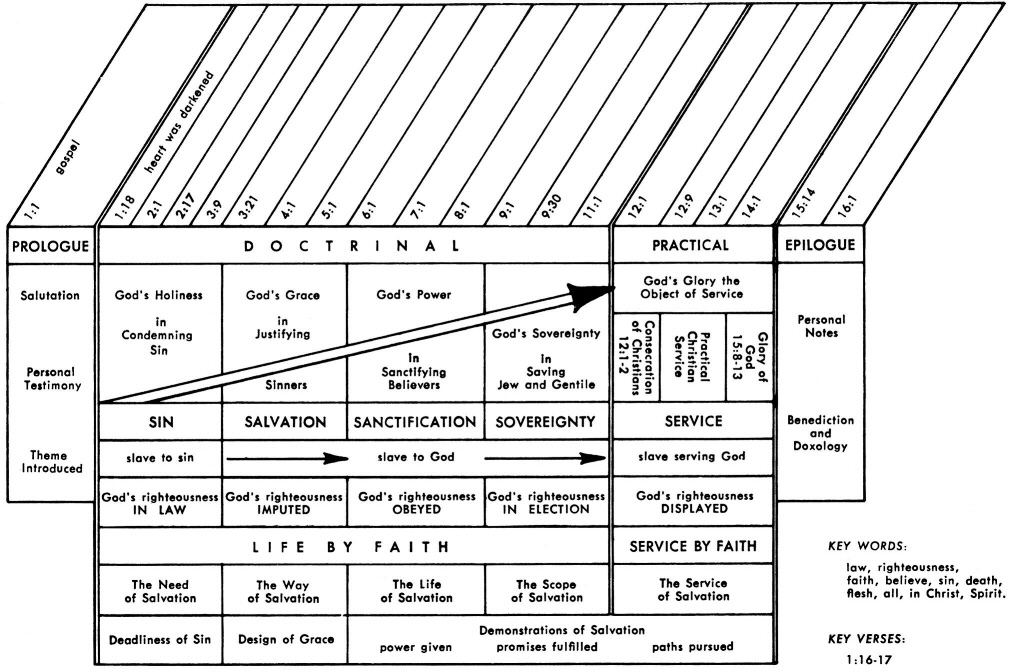
Click chart to enlarge
Chart from recommended resource Jensen's Survey of the NT - used by permission
Romans Overview Chart - Charles Swindoll
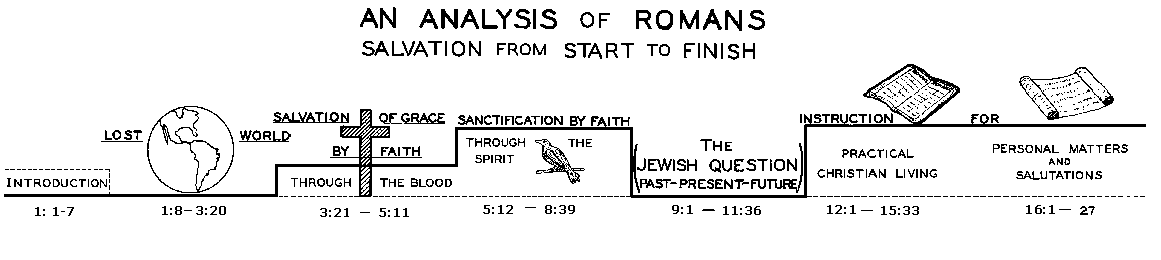
Source: Dr David Cooper
Click to Enlarge
| ROMANS ROAD to RIGHTEOUSNESS |
||||
| Romans 1:18-3:20 | Romans 3:21-5:21 | Romans 6:1-8:39 | Romans 9:1-11:36 | Romans 12:1-16:27 |
| SIN | SALVATION | SANCTIFICATION | SOVEREIGNTY | SERVICE |
| NEED FOR SALVATION |
WAY OF SALVATION |
LIFE OF SALVATION |
SCOPE OF SALVATION |
SERVICE OF SALVATION |
| God's Holiness In Condemning Sin |
God's Grace In Justifying Sinners |
God's Power In Sanctifying Believers |
God's Sovereignty In Saving Jew and Gentile |
Gods Glory The Object of Service |
| Deadliness of Sin |
Design of Grace |
Demonstration of Salvation | ||
| Power Given | Promises Fulfilled | Paths Pursued | ||
| Righteousness Needed |
Righteousness Credited |
Righteousness Demonstrated |
Righteousness Restored to Israel |
Righteousness Applied |
| God's Righteousness IN LAW |
God's Righteousness IMPUTED |
God's Righteousness OBEYED |
God's Righteousness IN ELECTION |
God's Righteousness DISPLAYED |
| Slaves to Sin | Slaves to God | Slaves Serving God | ||
| Doctrine | Duty | |||
| Life by Faith | Service by Faith | |||
|
Modified from Irving L. Jensen's chart above |
||||
R Ruin (Romans 1:17 – 3:20) – The utter sinfulness of humanity
O Offer (Romans 3:21-31) – God’s offer of justification by grace
M Model (Romans 4:1-25) – Abraham as a model for saving faith
A Access (Romans 5:1-11) – The benefits of justification
N New Adam (Romans 5:12-21) – We are children of two “Adams”
S Struggle w/ Sin (Romans 6:1-8:39) Struggle, sanctification, and victory
Romans 7:21 I find then the principle that evil is present in me, the one who wants to do good. (NASB: Lockman)
Greek: Heurisko (1SPAI) ara ton nomon to thelonti (PAPMSD) emoi poiein (PAN) to kalon hoti emoi to kakon parakeitai; (3SPMI)
Amplified: So I find it to be a law (rule of action of my being) that when I want to do what is right and good, evil is ever present with me and I am subject to its insistent demands. (Amplified Bible - Lockman)
Berkley: Consequently, I discover a law hat when I want to do right, wrong suggestions crowd in
Moffatt: So this is my experience of the Law: I desire to do what is right but wrong is all that I can manage; I cordially agree with God's law, so far as my inner self is concerned,
NLT: It seems to be a fact of life that when I want to do what is right, I inevitably do what is wrong. (NLT - Tyndale House)
Wuest: I find therefore the law, that to me, always desirous of doing the good, to me, the evil is always present.
Young's Literal: I find, then, the law, that when I desire to do what is right, with me the evil is present,
WHAT CONCLUSION DOES HE COME TO REGARDING HIS CONFLICTING BEHAVIOR? WHAT IS THE PRINCIPLE HE CONCLUDES?
I FIND THEN THE PRINCIPLE THAT EVIL IS PRESENT IN ME, THE ONE WHO WANTS TO DO GOOD: Heurisko (1SPAI) ara ton nomon, to thelonti (PAPMSD) emoi poiein (PAN) to kalon, hoti emoi to kakon parakeitai (3SPMI):
- Ro 7:23; 6:12,14; 8:2; Ps 19:13; 119:133; Jn 8:34; Eph 6:11, 12, 13; 2Pet 2:19
- 2Chr 30:18,19; Ps 19:12; 40:12; 65:3; 119:37; Isa 6:5, 6, 7; Zec 3:1, 2, 3, 4; Lk 4:1; Heb 2:17; 4:15
- Romans 7 Resources - Multiple Sermons and Commentaries
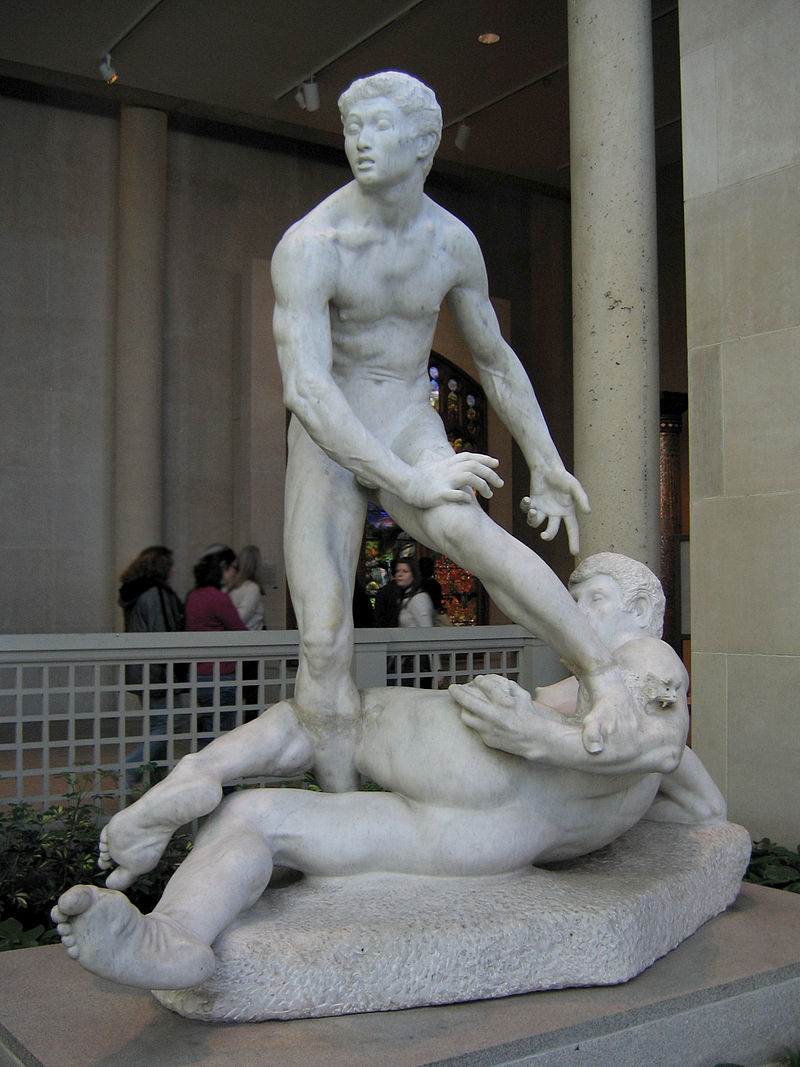
The Struggle of the Two Natures in Man
George Grey Barnard (carved 1892–94)
As you study these passages remember the context. Beginning in Romans 7:14 Paul begins to discuss the conflict between two natures. This section has been one of the most controversial in the New Testament. The majority of modern commentators (men like John MacArthur, John Piper, William Newell, Donald Barnhouse, et al) favor this section to be a description of a saved man who is wrestling with the sinful propensities still present in the physical body of every saved individual. Others feel Paul is discussing an unsaved man in this section. Although I favor the former interpretation, the principles that can be gleaned from Paul's teaching on this struggle are still applicable to all men whatever their status regarding salvation. Click here for a summary of the arguments that favor Romans 7:14-25 as a description of a believer over an unbeliever (or vice versa), as there are legitimate points favoring both interpretations.
The language clearly indicates a purpose to summarize what has gone before.
Then (686) (ara) can be translated therefore, then, now, consequently and is used to mark a transition to what naturally follows from the preceding arguments.
I find - The Greek verb here is heurisko which gives us our English "Eureka!" - I found it - This exclamation is attributed to Archimedes on discovering a method for determining the purity of gold.
Find (2147) (heurisko) means to learn the location of something, either by intentional searching or by unexpected discovery learn whereabouts of something. It means to find, discover, come upon, happen to find, to learn something previously not known, frequently involving an element of surprise. Heurisko is the source of our English word eureka from an exclamation attributed to Archimedes on discovering a method for determining the purity of gold. The present tense indicates continuous actions.
Leon Morris writes that "I find puts this as a discovery. It is not something that Paul lays down as his presupposition, but a conclusion he has reached from a study of the facts. There is some emphasis on the fact that the self-same “I” has both these opposite experiences. Paul insists that he has the will to do good. But the trouble is that evil is right there with me. He cannot escape it. (Morris, L. The Epistle to the Romans. Grand Rapids, Mich.; Leicester, England: W. B. Eerdmans; Inter-Varsity Press)
Wayne Barber writes that…
Paul says, I find, actually I have discovered (heurisko) a principle, a "law," that "the evil (kakos)" is present in me. It is inherent in my flesh. He is simply restating what he said in Romans 7:18. In his flesh is a law (prinicple); it is the very presence of evil within his flesh, his body of sin. But, he says, he is "the one who wishes to do good." Again, the word there is thelo—he has "determined in his will" to do good. It doesn’t make a lot of sense to me that a person who is in Adam, under the law, doomed to the unrighteous works of the flesh, ungodly, devoted to sin, and an enemy to all that God represents, would say "I’m the one who wishes to do good."
The principle that evil is present - In Romans 7:22-23 Paul describes an opposing principle, the law of God.
Principle (3551) (nomos) is used in this context to stand for the regulative principle which exercises a control over one. Clearly in this context nomos does not refer to the Mosaic Law, but to an inviolable spiritual principle (see similar use Romans 8:2 [note]). It could be considered analogous to the phrase, the "law" of gravity (but see Wuest's note below). Nomos is used in the sense of a principle of operation, similar to Paul's use earlier in the letter, where he speaks of law of faith (Ro 3:27-note) and as he does in Galatians, where he speaks of the law of Christ (Galatians 6:2).
Newell writes that Paul…
now states as a settled conclusion, what he has experimentally discovered. And we all need to consent to the fact-even if we have found God's way of deliverance, that evil is present. It is the denial of this fact that has wrecked thousands of lives! For evil will be present until the Lord comes, bringing in the redemption of our bodies.
Wuest explains that law (principle)…
… could refer to a law such as the constant rule of experience imposing itself on the will such as a modern scientific law, or the Mosaic law, or to the law of sin which Paul speaks of as in his members (Vincent). The last interpretation seems most in keeping with the times in which Paul is writing, and with the context. The law in his members warring against the law of his mind is, of course, the evil nature. Paul finds a condition that when he desires to do good, this evil nature always asserts itself against the doing of that good. He brings out the same truth in Gal 5:17 (note) where he says,
“The flesh (evil nature) has a passionate desire to suppress the Spirit, and the Spirit has a passionate desire to suppress the flesh. And these are set in opposition to each other so that you may not do the things which you desire to do.” (Wuest's Word Studies from the Greek New Testament: Eerdmans)
In this verse Paul says that evil is the constant rule of experience imposing itself on the will. Paul found that evil is still present in an individual whenever he wants to do good.
Barnes has a good explanation of the law writing that…
There is a law whose operation I experience whenever I attempt to do good. There have been various opinions about the meaning of the word law in this place. It is evident that [it] is used here in a sense somewhat unusual. But it retains the notion which commonly attaches to it of that which binds, or controls. And though this to which he refers differs from a law, inasmuch as it is not imposed by a superior, which is the usual idea of a law, yet it has so far the sense of law that it binds, controls, influences, or is that to which he was subject. There can be no doubt that he refers here to his carnal and corrupt nature; to the evil propensities and dispositions which were leading him astray. His representing this as a law is in accordance with all that he says of it, that it is servitude, that he is in bondage to it, and that it impedes his efforts to be holy and pure. The meaning is this: "I find a habit, a propensity, an influence of corrupt passions and desires, which, when I would do right, impedes my progress, and prevents my accomplishing what I would." Comp. Gal 5:17-note. Every Christian is as much acquainted with this as was the apostle Paul. (Albert Barnes. Barnes NT Commentary)
MacDonald adds that Paul…
finds a principle or law at work in his life causing all his good intentions to end in failure. When he wants to do what is right, he ends up by sinning. (MacDonald, W & Farstad, A. Believer's Bible Commentary: Thomas Nelson)
Lingering sin does battle with every good thing a believer desires to do. The Sin Nature wants us to try to do good apart from God. Even if based upon the Word of God but to take the truth, the Word and try to work it according to the flesh.
The Lord warned Cain who was angry with Abel because his sacrifice was accepted…
If you do well, will not your countenance be lifted up? And if you do not do well, sin is crouching at the door; and its desire is for you, but you must master it. (Genesis 4:7)
Here in Romans 7:21 Paul is saying that this "principle" still applies and sin is always in the shadows, ready to pounce and lead us into disobedience. We must master it! I don't understand exactly how Cain was to accomplish this but Paul goes on in the next verses (and Romans 8) to explain how believers can accomplish this task.
Haldane makes an interesting observation noting that…
The evil propensity of our nature the Apostle calls a law (principle), because of its strength and permanence. It has the force of a law in corrupt nature. This proves that it is of himself, as to his present state, that the Apostle speaks. None but the regenerate man is properly sensible of this law.
It does not refer to conscience, which in an unregenerate man will smite him when he does that which he knows to be wrong. It refers to the evil principle which counteracts him when he would do that which is right.
This law is the greatest grievance to every Christian. It disturbs his happiness and peace more than any other cause. It constantly besets him, and, from its influence, his very prayers, instead of being in themselves worthy of God, need forgiveness, and can be accepted only through the mediation of Christ. It is strange that any Christian should even hesitate as to the character in which the Apostle uses this language. It entirely suits the Christian, and not in one solitary feature does it wear the feeblest semblance of any other character. (Haldane, R. An Exposition of Romans)
S Lewis Johnson offers an interesting analysis of this last section writing that in…
In the final cycle of the apostle's reasoning he points out that the enemy within is stronger than his renewed self (Ed note: referring to the Christian). The new life alone is not sufficient for overcoming in the struggle for victory. The another law which always wins the battle against the law of his mind and brings him into captivity is the "law" of indwelling sin (cf. Romans 7:21, 25). The believer, thus, is always in a losing conflict. The present tenses of verse twenty-three vividly portray the habitual struggle that always ends, it seems, in defeat. And, finally, there comes the agonizing cry of verse twenty-four,
"Oh, wretched man that I am! Who shall deliver me from the body of this death?"
The body is the body looked at as that in which the death of indwelling sin is located. Paul is now at the end of self, the only time God can come in and deliver the believer. No longer is he looking within; it is "who shall deliver me?" It was Alfred Lord Tennyson who wrote,
Oh! that a man would arise in me
That the man I am may cease to be
That is the cry of the concerned Christian, cognizant of his weakness in himself and longing for deliverance from the thralldom of indwelling sin. In the final verse of the section the apostle breaks forth with a cry of victory, "I thank God through Jesus Christ, our Lord." There IS such a man! Trust in Him is the answer to the longing for deliverance. He says here what he will say in an expanded way in the next chapter (cf. Romans 8:1-11). The victory is found in the continuing ministry of the Holy Spirit and in His final deliverance at the resurrection.
Present (3873) (parakeimai from pará = near, with + keímai = to lie) (only other NT use Ro 7:18) means literally to lie near and so to be adjacent to or to be within reach (present tense = continually). It is used with the metaphorical meaning in this verse which conveys the idea of to be at hand or be present.
Barnes explains that the idea of parakeimai means…
Is near; is at hand. It starts up unbidden, and undesired. It is in the path, and never leaves us, but is always ready to impede our going, and to turn us from our good designs. Compare Psalm 65:3, "Iniquities prevail against me." (Spurgeon's comment) The sense is, that to do evil is agreeable to our strong natural inclinations and passions. (Ibid)
Wants (2309) (thelo) describes that desire (present tense = continually) which comes from one’s emotions. It is a predetermined and focused will that one sets to do. It is an active decision of the will, implying volition (will) and purpose. It is a conscious willing that denotes a more active resolution urging on to action.
To do (4160) (poieo) means to make or to do and expresses action either as completed or continued (present tense = continually).
Good (2570) (kalos) refers to that which is inherently excellent or intrinsically good.
Can not all believers identify with the way Hendriksen sums up Romans 7:22 noting that…
The inflexible “law” to which reference is here made, and which the author of this epistle—as well as every believer—is constantly discovering, is this: “When I want to do good, evil lies close at hand.” In view of the fact that, according to Ro 7:17, 20, sinful human nature has established its residence in Paul’s own house (his soul), and has done this with a wicked purpose, the statement “evil lies close at hand,” is indeed very logical. This “evil,” here personified, may be lying down, but is certainly not sleeping. It is pictured as if it were watching the apostle to see whether he is about to carry out a good intention. Whenever such a noble thought or suggestion enters Paul’s heart, evil immediately interrupts in order to turn the good deed into its opposite. (Hendriksen, W., & Kistemaker, S. J. NT Commentary Set. Baker Book)
Guzik writes "Anyone who has tried to do good is aware of this struggle. We never know how hard it is to stop sinning until we try.“No man knows how bad he is until he has tried to be good.” (C. S. Lewis)" (Romans 7 Commentary)
Romans 7:22 For I joyfully concur with the law of God in the inner man, (NASB: Lockman)
Greek: sunedomai (1SPMI) gar to nomo tou theou kata ton eso anthropon,
Amplified: For I endorse and delight in the Law of God in my inmost self [with my new nature]. (Amplified Bible - Lockman)
Moffatt: I cordially agree with God's law, so far as my inner self is concerned,
NLT: I love God's law with all my heart. (NLT - Tyndale House)
Wuest: For I rejoice in the law of God according to the inward man. (
Young's Literal: For I joyfully concur with the law of God in the inner man,
WHAT IS HIS ASSESSMENT OF THE LAW OF GOD?
FOR I JOYFULLY CONCUR WITH THE LAW OF GOD IN THE INNER MAN: sunedomai (1SPMI) gar to nomo tou theou kata ton eso anthropon:
- Ro 8:7; Job 23:12; Ps 1:2; 19:8, 9, 10; 40:8; 119:16, 24, 35, 47, 48, 72, 92; Ps 119:97 104, 111, 113, Ps 119:127,167,174; Isa 51:7; Jn 4:34; Heb 8:10
- Ro 2:29; 2Co 4:16; Eph 3:16; Col 3:9; 1Pet 3:4
- Romans 7 Resources - Multiple Sermons and Commentaries
For (gar) introduces the explanation of the conflict of good and evil Paul had just discussed in Romans 7:21.
I joyfully concur - This is a stronger expression than agree with the Law (Ro 7:16-note)
Joyfully concur (4913) (sunedomai from sún = with + hedomai = to be pleased from hedos = delight, enjoyment) means to rejoice in with oneself, to feel satisfaction concerning, to joyfully agree (present tense = continually). Others attribute to it the meaning of inward satisfaction. Would an unsaved man have this response?
Barnes has an interesting note on sunedomai writing that it…
occurs nowhere else in the New Testament. It properly means, to rejoice with any one; and expresses not only approbation of the understanding, as the expression, "I consent unto the law," in Romans 7:16 (note), but, more than that, it denotes sensible pleasure in the heart. It indicates not only intellectual assent, but emotion--an emotion of pleasure in the contemplation of the law.
And this shows that the apostle is not speaking of an unrenewed man. Of such a man it might be said that his conscience approved the law; that his understanding was convinced that the law was good; but never yet did it occur that an impenitent sinner found emotions of pleasure in the contemplation of the pure and spiritual law of God. If this expression can be applied to an unrenewed man, there is, perhaps, not a single mark of a pious mind which may not with equal propriety be so applied. It is the natural, obvious, and usual mode of denoting the feelings of piety, an assent to the Divine law followed with emotions of sensible delight in the contemplation. Comp. Ps 119:97, "O how love I thy law; it is my meditation all the day." Ps 1:2, "But his delight is in the law of the Lord (see expositon)." Ps 19:7, 8, 19, 10, 11; Job 23:12. (Albert Barnes. Barnes NT Commentary)
Law (see note above) of God - This principle is opposed to the Law of sin, which brings his members (i.e., his body, his hands, his tongue, etc.) into captivity.
KJV Bible Commentary explains that…
Paul has come to the conclusion that as long as the believer is alive there will be a constant warfare between the old sinful nature and his delight in the law of God. Unfortunately, when the believer attempts to win that battle in himself, he is always defeated. Self-attempts to rid our members of the tyranny of indwelling sin cause the frustration which underlies this passage. (Dobson, E G, Charles Feinberg, E Hindson, Woodrow Kroll, H L. Wilmington: KJV Bible Commentary: Nelson)
Inner (2080) (eso from eis = in, into) means Into, in, within. Eso when used with a prefixed article ("the") assumes the role of an adjective. As used by Paul, the inner man means the mind or soul.
Note that the only other use of the phrase the inner man (also by Paul) clearly in context refers to believers…
that He would grant you, according to the riches of His glory, to be strengthened with power through His Spirit in the inner man (Ep 3:16-note)
Charles Ryrie writes that…
an unbeliever would not say this, further supporting the view that Paul is relating his experience as a believer." (The Ryrie Study Bible: New American Standard Translation: 1995. Moody Publishers)
Henry Morris (who feels this section refers to a believer) says
The "inward man" here is evidently the same as the new man, for the old man (see note Romans 6:6) could never "delight in the law of God." (Morris, Henry: Defenders Study Bible. World Publishing)
Hendriksen comments on the inner man writing that…
Now the apostle states that he delights in God’s law according to his inner being. When he uses such phraseology he is not copying Plato or the Stoics. He is not expressing a contrast between man’s rational nature and his lower appetites. With Paul the inner man is the one that is hidden from the public gaze. It indicates the heart. It is here that a new principle of life has been implanted by the Holy Spirit. By means of this implantation the sinner has become a new man, a person who is being daily transformed into the image of Christ. (Hendriksen, W., & Kistemaker, S. J. NT Commentary Set. Baker Book)
Romans 7:23 but I see a different law in the members of my body, waging war against the law of my mind and making me a prisoner of the law of sin which is in my members. (NASB: Lockman)
Greek: blepo (1SPAI) de heteron nomon en tois melesin mou antistrateuomenon (PMPMSA) to nomo tou noos mou kai aichmalotizonta (PAPMSA) me en to nomo tes hamartias to onti (PAPMSD) en tois melesin mou.
Amplified: But I discern in my bodily members [in the sensitive appetites and wills of the flesh] a different law (rule of action) at war against the law of my mind (my reason) and making me a prisoner to the law of sin that dwells in my bodily organs [in the sensitive appetites and wills of the flesh]. (Amplified Bible - Lockman)
Berkley: But in my whole natural make-up I observe another law, battling against the principles which my reason dictates, and making me a prisoner to the law of sin that controls my members.
Moffatt: but then I find another law in members which conflicts with the law of my mind and makes me a prisoner to sin's law that resides in my members.
NLT: But there is another law at work within me that is at war with my mind. This law wins the fight and makes me a slave to the sin that is still within me. (NLT - Tyndale House)
Wuest: But I see a different kind of a law in my members, waging war against the law of my mind, making me a prisoner of war to the law of the sinful nature which is in my members.
Young's Literal: but I see a different law in the members of my body, waging war against the law of my mind, and making me a prisoner of the law of sin which is in my members.
WHAT WAS THE DIFFERENT LAW THAT WAS IN HIS MEMBERS? SIN INDWELLING HIM --(Ro 7:17,20) WHAT WAS THE OTHER LAW & THE 2 RESULTS?
BUT I SEE A DIFFERENT LAW IN THE MEMBERS OF MY BODY WAGING WAR AGAINST THE LAW OF MY MIND [my agreement with the law of God] : blepo (1SPAI) de heteron nomon en tois melesin mou antistrateuomenon (PMPMSA) to nomo tou noos mou:
- Ro 7:5,21,25; 8:2; Eccl 7:20; Gal 5:17; 1Ti 6:11,12; Heb 12:4; Jas 3:2; 4:1; 1Pet 2:11
- Ro 6:13,19
- Romans 7 Resources - Multiple Sermons and Commentaries
But (de) introduces another law (of sin) which contrasts to the law of God. The real Paul rejoiced in God’s law. He recognized it for what it was and rejoiced accordingly. But obeying it is another thing altogether, and to that he now turns.
See (991) (blepo) means to see and frequently with the sense of becoming aware of or taking notice of something.
D L Moody once wrote "I have more trouble with D .L. Moody than with any man I know." (To that I have to say "Amen" regarding the man I see in the mirror each morning!)
Different (2087) (heteros) means another but of a different kind. Paul saw a law different from that of the spirit of life. The law he is referring to in context is the Law of Sin "used in the sense 'principle' or 'rule of action', though with the nuance that there is some element of compulsion (he is made prisoner)." (Morris)
Law (see note above)
Members (3196) (melos) refers to the members of body as the seat of the desires and passions. Consistently Paul proceeds from his basic position that the body is not evil, though the forces of evil work through it.
Vine explains that melos in this context refers to…
A member or limb, here in the plural (see similar use in Col 3:5 [note]), is used morally, our actual limbs being used as instruments either for the world, the things on the earth, instead of being put to death, or used for Christ and His glory, and the things in the heavens. We thus either identify ourselves with the old man [note], or with the new man [note]. (Collected writings of W. E. Vine)
Here Paul is referring to the principle of indwelling sin (his unredeemed and still sinful humanness) exerting its effect in the members of his body waging war against his desire to obey God's law.
Harry Ironside writes that Paul…
He detected "another law," a principle, in his members (that is, the members of the body through which the carnal mind works) that wars against the law of his renewed mind (Romans 7:23). This principle he called "the law of sin and death." It takes him captive to the sin-principle which is inseparable from his physical members so long as he is in this life. Were it not for this principle or controlling power there would be no danger of perverting or misusing any human desire, or propensity. (Romans 7 Commentary)
Hendriksen comments on the law of God and the war with the law of sin…
If “God’s law” should be interpreted as a governing principle, as has just now been shown, logic requires that also this “different law” must be thus explained. Clearly—as the apostle states in so many words—that “different law” is the law of sin. How it operates has been indicated in verse 21. That it is making the apostle, and all true believers everywhere, prisoners is probably another way of expressing the thought of verse 14b. Again and again “the law of sin” causes the author of this letter to do what he does not want to do, and again and again it prevents him from doing what he wants to do, facts about which he bitterly complains, and which he deeply and sincerely deplores. (Hendriksen, W., & Kistemaker, S. J. NT Commentary Set. Baker Book)
Waging war against (497) (antistrateuomai from antí = against + strateuomai = wage war, lead an army, be on active service, be engaged in warfare, English words strategy, stratagem = trick) means to make a military expedition or take the field against anyone, and so oppose or war against. The present tense indicates continual warfare against. The thought of conflict is important. Paul is still in a war. He has not surrendered to the powers of evil.
It is interesting that in this spiritual war in Romans 7, Paul makes repeated use of military metaphors - see "making me a prisoner" (below), compare "taking opportunity" (aphorme Ro 7:8, 11- notes Ro 7:8; 11). This military metaphor should make us realize that this is not child's play Paul is discussing in Romans 7 but is strategically important information for believers to process if we are to experience the so-called "Victorious Christian Life"! (Compare similar military pictures in Gal 5:17-note; 1Pe 2:11-note; see also 2Cor 10:5)
Sin continually (present tense) carries out a campaign against us. It isn't the idea of a skirmish or a battle or a one- time shot, but a long-term (life long) campaign.
Peter has a similar statement exhorting his readers…
Beloved, I urge you (to be dedicated to relentless and ruthless opposition to sin in our lives) as aliens and strangers to abstain (present tense = continually. Greek = literally hold yourself away from) from fleshly lusts, which wage war (present tense = continually. Strateuomai from stratos = an encamped army. Picture of carrying on a military campaign! pictures our old flesh nature = war until the day we see glory) against the soul. (1Pe 2:11-note)
Sin is personified as if it is a rebel army intent on capturing, enslaving and destroying the soul. The term implies not just antagonism, but a continual aggression that is malicious and ongoing and doesn't stop. Sin is on an incessant "search and destroy mission". The world allures us and the flesh is the beachhead by which this allurement takes place.
In the classic allegory The Holy War John Bunyan pictures a city and he calls the city Man's Soul because it represents the soul of man. And he pictures the city as surrounded by high walls. And the enemy wants to assault the soul of man but he has no way over the walls or through the walls. The only way the enemy can get to the soul is through the gate. The only way that the World or Satan can get to the otherwise impregnable soul of a believer is through the gate of fleshly lusts, the gate of fallen desire. Beloved, if you keep the gate closed, you cannot lose the war. You say, "How do you do that?" (Gal 5:16-note) It's all about living in the spiritual dimension. It's all about being continually filled with and walking in the Spirit's power. The battle begins on the "inside". And the weapons of our warfare are spiritual not fleshly.
George Cutting writes that…
The law, though he delights in it after the inward man, gives him no power. In other words, he is trying to accomplish what God has declared to be an utter impossibility—namely, making the flesh subject to God’s holy law. He finds that the flesh minds the things of the flesh, and is very enmity itself to the law of God, and even to God Himself. (George Cutting, “The Old Nature and the New Birth”)
Law of my mind - this refers to the new inner self which longs to obey the Law of God. The mind emphasizes the intellectual side of the struggle. Because we are new creatures in Christ, believers have a new nature or capacity for loving spiritual truth. And yet Paul's experience bore testimony to the fact that there was another, opposing law at work in him, the principle or law of sin (cp "sin which indwells me" in Ro 7:17+; Ro 7:20+])
Mind (3563) (nous) refers to the organ of mental perception and apprehension, of conscious life, of the consciousness preceding actions or recognizing and judging them. The mind has the capacity for perceiving and making moral judgments.
MacArthur explains that Paul is describing a believer's mind where the "mind… here corresponds to the redeemed inner man about whom Paul has been talking. Paul is not setting up a dichotomy between the mind and the body but is contrasting the inner man, or the redeemed “new creature” (cf. 2Cor. 5:17+), with the “flesh” (Ro 7:25), that remnant of the old man that will remain with each believer until we receive our glorified bodies (Ro 8:23+). Paul is not saying his mind is always spiritual and his body is always sinful. In fact, he confesses that, tragically, the fleshly principle undermines the law of his mind and temporarily makes him a prisoner of the law of sin which is in his members.
With the mind he serves the law (note) of God and describing the war he says that with his flesh the law (principle) of sin (Ro 7:25). The conflict in (Gal 5:17+) is similar but not identical because there Paul refers to the 2 conflicting sides as Spirit and "flesh", whereas here he refers to the "law in the members" ("law of sin") of the body versus "the law of" the mind. (See chart contrasting in the flesh versus in the Spirit)
BKC notes that "despite a believer’s identification with Jesus Christ’s death and resurrection and his efforts to have Christ-honoring attitudes and actions, he cannot in his own power resist his indwelling sin nature. In and of himself he repeatedly experiences defeat and frustration. (Walvoord, J. F., Zuck, R. B., et al: The Bible Knowledge Commentary. 1985. Victor)
KJV Bible Commentary agrees writing that
Paul has come to the conclusion that as long as the believer is alive there will be a constant warfare between the old sinful nature and his delight in the law of God. Unfortunately, when the believer attempts to win that battle in himself, he is always defeated. Self-attempts to rid our members of the tyranny of indwelling sin cause the frustration which underlies this passage. (Dobson, E G, Charles Feinberg, E Hindson, Woodrow Kroll, H L. Wilmington: KJV Bible Commentary: Nelson)
Spurgeon - It is some comfort when we feel a war within the soul to remember that it is an interesting phase of Christian experience. Such as are dead in sin have never made proof of any of these things. These inward conflicts show that we are alive. There is some life in the soul that hates sin, even though it cannot do as it would. Do not be depressed about it. Where there is pain there is life.
AND MAKING ME A PRISONER OF THE LAW OF SIN WHICH IS (continuously) IN MY MEMBERS: kai aichmalotizonta (PAPMSA) me en to nomo tes hamartias to onti (PAPMSD) en tois melesin mou:
- Ro 7:14; Ps 142:7; 2Ti 2:25,26
- Romans 7 Resources - Multiple Sermons and Commentaries
Making me a prisoner (163) (aichmalotizo from aichmálotos = a prisoner, captive from aichme = spear) means to make captive, to lead away captive or to bring into captivity. A related word aichmaloteuo means to gain complete control over, either by force or deception.
Barnes comments that aichmalotizo means…
Making me a prisoner, or a captive. This is the completion of the figure respecting the warfare. A captive taken in war was at the disposal of the victor. So the apostle represents himself as engaged in a warfare; and as being overcome, and made an unwilling captive to the evil inclinations of the heart. The expression is strong; and denotes strong corrupt propensities. But though strong, it is believed it is language which all sincere Christians can adopt of themselves, as expressive of that painful and often disastrous conflict in their bosoms when they contend against the native propensities of their hearts. (Albert Barnes. Barnes NT Commentary)
Law (see note above)
Sin (266) refers to the Sin principle or propensity inherited from Adam (see "the Sin")
Sin still indwells believers but the difference now is that we have been crucified with Christ and the body of Sin's power has been rendered ineffective or inoperative, we are no longer slaves to "the Sin" (see note Romans 6:6).
Members (3196) (melos) refers to the members of body as the seat of the desires and passions. Again there is a reference to my members (cf. Ro 6:13, 19, 7:5-see notes Ro 6:13, 19; 7:5) for the members of the physical body are that through which sin makes its suggestions.
To make someone a prisoner is to have complete control over them and therefore many commentators question how could this description possibly refer to a believer and they use this verse as one to support their premise that (Ro 7:14-25) is referring to an unbeliever - believers have been freed from sin (see note Ro 6:7, Ro 6:18, Ro 6:22).
S Lewis Johnson (who feels that Romans 7 refers to the struggles of a believer) explains that Paul…
points out that the enemy within is stronger than his renewed self. The new life alone is not sufficient for overcoming in the struggle for victory. The "another law" which always wins the battle against the law of his mind and brings him into captivity is the "law" of indwelling sin (cf. Ro 7:21, 25). The believer, thus, is always in a losing conflict. The present tenses of verse twenty-three vividly portray the habitual struggle that always ends, it seems, in defeat. And, finally, there comes the agonizing cry of verse twenty-four, "Oh, wretched man that I am! Who shall deliver me from the body of this death?" The body is the body looked at as that in which the death of indwelling sin is located. Paul is now at the end of self, the only time God can come in and deliver the believer. No longer is he looking within; it is "who shall deliver me?"
It was Alfred Lord Tennyson who wrote,
"Oh! that a man would arise in me
That the man I am may cease to be."
That is the cry of the concerned Christian, cognizant of his weakness in himself and longing for deliverance from the thralldom of indwelling sin. In the final verse of the section the apostle breaks forth with a cry of victory, "I thank God through Jesus Christ, our Lord." There IS such a man! Trust in Him is the answer to the longing for deliverance. He says here what he will say in an expanded way in the next chapter (cf. Ro 8:1-11). The victory is found in the continuing ministry of the Holy Spirit and in His final deliverance at the resurrection.
The last sentence of the chapter is a concluding statement in which he summarizes the major point of the preceding section. The believer's struggle is that between the mind (he avoids the term spirit, although the mind is closely related to the spirit, because there might be a tendency to refer that to the new nature of the believer in conjunction with the Holy Spirit. That is what he wishes to avoid. In Romans eight we do not have the mind at all) and the flesh. These two entities within the believer struggle for control so long as the believer is in the flesh and until the resurrection of the body.
Conclusion - The apostle has made plain the inability of the flesh in the believer to give victory, even though the believer now possesses a new principle of life in the new nature. God must do something for us, if we are to be saved from the penalty of sin (Ed note: justification), and He must do something in us, if we are to have deliverance in this life (Ed note: sanctification). And He must do something for us and in us at the resurrection, if we are to have ultimate deliverance from sin and its consequences (Ed note: glorification). That He has done, is doing, and will yet do, the Scriptures say. It all adds up to the sufficiency of Jesus Christ and His saving work for our inability, whether that of the unconverted man (cf. Ro 8:8) or of the converted man (cf. Ro 7:24). We do thank God through Jesus Christ, our Lord. This sufficiency is received only when our inabilities are acknowledged. When we give up. He takes up. May the Lord give us the desire to please Him in a holy life and the will to give Him the reins of our hearts that He may produce His overcoming life in and through us by the Spirit! (full sermon Romans 7:13-25) (Bolding added)
Newell adds that in this section…
Here is first, delight, second, discernment, and third, defeat.
1. First, delight: in God's Law, Paul delights - this is a strong and inclusive word. And, after the inward man, - thus revealing himself as regenerate throughout this struggle: No unregenerate man would say, (unless profane) "It is no more I that do it, but sin which dwelleth in me:" For,
(1) An unregenerate man is not conscious of a moral power which is not himself: for he has but the one nature, -he is "in the flesh."
(2) An unregenerate man could not say, "What I hate, that I do." For only born-again people hate evil. "Ye that love Jehovah, hate evil" (Ps. 97.10), and David could say of him- self, "I hate every false way" (Ps 119:104). But of the wicked he wrote, "He abhorreth not evil" (Ps 36:4).
(3) An unregenerate man could not say, "What I would not, that I do, -I consent to the Law that it is good." An unregenerate man resists the Law, that he may "justify him- self." A regenerate man consents to the Law's being good, no matter how it judges what he finds himself doing! (Ro 7:16).
(4) The unregenerate man could not say, "I delight in the Law of God after the inward man." For by nature all men are "children of wrath, "" alienated from the life of God"; and "the mind of the flesh is enmity against God, not subject to the Law of God." Before his conversion, Saul, as we saw, could help to stone Stephen, -"verily thinking he ought" to do it; but Paul was not then seeking holiness (as the man in Romans Seven is), but was secure in his own righteousness as a legalist.
(5) The unregenerate man could not say, "Wretched man that I am!" For he could not see his wretchedness! His whole life was to build up that which was the flesh.
(6) If you claim that the "wretched man" of Romans Seven is an unregenerate man under conviction of sin, the complete reply is, that this man of Romans Seven is crying for deliverance, -not from sin's guilt and penalty, but from its power. Not for forgiveness of sins, but help against indwelling sin. This man is exercised, not about the day of judgment, but about a condition of bondage to that which he hates. The Jews on the Day of Pentecost, and the jailor at Philippi, cried out in terror, "What shall we do to be saved?" It was guilt and danger they felt. But this man in Romans Seven cries, "Who shall deliver me" (not from guilt) but, "from this body of death?" No one but a quickened soul ever knows about a "body of death"!
(7) But perhaps the most striking argument of all is in the closing words of Chapter Seven-verse 25: "Therefore then I myself with the mind, am subject to God's Law, but with the flesh to sin's law." Here we have both spiritual life and consciousness; also, discernment. and discrimination of both his real true new self, which chooses God and His will and of the flesh which will continue to choose "sin's law": and all this conclusion after he has realized deliverance from the "body of death" through our Lord Jesus Christ!
2. Second, discernment: I see a different law in my members.
It is the unwillingness to own this different law, this settled state of enmity, toward God, in our own members, that so terribly bars spiritual blessing and advancement. As long as we think lightly of the fact of the presence with us of the fallen nature, (I speak of Christians) we are far from deliverance.
In the law of leper-cleansing (Lev 13:2ff), "if a man shall have in the skin of his flesh a rising, " or even "a white rising"-he was unclean. (See the various degrees of the plague.) But, "If the leprosy break out abroad in the skin, and the leprosy cover all the skin of him that hath the plague from his head even to his feet, as far as appears to the priest; then the priest shall look; and, behold, if the leprosy have covered all his flesh, he shall pronounce him clean that hath the plague: it is all turned white: he is clean"!
It is significant that at the conclusion of the Sermon on the Mount, (Mt 8:1, 2, 3, 4) two things should be there: (1) A leper -showing the Law could cleanse no one. (2) A leper, as Luke the physician tells us, "full of leprosy" (Lk 5:12). It is because people do not recognize their all-badness that they do not find Christ all in all to them.
3. Third, defeat: There is no strength or power in ourselves against the law of sin which is in our members. God has left us as much dependent on Christ's work for our deliverance as for our forgiveness! It is wholly because we died with Him at the cross, both to sin and to the whole legal principle, that sin's power, for those in Christ, is broken. (Romans 7 Commentary)
Romans 7:24 Wretched man that I am! Who will set me free from the body of this death? (NASB: Lockman)
Greek: talaiporos ego anthropos; tis me rhusetai (3SFMI) ek tou somatos tou thanatou toutou?
Amplified: O unhappy and pitiable and wretched man that I am! Who will release and deliver me from [the shackles of] this body of death? (Amplified Bible - Lockman)|
Barclay: O wretched man that I am! Who will deliver me from this fatal body? (Westminster Press)
Moule: Unhappy man am I. Who will rescue me out of the body of this death, out of a life conditioned by this mortal body, which in the Fall became Sin’s especial vehicle, directly or indirectly, and which is not yet (see Ro 8:23) actually “redeemed”?
NLT: Oh, what a miserable person I am! Who will free me from this life that is dominated by sin? (NLT - Tyndale House)
Wuest: Wretched man, I. Who shall deliver me out of the body of this death?
Young's Literal: Wretched man that I am! Who will set me free from the body of this death?
DEFEATED AND TAKEN PRISONER… WHAT WAS HIS ASSESSMENT OF HIS CONDITION? WHAT WAS HIS CRY? WHO WAS THE ANSWER?
WRETCHED MAN THAT I AM: Talaiporos ego anthropos:
- Ro 8:26; 1Ki 8:38; Ps 6:6; 32:3,4; 38:2,8, 9, 10; 77:3, 4, 5, 6, 7, 8, 9; 119:20,81, 82, 83,131; Ps 119:143,176; 130:1, 2, 3; Ezek 9:4; Mt 5:4,6; 2Cor 12:7, 8, 9; Rev 21:4
- Romans 7 Resources - Multiple Sermons and Commentaries
Cranfield has a pithy note writing that "Many commentators, including—surprisingly—not a few in the Reformed tradition (e.g., Denney), have stated quite dogmatically that it cannot be a Christian who speaks here. But the truth is, surely, that inability to recognize the distress reflected in this cry as characteristic of Christian existence argues a failure to grasp the full seriousness of the Christian’s obligation to express his gratitude to God by obedience of life. The farther men advance in the Christian life, and the more mature their discipleship, the clearer becomes their perception of the heights to which God calls them, and the more painfully sharp their consciousness of the distance between what they ought, and want, to be, and what they are. The assertion that this cry could only come from an unconverted heart, and that the apostle must be expressing not what he feels as he writes but the vividly remembered experience of the unconverted man, is, we believe, totally untrue. To make it is to indicate—with all respect be it said—that one has not yet considered how absolute are the claims of the grace of God in Jesus Christ. The man, whose cry this is, is one who, knowing himself to be righteous by faith, desires from the depths of his being to respond to the claims which the gospel makes upon him (cf. Ro 7:22). It is the very clarity of his understanding of the gospel and the very sincerity of his love to God, which make his pain at this continuing sinfulness so sharp. (Cranfield, C. E. B.. A Critical and Exegetical Commentary on the Epistle to the Romans. London; New York: T&T Clark International)
Wretched (5005) (talaiporos from tálas = suffering, wretched or according to A T Robertson from tlao = to bear + poros = a callus) means afflicted, miserable, in a distressed condition, beaten down from from continued strain and leaving a person literally full of callouses (= deep misery). . Wretched describes a very unhappy or unfortunate state in poor or pitiful circumstances. Talaiporos is an expression used in pagan Greek drama to express tragic misfortune and woe. Wretched through the exhaustion of hard labor. Paul is completely worn out and wretched because of his unsuccessful effort to please God under the principle of Law.
Vincent writes that "Originally, wretched through the exhaustion of hard labor."
Paul recognizes that he is in a helpless state of despair because he cannot rid himself of his bent toward sinning.
Harry Ironside explains that Paul "Almost convinced that the struggle must go on during the entire course of his earthly existence he cried in anguish, "O wretched man that I am! who shall deliver me from the body of this death?" (Romans 7:24) He is like a living man chained to a polluted, because corrupt, corpse, and unable to snap the chains. He cannot make the corpse clean and subject, no matter how he tries. It is the cry of hopelessness so far as self-effort is concerned. He is brought to the end of human resources. In a moment he gets a vision by faith of the risen Christ. He alone is the deliverer from sin's power, as well as the Savior from the penalty of guilt. "I thank God," he cries, "through Jesus Christ our Lord"! He has found the way out. Not the law but Christ in glory is the rule of life for the Christian.
Morris makes an interesting point - It is worth bearing in mind that the great saints through the ages do not commonly say, ‘How good I am!’ Rather, they are apt to bewail their sinfulness.
Wiersbe explains that "The believer has an old nature that wants to keep him in bondage; “I will get free from these old sins!” the Christian says to himself. “I determine here and now that I will not do this any longer.” What happens? He exerts all his willpower and energy, and for a time succeeds; but then when he least expects it, he falls again. Why? Because he tried to overcome his old nature with Law, and the Law cannot deliver us from the old nature. When you move under the Law, you are only making the old nature stronger; because “the strength of sin is the Law” (1Cor. 15:56). Instead of being a dynamo that gives us power to overcome, the Law is a magnet that draws out of us all kinds of sin and corruption. The inward man may delight in the Law of God (Ps. 119:35), but the old nature delights in breaking the Law of God. No wonder the believer under Law becomes tired and discouraged, and eventually gives up! He is a captive, and his condition is “wretched.” (The Greek word indicates a person who is exhausted after a battle.) What could be more wretched than exerting all your energy to try to live a good life, only to discover that the best you do is still not good enough! (Wiersbe, W: Bible Exposition Commentary. 1989. Victor)
Sanday and Headlam comment that Paul utters "A heart-rending cry from the depths of despair.'
Webster adds that wretched means "deeply afflicted, dejected, or distressed in body or mind; extremely or deplorably bad or distressing; being or appearing mean, miserable, or contemptible; very poor in quality or ability".
In the only other NT use of wretched in Rev 3:17-note Jesus describes the church at Laodicea a church that has a reason to be wretched for (although there is difference of opinion) many able scholars feel that this description is of a church of completely unregenerate people (Rev 3:20-note).
Because you say, "I am rich, and have become wealthy, and have need of nothing," and you do not know that you are wretched and miserable and poor and blind and naked" (See note Revelation 3:17)
Morris - It is worth bearing in mind that the great saints through the ages do not commonly say, ‘How good I am!’ Rather, they are apt to bewail their sinfulness. (Morris, Henry: Defenders Study Bible. World Publishing)
McGee - This is not an unsaved man who is crying, “O wretched man that I am”; this is a saved man. The word wretched carries with it the note of exhaustion because of the struggle. “Who is going to deliver me?” He is helpless. His shoulders are pinned to the floor—he has been wrestled down. Like old Jacob, he has been crippled. He is calling for help from the outside. (Thru the Bible Commentary: Nashville: Thomas Nelson)
Spurgeon - This proves that he was not attacking his sin, but that this sin was attacking him. I do not seek to be delivered from a man against whom I lead the attack. It is the man who is opposing me from whom I seek to be delivered. And so sometimes the sin that dwells in believers flies at us, like some foul tiger of the woods, or some demon, jealous of the celestial spirit within us.
Henry Alford - These words are most important to the understanding of the whole passage. We must bear in mind that it had begun with the question, Is the law sin? The apostle has proved that it is not, but is holy. He has shown the relation it holds to sin; namely, that of vivifying it by means of man’s natural aversion to the commandment. He has further shown, that in himself, even as delivered by Christ Jesus, a conflict between the law and sin is ever going on: the misery of which would be death itself were not a glorious deliverance effected. He now sums up his vindication of the law as holy; and at the same time, sums up the other side of the evidence adduced in the passage, from which it appears that the flesh is still, even in the spiritual man subject (essentially, not practically and energetically) to the law of sin,—which subjection, in its nature and consequences, is so nobly treated in chapter 8.
WHO WILL SET ME FREE: tis me rhusetai (3SFMI):
- Dt 22:26,27; Ps 71:11; 72:12; 91:14,15; 102:20; Mic 7:19; Zech 9:11,12; Lu 4:18; 2Cor 1:8-10; 2Ti 4:18; Titus 2:14; Heb 2:15
- Romans 7 Resources - Multiple Sermons and Commentaries
The body is the scene of this contest. Sin living in the members brings spiritual death to the body, and man becomes aware that he needs outside help. Paul cries out not for deliverance from the body as such, but for deliverance from the body characterized by this spiritual death-the doing of that which is evil in opposition to his desire to do that which is good.
Set free (4506) (rhuomai) means to draw or snatch to oneself and invariably refers to a snatching from danger, evil or an enemy. This basic idea of rescuing from danger is pictured by the use describing a soldier’s going to a wounded comrade on the battlefield and carrying him to safety (he runs to the cry of his comrade to rescue him from the hands of the enemy). Rhuomai emphasizes greatness of peril from which deliverance is given by a mighty act of power.
This verse is especially meaningful to Spurgeon who wrote that…
I went to that same Primitive Methodist Chapel where I first received peace with God through the simple preaching of the Word. The text happened to be, "O wretched man that I am! who shall deliver me from the body of this death?" "There," I thought, "that's a text for me." I had got as far as that, when the minister began by saying, "Paul was not a believer when he said this." I knew I was a believer, and it seemed to me from the context that Paul must have been a believer, too. Now I am sure he was. The man went on to say that no child of God ever did feel any conflict within. So I took up my hat and left the place, and I do not think I have frequented such places since.
Such a cry takes us to the very place that the Lord Jesus began the Sermon on the Mount…
“Blessed are the poor in spirit, for theirs is the kingdom of heaven” (Mt 5:3-note).
One could paraphrase this as
“Blessed are the spiritually bankrupt… Blessed are the wretched.” . Blessed is the man who has arrived at spiritual bankruptcy.
Why is such a one "blessed"? Because this is the point and if fact the only point, where God's help is given and grace flows most freely for God is opposed to the proud but gives grace to the humble (James 4:6+). Paul even as a believer learned through a personal affliction to boast in his weakness that the power of Christ might be perfected in him. It is at such a spiritual low state, when the individual realizes and confesses his helplessness to live a life that pleases to God that the Spirit of Christ engages that person. "I can't God!" to which God answers "I never said 'YOU' could" but "I can (My Spirit) and I always said I would".
Hendriksen writes that Paul…
The writer genuinely deplores the fact that due to the law of sin still operating in him, he is unable to serve God as completely and whole-heartedly as he desires. The poignant grief here expressed is definitely that of a believer. No unbeliever would ever be able to be so filled with sorrow because of his sins! The author of the outcry is Paul, speaking for every child of God. The cry he utters is one of distress, but not of despair, as verse 25 proves. Paul suffers agony, to be sure, the wretchedness brought about by strenuous exertion; that is, by trying hard, but never satisfactorily succeeding, to live in complete harmony with God’s will but failing again and again. He is looking forward eagerly to the time when this struggle will have ended. (Ibid)
I like Leon Morris' comments on the wretched cry in this verse…
Paul is expressing in forceful terms his dismay at what sin does to him. It is, moreover, important that we understand this as applying to the regenerate. It is all too easy to take our Christian status for granted. We so readily remember our victories and gloss over our defeats. We slip into a routine and refuse to allow ourselves to be disturbed by what we see as occasional and minor slips. But a sensitive conscience and a genuine sorrow for every sin are the prerequisites of spiritual depth. (Morris, L.. The Epistle to the Romans. Grand Rapids, Mich.; Leicester, England: W. B. Eerdmans; Inter-Varsity Press)
THOUGHT - Are you wretched? Are you miserable in your sin and the repeated attempts to overcome that habit, that sin that so easily entangles? Then join Paul and millions of others who have come to the end of their strength and cried out to a Merciful God
"Wretched man or woman that I am.
Have mercy on me O God!"
Guzik writes that…
Legalism always brings a person face to face with their own wretchedness, and if they continue in legalism, they will react in one of two ways. Either they will deny their wretchedness and become self-righteous Pharisees, or they will despair because of their wretchedness and give up following after God.
The entire tone of the statement (O wretched man that I am!) shows that Paul is desperate for deliverance. He is overwhelmed with a sense of his own powerlessness and sinfulness. We must come to the same place of desperation to find victory. Your desire must go beyond a vague hope to be better. You must cry out against yourself and cry out unto God with the same desperation Paul did.
Who will deliver me: Paul’s perspective finally turns to something (actually, someone) outside of himself. Paul has referred to himself some 40 times since Romans 7:13. In the pit of Paul’s unsuccessful struggle against sin, he became entirely self-focused and self-obsessed. This is the place of any believer living under law, who looks to self and personal performance rather than looking first to Jesus. The words “Who will deliver me” show that Paul has given up on himself, and asks “Who will deliver me?” Instead of “How will I deliver myself?” (Romans 7 Commentary)
Matthew Poole writes that…
It is not the voice of one desponding or doubting, but of one breathing and panting after deliverance.
One of the great expositors of Scripture in the last fifty years, Ray Stedman offers some sage and practical advice concerning Romans 7:14-25…
If we think that we have got something in ourselves that we can work out our problems with, if we think that our wills are strong enough, our desires motivated enough, that we can control evil in our lives by simply determining to do so, then we have not come to the end of ourselves yet. And the Spirit of God simply folds his arms to wait and lets us go ahead and try it on that basis. And we fail, and fail miserably -- until, at last, out of our failures, we cry, "O wretched man that I am!" Sin has deceived us, and the Law, as our friend, has come in and exposed Sin for what it is. When we see how wretched it makes us, then we are ready for the answer, which comes immediately {Ro 7:25}
Who will deliver me from this body of death? The Lord Jesus has already done it. We are to respond to the feelings of wretchedness and discouragement and failure, to which the Law has brought us because of sin in us, by reminding ourselves immediately of the facts that are true of us in Jesus Christ. Our feelings must be answered by facts.
We are no longer under the Law. That is the fact. We have arrived at a different situation; we are married to Christ, Christ risen from the dead. That means we must no longer think, "I am a poor, struggling, bewildered disciple, left alone to wrestle against these powerful urges." We must now begin to think, "No, I am a free son of God, living a normal human life. I am dead to sin, and dead to the Law, because I am married to Christ. His power is mine, right at this moment. And though I may not feel a thing, I have the power to say, "No!" and walk away and be free, in Jesus Christ."(full sermon The Continuing Struggle)
FROM THE BODY OF THIS DEATH: ek tou somatos tou thanatou toutou:
- Ro 6:6; 8:13; Ps 88:5; Col 2:11
- Romans 7 Resources - Multiple Sermons and Commentaries
The enemy who keeps the prisoner bound is here called the body of this death.
The body of death = the old sinful nature that lives in every man born in Adam and also still lurks in the dying physical body of all who are born again in Christ. Christ delivers both from the body of death. The body is the scene of this contest. Sin living in the members brings spiritual death to the body, and man becomes aware that he needs outside help. Paul cries out not for deliverance from the body characterized by this spiritual death or the doing of that which is evil in opposition to his desire to do that which is good.
Regarding the body of this death, C H Spurgeon writes that "It was the custom of ancient tyrants, when they wished to put men to the most fearful punishments, to tie a dead body to them, placing the two back to back; and there was the living man, with a dead body closely strapped to him, rotting, putrid, corrupting, and this he must drag with him wherever he went. Now, this is just what the Christian has to do. He has within him the new life; he has a living and undying principle, which the Holy Spirit has put within him, but he feels that every day he has to drag about with him this dead body, this body of death, a thing as loathsome, as hideous, as abominable to his new life, as a dead stinking carcass would be to a living man.
Wuest (favors Romans 7 as description of a believer) writes that "The words this death refer to the miserable condition of the Christian who is yet dominated more or less by the evil nature which all the while he is desiring to gain victory over. It is the death Paul speaks of in verse 9. The body here is the physical body, as that body in which the sinful nature dwells and through which, when it is in the ascendancy, it operates. Vincent quotes Meyer, “Who shall deliver me out of bondage under the law of sin into moral freedom, in which my body shall no longer serve as the seat of this shameful death?” Paul is not crying out for egress from his body but for deliverance from the condition of defeat which his residence in his physical body makes a possibility, and his lack of spiritual knowledge up to that moment, resulted in. Paul answers his question as to who shall deliver him from the compelling power of the sinful nature by saying that that deliverance comes through Jesus Christ, and he gives thanks to God for that fact. (Wuest's Word Studies from the Greek New Testament: Eerdmans)
Godet writes that "The innate power of evil, against which that of the law is shattered, is a hereditary disease, a misfortune which only becomes a fault in proportion as we consent to it personally by not struggling against it with the aids appropriate to the economy in which we live. (Romans 7:7-25 The Powerlessness of the Law to Sanctify)
The New Manners and Customs of the Bible writes that the body of death "is a reference to the Roman method of punishment in which the body of the murdered person was chained to the murderer. The murderer was then released to wander where he might, but no one was allowed to help or comfort him upon penalty of suffering the same punishment. In the hot Eastern sun the dead body would soon begin to decay, overwhelming the sentenced person not only with the smell but also with infection from the rotting flesh. It was perhaps the most horrible of all sentences that the imaginary Romans ever devised. To Paul our putrefying body of sinful flesh is like this, and only Christ can rescue us from it. (Freeman, J. M., & Chadwick, H. J. (1998)s)
Vincent adds that "The body serving as the seat of the death into which the soul is sunk through the power of sin. The body is the literal body, regarded as the principal instrument which sin uses to enslave and destroy the soul. (Romans 7: Greek Word Studies)
Ray Stedman writes that "There are teachers who teach that this passage in Romans 7 is something a Christian goes through once, then he gets out of it and moves into Romans 8 and never gets back into Romans 7 again. Nothing could be further from the truth! This is a description of what every believer will go through again and again in his experience because sin has the power to deceive us and to cause us to trust in ourselves, even when we are not aware we are doing it. The Law is what will expose that evil force and drive us to this place of wretchedness that we might then, in poverty of spirit, cry out, "Lord Jesus, it is your problem; you take it." And he will do so. (full sermon The Continuing Struggle)
-
Despair (Ro 7:24) – The wretched cry: “Who will deliver me?”
-
Deliverer (Ro 7:25) – Answer: God, through Christ Jesus.
-
Declaration (Ro 8:1) – No condemnation for those in Christ.
-
Deliverance (Ro 8:2) – Spirit sets us free from sin’s enslaving power.
-
Decisive Act (Ro 8:3) – God condemned sin at the Cross through His Son.
-
Design (Ro 8:4) – Purpose: that God’s righteousness is fulfilled in Spirit-led believers.
Get Off My Back - Roman emperors saw torture as a legitimate way to put muscle and teeth into their laws. They were known to bind the body of a murder victim to the back of his killer. Under penalty of death, no one was allowed to release the condemned criminal. This terrible practice calls to mind the words of the apostle Paul in Romans 7. It's as if he felt that something dead was strapped to him and accompanied him wherever he went.
As children of God, we long for purity and holiness, yet at times we feel helplessly bound to the "dead body" of our flesh. Even though we are new creatures in Christ and we know that the physical body itself is not evil, the tendency to sin is always with us. This causes us to cry out with the apostle, "Who will deliver me from this body of death?" (Ro 7:24).
Paul answered his own cry in chapter 8. He said that through the forgiveness of Christ we are freed from eternal condemnation (v.1). Then by the strength of the indwelling Holy Spirit we are empowered to do the will of God (v.9). And someday in heaven these mortal bodies of ours will be redeemed (v.23). We are not hopelessly bound by the flesh.
Praise God, Christ broke the power of sin! We can serve Him in newness of life. —M De Haan (Our Daily Bread, Copyright RBC Ministries, Grand Rapids, MI. Reprinted by permission. All rights reserved)
At times sin's power within grows strong,
Too strong, it seems, for us to bear;
But Jesus says, "Look unto Me.
I broke sin's power, so don't despair." —DDH
The flesh says do what you would do--
Just be what you would be;
But Christ says do what's right and true
If you would be like Me. --DJD
To overcome sin, starve the old nature (deny self) and feed the new.
Christ freed us from sin's penalty; the Spirit frees us from its power.
In Our Daily Homily F B Meyer writes about the wretched man that we all are…
This chapter is very full of the personal pronoun. Me and I are the pivot around which its argument revolves. The strenuous efforts which the soul makes, not so much to justify as to sanctify itself, to realize its ideal, to walk worthy of the Lord, are well-pleasing, and are described by a master hand.
Is there one of us who has not read these words repeatedly, and in desperation? They have been so exactly true. We have longed with passionate sincerity that a new man might arise in us to free us from our old man, and make us the men we fain would be. We have been conscious of a subtle force mastering our struggles, like the serpents overcoming Laocoon and his sons; we have realized that a corrupting carcass was bound to our backs, as to the Roman criminals of old, filling the air with miasma, and poisoning our life. We have cried bitterly, O wretched man, who shall deliver?
The key to the plaintive moan of this chapter consists in this. It is the result of the endeavor to live a holy life apart from the power of the indwelling Savior, and independently of the grace of the Holy Spirit. All such efforts are sure to end in wretchedness. We can no more sanctify ourselves than we can justify. Deliverance from the power of sin is the gift of God’s grace, as forgiveness is. And it is only when we have come to the very end of all our strivings and resolvings, and have abandoned ourselves to the Savior He should do in us and for us what we cannot do for ourselves, that we are led to cry, “I thank God through Jesus Christ our Lord.”
“All things are possible to God;
To Christ, the power of God in men,
To me, when I am all subdued,
When I, in Christ, am born again.”
The Great Overcomer - Who is not inspired by the competitor who makes a comeback after being down and seemingly out of the running! The runner who stumbles while coming off the starting blocks but moves gradually into the lead stirs the imagination of us all. The team that can come from behind in the last moments to win excites us even more than the team that constantly wins by scoring big in the first part of the game.
Jesus made the most amazing comeback the world has ever seen. After being humiliated, insulted, spit upon, whipped, beaten, and nailed to a cross, His executioners claimed victory and declared Him dead. A military guard secured His tomb. How could anyone be more down and out than that?
Yet the struggle was not over; it was only the beginning. Three days later, He rose from the grave and reappeared as the victor over sin, death, and hell—a comeback like no other in all of history.
Are you feeling out of the running today? Have you stumbled badly? Think about Jesus’ suffering. Ponder His resurrection. Ask Him to give you the victory. Just imagine what He has to offer you, no matter how far down you are now!
No one has overcome like our Lord. — Mart De Haan
The great example is our Lord
Of overcoming power;
The strength that brought Him from the grave
Gives hope in life’s dark hour. —Branon
Jesus died to save us and lives to keep us.
Romans 7:25 Thanks be to God through Jesus Christ our Lord ! So then, on the one hand I myself with my mind am serving the law of God, but on the other, with my flesh the law of sin. (NASB: Lockman)
Greek: charis de to theo dia Iesou Christou tou kuriou hemon. ara oun autos ego to men noi douleuo (1SPAI) nomo theou te de sarki nomo hamartias.
Amplified: O thank God! [He will!] through Jesus Christ (the Anointed One) our Lord! So then indeed I, of myself with the mind and heart, serve the Law of God, but with the flesh the law of sin. (Amplified Bible - Lockman)
Barclay: God will! Thanks be to Him through Jesus Christ our Lord. Therefore with my mind I serve the law of God, but with my human nature the law of sin. (Westminster Press)
Moule: Thanks be to God, who giveth that deliverance, in covenant and in measure now, fully and in eternal actuality hereafter, through Jesus Christ our Lord. So then, to sum the whole phenomenon of the conflict up, leaving aside for the moment this glorious hope of the issue, I, myself, with the mind indeed do bondservice to the law of God, but with the flesh, with the life of self, wherever and whenever I “revert” that way, I do bondservice to the law of sin.
NLT: Thank God! The answer is in Jesus Christ our Lord. So you see how it is: In my mind I really want to obey God's law, but because of my sinful nature I am a slave to sin. (NLT - Tyndale House)
Wuest: Thanks be to God, through Jesus Christ our Lord. Therefore, I myself with my mind serve the law of God but with my flesh the law of sin.
Young's Literal: Thanks be to God through Jesus Christ our Lord! So then, on the one hand I myself with my mind am serving the law of God, but on the other, with my flesh the law of sin.
THANKS BE TO GOD: charis de to theo:
- Ro 6:14,17; Ps 107:15,16; 116:16,17; Isa 12:1; 49:9,13; Mt 1:21; 1Cor 15:57; 2Cor 9:15; 12:9,10; Eph 5:20; Phil 3:3; 4:6; Col 3:17; 1Pet 2:5,9
- Romans 7 Resources - Multiple Sermons and Commentaries
Thanks (5485) (charis) is the word the NT translates "grace" but is used here as an expression of thankfulness. It is also a declaration of assurance that His God will deliver him.
Paul could not answer the question he had just asked without gratitude. Thanks overwhelmed him at the thought of salvation in Christ. Paul used charis with a similar intent in his exclamation…
thanks (charis) be to God, Who gives us the victory through our Lord Jesus Christ. (1Cor 15:57)
Leon Morris feels that "Clearly Paul’s words express gratitude for a present deliverance, but it is likely that they also have eschatological significance (Ed note: the believer's glorification, free finally even from the presence of sin!). The deliverance we have today is wonderful, but it is partial and incomplete. It is but a first installment of greater things to come, and Paul looks forward to that great day with his burst of thanksgiving. (Morris, L. The Epistle to the Romans. W. B. Eerdmans; Inter-Varsity Press)
In Our Daily Bread we read that about how we can't but He can - You Can Do It! - A young boy was at the barbershop for a haircut. The room was filled with cigar smoke. The lad pinched his nose and exclaimed, "Who's been smoking in here!"
The barber sheepishly confessed, "I have."
The boy responded, "Don't you know it's not good for you?"
"I know," the barber replied. "I've tried to quit a thousand times but I just can't."
The boy commented, "I understand. I've tried to stop sucking my thumb, but I can't quit either!"
Those two remind me of the way believers sometimes feel about their struggle with sins of the flesh. Paul summed it up well by crying out,
"O wretched man that I am! Who will deliver me from this body of death?" (Romans 7:24).
His spiritual battle might have left him in despair if he had not found the solution. Following his agonizing question, he declared with triumph,
"I thank God -- through Jesus Christ our Lord!" (Ro 7:25)
Are you struggling to break some stubborn habit? Like Paul, you can be an overcomer. If you know the Lord Jesus as your Savior, victory is possible through the power of the indwelling Holy Spirit. Confidently affirm with Paul,
"I can do all things through Christ who strengthens me" (Php 4:13-note)
You can do it! --R De Haan (Our Daily Bread, Copyright RBC Ministries, Grand Rapids, MI. Reprinted by permission. All rights reserved)
I have tried and I have struggled
From my sin to be set free;
Not by trying but through trusting,
Jesus gives the victory. --Complin
Think less of the power of things over you and more of the power of Christ in you.
THROUGH JESUS CHRIST OUR LORD: dia Iesou Christou tou kuriou hemon:
- Romans 7 Resources - Multiple Sermons and Commentaries
Romans 7:21-25 does not suggest that you live a divided life because that is impossible. You must choose your Master (Romans 6:15-23) and be true to your Husband, Jesus Christ (Romans 7:1-6).
Paul comes to the conclusion that only through Jesus Christ our Lord can come the necessary supernatural enablement to live a life of holiness.
Consider the following simple study - observe and record the wonderful truths that accrue through Him - this would make an edifying, easy to prepare Sunday School lesson - then take some time to give thanks for these great truths by offering up a sacrifice of praise… through Him.
Jn 1:3 [Jn1:3NIV reads "through Him"], Jn 1:7, John 1:10, Jn 3:17, Jn 14:6, Acts 2:22, 3:16, Acts 7:25, Acts 10:43, Acts 13:38, 39, Ro 5:9 [note], Ro 8:37 [note], Ro 11:36 [note]; 1Co 8:6, Ep 2:18 [note], Php 4:13 [note], Col 1:20 [note], Col 2:15 [note], Col 3:17 [note], Heb 7:25 [note], Heb 13:15 [note], 1Pe 1:21[note], 1John 4:9
Would you like more study on the wonderful topic of through Him? Study also the NT uses of the parallel phrase through Jesus (or similar phrases - "through Whom", "through our Lord", etc) - John 1:17, Acts 10:36, Ro 1:4, 5- note; Ro 1:8-note, Ro 2:16-note, Ro 5:1-note; Ro 5:2-note Ro 5:11-note, Ro 5:21-note, Ro 7:25-note, Ro 16:27-note, 1Cor 15:57, 2Cor 1:5, 3:4, 5:18, Gal 1:1, Eph 1:5-note, Php 1:11-note, 1Th 5:9-note; Titus 3:6-note, He 1:2-note; He 2:10-note, Heb 13:21-note, 1Pe 2:5-note, 1Pe 4:11-note, Jude 1:25)
All things are from Him, through Him and to Him. To Him be the glory forever. Amen.
Godet remarks that…
The special feature in the deliverance, of which the apostle is here thinking, is not the pardon of sins through the blood of Christ, but victory over sin through Christ crucified and risen, communicated to faith by the Holy Spirit (Godet, F L: Commentary on Romans. Kregel. 1998)
SO THEN ON THE ONE HAND I MYSELF WITH MY MIND I AM SERVING THE LAW OF GOD BUT ON THE OTHER WITH MY FLESH THE LAW OF SIN : Ara oun autos ego to men noi douleuo (1SPAI) nomo theou te de sarki nomo hamartias:
- Ro 7:15-24; Gal 5:17, 18, 19, 20, 21, 22, 23, 24
- Romans 7 Resources - Multiple Sermons and Commentaries
Cranfield says that here Paul "sums up with clear-sighted honesty … the tension, with all its real anguish and also all its real hopefulness, in which the Christian never ceases to be involved so long as he is living this present life." (Ibid)
First, observe the striking contrasts…
Mind vs flesh
Law of God vs Law of Sin
Leon Morris observes that "Paul does not shrug off his responsibility; he does not say that his mind serves God while his flesh serves sin. He uses the emphatic pronoun “I”. It is what he has been saying all along. While there is that in him which approves God’s way there is that in him also which follows the paths of sin. (Ibid)
Henry Morris is relatively dogmatic - The final verse of this stressful soliloquy of the apostle makes it certain that he is not referring to a spiritual struggle before his conversion, but rather to the conflict between the old and new natures after his conversion. (Morris, Henry: Defenders Study Bible. World Publishing)
So then (ara oun) introduces a logical summary of what Paul has been saying.
Mind (3563) (nous) refers to the organ of mental perception and apprehension, of conscious life, of the consciousness preceding actions or recognizing and judging them.
Serve (1398) (douleuo from doulos) means to be in the position of a servant, to be subject to or to be in bondage to. (present tense = continually)
Law (3551) (nomos) in this context does not mean a standard (like the Mosaic Law gave), but refers to “fundamental principle.” The “law of gravity” is a statement of a fundamental principle of our experience -- we throw a ball in the air and it falls to the ground. The “law of sin” is also a statement of a fundamental principle of human experience: we do wrong, even when we don’t want to. (see also note above)
The mind here refers to the new nature from God and the flesh the old nature from Adam. We cannot serve God with an old nature that is sinful (Ro 7:18-note), but the Holy Spirit enables us to do His will as we yield to Him with our mind.
Newell explains the mind as representing…
All the spiritual faculties including, indeed, the soul - faculties of reason, imagination, sensibility - which even now are "being renewed" by the Holy Spirit, day by day (2Cor 4:16). I am subject to God's law or will - all new creatures can say this. But with the flesh sin's law. He saw it at last, and bowed to it, that all he was by the flesh, by Nature, was irrevocably committed to sin. So he gave up to see himself wholly in Christ (Who now lived in Him) and to walk not by the Law, even in the supposed powers of the quickened life but by the Spirit only (Ga 5:16-note): in Whose power Alone the Christian life is to be lived. (Romans 7)
Vincent explains that "Paul says therefore, that, so far as concerns his moral intelligence or reason, he approves and pays homage to God’s law; but, being in bondage to sin, made of flesh, sold under sin, the flesh carries him its own way and commands his allegiance to the economy of sin.
Hendriksen notes that "it is with his inner being or mind that Paul wants to do the will of God (Ro 7:15, 16, 18, 20, 21, 22-see notes Ro 7:15, 16, 18, 20, 21, 22). The flesh is the intruder, who is being driven out and will certainly lose the battle. That is due not to Paul’s goodness but to God’s grace, as the apostle loudly and cheerfully proclaims by shouting (Ibid)
With my flesh (sarx) - my fallen anti-god tendencies inherited from Adam (Click flesh = the evil disposition)
The law of sin - refers to our old nature prone to commit sins. This principle of sin is every man's (here including believers) unredeemed and sinful humanness.
Warren Wiersbe points out that "Everything the Bible says about the old nature is negative: “no good thing” (Ro 7:18+); “the flesh profiteth nothing” (John 6:63); “no confidence in the flesh” (Php 3:3+). If we depend on the energy of the flesh, we cannot serve God, please God, or do any good thing. But if we yield to the Holy Spirit, then we have the power needed to obey His will. The flesh will never serve the Law of God because the flesh is at war with God. But the Spirit can only obey the Law of God! Therefore, the secret of doing good is to yield to the Holy Spirit…The old nature knows no law and the new nature needs no law. Legalism makes a believer wretched because it grieves the new nature and aggravates the old nature! The legalist becomes a Pharisee whose outward actions are acceptable, but whose inward attitudes are despicable. No wonder Jesus called them “whited sepulchers, which indeed appear beautiful outward, but are within full of dead men’s bones, and of all uncleanness” (Mt 23:27). How wretched can you get! The best is yet to come! Romans 8 explains the work of the Holy Spirit in overcoming the bad and producing the good. (Wiersbe, W: Bible Exposition Commentary. 1989. Victor)
The KJV Bible Commentary summarizes this section concluding that "Romans 7 is not a hypothetical case. It is an actual picture of the internal strife caused by the law of sin against the law of the Spirit in the Apostle Paul. This need not be the normal Christian experience, for Paul has already instructed us how to avert this internal strife. The preceding chapter presents the proper way to sanctification; this chapter presents the improper way (cf. D. M. Lloyd-Jones, Romans, pp. 1–13) (ED: I WOULD ADD ROMANS 8 AMPLIFIES THE "PROPER WAY TO SANCTIFICATION" = BY RELYING ON THE POWER OF THE SPIRIT! - "by the Spirit you are putting to death the deeds of the body," Ro 8:13+ - Lloyd-Jones calls Ro 8:13 the most important verse in the Bible regarding progressive sanctification - listen to his Mp3 sermons below). To live a sanctified life we must know well what Christ has accomplished for us in our justification, daily reckon that we have died with Him and are alive unto righteousness, and yield ourselves completely to Him (see note Romans 6:11). (Dobson, E G, Charles Feinberg, E Hindson, Woodrow Kroll, H L. Wilmington: KJV Bible Commentary: Nelson)
Related Resources:
- The Way of Sanctification - Romans 8:12-13 - Mp3 by D. M. Lloyd-Jones
- Sin and the Christian - Romans 8:12-13 - Mp3 by D. M. Lloyd-Jones
- Sin and the Body - Romans 8:12-13 - Mp3 by D. M. Lloyd-Jones
Newell sums up this chapter writing…
I thank God, for deliverance through Jesus Christ our Lord. Ah! The answer to Paul's self-despairing question, Who shall deliver me? is a new revelation, - even identification with Christ in His death! For just as the sinner struggles in vain to find forgiveness and peace, until he looks outside himself to Him who made peace by the blood of His cross (Col 1:20+), just so does the quickened soul, struggling unto despair to find victory over sin by self-effort, look outside himself to Christ in Whom he is, and in Whom (or with Whom) he died to Sin (Ro 6;2, 3, 4, 5, 6, 7 -see notes Ro 6:2; 6:3; 6:4; 6:5; 6:6; 6:7) and to law (see notes Romans 7:4; 7:5; 7:6)! Paul was not delivered by Christ, but through Him; not by anything Christ then or at that time did for him; but through the revelation of the fact that he had died with Christ at the cross to this hated indwelling sin, and law of sin; and to God's Law, which gave sin its power. It was a new vision or revelation of the salvation which is in Christ- as described in Ro 7:4, 6-notes Ro 7:4; 7:6.
The sinner is not forgiven by what Christ now does, but by faith in what He did do at the cross, for, "The word of the cross is the power of God." (1Cor 1:18) Just so, the believer is not delivered by what Christ does for him now; but in the revelation to his soul of identification with Christ's death at the cross: for again, "The word of the cross is the power of God." (cf Col 2:6+)
It will be by the Holy Spirit, that this deliverance is wrought in us; as we shall see in Romans 8. Through our Lord Jesus Christ, and by the law of the Spirit of life in Christ Jesus (Ro 8:2+) is God's order.
To sum up Paul's Great Discoveries in this Struggle of Chapter Seven:
1.That sin dwelt in him, though he delighted in God's Law!
2.That his will was powerless against it.
3.That the sinful self was not his real self.
4.That there was deliverance through our Lord Jesus Christ!
I thank God for deliverance through Jesus Christ our Lord! Paul had cried, Who shall deliver me? The answer is, the discovery to his soul of that glorious deliverance at the cross! of death to sin and Law with Him! So it is said, "Through Jesus Christ our Lord." The word of the cross-of what Christ did there, is the power of God-whether to save sinners or deliver saints!
But ah, what a relief to Paul's soul-probably out yonder alone in Ara bia, struggling more and more in vain to compel the flesh to obey the Law, to have revealed to his weary soul the second glorious truth of the Gospel-that he had died with Christ-to sin, and to Law which sin had used as its power! And now the conclusion-which is the text of the whole chapter! So then-always a quod erat demonstrandum with Paul! I myself, with the mind, indeed this is the real renewed self, which the apostle has over and over said that "sin that dwelleth in him" was not! (Romans 7)
Calvin calls Romans 7:25 "A short epilogue, in which he teaches us, that the faithful never reach the goal of righteousness as long as they dwell in the flesh, but that they are running their course, until they put off the body." (Romans 7 Commentary)
The venerable pastor, Harry Ironside offers a word of encouragement to those struggling with the power of sin in their life "If I am addressing any believer who is even now in the agonizing throes of this terrific struggle, endeavoring to subject the flesh to the holy law of God, let me urge you to accept God's own verdict on the flesh and acknowledge the impossibility of ever making it behave itself. Do not fight with it. It will overthrow you every time. Turn away from it; cease from it altogether; and look away from self and law to Christ risen. Israel of old wanted to find a short cut through Edom, type of the flesh, but the children of Esau came out armed to contest their way. The command of God was to turn away and "compass (go around) the land of Edom." (Nu 21:4) And so with us; it is as we turn altogether from self-occupation we find deliverance and victory in Christ by the Holy Spirit. (Romans 7 Commentary)
S Lewis Johnson concludes his exposition of Romans 7 noting that…
In the final verse of the section the apostle breaks forth with a cry of victory, "I thank God through Jesus Christ, our Lord." There IS such a man! Trust in Him is the answer to the longing for deliverance. He says here what he will say in an expanded way in the next chapter (cf. Ro 8:1-11+). The victory is found in the continuing ministry of the Holy Spirit and in His final deliverance at the resurrection.
The last sentence of the chapter is a concluding statement in which he summarizes the major point of the preceding section. The believer's struggle is that between the mind (he avoids the term spirit, although the mind is closely related to the spirit, because there might be a tendency to refer that to the new nature of the believer in conjunction with the Holy Spirit. That is what he wishes to avoid. In chapter eight we do not have the mind at all) and the flesh. These two entities within the believer struggle for control so long as the believer is in the flesh (Ed note: in his mortal body) and until the resurrection of the body.
Conclusion - The apostle has made plain the inability of the flesh in the believer to give victory, even though the believer now possesses a new principle of life in the new nature. God must do something for us, if we are to be saved from the penalty of sin, and He must do something in us, if we are to have deliverance in this life. And He must do something for us and in us at the resurrection, if we are to have ultimate deliverance from sin and its consequences. That He has done, is doing, and will yet do, the Scriptures say.
It all adds up to the sufficiency of Jesus Christ and His saving work for our inability, whether that of the unconverted man (cf. Ro 8:8+) or of the converted man (cf. Ro 7:24+). We do thank God through Jesus Christ, our Lord.
This sufficiency is received only when our inabilities are acknowledged. When we give up. He takes up. May the Lord give us the desire to please Him in a holy life and the will to give Him the reins of our hearts that He may produce His overcoming life in and through us by the Spirit! (Discovering Romans: Spiritual Revival for the Soul - SEE ALSO FOLLOWING NOTE) (Bolding added for emphasis)
In his sermon (similar to the book above) S Lewis Johnson writes "that apart from the ministry of the Holy Spirit, he (PAUL) is dominated by the flesh, and we shall see he’s brought into defeat by the flesh constantly. He’s not master in his own house. That’s what he’s really trying to say. I’m not master in my own house. I am a bond slave to sin even though I have been brought to the forgiveness of sins. (Romans 7:13-25 The Struggle)
Bishop Moule asks…Do we close the passage with a sigh, and almost with a groan? Do we sigh over the intricacy of the thought, the depth and subtlety of the reasoning, the almost fatigue of fixing and of grasping the facts below the terms “will,” and “mind,” and “inner man,” and “flesh,” and “I”? Do we groan over the consciousness that no analysis of our spiritual failures can console us for the fact of them, and that the Apostle seems in his last sentences to relegate our consolations to the future, while it is in the present that we fail, and in the present that we long with all our souls to do, as well as to approve the will of God?Let us be patient, and also let us think again. Let us find a solemn and sanctifying peace in the patience which meekly accepts the mystery that we must needs “wait yet for the redemption of our body”; that the conditions of “this corruptible” must yet for a season give ambushes and vantages to temptation, which will be all annihilated hereafter. But let us also think again. If we went at all aright in our remarks previous to this passage, there are glorious possibilities for the present hour “readable between the lines” of St. Paul’s unutterably deep confession. We have seen in conflict the Christian man, regenerate, yet taken, in a practical sense, apart from his Regenerator. We have seen him really fight, though he really fails. We have seen him unwittingly, but guiltily, betray his position to the foe, by occupying it as it were alone. We have seen also, nevertheless, that he is not his foe’s ally but his antagonist. Listen; he is calling for his King.That cry will not be in vain. The King will take a double line of action in response. While his soldier-bondservant is yet in the body, “the body of this death,” He will throw Himself into the narrow hold, and wonderfully turn the tide within it, and around it. And hereafter, He will demolish it. Rather He will transfigure it, into the counterpart — even as it were into the part — of His own body of glory; and the man shall rest, and serve, and reign forever, with a being homogeneous all through in its likeness to the Lord. (The Epistle of Paul the Apostle to the Romans - Online)
Expositor's writes that…
Romans 7 performs a service by calling into question certain popular notions that lack biblical foundation:
- that the soul's struggle is essentially against specific sins (somewhat akin to the common vernacular used by many ~ a "demon of lust", a "demon of gambling", etc) or habits (Paul talks here not of sins but of Sin);
- that human nature is essentially good (cf. Ro 7:18+);
- that sanctification is by means of the law;
- that if one will only determine to do the right, he will be able to do it.
These are some of the misconceptions that must be removed, and they might not have been removed had the apostle proceeded directly from chap 6 to Ro 8. Without Romans 7 we would not be able to appreciate to the full the truths presented in Romans 8. (Expositor's Bible Commentary) (Bolding added)
F B Meyer in Our Daily Walk (November 16) writes the following devotional entitled "Daily Renewal"…
THIS SEVENTH chapter of Romans reflects, as in a mirror, the inward conflict of the Christian soul, who has not yet learned to appropriate the full power of the Holy Spirit. It will be noticed that the personal pronoun "I" occurs frequently, while there is no word of the Holy Spirit who lusts or strives against the flesh. It is the endeavor of a man to keep pure and holy in the energy of his own resolutions, and by the putting forth of his own power and will. But as Satan cannot cast out Satan, so the will of man is unable to exercise its own evil.
We turn, thankfully, therefore to the eighth chapter, which is as full of the power of the Holy Spirit to overcome evil, as the seventh is full of human endeavour. It is only when we learn to hand over our inner self to the Spirit of God that we can become more than conquerors through Him that loved us. As long as the conflict is in our own strength, there is nothing for it but to experience the up and down, fickle and faulty rife, which the Apostle describes so graphically.
How is it that the soul of man is so full of evil, and that it is unable to deliver itself by its resolutions which lack the necessary dynamic force, we cannot tell. But we find this "law of sin and death warring in our members and bringing us into captivity." It is a wretched experience, indeed, when we find the current running so swiftly against us, and carrying us down in spite of our strenuous desire to stem and conquer it. Who has not, again and again, experienced failure after the most earnest desire to do right? The bitterness of our origin overcomes the better choice, of which in our noblest moments we are conscious.
It is a great comfort to know that the Spirit of God is prepared to renew our inward man day by day (2Cor 4:16), and to make us free from the law of sin and death. It is the daily renewal that we need. Day by day, and hour by hour, it is necessary to seek by faith a fresh infusion of the power of the Holy Spirit, that we may be overcomers.
PRAYER: O God, may we live very near to Thee to-day, not in the energy of our own resolution, but by the anointing and indwelling of the Holy Spirit, who shall teach us to abide in Christ. If our wayward hearts tend to stray, recall us before we have gone too far. AMEN.
Doing the Impossible - The Christian life really isn't hard to live--it's impossible! In fact, only one person in history has actually lived it perfectly--Jesus Christ.
The situation isn't hopeless for us, however. When Jesus returned to His Father in heaven, He sent His Holy Spirit to help us live in a supernatural way (Jn. 14:15, 16, 17; Ro 8:2, 3, 4). Just as the Spirit gives us new life in Christ, so also He enables us to live the Christian life as we walk in close fellowship with Jesus (Jn 15:4, 5).
A church bulletin captured this reality in the following prayer: "So far today, Lord, I've done all right. I haven't gossiped; I haven't lost my temper; I haven't been greedy, grumpy, nasty, selfish, or overindulgent. I'm very thankful for that. But in a few moments, Lord, I'm going to get out of bed. And from then on, I'm going to need a lot of help."
The good news is that we have God's help. Believers possess the Holy Spirit of God! That leads to a probing question: "What's going on in your life that could not go on without the Holy Spirit?" The answer should be: "Everything!" The Christian needs the Holy Spirit for everything.
Whatever you face today, you don't face alone. Christ's Spirit is there with you. Count on it! --H W Robinson (Our Daily Bread, Copyright RBC Ministries, Grand Rapids, MI. Reprinted by permission. All rights reserved)
THINKING IT OVER: What does Romans 7:15-23 tell us about the apostle Paul's attempt to live the Christian life? How did he find victory? (Romans 7:24, 25, 8:1).
What Jesus accomplished for us,
the Spirit works out in us.
John MacArthur closes out his comments on Romans 7 noting that…
In the poem Maud (x. 5), one of Tennyson’s characters yearns,
Ah for a new man to arise in me,
that the man I am may cease to be!
The Christian can say that a new man has already arisen in him, but he also must confess that the sinful part his old man has not yet ceased to be. (Ibid)
Someone has written that
Sanctification is a gradual process that repeatedly takes the believer through this reoccurring sequence of failure through dependency upon self to triumph through the indwelling Spirit
D. L. Moody once said…
When I was converted, I made this mistake: I thought the battle was already mine, the victory already won, the crown already in my grasp. I thought the old things had passed away, that all things had become new, and that my old corrupt nature, the old life, was gone. But I found out, after serving Christ for a few months, that conversion was only like enlisting in the army--that there was a battle on hand.