Romans 7:2
Romans 7:3
Romans 7:4
Romans 7:5
Romans 7:6
Romans 7:7
Romans 7:8
Romans 7:9
Romans 7:10
Romans 7:11
Romans 7:12
Romans 7:13
Romans 7:14
Romans 7:15
Romans 7:16
Romans 7:17
Romans 7:18
Romans 7:19
Romans 7:20
Romans 7:21
Romans 7:22
Romans 7:23
Romans 7:24
Romans 7:25

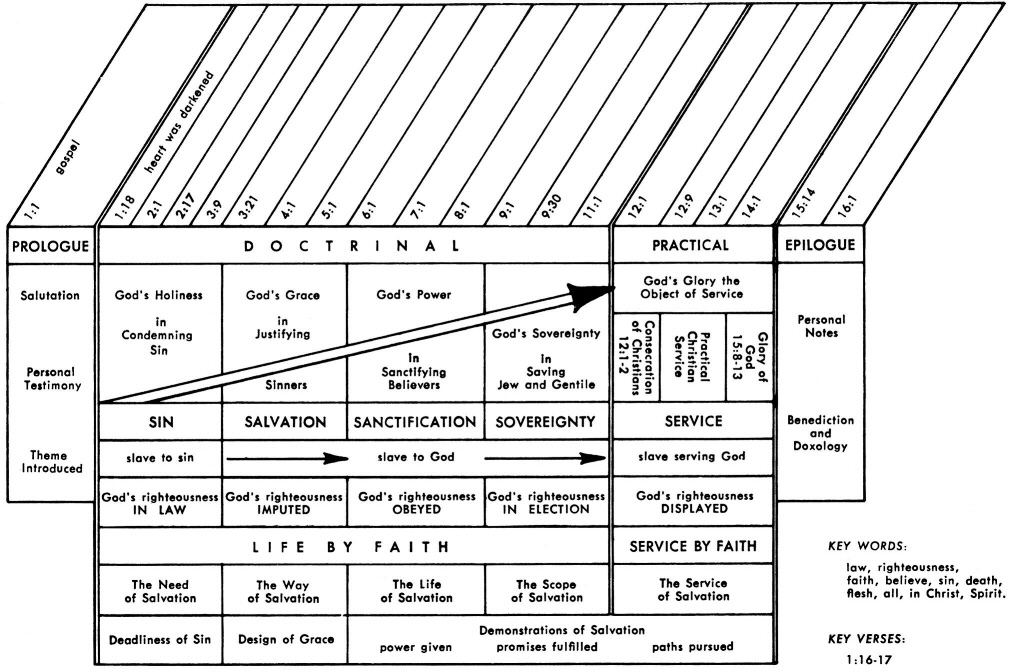
Click chart to enlarge
Chart from recommended resource Jensen's Survey of the NT - used by permission
Romans Overview Chart - Charles Swindoll
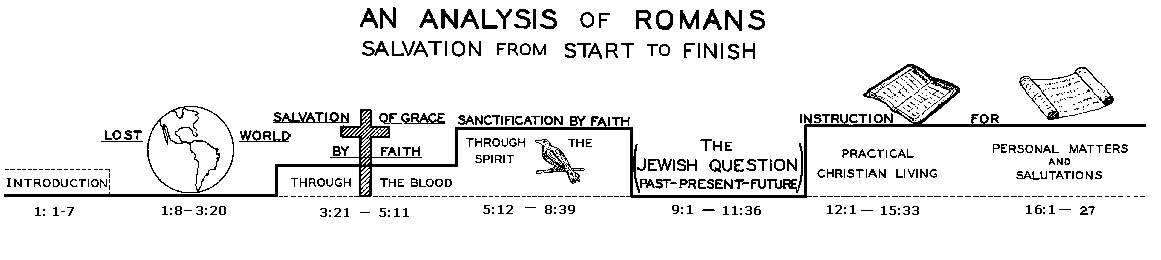
Source: Dr David Cooper
Click to Enlarge
| ROMANS ROAD to RIGHTEOUSNESS |
||||
| Romans 1:18-3:20 | Romans 3:21-5:21 | Romans 6:1-8:39 | Romans 9:1-11:36 | Romans 12:1-16:27 |
| SIN | SALVATION | SANCTIFICATION | SOVEREIGNTY | SERVICE |
| NEED FOR SALVATION |
WAY OF SALVATION |
LIFE OF SALVATION |
SCOPE OF SALVATION |
SERVICE OF SALVATION |
| God's Holiness In Condemning Sin |
God's Grace In Justifying Sinners |
God's Power In Sanctifying Believers |
God's Sovereignty In Saving Jew and Gentile |
Gods Glory The Object of Service |
| Deadliness of Sin |
Design of Grace |
Demonstration of Salvation | ||
| Power Given | Promises Fulfilled | Paths Pursued | ||
| Righteousness Needed |
Righteousness Credited |
Righteousness Demonstrated |
Righteousness Restored to Israel |
Righteousness Applied |
| God's Righteousness IN LAW |
God's Righteousness IMPUTED |
God's Righteousness OBEYED |
God's Righteousness IN ELECTION |
God's Righteousness DISPLAYED |
| Slaves to Sin | Slaves to God | Slaves Serving God | ||
| Doctrine | Duty | |||
| Life by Faith | Service by Faith | |||
|
Modified from Irving L. Jensen's chart above |
||||
R Ruin (Romans 1:17 – 3:20) – The utter sinfulness of humanity
O Offer (Romans 3:21-31) – God’s offer of justification by grace
M Model (Romans 4:1-25) – Abraham as a model for saving faith
A Access (Romans 5:1-11) – The benefits of justification
N New Adam (Romans 5:12-21) – We are children of two “Adams”
S Struggle w/ Sin (Romans 6:1-8:39) Struggle, sanctification, and victory
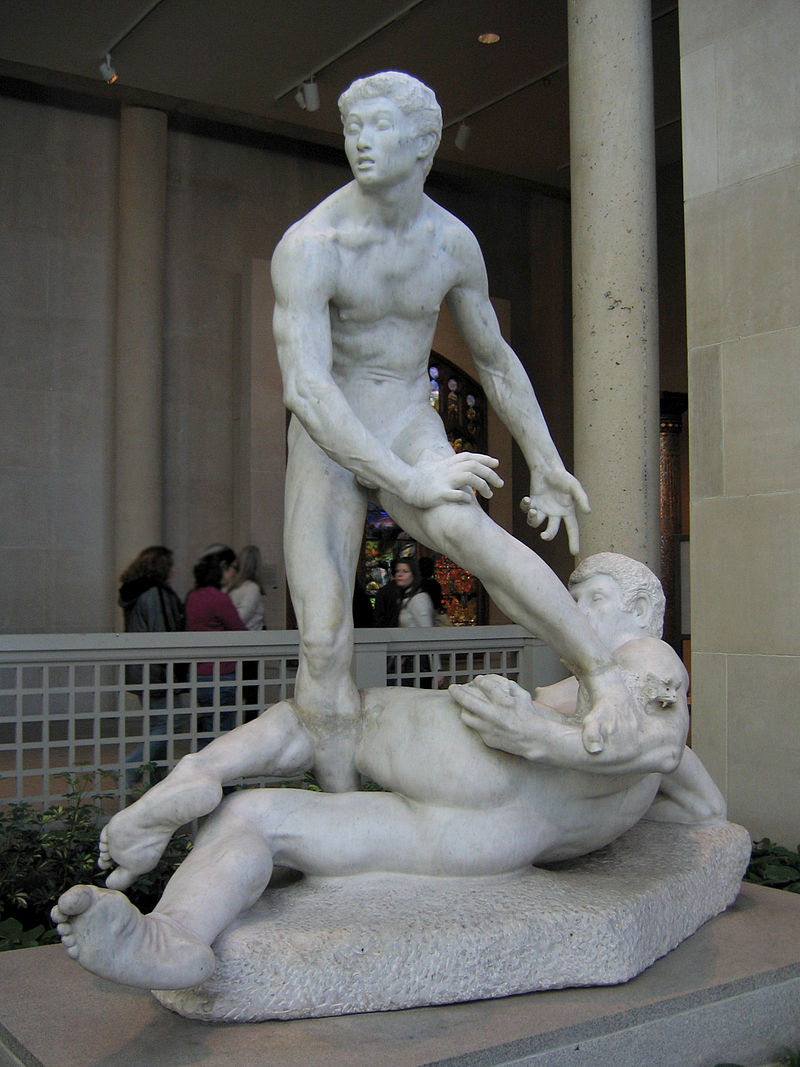
The Struggle of the Two Natures in Man
George Grey Barnard (carved 1892–94)
Romans 7:7 What shall we say then ? Is the Law sin ? May it never be! On the contrary, I would not have come to know sin except through the Law; for I would not have known about coveting if the Law had not said, "YOU SHALL NOT COVET." (NASB: Lockman)
Greek: Ti oun eroumen? (1PFAI) ho nomos hamartia? me genoito; (3SAMO) alla ten hamartian ouk egnon (1SAAI) ei me dia nomou, ten te gar epithumian ouk edein (RAI) ei me o nomos elegen, (3SIAI) ouk epithumeseis. (2SFAI)
Analyzed Literal: What then will we say? [Is] the Law sin? Absolutely not! _But_ I did not know sin except through [the] Law. For also I had not known covetousness unless the Law had said, "You will not covet." [Ex 20:17; Deut 5:21]
Amplified: What then do we conclude? Is the Law identical with sin? Certainly not! Nevertheless, if it had not been for the Law, I should not have recognized sin or have known its meaning. [For instance] I would not have known about covetousness [would have had no consciousness of sin or sense of guilt] if the Law had not [repeatedly] said, You shall not covet and have an evil desire [for one thing and another].(1) (Amplified Bible - Lockman)
Amplified (2015): What shall we say then? Is the Law sin? Certainly not! On the contrary, if it had not been for the Law, I would not have recognized sin. For I would not have known [for example] about coveting [what belongs to another, and would have had no sense of guilt] if the Law had not [repeatedly] said, “You shall not covet.”
BBE: What then is to be said? is the law sin? in no way. But I would not have had knowledge of sin but for the law: for I would not have been conscious of desire if the law had not said, You may not have a desire for what is another's.
CEV: Does this mean that the Law is sinful? Certainly not! But if it had not been for the Law, I would not have known what sin is really like. For example, I would not have known what it means to want something that belongs to someone else, unless the Law had told me not to do that. (CEV)
ESV: What then shall we say? That the law is sin? By no means! Yet if it had not been for the law, I would not have known sin. I would not have known what it is to covet if the law had not said, "You shall not covet." (ESV)
GWT: What should we say, then? Are Moses' laws sinful? That's unthinkable! In fact, I wouldn't have recognized sin if those laws hadn't shown it to me. For example, I wouldn't have known that some desires are sinful if Moses' Teachings hadn't said, "Never have wrong desires." (GWT)
Montgomery: What shall we say then? Is the Law sin? Certainly not. On the contrary I should not have become acquainted with sin had it not been for the Law; for except the Law had repeatedly said, "Thou shalt not lust," I should never have known the sin of lust.
NCV: You might think I am saying that sin and the law are the same thing. That is not true. But the law was the only way I could learn what sin meant. I would never have known what it means to want to take something belonging to someone else if the law had not said, "You must not want to take your neighbor's things." (NCV)
NET: What shall we say then? Is the law sin? Absolutely not! Certainly, I would not have known sin except through the law. For indeed I would not have known what it means to desire something belonging to someone else if the law had not said, "Do not covet." (NET Bible)
NAB: What then can we say? That the law is sin? Of course not! Yet I did not know sin except through the law, and I did not know what it is to covet except that the law said, You shall not covet.
NIV: What shall we say, then? Is the law sin? Certainly not! Indeed I would not have known what sin was except through the law. For I would not have known what coveting really was if the law had not said, "Do not covet." (NIV - IBS)
NKJV: What shall we say then? Is the law sin? Certainly not! On the contrary, I would not have known sin except through the law. For I would not have known covetousness unless the law had said, "You shall not covet."[1]
NLT: Well then, am I suggesting that the law of God is evil? Of course not! The law is not sinful, but it was the law that showed me my sin. I would never have known that coveting is wrong if the law had not said, "Do not covet." (NLT - Tyndale House)
Phillips: It now begins to look as if sin and the Law were very much the same thing - can this be a fact? Of course it cannot. But it must in fairness be admitted that I should never have had sin brought home to me but for the Law. For example, I should never have felt guilty of the sin of coveting if I had not heard the Law saying 'You shall not covet'. (Phillips: Touchstone)
Weymouth: What follows? Is the Law itself a sinful thing? No, indeed; on the contrary, unless I had been taught by the Law, I should have known nothing of sin as sin. For instance, I should not have known what covetousness is, if the Law had not repeatedly said, "THOU SHALT NOT COVET."
Wuest: What therefore shall we say? The law, is it sin? Away with the thought. Certainly I did not come into an experiential knowledge of sin except through the instrumentality of law, for I had not known evil desire except that the law kept on saying, You shall not desire evil. (Eerdmans Publishing - used by permission)
Young's Literal: What, then, shall we say? the law is sin? let it not be! but the sin I did not know except through law, for also the covetousness I had not known if the law had not said:
WHAT SHALL WE SAY THEN "IS THE LAW SIN?" - MAY IT NEVER BE: Ti oun eroumen (1PFAI) ho nomos hamartia me genoito (3SAMO):
- What shall we say then Ro 3:5; 4:1; 6:15
- Is the Law sin Ro 7:8,11,13; 1 Co 15:56
- See article Purpose of the Law
- Romans 7 Resources - Multiple Sermons and Commentaries
QUESTIONING THE
PURPOSE OF THE LAW
What shall we say then? Is the Law sin (hamartia)? May it never be! On the contrary, I would not have come to know sin (hamartia) except through the Law; for I would not have known about coveting if the Law had not said, "YOU SHALL NOT COVET. Paul anticipates a question that might arise concerning the Law - Is it sin? Did it miss the mark so to speak? He answers without taking a breath "Absolutely not! Away with such a thought!" Quite to the contrary, the Law is the means by which sin is made known!
THOUGHT - This truth explains why sinful men hate God (Ro 1:30+) and His Word. They do not want their sin exposed/revealed. They are like those in John 3:19+ "“This is the judgment, that the Light has come into the world, and men loved the darkness rather than the Light, for their deeds were evil."
Barnes - The objection which is here urged is one that would very naturally rise, and which we may suppose would be urged with no slight indignation. The Jew would ask, "Are we then to suppose that the holy law of God is not only insufficient to sanctify us, but that it is the mere occasion of increased sin? Is its tendency to produce sinful passions, and to make men worse than they were before?" To this objection the apostle replies with great wisdom, by showing that the evil was not in the law, but in man; that though these effects often followed, yet that the law itself was good and pure. (Romans 7 - Barnes' Notes)
Ironside - The law must simply be recognized as having a special ministry but not as the rule of the new life. It is a great detector of sin. Paul could say, "I had not known sin, but by the law." That is, he had not detected the evil nature within - so correct was his outward deportment - had not the law said, "Thou shalt not covet." The sin nature rebelled against this and brought out all manner of covetousness, or unsatisfied desire in him. (Romans 7 - Ironside's Notes).
Wuest (he interprets Romans 7 as speaking of Paul's experience as a believer) introduces this section writing that "With this verse, we come to a new division of the subject under discussion. In 7:1-6, Paul has shown that the believer is not under law. In Romans 7:7-13, he shows that a believer putting himself under law, thus failing to avail himself of the resources of grace, is a defeated Christian (here he recounts his own experience as a Christian before he came into the knowledge of Romans 6); and in 7:14-25, he teaches that while the law incites this Christian to more sin, yet the law is not responsible for that sin, but his evil nature, which only can be conquered as the believer cries, “Who shall deliver me?” and thus looks away from himself and self-dependence to the Lord Jesus. (Wuest Word Studies - Eerdman Publishing Company Volume 1, Volume 2, Volume 3 - used by permission)
The law is like a x-ray machine and reveals plainly what might have always been there, but hidden before; and you can’t blame a x-ray for what it exposes. The law sets the "speed limit" so we know if we are going too fast; we might never know that we are sinning in many areas (such as covetousness) if the law did not spell this out to us specifically.
Paul’s aim in [Ro 7:7-25] is to support the teaching, up to this point in the book, that the Law of Moses - or the law written on the heart of all men - is powerless to declare us righteous before God and powerless to make us righteous before God (Ro 3:19, 20, 28-see notes Ro 3:19; 20, 28). We are sinners by nature (Ro 5:12-note) and by action. Therefore the Law condemns us and stirs up rebellion within us. It doesn’t justify and it doesn’t sanctify.
God, in his mercy, has made His righteousness available for us another way, apart from the Law (Ro 3:21-note), namely through Jesus Christ His Son. So to be declared righteous (to be justified) we must turn from our law-keeping to Christ’s law-keeping. We must receive Christ as our treasure, and be declared righteous because of our UNION with Him by faith (Ro 6;3, 4, 5, 6, 7, 7:4, Ro 8:1, 2, 3, 4-see notes Ro 6:3; 6:4; 6:5; 6:6; 6:7; 7:4; 7:5; 7:6; 8:1; 8:2; 8:3; 8:4), not because of any righteousness in us. That’s how we are declared perfectly righteous before God.
Then to become progressively righteous (be sanctified) we must also turn from law-keeping, for as Paul says in [Ro 7:4-note], we have died to the Law and are united with Christ so that we might bear fruit for God. So justification is by faith in union with Christ, and sanctification is by faith in union with Christ. And both involve turning away from the Law as the decisive means of getting right with God and becoming like God (2Pe 1:4-note).
His reader might think that since the effect of the Law was to arouse the sinful passions, that the Law itself was SIN. Paul wanted to make certain his readers did not conclude that the law itself was SIN and it brings this answer to a climax in characterizing the Law in (Ro 7:12-note) "holy and righteous and good".
Paul addresses the certain objection of at least some of his readers. The objection is that all this teaching on justification by faith and sanctification by faith - all this talk about getting right with God "apart from works of the law" (Ro 3:21-note) and bearing fruit for God by "dying to the law" really undermines the law and makes it sinful and deadly. That’s the objection. Paul had already faced it back in Ro 3:31- note where he said,
Do we then nullify the Law through faith? May it never be! On the contrary, we establish the Law. (Ro 3:31-note)
Now in [Ro 7:7] he asks, "What shall we say then? Is the Law sin?" And in [Ro 7:13] he asks, "Did that which is good become a cause of death for me?" You see that Paul is answering an objection: Paul, you are saying that the law of God is sinful and poisonous. If that is true, then Paul’s doctrine is false. So he defends and supports his doctrine of justification by faith and sanctification by faith by arguing that the Law is holy, just, good, and spiritual. It is powerless to justify and sanctify not because it is sinful and deadly, but because I am sinful and my sin is deadly. Therefore this objection to his teaching on justification by faith and sanctification by faith falls to the ground. And the glorious truth of the gospel stands. That’s the point of Romans 7.
"Is the law sin? God forbid" Augustine placed the truth in a clear light when he wrote, "The law is not at fault, but our evil and wicked nature; even as a heap of lime is still and quiet until water is poured on it, but then it begins to smoke and burn, not from the fault of the water, but from the nature of the lime which will not endure it."
ON THE CONTRARY, I WOULD NOT HAVE COME TO KNOW SIN EXCEPT THROUGH THE LAW: alla ten hamartian ouk egnon (1SAAI) ei me dia nomou:
- I would not have come to know sin - Ro 7:5; 3:20; Ps 19:7, 8, 9, 10, 11, 12; 119:96
- See article Purpose of the Law
- Romans 7 Resources - Multiple Sermons and Commentaries
I would not have come to know (ginosko) sin (hamartia) except through the Law - Law is like a friend who introduces one to an acquaintance, in this case our enemy, SIN! The law reveals the divine standard, and as believers compare themselves against that standard, they can accurately identify sin, which is the failure to meet the standard. Paul uses the personal pronoun “I” throughout the rest of the chapter, and many think this refers to his own experience as an example of what is true of unredeemed mankind (Ro 7:7, 8, 9, 10, 11, 12) and true of Christians (Romans 7:13-25) but this is by no means agreed to by all observers.Through the Law describes the instrument by which the real truth about sin becomes known is the Law.
S Lewis Johnson explains it this way - God gave Israel the Mosaic Law with its commandments and ordinances since the Abrahamic Covenant promises did not lay much stress on sin (cf. Ge 12:1, 2, 3). It was necessary for the education of the nation that they be taught their sinful nature, for only in this way would they be likely to respond to the ministry of the Messiah who was to come. In this sense the giving of the Law of Moses was an act of grace on the part of the Lord… (Johnson adds) The giving of the commandment in Genesis 2:16, 17 made it possible for Satan to attack the woman and the man in the Garden of Eden. (See context in Discovering Romans: Spiritual Revival for the Soul)
Denney comments that this verse suggests that "The desire for what is forbidden is the first conscious form of sin… He, Paul, says that the consciousness of sin awoke in him in the shape of a conflict with a prohibitive law." (Romans 7:7 Commentaries)
John Piper - O the perils of not knowing our sin! There is a great sadness that comes from not being saddened by knowing our sin. There is a great pain that comes to the soul and to the marriage and to the family and to the church and to the world from not tasting the pain of knowing our sin. There is a great self-destruction that comes from not experiencing the self-devastation of knowing our sin. There is an eternal loss that comes from not losing our pride in the knowledge of our sin. If there is any hope and any faith and any joy and peace any love, it will come from knowing our sin. So get to know your sin! (The Importance of Knowing Our Sin)
Oswald Chambers - Once conscience begins to be aroused it is aroused more and more till it reaches the terrible conviction that I am responsible before God for the breaking of His law; I know that God cannot forgive me and remain God; if He did I should have a clearer sense of justice than He has. There is nothing in my spirit to deliver me from sin, I am powerless—“sold under sin.” Conviction of sin brings a man to this hopeless, helpless condition; until he gets there the Cross of Christ has no meaning for him. It is of the mercy of God that no man is convicted of sin before he is born again; we are convicted of sins in order to be born again, then the indwelling Holy Spirit convicts us of sin. If God gave us conviction of sin apart from a knowledge of His Redemption, we would be driven insane. When conviction of what sin is in the sight of God comes home to me, language cannot support the strain of the verbal expression of its enormity; the only word that expresses it is “Calvary.” If I see sin apart from the Cross, suicide seems the only fool’s way out. (See context in God's Workmanship)
Know (1097)(ginosko English derivatives - prognosis, gnostic, Gnosticism) involves experiential knowledge, not merely the accumulation of known facts. The basic meaning of ginosko is to know by experience. Knowledge possessed through the intellectual process of learning is one thing. Knowledge gained by experience, by an active relationship between the one who knows and the person or thing known, is far superior to the former. Ginosko describes the latter quality of knowledge.
Ginosko in Romans - Rom. 1:21 = "For even though they knew God, they did not honor Him as God or give thanks"; Rom. 2:18 = "and know His will and approve the things that are essential"; Ro 3:17 = "AND THE PATH OF PEACE THEY HAVE NOT KNOWN"; Ro 6:6 = "knowing this, that our old self was crucified with Him, in order that our body of sin might be done away with, so that we would no longer be slaves to sin;"; Rom. 7:1 = "Or do you not know, brethren (for I am speaking to those who know the law)"; Rom. 7:7; Rom. 7:15 = "what I am doing, I do not understand"; Rom. 10:19; Rom. 11:34
ILLUSTRATION FROM ADRIAN ROGERS - Joyce and I were on our honeymoon. We were driving down US-1, near Daytona Beach. And I had just come through a small little town there and was driving along about 45 miles an hour, and a policeman pulled me over. He said, “Young man, you’re breaking the speed limit.” I said, “Sir, I’m not breaking the speed limit. I’m only doing about 45 miles an hour.” He said, “The limit here is 35 miles an hour.” I said, “Well, why don’t you put up a sign that says the speed limit is 35 miles an hour?” He said, “We put one up.” I said, “I didn’t see it.” “Well,” he said, “it’s back there about a mile. I suggest that you go turn around, and go back, and take a look at it, would you?” And so I did. And he let me go. But you see, it was by the law that I had the knowledge of sin. God has His commandments. And so many times, we’re just driving along thinking we’re doing quite all right. But you see, God gives us the holy law so that we can know that we are sinners in the sight of a righteous and holy God.
FOR I WOULD NOT HAVE KNOWN ABOUT COVETING IF THE LAW HAD NOT SAID "YOU SHALL NOT COVET: ten te gar epithumian ouk edein (1SPluRAI) ei me o nomos elegen (3SIAI): ouk epithumeseis (2SFAI):
- You shall not covet - Ro 13:9; Ge 3:6; Ex 20:17; Dt 5:21; Josh 7:21; 2 Sa 11:2; 1 Ki 21:1, 2, 3, 4; Mic 2:2; Mt 5:28; Lk 12:15; Acts 20:33; Eph 5:3; Col 3:5; 1 Jn 2:15,16
- See Purpose of the Law
- Romans 7 Resources - Multiple Sermons and Commentaries

For (term of explanation) - What is Paul explaining? In this context he is giving one of the purposes of the Law. Calvin said "As in a mirror we discover any stains upon our face, so in the Law...."
I would not have known about coveting Plumblines (plumb bobs) are not meant to straighten the building but to tell one how crooked it is and where change is needed. The Law was given as a plumbline to show us our need for a "divine reconstruction."
Matthew Henry - There is no way of coming to that knowledge of sin, which is necessary to repentance, and therefore to peace and pardon, but by trying our hearts and lives by the law.
Spurgeon - There could not have been a better law. Some talk about the law of God being too severe, too strict, too stringent, but it is not. If the design had been that men should live by the law, there could not have been a better law for that purpose; and hence it is proved that, by the principle of law nobody ever can be justified because, even with the best of laws, all men are sinful, and so need that justification which comes only by grace through faith.
if the Law had not said, "YOU SHALL NOT COVET - Paul quotes from Exodus 20:17+ "You shall not covet (Hebrew = chamad = desire, take pleasure or delight in; Lxx = epithumeo = have a strong impulse toward in sense of an unrestricted desire for a forbidden person) your neighbor's house; you shall not covet (Hebrew = chamad = desire, take pleasure or delight in; Lxx = epithumeo = have a strong impulse toward in sense of an unrestricted desire for a forbidden person) your neighbor's wife or his male servant or his female servant or his ox or his donkey or anything that belongs to your neighbor." (cf Dt 5:21+)
Most of us experience this "revelation" every day if we drive a car, because we are constantly confronted with Speed Limit signs which themselves are not sinful but do specify the limits of sin.
Covetousness is simply craving more of what you have enough of already.
-- Haddon Robinson
Wiersbe has an interesting illustration of the effect of the Law noting that "Something in human nature wants to rebel whenever a law is given. I was standing in Lincoln Park in Chicago, looking at the newly painted benches; and I noticed a sign on each bench: “Do Not Touch.” As I watched, I saw numbers of people deliberately reach out and touch the wet paint! Why? Because the sign told them not to! Instruct a child not to go near the water, and that is the very thing he will do! Why? “Because the carnal mind is enmity against God: for it is not subject to the law of God, neither indeed can be” (Ro 8:7-+). (See context The Bible Exposition Commentary)
There apparently did come a time when Paul knew that coveting was sin. C H Spurgeon suggests when that point may have occurred writing…
It strikes me that when Paul was struck down from his horse on his way to Damascus, the first thought that came to him was, 'this Jesus Whom I have been persecuting, is after all the Messiah and Lord of all. Oh, horror of horrors, I have ignorantly warred against Him. He is Jesus, the Savior who saves from sins; but what are my sins? Wherein have I offended against the law?' In his lonely blindness his mind involuntarily ran over the ten commandments; and as he considered each one of them with his poor half-enlightened judgment, he cried to himself, 'I have not broken that! I have not broken that! I have not broken that!,' till at last he came to that command, 'Thou shalt not covet,' and in a moment, as though a lightning flash had cut in twain the solid darkness of his spirit, he saw his sin, and confessed that he had been guilty of inordinate desires. He had not known lust if the law had not said 'thou shalt not covet'. That discovery unveiled all the rest of his sins, the proud Pharisee became a humble penitent, and he who thought himself blameless cried out, I am the chief of sinners.’
Ray Stedman has a nice illustration of the power of the LAW to AWAKEN the sleeping giant, the sin which still inhabits our physical bodies and will until the day we are glorified. Stedman writes "I was in the Colorado Rockies this past week. A man met me to take me into the mountains for a conference. When I came out to the curb, he was waiting in his new, powerful, shiny Lincoln Continental. I got into the car and expected him to turn on the ignition. But to my amazement, he started driving without turning on the engine -- or at least that's how it seemed to me. I suddenly realized that the engine had been running all the time. It was so quiet that I hadn't heard it. As we moved up into the Rockies, the power of that engine became manifest. We traveled up the steep grades in those great mountains without difficulty because of the power released by the touch on the accelerator. Now, that is something like what Paul is describing here. SIN LIES SILENT WITHIN US. WE DO NOT EVEN KNOW IT IS THERE. We think we have got hold of life in such a way that we can handle it without difficulty. We are SELF-CONFIDENT because we have never really been exposed to the situation that puts pressure upon us -- we never have to make a decision against the pressure on the basis of the commandment of the Law "Thou shalt not… " But when that happens, we suddenly discover all kinds of desires are awakened within us. WE FIND OURSELVES FILLED WITH ATTITUDES THAT ALMOST SHOCK US -- unloving, bitter, resentful thoughts, murderous attitudes -- we would like to get hold of somebody and kill him, if we could. Lustful feelings that we never dreamed were there surface and we find that we would love to indulge in them if only we had the opportunity. We find ourselves awakened to these desires. AS THE GREAT ENGINE SURGES INTO LIFE AT THE TOUCH OF THE ACCELERATOR, so THIS POWERFUL, IDLING BEAST within us called SIN SPRINGS INTO LIFE as the LAW comes home to us. WE DISCOVER SOMETHING THAT WE NEVER KNEW WAS THERE BEFORE." (Read the full sermon The Continuing Struggle) (All caps added for effect)
Have you ever heard of the "Toddler's Creed"? Then read the following devotional from Our Daily Bread (October 27, 2005)…
Elisa Morgan, president of MOPS International (Mothers Of Pre-Schoolers), shared this insight into a child's view of the world:
Toddler's Creed
If I want it, it's mine.
If I give it to you and change my mind later, it's mine.
If I can take it away from you, it's mine.
If I had it a little while ago, it's mine.
If it's mine, it will never belong to anyone else, no matter what.
If we are building something together, all the pieces are mine.
If it looks just like mine, it is mine.
Anyone who has ever known a toddler knows the truth of that creed. We expect to see this trait in toddlers, but we despise it in adults. It is called covetousness.
The apostle Paul, who had led an outwardly religious life before he became a follower of Jesus, wrestled with that sin (Ro 7:7). After carefully studying the law, he recognized covetousness for what it was. But God in His grace changed Paul. Instead of being a coveting, grasping man, he became a truly generous person (Acts 20:33-35). Generosity may be the acid test of whether or not we are still spiritual toddlers.
Have you allowed Jesus Christ to create in you a new, giving heart? Or are you still following the "Toddler's Creed"? - H W Robinson (Our Daily Bread, Copyright RBC Ministries, Grand Rapids, MI. Reprinted by permission. All rights reserved)
Gratefulness overcomes selfishness.
Romans 7:8 But sin, taking opportunity through the commandment, produced in me coveting of every kind; for apart from the Law sin is dead. (NASB: Lockman)
Greek: aphormen de labousa (AAPFSN) e hamartia dia tes entoles kateirgasato (3SAMI) en emoi pasan epithumian; choris gar nomou hamartia nekra.
Amplified: But sin, finding opportunity in the commandment [to express itself], got a hold on me and aroused and stimulated all kinds of forbidden desires (lust, covetousness). For without the Law sin is dead [the sense of it is inactive and a lifeless thing]. (Amplified Bible - Lockman)
NLT: But sin took advantage of this law and aroused all kinds of forbidden desires within me! If there were no law, sin would not have that power. (NLT - Tyndale House)
Phillips: But the sin in me, finding in the commandment an opportunity to express itself, stimulated all my covetous desires. For sin, in the absence of the Law, has no chance to function technically as "sin". (Phillips: Touchstone)
Wuest: But the sinful nature, using the commandment as a fulcrum, brought about in me every kind of evil craving. For without law, the sinful nature was dead. (Eerdmans Publishing - used by permission)
Young's Literal: But sin, taking opportunity through the commandment, produced in me coveting of every kind; for apart from the Law sin is dead.
BUT SIN TAKING (seizing the) OPPORTUNITY THROUGH THE COMMANDMENT: aphormen de labousa (AAPFSN) e hamartia dia tes entoles:
- Ro 7:11,13,17; 4:15; 5:20
- See Purpose of the Law
- Romans 7 Resources - Multiple Sermons and Commentaries
SIN SEIZES THE
OPPORTUNITY
But sin (hamartia), taking opportunity (aphorme) through the commandment (entole) - Sin (PERSONIFIED AS OUR MORTAL ENEMY) uses the specific requirements of the law as a base of operation (taking opportunity) from which to launch its evil work. Confronted by God’s law, the sinner’s rebellious nature finds the forbidden thing more attractive, not because it is inherently attractive, but because it furnishes an opportunity to assert one’s self-will. In other words, law was not intended to be the means by which sin would launch its attack, but sin took advantage of this opportunity to attack man.
Notice SIN is personified as an adversarial force in our mortal bodies! We can NEVER call a truce with SIN, but must alway seek to kill it (Ro 8:13+). As explained more below, this statement gives us a basic principle we need to remember. What is that principle? First, what is the commandment? It is law of course. Do this. Or don't do that! Right? Now God's laws are good and are for our benefit as we obey them. Our problem is we don't want to obey in our old nature inherited from Adam (our Sin nature, the flesh, the old man, the old Adam). And so when we are confronted with a "do this" or "do not do that," our old nature is stirred into action to actually do what the law says not to do. So how can we win? There is only one way and Paul will speak of the Spirit in Romans 8, for the only way to successively fight sin and the subtle, seductive temptations of sin (which continually seeks to reign in our mortal/physical bodies - Ro 6:12-13+), is by wholly relying on the Holy Spirit, not by relying on our natural ability. We might hold off strong temptations for a while, but ultimately we will cave in (so to speak). Galatians 5:16+ is one of the most important passages in all of the Bible in this regard (and thus should be memorized so it becomes part of our innermost being!) for Paul writes (commands) "walk (present imperative but See discussion of the Need for the Holy Spirit even to obey this command to walk by the Spirit - mysterious? Yes! But Scripturally sound!) by the Spirit, and you (absolutely) will not carry out the desire of the flesh (you may and probably will still have the desire)." The corollary is do not place yourself under a "homemade" list of do's and don't's, which is legalism! Why? Legalism always blunts the work of grace! And what will such a list do to our Sin nature? It stimulates it into action of course, the very opposite effect that the law or rule or regulation was intended to have! Give Sin an inch (an opportunity) and it will take a mile (so to speak). Paul warned the Galatians against the danger of legalism (see Ray Stedman's excellent message) (a trap we have all fallen into at one time or another) declaring "This is the only thing I want to find out from you: did you receive the Spirit by the works of the Law, or by hearing with faith? 3 Are you so foolish? Having begun by the Spirit, are you now being perfected by the flesh (Rhetorical! Answer? OF COURSE NOT!)?" (Gal 3:2-3+).
Wuest offers an interesting explanation of how sin works with the Law - Sin is here the evil nature (Ed: That lives inside every human, even redeemed men and women). Without the incitement produced by the law, the evil nature was relatively dormant. A fulcrum is an instrument in the form of a pole or long stick, which when applied beneath an object, will pry that object loose from its position. Just so, the sinful nature uses the law as a fulcrum by which to pry itself loose from its relative inactivity into activity. (Wuest Word Studies - Eerdman Publishing Company Volume 1, Volume 2, Volume 3 - used by permission)
Sin (266) (hamartia) is literally the sin (the definite article precedes "sin" in Greek) which in Romans 6 represents a moral principle or force which is personified as an evil king who constantly seeks to enslave and to rule those who are subject to its power (all unregenerate mankind).
Hodge explains sin this way - By sin, in this case, cannot be understood acts of sin. It must mean indwelling sin, or corruption of nature, sin as the principle or source of action, and not as an act. There is a principle of sin, a corruption of nature which lies behind all conscious voluntary exercises, to which they owe their origin. (Hodge, C. Commentary on the Epistle to the Romans, 1835)
But sin taking opportunity - S Lewis Johnson has an interesting description ow what transpired writing that…
In other words, when sin sees the Law, it "sees red" and "runs wild," hurrying into rebellion and wickedness (cf. Ro 7:5). The Law, thus, does not let "sleeping dogs lie," as Luthi puts it. Spurgeon writes,
That must be a very terrible power which gathers strength from that which should restrain it, and rushes on the more violently in proportion as it is reined in. Sin kills men by that which was ordained to life. It makes heaven's gifts the stepping stones to hell, uses the lamps of the temple to show the way to perdition, and makes the ark of the Lord as in Uzzah's case, the messenger of death. Sin is that strange fire which burns the more fiercely for being damped, finding fuel in the water that was intended to quench it. The Lord brings good out of evil, but sin brings evil out of good." (Editorial Suggestion: We should all re-read Spurgeon's statement regarding the power of sin. Then we might think twice the next time we are tempted to give in to temptation! Sin kills!) (See context in Discovering Romans: Spiritual Revival for the Soul)
Opportunity (874) (aphorme from apó = from + horme = has various senses denoting the start of a rapid movement, a rushing on, a setting into rapid motion) means to make a start from a place. It describes a starting point, an occasion, an opportunity or a circumstance from which another action becomes possible. Aphorme is a place from which a movement or an attack can be made.
In context aphorme describes a starting point or base of operations for an expedition. It was frequently used to denote a “base of operations” in war. Paul is saying that the commandment provided sin with a base of operations, an attack upon the soul. It’s hard fighting an enemy on their soil…but even harder to fight against hidden terrorist in our own country! And such is sin!
Vincent has an example of the use of aphorme in secular Greek writing "The Lacedaemonians agreed that Peloponnesus would be aphormen hikanen or a good base of operations (Thucydides, i., 90). Thus (aphorme means), the origin, cause, occasion, or pretext of a thing; the means with which one begins. Generally, resources, as means of war, capital in business. Here the law is represented as furnishing sin with the material or ground of assault, “the fulcrum for the energy of the evil principle.” Sin took the law as a base of operations.
A T Robertson writes that aphorme here in Romans 7:8 describes "a starting place from which to rush into acts of sin, excuses for doing what they want to do. Just so drinking men use the prohibition laws as occasions for violating them. "
Aphorme is used 7 times in the NT…
Romans 7:8+ But sin, taking opportunity through the commandment, produced in me coveting of every kind; for apart from the Law sin is dead.
Romans 7:11+ for sin, taking opportunity through the commandment, deceived me, and through it killed me.
2 Corinthians 5:12+ We are not again commending ourselves to you but are giving you an occasion to be proud of us, that you may have an answer for those who take pride in appearance, and not in heart.
Comment: Here aphorme is used in a positive sense for Paul is saying that his irreproachable conduct provided his friends with a base of operations against his detractors.
2 Corinthians 11:12+ But what I am doing, I will continue to do, that I may cut off opportunity from those who desire an opportunity to be regarded just as we are in the matter about which they are boasting.
Comment: In the first use of aphorme Paul is saying that by his refusal of support at Corinth the detractors had been deprived of the ability to set up a base of operations [second use] their against him.
Galatians 5:13+ For you were called to freedom, brethren; only do not turn your freedom into an opportunity (starting point or base of operations) for the flesh (that evil disposition that dwells in the physical body of believers and unbelievers), but through love serve one another.
Comment: Other translations help us understand this passage…
After all, brothers, you were called to be free; do not use your freedom as an opening for self-indulgence, but be servants to one another in love. (New Jerusalem Bible)
For you, brethren, were [indeed] called to freedom; only [do not let your] freedom be an incentive to your flesh and an opportunity or excuse [for selfishness], but through love you should serve one another. (Amplified Bible)
My friends, you were chosen to be free. So don't use your freedom as an excuse to do anything you want. Use it as an opportunity to serve each other with love. (CEV)
As for you, my friends, you were called to be free. But do not let this freedom become an excuse for letting your physical desires control you. Instead, let love make you serve one another. (TEV)
You however, brethren, were called to freedom. Only do not turn your freedom into an excuse for giving way to your lower natures; but become bondservants to one another in a spirit of love. (Weymouth)
The flesh (that aspect of the human self which refuses to acknowledge God and which leads to the doing of evil instead of good) seeks a base of operations in the believer's new freedom in Christ. How does it manifest itself? By turning liberty to license, indulging self, using freedom as an excuse to do anything the sinful natures wants to do! Paul is saying "Don't allow your freedom to become an excuse to allow your fleshly evil desires to control you." The flesh here represents lovelessness and selfishness. Christian freedom is not to be abused for selfish ends. What is the antidote or defense against this misuse of the freedom? By doing all things to others out of love. The flesh seeks to get. Agape love led and enabled by the Spirit seeks to give.)
1 Timothy 5:14 Therefore, I want younger widows to get married, bear children, keep house, and give the enemy (the adversary, literally one set over against another - in this context not Satan per se but the human enemies of Christianity) no occasion for reproach (scolding in a harsh, loud or abusive manner)
Comment: Here Paul is saying that unrighteous behavior on the part of young widows [and all believers for that matter] would provide the enemy with a base of operations against the Christian faith.
Albert Barnes adds that aphorme "properly denotes any material, or preparation for accomplishing anything; then any opportunity, occasion, etc. of doing it. Here it means that the Law was the exciting cause of sin; or was what called the sinful principle of the heart into exercise. But for this, the effect here described would not have existed. Thus, we say that a tempting object of desire presented is the exciting cause of covetousness. Thus, an object of ambition is the exciting cause of the principle of ambition. Thus, the presentation of wealth, or of advantages possessed by others which we have not, may excite covetousness or envy. Thus, the fruit presented to Eve was the exciting cause of sin; the wedge of gold to Achan excited his covetousness. Had not these objects been presented, the evil principles of the heart might have slumbered, and never have been called forth. And hence, no one understand the full force of their native propensities until some object is presented that calls them forth into decided action. (Ed note: Dearly beloved, can you not identify with this analysis?) The occasion which called these forth in the mind of Paul was the Law crossing his path, and irritating and exciting the native strong inclinations of the mind." (Romans 7 - Barnes' Notes)
PRODUCED IN ME COVETING OF EVERY KIND: kateirgasato (3SAMI) en hemoi pasan epithumian:
- Produced - James 1:14,15+
- See Purpose of the Law
- Romans 7 Resources - Multiple Sermons and Commentaries
Related Passages:
James 1:14-15+ But each one is tempted when he is carried away and enticed by his own lust. 15 Then when lust has conceived, it gives birth to sin; and when sin is accomplished, it brings forth death.
LAW PRODUCES A
BUMPER CROP OF LUSTS
In agriculture, a bumper crop is a crop that has yielded an unusually productive harvest. The word "bumper" in this context comes from a usage that means "something unusually large",[1] which is where this term comes from.[2]
Produced in me coveting (epithumia) of every kind (pas) - The power of the law is to stir up sin one manifestation of which is lusting! The command not to lust actually accomplished the goal of making me lust even more! Coveting (lusts) occurs in our mind and is not the physical action per se although they may (and frequently do) lead to physical actions. Thus James warns us of the evil character of "lusts" writing that "each one is tempted when he is carried away and enticed by his own lust. Then when lust has conceived, it gives birth to sin and when sin is accomplished, it brings forth death." (Jas 1:14, 15)
Tholuck writes that "To man everything forbidden appears as a desirable blessing; but yet, as it is forbidden, he feels that his freedom is limited, and now his lust rages more violently, like the waves against the dyke
Wayne Barber - What did the sin produce in Paul? "Coveting of every kind." This is a word that means "to desire greatly, to lust after." These are the inordinate desires that cause us to intensely focus on the wrong things, obsessed with having them. Paul said, "I got up and decided not to covet, but my rebellious flesh took over and caused me to covet in ways that I did not think possible." (Romans 7:7-13: Frustration… Under Law)
Hiebert has an interesting note that the "degeneration in the meaning of the term (epithumia from God given desires to perverted desires) is a revealing commentary on human nature. Left to himself, instead of gaining mastery over his base desires and steadfastly adhering to the good, the individual is characteristically overcome by his evil cravings, so that they become the dominating force of his life." (Hiebert, D. Edmond: 1 Peter. Page 94. Moody)
The command not to lust made Paul lust even more! Is this the fault of the Law? Clearly not. The fault lies in every man's fallen flesh nature inherited from Adam.
This truth parallels (Ro 5:20+) explaining how where Law came in, transgression increases. He coveted before he was aware of the Law but when he heard "Thou shalt not covet" it stimulated an increase in coveting.
He found himself awakened to this commandment and discovered that he was coveting, no matter where he turned. When the Law came, he found himself aroused by it and brought under its power. It precipitated an orgy of desire. Many of us have felt this same way.
Produced (2716) (katergazomai from katá = down or here as an intensifying preposition + ergázomai = to work or to engage in an activity involving considerable expenditure of effort) means to work out fully and so to accomplish or finish a task. It means to work to bring something to fulfillment or completion so that it results in success. Katergazomai means to operate in a powerful and efficacious manner. The idea is to do it with thoroughness and thus achieve an end or come to a conclusion. As used in this context katergazomai means to to work out or produce coveting as the accomplished goal of Sin. Surely you must see that in light of this truth, Sin is never your friend dear believer. Don't let it dupe you!
Katergazomai is a key word in Romans 7 - Here are all uses in Romans - Rom. 1:27; Rom. 2:9; Rom. 4:15; Rom. 5:3; Rom. 7:8; Rom. 7:13; Rom. 7:15; Rom. 7:17; Rom. 7:18; Rom. 7:20; Rom. 15:18;
Coveting (Lusts) (1939) (epithumia from epi = at, toward {the preposition "epi-" in the compound is directive conveying the picture of "having one’s passion toward" } + thumos = passion. The root verb epithumeo = set heart upon) (Click in depth study) Epithumia in itself is a neutral term denoting the presence of strong desires or impulses, longings or passionate craving (whether it is good or evil is determined by the context) directed toward an object. Epithumia is used in a good sense referring to the natural, legitimate and necessary God given desires (eg, hunger, thirst, sex, etc) which are fulfilled in a God honoring way. Most often epithumia in the NT describes strong desires which are perverted and unrestrained and which originate from our SIN (flesh) nature, which is corrupt and fallen.
Epithumia in Romans - Rom. 1:24 = "Therefore God gave them over in the lusts of their hearts to impurity, so that their bodies would be dishonored among them." (THIS IS THE JUDGMENT OF GOD = A SEXUAL REVOLUTION AS HAS OCCURRED IN AMERICA - WE ARE UNDER THE JUDGMENT OF GOD!); Rom. 6:12 = "Therefore do not let sin reign in your mortal body so that you obey its lusts" (NOTE SIN IS PERSONIFIED AS A DESPOT THAT HAS EVIL DESIRES!); Rom. 7:7; Rom. 7:8; Rom. 13:14 = "But put on the Lord Jesus Christ, and make no provision for the flesh in regard to its lusts."
Every kind (3956) (pas - all without exception) and thus it was not confined to one single desire, but extended to everything which the Law declared to be wrong.
FOR APART FROM THE LAW SIN IS DEAD: choris gar nomou hamartia nekra:
- Apart from the Law - Ro 4:15; Jn 15:22,24; 1Cor 15:56
- See Purpose of the Law
- Romans 7 Resources - Multiple Sermons and Commentaries
Related Passage:
John 15:22; 24 “If I had not come and spoken to them, they would not have sin, but now they have no excuse for their sin....24 “If I had not done among them the works which no one else did, they would not have sin; but now they have both seen and hated Me and My Father as well.
1 Corinthians 15:56+ The sting of death is sin, and the power of sin is the law; (WHY? BECAUSE LAW STIRS UP SIN!)
Romans 4:15 ( for the Law brings about wrath, but where there is no law, there also is no violation.
Romans 7:5+ For while we were in the flesh, the sinful passions, which were aroused by the Law, were at work in the members of our body to bear fruit for death. (WHAT DOES THE LAW DO TO OUR SINFUL PASSIONS IN THIS VERSE?)
LAW REVIVES
SIN FROM DEATH
For apart (choris) from the Law sin (hamartia) is dead (nekros) Paul is not saying that a person is without sin when there is no Law, but is emphasizing that the power of sin is not aroused to activity when there is no law. In other words, without a commandment the sinfulness of sin is not realized.
Barnes writes about sin - Sin here is personified. It means not a real entity; not a physical subsistence; not something independent of the mind, having a separate existence, and lodged in the soul; but it means the corrupt passions, inclinations, and desires of the mind itself. Thus we say that lust burns, and ambition rages, and envy corrodes the mind, without meaning that lust, ambition, or envy are any independent physical subsistences; but meaning that the mind that is ambitious, or envious, is thus excited. (Romans 7:8 Commentaries)
Cranfield explains that "sin is indeed present, but it is inactive--or at least relatively so." (Quoted by S Lewis Johnson Discovering Romans: Spiritual Revival for the Soul)
Jameison says that dead means "the sinful principle of our nature lies so dormant, so torpid, that its virulence and power are unknown, and to our feeling it is as good as “dead.” (Romans 7:8 Commentary)
Harry Ironside explains that sin is dead in the sense that it is "inert and unrecognized. There were sins even before the law was given, but sin - the nature - was not recognized until the law provoked it." (The Righteousness Of God Revealed In The Gospel)
Middletown Bible - For without the law (before the commandment came-Ro 7:9) sin was dead (inactive, lifeless, dormant, showing little activity)." Without the mirror the person is not very much aware of his dirty face but once the mirror comes along that dirt just seems to jump to life! "Wow, look at that dirt!" It was there all the time but the mirror made him aware of it! (cp Jas 1:23, 24, 25-note) Think of a snake coiled up and sleeping in the sun. It is inactive and almost seems dead. But if you come along and poke it and disturb it that snake will really come alive (be aroused to activity - cp Ro 7:5-note). This is what the law does to sin! Illustration: Think of the Second Commandment in Exodus 20:4. This command is holy and just and good. There is nothing wrong with it. But when sinful man is confronted with a holy command, what does he naturally do? He rebels and revolts against it! God says THOU SHALT and the rebel answers I WILL NOT! God says THOU SHALT NOT and the rebel answers I MOST CERTAINLY WILL! Thus we have the tragic account of Exodus 32:7,8. The sin of idolatry was always in their hearts but the commandment aroused it. The sin of idolatry was dead and inactive and dormant before the commandment was given. They did not make golden calves as a habit before this time. The law arouses and incites sin. Can we blame the Second Commandment for the golden calf? God forbid! (Romans chapter 7)
William Newell writes that…This discovery that desire is sin would not be confined to the letter of the tenth commandment, “Thou shalt not desire, or covet”: but would in Paul’s inner consciousness extend itself through the whole Decalogue: For the Law is one! To illustrate the words apart from Law, sin is dead: Suppose a man determined to drive his automobile to the very limit of its speed. If (as is not quite yet done!) signs along the road would say, No Speed Limit, the man’s only thought would be to press his machine forward. But now suddenly he encounters a road with frequent signs limiting speed to thirty miles an hour. The man’s will rebels, and his rebellion is aroused still further by threats: Speed Limit Strictly Enforced. Now the man drives on fiercely, conscious both of his desire to “speed,” and his rebellion against restraint. The speed limit signs did not create the wild desire to rush forward: that was there before. But the notices brought the man into conscious conflict with authority. For apart from Law, sin is dead—Sin, like a coiled serpent, is in the old nature, but cannot get at the conscience to condemn it: for indwelling sin has no means of “springing into life,” as sin, apart from law: it is quiescent, dormant, “dead.” Every impulse of the flesh, the old natural life, is sin. Take desire, or coveting: who is to know that this inward, universal, natural desire is sin, till the Law says to the conscience, “Thou shalt not covet”? This command not to covet does not remove the covetousness, but rather calls attention to it. And in forbidding it, immediately puts into conflict the renewed human will with the power of indwelling sin,—in this case with covetousness. Now, however quickened or renewed the human will may be, strength, power against sin, does not reside in the human will. Furthermore, human strength is not God’s way to overcome indwelling sin. That power resides always and only in the indwelling Holy Spirit. (Romans 7)
Apart from (5565)(choris) as an adverb it means separately or by itself but here is used more as a preposition and signifies separate from or independent of the Law sin in a relative sense had no power.
Dead (3498) (nekros) can mean physically dead but is used figuratively in this verse. In this context, dead does not mean nonexistent (Ro 5:13) but dormant. The idea is not nonexistent but not fully perceived. When the law comes, sin becomes fully active and exerts its power over the sinner. Until the law was revealed, sin was unknown or unrevealed (Ro 5:14). Sin never really appeared to be what it is until the law brought it to light through definition.
Related Resources:
Did the Prohibition Act stop drinking? No, in many ways it made drinking more attractive to people. Once God draws a boundary for us, we are immediately enticed to cross that boundary - which is no fault of God or His boundary, but of our sinful hearts.
In Galveston, Texas, a hotel on the shore of the Gulf of Mexico put this notice in each room
"No Fishing From the Balcony" Yet every day, hotel guests threw in their lines to the waters below. Then the management decided to take down the signs--and the fishing stopped! "
Our Daily Bread - In his Confessions, Augustine (354-430), the well-known theologian, reflected on this attraction to the forbidden. He wrote, "There was a pear tree near our vineyard, laden with fruit. One stormy night we rascally youths set out to rob it … We took off a huge load of pears--not to feast upon ourselves, but to throw them to the pigs, though we ate just enough to have the pleasure of the forbidden fruit. They were nice pears, but it was not the pears that my wretched soul coveted, for I had plenty better at home. I picked them simply to become a thief… The desire to steal was awakened simply by the prohibition of stealing." Romans 7 sets forth the truth illustrated by Augustine's experience: Human nature is inherently rebellious. Give us a law and we will see it as a challenge to break it. Jesus, however, forgives our lawbreaking and gives us the Holy Spirit. He imparts a new desire and ability so that our greatest pleasure becomes bringing pleasure to God. --H W Robinson (Our Daily Bread, Copyright RBC Ministries, Grand Rapids, MI. Reprinted by permission. All rights reserved)
Why do we keep on trying
The fare of this world's sin
When God has set before us
The joy of Christ within? --JDB
Forbidden fruit tastes sweet but has bitter consequences
Romans 7:9 I was once alive apart from the Law; but when the commandment came, sin became alive and I died; NASB: Lockman)
Greek: ego de ezon (1SIAI) choris nomou pote; elthouses (AAPFSG) de tes entoles e hamartia anezesen, (3SAAI)
Amplified: Once I was alive, but quite apart from and unconscious of the Law. But when the commandment came, sin lived again and I died (was sentenced by the Law to death). (Amplified Bible - Lockman)
NLT: I felt fine when I did not understand what the law demanded. But when I learned the truth, I realized I had broken the law and was a sinner, doomed to die. (NLT - Tyndale House)
Phillips: As long, then, as I was without the Law I was, spiritually speaking, alive. (Phillips: Touchstone)
Wuest: But I was alive without law aforetime. But the commandment having come, the sinful nature regained its strength and vigor, and I died. (Eerdmans Publishing - used by permission)
Young's Literal: And I was once alive apart from the Law; but when the commandment came, sin became alive, and I died;
AND I WAS ONCE ALIVE APART FROM THE LAW: ego de ezon (1SIAI) choris nomou pote:
- Mt 19:20; Lk 10:25, 26, 27, 28, 29; 15:29; 18:9, 10, 11, 12,21; Phil 3:5,6
- Mt 5:21, 22, 23, 24, 25, 26; 15:4, 5, 6; Mk 7:8, 9, 10, 11, 12, 13
- See Purpose of the Law
- Romans 7 Resources - Multiple Sermons and Commentaries
THE LAW AROUSES SIN
I (ego) was once alive apart (choris) from the Law; but when the commandment (entole) came, sin became alive and I died (apothnesko)- The debate goes on about who "I" is but in its most plain literal sense it certainly could refer to Paul's own experience. On the other hand these timeless truths obviously describe of all who are dead in their trespasses and sins, and who are depending on their own righteousness.
I felt "fine" until the Law had its effect on me. Not ignorance of or lack of concern for the law (Php 3:6 [note]), but a purely external, imperfect conception of it. I had no dread of punishment, no painful conscientiousness (or consciousness) 0f sin.
We see repeatedly that one of the powerful effects of the Law is to stir up sin, causing it to become "active" or "energized!" For example, in 1Cor 15:56 Paul writes "The sting of death is sin, and the power of sin is the law." Why is the law the power of sin? Because Law stirs up sin. And earlier in Ro 7:5 we read that "while we were in the flesh, the sinful passions (literally = passions of the sin), which were aroused by the Law, were at work (energeo - imperfect tense) in the members of our body to bear fruit for death." The practical point for believers is to remember that the moment we put ourselves under some legal constrain (e.g., I won't do this or I won't do that), we are in effect stirring up the sin and will reap the opposite effect that we desired to achieve (victory of this or that sin). Beloved, yes, we must kill sin lest it be killing us, but we cannot do that in our natural strength. We need to renounce our natural self-sufficiency or self-reliance and rely on the supernatural sufficiency of the Holy Spirit to put that sin to death (Ro 8:13-note).
The excellent Lutheran commentator Lenski writes that "He was quite secure amid all his sin and sinfulness. He lived in the sense that the deathblow had not yet killed him. He sat secure in the house of his ignorance like a man living on a volcano and thought that all was well.
Once (4218) (pote) when speaking of the past signifies once or at some time.
Alive (2198)(zoe) means physically alive and in this context he felt "spiritually healthy." In other words, he was experiencing no dread of punishment and harbored no painful conscientiousness of sin.
Middletown Bible on "once alive apart from the law" - undisturbed, unconvicted, not realizing the great death sentence that he was under. Everything seemed fine (like the person with the dirty face who has not yet looked into the mirror. Everything seems fine but it is not fine. The problem is there even though I don’t realize it yet). (Romans chapter 7)
Barnes explains alive - This is opposed to what he immediately adds respecting another state, in which he was when he died. It must mean, therefore, that he had a certain kind of peace; he deemed himself secure; he was free from the convictions of conscience and the agitations of alarm. The state to which he refers here must be doubtless that to which he himself elsewhere alludes, when he deemed himself to be righteous, depending on his own works, and esteeming himself to be blameless, Php 3:4, 5, 6 (see below) Acts 23:1; 26:4,5. It means, that he was then free from those agitations and alarms which he afterwards experienced when he was brought under conviction for sin. At that time, though he had the law, and was attempting to obey it, yet he was unacquainted with its spiritual and holy nature. He aimed at external conformity. Its claims on the heart were unfelt. This is the condition of every self-confident sinner, and of every one who is unawakened. (Albert Barnes: Barnes' New Testament Notes)
Apart from (5565)(choris) as an adverb it means separately or by itself but here is used more as a preposition and signifies separate from or independent of the Law, before the Law was applied to his heart in its spiritual meaning and with convicting power.
The thought is that life without the law allowed the knowledge of sin to lie dormant (Romans 7:9). But when the law came, sin came to life in clear definition and understanding. Reference may be to the time either before a Jewish boy's bar mitzvah or before the "I"s conversion, when the true rigor of the law became clear.
The Sermon on the Mount in a similar way makes even the most self righteous Pharisee in the audience quiver with fear as Jesus takes the true meaning of the Law from its perceived external role to its role in judging the thoughts and intentions of one's heart attitudes. (cp Mt 5:28, 20, 21, 22, 23 notes Matthew 5:28, 20; 21; 22; 23).
ILLUSTRATION OF STING OF DEATH IS SIN (1 Cor 15:56) - One day a little boy was riding in the car with his father when a bee flew in through the window and started buzzing around. The boy began to scream, “The bee is going to sting me!” But his father reached out and grabbed the bee. He held it in his hand for a few seconds, then released it. The bee began to buzz around and the boy started to cry again. But his father said, “Son, you don’t have to be afraid. All the bee can do now is make noise.” Then Dad held out his hand, and there in the palm of his hand was the bee’s stinger. On the cross of Calvary, Jesus Christ took the stinger of sin, which is death. So all death can do now is make noise for those whose trust is in Jesus Christ.
BUT WHEN THE COMMANDMENT CAME: elthouses (AAPFSG) de tes entoles:
- When the commandment came - Ro 3:19,20; 10:5; Ps 40:12; Gal 3:10; Jas 2:10,11
- Romans 7 Resources - Multiple Sermons and Commentaries
WHEN PAUL UNDERSTOOD
THE LAW'S REQUIREMENTS
But - always pause to ponder this term of contrast, as it marks a change of direction and you need to ask "What is the change?"
when the commandment (entole) came, sin became alive and I died (apothnesko) - When he began to understand the true requirements of God’s moral law. It was when the law presented itself to his conscience and so broke in upon the supposed state of freedom, and instead imposed its constraints upon the natural tendencies.
In a parallel passage Paul wrote "Why the Law then? It was added because of transgressions, having been ordained through angels by the agency of a mediator, until the seed would come to whom the promise had been made." (Galatians 3:19+)
Ray Stedman comments (He interprets this section as Paul writing autobiographically of his pre-conversion experience.)
Paul, as we know, was raised in a godly home. He was raised a Jew in the city of Tarsus. He was brought up to be a typical Jewish son, and he was taught the Law from birth. So when he says he lived "APART FROM THE LAW" he doesn't mean that he didn't know what it was. He simply means that there came a time when the Law came home to him. "The commandment came," he says.
We have all had that experience. We have read Scripture that was just words to us -- BEAUTIFUL WORDS, PERHAPS, BUT WE DIDN'T UNDERSTAND THEM. Then, years after, an experience that we go through makes those words come alive. This is what Paul is talking about here. He knew the Law from birth, but he did not know it in the sense of understanding what it was saying until he went through a certain experience. Here he describes that experience, one that he had before he became a Christian.
In this home in which he was raised, Paul, like many of us today, was protected and sheltered and kept from exposure to serious temptations. He was raised in the Jewish culture, where everyone around him was sheltered also. Therefore, he grew up relatively untroubled with problems of sin. Now, there are many people like that in this congregation. You have grown up in a home where you have been protected and sheltered, and you have run with a crowd of friends who, likewise, have been kept from exposure to various things. You haven't fallen into evil.
Many young people, like Saul of Tarsus, think they have handled the problem. What about keeping the Law? It's not hard! Hardly any temptations come under these circumstances. These people think they have no struggles along this line. They have the world by the tail -- they can handle it. As Paul describes it, they are alive apart from the Law. But then comes a time when they are exposed. They are thrust out into a different lifestyle, a different crowd of people. They move out on their own and suddenly they find themselves removed from the shelter and protection and love and cultural defenses that have been theirs from childhood on. Perhaps the new crowd -- as a way of life -- does things that these sheltered young people have been taught are wrong.
Now, for the first time, they feel the force of the prohibition of the Law. The Law says, "Thou shalt not covet, commit adultery, murder, steal … " -- whatever it may be. And yet the crowd around them says, "Let's do it -- it's fun!" For the first time, they begin to feel the prohibition of the Law. Then a strange phenomenon happens. Something about that situation arouses within them a strong desire to do the things that are prohibited. Maybe they are able to resist them for awhile, but, nevertheless, they find themselves pressured, pushed by something within them that wants very badly to do these things. (See Full Sermon - The Continuing Struggle)
Commandment (1785) (entole from en = in, upon + tello = charge, command) is an order that calls for one to carry out a specific action in thought, word or deed. When the commandment came and said "Don't!", it was if the sinful nature became like a sleeping dog suddenly awakened and ready to attack the intruder.
SIN BECAME ALIVE AND I DIED: e hamartia anezesen (3SAAI) ego de apethanon (1SAAI):
- Sin became alive - Ro 7:21, 22, 23; 8:7
- And I died - Ro 7:4,6; 11; 3:20; Gal 2:19
- Romans 7 Resources - Multiple Sermons and Commentaries
REVIVAL OF SIN
DEATH OF PAUL
Sin (hamartia) became alive (anazao) and I died (apothnesko) - Paul uses it figuratively in Romans 7 to describe how sin came to life again or sprang into action so to speak. It manifested itself for the evil it really was. The power of sin was revived by the commandment. It lay dormant but the moment the commandment came, Sin recovered its full vigor (uncoiling like a poisonous pit viper) and exerted its nefarious power (biting with a fatal injection of "venom", cp 1Co 15:56). (see related topics the Sin; Purpose of the Law).
I like the HCSB rendering (Ro 7:9HCSB) of "sprang to life" because it gives a vivid picture of the ever ready propensity of sin, crouching like a famished lion, ready to pounce on it's (often deceived because that is what sin does!) victim (cp God's warning to Cain in Ge 4:6-7).
I died - God’s holy law convicts and "slays" the sinner! Paul came to realize that he was a law breaker (not a law keeper, an impossibility - cp Jas 2:10) and came to comprehend his deadness, spiritually, because breakers of the law deserve to die (cp Ga 3:10,13). He also realized that all his "religious" credentials and accomplishments were rubbish even as he later explained to the saints at Philippi testifying that "whatever things were gain to me, those things I have counted as loss for the sake of Christ. More than that, I count all things to be loss in view of the surpassing value of knowing Christ Jesus my Lord, for whom I have suffered the loss of all things, and count them but rubbish in order that I may gain Christ." (Php 3:7, 8-note)
He felt within himself the sentence of death, becoming bogged down in hopelessness and despair in contrast to the blithe self-confidence he had had before. This death is entirely unrelated to dying with Christ, that union described in Romans 6. No, this death was not a death to sin but a death because of sin.
If Paul is writing autobiographically, he seems to mean that there was a time when he was living in a state of indifference to the searching demands of the law on the inner man. He was self-deceived as to his own righteousness as reflected in Philippians 3, where he speaks of his pre-conversion days as a Pharisee when he was "blameless" with respect to legalistic righteousness or self-righteousness…
(Paul as a believer says) we are the true circumcision, who worship in the Spirit of God and glory in Christ Jesus and put no confidence in the flesh (which is what he did prior to conversion) 4 although I myself might have confidence even in the flesh. If anyone else has a mind to put confidence in the flesh, I far more: 5 circumcised the eighth day, of the nation of Israel, of the tribe of Benjamin, a Hebrew of Hebrews; as to the Law, a Pharisee; 6 as to zeal, a persecutor of the church; as to the righteousness which is in the Law, found blameless. (Php 3:3, 4, 5, 6-notes)
Paul's struggle before and at the time of his conversion was intellectual rather than moral. He was convinced that Jesus could not be the Messiah, for God had permitted him to die as a criminal. His conversion meant a complete reversal in this matter.
Vine explains I died - That is to say, “became conscious of the sinfulness of sin and realized that I was in a state of separation from God.” Separation is the essential feature of death; physical death is the separation of the soul from the body; spiritual death is the separation of the spirit from God. This condition of alienation from God involved the absence of any ability to work righteousness and the realization of condemnation and doom. (Vine, W. Collected writings of W. E. Vine. Nashville: Thomas Nelson)
S Lewis Johnson draws an interesting conclusion - This text proves that spiritual death is not annihilation, because it implies consciousness (i.e., Paul was aware of it). Physical death, confessedly, is not annihilation. It is only a peculiar mode of existence. In 1Co 15:36, and John 12:24, the physical 'death' of the corn of wheat is not the extinction of its substance, but the metamorphosis of it. Spiritual death, in like manner, supposes existence; because it is a vivid and distressing experience. (Romans 7:7-12)
Paul alludes to the death blow dealt by the law in second Corinthians writing that…
if the ministry of death (2Co 3:6-note), in letters engraved on stones (the Law, the Old Covenant, symbolized by the Ten Commandments, Dt 9:10, came with glory (the Shekinah glory cloud), so that the sons of Israel could not look intently at the face of Moses because of the glory of his face, fading as it was (Ex 34:29, 30 - as the glory on Moses' face faded, to too the Mosaic Covenant was always meant to be temporary, cp He 8:13-note), how shall the ministry of the Spirit (cp Ga 3:3, 4, 5) fail to be even more with glory? For if the ministry of condemnation (the Law, the Old Covenant which pronounced sentence against sinners) has glory, much more does the ministry of righteousness (speaks of the New Covenant of grace, cp 1Co 1:30, Ro 3:21-note) abound in glory. (2Cor 3:7-9-note)
(The) Sin (266) (hamartia) is literally the sin which in Romans 6 represents a moral principle or force which is personified as an evil king who constantly seeks to enslave and to rule those who are subject to its power (all unregenerate mankind).
Became alive (326) (anazao from ana = again + zao = to live) means literally to live again and is used figuratively and literally (latter only in Rev 20:5 in the KJV - see explanation below). One use of anazao in the KJV means resurrection from the dead, coming alive again from the dead.
Friberg - literally, of the dead become alive again, rise again, return to life; metaphorically, of sin personified revive, become (suddenly) active, spring into life (Ro 7.9); figuratively, of one morally and spiritually dead become alive again, live in a new and different way (Lu 15.24)
There are no uses of anazao in the Septuagint. The only other NT use of anazao in the Nestle-Aland Greek text (source of the NAS and other modern translations) is to describe the return of the prodigal son
Lk 15:24+ "for this son of mine was dead, and has come to life again; he was lost, and has been found.’ And they began to be merry."
For completeness it should be noted that there are 3 uses in the Textus Receptus (source of the King James).
KJV Luke 15:32 It was meet that we should make merry, and be glad: for this thy brother was dead, and is alive again; and was lost, and is found.
KJV Romans 14:9 For to this end Christ both died, and rose, and revived, that he might be Lord both of the dead and living.
KJV Revelation 20:5 But the rest of the dead lived not again until the thousand years were finished. This is the first resurrection.
Died (599)(apothnesko from apo = marker of dissociation implying a rupture from a former association, separation, departure, cessation + thnesko = die) literally means to die off and can speak of literal physical death (Ro 6:9-note) and figuratively (metaphorically) speaks of a believer's death to sin (Ro 6:2-note,Ro 6:7-note, Ro 6:89-note, Col 3:3-note), self, Satan, the law (Ro 7:6-note, Gal 2:19) and the world (Col 2:20-note, cp Gal 6:14-note where crucified is used instead of died) which came about when Christ was crucified and when by faith we believed in Him and in God's reckoning (a "mysterious" teaching to me) were crucified with Him (Ro 6:6-note).