Romans 8:2
Romans 8:3
Romans 8:4
Romans 8:5
Romans 8:6
Romans 8:7
Romans 8:8
Romans 8:9
Romans 8:10
Romans 8:11
Romans 8:12
Romans 8:13
Romans 8:14
Romans 8:15
Romans 8:16
Romans 8:17
Romans 8:18
Romans 8:19
Romans 8:20
Romans 8:21
Romans 8:22
Romans 8:23
Romans 8:24
Romans 8:25
Romans 8:26
Romans 8:27
Romans 8:28
Romans 8:29
Romans 8:30
Romans 8:31
Romans 8:32
Romans 8:33
Romans 8:34
Romans 8:35
Romans 8:36
Romans 8:37
Romans 8:38
Romans 8:39

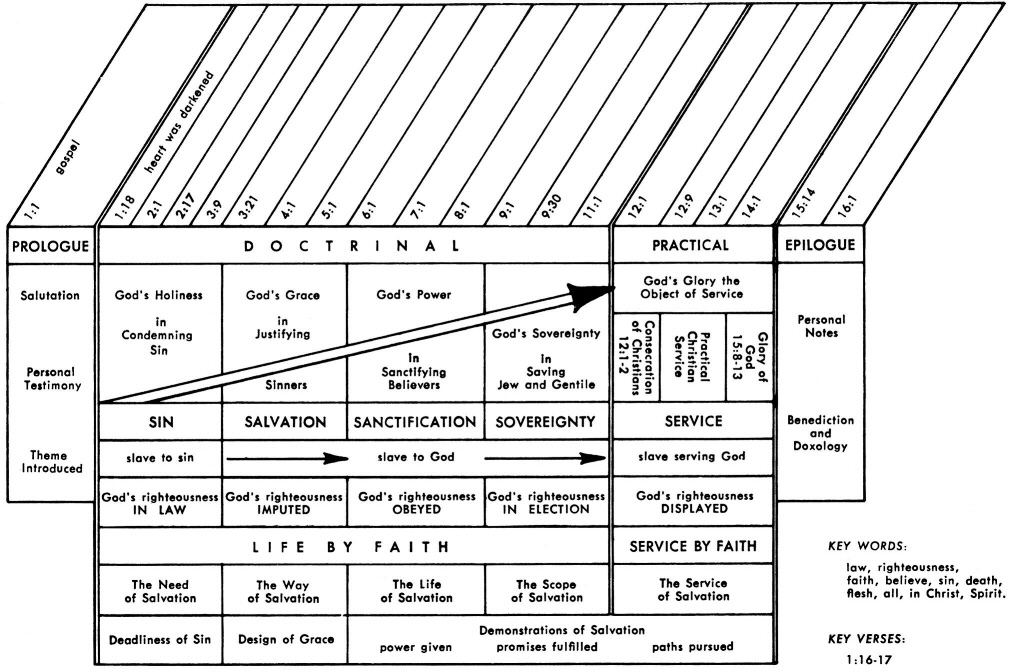
Click chart to enlarge
Chart from recommended resource Jensen's Survey of the NT - used by permission
Romans Overview Chart - Charles Swindoll
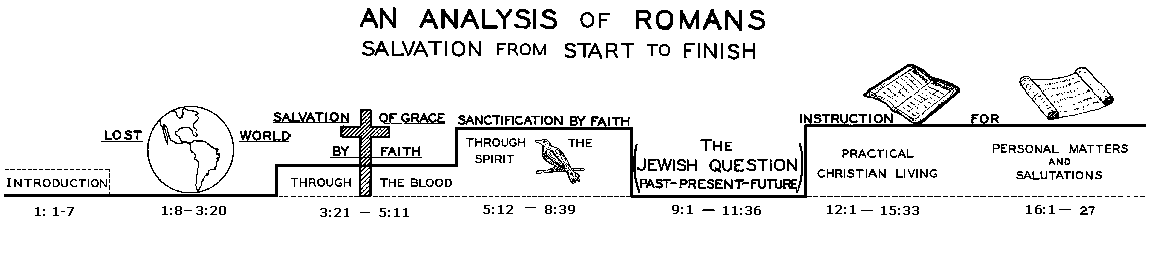
Source: Dr David Cooper
Click to Enlarge
| ROMANS ROAD to RIGHTEOUSNESS |
||||
| Romans 1:18-3:20 | Romans 3:21-5:21 | Romans 6:1-8:39 | Romans 9:1-11:36 | Romans 12:1-16:27 |
| SIN | SALVATION | SANCTIFICATION | SOVEREIGNTY | SERVICE |
| NEED FOR SALVATION |
WAY OF SALVATION |
LIFE OF SALVATION |
SCOPE OF SALVATION |
SERVICE OF SALVATION |
| God's Holiness In Condemning Sin |
God's Grace In Justifying Sinners |
God's Power In Sanctifying Believers |
God's Sovereignty In Saving Jew and Gentile |
Gods Glory The Object of Service |
| Deadliness of Sin |
Design of Grace |
Demonstration of Salvation | ||
| Power Given | Promises Fulfilled | Paths Pursued | ||
| Righteousness Needed |
Righteousness Credited |
Righteousness Demonstrated |
Righteousness Restored to Israel |
Righteousness Applied |
| God's Righteousness IN LAW |
God's Righteousness IMPUTED |
God's Righteousness OBEYED |
God's Righteousness IN ELECTION |
God's Righteousness DISPLAYED |
| Slaves to Sin | Slaves to God | Slaves Serving God | ||
| Doctrine | Duty | |||
| Life by Faith | Service by Faith | |||
|
Modified from Irving L. Jensen's chart above |
||||
R Ruin (Romans 1:17 – 3:20) – The utter sinfulness of humanity
O Offer (Romans 3:21-31) – God’s offer of justification by grace
M Model (Romans 4:1-25) – Abraham as a model for saving faith
A Access (Romans 5:1-11) – The benefits of justification
N New Adam (Romans 5:12-21) – We are children of two “Adams”
S Struggle w/ Sin (Romans 6:1-8:39) Struggle, sanctification, and victory
Romans 8:12 So then, brethren, we are under obligation, not to the flesh, to live according to the flesh -- (NASB: Lockman)
Greek: Ara oun, adelphoi, opheiletai esmen, (1PPAI) ou te sarki tou kata sarka zon; (PAN)
Amplified: So then, brethren, we are debtors, but not to the flesh [we are not obligated to our carnal nature], to live [a life ruled by the standards set up by the dictates] of the flesh. (Amplified Bible - Lockman)
NLT: So, dear Christian friends, you have no obligation whatsoever to do what your sinful nature urges you to do. (NLT - Tyndale House)
Phillips: So then, my brothers, you can see that we have no particular reason to feel grateful to our sensual nature, or to live life on the level of the instincts. (Phillips: Touchstone)
Wuest: So then, brethren, we are those under obligation, not to the sinful nature to live habitually under the dominion of the sinful nature. (Eerdmans Publishing - used by permission)
Young's Literal: So, then, brethren, we are debtors, not to the flesh, to live according to the flesh
SO THEN (therefore) : Ara oun:
- Romans 8 Resources - Multiple Sermons and Commentaries
- Romans 8:12-13: Kill Your Sin! - Steven Cole
- Romans 8:12-13 The Key to Spiritual Victory - John MacArthur
- Romans 8:12-13 The Spirit Empowers Us for Victory - John MacArthur
- Romans 8:12-13 The Spirit Empowers Us for Victory - Study Guide (click dropdown menu) - John MacArthur
- A Call for Action - Romans 8:12-13 - D. Martyn Lloyd-Jones - Mp3
- The Way of Sanctification - Romans 8:12-13 - D. Martyn Lloyd-Jones - Mp3
- Sin and the Christian - Romans 8:12-13 - D. Martyn Lloyd-Jones - Mp3
- Sin and the Body - Romans 8:12-13 - D. Martyn Lloyd-Jones - Mp3
A COMPELLING CONCLUSION
The venerable British preacher Dr Martyn Lloyd-Jones said the following regarding the crucial importance of Romans 8:13 - "These are the crucial verses with regard to this old problem around which there is and has been for a number of years a good deal of controversy." (Listen to his sermon A Call for Action - Romans 8:12-13) (Memorize Romans 8:12-13 so that in the Spirit you can meditate on it and pray it to the Father! Your walk of holiness will never be the same! I say that based on the authority of God's Holy Word enabled by His Holy Spirit for the glory of His Holy Son. Amen).
Vine has a nice summary statement on the Spirit of God observing that - This section is divided in two parts. Romans 8:1, 2, 3, 4, 5, 6, 7, 8, 9, 10, 11 have spoken of the indwelling of the Spirit of God; now follows an unfolding of the operation of the Spirit within us in a twofold way, firstly as to His leading and the effects of our response thereto (Romans 8:12, 13, 14); secondly, as to the inward witness given by the Holy Spirit, that we are the children of God, and the effects of this, issuing in our being glorified with Christ (Romans 8:15, 16, 17, 18, 19, 20, 21, 22, 23, 24 , 25, 26, 27). (Collected writings of W. E. Vine)
John MacArthur observes that in "Romans 8:12–13, the verses where Paul introduces the idea of mortifying sin, signal a major turning point in the logical thread that runs through this chapter. Martyn Lloyd-Jones said,"It is here for the first time, in this chapter, that we come to the realm of practical application. All we have had up to this point has been a general description of the Christian—his character, his position. But now the Apostle has really come explicitly to the doctrine of sanctification. Here we are told exactly how, in practice, the Christian becomes sanctified. Or, to state it differently, here we are told in detail and in practice how the Christian is to wage the battle against sin." (Listen to Lloyd-Jones' sermons on Romans 8) Paul does not promise immediate freedom from sin’s harassment. He does not describe a crisis-moment sanctification, where the believer is immediately made perfect. He does not tell the Romans to “let go and let God” take over while they sit idle. He does not suggest that a turning-point “decision” will solve the matter once and for all. On the contrary, he speaks of a continuous struggle with sin, where we are persistently, perpetually “putting to death the deeds of the body.” The language is often misunderstood. Paul is not calling for a life of self-flagellation. He is not saying believers should starve themselves, literally torture their bodies, or deprive themselves of life’s basic needs. He is not telling them to mutilate themselves or live monastic lives or anything of the sort. The mortification Paul speaks of has nothing to do with external self-punishment. It is a spiritual process accomplished “by the Spirit.” Paul is describing a way of life where we seek to throttle sin and crush it from our lives, sapping it of its strength, rooting it out, and depriving it of its influence. That is what it means to mortify sin." (Borrow Vanishing Conscience or here)
So (686) (ara) here is used as an inferential particle (so, therefore, now, consequently) marking a transition to what naturally follows from the words preceding.
Then (3767) (oun) is a conjunction which is placed after one or more words in a clause, and expressing either the merely external connection of two sentences, that the one follows upon the other, or also the internal relation of cause and effect, that the one follows from the other.
This could be rendered "wherefore therefore" this combination signifying that Paul is drawing a compelling conclusion. In other words he is using not one but two Greek "terms of conclusion" to emphasize his conclusion. What Paul will teach in these next two verses is that privilege is associated with responsibility. Given that the Spirit Who resurrected Christ will energize our mortal bodies (Ro 8:11), we are no longer debtors to the evil flesh for the flesh did not purchase our new life in Christ. To the contrary we are now debtors to the Spirit Who has given us new life in Christ. We as believers are under a "new management" team so to speak, to Whom we are now obligated.
Paul is saying in essence, "therefore on the basis of your magnificent privilege and provision for victory over sin that you possess by virtue of the indwelling Spirit (and motivated by the hope of your future resurrection), you now have a responsibility or obligation to fulfill."
Some commentaries feel Paul is drawing together all the truths of a believer he has taught about the believers new position and power since Romans 6, which is possible but is certainly not the immediate context. Others feel that Paul is summing up all the truths of a believer's position and privilege since Romans 8:1 and that is certainly a reasonable thought. Again in the immediate context (Ro 8:10, 11- see notes Ro 8:10; 11) Paul has just explained the great truth that Christ is in our dying bodies and the same Spirit Who God used to raise Christ from the dead indwells us to give life to our dying bodies. On the basis of these great truths he exhorts (and warns) believers about how such privileged people should now live out the remainder of their life.
Barnhouse - OUR text begins with a therefore, and it is necessary for us to look backwards into the preceding portion in order to understand the foundation on which the truth of the present text stands. In the previous chapter we saw that the Holy Spirit of the God who raised up the Lord Jesus from the dead is dwelling in the believer. In consequence, this same God who raised up Christ from the dead shall keep on furnishing life within the framework of our mortal bodies, through this indwelling Holy Spirit. The sphere of victory is to be within our dying bodies. Therefore, the apostle continues, we are debtors. God has made a large deposit of life and power to our account. We are debtors for that life and power and must some day give an account of how we have used or neglected it. To fail to lay hold upon the power that has been given us is a dereliction of duty, just as the failure to invest the one talent in order to gain interest, caused the strongest denunciation from the Lord. We have within us the strength and power of our old Adamic nature, the downward pull of our flesh. But God has gone to the depths of Calvary and the heights of the resurrection in order to furnish us with a power that will make it possible for us to live lives of victory. (Romans)
Hendricksen observes that "At this point there is a transition from exposition (Ed: "our privilege") to exhortation (Ed: "our responsibility"); from concentration on blessings bestowed by the Giver, to focusing on the obligation incurred by the recipients, including Paul himself. However, the recipients are by no means represented as being able to act independently. Salvation is not a 50–50 affair. It is God’s gift from start to finish. It is by the Spirit that God’s children must put to death the disgraceful deeds of the body (verse 13), that they are being led (Ro 8:14), and are being moved to cry, “Abba!” (Ro 8:15). It is from the Spirit that they receive the assurance that they are indeed children of God (Ro 8:16). But all this does not take away the fact that the recipients of these favors must go into action. They have an obligation to perform; nevertheless, cannot do this in their own power. How then? As already indicated, “by the Spirit,” and see notes Philippians 2:12, Philippians 2:13.(Hendriksen, W., & Kistemaker, S. J. New Testament Commentary)
Godet writes that that so then "refers to the thought of the preceding passage: “Since the Spirit has set you free from the law of sin and death, do not replace yourselves (put yourselves again) under this curse.”
S Lewis Johnson feels that "The resurrection (Ed: Just described in Ro 8:11) is a motive for the life of holiness, and that is the inference the apostle draws from the preceding." (Romans 8:5-17)
In short, Paul is drawing a conclusion and making an application based on the truth about the believer's position before God (In Christ - Ro 8:10-see notes Romans 8:10) and possessions (Indwelling Holy Spirit - Ro 8:9-see notes Romans 8:9) and promise (future resurrection - Ro 8:11) which are graciously provided to enable one to live a life of godliness. So then let the power of all these mighty truths transform our minds (in context especially the way we think about sin and how we deal with sin) and under grace (and Spirit enablement = we are to walk "not … according to the flesh, but according to the Spirit" - Ro 8:5) govern our thoughts and direct our actions (toward holiness and righteousness and life).
Implicit in the teaching in Romans 8:12,13 is the truth that every regenerate individual can live, at times (but never as a lifestyle) according to the flesh. Why else would Paul say a believer is no longer obligated to the flesh unless such an obligation were possible? (see also similar reasoning in Paul's command not to let sin reign in our mortal bodies, etc - Ro 6:12, 13-see notes on Ro 6:12; 13 - these verses imply that although Sin has been "placed in neutral gear" so to speak, as when a car is idling, this evil disposition can still be engaged into gear and exert it's evil affect over a believer's mortal body. This is a truth all of know far too well!)
Remember that all biblical exhortations and commands to believers are based on the promises they already have from the Lord. Peter makes it clear in his beautiful introduction to his second epistle writing "that His (God and Jesus our Lord) divine power has granted to us everything pertaining to life and godliness, through the true knowledge of Him who called us by His own glory and excellence. For by these He has granted (grace gifted) to us His precious and magnificent promises, in order that (explains purpose of the promises) by them you might become partakers (sharers) of the divine nature (not little Christ's like the New Agers teach, but progressively being transformed - 2Cor 3:18), having escaped (past tense = this is an accomplished fact = When? At the Cross and made effective for us when we first believed) the corruption (this is a "dirty" word - it ought to make sin repulsive to us!) that is in the world by lust (strong desires to please self not God). (see notes 2 Peter 1:3, 1:4)
Without these grace-laden provisions from God, we as believers would be unable to fulfill His commands. The point is that "I by myself can't live this supernatural Christian life". God never said I could. But God can and He said He would live in and through us. Paul said it this way in Galatians in the context of describing his death to the law and all self efforts to attain the righteousness that God requires writing "I have been crucified with Christ (that is when he "escaped the corruption"); and it is no longer I who live, but Christ lives in me; and the life which I now live in the flesh I live by faith in the Son of God, who loved me, and delivered Himself up for me." (Galatians 2:20-see detailed expository note)
We need to acknowledge the sense of our own inadequacy and of His all sufficient adequacy (cp 2Cor 3:5-6, 2Cor 12:9-10).
This principle of divine divine provision (promise) preceding the call to practice righteousness flows through both the Old and New Testament. For instance, the children of Israel were not commanded to take possession of the Promised Land until it was promised to them by God and they were prepared by Him to conquer it.
In this letter to Rome, Paul’s primary exhortations begin in Romans 12 (see note Romans 12:1) but only after he expounded on the position and power that each believer possesses which enable them to carry out the exhortations supernaturally, indwelt, controlled and empowered by the Spirit of Christ.
In Ephesians Paul first gives three chapters explaining "every spiritual blessing in the heavenly places in Christ" (see sermon note ) Then just before his beautiful doxology at the end of chapter 3 Paul prays
that He would grant you, according to the riches of His glory, to be strengthened with power through His Spirit in the inner man; so that Christ may dwell in your hearts through faith; and that you, being rooted and grounded in love, may be able to comprehend with all the saints what is the breadth and length and height and depth, and to know the love of Christ which surpasses knowledge, that you may be filled up to all the fulness of God. (see sermon notes on Ephesians 3:16; 3:17; 3:18; 3:19)
Only then does Paul exhort believers to walk a supernatural walk (lifestyle)
“in a manner worthy of the calling with which you have been called, with all humility and gentleness, with patience, showing forbearance to one another in love, being diligent to preserve the unity of the Spirit in the bond of peace.” (see sermon notes Ephesians 4:1; 4:2; 4:3).
A similar pattern of first a description of the believers position and possessions in Christ and then the call to put this truth into practice in the power of the Spirit is seen in the parallel epistle of Colossians (Col 1-2 = Doctrine; Col 3-4 = Duty).
F L Godet writes that "The life of the Spirit is not realized in the believer without his (the believer's) concurrence (agreement or union in action) merely from the fact that the Spirit has once been communicated to him. There is needed on man's part a persevering decision, an active docility (easily taught, led and managed) in giving himself over to the guidance of the Spirit. For the guidance of the Spirit tends constantly to the sacrifice of the flesh (Ed: Cp "Mortify your members" in Col 3:5KJV) and if the believer refuses to follow on this path, he renounces the life of the Spirit and its glorious privileges (Ed: I would add that he grieves the Spirit and quenches the Spirit - Eph 4:30, 1Thes 5:19). (Romans 8:12-17 Adoption)
BRETHREN, WE ARE (continually) UNDER OBLIGATION: adelphoi, opheiletai esmen (1PPAI):
- Ro 6:2-15; Ps 116:16; 1Corinthians 6:19,20; 1Peter 4:2,3
- Romans 8 Resources - Multiple Sermons and Commentaries
- Romans 8:12-13: Kill Your Sin! - Steven Cole
- Romans 8:12-13 The Key to Spiritual Victory - John MacArthur
- Romans 8:12-13 The Spirit Empowers Us for Victory - John MacArthur
- Romans 8:12-13 The Spirit Empowers Us for Victory - Study Guide (click dropdown menu) - John MacArthur
BELIEVERS ARE DEBTORS
Notice that Paul uses "we" clearly links him with his readers, whom he addresses as brethren. Paul needed to live in the light of this truth just as much as did his readers!
We don't owe the flesh anything! Why would we give in to our flesh which is a murderer and has done nothing but prepare us for everlasting torment (had Christ not rescued us)?
Moule introduces this section observing that "Paul begins with Holiness viewed as Duty, as Debt. He has led us through our vast treasury of privilege and possession. What are we to do with it? Shall we treat it as a museum, in which we may occasionally observe the mysteries of New Nature, and with more or less learning discourse upon them? Shall we treat it as the unwatchful King of old treated his splendid stores, making them his personal boast, and so betraying them to the very power which one day was to make them all its spoil? No, we are to live upon our Lord’s magnificent bounty — to His glory, and in His will. We are rich; but it is for Him. We have His talents; and those talents, in respect of His grace, as distinct from His “gifts,” are not one, nor five, nor ten, but ten thousand — for they are Jesus Christ. But we have them all “for Him.” We are free from the law of sin and of death; but we are in perpetual and delightful debt to Him who has freed us. And our debt is — to walk with Him. (Moule, C. G. The Epistle of St Paul to the Romans)
Brethren (80) (adelphos from a = denoting unity + delphús = womb) means literally one born from same womb and so describes males having the same father and mother. Here Paul uses adelphos figuratively to describe the close association of persons having a well-defined membership, specifically referring here to fellow believers in Christ, and composing His body, the church.
Godet writes that "When saying: we are under obligation, literally debtors, Paul meant to continue in the words: to the Spirit, to live according to Him. As soon as the Spirit comes to dwell in our heart, we owe to Him, ourselves, and a life wholly conformed to His wishes. But the apostle breaks off his sentence to set aside the opposite supposition, one unfortunately which cannot be passed over in silence, and he makes haste to add: not to the flesh. “The natural man,” Hofmann observes, “imagines that he owes it to his flesh to satisfy it.” The care of his person, from the most earthly point of view, appears to him the first and most important of his obligations. Now it is this tendency which is combated by the Spirit as soon as He takes possession of us (Gal 5:17). This is the debt which should neither be acknowledged nor paid. The apostle says why in the following verse. (Godet, F L: Commentary on Romans)
Matthew Henry adds that "We are not debtors to the flesh, neither by relation, gratitude, nor any other bond or obligation. We owe no suit nor service to our carnal desires; we are indeed bound to clothe, and feed, and take care of the body, as a servant to the soul in the service of God, but no further. We are not debtors to it; the flesh never did us so much kindness as to oblige us to serve it. It is implied that we are debtors to Christ and to the Spirit: there we owe our all, all we have and all we can do, by a thousand bonds and obligations. Being delivered from so great a death by so great a ransom, we are deeply indebted to our deliverer.
Paul explains why we are obligated to the Spirit writing "Or do you not know that your body is a temple of the Holy Spirit who is in you, whom you have from God, and that you are not your own? For you have been bought with a price: therefore glorify God in your body. (1Cor 6:19, 20)
Are under obligation - The verb are is present tense - this is not an on and off obligation but a continual obligation as long as we live in this fallen planet in mortal bodies.
Under obligation (3781) (opheiletes from opheilo = owe, conveying the basic meaning of owing a debt) means one who owes another (of one who owes another money) having a strong moral obligation and personal duty) means a debtor, one who is bound by some duty, one who owes anything to another. It can refer to a literal debt (see Mt 18:24 below) or as used here in Romans 3 times (see below) by Paul figuratively to refer to a personal, moral obligation in contrast to that which is a necessity (which is the Greek verb dei = Click word study of dei) as dictated by the nature of the situation (such as we must eat, we must sleep. We are no longer debtors to the flesh -- what we once were no longer has any claim on us.
Opheiletes can describe one who has committed a misdeed and owes it to the law to make it right - in such case this person is called a guilty person, an offender or a sinner (see Lu 13:4 below). It is one who has not yet made amends to whom he has injured. For example, it describes one who owes God penalty or whom God can demand punishment as something due (eg, a sinner)
Richards writes that words in the opheilo word group (including opheiletes) = "Words in this group originally expressed the idea of a legal or personal obligation. The Greeks had both financial and, later, moral obligations in mind when they used this term. (BORROW Expository Dictionary of Bible Words)
NIDNTT adds that…
The word-group formed from the stem opheil- belongs originally to the sphere of law.
Opheilo, attested since Mycenaean Greek., means:
(a) when linked with an object, to owe someone something, e.g. money, a loan (cf. Egyptian sources in BGU III, 846, 16; IV, 1149, 35); and (b) with an infinitive, to owe in the sense of being indebted (Plato, Leg. 4, 717b).
An opheiletes is (a) a debtor (Plato, Leg. 5, 736d); (b) someone who is under an obligation to achieve something (not found in this sense in the LXX).
Opheile (rare, and not in the LXX) and the more common opheilema (in the LXX only in Deut. 24:10; 1 Macc. 15:8) denote a debt, particularly of a financial nature,
Ophelon, originally an aorist participle of opheilo with the addition of estin (is), became the set expression for the optative “O, that”, “would that”, “if only” (cf. Epict., Dissertationes 2, 22, 12).
2. Alongside financial there are also moral obligations in respect of people or of state laws. Thus a culprit is often punished by being required to pay compensation to the injured party (Plato, Cra. 400c: until he has made the necessary payments). Infringement of divine regulations and thanks which must be rendered in return for benefactions of the gods also make men debtors, in requiring from them some cultic penance or act. Thus in Plato, Phaedo 118, the dying Socrates says: “We owe Asclepius [the god of healing] a cock.” Correlates and formations from opheilo thus contain both the negative component of debt and the positive one of obligation. (3 VOLUME WORK ONLINE - Brown, Colin, Editor. New International Dictionary of NT Theology. 1986. Zondervan)
The TDNT has a nice summary of the root word opheilo noting that it is…
Etymologically obscure, this word means “to owe someone something,” e.g. loans, debts, sums, or rents. The things owed may be spiritual, and the word is also used with the infinitive for “to be under obligation to,” “to have to.” The word is common in respect of revenge or law. Transgressors are in debt to injured parties. Secular and sacral penalties are owed. God’s goodness also makes people debtors. This gives rise to the idea of moral obligation. (BORROW Kittel's Theological Dictionary of the New Testament)
Here are the 7 NT uses of opheiletes (not in the Septuagint - LXX) translated culprits, 1; debtors, 1; indebted, 1; owed, 1; under obligation, 3…
'And forgive us our debts, as we also have forgiven our debtors (opheiletes). (see notes Matthew 6:12) (Comment: Those who sin against us are viewed as our debtors whom we are to forgive just as God Himself forgave us a sin debt we could never repay).
"And when he had begun to settle them, there was brought to him one who owed (opheiletes) him ten thousand talents (such a large amount in essence it cannot be paid = Jesus is teaching about man's dependence on and responsibility to God who will settle accounts with His servants - ultimately only through the compassion of the creditor could such a high debt be remitted - and so men should forgive one another debts which by comparison are miniscule instead of insisting on their "legal" rights!). (Mt 18:24)
"Or do you suppose that those eighteen on whom the tower in Siloam fell and killed them, were worse culprits (opheiletes; KJV renders it "sinners") than all the men who live in Jerusalem? (Luke 13:4)
"I am under obligation both to Greeks and to barbarians, both to the wise and to the foolish." (see notes Romans 1:14)
Yes, they were pleased to do so, and they are indebted to them. For if the Gentiles have shared in their spiritual things, they are indebted to minister to them also in material things. (see notes Romans 15:27)
And I testify again to every man who receives circumcision, that he is under obligation to keep the whole Law (the law is viewed as a unit, thus obedience to it cannot be selective). (Galatians 5:3)
Now we are indebted to the Holy Spirit for all He has done and will do in and through us. But don't be confused… we cannot "earn" God's favor. God gives us the power (His indwelling Spirit - Ro 8:9, 10, 11 - see notes Romans 8:9, 8:10, 8:11) to "pay Him back" with works of righteousness (not works done in the flesh… these are dead works) done out of heart of obedience (see note Romans 6:17)… now we offer back to Him our obedience (1Sa 15:22) realizing that even that would not be possible unless He had changed our hearts from their godless, hostile, helpless, sinful (Romans 5:6-10-notes) condition to a new heart with new motivation that He provides that now we might be pleasing to Him.
NOT TO THE FLESH TO LIVE (habitually, continually) ACCORDING TO THE FLESH: ou te sarki tou kata sarka zon (PAN):
- Romans 8 Resources - Multiple Sermons and Commentaries
- Romans 8:12-13: Kill Your Sin! - Steven Cole
- Romans 8:12-13 The Key to Spiritual Victory - John MacArthur
- Romans 8:12-13 The Spirit Empowers Us for Victory - John MacArthur
- Romans 8:12-13 The Spirit Empowers Us for Victory - Study Guide (click dropdown menu) - John MacArthur
ALL MANKIND IS EITHER
IN THE FLESH OR IN THE SPIRIT
Once we were dead in our trespasses and sins (Eph 2:1), but now are dead to sin and alive to God in Christ Jesus (Ro 6:11). Once we were in Adam, but now we are in Christ. We may at times act like we used to when we were in Adam, but we are not in Adam but eternally, securely in Christ! Once our soul lived solely in the flesh (continually in the power of and under the dominion of the flesh), but now we live in the Spirit of Jesus Christ. So the question is "Can believers still be literally "in the flesh?"" Strictly speaking they cannot! But can a believer live in a fleshly manner, temporarily under the power of the the flesh? Of course. I look in the mirror every morning and see evidence of that truth! But the truth about me and you dear brother or sister in Christ is that you can no longer continually live in the flesh, under its power and dominion, for that way is the way of death, eternal death. Why? Because a soul that lives continually in bondage to the flesh, to sin (personified as "King" or "Slave Master" cf Ro 6:12-13 - Sin "personified" as a principle), to the lusts of the flesh, has never been born of God (cf 1 Jn 3:9,10). They simply do not have the inherent supernatural (Christ in us, His Spirit in us as His effecting Agent) to overcome the flesh on a daily basis. In short then it is never accurate to say that a believer is "in the flesh." The more accurate way to describe a believer who sins is that he or she is acting fleshly. Does that make sense?
John MacArthur after quoting Ro 8:3-11 writes "In other words, life in the Spirit is markedly different from the life of the unbeliever. All true Christians are “in the Spirit.” They “do not walk according to the flesh, but according to the Spirit.” Those who walk according to the flesh are unbelievers, and Paul is quite definite in making that clear: “If anyone does not have the Spirit of Christ, he does not belong to Him” (v. 9). Later he adds, “For all who are being led by the Spirit of God, these are sons of God” (v. 14). That means there are only two kinds of people in the world—those who are in accord with the flesh, and those who are in accord with the Spirit. Of course, there are in-the-Spirit people at many different levels of spiritual maturity. In-the-flesh people also come in varying degrees of wickedness. But everyone is either “in the flesh” (v. 8) or “in the Spirit” (v. 9). There is no category called “in between.” What Paul is suggesting is that the Holy Spirit changes our basic disposition when we are born again. He brings us into accord with Himself....Christians are no longer “in the flesh”: “You are not in the flesh but in the Spirit, if indeed the Spirit of God dwells in you. But if anyone does not have the Spirit of Christ, he does not belong to Him” (Rom. 8:9). The Greek word translated “dwells” is oikeō, which means “to inhabit.” Paul is saying that the very Spirit of God indwells every person who trusts in Jesus Christ. The Spirit is in us, and we are “in the Spirit.” We are not “in the flesh.”" (BORROW Vanishing Conscience)
Not (ou) is the Greek word indicating absolute negation. The point is that believers have been set free from this harsh master personified as the Flesh (Compare Paul's earlier teaching that "the law of the Spirit of life in Christ Jesus has set you free from the law of sin and of death" Ro 8:2). Prior to our new birth we were in fact "obligated" to the flesh, and had to obey it's desires and wishes! (eg, cp notes on "enslaved to various lusts and pleasures" Titus 3:3) There is now no obligation to the flesh. In fact now Paul commands believers…
Therefore (because believers now are "dead to [the power once exerted over us by our old master] sin, but alive to God in Christ Jesus" Ro 6:11) do not let sin reign in your mortal body (present imperative is a command preceded by a negative = "Stop letting the Sin continue to reign in your physical body!" Beloved just try to keep this in your own power - as with all commands, this is a call for us to jettison self reliance and to instead rely on the Spirit Who is in us to give us the desire and the power to live pleasing to God - cp Phil 2:13NLT) that you should obey its lusts 13 and do not go on presenting (also present imperative with a negative - again the same qualifier - carry this out in dependence of the Spirit!) the members of your body to (the) Sin (which continues to want to "usurp" the throne which now rightly belongs to Christ Jesus alone) as instruments of unrighteousness; but present (aorist imperative = Command to do this now and do it effectively! = as the Spirit enables you to present) yourselves to God as those alive from the dead, and your members as instruments of righteousness to God. (see notes Romans 6:12; Romans 6:13)
Believers now are debtors to and in that sense obligated to righteousness (not a legalistic obligation but a love obligation that comes from our new heart and the new covenant). It is not enough that we have received the Holy Spirit (which we have). It is now our moral/ethical obligation (motivated by our remembrance of the love of God for us as evidenced by the Cross and the love and anticipation we have of our Lord's imminent Second Coming) to walk not according to the flesh but according to the Spirit. (Gal 5:16, 17, 18-see notes Galatians 5:16; 17; 18)
A Debtor to Mercy
A debtor to mercy alone
Of covenant mercy I sing
I come with Your righteousness on
My humble offering to bring
The judgments of Your holy law
With me can have nothing to do
My Savior’s obedience and blood
Hide all my transgressions
From view
The work which Your goodness began
The arm of Your strength will complete
Your promise is yes and amen
And never was forfeited yet
The future or things that are now
No power below or above
Can make You Your purpose forego
Or sever my soul from Your love
My name from the palms of Your hands
Eternity will not erase
Impressed on Your heart it remains
In marks of indelible grace
Yes I, to the end will endure
Until I bow down at Your throne
Forever and always secure
Forever and always secure
Forever and always secure
A debtor to mercy alone
See Related Post - Indelible Grace- Inscribed on His Hands
Pritchard - Why don’t we owe anything to the flesh? One, because we’ve been set free from the power of the flesh. We are no longer "in the flesh" but "in the Spirit." The flesh once controlled us, but now we are free. Two, because the flesh does us no good. Consider the "ministry" of the flesh: 1. It tempts us to do evil. 2. It pulls us away from God. 3. It wars continually against the Holy Spirit. You don’t have to live in the flesh any more because you don’t owe your flesh anything. (Romans 8:5-17: Life in the Spirit)
Warren Wiersbe explains the debt this way "Our obligation is to the Holy Spirit. It was the Spirit who convicted us and showed us our need of the Savior. It was the Spirit who imparted saving faith, who implanted the new nature within us, and who daily witnesses within that we are God’s children. What a great debt we owe to the Spirit! Christ loved us so much, He died for us; the Spirit loves us so much, He lives in us. Daily He endures our carnality and selfishness; daily He is grieved by our sin; yet He loves us and remains in us as the seal of God and the “down payment” (“earnest,” 2Cor. 1:22) of the blessings waiting for us in eternity. If a person does not have the Spirit dwelling within, that person is not a child of God. (BORROW Wiersbe's Expository Outlines on the New Testament )
Morris explains that "Paul is laying it down firmly that for Christians the flesh has no rights; as Earle puts it, “we owe the flesh nothing”. The way Paul puts it, “we are debtors, not to the flesh—”, leads us to look for “but to the Spirit” or for some other expression to indicate where our debt lies, “but this is elegantly left to be understood” (Bengel). The characteristic life of the Christian owes nothing to the flesh, though we should not ignore the force of this warning about “the flesh” in a letter to Christians. “The flesh” is not eradicated but is an ever-present reality. Paul goes on to explain that to be indebted to the flesh means “to live according to the flesh”. This is not an option for the believer. (BORROW The Epistle to the Romans. W. B. Eerdmans; Inter-Varsity Press)
As Moule says "For a moment he turns to say what we owe “no” debt to even “the flesh,” the self-life. But it is plain that his main purpose is positive, not negative. He implies in the whole rich context that we are debtors to the Spirit, to the Lord, “to walk Spirit-wise.” (Moule, C. G. The Epistle of St Paul to the Romans)
Not (3756) (ou) defines absolute negation. Paul's point is strong - the believer is no longer under moral obligation or debt to the flesh, that evil disposition inherited from Adam which is opposed to God and can do absolutely nothing to please God. The old, sinful nature may present its desires, even its demands, based upon our past, but we are now under no obligation to cooperate!
Live (2198) (zao) in the present context refers to living one's life. The important truth Paul brings out with the use of the present tense is that believers are no longer those who live continually under the dominion of the evil flesh nature. Sure, none of us have arrived so to speak (that is called "glorified"!) and we are "prone to wander" as the hymn writer laments. However our wandering is for a moment or even a season but not for a lifetime and not as our continual habitual practice.
According to (2596) (kata) can mean "down" and in this context can picture a person living "down under" (subject to) the dominion (the ruling power) of the flesh.
Flesh (4561) (sarx [word study]) as used in the present context is that evil part of man inherited from Adam and unfortunately still having residence in a believer's mortal body. The flesh is at war with God and is not able to be controlled or changed by the Law. In fact when a believer now attempts to keep the law (or any form legalism might take in one's life), he or she is only giving opportunity to the old flesh nature to work! When a believer begins to live by Law they begin to depend on their own strength (the evil flesh nature) and they are left to get by without God’s supply or the Spirit's enablement. And the efforts of the flesh can never accomplish what faith can accomplish through the Spirit. In short, the old nature cannot be controlled by Laws or rules and eventually breaks out thus explaining why legalistic religious groups are so prone to fights and divisions. There are many popular false religious teachers who promulgate a religion that pampers the old flesh nature and feeds the ego (which accounts to a large extent for their popularity).
As J Vernon McGee reminds us "My friend, the flesh—and we all have it—is a low-down, dirty rascal. And we don’t owe it anything. (Thru the Bible Commentary)
MacDonald echoes these thoughts writing that the flesh is nothing but "The old, evil, corrupt nature has been nothing but a drag. It has never done us a bit of good. If Christ had not saved us, the flesh would have dragged us down to the deepest, darkest, hottest places in hell. Why should we feel obligated to such an enemy? (BORROW Believer's Bible Commentary)
The flesh is recognized in a believer when he or she is living for self and seeking the praise of men rather than the glory of God. Be aware that the flesh is quite a "chameleon" (changes "colors" in order to adapt to the environment and assure survival), for it loves to be “religious”, obeying laws, observing holy occasions, fasting, etc (cp Col 2:20-23-note). The flesh loves to boast about its religious achievements - how many prayers were offered, or how many gifts were given. Every believer needs to be wary of that legalistic tendency of the flesh which can be easily "activated", leading to pride and making the outward event a substitute for the inward experience! Remember also that the ways of the flesh promise happiness, but misery is ultimately their reward (cf Gal 6:8-note).
To live according to the flesh is to be ruled and controlled by the flesh. Because of Christ’s saving work on our behalf, the sinful flesh no longer reigns over us, to debilitate us and drag us back into the pit of depravity into which we were all born (Study the passages Ro 6:6, 12, 14, 17, 22- see notes on Ro 6:6, 6:12, 6:14, 6:17, 6:22). Believers as Paul has already explained are those who order their behavior in such a way that it is not dominated by the evil nature, but by the Holy Spirit (Ro 8:4, 5, 6- see notes Ro 8:4, 5, 6).
Paul’s thought is, “So then, since the saint is not within the sphere of the flesh, the power of the latter having been broken and since he is within the sphere of the Holy Spirit, he is under no obligation to the flesh to live under its dominion.”
Although a believer is not now to be obligated to the flesh, Paul's implication is that believers are in fact under obligation to God's Holy Spirit of God and our aim should to be about the business of putting to death the deeds of the body (Col 3:5, Php 2:11).
The truth is that we have already spent too much time living according to the flesh (before we were born again), Peter writing that now believers are "to live the rest of the time in the flesh (here Peter uses flesh not to refer to the evil disposition but the "flesh and blood" aspect of flesh) no longer for the lusts of men, but for the will of God. For the time already past is sufficient for you to have carried out the desire of the Gentiles, having pursued a course of sensuality, lusts, drunkenness, carousals, drinking parties and abominable idolatries. (see notes 1 Peter 4 :2; 4 :3)
And so the believer disciplines himself or herself for godliness, continually seeking to deny the efforts of the flesh to impose its lifestyle on him or her, even as Paul instructed Titus to teach the believers at Crete "For (As an aside this is a great example of Paul's use of this strategic term of explanation. What will it force you to do, that is if you want to be edified?!) the grace of God has appeared, bringing salvation to all men (so grace is available to empower us), instructing (child rearing) us to deny (enabled by grace to make a definitive, conscious, willful repudiation of thoughts, words, and actions that are opposed to true godliness) ungodliness and worldly desires and to live sensibly, righteously and godly in the present age, looking for the blessed hope and the appearing of the glory of our great God and Savior, Christ Jesus who gave Himself for us, that He might redeem us from every lawless deed and purify for Himself a people for His own possession, zealous for good deeds . (see notes Titus 2:11, 2:12, 2:13, 2:14)
To review, the flesh is that ugly complex of human sinful desires that includes the ungodly motives, affections, principles, purposes, words, and actions that sin generates through our mortal bodies. To live continually according to the flesh is to be completely ruled and controlled by that evil complex. Because of Christ’s saving work on our behalf and our permanent position in Christ, the sinful flesh no longer has any right to reign over us and to debilitate us and drag us back into the pit of depravity into which we were all born in Adam.
Wayne Barber amplifies the meaning and practical significance of the believer's new freedom in Christ writing that…
WE ARE FREE IN CHRIST FROM THE COERCION OF THE FLESH. It is one thing to be CONTROLLED and another to be COERCED. Here is the point -
WE OWE THE FLESH ABSOLUTELY NOTHING.
The FLESH cannot control us anymore but it can coerce us to where it can have power over us…if we choose to allow this to transpire. In this verse Paul is making it clear that we are no longer UNDER OBLIGATION to the FLESH.
The word "OBLIGATION" is the same one he used in Romans 1:14 when he said
"I am UNDER OBLIGATION both to Greeks and to barbarians, both to the wise and to the foolish." (see notes Romans 1:14)
It is the picture of being INDEBTED to another.
Jesus paid a debt that He did not owe.
We owed a debt that we could not pay.
Now that we are IN CHRIST we are DEBTORS to God to proclaim the good news to the lost as Paul explains in Ro 1:14. How can we keep this great news of the new life IN CHRIST hidden from the lost and dying world around us? We cannot…we are debtors and our obligation is to share this life transforming truth.
On the other hand we are NO LONGER INDEBTED to the FLESH. Isn't this good news? Doesn't your flesh occasionally "rise up" and say something like
"You deserve to do this. Come on now…you owe me. So now please me. Please me!"
That's COERCION - the FLESH can still COERCE us but it cannot CONTROL one who is IN CHRIST. So because of what Jesus Christ did on the Cross, we don't "owe it a thing". We are debtors yes, but NOT TO THE FLESH. The truth is that the only thing that the FLESH has ever done for any of us is to draw us downward toward DEATH. Thank God that He has come into our life to save us from its power and we don't owe the flesh anything! If Christ had not saved us, the FLESH would have dragged us into Hell. Flesh has never done one thing GOOD for us. Everything the FLESH ever did for us was to INJURE and HURT us!
We owe the FLESH absolutely nothing!"
Dr Barber goes on to illustrate his point with a class on dieting at one the churches he pastored…
"The whole focus of this class on dieting is to QUIT THINKING ABOUT DIETING! Remember what happens when you put a "law" or "rule" over the flesh? The FLESH will rise up and potentially eat everything in site.
Don't get under a "law". Instead FOCUS ON CHRIST and remember that you do not owe your FLESH anything. So when that strong desire comes from your FLESH to tempt you to eat something you shouldn't, have the mindset that you don't owe the FLESH anything and turn to Christ.
We are free from the CONDEMNATION of the FLESH,
from the CONTROL of the FLESH and
from the COERCION of the FLESH.
Paul teaches a similar principle of how this Godward focus counters the lusts that emanate from your FLESH exhorting believers in Romans 13:14
PUT ON (aorist imperative) THE LORD JESUS CHRIST, and make (present imperative) no provision for the FLESH in regard to its lusts. (see notes on Romans 13:14)
When your mind is set on the things of the Spirit (see note Ro 8:6), you will find it much "easier" to not make plans on how you might commit the sins that the strong desires in your FLESH are crying out for you to commit. And the result? LIFE and PEACE…abundant life and peace not just "with" God but also "of" God. On one side on the truth in this verse believers are no longer under obligation to the FLESH, but the other side of that truth is that the Holy Spirit has the right to rule and reign in our hearts.
In Romans 8:5-11 (see notes Ro 8:5, 8:6, 8:7, 8:8, 8:9, 8:10, 8:11) Paul has drilled home the great life changing truth that a genuine believer is now INDWELT BY THE HOLY SPIRIT OF GOD. He shows us the lifestyle of those who are indwelt by the Spirit. It's not a lifestyle of sin. It is a lifestyle that brings glory to God and is obvious to others that Jesus lives in their lives. It is not worldly anymore. It has changed.
Then in Romans 8:12-14 (see notes Ro 8:12; 8:13; 8:14) Paul changes his emphasis and moves from Who we have in the Holy Spirit in our mortal bodies and he goes on to describe the responsibility of what those who are indwelt by the Holy Spirit are now to do. So yes we OWE A DEBT, and that debt is to surrender to the Spirit of God moment by moment. We owe nothing to the FLESH. It cannot compel us to do anything unless we so choose.
Wayne Barber gives his summary of what the flesh represents asking "WHAT IS THE FLESH? It is the Greek "sarx" which has two primary meanings in the New Testament. One is "flesh and blood" as in Romans 1:3 - "His Son, Who was born of a descendant of David according to the FLESH". (see note Romans 1:3)In other words Jesus is of the blood line of David. In Romans 2:28 Paul again uses flesh with its physical meaning writing…"neither is circumcision that which is outward in the FLESH" (see note Romans 2:28) In the figurative sense FLESH has to do with the nature or the characteristic or the mannerism of this flesh and blood body we live in. Because of original SIN (of Adam) this body is dying and inside this dying body are all the inordinate desires (lusts) of the FLESH. This is the same body we had before salvation and we need to understand the FLESH that still dwells in these bodies of (physical) FLESH. FLESH describes the only mindset and attitude with which the unregenerate body can respond - in a way that is totally the opposite what God desires and what pleases Him. Nothing that is birthed by the FLESH can produce good. Romans 7:5 says "For while we were IN THE FLESH, the sinful passions, which were aroused by the Law, were at work in the members of our body to bear fruit (or produce fruit) for death." (see note Romans 7:5) The "produce" so to speak of the efforts of the FLESH will always be DEAD WORKS and can NEVER PLEASE God. The Gnostics taught man is a spiritual being that is just "stuck" with this partner called flesh. They taught that by separating the spirit and the flesh we were no longer responsible for what the flesh does. In fact, believers are flesh and blood people inhabited by the Holy Spirit of God but we do have to deal with the FLESH that still remains in our mortal bodies. In Romans 6:19 Paul says "I am speaking in human terms because of the weakness of your FLESH" (see note Romans 6:19) What does he mean by "the weakness of your flesh"? Paul's point is that the FLESH has no ability whatsoever to measure up to what God requires (which equates with His Righteousness). As noted in Romans 7:5 (note) the FLESH has "sinful passions" or lusts, which describes the inordinate desires of the person who is IN THE FLESH (which equates with being IN ADAM). Although Paul is referring to the time when we were lost IN ADAM, even though we are now redeemed by the blood, we still live in an unredeemed physical body. In fact we still possess the same body we had before God placed us IN CHRIST. Paul's point then is that those SINFUL PASSIONS that we had while we were IN ADAM are still present in our mortal body. Our FLESH is wicked. It does not make any difference whether we are saved or lost…flesh is still just as evil in a saved person as it is in an unsaved person. Don't lose this truth. "When I get up in the morning and wonder what my biggest problem for the day is going to be, I quickly realize that I'm looking at him in the mirror!" My flesh is my biggest problem…it is wicked and has the potential to do all kind of evil deeds. This is Paul's primary focus in Romans 7:14, 15, 16, 17, 18, 19, 20, 21, 22, 23. There is something about my FLESH that is wicked and still devoted to sin. This wicked FLESH still lives in my mortal body (even a saved person) and I cannot divorce myself from it -- which is what the Gnostics taught. Instead we have to take responsibility for this FLESH that still indwells our saved but dying bodies. In Romans 7:18 Paul says "For I know that NOTHING GOOD DWELLS IN ME, that is, IN MY FLESH; for the wishing is present in me, but the doing of the good is not." (see note Romans 7:18) Yes the Spirit of God indwells a believer but He does not INDWELL MY FLESH. And so the wishing is present in me but the doing of the good is not IN MY FLESH because the FLESH can only bear fruit for death. Paul goes on in Romans 7:25 to say "Thanks be to God through Jesus Christ our Lord! So then, on the one hand I myself with my mind am serving the law of God, but on the other, with my FLESH the law of sin." (see note Romans 7:25) As believers now, any time we "drift" and choose to obey the desires, passions and lusts of our old FLESH, we are serving the LAW OF SIN, whether it is manifest as overt lawlessness or as religious works. Both still represent dead works of sin. As believers we need to be aware of the ongoing battle we will have until we see Jesus face to face…our FLESH will never improve…it will continue to give us a "fit"…it is wicked and has all manner of inordinate desires and passions. We continually have to deal with our flesh. The good news of Romans 8 is that we don't owe our flesh anything! What Jesus did for us on the Cross set us free from the power and the penalty of sin. I don't owe it anything anymore. Every time it sends me a note that says "Hey big boy…it's okay to have an immoral thought…hey big boy, just go ahead and covet…etc, etc" When that happens we can "look at the note" and say "Hold it. Hold it. Hold it. The bill that you want from me has been PAID IN FULL by Christ on the Cross and I don't owe you anything. I'm not obligated to all the wickedness of the FLESH any more!" Now folks that's the Gospel…THAT IS GOOD NEWS!
Romans 8:13 for if you are living according to the flesh, you must die; but if by the Spirit you are putting to death the deeds of the body, you will live. (NASB: Lockman)
Greek: ei gar kata sarka zete (2PPAI) mellete (2PPAI) apothneskein, (PAN) ei de pneumati tas praxeis tou somatos thanatoute (2PPAI) zesesthe (2PFMI)
Amplified: For if you live according to [the dictates of] the flesh, you will surely die. But if through the power of the [Holy] Spirit you are [habitually] putting to death (making extinct, deadening) the [evil] deeds prompted by the body, you shall [really and genuinely] live forever. (Amplified Bible - Lockman)
NLT: For if you keep on following it, you will perish. But if through the power of the Holy Spirit you turn from it and its evil deeds, you will live. (NLT - Tyndale House)
Phillips: Indeed that way of living leads to certain spiritual death. But if on the other hand you cut the nerve of your instinctive actions by obeying the Spirit, you are on the way to real living. (Phillips: Touchstone)
Wuest: For, assuming that you are living habitually under the dominion of the sinful nature, you are on the way to dying. But, assuming that by the Spirit you are habitually putting to death the deeds of the body, you will live. (Eerdmans Publishing - used by permission)
Young's Literal: for if according to the flesh ye do live, ye are about to die; and if, by the Spirit, the deeds of the body ye put to death, ye shall live;
FOR IF YOU ARE LIVING (habitually) ACCORDING TO THE FLESH: ei gar kata sarka zote (2PPAI) :
- Ro 8:1,4, 5, 6; 6:21,23; 7:5; Gal 5:19, 20, 21; 6:8; Eph 5:3, 4, 5; Col 3:5,6; Jas 1:14,15
- Romans 8 Resources - Multiple Sermons and Commentaries
- Romans 8:12-13: Kill Your Sin! - Steven Cole
- Romans 8:12-13 The Key to Spiritual Victory - John MacArthur
- Romans 8:12-13 The Spirit Empowers Us for Victory - John MacArthur
- Romans 8:12-13 The Spirit Empowers Us for Victory - Study Guide (click dropdown menu) - John MacArthur
- A Call for Action - Romans 8:12-13 - D. Martyn Lloyd-Jones - Mp3
- The Way of Sanctification - Romans 8:12-13 - D. Martyn Lloyd-Jones - Mp3
- Sin and the Christian - Romans 8:12-13 - D. Martyn Lloyd-Jones - Mp3
- Sin and the Body - Romans 8:12-13 - D. Martyn Lloyd-Jones - Mp3
A LIFE THAT LEADS TO
ETERNAL DEATH!
Note that both "if" clauses are first class conditional sentences ("if you are living according to the flesh… if by the Spirit") which assume the actuality of the thing stated. In other words the conclusions following the "if" statements, are assumed to be true and logically follow. Their solemnity corresponds to the seriousness of the action in the “if” clauses.
Note that in Ro 8:13a the life of the flesh is the death of man while in 8:13b, the death of the flesh is the life of man.
For (1063) (gar) (term of explanation) explains why we are not under obligation to the flesh to live habitually under the dominion of the fallen nature. Why not? Because if that is one's lifestyle, they will die! Not just physical death but spiritual death culminating in eternal confinement to the Lake of Fire resulting in eternal separation from his or her Creator God (see [1] Notes Second Death, [2] notes Revelation 20:11-15, [3] Chart on Births, Deaths, and Resurrections, or [4] What is the second death? [5] In depth discussion of eternal punishment). In summary, this for introduces Paul's exhortation of why we must be vigilant to fight the good fight of faith (the only way to fight) against our fallen, crafty, persistent flesh!
John Piper gives an impassioned explanation of this "for" - it is worth watching the video to see his gesticulations and facial expressions accompanying his explanation - it is at about 19 minutes on the video on this page = Groaning Creation, Groaning Saints, Groaning Spirit - Desiring God.
Morris observes that "There is a change from “we” to “you” as Paul turns to the link between living the fleshly life and death. This does not mean that he saw the Romans as living the unregenerate life; Lloyd-Jones sees “a general statement comparable to the form of speech which we use when we say to a person, ‘If you put your finger into that fire you will be burned’ ” (p. 109). But there is certainly a strong note of warning. To live “according to the flesh” is to live with one’s horizon bounded by the flesh, that is, by the concerns of this life. To live like this is death (cf. 1Ti 5:6). There is certainty in you will die, “a sure effect from the given cause” (BORROW The Epistle to the Romans. W. B. Eerdmans; Inter-Varsity Press)
S Lewis Johnson points out that there is some disagreement in how the statement "to live after the flesh is to die" is interpreted noting that…
There are two ways to take the "ye shall die." Many take the words to mean that, if one lives the corrupt life that flows from a corrupt nature, then spiritual death shall ensue as the natural destiny. The true believer will persevere in righteousness as the bent of his life, while the unbeliever perseveres in unrighteousness (cf. Jas 2:14, 15, 16, 17, 18, 19, 20, 21, 22, 23, 24, 25, 26-see notes James 2:14-26 ; Ro 6:15, 16, 17, 18, 19, 20, 21, 22, 21- see notes Ro 6:15-23). Others, thinking that the apostle is referring here to believers, refer the verb to physical death, linking it with sin unto death (cf. 1 John 5:16). The former view seems more likely. (See sermon Romans 8:5-17)
Living (2198) (zao) in the present tense means that one is not just behaving for a moment under the "spell" of the old evil nature but that this person is behaving continually, habitually having their life dominated and directed by the evil nature, the flesh.
According to the flesh (kata sarx) as explained earlier conveys the idea of one placing themselves down and therefore under the dominion or control of the evil flesh nature. Not a good position to be in spiritually speaking!
If a professing (not necessarily possessing) "Christian" habitually lives in sin and shows no concern for repentance, forgiveness, worship, or fellowship with other believers, he proves that he claims the name of Christ in vain. Many false Christians in the church work hard at keeping their lives pure in appearance, because other people think more highly of them for it and because they feel prouder of themselves when they act morally and benevolently than when they do not.
YOU MUST DIE: mellete (2PPAI) apothneskein (PAN):
ESV and NET have "you will die" - the verb (see below) is mello which conveys the idea “You are on the point of dying”, “are about to", "are certainly going to” (NET Note)
Must (3195) (mello) means to to occur at a point of time in the future which is subsequent to another event and closely related to it. Mello means to be inevitable, with respect to future developments be on the point of doing or suffering something (in this case death) must be or has to be. In this particular context mello clearly denotes not merely the future aspect, but the certainty of its coming to pass.
Vincent writes that mello signifies an "expression stronger than the simple future of the verb. It indicates a necessary consequence."
Cranfield explains mello this way - The periphrastic future is used to emphasize that the consequence is necessary and certain, since it is God’s judgment. Apothneskein is pregnant: the meaning is not merely that they will die (those who live according to the spirit have also to die—compare Ro 8:10), but that they will die without hope of life with God. (A critical and exegetical commentary on the Epistle to the Romans)
Die (599) (apothnesko from apo = away from, indicates separation + thnesko = die) means literally to die off. Literally apothnesko refers to natural death in which one's vital, life sustaining functions cease (Mt 22:24).
So Paul is not speaking of physical death but eternal death in hell! This is fascinating because Romans 8 goes to considerable lengths to emphasize assurance of our salvation, even ending with the phrase that nothing can separate us from the love of God in Christ Jesus! (Ro 8:39, cp Ro 8:30 - called, justified, glorified = you are absolutely secure!) But here in Romans 8:13a Paul says, be careful, because if you don't kill the deeds of the flesh and instead live according to the flesh, you are going to hell! John Piper feels that in light of passages like this, every pastor should at times look out on their congregation and say that they could go to hell! Piper goes on to explain that "Pastors who don't create a sense of urgency in their people -- what their lives mean, what's at stake in their lives -- aren't doing their job!" (Reference - quote at about 21 minutes)
Apothnesko is also used figuratively to refer to not responding to something due to separation from it and thus having no part in. It can also mean to become dead to something. For example, in Romans 6, Paul teaches that since we have "mystically" but in a very real sense died with Christ when He died on the Cross, we have died to the power of sin in our life -- we are dead to sin. In Gal 2:19 Paul teaches believers have died to the Law, for Christ's death fulfilled the Law perfectly and we are in union with Him and stand before God in His perfect righteousness. In a similar way in Col 2:20 Paul says we have died to the elementary principles of the world and are free from the need to obey decrees having to do with Asceticism (a rigid outward self-discipline, by which the spirit strives after full dominion over the flesh, and a "superior" grade of virtue).
Apothnesko as used in Ro 8:13 is a reference not to literal death but to spiritual death and ultimately the loss of eternal life (cp use of apothnesko in the spiritual death believers experience with Christ in Ro 6:7, 8, 9 - see notes Ro 6:7; 8; 9). In this case the spiritual dying results in the separation of the soul from God and this equates with the loss of eternal life.
And so here in Ro 8:13 the death Paul describes does not refer to physical death but to spiritual, because even those who live according to the Spirit will die physically (if the Lord should tarry).
Paul constantly reminds us that living after the dictates of the flesh ends in death. The voice of the fallen flesh deceives one into thinking that the flesh offers "real life" (like the commercials "grab all the gusto you can get!" or "you only go around once!"). What a habitual lifestyle of obedience to Sin and the flesh does sometimes offer is short term "gain" which ultimately brings long term loss… loss of eternal life!
Apothnesko - 100x in NT -Mt 8:32; 9:24; 22:24, 27; 26:35; Mk. 5:35, 39; 9:26; 12:19, 20, 21, 15:44; Lk 8:42, 52, 53; 16:22; 20:28, 29, 31, 32, 36; Jn. 4:47, 49; 6:49, 50, 58; 8:21, 24, 52, 53; 11:14, 16, 21, 25, 26, 32, 37, 50, 51; 12:24, 33; 18:14, 32; 19:7; 21:23; Acts 7:4; 9:37; 21:13; 25:11; Ro 5:6, 7, 8, 15; 6:2, 7, 8, 9; 7:2, 3, 6, 10; 8:13, 34; 14:7, 8, 9, 15; 1Co. 8:11; 9:15; 15:3, 22, 31, 32, 36; 2Co. 5:14, 15; 6:9; Gal. 2:19, 21; Php 1:21; Col 2:20; 3:3; 1Th 4:14; 5:10; He 7:8; 9:27; 10:28; 11:4, 13, 21, 37; Jude 1:12; Re 3:2; 8:9, 11; 9:6; 14:13; 16:3
There are a few commentaries that are generally accepted as conservative and evangelical which have comments similar to the College Press NIV Commentary that makes the following statement (with which I strongly disagree but am including to make the reader aware of how some commentaries handle the interpretation of this verse)
"This verse is a strong affirmation of the real possibility that a Christian can fall from grace and lose his salvation. Those who cling to the dogma of “once saved, always saved” deny this, of course." (Jack Cottrell, PhD, Cincinnati Bible Seminary). (Bolding added)
Related Resources:
Other commentaries use this verse similarly to Cottrell to justify their belief that a genuine believer can "fall from grace" and lose their salvation, these beliefs in general reflecting the position of Arminianism (What is Arminianism, and is it biblical?), which believes that the judgment of eternal death remains a real possibility for the Christian. That is not what Paul is teaching in this passage. The point he is making is that if one has a lifestyle (present tense) that is continually controlled by the desires of the evil flesh, how can such a one ever make the claim that he was a believer in the first place? He will die as he lived -- in his sins. He lived habitually like an unbeliever because he in fact always was an unbeliever. There is a deadly false teaching in some evangelical circles that one can pray a prayer of acceptance of Christ as Savior and thereafter demonstrate absolutely no change in lifestyle or behavior but instead spend the rest of their life living in sin. This is not what Scripture teaches! Do not be deceived!
C. H. Spurgeon affirmed the eternal security of genuine believers in the following illustration - "The believer, like a man on shipboard, may fall again and again on the deck, but he will never fall overboard."
Kenneth Wuest explains this section of Ro 8:13 "Assuming that a person lives habitually under the dominion of the evil nature, Paul says, that person is about to be dying. The verb is present in tense, and therefore durative in meaning, indicating habitual action. The individual who lives habitually under the dominion of the evil nature is an unsaved person. That one is on the way to final death in the Lake of Fire. But the person who by the Holy Spirit habitually puts to death the deeds of the body, will live. That person is a saved person.(Wuest Word Studies - Eerdman Publishing Company Volume 1, Volume 2, Volume 3 - used by permission)
John MacArthur explains that "The apostle is not warning genuine believers that they may lose their salvation and be condemned to death if they fall back into some of the ways of the flesh. He has already given the absolute assurance that “there is therefore now no condemnation for those who are in Christ Jesus” (Ro 8:1). He is rather saying that a person whose life is characterized by the things of the flesh is not a true Christian and is spiritually dead, no matter what his religious affiliations or activities may be. If he does not come to Christ in true faith, he must die the second death under God’s final judgment. (See Romans 1-16 MacArthur New Testament Commentary)
Don't misunderstand what Paul is not saying. He is not saying believers won't ever sin or from time to time fall back into patterns of sin they had before they were regenerated by the Holy Spirit. Clearly genuine children of God do fall back into sin when their focus turns away from Lord and His sufficiency and onto themselves and to the things of the world. Stated another way, there may be times in a believer's life when a snapshot might show that person as if they were living according to the flesh, but over time they would exhibit evidence of progress in holiness.
Neither is Paul suggesting that a believer should “Let go and let God”, a philosophy promoted by some who advocate a so-called "deeper life", in which one progressively rises to higher and higher levels of spirituality until sin and even temptation are virtually absent! As long as a believer is in his or her earth suit, they will be subject to the passions of the wily evil flesh and will need to keep putting sins to death by the power of the indwelling Holy Spirit and His ever sufficient supply of grace. Only in heaven will our need for this "practical" or "progressive" sanctification (growth in holiness) come to complete and final end, for when we see Christ, we shall be like Him (1Jn 3:2, 3 - What is He like? Holy of course. Sinless. Glorified.) Until the consummation of our blessed hope (Titus 2:13), all believers are admonished to continually be about the Father's business of putting sin to death by the Spirit (cp Col 3:5).
William Newell has some sobering thoughts…
Here is a terrible warning:
(1) It is one of the great red lights by which God keeps His elect out of fatal paths. (Compare 1Cor 15:2, Col 1:23-see note Col 1:23)
(2) It shows how those who have received a knowledge of the truth and are addressed by the apostle as among God's people, may yet be choosing a flesh-walk-which involves the refusal of the Spirit, a refusal to be led by Him, as are all God's real sons (Ro 8:14-see note Romans 8:14).
(3) Death, here, is of course eternal death, as in Romans 6: "The end of these things is death" (Ro 6:21-see note Romans 6:21); and here in Romans 8: "The mind of the flesh is death." (Ro 8:6-see note Romans 8:6)
(4) Note that expression "about to die" (mellete). Those following a flesh-walk are not yet viewed as dead, so let them hear and repent quickly, lest they become as those professing Christians became in Jude 1:12: Autumn trees without fruit, twice dead, plucked up by the roots, "-summer ended, a fruitless autumn, and Divine cursing. or "twice dead" means that there was an awakening, a quickening, and a tasting, as in Hebrews Six; tasting of the heavenly gift-eternal life; then, final apostasy, and withdrawal of all gracious influences; the very roots, as in the barren fig tree, plucked up and withered. Born again? No. Yet "escaping the defilements of the world, " only to choose to go back to a "twice-dead" condition. Surely the mind of the flesh is death! (Romans 8: Expository Notes Verse by Verse)
NOW FOR…
THE BELIEVER'S
OBLIGATION!
BUT IF BY THE SPIRIT YOU ARE PUTTING TO DEATH THE DEEDS OF THE BODY (Ga5:16) : ei de pneumati tas praxeis tou somatos thanatoute (2PPAI):
- Romans 8:2; 1 Cor 9:24, 25, 26, 27 ; Ga 5:24; Ep 4:22; Col 3:5, 6, 7,8- notes; Titus 2:12; 1Pe 2:11) (Ro 8:1; Ep 4:30; Ep 5:18; 1Pe 1:22) (Acts 19:18, Col 3:9 Gal 5:18 Jn 6:63 contrast Mt 16:27
- Romans 8 Resources - Multiple Sermons and Commentaries
- Romans 8:12-13: Kill Your Sin! - Steven Cole
- Romans 8:12-13 The Key to Spiritual Victory - John MacArthur
- Romans 8:12-13 The Spirit Empowers Us for Victory - John MacArthur
- Romans 8:12-13 The Spirit Empowers Us for Victory - Study Guide (click dropdown menu) - John MacArthur
- A Call for Action - Romans 8:12-13 - D. Martyn Lloyd-Jones - Mp3
- The Way of Sanctification - Romans 8:12-13 - D. Martyn Lloyd-Jones - Mp3
- Sin and the Christian - Romans 8:12-13 - D. Martyn Lloyd-Jones - Mp3
- Sin and the Body - Romans 8:12-13 - D. Martyn Lloyd-Jones - Mp3
BE KILLING SIN OR IT WILL BE KILLING YOU!
--John Owen
John Owen said "Mortification abates [sin’s] force, but doth not change its nature. Grace changeth the nature of man, but nothing can change the nature of sin.… Destroyed it may be, it shall be, but cured it cannot be.… If it be not overcome and destroyed, it will overcome and destroy the soul. And herein lies no small part of its power.… It is never quiet, [whether it is] conquering [or] conquered..... Do you mortify; do you make it your daily work; be always at it whilst you live; cease not a day from this work; be killing sin or it will be killing you." This makes me think of a similar idea of our daily need to preach the gospel to ourselves! (Watch Jerry Bridges discuss "Preaching the Gospel to Yourself" and a short related note by Tim Challies but see balancing article Why "Preach the Gospel to Yourself" Is Not Enough)
But if - This is a strategic term of contrast as it reverses the direction (so to speak) from death to life! The IF is not "iffy" but is a first class conditional (as it Romans 8:9, 10, 11, 13 twice, and Ro 8:17 twice) which assumes what follows to be true from the writer’s point of view or for his literary purposes. Here Paul is saying that he is making the assumption that his readers in Rome were Christians who were living by the Spirit (cf Gal 5:16). Would it be that this "first class conditional statement" could be made of every evangelical church, not just in America but around the globe! Let it be so Lord, for Your glory and honor in Christ. Amen.
| A DRAMATIC LIFE AND DEATH CONTRAST Romans 8:13 |
||
|
LIVING |
|
PUTTING TO DEATH |
|
ACCORDING TO THE FLESH |
BUT |
BY THE SPIRIT |
|
MUST DIE |
|
WILL LIVE |
Putting to death - This is in the present tense, indicating we are to be continually killing sin lest it kill us. This is to be our lifestyle, our habitual practice. Why? Because the "habitual practice" of our mortal enemy Sin (As a Principle, a Personification) is to seek continually to kill us, to corrupt and destroy our souls (1 Pe 2:11). The battle is continual and fierce and real! In Ephesians 6:17 we see that the "sword of the Spirit is the Word of God," which gives us a clue as to how we are to "by the Spirit" be actively killing sin (and Eph 6:16 adds our shield, faith, which is powerful to deflect sin's siren satanic screams!).
But I say, walk (present imperative = command to conduct ourselves continually surrendered to the sweet Spirit. Why? Obviously because we are in the state of continual need to do so! The supernatural Christ life cannot be lived by natural means, no matter how good or religious or holy they might appear) by the Spirit, and you will (ABSOLUTELY) not carry out the desire of the flesh ("OIL" DOES NOT MIX WITH WATER!). For (or "because" - this further explains the rationale for why Paul commanded them to continually walk in the Spirit) the flesh (present tense = continually until the day we are in glory! cf ongoing war in 1 Pe 2:11) sets its desire against the Spirit, and the Spirit against the flesh; for (another term of explanation) these are in opposition to one another, so that (term of purpose) you may not do the things that you please. (NOTE PAUL DOES NOT SAY WE WILL NOT WANT TO DO THEM BUT THAT WE WON'T DO THEM IF BY THE SPIRIT WE PUT THEM TO DEATH!) (See notes Galatians 5:16; Galatians 5:17)
The Early Church Father Irenaeus wrote that "The Spirit works, the Son fulfills His ministry, and the Father approves; and man is thus brought to full salvation." That is an interesting statement which begs the question of what Irenaeus meant by "full salvation." Suffice it to say when we believe we are fully justified, positionally perfect in Christ or as Paul said complete in Christ. (Col 2:10) Thereafter, for the rest of our mortal life on earth, we will be working out our salvation (Php 2:12) and only when we fall asleep in Jesus or Jesus returns (either of which will take us into eternal glory) will we be "brought to full salvation" in the strictest sense. Some have taught falsely that perfection is attainable in this life, but that is absolutely NOT biblical. See Is sinless perfection possible in this life? and What is entire sanctification?.
It is worth noting as an aside that the assurance of believers’ salvation is validated or demonstrated by their Christian lifestyle (this topic is discussed in James 2 [Jas 2:14-26- see notes James 2:14ff] and throughout the book of 1 John, eg, 1Jn 3:6 where "sins" is present tense = continually commits sins, 1Jn 3:7- What is the warning? What is the danger? Why would he need to give such a warning?, 1Jn 3:8 - "practices" is present tense = defining sinning as one's way of life. Just in case we missed it John repeats the vital truth 1Jn 3:9 - "cannot sin" again means the genuine believer cannot continually commit sins as the habit of their life. Why not? What does John say is true of such a person? 1Jn 3:10 drives home his point - what is the obvious point that can be clearly seen and easily known? Some would twist John's straightforward teaching, saying it means something else. Let the text speak for itself and this vital truth becomes "obvious" [as John says] -- this truth is vitally important for modern day evangelicalism, lest one be deceived and believe a lie, die and wake up in Hades to their shock and horror!).
Paul began Romans 8 teaching why believers are no longer under condemnation explaining that
the law (principle) of the Spirit of life in Christ Jesus has set you free (aorist tense = past, completed action, indicative mood = a living reality! YOU REALLY ARE FREE - not free to sin, but free to obey in the Spirit) from the law (principle) of sin and of death. (see note Romans 8:2)
What Paul is setting before his readers is very similar in intent to what God said through Moses to Israel (except of course they did not possess the indwelling Spirit as believers today do)…
See, I have set before you today life and prosperity, and death and adversity… So choose life in order that you may live, you and your descendants (Deut 30:15, 19b)
Comment: God's expectation of moral commitment and personal effort by the children of Israel was no less than what God expects of believers today. How much more privileged and responsible are we who possess the indwelling Spirit of Christ!
A LIBERATING PHRASE:
BY THE SPIRIT
John MacArthur points out that "It is significant that the Holy Spirit is mentioned only once in the introduction to the epistle (1:4, “the spirit of holiness”), then not mentioned again until Romans 8:1. In Romans 8 alone there are at least twenty references to the Holy Spirit." (BORROW Vanishing Conscience)
By the Spirit - It is not within a man of himself, of his own power or his own will, to be able to put to death sin (Man's responsibility). It is only by the Spirit (God's provision); by cherishing and cultivating His influences. The Spirit gives us the "want to" and "energizes that "want to" so that it can produce a result pleasing to God (Php 2:13-note). What God requires of believers can only be accomplished by the Holy Spirit Who indwells us. And while we are not forced to be moral/ethical puppets but we are nevertheless commanded to carry out our part of the supernatural transaction, or as Paul says elsewhere to "work out our salvation in fear and trembling." (Php 2:12-note)
Barnhouse - MORTIFICATION THROUGH THE SPIRIT - The only possible way in which a believer may truly mortify the deeds of his body is through the Spirit. It is not within the power of man to overcome in his own strength, but it is within our power to submit to the Holy Spirit for His leading and guidance, and for His work of mortification within us. By the Spirit the triumph takes place; there is the continuing death of the flesh and the continuing life of the Spirit within the body. The Lord will not do it all for us apart from ourselves. We cannot do it by ourselves. But as a bride puts her hand on the knife to cut the wedding cake and feels the hand of the bridegroom covering her hand that the operation may be performed together, so it is with the doing away of the deeds of the flesh. Let the believer look away to God in real spiritual desire, and then, through the Spirit it will be possible to have this continuing present tense work of the Holy Spirit done within us.
John MacArthur comments that "Paul’s first instruction concerning what his readers must do in the struggle with sin destroys several false views of how believers are made holy: 1) that in a crisis-moment we are immediately made perfect; 2) that we must “let God” take over while we remain idle (Ed: Reminiscent of a phrase I have heard many Christians say = "Let go and let God."); and 3) that some turning-point decision will propel us to a higher level of holiness. Rather, the apostle says the Spirit provides us with the energy and power to continually (Ed: Note that "killing" or "putting to death" is in the present tense calling for a continual choice on our part-there are probably hundreds, if not thousands, of these "crisis" points each day = Will I surrender to the Spirit and God's will or will I choose my will, my desire, my way? And so it is vitally important that before we begin each day, we are "fortified" with the Word and the filling of the Spirit, lest we we caught off guard by a sudden "ambush" by either the world, the flesh or the devil!) and gradually be killing our sins, a process never completed in this life. The means the Spirit uses to accomplish this process is our faithful obedience to the simple commands of Scripture (BORROW MacArthur Study Bible)
Pastor Ray Pritchard writes "I once heard Dr. Ryrie call Romans 8:13 the most important single verse on the spiritual life in the New Testament. He liked it because it contains a beautiful balance. There is God’s part—"if by the Spirit"—and there is our part—"you put to death." Spiritual growth comes when we do our part as we rely upon the Holy Spirit’s enablement. True spirituality is neither entirely passive ("Let go and let God") nor entirely active ("I’ve got to do this all by myself"). This verse balances a moment-by-moment dependence upon the Spirit with a tough-minded attitude toward the flesh. Is the spiritual life dependent upon God or upon me? The answer is Yes! I cannot do it without God. God will not do it without me. (Think of the) illustration about a car versus an elevated train. One operates on the storage principle (You put gas in the tank and you drive it. You burn the gas and when you're out of gas, you stop, you get more gas, you run it again, you burn it, you get more gas, you keep on driving until you run out. You're constantly running and stopping, running and stopping, filling and refilling.), the other on the contact principle (You have the two rails on the outside and the electrified third rail in the middle. What is it that keeps the elevated train going? As long as the train stays in contact with that third rail in the middle, it will go and go and go and never stop. Too many people think that walking with the Holy Spirit is like riding in a car. You get filled with the Holy Spirit and you get run down and you get filled up again and you get run down. So they're constantly up and down, up and down, being filled and emptied, being filled and emptied. That's not the Christian life of the New Testament.) The Christian life operates on the contact principle. Just as the train moves forward as long it stays in contact with the third rail, even so your spiritual life moves forward as you stay in constant contact with the Holy Spirit. The whole question of the Spirit-filled life resolves itself into this: Are you keeping in contact with the Holy Spirit? Your job—your only real job as a Christian—is to stay in contact with the Spirit -- Day by day. Hour by hour. Moment by moment… How well have you been staying in contact? (Read his entire message including his discussion of "Three Faulty Ways to Live the Christian Life")
Matthew Henry - Consider the consequences, what will be at the end of the way. Here are life and death, blessing and cursing, set before us. If you live after the flesh, you shall die; that is, die eternally. It is the pleasing, and serving, and gratifying, of the flesh, that are the ruin of souls; that is, the second death. Dying indeed is the soul’s dying: the death of the saints is but a sleep. But, on the other hand, You shall live, live and be happy to eternity; that is the true life: If you through the Spirit mortify the deeds of the body, subdue and keep under all fleshly lusts and affections, deny yourselves in the pleasing and humouring of the body, and this through the Spirit; we cannot do it without the Spirit working it in us, and the Spirit will not do it without our doing our endeavour. So that in a word we are put upon this dilemma, either to displease the body or destroy the soul.
Hendriksen emphasizes that "Those, and those alone, who by the Spirit, put to death the disgraceful deeds of the body, are able to rejoice in the fact that they are being led by the Spirit, and therefore will truly live. (Hendriksen, W., & Kistemaker, S. J. New Testament Commentary Set,)
Haldane adds that "No man overcomes the corruptions of his heart but by the influence of the Spirit of God. Though it is the Spirit of God who enables us to mortify the deeds of the body, yet it is also said to be our own act. We do this through the Spirit. The Holy Spirit works in men according to the constitution that God has given them. The same work is, in one point of view, the work of God, and in another the work of man. (Haldane, R. An Exposition on the Epistle to the Roman)
This same truth (the idea of "by the Spirit") is emphasized out by Paul in his second epistle to the Corinthians where he wrote "Not that we are adequate in ourselves to consider anything as coming from ourselves, but our adequacy is from God, who also made us adequate as servants of a new covenant, not of the letter, but of the Spirit; for the letter kills, but the Spirit gives life." (2 Corinthians 3:5, 6-note)
Watch (you MUST watch the video - Piper uses a technique to mark the Scripture which adds to the teaching value of HOW we BY THE SPIRIT kill sin!) - How can we do this practically? Piper answers that question - at about 30 minutes into the video entitled Groaning Creation, Groaning Saints, Groaning Spirit - Desiring God. Specifically Dr Piper discusses the application the following passages - Ephesians 6:17 ("Sword of the Spirit, which is the Word of God"), Galatians 3:5 ("hearing with faith"), 2 Th 2:13 (" through sanctification by the Spirit and faith in the truth" - on "sanctification" compare Heb 12:14) Then Dr Piper illustrates how Ro 8:13 "works" in Hebrews 13:5-6.
Putting to death (2289) (thanatoo from thanatos = death) means literally to kill, to cause to be put to death, to mortify, to give up to death, to condemn to death or to deliver over to death. And so in the NT some uses are literal (Mt 10:21, 26:59, 27:1, Mk 13:12, 14:55) and mean to cause cessation of life as by condemning to death or delivering/handing one over to be killed.
In the context of Ro 8:13 Paul is using thanatoo in a figurative sense (metaphorical), meaning to mortify or subdue the evil desires and deeds that emanate from those desires. To reiterate, by using the present tense Paul is calling for a sustained effort on the part of believers to "search and destroy" these death dealing deeds. Remember that "death" speaks of separation so what a believer (enabled by the Spirit) is to do is to separate day by day, even moment by moment from the evil deeds of the fallen flesh nature. For example, if a man is tempted to look at pornography, he can plead in the Spirit "Turn away my eyes from looking at vanity, and revive me in Thy ways." (Ps 119:37-note, and he can put into practice Ps 101:3-note and the resolve of Job 31:1-note) In this life, we will never achieve perfection. Paul is not calling for perfection but direction! Is your lifestyle, your habitual practice, one of generally killing sin or is it one of sin generally killing you? The former direction is toward Heaven (by grace, unmerited favor); the latter is toward Hell, "for if you are living according to the flesh, you must die." (Ro 8:13) Do not lose heart beloved, but keep pressing on, and as the writer of Hebrews exhorts, "consider (aorist imperative = Don't delay! Do this now and do it effectively! Do it depending on the Spirit, for only He can enable us to successively keep this command! The verb is analogizomai and means to think or reason with thoroughness and completeness on) Him (Jesus - Heb 12:2-note, cp 1Pe 1:13-note) Who has endured such hostility by sinners against Himself, so that (Whenever you see this "purpose clause" pause and ponder and practice interrogating it) you may not grow weary (faint) and lose heart (become so tired and weary as to give out). 4 You have not yet resisted (stood in opposition against in line of battle, picturing an army set in line ready for battle) to the point of shedding blood in your striving (antagonizomai = struggling against, engaging in an intense struggle) against sin." (Heb 12:3-4-note).
In Ro 7:4 Paul uses thanatoo declaring "you also were made to die to the Law through the body of Christ," which speaks of the death that the believer dies through supernatural, mystical but very real unity with the body of the crucified Christ. He uses thanatoo one other time in Romans 8 writing "Just as it is written, “FOR THY SAKE WE ARE BEING PUT TO DEATH ALL DAY LONG; WE WERE CONSIDERED AS SHEEP TO BE SLAUGHTERED.” (Ro 8:36)
Thanatoo - 11x in NT - Mt. 10:21; 26:59; 27:1; Mk 13:12; 14:55; Lk 21:16; Ro 7:4; 8:13, 36; 2Co. 6:9; 1Pet. 3:18.
Thanatoo - 153x in non-apocryphal Septuagint, most in the literal sense - Ge 38:10; Ex 14:11; 21:12, 14f; 31:14f; Le 20:2, 9, 10f, 15f, 27; 24:16f, 21; 27:29; Nu 15:35; 21:6; 35:16ff, 21, 31; Deut. 17:7; Jdg. 6:31; 9:54; 13:23; 15:13; 16:30; 20:13; 21:5; 1Sa 2:6; 5:10f; 11:12; 14:45; 17:35, 51; 19:1f, 5, 11, 15, 17; 20:8, 33; 22:17f, 21; 24:7; 28:9; 30:2, 15; 2Sa 1:9f, 16; 3:30, 37; 4:7; 8:2; 13:28, 32; 14:6f, 32; 18:15; 19:21f; 20:19; 21:1, 4, 9, 17; 22:41; 1 Ki. 1:51f; 2:8, 24, 26, 34f; 3:26f; 11:40; 12:24; 13:24; 15:28; 16:10; 17:18, 20; 18:9; 19:17; 2 Ki. 5:7; 7:4; 11:2, 15, 20; 14:6, 19; 15:10, 14, 25, 30; 16:9; 17:26; 21:23; 23:29; 25:21; 2 Chr. 22:11; 23:15, 17, 21; 24:22, 25; 25:3, 27; Job 5:2; 26:13; Ps. 37:32; 44:22; 59:1; 79:11; 102:20; 109:16; Eccl. 10:1; Jer. 8:17; 38:15; 43:3; Lam. 3:53; Ezek. 3:18; 18:13; 33:8, 14;
Paul previewed this statement ("putting to death… ") in Romans 6 commanding his readers to continually ""Even so consider yourselves to be dead to Sin, but alive to God in Christ Jesus." (Ro 6:11-note) (Comment: How is this to be done? Faith is the key! Faith lays hold of the truth that in Christ I have already died (Col 3:3-note "for you died") and by faith I reckon this true. The "even so" of Romans 6:11 points back to the glorious truth in Romans 6:1-11, truths that declare we been crucified, buried and risen with Christ and now are in Christ. The more we by faith [and remember faith is closely related to our obedience to the Spirit] reckon on the truth of our position, the more it will become our practice [by the power of the Spirit]."
Vine notes that "The verb thanatoo, “to put to death,” is the same as in Ro 7:4 (note), where it is used in the passive voice. That was the act of God through the death of Christ. This verse (Ro 8:13) states the responsibility of the believer himself (Ed note: And so it follows that now Paul uses the active voice = this voice calls for a volitional choice, a choice of our will = "I will or I won't!"). The power for this is not his own, but that of the Holy Spirit. In Col 3:9 (note) the believer is said to have "laid aside the old self with its [evil] practices.” That is recorded as the initial act of the new life, to be followed by the constant (Ed: Daily, moment by moment) fulfillment of the putting to death of the deeds of the body… The body (Ed: Which is itself morally or ethically neutral) is here regarded as the instrument of the flesh (Ed: The anti-God nature that still resides in believers), the principle which tends to animate it (Ed: Cp 1 Peter 2:11 where lusts or strong desires that originate from our fallen flesh continually wage war against our souls! If the enemy continually wages war, we can see how vitally important it is that believers don't take a "furlough" or "go AWOL," lest the flesh gain a victory over our soul! Dear Soldier of Christ, be prepared, be alert, always be ready for the battle, for your enemy the flesh is relentless, unremitting, merciless, persistent, etc, etc!) (Collected writings of W. E. Vine) (Bolding added)
Webster's Dictionary helps understand this "mortification" by defining "kill" as "to destroy the vital or essential quality of… to cause to stop… to check the flow of current through… to put an end to… to deprive one of life".
We are to put to death the evil deeds of the body, not make excuses for our failure to do so. For example, we continue to give in to the old patterns and excuse ourselves by saying we are weak but at least we are honest. We create elaborate excuses for our sins, saying things like we were deprived as children or our upbringing is to blame. We minimize our sins by looking at others and saying at least we are not as bad as others. And the list of excuses goes on and on. God says "Put these things to death"!
We are to deprive Sin of its power by depriving it of life and a lifeline "By "starving" it (e.g., by making no provision for the flesh in regard to its lusts - Ro 13:14-note)
By ceasing let sin reign in our mortal bodies and ceasing to present our members to sin (we have control over our members -- eyes, ears, hands, etc - Ro 6:12, 13-see notes Ro 6:12, 13)
Comment: Sin is like a deposed monarch who no longer reigns, nor has the ability to condemn, but works hard to debilitate and devastate all his former subjects. Sin is still potent, and success against it demands the Spirit’s power.
By filling our mind with thoughts of the things above (Col 3:1, 2, Php 4:8-see notes Col 3:1, 3:2, Php 4:8).
By abstaining (continually = present tense) from "from fleshly lusts, which wage war against the soul" (1Pe 2:11-see notes 1Pe 2:11)
Puritan John Owen in his discussion of Romans 8:13 (he wrote an entire book on Romans 8:13! = Of the Mortification of Sin in Believers) explaining Paul's metaphor of putting to death wrote…
"To kill a man, or any other living thing, is to take away the principle of all his strength, vigor, and power, so that he cannot act or exert, or put forth any proper actings of his own; so it is in this case. Indwelling sin is compared to a person, a living person, called "the old man," with his faculties, and properties, his wisdom, craft, subtlety, strength; this, says the apostle, must be killed, put to death, mortified, i.e., have its power, life, vigor, and strength, to produce its effects, taken away by the Spirit."
"Mortification abates [sin's] force, but does not change its nature. Grace changes the nature of man, but nothing can change the nature of sin… Destroyed it may be, it shall be, but cured it cannot be… If it be not overcome and destroyed, it will overcome and destroy the soul. And herein lies no small part of its power… It is never quiet, [whether it is] conquering [or] conquered. Do you mortify? Do you make it your daily work? Be always at it while you live. Cease not a day from this work. Be killing sin or it will be killing you."

Paul has a similar message regarding the believer's current interactions with the old Sin nature and the evil of the flesh…
1 Corinthians 9:27 but I buffet my body (literally = hit under the eye and figuratively knock out the bodily impulses to keep them from preventing Paul from winning souls to Christ) and make it my slave (Spirit empowered self denial - are you a "slave" to your body? Does your body give the orders?), lest possibly, after I have preached to others, I myself should be disqualified (adokimos [see bema] = means to test and find not passing the test. It does not = losing one's salvation - disqualified athletes did not lose citizenship - those who failed to meet requirements could not participate at all - in context seems to refer especially to fleshly sins, especially sexual immorality, that disqualify - a disqualified believer might be "put on the shelf" and no longer be usable by the Lord in addition to suffering loss of one's eternal reward! )." (1 Corinthians 9:24-27) (See John Piper's sermon series on "Olympic Spirituality:How Shall We Run?)
THOUGHT - Beloved Meditate deeply on this warning passage (1Co 9:24-27). Don't miss what Paul is saying! Here is the giant of evangelicalism saying that he considered it a possibility ant EVEN HE could be disqualified (not loss of salvation, but loss of usefulness on earth and loss of rewards at the Bema Seat)! This is jaw dropping. If you are a pastor (or not) this statement by Paul should be tattooed on your mind and heart! And after the truth of this passage has sunk in, reinforce it by reading the following context 1 Cor 10:1-12. Chapter 10 is not the best chapter break (IMO), because it tends to segment these passages from the danger of disqualification. Clearly what Paul is doing is illustrating the reality of this possibility in the nation of Israel who had every spiritual blessing as they were set free from Egypt (1 Cor 10:1-4). But then what does Paul say? NEVERTHELESS, which means in spite of their incredible spiritual advantages they stumbled and fell (literally their bodies fell in the desert over 40 years!). And why did they stumble and fall? Why was the first generation of Israel "disqualified?" Read 1 Cor 10:6-11 and make a "checklist" of the 5 categories of sin to which Israel succumbed. And then hold the mirror of God's Word up to your face (heart) and ask "Are any of those sins seeking to "kill" me, to destroy my ministry, my usefulness for His kingdom and my rewards in His eternal Kingdom?" (And before you answer read 1 Cor 10:12) And if the answer is "Yes" (which is was in my case), then carry out the radical surgery Paul describes in Romans 8:13. You have only one opportunity to serve the Lord God. We must seize the time (Redeem the time) by laying "aside aside every encumbrance and the sin which so easily entangles us, and let us run with endurance the race that is set before us, fixing our eyes on Jesus, the author and perfecter of faith, who for the joy set before Him endured the cross, despising the shame, and has sat down at the right hand of the throne of God. (Hebrews 12:1-2) If you need a little stirring musical motivation play the Scripturally sound song Run Like Heaven! Run, brothers and sister, run, for this is the only race you will ever have an opportunity to run by His grace and for His glory. Run!
Based upon the believer's new life in Christ Who gave them a new and supernatural power Paul commanded the Colossians…
Therefore (based upon the truth about their new supernatural position and power - Col 3:1, 2, 3, 4 - see notes Colossians 3:1; 3:2; 3:3; 3:4) consider (aorist imperative = Do this now and do it effectively! Can convey even a sense of urgency only possible as you depend on the Holy Spirit to obey) the members of your earthly body as dead to immorality, impurity, passion, evil desire, and greed, which amounts to idolatry. (Maclaren likens it to a man who while working at a machine gets his fingers drawn between rollers or caught in the belting. “Another minute and he will be flattened to a shapeless bloody mass. He catches up an axe lying by and with his own arm hacks off his own hand at the wrist… It is not easy nor pleasant, but it is the only alternative to a horrible death”)
6 For it is on account of these things that the wrath of God will come,
7 and in them you also once walked, when you were living in them.
8 But now you also, put them all aside: anger, wrath, malice, slander, and abusive speech from your mouth.
9 Do not lie to one another, since you laid aside the old self with its evil practices, (see notes Colossians 3:5; 3:6; 3:7; 3:8; 3:9)
Comment: Puritan Richard Baxter wrote, “Use sin as it will use you; spare it not, for it will not spare you; it is your murderer, and the murderer of the world: use it, therefore, as a murderer should be used. Kill it before it kills you; and though it bring you to the grave, as it did your Head, it shall not be able to keep you there”
John MacArthur cautions us - "As one Christian to another, let me warn you that you will be frustrated by your inability to experience the holiness you crave. That is the inevitable experience of every true child of God. In your flesh you will never achieve the level of holiness you want. But press on! Persevere in your faith, and your perseverance will set you apart as a member of the family of God and you will experience what it is to really live in Christ." (Welcome to the family: what to expect now that you’re a Christian) (Bolding added)
Deeds (4234) (praxis from prasso = to practice) is an act, deed or practice. In the plural, praxis refers to one's acts or works and by extension to one's conduct. Praxis has the basic meaning of a doing of something, i.e., a deed. It could refer to a habitual or established practice. It later came to connote something that was ordinarily done or practiced, a normal function.
BDAG summary of praxis - (1) a function implying sustained activity = acting, activity, function - Mt 16:27, Ro 12:4 (2) way of conducting oneself = way of acting, course of action (this is the proper course of action for the wife and for the husband Hm 4, 1, 8) (3) engagement in a project that involves planning = plan of action, undertaking (4) performance of some deed = act, action, deed (2 Chr 12:15; 13:22; 28:26); evil deed - Lk 23:51, Ro 8:13 (5) customary daily activity = undertaking, business (6) a state of being - condition.
In the Webster's Thesaurus a synonym for praxis (praxis is transliterated and found in English dictionaries) is habit which is especially illuminating in Romans 8:13. Before we were saved we all had praxis or habits and many if not most were bad (evil). Now that we are saved we are to submit to the Spirit, trust His enabling power and put to death or kill those evil habits. And if you are like me, those old "ruts in the road" of my mind die off very slowly and unwillingly and too often seem to come back to life! Don't be discouraged but occasional lapses into these old ways, but trust the Spirit to lead you in the right direction and over time the habit will have less and less of a hold on your heart and mind. Praise God!
Othro- is the prefix meaning "right" and so orthodoxy is right doctrine, doctrine which should lead to orthopraxy, right practice! (cp James 1:22, Mt 7:24-27, Mt 12:50, hear and do - Lk 8:21)
United Bible Service on praxis - what one does, deed, action, practice; function (of body parts); magical practice
Praxis - 6x in NT - Usage: action(1), deeds(2), function(1), practices(2).
Matthew 16:27 "For the Son of Man is going to come in the glory of His Father with His angels, and WILL THEN REPAY EVERY MAN ACCORDING TO HIS DEEDS.
Luke 23:51 (he had not consented to their plan and action), a man from Arimathea, a city of the Jews, who was waiting for the kingdom of God;
Acts 19:18 Many also of those who had believed kept coming, confessing and disclosing their practices.
Romans 8:13 for if you are living according to the flesh, you must die; but if by the Spirit you are putting to death the deeds of the body, you will live.
Romans 12:4 For just as we have many members in one body and all the members do not have the same function,
Colossians 3:9 Do not lie to one another, since you laid aside the old self with its evil practices,
Praxis - 7 times in the non-apocryphal Septuagint - 2Chr 12:15; 13:22; 27:7; 28:26 (referring to "acts"); Job 24:5; Pr 13:13; Dan 4:1
Body (4983) (soma) refers to the material body which represents an organized whole made up of parts and members. Our physical, mortal body is morally neutral, But since we live in physical bodies, sin finds expression through the body. Therefore in the present context Paul uses "body" as essentially synonymous with the old flesh.
"The deeds of the body” are those actions and practices which express undue dependence on satisfying the base human appetites and ambitions inherent in the fallen flesh which characterize one who is not alive in Christ Jesus.
Robert Haldane writes that "the deeds of the body" is synonymous with "the works which corrupt nature produces. The believer neither indulges nor walks according to them, but mortifies and puts them to death. Those to whom the Apostle wrote had mortified the deeds of the body, yet they are here called to a further mortification of them, which imports that this is both a gradual work, and to be continued and persevered in while we are in the world. This shows that the sanctification of the believer is progressive. (Haldane, R. An Exposition on the Epistle to the Roman)
Morris notes that the verb thanatoo "may be used of literally putting a person to death (Luke 21:16 etc.), or of undergoing the danger of death (see note Romans 8:36). Mortifying deeds means killing them off, getting rid of them altogether. But the tense is present, which indicates a continuing activity. It is not something that we can do once and for all and be done with. It is a daily duty. What is to be killed is “the deeds of the body”… Such actions are the objects of decisive and hostile action as far as the believer is concerned. There is to be no life in the deeds in question. They are not living options. And this is to take place through an action of the believer (“you put to death”), though not an unaided action, for the mortification is to be done “by the Spirit”. It is the energy of the divine Spirit, not the energy of the flesh, that enables the believer to put the body’s deeds to death.(BORROW The Epistle to the Romans. W. B. Eerdmans; Inter-Varsity Press)
S Lewis Johnson comments that "To mortify the deeds of the body is the practical, or experiential, side of Ro 6:11 (see note). It is the reckoning put into practice in the daily life, the self-abnegation that must characterize the believer. It is the result of the law of the Spirit of life and His operation within the believer, the working of the Spirit to suppress and destroy the effects of the sin principle. The apostle refers to the activity in Galatians 5:24 as a position, and in Colossians 3:5 (see note) as an activity and process (Sermon on Romans 8:5-17)
Mounce - The lower nature does not automatically fade away when a person comes to Christ. The need to put mor to death the evil practices of the body is ongoing. Note as well that the way to crucify the old self is to obey the promptings of the Spirit. When we walk in fellowship with the indwelling Spirit, the desires of the lower nature are not met. For all practical purposes they are put to death. It is only when we break fellowship with the Spirit that our sinful nature is able successfully to reassert its fraudulent claim on our lives. The key to freedom from what we were is constant reliance on the active presence of the Spirit. (BORROW Mounce, R. H. Romans: The New American Commentary. Broadman & Holman Publishers)
See the article by Greg Herrick entitled "Of the Mortification of Sin in Believers", based on Romans 8:13 and puritan John Owen's classic (but difficult to read in its old English style) on putting to death sin. Another superb article by John MacArthur gives many guidelines on the practical "Mortification of Sin".
Ray Stedman offers an interesting illustration of the spiritual war involving the evil flesh and the Spirit of God - "At the close of World War II, a picture appeared in a magazine showing a soldier in conflict with a tank. I remember the picture vividly because it was in color and it showed a tremendously huge army tank bearing down on the tiny figure of the soldier, about to crush him. How frightened he was, as this massive tank was about to overwhelm him. The picture was designed to show the odds involved when a foot soldier with a rifle faced a tank. Then it showed what happened to that soldier's odds when the bazooka (a rocket launcher) was invented. It showed him standing with a bazooka in his hands. It was the same soldier, but he had a different weapon. The next picture showed the tank, shrunken in size, with the soldier at least equal in size, if not a little larger. This is what Paul is saying to us. WITHOUT THE POWER OF GOD released in our lives, we are like an infantry soldier in the presence of a tank. We cannot do a thing. It is too much for us. But, by trust in the power of the living God at work in us, we can rise up in the FACE OF TEMPTATION, and, armed with the BAZOOKA OF THE SPIRIT, we can say, "YES" to the Spirit and "NO" to the flesh -- and He will make it stick! We can turn and begin to live as God intended us to live." (Why not Live? | Romans 8:5-13 Bolding added) (Note that the order is not by accident but is critical - First = "Yes" to the Spirit. Then = "No" to the flesh. Be careful not to reverse the order or you may find the "tank" runs you over!)
John MacArthur in the abstract of his article entitled "Mortification of Sin" writes that…
"It is puzzling how a Christian who has experienced liberation from sin's dominion can at times give in to temptation in his daily life. The OT account of Agag and the Amalekites is a good illustration of how Christians should deal with sin. They should not try to co-exist with it, but should remove it completely. Saul partially obeyed God's directive, but Samuel obeyed it to the letter by killing King Agag. Christians obey God's command to mortify sin by living a life in the Spirit and not acknowledging any obligation to the flesh. Consistent effort to mortify sin in the body comes through a life lived in the Spirit. Mortification is the believer's responsibility and includes such responsibilities as abstaining from fleshly lusts, making no provision for the flesh, fixing one's heart on Christ, meditating on God's Word, praying incessantly, exercising self-control, and being filled with the Spirit (Ed note: I would add confessing our sins 1Jn 1:9) Covering up sin, internalizing it, exchanging it for another sin, or merely repressing it do not equate to sin's mortification. Continuously and uncompromisingly removing sin resulting in a conscience free from guilt is what the process entails." (Master's Seminary Journal: Volume 5: #1, Spring, 1994)
The Puritan writer Richard Baxter warns pastors of the danger of preaching about putting to death the deeds of the body and yet not doing it themselves…
Take heed to yourselves, lest you live in those sins which you preach against in others, and lest you be guilty of that which daily you condemn. (Ro 2:1) Will you make it your work to magnify God, and, when you have done, dishonor him as much as others? Will you proclaim Christ’s governing power, and yet condemn it, and rebel yourselves? Will you preach his laws, and willfully break them? If sin be evil, why do you live in it? if it be not, why do you dissuade men from it? If it be dangerous, how dare you venture on it? if it be not, why do you tell men so? If God’s threatenings be true, why do you not fear them? if they be false, why do you needlessly trouble men with them, and put them into such frights without a cause? Do you “know the judgment of God, that they who commit such things are worthy of death;” and yet will you do them? “Thou that teachest another, teachest thou not thyself? Thou that sayest a man should not commit adultery, or be drunk, or covetous, art thou such thyself? Thou that makest thy boast of the law, through breaking the law dishonourest thou God?” (Ro 1:32; Ro 2:17; Ro 2:21, Ro 2:22, Ro 2:23, Ro 2:24) What! shall the same tongue speak evil that speakest against evil? Shall those lips censure, and slander, and backbite your neighbor, that cry down these and the like things in others? Take heed to yourselves, lest you cry down sin, and yet do not overcome it; lest, while you seek to bring it down in others, you bow to it, and become its slaves yourselves: “For of whom a man is overcome, of the same is he brought into bondage.” “To whom ye yield yourselves servants to obey, his servants ye are to whom ye obey, whether of sin unto death, or of obedience unto righteousness.” O brethren! it is easier to chide at sin, than to overcome it. (2Pe 2:19; Ro 6:19) (from The Reformed Pastor)
Barry Horner in Outlined Commentary on Romans writes
There is life in the Spirit of adoption, Ro 8;12-17.
Thus this indwelling Spirit is a “mighty Spirit” in terms of our present interim pilgrimage (Eph. 1:19; 3:7, 16, 20; Col. 1:10-11), and the expectations of holy Christian living are now presumed to be based upon this fact, especially as the doctrine of adoption incorporates such truth. In practical terms, Thomas Manton comments: “Now the Spirit would not put us upon the labors of the body, and take no care for the happiness of the body; these two always go together: ‘The body is for the Lord, and the Lord for the body’ (1 Cor. 6:13). Christ expecteth service from the body, and gave up himself for the redemption of it, as well as the soul (1 Cor. 6:20).”37
a. The obligations of sonship, Romans 8:12-13.
Like the strong inference commencing Ro 8:1, here there are emphatic and weighty consequences with regard to the Christian so potently indwelt by the Spirit of God. As the well equipped soldier is responsible, under obligation in terms of using those accouterments which are designed for his safety, so the child of God is indebted to the reign of the Spirit of God in his life with regard to an appreciation of His might, holy dominion and exclusive claims. The word opheiletes, describes a person in debt; for Paul in Ro 1:14 it is divine obligation according to his calling; in Ro 15:27 it is the Gentiles’ material obligation to Jerusalem for their spiritual inheritance; in Gal. 5:3 it is the legalist’s obligation to keep the whole law. So here it is the weight of responsibility which the indwelling Holy Spirit brings, as a Master Who although capable of being “grieved” (Eph. 4:30) and “quenched” (1 Th 5:19), yet here upholds His rightful demands upon the children He has adopted.
(1) Not to the flesh, Ro 8:12-13a.
Implicit is the understanding that while the flesh was formerly the governing lord of the Christian when unconverted (Ro 7:5; 8:3; Eph. 2:3), now the indwelling lordship of the more potent Holy Spirit has supplanted this reign. Therefore a new allegiance is incumbent upon the child of God, in two realms.
First, in the realm of Scripture knowledge, we are to yield to the truth lodged in the mind concerning the Spirit’s dominion. (cf Ro 6:11 = the "mind")
Second, in the realm of regenerate experience, we are to yield to the dynamic concerning the Spirit’s indwelling life and influence. (cf Ro 6:12, 13 = the practice)
Thus the Christian is not merely a person who has, through a commitment of will, spurned carnal overtures; rather he is under constraint of the life of God in his soul, a new bias, a new tilt of affections, to repudiate the lustings of the flesh by means of the new resources bestowed at conversion. But does the warning here imply the possibility of defection? The “if” proposition can be translated: “For if, and this axiom is certainly true, you are living [present tense] according to the dictates of the flesh, then you are destined to a damnable death.” Lloyd-Jones responds that Paul uses, “a form of speech which we use when we say to a person, ‘If you put your finger into that fire you will be burned.’”38 That is, here we have a warning which the true child of God will certainly heed. The present tense focus here, as well as that of the “deeds,” (praxis), of the flesh in Ro 8:13b, is reminiscent of 1 John 3:8-9 where a similar concern describes those “practicing sin” as being “of the devil.” Yes a Christian can and will sin according to the promptings of the flesh (1 John 1:8, 10), but not as a matter of habitual routine. Rather he will truly repent, seek cleansing and forgiveness (1 John 1:9), and pursue a course of “mortification,” that is a “putting to death the deeds of the body.”
(2) But to the Spirit, Ro 8:13b.
An opposite destiny awaits those who actively pursue mortification of the body through the Spirit, namely that of “life.” Surely this incorporates both a present perspective as Ro 8:14-17 describe, though primarily a future hope as Ro 8:18-25 anticipate. “Mortification” or “putting to death” is apothnesko, a present active infinitive describing a continuous process that the believer initiates, in contrast with the death resulting from carnality just mentioned. (ED: Related Resources - What is mortification of sin / the flesh?; What does it mean that the spirit is willing but the flesh is weak?; What is the flesh?; What is the enemy within?; What is the sin nature?)
Moo explains Paul’s point here as, “you will not ‘die’ if you cause your sin to die.”39 However it is vital to note here that such responsible activity is that of a regenerate child of God “by the Spirit,” that is the Spirit of God the Father “Who raised Jesus from the dead.” This subject of mortification has been the object of much perverse teaching, especially by the Roman Catholic Church in terms of physical containment and even flagellation.
On the other hand, Puritans in particular have contributed greatly to our understanding of Paul’s teaching here, perhaps preeminently in John Owen’s work, Of The Mortification of Sin in Believers, Etc. based on this verse.40 In summary he declares:
(a) There is no “sin killing” unless a person be a true believer. “There is no death of sin without the death of Christ. . . . All attempts, then, for mortification of any lust, without an interest in Christ, are vain.”41
(b) There must be “universal sincerity” or a thorough concern regarding sin. “So, then, it is not only an intense opposition to this or that peculiar lust, but a universal humble frame and temper of heart, with watchfulness over every evil and for the performance of every duty, that is accepted.”42
(c) There must be faith in the succor of Christ. “Set faith at work for the killing of thy sin. His blood is the great sovereign remedy for sin-sick souls. Live in this and thou wilt die a conqueror; yea, thou wilt, through the good providence of God, live to see thy lust dead at thy feet.”43
(d) Particular directions to follow.
1. Be alert to symptoms of lust,
2. Be aware of the results of sin, hardening, loss of peace and strength, wounding, loss of usefulness, discipline.
3. Allow guilt its full dimensions.
4. Cultivate the longing for deliverance.
5. Consider the nature of the body (1 Cor. 9:27). A man may have leanness of body and soul together.
6. Watch for situations that cause eruptions.
7. Quickly oppose the first actings of sin.
8. Let the soul contemplate the excellence and majesty of God.
9. Seek peace only from God, not self delusion.
Of course, such a disciplined Christian life is ever the fruit of justification, as the order here in Romans clearly indicates.
However, the Christian saved by sovereign grace is to vigorously “consider [put to death] (Here Paul uses “to put to death,” nekroo, probably emphasizing the condition of death whereas apothnesko refers to the act that brings death about.) the members of his earthly body with regard to immorality, impurity, passion, evil desire, and greed” (Col. 3:5).
Or, he is to “crucify the flesh with its passions and desires” (Gal. 5:24). (Here Paul uses “crucify,” stauroo, emphasizing the strictness and severity of the mortification.)
Notice the paradox that Paul describes as resulting from our investment in either the flesh or the Spirit. Living in the flesh brings death; inflicting death on the flesh brings life (Song 2:15; Matt. 5:29-30).
So Morris (BORROW The Epistle to the Romans. W. B. Eerdmans; Inter-Varsity Press) well describes these fundamental options that confront us in this modern era when he concludes: “There is a living that is death and there is a putting to death that is life.”46 (For more commentary see original article for the sources of the footnote quotations).(Notes and bold added)
Related Resources:
- Mortification of Sin in Believers (eBook) - updated to modern English (Epub, Mobi, Pdf formats) - John Owen - this book is an extended "exposition" of Romans 8:13.
- The Chief Design of My Life: Mortification and Universal Holiness - John Piper
- When the "Want To" and the "Ought To" Don't Match - John Piper
- Hope-Giving Promises for Triumph over Sin - John Piper
- Kill Sin with the Word of God - John Piper
- A Passion for Purity Vs Passive Prayers - John Piper
- How to Kill Sin, Part 1 - John Piper
- How to Kill Sin, Part 2 - John Piper
- How to Kill Sin, Part 3 - John Piper
- How Dead People do Battle with Sin - John Piper
- The War Within: Flesh Vs. Spirit - John Piper
- Why and How We Walk According to the Spirit - John Piper
- How the Spirit Does What the Law Could Not Do - John Piper
- How To Kill Sin in your Life - John MacArthur
- Mortification of Sin - 20 page paper - John MacArthur (Excellent summary of how to kill sin)
- How to Mortify Sin Sinclair Ferguson
- Preaching the Gospel to Yourself - Joe Thorn
- See in depth notes on Walking in the Spirit (Gal 5:16, 17, 18, 19, 20, 21, 22, 23, 24, 25, 26) Galatians 5:16; Galatians 5:17; Galatians 5:18; Galatians 5:19; Galatians 5:20; Galatians 5:21; Galatians 5:22; Galatians 5:23; Galatians 5:24; Galatians 5:25; Galatians 5:26
- Spirit filled: Being Filled With the Spirit: by Wayne Barber
- Spirit filled: Spirit Filled Families: by Wayne Barber
- See Exposition of Ephesians 5:18 - Be Filled With the Spirit
Greg Herrick
- 1. John Owen—His Life and Work
- 2. A Look at Romans 8:13
- 3. Even the “Best of Us” Are Called to Mortify Sin
- 4. The Life Giving Spirit Authors the Work of Mortification
- 5. Power in the Christian Life Depends on Mortification
- 6. To Mortify Sin—Negatively Considered
- 7. To Mortify Sin—Positively Considered
- 8. General Rule #1: A Man Must Be A Believer
- 9. General Rule #2: There Must Be Universal Sincerity of Obedience
- 10. Particular Direction #1: Consider Dangerous Symptoms Attending Sin
- 11. Particular Direction #2: Get A Clear Sense of the Guilt of Sin
- 12. Particular Direction #3-7: Guilt, Disposition, and Desire for Deliverance
- 13. Particular Direction #8: Meditate on God’s Greatness
- 14. Particular Direction #9: How to Have Peace
- 15. The Actual Practice of Mortification
YOU WILL LIVE: zesesthe (2PFMI):
- Romans 8 Resources - Multiple Sermons and Commentaries
- Romans 8:12-13: Kill Your Sin! - Steven Cole
- Romans 8:12-13 The Key to Spiritual Victory - John MacArthur
- Romans 8:12-13 The Spirit Empowers Us for Victory - John MacArthur
- Romans 8:12-13 The Spirit Empowers Us for Victory - Study Guide (click dropdown menu) - John MacArthur
NOT JUST LIVE BUT REALLY LIVE!
ABUNDANT LIFE!
Barnhouse writes - Just as the death referred to in our text has no reference to the second death, even so the life that is mentioned in this text has no reference to life after death. The life that is now set before the believer is the life of eternity that is to be lived in time. It is the life that is ours, day by day.
We need to be reminded constantly that this life which comes to us in Christ and through Christ is a present thing. Too many Christians are inclined to relegate this life to the future as though it were something that began only with the death of the body. They talk about going to Heaven or to Hell as if the whole matter of eternal existence were something alien to our present experience. Without abandoning in the slightest our belief in the reality of life after the separation of our soul and spirit from the body, we must emphasize the difference between mere existence and life that is promised to us in Christ. We are born into this world with the life of the flesh, and may continue to lead that life and none other in a wretched, debased existence both now and forever. But those who have passed out of death and into life are living the life of eternity within the confines of time, even though not all who have received life understand what has happened to them and what the possibilities of that life are right now.
“Verily, verily, I say unto you,” the Lord Jesus said to His followers, “If a man keep my saying, he shall never see death” (John 8:51). When we are in Christ, death has become as harmless to us as it was to Him, and nothing will be able to separate us from the love of God which is in Christ Jesus. The justifying work of God has been done and the resurrection life of Christ has become our life. I breathe the breath of physical life, and on occasions when I have had some inflammation of the chest that breath has come hard, and I have realized that the breath and the body are two different things, and that it would be a very simple matter for the body to lose its breath. But, more and more, I am aware of the reality of life, and that far above and beyond the physical life there is the eternal life which I am living, and which I am breathing from Christ by the Holy Breath day by day. “The life which I now live in the flesh,” Paul tells the Galatians, “I live by the faith of the Son of God, who loved me and gave himself for me” (Gal. 2:20). This is the life that the apostle is talking about in our text: “If you through the Spirit do mortify the deeds of your body, you shall live.” Phillips paraphrases it: “But if you cut the nerve of your instinctive actions by obeying the Spirit, you are on the way to real living.”
Perhaps the best loved of all the Psalms can bring to our minds the meaning of what it is truly to live. What better description of real living could we desire than that which is set forth in the shepherd psalm? “The Lord is my shepherd, I shall not want; he makes me lie down in green pastures, he leads me beside still waters; he restores my soul. He leads me in paths of righteousness for his name’s sake” (Ps. 23:1–3). This psalm has taken its place in the heart of the Church because it sets forth as practical reality the care and provision of our Lord for His own. Even though we have sometimes been wandering sheep, nevertheless it also makes each one of us feel eager to be in the fold with Him, our Shepherd. Here is set forth the illustration of His promise that He came that we might have life and that we might have it more abundantly.
The idea of full, free, overflowing, abundant life is beautifully hidden in the phrase, “He makes me to lie down in green pastures.” It was a shepherd who had spent many years with the flocks on the hills of Scotland who told me the inward truth of this verse. He asked me if I had ever seen a sheep eat while lying down. As a matter of fact, I had not. And then he told me that no one else had ever seen a sheep eat while lying down. If a sheep is lying down, he continued, even though there is a lovely tuft of grass within an inch of her nose, she will not eat it. She will scramble to her feet, then lean over and eat the grass that was in easier reach before. So when the Lord as our Shepherd makes us lie down in green pastures, that means that we have so much we just can’t take any more, and that when we are beside the still waters, we have slaked our thirst with the contentment that comes alone from Him.
Oh, the joys of living the abundant life in Christ! There is nothing that can approach the joy of true and utter fellowship with our God and Father, and our Savior the Lord Jesus Christ. But this real living which the Lord promises to us when certain conditions have been fulfilled is even more than that inner satisfaction of the soul as it rejoices in the presence of the One who is most deeply loved and most highly worshiped. The one who has entered into the length and breadth and depth and height of the life that is for us in Christ has every phase of his being satisfied. But even in the believer there will be a cloud across life and an unawareness of all that is available for us unless we meet the condition that is now set forth definitely. If a believer lives after the flesh, he will be subject to the ills of judgment that may lead, even, to physical death. But if, through the Holy Spirit, the believer puts to death the deeds of the body, then there will be life, and life more abundant. Certainly it is impossible for an individual to destroy the power of his old nature. As long as we are in the flesh the body and its appetites are present with us. It is only by the Holy Spirit that we are able to cope with the powers that reside within us and around us. (God's Heirs)
Live (2198) (zao) according to some commentators is purely an eschatological reference. In other words they say Paul is not speaking about our quality of living in our earthly bodies but is only referring to our future life with God in eternity. I would agree with others that both aspects (our present and our future life) are included in the life Paul promises the Spirit filled, Spirit empowered, obedient saint. While every believer enters into eternal life in one sense when they are born again, it is possible to possess this eternal life and yet not experience it fully or abundantly as Jesus alluded to in John 10 declaring "The thief comes only to steal, and kill, and destroy; I came that they might have life, and might have it abundantly (over and above, superabundant, superior in quality)" (John 10:10)
In short, it is not enough for us to have the Spirit. Paul is teaching that it is mandatory that the Spirit must have us! Only then can the Spirit share with us the abundant, victorious life that is possible in Christ. Believers have absolutely no obligation to the flesh (Ro 8:12-see note Ro 8:12), because the flesh has only brought trouble into our lives. We do however have an obligation to the Holy Spirit, for it is the Spirit Who convicted us, revealed Christ to us, and imparted eternal life to us when we trusted Christ. Because He is “the Spirit of Life,” (Jn 6:63). He (and He only) can empower us to obey Christ and enable us to be more like Christ, even "more than conquerors through Him that loved us" (Ro 8:37). Then as we continue to walk according to the Spirit (Ro 8:4 cp Gal 5:16), by being spiritually minded (Ro 8:6), the believer can put to death sinful deeds and live for Christ Who is our life (Col 3:4).
Morris explains that if you put to death the deeds of the body in the energy of the Holy Spirit you will live and warns that…
Real life is not a possibility when we choose to luxuriate in the body’s deeds. We must renounce all such deeds if we are to experience life in the Spirit. This is not because some meritorious achievement is required of us as a way of earning such life. It is because the two are incompatible. The one excludes the other. There is a living that is death and there is a putting to death that is life. (BORROW The Epistle to the Romans. W. B. Eerdmans; Inter-Varsity Press)
LIFE IN THE SPIRIT
William Newell has a lengthy discussion of this life in the Spirit…
But if, by the Spirit, ye put to death the doings of the body, ye shall live-Here is a most definite word that the body is under the control of sin; and a most definite statement as to the manner of a holy life.
1. The deeds, or doings of the body are naturally selfish, and so, evil, for the body is not redeemed. (See same word "deed" in Lk 23:51.) The body would have its every desire gratified-because it so desires. It has no governor in itself but the sin by which it is still dead-to God and all holiness. Even the lawful needs and desires of the body become sinful and deathful if the body is allowed to rule. In Ro 6;12 we hear: "Let not Sin reign in your mortal body that ye should obey the desires of it" (the body). The beasts and birds follow the instincts and desires of their bodies, being without spirit, conscience or sin. But man cannot do so. For he has, yea, he is, essentially a spirit, though he dwells in a bodily tabernacle, and has a conscience, under the eye of which all his consents or refusals pass, and that constantly. And to let his unredeemed body govern him, is to fall far below the very beasts: for he lets Sin reign in his mortal body, when he lets the lusts of the body control his decisions.
2. Now God says the "doings" of the body are to be put to death. Not that our bodies are not dear to God. They are, - and if we are Christ's our bodies are members of Christ (1Cor 6:15). But they are not redeemed as yet. And God has left us in these unredeemed bodies, that we may learn-
(1) the badness of our old self-life, as we see that in our flesh there dwelleth no good thing;
(2) the exceeding sinfulness of Sin, -and learn to hate and abhor it;
(3) the sweet and blessed path of relying on the indwelling Holy Spirit, -nay, even of using His Almighty and willing power by acts of simple faith; for it reads, "If WE, by the Spirit, put to death the doings of the body."
For we must note most carefully that a holy life is to be lived by us. It is not that we have any power, for we have none. But God's Spirit dwells in us for the express object of being railed "upon by us to put to death the doings of the body." Self-control is one of that sweet cluster called "the fruit of the Spirit, " in Gal 5:22.
How confidently Paul walked in this power of the Spirit! "In the Holy Spirit, " he says, in 2Cor 6:6, -"in pureness, " etc. And again, "I will not be brought under the power of any" bodily desire, however lawful. And again, "I buffet my body, and bring it into subjection; lest, having preached to others, I myself should be rejected" (1Co 6:13; 9:27).
A holy life without a controlled body is an absolute contradiction; not to be dreamed of for a moment. Indeed, God goes further here, and says, "Ye shall live, -if ye by the Spirit put to death the doings of the body": the opposite path being, "If ye live according to flesh, ye are about to die!"
WALKING BY THE SPIRIT
When we announce that the Scripture teaching is that walking by the Holy Spirit has taken the place of walking under the rule of the Mosaic law, there remains to be examined, and that most carefully, just what walking by the Spirit means.
1. It does not mean to desert the use of our faculties of moral perception or of moral judgment.
Although there doubtless are occasions in which the believer, being filled with the Spirit, acts in a wholly unanticipated way; and although there may be times when he will be carried quite out of himself in ecstasies of joy or love; and although the believer walking by the Spirit will normally be conscious of the almighty power within, of triumph over the world and the flesh: nevertheless the feet of the believer will never be swept from the path of conscious moral determination. He will always know that so far as decisions of moral matters are concerned, he has still the sense of moral accountability, or, perhaps better, responsibility. The believer's own conscience will protest against any such letting go of himself as has been unfortunately found throughout Church history when people have submitted themselves to such ecstatic states that moral judgment and self-control were cast to the winds.
We do indeed read of most remarkable experiences) and that in deeply approved saints, in which their spirits were over- whelmed by the vision of Divine things, and we must adduce that in such experiences they were rapt and ecstatic; but never to the losing of that self-control which, we read in Ga 5:22, is a fruit of the Spirit. Even in the- exercise of the gifts spoken of by the apostle in 1Corinthians 12 to 14, it is definitely declared, "The spirits of the prophets are subject to the prophets."
It is in the abandonment of the sense of moral responsibility into unscriptural surrender of the mental and spiritual faculties, -into other control than self-control directed by the Holy Spirit, that such awful extravagances have occurred in Church history.
2. To be led by the Spirit does indeed involve the surrender of our wills to God. But God, on His side, does not crush into fatalistic abandon those very faculties with which He has endowed men. On the contrary, the surrendered saint immediately finds His faculties marvelously quickened, -his faculties both of mind and of sensibility. All the powers of his soul-life (which include his intellect, tastes, feelings, emotions, and recollective memory) are renewed. His will being yielded to God, God now "works in Him to will" as well as "to do of His good pleasure, "-in which the surrendered saint rejoices.
But while it is indeed God who works in us even to will, yet it is true that walking in the Spirit is still our own choice: "If ye by the Spirit put to death the doings of the body"- we read. The Holy Spirit is infinitely ready, but God leads rather than compels.
There is deep mystery, no doubt, in the great double fact of God is working in us to will, and on the other hand, of our choosing His will, moment by moment. We can only affirm that both are taught in Scripture, and we ourselves know both to be blessedly true. (Romans 8: Expository Notes Verse by Verse)
Beet explains that "put to death" is "a bold personification: a close parallel in [Col 3:5-see note Col 3:5]. Experience proves that our past actions, especially often-repeated actions, are a living power in us today, urging us on in the path we trod yesterday. This present power of bygone thoughts, words, actions, we call habit. To destroy it, is to put to death the actions of the body. The present tense (of thanatoo) implies that the destruction is going on day by day; and therefore implies that the evil influence of their past conduct continues even in the justified (Ed: Clearly it does - see Ro 6:12, Gal 5:17). It is gradually destroyed (Ed: By the Spirit), as it was gradually formed, by single acts. Every act of an opposite kind weakens, and so far tends to kill, the influence of our past life. But the destruction of habits is gradual. Our body is already dead, in the sense that through the death of Christ its subjection to sin (Ro 6:11), and its rule over us, have ceased. But the actions of the body, i.e. the habits of our former life, still strive to regain for the body which begot them its lost dominion (Gal 5:17). The increasing weakness of these habits is a measure of spiritual growth. (Beets Commentary) (Bolding added)
Wayne Barber asks…
Now how do you "put to death the deeds of the body"?
By saying "Yes" to God. That's the mark of a believer, who will live forever.
Now be careful and don't misunderstand Romans 8:12, 13 - these verses are not saying that if you drift and let flesh rule over you, that somehow you are going to be cut off from God and you are going to die. And some go so far as to say that this verse teaches that you can "fall from grace". E.g., the College Press NIV Commentary Series comment on this Ro 8:13 says
"that a Christian can fall from grace and lose his salvation."
That is NOT WHAT PAUL IS SAYING…remember what Paul said in Romans 8:1
"There is NOW therefore NO CONDEMNATION for those who are IN Christ Jesus." (see note Romans 8:1)
Context is king in interpretation and the NIV comment fails to interpret this verse in light of the overall context of Romans 8. There is no sentence of eternal death just because I slip back up under the Law and am frustrated immediately. This does not mean that I have lost my salvation! That is not what Paul is saying here.
In the immediately preceding context Paul clearly was contrasting two radically different lifestyles - on one side, those in Adam and on the other, those in Christ. Those walking as a lifestyle according to the flesh receive death but those walking according to the Spirit experience life and peace. So Paul is contrasting two distinctive and different families and two different eternal destinies - those in Adam ("in the flesh") versus those in Christ (in the Spirit). (see Chart contrasting in the flesh vs in the Spirit) So if a person is living habitually according to the flesh, he must die, where the verb for "must" is (mello) which literally means he is about to die. The point is that his death (and almost certainly this refers to eternal death) is imminent…he is certain to die.
On the other side in Christ are those who are as a habit of life by the Spirit putting to death the deeds of the body. Paul's point is that as a believer, you have within your mortal body, the Resource you must have to put to death the sinful deeds of the body.
Not only do we have the Resource, the Holy Spirit, but we also owe a debt to Him.
Why? Just focus on the Cross. He died for sin. If you ever take your focus off the Cross, you are going to be "bewitched" and you are going right back into being obligated to the flesh (cf Galatians 3:1 "You foolish Galatians, who has bewitched you, before whose eyes Jesus Christ was publicly portrayed as crucified?"). But when you keep your focus on the cross ("the word of the Cross…to us who are being saved it is the power of God." = the enablement for sanctification) you realize that is why Jesus died - He condemned sin in the flesh.
Therefore now I am not obligated to the flesh anymore. It cost Jesus His life on the Cross and a cruel death. Now that He is resurrected…now that I've put my faith in Him…now that His Spirit lives within me…now I am a debtor, bound by duty to live a life of righteousness and holiness…to live a life of surrender to Him (Ro 6:13 "present (yield, surrender) yourselves to God as those alive from the dead, and your members as instruments of righteousness to God.")…to put to death the deeds of the flesh.
And with the phrase "You will live" in (Ro 8:13) Paul points us to the future…you will persevere and you will possess the fullness of the life that God has given to you for all eternity.
So how do you put to death the deeds of the body? Go back to Romans 6:12-14…
do not let Sin reign in your mortal body that you should obey its lusts. (Ro 6:12, 13, 14- see notes Romans 6:12, 6:13, 6:14)
So sin can "reign" in our mortal body, that part of us even as believers which is decaying and destined to die. This is where Sin is resident - in the hollows of our decaying body. So Paul says in essence make up your mind that Sin will not reign. And yet all of us know that the flesh can deceive our mind and somehow we think that we just have a right to do what the flesh wants me to do.
Have you ever heard the phrase
"Well, let's just let our hair down for a little while."
To many people that saying means let's just live a while according to the flesh because after all it's a struggle walking after the Spirit. We have to make up our mind that we will not just take a little "R & R" dealing with Sin.
Remember it's not that you can't… it is really that you won't deal seriously with whatever problem you are wrestling with. Then you have to do something about it as (Ro 6:13) says - I've got to learn way of presentation - I don't look at the flesh at all. I've got to start learning how to put myself in proximity to what God can do in my life. I've got to learn to get into the Word of God. Don't build your faith from what you hear from the pulpit. Build your faith on what the Word of God says - be a Berean. Check it out. The Word of God is the authority. Not the preacher. The Holy Spirit is the real Teacher.
If you're not regularly in the Word of God, then you can be assured that you have already been deceived by your flesh and you are living a very discouraged and defeated life because you think somehow you are now obligated to what your flesh is shouting out for you to do.
If you are not in the Word of God and it is in you, then you are not placing yourself in the place where God can begin to work in your life.
How many Christians are deluded into thinking that if they just go to a "higher life" or "deeper life" or "exchanged life", etc, etc, conference, that they will be "zapped" by the speaker or the material and they will emerge a spiritually mature believer?
Finally Paul sums it up in Romans 6:14
"For sin shall not be master over you, for you are not under law, but under grace." (see note Romans 6:14)
What does it mean to be under law? Simply put it means you are still trying to do it yourself! You say
"I know how I'll be more spiritual. I'll set my alarm and get up at 3AM every morning."
And that will last for a short time, but that's not serving God in the newness of the Spirit.
On the other hand, being under grace means that I place no confidence in my flesh and instead I'm putting my confidence in the Holy Spirit of God. And then if the Holy Spirit wakes me up at 3AM for a "quiet time" I get up and surrender to Him. You agree with Him…
"I am under Your authority and I am obligated to do what You tell me to do and I know that it is in Your power that I do it and so I surrender myself to You."
And the rest of it is history! We've got to lay hold of what it truly means to be under amazing, miracle working grace.
Don't fall for the trap of setting up a list of rules that you can and can't do anymore and expect that to produce the fruit of victory. That won't do anything but "irritate" your flesh and bear fruit for death (see notes Romans 7:5).
What you do is your put yourself up under the Spirit and you learn to obey what He says to do. And this is the essence of what Paul says in (Romans 8:14) (see notes)…
You have to allow the Spirit to lead you…
You've got to let the Spirit dominate you…
You've got to let the Spirit be in control of your life by constantly surrendering to Him.
A godly man considers the mischief which one sin lived in, will do.
1. One sin lived in, gives Satan as much advantage against you as more sins. The fowler can hold a bird by one wing. Satan held Judas fast by one sin.
2. One sin lived in, proves that the heart is not sound. He who hides one rebel in his house is a traitor to the crown. The person who indulges one sin is a traitorous hypocrite!
3. One sin lived in, will make way for more—as a little thief can open the door to more. Sins are linked and chained together. One sin will draw on more. David's adultery made way for murder. One sin never goes alone! If there is only one nest egg—the devil can brood on it!
4. One sin lived in, is as much a breach of God's law as more sins. "Whoever keeps the entire law, yet fails in one point, is guilty of breaking it all" James 2:10. The king may make a law against felony, treason and murder. If a man is guilty of only one of these—he is a transgressor.
5. One sin lived in, prevents Christ from entering. One stone in the pipe keeps out the water. One sin indulged in, obstructs the soul and keeps the streams of Christ's blood from running into it!
6. One sin lived in, will spoil all your good duties. One dead fly will spoil the whole box of precious ointment. A drop of poison will spoil a glass of wine. Abimelech, a bastard-son, destroyed seventy of his brethren, Judges 9:5. One bastard-sin will destroy seventy prayers.
7. One sin lived in will be a cankerworm to eat out the peace of conscience. "Alas! What a scorpion lies within!" (Seneca). One sin is a pirate—to rob a Christian of his comfort. One jarring string puts all the music out of tune. One sin lived in—will spoil the music of conscience.
8. One sin lived in, will damn as well as more sins. One disease is enough to kill. If a fence is made ever so strong, and only one gap is left open; the wild beast may enter and tread down the corn. If only one sin is allowed in the soul, you leave open a gap for the devil to enter! A soldier may have only one gap in his armor—and the bullet may enter there. He may as well be shot there—as if he had no armor on at all. So if you favor only one sin, you leave a part of your soul unprotected—and the bullet of God's wrath may enter there—and shoot you! One sin lived in, may shut you out of heaven! What difference is there, between being shut out of heaven for one sin—or for many sins? One millstone will sink a man into the sea—as well as a hundred!
Therefore, beware of cherishing one sin! Give a certificate of divorce to every sin. Kill the Goliath sin! "Let not sin reign over you." Romans 6:12. In the original it is "Let not sin king it over you." Grace and sin may be together—but grace and the love of sin cannot. Therefore parley with sin no longer—but with the spear of mortification, spill the heart-blood of every sin!
- "For if you live after the flesh, you shall die: but if you through the Spirit do mortify the deeds of the body, you shall live." Romans 8:13.
- "So put to death the sinful, earthly things lurking within you." Colossians 3:5