
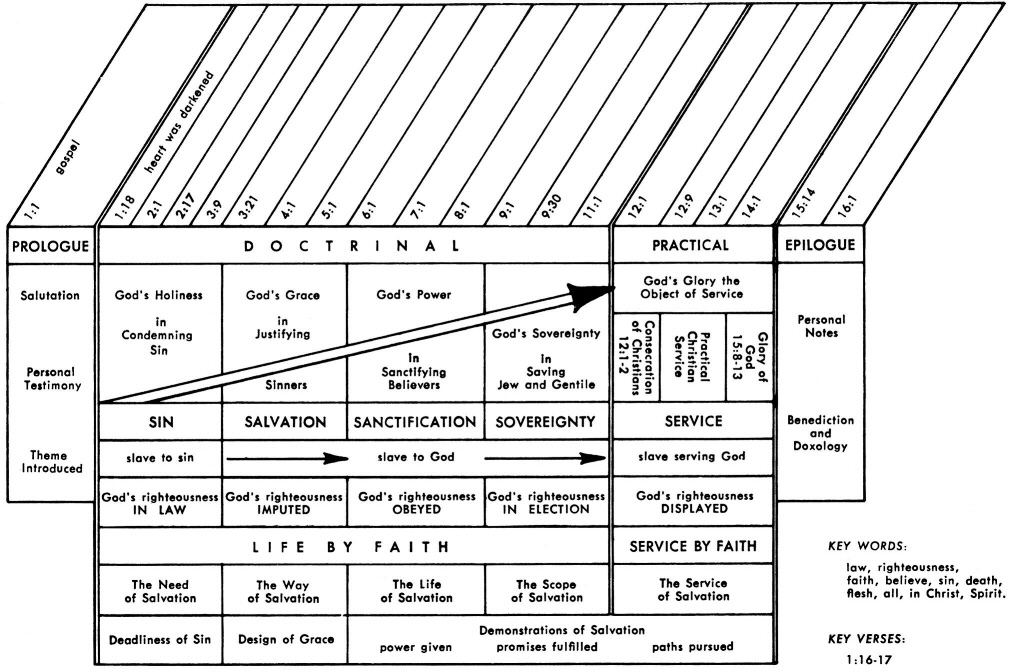
Click chart to enlarge
Chart from recommended resource Jensen's Survey of the NT - used by permission
Romans Overview Chart - Charles Swindoll
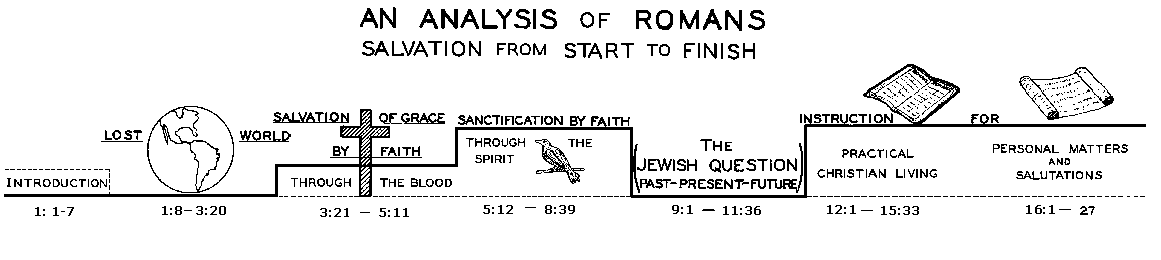
Source: Dr David Cooper
Click to Enlarge
| ROMANS ROAD to RIGHTEOUSNESS |
||||
| Romans 1:18-3:20 | Romans 3:21-5:21 | Romans 6:1-8:39 | Romans 9:1-11:36 | Romans 12:1-16:27 |
| SIN | SALVATION | SANCTIFICATION | SOVEREIGNTY | SERVICE |
| NEED FOR SALVATION |
WAY OF SALVATION |
LIFE OF SALVATION |
SCOPE OF SALVATION |
SERVICE OF SALVATION |
| God's Holiness In Condemning Sin |
God's Grace In Justifying Sinners |
God's Power In Sanctifying Believers |
God's Sovereignty In Saving Jew and Gentile |
Gods Glory The Object of Service |
| Deadliness of Sin |
Design of Grace |
Demonstration of Salvation | ||
| Power Given | Promises Fulfilled | Paths Pursued | ||
| Righteousness Needed |
Righteousness Credited |
Righteousness Demonstrated |
Righteousness Restored to Israel |
Righteousness Applied |
| God's Righteousness IN LAW |
God's Righteousness IMPUTED |
God's Righteousness OBEYED |
God's Righteousness IN ELECTION |
God's Righteousness DISPLAYED |
| Slaves to Sin | Slaves to God | Slaves Serving God | ||
| Doctrine | Duty | |||
| Life by Faith | Service by Faith | |||
|
Modified from Irving L. Jensen's chart above |
||||
R Ruin (Romans 1:17 – 3:20) – The utter sinfulness of humanity
O Offer (Romans 3:21-31) – God’s offer of justification by grace
M Model (Romans 4:1-25) – Abraham as a model for saving faith
A Access (Romans 5:1-11) – The benefits of justification
N New Adam (Romans 5:12-21) – We are children of two “Adams”
S Struggle w/ Sin (Romans 6:1-8:39) Struggle, sanctification, and victory
Romans 8:10 If Christ is in you, though the body is dead because of sin, yet the spirit is alive because of righteousness. (NASB: Lockman)
Greek: ei de Christos en humin, to men soma nekron dia hamartian, to de pneuma zoe dia dikaiosunen.
Amplified: But if Christ lives in you, [then although] your [natural] body is dead by reason of sin and guilt, the spirit is alive because of [the] righteousness [that He imputes to you]. (Amplified Bible - Lockman)
Barclay: But if Christ is in you, even if because of sin your body is mortal, your Spirit has life through righteousness. ("your Spirit" is an interesting way to render it. I suppose He is God's gift to us and thus He does belong to us in that still quiet mysterious sense!)
ESV: But if Christ is in you, although the body is dead because of sin, the Spirit is life because of righteousness.
Hendriksen: “But if Christ is in you, though the body is dead because of sin, yet the Spirit is life because of your justification.”
KJV: And if Christ be in you, the body is dead because of sin; but the Spirit is life because of righteousness.
NET: But if Christ is in you, your body is dead because of sin, but the Spirit is your life because of righteousness
NIV But if Christ is in you, your body is dead because of sin, yet your spirit is alive because of righteousness.
NLT: Since Christ lives within you, even though your body will die because of sin, your spirit is alive because you have been made right with God. (NLT - Tyndale House)
Phillips: Now if Christ does live within you his presence means that your sinful nature is dead, but your spirit becomes alive because of the righteousness he brings with him. (Phillips: Touchstone)
Wuest: But, assuming that Christ is in you, on the one hand the body is dead on account of sin, but on the other hand the [human] spirit is alive on account of righteousness.
Young's Literal: and if Christ is in you, the body, indeed, is dead because of sin, and the Spirit is life because of righteousness
Note how the various Versions give a different rendering of PNEUMA - Spirit or spirit. Again, this makes the point that EVERY translation is in some sense also an INTERPRETATION, which is why I strongly encourage you to go back to the original Greek texts and also to carefully examine the context which aids accurate interpretation.
AND (BUT) IF (SINCE) CHRIST IS IN YOU THOUGH THE (physical, mortal) BODY IS DEAD BECAUSE OF SIN: ei de Christos en humin to men soma nekron dia hamartian:
- John 6:56; 14:20,23; 15:5; 17:23; 2Corinthians 13:5; Ephesians 3:17; Colossians 1:27
- Ro 5:11; 5:12; 2Corinthians 4:11; 5:1, 2, 3, 4; 1Thessalonians 4:16; Hebrews 9:27; 2Peter 1:13,14; Revelation 14:13)
Related Resources:
- Torrey's Topic Union with Christ
- Union with Christ - Baker's Evangelical Dictionary of Biblical Theology
And is probably better rendered "but" (1161) as it indicates a contrast to what Paul has said in the preceding context. Note that Paul now begins to address the readers as "you", indicating that he is speaking to believers.
The subject that Paul is dealing with in this verse is how the “dead” body, in which sin dwells, can also be a vessel of the life of God. His answer is in the next verse. It is the Holy Spirit Who gives life to our mortal bodies.
If (1487) (ei) defines a condition of the first class or one that is assumed to be true. If can be understood as since or because. If does not express doubt but indicates that He is in the believer.
Since Christ is in you means that Christ Himself is in us. The indwelling of the Holy Spirit is the indwelling of Christ Himself. Mysterious? Yes, but it is inspired truth we can believe for our God is faithful, trustworthy! Compare Paul's statement in Ephesians 3 where he prays that the Father "would grant you, according to the riches of His glory, to be strengthened with power through His Spirit in the inner man so that Christ may dwell in your hearts through faith; and that you, being rooted and grounded in love." (Ephesians 3:16-17)
In Colossians Paul stated the same truth writing that Christ had been made known to the saints "to whom God willed to make known what is the riches of the glory of this mystery among the Gentiles, which is Christ in you, the hope of glory. (Col 1:27)
In Galatians Paul reiterated this truth declaring "I have been crucified with Christ; and it is no longer I who live, but Christ lives in me; and the life which I now live in the flesh I live by faith in the Son of God, who loved me, and delivered Himself up for me. (Galatians 2:20) (Comment: Yes, it is Christ in Him and at the same time it is the Spirit of Christ Who gives him the power to live supernaturally! Blessed divine mystery! But blessed truth by which we are to live out by faith not sight nor total understanding!)
Body (4983) (soma) refers to an organized whole made up of parts and members. Here soma refers to human the body which is the external man, the human frame which contains the seeds of decay and is mortal, doomed to death, in time due to sin.
Dead (3498) (nekros from nékus = a corpse = English - necropsy, necrophobia, etc. Verb = nekroo) refers to that which is literally dead even though that end has not yet been realized. Nevertheless the forces of death are working in our bodies and they will all inevitably die, except those whose bodies are are raptured.
The reference to the body as dead because of sin is clearly a reference to its ultimate destiny by the infliction of the penalty of sin (cf. Ge 3:19; Ro 5:12).
Godet writes that "The term dead here signifies: irrevocably smitten with death. The human body bears within itself from its formation the germ of death; it begins to die the instant it begins to live. (Romans Commentary Online)
This verse in part addresses Paul's question in Romans 7 "Wretched man that I am! Who will set me free from the body of this death?" (see note Romans 7:24)
Sin (266) (hamartia) originally conveyed the idea of missing the mark as when hunting with a bow and arrow and then came to mean missing or falling short of any goal, standard, or purpose. In Scripture sin often describes our thoughts, words and deeds that miss the ultimate purpose God has for each individual, these thoughts, words and deeds falling short of God’s perfect standard of holiness. "Sin" in this context does not describe the actions or results (sins we commit) but describes the underlying root cause, the principle or, in medical terms (I'm a physician with sub specialization in infectious disease), the "virus" we have all inherited from Adam that dooms our physical bodies to decay and eventually die. Sin has been defeated by Christ, but sin and death still claim their hold on our mortal bodies. Yet in these bodies we are alive spiritually and can live by the Spirit’s guidance.
Matthew Henry has some interesting comments about the body "is a frail, mortal, dying body, and it will be dead shortly; it is a house of clay, whose foundation is in the dust. The life purchased and promised does not immortalize the body in its present state. It is dead, that is, it is appointed to die, it is under a sentence of death: as we say one that is condemned is a dead man. In the midst of life we are in death: be our bodies ever so strong, and healthful, and handsome, they are as good as dead (Heb 11:12), and this because of sin. It is sin that kills the body. This effect the first threatening has (Ge 3:19): Dust thou art. Methinks, were there no other argument, love to our bodies should make us hate sin, because it is such an enemy to our bodies. The death even of the bodies of the saints is a remaining token of God’s displeasure against sin. (Henry, M. Matthew Henry's Commentary on the Whole Bible)
Those who have Christ in them now have a brand new vitality. Yes, our mortal, physical bodies are dying because sin killed our bodies, but our spirit is alive because Christ lives in us and the righteousness of God has been imputed to us. "Therefore we do not lose heart, but though our outer man is decaying, yet our inner man is being renewed day by day" (2Cor 4:16), growing stronger because of the life we have in our bodies from the Spirit of God.
William Newell notes that in this verse "we have the answer to our Lord's prayer in John 17:21-22: "I pray … that they may all be one; even as Thou, Father, art in Me, and I in Thee, that they also may be in us: … that they may be one, even as we are one." We have seen in an earlier chapter how we came to be in Christ: that God, having ended our history before Himself as connected with the first Adam, at the cross, created us in Christ, the Last Adam, the Second Man. Thus was the one part of our Lord's intercession answered. We are in Christ. But the other part of the great mystery is here before us in Romans 8.10: Christ is in us. Although, as we know, He is within us by His Spirit, yet it is Christ Himself who is in us." (Romans 8: Expository Notes Verse by Verse).
PERSISTENT POSSESSORS
OF A "SEDIMENT" OF SIN!
Sin (the principle) still lives in these "dead" and dying bodies.
Spurgeon put it this way "There is no doctrine more true to experience than this, that corruption remains even in the hearts of the regenerate, and that when we would do good, evil is present with us… We are often like a glass of water which has been standing still for hours and looks very clear and bright. But there is a sediment, and a little stir soon discovers it and clouds the crystal. That sediment is the old nature."
One day soon we will receive our glorified body and then sin's presence and pleasure will be forever totally eradicated. Lord haste the day! No more "sediment!" Hallelujah!
Moule writes "But if Christ is, thus by the Spirit, in you, dwelling by faith in the hearts which the Spirit has, “strengthened” to receive Christ (Ephesians 3:16, 17) — true, the body is dead, because of sin, the primeval sentence (Ge 2:17 "you shall surely die") still holds its way “there”; the body is deathful still, it is the body of the Fall; but the Spirit is life (see discussion below whether Paul means Spirit of God or man's spirit), He is in that body, your secret of power and peace eternal, because of righteousness, because of the merit of your Lord, in which you are accepted (Eph 1:6KJV), and which has won for you this wonderful Spirit-life. (The Epistle of Paul the Apostle to the Romans) (Bolding added)
YET THE SPIRIT IS ALIVE BECAUSE OF RIGHTEOUSNESS: to de pneuma zoe dia dikaiosunen:
- John 4:14; 6:54; 11:25,26; 14:19; 1Corinthians 15:45; 2Corinthians 5:6, 7, 8; Philippians 1:23; Colossians 3:3,4; Hebrews 12:23; Revelation 7:14, 15, 16, 17) (Ro 5:21; 2Corinthians 5:21; Philippians 3:9
A GLORIOUS CONTRAST:
DEAD - ALIVE
Yet - a glorious term of contrast. (See more explanation on this strategic conjunction below).
Literally this reads "yet the Spirit life", which I like better than the Spirit is alive (the ESV is more accurate here). We see a Pauline parallel in Col 3:4-note where NAS translates it "Christ Who is our life" but which more literally reads "Christ… our life." One is also reminded of Jesus' words in John 6:63 "It is the Spirit Who gives life; the flesh profits (ABSOLUTELY) nothing; the words that I have spoken to you are spirit and are life." If the words Jesus spoke were (are) spirit and life, it behooves us as often as possible to let the Word of Christ dwell in us richly (Col 3:16), does it not?
Yet (but NET Note = that "Greek emphasizes the contrast between these two clauses more than can be easily expressed in English.") (1161) (de) emphasizes the contrast between these preceding statement (body dead because of sin) and this statement (spirit is alive because of righteousness). Pause and praise God for His glorious contrasts in Scripture (cp Ponder/Meditate on a few uses of "But God" - Ge 8:1, 17:19, 48:21, 50:20, Ps 49:14, 73:26, Mk 2:7, Acts 13:30, Ro 5:8, 1Cor 1:27, 1Cor 3:6-7, 1Cor 12:24, 2Cor 7:6, Gal 3:18, Eph 2:4-note)! Remember to develop the discipline of pausing to ponder and practice interrogating , even when the contrast is easily seen. By slowing down, you are giving the Spirit more time to guide you into all the truth! You are in effect learning how to meditate on the Scripture, not just read it! And oh the glorious benefits God promises to those who meditate on the Scriptures! (Joshua 1:8-note, Ps 1:2-3-note). The
Some favor that "the spirit" refers to the person's spirit while others favor a reference to the Holy Spirit (observe this difference of opinion in the translations above, where some capitalize Spirit and some do not). Although I tend to favor the human spirit, there is no question that a sense in which the Holy Spirit is also correct because the human spirit, having been quickened at regeneration, is possessed of the inalienable principle of life, but only by virtue of the power of the Holy Spirit of God. That said, here are a few conservative commentators who argue for spirit with a small "s".
Wuest feels that spirit in this context "refers, not to the Holy Spirit which is not a logical contrast to the human body, but to the human spirit, that part of man which gives him God-consciousness and enables him when that spirit is made alive by the Holy Spirit, to worship God. The believer’s human body is dead in the sense that it has death in it because of sin, Adam’s sin which brought both spiritual and physical death to each member of the race (Ed: Ro 5:12-note, Ro 5:17-note). The believer’s spirit is alive (zoe) in that the Holy Spirit energizes it with divine life which is righteous in its quality. Eternal life is not only unending in its nature, but also ethical and spiritual in its content.
S Lewis Johnson notes that "The word spirit in the clause, but the spirit is life because of righteousness, is probably a reference to the human spirit and not the Holy Spirit, although that is the interpretation of the translators of the Authorized Version (KJV), for they capitalize the word. The contrast with body makes the reference to the human spirit likely, but the human spirit as regenerate. It is given new life in regeneration (cf. John 6:50, 51; 11:26). (Romans 8:5-17)
Charles Hodge also agrees writing that "By spirit here Paul does not mean the Holy Spirit, but the human spirit, since it is contrasted with body in the former clause. The body is dead, but the spirit is alive. It should not therefore be printed with a capital S, as in the KJV. The sense in which the spirit is life is antithetical to that in which the body is dead. As the body is infected with a principle of decay which renders its dissolution inevitable, so the soul in which the Holy Spirit dwells has a principle of life which secures its immortal and blessed existence. (Romans Commentary online)
Matthew Henry writes that "the spirit (Henry interprets "spirit" not as Holy Spirit but our spirit which is of course made alive by the Holy Spirit), the precious soul, that is life; it is now spiritually alive, nay, it is life. Grace in the soul is its new nature; the life of the saint lies in the soul, while the life of the sinner goes no further than the body. When the body dies, and returns to the dust, the spirit if life; not only living and immortal, but swallowed up of life. Death to the saints is but the freeing of the heaven-born spirit from the clog and load of this body, that it may be fit to partake of eternal life. (Ibid)
The Spirit is alive - NET = "life giving"
Alive (2222) (zoe) is literally the noun "life" which stands in radical opposition to death in the previous clause. It is the state of one who is possessed of vitality or is animate in the spiritual realm. And so this verse reads more literally "the spirit is life".
Godet writes that "The life of God does not become merely an attribute of the spirit in man through the Holy Spirit; it becomes his nature." (Romans Commentary Online)
Denney writes that life refers to “God-begotten, God-sustained life," if Christ is in you.
Paul explains to the Ephesians that God "even when we were dead in our transgressions, made us alive together with Christ (by grace you have been saved), and raised us up with Him, and seated us with Him in the heavenly places, in Christ Jesus (Ephesians 2:5-6)
Because of righteousness - Is this righteousness imputed to my account, Christ's perfect righteousness (1Cor 1:30, 2Cor 5:21, Php 3:8-9, etc) or is it the righteousness we now work out, energized by the Spirit of God? In the context of Romans 8:10, the righteousness that Paul describes speaks primarily of imputed righteousness or that righteousness which was credited to our "spiritual bank account" when we believed on and received Christ's perfect sinless righteousness (1Co 1:30, 2Co 5:21). This one time historical past tense event equates with so called past tense salvation or justification (God's declaration of believing sinners as now positionally righteous in Christ). See related discussion on the Three Tenses of Salvation.
John Piper interprets this righteousness as Christ's righteousness (justification), not our "lived out" righteousness (that would describe sanctification). See his interesting teaching video on Romans 8 given as part of a series of teaching lectures at the 2014 National Conference = Groaning Creation, Groaning Saints, Groaning Spirit - Desiring God.
Righteousness (1343) (dikaiosune [word study] from dikaios [word study] = being proper or right in the sense of being fully justified being or in accordance with what God requires) is the quality of being upright. In its simplest sense dikaiosune conveys the idea of conformity to a standard or norm. In this sense righteousness is the opposite of hamartia (sin), which is defined as missing of the mark set by God.
Righteousness in Biblical terms describes the righteousness acceptable to God which means it is in keeping with what God is in His holy character. Another descriptive definition of God's righteousness is all that God is, all that God commands, all that God demands, all that God approves, and all that God provides in Christ Jesus (1Cor 1:30) Because Christ is in us and He is perfect righteousness, we have been declared right with God -- that is, because of the divinely-imparted righteousness by which every believer is justified (Ro 3:21, 22, 23, 24, 25, 26-see note Ro 3:21-23; 3:24-26). The eternal, spiritual life of God is implanted by the indwelling Holy Spirit and Jesus Christ here and now, even though a believer’s body is mortal.
Dikaiosune is rightness of character before God and rightness of actions before men. Righteousness of God could be succinctly stated as all that God is, all that He commands, all that He demands, all that He approves, all that He provides through faith in Christ (Click to read Pastor Ray Pritchard's interesting analysis of righteousness in the Gospel of Matthew).
John Witmer writes that "Because of God’s imputed righteousness, a believer is alive spiritually. The eternal, spiritual life of God is implanted by the indwelling Holy Spirit and Jesus Christ here and now, even though a believer’s body is mortal. (Walvoord, J. F., Zuck, R. B., et al: The Bible Knowledge Commentary. 1985. Victor)
Some like S Lewis Johnson feel that in Romans 8:10 dikaiosune refers to "both imputed and imparted (righteousness), for in the context the apostle has had in mind both justification and sanctification and their indissoluble connection. (Romans 8:5-17)
John MacArthur explains that "if God’s Spirit indwells us, our own spirit is alive because of righteousness, that is, because of the divinely-imparted righteousness by which every believer is justified (Ro 3:21-26). In light of that perfect righteousness, all human attempts at being righteous are but rubbish (Phil. 3:8) (MacArthur, J: Romans 1-8. Chicago: Moody Press)
Leon Morris - "The believer is credited with the righteousness of God; it is this that brings him into the sphere of salvation (justification). But then he is required to live a life that is in conformity with this salvation (sanctification); he cannot be indifferent to the importance of righteousness in his daily living (Ed: Unfortunately and sadly many true saints are indifferent or at least not do not highly value this righteousness because they are ignorant of this righteousness as their present possession, which should prompt Spirit energized, love motivated obedience to perform righteous acts -- not to gain salvation, but because of salvation!). At this point it may well be that Paul has in mind neither the process that brings salvation, nor the life that follows, but both. (Morris, L. The Epistle to the Romans. W. B. Eerdmans; Inter-Varsity Press)
Many Christians miss out on living their Christian lives in the constant fullness of the Spirit, because they are not obeying the command to continually be filled with the Spirit (Eph 5:18). And as a result they fail to experience what Jesus spoke about when He described rivers of living water flowing from the believer, speaking metaphorically of the Holy Spirit's effect (Jn 7:37, 38, 39).
THOUGHT - Let us all pray for and passionately pursue to be continually filled that we might continually experience this glorious outflow of rivers of living water. Amen!
Romans 8:11 But if the Spirit of Him who raised Jesus from the dead dwells in you, He who raised Christ Jesus from the dead will also give life to your mortal bodies through His Spirit who dwells in you. (NASB: Lockman)
Greek: ei de to pneuma tou egeirantos (AAPMSG) ton Iesoun ek nekron oikei (3SPAI) en humin, o egeiras (AAPMSN) Christon ek nekron zoopoiesei (3SFAI) kai ta thneta somata humon dia tou enoikountos (PAPNSG) autou pneumatos en humin.
Amplified: And if the Spirit of Him Who raised up Jesus from the dead dwells in you, [then] He Who raised up Christ Jesus from the dead will also restore to life your mortal (short-lived, perishable) bodies through His Spirit Who dwells in you. (Amplified Bible - Lockman)
Barclay: If the Spirit of him who raised Jesus from the dead dwells in you he will make even your mortal bodies alive through his Spirit indwelling in you. (Westminster Press)
ESV: If the Spirit of him who raised Jesus from the dead dwells in you, he who raised Christ Jesus from the dead will also give life to your mortal bodies through his Spirit who dwells in you.
NET Moreover if the Spirit of the one who raised Jesus from the dead lives in you, the one who raised Christ from the dead will also make your mortal bodies alive through his Spirit who lives in you.
NLT: The Spirit of God, who raised Jesus from the dead, lives in you. And just as he raised Christ from the dead, he will give life to your mortal body by this same Spirit living within you. (NLT - Tyndale House)
Phillips: I said that our nature is "dead" in the presence of Christ, and so it is, because of its sin. Nevertheless once the Spirit of him who raised Jesus from the dead lives within you he will, by that same Spirit, bring to your whole being new strength and vitality. (Phillips: Touchstone)
Wuest: And assuming that the Spirit of the One who raised up Jesus out from among the dead is in residence in you, He who raised from among the dead Christ Jesus, will also make alive your mortal bodies through the agency of the Spirit who is resident in you.
Young's Literal: and if the Spirit of Him who did raise up Jesus out of the dead doth dwell in you, He who did raise up the Christ out of the dead shall quicken also your dying bodies, through His Spirit dwelling in you.
BUT IF (SINCE) THE SPIRIT OF HIM WHO RAISED JESUS FROM THE DEAD DWELLS IN YOU: ei de to pneuma tou egeirantos (AAPMSG) ton Iesoun ek nekron oikei (3SPAI) en humin:
- Ro 8:9; 4:24,25; Acts 2:24,32,33; Ephesians 1:19,20; Hebrews 13:20; 1Peter 1:21)
BAD NEWS
GOOD NEWS!
In Romans 8:10 Paul gave us the "bad news" that our body is dead because of sin but now counters with the good news that our dead body will be resurrected. The same Spirit that raised Jesus' body from the dead will raise ours from the dead (Hallelujah!) and he adds that each will be raised "in his own order: Christ the first fruits, after that those who are Christ’s at His coming, and He is the first fruits of all who will follow." (1Cor 15:23). In other words the "first fruits" assures the fruits (so to speak) will follow.
If introduces a first class conditional statement which is a fact. In other words the "if" does not introduce doubt, but means "if, as is the case" (or "since"). Note that again (like Ro 8:10 above) Paul introduces this clause with "but" indicating contrast with the body of death.
Note that the pronoun "Him" in the phrase "the Spirit of Him Who raised Jesus" is a reference to the Father not to the Spirit. It was God the Father Who raised Jesus. And yet it was also the Spirit! The same Spirit Who miraculously brought about conception of the life of Jesus the Man in Mary's womb (Mt 1:20) is the same Spirit Who was also involved in giving life to Jesus after He died as a Man! Oh, mystery of mysteries. How great is our salvation! (Heb 2:3)
The New Testament affirms the role of the Father in the resurrection in several other passages…
"And God raised Him up again, putting an end to the agony of death, since it was impossible for Him to be held in its power. (Acts 2:24)
Now God has not only raised the Lord, but will also raise us up through His power. (1Cor 6:14)
"knowing that He (God the Father) Who raised the Lord Jesus will raise us also with Jesus and will present us with you." (2Cor 4:14)
And elsewhere the Scripture affirms that the Spirit was intimately involved in the resurrection of our Lord. And so in Paul's introduction to Romans he writes…
who was declared the Son of God with power by the resurrection from the dead, according to the Spirit of holiness, Jesus Christ our Lord, (Ro 1:4NAS)
And Jesus Christ our Lord was shown to be the Son of God when God powerfully raised him from the dead by means of the Holy Spirit. (Ro 1:4NLT)
who was appointed the Son-of-God-in-power according to the Holy Spirit by the resurrection from the dead, Jesus Christ our Lord. (Ro 1:4NET)
That God the Father and God the Spirit are involved in the resurrection of Jesus Christ should not surprise us. The great Puritan writer John Owen explains how grace is in Jesus and yet the effecting Agent of that grace is the Spirit of Jesus (Acts 16:7, Phil 1:19, Ro 8:9 ). Owen writes
Everything God does He does as the triune God. Each Person of the Trinity is involved in every action of God. Yet at the same time each Person has a special role to fulfill in that work… There is no good that we receive from God but it is brought to us and wrought in us by the Holy Spirit. Nor is there in us any good towards God, any faith, love, obedience to His will, but what we are enabled (Ed: Note not "helped" which implies we have some ability and just need a little "push"!) to do so by the Holy Spirit. (Pneumatologia, Or, A Discourse Concerning the Holy Spirit)
As an aside remember that the Bible says every Christian has the Holy Spirit. The question is does the Holy Spirit have you? Is the Holy Spirit at home in your heart and life?
Raised (1453) (egeiro) means to waken, rouse from sleep, from sitting or lying, from disease and here means to wake up from death, of which sleep is the emblem. Here Paul says the Spirit raised Jesus. In Ro 4:24, Acts 2:24, Eph 1:19-20, Heb 13:20, 1Pe 1:21 we see that it is God the Father Who raised Jesus from the dead. There is no conflict, for the Trinity functions in perfect synchrony and unity, even if we cannot fully comprehend how that occurs.
Dwells (3611) (oikeo from oikos = home) means to live, inhabit or dwell in a certain place as one's home. To inhabit a house. Oikeo is speaks of dwelling often with a figurative sense - sin (Ro 7:17), Spirit (1Cor 3:16), marriage partners (1Cor 7:12). BDAG summarized - (1) To dwell in a place - live, dwell (Ge 24:3, 27:44), in marriage (1Cor 7:12-13) Of the Spirit of God Who dwells in believers (Ro 8:9, 11, 1Cor 3:16). Of "good" not dwelling (Ro 7:18). Of the principle of Sin (the "virus" inherited from Adam) dwelling in every human body, even believers (Ro 7:17). (2) To inhabit a place (Ge 24:13). In a transcendent sense (1Ti 6:16). Friberg - (1) intransitively dwell, live; (a) literally, of marriage live with, live together as husband and wife (1Co 7.12, 13); (b) figuratively, of spiritual indwelling reside in (1Cor 3.16); (2) transitively inhabit, dwell in something (1Ti 6.16) (Analytical Lexicon)
Liddell-Scott - A. transitive - to inhabit, occupy, Il., Hdt., Att.:-Pass. to be inhabited, Il., Hdt., etc.; 2. Pass. to be settled, of those to whom new abodes are assigned, Il. those who have been settled, i.e. those who dwell on the mainland, Hdt.; of cities, to be situated, to lie II. to manage, direct, govern, like dioikeo, Soph., etc. B. intransitive - to dwell, live, be settled, Homer, etc.; "sweet is it to live free from cares," Soph. II. of cities, in a pass. sense, to be settled, be situated, Hdt., Xen. 2. to conduct oneself or be conducted so and so "to a state with habits of self-control would be well governed," Plat.
Oikeo in the Septuagint - Gen 4:16.20; 16:3; 19:30; 20:1. To inhabit [ti] Gen 24:13; to live, to dwell Gen 4:16; to be situated; the (inhabited) world 2Sa 22:16; Is 21:12 live, dwell, return
In this passage oikeo is in the present tense = "is dwelling" or continually dwells. This fact is important for it emphasizes that the Spirit is not an occasional visitor (as He was in the OT) but that He takes up residence in God’s children. In fact the present tense even underscores that the Spirit continually indwells us not only in this life, but in the one to come! (cp John 14:16) And of course now we never have to pray the prayer of David in Ps 51:11b "Do not take Your Holy Spirit from me!" Praise God! Of course we can still blunt His effect and power by sin, so we need to keep short accounts!
Charles Stanley - The significance of the term oikeo is that it speaks of permanency. The idea is that the Holy Spirit takes up residency in believers—forever. He doesn’t just pass through. He makes us His home. He comes to stay. (The Wonderful Spirit-Filled Life)
What an awesome truth that the Spirit of the Living God would make His home in ever redeemed sinner. He lives in the believer, not simply paying a fleeting visit but making His "home" in us, even as in 1Cor 7:12-13 a husband and a wife dwell together (interesting as this brings to mind the picture of union and oneness which is true as a result of our entry into the New Covenant)!
The derivative verb enoikeo is used by Paul in commanding Timothy to "Guard, through the Holy Spirit who dwells in (enoikeo - present tense) us, the treasure which has been entrusted to you.
Oikeo - 9x in 9v -
Romans 7:17 So now, no longer am I the one doing it, but sin which dwells in me.
Romans 7:18 For I know that nothing good dwells in me, that is, in my flesh; for the willing is present in me, but the doing of the good is not.
Romans 7:20 But if I am doing the very thing I do not want, I am no longer the one doing it, but sin which dwells in me.
Comment - Paul is saying "I would never—in any way, shape, or form—choose to do this, but it is the ‘Sin’ living in my ‘house,’ oikeo, causing me to do it."
Romans 8:9 However, you are not in the flesh but in the Spirit, if indeed the Spirit of God dwells in you. But if anyone does not have the Spirit of Christ, he does not belong to Him.
Romans 8:11 But if the Spirit of Him who raised Jesus from the dead dwells in you, He who raised Christ Jesus from the dead will also give life to your mortal bodies through His Spirit who dwells in you.
1 Corinthians 3:16 Do you not know that you are a temple of God and that the Spirit of God dwells in you?
Zodhiates - This indwelling of the Spirit of God in the individual believer—in you and me—is not a transient visit but a permanent presence. The Greek verb is oikeí, from oikéō, which refers to dwelling in a house permanently. In fact, the word for "house," even in Modern Greek, is oikía.
Wayne Barber - In other words, He has taken up residence within our life. It is in the present active indicative. Continuously He dwells in our life, of His own accord (active voice) and write it down, it is a fact (indicative) you see. In other words, this is something that you just take home and understand. God says He has taken up residence in your life. The Holy Spirit taking up residence in your life is proof of your holiness before God. Understand that.
1 Corinthians 7:12 But to the rest I say, not the Lord, that if any brother has a wife who is an unbeliever, and she consents to live with him, he must not divorce her.
13 And a woman who has an unbelieving husband, and he consents to live with her, she must not send her husband away.
1 Timothy 6:16 who alone possesses immortality and dwells in unapproachable light, whom no man has seen or can see. To Him be honor and eternal dominion! Amen.
Oikeo in the Septuagint - 79x - Ge 4:16, 20; 16:3; 19:30; 20:1; 24:3, 13; 25:27; 27:44; 29:19; 34:16, 21, 23; 35:1; 36:7f; Ex 2:15; 16:35; Deut 28:30; Josh 21:42; Jdg 9:21, 41; 10:1; 11:3, 8, 26; 20:15; 21:9f, 12, 21; 2 Sam 15:8, 19; 19:32; 1 Kgs 3:17; 2 Kgs 4:13; 6:1f; 19:36; 1 Chr 4:41; 2 Chr 34:9; Ezra 4:6, 17; Neh 3:26; 4:12; 7:3; 13:4; Esther 1:1; Ps 17:12; 84:10; Pr 8:26; 10:30; 21:9, 19; 25:24; 27:10; Isa 5:8; 6:5; 21:12; 30:19; 33:16; 34:11; 37:37; Jer 35:7, 10f, 15; 40:4, 10; 42:14; 43:2; 48:28; Ezek 38:11; Dan 4:1, 11; 6:25; Hag 1:4
Sanday and Headlam remark that oikeo "denotes a settled permanent penetrative influence." (Romans 8 Commentary)
Note the truth of the Trinity in this verse. God the Father's Spirit vitalizes us here and now, even though we are sinful human beings, infusing us with that same power which raised Jesus from the dead, enabling us to live holy lives. Every one of our spiritual failures shouts out, “We can’t.” And every spiritual victory affirms, “But He can!”
HE WHO RAISED CHRIST JESUS FROM THE DEAD WILL ALSO GIVE LIFE TO YOUR MORTAL BODIES : o egeiras (AAPMSN) Christon ek nekron zoopoiesei (3SFAI) kai ta thneta somata humon:
- Ro 6:4,5; Isaiah 26:19; Ezekiel 37:14; John 5:28,29; 1Corinthians 6:14; 15:16,20, 21, 22; 1Corinthians 15:51, 52, 53, 54, 55, 56, 57; 2Corinthians 4:14; Ephesians 2:5; Philippians 3:21; 1Thessalonians 4:14, 15, 16, 17; 1Peter 3:18; Revelation 1:18; 11:11; 20:11, 12, 13) (Mortal: Ro 6:12; 1Corinthians 15:53; 2Corinthians 4:11; 5:4
Jews believed that God would raise the dead at the end of this age. Paul modifies this belief adding that God has already raised Jesus, and His resurrection is a sure sign that the rest of the resurrection will transpire as promised.
Not only has the spirit of the Christian been made alive (see Ro 8:10), but in time the body which is now under the curse of death will be resurrected as well. The facts that God raised Christ Jesus and has given us the indwelling Spirit guarantees every believer’s future resurrection, a glorious truth repeated many times by Paul…
Behold, I tell you a mystery; we shall not all sleep, but we shall all be changed, in a moment, in the twinkling of an eye, at the last trumpet; for the trumpet will sound, and the dead will be raised imperishable, and we shall be changed. For this perishable must put on the imperishable, and this mortal must put on immortality. But when this perishable will have put on the imperishable, and this mortal will have put on immortality, then will come about the saying that is written, "DEATH IS SWALLOWED UP in victory. "O DEATH, WHERE IS YOUR VICTORY? O DEATH, WHERE IS YOUR STING?" The sting of death is sin, and the power of sin is the law; but thanks be to God, who gives us the victory through our Lord Jesus Christ. Therefore, my beloved brethren, be steadfast, immovable, always abounding in the work of the Lord, knowing that your toil is not in vain in the Lord. (1Cor 15:51-57)
For our citizenship is in heaven, from which also we eagerly wait for a Savior, the Lord Jesus Christ; who will transform the body of our humble state into conformity with the body of His glory, by the exertion of the power that He has even to subject all things to Himself. (see note Philippians 3:20, 3:21)
For if we believe that Jesus died and rose again, even so God will bring with Him those who have fallen asleep in Jesus. For this we say to you by the word of the Lord, that we who are alive, and remain until the coming of the Lord, shall not precede those who have fallen asleep. For the Lord Himself will descend from heaven with a shout, with the voice of the archangel, and with the trumpet of God; and the dead in Christ shall rise first. Then we who are alive and remain shall be caught up together with them in the clouds to meet the Lord in the air, and thus we shall always be with the Lord. Therefore comfort one another with these words. (1Thes 4:14-18-see notes) )
Raised (awakened) (1453)(egeiro) means to rise (stand up) from a sitting or lying position (Mt 8:26, 9:5), to awaken from sleep (Mt 8:25), figuratively to "awaken" from death (rise up), describing the bringing back of Jesus from the dead.
Give life (2227) (zoopoieo from zoós = alive + poieo = to make) means to revitalize, make alive, quicken, vivify.
John uses zoopoieo in a similar way as Paul writing…
"For just as the Father raises the dead and gives them life, even so the Son also gives life to whom He wishes. (John 5:21)
"It is the Spirit who gives life; the flesh profits nothing; the words that I have spoken to you are spirit and are life. (John 6:63)
Why did Paul use "give life to" instead of "raise" when describing men's bodies? Godet comments that…
Once again we see how carefully Paul weighs every term he uses. We have a new proof of the same in the use of the two expressions (egeirantos), to awake (raised) (applied to Jesus), and (zoopoiesei), to quicken (to give life) (applied to believers). The death of Jesus was a sleep, unaccompanied with any dissolution of the body… ; it was therefore enough to awake Him. In our case, the body, being given over to destruction, must be entirely reconstituted; this is well expressed by the word quicken ("give life"). (Romans Commentary Online)
Vine writes that "The reference is not to the impartation of some special energy of life and power to our bodies in their present state, but to the effect upon them of the shout of the Lord at the time of the Rapture (1Thes. 4:17; see note Philippians 3:20, 3:21; 1Cor 15:52, 53). What is mortal will then be “swallowed up of life.” The statement in this eleventh verse is to be put in connection with that at the close of the seventh chapter, where the assurance is given that Christ will deliver us “out of the body of this death” (see note Romans 7:24) (Vine, W. Collected writings of W. E. Vine. Nashville: Thomas Nelson )
S Lewis Johnson observes that…
this verse is the final answer to the cry of Ro 7:24 (note). The power of indwelling sin and physical death over the believer's body is destroyed in the bodily resurrection. The logic of the apostle is clear. The presence of the Spirit of God in our mortal bodies is the guarantee of the bodily resurrection, for He is the one who raised up Jesus Christ.
Now one must be clear here. When Paul says, "the one who raised up Christ Jesus from the dead," he is referring, not to the Holy Spirit, but to the Father. It is not, "the Spirit who raised up Jesus from the dead," but, "the Spirit of the One Who raised up Jesus from the dead," that is, the Father God. It is the Father Who raised up the Son, and that is the universal testimony of the Bible. The reason for that is that it is important to make plain that the sacrifice of the Son is acceptable to the Father. Therefore, the almost universal testimony of the New Testament is that the Father raised the Son (cf. Acts 2:24, 32; 3:15, 26; 4:10; 5:30; 26:8; 1 Cor. 6:14; 2 Cor. 4:14). Thus, regeneration and the indwelling of the Spirit of the God of the resurrection naturally involve the resurrection of the believer's body. All are parts of the one process of redemption. If God has done the work of regeneration, He will accomplish the work in resurrection.
What a wonderful promise that is for the believer! Our spirits are already alive; our bodies soon shall be. (Romans 8:5-17) (Bolding added)
THROUGH HIS SPIRIT WHO (continually) INDWELLS YOU: dia tou enoikountos (PAPNSG) autou pneumatos en humin:
- Ro 8:9; John 7:38,39; 14:17
Through (dia) - Identifies the instrument, that is, a means whereby something is achieved, performed, or furthered. Whenever you encounter a through used in this sense, instead of "passing through," indifferently, it behooves the diligent disciple to pause and ponder the spiritual dynamic that the writer is explaining (prayerfully relying of course on your Teacher, the Holy Spirit to illuminate the sacred text.) You may be pleasantly surprised at the insights you glean!
Regarding the question of the role of the Spirit in giving life to our mortal bodies, Leon Morris notes that "The Spirit is not usually linked with resurrection, but here he seems to be. It is not clear whether Paul is saying that the Spirit is to be the agent in raising us or the guarantee that we will be raised. Both are true, and it does not seem to matter greatly which way we resolve the textual problem. (Morris, L. The Epistle to the Romans. W. B. Eerdmans; Inter-Varsity Press)
Matthew Henry reminds us that in this verse Paul gives…
Two great assurances of the resurrection of the body are mentioned:
(1.) The resurrection of Christ: He that raised up Christ from the dead shall also quicken. Christ rose as the head, and first-fruits, and forerunner of all the saints, 1Cor 15:20. The body of Christ lay in the grave, under the sin of all the elect imputed, and broke through it. O grave, then, where is thy victory? It is in the virtue of Christ’s resurrection that we shall rise.
(2.) The indwelling of the Spirit. The same Spirit that raiseth the soul now will raise the body shortly: By his Spirit that dwelleth in you. The bodies of the saints are the temples of the Holy Ghost, 1 Co. 3:16; 6:19. Now, though these temples may be suffered for awhile to lie in ruins, yet they shall be rebuilt. The tabernacle of David, which has fallen down, shall be repaired, whatever great mountains may be in the way. The Spirit, breathing upon dead and dry bones, will make them live, and the saints even in their flesh shall see God. (Ibid)
Indwells (1774) (enoikeo from en = in + oikéo = dwell) (Click word study on enoikeo) means to take up residence, make one's home in or among. To live in, inhabit; dwell in. Note that three of the five NT uses refer to indwelling of Spirit or God. All the NT uses of enoikeo are metaphorical. Vine observes that enoikeo "is used, with a spiritual significance only, of (a) the indwelling of God in believers, 2Co 6:16; (b) the indwelling of the Holy Spirit, Ro 8:11; 2Ti 1:14; (c) the indwelling of the word of Christ, Col. 3:16; (d) the indwelling of faith, 2Ti 1:5; (e) the indwelling of sin in the believer, Ro 7:17. (Vine's Complete Expository Dictionary of Old and New Testament Words)
Our spirits have been regenerated by the Holy Spirit, and our physical bodies ultimately will be resurrected by the Holy Spirit, Who continues to indwell our spirit bodies even after death. In other words, God promises spiritual resurrection life now (Ro 6:4, 8, 11, Php 3:10-see notes Ro 6:4, 6:8, 11 cp Php 3:10) for each believer’s mortal body and physical resurrection in the future for that mortal body (Ro 6:5, 1Cor 6:14, 15:42, 53 2Cor 4:14).
Warren Wiersbe - What a difference it makes in your body when the Holy Spirit lives within. You experience new life, and even your physical faculties take on a new dimension of experience. When evangelist D. L. Moody described his conversion experience, he said: “I was in a new world. The next morning the sun shone brighter and the birds sang sweeter… the old elms waved their branches for joy, and all nature was at peace.” Life in Christ is abundant life. (Wiersbe, W: Bible Exposition Commentary. 1989. Victor)
Wayne Barber - "Do you think God is through with your body? No - in fact to show you how much victory you have over the flesh, this old body that now the Spirit has power over, one day is going to die and will be raised up so that you can live in it forever, free then from even the PRESENCE of SIN, much less the power of SIN. So you see that we are free from any control of the FLESH. You say Wayne, "That's not true. I've been controlled recently by it." Maybe so but what Paul is explaining is that now when the flesh controls you, it is because you choose to be, not because of the work of grace that God has done in your heart. We choose it now. The whole emphasis of this section is that the "factory has been taken over by new management". We have not changed outwardly. Our bodies are still the same. What has changed outwardly is my behavior because some ONE has come in & has changed me inwardly. The spirit is alive even though this body continues to reek of the stench of death & will someday die.
Bishop Moule waxes eloquent on this passage writing "Wonderful is this deep characteristic of the Scripture; its Gospel for the body. In Christ, the body is seen to be something far different from the mere clog, or prison, or chrysalis, of the soul. It is its destined implement, may we not say its mighty wings in prospect, for the life of glory. As invaded by sin, it must needs pass through either death or, at the Lord’s Return, an equivalent transfiguration. But as created in God’s plan of Human Nature it is forever congenial to the soul, nay, it is necessary to the soul’s full action. And whatever be the mysterious mode (it is absolutely hidden from us as yet) of the event of Resurrection, this we know, if only from this Oracle, that the glory of the immortal body will have profound relations with the work of God in the sanctified soul. No mere material sequences will bring it about. It will be “because of the Spirit”; and “because of the Spirit dwelling in you,” as your power for holiness in Christ. (The Epistle of Paul the Apostle to the Romans - Online)