Romans 8:2
Romans 8:3
Romans 8:4
Romans 8:5
Romans 8:6
Romans 8:7
Romans 8:8
Romans 8:9
Romans 8:10
Romans 8:11
Romans 8:12
Romans 8:13
Romans 8:14
Romans 8:15
Romans 8:16
Romans 8:17
Romans 8:18
Romans 8:19
Romans 8:20
Romans 8:21
Romans 8:22
Romans 8:23
Romans 8:24
Romans 8:25
Romans 8:26
Romans 8:27
Romans 8:28
Romans 8:29
Romans 8:30
Romans 8:31
Romans 8:32
Romans 8:33
Romans 8:34
Romans 8:35
Romans 8:36
Romans 8:37
Romans 8:38
Romans 8:39

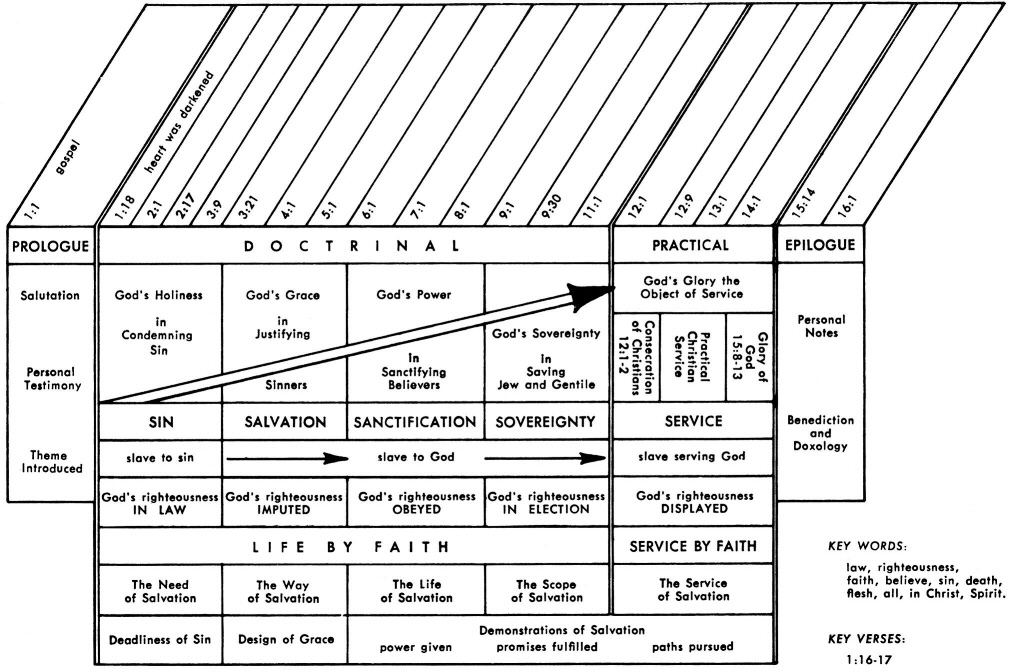
Click chart to enlarge
Chart from recommended resource Jensen's Survey of the NT - used by permission
Romans Overview Chart - Charles Swindoll
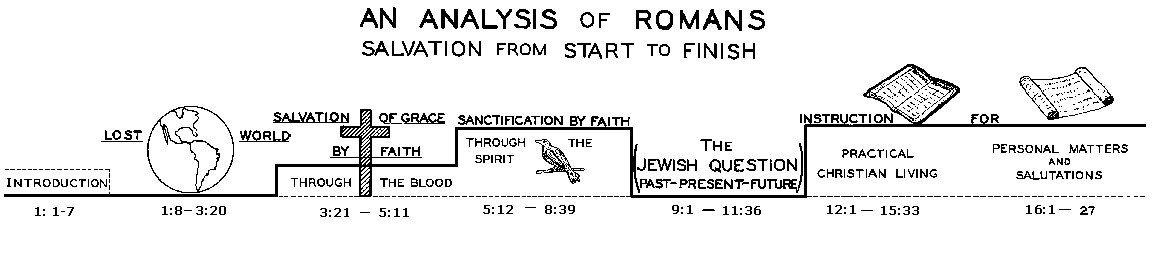
Source: Dr David Cooper
Click to Enlarge
| ROMANS ROAD to RIGHTEOUSNESS |
||||
| Romans 1:18-3:20 | Romans 3:21-5:21 | Romans 6:1-8:39 | Romans 9:1-11:36 | Romans 12:1-16:27 |
| SIN | SALVATION | SANCTIFICATION | SOVEREIGNTY | SERVICE |
| NEED FOR SALVATION |
WAY OF SALVATION |
LIFE OF SALVATION |
SCOPE OF SALVATION |
SERVICE OF SALVATION |
| God's Holiness In Condemning Sin |
God's Grace In Justifying Sinners |
God's Power In Sanctifying Believers |
God's Sovereignty In Saving Jew and Gentile |
Gods Glory The Object of Service |
| Deadliness of Sin |
Design of Grace |
Demonstration of Salvation | ||
| Power Given | Promises Fulfilled | Paths Pursued | ||
| Righteousness Needed |
Righteousness Credited |
Righteousness Demonstrated |
Righteousness Restored to Israel |
Righteousness Applied |
| God's Righteousness IN LAW |
God's Righteousness IMPUTED |
God's Righteousness OBEYED |
God's Righteousness IN ELECTION |
God's Righteousness DISPLAYED |
| Slaves to Sin | Slaves to God | Slaves Serving God | ||
| Doctrine | Duty | |||
| Life by Faith | Service by Faith | |||
|
Modified from Irving L. Jensen's chart above |
||||
R Ruin (Romans 1:17 – 3:20) – The utter sinfulness of humanity
O Offer (Romans 3:21-31) – God’s offer of justification by grace
M Model (Romans 4:1-25) – Abraham as a model for saving faith
A Access (Romans 5:1-11) – The benefits of justification
N New Adam (Romans 5:12-21) – We are children of two “Adams”
S Struggle w/ Sin (Romans 6:1-8:39) Struggle, sanctification, and victory
Romans 8:16 The Spirit Himself testifies with our spirit that we are children of God, (NASB: Lockman)
Greek: auto to pneuma summarturei (3SPAI) to pneumati hemon hoti esmen (1PPAI) tekna theou.
Amplified: The Spirit Himself [thus] testifies together with our own spirit, [assuring us] that we are children of God. (Amplified Bible - Lockman)
NLT: For his Holy Spirit speaks to us deep in our hearts and tells us that we are God's children. (NLT - Tyndale House)
Phillips: The Spirit himself endorses our inward conviction that we really are the children of God. (Phillips: Touchstone)
Wuest: The Spirit himself is constantly bearing joint-testimony with our [human] spirit that we are God’s children,
Young's Literal: The Spirit himself doth testify with our spirit, that we are children of God;
THE SPIRIT HIMSELF BEARS WITNESS WITH OUR SPIRIT: auto to pneuma summarturei (3SPAI) to pneumati hemon:
- Ro 8:23,26; 2Corinthians 1:22; 5:5; Ephesians 1:13; 4:30; 1John 3:24, 4:13
- 2Corinthians 1:12; 1John 3:19, 20, 21, 22; 5:10
- Romans 8 Resources
The Spirit Himself - The Holy Spirit Who indwells every believer from the inception of their new birth (Ro 8:9)
The KJV translation as “the Spirit itself” is explained by the fact that the Greek word “spirit” (pneuma) is neuter in gender; the personal pronoun according to the rules of Greek grammar must agree with its antecedent in gender, therefore, the translation “itself.” The translators followed a slavish, idiomatic method of translation here instead of translating according to sense. The Holy Spirit is a Person. The pronoun should be rendered “Himself.”
A comparison of Romans 8:15, 16 will bring out an important truth concerning the assurance of salvation. All too often a believer may come to the point of doubting his salvation because his or her sanctification (growth in holiness) has proceeded so slowly and so lamely. The Spirit, however, does not base His testimony to our spirit on our progress or the lack of progress in our Christian walk. The Spirit does not lead us to cry, "I am God's child" but does lead us to call upon God as Father and to look away from ourselves to Him Who established the paternal-child relationship.
Remember that the Spirit is holy and since He indwells all believers, their steps in sanctification may be "lame" from time to time, but there is always some evidence of a supernatural change in a genuine believer's behavior (2Cor 5:17-note). While they will never manifest perfection in this life, there is always a change in the "direction" of their life ("heavenward"). If not, then one seriously examine the state of their soul (see 2Cor 13:5-note, Ro 8:9-note).
Bears witness (testifies) (4828) (summartureo from sun/syn = with, together, speaks of intimacy + martureo = witness) literally means to bear witness with (or in support of another), to provide credible supporting evidence to one's case by giving testimony or by testifying. To show to be true, give evidence in support of.
The net result is to provide support to another. God knows believers need this support in regard to the assurance of their salvation and He makes abundant provision for our need.
The present tense emphasizes that the Holy Spirit continually bears witness with our spirit.
Summartureo - Used 3 times in the NT - Ro 2:15; 8:16; 9:1 twice referring to the conscience as witness and once in our text referring to the Holy Spirit.
Romans 2:15 in that they show the work of the Law written in their hearts, their conscience bearing witness and their thoughts alternately accusing or else defending them,
Romans 9:1 I am telling the truth in Christ, I am not lying, my conscience testifies with me in the Holy Spirit,
How is the Spirit's witness manifested? Olshausen beautifully says "in His comforting us, His stirring us up to prayer, His reproof of our sins, His drawing us to works of love, to bear testimony before the world, etc. On this direct testimony of the Holy Ghost rests, ultimately, all the regenerate man’s conviction respecting Christ and His work."
Barclay writes that Paul "uses still another picture from Roman adoption. He says that God’s spirit witnesses with our spirit that we really are his children. The adoption ceremony was carried out in the presence of seven witnesses. Now, suppose the adopting father died and there was some dispute about the right of the adopted son to inherit, one or more of the seven witnesses stepped forward and swore that the adoption was genuine. Thus the right of the adopted person was guaranteed and he entered into his inheritance. So, Paul is saying, it is the Holy Spirit himself who is the witness to our adoption into the family of God." (Romans 8 - William Barclay's Daily Study Bible)
Henry Alford asks and explains…
“What is this witness of the Spirit itself? All have agreed, and indeed this verse is decisive for it, that it is something separate from and higher than all subjective inferences and conclusions. But on the other hand, it does not consist in mere indefinite feeling, but in a certitude of the Spirit’s presence and work continually within us. It is manifested, as Olshausen beautifully says, ‘in His comforting us, His stirring us up to prayer, His reproof of our sins, His drawing us to works of love, to bear testimony before the world, etc.’ And he adds, with equal truth, ‘On this direct testimony of the Holy Ghost rests, ultimately, all the regenerate man’s conviction respecting Christ and His work.’ ” (The New Testament for English Readers Online)
Spurgeon on the testimony of the Spirit…
It corroborates the testimony of conscience. We feel that we are the children of God; and the Spirit of God comes forward as a second, but still greater and higher witness, to confirm the testimony that we are the children of God.
At this point in Romans 8, Donald Barnhouse issues a solemn warning that all in the Body of Christ, preachers and parishioners, should hear and heed…
WE received the Holy Spirit of God when we were made alive in Christ. One of the first effects of this stupendous and miraculous work is that we know that we have become children of God. We have not received the spirit of bondage that we might relapse into fear, but we have received the Spirit of God in our public manifestation as sons. We immediately are the objects of a spiritual experience. We cry “Abba, Father,” the Holy Spirit Himself testifying along with our human spirit that we are the children of God.
Several things about this experience must be examined closely. First, it must be understood that no spiritual experience is valid in itself. Every experience can be counterfeited, and therefore, no experience is valid that is not solidly based in correct theology. It is disastrous to build one’s theology upon some experience; it is always necessary to explain our experience by the Word of God. In the course of the past centuries of church history abundant evidence has been accumulated to show that it is possible to mistake the voice of Satan for the voice of God, and that it is even more possible to mistake the voice of self for the voice of God. That is why we must always be willing to turn to the Word of God, why we must repudiate any voice that speaks contrary to the Word of God, and avoid any experience that is an end in itself. We want no “inner light” experience, “divine voice” experience, we want no ecstatic mysticism that feels rather than thinks. The certain fact of our reception as sons of God must be based objectively on the written Word of God, and then, subjectively, on the fact of the Holy Spirit’s joint witness with our spirit…
The Holy Spirit does not bear witness to our spirits that we are children of God, but He bears witness with our spirits. The assurance of our salvation does not depend entirely upon the external testimony of the Holy Spirit, but there is an inward conviction which belongs to us, ourselves. We know that we have passed from death unto life; we have the inner conviction that we have become children of God. We find something within ourselves that turns outward and upward to God, so that we find ourselves crying, “Abba, Father.” The Holy Spirit’s testimony joins this testimony of our own inner being, confirms it, so that at the mouth of the two witnesses this thing is established. (God’s Heirs: Romans 8:1–39)
THAT WE ARE CHILDREN (born ones) OF GOD: hoti esmen (1PPAI) tekna theou:
Spurgeon…
What better testimony can we have than that of these two witnesses, first of our own spirit, and then of the Holy Spirit himself, “that we are the children of God”? Note that this is not spoken concerning everybody. The doctrine of the universal Fatherhood of God in a doctrine of the flesh, and not of the Spirit; it is not taught anywhere in God’s Word. This is a Fatherhood which relates only to those who are spiritual; we are born into it by the new birth, and brought into it by an act of grace in adoption. “Beloved, now are we the sons of God;” this is a special privilege that belongs only to those who are spiritual.
Many of you make a profession of being the children of God. Can your own spirit say that it is true? And is there, in addition to the witness of the Spirit within you that it is true? If not, unless there is a witness to our testimony, it avails nothing. Our Lord Jesus Christ said, “If I bear witness of myself, my witness is not true”; and if he chooses to put himself on a level, as it were, with the rest of humanity in that respect, we cannot expect that our witness will stand for ought if it stands alone. No, there must be the Spirit himself bearing witness with our spirit that we are the children of God.
Children (5043) (teknon [word study]) literally refers to those who are born ones and so in the plural refers to descendants, posterity or children. Here tekna is used figuratively to refer to those who have by grace through faith been born (again by the Spirit - John 3:5, 6, 7, 8, Eph 2:8, 9-note) spiritually (Jn 1:12, 1Jn. 3:1, 2, 10; How can we be certain we are children of the Living God? = 1Jn 5:2). Believers also are God's children (tekna = “born ones”) by the new birth (Jn 1:12,13 1Jn 3:1,2). The Holy Spirit bears testimony to our human spirit that we are children of God (teknon), without article, thus, children of God by nature), and our Spirit-energized spirit thus joins the Holy Spirit in a joint-testimony to that fact.
Teknon - Used in 91 verses in NT - Matt. 2:18; 3:9; 7:11; 9:2; 10:21; 15:26; 18:25; 19:29; 21:28; 22:24; 23:37; 27:25; Mk. 2:5; 7:27; 10:24, 29f; 12:19; 13:12; Lk. 1:7, 17; 2:48; 3:8; 7:35; 11:13; 13:34; 14:26; 15:31; 16:25; 18:29; 19:44; 20:31; 23:28; Jn. 1:12; 8:39; 11:52; Acts 2:39; 7:5; 13:33; 21:5, 21; Rom. 8:16f, 21; 9:7f; 1 Co. 4:14, 17; 7:14; 2 Co. 6:13; 12:14; Gal. 4:19, 25, 27f, 31; Eph. 2:3; 5:1, 8; 6:1, 4; Phil. 2:15, 22; Col. 3:20f; 1 Thess. 2:7, 11; 1 Tim. 1:2, 18; 3:4, 12; 5:4; 2 Tim. 1:2; 2:1; Tit. 1:4, 6; Philemon 1:10; 1 Pet. 1:14; 3:6; 2 Pet. 2:14; 1Jn. 3:1, 2, 10; 5:2; 2Jn. 1:1, 4, 13; 3 Jn. 1:4; Rev. 2:23; 12:4f
Wesley’s famous experience on May 24, 1738 occurred while listening to Luther’s preface to Romans, he felt his heart “strangely warmed. I felt I did trust in Christ, Christ alone, for salvation; and an assurance was given me that he had taken away my sins, even mine, and saved me from the law of sin and death.”
He certainly does that through the inner work of illumination and sanctification, as well as through the longing for communion with God. But here Paul does not have in mind just some mystical small voice saying we are saved. Rather, he may be referring to the fruit of the Spirit (Ga5:22,23), which, when the Spirit produces it, gives the believer assurance. Or, he may be thinking of the power for service (Acts 1:8), which when experienced is evidence of the Spirit’s presence, thus assuring one of salvation.
The nineteenth-century British pastor Billy Bray seemed never to have lacked that inner testimony. He had been converted from a life of drunken debauchery while reading John Bunyan’s Visions of Heaven and Hell. He was so continuously overjoyed by God’s grace and goodness that he said, “I can’t help praising the Lord. As I go along the street, I lift up one foot, and it seems to say, ‘Glory.’ And I lift up the other, and it seems to say, ‘Amen.’ And so they keep on like that all the time I am walking.”
Wayne Barber - The Spirit bears witness continuously with (not to) our spirit. This word is Greek is the "biscuit" word composed of "with" (sun) plus "bear witness" (martureo) thus picturing an intimate union & intimate knowledge t hat comes from the Spirit of God to our innermost spirit. You can know that you are a Christian. Wayne says that the way the Spirit does it with him is that He chastens & disciplines him every time he sins & He does not let him get away with sinning. The word "children" is teknon & means to bear the nature of another, in this context to bear the nature of our Father (2Pet 1:4 "partakers of the divine nature"). So the Spirit within us is continuously bearing witness that we are a child of God. Our relationship to sin will never be the same. Before we were saved we chased after SIN. Now that we are saved SIN chases after us. And the Spirit within us will not let us be "comfortable" toward sin. (Romans 8:12-17: Rights of the Holy Spirit )
Octavius Winslow writes the following section on The Spirit Testifying to the Believer's Adoption
"The Spirit himself testifies with our spirit that we are God's children." Romans 8:16
"For his Holy Spirit speaks to us deep in our hearts and tells us that we are God's children." Romans 8:16
Having affirmed the Divine relationship of the believer, the Apostle now proceeds to adduce the divine evidence of a truth so great. He assumes that the actual existence of the believer's sonship, may, to his own soul, at times be a matter of painful uncertainty. This leads him to unfold the agency of the Spirit in authenticating the fact, thus at once neutralizing in the mind all doubt, and allaying all fear. "The Spirit himself bearing witness with our spirit, that we are the children of God."
With regard to the first point; it is not strange that the fact of his adoption should meet with much misgiving in the Christian's mind, seeing that it is a truth so spiritual, flows from a source so concealed, and has its seat in the profound recesses of the soul. The very stupendousness of the relationship staggers our belief. To be fully assured of our divine adoption demands other than the testimony either of our own feelings, or the opinion of men. Our feelings sometimes excited and visionary- may mislead; the opinion of others- often fond and partial- may deceive us. The grand, the Divine, and only safe testimony is, "the Spirit himself bears witness with our spirit." There exists a strong combination of evil tending to shake the Christian's confidence in the belief of his sonship. Satan is ever on the watch to insinuate the doubt. He tried the experiment with our Lord. "If you are the Son of God." In no instance would it appear that he actually denied the truth of Christ's divine relationship; the utmost that his temerity permitted was the suggestion to the mind of a doubt, leaving it there to its own working. Our blessed Lord thus assailed, it is no marvel that his disciples should be exposed to a like assault. The world, too, presumes to call it in question. "Behold what manner of love the Father has bestowed upon us, that we should be called the sons of God: therefore the world knows us not, because it knew him not." Ignorant of the Divine Original, how can it recognize the divine lineaments in the faint and imperfect copy? It has no vocabulary by which it can decipher the "new name written on the white stone." The sons of God are in the midst of a crooked and perverse nation, illumining it with their light, and preserving it by their grace, yet disguised from its knowledge, and hidden from its view. But the strongest doubts touching the validity of his adoption are those gendered in the believer's own mind. Oh, there is much there to generate and foster the painful misgiving. We have said that the very greatness of the favor, the stupendousness of the relationship, startles the mind, and staggers our faith. "What! to be a child of God! God my Father! Can I be the subject of a change so great, of a relationship so exalted? Who am I, O Lord God, and what is my house, that you should exalt me to be a king's son? Is this the manner of men, O Lord God?"
And, then, there crowd upon the believer's mind thoughts of his own sinfulness, and unworthiness of so distinguished a blessing. "Can it be? With such depravity of heart, such carnality of mind, such rebellion of will, such a propensity to evil each moment, and in everything such backslidings and flaws, does there yet exist within me a nature that links me with the Divine? It seems impossible!" And when to all this are added the varied dispensations of his Heavenly Father, often wearing a rough garb, assuming a somber aspect, threatening, and crushing; oh, it is no marvel that, staggered by a discipline so severe, the fact of God's love to him, and of his close and tender relation to God, should sometimes be a matter of painful doubt. That thus he should reason- "If his child, reposing in his heart, and sealed upon his arm, why is it thus? Would he not have spared me this heavy stroke? Would not this cup of suffering have passed my lips? Would he have asked me to slay my Isaac, to resign my Benjamin? All these things are against me." And thus are the children of God constantly tempted to question the fact of their adoption.
But the Lord has graciously and amply provided for this painful part of Christian experience in the Witness of the Spirit. The perfect competence of the Spirit is assumed. Who can reasonably question it? Is verity essential to a witness? Then is he most competent, for he is the "Spirit of truth." Essentially Divine, his testimony is to be received as of one whose truthfulness cannot be impeached. If he witnesses to us that we are born from above, and belong to the one family, then we may safely credit his testimony, and receive the comfort it imparts. Is it essential that he should know the fact whereof he affirms? Who so competent to authenticate the work of the Spirit in the heart as the Spirit himself? We, then, may safely confide in the truthful and intelligent testimony which the Spirit of God bears to our being the sons of God.
As to the great truth thus witnessed to by the Spirit, we are not to suppose that the testimony is intended to make the fact itself more sure; but simply to confirm our own minds in the comfortable assurance of it. Our actual adoption cannot be more certain than it is. It is secured to us by the predestinating love of God, and the everlasting covenant of grace; is confirmed by our union with the Lord Jesus, and is sealed by the Holy Spirit of promise. "Having predestinated us unto the adoption of children by Jesus Christ to himself, according to the good pleasure of his will." But the testimony which the Spirit bears is designed to meet the phase of Christian experience just adverted to- the painful uncertainty to the children of God themselves, by which this truth is often enshrouded. It is not for the benefit of our fellow-creatures, still less for the satisfaction of God himself, but for the assurance and comfort of our own hearts, that the Spirit bears witness with our spirits that we are the children of God. The testimony is for the confirmation of our own faith, and the consolation of our own hearts.
But the question arises, What is the mode of his testimony? In attempting to supply an answer, we must acknowledge that we have no certain data to guide us. Sufficient light, however, beams from his work in general, to assist us in forming an intelligent and correct idea of his operations. How, then, may we suppose the Spirit witnesses with our spirit? Not by visions and voices; not by heats and fancies; nor by any direct inspiration, or new revelation of truth. Far different from this is the mode of his testimony. We may gather from the measure of light vouchsafed, that he first implants within the soul the germ of spiritual life, which beneath his culture produces the "fruits of love, joy, peace, patience, gentleness, goodness, faith, meekness, temperance." From these we are left to draw the rational deduction of our adoption. If, for example, a child of God, with all lowliness of spirit, and after much prayerful inquiry, discover that, more or less, some of these effects of the Spirit's operation are developed in his experience, then it is no presumption in that individual, honestly and humbly to conclude that he is a child of God. This is the Spirit's witness, and he cannot gainsay it without wilful blindness, nor reject it without positive sin. The breathing of the renewed heart after holiness, supplies another illustration of the mode of the Spirit's testimony. The panting after Divine conformity is the Spirit's inspiration. Where, therefore, it exists, the deduction is, that the individual is a child of God. Thus, by begetting in us the Divine nature- by producing in us spiritual fruits- and by breathing in our souls a desire for holiness, the Spirit conducts us to the rational conclusion that we are born of God. By shedding abroad God's love in the soul by sprinkling the conscience with the atoning blood- by endearing the Savior to our hearts by leading us more simply to rest in his finished work, yes, to rest in himself- by creating and increasing love to the members of the one family, and fellowship with whatever is holy, and heavenly, and useful, he thus testifies to our divine relationship.
Nor would we pass by the harmony which subsists between the Bible and the experience of the sanctified heart, by which the Spirit witnesses that we are born of God. Whatever may be the mode of his testimony, it never contradicts the word of truth, but always is in perfect agreement with, and fully sustains it. As it is by the truth he quickens, and through the truth he sanctifies, so with the truth he witnesses. If our sentiments, and feelings, and actions are invariably and unequivocally opposed to God's revealed word, we may boast as we will of our divine relationship, we yet are self-deceived, and are "illegitimate children and not true sons." Is there in our lives a correspondence of Christian experience and revealed truth?
"I could not, without making my own doctrine outstrip my own experience, vouch for any other intimation of the Spirit of God, than that which he gives in the act of making the word of God clear unto you, and the state of your own heart clear unto you. From the one you draw what are its promises- from the other what are your own personal characteristics; and the application of the first to the second may conduct to a most legitimate argument, that you personally are one of the saved- and that not in tardy or elaborate argument either, but with an evidence quick and powerful as the light of intuition. By a single deposition of conscience, for example, I may know that I do indeed hunger and thirst after righteousness; and by a single glance with the eye of my understanding, I may recognize a Savior's truth, and a Savior's tenderness in the promise that all who do so shall be filled; and without the intervention of any lengthened process of reasoning, I may confidently give to the general announcement in the gospel such a specific application to myself, as to convey my own distinct and assured hope of a particular interest therein. Thus there is no whisper of the Spirit distinct from the testimony of the word. Thus there is no irradiation, but that whereby the mind is enabled to look reflexly and with rational discernment upon itself. And hence there is no conclusion, but what comes immediately and irresistibly out of promises which are clear to me, while they lie hidden in deepest obscurity from other men: and all this you will observe with the rapidity of thought by a flight of steps so few, as to be got over in an instant of time- by a train of considerations strictly logical, while the mind that enjoys and is impressed with all this light is not sensible of any logic- and yet withal by the Spirit of God, for it is he who has brought the word near, and given it weight and significancy to my understanding, and it is he who has manifested to me the thoughts and intents of my own heart, and evinced some personal characteristic within that is coincident with the promise without, and it is he who sustains me in the work of making a firm and confident application. In all this he utters no voice. The word of God made plain to my convictions, and his own work upon me made plain to my conscience- these are the vocables, and I do imagine the only vocables, by which he expresses himself; but enough to furnish any Christian with a reason of the hope that is in him, and better than articulation itself to solace and to satisfy the inquiring spirit of its relationship to the family of God." (Chalmers).
Nor is the comfort which the Spirit imparts the least evidence of our adoption. As our chastenings are marks of our sonship, equally so are our consolations. The kindly view the Spirit gives of our Father's dispensations- the meek submission of the will- the cordial acquiescence of the heart- and the entire surrender of the soul to God, which he creates, supplies us with indisputable ground for drawing a conclusion favorable to the reality of our being the children of God. There is a depth of sympathy and a degree of tenderness in God's comforts, which could only flow from the heart of a Father- that Father, God himself. "As a father pities his children, so the Lord pities those who fear him." Sweet to know that the correction and the consolation, the wounding and the healing, flow from the same heart- come from the same hand, and each bear a message of love, and a token of sonship. Is the God of all comfort sustaining, soothing, and quieting your oppressed, chafed, and sorrowful heart? Oh, it is the Spirit's witness to your adoption.
Bending to your grief, and associating himself with every circumstance of your sorrow, he seeks to seal on your softened heart the deeper, clearer impress of your filial interest in God's love. And oh, if this overwhelming bereavement- if this crushing stroke- if the bitterness and gloom of this hour be the occasion of the Spirit's gentle, gracious lifting you from the region of doubt and distress, as to your sonship, into the serene sunlight of your Father's love, so that you shall question, and doubt, and deny no more your acceptance in the Beloved, and your adoption into his family, will you not kiss the rod, and love the hand, and bless the heart that has smitten? One word in conclusion. Forget not that the inward seal of adoption is testified by the outward seal of sanctification, and that if the Spirit of Christ is in your heart, the fruits of the Spirit will be exhibited in your life. Then, thus meek, and gentle, and lowly, like the Savior; separated from the world, that you live not and joy not, as the world does- in the secret chamber of your soul you shall often hear the voice of God, saying, "I will be a Father unto you, and you shall be my sons and daughters, says the Lord Almighty." (The Spirit Testifying to the Believer's Adoption in the book entitled NO CONDEMNATION IN CHRIST JESUS by Octavius Winslow)
Romans 8:17 and if children, heirs also, heirs of God and fellow heirs with Christ, if indeed we suffer with Him so that we may also be glorified with Him. (NASB: Lockman)
Greek: ei de tekna, kai kleronomoi; kleronomoi men theou, sugkleronomoi de Christou, eiper sumpaschomen (1PPAI) hina kai sundoxasthomen.
Amplified: And if we are [His] children, then we are [His] heirs also: heirs of God and fellow heirs with Christ [sharing His inheritance with Him]; only we must share His suffering if we are to share His glory. (Amplified Bible - Lockman)
NLT: And since we are his children, we will share his treasures--for everything God gives to his Son, Christ, is ours, too. But if we are to share his glory, we must also share his suffering. (NLT - Tyndale House)
Phillips: Think what that means. If we are his children we share his treasures, and all that Christ claims as his will belong to all of us as well! Yes, if we share in his suffering we shall certainly share in his glory. (Phillips: Touchstone)
Wuest: and since children, also heirs; on the one hand, heirs of God, on the other, joint-heirs with Christ, provided that we are suffering with Him in order that we also may be glorified together,
Young's Literal: and if children, also heirs, heirs, indeed, of God, and heirs together of Christ -- if, indeed, we suffer together, that we may also be glorified together.
AND IF (fulfilled condition = since were are) CHILDREN: ei de tekna:
- Ro 8:3,29,30; 5:9,10,17; Luke 12:32; Acts 26:18; Galatians 3:29; 4:7; Ephesians 3:6; Titus 3:7; Hebrews 1:14; 6:17; James 2:5; 1Peter 1:4
- Romans 8 Resources
If - This "if" is not "iffy" but in the original Greek conveys the sense of absolute certainty. The "if" could therefore be translated as "since they are children" (because they are children of God - as an aside [as alluded to above] NOT all those born physically are children of God, contrary to popular opinion. Biblical "opinion" trumps popular opinion and the apostle -- the apostle John clearly teaches that the mode by which a sinner [Ro 5:12, 1Ki 8:46, 2Chr 6:36, Ps 130:3; Pr 20:9, Eccl 7:20; Ro 3:23] destined for eternal separation from God (John 3:17,18,19, 36, Rev 20:11, 12, 13, 14, cp 2Th 1:5, 6, 7, 9, 10 - Hell in Baker's Evangelical Dictionary of Biblical Theology) becomes a child of God is by belief [NB: in context of Jn 1:12, "received" equates with "believe"] independent of human merit - John 1:12, 13, cp John 3:5, 6, 7,8, 5:24)
Children (5043) (teknon) emphasizes family relationship based on regeneration, while "sons" (huios) stresses legal standing. A final truth about adoption is that it involves an inheritance (Romans 8:17). In line with current legal provisions that enabled even a slave, once adopted, to inherit his master's possessions, Paul teaches that the Christian follows a similar course: a slave (to sin), a child, then an heir (Ro 8:15-note, Ro 8:16, 17; cf. Ga 4:6, 7). How unexpected and how breathtaking is the gracious provision of God! The marvel increases with the news that we are co-heirs with Christ. Sharing his sufferings may be looked at as simply the cost of discipleship. Yet it has a brighter aspect, because it is the prelude to partaking with him of the coming glory (cf. 1Pe 4:13-note).
Spurgeon - Oh that if—“if children.” There are some that get over all that. They believe in a universal fatherhood, which is not worth the words in which they describe it. This is a different fatherhood altogether.
HEIRS ALSO HEIRS OF GOD: kai kleronomoi kleronomoi men theou:
- Matthew 25:21; Luke 22:29,30; John 17:24; 1Co 2:9; 3:22,23; Rev 3:21; 21:7
- Romans 8 Resources
Spurgeon elaborates on our inheritance…
It is to be all with (Christ). With Him in the suffering; with Him in the glory; with Him in the reproach of men; with Him in the honour at the right hand of the Father. But if we shun the path of humiliation with Him, we may expect that He will deny us in the day of His glory.
Do we suffer now? Then let us wait for something better that is yet to come. Yes, we do suffer, and in this we are in accord with the whole creation of God, for the whole creation is just now, as it were, enduring birth pangs. There is something better coming; but, meanwhile, it is troubled and perplexed, moaning and groaning.
(Joint heirs) We are to take the rough and the smooth, the bitter and the sweet, with Christ; and who will make any demur to that? If we are to be heirs with Christ, we do not wish to split the inheritance in pieces. Nay! we will take the cross as well as the crown—the reproach as well as the honour.
This (being heirs) would not necessarily be true of any man’s family, for he might have children who were not his heirs; but, in God’s family, all who are born into it are born “heirs of God, and joint-heirs with Christ.” We must take our part of Christ’s portion,—his portion here, and his portion hereafter; the rule for us who are in him shall be, “share and share alike.” He himself has said, “Where I am, there shall also my servant be;” and all that he has he will divide with us. Are you willing, dear brother, to take shares with Christ? If not, then I question whether you can be rightly reckoned among his saints.
Not only heirs to God, but heirs of God. God himself is the heritage of his people; he belongs to them now, as an eternal endowment. “Heirs of God.”
Heirs (2818) (Kleronomos from kleros = a lot - lots were cast or drawn to divide property or select a winner or an heir + nemomai = to possess, to distribute among themselves), literally refers to one who obtains a lot or portion. It is one who receives something as a possession or a beneficiary (the person named as in an insurance policy to receive proceeds or benefits). It signifies more than one who inherits and it includes the idea of taking into possession. The New Testament usage of kleronomos applies primarily to the realm of spiritual inheritance.
Detzler records a different origin stating that kleronomos
is a combination of two words: kleros (a lot or inheritance) and nomos (law). Thus the word kleronomos indicates the legal distribution of possessions or lots to heirs… In the original Greek culture, possessions were passed on to any person named in one's will. In fact, Greeks often built their fortunes for the purpose of passing them on to favored relatives. The Romans widened the concept to enable the distribution of possessions or wealth among close friends or loyal servants.
To the Jews, however, an inheritance was usually reserved for one's children. In fact this was preserved in the Law as the principle to be followed. The Greek Old Testament also used kleros to refer to casting of the lot, as was seen in the use of the Urim and Thummim (Ex. 28:30; Lev. 8:8). (Detzler, Wayne E: New Testament Words in Today's Language. Victor. 1986)
In the Greco-Roman world the word kleronomos was a legal term and was found on ancient inscriptions of Asia Minor to refer to a son after he was succeeded to the inheritance as representative of his father, undertaking all the duties and obligations of his father.
A heir is one who receives or is entitled to receive some endowment or quality from a parent or predecessor
Richards writes that kleronomos is "one who takes possession of or inherits. The emphasis is on the heir's right to possess. (Richards, L O: Expository Dictionary of Bible Words: Regency)
Vincent comments that…
an inheritance is originally a portion which one receives by lot in a general distribution. In the New Testament the idea of chance attaching to the lot is eliminated. It is the portion or heritage which one receives by virtue of birth or by special gift. So of the vineyard seized by the wicked husbandmen: “Let us seize on his inheritance” (Mt 21:38); of Abraham in Canaan: “God gave him none inheritance” (Acts 7:5); “an eternal inheritance” (He 9:15-note).
The figure (of an heir and the inheritance) is based upon Roman, not upon Jewish, law. According to Roman law, all the children, sons and daughters, inherited alike. According to Jewish law, the inheritance of the sons was unequal, and the daughters were excluded, except where there were no male heirs. Thus the Roman law furnished a more truthful illustration of the privileges of Christians.
(Commenting on Jesus as heir in Hebrews 1:2 [note]) God eternally predestined the Son to be the possessor and sovereign of all things. Compare Psalm 89:28 [Spurgeon's note]. Heirship goes with sonship. See Romans 8:17 [note]; Gal. 4:7. Christ attained the Messianic Lordship through incarnation. Something was acquired as the result of His incarnation which He did not possess before it, and could not have possessed without it. Equality with God was His birthright; but out of His human life, death, and resurrection came a type of sovereignty which could pertain to Him only through His triumph over human sin in the flesh (see note Hebrews 1:3), through His identification with men as their brother. Messianic Lordship could not pertain to His preincarnate state: it is a matter of function, not of inherent power and majesty. He was essentially Son of God; He must become Son of man.)
Vine commenting on the use of kleronomos in Hebrews 1:2 (note) writes that
kleronomos, “heir,” signifies more than one who inherits, or obtains a portion, it means (like the corresponding Hebrew word, yaresh = 03423 = take something from someone else and possess it for yourself) to take into possession. The word, while being virtually a title, also conveys the significance of dominion and authority…
that property in real estate which in ordinary course passes from father to son on the death of the former
Gerald Cowen has a lengthy note on kleronomos…
Originally it denoted one who obtained a lot or portion. In Homer, for instance, it referred to a fragment of stone or wood used as a lot. The portion allotted by this casting of lots was the inheritance. Originally, an inheritance referred to that which had been received from the past. However, in the New Testament especially, the emphasis is changed somewhat to include the future as well.
In the Old Testament there are two basic ways the concept is used.
(1) Captives and captured booty were divided among the victors by lots. Psalm 22:18 predicts the fact that Jesus' clothes would be divided by lot. The captives of Israel were divided among their conquerors: "They have cast lots for my people" (Joel 3:3).
(2) The Land of Promise is Jehovah's inheritance. Jeremiah said, "You defiled my land, and made my heritage an abomination" (Jer 2:7). David said to Saul, "For they have driven me out this day from abiding in the inheritance of the Lord" (1 Sam. 26:19). The Levite was given no portion in the Promised Land for "the Lord is his inheritance" (Deut. 10:9).
In the Greek papyruses of New Testament times the word kleronomos is used in its ordinary sense of "heir." An example from A.D. 125 says, "If I die with this will unchanged, I leave my daughter Ammonous heir." However, a very important point is that being an heir usually involved responsibilities. A Macedonian inscription says, "But if my heir neglect anything he shall pay to the treasurer a fine of 750 denarii."
Concerning kleronomos Moulton and Milligan conclude, "In the inscriptions the one thing most often emphasized is the obligation of the kleronomos to fulfill certain conditions devolving upon him as an heir.
When Paul insists that only those who fulfill the conditions of heirship are truly heirs, he is making use of a well-known principle."
It is interesting to find also that it was not unheard of for persons to refuse an inheritance because they did not want to take on the responsibilities or fulfill the conditions associated with it. Another papyrus cited by Moulton and Milligan says, "As I have no intention of entering on his inheritance, I am obliged to send you notice, that you may give instructions about the next step to be taken, in order to free me from responsibility after his death."
In the New Testament kleronomos occurs fifteen times. In most, it is used in the ordinary sense of an "heir," one to whom property is to pass after the death of the owner. Three Gospels record the parable of the wicked husband-men who killed the son and heir of the owner in order to seize his inheritance (Matt. 21:38; Mark 12:7; Luke 20:14). Galatians 4:1 describes a child who is an heir but is too young to manage his own affairs.
Primarily kleronomos is soteriological in its emphasis. Abraham was appointed an "heir of the world" through the "righteousness of faith" (Romans 4:13-note). Because believers are now children of God, they have become "an heir of of God through Christ" (Gal. 4:7). The inheritance is eschatological in nature and at the same time present in effect. In Romans 8:17 the emphasis is on the future glory that will be a part of being an heir of God. In Ep 3:6-note the Gentiles are already fellow-heirs, part of the same body with the Jews (the church), and "partakers of His promise in Christ by the gospel."
Just as in the secular world where heirs had to meet pre-scribed conditions in order to inherit, there are conditions that must be met before one qualifies as an heir of God. Noah prepared the ark by faith and became an heir of righteousness, which comes as a result of faith (Hebrews 11:7-note). Abraham became "heir of the world" through the "righteousness of faith" (Romans 4:13, 14-notes). Paul explained to the Galatians that the only way to become an heir of God is through Christ (Gal. 4:7). The inheritance that God has promised to those who believe is based on the condition of faith, by which we become children of God and are placed in Christ, by which also we receive now the righteousness of Christ. Having been made righteous by the grace of God, we are also made heirs "according to the hope of eternal life" (Titus 3:7-note). (Cowen, Gerald: Salvation Word Studies from the Greek New Testament)
See excellent summary of Inheritance in Baker's Evangelical Dictionary article
The believer's heirship is not merely a future hope but a present reality. Even now in this present life we have the right as God's children to look forward to the full possession of that which we now possess only in principle. And this future inheritance serves to motivate us to godliness, etc for as C S Lewis wrote…
A continual looking forward to the eternal world is not a form of escapism or wishful thinking, but one of the things a Christian is meant to do. It does not mean that we are to leave the present world as it is. If you read history, you will find that the Christians who did the most for the present world were just those who thought most of the next.
The cry of "Abba" is the first mark of new life in Jesus Christ, the sign of being a Christian, the sign of being a child of God -- you know the Father. But the sign of a son is somewhat different. The sign of a son of God is that he is an heir of God, and has begun to possess and enjoy his inheritance. I realize that the son and the child are the same person. If you are a child, this also makes you the potential heir -- this is certainly true. But there is a difference between entering into the full possession of your inheritance and simply having it held in abeyance for you until you reach your age of majority. This is what the apostle is talking about here. In other words, until you begin to live in the fullness of the Spirit of God, you are like a minor child who has not yet entered into his inheritance. For it is those "who are led by the Spirit of God" who "are the sons of God." This is what he is talking about all along. Paul is trying to urge us to enter into our inheritance.
This picture that he draws comes from the Roman custom of adopting their children. A Roman father, if he had male children, never referred to them as his sons until they were of age. They were his children, but they were not his sons. But, when they became of age (which was about 14 in the Roman system) he took them down to the public forum, and, there, they were publicly adopted by their own father and thereafter regarded as his heirs. They entered into participation in their father's business, and had a share in his inheritance. This is what Paul is referring to here. As long as we are just children of God we know the Father, we are in the family of God, but we never begin to enter into our inheritance until we learn to walk in the Spirit as sons of God.
William Newell has a thoughtful comment on the phrase…
"If born-ones, then heirs--We have noted that the word for children here, tekna, is different from the word for adult-sons (huioi) of v14. The word indicates the fact that we are really begotten of God through His Word by His Spirit, and are partakers of His nature. Heirship is from relationship. The young ruler who came running to the Lord saying, "What good thing shall I do that I may inherit eternal life?" was a perfect example of a legalist. Indeed, Nicodemus, beloved man, "understood not these things"--of being born again. Now, if a man is really a child of God by begetting and birth, he becomes indissolubly God's heir! This is a fact of such overwhelming magnitude that our poor hearts hardly grasp it. It is said of no angel, cherub, or seraph, that he is an heir of God. Believer, if you will reflect, meditate deeply, on this, I am born of God; I am one of His heirs! earthly things will shrink to nothing. Now, J. D. Rockefeller, Jr., has inherited his father's wealth: why? Because he was his father's born son. The young ruler said, "What must I do to inherit?" a contradiction in itself!" (Romans 8: Expository Notes Verse by Verse) (Bolding added)
As Christians, we need to begin to see that salvation never really begins to make sense until we start acting as mature sons of God. This is when our salvation begins to count -- when we enter into the wonderful liberty of the sons of God.
Ray Stedman asks…
"Well," you say, "can you own something that you don't possess?" Oh, yes. I have just been working through my library, and I find that I own a lot of books that I don't possess. I own the books but I don't have them; they are not in my possession. They have been loaned out, and others have them in their libraries. But, also, as I was going through my library, I found a two-volume set that had been given to me by my uncle some time ago. When I opened the cover I discovered that it was a Christmas gift to my great-grandfather, who was a preacher, given to him by his son on Christmas in 1863 -- almost a hundred years ago. Now I have that book, and, in that sense, I am my great grandfather's heir -- I own what was once his. This is what the apostle is talking about when he says that when we begin live in the Spirit, and walk in the Spirit, and are led by the Spirit, we become heirs of God and joint heirs with Jesus Christ: What once was his now becomes ours. As you read through the record of the life of Jesus, you are struck with that remarkable life that he lived -- the compelling power of his words, the tenderness of his actions, the courage and manliness of his deeds, his keen insight into human nature, the marvelous calm and poise that was his in every circumstance, the unforgettable impact that he made upon everyone. What is the secret of a life like that? Wouldn't you like to discover it? What are the hidden resources of this sinless life, mighty in word and deed? Is it because he was himself the Son of God, God the Son now come into human flesh? Is his deity the reason he had such a wonderful life? Well, the strange thing is, as you read through the Gospels, you discover that the one thing he kept saying about himself was that he himself was nothing: When they challenged him about his healing of the impotent man, he said, "The Son can do nothing of himself, but what he seeth the Father do," {Jn 5:19b KJV}. And when they challenged him on the judgment that he passed, he said, "I can of my own self do nothing," {cf, Jn5:30a KJV}. Over and over this was his continual plea -- that, as the Son, he did nothing. You see, in all that wonderful ministry of his, he was simply living in fellowship with an indwelling Father. He shows us, in his life, that man was intended to be a son of God like that. The true son is one who himself is nothing, but who lives in continual dependence upon an indwelling one within who does everything -- both of them distinct beings, both of them thinking, and feeling, and willing, and acting -- yet one is nothing and the other is all.
And then he said, "As the Father has sent me, even so send I you," {cf, Jn 20:21 KJV}, i.e. "as the Father lived in the Son, so Christ lives in the believer today." The same wonderful secret that made him mighty in word and deed is the same secret that is available to every believer in Jesus Christ who desires to enter into the full inheritance that we have in him. I hope that you can see that this is not some pleasing and convenient addition to life which we can take or leave. This is not something optional -- there is no other life than this! Anything else than this is living death. The Bible declares it, and experience confirms it. "Without me," Jesus said, "you can do nothing," {cf, Jn15:5 KJV}. This is a fundamental necessity if I am ever to know life, and live it to the full. That is why Paul puts this right in the very center of the book of Romans -- this is the essential thing! Immediately, the shattering revelation is made that, if you and I begin to live this kind of life, it will lead inevitably into some kind of suffering. Did you notice that?" (The Joy of being Grown Up)
The actual experience of obtaining our full inheritance awaits the return of our Lord and Savior.
Illustration - English poet Edward Lear, known for his quaint children’s poems and accompanying drawings, was asked to give Queen Victoria drawing lessons. After one of the lessons, the Queen showed Lear several of the family heirlooms that were on display in her living quarters in the palace. Lear, taken with the beauty of the things he saw, without thinking cried out: “Oh, where did you get all these beautiful things?” Queen Victoria replied, “I inherited them, Mr. Lear.” In this passage the apostle reminds Titus of the precious inheritance he received when he experienced the washing of rebirth and the renewal of the Holy Spirit. (Today in the Word)
AND FELLOW HEIRS WITH CHRIST: sugkleronomoi de Christou:
AN AMAZING TRUTH:
CO-HEIRS WITH CHRIST!
Fellow heirs (4789) (sugkleronomos from sun = with, together, implying a closer relationship, intimacy or union + kleronomos = heir, sharer by lot, a possessor) is a joint heir, one who participates in the same lot. Sugkleronomos speaks of receiving possessions along with another OR OF inheriting together with. Heirs as used by Paul describes one who obtains something assigned to himself with others and the focus is upon receiving an unearned gift. In the biblical sense ‘heirs of God’ are those who receive the blessings that God has for His people.
Even in the OT (cf Genesis 12:3) God had included Gentiles in the sphere of salvation, but heretofore it was never on an equal footing with Jewish believers. Now God has revealed that the Gentiles are to share equally with saved Jews as heirs of God, joint heirs with Jesus Christ (Ro 8:17), and fellow heirs with all the redeemed. The two have become one new man in Christ.
Spurgeon
Oh! this blessed co-partnership—this fellowship: joint-heirs with Christ: taking part in the whole heritage—as well the heritage of suffering as the heritage of glory. “It shall bruise thy heel, but thou shalt bruise his head.” There is to be the heel-bruising for the Christ, as well as for us; but there is to be the head-crushing of sin and Satan for him and for us, too.
Kleronomos signifies more than one who inherits, or obtains a portion --it means to take into possession.
Sugkleronomos is used of , Heb 11:9; of husband and wife who are also united in Christ, 1Pe 3:7; here in Ephesians of Gentiles who believe, as participants in the gospel with Jews who believe, and of all believers as prospective participants with Christ in His glory, as recompense for their participation in His sufferings, Ro 8:17.
Fellow (joint) heirs is used 4 times in the NT…
Romans 8:16 The Spirit Himself bears witness with our spirit that we are children of God, 8:17and if children, heirs also, heirs of God and fellow heirs with Christ, if indeed we suffer with Him in order that we may also be glorified with Him.
Ephesians 3:6 (note) to be specific, that the Gentiles are fellow heirs and fellow members of the body, and fellow partakers of the promise in Christ Jesus through the gospel,
Hebrews 11:9 (note) By faith he lived as an alien in the land of promise, as in a foreign land, dwelling in tents with Isaac (Ge 26:3, 4) and Jacob (Ge 28:3, 4, 48:3, 4), fellow heirs of the same promise;10 for he was looking for the city which has foundations, whose architect and builder is God. (Comment: Isaac and Jacob are co-participants in the promises God initiated with Abraham)
1Peter 3:7 (note) You husbands likewise, live with your wives in an understanding way, as with a weaker vessel, since she is a woman; and grant her honor as a fellow heir of the grace of life, so that your prayers may not be hindered. (Comment: Peter describes believing husbands and wives as united in Christ)
With Christ (this speaks of our union with our Covenant Head - see related phrase in Christ) - God appointed His Son to be heir of all things (Heb 1:2-note). Every adopted child will receive by divine grace the full inheritance Christ receives by divine right (cf. Mt 25:21 Jn 17:22 2Co 8:9, 1Pe 1:3, 4-note). The rich young ruler asked Jesus, what he must do to inherit eternal life? (Lk 18:18). But the rich young ruler missed the point, because inheritance is not a matter of doing, it is a matter of being - of being in the right family, God's family (in Christ rather than in Adam, the family into which every human being is born physically = Ro 5:12-note; 1Cor 15:22, cp Jn 1:11, 12, 13, 1Jn 3:1-note. The family in Adam is subject to the leadership and control of the devil - see Jn 8:44, Eph 2:1, 2-note, Eph 2:3-note; cp 1Jn 3:10, Acts 26:18, Col 1:13, 14- note). Dear believer, are you a true child of God and yet find yourself living with the attitude of the rich young ruler? We are saved the first time (justification) by faith and not by keeping the law or by doing works. We are thereafter progressively set apart, sanctified or made holy the very same way -- by faith (Col 2:6-note; 2Co 5:7, cp 2Co 4:18, Gal 2:20-note; See related discussion - Three Tenses of Salvation)
In many families children inherit their parents’ estates. Each child is an heir and the children together are co-heirs. Similarly, since Christians are God’s children, they are His heirs (Ga 4:7), and they are co-heirs with Christ. They are recipients of all spiritual blessings (Ep 1:3-note) now, and in the future they will share with the Lord Jesus in all the riches of God’s kingdom (Jn 17:24 1Co 3:21, 22, 23,).
William Newell comments on "heirs of God… fellow heirs"…
I could not have the presumption-to write these words if they were not in God's holy Book. That a guilty, lost, wretched child of Adam the First should have written of him, a joint-heir with Christ, the Eternal Maker of all things, the Well-beloved of the Father, the Righteous One, the Prince of life--only God the God of all grace could prepare such a destiny for such a creature. And, we may humbly say, perhaps, that God could only do this by joining us in eternal union with His beloved Son, as the Last Adam, the Second Man; having released us from Adam the First and all his connections, at the cross, and having placed us in Christ Risen, in all the boundless and everlasting rights of His dear Son, whom He has "appointed heir of all things!" Ages after ages of ever-increasing blessing forever and forever and forever, lie in prospect for believers--for the joint-heirs!!" (Romans 8: Expository Notes Verse by Verse)
IF (since, as is the fact) INDEED WE SUFFER WITH HIM: eiper sumpaschomen (1PPAI) hina kai sundoxasthomen (1PAPS):
- Mt 16:24; Lk 24:26; Jn 12:25,26; Acts 14:22; 2Co 4:8, 9, 10, 11, 12; Php 1:29; 2Ti 2:10, 11, 12, 13, 14
- Romans 8 Resources
SUFFERING IS PROOF
WE ARE SONS
Matthew 16:24 Then Jesus said to His disciples, “If anyone wishes to come after Me, he must deny himself, and take up his cross (this speaks of death, separation from) and follow Me.
John 12:25 “He who loves his life loses it, and he who hates his life in this world will keep it to life eternal.
Acts 14:22 strengthening the souls of the disciples, encouraging them to continue in the faith, and saying, “Through many tribulations (thlipsis) we must enter the kingdom of God.”
Philippians 1:29 For to you it has been granted (charizomai = a gift of grace!) for Christ’s sake, not only to believe in Him, but also to suffer for His sake,
If - First class conditional - In view of the fact that we suffer with Him (note also that "suffer" is in the present tense). Suffering is not one our favorite "promises" in God's Promise Book but it is clearly promised for "indeed, all who desire to live godly in Christ Jesus will be persecuted." (2Ti 3:12 - note)
We suffer with Him - Note two things (1) we will suffer but (2) we will not suffer alone but with Him, our beloved Bridegroom, the lover of our souls, the one Who will stick closer than a brother (Pr 18:24), our Dearest Friend Who will loves at all times (Pr 17:17), especially when we suffer for His sake (Isa 43:2). So the next time you are being persecuted for the sake of righteousness (you may not be flogged 39 times but in some ways it's just as painful to get a "cold shoulder" or a snide remark filled with disgust and skepticism), recall to your mind that like the old secular/spiritual song (by Elvis Presley) says "You Will Never Walk Alone [ as you listen think of the truth that you will forever walk "with Him", with Christ Jesus]!" (Isa 41:10, 14, Dt 31:6, 7, 8, Josh 1:5, 9, Ps 23:4, 2Ti 4:17)
Suffering with Him - Suffering (note the "context" [context must be "king" to assure accurate interpretation] - not "suffering" in general as is the lot of all mankind but "with Him") is the "birthmark" so to speak of a genuine child of God. Proof of the believer’s authenticity is that he or she suffers (including mockery, ridicule, physical persecution or even martyrdom) because of His Lord. Suffering in this sense (with Him) is an expression of our covenantal union with Christ (cp in covenant "two become one" - see notes Covenant: The Exchange of Robes; Covenant: The Oneness of Covenant), so that because of that union, when we suffer (for His Name's sake), He suffers with us (do not misunderstand, for this in no way implies Christ's atoning work on the Cross was not satisfactory to pay for sin and provide for redemption, for His death was totally, eternally satisfactory [cp Ro 3:24, 25, 26-note - see also Propitiation] and represents Christ's once for all time sacrificial offering - He 7:27-note, He 9:12-note, He 10:10-note - see also Col 1:24 - note). This truth about our suffering with Christ is very important to understand. Suffering in general (as occurs in lives of believers and unbelievers alike) is not what Paul is referring, but it is specifically suffering with Christ that shows we are His children and which is preparing us for our future glory with Him. There can and often is suffering in our life that is not with Him. If His life is in us (ie, we are genuine believers), He lives His life through us, and we are guaranteed to be persecuted in one form or another. That
That believers are to endure suffering is not a popular teaching to say the least but it is thoroughly Biblical and is reiterated throughout the New Testament (e.g., see 2Ti 3:12 - note, Jn 15:18, 19, 20, 21, Php 1:29, 30- note, 1Th 3:2, 3- note, 1Th 3:4, 5- note, Heb 2:10 - note, Heb 5:8 - note, 1Pe 2:20 - note, 1Pe 2:21 - note; 1Pe 1:6,7 - note; 1Pe 4:12,13,14 - note; 2Ti 1:7 - note, 2Ti 1:8 - note; Lk 12:11; Ps 56:3,4 Acts 5:41,42 Acts 14:22 Mt 5:10,11,12 - note). I remember the time I was interviewing a prospect for membership in the evangelical church I attended at the time. I ask him "Have you ever suffered for your faith?" I was not trying to "trip him up" but reasoned that suffering is one of those clear earmarks of Spirit rebirth. I suppose I could have ask him "Are you a believer?" But which question would be more likely to yield a definite answer regarding his status of his salvation? Interestingly, the man quite proudly replied "Why, I've never suffered for my faith", reasoning that salvation is a good thing (which it of course is) and why should anyone ever suffer for their faith if it is a good thing. Now, in fairness to this prospective member, it is clearly unfair to judge him as an unbeliever. It could well be that he had never been taught the truth that suffering is one of the "birthmarks" of a genuine believer. Interestingly, the leadership of that church never asked me again to interview prospective members! Did I suffer with Him? Perhaps. The main point of this anecdotal story is that suffering is simply not a popular sermon topic and yet it is one that believers desperately need to understand for this truth permeates the Gospels, the book of Acts, and both the Pauline and General epistles. I think our persecuted brethren in the difficult "10/40 Window" (the most concentrated area of people groups unreached by the Gospel of Jesus Christ) can more fully comprehend Paul's message here in Romans 8:17 and in fact they undoubtedly draw great comfort from this truth.
John MacArthur explains that "Self-centered Christians who serve the Lord halfheartedly seldom have to pay a price for their faith. They are of little threat to Satan’s work because they are of little benefit to Christ’s. (I would dare take this thought a step further and say could it be that one who never ever has had to suffer for his faith in Messiah may not be a genuine partaker of Christ? Why would the Spirit teach in so many places it is he that holds fast to the end who is a partaker of Christ [Heb 3:14-note]… who is His house [Heb 3:6-note]?) (MacArthur, J: Romans 1-8. Chicago: Moody Press)
Kenneth Wuest emphasizes that the “If” in this verse introduces "a fulfilled condition. That is, the Spirit constantly bears testimony in company with our spirit that we are children of God, and since children, also heirs, on the one hand, heirs of God, on the other hand, joint-heirs with Christ, the identifying mark of heirship, suffering together with Christ in order that we, the believer and Christ, may be glorified together. (Wuest, K. S. Wuest's Word Studies from the Greek New Testament: Eerdmans)
Marvin Vincent says that "Roman law made all children including adopted ones, equal inheritors. Jewish law gave a double portion to the eldest son. The Roman law was naturally in Paul’s mind, and suits the context, where adoption is the basis of inheritance.”
On the phrase, “suffer with Him,” Vincent adds that "Mere suffering does not fulfill the condition. It is suffering with Christ.”
Denney says "The inheritance attached to divine sonship is attained only on the condition expressed in the clause, ‘if so be we suffer with Him, that we may be also glorified together.’… Paul was sure of it in his own case, and took it for granted in that of others. Those who share Christ’s sufferings now will share His glory hereafter; and in order to share His glory hereafter, it is necessary to begin by sharing His sufferings here. (Nicoll, W Robertson, Editor: Expositors Greek Testament: 5 Volumes. Online)
Amy Carmichael wrote these piercing words that speak to the call on the life of every follower of Jesus (2Ti 3:12-note, Php 1:29-note, 2Co 4:17)…
Hast thou no scar?
No hidden scar on foot, or side, or hand?
I hear thee sung as mighty in the land;
I hear them hail thy bright, ascendant star.
Hast thou no scar?Hast thou no wound?
Yet I was wounded by the archers; spent,
Leaned Me against a tree to die; and rent
By ravening beasts that compassed Me, I swooned.
Hast thou no wound?No wound? No scar?
Yet, as the Master shall the servant be,
And piercèd are the feet that follow Me.
But thine are whole; can he have followed far
Who hast no wound or scar?
IN ORDER THAT WE MAY ALSO BE GLORIFIED WITH HIM: hina kai sundoxasthomen (1PAPS):
First the Cross
Then the Crown
In order that - Always pause to ponder terms of purpose or result such as so that, in order that, that, as a result.
May be… glorified with (4888) (sundoxazo from sun/syn = together - speaks of an intimate union + doxazo [word study] = to glorify) (Only use in the NT) means to be exalted to the same glory to which Christ has been raised. John describes this blessed hope of all believers writing…
Beloved, now we are children of God, and it has not appeared as yet what we shall be. We know that, when He appears, we shall be like Him (glorified), because we shall see Him just as He is. (1Jn 3:2-note)
Some believe that the more a believer suffers in this life for the sake of his Lord, the greater will be his capacity for glory in heaven. Jesus made this relationship clear in [Mt 20:21, 22, 23], when He told James, John, and their mother that elevation to prominence in the future kingdom will be related to experiencing the depths of the cup of suffering through humiliation here and now. As with the relationship between works and rewards (1Co 3:12, 13, 14, 15), the spiritual quality of our earthly life will, in some divinely determined way, affect the quality of our heavenly life.
John MacArthur comments
It should be added that since the ultimate destiny of believers is to glorify God, it seems certain that our heavenly rewards and glory in essence will be capacities for glorifying Him. (MacArthur, J: Romans 1-8. Chicago: Moody Press or Logos or Wordsearch)
The suffering in this life creates reactions that reflect the genuine condition of the soul. God allows suffering to drive believers to dependence on Him-an evidence of their true salvation. Suffering because of our faith not only gives evidence that we belong to God and are destined for heaven but also is a type of preparation for heaven.
Wayne Barber explains that
The word heir ("heirs of God") is the word that means you've got to be a member of the family to qualify. Fellow In the Hebrew mindset the idea of a "double portion" was linked with inheritance, but not in the Roman way of thinking which spoke of equal shares. Everything given to Christ we share in equally…we have been given every spiritual blessing in the heavenly places in Christ Jesus. So free from the condemnation of the FLESH, the control of the flesh and the coercion of the flesh. As we allow the Holy Spirit to control us, we realize in practice all these freedoms that we already have been given IN CHRIST. Now we have been brought into the FAMILY OF GOD, been given a "garment of righteousness" to wear, possess His promised Spirit dwelling within us and one day soon will be taken to a place that "EYE HAS NOT SEEN AND EAR HAS NOT HEARD, AND which HAVE NOT ENTERED THE HEART OF MAN, ALL THAT GOD HAS PREPARED FOR THOSE WHO LOVE HIM." (1Cor 2:9).
So how in the world could you even think about going back and living like you used to live doing things of which you are now ashamed. You have been absolutely born from above, changed from within and made to live as one set free from Flesh's condemnation, control & coercion. We need to pray that God would open the eyes of our heart to understand that we access God's grace by faith and that when we turn to God and not to the Law or to our Flesh, casting ourselves upon God's unchanging truth and His faithful character, THEN we began to realize and walk in the victory that has been there all along IN CHRIST. When you look at this verse, it doesn't say that He suffers with us but that we suffer with Him. The suffering that Paul is describing here is that which comes from our identifying by choice with Jesus Christ.
Paul expresses a similar idea in…
2Cor 4:10 "always carrying about in the body THE DYING OF JESUS, that the life of Jesus also may be manifested in our body."
2Cor 1:5 "For just as THE SUFFERINGS OF CHRIST ARE OURS in abundance, so also our comfort is abundant through Christ."
Php 3:10-note "that I may know Him, and the power of His resurrection and the FELLOWSHIP OF HIS SUFFERINGS, being conformed to His death".
1Pe 4:13-note "but to the degree that you SHARE THE SUFFERINGS OF CHRIST, keep on rejoicing; so that also at the revelation of His glory, you may rejoice with exultation."
John 15:18 "If the world hates you, you know that it has hated Me before it hated you."
Christ is the real target of persecution so in (Ro 8:17, cp Who Paul was persecuting in Acts 9:4! Why did Jesus say this? Because He was in intimate union with the members of His body - Ep 5:30-note- and was their Covenant Defender - see related study - Covenant: The Exchange of Armor and Belts) Paul is referring to the suffering that comes to us as He lives His life through us. Suffering is guaranteed. But the good news is that we are JOINT HEIRS with Him so that whatever was given to Him to enable Him to suffer, will be given to us to enable us to suffer. (Romans 8:12-17: Rights of the Holy Spirit )