Romans 8:2
Romans 8:3
Romans 8:4
Romans 8:5
Romans 8:6
Romans 8:7
Romans 8:8
Romans 8:9
Romans 8:10
Romans 8:11
Romans 8:12
Romans 8:13
Romans 8:14
Romans 8:15
Romans 8:16
Romans 8:17
Romans 8:18
Romans 8:19
Romans 8:20
Romans 8:21
Romans 8:22
Romans 8:23
Romans 8:24
Romans 8:25
Romans 8:26
Romans 8:27
Romans 8:28
Romans 8:29
Romans 8:30
Romans 8:31
Romans 8:32
Romans 8:33
Romans 8:34
Romans 8:35
Romans 8:36
Romans 8:37
Romans 8:38
Romans 8:39

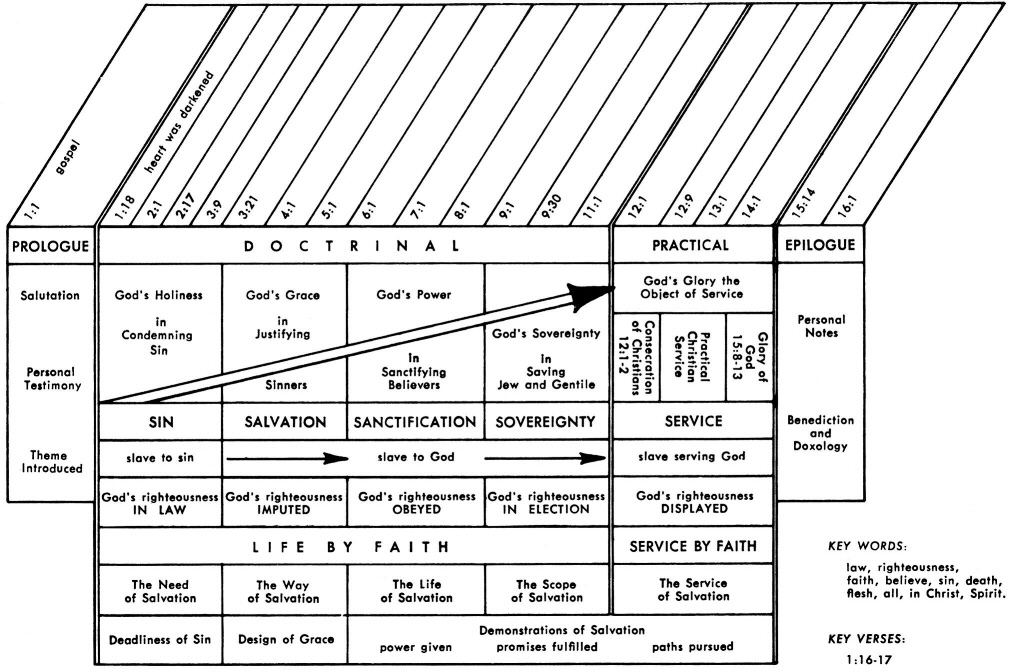
Click chart to enlarge
Chart from recommended resource Jensen's Survey of the NT - used by permission
Romans Overview Chart - Charles Swindoll
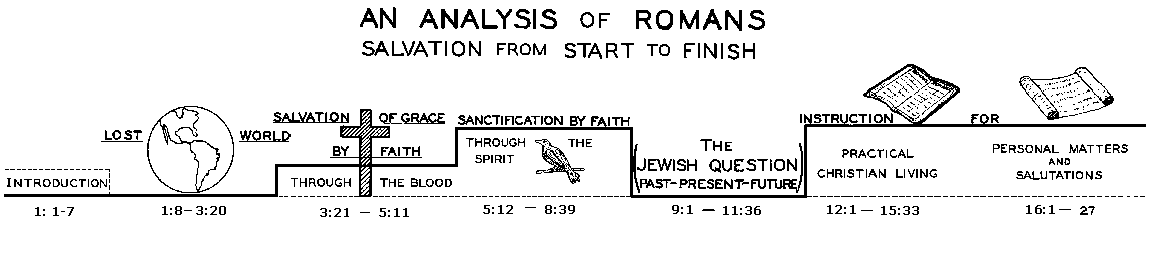
Source: Dr David Cooper
Click to Enlarge
| ROMANS ROAD to RIGHTEOUSNESS |
||||
| Romans 1:18-3:20 | Romans 3:21-5:21 | Romans 6:1-8:39 | Romans 9:1-11:36 | Romans 12:1-16:27 |
| SIN | SALVATION | SANCTIFICATION | SOVEREIGNTY | SERVICE |
| NEED FOR SALVATION |
WAY OF SALVATION |
LIFE OF SALVATION |
SCOPE OF SALVATION |
SERVICE OF SALVATION |
| God's Holiness In Condemning Sin |
God's Grace In Justifying Sinners |
God's Power In Sanctifying Believers |
God's Sovereignty In Saving Jew and Gentile |
Gods Glory The Object of Service |
| Deadliness of Sin |
Design of Grace |
Demonstration of Salvation | ||
| Power Given | Promises Fulfilled | Paths Pursued | ||
| Righteousness Needed |
Righteousness Credited |
Righteousness Demonstrated |
Righteousness Restored to Israel |
Righteousness Applied |
| God's Righteousness IN LAW |
God's Righteousness IMPUTED |
God's Righteousness OBEYED |
God's Righteousness IN ELECTION |
God's Righteousness DISPLAYED |
| Slaves to Sin | Slaves to God | Slaves Serving God | ||
| Doctrine | Duty | |||
| Life by Faith | Service by Faith | |||
|
Modified from Irving L. Jensen's chart above |
||||
R Ruin (Romans 1:17 – 3:20) – The utter sinfulness of humanity
O Offer (Romans 3:21-31) – God’s offer of justification by grace
M Model (Romans 4:1-25) – Abraham as a model for saving faith
A Access (Romans 5:1-11) – The benefits of justification
N New Adam (Romans 5:12-21) – We are children of two “Adams”
S Struggle w/ Sin (Romans 6:1-8:39) Struggle, sanctification, and victory
Romans 8:18 For I consider that the sufferings of this present time are not worthy to be compared with the glory that is to be revealed to us (NASB: Lockman)
Greek: Logizomai (1SPMI) gar hoti ouk axia ta pathemata tou nun kairou pros ten mellousan (PAPFSA) doxan apokaluphthenai (APN) eis hemas.
Amplified: [But what of that?] For I consider that the sufferings of this present time (this present life) are not worth being compared with the glory that is about to be revealed to us and in us and for us and conferred on us! (Amplified Bible - Lockman)
NLT: Yet what we suffer now is nothing compared to the glory He will give us later. (NLT - Tyndale House)
Phillips: In my opinion whatever we may have to go through now is less than nothing compared with the magnificent future God has planned for us. (Phillips: Touchstone)
Wuest: for I have come to a reasoned conclusion that the sufferings of the present season are of no weight in comparison to the glory which is about to be revealed upon us. (Eerdmans)
Young's Literal: For I reckon that the sufferings of the present time are not worthy to be compared with the glory about to be revealed in us;
FOR I CONSIDER THAT THE SUFFERINGS OF THIS PRESENT TIME ARE NOT WORTHY TO BE COMPARED: Logizomai (1SPMI) gar hoti ouk axia ta pathemata tou nun kairou:
- Mt 5:11, 12-see notes Matthew 5:11; 5:12; He 11:25, 26, 35-see notes He 11:25; 26; 35; 1Pe 1:6, 7- see notes 1Pe 1:6; 7; Acts 20:24; 2Cor 4:17,18
- Romans 8 Resources
For (gar) links this statement with the preceding and gives the reason for the foregoing, especially the truth that we will be glorified with Him. Always pause and ponder this term of explanation.
Denney introduces this section with the comment that…
This passage from Romans 8:18-27 is described by Lipsius as a "threefold testimony to the future transfiguration which awaits suffering believers". In Romans 8:19-22 there is the first testimony -- the sighing of creation; in Romans 8:23-25 the second, the yearning hope of Christians themselves, related as it is to the possession of the first fruits of the Spirit; and in Romans 8:26-27 the third, the intercession of the Spirit which helps us in our prayers and lends words to our longing."
(Denney continues) Logizomai is a favorite word with Paul: the instance most like this is the one in Ro 3:28 (see note). It does not suggest a more or less dubious result of calculation; rather by litotes (understatement for rhetorical effect) does it express the strongest assurance. The insignificance of present suffering compared with future glory was a fixed idea with the Apostle, 2Cor 4:17ff. (Expositor's Greek Testament)
I consider - As we often use this word in English it suggests a matter of personal opinion but that is not the case but as explained further below it conveys the sense that Paul has "mentally weighed" the evidence and come a conclusion that gives him strong assurance and not doubt.
Consider (3049) (logizomai [word study] from lógos = reason, word, account) refers literally to numerical calculation and means to reckon, compute, calculate, to take into account, to deliberate, and to weigh. Logizomai refers to a process of careful study or reasoning which results in the arriving at a conclusion.
I have thought it over carefully—I have weighed the evidence and thus reckon it to be so (And the present tense signifies he continued to mull this over in his mind).
Logizomai was a term frequently used in the business community of Paul's day and meant to impute (put to one's account) or credit to one's account. Logizomai is related to our English term logic (which deals with the methods of valid thinking, reveals how to draw proper conclusions from premises and is a prerequisite of all thought).
Logizomai - 39x in NT - Lk. 22:37; Jn. 11:50; Acts 19:27; Rom. 2:3, 26; 3:28; 4:3ff, 8ff, 22ff; 6:11; 8:18, 36; 9:8; 14:14; 1 Co. 4:1; 13:5, 11; 2 Co. 3:5; 5:19; 10:2, 7, 11; 11:5; 12:6; Gal. 3:6; Phil. 3:13; 4:8; 2 Tim. 4:16; Heb. 11:19; Jas. 2:23; 1 Pet. 5:12
What Biblical truths might one think about that would lead them to the conclusion that suffering now pales in comparison to glory in the future? Ponder the following Cross-references (Mt 5:11, 12-see notes Mt 5:11; 12; He 11:25, 26, 35-see notes He 11:25; 26; 35; 1Pe 1:6, 7- see notes 1Pe 1:6; 7; Acts 20:24; 2Cor 4:17,18) No matter what we have gone through, are presently going through, or will go through, the sum total is not worth comparing with the glory that awaits us. We can compare a thimble of water with the sea, but we cannot compare our sufferings with the coming glory. Belief in what the Scriptures say will change our lives. Some of us need to have our eyes lifted from the dirt toward the heavens. There is simply no comparison of our pleasure or pain with the glory yet to be revealed.
Martin Luther - If we consider the greatness and the glory of the life we shall have when we have risen from the dead, it would not be difficult at all for us to bear the concerns of this world. If I believe the Word, I shall on the Last Day, after the sentence has been pronounced, not only gladly have suffered ordinary temptations, insults, and imprisonment, but I shall also say: “O, that I did not throw myself under the feet of all the godless for the sake of the great glory which I now see revealed and which has come to me through the merit of Christ!
Sufferings (3804) (pathema [word study] describes what happens to a person and must be endured. Pathema is talking about the actual suffering itself (not suffering in general) - it refers to the very pain that we are experiencing right now - those very things that we can "see, touch and feel" - those things that are causing us anguish and emotional trauma.
Pathema - 16x in NT - Ro 7:5; 8:18; 2 Co. 1:5ff; Gal. 5:24; Phil. 3:10; Col. 1:24; 2 Tim. 3:11; Heb. 2:9f; 10:32; 1Pet. 1:11; 4:13; 5:1, 9
The sufferings of this life are the lot of all believers but keep in mind that for believers suffering takes on a different meaning and purpose then suffering in general - as believers we suffer for our faith in Christ (and Christ in us Who the world hates) and we suffer that we might be conformed to His image.
Paul reminds the Corinthians that
just as the sufferings (pathema) of Christ are ours in abundance, so also our comfort is abundant through Christ. (2Co 1:5)
Comment: Will we suffer for our faith? Yes. Will we "out suffer" God's capacity to comfort us? No. Never! The more we endure righteous ("right") suffering (i.e., not suffering because we are being disciplined by our Father for sinning against Him), the greater will be our comfort and reward (cf. 1Pe 4:12, 13, 1Pe 4:14). Paul understood from experience that his many sufferings were continual never-ending (2Cor 4:7, 8, 9, 10, 11; 6:5, 6, 7, 8, 9, 10; 11:23, 24, 25, 26, 27), and that all believers in Christ should expect the same (cf. Mt. 10:18, 19, 20, 21, 22, 23, 24, cp 2Ti 3:12, Php 1:29).
Again Paul writes that
"Now I rejoice in my sufferings (pathema) for your sake, and in my flesh I do my share on behalf of His body (which is the church) in filling up that which is lacking in Christ’s afflictions." (Col 1:24)
As a servant of the Lord, he was called upon to endure untold hardships, persecutions, and afflictions (see similar use of pathema in 2Ti 3:11). These to Paul were a privilege. "Filling up that which is lacking" does not refer to the atoning sufferings of the Jesus on the Cross for they are finished once and for all and no man could ever share in them. On the other hand there is a sense in which the Lord Jesus still suffers, for when believers are persecuted, the Head feels the sufferings of His Body.
In a similar vein, Peter encourages the saints:
"Beloved, do not be surprised (present imperative + negative = command to stop letting this happen, implying some were being surprised by the fiery trials) at the fiery ordeal among you, which comes upon you for your testing (peirasmos = not meant to break them but to make them, so to speak, to make them more like Jesus. Not to break our faith but to test our faith and strengthen our faith like tempered steel is made stronger - see article below on "tempering steel" - great parallels to our Christian life and God's use of trials to "temper" our faith!), as though some strange thing were happening to you, but to the degree that you share the sufferings (pathema) of Christ, keep on rejoicing; so that also at the revelation of His glory, you may rejoice with exultation." (1Pe 4:12, 13)
Step 1 - First you need to understand why steel needs to be tempered. To understand that you must understand the process before tempering, hardening. First metal is worked into the shape of what it is to become. For this article let's use a flat head crew driver as an example. After the metal is shaped into a flat head screw driver it needs to be hardened. To harden the metal its is heated till its orange hot. Then the metal is quenched in clean water. The super heating and rapid cooling make the metal very hard. However it also makes the metal very brittle. Sometimes you want the metal hard. In our case a brittle flat head crew driver would be a bad thing. As soon as you applied to much pressure to the flat tip it would crack breaking the tip. This is where tempering is needed.
Step 2 - After hardening the flat head screw driver, we have made it very hard and brittle. Now we must temper the point. To do this slowly heat up the tip of the screw driver. A blue line of heat will appear on the metal as the temperature rises and travels down the shaft of the screw driver. When you see this you have reached the correct temperature for tempering. Place the shaft on a metal surface and allow it to cool slowly. After its cool your screw driver is tempered.
Step 3 - The tempering process has taken most of the brittleness from the steel. Allowing you to turn a screw and not have the tip crack and shatter.
SUFFERING:
THE MARK OF
A BELIEVER
Suffering is the universal mark of all true Christians. Realizing that other Christians suffer in other places of the world, encourages us to move on in the faith (If you are not familiar with them, you might want to check out Voice of the Martyrs). This also unites us in the same experiences (cp 1Co 12:26, Ro 12:15, Gal 6:2, He 13:3). We can handle anything that life may bring us if we know the principles of the Word (Mt 4:4, 2Pe 1:3, 2Co 3:5,6). And remember that we are not to be ignorant of Satan's schemes (2Co 2:11), one of which is to use our suffering to discourage us (cp Ge 4:5, 6, 7 "sin is crouching at the door" - 1Pe 5:8). He shoots fiery missiles like "You're the only one suffering like this." (Ep 6:16) - note counter his fiery missiles of "fear" with the shield of "faith", believing what God says is always, eternally true about believers [cp Ro 10:17, 2Cor 5:7], truths like Ro 8:31, Ro 8:37, Heb 13:5) And this is a soul withering (cp Ps 42:5) thought if not taken captive to Christ (2Cor 10:5), for in the midst of the fire of affliction, it is easy to grow weary (cp He 12:3, Gal 6:9) and want to give up under the mistaken impression that no one else has as much trouble as we do (cp "same experiences" - 1Pe 5:9). In the passage below the apostle Peter (who was well acquainted with how the flesh responds to fear! Jn 13:38, Lk 22:31, 32, 33, 34, 56, 57, 58, 59, 60, 61, 62, contrasted with Acts 2:2,14, 4:8) speaks God's truth which deflates Satan's lie.
But resist (anthistemi in the aorist imperative - This sounds forth like a military command being "barked out" by a commanding officer. The aorist imperative is often used to convey a sense of urgency) him, firm (stereos = a military term used to describe a Grecian phalanx that remains solid and immovable, steadfast like a "firm" foundation) in your faith (pistis), knowing (eido = absolute, positive, beyond a chance of a doubt type of knowing) that the same experiences of suffering are being accomplished (epiteleo = fully completed and so reaching the intended goal, cp Php 1:6) by your brethren who are in the world. (1Pe 5:9)
><> ><> ><>
The abrasive experiences we encounter each day help to prepare us for heaven. The sovereign God uses all of life's troubles to polish and perfect our character. If we accept our trials with the right attitude (cp 1Th 5:18) and recognize that the heavenly Father is working through them (cp Jas 1:2, Jas 1:3, 4), we will someday shine with splendor before Him (cp Da 12:3, Pr 4:18, Mt 13:43).
In the rough, a diamond looks like a common pebble, but after it is cut, its hidden beauty begins to emerge. The stone then undergoes a finishing process to bring out its full radiance. A skilled craftsman holds the gem against the surface of a large grinding wheel. No other substance is hard enough to polish the stone, so the wheel is covered with diamond dust. This process may take a long time, depending on the quality desired by the one who will buy it.
This is similar to the way God works with us. The procedure is not pleasant, nor is it intended to be. The Divine Workman, however, has our final glory in view (2Cor 4:16, 17, 18). We may be "grieved by various trials," as Peter said, but when we understand what is behind them we can rejoice even in adversity (1Pe 1:6). God has one goal in mind during the refining process: that our faith "may be found to praise, honor, and glory at the revelation of Jesus Christ." (1Pe 1:7, Ps 66:10) Knowing this enables us to look beyond the unpleasantness of "polishing" to see the outcome (Ro 8:29). P. R. Van Gorder. (Our Daily Bread, Copyright RBC Ministries, Grand Rapids, MI. Reprinted by permission. All rights reserved)
A gem cannot be polished without friction,
nor a man perfected without adversity.
><> ><> ><>
Acid Test - A severe trial is sometimes called an “acid test.” This term originated during times when gold was widely circulated. Nitric acid was applied to an object of gold to see if it was genuine or not. If it was fake, the acid decomposed it; if it was genuine, the gold was unaffected.
In God’s view, our faith is “much more precious than gold,” and it too MUST be tested (1Pe 1:6; 1Pe 1:7). But these “acid tests” are positive ones. The Lord is working to reveal genuine faith, not to expose false faith. During hard times, though, we may feel overwhelmed with the fear that our faith is decomposing.
Ronald Dunn, a Bible teacher who has experienced much personal tragedy, knows what we are going through. He writes
I’m often mystified. I don’t understand why it is that as I endeavor to live for God and pray and believe, everything seems to be falling apart. Sometimes I struggle, and I say, ‘Dear Lord, why are You allowing this to happen?
Dunn concludes
It’s good for us to remember that God is not an arsonist; He’s a Refiner! (cp Mal 3:3KJV) (Our Daily Bread, Copyright RBC Ministries, Grand Rapids, MI. Reprinted by permission. All rights reserved)
><> ><> ><>
AN ILLUSTRATION - While studying the Scriptures a woman came across the picture of God as a Refiner in Mal 3:3 (cp Titus 2:14, Heb 12:10, 1Pe 1:7, 1Pe 4:12,13 Rev 3:18). She visited a silversmith to learn more about the process of refining silver. After the silversmith had described the refining process to her, she asked, "Do you sit while the work of refining is going on?" The silversmith replied, "Oh, yes, madam, I must sit with my eyes steadily fixed on the furnace because if the refining time is exceeded in the slightest degree, the silver will be damaged." The lady at once saw the beauty and comfort found in the picture of God as our Refiner and Purifier! When God sees it needful to put His children into a furnace of affliction (or testing), His eye is steadily intent on the work of purifying, while His wisdom and love are both engaged in the best manner for us. Our trials do not come at random (Beloved - Read that statement again and think "sovereignty"!). His is faithful (trustworthy) and will not let us be tested beyond what we can endure (1Co 10:13). Before she left, the lady asked one final question, "When do you know the process is complete?" The silversmith smiled and said, "Why, that's quite simple. When I can see my own image in the silver, the refining process is finished." (Ro 8:29, Php 3:10) As someone else has said "The face of Jesus must be very near our own when the thorns from his crown of suffering are pressing our brow and hurting us."
><> ><> ><>
There is a mission in Japan which has a meeting place built by the stones which were thrown at the Christians in years gone by. A mob rushed upon639 the company and stoned them away. When the time of peace came, the Christians picked up the stones and worked them into their building. God is able to make the wrath of man praise Him. —Selected
><> ><> ><>
Crucible Steel - Frank has a toolbox full of knives and chisels that are designed for his woodcarving hobby. His favorite is a German-made, all-purpose carving knife. He has honed it repeatedly, and it still holds an edge. "I'm going to be sad," Frank said, looking fondly at his knife, "when this blade gets too thin to sharpen."
Like all reliable carving tools, that knife is constructed of "crucible steel." To produce this durable metal, raw material is placed in a crucible where it is subjected to intense heat. Once it is glowing with molten brightness, the white-hot metal is maintained at precisely the right temperature until it qualifies as crucible steel. When it cools, it is neither so soft that it won't hold an edge nor so hard that it is brittle.
Christians, as the handiwork of God, are shaped and formed by His will. Sometimes He places us in a crucible of affliction. Peter wrote about the faith of Christians and said that it may be "tested by fire" (1Pet. 1:7). That testing may come in the form of "various trials" to refine our faith (1Pe 1:6).
If you're in a crucible of testing right now, don't be discouraged. God knows what He is doing. He has promised to stay with you and help you to become a useful tool in His strong, loving hands. —David C. Egner (Our Daily Bread, Copyright RBC Ministries, Grand Rapids, MI. Reprinted by permission. All rights reserved)
All things work out for good we know--
Such is God's great design;
He orders all our steps below
For purposes divine. --Peterson © 1961 Singspiration, Inc.
Gold is tested by fire; man is tested by adversity
God sometimes has to put us on our backs in order to make us look up.
><> ><> ><>
Great Preachers - The greatest sermons I have ever heard were not preached from pulpits but from sickbeds. The deepest truths of God's Word have often been taught by those humble souls who have gone through the seminary of affliction.
The most cheerful people I have met, with few exceptions, have been those who've had the least sunshine and the most pain and suffering in their lives. The most grateful people I have ever known were not those who had traveled a pathway of roses all their lives, but those who were confined to their homes, some to their beds, and had learned to depend on God.
The gripers, on the other hand, are usually those who have the least to complain about. The men and women who are the most cheerful and the most grateful for the blessings of Almighty God are often those who have gone through the greatest trials.
The Bible tells us that if we respond properly to the trials of life, we will develop patience and godly maturity (Romans 5:3, 4, 5; James 1:3, 4). We must keep in mind that our present sufferings are "but for a moment" and that they are being used by God for our eternal good (2Corinthians 4:17, 18).
So take heart, suffering one. Someday you too will realize that it was worth it all (1Peter 1:7). —M R De Haan (Ibid)
It will be worth it all when we see Jesus,
Life's trials will seem so small when we see Christ;
One glimpse of His dear face all sorrow will erase,
So bravely run the race till we see Christ. — Esther Kerr Rusthoi
(c) Renewal 1969 Singspiration, Inc.
Some of life's greatest lessons are learned in the school of affliction.
><> ><> ><>
If you are God’s child, suffering has or will come your way. That is a certainty and so it behooves every saint to understand the following truths regarding suffering…
Reasons for suffering
1. A Gift of Sharing in Christ’s Affliction
You are going to suffer with Him so that you might be glorified with Him. In one sense the affliction of the Lord is still going on in His children. (cp Ro 8:15, Ro 8:16, 17, Php 3:10). The gospel is a gospel of affliction or of suffering and because we are in covenant with Christ we join in and share His affliction, which Paul amplifies in Col 1:24 writing that…
I now rejoice in my sufferings for you, and fill up in my flesh what is lacking in the afflictions of Christ, for the sake of His body, which is the church
Why Christ’s afflictions lacking? Recall that the kingdom of God is still a spiritual kingdom. His kingdom now is not of this world and neither is our citizenship (Php 3:20). Thus now believers are aliens and strangers, living in a world that has another prince (Satan) rather than the Prince or Jesus. And so we are in a spiritual war (Ep 2:2, Ep 6:12) against a Satanic hierarchy bent on destroying the children of God and determined to impede the going forth of the gospel. And in this spiritual warfare believers suffer and as they do so we are filling up in our body the afflictions of Jesus Christ. We see this even from the inception of the church (Acts 5:34, 35, 36, 37, 38, 39, 40, 41). We can know that anytime that we suffer for righteousness and holiness and the kingdom of Christ, that those who fight against us are in reality fighting against God. Of course they cannot see God, but they can see us and Christ in us if we are walking worthy of the gospel, and consequently they persecute us. And as they attack us we are filling up the afflictions of Christ.
2. Suffering Purifies Believers - to make you more like Jesus (cp 1Pe 1:6, 7). When suffering comes and it does not destroy your faith, but causes you to stand firm, it shows the reality of your faith. (Php 1:28).
When silver is refined it is purified in the fire seven times (Psalm 12:6) and each time the temperature is made hotter by the silversmith who knows when the sliver is purified. How? When he looks in the silver he sees a perfect image of himself. (cp Jas 1:2, Jas 1:3, 4). When you begin to experience suffering don’t run, but remain under the suffering remembering that suffering purifies and proves to us that we belong to Jesus Christ (Ro 5:3, Ro 5:4, 5), The corollary is that you will doubt your salvation when you are walking "your way" and not God's way.
In sum, God uses suffering in our lives to expose our sin because (a) Suffering deters from going astray and leads to obedience. (Psalm 119:67); (b) Suffering produces repentance that leads us to salvation from sin.(2Co 7:10); (c) Suffering makes us more inclined to reject sin and to resist fulfilling our selfish desires. Suffering can lead to our living for the will of God. (1Pe 4:1, 2)
3. Suffering Testifies to the Reality of Your Faith - Believers have received the ministry of the new covenant and are responsible to walk worthy of this high privilege. We have turned from a life that is opposed to Jesus Christ. (cp 2Cor 4:1, 2, 3). Now our very lifestyle speaks of the reality of Jesus Christ. Death works in you – but life and salvation come to others because suffering testifies to the reality of your faith to those that are watching. (cp 2Co 4:7-12)
Realities of suffering
1. That Suffering Will Never Be More Than You Can Bear - There is always the way of escape so that in the midst of every trial His grace is sufficient (1Co 10:13, 2Co 12:9, 2Co 12:10)
2. The Lord Will Never Abandon You in the Midst of That Suffering
Hebrews 13:5 (In the Greek = 4 negatives “I will never never never leave you nor never forsake you”), Heb 13:6, 2Ti 4:16, 17, Acts 9:15, 16. You may (you will) suffer, but the Lord will never abandon you
3. Your Life Cannot Be Taken Without God’s Permission
The greatest fear that man has is the fear of death, but believers do not need to be afraid because no man can take our life from you without God's permission (cp He 2:14, 15, Mt 10:16,26,28,31, cp Rev 2:10). Jesus has in His hands the keys to hell and to death (Revelation 1:18). Moses affirms that God is sovereign over life and death…
Dt 32:39 - 'Now see that I, even I, am He, and there is no God besides Me; I kill and I make alive; I wound and I heal; nor is there any who can deliver from My hand.' (cp 1Sa 2:6, 7, 8)
Believers belong to God. We are His possession and the enemy cannot take our life without His permission, so don't fear (cp Rev 2:10). In fact for believers death only marks the end of temporal life and the beginning of eternal life, the beginning of all that life is meant to be.
Response in suffering
1. Response toward God - In a word, rejoice! (cp 1Pe 4:12, 13, Jas 1:2, always = Php 4:4, all circumstances = 1Th 5:18, with thanks = Eph 5:20 - which is in context of being filled with the Spirit explaining how this supernatural response is even possible).
2. Response toward the person causing the suffering - When God's enemies are persecuting you, you are not to be terrified but instead should respond to them with gentleness and reverence (Php 1:28, 1Pe 3:14, 15, 16). We are to respond to our (God's) enemies the way He responds -- in love (Mt 5:44, 45). We are to bless them and do good to them (Ro 12:14, Ro 12:17, Ro 12:18, 19, 20, 21)
3. Response toward believers - Believers are to be of one mind and one heart, united in spirit knowing that the enemy wants to separate believers from the fold (cp Php 2:1)
Results of suffering
1. God is glorified
2. Believers are purified
3. Lost may be justified because they see that you are not terrified by your suffering and to them it is an evidence of the fact that they are lost
A FEW MORE TRUTHS
ABOUT CHRISTIAN SUFFERING
Suffering develops contentment even when we are in need. (Php 4:12) Suffering produces perseverance, which in turn makes us emotionally mature and morally complete. (Jas 1:2, 3, 4) Suffering produces endurance, which is a catalyst to refine our character and renew our hope. (Ro 5:3, Ro 5:4) Suffering, will be used by God for our good. (Ro 8:28, cp Ge 50:20) Suffering gives Christians the opportunity to show care toward other Christians who suffer. (1Cor 12:25, 26) Suffering endured, produces compassion that equips us to comfort others. (2Co 1:3, 4) Suffering is used by God to change our perspective, for it can reveal Jesus, who is living within us.(2Co 4:8, 9, 10) Suffering prepares great eternal glory for us. (2Co 4:16, 17) Suffering creates a hunger in us for heaven, where there will be no more suffering. (Rev 21:4) Suffering for living right in God's sight promises great future Divine blessing (Mt 5:10) Suffering proves our faith is genuine. (1Pe 1:6, 7) Suffering with perseverance will be repaid with the crown of life. (Jas 1:12)
The present time - literally the now season. Just as seasons pass, so too the time of suffering will give way to a new age in which there is no suffering…
For momentary, light affliction is producing for us an eternal weight of glory far beyond all comparison, while we look not at the things which are seen, but at the things which are not seen; for the things which are seen are temporal, but the things which are not seen are eternal. (2 Cor 4:17, 18)
Time (2540)(kairos [word study]) means a period of time frequently with the implication of being especially fit for something to take place or have effect. Kairos means a period which is especially appropriate with the added notion of suitableness ("the suitable time", "the right moment", "the convenient time").
Kairos - 82x in NT - Matt. 24:21; 26:65; 27:42f; Mk. 10:30; 13:19; 15:32; Lk. 1:48; 2:29; 5:10; 6:21, 25; 11:39; 12:52; 16:25; 19:42; 22:18, 36, 69; Jn. 2:8; 4:18, 23; 5:25; 6:42; 8:11, 52; 9:21, 41; 11:8, 22; 12:27, 31; 13:31, 36; 14:29; 15:22, 24; 16:5, 22, 29f; 17:5, 7, 13; 21:10; Acts 3:17; 4:29; 5:38; 7:4, 34, 52; 10:5, 33; 12:11; 13:11, 31; 15:10; 16:36f; 17:30; 18:6; 20:22, 25, 32; 22:16; 23:15, 21; 24:25; 26:6; 27:22; Rom. 3:26; 5:9, 11; 6:19, 21; 8:1, 18, 22; 11:5, 30f; 13:11; 16:26; 1 Co. 3:2; 5:11; 7:14; 12:18, 20; 14:6; 16:12; 2 Co. 5:16; 6:2; 7:9; 8:14; 13:2; Gal. 1:23; 2:20; 3:3; 4:9, 25, 29; Eph. 2:2; 3:5, 10; 5:8; Phil. 1:5, 20, 30; 2:12; 3:18; Col. 1:24, 26; 1 Thess. 3:8; 2 Thess. 2:6; 1 Tim. 4:8; 6:17; 2 Tim. 1:10; 4:10; Tit. 2:12; Heb. 2:8; 8:6; 9:5, 24; 12:26; Jas. 4:13; 5:1; 1 Pet. 1:12; 2:10, 25; 3:21; 2 Pet. 3:7, 18; 1 Jn. 2:18, 28; 3:2; 4:3; 2 Jn. 1:5; Jude 1:25
Morris comments that "Contemplation of the future privileges of the believer leads Paul to think of the contrast this makes with the present state. He shows that suffering is the path we tread as we move to blessing and to glory. Since the early Christians led a somewhat precarious existence, it may well be that the contemplation of the future glory was very precious to them… Paul speaks of our present sufferings, which means the sufferings characteristic of this present age rather than the present moment. There is no reason to think that the circumstances in which he wrote were especially significant, but this age is in marked contrast to the age to come (Ed note: Millennium). Paul holds that the believer must expect sufferings in this present age. There is suffering that is the direct result of our sinning and there is suffering that we endure for Christ’s sake, suffering that arises directly from our Christian profession in a world that rejects Christ. But beyond that, there is suffering that arises simply because we are in this imperfect world. Paul is realistic; there is no reason to think that Christians will be free from troubles in this present life. It is important, therefore, that they learn how to bear them. (Morris, L. The Epistle to the Romans. W. B. Eerdmans; Inter-Varsity Press)
Not worthy - absolutely not (ouk) worthy.
Hodge - Here the meaning is “not weighty in reference to” or “in comparison with.” As the glory so outweighs the suffering, the idea of merit is excluded. It is altogether foreign to the context. It is not the basis on which eternal life is bestowed, but the greatness of the glory that the saints are to inherit which the apostle seeks to illustrate. (Commentary on Romans)
Worthy (adjective) (514) (áxios) means weighing as much as, of like value, worth as much. It means having the weight of another thing and so being of like value or worth as much. In other words axios has the root meaning of balancing the scales—what is on one side of the scale should be equal in weight to what is on the other side. By extension, axios came to be applied to anything that was expected to correspond to something else. A person worthy of his pay was one whose day’s work corresponded to his day’s wages.
Vine comments…
The word axios was used originally of drawing down a scale; hence it had to do with weight, and so of that which is of value. The idea, here (Ro 8:18), then, is that sufferings are of no weight in comparison with glory; they are not to be balanced in the scale with it.
Axios - 39x in NT - Matt. 3:8; 10:10f, 13, 37f; 22:8; Lk. 3:8; 7:4; 10:7; 12:48; 15:19, 21; 23:15, 41; Jn. 1:27; Acts 13:25, 46; 23:29; 25:11, 25; 26:20, 31; Rom. 1:32; 8:18; 1 Co. 16:4; 2Th 1:3; 1 Tim. 1:15; 4:9; 5:18; 6:1; Heb. 11:38; Rev. 3:4; 4:11; 5:2, 4, 9, 12; 16:6. NAS = appropriate(1), deserve(2), deserving(4), fitting(2), keeping(2), unworthy*(1), worthy(29).
The meaning of axios is illustrated by the balancing of the scale (see below). It is as if Paul is saying
Brothers, the glory to be revealed to the children of God is not on even on the same scale as trials because the eternal glory so far outweighs the temporal trials

TRIALS GLORY
Jewish readers would agree with Paul that the righteous would be greatly rewarded for any sufferings in this world. (Many Jewish teachers went beyond Paul and even said that one’s suffering atoned for sin, but Paul accepted only Christ’s atonement as sufficient for sin—see Ro 3:25)
As noted above, Paul calls present sufferings "momentary, light affliction” compared to the “eternal weight of glory” (2Cor 4:17) because the divine compensation package is “a hundredfold” (Mt 19:29).
That is, down here it doesn't seem like we are getting very far, nothing seems to be accomplished; but over yonder, where we can't see, the great floodtide of suffering is washing in a great wave of glory which shall be revealed in its time.
The late Ethel Waters, a performer who often sang at Billy Graham crusades was best known before she became a Christian for her rendition of the popular song, “Stormy Weather.” Later as a Christian she was once asked to sing this song, but replied,
“No Sir, I’ll never sing ‘Stormy Weather again, since Jesus came into my heart I’ve never had stormy weather like I had before I knew him.”
Or as someone has well said we can sometimes see more through a tear than through a telescope.
Or ponder the perspective on suffering by the Puritan saint Richard Baxter who said…
Weakness and pain helped me to study how to die; that set me on studying how to live. (and) Suffering so unbolts the door of the heart that the Word hath easier entrance.
Suffering times are teaching times. - William Bridge
D A Carson on suffering -
The sovereign and utterly good God created a good universe. We human beings rebelled; rebellion is now so much a part of our make-up that we are all enmeshed in it. Every scrap of suffering we face turns on this fact… There is a certain kind of maturity that can be attained only through the discipline of suffering… The staying power of our faith is neither demonstrated nor developed until it is tested by suffering.
From Southern Baptist Journal of Theology (SBJT 4:2 - Summer 2000) in an article on suffering in which several theologians were asked specific questions on this subject…
SBJT: From what perspective should Christians view suffering?
C. Ben Mitchell responds…
On my bookshelf is a favorite two-frame cartoon strip. In the first frame a little man is shown standing in a torrential downpour, eyes lifted toward heaven, wailing, “Why me?” In the last frame, the voice of God calls down from the dark sky, “Why not?” I saved that cartoon strip because it reminds me of a profound biblical principle about suffering. The classical theodicy problem begins with the question, “Why is there suffering in the world?” Yet, this little cartoon evokes what I take to be an even more profound question, “Why shouldn’t there be suffering in the world?” Given that we live in a universe that has been compromised by the effects of human sinfulness, is this not a more appropriate question? The question may be focused even more pointedly, “Why shouldn’t Christians suffer?”
Doubtless many Christians have and will suffer intensely. Whether from the ravages of disease, persecution, or disaster, Christians are not exempt from the pangs of living in a fallen world. A Christian wife of unflagging devotion to her husband learns that he is cheating on her and plans to move in with his adulterous partner. Faithful Christians are laid off in corporate downsizing, despite their hard work and loyalty. A godly nurse who has given her life in service to the weak and ill finds herself the victim of Lou Gehrig’s disease. A spiritually mature couple pray to have a baby for 10 years and invest more than one hundred thousand dollars in infertility treatments, all with no results. Christians in other countries find themselves tortured, raped, and murdered for their faith. When tragedy strikes, the almost knee-jerk reaction seems to be, “Why me?” Instead, it seems to me, Christians ought always to ask when they learn of the suffering of others, “Why not me?” Why shouldn’t Christians suffer?
Christians are better prepared than anyone else to endure suffering. First, Christians alone understand the cause of suffering. We know that, in a deep sense, this is not the way it is supposed to be. That is, prior to the entrance of sin into the world there was no pain, suffering, or trouble. God’s refrain over his creation was “it was good.” Everything conformed to his purpose. After the disobedience of our first parents, Adam and Eve, the refrain changed to “curse,” “pain,” and “toil” (Genesis 3:17, 18, 19). Thorns and thistles grew where once the gracious fruit had grown. Where once abundant life thrived, the report now is, “in Adam all die … ” (1Cor 15:22). Where once the creation rejoiced in God’s goodness, it now “waits in eager anticipation for the sons of God to be revealed” when “the creation itself will be liberated from its bondage to decay and brought into the glorious freedom of the children of God” (Ro 8:18, 19, 20, 21, 22, 23). Much of the suffering and many of the trials we experience are endemic to life in a fallen world. Christians acknowledge God’s justice in responding to sin in this way. We understand that God’s own holy character demands that the rebellion of Adam and Eve be rewarded with punishment. Christians, of all people, should understand why we suffer.
Second, Christians alone know the Father’s love and purpose in suffering. We know that our gracious heavenly Father never does anything to harm us. Just as it is his character to punish sin, it is his nature to love his children. Since he is the sovereign God, nothing can happen to us that he does not superintend or control for his good purpose. What is that purpose? It is at least twofold: to glorify himself and to make his children more like Jesus. Through Christ, the Father’s heart is turned toward us in love, not anger. When we ask for bread he does not give us a stone. When we ask for fish he does not give us a serpent. Or as the hymn-writer put it: “the flames shall not harm you, I only design, thy dross to consume and thy gold to refine.” Since the Father is animated by love toward his children, Christians should endure suffering knowing that God’s purpose is good and that he will not place more upon us than he will equip us to handle.
Third, Christians alone have been granted faith to trust God and believe his loving purposes will prevail. Suffering evokes either doubt of God’s goodness or trust in God’s goodness. Some respond to suffering by rejecting God himself or by repudiating his goodness. Not Christians! With eyes of faith we can see (dimly sometimes, more clearly at other times) that while we may not understand the suffering now, we will see God’s goodness in it in the future.
The apostle Peter reminds believers who were suffering intensely that the events which resulted in their suffering “have come so that your faith—of greater worth than gold, which perishes even though refined by fire—may be proved genuine and may result in praise, glory and honor when Jesus Christ is revealed” (1Pet 1:7). By faith we see through the suffering to the shining face of our gracious Father. Perseverance in the face of suffering is made possible through faith (cf. Heb 11:32, 33, 34, 35, 36, 37, 38, 39).
Finally, Christians have hope; hope that enables them to see through the suffering to the goal of suffering. Why shouldn’t they suffer, seeing that they have an inheritance that far surpasses what this world has to offer? Twice in a passage filled with pathos, the apostle Paul remarks that “we do not lose heart” during these “light and momentary troubles” (2Cor 4:16, 17, 18, 2Co 5:15:21). Note the images of suffering in this passage. “We are hard pressed on every side, but not crushed; perplexed, but not in despair; persecuted, but not abandoned; struck down, but not destroyed. We always carry around in our body the death of Jesus, so that the life of Jesus may also be revealed in our body” (2Co 4:8, 9, 10). “Though outwardly we are wasting away, yet inwardly we are being renewed day by day” (2Co 4:16). “Meanwhile we groan, longing to be clothed with our heavenly dwelling” (2Co 5:2). “For while we are in this tent, we groan and are burdened … ” (2Co 5:4). These are powerful exclamations of the suffering Paul and his brother and sisters were experiencing. At the same time, he (and they) can be “always confident” (2Co 5:6), living by faith, not by sight (2Co 5:7), longing to be at home with the Lord (2Co 5:8).
Or consider the apostle Peter’s encouragement to suffering Christians when he sets before them the hope of their inheritance “that can never perish, spoil or fade—kept in heaven for you, who through faith are shielded by God’s power until the coming of the salvation that is ready to be revealed in the last time” (1 Pet 1:4–5). Even though “now for a little while you may have had to suffer grief in all kinds of trials” (1 Pet 1:6). Their palpable experience of suffering was to be kept in perspective by viewing it in light of the hope of eternal life yet to come.
The Westminster Shorter Catechism asks, “What is the chief end of man?” The answer is, of course, “To glorify God and enjoy him forever.” Most contemporary Christians emphasize the assertion that precedes the conjunction—viz., to glorify God. The hope held out for us in the gospel of Christ is that those who have embraced Jesus by faith will benefit through the assertion following the conjunction— viz., enjoying him forever. Why shouldn’t Christians suffer, since they have laid up for them such a blessed hope?
One of the most mysterious passages of the Bible for contemporary Western Christians is the book of Philippians. The fellowship of sharing Christ’s sufferings (Phil 3:10) is a fellowship no one wants. Nevertheless, Paul’s exhortation to the church in Philippi was that “it has been granted to you on behalf of Christ not only to believe on him, but also to suffer for him … ” (Phil 1:29).
SBJT: In what way is our suffering an opportunity to display the goodness of God?
Mark Dever responds…
In the fall of 1984, I was preaching through the book of Job in the evening services of a Congregational Church in New England. I was in seminary, and my wife and I were committed to minister in the town we lived in. After having been involved in the church a couple of years, what I and others thought was particularly needed was expositional preaching. So we began an evening service, and every Sunday night for months I preached from Jude, 1 Peter, Genesis, and Job.
It was in that series on Job that God taught me something new about suffering. In some ways, I feel a bit ashamed to say I know about suffering, when I consider what eyes may read these words, but I know that the Great Sufferer not only reads but knows my heart.
As I was preaching through the book of Job, I began to notice something new about Job’s sufferings, namely, God’s marvelous sovereignty in his sufferings, and even God’s pleasure in choosing Job to suffer. For Job to suffer as he did was an honor. That was an amazing thought to me. Job had many reasons to trust God— God had been good to him by giving him life and caring for him all those years. But Job did not have what he probably desperately wanted. He did not know the reason for his suffering. What you and I know from reading the beginning of the book remained hidden from Job.
Satan wrongly accused Job, charging that Job was only serving God for his own selfish ends. Satan said that Job was only serving God because God had made him wealthy. But when all the material trappings were taken away, Job still worshipped God.
Satan will try to find fault with us even in our obedience to God! So Satan then accused Job of only serving God because his health remained. Satan switched his tactics, suggesting that health was Job’s only concern. God disagreed with Satan, but He allowed him to take away Job’s health, yet preserving his life. But Satan was still wrong. Even in the midst of his ever-present physical suffering, with his own body decaying and his skin erupting into boils, Job still worshipped God.
Job’s changing circumstances revealed that as wealthy as he was, he was not worshipping God because of his wealth. And Job’s changing circumstances revealed that as healthy as he was, he was not worshipping God because of his health. A life of true devotion to God is not dependent on our circumstances; it is not a life devoted to God’s blessings.
Job’s friends suggested that he suffered because of some sin he refused to confess. But far from being right, we the readers know that Job’s friends got it all wrong. Job’s trials were not because of his vices at all, but because of his virtue! God had bragged on Job! The amazing divine boast comes in Job 1:8, and again in Job 2:3: “Have you considered my servant Job?”
Not so many months ago, I sat securely on a plane as we taxied for take-off from the Dallas-Fort Worth Regional Airport. With terminals, parking garages, runways and support roads, DFW covers roughly the same area as Manhattan Island. Hundreds and thousands of planes take off from there every day. As I sat securely on the plane, we taxied for take-off. Knowing the great mass of air traffic around that airport, I could have become nervous and untrusting. As we taxied away from the gate and began to prepare for departure, I suppose I could have simply stood up and said, “Stop the plane!” I could have gone to the cockpit and demanded from the captain copies of the taxiing route, the runway we would be using, and the timetable for other flights, in order to satisfy myself that we would, in fact, be safe. As I say, I could have done that. Regardless of the response I would likely have received, I could have tried to satisfy myself. Or, I could do what I did—more habit than virtue—and trust the controllers. I recognized the care and order with which this whole apparently chaotic, potentially disastrous operation was run. And I sat back as we accelerated and lifted off the ground.
How many times do we want to stop the plane in order to understand all the variables before we go? How much do we trust the True Controller, who makes no errors, who never sleeps nor slumbers, nor in whom is the slightest touch of evil.
I wonder if Job, in this life, ever learned that God had bragged on him. I wonder if, in this life, he ever understood his sufferings to be an opportunity from God, a strange compliment. As far as we know, Job simply had to trust the character of God, His very goodness.
When I think about the preaching I did through Job those years ago, I am reminded of how dangerous it can be for us to try to think casually about how God may use this or that tragedy in others’ or even our own lives. To a point, seeking to understand how God may be using a tragedy in our lives is a good and natural practice. It comes out of our human desire for coherence and meaning. It is cognitive breathing. But at a still deeper level, there is no doubt that in all of our lives, times will come in which we are certainly called to trust God when we cannot understand the reason for our suffering. We must all finally rely on His character and purposes, rather than thinking that we have figured out the specifics of His plans. We know His ultimate purposes are good, even if His immediate goodness is sometimes hidden to us in the darkness of His plans: “Behind a frowning providence there hides a smiling face.”
Remember the story of Jesus and his disciples meeting the blind man, recorded in John 9? The disciples asked Jesus, “Who sinned, this man, or his parents that he was born blind?” “Neither this man nor his parents sinned,” replied Jesus, “but this happened so that the work of God might be displayed in his life” (John 9:3).
I realize that Job is someone that we would rather meet than emulate. But we may consider Job’s experience and be encouraged! I remember reading some years ago about an actress, who already having a hard year, found out, on the same day, that she had lost her television show and that her husband had left her. She said, “I know the Lord won’t send me more trouble than I have the strength to bear, but I do wish He didn’t have quite such a good opinion of me.” We may feel like that lady some days.
If I am going to be a follower of the Crucified One, I must know that when I suffer, I am being called on to display— perhaps even exquisitely—the glory of God as I continue to serve Him in the midst of my trials.
Do you think that God is speaking to Satan about you today,
“Have you considered my servant?”
If so, like Job, you can be confident of God’s goodness, even if you do not know His immediate plans. As Christians, we may often suffer. We only sometimes understand, but we can always trust.
WITH THE GLORY THAT IS TO BE REVEALED TO US: pros ten mellousan (PAPFSA ~ about to be) doxan apokaluphthenai (APN) eis hemas:
- Col 3:4; 2Th 1:7, 8, 9, 10, 11, 12; 2:14; Ro 5:1, Titus 2:12, 13, 1Pe 1:13; 4:13; 5:1; 1Jn 3:2
- Romans 8 Resources
Perish each thought of human pride,
Let God alone be magnified;
His glory let the heavens resound,
Shouted from earth's remotest bound.
Philip Doddridge
Glory… revealed to us - The Amplified rendering expands the meaning of the preposition to (eis = motion into, toward or upon) "the glory that is about to be revealed to us and in us and for us and conferred on us!"
As Richards says "The world is impressed by appearances. Wealth and position are equated with glory, and fame--the admiration of others--is eagerly sought. The Christian has a different set of values. To the believer, true glory is found only in the splendor of God. It is recognized as His character is displayed in His actions, and it is reflected back to Him as praise. We say with the psalmist David: "You are a shield around me, O LORD; you bestow glory on me and lift up my head" (Ps 3:3). We glorify God by recognizing His presence in His actions and by offering Him our praise. And we glorify God by being channels through which the Holy Spirit, Who lives within us, can communicate God to those whose lives we touch. (Richards, L O: Expository Dictionary of Bible Words: Regency)
Glory (1391) (doxa from dokeo = to think) in simple terms means to give a proper opinion or estimate of something. Glory is something that is a source of honor, fame, or admiration. It describes renown, a thing that is beautiful, impressive, or worthy of praise. It follows that the glory of God expresses all that He is in His Being and in His nature, character, power and acts. He is glorified when He is allowed to be seen as He really is. To be where God is will be glory. To be what God intended will be glory. To do what God purposed will be glory.
Charles Ryrie says that the glory of God "is the manifestation of any or all of His attributes. In other words, it is the displaying of God to the world. Thus, things which glorify God are things which show the characteristics of His being to the world.
I like the way Puritan writer Thomas Watson described God's glory - Glory is the sparkling of the Deity… We may see God's glory blazing in the sun and twinkling in the stars (Ps 19:1)… A sight of God's glory humbles. The stars vanish when the sun appears.
Doxa has a long history and originally meant opinion or estimation. In the Septuagint doxa took on a meaning of brightness or splendor, a sense not found in classical Greek. Kittel adds that…
While doxa can denote “reputation” or “power,” its main use in the NT is shaped by the OT; it thus becomes a biblical term rather than a Greek one. While individual nuances may embrace divine honor, splendor, power, or radiance, what is always expressed is the divine mode of being, although with varying stress on the element of visible manifestation (cf. Lk. 2:9; 9:31-32; Acts 22:11; Rev 15:8; 21:23). In the NT again, giving God glory means acknowledging (Acts 12:23) or extolling (Lk. 2:14) what is already a reality. (Kittel, G., Friedrich, G., & Bromiley, G. W. Theological Dictionary of the New Testament. Eerdmans)
Aalen adds that doxa is "one of the clearest examples of change in meaning of a Greek word, when it came under the influence of the Bible. The basic meaning of doxa in secular Greek is opinion… This ranges from the opinion about a person or thing that I am prepared to defend to the valuation placed on me by others, i.e. repute, praise."
Doxa is used in the word kenodoxia (word study) in Php 2:3 (note) which is from kenos (empty) plus doxa (opinion), which means that one has an empty or groundless opinion of himself.
Glory (doxa) speaks of a manifestation of God's true nature, presence, or likeness. The basic idea in the word doxa is that of manifestation. The glory of God is the manifestation of His Being, His character and His acts. The glory of God is what He is essentially. Glory, therefore, is the true apprehension of God or things. The glory of God must mean His unchanging essence.
By way of disclaimer, this "definition" of doxa makes no attempt to encompass all the nuances of this profound word (see here), but only to give a sampling of the various uses. The diligent student would be well rewarded by reviewing the 167 NT uses (see popups below).
Believers today have the holy privilege of living in such a (supernatural, inexplicable to natural thinking) way, that others (believers and unbelievers alike) see this supernatural life which gives a proper opinion of the unseen, supernatural Father in heaven (Mt 5:16 where the verb doxazo is used). As someone has well said a concern for the glory of God is the ultimate motive for Christian living. J Gresham Machen has a similar thought remarking that "The ultimate end of all things that come to pass, including the ultimate end of the great drama of redemption, is found in the glory of the eternal God." The very fact that the chief aim of God is to glorify Himself, makes it all the more incredible that He would choose to use redeemed sinners to be His lights as windows of His glory in the midst of a crooked and perverse generation (Php 2:15)!
The NT uses of doxa can be summarized as follows…
(1) A manifestation of light radiance, brightness, splendor (Acts 22.11 = Jesus' post-resurrection appearance to Paul on the Damascus Road); 1Cor 15:40, 41, 43 = Moon, stars, sun, resurrected body
(2) A manifestation of God’s excellent power glory, majesty (Ro 9.23, Lk 2:9, Acts 7:55, Ro 1:23 = Men rejected the clear testimony of Creation to the glory of God, cp Ps 19:1, and exchanged it for idolatry!); Ro 3:7, Ro 3:23 (Marvin Vincent - The glory of personal righteousness; that righteousness which God judges to be glory; the image of God in man; the glorying or boasting of righteousness before God; the approbation of God; the state of future glory. The sense of the phrase here is: they are coming short of the honor or approbation which God bestows. The point under discussion is the want of righteousness. Unbelievers, or mere legalists, do not approve themselves before God by the righteousness which is of the law. They come short of the approbation which is extended only to those who are justified by faith.) Ro 6:4, Ro 9:4 (Shekinah), Ro 9:23, Ro 15:7, 2Co 4:6, 15, Eph 1:12, 14, 17, Ep 3;16, 2Th 1:9 (hell will be separation from His glory!), He 1:3,
(3) An excellent reputation honor, glory, praise (Jn 5.41, 44, Lk 14:10, Jn 12:43, probably 1Cor 11:15, 2Co 6:8, 1Th 2:6);
(4) A state characterized by honor, power, and remarkable appearance glory, splendor - quality of splendid, remarkable appearance (Mt 4:8 = kingdoms of the world, cp Lk 4:6 = the "glory of this earthly domain; Lk 24.26, 1Pe 1:24, Mt 6:29 = speaks of the "glory" of the Creation, Lk 12:27)
(5) Of a person created in the image of God reflection, glory (1Co 11.7);
(6) Of angelic powers around God - angelic beings, majesties, dignities (Jude 1:8)
(7) Jesus, first coming (only see for Who He truly was with eyes of faith) - Lk 2:32, Lk 9:32 (His Transfiguration), Jn 1:14, Jn 2:11, Jn 11:40 (see Him first for salvation, but also refers to seeing Him in His future glory), 1Cor 2:8
(8) Jesus, second coming (all mankind will see) - Mt 16:27, 24:30, 25:31, Mk 8:38, 10:37 (in the Messianic kingdom that follows His Second Coming), Mk 13:26, Lk 9:26, Lk 21:27, Titus 2:13, 1Pe 4:13, 5:1,
(9) Used to acknowledge Who He is - Lk 2:14, Lk 17:18 = here a reflection of heartfelt thanks, Lk 19:38, Jn 9:24, Acts 12:23 = danger of not giving God the glory!; Ro 4:20, Ro 11:36, Ro 16:27, 2Cor 1:20, Gal 1:5, Ep 3:21, Php 1:11, Php 2:11, Php 4:20, 1Ti 1:17, 2Ti 4:18, He 13:21, 1Pe 4:11, 2Pe 3:18, Jude 1:25, Re 1:6, 4:9
(10) Humans in transcendent circumstances and transcendent beings - Moses and Elijah = Lk 9:31. Lxx of Ezek 10:4, cherubim = He 9:5; angels = Lk 2:9; Rev 18:1.
(11) Christ's present post-resurrection glory - Lk 24:26, Jn 17:24, Php 3:21, 2Th 2:14, 1Ti 3:16, He 2:7, 9, 1Pe 1:11, 21
(12) Christ's pre-incarnate glory - Jn 12:41, Jn 17:5, Acts 7:2 (I interpret this as a reference to a Christophany)
(13) Saint's future glorification - Ro 5:2, Ro 8:18 (our glory but mainly seeing Christ in His glory!), Ro 8:21, Col 1:27, Col 3:4, 2Ti 2:10, He 2:10, Ro 2:7, 10 (glory of heaven), 1Co 2:7, 2Cor 4:17
Miscellaneous:
- Christ's purpose to glorify His Father - Jn 7:18, Jn 8:50,
- Glory of the law, Moses' face - 2Co 3:7, 2Co 3:9, 10, 11,
- Ministry of the Spirit - 2Cor 3:8, 2Co 3:9, 10, 11
- Glory is their shame - Php 3:19
- Crown, of glory - 1Pe 5:4
- Gospel, glory of - 2Cor 4:4, 1Ti 1:11
- Grace, glory of - Eph 1:6
- Riches in glory - Php 4:19
- Glorious might - Col 1:11
- Inheritance, glorious - Eph 1:18
- Purpose of sickness - Jn 11:4
- Tribulations for saint's glory - Ep 3:13
- Saints purpose to glorify God - 1Cor 10:11, 2Co 8:19, 23
- Saints being glorified now - 2Cor 3:18
- Father gives glory to the Son - Jn 8:54, Jn 17:22, 2Pe 1:17
Doxa is used repeatedly in the Greek Septuagint (LXX) to describe the (Shekinah) glory of God. For example at Mt Sinai
the appearance of the glory (LXX = doxa) of Jehovah was like a consuming fire on the mountain top (Ex 24:17)
The dóxa of man is human opinion and is shifty, uncertain, often based on error, and its pursuit for its own safety is unworthy. The true glory of man is the ideal condition in which God created man. This condition was lost in the fall and is recovered through Christ and exists as a real fact in the Divine mind. As Paul writes every believer eagerly awaits his and her complete restoration.
Disciple's Study Bible - The glory of God is a visible, concentrated manifestation of the nature or person of God. Often the glory of God is associated with "shining.'' The emphasis is not upon the "shining,'' or how the manifestation occurs, but on the sense of awe that it produces in those who perceive it. When people "see'' the glory of God, they have a heightened, acute awareness of the presence and power, the majesty and authority of the holy God. See notes on Ex 16:7,10; 40:34, 35, 36, 37, 38. The cry of "glory to God'' is the equivalent of praying that nothing will stand in the way of all people seeing how great God is.
Vine - the basic idea in the word doxa, glory, is that of manifestation. The glory of God is the manifestation of His Being. His character and His acts. (Vine, W. Collected writings of W. E. Vine)
The Lord Jehovah reigns;
His throne is built on high,
The garments he assumes
Are light and majesty:
His glories shine with beams so bright,
No mortal eye can bear the sight.
Isaac Watts
Vincent remarks that…
glory is the expression of the divine attributes collectively. It is the unfolded fulness of the divine perfections, differing from form of God (Php 2:6), in that morphe (form) is the immediate, proper, personal investiture of the divine essence. Doxa is attached to deity: morphe is identified with the inmost being of deity. Doxa is used of various visible displays of divine light and splendor, as Ex. 24:17; Dt. 5:24; Ex 40:34; Nu 14:10; 15:19, 42; Ezek 10:4; 43:4, 5; 1:28; 3:23; Lv 9:23, etc. We come nearer to the sense of the word doxa in this passage in the story of Moses’ vision of the divine glory (Ex 33:18, 19, 20, 21, 22, 23; 34:5, 7). (Vincent, M. R. Word Studies in the New Testament)
The dominant meanings of doxa in classical Greek are notion, opinion, conjecture, repute. In biblical usage: 1. Recognition, honor, Philip. 1:11; 1 Pet. 1:7. It is joined with honor, 1Ti 1:17; He 2:7, 9; 2Pet. 1:17. Opposed to dishonor, 1Cor. 11:14, 15; 15:43; 2Cor. 6:8. With to seek, 1Thess. 2:6; Jn 5:44; 7:18. With to receive, John 5:41, 44. With to give, Luke 17:18; John 9:24. In the ascriptive phrase glory be to, Luke 2:14, and ascriptions in the Epistles. Compare Lk 14:10. 2. The glorious appearance which attracts the eye, Matt. 4:8; Luke 4:6; 12:27. Hence parallel with image; form; likeness; appearance, figure, Ro. 1:23; Ps. 17:15; Num. 12:8.
The glory of God is used of the aggregate of the divine attributes and coincides with His self-revelation, Ex 33:22; compare face, Ex 33:23. Hence the idea is prominent in the redemptive revelation (Is 60:3; Ro 6:4; 5:2). It expresses the form in which God reveals Himself in the economy of salvation (Ro 9:23; 1Tim. 1:11; Ep 1:12). It is the means by which the redemptive work is carried on; for instance, in calling, 2Pet. 1:3; in raising up Christ and believers with Him to newness of life, Ro 6:4; in imparting strength to believers, Eph 3:16; Col. 1:11; as the goal of Christian hope, Ro 5:2; 8:18, 21; Titus 2:13. It appears prominently in the work of Christ — the outraying of the Father’s glory. (He 1:3), especially in John. See Jn 1:14; 2:11, etc.
NIDNTT writes that doxa…
in the Bible it is a quality belonging to God and is recognized by man only in response to Him. It is more often translated glory. It suggests something which radiates from the one who has it, leaving an impression behind. As such, it is in applicable to relationships between men.
Erdman's Dictionary of the Bible writes that glory is…
Glory is an essential attribute of God, “the Father of glory” (Ep 1:17), whose radiance is displayed at Jesus’ birth (Lk 2:9) and is part of eschatological hope (Ro 5:2). In return, people are to glorify God (Ac 12:23; 1Co 10:31)…
Just as in the OT glory referred to salvation, so in the NT it is revealed in the Messiah’s work of deliverance. In the Synoptic Gospels Christ shares in glory at the Parousia, when he comes with vindication and judgment (Mt. 16:27; Mk 8:38). Christ possesses his own glory through his death and resurrection (Luke 24:26). In the Transfiguration account (Luke 9:28-36 par.) Jesus’ glory is experienced as theophany.
John presents Jesus as the revelation of God’s glory (John 1:14), preexistent in Christ (Jn 17:24). His works are signs of the glory of God (John 2:11), inviting belief (Jn 11:4, 40). The Cross is the culminating sign, the hour of Christ’s glorification (Jn 12:23; 13:31, 32; cf. Re 5:12, 13). God continues to glorify Christ through the work of the Spirit (Jn 16:14).
New Unger's Bible Dictionary adds that glory…
it is the exercise and display of what constitutes the distinctive excellence of the subject to which it is spoken; thus, in respect to God, His glory is the manifestation of His divine attributes and perfections, or such a visible splendor as indicates the possession and presence of these (Ex. 33:18, 19, 20, 21, 22; 16:7, 10; Jn 1:14; 2:11; 2Pe 1:17; etc.). God’s “glory is the correlative of His holiness … is that in which holiness comes to expression. Glory is the expression of holiness, as beauty is the expression of health.” In respect to man, His glory is found in the things that reveal His honorable state and character, such as wisdom, righteousness, superiority to passion, or that outward magnificence that is expressive of what, in the lower sphere, bespeaks the high position of its possessor. (Unger, M. F., Harrison, R. K., Vos, H. F., Barber, C. J., & Unger, M. F. The New Unger's Bible Dictionary. Chicago: Moody Press)
TLNT writes that…
Doxa means a subjective appraisal, an internal mental judgment, made by an individual or an assembly. But, beginning with its first usages, doxa means “expectation, what is thought possible”… by far the most widespread meaning in secular Greek is “opinion, thought, sentiment"… There are both true and false opinions, especially among the maxims of the philosophers… and also illusions produced by the imagination or a miscalculation. This “opinion” can also be that held by others concerning a person; so doxa is renown, reputation. Usually this is favorable
Doxa most often translates the Hebrew Kabod (03519), from the root kbd, “be heavy,” evokes the idea of weight or that which confers weightiness (cf. 2Cor 4:17, an eternal weight of glory) and hence esteem or respect, especially power and wealth. In this secular meaning, doxa can be translated sometimes “majesty” or “dignity,” sometimes “renown.”
Because Yahweh is the supreme sovereign, He is described as the “king of glory.” The whole universe is full of His doxa, that is, the splendor of His majesty. We should understand this to mean his mighty deeds, his glorious interventions (Ex 14:18; 16:7) both in overturning his adversaries (Ex 15:7) and in saving His people. In fact, more than once it is said that “the glory of Yahweh appeared,” conceived sometimes as a manifestation of the deity (Is 40:5), sometimes as an image of Yahweh; it is visible. (Ex 24:17; Dt 5:24), a sparking of light (Ezek 1) that flames out (Is 60:1, 2, 3). This is how biblical doxa, the manifestation of the presence and activity of the invisible and transcendent God answers to sense experience: even though its brilliance cannot be perceived by the eyes of the flesh (Ezek 33:22; Acts 22:11; Isa. 9.37), it is contemplated by the spirit. Biblical doxa therefore has a touch of luminescence. (Spicq, C., & Ernest, J. D. Theological Lexicon of the New Testament. Vol 1:362-368. Peabody, MA.: Hendrickson)
Richards notes that in the Greek world…
Doxa focused attention on the opinion held by others: it expressed the valuation placed by others on one's actions or achievements. A high valuation--ie, fame--exalted an individual over others. It was a goal of the Greeks to be honored and praised by others. This meaning is completely transformed in the Bible. When the translators of the Hebrew OT into Greek chose doxa to translate kabod (03519), glory as mere human opinion was transformed into glory as the majesty associated with God's self-revelation.
In the NT it is the OT concept that is generally reflected. Perhaps the Greek notion is suggested in a few passages, however, such as that describing the temptation in which Satan showed Jesus "all the kingdoms of the world and their glory" (doxa) (Mt 4:8). What men consider splendor and fame fades into insignificance when compared to the true glory of God.
The OT demonstrates that the root of God's glory in His essential nature and in the display of that nature as He acts in the material universe. His qualities are glorious in themselves (e.g., Eph 1:6; 3:16; Col 1:11), as is Jesus himself (Jas 2:1). But it is in God's actions and His works that we discover and are awed by the splendor of the Lord.
The NT speaks of two differing expressions of the divine glory.
(1) One expression is visible, yet is perceived only by the eyes of faith.
Thus the Incarnation can be described in Jn 1:14. Yet the unbelieving saw only the carpenter from Nazareth. It was the believing who saw in His person and in His actions the ultimate unveiling of God (cf. Jn 2:11; 8:50, 51, 52, 53, 54; Heb 1:3).
(2) The Bible also tells of an expression of God's glory in Jesus that will be experienced by all.
This is an eschatological unveiling; an unmasked demonstration of the bright and flaming splendor that was dimmed even as Sinai burned. In that day, God's presence will be known, as His unsheltered holiness sears every conscience not washed by Jesus' blood (Mt 16:27; 24:30; 25:31; Mk 8:38; 10:37; 13:26; Lk 9:26; 21:27; Col 3:4; 1Th 2:12; 2Th 1:9; Titus 2:13; 1Pe 4:13; 5:1; 2Pe 1:17; Rev 15:8; 21:11, 23). To the saved in that day the Lord's doxa will be beauty; to the lost, terror. But all will recognize His essential glory then, and (Php 2:10,11).
GLORIFYING
GOD
Throughout the Bible we find commands to glorify God (e.g., 1Ch 16:28; Ps 34:3; Jer 13:16; Jn 9:24; Rev 14:7).
In one sense we give God glory when we recognize his presence and praise Him for the qualities his acts unveil (e.g., Rev 4:9-11; 5:12-13).
But there is another NT sense in which we give God glory. Jesus spoke of his own actions as bringing glory to God (Jn 14:13) and called on his disciples to bear fruit to the "Father's glory" (Jn 15:8). Expressions like these occur frequently in the NT (see "glorify," "glorified," and "glory" in a concordance, noting especially Jn 9:24; 14:13; 15:8; 17:4, 10; Ro 3:7; 1 Co 10:31; 2 Co 1:20; Eph 1:12, 14; 3:21; Php 1:11; Col 1:27). These expressions force us back to our basic concept to discover a beautiful and wonderful fact:
God's glory is displayed in His acts in our world. Because God is present in believers today, He is able to display His qualities in our lives and so to glorify Himself in us. How wonderful that you and I can be agents of God's grace, displaying in our character and in loving works of service those Spirit-wrought qualities that God uses to make Himself known to those around us. (Ibid)
Doxa - 166x in 144v (Note: almost half by Paul) - Matt 4:8; 6:29; 16:27; 19:28; 24:30; 25:31; Mark 8:38; 10:37; 13:26; Luke 2:9, 14, 32; 4:6; 9:26, 31f; 12:27; 14:10; 17:18; 19:38; 21:27; 24:26; John 1:14; 2:11; 5:41, 44; 7:18; 8:50, 54; 9:24; 11:4, 40; 12:41, 43; 17:5, 22, 24; Acts 7:2, 55; 12:23; 22:11; Rom 1:23; 2:7, 10; 3:7, 23; 4:20; 5:2; 6:4; 8:18, 21; 9:4, 23; 11:36; 15:7; 16:27; 1 Cor 2:7f; 10:31; 11:7, 15; 15:40f, 43; 2 Cor 1:20; 3:7ff, 18; 4:4, 6, 15, 17; 6:8; 8:19, 23; Gal 1:5; Eph 1:6, 12, 14, 17f; 3:13, 16, 21; Phil 1:11; 2:11; 3:19, 21; 4:19f; Col 1:11, 27; 3:4; 1 Thess 2:6, 12, 20; 2 Thess 1:9; 2:14; 1 Tim 1:11, 17; 3:16; 2Tim 2:10; 4:18; Titus 2:13; Heb 1:3; 2:7, 9f; 3:3; 9:5; 13:21; Jas 2:1; 1 Pet 1:7, 11, 21, 24; 4:11, 13f; 5:1, 4, 10; 2 Pet 1:3, 17; 2:10; 3:18; Jude 1:8, 24f; Rev 1:6; 4:9, 11; 5:12f; 7:12; 11:13; 14:7; 15:8; 16:9; 18:1; 19:1, 7; 21:11, 23f, 26. NAS = approval(2), brightness(1), glories(1), glorious(5), glory(155), honor(1), majesties(2).
Doxa - 239x in the Septuagint (LXX) - Gen 31:1, 16; 45:13; Ex 15:7, 11; 16:7, 10; 24:16f; 28:2, 40; 29:43; 33:5, 18f, 22; 40:34f; Lev 9:6, 23; Num 12:8; 14:10, 21f; 16:19, 42; 20:6; 23:22; 24:8, 11; 27:20; Deut 5:24; Josh 7:19; 1 Sam 2:8; 4:22; 6:5; 1 Kgs 3:13; 8:11; 1Chr 16:27ff; 22:5; 29:12, 25, 28; 2Chr 1:11f; 2:6; 3:6; 5:13f; 7:1ff; 17:5; 18:1; 26:18; 30:8; 32:27, 33; Neh 9:5; Esther 1:4; 4:17; 5:1f, 11; 6:3; 10:2; Job 19:9; 29:20; 37:22; 39:20; 40:10; Ps 3:3; 7:5; 8:5; 17:15; 19:1; 21:5; 24:7ff; 26:8; 29:1ff, 9; 30:12; 45:13; 49:14, 16f; 57:5, 8, 11; 62:7; 63:2; 66:2; 68:34; 71:8; 72:19; 73:24; 79:9; 84:11; 85:9; 96:3, 7f; 97:6; 102:15f; 104:31; 106:20; 108:1, 5; 112:3, 9; 113:4; 115:1; 138:5; 145:5, 11f; 149:5, 9; Prov 3:16, 35; 8:18; 11:16; 14:28; 15:33; 18:11f; 20:3, 29; 21:21; 22:4; 25:2; 26:8, 11; 28:12; 29:23; Eccl 6:2; 10:1; Isa 2:10, 19, 21; 3:8, 18, 20; 4:2, 5; 6:1, 3; 8:7; 10:3, 12, 16; 11:3; 12:2; 14:11; 16:14; 17:3f; 20:5; 21:16; 22:22f, 25; 24:14f; 26:10; 28:1, 4f; 30:18, 27, 30; 33:17; 35:2; 40:5f, 26; 42:8, 12; 43:7; 45:24; 48:11; 52:1, 14; 53:2; 58:8; 60:1f, 13, 19, 21; 61:3; 62:2; 63:12, 14f; 64:11; 66:11f, 18f; Jer 2:11; 13:11, 16, 18, 20; 14:21; 17:12; 23:9; 48:11, 18; Lam 2:11, 15; Ezek 1:28; 3:12, 23; 8:4; 9:3; 10:4, 18f, 22; 11:22f; 27:7, 10; 39:21; 43:2, 4f; 44:4; Dan 2:37; 4:29ff, 34, 36; 5:18; 7:14; 10:8; 11:20f, 39; 12:13; Hos 4:7; 9:11; 10:5; Mic 1:15; 5:4; Hab 2:14, 16; Hag 2:3, 7, 9; Zech 2:5, 8; Mal 1:6; 2:2.
Doxa in OT most often used to translate Hebrew kabod (03519) which has the basic sense of that which is heavy and figuratively of that which is worthy, has the "weight of" esteem and honor (eg, a king 1Ki 3:13). E.g., kabod/doxa referring to men speaks of their reputation. When referring to God kabod/doxa signifies some aspect of the revelation of God’s character, including the Shekinah glory cloud (Ex 16:7, 10, . 24:15, 16, 17, 18, 40:34, 35, Lev 9:3, 6, 23, Nu 14:10, 16:19, 1Ki 8:10, 11). God gave men a glimpse of His glory (Ex. 33:21, 22, 23; 34:5, 6, 7, 8). OT prophets had "glimpses" of God's glory (Is 6:1, 2, 3, Ezek 1:28; 3:23; 8:4).
- God is, to his people -Psalms 3:3 Zech 2:5
- Christ is, to his people -Isaiah 60:1 Luke 2:32
- The gospel ordained to be, to saints -1Cor 2:7
- Of the gospel, exceeds that of the law -2Cor 3:9-10
- The joy of saints is full of -1Peter 1:8
Spiritual
- Is given by God -Psalms 84:11
- Is given by Christ -John 17:22
- Christ -John 17:22
- Is the work of the Holy Spirit -2Cor 3:18
Eternal
- Procured by the death of Christ -Heb 2:10
- Accompanies salvation by Christ -2Tim 2:10
- Inherited by saints -1Sam 2:8, Ps 73:24, Pr 3:35, Col 3:4, 1Pe 5:10
- Saints called to -2Th 2:14, 1Peter 5:10
- Saints afore prepared to -Romans 9:23
- Enhanced by present afflictions -2Cor 4:17
- Present afflictions not worthy to be compared with -Ro 8:18
- Of the Church shall be rich and abundant -Isaiah 60:11-13
- The bodies of saints shall be raised in -1Cor 15:43, Phil 3:21
- Saints shall be, of their ministers -1Thess 2:19-20
Temporal
- Is given by God -Dan 2:37
- Passes away -1Peter 1:24
- The devil tries to seduce by -Matt 4:8
- Of hypocrites turned to shame -Hosea 4:7
- Seek not, from man -Mt 6:2, 1Th 2:6
Of the wicked
- Is in their shame -Phil 3:19
- Ends in destruction -Isaiah 5:14
Is to be revealed (601) (apokalupto [word study] from apó = from + kalúpto = cover, conceal, English = apocalypse - see study of apokalupsis English = apocalypse) literally means to remove the cover from and so the idea is to remove that which conceals something. The idea is to cause something to be fully known by "removing the veil or covering" which then exposes to full view what was previously hidden. Apokalupto means to make manifest or reveal a thing previously secret or unknown and is especially applied to supernatural revelation. It means to cause something to be fully known. Note the passive voice, which indicates it is God Who will do the revealing.
Apokalupto - 26x in NT - Matt. 3:8; 10:10f, 13, 37f; 22:8; Lk. 3:8; 7:4; 10:7; 12:48; 15:19, 21; 23:15, 41; Jn. 1:27; Acts 13:25, 46; 23:29; 25:11, 25; 26:20, 31; Rom. 1:32; 8:18; 1 Co. 16:4; 2 Thess. 1:3; 1 Tim. 1:15; 4:9; 5:18; 6:1; Heb. 11:38; Rev. 3:4; 4:11; 5:2, 4, 9, 12; 16:6
Future glory in context refers to our future tense salvation (Romans 8:18-25) - I have been saved (from penalty of sin), I am being saved (from the power of sin - which was broken when we were saved but is now being "worked out" in the process of sanctification), I will be saved (from the presence of sin). The Spirit’s work within us is present tense salvation (sanctification) -- Believers are being saved from the power of sin and becoming righteous (Php 2:12; Php 2:13). When Jesus returns we will be saved completely, liberated from the last vestiges of sin which cling so persistently to this old mortal body.
The believer does not focus on today’s sufferings; he looks forward to tomorrow’s glory (Ro 8:18 2Cor 4:15-18),letting his uplook change his outlook. Today’s groaning bondage will be exchanged for tomorrow’s glorious liberty!
Those who live only for this life cannot look forward to any resolution of wrongs or to any comfort for their souls. Their pain, loneliness, and afflictions serve no divine purpose and bring no divine reward. Christians, on the other hand, have great hope, not only that their afflictions eventually will end but that those afflictions actually will add to their eternal glory. Long before the incarnation of Christ, the prophet Daniel spoke of believers’ glory as “the brightness of the expanse of heaven,” and as being “like the stars forever and ever” (Da 12:3).
This coming glory will not only be revealed TO us, but will actually be revealed IN us. (NASB translates it "to us" but Young's Literal translates it "in us"), which is an incredible truth that is paralleled in 2Th 1:10 referring to Christ's second coming -- "when He comes to be glorified IN His saints on that day, and to be marveled at among all who have believed". This truth is a bit difficult to fully comprehend on this side of eternity.
MacArthur nicely summarizes our present suffering vs future glory: "As followers of Christ, our suffering comes from men, whereas our glory comes from God. Our suffering is earthly, whereas our glory is heavenly. Our suffering is short, whereas our glory is forever. Our suffering is trivial, whereas our glory is limitless. Our suffering is in our mortal and corrupted bodies, whereas our glory will be in our perfected and imperishable bodies."
Matthew Henry has some pithy comments writing that "The sufferings of the saints strike no deeper than the things of time, last no longer than the present time, are light afflictions, and but for a moment. How vastly different are the sentence of the word and the sentiment of the world, concerning the sufferings of this present time! Indeed the whole creation seems to wait with earnest expectation for the period when the children of God shall be manifested in the glory prepared for them. There is an impurity, deformity, and infirmity, which has come upon the creation by the fall of man. There is an enmity of one creature to another. And they are used, or abused rather, by men as instruments of sin. Yet this deplorable state of the creation is in hope. God will deliver it from thus being held in bondage to man's depravity. The miseries of the human race, through their own and each other's wickedness, declare that the world is not always to continue as it is. Our having received the first-fruits of the Spirit, quickens our desires, encourages our hopes, and raises our expectations. SIN has been, and is, the guilty cause of all the suffering that exists in the creation of God. It has brought on the woes of earth; it has kindled the flames of hell. As to man, not a tear has been shed, not a groan has been uttered, not a pang has been felt, in body or mind, that has not come from SIN. This is not all; SIN is to be looked at as it affects the glory of God. Of this how fearfully regardless are the bulk of mankind! Believers have been brought into a state of safety; but their comfort consists rather in hope than in enjoyment. From this hope they cannot be turned by the vain expectation of finding satisfaction in the things of time and sense. We need patience, our way is rough and long; but He that shall come, will come, though He seems to tarry."
In the light of eternity we should view the cost of suffering with Jesus Christ now as insignificant in view of the glory that lies ahead for us (cf. 2Cor 4:17).
Disciple's Study Bible has an interesting note writing that…
Sin will never have the last word. God made the earth as a habitation for His people. The presence of sin brought on decay and frustration of purposes (Ge 3:17, 18, 19). Along with His people, the earth will be redeemed by the Creator. Paul personified the elements of nature as looking forward to deliverance the same way that Christians anticipate our glorified resurrection body. The same Holy Spirit that brooded over the waters in creation (Ge 1:2) has been given to Christians as a foretaste and guarantee of the glorious hope that awaits us. We can live with joy, confident that we have a wonderful hope awaiting us. That hope includes a new, redeemed world, which will again pass God's examination as "very good'' (Ge 1:31).
God's eschatological (future) salvation will include the whole created order. Just as the created order was affected by the advent of human sin, so it will be by future human redemption. A cosmic liberation from decay awaits the final, full redemption of the children of God. The redemption of nature is to be associated with that of believers' bodies. Three statements underlie the eager expectation of creation: because of human sin, God subjected the created order to frustration (Ge 3:17-19); the created order is presently in bondage to decay; and it has been and yet continues to groan with birth pains. The analogy of travail suggests the coming to be of something new. Creation is not what it should be due to human sin. It cannot serve its true function of glorifying God. It decays and thus goes nowhere. It is temporary rather than eternal. It suffers pain rather than being the arena of peace. It can look forward to a new glory when God creates a new earth. (Disciple's Study Bible)
Romans 8:19 For the anxious longing of the creation waits eagerly for the revealing of the sons of God. (NASB: Lockman)
Greek: e gar apokaradokia tes ktiseos ten apokalupsin ton huion tou theou apekdechetai; (3SPMI)
Amplified: For [even the whole] creation (all nature) waits expectantly and longs earnestly for God’s sons to be made known [waits for the revealing, the disclosing of their sonship]. (Amplified Bible - Lockman)
NLT: For all creation is waiting eagerly for that future day when God will reveal who his children really are. (NLT - Tyndale House)
Phillips: The whole creation is on tiptoe to see the wonderful sight of the sons of God coming into their own. (Phillips: Touchstone)
Wuest: For the concentrated and undivided expectation of the creation is assiduously and patiently awaiting the revelation of the sons of God; (Eerdmans)
Young's Literal: for the earnest looking out of the creation doth expect the revelation of the sons of God;
FOR THE ANXIOUS LONGING OF THE CREATION WAITS EAGERLY FOR THE REVEALING OF THE SONS (full grown, mature) OF GOD: e gar apokaradokia tes ktiseos ten apokalupsin ton huion tou theou apekdechetai; (3SPMI) :
- Ro 8:23; Philippians 1:20) (Isaiah 65:17; Acts 3:21; 2 Peter 3:11, 12, 13; Revelation 21:1, 2, 3, 4, 5
- Malachi 3:17,18; Matthew 25:31, 32, 33, 34, 35, 36, 37, 38, 39, 40, 41, 42, 43, 44, 45, 46; 1John 3:2
- Romans 8 Resources
For (gar) carries on Paul's chain of logic. Always pause and ponder this term of explanation.
Phillips's paraphrases it…
The whole creation is on tiptoe to see the wonderful sight of the sons of God coming into their own.
Anxious longing (603) (apokaradokia [word study] from apo = from + kara = head + dokeo = look, watch) means a stretching forth of the head as an indication of an “expectation” of something from a certain place. It pictures watching with outstretched head and indicates the concentrated intense hope which ignores other interests and strains forward outstretched with eagerness and desire. Creation personified holds its head erect with attention turned away from all other objects and riveted upon just one.
Apokaradokia - Ro. 8:19; Phil. 1:20
Apokaradokia was used in Greek writings to describe the alert watchman who peered into the darkness, eagerly looking for the first gleam of the distant beacon which would announce the capture of Troy. Paul’s heart attitude here is that of a concentrated, intense, confident waiting or watching which is closely related to the concept of hope.
Charles Hodge adds that the meaning is…
to look for with the head erect, with persistent expectation. It is an expectation that waits and that never fails until it has achieved its object. The object of this earnest expectation is for the sons of God to be revealed — that is, the time when they will be revealed in their true character and glory as his sons. (Commentary on Romans)
As the Apostle John wrote…
Beloved, now we are children of God, and it has not appeared as yet what we shall be. We know that, when He appears, we shall be like Him, because we shall see Him just as He is. (1John 3:2)
Paul maintained a keen anticipation of the future, as when someone stretches his neck to see what lies ahead. These are words of a confident faith. Paul trusted God mightily as reflected by his attitude of expectation and sure hope. This bedrock attitude liberated him so that he had no fear of death.
David, another man after God's own heart had learned to "preach to his soul" exhorting himself…
My soul, wait (rest) in silence for God only, for my hope (KJV = expectation) is from Him. (Psalms 62:5) (Spurgeon's Commentary)
Paul was confident in the promise of future glory. Hope and expectation are closely linked together as illustrated by the NASB and KJV translations of Psalm 62:5. Remember that hope is not "I hope so" but instead is a certain expectation of future good.
Paul was not concerned about the verdict of his earthly trial, but only for his earthly testimony for Christ, his life. What a contrast Solomon paints
The hope of the righteous is gladness, but the expectation of the wicked perishes. (Proverbs 10:28)
Biblical hope will stabilize your soul and motivate a walk of holiness and steadfastness.
The creation - Definite article "the" in Greek identifies this as "the" creation of all things - in the beginning!
Creation (2937) (ktisis [word study] from ktizo = to create) can signify the act of creating something which has not existed before or the product of the creative act. In context the latter meaning applies and refers to creation personified as looking for the consummation of all things. Thus Paul personifies creation as leaning forward eagerly in anticipation of the great day in which God will fully redeem it too (Galatians 5:5, Php 3;20 He 9:28).
Ktisis - 19x in NT - Mk. 10:6; 13:19; 16:15; Rom. 1:20, 25; 8:19, 20, 21, 39; 2 Co. 5:17; Gal. 6:15; Col. 1:15, 23; Heb. 4:13; 9:11; 1 Pet. 2:13; 2Pet. 3:4; Rev. 3:14
The non-rational creation was subjected to the curse put upon it because of man’s sin in Genesis 3 where God said to Adam
Because you have listened to the voice of your wife, and have eaten from the tree about which I commanded you, saying, 'You shall not eat from it'; Cursed is the ground because of you; In toil you shall eat of it all the days of your life. (Genesis 3:17)
And so the presently cursed creation is pictured as expectantly waiting for the glorification of the saints, that it also may be delivered from the curse. It should be noted that although not every one agrees that the creation here means only the non-rational aspect, the consensus of conservative scholars favors this interpretation.
There are similar personifications of the non-rational creation in the Old Testament…
Let the field exult, and all that is in it. Then all the trees of the forest will sing for joy (Psalm 96:12) (Spurgeon's note)
Let the rivers clap their hands; Let the mountains sing together for joy (Psalm 98:8) (Spurgeon's note)
For you will go out with joy, And be led forth with peace; The mountains and the hills will break forth into shouts of joy before you, And all the trees of the field will clap their hands. (Isaiah 55:12)
Spurgeon comments that…
The whole creation is in a waiting posture, waiting for the glory yet to be revealed.
Waits eagerly (553) (apekdechomai [word study] from apó = intensifier [see Vincent below] + ekdéchomai = expect, look for <> from ek = out + dechomai [word study] = receive kindly, accept deliberately and readily) means waiting in great anticipation but with patience (compare our English expression "wait it out"). To expect fully. To look (wait) for assiduously (marked by careful unremitting attention) and patiently.
Apekdechomai - 8x in NT - Ro 8:19, 23, 25; 1Co. 1:7; Gal. 5:5; Phil. 3:20; Heb. 9:28; 1 Pet. 3:20
The present tense gives the added continuous waiting and thus conveys the sense of readiness, preparedness, and continuance until the expected event occurs.
Kenneth Wuest explains that apekdechomai is "a Greek word made up of three words put together, the word, to receive, (dechomai) which speaks of a welcoming or appropriating reception such as is tendered to a friend who comes to visit one; the word “off,” (apo) speaking here of the withdrawal of one’s attention from other objects, and the word “out,” (ek) used here in a perfective sense which intensifies the already existing meaning of the word. The composite word speaks of an attitude of intense yearning and eager waiting for the coming of the Lord Jesus into the air to take His Bride to heaven with Him, the attention being withdrawn from all else and concentrated upon the Lord Jesus." (Wuest, K. S. Wuest's Word Studies from the Greek New Testament: Eerdmans)
Revelation (602) (apokalupsis [word study] from apó = from + kalúpto = cover, conceal, English = apocalypse) literally means cover from and so the idea is to remove that which conceals something. Apokalupsis conveys the idea of "taking the lid off" and means to remove the cover and expose to open view that which was heretofore not visible, known or disclosed. It means to make manifest or reveal a thing previously secret or unknown. It describes removing of a veil (an unveiling) or covering thus exposing to open view what was concealed. In all its uses, revelation refers to something or someone, once hidden, becoming visible and now made fully known.
Apokalupsis - 18x in NT - Lk. 2:32; Rom. 2:5; 8:19; 16:25; 1 Co. 1:7; 14:6, 26; 2 Co. 12:1, 7; Gal. 1:12; 2:2; Eph. 1:17; 3:3; 2 Thess. 1:7; 1 Pet. 1:7, 13; 4:13; Rev. 1:1
Originally in secular Greek apokalupsis was not an especially religious word (other words were used in secular Greek to designate divine revelations) but meant simply the disclosure of any fact. It was used to mean "uncovering" as of one's head. It was used to describe the "disclosing" of hidden springs. In contrast apokalupsis as used in the NT always has theological meaning (as discussed more below).
William Newell writes that
the word translated 'revealing' is apokalupsis, a removal of a covering,—as when some wonderful statue has been completed and a veil thrown over it, people assemble for the 'unveiling' of this work of art. It will be as when sky rockets are sent up on a festival night: rockets which, covered with brown paper, seem quite common and unattractive, but up they are sent into the air and then they are revealed in all colors of beauty, and the multitude waiting below shout in admiration. Now the saints are wrapped up in the common brown paper of flesh, looking outwardly like other folks. But the whole creation is waiting for their unveiling at Christ's coming, for they are connected with Christ, one with Him, and are to be glorified with Him at His coming." (Romans 8: Expository Notes Verse by Verse)
In Paul's longest closing benediction he wrote
Now to Him who is able to establish you according to my gospel and the preaching of Jesus Christ, according to the revelation (apokalupsis) of the mystery (spiritual truth not previously known but now made known) which has been kept secret for long ages past." (Ro 16:25).
The "mystery" that had not been disclosed in the OT but now had been fully disclosed was that of God's program of uniting believing Jews and Gentiles in one body, the Church. Paul had written elsewhere
that by revelation there was made known to me the mystery (of the church composed of Jews and Gentiles), as I wrote before in brief." (Eph 3:3).
Matthew Henry adds
Jesus Christ will appear again in glory, and, when He does so, the saints will appear with Him, and their graces will appear illustrious; and the more they have been tried the more bright they will then appear. The trial will soon be over, but the glory, honour, and praise will last to eternity. This should reconcile you to your present afflictions.
At present the world does not truly understand who Christians actually are (and many of us don't really understand either who we are in Christ!)
Ray Stedman explains that - In other words, this present life in which we are living is just a school time that we Christians are going through, and here we have been placed to learn some lessons that are preparing us for the great day yet to come. And one of these days it is going to be graduation day -- the day when the sons of God will shed their humble attire and manifest that they have been princes in disguise all along, indwelt by the same wonderful secret of life that Jesus Christ had when he was here, indwelt by divine life, a man who is the vehicle of the divine life. (The Joy of Being Grown Up)
The world does not comprehend who Christians really are (1Jn 3:1). This revealing of the sons of God will be fulfilled when Christ Returns and establishes His Kingdom on earth and the saints will reign with Him for 1000 years. The earth will be set free from the curse (see Acts 3:21 for ''restoration of all things''), even though sin still exists in those who are born to the saved Gentiles who enter the Millennium reign via the Judgment of the Sheep & Goats.
When Paul was caught up into the third heaven (~ "Paradise"), he heard utterances that were beyond human description (2Cor 12:2, 3, 4). (Click for more discussion of The Third Heaven) Even the inspired apostle was unable to depict the grandeur, majesty, and glory of heaven. Yet every believer some day not only will behold and comprehend those divine wonders but will share fully in them as a fellow heir with Christ! A bit incomprehensible on this side of eternity.
Jesus referred to that awesome time as “the regeneration,” a time when the old sinful environment will be radically judged and be replaced with God’s new and righteous one. He told the disciples “Truly I say to you that you who have followed Me, in the regeneration when the Son of Man will sit on His glorious throne, you also shall sit upon twelve thrones, judging the twelve tribes of Israel” (Mt 19:28). And all believers will judge the world and angels (1Cor 6:2, 3).
Sons of God - Exact phrase 5x in NT - Mt 5:9 Lk 20:36, Ro 8:14, Ro 8:19, Gal 3:26
Sons (5207) (huios) means descendants. The contrast is illegitimate sons. Note that Jesus is not referring to "male offspring" only but is using the term more generically to mean "children" or "offspring". The Hebrew idea of the term "son" was one who reflects the character of another. For example, the OT word belial literally meant worthless or useless and was usually employed as a term descriptive of a person, e.g., a son of Belial. Here the positive aspect is emphasized with the term "sons of God", sons who reflect the character of their Heavenly Father.
Sinclair Ferguson has an intriguing insight on the meaning of sons of God explaining that…
The blessing implies that in the kingdom of God we are restored to what we were meant to be – children of God (cf. Lk 3:38 "Adam the son of God"). We see him as children who love and trust their Father, and who know that he will supply all their needs. Jesus develops this point at great length in the middle section of his challenging sermon. Being aware of this particular blessing will set us free, he says, from both hypocrisy and paralysing anxiety about temporal concerns. Best of all, since sons inherit their father's riches as well as their father's characteristics, this beatitude summarises all the beatitudes. It tells us that God speaks to us in these words:
My son… you are always with me and everything I have is yours. (Lk 15:31)
Blessed, indeed, is the man or woman who has heard God say that! (Ferguson, Sinclair: Sermon on the Mount :Banner of Truth) (Bolding added)
The UBS Handbook makes an interesting clarification writing that
The phrase sons of God (or, children of God) causes a problem in cultures where readers would not understand this phrase to be figurative and, further, would not accept the idea of God having physical offspring. Translators in these cases sometimes use similes, as in “God will say they are like children to him,” “God will consider them as if they were his children,” or “God will have a relationship with (or, will care for) them like a father with his children.” (Newman, B. M., & Stine, P. C. A Handbook on the Gospel of Matthew. UBS handbook series New York: United Bible Societies)
Jesus' exhortation which He gave to correct the teaching they had heard that they were to hate your enemy in Mt 5:44, 45 [note]; 45 [note] offers an excellent commentary on the character and conduct of true sons of God:
But I say to you, love your enemies, and pray for those who persecute you (such a righteous conduct won't make you a son of God but it does prove you are a son of God for they are not a natural reactions of our fallen nature!) in order that you may be sons of your Father Who is in heaven; for He causes His sun to rise on the evil and the good, and sends rain on the righteous and the unrighteous.
As background notice that the NT uses another Greek word, teknon (word study), which can be translated "sons" but more often is translated "children". Although distinction between the teknon and huios is not always clear-cut, in general teknon refers more specifically to a child produced where that child as viewed in relation to the parents or family. Thus believers who are in God's family, are called the "children of God". As the redeemed, we become the "children of God" (Ro 8:16), a term which does not indicate childlikeness, but the fact that we are members of God's family and thus heirs (Ro 8:17, cf Mt 5:5). Teknon draws our attention to individuals not simply as children but as members of particular families, as those who must be understood within the context of their family and its character. This is seen in our common saying "Like father, like son". Note also that there are only two basic families to which one can be a teknon, either God's family or Satan's family!
Now back to our discussion of huios - the point is that teknon is a more general designation for offspring and contemplates the individual as one who is parented, one who has been born to another. Nevertheless, because these words often overlap and are used without discrimination, their semantic differences cannot always be pressed. And so huios is used to describe believers as sons of God (Ro 8:14, 19-see notes Ro 8:14, 19; Gal 3:26; 4:6, 7, He 12:7). Teknon is used to describe believers as children of God (Jn 1:12, Ro 8:16, 17, 21, 9:8- notes Ro 8:16; 8:17, 8:21 9:8 Ep 5:1 1Jn 3:1, 2, 10; 5:2) (For more on "sons of God" see article in ISBE click)
In contrast to the term in the OT (where it can refer to angelic beings), in the New Testament, sons of God always refers to human beings, not mankind in general, but those men and women who do God's will (Mt 5:9, Ro 8:14, 19-see notes Mt 5:9; Ro 8:14, 19). Similar expressions with the same meaning are to be found in Mt 5:45 (note); Jn 1:12, Ro 9:26 [note] Ho 1:10), and (2Cor 6:18)
The Expositor's Bible Commentary adds that…
In the OT, Israel has the title sons (Deut 14:1; Hos 1:10; cf. Apocryphal Books Pss Sol 17:30; Wisdom 2:13-18). Now it belongs to the heirs of the kingdom who, meek and poor in spirit, loving righteousness yet merciful, are especially equipped for peacemaking and so reflect something of their heavenly Father's character (Mt 5:9). "There is no more godlike work to be done in this world than peacemaking" (Broadus). This beatitude must have been shocking to Zealots when Jesus preached it, when political passions were inflamed (Morison). (Gaebelein, F, Editor: Expositor's Bible Commentary 6-Volume New Testament. Zondervan Publishing)
William Evans in the ISBE has an excellent discussion on sons of God…
Men are not by nature the sons of God, at least not in the sense in which believers in Christ are so called. By nature those outside of Jesus Christ are "children of wrath" (see Ep 2:3), "of disobedience" (Ep 2:2), controlled not by the Spirit of God (Ro 8:14), but by the spirit of disobedience (Ep 2:2; Ep 2:3; Ep 2:3). Men become sons of God in the regenerative and adoptive sense by the acceptance of Jesus Christ as Lord and Saviour (Jn 1:12; Gal 3:26). The universal brotherhood which the New Testament teaches is that brotherhood which is based on faith in the Lord Jesus Christ as the divine and only Saviour of the world. And the same is true of the universal Fatherhood of God. It is true that all men are "His offspring" (Acts 17:28) in the sense that they are God's created children; but that the New Testament makes a very clear and striking distinction between sonship by virtue of creation and sonship by faith in the Lord Jesus Christ, there can be no reasonable doubt.
Sonship is the present possession of the believer in Christ (1Jn 3:2). It will be completed at the second coming of our Lord (Ro 8:23), at which time the believer will throw off his incognito, by reason of which the world may not have recognized his sonship (1Jn 3:2), and be fully and gloriously revealed as the son of God (2Co 5:10). It doth not yet appear, it hath not yet appeared, what we shall be; the revelation of the sons of God is reserved for a coming day of manifestation.
The blessings of sonship are too numerous to mention, save in the briefest way. His sons are objects of God's peculiar love (John 17:23), and His Fatherly care (Lk 12:27, 28, 29, 30, 31, 32, 33). They have the family name (Ep 3:14; 1Jn 3:1); the family likeness (Ro 8:29); family love (John 13:35; 1Jn 3:14); a filial spirit (Ro 8:15; Gal 4:6); a family service (Jn 14:23; 15:8). They receive fatherly chastisement (Heb 12:5;6; He 12:7; 12:8; 12:9; 12:10; He 12:11); fatherly comfort (2Co 1:4), and an inheritance (Ro 8:17 ;1Pe 1:3;1:4; 1Pe 1:5).
Among the evidences of sonship are: being led by the Spirit (Ro 8:14; Gal 5:18); having a childlike confidence in God (Gal 4:5); having liberty of access (Ep 3:12); having love for the brethren (1Jn 2:9, 10, 11; 5:1), and obedience (1Jn 5:1, 2, 3). (Orr, J, et al: International Standard Bible Encyclopedia) (Bolding added)