Romans 8:2
Romans 8:3
Romans 8:4
Romans 8:5
Romans 8:6
Romans 8:7
Romans 8:8
Romans 8:9
Romans 8:10
Romans 8:11
Romans 8:12
Romans 8:13
Romans 8:14
Romans 8:15
Romans 8:16
Romans 8:17
Romans 8:18
Romans 8:19
Romans 8:20
Romans 8:21
Romans 8:22
Romans 8:23
Romans 8:24
Romans 8:25
Romans 8:26
Romans 8:27
Romans 8:28
Romans 8:29
Romans 8:30
Romans 8:31
Romans 8:32
Romans 8:33
Romans 8:34
Romans 8:35
Romans 8:36
Romans 8:37
Romans 8:38
Romans 8:39
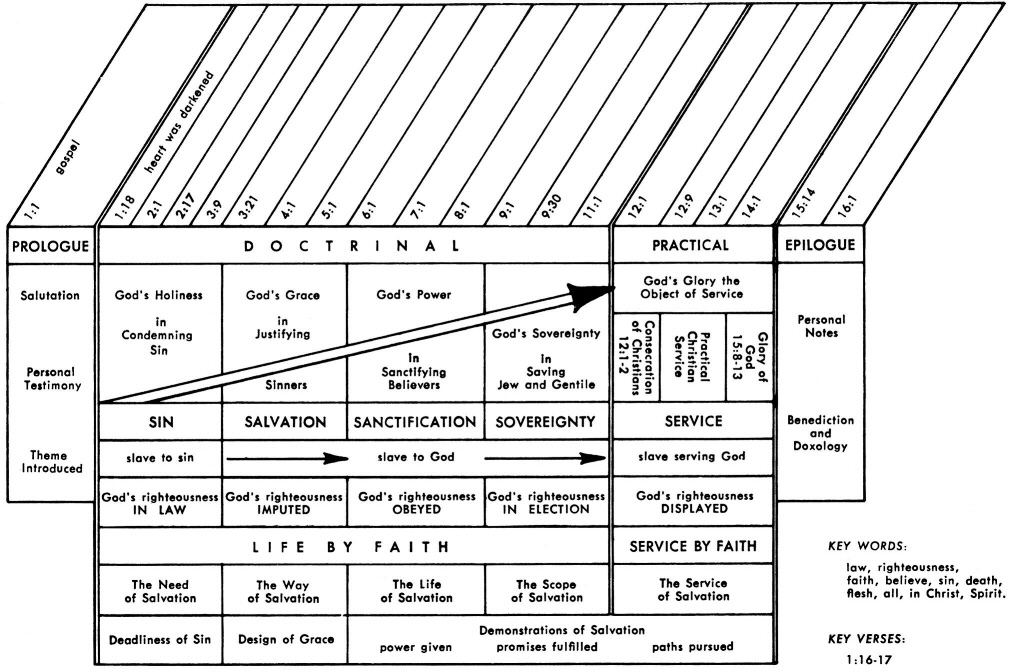
Click chart to enlarge
Chart from recommended resource Jensen's Survey of the NT - used by permission
Romans Overview Chart - Charles Swindoll
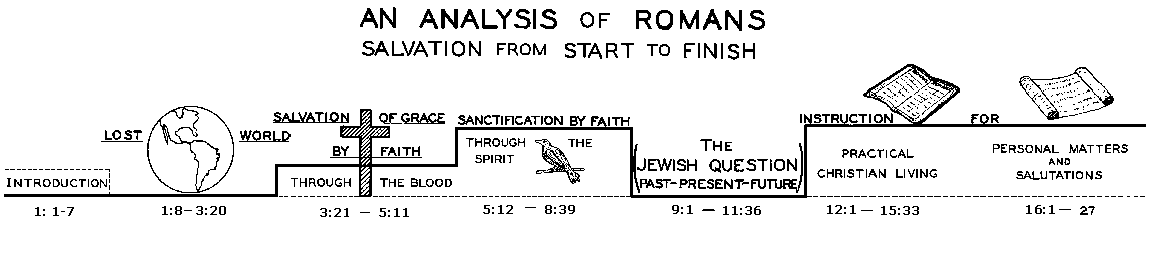
Source: Dr David Cooper
Click to Enlarge
| ROMANS ROAD to RIGHTEOUSNESS |
||||
| Romans 1:18-3:20 | Romans 3:21-5:21 | Romans 6:1-8:39 | Romans 9:1-11:36 | Romans 12:1-16:27 |
| SIN | SALVATION | SANCTIFICATION | SOVEREIGNTY | SERVICE |
| NEED FOR SALVATION |
WAY OF SALVATION |
LIFE OF SALVATION |
SCOPE OF SALVATION |
SERVICE OF SALVATION |
| God's Holiness In Condemning Sin |
God's Grace In Justifying Sinners |
God's Power In Sanctifying Believers |
God's Sovereignty In Saving Jew and Gentile |
Gods Glory The Object of Service |
| Deadliness of Sin |
Design of Grace |
Demonstration of Salvation | ||
| Power Given | Promises Fulfilled | Paths Pursued | ||
| Righteousness Needed |
Righteousness Credited |
Righteousness Demonstrated |
Righteousness Restored to Israel |
Righteousness Applied |
| God's Righteousness IN LAW |
God's Righteousness IMPUTED |
God's Righteousness OBEYED |
God's Righteousness IN ELECTION |
God's Righteousness DISPLAYED |
| Slaves to Sin | Slaves to God | Slaves Serving God | ||
| Doctrine | Duty | |||
| Life by Faith | Service by Faith | |||
|
Modified from Irving L. Jensen's chart above |
||||
R Ruin (Romans 1:17 – 3:20) – The utter sinfulness of humanity
O Offer (Romans 3:21-31) – God’s offer of justification by grace
M Model (Romans 4:1-25) – Abraham as a model for saving faith
A Access (Romans 5:1-11) – The benefits of justification
N New Adam (Romans 5:12-21) – We are children of two “Adams”
S Struggle w/ Sin (Romans 6:1-8:39) Struggle, sanctification, and victory
Romans 8:20 For the creation was subjected to futility, not willingly, but because of Him who subjected it, in hope (NASB: Lockman)
Greek: te gar mataioteti e ktisis hupetage, (3SAPI) ouch ekousa alla dia ton hupotaxanta, eph elpidi
Amplified: For the creation (nature) was subjected to frailty (to futility, condemned to frustration), not because of some intentional fault on its part, but by the will of Him Who so subjected it—[yet] with the hope [Eccl. 1:2.] (Amplified Bible - Lockman)
NLT: Against its will, everything on earth was subjected to God's curse. (NLT - Tyndale House)
Phillips: The world of creation cannot as yet see reality, not because it chooses to be blind, but because in God's purpose it has been so limited - yet it has been given hope. (Phillips: Touchstone)
Wuest: for the creation was subjected to futility, not voluntarily, but on account of the One who put it under subjection upon the basis of the hope
Young's Literal: for to vanity was the creation made subject -- not of its will, but because of Him who did subject it -- in hope,
FOR THE CREATION WAS SUBJECTED TO FUTILITY (fruitlessness, aimlessness, vanity) NOT WILLINGLY: te gar mataioteti e ktisis hupetage (3SAPI) ouch hekousa:
- Ro 8:22; Genesis 3:17, 18, 19; 5:29; 6:13; Job 12:6, 7, 8, 9, 10; Isaiah 24:5,6; Jeremiah 12:4,11; Jeremiah 14:5,6; Hosea 4:3; Joel 1:18
- Romans 8 Resources
For (gar) - Notice the little preposition "for" (there are over 7000 "for's" in Scripture) and if the context indicates, as it does in this passage, that the "for" is a term of explanation, pause and ask yourself what is the Spirit seeking to explain? In fact, stop reading right now and observe the for and see if you can determine what it is explaining. Notice how pausing to ponder will always force you to examine the context. You can (and should) practice this simple discipline every time you encounter a for, and while not every instance is a term of explanation, a "for" at the beginning of a verse is almost always is used with that grammatical sense. I guarantee that if you begin to "pause and ponder," you will radically rejuvenate your "Read Through the Bible in a Year" program! You might even get a small journal and begin to keep notes on what the Spirit illuminates and how this truth can be applied to your daily life. As you practice interrogating the text (for, therefore, but, so that, etc) with 5W/H questions such as "What's the for explaining?", you will begin to learn to (1) Read the Bible inductively (power point overview) and to (2) Meditate (see also Primer on Biblical Meditation) on the Scripture. Meditation or "chewing the cud" of the Scripture (cf Mt 4:4, Job 23:12-note, Jer 15:16) so to speak is a vanishing discipline in our fast paced, hi tech, low touch society, but a spiritual discipline which God promises to greatly bless (See Ps 1:1-note, Ps 1:2-note, Ps 1:3-note, Joshua 1:8-note, cf Ps 4:4, 19:14, 27:4, 49:4, 63:6, Ps 77:6, 77:12, Ps 104:34, Ps 119:15, 119:23, 119:27, Ps 119:48, 119:78, Ps 119:97, 119:99, Ps 119:148, 143:5, Ps 145:5) From the preceding passages which "organ" of our being is most often involved/engaged in meditation? What are the subjects or the focus of meditation? Reading the Bible without meditating on it is like eating without chewing.
Creation (2937) (ktisis [word study] from ktizo = create, form or found) stresses the work of original formation of an object and represents something which has undergone a process of creation. Here ktisis refers to what was created both animate and inanimate, the creation representing the sum total of everything created.
Ktisis - 19x in the NT - Mk. 10:6; 13:19; 16:15; Ro 1:20, 25; 8:19, 20, 21, 39; 2 Co. 5:17; Gal. 6:15; Col. 1:15, 23; Heb. 4:13; 9:11; 1 Pet. 2:13; 2Pe 3:4; Rev. 3:14
Was Subjected (5293) (hupotasso from hupó = under + tasso = arrange in orderly manner) means literally to place under in an orderly fashion. In the active voice hupotasso means to subject, bring under firm control, subordinate as used in here in Romans 8:20.
Futility (3153) (mataiotes from mataios = vain, empty <> derived from maten = to no purpose or in vain) means emptiness, vanity, nonsense, nothingness, purposelessness, and meaninglessness! Thayer says mataiotes is a "purely Biblical and ecclesiastical word" which describes "what is devoid of truth and appropriateness". It defines the inability to reach a goal or achieve a purpose. Mataiotes describes the state of being without use or value, emptiness, futility, purposelessness, transitoriness. It has the quality of being empty, fruitless, nonproductive, useless. Mataiotes speaks of want of attainment with the idea of aimlessness or of leading to no object or end.
Mataiotes (3 times in the NT - Ro 8:20; Eph. 4:17; 2Pet. 2:18) describes something that does not measure up to that for which it is intended and which fails to accomplish the purpose for which it was created. The creation was placed under the power of mataiotes. In short, mataiotes conveys the idea of futility, emptiness, purposelessness, and meaninglessness.
Mataiotes - 37x in Septuagint LXX of Ecclesiastes where is signifies vanity - Ps. 4:2; 26:4; 31:6; 38:12; 39:5; 40:4; 52:7; 62:9; 78:33; 119:37; 139:20; 144:4, 8, 11; Pr. 22:8; Eccl. 1:2, 14; 2:1, 11, 15, 17, 19, 21, 23, 26; 3:19; 4:4, 7, 8, 16; 5:7, 10; 6:2, 4, 9, 11, 12; 7:6, 15; 8:10, 14; 9:2, 9; 11:8, 10; 12:8
When was creation subjected to futility? Moses explains that it was the very day sin entered the world through Adam (Ro 5:12-note)
Then to Adam He (God) said, "Because you have listened to the voice of your wife, and have eaten from the tree about which I commanded you, saying, 'You shall not eat from it'; cursed is the ground because of you. In toil you shall eat of it all the days of your life. Both thorns and thistles it shall grow for you and you shall eat the plants of the field. By the sweat of your face you shall eat bread, till you return to the ground, because from it you were taken; for you are dust, and to dust you shall return." (Genesis 3:17-19)
And thus Adam’s sin was the cause of the subjection to futility.
Isaiah also alludes to this futility recording that…
The earth is also polluted by its inhabitants, for they transgressed laws, violated statutes, broke the everlasting covenant. 6 Therefore, a curse devours the earth, and those who live in it are held guilty. Therefore, the inhabitants of the earth are burned, and few men are left. (Isa 24:5, 6)
Note the verb is aorist tense (effectual action, past completed action, describes a definite historical event in the past) and passive voice (subjection of the subject, creation, from without, from an outside force, i.e., God). Thus we see that the creation did not subject itself. But you still might ask why punish the plants and animals, etc? After all they did not commit the sin. Irregardless, Sin is still the answer. Adam had no idea how devastating and far reaching would be the consequences of his sin (application - do we think about the effect of our sin on others before we commit it? Obviously it is not the same as Adam's sin, but sin nevertheless always effects others! Next time think before you jump!) When Adam disobeyed God Paul described what happened…
Therefore, just as through one man sin entered into the world, and death through sin, and so death spread to all men, because all sinned-- (Ro 5:12-note)
Sin entered the world and spread to all men and the effects of death spread to all creation because of Sin's entrance into the creation. In some way that I don't totally comprehend not only did the whole race fall into the bondage of sin and death, but the entire physical universe fell as well. Next time you see a beautiful rose, remember that it was Adam's sin that put the thorns on the rose. It was Adam's sin that made animals fear man and which brought predators and carnivores into being.
All because of Adam's sin, no part of nature now exists as God intended it to be and as it was originally created in pristine perfection, which was intended to give a perfect picture (or glorify) of the Creator. When the curse was placed on the creation, corruption set in and the result was a creation that could no longer perfectly glorify the Creator. To be sure, the Creation still gives a natural revelation which points to the Creator as David explained writing that…
The heavens are telling of the glory of God and their expanse is declaring the work of His hands. Day to day pours forth speech, and night to night reveals knowledge. (Psalm 19:1-Spurgeon's note, Ps 19:2-Spurgeon's note).
And yet to reiterate, no part of nature exists today as God originally intended it! Considering the fact that this corrupted creation has places of incomparable beauty, what does this say about what is in store for us when it is completely set free!
Newell comments on subjected to futility…
Here look back to the garden of Eden, and to Adam’s first sin, the judgment of which fell not upon the man, but we read: “Cursed is the ground for thy sake; in toil shalt thou eat of it all the days of thy life; thorns also and thistles shall it bring forth to thee.” Here we find God subjecting the whole creation to “vanity,”—that is, to unattainment. The book of Ecclesiastes dwells long, with a mournful tone upon this vanity, this unattainment; things “putting forth the tender leaves of hope” only to have the “sudden frost” of disease and death end earthly hopes. “Our days on the earth are as a shadow, and there is no abiding,” as David said in his great prayer (1Chr 29:15).
Morris explains this futility writing that…
Because of sin, the creation was made to operate under a law which specifies a universal process of decay and death. This law of morpholysis is recognized by science as a basic principle pervading the whole universe. It is also called the law of increasing entropy (meaning turning inward) or the Second Law of Thermodynamics. Every system in the physical and biological worlds has a tendency to turn inward and feed on itself to maintain its structure and activity, but this simply causes it to run down, disintegrate and die, unless it somehow becomes opened to outside sources of energy, information, food, etc. Even if it does remain an open system, this internal tendency continues to act in opposition to the incoming energy. Since even the latter will eventually be exhausted, the whole creation is thus in bondage to this principle of futility or vanity But since this law has been imposed by God, He also can remove it, and so there still is "hope." (Morris, Henry: Defenders Study Bible. World Publishing)
Willingly (1635) (hekon) (only other NT use 1Co 9:17) means willing, unconstrained, gladly, unforced, voluntary, of one's own will, or of one's own accord. Hekon is an adjective which describes someone (here some "thing", the creation personified as having a will) who is favorably disposed to do something without pressure. Note that hekon is preceded by the negative Greek particle (ou - 3756) which conveys the sense of absolute negation. In other words, the creation is personified as a person who did not willing submit, but which was forced to submit (because of the entrance of sin into the creation).
Bertrand Russell, the well known atheistic philosopher pictured this futility in creation when he wrote…
The life of a man is a long march through the night surrounded by invisible foes, tortured by weariness and pain, towards a goal that few can hope to reach and where none tarry long. One by one, as we march, our comrades vanish from our sight, seized by the silent orders of omnipotent death. Brief and powerless is man's life; on him all his race, the slow, sure doom falls pitiless and dark. Blind to good and evil, reckless of destruction, omnipotent matter rolls on its relentless way; for man, condemned today to lose his dearest, tomorrow himself to pass through the gate of darkness, it remains only to cherish, ere yet the blow falls, the lofty thoughts that ennoble his little day. (Bolding added)
Russell was right! The world exists as if in a night surrounded by invisible foes (Ep 2:2-note, Acts 26:18, Col 1:13-note)! To the unregenerate, this world is indeed enshrouded in the darkness of sin and unbelievers are blinded to the true meaning of life and the future hope of Creation made possible by the precious blood of the Lamb Who as the Kinsman Redeemer paid the price to redeem the corrupted earth and one day set it free.
BUT BECAUSE OF HIM WHO SUBJECTED IT IN HOPE: alla dia ton hupotaxanta (AAPMSA) eph elpidi:
Subjected (5293) (hupotasso from hupó = under + tasso = arrange in orderly manner) means literally to place under in an orderly fashion. In the active voice hupotasso means to subject, bring under firm control, subordinate as used in this verse.
Hupotasso - 38 times in the NT (Note esp the first use! - Lk. 2:51; 10:17, 20; Rom. 8:7, 20; 10:3; 13:1, 5; 1 Co. 14:32, 34; 15:27, 28; 16:16; Eph. 1:22; 5:21, 24; Phil. 3:21; Col. 3:18; Titus 2:5, 9; 3:1; Heb. 2:5, 8; 12:9; Jas. 4:7; 1 Pet. 2:13, 18; 3:1, 5, 22; 5:5)
Hope (1680) (elpis) (See study on Believer's Blessed Hope) in Scripture is not the world's definition of "I hope so", with a few rare exceptions (e.g., Acts 27:20) is defined as a desire for some future good with the expectation of obtaining it. It represents confident expectancy and the looking forward to something with some reason for confidence respecting fulfillment. Paul pictures the creation as a person who can look forward to the promised and therefore certain future day when it is set free from the inevitable decay that results from sin.
Here are the 48 uses of elpis in the NT - Acts 2:26; 16:19; 23:6; 24:15; 26:6f; 27:20; 28:20; Rom. 4:18; 5:2, 4f; 8:20, 24; 12:12; 15:4, 13; 1 Co. 9:10; 13:13; 2 Co. 1:7; 3:12; 10:15; Gal. 5:5; Eph. 1:18; 2:12; 4:4; Phil. 1:20; Col. 1:5, 23, 27; 1 Thess. 1:3; 2:19; 4:13; 5:8; 2 Thess. 2:16; 1 Tim. 1:1; Titus 1:2; 2:13; 3:7; Heb. 3:6; 6:11, 18; 7:19; 10:23; 1 Pet. 1:3, 21; 3:15; 1 Jn. 3:3
Vincent writes that hope
"in classical Greek, has the general signification of expectancy, relating to evil as well as to good. Thus Plato speaks of living in evil hope (“Republic,” i., 330); i.e., in the apprehension of evil; and Thucydides, of the hope of evils to come; i.e., the expectation or apprehension. In the New Testament the word always relates to a future good." (Vincent, M. R. Word Studies in the New Testament Vol.
As stated above, nature did not curse itself but God subjected it to futility and God alone can restore it. Where was the hope? Even before the ground was cursed ( or "subjected to futility") God in His great mercy and grace had already given the promise of redemption by a Redeemer through the Seed of a woman
(God said to Satan) And I will put enmity between you (Satan) and the woman, and between your seed (Satan's children, all who are still in Adam and not in Christ) and her seed (all who are in Christ, believers by faith in His sacrificial death); He (Messiah) shall bruise you (Satan) on the head, and you shall bruise him on the heel (crucifixion resulted in bruising of the heel but bruising of the head was to be the more effective blow against Satan)." (Genesis 3:15)
This first shadow of the gospel of Jesus Christ (see gospel in the OT - Gal 3:8) provided the firm foundation for hope (absolute certainty that God would do good to us and to the creation in the future) and this hope was the basis for the creation’s eager anticipation that Paul described in the previous verse (see note Romans 8:19)
Romans 8:21 that the creation itself also will be set free from its slavery to corruption into the freedom of the glory of the children of God. (NASB: Lockman)
Greek: hoti kai aute e ktisis eleutherothesetai (3SFPI) apo tes douleias tes phthoras eis ten eleutherian tes doxes ton teknon tou theou
Amplified: That nature (creation) itself will be set free from its bondage to decay and corruption [and gain an entrance] into the glorious freedom of God’s children. (Amplified Bible - Lockman)
NLT: All creation anticipates the day when it will join God's children in glorious freedom from death and decay. (NLT - Tyndale House)
Phillips: The whole creation is on tiptoe to see the wonderful sight of the sons of God coming into their own. (Phillips: Touchstone)
Wuest: that the creation itself also will be delivered from the bondage of corruption into the liberty of the glory of the children of God.
Young's Literal: that also the creation itself shall be set free from the servitude of the corruption to the liberty of the glory of the children of God;
THAT THE CREATION ITSELF ALSO WILL BE SET FREE FROM ITS SLAVERY TO CORRUPTION: hoti kai aute e ktisis eleutherothesetai (3SFPI) apo tes douleias tes phthoras :
- 2Pe 3:13
But according to His promise we are looking for new heavens and a new earth, in which righteousness dwells (see note 2 Peter 3:13)
Set free (1659) (eleutheroo [word study] = the ending " -oo" means not only will it be set free but it will be seen as set free) means to cause someone (in this case some thing, the creation) to be freed from domination of the corrupting effects of Adam's sin. The picture is that of the emancipation of slaves. The idea is that the one set free is at liberty, capable of movement, exempt from obligation or liability, and unfettered.
Eleutheroo is used 7 times in the NT - Jn. 8:32, 36; Rom. 6:18, 22; 8:2, 21; Gal. 5:1
In the future Christ will reveal the sons of God in their glorified state and at that time God will remove the curse from His creation.
Until the Spirit is poured out upon us from on high, and the wilderness (specifically referring to the land of Israel but applicable to the entire world at the time the Redeemer returns to Zion at the end of the Great Tribulation and beginning of His Millennial Reign) becomes a fertile field and the fertile field is considered as a forest. (Isaiah 32:15, Ro 11:26-note)
(At the return of the Redeemer described above God says) I will pour out water on the thirsty land And streams on the dry ground; I will pour out My Spirit on your offspring, And My blessing on your descendants And they will spring up among the grass Like poplars by streams of water.' (Isaiah 44:3, 4)
And the LORD will be king over all the earth; in that day the LORD will be the only one, and His name the only one (At the beginning of Messiah's Millennial Reign). 10 All the land will be changed into a plain from Geba to Rimmon south of Jerusalem; but Jerusalem will rise and remain on its site from Benjamin's Gate as far as the place of the First Gate to the Corner Gate, and from the Tower of Hananel to the king's wine presses. 11 And people will live in it, and there will be no more curse, for Jerusalem will dwell in security. (Zech 14:9, 10, 11)
When will Christ redeem the earth. First, observe that the price of redemption to set all captives to sin free was paid for in full by Christ on Calvary, when He became our Goel or Kinsman Redeemer. This redemption began to be realized for us as believers on the day of our salvation (set free from the guilt and power of sin) and will culminate in the future when we are glorified (set free from the presence and even the pleasure of sin).
As far as the redemption of the creation and specifically planet earth, this process begins will begin to be effected when the Lamb takes the Seven Sealed Scroll from the Father, this Scroll almost certainly represents title deed (Rev 5:6, 7, 9, 12, 13-see notes 5:6, 5:7, 5:9, 5:12, 5:13). Remember that now planet earth is held by a "squatter" so to speak and his name is Satan. God has given Satan temporary right and might over earth, the right and might which Adam forfeited when he sinned.
We know that we are of God, and the whole world lies in the power (exousia = right and might) of the evil one. (Satan) (1Jn 5:19)
The "squatter" has authority only temporarily for Jesus prophesied (in the context of alluding to His coming crucifixion) that…
Now judgment is upon this world (On one hand the judgment refers to Christ as bearing the believer's sins and the judgment they deserved and on the other hand is judgment upon all who reject His bearing their sins and who will suffer their own judgment). Now the ruler of this world (Satan) shall be cast out. (Jn 12:31)
And so when the Lamb Who Alone is worthy to open the Scroll, breaks the first seal (Rev 6:1-note), He sets in motion the events of Revelation (chapters 6-19) which culminate in the Second Coming of Christ as King of kings to set up the promised Messianic Kingdom on earth. (Re 19:11, 15, 20:1, 2, 3, 4, 5, - see notes on 19:11, 19:15, 20:1, 20:2, 20:4, 20:5, 20:6)
William Newell comments…
Now although we who are in Christ are new creatures, yet God has left our bodies as the link with the present “groaning” creation. Meanwhile, how “the bondage of corruption” appears on every side! Death—are not all creatures in terror of it, seeking to escape it? Every decaying carcass of poor earth-creatures speaks of the ‘bondage of corruption.” What ruin man’s sin has effected throughout the creation, as well as upon himself! It was God’s good pleasure, that when man sinned and became estranged from his God, all creation, which was under him, should be subjected to the “bondage of corruption” along with him, in decay and disease and suffering, death, and destruction, everywhere,—of bondage, with no deliverer. (Verse by Verse)
Spurgeon comments that…
Everything here is blighted, and subject to storm, or to decay, or to sudden death, or to calamity of some sort. It is a fair world, but there is the shadow of the curse over it all. The slime of the serpent is on all our Edens now.
Corruption (5356) (phthora [word study] from phtheíro = to destroy by means of corrupting, to spoil as does milk. Ethically phtheiro was the opposite of sozo) refers to a state of ruin or destruction with the picture of deterioration, dissolution, disintegration, ruin, perishing, decay or rotting like organic matter (breakdown of organic matter). Phthora was sometimes used of decaying food, which turns from that which is beneficial to that which is harmful.
The basic idea of phthora is not a sudden destruction owing to external violence, but a dissolution brought about by internal decay. It describes decomposition which brings to mind the picture of loathsome decaying matter replete with maggots and other macabre microbes! Figuratively the idea is that of the horrible thought of the "rotting" of one's morals which become more depraved with greater loss of integrity as a result of "slow internal decay".
Phthora pictures a departure from the original or from what is pure or correct and aptly depicts the moral filth and pollution of the world without God! It is the very opposite of "the divine nature."
Vine comments that phthora is…
the result of the withdrawal of life (which alone maintains the physical organism in effective being) is the dissolution of the body; this process is called corruption, and is attended by conditions repugnant to the senses of the living. This idea of repulsiveness is extended to the moral sphere… Apoleia and phthora signify not the destruction of being but of well-being, not an end of the existence of a person or thing. (Vine, W. Collected writings of W. E. Vine. Nashville: Thomas Nelson)
Phthora was used in Greek to refer to destruction of a fetus and thus to a miscarriage or abortion (Epistle of Barnabas 19:5), which was said to make the mother unclean for 40 days. It was used in Greek to describe the ruination of a person through an immoral act such as the seduction of a young woman.
Peter indicates this corruption is one of the effects of false teachers upon themselves (note 2 Peter 2:12) But these, like unreasoning animals, born as creatures of instinct to be captured and killed, reviling where they have no knowledge, will in the destruction {phthora} of those creatures also be destroyed {verb form phtheiro]}.
Phthora is used 7 times in the Septuagint (LXX) (Exodus 18:18, Daniel 10:8). Here are some of the uses in the OT Greek…
Psalm 103:4 Who redeems your life from the pit (pit in Hebrew = destruction, decay as in Ps 16:10 and in several context pictures a state of death, in some context to Sheol - Job 33:24, Ezek 28:8) (LXX= phthora = corruption!). Who crowns you with lovingkindness and compassion
Isaiah 24:3 The earth will be completely laid waste (LXX= Greek literally reads corrupted [phtheiro] with corruption [phthora]!) and completely despoiled, for the LORD has spoken this word.
Daniel 3:25 He answered and said, "Look! I see four men loosed and walking about in the midst of the fire without harm (LXX= phthora = corruption!), and the appearance of the fourth is like a son of the gods!"
Jonah 2:6 "I descended to the roots of the mountains. The earth with its bars was around me forever, But Thou hast brought up my life from the pit (pit in Hebrew = destruction, decay as in Ps 16:10 and in several context pictures a state of death, in some context to Sheol - Job 33:24, Ezek 28:8) (LXX= phthora = corruption!), O LORD my God.
Micah 2:10 "Arise and go, For this is no place of rest Because of the uncleanness that brings on destruction, a painful destruction (LXX= phthora).
There are 8 uses of phthora in the NT…
Romans 8:21 (note) that the creation itself also will be set free from its slavery to corruption into the freedom of the glory of the children of God.
Comment: Corruption is here viewed as a evil power which effects all of creation as a result of Adam's sin in Romans 5:12) Vine comments that phthora
is used in the New Testament either of decay and death, in the physical sphere (as here and in 1Cor 15:42, 50; 2Pet 2:12), or of moral degeneracy (as in Col 2:22; Gal 6:8). The phrase “bondage of corruption” is taken by some in an objective sense, as signifying bondage which produces corruption, by others subjectively, as the bondage which consists in corruption. The latter seems to be the meaning - Vine, W. Collected writings of W. E. Vine. Nashville: Thomas Nelson or Logos)
1 Corinthians 15:42 So also is the resurrection of the dead. It is sown a perishable body, it is raised an imperishable body… 50 Now I say this, brethren, that flesh and blood cannot inherit the kingdom of God; nor does the perishable inherit the imperishable.
Comment: Here phthora describes that which is subject to corruption, perishing or decay and stands opposite aphtharsia - that which is incorruptible or imperishable.
Galatians 6:8 For the one who sows to his own flesh shall from the flesh reap corruption, but the one who sows to the Spirit shall from the Spirit reap eternal life.
Comment: No one would bother to harvest a field of decaying matter. The deeds of the flesh are always corruptive and can only make a person progressively worse. The ultimate corruption is eternal death, the wages of sin. John Stott writes that
Every time we allow our mind to harbor a grudge, nurse a grievance, entertain an impure fancy, wallow in self-pity, we are sowing to the flesh. Every time we linger in bad company whose insidious influence we know we cannot resist, every time we lie in bed when we ought to be up and praying, every time we read pornographic literature, every time we take a risk that strains our self-control we are sowing, sowing, sowing, to the flesh -- The Message of Galatians. Inter-Varsity Press. 1984.
Colossians 2:22 (note) (which all refer to things destined to perish with the using)-- in accordance with the commandments and teachings of men?
2 Peter 1:4 (note) For by these He has granted to us His precious and magnificent promises, in order that by them you might become partakers of the divine nature, having escaped the corruption that is in the world by lust. (Here phthora describes the total destruction of an entity).
2 Peter 2:12 (note) But these, like unreasoning animals, born as creatures of instinct to be captured and killed, reviling where they have no knowledge, will in the destruction of those creatures also be destroyed. (Clearly phthora here is used in an ethical sense and refers to moral decay.
2 Peter 2:19 (note) promising them freedom while they themselves are slaves of corruption; for by what a man is overcome, by this he is enslaved. (Here it refers to a general inward depravity)
INTO THE FREEDOM OF THE GLORY OF THE CHILDREN OF GOD: eis ten eleutherian tes doxes ton teknon tou theou :
- Ro 8:19; Rev 22:3, 4, 5
- Romans 8 Resources
FINAL FULL FREEDOM
FOREVER
Freedom (1657) (eleutheria [word study] from eleutheros = free, at liberty, capable of movement, exempt from obligation or liability, unrestrained; see study of verb form eleutheroo) describes the state of freedom, independence, liberty freed from domination, in context domination of the corrupting effects of Adam's sin. The idea is that the one set free is at liberty, capable of movement, exempt from obligation or liability, and unfettered. The creation is pictured as a slave who have in a moment has been given freedom and is now capable of movement and exempt from obligation to a harsh taskmaster, free to move unfettered.
Eleutheria - 11x in the NT - Rom. 8:21; 1 Co. 10:29; 2 Co. 3:17; Gal. 2:4; 5:1, 13; Jas. 1:25; 2:12; 1 Pet. 2:16; 2 Pet. 2:19
Children (5043) (teknon) emphasizes family relationship based on regeneration, while "sons" (huios) stresses legal standing. Teknon literally refers to those who are "born ones" and in the plural refers to descendants, to posterity or to children. Here teknon is used figuratively to refer to those who have by grace through faith been born (again by the Spirit - John 3:5, 6, 7, 8, Eph 2:8, 9-note) spiritually (Jn 1:12, 1Jn. 3:1, 2, 10; How can we be certain we are children of the Living God? = 1Jn 5:2). Believers also are God's children (tekna = “born ones”) by the new birth (Jn 1:12,13 1Jn 3:1,2). The Holy Spirit bears testimony to our human spirit that we are children of God (teknon), without article, thus, children of God by nature), and our Spirit-energized spirit thus joins the Holy Spirit in a joint-testimony to that fact.
The glory of the children of God - (see Table comparing Rapture vs Second Coming of Christ) This refers to the time when all believers are glorified (future tense salvation - see Three Tenses of Salvation). This is the day that creation anticipates for it is the day when it will join God's children in glorious freedom from death and decay. There are two stages of setting creation free. The first stage begins when Messiah returns to reign in the Millennium. (Click The Millennium 3 for a Scriptural description -- primarily by the OT prophets -- of this 1000 year time Messianic Age on earth). The second stage follows the 1000 year Messianic age, the Millennium, when God will create “a new heaven and a new earth” as John records in Revelation 21…
And I saw a new heaven and a new earth; for the first heaven and the first earth passed away, and there is no longer any sea. (see note) And I saw the holy city, new Jerusalem, coming down out of heaven from God, made ready as a bride adorned for her husband. (See notes Revelation 21:1; 21:2)
John adds in the next and final chapter of the Revelation…
And there shall no longer be any curse; and the throne of God and of the Lamb shall be in it, and His bond-servants shall serve Him and they shall see His face, and His name shall be on their foreheads. (See notes Revelation 22:3; 22:4)
Peter describes this time writing that…
But according to His promise we are looking for new heavens and a new earth, in which righteousness dwells. (See note 2 Peter 3:13)
William Newell comments…
Into the liberty (freedom) of the glory of the children of God—As Paul shows we already have liberty in Christ,—the liberty of grace. The “liberty of the glory of the children of God” awaits Christ’s second coming. How blessed it is to know that into that glorious liberty, creation, which has shared “the bondage of corruption,” will be brought along with us!
Contrast the state of creation now with the Millennial order described in Isaiah 11:6-9: The wolf dwelling with the lamb the leopard with the kid; the calf, the young lion, and the fatling together, and the little child leading them. The cow and the bear feeding, their young ones lying down together; the lion eating straw like the ox; children playing over the serpent’s hole: “They shall not hurt nor destroy in all My holy mountain for the earth shall be full of the knowledge of Jehovah, as the waters cover the sea.” (Verse by Verse)
><> ><> ><>
Wayne Barber summarizes Romans 8:20-21…
You may ask, what did the plants, the animals, the birds do to deserve "being subjected to corruption," which means death and decay? We must understand this. It was all because of man’s sin. No part of nature exists like God intended it to.
Look again at Romans 8:20:
For the creation was subjected to futility, not of its own will, but because of Him who subjected it, in hope.
Now, again, he doesn’t tell us when it was subjected to futility, but we already know when. Romans 5:12:
Therefore, just as through one man sin entered into the world, and death through sin, and so death spread to all men, because all sinned.
Notice that "creation was subjected" which means it did not subject itself. God subjected it. It’s interesting that so many environmental agencies are making noble attempts to turn the tide of corruption that has devastated both man and his environment since the fall. But, this decay will never cease until the Creator, who subjected it, removes the curse and creates a new heaven and new earth.
Futility is the mataiotes, which means emptiness or that which is vain. The idea of the word mataiotes is the idea of being without success, of being unable to achieve a goal or purpose. You see, because of man’s sin, no part of nature now exists as God intended it to be, and as it originally was.
This is a cursed world we live in, yet in spite of that, God’s glory and beauty are still seen in it. Look back to Romans 1:20:
For since the creation of the world His invisible attributes, His eternal power and divine nature, have been clearly seen, being understood through what has been made, so that they are without excuse.
So "the creation was subjected to futility, not of it’s own will." The word here is hekon, not voluntarily, not willingly. The word for "not" is ou, which means "not in any way" willingly.
"But," the verse goes on, "because of Him who subjected it." Again, God subjected it. Why? Because of man’s sin. Subjected comes from the word hupotasso, to subordinate. God Himself subjected it to the impossibility of ever getting better on it’s own.
All this happened because of man’s sin. Why? Read Ro 8:21, picking up the last two words of Ro 8:20,
in hope, that the creation itself also will be set free from its slavery to corruption into the freedom of the glory of the children of God.
In hope is the word elpis, which carries the meaning of confidence, expectation. So you could translate it "certain hope"—hope that is never uncertain. Just as man’s sin brought corruption to the universe, man’s restoration to righteousness will be accompanied by the restoration of the earth and it’s universe to their divinely intended perfection and glory. We can be certain of that.
Will be set free is the word eleutheroo. We have seen this word before in Romans. It carries the idea that, not only will it be set free, but it will be shown to be free. Everyone will know it.
God will set it free. There will come a time when the creation will be fully restored to its desired perfection and glory. Free from what? From its slavery to corruption.
The word here for slavery is douleia, which indicates any kind of bondage. Corruption is phthora, that which is perishable, that which decays. Again, all of nature is in a current that is heading into corruption and seems to be on tiptoes waiting for the event when the sons of God are revealed.
Martin Lloyd-Jones made this wonderful insight
I wonder whether the phenomenon of the Spring supplies us with a part answer. Nature every year, as it were, makes an effort to renew itself, to produce something permanent; it has come out of the death and the darkness of all that is so true of the Winter. In the Spring it seems to be trying to produce a perfect creation, to be going through some kind of birth-pangs year by year. But unfortunately it does not succeed, for Spring leads only to Summer, whereas Summer leads to Autumn, and Autumn to Winter. Poor old nature tries every year to defeat the "vanity" of the principle of death and decay and disintegration that is in it. But it cannot do so. It fails every time. It still goes on trying, as if it feels things should be different and better; but it never succeeds. So it goes on "groaning and travailing in pain together until now." It has been doing so for a very long time… but nature still repeats the effort annually. But, it will be set free one day from this corruption "into the freedom of the glory of the children of God."
This refers to the time when believers will be liberated from the presence of sin, liberated from their flesh and their humanness. When we are given our glorified bodies and begin to share in His eternal glory, then the world itself will also be set free.
In my own belief, I think this begins in the Millennium. Turn to Revelation 5:9-13:
"And they sang a new song, saying, "Worthy are You to take the book and to break its seals; for You were slain, and purchased for God with Your blood men from every tribe and tongue and people and nation. "You have made them to be a kingdom and priests to our God; and they will reign upon the earth." Then I looked, and I heard the voice of many angels around the throne and the living creatures and the elders; and the number of them was myriads of myriads, and thousands of thousands, saying with a loud voice, "Worthy is the Lamb that was slain to receive power and riches and wisdom and might and honor and glory and blessing." And every created thing which is in heaven and on the earth and under the earth and on the sea, and all things in them, I heard saying, "To Him who sits on the throne, and to the Lamb, be blessing and honor and glory and dominion forever and ever."
Isaiah speaks of the millennium in Isaiah 11:6-9
And the wolf will dwell with the lamb, And the leopard will lie down with the kid, And the calf and the young lion and the fatling together; And a little boy will lead them. Also the cow and the bear will graze; Their young will lie down together; And the lion will eat straw like the ox. And the nursing child will play by the hole of the cobra, And the weaned child will put his hand on the viper’s den. They will not hurt or destroy in all My holy mountain, For the earth will be full of the knowledge of the LORD As the waters cover the sea.
Then it culminates in the "new heaven and the new earth", cleansed of all corruption.
Well, our pain will one day dim in the light of the glory God has prepared for us. Creation will also rejoice in that day. God has a plan for death and decay. He is in control! (Read Dr Barber's entire sermon - Romans 8:18-21: Reward of the Holy Spirit)