Romans 8:2
Romans 8:3
Romans 8:4
Romans 8:5
Romans 8:6
Romans 8:7
Romans 8:8
Romans 8:9
Romans 8:10
Romans 8:11
Romans 8:12
Romans 8:13
Romans 8:14
Romans 8:15
Romans 8:16
Romans 8:17
Romans 8:18
Romans 8:19
Romans 8:20
Romans 8:21
Romans 8:22
Romans 8:23
Romans 8:24
Romans 8:25
Romans 8:26
Romans 8:27
Romans 8:28
Romans 8:29
Romans 8:30
Romans 8:31
Romans 8:32
Romans 8:33
Romans 8:34
Romans 8:35
Romans 8:36
Romans 8:37
Romans 8:38
Romans 8:39

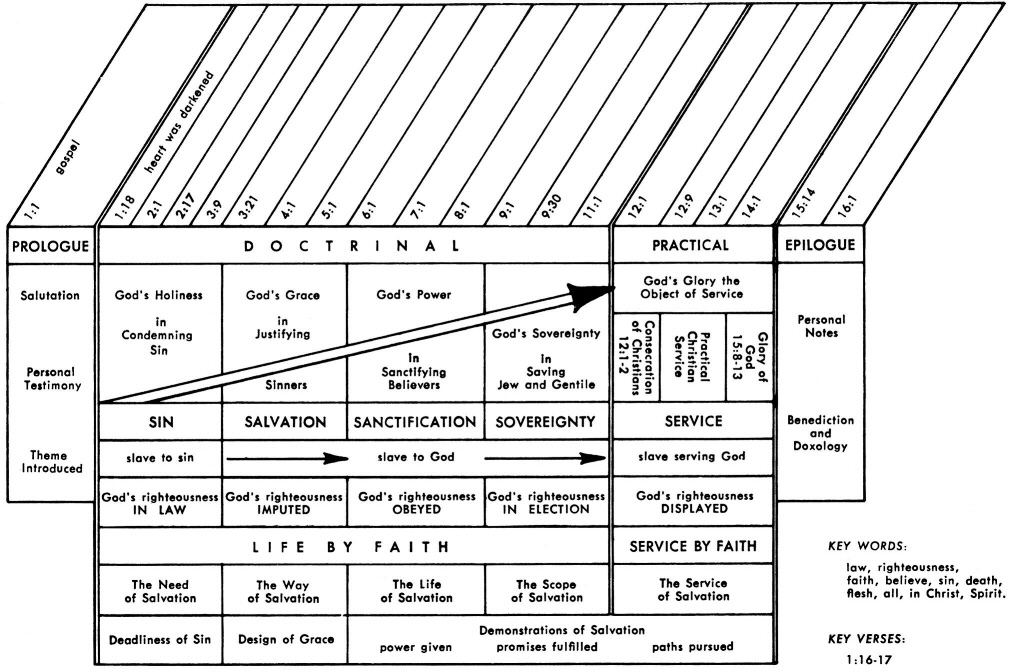
Click chart to enlarge
Chart from recommended resource Jensen's Survey of the NT - used by permission
Romans Overview Chart - Charles Swindoll
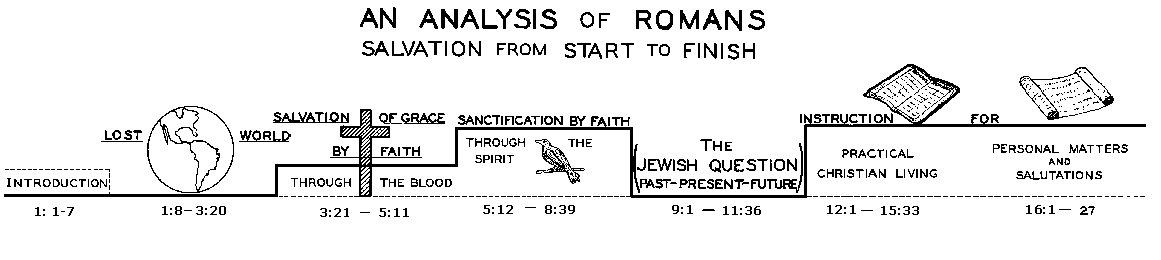
Source: Dr David Cooper
Click to Enlarge
| ROMANS ROAD to RIGHTEOUSNESS |
||||
| Romans 1:18-3:20 | Romans 3:21-5:21 | Romans 6:1-8:39 | Romans 9:1-11:36 | Romans 12:1-16:27 |
| SIN | SALVATION | SANCTIFICATION | SOVEREIGNTY | SERVICE |
| NEED FOR SALVATION |
WAY OF SALVATION |
LIFE OF SALVATION |
SCOPE OF SALVATION |
SERVICE OF SALVATION |
| God's Holiness In Condemning Sin |
God's Grace In Justifying Sinners |
God's Power In Sanctifying Believers |
God's Sovereignty In Saving Jew and Gentile |
Gods Glory The Object of Service |
| Deadliness of Sin |
Design of Grace |
Demonstration of Salvation | ||
| Power Given | Promises Fulfilled | Paths Pursued | ||
| Righteousness Needed |
Righteousness Credited |
Righteousness Demonstrated |
Righteousness Restored to Israel |
Righteousness Applied |
| God's Righteousness IN LAW |
God's Righteousness IMPUTED |
God's Righteousness OBEYED |
God's Righteousness IN ELECTION |
God's Righteousness DISPLAYED |
| Slaves to Sin | Slaves to God | Slaves Serving God | ||
| Doctrine | Duty | |||
| Life by Faith | Service by Faith | |||
|
Modified from Irving L. Jensen's chart above |
||||
R Ruin (Romans 1:17 – 3:20) – The utter sinfulness of humanity
O Offer (Romans 3:21-31) – God’s offer of justification by grace
M Model (Romans 4:1-25) – Abraham as a model for saving faith
A Access (Romans 5:1-11) – The benefits of justification
N New Adam (Romans 5:12-21) – We are children of two “Adams”
S Struggle w/ Sin (Romans 6:1-8:39) Struggle, sanctification, and victory
Romans 8:26 In the same way the Spirit also helps our weakness; for we do not know how to pray as we should, but the Spirit Himself intercedes for us with groanings too deep for words; (NASB: Lockman)
Greek: hosautos de kai to pneuma sunantilambanetai (3SPMI) te astheneia hemon; to gar ti proseuchometha kaqo dei (2SPAI) ouk oidamen, (3SRAI) alla auto to pneuma huperentugchanei (3SPAI) stenagmois alaletois;
Amplified: So too the [Holy] Spirit comes to our aid and bears us up in our weakness; for we do not know what prayer to offer nor how to offer it worthily as we ought, but the Spirit Himself goes to meet our supplication and pleads in our behalf with unspeakable yearnings and groanings too deep for utterance. (Amplified Bible - Lockman)
NLT: And the Holy Spirit helps us in our distress. For we don't even know what we should pray for, nor how we should pray. But the Holy Spirit prays for us with groanings that cannot be expressed in words. (NLT - Tyndale House)
Phillips: The Spirit of God not only maintains this hope within us, but helps us in our present limitations. For example, we do not know how to pray worthily as sons of God, but his Spirit within us is actually praying for us in those agonising longings which never find words. (Phillips: Touchstone)
Wuest: And in like manner also the Spirit lends us a helping hand with reference to our weakness, for the particular. thing that we should pray for according to what is necessary in the nature of the case, we do not know with an absolute knowledge; but the Spirit himself comes to our rescue by interceding with unutterable groanings. (Eerdmans)
Young's Literal: And, in like manner also, the Spirit doth help our weaknesses; for, what we may pray for, as it behoveth us, we have not known, but the Spirit himself doth make intercession for us with groanings unutterable,
ND IN THE SAME WAY: hosautos de kai :
What does in the same way refer to? In context the comparison appears to be between the way hope sustains us in the midst of present sufferings (v18-25) so (in the same way) the Spirit sustains us by personally aiding us in our weakness. The idea is that we have more than enough resources to keep us going in the midst of earthly trials.
MacArthur explains that "In the same way refers back to the groans of the creation (see note Romans 8:22) and of believers (see note Romans 8:23) for redemption from the corruption and defilement of sin. Here Paul reveals the immeasurably comforting truth that the Holy Spirit comes alongside us and all creation in groaning for God’s ultimate day of restoration and His eternal reign of righteousness. (MacArthur, J: Romans 1-8. Chicago: Moody Press)
Hodge agrees writing that "Not only does hope thus cheer and support the suffering believer, but In the same way, the Spirit helps us in our weakness. As hope sustains, so, in the same way, the Spirit also does. Not that the type of help is the same, but simply that they do both assist us. (Romans 8 - Hodge's Commentary on Romans, Ephesians and First Corinthians)
And so as the creation and believers both groan for ultimate restoration, the Holy Spirit does as well.
THE SPIRIT ALSO HELPS (lends a hand together with, come to aid of) OUR WEAKNESS: hosautos de kai to pneuma sunantilambanetai (3SPMI) te astheneia hemon:
- Ro 15:1; 2Corinthians 12:5-10; Hebrews 4:15; 5:2
Helps (4878) (sunantilambanomai from sun/syn = together, + antilambáno = to support, help) mans to take hold of anything with another, to take part in his burden or work, and thus to give help. It speaks of the action of a person coming to another’s aid by taking hold over against that person, of the load he is carrying. The person helping does not take the entire load, but helps the other person in his endeavor. The word is used where Martha says to the Lord Jesus concerning Mary
But Martha was distracted with all her preparations; and she came up to Him, and said, "Lord, do You not care that my sister has left me to do all the serving alone? Then tell her to help me. (Lk 10:40)
Comment: It is a beautiful word -- to take hold oneself at his end of the task together with one
One could translate, “Bid her lend me a helping hand,” the idea being that Martha would continue preparing the meal but needed Mary to help her. Just so, the Holy Spirit indwelling the saint, comes to the aid of that saint in his or her spiritual distresses and difficulties, not by taking over the responsibility for them and giving the saint an automatic deliverance without any effort on his or her part, but by lending a helping hand, allowing the saint to work out his problems and overcome the saint's difficulties, with His help.
A. T. Robertson says "The Holy Spirit lays hold of our weaknesses along with (sun) us and carries His part of the burden facing us (anti) as if two men were carrying a log, one at each end.
Weakness (769) (astheneia [word study]) means literally without strength and speaks of the state of incapacity to do or experience something. The infirmities here are not physical but spiritual. This refers to our human limitation due to sinfulness which produces a weakness that consists, at least in part, in that “we do not know what we ought to pray.”
Astheneia - 24x in 23v - Matt 8:17; Luke 5:15; 8:2; 13:11f; John 5:5; 11:4; Acts 28:9; Rom 6:19; 8:26; 1 Cor 2:3; 15:43; 2 Cor 11:30; 12:5, 9f; 13:4; Gal 4:13; 1 Tim 5:23; Heb 4:15; 5:2; 7:28; 11:34. NAS = ailments(1), diseases(1), ill(1), illness(1), infirmities(1), sickness(3), sicknesses(2), weak(1), weakness(9), weaknesses(4).
The writer of Hebrews uses astheneia writing…
For we do not have a high priest who cannot sympathize with our weaknesses (astheneia), but One who has been tempted in all things as we are, yet without sin. (Heb 4:15)
Wuest explains that…
The weakness spoken of here is defined by the context which speaks of prayer, one of the things in the spiritual realm in which our weakness needs His power. The infirmities here therefore are, not physical, but spiritual. The weakness spoken of here is the inability of the saint to know what to pray for. We do know what the general objects of prayer are. But we do not know what the specific, detailed objects of prayer in any given emergency or situation are. (Wuest's Word Studies)
Ryrie explains that…
The Holy Spirit helps our weakness (our inability to pray intelligently about situations) by praying with unutterable groanings. This is not the gift of tongues, for these groans are not in words. Such intercession is in accord with God's will (v. 27). (The Ryrie Study Bible:)
Vine says that…
Without the aid of the Holy Spirit our patience would fail and we should succumb to despair. (Collected writings of W. E. Vine.)
Robert Morgan asks…
What kind of weakness? We are weak in many ways, but in this passage the apostle Paul is specific about the particular weakness he is addressing—our prayer lives. We are weak when it comes to prayer. In what way? Well, we are weak in many ways, but here again Paul has something specific in mind. We are weak in our ability to know what we should ask. Many times we really don’t know what we should specifically pray for. We are not omniscient. We don’t know everything, nor can we see into the future. So we don’t know whether the things we’re asking for will turn out good or bad for us.
An old story illustrates: A Chinese gentleman lived on the border of China and Mongolia. In those days, there was constant conflict and strife along the perimeter. The man had a beautiful horse. One day, she leaped over the corral, raced down the road, crossed the border, and was captured by the Mongolians. His friends came to comfort him. “That’s bad news,” they said sadly. “What makes you think it’s bad news?” asked the Chinese gentleman. “Maybe it’s good news.” A few days later the mare came bolting into his corral, bringing with it a massive stallion. His friends crowded around. “That’s good news!” they cried. “What makes you think it’s good news?” he asked. “Maybe it is bad news.” Later, his son, while riding the stallion and trying to break it, was thrown off and broke his leg. “That’s bad news,” cried the friends. “What makes you think it is bad news?” asked the Chinese gentleman. “Maybe it’s good news.” One week later, war broke out with Mongolia, and a Chinese general came through, drafting all the young men. All later perished, except for the young man who couldn’t go because his leg was broken. The man said to his friends, “You see, the things you thought were bad turned out good; and the things you thought were good turned out bad.”
And thus it is with us. We don’t know if the things we want will really be good for us, or bad. We can’t see the future. That’s why James tells to us to pray, saying, “If it be thy will… ” But God does know the future. He is Alpha and Omega, the First and the Last. He knows the end from the beginning, and He knows how all things will turn out. Verse 26 says that the Holy Spirit prays for us according to the will of God with intensity, with groanings that words cannot express. And God answers the Holy Spirit’s pleas on our behalf. The result is Romans 8:28! As the Holy Spirit prays for us, God answers His prayers, therefore all the things turn out for our good in the unfolding providence of the Lord. (Nelson's Annual Preacher's Sourcebook: 2002 edition. Nashville: Thomas Nelson Publishers)
Hudson Taylor once said:
Ill that God blesses is our good
And unblest good is ill.
And all is right that seems most wrong
If it be his sweet will.
><> ><> ><>
Spurgeon wrote…
Never give up praying, even when Satan suggests that prayer is in vain. Pray in his teeth. “Pray without ceasing” (1Thess. 5:17). If the heavens are brass and your prayer only echoes above your head, pray on! If month after month your prayer appears to have miscarried, if you have had no answer, continue to draw close to the Lord. Do not abandon the mercy seat for any reason. If it is a good thing that you have been asking for, and if you are sure that it is according to the divine will, wait, tarry, pray, weep, plead, wrestle, and agonize until you get what you are praying for.
If your heart is cold, do not wait until your heart warms. Pray your soul into heat with the help of the ever-blessed Holy Spirit, who helps in our weakness, who makes intercession for us with groanings that cannot be uttered (Ro 8:26).
Never cease prayer for any reason. If the philosopher tells you that every event is fixed and that prayer cannot possibly change anything, go on praying. If you cannot reply to every difficulty that man suggests, resolve to be obedient to the divine will. “Pray without ceasing.” Never, never, never renounce the habit of prayer or your confidence in its power.
><> ><> ><>
Winslow writes…
The word here rendered helps properly means to take part with. It implies, not merely sympathy with, but a personal participation in our infirmity. The Spirit helps our infirmities by sharing them with us. Now take the general infirmities of the believer–infirmities which, unaided by another and a superior power, must crush and overwhelm–and trace the help thus afforded by the Spirit. We are taught to adore the love of the Father, from where each rill of mercy has its rise. We delight to dwell upon the love of the Son, through whose channel all redemption-blessing flows. And shall we overlook the love of the Holy Spirit? Shall we forget His comforts, His grace, His succourings? Forbid it, oh eternal and blessed Spirit! Your essential Deity–Your personal subsistence–Your tender love–Your Divine power–Your efficacious grace–Your sovereign mercy–Your infinite patience–Your exquisite sympathy–all demand our deepest love, and awake our loftiest praise.
But how is this sympathy of the Spirit expressed? Seeing the soul bound with an infirmity, all His compassion is awakened. Approaching, He takes hold of the burden. Constrained by a love which no thought can conceive, moved by a tenderness no tongue can describe, He advances, and places the power of His Godhead beneath the pressure–and thus He helps our infirmity. Do you doubt this? We summon you as a witness to its truth. Why are you not a ruin and a wreck? Why has not your infirmity long since dethroned reason, and annihilated faith, and extinguished hope, and clad all the future with the pall of despair? Why have you ridden serene and secure upon the crest of the billow, smiling calmly upon the dark and yawning surges dashing and foaming around you? Why have you, when your heart has been overwhelmed, found relief in a sigh, in a tear, in an uplifted glance, in one thought of God? Oh, it has been because the Spirit, all silent and invisible, was near to you, sympathizing, helping, bearing your infirmities. Because around you the power of His Deity was placed. And when you have staggered and turned pale, and have well near given up all for lost, resigning yourself to the broodings of despair, that Spirit has approached, all-loving and powerful, and helped, by sharing your infirmity. Some appropriate and precious promise has been sealed upon your heart–some clear and soothing view of Christ has been presented to your eye–some gentle whisper of love has breathed upon your ear–and you have been helped. The pressure has been lightened, the grief has been assuaged, the weakness has been strengthened, and you have risen superior to the infirmity that bowed you to the dust. Oh, it was the Spirit who helped you. Grieved, and wounded, and slighted a thousand times over though He has been, receiving at your hands the unkindest requital for the tenderest love, yet when your infirmity bowed you to the earth, and the sword entered your soul, He drew near, forgetting all your base ingratitude, and administered wine to your dejected spirit, and oil to your bleeding wound, and placed beneath you the encircling arms of His everlasting love. (Octavius Winslow. Daily Walking with God)
><> ><> ><>
Philpot writes that…
In all our prayers, in all our approaches to the throne of grace, our mercy and wisdom will be to seek to possess the mind of the Spirit; to desire to know the will of God, and do it; to look up more believingly and continually to the Lord Jesus, that he himself would teach and guide us; that he would by his Spirit and grace conform us more inwardly and outwardly to his suffering image; that he would grant unto us to know him more, and serve him better; that our prayers may day by day be more and more fervent, earnest, and sincere, more spiritual, more in accordance with the will of God; that thus they may be more and more manifested as the interceding breath of the Spirit of God in our hearts, and as such may bring more clear and evident answers down.
Pray for the manifestation of Christ to your soul, for a revelation of the Person, blood, righteousness, and love of Jesus; seek to have your signs and evidences of divine life more cleared up; your Ebenezers and tokens for good more brightly shone upon; your doubts and fears more plainly dispelled, and a fuller and sweeter assurance of personal interest given in the finished work of Christ. Desire also to have the promises applied to your heart, the word of God brought with divine power into your conscience, and a living faith raised up and drawn forth to mix with the truth which you read or hear.
Beg, as the Lord may enable, for submission, patience, resignation, brokenness, contrition, humility, godly sorrow for sin, heavenly affections, and that sweet spirituality of mind which is life and peace. Above all, seek an inward assurance that your prayers are heard and accepted, and then watch for the answer. This will give you the surest and best of all evidences that the blessed Spirit is himself interceding for you with groanings which cannot be uttered. (J. C. Philpot. Daily Portions)
FOR WE DO NOT KNOW HOW TO PRAY AS WE SHOULD (as we must - speaks of necessity) : to gar ti proseuchometha (1PAMS) katho dei (2SPAI) ouk oidamen (3SRAI):
- Matthew 20:22; Luke 11:1-13; James 4:3
- Romans 8 Resources
For - see discussion of importance of pausing to ponder this term of explanation.
The NASB translators understood Paul to be saying
We do not know how to pray as we should
The NAS thus implies we are ignorant concerning the proper method and procedure in prayer.
The NIV renders it…
We do not know what we ought to pray for
In Romans 8:26 the ignorance is in regard to the content of the prayer not the method of prayer, so the NAS is misleading. As an aside, the astute reader of Scripture needs to be aware that every "translation" is to some degree or another an "interpretation" of the original Hebrew, Aramaic and Greek texts. This is one reason it is helpful to try to learn the original languages, but if that is a bit extreme, one should always compare a number of translations to help discern the meaning of the text in the original language. This caveat is especially applicable to paraphrases, which can be very helpful in understanding the intent of a given passage. In this regard I highly recommend examining the Amplified Version (not a paraphrase per se - see a short, but helpful explanation of the purpose of the Amplified version) which can often function much like a "mini-commentary" because this version adds explanatory words and clauses to help bring out the sense of the original text. A paraphrase that I use frequently and find very helpful and usually true to the original language is the New Living Translation. Finally, in my humble opinion, the Message should be used only sparingly as it takes great liberty on translation of some texts and can therefore actually miss (again my opinion) the intent of the original Greek or Hebrew text.
MacDonald interprets it along the lines of the NIV rendering noting that we…
We do not know how to pray as we should. We pray selfishly, ignorantly, narrowly. But once again the Spirit comes alongside to assist us in our weakness, interceding for us with groanings which cannot find expression. In this verse it is the Spirit who groans and not we who groan, though that is also true. There is mystery here. We are peering into the unseen, spiritual realm where a great Person and great forces are at work on our behalf. And although we cannot understand it all, we can take infinite encouragement from the fact that a groan may sometimes be the most spiritual prayer. (MacDonald, W & Farstad, A. Believer's Bible Commentary: Thomas Nelson)
The Greek text permits either the NAS or the NIV interpretation, though it favors the NAS.
The basic principle of effective praying is that it must be in harmony with the will of God (the "what" more than the "how") to be effective, John clearly teaching that..
this is the confidence which we have before Him, that, if we ask anything according to His will, He hears us. And if we know that He hears us in whatever we ask, we know that we have the requests which we have asked from Him. (1John 5:14, 15)
However what the will of God is may be hard for us to ascertain in a given situation. In those situations, the Holy Spirit comes to our aid by interceding for us.
Vincent agrees adding that this verse is…
Not with reference to the form of prayer, but to the circumstances: in proportion to the need.
Vine also favors the what over the how of prayer in this passage writing that…
A more literal rendering would be, “what we are to pray according to our need we know not,” i.e., we do not know how to express ourselves so that our prayers shall correspond to the need. Not a mode of prayer is here especially in view, but the subjects. (Vine, W. Collected writings of W. E. Vine. Nashville: Thomas Nelson)
Alford adds that "The Holy Spirit of God dwelling in us, knowing our wants better than we, Himself pleads in our prayers, raising us to higher and holier desires than we can express in words, which can only find utterance in sighings and aspirations. (Romans 8 Commentary)
God wants us to ask, but there are times when the situation is simply too complex or we are too distraught that we don't know what to pray for. We have all experienced situations in which we wondered how to pray specifically. We didn't know what would be best and in the will of God for the specific issue at hand.
Hodge sums this up writing that "This is said to illustrate and confirm the previous general declaration; it is an example of the way in which the Spirit helps us. “He helps us in our weaknesses, for he teaches us how to pray, dictating to us our supplications,” etc. Our need for this help comes from our ignorance. We do not know what to pray for. We cannot tell what is really best for us. Pagan philosophers gave this as a reason why men ought not to pray! How miserable their condition is when compared with ours! Instead of our ignorance putting a seal on our lips and leaving our hearts to break, the Spirit gives voice to our desires in a language which is heard and understood by God. As we do not know how to pray, the Spirit teaches us. (Hodge, Charles: Commentary on Romans)
Related Resources on Prayer:
- Colossians 1:9 Commentary
- Colossians 4:12 Commentary
- Devotional on Prayer
- Guide to Praying for Missionaries
- Pithy Prayer Phrases
- Prayer - Greek Words for Prayer
- Prayer Devotionals and Illustrations
- Prayer Hymns and Poems
- Prayer Quotes
- Praying in the Spirit
- Spurgeon's Gems on Prayer
BUT THE SPIRIT HIMSELF INTERCEDES FOR US WITH GROANINGS TOO DEEP FOR WORDS: alla auto to pneuma huperentugchanei (3SPAI) stenagmois alaletois:
- Ro 8:15; Psalms 10:17; Zechariah 12:10; Matthew 10:20; Galatians 4:6; Ephesians 2:18; 6:18; Jude 1:20,21
- Ro 7:24; Ps 6:3,9; 42:1-5; 55:1,2; 69:3; 77:1, 2, 3; 88:1, 2, 3; 102:5,20; 119:81; Ps 119:82; 143:4, 5, 6, 7; Luke 22:44; 2Corinthians 5:2,4; 12:8
- Romans 8 Resources
But - see discussion of importance of pausing to ponder this term of contrast.
Intercedes (5241) (huperentugchano from hupér = for, on behalf of + entugchano = entreat, make intercession, bring a petition to a king on behalf of someone, ask for something with urgency and intensity) means to intercede for or in the behalf of someone or to plead for someone. It is a picturesque word of rescue by one who ‘happens on’ one who is in trouble, and ‘in his behalf’ (huper) pleads ‘with unuttered groanings’ or with ‘sighs that baffle words'.
The whole creation "groans" (Ro 8:22), we ourselves "groan within ourselves" (Ro 8:23) and the Spirit makes intercession for us with groanings (Romans 8:26).
Groanings (4726) (stenagmos from stenazo = to groan) refers to intense, yet inaudible, sighing. We who believe in God, the entire creation of God, and God Himself, are all yearning for the day when there shall be "no more curse" (Rev 22:3).
Newell - Groanings which cannot be uttered-expresses at once the vastness of our need, our utter ignorance and inability, and the infinite concern of the blessed indwelling Spirit for us. "Groanings"-what a word! and to be used of the Spirit of the Almighty Himself! How shallow is our appreciation of what is done, both by Christ for us, and by the Spirit within us! (Expository Notes Verse by Verse)
There are some who say Paul by groanings Paul is referring to a special manifestation of the Spirit, such as tongues or ecstatic cries that come from the heart, but that this is not what he is teaching. In fact, he specifically says that the praying of the Spirit is too deep for words or utterance and so is unuttered and cannot be expressed. It is felt only in the heart and never comes to the lips as a verbal expression. In short, we should not confuse these groanings with praying in tongues. This passage promises all Christians God's help, not just those who have (or had) the gift of tongues. Further Scripture never connects the gift of tongues with intercessory prayer. This verse seems to be saying that the Holy Spirit prays for us, not that He prays through us to the Father.
Moo writes
I take it that Paul is saying, then, that our failure to know God's will and consequent inability to petition God specifically and assuredly is met by God's Spirit, who himself expresses to God those intercessory petitions that perfectly match the will of God. When we do not know what to pray for—yes, even when we pray for things that are not best for us—we need not despair, for we can depend on the Spirit's ministry of perfect intercession on our behalf.
The Father understands the Spirit's intercession for the saints even though we do not hear it. We can know that His intercession is effective in securing God's help for us because the Spirit prays in harmony with God's will. Thus God Himself by the Spirit comes to our aid whenever we need help. He also assures us in His Word that we will get assistance from the Father. The consequence of this promise should be that when we feel frustrated about our inability to pray about a particular need we can relax. We can have confidence that our compassionate God understands just how we feel and what we want, and He will respond according to His will.
Stedman observes that…
There are three groans in this passage. Nature is groaning, we are groaning, and now the Spirit is groaning with words which cannot be uttered. This passage helps us in our understanding of prayer. The apostle says that we do not know what to pray for as we ought. We lack wisdom. I want to point out immediately that this is not an encouragement to cease praying. Some people think this means that if we don't know how to pray as we ought, and if the Spirit is going to pray for us anyway, then we don't need to pray. But that would contradict many other passages of Scripture, especially James 4:2, which says. "You have not because you ask not," {Jas 4:2b NIV}. God does want us to pray, and we are constantly encouraged to pray. Jesus taught on prayer. In Philippians 4:6, Paul tells us that we are never to be troubled or anxious, but in everything, with prayer and supplication, we are to let our requests be made known to God.
There are many times when we do know what to pray for. But there will come times when we won't know what to pray for. My wife and I had a time like that last night. We knew something was wrong, but we didn't know how to analyze it, or how to explain it, or how to ask God to do something about it. We were without wisdom. It is at that time, the apostle tells us, that the Spirit of God within us voices, without words, his request to the Father.
I have always been amazed at people who emphasize the gift of tongues and take this verse as proof that the Spirit prays in tongues through us. This verse could not mean that. Paul tells us that this praying of the Spirit is done with groans which words cannot express. Now, tongues are words, words of other languages. If this referred to the gift of tongues, it would merely be putting into other languages the feelings of our heart. But this passage has nothing to do with that. This describes the groans of the Spirit within, so deep and so impossible to verbalize that we cannot say anything at all. We just feel deeply. The apostle says that when that happens, it is the Spirit of God who is praying. The Spirit is putting our prayer into a form which God the Father, who searches the heart, understands. The Spirit is asking for something concerning the situation that we are trying to pray about (Romans 8:18-28: Agony & Ecstasy)
As the indwelling Holy Spirit alone knows how to interpret our needs, He makes His intercession within us, inspiring our yearnings, and thus fulfilling His gracious function as the other comforter (or advocate) whom the Lord Jesus promised, a comforter of like character with Himself. Since we know not what to pray for apart from His help, we are exhorted to pray “at all seasons in the Spirit” (Ep6:18).
Creation groans, we groan, and the Holy Spirit groans. But the Spirit groans within us, and in doing so strengthens us to bear our trials with confidence and courage, and at the same time directs our hearts to God. These groanings do not necessarily find expression in actual speech, but they are effective with God. Human language is, it would seem, not essential to Divine intercession.
McGee has a somewhat humorous note writing that…
Years ago when the late Dr. A. C. Gaebelein was speaking, a very enthusiastic member of the congregation kept interrupting with loud amens. That annoyed Dr. Gaebelein. Finally, he told him, “Brother, the Scripture says that the Spirit maketh intercession for us with groanings which cannot be uttered—so don’t you utter them if it’s the Spirit of God.” We didn’t even know how we ought to pray; but the Spirit of God will make intercession with groanings which cannot be uttered. Have you gone to God sometimes in prayer when you actually did not know what to pray for? All you could do was just go to Him and say, “Father.” You could not ask anything because you didn’t know what to ask for. At times like this the Spirit “helpeth our infirmities.” How wonderful that is! (McGee, J V: Thru the Bible Commentary: Thomas Nelson)
Here is a helpful note from Believer's Study Bible:
Frequently a disciple confronts difficulties so insurmountable that he cannot even approach prayer skillfully. He knows that he must approach God, but he has already said all that he knows to say to God. In those instances, the promise is that the Holy Spirit "makes intercession for us with groanings which cannot be uttered." Some have interpreted this verse as arguing for "prayer tongues." However, close examination reveals that the believer is not speaking at all. The Holy Spirit is making the intercession. Moreover, the precise words in Greek are stenagmois alaletois, "groanings which cannot be uttered." Literally, the words might be rendered "unspoken sighings." In other words, the communication is nonverbal, involving no speaking of any kind. (Criswell, W A. Believer's Study Bible: New King James Version. 1991. Thomas Nelson)
Wayne Barber has this note on Romans 8:26…
First he shows us the Spirit’s purpose in us: "And in the same way the Spirit also helps our weakness." He is there, in us to help us in our weakness." Notice that "weakness" is singular—which means he is referring to a specific weakness. We are weak, and feeble apart from Him.
"And in the same way," or in "like manner," says that what the Spirit is doing in us corresponds to what precedes. Just as we wait out the time longing for the event that is coming, the Spirit is there to help us through it.
"The Spirit also helps our weakness." The idea is that He lays hold on our weakness, our inability. The word translated here as "helps" is the word sunantilambano. Lambano means to take, or to hold, but the first two words Greek words give much insight to the word.
Sun, as we have already seen, means a union, or together with. You may remember we used the illustration of making biscuits. Once you have mixed all the ingredients together and then baked them, it is impossible to separate the ingredients again. This is the "union" of the word sun. So, along with us He, the Holy Spirit, takes hold of the burden in order to help. We have our part, which is to wait hopefully, choosing to bear up under whatever comes our way (Ro 8:25: "But if we hope for what we do not see, with perseverance we wait eagerly for it"), and He has his part.
Anti means facing us. Imagine a man struggling to move a heavy log. Along comes another man, who picks up the other end to help. One is on each end of the log, and they face each other as they work together to move the log. In the same way, the Holy Spirit is there with us to do His part in helping us in our weakness.
Second, Paul shows us our problem. Where is the target area of our weakness? Actually, there seems to me to be two things linked together. In Ro 8:18-25, the very need for the Roman church to be exhorted to trust God in suffering and to choose to bear up under whatever comes because God is in control, shows us that evidently they weren’t doing so good. Just like us. We know that God is in control, but we would rather blame somebody else and have a "pity party."
And coupled with this weakness is our inability to pray as we should: "for we do not know how to pray as we should." This is where the Holy Spirit takes hold of our situation with us, and does what we cannot do. We say, "God I trust you, but I need your help, I don’t even know what to pray." And the Holy Spirit picks up the other end of the log that we cannot carry.
It is not as if we do not pray, but we do not know how to pray or what to pray, because we don’t know all that God is doing in a given trial that we are going through. Our prayers, like in James, so often go amiss. We always pray in light of what we think is best for us. But, we don’t know how to pray.
So the purpose of the Holy Spirit is to help us, to pick up the end of the log we cannot carry. The problem is that we do not always look at life the way God does and when we pray we don’t know how or even what to ask.
But, the power, the ability of the Holy Spirit is that He knows exactly how to pray and what to ask for us: "but the Spirit Himself intercedes for us with groanings too deep for words." Oh, this gets good. The Holy Spirit knows exactly what is going on in our lives and knows exactly what to pray, for He is God. The Holy Spirit when He sees we do not know how to pray, immediately steps in and prays for us.
Most of the time, when we are in the midst of suffering, we are inclined to pray for our problem’s removal. Waiting and believing God that He is using this for greater purposes seems too difficult. Even the apostle Paul prayed three times that God would remove the thorn in his flesh. The answer he received should have been what he prayed—No. But, the Holy Spirit makes good these deficiencies in our prayers.
"But the Spirit Himself intercedes." The verb is in the present tense. This is at any time, all the time when it is needed. He intercedes "for us." The meaning here is that the Holy Spirit happens upon us and acts in behalf of us. The Holy Spirit works all that is "spiritual" in us, even our praying.
The verse goes on to say "with groanings too deep for words." Oh, the many views on this verse. Some say this is speaking in tongues. But in no way is this some mystical prayer language that a believer says he has. The word "groanings" is that which no language of any kind could ever express. These groanings are the communication between the Spirit and the Father.
Notice the verse says "the Spirit Himself" intercedes. Some say this is when the Holy Spirit takes our groanings and teaches us what to pray because we don’t know how. Prayer certainly is initiated by God and therefore the Spirit would be the one to lead us in prayer. All of us have experienced this. But, my problem is that I wonder if what Paul is saying ever reaches our consciousness. This is not us saying anything; this is communication in the Godhead.
What I get out of this is that the context has been speaking about believers going through suffering, pain, and tribulation. It has also stated who it is referring to: "those who walk according to the Spirit." In Ro 8:28, it says to those who "love God and are called according to His purpose." When I go through the deep dark valleys of suffering, when my heart yearns for the will of the Father, then I know that He cares so much for me, that my groanings become His as He takes them and prays the perfect will of God for me when I haven’t got a clue what to ask.
Think about a lawyer who prepares a case for court. He must discern if the client truly is telling the truth, then takes all the information given him, and puts it as it should be. Then he takes it to the trial lawyer who presents it to the judge. We have double comfort in the fact that the context of chapter 8 shows us that we have two lawyers. One is the Holy Spirit, and the other is the Lord Jesus. Verse 34: "who is the one who condemns? Christ Jesus is He who died, yes, rather who was raised, who is at the right hand of God, who also intercedes for us."
When I am compelled, through circumstances, to pray, I am suffering and in pain, not knowing how, but wanting God’s will to be done. It is then the Holy Spirit immediately picks up the burden, and takes my properly prepared case to our Lord Jesus who presents it to the Father. (Romans 8:26-29 Resource of the Holy Spirit)
><> ><> ><>
An Exercise of Worship - Prayer is more than asking things from God. It is an exercise in the worship of God, to extol His name and to offer thanks for all His benefits. The child of God is assured that in prayer he is approaching a throne of grace, not a throne of judgment (He 4:16). The Christian enters the divine presence in the name of Christ (John 14:14, 16:23). If he prays under the control of the Holy Spirit, he will offer petitions within the will of his Heavenly Father (Ro 8:26, 27). Prayer should be made in faith and with thanksgiving (Php 4:6; Col 4:2). The prayer that Christ taught His disciples, known as the Lord’s Prayer, is a model to guide His followers concerning proper principles and goals of prayer (Mt 6;9, 10, 11, 12, 13-see notes Mt 6:9; 10; 11; 12; 13; Lk 11:2, 2, 4). ESE (Our Daily Bread, Copyright RBC Ministries, Grand Rapids, MI. Reprinted by permission. All rights reserved)
><> ><> ><>
The Answered Prayers
I prayed for strength, and then I lost awhile
All sense of nearness, human and divine;
The love I leaned on failed and pierced my heart;
The hands I clung to loosed themselves from mine;
But while I swayed, weak, trembling, and alone,
The everlasting arms upheld my own.
I prayed for light; the sun went down in clouds,
The moon was darkened by a misty doubt,
The stars of heaven were dimmed by earthly fears,
But all my little candle flames burned out;
But while I sat in shadow, wrapped in night,
The face of Christ made all the darkness bright.
I prayed for peace, and dreamed of restful ease,
A slumber drugged from pain, a hushed repose;
Above my head the skies were black with storm,
And fiercer grew the onslaught of my foes;
But while the battle raged, and wild winds blew,
I heard His voice, and perfect peace I knew.
I thank Thee, Lord, Thou wert too wise to heed My feeble prayers, and answer as I sought,
Since these rich gifts Thy bounty has bestowed Have brought me more than I had asked or thought.
Giver of good, so answer each request
With Thine own giving, better than my best.
><>><>><>
F B Meyer (Our Daily Homily) on groaning in Romans 8…
THERE is a threefold groaning here.
Creation groans (Ro 8:22).--The sufferings of the dumb animals, under the brutal tyranny of man; in hard service; in the torture chambers of vivisectionists; to yield pleasure; to give food; or to provide dress--must fill the ear of Heaven with groans. The sighs of myriads of acres, condemned to bear the poisonous poppy or the barley for the manufacture of spirit, must be heard across the broad expanse of space. There is a discord, an oppression, a vanity in the universe around us, which constantly betrays the secret oppression of evil. Goethe said that Nature seemed to him to be like a captive maiden crying aloud for release.
The saints groan (Ro 8:23).--We wait for our adoption, for the manifestation of our sonship, for the redemption of our bodies from the last remnants of the fall; and as we wait, we groan beneath the pressure of the present, the weight of mortality, and with eager desire for the blessed advent of the Lord.
The Spirit groans (Ro 8:26).--The pressure of sin and sorrow in our world is heavy for Him to bear, and He sighs bitterly, as Jesus did when He stood face to face with the grave of His dead friend.
But these groans portend life, not death. They are full of hope, not despair. They are the pangs of birth, not the throes of death. Out of the agony of the present the new heavens and earth are being born.
"Unto you is given
To watch for the coming of His feet
Who is the glory of our blessed Heaven.
The work and watching will be very sweet,
Even in an earthly home;
And in such an hour as you think not
He will come."
><> ><> ><>
Philpot writes…
We know not what we should pray for as we ought. How often do we find and feel this to be our case. Darkness covers our mind; ignorance pervades our soul; unbelief vexes our spirit; guilt troubles our conscience; a crowd of evil imaginations, or foolish or worse than foolish wanderings distract our thoughts; Satan hurls in thick and fast his fiery darts; a dense cloud is spread over the mercy-seat; infidelity whispers its vile suggestions, until, amid all this rabble throng, such confusion and bondage prevail that words seem idle breath, and prayer to the God of heaven but empty mockery.
In this scene of confusion and distraction, when all seems going to the wreck, how kind, how gracious is it in the blessed Spirit to come, as it were, to the rescue of the poor bewildered saint, and to teach him how to pray and what to pray for. He is therefore said "to help our infirmities," for these evils of which we have been speaking are not willful, deliberate sins, but wretched infirmities of the flesh. He helps, then, our infirmities by subduing the power and prevalence of unbelief; by commanding in the mind a solemn calm; by rebuking and chasing away Satan and his fiery darts; by awing the soul with a reverential sense of the power and presence of God; by presenting Jesus before our eyes as the Mediator at the right hand of the Father; by raising up and drawing forth faith upon his Person and work, blood and righteousness; and, above all, by himself interceding for us and in us "with groanings which cannot be uttered." When the soul is favored thus to pray, its petitions are a spiritual sacrifice, and its cries enter the ears of the Lord Almighty, for "He that searches the hearts knows what is the mind of the Spirit, because he makes intercession for the saints according to the will of God" (Ro 8:27; James 5:4; 1Peter 2:5). (J. C. Philpot. Daily Words for Zion's Wayfarers)
><> ><> ><>
Alexander Maclaren has the following sermon message…
THE INTERCEDING SPIRIT - ‘The Spirit itself maketh intercession for us with groanings which cannot be uttered.’— ROMANS 8:26 .
Pentecost was a transitory sign of a perpetual gift. The tongues of fire and the rushing mighty wind, which were at first the most conspicuous results of the gifts of the Spirit, tongues, and prophecies, and gifts of healing, which were to the early Church itself and to onlookers palpable demonstrations of an indwelling power, were little more lasting than the fire and the wind. Does anything remain? This whole great chapter is Paul’s triumphant answer to such a question. The Spirit of God dwells in every believer as the source of his true life, is for him ‘the Spirit of adoption’ and witnesses with his spirit that he is a child of God, and a joint-heir with Christ. Not only does that Spirit co-operate with the human spirit in this witness-bearing, but the verse, of which our text is a part, points to another form of co-operation: for the word rendered in the earlier part of the verse ‘helpeth’ in the original suggests more distinctly that the Spirit of God in His intercession for us works in association with us.
First, then—
I. The Spirit’s intercession is not carried on apart from us.
Much modern hymnology goes wrong in this point, that it represents the Spirit’s intercession as presented in heaven rather than as taking place within the personal being of the believer. There is a broad distinction carefully observed throughout Scripture between the representations of the work of Christ and that of the Spirit of Christ. The former in its character and revelation and attainment was wrought upon earth, and in its character of intercession and bestowment of blessings is discharged at the right hand of God in heaven; the whole of the Spirit’s work, on the other hand, is wrought in human spirits here. The context speaks of intercession expressed in ‘groanings which cannot be uttered,’ and which, unexpressed though they are, are fully understood ‘by Him who searches the heart.’ Plainly, therefore, these groanings come from human hearts, and as plainly are the Divine Spirit’s voicing them.
II. The Spirit’s intercession in our spirits consists in our own divinely-inspired longings.
The Apostle has just been speaking of another groaning within ourselves, which is the expression of ‘the earnest expectation’ of ‘the adoption, to wit, the redemption of our body’; and he says that that longing will be the more patient the more it is full of hope. This, then, is Paul’s conception of the normal attitude of a Christian soul; but that attitude is hard to keep up in one’s own strength, because of the distractions of time and sense which are ever tending to disturb the continuity and fixity of that onward look, and to lead us rather to be satisfied with the gross, dull present. That redemption of the body, with all which it implies and includes, ought to be the supreme object to which each Christian heart should ever be turning, and Christian prayers should be directed. But our own daily experience makes us only too sure that such elevation above, and remoteness from earthly thoughts, with all their pettinesses and limitations, is impossible for us in our own strength. As Paul puts it here, ‘We know not what to pray for’; nor can we fix and focus our desires, nor present them ‘as we ought.’ It is to this weakness and incompleteness of our desires and prayers that the help of the Spirit is directed. He strengthens our longings by His own direct operation. The more vivid our anticipations and the more steadfast our hopes, and the more our spirits reach out to that future redemption, the more are we bound to discern something more than human imaginings in them, and to be sure that such visions are too good not to be true, too solid to be only the play of our own fancy. The more we are conscious of these experiences as our own, the more certain we shall be that in them it is not we that speak, but ‘the Spirit of the Father that speaketh in us.’
III. These divinely-inspired longings are incapable of full expression.
They are shallow feelings that can be spoken. Language breaks down in the attempt to express our deepest emotions and our truest love. For all the deepest things in man, inarticulate utterance is the most self-revealing. Grief can say more in a sob and a tear than in many weak words; love finds its tongue in the light of an eye and the clasp of a hand. The groanings which rise from the depths of the Christian soul cannot be forced into the narrow frame-work of human language; and just because they are unutterable are to be recognised as the voice of the Holy Spirit.
But where amidst the Christian experience of today shall we find anything in the least like these unutterable longings after the redemption of the body which Paul here takes it for granted are the experience of all Christians? There is no more startling condemnation of the average Christianity of our times than the calm certainty with which through all this epistle the Apostle takes it for granted that the experience of the Roman Christians will universally endorse his statements. Look for a moment at what these statements are. Listen to the briefest summary of them: ‘We cry, Abba, Father’; ‘We are children of God’; ‘We suffer with Him that we may be glorified with Him’; ‘Glory shall be revealed to usward’; ‘We have the first-fruits of the Spirit’; ‘We ourselves groan within ourselves’; ‘By hope were we saved’; ‘We hope for that which we see not’; ‘Then do we with patience wait for it’; ‘We know that to them that love God all things work together for good’; ‘In all these things we are more than conquerors’; ‘Neither death nor life… nor any other creature shall be able to separate us from the love of God.’ He believed that in these rapturous and triumphant words he was gathering together the experience of every Roman Christian, and would evoke from their lips a confident ‘Amen.’ Where are the communities to-day in whose hearing these words could be reiterated with the like assurance? How few among us there are who know anything of these ‘groanings which cannot be uttered!’ How few among us there are whose spirits are stretching out eager desires towards the land of perpetual summer, like migratory birds in northern latitudes when the autumn days are shortening and the temperature is falling!
But, however we must feel that our poor experience falls far short of the ideal in our text, an ideal which was to some extent realised in the early Christian Church, we must beware of taking the imperfections of our experience as any evidence of the unreality of our Christianity. They are a proof that we have limited and impeded the operation of the Spirit within us. They teach us that He will not intercede ‘with groanings which cannot be uttered’ unless we let Him speak through our voices. Therefore, if we find that in our own consciousness there is little to correspond to those unuttered groanings, we should take the warning: ‘Quench not the Spirit.’ ‘Grieve not the Holy Spirit of God in whom ye were sealed unto the day of redemption.’
IV. The unuttered longings are sure to be answered.
He that searcheth the heart knows the meaning of the Spirit’s unspoken prayers; and looking into the depths of the human spirit interprets its longings, discriminating between the mere human and partial expression and the divinely-inspired desire which may be unexpressed. If our prayers are weak, they are answered in the measure in which they embody in them, though perhaps mistaken by us, a divine longing. Apparent disappointment of our petitions may be real answers to our real prayer. It was because Jesus loved Mary and Martha and Lazarus that He abode still in the same place where He was, to let Lazarus die that He might be raised again. That was the true answer to the sisters’ hope of His immediate coming. God’s way of giving to us is to breathe within us a desire, and then to answer the desire inbreathed. So, longing is the prophecy of fulfilment when it is longing according to the will of God. They who ‘hunger and thirst after righteousness’ may ever be sure that their bread shall be given them, and their water will be made sure. The true object of our desires is often not clear to us, and so we err in translating it into words. Let us be thankful that we pray to a God who can discern the prayer within the prayer, and often gives the substance of our petitions in the very act of refusing their form. (Alexander Maclaren. Expositions of the Holy Scripture)
Romans 8:27 and He who searches the hearts knows what the mind of the Spirit is, because He intercedes for the saints according to the will of God. (NASB: Lockman)
Greek: o de eraunon (PAPMSN) tas kardias oiden (3SRAI) ti to phronema tou pneumatos, hoti kata theon entugchanei (3SPAI) huper hagion.
Amplified: And He Who searches the hearts of men knows what is in the mind of the [Holy] Spirit [what His intent is], because the Spirit intercedes and pleads [before God] in behalf of the saints according to and in harmony with God’s will. (Amplified Bible - Lockman)
GWT: The one who searches our hearts knows what the Spirit has in mind. The Spirit intercedes for God's people the way God wants him to. (GWT)
NLT: And the Father who knows all hearts knows what the Spirit is saying, for the Spirit pleads for us believers in harmony with God's own will. (NLT - Tyndale House)
Phillips: And God who knows the heart's secrets understands, of course, the Spirit's intention as he prays for those who love God. (Phillips: Touchstone)
Wuest: Moreover, He who is constantly searching our hearts knows what is the mind of the Spirit because, according to God, He continually makes intercession on behalf of the saints. (Eerdmans)
Young's Literal: and He who is searching the hearts hath known what is the mind of the Spirit, because according to God he doth intercede for saints.
AND HE WHO (continually) SEARCHES THE HEARTS: o de eraunon (PAPMSN) tas kardias :
- 1 Chronicles 28:9; 29:17; Psalms 7:9; 44:21; Proverbs 17:3; Jeremiah 11:20; 17:10; 20:12; Matthew 6:8; John 21:17; Acts 1:24; 15:8; 1 Thessalonians 2:4; Hebrews 4:13; Revelation 2:23
- Romans 8 Resources
Searches (2045) (ereunao) refers to an attempt to learn something by careful investigation or searching. It means to search, examine, inquire, try to find out. It is like a search men make when they are seeking gold, or hunters when they are in earnest after game. The present tense indicates this is God's continual activity.
Eraunao - 6x in 6v - John 5:39; 7:52; Rom 8:27; 1 Cor 2:10; 1 Pet 1:11; Rev 2:23. NAS = search(2), searches(3), seeking to know(1).
Newell - It is God the Father here that is "searching the hearts." How we used to shrink from the thought of such Divine searching! But here God is "searching hearts" to know what is the mind of the indwelling, holy Spirit concerning a saint, to know what the Spirit groans for, for that saint; in order that He may supply it. (Expository Notes)
Hearts (2588) (kardia) ) does not refer to the physical organ but is always used figuratively in Scripture to refer to the seat and center of human life. The heart is the center of the personality, and it controls the intellect, emotions, and will. No outward obedience is of the slightest value unless the heart turns to God.
Vine writes that kardia "came to denote man’s entire mental and moral activities, and to stand figuratively for the hidden springs of the personal life, and so here signifies the seat of thought and feeling. (Vine, W. Collected writings of W. E. Vine. Nashville: Thomas Nelson )
MacArthur commenting on kardia writes that "While we often relate heart to the emotions (e.g., “He has a broken heart”), the Bible relates it primarily to the intellect (e.g., “Out of the heart come evil thoughts, murders, adulteries, fornications, thefts, false witness, slanders,” Matt 15:19). That’s why you must “watch over your heart with all diligence” (Proverbs 4:23). In a secondary way, however, heart relates to the will and emotions because they are influenced by the intellect. If you are committed to something, it will affect your will, which in turn will affect your emotions." (Drawing Near. Crossway Books) MacArthur adds that "In most modern cultures, the heart is thought of as the seat of emotions and feelings. But most ancients—Hebrews, Greeks, and many others—considered the heart to be the center of knowledge, understanding, thinking, and wisdom. The New Testament also uses it in that way. The heart was considered to be the seat of the mind and will, and it could be taught what the brain could never know. Emotions and feelings were associated with the intestines, or bowels. (MacArthur, J: Ephesians. 1986. Chicago: Moody Press)
God the Father who searches the hearts of His saints, understands the intent or bent of our unutterable prayers, unutterable because we do not know the particular things we should pray for in connection with a certain circumstance, for He knows the mind of the Holy Spirit praying for us and in our stead in our prayers in the case of the above mentioned items for prayer, the Holy Spirit praying according to the plan of God for our lives.
KNOWS WHAT THE MIND OF THE SPIRIT IS: oiden (3SRAI) ti to phronema tou pneumatos:
- Ps 38:9; 66:18,19; James 5:16
- Romans 8 Resources
Knows (1492) (eido) means to see with the mind’s eye, signifies a clear and purely mental perception. It describes one as having come to a perception or realization of something. In general eido expresses intuitive knowledge, which ultimately belongs to God. The Trinity is a unity in mind and purpose.
God, in His omniscience, is entirely acquainted with these desires, even though they cannot be uttered.
Alford says "The Holy Spirit of God dwelling in us, knowing our wants better than we, Himself pleads in our prayers, raising us to higher and holier desires than we can express in words, which can only find utterance in sighings and aspirations."
Mind (5427) (phronema [word study] from phroneo [word study] = think, have a mind set) is the what one has in mind. It is the inclination of the mind which includes the acts of understanding and of will. Phronema like the verb, phroneo, refers to the content or thought patterns of the mind rather than to the mind itself. It describes the faculty of fixing one's mind on something and thus is a way of thinking.
Phronema - 3x in 3v - Rom 8:6, 7, 27
The argument here is from the greater to the lesser, or from the less likely to the more likely. If God knows what is in the minds of created beings who are qualitatively different from him and relatively independent of him, then surely he knows what is in the mind of the Spirit himself, who is qualitatively equal with God and one in nature with him. What he sees in the mind of the Spirit are the nonverbal groans that convey the contents of the saints’ uncertain and unspoken prayers.
Wuest sums this up commenting that "God the Father who searches the hearts of His saints, understands the intent or bent of our unutterable prayers, unutterable because we do not know the particular things we should pray for in connection with a certain circumstance, for He knows the mind of the Holy Spirit praying for us and in our stead in our prayers in the case of the above-mentioned items for prayer, the Holy Spirit praying according to the plan of God for our lives. (Wuest's Word Studies from the Greek New Testament: Eerdmans)
BECAUSE HE INTERCEDES FOR THE SAINTS ACCORDING TO THE WILL OF GOD: hoti kata theon entugchanei (3SPAI) huper hagion:
- Ro 8:34; Ephesians 2:18) (Jeremiah 29:12,13; John 14:13; James 1:5,6; 1John 3:21,22; 5:14,15
- Romans 8 Resources
Because - see discussion of importance of pausing to ponder this term of explanation.
Intercedes (1793) (entugchano [word study] from en = in + tugchano/tynchano = get, obtain) means to meet up with or to encounter and then to approach someone with a petition. It means to make an earnest request through contact with the one approached. To entreat (in favor or against), to make intercession, to bring a petition to a king on behalf of someone, to ask for something with urgency and intensity, to plead, beg, appeal to or to petition.
Entugchano - 5x in 5v - Acts 25:24; Ro 8:27, 34; 11:2; Heb 7:25. NAS = appealed(1), intercedes(2), make intercession(1), pleads(1).
For (5228) (huper) has a number of meanings in the NT but as used here huper means in behalf of, for the sake of, in the place of or instead of or.
How marvelous this all is! We have two intercessors: one in Heaven—our Lord Jesus who intercedes for our sins (v34), and one in our hearts—the Holy Spirit himself. How greatly we are loved!
Newell feels adding the word "will" (not in the Greek) obscures the meaning and commenting on according to writes that this is…
an all-inclusive, blessed expression, enwrapping us as to our salvation and blessing, wholly in Divine love and power. We know not how to pray as we ought; but the Spirit makes intercession in us, "according to God, " according to His nature (of which we are partakers); according to our needs, which He discerns; according to our dangers, which He foresees-according to all the desires He has toward us. (Expository Notes)
Wayne Barber has this note on Romans 8:27…
The Holy Spirit is God; therefore, He knows what to pray. Verse 27 says, "and He who searches the hearts knows what the mind of the Spirit is, because He intercedes for the saints according to the will of God." "He who searches the hearts" refers to God the Father. Look at these verses:
Matthew 6:4 (note) "that your alms may be in secret; and your Father who sees in secret will repay you."
1 Chronicles 28:9: "As for you, my son Solomon, know the God of your father, and serve Him with a whole heart and a willing mind; for the LORD searches all hearts, and understands every intent of the thoughts. If you seek Him, He will let you find Him; but if you forsake Him, He will reject you forever."
Psalm 7:9: "O let the evil of the wicked come to an end, but establish the righteous; For the righteous God tries the hearts and minds."
Proverbs 17:3: "The refining pot is for silver and the furnace for gold, but the LORD tests hearts."
Jeremiah 11:20: "But, O LORD of hosts, who judges righteously, Who tries the feelings and the heart, Let me see Thy vengeance on them, For to Thee have I committed my cause."
Jeremiah 17:10: "I, the LORD, search the heart, I test the mind, Even to give to each man according to his ways, According to the results of his deeds."
Jeremiah 20:12: "Yet, O LORD of hosts, Thou who dost test the righteous, Who seest the mind and the heart; Let me see Thy vengeance on them; For to Thee I have set forth my cause."
Acts 1:24: "And they prayed, and said, ‘Thou, Lord, who knowest the hearts of all men, show which one of these two Thou hast chosen.’"
1Thessalonians 2:4 (see note): "but just as we have been approved by God to be entrusted with the gospel, so we speak, not as pleasing men but God, who examines our hearts."
Revelation 2:23 (note) "And I will kill her children with pestilence; and all the churches will know that I am He who searches the minds and hearts; and I will give to each one of you according to your deeds."
Well, "He who searches the hearts knows what the mind of the Spirit is." In other words, the Holy Spirit and the Father are one. The Spirit doesn’t have to ask the Father what His will is. The Holy Spirit is God. He takes our groanings and translates them into prayer which is according to the will of God.
God, the Holy Spirit, picks up the end of the log that we cannot carry, and He takes our groanings and turns them into prayer which asks the very will of God. He intercedes for the saints according to the will of God.
Prayer is His work. We bow our heads, filled with groanings because of our longing for the event that will one day come. As we are bowed over with the pain and the sufferings of this life, unable to pick up the weight of the situation, the Holy Spirit, who is God, who cares for us beyond our understanding, quickly picks up our groanings and interprets them into prayer that is "according to the will of God."
When you fear that your prayers are not heard, or that they are not correct, when your heart only wants to please God, do not be discouraged. The Holy Spirit has already stepped in and translated your prayers according to the perfect will of God.
Oh, the resource of the Holy Spirit of God. And do you know what kind of conclusion we can draw when the answer comes? Romans 8:28-29: "And we know that God causes all things to work together for good to those who love God, to those who are called according to His purpose. For whom He foreknew, He also predestined to become conformed to the image of His Son, that He might be the first-born among many brethren."
I can thank Him for the circumstances. I can thank Him in the circumstances. God the Holy Spirit has been my prayer partner. (Romans 8:26-29 Resource of the Holy Spirit)
Andrew Murray writes the following on Romans 8:26-27.
OF the offices of the Holy Spirit, one that leads us most deeply into the understanding of His place in the Divine economy of grace, and into the mystery of the Holy Trinity, is the work He does as the Spirit of prayer. We have the Father to whom we pray, and who hears prayer. We have the Son through whom we pray, and through whom, in union with whom, we receive and really appropriate the answer. And we have the Holy Spirit in whom we pray, who prays in us according to the will of God, with such deeply hidden, unutterable sighings, that God has to search the hearts to know what is the mind of the Spirit. Just as wonderful and real as is the Divine work of God on the Throne, graciously hearing, and, by his mighty power, effectually answering prayer; just as Divine as is the work of the Son interceding and securing and transmitting the answer from above, is the work of the Holy Spirit in us in the prayer which waits and obtains the answer. The intercession within is as Divine as the intercession above. Let us try and understand why this should be so, and what it teaches.
In the creation of the world we see how it was the work of the Spirit to put Himself into contact with the dark and lifeless matter of chaos, and by His quickening energy to impart to it the power of life and fruitfulness. it was only after it had been thus vitalized by Him, that the Word of God gave it form, and called forth all the different types of life and beauty we now see. So, too, again in the creation of man it was the Spirit that was breathed into the body that had been formed from the ground, and that thus united itself with what would otherwise be dead matter. Even so, in the person of Jesus it is the Spirit through whose work a body was prepared for Him, through whom His body again was quickened from the grave, as it is through Him that our bodies are the temples of God, and the very members of our body the members of Christ. We think of the Spirit in connection with the spiritual nature of the Divine Being, far removed from the grossness and feebleness of matter; we forget that it is the very work of the Spirit specially to unite Himself with what is material, to lift it up into His own Spirit nature, and so to develop what will be the highest type of perfection, a spiritual body.
This view of the Spirit's work is essential to the understanding of the place He takes in the Divine work of redemption. In each part of that work there is a special place assigned to each of the Three Persons of the Holy Trinity. In the Father we have the unseen God, the Author of all. In the Son God revealed, made manifest, and brought nigh; He is the Form of God. In the Spirit of God we have the Indwelling God: the Power of God dwelling in human body and working in it what the Father and the Son have for us. The weakness and humiliation, yea, the very grossness of the flesh is the sphere for the operation of the Holy Spirit. Not only in the individual, but in the Church as a whole, what the Father has purposed, and the Son has procured, can be appropriated and take effect in the members of Christ who are still here in the flesh, only through the continual intervention and active operation of the Holy Spirit.
This is specially true of intercessory prayer. The coming of the kingdom of God, the increase of grace and knowledge and holiness in believers, their growing devotion to God's work and power for that work, the effectual working of God's power on the unconverted through the means of grace,---all this waits to come to us from God through Christ. But it cannot come except as it is looked for and desired, asked and expected, believed and hoped for. And this is now the wonderful position the Holy Ghost occupies, that to Him has been assigned the task of preparing the body of Christ to reach out and receive and hold fast what has been provided in the fulness of Christ the Head. For the communication of the Father's love and blessing, the Son and the Spirit must both work. The Son receives from the Father, reveals and brings nigh, as it were, descends from above; the Spirit from within wakens the soul to come out and meet its Lord. As indispensable as the unceasing intercession of Christ above, asking and receiving from the Father, is the unceasing intercession of the Spirit within, asking and accepting from the Son what the Father gives.
Very wonderful is the light that is cast upon this holy mystery by the words of our text. In the life of faith and prayer there are operations of the Spirit in which the word of God is made clear to our understanding, and our faith knows to express what it needs and ask. But there are also operations of the Spirit, deeper down than thoughts or feelings, where He works desires and yearnings in our spirit, in the secret springs of life and being, which God only can discover and understand. Of this nature is the real thirst for God Himself, the Living God, the longing to know the love ' that passeth knowledge; and to be ' filled with all the fulness of God,' the hope in ' Him who is able to do exceeding abundantly above all we can ask think; even ' what hath not entered the heart of man to conceive.' When these aspirations indeed take possession of us, we begin to pray for what cannot be expressed, and our only comfort is then that the Spirit prays with His unutterable yearnings in a region and a language which the Heart Searcher alone knows and understands.
To the Corinthians Paul says, ' I will pray with the spirit, and I will pray with the understanding also.' Under the influence of the moving of the Holy Spirit and His miraculous gifts, their danger was to neglect the understanding. Our danger in these latter days is in the opposite direction: to pray with the understanding is easy and universal We need to be reminded that, with the prayer with the understanding, there must come the prayer with the Spirit, the 'praying in the Holy Spirit' (Jude 20; Eph. 6:18). We need to give its due place to each of the twofold operations of the Spirit God's Word must dwell in us richly; our faith must seek to hold it clearly and intelligently, and to plead it in prayer. To have the words of Christ abiding in us, filling life and conduct, is one of the secrets of acceptable prayer. And yet we must always remember that in the inner sanctuary of our being, in the region of the unutterable and inconceivable (1 Cor. 2:6), the Spirit prays for us what we do not know and cannot express. As we grow in the apprehension of the divinity of that Holy Spirit who dwells within, and the reality of His breathing within us, we shall recognise how infinitely beyond the conceptions of our mind must be that Divine hunger with which He draws us heavenward. We shall feel the need of cultivating not only the activity of faith, which seeks to grasp and obey God's word, and from that to learn to pray, but its deep passivity too. As we pray we shall remember how infinitely above our conception is God and the spirit-world into which by prayer we enter. Let us believe and rejoice that where heart and flesh fail, there God is the strength of our heart, there His Holy Spirit within us in the inmost sanctuary of our spirit, within the veil, does His unceasing work of intercession, and prays according to God within us. As we pray, let us at times worship in holy stillness, and yield ourselves to that Blessed Paraclete, who alone, who truly is, the Spirit of Supplication'
' Because He maketh intercession for the saints: Why does the apostle not say for us; as he had said, ' We know not how to pray as we ought'? The expression, the saints, is a favourite one with Paul, where he thinks of the Church, either in one country or throughout the world. it is the special work of the Spirit, as dwelling in every member, ' Mystics will, on the one hand, take their stand on the incomprehensible intercession of the Spirit, without there being anything which would admit of being apprehended even by faith. Schoolmen, on the other hand, depend too much on that which has been reduced to logical definitions, and obscure to themselves their dim perception of the incomprehensible, by putting over it the veil of their multifarious definitions. Paul keeps the golden mean between that which we may know by faith and that which transcends all knowledge, when the Spirit alone, in accordance with the inmost purport of creation, knows what we pray. Both that which we utter in words of faith: which we understand, and the unutterable things of the Spirit, must co-exist in the heart, if the heart is to be stablished.'---Steinhofer on Rom. 8:26. to make the body realize its unity. As selfishness disappears, and the believer becomes more truly spiritual-minded, and he feels himself more identified with the body as a whole, he sees how its health and prosperity will be his own, and he learns what it is to 'pray at all seasons in the Spirit, watching thereunto in all perseverance for all saints.' it is as we give up ourselves to this work, in a large-heartedness which takes in all the Church of God, that the Spirit. will have free scope and will delight to do His work of intercession for the saints in us. it is specially in intercessory prayer that we may count upon the deep, unutterable, but all-prevailing intercession of the Spirit.
What a privilege I to be the temple out of which the Holy Spirit cries to the Father His unceasing Abba! and offers His unutterable intercession, too deep for words, What blessedness! that as the Eternal Son dwelt in the flesh in Jesus of Nazareth, and prayed to the Father as man, that even so the Eternal Spirit should dwell in us, sinful flesh, to train us to speak with the Father even as the Son did. Who would not yield himself to this blessed Spirit, to be made fit to take a share in that mighty Intercession work through which alone the Kingdom of God can be revealed? The path is open, and invites all. Let the Holy Spirit have complete possession. Let Him fill you. Let Him be your life. Believe in the possibility of His making your very personality and consciousness the seat of His in being. Believe in the certainty of His working (Andrew Murray. The Spirit of Christ)
The Apostle Paul was writing to a tried and afflicted people, and one of his objects was to remind them of the rivers of comfort which were flowing near at hand. He first of all stirred up their pure minds by way of remembrance as to their sonship,—for saith he "as many as are led by the Spirit of God, they are the sons of God." They were, therefore, encouraged to take part and lot with Christ, the elder brother, with whom they had become joint heirs; and they were exhorted to suffer with him, that they might afterwards be glorified with him. All that they endured came from a Father's hand, and this should comfort them. A thousand sources of joy are opened in that one blessing of adoption. Blessed be the God and Father of our Lord Jesus Christ, by whom we have been begotten into the family of grace.
When Paul had alluded to that consoling subject he turned to the next ground of comfort—namely, that we are to be sustained under present trial by hope. There is an amazing glory in reserve for us, and though as yet we cannot enter upon it, but in harmony with the whole creation must continue to groan and travail, yet the hope itself should minister strength to us, and enable us patiently to bear "these light afflictions, which are but for a moment." This also is a truth full of sacred refreshment: hope sees a crown in reserve, mansions in readiness, and Jesus himself preparing a place for us, and by the rapturous sight she sustains the soul under the sorrows of the hour. Hope is the grand anchor by whose means we ride out the present storm.
The apostle then turns to a third source of comfort, namely, the abiding of the Holy Spirit in and with the Lord's people. He uses the word "likewise" to intimate that in the same manner as hope sustains the soul, so does the Holy Spirit strengthen us under trial. Hope operated spiritually upon our spiritual faculties, and so does the Holy Spirit, in some mysterious way, divinely operate upon the new-born faculties of the believer, so that he is sustained under his infirmities. In his light shall we see light: I pray, therefore, that we may be helped of the Spirit while we consider his mysterious operations, that we may not fall into error or miss precious truth through blindness of heart.
The text speaks of "our infirmities," or as many translators put it in the singular—of "our infirmity." By this is intended our affliction, and the weakness which trouble discovers in us. The Holy Spirit helps us to bear the infirmity of our body and of our mind; he helps us to bear our cross, whether it be physical pain, or mental depression, or spiritual conflict, or slander, or poverty, or persecution. He helps our infirmity; and with a helper so divinely strong we need not fear for the result. God's grace will be sufficient for us; his strength will be made perfect in weakness.
I think, dear friends, you will all admit that if a man can pray, his trouble is at once lightened. When we feel that we have power with God and can obtain anything we ask for at his hands, then our difficulties cease to oppress us. We take our burden to our heavenly Father and tell it out in the accents of childlike confidence, and we come away quite content to bear whatever his holy will may lay upon us. Prayer is a great outlet for grief; it draws up the sluices, and abates the swelling flood, which else might be too strong for us. We bathe our wound in the lotion of prayer, and the pain is lulled, the fever is removed. We may be brought into such perturbation of mind, and perplexity of heart, that we do not know how to pray. We see the mercy-seat, and we perceive that God will hear us: we have no doubt about that, for we know that we are his own favoured children, and yet we hardly know what to desire. We fall into such heaviness of spirit, and entanglement of thought, that the one remedy of prayer, which we have always found to be unfailing, appears to be taken from us. Here, then, in the nick of time, as a very present help in time of trouble, comes in the Holy Spirit. He draws near to teach us how to pray, and in this way he helps our infirmity, relieves our suffering, and enables us to bear the heavy burden without fainting under the load.
At this time our subjects for consideration shall be, firstly, the help which the Holy Spirit gives; secondly, the prayers which he inspires; and thirdly, the success which such prayers ore certain to obtain.
I. First, then, let us consider THE HELP WHICH THE HOLY GHOST GIVES.
The help which the Holy Ghost renders to us meets the weakness which we deplore. As I have already said, if in time of trouble a man can pray, his burden loses its weight. If the believer can take anything and everything to God, then he learns to glory in infirmity, and to rejoice in tribulation; but sometimes we are in such confusion of mind that we know not what we should pray for as we ought. In a measure, through our ignorance, we never know what we should pray for until we are taught of the Spirit of God, but there are times when this beclouding of the soul is dense indeed, and we do not even know what would help us out of our trouble if we could obtain it. He see the disease, but the name of the medicine is not known to us. We look over the many things which we might ask for of the Lord, and we feel that each of them would be helpful, but that none of them would precisely meet our case. For spiritual blessings which we know to be according to the divine will we could ask with confidence, but perhaps these would not meet our peculiar circumstances. There are other things for which we are allowed to ask, but we scarcely know whether, if we had them, they would really serve our turn, and we also feel a diffidence as to praying for them. In praying for temporal things we plead with measured voices, ever referring our petition for revision to the will of the Lord. Moses prayed that he might enter Canaan, but God denied him; and the man that was healed asked our Lord that he might be with him, but he received for answer, "Go home to thy friends." We pray evermore on such matters with this reserve, "Nevertheless, not as I will, but as thou wilt." At times this very spirit of resignation appears to increase our spiritual difficulty, for we do not wish to ask for anything that would be contrary to the mind of God and yet we must ask for something. We are reduced to such straits that we must pray, but what shall be the particular subject of prayer we cannot for a while make out. Even when ignorance and perplexity are removed, we know not what we should pray for "as we ought." When we know the matter of prayer, we yet fail to pray in a right manner. We ask, but we are afraid that we shall not have, because we do not exercise the thought, or the faith, which we judge to be essential to prayer. We cannot at times command even the earnestness which is the life of supplication: a torpor steals over us, our heart is chilled, our hand is numbed, and we cannot wrestle with the angel. We know what to pray for as to objects, but we do not know what to pray for "as we ought" it is the manner of the prayer which perplexes us, even when the matter is decided upon. How can I pray? My mind wanders: I chatter like a crane; I roar like a beast in pain; I moan in the brokenness of my heart, but oh, my God, I know not what it is my inmost spirit needs; or if I know it, I know not how to frame my petition aright before thee. I know not how to open my lips in thy majestic presence: I am so troubled that I cannot speak. My spiritual distress robs me of the power to pour out my heart before my God. Now, beloved, it is in such a plight as this that the Holy Ghost aids us with his divine help. and hence he is "a very present help in time of trouble."
Coming to our aid in our bewilderment he instructs us. This is one of his frequent operations upon the mind of the believer: "he shall teach you all things." He instructs us as to our need, and as to the promises of God which refer to that need. He shows us where our deficiencies are, what our sins are, and what our necessities are; he sheds a light upon our condition, and makes us feel deeply our helplessness, sinfulness, and dire poverty; and then he casts the same light upon the promises of the Word, and lays home to the heart that very text which was intended to meet the occasion—the precise promise which was framed with foresight of our present distress. In that light he makes the promise shine in all its truthfulness, certainty, sweetness, and suitability, so that we, poor trembling sons of men, dare take that word into our mouth which first came out of God's mouth, and then come with it as an argument, and plead it before the throne of the heavenly grace. Our prevalence in prayer lies in the plea, "Lord, do as thou hast said." How greatly we ought to value the Holy Spirit, because when we are in the dark he gives us light, and when our perplexed spirit is so befogged and beclouded that it cannot see its own need, and cannot find out the appropriate promise in the Scriptures, the Spirit of God comes in and teaches us all things, and brings all things to our remembrance, whatsoever our Lord has told us. He guides us in prayer, and thus he helps our infirmity.
But the blessed Spirit does more than this, he will often direct the mind to the special subject of prayer. He dwells within us as a counsellor, and points out to us what it is we should seek at the hands of God. We do not know why it is so, but we sometimes find our minds carried as by a strong under current into a particular line of prayer for some one definite object. It is not merely that our judgment leads us in that direction, though usually the Spirit of God acts upon us by enlightening our judgment, but we often feel an unaccountable and irresistible desire rising again and again within our heart, and this so presses upon us, that we not only utter the desire before God at our ordinary times for prayer, but we feel it crying in our hearts all the day long, almost to the supplanting of all other considerations. At such times we should thank God for direction and give our desire a clear road: the Holy Spirit is granting us inward direction as to how we should reckon upon good success in our pleadings. Such guidance will the Spirit give to each of you if you will ask him to illuminate you. He will guide you both negatively and positively. Negatively, he will forbid you to pray for such and such a thing, even as Paul essayed to go into Bithynia, but the Spirit suffered him not: and, on other hand, he will cause you to hear a cry within your soul which shall guide your petitions, even as he made Paul hear the cry from Macedonia, saying, "Come over and help us." The Spirit teaches wisely, as no other teacher can do. Those who obey his promptings shall not walk in darkness. He leads the spiritual eye to take good and steady aim at the very centre of the target, and thus we hit the mark in our pleadings.
Nor is this all, for the spirit of God is not sent merely to guide and help our devotion, but he himself "maketh intercession for us" according to the will of God. By this expression it cannot be meant that the Holy Spirit ever groans or personally prays; but that he excites intense desire and created unutterable groanings in us, and these are ascribed to him. Even as Solomon built the temple because he superintended and ordained all, and yet I know not that he ever fashioned a timber or prepared a stone, so doth the Holy Spirit pray and plead within us by leading us to pray and plead. This he does by arousing our desires. The Holy Spirit has a wonderful power over renewed hearts, as much power as the skillful minstrel hath over the strings among which he lays his accustomed hand. The influences of the Holy Ghost at times pass through the soul like winds through an Eolian harp, creating and inspiring sweet notes of gratitude and tones of desire, to which we should have been strangers if it had not been for his divine visitation. He can arouse us from our lethargy, he can warm us out of our lukewarmness, he can enable us when we are on our knees to rise above the ordinary routine of prayer into that victorious importunity against which nothing can stand. He can lay certain desires so pressingly upon our hearts that we can never rest till they are fulfilled. He can make the zeal for God's house to eat us up, and the passion for God's glory to be like a fire within our bones; and this is one part of that process by which in inspiring our prayers he helps our infirmity. True Advocate is he, and Comforter most effectual. Blessed be his name.
The Holy Spirit also divinely operates in the strengthening of the faith of believers. That faith is at first of his creating, and afterwards it is of his sustaining and increasing: and oh, brothers and sisters, have you not often felt your faith rise in proportion to your trials? Have you not, like Noah's ark, mounted towards heaven as the flood deepened around you? You have felt as sure about the promise as you felt about the trial. The affliction was, as it were, in your very bones, but the promise was also in your very heart. You could not doubt the affliction, for you smarted under it, but you might almost as soon have doubted the divine help, for your confidence was firm and unmoved. The greatest faith is only what God has a right to expect from us, yet do we never exhibit it except as the Holy Ghost strengthens our confidence, and opens up before us the covenant with all its seals and securities. He it is that leads our soul to cry, "though my house be not so with God, yet hath he made with me an everlasting covenant ordered in all things and sure." Blessed be the Divine Spirit then, that since faith is essential to prevailing prayer, he helps us in supplication by increasing our faith. Without faith prayer cannot speed, for he that wavereth is like a wave of the sea driven with the wind and tossed, and such an one may not expect anything of the Lord; happy are we when the Holy Spirit removes our wavering, and enables us like Abraham to believe without staggering, knowing full well that he who has promised is able also to perform.
By three figures I will endeavour to describe the work of the Spirit of God in this matter, though they all fall short, and indeed all that I can say must fall infinitely short of the glory of his work. The actual mode of his working upon the mind we may not attempt to explain; it remains a mystery, and it would be an unholy intrusion to attempt to remove the veil. There is no difficulty in our believing that as one human mind operates upon another mind, so does the Holy Spirit influence our spirits. We are forced to use words if we would influence our fellow-men, but the Spirit of God can operate upon the human mind more directly, and communicate with it in silence. Into that matter, however, we will not dive lest we intrude where our knowledge would be drowned by our presumption.
My illustrations do not touch the mystery, but set forth the grace. The Holy Spirit acts to his people somewhat as a prompter to a reciter. A man has to deliver a piece which he has learned; but his memory is treacherous, and therefore somewhere out of sight there is a prompter, so that when the speaker is at a loss and might use a wrong word, a whisper is heard, which suggests the right one. When the speaker has almost lost the thread of his discourse he turns his ear, and the prompter gives him the catch-word and aids his memory. If I may be allowed the simile, I would say that this represents in part the work of the Spirit of God in us,—suggesting to us the right desire, and bringing all things to our remembrance whatsoever Christ has told us. In prayer we should often come to a dead stand, but he incites, suggests, and inspires, and so we go onward. In prayer we might grow weary, but the Comforter encourages and refreshes us with cheering thoughts. When, indeed, we are in our bewilderment almost driven to give up prayer, the whisper of his love drops a live coal from off the altar into our soul, and our hearts glow with greater ardour than before. Regard the Holy Spirit as your prompter, and let your ear be opened to his voice.
But he is much more than this. Let me attempt a second simile: he is as an advocate to one in peril at law. Suppose that a poor man had a great law-suit, touching his whole estate, and he was forced personally to go into court and plead his own cause, and speak up for his rights. If he were an uneducated man he would be in a poor plight. An adversary in the court might plead against him, and overthrow him, for he could not answer him. This poor man knows very little about law, and is quite unable to meet his cunning opponent. Suppose one who was perfect in the law should take up his cause warmly, and come and live with him, and use all his knowledge so as to prepare his case for him, draw up his petitions for him, and fill his mouth with arguments,—would not that be a grand relief? This counsellor would suggest the line of pleading, arrange the arguments, and put them into right courtly language. When the poor man was baffled by a question asked in court, he would run home and ask his adviser, and he would tell him exactly how to meet the objector. Suppose, too, that when he had to plead with the judge himself, this advocate at home should teach him how to behave and what to urge, and encourage him to hope that he would prevail,—would not this be a great boon? Who would be the pleader in such a case? The poor client would plead, but still, when he won the suit, he would trace it all to the advocate who lived at home, and gave him counsel: indeed, it would be the advocate pleading for him, even while he pleaded himself. This is an instructive emblem of a great fact. Within this narrow house of my body, this tenement of clay, if I be a true believer, there dwells the Holy Ghost, and when I desire to pray I may ask him what I should pray for as I ought, and he will help me. He will write the prayers which I ought to offer upon the tablets of my heart, and I shall see them there, and so I shall be taught how to plead. It will be the Spirit's own self pleading in me, and by me, and through me, before the throne of grace. What a happy man in his law-suit would such a poor man be, and how happy are you and I that we have the Holy Ghost to be our Counsellor!
Yet one more illustration: it is that of a father aiding his boy. Suppose it to be a time of war centuries back. Old English warfare was then conducted by bowmen to a great extent. Here is a youth who is to be initiated in the art of archery, and therefore he carries a bow. It is a strong bow, and therefore very hard to draw; indeed, it requires more strength than the urchin can summon to bend it. See how his father teaches him. "Put your right hand here, my boy, and place your left hand so. Now pull"; and as the youth pulls, his father's hands are on his hands, and the bow is drawn. The lad draws the bow: ay, but it is quite as much his father, too. We cannot draw the bow of prayer alone. Sometimes a bow of steel is not broken by our hands, for we cannot even bend it; and then the Holy Ghost puts his mighty hand over ours, and covers our weakness so that we draw; and lo, what splendid drawing of the bow it is them! The bow bends so easily we wonder how it is; away flies the arrow, and it pierces the very centre of the target, for he who giveth have won the day, but it was his secret might that made us strong, and to him be the glory of it.
Thus have I tried to set forth the cheering fact that the Spirit helps the people of God.
II. Our second subject is THE PRAYER WHICH THE HOLY SPIRIT INSPIRES, or that part of prayer which is especially and peculiarly the work of the Spirit of God. The text says, "The Spirit itself maketh intercession for us with groanings which cannot be uttered." It is not the Spirit that groans, but we that groan; but as I have shown you, the Spirit excited the emotion which causes us to groan.
It is clear then the prayers which are indited in us by the spirit of God are those which arise from our inmost soul. A man's heart is moved when he groans. A groan is a matter about which there is no hypocrisy. A groan cometh not from the lips, but from the heart. A groan then is a part of prayer which we owe to the Holy Ghost, and the same is true of all the prayer which wells up from the deep fountains of our inner life. The prophet cried, "My bowels, my bowels, I am pained at my very heart: my heart maketh a noise in me." This deep ground-swell of desire, this tidal motion of the life-floods is caused by the Holy Spirit. His work is never superficial, but always deep and inward.
Such prayers will rise within us when the mind is far too troubled to let us speak. We know not what we should pray for as we ought, and then it is that we groan, or utter some other inarticulate sound. Hezekiah said, "like a crane or a swallow did I chatter." The psalmist said, "I am so troubled that I cannot I have roared by reason of the disquietness of my heart"; but he added, "Lord, all my desire is before thee; and my groaning is not hid from thee." The sighing of the prisoner surely cometh up into the ears of the Lord. There is real prayer in these "groanings that cannot be uttered." It is the power of the Holy Ghost in us which creates all real prayer, even that which takes the form of a groan because the mind is incapable, by reason of its bewilderment and grief, of clothing its emotion in words. I pray you never think lightly of the supplications of your anguish. Rather judge that such prayers are like Jabez, of whom it is written, that "he was more honourable than his brethren, because his mother bare him with sorrow." That which is thrown up from the depth of the soul, when it is stirred with a terrible tempest, is more precious than pearl or coral, for it is the intercession of the Holy Spirit.
These prayers are sometimes "groanings that cannot be uttered," because they concern such great things that they cannot be spoken. I want, my Lord! I want, I want; I cannot tell thee what I want: but I seem to want all things. If it were some little thing, my narrow capacity could comprehend and describe it, but I need all covenant blessings. Thou knowest what I have need of before I ask thee, and though I cannot go into each item of my need, I know it to be very great, and such as I myself can never estimate. I groan, for I can do no more. Prayers which are the offspring of great desires, sublime aspirations, and elevated designs are surely the work of the Holy Spirit, and their power within a man is frequently so great that he cannot find expression for them. Words fail, and even the sighs which try to embody them cannot be uttered.
But it may be, beloved, that we groan because we are conscious of the littleness of our desire, and the narrowness of our faith. The trial, too. may seem too mean to pray about. I have known what it is to feel as if I could not pray about a certain matter, and yet I have been obliged to groan about it. A thorn in the flesh may be as painful a thing as a sword in the bones, and yet we may go and beseech the Lord thrice about it, and getting no answer we may feel that we know not what to pray for as we ought; and yet it makes us groan. Yes, and with that natural groan there may go up an unutterable groaning of the Holy Spirit. Beloved, what a different view of prayer God has from that which men think to be the correct one. You may have seen very beautiful prayers in print, and you may have heard very charming compositions from the pulpit, but I trust you have not fallen in love with them. Judge these things rightly. I pray you never think well of fine prayers, for before the thrice holy God it ill becomes a sinful suppliant to play the orator. We heard of a certain clergyman who was said to have given forth "the finest prayer ever offered to a Boston audience." Just so! The Boston audience received the prayer, and there it ended. We want the mind of the spirit in prayer, and not he mind of the flesh. The tail feathers of pride should be pulled out of our prayers, for they need only the wing feathers of faith; the peacock feathers of poetical expression are out of place before the throne of God. Hear me, what remarkably beautiful language he used in prayer!" "What an intellectual treat his prayer was! Yes, yes; but God looks at the heart. To him fine language is as sounding brass or tinkling cymbal, but a groan has music in it. We do not like groans: our ears are much too delicate to tolerate such dreary sounds; but not so the great Father of spirits. A Methodist brother cries, "Amen," and you say, "I cannot bear such Methodistic noise"; no, but if it comes from the man's heart God can bear it. When you get upstairs into your chamber this evening to pray, and find you cannot pray, but have to moan out, "Lord, I am too full of anguish and too perplexed to pray, hear thou the voice of my roaring," though you reach to nothing else you will be really praying. When like David we can say, "I opened my mouth and panted," we are by no means in an ill state of mind. All fine language in prayer, and especially all intoning or performing of prayers, must be abhorrent to God; it is little short of profanity to offer solemn supplication to God after the manner called "intoning." The sighing of a true heart is infinitely more acceptable, for it is the work of the Spirit of God.
We may say of the prayers which the Holy Spirit works in us that they are prayers of knowledge. Notice, our difficulty is that we know not what we should pray for; but the Holy Spirit does know, and therefore he helps us by enabling us to pray intelligently, knowing what we are asking for, so far as this knowledge is needful to valid prayer. The text speaks "of the mind of the Spirit." What a mind that must be!—the mind of that Spirit who arranged all the order which now pervades this earth! There once was chaos and confusion, but the Holy Spirit brooded over all, and His mind is the originator of that beautiful arrangement which we so admire in the visible creation. What a mind his must be! The Holy Spirit's mind is seen in our intercessions when under his sacred influence we order our case before the Lord, and plead with holy wisdom for things convenient and necessary. What wise and admirable desires must those be which the Spirit of Wisdom himself works in us!
Moreover, the Holy Spirit's intercession creates prayers offered in a proper manner. I showed you that the difficulty is that we know not what we should pray for "as we ought," and the Spirit meets that difficulty by making intercession for us in a right manner. The Holy Spirit works in us humility, earnestness, intensity, importunity, faith, and resignation, and all else that is acceptable to God in our supplications. We know not how to mingle these sacred spices in the incense of prayer. We, if left to ourselves at our very best, get too much of one ingredient or another, and spoil the sacred compound, but the Holy Spirit's intercessions have in them such a blessed blending of all that is good that they come up as a sweet perfume before the Lord. Spirit-taught prayers are offered as they ought to be. They are his own intercession in some respects, for we read that the Holy Spirit not only helps us to intercede but "maketh intercession." It is twice over declared in our text that he maketh intercession for us; and the meaning of this I tried to show when I described a father as putting his hands upon his child's hands. This is something more than helping us to pray, something more than encouraging us or directing us,—but I venture no further, except to say that he puts such force of his own mind into our poor weak thoughts and desires and hopes, that he himself maketh intercession for us, working in us to will and to pray according to his good pleasure.
I want you to notice, however, that these intercessions of the Spirit are only in the saints. "He maketh intercession for us," and "He maketh intercession for the saints." Does he do nothing for sinners, then? Yes, he quickens sinners into spiritual life, and he strives with them to overcome their sinfulness and turn them into the right way; but in the saints he works with us and enables us to pray after his mind and according to the will of God. His intercession is not in or for the unregenerate. O, unbelievers you must first be made saints or you cannot feel the Spirit's intercession within you. What need we have to go to Christ for the blessing of the Holy Ghost, which is peculiar to the children of God, and can only be ours by faith in Christ Jesus! "To as man as received him to them gave he power to become the sons of God"; and to the sons of God alone cometh the Spirit of adoption, and all his helping grace. Unless we are the sons of God the Holy Spirit's indwelling shall not be ours: we are shut out from the intercession of the Holy Ghost, ay, and from the intercession of Jesus too, for he hath said, "I pray not for the world, but for them which thou hast given me."
Thus I have tried to show you the kind of prayer which the Spirit inspires.
III. Our third and last point is THE SURE SUCCESS OF ALL SUCH PRAYERS.
All the prayers which the Spirit of God inspires in us must succeed, because, first, there is a meaning in them which God reads and approves. When the Spirit of God writes a prayer upon a man's heart, the man himself may be in such a state of mind that he does not altogether know what it is. His interpretation of it is a groan, and that is all. Perhaps he does not even get so far as that in expressing the mind of the Spirit, but he feels greenings which he cannot utter, he cannot find a door of utterance for his inward grief. Yet our heavenly Father, who looks immediately upon the heart, reads what the Spirit of God has indited there, and does not need even our groans to explain the meaning. He reads the heart itself: "he knoweth,' says the text, "what is the mind of the Spirit." The Spirit is one with the Father, and the Father knows what the Spirit means. The desires which the Spirit prompts may be too spiritual for such babes in grace as we are actually to describe or to express, and yet the Spirit writes the desire on the renewed mind, and the Father sees it. Now that which God reads in the heart and approves of—for the word to "know" in this case includes approval as well as the mere act of omniscience—what God sees and approves of in the heart must succeed. Did not Jesus say, "Your heavenly Father knoweth that you have need of these things before you ask them"? Did he not tell us this as an encouragement to believe that we shall receive all needful blessings? So it is with those prayers which are all broken up, wet with tears, and discordant with those sighs and inarticulate expressions and heavings of the bosom, and sobbings of the heart and anguish and bitterness of spirit, our gracious Lord reads them as a man reads a book, and they are written in a character which he fully understands. To give a simple figure: if I were to come into your house I might find there a little child that cannot yet speak plainly. It cries for something, and it makes very odd and objectionable noises, combined with signs and movements, which are almost meaningless to stranger, but his mother understands him, and attends to his little pleadings. A mother can translate baby-talk: she comprehends incomprehensible noises. Even so doth our Father in heaven know all about our poor baby talk, for our prayer is not much better. He knows and comprehends the cryings, and meanings, and sighings, and chatterings of his bewildered children. Yea, a tender mother knows her child's needs before the child knows what it wants. Perhaps the little one stutters, stammers, and cannot get its words out, but the mother sees what he would say, and takes the meaning. Even so we know concerning our great Father:—
He knows the thoughts we mean to speak,
Ere from our opening lips the break.
Do you therefore rejoice in this, that because the prayers of the Spirit are known and understood of God, therefore they will be sure to speed.
The next argument for making us sure that they will speed is this—that they are "the mind of the Spirit." God the ever blessed is one, and there can be no division between the Father, the Son, and the Holy Ghost. These divine persons always work together, and there is a common desire for the glory of each blessed Person of the Divine Unity, and therefore it cannot be conceived without profanity, that anything could be the mind of the Holy Spirit and not be the mind of the Father and the mind of the Son. The mind of God is one and harmonious; if, therefore, the Holy Spirit dwells in you, and he move you to any desire, then his mind is in your prayer, and it is not possible that the eternal Father should reject your petitions. That prayer which came from heaven will certainly go back to heaven. If the Holy Ghost prompts it, the Father must and will accept it, for it is not possible that he should put a slight upon the ever blessed and adorable Spirit.
But one more word, and that circles the argument, namely, that the work of the Spirit in the heart is not only the mind of the Spirit which God knows, but it is also according to the will or mind of God, for he never maketh intercession in us other than is consistent with the divine will. Now, the divine will or mind may be viewed two ways. First, there is the will declared in the proclamations of holiness by the Ten Commandments. The Spirit of God never prompts us to ask for anything that is unholy or inconsistent with the precepts of the Lord. Then secondly, there is the secret mind of God, the will of his eternal predestination and decree, of which we know nothing; but we do know this, that the Spirit of God never prompts us to ask anything which is contrary to the eternal purpose of God. Reflect for a moment: the Holy Spirit knows all the purposes of God, and when they are about to be fulfilled, he moves the children of God to pray about them, and so their prayers keep touch and tally with the divine decrees. Oh would you not pray confidently if you knew that your prayer corresponded with the sealed book of destiny? We may safely entreat the Lord to do what he has ordained to do. A carnal man draws the inference that if God has ordained an event we need not pray about it, but faith obediently draws the inference that the God who secretly ordained to give the blessing has openly commanded that we should pray for it, and therefore faith obediently prays. Coming events cast their shadows before them, and when God is about to bless his people his coming favour casts the shadow of prayer over the church. When he is about to favour an individual he casts the shadow of hopeful expectation over his soul. Our prayers, let men laugh at them as they will, and say there is no power in them, are the indicators of the movement of the wheels of Providence. Believing supplications are forecasts of the future, He who prayeth in faith is like the seer of old, he sees that which is to be: his holy expectancy, like a telescope, brings distant objects near to him. He is bold to declare that he has the petition which he has asked of God, and he therefore begins to rejoice and to praise God, even before the blessing has actually arrived. So it is: prayer prompted by the Holy Spirit is the footfall of the divine decree.
I conclude by saying, see, my dear hearers, the absolute necessity of the Holy Spirit, for if the saints know not what they should pray for as they ought; if consecrated men and women, with Christ suffering in them, still feel their need of the instruction of the Holy Spirit, how much more do you who are not saints, and have never given yourselves up to God, require divine teaching! On, that you would know and feel your dependence upon the Holy Ghost that he may prompt the once crucified but now ascended Redeemer that this gift of the Spirit, this promise of the Father, is shed abroad upon men. May he who comes from Jesus lead you to Jesus.
And, then O ye people of God, let this last thought abide with you,—what condescension is this that Divine Person should dwell in you for ever, and that he should be with you to help your prayers. Listen to me for a moment. If I read in the Scriptures that in the most heroic acts of faith God the Holy Ghost helpeth his people, I can understand it; if I read that in the sweetest music of their songs when they worship best, and chant their loftiest strains before the Most High God, the Spirit helpeth them, I can understand it; and even if I hear that in their wrestling prayers and prevalent intercessions God the Holy Spirit helpeth them, I can understand it: but I bow with reverent amazement, my heart sinking into the dust with adoration, when I reflect that God the Holy Ghost helps us when we cannot speak, but only groan. Yea, and when we cannot even utter our groanings, he doth not only help us but he claims as his own particular creation the "groanings that cannot be uttered." This is condescension indeed! In deigning to help us in the grief that cannot even vent itself in groaning, he proves himself to be a true Comforter. O God, my God, thou hast not forsaken me: thou art not far from me, nor from the voice of my roaring. Thou didst for awhile leave the Firstborn when he was made a curse for us, so that he cried in agony, "Why hast thou forsaken me?" but thou wilt not leave one of the "many brethren" for whom he died: the Spirit shall be with them, and when they cannot so much as groan he will make intercession for them with groanings that cannot be uttered. God bless you, my beloved brethren, and may you feel the Spirit of the Lord thus working in you and with you. Amen and amen.