Romans 8:2
Romans 8:3
Romans 8:4
Romans 8:5
Romans 8:6
Romans 8:7
Romans 8:8
Romans 8:9
Romans 8:10
Romans 8:11
Romans 8:12
Romans 8:13
Romans 8:14
Romans 8:15
Romans 8:16
Romans 8:17
Romans 8:18
Romans 8:19
Romans 8:20
Romans 8:21
Romans 8:22
Romans 8:23
Romans 8:24
Romans 8:25
Romans 8:26
Romans 8:27
Romans 8:28
Romans 8:29
Romans 8:30
Romans 8:31
Romans 8:32
Romans 8:33
Romans 8:34
Romans 8:35
Romans 8:36
Romans 8:37
Romans 8:38
Romans 8:39

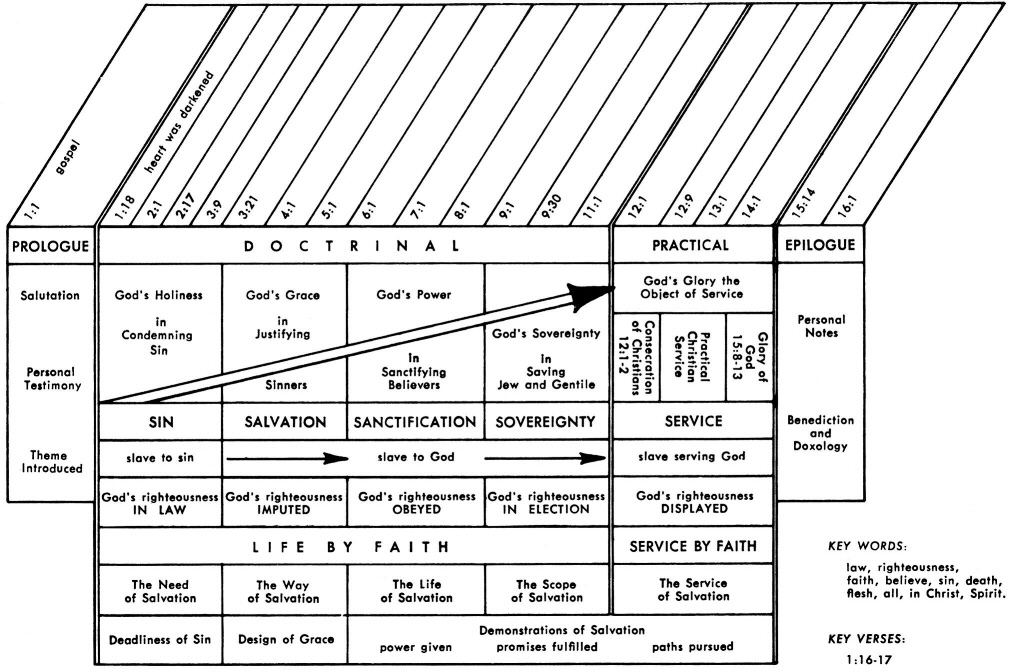
Click chart to enlarge
Chart from recommended resource Jensen's Survey of the NT - used by permission
Romans Overview Chart - Charles Swindoll
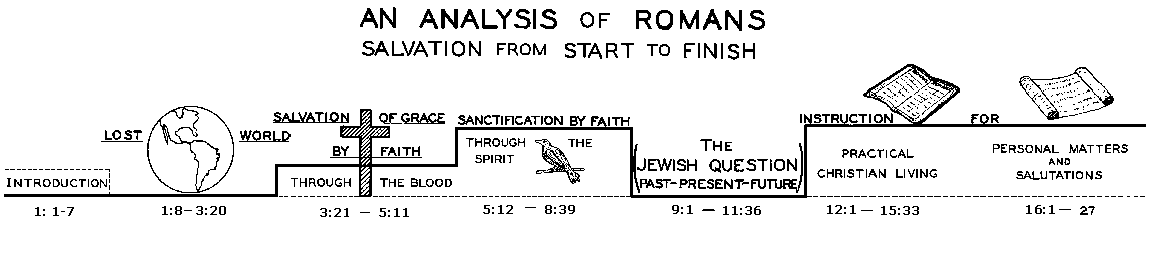
Source: Dr David Cooper
Click to Enlarge
| ROMANS ROAD to RIGHTEOUSNESS |
||||
| Romans 1:18-3:20 | Romans 3:21-5:21 | Romans 6:1-8:39 | Romans 9:1-11:36 | Romans 12:1-16:27 |
| SIN | SALVATION | SANCTIFICATION | SOVEREIGNTY | SERVICE |
| NEED FOR SALVATION |
WAY OF SALVATION |
LIFE OF SALVATION |
SCOPE OF SALVATION |
SERVICE OF SALVATION |
| God's Holiness In Condemning Sin |
God's Grace In Justifying Sinners |
God's Power In Sanctifying Believers |
God's Sovereignty In Saving Jew and Gentile |
Gods Glory The Object of Service |
| Deadliness of Sin |
Design of Grace |
Demonstration of Salvation | ||
| Power Given | Promises Fulfilled | Paths Pursued | ||
| Righteousness Needed |
Righteousness Credited |
Righteousness Demonstrated |
Righteousness Restored to Israel |
Righteousness Applied |
| God's Righteousness IN LAW |
God's Righteousness IMPUTED |
God's Righteousness OBEYED |
God's Righteousness IN ELECTION |
God's Righteousness DISPLAYED |
| Slaves to Sin | Slaves to God | Slaves Serving God | ||
| Doctrine | Duty | |||
| Life by Faith | Service by Faith | |||
|
Modified from Irving L. Jensen's chart above |
||||
R Ruin (Romans 1:17 – 3:20) – The utter sinfulness of humanity
O Offer (Romans 3:21-31) – God’s offer of justification by grace
M Model (Romans 4:1-25) – Abraham as a model for saving faith
A Access (Romans 5:1-11) – The benefits of justification
N New Adam (Romans 5:12-21) – We are children of two “Adams”
S Struggle w/ Sin (Romans 6:1-8:39) Struggle, sanctification, and victory
Romans 8:29 For those whom He foreknew, He also predestined to become conformed to the image of His Son, so that He would be the firstborn among many brethren; (NASB: Lockman)
Greek: hoti ous proegno, (3SAAI) kai proorisen (3SAAI) summorphous tes eikonos tou huiou autou, eis to einai (PAN) auton prototokon en pollois adelphois
Amplified: For those whom He foreknew [of whom He was aware and loved beforehand], He also destined from the beginning [foreordaining them] to be molded into the image of His Son [and share inwardly His likeness], that He might become the firstborn among many brethren. (Amplified Bible - Lockman)
NLT: For God knew his people in advance, and he chose them to become like his Son, so that his Son would be the firstborn, with many brothers and sisters. (NLT - Tyndale House)
Phillips: God, in his foreknowledge, chose them to bear the family likeness of his Son, that he might be the eldest of a family of many brothers. (Phillips: Touchstone)
Wuest: Because, those whom He foreordained He also marked out beforehand as those who were to be conformed to the derived image of His Son, with the result that He is firstborn among many brethren.
Young's Literal: For whom He foreknew, He also predestined to become conformed to the image of His Son, that He might be the first-born among many brethren;
FOR WHOM HE FOREKNEW: hoti ous proegno (3SAAI):
- Ro 11:2; Ex 33:12,17; Ps 1:6; Jer 1:5; Mt 7:23; 2Ti 2:19; 1Pe 1:2; Rev 13:8
- Romans 8 Resources - Multiple Sermons and Commentaries
GOD KNEW YOU
BEFORE YOU WERE BORN
For (hoti) introduces the argument to which the preceding words refer. See importance of querying terms of explanation.
As Denney explains "These verses (Ro 8:29ff) give the proof that God in all tings co-operates for good with the called. They show how His gracious purpose, beginning with foreknowledge and foreordination perfects all that concerns them on to the final glory. (Romans 8 Commentary - Expositor's Greek Testament)
Foreknew (4267) (proginosko from pró = before + ginosko = know) know about something prior to some temporal reference point. For example, to know about an event before it happens, to know beforehand, or to have foreknowledge. Proginosko describes God’s eternal counsel and includes all that He has considered and purposed to do prior to human history. In the language of Scripture, something foreknown is not simply that which God was aware of prior to a certain point, but also includes the idea of that which God gave prior consent to or which received His favorable or special recognition. Hence, proginosko is reserved for those matters which God favorably, deliberately and freely chose and ordained.
Proginosko - 5x in 5v - Acts 26:5; Rom 8:29; 11:2; 1 Pet 1:20; 2 Pet 3:17. NAS - foreknew(2), foreknown(1), knowing… beforehand(1), known(1).
Related Resources:
- Foreknowledge- Attributes of God
- How are predestination and election connected with foreknowledge?
- What is predestination? Is predestination biblical?
- Foreknowledge - Baker's Evangelical Dictionary of Biblical Theology
- Bridgeway Bible Dictionary Foreknowledge
- Charles Buck Dictionary Foreknowledge of God
- CARM Theological Dictionary Foreknow, foreknowledge
- Easton's Bible Dictionary Foreknowledge of God
- Holman Bible Dictionary Foreknowledge
- Hastings' Dictionary of the Bible Foreknowledge
- Hastings' Dictionary of the NT Foreknowledge
- International Standard Bible Encyclopedia Foreknow; Foreknowledge
- McClintock and Strong's Bible Encyclopedia Foreknowledge
God's foreknowledge is much more than just having prescience of what will happen in the future, but its full meaning is beyond our finite comprehension. [Acts 2:23] speaks of Christ as being delivered to be crucified "by the determinate counsel and foreknowledge of God."" His works surely were not planned merely by His foreknowledge of what they would be for that would place the power in the hands of man -- some say because it seems "logical" from our perspective that God looked into the future, saw what men would do and then He predestined them to salvation. That's not what Scripture says. That would put the initiative and impetus for salvation in the hands of depraved God hating men. We simply have to acknowledge that we don't have to explain this -- what we do have to do is rest in whatever He says for His ways are higher than our ways. By the way no where in Scripture does it say God foreknew or predestined anyone to hell.
God foreknew that Israel would be His people (Ro 11:2), yet He later chose them by His own will. It clearly suggests planning ahead of time, not just knowing ahead of time. Nothing takes God by surprise; His decisions are not determined by our decisions. Yet in every case where God's planning and predestinating are involved (Acts 2:23), it is also true that those who acted according to His foreknowledge carried out those acts of their own volition.
God promises
Whoever will call upon the name of the Lord will be saved (see note Romans 10:13).
And yet God also says that
He chose us in Him before the foundation of the world (see note Ephesians 1:4).
Our finite minds cannot fully apprehend both truths concurrently, yet we can rejoice in both with our hearts. God understands, because His understanding is infinite, and we rest in that.
Before I loved Him, He loved me
Before I found Him, He found me
Before I sought Him, He sought for me
Yes, Jesus cares for me
-- Ron Hamilton
HE ALSO PREDESTINED CONFORMED TO THE IMAGE OF HIS SON:kai proorisen (3SAAI) summorphous tes eikonos tou huiou autou:
- Eph 1:5,11; 1Pe 1:20
- Ro 13:14; Jn 17:16,19,22,23,26; 1Cor 15:49; 2Cor 3:18; Eph 1:4; 4:24; Php 3:21; 1Jn 3:2
- Spurgeon's sermon: Predestination and Calling
- Romans 8 Resources - Multiple Sermons and Commentaries
PREDESTINED TO
BE LIKE JESUS
When Paul assures the Roman saints that “God causes all things to work together for good to those who love God, to those who are called according to His purpose” (Ro 8:28), he then follows in this verse with God’s work of predestination as a reason why we can be assured of this truth. In short, predestination, far from being given to cause division, is given that it might bring comfort and assurance. The next verse looks at predestination from a futuristic perspective. That is to say, that if one looks to the future when Christ returns, he sees Paul's clear affirmation that God has determined to give believers in Christ perfect, glorified bodies. From eternity to eternity God has acted with the good of his people in mind. But if God has always acted for our good and will in the future act for our good, Paul reasons, then will he not also in our present circumstances work every circumstance together for our good as well? In this way predestination is seen as a comfort for believers in the everyday events of life.
Predestined (4309) (proorizo from pró = before + horízo = to determine, as by a boundary or limit in turn from horos = boundary, limit <> Source of our English word "horizon" = God's boundary between heaven and earth) literally means to mark out beforehand or set the the limits or boundaries in advance of any place or thing. When used of persons, proorizo means to put limitations upon that person thus conveys the idea of to determine his destiny. Though proorizo meant simply to plan in advance, in the New Testament it attracted a special meaning. Here the idea is a divine decree of God, whereby He determined in advance that something should happen.
Here in Romans 8:29 Paul is saying that God has predetermined the destiny or the future of each believer, a glorious future in which he or she will be like Christ, conformed to the image of His Son! And so we see that predestination need not be a frightful word for the believer but in fact a wonderful doctrine which should bring comfort , encouragement and thankfulness to our heart. God is in control. He has a plan for your life and mine! Note carefully that it was not the fact of our faith as foreknown by God that moved Him to "foreordain" us. The blessings and mercies recounted in this section are the result of His eternal purpose in Christ.
Proorizo reminds us that God is the supreme historian who wrote all history before it ever began and it is therefore not surprising that proorizo is used only of God in the NT.
Note that the Scripture never uses predestination to mean that God has predestined certain people to eternal condemnation. A person is condemned because he or she refuses to trust Christ. Stated another way the truth of predestination applies only to saved people. Peter explains the heart of the Father…
The Lord is not slow about His promise, as some count slowness, but is patient toward you, not wishing for any to perish but for all to come to repentance. (see note 2 Peter 3:9)
Proorizo is used 6 times in the NAS (Acts 4:28; Rom. 8:29; Rom. 8:30; 1 Co. 2:7; Eph. 1:5; Eph. 1:11) each use translated as predestined. In the KJV, proorizo is translated determine before, 1; ordain, 1; predestinate, 4. These 6 occurrences in the NT, all refer to the predestination of events and peoples by God before all time or before their concrete historical time. In each case proorizo speaks of God's plan for man or events and the inescapable implication is that God's plan will be fulfilled.
Here are the 4 other uses of proorizo (not counting the uses in Ro 8:29-30)…
Acts 4:27-28 "For truly in this city there were gathered together against Thy holy servant Jesus, whom Thou didst anoint, both Herod and Pontius Pilate, along with the Gentiles and the peoples of Israel, (4:28) to do whatever Thy hand and Thy purpose predestined to occur."
Comment: The Jews and Gentiles did what and only what God had planned beforehand. God did not force Jesus’ adversaries to engage in acts of violence against their will, for the evidence shows that they took full responsibility. Instead, God allowed them to conspire against Him that He might accomplish salvation for his people. Having done their worst, they merely succeeded in fulfilling God’s eternal plan. These verses contain another striking example of the conjoining of human responsibility and God's sovereignty in the same context, with no hint of this being a problem.
In a parallel passage (although not using proorizo) Luke records that Jesus…
Acts 2:22-23 "Men of Israel, listen to these words: Jesus the Nazarene, a man attested to you by God with miracles and wonders and signs which God performed through Him in your midst, just as you yourselves know--the Man delivered up by the predetermined (Greek = horizo = marked out) plan and foreknowledge of God, you nailed to a cross by the hands of godless men and put Him to death.
Comment: Again observe the juxtaposition of divine predestination and human responsibility. That these two truths exist in harmony that is beyond human comprehension is clearly taught in Scripture and must be received on faith in the infinitely wise, omniscient Creator God. He is the Potter and we are but clay!
1Cor 2:7 but we speak God's wisdom in a mystery, the hidden wisdom, which God predestined before the ages to our glory; 2:8 the wisdom which none of the rulers of this age has understood; for if they had understood it, they would not have crucified the Lord of glory
Comment: The meaning is that God’s wisdom in relation to the Gospel of His grace was predetermined by Him before any periods of time began. It was not an afterthought, not a plan contingent upon changed conditions or circumstances. Before time began, our heavenly Father determined to give us His saving wisdom that would lead ultimately to our eternal glorification.
Ephesians 1:5 He predestined us to adoption as sons through Jesus Christ to Himself, according to the kind intention of His will, (see note)
Ephesians 1:11 also we have obtained an inheritance, having been predestined according to His purpose who works all things after the counsel of His will, (see note)
Comment: Morris writing on predestination in Ephesians 1 says that "Its over-all purpose is to be "to the praise of his glory" (Ep 1:6, 12, 14, 3:21-notes Ep 1:6, 12, 14; 3:21)… Since our minds are finite, we are unable to comprehend the infinite character of the plan and purpose of God, which is exactly the situation with regard to the clearly Biblical truth of predestination. In no way does this preclude the ability of God to plan also the paradoxical truth of human freedom and responsibility, which also are clearly Biblical (remember God's ability is infinite). We cannot fully comprehend with our minds, but can believe and rejoice with our hearts that God has known and chosen us believers for Himself even before the world began. (Morris, Henry: Defenders Study Bible. World Publishing)
J D Watson on prohorizo - So, just as the horizon marks a limit between what we can and can't see, God has placed us within a certain limit, a certain "horizon." He has put us in a place where we can see and comprehend many things but where many other things are hidden from our sight and understanding, many things that are beyond our horizon. Further, even if we walk closer to the horizon, and understand things we never understood before, a new horizon appears. We will never understand it all this side of heaven. This word graphically demonstrates that God has marked out something for each of His elect; He has marked out a destiny. Much of that destiny is hidden from us; it is beyond the horizon. But, praise be to God, he reveals more of it with each new step we take toward it. What is that destiny? What is that purpose? While we don't know it all, we do know some of it. The primary purpose in God's predestination is "that [Christ] might be the firstborn among many brethren" (Rom. 8:29), that is, that Christ might be made preeminent. Scripture reveals that the firstborn always had preeminence. God's ultimate object, therefore, is to glorify His Son. Further, Ephesians 1:5 likewise tells us that God predestined us to adoption (see Jan. 2), making us Christ's brethren. Think of it! Each of us is either a brother or sister to our dear Savior. Then in Ephesians 1:11 we read that we are predestined to an inheritance, that is, spiritual riches, in Christ. That is our destiny. So, we would submit that no controversy is warranted. Predestination is simply God's marking out a destiny befitting His foreknown people. (A Word for the Day)
Believer's Study Bible has the following note explaining that..
Predestination and election have always been the subject of theological inquiry. Several truths about election should be noticed in this passage. Here, as in 1Pe 1:2 (see note), God's foreknowledge logically precedes the elective or predestinative act of God.
Another truth to be affirmed is that the Scriptures present salvation as viewed in two very different spheres. The earthly sphere sees man as totally responsible for his actions and faced with the necessity of choosing either to reject or to accept the atonement of Christ. The heavenly perspective in no sense contradicts the earthly, but it does add a new and infinitely more profound dimension. This new dimension declares that God has an elective purpose and that all which ultimately transpires conforms to His purpose, including the salvation of the elect.
Difficulty arises in man's seemingly unending efforts to reconcile the heavenly insight with the earthly perspective. Wrong answers are not infrequently the result of erroneous questions. Instead of attempting harmonization of those truths which are ultimately understood only by God (Ro 11:34), one ought to ask the question,
"Why is the doctrine of election present in the Scripture?"
Four distinct answers emerge from this passage:
(1) As long as the doctrine of election is in the Bible, salvation must be the gift of God alone. Predestination framed in God's foreknowledge assures us that salvation is from start to finish the work of God.
(2) The doctrine of God's elective purpose guarantees the perpetuity of salvation. Unthinkable is the idea that one of God's elect could forfeit his salvation. Those whom He has justified He will glorify. So certain is that sequence that "glorified" is an aorist tense in Greek, meaning that glorification is already a settled issue in the mind of God (Ro 8:30, 31, 32, 33, 34, 35, 36, 37, 38, 39). How could God lose one of His elect?
(3) The doctrine of election assures a peculiar providence which attends the way of every believer. If God's heart is set on us in His elective purpose, we may be sure of His concern and providential intervention in our behalf (Ro 8:28).
(4) Finally, that same personal providence bound up in election extends throughout the entire course of history. There is no runaway world. God's hand is systematically guiding the age to its intended consummation (Ro 8:21, 22). (MacDonald, W & Farstad, A. Believer's Bible Commentary: Thomas Nelson)
Wuest commenting on proorizo writes that " The genius of the word is that of placing limitations upon someone or something beforehand, these limitations bringing that person or thing within the sphere of a certain future or destiny. These meanings are carried over into the New Testament usage of the word. Thus, the “chosen-out” ones, have had limitations put around them which bring them within the sphere of becoming God’s children by adoption (Eph 1:5), and of being conformed to the image of the Lord Jesus (Ro 8:29).
Someone explained predestination with this simple picture. When we came to Christ, it was like walking through a gate. On the outside were inscribed these words: "Whosoever will, may come." Once we passed through the gate into the Saviour's arms, we could look back and see these words inscribed on the inside: "Chosen from the foundation of the world." We can praise Him for His sovereign and saving grace.
Jesus Himself taught that…
He who believes in Him is not judged; he who does not believe has been judged already, because he has not believed in the name of the only begotten Son of God. And this is the judgment, that the light is come into the world, and men loved the darkness rather than the light; for their deeds were evil. For everyone who does evil hates the light, and does not come to the light, lest his deeds should be exposed. But he who practices the truth comes to the light, that his deeds may be manifested as having been wrought in God. (John 3:18-21).
Conformed (4832) (summorphos from sún = together with + morphe = form) refers to the conformity of children of God "to the image of His Son". To resemble his Son; to be of like form with the image of his Son.
Dear reader if you are not being conformed into the image of God's Son, showing a greater and greater likeness to Jesus, you need to do a sober, honest look at your salvation as Paul exhorts in 2 Cor 13:5 - "Test yourselves to see if you are in the faith; examine yourselves! Or do you not recognize this about yourselves, that Jesus Christ is in you–unless indeed you fail the test?" Remember we are not speaking about absolute perfection but about general direction ("up" or "down")!
Gilbrant on sunmorphos - In Romans 8:29 Paul used sunmorphos to indicate that God has already determined that those who become His sons will be changed to be like Christ, i.e., “conformed to the image” of Jesus. This same concept is repeated in Philippians 3:21 where God again is the One doing the work. In this verse Paul said that God would change the mortal body of the Christian “that it may be fashioned like unto his glorious body.” Both instances indicate the goal of becoming Christlike, of having His image. (Complete Biblical Library Greek-English Dictionary)
Here Paul explains the goal of predestination - that believers would "be conformed to the image of His Son"!
As Denney puts it "The Son of God is the Lord Who appeared to Paul by Damascus: to be conformed to His image is to share His glory as well as His holiness. The Pauline Gospel is hopelessly distorted when this is forgotten." (Ibid)
In Philippians 3 Paul describes the physical conformity to the body of Christ's glory writing that in the future the Lord Jesus Christ
will transform the body of our humble state into conformity with (summorphos) the body of His glory, by the exertion of the power that He has even to subject all things to Himself. (see note Philippians 3:21)
A T Robertson on conformed - an inward and not merely superficial conformity. Eikon is used of Christ as the very image of the Father (2 Cor. 4:4; Col. 1:15). See morphe. Here we have both morphe and eikon to express the gradual change in us till we acquire the likeness of Christ the Son of God so that we ourselves shall ultimately have the family likeness of sons of God. Glorious destiny. (Word Pictures in the New Testament).
Howard Hendricks writes that "The Bible was not written to satisfy your curiosity, but to make you conform to Christ’s image. Not to make you a smarter sinner, but to make you like the Saviour. Not to fill your head with a collection of biblical facts, but to transform your life.
Vincent - "There is another kind of life of which science as yet has taken little cognizance. It obeys the same laws. It builds up an organism into its own form. It is the Christ-life. As the bird-life builds up a bird, the image of itself, so the Christ-life builds up a Christ, the image of Himself, in the inward nature of man.... According to the great law of conformity to type, this fashioning takes a specific form. It is that of the Artist who fashions. And all through life this wonderful, mystical, glorious, yet perfectly definite process goes on 'until Christ be formed' in it" (Drummond, "Natural Law in the Spiritual World"). (Word Studies in the New Testament)
Image (1504)(eikon) properly, "mirror-like representation," i.e. what is very close in resemblance (like a "high-definition" projection, as defined by the context). Eikon is an artistic representation, as one might see on a coin or statue (an image or a likeness, as in Mt 22.20). Eikon can also refer to a visible manifestation of an invisible and heavenly reality form (see Hebrews 10:1) In the context of the regenerate person, his or her image is renewed in the likeness of Christ; reborn in the image of the Creator (Colossians 3:10; cf.; Ephesians 4:24). When the believer is finally glorified, he or she will be conformed to the image of God’s Son (Ro 8:29; 1 Cor 15:49).
Related Resources:
- Bridgeway Bible Dictionary Predestination
- Baker's Evangelical Dictionary Predestination
- Charles Buck Dictionary Predestination
- CARM Theological Dictionary Predestine, Predestination
- Easton's Bible Dictionary Predestination
- Fausset Bible Dictionary Predestination
- Spurgeon's Illustration Collection Predestination
- Hastings' Dictionary of the Bible Predestination
- Hastings' Dictionary of the NT Predestination
- Vines' Expository Dictionary Predestinate
- Webster Dictionary Predestining Predestined
- Watson's Theological Dictionary Predestination
- 1911 Encyclopedia Britannica Predestination
- International Standard Bible Encyclopedia Predestination
- McClintock and Strong's Bible Encyclopedia Predestination
- The Nuttall Encyclopedia Predestination
- The Jewish Encyclopedia Predestination
On a wall near the main entrance to the Alamo in San Antonio, Texas, is a portrait with the following inscription:“ James Butler Bonham—no picture of him exists. This portrait is of his nephew, Major James Bonham, deceased, who greatly resembled his uncle. It is placed here by the family that people may know the appearance of the man who died for freedom.” No literal portrait of Jesus exists either. But the likeness of the Son who makes us free can be seen in the lives of His true followers.
Romans 8:28 is an easy verse to believe when the sun is shining, but it's something else entirely in the darkness of human tragedy. We doubt this verse for two reasons. First, Paul says "we know" when most of us don't feel like we know. Second, Paul says "all things" when most of us would rather say "some things." Surely the key word is the word "good." For us, "good" usually means happiness, health, prosperity, and good fortune. Those things are indeed good, but God's good far exceeds our limited vision. (Ro 8:29) tells us that God's good is that we should be conformed to the image of Jesus Christ. Anything that makes us like Jesus is good. This gives an entirely new perspective to heartaches and tragedies. They are part of God's plan to chip away little by little at our character until Jesus is fully formed in us.
I question whether we have preached the whole counsel of God, unless predestination with all its solemnity and sureness be continually declared.—6.26
I do not doubt that the Lord has settled, concerning every one of his elect, the exact time when they shall pass from death unto life, the precise instrumentality by which they shall be converted, the exact word that shall strike with power on their mind, the period of conviction which they shall undergo, and the instant when they shall burst into the joyful liberty of a simple faith in Christ. It is all settled, all arranged and predetermined in the divine purpose. If the very hairs of our head are all numbered, much more the circumstances of the most important of all events which can occur to us.
We are no believers in fate, seeing that fate is a different doctrine altogether from predestination. Fate says the thing is and must be, so it is decreed. But the true doctrine is—God has appointed this and that, not because it must be, but because it is best that it should be. Fate is blind, but the destiny of Scripture is full of eyes. Fate is stern and adamantine, and has no tears for human sorrow. But the arrangements of providence are kind and good.
"If there are so many that will be saved," says one, "then why do you preach?" That is why we preach! If there are so many fish to be taken in the net, I will go and catch some of them. Because many are ordained to be caught, I spread my nets with eager expectation. I never could see why that should repress our zealous efforts. It seems to me to be the very thing that should awaken us to energy—that God has a people, and that these people shall be brought in.If any of you do not believe in the predestination of God, you will probably, in some hour of depression, ascribe your sorrows to cruel fate. The human mind is driven at last to this decision, that some things are beyond the control of man and his will, and that these are fixed by necessity. How much better to see that God has fixed them!
The foreordination of God in no degree interferes with the responsibility of man. I have often been asked by persons to reconcile the two truths. My only reply is, "They need no reconciliation, for they never fell out." Why should I try to reconcile two friends? The two facts are parallel lines. I cannot make them unite, but you cannot make them cross each other.
I believe that nothing hap-pens apart from divine determination and decree.
I do not believe that there ever would have been a man delivered from this present evil world if it had not been according to the will, the purpose, the predestination of God. It needs a mighty tug to get a man away from the world. It is a miracle for a man to live in the world, and yet not to be of it. I am sure it would never have been wrought if it had not been according to the will of God our Father.
We shall never be able to escape from the doctrine of divine predestination—the doctrine that God has foreordained certain people unto eternal life.
It is true that everything is predestinated, and that everything that happens is ordered according to the unfailing purpose and will of God.
Predestination and calling - “Moreover whom he did predestinate, them he also called.” Romans 8:30 The testimony of sense may be false, but the testimony of the Spirit must be true. We have the witness of the Spirit within, bearing witness with our spirits that we are born of God. There is such a thing on earth as an infallible assurance of our election. Let a man once get that, and it will anoint his head with fresh oil, it will clothe him with the white garment of praise, and put the song of the angel into his mouth. Happy, happy man, who is fully assured of his interest in the covenant of grace, in the blood of atonement, and in the glories of heaven! Such men there are here this very day. Let them “rejoice in the Lord alway, and again I say rejoice.” What would some of you give if you could arrive at this assurance? Mark, if you anxiously desire to know, you may know. If your heart pants to read its title clear it shall do so before long. No man ever desired Christ in his heart with a living and longing desire, who did not find him sooner or later. If you have a desire, God has given it to you. If you pant, and cry, and groan after Christ, even this is his gift; bless him for it. Thank him for little grace, and ask him for great grace. He has given you hope, ask for faith; and when he gives you faith, ask for assurance; and when you get assurance, ask for full assurance; and when you have obtained full assurance, ask for enjoyment; and when you have enjoyment, ask for glory itself; and he shall surely give it to you in his own appointed season.
Note: The following devotionals are from the highly recommended resource Our Daily Bread - (Our Daily Bread, Copyright RBC Ministries, Grand Rapids, MI. — Reprinted by permission. All rights reserved)
Unblemished Beauty
Whom He foreknew, He also predestined to be conformed to the image of His Son. — Romans 8:29
Today's Scripture: Romans 8:18-30
Women in nearly record numbers, we’re told, were drawn in envy to the picture of a well-known movie actress on the cover of a popular magazine. She had been portrayed as possessing flawless beauty.
But the editors of another magazine published a follow-up story telling about a photo company that had billed the first magazine $1,525 for their work on the picture “to clean up complexion, soften eye line, soften smile line, add color to lips, trim chin, . . . adjust color, and add hair on the top of the head.” So however beautiful she actually is, she needed something— quite a little it seems—to hide the blemishes that would quickly destroy her image of “ideal loveliness.”
What a picture of man’s spiritual condition! Every one of us is flawed when compared with the moral excellence of Christ (Rom. 3:23). No matter how good we may appear, we need more than a religious touchup to conceal our sins. We desperately need the soul-cleansing, atoning blood of Jesus Christ. When we trust Jesus as our Savior, God gives us His flawless righteousness. From then on, He works within us by His Spirit to conform us to His likeness.
Are we making the unblemished beauty of Christlike character the daily goal of our life? By: Vernon Grounds
Let the beauty of Jesus be seen in me,
All His wonderful passion and purity;
O Thou Spirit divine, all my nature refine,
Till the beauty of Jesus be seen in me.
—Orsborn
The most beautiful people are those who remind us of Christ.
Like Him
Whom He foreknew, He also predestined to be conformed to the image of His Son. — Romans 8:29
Today's Scripture: Romans 8:28-39
God is not interested in just saving us from hell and taking us to heaven. He wants to conform us “to the image of His Son” (Romans 8:29). Someone has said that the Father was so pleased with His Son that He has determined to fill all of heaven with others just like Him.
When Jesus returns, “we shall be like Him” (1 John 3:2), but the process of becoming like Him begins here and now. How does that happen? It is explained by the “all things” of “all things work together for good to those who love God” (Romans 8:28). This includes testings and trials, chastenings and purifications, denials and suffering. To become like Him, we must follow Him, and that is the path of sacrifice and trial (Hebrews 2:10).
Following Jesus means we must be willing to go with Him to the Garden of Gethsemane and the hill of Calvary. We must be willing to endure suffering and rejection by those who reject Him (John 15:18-21). But following Him also leads us to the empty tomb and the place at the right hand of God. The apostle Paul said that those who follow Him will also share in His resurrection (Romans 6:5). And “if we endure, we shall also reign with Him” (2 Timothy 2:12).
Yes, God uses “all things” to make us like Christ. By: M.R. DeHaan
If you walk every day with the Savior,
Use His Word as your unfailing guide,
Then you surely will grow to be like Him,
And with Him you'll forever abide.
—Hess
The road to Christlikeness will take you through the valley of suffering.
How to Carve a Duck
For those God foreknew he also predestined to be conformed to the image of his Son. Romans 8:29
Today's Scripture & Insight: Psalm 138:7–8; Ephesians 2:6–10
My wife, Carolyn, and I met Phipps Festus Bourne in 1995 in his shop in Mabry Hill, Virginia. Bourne, who died in 2002, was a master wood carver whose carvings are almost exact replicas of real objects. “Carving a duck is simple,” he said. “You just look at a piece of wood, get in your head what a duck looks like, and then cut off everything that doesn’t look like it.”
So it is with God. He looks at you and me—blocks of rough wood—envisions the Christlike woman or man hidden beneath the bark, knots, and twigs and then begins to carve away everything that does not fit that image. We would be amazed if we could see how beautiful we are as finished “ducks.”
But first we must accept that we are a block of wood and allow the Artist to cut, shape, and sand us where He will. This means viewing our circumstances—pleasant or unpleasant—as God’s tools that shape us. He forms us, one part at a time, into the beautiful creature He envisioned in our ungainly lump of wood.
Sometimes the process is wonderful; sometimes it is painful. But in the end, all of God’s tools conform us “to the image of his Son” (Rom. 8:29).
Do you long for that likeness? Put yourself in the Master Carver’s hands. By: David H. Roper
Father, You are the craftsman who shapes me. You are the one who knows what shape my life should take. Thank You for carving me into the image You have planned. Help me to trust that the pieces and parts that You shave from me are the right ones.
Growing in Christ comes from a deepening relationship with Him.
Becoming What We Are
The Lord is the Spirit; and where the Spirit of the Lord is, there is liberty. — 2 Corinthians 3:17
Today's Scripture: Philippians 3:1-11
At a British university, a group of students had raised the question, “What do you want to be?” Different answers were given—a champion athlete, an influential politician, a noted scholar. Shyly, yet clearly, one student said something that caused thoughtful silence: “You may laugh at me, but I want to be a saint.”
Imagine—a saint! Whatever his concept of sainthood, many in our secular society would view that ambition as eccentric. Yet if we are Christians, it ought to be the highest priority of our life. The essence of sainthood is simply to be like Jesus. Paul said that the overarching purpose of God the Father is to make us like His Son (Romans 8:29).
Of course, every believer is guaranteed perfect conformity to Christ in the world to come. But God does not want us to wait passively until we enter heaven for that supernatural transformation to take place (1 John 3:2). We are to be cooperating with the Holy Spirit to grow more and more like Christ “in this world” (4:17).
Yes, we are already saints by faith in Christ Jesus (Philippians 1:1). But each day we face the challenge of becoming what we are—Christlike in every area of our lives. By: Vernon Grounds
More like the Master I would live and grow,
More of His love to others I would show;
More self-denial, like His in Galilee,
More like the Master I long to ever be.
—Gabriel
To belong to Christ is to be a saint; to live like a saint is to be like Christ.
Are You Using Your Power?
Whom He foreknew, He also predestined to be conformed to the image of His Son. — Romans 8:29
Today's Scripture: 2 Corinthians 3:5-18
What is God’s goal for your life? Author Max Lucado summarizes it this way: “God loves you just the way you are, but He refuses to leave you that way. He wants you to be just like Jesus.” This involves change, but we often believe it’s not possible. We say, “I’ve always worried,” or “I’ve always felt angry—I’m just that way.” Yet Paul said in Romans 8:29 that God’s purpose is to make us like Jesus. So what hinders this process?
In his book Just Like Jesus, Lucado tells about a wealthy woman who lived 100 years ago. She was extremely tight with her money, so neighbors were surprised when she had her home wired for electricity. Weeks later, a meter reader noted very little usage, so he asked, “Are you using your power?” “Certainly,” she replied. “Each evening I turn on my lights long enough to light my candles; then I turn them off.”
If we have put our faith in Christ, we too are connected to a power source—the Holy Spirit, who works in us to make us more like Jesus (2 Corinthians 3:18). So let’s not settle for “spiritual candlelight” by being comfortable with our old ways. We need to allow the Holy Spirit to transform our lives and make us like Jesus.
Are you using your power? By: Joanie Yoder
Father, thank You for Your Spirit,
Fill us with His love and power;
Change us into Christ's own image
Day by day and hour by hour.
—Anon.
Only God's power can transform your life.
It Takes Time!
Whom He foreknew, He also predestined to be conformed to the image of His Son. —Romans 8:29
Today's Scripture: Ephesians 4:11-16
The story is told of an accomplished artist who was applying the finishing touches to a bronze sculpture. He kept filing, scraping, and polishing every little surface of his masterpiece. “When will it be done?” asked an observer. “Never,” came the reply. “I just keep working and working until they come and take it away.”
Much the same could be said of the children of God. We are saved by grace and declared righteous in Christ. Yet when it comes to the matter of Christlikeness in our everyday living, we must keep working at it until Jesus comes and takes us away.
Someone has observed, “The acorn does not become an oak in a day . . . . It is not one touch of the artist’s brush that produces a finished painting. There are always months between seedtime and harvest.”
Whether you are a new believer or have known the Lord for many years, “Grow up in all things into Him” (Eph. 4:15). Don’t let setbacks and failures discourage you. Stay in touch with God through prayer. Then, as you feed on the Word of God and obey His commands, you too will become more like Christ through the power of the indwelling Holy Spirit. Remember, it takes time! By: Richard DeHaan
O to be like Thee, blessed Redeemer,
This is my constant longing and prayer;
Gladly I'll forfeit all of earth's treasures,
Jesus, Thy perfect likeness to wear.
—Chisholm
Salvation is the miracle of a moment; growth is the Labor of a lifetime.
The Making Of You
Whom He foreknew, He also predestined to be conformed to the image of His Son. — Romans 8:29
Today's Scripture: Romans 8:18-30
Scottish author George MacDonald told this story of a woman who had experienced a great tragedy in her life: “The heartache was so crushing and her sorrow so bitter that the one in distress exclaimed, ‘I wish I’d never been made.’ With spiritual discernment, her friend answered, ‘My dear, you are not fully made yet; you’re only being made, and this is the Maker’s process!’”
MacDonald wisely concluded, “We can let God take our troubles and make out of them a garment of Christian fortitude which will not only warm our souls but also serve to inspire others.”
This is true for all of our trials—even when we are being corrected by God for our sin. The author of Hebrews wrote, “No chastening seems to be joyful for the present, but painful; nevertheless, afterward it yields the peaceable fruit of righteousness to those who have been trained by it” (Heb. 12:11).
Does it seem as though everything in life is going against you? As you face disillusionment, take heart! If you’re a child of God, all things are working together for good, and He is conforming you “to the image of His Son” (Rom. 8:28-29). God’s lessons through trials can be the making of you! By: Richard DeHaan
For all the heartaches and the tears,
For gloomy days and fruitless years
I do give thanks, for now I know
These were the things that helped me grow.
—Anon.
God may have to break us in order to make us.
Like Jesus
For those God foreknew he also predestined to be conformed to the image of his Son. Romans 8:29
Today's Scripture & Insight: Romans 8:22–30
As a boy, theologian Bruce Ware was frustrated that 1 Peter 2:21–23 calls us to be like Jesus. Ware wrote of his youthful exasperation in his book The Man Christ Jesus. “Not fair, I determined. Especially when the passage says to follow in the steps of one ‘who did no sin.’ This was totally outlandish . . . . I just couldn’t see how God could really mean for us to take it seriously.”
I understand why Ware would find such a biblical challenge so daunting! An old chorus says, “To be like Jesus, to be like Jesus. My desire, to be like Him.” But as Ware rightly noted, we are incapable of doing that. Left to ourselves, we could never become like Jesus.
However, we’re not left to ourselves. The Holy Spirit has been given to the child of God, in part so that Christ can be formed in us (Galatians 4:19). So it should come as no surprise that in Paul’s great chapter on the Spirit we read, “For those God foreknew he also predestined to be conformed to the image of his Son” (Romans 8:29). God will see His work completed in us. And He does it through the Spirit of Jesus living in us.
As we yield to the Spirit’s work in us, we truly become more like Jesus. How comforting to know that’s God’s great desire for us! By: Bill Crowder
What attribute of the fruit of the Spirit would you like to live out to a greater degree? (see Galatians 5:22–23). What will help you do so?
Father, I long to be more like Your Son but so often fall short in word, thought, or deed. Forgive me, and help me to yield to the work of Your Spirit so that Jesus might be formed in me.
- For further study, read Free in the Spirit at DiscoverySeries.org/Q0307.
Is That Jesus?
Whom He foreknew, He also predestined to be conformed to the image of His Son, that He might be the firstborn among many brethren. —Romans 8:29
Today's Scripture: Romans 8:26-29
As I walked into church one Sunday morning, a little boy looked at me and said to his mother, “Mom, is that Jesus?” Needless to say, I was curious to hear her response. “No,” she said, “that’s our pastor.”
I knew she would say no, of course, but I still wished she could have added something like, “No, that’s our pastor, but he reminds us a lot of Jesus.”
Being like Jesus is the purpose of life for those of us who are called to follow Him. In fact, as John Stott notes, it is the all-consuming goal of our past, our present, and our future. Romans 8:29 tells us that in the past we were “predestined to be conformed to the image of His Son.” In the present, we “are being transformed into the same image” (the likeness of Christ), as we grow from “glory to glory” (2 Cor. 3:18). And, in the future, “we shall be like Him, for we shall see Him as He is” (1 John 3:2).
Being like Jesus is not about keeping the rules, going to church, and tithing. It’s about knowing His forgiveness, and committing acts of grace and mercy on a consistent basis. It’s about living a life that values all people. And it’s about having a heart of full surrender to the will of our Father.
Be like Jesus. You were saved for it! By: Joe Stowell
Be like Jesus—this my song—
In the home and in the throng;
Be like Jesus all day long!
I would be like Jesus.
—Rowe
Live in such a way that others see Jesus in you.
THAT HE MIGHT BE THE FIRST BORN AMONG MANY BRETHREN: eis to einai (PAN) auton prototokon en pollois adelphois:
- Ps 89:27; Mt 12:50; 25:40; Jn 20:17; Col 1:15, 16, 17, 18; Heb 1:5,6; Heb 2:11, 12, 13, 14, 15; Rev 1:5,6
- Romans 8 Resources - Multiple Sermons and Commentaries
CHRIST
THE FIRSTBORN
Firstborn reflects His priority and supremacy.
Related Resource:
- See commentary on Col 1:15 which discusses how the cult of Jehovah's Witnesses twists this truth to say Jesus was created
Robertson - Christ is "first born" of all creation (Col. 1:15), but here he is "first born from the dead" (Col. 1:18), the Eldest Brother in this family of God's sons, though "Son" in a sense not true of us. (Word Pictures in the New Testament)
That He might be the First Born - The end in this process of our being conformed to the Son's image is the exaltation of Christ.
First born (4416) (prototokos from protos = first, + tikto = to bear, bring forth) can mean first-born chronologically (Luke 2:7) but as used by Paul refers primarily to position, or rank. In both Greek and Jewish culture, the first-born was the son who had the right of inheritance. He was not necessarily the first one born. Although Esau was born first chronologically, it was Jacob who was the “first-born” and received the inheritance. Jesus is the One with the right to the inheritance of all creation (cf. He 1:2; Re 5:1f, Re 5:13). Israel was called God’s first-born in Exodus 4:22 and Jeremiah 31:9. Though not the first people born, they held first place in God’s sight among all the nations.
In Psalm 89:27 (note), God says of the Messiah, “I also shall make Him My first-born” (Spurgeon's note) Then the psalmist defines what He means "the highest of the kings of the earth.”
Prototokos - 8x in 8v - Luke 2:7; Rom 8:29; Col 1:15, 18; Heb 1:6; 11:28; 12:23; Rev 1:5
Prototokos - 103x in the Septuagint -Gen 4:4; 10:15; 22:21; 25:13, 25; 27:19, 32; 35:23; 36:15; 38:6f; 41:51; 43:33; 46:8; 48:18; 49:3; Exod 4:22f; 6:14; 11:5; 12:12, 29; 13:2, 13, 15; 22:29; 34:19f; Lev 27:26; Num 1:20; 3:2, 12f, 40ff, 45f, 50; 8:16ff; 18:15, 17; 26:5; 33:4; Deut 12:6, 17; 14:23; 15:19; 21:15ff; 33:17; Josh 6:26; 17:1; Judg 8:20; 1 Sam 8:2; 14:49; 2 Sam 3:2; 13:21; 19:43; 1 Kgs 16:34; 2 Kgs 3:27; 1 Chr 1:29; 2:3, 13, 25, 27, 42, 50; 3:1, 15; 4:4; 5:1, 3, 12; 6:28; 8:1, 30, 38f; 9:5, 31, 36, 44; 26:2, 4, 6, 10; 2 Chr 21:3; Neh 10:36; Ps 78:51; 89:27; 105:36; 135:8; 136:10; Jer 31:9; Ezek 44:30; Mic 6:7; Zech 12:10
In Rev 1:5-note, Jesus is called “the first-born of the dead,” even though He was not the first person to be resurrected chronologically. Of all ever raised, He is the preeminent One. Here in Romans 8:29 Jesus is the first-born in relation to the church. In all these uses, the first-born clearly means highest in rank, not first created.
Romans 8:30 and these whom He predestined, He also called; and these whom He called, He also justified; and these whom He justified, He also glorified. (NASB: Lockman)
Greek: ous de proorisen, (3SAAI) toutous kai ekalesen; (3SAAI) kai ous ekalesen, (3SAAI) toutous kai edikaiosen; (3SAAI) ous de edikaiosen, (3SAAI) toutous kai edoxasen (3SAAI)
Amplified: And those whom He thus foreordained, He also called; and those whom He called, He also justified (acquitted, made righteous, putting them into right standing with Himself). And those whom He justified, He also glorified [raising them to a heavenly dignity and condition or state of being]. (Amplified Bible - Lockman)
NLT: And having chosen them, he called them to come to him. And he gave them right standing with himself, and he promised them his glory. (NLT - Tyndale House)
Phillips: He chose them long ago; when the time came he called them, he made them righteous in his sight, and then lifted them to the splendour of life as his own sons. (Phillips: Touchstone)
Wuest: Moreover, those whom He thus marked out beforehand, these He also summoned. And those whom He summoned, these He also justified. Moreover, those whom He justified, these He also glorified.
Young's Literal: and whom He predestined, these He also called; and whom He called, these He also justified; and whom He justified, these He also glorified.
AND WHOM HE PREDESTINED THESE HE ALSO CALLED: ous de proorisen (3SAAI), toutous kai ekalesen (3SAAI):
- Ro 8:28; 1:6; 9:23,24; Isa 41:9; 1Co 1:2,9; Ep 4:4; Heb 9:15; 1Pe 2:9; 2Pe1:10; Rev 17:14; 19:9
- Romans 8 Resources - Multiple Sermons and Commentaries
- whom He predestined… He also glorified.
GOD'S EFFECTUAL
CALL
Spurgeon - "Notice that personal pronoun “he” — how it comes at the beginning, and goes on to the end. “Salvation is of the Lord.” This is so often forgotten that, trite as it may appear, we cannot repeat it too often: “Whom he did foreknow, he also did predestinate Whom he did predestinate, them he also called, and whom he called, them he also justified: and whom he justified, them he also glorified.” You might suppose, from the talk of some men, that, salvation is all of the man himself; — that is free agency pushed into a falsehood, a plain truth puffed into a lie. There is such a thing as free agency, and we should make a great mistake if we forgot it; but there is also such a thing as free grace, and we shall make a still greater mistake if we limit that to the agency of man; it is God who works our salvation from the beginning to the end."
Called (2564) (kaleo) (see study of the called) can refer to an invitation, but as discussed below in this context conveys the idea of an effectual call and emphasizes God's sovereign work. God has invited us to join Him in eternity in incorruptible, sinless, glorified bodies. The aorist tense points to the fact that God effectively had called them into His kingdom and service in the past.
Kaleo - 148x in 140v = call(13), called(99), calling(2), calls(7), give(1), invite(2), invited(15), invited guests(1), invites(1), name given(1), named(2), so-called(1), summoned(2).
Matt 1:21, 23, 25; 2:7, 15, 23; 4:21; 5:9, 19; 9:13; 20:8; 21:13; 22:3f, 8f, 43, 45; 23:7ff; 25:14; 27:8; Mark 1:20; 2:17; 3:31; 11:17; Luke 1:13, 31f, 35f, 59ff, 76; 2:4, 21, 23; 5:32; 6:15, 46; 7:11, 39; 8:2; 9:10; 10:39; 14:7ff, 12f, 16f, 24; 15:19, 21; 19:2, 13, 29; 20:44; 21:37; 22:3, 25; 23:33; John 1:42; 2:2; Acts 1:12, 19, 23; 3:11; 4:18; 7:58; 8:10; 9:11; 10:1; 13:1; 14:12; 15:22, 37; 24:2; 27:8, 14, 16; 28:1; Rom 4:17; 8:30; 9:7, 12, 24ff; 1 Cor 1:9; 7:15, 17f, 20ff, 24; 10:27; 15:9; Gal 1:6, 15; 5:8, 13; Eph 4:1, 4; Col 3:15; 1 Thess 2:12; 4:7; 5:24; 2 Thess 2:14; 1 Tim 6:12; 2 Tim 1:9; Heb 2:11; 3:13; 5:4; 9:15; 11:8, 18; Jas 2:23; 1 Pet 1:15; 2:9, 21; 3:6, 9; 5:10; 2 Pet 1:3; 1 John 3:1; Rev 1:9; 11:8; 12:9; 16:16; 19:9, 11, 13.
Spurgeon - The general call of the gospel is like the common "cluck" of the hen which she is always giving when her chickens are around her. But if there is any danger impending, then she gives a very peculiar call, quite different from the ordinary one, and the little chicks come running as fast as they can, and hide for safety under her wings. That is the call we want, God's peculiar and effectual call to his own.
Related Resources:
- What is the effectual calling/call?
- John MacArthur - Doctrine of God's Effectual Call
- C H Spurgeon - Effectual Calling - Illustrated by the Call of Abram
- What does it mean that God draws us to salvation?
- Irresistible Grace - is it biblical?
FOR A SIMPLE EASY TO COMPREHEND UNDERSTANDING OF CALLING WATCH THIS 12 MINUTE VIDEO - John Piper's explanation of CALLING - God Calls the Spiritually Dead to Life (using Ephesians 4:1 as the base passage). Watch John Piper's explanation of calling which he first illustrates by using Jesus' call to Lazarus (John 11:43-44) to "Come out" (or "come forth"). Piper's point is that "dead men" like Lazarus do not hear, so that Jesus' call to Lazarus came with the gift of life to enable Lazarus to hear and come forth. Then Piper demonstrates the principle of calling using 1 Corinthians 1:22-24. He points out that both Jews and Gentiles heard Paul preach Christ crucified, but to the Jews it was a stumbling block and to the Gentiles it was foolishness. Then he talks about the response of those who are the called in 1 Corinthians 1:24. He then discusses Romans 8:28-30.
Albert Barnes - Called by his Spirit to become Christians. He called, not merely by an external invitation, but in such a way as that they in fact were justified. This cannot refer simply to an external call of the gospel, since those who are here said to be called are said also to be justified and glorified. The meaning is, that there is a certain connexion between the predestination and the call, which will be manifested in due time. The connexion is so certain that the one infallibly secures the other. (Barnes' Notes on the New Testament)
John Walvoord on Calling - In the New Testament, divine calling relates to four aspects. The first of these is salvation (Rom. 8:28, 30; 1 Cor. 1:9, 24; Gal. 1:6, 15; 2 Thess. 2:13-15; Heb. 3:1; 9:15; 1 Pet. 1:15; 2:9; 5:10; 2 Pet. 1:3-6; Jude 1). A second form of calling is to special service, such as being an apostle (Rom. 1:1; 1 Cor. 1:1; 15:9; Gal. 1:15), missionary (Acts 13:2; 16:10), or priest (Heb. 5:4). A third form of calling is to any occupation, such as being a slave (1 Cor. 7:20-24). A fourth is God's calling to believers to lead holy and peaceful lives (1 Cor. 1:2; 7:15; Eph. 4:1; Col. 3:15; 2 Tim. 1:9; 1 Pet. 3:9). Of significance in God's calling is the contrast between a general call or announcement of the gospel and God's effectual call which results in salvation (Rom. 8:28-30; 9:23-26). In Calvinistic theology this effectual calling to salvation is referred to as “irresistible” (see 8:29). This means that when this call comes it is part of God's program for salvation. It is obvious, however, that when the gospel is presented, the invitation to believe in Christ is not always followed by a favorable response on the part of those who hear. Arminians say this call means that God's common grace extends to all, so that everyone has sufficient grace by which to believe. While the Bible often speaks of grace (for example, Rom. 5:2; Eph. 2:5, 8), the terms “irresistible grace” and “sufficient grace” are not used. Christ's words in John 16:8-11, in which He spoke of the convicting work of the Holy Spirit, show that a person can be under conviction, fully aware of his or her need to receive Christ as Savior and still fall short of faith in Christ. Conviction, then, is related to God's general calling but is antecedent to an effectual calling to salvation. The call of God for salvation is initiated by God the Father, is made effective by the Holy Spirit, and results in a proper relationship with Jesus Christ as the Savior. Each believer is a “called” one, summoned to escape the darkness and live in the light. (Theological Wordbook)
James Smith - Luke 19:5 The Call of Jesus Christ is—
1. A Gracious Call, He might have passed by.
2. A Personal Call, "Zaccheus."
3. An Urgent Call, "Make haste."
4. A Humbling Call, "Come down."
5. An Affectionate Call, "Abide at thy house."
6. An Assuring Call, "I must."
7. An Effectual Call, "He made haste."
Question: What is the effectual calling/call?
Answer: The term effectual call, as related to salvation, comes from Chapter X of the 1647 Westminster Confession of Faith. The effectual call is understood as God’s sovereign drawing of a sinner to salvation. The effectual call to a sinner so overwhelms his natural inclination to rebel that he willingly places faith in Jesus Christ. The apostle Paul refers to the effectual call when he writes, “It is God who works in you to will and to act in order to fulfill His good purpose” (Philippians 2:13). The necessity of the effectual call is emphasized in Jesus’ words, “No one can come to me unless the Father who sent me draws them” (John 6:44).
Paul further affirms that God must impress His will on the natural state of man when he writes that those who oppose God “must be gently instructed, in the hope that God will grant them repentance leading them to a knowledge of the truth” (2 Timothy 2:25). The apostle Peter writes that God “called us by his own glory and goodness” (2 Peter 1:3). Peter’s use of the Greek word kaleo, which is translated “called,” expresses the action of God calling sinners. Whenever kaleo is used in the participial form, as it is in this passage, with God as the subject, it refers to the effectual call of God on sinners to salvation. Kaleo carries the idea that a sinner is being drawn to God rather than simply invited to come.
The effectual calling is more commonly known as “irresistible grace,” which is the I in the acronym TULIP. The doctrine of effectual calling is closely related to the doctrine of total depravity, the T in TULIP. Since the unregenerate man is “dead in transgressions and sins” (Ephesians 2:1), he is incapable of reaching out to God or responding to the gospel of Jesus Christ on his own. “There is no one righteous, not even one; there is no one who understands; there is no one who seeks God” (Romans 3:10–11). This state of total depravity makes the effectual calling of God necessary to give anyone the opportunity for salvation.
Jesus said, “For many are invited, but few are chosen” (Matthew 22:14). In this statement, Jesus distinguishes between the general call that everyone receives by hearing the gospel and the effectual call that leads to salvation. The effectual call is also taught in passages such as Romans 1:6, where Paul greets the believers as those “who are called to belong to Jesus Christ”; and Acts 16:14, where Luke says of Lydia that “the Lord opened her heart to respond to Paul’s message.” The effectual call, therefore, is God’s action toward the elect, those whom He chose in Christ “before the creation of the world to be holy and blameless. . . . He predestined [them] for adoption to sonship through Jesus Christ” (Ephesians 1:4–5).
The general call, on the other hand, is for all of humanity, not just the elect. The famous passage, “For God so loved the world that he gave his one and only Son, that whoever believes in Him shall not perish but have eternal life” (John 3:16), portrays God’s general revelation to everyone in the world. The gospel is available to everyone, but, because of humanity’s sinful nature and total depravity, no one will turn to God without God first impressing Himself on them. GotQuestions.org
Related Resources:
- Irresistible Grace - is it biblical? | GotQuestions.org
- What does it mean that God draws us to salvation? | GotQuestions.org
- Does God pursue us? | GotQuestions.org
- Doctrine of God's Effectual Call - John MacArthur
- By Christ Isaiah 55:5; Romans 1:6
- By his Spirit Revelation 22:17
- By his works Psalm 19:2,3; Romans 1:20
- By his ministers Jeremiah 35:15; 2 Corinthians 5:20
- By his gospel 2 Thessalonians 2:14
- Is from darkness 1 Peter 2:9
- Addressed to all Isaiah 45:22; Matthew 20:16
- Most reject Proverbs 1:24; Matthew 20:16
- Effectual to saints Psalm 110:3; Acts 2:47; 13:48; 1 Corinthians 1:24
- TO MAN IS
- Of grace Galatians 1:15; 2 Timothy 1:9
- According to the purpose of God Romans 8:28; 9:11,23,24
- High Philippians 3:14
- Holy 1 Timothy 1:9
- Heavenly Hebrews 3:1
- To fellowship with Christ 1 Corinthians 1:9
- To holiness 1 Thessalonians 4:7
- To liberty Galatians 5:13
- To peace 1 Corinthians 7:15; Colossians 3:15
- To glory and virtue 2 Peter 1:3
- To the eternal glory of Christ 2 Thessalonians 2:14; 1 Peter 5:10
- To eternal life 1 Timothy 6:12
- Partakers of, justified Romans 8:30
- Walk worthy of Ephesians 4:1
- Blessedness of receiving Revelation 19:9
- Praise God for 1 Peter 2:9
- Illustrated Proverbs 9:3,4; Matthew 23:3-9
- REJECTION OF, LEADS TO
- Judicial blindness Isaiah 6:9; Acts 28:24-27; Romans 11:8-10
- Delusion Isaiah 66:4; 2 Thessalonians 2:10,11
- Withdrawal of the means of grace Jeremiah 26:4-6; Acts 13:46; 18:6; Revelation 2:5
- Temporal judgments Isaiah 28:12; Jeremiah 6:16,19; 35:17; Zechariah 7:12-14
- Rejection by God Proverbs 1:14-32; Jeremiah 6:19,30
- Condemnation John 12:48; Hebrews 2:1-3; 12:25
- Destruction Proverbs 29:1; Matthew 22:3-7
"He Called Me!"
Whom He called, these He also justified. —Romans 8:30
Today's Scripture: Romans 8:28-39
Darcie Claesson was watching TV with her 3-year-old daughter Emily one day when a news clip came on about a famous person who had died. Emily’s immediate reaction was “Is he going to heaven?” When her mom explained that he would go to heaven if he had asked Jesus to be his Savior, Emily proceeded to ask the same question about every family member she could think of.
Not to be left out, Emily added, “You know what, Mom? I talked to Jesus on the phone the other day, and I asked Him to come into my heart.” “That’s great!” Darcie said. “But how did you know His number?” Her reply was simple, yet profound. “He called me!” she declared.
Emily didn’t know it, but her answer revealed a deep truth that distinguishes Christianity from all other religions in the world. They require man to try to get to God, but in the plan God devised for man He’s the One who initiates the contact. Through the Holy Spirit, He calls us to repentance. Everyone who has accepted Jesus as Savior was prompted, or “called,” by the Holy Spirit (Rom. 8:30).
What an honor to get a personal call from God! And what blessing He gives to those who answer in the affirmative. Have you heard His call to you? By: Dave Branon (Our Daily Bread, Copyright RBC Ministries, Grand Rapids, MI. — Reprinted by permission. All rights reserved)
If God is calling you today
To trust in Christ His Son,
Respond to Him in simple faith—
Salvation's work is done.
—Sper
Salvation is a gift to be received—not a goal to be achieved.
AND WHOM HE CALLED THESE HE ALSO JUSTIFIED: kai ous ekalesen (3SAAI), toutous kai edikaiosen (3SAAI):
- Ro 3:22, 23, 24, 25, 26; 1Co 6:11; Titus 3:4, 5, 6, 7
- Romans 8 Resources - Multiple Sermons and Commentaries
THE CALLED
ARE JUSTIFIED
Justified (1344) (dikaioo [word study] from díkaios = just, righteous) means to be declared righteous (dikaios). In simple terms, dikaios describes what is right, what conforms to what is right, the standard of what is right being defined by God not man. The moment one believes he or she is justified instantaneously as a forensic act by God in which He forgives our sins, imputes to us the righteousness of Christ and declares we are now in righteous standing before Him.
Dikaioo - 36x in 39v - acknowledged… justice(1), acquitted(1), freed(3), justified(24), justifier(1), justifies(2), justify(4), vindicated(3).
Matt 11:19; 12:37; Luke 7:29, 35; 10:29; 16:15; 18:14; Acts 13:38f; Rom 2:13; 3:4, 20, 24, 26, 28, 30; 4:2, 5; 5:1, 9; 6:7; 8:30, 33; 1 Cor 4:4; 6:11; Gal 2:16f; 3:8, 11, 24; 5:4; 1 Tim 3:16; Titus 3:7; Jas 2:21, 24f.
Justified is in Christ and so is a truth of position. When we were justified by faith we were pronounced righteous in Christ. We are not made righteous. Stated another way, what is imputed is not, imparted. To be justified means that the believer is viewed in Christ as righteous, and is treated as such by God.
Denney explains that in justifying us "God in Jesus Christ forgave our sins, and accepted us as righteous in His sight; ungodly as we had been, He put us right with Himself. In that, everything else is included. The whole argument of Romans 6-8 has been that justification and the new life of holiness in the Spirit are inseparable experiences. (Romans 8 - The Expositor's Greek Testament)
John Murray makes the important distinction between regeneration and justification writing that "Regeneration is an act of God in us; justification is a judgment of God with respect to us. The distinction is like that of the distinction between the act of a surgeon and the act of a judge. The surgeon, when he removes an inward cancer, does something in us. That is not what a judge does—he gives a verdict regarding our judicial status. If we are innocent he declares accordingly. The purity of the gospel is bound up with the recognition of this distinction. If justification is confused with regeneration or sanctification, then the door is opened for the perversion of the gospel at its center. (See study on Relationship of Justified, Sanctified, Glorified) Justification is still the article of the standing or falling of the Church. (John Murray, Redemption Accomplished and Applied p. 121)
Spurgeon on Justification
- It is admitted by all evangelical Christians that the standing or falling in the church is that of justification by faith.
- I said that clothed in the righteousness of Christ, we are accepted as if we had never sinned. I correct myself—had we never sinned, we could only have stood in the righteousness of man. But this day by faith we stand in the righteousness of God himself. The doings and the dying of our Lord Jesus Christ make up for us a wedding dress more glorious than human merit could have spun, even if unfallen Adam had been the spinner.
- Any church which puts in the place of justification by faith in Christ another method of salvation is a harlot church.
- I can sympathize with Luther when he said, "I have preached justification by faith so often, and I feel sometimes that you are so slow to receive it, that I could almost take the Bible and bang it about your heads."
- The doctrine of justification by faith through the substitutionary sacrifice of Christ is very much to my ministry what bread and salt are to the table. As often as the table is set, there are those necessary things. This is the very salt of the gospel. It is impossible to bring it forward too often. It is the soul-saving doctrine. It is the foundation doctrine of the gospel of Jesus Christ.
Question: What is justification? What does it mean to be justified?
Answer: Simply put, to justify is to declare righteous, to make one right with God. Justification is God’s declaring those who receive Christ to be righteous, based on Christ’s righteousness being imputed to the accounts of those who receive Christ (2 Corinthians 5:21). Though justification as a principle is found throughout Scripture, the main passage describing justification in relation to believers is Romans 3:21-26: “But now a righteousness from God, apart from law, has been made known, to which the Law and the prophets testify. This righteousness from God comes through faith in Jesus Christ to all who believe. There is no difference, for all have sinned and fall short of the glory of God, and are justified freely by his grace through the redemption that came by Christ Jesus. God presented him as a sacrifice of atonement, through faith in his blood. He did this to demonstrate his justice, because in his forbearance he had left the sins committed beforehand unpunished—he did it to demonstrate his justice at the present time, so as to be just and the one who justifies those who have faith in Jesus.”
We are justified, declared righteous, at the moment of our salvation. Justification does not make us righteous, but rather pronounces us righteous. Our righteousness comes from placing our faith in the finished work of Jesus Christ. His sacrifice covers our sin, allowing God to see us as perfect and unblemished. Because as believers we are in Christ, God sees Christ’s own righteousness when He looks at us. This meets God’s demands for perfection; thus, He declares us righteous—He justifies us.
Romans 5:18-19 sums it up well: “Consequently, just as the result of one trespass was condemnation for all men, so also the result of one act of righteousness was justification that brings life for all men. For just as through the disobedience of the one man the many were made sinners, so also through the obedience of the one man the many will be made righteous.” It is because of justification that the peace of God can rule in our lives. It is because of justification that believers can have assurance of salvation. It is the fact of justification that enables God to begin the process of sanctification—the process by which God makes us in reality what we already are positionally. “Therefore, since we have been justified through faith, we have peace with God through our Lord Jesus Christ” (Romans 5:1). GotQuestions.org
Related Resources:
- What is righteousness?
- What is regeneration according to the Bible?
- Three Tenses of Salvation
- What is sanctification? What is the definition of Christian sanctification?
- Progressive Sanctification - online article
- What is progressive sanctification?
- What is positional sanctification?
- How do God’s mercy and justice work together in salvation?
- What is regeneration according to the Bible?
- American Church Dictionary Justification
- Bridgeway Bible Dictionary Justification
- Baker's Evangelical Dictionary Justification
- Charles Buck Dictionary Justification
- CARM Theological Dictionary Justify, Justification
- Easton's Bible Dictionary Justification
- Fausset Bible Dictionary Justification
- Hastings' Dictionary of the Bible Justification, Justify
- Hastings' Dictionary of the NT Justification (2) Justification
- King James Dictionary Justification
- Morrish Bible Dictionary Justification
- Vines' Expository Dictionary Justification, Justifier, Justify
- Webster Dictionary Justification
- Watson's Theological Dictionary Justification
- 1911 Encyclopedia Britannica Justification
- International Standard Bible Encyclopedia Justification
- McClintock and Strong's Bible Encyclopedia Justification
- Promised in Christ Isaiah 45:25; 53:11
- Is the act of God Isaiah 50:8; Romans 8:33
- UNDER LAW
- Requires perfect obedience Leviticus 18:5; Romans 10:5; 2:13; James 2:10
- Man cannot attain to Job 9:2,3,20; 25:4; Psalm 130:3; 143:2; Romans 3:20; 9:31,32
- UNDER THE GOSPEL
- Is not of works Acts 13:39; Romans 8:3; Galatians 2:16; 3:11
- Is not of faith and works united Acts 15:1-29; Romans 3:28; 11:6; Galatians 2:14-21; 5:4
- Is by faith alone John 5:24; Acts 13:39; Romans 3:30; 5:1; Galatians 2:16
- Is of grace Romans 3:24; 4:16; 5:17-21
- In the name of Christ 1 Corinthians 6:11
- By imputation of Christ's righteousness Isaiah 61:10; Jeremiah 23:6; Romans 3:22; 5:18; 1 Corinthians 1:30; 2 Corinthians 5:21
- By the blood of Christ Romans 5:9
- By the resurrection of Christ
Romans 4:25; 1 Corinthians 15:17
- Blessedness of Psalm 32:1,2; Romans 4:6-8
- Frees from condemnation Isaiah 50:8,9; 54:17; Romans 8:33,34
- Entitles to an inheritance Titus 3:7
- Ensures glorification Romans 8:30
- The wicked shall not attain to Exodus 23:7
- BY FAITH
- Revealed under the Old Testament age Habakkuk 2:4; Romans 1:17
- Excludes boasting Romans 3:27; 4:2; 1 Corinthians 1:29,31
- Does not make void the law Romans 3:30,31; 1 Corinthians 9:21
- Typified Zechariah 3:4,5
- Illustrated Luke 18:14
- Exemplified
- Abraham Genesis 15:6
- Paul Philippians 3:8,9
AND WHOM HE JUSTIFIED THESE HE ALSO GLORIFIED: ous de edikaiosen (3SAAI), toutous kai edoxasen (3SAAI):
- Ro 1:1,17,18,33, 34, 35; 5:8, 9, 10; Jn 5:24; 6:39,40; 17:22,24; 2Co 4:17; Ep 2:6; Col 3:4; 1Th 2:12; 2Th 1:10, 11, 12; 2:13,14; 2Ti 2:11; He 9:15; 1Pe 3:9; 4:13,14; 5:10
- Romans 8 Resources - Multiple Sermons and Commentaries
THE JUSTIFED
HAVE BEEN GLORIFIED!
Glorification is our great future tense salvation which is so certain that here Paul speaks of it using the same tense as justification. Do you worry about losing your salvation? Then drink deeply of this Romans 8:30 asking Your Teacher, the Holy Spirit, to illuminate the text to your mind and your heart.
Glorified (1392) (doxazo from doxa = glory) means to render glorious, to cause to have splendid greatness, to clothe in splendor, to invest with dignity, to give anyone esteem or honor by putting him into an honorable position.
The aorist tense of glorified speaks of God Who sees the end from the beginning and in whose decree and purpose all future events are comprehended and fixed. Once God's marvelous sequence begins with His foreknowledge of those He would call, it is carried through so inevitably that Paul in this verse speaks of us as "glorified" in the past tense. It is already an accomplished fact in the mind and purpose of God. Note that those who were foreknown will all be glorified without loss of a single one.
Doxazo - 61x in 53v - full of glory(1), glorified(20), glorifies(1), glorify(19), glorifying(12), had glory(1), has… glory(1), honor(1), honored(2), magnify(1), praised(1), praising(1). Matt 5:16; 6:2; 9:8; 15:31; Mark 2:12; Luke 2:20; 4:15; 5:25f; 7:16; 13:13; 17:15; 18:43; 23:47; John 7:39; 8:54; 11:4; 12:16, 23, 28; 13:31f; 14:13; 15:8; 16:14; 17:1, 4f, 10; 21:19; Acts 3:13; 4:21; 11:18; 13:48; 21:20; Rom 1:21; 8:30; 11:13; 15:6, 9; 1 Cor 6:20; 12:26; 2 Cor 3:10; 9:13; Gal 1:24; 2 Thess 3:1; Heb 5:5; 1 Pet 1:8; 2:12; 4:11, 16; Rev 15:4; 18:7.
Denney remarking on the aorist tense says it well - The tense in the last word (doxazo) is amazing. It is the most daring anticipation of faith that even the NT contains: the life is not to take out of it by the philosophical consideration that with God there is neither before or after. (Romans 8 - The Expositor's Greek Testament)
Question - What is glorification?
Answer: The short answer is that “glorification” is God’s final removal of sin from the life of the saints (i.e., everyone who is saved) in the eternal state (Romans 8:18; 2 Corinthians 4:17). At Christ’s coming, the glory of God (Romans 5:2)—His honor, praise, majesty, and holiness—will be realized in us; instead of being mortals burdened with sin nature, we will be changed into holy immortals with direct and unhindered access to God’s presence, and we will enjoy holy communion with Him throughout eternity. In considering glorification, we should focus on Christ, for He is every Christian’s “blessed hope”; also, we may consider final glorification as the culmination of sanctification.
Final glorification must await the manifestation of the glory of our great God and Savior Jesus Christ (Titus 2:13; 1 Timothy 6:14). Until He returns, we are burdened with sin, and our spiritual vision is distorted because of the curse. “For now we see in a mirror dimly, but then face to face. Now I know in part; then I shall know fully, even as I have been fully known” (1 Corinthians 13:12). Every day, we should be diligent by the Spirit to put to death what is “fleshly” (sinful) in us (Romans 8:13).
How and when will we be finally glorified? At the last trumpet, when Jesus comes, the saints will undergo a fundamental, instant transformation (“we shall all be changed, in a moment, in the twinkling of an eye” – 1 Corinthians 15:51); then the “perishable” will put on the “imperishable” (1 Corinthians 15:53). Yet 2 Corinthians 3:18 clearly indicates that, in a mysterious sense, “we all,” in the present, “with unveiled face” are “beholding the glory of the Lord” and are being transformed into His image “from one degree of glory to another” (2 Corinthians 3:18). Lest anyone imagine that this beholding and transformation (as part of sanctification) is the work of especially saintly people, the Scripture adds the following bit of information: “For this comes from the Lord who is the Spirit.” In other words, it is a blessing bestowed on every believer. This does not refer to our final glorification but to an aspect of sanctification by which the Spirit is transfiguring us right now. To Him be the praise for His work in sanctifying us in the Spirit and in truth (Jude 24-25; John 17:17; 4:23).
We should understand what Scripture teaches about the nature of glory—both God’s unsurpassed glory and our share in it at His coming. God’s glory refers not merely to the unapproachable light that the Lord inhabits (1 Timothy 6:15-16), but also to His honor (Luke 2:13) and holiness. The “You” referred to in Psalm 104:2 is the same God referenced in 1 Timothy 6:15-16; He is “clothed with splendor and majesty,” covering Himself “with light as with a garment” (Psalm 104:2; cf. 93:1; Job 37:22; 40:10). When the Lord Jesus returns in His great glory to execute judgment (Matthew 24:29-31; 25:31-35), He will do so as the only Sovereign, who alone has eternal dominion (1 Timothy 6:14-16).
Created beings dare not gaze upon God’s awesome glory; like Ezekiel (Ezekiel 1:4-29) and Simon Peter (Luke 5:8), Isaiah was devastated by self-loathing in the presence of the all-holy God. After the seraphim proclaimed, “Holy, holy, holy is the Lord of hosts; the whole earth is full of his glory!” Isaiah said, “Woe is me! For I am lost; for I am a man of unclean lips, and I dwell in the midst of a people of unclean lips; for my eyes have seen the King, the Lord of hosts!” (Isaiah 6:4). Even the seraphim showed that they were unworthy to gaze upon the divine glory, covering their faces with their wings.
God’s glory may be said to be “heavy” or “weighty”; the Hebrew word kabod literally means “heavy or burdensome”; Most often, the Scriptural usage of kabod is figurative (e.g., “heavy with sin”), from which we get the idea of the “weightiness” of a person who is honorable, impressive, or worthy of respect.
When the Lord Jesus became incarnate, He revealed both the “weighty” holiness of God and the fullness of His grace and truth (“and the Word became flesh and dwelt among us, and we have seen his glory, glory as of the only Son from the Father, full of grace and truth” [John 1:14; cf. 17:1–5]). The glory revealed by the incarnate Christ accompanies the ministry of the Spirit (2 Corinthians 3:7); it is unchanging and permanent (Isaiah 4:6-7; cf. Job 14:2; Psalm 102:11; 103:15; James 1:10). The previous manifestations of God’s glory were temporary, like the fading effluence of God’s glory from Moses’ face. Moses veiled his face so that the hard-hearted Israelites might not see that the glory was fading (1 Corinthians 3:12), but in our case the veil has been removed through Christ, and we reflect the glory of the Lord and seek by the Spirit to be like Him.
In His high priestly prayer, the Lord Jesus requested that God would sanctify us by His truth (i.e., make us holy; John 17:17); sanctification is necessary if we are to see Jesus’ glory and be with Him in eternal fellowship (John 17:21-24). “Father, I desire that they also, whom you have given me, may be with me where I am, to see my glory that you have given me because you loved me before the foundation of the world” (John 17:24). If the glorification of the saints follows the pattern revealed in Scripture, it must entail our sharing in the glory (i.e., the holiness) of God.
According to Philippians 3:20–21, our citizenship is in heaven, and when our Savior returns He will transform our lowly bodies “to be like His glorious body.” Although it has not yet been revealed what we shall be, we know that, when He returns in great glory, we shall be like Him, for we shall see Him as He is (1 John 3:2). We will be perfectly conformed to the image of our Lord Jesus and be like Him in that our humanity will be free from sin and its consequences. Our blessed hope should spur us on to holiness, the Spirit enabling us. “Everyone who thus hopes in Him purifies himself as He is pure” (1 John 3:3). GotQuestions.org
Norman Geisler - Are all the called ones saved or only some?
PROBLEM: Paul indicates here that all who are “called” by God are eventually “justified” and “glorified” (Rom. 8:30). But Jesus said that “many are called, but few chosen” (Matt. 20:16).
SOLUTION: The word “called” is being used in different senses. This is not uncommon in languages. Take, for example, the following sentence: “The dog would bark by the tree but did not scratch the bark from the tree.” Clearly the word “bark” is used in two different senses. Likewise, Paul and Jesus are using different senses of the word “called” which can be contrasted as follows:
GENERAL CALL -- Call for salvation - For all men- Not effectual
SPECIFIC CALL -- Call of salvation - Only for believers - Effectual for salvation
In brief, when Jesus referred to a “call” He was speaking of a general invitation for all to believe. Paul, however, has reference to the specific “call” of God by which God brings believers to salvation. The first is the call for salvation to all; the last is the call of salvation to some. (When Critics Ask)
Spurgeon Morning and Evening - Morning, May 28 “Whom he justified, them he also glorified.—Romans 8:30
Here is a precious truth for thee, believer. Thou mayest be poor, or in suffering, or unknown, but for thine encouragement take a review of thy “calling” and the consequences that flow from it, and especially that blessed result here spoken of. As surely as thou art God’s child today, so surely shall all thy trials soon be at an end, and thou shalt be rich to all the intents of bliss. Wait awhile, and that weary head shall wear the crown of glory, and that hand of labour shall grasp the palm-branch of victory. Lament not thy troubles, but rather rejoice that ere long thou wilt be where “there shall be neither sorrow, nor crying, neither shall there be any more pain.” The chariots of fire are at thy door, and a moment will suffice to bear thee to the glorified. The everlasting song is almost on thy lip. The portals of heaven stand open for thee. Think not that thou canst fail of entering into rest. If he hath called thee, nothing can divide thee from his love. Distress cannot sever the bond; the fire of persecution cannot burn the link; the hammer of hell cannot break the chain. Thou art secure; that voice which called thee at first, shall call thee yet again from earth to heaven, from death’s dark gloom to immortality’s unuttered splendours. Rest assured, the heart of him who has justified thee beats with infinite love towards thee. Thou shalt soon be with the glorified, where thy portion is; thou art only waiting here to be made meet for the inheritance, and that done, the wings of angels shall waft thee far away, to the mount of peace, and joy, and blessedness, where,
“Far from a world of grief and sin,
With God eternally shut in,”
thou shalt rest for ever and ever.
Spurgeon Morning and Evening - Evening, October 11 “Whom he did predestinate, them he also called.”—Romans 8:30
In the second epistle to Timothy, first chapter, and ninth verse, are these words—“Who hath saved us, and called us with an holy calling.” Now, here is a touchstone by which we may try our calling. It is “an holy calling, not according to our works, but according to his own purpose and grace.” This calling forbids all trust in our own doings, and conducts us to Christ alone for salvation, but it afterwards purges us from dead works to serve the living and true God. As he that hath called you is holy, so must you be holy. If you are living in sin, you are not called, but if you are truly Christ’s, you can say, “Nothing pains me so much as sin; I desire to be rid of it; Lord, help me to be holy.” Is this the panting of thy heart? Is this the tenor of thy life towards God, and his divine will? Again, in Philippians, 3:13, 14, we are told of “The high calling of God in Christ Jesus.” Is then your calling a high calling? Has it ennobled your heart, and set it upon heavenly things? Has it elevated your hopes, your tastes, your desires? Has it upraised the constant tenor of your life, so that you spend it with God and for God? Another test we find in Hebrews 3:1—“Partakers of the heavenly calling.” Heavenly calling means a call from heaven. If man alone call thee, thou art uncalled. Is thy calling of God? Is it a call to heaven as well as from heaven? Unless thou art a stranger here, and heaven thy home, thou hast not been called with a heavenly calling; for those who have been so called, declare that they look for a city which hath foundations, whose builder and maker is God, and they themselves are strangers and pilgrims upon the earth. Is thy calling thus holy, high, heavenly? Then, beloved, thou hast been called of God, for such is the calling wherewith God doth call his people.
The Best Is Yet To Be - Oswald Chambers loved the poetry of Robert Browning and often quoted a phrase from the poem Rabbi Ben Ezra: "The best is yet to be, the last of life for which the first was made. Our times are in His hand."
As principal of the Bible Training College in London from 1911 to 1915, Chambers often said that the school's initials, B.T.C., also stood for "Better To Come." He believed that the future was always bright with possibility because of Christ. In a letter to former students written during the dark days of World War I, Chambers said, "Whatever transpires, it is ever 'the best is yet to be.'"
For the Christian, this is certainly true when we think about going to heaven. But can we believe that our remaining days on earth will be better than the past? If our hope is centered in Christ, the answer is a resounding yes!
The apostle Paul concluded the stirring 8th chapter of Romans with the assurance that nothing in the present or the future can separate us from the love of God which is in Christ Jesus our Lord (vv.38-39). Because we are held in God's unchanging love, we can experience deeper fellowship with Him, no matter what difficulties come our way.
In Christ, "the best is yet to be." —David C. McCasland (Our Daily Bread, Copyright RBC Ministries, Grand Rapids, MI. Reprinted by permission. All rights reserved)
When we are walking with the Lord,
The future's always bright;
It matters not what comes our way
When faith replaces sight.
—Sper
You can be confident about tomorrow
if you walk with God today.