Romans 8:2
Romans 8:3
Romans 8:4
Romans 8:5
Romans 8:6
Romans 8:7
Romans 8:8
Romans 8:9
Romans 8:10
Romans 8:11
Romans 8:12
Romans 8:13
Romans 8:14
Romans 8:15
Romans 8:16
Romans 8:17
Romans 8:18
Romans 8:19
Romans 8:20
Romans 8:21
Romans 8:22
Romans 8:23
Romans 8:24
Romans 8:25
Romans 8:26
Romans 8:27
Romans 8:28
Romans 8:29
Romans 8:30
Romans 8:31
Romans 8:32
Romans 8:33
Romans 8:34
Romans 8:35
Romans 8:36
Romans 8:37
Romans 8:38
Romans 8:39

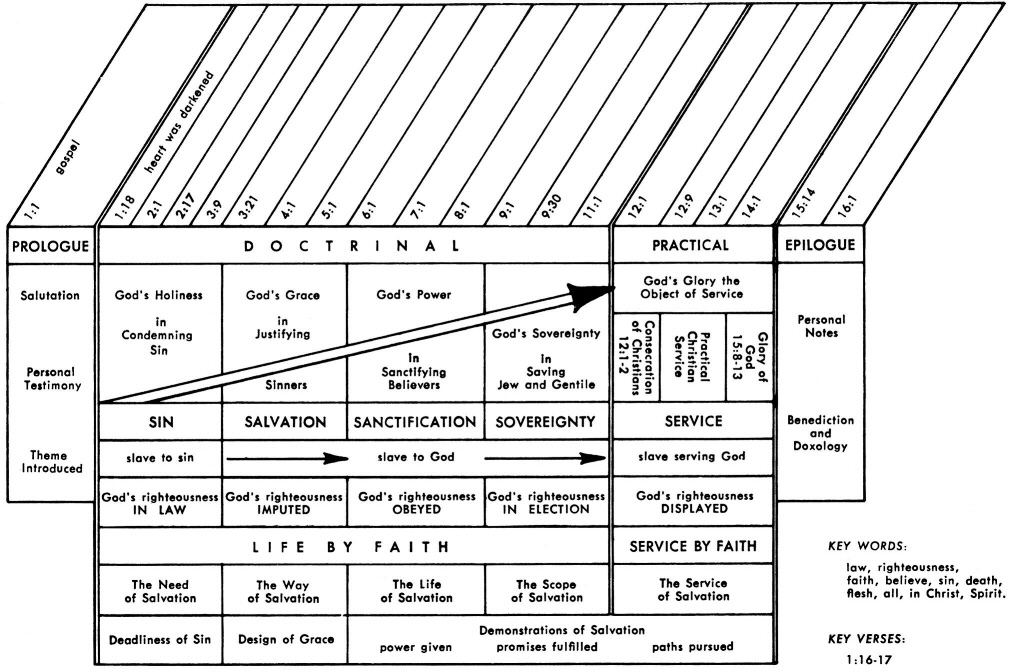
Click chart to enlarge
Chart from recommended resource Jensen's Survey of the NT - used by permission
Romans Overview Chart - Charles Swindoll
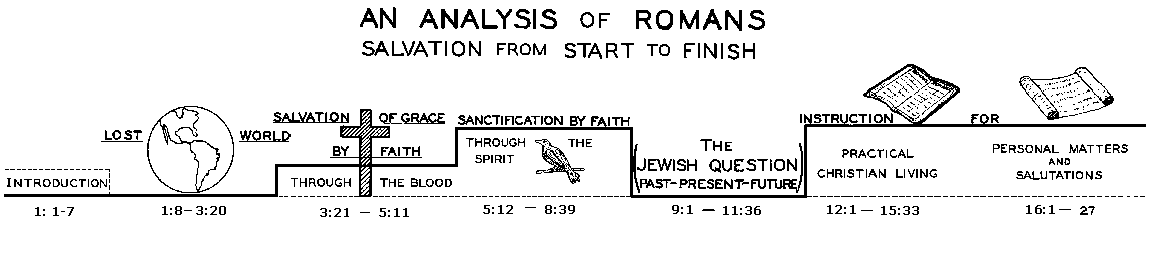
Source: Dr David Cooper
Click to Enlarge
| ROMANS ROAD to RIGHTEOUSNESS |
||||
| Romans 1:18-3:20 | Romans 3:21-5:21 | Romans 6:1-8:39 | Romans 9:1-11:36 | Romans 12:1-16:27 |
| SIN | SALVATION | SANCTIFICATION | SOVEREIGNTY | SERVICE |
| NEED FOR SALVATION |
WAY OF SALVATION |
LIFE OF SALVATION |
SCOPE OF SALVATION |
SERVICE OF SALVATION |
| God's Holiness In Condemning Sin |
God's Grace In Justifying Sinners |
God's Power In Sanctifying Believers |
God's Sovereignty In Saving Jew and Gentile |
Gods Glory The Object of Service |
| Deadliness of Sin |
Design of Grace |
Demonstration of Salvation | ||
| Power Given | Promises Fulfilled | Paths Pursued | ||
| Righteousness Needed |
Righteousness Credited |
Righteousness Demonstrated |
Righteousness Restored to Israel |
Righteousness Applied |
| God's Righteousness IN LAW |
God's Righteousness IMPUTED |
God's Righteousness OBEYED |
God's Righteousness IN ELECTION |
God's Righteousness DISPLAYED |
| Slaves to Sin | Slaves to God | Slaves Serving God | ||
| Doctrine | Duty | |||
| Life by Faith | Service by Faith | |||
|
Modified from Irving L. Jensen's chart above |
||||
R Ruin (Romans 1:17 – 3:20) – The utter sinfulness of humanity
O Offer (Romans 3:21-31) – God’s offer of justification by grace
M Model (Romans 4:1-25) – Abraham as a model for saving faith
A Access (Romans 5:1-11) – The benefits of justification
N New Adam (Romans 5:12-21) – We are children of two “Adams”
S Struggle w/ Sin (Romans 6:1-8:39) Struggle, sanctification, and victory
Romans 8:37 But in all these things we overwhelmingly conquer through Him who loved us. (NASB: Lockman)
Greek: all' en toutois pasin hupernikomen (1PPAI) dia tou agapesantos (AAPMSG) hemas.
Amplified: Yet amid all these things we are more than conquerors and gain a surpassing victory through Him Who loved us. (Amplified Bible - Lockman)
ICB: But in all these things we have full victory through God who showed His love for us. (ICB: Nelson)
KJV: Nay, in all these things we are more than conquerors through him that loved us.
NLT: No, despite all these things, overwhelming victory is ours through Christ, who loved us. (NLT - Tyndale House)
Phillips: No, in all these things we win an overwhelming victory through him who has proved his love for us. (Phillips: Touchstone)
Wuest: But in these things, all of them, we are coming off constantly with more than the victory through the One who loved us.
Young's Literal: But in all these things we overwhelmingly conquer through Him who loved us.
BUT IN ALL THESE THINGS WE OVERWHELMINGLY CONQUER: all en toutois pasin hupernikomen (1PPAI):
- 2Chr 20:25, 26, 27; Isa 25:8; 1Cor 15:54,57; 2Co 2:14; 12:9,19; 1Jn 4:4; 5:4,5; Rev 7:9-12; 12:11; 17:14; 21:7
- Romans 8 Resources - Multiple Sermons and Commentaries
But (KJV = "nay") (235) (alla) marks contrast or opposition. Paul is introducing something contrary to all that might have been expected. See discussion of importance of pausing to ponder this term of contrast.
In all these things - Paul is not overlooking one thing! Note carefully in the midst of the tribulation, in the midst of the distress, etc (Ro 8:35, 36-see notes Ro 8:35; 36), the following is still true.
Denney comments that Paul has just mentioned a list of trials and a descriptive summation of them from Psalm 44:22 and now is saying "these trials no only do not cut us off from Christ's love, they actually give us more intimate and thrilling experiences of it. (Romans 8 - The Expositor's Greek Testament)
Hodge - In these verses the apostle’s confidence is expressed in the strongest language. He heaps words together to show the absolute inability of all created things, separately or together, to frustrate the purpose of God or to turn away his love from those whom he has determined to save. (Romans 8 - Hodge's Commentary on Romans)
Newell exclaims "What a wonderful book this Word of God is! "Sheep for slaughter" naming themselves more than conquerors!"
Haldane - The sufferings of believers above enumerated, which, as the Apostle had just shown, verify the truth of the ancient predictions of the word of God, shall not separate them from the love of Christ, but, on the contrary, are to them the sources of the greatest benefits. In the Apostle Peter we see the weakness of all human affection and resolutions ("Even if I have to die with You, I will not deny You." All the disciples said the same thing too. - Mt 26:35). All the glory, then, of this victory which we obtain is to be ascribed solely to God; for it is He who is at our right hand, and who supports us in all our afflictions. In the seventeenth chapter of the Book of Revelation, the Lamb, who is Jesus Christ, is represented as combating against the enemies of His Church (Re 17:14). He is our shield, our rock, and our refuge. It is declared that we are “kept (as in a garrison) by the power of God,” 1Pe 1:5 (see notes), in order that we may not presume on our own strength, or attribute to ourselves the glory of our preservation; but that we may keep our eyes fixed upon Him who, with His outstretched arm, conducts us to the heavenly Canaan. (Haldane, R. An Exposition on the Epistle to the Romans)
Spurgeon takes us back to the previous verses in the opening remarks of his sermon on Romans 8:37…
Look attentively at the champion. It needs no stretch of imagination to conceive this place to be a Roman amphitheatre. There in the midst of the arena stands the hero. The great doors of the lion’s dens are lifted up by machinery, and as soon as the lairs are open, rushing forth with fury come bears and lions, and wild beasts of all kinds, that have been starved into ferocity, with which the champion is to contend. Such was the Christian in Paul’s day, such is he now. The world is the theater of conflict: angels and devils look on; a great cloud of witnesses view the fight-and monsters are let loose against him, with whom he must contend triumphantly.
The apostle gives us a little summary of the evils with which we must fight, and he places first, “tribulation.”
The word “tribulation,” in the Latin, signifies threshing, and God’s people are often cast upon the threshing-floor to be beaten with the heavy flail of trouble; but they are more than conquerors, since they lose nothing but their straw and chaff, and the pure wheat is thus separated from that which was of no benefit to it. The original Greek word, however, suggests pressure from without. It is used in the case of persons who are bearing heavy burdens, and are heavily pressed upon. Now, believers have had to contend with outward circumstances more or less in all ages. At the present day, there are very few who do not at some time or other in their lives meet with outward pressure, either from sickness or from loss of goods, or from bereavements, or from some other of the thousand and one causes from which affliction springs. The Christian has not a smooth pathway. “In the world, ye shall have tribulation,” is a sure promise, which never fails of fulfillment. But under all burdens, true believers have been sustained, no afflictions have ever been able to destroy their confidence in God. It is said of the palm-tree, that the more weights they hang upon it the more straight and the more lofty doth it tower towards heaven; and it is so with the Christian. Like Job, he is never so glorious as when he has passed through the loss of all things, and at last rises from his dunghill more mighty than a king. Brethren, you must expect to meet with this adversary so long as you are here; and if you now suffer the pressure of affliction, remember you must overcome it, and not yield to it. Cry unto the strong for strength, that your tribulation may work out for you patience, and patience experience, and experience hope that maketh not ashamed.
The next in the list is “distress.” I find that the Greek word rather refers to mental grief than to anything external. The Christian suffers from external circumstances; but this is probably a less affliction than internal woe. “Straitness of place” is something like the Greek word. We sometimes get into a position in which we feel as if we could not move, and are not able to turn to the right hand or to the left: the way is shut up; we see no deliverance, and our own consciousness of feebleness and perplexity is unbearably terrible. Do you never get into this state in which your mind is distracted, you know not what to do; you cannot calm and steady yourself; you would if you could consider calmly the conflict, and then enter into it like a man with all his wits about him; but the devil and the world, outward trial and inward despondency combined, toss you to and fro like the waves of the sea, till you are, to use John Bunyan’s Saxon expression, “much tumbled up and down in your mind.” Well, now, if you are a genuine Christian, you will come out of this all right enough. You will be more than a conqueror over mental distress. You will take this burden as well as every other to your Lord, and cast it upon him; and the Holy Ghost, whose office it is to be the Comforter, will say to the troubled waves of your heart, “Be still.” Jesus shall say, as he walks the tempest of your soul, “It is I, be not afraid;” and though the outward tribulation and the inward distress meet together like two contending seas, they shall both be calmed by the power of the Lord Jesus.
The third evil the apostle mentions is “persecution,” which has always fallen upon the genuine lovers of Christ; their good name has been slandered. I should blush to repeat the villanies which have been uttered against the saints of the olden times. Suffice it to say, there is no crime in the category of vice which has not been falsely laid to the door of the followers of the pure and holy Jesus. Yet slander did not crush the church; the fair name of Christianity outlived the reputation of the men who had the effrontery to accuse her. Imprisonment followed slander, but in prisons God’s saints have sung like birds in cages, better than when they were in the fields of open liberty. Prisons have glowed into palaces, and been sanctified into the dwelling places of God himself, more sacred far than all the consecrated domes of gorgeous architecture. Persecution has sometimes taken to banishing the saints, but in their banishment they have been at home, and when scattered far and wide, they have gone everywhere preaching the word, and their scattering has been the gathering together of others of the elect. When persecution has even resorted to the most cruel torments, God has had many a sweet song from the rack. The joyful notes of holy Lawrence, broiling upon the gridiron, must have been more sweet to God than the songs of cherubims and seraphims, for he loved God more than the brightest of them, and proved it in his bitterest anguish; and holy Mr. Hawkes, when his lower extremities were burnt, and they expected to see him fall over the chain into the fire, lifted his flaming hands, each finger spurting fire, and clapped them three times, with the shout of “None but Christ, none but Christ!” God was honored more by that burning man than even by the ten thousand times ten thousand who ceaselessly hymn his praises in glory. Persecution, in all its forms, has fallen upon the Christian church, and up to this moment it has never achieved a triumph, but it has been an essential benefit to the church, for it cleared her of hypocrisy; when cast into the fire the pure gold lost nothing but its dross and tin, which it might well be glad to lose.
Then the apostle adds “famine.” We are not exposed to this evil so much nowadays; but, in Paul’s time, those who were banished, frequently were carried to places where they could not exercise their handicraft to earn their bread. They were taken away from their situations, from their friends, from their acquaintance; they suffered the loss of all their goods, and consequently they did not know where to find even the necessary sustenance for their bodies; and no doubt there are some now who are great losers by their conscientious convictions-who are called to suffer, in a measure, even famine itself. Then, the devil whispers, “You ought to look after your house and children; you must not follow your religion so as to lose your bread.” Ah! my friend, we shall then see whether you have the faith that can conquer famine; that can look gaunt hunger in the face; look through the ribs of the skeleton, and yet say, “Ah! famine itself I will bear sooner than sell my conscience, and stain my love to Christ.”
Then comes nakedness, another terrible form of poverty. The Christian banished from house to house, and prevented from working at his trade, was not able to procure necessary funds, and therefore his garments gradually fell to rags, and the rags one by one disappeared. At other times the persecutors stripped men and women naked, to make them yield to shame; but nakedness, even in the case of the most tender and sensitive spirits, though such have been exposed to this evil in the olden days, has been unable to daunt the unconquerable spirit of the saints. There are stories in the old martyrologies of men and women who have had to suffer this indignity; and it is reported by those who looked on, that they never seemed to be so gloriously arrayed; for when they were stood naked before the whole bestial throng, that they might gaze upon them with their cruel eyes, their very bodies seemed to glow with glory, as with calm countenance they surveyed their enemies, and gave themselves up to die.
The apostle mentions next to nakedness, peril-that is, constant exposure to sudden death. This was the life of the early Christian. “We die daily,” said the apostle. They were never sure of a moment’s mercy, for a new edict might come forth from the Roman emperor to sweep the Christians away. They went literally with their lives in their hands wherever they went. Some of their perils were voluntarily encountered for the spread of the gospel; perils by rivers and by robbers were the lot of the Christian missionary going through inhospitable climes to declare the gospel. Other perils were the result of persecution; but we are told here that believers in Jesus so steadily reposed upon Christ’s love, that they did not feel peril to be peril; and the love of Christ so lifted them up above the ordinary thoughts of flesh and blood, so that even when perils became perils indeed, they entered upon them with joy, out of love to their Lord and Master.
And to close the list, as if there were a sort of perfection in these evils, the seventh thing is the sword, that is to say, the apostle Paul singles out one cruel form of death as a picture of the whole. Ye know, and I need not tell you, how the noble army of my Master’s martyrs have given their necks to the sword, as cheerfully as the bride upon the marriage day gives her hand to the bridegroom. Ye know how they have gone to the stake and kissed the fagots; how they have sung on the way to death, though death was attended with the most cruel torments; and have rejoiced with exceeding great joy, even to leaping and dancing at the thought of being counted worthy to suffer for Christ’s sake. The apostle tells us that the saints have suffered all these things put together. He does not say in some of these things we are conquerors, but in all; many believers literally passed through outward want, inward trial, persecution, want of bread, want of raiment, the constant hazard of life, and at last laid down life itself; and yet in every case through the whole list of these gloomy fights, believers were more than conquerors. Beloved, this day you are not, the most of you, called to peril, or nakedness, or sword: if ye were, my Lord would give you grace to bear the test; but I think the troubles of a Christian man, at the present moment, though not outwardly so terrible, are yet more hard to bear than even those of the fiery age. We have to bear the sneer of the world-that is little; its blandishments, its soft words, its oily speeches, its fawning, its hypocrisy, are far worse. O sirs, your danger is lest you grow rich and become proud, lest you give yourselves up to the fashions of this present evil world, and lose your faith. If you cannot be torn in pieces by the roaring lion, you may be hugged to death by the bear, and the devil little cares which it is so long as he gets your love to Christ out of you, and destroys your confidence in him. I fear me that the Christian church is far more likely to lose her integrity in these soft and silken days than she was in those rough times. Are there not many professing Christians whose methods of trade are just as vicious as the methods of trade of the most shifty and tricky of the unconverted? Have we not some professed Christians who are worldly altogether? whose non-attendance at our meetings for prayer, whose want of liberality to Christ’s cause, whose entire conduct indeed proves that if there be any grace in them at all, it is not the grace which conquers the world, but the pretended grace which lets the world put its foot upon its neck. We must be awake now; for we traverse the enchanted ground, and are more likely to be ruined than ever, unless our faith in Jesus be a reality, and our love to Jesus a vehement flame. We are likely to become bastards and not sons, tares and not wheat, hypocrites with fair vineyards, but not the true living children of the living God. Christians, do not think that these are times in which you can dispense with watchfulness or with holy ardor; you need these things more now than ever, and may God the eternal Spirit display his omnipotence in you, that you may be able to say, in all these softer things as well as in the rougher, “We are more than conquerors through him that loved us.” (Romans 8:37 More Than Conquerors Pdf)
Overwhelmingly conquer (5245) (hupernikao from hupér = above, degree which is beyond that of a compared scale of extent = more than, to a greater degree than, beyond + nikáo = to conquer, overcome, carry off the victory, come off victorious) means to come off more than victorious or to gain a surpassing victory and present tense signifies continually.
It describes one who is super-victorious, who wins more than an ordinary victory, and who is overpowering in achieving abundant victory. It describes a lopsided victory in which the enemy or opponent is completely routed. This is not the language of conceit, but of confidence in Christ. Christ’s love conquered death, and because of His love, we are can be more than conquerors through Him.
Vincent says the idea is…
A victory which is more than a victory.
Meyer says the idea is…
A holy arrogance of victory in the might of Christ.
W. B. J. Martin said that…
Hate can make a man a conqueror, can fill him with furious energy, but only love can make him more-than-conqueror
Bauer affirms that the verb hypernikao used here is a heightened form of "conquer" and suggests the translation "We are winning a most glorious victory." Is is also rendered "We win the supreme victory through him who loved us."
William Newell explains more than conquerors…
(a) It is to come off conqueror in every difficulty,
(b) It is to know that Divine, and therefore infinite, power has been engaged for us in the conflict,
(c) It is the absolute confidence that this infinite and therefore limitless Divine help is granted to us against any possible future emergency,
(d) It is to "divide the spoil" over any foe, after victory! (Isa 53:12.)
Robert Haldane writes that more than conquerors…
This is a strong expression, but in its fullest import it is strictly true. The Christian not only overcomes in the worst of his trials, but more than overcomes his adversaries, and all those things which seem to be against him. It is possible to overcome, and yet obtain no advantage from The contest, nay, to find the victory a loss. But the Christian not only vanquishes, he is also a gainer by the assault of his enemy. It is better for him than if he had not been called to suffer. He is a gainer and a conqueror, both in the immediate fruits of his sufferings, as God overrules them for his good, bringing him forth from the furnace as gold refined, and also in their final issue; for “our light affliction, which is but for a moment, worketh for us a far more exceeding and eternal weight of glory.”
The term conquerors reminds us that the life of a believer is a warfare, in which he is called to combat, both within and without.
We may remark, too, the difference between the judgment of God, and the judgment of men, respecting the victory of believers. In the world, persecutors and oppressors are judged as the conquerors; but here, those are pronounced to be such, who are oppressed and persecuted. They are the servants of Him whom the world put to death, but who said to His disciples, “Be of good cheer, I have overcome the world.” (Haldane, R. An Exposition on the Epistle to the Roman)
Pastor Ray Stedman explains more than a conqueror this way writing that…
If we barely manage to win our way to heaven by the skin of our teeth, we could be said to be a conqueror, but a "more than conqueror" is someone who takes the worst that life can throw at him and uses that to become victorious. "More than conqueror" is one who, by the grace and the gift of God, and in the strength of God within him, actually takes the very things that are designed to destroy him, and they become stepping stones instead of stumbling blocks. That is being "more than conquerors."
Stedman gives the following Illustration of more that a conqueror…
Just this week, I finished reading an amazing book written by Ernest Gordon, the dean of the Chapel at Princeton University. He tells of his own experience as a British officer in the Japanese prison camp by the River Kwai in Thailand. This camp was made famous by the movie, The Bridge over the River Kwai. He was one of the prisoners that built that bridge, and he tells about that camp, and about their indescribable starvation diet which made them nothing but walking skeletons, yet they were driven out each day to do heavy labor on the bridge. Thousands of them died as cholera, and other diseases, swept through the camp. The morale of the camp plummeted to the bottom -- there was nothing left. It was a hopeless, hideous situation in which men lived in filth and squalor, and walked about as the living dead. He tells how he himself descended, through disease and weakness, to a place where his body was taken and laid away in the death house, among all the corpses. Though he was still alive, he was laid there to die. In that camp, there were one or two people who, though they were not what we would call Evangelical Christians, nevertheless, entertained a deep faith in God. One or two men began quietly, in the midst of the darkest hour of the camp, to exercise a little faith and a little love, and to do things for one another. Gradually this spirit spread, and soon others became involved. They organized a massage team to go around and massage one another's legs to try to restore health to these members that had ceased working. Gradually this spirit transformed the camp, and faith and joy and hope sprang into being again. They organized an orchestra, made their own instruments, and finally had a 40-piece orchestra. They organized a church. They began Bible study classes, and a man who had been a skeptic all his life was the teacher. As he taught the Bible, he began to see something of the reality of these things. The story goes on to tell how this whole camp was transformed, and though the outward circumstances were unchanged, the Japanese were as hostile and as cruel as ever, the work was as heavy and the disease was rampant, yet the spirit of those men was literally transformed and they became joyous, happy, victorious individuals -- many of them. The whole camp became entirely different. He told how, when at last they returned to civilization, they looked forward to coming home -- to a place where they would experience again the joys of life. But, when they got home, they discovered that civilization is an illusion -- that the realities of life were discovered back in the prison camp. It was when they were down in the darkest, and the deepest, and the lowest depths of their lives that they began to lay hold of the eternal verities that strengthen a man's soul. They became, by faith, "more than conquerors." This is the message of this chapter, isn't it? The eternal verities are not doubt and fear and death, but life and hope and love. (To read full sermon click Prayer, Providence, Praise)
Spurgeon asks and answers how Christians are more than conquerors…
The word in the original is one of the apostle Paul’s strong expressions; it might be rendered, “more exceeding conquerors.” The Vulgate, I think, has a word in it which means, “over over-comers,” over and above conquering.
For a Christian to be a conqueror is a great thing: how can he be more than a conqueror?
I think in many respects, first, a Christian is better than some conquerors because the power by which he overcomes is nobler far. Here is a champion just come from the Greek games; he has well nigh killed his adversary in a severe boxing match, and he comes in to receive the crown. Step up to him, look at that arm, and observe the thews and sinews. Why! the man’s muscles are like steel, and you say to him, “I do not wonder that you beat and bruised your foe; if I had set up a machine made of steel, and worked by a little watery vapor, it could have done the same, though nothing but mere matter would have been at work. You are a stronger man and more vigorous in constitution than your foe: that is clear; but where is the particular glory about that? One machine is stronger than another. No doubt, credit is to be given to you for your endurance, after a sort; but you are just one big brute beating another big brute. Dogs, and bulls, and game-cocks, and all kinds of animals, would have endured as much, and perhaps more.
Now, see the Christian champion coming from the fight, having won the victory! Look at him! He has overcome human wisdom; but when I look at him, I perceive no learning nor cunning: he is a simple, unlettered person, who just knows that Jesus Christ came into the world to save sinners; yet he has won the victory over profound philosophers: then he is more than a conqueror. He has been tempted and tried in all sorts of ways, and he was not at all a crafty person; he was very weak, yet somehow he has conquered. Now this is being more than a conqueror, when weakness overcomes strength, when brute force is baffled by gentleness and love. This is victory indeed, when the little things overcome the great things; when the base things of this world overthrow the mighty; and the things that are not bring to nought the things that are: yet this is just the triumph of grace. The Christian is, viewed according to the eye of sense, weak as water; yet faith knows him to be irresistible. According to the eye of sense, he is a thing to be trampled upon, for he will not resist; and yet, in the sight of God, he becomes in this very way, by his gentleness and patience, more than a conqueror.
The Christian is more than a conqueror again, because the conqueror fights for victory-fights with some selfish motive. Even if the motive be patriotism, although from another point of view, patriotism is one of the highest of worldly virtues, yet it is only a magnificent selfishness by which one contends for one’s own country, instead of being subject to the far more generous cosmopolite thought of caring for all men. But the Christian fights neither for any set of men nor for himself: in contending for truth he contends for all men, but especially for God; and in suffering for the right he suffers with no prospect of earthly gain. He becomes more than a conqueror, both by the strength with which he fights and the motives by which he is sustained, which are better than the motives and the strength which sustain other conquerors.
He is more than a conqueror, because he loses nothing even by the fight itself. When a battle is won, at any rate the winning side loses something. In most wars, the gain seldom makes any recompense for the effusion of blood; but the Christian’s faith, when tried, grows stronger; his patience, when tempted, becomes more patient. His graces are like the fabled Anteus, who, when thrown to the ground, sprang up stronger than before, by touching his mother earth; for the Christian, by touching his God and falling down in helplessness into the arms of the Most High, grows stronger by all that he is made to suffer. He is more than a conqueror, because he loses nothing even by the fight, and gains wondrously by the victory.
He is more than a conqueror over persecution, because most conquerors have to struggle and agonize to win the conquest. But, my brethren, many Christians, ay, and all Christians, when their faith in Christ is strong, and their love to Christ is fervent, have found it even easy to overcome suffering for the Lord. Look at Blandina, enveloped in a net, tossed upon the horns of bulls, and then made to sit in a red hot iron chair to die, and yet unconquered to the close. What did the tormentors say to the emperor- “Oh! emperor,” said the tormentors, “we are ashamed, for these Christians mock us while they suffer thy cruelties.” Indeed, the tormentors often seemed to be themselves tormented; they were worried to think they could not conquer timid women and children. They devoured their own hearts with rage; like the viper, which gnaws at the file, they broke their teeth against the iron strength of Christian faith; they could not endure it, because these people suffered without repining, endured without retracting, and glorified Christ in the fires without complaining. I love to think of Christ’s army of martyrs, ay, and of all his church, marching over the battle-field, singing as they fight, never ceasing the song, never suffering a note to fall, and at the same time advancing from victory to victory; chanting the sacred hallelujah while they tramp over their foes. I saw one day upon the lake of Orta, in northern Italy, on some holy-day of the church of Rome, a number of boats coming from all quarters of the lake towards the church upon the central islet of the lake, and it was singularly beautiful to hear the splash of the oars and the sound of song as the boats came up in long processions, with all the villagers in them, bearing their banners, to the appointed place of meeting. As the oars splashed they kept time to the rowers, and the rowers never missed a stroke because they sang, neither was the song marred because of the splash of the oars, but on they came, singing and rowing: and so has it been with the church of God. That oar of obedience, and that other oar of suffering-the church has learned to ply both of these, and to sing as she rows: “Thanks be unto God, who always maketh us to triumph in every place!” Though we be made to suffer, and be made to fight, yet we are more than conquerors, because we are conquerors even while fighting; we sing even in the heat of the battle, waving high the banner, and dividing the spoil even in the center of the fray. When the fight is hottest, we are then there most happy; and when the strife is sternest, then most blessed; and when the battle grows most arduous, then, “calm ’mid the bewildering cry, confident of victory.” Thus the saints have been in those respects more than conquerors.
More than conquerors I hope, this day, because they have conquered their enemies by doing them good, converting their persecutors by their patience. To use the old Protestant motto, the church has been the anvil, and the world has been the hammer; and though the anvil has done nothing but bear the stroke, she has broken all the hammers, as she will do to the world’s end. All true believers who really trust in Jesus’ love, and are really fired with it, will be far more glorious than the Roman conqueror when he drove his milk white steeds through the imperial city’s streets; then the young men and maidens, matrons and old men gathered to the windows and chimney-tops, and scattered flowers upon the conquering legions as they came along; but what is this compared with the triumph which is going on even now as the great host of God’s elect come streaming through the streets of the New Jerusalem? What flowers are they which angels strew in the path of the blessed? What songs are those which rise from yonder halls of Zion, conjubilant with song as the saints pass along to their everlasting habitations?
And they who, with their Leader,
Have conquered in the fight,
For ever and for ever,
Are clad in robes of white.
THROUGH HIM WHO LOVED US: dia tou agaphesantos (AAPMSG) hemas:
- Gal 2:20; Eph 5:2,25, 26, 27; 2Th 2:16; 1 Jn 4:10,19; Jude 1:24; Re 1:5
- Romans 8 Resources - Multiple Sermons and Commentaries
The previous chapters (especially Romans 5:11-21) describe the super abounding grace through Christ. Those who overwhelmingly conquer are supremely victorious in overcoming everyone and everything that threatens their relationship to Jesus Christ. However their ability to triumph over all things does not arise from any inherent superiority on their part. Such a super abounding victory is only possible through Him. Believers triumph entirely through His power, the power of Him Who loved us so much that He gave His life for us that we might have life in Him… life abundant and overcoming.
Through Him - Through Jesus. Spurgeon comments "Jesus is the representative man for his people. The head has triumphed, and the members share in the victory. While a man’s head is above the water you cannot drown his body.
Through (1223) (dia) is a preposition denoting instrumentality, the means by which something is accomplished. The "instrument" by which sinners overwhelmingly conquer is Jesus Christ our Lord.
Below is a selection of Scriptures that relate to this great truth of through Him…
Consider the following simple study - observe and record the wonderful truths that accrue through Him - this would make an edifying, easy to prepare Sunday School lesson - then take some time to give thanks for these great truths by offering up a sacrifice of praise… through Him.
Jn 1:3 [NIV reads "through Him"], Jn 1:7, John 1:10, Jn 3:17, Jn 14:6, Acts 2:22, 3:16, Acts 7:25, Acts 10:43, Acts 13:38, 39, Ro 5:9 [note], Ro 8:37 [note], Ro 11:36 [note]; 1Co 8:6, Ep 2:18 [note], Php 4:13 [note], Col 1:20 [note], Col 2:15 [note], Col 3:17 [note], Heb 7:25 [note], Heb 13:15 [note], 1Pe 1:21[note], 1John 4:9
Would you like more study on the wonderful topic of through Him? Study also the NT uses of the parallel phrase through Jesus (or similar phrases - "through Whom", "through our Lord", etc) - John 1:17, Acts 10:36, Ro 1:4, 5; Ro 1:8, Ro 2:16, Ro 5:1; Ro 5:2 Ro 5:11, Ro 5:21, Ro 7:25, Ro 16:27, 1Cor 15:57, 2Cor 1:5, 3:4, 5:18, Gal 1:1, Eph 1:5, Php 1:11, 1Th 5:9; Titus 3:6, He 1:2; He 2:10, Heb 13:21, 1Pe 2:5, 1Pe 4:11, Jude 1:25)
All things are from Him, through Him and to Him. To Him be the glory forever. Amen.
Who loved us - Note the tense points to the past, which directs our attention to His love expressed on the Cross, the great demonstration of His love.
Loved (verb) (25) (agapao see related study of noun agape) means to love unconditionally and sacrificially as God Himself loves sinful men (John 3:16), the way He loves the Son (John 3:35, 15:9, 17:23, 24).
Agapao - 143x in 110v -
Matt 5:43f, 46; 6:24; 19:19; 22:37, 39; Mark 10:21; 12:30f, 33; Luke 6:27, 32, 35; 7:5, 42, 47; 10:27; 11:43; 16:13; John 3:16, 19, 35; 8:42; 10:17; 11:5; 12:43; 13:1, 23, 34; 14:15, 21, 23f, 28, 31; 15:9, 12, 17; 17:23f, 26; 19:26; 21:7, 15f, 20; Rom 8:28, 37; 9:13, 25; 13:8f; 1 Cor 2:9; 8:3; 2 Cor 9:7; 11:11; 12:15; Gal 2:20; 5:14; Eph 1:6; 2:4; 5:2, 25, 28, 33; 6:24; Col 3:12, 19; 1 Thess 1:4; 4:9; 2 Thess 2:13, 16; 2 Tim 4:8, 10; Heb 1:9; 12:6; Jas 1:12; 2:5, 8; 1 Pet 1:8, 22; 2:17; 3:10; 2 Pet 2:15; 1 John 2:10, 15; 3:10f, 14, 18, 23; 4:7f, 10ff, 19ff; 5:1f; 2 John 1:1, 5; 3 John 1:1; Jude 1:1; Rev 1:5; 3:9; 12:11; 20:9
Note that agapao is a verb and by its verbal nature calls for action. This quality of love is not an emotion but is an action initiated by a volitional choice.
Wuest writes that
Agapao speaks of a love which is awakened by a sense of value in an object which causes one to prize it. It springs from an apprehension of the preciousness of an object. It is a love of esteem and approbation. The quality of this love is determined by the character of the one who loves, and that of the object loved. (Wuest, K. S. Wuest's Word Studies from the Greek New Testament: Eerdmans)
William Newell comments on this phrase writing that
It is this past tense gospel the devil hates … Let a preacher be continually saying, ‘God loves you, Christ loves you,’ and he and his congregation will by and by be losing sight of both their sinner hood and of the substitutionary atonement of the cross, where the love of God and of Christ was once for all and supremely set forth." (Romans 8: Expository Notes Verse by Verse)
Paul associates Christ's love for us with His death on the Cross in Ephesians, exhorting the saints to…
walk in love, just as Christ also loved you, and gave Himself up for (huper - speaks of His substitutionary death in our place) us, an offering and a sacrifice to God as a fragrant aroma. (Ep 5:2)
Compare Paul's command in Ephesians 5…
Husbands, love your wives, just as Christ also loved the church and gave Himself up for her (Epp 5:25)
And in Galatians Paul associates Christ's love with Calvary's love declaring…
I have been crucified with Christ; and it is no longer I who live, but Christ lives in me; and the life which I now live in the flesh I live by faith in the Son of God, Who loved me, and delivered Himself up for me. (Gal 2:20)
In the Revelation John writes "To Him who loves us, and released us from our sins by His blood (Rev 1:5)
Because our Lord both saves and keeps us, we do much more than simply endure and survive the ominous circumstances Paul mentions in Ro 8:35.
First of all, we overwhelmingly conquer by coming out of troubles stronger than when they first threatened us. Paul has just declared that, by His divine grace and power, God causes everything, including the very worst things, to work for the good of His children (Ro 8:28). Even when we suffer because of our own sinfulness or unfaithfulness, our gracious Lord will bring us through with a deeper understanding of our own unrighteousness and of His perfect righteousness, of our own faithlessness and of His steadfast faithfulness, of our own weakness and of His great power.
Second, we overwhelmingly conquer because our ultimate reward will far surpass whatever earthly and temporal loss we may suffer. (Ro 8:17,18) With Paul, we should view even the most terrible circumstance as but “momentary, light affliction” that produces “for us an eternal weight of glory far beyond all comparison” (2Cor 4:17).
From the human perspective, of course, the over-conquest God promises often seems a long time in coming. But when, as true believers, we go through times of testing, whatever their nature or cause, we come out spiritually refined by our Lord. Instead of those things separating us from Christ, they will bring us closer to Him. His grace and glory will rest on us and we will grow in our understanding of His will and of the sufficiency of His grace. While we wait for Him to bring us through the trials, we know that He says to us what He said to Paul in (2Cor 12:9).
Jesus is the representative man for His people. The Head has triumphed, and the members share in the victory. While a man's head is above the water you cannot drown his body.
Thomas Watson (in "A Divine Cordial", 1663) writes…
Temptations work for good—as they engage the strength of Christ. Christ is our Friend, and when we are tempted, He sets all His power working for us. "Since he himself has gone through suffering and temptation, he is able to help us when we are being tempted" (Heb. 2:18). If a poor soul was to fight alone with the Goliath of hell, he would be sure to be vanquished—but Jesus Christ brings in His auxiliary forces, He gives fresh supplies of grace. "We are more than conquerors through him who loved us!" (Romans 8:37). Thus the evil of temptation is overruled for good. (The WORST things)
C H Spurgeon (Morning and Evening) has the following practical thoughts on Romans 8:37…
Nay, in all these things we are more than conquerors through him that loved us. - We go to Christ for forgiveness, and then too often look to the law for power to fight our sins. Paul thus rebukes us,
"O foolish Galatians, who hath bewitched you, that ye should not obey the truth? This only would I learn of you, Received ye the Spirit by the works of the law, or by the hearing of faith? are ye so foolish? having begun in the Spirit, are ye now made perfect by the flesh?"
Take your sins to Christ's cross, for the Old Man (see note) can only be crucified there: we are crucified with Him. The only weapon to fight sin with is the spear which pierced the side of Jesus.
To give an illustration-you want to overcome an angry temper, how do you go to work? It is very possible you have never tried the right way of going to Jesus with it. How did I get salvation? I came to Jesus just as I was, and I trusted him to save me. I must kill my angry temper in the same way? It is the only way in which I can ever kill it. I must go to the cross with it, and say to Jesus, "Lord, I trust thee to deliver me from it." This is the only way to give it a death-blow. Are you covetous? Do you feel the world entangle you?
You may struggle against this evil so long as you please, but if it be your besetting sin, you will never be delivered from it in any way but by the blood of Jesus. Take it to Christ. Tell him,
"Lord, I have trusted thee, and thy name is Jesus, for thou dost save thy people from their sins; Lord, this is one of my sins; save me from it!"
Ordinances are nothing without Christ as a means of mortification. Your prayers, and your repentances, and your tears-the whole of them put together-are worth nothing apart from him. "None but Jesus can do helpless sinners good;" or helpless saints either. You must be conquerors through him who hath loved you, if conquerors at all. Our laurels must grow among his olives in Gethsemane.
Spurgeon wrote…
The diamonds of divine promises glisten brightly when placed in the setting of personal trials. I thank God that I have undergone fearful depression. I know the borders of despair and the horrible brink of that dark gulf into which my feet have almost gone. Because of this, I have been able to help brothers and sisters in the same condition. I believe that the Christian’s darkest and most dreadful experiences will lead them to follow Christ and become fishers of men (Mark 1:17). Keep close to your Lord and He will make every step a blessing.
The Holy Scripture is full of narratives of trials. Your life will be as garnished with trials, like a rose is with thorns, but provision is made in the Word for Satan’s assaults. Confidently believe that Scripture’s wise plan is not in vain. You will have to battle the same spiritual foes that assailed and buffeted saints in days past, but spiritual armor will be your safeguard in times of attack (Eph. 6:11).
As the Spirit sanctifies us in spirit, soul, and body, we become more like the Master. We are conformed to Him not only in holiness and spirituality, but also in our experience of conflict, sorrow, agony, and triumph. Jesus was in all points tempted as we are, yet without sin (Heb. 4:15). Now we are to be made like Him. The Savior’s public life begins and ends with trials. It commences in the wilderness in a contest with Satan (Matt. 4:1), and it ends in Gethsemane in a dreadful battle with the powers of darkness (John 17:1ff). The gloom of the desert deepens into the midnight darkness of the cross to show that we also must begin and end our lives with trials.
If the Lord’s victory was won on Golgotha in blood and wounds, surely our crown will not be won without wrestling and overcoming. We must fight if we would reign, and through the same conflicts that brought the Savior His crown, we will obtain the palm-branch of everlasting victory (Rev. 7:9).
G Campbell Morgan comments that…
To conquer is to subdue; that is, to master, to overcome, in the sense of defeating as attack. To conquer tribulation would be to put an end to it; to conquer anguish would be to replace it by goy; to conquer persecution would be to turn it into patronage; to conquer famine would be to provide food; to conquer nakedness would be to provide clothing; to conquer peril would be to secure safety; to conquer the sword would be to destroy the sword. In all these things Paul says we are "more than conquerors." This does not mean that, in the senses referred to, we conquer, and more. On the contrary, it may mean that we do not conquer at all, but that we do more, we wrest from defeat values that could never be gained by conquest. Enduring tribulation, we are thereby brought, through patience and proving, to the hope that is not put to shame. Experiencing anguish, we are having fellowship with the suffering which saves. Bearing persecution, we are demonstrating the meaning of true godliness. Suffering hunger, we ,are proving that man does not live by bread alone. In nakedness, we reveal the beauty of spiritual adorning. Living amid perils, we are revealing the power of our Lord. Dying by the sword, we are demonstrating the weakness of the sword. This is more-than-conquering, and it is only possible "through Him that loved us." (Morgan, G. C. Life Applications from Every Chapter of the Bible)
J C Philpot Devotional on Romans 8:37…
"In all these things we are more than conquerors through him that loved us." Romans 8:37
Those who know nothing of their own heart, of their own infirmities, of their own frailties, of their own inward or outward slips and backslidings, know nothing of the secret of super-abounding grace, nothing of the secret of atoning blood, nothing of the secret of the Spirit's inward testimony. They cannot. Only in proportion as we are emptied of self in all its various forms, are we filled out of the fullness of Him who fills all in all.
Now you, perhaps, (I address myself personally to some poor, tempted child of God, that in touching one, I may touch others,) are a poor, tempted creature; and your daily sorrow, your continual trouble is, that you are so soon overcome; that your temper, your lusts, your pride, your worldliness, your carnal, corrupt heart are perpetually getting the mastery. And from this you sometimes draw bitter conclusions. You say, in the depth of your heart, "Can I be a child of God, and be thus? What mark and testimony have I of being in favor with God when I am so easily, so continually overcome?"
Now I want you to look to the end. What is the issue of these defeats? Remember, it is a solemn truth, and one that we learn very slowly--that we must be overcome in order to overcome. There is no setting out with a stock of strength, daily adding to it, weekly increasing it, and then gaining the victory by our own resolutions, our own innate strength. Such sham holiness may come under a gospel garb, may wear a fair appearance; but it only more hides the rottenness of the flesh. Then, remember this--that in order to gain the victory, we must know our weakness; and we can only know our weakness by its being experimentally opened up in our consciences. We cannot learn it from others; we must learn it in our own souls; and that often in a very painful manner. But these painful sensations in a tender conscience lead a man more humbly, more feelingly, more believingly to the Lord of life and glory, to receive out of his fullness. Thus every defeat only leads to and ensures victory at the last. Says the Apostle, "In all these things we are more than conquerors." How? Through our resolutions, through our wisdom? No; "through Him that loved us." There is no other way, then, to overcome, but by the "strength of Jesus made perfect in our weakness." (2Co 12:9-see note) (J. C. Philpot. Daily Words for Zion's Wayfarers)
Octavius Winslow devotional…
"No, in all these things we are more than conquerors through him that loved us." Romans 8:37
The apostle had enumerated certain things which, to the obscure eye of faith, and to the yet obscurer eye of sense, would appear to make against the best interests of the Christian, regarded either as evidences of a waning of Christ's love to him, or as calculated to produce such a result. He proposes an inquiry—"Who shall separate us from the love of Christ?"—and then proceeds to give the reply. That reply sets the question entirely at rest. He argues, that so far from the things which he enumerates shaking the constancy of Christ's love, periling the safety of the Christian, or shading the luster of His renown, they but developed the Savior's affection to him, more strongly confirmed the fact of his security, and entwined fresh and more verdant laurels around his brow. "No, in all these things we are more than conquerors."
"Through Him that loved us." Here is the great secret of our victory, the source of our triumph. Behold the mystery explained, how a weak, timid believer, often starting at his own shadow, is yet "more than a conqueror" over his many and mighty foes. To Christ who loved him, who gave Himself for him, who died in his stead, and lives to intercede on his behalf, the glory of the triumph is ascribed. And this is the song he chants: "Thanks be to God, which gives us the victory, through our Lord Jesus Christ." (1Co 15:57, 58) Through the conquest which He Himself obtained, through the grace which He imparts, through the strength which He inspires, through the intercession which he presents, in all our "tribulation and distress, and persecution, and famine, and nakedness, and peril, and sword," we are "more than conquerors." Accounted though we are as "sheep for the slaughter," (Ro 8:36) yet our great Shepherd, Himself slain for the sheep, guides His flock, and has declared that no one shall pluck them out of His hand. We are more than conquerors, through His grace who loved us, in the very circumstances that threaten to overwhelm. Fear not, then, the darkest cloud, nor the proudest waves, nor the deepest needs—in these very things you shall, through Christ, prove triumphant. Nor shrink from the battle with the "last enemy." (1Co 15:26) Death received a death-wound when Christ died. You face a conquered foe. He stands at your side a crownless king, and waving a broken scepter. Your death shall be another victory over the believer's last foe. Planting your foot of upon His prostrate neck, you shall spring into glory, more than a conqueror through Him that loved you. Thus entering heaven in triumph, you shall go to swell the ranks of the "noble army of martyrs"—those Christian heroes of whom it is recorded, "They overcame him by the blood of the Lamb." (Re 12:11) (Octavius Winslow. Daily Walking with God)
We Are Winners! - Everybody likes to be a winner. So when we read in Romans 8:37 that we as followers of Christ are "more than conquerors," we get excited. But what does that phrase mean?
The apostle Paul began Romans 8 by recounting God's grace in sending His Son Jesus to die to pay the penalty for our sins (Ro 8:1, 2, 3-notes). He went on to say that believers also have the help of the Holy Spirit to give us victory over the power of sin in daily life (Ro 8:4-17-notes).
Paul later talked about Christ's unfailing love (Ro 8:35-notes). Some circumstances may make us feel alone and defeated, but in all situations we are conquerors because nothing can "separate us from the love of God which is in Christ Jesus our Lord" (Ro 8:39).
When I was a boy in Singapore, I experienced one particularly harsh punishment. I was forced to kneel on the thorny skin of a durian (a large Asian fruit). I became angry, and bitterness consumed my life. But when I learned of God's love for me and I put my faith in Christ, He not only forgave my sin but He taught me to forgive others. No longer was I imprisoned by my sin or anger. I began to discover that "we are more than conquerors through Him who loved us" (Ro 8:37).
Because of Christ and His unfailing love for us, we are winners! —Albert Lee (Our Daily Bread, Copyright RBC Ministries, Grand Rapids, MI. Reprinted by permission. All rights reserved)
Although this life will bring us pain,
Our faith in Christ can help us see
That if we will obey His Word
He'll give us joy and victory. —SperThink less of the power of things over you
and more of the power of Christ in you.
F B Meyer - THE TALISMAN OF VICTORY
"In all these things we are more than conquerors, through Him that loved us."--Ro 8:37.
CAN ANYTHING separate me from the love of Christ? was the only question that St. Paul felt worth consideration. In this paragraph he takes the extreme conditions of being, and carefully investigates them, knowing that they include all between. First, he interrogates Existence--"death and life"; next, created Intelligences--"Angels, principalities, and powers"; next, the extremes of Time--"things present, things to come"; next, of Space---"height and depth"; lastly, the created Universe --"any other creature." Each of these extremes is passed in review. He is like a man proving every link of the chain in which he is going to swing out over the abyss. Carefully and fervently he has tested all, and is satisfied that none of them can cut him off from the love of God.
We strangely misjudge and mistrust the Love of God our Father, and think that our distresses and sufferings, our sins and failures, may make Him love us less. But in the home, it is not the troop of sturdy children that engross the mother's care so much as the puny feeble life, that lies in the cot, unable to help itself and reciprocate her love. And in the world, death and pain, disease and sorrow, sin and failure, so far from separating us from God's love, bind us closer.
Oh blessed Love! that comes down to us from the heart of Jesus, the essence of the eternal love of God--nothing can ever staunch, exhaust, intercept it. It is not our love to Him, but His to us, and since nothing can separate us from the love of God, He will go on loving us for ever, and pouring into us the entire fullness of His life and glory. Whatever our difficulties, whatever our weakness and infirmity, we shall he kept steadfast, unmovable, always abounding in the work of the Lord; gaining by our losses, succeeding by our failures, triumphing in our defeats, and ever more than conquerors through Him that loved us.
PRAYER - Yea thro' life, thro' sorrow and thro' sinning He shall suffice me, for He hath sufficed: Christ is the end, for Christ was the beginning, Christ is the beginning, for the end is Christ. (F. B. Meyer. Our Daily Walk)
More Than A Conqueror
Read: 2 Corinthians 12:1-10
We are more than conquerors through Him who loved us. —Romans 8:37
Fanny Crosby, composer of thousands of songs, was truly “more than a conqueror.” When she was only 6 weeks old, faulty treatment of an eye infection resulted in lifelong blindness. By age 8, having fought and won over discouragement, she wrote this poem:
Oh, what a happy soul am I! Although I cannot see,
I am resolved that in this world contented I shall be.
How many blessings I enjoy that other people don’t.
To weep and sigh because I’m blind, I cannot—and I won’t!
Instead of weeping and sighing, Fanny Crosby dedicated her blindness to God. Out of her rich Christian experience she composed numerous gospel hymns. In her testimonial song “Blessed Assurance,” she seemed to forget that she was blind. Phrases like “Visions of rapture now burst on my sight” or “Watching and waiting, looking above” expressed what she called “a foretaste of glory divine.”
Do you long to know and apply her secret? Consider this: While many of us seek Christ for what we can get, Fanny Crosby sought Christ for what she could become through Him—more than a conqueror (Rom. 8:37). Even through times of extreme distress, God’s grace is sufficient (2 Cor. 12:9), and He is lovingly working to make us more like His Son.
We all need to ask ourselves: Is our Christian life about getting or becoming?
Seek Christ not for what you can get but for what you can become.
By Joanie Yoder (Our Daily Bread, Copyright RBC Ministries, Grand Rapids, MI. — Reprinted by permission. All rights reserved)
True Security
In all these things we are more than conquerors through Him who loved us. — Romans 8:31-39
During the Cold War—a period of unrest between major world powers in the last half of the 20th century—Americans lived under the threat of nuclear war. I recall that during the 1962 Cuban missile crisis, we seemed to be a heartbeat away from annihilation. It was heady stuff for a sixth-grader.
One of my strangest memories of those turbulent times was the school safety drill. An alarm would sound, and we would hide under our desks—for protection from atomic bombs. Looking back, I’m certain it wouldn’t have helped us in the event of a nuclear holocaust. It may have even given us a false sense of security.
While we may not face the same level of nuclear threat today, there are still many dangers that scare us—and some of them are spiritual. Ephesians 6:12 reminds us that our battles are “against principalities, against powers, against the rulers of the darkness of this age, against spiritual hosts of wickedness in the heavenly places.” These are mighty foes indeed, but God has given us His protective love (Rom. 8:35,38-39) and the spiritual resources of His armor (Eph. 6:13-17).
The result? While we face powerful enemies, “we are more than conquerors through Him who loved us” (Rom. 8:37). In our heavenly Father, we have true security. By Bill Crowder (Our Daily Bread, Copyright RBC Ministries, Grand Rapids, MI. — Reprinted by permission. All rights reserved)
Today's Reflection
Though danger lurks on every side,
In Christ our Lord we will abide;
Our God is strong, our hope is sure—
In Him alone we are secure!
—Fitzhugh
Octavius Winslow - Morning Thoughts on "More than conquerors." Romans 8:37 …
The original word will admit a stronger rendering than our translators have allowed it. The same word is in another place rendered "a far more exceeding and eternal weight of glory." So that in the present instance it might be translated, "far more exceeding conquerors." The phrase seems to imply that it is more than a mere victory which the believer gains. A battle may be won at a severe loss to the conqueror. A great leader may fall at the head of his troops. The flower of an army may be destroyed, and the best blood of a nation's pride may be shed. But the Christian conquers with no such loss. Nothing whatever essential to His well-being is imperiled. His armor, riveted upon his soul by the Holy Spirit, he cannot lose. His life, hid with Christ in God, cannot be endangered. His Leader and Commander, once dead, is alive and dies no more. Nothing valuable and precious shall he lose.
There is not a grace in his soul but shall come out of the battle with sin, and Satan, and the world, purer and brighter for the conflict. The more thoroughly the Lord brings our graces into exercise, the more fully shall they be developed, and the more mightily shall they be invigorated. Not a grain of grace shall perish in the winnowing, not a particle of faith shall be consumed in the refining. Losing nothing, he gains everything! He returns from the battle laden with the spoils of a glorious victory- "more than a conqueror." All his resources are augmented by the result. His armor is brighter, his sword is keener, his courage is more dauntless, for the conflict. Every grace of the Spirit is matured. Faith is strengthened- love is expanded- experience is deepened- knowledge is increased. He comes forth from the trial holier and more valorous than when he entered it. His weakness has taught him wherein his strength lies (cp 2Co 12:9). His necessity has made him better acquainted with Christ's fulness. His peril has shown him who taught his hands to war and his fingers to fight, and whose shield covered his head in the day of battle. He is "more than conqueror "- he is triumphant!
Romans 8:38 For I am convinced that neither death, nor life, nor angels, nor principalities, nor things present, nor things to come, nor powers (NASB: Lockman)
Greek: pepeismai (1SRPI) gar hoti oute thanatos oute zoe oute aggeloi oute archai oute enestota (RAPNPN) oute mellonta (RAPNPN) oute dunameis
Amplified: For I am persuaded beyond doubt (am sure) that neither death nor life, nor angels nor principalities, nor things impending and threatening nor things to come, nor powers, (Amplified Bible - Lockman)
ICB: Yes, I am sure that nothing can separate us from the love God has for us. Not death, not life, not angels, not ruling spirits, nothing now, nothing in the future, no powers, (ICB: Nelson)
KJV: For I am persuaded, that neither death, nor life, nor angels, nor principalities, nor powers, nor things present, nor things to come,
NLT: And I am convinced that nothing can ever separate us from his love. Death can't, and life can't. The angels can't, and the demons can't. Our fears for today, our worries about tomorrow, and even the powers of hell can't keep God's love away. (NLT - Tyndale House)
Phillips: I have become absolutely convinced that neither death nor life, neither messenger of Heaven nor monarch of earth, neither what happens today nor what may happen tomorrow, neither a power from on high nor a power from below (Phillips: Touchstone)
TLB: For I am convinced that nothing can ever separate us from his love. Death can't, and life can't. The angels won't, and all the powers of hell itself cannot keep God's love away. Our fears for today, our worries about tomorrow,
Wuest: For I have come through a process of persuasion to the settled conclusion that neither death nor life, nor angels, nor principalities, nor things present, nor things about to come, nor powers
Young's Literal: For I am convinced that neither death, nor life, nor angels, nor principalities, nor things present, nor things to come, nor powers,
FOR I AM CONVINCED THAT NEITHER DEATH NOR LIFE: pepeismai (1SRPI) gar hoti oute thanatos oute zoe:
- Ro 4:21; 2Co 4:13; 2Ti 1:12; Heb 11:13
- Ro 14:8; Jn 10:28; 1Cor 3:22,23; 15:54-58; 2Cor 5:4, 5, 6, 7, 8; Php 1:20-23
- Romans 8 Resources - Multiple Sermons and Commentaries
For (gar) introduces an explanation or explains the reason for what has been said before..
S Lewis Johnson quipped
We are mighty thin on persuasion these days, as one of my former colleagues use to say. And that is one of the secrets of victory as the for, which opens verse 38 suggests.
For I am convinced - Here is Paul's personal conviction as confirmation of all that has been said, especially his declaration in Romans 8:37.
The power of Paul's words here in Romans 8 when we are experiencing fiery trials in the furnace of affliction…
God’s word is like a log sitting on top of the ice on a frozen lake. When the ice thaws and melts, the log penetrates into the water and becomes a part of the lake. The trials that come along in life are like that thawing process. They melt the heart and allow God’s Word to penetrate and become a part of us. (Swindoll, C. R. The Tale of the Tardy Oxcart and 1501 Other Stories. Nashville: Word Publishers)
I am convinced - KJV has "I am persuaded" which prompted Spurgeon's following comment…
Someone asked me the other day, “What persuasion are you of?” and the answer was, “I am persuaded that neither death, nor life, nor angels, nor principalities, nor powers, nor things present, nor things to come, nor height, nor depth, nor any other creature, shall be able to separate us from the love of God, which is in Christ Jesus our Lord.”
Keith Brooks writes…
One who is sheltered under His love finds God’s worst better than the devil’s best. Disappointment is His appointment. Glorious victory is assured those who love Him—in His good time. (Essential Themes)
Convinced (persuaded) (3982) (peitho [word study]) means to persuade (active) or to be persuaded (passive, as in this verse) to come to a particular point of view or course of action. The overwhelming idea is that of certainty. To Paul there is not even a "shadow of doubt" as we often say.
Paul uses peitho in the perfect tense indicating a past action with continuing result or effect and which we could render "became persuaded in the past and continue to have a settled persuasion".
The idea is "I have come through a process of persuasion to the settled conclusion"
A T Robertson renders it "I stand convinced".
Paul in his last epistle with full awareness that his death was imminent, resolutely declared…
I am not ashamed (he was suffering for the gospel); for I know Whom I have believed (perfect tense) and I am convinced (peitho also in the perfect tense) that He is able to guard what I have entrusted to Him until that day. (2Ti 1:12)
Paul had suffered with Christ and had learned the "secret" (see notes Philippians 4:11; 12; 13). He knew the inseparability of his immutable, irrevocable union with Christ founded on and guaranteed by the New Covenant in His Savior's blood.
Haldane remarks that the source of Paul's confidence is…
wholly grounded on Christ’s love and power, and not on our own firmness. It is not by our own loyalty and resolution, but through Him that loved us, that we are more than conquerors. (Haldane, R. An Exposition on the Epistle to the Romans)
Newell has an inspiring note on I am persuaded writing that…
Before we quote the last two verses of this triumphant paean, let us lay to heart this word persuaded, for it is the key to Paul's triumph as he goes shouting up these mountain heights of Christian faith.
Persuaded is a heart word. The difference between knowing a truth and being heart-persuaded of it, Paul brings out in Ro 14:14 (note):
"I know, and am persuaded in the Lord Jesus, that nothing is unclean of itself."
Many people know, for example, that in this dispensation all distinctions of meats have been removed; yet their consciences are not relieved. Weakness and fear still trouble them-about meats and days and many things. To know a Bible truth, you have only to read it: to be "persuaded of it in the Lord Jesus" involves the fact, first, that the truth in question touches your own personal safety before God; and, second, that your heart has so been enlightened by the Holy Spirit, and your will so won over - persuaded - that confidence, heart-satisfied persuasion, results.
Now Paul says in Romans 8.38: I am persuaded - Dear saints, had not Paul passed through all these terrible things of Ro 8:35 (note), tribulation, anguish, persecution, -all? Look at the scars on his body! Assurance? He had it:
"In the sight of God speak we in Christ" (2Cor 12:19)
"Seeing that ye seek a proof of Christ that speaketh in me" (2Cor 13:3)
Confidence? Hearken to his last epistle:
"The Lord will deliver me from every evil work, and will save me unto His heavenly kingdom: to whom be the glory unto the ages of the ages" (2Ti 4:18).
Persuaded? His mind, his conscience, his heart, his whole being, were sublimely committed to what he is about to say. The days of doubt and uncertainty were forever passed for him! (Romans 8: Expository Notes Verse by Verse)
Spurgeon said…
Someone asked me the other day, "What persuasion are you of?" and the answer was, "I am persuaded that neither death, nor life, nor angels, nor principalities, nor powers, nor things present, nor things to come, nor height, nor depth, nor any other creature, shall be able to separate us from the love of God, which is in Christ Jesus our Lord."
Matthew Henry…
A direct and positive conclusion of the whole matter: For I am persuaded denotes a full, and strong, and affectionate persuasion, arising from the experience of the strength and sweetness of the divine love. And here he enumerates all those things which might be supposed likely to separate between Christ and believers, and concludes that it could not be done.
Neither (3777) (oute) from ou = absolute negative + te = an enclitic particle = and) means and not, neither, nor, not even. Oute introduces a negative clause. Each item in the following list is introduced with this coordinating conjunction oute, which is used a total of ten times in 2 verses.
J I Packer rightly exclaims that this verse…
is the best news anyone has ever heard. It means that, as Paul triumphantly declares, nothing “ … in all creation, will be able to separate us from the love of God in Christ Jesus our Lord” (Romans 8:39). It means that God will never forget us, or cease to care for us, and that he remains our forbearing Father even when we act the prodigal (as, alas, we all sometimes do). (Packer, J. I. Growing in Christ. Wheaton, Ill. : Tyndale House Publishers, 1977.; Wheaton, Ill.: Crossway Books)
Paul proceeds to list those things that have potential for separating a believer from God's love. What an antidote for anxiety and fear for if none of these things can separate us from God's love, why should believers fear? Paul was absolutely certain on these points and he wants us to have the same degree of conviction.
Robertson comments that…
The items mentioned are those that people dread (life, death, supernatural powers, above, below, any creature to cover any omissions).
Death (2288) (thanatos from thnesko = to die) literally describes the physical separation of the soul (the spiritual part) from the body (the material part), the latter ceasing to function and turning to dust (but one day to be glorified). When related to God, thanatos speaks of separation of man from God, as documented in Genesis 2:17 when Adam died spiritually because of disobedience. Because believers are eternally justified by grace through faith and have Christ's righteousness, they need never again fear the separation from God which Adam first experienced in the Garden of Eden.
Paul had earlier explained that Adam's death sentence fell on all mankind for…
just as through one man sin entered into the world, and death through sin, and so death spread to all men, because * all sinned (see note Romans 5:12)
Jesus Himself promised…
Truly, truly, I say to you, he who hears My word, and believes Him who sent Me, has eternal life, and does not come into judgment, but has passed out of death (thanatos - here referring to that state of separation that first existed between Adam and God and was passed on to all of Adam's descendants) into life. (John 5:24)
Death cannot separate us from the love of God. Witness Lazarus (contrasted with the rich man)…
Now it came about that the poor man died and he was carried away by the angels to Abraham's bosom; and the rich man also died and was buried. and the thief on the cross show (Luke 16:22).
J C Ryle writes…
The closest relation on earth—the marriage bond—has an end. Marriage is only "until death us do part." But the relation between Christ and the sinner who trusts in him, never ends. It lives when the body dies. It lives when flesh and heart fail. Once begun, it never withers. It is only made brighter and stronger by the grave. (Be Content)
Death could not separate the repentant thief on the Cross, Jesus testifying…
Truly I say to you, today you shall be with Me in Paradise. (Luke 23:43)
And Jesus' friend, the other Lazarus, also shows the impotence of death toward believers…
And when He (Jesus) had said these things (that the people standing around Him might believe that the Father sent Him), He cried out with a loud voice, "Lazarus, come forth. (John 11:43).
The Psalmist writes…
Precious in the sight of the LORD Is the death of His godly ones. (Psalm 116:15 - see Spurgeon's note)
Denney comments that…
Death is mentioned first, either with Romans 8:36 in mind, or as the most tremendous enemy the Apostle could conceive. If Christ's love can hold us in and through death, what is left for us to fear? Much of the NT bears on this very point (that believers need have no fear of death), cf John 8:51 (Truly, truly, I say to you, if anyone keeps My word he shall never see death), John 10:28, 11:25, 26, 27f, 1Th 4:13, 14, 15, 16, 17, 18 (notes 1Th 4:13; 14;15; 16; 17; 18, 1Cor 15:1, 2, 3, 4, 5ff - notes ("The resurrection chapter"), 2Cor 4:15-5:5, Ro 14:8 [note], Heb 2:14, 15 [note] The blank horror of dying is annihilated by the love of Christ. Neither death nor life is to be explained: explanations "only limit the flight of the Apostle's thoughts just when they would soar above all limitation" (Gifford) (Romans 8 - The Expositor's Greek Testament).
Newell (ref) writes that "To the instructed believer, the fear of death is gone" because of his or her partaking of solid meat such as the truths expounded in Hebrews 2…
Since then the children share in flesh and blood, He Himself likewise also partook of the same, that through death He might render powerless him who had the power of death, that is, the devil; and might deliver those who through fear of death were subject to slavery all their lives. (Heb 2:14, 15-notes He 2:14; 15)
Leon Morris comments that…
Death is an obvious antagonist, for people have always feared it. It is so certain and so final. It is obvious that no one can escape it, and it is easy to be scared of what lies on the other side. “God is there in all his love”, Paul is reasoning. He could say “I die daily” (1Cor. 15:31). He could say “to die is gain”, and he looked forward to dying and being with Christ (Php 1:21, Php 1:23). For him death might be a grim tyrant, but there is no reason why the believer should fear it. (Morris, L. The Epistle to the Romans. W. B. Eerdmans; Inter-Varsity Press)
Haldane explains why death is not a fearful thing for God's child noting that…
In their death they have fellowship with Him who has disarmed it of its sting, and destroyed him that had the power of death. So far from separating them from God, it is His messenger to bring them home to Himself. If its aspect be terrible, it is still like the brazen serpent in the wilderness, which had but the form of a serpent, without its deadly poison. It dissolves the earthly house of their tabernacle, but introduces them into their house not made with hands, eternal in the heavens. It discharges the soul from the burden of sin, that it may be clothed with perfect holiness; for death, although the effect of sin, is the occasion of slaying and destroying it in the believer. (Romans 8 - Haldane's Exposition on the Epistle to the Romans)
Matthew Henry - Neither death nor life-neither the terrors of death on the one hand nor the comforts and pleasures of life on the other, neither the fear of death nor the hope of life. Or, We shall not be separated from that love either in death or in life.
A J Gossip's personal testimony…
Years ago, Dr. Arthur John Gossip preached a sermon titled “When Life Tumbles In, What Then?” on the day after his beloved wife had died suddenly. He closed with these words:
“I don’t think you need to be afraid of life. Our hearts are very frail, and there are places where the road is very steep and very lonely, but we have a wonderful God. And as Paul puts it, ‘What can separate us from His love? Not death,’ he writes immediately. No, not death, for standing in the roaring of the Jordan, cold with its dreadful chill and very conscious of its terror, of its rushing, I, too, like Hopeful in Pilgrim’s Progress, can call back to you who one day in your turn will have to cross it, ‘Be of good cheer, my brother, for I feel the bottom and it is sound.’ (Green, M. P. Illustrations for Biblical Preaching: Grand Rapids: Baker Book House)
Corrie Ten Boom…
Corrie Ten Boom was at the Nazi death camp Ravensbruck where roll call came at 4:30 every morning. Most mornings were cold, and sometimes the women would be forced to stand without moving for hours in the bone-chilling pre-dawn darkness. Nearby were the punishment barracks where all day and far into the night would come the sounds of cruelty: blows landing in regular rhythm and screams keeping pace.
But Corrie and her sister Betsie had a Bible, and at every opportunity they would gather the women together like orphans around a blazing fire, and read Romans 8:
Who shall separate us from the love of Christ? Shall tribulation, or distress, or persecution, or famine, or nakedness, or peril, or sword?… In all these things we are more than conquerors through Him who loved us.
Corrie later said:
I would look about us as Betsie read, watching the light leap from face to face. More than conquerors. It was not a wish. It was a fact. We knew it, we experienced it minute by minute in an ever widening circle of help and hope. Life at Ravensbruck took place on two separate levels. One, the observable, external life, grew every day more horrible. The other, the life we lived with God, grew daily better, truth upon truth, glory upon glory (2Co 3:18). (Morgan, R. J. Nelson's Complete Book of Stories, Illustrations, and Quotes. Nashville: Thomas Nelson Publishers)
Life (2222) (zoe) is the quality that distinguishes a vital and functional being from a dead body. It is a principle or force that is considered to underlie the distinctive quality of animate beings. Most of Paul's uses of zoe refer to the absolute fullness of life, both essential and ethical, which alone belongs to God the Giver of life. As Paul reminded the saints at Colossae, "Christ… is our life" (Col 3:4) (cf "Christ Jesus Who is our hope" 1Ti 1:1). Clearly that is not the sense of zoe in this passage.
What then does Paul mean? Life does not seem to be a hindrance as we naturally think of it, for we usually consider life as a positive thing. How could life be dangerous? Paul is referring not to our life in Christ and in eternity future but to our present earthly life, where very real and sinister spiritual dangers lie. He is referring to life with its blandishments and its trials. Our life on earth is one as aliens and strangers, with all the forces that opposed Christ, also opposing believers. It is because believers have eternal life in Christ Jesus that the threats during this present life are conquered. Interestingly, the first "enemy" Paul mentions (death) not only cannot harm believers but in fact will deliver us from the "dangers" of this present life!
Regarding life, Paul writes…
For not one of us lives for himself, and not one dies for himself; for if we live, we live for the Lord, or if we die, we die for the Lord; therefore whether we live or die, we are the Lord's. (Ro 14:7, 8)
Paul adds this note on life…
For to me, to live is Christ, and to die is gain. (Php 1:21)
Morris writes that…
We may be puzzled at life occurring in this list, but it forms a natural opposite to death and it is true that, just as many fear death, so many are afraid of life. Life has persecutions and trials on the one hand and it has tranquility and pleasures on the other, and any of these could be the means of seducing us from the path of service. But nothing in life can stop God from loving us (Ibid)
Newell adds this comment…
But life! Ah, life is so much more difficult than death!- life with its burdens, its bitternesses, its disappointments, its uncertainties; often with its physical miseries, -as Job said,
"My soul chooseth strangling and death rather than these my bones."
But just as death cannot separate us from this unchangeable love of God in Christ, neither can any circumstances of life do it! (Romans 8: Expository Notes Verse by Verse)
Donald Grey Barnhouse told a personal story that beautifully illustrates death’s powerlessness over Christians. When his wife died, his children were still quite young, and Dr. Barnhouse wondered how he could explain their mother’s death in a way their childish minds could understand. As they drove home from the funeral, a large truck passed them and briefly cast a dark shadow over the car. Immediately the father had the illustration he was looking for, and he asked the children,
“Would you rather be run over by a truck or by the shadow of a truck?”
“That’s easy, Daddy,” they replied. “We would rather get run over by the shadow, because that wouldn’t hurt.”
Their father then said,
“Well, children, your mother just went through the valley of the shadow of death, and there’s no pain there, either.”
NOR ANGELS, NOR PRINCIPALITIES, NOR THINGS PRESENT, NOR THINGS TO COME, NOR POWERS: oute aggeloi oute archai oute enestota (RAPNPN) oute mellonta (RAPNPN) oute dunameis:
- 2Co 11:14; Ep 1:21; 6:11,12; Col 1:16; 2:15; 1Pet 3:22; 5:8, 9, 10
- Romans 8 Resources - Multiple Sermons and Commentaries
Angels (32) (aggelos/angelos) are strictly speaking messengers or those who speak and/or act in place of one who has sent them. Although aggelos can refer to men, in this context Paul is referring to a transcendent being with power to carry out various missions or tasks. Aggelos are created supernatural beings that attend upon or serve as a messengers of a superior supernatural entity. (Torrey's Topic gives an excellent Scriptural overview of Angels)
Paul could be referring to the fallen angels, of whom Satan is one. On the other hand, the ancient world (as with many today) practiced angel worship which could theoretically might separate one from the love of God.
Haldane - Some restrict this to good angels, and some to evil angels. There is no reason why it should not include both. (Romans 8 - Haldane's Exposition on the Epistle to the Romans)
Newell - Whether we speak of the elect angels-the angels of God's power, in the presence of whom the saints have felt overwhelmed by their utter unworthiness (as Daniel, Dan 10:8-17); or whether it be the malignant angels, who chose Satan's captaincy, and are a unity with him in evil; -no angels can separate us from that love of God which is fixed forever in Christ. (Romans 8: Expository Notes Verse by Verse)
Principalities (746) (arche [word study]) means the first ones, preeminent one or leaders. Arché speaks of those first in order of rulership in a community, “the first ones” in the town. The arche is an an authority figure who initiates activity or process. Some observers favor these rulers as referring to earthly rulers (e.g., Phillips translates this section “neither messenger of heaven nor monarch of earth”), but most interpret arche as alluding to a high order of demonic creatures that assist Satan in his warfare against God and His children! And yet despite the elevated status of these demonic forces, the child of God is more than a conqueror over even them! Hallelujah!
Paul used arche when he taught the saints at Ephesus about the "invisible war" were now engaged in because of their position in Christ, explaining that…
our struggle is not against flesh and blood, but against the rulers (arche - translated principalities in Romans 8:38), against the powers (), against the world forces of this darkness, against the spiritual forces of wickedness in the heavenly places. (Ep 6:12)
Paul had earlier explained to the saints at Ephesus that Christ's victory at the Cross and in the resurrection of Christ, where God's mighty power…
raised Him (Christ) from the dead, and seated Him at His right hand in the heavenly places, far above all (not most but "all") rule (arche) and authority and power (dunamis) and dominion, and every name that is named, not only in this age, but also in the one to come. And He put all (again "all" emphasizes the totality of Christ's authority) things in subjection under His feet, and gave Him as head over all things to the church (Ep 1:20, 21, Ep 1:22)
Haldane comments that principalities…
is also variously interpreted. Some confine it to angels, and some to civil rulers. There is no reason that it should not extend to the words in their widest meaning. It is true of civil powers; it is equally true of all angelic powers. It is as true with respect to principalities in heaven, as it is with respect to those in hell. Were all the principalities, through all creation, to use their power against Christians, it would not succeed. They have Christ on their side; who, then, can prevail against them? (Romans 8 - Haldane's Exposition on the Epistle to the Romans)
Newell…
Here we touch a mysterious word. We know from Eph 1:21 that there is an ordered realm of unseen authorities whether of good or of evil (Eph 2:2; Ep 6:12). But with none of them have we anything to do, for whatever they are, they cannot separate us from God's love in Christ. (Romans 8: Expository Notes Verse by Verse)
Matthew Henry…
Nor angels, nor principalities, nor powers. Both the good angels and the bad are called principalities and powers: the good, Eph. 1:21; Col. 1:16; the bad, Eph. 6:12; Col. 2:15. And neither shall do it. The good angels will not, the bad shall not; and neither can. The good angels are engaged friends, the bad are restrained enemies.
Things present nor things to come - now and in the future. Our present is secure as our future for we are in Christ our Everlasting Rock, the Rock of our Salvation!
Things present (1764) (enistemi from en = in, with + hístemi = to stand, to set, to place) is literally to stand on, to place in, to set in (something that has begun) and to be at hand. It means to be present or be imminent. To have come. In Galatians it points to the present transitory age.
Vincent writes that enistemi "literally means to stand in sight. Hence to impend or threaten. So 2Th 2:2; 2Ti 3:1; 1Cor. 7:26. Used of something that has set in or begun. So some render here. Bengel says “Things past are not mentioned, not even sins, for they have passed away.”
present may also express something which is not simply present, but the presence of which foreshadows and inaugurates something to come. Hence it may be rendered impending or setting in.
In Romans 8:38 the enistemi speaks of the present events and/or circumstances that believers encounter and in regard to which we are super-victors!
Enistemi is used twice in the Lxx (1Ki 12:24, Esther 3:13) and 7 times in the NT…
Romans 8:38 (note) For I am convinced that neither death, nor life, nor angels, nor principalities, nor things present, nor things to come, nor powers,
1 Corinthians 3:22 whether Paul or Apollos or Cephas or the world or life or death or things present or things to come; all things belong to you,
1 Corinthians 7:26 I think then that this is good (Paul's giving of opinion concerning virgins) in view of the present distress, that it is good for a man to remain as he is.
Galatians 1:4 (Christ Jesus) Who gave Himself for (preposition huper = in this context speaks of substitution - Christ died in our place that we might live in Him) our sins, that He might deliver (study on rhuomai = snatched us out of danger and unto Himself) us out of this present (perfect tense = speaks of the permanence of this state!) evil age, according to the will of our God and Father,
2 Thessalonians 2:2 that you may not be quickly shaken from your composure or be disturbed either by a spirit or a message or a letter as if from us, to the effect that the day of the Lord has come. ("is now present" or as Lightfoot has it "is imminent")
2 Timothy 3:1 (note) But realize (present imperative = continually know) this, that in the last days difficult (perilous, hard to bear, dangerous, troublesome, fierce, dangerous) times will come (more literally = "will set in" and so "will be present").
Hebrews 9:9 (note) which (the fact that the outer tabernacle was still standing - this indicates Hebrews was written before the fall of Jerusalem in 70AD) is a symbol for the present time. Accordingly both gifts and sacrifices are offered which cannot make the worshiper perfect in conscience,
Things to come (3195) (mello) to be about to or about to be. To be about to do something. The idea is something is to take place at a future point of time and so to be subsequent to another event.
Newell adds that…
Nor things present nor things to come-In Job's case, Satan dealt in "things present"-and they were as bad as hellish enmity could make them. But they did not separate from God s love, for look at "the end of the Lord, " with Job. In the cases of David and Elijah, Satan dealt in "futures": David said, "I shall now one day perish by the hand of Saul." Yet shortly he sat on the throne! And Jezebel threatened, "I will make thy life as the life of one of them the slain prophets by tomorrow about this time." When Elijah saw that, (alas, these "thats" of the devil!) "he arose, and went for his life." Yet God took him up by a chariot of fire into heaven! (Romans 8: Expository Notes Verse by Verse)
Matthew Henry…
Nor things present, nor things to come-neither the sense of troubles present nor the fear of troubles to come. Time shall not separate us, eternity shall not. Things present separate us from things to come, and things to come separate and cut us off from things present; but neither from the love of Christ, whose favour is twisted in with both present things and things to come.
Powers (1411) (dunamis [word study] from dunamai = to be able, to have power) power especially achieving power. It refers to intrinsic power or inherent ability, the power or ability to carry out some function, the potential for functioning in some way (power, might, strength, ability, capability), the power residing in a thing by virtue of its nature. Here in Romans 8:38 and in Eph 6:12 dunamis is used to represent an entity or being that functions with remarkable power, specifically referring to angelic power. Believers are more than conquerors over these powerful angelic forces! In light of such great doctrinal truth, Paul reminded his young disciple Timothy that…
God has not given us a spirit of timidity, but of power (dunamis) and love and discipline. (2Ti 1:7)
Newell…
The word translated "powers"* here is dunamis, energy: and has reference evidently to those uncanny and horrible workings of Satan and his host seen in spiritism, theosophy, and all kinds of magic. Indeed, this very word is used in Ac 8:10 concerning Simon the Magician: "They said, This man is that power (dunamis) of God which is called Great." All kinds of bewitchment, sorcery, necromancy, "evil eye, " and "mystic spells" cast upon people are included. Now I know that sorcery, the "evil eye, "" spells, " are potent over the unsaved. But, it is a sad fact that many dear saints are troubled by these things. They are afraid-of Friday the thirteenth, of passing under a ladder, of seeing a black cat, of breaking a mirror! Now this simply leaves God out! Who rules in earth's affairs, Satan or God?
People say to me, "Do you believe there is anything in spiritism?" I say, "I certainly do-the devil's in it!" But none of these "powers" can separate us from the love of God, which is in Christ Jesus, our Lord. There is no such thing as "luck." Let us cease to dishonor God by mentioning it! "God worketh all things after the counsel of His will." I have seen professing Christians "knock on wood" if making some confident statement! (I am ashamed as I write this.) Let us be "persuaded" of the love which God, without cause in us, has unchangeable toward us in Christ Jesus our Lord. No matter how real, insidious, terrifying these demon powers may be, we are safe in Christ! If you want to be free from superstition and fears, do as James directs: "Ye ought to say, If the Lord will, we shall both live and do this or that." That brings God in! (Romans 8: Expository Notes Verse by Verse)
A W Pink…
One once wrote: "Earthly jewels sometimes get separated from their owner, Christ's jewels never: 'For I am persuaded, that neither death, nor life … nor any other creature, shall be able to separate us from the love of God, which is in Christ Jesus our Lord' (Romans 8:38, 39). Earthly jewels are sometimes lost—Christ's jewels never: 'I give unto them eternal life; and they shall never perish, neither shall any man pluck them out of My hand' (John 10:28). Earthly jewels are sometimes stolen—Christ's jewels never: 'in Heaven, where neither moth nor rust does corrupt, and where thieves do not break through nor steal' (Matt. 6:20)." Are you sure that you are one of Christ's jewels? Then seek to shine for Him now. (GODS JEWELS)
Romans 8:39 nor height, nor depth, nor any other created thing, will be able to separate us from the love of God, which is in Christ Jesus our Lord. (NASB: Lockman)
Greek: oute hupsoma oute bathos oute tis ktisis hetera dunesetai (3SFPI) hemas chorisai (AAN) apo tes agapes tou theou tes en Christo Iesou to kurio hemon.
Amplified: Nor height nor depth, nor anything else in all creation will be able to separate us from the love of God which is in Christ Jesus our Lord. (Amplified Bible - Lockman)
ICB: nothing above us, nothing below us, or anything else in the whole world will ever be able to separate us from the love of God that is in Christ Jesus our Lord. (ICB: Nelson)
KJV: Nor height, nor depth, nor any other creature, shall be able to separate us from the love of God, which is in Christ Jesus our Lord.
NLT: Whether we are high above the sky or in the deepest ocean, nothing in all creation will ever be able to separate us from the love of God that is revealed in Christ Jesus our Lord. (NLT - Tyndale House)
Phillips: neither a power from on high nor a power from below, nor anything else in God's whole world has any power to separate us from the love of God in Jesus Christ our Lord! (Phillips: Touchstone)
Wuest: nor height, nor depth, nor any other created thing will be able to separate us from the love of God which is in Christ Jesus our Lord.
Young's Literal: nor height, nor depth, nor any other created thing, shall be able to separate us from the love of God, which is in Christ Jesus our Lord.
NOR HEIGHT, NOR DEPTH, NOR ANY OTHER CREATED THING: oute hupsoma oute bathos oute tis ktisis hetera :
- Eph 3:18,19
- height: Ex 9:16,17; Ps 93:3,4; Isa 10:10-4,33; 24:21; Da 4:11; 5:18-23; 2Th 2:4; Rev 13:1-8
- depth: Ro 11:33; Ps 64:6; Pr 20:5; Mt 24:24; 2Cor 2:11; 11:3; 2Th 2:9, 10, 11, 12; Rev 2:24; 12:9; 13:14; 19:20; 20:3,7
- Romans 8 Resources - Multiple Sermons and Commentaries
Nor height, nor depth - No dimensions of any kind can separate us from the love of God.
Nor (3777) (oute from ou = absolute negation) means not even, neither, etc.
Height (5313) (hupsoma) refers to that which is lifted high, something elevated. The UBS lexicon adds the figurative meaning of a stronghold or proud obstacle, an exaggerated evaluation, arrogance, proud conceit or pretension like a fortress with high walls and great towers (2Co 10:5).
Freiberg adds that hupsoma can refer to "the (created) sphere above the earth in which supernatural powers rule (the) height, world on high.
Depth (899) (bathos) literally indicates a deep place.
Denney - Whether these words pictured something to Paul's imagination we cannot tell; the patristic (early church fathers) attempts to give them definiteness are not happy! (Romans 8 - The Expositor's Greek Testament)
Newell - Nor height, nor depth-The astronomers would frighten us with their figures of the vastness of the universe But Christ has passed through all the heavens, and is at the right hand of God! And God has. loved us in Christ-there is no separation from that love. But "depth"-Ah, poor mortals we are afraid, even of earthly cliffs and chasms. Yea, but Christ descended into "the lower parts of the earth, " into "the abyss" at "the heart of the earth" (Eph 4:9; Rom 10:7; Mat 12:40). Moreover, He has said that His Church would not enter the gates of Hades (Mt 16:18). And they shall not! But even if God had arranged that they should, Christ says to John, "Fear not; I am the First and the Last, and the Living One; and I was dead, and behold, I am alive forevermore, and I have the keys of death and of Hades!" This is indeed a glorious salvation! No "depth" can separate us from God's love in Christ. (Romans 8: Expository Notes Verse by Verse)
Haldane commenting on nor height, nor depth writes that "These expressions appear to comprise all that had been said of angels, principalities, and powers, including them altogether to give greater force to the declaration concerning them. Wherever they were, or whatever other power might inhabit heaven above, or hell beneath, if either a part of them, or the whole in combination, were to assail those whom Jesus loves, it would be of no avail. (Romans 8 - Haldane's Exposition on the Epistle to the Romans)
Matthew Henry takes this as somewhat figurative commenting that "neither the height of prosperity and preferment, nor the depth of adversity and disgrace; nothing from heaven above, no storms, no tempests; nothing on earth below, no rocks, no seas, no dungeons.
Any other created thing -
Other (2087) (heteros) means other of a different kind.
Denney explains it this way "All the things Paul has mentioned come under the head of creation (ktisis). If there is anything of a different kind which comes under the same head, he includes it too… nothing that God has made, whatever be its nature, shall be able to separate us. (Romans 8 - The Expositor's Greek Testament)
Created thing (2937) (ktisis from ktizo = create, form or found) means creation, creature (that which has been created). It refers primarily the act of creating or the creative act in process something which has not existed before. Ktisis is like the English word “creation,” which also signifies the product of the creative act, the creature.
Vine writes that ktisis is "primarily “the act of creating,” or “the creative act in process."
Newell - Nor any other created thing-There! That should banish all our fears, no matter what they be. The ability of the human heart to conjure up possible trouble and disaster is without limit, it seems: but this word gives us peace. No created thing shall be able to separate us from the love of God, which is in. Christ Jesus, our Lord. (Romans 8: Expository Notes Verse by Verse)
S. Lewis Johnson writes that
Concluding the listing of the things that might be concluded to be enemies Paul writes, nor any other creation. Everything else is a created thing, but we have the Creator on our side. And even we cannot overthrow His purposes for us, for we, too, are creations, and no creation can separate us from the love of God in Christ Jesus, our Lord (cf. note 2 Timothy 2:13). We cannot separate ourselves. Even our faith is a gift from Him… His hand shall never relax His grip upon us. The love of God will stand any test.
Leon Morris comments that with Paul's concluding statement nor any other created thing he…
abandons specifics and settles for a sweeping generalization wide enough to cover everything else that exists. He does not say “will separate” but will be able to separate; he is talking about power, and no created being is powerful alongside the Creator. The love of God is, of course, God’s love for us and not ours for him. And this love is explained as in Christ Jesus our Lord. We cannot know the love of God apart from Christ. The cross, and only the cross, shows what real, divine love is (cf. 5:8). (Ibid)
Matthew Henry…
Nor any other creature-any thing that can be named or thought of. It will not, it cannot, separate us from the love of God, which is in Christ Jesus our Lord. It cannot cut off or impair our love to God, or God's to us; nothing does it, can do it, but sin.
Observe, The love that exists between God and true believers is through Christ. He is the Mediator of our love: it is in and through Him that God can love us and that we dare love God. This is the ground of the stedfastness of the love; therefore God rests in His love…
"The LORD your God is in your midst, A victorious warrior. He will exult over you with joy, He will be quiet in His love, He will rejoice over you with shouts of joy. (Zep. 3:17)
… because Jesus Christ, in Whom He loves us, is the same yesterday, today, and for ever.
SHALL BE ABLE TO SEPARATE US FROM THE LOVE OF GOD, WHICH IS IN CHRIST JESUS OUR LORD: dunesetai (3SFPI) hemas chorisai (AAN) apo tes agapes tou theou tes en Christo Iesou to kurio hemon:
- Jn 10:28, 29, 30; Col 3:3,4
- Ro 8:35; 5:8; Jn 3:16; 16:27; 17:26; Ep1:4; 2:4, 5, 6, 7; Titus 3:4, 5, 6, 7; 1 Jn 4:9,10,16,19
- Romans 8 Resources - Multiple Sermons and Commentaries
Shall be able (1410) (dunamai [word study]) means to have power by virtue of inherent ability and resources. Nothing, absolutely nothing, has the inherent power or ability to submit to separate us from God's love.
To separate (5563) (chorizo from choris = separately, apart from, from) in the active sense means to cause to separate or divide, to put apart putting a space between. The emphasis of chorizo (especially in its literal uses) is on distance. In the passive sense, chorizo means to separate oneself (put some space between), to be separated,
Chorizo is used in 1Corinthians as the equivalent of divorce (see below). Although in modern terms we speak of separation as distinct from divorce but in the NT the use of chorizo in the context of marriage always carried the idea of divorce.
Chorizo means to be at some distance from something (Paul left Athens or separated himself from Athens, Acts 18:1, cf similar use in Acts 1:4, 18:2) or someone (Philemon 1:15, cf Lxx uses Ezra 6:21, 9:1, Neh 9:2, 13:3). Jesus used chorizo in the Gospels to refer to the union of a man and woman which was not be to separated.
The root word choris is used in Ephesians 2:12 (note) to describes the unsaved Gentile as one who is separated from Christ.
There are 13 uses of chorizo in the NT…
Matthew 19:6 "Consequently they are no longer two, but one flesh. What therefore God has joined together, let no man separate." (A T Robertson comments on chorizo "Here used of divorce by the wife which, though unusual then, yet did happen as in the case of Salome (sister of Herod the Great) and of Herodias before she married Herod Antipas.)
Mark 10:9 "What therefore God has joined together, let no man separate."
Acts 1:4 And gathering them together, He commanded them not to leave Jerusalem, but to wait for what the Father had promised, "Which," He said, "you heard of from Me;
Acts 18:1 After these things he left Athens and went to Corinth. 2 And he found a certain Jew named Aquila, a native of Pontus, having recently come from Italy with his wife Priscilla, because Claudius had commanded all the Jews to leave Rome. He came to them,
Romans 8:35 (note) Who shall separate us from the love of Christ? Shall tribulation, or distress, or persecution, or famine, or nakedness, or peril, or sword?
Romans 8:39 (note) nor height, nor depth, nor any other created thing, shall be able to separate us from the love of God, which is in Christ Jesus our Lord.
1 Corinthians 7:10 But to the married I give instructions, not I, but the Lord, that the wife should not leave (chorizo - put distance between or divorce) her husband
1 Corinthians 7:11 (but if she does leave (chorizo - if she does leave him), let her remain unmarried, or else be reconciled to her husband), and that the husband should not send his wife away.
1 Corinthians 7:15 Yet if the unbelieving one leaves (chorizo), let him leave (chorizo); the brother or the sister is not under bondage in such cases, but God has called us to peace. (Comment: If the unbeliever begins divorce proceedings, the Christian partner is not to contest.)
Philemon 1:15 For perhaps he was for this reason parted (chorizo) from you for a while, that you should have him back forever,
Hebrews 7:26 (note) For it was fitting that we should have such a high priest, holy, innocent, undefiled, separated from (chorizo) sinners and exalted above the heavens (Comment: John MacArthur explains chorizo in this context writing that Jesus "was of an utterly different class. Obviously, He was not separated from sinners in the sense of never coming in contact with them or mingling with them. His parents, His brothers and sisters, His friends, His disciples—all the people He encountered—were sinful. Yet He ate with them, traveled with them, worked with them, worshiped with them. But His nature was totally separate, totally different, from theirs—and from ours. For this, of course, we give the highest thanks, for otherwise He could not have been our Savior." - Hebrews. Moody Press or Logos.
In fairness, it should be noted that others like W E Vine favor a different interpretation of Jesus separation "What is here described is an action rather than a condition. It is true that in the days of His flesh He was separate from sinners, not of course that He did not mingle with them, for this He did, but that in respect of sin He was ever distinct from them, for in Him was no sin. But the thought here suggested is that in His resurrection He was separated from sinful men; never again would He be assailed by them, never again be subject to their maltreatment and indignity. In His resurrection life He was withdrawn forever from all that He experienced at the hands of wicked men. More than this, His resurrection and ascension were God’s vindication of His sinlessness. Hence “separated from sinners” follows “undefiled.” - Collected writings of W. E. Vine. Nashville: Thomas Nelson or Logos)
There are 9 uses of chorizo in the Septuagint (LXX) (Lev. 13:46; Jdg. 4:11; 6:18; 1 Chr. 12:8; Ezr. 6:21; 9:1; Neh. 9:2; 13:3; Prov. 18:1; Ezek. 46:19). Here are some representative uses…
Leviticus 13:46 "He (speaking of a leper) shall remain unclean all the days during which he has the infection; he is unclean. He shall live alone (LXX = chorizo = be separated in the perfect tense = speaks of permanence of the separation because of his leprosy); his dwelling shall be outside the camp.
Ezra 6:21 And the sons of Israel who returned from exile and all those who had separated themselves from the impurity of the nations of the land to join them, to seek the LORD God of Israel, ate the Passover.
Ezra 9:1 Now when these things had been completed, the princes approached me, saying, "The people of Israel and the priests and the Levites have not separated themselves from the peoples of the lands, according to their abominations, those of the Canaanites, the Hittites, the Perizzites, the Jebusites, the Ammonites, the Moabites, the Egyptians, and the Amorites.
Nehemiah 9:2 And the descendants of Israel separated themselves from all foreigners, and stood and confessed their sins and the iniquities of their fathers.
Nehemiah 13:3 So it came about, that when they heard the law, they excluded all foreigners from Israel.
THE LOVE OF GOD…
IN CHRIST JESUS
Amazing love! How can it be
That thou, my God, should’st die for me?
(Play And Can It Be That I Should Gain)
Love (26) (agape) is unconditional, sacrificial love which supremely describes the love that God is (1Jn 4:8,16) and that God demonstrates (Ro 5:8 [note], Jn 3:16, 1Jn 4:9). It is not surprising that Greek literature throws little light on its distinctive NT meaning. Biblical, divine love is the love of choice, the love of serving with humility (cf Mk 10:45), the highest kind of love (cf John 3:16), the noblest kind of devotion, the love not motivated by superficial appearance, emotional attraction, or sentimental relationship (cf we were - helpless = Ro 5:6 [note], sinners = Ro 5:8 [note], God's enemies = Ro 5:10 [note]).
J I Packer comments on the love of God which is in Christ Jesus…
The measure of love, human and divine, is how much it gives. By this standard the love of God is immeasurable, because both the greatness of the gift and the cost of giving it are beyond our power to grasp. All human parallels fall short; all comparisons are inadequate.
Never was love, dear King,
Never was grief like Thine.
(Play My Song is Love Unknown)
Humbled and awed, Christians should bask daily in the awareness of God’s overwhelming, incomparable love. (Packer, J. God's Plans for You)
Love of God which is in Christ Jesus our Lord - Denney comments that…
the love of Christ is God's love manifested to us in Him; and it is only in Him (Christ) that a Divine love is manifested which can inspire the triumphant assurance of this verse. (Ibid)
Matthew Henry comments on the love of God in Christ Jesus our Lord…
The inability of all these things to separate us from the love of Christ. Shall they, can they, do it? No, by no means. All this will not cut the bond of love and friendship that is between Christ and true believers.
{1.} Christ doth not, will not, love us the less for all this. All these troubles are very consistent with the strong and constant love of the Lord Jesus. They are neither a cause nor an evidence of the abatement of his love. When Paul was whipped, and beaten, and imprisoned, and stoned, did Christ love him ever the less? Were His favours intermitted? His smiles any whit suspended? His visits more shy? By no means, but the contrary. These things separate us from the love of other friends. When Paul was brought before Nero all men forsook him, but then the Lord stood by Him, 2Ti 4:16 (note); 2Ti 4:17 (note). Whatever persecuting enemies may rob us of, they cannot rob us of the love of Christ, they cannot intercept His love-tokens, they cannot interrupt nor exclude His visits: and therefore, let them do their worst, they cannot make a true believer miserable.
{2.} We do not, will not, love him the less for this; and that for this reason, because we do not think that He loves us the less. Charity thinks no evil, entertains no misgiving thoughts, makes no hard conclusions, no unkind constructions, takes all in good part that comes from love. A true Christian loves Christ never the less though he suffer for Him, thinks never the worse of Christ through he lose all for Him.
Newell writes…
Notice that this love of God is in Christ Jesus our Lord. Why God set His love upon us, we cannot tell. Why He chose us in Christ before the foundation of the world, connecting our destiny eternally with Christ His beloved Son, we cannot tell. But, "Whatsoever Jehovah doeth, it shall be forever." We must therefore hold in mind this fact, that God has loved us even as He loved Christ (Jn 17:26): for He loved us in Him.
Some dear saints seem to think that it is a mark of humility to doubt the security of God's elect. But Romans has surely shown us the way to be certain! Do not try to assure your heart that you are one of God's elect. If you are troubled with doubts, go and sit down on the sinner's seat, and say, "God declares righteous the ungodly who trust Him. I renounce all thoughts of my own righteousness, and as a sinner I trust the
God who raised Christ from the dead, -who was delivered up for my trespasses." This is the path our God in Romans shows us. Uncertainty about election arises from some kind of self- righteousness!
As we have elsewhere noted, the saints are those who have received Him whom God in His great love gave to the world, and they by Divine grace welcomed this only-begotten Son whom God has given. Therefore the love of God in Christ Jesus is forever theirs. However the world of men may treat this astonishing unspeakable gift which God has proffered, and may go on rejecting Christ till a day when it must be eternally withdrawn; yet God's elect, the saints, "those who have believed, "find themselves borne upon the irresistible tide of this Divine affection which "is in Christ Jesus, " out into an eternity of bliss! "God is love, " and "the Father loveth the Son." And now these connected with Christ find themselves wrapped in this same eternal affection shown by God to His dear Son.
When we fail utterly, and are overwhelmed, then is the time to say: We have been accepted in Christ-only in Christ, wholly in Christ. Our place is unchanged by our failure. We are ashamed before God, but not confounded. Just now His eyes are on us in Christ, as they ever have been. His love is as deep and wonderful as ever, being "the love wherewith He loved Christ"! We do not resolve to "do better, " for we are weak. We trust the grace of God in Christ and cast ourselves anew, and all the more wholly, upon His grace alone. We trust Him never to forsake or fail us: for He hath loved us in His beloved Son; and God will never forsake Christ! For His sake will He deal with us now and ever.
How hard it is to turn away from its object the love even of a man, a creature, a bit of dust! How eternally impossible, then, that the infinite God should be turned away from His love to those that are in Christ Jesus! (Romans 8: Expository Notes Verse by Verse)
A T Robertson concludes this grand chapter writing that "God’s love is victor over all possible foes, “God’s love that is in Christ Jesus.” Paul has reached the mountain top. He has really completed his great argument concerning the God-kind of righteousness save for its bearing on some special problems. The first of these concerns the fact that the Jews (God’s chosen people) have so largely rejected the gospel (Romans 9 to 11).
J C Philpot writes "This eternal, unchanging character of the love of Christ gives us something to stand upon apart from our fluctuating feelings, our wavering frames, and the changes that ever take place in our apprehensions of divine realities. The love of Christ to us is not changing and changeable like ours to him, but like himself abides forever. (The Love of Christ in Giving Himself for the Church)
Our salvation was secured by God’s decree from eternity past and will be held secure by Christ’s love through all future time and throughout all eternity.
George Matheson was born in Glasgow, Scotland, in 1842. As a child he had only partial vision, and his sight became progressively worse, until it resulted in blindness by the time he was eighteen. Despite his handicap, he was a brilliant student and graduated from the University of Glasgow and later from seminary. He became pastor of several churches in Scotland, including a large church in Edinburgh, where he was greatly respected and loved. After he had been engaged to a young woman for a short while, she broke the engagement, having decided she could not be content married to a blind man. Some believe that this painful disappointment in romantic love led Matheson to write the beautiful hymn which begins with the following stanza:
O Love That Wilt Not Let Me Go
O love that will not let me go,
I rest my weary soul in Thee;
I give Thee back the life I owe,
That in Thine ocean depths its flow
May richer, fuller be.
Because our God is infinite in power and love,
“we confidently say, ‘The Lord is my helper, I will not be afraid. What shall man do to me?’ ” (He 13:6).
Because our God is infinite in power and love, we can say with David,
“When I am afraid, I will put my trust in Thee” (Ps 56:3) and,
“In peace I will both lie down and sleep, for Thou alone, O Lord, dost make me to dwell in safety” (Ps 4:8).
Because our God is infinite in power and love, we can say with Moses,
“The eternal God is a dwelling place, and underneath are the everlasting arms” (Dt 33:27).
Because our God is infinite in power and love, we can say with the writer of Hebrews,
“This hope we have as an anchor of the soul, a hope both sure and steadfast” (He 6:19).
Harry Ironside concludes noting that "as Paul began this chapter with "no condemnation," he ended with "no separation."… Blessed, wondrous consummation of the most marvelous theme ever given to man! May our souls enter more deeply into it, and find increasing joy and spiritual strength as we contemplate this blessed assurance. (Romans 8 Commentary)
No condemnation; blessed is the word!
No separation; forever with the Lord,
By His blood He bought us, cleansed our every stain;
With rapture now we'll praise Him.
The Lamb for sinners slain.
- J. Denham Smith
Job declared "Though He slay me, I will hope in Him." (Job 13:15)
The Psalmist expressed his confidence in His God with these beautiful words "My flesh and my heart may fail, But God is the strength of my heart and my portion forever. (Ps 73:26 - see Spurgeon's note)
Matthew Henry - Mr. Hugh Kennedy, an eminent Christian of Ayr, in Scotland, when he was dying, called for a Bible; but, finding his sight gone, he said, "Turn me to the eighty of the Romans, and set my finger at these words, I am persuaded that neither death nor life,'' etc. "Now,'' said he, "is my finger upon them?'' And, when they told him it was, without speaking any more, he said, "Now, God be with you, my children; I have breakfasted with you, and shall sup with my Lord Jesus Christ this night;'' and so departed. (Ed note: Amen! May his tribe increase!)
His Unfailing Love
Read: Romans 8:31-39
I am persuaded that neither death nor life . . . shall be able to separate us from the love of God. —Romans 8:38-39
When Gillian learned one Saturday morning that her daughter had been killed, she was plunged into despair. For 18 months she pleaded with God for help in her grief. “I’ve been told that God is love. Why won’t He show me His love?” she wrote.
Then in October 1981, Gillian experienced what she refers to as “a small miracle—a tiny glow of warmth deep in my soul, which grew to an all-consuming love—the love of Jesus.” “Dear Jesus,” she said, “my search to find You has led me down many paths, but when the right time came You showed me the way.”
Gillian’s search ended when she found Christ as her Savior, but her need for Him had only begun. A few months later, her husband started having an affair. Their 20-year marriage eventually ended in divorce. “I’ve failed many times,” she wrote, “but I know God’s love for me is real, and I hold on to the knowledge that I am loved by Him.”
The apostle Paul came to know God’s love on the road to Damascus (Acts 9). And over the years he too found it to be unfailing. Nothing else could account for the amazing words he penned in today’s Scripture reading.
Are you searching for God’s unfailing love? It’s available if you will seek Him with all your heart.
When trials overwhelm your soul
And seem too much to bear,
Just ask the Lord to show His love,
Then trust His tender care. —Sper
Only those who know Christ can experience God’s love.
By Dennis J. DeHaan (Our Daily Bread, Copyright RBC Ministries, Grand Rapids, MI. — Reprinted by permission. All rights reserved)
'The Best Is Yet To Be'
I am persuaded that neither death nor life . . . shall be able to separate us from the love of God. —Romans 8:25-39
Oswald Chambers loved the poetry of Robert Browning and often quoted a phrase from the poem Rabbi Ben Ezra: “The best is yet to be, the last of life for which the first was made. Our times are in His hand.”
As principal of the Bible Training College in London from 1911 to 1915, Chambers often said that the school’s initials, B.T.C., also stood for “Better To Come.” He believed that the future was always bright with possibility because of Christ. In a letter to former students written during the dark days of World War I, Chambers said, “Whatever transpires, it is ever ‘the best is yet to be.'”
For the Christian, this is certainly true when we think about going to heaven. But can we believe that our remaining days on earth will be better than the past? If our hope is centered in Christ, the answer is a resounding yes!
The apostle Paul concluded the stirring 8th chapter of Romans with the assurance that nothing in the present or the future can separate us from the love of God which is in Christ Jesus our Lord (vv.38-39). Because we are held in God’s unchanging love, we can experience deeper fellowship with Him, no matter what difficulties come our way.
In Christ, “the best is yet to be.” —DCM (Our Daily Bread, Copyright RBC Ministries, Grand Rapids, MI. — Reprinted by permission. All rights reserved)
By David C. McCasland
Today's Reflection
When we are walking with the Lord,
The future's always bright;
It matters not what comes our way
When faith replaces sight. —Sper
Hold Me—It Hurts!
Read: Romans 8:35-39
[Nothing] shall be able to separate us from the love of God which is in Christ Jesus our Lord. —Romans 8:39
Suffering can become so intense at times that we don’t know how we can take any more pain. It’s in these moments that Jesus reassures us of His presence and sustains us, even though for reasons we do not understand the hurt is not taken away.
Dr. Diane Komp, a pediatric cancer specialist at Yale University, often must perform very painful procedures on children. She tells of a wonderful nurse’s aide named JoAnn who reflects God’s love. During the procedures, JoAnn comes in and holds the child and tells him that she will stay with him. Her hugs along with her loving and reassuring words have carried many children through those difficult times.
That’s a glimpse of what Jesus does for those who trust Him in their suffering. He draws us to Himself and says that He will be with us in our pain, for nothing can separate us from His love (Rom. 8:39).
How often we cry out for release, but no relief comes. The pain persists, but we sense God’s presence. Later, as we look back, we can see how the Lord was with us, caring for us, meeting our deepest needs.
No matter what painful situation you may face today, remember that Jesus is holding you.
Jesus shares your worries and cares,
You'll never be left all alone;
For He stands beside you to comfort and guide you,
He always looks out for His own. —Brandt
We can go through anything if we know Jesus is going with us.
By Dennis J. DeHaan (Our Daily Bread, Copyright RBC Ministries, Grand Rapids, MI. — Reprinted by permission. All rights reserved)
F B Meyer…
Romans 8:39 tells us that the love of God is in Christ Jesus. Do not think because it is a man who loves you that you have lost anything of the fulness of the love of God, for the love of God is in Christ, and therefore, of course, the love of Christ must be the vehicle of God's. One can hardly go further. It seems too wonderful to believe that all God's love is in Christ, and in Christ that it might be tempered and toned before it encountered the delicate organism of our natures. As the sun may not strike on the babe's eye save through the undulations of the ether, so the great love of the infinite God would be our destruction did it not come through the nature of Him who loved the children, who wept over the city, and who allowed the woman to wet His feet with her tears. But you must not think that you lose anything of the love of God because it comes through Christ. (F. B. Meyer. The Exalted Christ)
---
LET US CONSIDER THE TALISMAN OF VICTORY. - If we turn from his outward life to study the diary of this wonderful man, who seemed single-handed in his conflicts and victories, we find a pathetic record of his sorrows and trials. Writing during these eventful months, he speaks of himself as a man doomed to death and made a spectacle to the world; for Christ's sake, a fool, weak, and dishonoured; suffering hunger and thirst, when work was scant and ill-paid; having no certain dwelling-place, because unable to hold a situation long together through the plotting of his foes; hated, buffeted, reviled, persecuted, defamed; made as the filth of the world, and the offscouring of all things (1Co 4:9, 10, 11, 12, 13).
When he tells the story of the affliction which befell him during his residence in Asia, he says that he was weighed down exceedingly beyond his power, insomuch that he despaired even of life; that he was pressed on every side, perplexed, pursued, smitten down, groaning in the tabernacle of his body, and always bearing about the dying of the Lord Jesus. In addition to all these things that were without, there pressed on him daily the care of all the churches. There was also his anxiety about individuals, as he ceased not to admonish every one of them night and day with tears (2Co 1:8; 4:8; 11:27, 28).
There is nothing more pathetic in the records of human suffering and patience than the story of his Ephesian experiences, as he summoned them up on the shores of Miletus, in his parting address to the elders of the church. In this passage also he quotes the old words of the Psalmist, about being killed all the day long, and counted as fit for the slaughter; and enumerates tribulation, anguish, persecution, famine, nakedness, peril, sword, as ingredients in his cup. Added to this, there was the constant suffering caused by the stake in the flesh. As the result of it all we wonder how such a man, under such drawbacks and in face of such opposing forces, could be more than a conqueror. Evidently we are driven to seek the source of his victory outside himself. It was through Him that loved. He not only overcame, but he was more than an overcomer; he overcame with ease; he brought off the spoils of victory--and this because he was in daily communication with One who had loved, did love, and would love him, world without end; and who was ever pouring reinforcements into his soul, as men will pour fresh oxygen air to their comrade who is groping for pearls in the depth of the sea.
The only matter about which the Apostle, therefore, felt any anxiety was whether anything could occur to cut him off from the living, loving Lord. "Can anything separate me from the love of Christ?"--that was the only question worth consideration.
Taking the extreme conditions of Being, he carefully investigates them, knowing that they include all between. First he interrogates the extremes of existence, "death and life"; next, the extremes of created intelligences, "angels and principalities and powers"; next, the extremes of time, "things present and things to come"; next, the extremes of space, "height and depth"; lastly, the extremes of the created universe, "any other creature."
Each of these extremes has thus passed in review, and he has eagerly peered into its depths. He is like a man proving every link of the chain on which he is going to swing out over the abyss. Carefully and fervently he has tested all, and is satisfied that none of them can cut him off from the love of God; and since that is so, he is sure that nothing can ever intercept those supplies of the life and strength of God that shall avail to make him more than a conqueror.
We strangely misjudge the love of God. We think that our distresses and sufferings, our sins and failures, may make Him love us less, whereas they will draw Him nearer, and make his love exert itself more evidently and tenderly. In the home, it is not the troop of sturdy children that so engross the mother's care, as the puny withered life that has lain in the cot for the last eleven years, unable to help itself and reciprocate her love. And in the world, death and pain, disease and sorrow, failure and sin, only draw God nearer, if that be possible. So far from separating from his love, they bind us closer.
Oh, blessed love that comes down to us from the heart of Jesus, the essence of the eternal love of God dwelling there and coming through Jesus to us--nothing can ever staunch, nothing exhaust, nothing intercept it! It will not let us go. It leaps the gulf of space unattenuated, it bridges time unexhausted. It does not depend on our reciprocation or response. It is not our love that holds God, but God's that holds us. Not our love to Him, but his to us. And since nothing can separate us from the love of God, He will go on loving us for ever, and pouring into us the entire fulness of his life and glory; so that whatever our difficulties, whatever our weakness and infirmity, whatever the barrels of water which drench the sacrifice and the wood on which it lies, we shall be kept steadfast, unmovable, always abounding in the work of the Lord, gaining by our losses, succeeding by our failures, triumphing in our defeats, and ever more conquerors through Him that loved us. (F. B. Meyer. Paul A Servant of Jesus Christ)
What Can’t You Give Up?
[Nothing] will be able to separate us from the love of God.
“What’s one thing you can’t give up?” the radio host asked. Listeners called in with some interesting answers. Some mentioned their families, including a husband who shared memories of a deceased wife. Others shared they can’t give up on their dreams, such as making a living in music or becoming a mother. All of us have something we treasure dearly—a person, a passion, a possession—something we can’t give up.
In the book of Hosea, God tells us that He won’t give up on His chosen people Israel, His treasured possession. As Israel’s loving husband, God provided her with everything she needed: land, food, drink, clothing, and security. Yet like an adulterous spouse, Israel rejected God and sought her happiness and security elsewhere. The more God pursued her, the further she drifted away (Hosea 11:2). However, though she had hurt Him deeply, He would not give her up (v. 8). He would discipline Israel so as to redeem her; His desire was to re-establish His relationship with her (v. 11).
Today, all God’s children can have the same assurance: His love for us is a love that will never let us go (Romans 8:37–39). If we’ve wandered from Him, He yearns for us to return. When God disciplines us, we can be comforted that it’s a sign of His pursuit, not of His rejection. We are His treasure; He won’t give up on us.
By Poh Fang Chia (Our Daily Bread, Copyright RBC Ministries, Grand Rapids, MI. — Reprinted by permission. All rights reserved)
Today's Reflection - Heavenly Father, thank You for Your love that never gives up on me. Help me to love You wholeheartedly.
Octavius Winslow devotional on Romans 8:38, 39…
THE love of the Father is seen in giving us Christ, in choosing us in Christ, and in blessing us in Him with all spiritual blessings. Indeed, the love of the Father is the fountain of all covenant and redemption mercy to the Church. It is that river the streams whereof make glad the city of God. How anxious was Jesus to vindicate the love of the Father from all the suspicions and fears of His disciples! “I say not unto you that I will pray the Father for you; for the Father Himself loves you.” “God so loved the world that He gave his only begotten Son.” To this love we must trace all the blessings which flow to us through the channel of the cross. It is the love of God, exhibited, manifested, and seen in Christ Jesus; Christ being, not the originator, but the gift of His love; not the cause, but the exponent of it. Oh, to see a perfect equality in the Father’s love with the Son’s love! Then shall we be led to trace all His present mercies, and all His providential dealings, however trying, painful, and mysterious, to the heart of God; thus resolving all into that from where all alike flow—everlasting and unchangeable love.
Now it is from this love there is no separation. “Who shall separate us from the love of Christ?” The apostle had challenged accusation from every foe, and condemnation from every quarter; but no accuser rose, and no condemnation was pronounced. Standing on the broad basis of Christ’s finished work and of God’s full justification, his head was now lifted up in triumph above all his enemies round about. But it is possible that, though in the believer’s heart there is no fear of impeachment, there yet may exist the latent one of separation. The aggregate dealings of God with His Church, and His individual dealings with His saints, may at times present the appearance of an alienated affection of a lessened sympathy. The age in which this epistle was penned was fruitful of suffering to the Church of God. And if any period or any circumstances of her history boded a severance of the bond which bound her to Christ, that was the period, and those were the circumstances. But with a confidence based upon the glorious truth on which he had been descanting—the security of the Church of God in Christ—and with a persuasion inspired by the closer realization of the glory about to burst upon her view—with the most dauntless courage he exclaims, “I am persuaded that neither death, nor life, nor angels, nor principalities, nor powers, nor things present, nor things to come, nor height, nor depth, nor any other creature, shall be able to separate us from the love of God, which is in Christ Jesus our Lord.” (Octavius Winslow. Daily Walking with God)
Thank God for What We Cannot Lose -
When we express our gratitude to God, it’s easy to emphasize material prosperity and the qualities of life that are wonderful to have but easy to lose. Good health is a great blessing, but it could be gone tomorrow. Into the most loving families and friendships, death intrudes when we least expect it. Our tables may be loaded with food today, but we could be out of work tomorrow and wondering about our next meal.
How about taking a new approach to giving thanks today? Instead of focusing on the traditional areas of food, family, and friends, let’s thank God for what we cannot lose.
Romans 8:35, 36, 37, 38, 39 is a great place to begin. After considering the difficulties and calamities that can strip away the externals from our lives, Paul concluded that none of them “shall be able to separate us from the love of God which is in Christ Jesus our Lord” (Ro 8:39). God’s love is unfailing, unceasing, unchanging, and unconquerable.
Heavenly Father, if we have to be away from home and family today, if we are frail in body or spirit, if there is an empty place in our heart, if we have nothing to eat, we still give thanks for Your love in Christ, because no person or problem can take Your love away. - D C McCasland (Our Daily Bread, Copyright RBC Ministries, Grand Rapids, MI. Reprinted by permission. All rights reserved)
What believers cannot lose:
• Eternal life (Jn. 10:28)
• Forgiveness (1Jn 1:9)
• God’s presence (Heb 13:5)
• Access to the Lord through prayer (Heb. 4:15, 16).
Hold Me--It Hurts! - Suffering can become so intense at times that we don't know how we can take any more pain. It's in these moments that Jesus reassures us of His presence and sustains us, even though for reasons we do not understand the hurt is not taken away.
Dr. Diane Komp, a pediatric cancer specialist at Yale University, often must perform very painful procedures on children. She tells of a wonderful nurse's aide named JoAnn who reflects God's love. During the procedures, JoAnn comes in and holds the child and tells him that she will stay with him. Her hugs along with her loving and reassuring words have carried many children through those difficult times.
That's a glimpse of what Jesus does for those who trust Him in their suffering. He draws us to Himself and says that He will be with us in our pain, for nothing can separate us from His love (Ro 8:39).
How often we cry out for release, but no relief comes. The pain persists, but we sense God's presence. Later, as we look back, we can see how the Lord was with us, caring for us, meeting our deepest needs.
No matter what painful situation you may face today, remember that Jesus is holding you. —Dennis J. De Haan (Our Daily Bread, Copyright RBC Ministries, Grand Rapids, MI. Reprinted by permission. All rights reserved)
Jesus shares your worries and cares,
You'll never be left all alone;
For He stands beside you to comfort and guide you,
He always looks out for His own. --Brandt
We can go through anything if we know Jesus is going with us.
F B Meyer has the following devotional…
THINGS FOR AND AGAINST
"Jacob said: All these things are against me."--Ge 42:36.
"What shall we then say to these things: If God be for us, who can be against us? Nay, in all these things we are more than conquerors, through Him that loved us."--Ro 8:31-37.
THY COMPLAINT is very bitter, thou Prince of Israel! What ails thee so sorely? Is there none to comfort?
I do well to be sorrowful! The days of my years have been few and evil! Driven from my father's home; a stranger in a strange land for thirty years; in constant dread of my brother; compelled by the misdeeds of my sons to flee the country; bereaved of my beloved Rachel; lamed through my resistance to God's Angel--I had already suffered to the uttermost; but now we are straitened by famine and want; Joseph is not, Simeon is detained in prison as a hostage, and they are demanding Benjamin, the son of my old age and my right hand."
Let us beware of passing hasty judgments on God's dealings with us. He cannot work out His fair design without some cross-stitches on this side of the canvas. The black clouds are only His water-cisterns, and on the other side they are bathed in sunshine. Do not look at your sorrows from the lowlands of your pilgrimage---but from the uplands of God's purpose. No chastening for the present is joyous but grievous, nevertheless, afterward.., dwell on that Afterward! If Jacob had not been led along this special path, he would never have come out on the shining tableland, where God Himself is Sun.
"In all these things we are more than conquerors! " These are brave words, thou strenuous soul, how darest thou reverse the findings of the patriarch? Hast thou sounded the depths? Hast thou been in the pit?
"Ay! I have most certainly been there! I have experienced tribulation, distress, persecution, famine, nakedness, peril, and sword; thrice beaten with rods, once stoned. In journeyings and perils, in hunger and thirst, in cold and pain. But nothing has succeeded in separating me from the love of Christ; and I am persuaded that neither life nor death, things present nor things to come.., shall ever separate us from the love of God, which is in Christ Jesus our Lord."
Yes! thou great Apostle and Lover of Christ, thou art right! In all these things we are more than conquerors, through Him who has loved us--our Saviour, Jesus Christ!
PRAYER - Help me, O Lord, to believe that what seem to be my losses are really gains, and that each ounce of affliction is adding to the weight of glory, not hereafter only, but now! AMEN. (Our Daily Walk)