Romans 8:2
Romans 8:3
Romans 8:4
Romans 8:5
Romans 8:6
Romans 8:7
Romans 8:8
Romans 8:9
Romans 8:10
Romans 8:11
Romans 8:12
Romans 8:13
Romans 8:14
Romans 8:15
Romans 8:16
Romans 8:17
Romans 8:18
Romans 8:19
Romans 8:20
Romans 8:21
Romans 8:22
Romans 8:23
Romans 8:24
Romans 8:25
Romans 8:26
Romans 8:27
Romans 8:28
Romans 8:29
Romans 8:30
Romans 8:31
Romans 8:32
Romans 8:33
Romans 8:34
Romans 8:35
Romans 8:36
Romans 8:37
Romans 8:38
Romans 8:39

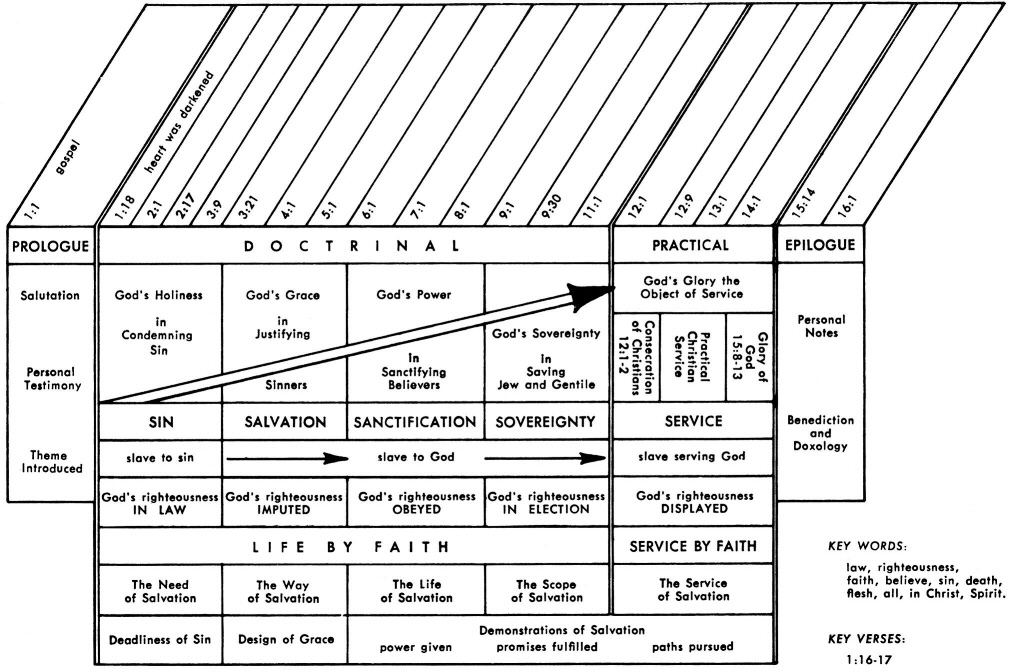
Click chart to enlarge
Chart from recommended resource Jensen's Survey of the NT - used by permission
Romans Overview Chart - Charles Swindoll
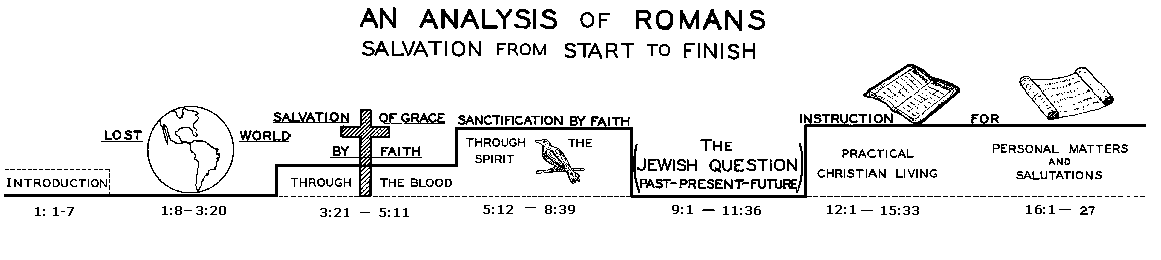
Source: Dr David Cooper
Click to Enlarge
| ROMANS ROAD to RIGHTEOUSNESS |
||||
| Romans 1:18-3:20 | Romans 3:21-5:21 | Romans 6:1-8:39 | Romans 9:1-11:36 | Romans 12:1-16:27 |
| SIN | SALVATION | SANCTIFICATION | SOVEREIGNTY | SERVICE |
| NEED FOR SALVATION |
WAY OF SALVATION |
LIFE OF SALVATION |
SCOPE OF SALVATION |
SERVICE OF SALVATION |
| God's Holiness In Condemning Sin |
God's Grace In Justifying Sinners |
God's Power In Sanctifying Believers |
God's Sovereignty In Saving Jew and Gentile |
Gods Glory The Object of Service |
| Deadliness of Sin |
Design of Grace |
Demonstration of Salvation | ||
| Power Given | Promises Fulfilled | Paths Pursued | ||
| Righteousness Needed |
Righteousness Credited |
Righteousness Demonstrated |
Righteousness Restored to Israel |
Righteousness Applied |
| God's Righteousness IN LAW |
God's Righteousness IMPUTED |
God's Righteousness OBEYED |
God's Righteousness IN ELECTION |
God's Righteousness DISPLAYED |
| Slaves to Sin | Slaves to God | Slaves Serving God | ||
| Doctrine | Duty | |||
| Life by Faith | Service by Faith | |||
|
Modified from Irving L. Jensen's chart above |
||||
R Ruin (Romans 1:17 – 3:20) – The utter sinfulness of humanity
O Offer (Romans 3:21-31) – God’s offer of justification by grace
M Model (Romans 4:1-25) – Abraham as a model for saving faith
A Access (Romans 5:1-11) – The benefits of justification
N New Adam (Romans 5:12-21) – We are children of two “Adams”
S Struggle w/ Sin (Romans 6:1-8:39) Struggle, sanctification, and victory
Romans 8:4 so that the requirement of the Law might be fulfilled in us, who do not walk according to the flesh but according to the Spirit. (NASB: Lockman)
Greek: hina to dikaioma tou nomou plerothe (3SAPS) en hemin tois me kata sarka peripatousin (PAPMPD) alla kata pneuma.
Amplified So that the righteous and just requirement of the Law might be fully met in us who live and move not in the ways of the flesh but in the ways of the Spirit [our lives governed not by the standards and according to the dictates of the flesh, but controlled by the Holy Spirit]. (Amplified Bible - Lockman)
KJV: That the righteousness of the law might be fulfilled in us, who walk not after the flesh, but after the Spirit.
NLT: in order that the requirement of the Law might be fulfilled in us, who do not walk according to the flesh, but according to the Spirit. (NLT - Tyndale House)
Phillips: So that we are able to meet the Law's requirements, so long as we are living no longer by the dictates of our sinful nature, but in obedience to the promptings of the Spirit. (Phillips: Touchstone)
Wuest: in order that the righteous requirement of the law may be brought to completion in us who, not as dominated by the sinful nature are ordering our behavior but as dominated by the Spirit.
Young's Literal: that the righteousness of the law may be fulfilled in us, who do not walk according to the flesh, but according to the Spirit.
SO THAT THE REQUIREMENT OF THE LAW MIGHT BE FULFILLED IN US: hina to dikaioma tou nomou plerothe (3SAPS) en hemin:
- Gal 5:22, 23, 24; Eph 5:26,27; Col 1:22; Heb 12:23; 1Jn 3:2; Jude 1:24; Rev 14:5
- Romans 8 Resources
So that (In order that) (2443) (hina) is a purpose statement (purpose clause) clearly linking verse 4 with the truth Paul has just explained in Ro 8:3 (In Greek verses 3 and 4 are in one sentence). In short, he is explaining the purpose of the death of Christ, which is the fulfillment of the righteous requirement of the Law in believers who walk after the Spirit.
See discussion of importance of pausing to ponder terms of purpose or result .
It must be stated here that several well known commentaries including works by John Calvin, Charles Hodge (quoted below), et al, interpret this verse as referring to justification rather than sanctification, this latter view being favored by the majority of conservative evangelical commentaries (cp, John MacArthur, John Piper, Leon Morris, William Newell, etc).
Leon Morris explains that…
Reformed theologians have stressed that justification and sanctification are not to be separated, and it seems that this is what Paul is saying here. In the full sense only Christ has fulfilled all the law’s requirements, but when we are in Him (Ed: as occurs when we are justified by faith) we in our measure begin to live the kind of life that God would have us live (Ed: which is the description of progressive sanctification).
Notice that Paul does not say “we fulfil the law’s righteous requirement”, but that “the righteous requirement of the law is fulfilled in us”, surely pointing to the work of the Holy Spirit in the believer.
Before we came to know Christ we were continually defeated by sin. When we came to know Him and to receive the indwelling Holy Spirit we were able to attain a standard we could never reach in our own strength. In interpreting these words the emphasis (is) on the way the Christian life is lived… (Ed: See summary of Romans 6:1-8:39 in the Romans Road to Righteousness). (Morris, L. The Epistle to the Romans. Grand Rapids, Mich.; Leicester, England: W. B. Eerdmans)
John Piper explains the relationship between Romans 8:3 and Romans 8:4 reminding us that…
The word “condemned” in Romans 8:3 recalls the words from Romans 8:1, “There is no condemnation for those who are in Christ Jesus.” This is a reference to the reality of justification. (“Who shall bring any charge against God’s elect? It is God who justifies. Who is to condemn?” [Ro 8:33, 34, ESV].) The Son of God became flesh so that the “condemnation” of sin might be on Him (Who had no sin). That is, He bore our condemnation. We are now viewed as free from condemnation “in Christ” (Ro 8:1) when we are united to Him by faith.
Now what is the relationship between this justified state and our being freed from the slavery of sin (sanctification)? Romans 8:4 describes the fulfillment of the law “in us” (not just for us), and therefore refers to the real practical progress of sanctification (“in order that the righteous requirement of the law might be fulfilled in us, who walk not according to the flesh but according to the Spirit”). The logical relationship with Romans 8:3 (justification) is that Romans 8:4 (sanctification) results from and is the purpose of verse 3.
“[God] condemned sin in the flesh (Ro 8:3b), so that the requirement of the law might be fulfilled in us. (Ro 8:4a)”
In other words, our union with Christ in His death for us secures our justification, which then leads, as a result, to our moral transformation (Ed: equivalent to progressive sanctification as occurs in 2Cor 3:18-note). This is the same logic we saw in Romans 6:6, 7-note. We were crucified with Christ so that we might not serve sin (Ro 6:6), because the one who has died is justified from sin (Ro 6:7), and on the basis of that justification, moral transformation becomes possible. (Piper, J. Counted Righteous in Christ. Wheaton, Ill.: Crossway Books) (Bolding added for emphasis)
William Newell agrees with the previous writers noting first that…
Throughout the Psalms, and all the Old Testament Saints' experiences, we find that there is under the Law, an almost constant striving and groaning after a righteous state, - seen, but not experienced, because the Law consisted of outer enactments, to be fulfilled by man. The Law furnished no power.
Now in Romans 8.4 we have three things: first, this righteous state or result; second, the fact that it was not fulfilled by us - we have no more power in ourselves than had the Old Testament saints: but it is fulfilled in us - it is the passive voice: be fulfilled. Third, it is fulfilled in us as we consent to reject the flesh and choose to walk according to the Spirit (Ed: Be careful here - this is subtle - don't try to fight off the desires of the flesh with the flesh, your old nature! The correct "order" is submission to the Spirit, Who will enable you to fight the good fight of faith - click for more detailed explanation of this principle discussed below). In the Spirit lies all the power. With us, the responsibility of choice - a blessed, solemn one! (Romans 8: Expository Notes Verse by Verse) (Bolding added)
In summary, the comments on Romans 8:4 in the preceptaustin commentary, reflect the interpretative view that Paul is referring to progressive sanctification which is a natural (supernatural) "outflow" of the justification described in Romans 8:3. If you favor the interpretation of this verse as referring to justification, you might want to consult the commentaries by John Calvin and Charles Hodge.
Requirement (1345) (dikaioma from dikaióo = to justify <> díkaios = just, righteous <> dike = right) refers to what God has declared to be right - His righteous demands. He is Holy and has the right to make righteous demands.
The UBS Handbook explains that the requirement of the law refers to…
the righteous deeds which the Law demands must be done” or “what the Law demands, which is right.” (The United Bible Societies' New Testament Handbook Series or Logos)
MacDonald explains the how the requirement of the law is now fulfilled in us noting that "As we turn over the control of our lives to the Holy Spirit, He empowers us to love God and to love our neighbor, and that, after all, is what the law requires. (MacDonald, W., & Farstad, A. Believer's Bible Commentary: Old and New Testaments. Nashville: Thomas Nelson)
Middletown Bible has a very good explanation first reminding us that…
"Righteousness" means "righteous requirements." The law has certain righteous requirements. The law demands and requires that a person live a righteous life of loving God (perfectly) and loving one’s neighbor (perfectly). How can I fulfill what the law requires? How can I keep the law? The Person and Power of the Holy Spirit makes this possible. Note carefully that the verse does not say "by us", it says "in us"! This is something God does IN ME by His power and by His Working and by His Spirit!
"The flesh" is that which I do in and of myself (that which I produce). "The Spirit" refers to that which God does in me by the Person of the indwelling Holy Spirit.
The law requires that I LOVE GOD and LOVE MY NEIGHBOR (Mt 22:36, 37, 38, 39, 40) These two commandments summarize not only the Ten Commandments but all of God’s commandments.
I cannot keep the law by trying to keep the law (Ed: You might want to read that statement again!). A sinner cannot keep God’s holy law. It is impossible. Even a "renewed sinner" (Ed: Regenerate sinner = a believer) cannot do this. As we saw in Ro 7:14-25, the saved person wants to but he can’t:
"How to perform that which is good (the keeping of God’s law) I find not" (Ro 7:18)
The key to fulfilling the law is LOVE (Ro13:8, 9, 10 and Gal 5:14). The key to having LOVE is a Spirit-filled walk (Gal 5:13, 14, 15,16, 17, 18, 19, 20, 21, 22, 23 and Ro 8:4). The Spirit of God thus produces this LOVE in me (Gal 5:22). I cannot but He can! If a person is walking according to the Spirit, then God is at work in Him producing that righteous life. We are His workmanship (Ep 2:10)! It’s impossible for me, that is my flesh, to keep God’s law. It’s impossible for God in me (when I allow Him to do His work) not to keep the law! What the flesh could never do, God can do. (Reference)
Wayne Barber comments that…
the character of God that is demanded in us now can be fulfilled in every one of us because the Holy Spirit of God has come to live in us. On one hand the Law shouts at us
"Thou shalt not, Thou shalt not"
And I say
"Come on flesh, we've got to do this thing".
And the flesh says
"No we can't."
And then you say
"Well how am I going to do this Lord?"
And the Lord says
"I fulfilled all of that already and I am in you. Now obey Me. In you is the fulfillment of everything I require by the Holy Spirit's power Who will work it out of you."
It is the character of God in us that is now being worked out in and through our lives. It is His righteousness not ours. And practical righteousness (Ed: essentially synonymous with "practical" or "progressive" sanctification) is what God demands and is the only thing which He can approve. We could never produce "righteous acts" in our own power. We could not justify ourself by works so why do we think we can sanctify ourself by our own efforts? But God can and He will, if we obey the Holy Spirit's leading (Ro 8:14-note, Gal 5:16-note, Gal 5:18-note, Gal 5:25-note) in our life. The character and righteousness (right actions) of God that God requires is now fulfilled or accomplished in us by the power of His Spirit. (Romans 8:1-4: Frustration of Living Under Law)
Moule asks rhetorically "And what was the aim and issue (of sin being condemned in the flesh)? That the righteous demand of the Law might be fulfilled in us, us who walk not flesh-wise, but Spirit-wise; that we, accepted in Christ, and using the Spirit’s power in the daily “walk” of circumstance and experience, might be liberated from the life of self-will, and meet the will of God with simplicity and joy. (The Epistle of Paul the Apostle to the Romans)
Might be fulfilled in us - To reiterate, Paul does not say "by us" (not by our innate power) but "in us" (by His power, His Spirit within us).
Henry Alford explains that might be fulfilled in us does not mean "merely, be performed by us, for the apostle has a much deeper meaning, namely, that the aim of God in giving the law might be accomplished in us, in our sanctification, which is the ultimate end of our redemption, Colossians 1:22 (note); Ephesians 2:10 (note). The passive voice is used, to show that the work is not ours, but that of God by His grace. (Romans 8 - Greek Testament Critical Exegetical Commentary)
Might be fulfilled (4137) (pleroo) (Click word study on pleroo) means satisfied, accomplished)
The Law has certain righteous requirements (dikaioma). As discussed above, the Law demands and requires that a person live a righteous life of loving God (perfectly) and loving one’s neighbor (perfectly). How can I fulfill what the law requires? How can I fulfill the law? The Person and Power of the Holy Spirit makes this possible (The passive voice speaks of an external power, the "divine" passive = God's power). To reiterate, notice that Paul does not say the requirement of the law is fulfilled "by us", but "in us"! In other words, this fulfillment or accomplishment is something God does in me by His power and by His Working and by His Spirit!
What God demands, we could not do. But praise God that what God demands, He supplies.
To run and walk the law commands
But gives me neither feet nor hands.
A better word, the gospel brings,
Bids me fly and gives me wings.
S Lewis Johnson - The apostle has made it plain in chapter six and in chapter seven that, as Professor Bruce says, "Christian holiness is not a matter of pains-taking conformity to the individual precepts of an external law-code; it is rather a question of the Holy Spirit's producing His fruit in the life, reproducing those graces which were seen in perfection in the life of Christ. On the other hand, the believer is responsible to have produced in his life "the righteous requirement of the law." In other words, while he is not under the Law as a code (Ro 6:14, Ro 7:4, 6), the Christian's life is to be such that the Law of Moses in its moral demands can find no flaw in that life. In other words, holiness is the goal of the incarnation, death, and resurrection of the Lord Jesus Christ. Further, that holiness (Ed: Johnson is referring to progressive sanctification) consists in the same righteousness that is fostered by the Law of Moses. And one final thing should be said: That holy life is the product of the Holy Spirit. That is suggested by the passive voice of the verb, "be fulfilled." The meeting of the righteous requirement of the Law is done by Another in us. The apostle by the words, "who walk not after the flesh, but after the Spirit," refers to the bent of life of the believer. He is the one who walks after the Spirit as the pattern of his life; service of sin does not characterize him (cf Ro 8:14, 15, 16, 17).The word, "walk," is the best biblical term for the believer's responsibility in the Christian life. It should be used rather than the word, "filled," which has a more specialized and limited force. (Romans 8:1-4 Power of the Indwelling Spirit)
So let us repeat again that what God demands, He supplies, and this great truth means that in the midst of our struggle with fallen flesh, the fallen world system and Satan, victory (including victory over that sin which so easily entangles us) is possible and is God's desire for His children.
Wayne Barber adds that pleroo conveys "the idea of filling full, supplying fully, fill up what was otherwise empty. We are "empty" apart from the Spirit of God and unable in our own strength to do anything that God requires. For anything that comes out of me that manifests the holiness of God has to come from the One Who lives in me. All the righteous character of God can now be supplied fully in us because the Holy Spirit lives in us to produce conformity to the image of Christ as we "walk according to the Spirit". Therefore we are forever free from the condemnation of the Law because what the Law requires can now be produced in me because the Holy Spirit lives in me. This is the message of the so-called "Exchanged Life" - you can't - God never said you could - He can and He always said He would. In Christ (regenerated, saved) now we are free from the control (bondage) of the flesh (unless we choose to go back under it). In Adam (unregenerate, unsaved) we were totally under the control of the flesh."
Charles Hodge as alluded to in the introductory comments on Romans 8:4 interprets this verse as referring to justification. He notes that one's interpretation of verse 4 "is determined by the view taken of Ro 8:3-note. If that verse means that God, by sending His Son, destroyed sin in us, then, of course, this verse must mean, “He destroyed sin in order that we should fulfill the law” — that is, so that we should be holy (sanctification). But if Romans 8:3 refers to the sacrificial death of Christ and to the condemnation of sin in Him as the sinners’ substitute, then this verse must refer to justification and not sanctification (Ed: Click for discussion of Justified, Sanctified, Glorified). (Ed note: this commentary was written in the early 1800's)" (Hodge, C. Commentary on the Epistle to the Romans, 1835)
But what is the context of this section of Romans (see the chart at the beginning of these notes, specifically beginning in Romans 6)? Does not this section of the letter deal primarily with sanctification or the practical outworking of our salvation? Clearly that great truth is the main thrust of Romans 6-8. Notice also that the immediate context speaks of one's "walk" which is either according to the flesh or according to the Spirit. This description is clearly a reference to sanctification, which is counter to the view expressed by Hodge (and others).
The respected expositor John MacArthur disagrees with Hodge, writing that…
Paul obviously is not speaking here of the justifying work of salvation but of its sanctifying work, its being lived out in the believer’s earthly life. Apart from the working of the Holy Spirit through the life of a redeemed person, human efforts at righteousness are as contaminated and useless as filthy garments (Is 64:6). But because the Christian has been cleansed of sin and been given God’s own divine nature within him, he now longs for and is able to live a life of holiness." (MacArthur, J: Romans 1-8. Chicago: Moody Press)
John Piper (quoting from a different source than Piper's previous quotation at the beginning of these notes) agrees that this section is not a specific reference to justification but refers to sanctification and to a believer's walk in the power and fullness of the Holy Spirit. Piper writes that…
some take this ("the requirement of the Law might be fulfilled") to mean that Christ fulfilled the law for us when He obeyed it perfectly and died as the perfect sacrifice on our behalf. In Him we are perfect with His perfection and in Him we are pardoned by His blood. Now I believe that is true. And it is foundational for everything. But I don't think that is the point of Romans 8:4. And the reason I don't is that it won't fit the wording of the text. Romans 8:4 says the aim is "that the requirement of the Law might be fulfilled in us." It does not say that the law is to be fulfilled for us. That is true, I would say, from Romans 5:19. But that's not the point here. And then he focuses specifically on our walking, that is, our living, as the way the fulfillment will happen: "that the requirement of the Law might be fulfilled in us, who walk … according to the Spirit. (Romans 8:3-4)
Piper then asks the practical question "How do we fulfill the requirement of the law? And specifically how can any of my "walking" by the Spirit – which is always imperfect in this life – be said to "fulfill God's law which is holy and just and good. Since when does God's holy law and divine standard say, "Pretty good will do"? (Romans 8:3-4)
Piper goes on to enumerate what he calls "12 theses" to help us understand what "fulfilling the requirement of the law" looks like in real life… click for his discussion.
William Newell adds that the requirement of the Law "is fulfilled in us as we consent to reject the flesh and choose to walk according to the Spirit. In the Spirit lies all the power. With us, the responsibility of choice-a blessed, solemn one!" (William Newell. Romans Verse by Verse).
Warren Wiersbe adds that now…
The believer lives a righteous life, not in the power of the Law, but in the power of the Holy Spirit (cp Ga 5:16-note). The Law does not have the power to produce holiness; it can only reveal and condemn sin. But the indwelling Holy Spirit enables you to walk in obedience to God’s will (cp Ga 5:25-note). The righteousness that God demands in His Law is fulfilled in you through the Spirit’s power. In the Holy Spirit, you have life and liberty (Ro 8:2) and “the pursuit of happiness” (Ro 8:4).
The legalist tries to obey God in his own strength and fails to measure up to the righteousness that God demands. The Spirit-led Christian, as he yields to the Lord, experiences the sanctifying work of the Spirit in his life (Ga 5:18- note). “For it is God that worketh in you, both to will and to do of His good pleasure (see note Philippians 2:12-13)" (Wiersbe, W: Bible Exposition Commentary. 1989. Victor)
So dear believer you must understand, believe and live out the truth that now you possess the power to reject those strong desires (epithumia = lusts) that come from the old corrupt Sin nature which is still resident in our physical bodies (and will be until we are glorified). As an aside, remember that progressive sanctification has no effect on the fallen flesh. In other words, the old flesh nature will never be made "better" in this life. It's power was broken to be sure, but it is still the same "nasty" evil flesh and it will be until the day we are glorified. The basis of our victory over sin is not that the fallen flesh is getting progressively better. To the contrary, the basis for our new power is the New Covenant (Je 31:31, Lk 22:20, 1Co 11:25, 2Co 3:6, He 8:8-note, He 8:13-note, He 9:15-note, He 12:24-note) in which God has given each of us a new heart and His Spirit as foretold by the prophet Ezekiel (in context referring primarily to Jews who were to be saved by faith in Messiah but also applicable to Gentile believers) where Jehovah declared:
Moreover, I will give you a new heart and put a new spirit within you; and I will remove the heart of stone from your flesh and give you a heart of flesh and I will put My Spirit within you and cause you to walk in My statutes (God's empowerment), and you will be careful to observe My ordinances (our responsibility). (Ezekiel 36:26, 27) (Compare parallel passages - Dt 30:6 Eze 11:19,20 Je31:31, 32, 33, 34, 32:39,40 Jn 3:3, 4, 5 2Co 5:17 Ga 6:15)
As New Covenant believers, we now possess a new heart which energizes a new motivation and desire to please God and to obey Him (Php 2:13-note). Now we can obey because God has placed that desire in our new heart and given us the provision and power of His indwelling Holy Spirit. We have the power to satisfy His commandments fulfilled in "love God and love your neighbor" (cp Mt 22:36, 37, 38, 39, 40). We can fulfill these requirements by His power not because we try hard to "keep" the Law. If we try to "fulfill" the requirement of the law in our own strength or power, we will fail because the power of Sin (our old sin nature, the old Adam) lies in the LAW (cf "The sting of death is sin, and the power of sin is the law" 1Co 15:56 and as Phillip's paraphrases it "While we were "in the flesh" the Law stimulated [or aroused] our sinful passions" -- see note Romans 7:5).
In summation, to fulfill the requirement of the Law is only possible as we learn to surrender to, lean on, submit to, yield to and rely on the Holy Spirit Who indwells every believer. The external, written code was unable to accomplish this requirement but, the Spirit is able to do so by writing the law on our hearts (Je 31:33) and giving us the power to obey it.
WHO DO NOT WALK ACCORDING TO (controlled by) THE FLESH BUT (continually controlled by) ACCORDING TO THE SPIRIT: me kata sarka peripatousin (PAPMPD) alla kata pneuma:
A DESCRIPTION OF
GENUINE FOLLOWERS OF CHRIST
The Amplified Version renders Ro 8:4 as those "who live and move not in the ways of the flesh but in the ways of the Spirit [our lives governed not by the standards and according to the dictates of the flesh, but controlled by the Holy Spirit]."
Who do not walk according to the flesh - First the negative description as those who as the generally conduct their life not under the dominion or control of the fallen flesh, that evil "anti-God" disposition every individual has inherited from Adam.
Walk (4043) (peripateo from peri = around + pateo = tread) (Click word study of peripateo) means literally to "tread around". “To walk” in Semitic thought is merely another way of saying “to live, to behave, to act.” Paul's figurative use in this verse refers to how one lives or passes their life. The present tense speaks of continually conducting one's self not according to the dictates of the old sinful flesh but according to the indwelling Holy Spirit. What is the habit of your life… in the general direction of good or of evil? As Jamieson notes "walk" is "the most ancient expression of the bent of one's life, whether in the direction of good or of evil" (Ge 48:15, Ps 1:1-see note, Isa 2:5, Mic 4:5, Eph 4:17-note, 1Jn 1:6, 7)? That's what Paul is describing here. An unregenerate person cannot keep God’s holy law. It is impossible. Even a regenerate person who wants to keep the Law because of their new heart cannot keep the Law in their own strength. The key is a Spirit-filled walk, admitting that "I cannot but He can!" If a person is walking according to the Spirit, then God is at work in that person producing a righteous life.
In a passage which helps to amplify Romans 8:4, Paul charged the Galatian believers to
walk (present imperative - command to make this their "lifestyle"!) by the Spirit, and you will not carry out the desire (epithumia - word study) of the flesh. (Gal 5:16-see in depth discussion of "Walking by the Spirit")
Comment: Now, under the New Covenant, all believers are commanded to conduct their supernatural lives by the Spirit and as we obey this command, we will not fulfill the evil desires of our flesh.
Note the order: First walk according to the Spirit. He will enable you to not walk according to the flesh. Don't try to reverse the order of Galatians 5:16 and attempt in your own power to not fulfill the corrupt strong desires of your fallen, sinful flesh (still present in believers, albeit its power was defeated at Calvary) thinking that by not carrying out the desires of the flesh, you are in a sense by "default" walking according to the Spirit. The only way you can not carry out the desires of the flesh is by first walking according to the Spirit.
Does that make sense? If you reverse, the order, and attempt to keep a list of do's and don't's, you are essentially placing yourself under the dominion or power of the law and are practicing "legalism" (cp Gal 5:18 [see note] "if you are led by the Spirit, you are not under [the power, authority or control of] the Law."). And the result of "inverting" Galatians 5:16 is that you will negate or blunt the power of the Spirit. It cannot be overemphasized that the primary "requirement" is reliance on the Holy Spirit, continually choosing to walk in His power. This may at first seem somewhat "mystical" but in Gal 5:19f Paul provides a list of behavioral "markers" by which one can assess whether or not they are walking according to the flesh (Gal 5:19, 20, 21-notes) or walking according to the Spirit (Gal 5:22, 23-notes).
Dear believer in union with Christ Who is now your life (Col 3:4-note), do not become discouraged, but keep pressing on, seeking moment by moment to submit to your Helper and Teacher, the Spirit (Jn 14:26), Who enables you to strive against your old flesh, according to His power which mightily works within you. This is the Spirit filled life (Eph 5:18-note). This is abiding in the Vine (Jn 15:5). This is walking by the Spirit. This is the supernatural abundant life (Jn 10:10b) in Christ. This is life on the highest plane.
Similarly Paul instructed the Ephesian believers to
walk no longer just as the Gentiles also walk, in the futility of their mind” (Eph 4:17-note)
Comment: Because of the truths Paul explains here in Romans 8 (and Ro 6-8) the Ephesian saints had received the supernatural power (the indwelling Spirit) to live holy lives in the midst of an unholy world.
John declares that,
if we walk in the light as [God] Himself is in the light, we have fellowship with one another, and the blood of Jesus His Son cleanses us from all sin” (1Jn 1:7).
Ray Stedman commenting on (Col 3:1-17) has some interesting insights on our "walk" writing
that (Col 3:1-4-see notes) is the true basis for living a Christian life. Scripture calls it "walking with the Lord." I like that figure because a walk, of course, merely consists of two simple steps, repeated over and over again. It is not a complicated thing. In the same way, the Christian life is a matter of taking two steps, one step after another. Then you are beginning to walk. Those two steps follow in this passage. Paul describes them as, "Put off the old man," (Col 3:9-note) and "put on the new." (Col 3:10-note) Then repeat them. That is all. Keep walking through every day like that. That is how Scripture exhorts us to live." (see his full sermon True Human Potential) (Bolding added)
Holiness of life and conversation
is an inseparable concomitant
of union with Christ
Robert Haldane explains that…
The expression, to “walk,” is frequently employed in Scripture regarding any particular line of conduct, as when it is said, Acts 21:21, “that they ought not to circumcise their children, neither to walk after the customs”; or it denotes the course of life in which we are proceeding as in Ephesians 2:2 (note),
“Ye walked according to the course of this world.”
In this way, comparing our life to a journey, in the usual style of Scripture, the Apostle comprehends all our actions under the figure of walking. To walk, then, according to the flesh, is to act agreeably to the principles of corrupt nature. To walk according to the Spirit, means to regulate the conduct according to the influence and dictates of the Holy Spirit, Who has given us a new nature, serving God in newness of spirit (cp Ro 6:4-note; Ro 7:6-note).
The expression, walking not according to the flesh, but according to the Spirit, in the verse before us, is generally interpreted as referring exclusively to the practice of good or of wicked works. It is supposed that the Apostle is here guarding his doctrine of gratuitous justification from abuse, by excluding all claim to union with Christ, and to exemption from condemnation, where there is not purity of conduct, under the influence of the Holy Spirit. This is undoubtedly a highly important truth, which is to be constantly affirmed and insisted on. Holiness of life and conversation (Ed: That is our conduct) is an inseparable concomitant of union with Christ; for to whom He is made righteousness He is also made sanctification, and they that are Christ’s have crucified the flesh with the affections and lusts (Gal 5:24-note). (Romans 8 Commentary) (Bolding added)
To reiterate, the words “who walk not according to the flesh but according to the Spirit” are descriptive of regenerate men and are one of their identifying characteristics. This description is true of every child of God. Being indwelt by and empowered by the Spirit is not a mark of special maturity or spirituality, but the mark and privilege of every believer without exception (Ro 8:9-note; cp 1Co 12:13).
According to - This phrase is the Greek preposition kata the root meaning of which is “down,” which in turn suggests domination. The born again believer is one who orders his or her behavior in such a way that it is not (habitually) dominated by the old evil nature (still latent in our physical bodies), instead, allowing themselves to be "dominated by" (controlled by) the Holy Spirit (Eph 5:18-note).
Flesh (4561) (sarx) (Click word study on sarx) as used in this context does not refer to physical flesh (like "flesh and blood") but to that evil disposition inherited from Adam (cp Ro 5:12-note) which is opposed to God ("anti-God" energy). Walking according to the flesh means behaving as the flesh dictates, so that the sinful nature entirely governs ones life. It means to have one’s life determined and directed by the values of this evil world system in total rebellion against God. This is the only way an unsaved person is able to walk - according to the flesh.
On the other hand the regenerate person can and should walk according to the Spirit which means to live in submission to and domination by the Holy Spirit Who leads and empowers. Stated another way, if a person claims to be saved, that person’s life cannot be cannot totally dominated by the flesh. To be sure, even saved men and women, unfortunately can "fall into" sin, but we will not persist in sin as the habit of our lives or as our lifestyle (eg, see especially 1Jn 3:4, 5, 6, 7, 8, 9, 10 - John is not saying a believer never sins, but that he does not continually [present tense] practice sin). If a person habitually makes a practice of committing sin and there has never been any time when there was a change toward holiness or godliness, then that person has never genuinely born again and has never received a new heart and God's Spirit, Who gives the new man in Christ the inherent disposition toward holiness, however imperfect that might disposition be manifest. However when a believer chooses to walk in submission to the flesh, he is not walking rightly and he grieves the Spirit which makes him miserable (Ep 4:30-note). A sinning saint is a sad sight!
Middletown Bible notes that when a genuine believer commits sin, then…
by the Spirit’s conviction, by confession and if needed, by chastening (1Cor 11:31, 32, cp He 12:5ff-note), he is brought back to the path of obedience. The believer at any given time may manifest any of the works of the flesh (Galatians 5:19, 20, 21-see notes) but his life will not be dominated by the works of the flesh because "they which do (present tense--‘keep on doing’; those who persist in these things) shall not inherit the kingdom of God" (Galatians 5:21 and compare 1Cor 6:9, 10, 11 and Ep 5:5-note). (Romans 8) (Bolding added for emphasis)
Ryrie commenting on Romans 8:4-8 writes that "The contrast here is between an unregenerate life dominated by the flesh (= sinful nature within) and one controlled by the Holy Spirit." (The Ryrie Study Bible: New American Standard Translation: 1995. Moody Publishers) (Bolding added)
A T Robertson says that Paul is contrasting "the two laws of life" and that the phrase "according to the Spirit" he interprets as "most likely the Holy Spirit or else the renewed spirit of man.
Dr Harry Ironside - The law demanded righteousness from a man whose nature was utterly corrupt and perverted, and which could only produce corrupt fruit. The Holy Spirit has produced a new nature in the man in Christ, and linked with this new life are new affections and desires. The new man gladly responds to the will of the Lord as revealed in His Word. Thus the righteousness of the law is actually produced in the one who walks not after the flesh, not in the power of the old nature. The practical good required by the law is produced in the person who lives in obedience to the Spirit, Who has come to take possession of us for Christ. (Ironside, Harry. Romans)
In short, as we walk according to Spirit we are progressively being sanctified by the same Spirit, growing in grace and the knowledge and likeness of our Lord and Savior Jesus Christ (Click for relationship of Relationship of Justified, Sanctified, Glorified). As we yield control of our will (and our heart and our mind) to the Holy Spirit, He empowers us to love God and to love our neighbor (Phil 2:13-note), which is the fulfillment of the law (Mk 12:30, 31, Mt 22:37, 38, 39, Lk 10:27, 1Jn 4:7, 8, 21, Ro 13:9-note, Ro 13:10-note). The next time someone hurts you, just try to rely on your own strength to truly forgive them. You can't, but God never said you could (in your own power). But He can and He always said He would (by the power provided by His Spirit indwelling each believer). This supernatural transaction takes place as we learn to live the Christ life, a life many have referred to as the "exchanged life" which Paul so memorably described testifying…
I have been crucified with Christ; and it is no longer I who live, but Christ lives in me; and the life which I now live in the (physical) flesh I live by faith in the Son of God, who loved me, and delivered Himself up for (in place of) me. (cp Gal 2:20-note)
The purpose of the gospel is not to make men happy but to make them holy. Genuine happiness comes to those who belong to Christ and are obedient to His will. Ultimately this true "supernatural happiness" comes only from holiness. God promises happiness, but He demands holiness, without which “no one will see the Lord” (Heb 12:14-note). Don't misunderstand. Living a holy life does not save us, but it does demonstrate that we are saved and indwelt by the Holy Spirit, Who prompts and empowers this holy, happy life!
Ray Stedman says that…
the mind set on the Spirit desires that God be glorified in all these things, which are proper and right. When your mind is set on the Spirit you look at the events of life from God's point of view, not from the world's. Your value system is changed and it touches everything you do. You no longer see that the important thing must be to make a lot of money. The important thing is that, in seeking to fulfill your needs, God be glorified (Mt 5:16-note). That is what makes the difference. That is the mind set on the Spirit (Ro 8:5-note). It does not remove you from life -- it puts you right back into it. But it does it with a different point of view. (Read his full message Why Not Live?)
F B Meyer in Our Daily Walk has the following devotional…
WALKING NOT AFTER THE FLESH,
BUT AFTER THE SPIRIT
THE APOSTLE here (Ro 8:1-4) is dealing with the conditions of a holy life; and the condemnation to which he refers is that caused by the constant failure so graphically described in the previous chapter. From my own experience, I think that the introspection which is often induced by ill-health and weakness makes us very sensitive to the failure and shortcoming of the inner life. We know that we are accepted in Christ, and that our sins are forgiven us for His sake; but we are deeply conscious that in us (i.e. in our flesh) dwelleth no good thing from. Rom 7:18-note).
The Reservoir of Eternal Life.--"the Spirit of Life in Christ Jesus." We perceive what physical life is when a child comes bounding into our room in a very ecstasy of health and joy. We know what intellectual life is as we see the mind developing under the process of education. We know what the moral life of a stoic is, repelling by force of will the appeal of the senses. But above all these, there is Life which is resident in Jesus Christ, stored in Him, abounding in Him, which He longs to communicate to every soul that trusts in Him. This was the witness of those who knew Jesus most intimately in His brief human life--that "God hath given unto us Eternal Life, and this Life is in His Son." "He that hath the Son hath the Life; and he that hath not the Son of God hath not the Life." This more than outweighs the down-pull of the serf-life. The aw of that life makes us free from the law of sin and death, for it has mastered death and the grave.
This Life is communicated and sustained by the Holy Spirit. We must be one with Christ; we must be in Him, as the sponge is in the ocean. We must be in Him, not only in our standing, but also in our daily walk. We must be in Him as the branch is in the vine, and the vine-sap in the branch. And this must not only be a theory, but an hourly experience. We must abide in Him and He in us. But how can this become our daily experience? There is but one way. Through the co-operation of the Holy Spirit, as we walk in Him (Gal 5:16-note). He is the essence of the Life which is in Christ Jesus. "The Spirit of Life in Christ Jesus hath made me free from the law of sin and death."
PRAYER: Almighty God, I beseech Thee to raise me from the death of sin to the life of righteousness by that same power that brought the Lord Jesus from the dead, that I may walk in newness of life through the aid of the Holy Spirit. AMEN. (F B Meyer)
|
IN THE FLESH
Dear reader… the striking contrasts in this simple table beg the question…
|
||||||||||||||||||||||||||||||||||||||||||||||||
-
Despair (Ro 7:24+) – The wretched cry: “Who will deliver me?”
-
Deliverer (Ro 7:25+) – Answer: God, through Christ Jesus.
-
Declaration (Ro 8:1+) – No condemnation for those in Christ.
-
Deliverance (Ro 8:2+) – Spirit sets us free from sin’s enslaving power.
-
Decisive Act (Ro 8:3+) – God condemned sin at the Cross through His Son.
-
Design (Ro 8:4+) – Purpose: that God’s righteousness is fulfilled in Spirit-led believers.