Romans 8:2
Romans 8:3
Romans 8:4
Romans 8:5
Romans 8:6
Romans 8:7
Romans 8:8
Romans 8:9
Romans 8:10
Romans 8:11
Romans 8:12
Romans 8:13
Romans 8:14
Romans 8:15
Romans 8:16
Romans 8:17
Romans 8:18
Romans 8:19
Romans 8:20
Romans 8:21
Romans 8:22
Romans 8:23
Romans 8:24
Romans 8:25
Romans 8:26
Romans 8:27
Romans 8:28
Romans 8:29
Romans 8:30
Romans 8:31
Romans 8:32
Romans 8:33
Romans 8:34
Romans 8:35
Romans 8:36
Romans 8:37
Romans 8:38
Romans 8:39

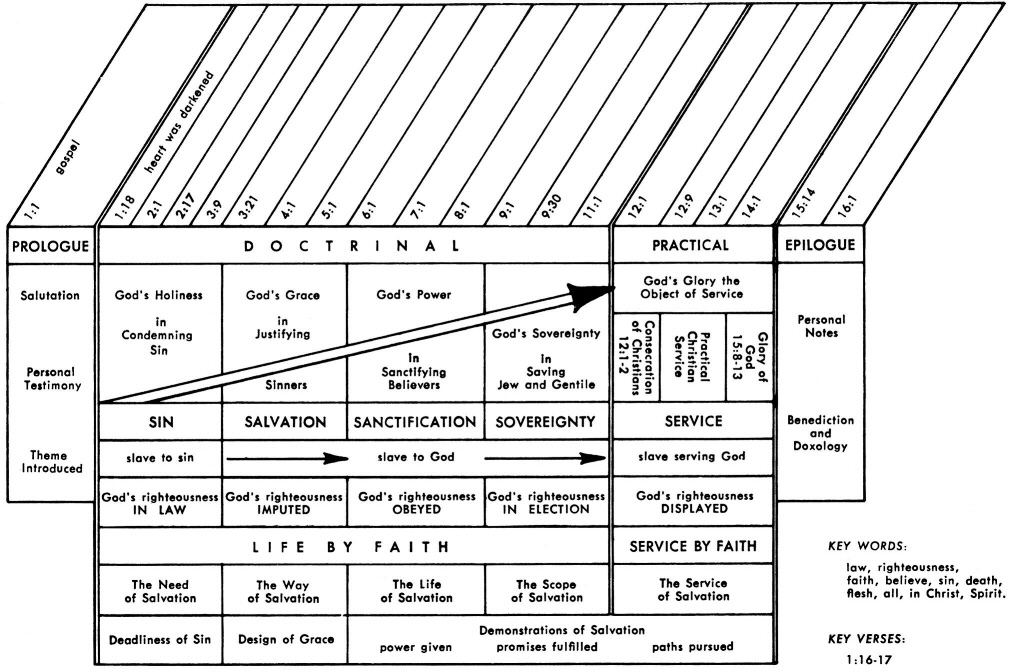
Click chart to enlarge
Chart from recommended resource Jensen's Survey of the NT - used by permission
Romans Overview Chart - Charles Swindoll
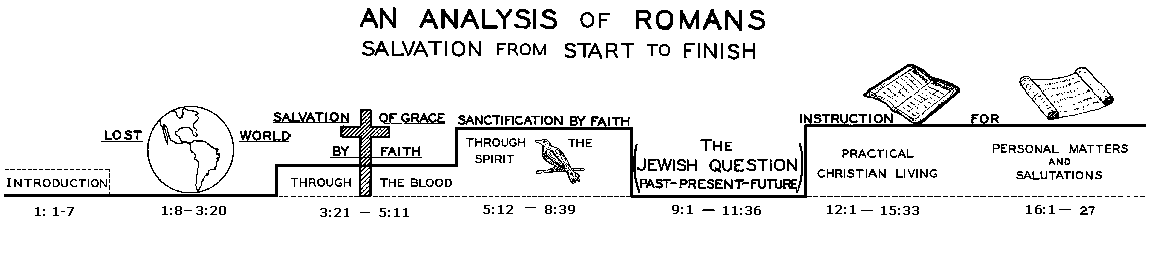
Source: Dr David Cooper
Click to Enlarge
| ROMANS ROAD to RIGHTEOUSNESS |
||||
| Romans 1:18-3:20 | Romans 3:21-5:21 | Romans 6:1-8:39 | Romans 9:1-11:36 | Romans 12:1-16:27 |
| SIN | SALVATION | SANCTIFICATION | SOVEREIGNTY | SERVICE |
| NEED FOR SALVATION |
WAY OF SALVATION |
LIFE OF SALVATION |
SCOPE OF SALVATION |
SERVICE OF SALVATION |
| God's Holiness In Condemning Sin |
God's Grace In Justifying Sinners |
God's Power In Sanctifying Believers |
God's Sovereignty In Saving Jew and Gentile |
Gods Glory The Object of Service |
| Deadliness of Sin |
Design of Grace |
Demonstration of Salvation | ||
| Power Given | Promises Fulfilled | Paths Pursued | ||
| Righteousness Needed |
Righteousness Credited |
Righteousness Demonstrated |
Righteousness Restored to Israel |
Righteousness Applied |
| God's Righteousness IN LAW |
God's Righteousness IMPUTED |
God's Righteousness OBEYED |
God's Righteousness IN ELECTION |
God's Righteousness DISPLAYED |
| Slaves to Sin | Slaves to God | Slaves Serving God | ||
| Doctrine | Duty | |||
| Life by Faith | Service by Faith | |||
|
Modified from Irving L. Jensen's chart above |
||||
R Ruin (Romans 1:17 – 3:20) – The utter sinfulness of humanity
O Offer (Romans 3:21-31) – God’s offer of justification by grace
M Model (Romans 4:1-25) – Abraham as a model for saving faith
A Access (Romans 5:1-11) – The benefits of justification
N New Adam (Romans 5:12-21) – We are children of two “Adams”
S Struggle w/ Sin (Romans 6:1-8:39) Struggle, sanctification, and victory
Romans 8:5 For those who are according to the flesh set their minds on the things of the flesh, but those who are according to the Spirit, the things of the Spirit. (NASB: Lockman)
Greek: oi gar kata sarka ontes (PAPMSN) ta tes sarkos phronousin, (3PPAI) hoi de kata pneuma ta tou pneumatos
Amplified For those who are according to the flesh and are controlled by its unholy desires set their minds on and pursue those things which gratify the flesh, but those who are according to the Spirit and are controlled by the desires of the Spirit set their minds on and seek those things which gratify the [Holy] Spirit. (Amplified Bible - Lockman)
Barclay: Those who live according to the dictates of sinful human nature are absorbed in worldly human things. Those who live according to the dictates of the Spirit are absorbed in the things of the Spirit. (Westminster Press)
KJV: For they that are after the flesh do mind the things of the flesh; but they that are after the Spirit the things of the Spirit.
NLT: Those who are dominated by the sinful nature think about sinful things, but those who are controlled by the Holy Spirit think about things that please the Spirit. (NLT - Tyndale House)
Phillips: The carnal attitude sees no further than natural things. But the spiritual attitude reaches out after the things of the spirit. (Phillips: Touchstone)
Wuest: For those who are habitually dominated by the sinful nature put their minds on the things of the sinful nature, but those who are habitually dominated by the Spirit put their minds on the things of the Spirit.
Young's Literal: For those who are according to the flesh, the things of the flesh do mind; and those according to the Spirit, the things of the Spirit;
FOR: gar:
- Romans 2 Resources - Multiple Sermons and Commentaries
- Romans 8:5-6: Two Groups, Two Destinies - Steven Cole
- Romans 8:4-6 The Transforming Work of the Spirit, Part 1 - John MacArthur
A CLEAR CONTRAST WALKING EITHER
ACCORDING TO THE FLESH OR ACCORDING TO THE SPIRIT
For - As in Romans 8:2-3, the conjunction for (1063) (gar) in this verse carries the meaning of because. Every time you see a "for" at the beginning of a sentence always stop and ask what the "for" is explaining (see term of explanation)? Not ever "for" is a term of explanation, but when you encounter it at the beginning of a verse or clause, most of these uses introduce an explanation. When you query this "code word", you will be forced to read the context to understand what is being explained.
"Men walk according to the inward inclination, bent, or disposition that they have."
S Lewis Johnson explains the "for" noting that "In the fifth verse of the chapter the apostle gives the first of the reasons why believers walk after the Spirit. In other words, the "for" of the verse is connected with the last clause of the preceding verse. Men walk according to the inward inclination, bent, or disposition that they have. Thus, those who have at their inmost center the lusts of the flesh will walk after the flesh, while the opposite is true of those who walk according to the Spirit. To "be" after the flesh is to exist only for the flesh, and the clause, then, refers to the unbeliever. They mind the things of the flesh, that is, they think and will according to the desires of the flesh. Their conduct follows accordingly. On the other hand, they that "are" after the Spirit think and will according to inclinations implanted by Him in the inmost being of the believer. They are inclined to holiness, just as the unbelievers are inclined to unholiness. The renewed nature of the believer, upheld by the Spirit, determines the bent of the life. (Romans 8:5-17)
Paul's point is that a believer does not behave according to the flesh because their new heart and mind (cf Ezekiel 36:26, 27) are no longer continually centered on the things of the flesh and ruled by Sin.
Disciple's Study Bible concurs adding that "The end result of following the bent of human nature is physical and spiritual death. People who yield their behavior to the sinful nature will never be pleasing to God." (Disciple's Study Bible)
Expositor's Bible Commentary - At this point Paul launches upon a fairly extended statement contrasting the terms "flesh" and "Spirit," which he has used in Ro 8:4. Both terms are difficult because they can have more than one meaning. For example, "flesh" can be used of ordinary physical life shared by believer and unbeliever alike (cf. 2Cor 10:3). But usually in Paul the ethical force of the word, referring to human nature as corrupted and weakened by sin, is dominant. Because the variety of expressions about the flesh may be confusing, some explanation is necessary. To be in the flesh, as the word is used here (Ro 8:8), is to be in the unregenerate state. To be (ontes, Ro 8:5) according to the flesh is to have the flesh as the regulating principle of one's life. To walk (peripatousin, Ro 8:4) according to the flesh is to carry out in conduct those things dictated by the flesh. (Gaebelein, F, Editor: Expositor's Bible Commentary)
THOSE WHO ARE (continually) ACCORDING TO (dominated, controlled by) THE FLESH SET THEIR MINDS ON THE THINGS OF THE FLESH: hoi gar kata sarka ontes (PAPMSN) ta tes sarkos phronousin (3PPAI):
- Ro 8:12,13; Jn 3:6; 1Cor 15:48; 2Cor 10:3; 2Pet 2:10
- Ro 8:6,7; Mk 8:33; 1Cor 2:14; Php 3:18,19
- Romans 2 Resources - Multiple Sermons and Commentaries
- Romans 8:5-6: Two Groups, Two Destinies - Steven Cole
- Romans 8:4-6 The Transforming Work of the Spirit, Part 1 - John MacArthur
For those who are according to the flesh and are controlled by its unholy desires set their minds on and pursue those things which gratify the flesh (Amplified)
Those who live by the corrupt nature have the corrupt nature’s attitude (GWT)
Those who live as their human nature tells them to, have their minds controlled by what human nature wants. (GNT)
Those who live following their sinful selves think only about things that their sinful selves want. (NCV)
For those who live according to the flesh have their outlook shaped by the things of the flesh (NET)
Those who live according to the sinful nature have their minds set on what that nature desires (NIV)
Those who are living by their natural inclinations have their minds on the things human nature desires (NJB)
Those who are dominated by the sinful nature think about sinful things (NLT)
For if men are controlled by their earthly natures, they give their minds to earthly things (Weymouth)
For those who are habitually dominated by the sinful nature put their minds on the things of the sinful nature (Wuest)
A MIND
DOMINATED BY
THE EVIL FLESH
Note that there are some who erroneously teach that this refers to a believer who is carnal. That is absolutely not true. This is clearly a non-believer. The danger of teaching the former error is that it gives a "pass" to someone who has made a "profession" of Christ, but whose life exhibits no evidence whatsoever of repentance, no evidence of the new life of Christ (2 Cor 5:17) energized by His Spirit and thus one who is in essence living a lie and is walking on the broad way "that leads to destruction." (see Mt 7:13)
John MacArthur adds that "Those who are according to the flesh are the unsaved, the unforgiven, the unredeemed, the unregenerate. Those who are according to the Spirit are the saved, the forgiven, the redeemed, the regenerated children of God. As the apostle points out a few verses later, the unsaved not only are according to the flesh but are in the flesh and are not indwelt by the Holy Spirit, The saved, on the other hand, not only are according to the Spirit but are in the Spirit and indwelt by Him (Ro 8:9)." (Romans Commentary, Vol 1, page 416)
Are (5607) (ontes) is in the present tense indicating that this is the general pattern of their life (their lifestyle) or habitual practice. In a word, such a person is unregenerate. He or she can only function by the dictates (authoritative rule) of the fallen flesh nature, for sin reigns in their mortal nature and they are obligated to obey its lusts (Ro 6:12). Believers still have the fallen nature, but do not have to function habitually according to the dictates of the flesh, for they possess the indwelling Holy Spirit, Who stimulates the holy desires and gives us the power to live a holy, set apart life to the glory of God. (cf Php 2:13NLT). How are you doing dearly beloved? Are you winning the war against your flesh? Even that question might be a bit misleading however. Why do I say that? Because it asks "are YOU winning the war"! Beloved, YOU cannot win the war, but must rely on the SPIRIT'S enabling power. So the question is more accurately phrased "Are you winning the war against your flesh in continual dependence of the Holy Spirit? And remember the war against our soul is continual (Read 1 Peter 2:11 where "wage war" is present tense) As Jerry Bridges puts it believers are 100% responsible and 100% dependent on the Spirit! Not good "math" but good Bible! And note that is not saying like some falsely teach "Let go, Let God." The correct aphorism should be more like "Let God, Let's go." Do you see the subtle but definite distinction? The former saying calls for passivity, while the latter calls for saint-Spirit synergy (syn = speaks of intimately together + ergo = work) See the "Paradoxical Principle of 100% Dependent and 100% Responsible" (100/100)
John Piper - Before a person can perform the best of all acts, he must become a new person. Thorn bushes don’t produce figs, apple trees don’t produce olives, and a “natural man” does not produce faith. He cannot. Here is the way Paul put it in Romans 8:5, 6, 7...Fallen human nature is so hostile to God and his demands that it cannot submit to God in faith. We must be born again, born of the Spirit, before we can approve of God’s Word and trust Christ. (That Which Is Born of the Spirit Is Spirit)
H A Ironside writes that Paul reminds us "that there are two exactly opposite principles, two utterly opposed standards of life, to be considered. They who are after (according to) the flesh - that is, the unsaved - are dominated by the fleshly nature. They "mind the things of the flesh." In these terse words the entire life of the natural man is summed up. In blessed contrast to this, those who live according to the Spirit of God - saved men and women - characteristically mind the things of the Spirit. Parenthetically Paul explained, the minding of the flesh is death, that is its only legitimate result; but the minding of the Spirit is life and peace. He who is thus Spirit-controlled is lifted onto a new plain where death has no place and conflict is not known." (Romans Commentary online).
According to (2596) (kata) conveys the root meaning of “down,” which in the present context suggests domination. In this context, the phrase according to refers to basic spiritual nature and indicates one's fundamental essence, bent, or disposition. In short as mentioned above, Paul is describing an unbeliever, devoid of the Spirit. An unbeliever orders his or her behavior in such a way that it is dominated or controlled by the flesh, the Sin nature inherited from Adam (Ro 5:12), this anti-God tendency stimulating in the unregenerate a propensity to commit sins, missing the mark God desires for their life..
As noted above (and the view favored by the majority of conservative commentaries) the plain sense of this verse favors that those who are according to the flesh are the unsaved, the unredeemed, the unregenerate as discussed below. As the apostle points out a few verses later, the unsaved not only are according to the flesh but are in the flesh and are not indwelt by the Holy Spirit, The saved, on the other hand, not only are according to the Spirit but are in the Spirit and indwelt by Him (Ro 8:9).
Set their mind - Note that this verb is in the present tense which depicts this as their the continual practice, their lifestyle, their habitual mindset. The active voice indicates that the subject carries out the action as a choice of their will! In a word, the object of all their thinking and striving is fleshly. Their mind is continually regulated by the flesh. These are unbelievers whose basic disposition is to attempt to gratify the cravings of their unredeemed flesh (a futile effort), which results in "corruption (phthora) that is in the world (kosmos) by lust (epithumia)." (2Pe 1:4). They obey the impulses of the flesh. They live to gratify the desires of the corrupt (and ever corrupting) nature. They cater to the body, which in a few short years will return to dust.
Set...mind (5426) (phroneo from phren = literally the diaphragm and thus that which curbs or restrains. Figuratively, phren is the supposed seat of all mental and emotional activity) refers to the basic orientation, bent, and thought patterns of the mind, rather than to the mind or intellect itself (that is the Greek word nous). Phroneo includes a person’s affections and will as well as his reasoning. In other words phroneo refers not simply to intellectual activity but also to direction and purpose of heart.
BDAG summarized - 1. to have an opinion with regard to something = think, form/hold an opinion, judge - I thought like a child 1 Cor 13:11; think or feel in a certain way about someone Phil 1:7. think of someone in the sense be concerned about him Php 4:10a; think nothing different, not take a different view Gal 5:10; Phil 3:15a = think of or regard something differently' 2. to give careful consideration to something = set one’s mind on, be intent on = Ro 12:16b Phil 3:19. Col 3:2 b. take someone’s side, espouse someone’s cause = Mt 16:23; Mk 8:33. Ro 8:5. c. of acknowledging the importance of something = the one who is intent on the day (i.e. a particular day rather than others) in honor of the Lord Ro 14:6.
Richards writes that phroneo "in particular expresses the idea of thinking or judging in a neutral way. The context indicates the content of what is being thought. (Expository Dictionary of Bible Words)
It means to to give careful consideration to something and thus to set one’s mind on, to be intent on or to have a mental disposition for, to keep on giving serious consideration to something, to ponder, to let one’s mind dwell on, to keep thinking about, to fix one’s attention on. (Col 3:2)
Vine comments that in Col 3:2 (note) phroneo "signifies the whole action of the mind, not merely the thinking power, the reasoning, but the set purpose of the mind, and is thus used in a distinctly spiritual sense. (Collected writings of W. E. Vine)
Phroneo means to employ one’s faculty for thoughtful planning, with emphasis upon the underlying disposition or attitude. Phroneo leads one through the process of evaluating a situation and, on the basis of our evaluation, adopting an attitude or disposition to act (Php 2:5)
Phroneo can mean to have an opinion with regard to something, to think or to judge (1Cor 13:11, Acts 28:22).
Vincent remarks that phroneo "denotes a general disposition of the mind rather than a specific act of thought directed at a given point."
Vine adds that phroneo means "“to think,” “to form a judgment”; but in the New Testament never merely “to hold an opinion,” always it is contemplated that action will be taken upon the judgment formed, cp. Philippians 4:10 (note)...(phroneo) implies moral interest or reflection, not mere unreasoning opinion. (Ibid)
Phroneo- 26x in 20v - NAS = adopt...view, 1; conceited, 1; concern, 1; concerned, 1; feel, 1; have...attitude, 3; intent on...purpose, 1; live in harmony, 1; mind, 4; observes, 2; set their minds, 2; set your mind, 1; setting your mind, 2; think, 3; views, 1
Matthew 16:23 But He turned and said to Peter, "Get behind Me, Satan! You are a stumbling block to Me; for you are not setting your mind on God's interests, but man's."
Mark 8:33 But turning around and seeing His disciples, He rebuked Peter and said, "Get behind Me, Satan; for you are not setting your mind on God's interests, but man's."
Acts 28:22 "But we desire to hear from you what your views are; for concerning this sect, it is known to us that it is spoken against everywhere."
Romans 8:5 For those who are according to the flesh set their minds on the things of the flesh, but those who are according to the Spirit, the things of the Spirit.
Romans 11:20 Quite right, they were broken off for their unbelief, but you stand by your faith. Do not be conceited, but fear;
Romans 12:3 For through the grace given to me I say to everyone among you not to think more highly of himself than he ought to think; but to think so as to have sound judgment, as God has allotted to each a measure of faith.
16 Be of the same mind toward one another; do not be haughty in mind, but associate with the lowly. Do not be wise in your own estimation.
Romans 14:6 He who observes the day, observes it for the Lord, and he who eats, does so for the Lord, for he gives thanks to God; and he who eats not, for the Lord he does not eat, and gives thanks to God.
Romans 15:5 Now may the God who gives perseverance and encouragement grant you to be of the same mind with one another according to Christ Jesus,
1 Corinthians 13:11 When I was a child, I used to speak like a child, think like a child, reason like a child; when I became a man, I did away with childish things.
2 Corinthians 13:11 Finally, brethren, rejoice, be made complete, be comforted, be like-minded, live in peace; and the God of love and peace will be with you.
Galatians 5:10 I have confidence in you in the Lord that you will adopt no other view; but the one who is disturbing you will bear his judgment, whoever he is.
Philippians 1:7 For it is only right for me to feel this way about you all, because I have you in my heart, since both in my imprisonment and in the defense and confirmation of the gospel, you all are partakers of grace with me.
Philippians 2:2 make my joy complete by being of the same mind, maintaining the same love, united in spirit, intent on one purpose.
5 Have this attitude in yourselves which was also in Christ Jesus,
Philippians 3:15 Let us therefore, as many as are perfect, have this attitude; and if in anything you have a different attitude, God will reveal that also to you;
19 whose end is destruction, whose god is their appetite, and whose glory is in their shame, who set their minds on earthly things.
Philippians 4:2 I urge Euodia and I urge Syntyche to live in harmony in the Lord (Be of the same mind in the Lord = that's the way to be at harmony with anyone, whether your spouse, friend, etc).
10 But I rejoiced in the Lord greatly, that now at last you have revived your concern for me; indeed, you were concerned before, but you lacked opportunity.
Colossians 3:2 Set your mind on the things above, not on the things that are on earth.
Phroneo - 7x in the non-apocryphal Septuagint (LXX) - Dt 32:29; Esther 8:12; Ps 94:8; Isa 44:18, 28; 56:10; Zech 9:2
Mounce has an interesting comment noting that "People’s decisions about how they intend to live determines how they think about things. Moral choice precedes and determines intellectual orientation. People do not think themselves into the way they act but act themselves into the way they think. Ethical decision, more often than misguided reason, lies at the heart of error. (Romans: The New American Commentary)
KJV Bible Commentary writes that phroneo "means to have something as the habit of your thought; something in which you place a total interest. Those who place their total interest in the things of the flesh cannot have their interest in the things of God. (KJV Bible Commentary)
Wuest comments that in Romans 8:5 phroneo "speaks of a deliberate setting of one’s mind upon a certain thing. The unsaved person, habitually dominated by the indwelling sinful nature...(Phroneo) speaks of a deliberate setting of one’s mind upon a certain thing. The unsaved person is dominated by the evil nature habitually and as habitually puts his mind on those things that the sinful nature has always welling up within itself, the things of sin." (Wuest's Word Studies from the Greek New Testament: Studies in the Vocabulary of the Greek New Testament) (Bolding Added)
Paul uses phroneo in Philippians, where he tells the saints at Philippi "make my joy complete by being of the same mind, (phroneo) maintaining the same love, united in spirit, intent on one purpose (phroneo).... (and to) Have this attitude (phroneo - present imperative = habitually, command)) in yourselves which was also in Christ Jesus." (Php 2:2; Php 2:5)
Writing to the Colossians after having just presented two chapters of doctrine dealing with the supremacy of Christ Who is in them and is their hope (certainty) of glory, Paul exhorts the saints...
Set your mind (phroneo - present imperative = habitually, command) on the things above, not on the things that are on earth. (Col 3:2)
Paul teaches elsewhere that the man who is living dominated or controlled by the flesh does not welcome the things of the Spirit writing that
a natural (psuchikos - governed by sensual appetites and living apart from the Spirit of God) man (born into Adam and not regenerated in Christ = still "in Adam", not "in Christ") does not (ou = absolute negation!) accept (dechomai = deliberately and readily, receive kindly, they do not "put out a welcome mat"! = present tense) the things of the Spirit of God (because the Truth of God given by the Spirit calls for a decision - "Am I going to continue to do it my way or God's way?"); for they are foolishness (moria = that which is considered intellectually weak, irrational. From "moros" dull, stupid >"moronic" = same word is used to describe the Gentiles who are perishing) to him, and he cannot (dunamai = present tense = have intrinsic power - natural men lack the inner, inherent ability and resources on their own to = absolutely lacks the inherent, internal enablement to) understand (ginosko = know by experience) them, because they are spiritually appraised (Sanakrino = sift up and down and so to scrutinize, to examine accurately and carefully with exact research like in legal processes). (1Cor 2:14)
This individual neither comprehends God's Truth nor even desires to do so. To reiterate, phroneo speaks of a deliberate setting of one’s mind upon a certain thing. The unsaved person is dominated by the evil nature habitually and habitually sets their mind on those things that the sinful nature has always welling up within itself, the things of sin.
The basic disposition of an unredeemed, unregenerate person is one who continually chooses to “indulge the flesh in its corrupt desires” (2Pe 2:10).
The flesh, the principle of rebellion within in man (see below), produces a certain pattern and way of thinking. Likewise, the Holy Spirit produces a certain pattern and way of thinking. The way we act is determined by the way we think. How are you acting...toward God, toward your spouse, toward those in authority over you, etc? How you are acting will tell you how you are thinking - like fallen man or like Christ?
Unregenerate individuals (not born from above, not new creations in Christ) are...
enemies of the cross of Christ, whose end is destruction, whose god is their appetite, and whose glory is in their shame, who set their minds (phroneo = present tense = continually) on earthly things. (Php 3:18, 19).
Alan Carr explains that...
The Desires Of The Mind Are Changed -The first thing Paul addresses is the contrast that exists between the natural mind of man and a mind that has been transformed by the Spirit of God. The whole idea here is that the natural bent, or orientation of the natural man's thinking is always directed toward the things that pertain to the flesh.
In other words, the carnal mind focuses on the physical, material and other selfish concerns. It may think about religion, but it will be a religion based in what he can do for himself. There may be thoughts about God, but that will be thoughts about how to approach God on his own terms. Generally, however, the carnal mind is filled with thoughts that center around ways to gratify the flesh. Of course, this is what the Bible teaches us about the lost man and his mind set, 2Pe 2:10 (note), "But chiefly them that walk after the flesh in the lust of uncleanness, and despise government. Presumptuous are they, self-willed, they are not afraid to speak evil of dignities." ; Php 3:19 (note), "Whose end is destruction, whose God is their belly, and whose glory is in their shame, who mind earthly things."
But, what a change is manifested in the lives of those who have been redeemed! While the saved do falter from time to time, their minds are filled with thoughts of heavenly things. These are people who love God and all the things that pertain to Him. They love His Word, His people, His house, His worship, etc. The Spirit of God redirects the thinking of those redeemed by the blood of Jesus.
A good question to ask ourselves at this point is, of what character are the thoughts that fill our minds? Depending upon how we answer that question, we can learn a lot about ourselves! (Sermon)
William Newell writes that...
The distinction between these two classes is as real as that between the sheep and goat nations at Christ's coming, or between those written in the book of life and those not written, at the last judgment. An unconquerable sadness rises in our hearts at the fact that after these centuries upon centuries of Divine dealing with man, and especially since the gospel has been preached, as Paul declares, "in all creation under heaven" (Col 1:23), there are yet those like Cain, Esau, Balaam, Saul, Judas, that are according to flesh. Alas, this description includes the mass of our race, for it is only "a little flock" that can be described as being according to Spirit.
Now all those according to flesh cherish, desire, are occupied with, and absorbed in, talk of, think of, follow after, the things of flesh; those according to Spirit, likewise discern, value, love, are absorbed in, the things of Spirit.
Those according to flesh "mind" the flesh's things: its physical lusts, gluttony, uncleanness, slothfulness; its soulical lusts, mental delights, pleasures of the imagination, esthetic indulgences or "tastes" whether art, music, sculpture, or what not; its spiritual lusts, of pride, envy, malice, avarice: in a word, every unclean thing, and every good thing used by unclean persons, that is, persons not cleansed by the blood of Christ, not new creatures in Him. Then, too, there is the "religion" of the flesh, which includes all not of and in the Holy Ghost. (Romans 8: Expository Notes Verse by Verse)
Wayne Barber explains that
"What Paul is doing in this section is contrasting a LOST and a SAVED person - this may seem obvious but there are some respected commentaries and pastors who hold that Paul is simply referring to a saved man who is struggling with the FLESH. (we know that although we are no longer "in the flesh", the Bible clearly teaches that the flesh is still in us (see Sarx #4b), in these mortal bodies - the difference now that we are in Christ is that we can say "yes" to Jesus and "no" to the FLESH).
Those who "set their minds on the things of the flesh" are doing so as a lifestyle. This is the habit of their lives because the verb "set minds on" is in the present tense. "Set minds on" is the single Greek word phroneo which speaks of a mind devoted to something, a determined focus set on something and means more than just the mind that entertains thoughts, etc. It is a fixed mindset. It is all the person lives for. Those who are in Adam (a "in the flesh") live to gratify the strong impulses (desires) of their corrupt (in Adam0 nature and they know no other way. From birth because of their inherited Sin nature inherited from Adam their minds are continuously fixed on the things which are displeasing to God.
The contrasting mindset is the person who continually or habitually has their mind focused on the things of the Spirit. To help understand what has happened to the mind of a person who is now in Christ, let's look at a similar word (sophronismos) in 2Ti 1:7 where Paul is exhorting young Timothy
"For God has not given us a spirit of timidity, but of power and love and discipline (KJV = sound mind = sophronismos)"
When I was in Adam my mind was fixed a certain way - it was on the "AM Radio Band" so to speak. When Christ came into my life and placed me in Christ, He "re-programmed" my mind to the "FM Band", a totally different focus now compared to when I was in Adam. The word for "discipline" (sophronismos) is derived from sozo meaning "salvation" and phren meaning "mind". Taken together the Greek word translated "discipline" pictures a man with a "saved" "mind" (in fact 1Co 2:16 says believers now "have the mind of Christ").
"When Christ rescued my dead spirit from in Adam and He took up residence in my body, He also rescued my mind and gave me a "saved mind" . When we were in Adam, there was only one way our mind could think and that was on the things of the flesh. When I came to Christ the Spirit changed my mind so to speak from "AM" to "FM". This doesn't' mean we won't occasionally drift back into "AM band thinking" and acting, but it does mean that because of repentance (a change of thinking that produces a change of direction in my life) there is now a general bent or orientation of our "saved mind" toward Christ and the things of the Spirit. And even when we stray off course, His Spirit chastens and disciplines and scourges and brings us back so that we continually set our minds on the things of God."
Godet writes that...
To be after the flesh, is to be inwardly governed by it, as the natural man always is. The part here referred to is the deepest source of the moral life, whence the will is constantly drawing its impulses and direction. Hence the consequence: they are preoccupied with the things of the flesh, aspire after them. The word phroneo is one of those terms which it is difficult to render in French, because it includes at once thinking and willing. (Godet, F L: The Epistle of St Paul to the Romans - ONLINE)
Moule comments that "they who are flesh-wise, the unchanged children of the self-life, think, “mind,” have moral affinity and converse with, the things of the flesh; but they who are Spirit-wise, think the things of the Spirit, His love, joy, peace (The Epistle of Paul the Apostle to the Romans)
Cranfield - We take Paul’s meaning in this verse then to be that those who allow the direction of their lives to be determined by the flesh are actually taking the flesh’s side in the conflict between the Spirit of God and the flesh, while those who allow the Spirit to determine the direction of their lives are taking the Spirit’s side. (Cranfield, C. E. B. A Critical and Exegetical Commentary on the Epistle to the Romans . London; New York: T&T Clark International)
Robert Haldane adds this comment on phroneo noting that...
The word here translated “mind,” (KJV "For they that are after the flesh do mind -phroneo - the things of the flesh") includes both the understanding and the affections, and signifies the strong bent of the mind regarding the object desired. The minding of the flesh comprehends all the faculties of man in his unregenerate state, there being no power of the mind exempt from sin. If, then, a man walks according to the flesh, seeking acceptance with God by his own works, moral or ceremonial, however earnest or sincere he may be in his endeavors, he will remain under the prevalence and dominion of sinful appetites. Such persons have their minds intent on the things that gratify their corrupt nature. They have no relish for spiritual things; whatever they may be induced to do from dread of punishment, or hope of reward in a future world, their desires are, in reality, centered in the things of this world. Whatever may be their profession of religion, their hearts are supremely engrossed with earthly things (cf Php 3:19- whose end is destruction, whose god is their appetite, and whose glory is in their shame, who set their minds - continually - on earthly things ); and for these, if they could obtain their wish through eternity, they would gladly barter all the glories of heaven. In one word, they mind the things of the flesh, they love the world, and all that is in the world. “If any man love the world, the love of the Father is not in him. For all that is in the world, the lust of the flesh, and the lust of the eyes, and the pride of life, is not of the Father, but is of the world (1John 2:15-16).” (Romans 8 Commentary) (Bolding added)
Flesh (4561) (sarx) is used 147 times in the NT (in table below click book title for uses of sarx). A simple definition of sarx is difficult because sarx has many nuances (e.g., some Greek lexicons list up to 11 definitions for sarx!). The diligent disciple must carefully observe the context of each use of sarx in order to accurately discern which nuance is intended. The range of meaning extends from the physical flesh (both human and animal), to the human body, to the entire person, and even to all humankind! Refer to the table below for the 4 basic definitions of sarx as categorized in Strong's Lexicon.
- Click for 12 page discussion of sarx by A C Thiselton NIDNTT. C. Brown Editor
THE NT USES
OF SARX
Sarx - 147x in 126v in NAS. Note that about 10% of all NT uses of sarx are in Romans 8! Therefore this chapter deserves special study if we would truly understand the flesh!:
Mt 16:17; 19:5, 6; 24:22; 26:41; Mk 10:8; 13:20; 14:38; Lk 3:6; 24:39; Jn 1:13, 14; 3:6; 6:51, 52, 53, 54, 55, 56, 63; 8:15; 17:2;
Acts 2:17, 26, 31;
Ro 1:3; 2:28; 3:20; 4:1; 6:19; 7:5, 18, 25; 8:3, 4, 5, 6, 7, 8, 9, 12, 13; 9:3, 5, 8; 11:14; 13:14;
1Co 1:26, 29; 5:5; 6:16; 7:28; 10:18; 15:39, 50; 2Co 1:17; 4:11; 5:16; 7:1, 5; 10:2, 3; 11:18; 12:7;
Gal 1:16; 2:16, 20; 3:3; 4:13, 14, 23, 29; 5:13, 16, 17, 19, 24; 6:8, 12, 13; Eph 2:3, 11, 14; 5:29, 31; 6:5, 12; Php 1:22, 24; 3:3, 4; Col 1:22, 24; 2:1, 5, 11, 13, 18, 23; 3:22; 1Ti 3:16; Philemon 1:16;
Heb 2:14; 5:7; 9:10, 13; 10:20; 12:9; Jas 5:3; 1Pe 1:24; 3:18, 21; 4:1, 2, 6; 2Pe 2:10, 18; 1Jn 2:16; 4:2; 2Jn 1:7; Jude 1:7, 8, 23; Rev 17:16; 19:18, 21
The NAS translates sarx as: (147) - bodily, 1; bodily condition, 1; body, 2; earth, 1; earthly, 1; fellow countrymen, 1; flesh, 129; fleshly, 4; life, 3; man, 1; mankind, 1; nation, 1; personally, 1.
Note that over 50% (75x) of the NT uses of sarx are by Paul. Note the concentration in Romans 22x and Galatians 16x.
Flesh in the moral/ethical or spiritual sense (see analysis of sarx below) as used by Paul in Romans 8:5 (and in many other passages - see box below) describes the outlook orientated toward self, is prone to sin, is opposed to God and which pursues its own ends in self-sufficient, independence from God. Flesh is the ugly complex of human sinful desires that includes the ungodly motives, affections, principles, purposes, words, and actions that sin generates through our bodies. Sarx as used in this manner denotes the entire fallen human being—not just the sinful body but the entire being, including the soul and mind, as affected by sin. To live according to the flesh is to be ruled and controlled by that evil complex. Because of Christ’s saving work on our behalf, the sinful flesh no longer reigns over us, to debilitate us and drag us back into the pit of depravity into which we were all born.
John Piper has an excellent "working definition" on the flesh as "the old ego that is self-reliant and does not delight to yield to any authority or depend on any mercy. It craves the sensation of self-generated power and loves the praise of men...in its conservative form it produces legalism -- keeping rules by its own power for its own glory...we see that the flesh also (in its more liberal form) produces grossly immoral attitudes and acts (as defined in Gal 5:19-21 -see notes Gal 5:19; 5:20; 5:21)...The flesh is the proud and unsubmissive root of depravity in every human heart which exalts itself subtly through proud, self-reliant morality, or flaunts itself blatantly through self-assertive, authority-despising immorality." (Read the full sermon Walk by the Spirit)
Flesh in the moral/ethical or spiritual sense is that urge within us toward total autonomy and rebellion, toward being our own little gods accountable to no one, responsible to no one, obeying no one, respecting no one, and running our own little worlds to suit ourselves. It is that continual tug of self-centeredness and selfishness within each of us that keeps us from being completely His.
Born again believers need to understand that there is still this remnant of the flesh within our physical bodies of flesh. In contrast to the unregenerate man, believers now have the power led by the Holy Spirit to say "yes" to God and "no" to the flesh, whereas before Romans 6 (Ro 6:1, 2, 3, 4, 5, 6, 7, 8, 9, 10, 11-see notes on Ro 6:1-3; 6:4-5; 6:6-7; 6:8-10; 6:11) took place we had no choice. Paul teaches clearly that the flesh is opposed to Spirit. The unbeliever can live only in the flesh, but the believer can live in the Spirit but can fall back into living according to the Spirit. Paul repeatedly encourages believers to overcome the deeds of the flesh in the only way possible - by living in the Spirit.
Tony Evans quips that our fallen flesh...
is like the structure of a house that has been eaten up by termites. You can paint the inside, put down new carpet, and buy new furniture, but you have not fixed the structural problem. The flesh is like a bad in-law; you can’t get rid of it. It just keeps hanging around....“There isn’t one good thing in my flesh” is Paul’s answer in Romans 7:18. So you may as well mark it down. There is nothing of value to God in your flesh. Your old address has been condemned. That’s why it must die. God doesn’t want it in heaven, and you can’t fix it here on earth. Now if you don’t understand this, you are going to waste your time trying to improve your flesh, whether through New Year’s resolutions or by sheer effort, gritting your teeth and giving it your best shot. It’s true you may be able to make a few minor improvements that way. The authority to do what we’re talking about, however, doesn’t come from you. It comes from the authority of the Holy Spirit in you. But a lot of us are like lion tamers, trying to whip the flesh into shape. It cannot be done. The flesh is totally diseased. It attracts sin like a magnet. Sin appeals to the flesh because sin pleases the flesh. The thing that makes the flesh so bad is that it seeks to serve and please self rather than serve and please God. But your new inner person seeks to please God. (The Promise : Experiencing God's Greatest Gift, the Holy Spirit)
Adrian Rogers on "King Self" (note that "flesh" spelled backwards is "self" if you remove the "h") - There is a cruel despot that wants to rule over your life and keep you in bondage. He is, beyond the shadow of doubt, your worst enemy. And, if you want to see more about him, then go look in the mirror. His name is Self—King Self. His throne is the human heart. His kingdom consists of three people: I, myself, and me. He comes from a dynasty. It began with Adam, and it continues on down to this present age. Self wants to rule in your heart. Now, let me tell you something: When self is on the throne, Christ is on the cross; when Christ is on the throne, self is on the cross. There needs to be a crucifixion of King Self. Now, his majesty, King Self, was born a king. He came into this world wanting to rule and wanting self-attention. He cried when he was yet a baby and wanted to be served. Like it or not, we are all, by nature, self-centered. Now, you may think that your problem in life is your weakness. Your problem in life is not your weakness; your problem in life is the strength of King Self, who is ruling over you, if you've not yet put King Self to death. Now, with all of this in mind, I'm here to tell you that we need a complete change of thinking. What we need is a mind transplant—not a brain transplant. That's not possible, but a mind transplant is. (Dr Rogers goes on to describe the crucifixion of King Self in Philippians 2:11) (See sermon outline= Watch the full sermon The Crucifixion of King Self)
To live according to the flesh is to be ruled and controlled by the flesh. Because of Christ’s saving work on our behalf, the sinful flesh no longer reigns over us, to debilitate us and drag us back into the pit of depravity into which we were all born.
J Vernon McGee has a simple classification for sarx writing that "it can be used in three different ways. It can speak of the body, the physical body that we have, the meat that is on the bones. It can speak of weakness, meaning that which is psychological. It can also mean that corrupt nature which you and I have, that fallen nature. That is the spiritual meaning. So this word can be used in a physical sense, in a psychological sense, and in a spiritual sense. Paul uses the word flesh in all three senses but more frequently in the sense of the old Adamic, fallen nature. (McGee, J V: Thru the Bible Commentary: Nashville: Thomas Nelson)
Harry Ironside - It is not that the flesh (referring to the moral/ethical meaning) is, or ever will be, in any sense improved. The flesh in the oldest and godliest Christian is as incorrigibly evil as the flesh in the vilest sinner...All efforts to reform or purify it are in vain. The law only demonstrates its incurable wickedness. And this explains why the natural man is so completely unprofitable... To say so would be to declare that man is not a responsible creature but is simply the victim of a hard, cruel fatalism. But although he knows the evil and approves the good, the natural man inclines toward the wrong and fails to do the right. Because he is dominated by the flesh, to which he yields his members as instruments of unrighteousness (Ro 6:13), he is powerless to change his nature. The natural man therefore cannot really please God." (Romans Commentary online) (Bolding added)
Larry Richards summarizes flesh (specifically the moral/ethical aspect) writing that "flesh" is a complex word with many meanings....The NT emphasizes humanity's moral inadequacy. When they are isolated from God, human beings are energized by evil desires and guided by perceptions that distort God's will and His nature. The word "flesh" reminds us that we are caught in the grip of sin. Even a desire for righteousness cannot enable us to actually become righteous. God deals with our flesh in a surprising way. He does not free us now from the fleshly nature. Instead, he provides a source of power that will release us from the domination of the flesh. Jesus has paid for sins generated by our flesh, whether sins of our past or those yet in our future. But Jesus has also provided us with his Holy Spirit. The Spirit lives within us, and He is the source of new desires and a new perspective. Even more, the spiritual power unleashed in the resurrection is made available to us in the Spirit...If we choose to rely on the Spirit and if we commit ourselves to His control, we will experience a resurrection kind of life--now. The limits imposed by our fleshly human nature will no longer contain us, and we will be freed from the mastery of the flesh." (Richards, L O: Expository Dictionary of Bible Words: Regency) (Bolding added)
William Barclay summarizes sarx...
(i) Sarx (4561) literally means flesh. The most cursory reading of Paul's letters will show how often he uses the word, and how he uses it in a sense that is all his own. Broadly speaking, he uses it in three different ways.
(a) He uses it quite literally. He speaks of physical circumcision, literally "in the flesh" (Romans 2:28). (b) Over and over again he uses the phrase kata (2596) sarka (4561), literally according to the flesh, which most often means looking at things from the human point of view. For instance, he says that Abraham is our forefather kata (2596) sarka (4561), from the human point of view. He says that Jesus is the son of David kata (2596) sarka (4561) (Romans 1:3), that is to say, on the human side of his descent. He speaks of the Jews being his kinsmen kata (2596) sarka (4561) (Romans 9:3), that is to say, speaking of human relationships. When Paul uses the phrase kata (2596) sarka (4561), it always implies that he is looking at things from the human point of view.
(c) But he has a use of this word sarx (4561) which is all his own. When he is talking of the Christians, he talks of the days when we were in the flesh (en (1722) sarki, 4561) (Romans 7:5). He speaks of those who walk according to the flesh in contradistinction to those who live the Christian life (Romans 8:4-5). He says that those who are in the flesh cannot please God (Romans 8:8). He says that the mind of the flesh is death, and that it is hostile to God (Romans 8:6; Romans 8:8). He talks about living according to the flesh (Romans 8:12). He says to his Christian friends, "You are not in the flesh" (Romans 8:9).
It is quite clear, especially from the last instance, that Paul is not using flesh simply in the sense of the body, as we say flesh and blood. How, then, is he using it? He really means human nature in all its weakness and he means human in its vulnerability to sin. He means that part of man which gives sin its bridgehead. He means sinful human nature, apart from Christ, everything that attaches a man to the world instead of to God. To live according to the flesh is to live a life dominated by the dictates and desires of sinful human nature instead of a life dominated by the dictates and the love of God. The flesh is the lower side of man's nature.
It is to be carefully noted that when Paul thinks of the kind of life that a man dominated by the sarx (4561) lives he is not by any means thinking exclusively of sexual and bodily sins. When he gives a list of the works of the flesh in Galatians 5:19-21, he includes the bodily and the sexual sins; but he also includes idolatry, hatred, wrath, strife, heresies, envy, murder. The flesh to him was not a physical thing but spiritual. It was human nature in all its sin and weakness; it was all that man is without God and without Christ. (Romans 8 - William Barclay's Daily Study Bible)
Lewis Sperry Chafer wrote that flesh (the moral/ethical definition) is "Any aspect of life or conduct which is undertaken in dependence upon the energy and ability of the flesh is, to that extent, purely legal in character, whether it be the whole revealed will of God, the actual written commandments contained in the Law, the exhortations of grace, or any activity whatsoever in which the believer may engage.
Middletown Bible Church has an instructive note on explaining that...
There are five things that will never happen to the flesh (referring to the moral/ethical aspect):
1) The flesh cannot be changed. The rebellious, non-submissive flesh will never be transformed into submissive, obedient flesh. God’s method of dealing with the flesh is not to change it but to CONDEMN IT (Ro 8:3) and crucify it (Gal 5:24; Gal 2:20 and compare Ro 6:6).
2) The flesh cannot be reformed. It cannot be corrected or restored to purity. That which is corrupt remains corrupt. That which is desperately wicked remains desperately wicked (Jer 17:9). The Church was reformed (we speak of the Protestant "Reformation") and restored to some degree of purity but the flesh will never have a reformation. Two thousand years ago it did not have a reformation but it had a crucifixion!
3) The flesh can never be trained. The flesh is stubborn. It refuses to change its ways. It’s immutable. You can never teach the flesh how to please God. The flesh is incorrigible--incapable of being corrected or amended. The flesh refuses to change its ways. The works of the flesh always remain the same (Gal 5:19, 20, 21-see notes Gal 5:19; 20; 21).
4) The flesh cannot be improved. It always remains as it is: depraved, corrupt, wicked, sinful, evil, anti-God, rebellious, stubborn, proud, etc.
5) The flesh cannot be reconciled to God. It is always and ever opposed to God (Gal 5:17). It will never be at peace with God; instead there is constant war. God can never be brought into harmony with that which is out of harmony with His holy and righteous character.
A Christian has an old nature from his physical birth and a new nature from his spiritual birth. The New Testament contrasts these two natures and gives them various names which are more or less synonyms:
Old
|
New
|
| “our old man” (Ro 6:6) | “the new man” (Col 3:10) |
| “the flesh” (Gal. 5:24) | “the Spirit” (Gal 5:17) |
| “corruptible seed” (1Pe 1:23) | “God’s seed” (1Jn 3:9) |
THOUGHT - Dearly beloved of God, be ever aware of the deceitfulness of sin's desire to use our unredeemed flesh to cause us to stray from the highway of holiness. As Spurgeon rightly reminds us "Corruptions may slumber, but godliness must watch. So long as we live, the corruptions of the old nature will be ready to rise in rebellion, and they must be held down by divine grace working in us continual care. Quaint Berridge wisely says:—
And if the monsters round thy head
Lay harmless down, like sheep,
Yet never once surmise them dead,
They have but dropped asleep.
The Evangelical Dictionary of Biblical Theology has a good word regarding one's approach to the study of a word as complex as sarx...
The range of meanings borne by this term in the Bible starts from the literal use denoting the material of which the human body is chiefly constructed, but quickly takes on other senses derived from the writers’ understanding of the created order and its relation to God. Careful attention to context is needed to catch the precise nuance in any given case. (Elwell, W. A., & Elwell, W. A. The Evangelical Dictionary of Biblical Theology - Online)
- FLESH: the material that covers the bones of a human or animal body = the meat that is on the bones. (1Co 15:39; Re 19:18; Re 19:21)
- THE BODY
-
BODY OF A MAN - the physical body as functioning entity.
FLESH can denote the human body in its entirety—the part referring to the whole (Eph 5:29; He 9:13).
FLESH can denote the opposite where the whole refers to the part, especially when referring to the sexual organs such as the circumcision of the flesh (Gal 6:13; Eph 2:11; Php 3:3; Col 2:13).
ALL FLESH is a comprehensive term referring to all of humanity (Mt 24:22 where "life" is sarx) or including both the human and animal creation (Ge 6:13).
- RELATIONSHIP: natural, physical origin, generation or relationship
- Born of natural generation - Jesus was related to David with reference to the flesh (Ro 1:3)
- Describing a SUPERNATURAL relationship - Adam and Eve (Ge 2:24), husband and wife (Mt 19:5; Ep 5:31)
- THE SENSUOUS NATURE OF MAN, "the animal nature" - refers to earthly and natural existence and then to the merely worldly existence of human beings
- Without any suggestion of depravity
-
FLESH refers to the weaker and more transitory aspects of the nature of humankind, including those aspects that are subject to temptation. FLESH is not automatically sinful, but it is weak, limited, and temporal. Because of the weakness of the FLESH it easily comes under the power of sin when not in fellowship with the spiritual power of God. This leads to the moral/ethical use of the term FLESH (see #4 below), which signifies man living apart from God and thus under sin’s domination. Adam and Eve were created as fleshly human beings. They succumbed to the temptations of Satan, who promised them that they would be like God, knowing good and evil (Ge 3:5). The weakness of the flesh is seen in the Garden of Gethsemane where Jesus found the disciples sleeping. He enjoined them to watch and pray lest they enter into temptation for “the spirit indeed is willing, but the flesh is weak” (Mt 26:41; Mk 14:38). (compare Ro 6:19) In sum, FLESH as defined in this section implies weakness, frailty or imperfection, each of which can be either in the physical and moral realm (but in these less common uses flesh does not necessarily imply sinfulness as in the much more frequent usage of flesh with the an evil connotation - see section #4 below).
Wiersbe points out that " The flesh is weak when it comes to doing spiritual things (Mt 26:41), but it is very strong when it comes to practicing religious rules and regulations (see definition #4). Somehow, adhering to the religious routine inflates the ego and makes a person content in his self-righteousness." (Wiersbe, W: Bible Exposition Commentary. 1989. Victor)
Hendricksen commenting on (Mt 26:41; Mk 14:38) writes that that "Here, the flesh was not sinful, but rather limited and weak due to fatigue, and easy to succumb to sleep. Flesh,” as here meant, is the human nature considered from the aspect of its frailty and needs, both physical and psychical. This use of “flesh” must not be confused with that according to which “flesh” indicates the human nature regarded as the seat of sinful desire." (Hendriksen, W., & Kistemaker, S. J. Exposition of the Gospel According to Matthew Grand Rapids: Baker Book House)
In summary FLESH can be a neutral term referring to created humans and animals who are limited and weak or it can refer to humans controlled by sin and its passions (see definition #4)
-
- A LIVING CREATURE (because possessed of a body of flesh) whether man or beast (2Co 10:3)
-
"THE FLESH" is used especially by Paul in a MORAL AND ETHICAL SENSE, or "SPIRITUAL SENSE", always with an evil connotation, implying sinfulness, a disposition or proneness to sin or the seat of sinful passions. Flesh in this sense denotes fallen human nature which is the earthly nature of man apart from divine influence and even opposed to God and godliness. Flesh manifest "self" (remove the "h" and read "flesh" backwards > "self"!). The usual expression of the flesh is through the body, which is itself morally neutral and is but an instrument of either righteousness or unrighteousness (cf Ro 6:12). Note that evil tendencies of man are not always referred to as flesh.
FLESH represents human nature which is alienated from God and devoted to sensual self-gratification and pursuit of worldly pleasures and possessions.
FLESH refers to man’s unredeemed humanness, acting apart from Christ, which is subject to the all-encompassing power of sin.
The Law was given, in any of its forms, only and solely because the FLESH exists. There is no need for law if there is no FLESH.
The FLESH refers to the dissipation of life that comes when one is abandoned to doing whatever feels good.
FLESH is the Adamic principle of evil which, apart from the revelation of the Bible, we would never know exists because it continually deludes and deceives us into self-effort, self-interest, self-praise, self-pity, self-admiration, self-centeredness of every kind. Deliverance can come only by the reintroduction into man of a new spirit, who in turn is under the control of the Holy Spirit.
FLESH is the base part of man’s physical life, which causes him to sin. It is the the dominating principle of the corrupt nature in man. The flesh is the base of all "enemy" operations that come from (1) Satan the deceiver and (2) the evil, godless world system opposed to and an enemy of God. These enemies gain foothold by means of flesh.
Vine says "The FLESH is the seat of sin in man."
FLESH is the human nature regarded as the seat and vehicle of sinful desire.
FLESH is the totally depraved nature dominating the unsaved individual (and as discussed in #4b is still present in born again men and women and capable of exerting its sinister influence)
-
FLESH IN NON-BELIEVERS
“In the flesh” describes an unregenerate person, one who allow their lives to be basically governed by their sinful human nature. The unredeemed, unregenerate person can operate only in the area of the flesh, the natural and sinful sphere of fallen mankind. Although we sometimes hear someone accuse a believer of being "in the flesh", strictly speaking believers are no longer “in the flesh.” Believers make act "fleshly" (see "4b" below) but their entire sphere of being is no longer solely "in the flesh" for they now have the Holy Spirit and new hearts. A person who lives completely in the realm of the flesh cannot belong to Christ.
J Vernon McGee writes that "Anything that Vernon McGee does in the flesh, (including "fleshly" works of believers) God hates. God won’t have it; God can’t use it. When it is of the flesh, it is no good. Have you learned that? That is a great lesson." McGee goes on to add that believers "are given a new nature, and that new nature will not commit sin. I assure you that the new nature won’t commit sin. When I sin, it is the old nature (flesh). The new nature won’t do it; the new nature just hates sin. That new nature won’t let me sleep at night; it says, “Look, you are wrong. You have to make it right!” (McGee, J V: Thru the Bible Commentary: Nashville: Thomas Nelson)
Hendricksen adds that "To be “in the flesh” means to be basically controlled by one’s sinful human nature. A person so described is not a believer. To be fleshly or carnal, on the other hand, means to be the opposite of what the law is. The law of God is spiritual, perfect, divine. In a sense Paul is unspiritual, imperfect. As 1Cor. 3:1, 3 indicates, such a carnal person can still be a Christian." (Hendriksen, W., & Kistemaker, S. J. New Testament Commentary Set, 12 Volumes. Grand Rapids: Baker Book House)
The FLESH serves as a base of operation for sin (Ro 7:8, Ro 7:11) and thus enslaves a person to sin (Ro 6:15, 16, 17, 18, 19, 20, 21, 22, 23-see notes Ro 6:15, 16, 17, 18, 19, 20, 21, 22, 23; Ro 7:25). This does not imply that flesh is automatically sinful, but its history in Adam shows the weakness of flesh and its strong tendency to yield to the commands of sin.
FLESH refers to the basic nature of unregenerate man that makes him blind to spiritual truth (1Cor. 2:14). FLESH is the nature we receive in our physical birth; spirit is the nature we receive in the second birth (John 3:5, 6).
Warren Wiersbe writes that FLESH (in the moral/ethical or spiritual use)
"The FLESH is the third force that encourages the unbeliever to disobey God. By the FLESH Paul does not mean the body, because of itself, the body is not sinful; the body is neutral. The Spirit may use the body to glorify God, or the FLESH may use the body to serve sin. The FLESH refers to that fallen nature that we were born with, that wants to control the body and the mind and make us disobey God. An evangelist friend of mine once announced as his topic, “Why Your Dog Does What It Does,” and, of course, many dog lovers came out to hear him. What he had to say was obvious, but too often overlooked: “A dog behaves like a dog because he has a dog’s nature.” If somehow you could transplant into the dog the nature of the cat, his behavior would change radically. Why does a sinner behave like a sinner? Because he has the nature of a sinner (Ps 51:5; 58:3). This sinful nature the Bible calls “the FLESH.” ... “The FLESH” is the old nature that we inherited from Adam, a nature that is opposed to God and can do nothing spiritual to please God. By His death and resurrection, Christ overcame the world (John 16:33; Gal. 6:14), and the FLESH (Ro 6:1, 2, 3, 4, 5, 6; Gal 2:20), and the devil (Eph 1:19, 20, 21, 22, 23). In other words, as believers, we do not fight for victory—we fight from victory! The Spirit of God enables us, by faith, to appropriate Christ’s victory for ourselves... Satan wants to use our external enemy, the world, and our internal enemy, the flesh, to defeat us. (Wiersbe, W: Bible Exposition Commentary. 1989. Victor) (Bolding added)
Dietrich Bonhoeffer on the deceptiveness of our fallen flesh and need to fight the fight of faith every moment of every day (1Ti 1:18, 6:12, until we can say with Paul 2Ti 4:7)...
The flesh resists this daily humiliation, first by a frontal attack, and later by hiding itself under the words of the Spirit (i.e., in the name of “evangelical liberty”). We claim liberty from all legal compulsion, from self-martyrdom and mortification and play this off against the proper evangelical use of discipline and asceticism; we thus excuse our self-indulgence and irregularity in prayer, in meditation and in our bodily life. But the contrast between our behavior and the word of Jesus is all too painfully evident. We forget that discipleship means estrangement from the world, and we forget the real joy and freedom which are the outcome of a devout rule of life. As soon as the Christian recognizes that he has failed in his service, that his readiness has become feeble, and that he has sinned against Another's life and become guilty of Another's guilt, that all his joy in God has vanished and that his capacity for prayer has quite gone, it is high time for him to launch an assault upon the flesh, and prepare for better service by fasting and prayer (Lk 2:27, 4:2, Mk 9:29, 1Co 7:5)...When all is said and done, the life of faith is nothing if not an unending struggle of the spirit with every available weapon against the flesh. How is it possible to live the life of faith when we grow weary of prayer, when we lose our taste for reading the Bible, when sleep, food and sensuality deprive us of the joy of communion with God? (Ed: Do Bonhoeffer's words prick and sting your heart and your conscience as they do mine? May the Almighty grant this writer and all who read this, enablement by His grace and Spirit to fight the good fight of faith for the glory of His Name in Christ. Amen.) (The Cost of Discipleship - page 170 from the chapter "The Hiddenness of the Devout Life)
The state of the unsaved is “in the flesh” and thus totally under the control of sinful passions (Ro 7:5).
McGee writes that "The Law was a straitjacket put on the flesh to control it. The flesh rebelled and chafed under the irksome restraint of the Law. The flesh had no capacity or desire to follow the injunctions of the Law. The flesh broke out of the restraint imposed by law and therefore brought down the irrevocable penalty for breaking the Law, which is death." (Thru the Bible Commentary: Nashville: Thomas Nelson)
The unsaved person does not have the Spirit of God (Ro 8:9) and lives in the flesh and for the flesh. His mind is centered on the things that satisfy the flesh.
The unbeliever can live only in the flesh, but the believer can live in a fleshly manner (but as noted below is no longer strictly speaking "in the flesh") or in the Spirit. Paul repeatedly encourages believers to overcome the deeds of the flesh by living in the Spirit.
The mind of the flesh describes that attitude or disposition of heart and mind apart from regenerating grace. (Col 1:28)
Legalism appeals to the flesh. The flesh loves to be “religious”—to obey laws, to observe holy occasions, to fast, etc. Certainly there is nothing wrong with obedience, fasting, or etc, provided that the Holy Spirit does the motivating and the empowering. The flesh loves to boast about its religious achievements
Flesh-driven people are the children of wrath (Eph 2:3). They cannot inherit the kingdom of God (1 Co 6:9, 10; Gal 5:19, 20, 21-see notes Gal 5:19; 20; 21; Ep 2:11, 12; Eph 5:5).
-
FLESH describes the moral and spiritual weakness and helplessness of human nature still present even in redeemed souls. Even though the old man (FLESH) indeed has been hanged upon the tree of Calvary with Christ, yet he still has the ability to influence you, distract you, tempt you, and even defeat you. There will be times when you will allow the FLESH to control you, but it is always your choice. The FLESH cannot control us anymore on it’s own, as Paul explains in Romans 6:1-11 (see notes Ro 6:1-3; 6:4-5; 6:6-7; 6:8-10; 6:11).The answer to FLESH is not to try to repress these influences by your will power. We must realize that our defense against the intrusion of the FLESH into our thinking is not our will power or our determination not to permit these things, but it is rather a quiet resting upon the supernatural power (dunamis) of the Holy Spirit to meet the FLESH whenever it rears its ugly head. And rest assured it is always looking for an opportunity to rise up and take control. One of the most important sections of Scripture regarding our spiritual war with our fallen flesh is Galatians 5:16-17
(FIRST THE "CONDITION") But I say, walk (present imperative) by the Spirit, (SECOND THE "PROMISE") and you will not (WORD SIGNIFIES ABSOLUTE NEGATION) carry out the desire of the flesh (DOES NOT SAY YOU WON'T HAVE THE DESIRE, BUT IT WILL BE IN EFFECT "QUENCHED!" BY THE SPIRIT). For the flesh (CONTINUALLY) sets its desire against the Spirit, and the Spirit against the flesh; for these are (CONTINUALLY) in opposition to one another, so that you may not do the things that you please.
I am reminded of Jehovah's warning to Cain in Genesis 4:6-7
Then the LORD said to Cain, “Why are you angry? And why has your countenance fallen? “If you do well, will not your countenance be lifted up? And if you do not do well, SIN (FIRST USE OF WORD "SIN" IN BIBLE - PERSONIFIED LIKE A LION WAITING TO POUNCE ON ITS PREY!) is crouching at the door; and its desire (Heb = teshuqah - desire to control and dominate) is for you, but you must master (mashal; Lxx = archo = literally "be first" - rule over. This speaks of his obligation) it.”
Comment - This is an amazing verse! It is interesting that most commentaries ignore explaining how God could call for Cain to do something that even we as believers in reliance on our own strength cannot do! But in some way which we cannot now understand (the text is silent), if Cain had made the choice to fight/kill SIN (realizing that even such a choice must be enabled by God's grace and Spirit - yes even in the Old Testament!), he would have been able to temporarily tame the "hungry lion" (so to speak). But the fallen flesh can only temporarily be "tamed" which means there is a continual need to "master" (kill) Sin. Thank God for the Holy Spirit in believers!
Two NT passages which parallel Genesis 4:7 are
Colossians 3:5 --Therefore (BASED ON TRUTH IN Colossians 3:1-4, INDICATIVES PRECEDE THE IMPERATIVES!) put to death (IMPERATIVE aorist imperative - Don't delay! Only possible as we rely on the Holy Spirit) whatever in your nature belongs to the earth: sexual immorality, impurity, shameful passion, evil desire, and greed which is idolatry. (Col 3:5NET)
Romans 8:13-14 -- If you are living according to the flesh, you must die; but if BY THE SPIRIT (GOD'S PART = HIS ENABLING POWER) you (YOUR PART = DAILY CHOICE - GOD WON'T FORCE YOU! SEE 100/100) are PUTTING TO DEATH (present tense, active voice = VOLITIONAL CHOICE, CHOICE OF YOUR WILL - SEE Php 2:13NLT) the deeds of the body, you will live. 14 For all who are being led by the Spirit of God (HOW? BY PUTTING TO DEATH THE DEEDS OF THE BODY BY HIS POWER), these are sons of God.
Comment - So how can we "kill sin" (command in Col 3:5)? Three crucial words "BY THE SPIRIT!" There is absolutely no PLAN B. Sin is crouching at the door of our heart, ready to pounce and take control and cause us to sin (study James 1:14-16). Listen to Dr Lloyd-Jones' sermons on Romans 8:13 found on this page (there is also one on the previous page - see link to go to previous page at the bottom). Dr Martyn Lloyd-Jones refer to Romans 8:13 as the most important passage in the Bible in regard to our daily growth in Christ-likeness (progressive sanctification).
John MacArthur - When we are given Christ’s divine nature (2 Cor 5:17+, 2 Pe 1:4+), our flesh is not removed. That will not occur until we are glorified (Ro 8:18–25). Until then the flesh continually resists and opposes the new heart (Gal 5:16-17). Paul tells about the struggle in his own life (Ro 7:15, 19, 22–23) When we were born physically we inherited from Adam the flesh with its propensity to sin. When we were born spiritually and given a new spirit, a new heart, God broke the back of sin, crippled its ability, and paid its penalty. But the tendency to evil remains. The one word that best characterizes the flesh, our humanness, our Adamic nature, is selfish. The sin of Adam, like the sin of the tempter when he fell (Isa 14:13), centered on setting his own will and interests against God’s; and that has been the center of sin ever since. The world and the flesh are closely related. They are used by the same power, Satan, and they serve the same purpose, evil. They complement each other and are often hard to distinguish. But it is not necessary to precisely distinguish between them, because both of them are spiritual enemies, and both must be fought with the same weapons—God’s Word (Mt 4:4) and God’s Spirit (Ro 8:13). Our ultimate triumph over the world and the flesh is certain, but our continued struggle with them in this life is also certain. We will win the ultimate battle, but can lose a lot of skirmishes along the way.(MNTC-1 Cor)
Ray Stedman in The Enemy Within (from his book Authentic Christianity which I highly recommend) has an interesting diagram (realizing that any diagram cannot fully explain profound spiritual truths) that may help you see how the FLESH and the SPIRIT operate in a believer's life. In the schematic below, the chair represents the "throne" in a believer's heart, "E" represents the "Ego" (FLESH) and the Cross represents the Holy Spirit "invading" and controlling various aspects of our everyday life. (click here and scroll down the page for a complete explanation of the diagram below and other diagrams)
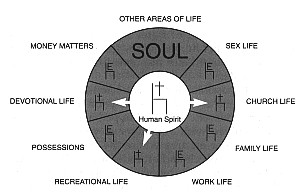
FLESH is the principle of human frailty, especially our sinful selfishness, which remains in believers after we are saved and until we are glorified and receive our new bodies. It is possible, of course, for believers to fall back into some of the ways of the FLESH, which occurs whenever we sin. Don't say "the devil made me do it!" He and this godless world system may have influenced you, but the FLESH made you do it beloved. Although believers can never again be "IN THE FLESH", the FLESH is still in them and is able to manifest itself in the believer.
Illustration of Flesh - When asked to account for the sleeping giant Mount Pinatubo in the Philippines(600 yrs), a research scientist from the Philippines Department of Volcanology observed, "When a volcano is silent for many years, our people forget that it's a volcano and begin to treat it like a mountain." Like Mount Pinatubo, the fallen flesh always has the potential to erupt, bringing great harm both to ourselves and to others. The biggest mistake believers can make is to ignore the volcano and move back onto what seems like a dormant "mountain." Never forget, the flesh is a Volcano…not simply a mountain! And it will always be a Volcano until we are glorified!
Be aware that the desire of the FLESH is to be religious in a manner acceptable to the world and to conduct its business along the principles of the world. FLESH is not a believer's friend, as many have been lulled into thinking but in fact is our enemy. Ray Stedman feels that "perhaps nothing has contributed more to the present weakness of the church than a failure to understand the nature and character of the FLESH"...the primary characteristic of the FLESH (is that) it is self-serving. It is God's life, misused. It can have all the outward appearance of the life of God--loving, working, forgiving, creating, serving--but with an inward motive that is aimed always and solely at the advancement of self. It thus becomes the rival of God--another god! This is why fallen human beings, working in the energy of the FLESH, can do many good deeds--good in the eyes of themselves and others around them. But God does not see them as good. He looks on the heart and not on the outward appearance, therefore he knows they are tainted right from the start. (read Two Splendors)
Here are a few quotes related to the flesh as manifest by our old sinful nature...We all carry about with us material that Satan can work upon. (Most of the quotes are from John Blanchard's highly recommended compendium of Biblically sound quotations - The Complete Gathered Gold: A Treasury of Quotations)
- Our sinful natures are neither removed at our regeneration nor refined by our sanctification. -- John Blanchard
- Ourselves are the greatest snares to ourselves. - Richard Baxter
- In the conversion of man, the properties of our original nature remain entire. -- John Calvin
- In youth, mid-age, and now after many battles, I find nothing in me but vanity and corruption. -- John Knox
- I more fear what is within me than what comes from without. -- Martin Luther
- Original sin is in us, like the beard. We are shaved today and look clean, and have a smooth chin; tomorrow our beard has grown again, nor does it cease growing while we remain on earth. -- Martin Luther
- It is one thing for sin to live in us; it is another for us to live in sin. - John Murray (Ed comment: The former is true of the genuine believer, while the latter is not likely to be a true believer!)
- I find not one corruption of my vile heart is dead, though some seem now and then asleep. --John Newton
- I have a vile heart, capable of every evil; and I, in myself, am as prone to change as a weathercock. --John Newton
- The flesh is radically and wholly evil. -- A. W. Pink
- There is far more wickedness in all our hearts than we know. -- J. C. Ryle
- The Christian does not have to live in defeat, but he does have to live all his life with the sin nature... and... because God has not made flesh any better in the believer, because it has not been refined, it is a powerful enemy with which we have to live. -- Charles Ryrie
- Impress the young convert from the very beginning with the conviction that God has called him into his kingdom to struggle with the corruptions of his heart. -- William B. Sprague
- All the devils in hell and tempters on earth could do us no injury if there were no corruption in our own natures. -- C. H. Spurgeon
- Beware of no man more than of yourself; we carry our worst enemies within us. -- C. H. Spurgeon
- The saints are sinners still. -- C. H. Spurgeon
- There is no doctrine more true to experience than this, that corruption remains even in the hearts of the regenerate, and that when we would do good evil is present with us. -- C. H. Spurgeon
- There may be persons who can always glide along like a tramcar on rails without a solitary jerk, but I find that I have a vile nature to contend with, and spiritual life is a struggle with me. I have to fight from day to day with inbred corruption, coldness, deadness, barrenness, and if it were not for my Lord Jesus Christ my heart would be as dry as the heart of the damned. -- C. H. Spurgeon
- Our old nature is no more extinct than the devil; but God's will is that the dominion of both should be broken. -- John R. W. Stott
- Human nature ("flesh")... is not a green apple to be perfected by mere growth, but an apple with a worm at the core, which left to itself will surely rot and perish. -- Augustus H. Strong
- The human personality has... been invaded by an alien army which is always campaigning within it. (cp 1Pe 2:11) -- R. V. G. Tasker
- Though we (as Christians) are like Christ, having the firstfruits of the Spirit, yet we are unlike him, having the remainders of the flesh. -- Thomas Watson
- Original sin is a sea that will not, in this life, be dried up. -- Thomas Watson
- Believers are no more able now of themselves to think one good thought, to form one good desire, to speak one good word, or to do one good work, than before they were justified. -- John Wesley
- Worst of all my foes, I fear the enemy within. -- John Wesley
Ray Stedman writes that "FLESH is openly arrogant, overbearing, boastful, lustful, cynical, proud. We have it described in Ephesians 5. But when it is driven by the Spirit into a corner it can assume a garb of righteousness and become pious, religious, scrupulous about morals, zealous in church work, indignant over wrongs, provokingly evangelical!...The righteousness of the FLESH is always counterfeit righteousness. It is centered in self, and therefore it is always self-righteousness....The FLESH can memorize Scripture. The FLESH can teach Sunday school. The FLESH can distribute tracts, give large gifts of money, give a stirring testimony, teach a Bible class, sing solos, or preach a sermon. It can even apologize (after a fashion), and repent (to some extent), or suffer (with a martyred air), but there is one thing that FLESH will never do. It will do anything to survive, but one thing: It will never give in it will never surrender, it will never change, it will never give up, never! It is a slippery, elusive thing; and, when we back it into a corner, it simply takes on a different disguise and appears in a different form, but it is the same old, deadly, evil FLESH. When driven into a corner it would rather wreck your life than give in. Have you found this to be true?" (The Price of Survival; see also The Death of the Flesh)
Believers need to be wary of defending the manifestations of the FLESH and excusing them as part of their personality or temperament, rather than judging them for what they really are! To give way to the desires of the FLESH is to give the devil an opportunity over us (Eph 4:17-27-see notes Ep 4:17-27).
"Pride is the root of all human evil, and pride is the basic characteristic of what the Bible calls the FLESH that lusts against, wars against, the Spirit. The FLESH is a principle that stands athwart God's purposes in human life and continually defies what God is trying to accomplish. Each of us has this struggle within us if we are Christians, and its basic characteristic is revealed here as pride. That is the number one identifying mark of the FLESH." (Ray Stedman)
In another message Stedman says that "If this pride -- the FLESH -- is not your friend, but rather a subtle, crafty enemy as this book says, then the most important thing in your Christian life is to learn to recognize how he works, for you never can win the battle against him unless you know his tactics. There is no possibility of victory without this. Paul says, "We are not ignorant of his devices," (2Corinthians 2:11b KJV). We know how he works and we can thus call upon all the overpowering, conquering influence of Jesus Christ on our behalf... The whole strategy of the FLESH is to convince us that these attitudes which mark God at work in us are really not to our advantage, that we would get along much better without them, and that the opposite attitudes are the things that will really pay off for us. If we can be led to distrust and reject these godly attitudes we will thereby frustrate the work of the Holy Spirit in our life." (Ray Stedman: The Struggle for Power)
Do not confuse other uses of "in the flesh" (pay careful attention to the context) such as in 2Cor 10:3, 4 (note) where Paul says "though we walk in the flesh, we do not war according to the flesh". The first phrase "in the flesh" refers to our human body (with its limitations) and the second phrase "according to the flesh" refers to walking according to the impulses of the sinful nature that still remains in believers.
John MacArthur addresses the issue of residual flesh still present in believers writing that "In other words, the redeemed soul must reside in a body of flesh (Ed note: not the fallen nature but the physical body which itself is a morally neutral instrument) that is still the beachhead of Sin, a place that can readily be given to unholy thoughts and longings. It is that powerful force (Sin) within our “mortal bodies” that tempts and lures us to do evil. When they succumb to the impulses of the fleshly mind, our “mortal bodies” again become instruments of sin and unrighteousness. It is a fearful thing to consider that, if we allow them to, our fallen and unredeemed bodies are still able to thwart the impulses of our redeemed and eternal souls. The body is still the center of sinful desires, emotional depression, and spiritual doubts." (MacArthur, J: Romans 1-8. Chicago: Moody Press)
The FLESH in believers is their propensity to sin, their fallen humanness that is awaiting our final redemption (GLORIFICATION), in which the new and holy creation dwells.
Flesh in believers as J Vernon McGee says "is incorrigible, my friend. It is in rebellion against God. It has been carrying a protest banner before the gates of heaven ever since man came out through the gates of paradise in the Garden of Eden."
McGee adds that "The believer has the Holy Spirit to deal with the flesh, that big bully. I learned a long time ago that I can’t overcome it (FLESH). So I have to turn it over to Somebody who can. The Holy Spirit indwells believers. He wants to do that for us, and He can!... It is humiliating but true that the child of God retains this old Adamic nature (THE FLESH). It means defeat and death to live by the FLESH. No child of God can be happy in living for the things of the FLESH. The prodigal son may get into the pig pen, but he will never be content to stay there. He is bound to say, “I will arise and go to my father.”...There is one thing for sure: if you are living in the FLESH (more accurately "LIVING FLESHLY"), and you are a child of God, you are not having fellowship with God. You can’t. (Thru the Bible Commentary)
The FLESH in believers is that part of a believer that functions apart from and against the work of the Holy Spirit in the believer’s new heart. It is not enough for us to have the Spirit; the Spirit must have us! Only then can He share with us the abundant, victorious life that can be ours in Christ. We have no obligation to the flesh, because the flesh has only brought trouble into our lives. We do have an obligation to the Holy Spirit, for it is the Spirit who convicted us, revealed Christ to us, and imparted eternal life to us when we trusted Christ. Because He is “the Spirit of Life,” He can empower us to obey Christ, and He can enable us to be more like Christ.
Vine writes that "To walk after the FLESH, to cultivate friendship with the world, to yield to any influence that would weaken our attachment and allegiance to Christ, is to deny our calling as “saints” and the relationship with Him into which God’s grace has brought us, and to involve us in present loss of His approval and in loss of our reward hereafter." (Collected writings of W. E. Vine)
Illustration of the flesh - A young convert on the foreign field was given a position of trust in the mission station. He violated that trust by stealing. The missionaries were distressed. "Why did you take what didn't belong to you?" they asked. "It wasn't I who stole; it was grandfather in my bones!" he replied. That was his way of referring to his old nature. In time he became an overcoming Christian. When asked, "How is grandfather in your bones?" he would reply, "Well, grandfather in the bones isn't dead yet, but he doesn't get about as he used to." (Zodhiates Corinthians Commentary Series – Conquering the Fear of Death: An Exegetical Commentary on First Corinthians Fifteen)
-
Summary of Scriptural Truth dealing with the moral/ethical aspect of FLESH, man's unredeemed humanness:
-
FLESH is the base of operations for lusts:
Ephesians 2:3 (note) Among them ([those who were] dead in...trespasses and sins...sons of disobedience...) we too all formerly lived in the lusts (strong inclinations and desires of every sort - see notes on epithumia) of our flesh, indulging the desires (thelema = emphasizes strong will-fulness, wanting and seeking something with great diligence) of the flesh and of the mind, and were by nature children of wrath, even as the rest. (cf 1Jn 2:15 "the lust of the flesh", 1Pe 2:11 (note) "abstain from fleshly [sarkikos] lusts" )
-
FLESH serves the Law of Sin:
Romans 7:25 (note) I thank God—through Jesus Christ our Lord! So then, with the mind I myself serve the law of God, but with the flesh the law of sin. (see note)
-
Nothing good dwells in my FLESH:
Romans 7:18 (note) For I know that in me (that is, in my flesh) nothing good dwells; for to will is present with me, but how to perform what is good I do not find. (see note)
Warren Wiersbe comments that "It is important that a believer remember what God says about his old nature, the FLESH. Everything God says about the flesh is negative. In the FLESH there is no good thing (Romans 7:18). The FLESH profits nothing (John 6:63). A Christian is to put no confidence in the FLESH (Phil 3:3). He is to make no provision for the FLESH (Ro 13:14). A person who lives for the FLESH is living a negative life. (Wiersbe, W: Bible Exposition Commentary. 1989. Victor)
-
Weakness of the FLESH is manifested in inability to discern spiritual truth.
Romans 6:19 (note) I speak in human terms because of the weakness of your flesh. For just as you presented your members as slaves of uncleanness, and of lawlessness leading to more lawlessness, so now present your members as slaves of righteousness for holiness. (cf Mt 26:41; Mk 14:38)
-
God condemned sin in the FLESH, through sinless flesh of Christ.
Romans 8:3 (note) For what the law could not do in that it was weak through the flesh (the weakness of our humanness), God did by sending His own Son in the likeness of sinful flesh, on account of sin: He condemned sin in the flesh (physical body), (see note)
-
Believers do not live according to the FLESH:
Ro 8:4-6 that the righteous requirement of the law might be fulfilled in us who do not walk according to the flesh but according to the Spirit. 5 For those who live according to the flesh set their minds on the things of the flesh, but those who live according to the Spirit, the things of the Spirit. 6 For the mind set on the flesh is death, but the mind set on the Spirit is life and peace (See notes Ro 8:4; 8:5; 8:6)
Romans 8:12; 13 Therefore, brethren, we are debtors—not to the flesh, to live according to the flesh. 13 For if you live according to the flesh you will die; but if by the Spirit you put to death the deeds of the body, you will live. (see note)
Gal 5:13 For you, brethren, have been called to liberty; only do not use liberty as an opportunity for the flesh, but through love serve one another.
Galatians 5:16 (note) I say then: Walk in the Spirit, and you shall not fulfill the lust of the flesh.
Warren Wiersbe writes that "the Spirit and the flesh (the old nature) are at war with each other. By “the flesh,” of course, Paul does not mean “the body.” The human body is not sinful; it is neutral. If the Holy Spirit controls the body, then we walk in the Spirit; but if the flesh controls the body, then we walk in the lusts (desires) of the flesh. The Spirit and the flesh have different appetites, and this is what creates the conflict... Note that the Christian cannot simply will to overcome the flesh...Paul is not denying that there is victory. He is simply pointing out that we cannot win this victory in our own strength and by our own will. .. The solution is not to pit our will against the flesh, but to surrender our will to the Holy Spirit. This verse literally means, “But if you are willingly led by the Spirit, then you are not under the Law.” The Holy Spirit writes God’s Law on our hearts (Heb 10:14, 15, 16, 17; see 2Cor 3:1, 2, 3, 4, 5ff) so that we desire to obey Him in love. “I delight to do Thy will, O my God: yea, Thy Law is within my heart” (Ps. 40:8). Being “`led of the Spirit” and “walking in the Spirit” are the opposites of yielding to the desires of the flesh. (Wiersbe, W: Bible Exposition Commentary. 1989. Victor)
-
Believers are involved in a life long struggle between Spirit and the FLESH:
Gal 5:17 (note) For the flesh sets its desire against the Spirit, and the Spirit against the flesh; for these are in opposition to one another, so that you may not do the things that you please. ("flesh" in this context is not the body of flesh and blood which is itself "morally neutral". The problems is what's still resident in these bodies and which Paul often terms "flesh" in a moral sense which makes the point that you need to be very attentive to the context when doing "word studies" as the same word can have several different meanings. In the present context Paul uses "flesh" to describe what remains of the Old self (old man) (which every human being inherits from our father Adam Ro 5:12 [note]) which still exists even after a person is saved [we can now say "no" to it]. Flesh relates to the moral and spiritual weakness and helplessness of human nature still clinging to redeemed souls. The flesh of Christians is their propensity to sin. Until then every believer has a redeemed self living in a mortal body that is dying and that creates great conflict. Flesh stands against the work of the Spirit in the believer’s new heart. The unsaved person often regrets the sinful things he does because of guilt and/or painful consequences, but he has no spiritual warfare going on within him, because he has only a fleshly nature and is devoid of the Spirit. The sinful things he does, though often disappointing and disgusting to him, are nevertheless consistent with his basic nature [his Old self] as an enemy of God and a child of God's wrath. The "Old Self" or "Old Man" therefore has no real internal conflict beyond whatever conscience may remain in his sinful state. In the believer, the essential conflict is between the Old Covenant (Law) and the New Covenant which is manifest in reality as the struggle between the flesh and the Spirit. Each of us is, in effect, a walking civil war. The flesh continually wars against the Spirit within us.)
-
Believers are not to make any provision for the FLESH:
Romans 13:14 (note) Put on the Lord Jesus Christ, and make no provision for the flesh in regard to its lusts. (If we feed the flesh, we will fail; but if we feed the inner man the nourishing things of the Spirit, we will succeed)
-
Believers have no confidence in the FLESH:
Php 3:3 (note) For we are the circumcision, who worship God in the Spirit, rejoice in Christ Jesus, and have no confidence in the flesh (By “flesh” Paul is referring to man’s unredeemed humanness, his own ability and achievements apart from God. The Jews placed their confidence in being circumcised, being descendants of Abraham, and performing the external ceremonies and duties of the Mosaic law—things that could not save them. The true believer views his flesh as sinful, without any capacity to merit salvation or please God. - MacArthur, J.: The MacArthur Study Bible Nashville: Word Pub)
-
Believers have crucified the FLESH through Christ.
Gal 5:24 (note) And those who are Christ’s have crucified the flesh with its passions and desires.
-
Believers are to cleanse themselves from the filthiness of the FLESH
2Cor 7:1 (note) Therefore, having these promises, beloved, let us cleanse ourselves from all filthiness of the flesh and spirit, perfecting holiness in the fear of God.
-
Sanctification cannot occur through the FLESH
Gal 3:3 Are you so foolish? Having begun in the Spirit, are you now being made perfect by the flesh?
-
Those who sow to the FLESH, reap corruption.
Gal 6:8 For he who sows to his flesh will of the flesh reap corruption, but he who sows to the Spirit will of the Spirit reap everlasting life.
-
Unbelievers live according to FLESH
Romans 8:5; 8:6 For those who live according to the flesh set their minds on the things of the flesh, but those who live according to the Spirit, the things of the Spirit. 6 For the mind set on the flesh is death, but the mind set on the Spirit is life and peace
-
False teachers live according to the FLESH
2 Peter 2:10 (note) and especially those who walk according to the flesh in the lust of uncleanness and despise authority. They are presumptuous, self-willed. They are not afraid to speak evil of dignitaries (see note)
-
The works of the FLESH
Galatians 5:19; 20; 21 (notes) Now the works of the flesh are evident, which are: adultery, fornication, uncleanness, lewdness, 20 idolatry, sorcery, hatred, contentions, jealousies, outbursts of wrath, selfish ambitions, dissensions, heresies, 21 envy, murders, drunkenness, revelries, and the like; of which I tell you beforehand, just as I also told you in time past, that those who practice such things will not inherit the kingdom of God.
-
Satan uses the lust of the FLESH to incite sin.
1 John 2:16 For all that is in the world—the lust of the flesh, the lust of the eyes, and the pride of life—is not of the Father but is of the world.
-
“In the FLESH” describes unregenerate people.
Romans 7:5 (note) For when we were in the flesh, the sinful passions which were aroused by the law were at work in our members to bear fruit to death. (see note)
Romans 8:8 (note) So then, those who are in the flesh cannot please God. (see note)
-
Believers can be controlled by the fallen FLESH
1 Corinthians 3:1 And I, brethren, could not speak to you as to spiritual men, but as to men of flesh, (related adjective sarkikos = pertaining to behavior which is typical of human nature, with focus upon more base physical desires) as to babes in Christ.. (Paul explained that there are two kinds of saved people: mature and immature (carnal - note that "carnal" is not necessarily the best translation because in English "carnal" often conveys the sense of one surrendered to bodily appetites, especially of the sexual nature, a fact which may or may not be the case in an immature believer). A Christian matures by allowing the Spirit to teach him and direct him by feeding on the Word. The immature Christian lives for the things of the flesh and has little interest in the things of the Spirit. Note that although they may be controlled for a time by the flesh, they are still not "in the flesh" which is the state of an unregenerate man. Note also that Living for the flesh means grieving the Holy Spirit of God who lives in us. To allow the flesh to control the mind is to lose the blessing of fellowship with God.
-
BUT THOSE WHO ARE ACCORDING TO THE SPIRIT, THE THINGS OF THE SPIRIT: hoi de kata pneuma ta tou pneumatos: (
- Ro 8:9,14; 1Cor 2:14; Gal 5:22, 23, 24, 25; Eph 5:9; Col 3:1, 2, 3
- Romans 2 Resources - Multiple Sermons and Commentaries
- Romans 8:5-6: Two Groups, Two Destinies - Steven Cole
- Romans 8:4-6 The Transforming Work of the Spirit, Part 1 - John MacArthur
"but those who are according to the Spirit and are controlled by the desires of the Spirit set their minds on and seek those things which gratify the [Holy] Spirit." (Amplified)
"Those who live as the Spirit tells them to, have their minds controlled by what the Spirit wants" (GNT)
"But those who live following the Spirit are thinking about the things the Spirit wants them to do" (NCV)
"but those who live according to the Spirit have their outlook shaped by the things of the Spirit" (NET)
"But those who live in accordance with the Spirit have their minds set on what the Spirit desires." (NIV)
"those who live in the Spirit have their minds on spiritual things" (NJB)
"but those who are controlled by the Holy Spirit think about things that please the Spirit." (NLT)
"If they are controlled by their spiritual natures, they give their minds to spiritual things" (Weymouth)
"but those who are habitually dominated by the Spirit put their minds on the things of the Spirit" (Wuest)
LIFE IN THE SPIRIT
IS POSSIBLE BY HIS POWER
But - Always pay close attention to this strategic term of contrast, which usually marks a "change of direction." Pause and ponder what this "change" entails - it will force you to read the context, but will allow the Spirit to give you greater illumination on the meaning. Here we see the contrast between what we once were in Adam and what we now have the wonderful potential to be in Christ Who sent His Spirit to indwell us and enable us to live life on higher plane, the Spirit filled/controlled life (Eph 5:18, cf Gal 5:16, Php 2:12 and Php 2:13NLT).
John MacArthur give a great analogy regarding the Holy Spirit and the life of the believer - The Holy Spirit is mentioned but once in the first seven chapters of Romans, but is referred to nearly twenty times in chapter 8. The Spirit is to a believer what God the Creator is to the physical world. Without God, the physical world would not exist. It has been created and is continually sustained by the omnipotent power of God. So the Holy Spirit—who also, of course, participated in the creation of the world-is to the Christian. The Holy Spirit is the divine agent who creates, sustains, and preserves spiritual life in those who place their trust in Jesus Christ. It is the Holy Spirit who ultimately will bring every believer into the full consummation of his salvation by granting him eternal glory in the presence of God. (Romans Commentary - notes on Ro 8:5-13, Vol 1, page 414)
According to the Spirit describes the mind (and heart) possessed by the Spirit and thus controlled and dominated by the Holy Spirit. These are believers, God's true children, because the Holy Spirit by Whom they were born (John 3:3-5), now indwells all of them (Ro 8:9). Therefore, true believers have the "inner potential" (the supernatural power of the Spirit) to rise above flesh and blood and live for those things that are eternal, the word of God, prayer, worship, evangelism, making of disciples, etc. (cf Col 3:1, Col 3:2).
In other words, those who belong to God (and by definition are no longer their own! 1 Cor 6:19-20) are concerned about godly things. As Jonathan Edwards liked to say, they have “holy affections,” deep longings after God and sanctification. As Paul has made clear in Romans 7, even God’s children (although not everyone agrees Paul is referring to believers in that section) falter in their obedience to Him. But they nevertheless “joyfully concur with the law of God in the inner man” (Ro 7:22). Despite their spiritual failures, the basic orientation of those who set their mind "according to the Spirit" is to seek those things that have to do with the Spirit.
In God’s eyes, there are only two kinds of people in the world, those who do not belong to Him and those who do. Obviously there are degrees in both categories. In other words, some unsaved people exhibit high moral standards and behavior, and, on the other hand, many saints do not mind the things of God as obediently as they should especially considering that they possess the Holy Spirit Who enables them to be holy. But every human being is completely in one spiritual state of being or the other and either belongs to God or does not belong to God. Just as a person cannot be partly dead and partly alive physically, neither can he be partly dead and partly alive spiritually. There is no middle ground. A person is either forgiven and in the kingdom of God or unforgiven and in the kingdom of darkness in this world and under the dominion of Satan. In short, every person on planet earth is either a child of God or a child of Satan, all are either in Christ or in Adam. No exceptions to this rule.
Expositor's Greek Testament - are those whose nature is determined simply by the flesh; their “mind,” i.e., their moral interest, their thought and study, is upon ta tes sarkos: for which see Gal 5:19f. Hoi kata pneuma (according to the spirit) are those whose nature is determined by the spirit: for ta tou pneumatos see Gal 5:22. (Romans 8 - The Expositor's Greek Testament)
Note the four contrasts in (Romans 8:5-8):
In the flesh—in the Spirit (Ro 8:5-note)
Death—life (Ro 8:6-note)
War with God—peace with God (Ro 8:6, 7-note)
Pleasing self—pleasing God (Ro 8:8-note)
MacDonald comments on the contrast in this verse noting that...
Those who live according to the flesh—that is, those who are unconverted—are concerned with the things of the flesh. They obey the impulses of the flesh. They live to gratify the desires of the corrupt nature. They cater to the body, which in a few short years will return to dust. But those who live according to the Spirit—that is, true believers—rise above flesh and blood and live for those things that are eternal. They are occupied with the word of God, prayer, worship, and Christian service. (Believer's Bible Commentary)
One's predominant mindset will determine not only their eternity but also the quality of life now. Wesley Hager, (Conquering: Eerdmans, 1965) pictures this contrast poetically...
One ship drives east and another drives west
With the selfsame winds that blow.
’Tis the set of the sails
And not the gales
Which tells us the way to go.
Like the winds of the sea are the ways of fate,
As we voyage along through life—
’Tis the set of a soul
That decides its goal
And not the calm or the strife.
William Newell - there are those who are according to Spirit, who mind the Spirit's things: salvation, the person of Christ, the fellowship of the saints, the Word of God, prayer, praise prophecy, the blessed hope of Christ's coming, walking as He walked before men. True, many, many of these fall woefully short (as they well know); yet they mind the things of Spirit, the things of God, to some degree, while others will have nothing of them. (Romans 8: Expository Notes Verse by Verse)
Hendricksen sums up this section emphasizing that "Those who live according to the flesh allow their lives to be basically determined by their sinful human nature. They set their minds on—are most deeply interested in, constantly talk about, engage and glory in—the things pertaining to the flesh, that is, to sinful human nature. Those who live according to the Spirit, and therefore submit to the Spirit’s direction, concentrate their attention on, and specialize in, whatever is dear to the Spirit. In the conflict between God and sinful human nature the first group sides with human nature; the second sides with God. Paul is reminding the members of the church in Rome that it is impossible to be on both sides at once; that is, the basic—this adjective should be stressed!—disposition or direction of our lives is either on God’s side or on the side of sinful human nature. If a person persists in being worldly, he is on the side of the world and must expect the world’s doom. On the other hand, if the things concerning God and his kingdom are his chief concern, he can expect life: sweet communion with God, God’s love shed abroad in the heart, joy unspeakable and full of glory, all this and far more forever and ever." (Hendriksen, W., & Kistemaker, S. J. NT Commentary Set. Baker Book) (Bolding added)
John Piper addresses what the things of the Spirit look like in a believer's life "The Spirit inspired the Word and therefore goes where the Word goes. The more of God’s Word you know and love, the more of God’s Spirit you will experience. Instead of drinking wine, we should drink the Spirit. How? By setting our minds on the things of the Spirit: “Those who live according to the Spirit set their minds on the things of the Spirit” (Ro 8:5). What are the things of the Spirit? When Paul said in 1Corinthians 2:14, “The natural person does not accept the things of the Spirit,” he was referring to his own Spirit-inspired teachings (1Co 2:13). Therefore, above all, the teachings of Scripture are the “things of the Spirit.” We drink in the Spirit by setting our minds on the things of the Spirit, namely, the Word of God. And the fruit of the Spirit is joy (Gal 5:22)." (Desiring God. Pdf online.)
Our Sinful Nature Always Has the Potential to Erupt - Scores of people lost their lives. The world’s mightiest army was forced to abandon a strategic base, property damage approached a billion dollars. All because the sleeping giant, Mount Pinatube in the Philippines, roared back to life after 600 years of quiet slumber. When asked to account for the incredible destruction, caused by this volcano, a research scientist from the Philippine department of volcanology observed, “When a volcano is silent for many years, our people forget that it’s a volcano and begin to treat it like a mountain. Like Mount Pinatube, our sinful nature always has the potential to erupt, bringing great harm both to ourselves and to others. The biggest mistake we can make is to ignore the volcano and move back onto what seems like a dormant “mountain.
William Barclay - Paul is drawing a contrast between two kinds of life.
(i) There is the life which is dominated by sinful human nature; whose focus and centre is self; whose only law is its own desires; which takes what it likes where it likes. In different people that life will be differently described. It may be passion-controlled, or lust-controlled, or pride-controlled, or ambition-controlled. Its characteristic is its absorption in the things that human nature without Christ sets its heart upon.
(ii) There is the life that is dominated by the Spirit of God. As a man lives in the air, he lives in Christ, never separated from Him. As he breathes in the air and the air fills him, so Christ fills him. He has no mind of his own; Christ is his mind (1Cor 2:16). He has no desires of his own; the will of Christ is his only law.
He is Spirit-controlled,
Christ-controlled,
God-focused.
These two lives are going in diametrically opposite directions. The life that is dominated by the desires and activities of sinful human nature is on the way to death. In the most literal sense, there is no future in it--because it is getting further and further away from God. To allow the things of the world completely to dominate life is self extinction; it is spiritual suicide. By living it, a man is making himself totally unfit ever to stand in the presence of God (2Th 1:6-9). He is hostile to him, resentful of his law and his control. God is not his friend but his enemy, and no man ever won the last battle against him.
The Spirit-controlled life, the Christ-centred life, the God-focused life is daily coming nearer heaven even when it is still on earth (cp Col 3:1-2). It is a life which is such a steady progress to God that the final transition of death is only a natural and inevitable stage on the way. It is like Enoch who walked with God and God took him (Heb 11:5). As the child said: "Enoch was a man who went on walks with God--and one day he didn't come back."
No sooner has Paul said this than an inevitable objection strikes him. Someone may object: "You say that the Spirit-controlled man is on the way to life; but in point of fact every man must die. Just what do you mean?" Paul's answer is this. All men die because they are involved in the human situation. Sin came into this world and with sin came death (Ro 5:12), the consequence of sin (Eph 2:1). Inevitably, therefore, all men die; but the man who is Spirit-controlled and whose heart is Christ-occupied, dies only to rise again (1Cor 15:52-57, 1Th 4:13-18). Paul's basic thought is that the Christian is indissolubly one with Christ. Now Christ died and rose again; and the man who is one with Christ is one with death's conqueror and shares in that victory. The Spirit controlled, Christ-possessed man is on the way to life (cf Jn 20:31 = "life in His Name", Col 3:4); death is but an inevitable interlude that has to be passed through on the way. (Romans 8- - William Barclay's Daily Study Bible)
Charles Simeon
IT is a certain and blessed truth, that all who believe in Christ are delivered from the condemnation due to their sins. But it is no less true, that all who believe in Christ are delivered also from the dominion of sin, and are enabled to walk in the paths of righteousness and holiness: and it is only by men’s attainment of this latter state that their attainment of the former can be ascertained.
At the time that men believe in Christ, they have a new and spiritual principle infused into them by the Spirit of God: and where that principle exists, it will of necessity manifest itself by its appropriate operations. Hence the carnal and the spiritual man may be clearly distinguished from each other. Each will follow the predominant principle by which he is actuated:
They that are after the flesh, will mind the things of the flesh;
and they that are after the Spirit, the things of the Spirit.
That the two characters may the more clearly appear, I will set them before you,
I. In a distinct and separate view—
THE CARNAL MAN
The carnal man will follow carnal things—
There is in man, by nature, a carnal principle only (~flesh). Whatever be his feelings, or whatever his pursuits, he is influenced by no other principle than that which he has in common with the whole human race (Ro 5:12): and the objects of his pursuit are such only as that principle affects.
In a word, he seeks nothing
beyond the things of time and sense.
Pleasure, riches, honour, are, in his estimation, the great sources of happiness to man; and they alone are deemed worthy of his attention. His pleasures may be more or less refined; but, whether they be of an intellectual or corporeal nature, his end in pursuing them is the gratification of his own taste.
As in the animal creation there is a diversity of pursuit, but the same end; so in men one may affect the sports of the field, another the indulgence of his appetites and passions, and another the investigations of science; but still self-pleasing is alike the principle of all. So also, in the pursuit of riches or honour, the immediate efforts of men will be suited to the sphere in which they move: but the king upon a throne, and the beggar upon a dunghill, however wide asunder the objects of their pursuit may be, will be worked upon ("energized") in the same way by the things which appear to be within their reach, and will show that they are alike under the influence of a principle that is purely carnal (~flesh).
Even in the things which have respect to religion, a carnal man will still feel no higher principle than self: self-seeking, self-pleasing, self-righteousness, and self-dependence, will be found at the root of all that he does in waiting upon God. He has no real delight in any religious exercise; and all his conformity to religious observances is a mere tribute to self, rather than to God: it is a price paid for self-esteem, and for the esteem of those around him.
THE SPIRITUAL MAN
The spiritual man, on the other hand, will follow spiritual things—
There is in him, as we have said, a principle infused into his soul by the Spirit of God (Ro 8:9), and operating to the production of a new and spiritual life. The person who has received this new nature will affect objects and employments suited to it. Acceptance with God will be the first great object of his pursuit (2Co 5:9). In comparison of this, nothing under heaven will be of any value.
The care of the soul will be, in his estimation, the one thing needful. Hence he will devote much time to reading the Scriptures and to prayer. The great work of repentance will now occupy his mind; and the Lord Jesus Christ will be endeared to him as the Saviour of the world.
There will be between him and the carnal man the same difference as existed between the well and the sick in the days of our Lord (Lk 5:31, Mt 9:12). The well beheld him with mere curiosity: the sick flocked around him with a determination to obtain, if possible, the healing of their diseases.
The spiritual man is in pursuit of heaven, as begun on earth, and perfected in glory: and, like a man in a race, or in a conflict, he engages with all his might, if by any means he may obtain the prize of his high calling (Php 3:14). Even in his earthly engagements he bears in mind his great object, and endeavours to make even temporal pursuits subservient to his attainment of it. He considers his responsibility to God, and acts in every thing with a reference to his great account.
But, that we may render the distinction between the two characters more clear, it will be proper to consider them,
II. In a combined and contrasted view—
Take both the characters, and consider them,
1. In their judgment—
A carnal man may feel a general approbation (commendation) of religion; but he does not regard it as of paramount importance. What he allows to religion, he rather concedes from necessity, than claims as its unquestionable due. He will conform to religion so far as his temporal interests will admit of it: but where the two come seriously in competition with each other, the world will have a decided preponderance in its favour. The good opinion of men will limit his exertions for God; and the attainment of some earthly object be prosecuted in preference to the best interests of his soul. To attend to the interests of time and sense will be esteemed by him as of the first necessity; and his spiritual welfare will be subordinated to it.
The spiritual man, on the other hand, will decidedly declare himself on the side of God and of religion. He will not neglect his earthly duties; for he considers them as a part of his duty to God: but if any thing earthly stand in competition with what is heavenly, he hesitates not to which he shall give the preference (Mt 6:24). The things of time and sense are in his eyes but as the dust upon the balance, in comparison of the things which are invisible and eternal (2Co 4:18): and in the contemplation of his God and Saviour, he gives this as the deliberate judgment of his mind, “Whom have I in heaven but thee? and there is none upon earth that I desire in comparison of thee.” (Ps 73:25)
2. In their will—
The will of man, for the most part, is determined by his judgment: for though he may see a better path, and pursue a worse, yet, at the time, he wills that which he thinks will, under the existing circumstances, contribute most to his happiness.
Hence the carnal man, though he may feel some good desires after religion, and some purpose of heart to seek after it at some future period, determines that he will, for the present, give himself to the prosecution of his earthly objects. Hence, too, he chooses as his associates those who are like-minded with himself, and who can participate with him in his enjoyments. He may know of persons capable of advancing his spiritual welfare: but he has no sympathy with them, nor any desire after their company, Any excess in worldly-mindedness he can forgive and palliate: but any thing that approximates to excess in religious matters is deemed by him an unpardonable offence: and one instance of it will do more to repel him from religion, than ten thousand instances of the opposite habit to deter him from a conformity to the world.
The spiritual man, on the contrary, chooses, with deliberate purpose, his spiritual pursuits; nor will he be deterred from them by any regard to the things of this world. His heart is fixed; and though he finds that the world has yet too great an ascendant over him, he maintains his conflicts with vigour, and becomes daily more dead to the world and more alive to God. He uses diligently, too, the means of spiritual advancement; and takes for his friends and associates those who will help him forward in his heavenly way.
3. Their affections—
These invariably are most called forth by the things which most preponderate in the soul.
The carnal man accordingly betrays his indifference to spiritual objects by his total want of feeling in relation to them. He may go through his religious observances with constancy; but he rests in them, and never thinks of the way in which his duties have been performed. But, in reference to earthly things, he is alive: his hopes and fears, his joys and sorrows, are called forth, according as he succeeds or fails in the objects of his pursuit.
The spiritual man, on the contrary, though not regardless of earthly pursuits, is comparatively unmoved by them; because he is chiefly solicitous that his soul may prosper, and that he may advance in a meetness for his heavenly inheritance. You may find him dejected or happy, without any visible cause: but when you inquire into the reasons of his experience, you will find that some change has taken place in his conflicts with sin, or in his sense of the Divine presence, or in his prospects in the eternal world; and, according as these are favourable or not, his soul becomes elevated or depressed; by which he shows that his chief treasure is in heaven.
Application—
Take this portion of Holy Writ,
1. As a test whereby to try your state—
Hitherto I have left unnoticed the peculiar force of the word which the Apostle uses to designate the regard which we feel towards the different objects here spoken of. But the question is, not so much what our external conduct is in relation to them, as what the disposition of our minds is. Which of the two objects do we savour? to which does our taste lead us? and in which do we find most enjoyment?
Now, if we will only take notice whither our thoughts lead us, at those seasons when nothing particular has occurred to determine their course, we shall infallibly discover the real bias of our minds:
if they run out after any thing that relates to this vain, transient world, we are carnal:
if after things spiritual and eternal, we may rank ourselves amongst the number of those who are truly spiritual.
The same judgment we may form, by noticing what subjects we most delight to converse about, whether on those which pertain to this life only, or those which relate to the kingdom of our Lord and the interests of our souls.
Whatever it be that we most relish and and most delight in, that is the thing which occupies the chief place in our hearts, and determines us to be either spiritual or carnal, as the case may be. Take, then, this test; and “judge yourselves, that ye be not judged of the Lord.”
2. As a rule whereby to regulate your conduct—
It is clear, from this passage, what ought to be the constant habit of our lives.
We should be growing continually in a deadness to the world, and in a superiority to every thing here below.
The great concerns of eternity should more and more occupy our minds; and the whole course of our life should be such as to bear witness to us that we are candidates for heaven. (2Co 4:18)
As to this present world, we should consider ourselves as mere pilgrims and sojourners (1Pe 2:11), that have but little interest in any thing around us, and whose chief concern is to pass through it in safety to our destined home. (Romans 8:5 The Carnal and the Spiritual Man Compared)
|
All Mankind is Either
Dear reader...the striking contrasts in this simple table beg the question... Which column are you in? How I pray that the Spirit has drawn you and reborn you, |
||||||||||||||||||||||||||||||||||||||||||||||||