Romans 8:2
Romans 8:3
Romans 8:4
Romans 8:5
Romans 8:6
Romans 8:7
Romans 8:8
Romans 8:9
Romans 8:10
Romans 8:11
Romans 8:12
Romans 8:13
Romans 8:14
Romans 8:15
Romans 8:16
Romans 8:17
Romans 8:18
Romans 8:19
Romans 8:20
Romans 8:21
Romans 8:22
Romans 8:23
Romans 8:24
Romans 8:25
Romans 8:26
Romans 8:27
Romans 8:28
Romans 8:29
Romans 8:30
Romans 8:31
Romans 8:32
Romans 8:33
Romans 8:34
Romans 8:35
Romans 8:36
Romans 8:37
Romans 8:38
Romans 8:39

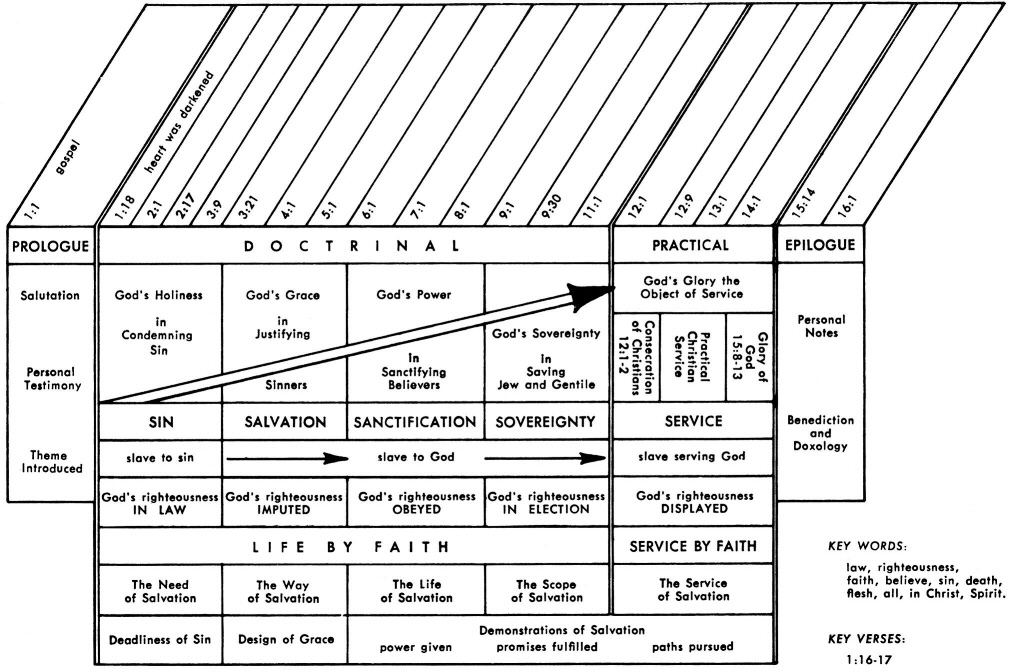
Click chart to enlarge
Chart from recommended resource Jensen's Survey of the NT - used by permission
Romans Overview Chart - Charles Swindoll
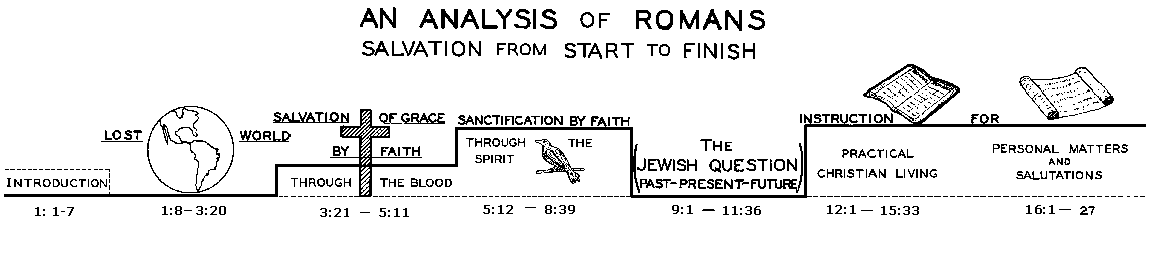
Source: Dr David Cooper
Click to Enlarge
| ROMANS ROAD to RIGHTEOUSNESS |
||||
| Romans 1:18-3:20 | Romans 3:21-5:21 | Romans 6:1-8:39 | Romans 9:1-11:36 | Romans 12:1-16:27 |
| SIN | SALVATION | SANCTIFICATION | SOVEREIGNTY | SERVICE |
| NEED FOR SALVATION |
WAY OF SALVATION |
LIFE OF SALVATION |
SCOPE OF SALVATION |
SERVICE OF SALVATION |
| God's Holiness In Condemning Sin |
God's Grace In Justifying Sinners |
God's Power In Sanctifying Believers |
God's Sovereignty In Saving Jew and Gentile |
Gods Glory The Object of Service |
| Deadliness of Sin |
Design of Grace |
Demonstration of Salvation | ||
| Power Given | Promises Fulfilled | Paths Pursued | ||
| Righteousness Needed |
Righteousness Credited |
Righteousness Demonstrated |
Righteousness Restored to Israel |
Righteousness Applied |
| God's Righteousness IN LAW |
God's Righteousness IMPUTED |
God's Righteousness OBEYED |
God's Righteousness IN ELECTION |
God's Righteousness DISPLAYED |
| Slaves to Sin | Slaves to God | Slaves Serving God | ||
| Doctrine | Duty | |||
| Life by Faith | Service by Faith | |||
|
Modified from Irving L. Jensen's chart above |
||||
R Ruin (Romans 1:17 – 3:20) – The utter sinfulness of humanity
O Offer (Romans 3:21-31) – God’s offer of justification by grace
M Model (Romans 4:1-25) – Abraham as a model for saving faith
A Access (Romans 5:1-11) – The benefits of justification
N New Adam (Romans 5:12-21) – We are children of two “Adams”
S Struggle w/ Sin (Romans 6:1-8:39) Struggle, sanctification, and victory
Romans 8:6 For the mind set on the flesh is death, but the mind set on the Spirit is life and peace, (NASB: Lockman)
Greek: to gar phronema tes sarkos thanatos, to de phronema tou pneumatos zoe kai eirene;
More literally: For the thinking of the flesh -- death, the thinking of the Spirit -- life and peace.
Amplified Now the mind of the flesh [which is sense and reason without the Holy Spirit] is death [death that comprises all the miseries arising from sin, both here and hereafter]. But the mind of the [Holy] Spirit is life and [soul] peace [both now and forever]. (Amplified Bible - Lockman)
Barclay: To be absorbed in worldly human things is death; but to be absorbed in the things of the Spirit is life and peace (Westminster Press)
KJV: For to be carnally minded is death; but to be spiritually minded is life and peace.
NLT: If your sinful nature controls your mind, there is death. But if the Holy Spirit controls your mind, there is life and peace. (NLT - Tyndale House)
Phillips: The former attitude means, bluntly, death: the latter means life and inward peace. (Phillips: Touchstone)
Wuest: For to have the mind dominated by the sinful nature is death, but to have the mind dominated by the Spirit is life and peace
Young's Literal: for the mind of the flesh is death, and the mind of the Spirit -- life and peace;
FOR THE MIND SET ON THE FLESH IS DEATH: to gar phronema tes sarkos thanatos:
- Ro 8:7,13; 6:21,23; 7:5,11; 13:14; Gal 6:8; Jas 1:14,15
- Romans 8 Resources - Multiple Sermons and Commentaries
For (gar) - Notice the little preposition "for" (there are over 7000 "for's" in Scripture) and if the context indicates, as it does in this passage, that the "for" is a term of explanation, pause and ask yourself what is the Spirit seeking to explain? Notice how pausing to ponder will always force you to examine the context. You can (and should) practice this simple discipline every time you encounter a for, and while not every instance is a term of explanation, a "for" at the beginning of a verse is almost always is used with that grammatical sense. I guarantee that if you begin to "pause and ponder," you will radically rejuvenate your "Read Through the Bible in a Year" program! As you practice interrogating the text (for, therefore, but, so that, etc) with 5W/H questions such as "What's the for explaining?", you will begin to learn to (1) Read the Bible inductively (power point overview) and to (2) Meditate (see also Primer on Biblical Meditation) on the Scripture. Meditation or "chewing the cud" of the Scripture (cf Mt 4:4, Job 23:12, Jer 15:16) so to speak is a vanishing discipline in our fast paced, hi tech, low touch society, but a spiritual discipline which God promises to greatly bless (See Ps 1:1, Ps 1:2, Ps 1:3, Joshua 1:8, cf Ps 4:4, 19:14, 27:4, 49:4, 63:6, Ps 77:6, 77:12, Ps 104:34, Ps 119:15, 119:23, 119:27, Ps 119:48, 119:78, Ps 119:97, 119:99, Ps 119:148, 143:5, Ps 145:5) From the preceding passages which "organ" of our being is most often involved/engaged in meditation? What are the subjects or the focus of meditation? Reading the Bible without meditating on it is like eating without chewing.
More literally (as there are no verbs in the original) the Greek reads…
For the thinking of the flesh -- death, the thinking of the Spirit -- life and peace.
Wuest expands the Greek…
For to have the mind dominated by the sinful nature is death, but to have the mind dominated by the Spirit is life and peace (Eerdmans)
Someone has well said that…
As to one's state of mind (natural or unregenerate versus regenerate), so is its tendency; as its tendency, so is its conduct.
Godet writes that Paul's introduction of this verse with the preposition For "explains the moral necessity with which this motion constantly proceeds, from the inward moral state to aspiration, and from aspiration to action. There is on both sides, as it were, a fated end to be reached (death or life and peace), which acts at a distance on the will by an attraction like that which is exercised by a precipice on the current of a river as it approaches it. This goal is death on the one hand, life on the other. The flesh tends to the former; for to gain the complete liberty after which it aspires, it needs a more and more complete separation from God; and this is death. The Spirit, on the contrary, thirsts for life in God, which is its element, and sacrifices everything to succeed in enjoying it perfectly. Neither of these two powers leaves a man at rest till it has brought him to its goal, whether to that state of death in which not a spark of life remains, or to that perfect life from which the last vestige of death has disappeared (Godet, F L: The Epistle of St Paul to the Romans) (Bolding added)
Moule adds that "the reference of this for is not clear at first sight. Probably the sequence of thought is that the difference of carnal and spiritual preferences is profoundly real; for the former involves death, the latter, life and peace. And it is implied that the respective persons cannot possibly interchange their preferences. (The Epistle of Paul the Apostle to the Romans)
THE THINKING
OF THE FLESH -
DEATH
Mind set (5427) (phronema from phroneo [word study] = think, have a mind set) is the what one has in mind. It is the inclination of the mind which includes the acts of understanding and of will. Phronema like the verb, phroneo, refers to the content or thought patterns of the mind rather than to the mind itself. It describes the faculty of fixing one's mind on something and thus is a way of thinking.
The four uses of phronema in the Bible are all found in Romans 8 - 2 in Ro 8:6; one in Ro 8:8 and one in Ro 8:27.
and He who searches the hearts knows what the mind (phronema) of the Spirit is, because He intercedes for the saints according to the will of God. (Ro 8:27)
Phronema refers to one's "way of thinking". The direction or orientation of human thought is warped by sin. Human beings without the Spirit are both unable and unwilling to grasp spiritual realities, and so they rebel against God. In short, they don't really know how to "think straight"! Keep in mind this refers to spiritual truth, not algebra, web design or writing a symphony, etc (1Co 2:14). What Paul is saying is that the direction or orientation of human thought is warped by sin. Human beings without the Spirit are both unable and unwilling to grasp spiritual realities, and so they rebel against God.
Moule notes that literally Paul refers to "The mind of the flesh. The noun (phronema) rendered mind is cognate (related) to the verb rendered do mind in Ro 8:5KJV. The idea includes choice, engrossment, affection towards a congenial object. (The Epistle of Paul the Apostle to the Romans)
Robert Haldane notes that…
In the preceding verse the Apostle contrasts the dispositions and practices of believers and unbelievers; here he contrasts their opposite states and conditions. These two states of carnal and spiritual mindedness include and divide the whole world. All men belong either to the one or the other. They are either in the flesh or in the Spirit; in a state of nature or in a state of grace.
For to be carnally minded is death.—This is the awful state of the carnal mind—the mind of the flesh without faith in Christ, and renovation of the Spirit of God. It is death spiritual and eternal. All the works of those who are in this state are “dead works,” Hebrews 9:14. “The sacrifice of the wicked is an abomination to the Lord,” although the Lord commanded to offer sacrifices, which therefore was in itself a good work. “She that liveth in pleasure is dead while she liveth.” All by nature being in this carnal state, are “dead in trespasses and sins.” Let those whose minds are set on the things of the world consider this fearful saying, that to be carnally minded is death, and let them look to Jesus the Savior of the guilty, through whom alone they can escape condemnation. (Romans 8 Commentary)
Charles Hodge writes that mind set "expresses a state of mind. The idea is not just that seeking the things of the flesh leads to death, but that an unspiritual mind, which reveals itself in the desire and pursuit of unspiritual objectives, is death. Death, of course, means spiritual death, the absence and the opposite of spiritual life. It includes alienation from God, unholiness, and misery. On the other hand, the “mind controlled by the Spirit” is that state of mind which is produced by the Spirit and which reveals itself in the desire and pursuit of the things of the Spirit. This state of mind is life and peace. This is where the true life and blessedness of the soul lies. As this is the case, there can be no such thing as salvation in sin, no possibility of justification without sanctification. If we share the spiritual benefits from Christ’s death, we also share in His life. If we died with Him, we live with Him. This is pertinent to the apostle’s main purpose in this chapter, which is to show that believers can never be condemned. They are not only delivered from the law and justified by the blood of Christ, but they participate in His life. They have the mind controlled by the Spirit [which] is life and peace. (Romans Commentary)
Flesh (4561) (sarx [word study]) in the context of this verse refers to the evil nature present in every man every born, for all have been born into the line of Adam (and even those who are born again or regenerate by the Spirit possess the fallen flesh, with which we must daily contend). The picture Paul paints is of a mind "possessed" by and thus controlled or dominated by the evil, "anti-god" flesh, and this picture is a description of all who are yet unsaved. Paul is saying that this means that one’s life (that of the unsaved person) is determined and directed by the values of this evil world system which intractably set against and in total rebellion toward God. Controlled by such an "anti-god" mindset is the only way an unsaved person is able to walk - according to the flesh. That person is still dead in their trespasses and sins (Eph 2:1), separated from the spiritual life God made possible by His Son. Death always brings about separation, in this life and the one to come in eternity (Rev 20:11, 12, 13, 14, 15-see commentary notes), unless one receives (Jn 1:12, 13) by grace through faith (Ep 2:8, 9-ntoe) God's Son "Who knew no sin (and was made) to be sin on our behalf, that we might become the righteousness of God in Him." (2Cor 5:21)
Alan Carr writes that "In this verse, Paul is stating a fact! If you have a carnal mind, that is, a mind focused on the things pertaining to the flesh, you are dead! He is not talking about a potential, he is merely stating an equation. To have a carnal mind means you are lost and dead, Eph. 2:1, 2, 3. However, to have a mind that is focused on God and things above is to prove that you are indeed saved by grace and walking in the Spirit! It is a genuine indicator of the state of the soul, Col. 3:1, Col 3:2, Col 3:3, 4. While the primary focus of this verse is the here and now, the future is also in view! To possess a carnal mind means that you are lost in sin and will eventually find yourself in Hell forever separated from God. On the other hand, to be controlled by the Spirit is evidence of an eternity that will be filled with life and peace in the presence of the Lord in Heaven some day! (Sermon)
Death (2288) (thanatos) refers to the termination of physical life or as death viewed transcendently in contrast to a living relationship with God. As used in the NT thanatos is treated primarily as a destroying power related to sin and its consequences. Death is separation from God in this present life and ultimately after physical death in eternity. (cp 2Th 1:7, 8, 9, 10, cp Mt 25:41)
In short, if one's mind is not Christ-centered and instead his or her interest is constantly (emphasize that this is one's lifestyle, one's habitual practice) being placed upon carnal or fleshly desires, the results (no spiritual "life and peace") are the symptoms of spiritual death!
Moule asks a question regarding death - Is this legal (at the time of judgment) or moral (spiritual death now) death? On the whole, we explain it of legal death, i.e. of doom. This idea implies the other, for the soul which is incurring the Divine Sentence cannot be morally "alive to God" in the sense of peace, love and purity. But the connection makes the idea of doom more prominent: see Ro 8:7, where antagonism to the Law is specified as the inevitable state of the "carnal mind." Thus the words here mean that to have the choice and affections of the unregenerate humanity is to lie under God's sentence, and to be on the way to its infliction. (The Epistle of Paul the Apostle to the Romans)
Newell comments that "It is terrible to contemplate a mind, disposition, purpose, so set on death (which is its end) that it can be said to be death. It is a most solemn contemplation that we who are in Christ were once in the flesh, the mind and disposition of which we could not and would not change, and which was death itself! (Romans: Verse by Verse - Recommended Resource)
Notice that Paul does not say that the mind set on the flesh leads to death, but that it is death. (in the original Greek there is no verb for "is" so literally the text reads even more dramatically "the mind set on the flesh - death"). The unsaved person is already dead spiritually.
As John MacArthur puts it Paul is "stating a spiritual equation, not a spiritual consequence. The consequence involved in this relationship is the reverse: that is, because unredeemed men are already spiritually dead, their minds are inevitably set on the flesh. Paul reminded the Ephesian believers that, before salvation, they were all once “dead in [their] trespasses and sins” (Eph 2:1)… The unsaved person is a spiritual corpse and consequently is completely unable, in himself, to respond to the things of God. Unless the Holy Spirit intervenes by convicting him of sin and enabling him to respond to God by faith and thus being made alive, the unsaved person is insensitive to the things of God (MacArthur, J: Romans 1-8. Chicago: Moody Press)
Kenneth Wuest explains flesh (sarx) in this verse as "the evil nature. It is the genitive of possession. The mind is possessed by, thus controlled or dominated by the evil nature, a description of the unsaved person. That person is dead in trespasses and sins, dead in the sense that he is separated from God and His life, for death is separation, and is on his way to a final and everlasting state of death in eternity." (Wuest's Word Studies from the Greek New Testament)
BUT THE MIND SET ON THE SPIRIT IS LIFE AND PEACE: to de phronema tou pneumatos zoe kai eirene:
- Ro 5:1,10; 14:17; Jn 14:6,27; 17:5; Gal 5:22
- Romans 8 Resources - Multiple Sermons and Commentaries
THE THINKING
OF THE SPIRIT -
LIFE AND PEACE
But (de) is a term of contrast which should always cause a pause to ponder what the writer is contrasting.
The mind set on the Spirit - More literally = “the mind possessed by the Spirit”. This describes a mind which is controlled by or dominated by the Holy Spirit (Compare - "do not get drunk with wine, for that is dissipation, but be filled with [controlled by = command to allow this to occur continually = present imperative] the Spirit" Eph 5:18). Such a person with such a "mindset" is the one who possesses the life that God is, and the peace that He Alone graciously gives.
Moule writes of life and peace that "This means a state of acceptance in regard to (a) pardon and the consequences of that pardon = glory and (b) secure, loving intercourse with God, with all its attendant blessings. (The mind possessed by the Spirit, that affinity given to the believer by the indwelling Holy Spirit is) the only state of mind in which life and peace can be realized and enjoyed (Adapted from page 142: The Epistle of Paul the Apostle to the Romans)
Life (2198) (zoe) means the absolute fullness of life, both essential and ethical, which alone belongs to God the Giver of life. This is life as God originally intended it to be lived.
Godet adds that…
Life, in Scripture, denotes a fully satisfied existence, in which all the faculties find their full exercise and their true occupation. Man's spirit, become the abode and organ of the Divine Spirit, realizes this life with a growing perfection to eternal life.
Peace is the inward feeling of tranquillity which accompanies such an existence; it shows itself particularly in the absence of all fear in regard to death and judgment (Ro 8:1). There is no changing the nature of these two states and walks (Ro 8:5), and no arresting the latter in its onward march (Ro 8:6). The way of salvation is to pass from the first to the second, and not to relapse thereafter from the second to the first. (Ibid)
Peace (1515) (eirene) in its verb form means “to bind together that which has been separated” thus in the present context describes the believing sinner, bound together with God and His life after having been separated by sin. It is that inward harmony and tranquility that results from yielding to God. Did you present yourself to Him this morning as a living (yielded) sacrifice? (Ro 12:1) If the interests of one's mind are placed on the things of the Spirit of God, there is a peace in this life that passes all understanding!
Vine comments that "Peace is not here the act of reconciliation, accomplished through the death of Christ, as in Ro 5:1 (note), but the enjoyment of the condition of reconciliation itself. (Vine, W. Collected writings of W. E. Vine. Nashville: Thomas Nelson )
William Newell writes that "The KJV rendering in this verse is hopelessly obscure. God does not say that "to be carnally minded" is death, but that the mind of the flesh, in which they are, is death. Further, He does not say, "to be spiritually minded is life and peace, " as if it were a state into which the believer came; but He does say, the mind of the Spirit is life and peace. In neither case does God speak of people, but of the flesh and of the Spirit. If you are according to Spirit, having been born of God, there is indwelling you a mighty One, the Comforter, whose whole mind, disposition, and manner of being and ruling within you, is life and peace. This "life" is the life of the Risen Christ, which the Spirit, as "the Spirit of grace, " supplies (Heb 10:29 Gal 3:5); and this "peace" is that of Christ as spoken of in Isaiah: "Of the increase of His government and peace there shall be no end." (Ibid)
The mind set on the Spirit is also synonymous with spiritual peace, that is, peace with God. The unsaved person, no matter how much he may claim to honor, worship, and love God, is God’s enemy, a truth Paul has already pointed out in this epistle. Before we were saved, Paul states, "we were all enemies" of God (Ro 5:10). Only the person who has new life in God has peace with God.
The obvious corollary of that truth is that it is impossible to have a mind set on the Spirit, which includes having spiritual life and peace, and yet remain dead to the things of God.
As Paul has illustrated from his own life in Romans 7 (although not everyone agrees this describes a born again believer), a true Christian battles with the flesh because his mortal body still hangs on and tries to lure him back into the old sinful ways. But he is no longer in the flesh but in the Spirit. He may act like he is "in the flesh" at times but that is no longer his position for he is now in Christ.
It is important to note that, when Paul speaks of sin in a Christian's life, he is always careful to identify sin with the outer, corrupted body, not with the new, inner nature. A believer’s flesh is not redeemed when he trusts in Christ. If that were so, all Christians would immediately become perfect when they are saved, which even apart from the testimony of Scripture is obviously not true. The sinful vestige of unredeemed humanness will not fall away until the Christian goes to be with the Lord. It is for that reason that the New Testament sometimes speaks of a Christian’s salvation in the future tense (click here). Referring to those who were already saved, Paul says later in this chapter,
“Having the first fruits of the Spirit, even we ourselves groan within ourselves, waiting eagerly for our adoption as sons, the redemption of our body” (Ro 8:23).
Robert Haldane explains life and peace - These are the effects of being enlightened and guided by the Spirit of God, and so having the mind turned from earthly things to the things of the Spirit. To be spiritually minded is life, even eternal life. This life is already enjoyed by the believer. “Whoso eateth My flesh, and drinketh My blood, hath eternal life;” and with his Redeemer he has risen from the death of sin to walk in this new life. It is also peace, both here and hereafter. This peace is the harmony of all the faculties of the soul with God, and with His will, and is altogether the opposite of that enmity against God, which in the following verse is affirmed concerning the carnal mind. While there is nothing so miserable for man as war with his Creator, there is nothing so blessed as peace and communion with God. It is peace in the conscience, in opposition to doubt, for which the Church of Rome contends, as if the effect of being spiritually minded, instead of peace and confidence in God, was servile fear and harassing distrust. That church maintains that the man who is regenerated should doubt of his salvation, and be uncertain of God’s love to him. What, then, becomes of this peace that flows from being spiritually minded—which passeth all understanding, keeping the heart and mind through Christ Jesus—this peace, which is one of the fruits of the Spirit, and a characteristic of the kingdom of God? Romans 14:17. The peace here spoken of is opposed to the terrors of conscience which the unregenerate experience, and to the opposition in their hearts to God, as well as to every species of false peace by which they may be deluded. “There is no peace, saith my God, to the wicked.” And again it is said, “Thou wilt keep him in perfect peace, whose mind is stayed on Thee, because he trusteth in Thee.” (Romans 8 Commentary)
Wayne Barber reminds us that Paul ""does not say that the mind set on the flesh ends in death but "is death" (in the original Greek there is no verb for "is" so literally it reads even more dramatically "the mind set on the flesh - death"). All of the aspects of death are reflected in the mind of a lost person. In other words, there is absolutely no possibly of partaking of that which pertains to life. He knows nothing about the life that God offers. He thinks he is living life but is actually living in death and doesn't know it because he is deceived. And this describes the way we all were in Adam. All we knew was death. So everything a lost person is thinking, doing, looking for, etc is DEATH compared to the LIFE that God can offer to him. There is no possibility of experiencing anything of the LIFE that God offers to those who love Him. But those in Christ have their mind set on the Spirit and the result is life and peace. Life is the Greek word "zoe" which means the essence of life. He's not talking about how busy you are…about what you get to do, but what you know on the inside. In Philippians 1:21 (see note) Paul says "for me to live (zoe) is Christ, to die is gain." The very essence of everything Paul was was found in Christ. And that's Who we have now that we are IN HIM. You receive a sense of fulfillment you've never know in your life. And you also get PEACE, the beautiful word that pictures two things coming together and absolutely cohering with nothing in between that would cause friction. The world interprets peace as solitude, etc, but unless Christ gives you His peace, you don't have peace. So now that we have the Spirit of God in us, our "course" is fixed toward God (the "Godward" life). When you stray off course, you know it and you realize that you are back up under the Law and under the Flesh. But you can return to life and peace, whereas the person in Adam has their course fixed on hell and is in a downward spiral for all he knows is death."
Below are notes from Charles Simeon's sermon "The Carnal and Spiritual Mind Contrasted" (Ro 8:6)
THE world in general are much mistaken with respect to the means of solid happiness. They seek the vanities of time and sense in hopes of finding satisfaction; and they shun religion under the idea that it would make them melancholy: but the “way of transgressors is hard.” On the contrary, the ways of religion afford both peace and pleasure. The testimony of St. Paul respecting this is clear and decisive. His words naturally lead us to consider the difference between the carnal and the spiritual mind,
I. In their operations—
By “the carnal mind” we understand that principle of our fallen nature which affects and idolizes carnal things. The spiritual mind imports that principle which leads the soul to spiritual objects, and is implanted by the Holy Spirit in the hearts of the regenerate. The difference between these two principles is discoverable in our thoughts—
The thoughts will naturally be fixed on the objects that are best suited to the reigning principle: to these objects they recur with frequency, fervor, and complacency. If we be under the dominion of a carnal principle, we shall be thinking of some pleasure, profit, honour, or other worldly vanity: if we be led by a spiritual principle, God, and Christ, and the concerns of the soul, will occupy the mind.
The principles will also operate on the affections—
Whatever we most esteem, we desire it when absent, hope for if it be attainable, love the means of attaining it, and rejoice in it when secured. If there be danger of losing it, we fear; we hate the means that would deprive us of it; and if it be lost, we grieve. The carnal mind is thus exercised about carnal objects: the spiritual mind is thus exercised about spiritual objects. Hence that caution given us with respect to the affections—
The principles will yet further influence our aims and ends of action—
A carnal man can only act from carnal motives: he will have carnal aims even in spiritual employments. A spiritual man, on the contrary, will act from spiritual motives: he will act with spiritual views even in his temporal concerns. The one will seek his own interest or honour, and the other God’s glory.
This difference in the operation of the two principles causes a corresponding difference,
II. In their effects—
The effect of the carnal principle is beyond measure awful—
This principle reigning in us proves us destitute of life; yea, rather, the reign of it is itself a state of spiritual “death:” it must moreover terminate in everlasting death. This is irreversibly decreed by God; and it must be so in the very nature of things.
The effect of the spiritual principle is inexpressibly glorious—
Wherever it prevails, it is a proof of spiritual life: it is also invariably the means of filling the soul with “peace.” Nor can it issue otherwise than in eternal life and peace. This also is according to the express constitution of God; and it must be so in the very nature of things.
Address—
1. The carnal-minded—
In what a lamentable state are they whose consciences testify that their thoughts, affections, and aims, are altogether carnal! Let it be remembered that it is God who declares this. Who would dare to continue in such a state another day? Let those who feel their misery plead that promise—There is the same grace for them as has been effectual for others.
2. The spiritual-minded—
Happy they who are of this description! Let such adore the grace that has caused them to differ from others. Let them endeavour to improve in spirituality of mind; let them guard against relapses, which will destroy their peace; and let their eyes be fixed upon the eternal state, where their present bliss shall be consummated in glory. (The Carnal and Spiritual Mind Contrasted)
Romans 8:7 because the mind set on the flesh is hostile toward God; for it does not subject itself to the law of God, for it is not even able to do so, (NASB: Lockman)
Greek: dioti to phronema tes sarkon echthra eis theon, to gar nomo tou theou ouch hupotassetai, (3SPPI) oude gar dunatai; (3SPPI)
Amplified [That is] because the mind of the flesh [with its carnal thoughts and purposes] is hostile to God, for it does not submit itself to God's Law; indeed it cannot. (Amplified Bible - Lockman)
Barclay: because absorption in the things which fascinate our sinful human nature is hostility to God, for it does not obey the law of God, nor, indeed, can it do so. (Westminster Press)
KJV: Because the carnal mind is enmity against God: for it is not subject to the law of God, neither indeed can be.
NLT: For the sinful nature is always hostile to God. It never did obey God's laws, and it never will. (NLT - Tyndale House)
Phillips: And this is only to be expected, for the carnal attitude is inevitably opposed to the purpose of God, and neither can nor will follow his laws for living. (Phillips: Touchstone)
Wuest: because the mind dominated by the sinful nature is hostile to God, for it does not marshal itself under the command of the law of God, neither is it able to. Moreover, those who are in the sphere of the sinful nature are not able to please God. (
Young's Literal: because the mind of the flesh is enmity to God, for to the law of God it doth not subject itself,
BECAUSE THE MIND SET ON THE FLESH IS HOSTILE TOWARD GOD: dioti to phronema tes sarkos ecthra eis theon:
- Ro 1:28,30; 5:10; Ex 20:5; 2Chr 19:2; Ps 53:1; Jn 7:7; 15:23,24; Eph 4:18,19; Col 1:21; 2Ti 3:4; Jas 4:4-see notes; 1Jn 2:15,16
- Romans 8 Resources - Multiple Sermons and Commentaries
HOSTILITY
TOWARD
GOD
Because (1063) (dioti) means on account of this or that or for this reason. Here dioti introduces the explanation (see value of pausing to ponder terms of explanation) as to why the mind of the flesh has death for its fruit, stating that it is because it is essentially at enmity toward God. In other words, Paul is explaining the reason for the radical difference between the two "mindsets" and he will do so in this verse by expanding on his description of the "mind of the flesh".
Hodge on the mind set on the flesh - In its nature it is opposed to God, who is the life of the soul. His favor is life, and therefore opposition to him is death. The sinful mind is enmity to God, for it is not subject to the law of God. The law of God, however, is the revelation of his nature, and therefore opposition to the law is opposition to God. This opposition on the part of the sinful mind is not casual or occasional. It arises out of its very nature. It is not only not subject to the law of God, but it cannot be. It has no ability to change itself. Otherwise it would not be death. It is precisely because of this utter powerlessness of the sinful mind, or unrenewed heart, to change its own nature that it experiences the hopelessness which the word death implies… “The will itself is fallen away from God,” says Baumgarten-Crusius. And the evangelical Philippi says: “This verse is a strong argument against the doctrine of the so-called ‘free judgment’ of the natural man. For this carnal state of mind, which cannot subject itself to the will of God, is not produced by any act of man’s will, nor can it be removed by any such act; it constitutes, according to the apostle’s teaching, the original nature of man in its present or fallen state.” (Commentary on Romans)
Shedd commenting on "the mind set on the flesh is hostile toward God," quips that this "is one of the tersest definitions of sin. (Shedd, W G T: A Critical and Doctrinal Commentary on the Epistle of St. Paul to the Romans. 1879)
The mind set on the flesh - The KJV has the carnal mind. Webster's more modern dictionary defines carnal as pertaining to the flesh, sensual with the derogatory connotation of an action or manifestation of a person’s lower nature (Ex: a slave to carnal desire). The 1828 version of Webster adds that carnal means "Being in the natural state; unregenerate. The carnal mind is enmity against God. Romans 8".
Mind set (5427) (phronema) is the noun that indicates the tendency or inclination of the mind, its bent, including the act of the understanding & of the will. The suffix -ma indicates the result of one's thinking.
Godet writes that "The flesh wishes to satisfy itself: most frequently the law withstands it; hence inward revolt always, and often external revolt. And this fact need not surprise us. The flesh is what it is; it cannot change its nature, any more than God can change the nature of His law. Hence an inevitable and perpetual conflict, which can only come to an end with the dominion of the flesh over the will. Now this conflict is the way of death; comp. Gal. 6:8. (Romans 8:1-11 Victory Over Sin)
Hostile (2189) (echthra from echthros = speaks of an enemy in an active sense, of one who is hostile to another) means antagonistic, expressing enmity (this word suggests positive hatred which may be open or concealed, expressing deep-rooted hatred or irreconcilable hostility (this word suggests an enmity showing itself in attacks or aggression) or expressing antagonism (actively expressed opposition or hostility). In its essence echthra is the opposite of love. It describes being the enemy of another in this case of God. The sinner is a rebel against God and in active hostility to Him. If any proof were needed, it is seen most clearly in the crucifixion of the Lord Jesus Christ.
Echthra describes that extreme negative attitude that is the opposite of love and friendship. The NT views this attitude as the source from which hostile acts flow. It is the inner source rather than the acts themselves that are focused on.
TDNT on echthra - “Hatred,” “hostility” is a disposition, objective opposition, and actual conflict. In the LXX canon the word mostly denotes individual hostility, in the apocrypha national enmity. In the NT hatred is one of the works of the flesh in Gal 5:20 (cf. Herod and Pilate in Lk 23:12). Christ, however, has broken down the wall of human hostility (Eph 2:14). The carnal mind means enmity against God (Ro 8:7; cf. Jas 4:4). (Kittel, G., Friedrich, G., & Bromiley, G. W. Theological Dictionary of the New Testament. Eerdmans)
Larry Richards - Echthra is translated "hostility" and "hatred." These words describe that extreme negative attitude that is the opposite of love and friendship. The NT views this attitude as the source from which hostile acts flow. It is the inner source rather than the acts themselves that are focused on. (Richards, L O: Expository Dictionary of Bible Words: Regency)
Echthra - 6 times in the NT -Lk 23:12; Ro 8:7; Gal 5:20; Ep 2:15,16; Jas 4:4) and is translated: enemies, 1; enmities, 1; enmity, 2; hostile, 1; hostility, 1.
Echthra existed between Herod Antipas and Pilate, but as a result of their common action against Jesus this turned into friendship.
Now Herod and Pilate became friends with one another that very day; for before they had been at enmity with each other. (Lk 23:12)
Paul explains that enmity is one of the rotten fruits of the flesh…
Now the deeds of the flesh are evident, which are: immorality, impurity, sensuality, idolatry, sorcery, enmities, strife, jealousy, outbursts of anger, disputes, dissensions, factions (Gal 5:19, 20)
Christ our Peace made Jew and Gentile one…
by abolishing in His flesh the enmity, which is the Law of commandments contained in ordinances, that in Himself He might make the two into one new man, thus establishing peace, and might reconcile them both in one body to God through the cross, by it having put to death the enmity. (Eph 2:15, 16)
In the last NT use James castigates his readers warning them…
You adulteresses, do you not know that friendship with the world is hostility (echthra) toward God? Therefore whoever wishes to be a friend of the world makes himself an enemy of God. (James 4:4)
Echthra -15 times in the Septuagint (LXX) -
Ge 3:15; Nu 35:20, 22; Pr 6:35; 10:18; 15:17; 25:10; 26:26; Isa 63:10; Jer 9:8; Ezek 35:5, 11; Mic 2:8; 7:8, 10
Echthra - 6 times in the NT -
Lk 23:12; Ro 8:7; Gal 5:20; Ep 2:15,16; Jas 4:4) and is translated: enemies, 1; enmities, 1; enmity, 2; hostile, 1; hostility, 1.
One of the most famous uses of echthra is in Genesis 3 where God tells Satan…
And I will put enmity (echthra) Between you and the woman, And between your seed and her seed; He shall bruise you on the head, And you shall bruise him on the heel." (Ge 3:15)
Romans 8:6, 7 teaches that one's will follows or obeys the dominant interest of the mind. If that interest is after the flesh, then death follows. If after the Spirit, then life and peace follow.
Hodge adds that "Enmity towards God has its necessary consequence: subjection to the enmity of God. The apostle’s immediate purpose is to show that to have one’s mind controlled by the sinful nature is death. This must be the case, as it is enmity towards God. But those who hate God are the objects of his displeasure; and to be the objects of the wrath of God is perdition. Surely, then, to have one’s mind controlled by the sinful nature is death. (Romans 8 Commentary)
William Newell commenting on this verse writes that…
the disposition (mind) of the flesh is shown to be the reason why that disposition is death. Perhaps no one text of Scripture more completely sets forth the hideously lost state of man after the flesh. For the disposition (mind) of the flesh is enmity itself toward God! There was indeed, as we saw in Chapter 5.10 (see note), reconcilement to God while we were enemies, but it did not in any wise consist in changing the nature of the flesh. On the contrary, we were transferred by death with Christ, into the Risen Christ, the flesh remaining unchanged. Your estate while in the flesh was as lost by nature as that of the demons. For nothing worse could be said of them than that they are enmity toward God and are not able to be subject to His law. God certainly has given the flesh up, and nothing but sovereign mercy ever redeemed a human being.
Very many years ago a deep revival was in progress in New Haven, Conn., and in Yale College there. Many, especially of the society class, were falling under profound conviction. Several young ladies who had found peace in the blood of Christ, went to a very prominent friend, a young woman whose generosity, grace and kindness had endeared her especially to her circle of friends. They besought her to come to the revival meetings. When she objected, they protested, "But God has a claim on you. He loves you. He gave His Son to die for you, " Fiercely she burst forth, stamping her foot: "I hate God!" (Romans Verse by Verse)
Robert Haldane notes that the mind set on the flesh "in its wisest thoughts is rooted enmity against God. This is the reason why the carnal mind is punished with death. The mind of the flesh, or of man in his unconverted state, walking according to the flesh, in its best as well as in its worst character—however moral in conduct—.whether seeking acceptance with God by its own services, or following altogether the course of this world in its sinful practices—is not merely an enemy, but enmity itself against God in the understanding, will, and affections. Every man whose heart is set on this world hates God, 1 John 2:15. “If any man love the world, the love of the Father is not in him;” and the heart of every one who has not been renewed in his mind by the Spirit of God is set on this world. Such men hate the holiness of God, His justice, His sovereignty, and even His mercy in the way in which it is exercised. Men of this character, however, have no notion that they hate God. Nay, many of them profess to love Him. But God’s testimony is, that they are His enemies; and His testimony is to be taken against the testimony of all men. This, however, does not suppose that men may not imagine that they love God. But it is not the true God Whom they are regarding, but a God of their own imagination—a God all mercy, and therefore a God unjust; while they abhor the just God, and the Savior, Who is the God of the Scriptures. “He that cometh to God must believe that He is,” Hebrews 11:6. He must believe that He is what He is. (Romans 8 Commentary)
Alan Carr writes that in Romans 8:7 we see that…
The Devotions Of The Mind Are Changed - Paul tells us that the carnal mind is really the enemy of God. Why is this true? Because the carnal mind desires to be God! It is bent on the overthrow of God and is determined to enthrone itself as God in the unbeliever's life. As a result, it refuses to walk in the will of God. In truth, the carnal mind is so filled with evil that it cannot walk in the will of God. The lost, carnal mind is totally opposed everything having to do with God. What may appear good in the life of a lost person is still tainted by the sin in his heart. His motives and his sin tarnish all that he does. Even on his best day, he is still God's rival and God's sworn enemy!
What Paul does not say, but what is true nonetheless, is the fact that the spiritual mind, or the mind of the saved person finds itself drawn away from the things which please the flesh and drawn toward the things which please the Lord. What the flesh cannot produce in us, the Holy Spirit does produce! The saint of God finds that he can live a life that is pleasing to the Lord and that he can produce good by the power of the Spirit of God. What a difference! What a Savior!
This is not to say that the believer has been absolutely perfected. However, when Paul refers to the sin of the believer, he is quick to point out that sin occurs in the sinful, mortal body and not within the redeemed, new inner nature (cp Ro 7:15-25). When we were saved, there was a part of us sealed off forever… Our flesh, on the other hand, is as evil as it has ever been and we are locked in a battle with it. The believer will not be free from the flesh until we go home to be with the Lord! While we are here, we must fight! While the fight is real, it is a fight that we have been empowered to win (cp Gal. 5:16, Gal 5:17). The flesh is strong (Jas 1:14), but the Spirit of God within us is stronger (1Jn 4:4, cp Ro 8:13). Therefore, we must prove (Ed: Not "earn" or "merit" but demonstrate!) the reality of our claims of salvation by living a life that is devoted to the Lord God and His perfect will!
Considering what Paul has already said about the changes that happen in the mind of one saved by grace, how does your life look? Can you see the evidence of a new, changed life? (Sermon) (Bolding and color added for emphasis)
FOR IT DOES NOT SUBJECT ITSELF TO THE LAW OF GOD (does not place itself under the Law): to gar nomo tou theou ouch hupotassetai (3SPPI):
- Ro 8:4; 3:31; 7:7-14,22; Mt 5:19; 1Cor 9:21; Gal 5:22,23; Heb 8:10
- Romans 8 Resources - Multiple Sermons and Commentaries
For (1063) (gar) is a term of explanation and in this case explains why the mind of the flesh is at enmity with God. Since the flesh does not submit to the Law, this is clear evidence that it is also at enmity towards God Who gave the Law.
Cranfield explains that "Fallen man’s fierce hostility to God is the response of his egotism (which is the essence of his fallenness) to God’s claim to his allegiance. Determined to assert himself, to assert his independence, to be the centre of his own life, to be his own god, he cannot help but hate the real God whose very existence gives the lie to all his self-assertion. His hatred of God and his rebellion against God’s claim upon him expressed in God’s law are inseparable from each other. As a rebel against God he hates God, and as one who hates God he rebels against Him. That mind of our fallen nature (its assumptions, desires, outlook, etc.) which is enmity toward God is also unsubmissive to His law, and indeed by its very nature is incapable of submitting to it. Even in the Christian this is still true, as Ro 7:14-25 has made clear (Ed note: clearly Cranfield feels Paul was speaking of the struggle of a saved person in Romans 7, which is what most conservative commentators favor): but in the Christian fallen human nature is not left to itself. (Cranfield, C. E. B. A Critical and Exegetical Commentary on the Epistle to the Romans. London; New York: T&T Clark International)
The mind set on the flesh wants its own will, not God's will. It desires to be it's own master and not to bow to the Lord as Master. Here is the crux of disobedience. Unregenerate men do not have the power to submit their rebellious wills to Holy God. They need a "heart transplant" (Ezekiel 36:27 "cause you to walk") It is not only the inclination that is missing but the power as well. The flesh is dead toward God.
Subject (5293) (hupotasso [word study]) is a military term which means to arrange under or place under in line or order. It was a military term describing troops "arranged under" a commanding general.
A mind set on the flesh (in a sense subjected to the flesh) is not marshaled under the command of God. By "default" (Ro 5:12, Heb 2:14, 15), such a mind is under the command of Satan (1Jn 3:6, 10). Consequently, those who are within the sphere of the evil nature (flesh), are not able to please God and are ultimately those who are unregenerate (not born from above) or unsaved.
Denney says: The reason why the mind of the flesh terminates so fatally: it is hostility to God, the fountain of life. Alienation from Him is necessarily fatal. It is the flesh which does not (for indeed it cannot) submit itself to God; as the seat of indwelling sin it is in permanent revolt, and those who are in it (a stronger expression, yet substantially identical with those who are after it, Ro 8:5), cannot please God. (Romans 8 Commentary - Expositor's Greek Testament)
FOR IT IS NOT EVEN ABLE TO DO SO: oude gar dunatai (3SPPI):
- Jer 13:23; Mt 12:34; 2Pe 2:14
- Romans 8 Resources - Multiple Sermons and Commentaries
For (1063) (gar) is again a term of explanation. Paul's argument is tightly woven together.
Not (3761) (oude from ou = absolute negation + de = but) is a denial that is absolute and graphic.
Able (1410) (dunamai [word study]) means to have power by virtue of inherent ability and resources. The unregenerate man does not have the inherent resource of the Holy Spirit Who Alone works in us both to will and to work to God's good pleasure (Php 2:13). They absolutely completely lack the inherent power or ability to submit to God.
Mounce has an instructive comment writing that "The approach to life that is controlled by the lower nature (flesh) is hostile to God (Ro 8:7). The old nature (flesh) is antagonistic to all that God is and stands for. It refuses to submit itself to the law of God; in fact, it cannot. By nature it stands over against the nature of God. James had this radical distinction in mind when he wrote that friendship with the world is hatred towards God (Jas 4:4). No wonder our best intentions fail when we try to reform the old nature or reconcile it with the indwelling Spirit. The enmity between the sinful mind and the Spirit is irreconcilable. The simple truth is that individuals who are controlled by their lower nature cannot please God (Ro 8:8). How can they, since they are in bondage to a power that is in fundamental opposition to the nature and will of God? Not only are persons apart from Christ “totally depraved” (i.e., every part of their being has been affected by the fall) but also “totally disabled” — in their rebellious state they cannot please God. (Mounce, R. H. Romans: The New American Commentary. Broadman & Holman Publishers) (Bolding added)
Moule writes that "the “mind” of the flesh is personal hostility towards God; for to God’s Law it is not subject. For indeed it cannot be subject to it— those who are in flesh, surrendered to the life of self as their law, cannot please God, “cannot meet the wish” of Him whose loving but absolute claim is to be Lord of the whole man. (The Epistle of Paul the Apostle to the Romans)
Paul describes the unregenerate ("natural") man explaining that "a natural (psuchikos - governed by sensual appetites and living apart from the Spirit of God) man (born into Adam and not regenerated in Christ) does not (ou = absolute negation!) accept (receive kindly, deliberately and readily, "put out the welcome mat") the things of the Spirit of God (because the Truth of God given by the Spirit calls for a decision - "Am I going to continue to do it my way or God's way?"); for they are foolishness (moria from "moros" dull, stupid >"moronic" = same word is used to describe the Gentiles who are perishing) to him, and he cannot (absolutely lacks the inherent, internal enablement to) understand (ginosko = know experientially) them, because they are spiritually (not naturally) appraised (anakrino = Sifted up and down = examined accurately or carefully as in a legal proceeding). (1Cor 2:14)
Wayne Barber notes that…
"Paul explains why the mind set on the flesh is DEATH - it is hostile (echthra = noun) or at enmity towards God. Because of Adam we are at enmity with God (Ro 5:10 "we were enemies (echthros = adjective)" of God).
The verb "does not subject" is hupotasso (see word study) which means there is absolutely no willingness (present tense = continuously) to subject itself to the Law. This IN ADAM mindset is unwilling to place itself up under what God wills and intends for one's life. Hupotasso is the verb used to describe a wife submitting to her husband and it pictures a choice that the wife makes and not something God forces her to do. Hupotasso is also a military term which meant "to arrange in order under" a commanding general.
Paul's picture then is that the mind of those in Adam are unwilling to be marshaled up under the "command of God". And in fact they don't even have the ability to subject themselves to the Law of God, for their mind is death. So Paul is painting a stark contrast of two mindsets - on one hand we formerly were controlled by sin and flesh because our minds were set on the things of the flesh . That's all we knew. We were like a plane flying on "autopilot" and as such it is a mind that is death and will end in death. Thank God that when we came to Christ our minds were made new and became focused on Him and if we keep them that way, we will walk in that victory that He gives to us. Those in the flesh (see discussion of "in the flesh" in Ro 7:5) could not in any way, shape or form please God, because Paul uses the Greek word for "not" ("ou") that signifies absolute negation. They have NO ability whatsoever to please God."
Wayne Barber adds that this realization (and the fact that this is the way he used to be) makes him much more burdened for those that are lost.
"You might be thinking to yourself "But surely this doesn't describe "religious" people?" Why do you think the Pharisees hated Jesus? When Jesus came on the scene they could not control Him. Religion is what a man can come up with and what he can control. Christianity is a life wrapped around the Person of God Who lives within you."
Romans 8:8 and those who are in the flesh cannot * please God. (NASB: Lockman)
Greek: oi de en sarki ontes (PAPMPN) theo aresai (AAN) ou dunantai. (3PPPI)
Amplified So then those who are living the life of the flesh [catering to the appetites and impulses of their carnal nature] cannot please or satisfy God, or be acceptable to Him. (Amplified Bible - Lockman)
Barclay: Those whose life is a purely worldly thing cannot please God. (Westminster Press)
KJV: So then they that are in the flesh cannot please God.
NLT: That's why those who are still under the control of their sinful nature can never please God. (NLT - Tyndale House)
Phillips: Men who hold this attitude cannot possibly please God. (Phillips: Touchstone)
Wuest: Moreover, those who are in the sphere of the sinful nature are not able to please God.
Young's Literal: for neither is it able; and those who are in the flesh are not able to please God.
AND THOSE WHO ARE IN THE FLESH (absolutely) CANNOT (ever) PLEASE GOD : oi de en sarki ontes (PAPMPN) theo aresai (AAN) ou dunantai. (3PPPI)
- Ro 8:9; 7:5; Jn 3:3,5,6) (Mt 3:17; Jn 8:29; 1Cor 7:32; Php 4:18; Col 1:10; 3:20; 1Th 4:1; Heb 11:5,6; 13:16,21; 1Jn 3:22)
- Romans 8 Resources - Multiple Sermons and Commentaries
IN THE
FLESH
Unregenerate man cannot please God because they lack faith and they don't have the inherent ability to please Him.
Are (5607) (eimi) is in the present tense marking these men as continually "in the flesh"
Flesh (4561) (sarx) in this context is the fallen human nature opposed to God and godliness.
John Piper defines flesh (in its moral/ethical sense) as "the old ego that is self-reliant and does not delight to yield to any authority or depend on any mercy. Flesh craves the sensation of self-generated power and loves the praise of men… in its conservative form it produces legalism -- keeping rules by its own power for its own glory… (in its more liberal form) produces grossly immoral attitudes and acts (Gal 5:19ff) The flesh is the proud and unsubmissive root of depravity in every human heart which exalts itself subtly through proud, self-reliant morality, or flaunts itself blatantly through self-assertive, authority-despising immorality." (Read John Piper's full sermon Walk By the Spirit!)
Related Resource on flesh versus spirit, deeds of the flesh, fruit of the Spirit:
- Exposition of Gal 5:16, 17, 18, 19, 20, 21, 22, 23, 24, 25 - see notes Gal 5:16; Gal 5:17; Gal 5:18; Gal 5:19; Gal 5:20; Gal 5:21;Gal 5:22; Gal 5:23; 5:24; 5:25; 5:26
Cannot is the combination of not (3756) (ou = absolutely not) + can (1410) (dunamai [word study] -- see also word study on dunamis) which means to be able or have power by virtue of inherent ability. One who is in the flesh has absolutely no inherent power or ability within them to please God! (You may want to read that statement again!) Not now. Not ever! (Unless of course they are redeemed and regenerated [born from above] by Spirit and the Gospel of the grace of God [Acts 20:24]).
Please (700) (aresko [word study]) means to win favor or give pleasure and satisfaction to another. The idea is behaving properly toward one with whom one is related and thereby being agreeable and pleasing to them. Those who allow the direction of their lives to be determined by the flesh (the fallen nature) are unable to please God, because they are fundamentally hostile to Him and opposed to His will.
S Lewis Johnson writes that Romans 8:8 "is one of the clearest texts teaching that an unbelieving man cannot please God until a work of the Spirit has been performed on his inner man. In fact, it is a verse that plainly teaches that regeneration must precede faith. The reason is clear. Faith pleases God (cf. Heb 11:6), but they that are in the flesh, the unsaved individuals, cannot please God. Thus, they cannot exercise faith as long as they are in the flesh. They exercise faith only after the Holy Spirit in efficacious grace takes them out of the flesh and puts them, in the Spirit by giving them new life. The first activity of the new life is to believe (cf. 1John 5:1). The man dead in sins (Ep 2:1) is given new life, which manifests itself in saving trust through the gospel. Could anything be plainer? To affirm that the unsaved man can believe is to deny the biblical teaching on total depravity and human inability; it is to lapse into Arminian error, as Dr. Lewis Sperry Chafer used to call it. (Romans 8:5-17 and Romans 8-5-17 - 2)
William Newell notes that Romans 8:8 "is God's sweeping announcement concerning all mankind that are out of Christ. In this sense, all in the flesh are out of Christ. Those in the flesh, even if, like Cain, they would worship God, would come in their own way, the flesh's way, which God cannot accept (cf Ge 4:5 and Hebrews 11:4). Terrible prospect! in a state forever displeasing to Him in Whom is all blessing. Such are all not born of God. (Romans 8: Expository Notes Verse by Verse)
Warren Wiersbe remarks that the specific phrase in the flesh "means to be lost, outside Christ. The unsaved person lives to please himself and rarely if ever thinks about pleasing God. The root of sin is selfishness—“I will” and not “Thy will.” To be unsaved and not have the Spirit is the lowest level of life. But a person need not stay on that level. By faith in Christ he can move to the second level. (Wiersbe, W: Bible Exposition Commentary. 1989. Victor) (Bolding added)
Godet remarks that in the flesh "is a still stronger expression than to be after the flesh, Ro 8:5 ("according to the flesh"). According to this latter, the flesh is the standard of moral existence; according to the former, it is its principle or source. Now, how could God take pleasure in beings who have as the principle of their life the pursuit of self? Is this not the principle opposed to His essence?—Thus, then, carnal beings, already involved in spiritual death, plunge themselves in it ever deeper and deeper; and consequently for them condemnation remains, and is all that remains; while spiritual men rise on the ladder of life to that perfect existence wherein the last trace of condemnation, physical death itself, will disappear (Ro 8: 9, 10, 11). (Romans 8:1-11 Victory Over Sin)
Moule writes that regarding being pleasing to God "They cannot: it is a moral impossibility. “The Law of God” is, “Thou shalt love Me with all thy heart, and thy neighbor as thyself”; the mind of the flesh is, “I will love my self and its will first and most.” Let this be disguised as it may, even from the man himself; it is always the same thing in its essence. It may mean a defiant choice of open evil. It may mean a subtle and almost evanescent preference of literature, or art, or work, or home, to God’s will as such. It is in either case “the mind of the flesh,” a thing which cannot be refined and educated into holiness, but must be surrendered at discretion, as its eternal enemy. (Moule, C. G. The Epistle of St Paul to the Romans)
J Vernon McGee gets right to the point declaring "Anything that the flesh produces is not acceptable to God. The so-called good work, the civilization, the culture, and man’s vaunted progress are all a stench in the nostrils of God. The religious works of church people done in the lukewarmness of the flesh make Christ sick to His stomach (Re 3:15,1 6-see notes Rev 3:15-16). I wonder if we are willing to accept God’s estimation of our human boasting. This is a terrible picture of man; but it is accurate. Yet there is deliverance in the Spirit of God. Are you willing, my friend, to turn it over to the Holy Spirit and quit trusting that weak, sinful nature that you have? That is the question. (McGee, J V: Thru the Bible Commentary: Nashville: Thomas Nelson)
MacDonald phrases it this way - Think of that! There is nothing an unsaved person can do to please God —no good works, no religious observances, no sacrificial services, absolutely nothing. First he must take the guilty sinner’s place and receive Christ by a definite act of faith. Only then can He win God’s smile of approval." (Believer's Bible Commentary: Old and New Testaments)