Romans 8:2
Romans 8:3
Romans 8:4
Romans 8:5
Romans 8:6
Romans 8:7
Romans 8:8
Romans 8:9
Romans 8:10
Romans 8:11
Romans 8:12
Romans 8:13
Romans 8:14
Romans 8:15
Romans 8:16
Romans 8:17
Romans 8:18
Romans 8:19
Romans 8:20
Romans 8:21
Romans 8:22
Romans 8:23
Romans 8:24
Romans 8:25
Romans 8:26
Romans 8:27
Romans 8:28
Romans 8:29
Romans 8:30
Romans 8:31
Romans 8:32
Romans 8:33
Romans 8:34
Romans 8:35
Romans 8:36
Romans 8:37
Romans 8:38
Romans 8:39

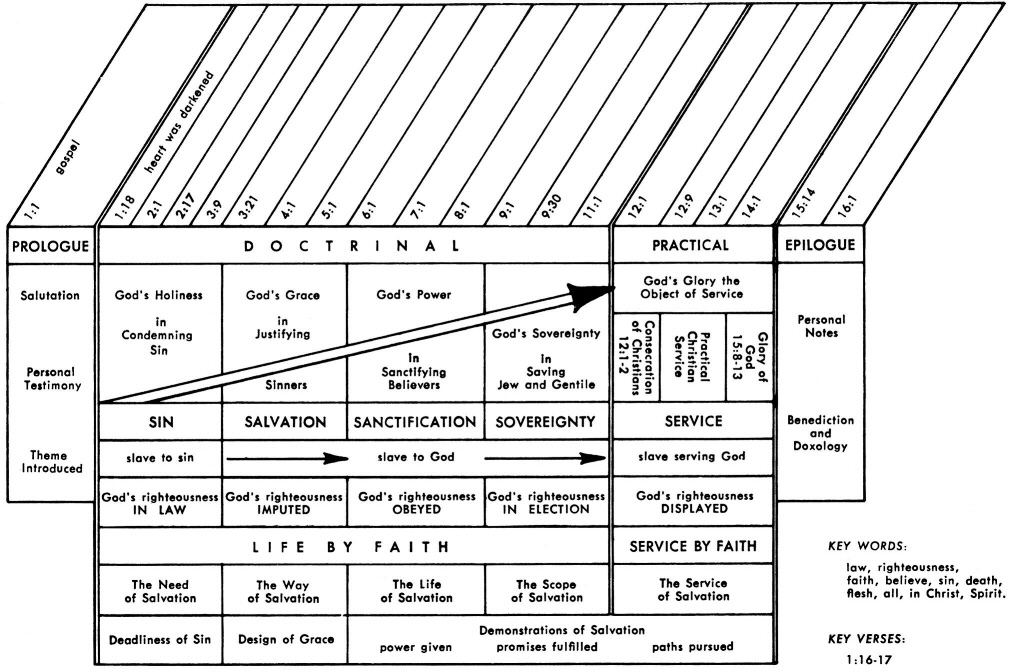
Click chart to enlarge
Chart from recommended resource Jensen's Survey of the NT - used by permission
Romans Overview Chart - Charles Swindoll
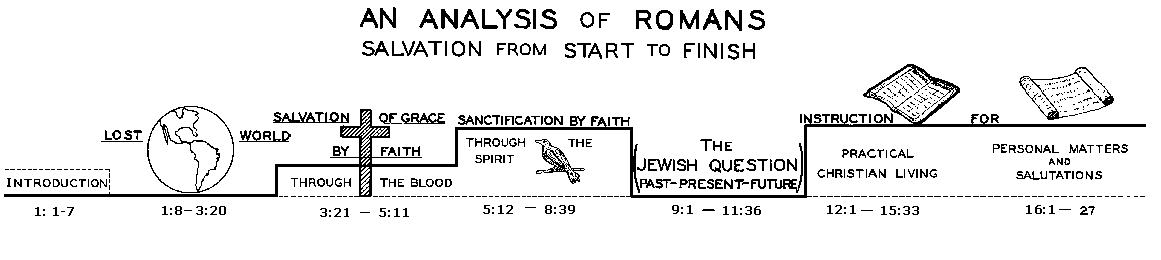
Source: Dr David Cooper
Click to Enlarge
| ROMANS ROAD to RIGHTEOUSNESS |
||||
| Romans 1:18-3:20 | Romans 3:21-5:21 | Romans 6:1-8:39 | Romans 9:1-11:36 | Romans 12:1-16:27 |
| SIN | SALVATION | SANCTIFICATION | SOVEREIGNTY | SERVICE |
| NEED FOR SALVATION |
WAY OF SALVATION |
LIFE OF SALVATION |
SCOPE OF SALVATION |
SERVICE OF SALVATION |
| God's Holiness In Condemning Sin |
God's Grace In Justifying Sinners |
God's Power In Sanctifying Believers |
God's Sovereignty In Saving Jew and Gentile |
Gods Glory The Object of Service |
| Deadliness of Sin |
Design of Grace |
Demonstration of Salvation | ||
| Power Given | Promises Fulfilled | Paths Pursued | ||
| Righteousness Needed |
Righteousness Credited |
Righteousness Demonstrated |
Righteousness Restored to Israel |
Righteousness Applied |
| God's Righteousness IN LAW |
God's Righteousness IMPUTED |
God's Righteousness OBEYED |
God's Righteousness IN ELECTION |
God's Righteousness DISPLAYED |
| Slaves to Sin | Slaves to God | Slaves Serving God | ||
| Doctrine | Duty | |||
| Life by Faith | Service by Faith | |||
|
Modified from Irving L. Jensen's chart above |
||||
R Ruin (Romans 1:17 – 3:20) – The utter sinfulness of humanity
O Offer (Romans 3:21-31) – God’s offer of justification by grace
M Model (Romans 4:1-25) – Abraham as a model for saving faith
A Access (Romans 5:1-11) – The benefits of justification
N New Adam (Romans 5:12-21) – We are children of two “Adams”
S Struggle w/ Sin (Romans 6:1-8:39) Struggle, sanctification, and victory
Romans 8:9 However you are not in the flesh but in the Spirit, if indeed the Spirit of God dwells in you. But if anyone does not have the Spirit of Christ, he does not belong to Him (NASB: Lockman)
Greek: humeis de ouk este (2PPAI) en sarki alla en pneumati, eiper pneuma theou oikei (3SPAI) en humin. ei de tis pneuma Christou ouk echei, (3SPAI) houtos ouk estin (3SPAI) autou.
Amplified But you are not living the life of the flesh, you are living the life of the Spirit, if the [Holy] Spirit of God [really] dwells within you [directs and controls you]. But if anyone does not possess the [Holy] Spirit of Christ, he is none of His [he does not belong to Christ, is not truly a child of God]. (Amplified Bible - Lockman)
Barclay: but you are not dominated by the pursuits which fascinate our sinful human nature; you are dominated by the Spirit, if so it be that the Spirit of God dwells in you. If anyone does not possess the Spirit of Christ he does not belong to Christ. (Westminster Press)
Godet: But as for you, ye are not under the dominion of the flesh, but under that of the Spirit, if the Spirit of God really dwell in you. But if any man have not the Spirit of Christ, he is none of His
Phillips: But you are not carnal but spiritual if the Spirit of God finds a home within you. You cannot, indeed, be a Christian at all unless you have something of His Spirit in you. (Phillips: Touchstone)
Wuest: But, as for you, you are not in the sphere of the sinful nature but in the sphere of the Spirit, provided that the Spirit of God is in residence in you. But, assuming that a person does not have Christ’s Spirit, this one does not belong to Him.
Young's Literal: And ye are not in the flesh, but in the Spirit, if indeed the Spirit of God doth dwell in you; and if any one hath not the Spirit of Christ -- this one is not His;
HOWEVER, YOU ARE NOT IN THE FLESH BUT IN THE SPIRIT: humeis de ouk este (2PPAI) en sarki alla en pneumati :
- Ro 8:2; Ezek 11:19; 36:26,27; Jn 3:6
Sermons (19 sermons) - Romans 8:9 Sermons
"are not controlled by the flesh but by the Spirit" (NET Bible Note)
“You are not unspiritual but spiritual.” (Charles Hodge)
NOT
IN THE SPHERE
OF THE FLESH
In Romans 8:9-11, we have the full and final answer to the question of Romans 7:24-note, "Who shall deliver me from the body of this death?." The basis of the deliverance is clearly the indwelling Spirit of God.
James Hastings introduces his very in depth comments on Romans 8:9 - "This is one of the most searching passages that can be found in the Bible. It takes hold of the question of our salvation in a very substantial and thorough manner. It removes utterly, almost infinitely, from this problem of our destiny, all shadow of uncertainty or of doubt. It brings us squarely to the facts in our character. On the force of this Scripture we are lifted to a platform where we stand with our hearts uncovered and naked before the eye of God." (Romans 8-9 The Owner’s Mark)
However you - More literally this reads "But as for you" - most translations render the Greek conjunction de as "but" rather than "however." Paul is presenting a striking contrast with the character of those he had just described (those who are identified as "in the flesh" Ro 8:5-8-note). Here the "you" signifies those who are regenerate, born of the Spirit, possessors of the Spirit and pursuers of a character that is being progressively transformed (by the Spirit) into the image of the Son (2Cor 3:18-note, cp Ro 8:29-note). In a sense Paul presents two diametrically opposed directions, a "Y" in the road of life if you will, a journey every human will traverse either in the flesh or in the Spirit. What is the general "direction" of your life dear reader? If it is toward holiness and the Holy One, then you give evidence of having been transposed from your former spiritual location in the flesh, to you new spiritual position of in the Spirit.
Not (3756) (ou) is absolutely not. You are absolutely not in the flesh.
In the flesh - In the sphere ("atmosphere") of the flesh, in the sway of, under the control or the influence of the flesh. Praise God this our fallen flesh is not the dominant determinant of our behavior (cp Ro 6:11-note, Ro 6:12-14-note, Ro 8:4-note) Yes, the flesh is still present in the mortal bodies of believers, but now it has a "jealous" Rival, the indwelling Spirit, Who is omnipotent. To surrender to the Spirit assures dominance of fleshly desires. (see Gal 5:16-note, Gal 5:17-note).
Flesh (4561) (sarx) (Click word study on sarx) in this verse refers to the evil nature present in those in Adam (and still present even in regenerate man).
Haldane - Flesh is a principle that attaches to the earth, and the things of the earth; but the Spirit of regeneration is as a light, which, coming from heaven, elevates the mind to those things that are celestial… This indwelling of the Spirit is a sure evidence of a renewed state; and believers should be careful not to grieve the Spirit, and should labor to enjoy a constant sense of His presence in their hearts. (Romans 8 Commentary)
William Barclay offers a good summation of the radical contrast in Romans 8:9. He writes "Paul is drawing a contrast between two kinds of life.
(i) There is the life which is dominated by sinful human nature; whose focus and centre is self; whose only law is its own desires; which takes what it likes, where it likes. In different people that life will be differently described. It may be passion-controlled, or lust-controlled, or pride-controlled, or ambition-controlled. Its characteristic is its absorption (entire occupation of one's mind) in the things that human nature without Christ sets its heart upon.
(ii) There is the life that is dominated by the Spirit of God. As a man lives in the air, he lives in Christ, never separated from Him (See Union with Christ ). As he breathes in the air and the air fills him, so Christ fills him. He has no mind of his own; Christ is his mind (1Cor 2:16-note). He has no desires of his own; the will of Christ is his only law (Ed: A good description of Christ's ; cp Ro 6:14-note, Gal 5:18-note), where "under" implies dominated by the law). He is Spirit-controlled, Christ-controlled, God-focused.
These two lives are going in diametrically opposite directions. The life that is dominated by the desires and activities of sinful human nature is on the way to death (Ed Comment: not annihilation but utterly destroyed which signifies more than just the loss of well-being, but describes one's life as a veritable ruin so that the one ruined can no longer serve the use for which he was designed, cp Isa 43:7). In the most literal sense, there is no future in it--because it is getting further and further away from God (cp Eph 4:22-note, 2Pe 1:4-note). To allow the things of the world completely to dominate life is self extinction (cp 1Jn 2:15-17-note); it is spiritual suicide (Ed: Actually they are already spiritually dead! They are born "dead" so to speak! Eph 2:1-note). By living it, a man is making himself totally unfit ever to stand in the presence of God (cp Jude 1:24-25-note). He is hostile to Him (Ro 8:7-note, Col 1:21-22-note), resentful of His law and His control. God is not his friend but his enemy (Ro 5:10-note), and no man ever won the last battle against Him.
The Spirit-controlled life, the Christ-centered life, the God-focused life is daily coming nearer heaven even when it is still on earth. It is a life which is such a steady progress to God that the final transition of death is only a natural and inevitable stage on the way. It is like Enoch who walked with God and God took him . As the child said: "Enoch was a man who went on walks with God--and one day he didn't come back." (Heb 11:5-note, Ge 5:22-24)
No sooner has Paul said this than an inevitable objection strikes him. Someone may object: "You say that the Spirit-controlled man is on the way to life; but in point of fact every man must die. Just what do you mean?" Paul's answer is this. All men die because they are involved in the human situation. Sin came into this world and with sin came death, the consequence of sin (Ro 5:12-note). Inevitably, therefore, all men die; but the man who is Spirit-controlled and whose heart is Christ-occupied, dies only to rise again (1Cor 15:51-55). Paul's basic thought is that the Christian is indissolubly one with Christ. Now Christ died and rose again; and the man who is one with Christ is one with death's conqueror and shares in that victory. The Spirit controlled, Christ-possessed man is on the way to life; death is but an inevitable interlude that has to be passed through on the way." (Romans 8 Commentary - William Barclay's Daily Study Bible)
O GLORIOUS CONTRAST:
IN THE SPHERE
OF THE SPIRIT
Cambridge - After this dark foil, in the picture of the fleshly state, St Paul now gives (what is his main aim all the while) the opposite picture; that of the spiritual, regenerate, state. (Romans 8 Cambridge Bible for Schools and Colleges)
Expositor's Greek - You is emphatic. YOU can please God (Why? How?) for you are not in the flesh. (Romans 8 Expositor's Greek Testament)
In the flesh but in the Spirit - Here but marks another contrast (See terms of contrast). Remember to practice the three P's - pause, ponder, and practice interrogating the passage, for example, asking "What is being contrasted?" (And do this even when it is relatively straightforward as this will help you develop this discipline). Here, Paul contrasts two "spiritual positions" - in the flesh versus in the Spirit. In the flesh is a description of where we all once lived in Adam, when we were dead in our trespasses and sins. To be sure believers can "act fleshly" now but they are no longer strictly speaking positionally in the flesh.
Notice the preposition "in" - As Piper says "you are not in the sway or control of the flesh but you are in the sway of the current of life… If He is in you, you are in His control." To say it another way the preposition "in" (1722) (en) speaks of the sphere in which one lives. As a fish lives in water and all mankind in oxygenated air, so too a believer lives no longer in the "atmosphere" of the flesh (continually under it's control, it's overriding influence) but in the sphere of the Spirit. Not only that but the Holy Spirit now lives within him!
You (5210) (humeis) is the second person personal pronoun "you". After speaking objectively about the two types of persons, Paul now addresses his readers directly as "you". Here the “you” is emphatic (notice it is placed first in the Greek sentence for emphasis). It is also notable that since the Greek verb ("are" = este) normally carries its own person in its ending ("you" is determined by the ending), it would not need a separate pronoun ("you") to indicate the person acting in the verb. The point is that when a pronoun ('humeis" = you, in this case) is used with a verb ("are" = este), it is used for emphasis or for contrast.
Paul had just spoken of the unregenerate who were in the sphere of the flesh or in the grip of the evil nature. Thus one might paraphrase what Paul is saying here as “But as for you, in contradistinction to the unsaved, you are not in the sphere of the evil nature, the flesh, but in the sphere of the Spirit."
Hendricksen explains in the flesh versus in the Spirit - As far as the basic direction of their life is concerned, they are under the control not of sinful human nature but of the Spirit. This implies that, speaking collectively, they do not belong to the category of those concerning whom the apostle just now (Ro 8:8-note) has stated that they cannot please God. (Exposition of Paul's Epistle to the Romans, Baker Book House) (Bolding added)
C E B Cranfield on those who are in the Spirit - The direction of their life is determined not by the flesh but by the Spirit of God. (A critical and exegetical commentary on the Epistle to the Romans. International Critical Commentary)
Cambridge - To be in the Spirit is to be in that state of soul which results in a “walk after the Spirit;” (cp Gal 5:16-note) a state therefore in which the Holy Ghost is the ruling influence. (Romans 8 Cambridge Bible for Schools and Colleges)
I'm forgiven because You were forsaken
I'm accepted, You were condemned
And I'm alive and well, Your spirit is within me
Because You died and rose again
I love how H C G Moule expounds on the phrase in the Spirit - Then from those words, "in Christ," he opens this ample revelation of our possession, in our union with Christ, of the Spirit who, having joined us to Him, now liberates us in Him, not from condemnation only, but from sin’s dominion. If we are indeed in Christ, the Spirit is in us, dwelling in us, and we are in the Spirit. And so, possessed and filled by the blessed Power, we indeed have power to walk and to obey. Nothing is mechanical, automatic; we are fully persons still; He who annexes and possesses our personality does not for a moment violate it. But then, He does possess it; and the Christian, so possessing and so possessed, is not only bound but enabled, in humble but practical reality, in a liberty otherwise unknown, to "fulfil the just demand of the Law," "to please God," in a life lived not to self but to Him. Thus, as we shall see in detail as we proceed, the Apostle, while he still firmly keeps his hand, so to speak, on Justification, is occupied fully now with its issue, Holiness. And this issue he explains as not merely a matter of grateful feeling, the outcome of the loyalty supposed to be natural to the pardoned. He gives it as a matter of divine power, secured to them under the Covenant of their acceptance. Shall we not enter on our expository study full of holy expectation, and with unspeakable desires awake, to receive all things which in that Covenant are ours? Shall we not remember, over every sentence, that in it Christ speaks by Paul, and speaks to us? For us also, as for our spiritual ancestors, all this is true. It shall be true in us also, as it was in them.(Romans 8 Expositor's Bible Commentary)
Ellicott on in the Spirit - It denotes the closest possible contact and influence of Spirit upon spirit. (Ed: This immutable, intimate union, this oneness, is the fruit of the New Covenant. When we entered the New Covenant by grace through faith, we entered an eternal identification with the Spirit of Christ, indeed with the Trinity! Mysterious? Yes. Truth? Absolutely! One wonders if we ever fully comprehend the inexhaustible significance of this great truth of our covenant union with the infinite and holy God?)
Johann Bengel on the "Trinitarian" aspect of Romans 8:9 - A remarkable testimony to the doctrine of the Holy Trinity, and its economy in the hearts of believers, comp. Romans 5:8; Romans 5:5, Romans 14:17-18, Romans 15:16; Romans 15:30; Mark 12:36; John 15:26; Galatians 4:6; Ephesians 1:17; Ephesians 2:18; Ephesians 2:22; 1 Peter 1:2; Acts 2:33; Hebrews 2:3-4; 1 Corinthians 6:11; 1 Corinthians 6:13, etc.; 2 Corinthians 3:3-4.
Joseph Beet - Your moral environment is not flesh with its needs and desires, but Spirit… His presence in us reveals to us, and lifts us into, a new world. (Ed: I would add, it is a "spiritual world," one which the natural, unregenerate man simply has no spiritual capacity to comprehend and therefore a world which he sees as utter foolishness! Indeed, as Paul says "We are fools for Christ's sake." 1Cor 4:10, cp natural man's understanding in 1Cor 2:14) (Romans 8 Commentary)
William Newell - Here the great mark of a true Christian is, that the Spirit of God dwells in him. If he is indwelt by the Spirit of God, he is not "in flesh, " but instead an entirely different kind of being, -"in Spirit." The Spirit becomes now the element in which the believer lives, like water to the fish, or air to the bird, vital, supplying, protecting. (Romans 8: Expository Notes Verse by Verse)
Constable remarks that Romans 8:9 "is one of the clearest statements in Scripture that corrects the false notion that baptism with the Spirit is a second work of grace for the Christian." (Expository Notes)
Albert Barnes - (Not in the flesh means you are) Not under the full influence of corrupt desires and passions. (In the Spirit means) you are spiritually minded; you are under the direction and influence of the Holy Spirit.
The KJV Bible Commentary - Paul clearly teaches that no one can receive Christ’s atonement for salvation unless the Spirit of God dwells within him. It is therefore irrational to say that there are Christians who have not fully received the blessing of the Spirit of God. There is no scriptural basis for a second work of grace or a baptism of the Holy Spirit subsequent to salvation. At salvation either we have all of the Spirit of God or we have none of Him. There may be a time subsequent to salvation in which the Spirit of God gets more of us, but there is never a time when we get more of Him. (Dobson, E G, Charles Feinberg, E Hindson, Woodrow Kroll, H L. Wilmington: KJV Bible Commentary: Nelson)
Note also that the phrase "in the flesh" clearly is opposed to the phrase "in the Spirit" (believer). The point is that while believers may occasionally act like they are still "in the flesh", the fact is that strictly speaking they are no longer living in the sphere of the flesh. Thus "in the flesh" is not an accurate description of the state of a genuine believer, irregardless of how "fleshly" they might be behaving at the moment!
Guzik (Romans Commentary) asks "How do I know that I have the Spirit? Ask these questions:
· Has the Spirit led you to Jesus?
· Has the Spirit put in you the desire to honor Jesus?
· Is the Spirit leading you to be more like Jesus?
· Is the Spirit at work in your heart?
A T Robertson notes that "in the Spirit" most likely refers to "“in the Holy Spirit.” It is not Pantheism or Buddhism that Paul here teaches, but the mystical union of the believer with Christ in the Holy Spirit. (Greek Word Studies)
IF INDEED THE SPIRIT OF GOD DWELLS IN YOU: eiper pneuma theou oikei (3SPAI) en humin:
- Ro 8:11; Lk 11:13; 1Cor 3:16; 6:19; 2Cor 6:16; Gal 4:6; Eph 1:13,17,18; 2:22; 2Ti 1:14; 1Jn 3:24; 4:4; Jude 1:19, 20, 21
- Jn 3:34; Gal 4:6; Php 1:19; 1Pet 1:11
THE SPIRIT MAKES
HIS HOME IN THE REDEEMED
"If" (1512) (eiper) is an emphatic marker of condition and is used of something that is assumed to be. Eiper could be translated “since”, "if as is the fact", "if as is the case." That is, since the Spirit of God dwells in you, that is an indication that you are not in the sphere of the evil nature, the flesh.
McGee explains it this way - This first “if” is not casting a doubt over the Roman believers’ salvation. They are saved. Let me give you a literal translation: “But you are not in the flesh, but in the Spirit since the Spirit of God really dwells in you.” That is the real test… The true mark of a born-again believer and a genuine Christian is that he is indwelt by the Spirit of God… A believer is a new creation (Ed note: The indwelling Holy Spirit gives a believer a totally different life - 2Cor 5:17-note). Do you love Him? (Do you love His Word? Do you want to communicate with Him?) Do you want to serve Him? Are these things uppermost in your mind and heart? Or are you in rebellion against God? (McGee, J V: Thru the Bible Commentary: Nashville: Thomas Nelson)
Dwells (3611) (oikeo from oikos = home) means to live or dwell in a certain place as one's home. Present tense = "is dwelling" or continually dwells. This fact is important for it emphasizes that the Spirit is not an occasional visitor but that He takes up residence in God’s children. What an awesome truth that the Spirit of the Living God would make His home in every redeemed sinner.
Godet writes that oikeo in the present tense "denotes a permanent fact; it is not enough to have some seasons of impulse, some outbursts of enthusiasm, mingled with practical infidelities." (Commentary on Romans. Kregel. 1998)
Sanday and Headlam remark that oikeo "denotes a settled permanent penetrative influence." (A Critical and Exegetical Commentary on the Epistle of the Romans 1897)
Albert Barnes - The expression, to dwell in one, denotes intimacy of connection, and means that those things which are the fruits of the Spirit are produced in the heart.
The New Jerusalem Bible renders it as "the Spirit of God has made a home in you."
S Lewis Johnson draws a wonderful picture from Romans 8:9 noting that "The believer is said to be in the Spirit, but the Spirit is also said to be in him. That is the language of an element, such as the elements of earth, water, fire, and air. It may be illustrated, for example, by the element of water. A fish may be said to be in the water, but the water is also in the fish. The force of the terms is to stress the closeness of the relationship that exists between the believer and the Spirit, a kind of mutual indwelling. The Spirit is the believer's element, a magnificent picture indeed. The apostle also points to the absolute necessity of the possession of the Spirit for one to belong to Christ. This is the test of spiritual life (cf. Gal. 4:1-7). (Romans 8:5-17 Sermon) (Bolding added)
Although, not in a comment specifically on this passage, the rabbis wrote that he who dwells in a house is the master of the house, not just a passing guest! Ponder that in the context of Romans 8:9!
Charles Hodge - The Roman Christians’ faith was spoken about throughout the world. Their real character, however, was not determined either by their professions or their reputation. The apostle therefore adds, if the Spirit of God lives in you. This is the only decisive test. Every other bond of union with Christ is of no avail without this. We may be members of his church, yet unless we share that vital union which comes from the indwelling of the Holy Spirit, we are his only in name. The Spirit of God is everywhere, yet he is said to dwell wherever he especially and permanently manifests his presence. So he is said to dwell in heaven; he dwelt of old in the temple; he now dwells in the church, which is “a dwelling in which God lives by his Spirit” (Ephesians 2:22); and he lives in each individual believer, whose body is a temple of the Holy Spirit (1 Corinthians 6:19-note). (Compare John 14:17; 1 Corinthians 3:16; 2 Corinthians 6:16; 2Ti 1:14-note; etc.) (Romans 8 - Hodge's Commentary on Romans)
Mounce adds that the reality of the indwelling Spirit "Obviously rests upon the assumption that the Spirit of God had taken possession of them. (Mounce, R. H. Romans: The New American Commentary. Broadman & Holman Publishers)
Mounce goes on to add the important comment that "Nowhere in Scripture do we find a clearer indication that the Spirit enters a person’s life at the moment of conversion (cf. also 1Cor 12:13 "For by one Spirit we were all baptized into one body, whether Jews or Greeks, whether slaves or free, and we were all made to drink of one Spirit."). If the Spirit needed to wait for some subsequent commitment to holiness, it follows that he would be absent between conversion and that later point in time. But that cannot be because Paul clearly indicated that a person without the Spirit does not belong to Christ. It is because God has given us his Spirit that “we know that we live in him and he in us” (1John 4:13). Without His Spirit there can be no assurance of salvation. (Ibid)
Wuest - The Spirit is not only resident in the believer in the sense of position in him, but He is actively at home in him, living in him as His home. The Spirit has a ministry to perform in him, namely, to give him victory over sin and produce His own fruit. This, together with the presence of the imparted divine nature in him, (Ed note: 2Pe 1:4) and the fact that God has broken the power of the flesh (Ed note: see especially dead to sin in Ro 6:1-3- see notes Ro 6:1-2; Ro 6:3), puts that person out of the sphere of the flesh and into the sphere of the Holy Spirit. (Wuest's Word Studies from the Greek New Testament)
The saved person is therefore not in the grip of the flesh but under the control of the Holy Spirit as he yields himself to Him (Gal 5:16-18-note).
Warren Wiersbe - What a difference it makes in your body when the Holy Spirit lives within. You experience new life, and even your physical faculties take on a new dimension of experience. When evangelist D. L. Moody described his conversion experience, he said: “I was in a new world. The next morning the sun shone brighter and the birds sang sweeter… the old elms waved their branches for joy, and all nature was at peace.” Life in Christ is abundant life. (Wiersbe, W: Bible Exposition Commentary. 1989. Victor)
Most Jewish people did not claim to have the Spirit. They believed that the Spirit would be made available only in the time of the end of this age, at the inception of the Messianic Age. If they believed at all, they believed that after the Messiah would come, all those who were truly God’s people would have the Spirit working in them (cf. Isaiah 44:3; Isaiah 59:21 Ezekiel 39:29).
G Campbell Morgan asks "how is it known that a man possesses the Spirit of Christ? A man possesses the Spirit of Christ if he manifests the mind or character of Christ. For just as the anointing of the Spirit enabled Christ to live His life of perfect obedience and true holiness, so in the measure in which the Spirit of Christ dwells in a man will he bring forth the fruits of the Spirit, which are the component parts of the Christian character. Here, then, is the test of Christianity. If a man have not the spirit, the tone, the temper, the character of Christ, he is none of His. Not the words that I recite as a creed, not the service that I render as a church member—these things do not prove my relation to Christ—but what I am in temper, in tone, in spirit, in character. “If any man have not the Spirit of Christ, he is none of his.” I pray you, attempt to correct the circumference of your life from the centre; do not attempt to correct the centre from the circumference—that is, do not attempt to correct your spirit by altering your habits. Correct your habits by an alteration of the spirit. And how is the spirit to be altered? Only by the true, whole-hearted, unquestioning abandonment of your whole being to the Spirit of God will it be possible for you to have the Spirit of Christ. (Romans 8-9 The Owner’s Mark)
BUT IF ANYONE DOES NOT HAVE THE SPIRIT OF CHRIST HE DOES NOT BELONG TO HIM: ei de tis pneuma Christou ouk echei (3SPAI), houtos ouk estin (3SPAI) autou:
- Jn 17:9,10; 1Cor 3:21, 22, 23; 15:23; 2Cor 10:7; Gal 5:24; Rev 13:8; 20:15
EVIDENCE THAT ONE
IS NOT BORN AGAIN
But if anyone does not possess the [Holy] Spirit of Christ, he is none of His [he does not belong to Christ, is not truly a child of God]. (Amplified Bible)
But, assuming that a person does not have the Spirit of Christ, this one does not belong to Him. (Wuest)
But - This is a critical term of contrast. This but marks the separation of all mankind into two groups, one without the Spirit but the other with the Spirit. The former destined for eternal separation and torment in hell (gehenna) but the other destined for glorious eternal union with Christ in heaven! There is no middle ground. There is no intermediate state. Either one has the Spirit indwelling or he does not, and eternity hangs in the balance! So this is a critical "but!" Beet says this is "solemn statement of another possibility."
As noted, in this section of the verse "if" (1487) (ei) defines a condition of the first class or one that is assumed to be true.
Leon Morris draws our attention to Paul's - "Notice the “characteristic delicacy of expression” (Sanday and Headlam); Paul used “you” when speaking of those who are not in the flesh, but now “anyone” as he refers to those who do not have the Spirit. (Morris, L. The Epistle to the Romans. Eerdmans; 1988)
Hodge - No clearer assertion and no higher exhibition of the Godhead of the Son can be conceived than that which presents him as the source and the possessor of the Holy Spirit. The Spirit proceeds from and belongs to him and by him is given to whomever he wills (John 1:33; 15:26; 16:7; Luke 24:49; etc.). (Hodge, Charles: Commentary on Romans)
Kent Hughes adds the practical comment that "The clear implication of Paul’s use of the phrase “the Spirit of Christ” is that through the Spirit we experience something of Jesus’ disposition—His kindness, His gentle care, His love in our lives. As we allow the Holy Spirit to fill us, we are filled with the ethos of Jesus, and life becomes more and more to us what it was and is to Him. (Amen!) (Hughes, R. K. Romans: Righteousness from heaven. Preaching the Word. Wheaton, Ill.: Crossway Books)
Have (2192) (echo) means to possess and is in the present tense points to more than a passing contact but conveys the thought of continual possession. In fact when Jesus promised the Spirit to His disciples in the "Upper Room Discourse" (Jn 13-16), He said "I will ask the Father, and He will give you another Helper, that He may be with you FOREVER." (Jn 14:16) I interpret this to mean that we will possess the Holy Spirit throughout eternity! Perhaps better, the Holy Spirit will possess us throughout eternity.
NO SPIRIT
NO NEW BIRTH!
The Spirit of Christ (same phrase in 1Pe 4:11-note, cp synonymous phrases "Spirit of Jesus" in Acts 16:7 and "Spirit of Jesus Christ" in Phil 1:19-note, cp Gal 4:6 "Spirit of His Son") - First notice that the Spirit of God is also the Spirit of Christ in this "Trinitarian" passage. Indeed, the Spirit is the Third Person of the Trinity. Thus, Christ is God, and so is the Holy Spirit. Paul sees the Holy Spirit as integrally related to Christ as well as to God the Father. And He is in fact a "He," NOT as I hear so often (even from pastors) an "It!" He is the same Spirit which "energized" Jesus for ministry during His life on earth (See Mt 4:1, Lk 4:1, 14, 18, see esp Acts 10:38-39). What is the significance of this truth? Jesus emptied Himself of His divine prerogatives (Php 2:5-7-note) and gave us His example of living and ministering in the power of the Spirit. We are to imitate His example! (cp 1Cor 11:1, 1Pe 2:21-note, 1Jn 2:6-note) The only way we can live the supernatural life is by means of a supernatural Source, the indwelling Spirit (cp Eph 3:16-note, Phil 4:13-note) See related discussion - The Abundant Life: Life in the Spirit
The great Puritan writer John Owen explains that "Everything God does He does as the triune God. Each Person of the Trinity is involved in every action of God. Yet at the same time each Person has a special role to fulfill in that work… There is no good that we receive from God but it is brought to us and wrought in us by the Holy Spirit. Nor is there in us any good towards God, any faith, love, obedience to His will, but what we are enabled (Ed: Note not "helped" which implies we have some ability and just need a little "push"!) to do so by the Holy Spirit." (Pneumatologia, Or, A Discourse Concerning the Holy Spirit)
Cornerstone Bible Commentary - The Key Is the Spirit of Christ in Us. This is why the New Testament writers speak of the experience of the Holy Spirit as an essential part of Christian salvation. Without the Spirit of Christ there is no comprehension of the Good News, no spiritual sensitivity (1 Cor 2:14), and no power to live the kind of life that God wants. Indeed, without the Spirit of Christ there is no personal relationship to Christ. (Mohrlang, Roger; Gerald L. Borchert)
Not (3756) (ou) means absolutely not and is used in both phrases "does not have the Spirit" and "does not belong to Him"
Not belong to Him is literally "He is absolutely not His". In short, he is not a Christian! The Greek is what is referred to as "genitive of possession" which conveys the idea of ownership, in this case in a negative sense. Paul's point is that the one who does not have the Spirit of Christ is not "owned" by Christ and thus is an unsaved person. Since only the Holy Spirit gives spiritual life, a person cannot be related to Christ apart from the Spirit.
Contrast Gal 5:24; which says "Now those who belong to Christ Jesus have crucified the flesh with its passions and desires."
1 Corinthians 3:21-23 So then let no one boast in men. For all things belong to you, 22 whether Paul or Apollos or Cephas or the world or life or death or things present or things to come; all things belong to you, 23 and you belong to Christ; and Christ belongs to God.
H C G Moule on does not belong to Him - He may bear his Lord’s name, he may be externally a Christian, he may enjoy the divine Sacraments of union; but he has not "the Thing." The Spirit, evidenced by His holy fruit, is no Indweller there; and the Spirit is our vital bond with Christ. But if Christ is, thus by the Spirit, in you, dwelling by faith in the hearts which the Spirit has, "strengthened" to receive Christ {Ephesians 3:16-17-note} - true, the body is dead, because of sin, the primeval sentence still holds its way "there"; the body is deathful still, it is the body of the Fall; but the Spirit is life, He is in that body, your secret of power and peace eternal, because of righteousness, because of the merit of your Lord, in which you are accepted, and which has won for you this wonderful Spirit-life. (Romans 8 Expositor's Bible Commentary)
Haldane notes that here Paul gives "a necessary reservation. If the Spirit of God did not really dwell in any of those whom the Apostle addressed, they were still in the flesh, notwithstanding all their profession, and all their present appearances, and his persuasion respecting them. And no doubt some will be found to have escaped for a time the pollutions of the world, who may afterwards show that they were never renewed in heart. Many ridicule the pretensions of those who speak of the Holy Spirit as dwelling in believers; yet if the Spirit of God dwell not in any, they are still in the flesh; that is, they are enemies to God… Every Christian has the Spirit of Christ dwelling in him. When Christ takes possession of any man as His, He puts His Holy Spirit within him. Without the presence of His Spirit, we can have no interest in Christ. (Haldane, R. An Exposition on the Epistle to the Roman)
Wuest - The truth is brought out that the Holy Spirit is given the believing sinner the moment he puts his faith in the Lord Jesus, and not some time afterwards, as is erroneously taught in some quarters, since that believing sinner becomes the possession of the Lord Jesus the moment he believes and thus must possess the Holy Spirit as an indweller (cp note Romans 5:5). (Ibid)
This verse also makes it clear that the indwelling presence of the Holy Spirit is the identifying mark of a believer in Jesus Christ. In his first epistle John echoes this truth writing that "the one who keeps His commandments abides in Him, and He in him. And we know by this that He abides in us, by the Spirit whom He has given us." (1John 3:24)
John adds that "By this we know that we abide in Him and He in us, because He has given us of His Spirit." (1John 4:13)
To belong to the family of God, it is essential that a person have the Holy Spirit. No amount of religious devotion or good works will produce salvation and eternal life, but only "the washing of regeneration, and renewing of the Holy Ghost" (Titus 3:5).
Every true believer in Christ is indwelt by the Holy Spirit for as Paul asks "do you not know that your body is a temple of the Holy Spirit Who is in you, Whom you have from God, and that you are not your own?" (1Cor 6:19)
All believers are being led by the Holy Spirit - "For all who are being led by the Spirit of God, these are sons of God." (see note Romans 8:14).
The person who gives no evidence of the presence, power, and fruit of God’s Spirit in his life has no legitimate claim to Christ as Savior and Lord. Stated another way, the person who demonstrates no desire for the things of God and has no inclination to avoid sin or passion to please God is not indwelt by the Holy Spirit and thus does not belong to Christ.
In light of this sobering truth Paul admonishes those who claim to be Christians:
“Test (present imperative = continually, command) yourselves (who?) to see if you are in the faith; examine (dokimazo = present imperative) yourselves! Or do you not recognize (know fully) this about yourselves, that Jesus Christ is in you-unless indeed you fail the test (a single word in Greek = adokimos = rejected after examination = not standing the test)?” (2Cor 13:5-note).
The Christian life is the life of the Spirit of Jesus Christ living in and through you.
The Christian life is...
NOT our trying to live like Christ -- that is a misconception,
NOR is it our trying to be Christ-like -- that is another misconception
It is none of these. One might say it is not a matter of trying but of dying (to self)! It is the Spirit of Christ indwelling us, living His life through us. And that life was designed to be lived in the toughest, most difficult spots on earth -- your home, your job, your everyday circumstances!
This is the test of whether you are laying hold of the power of the life of Christ in you. Is your home life different? It doesn't make any difference how well you talk in public, but are you different at home? That is the test -- for that is where the Christian life is designed to be lived.
Wayne Barber adds that what Paul is saying in essence is…
"that believers have a brand new identity. When you are in Adam your spirit is dead so you are simply in the flesh.
Now that we are in Christ we are no longer in the flesh. We can be duped by the flesh or deceived by it but the truth is that we have been baptized into Christ and the spiritual part of our being is now alive (Ro 8:10). Have you ever said "Boy, I got in the flesh today". No you didn't because you cannot get back in the flesh. Now that you are in Christ, you are now in the Spirit. You may be "after the flesh"…you may have strayed off course…you may have put your confidence back in your flesh, but you are not in the flesh anymore. And that's why you are so miserable and that's why the Holy Spirit is trying to get you back on course of gravitating you toward God.
Now the Spirit dwells in you, the Greek word signifying to be at home. So if you have the Holy Spirit of God in you, then you are no longer in the flesh. You are a brand new entity - you are in the Spirit. Yes, you will still sin, but when you sin you are going against the direction that the Spirit is drawing you toward (Ezekiel 36:27-note).
Some people believe that you can be saved and not receive the Holy Spirit until later in your "Christian life". But the meaning here is quite clear -
No Spirit of Christ = Not born again
When you received Christ, you received all of God you will ever get and you received one God. You do not receive the Spirit of God later. Be suspicious when someone tries to get you to go to a revival or a meeting so that you will receive the Holy Spirit.
Like Dr Barber warns there are many so called "revivals" going on in America today that are not focused on Jesus but on the Spirit. But remember what Jesus told us that when the Spirit comes "He will bear witness of" Jesus (John 15:26)."