Ruth 1:2
Ruth 1:3
Ruth 1:4
Ruth 1:5
Ruth 1:6
Ruth 1:7
Ruth 1:8
Ruth 1:9
Ruth 1:10
Ruth 1:11
Ruth 1:12
Ruth 1:13
Ruth 1:14
Ruth 1:15
Ruth 1:16
Ruth 1:17
Ruth 1:18
Ruth 1:19
Ruth 1:20
Ruth 1:21
Ruth 1:22
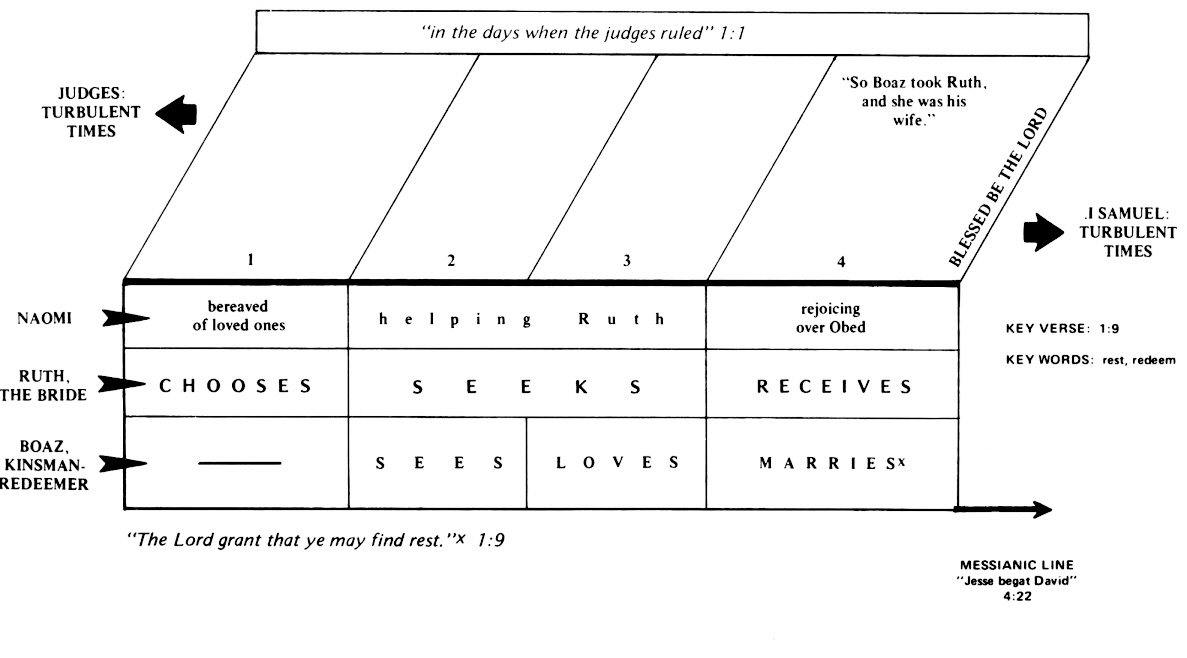
Irving Jensen's Survey of Bible (see his summary of Ruth online - page 392)
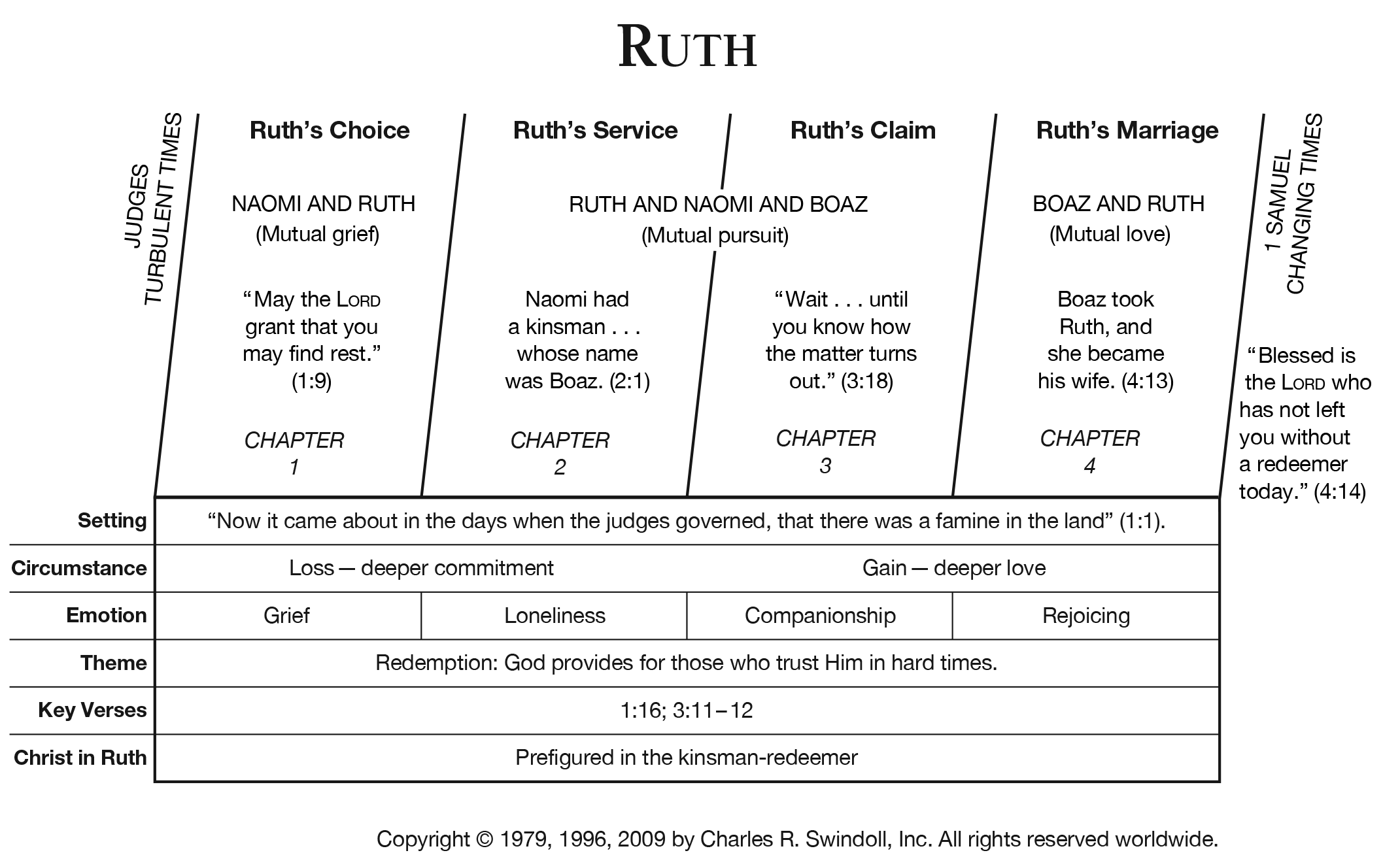
See Swindoll's summary chart of Ruth See Ruth Devotionals
|
RUTH: GOD PROVIDES |
|||
| Ruth 1 | Ruth 2 | Ruth 3 | Ruth 4 |
| Ruth's Choice | Ruth's Service | Ruth's Claim | Ruth's Marriage |
| Ruth's Resolve | Ruth's Rights | Ruth's Request | Ruth's Reward |
| Naomi and Ruth Mutual Grief |
Ruth and Naomi and Boaz Mutual Pursuit |
Boaz and Ruth Mutual Love |
|
| Ruth's Decision: Return with Naomi |
Ruth's Devotion: Provide for Naomi |
Ruth's Request: Redemption by Boaz |
Ruth's Reward: Relative of Messiah |
| Ruth and Naomi |
Ruth and Boaz |
||
| Death of Naomi's Family |
Ruth Cares for Naomi |
Boaz Cares for Ruth |
God Blesses with New Birth |
| Grief | Loneliness | Companionship | Rejoicing |
| Location: Plains of Moab |
Location: Fields of Bethlehem |
Location: Threshing floor of Bethlehem |
Location: Little town of Bethlehem |
| Time Lapsed: About 30 Years See Timeline |
|||
| Setting: Ru 1:1 Now it came about in the days when the judges governed Jdg 21:25+ In those days there was no king in Israel; everyone did what was right in his own eyes. |
|||

|
The Book of Judges |
|
|
RUTH |
JUDGES |
|
Spiritual |
Spiritual |
|
Purity |
Immorality |
|
Deciding for |
Pursuing Idols |
|
Devotion |
Disloyalty |
|
Love |
Lust |
|
Peace |
War |
|
Kindness |
Cruelty |
|
Obedience |
Disobedience |
|
Oasis |
Desert |
|
Faithfulness |
Faithlessness |
Ruth 1:14 And they lifted up their voices and wept again; and Orpah kissed her mother-in-law, but Ruth clung to her. (NASB: Lockman)
Septuagint (LXX): kai eperan (3PAAI) ten phonen auton kai eklausan (3PAAI) eti kai katephilesen (3SAAI: fervent or affectionate greeting = kiss tenderly) Orpha ten pentheran autes kai epestrepsen (3SAAI) eis ton laon autes Routh de ekolouthesen (3SAAI go along behind) aute
BGT καὶ ἐπῆραν τὴν φωνὴν αὐτῶν καὶ ἔκλαυσαν ἔτι καὶ κατεφίλησεν Ορφα τὴν πενθερὰν αὐτῆς καὶ ἐπέστρεψεν εἰς τὸν λαὸν αὐτῆς Ρουθ δὲ ἠκολούθησεν αὐτῇ
English of Septuagint: And they lifted up their voice, and wept again; and Orpha kissed her mother-in-law and returned to her people; but Ruth followed her
Hubbard Once again they burst into loud weeping. Then Orpah kissed her mother-in-law goodbye, but Ruth clung tightly to her.
KJV And they lifted up their voice, and wept again: and Orpah kissed her mother in law; but Ruth clave unto her.
NET Again they wept loudly. Then Orpah kissed her mother-in-law goodbye, but Ruth clung tightly to her.
BBE Then again they were weeping; and Orpah gave her mother-in-law a kiss, but Ruth would not be parted from her.
CSB Again they wept loudly, and Orpah kissed her mother-in-law, but Ruth clung to her.
ERV And they lifted up their voice, and wept again: and Orpah kissed her mother in law; but Ruth clave unto her.
ESV Then they lifted up their voices and wept again. And Orpah kissed her mother-in-law, but Ruth clung to her.
GWN They began to cry loudly again. Then Orpah kissed her mother-in-law goodbye, but Ruth held on to her tightly.
NKJ Then they lifted up their voices and wept again; and Orpah kissed her mother-in-law, but Ruth clung to her.
NAB Again they sobbed aloud and wept; and Orpah kissed her mother-in-law good-bye, but Ruth stayed with her.
NIV At this they wept again. Then Orpah kissed her mother-in-law good-by, but Ruth clung to her.
NJB They started weeping loudly all over again; Orpah then kissed her mother-in-law and went back to her people. But Ruth stayed with her.
NLT And again they wept together, and Orpah kissed her mother-in-law good-bye. But Ruth clung tightly to Naomi.
NRS Then they wept aloud again. Orpah kissed her mother-in-law, but Ruth clung to her.
YLT And they lift up their voice, and weep again, and Orpah kisseth her mother-in-law, and Ruth hath cleaved to her.
- Orpah kissed her mother-in-law Ge 31:28,55 1Ki 19:20 Mt 10:37; Mt 19:22 Mk 10:21,22 2Ti 4:10-see Demas
- Clave (KJV): Dt 4:4, 10:20, Pr 17:17, 18:24 Isa 14:1 Zec 8:23 Mt 16:24 Jn 6:66, 67, 68, 69 Acts 17:34 Heb 10:39
- Ruth 1 Resources - Multiple Sermons and Commentaries
TEARS AT
SEPARATION
And they lifted up their voices and wept again (loud weeping - see Ru 1:9+) - NJB = "They started weeping loudly all over again" The Septuagint (LXX) uses a verb that means to cry with a loud voice. This must have been quite a scene! There comes a place in our following after God, where it comes down to doing. Ruth and Orpah were both feeling the same feelings but Ruth did differently than Orpah. Applying Ruth's decisive action for God's people and thus for God one notes that in Christianity some are content with feeling Christian feelings, with feeling a love for God, with feeling a love for His Word, with feeling a love for His people. But the decisive question is will you be doers of the word (Jas 1:23+;, cp Jas 2:14f+)? We are all thankful that God did not just feel His love for us? Instead "God so loved the world, He gave His only begotten Son." (Jn 3:16+)
Ruth showed her feeling of love by her willingness to make a "costly commitment" especially when one realizes that she had not yet "read" the next three chapters! Her action is an excellent OT example of faith which Hebrews "defines" as "the assurance of things hoped for, the conviction of things not seen." (Heb 11:1+) and goes on to add that "without faith it is impossible to please Him, for he who comes to God must believe that He is, and that He is a Rewarder of those who seek Him. (Heb 11:6+)
Orpah did the sensible, expected thing,
Ruth the extraordinary and unexpected.
- Robert L Hubbard
And Orpah kissed her mother-in-law - NLT, NET, NAB, AMP = "Orpah kissed her mother-in-law goodbye". The Septuagint adds the phrase "and returned to her people." Kissed (5401) (nashaq) means to kiss mouth to mouth or to be attached and the Greek Septuagint verb (kataphileo = fervent, affectionate, tender kiss) adds the interesting nuance of kissing one tenderly, with caressing and as a sign of special affection (the same verb was used by the Septuagint in Ruth 1:9+ of Naomi kissing each daughter-in-law). Finally, after three commands (First = Ru 1:8+, Second & Third = Ru 1:11, 12+) from Naomi for them to return, Orpah finally capitulated.
Hubbard - Naomi’s impassioned soliloquy had hit home in at least one heart. Orpah obeyed her, choosing the probability of a normal life in Moab over a risky venture in Naomi’s company. (See context in The Book of Ruth - NICOT or borrow The book of Ruth)
NET Note - Orpah is a literary foil for Ruth. Orpah is a commendable and devoted person (see Ru 1:8+); after all she is willing to follow Naomi back to Judah. However, when Naomi bombards her with good reasons why she should return, she relents. But Ruth is special. Despite Naomi's bitter tirade, she insists on staying. Orpah is a good person, but Ruth is beyond good – she possesses an extra measure of devotion and sacrificial love that is uncommon.
Alexander Maclaren feels that Orpah "goes back to her home and her gods. She is the first in the sad series of those, 'not far from the kingdom of God'' (Mark 12:34+) who needed but a little more resolution at the critical moment, and, for want of it, shut themselves out from the covenant, and sank back to a world which they had half renounced. So these two lonely widows are left, each seeking to sacrifice herself for the other. Who shall decide which was the more noble and truly womanly in her self-forgetfulness,--the elder, sadder heart, which strove to secure for the other some joy and fellowship at the price of its own deepened solitude; or the younger, which steeled itself against entreaties, and cast away friends and country for love's sweet sake? We rightly praise Ruth's vow, but we should not forget Naomi's unselfish pleading to be left to tread her weary path alone (Ruth Exposition)
Matthew Henry referring to Orpah's apparent resolution to do but failure to follow her words with actions says "Strong passions, without a settled judgment, commonly produce weak resolutions."
THOUGHT - What is the application to saints today? It is probably unfair to Orpah to be too critical of her action and to misjudge her motives for kissing Naomi goodbye. The Greek verb certainly suggests a tenderness and therefore a heartfelt sincerity in her action. Nevertheless, by way of application, it should be noted that a kiss of outward profession can be an an act that appears sincere (Mt 26:48-49 Lk 22:47-48+), but the practical cleaving to the Lord, which must show itself in definitive decision for truth and holiness, is not so small a matter. Are the eyes of your heart fixed upon Jesus (Col 3:1, 2+, Heb 12:1, 2+) and the sacrifice bound with cords to the horns of the altar (Ps 118:7+)? Have you counted the cost, and are you solemnly ready to suffer all worldly loss for the Master’s sake (Lk 14:28+; Lk 14:33+, Mk 8:34-37+)? The gain will be an abundant recompense, for Egypt’s treasures are not to be compared with the glory to be revealed (cf Moses - He 11:24-27+).
So what happened to Orpah? The Living Bible says she "returned to her childhood home" and the TEV says she "went back home," both of which are certainly plausible but neither of which is clearly stated in the Hebrew or Greek Septuagint texts (which is another reason paraphrases should be assiduously avoided as one's primary Bible when performing serious Bible study - see chart on Bible Versions). So the most reliable answer is that we don’t know what happened to Orpah and that is where the commentary should cease. Men however often concoct fantastic stories to explain what they don’t know. For example, Jewish tradition says this request of Naomi came four miles outside of Moab; and that Orpah shed only four tears and the thought of parting from her mother-in-law Naomi. The rabbis go on to say that in recompense for the four miles that she went with Naomi, Orpah gave birth to four sons - Goliath and his three brothers! Fruitless, foolish, unfounded speculation!
BUT RUTH!
But - Note the phrase "but Ruth", which draws a stark contrast (See value of observing for contrasts) so vivid that one can easily imagine themselves as a quiet observer standing nearby as this poignant, life-changing drama unfolds. As discussed elsewhere, a "but" always signifies a change of direction is occurring, in this case not just literally (Moab to Bethlehem) but spiritually (idolatry of Moab to the God of Naomi) and ultimately a change in Ruth's eternal destiny (from hell to heaven). Always stop when you encounter a "but" and ask what is being contrasted?
Ruth clung (dabaq; Lxx - akoloutheo - followed) to her - NET = "Ruth hugged her tightly" NLT = "Ruth insisted on staying with Naomi" They both wept but only Orpah kissed her mother in law while Ruth clung to her implying a strong loyalty and deep, unshakeable affection. The first Biblical use of dabaq in Genesis 2:24 describes the bond that exist between a man and woman in marriage, which gives us some idea of Ruth's loyalty and commitment to Naomi (and as we soon see, to Naomi's God!)
Ruth models an adventurous faith,
one willing to abandon the apparently sensible and venture into unknown territory.
-- R L Hubbard
Hubbard on clung - It requires leaving membership in one group (“father’s house,” Ge 2:24; 34:3; the covenant people, Josh 23:12; 1Ki 11:2) to join another (cf. 2Sa 20:2). Thus, Ruth’s gesture signaled her commitment to “abandon” (cf. Ru 1:15–16) her Moabite roots to remain with Naomi permanently. In sum, as Orpah left the scene, Ruth stepped to center stage, a spot she would occupy with Naomi until Ru 3:18, where, for the most part (cf. Ru 4:13, 15), her role in the story ends. May one fault Orpah for unforgivable disloyalty to Naomi? On the contrary, the narrator avoids criticizing her. In fact, her departure merits some praise as an obedient daughter who properly accepted Naomi’s wise counsel. Were the story to follow her future, it might report Yahweh’s fulfillment of Naomi’s good wishes (Ru 1:8–9). Her choice only highlights how extraordinary was Ruth’s conduct. That is the narrator’s point: Orpah did the sensible, expected thing, Ruth the extraordinary and unexpected. Thus, Ruth models an adventurous faith, one willing to abandon the apparently sensible and venture into unknown territory. Whatever her motives—deep affection, a sense of loyalty, misguided idealism—she sacrificed her destiny to “cling to” an aged, hopeless mother-in-law. One may understand Orpah; one must emulate Ruth. (See context in The Book of Ruth - NICOT or borrow The book of Ruth)
It is interesting that the Septuagint (LXX) translates "but Ruth clung to her" as "but Ruth followed her" where the verb followed is the Greek verb akoloutheo (from "a" = expressing union + keleuthos = way) which literally pictures one (in this case Ruth) going in the same way or walking the same road and so to follow or accompany someone (in this case Naomi) who takes the lead. Hubbard however gives a caveat, noting that "Cf. LXX ēkoloúthēsen (“she followed after”), probably a scribal error of hearing for ekollḗthē (from kollao, “to adhere,” whose forms render Hebrew dabaq in Ru 2:8, 21, 23)." The first use of akoloutheo in the NT is instructive, Matthew writing that Peter and Andrew, upon hearing Jesus' call "Follow Me!" (Mt 4:19+), "immediately left the nets, and followed (akoloutheo) Him." (Mt 4:20+) In a similar way Ruth left her friends, family, familiar culture and foreign gods and followed Naomi even in face of Naomi's discouragement to do so! What great faith Ruth the Moabitess manifested.
THOUGHT - Do I have the faith and willingness to commit to cling to and follow Jesus Who taught that "If anyone wishes to come after (akoloutheo) Me, let him deny (aorist imperative see our need to depend on the Holy Spirit to obey) himself, and take up (aorist imperative) his cross, and follow (akoloutheo - present imperative see our need to depend on the Holy Spirit to obey) Me. For (TERM OF EXPLANATION) whoever wishes to save his life shall lose it (COULD THIS BE A PICTURE OF ORPAH?); but whoever loses his life for My sake and the gospel's shall save it (DEFINITELY A PICTURE OF RUTH!)." (Mk 8:34, 35+)
Naomi’s well-being was Ruth's first concern, though that involved emigration from her homeland, leaving her parents who were still living (Ru 2:11+), and settling among strangers. From this point on Naomi’s people would be her people, though Ruth had no certainty that she would find acceptance.
William MacDonald summarizes this dramatic scene describing "the different attitudes of the three widows: Naomi was a grieving widow, stripped of the earthly joys of husband and family by divine judgment. Orpah , having soberly considered the words of her mother-in-law, proved to be a leaving widow, choosing the easiest and most convenient course. But Ruth was a cleaving widow, clinging to Naomi in spite of the latter’s discouragements. When Ruth chose a new life with Naomi, she knew that it wouldn’t be easy. There was hard work and poverty ahead since they were without a male provider. There was separation from home and loved ones, too. (See context Believer's Bible Commentary or borrow Believer's Bible Commentary)
John Martin has an interesting note that "In Ruth's mind the decision probably meant that she would never have a husband or children. James would have considered her concern for her widowed mother-in-law a profoundly religious act (James 1:27+)." (See context in The Bible Knowledge Commentary)
Warren Wiersbe succinctly describes the scene as "Naomi was trying to cover up; Orpah had given up, but Ruth was prepared to stand up!" (See context in The Bible Exposition Commentary or borrow Be committed : doing God's will whatever the cost)
Henri Rossi...Naomi's daughters-in-law accompany her, moved by the thought of returning with her to her people (Ru 1:10). But this good intention is not enough, for nothing less than faith will do in order to enter into relationship with grace. The behavior of Orpah and of Ruth illustrates this principle. In appearance there is no difference at all between them. Both leave with Naomi and walk with her, thus demonstrating their attachment to her. Orpah's affection is real: she weeps at the mere thought of leaving her mother-in-law; and full of sympathy, sheds still more tears when she finally leaves her. Orpah, the Moabite, also loves Naomi's people: “They said to her, We will certainly return with thee to thy people.” But it is possible to have a very amiable character without having faith. Faith makes a gulf between these two women who are so similar in so many ways. Confronted with impossibilities, the natural heart draws back, whereas faith is nourished on impossibilities and so increases in strength. Orpah gives up a path which has no outcome. What could Naomi offer her? She was ruined, stricken by God, and filled with bitterness; did she yet have sons in her womb to give as husbands to her daughters-in-law? Orpah kisses her mother-in-law and returns to her people and to her gods (Ru 1:15).
Here at last the secret of the natural heart is unveiled. The natural heart may attach itself to God's people without actually belonging to this people. A woman like Naomi surely is worthy of awakening sympathy, but that is not the sign of faith in operation. In the first place faith separates us from idols, causes us to give up our gods, and turns us to the true God. This was the Thessalonians' first step in the path of faith, too (1Th 1:9+). Orpah on the contrary turns away from Naomi and the God of Israel in order to return to her people and her gods. Confronted by this difficulty, she shows that she is unable to endure the test. She indeed weeps as she leaves, but she does leave, just like that charming young man who went away sad, unable to decide to separate himself from his possessions in order to follow a poor and despised Master.
Ruth's case is quite different. What precious faith she displays: full of certainty, resolution, and decision! No objection can change her mind. How clearly faith sees its goal! She listens to Naomi's words but her decision has been made, for she knows only one path, which for her is the necessary path. What are nature's impossibilities before faith's necessities? Ruth neither allows herself to be deterred by the prospect of not finding another husband, nor even by the Lord's hand stretched out against her mother-in-law; in the obstacles that mount up she sees only so many new reasons for clinging to her decision. Naomi is everything to Ruth, and Ruth cleaves to Naomi.
Clung (1692) (dabaq) means to stick to, adhere to, cling to, join with, stay with, stay in close proximity to and which yields the noun form for "glue". Dabaq describes something that sticks or clings to something else (Ezek 29:4 and Ezekiel’s tongue to roof of his mouth Ezek. 3:26).
It is interesting that one of the most concentrated uses of "dabaq" in the OT is found in this short story of Ruth (Ru 1:14, 2:8, 2:21, 23-see notes Ru 1:14; 2:8; 21; 23) -- Ruth 2:8 "stay here with my maids"; Ruth 2:21 "‘You should stay close to my servants"; Ruth 2:23 "So she stayed close by the maids of Boaz";
Dabaq often refers to physical things sticking to each other, especially parts of the body as described vividly by Job who said "My bone clings to my skin and my flesh, and I have escaped only by the skin of my teeth" (Job 19:20, cf one's tongue "stuck to their palate" Job 29:10).
God speaking through Moses warned Israel to "choose life in order that you may live… by loving the LORD your God, by obeying His voice, and by holding fast (dabaq) to Him" going on to explain that one should cling to Jehovah because "this is your life and the length of your days, that you may live in the land which the LORD swore to your fathers, to Abraham, Isaac, and Jacob, to give them." (Dt 30:19, 20)
King Hezekiah heeded this instruction and "clung to the LORD; he did not depart from following Him, but kept His commandments, which the LORD had commanded Moses." and the result of his clinging was that "Jehovah was with him; wherever he went he prospered." (2Ki 18:6 18:7, cf : Ps 63:8)
A vivid picture of the meaning of dabaq is found in David's declaration "I will set no worthless thing before my eyes; I hate the work of those who fall away; It shall not fasten its grip on me." (Ps 101:3), picturing the power of sin to entrap the sinner. (Spurgeon on Ps 101:3)
Dabaq also conveys the ideas of loyalty and devotion as in the first use of dabaq where "a man shall leave his father and his mother, and shall cleave to his wife; and they shall become one flesh" (Ge 2:24) which also emphasizes the basic meaning of being intimately joined to another and of being identified with one another, even as Ruth was now committing to be "identified" no longer with the Moabites but primarily with Naomi, her people and her God.
As alluded to earlier, this idea of leaving former affections and loyalties and shifting them to Jehovah is found numerous times in Deuteronomy, as for example in (Dt 10:20) where Moses instructs Israel that they are to "fear the LORD your God; you shall serve Him and cling to Him, and you shall swear by His name". In this verse we also see that reverential awe (fear) of God is in part manifest by one cleaving closely to Him. This truth gives us some insight into Ruth's cleaving to Naomi and ultimately to Naomi's God. (cf Dt 11:22 23, 13:4 Josh 23::8 contrast Josh 23:12 Dt 13:17)
Dabaq - (See passages below) 53x in OT - cleaves(4), cling(14), clings(3), closely pursued(1), closer(1), clung(4), deeply attracted(1), fasten its grip(1), follow closely(1), held fast(1), hold(2), hold fast(2), holding fast(1), joined(2), joined together(1), overtake(1), overtook(5), pursued him closely(1), pursued them closely(1), remained steadfast(1), stay(1), stay close(1), stayed close(1), stick(1), stick together(1), stuck(2). Gen. 2:24; 19:19; 31:23; 34:3; Num. 36:7, 9; Deut. 10:20; 11:22; 13:4, 17; 28:21, 60; 30:20; Jos. 22:5; 23:8, 12; Jdg. 18:22; 20:42, 45; Ruth 1:14; 2:8, 21, 23; 1 Sam. 14:22; 31:2; 2 Sam. 1:6; 20:2; 23:10; 1 Ki. 11:2; 2 Ki. 3:3; 5:27; 18:6; 1 Chr. 10:2; Job 19:20; 29:10; 31:7; 38:38; 41:17, 23; Ps. 22:15; 44:25; 63:8; 101:3; 102:5; 119:25, 31; 137:6; Pr. 18:24; Jer. 13:11; 42:16; Lam. 4:4; Ezek. 3:26; 29:4
DABAQ IN THE OLD TESTAMENT - 53x in OT -
Genesis 2:24 For this reason a man shall leave his father and his mother, and be joined to his wife; and they shall become one flesh.
Comment: The Lxx use the verb proskollao (from prós = to, toward, in compounds prós implies motion, direction + kollao = to glue) literally means to glue one thing to another so that it cleaves or adheres. To unite. To cleave. To be united with. To join oneself to closely. To stick to. It is used metaphorically in this verse to describe the marriage bond. To adhere to closely, be faithfully devoted to. Proskollao was a medical term used to describe the uniting of wounds. Here this compound verb denotes the most intimate union. This verb emphasizes not only permanence but also unity of the two who have been "glued" together. Take a picture of a husband and another of his wife and glue them together. Allow time for the glue to set. What happens when you try to take the two individual pictures apart? Do you see what God is saying about the dissolution of the marriage covenant between a husband and a wife?
Genesis 19:19 "Now behold, your servant has found favor in your sight, and you have magnified your lovingkindness, which you have shown me by saving my life; but I cannot escape to the mountains, for the disaster will overtake me and I will die;
Genesis 31:23 then he took his kinsmen with him and pursued him a distance of seven days' journey, and he overtook him in the hill country of Gilead.
Genesis 34:3 He was deeply attracted to Dinah the daughter of Jacob, and he loved the girl and spoke tenderly to her.
Numbers 36:7 "Thus no inheritance of the sons of Israel shall be transferred from tribe to tribe, for the sons of Israel shall each hold to the inheritance of the tribe of his fathers… 9 "Thus no inheritance shall be transferred from one tribe to another tribe, for the tribes of the sons of Israel shall each hold to his own inheritance."
Deuteronomy 10:20 "You shall fear the LORD your God; you shall serve Him and cling to Him, and you shall swear by His name.
Comment: The Lxx uses the root verb kollao which means to join closely, to "glue together," to unite, to cling to, to adhere to, to cleave to, to come in close contact with. It was used in 1Cor 6:16 to describe the joining of oneself to a harlot. In Acts 9:26 it describes joining oneself to another as a disciple.
Deuteronomy 11:22 "For if you are careful to keep all this commandment which I am commanding you to do, to love the LORD your God, to walk in all His ways and hold fast (Lxx use the verb proskollao) to Him,
Deuteronomy 13:4 "You shall follow the LORD your God and fear Him; and you shall keep His commandments, listen to His voice, serve Him, and cling to Him.
Comment: Lxx uses prostithemi meaning to add to something that is already in existence, of persons who are added to a group already existing, or who are attached to an individual, to whom they henceforth belong.
Deuteronomy 13:17 "Nothing from that which is put under the ban shall cling to (Lxx use the verb proskollao) your hand, in order that the LORD may turn from His burning anger and show mercy to you, and have compassion on you and make you increase, just as He has sworn to your fathers,
Deuteronomy 28:21 "The LORD will make the pestilence cling to (Lxx use the verb proskollao) you until He has consumed you from the land where you are entering to possess it.
Deuteronomy 28:60 "He will bring back on you all the diseases of Egypt of which you were afraid, and they will cling to (Lxx uses the root verb kollao) you.
Deuteronomy 30:20 by loving the LORD your God, by obeying His voice, and by holding fast to Him; for this is your life and the length of your days, that you may live in the land which the LORD swore to your fathers, to Abraham, Isaac, and Jacob, to give them."
Joshua 22:5 "Only be very careful to observe the commandment and the law which Moses the servant of the LORD commanded you, to love the LORD your God and walk in all His ways and keep His commandments and hold fast to (lxx = proskeimai = to lie near, adjacent to, joined to, abiding among) Him and serve Him with all your heart and with all your soul."
Joshua 23:8 "But you are to cling to (Lxx use the verb proskollao) the LORD your God, as you have done to this day.
Comment - Clear admonition which most of Israel did not heed.
Joshua 23:12 "For if you ever go back and cling to (Lxx uses prostithemi meaning to add to something that is already in existence) the rest of these nations, these which remain among you, and intermarry with them, so that you associate with them and they with you,
Comment - This warning is coupled with clear consequences - "know with certainty that the LORD your God will not continue to drive these nations out from before you; but they shall be a snare and a trap to you, and a whip on your sides and thorns in your eyes, until (time phrase) you perish from off this good land which the LORD your God has given you (which is exactly what happened when they were exiled to Babylon for 70 years!)." (Josh 23:13)
Judges 18:22 When they had gone some distance from the house of Micah, the men who were in the houses near Micah's house assembled and overtook the sons of Dan.
Judges 20:42 Therefore, they turned their backs before the men of Israel toward the direction of the wilderness, but the battle overtook them while those who came out of the cities destroyed them in the midst of them.
45 The rest turned and fled toward the wilderness to the rock of Rimmon, but they caught 5,000 of them on the highways and overtook them at Gidom and killed 2,000 of them.
Ruth 1:14 And they lifted up their voices and wept again; and Orpah kissed her mother-in-law, but Ruth clung to her.
Ruth 2:8 Then Boaz said to Ruth, "Listen carefully, my daughter. Do not go to glean in another field; furthermore, do not go on from this one, but stay here with my maids.
21 Then Ruth the Moabitess said, "Furthermore, he said to me, 'You should stay close to my servants until they have finished all my harvest.'"
23 So she stayed close by the maids of Boaz in order to glean until the end of the barley harvest and the wheat harvest. And she lived with her mother-in-law.
1 Samuel 14:22 When all the men of Israel who had hidden themselves in the hill country of Ephraim heard that the Philistines had fled, even they also pursued them closely in the battle.
1 Samuel 31:2 The Philistines overtook Saul and his sons; and the Philistines killed Jonathan and Abinadab and Malchi-shua the sons of Saul.
2 Samuel 1:6 The young man who told him said, "By chance I happened to be on Mount Gilboa, and behold, Saul was leaning on his spear. And behold, the chariots and the horsemen pursued him closely.
2 Samuel 20:2 So all the men of Israel withdrew from following David and followed Sheba the son of Bichri; but the men of Judah remained steadfast to (Lxx uses the root verb kollao) their king, from the Jordan even to Jerusalem.
2 Samuel 23:10 He arose and struck the Philistines until his hand was weary and clung to (Lxx use the verb proskollao) the sword, and the LORD brought about a great victory that day; and the people returned after him only to strip the slain.
1 Kings 11:2 from the nations concerning which the LORD had said to the sons of Israel, "You shall not associate with them, nor shall they associate with you, for they will surely turn your heart away after their gods." Solomon held fast to these in love.
Comment: One of the saddest verses in the Bible in my opinion! The wisest man doing the most foolish thing! The Lxx uses the root verb kollao, indicating Solomon "stuck like glue" to these foreign women and their idolatrous gods turned his heart from the living God. Wow! If this could happen to Solomon, it could happen to any of us! Remember 1Cor 10:12!
2 Kings 3:3 Nevertheless, he clung to (Lxx uses the root verb kollao) the sins of Jeroboam the son of Nebat, which he made Israel sin; he did not depart from them.
Comment: Another sad commentary on the kings!
2 Kings 5:27 "Therefore, the leprosy of Naaman shall cling to (Lxx uses the root verb kollao) you and to your descendants forever." So he went out from his presence a leper as white as snow.
2 Kings 18:6 For he clung to (Lxx uses the root verb kollao) the LORD; he did not depart from following Him, but kept His commandments, which the LORD had commanded Moses.
Comment: A refreshing contrast with Solomon's attraction to evil! Here King Hezekiah is "glued to" God, so to speak. Notice the fruit of following hard after God = did not depart, obeyed. And the result in 2Ki 18:7 was that "the LORD was with him; wherever he went he prospered."
1 Chronicles 10:2 The Philistines closely pursued Saul and his sons, and the Philistines struck down Jonathan, Abinadab and Malchi-shua, the sons of Saul.
Job 19:20 "My bone clings to my skin and my flesh, And I have escaped only by the skin of my teeth.
Job 29:10 The voice of the nobles was hushed, And their tongue stuck to their palate.
Job 31:7 "If my step has turned from the way, Or my heart followed my eyes, Or if any spot has stuck to (Lxx uses the root verb kollao) my hands,
Job 38:38 When the dust hardens into a mass And the clods stick together?
Job 41:17 "They are joined (Lxx use the verb proskollao) one to another; They clasp each other and cannot be separated.
Job 41:23 "The folds of his flesh are joined (Lxx uses the root verb kollao) together, Firm on him and immovable.
Psalm 22:15 My strength is dried up like a potsherd, And my tongue cleaves to (Lxx uses the root verb kollao) my jaws; And You lay me in the dust of death.
Psalm 44:25 For our soul has sunk down into the dust; Our body cleaves to (Lxx uses the root verb kollao) the earth. (See Ps 119:25 below)
Psalm 63:8 My soul clings to (Lxx uses the root verb kollao) You; Your right hand upholds me.
Psalm 101:3 (David writes) I will set no worthless (belial - also a name given to Satan!) thing before my eyes; I hate the work of those who fall away; It shall not fasten its grip (Lxx uses the root verb kollao) on me.
Psalm 102:5 Because of the loudness of my groaning My bones cling to (Lxx uses the root verb kollao) my flesh.
Psalm 119:25 My soul cleaves to (Lxx uses the root verb kollao) the dust; Revive me according to Your word.
Psalm 119:31 I cling to (Lxx uses the root verb kollao) Your testimonies; O LORD, do not put me to shame!
Psalm 137:6 May my tongue cling to (Lxx uses the root verb kollao) the roof of my mouth If I do not remember you, If I do not exalt Jerusalem Above my chief joy.
Proverbs 18:24 A man of too many friends comes to ruin, But there is a friend who sticks closer than a brother.
Jeremiah 13:11 'For as the waistband clings to (Lxx uses the root verb kollao) the waist of a man, so I made the whole household of Israel and the whole household of Judah cling to (Lxx uses the root verb kollao) Me,' declares the LORD, 'that they might be for Me a people, for renown, for praise and for glory; but they did not listen.'
Jeremiah 42:16 then the sword, which you are afraid of, will overtake you there in the land of Egypt; and the famine, about which you are anxious, will follow closely after you there in Egypt, and you will die there.
Lamentations 4:4 The tongue of the infant cleaves (Lxx uses the root verb kollao) To the roof of its mouth because of thirst; The little ones ask for bread, But no one breaks it for them.
Ezekiel 3:26 "Moreover, I will make your tongue stick (Lxx = sundeo = bind together) to the roof of your mouth so that you will be mute and cannot be a man who rebukes them, for they are a rebellious house.
Ezekiel 29:4 "I will put hooks in your jaws And make the fish of your rivers cling to(Lxx use the verb proskollao) your scales. And I will bring you up out of the midst of your rivers, And all the fish of your rivers will cling to your scales.
From Our Daily Bread…
THE first girl I ever kissed in public was named Ruth. Several hundred people watched as the Zeeland High School junior play reached the romantic moment between the leading man and woman. After the performance this comment filtered back to me from someone in the audience:
"That was rather a cool kiss."
The biblical book of Ruth, however, is anything but cool. The love and loyalty Ruth displayed for her mother-in-law, Naomi, bathes the story with warmth and tenderness. And the beauty of this Old Testament narrative is all the more striking set against the background of the time of the judges when moral debris cluttered the landscape of Israel's early life in Canaan.
Ruth's love for her mother-in-law is only part of this love story, however. Boaz, Naomi's relative, exercises his right as kinsman-redeemer and takes Ruth to be his wife (Ruth 3-4). He brings into focus our Redeemer, Jesus, who purchases us with His blood, takes us into His family, and surrounds us with His unfailing love.
As objects of Christ's redeeming love, we sinners should never be reserved about expressing our love to Him. May it never be said of us in our relationship to Jesus that our love is cold and mechanical.- D J De Haan (Our Daily Bread, Copyright RBC Ministries, Grand Rapids, MI. Reprinted by permission. All rights reserved)
Devotional from C H Spurgeon…
Orpah kissed her mother in law; but Ruth clave unto her
Both of them had an affection for Naomi, and therefore set out with her upon her return to the land of Judah. But the hour of test came; Naomi most unselfishly set before each of them the trials which awaited them, and bade them if they cared for ease and comfort to return to their Moabitish friends. At first both of them declared that they would cast in their lot with the Lord’s people; but upon still further consideration Orpah with much grief and a respectful kiss left her mother in law, and her people, and her God, and went back to her idolatrous friends, while Ruth with all her heart gave herself up to the God of her mother in law. It is one thing to love the ways of the Lord when all is fair, and quite another to cleave to them under all discouragements and difficulties. The kiss of outward profession is very cheap and easy, but the practical cleaving to the Lord, which must show itself in holy decision for truth and holiness, is not so small a matter.
How stands the case with us, is our heart fixed upon Jesus, is the sacrifice bound with cords to the horns of the altar? Have we counted the cost, and are we solemnly ready to suffer all worldly loss for the Master’s sake? The after gain will be an abundant recompense, for Egypt’s treasures are not to be compared with the glory to be revealed.
Orpah is heard of no more; in glorious ease and idolatrous pleasure her life melts into the gloom of death; but Ruth lives in history and in heaven, for grace has placed her in the noble line whence sprung the King of kings. Blessed among women shall those be who for Christ’s sake can renounce all; but forgotten and worse than forgotten shall those be who in the hour of temptation do violence to conscience and turn back unto the world. O that this morning we may not be content with the form of devotion, which may be no better than Orpah’s kiss, but may the Holy Spirit work in us a cleaving of our whole heart to our Lord Jesus. (Spurgeon, C. H. Morning and evening) (See also Surgeon's sermon on Ruth 1:16: Deciding for God)
Ruth 1:15 Then she said, "Behold, your sister-in-law has gone back to her people and her gods; return after your sister-in-law." (NASB: Lockman)
Septuagint (LXX): kai eipen (3SAAI) Noemin pros Routh idou anestrepsen e sunnumphos sou pros laon autes kai pros tous theous autes epistrapheti (APM) de kai su opiso ten sunnumphou sou
BGT καὶ εἶπεν Νωεμιν πρὸς Ρουθ ἰδοὺ ἀνέστρεψεν ἡ σύννυμφός σου πρὸς λαὸν αὐτῆς καὶ πρὸς τοὺς θεοὺς αὐτῆς ἐπιστράφητι δὴ καὶ σὺ ὀπίσω τῆς συννύμφου σου
English of Septuagint: And Noemin said to Ruth, Behold, thy sister-in-law has returned to her people and to her gods; turn now thou also after thy sister-in-law.
Hubbard - Naomi then said, “Look, your sister-in-law has started back to her people and her god. Follow your sister-in-law back home.”
KJV And she said, Behold, thy sister in law is gone back unto her people, and unto her gods: return thou after thy sister in law.
NET So Naomi said, "Look, your sister-in-law is returning to her people and to her god. Follow your sister-in-law back home!"
BBE And Naomi said, See, your sister-in-law has gone back to her people and to her gods: go back after your sister-in-law.
CSB Naomi said, "Look, your sister-in-law has gone back to her people and to her god. Follow your sister-in-law."
ERV And she said, Behold, thy sister in law is gone back unto her people, and unto her god: return thou after thy sister in law.
ESV And she said, "See, your sister-in-law has gone back to her people and to her gods; return after your sister-in-law."
GWN Naomi said, "Look, your sister-in-law has gone back to her people and to her gods. Go back with your sister-in-law."
NKJ And she said, "Look, your sister-in-law has gone back to her people and to her gods; return after your sister-in-law."
NAB "See now!" she said, "your sister-in-law has gone back to her people and her god. Go back after your sister-in-law!"
NIV "Look," said Naomi, "your sister-in-law is going back to her people and her gods. Go back with her."
NJB Naomi then said, 'Look, your sister-in-law has gone back to her people and to her god. Go home, too; follow your sister-in-law.'
NLT "Look," Naomi said to her, "your sister-in-law has gone back to her people and to her gods. You should do the same."
NRS So she said, "See, your sister-in-law has gone back to her people and to her gods; return after your sister-in-law."
YLT And she saith, 'Lo, thy sister-in-law hath turned back unto her people, and unto her god, turn thou back after thy sister-in-law.'
LXE And Noemin said to Ruth, Behold, thy
- Behold, your sister-in-law has gone back Ps 36:3; 125:5; Zeph 1:6; Mt 13:20;21 Heb 10:38; 1Jn 2:19
- her gods: Jdg 11:24; Chemosh - Nu 21:29; 1Ki 11:7, 33; Jer. 48:7
- return : Jos 24:15,19 2Sa 15:19,20 2Ki 2:2 Lu 14:26-33 24:28
- Ruth 1 Resources - Multiple Sermons and Commentaries
RETURNING TO
IDOLATRY
Then she said, "Behold (hinneh), your sister-in-law has gone back to her people and her gods - In spite of Ruth's tender, firm embrace, Naomi still says Behold to get Ruth's attention and may have even pointed to her sister-in-law walking away, for this "peer pressure" would have exerted additional pressure for Ruth to return home. “Follow Orpah’s wise example, Ruth; she is doing the right thing. Moab is best for you.” (Hubbard) Note not to her "god" but her "gods" indicating the polytheistic paganism practiced in Moab with the despicable idol Chemosh being the chief Moabite false "deity", one so vile that its "worship" (if we dare call it that!) was associated with child sacrifice (2Ki 3:27), which God says was tantamount to sacrificing one's children "to the demons!" (Ps 106:37). Orpah clearly had experienced exposure to the true and living God through the life and witness of Naomi, and yet, after considerable pressuring from Naomi, she chooses to go back to the dead gods. Did she ever come to a knowledge of Jehovah? We will not know until heaven.
Orpah may well be an OT example of "the one on whom seed was sown on the rocky places, this is the man who hears the word, and immediately receives it with joy yet he has no firm root in himself, but is only temporary, and when affliction or persecution arises because of the word, immediately he falls away." (Mt 13:20;21+)
The writer of Hebrews adds "MY RIGHTEOUS ONE SHALL LIVE BY FAITH; AND IF HE SHRINKS BACK, MY SOUL HAS NO PLEASURE IN HIM. (Hebrews 10:38+)
And finally John writes "They went out from us, but they were not really of us; for if they had been of us, they would have remained with us; but they went out, in order that it might be shown that they all are not of us. (1Jn 2:19+)
Up to this point in the narrative, one might have assumed that both daughters had forsaken idolatry and become Yahweh worshipers. Now however it seems probable that Oprah's choice of homeland is a choice for her "gods" and not the one true, living God. Set against the background of Orpah’s choice, the courage and beauty of Ruth’s declaration is all the more poignant. Naomi's assessment is that Orpah has returned to idolatry (cf Nu 21:29+). As Orpah goes back, she walks off the pages of Scripture into silence and into oblivion, never to heard from again. Will we meet her in Heaven? Heaven only knows! The poem by Ella Wheeler Wilcox poignantly contrasts the way of Orpah and the way of Ruth (and the way of every soul ever born)....
Tis The Set Of The Sail
Or -- One Ship Sails East
But to every mind there openeth,
A way, and way, and away,
A high soul climbs the highway,
And the low soul gropes the low,
And in between on the misty flats,
The rest drift to and fro.
But to every man there openeth,
A high way and a low,
And every mind decideth,
The way his soul shall go.
One ship sails East
And another West,
By the selfsame winds that blow;
'Tis the set of the sails,
And not the gales,
That tells them the way to go!
Like the winds of the sea
Are the waves of Time,
As we voyage along through life;
'Tis the set of the soul
That determines the goal,
And not the calm or the strife!
ONE LAST PLEA FOR
RUTH TO RETURN!
Return after your sister-in-law - Return (shub) essentially means to turn (Josh 19:12), to return (Ge 3:19), to turn back (Ex 14:2), to do again, to change, to withdraw, to bring back, to reestablish, to be returned, to bring back, to take, to restore, to recompense, to answer, to hinder. Shub essentially refers to a reversal or change of direction, an “about face.” Return (shub) is a keyword in Ruth 1 occuring 10 times - Ruth 1:6; Ruth 1:7; Ruth 1:8; Ruth 1:10; Ruth 1:11; Ruth 1:12; Ruth 1:15; Ruth 1:16; Ruth 1:21; Ruth 1:22; Ruth 2:6; Ruth 4:3; Ruth 4:15;) after your sister-in-law - NET = "Follow your sister-in-law back home!" NLT = "You should do the same" NJB = "Go home, too; follow your sister–in–law". This is the fourth time Naomi has commanded Ruth to return (First = Ru 1:8+, Second & Third = Ru 1:11, 12+). It is an understatement to note that Naomi did not make it easy for Ruth to come to faith in Yahweh! It is interesting that Naomi does not tell Ruth to return to your gods as she had directed Orpah!
This scene reminds one of the dying words of Joshua who called for a decision saying "choose for yourselves today whom you will serve: whether the gods which your fathers served which were beyond the (Jordan) River, or the gods of the Amorites in whose land you are living; but as for me and my house, we will serve the LORD." (Jos 24:15+)
Jesus' call to discipleship echoes a similar demand - If anyone comes to Me, and does not hate his own father and mother and wife and children and brothers and sisters, yes, and even his own life, he cannot be My disciple." (Lk 14:26-33+)
Behold (02009) hinneh is an interjection meaning behold, look, now; if. "It is used often and expresses strong feelings, surprise, hope, expectation, certainty, thus giving vividness depending on its surrounding context." (Baker) Hinneh generally directs our mind to the text, imploring the reader to give it special attention. In short, the Spirit is trying to arrest our attention! And so hinneh is used as an exclamation of vivid immediacy (e.g., read Ge 6:13)! Hinneh is a marker used to enliven a narrative, to express a change a scene, to emphasize an idea, to call attention to a detail or an important fact or action that follows (Isa 65:17, Ge 17:20, 41:17). Spurgeon reminds us that "Behold is a word of wonder; it is intended to excite admiration. Wherever you see it hung out in Scripture, it is like an ancient sign-board, signifying that there are rich wares within, or like the hands which solid readers have observed in the margin of the older Puritanic books, drawing attention to something particularly worthy of observation." I would add, behold is like a divine highlighter, a divine underlining of an especially striking or important text. It says in effect "Listen up, all ye who would be wise in the ways of Jehovah!"
Return (shub/shuv) essentially means to turn (Josh 19:12), to return (Ge 3:19), to turn back (Ex 14:2), to do again, to change, to withdraw, to bring back, to reestablish, to be returned, to bring back, to take, to restore, to recompense, to answer, to hinder. Shub essentially refers to a reversal or change of direction, an “about face.” Return (shub) is a keyword in Ruth 1 occuring 10 times - Ruth 1:6; Ruth 1:7; Ruth 1:8; Ruth 1:10; Ruth 1:11; Ruth 1:12; Ruth 1:15; Ruth 1:16; Ruth 1:21; Ruth 1:22; Ruth 2:6; Ruth 4:3; Ruth 4:15;
Return (shub) is translated in the Septuagint with the verb epistrepho literally, of physical movement turn around, turn (about) ( Jn 21.20); return, turn back (Acts 15.36);
QUESTION - Why did Ruth and Orpah make different decisions?
ANSWER - In Ruth 1, we read that the husband of Naomi died in the land of Moab. Naomi’s two sons, the husbands of Ruth and Orpah, also died. Naomi then chose to return to Israel and encouraged her daughters-in-law to return to their families. In verse 8 she says, “Go back, each of you, to your mother’s home. May the Lord show you kindness, as you have shown kindness to your dead husbands and to me.”
Initially, both Ruth and Orpah refused, saying, “We will go back with you to your people” (Ruth 1:10). Naomi then argued that she could provide no more husbands for Ruth and Orpah. From Naomi’s perspective, Ruth and Orpah would remain widowed and childless unless they returned to the homes of their parents. After Naomi’s continued encouragement, Orpah agreed and returned to her family (Ruth 1:14).
Naomi then told Ruth, “Look . . . your sister-in-law is going back to her people and her gods. Go back with her” (Ruth 1:15). Ruth’s response revealed the difference between Orpah and herself. Ruth said, “Don’t urge me to leave you or to turn back from you. Where you go I will go, and where you stay I will stay. Your people will be my people and your God my God. Where you die I will die, and there I will be buried. May the Lord deal with me, be it ever so severely, if even death separates you and me” (Ruth 1:16–17).
This response reveals an important detail about Ruth. In the first statement, in which Ruth and Orpah both said they would return to Israel with Naomi, they said they would return to “your people” (Ruth 1:10). But when Ruth answered this second time, she also added that Naomi’s God would be her God. She agreed to live with Naomi’s people and to follow the Lord.
Naomi and Ruth returned to the humblest of circumstances, yet God used this situation to work in a remarkable way. Ruth would not only join Naomi’s people; she would later marry one of Naomi’s relatives and give birth to a son named Obed—who became the grandfather of King David.
Ruth’s response is a powerful example of how we are to give allegiance to God even when we do not know what the future holds. When we surrender to Him, God sometimes works in unexpected ways to show His power and reveal His love.GotQuestions.org
Ruth 1:16 But Ruth said, "Do not urge me to leave you or turn back from following you; for where * you go, I will go, and where you lodge, I will lodge. Your people shall be my people, and your God, my God. (NASB: Lockman)
Septuagint (LXX): eipen (3SAAI) de Routh me apantesai (2SAMM) emoi tou katalipein (AAN) se e apostrepsai opisthen sou hoti su opou ean poreuthes poreusomai kai ou ean aulisthes aulisthesomai o laos sou laos mou kai o theos sou theos mou
BGT εἶπεν δὲ Ρουθ μὴ ἀπαντήσαι ἐμοὶ τοῦ καταλιπεῖν σε ἢ ἀποστρέψαι ὄπισθέν σου ὅτι σὺ ὅπου ἐὰν πορευθῇς πορεύσομαι καὶ οὗ ἐὰν αὐλισθῇς αὐλισθήσομαι ὁ λαός σου λαός μου καὶ ὁ θεός σου θεός μου
English of Septuagint: And Ruth said, Intreat me not to leave thee, or to return from following thee; for whithersoever thou goest, I will go, and wheresoever thou lodgest, I will lodge; thy people shall be my people, and thy God my God
Hubbard But Ruth replied, “Do not pressure me to desert you, to give up following you. For where you go, I will go, too; and where you lodge, I will lodge, too. Your people will be my people, and your God will be my God.
KJV And Ruth said, Intreat me not to leave thee, or to return from following after thee: for whither thou goest, I will go; and where thou lodgest, I will lodge: thy people shall be my people, and thy God my God:
NET But Ruth replied, "Stop urging me to abandon you! For wherever you go, I will go. Wherever you live, I will live. Your people will become my people, and your God will become my God.
BBE But Ruth said, Give up requesting me to go away from you, or to go back without you: for where you go I will go; and where you take your rest I will take my rest; your people will be my people, and your God my God.
CSB But Ruth replied: Do not persuade me to leave you or go back and not follow you. For wherever you go, I will go, and wherever you live, I will live; your people will be my people, and your God will be my God.
ERV And Ruth said, Entreat me not to leave thee, and to return from following after thee: for whither thou goest, I will go; and where thou lodgest, I will lodge: thy people shall be my people, and thy God my God:
ESV But Ruth said, "Do not urge me to leave you or to return from following you. For where you go I will go, and where you lodge I will lodge. Your people shall be my people, and your God my God.
GWN But Ruth answered, "Don't force me to leave you. Don't make me turn back from following you. Wherever you go, I will go, and wherever you stay, I will stay. Your people will be my people, and your God will be my God.
NKJ But Ruth said: "Entreat me not to leave you, Or to turn back from following after you; For wherever you go, I will go; And wherever you lodge, I will lodge; Your people shall be my people, And your God, my God.
NAB But Ruth said, "Do not ask me to abandon or forsake you! for wherever you go I will go, wherever you lodge I will lodge, your people shall be my people, and your God my God.
NIV But Ruth replied, "Don't urge me to leave you or to turn back from you. Where you go I will go, and where you stay I will stay. Your people will be my people and your God my God.
NJB But Ruth said, 'Do not press me to leave you and to stop going with you, for wherever you go, I shall go, wherever you live, I shall live. Your people will be my people, and your God will be my God.
NLT But Ruth replied, "Don't ask me to leave you and turn back. Wherever you go, I will go; wherever you live, I will live. Your people will be my people, and your God will be my God.
NRS But Ruth said, "Do not press me to leave you or to turn back from following you! Where you go, I will go; where you lodge, I will lodge; your people shall be my people, and your God my God.
YLT And Ruth saith, 'Urge me not to leave thee -- to turn back from after thee; for whither thou goest I go, and where thou lodgest I lodge; thy people is my people, and thy God my God.
- Do not urge me to leave - 2Ki 2:2, 3, 4, 5, 6; Lk 24:28;29 Acts 21:13
- Where - 2Sa 15:21; Mt 8:19; Jn 13:37; Rev 14:4
- Your people: Ru 2:11,12 Ps 45:10 Isa 14:1
- Your God: Jos 24:18 Da 2:47 3:29 4:37 Ho 13:4 2Co 6:16-18 1Th 1:9+
- Ruth 1 Resources - Multiple Sermons and Commentaries
Related Passages:
Matthew 10:37-39+ “He who loves father or mother more than Me is not worthy of Me; and he who loves son or daughter more than Me is not worthy of Me. 38 “And he who does not take his cross and follow after Me is not worthy of Me. 39 “He who has found his life will lose it, and he who has lost his life for My sake will find it.
Matthew 19:29 “And everyone who has left houses or brothers or sisters or father or mother or children or farms for My name’s sake, will receive many times as much, and will inherit eternal life.
Mark 10:29+ Jesus said, “Truly I say to you, there is no one who has left house or brothers or sisters or mother or father or children or farms, for My sake and for the gospel’s sake,
Luke 14:26+ “If anyone comes to Me, and does not hate his own father and mother and wife and children and brothers and sisters, yes, and even his own life, he cannot be My disciple.
Luke 14:33+ “So then, none of you can be My disciple who does not give up all his own possessions.
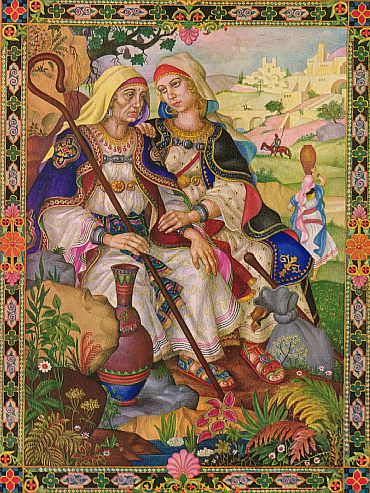
THE VALLEY OF DECISION -
RUTH DECIDES FOR GOD
But Ruth said - A dramatic contrast marking a change in direction in her life from that of a godless, hopeless, pagan Gentile to one grafted into Israel and eventually in the lineage of the Messiah, Who is our Hope (1Ti 1:1+). This was Ruth's valley of decision, her moment of truth! Whenever you observe a "but" (or other words associated with contrast, such as yet, nevertheless, on the other hand, etc) pause and ask what is the author contrasting? (See more discussion of contrasts) There are over 4000 uses of this little conjunction "but" in the Bible and all of them are important. Dr Howard Hendricks adds that…
contrasts are always important in Scripture. They indicate a change of direction… What does the word but force me to do? To go back to the preceding context… The flip side of comparison is contrast—things that are unlike. We could say that in Bible study, as in love, opposites attract. At least, they attract the eye of the observant reader. There are several ways the biblical writers signify contrast. The word but is a clue that a change of direction is coming. (See context in Living By the Book: The Art and Science of Reading the Bible)
Hubbard - The audience senses a decisive, dramatic turning point as attention again shifts to Ruth. One can imagine her loosening her embrace and looking Naomi directly in the eyes. With the ring of poetry, the now familiar words—her very first in the story—soar “on the wings of rhythm.” They still tower as a majestic monument of faithfulness above the biblical landscape. (See context in The Book of Ruth)
Do not urge me to leave you or turn back from following you; for where you go, I will go, and where you lodge, I will lodge. Your people shall be my people, and your God, my God - Hubbard = "Do not pressure me to desert you" NET = "Stop urging me to abandon you and to leave you!" NJB = "Do not press me to leave you and to stop going with you" GWT = "Don't force me to leave you. Don't make me turn back from following you" In effect, Ruth was forsaking all that she had ever known to follow the one true God. She was following in the footsteps of Abraham, who had forsaken his family and his homeland in response to God’s command (Ge 12:1-4+, He 11:8, 9+). In a beautiful irony, the greatest descendant from Ruth (and Boaz's) line, the Messiah, spoke works over 1000 years later that would apply to His "great, great, great..." grandmother, declaring
“Truly I say to you, there is no one who has left house or brothers or sisters or mother or father or children or farms, for My sake and for the gospel’s sake, 30 but that he will receive a hundred times as much now in the present age, houses and brothers and sisters and mothers and children and farms, along with persecutions; and in the age to come, eternal life. 31 “But many who are first will be last, and the last, first.” (Mark 10:29-31+)
O Love that will not let me go,
I rest my weary soul in thee.
I give thee back the life I owe,
that in thine ocean depths its flow
may richer, fuller be.
--George Matheson
We often hear the phrase "count the cost," (What does it mean to “count the cost?”) a phrase for which Ruth could be the "poster child" for she gave up her family (her blood relative), her national identity (Moab), her loyalty to Moabite idols (Chemosh), and to some degree the future prospects of marriage and children! And she relinquished all this without a specific promise of future good (hope)! Amazing faith! As an aside Israel may have been the promised land for Naomi, an Israelite, but not for Ruth the Moabitess. At least not yet! God's gracious providence would soon change everything...forever! Amazing grace! Amazing God! Ruth's "theme song" could have been "Trust and obey for there's no better way to be happy in Yahweh, then to trust and obey." Her trust was evidenced by her journeying into a land to which she had never been!
THOUGHT - Ruth came to faith in Yahweh despite repeated pressure to not come to faith. Naomi was not making an attractive altar call! One wonders how many people would come forward to place their faith in Christ using Naomi's approach? But one also wonders how much more real would be those decisions to follow Christ would be if the Gospel was really understood as Jesus stated in Mark 8:35 stating that "whoever wishes to save his life will lose it, but whoever loses his life for My sake and the gospel’s will save it." Just something to think about in our modern era given the widespread prevalence of "Easy Believism." (See What is easy believism? | GotQuestions.org)
Leon Morris says "Ruth’s determination to be with Naomi is not meant to be short-lived. She will stay with Naomi until death, and die where Naomi dies....Ruth is determined that nothing, not even death, shall separate’ her from Naomi." (See page 242 TOTC Judges & Ruth).
Vance Havner quipped that "a good woman is the best thing on earth. Women were last at the cross and first at the open tomb. The church owes a debt to her faithful women which she can never estimate, to say nothing of the debt we owe in our homes to godly wives and mothers.
Thomas Constable has an interesting note - "Ruth was a descendent of Lot who chose to leave the Promised Land because he thought he could do better for himself elsewhere (Ge 13:11-12)." The irony is that Lot's descendant Ruth returns to the Promised Land Lot left!
Duguid writes that "Each of these statements (BY RUTH) ratchets up the level of her commitment a notch higher. Ruth was not merely relocating her home to go somewhere geographically less pleasant, as if someone were willing to move from sunny Southern California to the unbearable heat of Death Valley. That would be noble self-sacrifice; this is far more. She is committing her life to Naomi, body and soul, for better or for worse, for richer or for poorer, in sickness and in health. (Esther and Ruth Reformed Expository Commentary)
Hubbard adds that Ruth's commitment "recalls an earlier emigrant, Abraham, who also cast his lot with Yahweh (Ge 12:1–5). Indeed, as Trible notes, Ruth’s leap of faith even outdid Abraham’s. She acted with no promise in hand, with no divine blessing pronounced, without spouse, possessions, or supporting retinue. She gave up marriage to a man to devote herself to an old woman—and in a world dominated by men at that!" (See context in The Book of Ruth)
Examples of OT Conversions - Individuals who were converted from an idolatrous Gentile background include such major figures as Abram (Genesis 12), Naaman the leper (2Ki 5:9-19), Rahab (Jos 2:1-17, See especially Scarlet Thread in Jos 2:18-24), Ruth (Ru 1:16-18), and the sailors on board the ship from Joppa to Tarshish (Jonah 1:16). Examples of national or corporate conversion include Judah in the time of Asa (2Chr 14:2-4; 2Chr 15:12-15) and the city of Nineveh (Jonah 3:1-10).
Although not as famous, Scripture records the commitment of another foreigner named Ittai the Gittite a Philistine was in a group of 600 men from Gath who had come to the side of David in Jerusalem. As King David fled Jerusalem, this group of 600 marched by David who then addressed Ittai saying
"Why will you also go with us? Return and remain with the king, for you are a foreigner and also an exile; return to your own place. You came only yesterday, and shall I today make you wander with us, while I go where I will? Return and take back your brothers; mercy and truth be with you." And here although the context is not the same, we see Ittai's loyalty to David for he "answered the king and said, "As the LORD lives, and as my lord the king lives, surely wherever my lord the king may be, whether for death or for life, there also your servant will be." Therefore David said to Ittai, "Go and pass over." So Ittai the Gittite passed over with all his men and all the little ones (their families) who were with him." (2Sa 15:19-22)
Later when David organized and numbered the army at Mahanaim, Ittai was given command of a third part of the force, and seems to have enjoyed equal rank with Joab and Abishai (2Sa 18:2,5,12).
Compare Ruth's famous commitment with Peter's profession - "Lord, why can I not follow You right now? I will lay down my life for You." (Jn 13:37) Peter however momentarily shrank back (Mt 26:75), but did eventually follow through, tradition teaching that he was crucified upside down (cf Lk 22:31,32+).
Ruth did not know if she was going to a cottage or if she would even have a place to lay her head, so total was her sweet surrender. This is reminiscent of Jesus' reply to those who professed a desire to follow Him...
A certain scribe came and said to Him "Teacher, I will follow You wherever You go." And Jesus said to him, "The foxes have holes, and the birds of the air have nests; but the Son of Man has nowhere to lay His head. (Mt 8:19, 20+)
Ruth was willing to follow Naomi wherever it led!
ENTREAT ME NOT TO LEAVE THEE
by Fanny Crosby
Entreat me not to leave thee,
My heart goes with thee now;
Why turn my footsteps homeward?
No friend so dear as thou!
Thy heart has borne my sorrow,
And I have wept for thine;
And now how can I leave thee?
Oh, let thy lot be mine.
Refrain
Entreat me not to leave thee,
Entreat me not to leave thee,
Or to return from following after thee;
For where thou goest I will go,
And where thou lodgest I will lodge;
Thy people shall be my people,
And thy God my God,
Thy people shall be my people,
And thy God my God.I’ll follow where thou leadest;
My love will cling to thee;
And where thy head is pillowed,
My nightly rest shall be;
Thy birthplace and thy kindred
I’ll cherish like my own;
Thy God shall be my refuge,
I’ll worship at His throne.
RefrainWhere death’s cold hand shall find thee,
There let my eyelids close,
And, in the grave beside thee,
This mortal frame repose:
Oh, do not now entreat me;
No friend so dear as thou;
My heart would break in anguish
If I should leave thee now.
Refrain
As Boaz reiterated in the next chapter, Ruth "left (her) father and (her) mother and the land of (her) birth, and came to a people that (she) did not previously know" (Ru 2:11+) and sought refuge under the wings of "the LORD, the God of Israel" (Ru 2:12+) Boaz's declaration implies that Ruth's parents were still alive, making her commitment to the "Chosen People" even more striking. Ruth as a foreigner or “sojourner” was entitled to certain privileges such as the right to glean the harvest fields (Lv 19:10). However, Ruth was not simply a foreigner, but a Moabite and the Law stated that no Moabite could “enter the assembly of the Lord” (Dt 23:3) because of what the Moabites had done to Israel during the wilderness journey (Nu 22-25; Nu 31:15, 16). Moabites were so abhorred that Jews were forbidden even to “seek their peace (or) their prosperity” (Dt. 23:6). Whether she was aware of this is unknown.
Henri Rossi…her thoughts go farther than simple association with Israel; she identifies herself with the people, whatever their state might be, in order to belong to the God of Israel, the true God who does not change: “Thy people shall be my people, and thy God my God.”
RUTH CHOOSES THE LIVING GOD
OVER THE DEAD GODS
Your God, my God - Ruth makes this confession during the days of the judges when the majority of the "chosen people" chose to forsake the living God and cleave to dead idols. And keep in mind she is making this affirmation even after Naomi's bitter indictment of God in Ruth 1:13! These words testify to the fact that Ruth had made a true conversion from idolatry to the living God, from Chemosh to Yahweh. Despite multiple barriers placed before her by Naomi, Ruth makes a complete "leap of faith" regarding God. She was not leaping into the unknown, for it is obvious that she had some knowledge of Jehovah gleaned from her mother-in-law (and probably the dead husbands). And as Jesus said "No one (INCLUDING RUTH) can come to Me unless the Father who sent Me draws him; and I will raise him up on the last day." (John 6:44) So behind the scenes of Ruth's life-changing decision we see the providential hand of God. He drew, she decided. God's sovereignty, man's responsibility. Mystery of mysteries. All praise be to the Most High God. Amen.
ESV Study Bible comments that "Her confession of faith, your people... my God, recalls the central covenant promise: “I will be your God and you shall be My people” (Ge 17:7-8; Ex. 6:7; Dt 29:13; Jer 24:7; Jer 31:33; Hos 2:23; Zech 8:8; 2Co 6:16; Rev. 21:7). (See context in ESV Study Bible or borrow the ESV Study Bible)
Thomas Constable has an interesting note that "The ancients believed that a deity had power only in the locale occupied by its worshippers. Therefore to leave one’s land (Ru 1:15) meant to separate from one’s god."
Ruth's decision to forsake Chemosh for Jehovah would quickly reap rewards as we see when Boaz prayed over her the following words...
“May the LORD reward your work, and your wages be full from the LORD, the God of Israel, under whose wings you have come to seek refuge.” (Ru 2:12+).
Ruth's affirmation is similar to the picture of repentance among the Thessalonians who heard the gospel "For they themselves report about us (Paul, Silvanus, Timothy 1Th 1:1) what kind of a reception we had with you and how you turned to God from idols to serve a living and true God." (1Th 1:9+) And so Ruth's action is similar to the pagans in Thessalonica for she too turned to Yahweh and from the idols of Moab which is a beautiful Old Testament illustration of repentance (discussion)
Ruth's turning away from the gods of her family reminds one of the path blazed by Abraham as Joshua explained to the Israelites in his farewell message declaring “Thus says the LORD, the God of Israel, ‘From ancient times your fathers lived beyond the River, namely, Terah, the father of Abraham and the father of Nahor, and they served other gods." (Josh 24:2+)
It has been well said that faith is not only believing in spite of evidence but obeying in spite of the consequence. Ruth and Esther point the way to that kind of dynamic and exciting faith and all believers do well to emulate their excellent example. True faith is not based on empirical evidence but on divine assurance (He 11:1+) and ''is the gift of God'' (Ep 2:8+)
Alexander Maclaren characterize Ruth's words this way: Put the sweet figure of the Moabitess beside the heroes of the Book of Judges, and we feel the contrast. But is there anything in its pages more truly heroic than her deed, as she turned her back on the blue hills of Moab, and chose the joyless lot of the widowed companion of a widow aged and poor, in a land of strangers, the enemies of her country and its gods? It is easier far to rush on the spears of the foe, amid the whirl and excitement of battle, than to choose with open eyes so dreary a lifelong path. The gentleness of a true woman covers a courage of the patient, silent sort, which, in its meek steadfastness, is nobler than the contempt of personal danger, which is vulgarly called bravery. It is harder to endure than to strike. The supreme type of heroic, as of all, virtue is Jesus Christ, whose gentleness was the velvet glove on the iron hand of an inflexible will. Of that best kind of heroes there are few brighter examples, even in the annals of the Church which numbers its virgin martyrs by the score, than this sweet figure of Ruth, as the eager vow comes from her young lips, which had already tasted sorrow, and were ready to drink its bitterest cup at the call of duty. She may well teach us to rectify our judgments, and to recognise the quiet heroism of many a modest life of uncomplaining suffering. Her example has a special message to women, and exhorts them to see to it that, in the cultivation of the so-called womanly excellence of gentleness, they do not let it run into weakness, nor, on the other hand, aim at strength, to the loss of meekness. The yielding birch tree, the 'lady of the woods,' bends in all its elastic branches and tossing ringlets of foliage to the wind; but it stands upright after storms that level oaks and pines. God's strength is gentle strength, and ours is like His when it is meek and lowly, like that of the 'strong Son of God.'…How many hearts, since Ruth spoke her vow, have found in it the words that fitted their love best! How often they have been repeated by quivering lips, and heard as music by loving ears! How solemn, and even awful, is that perennial freshness of words which came hot and broken by tears, from lips that have long ago mouldered into dust! What has made them thus 'enduring for ever,' is that they express most purely the self-sacrifice which is essential to all noble love. The very inmost longing of love is to give itself away to the object beloved. It is not so much a desire to acquire as to bestow, or, rather, the antithesis of giving and receiving melts into one action which has a twofold motion,--one outwards, to give; one inwards, to receive. To love is to give one's self away, therefore all lesser givings are its food and delight; and, when Ruth threw herself on Naomi's withered breast, and sobbed out her passionate resolve, she was speaking the eternal language of love, and claiming Naomi for her own, in the very act of giving herself to Naomi, Human love should be the parent of all self-sacrificing as of all heroic virtues; and in our homes we do not live in love, as we ought, unless it leads us to the daily exercise of self-suppression and surrender, which is not felt to be loss but the natural expression of our love, which it would be a crime against it, and a pain to ourselves, to withhold. If Ruth's temper lived in our families, they would be true 'houses of God' and 'gates of heaven.' (Click)
THOUGHT - How did Ruth know Naomi's God whom she called "your God"? Clearly Naomi’s relationship with God had had an impact on Ruth. The application is clear -- Can people look at your life, as Ruth looked at Naomi’s, and say "I want your God to be my God!"? Our trust in God, and turning towards Him in tough times (as exemplified by Naomi who still blesses/prays for them in the name of Jehovah - Ru 1:8, 9), will often be the very thing that draws others to the Lord. May God grant that we each might be the kind of people who draw others to ourselves and that, through their friendship with us, they might be drawn to our Savior, the Lord Jesus Christ. Amen (See What is friendship evangelism? | GotQuestions.org)
Spurgeon draws out this application "This was a very brave, outspoken confession of faith. Please to notice that it was made by a woman, a young woman, a poor woman, a widow woman, and a foreigner. Remembering all that, I should think there is no condition of gentleness, or of obscurity, or of poverty, or of sorrow, which should prevent anybody from making an open confession of allegiance to God when faith in the Lord Jesus Christ has been exercised. If that is your experience, then whoever you may be, you will find an opportunity, somewhere or other, of declaring that you are on the Lord’s side." (Ruth 1:16: Deciding for God)
THOUGHT - Looking at these events from a slightly different light, the events suggest that ten years of Naomi’s "compromise" in Moab was not accompanied by Ruth confessing the God of Israel. Yet as soon as Naomi says, "I’m going back to the God of Israel and put my fate in His hands" Ruth stands with her. Do you see an application to your own life? If we think we will persuade our friends or relatives to come to Jesus by our compromise, we are mistaken. We may be very sincere, albeit sincerely mistaken. Only a Spirit emboldened stand for Jesus is what we must exhibit. Spurgeon said "Ah! you will never win any soul to the right by a compromise with the wrong. It is decision for Christ and his truth that has the greatest power in the family, and the greatest power in the world, too."
Do you have unsaved family members? Most of us do.The important lesson is to remember that you should not try to coerce or coax them into the kingdom by a watered down or compromised "Christian" message. Don't make the word of Christ, the word of the Cross void (empty) of its life giving power (1Cor 1:17, 18+).
Maclaren adds that "We hear in Ruth's words also that forsaking of all things which is an essential of all true religion. We have said that it was difficult to separate, in the words, the effects of love to Naomi from those of adoption of Naomi's faith. Apparently Ruth's adhesion to the worship of Jehovah was originally due to her love for her mother-in-law. It is in order to be one with her in all things that she says, 'Thy God shall be my God.' And it was because Jehovah was Naomi's God that Ruth chose Him for hers. But whatever the origin of her faith, it was genuine and robust enough to bear the strain of casting Chemosh and the gods of Moab behind her, and setting herself with full purpose of heart to seek the Lord. Abandoning them was digging an impassable gulf between herself and all her past, with its friendships, loves, and habits. She is one of the first, and not the least noble, of the long series of those who 'suffer the loss of all things, and count them but dung, that they may win' God for their dearest treasure. We have seen how, in her, human love wrought self-sacrifice. But it was not human love alone that did it. The cord that drew her was twisted of two strands, and her love to Naomi melted into her love of Naomi's God. Blessed they who are drawn to the knowledge and love of the fountain of all love in heaven by the sweetness of the characters of His representatives in their homes, and who feel that they have learned to know God by seeing Him in dear ones, whose tenderness has revealed His, and whose gracious words have spoken of His grace! If Ruth teaches us that we must give up all, in order truly to follow the Lord, the way by which she came to her religion may teach us how great are the possibilities, and consequently the duties, of Christians to the members of their own families. If we had more elder women like Naomi, we should have more younger women like Ruth. (Bolding added) (Click)
QUESTION - What is the significance of Ruth telling Naomi, “Wherever you go, I will go” (Ruth 1:16)?
ANSWER - Ruth made a radical break with everything she had ever known in life when she told her mother-in-law, Naomi, “Wherever you go, I will go; wherever you live, I will live. Your people will be my people, and your God will be my God” (Ruth 1:16NLT). From this point forward, the young widow’s life would never be the same.
Ruth’s story portrays sacrificial love and redemption despite overwhelming odds. Ruth, a Moabite woman, married into a Jewish family but soon became a destitute widow, along with her mother-in-law, Naomi. After the death of her husband and two sons, the Israelite Naomi decided to return to Bethlehem in her homeland. She had heard that “the Lord had come to the aid of his people by providing food” (Ruth 1:16).
Before leaving Moab, Naomi urged her two daughters-in-law to return to their families, but Ruth refused to leave Naomi’s side, saying, “Wherever you go, I will go.” Together, they traveled to Bethlehem, where Ruth gleaned in the barley fields to put food on their table. Ruth then married Boaz, a relative (and “kinsman-redeemer”) of Naomi’s husband. The couple gave Naomi a grandchild, rescued her from poverty, and restored her joy.
Redemption is the central theme of Ruth’s story. The young widow’s unwavering commitment to follow Naomi provides a beautiful depiction of Christian conversion. With her words, “Wherever you go, I will go,” Ruth made a definitive separation from her past way of life. Becoming a follower of Jesus Christ likewise involves a pivotal decision and breaking away from the past.
By leaving her homeland and going with Naomi, Ruth renounced her citizenship in Moab. With the words, “Wherever you go, I will go; wherever you live, I will live,” Ruth separated herself from her country of origin. She abandoned one kingdom to be joined to another. Similarly, when we choose to follow Christ, we are brought into His kingdom. Jesus Christ died to rescue believers from the kingdom of darkness and transfer them into His kingdom of light (Matthew 5:3; 13:43; Colossians 1:13; James 2:5; 2 Timothy 4:18; 1 Thessalonians 2:12).
As new creations in Christ, we are separated from the dominion of sin through the death of Christ on the cross. We become a wholly “new person. The old life is gone; a new life has begun!” (2 Corinthians 5:17NLT).
Ruth renounced her people and claimed Naomi’s people—the people of God—as her own. Living as a pagan in Moab, Ruth would have worshipped many gods. But by the young woman’s confession, the older woman’s God—the God of Israel—became Ruth’s God. Now Ruth worshipped the One True God. The apostle Peter asserts that Christians are “a chosen people . . . royal priests, a holy nation, God’s very own possession.” Believers “show others the goodness of God” who calls us “out of the darkness into his wonderful light.” Before salvation, we “had no identity as a people.” But now we “are God’s people” (1 Peter 2:9–10NLT).
Ruth identified herself completely and totally with Naomi. Scripture says, “Ruth clung to her” (Ruth 1:14). The verb translated “clung to” is the same term used in Genesis 2:24 to define the “cleaving, uniting, or holding fast” of a man and woman in marriage. Ruth’s identity was now fully involved in Naomi’s. She had made a radical and absolute dedication to Naomi, her people, and her God. Ruth had surrendered every aspect of her life into Naomi’s hands.
Ruth’s statement to Naomi, “Wherever you go, I will go,” is analogous to a new believer saying, “I have decided to follow Jesus. Wherever you go, Lord, I will go.”
To become a Christian means to be united with Jesus Christ (1 Corinthians 3:23). By grace through faith, we cling to Him (Ephesians 2:8; 1 John 2:28). We leave our old citizenship and identity behind and become new creations in Jesus Christ (Colossians 3:10; Ephesians 4:24). We say goodbye to the darkness of sin and live in the light of His kingdom (Ephesians 5:8–14). The Sovereign Lord becomes our God, and His people become our people (Ephesians 2:19–22). We give up our old way of living for ourselves; we take up our cross and follow Him (Mark 8:34).GotQuestions.org
Committed To Serve
Wherever you go, I will go; … your people shall be my people, and your God, my God. —Ruth 1:16
The best-known words of Ruth are most often heard at weddings, even though they were spoken by a grieving young widow to her mother-in-law, Naomi. Ruth said, "Wherever you go, I will go; and wherever you lodge, I will lodge; your people shall be my people, and your God, my God" (see note Ruth 1:16).
Ruth had no legal or cultural responsibility to Naomi, who also was a widow and had no means of support. No one would have blamed Ruth for staying with her own people in Moab where the chances of remarriage were greater.
Naomi even urged Ruth to stay, but Ruth was determined to go with her to Judah, and to follow her God. Ruth's unselfish devotion was considered worthy of praise. Boaz, Ruth's future husband, told her, "It has been fully reported to me, all that you have done for your mother-in-law since the death of your husband … The Lord repay your work" (Ru 2:11, 12+).
Promises spoken at a wedding are full of hope and meaning, but Ruth's words have survived the centuries because of her unwavering commitment to God and a person in need. She points us to the value of loving sacrifice for the Lord, and to His rich blessing on all who give themselves unselfishly to others. —David C. McCasland (Our Daily Bread, Copyright RBC Ministries, Grand Rapids, MI. — Reprinted by permission. All rights reserved)
Searching to know life's true meaning?
You'll find it in only one way:
Serving the Lord with commitment
And living for others each day.
—Branon
A life filled with love for the Lord
and for others is a fulfilling life.
Choices (Ruth 1:11-18) - A friend once told me: "Joe, I’ve come to realize that my life is not made by the dreams that I dream but by the choices that I make." Count on it: You will have plenty of choices in life. And usually they boil down to a choice between "What do I want?" and "What’s best for others?" After their husbands died, Ruth and Orpah were faced with a strategic choice (Ru 1:11+). Their mother-in-law Naomi told them they should go home. She didn’t want them to feel any obligation to her, in spite of the fact that her loss was far greater. She had lost her own husband and both of her sons. Orpah and Ruth could either go home and start a new life, or stay with Naomi to help her in a time of great need. They knew very well that the latter choice would probably mean living in a foreign land as widows for the rest of their lives, since few Jewish men would want to marry a foreign woman.
Ruth chose to serve the needs of Naomi rather than to serve herself. Orpah chose to leave Naomi for what she thought would be a better life. Ruth went on to play a significant role in Jewish history and became an ancestor of Jesus (Mt 1:5).
Make the best choice. Choose to serve others. —Joe Stowell (Our Daily Bread, Copyright RBC Ministries, Grand Rapids, MI. — Reprinted by permission. All rights reserved)
When we’re involved in serving
And meeting others’ needs,
We’re imitating Jesus
In thoughts and words and deeds. —Fitzhugh
Serve God by serving others.
Thy people shall be my people, and thy God my God.
The Book of Ruth stands in striking contrast to the Book of Judges, and especially to the last five chapters thereof. The story which it tells illustrates the truth that God has never left Himself without witness. It is an idyll of faith-fulness amid infidelity. It has, moreover, the value of being a link in the chain of history, showing how God moved forward to the central things of His redeeming purpose through faithful souls. The choice of Ruth, here recorded, in its devotion and in the very manner in which she expressed it, has become enshrined in the heart of humanity. With constant recurrence her language has been employed to express the fidelity of love. The younger woman found her heart closely knit to the older one, and she declined to be severed from her in the pathway that lay before her, choosing to share whatever the future might have in store for the one upon whom her love was set. While all this is true, it does not touch the deepest note. It is patent that Ruth's love for Naomi was created by the new faith which she had learned from her.
The deepest note in her expression of devotion was: "Thy God, my God." It is a beautiful illustration of how a quiet, strong fidelity to God produces faith in Him on the part of others. Happy indeed are we, if our life is such as to compel some soul to say, "Thy God shall be my God."
This is what Naomi had done for Ruth. This result is never obtained by the witness of the lips, save as that is vindicated and reinforced by the witness of life. (Borrow Life applications from every chapter of the Bible)
Ruth 1:17 "Where you die, I will die, and there I will be buried. Thus may the LORD do to me, and worse, if anything but death parts you and me." (NASB: Lockman)
Septuagint (LXX): kai ou ean apothanes (2SAAS) apothanoumai (1SFMI) kakei taphesomai (1SFMI) tade poiesai moi kurios kai tade prostheie (3SAAO) hoti thanatos diastelei (3SFAI) ana meson emou kai sou
BGT καὶ οὗ ἐὰν ἀποθάνῃς ἀποθανοῦμαι κἀκεῖ ταφήσομαι τάδε ποιήσαι μοι κύριος καὶ τάδε προσθείη ὅτι θάνατος διαστελεῖ ἀνὰ μέσον ἐμοῦ καὶ σοῦ
English of Septuagint: And wherever thou die, I will die, and there will I be buried: the Lord do so to me, and more also, if I leave thee, for death only shall divide between me and thee
Hubbard Where you die, I will die, and there I will be buried. Thus may Yahweh do to me and more so if even death itself separates me from you.”
ICB: And where you die, I will die. And there I will be buried. I ask the Lord to punish me terribly if I do not keep this promise: Only death will separate us.
KJV Where thou diest, will I die, and there will I be buried: the LORD do so to me, and more also, if ought but death part thee and me.
NET Wherever you die, I will die– and there I will be buried. May the LORD punish me severely if I do not keep my promise! Only death will be able to separate me from you!"
BBE Wherever death comes to you, death will come to me, and there will be my last resting-place; the Lord do so to me and more if we are parted by anything but death.
CSB Where you die, I will die, and there I will be buried. May Yahweh punish me, and do so severely, if anything but death separates you and me.
ERV where thou diest, will I die, and there will I be buried: the LORD do so to me, and more also, if aught but death part thee and me.
ESV Where you die I will die, and there will I be buried. May the LORD do so to me and more also if anything but death parts me from you."
GWN Wherever you die, I will die, and I will be buried there with you. May the LORD strike me down if anything but death separates you and me!"
NKJ Where you die, I will die, And there will I be buried. The LORD do so to me, and more also, If anything but death parts you and me."
NAB Wherever you die I will die, and there be buried. May the LORD do so and so to me, and more besides, if aught but death separates me from you!"
NIV Where you die I will die, and there I will be buried. May the LORD deal with me, be it ever so severely, if anything but death separates you and me."
NJB Where you die, I shall die and there I shall be buried. Let Yahweh bring unnameable ills on me and worse ills, too, if anything but death should part me from you!'
NLT Wherever you die, I will die, and there I will be buried. May the LORD punish me severely if I allow anything but death to separate us!"
NRS Where you die, I will die-- there will I be buried. May the LORD do thus and so to me, and more as well, if even death parts me from you!"
YLT Where thou diest I die, and there I am buried; thus doth Jehovah to me, and thus doth He add -- for death itself doth part between me and thee.'
- Thus may the LORD: 1Sa 3:17 25:22 2Sa 3:9,35 19:13 1Ki 2:23 19:2 20:10 2Ki 6:31
- but death: Ac 11:23 20:24
- Ruth 1 Resources - Multiple Sermons and Commentaries
RUTH BINDS HERSELF
WITH A SOLEMN OATH
Where you die, I will die, and there I will be buried - The certainty of Ruth's decision is underscored by her references to death and burial. Ruth is identifying totally with Naomi, which is a perfect picture of covenant wherein two become one and co-mingle their lives. But remember that commitment comes with a cost.
The place of a person’s grave...identified the area he or she considered his or her true home.
-- Thomas Constable
Thomas Constable - "The place of a person’s grave in ancient Near Eastern life was very significant (cf. Ge. 23; 25:9–10; 50:1–14, 24–25; Josh. 24:32). It identified the area he or she considered his or her true home. So when Ruth said she wanted to die and be buried where Naomi was (v. 17) she was voicing her strong commitment to the people, land, and God of Naomi.
Jason Driesbach adds - The importance of burial in one’s homeland may be observed, for example, in the requests of Jacob and Joseph to be buried in Canaan (Gen 49:29; 50:25). The implication of Ruth’s intent to be buried in Israel was a change of homeland and an intent to change her national identity if possible. She would be forever aligned with the family of Naomi and Elimelech. (Joshua, Judges, Ruth - Cornerstone Biblical Commentary)
Duguid writes "Given the intimate connection between land and deity in the ancient Near East, and the importance of proper burial for a restful afterlife, this was the ultimate commitment in the ancient world." (Esther and Ruth Reformed Expository Commentary)
Thus may the LORD do to me, and worse, if anything but death parts you and me. - NET = “thus the Lord will do to me and thus he will add—certainly death will separate me and you.” ICB = "I ask the Lord to punish me terribly if I do not keep this promise: Only death will separate us." Ruth "seals the deal" with a solemn imprecatory oath! Notice that Ruth is swearing this oath not in the name of Chemosh but in the Name of Yahweh (her first mention of God), clearly identifying herself with Him! Ruth invoked this covenant name of God, Jehovah, for the first and only time in this self-imprecation. Her commitment of no separation even by death may refer to the Israelite custom of burying members of the same family in a family tomb.Compare her oath to similar oath formula invoking the Name of Yahweh or God - 1Sa 3:17; 25:22; 2Sa 3:9, 35 2Sa 19:13; 1Ki 2:23; 20:10; 2Ki 6:31). So may the gods do to me and even more, if I do not make your life as the life of one of them by tomorrow about this time.” What a contrast is the oath of Ruth and the evil Jezebel who said "So may the gods do to me and even more, if I do not make your life as the life of one of them by tomorrow about this time.” (1Ki 19:2) Ruth in a sense pronounces a curse upon herself, elevating the preceding promise to a formal, unconditional level. If she is not faithful to her promise, she agrees to become an object of divine judgment (cf Paul in Acts 20:24+).
Ruth is a good Old Testament illustration of total surrender similar to that seen with the Apostle Paul who said "I count all things to be loss in view of the surpassing value of knowing Christ Jesus my Lord, for whom I have suffered the loss of all things, and count them but rubbish in order that I may gain Christ (Php 3:7; 3:8+)
THOUGHT - One lesson from this section is that the people of God are spiritually defined. Ruth is a daughter of Moab, an "unnatural branch" (Ro 11:20, 21+, Ro 11:22-24+) and yet becomes an "heir of the righteousness which is according to faith." (He 11:7+, cp Ga 3:7, 29+, Ro 4:11+, Ro 8:17+) Paul emphasized that "he is not a Jew who is one outwardly; neither is circumcision that which is outward in the flesh. But he is a Jew who is one inwardly; and circumcision is that which is of the heart, by the Spirit, not by the letter; and his praise is not from men, but from God. (Ro 2:28, 29+)
Driving Miss Daisy - One of the most delightful and endearing stories in the last decade is Driving Miss Daisy. It’s the story of a friendship that develops over a twenty-to thirty-year period between a man and a woman. What makes the story so touching is that this is a totally improbable relationship! Hoke Colburn is a chauffeur; Daisy Werthan is a woman who does not want a chauffeur. He is black; she is white. He is poor; she is wealthy. He is a Christian; she is Jewish. He is illiterate; she is educated and well-read. He is warm and friendly; she is cold and crotchety. He is “the hired help”; she is “the boss.” And yet by the end of the story, Miss Daisy says, “Hoke, you’re my best friend.”
We may be tempted to dismiss such an unlikely friendship as mere fantasy; yet the Scriptures show us that such relationships are possible. Consider the Old Testament book of Ruth. Despite cultural, religious and generational differences, despite economic hardship, tragedy, and the age-old “in-law” factor, these two women--Ruth and Naomi--developed a close relationship marked by genuine concern. A number of factors contribute to their closeness.
First, they spent a lot of time together (Ru 1:4+). Good relationships always take time to develop.
Second, their relationship was marked by a vital spirituality (Ru 1:6, 8-9, 13, 16-17, 20-21+; Ru 2:20+). It is even possible that Naomi led Ruth to faith in Yahweh! (Today in the Word)
Ruth 1:18 When she saw that she was determined to go with her, she said no more to her. (NASB: Lockman)
Septuagint (LXX): idousa (AAPFSN) de Noemin hoti krataioutai (3SPPI) aute tou poreuesthai met' autes ekopasen (3SAAI) tou lalesai (AAN) pros auten eti
BGT ἰδοῦσα δὲ Νωεμιν ὅτι κραταιοῦται αὐτὴ τοῦ πορεύεσθαι μετ᾽ αὐτῆς ἐκόπασεν τοῦ λαλῆσαι πρὸς αὐτὴν ἔτι
English of Septuagint: And Noemin seeing that she was determined to go with her, ceased to speak to her any more
Hubbard When Naomi saw that she was firmly determined to go on with her, she said nothing more to her.
KJV When she saw that she was stedfastly minded to go with her, then she left speaking unto her.
NET When Naomi realized that Ruth was determined to go with her, she stopped trying to dissuade her.
BBE And when she saw that Ruth was strong in her purpose to go with her she said no more.
CSB When Naomi saw that Ruth was determined to go with her, she stopped trying to persuade her.
ERV And when she saw that she was stedfastly minded to go with her, she left speaking unto her.
ESV And when Naomi saw that she was determined to go with her, she said no more.
GWN When Naomi saw that Ruth was determined to go with her, she ended the conversation.
NKJ When she saw that she was determined to go with her, she stopped speaking to her.
NAB Naomi then ceased to urge her, for she saw she was determined to go with her.
NIV When Naomi realized that Ruth was determined to go with her, she stopped urging her.
NJB Seeing that Ruth was determined to go with her, Naomi said no more.
NLT When Naomi saw that Ruth was determined to go with her, she said nothing more.
NRS When Naomi saw that she was determined to go with her, she said no more to her.
YLT And she seeth that she is strengthening herself to go with her, and she ceaseth to speak unto her;
- When - Acts 21:14
- Determined - Ac 2:42 Eph 6:10
- Ruth 1 Resources - Multiple Sermons and Commentaries
RUTH'S DETERMINATION
NAOMI'S ACQUIESCENCE
When she saw that she was determined to go with her - The Hebrew verb for determined is more literally "she was strengthening herself" and so to stiffen one's self firmly upon a thing which pictures Ruth as strong in her resolve and steadfast in her determination not to go back to her own country, but to go forward with Naomi to the degree that nothing could move her from her firm purpose of mind.
Paul when he had counted "all things as loss in view of the surpassing value of knowing Christ Jesus" (Php 3:8+8), determined "one thing I do: forgetting what lies behind and reaching forward to what lies ahead, I press on toward the goal for the prize of the upward call of God in Christ Jesus. (Php 3:13-14+)
She said no more to her. - GWT = "she ended the conversation." NIV = "she stopped urging her" The Hebrew means “she ceased speaking to her” not implying that Naomi was completely silent but that she stopped trying to convince her to go back to Moab. And so the curtain falls on this dramatic scene, giving the reader a chance to catch his or her breath before the next scene, several days later.
TRUSTING GOD'S GOODNESS -
Oh, that men would give thanks to the Lord for His goodness --Psalm 107:8+
One of the most beautiful confessions of love in all of literature is the one Ruth made to Naomi. In vowing to return to Israel with her, Ruth pledged, "Wherever you go, I will go; and wherever you lodge, I will lodge; your people shall be my people, and your God, my God. Where you die, I will die, and there will I be buried"
But suppose Naomi had said to herself, "Ruth's just a gold digger. What she really wants is to get into Israel to marry a wealthy Hebrew. I'm just her passport in."
If Naomi had doubted Ruth's good intentions and rejected her kindness, she would have lost out on blessings she never could have imagined.
But that's exactly what we do when we fail to trust God's goodness. We stop believing He will do what is best for us. And as the saying goes, once the well is poisoned, all the water is contaminated.
James 1:16, 17+ states, "Do not be deceived … Every perfect gift is from above, and comes down from the Father." Once we doubt God's goodness, some of His best gifts--like trials that help us to mature--will seem like bad ones.
Don't doubt God's goodness and poison the wellspring of blessing He has for you. --H W Robinson (Our Daily Bread, Copyright RBC Ministries, Grand Rapids, MI. Reprinted by permission. All rights reserved)
Drink deep of God's goodness, His faithfulness too,
Leave no room for doubting and fear;
His Word is the Water of Life pure and true,
Refreshing and cooling and clear.
-Hess
We poison the well
when we don't think well of God's goodness.
Johnstown Flood - See picture of the aftermath

Your people shall be my people, and your God, my God. —Ruth 1:16
On May 31, 1889, a massive rainstorm filled Lake Conemaugh in Pennsylvania until its dam finally gave way. A wall of water 40 feet high traveling at 40 mph rushed down the valley toward the town of Johnstown. The torrent picked up buildings, animals, and human beings and sent them crashing down the spillway. When the lake had emptied itself, debris covered 30 acres, and 2,209 people were dead. At first, stunned by the loss of property and loved ones, survivors felt hopeless. But later, community leaders gave speeches about how local industry and homes could be rebuilt. This acted like a healing balm, and the survivors energetically got to work. Johnstown was rebuilt and today is a thriving town with a population of approximately 28,000. (Watch full documentary)
The Bible tells us that when Naomi despaired over the loss of her husband and sons, her daughter-in-law Ruth refused to leave her. Instead, Ruth focused on God, her relationships, and the future. God rewarded her faith by providing for them and making Ruth an ancestor of Jesus Christ (Mt. 1:5-16).
After a tragic loss, we should look at the resources and relationships that remain and trust God to use them. This can inspire the hope of rebuilding a new life. — Dennis Fisher (Our Daily Bread, Copyright RBC Ministries, Grand Rapids, MI. Reprinted by permission. All rights reserved)
Beyond the losses of this life
That cause us to despair
New hope is born within our heart
Because our God is there.
—D. De Haan
No one is hopeless whose hope is in God.
Spurgeon applies these truths - "O you dear young friends who want to be Christians, how glad we are when we see that you are steadfastly minded to go with the people of God! There are so many who are quickly hot and quickly cold,—soon excited towards good things, and almost as speedily their ardor cools, and they go back into the world. Do ask the Lord to make you steadfastly minded. This is one of the best frames of mind for any of us to be in."
T. Fuller suggests an application regarding Naomi's actions - "After proof and trial made of their fidelity we are to trust our brethren, without any further suspicion. Not to try before we trust is want of wisdom; not to trust after we have tried is want of charity. The goldsmith must purify the dross and ore from the gold, but he must be wary lest he makes waste of good metal if over-curious in too often refining. We may search and sound the sincerity of our brethren, but after good experience made of their uprightness we must take heed lest by continual sifting and proving them we offend a weak Christian." (Trusting and Testing)